EP4173326B1 - Verfahren und vorrichtung zur auswahl eines weitbereichsnetzwerks mit niedriger leistung - Google Patents
Verfahren und vorrichtung zur auswahl eines weitbereichsnetzwerks mit niedriger leistung Download PDFInfo
- Publication number
- EP4173326B1 EP4173326B1 EP21748904.6A EP21748904A EP4173326B1 EP 4173326 B1 EP4173326 B1 EP 4173326B1 EP 21748904 A EP21748904 A EP 21748904A EP 4173326 B1 EP4173326 B1 EP 4173326B1
- Authority
- EP
- European Patent Office
- Prior art keywords
- profile
- prof
- network
- profiles
- selection method
- Prior art date
- Legal status (The legal status is an assumption and is not a legal conclusion. Google has not performed a legal analysis and makes no representation as to the accuracy of the status listed.)
- Active
Links
Images


Classifications
-
- H—ELECTRICITY
- H04—ELECTRIC COMMUNICATION TECHNIQUE
- H04W—WIRELESS COMMUNICATION NETWORKS
- H04W48/00—Access restriction; Network selection; Access point selection
- H04W48/18—Selecting a network or a communication service
-
- H—ELECTRICITY
- H04—ELECTRIC COMMUNICATION TECHNIQUE
- H04W—WIRELESS COMMUNICATION NETWORKS
- H04W8/00—Network data management
- H04W8/18—Processing of user or subscriber data, e.g. subscribed services, user preferences or user profiles; Transfer of user or subscriber data
-
- H—ELECTRICITY
- H04—ELECTRIC COMMUNICATION TECHNIQUE
- H04W—WIRELESS COMMUNICATION NETWORKS
- H04W12/00—Security arrangements; Authentication; Protecting privacy or anonymity
- H04W12/03—Protecting confidentiality, e.g. by encryption
-
- H—ELECTRICITY
- H04—ELECTRIC COMMUNICATION TECHNIQUE
- H04W—WIRELESS COMMUNICATION NETWORKS
- H04W12/00—Security arrangements; Authentication; Protecting privacy or anonymity
- H04W12/06—Authentication
- H04W12/069—Authentication using certificates or pre-shared keys
-
- H—ELECTRICITY
- H04—ELECTRIC COMMUNICATION TECHNIQUE
- H04W—WIRELESS COMMUNICATION NETWORKS
- H04W88/00—Devices specially adapted for wireless communication networks, e.g. terminals, base stations or access point devices
- H04W88/02—Terminal devices
-
- Y—GENERAL TAGGING OF NEW TECHNOLOGICAL DEVELOPMENTS; GENERAL TAGGING OF CROSS-SECTIONAL TECHNOLOGIES SPANNING OVER SEVERAL SECTIONS OF THE IPC; TECHNICAL SUBJECTS COVERED BY FORMER USPC CROSS-REFERENCE ART COLLECTIONS [XRACs] AND DIGESTS
- Y02—TECHNOLOGIES OR APPLICATIONS FOR MITIGATION OR ADAPTATION AGAINST CLIMATE CHANGE
- Y02D—CLIMATE CHANGE MITIGATION TECHNOLOGIES IN INFORMATION AND COMMUNICATION TECHNOLOGIES [ICT], I.E. INFORMATION AND COMMUNICATION TECHNOLOGIES AIMING AT THE REDUCTION OF THEIR OWN ENERGY USE
- Y02D30/00—Reducing energy consumption in communication networks
- Y02D30/70—Reducing energy consumption in communication networks in wireless communication networks
Definitions
- the invention relates to the general field of telecommunications, and more particularly to that of the selection of a low-consumption wide area network by a device.
- low-power wide-area networks are networks operating according to the LoRaWan protocol (for “Long Range Wide-area network”).
- the document WO 2018/183789 A1 describes an LPWAN network that can use multiple network servers, and distribute IoT devices (e.g., LoRa end nodes) across network servers in a way that balances loads across those network servers.
- IoT devices e.g., LoRa end nodes
- the document US 2015/119103 A1 relates to methods, systems and devices for prioritizing communication technologies to allocate resources in a mobile device that uses a dual-subscription configuration that may be associated with simultaneously active communications.
- FIG. 1 illustrates four connected objects OC 1 to OC 4 , two gateways GW 1 , GW 2 , a network server NS and an application server AS in a network operating according to the LoRaWan protocol (or LoRaWan network) in accordance with the state of the art.
- LoRaWan protocol or LoRaWan network
- Connected objects OC 1 to OC 4 are, for example, low-consumption wireless devices. They communicate with the GW 1 , GW 2 gateways in the free ISM frequency band using LoRa modulation (registered trademark) developed by the company Semtech Corporation (registered trademark).
- LoRa modulation registered trademark
- Semtech Corporation registered trademark
- the gateways GW 1 , GW 2 are not specifically addressed by the connected objects OC 1 to OC 4 : all the gateways present in the coverage area receive the messages and process them. They therefore play the role of gateway between a LoRa modulation and an IP communication.
- NwkSKey OCi 128-bit AES key (in English "Advanced Encryption Standard") called Network Session Key: NwkSKey OCi .
- NwkSKey OCi key is used for authentication between an OC i connected object and an NS network server. More precisely, and in a known manner, in order to perform this authentication between the OC i connected object and the NS network server, a MIC field (for "Message Integrity Control”) is added to the frame. It is calculated based on the data transmitted and the NwkSKey OCi key.
- the same calculation is performed by the NS network server. If the NwkSKey OCi keys are identical in the connected object OC i and in the NS network server then the two calculated MIC values must match.
- the NS network server handles other security functions. It also eliminates duplicate packets, when several gateways have received the same message from a connected object.
- the AS application server analyzes the data received from the connected objects OC i .
- the AS application server can analyze and process the temperature measurements received from these connected objects via the LoRaWAN network.
- the AS application server stores the ID OCi identifiers of the connected objects under its management.
- the messages transmitted to the AS application server by the connected objects OC i are encrypted using a 128-bit AES key called Application Session Key: AppSKey OCi .
- FIG 2 represents a connected object OC i conforming to the current state of the art.
- it stores a profile, or more generally a data structure, PROF i comprising its unique identifier ID OCi , its authentication key NwkSKey OCi with the network server NS and its encryption key AppSKey OCi .
- PROF i comprising its unique identifier ID OCi , its authentication key NwkSKey OCi with the network server NS and its encryption key AppSKey OCi .
- It also includes a business application AM which uses this information to send data to the application server AS via the network corresponding to the authentication key NwkSKey OCi .
- LoRaWAN networks are now widespread and hundreds of millions of objects around the world are connected via different LoRaWAN networks, of which more than a hundred are managed by operators and many more by private managers, especially in countries where the coverage offered by operators is insufficient.
- the invention aims at a solution to this problem. It applies in particular to low-power wide area networks, known in English terminology as LPWA (for "Low Power Wide Area”) type networks, not having native roaming functionalities. Thus, it applies in particular to LoRaWAN networks but more generally to any low-power wide area network.
- LPWA Low Power Wide Area
- Pre-declaring the device to a low-power WAN essentially consists of communicating the necessary elements to this network, so that the device can connect to the network using its profile.
- each of said profiles comprises at least one piece of data enabling the device to connect to the network corresponding to this profile and the device connects to this network using this piece of data.
- the invention is implemented in LoraWAN networks.
- the invention can more generally be implemented in any low power wide area network (LPWAN).
- LPWAN low power wide area network
- the invention finds a particular but non-limiting application in the context of the Internet of Things (IoT).
- IoT Internet of Things
- the device is integrated into a connected object, for example a measuring device, a watch, etc.
- the selection method can be implemented by a connected object.
- the method can be implemented in or by a terminal type device (“end-device” in English terminology) within the meaning of the LoRaWan protocol.
- the selection method according to the invention can be implemented exclusively by the devices connecting to the low-power wide area network, in other words by the connected objects, without any impact on the other equipment of the network, in particular, in the case of a LoRaWAN network, on the network server within the meaning of the figure 1 .
- the selection method according to the invention can be described as autonomous.
- the invention thus provides a mechanism allowing a connected object to select a network, without impacting the network. It thus offers a solution to the problem of interconnecting networks, whether they are managed by public operators or by private managers. It does not require a roaming agreement between network operators.
- the invention can be used in a static model in which the device is not necessarily likely to move, but likely to be connected to different low-power wide area networks.
- the invention finds an application in which the device can be used in different countries, the profile table comprising a profile for each of these countries.
- the device selects the profiles in the table randomly or cyclically. Taking the example in which the device can be used in different country, the device can select profiles from the table one after the other until the profile corresponding to the country of use is selected.
- the device is considered to lose the ability to communicate with the network if it leaves the area covered by the network or if it ceases to be authenticated or authorized to communicate with the network.
- the selection method according to the invention can be described as "dynamic" since it advantageously allows the device to connect to a new network in response to the detection of a loss of capacity to communicate with the network to which the device is connected at a given time.
- the invention thus finds an application in mobility and makes it possible to guarantee continuity of service when the device leaves the coverage of a first network and enters the coverage of a second network.
- the device according to the invention can therefore be mobile, for example carried by a mobile connected object or by a person.
- the table is a table of prioritized profiles, the profiles being associated with respective priorities stored in the table and the selection of a profile being carried out according to its priority.
- the invention thus makes it possible to favor the first network selected according to different criteria or to dynamically switch a connection established on a first network to a second network more relevant in the sense of these criteria.
- the criteria for selecting a network can be of any nature.
- the selection method comprises a step of modifying at least one of the priorities.
- the system can thus favor or, on the contrary, disfavor certain networks dynamically, for example depending on the reliability of these networks.
- said table can be updated to add a profile to the table and/or delete a profile from the table and/or modify the priority of at least one of the profiles in the table.
- the profile table of a device may not contain any profile or only one profile.
- the first profile can for example be loaded by a terminal incorporating the device by any means, for example via a USB cable, by reading an RFID tag ...
- the other profiles can be downloaded into the table by the same means or by an OTA mechanism (in English Over The Air).
- This embodiment in particular allows the device to connect or switch to a new network as soon as a profile associated with this network is downloaded into the profile table.
- the data included in the profile and allowing the device to connect to a low-power wide area network is an authentication key allowing the device to authenticate itself with a server on this network.
- the profiles further comprise an encryption key associated with an application server.
- the selection method according to the invention is a purely software solution. It can be implemented by a computer program. Consequently, the invention also relates to a computer program on a recording medium, this program being capable of being implemented in a device or more generally in a computer. This program comprises instructions allowing the implementation of a method as described above.
- This program may use any programming language, and may be in the form of source code, object code, or code intermediate between source code and object code, such as in a partially compiled form, or in any other desirable form.
- the invention also relates to an information medium or a recording medium readable by a computer, and comprising instructions of a computer program as mentioned above.
- the information or recording medium may be any entity or device capable of storing programs.
- the media may include a storage medium, such as a ROM, for example a CD ROM or a microelectronic circuit ROM, or a magnetic recording medium, for example a floppy disk or a hard disk, or a flash memory.
- the information or recording medium may be a transmissible medium such as an electrical or optical signal, which may be conveyed via an electrical or optical cable, by radio link, by wireless optical link or by other means.
- the program according to the invention can in particular be downloaded from an Internet-type network.
- the information or recording medium may be an integrated circuit in which a program is incorporated, the circuit being adapted to execute or to be used in the execution of one of the methods as described above.
- FIG. 3 represents an example of an environment in which the invention can be implemented.
- n low-power wide area networks for example of the LoRaWAN type N 1 to N n .
- Each network N j comprises one or more gateways GW and a network server NS j .
- An application server AS is connected to the networks N 1 to N n by a wide area network, for example the Internet network.
- the selection method can be implemented by a terminal type device (end-device in English terminology) within the meaning of the LoRaWan protocol, i.e. operating according to the LoRaWan protocol.
- the device connects to the network Nj by connecting to a network server NS within the meaning of the LoRaWan standard.
- wireless communication networks distinguishes between networks in connected mode and networks in non-connected mode. Some low-power wide area networks operate in non-connected mode.
- Connected mode networks are networks in which there is a permanently established communication channel between the network and the terminal devices. communicating on these networks.
- GSM Global System for Mobile communications
- Wi-Fi registered trademark
- Bluetooth registered trademark
- connected mode more specifically aims at "establishing a communication session between two parties who want to exchange data, this session comprising a start, an end and a validation (error checking), typically an identifier and a password. It corresponds to layer no. 5 called “session" of the OSI model, between the "presentation" and "transport”layers”.
- FIG 4 represents the hardware architecture of a device 100 according to the invention.
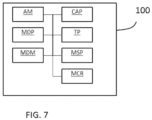
- this device 100 has the hardware architecture of a computer. It comprises in particular a processor 10, a RAM type random access memory 11, a ROM type read-only memory 12, a rewritable non-volatile Flash type memory 14 and communication means 13.
- the read-only memory 12 constitutes a medium in accordance with a particular embodiment of the invention.
- This memory comprises a computer program PGSD in accordance with a particular embodiment of the invention, which when executed by the processor 10, implements a selection method in accordance with the invention and described later with reference to the figure 6 .
- the memory 14 of the device 100 comprises a table TP of prioritized profiles.
- the TP table comprises three profiles PROF 100 , N1 , PROF 100 , N2 and PROF 100 , Nj of respective priorities p 1 , p 2 , and p j allowing the device 100 to authenticate itself respectively with the networks N1, N2 and Nj.
- the figure 5 represents the PROF 100 profile, Nj : it includes the unique identifier ID 100 of the device 100, its authentication key NwkSKey 100, Nj with the NS server j of the network Nj and its encryption key AppSKey 100 associated with the application server AS.
- FIG 6 represents in the form of a flowchart the main steps of a selection method according to a particular embodiment. In the embodiment described here, this method is implemented by the device 100 of the figure 4 .
- the device 100 has previously been declared to the network servers NS 1 , NS 2 and ND j , the device 100 being likely to be at a given time under the coverage of at least one gateway of the networks N 1 , N 2 or N j .
- the declaration to the network server NS j can be made via a portal or via an API (in English “Application Programming Interface”) of a platform of the operator or manager of the network N j .
- the profiles PROF 100 , N1 , PROF 100 , N2 and PROF 100, Nj of the device 100 for the respective networks N 1 , N 2 or N j are recorded in the prioritized profile table TP.
- Each of the profiles PROF 100 , Nj is initially associated with a priority p.
- a profile PROF 100 , Nj is associated with the priority p j , the priority p 1 being the highest priority.
- the profiles in the TP table and the priority of these profiles are likely to vary over time, particularly dynamically: new profiles may be added to the TP profile table, profiles may be deleted from the TP profile table, and the priorities of one or more profiles present in the TP profile table may be modified.
- the device 100 detects that a connectivity criterion of a network N k decreases, it modifies the priority p k of this network so that it becomes less of a priority.
- This connectivity quality criterion, or overall connectivity quality criterion may for example take into account the frequency of use of the network, unreachability rates, error rates, etc.
- the TP profile table can be updated through the network according to an OTA (Over The Air) mechanism by a frame received from the network server NS. It can also be updated from a terminal (for example a smartphone) if the device 100 can establish communication (USB, BLE, NFC, etc.) with this terminal. It can also be updated by reading an RFID tag if the device 100 is configured to be able to read such tags.
- OTA Over The Air
- the method then executes an infinite loop comprising steps E20 to E80 described below.
- the device 100 obtains the list of profiles recorded in the profile table TP.
- the device 100 selects the highest priority profile and then (step E40) tries to connect to the network corresponding to this profile. Consequently, in the particular example described here, the device 100 tries to connect to the network N 1 , then if it fails to the network N 2 , then if it fails to the network N j .
- the device 100 uses the authentication key NwkSKey 100, N1 with the server NS 1 , included in the profile PROF 100 , N1 .
- the connection attempt can be made by sending a command of the JOIN_ACCEPT type.
- the device selects the profile randomly.
- the result of the E40 test is positive if the device 100 succeeds in authenticating itself to a network and negative otherwise. It is assumed in this example that the device 100 actually succeeds in authenticating itself to the network server NS 1 .
- the device 100 executes its business application AM.
- This business application embedded in the device 100 corresponds to the primary function of the device 100, for example acquiring a measurement (temperature, vibration frequency) with a sensor of the device 100 and sending this measurement to the application server AS.
- the business application uses for this purpose the authentication key NwkSKey 100, N1 with the server NS 1 and the encryption key AppSKey 100 associated with the application server AS. These keys are therefore variables of the business application AM.
- the device 100 checks whether it is still able to communicate with said network, for example whether it is still in an area covered by the network and authenticated with the network (in this case with network N 1 in this example).
- this check may consist of sending a LINK_CHECK_REQUEST status request.
- step E30 the device 100 executes step E30 again to select the profile with the highest priority (in this case the profile PROF 100 , N2 ) and try (step E40) to connect to the network N 2 corresponding to this profile.
- the device 100 determines that the current connection is still active, the result of the E60 test is negative and the device 100 executes a step E70 to determine whether its TP profile table has been updated (adding a new profile, deleting a profile, modifying a priority).
- step E70 the result of test E70 is positive and the method again executes step E20 of obtaining its profile table, in order to select the profile with the highest priority (step E30) to attempt to connect (step E40) to the network associated with this profile.
- the device 100 determines during a step E80 whether the priority of the profiles of the TP table must be modified. If this is the case, the device 100 modifies the priorities during this same step.
- the priorities can for example be modified automatically by the device 100 to favor the most reliable or most frequently connected networks, for example according to a weighting mechanism.
- the device 100 stores a history of its previous connections with the different networks and modifies the priorities of the profiles associated with these networks based on this history.
- This history can for example record the connectivity criteria mentioned above (frequency of network use, unreachability rate, error rate, etc.).
- the device 100 can choose to raise the priority of the profile associated with this network.
- the priority associated with a network can also be modified by the device 100 based on parameters obtained or measured by the device, for example representative of its location, the current time, its battery level, etc.
- the device 100 executes the business application again (by returning to step E50), for example to acquire a new measurement and send this measurement to the application server AS.
- the MSP, MCR, MDP and MDM modules can be implemented according to the hardware architecture described with reference to the figure 4 .
Landscapes
- Engineering & Computer Science (AREA)
- Computer Networks & Wireless Communication (AREA)
- Signal Processing (AREA)
- Databases & Information Systems (AREA)
- Computer Security & Cryptography (AREA)
- Mobile Radio Communication Systems (AREA)
Claims (12)
- Verfahren zur Auswahl eines Niedrigenergie-Weitverkehrsnetzes (Nj) unter einer Vielzahl von Niedrigenergie-Weitverkehrsnetzen (N1, Nn), wobei das Verfahren von einer Vorrichtung (100) vom Typ Endgerät oder vernetztes Objekt durchgeführt wird, die bei Netzen (N1, Nn) angemeldet ist und eine Tabelle (TP) aufweist, die mindestens zwei Profile (PROF100,N1, PROF100,Nj) speichern kann, wobei jedes der Profile (PROF100,Nj) einem (Nj) der Netze (N1, Nn) entspricht, wobei das Verfahren aufweist:- einen Schritt (E30) der Auswahl eines Profils (PROF100,Nj) aus der Tabelle (TP) ; und- einen Schritt (E40) der Verbindung mit dem dem Profil (PROF100,Nj) entsprechenden Netz (Nj) unter Verwendung des Profils (PROF100,Nj).
- Auswahlverfahren nach Anspruch 1, wobei die Tabelle (TP) eine Tabelle priorisierter Profile ist, wobei die Profile (PROF100,N1, PROF100,Nj) in der Tabelle (TP) gespeicherten Prioritäten (pj) zugeordnet sind, wobei die Auswahl (E30) eines Profils abhängig von seiner Priorität ausgeführt wird.
- Auswahlverfahren nach Anspruch 1 oder 2, wobei die Tabelle (TP) dynamisch aktualisiert werden kann, um ein Profil zur Tabelle hinzuzufügen und/oder ein Profil aus der Tabelle zu löschen und/oder die Priorität mindestens eines der Profile der Tabelle zu ändern.
- Auswahlverfahren nach einem der Ansprüche 1 bis 3, das einen Schritt (E60) aufweist, um einen möglichen Verlust einer Fähigkeit der Vorrichtung (100), mit dem Netz (Nj) zu kommunizieren, zu erkennen, und ggf.:- einen Schritt (E30) der Auswahl eines Profils (PROF100,Nj) aus der Tabelle (TP); und- einen Schritt (E40) der Verbindung mit dem dem Profil (PROF100,Nj) entsprechenden Netz (Nj) unter Verwendung des Profils (PROF100,Nj).
- Auswahlverfahren nach einem der Ansprüche 1 bis 4, das einen Schritt (E70) aufweist, um eine mögliche Änderung der Tabelle (TP) zu erkennen, und ggf.:- einen Schritt (E30) der Auswahl eines Profils (PROF100,Nj) aus der Tabelle (TP); und- einen Schritt (E40) der Verbindung mit dem dem Profil (PROF100,Nj) entsprechenden Netz (Nj) unter Verwendung des Profils (PROF100,Nj).
- Auswahlverfahren nach einem der Ansprüche 2 bis 5, das einen Schritt (E100) der Änderung mindestens einer der Prioritäten (pj) aufweist.
- Auswahlverfahren nach einem der Ansprüche 1 bis 6, wobei jedes der Profile (PROF100,Nj) einen Datenwert (NwkSKey100,Nj) aufweist, der es der Vorrichtung (100) ermöglicht, sich mit dem dem Profil entsprechenden Netz zu verbinden.
- Auswahlverfahren nach Anspruch 7, wobei der Datenwert ein Authentifizierungsschlüssel ist, der es der Vorrichtung (100) ermöglicht, sich bei einem Server (NSj) eines (Nj) der Niedrigenergie-Weitverkehrsnetze (N1, Nn) zu authentifizieren.
- Auswahlverfahren nach einem der Ansprüche 1 bis 7, wobei die Profile (PROF100,Nj) einen Verschlüsselungsschlüssel (AppSKey100) aufweisen, der einem Anwendungsserver (AS) zugeordnet ist.
- Auswahlverfahren nach einem der Ansprüche 1 bis 9, wobei das ausgewählte Niedrigenergie-Weitverkehrsnetz (N1,Nn) ein gemäß dem Protokoll LoraWAN arbeitendes Netz ist.
- Vorrichtung (100) der Art Endgerät oder vernetztes Objekt, die aufweist:- eine Tabelle (TP), die mindestens zwei Profile (PROF100,N1, PROF100,Nn) speichern kann, wobei jedes der Profile (PROF100,Nj) einem Niedrigenergie-Weitverkehrsnetz (Nj) unter einer Vielzahl von Niedrigenergie-Weitverkehrsnetzen (N1, Nn) entspricht, bei denen die Vorrichtung (100) angemeldet ist, wobei die Vorrichtung aufweist:- ein Modul (MSP) zur Auswahl eines Profils (PROF100,Nj) aus der Tabelle (TP); und- ein Modul (MCR), das konfiguriert ist, die Vorrichtung (100) mit dem dem Profil (PROF100,Nj) entsprechenden Netz (Nj) unter Verwendung des Profils (PROF100,Nj) zu verbinden.
- Computerprogramm (PGSD), das Anweisungen aufweist, die konfiguriert sind, die Schritte eines Auswahlverfahrens nach einem der Ansprüche 1 bis 10 durchzuführen, wenn sie von einer Vorrichtung (100) der Art Endgerät oder vernetztes Objekt ausgeführt werden.
Applications Claiming Priority (2)
| Application Number | Priority Date | Filing Date | Title |
|---|---|---|---|
| FR2006717A FR3112057A1 (fr) | 2020-06-26 | 2020-06-26 | Procédé et dispositif de sélection d’un réseau en mode non connecté. |
| PCT/FR2021/051166 WO2021260332A1 (fr) | 2020-06-26 | 2021-06-24 | Procede et dispositif de selection d'un reseau etendu a basse consommation |
Publications (3)
| Publication Number | Publication Date |
|---|---|
| EP4173326A1 EP4173326A1 (de) | 2023-05-03 |
| EP4173326C0 EP4173326C0 (de) | 2025-02-12 |
| EP4173326B1 true EP4173326B1 (de) | 2025-02-12 |
Family
ID=72709550
Family Applications (1)
| Application Number | Title | Priority Date | Filing Date |
|---|---|---|---|
| EP21748904.6A Active EP4173326B1 (de) | 2020-06-26 | 2021-06-24 | Verfahren und vorrichtung zur auswahl eines weitbereichsnetzwerks mit niedriger leistung |
Country Status (5)
| Country | Link |
|---|---|
| EP (1) | EP4173326B1 (de) |
| ES (1) | ES3030516T3 (de) |
| FR (1) | FR3112057A1 (de) |
| PL (1) | PL4173326T3 (de) |
| WO (1) | WO2021260332A1 (de) |
Family Cites Families (3)
| Publication number | Priority date | Publication date | Assignee | Title |
|---|---|---|---|---|
| US20150119103A1 (en) * | 2013-10-29 | 2015-04-30 | Qualcomm Incorporated | Priority Management for Multiple Concurrently Active Technologies |
| US11134543B2 (en) * | 2017-03-31 | 2021-09-28 | Convida Wireless, Llc | Interworking LPWAN end nodes in mobile operator network |
| EP3490279B1 (de) * | 2017-11-24 | 2023-08-30 | Bittium Wireless Oy | Benutzergerät und verfahren zur steuerung von abonnements |
-
2020
- 2020-06-26 FR FR2006717A patent/FR3112057A1/fr not_active Withdrawn
-
2021
- 2021-06-24 PL PL21748904.6T patent/PL4173326T3/pl unknown
- 2021-06-24 ES ES21748904T patent/ES3030516T3/es active Active
- 2021-06-24 WO PCT/FR2021/051166 patent/WO2021260332A1/fr not_active Ceased
- 2021-06-24 EP EP21748904.6A patent/EP4173326B1/de active Active
Also Published As
| Publication number | Publication date |
|---|---|
| EP4173326C0 (de) | 2025-02-12 |
| FR3112057A1 (fr) | 2021-12-31 |
| PL4173326T3 (pl) | 2025-06-16 |
| ES3030516T3 (en) | 2025-06-30 |
| EP4173326A1 (de) | 2023-05-03 |
| WO2021260332A1 (fr) | 2021-12-30 |
Similar Documents
| Publication | Publication Date | Title |
|---|---|---|
| CA2243530A1 (fr) | Procede ameliore de chargement d'une liste predeterminee d'articles par un terminal mobile pilote par un module d'identification d'abonne, commande, module d'identification d'abonne et terminal mobile correspondants | |
| EP3072322A1 (de) | Benachrichtigungsverfahren zum konfigurieren eines sicheren elements | |
| WO2018206880A1 (fr) | Singularisation de trames à émettre par un objet connecté et blocage de trames réémises sur un réseau de communication sans-fil basse consommation | |
| CA3100752A1 (fr) | Procede d'association d'un nouveau noeud de collecte dans un reseau sans fil distribue | |
| FR3112057A1 (fr) | Procédé et dispositif de sélection d’un réseau en mode non connecté. | |
| EP4449678A1 (de) | Mechanismen zur kommunikation mit einem über ein telekommunikationsnetz zugänglichen dienst unter berücksichtigung der mobilität von diensten, benutzern und ausrüstung | |
| WO2022238644A1 (fr) | Procede de defense contre une tentative de deconnexion entre deux entites, systeme associe | |
| EP2437431A1 (de) | Verwaltung der Topologie mehrerer Netze mit heterogenem Zugang, und Datenbankverwaltung auf der Topologie | |
| EP3542589B1 (de) | Delegieren von anweisungen an eine vorrichtung in abhängigkeit ihrer ressourcen | |
| EP3835985A1 (de) | Eine verfahren zur überwachung von daten die durch ein nutzergerät geleitet werden | |
| EP3709185A1 (de) | Optimierungsverfahren für den datenaustausch in einer infrastruktur von vernetzten objekten | |
| FR3109692A1 (fr) | Procédé de gestion d’une phase de demande d’appairage entre dispositifs de traitement de données. | |
| WO2019129960A1 (fr) | Méthode d'accès et méthode de contrôle d'accès d'un nœud à un réseau sur la base d'un test | |
| EP3348090B1 (de) | Verfahren und vorrichtung zum aufbau und zur aufrechterhaltung des internetzugangs durch die verwendung eines drahtloskommunikationsprotokolls in einem lokalen computernetzwerk von einer mobilen client-station | |
| FR3153485A1 (fr) | Procede de duplication d’un reseau de communication local principal sur un reseau de communication local secondaire, dispositif de duplication et programme d’ordinateur correspondants. | |
| WO2025125483A1 (fr) | Procédé de gestion d'un accès à une fonction de gestion d'une politique de trafic et dispositif associé | |
| WO2026104640A1 (fr) | Procédé et dispositif de fourniture d'un rapport d'analyse. | |
| FR3128089A1 (fr) | Procédé et dispositif de sélection d’une station de base | |
| FR2924294A1 (fr) | Procede de transmission et systeme de telecommunications | |
| EP2801220B1 (de) | Verfahren zur aktivierung auf einem zweiten netzwerk eines endgeràts, das ein mit einem ersten netzwerk zugeordnetes speichermodul beinhaltet. | |
| FR3014630A1 (fr) | Procede de test de qualite de service, module d'identite de souscripteur, terminal mobile et systeme correspondants | |
| FR3112053A1 (fr) | Procédé de gestion d’une phase d’appairage entre dispositifs de traitement de données. | |
| FR3096213A1 (fr) | Procédé de gestion d’une information de sécurité dans un réseau de communication, dispositif, équipement d’accès audit réseau, procédé de gestion d’une connexion audit réseau, dispositif, équipement terminal et programmes d’ordinateur correspondants | |
| EP3360293A1 (de) | Mittel zur verwaltung des zugriffs auf daten | |
| FR3075547A1 (fr) | Dispositif et methode de planification de ressource, mise en oeuvre dans un reseau en nuage comportant un reseau d'acces sans fil, sur detection d'un evenement declencheur |
Legal Events
| Date | Code | Title | Description |
|---|---|---|---|
| STAA | Information on the status of an ep patent application or granted ep patent |
Free format text: STATUS: UNKNOWN |
|
| STAA | Information on the status of an ep patent application or granted ep patent |
Free format text: STATUS: THE INTERNATIONAL PUBLICATION HAS BEEN MADE |
|
| PUAI | Public reference made under article 153(3) epc to a published international application that has entered the european phase |
Free format text: ORIGINAL CODE: 0009012 |
|
| STAA | Information on the status of an ep patent application or granted ep patent |
Free format text: STATUS: REQUEST FOR EXAMINATION WAS MADE |
|
| 17P | Request for examination filed |
Effective date: 20230110 |
|
| AK | Designated contracting states |
Kind code of ref document: A1 Designated state(s): AL AT BE BG CH CY CZ DE DK EE ES FI FR GB GR HR HU IE IS IT LI LT LU LV MC MK MT NL NO PL PT RO RS SE SI SK SM TR |
|
| DAV | Request for validation of the european patent (deleted) | ||
| DAX | Request for extension of the european patent (deleted) | ||
| GRAP | Despatch of communication of intention to grant a patent |
Free format text: ORIGINAL CODE: EPIDOSNIGR1 |
|
| STAA | Information on the status of an ep patent application or granted ep patent |
Free format text: STATUS: GRANT OF PATENT IS INTENDED |
|
| INTG | Intention to grant announced |
Effective date: 20231013 |
|
| RAP3 | Party data changed (applicant data changed or rights of an application transferred) |
Owner name: ORANGE |
|
| GRAJ | Information related to disapproval of communication of intention to grant by the applicant or resumption of examination proceedings by the epo deleted |
Free format text: ORIGINAL CODE: EPIDOSDIGR1 |
|
| STAA | Information on the status of an ep patent application or granted ep patent |
Free format text: STATUS: REQUEST FOR EXAMINATION WAS MADE |
|
| STAA | Information on the status of an ep patent application or granted ep patent |
Free format text: STATUS: EXAMINATION IS IN PROGRESS |
|
| INTC | Intention to grant announced (deleted) | ||
| 17Q | First examination report despatched |
Effective date: 20240222 |
|
| GRAP | Despatch of communication of intention to grant a patent |
Free format text: ORIGINAL CODE: EPIDOSNIGR1 |
|
| STAA | Information on the status of an ep patent application or granted ep patent |
Free format text: STATUS: GRANT OF PATENT IS INTENDED |
|
| INTG | Intention to grant announced |
Effective date: 20240926 |
|
| GRAS | Grant fee paid |
Free format text: ORIGINAL CODE: EPIDOSNIGR3 |
|
| GRAA | (expected) grant |
Free format text: ORIGINAL CODE: 0009210 |
|
| STAA | Information on the status of an ep patent application or granted ep patent |
Free format text: STATUS: THE PATENT HAS BEEN GRANTED |
|
| AK | Designated contracting states |
Kind code of ref document: B1 Designated state(s): AL AT BE BG CH CY CZ DE DK EE ES FI FR GB GR HR HU IE IS IT LI LT LU LV MC MK MT NL NO PL PT RO RS SE SI SK SM TR |
|
| REG | Reference to a national code |
Ref country code: GB Ref legal event code: FG4D Free format text: NOT ENGLISH |
|
| REG | Reference to a national code |
Ref country code: CH Ref legal event code: EP |
|
| REG | Reference to a national code |
Ref country code: DE Ref legal event code: R096 Ref document number: 602021026032 Country of ref document: DE |
|
| REG | Reference to a national code |
Ref country code: IE Ref legal event code: FG4D Free format text: LANGUAGE OF EP DOCUMENT: FRENCH |
|
| U01 | Request for unitary effect filed |
Effective date: 20250307 |
|
| U07 | Unitary effect registered |
Designated state(s): AT BE BG DE DK EE FI FR IT LT LU LV MT NL PT RO SE SI Effective date: 20250317 |
|
| U20 | Renewal fee for the european patent with unitary effect paid |
Year of fee payment: 5 Effective date: 20250520 |
|
| REG | Reference to a national code |
Ref country code: ES Ref legal event code: FG2A Ref document number: 3030516 Country of ref document: ES Kind code of ref document: T3 Effective date: 20250630 |
|
| PG25 | Lapsed in a contracting state [announced via postgrant information from national office to epo] |
Ref country code: RS Free format text: LAPSE BECAUSE OF FAILURE TO SUBMIT A TRANSLATION OF THE DESCRIPTION OR TO PAY THE FEE WITHIN THE PRESCRIBED TIME-LIMIT Effective date: 20250512 |
|
| PGFP | Annual fee paid to national office [announced via postgrant information from national office to epo] |
Ref country code: MC Payment date: 20250526 Year of fee payment: 5 |
|
| PGFP | Annual fee paid to national office [announced via postgrant information from national office to epo] |
Ref country code: PL Payment date: 20250528 Year of fee payment: 5 |
|
| PGFP | Annual fee paid to national office [announced via postgrant information from national office to epo] |
Ref country code: GB Payment date: 20250520 Year of fee payment: 5 |
|
| PG25 | Lapsed in a contracting state [announced via postgrant information from national office to epo] |
Ref country code: NO Free format text: LAPSE BECAUSE OF FAILURE TO SUBMIT A TRANSLATION OF THE DESCRIPTION OR TO PAY THE FEE WITHIN THE PRESCRIBED TIME-LIMIT Effective date: 20250512 Ref country code: IS Free format text: LAPSE BECAUSE OF FAILURE TO SUBMIT A TRANSLATION OF THE DESCRIPTION OR TO PAY THE FEE WITHIN THE PRESCRIBED TIME-LIMIT Effective date: 20250612 |
|
| PG25 | Lapsed in a contracting state [announced via postgrant information from national office to epo] |
Ref country code: HR Free format text: LAPSE BECAUSE OF FAILURE TO SUBMIT A TRANSLATION OF THE DESCRIPTION OR TO PAY THE FEE WITHIN THE PRESCRIBED TIME-LIMIT Effective date: 20250212 |
|
| PGFP | Annual fee paid to national office [announced via postgrant information from national office to epo] |
Ref country code: GR Payment date: 20250522 Year of fee payment: 5 |
|
| PGFP | Annual fee paid to national office [announced via postgrant information from national office to epo] |
Ref country code: TR Payment date: 20250529 Year of fee payment: 5 |
|
| PGFP | Annual fee paid to national office [announced via postgrant information from national office to epo] |
Ref country code: CZ Payment date: 20250529 Year of fee payment: 5 |
|
| PGFP | Annual fee paid to national office [announced via postgrant information from national office to epo] |
Ref country code: IE Payment date: 20250522 Year of fee payment: 5 |
|
| REG | Reference to a national code |
Ref country code: GR Ref legal event code: EP Ref document number: 20250400952 Country of ref document: GR Effective date: 20250613 |
|
| PG25 | Lapsed in a contracting state [announced via postgrant information from national office to epo] |
Ref country code: SM Free format text: LAPSE BECAUSE OF FAILURE TO SUBMIT A TRANSLATION OF THE DESCRIPTION OR TO PAY THE FEE WITHIN THE PRESCRIBED TIME-LIMIT Effective date: 20250212 |
|
| PGFP | Annual fee paid to national office [announced via postgrant information from national office to epo] |
Ref country code: ES Payment date: 20250701 Year of fee payment: 5 |
|
| PGFP | Annual fee paid to national office [announced via postgrant information from national office to epo] |
Ref country code: CH Payment date: 20250701 Year of fee payment: 5 |
|
| PG25 | Lapsed in a contracting state [announced via postgrant information from national office to epo] |
Ref country code: SK Free format text: LAPSE BECAUSE OF FAILURE TO SUBMIT A TRANSLATION OF THE DESCRIPTION OR TO PAY THE FEE WITHIN THE PRESCRIBED TIME-LIMIT Effective date: 20250212 |
|
| PLBE | No opposition filed within time limit |
Free format text: ORIGINAL CODE: 0009261 |
|
| STAA | Information on the status of an ep patent application or granted ep patent |
Free format text: STATUS: NO OPPOSITION FILED WITHIN TIME LIMIT |
|
| 26N | No opposition filed |
Effective date: 20251113 |
|
| U1N | Appointed representative for the unitary patent procedure changed after the registration of the unitary effect |
Representative=s name: KILBURN & STRODE LLP; GB |