EP4170439B1 - Optimierte hlk-steuerung unter verwendung von domänenkenntnis in kombination mit tiefem verstärkungslernen (drl) - Google Patents
Optimierte hlk-steuerung unter verwendung von domänenkenntnis in kombination mit tiefem verstärkungslernen (drl) Download PDFInfo
- Publication number
- EP4170439B1 EP4170439B1 EP22196866.2A EP22196866A EP4170439B1 EP 4170439 B1 EP4170439 B1 EP 4170439B1 EP 22196866 A EP22196866 A EP 22196866A EP 4170439 B1 EP4170439 B1 EP 4170439B1
- Authority
- EP
- European Patent Office
- Prior art keywords
- hvac
- action
- reward
- edt
- state
- Prior art date
- Legal status (The legal status is an assumption and is not a legal conclusion. Google has not performed a legal analysis and makes no representation as to the accuracy of the status listed.)
- Active
Links
Images






Classifications
-
- F—MECHANICAL ENGINEERING; LIGHTING; HEATING; WEAPONS; BLASTING
- F24—HEATING; RANGES; VENTILATING
- F24F—AIR-CONDITIONING; AIR-HUMIDIFICATION; VENTILATION; USE OF AIR CURRENTS FOR SCREENING
- F24F11/00—Control or safety arrangements
- F24F11/62—Control or safety arrangements characterised by the type of control or by internal processing, e.g. using fuzzy logic, adaptive control or estimation of values
- F24F11/63—Electronic processing
-
- G—PHYSICS
- G05—CONTROLLING; REGULATING
- G05B—CONTROL OR REGULATING SYSTEMS IN GENERAL; FUNCTIONAL ELEMENTS OF SUCH SYSTEMS; MONITORING OR TESTING ARRANGEMENTS FOR SUCH SYSTEMS OR ELEMENTS
- G05B15/00—Systems controlled by a computer
- G05B15/02—Systems controlled by a computer electric
-
- G—PHYSICS
- G05—CONTROLLING; REGULATING
- G05B—CONTROL OR REGULATING SYSTEMS IN GENERAL; FUNCTIONAL ELEMENTS OF SUCH SYSTEMS; MONITORING OR TESTING ARRANGEMENTS FOR SUCH SYSTEMS OR ELEMENTS
- G05B13/00—Adaptive control systems, i.e. systems automatically adjusting themselves to have a performance which is optimum according to some preassigned criterion
- G05B13/02—Adaptive control systems, i.e. systems automatically adjusting themselves to have a performance which is optimum according to some preassigned criterion electric
- G05B13/0265—Adaptive control systems, i.e. systems automatically adjusting themselves to have a performance which is optimum according to some preassigned criterion electric the criterion being a learning criterion
-
- F—MECHANICAL ENGINEERING; LIGHTING; HEATING; WEAPONS; BLASTING
- F24—HEATING; RANGES; VENTILATING
- F24F—AIR-CONDITIONING; AIR-HUMIDIFICATION; VENTILATION; USE OF AIR CURRENTS FOR SCREENING
- F24F2120/00—Control inputs relating to users or occupants
- F24F2120/20—Feedback from users
-
- G—PHYSICS
- G05—CONTROLLING; REGULATING
- G05B—CONTROL OR REGULATING SYSTEMS IN GENERAL; FUNCTIONAL ELEMENTS OF SUCH SYSTEMS; MONITORING OR TESTING ARRANGEMENTS FOR SUCH SYSTEMS OR ELEMENTS
- G05B2219/00—Program-control systems
- G05B2219/20—Pc systems
- G05B2219/26—Pc applications
- G05B2219/2614—HVAC, heating, ventillation, climate control
Definitions
- HVAC Heating, ventilation, and air-conditioning
- DRL Deep Reinforcement Learning
- HVAC heating, ventilation, and air conditioning equipment
- Various techniques have been proposed to optimize HVAC performance in buildings. These techniques can be broadly categorized into: (1) Schedule-based systems are easy to realize in practice. These existing systems typically involve occupancy detection-based control. Normally, schedule-based controls are reactive and generally known to be sub-optimal in terms of energy and/or occupant comfort. (2) Model-based predictive control (MPC) has been shown to give near optimal solutions even with stochastic external disturbances.
- MPC Model-based predictive control
- building automation systems still employ the easy-to-implement rule based IFTTE (if-then-that-else) systems to strike a balance between energy consumption and occupant comfort.
- Typical control knobs in rule based systems include chiller temperature set points and fan speeds of air-handling (AHU)/variable-air volume (VAV) units.
- AHU air-handling
- VAV variable-air volume
- the rules are often written by domain experts who rely on their experience to encode some heuristics. These rules may have conflicts. More so, when the rules are subject to changes over time by the same or different operators. While the rules in silos are intended to and may perform optimally, the performance may deteriorate when there is a conflict in the control outputs.
- the input parameters are the outside air temperature (OAT), the occupancy count (OpCnt), the current building temperature or AHU Return Air Temperature (RAT), and the AHU desired temperature (desTemp).
- OAT outside air temperature
- OpCnt occupancy count
- RAT current building temperature
- desTemp AHU Return Air Temperature
- the rules R1 and R3 may co-exist resulting in conflicting flowrate decisions.
- conflict resolution is an important problem, particularly in the context of smart buildings. Conflict resolution requires an informed decision-making process to obtain near-optimal HVAC system performance.
- Embodiments of the present disclosure present technological improvements as solutions to one or more of the above-mentioned technical problems recognized by the inventors in conventional systems.
- HVAC Heating, ventilation, and air-conditioning
- DRL Deep Reinforcement Learning
- the method receives, via an Expressive Decision Tables (EDT) engine executed by the one or more hardware processors, a plurality of HVAC parameters of the building, measured for a current time instance (t).
- EDT Expressive Decision Tables
- the plurality of HVAC parameters comprising: (i) a return air temperature (RAT), (ii) an occupancy count (OpCnt), (iii) an outside air temperature (OAT), (iv) an occupant discomfort measured in terms of predicted percentage dissatisfied (PPD) metric, (v) a HVAC energy consumption (E HVAC ) and (vi) a current time, wherein the occupant discomfort and the HVAC energy consumption (E HVAC ) are measured with respect to a previous action item (a t-1 ) triggered at a previous time instant (t-1).
- RAT return air temperature
- OpCnt occupancy count
- OAT outside air temperature
- PPD predicted percentage dissatisfied
- E HVAC HVAC energy consumption
- a current time wherein the occupant discomfort and the HVAC energy consumption (E HVAC ) are measured with respect to a previous action item (a t-1 ) triggered at a previous time instant (t-1).
- the method analyzes, by the EDT engine, the plurality of HVAC parameters in accordance with a rule set predefined for the HVAC control of the building to determine an action space (At) comprising more than one action items (an... a tn ) for the current time instance (t) corresponding to more than one rules that are satisfied from among the rule set.
- the rule set is predefined in the EDT engine via a formal requirement specifier consumable by the EDT engine to capture domain knowledge of the building for the HVAC control, and wherein presence of more than one or more action items is indicative of presence of one or more conflicts in the domain knowledge.
- the method receives, by a Deep Reinforcement Learning (DRL) agent executed by the one or more hardware processors, the action space (At), a current state (St) of the building from the EDT engine, and a current reward (Rt) received by the DRL agent for the previous action item (a t-1 ).
- the current state (St) is represented by a state tuple ⁇ OAT t , RAT t , OpCntt, ⁇ comprising one or more HVAC parameters from among the plurality of HVAC parameters, and ⁇ representing time-of-day capturing time related variations in the one or more plurality of HVAC parameters.
- the method selects, by the DRL agent, an optimal control action item from among the action space (At) comprising the one or more action items (an... a tn ) that resolves the conflicts by maximizing a cumulative reward received over an episode.
- a target cumulative reward is computed for current state action pair (St, at) providing an expected return over the episode starting from the current state St, following a policy, taking an action item at.
- a system for optimized HVAC control using domain knowledge combined with Deep Reinforcement Learning comprises a memory storing instructions; one or more Input/Output (I/O) interfaces; and one or more hardware processors coupled to the memory via the one or more I/O interfaces, wherein the one or more hardware processors are configured by the instructions to receive, via an Expressive Decision Tables (EDT) engine executed by the one or more hardware processors, a plurality of HVAC parameters of the building, measured for a current time instance (t).
- EDT Expressive Decision Tables
- the plurality of HVAC parameters comprising: (i) a return air temperature (RAT), (ii) an occupancy count (OpCnt), (iii) an outside air temperature (OAT), (iv) an occupant discomfort measured in terms of predicted percentage dissatisfied (PPD) metric, (v) a HVAC energy consumption (E HVAC ) and (vi) a current time, wherein the occupant discomfort and the HVAC energy consumption (E HVAC ) are measured with respect to a previous action item (a t-1 ) triggered at a previous time instant (t-1).
- RAT return air temperature
- OpCnt occupancy count
- OAT outside air temperature
- PPD predicted percentage dissatisfied
- E HVAC HVAC energy consumption
- a current time wherein the occupant discomfort and the HVAC energy consumption (E HVAC ) are measured with respect to a previous action item (a t-1 ) triggered at a previous time instant (t-1).
- the system analyzes, by the EDT engine, the plurality of HVAC parameters in accordance with a rule set predefined for the HVAC control of the building to determine an action space (At) comprising more than one action items (an... a tn ) for the current time instance (t) corresponding to more than one rules that are satisfied from among the rule set.
- the rule set is predefined in the EDT engine via a formal requirement specifier consumable by the EDT engine to capture domain knowledge of the building for the HVAC control, and wherein presence of more than one or more action items is indicative of presence of one or more conflicts in the domain knowledge.
- the system receives, by a Deep Reinforcement Learning (DRL) agent executed by the one or more hardware processors, the action space (At), a current state (St) of the building from the EDT engine, and a current reward (Rt) received by the DRL agent for the previous action item (a t-1 ).
- the current state (St) is represented by a state tuple ⁇ OAT t , RAT t , OpCntt, ⁇ comprising one or more HVAC parameters from among the plurality of HVAC parameters, and ⁇ representing time-of-day capturing time related variations in the one or more plurality of HVAC parameters.
- the system selects, by the DRL agent, an optimal control action item from among the action space (At) comprising the one or more action items (a t1 ... a tn ) that resolves the conflicts by maximizing a cumulative reward received over an episode.
- a target cumulative reward is computed for current state action pair (St, at) providing an expected return over the episode starting from the current state St, following a policy, taking an action item at.
- one or more non-transitory machine-readable information storage mediums comprising one or more instructions, which when executed by one or more hardware processors causes a method for optimized HVAC control using domain knowledge combined with Deep Reinforcement Learning (DRL).
- the method receives, via an Expressive Decision Tables (EDT) engine executed by the one or more hardware processors, a plurality of HVAC parameters of the building, measured for a current time instance (t).
- EDT Expressive Decision Tables
- the plurality of HVAC parameters comprising: (i) a return air temperature (RAT), (ii) an occupancy count (OpCnt), (iii) an outside air temperature (OAT), (iv) an occupant discomfort measured in terms of predicted percentage dissatisfied (PPD) metric, (v) a HVAC energy consumption (EHVAC) and (vi) a current time, wherein the occupant discomfort and the HVAC energy consumption (EHVAC) are measured with respect to a previous action item (at-1) triggered at a previous time instant (t-1).
- RAT return air temperature
- OpCnt occupancy count
- OAT outside air temperature
- EHVAC HVAC energy consumption
- a current time wherein the occupant discomfort and the HVAC energy consumption (EHVAC) are measured with respect to a previous action item (at-1) triggered at a previous time instant (t-1).
- the method analyzes, by the EDT engine, the plurality of HVAC parameters in accordance with a rule set predefined for the HVAC control of the building to determine an action space (At) comprising more than one action items (a t1 ... a tn ) for the current time instance (t) corresponding to more than one rules that are satisfied from among the rule set.
- the rule set is predefined in the EDT engine via a formal requirement specifier consumable by the EDT engine to capture domain knowledge of the building for the HVAC control, and wherein presence of more than one or more action items is indicative of presence of one or more conflicts in the domain knowledge.
- the method receives, by a Deep Reinforcement Learning (DRL) agent executed by the one or more hardware processors, the action space (At), a current state (St) of the building from the EDT engine, and a current reward (Rt) received by the DRL agent for the previous action item (at-1).
- the current state (St) is represented by a state tuple ⁇ OAT t , RAT t , OpCntt, ⁇ comprising one or more HVAC parameters from among the plurality of HVAC parameters, and ⁇ representing time-of-day capturing time related variations in the one or more plurality of HVAC parameters.
- the method selects, by the DRL agent, an optimal control action item from among the action space (At) comprising the one or more action items (at1...atn) that resolves the conflicts by maximizing a cumulative reward received over an episode.
- a target cumulative reward is computed for current state action pair (St, at) providing an expected return over the episode starting from the current state St, following a policy, taking an action item at.
- HVAC Heating, ventilation, and air-conditioning
- Embodiments of the present disclosure provide a method and system for optimized Heating, ventilation, and air-conditioning (HVAC) control using domain knowledge combined with Deep Reinforcement Learning (DRL).
- the system disclosed utilizes Deep Reinforcement Learning (DRL) for conflict resolution in a HVAC control in combination with domain knowledge in form of control logic.
- DRL Deep Reinforcement Learning
- the method disclosed enables to exploit conflicting intuitions to converge quickly to optimal control policy.
- the domain knowledge is predefined in an Expressive Decision Tables (EDT) engine via a formal requirement specifier consumable by the EDT engine to capture domain knowledge of a building for the HVAC control.
- EDT Expressive Decision Tables
- Unlike the method disclosed hardly any state of art techniques have explored utilizing domain knowledge encoded in a formal manner with DRL to feed the rules to control system for optimal HVAC control in buildings by resolving conflicting rules.
- FIGS. 1 through 6 where similar reference characters denote corresponding features consistently throughout the figures, there are shown preferred embodiments and these embodiments are described in the context of the following exemplary system and/or method.
- FIG. 1A is a functional block diagram of a system 100 for optimized Heating, ventilation, and air-conditioning (HVAC) control using domain knowledge combined with Deep Reinforcement Learning (DRL), in accordance with some embodiments of the present disclosure.
- HVAC Heating, ventilation, and air-conditioning
- DRL Deep Reinforcement Learning
- the system 100 includes a processor(s) 104, communication interface device(s), alternatively referred as input/output (I/O) interface(s) 106, and one or more data storage devices or a memory 102 operatively coupled to the processor(s) 104.
- the system 100 with one or more hardware processors is configured to execute functions of one or more functional blocks of the system 100.
- the processor(s) 104 can be one or more hardware processors 104.
- the one or more hardware processors 104 can be implemented as one or more microprocessors, microcomputers, microcontrollers, digital signal processors, central processing units, state machines, logic circuitries, and/or any devices that manipulate signals based on operational instructions.
- the one or more hardware processors 104 are configured to fetch and execute computer-readable instructions stored in the memory 102.
- the system 100 can be implemented in a variety of computing systems including laptop computers, notebooks, hand-held devices such as mobile phones, workstations, mainframe computers, servers, and the like.
- the I/O interface(s) 106 can include a variety of software and hardware interfaces, for example, a web interface, a graphical user interface and the like and can facilitate multiple communications within a wide variety of networks N/W and protocol types, including wired networks, for example, LAN, cable, etc., and wireless networks, such as WLAN, cellular and the like.
- the I/O interface (s) 106 can include one or more ports for connecting to a number of external devices or to another server or devices.
- the memory 102 may include any computer-readable medium known in the art including, for example, volatile memory, such as static random access memory (SRAM) and dynamic random access memory (DRAM), and/or non-volatile memory, such as read only memory (ROM), erasable programmable ROM, flash memories, hard disks, optical disks, and magnetic tapes.
- volatile memory such as static random access memory (SRAM) and dynamic random access memory (DRAM)
- DRAM dynamic random access memory
- non-volatile memory such as read only memory (ROM), erasable programmable ROM, flash memories, hard disks, optical disks, and magnetic tapes.
- the memory 102 includes a database 108 that stores the collection of remotely sensed images to be analyzed, the labelled images detected with the properties of interest and the like. Further, the memory 102 includes modules such as the EDT engine (as depicted in FIG. 1B ) for storing and executing the rule set representing the domain knowledge of the building for HVAC control, the DRL agent (as depicted in FIG. 1B ) for resolving one or more conflicts present post executing the rule set. Further, the memory 102 may comprise information pertaining to input(s)/output(s) of each step performed by the processor(s) 104 of the system 100 and methods of the present disclosure. In an embodiment, the database 108 may be external (not shown) to the system 100 and coupled to the system via the I/O interface 106. Functions of the components of the system 100 are explained in conjunction FIG. 1B through FIG. 6 .
- FIG. 1B illustrates an example process and architectural overview of the system of FIG. 1 using a HVAC simulator of a building, in accordance with some embodiments of the present disclosure.
- a plurality of HVAC parameters are received by the EDT engine via a HVAC simulator and an input dataset.
- the plurality of HVAC parameters are received from one or more sensors and computational units for HVAC control of the building.
- the input dataset provides HVAC parameters such as occupancy count (OpCnt) and outside air temperature (OAT) for every minute etc.
- An Energy plus (E+) TM ( HVAC simulator) observes previous state using the OpCnt, the OAT and an action item flowrate computed by the DRL agent, interchangeably referred to as RL agent, for a previous time instant, that is applied to the HVAC simulator. Further, the HVAC simulator computes, a Return Air Temperature (RAT), an occupant discomfort measured in terms of predicted percentage dissatisfied (PPD) metric, and Energy Consumption (E HVAC ) for the next time-step. Further, a current state (S) of the building is defined based one or more of HVAC parameters. Also, the rule set is executed by the EDT engine to compute conflicting action items (defining the flowrates of air in the HVAC simulator).
- RAT Return Air Temperature
- PPD percentage dissatisfied
- E HVAC Energy Consumption
- the conflicting action items are passed to the DRL agent, which calculates an immediate reward function by combining the occupant discomfort and the energy consumption computed. Further, the current state (S) is fed to a to Q-Network by the RL agent to get an output corresponding to every conflicting flowrate. The output of Q-Network is used to determine the action item (flowrate), which must be fired from the conflicting actions.
- FIG. 1B is better understood in conjunction with steps of method 200 depicted in FIG. 2
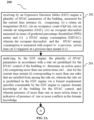
- FIGS. 2A and 2B (collectively referred as FIG. 2 ) is a flow diagram illustrating a method 200 for optimized HVAC control using domain knowledge combined with Deep Reinforcement Learning (DRL), using the system of FIG. 1 , in accordance with some embodiments of the present disclosure.
- DRL Deep Reinforcement Learning
- the system 100 comprises one or more data storage devices or the memory 102 operatively coupled to the processor(s) 104 and is configured to store instructions for execution of steps of the method 200 by the processor(s) or one or more hardware processors 104.
- the steps of the method 200 of the present disclosure will now be explained with reference to the components or blocks of the system 100 as depicted in FIG. 1A and 1B and the steps of flow diagram as depicted in FIG. 2 .
- process steps, method steps, techniques or the like may be described in a sequential order, such processes, methods, and techniques may be configured to work in alternate orders. In other words, any sequence or order of steps that may be described does not necessarily indicate a requirement that the steps to be performed in that order.
- the steps of processes described herein may be performed in any order practical. Further, some steps may be performed simultaneously.
- the Expressive Decision Tables (EDT) engine executed by the one or more hardware processors 104, receives a plurality of HVAC parameters of the building, measured for the current time instance (t).
- the HVAC parameters are received via the I/O interface that connect external sensors that capture environmental conditions in the building.
- the system 100 is tested via the HVAC simulators, such as E+ TM models.
- the HVAC parameters comprise: (i) the return air temperature (RAT), (ii) the occupancy count (OpCnt), (iii) the outside air temperature (OAT), (iv) the occupant discomfort measured in terms of predicted percentage dissatisfied (PPD) metric and (v) a HVAC energy consumption (E HVAC ).
- the occupant discomfort and the HVAC energy consumption is measured with respect to a previous action item (a t-1 ) triggered at a previous time instant (t-1).
- the HVAC parameters also include another variable, that enables specifying current time instance (currTime) for an episode or a day.
- the EDT engine executed by the one or more hardware processors 104 analyzes the plurality of HVAC parameters in accordance with a rule set predefined for the HVAC control of the building to determine an action space (At).
- the action space (At) comprises more than one action items (a t1 ... a tn ) for the current time instant (t) corresponding to more than one rules that are satisfied from among the rule set.
- the rule set is predefined in the EDT engine via a formal requirement specifier consumable by the EDT engine to capture domain knowledge of the building for the HVAC control. Domain knowledge is captured in rules and rules are usually described using a combination of natural language and system state-based paradigm.
- the method 200 leverages Expressive Decision Tables (EDT) notation in the literature that was specifically designed for verification of the rules. It can be understood that more than one rules may be true due to obvious conflicts in domain knowledge, which thus raises conflicts in HVAC control action.
- EDT is a user-friendly tabular notation to formally specify requirements of reactive systems as a relationship between inputs and outputs. It is regular expression based and provides a uniform notation to compactly specify state, sequence, and timing-based requirements of reactive systems.
- An EDT specification consists of tables where column headers specify inputs, local and outputs variable. Rows of the table specify requirements as relationships between patterns of input and output variable values and can also be used for test generation.
- each row maps directly to one of the requirements.
- column names under the keyword IN: RAT, currTime, OAT and OpCnt are input variables, whereas those under the keyword OUT: flowrate, currTime, EHVAC, PPD and RAT are output variables. Since RAT and currTime are both input and output variables, they are referred to as local variables.
- Each cell of an input variable column consists of a conditional expression. The cell is said to match when the condition corresponding to that cell evaluates to True and a row is said to match when it is all non-empty cells match.
- row 2 of table 1 matches when the current value of OAT is greater than RAT and OpCnt is greater than zero.
- the value of flowrate is set to 20 kg/s, and when row 1 matches, then the values of EHVAC, PPD, and RAT are computed by invoking appropriate simulator functions.
- EDT engine highlights such conflicts between the rules as shown in table 2. Note that, while other formal requirement specifiers such as SCR and stream-based tables may work, the method 200 leverages EDT here for its superior performance in terms of uniformity, ease of use, and scalability with in-built support to connect external C++ programs or databases.
- the DRL agent executed by the one or more hardware processors 104 receives the action space (At), a current state (St) of the building from the EDT engine, and a current reward (Rt) received by the DRL agent for the previous action item (a t-1 ).
- the DRL agent executed by the one or more hardware processors 104 selects an optimal control action item from among the action space (At) comprising the one or more action items (a t1 ... a tn ) that resolves one or more conflicts by maximizes a cumulative reward received over an episode.
- the cumulative reward is computed for current state action pair (St.at) providing an expected return over the episode starting from the current state St, following a policy, taking an action item at.
- the target cumulation reward comprises a) an immediate reward component computed based on an energy consumption reward component (Rc) and an occupant discomfort component (R E ) and b) second component comprising a neural networks approximation of maximum cumulative reward that is expected from the next state that is S (t+1) .
- the Rc is based on ratio of the HVAC energy consumption (E HVAC ) computed for the successive time instant to a rated maximum HVAC energy consumption as a result of taking action (at) to a rated maximum HVAC energy consumption.
- the R E is based on the ratio of the occupant discomfort for the successive time instant to a maximum allowed occupant discomfort as a result of taking action (at) to a maximum allowed occupant discomfort.
- the DRL agent is trained using a deep Q-Network (DQN) for selecting the optimal control action by applying an iterative process using episodic-epoch based learning over an truncated action space (A), a state (S) and the immediate reward corresponding to action item (a) taken from a previous state received from the EDT engine.
- the DQN which is a neural network, approximates an action-value function (Q-value) for the state (S) in each iteration returning the expected cumulative discounted reward over an episode starting from the state 'S', following the policy, taking the action item a.
- the control action is selected by providing preference to a highest Q-value based on a ⁇ -greedy policy.
- iterative process is applied over two DQNs comprising a policy network Q and a target network Q to choose action and approximate target cumulative reward, respectively.
- HVAC control The main goal of HVAC equipment is to ensure occupant comfort. An ideal HVAC controller achieves this goal with minimum energy consumption. The controller modulates HVAC fan speed, resulting in a change in room temperature that meets occupant comfort. This process can be modelled as a Markov Decision Process (MDP), making it a natural candidate for RL.
- MDP Markov Decision Process
- Control action A building space is considered with an AHU capable of modulating the supply air fan speed.
- a supply fan equipped with a stepper motor where the fan speed varies in a few discrete steps is assumed.
- St ⁇ OAT t , RAT t , OpCntt, ⁇ .
- Incorporating time-of-day ⁇ in the state-space helps RL agent capture time related variations in the features. For instance, OAT naturally has a trend of rise-peak-fall over the course of the day. To this end, one-hot encoding of length three is used for ⁇ (morning, afternoon, and evening). Alternatively, forecasted values of such features may also be incorporated in the state-space.
- R Immediate Reward
- E HV AC t + 1 and PPD t +1 1 represent the immediate energy consumption and occupant discomfort as a result of taking the action at.
- the system 100 employs a co-simulation architecture that connects the HVAC simulator, for example E+ TM , the EDT-Engine, and the DRL agent. These components exchange information at every time-step.
- E+ is a building energy simulation tool that models the energy consumption for HVAC, lighting, and other electrical loads.
- the parameters currently provided by the HVAC simulator are acquired vis corresponding sensors for each parameter..
- the HVAC simulator in real time applications will be replaced by sensors providing the HVAC parameters for the EDT engine and DRL agent to process and determine the optimal control action.
- the environment's state St of the building is observed or obtained from the input dataset and a flowrate, computed by EDT engine, as control input and computes RAT, PPD, and EHVAC in the next time-step.
- EDT engine operates on an EDT defining the rule set and computes one or more set of conflicting flowrates based on the current OpCnt and OAT, and RAT as returned by E+.
- the DRL agent decides a control action, at based on the policy learnt so far, from a truncated set of feasible action space (set of flowrates computed by EDT), upon observing St and reward Rt as computed by the immediate reward function.
- the control action decided by the DRL agent is passed to the HVAC simulator through the EDT engine, and the cycle repeats.
- the DRL agent training process At each time t, the DRL agent acts (at) directly on the environment and receives the immediate reward R t+1 along with a new state S t+1 .
- the goal of the agent is to learn an optimal policy that maximizes the expected cumulative reward.
- the episodic- epoch version of learning is used, where each episode is a day and each epoch is one minute. In a practical example scenario, only working hours of the building are considered, thus an episode consists of 540 epochs. Each episode ends in a special state called the terminal state, followed by a reset to an original starting state.
- the DQN is used to approximate the action-value function represented by (Q-value).
- the action-value de-notes the expected return (discounted rewards) over an episode starting from state (S), following a policy, taking action (a).
- the DQN receives the state as an input value and outputs the Q values for all possible actions.
- a pseudo code or algorithm 1, used for training the DRL agent for selecting optimal control action is provided below.
- nEpisodes are decided depending on learning duration, number of epochs nEpochs, and ⁇ min required for the G-greedy exploration and exploitation.
- the nEpochs refer to the simulation time-step and is the same as the number of interactions between the EDT and the HVAC simulator per episode.
- a replay buffer is initialized to an empty set followed by initializing the policy network Q and the target network Q with the same random weights (Lines 7-9).
- the environment is reset to the same initial state and ⁇ is decayed linearly (Lines 12, 13).
- the state and the immediate reward are observed (Line 16).
- a truncated action space from EDT on Line 17 is received.
- the most recent transition tuple (St, at, S t+1 ,R t+1 ,A t+1 ) are accumulated in the replay buffer.
- a randomly chosen, set of tuples (mini-batch), is used in the target value calculation (Line 19).
- the target values are computed using Line 20 using target neural networks.. Further, these target values along with the states vector is used for training the policy network (Line 21).
- An ADAM back-propagation method known in literature is used.
- An action is chosen based on the G-greedy policy (Line 22). This new action is passed to the HVAC simulator if it is a control step, else the previous action is retained.
- the weights of the target network are updated with the policy network weights (Line 28) after every K episodes. In experiments conducted, the target network is updated every 2 episodes.
- Equation 3 provides mathematical representation of components of the target cumulative reward, which is the immediate reward plus the neural networks' approximation of maximum cumulative reward one can expect from the next state that is S t+1 .
- Q S t a t R t + 1 + ⁇ ⁇ max a ⁇ ⁇ A t + 1 Q S t + 1 a ⁇
- DQN architecture Since the state space features can take a wide range of values, to improve convergence, the features are scaled to the range [0,1] using min-max normalization.
- the input layer and each of the three hidden layers have 6 and 10 nodes, respectively.
- the output layer for the flowrate (action items of the action space) has 5 nodes.
- a Rectified Linear Unit (ReLU) activation function is used for the hidden layers and the output Q-value is estimated using the linear function.
- a Random-Uniform initialization is used for the weights and bias of the network.
- the method and system disclosed herein reduces learning duration by combining rule-based domain knowledge and DRL-based control in and in this process, resolves any conflicts that may be present in the domain knowledge encoded using a formal requirement specifier.
- EXPERIMENTAL RESULTS AND OBSERVATIONS A major challenge in real-world implementation of the system is access to override the existing Air Handling Unit's (AHU's) control logic, which is proprietary. Therefore, the system 100 is evaluated through simulations using a calibrated HVAC simulator for HVAC control (E+ TM ) model of the building. The building thermal dynamics are calibrated with the data normally available in a Building Automation Systems (BAS).
- AAS Building Automation Systems
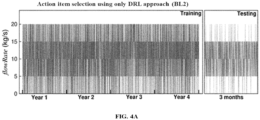
- FIGS. 4A and FIG. 4B show the decision (flowrate) taken by the agent during training phase for BL2 (4 years) and the system 100. It is observed that initially flowrate oscillates frequently between the minimum (0 kg/s) and maximum (20 kg/s) values. At the end of the training, as the DRL agent begins to exploit, fewer of these extreme values are picked and the optimal flowrates are mostly concentrated between [5, 15] kg/s. This is clear in FIGS. 4A and 4B for the testing period. FIGS.
- 5A and 5B show the PPD convergence during training and testing for BL2 (DRL approach) and the system 100.
- DRL approach DRL approach
- the PPD fluctuates significantly while learning. These fluctuations reduce as the training progresses.
- the testing phase we observe that the PPD settles mostly within a narrow band for both BL2 and the system 100. This shows that choice of the reward function and penalty is able to drive the solution in the right direction.
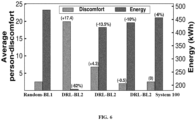
- FIG. 6 compares the performance of the system 100 with the baselines.
- the X-axis represents the approach and primary (secondary) Y-axis represents the average person-discomfort (Energy in kWh).
- the numerical values on top of each bar for BL2s' and e system 100 prove indicate the increase or decrease in the average person discomfort and percentage change in EHVAC from BL1.
- BL1 a rule that satisfies the criterion or a random rule among the conflicting rules is picked. Due to random picking, metrics are averaged across five instances.
- BL1 results in an average person-discomfort of 2.5 and consumes 486 kWh energy over the three months testing period.
- BL2 Compared to BL1, BL2 (with 1 year training) performs poorly in terms of person discomfort (increases by 17.4) while consuming significantly lower energy. The lower energy consumption is a direct result of maintaining poor comfort.
- the poor performance of BL2 (1 year) is mainly due to insufficient training duration. As the training duration is increased , it is observed that BL2 keeps improving and better learns the optimal policy. Specifically, BL2 (2 years training) and BL2 (4 years training) significantly bring down the person-discomfort, compared with BL2 (1 year training).
- BL2 (4 years training) marginally improves the average person-discomfort (by 0.5) and consumes 10% less energy.
- the system 100 performs at par with BL2 (4 years training) in terms of average person-discomfort while consuming slightly more energy of 4%.
- the key advantage of the system 100 over BL2 (4 years training) is the significant reduction in the training duration (by 75%) to learn the optimal policy. This finding is particularly important when only a few training samples are available.
- the system 100 has been trained over one year data, as discussed earlier.
- the system 100 consumes 6% lower energy for the same average person-discomfort.
- an informed decision making helps to optimize energy and comfort in buildings (achieve energy savings for nearly the same or even marginally improve comfort)
- domain knowledge helps guide the learning process quickly to an optimal policy.
- the hardware device can be any kind of device which can be programmed including e.g. any kind of computer like a server or a personal computer, or the like, or any combination thereof.
- the device may also include means which could be e.g. hardware means like e.g. an application-specific integrated circuit (ASIC), a field-programmable gate array (FPGA), or a combination of hardware and software means, e.g.
- ASIC application-specific integrated circuit
- FPGA field-programmable gate array
- the means can include both hardware means, and software means.
- the method embodiments described herein could be implemented in hardware and software.
- the device may also include software means.
- the embodiments may be implemented on different hardware devices, e.g. using a plurality of CPUs.
- the embodiments herein can comprise hardware and software elements.
- the embodiments that are implemented in software include but are not limited to, firmware, resident software, microcode, etc.
- the functions performed by various components described herein may be implemented in other components or combinations of other components.
- a computer-usable or computer readable medium can be any apparatus that can comprise, store, communicate, propagate, or transport the program for use by or in connection with the instruction execution system, apparatus, or device.
- a computer-readable storage medium refers to any type of physical memory on which information or data readable by a processor may be stored.
- a computer-readable storage medium may store instructions for execution by one or more processors, including instructions for causing the processor(s) to perform steps or stages consistent with the embodiments described herein.
- the term "computer-readable medium” should be understood to include tangible items and exclude carrier waves and transient signals, i.e., be non-transitory. Examples include random access memory (RAM), read-only memory (ROM), volatile memory, nonvolatile memory, hard drives, CD ROMs, DVDs, flash drives, disks, and any other known physical storage media.
Landscapes
- Engineering & Computer Science (AREA)
- Physics & Mathematics (AREA)
- Artificial Intelligence (AREA)
- Automation & Control Theory (AREA)
- General Physics & Mathematics (AREA)
- Signal Processing (AREA)
- General Engineering & Computer Science (AREA)
- Evolutionary Computation (AREA)
- Software Systems (AREA)
- Medical Informatics (AREA)
- Computer Vision & Pattern Recognition (AREA)
- Health & Medical Sciences (AREA)
- Fuzzy Systems (AREA)
- Mathematical Physics (AREA)
- Chemical & Material Sciences (AREA)
- Combustion & Propulsion (AREA)
- Mechanical Engineering (AREA)
- Air Conditioning Control Device (AREA)
Claims (12)
- Prozessorimplementiertes Verfahren (200) für eine optimierte Heizungs-, Lüftungs- und Klimatisierungs(HLK)-Steuerung eines Gebäudes, wobei das Verfahren umfasst:Empfangen (202) über eine Expressive Decision Tables(EDT)-Engine, die von einem oder mehreren Hardwareprozessoren ausgeführt wird, einer Vielzahl von HLK-Parametern des Gebäudes, die für einen aktuellen Zeitpunkt (t) gemessen werden, wobei die Vielzahl von HLK-Parametern umfasst: (i) eine Rücklufttemperatur (RAT), (ii) eine Belegungszahl (OpCnt), (iii) eine Außenlufttemperatur (OAT), (iv) einen Insassenunbehagen, der in Form einer vorhergesagten Prozentunzufriedens(PPD)-Metrik gemessen wird, (v) einen HLK-Energieverbrauch (EHVAC) und (vi) einen aktuellen Zeitpunkt, wobei der Insassenunbehagen und der HLK-Energieverbrauch (EHVAC) in Bezug auf ein vorheriges Aktionselement (at-1) gemessen werden, das zu einem vorherigen Zeitpunkt (t-1) ausgelöst wurde;Analysieren (204) durch die EDT-Engine, die von dem einen oder den mehreren Hardwareprozessoren ausgeführt wird, der Vielzahl von HLK-Parametern gemäß einem Regelsatz, der für die HLK-Steuerung des Gebäudes vordefiniert ist, um einen Aktionsraum (At) zu bestimmen, der mehr als ein Aktionselement (at1 ... atn) für den aktuellen Zeitpunkt (t) umfasst, das mehr als einer Regel aus dem Regelsatz entspricht, die erfüllt sind, wobei der Regelsatz in der EDT-Engine über einen formalen Anforderungsspezifizierer vordefiniert wird, der von der EDT-Engine verbraucht werden kann, um Domänenwissen des Gebäudes für die HLK-Steuerung zu erfassen, und wobei das Vorhandensein von einem oder mehreren Aktionselementen das Vorhandensein von einem oder mehreren Konflikten im Domänenwissen anzeigt;Empfangen (206) durch einen Deep Reinforcement Learning(DRL)-Agenten, der von dem einen oder den mehreren Hardwareprozessoren ausgeführt wird, des Aktionsraums (At), eines aktuellen Zustands (St) des Gebäudes von der EDT-Engine und einer aktuellen Belohnung (Rt), die von dem DRL-Agenten für das vorherige Aktionselement (at-1) empfangen wird, wobei der aktuelle Zustand (St) durch ein Zustandstupel {OATt, RATt, OpCntt, τ} dargestellt wird, das einen oder mehrere HLK-Parameter aus der Vielzahl von HLK-Parametern umfasst, und wobei τ die Tageszeit darstellt, die zeitbezogene Variationen in der einen oder den mehreren Vielzahl von HLK-Parametern erfasst; undAuswählen (208) durch den DRL-Agenten, der von dem einen oder den mehreren Hardwareprozessoren ausgeführt wird, eines optimalen Steueraktionselements aus dem Aktionsraum (At) aus, der das eine oder die mehreren Aktionselemente (at1...atn) umfasst, das die Konflikte durch Maximieren einer kumulativen Belohnung löst, die über eine Episode empfangen wird, wobei eine kumulative Zielbelohnung für das Aktionspaar des aktuellen Zustands (St, at) berechnet wird, das eine erwartete Rückkehr über die Episode ausgehend von dem aktuellen Zustand St nach einer Richtlinie bereitstellt, die ein Aktionselement at nimmt.
- Verfahren nach Anspruch 1, wobei die kumulative Zielbelohnung eine unmittelbare Belohnungskomponente und eine Komponente umfasst, die eine neuronale Netzwerkannäherung der maximalen kumulativen Belohnung bereitstellt, die von dem nächsten Zustand erwartet wird, der S(t+1) ist, wobei die unmittelbare Belohnungskomponente basierend auf einer Verbrauchsbelohnungskomponente (Rc) und einer Insassenunbehagenkomponente (RE) berechnet wird, wobei die Gewichtung jeder Komponente durch einen Abstimmungsfaktor (α) definiert ist und die unmittelbare Belohnung für einen nachfolgenden Zeitpunkt (t+1) durch Rt+1 = α RC + (1-α) RE definiert ist, und wobei die RC auf dem Verhältnis des HLK-Energieverbrauchs (EHVAC) basiert, der für den nachfolgenden Zeitpunkt berechnet wird, zu einem bewerteten maximalen HLK-Energieverbrauch als ein Ergebnis des Ergreifens der Aktion bei einem bewerteten maximalen HLK-Energieverbrauch, und wobei die RE auf dem Verhältnis des Insassenunbehagens für den nachfolgenden Zeitpunkt zu einem maximal erlaubten Insassenunbehagen als ein Ergebnis des Ergreifens der Aktion bei einem maximal erlaubten Insassenunbehagen basiert.
- Verfahren nach Anspruch 1, wobei der DRL-Agent unter Verwendung eines tiefen Q-Netzwerks (DQN) trainiert wird, um die optimale Steueraktion durch Anwenden eines iterativen Prozesses unter Verwendung von Episodenepochenbasiertem Lernen über einen verkürzten Aktionsraum (A), einen Zustand (S) und die unmittelbare Belohnung, die dem Aktionselement (a) entspricht, das von einem vorherigen Zustand genommen wurde, der von der EDT-Engine empfangen wird, auszuwählen, wobei das DQN eine Aktionswertfunktion (Q-Wert) für den Zustand (S) in jeder Iteration nähert, die die erwartete kumulative abgekürzte Belohnung über eine Episode ausgehend von dem Zustand (S) nach der Richtlinie, die das Aktionselement a nimmt, zurückgibt, und wobei die Steueraktion durch Bereitstellen einer Präferenz für einen höchsten Q-Wert basierend auf einer ε-gierigen Richtlinie angewendet wird, und wobei der iterative Prozess über zwei DQNs angewendet wird, die ferner ein Richtliniennetzwerk Q und ein Zielnetzwerk
Q umfassen, um die Aktion zu wählen bzw. die kumulative Zielbelohnung anzunähern. - Verfahren nach Anspruch 1, wobei eine oder mehrere Regeln im Regelsatz eine zeitbasierte Komponente beinhalten.
- System (100) für eine optimierte Heizungs-, Lüftungs- und Klimatisierungs (HLK)-Steuerung eines Gebäudes, wobei das System (100) umfasst:einen Speicher (102), der Anweisungen speichert;eine oder mehrere Eingabe/Ausgabe(E/A)-Schnittstellen (106); undeinen oder mehrere Hardwareprozessoren (104), die über die eine oder die mehreren E/A-Schnittstellen (106) an den Speicher (102) gekoppelt sind, wobei der eine oder die mehreren Hardwareprozessoren (104) durch die Anweisungen konfiguriert sind, um:Empfangen über eine Expressive Decision Tables(EDT)-Engine, die von dem einen oder den mehreren Hardwareprozessoren ausgeführt wird, eine Vielzahl von HLK-Parametern des Gebäudes, die für einen aktuellen Zeitpunkt (t) gemessen werden, wobei die Vielzahl von HLK-Parametern umfasst: (i) eine Rücklufttemperatur (RAT), (ii) eine Belegungszahl (OpCnt), (iii) eine Außenlufttemperatur (OAT), (iv) einen Insassenunbehagen, der in Form einer vorhergesagten Prozentunzufriedens(PPD)-Metrik gemessen wird, (v) einen HLK-Energieverbrauch (EHVAC) und (vi) einen aktuellen Zeitpunkt, wobei der Insassenunbehagen und der HLK-Energieverbrauch (EHVAC) in Bezug auf ein vorheriges Aktionselement (at-1) gemessen werden, das zu einem vorherigen Zeitpunkt (t-1) ausgelöst wurde;Analysieren durch die EDT-Engine die Vielzahl von HLK-Parametern gemäß einem Regelsatz, der für die HLK-Steuerung des Gebäudes vordefiniert ist, um einen Aktionsraum (At) zu bestimmen, der mehr als ein Aktionselement (at1 ... atn) für den aktuellen Zeitpunkt (t) umfasst, das mehr als einer Regel aus dem Regelsatz entspricht, wobei der Regelsatz in der EDT-Engine über einen formalen Anforderungsspezifizierer vordefiniert wird, der von der EDT-Engine verbraucht werden kann, um Domänenwissen des Gebäudes für die HLK-Steuerung zu erfassen, und wobei das Vorhandensein von mehr als einem oder mehreren Aktionselementen das Vorhandensein von einem oder mehreren Konflikten im Domänenwissen anzeigt;Empfangen durch einen Deep Reinforcement Learning(DRL)-Agenten, der von dem einen oder den mehreren Hardwareprozessoren ausgeführt wird, des Aktionsraums (At), eines aktuellen Zustands (St) des Gebäudes von der EDT-Engine und einer aktuellen Belohnung (Rt), die von dem DRL-Agenten für das vorherige Aktionselement (at-1) empfangen wird, wobei der aktuelle Zustand (St) durch ein Zustandstupel {OATt, RATt, OpCntt, τ} dargestellt wird, das einen oder mehrere HLK-Parameter aus der Vielzahl von HLK-Parametern umfasst, und wobei τ die Tageszeit darstellt, die zeitbezogene Variationen in der einen oder den mehreren Vielzahl von HLK-Parametern erfasst; undAuswählen durch den DRL-Agenten ein optimales Steueraktionselement aus dem Aktionsraum (At), der das eine oder die mehreren Aktionselemente (at1...atn) umfasst, das die Konflikte durch Maximieren einer kumulativen Belohnung löst, die über eine Episode empfangen wird, wobei eine kumulative Zielbelohnung für das Aktionspaar des aktuellen Zustands (St, at) berechnet wird, das eine erwartete Rückkehr über die Episode ausgehend von dem aktuellen Zustand St nach einer Richtlinie bereitstellt, die ein Aktionselement at nimmt.
- System nach Anspruch 5, wobei die kumulative Zielbelohnung eine unmittelbare Belohnungskomponente und eine Komponente umfasst, die eine neuronale Netzwerkannäherung der maximalen kumulativen Belohnung bereitstellt, die von dem nächsten Zustand erwartet wird, der S(t+1) ist, wobei die unmittelbare Belohnungskomponente basierend auf einer Verbrauchsbelohnungskomponente (Rc) und einer Insassenunbehagenkomponente (RE) berechnet wird, wobei die Gewichtung jeder Komponente durch einen Abstimmungsfaktor (α) definiert ist und die unmittelbare Belohnung für einen nachfolgenden Zeitpunkt (t+1) durch Rt+1 = α RC + (1-α) RE definiert ist, und wobei die RC auf dem Verhältnis des HLK-Energieverbrauchs (EHVAC) basiert, der für den nachfolgenden Zeitpunkt berechnet wird, zu einem bewerteten maximalen HLK-Energieverbrauch als ein Ergebnis des Ergreifens der Aktion bei einem bewerteten maximalen HLK-Energieverbrauch, und wobei die RE auf dem Verhältnis des Insassenunbehagens für den nachfolgenden Zeitpunkt zu einem maximal erlaubten Insassenunbehagen als ein Ergebnis des Ergreifens der Aktion bei einem maximal erlaubten Insassenunbehagen basiert.
- System nach Anspruch 5, wobei der DRL-Agent unter Verwendung eines tiefen Q-Netzwerks (DQN) trainiert wird, um die optimale Steueraktion durch Anwenden eines iterativen Prozesses unter Verwendung von episodischem epochenbasiertem Lernen über einen verkürzten Aktionsraum (A), einen Zustand (S) und die unmittelbare Belohnung, die dem Aktionselement (a) entspricht, das aus einem vorherigen Zustand genommen wurde, der von der EDT-Engine empfangen wurde, auszuwählen, wobei das DQN eine Aktionswertfunktion (Q-Wert) für den Zustand (S) in jeder Iteration annähert, die die erwartete kumulative abgekürzte Belohnung über eine Episode ausgehend von dem Zustand (S) nach der Richtlinie zurückgibt, die das Aktionselement a nimmt, und wobei die Steueraktion durch Bereitstellen einer Präferenz für einen höchsten Q-Wert basierend auf einer ε-gierigen Richtlinie erfolgt, und wobei der iterative Prozess über zwei DQNs angewendet wird, die ein Richtliniennetzwerk Q und ein Zielnetzwerk
Q umfassen, um jeweils die Aktion zu wählen und die kumulative Zielbelohnung anzunähern. - System nach Anspruch 5, wobei eine oder mehrere Regeln im Regelsatz eine zeitbasierte Komponente beinhalten.
- Ein oder mehrere nichtflüchtige maschinenlesbare Informationsspeichermedien, die eine oder mehrere Anweisungen umfassen, die, wenn sie von einem oder mehreren Hardwareprozessoren ausgeführt werden, bewirken:Empfangen über eine Expressive Decision Tables(EDT)-Engine, die von einem oder mehreren Hardwareprozessoren ausgeführt wird, einer Vielzahl von HLK-Parametern des Gebäudes, die für einen aktuellen Zeitpunkt (t) gemessen werden, wobei die Vielzahl von HLK-Parametern umfasst: (i) eine Rücklufttemperatur (RAT), (ii) eine Belegungszahl (OpCnt), (iii) eine Außenlufttemperatur (OAT), (iv) einen Insassenunbehagen, der in Form einer vorhergesagten Prozentunzufriedens(PPD)-Metrik gemessen wird, (v) einen HLK-Energieverbrauch (EHVAC) und (vi) einen aktuellen Zeitpunkt, wobei der Insassenunbehagen und der HLK-Energieverbrauch (EHVAC) in Bezug auf ein vorheriges Aktionselement (at-1) gemessen werden, das zu einem vorherigen Zeitpunkt (t-1) ausgelöst wurde;Analysieren durch die EDT-Engine, die von dem einen oder den mehreren Hardwareprozessoren ausgeführt wird, der Vielzahl von HLK-Parametern gemäß einem Regelsatz, der für die HLK-Steuerung des Gebäudes vordefiniert ist, um einen Aktionsraum (At) zu bestimmen, der mehr als ein Aktionselement (at1 ... am) für den aktuellen Zeitpunkt (t) umfasst, das mehr als einer Regel aus dem Regelsatz entspricht, die erfüllt sind, wobei der Regelsatz in der EDT-Engine über einen formalen Anforderungsspezifizierer vordefiniert wird, der von der EDT-Engine verbraucht werden kann, um Domänenwissen des Gebäudes für die HLK-Steuerung zu erfassen, und wobei das Vorhandensein von mehr als einem oder mehreren Aktionselementen das Vorhandensein von einem oder mehreren Konflikten im Domänenwissen anzeigt;Empfangen durch einen Deep Reinforcement Learning(DRL)-Agenten, der von dem einen oder den mehreren Hardwareprozessoren ausgeführt wird, des Aktionsraums (At), eines aktuellen Zustands (St) des Gebäudes von der EDT-Engine und einer aktuellen Belohnung (Rt), die von dem DRL-Agenten für das vorherige Aktionselement (at-1) empfangen wird, wobei der aktuelle Zustand (St) durch ein Zustandstupel {OATt, RATt, OpCntt, τ} dargestellt wird, das einen oder mehrere HLK-Parameter aus der Vielzahl von HLK-Parametern umfasst, und wobei τ die Tageszeit darstellt, die zeitbezogene Variationen in der einen oder den mehreren Vielzahl von HLK-Parametern erfasst; undAuswählen durch den DRL-Agenten, der von dem einen oder den mehreren Hardwareprozessoren ausgeführt wird, eines optimalen Steueraktionselements aus dem Aktionsraum (At) aus, der das eine oder die mehreren Aktionselemente (at1...atn) umfasst, das die Konflikte durch Maximieren einer kumulativen Belohnung löst, die über eine Episode empfangen wird, wobei eine kumulative Zielbelohnung für das Aktionspaar des aktuellen Zustands (St, at) berechnet wird, das eine erwartete Rückkehr über die Episode ausgehend von dem aktuellen Zustand St nach einer Richtlinie bereitstellt, die ein Aktionselement at nimmt.
- Das eine oder die mehreren nichtflüchtigen maschinenlesbaren Informationsspeichermedien nach Anspruch 9, wobei die kumulative Zielbelohnung eine unmittelbare Belohnungskomponente und eine Komponente umfasst, die eine neuronale Netzwerkannäherung der maximalen kumulativen Belohnung bereitstellt, die von dem nächsten Zustand erwartet wird, der S(t+1) ist, wobei die unmittelbare Belohnungskomponente basierend auf einer Verbrauchsbelohnungskomponente (Rc) und einer Insassenunbehaglichkeitskomponente (RE) berechnet wird, wobei die Gewichtung jeder Komponente durch einen Abstimmfaktor (α) definiert ist und die unmittelbare Belohnung für einen nachfolgenden Zeitpunkt (t+1) durch Rt+1 = α RC + (1-α) RE definiert ist, und wobei die RC auf dem Verhältnis des HLK-Energieverbrauchs (EHLK), der für den nachfolgenden Zeitpunkt berechnet wird, zu einem bewerteten maximalen HLK-Energieverbrauch als ein Ergebnis des Ergreifens einer Aktion bei einem bewerteten maximalen HLK-Energieverbrauch basiert, und die RE auf dem Verhältnis der Insassenunbehaglichkeit für den nachfolgenden Zeitpunkt zu einer maximal zulässigen Insassenunbehaglichkeit als ein Ergebnis des Ergreifens einer Aktion bei einer maximal zulässigen Insassenunbehaglichkeit basiert.
- Das eine oder die mehreren nichtflüchtigen maschinenlesbaren Informationsspeichermedien nach Anspruch 9, wobei der DRL-Agent unter Verwendung eines tiefen Q-Netzwerks (DQN) trainiert wird, um die optimale Steueraktion durch Anwenden eines iterativen Prozesses unter Verwendung von episodischem epochenbasiertem Lernen über einen verkürzten Aktionsraum (A), einen Zustand (S) und die unmittelbare Belohnung, die dem Aktionselement (a) entspricht, das aus einem vorherigen Zustand genommen wurde, der von der EDT-Engine empfangen wurde, auszuwählen, wobei das DQN eine Aktionswertfunktion (Q-Wert) für den Zustand (S) in jeder Iteration annähert, die die erwartete kumulative abgekürzte Belohnung über eine Episode ausgehend von dem Zustand (S) nach der Richtlinie zurückgibt, die das Aktionselement a nimmt, und wobei die Steueraktion durch Bereitstellen einer Präferenz für einen höchsten Q-Wert basierend auf einer ε-gierigen Richtlinie erfolgt, und wobei der iterative Prozess über zwei DQNs angewendet wird, die ein Richtliniennetzwerk Q und ein Zielnetzwerk
Q umfassen, um jeweils die Aktion zu wählen und die kumulative Zielbelohnung anzunähern. - Das eine oder die mehreren nichtflüchtigen maschinenlesbaren Informationsspeichermedien nach Anspruch 9, wobei eine oder mehrere Regeln im Regelsatz eine zeitbasierte Komponente beinhalten.
Applications Claiming Priority (1)
| Application Number | Priority Date | Filing Date | Title |
|---|---|---|---|
| IN202121047480 | 2021-10-19 |
Publications (3)
| Publication Number | Publication Date |
|---|---|
| EP4170439A1 EP4170439A1 (de) | 2023-04-26 |
| EP4170439B1 true EP4170439B1 (de) | 2023-12-20 |
| EP4170439C0 EP4170439C0 (de) | 2023-12-20 |
Family
ID=83689553
Family Applications (1)
| Application Number | Title | Priority Date | Filing Date |
|---|---|---|---|
| EP22196866.2A Active EP4170439B1 (de) | 2021-10-19 | 2022-09-21 | Optimierte hlk-steuerung unter verwendung von domänenkenntnis in kombination mit tiefem verstärkungslernen (drl) |
Country Status (2)
| Country | Link |
|---|---|
| US (1) | US12222122B2 (de) |
| EP (1) | EP4170439B1 (de) |
Families Citing this family (10)
| Publication number | Priority date | Publication date | Assignee | Title |
|---|---|---|---|---|
| CN116714411B (zh) * | 2023-05-24 | 2025-11-18 | 重庆大学 | 基于td3算法的电动汽车空调与乘客舱热管理控制方法 |
| CN116989384A (zh) * | 2023-07-31 | 2023-11-03 | 苏州思萃融合基建技术研究所有限公司 | 基于先验知识的深度强化学习的风机盘管控制系统及方法 |
| CN117419428B (zh) * | 2023-09-21 | 2026-01-06 | 南京电力设计研究院有限公司 | 基于深度强化学习的综合能源暖通空调控制方法 |
| CN117739564A (zh) * | 2023-12-19 | 2024-03-22 | 深圳市英维克信息技术有限公司 | 一种制冷系统的运行控制方法、装置、设备及介质 |
| CN119333940B (zh) * | 2024-09-30 | 2025-09-26 | 上海联元智能科技有限公司 | 一种基于深度学习的空调动态优化方法及系统 |
| CN119333953B (zh) * | 2024-12-20 | 2025-02-25 | 南京深度智控科技有限公司 | 基于强化学习的水冷制冷站冷却系统优化控制方法 |
| CN119597064B (zh) * | 2025-01-23 | 2025-05-23 | 国科大杭州高等研究院 | 一种大面源黑体多通道均衡加热方法、装置及介质 |
| CN120010255B (zh) * | 2025-02-05 | 2025-11-14 | 天津大学 | 基于深度强化学习的建筑hvac自适应协调控制方法及装置 |
| CN120068657B (zh) * | 2025-04-23 | 2025-07-29 | 安徽建工三建集团有限公司 | 一种基于bim技术的建筑信息智能管理方法及系统 |
| CN121828964A (zh) * | 2026-03-16 | 2026-04-10 | 广州施杰节能科技有限公司 | 基于ai自学习的冷站实时优化方法及系统 |
Family Cites Families (3)
| Publication number | Priority date | Publication date | Assignee | Title |
|---|---|---|---|---|
| US20180100662A1 (en) | 2016-10-11 | 2018-04-12 | Mitsubishi Electric Research Laboratories, Inc. | Method for Data-Driven Learning-based Control of HVAC Systems using High-Dimensional Sensory Observations |
| US11579576B2 (en) * | 2019-01-31 | 2023-02-14 | Tata Consultancy Services Limited | Systems and methods for optimizing performance parameters of air handling units in infrastructures |
| US11539598B2 (en) * | 2020-10-16 | 2022-12-27 | Craft.Ai | Devices and processes for data sample selection for power consumption management |
-
2022
- 2022-09-21 EP EP22196866.2A patent/EP4170439B1/de active Active
- 2022-09-26 US US17/935,420 patent/US12222122B2/en active Active
Also Published As
| Publication number | Publication date |
|---|---|
| EP4170439C0 (de) | 2023-12-20 |
| EP4170439A1 (de) | 2023-04-26 |
| US20230125620A1 (en) | 2023-04-27 |
| US12222122B2 (en) | 2025-02-11 |
Similar Documents
| Publication | Publication Date | Title |
|---|---|---|
| EP4170439A1 (de) | Optimierte hlk-steuerung unter verwendung von domänenkenntnis in kombination mit tiefem verstärkungslernen (drl) | |
| CN113574554A (zh) | 使用因果模型操作供应链 | |
| US20150026109A1 (en) | Method and system for predicting power consumption | |
| CN110781595B (zh) | 能源使用效率pue的预测方法、装置、终端及介质 | |
| Ding et al. | Multi-zone HVAC control with model-based deep reinforcement learning | |
| EP4369115A1 (de) | Verfahren und system zur physikbewussten steuerung einer hlk-anlage | |
| Thi et al. | An improved hybrid metaheuristics and rule-based approach for flexible job-shop scheduling subject to machine breakdowns | |
| Jahedpari et al. | Online prediction via continuous artificial prediction markets | |
| US20240119470A1 (en) | Systems and methods for generating a forecast of a timeseries | |
| US20160246277A1 (en) | Model Predictive Control with Uncertainties | |
| WO2025066350A1 (zh) | 路径规划方法、装置和系统及存储介质 | |
| KR20240122261A (ko) | Lstm을 이용한 hvac 제어 방법 및 장치 | |
| Güven et al. | Comparative analysis and statistical performance evaluation of fractional PID controllers in fuel cell choppers optimized with metaheuristic algorithms | |
| US10055687B2 (en) | Method for creating predictive knowledge structures from experience in an artificial agent | |
| Thayer et al. | A fast algorithm for stochastic orienteering with chance constraints | |
| Sun et al. | Zeroth-order supervised policy improvement | |
| Shiue et al. | Development of dynamic scheduling in semiconductor manufacturing using a Q-learning approach | |
| EP4645005A1 (de) | Thermische optimierung und steuerung in räumen mit offenem plan unter verwendung einer auf physik-informiertem neuronalem graphnetzwerk basierenden optimalen steuerung | |
| EP3690560A1 (de) | Systeme und verfahren zur optimierung von leistungsparametern von luftbehandlungseinheiten in infrastrukturen | |
| Zhang et al. | Home health care routing problem via off-line learning and neural network | |
| CN116611499B (zh) | 训练用于自动出价的强化学习系统的方法及装置 | |
| KR20210089919A (ko) | Poi 추천 방법 및 이를 수행하는 추천 제공 시스템 | |
| CN109343952A (zh) | 贝叶斯网络确定方法、装置、存储介质和电子设备 | |
| Zhou et al. | A noise-robust approach using dynamic graph neural networks for bus passenger flow prediction | |
| Pessin et al. | Investigation on the evolution of an indoor robotic localization system based on wireless networks |
Legal Events
| Date | Code | Title | Description |
|---|---|---|---|
| PUAI | Public reference made under article 153(3) epc to a published international application that has entered the european phase |
Free format text: ORIGINAL CODE: 0009012 |
|
| STAA | Information on the status of an ep patent application or granted ep patent |
Free format text: STATUS: THE APPLICATION HAS BEEN PUBLISHED |
|
| STAA | Information on the status of an ep patent application or granted ep patent |
Free format text: STATUS: REQUEST FOR EXAMINATION WAS MADE |
|
| AK | Designated contracting states |
Kind code of ref document: A1 Designated state(s): AL AT BE BG CH CY CZ DE DK EE ES FI FR GB GR HR HU IE IS IT LI LT LU LV MC MK MT NL NO PL PT RO RS SE SI SK SM TR |
|
| 17P | Request for examination filed |
Effective date: 20230324 |
|
| RBV | Designated contracting states (corrected) |
Designated state(s): AL AT BE BG CH CY CZ DE DK EE ES FI FR GB GR HR HU IE IS IT LI LT LU LV MC MK MT NL NO PL PT RO RS SE SI SK SM TR |
|
| GRAP | Despatch of communication of intention to grant a patent |
Free format text: ORIGINAL CODE: EPIDOSNIGR1 |
|
| STAA | Information on the status of an ep patent application or granted ep patent |
Free format text: STATUS: GRANT OF PATENT IS INTENDED |
|
| INTG | Intention to grant announced |
Effective date: 20230629 |
|
| GRAS | Grant fee paid |
Free format text: ORIGINAL CODE: EPIDOSNIGR3 |
|
| GRAA | (expected) grant |
Free format text: ORIGINAL CODE: 0009210 |
|
| STAA | Information on the status of an ep patent application or granted ep patent |
Free format text: STATUS: THE PATENT HAS BEEN GRANTED |
|
| AK | Designated contracting states |
Kind code of ref document: B1 Designated state(s): AL AT BE BG CH CY CZ DE DK EE ES FI FR GB GR HR HU IE IS IT LI LT LU LV MC MK MT NL NO PL PT RO RS SE SI SK SM TR |
|
| REG | Reference to a national code |
Ref country code: GB Ref legal event code: FG4D |
|
| REG | Reference to a national code |
Ref country code: CH Ref legal event code: EP |
|
| REG | Reference to a national code |
Ref country code: DE Ref legal event code: R096 Ref document number: 602022001391 Country of ref document: DE |
|
| REG | Reference to a national code |
Ref country code: IE Ref legal event code: FG4D |
|
| U01 | Request for unitary effect filed |
Effective date: 20231220 |
|
| U07 | Unitary effect registered |
Designated state(s): AT BE BG DE DK EE FI FR IT LT LU LV MT NL PT SE SI Effective date: 20240102 |
|
| PG25 | Lapsed in a contracting state [announced via postgrant information from national office to epo] |
Ref country code: GR Free format text: LAPSE BECAUSE OF FAILURE TO SUBMIT A TRANSLATION OF THE DESCRIPTION OR TO PAY THE FEE WITHIN THE PRESCRIBED TIME-LIMIT Effective date: 20240321 |
|
| PG25 | Lapsed in a contracting state [announced via postgrant information from national office to epo] |
Ref country code: ES Free format text: LAPSE BECAUSE OF FAILURE TO SUBMIT A TRANSLATION OF THE DESCRIPTION OR TO PAY THE FEE WITHIN THE PRESCRIBED TIME-LIMIT Effective date: 20231220 |
|
| PG25 | Lapsed in a contracting state [announced via postgrant information from national office to epo] |
Ref country code: GR Free format text: LAPSE BECAUSE OF FAILURE TO SUBMIT A TRANSLATION OF THE DESCRIPTION OR TO PAY THE FEE WITHIN THE PRESCRIBED TIME-LIMIT Effective date: 20240321 Ref country code: ES Free format text: LAPSE BECAUSE OF FAILURE TO SUBMIT A TRANSLATION OF THE DESCRIPTION OR TO PAY THE FEE WITHIN THE PRESCRIBED TIME-LIMIT Effective date: 20231220 |
|
| PG25 | Lapsed in a contracting state [announced via postgrant information from national office to epo] |
Ref country code: RS Free format text: LAPSE BECAUSE OF FAILURE TO SUBMIT A TRANSLATION OF THE DESCRIPTION OR TO PAY THE FEE WITHIN THE PRESCRIBED TIME-LIMIT Effective date: 20231220 Ref country code: NO Free format text: LAPSE BECAUSE OF FAILURE TO SUBMIT A TRANSLATION OF THE DESCRIPTION OR TO PAY THE FEE WITHIN THE PRESCRIBED TIME-LIMIT Effective date: 20240320 Ref country code: HR Free format text: LAPSE BECAUSE OF FAILURE TO SUBMIT A TRANSLATION OF THE DESCRIPTION OR TO PAY THE FEE WITHIN THE PRESCRIBED TIME-LIMIT Effective date: 20231220 |
|
| PG25 | Lapsed in a contracting state [announced via postgrant information from national office to epo] |
Ref country code: IS Free format text: LAPSE BECAUSE OF FAILURE TO SUBMIT A TRANSLATION OF THE DESCRIPTION OR TO PAY THE FEE WITHIN THE PRESCRIBED TIME-LIMIT Effective date: 20240420 |
|
| PG25 | Lapsed in a contracting state [announced via postgrant information from national office to epo] |
Ref country code: CZ Free format text: LAPSE BECAUSE OF FAILURE TO SUBMIT A TRANSLATION OF THE DESCRIPTION OR TO PAY THE FEE WITHIN THE PRESCRIBED TIME-LIMIT Effective date: 20231220 |
|
| PG25 | Lapsed in a contracting state [announced via postgrant information from national office to epo] |
Ref country code: SK Free format text: LAPSE BECAUSE OF FAILURE TO SUBMIT A TRANSLATION OF THE DESCRIPTION OR TO PAY THE FEE WITHIN THE PRESCRIBED TIME-LIMIT Effective date: 20231220 |
|
| PG25 | Lapsed in a contracting state [announced via postgrant information from national office to epo] |
Ref country code: SM Free format text: LAPSE BECAUSE OF FAILURE TO SUBMIT A TRANSLATION OF THE DESCRIPTION OR TO PAY THE FEE WITHIN THE PRESCRIBED TIME-LIMIT Effective date: 20231220 Ref country code: SK Free format text: LAPSE BECAUSE OF FAILURE TO SUBMIT A TRANSLATION OF THE DESCRIPTION OR TO PAY THE FEE WITHIN THE PRESCRIBED TIME-LIMIT Effective date: 20231220 Ref country code: RO Free format text: LAPSE BECAUSE OF FAILURE TO SUBMIT A TRANSLATION OF THE DESCRIPTION OR TO PAY THE FEE WITHIN THE PRESCRIBED TIME-LIMIT Effective date: 20231220 Ref country code: IS Free format text: LAPSE BECAUSE OF FAILURE TO SUBMIT A TRANSLATION OF THE DESCRIPTION OR TO PAY THE FEE WITHIN THE PRESCRIBED TIME-LIMIT Effective date: 20240420 Ref country code: CZ Free format text: LAPSE BECAUSE OF FAILURE TO SUBMIT A TRANSLATION OF THE DESCRIPTION OR TO PAY THE FEE WITHIN THE PRESCRIBED TIME-LIMIT Effective date: 20231220 |
|
| PG25 | Lapsed in a contracting state [announced via postgrant information from national office to epo] |
Ref country code: PL Free format text: LAPSE BECAUSE OF FAILURE TO SUBMIT A TRANSLATION OF THE DESCRIPTION OR TO PAY THE FEE WITHIN THE PRESCRIBED TIME-LIMIT Effective date: 20231220 |
|
| PG25 | Lapsed in a contracting state [announced via postgrant information from national office to epo] |
Ref country code: PL Free format text: LAPSE BECAUSE OF FAILURE TO SUBMIT A TRANSLATION OF THE DESCRIPTION OR TO PAY THE FEE WITHIN THE PRESCRIBED TIME-LIMIT Effective date: 20231220 |
|
| REG | Reference to a national code |
Ref country code: DE Ref legal event code: R097 Ref document number: 602022001391 Country of ref document: DE |
|
| PLBE | No opposition filed within time limit |
Free format text: ORIGINAL CODE: 0009261 |
|
| STAA | Information on the status of an ep patent application or granted ep patent |
Free format text: STATUS: NO OPPOSITION FILED WITHIN TIME LIMIT |
|
| U20 | Renewal fee for the european patent with unitary effect paid |
Year of fee payment: 3 Effective date: 20240926 |
|
| 26N | No opposition filed |
Effective date: 20240923 |
|
| PG25 | Lapsed in a contracting state [announced via postgrant information from national office to epo] |
Ref country code: MC Free format text: LAPSE BECAUSE OF FAILURE TO SUBMIT A TRANSLATION OF THE DESCRIPTION OR TO PAY THE FEE WITHIN THE PRESCRIBED TIME-LIMIT Effective date: 20231220 |
|
| PG25 | Lapsed in a contracting state [announced via postgrant information from national office to epo] |
Ref country code: IE Free format text: LAPSE BECAUSE OF NON-PAYMENT OF DUE FEES Effective date: 20240921 |
|
| REG | Reference to a national code |
Ref country code: CH Ref legal event code: U11 Free format text: ST27 STATUS EVENT CODE: U-0-0-U10-U11 (AS PROVIDED BY THE NATIONAL OFFICE) Effective date: 20251001 |
|
| U20 | Renewal fee for the european patent with unitary effect paid |
Year of fee payment: 4 Effective date: 20250925 |
|
| PGFP | Annual fee paid to national office [announced via postgrant information from national office to epo] |
Ref country code: CH Payment date: 20251001 Year of fee payment: 4 |
|
| PG25 | Lapsed in a contracting state [announced via postgrant information from national office to epo] |
Ref country code: CY Free format text: LAPSE BECAUSE OF FAILURE TO SUBMIT A TRANSLATION OF THE DESCRIPTION OR TO PAY THE FEE WITHIN THE PRESCRIBED TIME-LIMIT; INVALID AB INITIO Effective date: 20220921 |
|
| PG25 | Lapsed in a contracting state [announced via postgrant information from national office to epo] |
Ref country code: HU Free format text: LAPSE BECAUSE OF FAILURE TO SUBMIT A TRANSLATION OF THE DESCRIPTION OR TO PAY THE FEE WITHIN THE PRESCRIBED TIME-LIMIT; INVALID AB INITIO Effective date: 20220921 |