EP4167353A1 - Sensor - Google Patents
Sensor Download PDFInfo
- Publication number
- EP4167353A1 EP4167353A1 EP21821451.8A EP21821451A EP4167353A1 EP 4167353 A1 EP4167353 A1 EP 4167353A1 EP 21821451 A EP21821451 A EP 21821451A EP 4167353 A1 EP4167353 A1 EP 4167353A1
- Authority
- EP
- European Patent Office
- Prior art keywords
- conductive part
- conductive
- functional
- medium
- voltage
- Prior art date
- Legal status (The legal status is an assumption and is not a legal conclusion. Google has not performed a legal analysis and makes no representation as to the accuracy of the status listed.)
- Withdrawn
Links
- 238000006243 chemical reaction Methods 0.000 claims description 16
- 238000003860 storage Methods 0.000 claims description 15
- XLYOFNOQVPJJNP-UHFFFAOYSA-N water Substances O XLYOFNOQVPJJNP-UHFFFAOYSA-N 0.000 description 41
- 229910052751 metal Inorganic materials 0.000 description 13
- 239000002184 metal Substances 0.000 description 13
- 238000010586 diagram Methods 0.000 description 10
- 238000005259 measurement Methods 0.000 description 10
- 239000003990 capacitor Substances 0.000 description 9
- 239000007788 liquid Substances 0.000 description 9
- 238000004891 communication Methods 0.000 description 8
- 239000000126 substance Substances 0.000 description 8
- VYPSYNLAJGMNEJ-UHFFFAOYSA-N Silicium dioxide Chemical compound O=[Si]=O VYPSYNLAJGMNEJ-UHFFFAOYSA-N 0.000 description 7
- 239000000203 mixture Substances 0.000 description 7
- 239000002689 soil Substances 0.000 description 7
- 230000005611 electricity Effects 0.000 description 6
- 239000007789 gas Substances 0.000 description 6
- 239000003960 organic solvent Substances 0.000 description 6
- 239000007787 solid Substances 0.000 description 6
- 230000000694 effects Effects 0.000 description 5
- 239000012212 insulator Substances 0.000 description 5
- 239000000463 material Substances 0.000 description 5
- 239000004576 sand Substances 0.000 description 5
- NIXOWILDQLNWCW-UHFFFAOYSA-N acrylic acid group Chemical group C(C=C)(=O)O NIXOWILDQLNWCW-UHFFFAOYSA-N 0.000 description 4
- 239000008151 electrolyte solution Substances 0.000 description 4
- QTBSBXVTEAMEQO-UHFFFAOYSA-N Acetic acid Chemical compound CC(O)=O QTBSBXVTEAMEQO-UHFFFAOYSA-N 0.000 description 3
- CSCPPACGZOOCGX-UHFFFAOYSA-N Acetone Chemical compound CC(C)=O CSCPPACGZOOCGX-UHFFFAOYSA-N 0.000 description 3
- UHOVQNZJYSORNB-UHFFFAOYSA-N Benzene Chemical compound C1=CC=CC=C1 UHOVQNZJYSORNB-UHFFFAOYSA-N 0.000 description 3
- WWZKQHOCKIZLMA-UHFFFAOYSA-N Caprylic acid Natural products CCCCCCCC(O)=O WWZKQHOCKIZLMA-UHFFFAOYSA-N 0.000 description 3
- OKKJLVBELUTLKV-UHFFFAOYSA-N Methanol Chemical compound OC OKKJLVBELUTLKV-UHFFFAOYSA-N 0.000 description 3
- YXFVVABEGXRONW-UHFFFAOYSA-N Toluene Chemical compound CC1=CC=CC=C1 YXFVVABEGXRONW-UHFFFAOYSA-N 0.000 description 3
- 238000004364 calculation method Methods 0.000 description 3
- 150000001768 cations Chemical class 0.000 description 3
- 239000003792 electrolyte Substances 0.000 description 3
- 238000005516 engineering process Methods 0.000 description 3
- 238000009434 installation Methods 0.000 description 3
- 150000002739 metals Chemical class 0.000 description 3
- VNWKTOKETHGBQD-UHFFFAOYSA-N methane Chemical compound C VNWKTOKETHGBQD-UHFFFAOYSA-N 0.000 description 3
- 238000000034 method Methods 0.000 description 3
- VLKZOEOYAKHREP-UHFFFAOYSA-N n-Hexane Chemical compound CCCCCC VLKZOEOYAKHREP-UHFFFAOYSA-N 0.000 description 3
- 239000004033 plastic Substances 0.000 description 3
- 229910001220 stainless steel Inorganic materials 0.000 description 3
- 239000010935 stainless steel Substances 0.000 description 3
- 239000002023 wood Substances 0.000 description 3
- KBPLFHHGFOOTCA-UHFFFAOYSA-N 1-Octanol Chemical compound CCCCCCCCO KBPLFHHGFOOTCA-UHFFFAOYSA-N 0.000 description 2
- IJGRMHOSHXDMSA-UHFFFAOYSA-N Atomic nitrogen Chemical compound N#N IJGRMHOSHXDMSA-UHFFFAOYSA-N 0.000 description 2
- OKTJSMMVPCPJKN-UHFFFAOYSA-N Carbon Chemical compound [C] OKTJSMMVPCPJKN-UHFFFAOYSA-N 0.000 description 2
- RYGMFSIKBFXOCR-UHFFFAOYSA-N Copper Chemical compound [Cu] RYGMFSIKBFXOCR-UHFFFAOYSA-N 0.000 description 2
- IAZDPXIOMUYVGZ-UHFFFAOYSA-N Dimethylsulphoxide Chemical compound CS(C)=O IAZDPXIOMUYVGZ-UHFFFAOYSA-N 0.000 description 2
- LFQSCWFLJHTTHZ-UHFFFAOYSA-N Ethanol Chemical compound CCO LFQSCWFLJHTTHZ-UHFFFAOYSA-N 0.000 description 2
- XEEYBQQBJWHFJM-UHFFFAOYSA-N Iron Chemical compound [Fe] XEEYBQQBJWHFJM-UHFFFAOYSA-N 0.000 description 2
- PXHVJJICTQNCMI-UHFFFAOYSA-N Nickel Chemical compound [Ni] PXHVJJICTQNCMI-UHFFFAOYSA-N 0.000 description 2
- WYURNTSHIVDZCO-UHFFFAOYSA-N Tetrahydrofuran Chemical compound C1CCOC1 WYURNTSHIVDZCO-UHFFFAOYSA-N 0.000 description 2
- HCHKCACWOHOZIP-UHFFFAOYSA-N Zinc Chemical compound [Zn] HCHKCACWOHOZIP-UHFFFAOYSA-N 0.000 description 2
- XLOMVQKBTHCTTD-UHFFFAOYSA-N Zinc monoxide Chemical compound [Zn]=O XLOMVQKBTHCTTD-UHFFFAOYSA-N 0.000 description 2
- OMOVVBIIQSXZSZ-UHFFFAOYSA-N [6-(4-acetyloxy-5,9a-dimethyl-2,7-dioxo-4,5a,6,9-tetrahydro-3h-pyrano[3,4-b]oxepin-5-yl)-5-formyloxy-3-(furan-3-yl)-3a-methyl-7-methylidene-1a,2,3,4,5,6-hexahydroindeno[1,7a-b]oxiren-4-yl] 2-hydroxy-3-methylpentanoate Chemical compound CC12C(OC(=O)C(O)C(C)CC)C(OC=O)C(C3(C)C(CC(=O)OC4(C)COC(=O)CC43)OC(C)=O)C(=C)C32OC3CC1C=1C=COC=1 OMOVVBIIQSXZSZ-UHFFFAOYSA-N 0.000 description 2
- 150000001298 alcohols Chemical class 0.000 description 2
- 229910052799 carbon Inorganic materials 0.000 description 2
- 150000001735 carboxylic acids Chemical class 0.000 description 2
- 229920001940 conductive polymer Polymers 0.000 description 2
- 229910052802 copper Inorganic materials 0.000 description 2
- 239000010949 copper Substances 0.000 description 2
- 230000007423 decrease Effects 0.000 description 2
- 239000003574 free electron Substances 0.000 description 2
- 238000003306 harvesting Methods 0.000 description 2
- ZSIAUFGUXNUGDI-UHFFFAOYSA-N hexan-1-ol Chemical compound CCCCCCO ZSIAUFGUXNUGDI-UHFFFAOYSA-N 0.000 description 2
- BDAGIHXWWSANSR-UHFFFAOYSA-N methanoic acid Natural products OC=O BDAGIHXWWSANSR-UHFFFAOYSA-N 0.000 description 2
- -1 methanol and ethanol Chemical class 0.000 description 2
- BKIMMITUMNQMOS-UHFFFAOYSA-N nonane Chemical compound CCCCCCCCC BKIMMITUMNQMOS-UHFFFAOYSA-N 0.000 description 2
- BASFCYQUMIYNBI-UHFFFAOYSA-N platinum Chemical compound [Pt] BASFCYQUMIYNBI-UHFFFAOYSA-N 0.000 description 2
- 239000003495 polar organic solvent Substances 0.000 description 2
- 239000008213 purified water Substances 0.000 description 2
- 238000011160 research Methods 0.000 description 2
- 239000011435 rock Substances 0.000 description 2
- 150000003839 salts Chemical class 0.000 description 2
- 239000000243 solution Substances 0.000 description 2
- 239000004575 stone Substances 0.000 description 2
- 229910052725 zinc Inorganic materials 0.000 description 2
- 239000011701 zinc Substances 0.000 description 2
- OSWFIVFLDKOXQC-UHFFFAOYSA-N 4-(3-methoxyphenyl)aniline Chemical compound COC1=CC=CC(C=2C=CC(N)=CC=2)=C1 OSWFIVFLDKOXQC-UHFFFAOYSA-N 0.000 description 1
- 229920000049 Carbon (fiber) Polymers 0.000 description 1
- 208000009043 Chemical Burns Diseases 0.000 description 1
- 208000018380 Chemical injury Diseases 0.000 description 1
- 229910001335 Galvanized steel Inorganic materials 0.000 description 1
- FYYHWMGAXLPEAU-UHFFFAOYSA-N Magnesium Chemical compound [Mg] FYYHWMGAXLPEAU-UHFFFAOYSA-N 0.000 description 1
- CTQNGGLPUBDAKN-UHFFFAOYSA-N O-Xylene Chemical compound CC1=CC=CC=C1C CTQNGGLPUBDAKN-UHFFFAOYSA-N 0.000 description 1
- BQCADISMDOOEFD-UHFFFAOYSA-N Silver Chemical compound [Ag] BQCADISMDOOEFD-UHFFFAOYSA-N 0.000 description 1
- ATJFFYVFTNAWJD-UHFFFAOYSA-N Tin Chemical compound [Sn] ATJFFYVFTNAWJD-UHFFFAOYSA-N 0.000 description 1
- RTAQQCXQSZGOHL-UHFFFAOYSA-N Titanium Chemical compound [Ti] RTAQQCXQSZGOHL-UHFFFAOYSA-N 0.000 description 1
- 230000003213 activating effect Effects 0.000 description 1
- 239000000853 adhesive Substances 0.000 description 1
- 230000001070 adhesive effect Effects 0.000 description 1
- 230000002411 adverse Effects 0.000 description 1
- 150000001338 aliphatic hydrocarbons Chemical class 0.000 description 1
- OBETXYAYXDNJHR-UHFFFAOYSA-N alpha-ethylcaproic acid Natural products CCCCC(CC)C(O)=O OBETXYAYXDNJHR-UHFFFAOYSA-N 0.000 description 1
- 229910052782 aluminium Inorganic materials 0.000 description 1
- XAGFODPZIPBFFR-UHFFFAOYSA-N aluminium Chemical compound [Al] XAGFODPZIPBFFR-UHFFFAOYSA-N 0.000 description 1
- 239000007864 aqueous solution Substances 0.000 description 1
- 150000001491 aromatic compounds Chemical class 0.000 description 1
- 229910001566 austenite Inorganic materials 0.000 description 1
- GONOPSZTUGRENK-UHFFFAOYSA-N benzyl(trichloro)silane Chemical compound Cl[Si](Cl)(Cl)CC1=CC=CC=C1 GONOPSZTUGRENK-UHFFFAOYSA-N 0.000 description 1
- UBAZGMLMVVQSCD-UHFFFAOYSA-N carbon dioxide;molecular oxygen Chemical compound O=O.O=C=O UBAZGMLMVVQSCD-UHFFFAOYSA-N 0.000 description 1
- 239000004917 carbon fiber Substances 0.000 description 1
- 239000000919 ceramic Substances 0.000 description 1
- 150000001875 compounds Chemical class 0.000 description 1
- 239000004567 concrete Substances 0.000 description 1
- 238000000354 decomposition reaction Methods 0.000 description 1
- 230000001419 dependent effect Effects 0.000 description 1
- 239000000839 emulsion Substances 0.000 description 1
- 238000004880 explosion Methods 0.000 description 1
- 239000004744 fabric Substances 0.000 description 1
- 235000019253 formic acid Nutrition 0.000 description 1
- 239000008397 galvanized steel Substances 0.000 description 1
- PCHJSUWPFVWCPO-UHFFFAOYSA-N gold Chemical compound [Au] PCHJSUWPFVWCPO-UHFFFAOYSA-N 0.000 description 1
- 229910052737 gold Inorganic materials 0.000 description 1
- 239000010931 gold Substances 0.000 description 1
- 239000001257 hydrogen Substances 0.000 description 1
- 229910052739 hydrogen Inorganic materials 0.000 description 1
- 125000004435 hydrogen atom Chemical class [H]* 0.000 description 1
- 229910052742 iron Inorganic materials 0.000 description 1
- 229910052749 magnesium Inorganic materials 0.000 description 1
- 239000011777 magnesium Substances 0.000 description 1
- 239000000395 magnesium oxide Substances 0.000 description 1
- CPLXHLVBOLITMK-UHFFFAOYSA-N magnesium oxide Inorganic materials [Mg]=O CPLXHLVBOLITMK-UHFFFAOYSA-N 0.000 description 1
- AXZKOIWUVFPNLO-UHFFFAOYSA-N magnesium;oxygen(2-) Chemical compound [O-2].[Mg+2] AXZKOIWUVFPNLO-UHFFFAOYSA-N 0.000 description 1
- 244000005700 microbiome Species 0.000 description 1
- FUZZWVXGSFPDMH-UHFFFAOYSA-N n-hexanoic acid Natural products CCCCCC(O)=O FUZZWVXGSFPDMH-UHFFFAOYSA-N 0.000 description 1
- 229910052759 nickel Inorganic materials 0.000 description 1
- 229910052757 nitrogen Inorganic materials 0.000 description 1
- 239000000615 nonconductor Substances 0.000 description 1
- TVMXDCGIABBOFY-UHFFFAOYSA-N octane Chemical compound CCCCCCCC TVMXDCGIABBOFY-UHFFFAOYSA-N 0.000 description 1
- 239000005416 organic matter Substances 0.000 description 1
- 238000007254 oxidation reaction Methods 0.000 description 1
- 239000002245 particle Substances 0.000 description 1
- 229910052697 platinum Inorganic materials 0.000 description 1
- 239000002798 polar solvent Substances 0.000 description 1
- 230000010287 polarization Effects 0.000 description 1
- 229920000642 polymer Polymers 0.000 description 1
- 238000010248 power generation Methods 0.000 description 1
- 238000012545 processing Methods 0.000 description 1
- 238000006722 reduction reaction Methods 0.000 description 1
- 239000000377 silicon dioxide Substances 0.000 description 1
- 229910052709 silver Inorganic materials 0.000 description 1
- 239000004332 silver Substances 0.000 description 1
- 238000012360 testing method Methods 0.000 description 1
- YLQBMQCUIZJEEH-UHFFFAOYSA-N tetrahydrofuran Natural products C=1C=COC=1 YLQBMQCUIZJEEH-UHFFFAOYSA-N 0.000 description 1
- 229910052718 tin Inorganic materials 0.000 description 1
- 239000011135 tin Substances 0.000 description 1
- 239000010936 titanium Substances 0.000 description 1
- 229910052719 titanium Inorganic materials 0.000 description 1
- 239000002341 toxic gas Substances 0.000 description 1
- 229910052720 vanadium Inorganic materials 0.000 description 1
- 239000002699 waste material Substances 0.000 description 1
- 238000003466 welding Methods 0.000 description 1
- 239000008096 xylene Substances 0.000 description 1
- 239000011787 zinc oxide Substances 0.000 description 1
Images

Classifications
-
- G—PHYSICS
- G01—MEASURING; TESTING
- G01N—INVESTIGATING OR ANALYSING MATERIALS BY DETERMINING THEIR CHEMICAL OR PHYSICAL PROPERTIES
- G01N27/00—Investigating or analysing materials by the use of electric, electrochemical, or magnetic means
- G01N27/02—Investigating or analysing materials by the use of electric, electrochemical, or magnetic means by investigating impedance
- G01N27/028—Circuits therefor
-
- G—PHYSICS
- G01—MEASURING; TESTING
- G01N—INVESTIGATING OR ANALYSING MATERIALS BY DETERMINING THEIR CHEMICAL OR PHYSICAL PROPERTIES
- G01N27/00—Investigating or analysing materials by the use of electric, electrochemical, or magnetic means
- G01N27/26—Investigating or analysing materials by the use of electric, electrochemical, or magnetic means by investigating electrochemical variables; by using electrolysis or electrophoresis
- G01N27/416—Systems
-
- G—PHYSICS
- G01—MEASURING; TESTING
- G01F—MEASURING VOLUME, VOLUME FLOW, MASS FLOW OR LIQUID LEVEL; METERING BY VOLUME
- G01F23/00—Indicating or measuring liquid level or level of fluent solid material, e.g. indicating in terms of volume or indicating by means of an alarm
- G01F23/22—Indicating or measuring liquid level or level of fluent solid material, e.g. indicating in terms of volume or indicating by means of an alarm by measuring physical variables, other than linear dimensions, pressure or weight, dependent on the level to be measured, e.g. by difference of heat transfer of steam or water
- G01F23/24—Indicating or measuring liquid level or level of fluent solid material, e.g. indicating in terms of volume or indicating by means of an alarm by measuring physical variables, other than linear dimensions, pressure or weight, dependent on the level to be measured, e.g. by difference of heat transfer of steam or water by measuring variations of resistance of resistors due to contact with conductor fluid
- G01F23/241—Indicating or measuring liquid level or level of fluent solid material, e.g. indicating in terms of volume or indicating by means of an alarm by measuring physical variables, other than linear dimensions, pressure or weight, dependent on the level to be measured, e.g. by difference of heat transfer of steam or water by measuring variations of resistance of resistors due to contact with conductor fluid for discrete levels
-
- G—PHYSICS
- G01—MEASURING; TESTING
- G01N—INVESTIGATING OR ANALYSING MATERIALS BY DETERMINING THEIR CHEMICAL OR PHYSICAL PROPERTIES
- G01N27/00—Investigating or analysing materials by the use of electric, electrochemical, or magnetic means
- G01N27/02—Investigating or analysing materials by the use of electric, electrochemical, or magnetic means by investigating impedance
-
- G—PHYSICS
- G01—MEASURING; TESTING
- G01N—INVESTIGATING OR ANALYSING MATERIALS BY DETERMINING THEIR CHEMICAL OR PHYSICAL PROPERTIES
- G01N27/00—Investigating or analysing materials by the use of electric, electrochemical, or magnetic means
- G01N27/02—Investigating or analysing materials by the use of electric, electrochemical, or magnetic means by investigating impedance
- G01N27/026—Dielectric impedance spectroscopy
-
- G—PHYSICS
- G01—MEASURING; TESTING
- G01N—INVESTIGATING OR ANALYSING MATERIALS BY DETERMINING THEIR CHEMICAL OR PHYSICAL PROPERTIES
- G01N27/00—Investigating or analysing materials by the use of electric, electrochemical, or magnetic means
- G01N27/26—Investigating or analysing materials by the use of electric, electrochemical, or magnetic means by investigating electrochemical variables; by using electrolysis or electrophoresis
- G01N27/403—Cells and electrode assemblies
- G01N27/413—Concentration cells using liquid electrolytes measuring currents or voltages in voltaic cells
-
- H—ELECTRICITY
- H01—ELECTRIC ELEMENTS
- H01M—PROCESSES OR MEANS, e.g. BATTERIES, FOR THE DIRECT CONVERSION OF CHEMICAL ENERGY INTO ELECTRICAL ENERGY
- H01M10/00—Secondary cells; Manufacture thereof
- H01M10/42—Methods or arrangements for servicing or maintenance of secondary cells or secondary half-cells
- H01M10/48—Accumulators combined with arrangements for measuring, testing or indicating the condition of cells, e.g. the level or density of the electrolyte
-
- H—ELECTRICITY
- H01—ELECTRIC ELEMENTS
- H01M—PROCESSES OR MEANS, e.g. BATTERIES, FOR THE DIRECT CONVERSION OF CHEMICAL ENERGY INTO ELECTRICAL ENERGY
- H01M14/00—Electrochemical current or voltage generators not provided for in groups H01M6/00 - H01M12/00; Manufacture thereof
-
- G—PHYSICS
- G01—MEASURING; TESTING
- G01N—INVESTIGATING OR ANALYSING MATERIALS BY DETERMINING THEIR CHEMICAL OR PHYSICAL PROPERTIES
- G01N33/00—Investigating or analysing materials by specific methods not covered by groups G01N1/00 - G01N31/00
- G01N33/18—Water
Definitions
- the present invention relates to a sensor capable of operating on a self-sustaining power source.
- Electrodes There is a device in which two different kinds of metals are used as electrodes and immersed in an electrolytic solution to cause an oxidation reaction or a reduction reaction in each electrode to create a path through which electrons flow (that is, a battery), such as a voltaic battery or a Daniels battery.
- a battery such as a voltaic battery or a Daniels battery.
- a liquid used as an electrolytic solution of a battery may adversely affect a human body and an environment, such as fear of chemical burn, fear of fire or explosion, or generation of toxic gas, and thus handling of the electrolytic solution is very difficult.
- Patent Literature 1 JP 2007-181278 A
- At least one object of the present invention is to provide a sensor capable of operating on a self-sustaining power source.
- the present invention solves the above problem by any of the following [1] to [14].
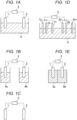
- Fig. 1 is a block diagram illustrating a configuration of a system according to an embodiment of the present invention.
- the system includes a first conductive part 1, a second conductive part 2, a functional part 3, and a medium 4.
- the first conductive part 1 and the functional part 3 are electrically connected to each other, and the functional part 3 and the second conductive part 2 are electrically connected to each other.
- the term "electrically connected” means, for example, energizably connected by a conductive wire or the like.
- a part or the whole of the first conductive part 1 and the second conductive part 2 are in contact with the medium 4.
- the first conductive part 1 and the second conductive part 2 are not in contact with each other.
- the term "not in contact” refers to, for example, a state in which the first conductive part 1 and the second conductive part 2 are not in direct contact with each other.
- the distance between the position where the first conductive part 1 is in contact with the medium 4 and the position where the second conductive part 2 is in contact with the medium 4 is preferably 1 cm or more, more preferably 10 cm or more, still more preferably 100 cm or more, and particularly preferably 1000 cm (10 m) or more.
- both the first conductive part 1 and the second conductive part 2 have conductivity.
- examples of the material of the first conductive part 1 and the second conductive part 2 include metal, a conductive polymer, carbon, and the like.
- Shapes of the first conductive part 1 and the second conductive part 2 are not particularly limited.
- the first conductive part 1 and the second conductive part 2 may have a rectangular parallelepiped shape, a round columnar shape (rod shape), a pyramid shape, a conical shape, a plate shape, or a string shape, and may have any shape.
- the metal used for the first conductive part 1 and the second conductive part 2 can be appropriately selected from, for example, silver, copper, gold, aluminum, magnesium, zinc, nickel, platinum, tin, titanium, stainless steel, zinc oxide, magnesium oxide, oxides of the above-described metals, and the like.
- a predetermined metal may be coated with another metal different from the predetermined metal or another material having conductivity.
- first conductive part 1 and the second conductive part 2 may be different from each other, or may be the same as each other.
- a round columnar rod made of stainless steel can be used for the first conductive part 1
- a round columnar rod made of zinc can be used for the second conductive part 2.
- the first conductive part 1 and the second conductive part 2 are connected to the functional part 3 or a voltage boost circuit/voltage step-down circuit by a conductive wire.
- the measured value is preferably 100 Q or more.
- a conductive part serving as a starting point of a current is defined as the first conductive part 1
- a conductive part serving as an ending point is defined as the second conductive part 2.
- Which conductive part functions as the first conductive part 1 is determined by a material of the conductive part or an environment surrounding the conductive part (for example, temperature, humidity, atmospheric pressure, pH, and the like). A chemical reaction occurs at an interface between the first conductive part 1 or the second conductive part 2 and the medium 4, and free electrons are generated in the conductive part.
- the conductive part made of a metal having a lower standard electrode potential is used as the first conductive part 1
- the conductive part made of a metal having a higher standard electrode potential is used as the second conductive part 2.
- electrons move from the second conductive part 2 toward the functional part 3
- electrons move from the functional part 3 toward the first conductive part 1. That is, a current is generated from the first conductive part 1 side to the second conductive part 2 side via the functional part 3.
- the metal constituting the conductive part is eluted as a cation into the medium 4 to generate free electrons, and in the first conductive part 1, the cation in water of the medium 4 reacts with the electrons to be electrically neutralized.
- the level of the standard electrode potential is determined by comparing relative values (relative values) of the standard electrode potentials of substances, and is not determined by using an absolute value of the standard electrode potential. For example, when substance A having a standard electrode potential of -5 V is compared with substance B having a standard electrode potential of +2 V, the standard electrode potential of substance A is low, and the standard electrode potential of substance B is high.
- either one of the conductive parts functions as the first conductive part 1 and the other conductive part functions as the second conductive part 2 depending on the conditions of the surrounding environment of the conductive parts, such as temperature, humidity, atmospheric pressure, and pH, for example, and a current is generated. Therefore, when conditions such as ambient temperature, humidity, atmospheric pressure, and pH of the two conductive parts are changed, the one functioning as the first conductive part may function as the second conductive part, and the one functioning as the second conductive part may function as the first conductive part.
- the electromotive force generated from the first conductive part 1 and the second conductive part 2 is preferably 0.9 V or less, more preferably 0.35 V or less, and still more preferably 0.25 V or less.
- the electromotive force generated from the first conductive part 1 and the second conductive part 2 is preferably 5 mV or more.
- the functional part 3 is, for example, a part that executes a predetermined function by energization.
- the functional part 3 can include an electric consumption part that consumes electric power and exerts a predetermined function, an electric storage part that stores electricity generated in a conductive part, an output voltage conversion part or the like that converts a voltage to be output, such as a voltage boost circuit and a voltage step-down circuit, a control part such as a microcomputer that controls a circuit, and a communication part or the like capable of wirelessly communicating with other devices.
- any of a light source such as an incandescent light bulb or a light emitting diode, a heat generator that emits heat, a sounding body that emits sound, a transmitter that emits a signal, and the like can be adopted.
- the electric storage part may be included in the voltage boost circuit or the voltage step-down circuit.
- a control part such as a microcomputer can control a circuit to release the electricity stored in the electric storage part under a predetermined condition. The released electricity is consumed by the electric consumption part.
- electric power is consumed slightly, and thus, it is possible to perform control so as to release the stored electricity while securing electric power necessary for activating the control part.
- the functional part 3 may include any one of the electric consumption part, the electric storage part, the output voltage conversion part, the communication part, and the control part, and may be formed by combining any two or more of the power consumption part, the electric storage part, the output voltage conversion part, the communication part, and the control part.
- the functional part 3 may be formed by integrally forming any two or more of the electric consumption part, the electric storage part, the output voltage conversion part, the communication part, and the control part, or may be formed separately while electrically connecting any of the electric consumption part, the electric storage part, the output voltage conversion part, the communication part, and the control part.
- Input impedance in the functional part 3 is preferably 1 k ⁇ or more, and more preferably 10 k ⁇ or more.
- the input impedance of the functional part 3 preferably has a non-linear current-voltage characteristic (I-V characteristic).
- the non-linear current-voltage characteristic refers to, for example, a case where, in a voltage change when a current flows through the functional part 3, the voltage value increases as a current value increases, but as the current value increases, an increase width of the voltage value required to increase the current value increases, and the voltage is not proportional to the current.
- the current value increases as the voltage value applied to the functional part 3 increases, but the degree of increase in the current value, which is increased by an increase in the voltage value, decreases as the voltage value increases, and the current value is not proportional to the voltage value. Since the input impedance in the functional part 3 has the non-linear current-voltage characteristic, the electromotive force generated between the first conductive part 1 and the second conductive part 2 is easily maintained.
- the functional part 3 preferably has a function of converting output impedance. As a result, an influence on an input signal of the functional part 3 can be controlled.
- the functional part 3 includes the electric storage part, and stores electric charge supplied from the first conductive part and/or the second conductive part.
- the control part performs control to release the stored electric charge in a time shorter than a time required to store the electric charge.
- the lower limit value of the operating voltage of the functional part 3 is preferably 0.9 V or less. It is more preferable to operate at 0.35 V or less, and it is still more preferable to operate at 20 mV or less.
- the medium 4 may be in any form of a gas, a liquid, and a solid.
- the medium 4 may be sol or gel.
- the medium 4 is not particularly limited as long as it can cause a chemical reaction at the interface between the first conductive part 1 and the second conductive part 2.
- the medium 4 may contain an electrolyte.
- the gas is not particularly limited as long as it is a gas when used in the present system, and examples thereof include oxygen, carbon dioxide, nitrogen, hydrogen, methane, and the like. When a gas is used as the medium 4, only a single type of gas may be used, or a mixture of a plurality of types of these gases may be used.
- the liquid used as the medium 4 is not particularly limited as long as it is a liquid when used in the present system, and, for example, not only water but also an organic solvent having high polarity, an organic solvent having low polarity, or a non-polar organic solvent can be used.
- the liquid used as the medium 4 may be a mixture of water and an organic solvent having high polarity, a mixture of two or more different organic solvents, an emulsion, or the like.
- As the water not only pure water but also water containing an electrolyte can be used.
- the concentration of cations may be 1 mol/L or less, 0.6 mol/L or less, 0.1 mol/L or less, 0.01 mol/L or less, 0.001 mol/L or less, or 0.0001 mol/L or less.
- organic solvent having high polarity for example, lower alcohols such as methanol and ethanol, lower carboxylic acids such as formic acid and acetic acid, acetone, tetrahydrofuran, dimethyl sulfoxide, and the like can be used.
- organic solvent having low polarity higher alcohols such as hexanol and octanol, higher carboxylic acids such as hexanoic acid and octanoic acid, or the like can be used.
- non-polar organic solvent include aliphatic hydrocarbons such as hexane, octane, and nonane, and aromatic compounds such as benzene, toluene, and xylene.
- a liquid is used as the medium 4 only a single type of liquid may be used, or a mixture of a plurality of types of these liquids may be used.
- the solid used as the medium 4 is not particularly limited as long as it is a solid when used in the present system, and may be, for example, wood, plastic, metal, ceramics, concrete, or the like.
- a powdery or granular solid such as sand or soil can be used, and a plurality of stones or rocks stacked can also be used.
- sand, soil, stones, or rocks stacked on one another are used as the medium 4, fine voids are generated in the medium 4, but even if there are such voids, it is sufficient that the medium 4 is physically connected.
- One medium 4 can be formed by physically connecting media 4 having different compositions and characteristics. For example, when plastic is in contact with the first conductive part 1 and wood is in contact with the second conductive part 2, the plastic and wood come into contact with each other to function as the medium 4.
- Resistance value of the medium 4 between the first conductive part 1 and the second conductive part 2 is preferably 1 k ⁇ or more, and more preferably 10 k ⁇ or more.
- the medium 4 may be an insulator.
- the insulator refers to, for example, a non-conductor, and refers to a substance having a property of hardly passing electricity or heat.
- the electrical conductivity of the insulator is preferably 10 -5 S/m or less, more preferably 10 -8 S/m, and still more preferably 10 -11 S/m.
- the medium 4 preferably contains moisture.
- the water content of the medium 4 such as sand or soil is preferably 1% by mass or more, more preferably 5% by mass or more, and still more preferably 10% by mass or more.
- the water content of the medium 4 is preferably 200% by mass or less.
- the water content refers to a value obtained by dividing the weight of water by the sum of the weight of water and the weight of solid content.
- a system includes the first conductive part 1, the second conductive part 2, the functional part 3, and the medium 4.
- the medium 4 is in contact with both the first conductive part 1 and the second conductive part, and the functional part 3 is electrically connected to the first conductive part 1 and the second conductive part 2.
- a system according to an embodiment of the present invention may use a medium 4a and a medium 4b instead of the medium 4.
- the medium 4a and the medium 4b may be different types of media from each other, or may be the same type of media.
- the medium 4a and the medium 4b are housed in different containers and are in a not-in-contact state.
- a system according to an embodiment of the present invention may electrically connect the first conductive part 1 and the second conductive part 2 without using the medium 4.
- a plurality of first conductive parts 1a, 1b to 1n may be electrically connected in parallel.
- a plurality of second conductive parts 2a, 2b to 2m may be electrically connected in parallel.
- the plurality of first conductive parts 1a, 1b to 1n may be electrically connected in series.
- the plurality of second conductive parts 2a, 2b to 2m may be electrically connected in series.
- a part or the whole of the first conductive part 1 may be covered with an insulating part 5a, and a part or the whole of the second conductive part 2 may be covered with an insulating part 5b.
- the insulating parts 5a and 5b function as the medium 4.
- the insulating parts 5a and 5b may be made of insulators different from each other, or may be made of insulators having the same composition or properties.
- Figs. 1A to 1E may be combined.
- the combination is not limited as long as it is an aspect that exerts the effect of the present invention.
- Fig. 2 is a block diagram illustrating a configuration of an electric power conversion part according to an embodiment of the present invention.
- Fig. 2A is a circuit diagram of a voltage boost circuit according to an embodiment of the present invention.
- a voltage boost circuit or a voltage step-down circuit is an example of the functional part 3, and includes an electric storage part.
- an inductor L, a diode D, a transistor Tr, and a capacitor C are electrically connected.
- an input terminal A1 is connected to the first conductive part 1
- an input terminal A2 is connected to the second conductive part 2.
- An output terminal B1 and an output terminal B2 are connected to an electric consumption part, a control part, and the like.
- the control part may be connected in parallel with the voltage boost circuit between the voltage boost circuit, and the first conductive part 1 and the second conductive part 2.
- the voltage boost circuit may be based on the premise that the input voltage V IN is a voltage lower than a predetermined voltage, and boost control may not be executed at a voltage higher than the predetermined voltage.
- the input voltage V IN of the voltage boost circuit is preferably 5 mV or more. Note that ON/OFF of the transistor Tr is controlled by the control part.
- Fig. 2B is a circuit diagram of a voltage step-down circuit according to an embodiment of the present invention.
- the transistor Tr, the inductor L, the diode D, and the capacitor C are electrically connected.
- the input terminal A1 is connected to the first conductive part 1
- the input terminal A2 is connected to the second conductive part 2.
- the output terminal B1 and the output terminal B2 are connected to the electric consumption part, the control part, and the like.
- the control part may be connected in parallel with the voltage step-down circuit between the voltage step-down circuit, and the first conductive part 1 and the second conductive part 2.
- the input voltage V IN is the potential difference between a connection point P 11 and a connection point P 12
- the output voltage V OUT is the potential difference between a connection point P 13 and a connection point P 14 .
- the input voltage V IN is substantially equal to the output voltage V OUT .
- the voltage step-down circuit may be based on the premise that the input voltage V IN is higher than a predetermined voltage, and step-down control may not be executed at a voltage lower than the predetermined voltage. Note that ON/OFF of the transistor Tr is controlled by the control part.
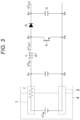
- Fig. 3 is a diagram illustrating a system according to an embodiment of the present invention.
- the potential difference between the first conductive part 1 and the second conductive part 2 can be defined as V 1 IN
- the potential difference between the connection point P 1 and the connection point P 2 can be defined as V 2 IN
- the potential difference between a connection point P 5 and a connection point P 6 can be defined as V 1 OUT
- the potential difference between the connection point P 3 and the connection point P 4 can be defined as V 2 OUT .
- a voltage boost circuit is connected to the first conductive part 1 at the connection point P 1 , and to the second conductive part 2 at the connection point P 2 .
- the inductor L, the diode D, the transistor Tr, and the capacitor C are electrically connected.
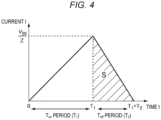
- Fig. 4 is a diagram illustrating a relationship between time and the current I when ON/OFF of the transistor in the system is switched according to an embodiment of the present invention.
- V 2 IN L1 ⁇ dI/dt can be derived.
- dI/dt is a positive value, and the current I increases with time.
- V 1 OUT - V 2 IN -L1 ⁇ dI/dt that dI/dt is a negative value. In this case, the current I decreases with time. The ON and OFF of the transistor Tr are periodically repeated.
- the first conductive part 1, the second conductive part 2, and the medium 4 are regarded as one type of battery, it can be considered that the current I flows due to the electromotive force V 1 IN .
- the internal impedance caused by the medium 4 is defined as Z
- I(t) V 1 IN /Z + A ⁇ e (-Z/L1 ⁇ t) is derived, where A is an integral constant.
- the current I while the transistor Tr is ON (hereinafter, referred to as a T on period) can be calculated by Equation (6).
- V' out V start + V f is a constant.
- the current I during the T off period can be expressed by a function of time t, the capacitor capacitance C1, the internal impedance Z, the inductance L1, V 1 IN , V' out , and K.
- I(T2) 0.
- the capacitor capacitance C1, the inductance L1, and V' out are constants, and when I(0) and T2 are measured, the values of V 1 IN and Z can be calculated.
- V 1 IN V 2 IN at the time point when the T off period is sufficiently long (the time point when the current I is consumed)
- V 1 IN can be specified by measuring V 2 IN .
- a sensor according to a first embodiment of the present invention is a sensor utilizing the above-described system.
- Examples thereof include a sensor that detects whether the internal impedance Z, or the input voltage V IN or the output voltage V OUT in the voltage boost circuit or the voltage step-down circuit in the above system satisfies a predetermined condition.
- the predetermined condition can be appropriately designed such that the internal impedance Z, the input voltage V IN , or the output voltage V OUT exceeds a predetermined threshold, is equal to or greater than a predetermined threshold, is less than a predetermined threshold, or is equal to or less than a predetermined threshold.
- the input voltage V IN to be a target of the predetermined condition may be, for example, the input voltage V 2 IN when the T off period is sufficiently long and the current I becomes zero
- the output voltage V OUT to be a target of the predetermined condition may be, for example, the output voltage V 2 OUT when the T off period is sufficiently long and the current I becomes zero
- the input voltage V IN to be a target of the predetermined condition may be, for example, the input voltage V 2 IN at the time when the T off period is started
- the output voltage V OUT to be a target of the predetermined condition may be, for example, the output voltage V 2 OUT at the time when the T off period is started.
- the input voltage V 2 IN at the start of the T off period is a value dependent on the impedance Z as is clear from Equation (3). Conversely, by measuring the input voltage V 2 IN , the fluctuation of the input voltage including the impedance Z can be grasped. Therefore, the input voltage V 2 IN at the start of the T off period is effective as the measurement data.
- the internal impedance Z, the input voltage V IN , or the output voltage V OUT satisfies a predetermined condition, a signal is transmitted from the communication part to another computer device under the control of the control part.
- the senor of the present invention can be used using water such as of a river, a pond, a sea, or a dam as a medium.
- the sensor is installed such that the longitudinal directions of the first conductive part 1 and the second conductive part 2 of the sensor are perpendicular to the water surface.
- a signal is transmitted to another computer device.
- information indicating that the height of the water surface exceeds a threshold or the like is notified is displayed on a display screen of the other computer device or output as a voice by the other computer device.
- the change in the height of the water surface is detected by the sensor, however, for example, even when there is a change in the water quality (pH or composition) at the installation position of the sensor, this change can be detected based on the internal impedance, or the input voltage V IN or the output voltage V OUT in the system.
- water such as of a river, a pond, a sea, or a dam is used as a medium, but the sensor of the present invention can use, for example, soil or the like different from water as a medium.
- a sensor according to a second embodiment of the present invention is a sensor utilizing the above-described system.
- Examples thereof include a sensor that detects that a change amount per unit time of the internal impedance, or the input voltage V IN or the output voltage V OUT in the voltage boost circuit or the voltage step-down circuit in the above system satisfies a predetermined condition.
- the predetermined condition can be appropriately designed such that the change amount per unit time of the internal impedance, or the input voltage V IN or the output voltage V OUT exceeds a predetermined threshold, is equal to or greater than a predetermined threshold, is less than a predetermined threshold, or is equal to or less than a predetermined threshold.
- the senor of the present invention can be used using water such as of a river, a pond, a sea, or a dam as a medium.
- the sensor is installed such that the longitudinal directions of the first conductive part 1 and the second conductive part 2 of the sensor are perpendicular to the water surface.
- a signal is transmitted to another computer device.
- the senor of the present invention can use, for example, soil or the like different from water as a medium.
- a "system” refers to, for example, a system including elements necessary for achieving the effects of the present invention.
- the system more specifically includes a circuit and a device.
- the "conductive part” may be, for example, made of any material as long as it is an energizable member.
- the "functional part” is, for example, a part that executes a predetermined function by energization. The function may be to convert electricity into energy such as light or heat, or to control a circuit.
- the "electrolytic solution” refers to, for example, a solution having electrical conductivity in which an ionic substance is dissolved in a polar solvent.
- the "voltage boost circuit” refers to, for example, a circuit that boosts and outputs an input voltage.
- the “voltage step-down circuit” refers to, for example, a circuit that steps down and outputs an input voltage.
- the "conductive polymer” refers to, for example, a polymer compound having electrical conductivity.
- Carbon refers to, for example, carbon fiber having conductivity.
- the "integrally forming” refers to, for example, joining different objects to each other, and more specifically, joining by a chemical and/or physical force such as adhesion using an adhesive, mechanical joining using another member, welding, and pressure bonding can be mentioned.
- the following test was performed at normal temperature and normal pressure.
- a circuit including the first conductive part 1, the second conductive part 2, the functional part 3, and the medium 4 illustrated in Fig. 1A was used.
- a plate-shaped member (0.5 mm thick, 10 cm ⁇ 15 cm) made of stainless steel (austenite, SUS 304 series) was used as the first conductive part 1
- a plate-shaped member (0.5 mm thick, 10 cm ⁇ 15 cm) made of a galvanized steel plate (iron) was used as the second conductive part 2
- the first conductive part 1, the second conductive part 2, and the functional part 3 were connected to each other by copper conductive wires.
- the functional part 3 includes an electric consumption part, an output voltage conversion part, a communication part, and a control part.
- the functional part 3 having an input impedance of 1 k ⁇ or more and a non-linear current-voltage characteristic was used.
- the electric consumption part an LED bulb that lights up when a current of 2 mA or more flows was used.
- a voltage boost circuit illustrated in Fig. 2A was used as the output voltage conversion part to form a system.
- the first conductive part 1 was connected to the input terminal A1 of the voltage boost circuit of the output voltage conversion part, and the output terminal B1 of the voltage boost circuit was connected to the LED bulb. Furthermore, the second conductive part 2 was connected to the input terminal A2 of the voltage boost circuit, and the output terminal B2 of the voltage boost circuit was connected to a terminal opposite to the terminal connected to the output terminal B1 of the LED bulb.
- Pure water (KOGA Chemical Mfg Co.,Ltd., high-purity purified water, temperature 25°C: medium 4) was placed in an acrylic container (cubic body with outer diameter of 15 cm ⁇ 15 cm ⁇ 15 cm, inner diameter of 14.5 cm) up to a height of 7.5 cm, and the first conductive part 1 and the second conductive part 2 were immersed in the pure water to construct the system.
- the first conductive part 1 and the second conductive part 2 were not in contact with each other, the distance between the first conductive part 1 and the second conductive part 2 was 12 cm, and the first conductive part 1 and the second conductive part 2 were installed so that plate-like planes of the first conductive part 1 and the second conductive part 2 were parallel to each other.
- the voltage between the first conductive part 1 and the second conductive part 2 was measured (Measurement 1).
- a 34401A multimeter manufactured by Agilent Technologies was used for the measurement. The result is shown in Table 1.
- the LED bulb repeatedly blinked every 270 to 330 seconds. That is, it was confirmed that electromotive force was generated from the first conductive part 1 and/or the second conductive part 2.
- the first conductive part 1 and the second conductive part 2 were immersed, and pure water (KOGA Chemical Mfg Co.,Ltd., high-purity purified water, temperature 25°C: medium 4) was placed in an acrylic container (cubic body with outer diameter of 15 cm ⁇ 15 cm ⁇ 15 cm, inner diameter of 14.5 cm) up to a height of 7.5 cm, and the first conductive part 1 and the second conductive part 2 were immersed in the pure water.
- pure water KGA Chemical Mfg Co.,Ltd., high-purity purified water, temperature 25°C: medium 4
- the first conductive part 1 and the second conductive part 2 were not in contact with each other, the distance between the first conductive part 1 and the second conductive part 2 was 12 cm, and the first conductive part 1 and the second conductive part 2 were installed so that plate-like planes of the first conductive part 1 and the second conductive part 2 were parallel to each other.
- the first conductive part 1 and the second conductive part 2 were not electrically connected.
- the voltage between the first conductive part 1 and the second conductive part 2 was measured using a 34401A multimeter (Measurement 2).
- the resistance value of the medium 4 between the first conductive part 1 and the second conductive part 2 was measured (Measurement 3).
- Measurements 1 to 3 were performed in the same manner as in Example 1 except that the medium 4 was changed to soil (soil of house plant manufactured by PROTOLEAF, Inc.). The results are shown in Table 1.
- the LED bulb repeatedly blinked at substantially equal intervals every 21 to 23 seconds. That is, it was confirmed that electromotive force was generated from the first conductive part 1 and/or the second conductive part 2.
- Measurements 1 to 3 were performed in the same manner as in Example 1 except that a waste cloth soaked in an aqueous solution in which 5 g of salt (Coarse Salt produced by Hakata Salt Co., Ltd.) was dissolved in 50 g of pure water (the same as in Example 1) was attached to the surfaces of the first conductive part 1 and the second conductive part 2 in contact with the medium 4, and the medium 4 was changed to sand (silica sand having a particle size peak (weight ratio) of about 0.9 mm manufactured by Toyo Matelan Corporation).
- sand silicon sand having a particle size peak (weight ratio) of about 0.9 mm manufactured by Toyo Matelan Corporation.
- Table 1 In the system shown in Example 2, the LED bulb repeatedly blinked every 80 to 100 seconds.
- the internal impedance was calculated by the above-described calculation method.
- the input voltage is the input voltage V 2 IN when the T off period starts.
Landscapes
- Chemical & Material Sciences (AREA)
- Health & Medical Sciences (AREA)
- Life Sciences & Earth Sciences (AREA)
- Physics & Mathematics (AREA)
- Chemical Kinetics & Catalysis (AREA)
- Electrochemistry (AREA)
- General Physics & Mathematics (AREA)
- Biochemistry (AREA)
- Immunology (AREA)
- Analytical Chemistry (AREA)
- Pathology (AREA)
- General Health & Medical Sciences (AREA)
- Molecular Biology (AREA)
- General Chemical & Material Sciences (AREA)
- Engineering & Computer Science (AREA)
- Thermal Sciences (AREA)
- Fluid Mechanics (AREA)
- Manufacturing & Machinery (AREA)
- Spectroscopy & Molecular Physics (AREA)
- Investigating Or Analyzing Materials By The Use Of Electric Means (AREA)
- Testing Or Calibration Of Command Recording Devices (AREA)
- Hybrid Cells (AREA)
- Measurement Of Levels Of Liquids Or Fluent Solid Materials (AREA)
- Dc-Dc Converters (AREA)
- Measuring Fluid Pressure (AREA)
- Electronic Switches (AREA)
Abstract
Description
- The present invention relates to a sensor capable of operating on a self-sustaining power source.
- There is a device in which two different kinds of metals are used as electrodes and immersed in an electrolytic solution to cause an oxidation reaction or a reduction reaction in each electrode to create a path through which electrons flow (that is, a battery), such as a voltaic battery or a Daniels battery.
- A liquid used as an electrolytic solution of a battery may adversely affect a human body and an environment, such as fear of chemical burn, fear of fire or explosion, or generation of toxic gas, and thus handling of the electrolytic solution is very difficult. In addition, there is a problem in that it is necessary to prevent liquid leakage at the time of commercialization, and the cost increases.
- Meanwhile, in recent years, energy harvesting technology that converts minute energy such as visible light, heat, radio waves, or organic matter decomposition processing by microorganisms into electric power has attracted attention, and research has been conducted to put a self-sustaining power source into practical use by using the energy harvesting technology. Furthermore, in the IoT field, research is in progress as a means that makes it possible to obtain various information in various environments by combining a sensor and a self-sustaining power source.
- For a self-sustaining power source type device used for a sensor or the like, it has been studied to use solar power generation (see, for example, Patent Literature 1), but it is likely to be affected by a time zone and weather, and stable power supply may not be possible.
- Patent Literature 1:
JP 2007-181278 A - At least one object of the present invention is to provide a sensor capable of operating on a self-sustaining power source.
- The present invention solves the above problem by any of the following [1] to [14].
- [1] A sensor comprising a system, the system including: a first conductive part and a second conductive part; a medium; and a functional part, the first conductive part and the functional part being connected to each other, the second conductive part and the functional part being connected to each other, at least a part of the first conductive part and the second conductive part being in contact with the medium, and the first conductive part and the second conductive part being not in contact with each other, and the sensor being configured to detect that internal impedance of the system satisfies a predetermined condition;
- [2] A sensor comprising a system, the system including: a first conductive part and a second conductive part; a medium; and a functional part, the first conductive part and the functional part being connected to each other, the second conductive part and the functional part being connected to each other, at least a part of the first conductive part and the second conductive part being in contact with the medium, and the first conductive part and the second conductive part being not in contact with each other, and the sensor being configured to detect that a predetermined voltage in the system satisfies a predetermined condition;
- [3] A sensor comprising a system, the system including: a first conductive part and a second conductive part; a medium; and a functional part, the first conductive part and the functional part being connected to each other, the second conductive part and the functional part being connected to each other, at least a part of the first conductive part and the second conductive part being in contact with the medium, and the first conductive part and the second conductive part being not in contact with each other, and the sensor being configured to detect that a change amount per unit time of internal impedance of the system satisfies a predetermined condition;
- [4] A sensor comprising a system, the system including: a first conductive part and a second conductive part; a medium; and a functional part, the first conductive part and the functional part being connected to each other, the second conductive part and the functional part being connected to each other, at least a part of the first conductive part and the second conductive part being in contact with the medium, and the first conductive part and the second conductive part being not in contact with each other, and the sensor being configured to detect that a change amount per unit time of a predetermined voltage in the system satisfies a predetermined condition;
- [5] The sensor according to any one of [1] to [4], wherein the functional part includes a voltage boost circuit or a voltage step-down circuit;
- [6] The sensor according to [2] or [4], wherein the functional part includes a voltage boost circuit or a voltage step-down circuit, and the predetermined voltage in the system is an input voltage or an output voltage of the voltage boost circuit or the voltage step-down circuit;
- [7] The sensor according to any one of [1] to [6], wherein the functional part has a conversion function of converting output impedance;
- [8] The sensor according to any one of [1] to [7], wherein the functional part includes an electric storage part, and the electric storage part stores electric charge supplied from the first conductive part and/or the second conductive part, and the electric storage part has a function of releasing stored electric charge in a time shorter than a time required for storing;
- [9] The sensor according to any one of [1] to [8], wherein the functional part includes an output voltage conversion part;
- [10] The sensor according to any one of [1] to [9], wherein input impedance of the functional part has a non-linear current-voltage characteristic;
- [11] A device comprising: a first conductive part and a second conductive part; and a functional part, the first conductive part and the functional part being connected to each other, the second conductive part and the functional part being connected to each other, and the first conductive part and the second conductive part being not in contact with each other, and the device being configured to detect that internal impedance of a system satisfies a predetermined condition, the system being configured in a case where the first conductive part and the second conductive part are brought into contact with a medium;
- [12] A device comprising: a first conductive part and a second conductive part; and a functional part, the first conductive part and the functional part being connected to each other, the second conductive part and the functional part being connected to each other, and the first conductive part and the second conductive part being not in contact with each other, and the device being configured to detect that a predetermined voltage in a system satisfies a predetermined condition, the system being configured in a case where the first conductive part and the second conductive part are brought into contact with a medium;
- [13] A device comprising: a first conductive part and a second conductive part; and a functional part, the first conductive part and the functional part being connected to each other, the second conductive part and the functional part being connected to each other, and the first conductive part and the second conductive part being not in contact with each other, and the device being configured to detect that a change amount per unit time of internal impedance of a system satisfies a predetermined condition, the system being configured in a case where the first conductive part and the second conductive part are brought into contact with a medium;
- [14] A device comprising: a first conductive part and a second conductive part; and a functional part, the first conductive part and the functional part being connected to each other, the second conductive part and the functional part being connected to each other, and the first conductive part and the second conductive part being not in contact with each other, and the device being configured to detect that a change amount per unit time of a predetermined voltage in a system satisfies a predetermined condition, the system being configured in a case where the first conductive part and the second conductive part are brought into contact with a medium.
- According to the present invention, it is possible to provide a sensor capable of operating on a self-sustaining power supply.
-
-
Fig. 1 is a block diagram illustrating a configuration of a system according to an embodiment of the present invention. -
Fig. 2 is a block diagram illustrating a configuration of an electric power conversion part according to an embodiment of the present invention. -
Fig. 3 is a diagram illustrating a system according to an embodiment of the present invention. -
Fig. 4 is a diagram illustrating a relationship between time and a current I in a case where ON/OFF of a transistor in the system is switched according to an embodiment of the present invention. - Hereinafter, embodiments of the present invention will be described with reference to the accompanying drawings. Hereinafter, the description regarding effects is an aspect of the effects of the embodiments of the present invention, and is not limited to the description herein.
-
Fig. 1 is a block diagram illustrating a configuration of a system according to an embodiment of the present invention. As shown inFigs. 1A to 1E , the system includes a firstconductive part 1, a secondconductive part 2, afunctional part 3, and amedium 4. The firstconductive part 1 and thefunctional part 3 are electrically connected to each other, and thefunctional part 3 and the secondconductive part 2 are electrically connected to each other. The term "electrically connected" means, for example, energizably connected by a conductive wire or the like. - A part or the whole of the first
conductive part 1 and the secondconductive part 2 are in contact with themedium 4. The firstconductive part 1 and the secondconductive part 2 are not in contact with each other. The term "not in contact" refers to, for example, a state in which the firstconductive part 1 and the secondconductive part 2 are not in direct contact with each other. - The distance between the position where the first
conductive part 1 is in contact with themedium 4 and the position where the secondconductive part 2 is in contact with themedium 4 is preferably 1 cm or more, more preferably 10 cm or more, still more preferably 100 cm or more, and particularly preferably 1000 cm (10 m) or more. - It is preferable that both the first
conductive part 1 and the secondconductive part 2 have conductivity. Here, examples of the material of the firstconductive part 1 and the secondconductive part 2 include metal, a conductive polymer, carbon, and the like. Shapes of the firstconductive part 1 and the secondconductive part 2 are not particularly limited. The firstconductive part 1 and the secondconductive part 2 may have a rectangular parallelepiped shape, a round columnar shape (rod shape), a pyramid shape, a conical shape, a plate shape, or a string shape, and may have any shape. - The metal used for the first
conductive part 1 and the secondconductive part 2 can be appropriately selected from, for example, silver, copper, gold, aluminum, magnesium, zinc, nickel, platinum, tin, titanium, stainless steel, zinc oxide, magnesium oxide, oxides of the above-described metals, and the like. In addition, a predetermined metal may be coated with another metal different from the predetermined metal or another material having conductivity. - Materials of the first
conductive part 1 and the secondconductive part 2 may be different from each other, or may be the same as each other. For example, a round columnar rod made of stainless steel can be used for the firstconductive part 1, and a round columnar rod made of zinc can be used for the secondconductive part 2. In this case, the firstconductive part 1 and the secondconductive part 2 are connected to thefunctional part 3 or a voltage boost circuit/voltage step-down circuit by a conductive wire. - When polarization resistance is measured for at least one of the first
conductive part 1 or the secondconductive part 2 using an AC impedance method, the measured value is preferably 100 Q or more. - Here, a conductive part serving as a starting point of a current is defined as the first
conductive part 1, and a conductive part serving as an ending point is defined as the secondconductive part 2. Which conductive part functions as the firstconductive part 1 is determined by a material of the conductive part or an environment surrounding the conductive part (for example, temperature, humidity, atmospheric pressure, pH, and the like). A chemical reaction occurs at an interface between the firstconductive part 1 or the secondconductive part 2 and themedium 4, and free electrons are generated in the conductive part. - For example, when different metals are used for the first
conductive part 1 and the secondconductive part 2, the conductive part made of a metal having a lower standard electrode potential is used as the firstconductive part 1, and the conductive part made of a metal having a higher standard electrode potential is used as the secondconductive part 2. In this case, electrons move from the secondconductive part 2 toward thefunctional part 3, and electrons move from thefunctional part 3 toward the firstconductive part 1. That is, a current is generated from the firstconductive part 1 side to the secondconductive part 2 side via thefunctional part 3. For example, in the secondconductive part 2, the metal constituting the conductive part is eluted as a cation into themedium 4 to generate free electrons, and in the firstconductive part 1, the cation in water of themedium 4 reacts with the electrons to be electrically neutralized. - The level of the standard electrode potential is determined by comparing relative values (relative values) of the standard electrode potentials of substances, and is not determined by using an absolute value of the standard electrode potential. For example, when substance A having a standard electrode potential of -5 V is compared with substance B having a standard electrode potential of +2 V, the standard electrode potential of substance A is low, and the standard electrode potential of substance B is high.
- On the other hand, even when the same metal is used for the conductive parts, either one of the conductive parts functions as the first
conductive part 1 and the other conductive part functions as the secondconductive part 2 depending on the conditions of the surrounding environment of the conductive parts, such as temperature, humidity, atmospheric pressure, and pH, for example, and a current is generated. Therefore, when conditions such as ambient temperature, humidity, atmospheric pressure, and pH of the two conductive parts are changed, the one functioning as the first conductive part may function as the second conductive part, and the one functioning as the second conductive part may function as the first conductive part. - The electromotive force generated from the first
conductive part 1 and the secondconductive part 2 is preferably 0.9 V or less, more preferably 0.35 V or less, and still more preferably 0.25 V or less. The electromotive force generated from the firstconductive part 1 and the secondconductive part 2 is preferably 5 mV or more. - The
functional part 3 is, for example, a part that executes a predetermined function by energization. Thefunctional part 3 can include an electric consumption part that consumes electric power and exerts a predetermined function, an electric storage part that stores electricity generated in a conductive part, an output voltage conversion part or the like that converts a voltage to be output, such as a voltage boost circuit and a voltage step-down circuit, a control part such as a microcomputer that controls a circuit, and a communication part or the like capable of wirelessly communicating with other devices. - As the electric consumption part, for example, any of a light source such as an incandescent light bulb or a light emitting diode, a heat generator that emits heat, a sounding body that emits sound, a transmitter that emits a signal, and the like can be adopted. The electric storage part may be included in the voltage boost circuit or the voltage step-down circuit. A control part such as a microcomputer can control a circuit to release the electricity stored in the electric storage part under a predetermined condition. The released electricity is consumed by the electric consumption part. In addition, even in the control part such as a microcomputer, electric power is consumed slightly, and thus, it is possible to perform control so as to release the stored electricity while securing electric power necessary for activating the control part.
- The
functional part 3 may include any one of the electric consumption part, the electric storage part, the output voltage conversion part, the communication part, and the control part, and may be formed by combining any two or more of the power consumption part, the electric storage part, the output voltage conversion part, the communication part, and the control part. In addition, thefunctional part 3 may be formed by integrally forming any two or more of the electric consumption part, the electric storage part, the output voltage conversion part, the communication part, and the control part, or may be formed separately while electrically connecting any of the electric consumption part, the electric storage part, the output voltage conversion part, the communication part, and the control part. - Input impedance in the
functional part 3 is preferably 1 kΩ or more, and more preferably 10 kΩ or more. In addition, the input impedance of thefunctional part 3 preferably has a non-linear current-voltage characteristic (I-V characteristic). The non-linear current-voltage characteristic refers to, for example, a case where, in a voltage change when a current flows through thefunctional part 3, the voltage value increases as a current value increases, but as the current value increases, an increase width of the voltage value required to increase the current value increases, and the voltage is not proportional to the current. In other words, the current value increases as the voltage value applied to thefunctional part 3 increases, but the degree of increase in the current value, which is increased by an increase in the voltage value, decreases as the voltage value increases, and the current value is not proportional to the voltage value. Since the input impedance in thefunctional part 3 has the non-linear current-voltage characteristic, the electromotive force generated between the firstconductive part 1 and the secondconductive part 2 is easily maintained. - The
functional part 3 preferably has a function of converting output impedance. As a result, an influence on an input signal of thefunctional part 3 can be controlled. - In addition, the
functional part 3 includes the electric storage part, and stores electric charge supplied from the first conductive part and/or the second conductive part. The control part performs control to release the stored electric charge in a time shorter than a time required to store the electric charge. - The lower limit value of the operating voltage of the
functional part 3 is preferably 0.9 V or less. It is more preferable to operate at 0.35 V or less, and it is still more preferable to operate at 20 mV or less. - The medium 4 may be in any form of a gas, a liquid, and a solid. The medium 4 may be sol or gel. The
medium 4 is not particularly limited as long as it can cause a chemical reaction at the interface between the firstconductive part 1 and the secondconductive part 2. The medium 4 may contain an electrolyte. As themedium 4, a medium having no conductivity is preferably used. The gas is not particularly limited as long as it is a gas when used in the present system, and examples thereof include oxygen, carbon dioxide, nitrogen, hydrogen, methane, and the like. When a gas is used as themedium 4, only a single type of gas may be used, or a mixture of a plurality of types of these gases may be used. - The liquid used as the
medium 4 is not particularly limited as long as it is a liquid when used in the present system, and, for example, not only water but also an organic solvent having high polarity, an organic solvent having low polarity, or a non-polar organic solvent can be used. The liquid used as themedium 4 may be a mixture of water and an organic solvent having high polarity, a mixture of two or more different organic solvents, an emulsion, or the like. As the water, not only pure water but also water containing an electrolyte can be used. - Among electrolytes contained in the water, the concentration of cations may be 1 mol/L or less, 0.6 mol/L or less, 0.1 mol/L or less, 0.01 mol/L or less, 0.001 mol/L or less, or 0.0001 mol/L or less.
- As the organic solvent having high polarity, for example, lower alcohols such as methanol and ethanol, lower carboxylic acids such as formic acid and acetic acid, acetone, tetrahydrofuran, dimethyl sulfoxide, and the like can be used. As the organic solvent having low polarity, higher alcohols such as hexanol and octanol, higher carboxylic acids such as hexanoic acid and octanoic acid, or the like can be used. Examples of the non-polar organic solvent include aliphatic hydrocarbons such as hexane, octane, and nonane, and aromatic compounds such as benzene, toluene, and xylene. When a liquid is used as the
medium 4, only a single type of liquid may be used, or a mixture of a plurality of types of these liquids may be used. - The solid used as the
medium 4 is not particularly limited as long as it is a solid when used in the present system, and may be, for example, wood, plastic, metal, ceramics, concrete, or the like. As the solid used as themedium 4, for example, a powdery or granular solid such as sand or soil can be used, and a plurality of stones or rocks stacked can also be used. When sand, soil, stones, or rocks stacked on one another are used as themedium 4, fine voids are generated in themedium 4, but even if there are such voids, it is sufficient that themedium 4 is physically connected. - One medium 4 can be formed by physically connecting
media 4 having different compositions and characteristics. For example, when plastic is in contact with the firstconductive part 1 and wood is in contact with the secondconductive part 2, the plastic and wood come into contact with each other to function as themedium 4. - Resistance value of the medium 4 between the first
conductive part 1 and the secondconductive part 2 is preferably 1 kΩ or more, and more preferably 10 kΩ or more. - The medium 4 may be an insulator. The insulator refers to, for example, a non-conductor, and refers to a substance having a property of hardly passing electricity or heat. The electrical conductivity of the insulator is preferably 10-5 S/m or less, more preferably 10-8 S/m, and still more preferably 10-11 S/m.
- The medium 4 preferably contains moisture. The water content of the medium 4 such as sand or soil is preferably 1% by mass or more, more preferably 5% by mass or more, and still more preferably 10% by mass or more. The water content of the
medium 4 is preferably 200% by mass or less. Here, the water content refers to a value obtained by dividing the weight of water by the sum of the weight of water and the weight of solid content. - As illustrated in
Fig. 1A , a system according to an embodiment of the present invention includes the firstconductive part 1, the secondconductive part 2, thefunctional part 3, and themedium 4. Themedium 4 is in contact with both the firstconductive part 1 and the second conductive part, and thefunctional part 3 is electrically connected to the firstconductive part 1 and the secondconductive part 2. - As illustrated in
Fig. 1B , a system according to an embodiment of the present invention may use a medium 4a and a medium 4b instead of themedium 4. The medium 4a and the medium 4b may be different types of media from each other, or may be the same type of media. InFig. 1B , the medium 4a and the medium 4b are housed in different containers and are in a not-in-contact state. - As illustrated in
Fig. 1C , a system according to an embodiment of the present invention may electrically connect the firstconductive part 1 and the secondconductive part 2 without using themedium 4. - As illustrated in
Fig. 1D , in a system according to an embodiment of the present invention, a plurality of firstconductive parts conductive parts conductive parts conductive parts - As illustrated in
Fig. 1E , in at least one embodiment of the present invention, a part or the whole of the firstconductive part 1 may be covered with aninsulating part 5a, and a part or the whole of the secondconductive part 2 may be covered with aninsulating part 5b. By bringing the insulatingparts parts medium 4. Here, the insulatingparts - The configurations illustrated in
Figs. 1A to 1E may be combined. The combination is not limited as long as it is an aspect that exerts the effect of the present invention. -
Fig. 2 is a block diagram illustrating a configuration of an electric power conversion part according to an embodiment of the present invention.Fig. 2A is a circuit diagram of a voltage boost circuit according to an embodiment of the present invention. A voltage boost circuit or a voltage step-down circuit is an example of thefunctional part 3, and includes an electric storage part. - As illustrated, an inductor L, a diode D, a transistor Tr, and a capacitor C are electrically connected. For example, an input terminal A1 is connected to the first
conductive part 1, and an input terminal A2 is connected to the secondconductive part 2. An output terminal B1 and an output terminal B2 are connected to an electric consumption part, a control part, and the like. The control part may be connected in parallel with the voltage boost circuit between the voltage boost circuit, and the firstconductive part 1 and the secondconductive part 2. - When an input voltage VIN is applied while the transistor Tr is ON, electric energy is stored in the inductor L. The input voltage VIN is the potential difference between a connection point P1 and a connection point P2. When the transistor Tr is OFF, the energy stored in the inductor L is added to the electric energy derived from the input voltage VIN, and is output via the diode D. As a result, an output voltage VOUT, which is the potential difference between a connection point P3 and a connection point P4, is higher than the input voltage VIN. The voltage boost circuit may be based on the premise that the input voltage VIN is a voltage lower than a predetermined voltage, and boost control may not be executed at a voltage higher than the predetermined voltage. The input voltage VIN of the voltage boost circuit is preferably 5 mV or more. Note that ON/OFF of the transistor Tr is controlled by the control part.
-
Fig. 2B is a circuit diagram of a voltage step-down circuit according to an embodiment of the present invention. As illustrated, the transistor Tr, the inductor L, the diode D, and the capacitor C are electrically connected. For example, the input terminal A1 is connected to the firstconductive part 1, and the input terminal A2 is connected to the secondconductive part 2. The output terminal B1 and the output terminal B2 are connected to the electric consumption part, the control part, and the like. The control part may be connected in parallel with the voltage step-down circuit between the voltage step-down circuit, and the firstconductive part 1 and the secondconductive part 2. - When the transistor Tr is ON, electric energy is stored in the inductor L. The input voltage VIN is the potential difference between a connection point P11 and a connection point P12, and the output voltage VOUT is the potential difference between a connection point P13 and a connection point P14. In this case, the input voltage VIN is substantially equal to the output voltage VOUT. When the transistor Tr is OFF, the potential of at a connection point P15 at the left end of the inductor L becomes lower than the potential at the connection point P14, so that the output voltage VOUT becomes a lower voltage. The voltage step-down circuit may be based on the premise that the input voltage VIN is higher than a predetermined voltage, and step-down control may not be executed at a voltage lower than the predetermined voltage. Note that ON/OFF of the transistor Tr is controlled by the control part.
- Next, a method for measuring the internal impedance of a system of the present invention will be described.
Fig. 3 is a diagram illustrating a system according to an embodiment of the present invention. The potential difference between the firstconductive part 1 and the secondconductive part 2 can be defined as V1 IN, and the potential difference between the connection point P1 and the connection point P2 can be defined as V2 IN. The potential difference between a connection point P5 and a connection point P6 can be defined as V1 OUT, and the potential difference between the connection point P3 and the connection point P4 can be defined as V2 OUT. When power is generated by the system of the present invention, a current I flows between the firstconductive part 1 and the secondconductive part 2 in the direction of the connection point P1 and the connection point P5 by electromotive force V2 IN. - As illustrated in
Fig. 3 , a voltage boost circuit is connected to the firstconductive part 1 at the connection point P1, and to the secondconductive part 2 at the connection point P2. In the voltage boost circuit, the inductor L, the diode D, the transistor Tr, and the capacitor C are electrically connected. -
Fig. 4 is a diagram illustrating a relationship between time and the current I when ON/OFF of the transistor in the system is switched according to an embodiment of the present invention. Here, the relationship between V1 OUT and V2 IN can be expressed by Equation (1): V1 OUT - V2 IN = -L1 × dI/dt using the current I flowing through the inductor L and inductance L1. When the transistor Tr is ON, since V2 OUT = 0, Equation (2): V2 IN = L1 × dI/dt can be derived. In this case, dI/dt is a positive value, and the current I increases with time. On the other hand, when the transistor Tr is OFF, since V1 OUT > V2 IN is satisfied, it can be seen from Equation (1): V1 OUT - V2 IN = -L1 × dI/dt that dI/dt is a negative value. In this case, the current I decreases with time. The ON and OFF of the transistor Tr are periodically repeated. - Here, when the first
conductive part 1, the secondconductive part 2, and the medium 4 are regarded as one type of battery, it can be considered that the current I flows due to the electromotive force V1 IN. In this case, when the internal impedance caused by themedium 4 is defined as Z, the relationship between an input voltage and the internal impedance can be expressed by Equation (3): V1 IN = Z × I + V2 IN. - In addition, while the transistor Tr is OFF (hereinafter, referred to as a TOFF period), the capacitor C is charged with electric charge Q by the current I. Assuming that the voltage increased at the connection point P3 during the TOFF period is ΔV and the capacitor capacitance of the capacitor C is C1, Equation (4) : Q = ∫Idt = C1 × ΔV holds.
- From Equations (2) and (3), V1 IN = L1 × dI/dt + Z × I is derived. By solving this equation, Equation (5): I(t) = V1 IN/Z + A × e(-Z/L1 × t) is derived, where A is an integral constant. In a case where the time when the transistor Tr is switched from OFF to ON is t = 0, as is clear from
Fig. 4 , the current I is zero when t = 0. Therefore, when t = 0 and I = 0 are substituted into Equation (5), it is found that the relationship of A = -V1 IN/Z holds. When this A = -V1 IN/Z is substituted into Equation (5), Equation (6): I(t) = V1 IN/Z × (1 - e(-Z/L1 × t)) can be derived. The current I while the transistor Tr is ON (hereinafter, referred to as a Ton period) can be calculated by Equation (6). When a time during which the transistor Tr is ON is sufficiently taken, the maximum value of the current I is V1 IN/Z. - The current I when the Ton period ends and the Toff period starts (that is, when time T1 has elapsed since the transistor Tr was switched from OFF to ON) can be calculated by substituting t = T1 into Equation (6). This is because the current I has continuity as can be seen from
Fig. 4 . When replacing (1 - e(-Z/L1 × T1)) with K (constant), the current I at t = T1 can be expressed as I(T1) = V1 IN/Z × (1 - e(-Z/L1 × T1)) = K × V1 IN/Z. Note that K satisfies the relationship of 0 ≤ K < 1, and when the value of Z/L1 × T1 becomes sufficiently large, K can be approximated to 1. - Next, Equation (7) : L1 × dI/dt + Z × I = V1 IN - V1 OUT can be derived by Equations (1) and (3). Furthermore, by Equation (4), V2 OUT can be expressed by fIdt/C1 + Vstart. Here, Vstart is the voltage of the capacitor C at the start of the Toff period (t = T1) and is a constant. If the threshold voltage of the diode D is Vf, Equation (8) : V1 OUT = V2 OUT + Vf = ∫Idt/C1 + Vstart + Vf = ∫Idt/C1 + V'out can be derived. Here, V'out = Vstart + Vf is a constant.
- Furthermore, Equation (9): fIdt/C1 + Z × I + L1 × dI/dt = V1 IN - V'out can be derived from Equations (7) and (8). By solving the differential equation of Equation (9), the current I during the Toff period can be expressed by a function of time t, the capacitor capacitance C1, the internal impedance Z, the inductance L1, V1 IN, V'out, and K. When the start time of the Toff period is t = 0, an initial value I (0) of the current I at that time is 1(0) = K × V1 IN/Z. When the Toff period ends (that is, time T2 elapses after the transistor Tr is switched from ON to OFF, and the current I becomes zero), I(T2) = 0. The capacitor capacitance C1, the inductance L1, and V'out are constants, and when I(0) and T2 are measured, the values of V1 IN and Z can be calculated.
- Unlike the method described above, Z can be easily obtained. During the Toff period, since V1 OUT is a voltage that is about 10 times larger than V2 IN, dI/dt also has a large value. In this case, fIdt in Equation (4) corresponds to the area of the triangle S in
Fig. 4 . Therefore, Equation (9): fIdt = K × V1 IN/Z × T2/2 = C1 × ΔV is derived from Equation (4). Here, if the Ton time is sufficiently long, K ≈ 1 can be approximated, and thus, when K = 1 is substituted into Equation (9), Equation (10): V1 IN/Z × T2/2 = C1 × ΔV is derived. C1 is a constant, and Z can be calculated from ΔV at the time point when the Toff period is sufficiently long (the time point when the current I becomes the minimum value), V1 IN at the time point when the Toff period is sufficiently long (the time point when the current I becomes the minimum value), and T2 (the time when V1 OUT becomes equal to V2 IN). Since V1 IN = V2 IN at the time point when the Toff period is sufficiently long (the time point when the current I is consumed), V1 IN can be specified by measuring V2 IN. - Note that the calculation of the internal impedance Z is executed by the control part.
- A sensor according to a first embodiment of the present invention is a sensor utilizing the above-described system. Examples thereof include a sensor that detects whether the internal impedance Z, or the input voltage VIN or the output voltage VOUT in the voltage boost circuit or the voltage step-down circuit in the above system satisfies a predetermined condition. Here, the predetermined condition can be appropriately designed such that the internal impedance Z, the input voltage VIN, or the output voltage VOUT exceeds a predetermined threshold, is equal to or greater than a predetermined threshold, is less than a predetermined threshold, or is equal to or less than a predetermined threshold. The input voltage VIN to be a target of the predetermined condition may be, for example, the input voltage V2 IN when the Toff period is sufficiently long and the current I becomes zero, and the output voltage VOUT to be a target of the predetermined condition may be, for example, the output voltage V2 OUT when the Toff period is sufficiently long and the current I becomes zero. Furthermore, the input voltage VIN to be a target of the predetermined condition may be, for example, the input voltage V2 IN at the time when the Toff period is started, and the output voltage VOUT to be a target of the predetermined condition may be, for example, the output voltage V2 OUT at the time when the Toff period is started. The input voltage V2 IN at the start of the Toff period is a value dependent on the impedance Z as is clear from Equation (3). Conversely, by measuring the input voltage V2 IN, the fluctuation of the input voltage including the impedance Z can be grasped. Therefore, the input voltage V2 IN at the start of the Toff period is effective as the measurement data. When the internal impedance Z, the input voltage VIN, or the output voltage VOUT satisfies a predetermined condition, a signal is transmitted from the communication part to another computer device under the control of the control part.
- For example, the sensor of the present invention can be used using water such as of a river, a pond, a sea, or a dam as a medium. The sensor is installed such that the longitudinal directions of the first
conductive part 1 and the secondconductive part 2 of the sensor are perpendicular to the water surface. When the internal impedance, or the input voltage VIN or the output voltage VOUT in the system satisfies a predetermined condition due to a change in the height of the water surface, a signal is transmitted to another computer device. When the signal is received by the other computer device, information indicating that the height of the water surface exceeds a threshold or the like is notified is displayed on a display screen of the other computer device or output as a voice by the other computer device. As described above, by using the sensor of the present invention, it is possible to grasp, by another computer device that the height of the water surface becomes high and danger is imminent around the installation position of the sensor. - In the first embodiment, the change in the height of the water surface is detected by the sensor, however, for example, even when there is a change in the water quality (pH or composition) at the installation position of the sensor, this change can be detected based on the internal impedance, or the input voltage VIN or the output voltage VOUT in the system. In addition, in the first embodiment, it has been described that water such as of a river, a pond, a sea, or a dam is used as a medium, but the sensor of the present invention can use, for example, soil or the like different from water as a medium.
- A sensor according to a second embodiment of the present invention is a sensor utilizing the above-described system. Examples thereof include a sensor that detects that a change amount per unit time of the internal impedance, or the input voltage VIN or the output voltage VOUT in the voltage boost circuit or the voltage step-down circuit in the above system satisfies a predetermined condition. Here, the predetermined condition can be appropriately designed such that the change amount per unit time of the internal impedance, or the input voltage VIN or the output voltage VOUT exceeds a predetermined threshold, is equal to or greater than a predetermined threshold, is less than a predetermined threshold, or is equal to or less than a predetermined threshold. When the change amount per unit time of the internal impedance, or the input voltage VIN or the output voltage VOUT satisfies a predetermined condition, a signal is transmitted from the communication part to another computer device under the control of the control part.
- For example, the sensor of the present invention can be used using water such as of a river, a pond, a sea, or a dam as a medium. The sensor is installed such that the longitudinal directions of the first
conductive part 1 and the secondconductive part 2 of the sensor are perpendicular to the water surface. When the change amount per unit time of the internal impedance, or the input voltage VIN or the output voltage VOUT in the system satisfies a predetermined condition due to the change in the height of the water surface, a signal is transmitted to another computer device. When the signal is received by the other computer device, information indicating that the height of the water surface suddenly rises (alternatively, the height of the water surface has fallen sharply) or the like is notified is displayed on a display screen of the other computer device or output as a voice by the other computer device. As described above, by using the sensor of the present invention, it is possible to grasp, by another computer device that the height of the water surface suddenly rises and danger is imminent around the installation position of the sensor. - In the second embodiment, it has been described that water such as of a river, a pond, a sea, or a dam is used as a medium, but the sensor of the present invention can use, for example, soil or the like different from water as a medium.
- In the embodiments of the present invention, a "system" refers to, for example, a system including elements necessary for achieving the effects of the present invention. The system more specifically includes a circuit and a device. The "conductive part" may be, for example, made of any material as long as it is an energizable member. The "functional part" is, for example, a part that executes a predetermined function by energization. The function may be to convert electricity into energy such as light or heat, or to control a circuit.
- In the embodiments of the present invention, the "electrolytic solution" refers to, for example, a solution having electrical conductivity in which an ionic substance is dissolved in a polar solvent. The "voltage boost circuit" refers to, for example, a circuit that boosts and outputs an input voltage. The "voltage step-down circuit" refers to, for example, a circuit that steps down and outputs an input voltage. The "conductive polymer" refers to, for example, a polymer compound having electrical conductivity. "Carbon" refers to, for example, carbon fiber having conductivity. The "integrally forming" refers to, for example, joining different objects to each other, and more specifically, joining by a chemical and/or physical force such as adhesion using an adhesive, mechanical joining using another member, welding, and pressure bonding can be mentioned.
- Hereinafter, the present invention will be described in more detail with reference to examples, but the present invention is not limited by these examples at all.
- The following test was performed at normal temperature and normal pressure. A circuit including the first
conductive part 1, the secondconductive part 2, thefunctional part 3, and the medium 4 illustrated inFig. 1A was used. A plate-shaped member (0.5 mm thick, 10 cm × 15 cm) made of stainless steel (austenite, SUS 304 series) was used as the firstconductive part 1, a plate-shaped member (0.5 mm thick, 10 cm × 15 cm) made of a galvanized steel plate (iron) was used as the secondconductive part 2, and the firstconductive part 1, the secondconductive part 2, and thefunctional part 3 were connected to each other by copper conductive wires. Thefunctional part 3 includes an electric consumption part, an output voltage conversion part, a communication part, and a control part. In addition, thefunctional part 3 having an input impedance of 1 kΩ or more and a non-linear current-voltage characteristic was used. As the electric consumption part, an LED bulb that lights up when a current of 2 mA or more flows was used. A voltage boost circuit illustrated inFig. 2A was used as the output voltage conversion part to form a system. - The first
conductive part 1 was connected to the input terminal A1 of the voltage boost circuit of the output voltage conversion part, and the output terminal B1 of the voltage boost circuit was connected to the LED bulb. Furthermore, the secondconductive part 2 was connected to the input terminal A2 of the voltage boost circuit, and the output terminal B2 of the voltage boost circuit was connected to a terminal opposite to the terminal connected to the output terminal B1 of the LED bulb. - Pure water (KOGA Chemical Mfg Co.,Ltd., high-purity purified water, temperature 25°C: medium 4) was placed in an acrylic container (cubic body with outer diameter of 15 cm × 15 cm × 15 cm, inner diameter of 14.5 cm) up to a height of 7.5 cm, and the first
conductive part 1 and the secondconductive part 2 were immersed in the pure water to construct the system. The firstconductive part 1 and the secondconductive part 2 were not in contact with each other, the distance between the firstconductive part 1 and the secondconductive part 2 was 12 cm, and the firstconductive part 1 and the secondconductive part 2 were installed so that plate-like planes of the firstconductive part 1 and the secondconductive part 2 were parallel to each other. - For the constructed system, the voltage between the first
conductive part 1 and the secondconductive part 2 was measured (Measurement 1). For the measurement, a 34401A multimeter manufactured by Agilent Technologies was used. The result is shown in Table 1. In the system shown in Example 1, the LED bulb repeatedly blinked every 270 to 330 seconds. That is, it was confirmed that electromotive force was generated from the firstconductive part 1 and/or the secondconductive part 2. - Next, the first
conductive part 1 and the secondconductive part 2 were immersed, and pure water (KOGA Chemical Mfg Co.,Ltd., high-purity purified water, temperature 25°C: medium 4) was placed in an acrylic container (cubic body with outer diameter of 15 cm × 15 cm × 15 cm, inner diameter of 14.5 cm) up to a height of 7.5 cm, and the firstconductive part 1 and the secondconductive part 2 were immersed in the pure water. The firstconductive part 1 and the secondconductive part 2 were not in contact with each other, the distance between the firstconductive part 1 and the secondconductive part 2 was 12 cm, and the firstconductive part 1 and the secondconductive part 2 were installed so that plate-like planes of the firstconductive part 1 and the secondconductive part 2 were parallel to each other. The firstconductive part 1 and the secondconductive part 2 were not electrically connected. Then, the voltage between the firstconductive part 1 and the secondconductive part 2 was measured using a 34401A multimeter (Measurement 2). Furthermore, in this state, the resistance value of the medium 4 between the firstconductive part 1 and the secondconductive part 2 was measured (Measurement 3). -
Measurements 1 to 3 were performed in the same manner as in Example 1 except that themedium 4 was changed to soil (soil of house plant manufactured by PROTOLEAF, Inc.). The results are shown in Table 1. In the system shown in Example 2, the LED bulb repeatedly blinked at substantially equal intervals every 21 to 23 seconds. That is, it was confirmed that electromotive force was generated from the firstconductive part 1 and/or the secondconductive part 2. -
Measurements 1 to 3 were performed in the same manner as in Example 1 except that a waste cloth soaked in an aqueous solution in which 5 g of salt (Coarse Salt produced by Hakata Salt Co., Ltd.) was dissolved in 50 g of pure water (the same as in Example 1) was attached to the surfaces of the firstconductive part 1 and the secondconductive part 2 in contact with themedium 4, and themedium 4 was changed to sand (silica sand having a particle size peak (weight ratio) of about 0.9 mm manufactured by Toyo Matelan Corporation). The results are shown in Table 1. In the system shown in Example 2, the LED bulb repeatedly blinked every 80 to 100 seconds. That is, it was confirmed that electromotive force was generated from the firstconductive part 1 and/or the secondconductive part 2.[Table 1] Measurement 1 [mV] Measurement 2 [mV] Measurement 3 [kΩ] Example 1 239 952 20 Example 2 291 822 1,700 Example 3 253 954 250 - Pure water placed in an acrylic container up to a height of 7.5 cm in Example 1 was added up to a height of 10 cm. By adding pure water, it was possible to confirm a change in the internal impedance of the system described above. In addition, by adding pure water, a change in the input voltage V2 IN when the Toff period started was able to be confirmed. The internal impedance was calculated by the above-described calculation method.
- Pure water placed in an acrylic container up to a height of 7.5 cm in Example 1 was added up to a height of 10 cm over 5 minutes. It was possible to confirm that the change amount per unit time of the internal impedance of the system described above changed. In addition, it was possible to confirm that the change amount per unit time of the input voltage was changed by adding pure water. The internal impedance was calculated by the above-described calculation method. The input voltage is the input voltage V2 IN when the Toff period starts.
-
- 1
- First conductive part
- 2
- Second conductive part
- 3
- Functional part
- 4
- Medium
- 5
- Insulating part
Claims (14)
- A sensor comprising a system, the system including:a first conductive part and a second conductive part;a medium; anda functional part,the first conductive part and the functional part being connected to each other,the second conductive part and the functional part being connected to each other,at least a part of the first conductive part and the second conductive part being in contact with the medium, andthe first conductive part and the second conductive part being not in contact with each other, andthe sensor being configured to detect that internal impedance of the system satisfies a predetermined condition.
- A sensor comprising a system, the system including:a first conductive part and a second conductive part;a medium; anda functional part,the first conductive part and the functional part being connected to each other,the second conductive part and the functional part being connected to each other,at least a part of the first conductive part and the second conductive part being in contact with the medium, andthe first conductive part and the second conductive part being not in contact with each other, andthe sensor being configured to detect that a predetermined voltage in the system satisfies a predetermined condition.
- A sensor comprising a system, the system including:a first conductive part and a second conductive part;a medium; anda functional part,the first conductive part and the functional part being connected to each other,the second conductive part and the functional part being connected to each other,at least a part of the first conductive part and the second conductive part being in contact with the medium, andthe first conductive part and the second conductive part being not in contact with each other, andthe sensor being configured to detect that a change amount per unit time of internal impedance of the system satisfies a predetermined condition.
- A sensor comprising a system, the system including:a first conductive part and a second conductive part;a medium; anda functional part,the first conductive part and the functional part being connected to each other,the second conductive part and the functional part being connected to each other,at least a part of the first conductive part and the second conductive part being in contact with the medium, andthe first conductive part and the second conductive part being not in contact with each other, andthe sensor being configured to detect that a change amount per unit time of a predetermined voltage in the system satisfies a predetermined condition.
- The sensor according to any one of claims 1 to 4, wherein the functional part includes a voltage boost circuit or a voltage step-down circuit.
- The sensor according to claim 2 or 4, whereinthe functional part includes a voltage boost circuit or a voltage step-down circuit, andthe predetermined voltage in the system is an input voltage or an output voltage of the voltage boost circuit or the voltage step-down circuit.
- The sensor according to any one of claims 1 to 6, wherein the functional part has a conversion function of converting output impedance.
- The sensor according to any one of claims 1 to 7, whereinthe functional part includes an electric storage part, andthe electric storage part stores electric charge supplied from the first conductive part and/or the second conductive part, andthe electric storage part has a function of releasing stored electric charge in a time shorter than a time required for storing.
- The sensor according to any one of claims 1 to 8, wherein the functional part includes an output voltage conversion part.
- The sensor according to any one of claims 1 to 9, wherein input impedance of the functional part has a non-linear current-voltage characteristic.
- A device comprising:a first conductive part and a second conductive part; anda functional part,the first conductive part and the functional part being connected to each other,the second conductive part and the functional part being connected to each other, andthe first conductive part and the second conductive part being not in contact with each other, andthe device being configured to detect that internal impedance of a system satisfies a predetermined condition, the system being configured in a case where the first conductive part and the second conductive part are brought into contact with a medium.
- A device comprising:a first conductive part and a second conductive part; anda functional part,the first conductive part and the functional part being connected to each other,the second conductive part and the functional part being connected to each other, andthe first conductive part and the second conductive part being not in contact with each other, andthe device being configured to detect that a predetermined voltage in a system satisfies a predetermined condition, the system being configured in a case where the first conductive part and the second conductive part are brought into contact with a medium.
- A device comprising:a first conductive part and a second conductive part; anda functional part,the first conductive part and the functional part being connected to each other,the second conductive part and the functional part being connected to each other, andthe first conductive part and the second conductive part being not in contact with each other, andthe device being configured to detect that a change amount per unit time of internal impedance of a system satisfies a predetermined condition, the system being configured in a case where the first conductive part and the second conductive part are brought into contact with a medium.
- A device comprising:a first conductive part and a second conductive part; anda functional part,the first conductive part and the functional part being connected to each other,the second conductive part and the functional part being connected to each other, andthe first conductive part and the second conductive part being not in contact with each other, andthe device being configured to detect that a change amount per unit time of a predetermined voltage in a system satisfies a predetermined condition, the system being configured in a case where the first conductive part and the second conductive part are brought into contact with a medium.
Applications Claiming Priority (2)
| Application Number | Priority Date | Filing Date | Title |
|---|---|---|---|
| JP2020102687 | 2020-06-12 | ||
| PCT/JP2021/010940 WO2021250970A1 (en) | 2020-06-12 | 2021-03-17 | Sensor |
Publications (1)
| Publication Number | Publication Date |
|---|---|
| EP4167353A1 true EP4167353A1 (en) | 2023-04-19 |
Family
ID=78845576
Family Applications (1)
| Application Number | Title | Priority Date | Filing Date |
|---|---|---|---|
| EP21821451.8A Withdrawn EP4167353A1 (en) | 2020-06-12 | 2021-03-17 | Sensor |
Country Status (8)
| Country | Link |
|---|---|
| US (1) | US20230213464A1 (en) |
| EP (1) | EP4167353A1 (en) |
| JP (2) | JP7208696B2 (en) |
| KR (1) | KR20230023728A (en) |
| CN (1) | CN115917305A (en) |
| AU (1) | AU2021289700A1 (en) |
| CA (1) | CA3185624A1 (en) |
| WO (1) | WO2021250970A1 (en) |
Families Citing this family (1)
| Publication number | Priority date | Publication date | Assignee | Title |
|---|---|---|---|---|
| JP2022067883A (en) * | 2020-10-21 | 2022-05-09 | トライポッド・デザイン株式会社 | Device and energization method |
Family Cites Families (14)
| Publication number | Priority date | Publication date | Assignee | Title |
|---|---|---|---|---|
| JPH04113231A (en) * | 1990-09-04 | 1992-04-14 | Ngk Spark Plug Co Ltd | Level sensor |
| JP3139672B2 (en) * | 1995-10-06 | 2001-03-05 | 矢崎総業株式会社 | Carbon monoxide concentration measuring method and measuring instrument |
| EP2388587B1 (en) * | 2000-11-30 | 2018-01-10 | Panasonic Healthcare Holdings Co., Ltd. | Method of quantifying substrate |
| US7487677B2 (en) * | 2004-04-19 | 2009-02-10 | Fook Tin Technologies Ltd. | Apparatus and methods for monitoring water consumption and filter usage |
| JP2007181278A (en) | 2005-12-27 | 2007-07-12 | Morioka Seiko Instruments Inc | Autonomous power supply and wireless sensor network apparatus |
| EP2522740B1 (en) * | 2007-09-18 | 2015-03-04 | Ultizyme International Ltd. | Method for measuring substrate concentration and device for the same |
| JP6502056B2 (en) * | 2014-10-22 | 2019-04-17 | 日本圧着端子製造株式会社 | Electrical connection device |
| CN107427258B (en) * | 2015-04-15 | 2021-03-02 | 株式会社村田制作所 | Exhalation sensor, exhalation sensor unit, and exhalation detection method |
| JP6092926B2 (en) * | 2015-04-23 | 2017-03-08 | 京セラ株式会社 | Electronics |
| JP6859971B2 (en) * | 2017-05-26 | 2021-04-14 | 株式会社デンソー | Particulate matter detection system |
| JP2019101342A (en) * | 2017-12-07 | 2019-06-24 | コニカミノルタ株式会社 | Image forming apparatus and sulfuration detection circuit |
| US11848427B2 (en) * | 2017-12-07 | 2023-12-19 | Yazami Ip Pte. Ltd. | Non-linear voltammetry-based method for charging a battery and fast charging system implementing this method |
| JP7205126B2 (en) * | 2018-09-20 | 2023-01-17 | 株式会社豊田中央研究所 | Corrosion sensors and corrosion evaluation systems |
| JP2020156308A (en) * | 2019-03-21 | 2020-09-24 | 有限会社ライフガードプロダクト | Power generation method for small electric power |
-
2021
- 2021-03-17 US US18/009,237 patent/US20230213464A1/en not_active Abandoned
- 2021-03-17 JP JP2022530033A patent/JP7208696B2/en active Active
- 2021-03-17 EP EP21821451.8A patent/EP4167353A1/en not_active Withdrawn
- 2021-03-17 AU AU2021289700A patent/AU2021289700A1/en not_active Abandoned
- 2021-03-17 KR KR1020237000874A patent/KR20230023728A/en not_active Withdrawn
- 2021-03-17 CN CN202180041708.XA patent/CN115917305A/en active Pending
- 2021-03-17 WO PCT/JP2021/010940 patent/WO2021250970A1/en not_active Ceased
- 2021-03-17 CA CA3185624A patent/CA3185624A1/en active Pending
-
2022
- 2022-12-26 JP JP2022208956A patent/JP7649053B2/en active Active
Also Published As
| Publication number | Publication date |
|---|---|
| WO2021250970A1 (en) | 2021-12-16 |
| JP2023033339A (en) | 2023-03-10 |
| JP7649053B2 (en) | 2025-03-19 |
| KR20230023728A (en) | 2023-02-17 |
| AU2021289700A1 (en) | 2023-02-09 |
| CN115917305A (en) | 2023-04-04 |
| JP7208696B2 (en) | 2023-01-19 |
| US20230213464A1 (en) | 2023-07-06 |
| CA3185624A1 (en) | 2021-12-16 |
| JPWO2021250970A1 (en) | 2021-12-16 |
Similar Documents
| Publication | Publication Date | Title |
|---|---|---|
| EP4027415A1 (en) | System and device | |
| EP4167353A1 (en) | Sensor | |
| US20230395820A1 (en) | Device and method | |
| EP4199197A1 (en) | Sensor system, sensor device, and sensing method | |
| WO2022080320A1 (en) | Illumination device and illumination method | |
| US8617364B2 (en) | Sensors and sensor housing systems | |
| WO2023145523A1 (en) | Power supply system | |
| WO2023063427A1 (en) | System and method | |
| JP2023089938A (en) | Cathodic protection system and method | |
| Popović et al. | Characteristics of sea seawater battery with magnesium alloy AZ63 and a rechargeable composite positive electrode based on polypyrrole and silver chloride | |
| JP2025014094A (en) | Systems and methods | |
| JP2024139640A (en) | Systems, Apparatuses, and Methods | |
| JP2024055704A (en) | System, device, and method |
Legal Events
| Date | Code | Title | Description |
|---|---|---|---|
| STAA | Information on the status of an ep patent application or granted ep patent |
Free format text: STATUS: THE INTERNATIONAL PUBLICATION HAS BEEN MADE |
|
| PUAI | Public reference made under article 153(3) epc to a published international application that has entered the european phase |
Free format text: ORIGINAL CODE: 0009012 |
|
| STAA | Information on the status of an ep patent application or granted ep patent |
Free format text: STATUS: REQUEST FOR EXAMINATION WAS MADE |
|
| 17P | Request for examination filed |
Effective date: 20230110 |
|
| AK | Designated contracting states |
Kind code of ref document: A1 Designated state(s): AL AT BE BG CH CY CZ DE DK EE ES FI FR GB GR HR HU IE IS IT LI LT LU LV MC MK MT NL NO PL PT RO RS SE SI SK SM TR |
|
| DAV | Request for validation of the european patent (deleted) | ||
| DAX | Request for extension of the european patent (deleted) | ||
| STAA | Information on the status of an ep patent application or granted ep patent |
Free format text: STATUS: THE APPLICATION HAS BEEN WITHDRAWN |
|
| 18W | Application withdrawn |
Effective date: 20240625 |