EP4167213A1 - Secret computation method, secret computation system, secret computation apparatus, and program - Google Patents
Secret computation method, secret computation system, secret computation apparatus, and program Download PDFInfo
- Publication number
- EP4167213A1 EP4167213A1 EP22207157.3A EP22207157A EP4167213A1 EP 4167213 A1 EP4167213 A1 EP 4167213A1 EP 22207157 A EP22207157 A EP 22207157A EP 4167213 A1 EP4167213 A1 EP 4167213A1
- Authority
- EP
- European Patent Office
- Prior art keywords
- data
- computation
- secret
- share
- power
- Prior art date
- Legal status (The legal status is an assumption and is not a legal conclusion. Google has not performed a legal analysis and makes no representation as to the accuracy of the status listed.)
- Granted
Links
Images


Classifications
-
- H—ELECTRICITY
- H04—ELECTRIC COMMUNICATION TECHNIQUE
- H04L—TRANSMISSION OF DIGITAL INFORMATION, e.g. TELEGRAPHIC COMMUNICATION
- H04L9/00—Cryptographic mechanisms or cryptographic arrangements for secret or secure communications; Network security protocols
-
- H—ELECTRICITY
- H04—ELECTRIC COMMUNICATION TECHNIQUE
- H04L—TRANSMISSION OF DIGITAL INFORMATION, e.g. TELEGRAPHIC COMMUNICATION
- H04L9/00—Cryptographic mechanisms or cryptographic arrangements for secret or secure communications; Network security protocols
- H04L9/08—Key distribution or management, e.g. generation, sharing or updating, of cryptographic keys or passwords
- H04L9/0861—Generation of secret information including derivation or calculation of cryptographic keys or passwords
- H04L9/0869—Generation of secret information including derivation or calculation of cryptographic keys or passwords involving random numbers or seeds
-
- G—PHYSICS
- G09—EDUCATION; CRYPTOGRAPHY; DISPLAY; ADVERTISING; SEALS
- G09C—CIPHERING OR DECIPHERING APPARATUS FOR CRYPTOGRAPHIC OR OTHER PURPOSES INVOLVING THE NEED FOR SECRECY
- G09C1/00—Apparatus or methods whereby a given sequence of signs, e.g. an intelligible text, is transformed into an unintelligible sequence of signs by transposing the signs or groups of signs or by replacing them by others according to a predetermined system
-
- H—ELECTRICITY
- H04—ELECTRIC COMMUNICATION TECHNIQUE
- H04L—TRANSMISSION OF DIGITAL INFORMATION, e.g. TELEGRAPHIC COMMUNICATION
- H04L9/00—Cryptographic mechanisms or cryptographic arrangements for secret or secure communications; Network security protocols
- H04L9/08—Key distribution or management, e.g. generation, sharing or updating, of cryptographic keys or passwords
- H04L9/0816—Key establishment, i.e. cryptographic processes or cryptographic protocols whereby a shared secret becomes available to two or more parties, for subsequent use
- H04L9/085—Secret sharing or secret splitting, e.g. threshold schemes
-
- H—ELECTRICITY
- H04—ELECTRIC COMMUNICATION TECHNIQUE
- H04L—TRANSMISSION OF DIGITAL INFORMATION, e.g. TELEGRAPHIC COMMUNICATION
- H04L2209/00—Additional information or applications relating to cryptographic mechanisms or cryptographic arrangements for secret or secure communication H04L9/00
- H04L2209/46—Secure multiparty computation, e.g. millionaire problem
Definitions
- the present invention relates to secret computation techniques, and more specifically, to a technique that computes, while concealing data, a power of the data.
- the Binary method is usually used to compute a power, for example, to compute [a 9 ] from [a], wherein [a] indicates data "a" being concealed.
- the Binary method repeats multiplication to compute a desired power.
- the Binary method computes [a 9 ] in the following way, wherein Mult indicates the procedure of multiplication.
- An object of the present invention is to provide secret computation technology that computes a power of data while concealing the data, with a small number of communication rounds.
- a secret computation method is a secret computation method in which GF(p k ) is an extended field having a characteristic of p and a degree k of field extension, a is data that is an element of the extended field GF(p k ), [a] is a share obtained by applying additive secret sharing to data a, v is an integer equal to or larger than 2, and u and t are integers equal to or larger than 1 and satisfy t ⁇ p u ⁇ v, the secret computation method computing a share [a v ] of the v-th power of data a from a share [a] of data a while data a is concealed and being executed by a secret computation system that includes three or more secret computation apparatuses.
- the secret computation method includes computing the p u -th power of a share [a t ] of the t-th power of data a in a local operation unit of one of the three or more secret computation apparatuses without communication with the other secret computation apparatuses; and obtaining the share [a v ] in a secret computation unit of the one of the three or more secret computation apparatuses by computing a multiplication in which at least one of the multiplicands is [a (t ⁇ p ⁇ u) ], the computation result of the local operation unit, using secret computation that requires communication with the other secret computation apparatuses.
- the power is computed at high speed with a small number of communication rounds.
- a superscript indicates a power and the sign ⁇ in a superscript also means a power.
- a b means the b-th power of a
- a b ⁇ c means the b c -th power of a.
- a randomized shared value of data "a” is indicated by ⁇ a>.
- [a] is called the 0-th component and [ra] is called the first component. See Non-Patent Literature 1 for detecting secret falsification with randomized shared values.
- a field to which data and shares belong to is called GF(p k ), and hereinafter, all operations are performed on GF(p k ), wherein p is called a characteristic and k is called a degree of field extension.
- p is called a characteristic
- k is called a degree of field extension.
- a + b is obtained by adding a and b and applying mod 7 to the sum.
- a + b is obtained by applying XOR to the corresponding bits of a and b expressed in bits.
- Replicated secret sharing formed of the following Share and Rec protocols can be used as additive secret sharing.
- the Share protocol divides plaintext into shares, and the Rec protocol reconstructs the plaintext from the shares.
- any method can be used as long as the method has the characteristics of additive secret sharing, even if the method is not replicated secret sharing.
- [a] indicates the whole share of data "a” and [a] i indicates a share held by a server “i” among the share [a].
- data "a” is divided and held by three servers (servers 0, 1, and 2)
- the Share protocol is, for example, the following protocol.
- the Rec protocol is, for example, the following protocol.
- the following secret sharing can be used as a modification of replicated secret sharing.
- the Share protocol is, for example, the following protocol.
- the Rec protocol is, for example, the following protocol.
- Mult indicates multiplication in additive secret sharing. More specifically, Mult is a protocol in which, when three servers (servers 0, 1, and 2) respectively store two shares of additive secret sharing, ([a] 0 , [b] 0 ), ([a] 1 , [b] 1 ), and ([a] 2 , [b] 2 ), servers 0, 1, and 2 respectively perform communication and computation to finally obtain [ab] 0 , [ab] 1 , and [ab] 2 . Such an operation is indicated by [ab] ⁇ Mult([a], [b]). Mult can be performed by a multiplication protocol in a known secret computation.
- the protocol described in Scheme 11 in Non-Patent Literature 1 may be used in replicated secret sharing, and a protocol described in Non-Patent Literature 2 may be used in the modification of replicated secret sharing.
- Scheme 11 described in Non-Patent Literature 1 is used as Mult. In that case, every time Mult is called, it is counted as one communication round.
- DoubleMult indicates an operation in which two pairs of secure text are input, and the secure text in the different pairs are multiplied to obtain the resultant secure text. More specifically, ([a], [a']) and ([b], [b']) are input, and ([ab], [a'b']) is output. Such an operation is indicated by ([ab], [a'b']) ⁇ DoubleMult(([a], [a']), ([b], [b'])). DoubleMult can be performed by any known protocol. For example, such a protocol is described in Non-Patent Literature 1. In that case, every time DoubleMult is called, it is counted as one communication round. DoubleMult can be performed by performing Mult twice.
- the left side of Formula (1) is plaintext "a” raised to the power of a power of a characteristic
- the right side is the sum of the shares a 0 , a 1 , ..., a m-1 , of plaintext "a", each raised to the power of a power of the characteristic.
- a power of any number can be computed at a higher speed.
- the required number of communication times is one for the Mult operation.
- a secret computation system includes n ( ⁇ 3) secret computation apparatuses 1 1 to 1 n , as exemplified in Fig. 1 .
- the secret computation apparatuses 1 1 to 1 n are connected separately to a communication network 3.
- the communication network 3 is a circuit-switching or packet-switching communication network configured to allow mutual communication between the secret computation apparatuses 1 1 to 1 n , and the Internet, a local area network (LAN), a wide area network (WAN) or the like can be used, for example.
- Each apparatus does not necessarily have to be able to perform communication online via the communication network 3.
- information to be input to the secret computation apparatus 1 i (i ⁇ ⁇ 1,... ,n ⁇ ) may be stored on a portable recording medium, such as a magnetic tape or a USB memory, and may be input offline from the portable recording medium.
- the secret computation apparatus 1 includes an input unit 11, a local operation unit 12, a secret computation unit 14, and an output unit 15, as exemplified in Fig. 2 .
- a secret computation method of the first embodiment is implemented when this secret computation apparatus 1 executes the processes of steps exemplified in Fig. 3 in cooperation with other secret computation apparatuses 1.
- the secret computation apparatus 1 is, for example, a special apparatus configured by reading a special program into a known or special computer having a central processing unit (CPU), a main memory (a random access memory: RAM), and other components.
- the secret computation apparatus 1 executes processing under the control of the central processing unit, for example.
- Data input to the secret computation apparatus 1 or data obtained by processing is stored in the main memory, for example, and the data stored in the main memory is read into the central processing unit and used for other processing when necessary.
- At least some of the processing sections of the secret computation apparatus 1 may be configured by hardware such as integrated circuits.
- step S11 a share [a] obtained by applying additive secret sharing to data "a”, which is subjected to operations, and the exponent v ( ⁇ 2) of a power to be applied to data "a” are input to the input unit 11.
- the share [a] and the exponent v are sent to the local operation unit 12.
- the local operation unit 12 may perform executions a plurality of number of times to obtain a share [a v ] by applying additive secret sharing to the v-th power of data "a", but "t" equals 1 at least for the first time of execution, and the p u -th power of a share [a] obtained by applying additive secret sharing to data "a" is computed.
- step S13 the secret computation unit 14 performs secret computation in cooperation with other secret computation apparatuses to multiply a share [a ⁇ ] obtained by applying additive secret sharing to the ⁇ -th power of data "a", with a share [a ⁇ ] obtained by applying additive secret sharing to the ⁇ -th power of data "a”. That is, [a ⁇ + ⁇ ] ⁇ Mult([a ⁇ ], [b ⁇ ]) is computed, wherein ⁇ and ⁇ are integers equal to or larger than 1 and satisfy ⁇ + ⁇ ⁇ v.
- the secret computation unit 14 may perform executions a plurality of number of times to obtain a share [a v ] by applying additive secret sharing to the v-th power of data "a".
- step S14 when the computational result of the local operation unit 12 or the secret computation unit 14 becomes a share [a v ] obtained by applying additive secret sharing to the v-th power of data "a", the output unit 15 outputs the share [a v ] .
- a secret computation system can detect falsification made in power computation using secret computation.
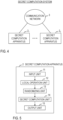
- the secret computation system of the second embodiment includes n ( ⁇ 3) secret computation apparatuses 2 1 , ..., and 2 n , as exemplified in Fig. 4 .
- the secret computation apparatus 2 includes an input unit 11, a local operation unit 12, a randomizing unit 13, a secret computation unit 14, and an output unit 15, as exemplified in Fig. 5 .
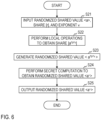
- a secret computation method of the second embodiment is implemented when this secret computation apparatus 2 executes the processes of steps exemplified in Fig. 6 in cooperation with other secret computation apparatuses 2.
- the randomized shared value ⁇ a>, the share [r], and the exponent v are sent to the local operation unit 12.
- DoubleMult can be used for this multiplication.
- ⁇ a ⁇ + ⁇ > ⁇ DoubleMult(([a ⁇ ], [a ⁇ ] ), ([a ⁇ ], [ra ⁇ ])) is computed.
- the secret computation unit 14 may execute these operations a plurality of number of times to obtain a randomized shared value ⁇ a v > obtained by applying additive secret sharing of the v-th power of data "a".
- step S25 when the computational result of the randomizing unit 13 or the secret computation unit 14 becomes a randomized shared value ⁇ a v > obtained by applying additive secret sharing to the v-th power of data "a", the output unit 15 outputs the randomized shared value ⁇ a v >.
- the protocol computes a power in secret computation on a field GF(2 8 ).
- a protocol that computes [a 21 ] from [a] is shown.
- the protocol obtains an inverse element in secret computation on a field GF(2 8 ).
- the power protocol in secret computation on the field GF(2 8 ) is applied to falsification detection.
- the multiplication of a random number is performed by Mult after local operations.
- the inverse-element protocol in secret computation on the field GF(2 8 ) is applied to falsification detection.
- the multiplication of a random number is performed by Mult after local operations.
- the protocol computes a power in secret computation on a field GF(3 3 ).
- a protocol that computes [a 10 ] from [a] is shown.
- the protocol obtains an inverse element in secret computation on a field GF(3 3 ).
- the power protocol in secret computation on the field GF(3 3 ) is applied to falsification detection.
- the multiplication of a random number is performed by Mult after local operations.
- the inverse-element protocol in secret computation on the field GF(3 3 ) is applied to falsification detection.
- the multiplication of a random number is performed by Mult after local operations.
- the following formula on the extended field is used to locally compute the power of a power of a characteristic, reducing the number of communication rounds used in the entire power computation. Therefore, a power can be computed at high speed while data is concealed.
- inverse-element computation that uses a power can be executed at high speed.
- Embodiments of the present invention have been described above. However, a specific configuration of the present invention is not limited to those in the above described embodiments. Even if a design change is made to the above embodiments, if necessary, without departing from the scope of the present invention, it is needless to say that those changes are included in the present invention.
- Each type of processing described in the above embodiments may be executed not only time sequentially according to the order of description but also in parallel or individually when necessary or according to the processing capabilities of the apparatuses that execute the processing.
- the program containing the processing details can be recorded in a computer-readable recording medium.
- the computer-readable recording medium can be any type of medium, such as a magnetic recording device, an optical disc, a magneto-optical recording medium, or a semiconductor memory.
- This program is distributed by selling, transferring, or lending a portable recording medium, such as a DVD or a CD-ROM, with the program recorded on it, for example.
- the program may also be distributed by storing the program in a storage of a server computer and transferring the program from the server computer to another computer through the network.
- a computer that executes this type of program first stores the program recorded on the portable recording medium or the program transferred from the server computer in its storage, for example. Then, the computer reads the program stored in its storage and executes processing in accordance with the read program.
- the computer may read the program directly from the portable recording medium and execute processing in accordance with the program, or the computer may execute processing in accordance with the program each time the computer receives the program transferred from the server computer.
- the above-described processing may be executed by a so-called application service provider (ASP) service, in which the processing functions are implemented just by giving program execution instructions and obtaining the results without transferring the program from the server computer to the computer.
- the program of this form includes information that is provided for use in processing by the computer and is treated correspondingly as a program (something that is not a direct instruction to the computer but is data or the like that has characteristics that determine the processing executed by the computer).
- the apparatuses are implemented by executing the predetermined programs on the computer, but at least a part of the processing details may be implemented by hardware.
- EEE1 A secret computation method in which GF(p k ) is an extended field having a characteristic of p and a degree k of field extension, a is data that is an element of the extended field GF(p k ), [a] is a share obtained by applying additive secret sharing to data a, v is an integer equal to or larger than 2, and u and t are integers equal to or larger than 1 and satisfy t ⁇ p u ⁇ v,
- GF(p k ) is an extended field having a characteristic of p and a degree k of field extension
- a is data that is an element of the extended field GF(p k )
- r is a random number that is an element of the extended field GF(p k )
- [a] is a share obtained by applying additive secret sharing to data a
- ⁇ a> : ([a], [ra]) is a randomized shared value of data a
- v is an integer equal to or larger than 2
- u and t are integers equal to or larger than 1 and satisfy t ⁇ p u ⁇ v
- a secret computation system in which GF(p k ) is an extended field having a characteristic of p and a degree k of field extension, a is data that is an element of the extended field GF(p k ), r is a random number that is an element of the extended field GF(p k ), [a] is a share obtained by applying additive secret sharing to data a, ⁇ a> : ([a], [ra]) is a randomized shared value of data a, v is an integer equal to or larger than 2, and u and t are integers equal to or larger than 1 and satisfy t ⁇ p u ⁇ v,
- a secret computation apparatus included in a secret computation system in which GF(p k ) is an extended field having a characteristic of p and a degree k of field extension, a is data that is an element of the extended field GF(p k ), r is a random number that is an element of the extended field GF(p k ), [a] is a share obtained by applying additive secret sharing to data a, ⁇ a> : ([a], [ra]) is a randomized shared value of data a, v is an integer equal to or larger than 2, and u and t are integers equal to or larger than 1 and satisfy t ⁇ p u ⁇ v,
- EEE7 A program for causing a computer to function as the secret computation apparatus according to one of EEE5 and EEE6.
Landscapes
- Engineering & Computer Science (AREA)
- Computer Security & Cryptography (AREA)
- Computer Networks & Wireless Communication (AREA)
- Signal Processing (AREA)
- Physics & Mathematics (AREA)
- General Physics & Mathematics (AREA)
- Theoretical Computer Science (AREA)
- Storage Device Security (AREA)
- Power Sources (AREA)
Abstract
Description
- The present invention relates to secret computation techniques, and more specifically, to a technique that computes, while concealing data, a power of the data.
- Secret computation technology for analyzing sensitive data while concealing it, in order to share and analyze the data, has been researched. One type of such a technology uses a method called secret sharing in which data is divided into a plurality of pieces called shares. In order to perform various analyses while the data is concealed, protocols have been proposed to perform operations on the concealed data, such as multiplication, addition, and sorting (see Non-Patent Literature 1 and Non-Patent Literature 2, for example).
- Suppose that a power of data is computed while the data is concealed. The Binary method is usually used to compute a power, for example, to compute [a9] from [a], wherein [a] indicates data "a" being concealed. The Binary method repeats multiplication to compute a desired power. The Binary method computes [a9] in the following way, wherein Mult indicates the procedure of multiplication.
- 1. [a2]←Mult([a], [a])
- 2. [a4]←Mult([a2], [a2])
- 3. [a8]←Mult([a4], [a4])
- 4. [a9]←Mult([a8], [a])
-
- Non-Patent Literature 1: Dai Ikarashi, Ryo Kikuchi, Koki Hamada, and Koji Chida, "Actively private and correct MPC scheme in t < n/2 from passively secure schemes with small overhead", IACR Cryptology ePrint Archive, vol. 2014, p. 304, 2014.
- Non-Patent Literature 2: Toshinori Araki, Jun Furukawa, Yehuda Lindell, Ariel Nof, and Kazuma Ohara, "High-Throughput Semi-Honest Secure Three-Party Computation with an Honest Majority", ACM CCS 2016.
- To compute a power with the Binary method, it is necessary to perform multiplication O(log m) times to compute the m-th power. In secret computation, communication is required for multiplication, which serves as a bottleneck for performance. Therefore, it is desirable that a power be computed with a smaller number of multiplication calls.
- An object of the present invention is to provide secret computation technology that computes a power of data while concealing the data, with a small number of communication rounds.
- To solve the problems described above, a secret computation method according to a first aspect of the present invention is a secret computation method in which GF(pk) is an extended field having a characteristic of p and a degree k of field extension, a is data that is an element of the extended field GF(pk), [a] is a share obtained by applying additive secret sharing to data a, v is an integer equal to or larger than 2, and u and t are integers equal to or larger than 1 and satisfy t∗pu ≤ v, the secret computation method computing a share [a v ] of the v-th power of data a from a share [a] of data a while data a is concealed and being executed by a secret computation system that includes three or more secret computation apparatuses. The secret computation method includes computing the pu-th power of a share [at] of the t-th power of data a in a local operation unit of one of the three or more secret computation apparatuses without communication with the other secret computation apparatuses; and obtaining the share [a v ] in a secret computation unit of the one of the three or more secret computation apparatuses by computing a multiplication in which at least one of the multiplicands is [a(t∗p^u)], the computation result of the local operation unit, using secret computation that requires communication with the other secret computation apparatuses.
- A secret computation method according to a second aspect of the present invention is a secret computation method in which GF(pk) is an extended field having a characteristic of p and a degree k of field extension, a is data that is an element of the extended field GF(pk), r is a random number that is an element of the extended field GF(pk), [a] is a share obtained by applying additive secret sharing to data a, <a> := ([a], [ra]) is a randomized shared value of data a, v is an integer equal to or larger than 2, and u and t are integers equal to or larger than 1 and satisfy t∗pu ≤ v, the secret computation method computing a randomized shared value <av> := ([av], [rav]) of the v-th power of data a from a randomized shared value [a] of data a while data a is concealed and being executed by a secret computation system that includes three or more secret computation apparatuses. The secret computation method includes computing the pu-th power of a share [at] of the t-th power of data a in a local operation unit of one of the three or more secret computation apparatuses without communication with the other secret computation apparatuses; obtaining a randomized shared value <a(t∗p^u)> := ([a(t∗p^u)], [r a(t∗p^u)]) of the computation result of the local operation unit in a randomizing unit of the one of the three or more secret computation apparatuses by multiplying [a(t∗p^u)], the computation result of the local operation unit, with a share [r] of the random number r using secret computation that requires communication with the other secret computation apparatuses; and obtain the randomized shared value <av> in a secret computation unit of the one of the three or more secret computation apparatuses by computing a multiplication in which at least one of the multiplicands is a randomized shared value <a(t∗p^u)>, of the computation result of the local operation unit using secret computation that requires communication with the other secret computation apparatuses.
- According to the present invention, since some operations are performed locally when a power of data is computed while the data is concealed, the power is computed at high speed with a small number of communication rounds.
-
-
Fig. 1 is a diagram showing an example of the functional configuration of a secret computation system according to a first embodiment; -
Fig. 2 is a diagram showing an example of the functional configuration of a secret computation apparatus according to the first embodiment; -
Fig. 3 is a diagram showing an example of the processing procedure of a secret computation method according to the first embodiment; -
Fig. 4 is a diagram showing an example of the functional configuration of a secret computation system according to a second embodiment; -
Fig. 5 is a diagram showing an example of the functional configuration of a secret computation apparatus according to the second embodiment; and -
Fig. 6 is a diagram showing an example of the processing procedure of a secret computation method according to the second embodiment. - Embodiments of the present invention will be described below in detail. Components having identical functions will be denoted by the same reference numbers in the figures, and duplication of description thereof will be omitted.
- A superscript indicates a power and the sign ^ in a superscript also means a power. For example, ab means the b-th power of a, and ab^c means the bc-th power of a.
- Data obtained by concealing data "a" with encryption or secret sharing is called the secure text of "a" and is indicated by [a]. "a" is called the plaintext of [a]. When secret sharing is used in concealment, [a] is called a share or a shared value of data "a".
- A randomized shared value of data "a" is indicated by <a>. A randomized shared value is a pair of a share [a] of data "a" and a share [ra] of the product "ra" of data "a" and a random number "r". Therefore, a randomized shared value of data "a" can be defined as: <a> := ([a], [ra]). In the randomized shared value <a> := ([a], [ra]), [a] is called the 0-th component and [ra] is called the first component. See Non-Patent Literature 1 for detecting secret falsification with randomized shared values.
- A field to which data and shares belong to is called GF(pk), and hereinafter, all operations are performed on GF(pk), wherein p is called a characteristic and k is called a degree of field extension. For example, when a, b ∈ GF(7), a + b is obtained by adding a and b and applying mod 7 to the sum. When a, b ∈ GF(28), a + b is obtained by applying XOR to the corresponding bits of a and b expressed in bits.
- Additive secret sharing is a secret sharing method in which data "a" is divided into the sum or difference of a plurality of shares ai (i = 0, 1, ..., m-1), as shown in the formula below, and sharing and reconstructing are performed only by addition and subtraction.

- In additive secret sharing, when all of m shares a0, a1, ..., and am-1 are obtained from some servers, the original data "a" can be reconstructed; if any of the shares a0, a1, ..., and am-1 is not obtained, the original data "a" cannot be reconstructed.
- Replicated secret sharing formed of the following Share and Rec protocols can be used as additive secret sharing. The Share protocol divides plaintext into shares, and the Rec protocol reconstructs the plaintext from the shares. In the present invention, however, any method can be used as long as the method has the characteristics of additive secret sharing, even if the method is not replicated secret sharing.
- It is assumed that [a] indicates the whole share of data "a" and [a]i indicates a share held by a server "i" among the share [a]. When data "a" is divided and held by three servers (servers 0, 1, and 2), data "a" is divided into ao, a1, and a2 in advance according to the following Share protocol, and servers 0, 1, and 2 respectively store [a]o := (ao, a1), [a]1:= (a1 a2), and [a]2 := (a2, a0). When data "a" is reconstructed, at least two of the shares [a]0, [a]1, and [a]2 are collected to obtain a0, a1, and a2, and they are added to compute data "a" according to the following Rec protocol.
- The Share protocol is, for example, the following protocol.
       Input: a
       Output: ([a]0, [a]1,[a]2)
       1. a1, a2←GF(pk)
       2. a0:=a-(a1+a2)
       3. [a]i:=(ai, ai+1 mod3) for iE {0, 1, 2}
       4. return ([a]0, [a]1, [a]2)
       Input: [a]i0, [a]i1 (i0, i1 ∈ {0, 1, 2})
       Output: a
       1. Obtain a0, a1, a2 from [a]i0, [a]i1
       2. return a:=a0+a1+a2
       Input: a
       Output: ([a]0, [a]1,[a]2)
       1. a1, a2←GF(pk)
       2. a0:=-(a1+a2)
       3. [a]i:=(ai, ai-1 mod3- a) for i∈ {0, 1, 2}
       4. return ([a]0, [a]1, [a]2)
       Input: [a]i0, [a]i1 (i0, i1 ∈ {0, 1, 2})
       Output: a
       1. Obtain ai mod3, ai+1 mod 3, (ai+2 mod 3-a) from [a]i0, [a]i1 for some i ∈ {0,
 1,2}
       2. return a:=-(a0+a1+a2)


is assumed here. However,


- 1. [a64]:=LocalExp([a], 26)
- 2. [a32]:=LocalExp([a], 25)
- 3. [a96]←Mult([a64], [a32])
- 1. [a2]←Mult([a], [a])
- 2. [a4]←Mult([a2], [a2])
- 3. [a8]←Mult([a4], [a4])
- 4. [a16]←Mult([a8], [a8])
- 5. [a32]←Mult([a16], [a16])
- 6. [a64]←Mult([a32], [a32])
- 7. [a96]←Mult([a64], [a32])
       Input: [a]
       Output: [a21]
       1. [a16]:=LocalExp([a], 24)
       2. [a4]:=LocalExp([a], 22)
       3. [a20]←Mult([a16], [a4])
       4. [a21]←Mult([a20], [a1])
       5. return [a21]
       Input: [a]
       Output: [a21]
       1. [a2]←Mult([a], [a])
       2. [a4]←Mult([a2], [a2])
       3. [a5]←Mult([a4], [a])
       4. [a10]←Mult([a5], [a5])
       5. [a20]←Mult([a10], [a10])
       6. [a21]←Mult([a20], [a])
       7. return [a21]
       Input: [a]
       Output: [a-1]=[a254]
       1. [a2]:=LocalExp([a], 2)
       2. [a3]←Mult([a2], [a])
       3. [a12]:=LocalExp([a3], 22)
       4. [a15]←Mult([a12], [a3])
       5. [a14]←Mult([a12], [a2])
       6. [a240]:=LocalExp([a15], 24)
       7. [a254]←Mult([a240], [a14])
       8. return [a254]
       Input: [a]
       Output: [a-1]=[a254]
       1. [a2]←Mult([a], [a])
       2. [a3]←Mult([a2], [a])
       3. [a6]←Mult([a3], [a3])
       4. [a7]←Mult([a6], [a])
       5. [a14]←Mult([a7], [a7])
       6. [a15]←Mult([a14], [a])
       7. [a30]←Mult([a30], [a30])
       8. [a31]←Mult([a30], [a])
       9. [a62]←Mult([a32], [a32])
       10. [a63]←Mult([a62], [a])
       11. [a126]←Mult([a63], [a63])
       12. [a127]←Mult([a126], [a])
       13. [a254]←Mult([a127], [a127])
       14. return [a254]
       Input: <a>=([a], [ra]), [r]
       Output: <a21>=([a21], [ra21])
       1. [a16]:=LocalExp([a], 24)
       2. [a4]:=LocalExp([a], 22)
       3. [ra4]←Mult([a4], [r])
       4. ([a20], [ra20])←DoubleMult(([a16], [a16]), ([a4], [ra4]))
       5. ([a21], [ra21])←DoubleMult(([a], [a]), ([a20], [ra20]))
       6. return <a21>=([a21], [ra21])
       Input: <a>=([a], [ra]), [r]
       Output: <a-1>=<a254>=([a254], [ra254])
       1. [a2]:=LocalExp([a], 2)
       2. [ra2]←Mult([a2], [r])
       3. ([a3], [ra3])←DoubleMult(([a], [a]), ([a2], [ra2]))
       4. [a12]:=LocalExp([a3], 22)
       5. ([a15], [ra15])←DoubleMult(([a12], [a12]), ([a3], [ra3]))
       6. ([a14], [ra14])←DoubleMult(([a12], [a12]), ([a2], [ra2]))
       7. [a240]:=LocalExp([a15], 24)
       8. ([a254], [ra254])←DoubleMult(([a240], [a240]), ([a14], [ra14]))
       9. return <a254>=([a254], [ra254])
       Input: [a]
       Output: [a10]
       1. [a9]:=LocalExp([a], 32)
       2. [a10]←Mult([a9], [a])
       3. return [a10]
       Input: [a]
       Output: [a10]
       1. [a2]←Mult([a], [a])
       2. [a4]←Mult([a2], [a2])
       3. [a5]←Mult([a4], [a])
       4. [a10]←Mult([a5], [a5])
       5. return [a10]
       Input: [a]
       Output: [a-1]=[a25]
       1. [a9]:=LocalExp([a], 32)
       2. [a3]:=LocalExp([a], 3)
       2. [a12]←Mult([a9], [a3])
       4. [a24]←Mult([a12], [a12])
       5. [a25]←Mult([a24], [a])
       8. return [a25]
       Input: [a]
       Output: [a-1]=[a25]
       1. [a2]←Mult([a], [a])
       2. [a3]←Mult([a2], [a])
       3. [a6]←Mult([a3], [a3])
       4. [a12]←Mult([a6], [a6])
       5. [a24]←Mult([a12], [a12])
       6. [a25]←Mult([a24], [a])
       7. return [a25]
       Input: <a>=([a], [ra]), [r]
       Output: <a10>=([a10], [ra10])
       1. [a9]:=LocalExp([a], 32)
       2. ([a10], [ra10])←DoubleMult(([a9], [a9]), ([a], [ra]))
       3. return <a10>=([a10], [ra10])
       Input: <a>=([a], [ra]), [r]
       Output: <a-1>=<a25>=([a25], [ra25])
       1. [a9]:=LocalExp([a], 32)
       2. [a3]:=LocalExp([a], 3)
       3. [ra3]←Mult([a3], [r])
       4. ([a12], [ra12])←DoubleMult(([a9], [a9]), ([a3], [ra3]))
       5. ([a24], [ra24])←DoubleMult(([a12], [a12]), ([a12], [ra12]))
       6. ([a25], [ra25])←DoubleMult(([a24], [a24]), ([a], [ra]))
       7. return <a25>=([a25], [ra25])

- the secret computation method computing a share [a v ] of the v-th power of data a from a share [a] of data a while data a is concealed and being executed by a secret computation system that includes three or more secret computation apparatuses,
- the secret computation method comprising:
- computing the pu-th power of a share [at] of the t-th power of data a in a local operation unit of one of the three or more secret computation apparatuses without communication with the other secret computation apparatuses; and
- obtaining the share [a v ] in a secret computation unit of the one of the three or more secret computation apparatuses by computing a multiplication in which at least one of the multiplicands is [a(t∗p^u)], the computation result of the local operation unit, using secret computation that requires communication with the other secret computation apparatuses.
- the secret computation method computing a randomized shared value <av> := ([av], [rav]) of the v-th power of data a from a randomized shared value [a] of data a while data a is concealed and being executed by a secret computation system that includes three or more secret computation apparatuses,
- the secret computation method comprising:
- computing the pu-th power of a share [at] of the t-th power of data a in a local operation unit of one of the three or more secret computation apparatuses without communication with the other secret computation apparatuses;
- obtaining a randomized shared value <a(t∗p^u)> := ([a(t∗p^u)], [ra(t∗p^u)]) of the computation result of the local operation unit in a randomizing unit of the one of the three or more secret computation apparatuses by multiplying [a(t∗p^u)], the computation result of the local operation unit, with a share [r] of the random number r using secret computation that requires communication with the other secret computation apparatuses; and
- obtaining the randomized shared value <av> in a secret computation unit of the one of the three or more secret computation apparatuses by computing a multiplication in which at least one of the multiplicands is a randomized shared value <a(t∗p^u)> of the computation result of the local operation unit using secret computation that requires communication with the other secret computation apparatuses.
- the secret computation system comprising three or more secret computation apparatuses to compute a share [a v ] of the v-th power of data a from a share [a] of data a while data a is concealed,
- each of the secret computation apparatuses comprising:
- a local operation unit adapted to compute the pu-th power of a share [at] of the t-th power of data a without communication with the other secret computation apparatuses; and
- a secret computation unit adapted to obtain the share [a v ] by computing a multiplication in which at least one of the multiplicands is [a(t∗p^u)], the computation result of the local operation unit, using secret computation that requires communication with the other secret computation apparatuses.
- the secret computation system comprising three or more secret computation apparatuses to compute a randomized shared value <av> := ([av], [rav]) of the v-th power of data a from a randomized shared value [a] of data a while data a is concealed,
- each of the secret computation apparatuses comprising:
- a local operation unit adapted to compute the pu-th power of a share [at] of the t-th power of data a without communication with the other secret computation apparatuses;
- a randomizing unit adapted to obtain a randomized shared value <a(t∗p^u)> := ([a(t∗p^u)], [ra(t∗p^u)]) of the computation result of the local operation unit by multiplying [a(t∗p^u)], the computation result of the local operation unit, with a share [r] of the random number r using secret computation that requires communication with the other secret computation apparatuses; and
- a secret computation unit adapted to obtain the randomized shared value <av> by computing a multiplication in which at least one of the multiplicands is a randomized shared value <a(t∗p^u)> of the computation result of the local operation unit using secret computation that requires communication with the other secret computation apparatuses.
- the secret computation system computing a share [a v ] of the v-th power of data a from a share [a] of data a while data a is concealed,
- the secret computation apparatus comprising:
- a local operation unit adapted to compute the pu-th power of a share [at] of the t-th power of data a without communication with another secret computation apparatus; and
- a secret computation unit adapted to obtain the share [a v ] by computing a multiplication in which at least one of the multiplicands is [a(t∗p^u)], the computation result of the local operation unit, using secret computation that requires communication with another secret computation apparatus.
- the secret computation system computing a randomized shared value <av> := ([av], [rav]) of the v-th power of data a from a randomized shared value [a] of data a while data a is concealed,
- the secret computation apparatus comprising:
- a local operation unit adapted to compute the pu-th power of a share [at] of the t-th power of data a without communication with another secret computation apparatus;
- a randomizing unit adapted to obtain a randomized shared value <a(t∗p^u)> := ([a(t∗p^u)], [ra(t∗p^u)]) of the computation result of the local operation unit by multiply [a(t∗p^u)], the computation result of the local operation unit, with a share [r] of the random number r using secret computation that requires communication with another secret computation apparatus; and
- a secret computation unit adapted to obtain the randomized shared value <av> by computing a multiplication in which at least one of the multiplicands is a randomized shared value <a(t∗p^u)> of the computation result of the local operation unit using secret computation that requires communication with another secret computation apparatus.
Claims (7)
- A secure multiparty computation method in which GF(pk) is an extended field having a characteristic of p and a degree k of field extension, a is data that is an element of the extended field GF(pk), [a] is a share obtained by applying additive secret sharing to data a, v is an integer equal to or larger than 2, u is an integer equal to or larger than 2, t is an integer equal to or larger than 1, t, u, and v satisfy t∗pu ≤ v, LocalExp is a local power operation, and Mult is a multiplication,
the secure multiparty computation method computing a share [a v ] of the v-th power of data a from a share [a] of data a while data a is concealed and being executed by a secure multiparty computation system that includes three or more secret computation apparatuses (11, ..., 1n),
the secure multiparty computation method comprising:computing the pu-th power of a share [at] of the t-th power of data a, in a local operation unit (12) of each of the secret computation apparatuses, using a local power operation that does not communicate with the other secret computation apparatuses, wherein the share [at] is locally held,characterized in thatwhen p=2, v=254, the secure multiparty computation method computes
[a2]:=LocalExp([a], 2),
[a3]←Mult([a2], [a]),
[a12]:=LocalExp([a3], 22),
[a15]←Mult([a12], [a3]),
[a14]←Mult([a12], [a2]),
[a240]:=LocalExp([a15], 24), and
[a254]←Mult([a240], [a14]). - A secure multiparty computation method in which GF(pk) is an extended field having a characteristic of p and a degree k of field extension, a is data that is an element of the extended field GF(pk), r is a random number that is an element of the extended field GF(pk), [a] is a share obtained by applying additive secret sharing to data a, <a> := ([a], [ra]) is a randomized shared value of data a, v is an integer equal to or larger than 2, u is an integer equal to or larger than 2, t is an integer equal to or larger than 1, t, u, and v satisfy t∗pu ≤ v, LocalExp is a local power operation, Mult is a multiplication, and DoubleMult is an operation in which two pairs of secure text are input,
the secure multiparty computation method computing a randomized shared value <av> := ([av], [rav]) of the v-th power of data a from a randomized shared value [a] of data a while data a is concealed and being executed by a secure multiparty computation system that includes three or more secret computation apparatuses (21, ..., 2n),
the secure multiparty computation method comprising:computing the pu-th power of a share [at] of the t-th power of data a, in a local operation unit (12) of each of the secret computation apparatuses, using a local power operation that does not communicate with the other secret computation apparatuses, wherein the share [at] is locally held; andobtaining a randomized shared value <a(t∗p^u)> := ([a(t∗p^u)], [ra(t∗p^u)]) of the computation result of the local operation unit (12) in a randomizing unit (13) of each of the secret computation apparatuses by multiplying [a(t∗p^u)], the computation result of the local operation unit (12), with a share [r] of the random number r using secret computation that requires communication with the other secret computation apparatuses,characterized in thatwhen p=2, v=254, the secure multiparty computation method computes
[a2]:=LocalExp([a], 2),
[ra2]←Mult([a2], [r]),
([a3], [ra3])←DoubleMult(([a], [a]), ([a2], [ra2])),
[a12]:= LocalExp([ a3] , 22),
([a15], [ra15])←DoubleMult(([a12], [a12]), ([a3], [ra3])),
([a14], [ra14])←DoubleMult(([a12], [a12]), ([a2], [ra2])),
[a240]:=LocalExp([a15], 24), and
([a254], [ra254])←DoubleMult(([a240], [a240]), ([a14], [ra14])). - A secure multiparty computation system in which GF(pk) is an extended field having a characteristic of p and a degree k of field extension, a is data that is an element of the extended field GF(pk), [a] is a share obtained by applying additive secret sharing to data a, v is an integer equal to or larger than 2, u is an integer equal to or larger than 2, t is an integer equal to or larger than 1, t, u, and v satisfy t∗pu ≤ v, LocalExp is a local power operation, and Mult is a multiplication,the secure multiparty computation system comprising three or more secret computation apparatuses (11, ..., 1n) to compute a share [a v ] of the v-th power of data a from a share [a] of data a while data a is concealed,each of the secret computation apparatuses (1) comprising:a local operation unit (12) adapted to compute the pu-th power of a share [at] of the t-th power of data a, using a local power operation that does not communicate with the other secret computation apparatuses, wherein the share [at] is locally held; anda secret computation unit (14) adapted to compute a multiplication,characterized in thatwhen p=2, v=254, the secure multiparty computation system computes
[a2]:=LocalExp([a], 2),
[a3]←Mult([a2], [a]),
[a12]:=LocalExp([a3], 22),
[a15]←Mult([a12], [a3]),
[a14]←Mult([a12], [a2]),
[a240]:=LocalExp([a15], 24), and
[a254]←Mult([a240], [a14]). - A secure multiparty computation system in which GF(pk) is an extended field having a characteristic of p and a degree k of field extension, a is data that is an element of the extended field GF(pk), r is a random number that is an element of the extended field GF(pk), [a] is a share obtained by applying additive secret sharing to data a, <a> := ([a], [ra]) is a randomized shared value of data a, v is an integer equal to or larger than 2, u is an integer equal to or larger than 2, t is an integer equal to or larger than 1, t, u, and v satisfy t∗pu ≤ ν, LocalExp is a local power operation, Mult is a multiplication, and DoubleMult is an operation in which two pairs of secure text are input,the secure multiparty computation system comprising three or more secret computation apparatuses (21, ..., 2n) to compute a randomized shared value <av> := ([av], [rav]) of the v-th power of data a from a randomized shared value [a] of data a while data a is concealed,each of the secret computation apparatuses (2) comprising:a local operation unit (12) adapted to compute the pu-th power of a share [at] of the t-th power of data a, using a local power operation that does not communicate with the other secret computation apparatuses, wherein the share [at] is locally held;a randomizing unit (13) adapted to obtain a randomized shared value <a(t∗p^u)> := ([a(t∗p^u)], [ra(t∗p^u)]) of the computation result of the local operation unit (12) by multiplying [a(t∗p^u)], the computation result of the local operation unit (12), with a share [r] of the random number r using secret computation that requires communication with the other secret computation apparatuses; anda secret computation unit (14) adapted to compute a multiplication,characterized in thatwhen p=2, v=254, the secure multiparty computation system computes
[a2]:=LocalExp([a], 2),
[ra2]←Mult([a2], [r]),
([a3], [ra3])←DoubleMult(([a], [a]), ([a2], [ra2])),
[a12]:= LocalExp([ a3] , 22),
([a15], [ra15])←DoubleMult(([a12], [a12]), ([a3], [ra3])),
([a14], [ra14])←DoubleMult(([a12], [a12]), ([a2], [ra2])),
[a240]:=LocalExp([a15], 24), and
([a254], [ra254])←DoubleMult(([a240], [a240]), ([a14], [ra14])). - A secret computation apparatus (1) included in a secure multiparty computation system in which GF(pk) is an extended field having a characteristic of p and a degree k of field extension, a is data that is an element of the extended field GF(pk), [a] is a share obtained by applying additive secret sharing to data a, v is an integer equal to or larger than 2, u is an integer equal to or larger than 2, t is an integer equal to or larger than 1, t, u, and v satisfy t∗pu ≤ v, LocalExp is a local power operation, and Mult is a multiplication,the secure multiparty computation system computing a share [a v ] of the v-th power of data a from a share [a] of data a while data a is concealed,the secret computation apparatus (1) comprising:a local operation unit (12) adapted to compute the pu-th power of a share [at] of the t-th power of data a, using a local power operation that does not communicate with another secret computation apparatus, wherein the share [at] is locally held; anda secret computation unit (14) adapted to compute a multiplication,characterized in thatwhen p=2, v=254, the secure multiparty computation system computes
[a2]:=LocalExp([a], 2),
[a3]←Mult([a2], [a]),
[a12] :=LocalExp([a3], 22),
[a15]←Mult([a12], [a3]),
[a14]←Mult([a12], [a2]),
[a240]:=LocalExp([a15], 24), and
[a254]←Mult([a240], [a14]). - A secret computation apparatus (2) included in a secure multiparty computation system in which GF(pk) is an extended field having a characteristic of p and a degree k of field extension, a is data that is an element of the extended field GF(pk), r is a random number that is an element of the extended field GF(pk), [a] is a share obtained by applying additive secret sharing to data a, <a> := ([a], [ra]) is a randomized shared value of data a, v is an integer equal to or larger than 2, u is an integer equal to or larger than 2, t is an integer equal to or larger than 1, t, u, and v satisfy t∗pu ≤ v, LocalExp is a local power operation, Mult is a multiplication, and DoubleMult is an operation in which two pairs of secure text are input,the secure multiparty computation system computing a randomized shared value <av> := ([av], [rav]) of the v-th power of data a from a randomized shared value [a] of data a while data a is concealed,the secret computation apparatus (2) comprising:a local operation unit (12) adapted to compute the pu-th power of a share [at] of the t-th power of data a, using a local power operation that does not communicate with another secret computation apparatus, wherein the share [at] is locally held;a randomizing unit (13) adapted to obtain a randomized shared value <a(t∗p^u)> := ([a(t∗p^u)], [ra(t∗p^u)]) of the computation result of the local operation unit (12) by multiply [a(t∗p^u)], the computation result of the local operation unit (12), with a share [r] of the random number r using secret computation that requires communication with another secret computation apparatus;a secret computation unit (14) adapted to compute a multiplication,characterized in thatwhen p=2, v=254, the secure multiparty computation system computes
[a2]:=LocalExp([a], 2),
[ra2]←Mult([a2], [r]),
([a3], [ra3])←DoubleMult(([a], [a]), ([a2], [ra2])),
[a12]:= LocalExp([ a3] , 22),
([a15], [ra15])←DoubleMult(([a12], [a12]), ([a3], [ra3])),
([a14], [ra14])←DoubleMult(([a12], [a12]), ([a2], [ra2])),
[a240]:=LocalExp([a15], 24), and
([a254], [ra254])←DoubleMult(([a240], [a240]), ([a14], [ra14])). - A program for causing a computer to function as the secret computation apparatus according to one of Claims 5 and 6.
Applications Claiming Priority (3)
| Application Number | Priority Date | Filing Date | Title |
|---|---|---|---|
| JP2017006355 | 2017-01-18 | ||
| EP18741847.0A EP3573041A4 (en) | 2017-01-18 | 2018-01-17 | SECURE CALCULATION METHOD, SECURE CALCULATION SYSTEM, SECURE CALCULATION DEVICE, AND PROGRAM |
| PCT/JP2018/001135 WO2018135511A1 (en) | 2017-01-18 | 2018-01-17 | Secure computation method, secure computation system, secure computation device, and program |
Related Parent Applications (1)
| Application Number | Title | Priority Date | Filing Date |
|---|---|---|---|
| EP18741847.0A Division EP3573041A4 (en) | 2017-01-18 | 2018-01-17 | SECURE CALCULATION METHOD, SECURE CALCULATION SYSTEM, SECURE CALCULATION DEVICE, AND PROGRAM |
Publications (2)
| Publication Number | Publication Date |
|---|---|
| EP4167213A1 true EP4167213A1 (en) | 2023-04-19 |
| EP4167213B1 EP4167213B1 (en) | 2024-03-13 |
Family
ID=62908607
Family Applications (2)
| Application Number | Title | Priority Date | Filing Date |
|---|---|---|---|
| EP22207157.3A Active EP4167213B1 (en) | 2017-01-18 | 2018-01-17 | Secret computation method, secret computation system, secret computation apparatus, and program |
| EP18741847.0A Ceased EP3573041A4 (en) | 2017-01-18 | 2018-01-17 | SECURE CALCULATION METHOD, SECURE CALCULATION SYSTEM, SECURE CALCULATION DEVICE, AND PROGRAM |
Family Applications After (1)
| Application Number | Title | Priority Date | Filing Date |
|---|---|---|---|
| EP18741847.0A Ceased EP3573041A4 (en) | 2017-01-18 | 2018-01-17 | SECURE CALCULATION METHOD, SECURE CALCULATION SYSTEM, SECURE CALCULATION DEVICE, AND PROGRAM |
Country Status (4)
| Country | Link |
|---|---|
| US (1) | US11646880B2 (en) |
| EP (2) | EP4167213B1 (en) |
| JP (1) | JP6732959B2 (en) |
| WO (1) | WO2018135511A1 (en) |
Families Citing this family (5)
| Publication number | Priority date | Publication date | Assignee | Title |
|---|---|---|---|---|
| AU2018295722B2 (en) * | 2017-07-05 | 2020-11-19 | Ntt, Inc. | Secure computation system, secure computation apparatus, secure computation method, program, and recording medium |
| WO2020152831A1 (en) * | 2019-01-24 | 2020-07-30 | 日本電気株式会社 | Information processing device, secret calculation method, and program |
| JP7452669B2 (en) | 2020-08-26 | 2024-03-19 | 日本電気株式会社 | Secure computation system, secure computation server device, secure computation method, and secure computation program |
| CN114448630B (en) * | 2022-04-07 | 2022-06-14 | 华控清交信息科技(北京)有限公司 | Multi-party secure computing method, system and device for multi-party secure computing |
| CN114448631B (en) * | 2022-04-07 | 2022-06-07 | 华控清交信息科技(北京)有限公司 | Multi-party security computing method, system and device for multi-party security computing |
Family Cites Families (33)
| Publication number | Priority date | Publication date | Assignee | Title |
|---|---|---|---|---|
| US4975867A (en) * | 1987-06-26 | 1990-12-04 | Digital Equipment Corporation | Apparatus for dividing elements of a Galois Field GF (2QM) |
| US6038581A (en) * | 1997-01-29 | 2000-03-14 | Nippon Telegraph And Telephone Corporation | Scheme for arithmetic operations in finite field and group operations over elliptic curves realizing improved computational speed |
| JP3560860B2 (en) * | 1999-07-23 | 2004-09-02 | 株式会社東芝 | Secret sharing system, device, and storage medium |
| FR2807898B1 (en) * | 2000-04-18 | 2002-06-28 | Gemplus Card Int | ELLIPTICAL CURVE CRYPTOGRAPHY PROCESS |
| FR2822002B1 (en) * | 2001-03-12 | 2003-06-06 | France Telecom | CRYPTOGRAPHIC AUTHENTICATION BY EPHEMER MODULES |
| US6766344B2 (en) * | 2001-05-08 | 2004-07-20 | International Business Machines Corporation | Processing Galois Field arithmetic |
| CN1875569A (en) * | 2003-11-03 | 2006-12-06 | 皇家飞利浦电子股份有限公司 | Method and device for efficient multiparty multiplication |
| DE102005041102A1 (en) * | 2005-08-30 | 2007-03-15 | Siemens Ag | Method for scalar multiplication of points on an elliptic curve |
| US7885406B2 (en) * | 2006-10-10 | 2011-02-08 | Microsoft Corporation | Computing endomorphism rings of Abelian surfaces over finite fields |
| US7995757B2 (en) * | 2007-05-31 | 2011-08-09 | Harris Corporation | Closed galois field combination |
| JP4189828B1 (en) * | 2007-10-30 | 2008-12-03 | 国立大学法人 岡山大学 | Pairing calculation device, pairing calculation method, and pairing calculation program |
| JP4521503B2 (en) * | 2008-02-25 | 2010-08-11 | 国立大学法人 岡山大学 | Scalar multiplication operation program and power multiplication operation program |
| US8139764B2 (en) * | 2008-05-06 | 2012-03-20 | Harris Corporation | Closed galois field cryptographic system |
| CN102227759B (en) * | 2008-11-28 | 2015-06-24 | 国立大学法人冈山大学 | Scalar multiplier and scalar multiplication method |
| US8630422B2 (en) * | 2009-11-10 | 2014-01-14 | International Business Machines Corporation | Fully homomorphic encryption method based on a bootstrappable encryption scheme, computer program and apparatus |
| FR2960727B1 (en) * | 2010-05-26 | 2016-04-15 | Oberthur Technologies | METHOD FOR EVALUATING A FUNCTION |
| US8565435B2 (en) * | 2010-08-16 | 2013-10-22 | International Business Machines Corporation | Efficient implementation of fully homomorphic encryption |
| JP5531154B2 (en) * | 2011-03-10 | 2014-06-25 | 日本電信電話株式会社 | Secret product-sum combination system, calculation device, secret product-sum combination method, and program thereof |
| US8433893B2 (en) * | 2011-03-30 | 2013-04-30 | Mitsubishi Electric Research Laboratories, Inc. | Privacy-preserving probabilistic inference based on hidden markov models |
| US8799343B2 (en) * | 2011-09-22 | 2014-08-05 | Intel Corporation | Modular exponentiation with partitioned and scattered storage of Montgomery Multiplication results |
| US20160365973A1 (en) * | 2012-10-30 | 2016-12-15 | Nederlandse Organisatie Voor Toegepast-Natuurwetenschappelijk Onderzoek Tno | Secure Distribution of Watermarked Content |
| WO2014112548A1 (en) * | 2013-01-17 | 2014-07-24 | 日本電信電話株式会社 | Secure-computation system, computing device, secure-computation method, and program |
| US9787472B1 (en) * | 2013-03-13 | 2017-10-10 | Hrl Laboratories, Llc | Information secure protocol for mobile proactive secret sharing with near-optimal resilience |
| US10083310B1 (en) * | 2013-03-13 | 2018-09-25 | Hrl Laboratories, Llc | System and method for mobile proactive secure multi-party computation (MPMPC) using commitments |
| JP6089878B2 (en) * | 2013-03-28 | 2017-03-08 | 富士通株式会社 | Orthogonal transformation device, orthogonal transformation method, computer program for orthogonal transformation, and audio decoding device |
| US10075288B1 (en) * | 2014-02-28 | 2018-09-11 | The Governing Council Of The University Of Toronto | Systems, devices, and processes for homomorphic encryption |
| ES2949399T3 (en) * | 2014-11-12 | 2023-09-28 | Calctopia Ltd | Secure multiparty computing in spreadsheets |
| WO2016104476A1 (en) * | 2014-12-26 | 2016-06-30 | 日本電信電話株式会社 | Secret falsification detection system, secret calculation device, secret falsification detection method, and program |
| JP6693508B2 (en) * | 2015-04-03 | 2020-05-13 | 日本電気株式会社 | Secret calculation system, server device, secret calculation method, and program |
| US9906505B2 (en) * | 2015-05-08 | 2018-02-27 | Nxp B.V. | RSA decryption using multiplicative secret sharing |
| JP6988807B2 (en) * | 2016-08-18 | 2022-01-05 | 日本電気株式会社 | Secret calculation system, secret calculation method, secret calculation device and secret calculation program |
| EP3566389B1 (en) * | 2017-01-06 | 2021-08-18 | Koninklijke Philips N.V. | Distributed privacy-preserving verifiable computation |
| CN111133719B (en) * | 2017-09-29 | 2024-01-26 | 罗伯特·博世有限公司 | A method for faster secure multi-square inner product computation utilizing SPDZ |
-
2018
- 2018-01-17 WO PCT/JP2018/001135 patent/WO2018135511A1/en not_active Ceased
- 2018-01-17 EP EP22207157.3A patent/EP4167213B1/en active Active
- 2018-01-17 US US16/475,236 patent/US11646880B2/en active Active
- 2018-01-17 EP EP18741847.0A patent/EP3573041A4/en not_active Ceased
- 2018-01-17 JP JP2018563352A patent/JP6732959B2/en active Active
Non-Patent Citations (8)
| Title |
|---|
| CRAIG GENTRY ET AL: "Homomorphic Evaluation of the AES Circuit", IACR, INTERNATIONAL ASSOCIATION FOR CRYPTOLOGIC RESEARCH, vol. 20120615:114229, 15 June 2012 (2012-06-15), pages 1 - 34, XP061006283 * |
| DAI IKARASHI ET AL: "Actively Private and Correct MPC Scheme in t < n/2 from Passively Secure Schemes with Small Overhead", IACR, INTERNATIONAL ASSOCIATION FOR CRYPTOLOGIC RESEARCH, vol. 20140519:023358, 19 May 2014 (2014-05-19), pages 1 - 18, XP061016122 * |
| DAI IKARASHIRYO KIKUCHIKOKI HAMADAKOJI CHIDA: "Actively private and correct MPC scheme in t < n/2 from passively secure schemes with small overhead", IACR CRYPTOLOGY EPRINT ARCHIVE, vol. 2014, 2014, pages 304 |
| FABRIZIO DE SANTIS ET AL: "Hiding Higher-Order Univariate Leakages by Shuffling Polynomial Masking Schemes", THEORY OF IMPLEMENTATION SECURITY, ACM, 2 PENN PLAZA, SUITE 701 NEW YORK NY 10121-0701 USA, 24 October 2016 (2016-10-24), pages 17 - 26, XP058282082, ISBN: 978-1-4503-4575-0, DOI: 10.1145/2996366.2996370 * |
| HEESEOK KIM ET AL: "A Fast and Provably Secure Higher-Order Masking of AES S-Box", 28 September 2011, SAT 2015 18TH INTERNATIONAL CONFERENCE, AUSTIN, TX, USA, SEPTEMBER 24-27, 2015; [LECTURE NOTES IN COMPUTER SCIENCE; LECT.NOTES COMPUTER], SPRINGER, BERLIN, HEIDELBERG, PAGE(S) 95 - 107, ISBN: 978-3-540-74549-5, XP019166882 * |
| IVAN DAMGÅRD ET AL: "Implementing AES via an Actively/Covertly Secure Dishonest-Majority MPC Protocol", 5 September 2012, SECURITY AND CRYPTOGRAPHY FOR NETWORKS, SPRINGER BERLIN HEIDELBERG, BERLIN, HEIDELBERG, PAGE(S) 241 - 263, ISBN: 978-3-642-32927-2, XP047016102 * |
| TOSHINORI ARAKI ET AL: "High-Throughput Semi-Honest Secure Three-Party Computation with an Honest Majority", ACM CCS, 2016, XP061022051 * |
| TOSHINORI ARAKIJUN FURUKAWAYEHUDA LINDELLARIEL NOFKAZUMA OHARA: "High-Throughput Semi-Honest Secure Three-Party Computation with an Honest Majority", ACM CCS, 2016 |
Also Published As
| Publication number | Publication date |
|---|---|
| JPWO2018135511A1 (en) | 2019-11-07 |
| EP3573041A4 (en) | 2020-06-03 |
| EP4167213B1 (en) | 2024-03-13 |
| US11646880B2 (en) | 2023-05-09 |
| WO2018135511A1 (en) | 2018-07-26 |
| US20190349193A1 (en) | 2019-11-14 |
| EP3573041A1 (en) | 2019-11-27 |
| JP6732959B2 (en) | 2020-07-29 |
Similar Documents
| Publication | Publication Date | Title |
|---|---|---|
| US11646880B2 (en) | Secret computation method, secret computation system, secret computation apparatus, and program | |
| US9064123B2 (en) | Secure product-sum combination system, computing apparatus, secure product-sum combination method and program therefor | |
| Bogdanov et al. | High-performance secure multi-party computation for data mining applications | |
| CA2614120C (en) | Elliptic curve point multiplication | |
| EP3057078B1 (en) | Secret quotient transfer device, secret quotient transfer method, and program therefor | |
| EP2608190B1 (en) | Secret sharing system, secret sharing apparatus, secret sharing method, secret sorting method and secret sharing program | |
| US8756410B2 (en) | Polynomial evaluation delegation | |
| EP2858297A9 (en) | Secret sharing system, data distribution device, distributed data conversion device, secret sharing method, and program | |
| US11164484B2 (en) | Secure computation system, secure computation device, secure computation method, and program | |
| US20090136024A1 (en) | Sharing a secret using polynomials | |
| US11294633B2 (en) | Secure computation system, secure computation device, secure computation method, and program | |
| EP3863003A1 (en) | Hidden sigmoid function calculation system, hidden logistic regression calculation system, hidden sigmoid function calculation device, hidden logistic regression calculation device, hidden sigmoid function calculation method, hidden logistic regression calculation method, and program | |
| US20180218650A1 (en) | Secret computation apparatus, method for the same, and program | |
| JP2012128398A (en) | Method and system for selecting sequence of encrypted elements with privacy protected | |
| Oliveira et al. | Fast point multiplication algorithms for binary elliptic curves with and without precomputation | |
| Al Badawi et al. | Fast homomorphic SVM inference on encrypted data | |
| Mujeerulla et al. | Demerits of elliptic curve cryptosystem with bitcoin curves using lenstra–lenstra–lovasz (lll) lattice basis reduction | |
| EP4080488B1 (en) | Secret random number generation system, secret calculation device, secret random number generation method, and program | |
| CN114595271B (en) | Big data mining method and system | |
| US20220413807A1 (en) | Secure random number generation system, secure computation apparatus, secure random number generation method, and program | |
| EP3675089A1 (en) | Secure computation device, secure computation method, program, and recording medium | |
| EP3096308B1 (en) | Element replication device, element replication method, and program | |
| US20250322032A1 (en) | Secure attribute selection system, secure attribute selection apparatus, secure attribute selection method, and program | |
| JP6713585B2 (en) | Secret calculation system, secret calculation device, secret calculation method, program, and recording medium | |
| Saxon et al. | Efficient retrieval of key material for inspecting potentially malicious traffic in the cloud |
Legal Events
| Date | Code | Title | Description |
|---|---|---|---|
| PUAI | Public reference made under article 153(3) epc to a published international application that has entered the european phase |
Free format text: ORIGINAL CODE: 0009012 |
|
| STAA | Information on the status of an ep patent application or granted ep patent |
Free format text: STATUS: THE APPLICATION HAS BEEN PUBLISHED |
|
| AC | Divisional application: reference to earlier application |
Ref document number: 3573041 Country of ref document: EP Kind code of ref document: P |
|
| AK | Designated contracting states |
Kind code of ref document: A1 Designated state(s): AL AT BE BG CH CY CZ DE DK EE ES FI FR GB GR HR HU IE IS IT LI LT LU LV MC MK MT NL NO PL PT RO RS SE SI SK SM TR |
|
| STAA | Information on the status of an ep patent application or granted ep patent |
Free format text: STATUS: REQUEST FOR EXAMINATION WAS MADE |
|
| RIN1 | Information on inventor provided before grant (corrected) |
Inventor name: KIKUCHI, RYO Inventor name: IKARASHI, DAI |
|
| 17P | Request for examination filed |
Effective date: 20230620 |
|
| RBV | Designated contracting states (corrected) |
Designated state(s): AL AT BE BG CH CY CZ DE DK EE ES FI FR GB GR HR HU IE IS IT LI LT LU LV MC MK MT NL NO PL PT RO RS SE SI SK SM TR |
|
| STAA | Information on the status of an ep patent application or granted ep patent |
Free format text: STATUS: EXAMINATION IS IN PROGRESS |
|
| GRAP | Despatch of communication of intention to grant a patent |
Free format text: ORIGINAL CODE: EPIDOSNIGR1 |
|
| STAA | Information on the status of an ep patent application or granted ep patent |
Free format text: STATUS: GRANT OF PATENT IS INTENDED |
|
| 17Q | First examination report despatched |
Effective date: 20230925 |
|
| INTG | Intention to grant announced |
Effective date: 20231018 |
|
| GRAS | Grant fee paid |
Free format text: ORIGINAL CODE: EPIDOSNIGR3 |
|
| GRAA | (expected) grant |
Free format text: ORIGINAL CODE: 0009210 |
|
| STAA | Information on the status of an ep patent application or granted ep patent |
Free format text: STATUS: THE PATENT HAS BEEN GRANTED |
|
| AC | Divisional application: reference to earlier application |
Ref document number: 3573041 Country of ref document: EP Kind code of ref document: P |
|
| AK | Designated contracting states |
Kind code of ref document: B1 Designated state(s): AL AT BE BG CH CY CZ DE DK EE ES FI FR GB GR HR HU IE IS IT LI LT LU LV MC MK MT NL NO PL PT RO RS SE SI SK SM TR |
|
| REG | Reference to a national code |
Ref country code: GB Ref legal event code: FG4D |
|
| REG | Reference to a national code |
Ref country code: CH Ref legal event code: EP |
|
| REG | Reference to a national code |
Ref country code: DE Ref legal event code: R096 Ref document number: 602018066770 Country of ref document: DE |
|
| REG | Reference to a national code |
Ref country code: IE Ref legal event code: FG4D |
|
| PG25 | Lapsed in a contracting state [announced via postgrant information from national office to epo] |
Ref country code: LT Free format text: LAPSE BECAUSE OF FAILURE TO SUBMIT A TRANSLATION OF THE DESCRIPTION OR TO PAY THE FEE WITHIN THE PRESCRIBED TIME-LIMIT Effective date: 20240313 |
|
| REG | Reference to a national code |
Ref country code: LT Ref legal event code: MG9D |
|
| PG25 | Lapsed in a contracting state [announced via postgrant information from national office to epo] |
Ref country code: GR Free format text: LAPSE BECAUSE OF FAILURE TO SUBMIT A TRANSLATION OF THE DESCRIPTION OR TO PAY THE FEE WITHIN THE PRESCRIBED TIME-LIMIT Effective date: 20240614 |
|
| REG | Reference to a national code |
Ref country code: NL Ref legal event code: MP Effective date: 20240313 |
|
| PG25 | Lapsed in a contracting state [announced via postgrant information from national office to epo] |
Ref country code: RS Free format text: LAPSE BECAUSE OF FAILURE TO SUBMIT A TRANSLATION OF THE DESCRIPTION OR TO PAY THE FEE WITHIN THE PRESCRIBED TIME-LIMIT Effective date: 20240613 Ref country code: HR Free format text: LAPSE BECAUSE OF FAILURE TO SUBMIT A TRANSLATION OF THE DESCRIPTION OR TO PAY THE FEE WITHIN THE PRESCRIBED TIME-LIMIT Effective date: 20240313 |
|
| PG25 | Lapsed in a contracting state [announced via postgrant information from national office to epo] |
Ref country code: ES Free format text: LAPSE BECAUSE OF FAILURE TO SUBMIT A TRANSLATION OF THE DESCRIPTION OR TO PAY THE FEE WITHIN THE PRESCRIBED TIME-LIMIT Effective date: 20240313 |
|
| PG25 | Lapsed in a contracting state [announced via postgrant information from national office to epo] |
Ref country code: RS Free format text: LAPSE BECAUSE OF FAILURE TO SUBMIT A TRANSLATION OF THE DESCRIPTION OR TO PAY THE FEE WITHIN THE PRESCRIBED TIME-LIMIT Effective date: 20240613 Ref country code: NO Free format text: LAPSE BECAUSE OF FAILURE TO SUBMIT A TRANSLATION OF THE DESCRIPTION OR TO PAY THE FEE WITHIN THE PRESCRIBED TIME-LIMIT Effective date: 20240613 Ref country code: LT Free format text: LAPSE BECAUSE OF FAILURE TO SUBMIT A TRANSLATION OF THE DESCRIPTION OR TO PAY THE FEE WITHIN THE PRESCRIBED TIME-LIMIT Effective date: 20240313 Ref country code: HR Free format text: LAPSE BECAUSE OF FAILURE TO SUBMIT A TRANSLATION OF THE DESCRIPTION OR TO PAY THE FEE WITHIN THE PRESCRIBED TIME-LIMIT Effective date: 20240313 Ref country code: GR Free format text: LAPSE BECAUSE OF FAILURE TO SUBMIT A TRANSLATION OF THE DESCRIPTION OR TO PAY THE FEE WITHIN THE PRESCRIBED TIME-LIMIT Effective date: 20240614 Ref country code: FI Free format text: LAPSE BECAUSE OF FAILURE TO SUBMIT A TRANSLATION OF THE DESCRIPTION OR TO PAY THE FEE WITHIN THE PRESCRIBED TIME-LIMIT Effective date: 20240313 Ref country code: ES Free format text: LAPSE BECAUSE OF FAILURE TO SUBMIT A TRANSLATION OF THE DESCRIPTION OR TO PAY THE FEE WITHIN THE PRESCRIBED TIME-LIMIT Effective date: 20240313 Ref country code: BG Free format text: LAPSE BECAUSE OF FAILURE TO SUBMIT A TRANSLATION OF THE DESCRIPTION OR TO PAY THE FEE WITHIN THE PRESCRIBED TIME-LIMIT Effective date: 20240313 |
|
| REG | Reference to a national code |
Ref country code: AT Ref legal event code: MK05 Ref document number: 1666518 Country of ref document: AT Kind code of ref document: T Effective date: 20240313 |
|
| PG25 | Lapsed in a contracting state [announced via postgrant information from national office to epo] |
Ref country code: SE Free format text: LAPSE BECAUSE OF FAILURE TO SUBMIT A TRANSLATION OF THE DESCRIPTION OR TO PAY THE FEE WITHIN THE PRESCRIBED TIME-LIMIT Effective date: 20240313 Ref country code: LV Free format text: LAPSE BECAUSE OF FAILURE TO SUBMIT A TRANSLATION OF THE DESCRIPTION OR TO PAY THE FEE WITHIN THE PRESCRIBED TIME-LIMIT Effective date: 20240313 |
|
| PG25 | Lapsed in a contracting state [announced via postgrant information from national office to epo] |
Ref country code: NL Free format text: LAPSE BECAUSE OF FAILURE TO SUBMIT A TRANSLATION OF THE DESCRIPTION OR TO PAY THE FEE WITHIN THE PRESCRIBED TIME-LIMIT Effective date: 20240313 |
|
| PG25 | Lapsed in a contracting state [announced via postgrant information from national office to epo] |
Ref country code: NL Free format text: LAPSE BECAUSE OF FAILURE TO SUBMIT A TRANSLATION OF THE DESCRIPTION OR TO PAY THE FEE WITHIN THE PRESCRIBED TIME-LIMIT Effective date: 20240313 |
|
| PG25 | Lapsed in a contracting state [announced via postgrant information from national office to epo] |
Ref country code: IS Free format text: LAPSE BECAUSE OF FAILURE TO SUBMIT A TRANSLATION OF THE DESCRIPTION OR TO PAY THE FEE WITHIN THE PRESCRIBED TIME-LIMIT Effective date: 20240713 |
|
| PG25 | Lapsed in a contracting state [announced via postgrant information from national office to epo] |
Ref country code: PT Free format text: LAPSE BECAUSE OF FAILURE TO SUBMIT A TRANSLATION OF THE DESCRIPTION OR TO PAY THE FEE WITHIN THE PRESCRIBED TIME-LIMIT Effective date: 20240715 Ref country code: SM Free format text: LAPSE BECAUSE OF FAILURE TO SUBMIT A TRANSLATION OF THE DESCRIPTION OR TO PAY THE FEE WITHIN THE PRESCRIBED TIME-LIMIT Effective date: 20240313 |
|
| PG25 | Lapsed in a contracting state [announced via postgrant information from national office to epo] |
Ref country code: EE Free format text: LAPSE BECAUSE OF FAILURE TO SUBMIT A TRANSLATION OF THE DESCRIPTION OR TO PAY THE FEE WITHIN THE PRESCRIBED TIME-LIMIT Effective date: 20240313 Ref country code: CZ Free format text: LAPSE BECAUSE OF FAILURE TO SUBMIT A TRANSLATION OF THE DESCRIPTION OR TO PAY THE FEE WITHIN THE PRESCRIBED TIME-LIMIT Effective date: 20240313 |
|
| PG25 | Lapsed in a contracting state [announced via postgrant information from national office to epo] |
Ref country code: AT Free format text: LAPSE BECAUSE OF FAILURE TO SUBMIT A TRANSLATION OF THE DESCRIPTION OR TO PAY THE FEE WITHIN THE PRESCRIBED TIME-LIMIT Effective date: 20240313 |
|
| PG25 | Lapsed in a contracting state [announced via postgrant information from national office to epo] |
Ref country code: PL Free format text: LAPSE BECAUSE OF FAILURE TO SUBMIT A TRANSLATION OF THE DESCRIPTION OR TO PAY THE FEE WITHIN THE PRESCRIBED TIME-LIMIT Effective date: 20240313 |
|
| PG25 | Lapsed in a contracting state [announced via postgrant information from national office to epo] |
Ref country code: SK Free format text: LAPSE BECAUSE OF FAILURE TO SUBMIT A TRANSLATION OF THE DESCRIPTION OR TO PAY THE FEE WITHIN THE PRESCRIBED TIME-LIMIT Effective date: 20240313 |
|
| PG25 | Lapsed in a contracting state [announced via postgrant information from national office to epo] |
Ref country code: SM Free format text: LAPSE BECAUSE OF FAILURE TO SUBMIT A TRANSLATION OF THE DESCRIPTION OR TO PAY THE FEE WITHIN THE PRESCRIBED TIME-LIMIT Effective date: 20240313 Ref country code: SK Free format text: LAPSE BECAUSE OF FAILURE TO SUBMIT A TRANSLATION OF THE DESCRIPTION OR TO PAY THE FEE WITHIN THE PRESCRIBED TIME-LIMIT Effective date: 20240313 Ref country code: RO Free format text: LAPSE BECAUSE OF FAILURE TO SUBMIT A TRANSLATION OF THE DESCRIPTION OR TO PAY THE FEE WITHIN THE PRESCRIBED TIME-LIMIT Effective date: 20240313 Ref country code: PT Free format text: LAPSE BECAUSE OF FAILURE TO SUBMIT A TRANSLATION OF THE DESCRIPTION OR TO PAY THE FEE WITHIN THE PRESCRIBED TIME-LIMIT Effective date: 20240715 Ref country code: PL Free format text: LAPSE BECAUSE OF FAILURE TO SUBMIT A TRANSLATION OF THE DESCRIPTION OR TO PAY THE FEE WITHIN THE PRESCRIBED TIME-LIMIT Effective date: 20240313 Ref country code: IS Free format text: LAPSE BECAUSE OF FAILURE TO SUBMIT A TRANSLATION OF THE DESCRIPTION OR TO PAY THE FEE WITHIN THE PRESCRIBED TIME-LIMIT Effective date: 20240713 Ref country code: EE Free format text: LAPSE BECAUSE OF FAILURE TO SUBMIT A TRANSLATION OF THE DESCRIPTION OR TO PAY THE FEE WITHIN THE PRESCRIBED TIME-LIMIT Effective date: 20240313 Ref country code: CZ Free format text: LAPSE BECAUSE OF FAILURE TO SUBMIT A TRANSLATION OF THE DESCRIPTION OR TO PAY THE FEE WITHIN THE PRESCRIBED TIME-LIMIT Effective date: 20240313 Ref country code: AT Free format text: LAPSE BECAUSE OF FAILURE TO SUBMIT A TRANSLATION OF THE DESCRIPTION OR TO PAY THE FEE WITHIN THE PRESCRIBED TIME-LIMIT Effective date: 20240313 |
|
| PG25 | Lapsed in a contracting state [announced via postgrant information from national office to epo] |
Ref country code: IT Free format text: LAPSE BECAUSE OF FAILURE TO SUBMIT A TRANSLATION OF THE DESCRIPTION OR TO PAY THE FEE WITHIN THE PRESCRIBED TIME-LIMIT Effective date: 20240313 |
|
| REG | Reference to a national code |
Ref country code: DE Ref legal event code: R097 Ref document number: 602018066770 Country of ref document: DE |
|
| PG25 | Lapsed in a contracting state [announced via postgrant information from national office to epo] |
Ref country code: IT Free format text: LAPSE BECAUSE OF FAILURE TO SUBMIT A TRANSLATION OF THE DESCRIPTION OR TO PAY THE FEE WITHIN THE PRESCRIBED TIME-LIMIT Effective date: 20240313 |
|
| PG25 | Lapsed in a contracting state [announced via postgrant information from national office to epo] |
Ref country code: DK Free format text: LAPSE BECAUSE OF FAILURE TO SUBMIT A TRANSLATION OF THE DESCRIPTION OR TO PAY THE FEE WITHIN THE PRESCRIBED TIME-LIMIT Effective date: 20240313 |
|
| PLBE | No opposition filed within time limit |
Free format text: ORIGINAL CODE: 0009261 |
|
| STAA | Information on the status of an ep patent application or granted ep patent |
Free format text: STATUS: NO OPPOSITION FILED WITHIN TIME LIMIT |
|
| PG25 | Lapsed in a contracting state [announced via postgrant information from national office to epo] |
Ref country code: DK Free format text: LAPSE BECAUSE OF FAILURE TO SUBMIT A TRANSLATION OF THE DESCRIPTION OR TO PAY THE FEE WITHIN THE PRESCRIBED TIME-LIMIT Effective date: 20240313 |
|
| 26N | No opposition filed |
Effective date: 20241216 |
|
| PG25 | Lapsed in a contracting state [announced via postgrant information from national office to epo] |
Ref country code: SI Free format text: LAPSE BECAUSE OF FAILURE TO SUBMIT A TRANSLATION OF THE DESCRIPTION OR TO PAY THE FEE WITHIN THE PRESCRIBED TIME-LIMIT Effective date: 20240313 |
|
| REG | Reference to a national code |
Ref country code: CH Ref legal event code: PL |
|
| PG25 | Lapsed in a contracting state [announced via postgrant information from national office to epo] |
Ref country code: MC Free format text: LAPSE BECAUSE OF FAILURE TO SUBMIT A TRANSLATION OF THE DESCRIPTION OR TO PAY THE FEE WITHIN THE PRESCRIBED TIME-LIMIT Effective date: 20240313 Ref country code: LU Free format text: LAPSE BECAUSE OF NON-PAYMENT OF DUE FEES Effective date: 20250117 |
|
| PG25 | Lapsed in a contracting state [announced via postgrant information from national office to epo] |
Ref country code: BE Free format text: LAPSE BECAUSE OF NON-PAYMENT OF DUE FEES Effective date: 20250131 |
|
| PG25 | Lapsed in a contracting state [announced via postgrant information from national office to epo] |
Ref country code: CH Free format text: LAPSE BECAUSE OF NON-PAYMENT OF DUE FEES Effective date: 20250131 |
|
| REG | Reference to a national code |
Ref country code: BE Ref legal event code: MM Effective date: 20250131 |
|
| PG25 | Lapsed in a contracting state [announced via postgrant information from national office to epo] |
Ref country code: IE Free format text: LAPSE BECAUSE OF NON-PAYMENT OF DUE FEES Effective date: 20250117 |
|
| REG | Reference to a national code |
Ref country code: DE Ref legal event code: R081 Ref document number: 602018066770 Country of ref document: DE Owner name: NTT, INC., JP Free format text: FORMER OWNER: NIPPON TELEGRAPH AND TELEPHONE CORPORATION, TOKYO, JP Ref country code: DE Ref legal event code: R082 Ref document number: 602018066770 Country of ref document: DE Representative=s name: DENNEMEYER & ASSOCIATES RECHTSANWALTSGESELLSCH, DE |
|
| PGFP | Annual fee paid to national office [announced via postgrant information from national office to epo] |
Ref country code: GB Payment date: 20260123 Year of fee payment: 9 |
|
| PGFP | Annual fee paid to national office [announced via postgrant information from national office to epo] |
Ref country code: DE Payment date: 20260121 Year of fee payment: 9 |
|
| PGFP | Annual fee paid to national office [announced via postgrant information from national office to epo] |
Ref country code: FR Payment date: 20260123 Year of fee payment: 9 |