EP4166714A1 - Method for producing cleaned recycled pulp fibers from used sanitary materials - Google Patents
Method for producing cleaned recycled pulp fibers from used sanitary materials Download PDFInfo
- Publication number
- EP4166714A1 EP4166714A1 EP21845892.5A EP21845892A EP4166714A1 EP 4166714 A1 EP4166714 A1 EP 4166714A1 EP 21845892 A EP21845892 A EP 21845892A EP 4166714 A1 EP4166714 A1 EP 4166714A1
- Authority
- EP
- European Patent Office
- Prior art keywords
- pulp fibers
- recycled pulp
- mixture
- moisture content
- absorbent polymer
- Prior art date
- Legal status (The legal status is an assumption and is not a legal conclusion. Google has not performed a legal analysis and makes no representation as to the accuracy of the status listed.)
- Pending
Links
Images

Classifications
-
- D—TEXTILES; PAPER
- D21—PAPER-MAKING; PRODUCTION OF CELLULOSE
- D21C—PRODUCTION OF CELLULOSE BY REMOVING NON-CELLULOSE SUBSTANCES FROM CELLULOSE-CONTAINING MATERIALS; REGENERATION OF PULPING LIQUORS; APPARATUS THEREFOR
- D21C5/00—Other processes for obtaining cellulose, e.g. cooking cotton linters ; Processes characterised by the choice of cellulose-containing starting materials
- D21C5/02—Working-up waste paper
-
- B—PERFORMING OPERATIONS; TRANSPORTING
- B09—DISPOSAL OF SOLID WASTE; RECLAMATION OF CONTAMINATED SOIL
- B09B—DISPOSAL OF SOLID WASTE NOT OTHERWISE PROVIDED FOR
- B09B3/00—Destroying solid waste or transforming solid waste into something useful or harmless
- B09B3/70—Chemical treatment, e.g. pH adjustment or oxidation
-
- D—TEXTILES; PAPER
- D21—PAPER-MAKING; PRODUCTION OF CELLULOSE
- D21H—PULP COMPOSITIONS; PREPARATION THEREOF NOT COVERED BY SUBCLASSES D21C OR D21D; IMPREGNATING OR COATING OF PAPER; TREATMENT OF FINISHED PAPER NOT COVERED BY CLASS B31 OR SUBCLASS D21G; PAPER NOT OTHERWISE PROVIDED FOR
- D21H11/00—Pulp or paper, comprising cellulose or lignocellulose fibres of natural origin only
- D21H11/14—Secondary fibres
-
- B—PERFORMING OPERATIONS; TRANSPORTING
- B09—DISPOSAL OF SOLID WASTE; RECLAMATION OF CONTAMINATED SOIL
- B09B—DISPOSAL OF SOLID WASTE NOT OTHERWISE PROVIDED FOR
- B09B2101/00—Type of solid waste
- B09B2101/65—Medical waste
- B09B2101/67—Diapers or nappies
-
- Y—GENERAL TAGGING OF NEW TECHNOLOGICAL DEVELOPMENTS; GENERAL TAGGING OF CROSS-SECTIONAL TECHNOLOGIES SPANNING OVER SEVERAL SECTIONS OF THE IPC; TECHNICAL SUBJECTS COVERED BY FORMER USPC CROSS-REFERENCE ART COLLECTIONS [XRACs] AND DIGESTS
- Y02—TECHNOLOGIES OR APPLICATIONS FOR MITIGATION OR ADAPTATION AGAINST CLIMATE CHANGE
- Y02W—CLIMATE CHANGE MITIGATION TECHNOLOGIES RELATED TO WASTEWATER TREATMENT OR WASTE MANAGEMENT
- Y02W30/00—Technologies for solid waste management
- Y02W30/50—Reuse, recycling or recovery technologies
- Y02W30/64—Paper recycling
Definitions
- the method of producing cleaned recycled pulp fibers from a used sanitary article of the present disclosure can form recycled pulp fibers having a low content of a nitrogen-containing component.
- the pulp fibers are not particularly limited, as long as they can be used as the sanitary article, and examples thereof include a wood pulp (for example, coniferous pulp or hardwood pulp), a crosslinked pulp, and a non-wood pulp.
- the super absorbent polymer examples thereof include starch-based, cellulose-based, synthetic polymer-based super absorbent polymers.
- examples of the starch-based or cellulose-based super absorbent polymers include starch-acrylic acid (salt) graft copolymers, saponified substance of starch-acrylonitrile copolymers, and crosslinked substance of sodium carboxymethyl cellulose.
- the moisture content in the mixture is adjusted to preferably 70 mass% or less, more preferably 67 mass% or less, and even more preferably 65 mass% or less.
- the moisture content in the mixture is adjusted to preferably 50 mass% or more, more preferably 53 mass% or more, and even more preferably 55 mass% or more. Accordingly, this makes it easier to decrease the amount of the nitrogen-containing component in the mixture and the amount of the nitrogen-containing component in the recycled pulp fibers to the predetermined range.
- it may be referred to as a solid content in the mixture, and the solid content and the moisture content in a single mixture have a relationship in which the sum thereof is 100.
- the super absorbent polymer in the mixture before the moisture content is adjusted (the mixture obtained from the used sanitary article), the super absorbent polymer may or may not be dehydrated by using the dehydrating agent.
- the super absorbent polymer has a water absorption ratio of preferably 50 times or less, more preferably 30 times or less, even more preferably 25 times or less, and still preferably 20 times or less, in the mixture before the moisture content is adjusted (the mixture obtained from the used sanitary article). Accordingly, this makes it easier to further decrease the moisture content in the moisture content adjustment step S11.
- the super absorbent polymer dehydration step S101 can be performed according to, for example, Japanese Unexamined Patent Publication No. 2003-326161 , and Patent Publications shown in the section "Oxidation treatment step S12" which will be described later.
- the recycled pulp fibers are recovered.
- the recycled pulp fibers recovery step S13 for example, the recycled pulp fibers can be recovered from the oxidizing agent-containing aqueous solution using, for example, a screen having a plurality of openings.
- the producing method of the present disclosure can further include, as an optional step, the recycled pulp fibers washing step S 103 of washing the recycled pulp fibers with washing water after the oxidation treatment step S12 and before the recycled pulp fibers recovery step S13.
- the recycled pulp fibers washing step S 103 is not particularly limited, and the recycled pulp fibers can be washed with washing water (for example, tap water, deionized water, or the like).
- the washing water can be used as running water, hydrostatic water (for example, water stored in a container), or the like.
- the producing method of the present disclosure can further include, as an optional step, the recycled pulp fibers dehydration step S 104 of dehydrating the recycled pulp fibers so as to have a moisture content of 60 mass% or less, after the recycled pulp fibers recovery step S13.
Landscapes
- Health & Medical Sciences (AREA)
- Chemical & Material Sciences (AREA)
- Chemical Kinetics & Catalysis (AREA)
- General Chemical & Material Sciences (AREA)
- General Health & Medical Sciences (AREA)
- Toxicology (AREA)
- Engineering & Computer Science (AREA)
- Environmental & Geological Engineering (AREA)
- Paper (AREA)
- Separation, Recovery Or Treatment Of Waste Materials Containing Plastics (AREA)
- Absorbent Articles And Supports Therefor (AREA)
- Processing Of Solid Wastes (AREA)
Abstract
Description
- The present disclosure relates to a method of producing cleaned recycled pulp fibers from a used sanitary article.
- There are studies conducted regarding methods for recovering recycled pulp fibers from a used sanitary article. For example, Patent Literature 1 discloses a method for recovering pulp fibers from a used sanitary article containing pulp fibers and a polymer absorbent material, the method including a step of immersing the used sanitary article in ozone water to decompose the polymer absorbent material, a step of discharging the ozone water, in which the decomposed polymer absorbent material is dissolved, to obtain a residue of the sanitary article from which the polymer absorbent material is removed, and a step of washing the residue of the sanitary article and decomposing the residue of the sanitary article in a constituent element by stirring the residue of the sanitary article, from which the polymer absorbent material is removed, in an aqueous solution containing a disinfectant or in water.
- Patent Literature 1:
Japanese Unexamined Patent Publication No. 2014-217835 - It is preferable that the recycled pulp fibers recovered from the used sanitary article has a small amount of remaining components such as an excrement, a super absorbent polymer, and the like. The inventors of the present application analyzed the recycled pulp fibers recovered by the method described above, and found that a high-concentration nitrogen-containing component may remain in the recycled pulp fibers. Accordingly, an aspect of the present disclosure is to provide a method of producing cleaned recycled pulp fibers from a used sanitary article, the method capable of forming recycled pulp fibers having a low content of a nitrogen-containing component.
- The inventors of the present disclosure found a method of producing cleaned recycled pulp fibers from a used sanitary article, the method comprising:
- a moisture content adjustment step of adjusting a moisture content in a mixture containing pulp fibers and a super absorbent polymer to 70 mass% or less, the mixture being obtained from the used sanitary article containing the pulp fibers and the super absorbent polymer;
- an oxidation treatment step of treating the mixture obtained through the moisture content adjustment step with an oxidizing agent-containing aqueous solution containing an oxidizing agent, oxidatively decomposing the super absorbent polymer, dissolving the oxidatively decomposed super absorbent polymer in the oxidizing agent-containing aqueous solution, and forming the recycled pulp fibers; and
- a recycled pulp fibers recovery step of recovering the recycled pulp fibers.
- The method of producing cleaned recycled pulp fibers from a used sanitary article of the present disclosure can form recycled pulp fibers having a low content of a nitrogen-containing component.
-
FIG. 1 is a diagram illustrating a method of producing recycled pulp fibers of the present disclosure. - Specifically, the present disclosure relates to the following aspects.
- A method of producing cleaned recycled pulp fibers from a used sanitary article, the method comprising:
- a moisture content adjustment step of adjusting a moisture content in a mixture containing pulp fibers and a super absorbent polymer to 70 mass% or less, the mixture being obtained from the used sanitary article containing the pulp fibers and the super absorbent polymer;
- an oxidation treatment step of treating the mixture obtained through the moisture content adjustment step with an oxidizing agent-containing aqueous solution containing an oxidizing agent, oxidatively decomposing the super absorbent polymer, dissolving the oxidatively decomposed super absorbent polymer in the oxidizing agent-containing aqueous solution, and forming the recycled pulp fibers; and
- a recycled pulp fibers recovery step of recovering the recycled pulp fibers.
- The method includes the predetermined moisture content adjustment step, the oxidation treatment step, and the recycled pulp fibers recovery step. In the moisture content adjustment step, the mixture containing the pulp fibers and the super absorbent polymer is adjusted to have a predetermined moisture content. Due to that, a large amount of a nitrogen-containing component such as an excrement in the pulp fibers, particularly, inside the pulp fibers, is removed from the pulp fibers, and the nitrogen-containing component is less likely to remain in the pulp fibers. Next, in the oxidation treatment step, the oxidizing agent can properly oxidatively decompose the super absorbent polymer in the mixture, and the oxidatively decomposed super absorbent polymer can be removed. Due to that, the method described above can form the recycled pulp fibers having a low content of the nitrogen-containing component.
- It should be noted that, in a case where the moisture content adjustment step is not performed, a large amount of the nitrogen-containing component such as an excrement in the pulp fibers, particularly inside the pulp fibers, is likely to remain in the pulp fibers. Due to that, in the next oxidation treatment step, the oxidizing agent is consumed in not only the oxidation of the nitrogen-containing component, but also the oxidative decomposition of the super absorbent polymer, and there is a tendency for the amount of the oxidizing agent for decomposing the super absorbent polymer to increase and also a tendency for the nitrogen-containing component to decrease easily.
- The method according to Aspect 1, wherein
in the moisture content adjustment step, moisture of the mixture is adjusted so that the mixture contains TOC of 10.0 g/Kg or less per kg of a dry mass of the mixture. - In the method described above, in the moisture content adjustment step, moisture of the mixture is adjusted so that the mixture contains predetermined TOC. Therefore, in the moisture content adjustment step, the amount of the nitrogen-containing component contained in the mixture containing the pulp fibers and the super absorbent polymer can be decreased. Due to that, the method described above can form the recycled pulp fibers having a low content of the nitrogen-containing component.
- The method according to Aspect 1 or 2, wherein
in the oxidation treatment step, the mixture is treated in the oxidizing agent-containing aqueous solution containing the oxidizing agent so that the oxidizing-agent-containing aqueous solution contains TOC of 3.0 g/Kg or less. - In the method described above, in the oxidation treatment step, the mixture is treated so that the oxidizing agent-containing aqueous solution contains predetermined TOC. Due to that, the method described above can form the recycled pulp fibers having a low content of the nitrogen-containing component.
- The method according to any one of Aspects 1 to 3, further comprising:
a dispersion step of dispersing the mixture in water after the moisture content adjustment step and before the oxidation treatment step. - In the mixture containing the pulp fibers and the super absorbent polymer, the moisture content in the mixture tends to be less likely to decrease due to a high water retention property of the super absorbent polymer. Therefore, in order to adjust the moisture content in the mixture to 70 mass% or less, a compression force may be applied to the mixture. In this case, the mixture may become an agglomerate, which causes problems that it is difficult to disperse the mixture in water again, a long time is taken, and the like.
- The method further includes a predetermined dispersion step after the moisture content adjustment step and before the oxidation treatment step. Therefore, the mixture agglomerated through the moisture content adjustment step is likely to be dispersed in each of the pulp fibers, the super absorbent polymer (each particle), and the like, and in the next oxidation treatment step, the super absorbent polymer is likely to be oxidatively decomposed and the nitrogen-containing component in the pulp fibers is likely to be oxidatively decomposed. Due to that, the method described above can form the recycled pulp fibers having a low content of the nitrogen-containing component.
- The method according to any one of Aspects 1 to 4, further comprising:
a recycled pulp fibers washing step of washing the recycled pulp fibers with washing water after the oxidation treatment step and before the recycled pulp fibers recovery step. - The method further includes the predetermined recycled pulp fibers washing step after the oxidation treatment step and before the recycled pulp fibers recovery step. This makes it possible to further decrease the amount of the nitrogen-containing component which remains in the recycled pulp fibers. Due to that, the method described above can form the recycled pulp fibers having a low content of the nitrogen-containing component.
- The method according to Aspect 5, wherein
the washing water after the recycled pulp fibers washing step contains TOC of 1.5 g/Kg or less. In the method described above, the washing water after the recycled pulp fibers washing step contains the predetermined TOC. Due to that, the method described above can properly form the recycled pulp fibers having a low content of the nitrogen-containing component. - The method according to any one of Aspects 1 to 6, further comprising:
a recycled pulp fibers dehydration step of dehydrating the recycled pulp fibers so as to have a moisture content of 60 mass% or less, after the recycled pulp fibers recovery step. - The method further includes the predetermined recycled pulp fibers dehydration step after the recycled pulp fibers recovery step. Therefore, in a case of storing the recycled pulp fibers in a dry state, a drying property is excellent, and in a case of storing the recycled pulp fibers in a wet state, transportability is excellent.
- The method according to any one of Aspects 1 to 7, further comprising:
a super absorbent polymer dehydration step of dehydrating the super absorbent polymer with a dehydrating agent, before the moisture content adjustment step. - The method further includes the predetermined super absorbent polymer dehydration step. Therefore, in the super absorbent polymer dehydration step, the amount of the nitrogen-containing component contained in the super absorbent polymer in the mixture can be decreased, and in the next moisture content adjustment step, a large amount of the nitrogen-containing component is removed from the pulp fibers, which makes the nitrogen-containing component to be less likely to remain in the pulp fibers. Due to that, the method described above can form the recycled pulp fibers having a low content of the nitrogen-containing component.
- Hereinafter, the method of producing cleaned recycled pulp fibers from a used sanitary article of the present disclosure (hereinafter, may be simply referred to as a "producing method") will be described in detail. The producing method of the present disclosure includes the following steps as shown in
FIG. 1 . - A moisture content adjustment step of adjusting a moisture content in a mixture containing pulp fibers and a super absorbent polymer to 70 mass% or less, the mixture being obtained from the used sanitary article containing the pulp fibers and the super absorbent polymer (hereinafter, may be simply referred to as a "moisture content adjustment step S11")
- An oxidation treatment step of treating the mixture obtained through the moisture content adjustment step with an oxidizing agent-containing aqueous solution containing an oxidizing agent, oxidatively decomposing the super absorbent polymer, dissolving the oxidatively decomposed super absorbent polymer in the oxidizing agent-containing aqueous solution, and forming the recycled pulp fibers (hereinafter, may be simply referred to as an "oxidation treatment step S12")
- A recycled pulp fibers recovery step of recovering the recycled pulp fibers (hereinafter, may be simply referred to as a "recycled pulp fibers recovery step S13")
- As shown in
FIG. 1 , the producing method of the present disclosure can further include the following steps as optional steps. - A super absorbent polymer dehydration step of dehydrating the super absorbent polymer with a dehydrating agent, before the moisture content adjustment step (hereinafter, may be simply referred to as a "super absorbent polymer dehydration step S101")
- A dispersion step of dispersing the mixture in water after the moisture content adjustment step and before the oxidation treatment step (hereinafter, may be simply referred to as a "dispersion step S102")
- A recycled pulp fibers washing step of washing the recycled pulp fibers with washing water after the oxidation treatment step and before the recycled pulp fibers recovery step (hereinafter, may be simply referred to as a "recycled pulp fibers washing step 5103")
- A recycled pulp fibers dehydration step of dehydrating the recycled pulp fibers so as to have a moisture content of 60 mass% or less, after the recycled pulp fibers recovery step (hereinafter, may be simply referred to as a "recycled pulp fibers dehydration step S104")
- In the moisture content adjustment step S11, the moisture content in the mixture containing the pulp fibers and the super absorbent polymer is adjusted to 70 mass% or less, the mixture being obtained from the used sanitary article containing the pulp fibers and the super absorbent polymer.
- The sanitary article is not particularly limited, as long as it contains the pulp fibers and the super absorbent polymer, and examples thereof include a paper diaper, a urine absorbing pad, a sanitary napkin, a bed sheet, and a pet sheet. The used sanitary article means a sanitary article in a state where an excrement is absorbed.
- The pulp fibers are not particularly limited, as long as they can be used as the sanitary article, and examples thereof include a wood pulp (for example, coniferous pulp or hardwood pulp), a crosslinked pulp, and a non-wood pulp.
- As the super absorbent polymer, those well-known in the technical field of the sanitary article can be exemplified, and examples thereof include starch-based, cellulose-based, synthetic polymer-based super absorbent polymers. Examples of the starch-based or cellulose-based super absorbent polymers include starch-acrylic acid (salt) graft copolymers, saponified substance of starch-acrylonitrile copolymers, and crosslinked substance of sodium carboxymethyl cellulose. Examples of the synthetic polymer-based super absorbent polymer include polyacrylate-based, polysulfonate-based, maleate anhydride-based, polyacrylamide-based, polyvinyl alcohol-based, polyethylene oxide-based, polyaspartate-based, polyglutamate-based, polyalginate-based, starch-based, and cellulose-based super absorbent polymers (SAPs).
- The method of obtaining the mixture containing the pulp fibers and the super absorbent polymer from the used sanitary article is not particularly limited, and, for example, the used sanitary article can be cut and the mixture containing the pulp fibers and the super absorbent polymer can be obtained from an absorbent body.
- In the mixture described above, since the pulp fibers and the super absorbent polymer absorb and retain a liquid excrement, and the super absorbent polymer does not easily separate the retained liquid excrement, it is preferable to apply a force, for example, a compression force (for example, a pressure or a centrifugal force) to the mixture, in order to adjust the moisture content to 70 mass% or less. For example, the mixture is compressed by using a screw press dehydrator, a centrifugal separator, or the like to dehydrate the mixture, which makes it possible to achieve the moisture content described above.
- As the screw press dehydrator, for example, a screw press dehydrator manufactured by Kawaguchi Seiki Co., Ltd. is used. The pressure applied to a lid body of the screw press dehydrator is not particularly limited, as long as the moisture content of the mixture can be adjusted to the predetermined range, and it is preferable to apply a high pressure, because the super absorbent polymer has an excellent water retention property.
- The pressure is preferably greater than 1.0 MPa, more preferably greater than 1.1 MPa, and even more preferably greater than 1.2 MPa. In addition, the pressure applied to the lid body of the screw press dehydrator is preferably 5.0 MPa or less, more preferably 4.0 MPa or less, and even more preferably 3.0 MPa or less. Accordingly, this makes it easier to adjust the moisture content in the mixture to the range described above and makes it easier to secure the redispersibility of the mixture.
- In the moisture content adjustment step S11, the moisture content in the mixture is adjusted to preferably 70 mass% or less, more preferably 67 mass% or less, and even more preferably 65 mass% or less. In addition, in the moisture content adjustment step S11, the moisture content in the mixture is adjusted to preferably 50 mass% or more, more preferably 53 mass% or more, and even more preferably 55 mass% or more. Accordingly, this makes it easier to decrease the amount of the nitrogen-containing component in the mixture and the amount of the nitrogen-containing component in the recycled pulp fibers to the predetermined range. It should be noted that, in the present specification, it may be referred to as a solid content in the mixture, and the solid content and the moisture content in a single mixture have a relationship in which the sum thereof is 100.
- In the present specification, the moisture content is measured by using an infrared moisture meter FD-720 manufactured by Ketto Corporation. Specifically, approximately 5 g of a sample is placed on a sample dish of FD-720, a set temperature is set to 150°C, an automatic stop mode is selected, and the moisture content is measured.
- In the producing method of the present disclosure, in the moisture content adjustment step S11, the moisture content in the mixture is adjusted so that the mixture has TOC of preferably 10.0 g/Kg or less, more preferably 8.0 g/Kg or less, and even more preferably 6.0 g/Kg or less per kg of the dry mass of the mixture. Accordingly, this makes it easier to decrease the amount of the nitrogen-containing component in the mixture and the amount of the nitrogen-containing component in the recycled pulp fibers to the predetermined range.
- In addition, in the moisture content adjustment step, a lower limit of the TOC per kg of the dry mass of the mixture is not particularly limited, and is, for example, 0.1 g/Kg. It should be noted that the dry mass of the mixture means a mass of the mixture after the moisture content described above is measured.
- In the present specification, the TOC per kg of dry mass of the mixture is measured as follows.
- (1) In the moisture content adjustment step, the discharged liquid discharged from the mixture is recovered.
- (2) The discharged liquid is suction-filtered with a glass fibers filter paper having a particle retention capability of 1 µm, and the discharged liquid is partitioned into a filtration residue and an extract liquid.
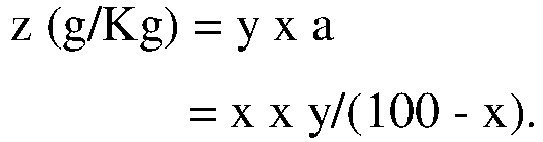
- (3) TOC: y (g/Kg) of the extract liquid is measured using TOC-200MD manufactured by Toray Engineering D Solutions Co., Ltd.
- (4) The moisture content in the mixture having the adjusted moisture content: x (mass%) is measured according to the method described in the present specification.
- (5) The moisture content per kg of the dry mass of the mixture having the adjusted moisture content: a (Kg) is calculated by the following formula:

- (6) The TOC: z (g/Kg) per kg of dry mass of the mixture is calculated by the following formula:
- As the glass fibers filter paper, glass fibers circular filter paper GF/B manufactured by GE Health care is used.
- It should be noted that TOC means total organic carbon.
- In the moisture content adjustment step S11, in the mixture before the moisture content is adjusted (the mixture obtained from the used sanitary article), the super absorbent polymer may or may not be dehydrated by using the dehydrating agent. In a case where the super absorbent polymer is dehydrated by using the dehydrating agent, the super absorbent polymer has a water absorption ratio of preferably 50 times or less, more preferably 30 times or less, even more preferably 25 times or less, and still preferably 20 times or less, in the mixture before the moisture content is adjusted (the mixture obtained from the used sanitary article). Accordingly, this makes it easier to further decrease the moisture content in the moisture content adjustment step S11.
- The producing method of the present disclosure can further include, as an optional step, the super absorbent polymer dehydration step S101 of dehydrating the super absorbent polymer, before the moisture content adjustment step S11. Accordingly, the amount of the nitrogen-containing component contained in the super absorbent polymer in the mixture can be decreased, and in the next moisture content adjustment step S11, a large amount of the nitrogen-containing component is removed from the pulp fibers, which makes the nitrogen-containing component to be less likely to remain in the pulp fibers.
- The super absorbent polymer dehydration step S101 can be performed by immersing the mixture, for example, the used sanitary article, in the dehydrating agent-containing aqueous solution containing the dehydrating agent. Examples of the dehydrating agent include acids (for example, inorganic acids and organic acids), lime, calcium chloride, magnesium sulfate, magnesium chloride, aluminum sulfate, aluminum chloride, and the like. The acid is preferable because it is less likely to remain an ash content in the pulp fibers. In a case where the acid is used as the dehydrating agent, a pH of the dehydrating agent-containing aqueous solution is preferably 2.5 or less and more preferably 1.3 to 2.4. Accordingly, this makes it possible to sufficiently decrease the water absorption capability of the super absorbent polymer, and there is a risk of corrosion of the equipment, which makes it less likely to require a large amount of alkaline chemicals for a neutralization treatment during the waste water treatment.
- Examples of the inorganic acid include a sulfuric acid, a hydrochloric acid, and a nitric acid, and the sulfuric acid is preferable from a viewpoint of not containing chlorine and cost. Examples of the organic acid include a citric acid, a tartaric acid, a glycolic acid, a malic acid, a succinic acid, an acetic acid, and an ascorbic acid, and an acid capable of forming a complex with a metal ion contained in excrement, for example, a hydroxycarbonate-based organic acid such as a citric acid, a tartaric acid, and a gluconic acid are particularly preferable. Examples of metal ions contained in excrement include calcium ions. This is because the metal ions in the excrement can be trapped and removed by a chelating effect of the acid capable of forming a complex with the metal ions contained in the excrement. In addition, the citric acid can be expected to have a high dirt component removing effect due to its cleaning effect. The super absorbent polymer dehydration step S101 can be performed according to, for example,
Japanese Unexamined Patent Publication No. 2003-326161 - In the super absorbent polymer dehydration step S101, the super absorbent polymer is dehydrated so that the super absorbent polymer has a water absorption ratio of preferably 50 times or less, more preferably 30 times or less, even more preferably 25 times or less, and still preferably 20 times or less.
- The water absorption ratio is measured as follows.
- (1) The super absorbent polymer is suspended in meshes for 5 minutes to remove moisture adhering to their surfaces, and a mass before drying: mi (g) is measured.
- (2) The super absorbent polymer is dried at 120°C for 10 minutes, and a mass after drying: m2 (g) is measured.
- (3) The water absorption ratio (g/g) is calculated by the following equation:

- In the oxidation treatment step S12, the mixture obtained through the moisture content adjustment step S11 is treated with an oxidizing agent-containing aqueous solution containing an oxidizing agent, the super absorbent polymer is oxidatively decomposed, the oxidatively decomposed super absorbent polymer is dissolved in the oxidizing agent-containing aqueous solution, and the recycled pulp fibers are formed. Examples of the oxidizing agent include ozone (for example, an ozone-containing gas), hydrogen peroxide, chlorine dioxide, peracetic acid, sodium hypochlorite, and the like. Examples of the oxidation treatment step S12 include steps disclosed in
Japanese Patent Application Publication No.2014-217835 Japanese Patent Application Publication No.2016-881 Japanese Patent Application Publication No.2019-007119 Japanese Patent Application Publication No.2019-085447 Japanese Patent Application Publication No.2019-108639 Japanese Patent Application Publication No.2019-108640 - In the oxidation treatment step S12, the mixture is treated in the oxidizing agent-containing aqueous solution containing the oxidizing agent so that the oxidizing agent-containing aqueous solution contains TOC of preferably 3.0 g/Kg or less, more preferably 2.5 g/Kg or less, and even more preferably 2.0 g/Kg or less. Accordingly, this makes it easier to form the recycled pulp fibers having a low content of the nitrogen-containing component. It should be noted that, in the oxidation treatment step S12, a lower limit of the TOC of the recycled pulp fibers is not particularly limited, and is, for example, 0.5 g/Kg.
- In the present specification, the TOC of the oxidizing agent-containing aqueous solution is measured as follows.
- (1) The oxidizing agent-containing aqueous solution is suction-filtered with a glass fibers filter paper having a particle retention capability of 1 µm, and the discharged liquid is partitioned into a filtration residue and an extract liquid.
- (2) TOC: w (g/Kg) of the extract liquid is measured using TOC-200MD manufactured by Toray Engineering D Solutions Co., Ltd. and a measured value thereof is set as TOC of the oxidizing agent-containing aqueous solution.
- The producing method of the present disclosure can further include, as an optional step, the dispersion step S102 of dispersing the mixture in water, after the moisture content adjustment step S11 and before the oxidation treatment step S12. Therefore, even in a case where at least a part or the entire part of the mixture is agglomerated through the moisture content adjustment step S11, the mixture is likely to be dispersed in each of the pulp fibers, the super absorbent polymer (each particle), and the like, and in the next oxidation treatment step S12, the super absorbent polymer is likely to be oxidatively decomposed and the nitrogen-containing component in the pulp fibers is likely to be oxidatively decomposed.
- For example, the dispersion step S 102 can be performed by adding water to the mixture to form a dispersed aqueous solution, and passing the dispersed aqueous solution through, for example, a pulper, a refiner, a beater, or the like. The moisture content in the mixture in the dispersed aqueous solution is preferably 80 mass% or more, more preferably 85 mass% or more, and even more preferably 90 mass% or more. In addition, the moisture content in the mixture in the dispersed aqueous solution is preferably 99.0 mass% or less, more preferably 98.5 mass% or less, and even more preferably 98.0 mass% or less. Accordingly, this makes it easier to disperse the agglomerated portion of the mixture, which has been agglomerated through the moisture content adjustment step S11, into each of the pulp fibers, the super absorbent polymer (each particle), and the like.
- It is preferable that the dispersed aqueous solution contains the dehydrating agent described in the section of the super absorbent polymer dehydration step S101, from a viewpoint of suppressing the water absorption of the super absorbent polymer contained in the mixture. In the dispersion step S102, since it is sufficient that the dehydrated state of the super absorbent polymer can be maintained, the dispersed aqueous solution can contain a dehydrating agent having a low concentration (for example, 1/10 times, 1/100 times, or the like) than that of the dehydrating agent-containing aqueous solution, the dispersed aqueous solution can contain a dehydrating agent having the same concentration as that of the dehydrating agent-containing aqueous solution, and the dispersed aqueous solution may be the same as the dehydrating agent-containing aqueous solution (that is, the dehydrating agent-containing aqueous solution in the super absorbent polymer dehydration step S101 may be reused as the dispersed aqueous solution in the dispersion step S102).
- In the recycled pulp fibers
recovery step S 13, the recycled pulp fibers are recovered. In the recycled pulp fibers recovery step S13, for example, the recycled pulp fibers can be recovered from the oxidizing agent-containing aqueous solution using, for example, a screen having a plurality of openings. - The producing method of the present disclosure can further include, as an optional step, the recycled pulp fibers washing step S 103 of washing the recycled pulp fibers with washing water after the oxidation treatment step S12 and before the recycled pulp fibers recovery step S13. The recycled pulp fibers washing step S 103 is not particularly limited, and the recycled pulp fibers can be washed with washing water (for example, tap water, deionized water, or the like). The washing water can be used as running water, hydrostatic water (for example, water stored in a container), or the like.
- The washing water after the recycled pulp fibers washing step S103 contains TOC of preferably 1.5 g/Kg or less, more preferably 1.0 g/Kg or less, and even more preferably 0.9 g/Kg or less. Accordingly, the recycled pulp fibers having a low content of the nitrogen-containing component can be properly formed. It should be noted that a lower limit of the TOC of the recycled pulp fibers is not particularly limited, and is, for example, 0.5 g/Kg.
- In the present specification, the TOC of the washing water is measured as follows.
- (1) The washing water is suction-filtered with a glass fibers filter paper having a particle retention capability of 1 µm, and the discharged liquid is partitioned into a filtration residue and an extract liquid.
- (2) TOC: w (g/Kg) of the extract liquid is measured using TOC-200MD manufactured by Toray Engineering D Solutions Co., Ltd. and a measured value thereof is set as TOC of the washing water.
- The producing method of the present disclosure can further include, as an optional step, the recycled pulp fibers dehydration step S 104 of dehydrating the recycled pulp fibers so as to have a moisture content of 60 mass% or less, after the recycled pulp fibers recovery step S13.
- In the recycled fibers dehydration step, the recycled pulp fibers can be dehydrated so as to have a moisture content of preferably 60 mass% or less and more preferably 50 mass% or less. Therefore, in a case of storing the recycled pulp fibers in a dry state, a drying property is excellent, and in a case of storing the recycled pulp fibers in a wet state, transportability is excellent. The recycled fibers dehydration step can be performed using, for example, a pressure-type dehydrator, for example, a screw press dehydrator manufactured by Kawaguchi Seiki Co., Ltd. Examples
- Hereinafter, the present disclosure will be described with reference to examples, but the present disclosure is not limited to these examples.
- According to a perforation step S11, a pulverization step S12, a first separation step S13, a first dust removing step S14, a second dust removing step S15, and a third dust removing step S16 (a bag breaking device 11, a
pulverization device 12, afirst separation device 13, a first dust removing device 14, a second dust removing device 15, a third dust removing device 16, and a second separation device 17) disclosed inJapanese Patent Application Publication No. 2019-085447 - It should be noted that, in the super absorbent polymer dehydration step S101, the pH of the dehydrating agent-containing aqueous solution was adjusted to 2.0 by adding citric acid.
- The mixture No. 1a was put to a screw press dehydrator manufactured by Kawaguchi Seiki Co., Ltd., a pressure of 1.2 MPa was applied to a lid body, and a discharged liquid and a mixture No. 1b (moisture content: 70 mass%) was obtained.
- A TOC of mixture No. 1b was calculated from the TOC of the discharged liquid and the moisture content of the mixture No. 1b. The TOC of the mixture No. 1b is shown in Table 1. In addition, the TOC of the mixture No. 1a was calculated from the TOC of the discharged liquid and the moisture content of the mixture No. 1a. The TOC of the mixture No. 1a is shown in Table 1.
- Water was added to the mixture No. 1b and passed through a refiner manufactured by Satomi Corporation, and a mixture No. 1c (solid content: 4.0 mass%) in which pulp fibers and a super absorbent polymer were dispersed in water was obtained.
- The mixture No. 1c was adjusted to have a solid content of 1.0 mass%, the oxidation treatment step S12 was performed under the following conditions according to an oxidizing agent treatment step S19 (ozone treatment device 22) disclosed in
Japanese Patent Application Publication No. 2019-085447 - Oxidizing agent: ozone-containing gas
- Ozone concentrations in ozone-containing gas: 200 g/m3
- Shape: Nanobubbles
- Treatment time: 30 minutes
- pH: 4.5
- The recycled pulp fibers No. 1a obtained through the oxidation treatment step S12 was dehydrated to obtain recycled pulp fibers No. 1b.
- Recycled pulp fibers No. 2 were obtained in the same manner as in Example 1, except for adding the recycled pulp fibers washing step S103 of extracting the recycled pulp fibers No. 1b obtained through the oxidation treatment step S12, and washing the recycled pulp fibers No. 1a with running water for 3 minutes by using deionized water having the amount 40 times the dry mass of the recycled pulp fibers No. 1b as the washing water, after the oxidation treatment step S12 and before the recycled pulp fibers recovery step S13. A TOC of the washing water after obtaining the recycled pulp fibers No. 2 is shown in Table 1. It should be noted that the dry mass of the recycled pulp fibers means a mass after the recycled pulp fibers are dried in an oven at a temperature of 105°C ± 3°C for 2 hours.
- Recycled pulp fibers No. 3 were obtained in the same manner as in Example 1, except for adding the recycled pulp fibers washing step S103 of extracting the recycled pulp fibers No. 1b obtained through the oxidation treatment step S12, and washing the recycled pulp fibers No. 1a with running water for 60 minutes by using deionized water having the amount 40 times the dry mass of the recycled pulp fibers No. 1b as the washing water, after the oxidation treatment step S12 and before the recycled pulp fibers recovery step S13. A TOC of the washing water after obtaining the recycled pulp fibers No. 3 is shown in Table 1.
- Recycled pulp fibers No. 4 were obtained in the same manner as in Example 1, except for adding the recycled pulp fibers washing step S103 of extracting the recycled pulp fibers No. 1b obtained through the oxidation treatment step S12, adding deionized water as the washing water so that the moisture content of the recycled pulp fibers No. 1b is 99 mass%, and washing the recycled pulp fibers No. 1a, after the oxidation treatment step S12 and before the recycled pulp fibers recovery step S13. A TOC of the washing water after obtaining the recycled pulp fibers No. 4 is shown in Table 1.
- Recycled pulp fibers No. 5 were obtained in the same manner as in Example 1, except that the moisture content adjustment step S11 and the dispersion step S102 are not performed. The TOC of the mixture No. 1a and the oxidizing agent-containing aqueous solution are shown in Table 1.
- Recycled pulp fibers No. 6 were obtained in the same manner as in Comparative Example 1, except for adding the recycled pulp fibers washing step S103 of extracting the recycled pulp fibers No. 5 obtained through the oxidation treatment step S12, and washing the recycled pulp fibers No. 5 with running water for 3 minutes by using deionized water having the amount 40 times the dry mass of the recycled pulp fibers No. 5 as the washing water, after the oxidation treatment step S12 and before the recycled pulp fibers recovery step S13. A TOC of the washing water after obtaining the recycled pulp fibers No. 6 was approximately half of the oxidizing agent-containing aqueous solution before washing.
-
Table 1 No. TOC (g/Kg) Example 1 Mixture No. 1a (before adjusting moisture content) 22.0 Mixture No. 1b (after adjusting moisture content) 5.2 Oxidizing agent-containing aqueous solution 1.6 Example 2 Washing water 1.20 Example 3 Washing water 0.86 Example 4 Washing water 0.95 Comparative Example 1 Mixture No. 1a (before adjusting moisture content) 22.0 Oxidizing agent-containing aqueous solution 10.0 Comparative Example 2 Washing water (5) -
- S11 Moisture content adjustment step
- S12 Oxidation treatment step
- S13 Recycled pulp fibers recovery step
- S101 Super absorbent polymer dehydration step
- S102 Dispersion step
- S103 Recycled pulp fibers washing step
- S104 Recycled pulp fibers dehydration step
Claims (8)
- A method of producing cleaned recycled pulp fibers from a used sanitary article, the method comprising:a moisture content adjustment step of adjusting a moisture content in a mixture containing pulp fibers and a super absorbent polymer to 70 mass% or less, the mixture being obtained from the used sanitary article containing the pulp fibers and the super absorbent polymer;an oxidation treatment step of treating the mixture obtained through the moisture content adjustment step with an oxidizing agent-containing aqueous solution containing an oxidizing agent, oxidatively decomposing the super absorbent polymer, dissolving the oxidatively decomposed super absorbent polymer in the oxidizing agent-containing aqueous solution, and forming the recycled pulp fibers; anda recycled pulp fibers recovery step of recovering the recycled pulp fibers.
- The method according to Claim 1, wherein
in the moisture content adjustment step, moisture of the mixture is adjusted so that the mixture contains TOC of 10.0 g/Kg or less per kg of a dry mass of the mixture. - The method according to Claim 1 or 2, wherein
in the oxidation treatment step, the mixture is treated in the oxidizing agent-containing aqueous solution containing the oxidizing agent so that the oxidizing agent-containing aqueous solution contains TOC of 3.0 g/Kg or less. - The method according to any one of Claims 1 to 3, further comprising:
a dispersion step of dispersing the mixture in water after the moisture content adjustment step and before the oxidation treatment step. - The method according to any one of Claims 1 to 4, further comprising:
a recycled pulp fibers washing step of washing the recycled pulp fibers with washing water after the oxidation treatment step and before the recycled pulp fibers recovery step. - The method according to Claim 5, wherein
the washing water after the recycled pulp fibers washing step contains TOC of 1.5 g/Kg or less. - The method according to any one of Claims 1 to 6, further comprising:
a recycled pulp fibers dehydration step of dehydrating the recycled pulp fibers so as to have a moisture content of 60 mass% or less, after the recycled pulp fibers recovery step. - The method according to any one of Claims 1 to 7, further comprising:
a super absorbent polymer dehydration step of dehydrating the super absorbent polymer with a dehydrating agent, before the moisture content adjustment step.
Applications Claiming Priority (2)
| Application Number | Priority Date | Filing Date | Title |
|---|---|---|---|
| JP2020124011A JP7355714B2 (en) | 2020-07-20 | 2020-07-20 | Method for producing purified recycled pulp fiber from used sanitary products |
| PCT/JP2021/025505 WO2022019109A1 (en) | 2020-07-20 | 2021-07-06 | Method for producing cleaned recycled pulp fibers from used sanitary materials |
Publications (2)
| Publication Number | Publication Date |
|---|---|
| EP4166714A1 true EP4166714A1 (en) | 2023-04-19 |
| EP4166714A4 EP4166714A4 (en) | 2024-03-27 |
Family
ID=79729712
Family Applications (1)
| Application Number | Title | Priority Date | Filing Date |
|---|---|---|---|
| EP21845892.5A Pending EP4166714A4 (en) | 2020-07-20 | 2021-07-06 | Method for producing cleaned recycled pulp fibers from used sanitary materials |
Country Status (4)
| Country | Link |
|---|---|
| EP (1) | EP4166714A4 (en) |
| JP (1) | JP7355714B2 (en) |
| CN (1) | CN116133626B (en) |
| WO (1) | WO2022019109A1 (en) |
Family Cites Families (20)
| Publication number | Priority date | Publication date | Assignee | Title |
|---|---|---|---|---|
| JP3091251B2 (en) * | 1991-04-15 | 2000-09-25 | 株式会社日本触媒 | Pulp recovery from absorbent products |
| JP3222462B2 (en) * | 1991-06-17 | 2001-10-29 | ノワスト・テクノロジーズ・インコーポレーテツド | Processing of absorbent physiological paper products |
| JP2003326161A (en) | 2002-03-06 | 2003-11-18 | Nippon Shokubai Co Ltd | Method for regenerating water absorbent resin and water absorbent |
| JP2009183668A (en) * | 2008-02-08 | 2009-08-20 | Kazutoshi Koto | Washable paper diaper |
| JP5872885B2 (en) | 2011-12-27 | 2016-03-01 | ケア・ルートサービス株式会社 | Pulp recovery equipment |
| JP6130141B2 (en) | 2011-12-28 | 2017-05-17 | 日本製紙株式会社 | Disposal of used hygiene products |
| JP6061875B2 (en) | 2013-04-10 | 2017-01-18 | ユニ・チャーム株式会社 | Method for recovering pulp fibers from used sanitary products |
| JP6199243B2 (en) * | 2014-06-12 | 2017-09-20 | ユニ・チャーム株式会社 | Method for producing recycled pulp from used sanitary products |
| JP6203158B2 (en) * | 2014-10-15 | 2017-09-27 | ユニ・チャーム株式会社 | Method for producing recycled pulp from used sanitary products |
| JP6161669B2 (en) * | 2014-12-26 | 2017-07-12 | ユニ・チャーム株式会社 | Recycling method of used absorbent articles |
| JP6698506B2 (en) * | 2016-12-02 | 2020-05-27 | ユニ・チャーム株式会社 | How to recycle used absorbent articles |
| JP6438077B1 (en) * | 2017-06-28 | 2018-12-12 | ユニ・チャーム株式会社 | Method for producing pulp fiber for saccharification, and aqueous pulp fiber solution for saccharification |
| JP6523376B2 (en) | 2017-06-28 | 2019-05-29 | ユニ・チャーム株式会社 | Method for producing recycled fiber and recycled fiber |
| JP2017193819A (en) * | 2017-07-20 | 2017-10-26 | ユニ・チャーム株式会社 | Method for producing recycled pulp from used sanitary products |
| JP6762287B2 (en) * | 2017-11-01 | 2020-09-30 | ユニ・チャーム株式会社 | Methods and systems for recovering pulp fibers from used absorbent articles |
| JP6847028B2 (en) | 2017-12-20 | 2021-03-24 | ユニ・チャーム株式会社 | Methods for producing recycled pulp fibers, use of peracids for inactivating and decomposing superabsorbent polymers, and inactivating and decomposing agents of superabsorbent polymers containing peracids. |
| JP6907147B2 (en) | 2018-03-30 | 2021-07-21 | ユニ・チャーム株式会社 | How to evaluate the cleanliness of recycled materials and how to manufacture recycled materials from used hygiene products |
| CN111556967B (en) * | 2017-12-20 | 2023-04-04 | 尤妮佳股份有限公司 | Method for producing recycled pulp fibers |
| JP6861662B2 (en) * | 2018-03-30 | 2021-04-21 | ユニ・チャーム株式会社 | Recycled pulp fiber and manufacturing method of recycled pulp fiber |
| JP6580116B2 (en) | 2017-12-20 | 2019-09-25 | ユニ・チャーム株式会社 | Method for producing recycled pulp fiber |
-
2020
- 2020-07-20 JP JP2020124011A patent/JP7355714B2/en active Active
-
2021
- 2021-07-06 CN CN202180060018.9A patent/CN116133626B/en active Active
- 2021-07-06 WO PCT/JP2021/025505 patent/WO2022019109A1/en not_active Ceased
- 2021-07-06 EP EP21845892.5A patent/EP4166714A4/en active Pending
Also Published As
| Publication number | Publication date |
|---|---|
| WO2022019109A1 (en) | 2022-01-27 |
| JP7355714B2 (en) | 2023-10-03 |
| EP4166714A4 (en) | 2024-03-27 |
| CN116133626B (en) | 2024-08-02 |
| JP2022020488A (en) | 2022-02-01 |
| CN116133626A (en) | 2023-05-16 |
Similar Documents
| Publication | Publication Date | Title |
|---|---|---|
| US10961658B2 (en) | Method for recovering pulp fiber from used sanitary product and recycled pulp obtained thereby | |
| JP6412611B2 (en) | Disposal of used hygiene products | |
| US10280560B2 (en) | Process for manufacturing recycled pulp from used sanitary goods | |
| TWI726234B (en) | Method and system for recovering pulp fibers from used absorbent articles | |
| US10927496B2 (en) | Method for recovering pulp fibers from used absorbent article | |
| JP6364004B2 (en) | Disposal of used hygiene products | |
| WO2019087485A1 (en) | Method and system for recovering pulp fibers and highly water-absorbent polymer from used absorbent articles | |
| EP3495551B1 (en) | Method for recovering pulp fibers from used absorbent articles | |
| CA3086165A1 (en) | Recycled pulp fiber manufacturing method | |
| US10960577B2 (en) | Method for recovering pulp fiber from used sanitary product and recycled pulp obtained thereby | |
| CN111278579B (en) | Method for recovering organic acid and method for producing recycled pulp | |
| JP7355714B2 (en) | Method for producing purified recycled pulp fiber from used sanitary products | |
| WO2019123579A1 (en) | Method for producing pulp fibers to be saccharified | |
| JP2024088438A (en) | Method for separating fibrous matter and particulate matter from used sanitary products |
Legal Events
| Date | Code | Title | Description |
|---|---|---|---|
| STAA | Information on the status of an ep patent application or granted ep patent |
Free format text: STATUS: THE INTERNATIONAL PUBLICATION HAS BEEN MADE |
|
| PUAI | Public reference made under article 153(3) epc to a published international application that has entered the european phase |
Free format text: ORIGINAL CODE: 0009012 |
|
| STAA | Information on the status of an ep patent application or granted ep patent |
Free format text: STATUS: REQUEST FOR EXAMINATION WAS MADE |
|
| 17P | Request for examination filed |
Effective date: 20230111 |
|
| AK | Designated contracting states |
Kind code of ref document: A1 Designated state(s): AL AT BE BG CH CY CZ DE DK EE ES FI FR GB GR HR HU IE IS IT LI LT LU LV MC MK MT NL NO PL PT RO RS SE SI SK SM TR |
|
| DAV | Request for validation of the european patent (deleted) | ||
| DAX | Request for extension of the european patent (deleted) | ||
| A4 | Supplementary search report drawn up and despatched |
Effective date: 20240226 |
|
| RIC1 | Information provided on ipc code assigned before grant |
Ipc: B09B 3/00 20220101ALI20240220BHEP Ipc: A61F 13/551 20060101ALI20240220BHEP Ipc: A61F 13/15 20060101ALI20240220BHEP Ipc: D21C 5/02 20060101AFI20240220BHEP |
|
| STAA | Information on the status of an ep patent application or granted ep patent |
Free format text: STATUS: EXAMINATION IS IN PROGRESS |
|
| 17Q | First examination report despatched |
Effective date: 20241220 |
|
| GRAP | Despatch of communication of intention to grant a patent |
Free format text: ORIGINAL CODE: EPIDOSNIGR1 |
|
| STAA | Information on the status of an ep patent application or granted ep patent |
Free format text: STATUS: GRANT OF PATENT IS INTENDED |