EP4166389B1 - Système de manutention pour véhicule - Google Patents
Système de manutention pour véhicule Download PDFInfo
- Publication number
- EP4166389B1 EP4166389B1 EP22197631.9A EP22197631A EP4166389B1 EP 4166389 B1 EP4166389 B1 EP 4166389B1 EP 22197631 A EP22197631 A EP 22197631A EP 4166389 B1 EP4166389 B1 EP 4166389B1
- Authority
- EP
- European Patent Office
- Prior art keywords
- vehicle
- handling system
- support assembly
- rigid support
- load
- Prior art date
- Legal status (The legal status is an assumption and is not a legal conclusion. Google has not performed a legal analysis and makes no representation as to the accuracy of the status listed.)
- Active
Links
Images



Classifications
-
- B—PERFORMING OPERATIONS; TRANSPORTING
- B60—VEHICLES IN GENERAL
- B60P—VEHICLES ADAPTED FOR LOAD TRANSPORTATION OR TO TRANSPORT, TO CARRY, OR TO COMPRISE SPECIAL LOADS OR OBJECTS
- B60P1/00—Vehicles predominantly for transporting loads and modified to facilitate loading, consolidating the load, or unloading
- B60P1/54—Vehicles predominantly for transporting loads and modified to facilitate loading, consolidating the load, or unloading using cranes for self-loading or self-unloading
- B60P1/5438—Vehicles predominantly for transporting loads and modified to facilitate loading, consolidating the load, or unloading using cranes for self-loading or self-unloading with a moveable base
- B60P1/5442—Vehicles predominantly for transporting loads and modified to facilitate loading, consolidating the load, or unloading using cranes for self-loading or self-unloading with a moveable base attached to the roof of the vehicle
-
- B—PERFORMING OPERATIONS; TRANSPORTING
- B60—VEHICLES IN GENERAL
- B60P—VEHICLES ADAPTED FOR LOAD TRANSPORTATION OR TO TRANSPORT, TO CARRY, OR TO COMPRISE SPECIAL LOADS OR OBJECTS
- B60P1/00—Vehicles predominantly for transporting loads and modified to facilitate loading, consolidating the load, or unloading
- B60P1/54—Vehicles predominantly for transporting loads and modified to facilitate loading, consolidating the load, or unloading using cranes for self-loading or self-unloading
- B60P1/5471—Vehicles predominantly for transporting loads and modified to facilitate loading, consolidating the load, or unloading using cranes for self-loading or self-unloading the crane being detachable from the vehicle
Definitions
- the present invention relates to the field of vehicle handling systems, and more particularly relates to a detachable handling system for armored vehicles.
- the document GB 2 105 294 A also discloses a handling system according to the prior art.
- the solution according to the present invention is based on the use of fixing means to fix to the vehicle a beam forming a slide for lifting means and the use of a rigid support assembly on the vehicle, the fixing means being detachable from so as to allow storage outside the vehicle when the handling system is not in use.
- the beam/crossmember/lifting device assembly can be detached from the vehicle to be stored elsewhere than inside the vehicle, for example on the roof, so as to reduce the bulk of the interior. of the vehicle.
- the attachment device may include an arm having a first end connected to the beam and a second end, opposite the first end, configured for attachment to the vehicle wall.
- the arm may be provided, at its second end, with a fixing part configured to be fixed to said wall of the vehicle, the fixing part being, in use, connected to the second end by a pivot axis parallel to the direction longitudinal to the beam.
- the first end of the arm is detachable from the beam.
- the rigid support assembly has two flat faces capable of bearing on an upper side of the vehicle doors when they are open.
- the stability of the beam resting on the doors is further improved.
- the rigid support assembly comprises a crosspiece extending symmetrically on either side of the beam, perpendicular to it.
- the lifting device is a hoist comprising at least one lifting pulley hooked to a load and an actuation cable linked to the lifting pulley and operable by a user so as to raise and lower the load.
- the lifting device further comprises an end pulley, at the outer end of the beam, the actuation cable passing through the end pulley, running along the beam, resting freely on the shuttle and the elevation pulley and being fixed to the inner end of the beam.
- the beam may be a rail with an H-shaped cross section, the lifting device, where appropriate the shuttle, being movably mounted on a lower flange of the rail, which lower flange is, in use, turned downwards, and the lifting device fixing and the rigid support assembly being arranged on the other, upper sole of the rail.
- FIG. 1 it can be seen that there is shown a handling system 1 according to a particular embodiment of the present invention, which handling system 1 is intended in use to be attached to a vehicle A, in particular an armored vehicle, for loading/unloading loads G into/out of vehicle A.
- the handling system 1 is in particular suitable for use with a vehicle A comprising an interior B and two doors C pivoting along parallel and vertical pivot axes to close an opening D from the interior B of the vehicle towards the outside, as can be seen on the Figure 3 .
- the handling system 1 comprises a rigid beam 2, of the commonly encountered rail type and having an H-shaped cross section, with a core 3 connecting an upper flange 4 and a lower flange 5.
- upper we mean the side turned upwards in use and by lower, the side turned downwards in use.
- the beam 2 is terminated by an interior end 6 and an exterior end 7.
- interior we mean the side located, in use, inside the vehicle A and by exterior, the side located, in use, outside of vehicle A.
- the handling system 1 also includes a fixing device 8, articulated, for detachably fixing the beam 2 to a wall E of the interior B of the vehicle A.
- the fixing device 8 comprises an arm 9 having a first end 10 and a second end 11.
- the first end 10 is detachably connected to a connecting piece 12 secured to the upper sole 4.
- holes are provided in the connecting piece 12 as well as in the first end 10 of the arm 9, such that the connecting piece 12 and the arm 9 can be secured by means of bolts 13 passing through said holes.
- other means of fixing could be considered, provided that they ensure a solid mechanical connection and allow the detachment of the beam 2 from the fixing device 8.
- the second end 11 of the arm 9 is connected by a pivot connection to a fixing part 14.
- the axis 15 of the pivot connection is oriented parallel to the longitudinal direction of the beam 2.
- the fixing part 14 comprises a flat part 16 configured to be fixed to a wall E of the interior of the vehicle A.
- the fixing of the fixing part 14 to the wall E can be carried out by any appropriate means conceivable by the skilled in the art, for example by means of screw/nut.
- the fixing part 14 also comprises two tabs 17 extending from the flat part 16 and connected to the axis 15 of the arm 9 so that the arm 9 is able to pivot relative to the flat part 16 and therefore relative to the wall E to which it is fixed.
- the fixing part 14 is fixed to the wall serving as the ceiling of the interior B of the vehicle A.
- this wall E may correspond to the bulkhead plate replacing the rear roof door. It should be noted, however, that the fixing plate 14 could be attached to a side wall of the interior B of the vehicle A.
- the handling system 1 further comprises a rigid crosspiece 18.
- the crosspiece 18 is fixed on the upper flange 4 of the beam 2, perpendicular to the beam 2, and extending symmetrically on either side of it.
- the two ends 19 of the crosspiece 18 have on their lower side 20 a flat face 21.
- the flat faces 21 are intended to come to bear on the upper side F of the doors C of the vehicle A when they are open, as it can be seen on the Figure 3 , so as to allow a load to be taken up by the doors C of vehicle A, of the weight constituted by the handling system 1 alone or by the beam 2/load G assembly to be maneuvered.
- the crosspiece 18 thus constitutes a rigid support assembly 22 extending laterally from the beam 2, intended, in use, to bear on each of the doors C when they are open.
- the rigid support assembly could alternatively comprise two branches extending from the beam 2 at different angles, provided that they ensure the rest of the rigid support assembly on the doors C of vehicle A when they are open. Furthermore, the rigid support assembly could also be fixed to the beam in any area thereof as long as it guarantees the operation of the handling system.
- the fixing device 8 is arranged on the beam 2 on the interior side and the crosspiece 19 is arranged on the beam 2 on the exterior side.
- the handling system 1 further comprises a lifting device 23 configured to maneuver a load G.
- maneuvering is meant lifting/lowering a load G, moving it inside B of vehicle A and between interior B and l exterior of vehicle A.
- the lifting device 23 here consists of a hoist.
- the lifting device 23 comprises an elevation pulley 26, to which, in use, the load to be maneuvered G is attached.
- the lifting device 23 also comprises an actuation cable 27 configured to, under the action of a user, raise/lower the load G.
- an actuation cable 27 configured to, under the action of a user, raise/lower the load G.
- one end 28 of the lifting cable actuation 27 is fixed to the inner end 6 of the beam 2. Then, going from the inner end 6 to the outer end 7 of the beam 2, the actuation cable 27 rests freely for the first time on the shuttle 24, winds on the elevation pulley 26, rests freely a second time on the shuttle 24, runs along the lower sole 5 and winds on an end pulley 29 disposed at the outer end 7 hence the free end 30 of the actuation cable 27 hangs freely. In this configuration, the actuation cable 27 lifts the load G by two strands.
- the fixing device 8 being initially fixed to a wall E of the interior B of the vehicle A, the flat faces 21 of the crosspiece 18 are brought into contact with the upper side F of the doors C of the vehicle, these being previously opened, and the beam 2 is fixed, by the connecting piece 12, to the fixing device 8. It should be noted that an additional degree of freedom could be considered at the level of the interior end/fixing device interface so as to allow better adaptability of the handling system to different vehicle openings.
- the beam 2 passes through the opening D of the vehicle A and has the region of its outer end 7 outside the vehicle A, as can be seen in the Figure 3 .
- the actuation cable 27 is released so as to be able to lower the lifting pulley 26 where the load G will be attached to it.
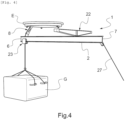
- the actuation cable 27 is pulled by its free end 30 so as to lift the load G as can be seen on the Figures 4 And 5 . Due to the fact that the lifting of the load G is carried out by two strands, the tensile effort is half of the weight to be lifted.
- the shuttle 24 is moved manually, by being pushed, along the beam 2 towards the outside of the vehicle A, as can be seen in the Figure 6 , where the actuation cable 27 is released so as to lower the load G and then detach it from the elevation pulley 26.
- the beam 2/crossmember 18/lifting device 23 assembly is detached from the fixing device 8 and can be stored for example on the roof of vehicle A. Thanks to the pivot connection , the fixing device 8 can be folded against the wall E on which it is fixed so as to reduce the volume occupied in the interior B.
- the present invention is particularly advantageous when the handling system 1 is used in a passenger transport vehicle.
- the entire handling system 1 could be detached from the vehicle A by detaching the flat part 16 of the fixing device 8 relative to the wall E on which it is fixed.
Landscapes
- Engineering & Computer Science (AREA)
- Transportation (AREA)
- Mechanical Engineering (AREA)
- Load-Engaging Elements For Cranes (AREA)
- Jib Cranes (AREA)
- Vehicle Step Arrangements And Article Storage (AREA)
- Fittings On The Vehicle Exterior For Carrying Loads, And Devices For Holding Or Mounting Articles (AREA)
Description
- La présente invention concerne le domaine des systèmes de manutention pour véhicule, et porte plus particulièrement sur un système de manutention détachable pour véhicules blindés.
- On connaît du brevet
FR2752233B1 - Le document
GB 2 105 294 A - Il existe donc un besoin pour un système de manutention qui présente une occupation minimale du véhicule hors utilisation tout en garantissant une reprise de charge par le véhicule en utilisation et qui en outre soit polyvalent.
- La solution selon la présente invention repose sur l'emploi de moyens de fixation pour fixer au véhicule une poutre formant glissière pour moyens de levage et l'emploi d'un ensemble rigide d'appui sur le véhicule, les moyens de fixation étant détachable de façon à permettre un stockage à l'extérieur du véhicule lorsque le système de manutention n'est pas en utilisation.
- La présente invention a donc pour objet un système de manutention pour véhicule, le véhicule comportant un intérieur et deux portes pivotantes selon des axes de pivotement parallèles et verticaux pour refermer une ouverture de l'intérieur du véhicule vers l'extérieur, le système de manutention comprenant:
- une poutre rigide, ayant une première extrémité dite intérieure et une seconde extrémité dite extérieure ;
- un dispositif de fixation relié à la poutre pour fixation détachable de la poutre à une paroi de l'intérieur du véhicule ;
- un ensemble rigide d'appui solidaire de la poutre dans la région de l'extrémité extérieure, et s'étendant latéralement à partir de celle-ci, l'ensemble rigide d'appui étant destiné, en utilisation, à prendre appui sur chacune des portes lorsque celles-ci sont ouvertes, la poutre traversant alors l'ouverture du véhicule et ayant la région de son extrémité extérieure à l'extérieur du véhicule ; et
- un dispositif de levage configuré pour manoeuvrer une charge et monté mobile le long de la poutre.
- Ainsi, hors utilisation, l'ensemble poutre / traverse / dispositif de levage peut être détaché du véhicule pour être stocké ailleurs qu'à l'intérieur du véhicule, par exemple sur le toit, de façon à réduire l'encombrement de l'intérieur du véhicule.
- Le dispositif de fixation peut comprendre un bras ayant une première extrémité reliée à la poutre et une seconde extrémité, opposée à la première extrémité, configurée pour fixation à la paroi du véhicule.
- Le bras peut être muni, à sa seconde extrémité, d'une pièce de fixation configurée pour être fixée à ladite paroi du véhicule, la pièce de fixation étant, en utilisation, reliée à la seconde extrémité par un axe de pivot parallèle à la direction longitudinale à la poutre. Ainsi, hors utilisation et la poutre détachée, le bras peut être rabattu contre la paroi sur laquelle il est fixé de façon à réduire encore davantage le volume occupé par la partie du système de manutention restant à l'intérieur du véhicule.
- Avantageusement, la première extrémité du bras est détachable de la poutre.
- Avantageusement, l'ensemble rigide d'appui présente deux faces planes aptes à venir en appui sur un côté supérieur des portes du véhicule lorsqu'elles sont ouvertes. La stabilité de la poutre reposant sur les portes s'en trouve encore améliorée.
- Avantageusement, l'ensemble rigide d'appui comprend une traverse s'étendant de façon symétrique de part d'autre de la poutre, perpendiculairement à celle-ci.
- Avantageusement, le dispositif de levage est un palan comprenant au moins une poulie d'élévation accrochable à une charge et un câble d'actionnement lié à la poulie d'élévation et actionnable par un utilisateur de façon à lever et abaisser la charge.
- Avantageusement, le dispositif de levage comprend en outre une poulie d'extrémité, à l'extrémité extérieure de la poutre, le câble d'actionnement passant par la poulie d'extrémité, courant le long de la poutre, reposant librement sur la navette et la poulie d'élévation et étant fixé à l'extrémité intérieure de la poutre.
- La poutre peut être un rail à section transversale en H, le dispositif de levage, le cas échéant la navette, étant monté mobile sur une semelle inférieure du rail, laquelle semelle inférieure est, en utilisation, tournée vers le bas, et le dispositif de fixation et l'ensemble rigide d'appui étant disposés sur l'autre semelle, supérieure, du rail.
- Pour mieux illustrer l'objet de la présente invention, on va en décrire ci-après, à titre indicatif et non limitatif, plusieurs modes de réalisation avec référence aux dessins annexés.
- Sur ces dessins :
- [
Fig. 1 ] est une vue en perspective du système de manutention selon un mode de réalisation particulier de la présente invention ; - [
Fig. 2 ] est une vue en perspective du système de manutention monté sur un véhicule ; - [
Fig. 3 ] est une vue en perspective de dessous du système de manutention, en utilisation ; - [
Fig. 4 ] est une vue en perspective du système de manutention en utilisation à une première étape ; - [
Fig. 5 ] est une vue en perspective du système de manutention en utilisation à une deuxième étape ; et - [
Fig. 6 ] est une vue en perspective du système de manutention en utilisation à une troisième étape. - Si l'on se réfère à la
Figure 1 , on peut voir qu'il y est représenté un système de manutention 1 selon un mode de réalisation particulier de la présente invention, lequel système de manutention 1 est destiné en utilisation à être fixé à un véhicule A, en particulier un véhicule blindé, pour charger/décharger des charges G dans/hors du véhicule A. - Le système de manutention 1 est en particulier adapté pour être utilisé avec un véhicule A comportant un intérieur B et deux portes C pivotantes selon des axes de pivotement parallèles et verticaux pour refermer une ouverture D de l'intérieur B du véhicule vers l'extérieur, comme on peut le voir sur la
Figure 3 . - Le système de manutention 1 comprend une poutre 2 rigide, du type rail couramment rencontré et ayant une section transversale en H, avec une âme 3 reliant une semelle supérieure 4 et une semelle inférieure 5. Par supérieur, on entend le côté tourné en utilisation vers le haut et par inférieur, le côté tourné en utilisation vers le bas. La poutre 2 est terminée par une extrémité intérieure 6 et une extrémité extérieure 7. Par intérieur, on entend le côté situé, en utilisation, à l'intérieur du véhicule A et par extérieur, le côté situé, en utilisation, à l'extérieur du véhicule A.
- Le système de manutention 1 comprend également un dispositif de fixation 8, articulé, pour fixation détachable de la poutre 2 à une paroi E de l'intérieur B du véhicule A.
- Le dispositif de fixation 8 comprend un bras 9 ayant une première extrémité 10 et une seconde extrémité 11. La première extrémité 10 est reliée de façon détachable à une pièce de raccordement 12 solidaire de la semelle supérieure 4. Pour ce faire, des trous sont ménagés dans la pièce de raccordement 12 ainsi que dans la première extrémité 10 du bras 9, de telle sorte que la pièce de raccordement 12 et le bras 9 peuvent être solidarisés au moyens de boulons 13 passant par lesdits trous. Il convient de noter que d'autres moyens de fixation pourront être envisagés, pour autant qu'ils assurent une liaison mécanique solide et permettent le détachement de la poutre 2 par rapport au dispositif de fixation 8.
- La seconde extrémité 11 du bras 9 est reliée par une liaison pivot à une pièce de fixation 14. L'axe 15 de la liaison pivot est orienté parallèlement à la direction longitudinale de la poutre 2. Comme on peut le voir sur la
Figure 2 , la pièce de fixation 14 comporte une partie plane 16 configurée pour être fixée à une paroi E de l'intérieur du véhicule A. La fixation de la pièce de fixation 14 à la paroi E pourra être réalisée par tous moyens appropriés envisageables par l'homme du métier, par exemple au moyen de vis/écrou. La pièce de fixation 14 comporte également deux pattes 17 s'étendant depuis la partie plane 16 et reliées à l'axe 15 du bras 9 de sorte que le bras 9 est apte à pivoter par rapport à la partie plane 16 et donc par rapport à la paroi E à laquelle celle-ci est fixée. De façon particulièrement avantageuse, la pièce de fixation 14 est fixée à la paroi faisant office de plafond de l'intérieur B du véhicule A. Dans le cas d'un véhicule blindé, cette paroi E pourra correspondre à la plaque passe-cloison remplaçant la porte de toit arrière. Il convient toutefois de noter que la plaque de fixation 14 pourrait être fixée à une paroi latérale de l'intérieur B du véhicule A. - Le système de manutention 1 comprend en outre une traverse 18 rigide. La traverse 18 est fixée sur la semelle supérieure 4 de la poutre 2, perpendiculairement à la poutre 2, et s'étendant de façon symétrique de part et d'autre de celle-ci. Les deux extrémités 19 de la traverse 18 présentent sur leur côté inférieur 20 une face plane 21. En utilisation, les faces planes 21 sont destinées à venir en appui sur le côté supérieur F des portes C du véhicule A lorsqu'elles sont ouvertes, comme on peut le voir sur la
Figure 3 , de façon à permettre une reprise de charge par les portes C du véhicule A, du poids constitué par le système de manutention 1 seul ou par l'ensemble poutre 2/charge G à manoeuvrer. - La traverse 18 constitue ainsi un ensemble rigide d'appui 22 s'étendant latéralement à partir de la poutre 2, destiné, en utilisation, à prendre appui sur chacune des portes C lorsque celles-ci sont ouvertes.
- Il convient de noter que l'ensemble rigide d'appui pourrait en variante comprendre deux branches s'étendant depuis la poutre 2 selon des angles différents, pour autant qu'elles assurent le repos de l'ensemble rigide d'appui sur les portes C du véhicule A lorsqu'elles sont ouvertes. Par ailleurs, l'ensemble rigide d'appui pourrait également être fixé à la poutre sur toute zone de celle-ci pour autant qu'il garantisse le fonctionnement du système de manutention.
- Comme on peut le voir sur la
Figure 3 , le dispositif de fixation 8 est disposé sur la poutre 2 côté intérieur et la traverse 19 est disposée sur la poutre 2 côté extérieur. - Le système de manutention 1 comprend en outre un dispositif de levage 23 configuré pour manoeuvrer une charge G. Par manoeuvrer, on entend lever/abaisser une charge G, la déplacer à l'intérieur B du véhicule A et entre l'intérieur B et l'extérieur du véhicule A.
- Le dispositif de levage 23 consiste ici en un palan.
- Le dispositif de levage 23 comprend une navette 24, configurée pour se déplacer le long de la poutre 2, la poutre 2 formant ainsi glissière pour le dispositif de levage 23. Pour ce faire et comme de façon connue, la navette 24 est équipée de roues 25 roulant sur la semelle inférieure 5 de la poutre 2.
- Le dispositif de levage 23 comprend une poulie d'élévation 26, à laquelle, en utilisation, la charge à manoeuvrer G est accrochée.
- Le dispositif de levage 23 comprend également un câble d'actionnement 27 configuré pour, sous l'action d'un utilisateur, soulever/abaisser la charge G. Pour ce faire, selon le présent mode de réalisation, une extrémité 28 du câble d'actionnement 27 est fixée à l'extrémité intérieure 6 de la poutre 2. Ensuite, en allant de l'extrémité intérieure 6 à l'extrémité extérieure 7 de la poutre 2, le câble d'actionnement 27 repose librement une première fois sur la navette 24, s'enroule sur la poulie d'élévation 26, repose librement une seconde fois sur la navette 24, court le long de la semelle inférieure 5 et s'enroule sur une poulie d'extrémité 29 disposée à l'extrémité extérieure 7 d'où l'extrémité libre 30 du câble d'actionnement 27 pend librement. Dans cette configuration, le câble d'actionnement 27 soulève la charge G par deux brins.
- Pour positionner le système de manutention 1 en position d'utilisation, le dispositif de fixation 8 étant initialement fixé à une paroi E de l'intérieur B du véhicule A, les faces planes 21 de la traverse 18 sont amenées au contact avec le côté supérieur F des portes C du véhicule, celles-ci étant préalablement ouvertes, et la poutre 2 est fixée, par la pièce de raccordement 12, au dispositif de fixation 8. Il convient de noter qu'un degré de liberté additionnel pourra être envisagé au niveau de l'interface extrémité intérieure / dispositif de fixation de façon à permettre une meilleur adaptabilité du système de manutention à différentes ouvertures de véhicule.
- En position d'utilisation, la poutre 2 traverse l'ouverture D du véhicule A et a la région de son extrémité extérieure 7 à l'extérieur du véhicule A, comme on peut le voir sur la
Figure 3 . - Pour sortir une charge G à l'extérieur du véhicule A, le câble d'actionnement 27 est relâché de façon à pouvoir abaisser la poulie d'élévation 26 où la charge G y sera accrochée. Le câble d'actionnement 27 est tiré par son extrémité libre 30 de façon à soulever la charge G comme on peut le voir sur les
Figures 4 et5 . Du fait que le levage de la charge G est réalisé par deux brins, l'effort de traction est la moitié du poids à lever. Une fois la charge G levée à la hauteur souhaitée, la navette 24 est déplacée manuellement, en étant poussée, le long de la poutre 2 vers l'extérieur du véhicule A, comme on peut le voir sur laFigure 6 , où le câble d'actionnement 27 est relâché de façon à abaisser la charge G pour ensuite la détacher de la poulie d'élévation 26. - On procède de manière analogue lorsque l'on souhaite embarquer la charge G dans le véhicule A.
- Lorsque le système de manutention 1 n'est plus utilisé, l'ensemble poutre 2/traverse 18/dispositif de levage 23 est détaché du dispositif de fixation 8 et peut être stocké par exemple sur le toit du véhicule A. Grâce à la liaison pivot, le dispositif de fixation 8 peut être rabattu contre la paroi E sur laquelle il est fixé de façon à diminuer le volume occupé dans l'intérieur B.
- Ainsi, la présente invention est particulièrement avantageuse lorsque le système de manutention 1 est utilisé dans un véhicule de transport de personnes.
- Il convient de noter qu'en variante l'intégralité du système de manutention 1 pourrait être détachée du véhicule A en détachant la partie plane 16 du dispositif de fixation 8 par rapport à la paroi E sur laquelle il est fixé.
Claims (9)
- - Système de manutention (1) pour véhicule (A), le véhicule (A) comportant un intérieur (B) et deux portes (C) pivotantes selon des axes de pivotement parallèles et verticaux pour refermer une ouverture (D) de l'intérieur (B) du véhicule (A) vers l'extérieur, le système de manutention (1) comprenant:- une poutre (2) rigide, ayant une première extrémité dite intérieure (6) et une seconde extrémité dite extérieure (7) ;- un dispositif de fixation (8) relié à la poutre (2) pour fixation détachable de la poutre (2) à une paroi (E) de l'intérieur (B) du véhicule (A) ; et- un dispositif de levage (23) configuré pour manoeuvrer une charge (G) et monté mobile le long de la poutre (2); caractérisé par le fait que le système de manutention (1) comprend en outre- un ensemble rigide d'appui (22) solidaire de la poutre (2) dans la région de l'extrémité extérieure (7), et s'étendant latéralement à partir de celle-ci, l'ensemble rigide d'appui (22) étant destiné, en utilisation, à prendre appui sur chacune des portes (C) lorsque celles-ci sont ouvertes, la poutre (2) traversant alors l'ouverture (D) du véhicule (A) et ayant la région de son extrémité extérieure (7) à l'extérieur du véhicule (A).
- - Système de manutention (1) selon la revendication 1, caractérisé par le fait que le dispositif de fixation (8) comprend un bras (9) ayant une première extrémité (10) reliée à la poutre (2) et une seconde extrémité (11), opposée à la première extrémité (10), configurée pour fixation à la paroi (E) du véhicule (A).
- - Système de manutention (1) selon la revendication 2, caractérisé par le fait que le bras (9) est muni, à sa seconde extrémité (11), d'une pièce de fixation (14) configurée pour être fixée à ladite paroi (E) du véhicule (A), la pièce de fixation (14) étant, en utilisation, reliée à la seconde extrémité (11) par un axe de pivot (15) parallèle à la direction longitudinale à la poutre (2).
- - Système de manutention (1) selon la revendication 2 ou 3, caractérisé par le fait que la première extrémité (10) du bras (9) est détachable de la poutre (2).
- - Système de manutention (1) selon l'une quelconque des revendications 1 à 4, caractérisé par le fait que l'ensemble rigide d'appui (22) présente deux faces planes (21) aptes à venir en appui sur un côté supérieur (F) des portes (C) du véhicule (A) lorsqu'elles sont ouvertes.
- - Système de manutention (1) selon l'une quelconque des revendications 1 à 5, caractérisé par le fait que l'ensemble rigide d'appui (22) comprend une traverse (18) s'étendant de façon symétrique de part d'autre de la poutre (2), perpendiculairement à celle-ci.
- - Système de manutention (1) selon l'une quelconque des revendications 1 à 6, caractérisé par le fait que le dispositif de levage (23) est un palan comprenant au moins une poulie d'élévation (26) accrochable à une charge (G) et un câble d'actionnement (27) lié à la poulie d'élévation (26) et actionnable par un utilisateur de façon à lever et abaisser la charge (G).
- - Système de manutention (1) selon la revendication 7, caractérisé par le fait que le dispositif de levage (23) comprend en outre une poulie d'extrémité (29), à l'extrémité extérieure (7) de la poutre (2), le câble d'actionnement (27) passant par la poulie d'extrémité (29), courant le long de la poutre (2), reposant librement sur une navette (24) et la poulie d'élévation (26) et étant fixé à l'extrémité intérieure (6) de la poutre (2).
- - Système de manutention (1) selon l'une quelconque des revendications 1 à 8, caractérisé par le fait que la poutre (2) est un rail à section transversale en H, le dispositif de levage (23), le cas échéant la navette (24), étant monté mobile sur une semelle inférieure (5) du rail, laquelle semelle inférieure (5) est, en utilisation, tournée vers le bas, et le dispositif de fixation (8) et l'ensemble rigide d'appui (22) étant disposés sur l'autre semelle (4), supérieure, du rail.
Applications Claiming Priority (1)
| Application Number | Priority Date | Filing Date | Title |
|---|---|---|---|
| FR2110732A FR3127917B1 (fr) | 2021-10-13 | 2021-10-13 | Système de manutention pour véhicule |
Publications (2)
| Publication Number | Publication Date |
|---|---|
| EP4166389A1 EP4166389A1 (fr) | 2023-04-19 |
| EP4166389B1 true EP4166389B1 (fr) | 2024-07-24 |
Family
ID=80113368
Family Applications (1)
| Application Number | Title | Priority Date | Filing Date |
|---|---|---|---|
| EP22197631.9A Active EP4166389B1 (fr) | 2021-10-13 | 2022-09-26 | Système de manutention pour véhicule |
Country Status (2)
| Country | Link |
|---|---|
| EP (1) | EP4166389B1 (fr) |
| FR (1) | FR3127917B1 (fr) |
Family Cites Families (4)
| Publication number | Priority date | Publication date | Assignee | Title |
|---|---|---|---|---|
| GB2105294B (en) * | 1981-06-13 | 1984-08-01 | Jonathan James Pratt | Extensible and retractable gantry for mounting in a vehicle |
| US5062760A (en) * | 1990-04-16 | 1991-11-05 | Transport Technology Corporation | Material handling system |
| US5156517A (en) * | 1991-03-05 | 1992-10-20 | Gaston Boissonneault | Removable hoist system |
| FR2752233B1 (fr) | 1996-08-08 | 1998-10-02 | Groupe Dld France | Dispositif de manutention, a montage en kit, pour vehicules utilitaires et similaires |
-
2021
- 2021-10-13 FR FR2110732A patent/FR3127917B1/fr active Active
-
2022
- 2022-09-26 EP EP22197631.9A patent/EP4166389B1/fr active Active
Also Published As
| Publication number | Publication date |
|---|---|
| FR3127917A1 (fr) | 2023-04-14 |
| FR3127917B1 (fr) | 2023-09-29 |
| EP4166389A1 (fr) | 2023-04-19 |
Similar Documents
| Publication | Publication Date | Title |
|---|---|---|
| EP0199652B1 (fr) | Dispositif de manoeuvre de conteneur | |
| EP0905083B1 (fr) | Chariot à mât, apte à être embarqué à l'arrière d'un véhicule porteur | |
| FR2944488A1 (fr) | Benne de chargement autonome destinee a recevoir une charge | |
| EP3450363B1 (fr) | Quai sécurisé de déchargement des déchets depuis un véhicule dans un centre de stockage | |
| EP4166389B1 (fr) | Système de manutention pour véhicule | |
| EP0485257A1 (fr) | Plate-forme rabattable à verrouillage automatique notamment pour chariots du type transpalette ou gerbeur | |
| FR2641743A1 (fr) | Vehicule amenage pour etre equipe d'un outil interchangeable et outil destine a equiper un tel vehicule | |
| EP2106967A1 (fr) | Benne pour la récupération de rebuts de béton | |
| EP0939018B1 (fr) | Dispositif de calage automatique de pièces cylindriques ou parallélépipédiques et wagon utilisant un tel dispositif | |
| EP0799789B1 (fr) | Dispositif de solidarisation d'un chariot de manutention à un camion, châssis de support et camion correspondants | |
| EP3090927A1 (fr) | Structure de transport munie d'une porte a coulissement vertical | |
| EP2253562B1 (fr) | Dispositif pour le transport d'objets, notamment d'éléments préfabriqués sous forme de plaques | |
| FR2936989A1 (fr) | Monte-charge pour toit d'un vehicule terrestre | |
| EP0411984A1 (fr) | Dispositif de montage de hayon pour véhicule à benne basculante | |
| FR2940937A1 (fr) | Dispositif de support destine a faciliter le chargement d'un caisson ou d'un plateau sur une plate-forme | |
| EP2042372A1 (fr) | Dispositif de plateau de chargement basculant-coulissant pour vehicule de depannage | |
| FR3112108A1 (fr) | ensemble porte-charge pour engin roulant et engin roulant équipé d’un tel ensemble porte-charge | |
| FR2904300A1 (fr) | Dispositif permettant de proceder au basculement d'objets ayant des dimensions et/ou un poids importants. | |
| FR2824540A1 (fr) | Amelioration aux bennes de transport en vrac de residus | |
| FR2944512A1 (fr) | Caisse de benne et benne a ridelle laterale mobile pour le transport et/ou le stockage de charges | |
| BE680305A (fr) | ||
| FR3135455A1 (fr) | Chariot elevateur manuel reglable | |
| FR2857638A1 (fr) | Dispositif de relevage d'un moyen de protection arriere d'un vehicule industriel et vehicule industriel equipe d'un tel dispositif | |
| FR2567856A1 (fr) | Dispositif pour lever et renverser un recipient et en vider le contenu dans un bac de reception, et bac de reception equipe d'un tel dispositif | |
| FR2919241A1 (fr) | Ensemble de fixation d'un arceau sur une benne |
Legal Events
| Date | Code | Title | Description |
|---|---|---|---|
| PUAI | Public reference made under article 153(3) epc to a published international application that has entered the european phase |
Free format text: ORIGINAL CODE: 0009012 |
|
| STAA | Information on the status of an ep patent application or granted ep patent |
Free format text: STATUS: THE APPLICATION HAS BEEN PUBLISHED |
|
| AK | Designated contracting states |
Kind code of ref document: A1 Designated state(s): AL AT BE BG CH CY CZ DE DK EE ES FI FR GB GR HR HU IE IS IT LI LT LU LV MC MK MT NL NO PL PT RO RS SE SI SK SM TR |
|
| STAA | Information on the status of an ep patent application or granted ep patent |
Free format text: STATUS: REQUEST FOR EXAMINATION WAS MADE |
|
| 17P | Request for examination filed |
Effective date: 20230908 |
|
| RBV | Designated contracting states (corrected) |
Designated state(s): AL AT BE BG CH CY CZ DE DK EE ES FI FR GB GR HR HU IE IS IT LI LT LU LV MC MK MT NL NO PL PT RO RS SE SI SK SM TR |
|
| GRAP | Despatch of communication of intention to grant a patent |
Free format text: ORIGINAL CODE: EPIDOSNIGR1 |
|
| STAA | Information on the status of an ep patent application or granted ep patent |
Free format text: STATUS: GRANT OF PATENT IS INTENDED |
|
| INTG | Intention to grant announced |
Effective date: 20240220 |
|
| RAP3 | Party data changed (applicant data changed or rights of an application transferred) |
Owner name: KNDS FRANCE |
|
| GRAS | Grant fee paid |
Free format text: ORIGINAL CODE: EPIDOSNIGR3 |
|
| GRAA | (expected) grant |
Free format text: ORIGINAL CODE: 0009210 |
|
| STAA | Information on the status of an ep patent application or granted ep patent |
Free format text: STATUS: THE PATENT HAS BEEN GRANTED |
|
| AK | Designated contracting states |
Kind code of ref document: B1 Designated state(s): AL AT BE BG CH CY CZ DE DK EE ES FI FR GB GR HR HU IE IS IT LI LT LU LV MC MK MT NL NO PL PT RO RS SE SI SK SM TR |
|
| REG | Reference to a national code |
Ref country code: GB Ref legal event code: FG4D Free format text: NOT ENGLISH |
|
| REG | Reference to a national code |
Ref country code: CH Ref legal event code: EP |
|
| REG | Reference to a national code |
Ref country code: IE Ref legal event code: FG4D Free format text: LANGUAGE OF EP DOCUMENT: FRENCH Ref country code: DE Ref legal event code: R096 Ref document number: 602022004780 Country of ref document: DE |
|
| REG | Reference to a national code |
Ref country code: NL Ref legal event code: FP |
|
| REG | Reference to a national code |
Ref country code: LT Ref legal event code: MG9D |
|
| PG25 | Lapsed in a contracting state [announced via postgrant information from national office to epo] |
Ref country code: PT Free format text: LAPSE BECAUSE OF FAILURE TO SUBMIT A TRANSLATION OF THE DESCRIPTION OR TO PAY THE FEE WITHIN THE PRESCRIBED TIME-LIMIT Effective date: 20241125 |
|
| REG | Reference to a national code |
Ref country code: AT Ref legal event code: MK05 Ref document number: 1706029 Country of ref document: AT Kind code of ref document: T Effective date: 20240724 |
|
| PG25 | Lapsed in a contracting state [announced via postgrant information from national office to epo] |
Ref country code: PT Free format text: LAPSE BECAUSE OF FAILURE TO SUBMIT A TRANSLATION OF THE DESCRIPTION OR TO PAY THE FEE WITHIN THE PRESCRIBED TIME-LIMIT Effective date: 20241125 |
|
| PG25 | Lapsed in a contracting state [announced via postgrant information from national office to epo] |
Ref country code: NO Free format text: LAPSE BECAUSE OF FAILURE TO SUBMIT A TRANSLATION OF THE DESCRIPTION OR TO PAY THE FEE WITHIN THE PRESCRIBED TIME-LIMIT Effective date: 20241024 |
|
| PG25 | Lapsed in a contracting state [announced via postgrant information from national office to epo] |
Ref country code: FI Free format text: LAPSE BECAUSE OF FAILURE TO SUBMIT A TRANSLATION OF THE DESCRIPTION OR TO PAY THE FEE WITHIN THE PRESCRIBED TIME-LIMIT Effective date: 20240724 Ref country code: GR Free format text: LAPSE BECAUSE OF FAILURE TO SUBMIT A TRANSLATION OF THE DESCRIPTION OR TO PAY THE FEE WITHIN THE PRESCRIBED TIME-LIMIT Effective date: 20241025 Ref country code: PL Free format text: LAPSE BECAUSE OF FAILURE TO SUBMIT A TRANSLATION OF THE DESCRIPTION OR TO PAY THE FEE WITHIN THE PRESCRIBED TIME-LIMIT Effective date: 20240724 |
|
| PG25 | Lapsed in a contracting state [announced via postgrant information from national office to epo] |
Ref country code: BG Free format text: LAPSE BECAUSE OF FAILURE TO SUBMIT A TRANSLATION OF THE DESCRIPTION OR TO PAY THE FEE WITHIN THE PRESCRIBED TIME-LIMIT Effective date: 20240724 |
|
| PG25 | Lapsed in a contracting state [announced via postgrant information from national office to epo] |
Ref country code: LV Free format text: LAPSE BECAUSE OF FAILURE TO SUBMIT A TRANSLATION OF THE DESCRIPTION OR TO PAY THE FEE WITHIN THE PRESCRIBED TIME-LIMIT Effective date: 20240724 |
|
| PG25 | Lapsed in a contracting state [announced via postgrant information from national office to epo] |
Ref country code: IS Free format text: LAPSE BECAUSE OF FAILURE TO SUBMIT A TRANSLATION OF THE DESCRIPTION OR TO PAY THE FEE WITHIN THE PRESCRIBED TIME-LIMIT Effective date: 20241124 Ref country code: AT Free format text: LAPSE BECAUSE OF FAILURE TO SUBMIT A TRANSLATION OF THE DESCRIPTION OR TO PAY THE FEE WITHIN THE PRESCRIBED TIME-LIMIT Effective date: 20240724 |
|
| PG25 | Lapsed in a contracting state [announced via postgrant information from national office to epo] |
Ref country code: HR Free format text: LAPSE BECAUSE OF FAILURE TO SUBMIT A TRANSLATION OF THE DESCRIPTION OR TO PAY THE FEE WITHIN THE PRESCRIBED TIME-LIMIT Effective date: 20240724 |
|
| PG25 | Lapsed in a contracting state [announced via postgrant information from national office to epo] |
Ref country code: ES Free format text: LAPSE BECAUSE OF FAILURE TO SUBMIT A TRANSLATION OF THE DESCRIPTION OR TO PAY THE FEE WITHIN THE PRESCRIBED TIME-LIMIT Effective date: 20240724 Ref country code: RS Free format text: LAPSE BECAUSE OF FAILURE TO SUBMIT A TRANSLATION OF THE DESCRIPTION OR TO PAY THE FEE WITHIN THE PRESCRIBED TIME-LIMIT Effective date: 20241024 |
|
| PG25 | Lapsed in a contracting state [announced via postgrant information from national office to epo] |
Ref country code: RS Free format text: LAPSE BECAUSE OF FAILURE TO SUBMIT A TRANSLATION OF THE DESCRIPTION OR TO PAY THE FEE WITHIN THE PRESCRIBED TIME-LIMIT Effective date: 20241024 Ref country code: PL Free format text: LAPSE BECAUSE OF FAILURE TO SUBMIT A TRANSLATION OF THE DESCRIPTION OR TO PAY THE FEE WITHIN THE PRESCRIBED TIME-LIMIT Effective date: 20240724 Ref country code: NO Free format text: LAPSE BECAUSE OF FAILURE TO SUBMIT A TRANSLATION OF THE DESCRIPTION OR TO PAY THE FEE WITHIN THE PRESCRIBED TIME-LIMIT Effective date: 20241024 Ref country code: LV Free format text: LAPSE BECAUSE OF FAILURE TO SUBMIT A TRANSLATION OF THE DESCRIPTION OR TO PAY THE FEE WITHIN THE PRESCRIBED TIME-LIMIT Effective date: 20240724 Ref country code: IS Free format text: LAPSE BECAUSE OF FAILURE TO SUBMIT A TRANSLATION OF THE DESCRIPTION OR TO PAY THE FEE WITHIN THE PRESCRIBED TIME-LIMIT Effective date: 20241124 Ref country code: HR Free format text: LAPSE BECAUSE OF FAILURE TO SUBMIT A TRANSLATION OF THE DESCRIPTION OR TO PAY THE FEE WITHIN THE PRESCRIBED TIME-LIMIT Effective date: 20240724 Ref country code: GR Free format text: LAPSE BECAUSE OF FAILURE TO SUBMIT A TRANSLATION OF THE DESCRIPTION OR TO PAY THE FEE WITHIN THE PRESCRIBED TIME-LIMIT Effective date: 20241025 Ref country code: FI Free format text: LAPSE BECAUSE OF FAILURE TO SUBMIT A TRANSLATION OF THE DESCRIPTION OR TO PAY THE FEE WITHIN THE PRESCRIBED TIME-LIMIT Effective date: 20240724 Ref country code: ES Free format text: LAPSE BECAUSE OF FAILURE TO SUBMIT A TRANSLATION OF THE DESCRIPTION OR TO PAY THE FEE WITHIN THE PRESCRIBED TIME-LIMIT Effective date: 20240724 Ref country code: BG Free format text: LAPSE BECAUSE OF FAILURE TO SUBMIT A TRANSLATION OF THE DESCRIPTION OR TO PAY THE FEE WITHIN THE PRESCRIBED TIME-LIMIT Effective date: 20240724 Ref country code: AT Free format text: LAPSE BECAUSE OF FAILURE TO SUBMIT A TRANSLATION OF THE DESCRIPTION OR TO PAY THE FEE WITHIN THE PRESCRIBED TIME-LIMIT Effective date: 20240724 |
|
| PG25 | Lapsed in a contracting state [announced via postgrant information from national office to epo] |
Ref country code: RO Free format text: LAPSE BECAUSE OF FAILURE TO SUBMIT A TRANSLATION OF THE DESCRIPTION OR TO PAY THE FEE WITHIN THE PRESCRIBED TIME-LIMIT Effective date: 20240724 Ref country code: DK Free format text: LAPSE BECAUSE OF FAILURE TO SUBMIT A TRANSLATION OF THE DESCRIPTION OR TO PAY THE FEE WITHIN THE PRESCRIBED TIME-LIMIT Effective date: 20240724 Ref country code: SM Free format text: LAPSE BECAUSE OF FAILURE TO SUBMIT A TRANSLATION OF THE DESCRIPTION OR TO PAY THE FEE WITHIN THE PRESCRIBED TIME-LIMIT Effective date: 20240724 |
|
| PG25 | Lapsed in a contracting state [announced via postgrant information from national office to epo] |
Ref country code: MC Free format text: LAPSE BECAUSE OF FAILURE TO SUBMIT A TRANSLATION OF THE DESCRIPTION OR TO PAY THE FEE WITHIN THE PRESCRIBED TIME-LIMIT Effective date: 20240724 Ref country code: EE Free format text: LAPSE BECAUSE OF FAILURE TO SUBMIT A TRANSLATION OF THE DESCRIPTION OR TO PAY THE FEE WITHIN THE PRESCRIBED TIME-LIMIT Effective date: 20240724 |
|
| PG25 | Lapsed in a contracting state [announced via postgrant information from national office to epo] |
Ref country code: CZ Free format text: LAPSE BECAUSE OF FAILURE TO SUBMIT A TRANSLATION OF THE DESCRIPTION OR TO PAY THE FEE WITHIN THE PRESCRIBED TIME-LIMIT Effective date: 20240724 |
|
| REG | Reference to a national code |
Ref country code: DE Ref legal event code: R097 Ref document number: 602022004780 Country of ref document: DE |
|
| PG25 | Lapsed in a contracting state [announced via postgrant information from national office to epo] |
Ref country code: IT Free format text: LAPSE BECAUSE OF FAILURE TO SUBMIT A TRANSLATION OF THE DESCRIPTION OR TO PAY THE FEE WITHIN THE PRESCRIBED TIME-LIMIT Effective date: 20240724 Ref country code: SK Free format text: LAPSE BECAUSE OF FAILURE TO SUBMIT A TRANSLATION OF THE DESCRIPTION OR TO PAY THE FEE WITHIN THE PRESCRIBED TIME-LIMIT Effective date: 20240724 |
|
| PG25 | Lapsed in a contracting state [announced via postgrant information from national office to epo] |
Ref country code: LU Free format text: LAPSE BECAUSE OF NON-PAYMENT OF DUE FEES Effective date: 20240926 |
|
| PLBE | No opposition filed within time limit |
Free format text: ORIGINAL CODE: 0009261 |
|
| STAA | Information on the status of an ep patent application or granted ep patent |
Free format text: STATUS: NO OPPOSITION FILED WITHIN TIME LIMIT |
|
| 26N | No opposition filed |
Effective date: 20250425 |
|
| PG25 | Lapsed in a contracting state [announced via postgrant information from national office to epo] |
Ref country code: IE Free format text: LAPSE BECAUSE OF NON-PAYMENT OF DUE FEES Effective date: 20240926 |
|
| PG25 | Lapsed in a contracting state [announced via postgrant information from national office to epo] |
Ref country code: SE Free format text: LAPSE BECAUSE OF FAILURE TO SUBMIT A TRANSLATION OF THE DESCRIPTION OR TO PAY THE FEE WITHIN THE PRESCRIBED TIME-LIMIT Effective date: 20240724 |
|
| PGFP | Annual fee paid to national office [announced via postgrant information from national office to epo] |
Ref country code: NL Payment date: 20250820 Year of fee payment: 4 |
|
| PGFP | Annual fee paid to national office [announced via postgrant information from national office to epo] |
Ref country code: DE Payment date: 20250820 Year of fee payment: 4 |
|
| PGFP | Annual fee paid to national office [announced via postgrant information from national office to epo] |
Ref country code: BE Payment date: 20250820 Year of fee payment: 4 |
|
| PGFP | Annual fee paid to national office [announced via postgrant information from national office to epo] |
Ref country code: FR Payment date: 20250820 Year of fee payment: 4 |
|
| PG25 | Lapsed in a contracting state [announced via postgrant information from national office to epo] |
Ref country code: CY Free format text: LAPSE BECAUSE OF FAILURE TO SUBMIT A TRANSLATION OF THE DESCRIPTION OR TO PAY THE FEE WITHIN THE PRESCRIBED TIME-LIMIT; INVALID AB INITIO Effective date: 20220926 |
|
| PG25 | Lapsed in a contracting state [announced via postgrant information from national office to epo] |
Ref country code: HU Free format text: LAPSE BECAUSE OF FAILURE TO SUBMIT A TRANSLATION OF THE DESCRIPTION OR TO PAY THE FEE WITHIN THE PRESCRIBED TIME-LIMIT; INVALID AB INITIO Effective date: 20220926 |