EP4164016B1 - Roll-type raw material supply device - Google Patents
Roll-type raw material supply device Download PDFInfo
- Publication number
- EP4164016B1 EP4164016B1 EP22788493.9A EP22788493A EP4164016B1 EP 4164016 B1 EP4164016 B1 EP 4164016B1 EP 22788493 A EP22788493 A EP 22788493A EP 4164016 B1 EP4164016 B1 EP 4164016B1
- Authority
- EP
- European Patent Office
- Prior art keywords
- raw material
- tape
- roll type
- clamp member
- supply device
- Prior art date
- Legal status (The legal status is an assumption and is not a legal conclusion. Google has not performed a legal analysis and makes no representation as to the accuracy of the status listed.)
- Active
Links
Images



Classifications
-
- H—ELECTRICITY
- H01—ELECTRIC ELEMENTS
- H01M—PROCESSES OR MEANS, e.g. BATTERIES, FOR THE DIRECT CONVERSION OF CHEMICAL ENERGY INTO ELECTRICAL ENERGY
- H01M4/00—Electrodes
- H01M4/02—Electrodes composed of, or comprising, active material
- H01M4/04—Processes of manufacture in general
- H01M4/0402—Methods of deposition of the material
- H01M4/0407—Methods of deposition of the material by coating on an electrolyte layer
-
- B—PERFORMING OPERATIONS; TRANSPORTING
- B65—CONVEYING; PACKING; STORING; HANDLING THIN OR FILAMENTARY MATERIAL
- B65H—HANDLING THIN OR FILAMENTARY MATERIAL, e.g. SHEETS, WEBS, CABLES
- B65H19/00—Changing the web roll
- B65H19/10—Changing the web roll in unwinding mechanisms or in connection with unwinding operations
-
- B—PERFORMING OPERATIONS; TRANSPORTING
- B65—CONVEYING; PACKING; STORING; HANDLING THIN OR FILAMENTARY MATERIAL
- B65H—HANDLING THIN OR FILAMENTARY MATERIAL, e.g. SHEETS, WEBS, CABLES
- B65H16/00—Unwinding, paying-out webs
- B65H16/02—Supporting web roll
-
- B—PERFORMING OPERATIONS; TRANSPORTING
- B65—CONVEYING; PACKING; STORING; HANDLING THIN OR FILAMENTARY MATERIAL
- B65H—HANDLING THIN OR FILAMENTARY MATERIAL, e.g. SHEETS, WEBS, CABLES
- B65H19/00—Changing the web roll
- B65H19/10—Changing the web roll in unwinding mechanisms or in connection with unwinding operations
- B65H19/102—Preparing the leading end of the replacement web before splicing operation; Adhesive arrangements on leading end of replacement web; Tabs and adhesive tapes for splicing
-
- B—PERFORMING OPERATIONS; TRANSPORTING
- B65—CONVEYING; PACKING; STORING; HANDLING THIN OR FILAMENTARY MATERIAL
- B65H—HANDLING THIN OR FILAMENTARY MATERIAL, e.g. SHEETS, WEBS, CABLES
- B65H19/00—Changing the web roll
- B65H19/10—Changing the web roll in unwinding mechanisms or in connection with unwinding operations
- B65H19/105—Opening of web rolls; Removing damaged outer layers; Detecting the leading end of a closed web roll
-
- B—PERFORMING OPERATIONS; TRANSPORTING
- B65—CONVEYING; PACKING; STORING; HANDLING THIN OR FILAMENTARY MATERIAL
- B65H—HANDLING THIN OR FILAMENTARY MATERIAL, e.g. SHEETS, WEBS, CABLES
- B65H20/00—Advancing webs
- B65H20/16—Advancing webs by web-gripping means, e.g. grippers, clips
-
- H—ELECTRICITY
- H01—ELECTRIC ELEMENTS
- H01M—PROCESSES OR MEANS, e.g. BATTERIES, FOR THE DIRECT CONVERSION OF CHEMICAL ENERGY INTO ELECTRICAL ENERGY
- H01M10/00—Secondary cells; Manufacture thereof
- H01M10/04—Construction or manufacture in general
- H01M10/0404—Machines for assembling batteries
-
- H—ELECTRICITY
- H01—ELECTRIC ELEMENTS
- H01M—PROCESSES OR MEANS, e.g. BATTERIES, FOR THE DIRECT CONVERSION OF CHEMICAL ENERGY INTO ELECTRICAL ENERGY
- H01M10/00—Secondary cells; Manufacture thereof
- H01M10/04—Construction or manufacture in general
- H01M10/0404—Machines for assembling batteries
- H01M10/0409—Machines for assembling batteries for cells with wound electrodes
-
- B—PERFORMING OPERATIONS; TRANSPORTING
- B65—CONVEYING; PACKING; STORING; HANDLING THIN OR FILAMENTARY MATERIAL
- B65H—HANDLING THIN OR FILAMENTARY MATERIAL, e.g. SHEETS, WEBS, CABLES
- B65H16/00—Unwinding, paying-out webs
- B65H16/02—Supporting web roll
- B65H16/04—Supporting web roll cantilever type
-
- B—PERFORMING OPERATIONS; TRANSPORTING
- B65—CONVEYING; PACKING; STORING; HANDLING THIN OR FILAMENTARY MATERIAL
- B65H—HANDLING THIN OR FILAMENTARY MATERIAL, e.g. SHEETS, WEBS, CABLES
- B65H16/00—Unwinding, paying-out webs
- B65H16/10—Arrangements for effecting positive rotation of web roll
- B65H16/103—Arrangements for effecting positive rotation of web roll in which power is applied to web-roll spindle
-
- B—PERFORMING OPERATIONS; TRANSPORTING
- B65—CONVEYING; PACKING; STORING; HANDLING THIN OR FILAMENTARY MATERIAL
- B65H—HANDLING THIN OR FILAMENTARY MATERIAL, e.g. SHEETS, WEBS, CABLES
- B65H2301/00—Handling processes for sheets or webs
- B65H2301/40—Type of handling process
- B65H2301/41—Winding, unwinding
- B65H2301/415—Unwinding
- B65H2301/41505—Preparing unwinding process
- B65H2301/41508—Preparing unwinding process the web roll being in the unwinding support / unwinding location
- B65H2301/41509—Preparing unwinding process the web roll being in the unwinding support / unwinding location opening web roll and related steps
- B65H2301/415095—Preparing unwinding process the web roll being in the unwinding support / unwinding location opening web roll and related steps gripping an edge of the web, e.g. by clamping and forward it, e.g. to splicing web advancing unit
-
- B—PERFORMING OPERATIONS; TRANSPORTING
- B65—CONVEYING; PACKING; STORING; HANDLING THIN OR FILAMENTARY MATERIAL
- B65H—HANDLING THIN OR FILAMENTARY MATERIAL, e.g. SHEETS, WEBS, CABLES
- B65H2301/00—Handling processes for sheets or webs
- B65H2301/40—Type of handling process
- B65H2301/41—Winding, unwinding
- B65H2301/417—Handling or changing web rolls
- B65H2301/4176—Preparing leading edge of replacement roll
-
- B—PERFORMING OPERATIONS; TRANSPORTING
- B65—CONVEYING; PACKING; STORING; HANDLING THIN OR FILAMENTARY MATERIAL
- B65H—HANDLING THIN OR FILAMENTARY MATERIAL, e.g. SHEETS, WEBS, CABLES
- B65H2301/00—Handling processes for sheets or webs
- B65H2301/40—Type of handling process
- B65H2301/41—Winding, unwinding
- B65H2301/417—Handling or changing web rolls
- B65H2301/4176—Preparing leading edge of replacement roll
- B65H2301/41766—Preparing leading edge of replacement roll by adhesive tab or tape with cleavable or delaminating layer
-
- B—PERFORMING OPERATIONS; TRANSPORTING
- B65—CONVEYING; PACKING; STORING; HANDLING THIN OR FILAMENTARY MATERIAL
- B65H—HANDLING THIN OR FILAMENTARY MATERIAL, e.g. SHEETS, WEBS, CABLES
- B65H2301/00—Handling processes for sheets or webs
- B65H2301/50—Auxiliary process performed during handling process
- B65H2301/52—Auxiliary process performed during handling process for starting
- B65H2301/521—Stripping web from roll
-
- B—PERFORMING OPERATIONS; TRANSPORTING
- B65—CONVEYING; PACKING; STORING; HANDLING THIN OR FILAMENTARY MATERIAL
- B65H—HANDLING THIN OR FILAMENTARY MATERIAL, e.g. SHEETS, WEBS, CABLES
- B65H2405/00—Parts for holding the handled material
- B65H2405/50—Gripping means
-
- B—PERFORMING OPERATIONS; TRANSPORTING
- B65—CONVEYING; PACKING; STORING; HANDLING THIN OR FILAMENTARY MATERIAL
- B65H—HANDLING THIN OR FILAMENTARY MATERIAL, e.g. SHEETS, WEBS, CABLES
- B65H2405/00—Parts for holding the handled material
- B65H2405/50—Gripping means
- B65H2405/57—Details of the gripping parts
- B65H2405/575—Details of gripping surface
-
- B—PERFORMING OPERATIONS; TRANSPORTING
- B65—CONVEYING; PACKING; STORING; HANDLING THIN OR FILAMENTARY MATERIAL
- B65H—HANDLING THIN OR FILAMENTARY MATERIAL, e.g. SHEETS, WEBS, CABLES
- B65H2405/00—Parts for holding the handled material
- B65H2405/50—Gripping means
- B65H2405/58—Means for achieving gripping/releasing operation
-
- B—PERFORMING OPERATIONS; TRANSPORTING
- B65—CONVEYING; PACKING; STORING; HANDLING THIN OR FILAMENTARY MATERIAL
- B65H—HANDLING THIN OR FILAMENTARY MATERIAL, e.g. SHEETS, WEBS, CABLES
- B65H2405/00—Parts for holding the handled material
- B65H2405/50—Gripping means
- B65H2405/58—Means for achieving gripping/releasing operation
- B65H2405/581—Means for achieving gripping/releasing operation moving only one of the gripping parts towards the other
-
- B—PERFORMING OPERATIONS; TRANSPORTING
- B65—CONVEYING; PACKING; STORING; HANDLING THIN OR FILAMENTARY MATERIAL
- B65H—HANDLING THIN OR FILAMENTARY MATERIAL, e.g. SHEETS, WEBS, CABLES
- B65H2406/00—Means using fluid
- B65H2406/10—Means using fluid made only for exhausting gaseous medium
-
- B—PERFORMING OPERATIONS; TRANSPORTING
- B65—CONVEYING; PACKING; STORING; HANDLING THIN OR FILAMENTARY MATERIAL
- B65H—HANDLING THIN OR FILAMENTARY MATERIAL, e.g. SHEETS, WEBS, CABLES
- B65H2406/00—Means using fluid
- B65H2406/30—Suction means
- B65H2406/31—Suction box; Suction chambers
-
- B—PERFORMING OPERATIONS; TRANSPORTING
- B65—CONVEYING; PACKING; STORING; HANDLING THIN OR FILAMENTARY MATERIAL
- B65H—HANDLING THIN OR FILAMENTARY MATERIAL, e.g. SHEETS, WEBS, CABLES
- B65H2515/00—Physical entities not provided for in groups B65H2511/00 or B65H2513/00
- B65H2515/60—Optical characteristics, e.g. colour, light
-
- B—PERFORMING OPERATIONS; TRANSPORTING
- B65—CONVEYING; PACKING; STORING; HANDLING THIN OR FILAMENTARY MATERIAL
- B65H—HANDLING THIN OR FILAMENTARY MATERIAL, e.g. SHEETS, WEBS, CABLES
- B65H2553/00—Sensing or detecting means
- B65H2553/20—Sensing or detecting means using electric elements
- B65H2553/21—Variable resistances, e.g. rheostats, potentiometers or strain gauges
-
- B—PERFORMING OPERATIONS; TRANSPORTING
- B65—CONVEYING; PACKING; STORING; HANDLING THIN OR FILAMENTARY MATERIAL
- B65H—HANDLING THIN OR FILAMENTARY MATERIAL, e.g. SHEETS, WEBS, CABLES
- B65H2555/00—Actuating means
- B65H2555/41—Actuating means using electrostatic forces or magnets
-
- B—PERFORMING OPERATIONS; TRANSPORTING
- B65—CONVEYING; PACKING; STORING; HANDLING THIN OR FILAMENTARY MATERIAL
- B65H—HANDLING THIN OR FILAMENTARY MATERIAL, e.g. SHEETS, WEBS, CABLES
- B65H2801/00—Application field
- B65H2801/72—Fuel cell manufacture
-
- Y—GENERAL TAGGING OF NEW TECHNOLOGICAL DEVELOPMENTS; GENERAL TAGGING OF CROSS-SECTIONAL TECHNOLOGIES SPANNING OVER SEVERAL SECTIONS OF THE IPC; TECHNICAL SUBJECTS COVERED BY FORMER USPC CROSS-REFERENCE ART COLLECTIONS [XRACs] AND DIGESTS
- Y02—TECHNOLOGIES OR APPLICATIONS FOR MITIGATION OR ADAPTATION AGAINST CLIMATE CHANGE
- Y02E—REDUCTION OF GREENHOUSE GAS [GHG] EMISSIONS, RELATED TO ENERGY GENERATION, TRANSMISSION OR DISTRIBUTION
- Y02E60/00—Enabling technologies; Technologies with a potential or indirect contribution to GHG emissions mitigation
- Y02E60/10—Energy storage using batteries
Definitions
- the present invention relates to a roll type raw material supply device.
- a secondary battery is a chemical battery that can be used semi-permanently by continuously repeating charging and discharge using an electrochemical reaction, which is classified into a lead-acid battery, a nickel-cadmium battery, a nickel-hydrogen battery, and a lithium secondary battery.
- a lithium secondary battery has superior voltage and energy density characteristics compared to other batteries, thereby leading the market for secondary batteries, which is divided into a lithium-ion secondary battery using a liquid electrolyte and a lithium-ion polymer secondary battery using a solid electrolyte, according to the type of electrolyte.
- This lithium secondary battery is composed of a positive electrode, a negative electrode and an electrolyte, and also the separator is generally positioned between the positive electrode and the negative electrode to prevent a short circuit between the positive electrode and the negative electrode due to their direct contact.
- various resins comprising a polyolefin-based polymer resins such as polyethylene and polypropylene are used as raw materials, and the raw material is mainly supplied in the form of a roll.
- the raw material is continuously supplied by bonding the end portion of the raw material in use and the end portion of the new raw material.
- An automated bonding device that bonds the raw material in use and the new raw material is already known as a related art as in Patent Document 1 below.
- supplied raw material in the form of a roll is initially supplied by attaching a tape to an end portion so as to prevent the roll from unwinding, and there is inconvenience that the tape is manually removed and a part of the roll should be released and inserted into a raw material supply location of the automated bonding device in order to apply the supplied raw material in the form of a roll to the automated bonding device. Further, when the roll is released by the manual work, it is difficult to maintain a tension in the supplied raw material in the form of a roll as it is, and thus a quality of the raw material of the corresponding portion deteriorates.
- the present inventor studies the roll type raw material supply device capable of automating even a process of removing the tape in the supplied raw material in the form of a roll and supplying the supplied raw material in the form of a roll, corresponding to the automated bonding device, and has completed the present invention in order to solve the above-described problem.
- Patent Document 1 Korean Laid-open Patent Publication No. 10-2016-0133264 JP H 0556856 U discloses a peeling device wherein a first adhesive layer to be adhered to a web terminal part and a second adhesive layer to be adhered to a surface of a paper roll are provided on the rear surface of a mount, the terminal part of the rolled paper is temporarily fixed by sticking a tab having an adhesive layer for paper slicing formed on the surface of the mount, an ear part extending outward from one side of the outer periphery of the adhesive layer is provided on the separator for protecting the adhesive layer for paper slicing.
- US 4,840,320 A discloses an apparatus for automatically threading the leading end of web spooled on the reel into one end of the conveying passage
- a draw-out lever having a web support surface and movable to a first position at which the support surface engages the web spooled on the reel.
- a nipping finger is provided which is actuatable to trap the leading end of the web against surface when the lever is in its first position.
- the lever is movable to a second position at which the support surface is spaced from the web spooled on the reel for unspooling the web from the reel.
- a feed mechanism is made effective after the lever is moved to a second position, and after the nipping finger has been deactuated, for engaging the unspooled web and feeding the leading end thereof into the conveying passage.
- the present invention provides a roll type raw material supply device including: a raw material mounting unit 10 for introducing a roll type raw material R to which a tape T for fixation to an end portion of a raw material is attached; a tape removal unit 20 clamping a non-bonding portion B of the tape and separating the tape from the raw material; and a raw material conveying unit 30 attaching and moving the raw material.
- the raw material mounting unit 10 includes a support 11 and a first roller 12, wherein the support supports the first roller, and the first roller fixes and rotates the roll type raw material R.
- the tape removal unit 20 includes a clamp member 21 and a first conveying cylinder 22, wherein the clamp member includes a first clamp member 21A and a second clamp member 21B, and the first clamp member is positioned at an outer side than the second clamp member to be in contact with the raw material R and the tape T when driving the device, and when the first clamp member and the second clamp member are spaced apart from each other and then the nonbonding portion B of the tape is positioned between the first clamp member and the second clamp member, the first clamp member and the second clamp member are close to each other to clamp the non-bonding portion of the tape, and the first conveying cylinder moves the clamp member.
- the raw material conveying unit 30 includes an attachment pad 31 and a second conveying cylinder 32, wherein the attachment pad attaches and fixes the end portion of the raw material, and the second conveying cylinder moves the attachment pad.
- the non-bonding portion B of the tape T attached to the roll type raw material R has a different color from the raw material and is coated with a film F having greater rigidity than the tape, and the first clamp member 21A includes a color sensor 21S for identifying the film.
- the first clamp member 21A includes an air eruption hole H2 for erupting air to separate the non-bonding portion B of the tape T from the roll type raw material R.
- a portion in the tape that is coated with the film has one or more holes H1 through which air can pass.
- the attachment pad 31 has a shape in which an attachment surface is in contact with a corner of the end portion of the raw material and is not in contact with the tape when attaching and fixing the end portion of the raw material.
- the raw material conveying unit 30 further includes a supplementary member 33 for supplementing the attachment pad 31 so that the attachment surface is in contact with the entire area of the end portion of the raw material after the tape is removed.
- the raw material conveying unit 30 further includes a support member 34 for supporting the other surface of the attachment surface when unwinding the roll type raw material after attaching the raw material.
- the roll type raw material supply device further includes one or more second rollers 41 for adjusting a tension of the raw material and determining a movement path of the raw material.
- the roll type raw material supply device can automatically and effectively remove the tape attached to a roll type raw material, and can cause the end portion of the raw material to move to a desired location without damage such as warping.
- each component or a specific part constituting the component is exaggerated, omitted, or schematically illustrated for convenience and clarity of description. Therefore, the size of each component does not fully reflect the actual size. If it is determined that a detailed description of a related known function or configuration may unnecessarily obscure the gist of the present invention, such description will be omitted.
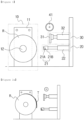
- FIG. 1 provides a view schematically showing a roll type raw material supply device according to an embodiment of the present invention.
- the roll type raw material supply device may include a raw material mounting unit 10, a tape removal unit 20, and a raw material conveying unit 30, and may include additional components as necessary.
- the raw material mounting unit 10 is a device for introducing a roll type raw material R, and a tape (not shown in FIG. 1 ) for fixing to the end portion of the raw material is attached to the roll type raw material so as to prevent the roll from unwinding.
- the "end portion” means the area from a start line (or end line) in the direction (when applied to a device, a machine direction (MD)) of a raw material R, to a line spaced apart by a certain distance and the certain distance is determined by the line in the width direction (when applied to the device, a transverse direction (TD)), where the attachment pad 31 and the raw material R are in contact with each other.
- the width of the tape is sufficient as long as the roll does not unwind, and may be much shorter than the width of the raw material.
- One tape is attached to a portion around a center of the width of the raw material.
- the raw material mounting unit 10 includes a support 11 and a first roller 12, and may include additional components as necessary.
- the support 11 is a device for supporting a first roller 12 so that the roll type raw material R may be introduced into the first roller.
- the first roller 12 is a device for fixing and rotating the roll type raw material R.
- the raw material R may be supplied while one or more layers of fabrics are rolled in a roll type.
- the fabric may be a state in which respective layers are attached by an electrostatic attraction.
- the tape removal unit 20 is a device for clamping the non-bonding portion of the tape and separating the tape from the raw material.
- the tape removal unit 20 may include a clamp member 21 and a first conveying cylinder 22, and may include additional components as necessary.
- the clamp member 21 is a device for clamping the non-bonding portion of the tape.
- the clamp member 21 includes a first clamp member 21A and a second clamp member 21B, wherein the first clamp member 21A is positioned at the outer side than the second clamp member 21B, and is in contact with the raw material R and the tape when driving the device.
- the first conveying cylinder 22 is a device for moving the clamp member 21.
- the first conveying cylinder 22 may achieve the purpose of removing the tape only by causing the clamp member 21 to contact the roll type raw material R and move in a direction away from the roll type raw material (a left-right direction in FIG. 1 ), but it also causes the clamp member 21 to move in a direction perpendicular thereto (an up-down direction in FIG. 1 ) if necessary.
- the raw material conveying unit 30 is a device for attaching and moving the raw material.
- the raw material conveying unit 30 includes an attachment pad 31 and a second conveying cylinder 32.
- the attachment pad 31 is a device for attaching and fixing the end portion of the raw material.
- the attachment pad 31 attaches and fixes the end portion of the raw material, thereby effectively removing only the tape in a state in which the clamp member 21 fixes the end portion of the raw material, and supplying the raw material to a desired location by causing the attachment pad 31 to move to unwind the roll.
- the attachment pad 31 may attach the raw material through adsorption or electrostatic force.
- the attachment pad 31 may fix the raw material R in a state in which each layer of the fabrics is attached using electrostatic force, thereby conveying the raw material R in a state in which each layer is not separated from each other.
- An electrostatic chuck may be used in order to apply the electrostatic force, and if the raw material R may be fixed in a state in which each layer of the fabrics is attached, the type of electrostatic chuck is not particularly limited.
- the electrostatic chuck includes a polyimide substrate and a bipolar type electrode, and is driven by applying a voltage of 1.0 kV to 5.0 kV, specifically 1.5 kV to 4.0 kV, and more specifically 2.0 kV to 3.0 kV. Two or more layers of fabrics may be efficiently fixed within the above range.
- the second conveying cylinder 32 is a device for moving the attachment pad 31.
- the second conveying cylinder 32 causes the attachment pad 31 to be in contact with the roll type raw material R and move in a direction away from the roll type raw material R (the left-right direction in FIG. 1 ), and also causes the attachment pad 31 to move in a direction perpendicular thereto (the up-down direction in FIG. 1 ) in order to supply the raw material to a desired location.
- a 2-axis direction orthogonal robot which is movable in both an X direction (the left-right direction in FIG. 1 ) and a Z direction (the up-down direction in FIG. 1 ) except for a Y direction (a front-rear direction in FIG. 1 ), may be used, and when the 2-axis orthogonal robot moves in the Y direction, a warping phenomenon of the raw material may occur.
- the roll type raw material supply device further includes one or more second rollers 41.
- the second rollers 41 are a device for adjusting the tension of the raw material and deciding a movement path of the raw material.
- the second rollers 41 are disposed in the middle of the movement path of the raw material, thereby preventing a phenomenon in which the tension of the raw material is decreased at a specific portion according to a supply speed of the raw material.
- the tension of the raw material may be controlled by installing a load cell in the second roller 41, and the warping phenomenon or a break phenomenon of the raw material may be prevented by controlling the tension of the raw material.
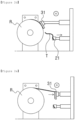
- FIG. 2 provides a view showing a process in which a roll type raw material supply device is driven sequentially according to an embodiment of the present invention.
- the clamp member 21 of the tape removal unit 20 moves to a vicinity of the roll type raw material R to identify a location of a tape T from the roll type raw material R which rotates in a counterclockwise direction. Thereafter, as shown in FIG. 2b , when the location of the tape T is identified, the location of the roll is adjusted so that the clamp member 21 may be positioned just below the non-bonding portion of the tape, and then the clamp member 21 is in contact with the roll type raw material R. Thereafter, as shown in FIG.
- the roll type raw material is rotated in a clockwise direction so that the non-bonding portion of the tape is positioned between the first clamp member 21A and the second clamp member 21B of the clamp member 21, and when the non-bonding portion of the tape is positioned between the first clamp member 21A and the second clamp member 21B of the clamp member 21, the second clamp member 21B is moved close to the first clamp member 21A so that the clamp member 21 clamps the non-bonding portion of the tape.
- the attachment pad 31 moves to the end portion of the raw material to attach and fix the end portion of the raw material. In this case, since the attachment pad 31 is not in contact with the tape, the attachment pad 31 does not interfere with removal of the tape. As shown in FIG.
- the clamp member 21 is spaced apart from the roll type raw material to remove the tape T.
- the attachment pad 31 is spaced apart from the roll type raw material R to unwind the roll and move the end portion of the raw material.
- the attachment pad 31 is moved so that the raw material moves in contact with the second roller 41.
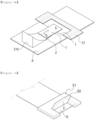
- FIGs. 3a and 3b provide views showing a tape in which a non-bonding portion is coated with a film according to an embodiment of the present invention.
- FIG. 3a is a perspective view showing a state in which the tape is viewed obliquely
- FIG. 3b is a plan view showing a state in which the tape is viewed from the top.
- the roll type raw material Since a generally used tape is transparent, even though the tape is attached to the roll type raw material, the roll type raw material shows the same color as the raw material in appearance even at a location to which the tape is attached, equally at a location to which the tape is not attached. Therefore, the location of the tape may not be easily distinguished visually. If the tape is coated with a film F having a different color from the raw material, the location of the tape may be easily distinguished visually. In an automated device, the film F having the different color is identified by a sensor such as color sensor. As shown in FIGs. 3a and 3b , the tape T is separated into a bonding portion A and a non-bonding portion B.
- the non-bonding portion B of the tape T is a portion where there is no bonding force on the surface that is in contact with the raw material, and when the tape T has the non-bonding portion B, the clamp member 21 of the device may easily clamp the tape T.
- the non-bonding portion B of the tape T is coated with the film F.
- a lower portion of the non-bonding portion B facing the raw material may also be coated with the film, and an upper portion of the non-bonding portion B, which is an opposite surface thereto, may be coated with the film, and the upper and lower portions of the non-bonding portion B may be coated with the film.
- a material having larger rigidity than the tape T may be used, and for example, a material such as polyethylene terephthalate (PET) may be used.
- PET polyethylene terephthalate
- a thickness of the film may be 10 to 500 ⁇ m, and preferably 50 to 200 ⁇ m.
- a portion coated with the film in the tape may have one or more holes H1 through which air may pass.
- the hole H1 may reduce the phenomenon in which the raw material and the non-bonding portion are in close contact with each other by the electrostatic attraction, and when the non-bonding portion B of the tape T is spaced apart from the roll type raw material R by artificially blowing the wind, the air passes between the holes H1, thereby preventing the non-bonding portion B of the tape T from excessively separating beyond a space between the first clamp member 21A and the second clamp member 21B.
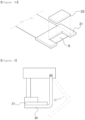
- FIG. 4 provides a view showing the clamp member including the color sensor according to an embodiment of the present invention.
- the clamp member 21 may include a color sensor 21S in order to recognize the location of the film F and adjust the location of the clamp member 21, and the color sensor 21S may be positioned on a surface facing the roll type raw material R of the first clamp member 21A or the tape T in order for the color sensor 21S to be effectively operated. If the film F may be identified with a high sensitivity, the type of color sensor 21S is not particularly limited.
- FIG. 5 provides a view showing the clamp member including the air eruption hole according to an embodiment of the present invention.
- the non-bonding portion B of the tape T even though the non-bonding portion B has no bonding force, the phenomenon in which the raw material R and the non-bonding portion B are in close contact with each other by the electrostatic attraction may occur, and when artificially blowing the wind to the space between the roll type raw material R and the non-bonding portion B, the non-bonding portion B may be easily spaced apart from the roll type raw material R.
- the wind may be generated by erupting the air from an air eruption hole H2 positioned in the clamp member.
- the air eruption hole H2 is connected to a device (not shown) that injects the air.
- the air eruption hole H2 is formed to be close to the non-bonding portion B of the tape T in the first clamp member 21A as possible as shown in FIG. 5 .
- FIG. 6a provides a plan view showing a state in which the clamp member and the attachment pad are in contact with the roll type raw material just before removing the tape according to an embodiment of the present invention
- FIG. 6b provides a perspective view showing a state in which the first clamp member is in contact with the raw material before clamping the non-bonding portion of the tape according to an embodiment of the present invention.
- one tape T is attached to the vicinity of a width center of the roll type raw material R, and the tape is bonded so that the bonding portion A goes through a start line L of the roll type raw material.
- the first clamp member 21A is in contact with the roll type raw material R in the state of being adjacent to the end of the non-bonding portion of the tape, the first clamp member 21A moves toward the non-bonding portion B of the tape and is placed at a lower end of the first clamp member as shown in FIG. 6a , and the non-bonding portion B of the tape is positioned between the first clamp member and the second clamp member.
- the first clamp member 21A among the clamp members 21 is in contact with the roll type raw material R in the state in which the clamp member 21 clamps the non-bonding portion B of the tape T, and the attachment pad 31 is in contact with the roll type raw material R in order to clamp the roll type raw material R so that the roll type material R is not unwound.
- the attachment pad 31 is not in contact with the tape.
- the shape of the attachment surface of the attachment pad 31 is not particularly limited as long as the roll type raw material R is not unwound and is not in contact with the tape, but covering the periphery of the tape as much as possible can prevent the deformation of the raw material at most by removing the tape.
- the attachment pad 31 serves to prevent the roll type raw material from unwinding when removing the tape and also move the end portion of the raw material, if the attachment pad 31 clamps a corner of the end portion of the raw material, the phenomenon in which the corner is bent while moving may be prevented.
- FIG. 6 one exemplary shape of the attachment pad 31 is presented, and in such a shape, the attachment pad 31 is in contact with the corner of the end portion of the raw material and is not in contact with the tape.
- FIGS. 7a and 7b provide view showing the raw material conveying unit including the supplementary member according to an embodiment of the present invention.
- the attachment pad 31 serves to clamp the raw material so as to prevent the roll type raw material from unwinding when removing the tape, the attachment pad 31 has a shape in which the attachment pad 31 is not in contact with the tape.
- the attachment pad 31 does not cover the entire area of the end portion of the raw material due to such a shape, and this causes a problem in that when the attachment pad 31 moves the end portion of the raw material, the end portion of the raw material is not sufficiently fixed.
- the raw material conveying unit 30 may further include a supplementary member 33, and the supplementary member 33 supplements the attachment pad 31 so that the attachment surface is in contact with the entire area of the end portion of the raw material after the tape is removed. Since the area to be supplemented is determined, the shape of the supplementary member 33 is not diversified, but the supplementary member 33 may be applied in various directions.
- FIGs. 7a and 7b present an exemplary application direction of the supplementary member 33.
- FIG. 8 provides a view showing the raw material conveying unit including the support member according to an embodiment of the present invention.
- the support member 34 may be introduced to solve a problem in that the support member 34, similarly to the supplementary member 33, does not sufficiently fix the end portion of the raw material when the attachment pad 31 moves the end portion of the raw material, and the supplementary member 33 and the support member 34 may also be simultaneously applied.
- the raw material conveying unit 30 may further include the support member 34, and the support member 34 supports the other surface of the attachment surface when unwinding the roll type raw material R after attaching the raw material.
- the supplementary member 33 and the support member 34 are simultaneously applied, since the supplementary member 33 may be applied before unwinding the roll type raw material R, the supplementary member 33 may be applied earlier than the support member 34.
- FIG. 8 presents an exemplary shape and an exemplary application direction of the support member 34.
Landscapes
- Engineering & Computer Science (AREA)
- Manufacturing & Machinery (AREA)
- Chemical & Material Sciences (AREA)
- Chemical Kinetics & Catalysis (AREA)
- Electrochemistry (AREA)
- General Chemical & Material Sciences (AREA)
- Replacement Of Web Rolls (AREA)
- Cell Separators (AREA)
Description
- The present invention relates to a roll type raw material supply device. [Background Art]
- A secondary battery is a chemical battery that can be used semi-permanently by continuously repeating charging and discharge using an electrochemical reaction, which is classified into a lead-acid battery, a nickel-cadmium battery, a nickel-hydrogen battery, and a lithium secondary battery. Among them, a lithium secondary battery has superior voltage and energy density characteristics compared to other batteries, thereby leading the market for secondary batteries, which is divided into a lithium-ion secondary battery using a liquid electrolyte and a lithium-ion polymer secondary battery using a solid electrolyte, according to the type of electrolyte. This lithium secondary battery is composed of a positive electrode, a negative electrode and an electrolyte, and also the separator is generally positioned between the positive electrode and the negative electrode to prevent a short circuit between the positive electrode and the negative electrode due to their direct contact.
- In this separator, various resins comprising a polyolefin-based polymer resins such as polyethylene and polypropylene are used as raw materials, and the raw material is mainly supplied in the form of a roll. When supplying a new raw material due to the exhaustion of the raw material in use, in general, the raw material is continuously supplied by bonding the end portion of the raw material in use and the end portion of the new raw material. An automated bonding device that bonds the raw material in use and the new raw material is already known as a related art as in Patent Document 1 below. However, supplied raw material in the form of a roll is initially supplied by attaching a tape to an end portion so as to prevent the roll from unwinding, and there is inconvenience that the tape is manually removed and a part of the roll should be released and inserted into a raw material supply location of the automated bonding device in order to apply the supplied raw material in the form of a roll to the automated bonding device. Further, when the roll is released by the manual work, it is difficult to maintain a tension in the supplied raw material in the form of a roll as it is, and thus a quality of the raw material of the corresponding portion deteriorates.
- Therefore, the present inventor studies the roll type raw material supply device capable of automating even a process of removing the tape in the supplied raw material in the form of a roll and supplying the supplied raw material in the form of a roll, corresponding to the automated bonding device, and has completed the present invention in order to solve the above-described problem.
- (Patent Document 1)
Korean Laid-open Patent Publication No. 10-2016-0133264
JP H 0556856 U -
US 4,840,320 A discloses an apparatus for automatically threading the leading end of web spooled on the reel into one end of the conveying passage including a draw-out lever having a web support surface and movable to a first position at which the support surface engages the web spooled on the reel. A nipping finger is provided which is actuatable to trap the leading end of the web against surface when the lever is in its first position. The lever is movable to a second position at which the support surface is spaced from the web spooled on the reel for unspooling the web from the reel. A feed mechanism is made effective after the lever is moved to a second position, and after the nipping finger has been deactuated, for engaging the unspooled web and feeding the leading end thereof into the conveying passage. - In order to solve the above problems, it is an object of the present invention to provide a roll type raw material supply device capable of automatically removing a tape attached to a raw material in the form of a roll and moving so as to supply the end portion of the raw material to a subsequent device.
- The present invention provides a roll type raw material supply device including: a raw
material mounting unit 10 for introducing a roll type raw material R to which a tape T for fixation to an end portion of a raw material is attached; atape removal unit 20 clamping a non-bonding portion B of the tape and separating the tape from the raw material; and a rawmaterial conveying unit 30 attaching and moving the raw material. - In one embodiment of the present invention, the raw
material mounting unit 10 includes asupport 11 and afirst roller 12, wherein the support supports the first roller, and the first roller fixes and rotates the roll type raw material R. - In one embodiment of the present invention, the
tape removal unit 20 includes aclamp member 21 and a first conveyingcylinder 22, wherein the clamp member includes afirst clamp member 21A and asecond clamp member 21B, and the first clamp member is positioned at an outer side than the second clamp member to be in contact with the raw material R and the tape T when driving the device, and when the first clamp member and the second clamp member are spaced apart from each other and then the nonbonding portion B of the tape is positioned between the first clamp member and the second clamp member, the first clamp member and the second clamp member are close to each other to clamp the non-bonding portion of the tape, and the first conveying cylinder moves the clamp member. - In one embodiment of the present invention, the raw
material conveying unit 30 includes anattachment pad 31 and a second conveyingcylinder 32, wherein the attachment pad attaches and fixes the end portion of the raw material, and the second conveying cylinder moves the attachment pad. - In one embodiment of the present invention, the non-bonding portion B of the tape T attached to the roll type raw material R has a different color from the raw material and is coated with a film F having greater rigidity than the tape, and the
first clamp member 21A includes acolor sensor 21S for identifying the film. - In one embodiment of the present invention, the
first clamp member 21A includes an air eruption hole H2 for erupting air to separate the non-bonding portion B of the tape T from the roll type raw material R. - In one embodiment of the present invention, a portion in the tape that is coated with the film has one or more holes H1 through which air can pass.
- In one embodiment of the present invention, the
attachment pad 31 has a shape in which an attachment surface is in contact with a corner of the end portion of the raw material and is not in contact with the tape when attaching and fixing the end portion of the raw material. - In one embodiment of the present invention, the raw
material conveying unit 30 further includes asupplementary member 33 for supplementing theattachment pad 31 so that the attachment surface is in contact with the entire area of the end portion of the raw material after the tape is removed. - In one embodiment of the present invention, the raw
material conveying unit 30 further includes asupport member 34 for supporting the other surface of the attachment surface when unwinding the roll type raw material after attaching the raw material. - In one embodiment of the present invention, the roll type raw material supply device further includes one or more
second rollers 41 for adjusting a tension of the raw material and determining a movement path of the raw material. - The roll type raw material supply device according to the present invention can automatically and effectively remove the tape attached to a roll type raw material, and can cause the end portion of the raw material to move to a desired location without damage such as warping.
-
-
FIG. 1 is a view schematically showing the roll type raw material supply device according to an embodiment of the present invention. -
FIGs. 2a ,2b ,2c ,2d ,2e , and2f are views sequentially showing a process in which a roll type raw material supply device is driven according to an embodiment of the present invention. -
FIGs. 3a and3b are views showing a tape in which a non-bonding portion is coated with a film according to an embodiment of the present invention.FIG. 3a is a perspective view andFIG. 3b is a plan view. -
FIG. 4 is a view showing a clamp member including a color sensor according to an embodiment of the present invention. -
FIG. 5 is a view showing a clamp member including an air eruption hole according to an embodiment of the present invention. -
FIG. 6a is a plan view showing a state in which the clamp member and an attachment pad are in contact with a roll type raw material just before removing a tape according to an embodiment of the present invention.FIG. 6b is a perspective view showing a state in which a first clamp member is in contact with a raw material before clamping a non-bonding portion of the tape according to an embodiment of the present invention. -
FIGs. 7a and7b are views showing a raw material conveying unit including a supplementary member according to an embodiment of the present invention. -
FIG. 8 is a view showing a raw material conveying unit including a support member according to an embodiment of the present invention. - The terms and words used in the present specification and claims should not be construed as limited to ordinary or dictionary terms, and should be construed in a sense and concept consistent with the technical idea of the present invention, based on the principle that the inventor can properly define the concept of a term to describe his invention in the best way possible.
- In the drawings, the size of each component or a specific part constituting the component is exaggerated, omitted, or schematically illustrated for convenience and clarity of description. Therefore, the size of each component does not fully reflect the actual size. If it is determined that a detailed description of a related known function or configuration may unnecessarily obscure the gist of the present invention, such description will be omitted.
- The present invention relates to a roll type raw material supply device, and in order to describe such a device,
FIG. 1 provides a view schematically showing a roll type raw material supply device according to an embodiment of the present invention. - The roll type raw material supply device according to an embodiment of the present invention may include a raw
material mounting unit 10, atape removal unit 20, and a rawmaterial conveying unit 30, and may include additional components as necessary. - The raw
material mounting unit 10 is a device for introducing a roll type raw material R, and a tape (not shown inFIG. 1 ) for fixing to the end portion of the raw material is attached to the roll type raw material so as to prevent the roll from unwinding. Here, the "end portion" means the area from a start line (or end line) in the direction (when applied to a device, a machine direction (MD)) of a raw material R, to a line spaced apart by a certain distance and the certain distance is determined by the line in the width direction (when applied to the device, a transverse direction (TD)), where theattachment pad 31 and the raw material R are in contact with each other. The width of the tape is sufficient as long as the roll does not unwind, and may be much shorter than the width of the raw material. One tape is attached to a portion around a center of the width of the raw material. The rawmaterial mounting unit 10 includes asupport 11 and afirst roller 12, and may include additional components as necessary. Thesupport 11 is a device for supporting afirst roller 12 so that the roll type raw material R may be introduced into the first roller. Thefirst roller 12 is a device for fixing and rotating the roll type raw material R. - The raw material R may be supplied while one or more layers of fabrics are rolled in a roll type. When the raw material R is formed of two or more layers of fabrics, the fabric may be a state in which respective layers are attached by an electrostatic attraction. When conveying the raw material R formed of two or more layers of fabrics, it is advantageous to apply in subsequent processes only when the raw material R is conveyed in a state in which each layer is not separated from each other.
- The
tape removal unit 20 is a device for clamping the non-bonding portion of the tape and separating the tape from the raw material. Thetape removal unit 20 may include aclamp member 21 and a first conveyingcylinder 22, and may include additional components as necessary. Theclamp member 21 is a device for clamping the non-bonding portion of the tape. Theclamp member 21 includes afirst clamp member 21A and asecond clamp member 21B, wherein thefirst clamp member 21A is positioned at the outer side than thesecond clamp member 21B, and is in contact with the raw material R and the tape when driving the device. When thefirst clamp member 21A and thesecond clamp member 21B are spaced apart from each other and then the non-bonding portion of the tape is positioned between thefirst clamp member 21A and thesecond clamp member 21B, thefirst clamp member 21A and thesecond clamp member 21B are in contact with each other to clamp the non-bonding portion of the tape. The first conveyingcylinder 22 is a device for moving theclamp member 21. The first conveyingcylinder 22 may achieve the purpose of removing the tape only by causing theclamp member 21 to contact the roll type raw material R and move in a direction away from the roll type raw material (a left-right direction inFIG. 1 ), but it also causes theclamp member 21 to move in a direction perpendicular thereto (an up-down direction inFIG. 1 ) if necessary. - The raw
material conveying unit 30 is a device for attaching and moving the raw material. The rawmaterial conveying unit 30 includes anattachment pad 31 and a second conveyingcylinder 32. Theattachment pad 31 is a device for attaching and fixing the end portion of the raw material. Theattachment pad 31 attaches and fixes the end portion of the raw material, thereby effectively removing only the tape in a state in which theclamp member 21 fixes the end portion of the raw material, and supplying the raw material to a desired location by causing theattachment pad 31 to move to unwind the roll. Theattachment pad 31 may attach the raw material through adsorption or electrostatic force. When the raw material R is formed of two or more layers of fabrics, theattachment pad 31 may fix the raw material R in a state in which each layer of the fabrics is attached using electrostatic force, thereby conveying the raw material R in a state in which each layer is not separated from each other. An electrostatic chuck may be used in order to apply the electrostatic force, and if the raw material R may be fixed in a state in which each layer of the fabrics is attached, the type of electrostatic chuck is not particularly limited. According to one embodiment of the present invention, the electrostatic chuck includes a polyimide substrate and a bipolar type electrode, and is driven by applying a voltage of 1.0 kV to 5.0 kV, specifically 1.5 kV to 4.0 kV, and more specifically 2.0 kV to 3.0 kV. Two or more layers of fabrics may be efficiently fixed within the above range. - The second conveying
cylinder 32 is a device for moving theattachment pad 31. The second conveyingcylinder 32 causes theattachment pad 31 to be in contact with the roll type raw material R and move in a direction away from the roll type raw material R (the left-right direction inFIG. 1 ), and also causes theattachment pad 31 to move in a direction perpendicular thereto (the up-down direction inFIG. 1 ) in order to supply the raw material to a desired location. As the second conveyingcylinder 32, a 2-axis direction orthogonal robot, which is movable in both an X direction (the left-right direction inFIG. 1 ) and a Z direction (the up-down direction inFIG. 1 ) except for a Y direction (a front-rear direction inFIG. 1 ), may be used, and when the 2-axis orthogonal robot moves in the Y direction, a warping phenomenon of the raw material may occur. - The roll type raw material supply device according to an embodiment of the present invention further includes one or more
second rollers 41. Thesecond rollers 41 are a device for adjusting the tension of the raw material and deciding a movement path of the raw material. In the roll type raw material supply device, thesecond rollers 41 are disposed in the middle of the movement path of the raw material, thereby preventing a phenomenon in which the tension of the raw material is decreased at a specific portion according to a supply speed of the raw material. The tension of the raw material may be controlled by installing a load cell in thesecond roller 41, and the warping phenomenon or a break phenomenon of the raw material may be prevented by controlling the tension of the raw material. - In order to specifically describe a process of separating a tape from a roll type raw material and causing the end portion of the raw material to move to a location required for a subsequent step,
FIG. 2 provides a view showing a process in which a roll type raw material supply device is driven sequentially according to an embodiment of the present invention. - As shown in
FIG. 2a , theclamp member 21 of thetape removal unit 20 moves to a vicinity of the roll type raw material R to identify a location of a tape T from the roll type raw material R which rotates in a counterclockwise direction. Thereafter, as shown inFIG. 2b , when the location of the tape T is identified, the location of the roll is adjusted so that theclamp member 21 may be positioned just below the non-bonding portion of the tape, and then theclamp member 21 is in contact with the roll type raw material R. Thereafter, as shown inFIG. 2c , the roll type raw material is rotated in a clockwise direction so that the non-bonding portion of the tape is positioned between thefirst clamp member 21A and thesecond clamp member 21B of theclamp member 21, and when the non-bonding portion of the tape is positioned between thefirst clamp member 21A and thesecond clamp member 21B of theclamp member 21, thesecond clamp member 21B is moved close to thefirst clamp member 21A so that theclamp member 21 clamps the non-bonding portion of the tape. Further, theattachment pad 31 moves to the end portion of the raw material to attach and fix the end portion of the raw material. In this case, since theattachment pad 31 is not in contact with the tape, theattachment pad 31 does not interfere with removal of the tape. As shown inFIG. 2d , theclamp member 21 is spaced apart from the roll type raw material to remove the tape T. Thereafter, as shown inFIG. 2e , theattachment pad 31 is spaced apart from the roll type raw material R to unwind the roll and move the end portion of the raw material. Thereafter, as shown inFIG. 2f , when thesecond roller 41 is present, theattachment pad 31 is moved so that the raw material moves in contact with thesecond roller 41. - In order to increase the efficiency of removing the tape, the tape coated with the film may be used.
FIGs. 3a and3b provide views showing a tape in which a non-bonding portion is coated with a film according to an embodiment of the present invention.FIG. 3a is a perspective view showing a state in which the tape is viewed obliquely andFIG. 3b is a plan view showing a state in which the tape is viewed from the top. - Since a generally used tape is transparent, even though the tape is attached to the roll type raw material, the roll type raw material shows the same color as the raw material in appearance even at a location to which the tape is attached, equally at a location to which the tape is not attached. Therefore, the location of the tape may not be easily distinguished visually. If the tape is coated with a film F having a different color from the raw material, the location of the tape may be easily distinguished visually. In an automated device, the film F having the different color is identified by a sensor such as color sensor. As shown in
FIGs. 3a and3b , the tape T is separated into a bonding portion A and a non-bonding portion B. The non-bonding portion B of the tape T is a portion where there is no bonding force on the surface that is in contact with the raw material, and when the tape T has the non-bonding portion B, theclamp member 21 of the device may easily clamp the tape T. The non-bonding portion B of the tape T is coated with the film F. A lower portion of the non-bonding portion B facing the raw material may also be coated with the film, and an upper portion of the non-bonding portion B, which is an opposite surface thereto, may be coated with the film, and the upper and lower portions of the non-bonding portion B may be coated with the film. Since a transparent tape or a translucent tape is used, there is no problem in identifying the film by the sensor even though the lower portion of the non-bonding portion B is coated with the film, and since a material of the film F may be rather lower in electrostatic attraction with the raw material R than the material of the tape T, it may be more advantageous in separating the non-bonding portion B of the tape from the roll type raw material R. When only the non-bonding portion B is coated with the film F by distinguishing the bonding portion A and the non-bonding portion B, it is easy for the sensor of the device to recognize the size of the non-bonding portion B and decide a location for theclamp member 21 to clamp the tape T. As the film F, a material having larger rigidity than the tape T may be used, and for example, a material such as polyethylene terephthalate (PET) may be used. When the material having the large rigidity is used as the film F, the non-bonding portion may be easily raised at once. A thickness of the film may be 10 to 500 µm, and preferably 50 to 200 µm. A portion coated with the film in the tape may have one or more holes H1 through which air may pass. The hole H1 may reduce the phenomenon in which the raw material and the non-bonding portion are in close contact with each other by the electrostatic attraction, and when the non-bonding portion B of the tape T is spaced apart from the roll type raw material R by artificially blowing the wind, the air passes between the holes H1, thereby preventing the non-bonding portion B of the tape T from excessively separating beyond a space between thefirst clamp member 21A and thesecond clamp member 21B. - In order to describe the location for the color sensor,
FIG. 4 provides a view showing the clamp member including the color sensor according to an embodiment of the present invention. - When the film F having the different color is attached to the non-bonding portion B of the tape T, the
clamp member 21 may include acolor sensor 21S in order to recognize the location of the film F and adjust the location of theclamp member 21, and thecolor sensor 21S may be positioned on a surface facing the roll type raw material R of thefirst clamp member 21A or the tape T in order for thecolor sensor 21S to be effectively operated. If the film F may be identified with a high sensitivity, the type ofcolor sensor 21S is not particularly limited. - In order to describe the location for the air eruption hole,
FIG. 5 provides a view showing the clamp member including the air eruption hole according to an embodiment of the present invention. - In the case of the roll type raw material R and the non-bonding portion B of the tape T, even though the non-bonding portion B has no bonding force, the phenomenon in which the raw material R and the non-bonding portion B are in close contact with each other by the electrostatic attraction may occur, and when artificially blowing the wind to the space between the roll type raw material R and the non-bonding portion B, the non-bonding portion B may be easily spaced apart from the roll type raw material R. The wind may be generated by erupting the air from an air eruption hole H2 positioned in the clamp member. The air eruption hole H2 is connected to a device (not shown) that injects the air. In order to effectively separate the non-bonding portion B, it may be preferable that the air eruption hole H2 is formed to be close to the non-bonding portion B of the tape T in the
first clamp member 21A as possible as shown inFIG. 5 . - In order to describe a state in which the clamp member and the attachment pad are in contact with the roll type raw material just before removing the tape,
FIG. 6a provides a plan view showing a state in which the clamp member and the attachment pad are in contact with the roll type raw material just before removing the tape according to an embodiment of the present invention, andFIG. 6b provides a perspective view showing a state in which the first clamp member is in contact with the raw material before clamping the non-bonding portion of the tape according to an embodiment of the present invention. - In general, one tape T is attached to the vicinity of a width center of the roll type raw material R, and the tape is bonded so that the bonding portion A goes through a start line L of the roll type raw material. In order to remove the tape, first, as shown in
FIG. 6b , thefirst clamp member 21A is in contact with the roll type raw material R in the state of being adjacent to the end of the non-bonding portion of the tape, thefirst clamp member 21A moves toward the non-bonding portion B of the tape and is placed at a lower end of the first clamp member as shown inFIG. 6a , and the non-bonding portion B of the tape is positioned between the first clamp member and the second clamp member. Just before removing the tape, thefirst clamp member 21A among theclamp members 21 is in contact with the roll type raw material R in the state in which theclamp member 21 clamps the non-bonding portion B of the tape T, and theattachment pad 31 is in contact with the roll type raw material R in order to clamp the roll type raw material R so that the roll type material R is not unwound. In this case, in order to effectively remove the tape by separating theclamp member 21, it is important that theattachment pad 31 is not in contact with the tape. The shape of the attachment surface of theattachment pad 31 is not particularly limited as long as the roll type raw material R is not unwound and is not in contact with the tape, but covering the periphery of the tape as much as possible can prevent the deformation of the raw material at most by removing the tape. In addition, since theattachment pad 31 serves to prevent the roll type raw material from unwinding when removing the tape and also move the end portion of the raw material, if theattachment pad 31 clamps a corner of the end portion of the raw material, the phenomenon in which the corner is bent while moving may be prevented. InFIG. 6 , one exemplary shape of theattachment pad 31 is presented, and in such a shape, theattachment pad 31 is in contact with the corner of the end portion of the raw material and is not in contact with the tape. - In order to describe the supplementary member,
FIGS. 7a and7b provide view showing the raw material conveying unit including the supplementary member according to an embodiment of the present invention. - Since the
attachment pad 31 serves to clamp the raw material so as to prevent the roll type raw material from unwinding when removing the tape, theattachment pad 31 has a shape in which theattachment pad 31 is not in contact with the tape. Theattachment pad 31 does not cover the entire area of the end portion of the raw material due to such a shape, and this causes a problem in that when theattachment pad 31 moves the end portion of the raw material, the end portion of the raw material is not sufficiently fixed. The rawmaterial conveying unit 30 may further include asupplementary member 33, and thesupplementary member 33 supplements theattachment pad 31 so that the attachment surface is in contact with the entire area of the end portion of the raw material after the tape is removed. Since the area to be supplemented is determined, the shape of thesupplementary member 33 is not diversified, but thesupplementary member 33 may be applied in various directions.FIGs. 7a and7b present an exemplary application direction of thesupplementary member 33. - In order to describe the support member,
FIG. 8 provides a view showing the raw material conveying unit including the support member according to an embodiment of the present invention. - The
support member 34 may be introduced to solve a problem in that thesupport member 34, similarly to thesupplementary member 33, does not sufficiently fix the end portion of the raw material when theattachment pad 31 moves the end portion of the raw material, and thesupplementary member 33 and thesupport member 34 may also be simultaneously applied. The rawmaterial conveying unit 30 may further include thesupport member 34, and thesupport member 34 supports the other surface of the attachment surface when unwinding the roll type raw material R after attaching the raw material. When thesupplementary member 33 and thesupport member 34 are simultaneously applied, since thesupplementary member 33 may be applied before unwinding the roll type raw material R, thesupplementary member 33 may be applied earlier than thesupport member 34.FIG. 8 presents an exemplary shape and an exemplary application direction of thesupport member 34. -
- 10: Raw material mounting unit, 11: Support
- 12: First roller, 20: Tape removal unit
- 21: Clamp member, 21A: First clamp member
- 21B: Second clamp member, 21S: Color sensor
- 22: First conveying cylinder, 30: Raw material transport unit
- 31: Attachment pad, 32: Second conveying cylinder
- 33: Supplementary member, 34: Support member
- 41: Second roller, R: Roll type raw material
- L: Start line (of roll type raw material), T: Tape
- A: Bonding portion of tape, B: Non-bonding portion of tape (film coating portion)
- F: Film, H1: Hole (of tape)
- H2: Air eruption hole
Claims (11)
- A roll type raw material supply device comprising:a raw material mounting unit (10) for introducing a roll type raw material (R) to which a tape (T) for fixing to the end portion of the raw material is attached;a tape removal unit (20) for clamping a non-bonding portion of the tape (B) and separating the tape (T) from the raw material;the roll type raw material supply device being characterized by further comprisinga raw material conveying unit for attaching and moving the raw material.
- The roll type raw material supply device of claim 1,wherein the raw material mounting unit (10) comprises a support (11) and a first roller (12),the support (11) supports the first roller (12), andthe first roller (12) fixes and rotates the roll type raw material (R).
- The roll type raw material supply device of claim 1,wherein the tape removal unit (20) comprises a clamp member (21) and a first conveying cylinder (22),the clamp member (21) comprises a first clamp member (21A) and a second clamp member (21B),the first clamp member (21A) is positioned at an outer side than the second clamp member (21B) to be in contact with the raw material and the tape (T) when driving the device, andwhen the first clamp member (21A) and the second clamp member (21B) are spaced apart from each other and then the non-bonding portion of the tape (B) is positioned between the first clamp member (21A) and the second clamp member (21B), the first clamp member (21A) and the second clamp member (21B) are close to each other to clamp the non-bonding portion of the tape (B), andthe first conveying cylinder (22) moves the clamp member (21).
- The roll type raw material supply device of claim 1,wherein the raw material conveying unit comprises an attachment pad (31) and a second conveying cylinder (32),the attachment pad (31) attaches and fixes the end portion of the raw material, andthe second conveying cylinder (32) moves the attachment pad (31).
- The roll type raw material supply device of claim 3,wherein the non-bonding portion of the tape (B) attached to the roll type raw material (R) has a different color from the raw material and is coated with a film (F) having greater rigidity than the tape (T), andthe first clamp member (21A) comprises a color sensor (21S) for identifying the film (F).
- The roll type raw material supply device of claim 5,
wherein the first clamp member (21A) comprises an air eruption hole (H2) for erupting air in order to separate the non-bonding portion of the tape (B) from the roll type raw material (R). - The roll type raw material supply device of claim 6,
wherein a portion coated with the film (F) in the tape (T) has one or more holes (H1) through which air is capable of passing. - The roll type raw material supply device of claim 4,
wherein the attachment pad (31) has a shape in which an attachment surface is in contact with a corner of the end portion of the raw material but is not in contact with the tape (T) when attaching and fixing the end portion of the raw material. - The roll type raw material supply device of claim 8,
wherein the raw material conveying unit further comprises a supplementary member (33) for supplementing the attachment pad (31) so that the attachment surface is in contact with the entire area of the end portion of the raw material after the tape (T) is removed. - The roll type raw material supply device of claim 9,
wherein the raw material conveying unit further comprises a support member (34) for supporting the other surface of the attachment surface when unwinding the roll type raw material (R) after attaching the raw material. - The roll type raw material supply device of claim 4,
wherein the roll type raw material supply device further comprises one or more second rollers (41) for adjusting the tension of the raw material and determining a movement path of the raw material.
Applications Claiming Priority (3)
| Application Number | Priority Date | Filing Date | Title |
|---|---|---|---|
| KR1020210048933A KR102962584B1 (en) | 2021-04-15 | Device supplying roll type raw material | |
| KR1020220005009A KR20230109266A (en) | 2022-01-13 | 2022-01-13 | Device supplying roll type raw material |
| PCT/KR2022/005455 WO2022220638A1 (en) | 2021-04-15 | 2022-04-15 | Roll-type raw material supply device |
Publications (3)
| Publication Number | Publication Date |
|---|---|
| EP4164016A1 EP4164016A1 (en) | 2023-04-12 |
| EP4164016A4 EP4164016A4 (en) | 2024-10-30 |
| EP4164016B1 true EP4164016B1 (en) | 2025-06-11 |
Family
ID=83640850
Family Applications (1)
| Application Number | Title | Priority Date | Filing Date |
|---|---|---|---|
| EP22788493.9A Active EP4164016B1 (en) | 2021-04-15 | 2022-04-15 | Roll-type raw material supply device |
Country Status (7)
| Country | Link |
|---|---|
| US (1) | US20230286765A1 (en) |
| EP (1) | EP4164016B1 (en) |
| JP (1) | JP7576380B2 (en) |
| CN (1) | CN116057764A (en) |
| ES (1) | ES3040604T3 (en) |
| HU (1) | HUE072243T2 (en) |
| WO (1) | WO2022220638A1 (en) |
Families Citing this family (1)
| Publication number | Priority date | Publication date | Assignee | Title |
|---|---|---|---|---|
| KR20230037210A (en) * | 2021-09-09 | 2023-03-16 | 에스케이온 주식회사 | Apparatus for feeding tape for secondary batteryg |
Family Cites Families (46)
| Publication number | Priority date | Publication date | Assignee | Title |
|---|---|---|---|---|
| GB1154662A (en) * | 1967-02-02 | 1969-06-11 | Agfa Gevaert Nv | Web Winding Apparatus. |
| JPS5931244A (en) * | 1982-08-09 | 1984-02-20 | Dainippon Printing Co Ltd | Paper feeder with automatic paper connection |
| JPH0125600Y2 (en) * | 1985-01-28 | 1989-07-31 | ||
| JPS63165259A (en) * | 1986-12-25 | 1988-07-08 | Tokyo Jido Kikai Seisakusho:Kk | Band like material replacing unit in band like material feeding device |
| JPS63162434A (en) * | 1986-12-25 | 1988-07-06 | 株式会社 東京自働機械製作所 | Exchanger for packaging material in packaging-material delivery device |
| JPH089438B2 (en) * | 1989-04-26 | 1996-01-31 | 日本たばこ産業株式会社 | Cutting device for feeding out the leading edge of the band-shaped material fed from the winding roll |
| IT1235955B (en) * | 1989-12-07 | 1992-12-09 | Gd Spa | DEVICE FOR THE REMOVAL OF A CLOSING ADHESIVE CLAMP FROM A BAND OF TAPE MATERIAL |
| IT1238288B (en) * | 1990-03-27 | 1993-07-12 | Gd Spa | DEVICE FOR THE REMOVAL OF A CLOSING ADHESIVE CLAMP FROM A BAND OF TAPE MATERIAL. |
| IT1245766B (en) * | 1991-02-26 | 1994-10-14 | Gd Spa | METHOD AND DEVICE FOR CUTTING AN ADHESIVE CLAMP FOR CLOSING A BAND OF TAPE MATERIAL. |
| JP2860350B2 (en) * | 1991-04-30 | 1999-02-24 | コニカ株式会社 | Tape peeling method for roll-shaped sheet and its peeling device |
| US5366174A (en) * | 1991-10-08 | 1994-11-22 | Sony Magnescale, Inc. | Tape winding apparatus |
| JPH0556856U (en) * | 1992-01-14 | 1993-07-27 | ハマダ印刷機械株式会社 | Separator for the tab surface side separator |
| US5383622A (en) * | 1993-05-05 | 1995-01-24 | The Kohler Coating Machinery Corporation | Web transfer mechanism and method for a continuous winder |
| JPH0812181A (en) * | 1994-07-01 | 1996-01-16 | Mitsubishi Paper Mills Ltd | How to peel off the label for stopping the roll end |
| US6325324B1 (en) * | 1999-09-16 | 2001-12-04 | Industrial Adhesives, Inc. | Tape splicing system |
| JP2002012349A (en) * | 2000-04-27 | 2002-01-15 | Mitsubishi Heavy Ind Ltd | Paper splicing device and corrugating machine |
| JP2002274705A (en) * | 2001-03-16 | 2002-09-25 | Fuji Photo Film Co Ltd | Recording paper roll supporting device |
| WO2003029119A1 (en) * | 2001-09-26 | 2003-04-10 | Tesa Ag | Cover strip |
| US20060162852A1 (en) * | 2002-08-05 | 2006-07-27 | Peter Gertsch | Method, system and device for preparing a winding reel for changing reels in a flying manner, detecting a web of material, and applying a double-sided adhesive tape to a surface |
| ES2261574T3 (en) * | 2002-10-14 | 2006-11-16 | Metso Paper Ag | PROCEDURE AND DEVICE FOR THE PREPARATION OF A PAPER COIL FOR AUTOMATIC CHANGE OF THE COIL. |
| US8178181B2 (en) * | 2004-03-05 | 2012-05-15 | Rodriguez Peter A | Transfer tape for cutting and spooling a paper web |
| JP4383252B2 (en) * | 2004-05-27 | 2009-12-16 | 富士フイルム株式会社 | Tape drawing apparatus and method |
| JP2008162781A (en) * | 2006-12-28 | 2008-07-17 | Mitsubishi Heavy Industries Printing & Paper Converting Machinery Sales Co Ltd | Splicing device and corrugating machine |
| JP2008184230A (en) * | 2007-01-26 | 2008-08-14 | Mitsubishi Heavy Industries Printing & Paper Converting Machinery Sales Co Ltd | Paper splicing device and corrugating machine |
| JP2009004218A (en) * | 2007-06-21 | 2009-01-08 | Nippon Sheet Glass Co Ltd | Separator winding body for battery |
| JP2010150008A (en) * | 2008-12-25 | 2010-07-08 | Sanyo Electric Co Ltd | Extraction method and extraction device for trailing end of hoop-shaped band material |
| US9067750B2 (en) * | 2011-02-23 | 2015-06-30 | Greif Packaging Llc | Method and apparatus for splicing a paper roll |
| CA2934432A1 (en) * | 2013-12-20 | 2015-06-25 | Peromo Ltd | An apparatus and method for web transfer |
| NL2012668B1 (en) * | 2014-04-23 | 2016-07-04 | Vmi Holland Bv | Foil removal device and a method for removing a foil from a tire tread. |
| CN106458490B (en) * | 2014-06-30 | 2018-03-02 | 株式会社瑞光 | Lamellar body transmitting system and the lamellar body submitting method for the lamellar body transmitting system |
| KR101695650B1 (en) | 2015-05-12 | 2017-01-12 | 주식회사 디에이테크놀로지 | Apparatus for Automatically Changing Electrode Films |
| KR101832936B1 (en) * | 2015-08-07 | 2018-02-28 | 정명환 | Auto-replaceable tape supply apparatus |
| IT201600103467A1 (en) * | 2016-10-14 | 2018-04-14 | Ri Flex Abrasives S R L | AUTOMATIC FEEDER |
| KR102474343B1 (en) * | 2016-12-14 | 2022-12-05 | 현대자동차 주식회사 | Auto splicing device of roll to roll feeding system |
| ES2941799T3 (en) * | 2017-03-22 | 2023-05-25 | Philip Morris Products Sa | Method for removing an adhesive label from a coil and an apparatus for removing an adhesive label from an end portion of a spiral sheet in a coil |
| KR101892583B1 (en) * | 2018-02-21 | 2018-08-28 | 김태완 | Splicing Device of Secondary Battery Separator and Method the Same |
| JP7132742B2 (en) * | 2018-04-26 | 2022-09-07 | 株式会社ディスコ | Tape peeling device |
| DE102019203742A1 (en) * | 2019-02-07 | 2020-08-13 | Bhs Corrugated Maschinen- Und Anlagenbau Gmbh | Material web feed device |
| WO2020223257A1 (en) | 2019-04-28 | 2020-11-05 | Visby Medical, Inc. | Molecular diagnostic devices with digital detection capability and wireless connectivity |
| KR102269811B1 (en) * | 2019-09-06 | 2021-06-28 | 엘지전자 주식회사 | Automatic connection apparatus for film type material of secondary battery |
| KR20210048933A (en) | 2019-10-24 | 2021-05-04 | (주)닥터티제이 | Pharmaceutical composition for the prevention or treatment of obesity or metabolic syndrome induced from obesity containing evening primrose extract as an active ingredient |
| JP2021174705A (en) * | 2020-04-27 | 2021-11-01 | 住友化学株式会社 | Separator winding body |
| KR102661995B1 (en) * | 2020-07-14 | 2024-05-02 | 주식회사 엘지에너지솔루션 | Apparatus for removing tape |
| EP3988484B1 (en) * | 2020-10-21 | 2024-04-24 | Fameccanica.Data S.p.A. | A method and apparatus for preparing edges of reels of web material |
| US12280973B2 (en) * | 2021-05-28 | 2025-04-22 | Papeltec Overseas, Inc. | Method and apparatus for a transfer tape applied to form a raised profile |
| KR102326503B1 (en) * | 2021-07-20 | 2021-11-15 | (주)도원위즈테크 | Material peeling device of winding type material roll |
-
2022
- 2022-04-15 CN CN202280005918.8A patent/CN116057764A/en active Pending
- 2022-04-15 HU HUE22788493A patent/HUE072243T2/en unknown
- 2022-04-15 US US18/016,769 patent/US20230286765A1/en active Pending
- 2022-04-15 ES ES22788493T patent/ES3040604T3/en active Active
- 2022-04-15 EP EP22788493.9A patent/EP4164016B1/en active Active
- 2022-04-15 JP JP2023511833A patent/JP7576380B2/en active Active
- 2022-04-15 WO PCT/KR2022/005455 patent/WO2022220638A1/en not_active Ceased
Also Published As
| Publication number | Publication date |
|---|---|
| EP4164016A1 (en) | 2023-04-12 |
| CN116057764A (en) | 2023-05-02 |
| JP7576380B2 (en) | 2024-10-31 |
| US20230286765A1 (en) | 2023-09-14 |
| HUE072243T2 (en) | 2025-11-28 |
| EP4164016A4 (en) | 2024-10-30 |
| WO2022220638A1 (en) | 2022-10-20 |
| JP2023539082A (en) | 2023-09-13 |
| ES3040604T3 (en) | 2025-11-03 |
Similar Documents
| Publication | Publication Date | Title |
|---|---|---|
| EP4049955B1 (en) | Automatic replacement apparatus and method for feed material | |
| KR102661995B1 (en) | Apparatus for removing tape | |
| US6936080B2 (en) | Method and device for manufacturing coiled electrode group | |
| EP4164015B1 (en) | Material supply apparatus for secondary battery separator | |
| EP4164016B1 (en) | Roll-type raw material supply device | |
| CN218707612U (en) | Five-in-one forming equipment | |
| EP4299494B1 (en) | Winding apparatus and winding method for electrode connection film and electrode roll | |
| KR101717392B1 (en) | Method for producing separator and method for slitting | |
| CN213401287U (en) | Tab reel changing device and winding equipment | |
| KR20230122541A (en) | Apparatus and method for windng film for connection to electrode,and electrode roll | |
| KR102611154B1 (en) | electrode sheet connection method for secondary battery | |
| KR101832681B1 (en) | Film production apparatus, film roll production apparatus, film production method, and film roll production method | |
| KR102962584B1 (en) | Device supplying roll type raw material | |
| US20110146915A1 (en) | Label attaching device | |
| KR20220061715A (en) | Method for connecting electrode sheet and electrode sheet thereof | |
| KR20230109266A (en) | Device supplying roll type raw material | |
| JP5992670B2 (en) | Sheet sticking device and sticking method | |
| KR20220142642A (en) | Device supplying roll type raw material | |
| KR20220008633A (en) | Apparatus for Attaching Tape | |
| JP2003118896A (en) | Winding device and winding method | |
| CN224082441U (en) | Cell film sticking device | |
| JP2002025600A (en) | Electrode supply device and electrode supply method | |
| KR20260018429A (en) | Film member replacement apparatus and film member replacement method | |
| KR20200018923A (en) | Seamless Double Turret Foil Winding System for Secondary Cell Electrode |
Legal Events
| Date | Code | Title | Description |
|---|---|---|---|
| STAA | Information on the status of an ep patent application or granted ep patent |
Free format text: STATUS: THE INTERNATIONAL PUBLICATION HAS BEEN MADE |
|
| PUAI | Public reference made under article 153(3) epc to a published international application that has entered the european phase |
Free format text: ORIGINAL CODE: 0009012 |
|
| STAA | Information on the status of an ep patent application or granted ep patent |
Free format text: STATUS: REQUEST FOR EXAMINATION WAS MADE |
|
| 17P | Request for examination filed |
Effective date: 20230103 |
|
| AK | Designated contracting states |
Kind code of ref document: A1 Designated state(s): AL AT BE BG CH CY CZ DE DK EE ES FI FR GB GR HR HU IE IS IT LI LT LU LV MC MK MT NL NO PL PT RO RS SE SI SK SM TR |
|
| DAV | Request for validation of the european patent (deleted) | ||
| DAX | Request for extension of the european patent (deleted) | ||
| A4 | Supplementary search report drawn up and despatched |
Effective date: 20240927 |
|
| RIC1 | Information provided on ipc code assigned before grant |
Ipc: H01M 4/04 20060101ALI20240923BHEP Ipc: B65H 23/26 20060101ALI20240923BHEP Ipc: B65H 20/16 20060101ALI20240923BHEP Ipc: B65H 16/02 20060101ALI20240923BHEP Ipc: B65H 19/10 20060101ALI20240923BHEP Ipc: H01M 50/256 20210101ALI20240923BHEP Ipc: H01M 10/04 20060101AFI20240923BHEP |
|
| GRAP | Despatch of communication of intention to grant a patent |
Free format text: ORIGINAL CODE: EPIDOSNIGR1 |
|
| STAA | Information on the status of an ep patent application or granted ep patent |
Free format text: STATUS: GRANT OF PATENT IS INTENDED |
|
| RIC1 | Information provided on ipc code assigned before grant |
Ipc: H01M 4/04 20060101ALI20250314BHEP Ipc: B65H 23/26 20060101ALI20250314BHEP Ipc: B65H 20/16 20060101ALI20250314BHEP Ipc: B65H 16/02 20060101ALI20250314BHEP Ipc: B65H 19/10 20060101ALI20250314BHEP Ipc: H01M 50/256 20210101ALI20250314BHEP Ipc: H01M 10/04 20060101AFI20250314BHEP |
|
| INTG | Intention to grant announced |
Effective date: 20250402 |
|
| RAP1 | Party data changed (applicant data changed or rights of an application transferred) |
Owner name: LG ENERGY SOLUTION, LTD. |
|
| GRAS | Grant fee paid |
Free format text: ORIGINAL CODE: EPIDOSNIGR3 |
|
| GRAA | (expected) grant |
Free format text: ORIGINAL CODE: 0009210 |
|
| STAA | Information on the status of an ep patent application or granted ep patent |
Free format text: STATUS: THE PATENT HAS BEEN GRANTED |
|
| P01 | Opt-out of the competence of the unified patent court (upc) registered |
Free format text: CASE NUMBER: APP_18258/2025 Effective date: 20250415 |
|
| AK | Designated contracting states |
Kind code of ref document: B1 Designated state(s): AL AT BE BG CH CY CZ DE DK EE ES FI FR GB GR HR HU IE IS IT LI LT LU LV MC MK MT NL NO PL PT RO RS SE SI SK SM TR |
|
| REG | Reference to a national code |
Ref country code: GB Ref legal event code: FG4D |
|
| REG | Reference to a national code |
Ref country code: CH Ref legal event code: EP |
|
| REG | Reference to a national code |
Ref country code: DE Ref legal event code: R096 Ref document number: 602022015900 Country of ref document: DE |
|
| REG | Reference to a national code |
Ref country code: IE Ref legal event code: FG4D |
|
| PG25 | Lapsed in a contracting state [announced via postgrant information from national office to epo] |
Ref country code: FI Free format text: LAPSE BECAUSE OF FAILURE TO SUBMIT A TRANSLATION OF THE DESCRIPTION OR TO PAY THE FEE WITHIN THE PRESCRIBED TIME-LIMIT Effective date: 20250611 |
|
| REG | Reference to a national code |
Ref country code: LT Ref legal event code: MG9D |
|
| PG25 | Lapsed in a contracting state [announced via postgrant information from national office to epo] |
Ref country code: GR Free format text: LAPSE BECAUSE OF FAILURE TO SUBMIT A TRANSLATION OF THE DESCRIPTION OR TO PAY THE FEE WITHIN THE PRESCRIBED TIME-LIMIT Effective date: 20250912 Ref country code: NO Free format text: LAPSE BECAUSE OF FAILURE TO SUBMIT A TRANSLATION OF THE DESCRIPTION OR TO PAY THE FEE WITHIN THE PRESCRIBED TIME-LIMIT Effective date: 20250911 |
|
| REG | Reference to a national code |
Ref country code: NL Ref legal event code: MP Effective date: 20250611 |
|
| PG25 | Lapsed in a contracting state [announced via postgrant information from national office to epo] |
Ref country code: BG Free format text: LAPSE BECAUSE OF FAILURE TO SUBMIT A TRANSLATION OF THE DESCRIPTION OR TO PAY THE FEE WITHIN THE PRESCRIBED TIME-LIMIT Effective date: 20250611 |
|
| PG25 | Lapsed in a contracting state [announced via postgrant information from national office to epo] |
Ref country code: HR Free format text: LAPSE BECAUSE OF FAILURE TO SUBMIT A TRANSLATION OF THE DESCRIPTION OR TO PAY THE FEE WITHIN THE PRESCRIBED TIME-LIMIT Effective date: 20250611 |
|
| PG25 | Lapsed in a contracting state [announced via postgrant information from national office to epo] |
Ref country code: RS Free format text: LAPSE BECAUSE OF FAILURE TO SUBMIT A TRANSLATION OF THE DESCRIPTION OR TO PAY THE FEE WITHIN THE PRESCRIBED TIME-LIMIT Effective date: 20250911 |
|
| PG25 | Lapsed in a contracting state [announced via postgrant information from national office to epo] |
Ref country code: LV Free format text: LAPSE BECAUSE OF FAILURE TO SUBMIT A TRANSLATION OF THE DESCRIPTION OR TO PAY THE FEE WITHIN THE PRESCRIBED TIME-LIMIT Effective date: 20250611 |
|
| REG | Reference to a national code |
Ref country code: ES Ref legal event code: FG2A Ref document number: 3040604 Country of ref document: ES Kind code of ref document: T3 Effective date: 20251103 |
|
| PG25 | Lapsed in a contracting state [announced via postgrant information from national office to epo] |
Ref country code: NL Free format text: LAPSE BECAUSE OF FAILURE TO SUBMIT A TRANSLATION OF THE DESCRIPTION OR TO PAY THE FEE WITHIN THE PRESCRIBED TIME-LIMIT Effective date: 20250611 |
|
| REG | Reference to a national code |
Ref country code: HU Ref legal event code: AG4A Ref document number: E072243 Country of ref document: HU |
|
| PG25 | Lapsed in a contracting state [announced via postgrant information from national office to epo] |
Ref country code: PT Free format text: LAPSE BECAUSE OF FAILURE TO SUBMIT A TRANSLATION OF THE DESCRIPTION OR TO PAY THE FEE WITHIN THE PRESCRIBED TIME-LIMIT Effective date: 20251013 |
|
| REG | Reference to a national code |
Ref country code: AT Ref legal event code: MK05 Ref document number: 1802986 Country of ref document: AT Kind code of ref document: T Effective date: 20250611 |
|
| PG25 | Lapsed in a contracting state [announced via postgrant information from national office to epo] |
Ref country code: IS Free format text: LAPSE BECAUSE OF FAILURE TO SUBMIT A TRANSLATION OF THE DESCRIPTION OR TO PAY THE FEE WITHIN THE PRESCRIBED TIME-LIMIT Effective date: 20251011 |
|
| PG25 | Lapsed in a contracting state [announced via postgrant information from national office to epo] |
Ref country code: AT Free format text: LAPSE BECAUSE OF FAILURE TO SUBMIT A TRANSLATION OF THE DESCRIPTION OR TO PAY THE FEE WITHIN THE PRESCRIBED TIME-LIMIT Effective date: 20250611 Ref country code: SM Free format text: LAPSE BECAUSE OF FAILURE TO SUBMIT A TRANSLATION OF THE DESCRIPTION OR TO PAY THE FEE WITHIN THE PRESCRIBED TIME-LIMIT Effective date: 20250611 |
|
| PG25 | Lapsed in a contracting state [announced via postgrant information from national office to epo] |
Ref country code: CZ Free format text: LAPSE BECAUSE OF FAILURE TO SUBMIT A TRANSLATION OF THE DESCRIPTION OR TO PAY THE FEE WITHIN THE PRESCRIBED TIME-LIMIT Effective date: 20250611 |
|
| PG25 | Lapsed in a contracting state [announced via postgrant information from national office to epo] |
Ref country code: PL Free format text: LAPSE BECAUSE OF FAILURE TO SUBMIT A TRANSLATION OF THE DESCRIPTION OR TO PAY THE FEE WITHIN THE PRESCRIBED TIME-LIMIT Effective date: 20250611 |
|
| PG25 | Lapsed in a contracting state [announced via postgrant information from national office to epo] |
Ref country code: EE Free format text: LAPSE BECAUSE OF FAILURE TO SUBMIT A TRANSLATION OF THE DESCRIPTION OR TO PAY THE FEE WITHIN THE PRESCRIBED TIME-LIMIT Effective date: 20250611 |
|
| PG25 | Lapsed in a contracting state [announced via postgrant information from national office to epo] |
Ref country code: SK Free format text: LAPSE BECAUSE OF FAILURE TO SUBMIT A TRANSLATION OF THE DESCRIPTION OR TO PAY THE FEE WITHIN THE PRESCRIBED TIME-LIMIT Effective date: 20250611 |
|
| REG | Reference to a national code |
Ref country code: DE Ref legal event code: R097 Ref document number: 602022015900 Country of ref document: DE |
|
| PGFP | Annual fee paid to national office [announced via postgrant information from national office to epo] |
Ref country code: GB Payment date: 20260324 Year of fee payment: 5 |
|
| PG25 | Lapsed in a contracting state [announced via postgrant information from national office to epo] |
Ref country code: DK Free format text: LAPSE BECAUSE OF FAILURE TO SUBMIT A TRANSLATION OF THE DESCRIPTION OR TO PAY THE FEE WITHIN THE PRESCRIBED TIME-LIMIT Effective date: 20250611 |
|
| PG25 | Lapsed in a contracting state [announced via postgrant information from national office to epo] |
Ref country code: IT Free format text: LAPSE BECAUSE OF FAILURE TO SUBMIT A TRANSLATION OF THE DESCRIPTION OR TO PAY THE FEE WITHIN THE PRESCRIBED TIME-LIMIT Effective date: 20250611 |
|
| PGFP | Annual fee paid to national office [announced via postgrant information from national office to epo] |
Ref country code: BE Payment date: 20260323 Year of fee payment: 5 |
|
| PLBE | No opposition filed within time limit |
Free format text: ORIGINAL CODE: 0009261 |
|
| STAA | Information on the status of an ep patent application or granted ep patent |
Free format text: STATUS: NO OPPOSITION FILED WITHIN TIME LIMIT |
|
| PGFP | Annual fee paid to national office [announced via postgrant information from national office to epo] |
Ref country code: FR Payment date: 20260323 Year of fee payment: 5 |
|
| REG | Reference to a national code |
Ref country code: CH Ref legal event code: L10 Free format text: ST27 STATUS EVENT CODE: U-0-0-L10-L00 (AS PROVIDED BY THE NATIONAL OFFICE) Effective date: 20260423 |