EP4164004A1 - Sacrificial positive electrode material with reduced gas emissions, and lithium secondary battery comprising same - Google Patents
Sacrificial positive electrode material with reduced gas emissions, and lithium secondary battery comprising same Download PDFInfo
- Publication number
- EP4164004A1 EP4164004A1 EP22759992.5A EP22759992A EP4164004A1 EP 4164004 A1 EP4164004 A1 EP 4164004A1 EP 22759992 A EP22759992 A EP 22759992A EP 4164004 A1 EP4164004 A1 EP 4164004A1
- Authority
- EP
- European Patent Office
- Prior art keywords
- positive electrode
- sacrificial
- chemical formula
- electrode material
- lithium
- Prior art date
- Legal status (The legal status is an assumption and is not a legal conclusion. Google has not performed a legal analysis and makes no representation as to the accuracy of the status listed.)
- Pending
Links
Images


Classifications
-
- H—ELECTRICITY
- H01—ELECTRIC ELEMENTS
- H01M—PROCESSES OR MEANS, e.g. BATTERIES, FOR THE DIRECT CONVERSION OF CHEMICAL ENERGY INTO ELECTRICAL ENERGY
- H01M4/00—Electrodes
- H01M4/02—Electrodes composed of, or comprising, active material
- H01M4/36—Selection of substances as active materials, active masses, active liquids
- H01M4/48—Selection of substances as active materials, active masses, active liquids of inorganic oxides or hydroxides
- H01M4/52—Selection of substances as active materials, active masses, active liquids of inorganic oxides or hydroxides of nickel, cobalt or iron
- H01M4/525—Selection of substances as active materials, active masses, active liquids of inorganic oxides or hydroxides of nickel, cobalt or iron of mixed oxides or hydroxides containing iron, cobalt or nickel for inserting or intercalating light metals, e.g. LiNiO2, LiCoO2 or LiCoOxFy
-
- C—CHEMISTRY; METALLURGY
- C01—INORGANIC CHEMISTRY
- C01G—COMPOUNDS CONTAINING METALS NOT COVERED BY SUBCLASSES C01D OR C01F
- C01G51/00—Compounds of cobalt
- C01G51/40—Complex oxides containing cobalt and at least one other metal element
- C01G51/42—Complex oxides containing cobalt and at least one other metal element containing alkali metals, e.g. LiCoO2
-
- H—ELECTRICITY
- H01—ELECTRIC ELEMENTS
- H01M—PROCESSES OR MEANS, e.g. BATTERIES, FOR THE DIRECT CONVERSION OF CHEMICAL ENERGY INTO ELECTRICAL ENERGY
- H01M4/00—Electrodes
- H01M4/02—Electrodes composed of, or comprising, active material
- H01M4/62—Selection of inactive substances as ingredients for active masses, e.g. binders, fillers
-
- H—ELECTRICITY
- H01—ELECTRIC ELEMENTS
- H01M—PROCESSES OR MEANS, e.g. BATTERIES, FOR THE DIRECT CONVERSION OF CHEMICAL ENERGY INTO ELECTRICAL ENERGY
- H01M10/00—Secondary cells; Manufacture thereof
- H01M10/05—Accumulators with non-aqueous electrolyte
- H01M10/052—Li-accumulators
-
- H—ELECTRICITY
- H01—ELECTRIC ELEMENTS
- H01M—PROCESSES OR MEANS, e.g. BATTERIES, FOR THE DIRECT CONVERSION OF CHEMICAL ENERGY INTO ELECTRICAL ENERGY
- H01M10/00—Secondary cells; Manufacture thereof
- H01M10/42—Methods or arrangements for servicing or maintenance of secondary cells or secondary half-cells
- H01M10/4235—Safety or regulating additives or arrangements in electrodes, separators or electrolyte
-
- H—ELECTRICITY
- H01—ELECTRIC ELEMENTS
- H01M—PROCESSES OR MEANS, e.g. BATTERIES, FOR THE DIRECT CONVERSION OF CHEMICAL ENERGY INTO ELECTRICAL ENERGY
- H01M4/00—Electrodes
- H01M4/02—Electrodes composed of, or comprising, active material
- H01M4/04—Processes of manufacture in general
- H01M4/0402—Methods of deposition of the material
- H01M4/0404—Methods of deposition of the material by coating on electrode collectors
-
- H—ELECTRICITY
- H01—ELECTRIC ELEMENTS
- H01M—PROCESSES OR MEANS, e.g. BATTERIES, FOR THE DIRECT CONVERSION OF CHEMICAL ENERGY INTO ELECTRICAL ENERGY
- H01M4/00—Electrodes
- H01M4/02—Electrodes composed of, or comprising, active material
- H01M4/13—Electrodes for accumulators with non-aqueous electrolyte, e.g. for lithium-accumulators; Processes of manufacture thereof
- H01M4/131—Electrodes based on mixed oxides or hydroxides, or on mixtures of oxides or hydroxides, e.g. LiCoOx
-
- H—ELECTRICITY
- H01—ELECTRIC ELEMENTS
- H01M—PROCESSES OR MEANS, e.g. BATTERIES, FOR THE DIRECT CONVERSION OF CHEMICAL ENERGY INTO ELECTRICAL ENERGY
- H01M4/00—Electrodes
- H01M4/02—Electrodes composed of, or comprising, active material
- H01M4/36—Selection of substances as active materials, active masses, active liquids
- H01M4/48—Selection of substances as active materials, active masses, active liquids of inorganic oxides or hydroxides
- H01M4/485—Selection of substances as active materials, active masses, active liquids of inorganic oxides or hydroxides of mixed oxides or hydroxides for inserting or intercalating light metals, e.g. LiTi2O4 or LiTi2OxFy
-
- H—ELECTRICITY
- H01—ELECTRIC ELEMENTS
- H01M—PROCESSES OR MEANS, e.g. BATTERIES, FOR THE DIRECT CONVERSION OF CHEMICAL ENERGY INTO ELECTRICAL ENERGY
- H01M4/00—Electrodes
- H01M4/02—Electrodes composed of, or comprising, active material
- H01M4/36—Selection of substances as active materials, active masses, active liquids
- H01M4/48—Selection of substances as active materials, active masses, active liquids of inorganic oxides or hydroxides
- H01M4/50—Selection of substances as active materials, active masses, active liquids of inorganic oxides or hydroxides of manganese
- H01M4/505—Selection of substances as active materials, active masses, active liquids of inorganic oxides or hydroxides of manganese of mixed oxides or hydroxides containing manganese for inserting or intercalating light metals, e.g. LiMn2O4 or LiMn2OxFy
-
- H—ELECTRICITY
- H01—ELECTRIC ELEMENTS
- H01M—PROCESSES OR MEANS, e.g. BATTERIES, FOR THE DIRECT CONVERSION OF CHEMICAL ENERGY INTO ELECTRICAL ENERGY
- H01M4/00—Electrodes
- H01M4/02—Electrodes composed of, or comprising, active material
- H01M4/62—Selection of inactive substances as ingredients for active masses, e.g. binders, fillers
- H01M4/624—Electric conductive fillers
- H01M4/625—Carbon or graphite
-
- H—ELECTRICITY
- H01—ELECTRIC ELEMENTS
- H01M—PROCESSES OR MEANS, e.g. BATTERIES, FOR THE DIRECT CONVERSION OF CHEMICAL ENERGY INTO ELECTRICAL ENERGY
- H01M4/00—Electrodes
- H01M4/02—Electrodes composed of, or comprising, active material
- H01M4/62—Selection of inactive substances as ingredients for active masses, e.g. binders, fillers
- H01M4/628—Inhibitors, e.g. gassing inhibitors, corrosion inhibitors
-
- C—CHEMISTRY; METALLURGY
- C01—INORGANIC CHEMISTRY
- C01P—INDEXING SCHEME RELATING TO STRUCTURAL AND PHYSICAL ASPECTS OF SOLID INORGANIC COMPOUNDS
- C01P2006/00—Physical properties of inorganic compounds
- C01P2006/40—Electric properties
-
- H—ELECTRICITY
- H01—ELECTRIC ELEMENTS
- H01M—PROCESSES OR MEANS, e.g. BATTERIES, FOR THE DIRECT CONVERSION OF CHEMICAL ENERGY INTO ELECTRICAL ENERGY
- H01M4/00—Electrodes
- H01M4/02—Electrodes composed of, or comprising, active material
- H01M2004/021—Physical characteristics, e.g. porosity, surface area
-
- H—ELECTRICITY
- H01—ELECTRIC ELEMENTS
- H01M—PROCESSES OR MEANS, e.g. BATTERIES, FOR THE DIRECT CONVERSION OF CHEMICAL ENERGY INTO ELECTRICAL ENERGY
- H01M4/00—Electrodes
- H01M4/02—Electrodes composed of, or comprising, active material
- H01M2004/026—Electrodes composed of, or comprising, active material characterised by the polarity
- H01M2004/028—Positive electrodes
-
- Y—GENERAL TAGGING OF NEW TECHNOLOGICAL DEVELOPMENTS; GENERAL TAGGING OF CROSS-SECTIONAL TECHNOLOGIES SPANNING OVER SEVERAL SECTIONS OF THE IPC; TECHNICAL SUBJECTS COVERED BY FORMER USPC CROSS-REFERENCE ART COLLECTIONS [XRACs] AND DIGESTS
- Y02—TECHNOLOGIES OR APPLICATIONS FOR MITIGATION OR ADAPTATION AGAINST CLIMATE CHANGE
- Y02E—REDUCTION OF GREENHOUSE GAS [GHG] EMISSIONS, RELATED TO ENERGY GENERATION, TRANSMISSION OR DISTRIBUTION
- Y02E60/00—Enabling technologies; Technologies with a potential or indirect contribution to GHG emissions mitigation
- Y02E60/10—Energy storage using batteries
Definitions
- the present invention relates to a sacrificial positive electrode material with a reduced amount of gas generated during charging by being doped with a zinc ion and having controlled electrical properties, and a lithium secondary battery including the same.
- lithium secondary batteries having a high energy density and voltage, a long cycle lifespan, and a low self-discharge rate have been commercialized and widely used.
- a negative electrode material for the lithium secondary batteries As a negative electrode material for the lithium secondary batteries, graphite has been mainly used. However, since graphite has a low capacity per unit mass of 372 mAh/g, it is difficult to increase the capacity of lithium secondary batteries.
- a negative electrode material that forms an intermetallic compound with lithium such as silicon, tin, an oxide thereof, and the like, has been developed and used.
- the non-carbon-based negative electrode material has high capacity, but the initial efficiency thereof is low, so a large amount of lithium is consumed during initial charging and discharging, and irreversible capacity loss is large.
- Such a sacrificial positive electrode material or irreversible additive causes oxidation not only during activation of a battery but also during charging and discharging after the activation due to having an unstable structure, and thus oxygen gas may be generated inside a battery.
- the generated oxygen gas may cause volume expansion and the like and thus acts as one of the main factors leading to degradation of battery performance.
- An object of the present invention is to provide a sacrificial positive electrode material having a higher charge/discharge capacity while having a small amount of oxygen gas generated during a charging/discharging process of a battery, and a positive electrode and lithium secondary battery including the same.
- One aspect of the present invention provides a sacrificial positive electrode material which includes a lithium cobalt zinc oxide represented by the following Chemical Formula 1 and has a powder electrical conductivity of 1 ⁇ 10 -4 S/cm to 1 ⁇ 10 -2 S/cm: [Chemical Formula 1] Li x Co (1-y) Zn y O 4 in Chemical Formula 1, x and y satisfy 5 ⁇ x ⁇ 7 and 0.05 ⁇ y ⁇ 0.5.
- y in Chemical Formula 1 may satisfy 0.2 ⁇ y ⁇ 0.4.
- the sacrificial positive electrode material may have a powder electrical conductivity of 1 ⁇ 10 -3 S/cm to 9 ⁇ 10 -3 S/cm.
- the sacrificial positive electrode material may have a tetragonal structure with a space group of P4 2 /nmc.
- a positive electrode which includes: a positive electrode current collector; and a positive electrode mixture layer including a positive electrode active material, a conductive material, an organic binder polymer, and a sacrificial positive electrode material on the positive electrode current collector, wherein the sacrificial positive electrode material includes a lithium cobalt zinc oxide represented by the following Chemical Formula 1 and has a powder electrical conductivity of 1 ⁇ 10 -4 S/cm to 1 ⁇ 10 -2 S/cm: [Chemical Formula 1] Li x Co (1-y) Zn y O 4 in Chemical Formula 1, x and y satisfy 5 ⁇ x ⁇ 7 and 0.05 ⁇ y ⁇ 0.5.
- the sacrificial positive electrode material may be included in an amount of 0.001 to 5.0 parts by weight with respect to 100 parts by weight of the positive electrode active material.
- the conductive material may be included in an amount of 0.5 to 10 parts by weight with respect to a total of 100 parts by weight of the positive electrode mixture layer.
- the conductive material may include one or more carbon-based materials selected from the group consisting of natural graphite, artificial graphite, carbon black, acetylene black, Ketjen black, and carbon fibers.
- the positive electrode active material may be a lithium composite transition metal oxide including two or more elements selected from the group consisting of nickel (Ni), cobalt (Co), manganese (Mn), aluminum (Al), zinc (Zn), titanium (Ti), magnesium (Mg), chromium (Cr), and zirconium (Zr).
- the positive electrode mixture layer may have an average thickness of 100 ⁇ m to 200 ⁇ m.
- the positive electrode may have a rate of increase of resistance of 10% or less after 30-cycle charging and discharging relative to a resistance during initial charging and discharging.
- Still another aspect of the present invention provides an electrode assembly including the above-described positive electrode.
- Yet another aspect of the present invention provides a lithium secondary battery including the above-described electrode assembly.
- a sacrificial positive electrode material according to the present invention can reduce the generation of gas, particularly, oxygen (O 2 ) gas, during charging and discharging of a battery after activation and achieve a high charge/discharge capacity by including a lithium cobalt metal oxide represented by Chemical Formula 1, which is doped with a specific fraction of zinc, and having a powder electrical conductivity adjusted within a specific range, and thus the stability and lifespan of a battery including the same are effectively enhanced.
- gas particularly, oxygen (O 2 ) gas
- a portion of a layer, film, region, plate, or the like when referred to as being “on” another portion, this includes not only the case where the portion is “directly on” but also the case where there is another portion interposed therebetween. Conversely, when a portion of a layer, film, region, plate, or the like is referred to as being “under” another portion, this includes not only the case where the portion is “directly under” but also the case where there is another portion interposed therebetween. Also, herein, what is referred to as being disposed “on” may include being disposed not only on an upper part but also on a lower part.
- One aspect of the present invention provides a sacrificial positive electrode material which includes a lithium cobalt zinc oxide represented by the following Chemical Formula 1 and has a powder electrical conductivity of 1 ⁇ 10 -4 S/cm to 1 ⁇ 10 -2 S/cm: [Chemical Formula 1] Li x Co (1-y) Zn y O 4 in Chemical Formula 1, x and y satisfy 5 ⁇ x ⁇ 7 and 0.05 ⁇ y ⁇ 0.5.
- the sacrificial positive electrode material according to the present invention includes a lithium cobalt metal oxide represented by Chemical Formula 1 as a main component.
- the "main component” means that the lithium cobalt metal oxide represented by Chemical Formula 1 is included in an amount of 80 wt% or more, 90 wt% or more, 95 wt% or more, or 97.5 wt% or more with respect to the total weight of the sacrificial positive electrode material.
- the sacrificial positive electrode material is composed only of the lithium cobalt metal oxide represented by Chemical Formula 1, that is, that the lithium cobalt metal oxide represented by Chemical Formula 1 is included in an amount of 100 wt%.
- the lithium cobalt metal oxide represented by Chemical Formula 1 has a structure in which zinc is doped at the cobalt position of a lithium cobalt oxide that emits a large amount of lithium ions, and in this case, the doping amount of zinc may be a 5 to 50 mole fraction (i.e., 0.05 ⁇ y ⁇ 0.5), specifically, a 10 to 50 mole fraction (0.1 ⁇ y ⁇ 0.5), a 15 to 50 mole fraction (0.15 ⁇ y ⁇ 0.5), a 15 to 45 mole fraction (0.15 ⁇ y ⁇ 0.45), a 20 to 40 mole fraction (0.2 ⁇ y ⁇ 0.4), or a 25 to 35 mole fraction (0.25 ⁇ y ⁇ 0.35).
- the doping amount of zinc may be adjusted within the above mole fraction range to alleviate the structural distortion of the lithium cobalt oxide, and thus structural stability may be further enhanced.
- the lithium cobalt metal oxide represented by Chemical Formula 1 may have a tetragonal crystal structure, particularly, a space group of P4 2 /nmc.
- a lithium metal oxide having a tetragonal crystal structure has an unstable structure due to the distortion of a tetrahedral structure formed by a cobalt element and an oxygen element, and the structural instability causes the generation of gas including oxygen gas even during charging after activation of a battery.
- the sacrificial positive electrode material according to the present invention may effectively reduce a gas generation amount even when including the lithium metal oxide represented by Chemical Formula 1 having a tetragonal crystal structure.
- the sacrificial positive electrode material may have a powder electrical conductivity of 1 ⁇ 10 -4 S/cm to 1 ⁇ 10 -2 S/cm, specifically, 1 ⁇ 10 -4 S/cm to 5 ⁇ 10 -3 S/cm, 5 ⁇ 10 -4 S/cm to 1 ⁇ 10 -2 S/cm, 5 ⁇ 10 -4 S/cm to 5 ⁇ 10 -3 S/cm, 8 ⁇ 10 -4 S/cm to 9 ⁇ 10 -3 S/cm, 1 ⁇ 10 -3 S/cm to 9 ⁇ 10 -3 S/cm, 1 ⁇ 10 -3 S/cm to 8 ⁇ 10 -3 S/cm, or 2.5 ⁇ 10 -3 S/cm to 5.5 ⁇ 10 -3 S/cm.
- the powder electrical conductivity of the sacrificial positive electrode material may be adjusted according to one or more condition for preparation of the sacrificial positive electrode material and the like, and when the powder electrical conductivity is adjusted within the above range, charge/discharge capacity may be enhanced while reducing an amount of gas generated during charging of a battery.
- the sacrificial positive electrode material according to the present invention can reduce the generation of gas, particularly, oxygen (O 2 ) gas, in an electrode assembly during charging and discharging of a battery after activation and achieve a high charge/discharge capacity by including the lithium cobalt metal oxide represented by Chemical Formula 1, which is doped with a specific fraction of zinc, and having a powder electrical conductivity adjusted within a specific range, and thus the stability and lifespan of a battery including the same are effectively enhanced.
- gas particularly, oxygen (O 2 ) gas
- a positive electrode which includes: a positive electrode current collector; and a positive electrode mixture layer including a positive electrode active material, a conductive material, an organic binder polymer, and a sacrificial positive electrode material on the positive electrode current collector, wherein the sacrificial positive electrode material includes a lithium cobalt zinc oxide represented by the following Chemical Formula 1 and has a powder electrical conductivity of 1 ⁇ 10 -4 S/cm to 1 ⁇ 10 -2 S/cm: [Chemical Formula 1] Li x Co (1-y) Zn y O 4 in Chemical Formula 1, x and y satisfy 5 ⁇ x ⁇ 7 and 0.05 ⁇ y ⁇ 0.5.
- the positive electrode according to the present invention has a structure in which a positive electrode mixture layer is formed on a positive electrode current collector, wherein the positive electrode mixture layer includes a sacrificial positive electrode material prepared by the method of the present invention and including the lithium cobalt metal oxide represented by Chemical Formula 1 together with a positive electrode active material, a conductive material, and an organic binder polymer, and thus charge capacity is high, and the generation of gas, particularly, oxygen (O 2 ) gas, during charging and discharging of a battery is effectively reduced.
- the positive electrode mixture layer includes a sacrificial positive electrode material prepared by the method of the present invention and including the lithium cobalt metal oxide represented by Chemical Formula 1 together with a positive electrode active material, a conductive material, and an organic binder polymer, and thus charge capacity is high, and the generation of gas, particularly, oxygen (O 2 ) gas, during charging and discharging of a battery is effectively reduced.
- the positive electrode active material may be a lithium composite transition metal oxide including two or more elements selected from the group consisting of nickel (Ni), cobalt (Co), manganese (Mn), aluminum (Al), zinc (Zn), titanium (Ti), magnesium (Mg), chromium (Cr), and zirconium (Zr).
- the sacrificial positive electrode material may be included in an amount of 0.001 to 5.0 parts by weight with respect to 100 parts by weight of the positive electrode active material. More specifically, the sacrificial positive electrode material may be included in an amount of 0.001 to 4.0 parts by weight, 0.001 to 3.0 parts by weight, 0.001 to 2.0 parts by weight, 0.001 to 1.0 parts by weight, 0.01 to 2.0 parts by weight, 0.05 to 2.0 parts by weight, 0.1 to 2.0 parts by weight, or 0.1 to 1.5 parts by weight with respect to 100 parts by weight of the positive electrode active material.
- the conductive material may be added in an amount of 1 to 20 parts by weight, specifically, 1 to 10 parts by weight, 1 to 5 parts by weight, 3 to 8 parts by weight, or 2 to 5 parts by weight with respect to 100 parts by weight of the positive electrode active material.
- the conductive material is not particularly limited as long as it does not cause a chemical change in a battery and has conductivity.
- materials may be used such as: graphite such as natural graphite, artificial graphite, or the like; carbon black such as acetylene black, Ketjen black, channel black, furnace black, lamp black, thermal black, or the like; a conductive fiber such as carbon fiber, metal fiber, or the like; fluorocarbon; metal powder such as aluminum powder, nickel powder, or the like; a conductive whisker such as zinc oxide, potassium titanate, or the like; a conductive metal oxide such as titanium oxide or the like; or a conductive material such as a polyphenylene derivative or the like.
- the organic binder polymer is a component that aids in the binding of the active material, the conductive material, and the like to one another and to a current collector and may be added in an amount of 1 to 20 parts by weight, specifically, 1 to 10 parts by weight, 1 to 5 parts by weight, 3 to 8 parts by weight, or 2 to 5 parts by weight with respect to 100 parts by weight of the positive electrode active material.
- examples of the organic binder polymer include polyvinylidene fluoride (PVdF), polyvinyl alcohol, carboxymethylcellulose (CMC), starch, hydroxypropyl cellulose, regenerated cellulose, polyvinylpyrrolidone, polytetrafluoroethylene, polyethylene, polypropylene, an ethylene-propylene-diether polymer (EPDM), a sulfonated EPDM, styrenebutyrene rubber, fluoro-rubber, and various copolymers thereof.
- PVdF polyvinylidene fluoride
- CMC carboxymethylcellulose
- EPDM ethylene-propylene-diether polymer
- EPDM ethylene-propylene-diether polymer
- styrenebutyrene rubber fluoro-rubber, and various copolymers thereof.
- the positive electrode may further include, in the positive electrode mixture layer, a filler for suppressing the expansion of the positive electrode in addition to the positive electrode active material, the conductive material, and the organic binder polymer, and the filler is not particularly limited as long as it is a fibrous material that does not cause a chemical change in a battery.
- a filler for suppressing the expansion of the positive electrode in addition to the positive electrode active material, the conductive material, and the organic binder polymer
- the filler is not particularly limited as long as it is a fibrous material that does not cause a chemical change in a battery.
- an olefin-based polymer such as polyethylene, polypropylene, or the like, a fibrous material such as glass fiber, carbon fiber, or the like may be used as the filler.
- the positive electrode mixture layer may include, with respect to 100 parts by weight of a lithium nickel cobalt manganese oxide (LiNi 0.6 Co 0.2 Mn 0.2 O 2 ), 1 part by weight of a sacrificial positive electrode material (Li 6 Co 0.7 Zn 0.3 O 4 ), 5 parts by weight of acetylene black as a conductive material, and 10 parts by weight of a PVdF binder.
- a lithium nickel cobalt manganese oxide LiNi 0.6 Co 0.2 Mn 0.2 O 2
- a sacrificial positive electrode material Li 6 Co 0.7 Zn 0.3 O 4
- acetylene black as a conductive material
- PVdF binder 10 parts by weight of a PVdF binder
- the positive electrode mixture layer may have an average thickness of 100 ⁇ m to 200 ⁇ m, specifically, 120 ⁇ m to 180 ⁇ m, 140 ⁇ m to 170 ⁇ m, or 150 ⁇ m to 200 ⁇ m.
- the positive electrode mixture layer may have a single-layer structure or a multi-layer structure having two or more layers.
- the amount of the sacrificial positive electrode material included in the positive electrode mixture layer may be different, and the types and/or amounts of the positive electrode active material, the conductive material, and the binder may be the same or different.
- the positive electrode mixture layer may have a two-layer structure in which a first mixture layer and a second mixture layer are positioned on a positive electrode current collector, wherein the first mixture layer may include, with respect to 100 parts by weight of a lithium nickel cobalt manganese oxide (LiNi 0.6 Co 0.2 Mn 0.2 O 2 ), 1 part by weight of a sacrificial positive electrode material (Li 6 Co 0.7 Zn 0.3 O 4 ), 5 parts by weight of acetylene black as a conductive material, and 10 parts by weight of a PVdF binder, and the second mixture layer may include, with respect to 100 parts by weight of a lithium nickel cobalt manganese oxide (LiNi 0.6 Co 0.2 Mn 0.2 O 2 ), 2 parts by weight of a sacrificial positive electrode material (Li 6 Co 0.7 Zn 0.3 O 4 ); 5 parts by weight of acetylene black as a conductive material, and 9 parts by weight of a PVdF binder
- the positive electrode current collector is not particularly limited as long as it does not cause a chemical change in a battery and has high conductivity.
- stainless steel, aluminum, nickel, titanium, calcined carbon, or the like may be used, and in the case of aluminum or stainless steel, a surface thereof has been treated with carbon, nickel, titanium, silver, or the like.
- fine irregularities may be formed on the surface of the positive electrode current collector to increase the adhesion of the positive electrode active material, and various forms such as a film, a sheet, a foil, a net, a porous body, a foam, and a nonwoven body are possible.
- the average thickness of the positive electrode current collector may be appropriately applied in a range of 3 to 500 ⁇ m in consideration of the conductivity and total thickness of the positive electrode to be manufactured.
- the positive electrode according to the present invention may have excellent electrical performance by including the above-described components.
- the positive electrode may have low electrode resistance at room temperature (23 ⁇ 2 °C) and a low rate of increase of electrode resistance even after repeated charging and discharging of a battery, and thus the lifespan of a battery may be enhanced.
- the positive electrode may have a low rate of increase of electrode resistance of 10% or less after 30-cycle charging and discharging relative to an electrode resistance during initial charging and discharging (e.g., activation).
- the positive electrode may have a rate of increase of electrode resistance of 8% or less, 6% or less, 4% or less, or 3% or less after 30-cycle charging and discharging relative to electrode resistance during initial charging and discharging.
- Still another aspect of the present invention provides an electrode assembly including the above-described positive electrode.
- the electrode assembly according to the present invention may include the above-described positive electrode, a negative electrode, and a separator interposed between the positive electrode and the negative electrode. In some cases, the separator may be excluded.
- the negative electrode is manufactured by applying a negative electrode active material on a negative electrode current collector, followed by drying and pressing, and as necessary, it may optionally further include a conductive material, an organic binder polymer, a filler, and the like as described above.
- materials may be used such as, for example, carbon and graphite materials such as graphite having a completely layered crystal structure such as natural graphite, soft carbon having a low crystallinity layered crystal structure (graphene structure; a structure in which hexagonal honeycomb planes of carbon are arranged in layers), hard carbon in which these structures are mixed with amorphous parts, artificial graphite, expanded graphite, carbon fiber, non-graphitizable carbon, carbon black, carbon nanotubes, fullerenes, activated carbon, and the like; metal composite oxides such as Li x Fe 2 O 3 (0 ⁇ x ⁇ 1), Li x WO 2 (0 ⁇ x ⁇ 1), Sn x Me 1-x Me' y O z (Me: Mn, Fe, Pb, Ge; Me': Al, B, P, Si, Group 1, Group 2 and Group 3 elements of the periodic table, halogens; 0 ⁇ x ⁇ 1; 1 ⁇ y ⁇ 3; 1 ⁇ z ⁇ 8); lithium metal; lithium alloys;
- the negative electrode current collector is not particularly limited as long as it does not cause a chemical change in a battery and has high conductivity.
- copper, stainless steel, nickel, titanium, calcined carbon, or the like may be used, and copper or stainless steel whose surface has been treated with carbon, nickel, titanium, silver, or the like may also be used.
- the negative electrode current collector may have fine irregularities formed on the surface thereof to increase the adhesion of a negative electrode active material, and various forms such as a film, a sheet, a foil, a net, a porous body, a foam, and a nonwoven body are possible.
- the average thickness of the negative electrode current collector may be appropriately applied in a range of 3 to 500 ⁇ m in consideration of the conductivity and total thickness of a negative electrode to be manufactured.
- the separator is interposed between the positive electrode and the negative electrode, and an insulating thin film having high ion permeability and mechanical strength is used.
- the separator is not particularly limited as long as it is commonly used in the art, specifically, a sheet or non-woven fabric made of chemical-resistant and hydrophobic polypropylene, glass fiber, polyethylene, or the like may be used, and in some cases, a composite separator in which a porous polymer substrate such as the sheet or nonwoven fabric is coated with inorganic particles/organic particles by an organic binder polymer may be used.
- a solid electrolyte such as a polymer or the like is used as an electrolyte, the solid electrolyte may serve as the separator.
- the separator may have an average pore diameter of 0.01 to 10 ⁇ m and an average thickness of 5 to 300 ⁇ m.
- the electrode assembly may be accommodated in a cylindrical battery, a prismatic battery, or a pouch-type battery while being wound in the form of a jelly roll or accommodated in a folding or stack-folding type in a pouch-type battery, but the present invention is not limited thereto.
- Yet another aspect of the present invention provides a lithium secondary battery including the above-described electrode assembly.
- the lithium secondary battery according to the present invention may have a structure in which the electrode assembly is impregnated with a lithium salt-containing liquid electrolyte.
- the lithium salt-containing liquid electrolyte may consist of a liquid electrolyte and a lithium salt.
- a non-aqueous organic solvent, an organic solid electrolyte, an inorganic solid electrolyte, or the like may be used.
- an aprotic organic solvent such as N-methyl-2-pyrrolidinone, ethylene carbonate, propylene carbonate, butylene carbonate, dimethyl carbonate, diethyl carbonate, ⁇ -butyrolactone, 1,2-dimethoxyethane, tetrahydrofuran, 2-methyl tetrahydrofuran, dimethyl sulfoxide, 1,3-dioxolane, formamide, dimethylformamide, dioxolane, acetonitrile, nitromethane, methyl formate, methyl acetate, phosphate triester, trimethoxy methane, dioxolane derivatives, sulfolane, methyl sulfolane, 1,3-dimethyl-2-imidazolidinone, propylene carbonate derivatives, tetrahydrofuran derivatives, ether, methyl propionate, ethyl propionate, or the like
- an aprotic organic solvent such as N-methyl-2-
- organic solid electrolyte for example, polyethylene derivatives, polyethylene oxide derivatives, polypropylene oxide derivatives, phosphoric acid ester polymers, poly alginate lysine, polyester sulfide, polyvinyl alcohol, polyvinylidene fluoride, polymers including ionic dissociation groups, or the like may be used.
- the inorganic solid electrolyte for example, nitrides, halides, or sulfates of Li, such as Li 3 N, LiI, Li 5 Ni 2 , Li 3 N-LiI-LiOH, LiSiO 4 , LiSiO 4 -LiI-LiOH, Li 2 SiS 3 , Li 4 SiO 4 , Li 4 SiO 4 -LiI-LiOH, Li 3 PO 4 -Li 2 S-SiS 2 , or the like, may be used.
- Li such as Li 3 N, LiI, Li 5 Ni 2 , Li 3 N-LiI-LiOH, LiSiO 4 , LiSiO 4 -LiI-LiOH, Li 2 SiS 3 , Li 4 SiO 4 , Li 4 SiO 4 -LiI-LiOH, Li 3 PO 4 -Li 2 S-SiS 2 , or the like.
- the lithium salt is a substance that is readily soluble in a non-aqueous electrolyte, and for example, LiCl, LiBr, LiI, LiClO 4 , LiBF 4 , LiB 10 Cl 10 , LiPF 6 , LiCF 3 SO 3 , LiCF 3 CO 2 , LiAsF 6 , LiSbF 6 , LiAlCl 4 , CH 3 SO 3 Li, (CF 3 SO 2 ) 2 NLi, chloroborane lithium, lower aliphatic carboxylic acid lithium, lithium tetraphenyl borate, lithium imide, or the like may be used.
- pyridine triethylphosphite, triethanolamine, cyclic ether, ethylenediamine, n-glyme, hexamethylphosphoric triamide, nitrobenzene derivatives, sulfur, quinone imine dyes, N-substituted oxazolidinone, N,N-substituted imidazolidine, ethylene glycol dialkyl ether, ammonium salts, pyrrole, 2-methoxy ethanol, aluminum trichloride, or the like may be added to the liquid electrolyte.
- a halogen-containing solvent such as carbon tetrachloride, ethylene trifluoride, or the like may be further included to impart incombustibility
- carbon dioxide gas may be further included to enhance high-temperature storage characteristics
- fluoro-ethylene carbonate (FEC), propene sultone (PRS), or the like may be further included.
- yet another aspect of the present invention provides a battery module including the above-described secondary battery as a unit cell and also provides a battery pack including the battery module.
- the battery pack may be used as power sources of medium-to-large-sized devices that require high-temperature stability, high rate characteristics and long cycle characteristics
- specific examples of the medium-to-large-sized devices include: power tools powered by electric motors; electric vehicles including electric vehicles (EVs), hybrid electric vehicles (HEVs), plug-in hybrid electric vehicles (PHEVs), and the like; electric two-wheeled vehicles including electric bicycles (E-bikes) and electric scooters (E-scooters); electric golf carts; power storage systems; and the like, and more specific examples thereof include HEVs, but the present invention is not limited thereto.
- Lithium oxide (Li 2 O), cobalt oxide (CoO), and zinc oxide (ZnO) were input into a reactor and uniformly dry-mixed for about 30 minutes using a mixer. Then, the prepared raw material mixture was input into an electric furnace and fired under an argon gas (Ar) atmosphere at about 700 ⁇ 10 °C for 10 hours to obtain a lithium cobalt oxide (Li 6 Co 1-x Zn x O 4 ).
- a molar ratio of lithium oxide and cobalt oxide put into the reactor was 1:3.0 to 3.03, and a molar ratio of cobalt oxide and zinc oxide was as shown in Table 1 below.
- each sacrificial positive electrode material and the sheet resistance according to a pressure change were measured by a four-point probe method using a powder resistivity tester, and the powder electrical conductivity of each sacrificial positive electrode material was calculated using the measured volume and input mass. Results thereof are shown in the following Table 1.
- N-methylpyrrolidone solvent was input into a homo mixer, and each sacrificial positive electrode material prepared in Examples 1 to 3 and Comparative Examples 1 to 5, a positive electrode active material (LiNi 0.6 Co 0.2 Mn 0.2 O 2 ), a modified silanol binder, and a dispersant were input in a weight ratio of 70:28:1.7:0.3 and then mixed at 3,000 rpm for 60 minutes to prepare a pre-dispersion.
- a positive electrode active material LiNi 0.6 Co 0.2 Mn 0.2 O 2
- a modified silanol binder a modified silanol binder
- a dispersant were input in a weight ratio of 70:28:1.7:0.3 and then mixed at 3,000 rpm for 60 minutes to prepare a pre-dispersion.
- the prepared pre-dispersion was mixed with a positive electrode active material (LiNi 0.6 Co 0.2 Mn 0.2 O 2 ) so that the content of the sacrificial positive electrode material was 2 parts by weight with respect to 100 parts by weight of the positive electrode active material, and a positive electrode active material mixed in an N-methylpyrrolidone solvent, a PVdF binder, and a carbon black conductive material were input in a weight ratio of 96:1:3 into a homo mixer, and then dispersed at 3,000 rpm for 80 minutes to prepare a slurry for a positive electrode.
- a positive electrode active material LiNi 0.6 Co 0.2 Mn 0.2 O 2
- the prepared slurry was applied on one surface of an aluminum current collector, dried at 100°C, and then rolled to manufacture a positive electrode so that an average thickness of a positive electrode mixture layer was about 170 ⁇ m and a total thickness of a positive electrode mixture layer and a positive electrode current collector was about 200 ⁇ m.
- a 2032 type coin cell was fabricated using the positive electrode and a lithium metal counter electrode.
- a separator (thickness: about 16 ⁇ m) made of a porous polyethylene (PE) film was interposed between the positive electrode and the lithium metal counter electrode, and a liquid electrolyte was injected to fabricate a half-cell type coin cell.
- EC ethylene carbonate
- EMC ethyl methyl carbonate
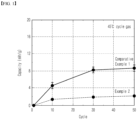
- the fabricated coin cell was charged and discharged once at 25°C under 4.5C/1.5C conditions to perform formation. Then the fabricated coin cell was analyzed in terms of the amount and component of gas generated respectively 1 during each charge and discharge which were repeatedly performed 50 times at 45°C under 1.5C/1.5C condition and 2 during storage at 60°C for 4 weeks. Results thereof are shown in the following Table 2 and FIGS. 1 to 3 .
- the battery of Example 2 exhibited a gas generation amount reduced by 16% during activation and a gas generation amount reduced by 75% after 50-cycle charging and discharging, as compared to the battery of Comparative Example 1 using a sacrificial positive electrode material which was not doped with zinc. Also, the battery of Example 2 exhibited a gas generation amount reduced by 85% during 4-week storage, as compared to the battery of Comparative Example 1.
- the sacrificial positive electrode material according to the present invention exhibits a reduced gas generation amount by being doped with a specific mole fraction of zinc and having controlled powder electrical conductivity.
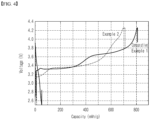
- the fabricated coin cell was charged and discharged once at 25 °C under 400 mAh/144 mAh conditions to perform formation. And then charging and discharging were repeatedly performed 30 times at 25°C under 200 mAh/200 mAh conditions, and 1 the electrode resistance during initial charging and discharging and after 30-cycle charging and discharging and 2 the initial charge capacity of each coin cell were measured. A resistance rate of increase of the electrode was calculated from the measured electrode resistance before and after charging and discharging, and the calculated result and the measured initial charge capacity are shown in the following Table 3 and FIG. 4 .
- the sacrificial positive electrode materials prepared according to the present invention have an effect of enhancing battery performance.
- the batteries including the sacrificial positive electrode materials of Examples exhibited an electrode resistance rate of increase of 10% or less even after 30-cycle charging and discharging. This means that, as the number of charging and discharging cycles of the battery increases, the degree of degradation of battery lifespan is improved. Also, it was confirmed that the batteries including the sacrificial positive electrode materials of Examples exhibited a high initial charge capacity of 690 mAh or more, whereas the batteries including the sacrificial positive electrode materials of Comparative Examples exhibited a low initial charge capacity of less than 680 mAh.
- the batteries including the sacrificial positive electrode materials of Comparative Examples 1 and 2 exhibited a high initial charge capacity of more than 700 mAh, but electrode resistance was increased as charging and discharging were repeated, and thus electrode resistance after 30-cycle charging and discharging was increased by more than 15%.
- the sacrificial positive electrode materials according to the present invention is doped with a specific mole fraction of zinc and has controlled powder electrical conductivity to enhance the electrical performance of a battery, and thus the stability and lifespan of a battery including the same are effectively improved.
Landscapes
- Chemical & Material Sciences (AREA)
- Chemical Kinetics & Catalysis (AREA)
- Electrochemistry (AREA)
- General Chemical & Material Sciences (AREA)
- Engineering & Computer Science (AREA)
- Manufacturing & Machinery (AREA)
- Inorganic Chemistry (AREA)
- Organic Chemistry (AREA)
- Materials Engineering (AREA)
- Battery Electrode And Active Subsutance (AREA)
Abstract
Description
- The present invention relates to a sacrificial positive electrode material with a reduced amount of gas generated during charging by being doped with a zinc ion and having controlled electrical properties, and a lithium secondary battery including the same.
- This application claims the benefit of priority based on
Korean Patent Application No. 10-2021-0024264, filed on February 23, 2021 - Recently, demand for secondary batteries as a power source has rapidly increased. Among secondary batteries, lithium secondary batteries having a high energy density and voltage, a long cycle lifespan, and a low self-discharge rate have been commercialized and widely used.
- As a negative electrode material for the lithium secondary batteries, graphite has been mainly used. However, since graphite has a low capacity per unit mass of 372 mAh/g, it is difficult to increase the capacity of lithium secondary batteries. In order to increase the capacity of lithium secondary batteries, as a non-carbon-based negative electrode material having a higher energy density than graphite, a negative electrode material that forms an intermetallic compound with lithium, such as silicon, tin, an oxide thereof, and the like, has been developed and used. The non-carbon-based negative electrode material has high capacity, but the initial efficiency thereof is low, so a large amount of lithium is consumed during initial charging and discharging, and irreversible capacity loss is large.
- In this regard, there has been proposed a method of overcoming the irreversible capacity loss of the negative electrode using a material that is able to provide a lithium ion source or reservoir to a positive electrode material and exhibits electrochemical activity after an initial cycle so as not to degrade the overall performance of a battery. Specifically, a method of applying an oxide including an excessive amount of lithium, such as Li6CoO4, as a sacrificial positive electrode material or an irreversible additive (or overdischarge inhibitor) to a positive electrode is known.
- However, such a sacrificial positive electrode material or irreversible additive causes oxidation not only during activation of a battery but also during charging and discharging after the activation due to having an unstable structure, and thus oxygen gas may be generated inside a battery. The generated oxygen gas may cause volume expansion and the like and thus acts as one of the main factors leading to degradation of battery performance.
- Therefore, there is a demand for the development of a sacrificial positive electrode material having a reduced amount of oxygen gas generated during a charging/discharging process of a battery and a high charge/discharge capacity.
-
Korean Laid-Open Patent Publication No. 10-2019-0059115 - An object of the present invention is to provide a sacrificial positive electrode material having a higher charge/discharge capacity while having a small amount of oxygen gas generated during a charging/discharging process of a battery, and a positive electrode and lithium secondary battery including the same.
- One aspect of the present invention provides a sacrificial positive electrode material which includes a lithium cobalt zinc oxide represented by the following Chemical Formula 1 and has a powder electrical conductivity of 1 × 10⁻⁴ S/cm to 1 × 10⁻² S/cm:
[Chemical Formula 1] LixCo(1-y)ZnyO4
in Chemical Formula 1, x and y satisfy 5≤x≤7 and 0.05≤y≤0.5. - Specifically, y in Chemical Formula 1 may satisfy 0.2≤y≤0.4.
- In addition, the sacrificial positive electrode material may have a powder electrical conductivity of 1 × 10⁻³ S/cm to 9 × 10⁻³ S/cm.
- In addition, the sacrificial positive electrode material may have a tetragonal structure with a space group of P42/nmc.
- Another aspect of the present invention provides a positive electrode which includes: a positive electrode current collector; and a positive electrode mixture layer including a positive electrode active material, a conductive material, an organic binder polymer, and a sacrificial positive electrode material on the positive electrode current collector, wherein the sacrificial positive electrode material includes a lithium cobalt zinc oxide represented by the following Chemical Formula 1 and has a powder electrical conductivity of 1 × 10⁻⁴ S/cm to 1 × 10⁻² S/cm:
[Chemical Formula 1] LixCo(1-y)ZnyO4
in Chemical Formula 1, x and y satisfy 5≤x≤7 and 0.05≤y≤0.5. - Here, the sacrificial positive electrode material may be included in an amount of 0.001 to 5.0 parts by weight with respect to 100 parts by weight of the positive electrode active material.
- In addition, the conductive material may be included in an amount of 0.5 to 10 parts by weight with respect to a total of 100 parts by weight of the positive electrode mixture layer.
- In addition, the conductive material may include one or more carbon-based materials selected from the group consisting of natural graphite, artificial graphite, carbon black, acetylene black, Ketjen black, and carbon fibers.
- In addition, the positive electrode active material may be a lithium composite transition metal oxide including two or more elements selected from the group consisting of nickel (Ni), cobalt (Co), manganese (Mn), aluminum (Al), zinc (Zn), titanium (Ti), magnesium (Mg), chromium (Cr), and zirconium (Zr).
- In addition, the positive electrode mixture layer may have an average thickness of 100 µm to 200 µm.
- In addition, the positive electrode may have a rate of increase of resistance of 10% or less after 30-cycle charging and discharging relative to a resistance during initial charging and discharging.
- Still another aspect of the present invention provides an electrode assembly including the above-described positive electrode.
- Yet another aspect of the present invention provides a lithium secondary battery including the above-described electrode assembly.
- A sacrificial positive electrode material according to the present invention can reduce the generation of gas, particularly, oxygen (O2) gas, during charging and discharging of a battery after activation and achieve a high charge/discharge capacity by including a lithium cobalt metal oxide represented by Chemical Formula 1, which is doped with a specific fraction of zinc, and having a powder electrical conductivity adjusted within a specific range, and thus the stability and lifespan of a battery including the same are effectively enhanced.
-
-
FIG. 1 is a graph showing a gas generation amount according to the number of charging and discharging cycles (temperature condition: 45 °C) of a sacrificial positive electrode material according to whether or not zinc (Zn) is doped. -
FIG. 2 is a graph showing a gas generation amount according to the storage time (temperature condition: 60 °C) of a sacrificial positive electrode material according to whether or not zinc (Zn) is doped. -
FIG. 3 is a graph showing the component and amount of gas generated according to the charging/discharging and storage time of a sacrificial positive electrode material according to whether or not zinc (Zn) is doped. -
FIG. 4 is a graph showing the initial charge/discharge capacity of a sacrificial positive electrode material according to whether or not zinc (Zn) is doped. - As the present invention allows for various changes and a variety of embodiments, particular embodiments will be described in detail in the detailed description.
- However, this is not intended to limit the present invention to specific embodiments, and it should be understood that all changes, equivalents, or substitutes within the spirit and technical scope of the present invention are included in the present invention.
- In the present invention, it should be understood that the term "include(s)" or "have(has)" is merely intended to indicate the presence of features, numbers, steps, operations, components, parts, or combinations thereof, and not intended to preclude the possibility of the presence of addition of one or more other features, numbers, steps, operations, components, parts, or combinations thereof.
- In addition, in the present invention, when a portion of a layer, film, region, plate, or the like is referred to as being "on" another portion, this includes not only the case where the portion is "directly on" but also the case where there is another portion interposed therebetween. Conversely, when a portion of a layer, film, region, plate, or the like is referred to as being "under" another portion, this includes not only the case where the portion is "directly under" but also the case where there is another portion interposed therebetween. Also, herein, what is referred to as being disposed "on" may include being disposed not only on an upper part but also on a lower part.
- Hereinafter, the present invention will be described in more detail.
- One aspect of the present invention provides a sacrificial positive electrode material which includes a lithium cobalt zinc oxide represented by the following Chemical Formula 1 and has a powder electrical conductivity of 1 × 10⁻⁴ S/cm to 1 × 10⁻² S/cm:
[Chemical Formula 1] LixCo(1-y)ZnyO4
in Chemical Formula 1, x and y satisfy 5≤x≤7 and 0.05≤y≤0.5. - The sacrificial positive electrode material according to the present invention includes a lithium cobalt metal oxide represented by Chemical Formula 1 as a main component. Here, the "main component" means that the lithium cobalt metal oxide represented by Chemical Formula 1 is included in an amount of 80 wt% or more, 90 wt% or more, 95 wt% or more, or 97.5 wt% or more with respect to the total weight of the sacrificial positive electrode material. In some cases, it means that the sacrificial positive electrode material is composed only of the lithium cobalt metal oxide represented by Chemical Formula 1, that is, that the lithium cobalt metal oxide represented by Chemical Formula 1 is included in an amount of 100 wt%.
- The lithium cobalt metal oxide represented by Chemical Formula 1 has a structure in which zinc is doped at the cobalt position of a lithium cobalt oxide that emits a large amount of lithium ions, and in this case, the doping amount of zinc may be a 5 to 50 mole fraction (i.e., 0.05≤y≤0.5), specifically, a 10 to 50 mole fraction (0.1≤y≤0.5), a 15 to 50 mole fraction (0.15≤y≤0.5), a 15 to 45 mole fraction (0.15≤y≤0.45), a 20 to 40 mole fraction (0.2≤y≤0.4), or a 25 to 35 mole fraction (0.25≤y≤0.35). In the present invention, the doping amount of zinc may be adjusted within the above mole fraction range to alleviate the structural distortion of the lithium cobalt oxide, and thus structural stability may be further enhanced.
- In addition, the lithium cobalt metal oxide represented by Chemical Formula 1 may have a tetragonal crystal structure, particularly, a space group of P42/nmc. Generally, a lithium metal oxide having a tetragonal crystal structure has an unstable structure due to the distortion of a tetrahedral structure formed by a cobalt element and an oxygen element, and the structural instability causes the generation of gas including oxygen gas even during charging after activation of a battery. However, the sacrificial positive electrode material according to the present invention may effectively reduce a gas generation amount even when including the lithium metal oxide represented by Chemical Formula 1 having a tetragonal crystal structure.
- In addition, the sacrificial positive electrode material may have a powder electrical conductivity of 1 × 10⁻⁴ S/cm to 1 × 10⁻² S/cm, specifically, 1 × 10⁻⁴ S/cm to 5 × 10⁻³ S/cm, 5 × 10⁻⁴ S/cm to 1 × 10⁻² S/cm, 5 × 10⁻⁴ S/cm to 5 × 10⁻³ S/cm, 8 × 10⁻⁴ S/cm to 9 × 10⁻³ S/cm, 1 × 10⁻³ S/cm to 9 × 10⁻³ S/cm, 1 × 10⁻³ S/cm to 8 × 10⁻³ S/cm, or 2.5 × 10⁻³ S/cm to 5.5 × 10⁻³ S/cm. The powder electrical conductivity of the sacrificial positive electrode material may be adjusted according to one or more condition for preparation of the sacrificial positive electrode material and the like, and when the powder electrical conductivity is adjusted within the above range, charge/discharge capacity may be enhanced while reducing an amount of gas generated during charging of a battery.
- The sacrificial positive electrode material according to the present invention can reduce the generation of gas, particularly, oxygen (O2) gas, in an electrode assembly during charging and discharging of a battery after activation and achieve a high charge/discharge capacity by including the lithium cobalt metal oxide represented by
Chemical Formula 1, which is doped with a specific fraction of zinc, and having a powder electrical conductivity adjusted within a specific range, and thus the stability and lifespan of a battery including the same are effectively enhanced. - Another aspect of the present invention provides a positive electrode which includes: a positive electrode current collector; and a positive electrode mixture layer including a positive electrode active material, a conductive material, an organic binder polymer, and a sacrificial positive electrode material on the positive electrode current collector, wherein the sacrificial positive electrode material includes a lithium cobalt zinc oxide represented by the following
Chemical Formula 1 and has a powder electrical conductivity of 1 × 10⁻⁴ S/cm to 1 × 10⁻² S/cm:
[Chemical Formula 1] LixCo(1-y)ZnyO4
inChemical Formula 1, x and y satisfy 5≤x≤7 and 0.05≤y≤0.5. - The positive electrode according to the present invention has a structure in which a positive electrode mixture layer is formed on a positive electrode current collector, wherein the positive electrode mixture layer includes a sacrificial positive electrode material prepared by the method of the present invention and including the lithium cobalt metal oxide represented by
Chemical Formula 1 together with a positive electrode active material, a conductive material, and an organic binder polymer, and thus charge capacity is high, and the generation of gas, particularly, oxygen (O2) gas, during charging and discharging of a battery is effectively reduced. - In this case, the positive electrode active material may be a lithium composite transition metal oxide including two or more elements selected from the group consisting of nickel (Ni), cobalt (Co), manganese (Mn), aluminum (Al), zinc (Zn), titanium (Ti), magnesium (Mg), chromium (Cr), and zirconium (Zr). For example, the positive electrode active material may be a layered compound such as a lithium cobalt oxide (LiCoO2), a lithium nickel oxide (LiNiO2), or the like or a layered compound substituted with one or more transition metals; a lithium manganese oxide represented by the chemical formula Li1+xMn2-xO4 (where x is 0 to 0.33) such as LiMnO3, LiMn2O3, LiMnO2, or the like; a lithium copper oxide such as Li2CuO2 or the like; a vanadium oxide such as LiVsOs, Li3VO4, V2O5, Cu2V2O7, or the like; a Ni-site-type lithium nickel oxide represented by the chemical formula LiNi1-xMxO2 (where M = Co, Mn, Al, Cu, Fe, Mg, B, or Ga, and x = 0.01 to 0.3); a lithium manganese composite oxide represented by the chemical formula LiMn2-xMxO2 (where M = Co, Ni, Fe, Cr, Zn, or Ta, and x = 0.01 to 0.1) or Li2Mn3MO8 (where M = Fe, Co, Ni, Cu, or Zn); a lithium manganese composite oxide represented by LiNixMn2-xO4 and having a spinel structure; LiMn2O4 in which some Li ions in the chemical formula have been substituted with alkaline earth metal ions; a disulfide compound; Fe2(MoO4)3; or the like.
- The sacrificial positive electrode material may be included in an amount of 0.001 to 5.0 parts by weight with respect to 100 parts by weight of the positive electrode active material. More specifically, the sacrificial positive electrode material may be included in an amount of 0.001 to 4.0 parts by weight, 0.001 to 3.0 parts by weight, 0.001 to 2.0 parts by weight, 0.001 to 1.0 parts by weight, 0.01 to 2.0 parts by weight, 0.05 to 2.0 parts by weight, 0.1 to 2.0 parts by weight, or 0.1 to 1.5 parts by weight with respect to 100 parts by weight of the positive electrode active material.
- The conductive material may be added in an amount of 1 to 20 parts by weight, specifically, 1 to 10 parts by weight, 1 to 5 parts by weight, 3 to 8 parts by weight, or 2 to 5 parts by weight with respect to 100 parts by weight of the positive electrode active material.
- In addition, the conductive material is not particularly limited as long as it does not cause a chemical change in a battery and has conductivity. For example, materials may be used such as: graphite such as natural graphite, artificial graphite, or the like; carbon black such as acetylene black, Ketjen black, channel black, furnace black, lamp black, thermal black, or the like; a conductive fiber such as carbon fiber, metal fiber, or the like; fluorocarbon; metal powder such as aluminum powder, nickel powder, or the like; a conductive whisker such as zinc oxide, potassium titanate, or the like; a conductive metal oxide such as titanium oxide or the like; or a conductive material such as a polyphenylene derivative or the like.
- The organic binder polymer is a component that aids in the binding of the active material, the conductive material, and the like to one another and to a current collector and may be added in an amount of 1 to 20 parts by weight, specifically, 1 to 10 parts by weight, 1 to 5 parts by weight, 3 to 8 parts by weight, or 2 to 5 parts by weight with respect to 100 parts by weight of the positive electrode active material.
- In addition, examples of the organic binder polymer include polyvinylidene fluoride (PVdF), polyvinyl alcohol, carboxymethylcellulose (CMC), starch, hydroxypropyl cellulose, regenerated cellulose, polyvinylpyrrolidone, polytetrafluoroethylene, polyethylene, polypropylene, an ethylene-propylene-diether polymer (EPDM), a sulfonated EPDM, styrenebutyrene rubber, fluoro-rubber, and various copolymers thereof.
- The positive electrode may further include, in the positive electrode mixture layer, a filler for suppressing the expansion of the positive electrode in addition to the positive electrode active material, the conductive material, and the organic binder polymer, and the filler is not particularly limited as long as it is a fibrous material that does not cause a chemical change in a battery. Specifically, an olefin-based polymer such as polyethylene, polypropylene, or the like, a fibrous material such as glass fiber, carbon fiber, or the like may be used as the filler.
- As one example, the positive electrode mixture layer may include, with respect to 100 parts by weight of a lithium nickel cobalt manganese oxide (LiNi0.6Co0.2Mn0.2O2), 1 part by weight of a sacrificial positive electrode material (Li6Co0.7Zn0.3O4), 5 parts by weight of acetylene black as a conductive material, and 10 parts by weight of a PVdF binder.
- In addition, the positive electrode mixture layer may have an average thickness of 100 µm to 200 µm, specifically, 120 µm to 180 µm, 140 µm to 170 µm, or 150 µm to 200 µm.
- Additionally, the positive electrode mixture layer may have a single-layer structure or a multi-layer structure having two or more layers. In the case of the multi-layer structure having two or more layers, the amount of the sacrificial positive electrode material included in the positive electrode mixture layer may be different, and the types and/or amounts of the positive electrode active material, the conductive material, and the binder may be the same or different.
- As one example, the positive electrode mixture layer may have a two-layer structure in which a first mixture layer and a second mixture layer are positioned on a positive electrode current collector, wherein the first mixture layer may include, with respect to 100 parts by weight of a lithium nickel cobalt manganese oxide (LiNi0.6Co0.2Mn0.2O2), 1 part by weight of a sacrificial positive electrode material (Li6Co0.7Zn0.3O4), 5 parts by weight of acetylene black as a conductive material, and 10 parts by weight of a PVdF binder, and the second mixture layer may include, with respect to 100 parts by weight of a lithium nickel cobalt manganese oxide (LiNi0.6Co0.2Mn0.2O2), 2 parts by weight of a sacrificial positive electrode material (Li6Co0.7Zn0.3O4); 5 parts by weight of acetylene black as a conductive material, and 9 parts by weight of a PVdF binder.
- The positive electrode current collector is not particularly limited as long as it does not cause a chemical change in a battery and has high conductivity. For example, stainless steel, aluminum, nickel, titanium, calcined carbon, or the like may be used, and in the case of aluminum or stainless steel, a surface thereof has been treated with carbon, nickel, titanium, silver, or the like. Also, fine irregularities may be formed on the surface of the positive electrode current collector to increase the adhesion of the positive electrode active material, and various forms such as a film, a sheet, a foil, a net, a porous body, a foam, and a nonwoven body are possible. Also, the average thickness of the positive electrode current collector may be appropriately applied in a range of 3 to 500 µm in consideration of the conductivity and total thickness of the positive electrode to be manufactured.
- In addition, the positive electrode according to the present invention may have excellent electrical performance by including the above-described components. Specifically, the positive electrode may have low electrode resistance at room temperature (23±2 °C) and a low rate of increase of electrode resistance even after repeated charging and discharging of a battery, and thus the lifespan of a battery may be enhanced.
- As one example, the positive electrode may have a low rate of increase of electrode resistance of 10% or less after 30-cycle charging and discharging relative to an electrode resistance during initial charging and discharging (e.g., activation). For example, the positive electrode may have a rate of increase of electrode resistance of 8% or less, 6% or less, 4% or less, or 3% or less after 30-cycle charging and discharging relative to electrode resistance during initial charging and discharging.
- Still another aspect of the present invention provides an electrode assembly including the above-described positive electrode.
- The electrode assembly according to the present invention may include the above-described positive electrode, a negative electrode, and a separator interposed between the positive electrode and the negative electrode. In some cases, the separator may be excluded.
- In this case, the negative electrode is manufactured by applying a negative electrode active material on a negative electrode current collector, followed by drying and pressing, and as necessary, it may optionally further include a conductive material, an organic binder polymer, a filler, and the like as described above.
- As the negative electrode active material, materials may be used such as, for example, carbon and graphite materials such as graphite having a completely layered crystal structure such as natural graphite, soft carbon having a low crystallinity layered crystal structure (graphene structure; a structure in which hexagonal honeycomb planes of carbon are arranged in layers), hard carbon in which these structures are mixed with amorphous parts, artificial graphite, expanded graphite, carbon fiber, non-graphitizable carbon, carbon black, carbon nanotubes, fullerenes, activated carbon, and the like; metal composite oxides such as LixFe2O3 (0≤x≤1), LixWO2 (0≤x≤1), SnxMe1-xMe'yOz (Me: Mn, Fe, Pb, Ge; Me': Al, B, P, Si, Group 1, Group 2 and Group 3 elements of the periodic table, halogens; 0<x≤1; 1≤y≤3; 1≤z≤8); lithium metal; lithium alloys; silicon-based alloys; tin-based alloys; metal oxides such as SnO, SnO2, PbO, PbO2, Pb2O3, Pb3O4, Sb2O3, Sb2O4, Sb2O5, GeO, GeO2, Bi2O3, Bi2O4 and Bi2O5; conductive polymers such as polyacetylene and the like; Li-Co-Ni-based materials; titanium oxide; lithium titanium oxide, and the like.
- In addition, the negative electrode current collector is not particularly limited as long as it does not cause a chemical change in a battery and has high conductivity. For example, copper, stainless steel, nickel, titanium, calcined carbon, or the like may be used, and copper or stainless steel whose surface has been treated with carbon, nickel, titanium, silver, or the like may also be used. Also, like the positive electrode current collector, the negative electrode current collector may have fine irregularities formed on the surface thereof to increase the adhesion of a negative electrode active material, and various forms such as a film, a sheet, a foil, a net, a porous body, a foam, and a nonwoven body are possible. Also, the average thickness of the negative electrode current collector may be appropriately applied in a range of 3 to 500 µm in consideration of the conductivity and total thickness of a negative electrode to be manufactured.
- Furthermore, the separator is interposed between the positive electrode and the negative electrode, and an insulating thin film having high ion permeability and mechanical strength is used. Although the separator is not particularly limited as long as it is commonly used in the art, specifically, a sheet or non-woven fabric made of chemical-resistant and hydrophobic polypropylene, glass fiber, polyethylene, or the like may be used, and in some cases, a composite separator in which a porous polymer substrate such as the sheet or nonwoven fabric is coated with inorganic particles/organic particles by an organic binder polymer may be used. When a solid electrolyte such as a polymer or the like is used as an electrolyte, the solid electrolyte may serve as the separator. Also, the separator may have an average pore diameter of 0.01 to 10 µm and an average thickness of 5 to 300 µm.
- Meanwhile, the electrode assembly may be accommodated in a cylindrical battery, a prismatic battery, or a pouch-type battery while being wound in the form of a jelly roll or accommodated in a folding or stack-folding type in a pouch-type battery, but the present invention is not limited thereto.
- Yet another aspect of the present invention provides a lithium secondary battery including the above-described electrode assembly.
- The lithium secondary battery according to the present invention may have a structure in which the electrode assembly is impregnated with a lithium salt-containing liquid electrolyte.
- In this case, the lithium salt-containing liquid electrolyte may consist of a liquid electrolyte and a lithium salt. As the liquid electrolyte, a non-aqueous organic solvent, an organic solid electrolyte, an inorganic solid electrolyte, or the like may be used.
- As the non-aqueous organic solvent, for example, an aprotic organic solvent such as N-methyl-2-pyrrolidinone, ethylene carbonate, propylene carbonate, butylene carbonate, dimethyl carbonate, diethyl carbonate, γ-butyrolactone, 1,2-dimethoxyethane, tetrahydrofuran, 2-methyl tetrahydrofuran, dimethyl sulfoxide, 1,3-dioxolane, formamide, dimethylformamide, dioxolane, acetonitrile, nitromethane, methyl formate, methyl acetate, phosphate triester, trimethoxy methane, dioxolane derivatives, sulfolane, methyl sulfolane, 1,3-dimethyl-2-imidazolidinone, propylene carbonate derivatives, tetrahydrofuran derivatives, ether, methyl propionate, ethyl propionate, or the like may be used.
- As the organic solid electrolyte, for example, polyethylene derivatives, polyethylene oxide derivatives, polypropylene oxide derivatives, phosphoric acid ester polymers, poly alginate lysine, polyester sulfide, polyvinyl alcohol, polyvinylidene fluoride, polymers including ionic dissociation groups, or the like may be used.
- As the inorganic solid electrolyte, for example, nitrides, halides, or sulfates of Li, such as Li3N, LiI, Li5Ni2, Li3N-LiI-LiOH, LiSiO4, LiSiO4-LiI-LiOH, Li2SiS3, Li4SiO4, Li4SiO4-LiI-LiOH, Li3PO4-Li2S-SiS2, or the like, may be used.
- The lithium salt is a substance that is readily soluble in a non-aqueous electrolyte, and for example, LiCl, LiBr, LiI, LiClO4, LiBF4, LiB10Cl10, LiPF6, LiCF3SO3, LiCF3CO2, LiAsF6, LiSbF6, LiAlCl4, CH3SO3Li, (CF3SO2)2NLi, chloroborane lithium, lower aliphatic carboxylic acid lithium, lithium tetraphenyl borate, lithium imide, or the like may be used.
- In addition, in order to improve charging/discharging characteristics, flame retardancy, and the like, for example, pyridine, triethylphosphite, triethanolamine, cyclic ether, ethylenediamine, n-glyme, hexamethylphosphoric triamide, nitrobenzene derivatives, sulfur, quinone imine dyes, N-substituted oxazolidinone, N,N-substituted imidazolidine, ethylene glycol dialkyl ether, ammonium salts, pyrrole, 2-methoxy ethanol, aluminum trichloride, or the like may be added to the liquid electrolyte. In some cases, a halogen-containing solvent such as carbon tetrachloride, ethylene trifluoride, or the like may be further included to impart incombustibility, carbon dioxide gas may be further included to enhance high-temperature storage characteristics, and fluoro-ethylene carbonate (FEC), propene sultone (PRS), or the like may be further included.
- Meanwhile, yet another aspect of the present invention provides a battery module including the above-described secondary battery as a unit cell and also provides a battery pack including the battery module.
- The battery pack may be used as power sources of medium-to-large-sized devices that require high-temperature stability, high rate characteristics and long cycle characteristics, and specific examples of the medium-to-large-sized devices include: power tools powered by electric motors; electric vehicles including electric vehicles (EVs), hybrid electric vehicles (HEVs), plug-in hybrid electric vehicles (PHEVs), and the like; electric two-wheeled vehicles including electric bicycles (E-bikes) and electric scooters (E-scooters); electric golf carts; power storage systems; and the like, and more specific examples thereof include HEVs, but the present invention is not limited thereto.
- Hereinafter, the present invention will be described in more detail with reference to examples and experimental examples.
- However, it should be understood that the following examples and experimental examples are given for the purpose of illustration only and are not intended to limit the scope of the present invention.
- Lithium oxide (Li2O), cobalt oxide (CoO), and zinc oxide (ZnO) were input into a reactor and uniformly dry-mixed for about 30 minutes using a mixer. Then, the prepared raw material mixture was input into an electric furnace and fired under an argon gas (Ar) atmosphere at about 700±10 °C for 10 hours to obtain a lithium cobalt oxide (Li6Co1-xZnxO4).
- In this case, a molar ratio of lithium oxide and cobalt oxide put into the reactor was 1:3.0 to 3.03, and a molar ratio of cobalt oxide and zinc oxide was as shown in Table 1 below.
- In addition, the volume of each sacrificial positive electrode material and the sheet resistance according to a pressure change were measured by a four-point probe method using a powder resistivity tester, and the powder electrical conductivity of each sacrificial positive electrode material was calculated using the measured volume and input mass. Results thereof are shown in the following Table 1.
[Table 1] Molar ratio of CoO and ZnO x Powder electrical conductivity Example 1 9:1 0.1 2.4 × 10⁻³ S/cm Example 2 7:3 0.3 6.0 × 10⁻³ S/cm Example 3 5:5 0.5 5.4 × 10⁻³ S/cm Comparative Example 1 100:0 0 8.2 × 10⁻⁸ S/cm Comparative Example 2 9.9:0.1 0.01 3.7 × 10⁻⁷ S/cm Comparative Example 3 4:6 0.6 8.1 × 10⁻⁴ S/cm Comparative Example 4 7:3 0.3 1.0 × 10⁻⁵ S/cm Comparative Example 5 7:3 0.3 2.9 × 10⁻⁶ S/cm - In order to evaluate the performance of the sacrificial positive electrode materials prepared according to the present invention, experiments were conducted as follows.
- An N-methylpyrrolidone solvent was input into a homo mixer, and each sacrificial positive electrode material prepared in Examples 1 to 3 and Comparative Examples 1 to 5, a positive electrode active material (LiNi0.6Co0.2Mn0.2O2), a modified silanol binder, and a dispersant were input in a weight ratio of 70:28:1.7:0.3 and then mixed at 3,000 rpm for 60 minutes to prepare a pre-dispersion.
- The prepared pre-dispersion was mixed with a positive electrode active material (LiNi0.6Co0.2Mn0.2O2) so that the content of the sacrificial positive electrode material was 2 parts by weight with respect to 100 parts by weight of the positive electrode active material, and a positive electrode active material mixed in an N-methylpyrrolidone solvent, a PVdF binder, and a carbon black conductive material were input in a weight ratio of 96:1:3 into a homo mixer, and then dispersed at 3,000 rpm for 80 minutes to prepare a slurry for a positive electrode. The prepared slurry was applied on one surface of an aluminum current collector, dried at 100°C, and then rolled to manufacture a positive electrode so that an average thickness of a positive electrode mixture layer was about 170 µm and a total thickness of a positive electrode mixture layer and a positive electrode current collector was about 200 µm.
- A 2032 type coin cell was fabricated using the positive electrode and a lithium metal counter electrode. A separator (thickness: about 16 µm) made of a porous polyethylene (PE) film was interposed between the positive electrode and the lithium metal counter electrode, and a liquid electrolyte was injected to fabricate a half-cell type coin cell.
- In this case, as the liquid electrolyte, a solution obtained by mixing ethylene carbonate (EC):ethyl methyl carbonate (EMC) (volume ratio= 3:7), lithium hexafluorophosphate (LiPF6, 0.7 M), lithium bis(fluorosulfonyl)imide (LiFSI, 0.5 M), lithium tetrafluoroborate (LiBF4, 0.2 wt%), vinyl carbonate (VC, 2 wt%), 1,3-propanesultone (PS, 0.5 wt%), and ethylene sulfate (Esa, 1 wt%) was used.
- The fabricated coin cell was charged and discharged once at 25°C under 4.5C/1.5C conditions to perform formation. Then the fabricated coin cell was analyzed in terms of the amount and component of gas generated respectively ① during each charge and discharge which were repeatedly performed 50 times at 45°C under 1.5C/1.5C condition and ② during storage at 60°C for 4 weeks. Results thereof are shown in the following Table 2 and
FIGS. 1 to 3 .[Table 2] Units: mL/g Examples Comparative Examples 1 2 3 1 2 3 4 5 Gas generation amount during initial charging and discharging 111.3 110.6 95.8 132.1 121.5 94.9 114.2 119.7 - As shown in Table 2 and
FIGS. 1 to 3 , in the case of the sacrificial positive electrode materials prepared according to the present invention, since a lithium cobalt oxide was doped with a specific mole fraction of zinc (Zn), and powder electrical conductivity was adjusted within a specific range, the amount of gas generated not only during activation but also during charging and discharging of a battery after the activation was reduced. Specifically, the battery of Example 2 exhibited a gas generation amount reduced by 16% during activation and a gas generation amount reduced by 75% after 50-cycle charging and discharging, as compared to the battery of Comparative Example 1 using a sacrificial positive electrode material which was not doped with zinc. Also, the battery of Example 2 exhibited a gas generation amount reduced by 85% during 4-week storage, as compared to the battery of Comparative Example 1. - From these results, it can be seen that the sacrificial positive electrode material according to the present invention exhibits a reduced gas generation amount by being doped with a specific mole fraction of zinc and having controlled powder electrical conductivity.
- A half-cell type coin cell was fabricated in the same manner as in the measurement of a gas emission amount, except that E2DVC was used as a liquid electrolyte. Here, "E2DVC" is a kind of carbonate-based liquid electrolyte and refers to a solution obtained by mixing a mixture of EC:dimethyl carbonate (DMC):diethyl carbonate (DEC) (volume ratio=1:1:1) with lithium hexafluorophosphate (LiPF6, 1.0 M) and VC (2 wt%).
- The fabricated coin cell was charged and discharged once at 25 °C under 400 mAh/144 mAh conditions to perform formation. And then charging and discharging were repeatedly performed 30 times at 25°C under 200 mAh/200 mAh conditions, and ① the electrode resistance during initial charging and discharging and after 30-cycle charging and discharging and ② the initial charge capacity of each coin cell were measured. A resistance rate of increase of the electrode was calculated from the measured electrode resistance before and after charging and discharging, and the calculated result and the measured initial charge capacity are shown in the following Table 3 and
FIG. 4 .[Table 3] Electrode resistance rate of increase after 30-cycle charging and discharging [%] Initial charge capacity [mAh] Example 1 7.1 786.3 Example 2 5.8 711.1 Example 3 6.4 698.7 Comparative Example 1 18.4 803.7 Comparative Example 2 15.2 775.2 Comparative Example 3 10.5 678.9 Comparative Example 4 12.8 581.6 Comparative Example 5 11.7 613.4 - As shown in Table 3, it can be seen that the sacrificial positive electrode materials prepared according to the present invention have an effect of enhancing battery performance.
- Specifically, it was confirmed that the batteries including the sacrificial positive electrode materials of Examples exhibited an electrode resistance rate of increase of 10% or less even after 30-cycle charging and discharging. This means that, as the number of charging and discharging cycles of the battery increases, the degree of degradation of battery lifespan is improved. Also, it was confirmed that the batteries including the sacrificial positive electrode materials of Examples exhibited a high initial charge capacity of 690 mAh or more, whereas the batteries including the sacrificial positive electrode materials of Comparative Examples exhibited a low initial charge capacity of less than 680 mAh. Also, it was confirmed that the batteries including the sacrificial positive electrode materials of Comparative Examples 1 and 2 exhibited a high initial charge capacity of more than 700 mAh, but electrode resistance was increased as charging and discharging were repeated, and thus electrode resistance after 30-cycle charging and discharging was increased by more than 15%.
- From these results, it can be seen that, since the sacrificial positive electrode materials according to the present invention is doped with a specific mole fraction of zinc and has controlled powder electrical conductivity to enhance the electrical performance of a battery, and thus the stability and lifespan of a battery including the same are effectively improved.
- While the present invention has been described above with reference to the exemplary embodiments, it can be understood by those skilled in the art that various modifications and alterations may be made without departing from the spirit and technical scope of the present invention described in the appended claims.
- Therefore, the technical scope of the present invention should be defined by the appended claims and not limited by the detailed description of the specification.
Claims (13)
- A sacrificial positive electrode material comprising a lithium cobalt zinc oxide represented by the following Chemical Formula 1 and having a powder electrical conductivity of 1 × 10⁻⁴ S/cm to 1 × 10⁻² S/cm:
[Chemical Formula 1] LixCo(1-y)ZnyO4
in Chemical Formula 1, x and y satisfy 5≤x≤7 and 0.05≤y≤0.5. - The sacrificial positive electrode material of claim 1, wherein y in Chemical Formula 1 satisfies 0.2≤y≤0.4.
- The sacrificial positive electrode material of claim 1, wherein the sacrificial positive electrode material has a powder electrical conductivity of 1 × 10⁻³ S/cm to 9 × 10⁻³ S/cm.
- The sacrificial positive electrode material of claim 1, wherein the sacrificial positive electrode material has a tetragonal structure with a space group of P42/nmc.
- A positive electrode comprising:a positive electrode current collector; anda positive electrode mixture layer including a positive electrode active material, a conductive material, an organic binder polymer, and a sacrificial positive electrode material on the positive electrode current collector,wherein the sacrificial positive electrode material includes a lithium cobalt zinc oxide represented by the following Chemical Formula 1 and has a powder electrical conductivity of 1 × 10⁻⁴ S/cm to 1 × 10⁻² S/cm:
[Chemical Formula 1] LixCo(1-y)ZnyO4
in Chemical Formula 1, x and y satisfy 5≤x≤7 and 0.05≤y≤0.5. - The positive electrode of claim 5, wherein the sacrificial positive electrode material is included in an amount of 0.001 to 5.0 parts by weight with respect to 100 parts by weight of the positive electrode active material.
- The positive electrode of claim 5, wherein the conductive material is included in an amount of 0.5 to 10 parts by weight with respect to a total of 100 parts by weight of the positive electrode mixture layer.
- The positive electrode of claim 5, wherein the conductive material includes one or more carbon-based materials selected from the group consisting of natural graphite, artificial graphite, carbon black, acetylene black, Ketjen black, and carbon fibers.
- The positive electrode of claim 5, wherein the positive electrode active material is a lithium composite transition metal oxide including two or more elements selected from the group consisting of nickel (Ni), cobalt (Co), manganese (Mn), aluminum (Al), zinc (Zn), titanium (Ti), magnesium (Mg), chromium (Cr), and zirconium (Zr).
- The positive electrode of claim 5, wherein the positive electrode mixture layer has an average thickness of 100 µm to 200 µm.
- The positive electrode of claim 5, wherein the positive electrode has a change rate of resistance of 10% or less after 30-cycle charging and discharging relative to resistance during initial charging and discharging.
- An electrode assembly comprising the positive electrode of claim 5.
- A lithium secondary battery comprising the electrode assembly of claim 12.
Applications Claiming Priority (2)
| Application Number | Priority Date | Filing Date | Title |
|---|---|---|---|
| KR1020210024264A KR20220120316A (en) | 2021-02-23 | 2021-02-23 | Sacrificial cathod meterials reduced gas generation, and lithium secondary battery containing the same |
| PCT/KR2022/002491 WO2022182074A1 (en) | 2021-02-23 | 2022-02-21 | Sacrificial positive electrode material with reduced gas emissions, and lithium secondary battery comprising same |
Publications (2)
| Publication Number | Publication Date |
|---|---|
| EP4164004A1 true EP4164004A1 (en) | 2023-04-12 |
| EP4164004A4 EP4164004A4 (en) | 2025-02-19 |
Family
ID=83049418
Family Applications (1)
| Application Number | Title | Priority Date | Filing Date |
|---|---|---|---|
| EP22759992.5A Pending EP4164004A4 (en) | 2021-02-23 | 2022-02-21 | SACRIFICIAL POSITIVE ELECTRODE MATERIAL WITH REDUCED GAS EMISSIONS, AND LITHIUM SECONDARY BATTERY COMPRISING SAME |
Country Status (6)
| Country | Link |
|---|---|
| US (1) | US20230261185A1 (en) |
| EP (1) | EP4164004A4 (en) |
| JP (1) | JP7551212B2 (en) |
| KR (1) | KR20220120316A (en) |
| CN (1) | CN116235334A (en) |
| WO (1) | WO2022182074A1 (en) |
Families Citing this family (2)
| Publication number | Priority date | Publication date | Assignee | Title |
|---|---|---|---|---|
| KR102759685B1 (en) * | 2023-07-19 | 2025-02-03 | 한양대학교 산학협력단 | Method for Preparing High-crystalline II-V Nanocrystal, II-V Nanocrystal Prepared Thereby and Field-Effect Transistor Comprising Same |
| KR20260024272A (en) * | 2024-08-13 | 2026-02-20 | 삼성에스디아이 주식회사 | Positive electrode for lithium secondary battery and method for manufacturing the same |
Family Cites Families (14)
| Publication number | Priority date | Publication date | Assignee | Title |
|---|---|---|---|---|
| US6709788B2 (en) * | 2001-05-11 | 2004-03-23 | Denso Corporation | Lithium secondary cell and method of producing lithium nickel metal oxide positive electrode therefor |
| JP3685109B2 (en) * | 2001-08-29 | 2005-08-17 | 株式会社日立製作所 | Lithium ion secondary battery comprising a positive electrode material for a lithium ion secondary battery and a positive electrode formed from the positive electrode material |
| KR100846381B1 (en) * | 2007-05-29 | 2008-07-15 | 새한미디어주식회사 | Cathode active material for lithium secondary battery, manufacturing method thereof and lithium secondary battery comprising same |
| JP2014513409A (en) * | 2011-05-23 | 2014-05-29 | エルジー ケム. エルティーディ. | High power lithium secondary battery with improved power density characteristics |
| EP3059211B1 (en) * | 2011-06-17 | 2024-08-07 | Umicore | Lithium metal oxide partcles coated with a mixture of the elements of the core material and one or more metal oxides with a spinel phase indexed in the fd3-m space group. |
| KR20130079109A (en) * | 2011-12-30 | 2013-07-10 | 국립대학법인 울산과학기술대학교 산학협력단 | Positive active material for rechargeable lithium battery and rechargeable lithium battery including same |
| JP2014055085A (en) * | 2012-09-13 | 2014-03-27 | Asahi Glass Co Ltd | Phosphate compound, cathode material for second battery, and method for producing second battery |
| WO2015115052A1 (en) * | 2014-01-31 | 2015-08-06 | 三洋電機株式会社 | Nonaqueous-electrolyte secondary battery and method for manufacturing nonaqueous-electrolyte secondary battery |
| JP6251452B1 (en) * | 2016-01-22 | 2017-12-20 | 旭化成株式会社 | Lithium ion secondary battery |
| KR102345015B1 (en) | 2017-11-22 | 2021-12-28 | 주식회사 엘지에너지솔루션 | Irreversible Additive Comprised in Cathode Material for Lithium Secondary Battery, Preparing Method thereof, and Cathode Material Comprising the Same |
| KR102663796B1 (en) * | 2017-12-27 | 2024-05-03 | 주식회사 엘지에너지솔루션 | Lithium secondary battery |
| CN110224114A (en) * | 2018-03-01 | 2019-09-10 | 安普瑞斯(南京)有限公司 | A kind of anode material for lithium ion battery and preparation method thereof |
| KR102217302B1 (en) * | 2018-11-30 | 2021-02-18 | 주식회사 포스코 | Positive electrode additive material for rechargeable lithium battery, method of preparing the same, positive electrode including the same and rechargeable lithium battery including the same |
| CN115119526A (en) * | 2021-01-22 | 2022-09-27 | 株式会社Lg化学 | Lithium transition metal oxide, positive electrode additive for lithium secondary battery, and lithium secondary battery comprising same |
-
2021
- 2021-02-23 KR KR1020210024264A patent/KR20220120316A/en active Pending
-
2022
- 2022-02-21 CN CN202280006291.8A patent/CN116235334A/en active Pending
- 2022-02-21 JP JP2022580998A patent/JP7551212B2/en active Active
- 2022-02-21 EP EP22759992.5A patent/EP4164004A4/en active Pending
- 2022-02-21 WO PCT/KR2022/002491 patent/WO2022182074A1/en not_active Ceased
- 2022-02-21 US US18/005,134 patent/US20230261185A1/en active Pending
Also Published As
| Publication number | Publication date |
|---|---|
| WO2022182074A1 (en) | 2022-09-01 |
| KR20220120316A (en) | 2022-08-30 |
| US20230261185A1 (en) | 2023-08-17 |
| JP7551212B2 (en) | 2024-09-17 |
| JP2023532097A (en) | 2023-07-26 |
| EP4164004A4 (en) | 2025-02-19 |
| CN116235334A (en) | 2023-06-06 |
Similar Documents
| Publication | Publication Date | Title |
|---|---|---|
| KR101451196B1 (en) | Cathode Active Material and Lithium Secondary Battery Employed with the Same | |
| KR101540618B1 (en) | Electrode for Secondary Battery and Method of Preparing the Same | |
| EP2811562B1 (en) | Method of manufacturing electrode for lithium secondary cell | |
| KR101527748B1 (en) | The Method for Preparing Electrodes and the Electrodes Prepared by Using the Same | |
| EP2869369A1 (en) | Cathode active material for secondary battery and secondary battery comprising same | |
| EP2840632A1 (en) | High voltage anode active material and lithium secondary battery including same | |
| KR20140025102A (en) | Cathode active material for lithium secondary battery and manufacturing method thereof | |
| KR20160126840A (en) | Cathode Active Material Particles Comprising One or More Coating Layer and Method for Preparation of the Same | |
| US10008720B2 (en) | Method of preparing positive electrode active material for lithium secondary batteries | |
| KR101506451B1 (en) | Anode for Secondary Battery | |
| US20230178724A1 (en) | Electrode Assembly Having High Energy Density and Lithium Secondary Battery Comprising Same | |
| KR101796344B1 (en) | Positive electrode material for lithium secondary battery, preparation thereof, and lithium secondary battery comprising the same | |
| US20230261185A1 (en) | Sacrificial Positive Electrode Material With Reduced Gas Emissions, And Lithium Secondary Battery Comprising Same | |
| KR101506452B1 (en) | Cathode for Secondary Battery | |
| KR101514303B1 (en) | The Method for Preparing Electrodes and the Electrodes Prepared by Using the Same | |
| KR20200036708A (en) | Multilayer-Structured Positive Electrode and Lithium Secondary Battery Comprising The Same | |
| KR101580486B1 (en) | Anode with Improved Wetting Properties and Lithium Secondary Battery Having the Same | |
| KR101514297B1 (en) | The Method for Preparing Electrodes and the Electrodes Prepared by Using the Same | |
| EP4109601A1 (en) | Sacrificial positive electrode material and lithium secondary battery comprising same | |
| EP4164003A1 (en) | Sacrificial positive electrode material with reduced gas generation and method for preparing same | |
| KR102961378B1 (en) | Sacrificial cathod meterials, and lithium secondary battery containing the same | |
| KR20130118243A (en) | Electrode for secondary battery | |
| KR20220120468A (en) | Sacrificial cathod meterials reduced gas generation, and preparation method thereof | |
| KR20220120453A (en) | Sacrificial cathod meterials reduced gas generation, and preparation method thereof | |
| KR20130117717A (en) | Cathode active material of high voltage and lithium secondary battery comprising the same |
Legal Events
| Date | Code | Title | Description |
|---|---|---|---|
| STAA | Information on the status of an ep patent application or granted ep patent |
Free format text: STATUS: THE INTERNATIONAL PUBLICATION HAS BEEN MADE |
|
| PUAI | Public reference made under article 153(3) epc to a published international application that has entered the european phase |
Free format text: ORIGINAL CODE: 0009012 |
|
| STAA | Information on the status of an ep patent application or granted ep patent |
Free format text: STATUS: REQUEST FOR EXAMINATION WAS MADE |
|
| 17P | Request for examination filed |
Effective date: 20230109 |
|
| AK | Designated contracting states |
Kind code of ref document: A1 Designated state(s): AL AT BE BG CH CY CZ DE DK EE ES FI FR GB GR HR HU IE IS IT LI LT LU LV MC MK MT NL NO PL PT RO RS SE SI SK SM TR |
|
| DAV | Request for validation of the european patent (deleted) | ||
| DAX | Request for extension of the european patent (deleted) | ||
| A4 | Supplementary search report drawn up and despatched |
Effective date: 20250121 |
|
| RIC1 | Information provided on ipc code assigned before grant |
Ipc: H01M 4/525 20100101ALI20250115BHEP Ipc: H01M 4/505 20100101ALI20250115BHEP Ipc: H01M 4/02 20060101ALI20250115BHEP Ipc: C01G 51/00 20060101ALI20250115BHEP Ipc: H01M 10/052 20100101ALI20250115BHEP Ipc: H01M 4/131 20100101ALI20250115BHEP Ipc: H01M 10/42 20060101ALI20250115BHEP Ipc: H01M 4/62 20060101AFI20250115BHEP |
|
| GRAP | Despatch of communication of intention to grant a patent |
Free format text: ORIGINAL CODE: EPIDOSNIGR1 |
|
| STAA | Information on the status of an ep patent application or granted ep patent |
Free format text: STATUS: GRANT OF PATENT IS INTENDED |
|
| INTG | Intention to grant announced |
Effective date: 20260120 |
|
| RIC1 | Information provided on ipc code assigned before grant |
Ipc: H01M 4/62 20060101AFI20260109BHEP Ipc: H01M 10/42 20060101ALI20260109BHEP Ipc: H01M 4/131 20100101ALI20260109BHEP Ipc: H01M 10/052 20100101ALI20260109BHEP Ipc: C01G 51/00 20060101ALI20260109BHEP Ipc: H01M 4/02 20060101ALI20260109BHEP Ipc: H01M 4/505 20100101ALI20260109BHEP Ipc: H01M 4/525 20100101ALI20260109BHEP Ipc: C01G 51/42 20250101ALI20260109BHEP |
|
| GRAS | Grant fee paid |
Free format text: ORIGINAL CODE: EPIDOSNIGR3 |
|
| GRAA | (expected) grant |
Free format text: ORIGINAL CODE: 0009210 |
|
| STAA | Information on the status of an ep patent application or granted ep patent |
Free format text: STATUS: THE PATENT HAS BEEN GRANTED |