EP4163410A1 - Track link production method - Google Patents
Track link production method Download PDFInfo
- Publication number
- EP4163410A1 EP4163410A1 EP21201429.4A EP21201429A EP4163410A1 EP 4163410 A1 EP4163410 A1 EP 4163410A1 EP 21201429 A EP21201429 A EP 21201429A EP 4163410 A1 EP4163410 A1 EP 4163410A1
- Authority
- EP
- European Patent Office
- Prior art keywords
- track link
- blank
- temperature
- track
- optionally
- Prior art date
- Legal status (The legal status is an assumption and is not a legal conclusion. Google has not performed a legal analysis and makes no representation as to the accuracy of the status listed.)
- Pending
Links
Images
Classifications
-
- C—CHEMISTRY; METALLURGY
- C21—METALLURGY OF IRON
- C21D—MODIFYING THE PHYSICAL STRUCTURE OF FERROUS METALS; GENERAL DEVICES FOR HEAT TREATMENT OF FERROUS OR NON-FERROUS METALS OR ALLOYS; MAKING METAL MALLEABLE, e.g. BY DECARBURISATION OR TEMPERING
- C21D9/00—Heat treatment, e.g. annealing, hardening, quenching or tempering, adapted for particular articles; Furnaces therefor
- C21D9/0087—Heat treatment, e.g. annealing, hardening, quenching or tempering, adapted for particular articles; Furnaces therefor for chains, for chain links
-
- C—CHEMISTRY; METALLURGY
- C21—METALLURGY OF IRON
- C21D—MODIFYING THE PHYSICAL STRUCTURE OF FERROUS METALS; GENERAL DEVICES FOR HEAT TREATMENT OF FERROUS OR NON-FERROUS METALS OR ALLOYS; MAKING METAL MALLEABLE, e.g. BY DECARBURISATION OR TEMPERING
- C21D1/00—General methods or devices for heat treatment, e.g. annealing, hardening, quenching or tempering
- C21D1/18—Hardening; Quenching with or without subsequent tempering
-
- C—CHEMISTRY; METALLURGY
- C21—METALLURGY OF IRON
- C21D—MODIFYING THE PHYSICAL STRUCTURE OF FERROUS METALS; GENERAL DEVICES FOR HEAT TREATMENT OF FERROUS OR NON-FERROUS METALS OR ALLOYS; MAKING METAL MALLEABLE, e.g. BY DECARBURISATION OR TEMPERING
- C21D1/00—General methods or devices for heat treatment, e.g. annealing, hardening, quenching or tempering
- C21D1/18—Hardening; Quenching with or without subsequent tempering
- C21D1/19—Hardening; Quenching with or without subsequent tempering by interrupted quenching
- C21D1/22—Martempering
-
- C—CHEMISTRY; METALLURGY
- C21—METALLURGY OF IRON
- C21D—MODIFYING THE PHYSICAL STRUCTURE OF FERROUS METALS; GENERAL DEVICES FOR HEAT TREATMENT OF FERROUS OR NON-FERROUS METALS OR ALLOYS; MAKING METAL MALLEABLE, e.g. BY DECARBURISATION OR TEMPERING
- C21D6/00—Heat treatment of ferrous alloys
- C21D6/004—Heat treatment of ferrous alloys containing Cr and Ni
-
- C—CHEMISTRY; METALLURGY
- C21—METALLURGY OF IRON
- C21D—MODIFYING THE PHYSICAL STRUCTURE OF FERROUS METALS; GENERAL DEVICES FOR HEAT TREATMENT OF FERROUS OR NON-FERROUS METALS OR ALLOYS; MAKING METAL MALLEABLE, e.g. BY DECARBURISATION OR TEMPERING
- C21D6/00—Heat treatment of ferrous alloys
- C21D6/005—Heat treatment of ferrous alloys containing Mn
-
- C—CHEMISTRY; METALLURGY
- C21—METALLURGY OF IRON
- C21D—MODIFYING THE PHYSICAL STRUCTURE OF FERROUS METALS; GENERAL DEVICES FOR HEAT TREATMENT OF FERROUS OR NON-FERROUS METALS OR ALLOYS; MAKING METAL MALLEABLE, e.g. BY DECARBURISATION OR TEMPERING
- C21D6/00—Heat treatment of ferrous alloys
- C21D6/008—Heat treatment of ferrous alloys containing Si
-
- C—CHEMISTRY; METALLURGY
- C21—METALLURGY OF IRON
- C21D—MODIFYING THE PHYSICAL STRUCTURE OF FERROUS METALS; GENERAL DEVICES FOR HEAT TREATMENT OF FERROUS OR NON-FERROUS METALS OR ALLOYS; MAKING METAL MALLEABLE, e.g. BY DECARBURISATION OR TEMPERING
- C21D8/00—Modifying the physical properties of ferrous metals or ferrous alloys by deformation combined with, or followed by, heat treatment
-
- C—CHEMISTRY; METALLURGY
- C22—METALLURGY; FERROUS OR NON-FERROUS ALLOYS; TREATMENT OF ALLOYS OR NON-FERROUS METALS
- C22C—ALLOYS
- C22C38/00—Ferrous alloys, e.g. steel alloys
- C22C38/002—Ferrous alloys, e.g. steel alloys containing In, Mg, or other elements not provided for in one single group C22C38/001 - C22C38/60
-
- C—CHEMISTRY; METALLURGY
- C22—METALLURGY; FERROUS OR NON-FERROUS ALLOYS; TREATMENT OF ALLOYS OR NON-FERROUS METALS
- C22C—ALLOYS
- C22C38/00—Ferrous alloys, e.g. steel alloys
- C22C38/02—Ferrous alloys, e.g. steel alloys containing silicon
-
- C—CHEMISTRY; METALLURGY
- C22—METALLURGY; FERROUS OR NON-FERROUS ALLOYS; TREATMENT OF ALLOYS OR NON-FERROUS METALS
- C22C—ALLOYS
- C22C38/00—Ferrous alloys, e.g. steel alloys
- C22C38/04—Ferrous alloys, e.g. steel alloys containing manganese
-
- C—CHEMISTRY; METALLURGY
- C22—METALLURGY; FERROUS OR NON-FERROUS ALLOYS; TREATMENT OF ALLOYS OR NON-FERROUS METALS
- C22C—ALLOYS
- C22C38/00—Ferrous alloys, e.g. steel alloys
- C22C38/18—Ferrous alloys, e.g. steel alloys containing chromium
- C22C38/40—Ferrous alloys, e.g. steel alloys containing chromium with nickel
- C22C38/42—Ferrous alloys, e.g. steel alloys containing chromium with nickel with copper
-
- C—CHEMISTRY; METALLURGY
- C22—METALLURGY; FERROUS OR NON-FERROUS ALLOYS; TREATMENT OF ALLOYS OR NON-FERROUS METALS
- C22C—ALLOYS
- C22C38/00—Ferrous alloys, e.g. steel alloys
- C22C38/18—Ferrous alloys, e.g. steel alloys containing chromium
- C22C38/40—Ferrous alloys, e.g. steel alloys containing chromium with nickel
- C22C38/44—Ferrous alloys, e.g. steel alloys containing chromium with nickel with molybdenum or tungsten
-
- C—CHEMISTRY; METALLURGY
- C22—METALLURGY; FERROUS OR NON-FERROUS ALLOYS; TREATMENT OF ALLOYS OR NON-FERROUS METALS
- C22C—ALLOYS
- C22C38/00—Ferrous alloys, e.g. steel alloys
- C22C38/18—Ferrous alloys, e.g. steel alloys containing chromium
- C22C38/40—Ferrous alloys, e.g. steel alloys containing chromium with nickel
- C22C38/48—Ferrous alloys, e.g. steel alloys containing chromium with nickel with niobium or tantalum
-
- C—CHEMISTRY; METALLURGY
- C21—METALLURGY OF IRON
- C21D—MODIFYING THE PHYSICAL STRUCTURE OF FERROUS METALS; GENERAL DEVICES FOR HEAT TREATMENT OF FERROUS OR NON-FERROUS METALS OR ALLOYS; MAKING METAL MALLEABLE, e.g. BY DECARBURISATION OR TEMPERING
- C21D2261/00—Machining or cutting being involved
Definitions
- EP 0 700 739 B1 discloses a method for producing a vehicular endless track link comprising the steps of:
- the forging step can include the step of hot-trimming at least one end surface of the link material.
- the link material is forged at about 1200°C (i.e., 1200 ⁇ 50°C) to form a preliminary link shape.
- opposite end surfaces 2 and 3 one of the end surfaces being designated as a roller contact surface
- nut seat surfaces 4 a pin hole 5, and a bushing hole 6 are hot-trimmed (see FIG. 2). Because the temperature of about 1200°C affects the mechanical properties of the link material inasmuch as the link material is thereby softened, the hot-trimming is easily performed and the link material can be fashioned into a substantially final link shape.
- the tempering temperature is in the range of 150°C - 250°C, that is, 200 ⁇ 50°C
- the hardness is almost constant and is about HRC 46
- the toughness is almost constant and is in the range of 7.0 to 7.5 Kg • m/cm2 ,even though the tempering temperature changes.
- the hardness and toughness are substantially uneffected by a change in the tempering temperature.
- Fig. 9 also shows that in the range of 200 ⁇ 50°C tempering temperature, the tensile strength is also substantially constant at a value of approximately 145 kg/mm 2 , which equals approximately 1.420 MPa.
- a track link produced according to the production method described in EP 0 700 739 B1 therefore has a combination of mechanical material properties comprising a hardness of 46 HRC, a tensile strength of well below 1.450 MPa and a toughness of 7 - 7,5 Kg • m/cm2.
- the object related to the production method is solved by a track link production method according to claim 1. Avantageous improvements of the production method are indicated in claims depending on claim 1.
- the object related to the track link is solved by a track link according to claim 4. Avantageous improvements of the track link are indicated in claims depending on claim 4.
- the production method according to the present invention is characterized in that the steel of the forging blank has the following composition (in % by weight):
- the quenching in process step P3) comprises a rapid cooling of the reheated track link blank to a temperature T1 between 235 °C and 190 °C.
- the described manufacturing process leads to a track link having very good mechanical properties, including (in combination with each other) a surface hardness of > 44 HRC, a core hardness of > 44 HRC, a tensile strength of > 1.500 MPa, and a toughness of at least 20 J at -45 °C. Due to the high value of surface and core hardness, the track link according to the invention features a very god wear resistance. The high value of tensile strength of the track link material leads to a very good resistance of the track link against deformation under heavy loads. Due to the high toughness of the track link material, the track link has a high resistance to cracking, especially in the pin hole and bushing hole areas.
Landscapes
- Chemical & Material Sciences (AREA)
- Engineering & Computer Science (AREA)
- Mechanical Engineering (AREA)
- Materials Engineering (AREA)
- Metallurgy (AREA)
- Organic Chemistry (AREA)
- Physics & Mathematics (AREA)
- Thermal Sciences (AREA)
- Crystallography & Structural Chemistry (AREA)
- Heat Treatment Of Articles (AREA)
- Forging (AREA)
Abstract
Description
- The invention refers to a method of producing a track link. Track links are used in track chains of tracked vehicles, such as construction machinery vehicles and earth moving machinery vehicles with track chains.
-
EP 0 700 739 B1 discloses a method for producing a vehicular endless track link comprising the steps of: - forging a link material (1) of low-carbon boron steel at a temperature about 1200°C ;
- quench-hardening said link material (1) by rapidly cooling said link material (1) from a temperature above about 760°C so that a metallic crystal structure of said link material (1) is converted to martensite; and
- tempering said link material (1) at a temperature of about 200°C .
- According to
EP 0 700 739 B1 , the forging step can include the step of hot-trimming at least one end surface of the link material. According to an embodiment of the invention disclosed inEP 0 700 739 B1 , the link material is forged at about 1200°C (i.e., 1200±50°C) to form a preliminary link shape. During the forging step, opposite end surfaces 2 and 3 (one of the end surfaces being designated as a roller contact surface), nut seat surfaces 4, a pin hole 5, and a bushing hole 6 are hot-trimmed (see FIG. 2). Because the temperature of about 1200°C affects the mechanical properties of the link material inasmuch as the link material is thereby softened, the hot-trimming is easily performed and the link material can be fashioned into a substantially final link shape. -
EP 0 700 739 B1 discusses the tempering step at a temperature of about 200°C in more detail. It is disclosed that "about 200° C" is meant to mean 200± 50°C. The reason for the range of 200± 50°C for the low-temperature tempering is explained as follows:
The relationships among the hardness, the impact value (toughness), and the tempering temperature for the link manufactured using the method according to the invention disclosed inEP 0 700 739 B1 are illustrated in FIG. 9. When the tempering temperature is in the range of 150°C - 250°C, that is, 200± 50°C, the hardness is almost constant and is about HRC 46, and also the toughness is almost constant and is in the range of 7.0 to 7.5 Kg • m/cm2 ,even though the tempering temperature changes. This means that, in the range of 200± 50°C , the hardness and toughness are substantially uneffected by a change in the tempering temperature. Fig. 9 also shows that in the range of 200± 50°C tempering temperature, the tensile strength is also substantially constant at a value of approximately 145 kg/mm2, which equals approximately 1.420 MPa. - A track link produced according to the production method described in
EP 0 700 739 B1 therefore has a combination of mechanical material properties comprising a hardness of 46 HRC, a tensile strength of well below 1.450 MPa and a toughness of 7 - 7,5 Kg • m/cm2. -
US 7,040,080 B2 discloses a method for producing a track link, said method comprising the following production steps: - hot forging a link material;
- machining the link material;
- then applying a heat treatment process to an entirety of the link material, said heat treatment process comprising
- quenching and low temperature tempering the entirety of the link material;
- then tempering parts of the link material which at least one of: (i) require high dimensional accuracy, and (ii) are susceptible to delayed failure caused by high stress due to press-fitting; and
- finish machining said parts of the link material.
- Because of the separate partial tempering step required by the method according to
US 7,040,080 B2 , this production method is costly and time consuming. The extra tempering step of individual track link parts also consumes additional energy. - Regarding the mechanical material properties of the track link material produced by the proposed production method,
US 7,040,080 B2 discloses values for the hardness for three specific track link materials at the surface and in the center core of the track link, as well as grain size of the center core of the track link. The three specific steel compositions for which hardness values are disclosed inUS 7,040,080 B2 are called "SNCM431", "SCM 440Mod." and SCM435" (see Table 1). Out of these three steel compositions, only SCM 440Mod. comprises Nb as an alloy compound, and this steel composition has a high concentration in Carbon (C = 0,4%), high concentrations in Sulphur (S = 0,008%) and Chromium (Cr = 1,01%), as well as a low concentration in Molybdenum (Mo = 0,5%). Also, SCM 440Mod. contains Boron (B = 0,03%). -
US 7,040,080 B2 only discusses hardness and is silent about other important material properties such as tensile strength and toughness of the track link material produced according to the claimed production method. - It is an object of the present invention to provide a track link production method which allows the cost efficient and lean production of track links, wherein the track link material has high hardness, high tensile strength and high toughness in combination with each other. It is also an object of the present invention to provide an efficiently produced track link which has both a high surface hardness and core hardness, as well as a high tensile strength and a high toughness.
- The object related to the production method is solved by a track link production method according to claim 1. Avantageous improvements of the production method are indicated in claims depending on claim 1. The object related to the track link is solved by a track link according to claim 4. Avantageous improvements of the track link are indicated in claims depending on claim 4.
- According to the present invention, the method for manufacturing a track link for a running gear of a tracked vehicle, comprising the following method steps:
- P1) providing a forging blank of steel,
- P2) hot forging the forging blank to produce a track link blank and hot trimming of the track link blank to form at least a wheel tread part of the track link blank,
- P3) quenching the track link blank to a temperature T1,
- P4) low temperature tempering the track link blank at a temperature of approximately 200 °C, and
- P5) finish machining the tempered track link blank to produce the final shape of the track link.
- The production method according to the present invention is characterized in that the steel of the forging blank has the following composition (in % by weight):
- 0,25 - 0,33 % Carbon (C),
- 0.75 - 1.05 % Manganese (Mn),
- 0.15 - 0.35 % Silicon (Si),
- 0.75 - 0.85 % Molybdenum (Mo),
- 0.65 - 0.95 % Chromium (Cr),
- 0.65 - 0.95 % Nickel (Ni),
- 0.02 - 0.05 % Niobium (Nb),
- optionally up to a maximum of 0.015 % Phosporus (P),
- optionally up to a maximum of 0.005 % Sulphur (S),
- optionally up to a maximum of 0.2 % Copper (Cu),
- optionally up to a maximum of 0.005 % Calcium (Ca),
- the balance being iron and unavoidable impurities.
- It was found that when a steel forging blank having the aforementioned steel composition and subjected to the production steps according to claim 1 a track link is obtained having very good mechanical properties, including (in combination with each other) a surface hardness of > 44 HRC, a core hardness of > 44 HRC, a tensile strength of > 1.500 MPa, and a toughness of at least 20 J at -45 °C. Due to the high value of surface and core hardness, the track link according to the invention features a very good wear resistance. The high value of tensile strength of the track link material leads to a very good resistance of the track link against deformation under heavy loads. Due to the high toughness of the track link material, the track link has a high resistance to cracking, especially in the pin hole and bushing hole areas.
- Thus, the present invention provides a track link that has a particularly long service life, while at the same time being inexpensive to manufacture.
- In principle, the quenching in process step P3) can be performed directly after the hot forging and hot trimming step P2), utilizing the residual heat of the track link blank from the hot forging and hot trimming step P2). However, it may be desirable to decouple production steps P2) and P3) from each other.
- Therefore, in one embodiment of the present production method according to the invention, the quenching in process step P3) comprises a reheating of the track link blank up to a temperature of 880 ± 10 °C, and a rapid cooling of the reheated track link blank ( ) to a temperature T1 between 190 °C and 235 °C. It is the temperature in which this steel reach the most higher resistance and toughness
- In one embodiment of the present production method according to the invention, the reheating in process step P3) includes heating the track link blank from 20 °C up to 879 °C at an average temperature rate of 7,7 °C/min. This value is related to the chemical of the steel and it is crucial to obtain the maximum level of toughness.
- The track link provided by the present invention has very good mechanical properties, including (in combination with each other) a surface hardness of > 44 HRC, a core hardness of > 44 HRC, a tensile strength of > 1.500 MPa, and a toughness of at least 20 J at -45 °C. Due to the high value of surface and core hardness, the track link according to the invention features a very good wear resistance. The high value of tensile strength of the track link material leads to a very good resistance of the track link against deformation under heavy loads. Due to the high toughness of the track link material, the track link has a high resistance to cracking, especially in the pin hole and bushing hole areas. Therefore, the track link has a particularly long service life, while at the same time being inexpensive to manufacture.
- In one embodiment of the track link according to the present invention, the track link material also has a yield strength Rp0,2 of > 1.100 (1200 typically) MPa and therefore has a particularly high resistance to plastic deformation during the hard conditions under use in construction and earth moving machinery.
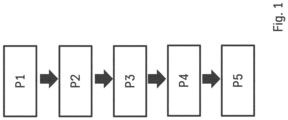
- The invention is described in more detail with the help of the figure. The only figure shows schematically the process steps of the production method according to the invention.
-
Fig. 1 shows the process steps of the production method according to the present invention. In process step P1) there is provided a forging blank made out of steel. In process step P2) the forging blank is hot forged to produce a track link blank, and the track link blank is hot trimmed to form a wheel tread part of the track link blank. - In process step P3) the track link blank is quenched to a temperature T1. The starting temperature for the quenching of the track link blank is 880 ± 10 °C. The temperature T1 is a temperature in the range between 235 °C and 190 °C.
- If the track link blank is within the temperature range of 880 ± 10 °C after the process step P2) has been finished, then the track link blank can be quenched immediately after completion of process step P2). But according to the present invention it is also possible to allow the track link blank to cool down to a temperature below 880 - 10 °C after process step P2). The track link blank may be allowed, for example, to cool down to room temperature after process step P2). In this way, the process steps P2) and P3) can be separated from one another, i.e. the process step P3) can be carried out at a later point in time independently of process step P2) and at a place different from the place where process step P2) was carried out.
- If the track link blank is allowed to cool down to a temperature below 880 - 10 °C, then the process step P3) comprises a reheating of the track link blank to a temperature in the range of 880 ± 10 °C prior to quenching.
- The quenching in process step P3) comprises a rapid cooling of the reheated track link blank to a temperature T1 between 235 °C and 190 °C.
- According to an embodiment of the present invention, the reheating in process step 3) includes heating the track link blank from 20 °C up to 879 °C, e.g. at an average heating rate between 7 and 8 °C/min, for example at a heating rate of 7,7 °C/min. The mentioned heating rate and the mentioned heating temperature have proven to produce good results when used with a steel composition according to the present invention.
- In the process step P4) the track link blank is subjected to a low temperature tempering at a temperature of approximately 200 °C for a period of time of 260 minutes.
- In the process step P5) the tempered track link blank is subjected to a finish machining in order to produce the final shape of the track link.
- According to the present invention, the described manufacturing process is carried out on a forging blank comprising the following composition (in % by weight):
- 0,25 - 0,33 % Carbon (C),
- 0.75 - 1.05 % Manganese (Mn),
- 0.15 - 0.35 % Silicon (Si),
- 0.75 - 0.85 % Molybdenum (Mo),
- 0.65 - 0.95 % Chromium (Cr),
- 0.65 - 0.95 % Nickel (Ni),
- 0.02 - 0.05 % Niobium (Nb),
- optionally up to a maximum of 0.015 % Phosporus (P),
- optionally up to a maximum of 0.005 % Sulphur (S),
- optionally up to a maximum of 0.2 % Copper (Cu),
- optionally up to a maximum of 0.005 % Calcium (Ca),
- The described manufacturing process leads to a track link having very good mechanical properties, including (in combination with each other) a surface hardness of > 44 HRC, a core hardness of > 44 HRC, a tensile strength of > 1.500 MPa, and a toughness of at least 20 J at -45 °C. Due to the high value of surface and core hardness, the track link according to the invention features a very god wear resistance. The high value of tensile strength of the track link material leads to a very good resistance of the track link against deformation under heavy loads. Due to the high toughness of the track link material, the track link has a high resistance to cracking, especially in the pin hole and bushing hole areas.
- Thus, the present invention provides a track link that has a particularly long service life, while at the same time being inexpensive to manufacture.
Claims (5)
- Method for manufacturing a track link for a running gear of a tracked vehicle, comprising the following method steps:P1) providing a forging blank of steel,P2) hot forging the forging blank to produce a track link blank and hot trimming of the track link blank to form at least a wheel tread part of the track link blank,P3) quenching the track link blank to a temperature T1,P4) low temperature tempering the track link blank at a temperature of approximately 200 °C,P5) finish machining the tempered track link blank to produce the final shape of the track link,characterized in thatthe steel of the forging blank has the following composition (in % by weight):0,25 - 0,33 % Carbon (C),0.75 - 1.05 % Manganese (Mn),0.15 - 0.35 % Silicon (Si),0.75 - 0.85 % Molybdenum (Mo),0.65 - 0.95 % Chromium (Cr),0.65 - 0.95 % Nickel (Ni),0.02 - 0.05 % Niobium (Nb),optionally up to a maximum of 0.015 % Phosporus (P),optionally up to a maximum of 0.005 % Sulphur (S),optionally up to a maximum of 0.2 % Copper (Cu),optionally up to a maximum of 0.005 % Calcium (Ca),the balance being iron and unavoidable impurities.
- Method according to claim 1, wherein the quenching in process step P3) comprises a reheating of the track link blank up to a temperature of 880 ± 10 °C, and a rapid cooling of the reheated track link blank to a temperature T1 between 190 °C and 235 °C.
- Method according to claim 2, wherein the reheating includes heating the track link blank from 20 °C up to 879 °C at an average temperature rate of 7,7 °C/min.
- Track link for a running gear of a tracked vehicle obtainable by a production process according to claims 1 - 3, wherein the track link material hasa surface hardness of > 44 HRC,a core hardness of > 44 HRC,a tensile strength of > 1.500 MPa,and a toughness of at least 20 J at -45 °C.
- Track link according to claim 4, wherein the track link material has a yield strength RP0,2 of > 1.100 MPa.
Priority Applications (5)
| Application Number | Priority Date | Filing Date | Title |
|---|---|---|---|
| EP21201429.4A EP4163410A1 (en) | 2021-10-07 | 2021-10-07 | Track link production method |
| PCT/EP2022/077534 WO2023057430A1 (en) | 2021-10-07 | 2022-10-04 | Track link production method |
| CN202280067371.4A CN118056029A (en) | 2021-10-07 | 2022-10-04 | Track chain link production method |
| US18/698,703 US20240417819A1 (en) | 2021-10-07 | 2022-10-04 | Track link production method |
| KR1020247010817A KR20240058136A (en) | 2021-10-07 | 2022-10-04 | Track Link Manufacturing Method |
Applications Claiming Priority (1)
| Application Number | Priority Date | Filing Date | Title |
|---|---|---|---|
| EP21201429.4A EP4163410A1 (en) | 2021-10-07 | 2021-10-07 | Track link production method |
Publications (1)
| Publication Number | Publication Date |
|---|---|
| EP4163410A1 true EP4163410A1 (en) | 2023-04-12 |
Family
ID=78332477
Family Applications (1)
| Application Number | Title | Priority Date | Filing Date |
|---|---|---|---|
| EP21201429.4A Pending EP4163410A1 (en) | 2021-10-07 | 2021-10-07 | Track link production method |
Country Status (5)
| Country | Link |
|---|---|
| US (1) | US20240417819A1 (en) |
| EP (1) | EP4163410A1 (en) |
| KR (1) | KR20240058136A (en) |
| CN (1) | CN118056029A (en) |
| WO (1) | WO2023057430A1 (en) |
Citations (5)
| Publication number | Priority date | Publication date | Assignee | Title |
|---|---|---|---|---|
| EP0072355A1 (en) * | 1981-07-21 | 1983-02-16 | Italtractor Itm S.P.A. | Process for direct treatment of links for tractors or tracked vehicles |
| EP0700739B1 (en) | 1994-08-16 | 1999-05-12 | Topy Kogyo Kabushiki Kaisha | Method for producing a vehicular endless track link |
| US20030230069A1 (en) * | 2002-06-14 | 2003-12-18 | Komatsu Ltd. | Track link production method and track link produced by the same |
| EP3119916A1 (en) * | 2014-03-20 | 2017-01-25 | Caterpillar Inc. | Air-hardenable bainitic steel part |
| CN111360488A (en) * | 2020-03-18 | 2020-07-03 | 徐州徐工履带底盘有限公司 | Processing method of caterpillar track link for caterpillar track |
-
2021
- 2021-10-07 EP EP21201429.4A patent/EP4163410A1/en active Pending
-
2022
- 2022-10-04 US US18/698,703 patent/US20240417819A1/en active Pending
- 2022-10-04 WO PCT/EP2022/077534 patent/WO2023057430A1/en not_active Ceased
- 2022-10-04 KR KR1020247010817A patent/KR20240058136A/en active Pending
- 2022-10-04 CN CN202280067371.4A patent/CN118056029A/en active Pending
Patent Citations (6)
| Publication number | Priority date | Publication date | Assignee | Title |
|---|---|---|---|---|
| EP0072355A1 (en) * | 1981-07-21 | 1983-02-16 | Italtractor Itm S.P.A. | Process for direct treatment of links for tractors or tracked vehicles |
| EP0700739B1 (en) | 1994-08-16 | 1999-05-12 | Topy Kogyo Kabushiki Kaisha | Method for producing a vehicular endless track link |
| US20030230069A1 (en) * | 2002-06-14 | 2003-12-18 | Komatsu Ltd. | Track link production method and track link produced by the same |
| US7040080B2 (en) | 2002-06-14 | 2006-05-09 | Komatsu Ltd. | Track link production method and track link produced by the same |
| EP3119916A1 (en) * | 2014-03-20 | 2017-01-25 | Caterpillar Inc. | Air-hardenable bainitic steel part |
| CN111360488A (en) * | 2020-03-18 | 2020-07-03 | 徐州徐工履带底盘有限公司 | Processing method of caterpillar track link for caterpillar track |
Also Published As
| Publication number | Publication date |
|---|---|
| WO2023057430A1 (en) | 2023-04-13 |
| CN118056029A (en) | 2024-05-17 |
| US20240417819A1 (en) | 2024-12-19 |
| KR20240058136A (en) | 2024-05-03 |
Similar Documents
| Publication | Publication Date | Title |
|---|---|---|
| KR100961501B1 (en) | Manufacturing method of track link and track link manufactured by the manufacturing method | |
| KR101124019B1 (en) | High-strength part using carburizing and high-frequency hardening | |
| US9869009B2 (en) | High strength low alloy steel and method of manufacturing | |
| JP3915043B2 (en) | Steel for forging production and method for producing forging | |
| EP0700739B1 (en) | Method for producing a vehicular endless track link | |
| CN111360488A (en) | Processing method of caterpillar track link for caterpillar track | |
| EP3231879B1 (en) | Production method for stabilizers | |
| KR101685489B1 (en) | The Alloy Steel Which Is Used as The High Tough Outer Wheel of Constant Velocity Joint And The Method of The Same | |
| EP3272896B1 (en) | Age-hardenable steel, and method for manufacturing components using age-hardenable steel | |
| US20240417819A1 (en) | Track link production method | |
| US20170130304A1 (en) | Alloy with High Core Hardness Suitable for Rapid Nitriding | |
| EP1538231B1 (en) | A microalloy bainitic steel with high resistance to fatigue and to fretting fatigue | |
| KR100940038B1 (en) | Hot forged steel for excellent impact toughness, manufacturing method thereof and parts for automobile chassis manufactured by the same | |
| CN107904387A (en) | A kind of Gear Shaft Heat Treatment | |
| US20080095657A1 (en) | Optimization Of Steel Metallurgy To Improve Broach Tool Life | |
| KR101802424B1 (en) | Bearing steel and manufacturing method of the same | |
| KR20150074645A (en) | Material for high carburizing steel and method for producing gear using the same | |
| KR19980059367A (en) | Manufacturing method of forklift knuckle | |
| CN120464942B (en) | Medium-carbon fatigue-resistant steel for cutters and heat treatment method | |
| CN110091139A (en) | A kind of interior bracing method | |
| KR101062080B1 (en) | How to make a lower control arm | |
| MXPA06011336A (en) | High strength steel. | |
| KR20100005970A (en) | Method for manufacturing transmission gear of automobile | |
| JP7184209B2 (en) | Manufacturing method of crankshaft and cast material for crankshaft | |
| JPH07109517A (en) | Production of link for crawler belt |
Legal Events
| Date | Code | Title | Description |
|---|---|---|---|
| PUAI | Public reference made under article 153(3) epc to a published international application that has entered the european phase |
Free format text: ORIGINAL CODE: 0009012 |
|
| STAA | Information on the status of an ep patent application or granted ep patent |
Free format text: STATUS: THE APPLICATION HAS BEEN PUBLISHED |
|
| AK | Designated contracting states |
Kind code of ref document: A1 Designated state(s): AL AT BE BG CH CY CZ DE DK EE ES FI FR GB GR HR HU IE IS IT LI LT LU LV MC MK MT NL NO PL PT RO RS SE SI SK SM TR |
|
| STAA | Information on the status of an ep patent application or granted ep patent |
Free format text: STATUS: REQUEST FOR EXAMINATION WAS MADE |
|
| 17P | Request for examination filed |
Effective date: 20231012 |
|
| RBV | Designated contracting states (corrected) |
Designated state(s): AL AT BE BG CH CY CZ DE DK EE ES FI FR GB GR HR HU IE IS IT LI LT LU LV MC MK MT NL NO PL PT RO RS SE SI SK SM TR |