EP4162195B1 - Headlamp for a motor vehicle - Google Patents
Headlamp for a motor vehicle Download PDFInfo
- Publication number
- EP4162195B1 EP4162195B1 EP20732135.7A EP20732135A EP4162195B1 EP 4162195 B1 EP4162195 B1 EP 4162195B1 EP 20732135 A EP20732135 A EP 20732135A EP 4162195 B1 EP4162195 B1 EP 4162195B1
- Authority
- EP
- European Patent Office
- Prior art keywords
- light
- entry surfaces
- headlamp
- light entry
- headlamp according
- Prior art date
- Legal status (The legal status is an assumption and is not a legal conclusion. Google has not performed a legal analysis and makes no representation as to the accuracy of the status listed.)
- Active
Links
Images


Classifications
-
- B—PERFORMING OPERATIONS; TRANSPORTING
- B60—VEHICLES IN GENERAL
- B60Q—ARRANGEMENT OF SIGNALLING OR LIGHTING DEVICES, THE MOUNTING OR SUPPORTING THEREOF OR CIRCUITS THEREFOR, FOR VEHICLES IN GENERAL
- B60Q1/00—Arrangement of optical signalling or lighting devices, the mounting or supporting thereof or circuits therefor
- B60Q1/02—Arrangement of optical signalling or lighting devices, the mounting or supporting thereof or circuits therefor the devices being primarily intended to illuminate the way ahead or to illuminate other areas of way or environments
- B60Q1/04—Arrangement of optical signalling or lighting devices, the mounting or supporting thereof or circuits therefor the devices being primarily intended to illuminate the way ahead or to illuminate other areas of way or environments the devices being headlights
- B60Q1/14—Arrangement of optical signalling or lighting devices, the mounting or supporting thereof or circuits therefor the devices being primarily intended to illuminate the way ahead or to illuminate other areas of way or environments the devices being headlights having dimming means
-
- F—MECHANICAL ENGINEERING; LIGHTING; HEATING; WEAPONS; BLASTING
- F21—LIGHTING
- F21S—NON-PORTABLE LIGHTING DEVICES; SYSTEMS THEREOF; VEHICLE LIGHTING DEVICES SPECIALLY ADAPTED FOR VEHICLE EXTERIORS
- F21S41/00—Illuminating devices specially adapted for vehicle exteriors, e.g. headlamps
- F21S41/10—Illuminating devices specially adapted for vehicle exteriors, e.g. headlamps characterised by the light source
- F21S41/14—Illuminating devices specially adapted for vehicle exteriors, e.g. headlamps characterised by the light source characterised by the type of light source
- F21S41/141—Light emitting diodes [LED]
- F21S41/143—Light emitting diodes [LED] the main emission direction of the LED being parallel to the optical axis of the illuminating device
-
- F—MECHANICAL ENGINEERING; LIGHTING; HEATING; WEAPONS; BLASTING
- F21—LIGHTING
- F21S—NON-PORTABLE LIGHTING DEVICES; SYSTEMS THEREOF; VEHICLE LIGHTING DEVICES SPECIALLY ADAPTED FOR VEHICLE EXTERIORS
- F21S41/00—Illuminating devices specially adapted for vehicle exteriors, e.g. headlamps
- F21S41/10—Illuminating devices specially adapted for vehicle exteriors, e.g. headlamps characterised by the light source
- F21S41/14—Illuminating devices specially adapted for vehicle exteriors, e.g. headlamps characterised by the light source characterised by the type of light source
- F21S41/141—Light emitting diodes [LED]
- F21S41/151—Light emitting diodes [LED] arranged in one or more lines
- F21S41/153—Light emitting diodes [LED] arranged in one or more lines arranged in a matrix
-
- F—MECHANICAL ENGINEERING; LIGHTING; HEATING; WEAPONS; BLASTING
- F21—LIGHTING
- F21S—NON-PORTABLE LIGHTING DEVICES; SYSTEMS THEREOF; VEHICLE LIGHTING DEVICES SPECIALLY ADAPTED FOR VEHICLE EXTERIORS
- F21S41/00—Illuminating devices specially adapted for vehicle exteriors, e.g. headlamps
- F21S41/20—Illuminating devices specially adapted for vehicle exteriors, e.g. headlamps characterised by refractors, transparent cover plates, light guides or filters
- F21S41/24—Light guides
-
- F—MECHANICAL ENGINEERING; LIGHTING; HEATING; WEAPONS; BLASTING
- F21—LIGHTING
- F21S—NON-PORTABLE LIGHTING DEVICES; SYSTEMS THEREOF; VEHICLE LIGHTING DEVICES SPECIALLY ADAPTED FOR VEHICLE EXTERIORS
- F21S41/00—Illuminating devices specially adapted for vehicle exteriors, e.g. headlamps
- F21S41/20—Illuminating devices specially adapted for vehicle exteriors, e.g. headlamps characterised by refractors, transparent cover plates, light guides or filters
- F21S41/25—Projection lenses
-
- F—MECHANICAL ENGINEERING; LIGHTING; HEATING; WEAPONS; BLASTING
- F21—LIGHTING
- F21S—NON-PORTABLE LIGHTING DEVICES; SYSTEMS THEREOF; VEHICLE LIGHTING DEVICES SPECIALLY ADAPTED FOR VEHICLE EXTERIORS
- F21S41/00—Illuminating devices specially adapted for vehicle exteriors, e.g. headlamps
- F21S41/40—Illuminating devices specially adapted for vehicle exteriors, e.g. headlamps characterised by screens, non-reflecting members, light-shielding members or fixed shades
- F21S41/43—Illuminating devices specially adapted for vehicle exteriors, e.g. headlamps characterised by screens, non-reflecting members, light-shielding members or fixed shades characterised by the shape thereof
-
- F—MECHANICAL ENGINEERING; LIGHTING; HEATING; WEAPONS; BLASTING
- F21—LIGHTING
- F21S—NON-PORTABLE LIGHTING DEVICES; SYSTEMS THEREOF; VEHICLE LIGHTING DEVICES SPECIALLY ADAPTED FOR VEHICLE EXTERIORS
- F21S41/00—Illuminating devices specially adapted for vehicle exteriors, e.g. headlamps
- F21S41/60—Illuminating devices specially adapted for vehicle exteriors, e.g. headlamps characterised by a variable light distribution
- F21S41/65—Illuminating devices specially adapted for vehicle exteriors, e.g. headlamps characterised by a variable light distribution by acting on light sources
- F21S41/663—Illuminating devices specially adapted for vehicle exteriors, e.g. headlamps characterised by a variable light distribution by acting on light sources by switching light sources
-
- F—MECHANICAL ENGINEERING; LIGHTING; HEATING; WEAPONS; BLASTING
- F21—LIGHTING
- F21W—INDEXING SCHEME ASSOCIATED WITH SUBCLASSES F21K, F21L, F21S and F21V, RELATING TO USES OR APPLICATIONS OF LIGHTING DEVICES OR SYSTEMS
- F21W2102/00—Exterior vehicle lighting devices for illuminating purposes
- F21W2102/10—Arrangement or contour of the emitted light
- F21W2102/13—Arrangement or contour of the emitted light for high-beam region or low-beam region
Definitions
- the present invention concerns a headlamp for a motor vehicle according to the preamble of claim 1.
- a headlamp of the aforementioned type is known from WO 2014/032071 A1 .
- the headlamp comprises of a plurality of light sources, a light guide unit having a plurality of light guides and a downstream projection lens having a focal plane, wherein each light guide respectively has a light coupling-out surface, wherein the light coupling-out surfaces of at least two adjacent light guides are offset with respect to one another in relation to the focal plane, and/or at least two mutually adjacent light guides in each case make contact with one another along an extent in a contact region, wherein the respective extents deviate from one another, measured in relation to the focal plane.
- the headlamp described therein comprises a plurality of first light-emitting diodes (LED) for a high beam and a plurality of second light-emitting diodes for a low beam.
- the light-emitting diodes can be individually controlled to adapt the generated light distribution to the traffic situation, for example to avoid dazzling an oncoming vehicle.
- the headlamp also comprises a first light guide for the light emitted by the first light-emitting diodes and a second light guide for the light emitted by the second light-emitting diodes.
- a light guide element is assigned to each of the light sources, which extends from the light source to the light guide and is comprised by the respective light guide.
- a disadvantage of such a headlamp is the small spread of the light distribution produced by the headlamp, in particular the small spread of the low beam light distribution produced by the headlamp, which is in particular approximately ⁇ 30°.
- additional light guide elements would have to be provided, which would lead to higher costs of the headlamp.
- the problem underlying the present invention is the creation of a headlamp of the type mentioned above in which an increase in the spread of the light distribution produced by the headlamp, in particular the low beam, is possible at low cost.
- Claim 1 provides that the first light exit surface and/or the second light exit surface have a structuring, wherein in a region which is arranged centrally in the direction in which the light entry surfaces are arranged side by side, the structuring of the first light exit surface and/or the second light exit surface is not provided.
- a structuring By means of a structuring, the emerging light can be homogenized, which in particular avoids undesirable local intensity maxima on components arranged behind the light exit surfaces. By omitting the structuring in the central region, higher light intensities can be achieved.
- At least a first one of the light entry surfaces has a greater width in the direction in which the light entry surfaces are arranged side by side than at least a second one of the light entry surfaces.
- At least a first one of the light entry surfaces in the direction in which the light entry surfaces are arranged side by side has such a large width that two of the light sources can be arranged side by side in front of this light entry surface. In this way the light of two light sources can be coupled into these light entry surfaces.
- the at least one first of the light entry surfaces is arranged further outwardly in the direction in which the light entry surfaces are arranged side by side than the at least one second of the light entry surfaces.
- the width of the light entry surfaces increases at least partially from a central region outwards in the direction in which the light entry surfaces are arranged side by side. In this way, two light sources can be selectively positioned in an outer area in front of the light entry surfaces so that a higher illuminance can be achieved in the edge areas of the light distribution.
- the at least one first of the light entry surfaces and the at least one second of the light entry surfaces are light entry surfaces of the second light guide. In this way, the low beam light distribution is specifically influenced.
- each of the light guides has light guide elements which project from the light guides, the ends of the light guide elements facing away from the light guides forming the light entry surfaces. Furthermore, it is possible that a first light guide element, the end of which forms the at least one first of the light entry surfaces, has a greater width over its longitudinal extension in the direction in which the light entry surfaces are arranged side by side than a second light guide element, the end of which forms the at least one second of the light entry surfaces. Due to the greater width over the longitudinal extension of the light guide elements, the light moving through this wide light guide element is distributed over a greater angular range.
- the first and/or the second light sources are designed as light-emitting diodes, which are arranged in particular on a common circuit board.
- a common circuit board By arranging them on a common circuit board, it is relatively easy to influence the light distribution produced by the headlamp, in particular without changing the optical system.
- This can be achieved by providing differently equipped circuit boards which differ, for example, in the arrangement and/or the number of light-emitting diodes.
- the light distribution produced by the headlamp can be changed. For example, the spread of the light distribution can be easily changed without changing the optics.
- first and/or the second light sources can be controlled individually or in individual groups. In this way, the light distribution produced by the headlamp can be adapted to the traffic situation, e.g. to avoid dazzling an oncoming vehicle.
- the structuring of the first light exit surface and/or the second light exit surface is not provided in a region which is arranged centrally in the direction in which the light entry surfaces are arranged side by side. By omitting the structuring in the central region, higher light intensities can be achieved.
- the light guides each have a collimating lens which are integrated in particular in the light exit surfaces. By integrating one collimating lens each into the light guides, the efficiency of the headlamp can be increased.
- the headlamp comprises an, in particular monolithic, optical component which comprises both the first and the second light guide, in particular with the optical component serving as a primary optics.
- This design makes it easier to assemble the headlamp, in particular because components can be integrated into one another.
- the optical component has a light exit surface which is formed by the light exit surfaces of the first and second light guides, in particular wherein the light exit surfaces of the first and second light guides are adjacent to and/or merge into one another.
- the optical component thus contributes both to the generation of the high beam and to the generation of the low beam.
- any artifacts generated by the structuring of the primary optics can be minimized.
- the illustrated version of a headlamp according to the invention comprises an unshown circuit board on which a plurality of light sources in the form of light-emitting diodes (LEDs) are arranged.
- LEDs light-emitting diodes
- both several first light sources designed as light-emitting diodes for a high beam and several second light sources designed as light-emitting diodes for a low beam are arranged on the board.
- light sources instead of the light-emitting diodes.
- semiconductor lasers could also be used as light sources.
- the light sources can be controlled separately to switch between low beam and high beam. It is also possible to implement other functions of an adaptive front lighting system by varying the power supply to the light sources, such as city lights, country lights or motorway lights. It is also possible to control the first and/or second light sources individually or in groups. In this way, the light distribution generated by the headlamp can be adapted to the traffic situation, e.g. to avoid dazzling an oncoming vehicle.
- the illustrated design of a headlamp according to the invention further comprises an optical component 1 serving as a primary optics, in particular a monolithic optical component 1, and a secondary optics 2.
- an optical component 1 serving as a primary optics, in particular a monolithic optical component 1, and a secondary optics 2.
- the light emitted by the light sources passes first through the primary optics and then through the secondary optics 2.
- the optical component 1, which serves as primary optics, comprises a first light guide 3 for the high beam and a second light guide 4 for the low beam (see, for example, Fig. 2 to Fig. 5 ).
- the light guides 3, 4 each have several light entry surfaces 5, 6 on their lower side in Fig. 4 and Fig. 5 (see also Fig. 2 ), into which the light of the light-emitting diodes is coupled when the headlamp is in operation.
- the light guides 3, 4 On the upper side shown in Fig. 4 and Fig. 5 the light guides 3, 4 each have a light exit surface 7, 8 through which the light emerges.
- the light guides 3, 4 each have a plurality of light guide elements 9, 10, which protrude from the light guides 3, 4.
- the ends of the light guide elements 9, 10 facing away from the light guides 3, 4 form the light entry surfaces 5, 6.
- the light guide elements 9, 10 are essentially finger-shaped or trunk-shaped.
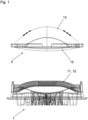
- Fig. 1 , Fig. 4 , Fig. 5 and Fig. 7 illustrates that each of the light exit surfaces 7, 8 is curved so that two collimating lenses 11, 12 are formed on the optical component 1 serving as primary optics, each of which is assigned to one of the light guides 3, 4.
- the efficiency of the headlamp can be increased by integrating one collimating lens 11, 12 each into the light guides 3, 4.
- the illustrated version of the secondary optics 2 also features a collimating lens 13, which is designed as a biconvex lens (see Fig. 1 ). It is also possible to design the collimating lens 13 differently, for example as a plano-convex lens.
- the cutting width of the collimating lens 13 of the secondary optics 2 is adapted to the cutting widths of the collimating lenses 11, 12 of the primary optics.
- the illustrated design of a headlamp according to the invention further comprises an unshown housing in or on which the optical component 1 serving as primary optics with the circuit board, the secondary optics 2 and a likewise unshown heat sink for the light emitting diodes arranged on the circuit board can be mounted.
- the structuring 14 is recessed in a middle area 15.
- the light can pass through this recessed area 15 relatively unhindered, so that higher light intensities can be achieved.
- Fig. 2 , Fig. 4 and Fig. 5 illustrate that eleven light entry surfaces 5 of the first light guide 3 and ten light entry surfaces 6 of the second light guide 4 are provided, each formed by the distal end of a light guide element 9, 10. If a light source, for example in the form of a light-emitting diode, is arranged in front of each of the light entry surfaces 5, 6, eleven light sources for the high beam and ten light sources for the low beam would be provided.
- a light source for example in the form of a light-emitting diode
- Fig. 2 and Fig. 4 illustrate that the light entry surfaces 5 of the first light guide 3 in the direction in which the light entry surfaces 5 are arranged next to each other have the same width.
- the light entry surfaces 6 of the second light guide 4 in the direction in which the light entry surfaces 6 are arranged next to each other have at least partially different widths (see Fig. 2 and Fig. 5 ).
- the width of the light entry surfaces 6 and the width of the light guide elements 10 essentially increases at least partially from a central area to the outside.
- a first light entry surface 6a which is visible at the left outer edge in Fig. 5
- a second light entry surface 6b which is arranged closer to the centre of the light guide 4.
- the light guide element 10a assigned to the first light entry surface 6a is also significantly wider over its longitudinal extension than the light guide element 10b assigned to the second light entry surface 6b.
- the greater width of the light entry surfaces 6, 6a in the outer area of the light guide 4 it is possible to arrange more than one light emitting diode in front of these light entry surfaces 6, 6a. Furthermore, the larger width makes it easier to position the light emitting diodes in front of the light entry surfaces 6.
Landscapes
- Engineering & Computer Science (AREA)
- General Engineering & Computer Science (AREA)
- Physics & Mathematics (AREA)
- Microelectronics & Electronic Packaging (AREA)
- Optics & Photonics (AREA)
- Mathematical Physics (AREA)
- Mechanical Engineering (AREA)
- Non-Portable Lighting Devices Or Systems Thereof (AREA)
Description
- The present invention concerns a headlamp for a motor vehicle according to the preamble of
claim 1. - A headlamp of the aforementioned type is known from
WO 2014/032071 A1 . The headlamp comprises of a plurality of light sources, a light guide unit having a plurality of light guides and a downstream projection lens having a focal plane, wherein each light guide respectively has a light coupling-out surface, wherein the light coupling-out surfaces of at least two adjacent light guides are offset with respect to one another in relation to the focal plane, and/or at least two mutually adjacent light guides in each case make contact with one another along an extent in a contact region, wherein the respective extents deviate from one another, measured in relation to the focal plane. - Another headlamp is known from
WO 2017/198516 A1 . The headlamp described therein comprises a plurality of first light-emitting diodes (LED) for a high beam and a plurality of second light-emitting diodes for a low beam. The light-emitting diodes can be individually controlled to adapt the generated light distribution to the traffic situation, for example to avoid dazzling an oncoming vehicle. The headlamp also comprises a first light guide for the light emitted by the first light-emitting diodes and a second light guide for the light emitted by the second light-emitting diodes. A light guide element is assigned to each of the light sources, which extends from the light source to the light guide and is comprised by the respective light guide. - A disadvantage of such a headlamp is the small spread of the light distribution produced by the headlamp, in particular the small spread of the low beam light distribution produced by the headlamp, which is in particular approximately ± 30°. In order to increase the spread in the concept described in
WO 2017/198516 A1 , additional light guide elements would have to be provided, which would lead to higher costs of the headlamp. - The problem underlying the present invention is the creation of a headlamp of the type mentioned above in which an increase in the spread of the light distribution produced by the headlamp, in particular the low beam, is possible at low cost.
- This is achieved, in accordance with the invention, by means of a headlamp of the aforementioned kind with the characterizing features of
claim 1. The subclaims concern preferred forms of the invention. -
Claim 1 provides that the first light exit surface and/or the second light exit surface have a structuring, wherein in a region which is arranged centrally in the direction in which the light entry surfaces are arranged side by side, the structuring of the first light exit surface and/or the second light exit surface is not provided. By means of a structuring, the emerging light can be homogenized, which in particular avoids undesirable local intensity maxima on components arranged behind the light exit surfaces. By omitting the structuring in the central region, higher light intensities can be achieved. - At least a first one of the light entry surfaces has a greater width in the direction in which the light entry surfaces are arranged side by side than at least a second one of the light entry surfaces. By such a design, an increase in the spread of the light distribution produced by the headlamp can be achieved. For example, low beam light distributions with a spread of up to more than ± 40° can be obtained with an appropriately designed headlamp. Furthermore, the wider light entry surfaces make the light distribution less sensitive to tolerances in relation to the positioning of the light sources.
- It may be provided that at least a first one of the light entry surfaces in the direction in which the light entry surfaces are arranged side by side has such a large width that two of the light sources can be arranged side by side in front of this light entry surface. In this way the light of two light sources can be coupled into these light entry surfaces.
- It is possible that the at least one first of the light entry surfaces is arranged further outwardly in the direction in which the light entry surfaces are arranged side by side than the at least one second of the light entry surfaces. In particular, the width of the light entry surfaces increases at least partially from a central region outwards in the direction in which the light entry surfaces are arranged side by side. In this way, two light sources can be selectively positioned in an outer area in front of the light entry surfaces so that a higher illuminance can be achieved in the edge areas of the light distribution.
- It may be provided that the at least one first of the light entry surfaces and the at least one second of the light entry surfaces are light entry surfaces of the second light guide. In this way, the low beam light distribution is specifically influenced.
- It is possible that each of the light guides has light guide elements which project from the light guides, the ends of the light guide elements facing away from the light guides forming the light entry surfaces. Furthermore, it is possible that a first light guide element, the end of which forms the at least one first of the light entry surfaces, has a greater width over its longitudinal extension in the direction in which the light entry surfaces are arranged side by side than a second light guide element, the end of which forms the at least one second of the light entry surfaces. Due to the greater width over the longitudinal extension of the light guide elements, the light moving through this wide light guide element is distributed over a greater angular range.
- It may be provided that the first and/or the second light sources are designed as light-emitting diodes, which are arranged in particular on a common circuit board. By arranging them on a common circuit board, it is relatively easy to influence the light distribution produced by the headlamp, in particular without changing the optical system. This can be achieved by providing differently equipped circuit boards which differ, for example, in the arrangement and/or the number of light-emitting diodes. By replacing one board with another, the light distribution produced by the headlamp can be changed. For example, the spread of the light distribution can be easily changed without changing the optics.
- It is possible that the first and/or the second light sources can be controlled individually or in individual groups. In this way, the light distribution produced by the headlamp can be adapted to the traffic situation, e.g. to avoid dazzling an oncoming vehicle.
- It may be provided that in a region which is arranged centrally in the direction in which the light entry surfaces are arranged side by side, the structuring of the first light exit surface and/or the second light exit surface is not provided. By omitting the structuring in the central region, higher light intensities can be achieved.
- It is possible that the light guides each have a collimating lens which are integrated in particular in the light exit surfaces. By integrating one collimating lens each into the light guides, the efficiency of the headlamp can be increased.
- It may be provided that the headlamp comprises an, in particular monolithic, optical component which comprises both the first and the second light guide, in particular with the optical component serving as a primary optics. This design makes it easier to assemble the headlamp, in particular because components can be integrated into one another.
- It is possible that the optical component has a light exit surface which is formed by the light exit surfaces of the first and second light guides, in particular wherein the light exit surfaces of the first and second light guides are adjacent to and/or merge into one another. The optical component thus contributes both to the generation of the high beam and to the generation of the low beam.
- By structuring the secondary optics, any artifacts generated by the structuring of the primary optics can be minimized.
- The invention is explained in more detail below on the basis of the attached drawings.
- And shows
- Fig. 1
- a plan view of components of a headlamp of the invention;
- Fig. 2
- a rear view of the primary optics of the headlamp as shown in
Fig. 1 ; - Fig. 3
- a front view of the primary optics of the headlamp as shown in
Fig. 1 ; - Fig. 4
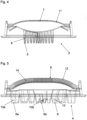
- a plan view of the first light guide of the primary optics of the headlamp as shown in
Fig. 1 ; - Fig. 5
- a plan view of the second light guide of the primary optic of the headlamp as shown in
Fig. 1 ; - Fig. 6
- a perspective view of the components of the headlamp shown in
Fig. 1 ; - Fig. 7
- a perspective view of the primary optics of the headlamp as shown in
Fig. 1 . - In the figures, identical and functionally identical parts are marked with identical reference symbols.
- The illustrated version of a headlamp according to the invention comprises an unshown circuit board on which a plurality of light sources in the form of light-emitting diodes (LEDs) are arranged. In this case, both several first light sources designed as light-emitting diodes for a high beam and several second light sources designed as light-emitting diodes for a low beam are arranged on the board.
- It is possible to use other light sources instead of the light-emitting diodes. For example, semiconductor lasers could also be used as light sources.
- The light sources can be controlled separately to switch between low beam and high beam. It is also possible to implement other functions of an adaptive front lighting system by varying the power supply to the light sources, such as city lights, country lights or motorway lights. It is also possible to control the first and/or second light sources individually or in groups. In this way, the light distribution generated by the headlamp can be adapted to the traffic situation, e.g. to avoid dazzling an oncoming vehicle.
- The illustrated design of a headlamp according to the invention further comprises an
optical component 1 serving as a primary optics, in particular a monolithicoptical component 1, and asecondary optics 2. During operation of the headlamp, the light emitted by the light sources passes first through the primary optics and then through thesecondary optics 2. - The
optical component 1, which serves as primary optics, comprises afirst light guide 3 for the high beam and a secondlight guide 4 for the low beam (see, for example,Fig. 2 to Fig. 5 ). The light guides 3, 4 each have several light entry surfaces 5, 6 on their lower side inFig. 4 and Fig. 5 (see alsoFig. 2 ), into which the light of the light-emitting diodes is coupled when the headlamp is in operation. On the upper side shown inFig. 4 and Fig. 5 the light guides 3, 4 each have alight exit surface - The light guides 3, 4 each have a plurality of
light guide elements light guide elements light guide elements -
Fig. 1 ,Fig. 4 ,Fig. 5 andFig. 7 illustrates that each of the light exit surfaces 7, 8 is curved so that twocollimating lenses optical component 1 serving as primary optics, each of which is assigned to one of the light guides 3, 4. The efficiency of the headlamp can be increased by integrating onecollimating lens - The illustrated version of the
secondary optics 2 also features acollimating lens 13, which is designed as a biconvex lens (seeFig. 1 ). It is also possible to design thecollimating lens 13 differently, for example as a plano-convex lens. The cutting width of the collimatinglens 13 of thesecondary optics 2 is adapted to the cutting widths of thecollimating lenses - The illustrated design of a headlamp according to the invention further comprises an unshown housing in or on which the
optical component 1 serving as primary optics with the circuit board, thesecondary optics 2 and a likewise unshown heat sink for the light emitting diodes arranged on the circuit board can be mounted. -
Fig. 3 illustrates that thelight exit surface 8 of the secondlight guide 4 has a structuring 14. It is certainly possible to also provide thelight exit surface 7 of thefirst light guide 3 at least partially with this or acomparable structuring 14. The structuring 14 can be designed as a prism array, for example. The structuring 14 homogenizes the light emerging from thelight exit surface 8 at least to such an extent that no undesired intensity maxima occur on thesecondary optics 2 and/or an unshown cover glass. - The structuring 14 is recessed in a
middle area 15. The light can pass through this recessedarea 15 relatively unhindered, so that higher light intensities can be achieved. - It is certainly possible to provide a structuring on the
collimating lens 13 of the secondary optics. -
Fig. 2 ,Fig. 4 and Fig. 5 illustrate that eleven light entry surfaces 5 of thefirst light guide 3 and ten light entry surfaces 6 of the secondlight guide 4 are provided, each formed by the distal end of alight guide element - However, it is quite possible to provide more or less light entry surfaces 5, 6 or more or less
light guide elements first light guide 3 and the secondlight guide 4. -
Fig. 2 andFig. 4 illustrate that the light entry surfaces 5 of thefirst light guide 3 in the direction in which the light entry surfaces 5 are arranged next to each other have the same width. In contrast, the light entry surfaces 6 of the secondlight guide 4 in the direction in which the light entry surfaces 6 are arranged next to each other have at least partially different widths (seeFig. 2 andFig. 5 ). - The width of the light entry surfaces 6 and the width of the
light guide elements 10 essentially increases at least partially from a central area to the outside. Thus a firstlight entry surface 6a, which is visible at the left outer edge inFig. 5 , is considerably wider than a secondlight entry surface 6b, which is arranged closer to the centre of thelight guide 4. Accordingly, thelight guide element 10a assigned to the firstlight entry surface 6a is also significantly wider over its longitudinal extension than thelight guide element 10b assigned to the secondlight entry surface 6b. - Due to the greater width of the light entry surfaces 6, 6a in the outer area of the
light guide 4, it is possible to arrange more than one light emitting diode in front of these light entry surfaces 6, 6a. Furthermore, the larger width makes it easier to position the light emitting diodes in front of the light entry surfaces 6. -
- 1
- Optical component
- 2
- Secondary optics
- 3
- First light guide
- 4
- Second light guide
- 5
- Light entry surface of the
first light guide 3 - 6
- Light entry surface of the second
light guide 4 - 6a
- First of the light entry surfaces 6
- 6b
- Second of the light entry surfaces 6
- 7
- Light emitting surface of the
first light guide 3 - 8
- Light emitting surface of the second
light guide 4 - 9
- Light guide element of the
first light guide 3 - 10
- Light guide element of the second
light guide 4 - 10a
- First of the
light guide elements 10 - 10b
- Second of the
light guide elements 10 - 11
- Collimating lens of the
first light guide 3 - 12
- Collimating lens of the second
light guide 3 - 13
- Collimating lens of the
secondary optics 2 - 14
- Structuring of the
light emitting surface 8 - 15
- Recessed area of the structuring 14
Claims (13)
- Headlamp for a motor vehicle, comprising- a plurality of first light sources for a high beam, emitting light during operation of the headlamp,- a plurality of second light sources for a low beam, emitting light during operation of the headlamp,
a first light guide (3) having a plurality of light entry surfaces (5) arranged side by side for the light emitted from the first light sources and a first light exit surface (7),- a second light guide (4) having a plurality of light entry surfaces (6, 6a, 6b) arranged side by side for the light emitted from the second light sources and a second light exit surface (8), wherein at least a first one of the light entry surfaces (6a) has a greater width in the direction in which the light entry surfaces (5, 6) are arranged side by side than at least a second one of the light entry surfaces (6b),characterized in that the first light exit surface (7) and/or the second light exit surface (8) have a structuring (14), wherein in a region (15) which is arranged centrally in the direction in which the light entry surfaces (5, 6) are arranged side by side, the structuring (14) of the first light exit surface (7) and/or the second light exit surface (8) is not provided. - Headlamp according to claim 1, characterized in that at least a first one of the light entry surfaces (6a) in the direction in which the light entry surfaces (5, 6) are arranged side by side has such a large width that two of the light sources can be arranged side by side in front of this light entry surface (6a).
- Headlamp according to one of claims 1 or 2, characterized in that the at least one first of the light entry surfaces (6a) is arranged further outwardly in the direction in which the light entry surfaces (5, 6) are arranged side by side than the at least one second of the light entry surfaces (6b).
- Headlamp according to any one of claims 1 to 3, characterized in that the width of the light entry surfaces (6, 6a, 6b) increases at least partially from a central region outwards in the direction in which the light entry surfaces (5, 6) are arranged side by side.
- Headlamp according to any one of claims 1 to 4, characterized in that the at least one first of the light entry surfaces (6a) and the at least one second of the light entry surfaces (6a) are light entry surfaces (6, 6a, 6b) of the second light guide (4).
- Headlamp according to one of claims 1 to 5, characterized in that each of the light guides (3, 4) has light guide elements (9, 10) which project from the light guides (3, 4), the ends of the light guide elements (9, 10) facing away from the light guides (3, 4) forming the light entry surfaces (5, 6).
- Headlamp according to claim 6, characterized in that a first light guide element (10a), the end of which forms the at least one first of the light entry surfaces (6a), has a greater width over its longitudinal extension in the direction in which the light entry surfaces (5, 6) are arranged side by side than a second light guide element (10b), the end of which forms the at least one second of the light entry surfaces (6b).
- Headlamp according to one of claims 1 to 7, characterized in that the first and/or the second light sources are designed as light-emitting diodes, which are arranged in particular on a common circuit board.
- Headlamp according to any of claims 1 to 8, characterized in that the first and/or the second light sources can be controlled individually or in individual groups.
- Headlamp according to one of claims 1 to 9, characterized in that the light guides (3, 4) each have a collimating lens (11, 12) which are integrated in particular in the light exit surfaces (7, 8).
- Headlamp according to one of claims 1 to 10, characterized in that the headlamp comprises an, in particular monolithic, optical component (1) which comprises both the first and the second light guide (3, 4), in particular with the optical component (1) serving as a primary optics.
- Headlamp according to claim 11, characterized in that the optical component (1) has a light exit surface which is formed by the light exit surfaces (7, 8) of the first and second light guides (3, 4), in particular wherein the light exit surfaces (7, 8) of the first and second light guides (3, 4) are adjacent to and/or merge into one another.
- Headlamp according to one of claims 1 to 12, characterized in that the headlamp has a secondary optics (2) through which the light emerging from the light exit surfaces (7, 8) of the first and/or the second light guide (3, 4) passes during operation of the headlamp.
Applications Claiming Priority (1)
| Application Number | Priority Date | Filing Date | Title |
|---|---|---|---|
| PCT/EP2020/065272 WO2021244736A1 (en) | 2020-06-03 | 2020-06-03 | Headlamp for a motor vehicle |
Publications (2)
| Publication Number | Publication Date |
|---|---|
| EP4162195A1 EP4162195A1 (en) | 2023-04-12 |
| EP4162195B1 true EP4162195B1 (en) | 2025-05-07 |
Family
ID=71083595
Family Applications (1)
| Application Number | Title | Priority Date | Filing Date |
|---|---|---|---|
| EP20732135.7A Active EP4162195B1 (en) | 2020-06-03 | 2020-06-03 | Headlamp for a motor vehicle |
Country Status (4)
| Country | Link |
|---|---|
| US (1) | US12049989B2 (en) |
| EP (1) | EP4162195B1 (en) |
| CN (1) | CN115698585A (en) |
| WO (1) | WO2021244736A1 (en) |
Families Citing this family (2)
| Publication number | Priority date | Publication date | Assignee | Title |
|---|---|---|---|---|
| DE102021127813A1 (en) * | 2021-10-26 | 2023-04-27 | HELLA GmbH & Co. KGaA | Headlight for a motor vehicle and appearance light module for such a headlight |
| DE102023112788A1 (en) | 2023-05-15 | 2024-11-21 | Marelli Automotive Lighting Reutlingen (Germany) GmbH | Auxiliary optics assembly for a light module of a motor vehicle headlight and motor vehicle headlight with such an auxiliary optics assembly |
Family Cites Families (21)
| Publication number | Priority date | Publication date | Assignee | Title |
|---|---|---|---|---|
| DE102006044640A1 (en) * | 2006-09-19 | 2008-03-27 | Schefenacker Vision Systems Germany Gmbh | Lighting unit for high and low beam generation |
| AT513341B1 (en) * | 2012-09-03 | 2015-06-15 | Zizala Lichtsysteme Gmbh | Lighting unit for a headlight |
| CN104421835A (en) * | 2013-09-04 | 2015-03-18 | 海洋王(东莞)照明科技有限公司 | Lens and lamps using the same |
| FR3041738B1 (en) * | 2015-09-28 | 2020-01-17 | Valeo Vision | PRIMARY OPTICAL ELEMENT FOR LIGHT MODULE OF MOTOR VEHICLE |
| FR3050011A1 (en) * | 2016-04-11 | 2017-10-13 | Valeo Vision | MODULE FOR TRANSMITTING A LUMINOUS BEAM FOR MOTOR VEHICLE PROJECTOR |
| DE102016109132A1 (en) * | 2016-05-18 | 2017-11-23 | Hella Kgaa Hueck & Co. | Headlight, in particular headlight of a motor vehicle |
| CN206001399U (en) * | 2016-07-28 | 2017-03-08 | 湖北鑫美电子科技股份有限公司 | A kind of light compensating lamp anti-dazzle apparatus |
| DE102016125887A1 (en) * | 2016-12-29 | 2018-07-05 | Automotive Lighting Reutlingen Gmbh | Light module for motor vehicle headlights |
| CN106641802B (en) * | 2016-12-30 | 2023-09-01 | 宁波欧琳厨具有限公司 | A Portable Purifying Negative Ion Lamp |
| US10816156B2 (en) * | 2017-02-14 | 2020-10-27 | Everlight Electronics Co., Ltd. | Light guiding element, light guiding device, and lighting module |
| KR101907372B1 (en) * | 2017-04-26 | 2018-10-12 | 현대모비스 주식회사 | Head lamp apparatus |
| JP7002046B2 (en) * | 2017-12-25 | 2022-02-04 | パナソニックIpマネジメント株式会社 | Vehicle headlights |
| FR3084440B1 (en) * | 2018-07-30 | 2021-01-15 | Valeo Vision | AUTOMOTIVE VEHICLE LIGHT MODULE SUITABLE TO GENERATE A LIGHT BEAM WITH AT LEAST ONE ROW OF ILLUMINATION UNITS |
| FR3084755B1 (en) * | 2018-08-02 | 2020-12-18 | Valeo Vision | OPTICAL PART INCLUDING A BLOCK WITH A BENDING DIOPTER FOR TWO BEAMS |
| US11092304B2 (en) * | 2018-09-05 | 2021-08-17 | Flex-N-Gate Advanced Product Development, Llc | Vehicle adaptable driving beam headlamp |
| FR3087875B1 (en) * | 2018-10-25 | 2021-07-30 | Valeo Vision | LIGHT MODULE FOR VEHICLE LIGHTING DEVICE |
| CN109268774A (en) * | 2018-10-25 | 2019-01-25 | 华域视觉科技(上海)有限公司 | A kind of double matrix form illumination module and its auxiliary lighting method |
| WO2020104043A1 (en) * | 2018-11-23 | 2020-05-28 | HELLA GmbH & Co. KGaA | Multi-component injection molded primary optic |
| CN114026361B (en) * | 2019-04-25 | 2023-05-05 | 亮锐有限责任公司 | Maintaining collimator element in lighting device |
| CN212132313U (en) * | 2020-03-09 | 2020-12-11 | 华域视觉科技(上海)有限公司 | Car light optical element subassembly, vehicle lighting device, car light and vehicle |
| JP7530794B2 (en) * | 2020-10-02 | 2024-08-08 | 株式会社小糸製作所 | Lighting unit |
-
2020
- 2020-06-03 CN CN202080101684.8A patent/CN115698585A/en active Pending
- 2020-06-03 WO PCT/EP2020/065272 patent/WO2021244736A1/en not_active Ceased
- 2020-06-03 EP EP20732135.7A patent/EP4162195B1/en active Active
-
2022
- 2022-12-02 US US18/061,406 patent/US12049989B2/en active Active
Also Published As
| Publication number | Publication date |
|---|---|
| US12049989B2 (en) | 2024-07-30 |
| US20230096707A1 (en) | 2023-03-30 |
| CN115698585A (en) | 2023-02-03 |
| EP4162195A1 (en) | 2023-04-12 |
| WO2021244736A1 (en) | 2021-12-09 |
Similar Documents
| Publication | Publication Date | Title |
|---|---|---|
| EP4162194B1 (en) | Headlamp for a motor vehicle | |
| US10900630B2 (en) | Headlight, in particular headlight of a motor vehicle | |
| US11035537B2 (en) | Luminous lighting and/or signaling module of an automotive vehicle | |
| CN108351084B (en) | Lighting device for motor vehicle searchlight | |
| US9285091B2 (en) | LED light module | |
| US7988345B2 (en) | Projection module of an automobile headlight | |
| CN104100903B (en) | Optical module for lighting assembly for vehicles | |
| US8177402B2 (en) | Light module for an illumination device for a motor vehicle | |
| WO2020064978A1 (en) | Optical element, optical module, and vehicle | |
| US11320111B2 (en) | Illumination apparatus for vehicles | |
| KR20040073330A (en) | Vehicular headlamp | |
| US12049989B2 (en) | Vehicle headlamp having high/low beam light guides with different width entry surfaces | |
| CN108224352B (en) | Lamp fitting | |
| CA2533561A1 (en) | Virtual point light source | |
| CN118463078A (en) | Lighting device for motor vehicle | |
| JP7275481B2 (en) | vehicle lamp | |
| US12449104B2 (en) | Headlight for a motor vehicle | |
| CN113795705B (en) | Lamp for vehicle | |
| CN116261639A (en) | Lighting devices for motor vehicle headlights | |
| CN120092153A (en) | Headlights for motor vehicles | |
| JP2024054742A (en) | Optical components and vehicle lighting fixtures | |
| WO2025216043A1 (en) | Vehicle headlight |
Legal Events
| Date | Code | Title | Description |
|---|---|---|---|
| STAA | Information on the status of an ep patent application or granted ep patent |
Free format text: STATUS: UNKNOWN |
|
| STAA | Information on the status of an ep patent application or granted ep patent |
Free format text: STATUS: THE INTERNATIONAL PUBLICATION HAS BEEN MADE |
|
| PUAI | Public reference made under article 153(3) epc to a published international application that has entered the european phase |
Free format text: ORIGINAL CODE: 0009012 |
|
| STAA | Information on the status of an ep patent application or granted ep patent |
Free format text: STATUS: REQUEST FOR EXAMINATION WAS MADE |
|
| 17P | Request for examination filed |
Effective date: 20221216 |
|
| AK | Designated contracting states |
Kind code of ref document: A1 Designated state(s): AL AT BE BG CH CY CZ DE DK EE ES FI FR GB GR HR HU IE IS IT LI LT LU LV MC MK MT NL NO PL PT RO RS SE SI SK SM TR |
|
| DAV | Request for validation of the european patent (deleted) | ||
| DAX | Request for extension of the european patent (deleted) | ||
| STAA | Information on the status of an ep patent application or granted ep patent |
Free format text: STATUS: EXAMINATION IS IN PROGRESS |
|
| 17Q | First examination report despatched |
Effective date: 20240531 |
|
| GRAP | Despatch of communication of intention to grant a patent |
Free format text: ORIGINAL CODE: EPIDOSNIGR1 |
|
| STAA | Information on the status of an ep patent application or granted ep patent |
Free format text: STATUS: GRANT OF PATENT IS INTENDED |
|
| INTG | Intention to grant announced |
Effective date: 20241219 |
|
| GRAS | Grant fee paid |
Free format text: ORIGINAL CODE: EPIDOSNIGR3 |
|
| GRAA | (expected) grant |
Free format text: ORIGINAL CODE: 0009210 |
|
| STAA | Information on the status of an ep patent application or granted ep patent |
Free format text: STATUS: THE PATENT HAS BEEN GRANTED |
|
| AK | Designated contracting states |
Kind code of ref document: B1 Designated state(s): AL AT BE BG CH CY CZ DE DK EE ES FI FR GB GR HR HU IE IS IT LI LT LU LV MC MK MT NL NO PL PT RO RS SE SI SK SM TR |
|
| REG | Reference to a national code |
Ref country code: GB Ref legal event code: FG4D |
|
| REG | Reference to a national code |
Ref country code: CH Ref legal event code: EP |
|
| REG | Reference to a national code |
Ref country code: DE Ref legal event code: R096 Ref document number: 602020050826 Country of ref document: DE |
|
| REG | Reference to a national code |
Ref country code: IE Ref legal event code: FG4D |
|
| PGFP | Annual fee paid to national office [announced via postgrant information from national office to epo] |
Ref country code: DE Payment date: 20250514 Year of fee payment: 6 |
|
| PGFP | Annual fee paid to national office [announced via postgrant information from national office to epo] |
Ref country code: FR Payment date: 20250523 Year of fee payment: 6 |
|
| REG | Reference to a national code |
Ref country code: NL Ref legal event code: MP Effective date: 20250507 |
|
| RAP4 | Party data changed (patent owner data changed or rights of a patent transferred) |
Owner name: HELLA GMBH & CO. KGAA |
|
| PG25 | Lapsed in a contracting state [announced via postgrant information from national office to epo] |
Ref country code: PT Free format text: LAPSE BECAUSE OF FAILURE TO SUBMIT A TRANSLATION OF THE DESCRIPTION OR TO PAY THE FEE WITHIN THE PRESCRIBED TIME-LIMIT Effective date: 20250908 Ref country code: FI Free format text: LAPSE BECAUSE OF FAILURE TO SUBMIT A TRANSLATION OF THE DESCRIPTION OR TO PAY THE FEE WITHIN THE PRESCRIBED TIME-LIMIT Effective date: 20250507 Ref country code: ES Free format text: LAPSE BECAUSE OF FAILURE TO SUBMIT A TRANSLATION OF THE DESCRIPTION OR TO PAY THE FEE WITHIN THE PRESCRIBED TIME-LIMIT Effective date: 20250507 |
|
| REG | Reference to a national code |
Ref country code: LT Ref legal event code: MG9D |
|
| PG25 | Lapsed in a contracting state [announced via postgrant information from national office to epo] |
Ref country code: NO Free format text: LAPSE BECAUSE OF FAILURE TO SUBMIT A TRANSLATION OF THE DESCRIPTION OR TO PAY THE FEE WITHIN THE PRESCRIBED TIME-LIMIT Effective date: 20250807 Ref country code: GR Free format text: LAPSE BECAUSE OF FAILURE TO SUBMIT A TRANSLATION OF THE DESCRIPTION OR TO PAY THE FEE WITHIN THE PRESCRIBED TIME-LIMIT Effective date: 20250808 |
|
| PG25 | Lapsed in a contracting state [announced via postgrant information from national office to epo] |
Ref country code: NL Free format text: LAPSE BECAUSE OF FAILURE TO SUBMIT A TRANSLATION OF THE DESCRIPTION OR TO PAY THE FEE WITHIN THE PRESCRIBED TIME-LIMIT Effective date: 20250507 Ref country code: PL Free format text: LAPSE BECAUSE OF FAILURE TO SUBMIT A TRANSLATION OF THE DESCRIPTION OR TO PAY THE FEE WITHIN THE PRESCRIBED TIME-LIMIT Effective date: 20250507 |
|
| REG | Reference to a national code |
Ref country code: AT Ref legal event code: MK05 Ref document number: 1792807 Country of ref document: AT Kind code of ref document: T Effective date: 20250507 |
|
| PG25 | Lapsed in a contracting state [announced via postgrant information from national office to epo] |
Ref country code: BG Free format text: LAPSE BECAUSE OF FAILURE TO SUBMIT A TRANSLATION OF THE DESCRIPTION OR TO PAY THE FEE WITHIN THE PRESCRIBED TIME-LIMIT Effective date: 20250507 |
|
| PG25 | Lapsed in a contracting state [announced via postgrant information from national office to epo] |
Ref country code: HR Free format text: LAPSE BECAUSE OF FAILURE TO SUBMIT A TRANSLATION OF THE DESCRIPTION OR TO PAY THE FEE WITHIN THE PRESCRIBED TIME-LIMIT Effective date: 20250507 |
|
| PG25 | Lapsed in a contracting state [announced via postgrant information from national office to epo] |
Ref country code: AT Free format text: LAPSE BECAUSE OF FAILURE TO SUBMIT A TRANSLATION OF THE DESCRIPTION OR TO PAY THE FEE WITHIN THE PRESCRIBED TIME-LIMIT Effective date: 20250507 |
|
| PG25 | Lapsed in a contracting state [announced via postgrant information from national office to epo] |
Ref country code: RS Free format text: LAPSE BECAUSE OF FAILURE TO SUBMIT A TRANSLATION OF THE DESCRIPTION OR TO PAY THE FEE WITHIN THE PRESCRIBED TIME-LIMIT Effective date: 20250807 |
|
| PG25 | Lapsed in a contracting state [announced via postgrant information from national office to epo] |
Ref country code: IS Free format text: LAPSE BECAUSE OF FAILURE TO SUBMIT A TRANSLATION OF THE DESCRIPTION OR TO PAY THE FEE WITHIN THE PRESCRIBED TIME-LIMIT Effective date: 20250907 |
|
| PG25 | Lapsed in a contracting state [announced via postgrant information from national office to epo] |
Ref country code: LV Free format text: LAPSE BECAUSE OF FAILURE TO SUBMIT A TRANSLATION OF THE DESCRIPTION OR TO PAY THE FEE WITHIN THE PRESCRIBED TIME-LIMIT Effective date: 20250507 |
|
| PG25 | Lapsed in a contracting state [announced via postgrant information from national office to epo] |
Ref country code: SM Free format text: LAPSE BECAUSE OF FAILURE TO SUBMIT A TRANSLATION OF THE DESCRIPTION OR TO PAY THE FEE WITHIN THE PRESCRIBED TIME-LIMIT Effective date: 20250507 Ref country code: DK Free format text: LAPSE BECAUSE OF FAILURE TO SUBMIT A TRANSLATION OF THE DESCRIPTION OR TO PAY THE FEE WITHIN THE PRESCRIBED TIME-LIMIT Effective date: 20250507 |
|
| PG25 | Lapsed in a contracting state [announced via postgrant information from national office to epo] |
Ref country code: CZ Free format text: LAPSE BECAUSE OF FAILURE TO SUBMIT A TRANSLATION OF THE DESCRIPTION OR TO PAY THE FEE WITHIN THE PRESCRIBED TIME-LIMIT Effective date: 20250507 |
|
| PG25 | Lapsed in a contracting state [announced via postgrant information from national office to epo] |
Ref country code: EE Free format text: LAPSE BECAUSE OF FAILURE TO SUBMIT A TRANSLATION OF THE DESCRIPTION OR TO PAY THE FEE WITHIN THE PRESCRIBED TIME-LIMIT Effective date: 20250507 |
|
| PG25 | Lapsed in a contracting state [announced via postgrant information from national office to epo] |
Ref country code: SK Free format text: LAPSE BECAUSE OF FAILURE TO SUBMIT A TRANSLATION OF THE DESCRIPTION OR TO PAY THE FEE WITHIN THE PRESCRIBED TIME-LIMIT Effective date: 20250507 |
|
| REG | Reference to a national code |
Ref country code: CH Ref legal event code: H13 Free format text: ST27 STATUS EVENT CODE: U-0-0-H10-H13 (AS PROVIDED BY THE NATIONAL OFFICE) Effective date: 20260127 |
|
| PG25 | Lapsed in a contracting state [announced via postgrant information from national office to epo] |
Ref country code: IT Free format text: LAPSE BECAUSE OF FAILURE TO SUBMIT A TRANSLATION OF THE DESCRIPTION OR TO PAY THE FEE WITHIN THE PRESCRIBED TIME-LIMIT Effective date: 20250507 |
|
| PG25 | Lapsed in a contracting state [announced via postgrant information from national office to epo] |
Ref country code: RO Free format text: LAPSE BECAUSE OF FAILURE TO SUBMIT A TRANSLATION OF THE DESCRIPTION OR TO PAY THE FEE WITHIN THE PRESCRIBED TIME-LIMIT Effective date: 20250507 |
|
| REG | Reference to a national code |
Ref country code: DE Ref legal event code: R097 Ref document number: 602020050826 Country of ref document: DE |
|
| PG25 | Lapsed in a contracting state [announced via postgrant information from national office to epo] |
Ref country code: LU Free format text: LAPSE BECAUSE OF NON-PAYMENT OF DUE FEES Effective date: 20250603 |
|
| PG25 | Lapsed in a contracting state [announced via postgrant information from national office to epo] |
Ref country code: MC Free format text: LAPSE BECAUSE OF FAILURE TO SUBMIT A TRANSLATION OF THE DESCRIPTION OR TO PAY THE FEE WITHIN THE PRESCRIBED TIME-LIMIT Effective date: 20250507 |
|
| REG | Reference to a national code |
Ref country code: BE Ref legal event code: MM Effective date: 20250630 |
|
| PLBE | No opposition filed within time limit |
Free format text: ORIGINAL CODE: 0009261 |
|
| STAA | Information on the status of an ep patent application or granted ep patent |
Free format text: STATUS: NO OPPOSITION FILED WITHIN TIME LIMIT |
|
| REG | Reference to a national code |
Ref country code: CH Ref legal event code: L10 Free format text: ST27 STATUS EVENT CODE: U-0-0-L10-L00 (AS PROVIDED BY THE NATIONAL OFFICE) Effective date: 20260318 |
|
| PG25 | Lapsed in a contracting state [announced via postgrant information from national office to epo] |
Ref country code: IE Free format text: LAPSE BECAUSE OF NON-PAYMENT OF DUE FEES Effective date: 20250603 |
|
| 26N | No opposition filed |
Effective date: 20260210 |
|
| PG25 | Lapsed in a contracting state [announced via postgrant information from national office to epo] |
Ref country code: BE Free format text: LAPSE BECAUSE OF NON-PAYMENT OF DUE FEES Effective date: 20250630 |
|
| PG25 | Lapsed in a contracting state [announced via postgrant information from national office to epo] |
Ref country code: CH Free format text: LAPSE BECAUSE OF NON-PAYMENT OF DUE FEES Effective date: 20250630 |