EP4161091B1 - Wireless headset, wireless headset box and wireless headset device - Google Patents
Wireless headset, wireless headset box and wireless headset device Download PDFInfo
- Publication number
- EP4161091B1 EP4161091B1 EP21812823.9A EP21812823A EP4161091B1 EP 4161091 B1 EP4161091 B1 EP 4161091B1 EP 21812823 A EP21812823 A EP 21812823A EP 4161091 B1 EP4161091 B1 EP 4161091B1
- Authority
- EP
- European Patent Office
- Prior art keywords
- wireless earphone
- contact
- magnetic member
- movable member
- state
- Prior art date
- Legal status (The legal status is an assumption and is not a legal conclusion. Google has not performed a legal analysis and makes no representation as to the accuracy of the status listed.)
- Active
Links
Images



Classifications
-
- H—ELECTRICITY
- H04—ELECTRIC COMMUNICATION TECHNIQUE
- H04R—LOUDSPEAKERS, MICROPHONES, GRAMOPHONE PICK-UPS OR LIKE ACOUSTIC ELECTROMECHANICAL TRANSDUCERS; ELECTRIC HEARING AIDS; PUBLIC ADDRESS SYSTEMS
- H04R1/00—Details of transducers, loudspeakers or microphones
- H04R1/10—Earpieces; Attachments therefor ; Earphones; Monophonic headphones
- H04R1/1025—Accumulators specially adapted for earpieces; Arrangements specially adapted for charging thereof
-
- A—HUMAN NECESSITIES
- A45—HAND OR TRAVELLING ARTICLES
- A45C—PURSES; LUGGAGE; HAND CARRIED BAGS
- A45C11/00—Receptacles for purposes not provided for in groups A45C1/00-A45C9/00
-
- A—HUMAN NECESSITIES
- A45—HAND OR TRAVELLING ARTICLES
- A45C—PURSES; LUGGAGE; HAND CARRIED BAGS
- A45C11/00—Receptacles for purposes not provided for in groups A45C1/00-A45C9/00
- A45C11/001—Receptacles for purposes not provided for in groups A45C1/00-A45C9/00 for storing portable audio devices, e.g. headphones or digital music players
-
- A—HUMAN NECESSITIES
- A45—HAND OR TRAVELLING ARTICLES
- A45C—PURSES; LUGGAGE; HAND CARRIED BAGS
- A45C15/00—Purses, bags, luggage or other receptacles covered by groups A45C1/00 - A45C11/00, combined with other objects or articles
-
- H—ELECTRICITY
- H02—GENERATION; CONVERSION OR DISTRIBUTION OF ELECTRIC POWER
- H02J—ELECTRIC POWER NETWORKS; CIRCUIT ARRANGEMENTS OR SYSTEMS FOR SUPPLYING OR DISTRIBUTING ELECTRIC POWER; SYSTEMS FOR STORING ELECTRIC ENERGY
- H02J7/00—Circuit arrangements for charging or discharging batteries or for supplying loads from batteries
- H02J7/70—Circuit arrangements for charging or discharging batteries or for supplying loads from batteries characterised by the mechanical construction
- H02J7/751—Circuit arrangements for charging or discharging batteries or for supplying loads from batteries characterised by the mechanical construction concerning the insertion or the connection of the batteries
-
- H—ELECTRICITY
- H04—ELECTRIC COMMUNICATION TECHNIQUE
- H04R—LOUDSPEAKERS, MICROPHONES, GRAMOPHONE PICK-UPS OR LIKE ACOUSTIC ELECTROMECHANICAL TRANSDUCERS; ELECTRIC HEARING AIDS; PUBLIC ADDRESS SYSTEMS
- H04R1/00—Details of transducers, loudspeakers or microphones
- H04R1/10—Earpieces; Attachments therefor ; Earphones; Monophonic headphones
-
- H—ELECTRICITY
- H04—ELECTRIC COMMUNICATION TECHNIQUE
- H04R—LOUDSPEAKERS, MICROPHONES, GRAMOPHONE PICK-UPS OR LIKE ACOUSTIC ELECTROMECHANICAL TRANSDUCERS; ELECTRIC HEARING AIDS; PUBLIC ADDRESS SYSTEMS
- H04R1/00—Details of transducers, loudspeakers or microphones
- H04R1/10—Earpieces; Attachments therefor ; Earphones; Monophonic headphones
- H04R1/1016—Earpieces of the intra-aural type
-
- H—ELECTRICITY
- H02—GENERATION; CONVERSION OR DISTRIBUTION OF ELECTRIC POWER
- H02J—ELECTRIC POWER NETWORKS; CIRCUIT ARRANGEMENTS OR SYSTEMS FOR SUPPLYING OR DISTRIBUTING ELECTRIC POWER; SYSTEMS FOR STORING ELECTRIC ENERGY
- H02J2105/00—Networks for supplying or distributing electric power characterised by their spatial reach or by the load
- H02J2105/40—Networks for supplying or distributing electric power characterised by their spatial reach or by the load characterised by the loads connecting to the networks or being supplied by the networks
- H02J2105/44—Portable electronic devices
-
- H—ELECTRICITY
- H02—GENERATION; CONVERSION OR DISTRIBUTION OF ELECTRIC POWER
- H02J—ELECTRIC POWER NETWORKS; CIRCUIT ARRANGEMENTS OR SYSTEMS FOR SUPPLYING OR DISTRIBUTING ELECTRIC POWER; SYSTEMS FOR STORING ELECTRIC ENERGY
- H02J7/00—Circuit arrangements for charging or discharging batteries or for supplying loads from batteries
- H02J7/50—Circuit arrangements for charging or discharging batteries or for supplying loads from batteries acting upon multiple batteries simultaneously or sequentially
-
- H—ELECTRICITY
- H04—ELECTRIC COMMUNICATION TECHNIQUE
- H04R—LOUDSPEAKERS, MICROPHONES, GRAMOPHONE PICK-UPS OR LIKE ACOUSTIC ELECTROMECHANICAL TRANSDUCERS; ELECTRIC HEARING AIDS; PUBLIC ADDRESS SYSTEMS
- H04R2420/00—Details of connection covered by H04R, not provided for in its groups
- H04R2420/07—Applications of wireless loudspeakers or wireless microphones
Definitions
- This application relates to the field of earphone technologies, and in particular, to a wireless earphone, a wireless earphone box, and a wireless earphone device.
- wireless earphones are more and more popular among users.
- the wireless earphones tend to include batteries that tend to have small capacities and are designed to be non-removable. In this way, the battery life of the wireless earphones is short.
- the batteries of the wireless earphones cannot be removed for replacement.
- the wireless earphones can only be put in earphone charge cases for charging, which is time-consuming.
- the batteries of the wireless earphones in the related art are non-replaceable.
- Document CN 106 878 852 A discloses a wireless headset comprising an earphone and an earphone housing, wherein the earpiece is provided with a power supply module, and comprises a connecting portion in which a power supply management circuit is provided.
- Document CN 207 117 889 U discloses headphones comprising an in ear part, provided with a first electrical contact; a power supply part which can be detached from the in-ear part, and the power supply part comprising a positioning structure which includes a first magnetic attraction portion and a second magnetic attraction portion.
- Embodiments of this application provide a wireless earphone, a wireless earphone box, and a wireless earphone device, so as to resolve the problem in the related art that the batteries of the wireless earphones are non-replaceable.
- an embodiment of this application provides a wireless earphone, the wireless earphone including:
- an embodiment of this application provides a wireless earphone box, the wireless earphone box being adapted to the wireless earphone according to the first aspect of this application, the wireless earphone box including: a first movable member, the first movable member being provided with a first receiving chamber, the first receiving chamber being configured to store at least the second body of the wireless earphone, a fourth contact being provided on a side wall of the first receiving chamber; in a case that the second body is received in the first receiving chamber, the fourth contact being electrically connected to the third contact of the second body to cause the first body and the second body to be in the connected state or separated state.
- an embodiment of this application provides a wireless earphone device, including a wireless earphone and a wireless earphone box, the wireless earphone being the wireless earphone according to the first aspect of this application, the wireless earphone box being the wireless earphone box according to the second aspect of this application.
- the wireless earphone is divided into the first body and the second body.
- the second body includes the first battery, and the third contact of the second body may change a polarity of the second magnetic member from being opposite to a polarity of the first magnetic member to being the same as the polarity of the first magnetic member, so that the first body and the second body are separated and then the second body including the first battery is removed for separate charging or replacement.
- the first battery can be charged or replaced through direct removal of the second body, without the need to put the whole wireless earphone in the wireless earphone box for charging, which makes the use of the wireless earphone more convenient.
- the word “exemplary” or “for example” or the like is used to represent giving an example, an illustration, or a description. Any embodiment or design solution described as “exemplary” or “for example” in the embodiments of this application should not be explained as being more preferred or having more advantages than another embodiment or design solution. Exactly, the use of the word “exemplary” or “for example” or the like is intended to present a related concept in a specific manner.
- the wireless earphone 100 includes:
- the third contact 124 is energized to cause the first body 110 and the second body 120 to be in a connected state or separated state.
- the first magnetic member 111 and the second magnetic member 121 have opposite polarities attracting each other, and the first contact 112 is in contact with the second contact 122, so that the first battery 123 supplies power to the sound output component.
- the first magnetic member 111 and the second magnetic member 121 have a same polarity repelling each other.
- the wireless earphone 100 includes the first body 110 and the second body 120.
- the first body 110 is an upper part of the wireless earphone 100, which may include a sound output component (not shown in FIG. 1 ) of the wireless earphone 100, and may specifically include an earphone circuit and a sound output structure of the wireless earphone.
- the second body 120 is a lower part of the wireless earphone 100, which may include the first battery 123.
- the first contact 112 is in contact with the second contact 122 to realize electrical communication between the first body 110 and the second body 120, and the first battery 123 may be electrically connected to the sound output component in the first body 110 to supply power to the wireless earphone 100.
- An appearance structure of the wireless earphone 100 may be shown in FIG. 2 .
- the first end face of the first body 110 is provided with the first magnetic member 111
- the second end face of the second body 120 is provided with the second magnetic member 121.
- the second magnetic member 121 is a polarity-variable magnetic member, and the polarity of the second magnetic member 121 may be changed by a current.
- the outer surface of the second body 120 is provided with the third contact 124.
- the third contact 124 When the third contact 124 is positively energized, the second magnetic member 121 and the first magnetic member 111 have opposite polarities attracting each other, so that the first body 110 and the second body 120 of the wireless earphone 100 are in the connected state.
- the third contact 124 When the third contact 124 is reversely energized, the polarity of the second magnetic member 121 may be reversed, and the second magnetic member 121 and the first magnetic member 111 have a same polarity repelling each other, so that the first body 110 and the second body 120 of the wireless earphone 100 are in the separated state.
- the second magnetic member 121 and the first magnetic member 111 have opposite polarities by default, and the first body 110 and the second body 120 are in the connected state, that is, a normal use state of the wireless earphone 100.
- the polarity of the second magnetic member 121 is reversed through reverse energization of the third contact 124.
- an on/off key may be provided outside the wireless earphone 100, and the third contact 124 is reversely energized when the on/off key is pressed, or the wireless earphone 100 may be put in a wireless earphone box 200, and the third contact 124 is reversely energized by a power supply module of the wireless earphone box 200, which is not specifically limited in the embodiments of this application.
- the second magnetic member 121 and the first magnetic member 111 repel each other to produce thrust, so that the second body 120 is separated from the first body 110, the second body 120 including the first battery 123 is removed from the wireless earphone 100, and then the first battery 123 in the second body may be charged or replaced with another standby battery.
- the wireless earphone 100 is divided into the first body 110 and the second body 120.
- the second body 120 includes the first battery 123, and the third contact 124 is energized to change a polarity of the second magnetic member 121 from being opposite to a polarity of the first magnetic member 111 to being the same as the polarity of the first magnetic member 111, so that the first body 110 and the second body 120 are separated and then the second body 120 including the first battery 123 is removed for separate charging or replacement.
- the first battery 123 can be charged or replaced through direct removal of the second body 120, without the need to put the whole wireless earphone 100 in the wireless earphone box for charging, which makes the use of the wireless earphone 100 more convenient.
- the first end face is provided with a protruding portion
- the second end face is provided with a groove matching the protruding portion
- the first magnetic member 111 is provided on a top surface of the protruding portion
- the second magnetic member 121 is provided on a bottom surface of the groove
- the second end face is provided with a protruding portion
- the first end face is provided with a groove matching the protruding portion
- the second magnetic member 121 is provided on a top surface of the protruding portion
- the first magnetic member 111 is provided on a bottom surface of the groove.
- the first end face of the first body 110 is provided with a protruding portion
- the first magnetic member 111 is provided on a top surface of the protruding portion
- the second end face of the second body 120 is provided with a groove matching the protruding portion
- the second magnetic member 121 is provided on a bottom surface of the groove
- the protruding portion may extend into the groove
- the first magnetic member 111 and the second magnetic member 121 attract or repel each other.
- the second end face of the second body 120 is provided with a protruding portion
- the second magnetic member 121 is provided on a top surface of the protruding portion
- the first end face of the first body 110 is provided with a groove matching the protruding portion
- the first magnetic member 111 is provided on a bottom surface of the groove
- the protruding portion may extend into the groove
- the first magnetic member 111 and the second magnetic member 121 attract or repel each other.
- the wireless earphone 100 includes the first body 110 and the second body 120.
- the first end face of the first body 110 is provided with the first magnetic member 111.
- the second end face of the second body 120 is provided with the second magnetic member 121.
- the second end face is opposite the first end face.
- the outer surface of the second body 120 is provided with the third contact 124.
- the second body 120 includes the first battery 123.
- the third contact 124 is energized to change the polarity of the second magnetic member 121 from being opposite to the polarity of the first magnetic member 111 to being the same as the polarity of the first magnetic member 111, so that the first body 110 and the second body 120 are separated and then the second body 120 including the first battery 123 is removed for separate charging or replacement.
- the first battery 123 can be charged or replaced through direct removal of the second body 120, without the need to put the whole wireless earphone 100 in the wireless earphone box for charging, which makes the use of the wireless earphone 100 more convenient.
- An embodiment of this application further provides a wireless earphone box 200 adapted to the wireless earphone 100 shown in FIG. 1 to FIG. 3 .
- the wireless earphone box 200 includes: a first movable member 210.
- the first movable member 210 is provided with a first receiving chamber.
- the first receiving chamber is configured to store at least the second body 120 of the wireless earphone 100.
- a fourth contact 2111 is provided on a side wall of the first receiving chamber. In a case that the second body 120 is received in the first receiving chamber, the fourth contact 2111 is electrically connected to the third contact 124 of the second body 120 to cause the first body 110 and the second body 120 to be in the connected state or separated state.
- the wireless earphone box 200 includes the first movable member 210.
- the first receiving chamber is provided on the first movable member 210, which may be configured to store at least the second body 120 of the wireless earphone 100. In other words, the first receiving chamber may receive at least a lower part of the wireless earphone 100.
- two first movable members 210 may be provided.
- the two first movable members 210 may be symmetrically provided in the wireless earphone box 200.
- two first receiving chambers may also be provided to respectively receive a left-ear earphone and a right-ear earphone of a two-ear wireless earphone 100. It may be understood that one first movable member 210 may be provided according to an actual requirement, and the first receiving chamber provided correspondingly may be configured to receive a single-ear wireless earphone 100.
- first movable members 210 may also be provided, and first receiving chambers provided correspondingly may be configured to receive two sets or three sets or a plurality of sets of two-ear wireless earphones 100, which is not specifically limited in the embodiments of this application.
- the fourth contact 2111 is provided on a side wall of the first receiving chamber.
- the fourth contact 2111 may be electrically connected to the power supply module of the wireless earphone box 200.
- the fourth contact 2111 may contact the third contact 124 on the outer surface of the second body 120.
- the power supply module of the wireless earphone box 200 energizes the third contact 124 through the fourth contact 2111, to cause the first body 110 and the second body 120 of the wireless earphone 100 to be in the connected state or separated state.
- the second body 120 of the wireless earphone 100 When the electric power of the wireless earphone 100 is low, the second body 120 of the wireless earphone 100 may be put in the first receiving chamber of the wireless earphone box 200, the power supply module of the wireless earphone box 200 is controlled to reversely energize the third contact 124 to cause the polarity of the second magnetic member 121 of the wireless earphone 100 to be reversed, the second magnetic member 121 and the first magnetic member 111 repel each other to produce thrust, and the second body 120 is separated from the first body 110.
- the second body 120 including the first battery 123 may be removed from the wireless earphone 100.
- the removed second body 120 is left in the wireless earphone box 200, and a charge circuit in the wireless earphone box 200 may charge the second body 120, so that the second body 120 can be connected to the first body 110 again upon completion of the charging, and then the wireless earphone 100 can be continuously used.
- a charge circuit in the wireless earphone box 200 may charge the second body 120, so that the second body 120 can be connected to the first body 110 again upon completion of the charging, and then the wireless earphone 100 can be continuously used.
- another body including a standby battery may also be used to connect the first body 110, and then the wireless earphone 100 is continuously used.
- the fourth contact 2111 provided on the side wall of the first receiving chamber may be electrically connected to the third contact 124 on the outer surface of the second body 120 to change the polarity of the second magnetic member 121 of the wireless earphone 100, so that the first body 110 and the second body 120 are separated, and then the second body 120 including the first battery 123 is removed for separate charging or replacement.
- the first battery 123 can be charged or replaced through direct removal of the second body 120 by using the wireless earphone box 200, without the need to put the whole wireless earphone in the wireless earphone box for charging, so that the function of the wireless earphone box 200 is more in line with the requirement of the wireless earphone 100.
- the wireless earphone box 200 may include a first control module.
- the first control module is started to control the power supply module to energize the fourth contact 2111 in the first receiving chamber to cause the first body 110 and the second body 120 of the wireless earphone 100 to be separated.
- the wireless earphone box 200 may be provided with a first control button. When the first control button is pressed, the first control module is started.
- the wireless earphone box 200 may be provided with a first delay apparatus, and after the second body 120 of the wireless earphone 100 is received in the first receiving chamber, the first control module is automatically started after a preset time of delay, which is not specifically limited in the embodiments of this application.
- the wireless earphone box 200 further includes:
- the fourth contact 2111 is electrically connected to the third contact 124 to control the first body 110 and the second body 120 to be in a connected state or separated state.
- the sixth contact 2211 is electrically connected to the fifth contact to control the first body 110 and the third body to be in a connected state or separated state.
- the wireless earphone box 200 further includes the second movable member 220 and the driving mechanism.
- the third body including the second battery is received in the second movable member 220.
- the second battery may be understood as a standby battery of the wireless earphone 100.
- the third body may be understood as a standby second body 120. It may be understood that structures of the third body and the second body 120 may be exactly the same.
- a third end face of the third body is also provided with a polarity-variable magnetic member corresponding to the first magnetic member 111 and also provided with a contact corresponding to the first contact 112.
- Two second movable members 220 may be provided.
- the two second movable members 220 may be symmetrically provided in the wireless earphone box 200.
- two second receiving chambers may also be provided to respectively receive a second battery of the left-ear earphone and a second battery of the right-ear earphone of the two-ear wireless earphone 100. It may be understood that one second movable member 220 may be provided according to an actual requirement, and the second receiving chamber provided correspondingly may be configured to receive a second battery of a single-ear wireless earphone 100.
- second movable members 220 may also be provided, and second receiving chambers provided correspondingly may be configured to receive second batteries of two sets or three sets or a plurality of sets of two-ear wireless earphones 100. No limitation is made herein.
- first movable member 210 and the second movable member 220 may be provided in the wireless earphone box 200 according to the top views shown in FIG. 6a and FIG. 6b .
- A1 and A2 are the first movable members 210
- B 1 and B2 are the second movable members 220.
- the second body 120 of the wireless earphone 100 may be received in the first receiving chamber.
- the first body 110 and the second body 120 of the wireless earphone 100 are connected, the first movable member 210 is located below the first body 110 of the wireless earphone 100, and the first movable member 210 and the second movable member 220 are in the first state.
- the fourth contact 2111 in the first receiving chamber reversely energizes the third contact 124 of the second body 120, and the second body 120 and the first body 110 of the wireless earphone 100 are separated, to realize removal of the first battery 123.
- the driving mechanism may drive the first movable member 210 and the second movable member 220 to move to cause the second movable member 220 receiving the third body to move below the first body 110 of the wireless earphone 100.
- the first movable member 210 and the second movable member 220 are in the second state. Since the structures of the third body and the second body 120 are exactly the same, the sixth contact 2211 in the second receiving chamber positively energizes the fifth contact on the third body, so that the second magnetic member on the third body and the first magnetic member 111 on the first body 110 have opposite polarities attracting each other, then the third body is connected to the first body 110, and an earphone circuit of the wireless earphone 100 begins to be powered by the second battery.
- the removed second body 120 is left in the wireless earphone box 200.
- the charge circuit in the wireless earphone box 200 may charge the second body 120.
- the third body may be removed in the same manner to replace the fully charged second body 120, and the wireless earphone box 200 continues charging the second battery of the third body.
- the first battery and the second battery may be continuously and cyclically replaced to ensure continuous and sufficient electric power of the wireless earphone 100, and users do not need to spend time waiting for the wireless earphone 100 to be charged, which improves user experience.
- the wireless earphone box 200 may include a second control module.
- the second control module may control the driving mechanism to drive the first movable member 210 and the second movable member 220 to move.
- the wireless earphone box 200 may be provided with a second control button. When the second control button is pressed, the second control module is started.
- the wireless earphone box 200 may be provided with a second delay apparatus, and after the first body 110 and the second body 120 of the wireless earphone 100 are separated, the second control module is automatically started after a preset time of delay. No limitation is made herein.
- the second movable member 220 receiving the third body is provided in the wireless earphone box 200.
- the third body includes a second battery. After the second body 120 including the first battery 123 is removed from the wireless earphone 100, through the driving of the driving mechanism, the third body including the second battery may be automatically mounted without user manual operations, so that the wireless earphone 100 automatically replaces the battery. At the same time, the replacement of the second battery and the first battery can ensure continuous and sufficient electric power of the wireless earphone 100, and the users do not need to spend time waiting for the wireless earphone 100 to be charged, which improves user experience.
- the first movable member 210 includes a first connecting member 211 and a second connecting member 212, the first connecting member 211 is provided with a third receiving chamber, the second connecting member 212 is provided with the first receiving chamber, the third receiving chamber is configured to receive the first body 110 of the wireless earphone 100, and the first receiving chamber is configured to receive the second body 120.
- the driving mechanism is connected to the second connecting member 212 and the second movable member 220.
- the driving mechanism is configured to drive the second connecting member 212 and the second movable member 220 to switch between a first state and a second state.
- the first movable member 210 includes the first connecting member 211 and the second connecting member 212, and both the first body 110 and the second body 120 of the wireless earphone 100 may be received in the first movable member 210.
- the second connecting member 212 and the second movable member 220 are at a same level height, and structures of the second connecting member 212 and the second movable member 220 may be exactly the same.
- the second connecting member 212 and the second movable member 220 may also be provided in the wireless earphone box 200 according to the top views shown in FIG. 6a and FIG. 6b .
- A1 and A2 are the second connecting members 212
- B 1 and B2 are the second movable members 220.
- the first connecting member 211 may be understood as being fixed to the wireless earphone box 200.
- the driving mechanism may drive the second connecting member 212 and the second movable member 220 to switch between the first state and the second state, while a position of the first connecting member 211 may not change.
- the second connecting member 212 and the second movable member 220 are in the first state, the second connecting member 212 is located below the first connecting member 211, the third receiving chamber is communicated with the first receiving chamber, the first body 110 and the second body 120 of the wireless earphone 100 are connected, the fourth contact 2111 in the first receiving chamber reversely energizes the third contact 124 of the second body 120, and the second body 120 and the first body 110 of the wireless earphone 100 are separated, to realize removal of the second body 120 including the first battery 123.
- the driving mechanism may drive the second connecting member 212 and the second movable member 220 to move to cause the second movable member 220 receiving the third body to move below the first connecting member 211, and the second receiving chamber is communicated with the third receiving chamber.
- the sixth contact 2211 in the second receiving chamber positively energizes the fifth contact on the third body, so that the third body is connected to the first body 110, and an earphone circuit of the wireless earphone 100 begins to be powered by the second battery.
- the wireless earphone 100 when the battery in the wireless earphone 100 needs to be replaced, the wireless earphone 100 is entirely put in the wireless earphone box 200, the first body 110 of the wireless earphone 100 is fixed through the first connecting member 211, the driving mechanism drives the second connecting member 212 and the second movable member 220 to move, and then the second body 120 and the third body are swapped, so that the first body 110 of the wireless earphone 100 is connected to the third body to complete replacement of the battery of the wireless earphone 100 without user intervention, which further improves automation of the replacement of the battery of the wireless earphone 100.
- the driving mechanism includes a third magnetic member 230 and a fourth magnetic member 240, a first side of the third magnetic member 230 is connected to the second connecting member 212 and the second movable member 220, the fourth magnetic member 240 is fixed to a second side of the third magnetic member 230 at intervals, and the first side is opposite the second side.
- the fourth magnetic member 240 is energized to cause the first connecting member 211 and the second connecting member 212 to be in a connected state or separated state.
- the third magnetic member 230 and the fourth magnetic member 240 In the connected state, the third magnetic member 230 and the fourth magnetic member 240 have a same polarity repelling each other.
- the separated state In the separated state, the third magnetic member 230 and the fourth magnetic member 240 have opposite polarities attracting each other.
- the driving mechanism includes the third magnetic member 230 and the fourth magnetic member 240.
- the fourth magnetic member 240 may be fixed and energized to change a polarity. Specifically, when the fourth magnetic member 240 is positively energized, the polarity of the fourth magnetic member 240 may be the same as that of the third magnetic member 230, the fourth magnetic member 240 and the third magnetic member 230 repel each other to produce thrust to drive the third magnetic member 230 to move the second connecting member 212 and the second movable member 220 upwards, and the first connecting member 211 is connected to the second connecting member 212.
- the polarity of the fourth magnetic member 240 may be opposite to that of the third magnetic member 230, the fourth magnetic member 240 and the third magnetic member 230 attract each other to produce tension to drive the third magnetic member 230 to move the second connecting member 212 and the second movable member 220 downwards, and the first connecting member 211 is separated from the second connecting member 212.
- the power supply module of the wireless earphone box 200 positively energizes the fourth magnetic member 240.
- the power supply module of the wireless earphone box 200 may be controlled to reversely energize the fourth magnetic member 240, so that the first connecting member 211 is separated from the second connecting member 212. Then, the driving mechanism moves the second connecting member 212 and the second movable member 220 again.
- the power supply module of the wireless earphone box 200 is controlled to positively energize the fourth magnetic member 240, so that the first connecting member 211 is connected to the second movable member 220.
- the first body 110 and the second body 120 of the wireless earphone 100 are separated, and the first connecting member 211 and the second connecting member 212 are also separated, which prevents high friction resistance between the second connecting member 212 and the first connecting member 211 caused by movement of the second connecting member 212 and the second movable member 220 and further improves the efficiency of the replacement of the battery of the wireless earphone 100.
- the wireless earphone box 200 may include a third control module.
- the third control module may first control the power supply module to reversely energize the fourth magnetic member 240 to separate the first connecting member 211 from the second connecting member 212 and then control the driving mechanism to be started to drive the second connecting member 212 and the second movable member 220 to move, which is not limited herein.
- the driving mechanism includes a third connecting member 250 and a driving component 260.
- the driving component 260 is connected to the third connecting member 250, the third connecting member 250 is connected to the second connecting member 212 and the second movable member 220, and the driving component 260 may drive the third connecting member 250 to rotate to cause the second connecting member 212 and the second movable member 220 to switch between the first state and the second state.
- the third connecting member 250 may have a cross structure as shown in FIG. 6a and FIG. 6b .
- the two second connecting members 212 (A1 and A2) are connected to a first end and a second end of the third connecting member 250 that are disposed opposite, and the two second movable members 220 (B1 and B2) are connected to a third end and a fourth end of the third connecting member 250 that are disposed opposite.
- the third magnetic member 230 may be connected to the third connecting member 250, and the second connecting member 212 and the second movable member 220 may be driven through the third connecting member 250 to move up and down.
- a specific implementation form may be obtained with reference to the descriptions in the above embodiment. Details are not described herein again.
- the driving component 260 includes a driving member 261 and a gear set
- the gear set includes a first gear 262 and a second gear 263, the first gear 262 engages with the second gear 263, the first gear 262 is connected to the driving member 261, and the second gear 263 is connected to the third connecting member 250.
- the driving member 261 may be a motor or an electric machine, which is not limited herein.
- the third connecting member 250 is driven to rotate through transmission of the gear set.
- the second connecting member 212 and the second movable member 220 may change positions through rotation. In this way, a movement space reserved inside the wireless earphone box 200 can be saved, and a size of the wireless earphone box 200 can be reduced.
- the wireless earphone box 200 further includes a charge circuit.
- the charge circuit When the first movable member 210 and the second movable member 220 are in the first state, the charge circuit is electrically connected to the second receiving chamber to charge the second battery.
- the charge circuit When the first movable member 210 and the second movable member 220 are in the second state, the charge circuit is electrically connected to the first receiving chamber to charge the first battery 123.
- the first movable member 210 and the second movable member 220 when the first movable member 210 and the second movable member 220 are in the first state, the first movable member 210 is located below the first body 110 of the wireless earphone 100, the fourth contact 2111 is electrically connected to the third contact 124, and the first body 110 and the second body 120 of the wireless earphone 100 may be controlled to be in the connected state or separated state.
- the charge circuit may be electrically connected to the second receiving chamber, the third body including the second battery is received in the second receiving chamber, and the charge circuit may charge the second battery.
- the second movable member 210 When the first movable member 210 and the second movable member 220 are in the second state, the second movable member 210 is located below the first body 110 of the wireless earphone 100, the sixth contact 2211 is electrically connected to the fifth contact, and the first body 110 of the wireless earphone 100 and the third body may be controlled to be in the connected state or separated state.
- the charge circuit may be electrically connected to the first receiving chamber, the second body 120 including the first battery 123 is received in the first receiving chamber, and the charge circuit may charge the first battery 123.
- the battery may be charged through the charge circuit, so that, when the second body 120 and the third body need to be subsequently replaced and mounted again, the new battery may have sufficient electric power, which improves user experience.
- a key 270 is provided on an outer surface of the wireless earphone box 200, and the key 270 is electrically connected to the fourth contact 2111.
- the key 270 provided on the outer surface of the wireless earphone box 200 may control the wireless earphone box 200 to enable battery replacement.
- the user may press the key 270 for replacement when battery replacement is required.
- the user does not press the key when battery replacement is not required, in which case the wireless earphone box 200 may be configured separately to receive the wireless earphone 100.
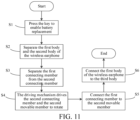
- FIG. 11 With reference to the wireless earphone 100 shown in FIG. 1 and the wireless earphone box 200 shown in FIG. 6a, FIG. 6b , FIG. 9, and FIG. 10 , a specific process of battery replacement in an implementation of this application is as shown in FIG. 11 :
- the wireless earphone When electric power of the wireless earphone is low, the wireless earphone is put in the wireless earphone box, the third receiving chamber receives the first body of the wireless earphone, the first receiving chamber receives the second body of the wireless earphone, and the second receiving chamber receives the third body including the second battery.
- the second connecting member and the second movable member are in the first state.
- the key is pressed to start the first control module of the wireless earphone box, the first control module controls the power supply module to reversely energize the third contact of the second body in the first receiving chamber through the fourth contact on the second connecting member, the polarity of the second magnetic member is reversed and changed into being the same as the polarity of the first magnetic member, the second magnetic member and the first magnetic member repel each other, and the first body and the second body of the wireless earphone are separated.
- the second control module is started after a preset time of start of the first control module, the second control module controls the power supply module to reversely energize the fourth magnetic member, the polarity of the fourth magnetic member is reversed and changed into being opposite to the polarity of the third magnetic member, the fourth magnetic member and the third magnetic member attract each other, the third magnetic member drives the second connecting member and the second movable member to move downwards, and the first connecting member is separated from the second connecting member.
- the driving mechanism drives the second connecting member and the second movable member to rotate.
- the third control module is started after a preset time of start of the second control module, the third control module controls the motor (the driving member) to operate, and the motor drives the first gear and the second gear to transmit to cause the third connecting member to rotate clockwise, as shown in FIG. 6a , in which A1 and A2 are the second connecting members, and B1 and B2 are the second movable members.
- the motor stops operating, and the second connecting member and the second movable member change from the state shown in FIG. 6a into the state shown in FIG. 6b .
- the second movable member is located below the first connecting member.
- the second control module After the motor stops operating, the second control module is started again, the second control module controls the power supply module to positively energize the fourth magnetic member, the polarity of the fourth magnetic member changes back to being the same as the polarity of the third magnetic member, the fourth magnetic member and the third magnetic member repel each other, the third magnetic member drives the second connecting member and the second movable member to move upwards, and the first connecting member is connected to the second movable member.
- the first control module controls the power supply module to positively energize the fourth magnetic member
- the first control module is started again after a preset time
- the first control module controls the power supply module to positively energize the fifth contact on the third body in the second receiving chamber through the sixth contact on the second movable member
- the polarity of the second magnetic member changes back to being opposite to the polarity of the first magnetic member
- the second magnetic member and the first magnetic member attract each other
- the first body of the wireless earphone is connected to the third body, so as to complete replacement of the battery of the wireless earphone.
- the wireless earphone box 200 includes a first movable member 210.
- the first movable member 210 is provided with a first receiving chamber.
- the first receiving chamber is configured to store at least the second body 120 of the wireless earphone 100.
- a fourth contact 2111 is provided on a side wall of the first receiving chamber. In a case that the second body 120 is received in the first receiving chamber, the fourth contact 2111 is electrically connected to the third contact 124 to cause the first body 110 and the second body 120 to be in the connected state or separated state.
- the fourth contact 2111 provided on the side wall of the first receiving chamber may be connected to the third contact 124 on the outer surface of the second body 120 to change the polarity of the second magnetic member 121 of the wireless earphone 100, so that the first body 110 and the second body 120 are separated, and then the second body 120 including the first battery 123 is removed for separate charging or replacement.
- the first battery 123 can be charged or replaced through direct removal of the second body 120 by using the wireless earphone box 200, without the need to put the whole wireless earphone in the wireless earphone box for charging, so that the function of the wireless earphone box 200 is more in line with the requirement of the wireless earphone 100.
- An embodiment of this application further provides a wireless earphone device, including the wireless earphone 100 shown in FIG. 1 to FIG. 3 , and the wireless earphone box 200 shown in FIG. 4 to FIG. 10 .
- the wireless earphone device may implement all the functions that can be implemented by the wireless earphone 100 shown in FIG. 1 to FIG. 3 and the wireless earphone box 200 shown in FIG. 4 to FIG. 10 , and achieve the same technical effects. Details are not described herein again so as to avoid repetition.
- the computer software product is stored in a storage medium, such as a read-only memory (read-only memory, ROM)/random access memory (random access memory, RAM), a magnetic disk, or an optical disc) and includes several instructions for instructing a terminal (which may be a mobile phone, a computer, a server, an air conditioner, a network device, or the like) to perform the methods described in the embodiments of this application.
- a storage medium such as a read-only memory (read-only memory, ROM)/random access memory (random access memory, RAM), a magnetic disk, or an optical disc
- a terminal which may be a mobile phone, a computer, a server, an air conditioner, a network device, or the like
Landscapes
- Engineering & Computer Science (AREA)
- Physics & Mathematics (AREA)
- Acoustics & Sound (AREA)
- Signal Processing (AREA)
- Power Engineering (AREA)
- Headphones And Earphones (AREA)
- Charge And Discharge Circuits For Batteries Or The Like (AREA)
- Secondary Cells (AREA)
Description
- This application relates to the field of earphone technologies, and in particular, to a wireless earphone, a wireless earphone box, and a wireless earphone device.
- At present, wireless earphones are more and more popular among users. However, due to compact positioning, the wireless earphones tend to include batteries that tend to have small capacities and are designed to be non-removable. In this way, the battery life of the wireless earphones is short. When electric power of the earphones is low, the batteries of the wireless earphones cannot be removed for replacement. The wireless earphones can only be put in earphone charge cases for charging, which is time-consuming.
- Therefore, the batteries of the wireless earphones in the related art are non-replaceable.
- Document
CN 106 878 852 A discloses a wireless headset comprising an earphone and an earphone housing, wherein the earpiece is provided with a power supply module, and comprises a connecting portion in which a power supply management circuit is provided. - Document
CN 207 117 889 U discloses headphones comprising an in ear part, provided with a first electrical contact; a power supply part which can be detached from the in-ear part, and the power supply part comprising a positioning structure which includes a first magnetic attraction portion and a second magnetic attraction portion. - Embodiments of this application provide a wireless earphone, a wireless earphone box, and a wireless earphone device, so as to resolve the problem in the related art that the batteries of the wireless earphones are non-replaceable.
- In order to resolve the above technical problem, this application is implemented as follows:
- According to a first aspect, an embodiment of this application provides a wireless earphone, the wireless earphone including:
- a first body, the first body including a sound output component, a first end face of the first body being provided with a first magnetic member and a first contact, the first contact being electrically connected to the sound output component; and
- a second body, a second end face of the second body being opposite the first end face, the second end face being provided with a second magnetic member corresponding to the first magnetic member and a second contact corresponding to the first contact, the second body including a first battery, an outer surface of the second body being provided with a third contact;
- where the third contact is energized to cause the first body and the second body to be in a connected state or separated state; in the connected state, the first magnetic member and the second magnetic member have opposite polarities attracting each other, and the first contact is in contact with the second contact, so that the first battery supplies power to the sound output component; and in the separated state, the first magnetic member and the second magnetic member have a same polarity repelling each other.
- According to a second aspect, an embodiment of this application provides a wireless earphone box, the wireless earphone box being adapted to the wireless earphone according to the first aspect of this application, the wireless earphone box including:
a first movable member, the first movable member being provided with a first receiving chamber, the first receiving chamber being configured to store at least the second body of the wireless earphone, a fourth contact being provided on a side wall of the first receiving chamber; in a case that the second body is received in the first receiving chamber, the fourth contact being electrically connected to the third contact of the second body to cause the first body and the second body to be in the connected state or separated state. - According to a third aspect, an embodiment of this application provides a wireless earphone device, including a wireless earphone and a wireless earphone box, the wireless earphone being the wireless earphone according to the first aspect of this application, the wireless earphone box being the wireless earphone box according to the second aspect of this application.
- In the embodiments of this application, the wireless earphone is divided into the first body and the second body. The second body includes the first battery, and the third contact of the second body may change a polarity of the second magnetic member from being opposite to a polarity of the first magnetic member to being the same as the polarity of the first magnetic member, so that the first body and the second body are separated and then the second body including the first battery is removed for separate charging or replacement. In this way, when electric power of the wireless earphone is low, the first battery can be charged or replaced through direct removal of the second body, without the need to put the whole wireless earphone in the wireless earphone box for charging, which makes the use of the wireless earphone more convenient.
- To describe the technical solutions of the embodiments of this application more clearly, the following briefly introduces the accompanying drawings required for describing the embodiments of this application. Apparently, the accompanying drawings in the following description show only some embodiments of this application, and a person of ordinary skill in the art may still derive other accompanying drawings from these accompanying drawings without creative efforts.
-
FIG. 1 is a first schematic structural diagram of a wireless earphone according to an embodiment of this application; -
FIG. 2 is a schematic diagram of an appearance of a wireless earphone according to an embodiment of this application; -
FIG. 3 is a second schematic structural diagram of a wireless earphone according to an embodiment of this application; -
FIG. 4 is a first schematic structural diagram of a wireless earphone box according to an embodiment of this application; -
FIG. 5 is a second schematic structural diagram of a wireless earphone box according to an embodiment of this application; -
FIG. 6a is a first partial top view of a wireless earphone box according to an embodiment of this application; -
FIG. 6b is a first partial top view of a wireless earphone box according to an embodiment of this application; -
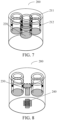
FIG. 7 is a third schematic structural diagram of a wireless earphone box according to an embodiment of this application; -
FIG. 8 is a first schematic structural diagram of a wireless earphone box not including a second movable member according to an embodiment of this application; -
FIG. 9 is a second schematic structural diagram of a wireless earphone box not including a second movable member according to an embodiment of this application; -
FIG. 10 is a schematic front view of exterior of a wireless earphone box according to an embodiment of this application; and -
FIG. 11 is a schematic flowchart of replacement of a battery of a wireless earphone according to an embodiment of this application. - The technical solutions in embodiments of this application are clearly and completely described in the following with reference to the accompanying drawings in the embodiments of this application. Apparently, the described embodiments are some rather than all of the embodiments of this application. All other embodiments obtained by a person of ordinary skill in the art based on the embodiments of this application without creative efforts shall fall within the protection scope of this application.
- The terms "include" and any other variants in the specification, claims of the this application mean to cover the non-exclusive inclusion, such as, a process, method, system, product, or device that includes a list of steps or units is not necessarily limited to those steps or units that are expressly listed, but may include other steps or units that are not expressly listed or inherent to such a process, method, product, or device. In addition, the use of "and/or" in the specification and the claims means at least one of the connected objects. For example, A and/or B indicates that there are three cases including A alone, B alone, and both A and B present.
- In the embodiments of this application, the word "exemplary" or "for example" or the like is used to represent giving an example, an illustration, or a description. Any embodiment or design solution described as "exemplary" or "for example" in the embodiments of this application should not be explained as being more preferred or having more advantages than another embodiment or design solution. Exactly, the use of the word "exemplary" or "for example" or the like is intended to present a related concept in a specific manner.
- An embodiment of this application provides a
wireless earphone 100. As shown inFIG. 1 , thewireless earphone 100 includes: - a
first body 110, thefirst body 110 including a sound output component, a first end face of thefirst body 110 being provided with a firstmagnetic member 111 and afirst contact 112, thefirst contact 112 being electrically connected to the sound output component; and - a
second body 120, a second end face of thesecond body 120 being opposite the first end face, the second end face being provided with a secondmagnetic member 121 corresponding to the firstmagnetic member 111 and asecond contact 122 corresponding to thefirst contact 112, thesecond body 120 including afirst battery 123, an outer surface of thesecond body 120 being provided with athird contact 124. - The
third contact 124 is energized to cause thefirst body 110 and thesecond body 120 to be in a connected state or separated state. In the connected state, the firstmagnetic member 111 and the secondmagnetic member 121 have opposite polarities attracting each other, and thefirst contact 112 is in contact with thesecond contact 122, so that thefirst battery 123 supplies power to the sound output component. In the separated state, the firstmagnetic member 111 and the secondmagnetic member 121 have a same polarity repelling each other. - In this embodiment of this application, as shown in
FIG. 1 , thewireless earphone 100 includes thefirst body 110 and thesecond body 120. Thefirst body 110 is an upper part of thewireless earphone 100, which may include a sound output component (not shown inFIG. 1 ) of thewireless earphone 100, and may specifically include an earphone circuit and a sound output structure of the wireless earphone. Thesecond body 120 is a lower part of thewireless earphone 100, which may include thefirst battery 123. When thefirst body 110 and thesecond body 120 are in the connected state, thefirst contact 112 is in contact with thesecond contact 122 to realize electrical communication between thefirst body 110 and thesecond body 120, and thefirst battery 123 may be electrically connected to the sound output component in thefirst body 110 to supply power to thewireless earphone 100. An appearance structure of thewireless earphone 100 may be shown inFIG. 2 . - As shown in
FIG. 1 , the first end face of thefirst body 110 is provided with the firstmagnetic member 111, and the second end face of thesecond body 120 is provided with the secondmagnetic member 121. The secondmagnetic member 121 is a polarity-variable magnetic member, and the polarity of the secondmagnetic member 121 may be changed by a current. - Specifically, the outer surface of the
second body 120 is provided with thethird contact 124. When thethird contact 124 is positively energized, the secondmagnetic member 121 and the firstmagnetic member 111 have opposite polarities attracting each other, so that thefirst body 110 and thesecond body 120 of thewireless earphone 100 are in the connected state. When thethird contact 124 is reversely energized, the polarity of the secondmagnetic member 121 may be reversed, and the secondmagnetic member 121 and the firstmagnetic member 111 have a same polarity repelling each other, so that thefirst body 110 and thesecond body 120 of thewireless earphone 100 are in the separated state. - In this embodiment of this application, the second
magnetic member 121 and the firstmagnetic member 111 have opposite polarities by default, and thefirst body 110 and thesecond body 120 are in the connected state, that is, a normal use state of thewireless earphone 100. When electric power of thewireless earphone 100 is low, the polarity of the secondmagnetic member 121 is reversed through reverse energization of thethird contact 124. For example, an on/off key may be provided outside thewireless earphone 100, and thethird contact 124 is reversely energized when the on/off key is pressed, or thewireless earphone 100 may be put in awireless earphone box 200, and thethird contact 124 is reversely energized by a power supply module of thewireless earphone box 200, which is not specifically limited in the embodiments of this application. - When the polarities of the second
magnetic member 121 and the firstmagnetic member 111 change from being opposite to being the same, the secondmagnetic member 121 and the firstmagnetic member 111 repel each other to produce thrust, so that thesecond body 120 is separated from thefirst body 110, thesecond body 120 including thefirst battery 123 is removed from thewireless earphone 100, and then thefirst battery 123 in the second body may be charged or replaced with another standby battery. - In the
wireless earphone 100 according to this embodiment of this application, thewireless earphone 100 is divided into thefirst body 110 and thesecond body 120. Thesecond body 120 includes thefirst battery 123, and thethird contact 124 is energized to change a polarity of the secondmagnetic member 121 from being opposite to a polarity of the firstmagnetic member 111 to being the same as the polarity of the firstmagnetic member 111, so that thefirst body 110 and thesecond body 120 are separated and then thesecond body 120 including thefirst battery 123 is removed for separate charging or replacement. In this way, when electric power of thewireless earphone 100 is low, thefirst battery 123 can be charged or replaced through direct removal of thesecond body 120, without the need to put thewhole wireless earphone 100 in the wireless earphone box for charging, which makes the use of thewireless earphone 100 more convenient. - Optionally, as shown in
FIG. 3 , the first end face is provided with a protruding portion, the second end face is provided with a groove matching the protruding portion, the firstmagnetic member 111 is provided on a top surface of the protruding portion, and the secondmagnetic member 121 is provided on a bottom surface of the groove; or
the second end face is provided with a protruding portion, and the first end face is provided with a groove matching the protruding portion; the secondmagnetic member 121 is provided on a top surface of the protruding portion, and the firstmagnetic member 111 is provided on a bottom surface of the groove. - At least two implementations are included in this embodiment:
- In the first implementation, as shown in
FIG. 3 , the first end face of thefirst body 110 is provided with a protruding portion, the firstmagnetic member 111 is provided on a top surface of the protruding portion, the second end face of thesecond body 120 is provided with a groove matching the protruding portion, the secondmagnetic member 121 is provided on a bottom surface of the groove, the protruding portion may extend into the groove, and the firstmagnetic member 111 and the secondmagnetic member 121 attract or repel each other. - In the second implementation, the second end face of the
second body 120 is provided with a protruding portion, the secondmagnetic member 121 is provided on a top surface of the protruding portion, the first end face of thefirst body 110 is provided with a groove matching the protruding portion, the firstmagnetic member 111 is provided on a bottom surface of the groove, the protruding portion may extend into the groove, and the firstmagnetic member 111 and the secondmagnetic member 121 attract or repel each other. - In this way, when the
first body 110 is connected to thesecond body 120, no relative radial movement may occur between thefirst body 110 and thesecond body 120, which improves structural stability of thewireless earphone 100. - Based on the above, the
wireless earphone 100 according to this embodiment of this application includes thefirst body 110 and thesecond body 120. The first end face of thefirst body 110 is provided with the firstmagnetic member 111. The second end face of thesecond body 120 is provided with the secondmagnetic member 121. The second end face is opposite the first end face. The outer surface of thesecond body 120 is provided with thethird contact 124. Thesecond body 120 includes thefirst battery 123. Thethird contact 124 is energized to change the polarity of the secondmagnetic member 121 from being opposite to the polarity of the firstmagnetic member 111 to being the same as the polarity of the firstmagnetic member 111, so that thefirst body 110 and thesecond body 120 are separated and then thesecond body 120 including thefirst battery 123 is removed for separate charging or replacement. In this way, when electric power of thewireless earphone 100 is low, thefirst battery 123 can be charged or replaced through direct removal of thesecond body 120, without the need to put thewhole wireless earphone 100 in the wireless earphone box for charging, which makes the use of thewireless earphone 100 more convenient. - An embodiment of this application further provides a
wireless earphone box 200 adapted to thewireless earphone 100 shown inFIG. 1 to FIG. 3 . - As shown in
FIG. 4 , thewireless earphone box 200 includes:
a firstmovable member 210. The firstmovable member 210 is provided with a first receiving chamber. The first receiving chamber is configured to store at least thesecond body 120 of thewireless earphone 100. Afourth contact 2111 is provided on a side wall of the first receiving chamber. In a case that thesecond body 120 is received in the first receiving chamber, thefourth contact 2111 is electrically connected to thethird contact 124 of thesecond body 120 to cause thefirst body 110 and thesecond body 120 to be in the connected state or separated state. - In this embodiment of this application, the
wireless earphone box 200 includes the firstmovable member 210. The first receiving chamber is provided on the firstmovable member 210, which may be configured to store at least thesecond body 120 of thewireless earphone 100. In other words, the first receiving chamber may receive at least a lower part of thewireless earphone 100. - In this embodiment of this application, two first
movable members 210 may be provided. The two firstmovable members 210 may be symmetrically provided in thewireless earphone box 200. Correspondingly, two first receiving chambers may also be provided to respectively receive a left-ear earphone and a right-ear earphone of a two-ear wireless earphone 100. It may be understood that one firstmovable member 210 may be provided according to an actual requirement, and the first receiving chamber provided correspondingly may be configured to receive a single-ear wireless earphone 100. Four, six, or other even numbers of firstmovable members 210 may also be provided, and first receiving chambers provided correspondingly may be configured to receive two sets or three sets or a plurality of sets of two-ear wireless earphones 100, which is not specifically limited in the embodiments of this application. - In this embodiment of this application, descriptions are based on an example in which two first
movable members 210 are provided and the two firstmovable members 210 are symmetrically provided in thewireless earphone box 200. - As shown in
FIG. 4 , thefourth contact 2111 is provided on a side wall of the first receiving chamber. Thefourth contact 2111 may be electrically connected to the power supply module of thewireless earphone box 200. When thesecond body 120 of thewireless earphone 100 shown inFIG. 1 orFIG. 3 is received in the first receiving chamber, thefourth contact 2111 may contact thethird contact 124 on the outer surface of thesecond body 120. The power supply module of thewireless earphone box 200 energizes thethird contact 124 through thefourth contact 2111, to cause thefirst body 110 and thesecond body 120 of thewireless earphone 100 to be in the connected state or separated state. - When the electric power of the
wireless earphone 100 is low, thesecond body 120 of thewireless earphone 100 may be put in the first receiving chamber of thewireless earphone box 200, the power supply module of thewireless earphone box 200 is controlled to reversely energize thethird contact 124 to cause the polarity of the secondmagnetic member 121 of thewireless earphone 100 to be reversed, the secondmagnetic member 121 and the firstmagnetic member 111 repel each other to produce thrust, and thesecond body 120 is separated from thefirst body 110. Thesecond body 120 including thefirst battery 123 may be removed from thewireless earphone 100. - Then, the removed
second body 120 is left in thewireless earphone box 200, and a charge circuit in thewireless earphone box 200 may charge thesecond body 120, so that thesecond body 120 can be connected to thefirst body 110 again upon completion of the charging, and then thewireless earphone 100 can be continuously used. Certainly, after the removedsecond body 120 is left in thewireless earphone box 200 for charging, another body including a standby battery may also be used to connect thefirst body 110, and then thewireless earphone 100 is continuously used. - In the
wireless earphone box 200 according to this embodiment of this application, when thesecond body 120 of thewireless earphone 100 is received in the first receiving chamber, thefourth contact 2111 provided on the side wall of the first receiving chamber may be electrically connected to thethird contact 124 on the outer surface of thesecond body 120 to change the polarity of the secondmagnetic member 121 of thewireless earphone 100, so that thefirst body 110 and thesecond body 120 are separated, and then thesecond body 120 including thefirst battery 123 is removed for separate charging or replacement. In this way, when electric power of thewireless earphone 100 is low, thefirst battery 123 can be charged or replaced through direct removal of thesecond body 120 by using thewireless earphone box 200, without the need to put the whole wireless earphone in the wireless earphone box for charging, so that the function of thewireless earphone box 200 is more in line with the requirement of thewireless earphone 100. - In an implementation, the
wireless earphone box 200 may include a first control module. When thewireless earphone box 200 detects that thesecond body 120 of thewireless earphone 100 is received in the first receiving chamber, the first control module is started to control the power supply module to energize thefourth contact 2111 in the first receiving chamber to cause thefirst body 110 and thesecond body 120 of thewireless earphone 100 to be separated. Alternatively, thewireless earphone box 200 may be provided with a first control button. When the first control button is pressed, the first control module is started. Alternatively, thewireless earphone box 200 may be provided with a first delay apparatus, and after thesecond body 120 of thewireless earphone 100 is received in the first receiving chamber, the first control module is automatically started after a preset time of delay, which is not specifically limited in the embodiments of this application. - Optionally, as shown in
FIG. 5 , thewireless earphone box 200 further includes: - a second
movable member 220, the secondmovable member 220 being provided with a second receiving chamber, a third body being received in the second receiving chamber, the third body including a second battery, a fifth contact being provided on an outer surface of the third body, asixth contact 2211 being provided on a side wall of the second receiving chamber; and - a driving mechanism, the driving mechanism being connected to the first
movable member 210 and the secondmovable member 220, in a case that thesecond body 120 is received in the first receiving chamber, the driving mechanism being configured to drive the firstmovable member 210 and the secondmovable member 220 to switch between a first state and a second state. - When the first
movable member 210 and the secondmovable member 220 are in the first state, thefourth contact 2111 is electrically connected to thethird contact 124 to control thefirst body 110 and thesecond body 120 to be in a connected state or separated state. In a case that the firstmovable member 210 and the secondmovable member 220 are in the second state, thesixth contact 2211 is electrically connected to the fifth contact to control thefirst body 110 and the third body to be in a connected state or separated state. - In this embodiment, the
wireless earphone box 200 further includes the secondmovable member 220 and the driving mechanism. The third body including the second battery is received in the secondmovable member 220. The second battery may be understood as a standby battery of thewireless earphone 100. The third body may be understood as a standbysecond body 120. It may be understood that structures of the third body and thesecond body 120 may be exactly the same. A third end face of the third body is also provided with a polarity-variable magnetic member corresponding to the firstmagnetic member 111 and also provided with a contact corresponding to thefirst contact 112. - Two second
movable members 220 may be provided. The two secondmovable members 220 may be symmetrically provided in thewireless earphone box 200. Correspondingly, two second receiving chambers may also be provided to respectively receive a second battery of the left-ear earphone and a second battery of the right-ear earphone of the two-ear wireless earphone 100. It may be understood that one secondmovable member 220 may be provided according to an actual requirement, and the second receiving chamber provided correspondingly may be configured to receive a second battery of a single-ear wireless earphone 100. Four, six, or other even numbers of secondmovable members 220 may also be provided, and second receiving chambers provided correspondingly may be configured to receive second batteries of two sets or three sets or a plurality of sets of two-ear wireless earphones 100. No limitation is made herein. - In this embodiment, descriptions are based on an example in which two second
movable members 220 are provided and the two secondmovable members 220 are symmetrically provided in thewireless earphone box 200. In an implementation, the firstmovable member 210 and the secondmovable member 220 may be provided in thewireless earphone box 200 according to the top views shown inFIG. 6a and FIG. 6b . A1 and A2 are the firstmovable members 210, and B 1 and B2 are the secondmovable members 220. - When the electric power of the
wireless earphone 100 is low, thesecond body 120 of thewireless earphone 100 may be received in the first receiving chamber. In this case, thefirst body 110 and thesecond body 120 of thewireless earphone 100 are connected, the firstmovable member 210 is located below thefirst body 110 of thewireless earphone 100, and the firstmovable member 210 and the secondmovable member 220 are in the first state. Thefourth contact 2111 in the first receiving chamber reversely energizes thethird contact 124 of thesecond body 120, and thesecond body 120 and thefirst body 110 of thewireless earphone 100 are separated, to realize removal of thefirst battery 123. - Then, the driving mechanism may drive the first
movable member 210 and the secondmovable member 220 to move to cause the secondmovable member 220 receiving the third body to move below thefirst body 110 of thewireless earphone 100. In this case, the firstmovable member 210 and the secondmovable member 220 are in the second state. Since the structures of the third body and thesecond body 120 are exactly the same, thesixth contact 2211 in the second receiving chamber positively energizes the fifth contact on the third body, so that the second magnetic member on the third body and the firstmagnetic member 111 on thefirst body 110 have opposite polarities attracting each other, then the third body is connected to thefirst body 110, and an earphone circuit of thewireless earphone 100 begins to be powered by the second battery. - Then, the removed
second body 120 is left in thewireless earphone box 200. The charge circuit in thewireless earphone box 200 may charge thesecond body 120. When electric power of the second battery in the third body is low, the third body may be removed in the same manner to replace the fully chargedsecond body 120, and thewireless earphone box 200 continues charging the second battery of the third body. In this way, the first battery and the second battery may be continuously and cyclically replaced to ensure continuous and sufficient electric power of thewireless earphone 100, and users do not need to spend time waiting for thewireless earphone 100 to be charged, which improves user experience. - In an implementation, the
wireless earphone box 200 may include a second control module. When thewireless earphone box 200 detects that thefirst body 110 and thesecond body 120 of thewireless earphone 100 are separated, the second control module may control the driving mechanism to drive the firstmovable member 210 and the secondmovable member 220 to move. Alternatively, thewireless earphone box 200 may be provided with a second control button. When the second control button is pressed, the second control module is started. Alternatively, thewireless earphone box 200 may be provided with a second delay apparatus, and after thefirst body 110 and thesecond body 120 of thewireless earphone 100 are separated, the second control module is automatically started after a preset time of delay. No limitation is made herein. - In this embodiment, the second
movable member 220 receiving the third body is provided in thewireless earphone box 200. The third body includes a second battery. After thesecond body 120 including thefirst battery 123 is removed from thewireless earphone 100, through the driving of the driving mechanism, the third body including the second battery may be automatically mounted without user manual operations, so that thewireless earphone 100 automatically replaces the battery. At the same time, the replacement of the second battery and the first battery can ensure continuous and sufficient electric power of thewireless earphone 100, and the users do not need to spend time waiting for thewireless earphone 100 to be charged, which improves user experience. - Further, as shown in
FIG. 7 , the firstmovable member 210 includes a first connectingmember 211 and a second connectingmember 212, the first connectingmember 211 is provided with a third receiving chamber, the second connectingmember 212 is provided with the first receiving chamber, the third receiving chamber is configured to receive thefirst body 110 of thewireless earphone 100, and the first receiving chamber is configured to receive thesecond body 120. - The driving mechanism is connected to the second connecting
member 212 and the secondmovable member 220. In a case that thesecond body 120 is received in the first receiving chamber, the driving mechanism is configured to drive the second connectingmember 212 and the secondmovable member 220 to switch between a first state and a second state. - In this embodiment, as shown in
FIG. 7 , the firstmovable member 210 includes the first connectingmember 211 and the second connectingmember 212, and both thefirst body 110 and thesecond body 120 of thewireless earphone 100 may be received in the firstmovable member 210. The second connectingmember 212 and the secondmovable member 220 are at a same level height, and structures of the second connectingmember 212 and the secondmovable member 220 may be exactly the same. - In an implementation, the second connecting
member 212 and the secondmovable member 220 may also be provided in thewireless earphone box 200 according to the top views shown inFIG. 6a and FIG. 6b . A1 and A2 are the second connectingmembers 212, and B 1 and B2 are the secondmovable members 220. - In this embodiment, the first connecting
member 211 may be understood as being fixed to thewireless earphone box 200. When thewireless earphone 100 is received in the firstmovable member 210, the driving mechanism may drive the second connectingmember 212 and the secondmovable member 220 to switch between the first state and the second state, while a position of the first connectingmember 211 may not change. - Specifically, when the second connecting
member 212 and the secondmovable member 220 are in the first state, the second connectingmember 212 is located below the first connectingmember 211, the third receiving chamber is communicated with the first receiving chamber, thefirst body 110 and thesecond body 120 of thewireless earphone 100 are connected, thefourth contact 2111 in the first receiving chamber reversely energizes thethird contact 124 of thesecond body 120, and thesecond body 120 and thefirst body 110 of thewireless earphone 100 are separated, to realize removal of thesecond body 120 including thefirst battery 123. - Then, the first connecting
member 211 remains fixed, the driving mechanism may drive the second connectingmember 212 and the secondmovable member 220 to move to cause the secondmovable member 220 receiving the third body to move below the first connectingmember 211, and the second receiving chamber is communicated with the third receiving chamber. Thesixth contact 2211 in the second receiving chamber positively energizes the fifth contact on the third body, so that the third body is connected to thefirst body 110, and an earphone circuit of thewireless earphone 100 begins to be powered by the second battery. - In this embodiment, when the battery in the
wireless earphone 100 needs to be replaced, thewireless earphone 100 is entirely put in thewireless earphone box 200, thefirst body 110 of thewireless earphone 100 is fixed through the first connectingmember 211, the driving mechanism drives the second connectingmember 212 and the secondmovable member 220 to move, and then thesecond body 120 and the third body are swapped, so that thefirst body 110 of thewireless earphone 100 is connected to the third body to complete replacement of the battery of thewireless earphone 100 without user intervention, which further improves automation of the replacement of the battery of thewireless earphone 100. - Further, as shown in
FIG. 8 , the driving mechanism includes a thirdmagnetic member 230 and a fourthmagnetic member 240, a first side of the thirdmagnetic member 230 is connected to the second connectingmember 212 and the secondmovable member 220, the fourthmagnetic member 240 is fixed to a second side of the thirdmagnetic member 230 at intervals, and the first side is opposite the second side. - The fourth
magnetic member 240 is energized to cause the first connectingmember 211 and the second connectingmember 212 to be in a connected state or separated state. In the connected state, the thirdmagnetic member 230 and the fourthmagnetic member 240 have a same polarity repelling each other. In the separated state, the thirdmagnetic member 230 and the fourthmagnetic member 240 have opposite polarities attracting each other. - In this embodiment, the driving mechanism includes the third
magnetic member 230 and the fourthmagnetic member 240. As shown inFIG. 8 , the fourthmagnetic member 240 may be fixed and energized to change a polarity. Specifically, when the fourthmagnetic member 240 is positively energized, the polarity of the fourthmagnetic member 240 may be the same as that of the thirdmagnetic member 230, the fourthmagnetic member 240 and the thirdmagnetic member 230 repel each other to produce thrust to drive the thirdmagnetic member 230 to move the second connectingmember 212 and the secondmovable member 220 upwards, and the first connectingmember 211 is connected to the second connectingmember 212. - When the fourth
magnetic member 240 is reversely energized, the polarity of the fourthmagnetic member 240 may be opposite to that of the thirdmagnetic member 230, the fourthmagnetic member 240 and the thirdmagnetic member 230 attract each other to produce tension to drive the thirdmagnetic member 230 to move the second connectingmember 212 and the secondmovable member 220 downwards, and the first connectingmember 211 is separated from the second connectingmember 212. - In this embodiment, it is a default state of the
wireless earphone box 200 that the power supply module of thewireless earphone box 200 positively energizes the fourthmagnetic member 240. After thefirst body 110 and thesecond body 120 of thewireless earphone 100 are separated, the power supply module of thewireless earphone box 200 may be controlled to reversely energize the fourthmagnetic member 240, so that the first connectingmember 211 is separated from the second connectingmember 212. Then, the driving mechanism moves the second connectingmember 212 and the secondmovable member 220 again. When the second connectingmember 212 and the secondmovable member 220 are in the second state, the power supply module of thewireless earphone box 200 is controlled to positively energize the fourthmagnetic member 240, so that the first connectingmember 211 is connected to the secondmovable member 220. - In this way, during replacement of the
second body 120 with the third body, thefirst body 110 and thesecond body 120 of thewireless earphone 100 are separated, and the first connectingmember 211 and the second connectingmember 212 are also separated, which prevents high friction resistance between the second connectingmember 212 and the first connectingmember 211 caused by movement of the second connectingmember 212 and the secondmovable member 220 and further improves the efficiency of the replacement of the battery of thewireless earphone 100. - In an implementation, the
wireless earphone box 200 may include a third control module. When thewireless earphone box 200 detects that thefirst body 110 and thesecond body 120 of thewireless earphone 100 are separated, the third control module may first control the power supply module to reversely energize the fourthmagnetic member 240 to separate the first connectingmember 211 from the second connectingmember 212 and then control the driving mechanism to be started to drive the second connectingmember 212 and the secondmovable member 220 to move, which is not limited herein. - Further, as shown in
FIG. 9 , the driving mechanism includes a third connectingmember 250 and adriving component 260. Thedriving component 260 is connected to the third connectingmember 250, the third connectingmember 250 is connected to the second connectingmember 212 and the secondmovable member 220, and thedriving component 260 may drive the third connectingmember 250 to rotate to cause the second connectingmember 212 and the secondmovable member 220 to switch between the first state and the second state. - In an implementation, the third connecting
member 250 may have a cross structure as shown inFIG. 6a and FIG. 6b . The two second connecting members 212 (A1 and A2) are connected to a first end and a second end of the third connectingmember 250 that are disposed opposite, and the two second movable members 220 (B1 and B2) are connected to a third end and a fourth end of the third connectingmember 250 that are disposed opposite. - In an implementation, as shown in
FIG. 9 , the thirdmagnetic member 230 may be connected to the third connectingmember 250, and the second connectingmember 212 and the secondmovable member 220 may be driven through the third connectingmember 250 to move up and down. A specific implementation form may be obtained with reference to the descriptions in the above embodiment. Details are not described herein again. - Further, as shown in
FIG. 9 , thedriving component 260 includes a drivingmember 261 and a gear set, the gear set includes afirst gear 262 and asecond gear 263, thefirst gear 262 engages with thesecond gear 263, thefirst gear 262 is connected to the drivingmember 261, and thesecond gear 263 is connected to the third connectingmember 250. - The driving
member 261 may be a motor or an electric machine, which is not limited herein. - In this embodiment, the third connecting
member 250 is driven to rotate through transmission of the gear set. The second connectingmember 212 and the secondmovable member 220 may change positions through rotation. In this way, a movement space reserved inside thewireless earphone box 200 can be saved, and a size of thewireless earphone box 200 can be reduced. - Optionally, the
wireless earphone box 200 further includes a charge circuit. When the firstmovable member 210 and the secondmovable member 220 are in the first state, the charge circuit is electrically connected to the second receiving chamber to charge the second battery. When the firstmovable member 210 and the secondmovable member 220 are in the second state, the charge circuit is electrically connected to the first receiving chamber to charge thefirst battery 123. - In this embodiment, when the first
movable member 210 and the secondmovable member 220 are in the first state, the firstmovable member 210 is located below thefirst body 110 of thewireless earphone 100, thefourth contact 2111 is electrically connected to thethird contact 124, and thefirst body 110 and thesecond body 120 of thewireless earphone 100 may be controlled to be in the connected state or separated state. In this case, the charge circuit may be electrically connected to the second receiving chamber, the third body including the second battery is received in the second receiving chamber, and the charge circuit may charge the second battery. - When the first
movable member 210 and the secondmovable member 220 are in the second state, the secondmovable member 210 is located below thefirst body 110 of thewireless earphone 100, thesixth contact 2211 is electrically connected to the fifth contact, and thefirst body 110 of thewireless earphone 100 and the third body may be controlled to be in the connected state or separated state. In this case, the charge circuit may be electrically connected to the first receiving chamber, thesecond body 120 including thefirst battery 123 is received in the first receiving chamber, and the charge circuit may charge thefirst battery 123. - In other words, in a case that a standby third body or the removed
second body 120 of thewireless earphone 100 is received in thewireless earphone box 200, the battery may be charged through the charge circuit, so that, when thesecond body 120 and the third body need to be subsequently replaced and mounted again, the new battery may have sufficient electric power, which improves user experience. - Optionally, as shown in
FIG. 10 , a key 270 is provided on an outer surface of thewireless earphone box 200, and the key 270 is electrically connected to thefourth contact 2111. - In this embodiment, the key 270 provided on the outer surface of the
wireless earphone box 200 may control thewireless earphone box 200 to enable battery replacement. The user may press the key 270 for replacement when battery replacement is required. The user does not press the key when battery replacement is not required, in which case thewireless earphone box 200 may be configured separately to receive thewireless earphone 100. - With reference to the
wireless earphone 100 shown inFIG. 1 and thewireless earphone box 200 shown inFIG. 6a, FIG. 6b ,FIG. 9, and FIG. 10 , a specific process of battery replacement in an implementation of this application is as shown inFIG. 11 : - When electric power of the wireless earphone is low, the wireless earphone is put in the wireless earphone box, the third receiving chamber receives the first body of the wireless earphone, the first receiving chamber receives the second body of the wireless earphone, and the second receiving chamber receives the third body including the second battery. In this case, the second connecting member and the second movable member are in the first state.
- S1: Press the key to enable battery replacement.
- S2: Separate the first body and the second body of the wireless earphone.
- The key is pressed to start the first control module of the wireless earphone box, the first control module controls the power supply module to reversely energize the third contact of the second body in the first receiving chamber through the fourth contact on the second connecting member, the polarity of the second magnetic member is reversed and changed into being the same as the polarity of the first magnetic member, the second magnetic member and the first magnetic member repel each other, and the first body and the second body of the wireless earphone are separated.
- S3: Separate the first connecting member from the second connecting member.
- Through the delay apparatus, the second control module is started after a preset time of start of the first control module, the second control module controls the power supply module to reversely energize the fourth magnetic member, the polarity of the fourth magnetic member is reversed and changed into being opposite to the polarity of the third magnetic member, the fourth magnetic member and the third magnetic member attract each other, the third magnetic member drives the second connecting member and the second movable member to move downwards, and the first connecting member is separated from the second connecting member.
- S4: The driving mechanism drives the second connecting member and the second movable member to rotate.
- Through the delay apparatus, the third control module is started after a preset time of start of the second control module, the third control module controls the motor (the driving member) to operate, and the motor drives the first gear and the second gear to transmit to cause the third connecting member to rotate clockwise, as shown in
FIG. 6a , in which A1 and A2 are the second connecting members, and B1 and B2 are the second movable members. After the third connecting member rotates by 90° clockwise, the motor stops operating, and the second connecting member and the second movable member change from the state shown inFIG. 6a into the state shown inFIG. 6b . In this case, the second movable member is located below the first connecting member. - S5: Connect the first connecting member to the second movable member.
- After the motor stops operating, the second control module is started again, the second control module controls the power supply module to positively energize the fourth magnetic member, the polarity of the fourth magnetic member changes back to being the same as the polarity of the third magnetic member, the fourth magnetic member and the third magnetic member repel each other, the third magnetic member drives the second connecting member and the second movable member to move upwards, and the first connecting member is connected to the second movable member.
- S6: Connect the first body of the wireless earphone to the third body.
- Through the delay apparatus, after the second control module controls the power supply module to positively energize the fourth magnetic member, the first control module is started again after a preset time, the first control module controls the power supply module to positively energize the fifth contact on the third body in the second receiving chamber through the sixth contact on the second movable member, the polarity of the second magnetic member changes back to being opposite to the polarity of the first magnetic member, the second magnetic member and the first magnetic member attract each other, and the first body of the wireless earphone is connected to the third body, so as to complete replacement of the battery of the wireless earphone.
- Based on the above, the
wireless earphone box 200 according to this embodiment of this application includes a firstmovable member 210. The firstmovable member 210 is provided with a first receiving chamber. The first receiving chamber is configured to store at least thesecond body 120 of thewireless earphone 100. Afourth contact 2111 is provided on a side wall of the first receiving chamber. In a case that thesecond body 120 is received in the first receiving chamber, thefourth contact 2111 is electrically connected to thethird contact 124 to cause thefirst body 110 and thesecond body 120 to be in the connected state or separated state. When thesecond body 120 of thewireless earphone 100 is received in the first receiving chamber, thefourth contact 2111 provided on the side wall of the first receiving chamber may be connected to thethird contact 124 on the outer surface of thesecond body 120 to change the polarity of the secondmagnetic member 121 of thewireless earphone 100, so that thefirst body 110 and thesecond body 120 are separated, and then thesecond body 120 including thefirst battery 123 is removed for separate charging or replacement. In this way, when electric power of thewireless earphone 100 is low, thefirst battery 123 can be charged or replaced through direct removal of thesecond body 120 by using thewireless earphone box 200, without the need to put the whole wireless earphone in the wireless earphone box for charging, so that the function of thewireless earphone box 200 is more in line with the requirement of thewireless earphone 100. - An embodiment of this application further provides a wireless earphone device, including the
wireless earphone 100 shown inFIG. 1 to FIG. 3 , and thewireless earphone box 200 shown inFIG. 4 to FIG. 10 . - The wireless earphone device may implement all the functions that can be implemented by the
wireless earphone 100 shown inFIG. 1 to FIG. 3 and thewireless earphone box 200 shown inFIG. 4 to FIG. 10 , and achieve the same technical effects. Details are not described herein again so as to avoid repetition. - It should be noted that the terms "include", "comprise", or any other variants thereof in this specification are intended to cover a non-exclusive inclusion, so that a process, method, object, or apparatus including a series of elements not only include those elements, but also include other elements which are not clearly listed, or include inherent elements of the process, method, object, or apparatus. Without more limitations, elements defined by the sentence "including one" does not exclude that there are still another same element in the process, method, object, or apparatus including the element.
- Through the descriptions of the foregoing implementations, a person skilled in the art may clearly understand that the methods in the foregoing embodiments may be implemented by means of software and a necessary general hardware platform, and certainly, may also be implemented by hardware, but in many cases, the former manner is a better implementation. Based on such understanding, the technical solutions of this application essentially or some contributing to the prior art may be implemented in a form of a software product. The computer software product is stored in a storage medium, such as a read-only memory (read-only memory, ROM)/random access memory (random access memory, RAM), a magnetic disk, or an optical disc) and includes several instructions for instructing a terminal (which may be a mobile phone, a computer, a server, an air conditioner, a network device, or the like) to perform the methods described in the embodiments of this application.
- The embodiments of this application are described above with reference to the accompanying drawings. However, this application is not limited to the foregoing specific implementations. The foregoing specific implementations are only exemplary and not limitative.
Claims (11)
- A wireless earphone comprising:a first body (110), the first body (110) comprising a sound output component, a first end face of the first body (110) being provided with a first magnetic member (111) and a first contact, the first contact (112) being electrically connected to the sound output component; anda second body (120), a second end face of the second body (120) being opposite the first end face, the second end face being provided with a second magnetic member (121) corresponding to the first magnetic member (111) and a second contact (122) corresponding to the first contact (112), the second body (120) comprising a first battery (123), an outer surface of the second body (120) being provided with a third contact (124);wherein the third contact (124) is energized to cause the first body (110) and the second body (120) to be in a connected state or separated state; in the connected state, the first magnetic member (111) and the second magnetic member (121) have opposite polarities attracting each other, and the first contact (112) is in contact with the second contact (122), so that the first battery (123) supplies power to the sound output component; and in the separated state, the first magnetic member (111) and the second magnetic member (121) have a same polarity repelling each other.
- The wireless earphone according to claim 1, wherein the first end face is provided with a protruding portion, the second end face is provided with a groove matching the protruding portion, the first magnetic member (111) is provided on a top surface of the protruding portion, and the second magnetic member (121) is provided on a bottom surface of the groove; or
the second end face is provided with a protruding portion, and the first end face is provided with a groove matching the protruding portion; the second magnetic member (121) is provided on a top surface of the protruding portion, and the first magnetic member (111) is provided on a bottom surface of the groove. - A wireless earphone box, the wireless earphone box being adapted to contain the wireless earphone according to claim 1 or 2, characterized by the wireless earphone box comprising:
a first movable member (210), the first movable member (210) being provided with a first receiving chamber, the first receiving chamber being configured to store at least the second body (120) of the wireless earphone (100), a fourth contact (2111) being provided on a side wall of the first receiving chamber; in a case that the second body (120) is received in the first receiving chamber, the fourth contact (2111) being electrically connected to the third contact (124) of the second body (120) to cause the first body (110) and the second body (120) to be in the connected state or separated state. - The wireless earphone box according to claim 3, further comprising:a second movable member (220), the second movable member (220) being provided with a second receiving chamber, a third body being received in the second receiving chamber, the third body comprising a second battery, a fifth contact being provided on an outer surface of the third body, a sixth contact being provided on a side wall of the second receiving chamber; anda driving mechanism, the driving mechanism being connected to the first movable member (210) and the second movable member (220), in a case that the second body (120) is received in the first receiving chamber, the driving mechanism being configured to drive the first movable member (210) and the second movable member (220) to switch between a first state and a second state;wherein, in a case that the first movable member (210) and the second movable member (220) are in the first state, the fourth contact (2111) is electrically connected to the third contact (124) to control the first body (110) and the second body (120) to be in a connected state or separated state; and in a case that the first movable member (210) and the second movable member (220) are in the second state, the sixth contact is electrically connected to the fifth contact to control the first body (110) and the third body to be in a connected state or separated state.
- The wireless earphone box according to claim 4, wherein the first movable member (210) comprises a first connecting member (211) and a second connecting member (212), the first connecting member (211) being provided with a third receiving chamber, the second connecting member (212) being provided with the first receiving chamber, the third receiving chamber being configured to receive the first body (110) of the wireless earphone (100), the first receiving chamber being configured to receive the second body (120); and
the driving mechanism is connected to the second connecting member (212) and the second movable member (220), and in a case that the second body (120) is received in the first receiving chamber, the driving mechanism is configured to drive the second connecting member (212) and the second movable member (220) to switch between the first state and the second state. - The wireless earphone box according to claim 5, wherein the driving mechanism comprises a third magnetic member (230) and a fourth magnetic member (240), a first side of the third magnetic member (230) being connected to the second connecting member (212) and the second movable member (220), the fourth magnetic member (240) being fixed to a second side of the third magnetic member (230) at intervals, the first side being opposite the second side; and
the fourth magnetic member (240) is energized to cause the first connecting member (211) and the second connecting member (212) to be in a connected state or separated state; in the connected state, the third magnetic member (230) and the fourth magnetic member (240) have a same polarity repelling each other; and in the separated state, the third magnetic member (230) and the fourth magnetic member (240) have opposite polarities attracting each other. - The wireless earphone box according to claim 5, wherein the driving mechanism comprises a third connecting member (250) and a driving component (260), the driving component (260) being connected to the third connecting member (250), the third connecting member (250) being connected to the second connecting member (212) and the second movable member (220), the driving component (260) driving the third connecting member (250) to rotate to cause the second connecting member (212) and the second movable member (220) to switch between the first state and the second state.
- The wireless earphone box according to claim 7, wherein the driving component (260) comprises a driving member (261) and a gear set, the gear set comprising a first gear (262) and a second gear (263), the first gear (262) engaging with the second gear (263), the first gear (262) being connected to the driving member (261), the second gear (263) being connected to the third connecting member (250).
- The wireless earphone box according to claim 4, further comprising a charge circuit, in a case that the first movable member (210) and the second movable member (220) are in the first state, the charge circuit being electrically connected to the second receiving chamber to charge the second battery; in a case that the first movable member (210) and the second movable member (220) are in the second state, the charge circuit being electrically connected to the first receiving chamber to charge the first battery (123).
- The wireless earphone box according to claim 3, wherein a key (270) is provided on an outer surface of the wireless earphone box, the key (270) being electrically connected to the fourth contact (2111).
- A wireless earphone device, characterized by comprising a wireless earphone (100) and a wireless earphone box, the wireless earphone (100) being the wireless earphone (100) according to claim 1 or 2, the wireless earphone box being the wireless earphone box according to any one of claims 3 to 10.
Applications Claiming Priority (2)
| Application Number | Priority Date | Filing Date | Title |
|---|---|---|---|
| CN202010472671.3A CN111629298B (en) | 2020-05-29 | 2020-05-29 | A wireless earphone, wireless earphone box and wireless earphone device |
| PCT/CN2021/096343 WO2021239052A1 (en) | 2020-05-29 | 2021-05-27 | Wireless headset, wireless headset box and wireless headset device |
Publications (3)
| Publication Number | Publication Date |
|---|---|
| EP4161091A1 EP4161091A1 (en) | 2023-04-05 |
| EP4161091A4 EP4161091A4 (en) | 2023-12-13 |
| EP4161091B1 true EP4161091B1 (en) | 2025-01-29 |
Family
ID=72260833
Family Applications (1)
| Application Number | Title | Priority Date | Filing Date |
|---|---|---|---|
| EP21812823.9A Active EP4161091B1 (en) | 2020-05-29 | 2021-05-27 | Wireless headset, wireless headset box and wireless headset device |
Country Status (7)
| Country | Link |
|---|---|
| US (1) | US12114122B2 (en) |
| EP (1) | EP4161091B1 (en) |
| JP (1) | JP7516566B2 (en) |
| KR (1) | KR102679477B1 (en) |
| CN (1) | CN111629298B (en) |
| ES (1) | ES3013500T3 (en) |
| WO (1) | WO2021239052A1 (en) |
Families Citing this family (3)
| Publication number | Priority date | Publication date | Assignee | Title |
|---|---|---|---|---|
| CN111629298B (en) | 2020-05-29 | 2022-04-29 | 维沃移动通信有限公司 | A wireless earphone, wireless earphone box and wireless earphone device |
| CN113810815B (en) * | 2021-08-27 | 2024-06-11 | 深圳市汉科电子股份有限公司 | Bluetooth headset rapid power-changing structure and power-changing method thereof |
| US12604958B1 (en) | 2025-06-12 | 2026-04-21 | Besavior Limited | Storage box for headset |
Family Cites Families (27)
| Publication number | Priority date | Publication date | Assignee | Title |
|---|---|---|---|---|
| JPH0734306B2 (en) * | 1989-04-26 | 1995-04-12 | パイオニア株式会社 | Recording medium playing device |
| JP2723844B2 (en) * | 1995-07-28 | 1998-03-09 | 九州日本電気株式会社 | IC socket device |
| JP3112606U (en) | 2004-12-20 | 2005-08-25 | 興晶実業股▼ふん▲有限公司 | Bluetooth (registered trademark) communication earphone with removable battery module |
| KR100933595B1 (en) * | 2006-12-14 | 2009-12-23 | (주) 지.티 텔레콤 | Headset Assembly for Bluetooth Devices |
| JP2008182655A (en) | 2006-12-27 | 2008-08-07 | Kyocera Corp | Power supply system, portable terminal device, and battery |
| DE102009030070A1 (en) | 2009-06-22 | 2010-12-23 | Sennheiser Electronic Gmbh & Co. Kg | Transport and / or storage containers for rechargeable wireless handset |
| US9288568B2 (en) * | 2011-09-02 | 2016-03-15 | Advanced Audio Llc | Headphone system for earbud speakers |
| US8891800B1 (en) * | 2014-02-21 | 2014-11-18 | Jonathan Everett Shaffer | Earbud charging case for mobile device |
| EP3267696A1 (en) * | 2016-07-08 | 2018-01-10 | Oticon Medical A/S | Hearing aid comprising a locking mechanism |
| CN106878852B (en) | 2017-03-20 | 2023-08-04 | 歌尔股份有限公司 | Wireless earphone and electronic equipment |
| CN207117889U (en) * | 2017-07-14 | 2018-03-16 | 深圳市凯聚源科技有限公司 | A kind of magnetic-type earphone and its charging device |
| CN207995326U (en) | 2017-12-18 | 2018-10-19 | 深圳市凯聚源科技有限公司 | A kind of magnetic conduction location structure and magnetic-type earphone |
| JP2019186870A (en) | 2018-04-17 | 2019-10-24 | 株式会社オーディオテクニカ | Wireless earphone, charger therefor and wireless earphone system |
| CN208768273U (en) * | 2018-10-02 | 2019-04-19 | 深圳市维尔晶科技有限公司 | A kind of bluetooth headset |
| JP2020057929A (en) | 2018-10-02 | 2020-04-09 | 株式会社パン・パシフィック・インターナショナルホールディングス | Multi-power source wireless earphone and method for controlling wireless earphone |
| CN209283452U (en) * | 2019-03-01 | 2019-08-20 | 深圳市良标科技有限公司 | A kind of charging bluetooth earphone box |
| CN109788390A (en) * | 2019-03-25 | 2019-05-21 | 施海 | Change battery bluetooth headset |
| CN209402698U (en) * | 2019-03-26 | 2019-09-17 | 黄国梁 | A kind of wireless Bluetooth headsets and charging box of replaceable battery |
| CN210008622U (en) * | 2019-04-30 | 2020-02-04 | 东莞市亿瑞特电子有限公司 | Take reserve battery's multi-functional bluetooth headset receiver |
| CN209545835U (en) * | 2019-04-30 | 2019-10-25 | 东莞市亿瑞特电子有限公司 | Bluetooth headset with replaceable battery and switchable wired and wireless |
| CN110191385B (en) * | 2019-05-30 | 2024-07-12 | 歌尔股份有限公司 | True wireless earphone and data communication method thereof |
| CN110166876B (en) * | 2019-06-15 | 2021-06-08 | 常德沁音科技有限公司 | Magnetic attraction type wireless Bluetooth headset charging box |
| CN210491164U (en) * | 2019-11-28 | 2020-05-08 | 歌尔科技有限公司 | Wireless earphone charging box and wireless earphone |
| CN110944264A (en) * | 2019-12-05 | 2020-03-31 | 广州酷狗计算机科技有限公司 | Wireless earphone and wireless earphone system |
| CN211089908U (en) * | 2019-12-20 | 2020-07-24 | 歌尔科技有限公司 | Wireless earphone assembly |
| CN111555392B (en) * | 2020-05-18 | 2022-09-20 | 歌尔智能科技有限公司 | Charging box |
| CN111629298B (en) * | 2020-05-29 | 2022-04-29 | 维沃移动通信有限公司 | A wireless earphone, wireless earphone box and wireless earphone device |
-
2020
- 2020-05-29 CN CN202010472671.3A patent/CN111629298B/en active Active
-
2021
- 2021-05-27 EP EP21812823.9A patent/EP4161091B1/en active Active
- 2021-05-27 KR KR1020227045124A patent/KR102679477B1/en active Active
- 2021-05-27 ES ES21812823T patent/ES3013500T3/en active Active
- 2021-05-27 JP JP2022573275A patent/JP7516566B2/en active Active
- 2021-05-27 WO PCT/CN2021/096343 patent/WO2021239052A1/en not_active Ceased
-
2022
- 2022-11-17 US US17/989,507 patent/US12114122B2/en active Active
Also Published As
| Publication number | Publication date |
|---|---|
| CN111629298A (en) | 2020-09-04 |
| WO2021239052A1 (en) | 2021-12-02 |
| JP2023527207A (en) | 2023-06-27 |
| CN111629298B (en) | 2022-04-29 |
| US12114122B2 (en) | 2024-10-08 |
| EP4161091A4 (en) | 2023-12-13 |
| US20230085536A1 (en) | 2023-03-16 |
| JP7516566B2 (en) | 2024-07-16 |
| ES3013500T3 (en) | 2025-04-14 |
| KR102679477B1 (en) | 2024-06-27 |
| KR20230015971A (en) | 2023-01-31 |
| EP4161091A1 (en) | 2023-04-05 |
Similar Documents
| Publication | Publication Date | Title |
|---|---|---|
| US12114122B2 (en) | Wireless earphone, wireless earphone box, and wireless earphone device | |
| EP1352443B1 (en) | Cellular telephone comprising a backup-battery | |
| US8369904B2 (en) | Cell phone battery system with back-up reserve | |
| US20090017881A1 (en) | Storage and activation of mobile phone components | |
| CN1679219A (en) | Charger and recharge device | |
| JPH1029172A (en) | Battery pack for rechargeable power tool and dummy battery for this battery pack | |
| WO2000065803A1 (en) | A device for controlling a cellular telephone | |
| WO2001017054A1 (en) | An energy system for delivering intermittent pulses | |
| CN211089908U (en) | Wireless earphone assembly | |
| CN216215930U (en) | Charging device and wireless transmission system | |
| KR20050019544A (en) | possible uninterrupt power supply mobile phone and battery pack therefor | |
| CN211047185U (en) | Bluetooth headset system with external playing function | |
| CN212769173U (en) | Automatic take-up device | |
| CN218386897U (en) | Earphone charging device | |
| JP2005045989A (en) | Charger for portable electronic devices | |
| JP4843552B2 (en) | Charging system | |
| CN218387590U (en) | Multifunctional mobile phone shell | |
| CN216057428U (en) | Multifunctional Bluetooth headset and storage device thereof | |
| CN213072189U (en) | Chargeable endurance electronic equipment | |
| WO2024189419A1 (en) | A system for charging an audio device | |
| KR100510073B1 (en) | An electric generating apparatus for an electronic and communications machine | |
| KR20040026318A (en) | Battery Recharging Device | |
| JPH1092401A (en) | Battery pack | |
| JP3765796B2 (en) | Charger / discharger for portable electronic devices | |
| CN108937107A (en) | A kind of lifting Desk system and equipment |
Legal Events
| Date | Code | Title | Description |
|---|---|---|---|
| STAA | Information on the status of an ep patent application or granted ep patent |
Free format text: STATUS: THE INTERNATIONAL PUBLICATION HAS BEEN MADE |
|
| PUAI | Public reference made under article 153(3) epc to a published international application that has entered the european phase |
Free format text: ORIGINAL CODE: 0009012 |
|
| STAA | Information on the status of an ep patent application or granted ep patent |
Free format text: STATUS: REQUEST FOR EXAMINATION WAS MADE |
|
| 17P | Request for examination filed |
Effective date: 20221116 |
|
| AK | Designated contracting states |
Kind code of ref document: A1 Designated state(s): AL AT BE BG CH CY CZ DE DK EE ES FI FR GB GR HR HU IE IS IT LI LT LU LV MC MK MT NL NO PL PT RO RS SE SI SK SM TR |
|
| DAV | Request for validation of the european patent (deleted) | ||
| DAX | Request for extension of the european patent (deleted) | ||
| A4 | Supplementary search report drawn up and despatched |
Effective date: 20231110 |
|
| RIC1 | Information provided on ipc code assigned before grant |
Ipc: A45C 11/00 20060101ALI20231106BHEP Ipc: H04R 1/10 20060101AFI20231106BHEP |
|
| RIC1 | Information provided on ipc code assigned before grant |
Ipc: H04R 1/10 20060101AFI20240613BHEP |
|
| GRAP | Despatch of communication of intention to grant a patent |
Free format text: ORIGINAL CODE: EPIDOSNIGR1 |
|
| STAA | Information on the status of an ep patent application or granted ep patent |
Free format text: STATUS: GRANT OF PATENT IS INTENDED |
|
| INTG | Intention to grant announced |
Effective date: 20241022 |
|
| GRAS | Grant fee paid |
Free format text: ORIGINAL CODE: EPIDOSNIGR3 |
|
| GRAA | (expected) grant |
Free format text: ORIGINAL CODE: 0009210 |
|
| STAA | Information on the status of an ep patent application or granted ep patent |
Free format text: STATUS: THE PATENT HAS BEEN GRANTED |
|
| AK | Designated contracting states |
Kind code of ref document: B1 Designated state(s): AL AT BE BG CH CY CZ DE DK EE ES FI FR GB GR HR HU IE IS IT LI LT LU LV MC MK MT NL NO PL PT RO RS SE SI SK SM TR |
|
| REG | Reference to a national code |
Ref country code: GB Ref legal event code: FG4D |
|
| REG | Reference to a national code |
Ref country code: CH Ref legal event code: EP |
|
| REG | Reference to a national code |
Ref country code: DE Ref legal event code: R096 Ref document number: 602021025546 Country of ref document: DE |
|
| REG | Reference to a national code |
Ref country code: IE Ref legal event code: FG4D |
|
| REG | Reference to a national code |
Ref country code: NL Ref legal event code: FP |
|
| REG | Reference to a national code |
Ref country code: ES Ref legal event code: FG2A Ref document number: 3013500 Country of ref document: ES Kind code of ref document: T3 Effective date: 20250414 |
|
| PGFP | Annual fee paid to national office [announced via postgrant information from national office to epo] |
Ref country code: NL Payment date: 20250409 Year of fee payment: 5 |
|
| PG25 | Lapsed in a contracting state [announced via postgrant information from national office to epo] |
Ref country code: RS Free format text: LAPSE BECAUSE OF FAILURE TO SUBMIT A TRANSLATION OF THE DESCRIPTION OR TO PAY THE FEE WITHIN THE PRESCRIBED TIME-LIMIT Effective date: 20250429 |
|
| PG25 | Lapsed in a contracting state [announced via postgrant information from national office to epo] |
Ref country code: FI Free format text: LAPSE BECAUSE OF FAILURE TO SUBMIT A TRANSLATION OF THE DESCRIPTION OR TO PAY THE FEE WITHIN THE PRESCRIBED TIME-LIMIT Effective date: 20250129 |
|
| PG25 | Lapsed in a contracting state [announced via postgrant information from national office to epo] |
Ref country code: PL Free format text: LAPSE BECAUSE OF FAILURE TO SUBMIT A TRANSLATION OF THE DESCRIPTION OR TO PAY THE FEE WITHIN THE PRESCRIBED TIME-LIMIT Effective date: 20250129 |
|
| PGFP | Annual fee paid to national office [announced via postgrant information from national office to epo] |
Ref country code: DE Payment date: 20250402 Year of fee payment: 5 |
|
| PGFP | Annual fee paid to national office [announced via postgrant information from national office to epo] |
Ref country code: ES Payment date: 20250606 Year of fee payment: 5 |
|
| REG | Reference to a national code |
Ref country code: LT Ref legal event code: MG9D |
|
| PG25 | Lapsed in a contracting state [announced via postgrant information from national office to epo] |
Ref country code: NO Free format text: LAPSE BECAUSE OF FAILURE TO SUBMIT A TRANSLATION OF THE DESCRIPTION OR TO PAY THE FEE WITHIN THE PRESCRIBED TIME-LIMIT Effective date: 20250429 Ref country code: IS Free format text: LAPSE BECAUSE OF FAILURE TO SUBMIT A TRANSLATION OF THE DESCRIPTION OR TO PAY THE FEE WITHIN THE PRESCRIBED TIME-LIMIT Effective date: 20250529 |
|
| PGFP | Annual fee paid to national office [announced via postgrant information from national office to epo] |
Ref country code: IT Payment date: 20250422 Year of fee payment: 5 |
|
| REG | Reference to a national code |
Ref country code: AT Ref legal event code: MK05 Ref document number: 1764593 Country of ref document: AT Kind code of ref document: T Effective date: 20250129 |
|
| PG25 | Lapsed in a contracting state [announced via postgrant information from national office to epo] |
Ref country code: HR Free format text: LAPSE BECAUSE OF FAILURE TO SUBMIT A TRANSLATION OF THE DESCRIPTION OR TO PAY THE FEE WITHIN THE PRESCRIBED TIME-LIMIT Effective date: 20250129 |
|
| PG25 | Lapsed in a contracting state [announced via postgrant information from national office to epo] |
Ref country code: PT Free format text: LAPSE BECAUSE OF FAILURE TO SUBMIT A TRANSLATION OF THE DESCRIPTION OR TO PAY THE FEE WITHIN THE PRESCRIBED TIME-LIMIT Effective date: 20250529 Ref country code: LV Free format text: LAPSE BECAUSE OF FAILURE TO SUBMIT A TRANSLATION OF THE DESCRIPTION OR TO PAY THE FEE WITHIN THE PRESCRIBED TIME-LIMIT Effective date: 20250129 |
|
| PGFP | Annual fee paid to national office [announced via postgrant information from national office to epo] |
Ref country code: FR Payment date: 20250401 Year of fee payment: 5 |
|
| PG25 | Lapsed in a contracting state [announced via postgrant information from national office to epo] |
Ref country code: BG Free format text: LAPSE BECAUSE OF FAILURE TO SUBMIT A TRANSLATION OF THE DESCRIPTION OR TO PAY THE FEE WITHIN THE PRESCRIBED TIME-LIMIT Effective date: 20250129 Ref country code: GR Free format text: LAPSE BECAUSE OF FAILURE TO SUBMIT A TRANSLATION OF THE DESCRIPTION OR TO PAY THE FEE WITHIN THE PRESCRIBED TIME-LIMIT Effective date: 20250430 |
|
| PG25 | Lapsed in a contracting state [announced via postgrant information from national office to epo] |
Ref country code: AT Free format text: LAPSE BECAUSE OF FAILURE TO SUBMIT A TRANSLATION OF THE DESCRIPTION OR TO PAY THE FEE WITHIN THE PRESCRIBED TIME-LIMIT Effective date: 20250129 |
|
| PG25 | Lapsed in a contracting state [announced via postgrant information from national office to epo] |
Ref country code: SE Free format text: LAPSE BECAUSE OF FAILURE TO SUBMIT A TRANSLATION OF THE DESCRIPTION OR TO PAY THE FEE WITHIN THE PRESCRIBED TIME-LIMIT Effective date: 20250129 |
|
| PG25 | Lapsed in a contracting state [announced via postgrant information from national office to epo] |
Ref country code: SM Free format text: LAPSE BECAUSE OF FAILURE TO SUBMIT A TRANSLATION OF THE DESCRIPTION OR TO PAY THE FEE WITHIN THE PRESCRIBED TIME-LIMIT Effective date: 20250129 |
|
| PG25 | Lapsed in a contracting state [announced via postgrant information from national office to epo] |
Ref country code: DK Free format text: LAPSE BECAUSE OF FAILURE TO SUBMIT A TRANSLATION OF THE DESCRIPTION OR TO PAY THE FEE WITHIN THE PRESCRIBED TIME-LIMIT Effective date: 20250129 |
|
| PG25 | Lapsed in a contracting state [announced via postgrant information from national office to epo] |
Ref country code: EE Free format text: LAPSE BECAUSE OF FAILURE TO SUBMIT A TRANSLATION OF THE DESCRIPTION OR TO PAY THE FEE WITHIN THE PRESCRIBED TIME-LIMIT Effective date: 20250129 Ref country code: CZ Free format text: LAPSE BECAUSE OF FAILURE TO SUBMIT A TRANSLATION OF THE DESCRIPTION OR TO PAY THE FEE WITHIN THE PRESCRIBED TIME-LIMIT Effective date: 20250129 |
|
| PG25 | Lapsed in a contracting state [announced via postgrant information from national office to epo] |
Ref country code: RO Free format text: LAPSE BECAUSE OF FAILURE TO SUBMIT A TRANSLATION OF THE DESCRIPTION OR TO PAY THE FEE WITHIN THE PRESCRIBED TIME-LIMIT Effective date: 20250129 |
|
| PG25 | Lapsed in a contracting state [announced via postgrant information from national office to epo] |
Ref country code: SK Free format text: LAPSE BECAUSE OF FAILURE TO SUBMIT A TRANSLATION OF THE DESCRIPTION OR TO PAY THE FEE WITHIN THE PRESCRIBED TIME-LIMIT Effective date: 20250129 |
|
| REG | Reference to a national code |
Ref country code: DE Ref legal event code: R097 Ref document number: 602021025546 Country of ref document: DE |
|
| PLBE | No opposition filed within time limit |
Free format text: ORIGINAL CODE: 0009261 |
|
| STAA | Information on the status of an ep patent application or granted ep patent |
Free format text: STATUS: NO OPPOSITION FILED WITHIN TIME LIMIT |
|
| REG | Reference to a national code |
Ref country code: CH Ref legal event code: L10 Free format text: ST27 STATUS EVENT CODE: U-0-0-L10-L00 (AS PROVIDED BY THE NATIONAL OFFICE) Effective date: 20251210 |
|
| REG | Reference to a national code |
Ref country code: CH Ref legal event code: H13 Free format text: ST27 STATUS EVENT CODE: U-0-0-H10-H13 (AS PROVIDED BY THE NATIONAL OFFICE) Effective date: 20251223 |
|
| 26N | No opposition filed |
Effective date: 20251030 |
|
| PG25 | Lapsed in a contracting state [announced via postgrant information from national office to epo] |
Ref country code: LU Free format text: LAPSE BECAUSE OF NON-PAYMENT OF DUE FEES Effective date: 20250527 |
|
| PG25 | Lapsed in a contracting state [announced via postgrant information from national office to epo] |
Ref country code: CH Free format text: LAPSE BECAUSE OF NON-PAYMENT OF DUE FEES Effective date: 20250531 |
|
| REG | Reference to a national code |
Ref country code: BE Ref legal event code: MM Effective date: 20250531 |
|
| PG25 | Lapsed in a contracting state [announced via postgrant information from national office to epo] |
Ref country code: MC Free format text: LAPSE BECAUSE OF FAILURE TO SUBMIT A TRANSLATION OF THE DESCRIPTION OR TO PAY THE FEE WITHIN THE PRESCRIBED TIME-LIMIT Effective date: 20250129 |
|
| PGFP | Annual fee paid to national office [announced via postgrant information from national office to epo] |
Ref country code: GB Payment date: 20260324 Year of fee payment: 6 |
|
| PG25 | Lapsed in a contracting state [announced via postgrant information from national office to epo] |
Ref country code: IE Free format text: LAPSE BECAUSE OF NON-PAYMENT OF DUE FEES Effective date: 20250527 |
|
| PG25 | Lapsed in a contracting state [announced via postgrant information from national office to epo] |
Ref country code: BE Free format text: LAPSE BECAUSE OF NON-PAYMENT OF DUE FEES Effective date: 20250531 |