EP4160779A1 - Pouch for secondary battery and secondary battery comprising the same - Google Patents
Pouch for secondary battery and secondary battery comprising the same Download PDFInfo
- Publication number
- EP4160779A1 EP4160779A1 EP22191980.6A EP22191980A EP4160779A1 EP 4160779 A1 EP4160779 A1 EP 4160779A1 EP 22191980 A EP22191980 A EP 22191980A EP 4160779 A1 EP4160779 A1 EP 4160779A1
- Authority
- EP
- European Patent Office
- Prior art keywords
- pouch
- secondary battery
- supporting portion
- cup
- battery cell
- Prior art date
- Legal status (The legal status is an assumption and is not a legal conclusion. Google has not performed a legal analysis and makes no representation as to the accuracy of the status listed.)
- Pending
Links
Images

Classifications
-
- H—ELECTRICITY
- H01—ELECTRIC ELEMENTS
- H01M—PROCESSES OR MEANS, e.g. BATTERIES, FOR THE DIRECT CONVERSION OF CHEMICAL ENERGY INTO ELECTRICAL ENERGY
- H01M10/00—Secondary cells; Manufacture thereof
- H01M10/05—Accumulators with non-aqueous electrolyte
- H01M10/058—Construction or manufacture
- H01M10/0585—Construction or manufacture of accumulators having only flat construction elements, i.e. flat positive electrodes, flat negative electrodes and flat separators
-
- H—ELECTRICITY
- H01—ELECTRIC ELEMENTS
- H01M—PROCESSES OR MEANS, e.g. BATTERIES, FOR THE DIRECT CONVERSION OF CHEMICAL ENERGY INTO ELECTRICAL ENERGY
- H01M50/00—Constructional details or processes of manufacture of the non-active parts of electrochemical cells other than fuel cells, e.g. hybrid cells
- H01M50/10—Primary casings; Jackets or wrappings
- H01M50/102—Primary casings; Jackets or wrappings characterised by their shape or physical structure
- H01M50/105—Pouches or flexible bags
-
- H—ELECTRICITY
- H01—ELECTRIC ELEMENTS
- H01M—PROCESSES OR MEANS, e.g. BATTERIES, FOR THE DIRECT CONVERSION OF CHEMICAL ENERGY INTO ELECTRICAL ENERGY
- H01M50/00—Constructional details or processes of manufacture of the non-active parts of electrochemical cells other than fuel cells, e.g. hybrid cells
- H01M50/10—Primary casings; Jackets or wrappings
- H01M50/116—Primary casings; Jackets or wrappings characterised by the material
- H01M50/124—Primary casings; Jackets or wrappings characterised by the material having a layered structure
-
- H—ELECTRICITY
- H01—ELECTRIC ELEMENTS
- H01M—PROCESSES OR MEANS, e.g. BATTERIES, FOR THE DIRECT CONVERSION OF CHEMICAL ENERGY INTO ELECTRICAL ENERGY
- H01M50/00—Constructional details or processes of manufacture of the non-active parts of electrochemical cells other than fuel cells, e.g. hybrid cells
- H01M50/10—Primary casings; Jackets or wrappings
- H01M50/14—Primary casings; Jackets or wrappings for protecting against damage caused by external factors
-
- H—ELECTRICITY
- H01—ELECTRIC ELEMENTS
- H01M—PROCESSES OR MEANS, e.g. BATTERIES, FOR THE DIRECT CONVERSION OF CHEMICAL ENERGY INTO ELECTRICAL ENERGY
- H01M50/00—Constructional details or processes of manufacture of the non-active parts of electrochemical cells other than fuel cells, e.g. hybrid cells
- H01M50/10—Primary casings; Jackets or wrappings
- H01M50/172—Arrangements of electric connectors penetrating the casing
- H01M50/174—Arrangements of electric connectors penetrating the casing adapted for the shape of the cells
- H01M50/178—Arrangements of electric connectors penetrating the casing adapted for the shape of the cells for pouch or flexible bag cells
-
- H—ELECTRICITY
- H01—ELECTRIC ELEMENTS
- H01M—PROCESSES OR MEANS, e.g. BATTERIES, FOR THE DIRECT CONVERSION OF CHEMICAL ENERGY INTO ELECTRICAL ENERGY
- H01M50/00—Constructional details or processes of manufacture of the non-active parts of electrochemical cells other than fuel cells, e.g. hybrid cells
- H01M50/10—Primary casings; Jackets or wrappings
- H01M50/183—Sealing members
- H01M50/186—Sealing members characterised by the disposition of the sealing members
-
- H—ELECTRICITY
- H01—ELECTRIC ELEMENTS
- H01M—PROCESSES OR MEANS, e.g. BATTERIES, FOR THE DIRECT CONVERSION OF CHEMICAL ENERGY INTO ELECTRICAL ENERGY
- H01M50/00—Constructional details or processes of manufacture of the non-active parts of electrochemical cells other than fuel cells, e.g. hybrid cells
- H01M50/10—Primary casings; Jackets or wrappings
- H01M50/183—Sealing members
- H01M50/19—Sealing members characterised by the material
- H01M50/193—Organic material
-
- H—ELECTRICITY
- H01—ELECTRIC ELEMENTS
- H01M—PROCESSES OR MEANS, e.g. BATTERIES, FOR THE DIRECT CONVERSION OF CHEMICAL ENERGY INTO ELECTRICAL ENERGY
- H01M50/00—Constructional details or processes of manufacture of the non-active parts of electrochemical cells other than fuel cells, e.g. hybrid cells
- H01M50/30—Arrangements for facilitating escape of gases
-
- H—ELECTRICITY
- H01—ELECTRIC ELEMENTS
- H01M—PROCESSES OR MEANS, e.g. BATTERIES, FOR THE DIRECT CONVERSION OF CHEMICAL ENERGY INTO ELECTRICAL ENERGY
- H01M50/00—Constructional details or processes of manufacture of the non-active parts of electrochemical cells other than fuel cells, e.g. hybrid cells
- H01M50/40—Separators; Membranes; Diaphragms; Spacing elements inside cells
- H01M50/463—Separators, membranes or diaphragms characterised by their shape
-
- H—ELECTRICITY
- H01—ELECTRIC ELEMENTS
- H01M—PROCESSES OR MEANS, e.g. BATTERIES, FOR THE DIRECT CONVERSION OF CHEMICAL ENERGY INTO ELECTRICAL ENERGY
- H01M50/00—Constructional details or processes of manufacture of the non-active parts of electrochemical cells other than fuel cells, e.g. hybrid cells
- H01M50/40—Separators; Membranes; Diaphragms; Spacing elements inside cells
- H01M50/471—Spacing elements inside cells other than separators, membranes or diaphragms; Manufacturing processes thereof
-
- H—ELECTRICITY
- H01—ELECTRIC ELEMENTS
- H01M—PROCESSES OR MEANS, e.g. BATTERIES, FOR THE DIRECT CONVERSION OF CHEMICAL ENERGY INTO ELECTRICAL ENERGY
- H01M50/00—Constructional details or processes of manufacture of the non-active parts of electrochemical cells other than fuel cells, e.g. hybrid cells
- H01M50/20—Mountings; Secondary casings or frames; Racks, modules or packs; Suspension devices; Shock absorbers; Transport or carrying devices; Holders
- H01M50/233—Mountings; Secondary casings or frames; Racks, modules or packs; Suspension devices; Shock absorbers; Transport or carrying devices; Holders characterised by physical properties of casings or racks, e.g. dimensions
- H01M50/242—Mountings; Secondary casings or frames; Racks, modules or packs; Suspension devices; Shock absorbers; Transport or carrying devices; Holders characterised by physical properties of casings or racks, e.g. dimensions adapted for protecting batteries against vibrations, collision impact or swelling
-
- Y—GENERAL TAGGING OF NEW TECHNOLOGICAL DEVELOPMENTS; GENERAL TAGGING OF CROSS-SECTIONAL TECHNOLOGIES SPANNING OVER SEVERAL SECTIONS OF THE IPC; TECHNICAL SUBJECTS COVERED BY FORMER USPC CROSS-REFERENCE ART COLLECTIONS [XRACs] AND DIGESTS
- Y02—TECHNOLOGIES OR APPLICATIONS FOR MITIGATION OR ADAPTATION AGAINST CLIMATE CHANGE
- Y02E—REDUCTION OF GREENHOUSE GAS [GHG] EMISSIONS, RELATED TO ENERGY GENERATION, TRANSMISSION OR DISTRIBUTION
- Y02E60/00—Enabling technologies; Technologies with a potential or indirect contribution to GHG emissions mitigation
- Y02E60/10—Energy storage using batteries
Definitions
- the present invention relates to a pouch for a secondary battery and a secondary battery including the same. More particularly, the present invention relates to a pouch for a secondary battery having a sealing portion and a secondary battery including the same.
- a secondary battery which can be charged and discharged repeatedly has been widely employed as a power source of a mobile electronic device such as a camcorder, a mobile phone, a laptop computer, etc., according to developments of information and display technologies. Further, a battery pack including the secondary battery is being developed and applied to a power source of an eco-friendly vehicle.
- the secondary battery includes, e.g., a lithium secondary battery, a nickel-cadmium battery, a nickel-hydrogen battery, etc.
- the lithium secondary battery is highlighted due to high operational voltage and energy density per unit weight, a high charging rate, a compact dimension, etc.
- the lithium secondary battery may include an electrode assembly including a cathode, an anode and a separation layer (separator), and an electrolyte immersing the electrode assembly.
- the lithium secondary battery may further include an outer case having, e.g., a pouch shape.
- Gas may be generated from the electrode assembly and/or the electrolyte included in the lithium secondary battery by continuous charge/discharge repetition.
- a lithium salt such as LiPF 6 or LiBF 4 in the electrolyte may react with a trace amount of an anion contained in the electrolyte to generate a free gas such as hydrofluoric acid or hydrochloric acid.
- a pouch for a secondary battery having improved operational reliability and stability.
- a secondary battery having improved operational reliability and stability.
- a pouch for a secondary battery includes a pouch cup having a battery cell accommodating portion, a tab receiving portion formed at one end portion of the pouch cup to be in communication with one end of the battery cell accommodating portion, a supporting portion adjacent to the tab accommodating portion at the one end portion of the pouch cup to be separated from the battery cell accommodating portion and the tab accommodating portion, the supporting portion including a plurality of columns therein, and a reinforcing film attached on an outer wall of the supporting portion, the reinforcing film having a material different from that of the outer wall of the supporting portion.
- the reinforcing film may serve as a fusion film between the outer wall of the supporting portion and the columns.
- the reinforcing film may include an amorphous polyolefin.
- the columns may have a hollow structure.
- the columns may be coupled to the outer wall of the supporting portion to form a vacuum state.
- the outer wall and the columns may be configured to be spaced apart by a gas entering from the battery cell accommodating portion so that the vacuum state is released.
- the columns may have a polygonal column shape.
- the columns may be arranged in a honeycomb shape.
- the columns may form a plurality of column rows within the supporting portion.
- heights of the column rows may sequentially decrease as a distance from the battery cell accommodating portion increases.
- the pouch cup may include a first pouch cup and a second pouch cup.
- the battery cell accommodating portion may include a first battery cell accommodating portion and a second battery cell accommodating portion formed in the first pouch cup and the second pouch cup, respectively.
- the tab receiving portion may include a first tab receiving portion and a second tab receiving portion formed in the first pouch cup and the second pouch cup, respectively.
- the supporting portion may include a first supporting portion and a second supporting portion formed in the first pouch cup and the second pouch cup, respectively.
- the reinforcing film may include a first reinforcing film and a second reinforcing film attached to outer walls of the first supporting portion and the second supporting portion, respectively.
- first pouch cup and the second pouch cup may be combined such that the first battery cell accommodating portion and the second battery cell accommodating portion may face each other, the first tab receiving portion and the second tab receiving portion may face each other, and the first supporting portion and the second supporting portion may face each other.
- one end of the first reinforcing film may be located on at least a portion of an outer surface of the first battery cell accommodating portion, and one end of the second reinforcing film may be located on at least a portion of an outer surface of the second battery cell accommodating portion.
- a secondary battery according to embodiments of the present invention includes the pouch for a secondary battery according to embodiments as described above, and a battery cell accommodated in the pouch for the secondary battery.
- a pouch for a secondary battery pouch may include a battery cell accommodating portion, a tab receiving portion, and a supporting portion, and the supporting portion may be adjacent to the tab receiving portion and may have a space separated from the tab receiving portion.
- mechanical stability of the pouch for a secondary battery may be increased by including the support portion.
- a sequential communication between the supporting portion and the battery cell accommodating portion may be induced by a reinforcing film attached to an outer wall of the supporting portion. Accordingly, an increase of pressure at an inside of the pouch may be delayed in a stepwise manner, and life-span of the pouch and the secondary battery may be enhanced.
- a pouch for a secondary battery including a pouch cup and a supporting portion is disclosed.
- a secondary battery including the pouch for a secondary battery is also provided.
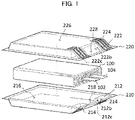
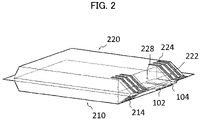
- FIGS. 1 and 2 are schematic perspective views illustrating a secondary battery including a pouch for a secondary battery in accordance with exemplary embodiments.
- FIG. 1 is an exploded perspective view of a secondary battery.
- FIG. 2 is a perspective view illustrating a secondary battery in a sealed state of the pouch for a secondary battery of in FIG. 1 .
- FIGS. 1 and 2 a pouch for a secondary battery and a secondary battery according to embodiments of the present invention will be described together with reference to FIGS. 1 and 2 .
- FIG. 1 for convenience of descriptions, a first pouch cup 210 and a second pouch cup 210 are illustrated as being separated from each other, but the first pouch cup 210 and the second pouch cup 210 may be integrally connected to each other.
- illustration of a battery cell 100 is omitted in FIG. 2 .
- a pouch for a secondary battery may include a first pouch cup 210 and a second pouch cup 220.
- the first pouch cup 210 and the second pouch cup may have substantially the same shape.
- the secondary battery may include the battery cell 100 accommodated in the pouch.
- the battery cell 100 may include an electrode assembly.
- the electrode assembly may include repeatedly stacked electrodes and a separation layer disposed between the electrodes.
- Each of the electrodes may include an active material layer formed on an electrode current collector.
- the electrodes may include an anode and a cathode.
- the electrode current collector may include a cathode current collector included in the cathode and an anode current collector included in the anode.
- the active material layer may include a cathode active material layer included in the cathode and an anode active material layer included in the anode.
- the cathode may include the cathode current collector and the cathode active material layer formed by coating a cathode active material on the cathode current collector.
- the cathode active material may include a compound capable of reversibly intercalating and deintercalating lithium ions.
- the secondary battery may be provided as a lithium secondary battery.
- the cathode active material may include lithium-transition metal composite oxide particles.
- the lithium-transition metal composite oxide contained in the lithium-transition metal composite oxide particles may include a lithium-manganese oxide, a lithium-cobalt-based oxide, a lithium-nickel-based oxide, a lithium-manganese-cobalt-based oxide, etc.
- the lithium-transition metal composite oxide particles may include nickel (Ni), and may further include at least one of cobalt (Co) and manganese (Mn).
- the lithium-transition metal composite oxide particles may be represented by Chemical Formula 1 below.
- Chemical Formula 1 Li x Ni 1-y M y O 2-z X z
- M may represent at least one element selected from Na, Mg, Ca, Y, Ti, Zr, Hf, V, Nb, Ta, Cr, Mo, W, Mn, Co, Fe, Cu, Ag, Zn, B, Al, Ga, C, Si, Sn or Zr.
- X may represent at least one element selected from O, F, S and P.
- a molar ratio (1-y) of nickel in Chemical Formula 1 may be in a range from 0.8 to 0.95.
- power and capacity may be increased using a high-nickel (High-Ni) cathode composition.
- High-Ni high-nickel
- generation of gas due to a side reaction between the cathode active material and an electrolyte may be increased.
- the lithium-transition metal composite oxide particles may be represented by Chemical Formula 2 below, and may have an olivine structure.
- Chemical Formula 2 LiMPO 4
- M may be at least one element selected from Fe, Mn, Ni, Co, and V.
- the cathode current collector may include a metallic material that may not be reactive in a charge/discharge voltage range of the lithium secondary battery, and may be easily coated and adhered to the electrode active material.
- the cathode current collector may include, e.g., stainless steel, nickel, aluminum, titanium, copper, zinc or an alloy thereof, preferably aluminum or an aluminum alloy.
- a slurry may be prepared by mixing and stirring the cathode active material with a binder, a conductive material and/or a dispersive agent in a solvent.
- the slurry may be coated on the cathode current collector, and then dried and pressed to form the cathode including the cathode active material layer
- the binder may include an organic based binder such as a polyvinylidene fluoride-hexafluoropropylene copolymer (PVDF-co-HFP), polyvinylidenefluoride (PVDF), polyacrylonitrile, polymethylmethacrylate, etc., or an aqueous based binder such as styrene-butadiene rubber (SBR) that may be used with a thickener such as carboxymethyl cellulose (CMC).
- organic based binder such as a polyvinylidene fluoride-hexafluoropropylene copolymer (PVDF-co-HFP), polyvinylidenefluoride (PVDF), polyacrylonitrile, polymethylmethacrylate, etc.
- an aqueous based binder such as styrene-butadiene rubber (SBR) that may be used with a thickener such as carboxymethyl cellulose (CMC).
- SBR
- a PVDF-based binder may be used as a cathode binder.
- an amount of the binder for forming the cathode active material layer may be reduced, and an amount of the cathode active material may be relatively increased.
- capacity and power of the secondary battery may be further improved.
- the conductive material may be added to facilitate electron mobility between active material particles.
- the conductive material may include a carbon-based material such as graphite, carbon black, graphene, carbon nanotube, etc., and/or a metal-based material such as tin, tin oxide, titanium oxide, a perovskite material such as LaSrCoO 3 or LaSrMnO 3 , etc.
- the anode may include the anode current collector and the anode active material layer formed by coating the anode active material on the anode current collector.
- the anode active material may include a material commonly used in the related art which may be capable of adsorbing and ejecting lithium ions.
- a carbon-based material such as a crystalline carbon, an amorphous carbon, a carbon complex or a carbon fiber, a lithium alloy, a silicon (Si)-based compound, etc., may be used.
- the amorphous carbon may include a hard carbon, cokes, a mesocarbon microbead (MCMB), a mesophase pitch-based carbon fiber (MPCF), etc.
- MCMB mesocarbon microbead
- MPCF mesophase pitch-based carbon fiber
- the crystalline carbon may include a graphite-based material such as natural graphite, graphitized cokes, graphitized MCMB, graphitized MPCF, etc.
- the lithium alloy may further include aluminum, zinc, bismuth, cadmium, antimony, silicon, lead, tin, gallium, indium, etc.
- the anode active material may include the silicon-based active material to provide a high-capacity lithium secondary battery.
- the silicon-based active material may include SiOx (0 ⁇ x ⁇ 2) or SiOx (0 ⁇ x ⁇ 2) containing a lithium compound.
- SiOx containing the Li compound may be SiOx containing a lithium silicate.
- the lithium silicate may be present in at least a portion of an SiOx (0 ⁇ x ⁇ 2) particle.
- lithium silicate may be present at an inside and/or on a surface of the SiOx (0 ⁇ x ⁇ 2) particle.
- the lithium silicate may include Li 2 SiO 3 , Li 2 Si 2 O 5 , Li 4 SiO 4 , Li 4 Si 3 O 8 , etc.
- the silicon-based active material may include, e.g., a silicon-carbon composite compound such as silicon carbide (SiC).
- the anode current collector may include gold, stainless steel, nickel, aluminum, titanium, copper or an alloy thereof, preferably may include copper or a copper alloy.
- a slurry may be prepared by mixing and stirring the anode active material with a binder, a conductive material and/or a dispersive agent in a solvent.
- the slurry may be coated on the anode current collector, and then dried and pressed to form the anode including the anode active material layer.
- the binder and the conductive material substantially the same as or similar to those used for forming the cathode may be used in the anode.
- the binder for forming the anode may include, e.g., an aqueous binder such as styrene-butadiene rubber (SBR) for compatibility with the carbon-based active material, and may be used together with a thickener such as carboxymethyl cellulose (CMC).
- SBR styrene-butadiene rubber
- CMC carboxymethyl cellulose
- the separation layer may be interposed between the cathode and the anode.
- the separation layer 140 include a porous polymer film prepared from, e.g., a polyolefin-based polymer such as an ethylene homopolymer, a propylene homopolymer, an ethylene/butene copolymer, an ethylene/hexene copolymer, an ethylene/methacrylate copolymer, or the like.
- the separation layer may also include a non-woven fabric formed from a glass fiber with a high melting point, a polyethylene terephthalate fiber, or the like.
- an electrode cell may be defined by the cathode, the anode and the separation layer, and a plurality of the electrode cells may be stacked to form the electrode assembly.
- the battery cell may be accommodated together with an electrolyte in the pouch for a secondary battery according to exemplary embodiments to define the secondary battery.
- a non-aqueous electrolyte may be used as the electrolyte.
- the non-aqueous electrolyte solution may include a lithium salt and an organic solvent.
- the lithium salt may be represented by Li + X - , and an anion of the lithium salt X - may include, e.g., F - , Cl - , Br - , I - , NO 3 - , N(CN) 2 - , BF 4 - , ClO 4 - , PF 6 - , (CF 3 ) 2 PF 4 - , (CF 3 ) 3 PF 3 - , (CF 3 ) 4 PF 2 - , (CF 3 ) 5 PF - , (CF 3 ) 6 P - , CF 3 SO 3 - , CF 3 CF 2 SO 3 - , (CF 3 SO 2 ) 2 N - , (FSO 2 ) 2 N - , CF 3 CF 2 (CF 3 ) 2 CO - , (CF 3 SO 2 ) 2 CH - ,
- the organic solvent may include, e.g., propylene carbonate (PC), ethylene carbonate (EC), diethyl carbonate (DEC), dimethyl carbonate (DMC), ethylmethyl carbonate (EMC), methylpropyl carbonate, dipropyl carbonate, dimethyl sulfoxide, acetonitrile, dimethoxy ethane, diethoxy ethane, vinylene carbonate, sulfolane, gamma-butyrolactone, propylene sulfite, tetrahydrofuran, etc. These may be used alone or in a combination of two or more therefrom.
- PC propylene carbonate
- EC ethylene carbonate
- DEC diethyl carbonate
- DMC dimethyl carbonate
- EMC ethylmethyl carbonate
- methylpropyl carbonate dipropyl carbonate
- dimethyl sulfoxide acetonitrile
- dimethoxy ethane diethoxy
- the electrode current collector may include a notched portion (not illustrated).
- the notched portion may serve as, e.g., an electrode tab.
- the notched portion may include a cathode notched potion protruding from the cathode current collector and an anode notched portion protruding from the anode current collector.
- Electrode leads 102 and 104 may be electrically connected to the notched portions, and may be exposed to an outside of the pouch.
- the electrode leads 102 and 104 may serve as external connection leads for applying a power to the secondary battery.
- the electrode leads may include a cathode lead 102 and an anode lead 104.
- the cathode lead 102 and the anode lead 104 may be disposed at both opposite sides of the secondary battery. In an embodiment, the cathode lead 102 and the anode lead 104 may be fused together at one side of the pouch.
- Each pouch cup of the pouch for a secondary battery may include an inner resin layer and an outer resin layer.
- the inner resin layer may include a polyolefin resin, a copolymer of ethylene and an acrylic acid, a copolymer of propylene and an acrylic acid, etc.
- the polyolefin resin may include unstretched polypropylene, polypropylene-butylene-ethylene terpolymer, polypropylene, a chlorinated polypropylene (CPP) resin, polyethylene, ethylene propylene copolymer, etc.
- the inner resin layer may include a polymer resin having enhanced electrolyte resistance.
- the outer resin layer may have a single-layered structure or a multi-layered structure including, e.g., polyethylene, polypropylene, polyethylene terephthalate, nylon, a low density polyethylene (LDPE), a high density polyethylene (HDPE), a linear low density polyethylene (LLDPE), etc.
- the outer resin layer may be laminated on the inner resin layer to prevent a direct exposure of the inner resin layer.
- Each thickness of the inner resin layer or the outer resin layer may be from 5 ⁇ m to 100 ⁇ m, e.g., from 10 ⁇ m to 80 ⁇ m.
- the pouch for a secondary battery pouch includes a tab receiving portion 218 and 228 communicating with one end of the battery cell accommodating portion 216 and 226, and a supporting portion having a space separated or divided from the tab receiving portion 212 and 222.
- the supporting portion may include two or more first supporting portions 212 and two or more second supporting portions 222.
- a pair of the first supporting portions 212 may be disposed to be spaced apart from each other with the first tab receiving portion 218 interposed therebetween.
- the first supporting portion 212 may be disposed at each of both sides of the first tab receiving portion 218.
- a pair of the second supporting portions 222 may be disposed to be spaced apart from each other with the second tab receiving portion 228 interposed therebetween.
- the second supporting portion 222 may be disposed at each of both sides of the second tab receiving portion 228.
- the first supporting portion 212 and the second supporting portion 222 may face each other in a thickness direction. In exemplary embodiments, at least a portion of a top surface of the first support portion 212 and at least a portion of a bottom surface of the second supporting portion 222 may contact each other.
- the first supporting portion 212 may have a space (e.g., a first space) separated from the first tab receiving portion 218 and the first battery cell accommodating portion 216 by a first inner wall 212b.
- the second supporting portion 222 may have a space (e.g., a second space) separated from the second tab receiving portion 228 and the second battery cell accommodating portion 226 by a second inner wall 222b.
- first supporting portions 212 and the second supporting portions 222 may face each other in the thickness direction.
- the first pouch cup 210 and the second pouch cup 220 may be aligned and coupled with each other so that the first supporting portion 212 and the second supporting portion 222 may contact or face each other.
- the electrode leads 102 and 104 may not be in contact with the first supporting portion 212 and the second supporting portion 222, and may be partially disposed in the tab receiving portion 218 and 228 to protrude to an outside of the pouch.
- the pouch may include one first supporting portion 212 and one second supporting portion 222.
- the first supporting portion 212 may be disposed under the first tab receiving portion 218 so that a top surface of the first supporting portion 212 may contact a bottom surface of at least one of the electrode leads 102 and 104.
- the second supporting portion 222 may be disposed on the second tab receiving portion 228 so that the bottom surface of the second supporting portion 222 may contact a top surface of at least one of the electrode leads 102 and 104.
- the top surface of the first supporting portion 212 may be in contact with the bottom surfaces of the supporting portion 222 and the electrode lead 102 and 104.
- the bottom surface of the second supporting portion 222 may be in contact with the top surfaces of the first supporting portion 212 and the electrode lead 102 and 104.
- the first supporting portion 212 may be disposed at each of a front end portion and a rear end portion in a length direction of the pouch.
- the top surface of the first supporting portion 212 disposed at the front end portion may be in contact with or adjacent to the electrode lead 102 and 104.
- the second supporting portion 222 may be disposed to be symmetrical with the first supporting portion 212 in the thickness direction.
- one of the plurality of the first supporting portions 212 may be in contact with or adjacent to the anode lead 102, and the other one may be in contact with or adjacent to the anode lead 104.
- the second supporting portion 222 may be disposed to be symmetrical with the first supporting portion 212 in the thickness direction.
- the pouch for a secondary battery may include a reinforcing film 214 and 224 attached to an outer wall 212c and 222c of the supporting portion 212 and 222.
- the reinforcing film 214 and 224 may include a different material from that of the outer wall 212c and 222c.
- the outer wall 212c and 222c may be a part of the pouch cup 210 and 220.
- the reinforcing films 214 and 224 may include a first reinforcing film 214 and a second reinforcing film 224 attached on the outer wall 212c of the first supporting portion 212 and the outer wall 222c of the second supporting portion 222, respectively.
- One end of the first reinforcing film 214 may be located on at least a portion of an outer bottom surface of the first battery cell accommodating portion 216, and one end of the second reinforcing film 224 may be located on at least a portion of an outer top surface of the second battery cell accommodating portion 226.
- the reinforcing film 214 and 224 may be provided as a film that may fuse the outer walls 212c and 222c of the supporting portions 212 and 222 and columns 222a (see, e.g., FIG. 3 ) with each other.
- the reinforcing film 214, 224 may include an amorphous polyolefin.
- the amorphous polyolefin may be an amorphous polypropylene.
- the reinforcing film 214 and 224 may be easily adhered to the supporting portions 212 and 222 through a simple process.
- first reinforcing films 214 may be formed on an outer surface of the first pouch cup 210, e.g., the outer wall of the supporting portion 212 to be spaced apart from each other.
- a plurality of the second reinforcing films 224 may be formed on an outer surface of the second pouch cup 220, e.g., the outer wall of the supporting portion 222 to be spaced apart from each other.
- the first reinforcing film 214 and the second reinforcing film 224 may disperse a pressure applied to each of the first supporting portion 212 and the second supporting portion 222 from the inside of the battery cell accommodating portions 216 and 226 in a short axis direction.
- a spacing between the outer wall of the first supporting portion 212 and first columns to be described later or a spacing between the outer wall of the second supporting portion 222 and the second columns 222a may be stably maintained.
- each length of the first reinforcing film 214 and the second reinforcing film 224 may be greater than a length of the outer wall of the first supporting portion 212 or the second supporting portion 222 (e.g., a length of a lateral side of the outer wall).
- the reinforcing film 214 and 224 may extend on the outer surface of the battery cell receiving portions 216 and 226 of the pouch cups 216 and 226, the outer wall of the supporting portions 212 and 222, and an end portion of the pouch cups 210 and 220.
- mechanical stability of the first outer wall 212c may be further increased in a long axis direction by the first reinforcing film 214
- mechanical stability of the second outer wall 222c may be further increased in the long axis direction by the second reinforcing film 224.
- the pressure applied to the first supporting portion 212 and the second supporting portion 222 from the inside of the battery cell accommodating portions 216 and 226, respectively may be dispersed in a stepwise manner until the first supporting portion 212 and the second supporting portion 222 may be completely vented.
- the spacing between the supporting portions 212 and 222 and the pouch cups 210 and 220 may be uniformly induced from a first row of columns to be described later, and a pressure change at the inside of the pouch may be effectively delayed.
- An insulating member (not illustrated) may be wound around a portion of each of the electrode leads 102 and 104 to prevent an electrical short circuit.
- the electrode assembly included in the battery cell 100 is illustrated as a wound type in FIG. 1 , but the electrode assembly may have, e.g., a stacked shape or a folded jelly-roll shape.
- first pouch cup 210 and the second pouch cup 220 may be a single or unitary member integrally connected to each other. In this case, an area of a sealing surface or a bonding surface of the first pouch cup 210 and the second pouch cup 220 may be reduced.
- first pouch cup 210 and the second pouch cup 220 are an integral member, a connecting region of the pouch cups 210 and 220 may be formed at any one side of each pouch cup 210 and 220.
- the first supporting portion 212 and the second supporting portion 222 may be formed of the same material as that of the above-described inner resin layer.
- the supporting portions 212 and 222 may include a polyolefin resin, a copolymer of ethylene and an acrylic acid, a copolymer of propylene and an acrylic acid, etc.
- the polyolefin resin may include unstretched polypropylene, polypropylene-butylene-ethylene terpolymer, polypropylene, a chlorinated polypropylene (CPP) resin, polyethylene, ethylene propylene copolymer, etc.
- CPP chlorinated polypropylene
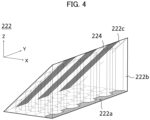
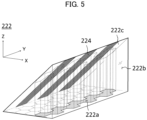
- FIGS. 3 to 5 are schematic perspective views illustrating a second supporting portion in accordance with exemplary embodiments.
- FIGS. 3 to 5 provide perspective views of the second supporting portion, and the first supporting portion may have a structure and a shape substantially the same or similar to those of the second supporting portion
- the second supporting portion 222 may include at least one second column 222a and at least one pressing pattern 222c.
- a plurality of the second columns 222a may be included in the second supporting portion 222, and a bottom surface of each of the second columns 222a may have a polygonal shape.
- the second column 222a may have a hollow structure.
- the second column 222a may have a hexagonal cross-section.
- an external force applied to the second supporting portion 222 may be more easily dispersed or absorbed, and mechanical stability of the pouch may be further improved.
- the second columns 222a may have the same shape.
- the second columns 222a may have different shapes. For example, some of the second columns 222a may have a rectangular cross-section, and others of the second columns 222a may have a triangular cross-section.
- the second columns 222a may form a honeycomb structure. Accordingly, the external force applied to the second supporting portion 222 may be more easily dispersed or absorbed, and mechanical stability of the pouch may be further improved.
- An inner space partitioned by the second column may be a vacuum.
- a through hole may be connected to an outside of the pouch cup, and an inner space of the column may be vacuum-treated. Thereafter, the inner space of the column may be vacuum-treated by sealing the through hole.
- a plurality of the second columns 222a may be arranged in a Y-direction to form a column row, and the plurality of column rows may be arranged along an X-direction.
- a height of the column rows may sequentially decrease as a distance from the battery cell accommodating portion 216 increases.
- the shade-designated second columns 222a may have a 22-gonal cross-section.
- a second column row including the shade-designated second columns 222a may have a 38-gonal cross-section.
- the first column row indicated in FIG. 4 may be in an integral communication with the second battery cell accommodating portion 226 by an action of the second reinforcing film 224
- the second column row indicated in FIG. 5 may also be in an integral communication with the second battery cell accommodating portion 226 by an action of the second reinforcing film 224.
- the communication of the first column row and the communication of the second column row may be sequentially performed. For example, communications from the first column row to the fifth column row illustrated in FIGS. 4 and 5 may be sequentially performed.
- a pressure change at the inside of the pouch may be delayed in a stepwise manner, and life-span stability of the secondary battery may be improved.
Landscapes
- Chemical & Material Sciences (AREA)
- Chemical Kinetics & Catalysis (AREA)
- Electrochemistry (AREA)
- General Chemical & Material Sciences (AREA)
- Engineering & Computer Science (AREA)
- Manufacturing & Machinery (AREA)
- Sealing Battery Cases Or Jackets (AREA)
Abstract
A pouch for a secondary battery according to embodiments of the present invention includes a pouch cup having a battery cell accommodating portion, a tab receiving portion formed at one end portion of the pouch cup to be in communication with one end of the battery cell accommodating portion, a supporting portion adjacent to the tab accommodating portion at the one end portion of the pouch cup to be separated from the battery cell accommodating portion and the tab accommodating portion, the supporting portion comprising a plurality of columns therein, and a reinforcing film attached on an outer wall of the supporting portion, the reinforcing film having a material different from that of the outer wall of the supporting portion. A secondary battery including the pouch has improved stability to an external force and an internal pressure.
Description
- The present invention relates to a pouch for a secondary battery and a secondary battery including the same. More particularly, the present invention relates to a pouch for a secondary battery having a sealing portion and a secondary battery including the same.
- A secondary battery which can be charged and discharged repeatedly has been widely employed as a power source of a mobile electronic device such as a camcorder, a mobile phone, a laptop computer, etc., according to developments of information and display technologies. Further, a battery pack including the secondary battery is being developed and applied to a power source of an eco-friendly vehicle.
- The secondary battery includes, e.g., a lithium secondary battery, a nickel-cadmium battery, a nickel-hydrogen battery, etc. The lithium secondary battery is highlighted due to high operational voltage and energy density per unit weight, a high charging rate, a compact dimension, etc.
- For example, the lithium secondary battery may include an electrode assembly including a cathode, an anode and a separation layer (separator), and an electrolyte immersing the electrode assembly. The lithium secondary battery may further include an outer case having, e.g., a pouch shape.
- Gas may be generated from the electrode assembly and/or the electrolyte included in the lithium secondary battery by continuous charge/discharge repetition. For example, a lithium salt such as LiPF6 or LiBF4 in the electrolyte may react with a trace amount of an anion contained in the electrolyte to generate a free gas such as hydrofluoric acid or hydrochloric acid.
- According to an aspect of the present invention, there is provided a pouch for a secondary battery having improved operational reliability and stability.
- According to an aspect of the present invention, there is provided a secondary battery having improved operational reliability and stability.
- A pouch for a secondary battery according to embodiments of the present invention includes a pouch cup having a battery cell accommodating portion, a tab receiving portion formed at one end portion of the pouch cup to be in communication with one end of the battery cell accommodating portion, a supporting portion adjacent to the tab accommodating portion at the one end portion of the pouch cup to be separated from the battery cell accommodating portion and the tab accommodating portion, the supporting portion including a plurality of columns therein, and a reinforcing film attached on an outer wall of the supporting portion, the reinforcing film having a material different from that of the outer wall of the supporting portion.
- In some embodiments, the reinforcing film may serve as a fusion film between the outer wall of the supporting portion and the columns.
- In some embodiments, the reinforcing film may include an amorphous polyolefin.
- In some embodiments, the columns may have a hollow structure.
- In some embodiments, the columns may be coupled to the outer wall of the supporting portion to form a vacuum state.
- In some embodiments, the outer wall and the columns may be configured to be spaced apart by a gas entering from the battery cell accommodating portion so that the vacuum state is released.
- In some embodiments, the columns may have a polygonal column shape.
- In some embodiments, wherein the columns may be arranged in a honeycomb shape.
- In some embodiments, the columns may form a plurality of column rows within the supporting portion.
- In some embodiments, heights of the column rows may sequentially decrease as a distance from the battery cell accommodating portion increases.
- In some embodiments, the pouch cup may include a first pouch cup and a second pouch cup. The battery cell accommodating portion may include a first battery cell accommodating portion and a second battery cell accommodating portion formed in the first pouch cup and the second pouch cup, respectively. The tab receiving portion may include a first tab receiving portion and a second tab receiving portion formed in the first pouch cup and the second pouch cup, respectively. The supporting portion may include a first supporting portion and a second supporting portion formed in the first pouch cup and the second pouch cup, respectively. The reinforcing film may include a first reinforcing film and a second reinforcing film attached to outer walls of the first supporting portion and the second supporting portion, respectively.
- In some embodiments, the first pouch cup and the second pouch cup may be combined such that the first battery cell accommodating portion and the second battery cell accommodating portion may face each other, the first tab receiving portion and the second tab receiving portion may face each other, and the first supporting portion and the second supporting portion may face each other.
- In some embodiments, one end of the first reinforcing film may be located on at least a portion of an outer surface of the first battery cell accommodating portion, and one end of the second reinforcing film may be located on at least a portion of an outer surface of the second battery cell accommodating portion.
- A secondary battery according to embodiments of the present invention includes the pouch for a secondary battery according to embodiments as described above, and a battery cell accommodated in the pouch for the secondary battery.
- A pouch for a secondary battery pouch according to exemplary embodiments of the present invention may include a battery cell accommodating portion, a tab receiving portion, and a supporting portion, and the supporting portion may be adjacent to the tab receiving portion and may have a space separated from the tab receiving portion. In exemplary embodiments, mechanical stability of the pouch for a secondary battery may be increased by including the support portion.
- In exemplary embodiments, a sequential communication between the supporting portion and the battery cell accommodating portion may be induced by a reinforcing film attached to an outer wall of the supporting portion. Accordingly, an increase of pressure at an inside of the pouch may be delayed in a stepwise manner, and life-span of the pouch and the secondary battery may be enhanced.
-
-
FIGS. 1 and2 are schematic perspective views illustrating a secondary battery including a pouch for a secondary battery in accordance with exemplary embodiments. -
FIGS. 3 to 5 are schematic perspective views illustrating a second supporting portion in accordance with exemplary embodiments. - According to exemplary embodiments, a pouch for a secondary battery including a pouch cup and a supporting portion is disclosed. According to exemplary embodiments, A secondary battery including the pouch for a secondary battery is also provided.
- Hereinafter, the present invention will be described in detail with reference to the accompanying drawings. However, those skilled in the art will appreciate that such embodiments described with reference to the accompanying drawings are provided to further understand the spirit of the present invention and do not limit subject matters to be protected as disclosed in the detailed description and appended claims.
-
FIGS. 1 and2 are schematic perspective views illustrating a secondary battery including a pouch for a secondary battery in accordance with exemplary embodiments. For example,FIG. 1 is an exploded perspective view of a secondary battery.FIG. 2 is a perspective view illustrating a secondary battery in a sealed state of the pouch for a secondary battery of inFIG. 1 . - Hereinafter, a pouch for a secondary battery and a secondary battery according to embodiments of the present invention will be described together with reference to
FIGS. 1 and2 . - In
FIG. 1 , for convenience of descriptions, afirst pouch cup 210 and asecond pouch cup 210 are illustrated as being separated from each other, but thefirst pouch cup 210 and thesecond pouch cup 210 may be integrally connected to each other. For convenience of descriptions, illustration of abattery cell 100 is omitted inFIG. 2 . - Referring to
FIGS. 1 and2 , a pouch for a secondary battery (hereinafter, that may be abbreviated as a pouch) according to exemplary embodiments may include afirst pouch cup 210 and asecond pouch cup 220. Thefirst pouch cup 210 and the second pouch cup may have substantially the same shape. In exemplary embodiments, the secondary battery may include thebattery cell 100 accommodated in the pouch. - The
battery cell 100 may include an electrode assembly. The electrode assembly may include repeatedly stacked electrodes and a separation layer disposed between the electrodes. Each of the electrodes may include an active material layer formed on an electrode current collector. - The electrodes may include an anode and a cathode. The electrode current collector may include a cathode current collector included in the cathode and an anode current collector included in the anode. The active material layer may include a cathode active material layer included in the cathode and an anode active material layer included in the anode.
- The cathode may include the cathode current collector and the cathode active material layer formed by coating a cathode active material on the cathode current collector. The cathode active material may include a compound capable of reversibly intercalating and deintercalating lithium ions. In this case, the secondary battery may be provided as a lithium secondary battery.
- In exemplary embodiments, the cathode active material may include lithium-transition metal composite oxide particles. Examples of the lithium-transition metal composite oxide contained in the lithium-transition metal composite oxide particles may include a lithium-manganese oxide, a lithium-cobalt-based oxide, a lithium-nickel-based oxide, a lithium-manganese-cobalt-based oxide, etc. In some embodiments, the lithium-transition metal composite oxide particles may include nickel (Ni), and may further include at least one of cobalt (Co) and manganese (Mn).
- For example, the lithium-transition metal composite oxide particles may be represented by Chemical Formula 1 below.
[Chemical Formula 1] LixNi1-yMyO2-zXz
- In Chemical Formula 1, 0.9≤x≤1.1, 0≤y≤0.7, and -0.1≤z≤0.1. M may represent at least one element selected from Na, Mg, Ca, Y, Ti, Zr, Hf, V, Nb, Ta, Cr, Mo, W, Mn, Co, Fe, Cu, Ag, Zn, B, Al, Ga, C, Si, Sn or Zr. X may represent at least one element selected from O, F, S and P.
- In an embodiment, a molar ratio (1-y) of nickel in Chemical Formula 1 may be in a range from 0.8 to 0.95. In this case, power and capacity may be increased using a high-nickel (High-Ni) cathode composition. As a content of nickel included in the cathode active material increases, generation of gas due to a side reaction between the cathode active material and an electrolyte may be increased.
- In an embodiment, the lithium-transition metal composite oxide particles may be represented by Chemical Formula 2 below, and may have an olivine structure.
[Chemical Formula 2] LiMPO4
- In Chemical Formula 2, M may be at least one element selected from Fe, Mn, Ni, Co, and V.
- The cathode current collector may include a metallic material that may not be reactive in a charge/discharge voltage range of the lithium secondary battery, and may be easily coated and adhered to the electrode active material. For example, the cathode current collector may include, e.g., stainless steel, nickel, aluminum, titanium, copper, zinc or an alloy thereof, preferably aluminum or an aluminum alloy.
- For example, a slurry may be prepared by mixing and stirring the cathode active material with a binder, a conductive material and/or a dispersive agent in a solvent. The slurry may be coated on the cathode current collector, and then dried and pressed to form the cathode including the cathode active material layer
- The binder may include an organic based binder such as a polyvinylidene fluoride-hexafluoropropylene copolymer (PVDF-co-HFP), polyvinylidenefluoride (PVDF), polyacrylonitrile, polymethylmethacrylate, etc., or an aqueous based binder such as styrene-butadiene rubber (SBR) that may be used with a thickener such as carboxymethyl cellulose (CMC).
- For example, a PVDF-based binder may be used as a cathode binder. In this case, an amount of the binder for forming the cathode active material layer may be reduced, and an amount of the cathode active material may be relatively increased. Thus, capacity and power of the secondary battery may be further improved.
- The conductive material may be added to facilitate electron mobility between active material particles. For example, the conductive material may include a carbon-based material such as graphite, carbon black, graphene, carbon nanotube, etc., and/or a metal-based material such as tin, tin oxide, titanium oxide, a perovskite material such as LaSrCoO3 or LaSrMnO3, etc.
- The anode may include the anode current collector and the anode active material layer formed by coating the anode active material on the anode current collector.
- The anode active material may include a material commonly used in the related art which may be capable of adsorbing and ejecting lithium ions. For example, a carbon-based material such as a crystalline carbon, an amorphous carbon, a carbon complex or a carbon fiber, a lithium alloy, a silicon (Si)-based compound, etc., may be used.
- The amorphous carbon may include a hard carbon, cokes, a mesocarbon microbead (MCMB), a mesophase pitch-based carbon fiber (MPCF), etc.
- The crystalline carbon may include a graphite-based material such as natural graphite, graphitized cokes, graphitized MCMB, graphitized MPCF, etc. The lithium alloy may further include aluminum, zinc, bismuth, cadmium, antimony, silicon, lead, tin, gallium, indium, etc.
- In an embodiment, the anode active material may include the silicon-based active material to provide a high-capacity lithium secondary battery. The silicon-based active material may include SiOx (0<x<2) or SiOx (0<x<2) containing a lithium compound. SiOx containing the Li compound may be SiOx containing a lithium silicate. The lithium silicate may be present in at least a portion of an SiOx (0<x<2) particle. For example, lithium silicate may be present at an inside and/or on a surface of the SiOx (0<x<2) particle. In an embodiment, the lithium silicate may include Li2SiO3, Li2Si2O5, Li4SiO4, Li4Si3O8, etc.
- The silicon-based active material may include, e.g., a silicon-carbon composite compound such as silicon carbide (SiC).
- The anode current collector may include gold, stainless steel, nickel, aluminum, titanium, copper or an alloy thereof, preferably may include copper or a copper alloy.
- For example, a slurry may be prepared by mixing and stirring the anode active material with a binder, a conductive material and/or a dispersive agent in a solvent. The slurry may be coated on the anode current collector, and then dried and pressed to form the anode including the anode active material layer.
- The binder and the conductive material substantially the same as or similar to those used for forming the cathode may be used in the anode. In some embodiments, the binder for forming the anode may include, e.g., an aqueous binder such as styrene-butadiene rubber (SBR) for compatibility with the carbon-based active material, and may be used together with a thickener such as carboxymethyl cellulose (CMC).
- The separation layer may be interposed between the cathode and the anode. The separation layer 140 include a porous polymer film prepared from, e.g., a polyolefin-based polymer such as an ethylene homopolymer, a propylene homopolymer, an ethylene/butene copolymer, an ethylene/hexene copolymer, an ethylene/methacrylate copolymer, or the like. The separation layer may also include a non-woven fabric formed from a glass fiber with a high melting point, a polyethylene terephthalate fiber, or the like.
- In exemplary embodiments, an electrode cell may be defined by the cathode, the anode and the separation layer, and a plurality of the electrode cells may be stacked to form the electrode assembly.
- The battery cell may be accommodated together with an electrolyte in the pouch for a secondary battery according to exemplary embodiments to define the secondary battery. In exemplary embodiments, a non-aqueous electrolyte may be used as the electrolyte.
- The non-aqueous electrolyte solution may include a lithium salt and an organic solvent. The lithium salt may be represented by Li+X- , and an anion of the lithium salt X- may include, e.g., F-, Cl-, Br-, I-, NO3 -, N(CN)2 -, BF4 -, ClO4 -, PF6 -, (CF3)2PF4 -, (CF3)3PF3 -, (CF3)4PF2 -, (CF3)5PF-, (CF3)6P-, CF3SO3 -, CF3CF2SO3 -, (CF3SO2)2N-, (FSO2)2N-, CF3CF2(CF3)2CO-, (CF3SO2)2CH-, (SF5)3C-, (CF3SO2)3C-, CF3(CF2)7SO3 -, CF3CO2 -, CH3CO2 -, SCN-, (CF3CF2SO2)2N-, etc.
- The organic solvent may include, e.g., propylene carbonate (PC), ethylene carbonate (EC), diethyl carbonate (DEC), dimethyl carbonate (DMC), ethylmethyl carbonate (EMC), methylpropyl carbonate, dipropyl carbonate, dimethyl sulfoxide, acetonitrile, dimethoxy ethane, diethoxy ethane, vinylene carbonate, sulfolane, gamma-butyrolactone, propylene sulfite, tetrahydrofuran, etc. These may be used alone or in a combination of two or more therefrom.
- The electrode current collector may include a notched portion (not illustrated). The notched portion may serve as, e.g., an electrode tab. The notched portion may include a cathode notched potion protruding from the cathode current collector and an anode notched portion protruding from the anode current collector.
- Electrode leads 102 and 104 may be electrically connected to the notched portions, and may be exposed to an outside of the pouch. The electrode leads 102 and 104 may serve as external connection leads for applying a power to the secondary battery. The electrode leads may include a
cathode lead 102 and ananode lead 104. - In an embodiment, the
cathode lead 102 and theanode lead 104 may be disposed at both opposite sides of the secondary battery. In an embodiment, thecathode lead 102 and theanode lead 104 may be fused together at one side of the pouch. - Each pouch cup of the pouch for a secondary battery according to exemplary embodiments may include an inner resin layer and an outer resin layer.
- In some embodiments, the inner resin layer may include a polyolefin resin, a copolymer of ethylene and an acrylic acid, a copolymer of propylene and an acrylic acid, etc. Examples of the polyolefin resin may include unstretched polypropylene, polypropylene-butylene-ethylene terpolymer, polypropylene, a chlorinated polypropylene (CPP) resin, polyethylene, ethylene propylene copolymer, etc. The inner resin layer may include a polymer resin having enhanced electrolyte resistance.
- The outer resin layer may have a single-layered structure or a multi-layered structure including, e.g., polyethylene, polypropylene, polyethylene terephthalate, nylon, a low density polyethylene (LDPE), a high density polyethylene (HDPE), a linear low density polyethylene (LLDPE), etc. The outer resin layer may be laminated on the inner resin layer to prevent a direct exposure of the inner resin layer.
- Each thickness of the inner resin layer or the outer resin layer may be from 5 µm to 100 µm, e.g., from 10 µm to 80 µm.
- The pouch for a secondary battery pouch according to exemplary embodiments includes a
tab receiving portion cell accommodating portion tab receiving portion - In some embodiments, the supporting portion may include two or more first supporting
portions 212 and two or more second supportingportions 222. - In an embodiment, a pair of the first supporting
portions 212 may be disposed to be spaced apart from each other with the firsttab receiving portion 218 interposed therebetween. For example, the first supportingportion 212 may be disposed at each of both sides of the firsttab receiving portion 218. - In an embodiment, a pair of the second supporting
portions 222 may be disposed to be spaced apart from each other with the secondtab receiving portion 228 interposed therebetween. For example, the second supportingportion 222 may be disposed at each of both sides of the secondtab receiving portion 228. - The first supporting
portion 212 and the second supportingportion 222 may face each other in a thickness direction. In exemplary embodiments, at least a portion of a top surface of thefirst support portion 212 and at least a portion of a bottom surface of the second supportingportion 222 may contact each other. - The first supporting
portion 212 may have a space (e.g., a first space) separated from the firsttab receiving portion 218 and the first batterycell accommodating portion 216 by a firstinner wall 212b. The second supportingportion 222 may have a space (e.g., a second space) separated from the secondtab receiving portion 228 and the second batterycell accommodating portion 226 by a secondinner wall 222b. - If a plurality of the first supporting
portions 212 and the second supportingportions 222 are included, at least one of the first supportingportions 212 and at least one of the second supportingportions 222 may face each other in the thickness direction. Thefirst pouch cup 210 and thesecond pouch cup 220 may be aligned and coupled with each other so that the first supportingportion 212 and the second supportingportion 222 may contact or face each other. - The electrode leads 102 and 104 may not be in contact with the first supporting
portion 212 and the second supportingportion 222, and may be partially disposed in thetab receiving portion - In some embodiments, the pouch may include one first supporting
portion 212 and one second supportingportion 222. - In this case, the first supporting
portion 212 may be disposed under the firsttab receiving portion 218 so that a top surface of the first supportingportion 212 may contact a bottom surface of at least one of the electrode leads 102 and 104. The second supportingportion 222 may be disposed on the secondtab receiving portion 228 so that the bottom surface of the second supportingportion 222 may contact a top surface of at least one of the electrode leads 102 and 104. - For example, the top surface of the first supporting
portion 212 may be in contact with the bottom surfaces of the supportingportion 222 and theelectrode lead portion 222 may be in contact with the top surfaces of the first supportingportion 212 and theelectrode lead - In some embodiments, the first supporting
portion 212 may be disposed at each of a front end portion and a rear end portion in a length direction of the pouch. For example, the top surface of the first supportingportion 212 disposed at the front end portion may be in contact with or adjacent to theelectrode lead portion 222 may be disposed to be symmetrical with the first supportingportion 212 in the thickness direction. - If the electrode leads 102 and 104 are located at opposite sides (e.g., the front end portion and the rear end portion), one of the plurality of the first supporting
portions 212 may be in contact with or adjacent to theanode lead 102, and the other one may be in contact with or adjacent to theanode lead 104. The second supportingportion 222 may be disposed to be symmetrical with the first supportingportion 212 in the thickness direction. - In exemplary embodiments, the pouch for a secondary battery may include a reinforcing
film outer wall portion film outer wall outer wall pouch cup - The reinforcing
films film 214 and a second reinforcingfilm 224 attached on theouter wall 212c of the first supportingportion 212 and theouter wall 222c of the second supportingportion 222, respectively. - One end of the first reinforcing
film 214 may be located on at least a portion of an outer bottom surface of the first batterycell accommodating portion 216, and one end of the second reinforcingfilm 224 may be located on at least a portion of an outer top surface of the second batterycell accommodating portion 226. - In some embodiments, the reinforcing
film outer walls portions columns 222a (see, e.g.,FIG. 3 ) with each other. - In some embodiments, the reinforcing
film film portions - As illustrated in
FIGS. 1 and2 , a plurality of first reinforcing films 214 (e.g., six first reinforcing films) may be formed on an outer surface of thefirst pouch cup 210, e.g., the outer wall of the supportingportion 212 to be spaced apart from each other. - A plurality of the second reinforcing films 224 (e.g., six second reinforcing films) may be formed on an outer surface of the
second pouch cup 220, e.g., the outer wall of the supportingportion 222 to be spaced apart from each other. - The first reinforcing
film 214 and the second reinforcingfilm 224 may disperse a pressure applied to each of the first supportingportion 212 and the second supportingportion 222 from the inside of the batterycell accommodating portions - Thus, a spacing between the outer wall of the first supporting
portion 212 and first columns to be described later or a spacing between the outer wall of the second supportingportion 222 and thesecond columns 222a may be stably maintained. - In some embodiments, each length of the first reinforcing
film 214 and the second reinforcingfilm 224 may be greater than a length of the outer wall of the first supportingportion 212 or the second supporting portion 222 (e.g., a length of a lateral side of the outer wall). - Accordingly, the reinforcing
film cell receiving portions portions outer wall 212c may be further increased in a long axis direction by the first reinforcingfilm 214, and mechanical stability of the secondouter wall 222c may be further increased in the long axis direction by the second reinforcingfilm 224. - Further, when the pressure applied to the first supporting
portion 212 and the second supportingportion 222 from the inside of the batterycell accommodating portions portion 212 and the second supportingportion 222 may be completely vented. - Additionally, the spacing between the supporting
portions - An insulating member (not illustrated) may be wound around a portion of each of the electrode leads 102 and 104 to prevent an electrical short circuit.
- For convenience of illustration, the electrode assembly included in the
battery cell 100 is illustrated as a wound type inFIG. 1 , but the electrode assembly may have, e.g., a stacked shape or a folded jelly-roll shape. - As described above, the
first pouch cup 210 and thesecond pouch cup 220 may be a single or unitary member integrally connected to each other. In this case, an area of a sealing surface or a bonding surface of thefirst pouch cup 210 and thesecond pouch cup 220 may be reduced. - If the
first pouch cup 210 and thesecond pouch cup 220 are an integral member, a connecting region of the pouch cups 210 and 220 may be formed at any one side of eachpouch cup - The first supporting
portion 212 and the second supportingportion 222 may be formed of the same material as that of the above-described inner resin layer. For example, the supportingportions -
FIGS. 3 to 5 are schematic perspective views illustrating a second supporting portion in accordance with exemplary embodiments. For convenience of explanation,FIGS. 3 to 5 provide perspective views of the second supporting portion, and the first supporting portion may have a structure and a shape substantially the same or similar to those of the second supporting portion - Referring to
FIGS. 3 to 5 , the second supportingportion 222 may include at least onesecond column 222a and at least onepressing pattern 222c. - For example, a plurality of the
second columns 222a may be included in the second supportingportion 222, and a bottom surface of each of thesecond columns 222a may have a polygonal shape. Thesecond column 222a may have a hollow structure. - As illustrated in
FIG. 3 , in some embodiments, thesecond column 222a may have a hexagonal cross-section. In this case, an external force applied to the second supportingportion 222 may be more easily dispersed or absorbed, and mechanical stability of the pouch may be further improved. - If a plurality of the
second columns 222a are included in the second supportingportion 222, thesecond columns 222a may have the same shape. - In an embodiment, the
second columns 222a may have different shapes. For example, some of thesecond columns 222a may have a rectangular cross-section, and others of thesecond columns 222a may have a triangular cross-section. - As illustrated in
FIG. 3 , thesecond columns 222a may form a honeycomb structure. Accordingly, the external force applied to the second supportingportion 222 may be more easily dispersed or absorbed, and mechanical stability of the pouch may be further improved. - An inner space partitioned by the second column may be a vacuum.
- For example, a through hole may be connected to an outside of the pouch cup, and an inner space of the column may be vacuum-treated. Thereafter, the inner space of the column may be vacuum-treated by sealing the through hole.
- In some embodiments, a plurality of the
second columns 222a may be arranged in a Y-direction to form a column row, and the plurality of column rows may be arranged along an X-direction. A height of the column rows may sequentially decrease as a distance from the batterycell accommodating portion 216 increases. - As illustrated in
FIG. 4 , the shade-designatedsecond columns 222a (e.g., the first column row) may have a 22-gonal cross-section. - As illustrated in
FIG. 5 , a second column row including the shade-designatedsecond columns 222a may have a 38-gonal cross-section. - The first column row indicated in
FIG. 4 may be in an integral communication with the second batterycell accommodating portion 226 by an action of the second reinforcingfilm 224, and the second column row indicated inFIG. 5 may also be in an integral communication with the second batterycell accommodating portion 226 by an action of the second reinforcingfilm 224. - The communication of the first column row and the communication of the second column row may be sequentially performed. For example, communications from the first column row to the fifth column row illustrated in
FIGS. 4 and5 may be sequentially performed. - Accordingly, a pressure change at the inside of the pouch may be delayed in a stepwise manner, and life-span stability of the secondary battery may be improved.
Claims (14)
- A pouch for a secondary battery, comprising:a pouch cup having a battery cell accommodating portion;a tab receiving portion formed at one end portion of the pouch cup to be in communication with one end of the battery cell accommodating portion;a supporting portion adjacent to the tab accommodating portion at the one end portion of the pouch cup to be separated from the battery cell accommodating portion and the tab accommodating portion, the supporting portion comprising a plurality of columns therein; anda reinforcing film attached on an outer wall of the supporting portion, the reinforcing film having a material different from that of the outer wall of the supporting portion.
- The pouch for a secondary battery according to claim 1, wherein the reinforcing film serves as a fusion film between the outer wall of the supporting portion and the columns.
- The pouch for a secondary battery according to claim 1, wherein the reinforcing film comprises an amorphous polyolefin.
- The pouch for a secondary battery of claim 1, wherein the columns have a hollow structure.
- The pouch for a secondary battery according to claim 4, wherein the columns are coupled to the outer wall of the supporting portion to form a vacuum state.
- The pouch for a secondary battery according to claim 5, wherein the outer wall and the columns are configured to be spaced apart by a gas entering from the battery cell accommodating portion so that the vacuum state is released.
- The pouch for a secondary battery of claim 6, wherein the columns have a polygonal column shape.
- The pouch for a secondary battery of claim 7, wherein the columns are arranged in a honeycomb shape.
- The pouch for a secondary battery of claim 7, wherein the columns form a plurality of column rows within the supporting portion.
- The pouch for a secondary battery of claim 9, wherein heights of the column rows sequentially decrease as a distance from the battery cell accommodating portion increases.
- The pouch for a secondary battery of claim 1, wherein the pouch cup comprises a first pouch cup and a second pouch cup,the battery cell accommodating portion comprises a first battery cell accommodating portion and a second battery cell accommodating portion formed in the first pouch cup and the second pouch cup, respectively,the tab receiving portion comprises a first tab receiving portion and a second tab receiving portion formed in the first pouch cup and the second pouch cup, respectively,the supporting portion comprises a first supporting portion and a second supporting portion formed in the first pouch cup and the second pouch cup, respectively, andthe reinforcing film comprises a first reinforcing film and a second reinforcing film attached to outer walls of the first supporting portion and the second supporting portion, respectively.
- The pouch for a secondary battery of claim 11, wherein the first pouch cup and the second pouch cup are combined such that the first battery cell accommodating portion and the second battery cell accommodating portion face each other, the first tab receiving portion and the second tab receiving portion face each other, and the first supporting portion and the second supporting portion face each other.
- The pouch for a secondary battery of claim 12, wherein one end of the first reinforcing film is located on at least a portion of an outer surface of the first battery cell accommodating portion, and one end of the second reinforcing film is located on at least a portion of an outer surface of the second battery cell accommodating portion.
- A secondary battery, comprising:the pouch for a secondary battery according to claim 1; anda battery cell accommodated in the pouch for the secondary battery.
Applications Claiming Priority (1)
| Application Number | Priority Date | Filing Date | Title |
|---|---|---|---|
| KR1020210112876A KR102957817B1 (en) | 2021-08-26 | Pouch for secondary battery and secondary battery comprising the same |
Publications (1)
| Publication Number | Publication Date |
|---|---|
| EP4160779A1 true EP4160779A1 (en) | 2023-04-05 |
Family
ID=83059370
Family Applications (1)
| Application Number | Title | Priority Date | Filing Date |
|---|---|---|---|
| EP22191980.6A Pending EP4160779A1 (en) | 2021-08-26 | 2022-08-24 | Pouch for secondary battery and secondary battery comprising the same |
Country Status (2)
| Country | Link |
|---|---|
| US (1) | US20230066639A1 (en) |
| EP (1) | EP4160779A1 (en) |
Citations (3)
| Publication number | Priority date | Publication date | Assignee | Title |
|---|---|---|---|---|
| EP1202371A1 (en) * | 1999-03-26 | 2002-05-02 | Matsushita Electric Industrial Co., Ltd. | Laminate sheath type battery |
| US20090197160A1 (en) * | 2008-01-31 | 2009-08-06 | Sanyo Electric Co., Ltd. | Stack type battery |
| US20140154554A1 (en) * | 2011-08-24 | 2014-06-05 | Sk Innovation Co.,Ltd. | Battery module |
Family Cites Families (1)
| Publication number | Priority date | Publication date | Assignee | Title |
|---|---|---|---|---|
| US11600875B2 (en) * | 2018-01-17 | 2023-03-07 | Ford Global Technologies, Llc | Vehicle high voltage battery cell assembly |
-
2022
- 2022-08-24 EP EP22191980.6A patent/EP4160779A1/en active Pending
- 2022-08-25 US US17/896,064 patent/US20230066639A1/en active Pending
Patent Citations (3)
| Publication number | Priority date | Publication date | Assignee | Title |
|---|---|---|---|---|
| EP1202371A1 (en) * | 1999-03-26 | 2002-05-02 | Matsushita Electric Industrial Co., Ltd. | Laminate sheath type battery |
| US20090197160A1 (en) * | 2008-01-31 | 2009-08-06 | Sanyo Electric Co., Ltd. | Stack type battery |
| US20140154554A1 (en) * | 2011-08-24 | 2014-06-05 | Sk Innovation Co.,Ltd. | Battery module |
Also Published As
| Publication number | Publication date |
|---|---|
| US20230066639A1 (en) | 2023-03-02 |
| KR20230030788A (en) | 2023-03-07 |
Similar Documents
| Publication | Publication Date | Title |
|---|---|---|
| KR102932972B1 (en) | Lithium secondary battery | |
| KR101829528B1 (en) | Electrode, nonaqueous electrolyte battery and battery pack | |
| US20220263076A1 (en) | Anode for Secondary Battery and Lithium Secondary Battery Including the Same | |
| US20230163277A1 (en) | Anode for lithium secondary battery and lithium secondary battery including the same | |
| CN107836061B (en) | Non-aqueous electrolyte batteries and battery packs | |
| KR20230118401A (en) | Positive electrode for lithium secondary battery and lithium secondary battery including same | |
| KR20220169381A (en) | Ventilation device for pouch-type secondary battery, and battery module including the same | |
| KR102846026B1 (en) | Composition for anode of lithium secondary battery and lithium secondary battery | |
| KR102930424B1 (en) | Lithium secondary battery | |
| US11916225B2 (en) | Lithium secondary battery | |
| US20240021800A1 (en) | Lithium secondary battery | |
| EP4160779A1 (en) | Pouch for secondary battery and secondary battery comprising the same | |
| US20230387396A1 (en) | Anode for secondary battery, method of fabricating the same and lithium secondary battery including the same | |
| US20220367858A1 (en) | Electrode Structure and Lithium Secondary Battery Including the Same | |
| US12512536B2 (en) | Pouch for secondary battery and secondary battery comprising the same | |
| US12009491B2 (en) | Lithium secondary battery | |
| KR102954777B1 (en) | Pouch for secondary battery and secondary battery comprising the same | |
| KR102957817B1 (en) | Pouch for secondary battery and secondary battery comprising the same | |
| KR20230087039A (en) | Lithium secondary battery | |
| EP4106081A1 (en) | Ventilation device for pouch-type secondary battery and battery module including the same | |
| KR102909785B1 (en) | Secondary battery | |
| US20240021926A1 (en) | Secondary Battery | |
| EP4679570A1 (en) | Secondary battery | |
| US20250158245A1 (en) | Secondary battery | |
| KR102909163B1 (en) | Electrode for secondary battery and lithium secondary battery including the same |
Legal Events
| Date | Code | Title | Description |
|---|---|---|---|
| PUAI | Public reference made under article 153(3) epc to a published international application that has entered the european phase |
Free format text: ORIGINAL CODE: 0009012 |
|
| STAA | Information on the status of an ep patent application or granted ep patent |
Free format text: STATUS: REQUEST FOR EXAMINATION WAS MADE |
|
| 17P | Request for examination filed |
Effective date: 20220824 |
|
| AK | Designated contracting states |
Kind code of ref document: A1 Designated state(s): AL AT BE BG CH CY CZ DE DK EE ES FI FR GB GR HR HU IE IS IT LI LT LU LV MC MK MT NL NO PL PT RO RS SE SI SK SM TR |
|
| P01 | Opt-out of the competence of the unified patent court (upc) registered |
Effective date: 20230602 |