EP4160364A1 - Method, device, and equipment for switching text language types, and storage medium - Google Patents
Method, device, and equipment for switching text language types, and storage medium Download PDFInfo
- Publication number
- EP4160364A1 EP4160364A1 EP21813831.1A EP21813831A EP4160364A1 EP 4160364 A1 EP4160364 A1 EP 4160364A1 EP 21813831 A EP21813831 A EP 21813831A EP 4160364 A1 EP4160364 A1 EP 4160364A1
- Authority
- EP
- European Patent Office
- Prior art keywords
- text field
- input
- language type
- switched
- user
- Prior art date
- Legal status (The legal status is an assumption and is not a legal conclusion. Google has not performed a legal analysis and makes no representation as to the accuracy of the status listed.)
- Granted
Links
Images


Classifications
-
- G—PHYSICS
- G06—COMPUTING OR CALCULATING; COUNTING
- G06F—ELECTRIC DIGITAL DATA PROCESSING
- G06F3/00—Input arrangements for transferring data to be processed into a form capable of being handled by the computer; Output arrangements for transferring data from processing unit to output unit, e.g. interface arrangements
- G06F3/01—Input arrangements or combined input and output arrangements for interaction between user and computer
- G06F3/02—Input arrangements using manually operated switches, e.g. using keyboards or dials
- G06F3/023—Arrangements for converting discrete items of information into a coded form, e.g. arrangements for interpreting keyboard generated codes as alphanumeric codes, operand codes or instruction codes
- G06F3/0233—Character input methods
-
- G—PHYSICS
- G06—COMPUTING OR CALCULATING; COUNTING
- G06F—ELECTRIC DIGITAL DATA PROCESSING
- G06F3/00—Input arrangements for transferring data to be processed into a form capable of being handled by the computer; Output arrangements for transferring data from processing unit to output unit, e.g. interface arrangements
- G06F3/01—Input arrangements or combined input and output arrangements for interaction between user and computer
- G06F3/02—Input arrangements using manually operated switches, e.g. using keyboards or dials
- G06F3/023—Arrangements for converting discrete items of information into a coded form, e.g. arrangements for interpreting keyboard generated codes as alphanumeric codes, operand codes or instruction codes
- G06F3/0233—Character input methods
- G06F3/0237—Character input methods using prediction or retrieval techniques
-
- G—PHYSICS
- G06—COMPUTING OR CALCULATING; COUNTING
- G06F—ELECTRIC DIGITAL DATA PROCESSING
- G06F40/00—Handling natural language data
- G06F40/20—Natural language analysis
- G06F40/263—Language identification
-
- G—PHYSICS
- G06—COMPUTING OR CALCULATING; COUNTING
- G06F—ELECTRIC DIGITAL DATA PROCESSING
- G06F3/00—Input arrangements for transferring data to be processed into a form capable of being handled by the computer; Output arrangements for transferring data from processing unit to output unit, e.g. interface arrangements
- G06F3/01—Input arrangements or combined input and output arrangements for interaction between user and computer
- G06F3/048—Interaction techniques based on graphical user interfaces [GUI]
- G06F3/0484—Interaction techniques based on graphical user interfaces [GUI] for the control of specific functions or operations, e.g. selecting or manipulating an object, an image or a displayed text element, setting a parameter value or selecting a range
- G06F3/04847—Interaction techniques to control parameter settings, e.g. interaction with sliders or dials
-
- G—PHYSICS
- G06—COMPUTING OR CALCULATING; COUNTING
- G06F—ELECTRIC DIGITAL DATA PROCESSING
- G06F40/00—Handling natural language data
- G06F40/40—Processing or translation of natural language
- G06F40/58—Use of machine translation, e.g. for multi-lingual retrieval, for server-side translation for client devices or for real-time translation
Definitions
- the present invention relates to the field of electronic devices, and specifically, to a text language type switching method, a text language type switching apparatus, an electronic device, and a readable storage medium.
- This application provides a text language type switching method and apparatus, a device, and a storage medium, which can avoid a large quantity of unnecessary editing operations of a user, thereby improving editing experience of the user.
- the present invention is implemented as follows:
- a text language type switching method includes: receiving a typing input of a user; displaying a first text field in response to the typing input; receiving a first input of the user; determining a to-be-switched text field of a first language type from the first text field in response to the first input; receiving a second input of the user; and switching the to-be-switched text field to a target text field of a second language type in response to the second input.
- a text language type switching apparatus includes: a first receiving module, configured to receive a typing input of a user; a first responding module, configured to display a first text field in response to the typing input; a second receiving module, configured to receive a first input of the user; a second responding module, configured to determine a to-be-switched text field of a first language type from the first text field in response to the first input; a third receiving module, configured to receive a second input of the user; and a third responding module, configured to switch the to-be-switched text field to a target text field of a second language type in response to the second input.
- an electronic device including: a processor, a memory, and a program or an instruction that is stored in the memory and that can run on the processor, where in a case that the program or the instruction is executed by the processor, steps in the text language type switching method according to the first aspect are implemented.
- a readable storage medium stores a program or an instruction, and in a case that the program or the instruction is executed by a processor, steps in the text language type switching method according to the first aspect are implemented.
- a typing input of a user is received, and a first text field is displayed in response to the typing input; a first input of the user is received; a to-be-switched text field of a first language type is determined from the first text field in response to the first input; a second input of the user is received; and the to-be-switched text field is switched to a target text field of a second language type in response to the second input.
- the first input needs to be performed by the user, so that the to-be-switched text field of the first language type may be selected, and then one second input is performed, so that the to-be-switched text field of the first language type may be switched to the target text field of the second language type.
- an editing operation performed again by the user is avoided, that is, a large quantity of unnecessary editing operations performed by the user are avoided, thereby improving editing experience of the user.
- An embodiment of this application provides a text language type switching method, and the method may be executed by various electronic devices, for example, any device that can input text, such as a mobile phone, a tablet computer, a notebook computer, a palmtop computer, an in-vehicle terminal, or a wearable device.
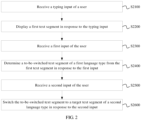
- the method includes the following S2100 to S2600.
- S2100 Receive a typing input of a user.
- S2200 Display a first text field in response to the typing input.
- the typing input of the user may be an operation of selecting at least one button on a keyboard of an electronic device in a case that the user edits text.
- the keyboard may be a push-button keyboard, or may be a touch keyboard.
- the user performs the typing input.
- the electronic device After receiving the typing input of the user, the electronic device responds to the typing input to identify the at least one button selected by the user. Further, the electronic device displays a matched text field according to information corresponding to the identified button, that is, a first text field in this embodiment of this application.
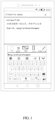
- text to be edited by the user by using an input method is “ , English, ". After "English” is input, the user forgets to switch a language type from English to Chinese. Consequently, as shown in FIG. 1 , a piece of text that is actually edited by using the input method is “ , English,wangjiqiehuanzhongwen”.
- the first text field is " , English,wangjiqiehuanzhongwen”.
- S2300 Receive a first input of the user.
- the first input of the user is an operation that the user selects an input text field of an unexpected language type from the first text field.
- the input text field of the unexpected language type is referred to as a to-be-switched text field.
- the to-be-switched text field is "wangjiqiehuanzhongwen" input by the user because the user forgets to switch a language type.
- S2400 Determine a to-be-switched text field of a first language type from the first text field in response to the first input.
- the first language type is the unexpected language type of the user.
- the electronic device may separately display a cursor "I" on each side of the determined to-be-switched text field, to prompt the user of a specific location of the to-be-switched text field.
- a rectangular frame with a grayscale is displayed on above the determined to-be-switched text field, and waterdrop cursors are displayed on both sides, to prompt the user of a specific location of the to-be-switched text field.
- the first text field includes at least two sub-text fields that are sequentially input by the user. It may be understood that the to-be-switched text field is a sub-text field in the first text field.
- One sub-text field is a text field that is consecutively input by the user at one time.
- S2400 may be implemented as the following S2410: S2410: According to a target type of the first input, determine a target sequence number corresponding to the target type and determine a sub-text field corresponding to the target sequence number that is in the at least two sub-text fields as the to-be-switched text field.
- the target type of the first input may be a quantity of input times of the first input.
- the target sequence number corresponding to the target type is a specific quantity of input times of the first input.
- the target type of the first input may alternatively be a sliding distance, a sliding direction, a sliding speed, or the like corresponding to the first input.
- the target sequence number corresponding to the target type may be specifically a specific sliding distance value, a specific sliding direction, a specific sliding speed, or the like corresponding to the first input. It may be understood that a corresponding target sequence number is also different in a case that a specific sliding distance value, a specific sliding direction, or a specific sliding speed is different.
- the target type of the first input is the sliding distance of the first input
- the sliding distance is a sliding distance less than 0.5 cm
- the target sequence number is 1. If the sliding distance is between 0.5 cm and 1 cm, it is determined that the target sequence number is 2.
- different target sequences correspond to different sub-text fields in the first text field.
- a sub-text field whose reverse sequence number is the same as the target sequence number in the first text field may be used as the sub-text field corresponding to the target sequence number.
- a sub-text field whose sequence number is the same as the target sequence number in the first text field may be used as the sub-text field corresponding to the target sequence number.
- the first text field may be a preset quantity of latest sub-text fields that are sequentially input by the user.
- the text language type switching method provided in this embodiment of this application further includes a step of determining a sub-text field, and the step is the following S2411: S2411: In a case that an input event of an acknowledgment character is monitored, determine, as one sub-text field, a character between a currently latest input text and a character that is input for the first time after the input event is previously monitored.
- the input event of the acknowledgement text may be an event such as an event of tapping the Space key, an event of tapping the Enter key, or an event of tapping the number key 1, 2, 3, 4, or 5.
- an input control used by the user to input the first input may be further provided.
- the user may tap the input control at least once to implement execution of the first input.
- a sliding operation may be performed on the input control to implement execution of the first input.
- the input control may be a newly added control disposed within a range of a touch keyboard corresponding to an input method.
- the input control may be shown in FIG. 3 .
- a combined shortcut key and a key for selecting a to-be-switched text field may be further provided for the user to enter the first input.
- the electronic device identifies a pressing operation for the combined shortcut key as the first input in the first time, , and after identifying the first input in the first time, the electronic device identifies a pressing operation on the key for selecting the to-be-switched text field as the first input in the second time or more.
- the combined shortcut key may be set by the user in Settings in a soft keyboard of the electronic device, and the key for selecting the to-be-switched text field may be a key with a left arrow.
- S2500 Receive a second input of the user.
- the second input is used to instruct to switch the to-be-switched text field to a target text field of a second language type.
- the second language type is an expected language type of the user.
- the second input of the user may be an operation of tapping the "shift" key by the user.
- the second input of the user may be an operation of tapping the "Chinese or English" key by the user.
- S2600 Switch the to-be-switched text field to a target text field of a second language type in response to the second input.
- the to-be-switched text field of the first language type and the target text field of the second language type correspond to a same typing input of the user.
- the to-be-switched text field is the same as an original text field of the target text field. Therefore, the electronic device may obtain, according to the original text field of the to-be-switched text field, the target text field corresponding to the to-be-switched text field.
- the foregoing S2200 further includes the following step S2210: S2210: According to the first typing sub-input, determine an original text field and determine the to-be-switched text field of the first language type corresponding to the original text field.
- the first typing input includes multiple typing sub-inputs.
- Each typing sub-input corresponds to one original text field, and one original text field corresponds to one sub-text field in the first text field.
- a typing sub-input corresponding to the to-be-switched text field is recorded as the first sub-input.
- the original text field in S2210 is an original text field corresponding to the first sub-input.
- the electronic device may record an original text field corresponding to a preset quantity of typing sub-inputs that are executed by the user.
- S2600 may be S2610.
- S2610 Determine, according to the original text field corresponding to the to-be-switched text field, a target text field of the second language type corresponding to the original text field.
- the to-be-switched text field is an original text field
- the target text field is an original text field
- a specific implementation of S2610 may be: using, as the target text field of the second language type, the original text field corresponding to the to-be-switched text field.
- the original text field corresponding to the to-be-switched text field of the first language type is "abcdef"
- the second language type is English
- "abcdef” is an English text field expected to be input by the user, that is, the target text field of the second language type.
- the original text field corresponding to the to-be-switched text field is a text field of the second language type expected by the user. Therefore, the original text field corresponding to the to-be-switched text field is directly used as the target text field of the second language type.
- a specific implementation of S2610 may be the following S2611 to S2613:
- S2611 Display the text field of at least one second language type that matches the original text field corresponding to the to-be-switched text field.
- S2612 Receive a third input of the user.
- the third input of the user is an operation of selecting the target text field of the second language type from the text field of at least one second language type by the user.
- S2613 Determine the target text field of the second language type from the text field of at least one second language type in response to the third input.
- the original text field of the to-be-switched text field is "wdjx”.
- the second language type is Chinese
- the original text field "wdjx" of the to-be-switched text field corresponding to a text field of at least one second language type may be " ", " ", or the like.
- the user may execute the third input, to select the target text field of the second language type from the text field of at least one second language type.
- the electronic device determines the target text field of the second language type from the text field of at least one second language type. in response to the third input
- the to-be-switched text field "wangjiqiehuanzhongwen" of the first type may be displayed, and a corresponding target text field of the second language type is " ".
- the electronic device may directly replace "wangjiqiehuanzhongwen" in the first text field with " ", and an effect is shown in FIG. 5 .
- the electronic device may further switch the cursor to the end of the displayed text field, to prevent the user from manually switching the cursor to the end of the displayed text field.
- S2600 may be shown in the following S2620: S2620: Switch the to-be-switched text field to a target text field of the second language type, and switch a cursor to an end of a displayed text field in response to the second input.
- the electronic device controls the cursor to automatically switch to the end of the displayed text field.
- a text input location is at the end of the displayed text field. In this way, the user can continue to perform typing input without manually moving the cursor to the end of the displayed text field. This further improves editing experience of the user.
- the displayed text field is a text field formed after the to-be-switched text field in the first text field is switched to the target text field.
- the cursor may be switched to the end of the displayed text field in another manner.
- the electronic device controls the cursor to switch to the end of the displayed text field.
- the electronic device controls the cursor to switch to the end of the displayed text field.
- the text language type switching method provided in this embodiment of this application further includes: controlling the electronic device to switch the first language type to the second language type.
- a language type does not need to be manually switched. This further improves editing experience of the user.
- a typing input of a user is received, and a first text field is displayed in response to the typing input; a first input of the user is received; a to-be-switched text field of a first language type is determined from the first text field in response to the first input; a second input of the user is received; and the to-be-switched text field is switched to a target text field of a second language type in response to the second input.
- the first input needs to be performed by the user, so that the to-be-switched text field of the first language type may be selected, and then one second input is performed, so that the to-be-switched text field of the first language type may be switched to the target text field of the second language type.
- an editing operation performed again by the user is avoided, that is, a large quantity of unnecessary editing operations performed by the user are avoided, thereby improving editing experience of the user.
- text may also be edited again.
- the dissatisfied text field may be considered as he to-be-switched text field and is determined by using the foregoing S2400.
- the user can edit the text again.
- the electronic device replaces the text field that is not satisfied by the user with a re-edited text field.
- the text language type switching method provided in this embodiment of this application may further include the following steps:
- the user may execute the fourth input twice.
- the electronic device determines "English” in the first text field as a to-be-edited text field in response to the fourth input.
- the user re-edits the text field "English”.
- the electronic device replaces "English” with " ".
- the electronic device may further switch the cursor to the end of the displayed text field, to prevent the user from manually switching the cursor to the end of the displayed text field.
- S2731 Determine a text field re-edited by the user, replace a to-be-edited text field with the re-edited text field, and switch the cursor to the end of the displayed text field.
- the electronic device controls the cursor to automatically switch to the end of the displayed text field.
- a text input location is at the end of the displayed text field. In this way, the user can continue to perform typing input without manually moving the cursor to the end of the displayed text field. This further improves editing experience of the user.
- the displayed text field is a text field formed after the to-be-switched text field in the first text field is switched to re-edited text.
- the cursor may be switched to the end of the displayed text field in another manner.
- the electronic device controls the cursor to switch to the end of the displayed text field.
- the electronic device controls the cursor to switch to the end of the displayed text field.
- the apparatus 300 includes a first receiving module 310, a first responding module 320, a second receiving module 330, a second responding module 340, a third receiving module 350, and a third responding module 360.
- the first receiving module 310 is configured to receive a typing input of a user.
- the first responding module 320 is configured to display a first text field in response to the typing input.
- the second receiving module 330 is configured to receive a first input of the user.
- the second responding module 340 is configured to determine a to-be-switched text field of a first language type from the first text field in response to the first input.
- the third receiving module 350 is configured to receive a second input of the user.
- the third responding module 360 is configured to switch the to-be-switched text field to a target text field of a second language type in response to the second input.
- the typing input includes a first typing sub-input.
- the first responding module 320 is specifically configured to: according to the first typing sub-input, determine an original text field and determine the to-be-switched text field of the first language type corresponding to the original text field.
- the third responding module 360 is specifically configured to determine, according to the original text field corresponding to the to-be-switched text field, a target text field of the second language type corresponding to the original text field.
- the to-be-switched text field is the original text field; and in a case that the second language type is English, the target text field is the original text field.
- the third responding module 360 includes a display unit, a receiving unit, and a responding unit.
- the display unit is configured to display the text field of at least one second language type that matches the original text field corresponding to the to-be-switched text field.
- the receiving unit is configured to receive third input of the user.
- the responding unit is configured to determine the target text field of the second language type from the text field of at least one second language type in response to the third input.
- the first text field includes at least two sub-text fields that are sequentially input by the user
- the second responding module 340 is specifically configured to: according to a target type of the first input, determine a target sequence number corresponding to the target type and determine a sub-text field corresponding to the target sequence number that is in the at least two sub-text fields as the to-be-switched text field.
- the apparatus 300 further includes a determining module, configured to: in a case that an input event of an acknowledgment character is monitored, determine, as one sub-text field, a character between a currently latest input character and a character that is input for the first time after the input event is previously monitored.
- the third responding module is specifically configured to: switch the to-be-switched text field to the target text field of the second language type, and switch a cursor to an end of a displayed text field in response to the second input.
- the text language type switching apparatus 300 provided in this embodiment of this application can implement processes implemented by the electronic device in the method embodiment of FIG. 2 . To avoid repetition, details are not described herein again.
- the first receiving module receives a typing input of a user, and the first responding module displays a first text field in response to the typing input;
- the second receiving module receives a first input of the user;
- the second responding module determines a to-be-switched text field of a first language type from the first text field in response to the first input;
- the third receiving module receives a second input of the user; and the third responding module switches the to-be-switched text field to a target text field of a second language type in response to the second input.
- FIG. 9 is a schematic diagram of a hardware structure of an electronic device for implementing the embodiments of the present invention.
- the electronic device 100 includes but is not limited to components such as a radio frequency unit 101, a network module 102, an audio output unit 103, an input unit 104, a sensor 105, a display unit 106, a user input unit 107, an interface unit 108, a memory 109, a processor 110, and a power supply 111.
- a structure of the electronic device shown in FIG. 1 does not constitute a limitation on the electronic device, and the electronic device may include more or fewer components than those shown in the figure, or combine some components, or have different component arrangements.
- the electronic device includes but is not limited to a mobile phone, a tablet computer, a laptop computer, a palmtop computer, an in-vehicle terminal, a wearable device, and the like.
- the user input unit 107 is configured to receive a typing input of a user.
- the display unit 106 is configured to display a first text field in response to the typing input.
- the user input unit 107 is further configured to receive a first input of the user.
- the processor 110 is configured to determine a to-be-switched text field of a first language type from the first text field in response to the first input.
- the user input unit 107 is further configured to receive a second input of the user.
- the processor 110 is further configured to switch the to-be-switched text field to a target text field of a second language type in response to the second input.
- the user input unit receives a typing input of a user; the display unit displays a first text field in response to the typing input; the user input unit receives a first input of the user; the processor determines a to-be-switched text field of a first language type from the first text field in response to the first input; the user input unit receives a second input of the user; and the processor switches the to-be-switched text field to a target text field of a second language type in response to the second input.
- the radio frequency unit 101 may be configured to receive and send information or receive and send a signal in a call process. Specifically, after downlink data from a base station is received, the processor 110 processes the downlink data. In addition, uplink data is sent to the base station.
- the radio frequency unit 101 includes but is not limited to an antenna, at least one amplifier, a transceiver, a coupler, a low noise amplifier, a duplexer, and the like.
- the radio frequency unit 101 may further communicate with a network and another device by using a wireless communication system.
- the electronic device provides wireless broadband Internet access for the user by using the network module 102, for example, helping the user send and receive an email, browse a web page, and access streaming media.
- the audio output unit 103 may convert audio data received by the radio frequency unit 101 or the network module 102 or stored in the memory 109 into an audio signal and output as sound. In addition, the audio output unit 103 may further provide audio output (for example, call signal receiving sound or message receiving sound) related to a specific function performed by the electronic device 100.
- the audio output unit 103 includes a speaker, a buzzer, a telephone receiver, and the like.
- the input unit 104 is configured to receive an audio or video signal.
- the input unit 104 may include a graphics processing unit (Graphics Processing Unit, GPU) 1041 and a microphone 1042.
- the graphics processing unit 1041 processes image data of a static picture or a video obtained by an image capture apparatus (such as a camera) in a video capture mode or an image capture mode.
- the processed image frame may be displayed on the display unit 106.
- the image frame processed by the graphics processing unit 1041 may be stored in the memory 109 (or another storage medium) or sent by using the radio frequency unit 101 or the network module 102.
- the microphone 1042 may receive sound and can process such sound into audio data.
- the processed audio data may be output by being converted into a format that may be sent to a mobile communications base station by using the radio frequency unit 101 in a telephone call mode.
- the electronic device 100 further includes at least one sensor 105, such as an optical sensor, a motion sensor, and another sensor.
- the optical sensor includes an ambient light sensor and a proximity sensor.
- the ambient light sensor may adjust luminance of a display panel 1061 according to brightness of ambient light
- the proximity sensor may disable the display panel 1061 and/or backlight in a case that the electronic device 100 approaches an ear.
- an accelerometer sensor may detect magnitude of an acceleration in each direction (generally three axes), and may detect magnitude and a direction of gravity in a case of being static.
- the accelerometer sensor may be used for recognizing an electronic device gesture (for example, horizontal and vertical screen switching, a related game, or magnetometer posture calibration), a function related to vibration recognition (for example, a pedometer or a strike), or the like.
- the sensor 105 may further include a fingerprint sensor, a pressure sensor, an iris sensor, a molecular sensor, a gyroscope, a barometer, a hygrometer, a thermometer, an infrared sensor, and the like. This is not described herein.
- the display unit 106 is configured to display information input by the user or information provided for the user.
- the display unit 106 may include a display panel 1061, and the display panel 1061 may be configured in a form of a liquid crystal display (Liquid Crystal Display, LCD), an organic light-emitting diode (Organic Light-Emitting Diode, OLED), or the like.
- LCD Liquid Crystal Display
- OLED Organic Light-Emitting Diode
- the user input unit 107 may be configured to receive input digit or character information and generate key signal input related to user setting and function control of the electronic device.
- the user input unit 107 includes a touch panel 1071 and another input device 1072.
- the touch panel 1071 also referred to as a touchscreen, may collect a touch operation performed by the user on or near the touch panel 1071 (for example, an operation performed by the user on or near the touch panel 1071 by using any suitable object or accessory such as a finger or a stylus).
- the touch panel 1071 may include two parts: a touch detection apparatus and a touch controller.
- the touch detection apparatus detects a touch location of the user, detects a signal brought by the touch operation, and transmits the signal to the touch controller.
- the touch controller receives touch information from the touch detection apparatus, converts the touch information into contact coordinates, sends the contact coordinates to the processor 110, and can receive and execute a command sent by the processor 110.
- the touch panel 1071 may be implemented by using multiple types such as a resistive type, a capacitive type, an infrared ray, and a surface acoustic wave.
- the user input unit 107 may include another input device 1072 in addition to the touch panel 1071.
- the another input device 1072 may include but is not limited to one or more of a physical keyboard, a function key (such as a volume control key or an on/off key), a trackball, a mouse, a joystick, and the like. Details are not described herein.
- the touch panel 1071 may cover the display panel 1061. After detecting the touch operation on or near the touch panel 1071, the touch panel 1061 transmits the touch operation to the processor 110 to determine a type of a touch event, and then the processor 110 provides corresponding visual output on the display panel 1061 according to the type of the touch event.
- the touch panel 1071 and the display panel 1061 are used as two independent components to implement input and output functions of the electronic device. However, in some embodiments, the touch panel 1071 and the display panel 1061 may be integrated to implement the input and output functions of the electronic device. This is not specifically limited herein.
- the interface unit 108 is an interface connecting an external apparatus to the electronic device 100.
- the external apparatus may include a wired or wireless headset port, an external power supply (or battery charger) port, a wired or wireless data port, a storage card port, a port configured to connect to an apparatus having an identification module, an audio input/output (I/O) port, a video I/O port, a headset port, and the like.
- the interface unit 108 may be configured to receive input (for example, data information and power) from the external apparatus and transmit the received input to one or more elements in the electronic device 100, or may be configured to transmit data between the electronic device 100 and the external apparatus.
- the memory 109 may be configured to store a software program and various data.
- the memory 109 may mainly include a program storage area and a data storage area.
- the program storage area may store an operating system, an application program required by at least one function (such as a sound play function or an image play function), and the like.
- the data storage area may store data (such as audio data or an address book) or the like created according to use of the mobile phone.
- the memory 109 may include a high-speed random access memory, and may further include a non-volatile memory such as at least one magnetic disk storage component, a flash memory component, or another volatile solid-state storage component.
- the processor 110 is a control center of the electronic device, and is connected to all parts of the entire electronic device by using various interfaces and lines, and performs various functions of the electronic device and processes data by running or executing the software program and/or the module that are stored in the memory 109 and invoking the data stored in the memory 109, to implement overall monitoring on the electronic device.
- the processor 110 may include one or more processing units.
- the processor 110 may be integrated with an application processor and a modem processor.
- the application processor mainly processes an operating system, a user interface, an application program, and the like, and the modem processor mainly processes wireless communication. It may be understood that the modem processor may also not be integrated into the processor 110.
- the electronic device 100 may further include a power supply 111 (such as a battery) that supplies power to each component.
- a power supply 111 such as a battery
- the power supply 111 may be logically connected to the processor 110 by using a power management system, to implement functions such as charging, discharging, and power consumption management by using the power management system.
- the electronic device 100 includes some function modules not shown, and details are not described herein.
- an embodiment of this application further provides an electronic device 100, including, as shown in FIG. 10 , a processor 110, a memory 109, and a program or an instruction that is stored in the memory 109 and that can run on the processor 110.
- a processor 110 a memory 109
- a program or an instruction that is stored in the memory 109 and that can run on the processor 110.
- the program or the instruction is executed by the processor 110, processes of the embodiment of the text language type switching method can be implemented, and a same technical effect can be achieved. To avoid repetition, details are not described herein.
- An embodiment of this application further provides a computer-readable storage medium.
- a computer program is stored in the computer-readable storage medium.
- the computer program is executed by a processor, processes of the embodiment of the text language type switching method can be implemented, and a same technical effect can be achieved. To avoid repetition, details are not described herein.
- the computer-readable storage medium includes a read-only memory (Read-Only Memory, ROM for short), a random access memory (Random Access Memory, RAM for short), a magnetic disk, an optical disc, or the like.
- the foregoing method embodiments may be implemented by using software and a required universal hardware platform, or certainly may be implemented by using hardware. However, in many cases, the former is a better implementation. According to such an understanding, the technical solutions of the present invention essentially or the part contributing to existing technologies may be implemented in a form of a software product.
- the computer software product is stored in a storage medium (such as a ROM/RAM, a magnetic disk, or an optical disc) and includes several instructions for instructing a terminal (which may be a mobile phone, a computer, a server, an air conditioner, or a network device) to execute the methods described in the embodiments of the present invention.
Landscapes
- Engineering & Computer Science (AREA)
- Theoretical Computer Science (AREA)
- General Engineering & Computer Science (AREA)
- Physics & Mathematics (AREA)
- General Physics & Mathematics (AREA)
- Human Computer Interaction (AREA)
- Computational Linguistics (AREA)
- General Health & Medical Sciences (AREA)
- Health & Medical Sciences (AREA)
- Audiology, Speech & Language Pathology (AREA)
- Artificial Intelligence (AREA)
- User Interface Of Digital Computer (AREA)
- Input From Keyboards Or The Like (AREA)
Abstract
Description
- This application claims priority to
Chinese Patent Application No. 202010471772.9 filed in China on May 28, 2020 - The present invention relates to the field of electronic devices, and specifically, to a text language type switching method, a text language type switching apparatus, an electronic device, and a readable storage medium.
- With the development of science and technology, working or communicating with electronic devices such as a mobile phone and a computer has become an important part of people's lives. During working or communicating by using the electronic device such as a mobile phone or a computer, text needs to be entered by using an input method.
- In a case that a user enters text by using the input method, there is a case that the user is not aware in time that a language type of currently entered text is not expected. Consequently, the user realizes that the language type of the currently entered text is incorrect after a long of text is entered. In this case, the user can only delete a large field of entered text of an unexpected language type, and then edit the text again. Consequently, the user adds a large quantity of unnecessary editing operations, thereby reducing editing experience of the user.
- This application provides a text language type switching method and apparatus, a device, and a storage medium, which can avoid a large quantity of unnecessary editing operations of a user, thereby improving editing experience of the user.
- To resolve the foregoing technical problem, the present invention is implemented as follows:
- According to a first aspect, a text language type switching method is provided, and the method includes: receiving a typing input of a user; displaying a first text field in response to the typing input; receiving a first input of the user; determining a to-be-switched text field of a first language type from the first text field in response to the first input; receiving a second input of the user; and switching the to-be-switched text field to a target text field of a second language type in response to the second input.
- According to a second aspect, a text language type switching apparatus is provided, and the switching apparatus includes: a first receiving module, configured to receive a typing input of a user; a first responding module, configured to display a first text field in response to the typing input; a second receiving module, configured to receive a first input of the user; a second responding module, configured to determine a to-be-switched text field of a first language type from the first text field in response to the first input; a third receiving module, configured to receive a second input of the user; and a third responding module, configured to switch the to-be-switched text field to a target text field of a second language type in response to the second input.
- According to a third aspect, an electronic device is provided, including: a processor, a memory, and a program or an instruction that is stored in the memory and that can run on the processor, where in a case that the program or the instruction is executed by the processor, steps in the text language type switching method according to the first aspect are implemented.
- According to a fourth aspect, a readable storage medium is provided, where the readable storage medium stores a program or an instruction, and in a case that the program or the instruction is executed by a processor, steps in the text language type switching method according to the first aspect are implemented.
- In embodiments of this application, a typing input of a user is received, and a first text field is displayed in response to the typing input; a first input of the user is received; a to-be-switched text field of a first language type is determined from the first text field in response to the first input; a second input of the user is received; and the to-be-switched text field is switched to a target text field of a second language type in response to the second input. In this way, only the first input needs to be performed by the user, so that the to-be-switched text field of the first language type may be selected, and then one second input is performed, so that the to-be-switched text field of the first language type may be switched to the target text field of the second language type. In this way, an editing operation performed again by the user is avoided, that is, a large quantity of unnecessary editing operations performed by the user are avoided, thereby improving editing experience of the user.
- The accompanying drawings, which are incorporated in the specification and constitute a part of the specification, illustrate embodiments of this application and are used together with the description thereof to explain the principles of the present invention.
-
FIG. 1 is a first interface display diagram of an electronic device according to an embodiment of this application; -
FIG. 2 is a schematic flowchart of a text language type switching method according to an embodiment of this application; -
FIG. 3 is a second interface display diagram of an electronic device according to an embodiment of this application; -
FIG. 4 is a third interface display diagram of an electronic device according to an embodiment of this application; -
FIG. 5 is a fourth interface display diagram of an electronic device according to an embodiment of this application; -
FIG. 6 is a fifth interface display diagram of an electronic device according to an embodiment of this application; -
FIG. 7 is a sixth interface display diagram of an electronic device according to an embodiment of this application; -
FIG. 8 is a schematic structural diagram of an electronic device according to an embodiment of this application; -
FIG. 9 is a schematic diagram of a hardware structure of an electronic device for implementing embodiments of this application; and -
FIG. 10 is a schematic diagram of a structure of another electronic device according to an embodiment of this application. - The following clearly and completely describes the technical solutions in the embodiments of this application with reference to the accompanying drawings in the embodiments of this application. Apparently, the described embodiments are some rather than all of the embodiments of this application. According to the embodiments of this application, all other embodiments obtained by a person of ordinary skill in the art without creative efforts fall within the protection scope of this application.
- Terms "first" and "second" in the specification and claims of this application are used to distinguish between similar objects, and do not need to be used to describe a specific order or sequence. It should be understood that data used in this way may be interchangeable in appropriate cases, so that the embodiments of this application can be implemented in a sequence other than those shown or described herein. In addition, in the specification and the claims, "and/or" represents at least one of connected objects, and the character "/" generally represents an "or" relationship between associated objects.
- A text language type switching method provided in the embodiments of this application is described in detail below with reference to the accompanying drawings by using specific embodiments and application scenarios thereof.
- An embodiment of this application provides a text language type switching method, and the method may be executed by various electronic devices, for example, any device that can input text, such as a mobile phone, a tablet computer, a notebook computer, a palmtop computer, an in-vehicle terminal, or a wearable device.
- As shown in
FIG. 2 , the method includes the following S2100 to S2600. - S2100: Receive a typing input of a user.
- S2200: Display a first text field in response to the typing input.
- In this embodiment of this application, the typing input of the user may be an operation of selecting at least one button on a keyboard of an electronic device in a case that the user edits text. The keyboard may be a push-button keyboard, or may be a touch keyboard.
- In this embodiment of this application, the user performs the typing input. After receiving the typing input of the user, the electronic device responds to the typing input to identify the at least one button selected by the user. Further, the electronic device displays a matched text field according to information corresponding to the identified button, that is, a first text field in this embodiment of this application.
- For example, text to be edited by the user by using an input method is "
 ,
, English,
 ". After "English" is input, the user forgets to switch a language type from English to Chinese. Consequently, as shown in
FIG. 1 , a piece of text that is actually edited by using the input method is ",
 English,wangjiqiehuanzhongwen". In the example shown in
FIG. 1 , the first text field is ", English,wangjiqiehuanzhongwen".
- S2300: Receive a first input of the user.
- In this embodiment of this application, the first input of the user is an operation that the user selects an input text field of an unexpected language type from the first text field. In this embodiment of this application, the input text field of the unexpected language type is referred to as a to-be-switched text field.
- With reference to the example described in
FIG. 1 , the to-be-switched text field is "wangjiqiehuanzhongwen" input by the user because the user forgets to switch a language type. - S2400: Determine a to-be-switched text field of a first language type from the first text field in response to the first input.
- In this embodiment of this application, the first language type is the unexpected language type of the user.
- In an embodiment, the electronic device may separately display a cursor "I" on each side of the determined to-be-switched text field, to prompt the user of a specific location of the to-be-switched text field.
- Alternatively, as shown in
FIG. 3 , a rectangular frame with a grayscale is displayed on above the determined to-be-switched text field, and waterdrop cursors are displayed on both sides, to prompt the user of a specific location of the to-be-switched text field. - In this embodiment of this application, the first text field includes at least two sub-text fields that are sequentially input by the user. It may be understood that the to-be-switched text field is a sub-text field in the first text field. One sub-text field is a text field that is consecutively input by the user at one time.
- For example, if an input of the user is the first text field ",
 English,wangjiqiehuanzhongwen", after entering "ruguoxiang", the user taps the Enter key or the Space key or taps 1, and "ruguoxiang" is displayed as "
 ". Further, after entering "bianjiyiduan", the user taps 2, and "bianjiyiduan" is displayed as "
 ". Further, after entering "wenzi", the user taps the Enter key or the Space key or taps 1, and " wenzi " is displayed as "
 ". Further, after entering "jiyou", the user taps the Enter key or the Space key or taps 1, and "jiyou" is displayed as "
 ". Further, after entering "zhongwen", the user taps the Enter key or the Space key or taps 1, and "zhongwen" is displays as "
 ". Further, after entering "youyou", the user taps the Enter key or the Space key or taps 1, and "youyou" is displayed as "
 ", and then taps a conversion key "shift" to convert Chinese into English. Further, after entering "english", the user taps the Enter key or the Space key, and "English" is displayed as "English", and then the user enters a comma. The user forgets to tap "shift" to convert Chinese into English, and in this case, the user enters "wangjiqiehuanzhongwen". In this case, sub-text fields that are sequentially input by the user may be obtained: "
 ", "
", " ", "
", "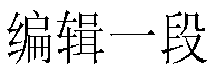 ", "
", " ", "
", " ", "
", " ", "English", and "wangjiqiehuanzhongwen".
- In an embodiment of this application, a specific implementation of S2400 may be implemented as the following S2410:
S2410: According to a target type of the first input, determine a target sequence number corresponding to the target type and determine a sub-text field corresponding to the target sequence number that is in the at least two sub-text fields as the to-be-switched text field. - In an embodiment of this application, the target type of the first input may be a quantity of input times of the first input. Correspondingly, the target sequence number corresponding to the target type is a specific quantity of input times of the first input.
- In another embodiment of this application, the target type of the first input may alternatively be a sliding distance, a sliding direction, a sliding speed, or the like corresponding to the first input. Correspondingly, the target sequence number corresponding to the target type may be specifically a specific sliding distance value, a specific sliding direction, a specific sliding speed, or the like corresponding to the first input. It may be understood that a corresponding target sequence number is also different in a case that a specific sliding distance value, a specific sliding direction, or a specific sliding speed is different.
- For example, in a case that the target type of the first input is the sliding distance of the first input, for example, if the sliding distance is a sliding distance less than 0.5 cm, it is determined that the target sequence number is 1. If the sliding distance is between 0.5 cm and 1 cm, it is determined that the target sequence number is 2.
- In this embodiment of this application, different target sequences correspond to different sub-text fields in the first text field.
- In an embodiment of this application, a sub-text field whose reverse sequence number is the same as the target sequence number in the first text field may be used as the sub-text field corresponding to the target sequence number.
- Alternatively, a sub-text field whose sequence number is the same as the target sequence number in the first text field may be used as the sub-text field corresponding to the target sequence number. In this embodiment, the first text field may be a preset quantity of latest sub-text fields that are sequentially input by the user.
- It may be learned from the foregoing content that the text language type switching method provided in this embodiment of this application further includes a step of determining a sub-text field, and the step is the following S2411:
S2411: In a case that an input event of an acknowledgment character is monitored, determine, as one sub-text field, a character between a currently latest input text and a character that is input for the first time after the input event is previously monitored. - In this embodiment of this application, the input event of the acknowledgement text may be an event such as an event of tapping the Space key, an event of tapping the Enter key, or an event of tapping the
number key - Based on S2410, in a case that the electronic device is an electronic device according to a touch keyboard, in the text language type switching method provided in this embodiment of this application, an input control used by the user to input the first input may be further provided. The user may tap the input control at least once to implement execution of the first input. Alternatively, a sliding operation may be performed on the input control to implement execution of the first input.
- In an embodiment of this application, the input control may be a newly added control disposed within a range of a touch keyboard corresponding to an input method. For example, the input control may be shown in
FIG. 3 . - In a case that the electronic device is an electronic device according to a push-button keyboard, in the text language type switching method provided in this embodiment of this application, a combined shortcut key and a key for selecting a to-be-switched text field may be further provided for the user to enter the first input.
- In this embodiment, the electronic device identifies a pressing operation for the combined shortcut key as the first input in the first time, , and after identifying the first input in the first time, the electronic device identifies a pressing operation on the key for selecting the to-be-switched text field as the first input in the second time or more.
- In this embodiment of this application, the combined shortcut key may be set by the user in Settings in a soft keyboard of the electronic device, and the key for selecting the to-be-switched text field may be a key with a left arrow.
- S2500: Receive a second input of the user.
- In this embodiment of this application, the second input is used to instruct to switch the to-be-switched text field to a target text field of a second language type. The second language type is an expected language type of the user.
- In an example, the second input of the user may be an operation of tapping the "shift" key by the user.
- In another example, in a case that the first language type is Chinese and the second language type is English, as shown in
FIG. 3 , the second input of the user may be an operation of tapping the "Chinese or English" key by the user. - S2600: Switch the to-be-switched text field to a target text field of a second language type in response to the second input.
- It may be understood that the to-be-switched text field of the first language type and the target text field of the second language type correspond to a same typing input of the user. In other words, the to-be-switched text field is the same as an original text field of the target text field. Therefore, the electronic device may obtain, according to the original text field of the to-be-switched text field, the target text field corresponding to the to-be-switched text field.
- Based on the foregoing content, in an embodiment, the foregoing S2200 further includes the following step S2210:
S2210: According to the first typing sub-input, determine an original text field and determine the to-be-switched text field of the first language type corresponding to the original text field. - In implementation of this application, the first typing input includes multiple typing sub-inputs. Each typing sub-input corresponds to one original text field, and one original text field corresponds to one sub-text field in the first text field. A typing sub-input corresponding to the to-be-switched text field is recorded as the first sub-input. The original text field in S2210 is an original text field corresponding to the first sub-input.
- In implementation of this application, the electronic device may record an original text field corresponding to a preset quantity of typing sub-inputs that are executed by the user.
- Based on S2210, a specific implementation of S2600 may be S2610.
- S2610: Determine, according to the original text field corresponding to the to-be-switched text field, a target text field of the second language type corresponding to the original text field.
- For example, in a case that the first language type is English, the to-be-switched text field is an original text field, and in a case that the second language type is English, the target text field is an original text field.
- In this embodiment of this application, in a case that the original text field is consistent with text composition of the second language type, a specific implementation of S2610 may be: using, as the target text field of the second language type, the original text field corresponding to the to-be-switched text field.
- For example, if the first language type is Chinese, the original text field corresponding to the to-be-switched text field of the first language type is "abcdef", and the second language type is English, "abcdef" is an English text field expected to be input by the user, that is, the target text field of the second language type. In this case, the original text field corresponding to the to-be-switched text field is a text field of the second language type expected by the user. Therefore, the original text field corresponding to the to-be-switched text field is directly used as the target text field of the second language type.
- In this embodiment of this application, in a case that the original text field corresponds to a text field of at least one second language type, a specific implementation of S2610 may be the following S2611 to S2613:
- S2611: Display the text field of at least one second language type that matches the original text field corresponding to the to-be-switched text field.
- S2612: Receive a third input of the user.
- In this embodiment of this application, the third input of the user is an operation of selecting the target text field of the second language type from the text field of at least one second language type by the user.
- S2613: Determine the target text field of the second language type from the text field of at least one second language type in response to the third input.
- In an example, if the first language type is English, and the corresponding to-be-switched text field is "wdjx", the original text field of the to-be-switched text field is "wdjx". In a case that the second language type is Chinese, the original text field "wdjx" of the to-be-switched text field corresponding to a text field of at least one second language type may be "", "
 ", or the like. The user may execute the third input, to select the target text field of the second language type from the text field of at least one second language type. The electronic device determines the target text field of the second language type from the text field of at least one second language type. in response to the third input
- In addition, with reference to the example shown in
FIG. 1 , after the electronic device performs S2600, as shown inFIG. 4 , the to-be-switched text field "wangjiqiehuanzhongwen" of the first type may be displayed, and a corresponding target text field of the second language type is "". Further, the electronic device may directly replace "wangjiqiehuanzhongwen" in the first text field with " ", and an effect is shown in
FIG. 5 . - Based on any one of the foregoing embodiments, after switching the to-be-switched text field to the target text field of the second language type, the electronic device may further switch the cursor to the end of the displayed text field, to prevent the user from manually switching the cursor to the end of the displayed text field. Based on this, the foregoing S2600 may be shown in the following S2620:
S2620: Switch the to-be-switched text field to a target text field of the second language type, and switch a cursor to an end of a displayed text field in response to the second input. - In this embodiment of this application, after switching the to-be-switched text field to the target text field of the second language type, the electronic device controls the cursor to automatically switch to the end of the displayed text field. In this case, a text input location is at the end of the displayed text field. In this way, the user can continue to perform typing input without manually moving the cursor to the end of the displayed text field. This further improves editing experience of the user.
- The displayed text field is a text field formed after the to-be-switched text field in the first text field is switched to the target text field.
- Certainly, in this embodiment of this application, the cursor may be switched to the end of the displayed text field in another manner.
- For example, according to the foregoing example of the combined shortcut key, after the electronic device switches the to-be-switched text field to the target text field of the second language type, if the user triggers the combined shortcut key again, the electronic device controls the cursor to switch to the end of the displayed text field.
- For example, according to the foregoing example of the input control, after the electronic device switches the to-be-switched text field to the target text field of the second language type, if the user taps the input control again, the electronic device controls the cursor to switch to the end of the displayed text field.
- Based on any one of the foregoing embodiments, the text language type switching method provided in this embodiment of this application further includes: controlling the electronic device to switch the first language type to the second language type. In this embodiment, before the user performs the typing input again, a language type does not need to be manually switched. This further improves editing experience of the user.
- In this embodiment of this application, a typing input of a user is received, and a first text field is displayed in response to the typing input; a first input of the user is received; a to-be-switched text field of a first language type is determined from the first text field in response to the first input; a second input of the user is received; and the to-be-switched text field is switched to a target text field of a second language type in response to the second input. In this way, only the first input needs to be performed by the user, so that the to-be-switched text field of the first language type may be selected, and then one second input is performed, so that the to-be-switched text field of the first language type may be switched to the target text field of the second language type. In this way, an editing operation performed again by the user is avoided, that is, a large quantity of unnecessary editing operations performed by the user are avoided, thereby improving editing experience of the user.
- Based on the foregoing embodiment, in the text language type switching method provided in this embodiment of this application, text may also be edited again. Specifically, in a case that the user is dissatisfied with some sub-text fields in the first text field, the dissatisfied text field may be considered as he to-be-switched text field and is determined by using the foregoing S2400. Then, the user can edit the text again. Finally, the electronic device replaces the text field that is not satisfied by the user with a re-edited text field. Based on this, the text language type switching method provided in this embodiment of this application may further include the following steps:
- S2710: Recei he user.
In this embodiment of this application, the fourth input is the same as the first input, and details are not described herein again. - S2720: Determine a to-be-edited text field in the first text field in response to the fourth input.
- S2730: Determine a text field re-edited by the user, and replace the to-be-edited text field with the re-edited text field.
- For example, as shown in
FIG. 6 , in a case that the first text field is " ,
, English,
 ", if the user is not satisfied with the last second input sub-text field "English ", the user may execute the fourth input twice. The electronic device determines "English" in the first text field as a to-be-edited text field in response to the fourth input. The user re-edits the text field "English". In this case, as shown in
FIG. 7 , the electronic device replaces "English" with "".
- Based on any one of the foregoing embodiments, after replacing the to-be-edited text field with the re-edited text field, the electronic device may further switch the cursor to the end of the displayed text field, to prevent the user from manually switching the cursor to the end of the displayed text field. Based on this, the foregoing S2730 may be shown in the following S2731:
S2731: Determine a text field re-edited by the user, replace a to-be-edited text field with the re-edited text field, and switch the cursor to the end of the displayed text field. - In this embodiment of this application, after replacing the to-be-edited text field with the re-edited text field, the electronic device controls the cursor to automatically switch to the end of the displayed text field. In this case, a text input location is at the end of the displayed text field. In this way, the user can continue to perform typing input without manually moving the cursor to the end of the displayed text field. This further improves editing experience of the user.
- The displayed text field is a text field formed after the to-be-switched text field in the first text field is switched to re-edited text.
- Certainly, in this embodiment of this application, the cursor may be switched to the end of the displayed text field in another manner.
- For example, according to the foregoing example of the combined shortcut key, after the electronic device replaces the to-be-edited text field with the re-edited text field, if the user triggers the combined shortcut key again, the electronic device controls the cursor to switch to the end of the displayed text field.
- For example, according to the foregoing example of the input control, after the electronic device replaces the to-be-edited text field with the re-edited text field, if the user taps the input control again, the electronic device controls the cursor to switch to the end of the displayed text field.
- An embodiment of this application provides a text language type switching apparatus 300. As shown in
FIG. 8 , the apparatus 300 includes afirst receiving module 310, a first respondingmodule 320, asecond receiving module 330, a second respondingmodule 340, athird receiving module 350, and a third respondingmodule 360. - The
first receiving module 310 is configured to receive a typing input of a user. - The first responding
module 320 is configured to display a first text field in response to the typing input. - The
second receiving module 330 is configured to receive a first input of the user. - The second responding
module 340 is configured to determine a to-be-switched text field of a first language type from the first text field in response to the first input. - The
third receiving module 350 is configured to receive a second input of the user. - The third responding
module 360 is configured to switch the to-be-switched text field to a target text field of a second language type in response to the second input. - In an embodiment, the typing input includes a first typing sub-input.
- The first responding
module 320 is specifically configured to: according to the first typing sub-input, determine an original text field and determine the to-be-switched text field of the first language type corresponding to the original text field. - The third responding
module 360 is specifically configured to determine, according to the original text field corresponding to the to-be-switched text field, a target text field of the second language type corresponding to the original text field. - In an embodiment, in a case that the first language type is English, the to-be-switched text field is the original text field; and
in a case that the second language type is English, the target text field is the original text field. - In an embodiment, in a case that the original text field corresponds to a text field of at least one second language type, the third responding
module 360 includes a display unit, a receiving unit, and a responding unit. - The display unit is configured to display the text field of at least one second language type that matches the original text field corresponding to the to-be-switched text field.
- The receiving unit is configured to receive third input of the user.
- The responding unit is configured to determine the target text field of the second language type from the text field of at least one second language type in response to the third input.
- In an embodiment, the first text field includes at least two sub-text fields that are sequentially input by the user, and the second responding
module 340 is specifically configured to:
according to a target type of the first input, determine a target sequence number corresponding to the target type and determine a sub-text field corresponding to the target sequence number that is in the at least two sub-text fields as the to-be-switched text field. - In an embodiment, the apparatus 300 further includes a determining module, configured to:
in a case that an input event of an acknowledgment character is monitored, determine, as one sub-text field, a character between a currently latest input character and a character that is input for the first time after the input event is previously monitored. - In an embodiment, the third responding module is specifically configured to:
switch the to-be-switched text field to the target text field of the second language type, and switch a cursor to an end of a displayed text field in response to the second input. - The text language type switching apparatus 300 provided in this embodiment of this application can implement processes implemented by the electronic device in the method embodiment of
FIG. 2 . To avoid repetition, details are not described herein again. - In this embodiment of this application, the first receiving module receives a typing input of a user, and the first responding module displays a first text field in response to the typing input; the second receiving module receives a first input of the user; the second responding module determines a to-be-switched text field of a first language type from the first text field in response to the first input; the third receiving module receives a second input of the user; and the third responding module switches the to-be-switched text field to a target text field of a second language type in response to the second input. In this way, only the first input needs to be performed by the user, so that the to-be-switched text field of the first language type may be selected, and then one second input is performed, so that the to-be-switched text field of the first language type may be switched to the target text field of the second language type. In this way, an editing operation performed again by the user is avoided, that is, a large quantity of unnecessary editing operations performed by the user are avoided, thereby improving editing experience of the user.
-
FIG. 9 is a schematic diagram of a hardware structure of an electronic device for implementing the embodiments of the present invention. Theelectronic device 100 includes but is not limited to components such as aradio frequency unit 101, anetwork module 102, anaudio output unit 103, aninput unit 104, asensor 105, adisplay unit 106, auser input unit 107, aninterface unit 108, amemory 109, aprocessor 110, and apower supply 111. A person skilled in the art may understand that a structure of the electronic device shown inFIG. 1 does not constitute a limitation on the electronic device, and the electronic device may include more or fewer components than those shown in the figure, or combine some components, or have different component arrangements. In this embodiment of the present invention, the electronic device includes but is not limited to a mobile phone, a tablet computer, a laptop computer, a palmtop computer, an in-vehicle terminal, a wearable device, and the like. - The
user input unit 107 is configured to receive a typing input of a user. - The
display unit 106 is configured to display a first text field in response to the typing input. - The
user input unit 107 is further configured to receive a first input of the user. - The
processor 110 is configured to determine a to-be-switched text field of a first language type from the first text field in response to the first input. - The
user input unit 107 is further configured to receive a second input of the user. - The
processor 110 is further configured to switch the to-be-switched text field to a target text field of a second language type in response to the second input. - In this embodiment of this application, the user input unit receives a typing input of a user; the display unit displays a first text field in response to the typing input; the user input unit receives a first input of the user; the processor determines a to-be-switched text field of a first language type from the first text field in response to the first input; the user input unit receives a second input of the user; and the processor switches the to-be-switched text field to a target text field of a second language type in response to the second input. In this way, only the first input needs to be performed by the user, so that the to-be-switched text field of the first language type may be selected, and then one second input is performed, so that the to-be-switched text field of the first language type may be switched to the target text field of the second language type. In this way, an editing operation performed again by the user is avoided, that is, a large quantity of unnecessary editing operations performed by the user are avoided, thereby improving editing experience of the user.
- It should be understood that, in this embodiment of the present invention, the
radio frequency unit 101 may be configured to receive and send information or receive and send a signal in a call process. Specifically, after downlink data from a base station is received, theprocessor 110 processes the downlink data. In addition, uplink data is sent to the base station. Generally, theradio frequency unit 101 includes but is not limited to an antenna, at least one amplifier, a transceiver, a coupler, a low noise amplifier, a duplexer, and the like. In addition, theradio frequency unit 101 may further communicate with a network and another device by using a wireless communication system. - The electronic device provides wireless broadband Internet access for the user by using the
network module 102, for example, helping the user send and receive an email, browse a web page, and access streaming media. - The
audio output unit 103 may convert audio data received by theradio frequency unit 101 or thenetwork module 102 or stored in thememory 109 into an audio signal and output as sound. In addition, theaudio output unit 103 may further provide audio output (for example, call signal receiving sound or message receiving sound) related to a specific function performed by theelectronic device 100. Theaudio output unit 103 includes a speaker, a buzzer, a telephone receiver, and the like. - The
input unit 104 is configured to receive an audio or video signal. Theinput unit 104 may include a graphics processing unit (Graphics Processing Unit, GPU) 1041 and amicrophone 1042. Thegraphics processing unit 1041 processes image data of a static picture or a video obtained by an image capture apparatus (such as a camera) in a video capture mode or an image capture mode. The processed image frame may be displayed on thedisplay unit 106. The image frame processed by thegraphics processing unit 1041 may be stored in the memory 109 (or another storage medium) or sent by using theradio frequency unit 101 or thenetwork module 102. Themicrophone 1042 may receive sound and can process such sound into audio data. The processed audio data may be output by being converted into a format that may be sent to a mobile communications base station by using theradio frequency unit 101 in a telephone call mode. - The
electronic device 100 further includes at least onesensor 105, such as an optical sensor, a motion sensor, and another sensor. Specifically, the optical sensor includes an ambient light sensor and a proximity sensor. The ambient light sensor may adjust luminance of adisplay panel 1061 according to brightness of ambient light, and the proximity sensor may disable thedisplay panel 1061 and/or backlight in a case that theelectronic device 100 approaches an ear. As a type of the motion sensor, an accelerometer sensor may detect magnitude of an acceleration in each direction (generally three axes), and may detect magnitude and a direction of gravity in a case of being static. The accelerometer sensor may be used for recognizing an electronic device gesture (for example, horizontal and vertical screen switching, a related game, or magnetometer posture calibration), a function related to vibration recognition (for example, a pedometer or a strike), or the like. Thesensor 105 may further include a fingerprint sensor, a pressure sensor, an iris sensor, a molecular sensor, a gyroscope, a barometer, a hygrometer, a thermometer, an infrared sensor, and the like. This is not described herein. - The
display unit 106 is configured to display information input by the user or information provided for the user. Thedisplay unit 106 may include adisplay panel 1061, and thedisplay panel 1061 may be configured in a form of a liquid crystal display (Liquid Crystal Display, LCD), an organic light-emitting diode (Organic Light-Emitting Diode, OLED), or the like. - The
user input unit 107 may be configured to receive input digit or character information and generate key signal input related to user setting and function control of the electronic device. Specifically, theuser input unit 107 includes atouch panel 1071 and anotherinput device 1072. Thetouch panel 1071, also referred to as a touchscreen, may collect a touch operation performed by the user on or near the touch panel 1071 (for example, an operation performed by the user on or near thetouch panel 1071 by using any suitable object or accessory such as a finger or a stylus). Thetouch panel 1071 may include two parts: a touch detection apparatus and a touch controller. The touch detection apparatus detects a touch location of the user, detects a signal brought by the touch operation, and transmits the signal to the touch controller. The touch controller receives touch information from the touch detection apparatus, converts the touch information into contact coordinates, sends the contact coordinates to theprocessor 110, and can receive and execute a command sent by theprocessor 110. In addition, thetouch panel 1071 may be implemented by using multiple types such as a resistive type, a capacitive type, an infrared ray, and a surface acoustic wave. Theuser input unit 107 may include anotherinput device 1072 in addition to thetouch panel 1071. Specifically, the anotherinput device 1072 may include but is not limited to one or more of a physical keyboard, a function key (such as a volume control key or an on/off key), a trackball, a mouse, a joystick, and the like. Details are not described herein. - Further, the
touch panel 1071 may cover thedisplay panel 1061. After detecting the touch operation on or near thetouch panel 1071, thetouch panel 1061 transmits the touch operation to theprocessor 110 to determine a type of a touch event, and then theprocessor 110 provides corresponding visual output on thedisplay panel 1061 according to the type of the touch event. InFIG. 9 , thetouch panel 1071 and thedisplay panel 1061 are used as two independent components to implement input and output functions of the electronic device. However, in some embodiments, thetouch panel 1071 and thedisplay panel 1061 may be integrated to implement the input and output functions of the electronic device. This is not specifically limited herein. - The
interface unit 108 is an interface connecting an external apparatus to theelectronic device 100. For example, the external apparatus may include a wired or wireless headset port, an external power supply (or battery charger) port, a wired or wireless data port, a storage card port, a port configured to connect to an apparatus having an identification module, an audio input/output (I/O) port, a video I/O port, a headset port, and the like. Theinterface unit 108 may be configured to receive input (for example, data information and power) from the external apparatus and transmit the received input to one or more elements in theelectronic device 100, or may be configured to transmit data between theelectronic device 100 and the external apparatus. - The
memory 109 may be configured to store a software program and various data. Thememory 109 may mainly include a program storage area and a data storage area. The program storage area may store an operating system, an application program required by at least one function (such as a sound play function or an image play function), and the like. The data storage area may store data (such as audio data or an address book) or the like created according to use of the mobile phone. In addition, thememory 109 may include a high-speed random access memory, and may further include a non-volatile memory such as at least one magnetic disk storage component, a flash memory component, or another volatile solid-state storage component. - The
processor 110 is a control center of the electronic device, and is connected to all parts of the entire electronic device by using various interfaces and lines, and performs various functions of the electronic device and processes data by running or executing the software program and/or the module that are stored in thememory 109 and invoking the data stored in thememory 109, to implement overall monitoring on the electronic device. Theprocessor 110 may include one or more processing units. Preferentially, theprocessor 110 may be integrated with an application processor and a modem processor. The application processor mainly processes an operating system, a user interface, an application program, and the like, and the modem processor mainly processes wireless communication. It may be understood that the modem processor may also not be integrated into theprocessor 110. - The
electronic device 100 may further include a power supply 111 (such as a battery) that supplies power to each component. Preferably, thepower supply 111 may be logically connected to theprocessor 110 by using a power management system, to implement functions such as charging, discharging, and power consumption management by using the power management system. - In addition, the
electronic device 100 includes some function modules not shown, and details are not described herein. - Preferably, an embodiment of this application further provides an
electronic device 100, including, as shown inFIG. 10 , aprocessor 110, amemory 109, and a program or an instruction that is stored in thememory 109 and that can run on theprocessor 110. In a case that the program or the instruction is executed by theprocessor 110, processes of the embodiment of the text language type switching method can be implemented, and a same technical effect can be achieved. To avoid repetition, details are not described herein. - An embodiment of this application further provides a computer-readable storage medium. A computer program is stored in the computer-readable storage medium. In a case that the computer program is executed by a processor, processes of the embodiment of the text language type switching method can be implemented, and a same technical effect can be achieved. To avoid repetition, details are not described herein. The computer-readable storage medium includes a read-only memory (Read-Only Memory, ROM for short), a random access memory (Random Access Memory, RAM for short), a magnetic disk, an optical disc, or the like.
- It should be noted that in this specification, the term "include", "including", or any other variant is intended to cover non-exclusive inclusion, so that a process, method, article, or apparatus that includes a series of elements includes not only those elements but also other elements that are not explicitly listed, or includes elements inherent to such a process, method, article, or apparatus. In the absence of more restrictions, an element defined by the statement "including a..." does not exclude another same element in a process, method, article, or apparatus that includes the element.
- According to the descriptions of the foregoing implementations, a person skilled in the art may clearly understand that the foregoing method embodiments may be implemented by using software and a required universal hardware platform, or certainly may be implemented by using hardware. However, in many cases, the former is a better implementation. According to such an understanding, the technical solutions of the present invention essentially or the part contributing to existing technologies may be implemented in a form of a software product. The computer software product is stored in a storage medium (such as a ROM/RAM, a magnetic disk, or an optical disc) and includes several instructions for instructing a terminal (which may be a mobile phone, a computer, a server, an air conditioner, or a network device) to execute the methods described in the embodiments of the present invention.
- The embodiments of the present invention are described with reference to the accompanying drawings. However, the present invention is not limited to the foregoing specific implementations. The foregoing specific implementations are merely examples, but are not limiting. A person of ordinary skill in the art may make many forms without departing from the objective and the scope of the claims of the present invention, and these forms all fall within the protection scope of the present invention.
Claims (16)
- A text language type switching method, wherein the method comprises:receiving a typing input of a user;displaying a first text field in response to the typing input;receiving a first input of the user;determining a to-be-switched text field of a first language type from the first text field in response to the first input;receiving a second input of the user; andswitching the to-be-switched text field to a target text field of a second language type in response to the second input.
- The method according to claim 1, wherein the typing input comprises a first typing sub-input, and the displaying the first text field in response to the typing input comprises:according to the first typing sub-input, determining an original text field and determining the to-be-switched text field of the first language type corresponding to the original text field; andthe switching the to-be-switched text field to the target text field of the second language type comprises:
determining, according to the original text field corresponding to the to-be-switched text field, the target text field of the second language type corresponding to the original text field. - The method according to claim 2, whereinin a case that the first language type is English, the to-be-switched text field is the original text field; andin a case that the second language type is English, the target text field is the original text field.
- The method according to claim 2, wherein in a case that the original text field corresponds to a text field of at least one second language type, the determining, according to the original text field corresponding to the to-be-switched text field, the target text field of the second language type corresponding to the original text field comprises:displaying the text field of at least one second language type that matches the original text field corresponding to the to-be-switched text field;receiving a third input of the user; anddetermining the target text field of the second language type from the text field of at least one second language type in response to the third input.
- The method according to claim 1, wherein the first text field comprises at least two sub-text fields that are sequentially input by the user, and the determining the to-be-switched text field of the first language type from the first text field in response to the first input specifically comprises:
according to a target type of the first input, determining a target sequence number corresponding to the target type and determining a sub-text field corresponding to the target sequence number that is in the at least two sub-text fields as the to-be-switched text field. - The method according to claim 5, wherein the method further comprises a step of determining the sub-text field, comprising:
in a case that an input event of an acknowledgment character is monitored, determining, as one sub-text field, a character between a currently latest input character and a character that is input for the first time after the input event is previously monitored. - The method according to claim 1, wherein the switching the to-be-switched text field to the target text field of the second language type in response to the second input specifically comprises:
switching the to-be-switched text field to the target text field of the second language type, and switching a cursor to an end of a displayed text field in response to the second input. - A text language type switching apparatus, comprising:a first receiving module, configured to receive a typing input of a user;a first responding module, configured to display a first text field in response to the typing input;a second receiving module, configured to receive a first input of the user;a second responding module, configured to determine a to-be-switched text field of a first language type from the first text field in response to the first input;a third receiving module, configured to receive a second input of the user; anda third responding module, configured to switch the to-be-switched text field to a target text field of a second language type in response to the second input.
- The apparatus according to claim 8, wherein the typing input comprises a first typing sub-input;the first responding module is specifically configured to: according to the first typing sub-input, determine an original text field and determine the to-be-switched text field of the first language type corresponding to the original text field; andthe third responding module is specifically configured to determine, according to the original text field corresponding to the to-be-switched text field, the target text field of the second language type corresponding to the original text field.
- The apparatus according to claim 9, whereinin a case that the first language type is English, the to-be-switched text field is the original text field; andin a case that the second language type is English, the target text field is the original text field.
- The apparatus according to claim 9, wherein in a case that the original text field corresponds to a text field of at least one second language type, the third responding module comprises a display unit, a receiving unit, and a responding unit; whereinthe display unit is configured to display the text field of at least one second language type that matches the original text field corresponding to the to-be-switched text field;the receiving unit is configured to receive third input of the user; andthe responding unit is configured to determine the target text field of the second language type from the text field of at least one second language type in response to the third input.
- The apparatus according to claim 8, wherein the first text field comprises at least two sub-text fields that are sequentially input by the user, and the second responding module is specifically configured to:
according to a target type of the first input, determine a target sequence number corresponding to the target type and determine a sub-text field corresponding to the target sequence number that is in the at least two sub-text fields as the to-be-switched text field. - The apparatus according to claim 12, wherein the apparatus further comprises a determining module, configured to:
in a case that an input event of an acknowledgment character is monitored, determine, as one sub-text field, a character between a currently latest input character and a character that is input for the first time after the input event is previously monitored. - The apparatus according to claim 8, wherein the third responding module is specifically configured to:
switch the to-be-switched text field to the target text field of the second language type, and switch a cursor to an end of a displayed text field in response to the second input. - An electronic device, comprising: a processor, a memory, and a program or an instruction that is stored in the memory and executable on the processor, wherein in a case that the program or the instruction is executed by the processor, steps in the text language type switching method according to any one of claims 1 to 7 are implemented.
- A readable storage medium, wherein the readable storage medium stores a program or an instruction, and in a case that the program or the instruction is executed by a processor, steps in the text language type switching method according to any one of claims 1 to 7 are implemented.
Applications Claiming Priority (2)
| Application Number | Priority Date | Filing Date | Title |
|---|---|---|---|
| CN202010471772.9A CN111651068B (en) | 2020-05-28 | 2020-05-28 | Method, device and equipment for switching character language types and storage medium |
| PCT/CN2021/096190 WO2021239019A1 (en) | 2020-05-28 | 2021-05-26 | Method, device, and equipment for switching text language types, and storage medium |
Publications (3)
| Publication Number | Publication Date |
|---|---|
| EP4160364A1 true EP4160364A1 (en) | 2023-04-05 |
| EP4160364A4 EP4160364A4 (en) | 2023-11-08 |
| EP4160364B1 EP4160364B1 (en) | 2025-07-09 |
Family
ID=72346916
Family Applications (1)
| Application Number | Title | Priority Date | Filing Date |
|---|---|---|---|
| EP21813831.1A Active EP4160364B1 (en) | 2020-05-28 | 2021-05-26 | Method, device, and equipment for switching text language types, and storage medium |
Country Status (5)
| Country | Link |
|---|---|
| US (1) | US20230087022A1 (en) |
| EP (1) | EP4160364B1 (en) |
| CN (1) | CN111651068B (en) |
| ES (1) | ES3038609T3 (en) |
| WO (1) | WO2021239019A1 (en) |
Families Citing this family (2)
| Publication number | Priority date | Publication date | Assignee | Title |
|---|---|---|---|---|
| CN111651068B (en) * | 2020-05-28 | 2023-04-18 | 维沃移动通信有限公司 | Method, device and equipment for switching character language types and storage medium |
| CN115098200B (en) * | 2022-05-20 | 2024-07-05 | 北京快乐茄信息技术有限公司 | Language switching method and device, electronic equipment and storage medium |
Family Cites Families (33)
| Publication number | Priority date | Publication date | Assignee | Title |
|---|---|---|---|---|
| KR100213910B1 (en) * | 1997-03-26 | 1999-08-02 | 윤종용 | Hanyoung automatic converter and method |
| US6963840B2 (en) * | 2001-01-12 | 2005-11-08 | International Business Machines Corporation | Method for incorporating multiple cursors in a speech recognition system |
| US7296220B2 (en) * | 2004-12-20 | 2007-11-13 | Microsoft Corporation | Method and system for creating a table in a text editing application |
| US8144990B2 (en) * | 2007-03-22 | 2012-03-27 | Sony Ericsson Mobile Communications Ab | Translation and display of text in picture |
| US8464150B2 (en) * | 2008-06-07 | 2013-06-11 | Apple Inc. | Automatic language identification for dynamic text processing |
| US8683329B2 (en) * | 2009-03-18 | 2014-03-25 | Google Inc. | Web translation with display replacement |
| US8478579B2 (en) * | 2009-05-05 | 2013-07-02 | Google Inc. | Conditional translation header for translation of web documents |
| US8326602B2 (en) * | 2009-06-05 | 2012-12-04 | Google Inc. | Detecting writing systems and languages |
| WO2011004367A1 (en) * | 2009-07-09 | 2011-01-13 | Eliyahu Mashiah | Content sensitive system and method for automatic input language selection |
| US20120059662A1 (en) * | 2010-09-03 | 2012-03-08 | Huisman Jr John E | Automated lead processing systems and methods |
| US9058105B2 (en) * | 2010-10-31 | 2015-06-16 | International Business Machines Corporation | Automated adjustment of input configuration |
| KR20140056231A (en) * | 2011-06-24 | 2014-05-09 | 구글 인코포레이티드 | Detecting source languages of search queries |
| US9002699B2 (en) * | 2011-11-14 | 2015-04-07 | Microsoft Technology Licensing, Llc | Adaptive input language switching |
| WO2013149403A1 (en) * | 2012-04-07 | 2013-10-10 | Motorola Mobility, Inc. | Text select and enter |
| US20140035823A1 (en) * | 2012-08-01 | 2014-02-06 | Apple Inc. | Dynamic Context-Based Language Determination |
| KR20150067489A (en) * | 2013-12-10 | 2015-06-18 | 삼성전자주식회사 | Method and apparatus for providing input method editor in a electronic devices |
| TWI594134B (en) * | 2013-12-27 | 2017-08-01 | 緯創資通股份有限公司 | Method of providing input method and electronic device using the same |
| US9524293B2 (en) * | 2014-08-15 | 2016-12-20 | Google Inc. | Techniques for automatically swapping languages and/or content for machine translation |
| US10374987B2 (en) * | 2015-03-11 | 2019-08-06 | Salesforce.Com, Inc. | Electronic notifications of users concurrently interacting with the same feed item of a social network feed |
| US20170031897A1 (en) * | 2015-07-31 | 2017-02-02 | Lenovo (Singapore) Pte. Ltd. | Modification of input based on language content background |
| JP2019519010A (en) * | 2016-04-20 | 2019-07-04 | グーグル エルエルシー | Automatic translation by keyboard |
| WO2017183035A1 (en) * | 2016-04-20 | 2017-10-26 | Avi Elazari | Reduced keyboard disambiguating system and method thereof |
| GB2549929A (en) * | 2016-04-26 | 2017-11-08 | Tactile Ltd | Repair management system and method |
| US10101897B1 (en) * | 2016-09-14 | 2018-10-16 | Google Llc | Electronic stylus for storing credentials |
| US10282415B2 (en) * | 2016-11-29 | 2019-05-07 | Ebay Inc. | Language identification for text strings |
| CN106782553A (en) * | 2016-12-09 | 2017-05-31 | 深圳市金立通信设备有限公司 | Pronunciation inputting method and terminal device |
| US10747427B2 (en) * | 2017-02-01 | 2020-08-18 | Google Llc | Keyboard automatic language identification and reconfiguration |
| CN108052212A (en) * | 2017-10-18 | 2018-05-18 | 深圳市金立通信设备有限公司 | A kind of method, terminal and computer-readable medium for inputting word |
| WO2019150996A1 (en) * | 2018-01-30 | 2019-08-08 | パナソニックIpマネジメント株式会社 | Language presentation device, language presentation method, and language presentation program |
| CN109189298A (en) * | 2018-08-01 | 2019-01-11 | 维沃移动通信有限公司 | A kind of language switching method and terminal |
| CN109240785B (en) * | 2018-08-31 | 2021-01-22 | 维沃移动通信有限公司 | Method, terminal and storage medium for setting language |
| CN111651068B (en) * | 2020-05-28 | 2023-04-18 | 维沃移动通信有限公司 | Method, device and equipment for switching character language types and storage medium |
| WO2021248383A1 (en) * | 2020-06-10 | 2021-12-16 | Orange | Method for inputting message on terminal |
-
2020
- 2020-05-28 CN CN202010471772.9A patent/CN111651068B/en active Active
-
2021
- 2021-05-26 EP EP21813831.1A patent/EP4160364B1/en active Active
- 2021-05-26 WO PCT/CN2021/096190 patent/WO2021239019A1/en not_active Ceased
- 2021-05-26 ES ES21813831T patent/ES3038609T3/en active Active
-
2022
- 2022-11-23 US US17/993,866 patent/US20230087022A1/en active Pending
Also Published As
| Publication number | Publication date |
|---|---|
| EP4160364B1 (en) | 2025-07-09 |
| ES3038609T3 (en) | 2025-10-14 |
| CN111651068B (en) | 2023-04-18 |
| EP4160364A4 (en) | 2023-11-08 |
| WO2021239019A1 (en) | 2021-12-02 |
| US20230087022A1 (en) | 2023-03-23 |
| CN111651068A (en) | 2020-09-11 |
Similar Documents
| Publication | Publication Date | Title |
|---|---|---|
| US11165950B2 (en) | Method and apparatus for shooting video, and storage medium | |
| CN110531915B (en) | Screen operation method and terminal device | |
| US11658932B2 (en) | Message sending method and terminal device | |
| CN109558046B (en) | Information display method and terminal equipment | |
| EP3699743B1 (en) | Image viewing method and mobile terminal | |
| CN110825295B (en) | Application control method and electronic device | |
| WO2021068885A1 (en) | Control method and electronic device | |
| CN110913067A (en) | Information sending method and electronic equipment | |
| EP3764211A1 (en) | Display method and mobile terminal | |
| CN108958593B (en) | Method for determining communication object and mobile terminal | |
| US20220043564A1 (en) | Method for inputting content and terminal device | |
| CN110321046A (en) | A kind of content selecting method and terminal | |
| CN109407948B (en) | Interface display method and mobile terminal | |
| CN107748640A (en) | One kind puts out screen display methods and mobile terminal | |
| CN111475066B (en) | Background switching method of application program and electronic device | |
| CN108446156B (en) | Application program control method and terminal | |
| EP4016269A1 (en) | Icon display method and terminal | |
| CN110333803B (en) | A kind of multimedia object selection method and terminal device | |
| CN109126127B (en) | Game control method, dual-screen mobile terminal and computer-readable storage medium | |
| CN109067975B (en) | A contact information management method and terminal device | |
| CN110795402A (en) | Method and device for displaying file list and electronic equipment | |
| CN108491143B (en) | Object movement control method and mobile terminal | |
| EP4160364B1 (en) | Method, device, and equipment for switching text language types, and storage medium | |
| CN111124585A (en) | Operation method, device and readable storage medium of shortcut panel | |
| CN108628534B (en) | Character display method and mobile terminal |
Legal Events
| Date | Code | Title | Description |
|---|---|---|---|
| STAA | Information on the status of an ep patent application or granted ep patent |
Free format text: STATUS: THE INTERNATIONAL PUBLICATION HAS BEEN MADE |
|
| PUAI | Public reference made under article 153(3) epc to a published international application that has entered the european phase |
Free format text: ORIGINAL CODE: 0009012 |
|
| STAA | Information on the status of an ep patent application or granted ep patent |
Free format text: STATUS: REQUEST FOR EXAMINATION WAS MADE |
|
| 17P | Request for examination filed |
Effective date: 20221223 |
|
| AK | Designated contracting states |
Kind code of ref document: A1 Designated state(s): AL AT BE BG CH CY CZ DE DK EE ES FI FR GB GR HR HU IE IS IT LI LT LU LV MC MK MT NL NO PL PT RO RS SE SI SK SM TR |
|
| DAV | Request for validation of the european patent (deleted) | ||
| DAX | Request for extension of the european patent (deleted) | ||
| A4 | Supplementary search report drawn up and despatched |
Effective date: 20231006 |
|
| RIC1 | Information provided on ipc code assigned before grant |
Ipc: G06F 3/0484 20220101ALI20230929BHEP Ipc: G06F 3/023 20060101AFI20230929BHEP |
|
| GRAP | Despatch of communication of intention to grant a patent |
Free format text: ORIGINAL CODE: EPIDOSNIGR1 |
|
| STAA | Information on the status of an ep patent application or granted ep patent |
Free format text: STATUS: GRANT OF PATENT IS INTENDED |
|
| INTG | Intention to grant announced |
Effective date: 20250204 |
|
| GRAS | Grant fee paid |
Free format text: ORIGINAL CODE: EPIDOSNIGR3 |
|
| GRAA | (expected) grant |
Free format text: ORIGINAL CODE: 0009210 |
|
| STAA | Information on the status of an ep patent application or granted ep patent |
Free format text: STATUS: THE PATENT HAS BEEN GRANTED |
|
| AK | Designated contracting states |
Kind code of ref document: B1 Designated state(s): AL AT BE BG CH CY CZ DE DK EE ES FI FR GB GR HR HU IE IS IT LI LT LU LV MC MK MT NL NO PL PT RO RS SE SI SK SM TR |
|
| REG | Reference to a national code |
Ref country code: GB Ref legal event code: FG4D |
|
| REG | Reference to a national code |
Ref country code: CH Ref legal event code: EP |
|
| REG | Reference to a national code |
Ref country code: IE Ref legal event code: FG4D |
|
| REG | Reference to a national code |
Ref country code: DE Ref legal event code: R096 Ref document number: 602021033906 Country of ref document: DE |
|
| REG | Reference to a national code |
Ref country code: NL Ref legal event code: FP |
|
| REG | Reference to a national code |
Ref country code: ES Ref legal event code: FG2A Ref document number: 3038609 Country of ref document: ES Kind code of ref document: T3 Effective date: 20251014 |
|
| PG25 | Lapsed in a contracting state [announced via postgrant information from national office to epo] |
Ref country code: PT Free format text: LAPSE BECAUSE OF FAILURE TO SUBMIT A TRANSLATION OF THE DESCRIPTION OR TO PAY THE FEE WITHIN THE PRESCRIBED TIME-LIMIT Effective date: 20251110 |
|
| REG | Reference to a national code |
Ref country code: AT Ref legal event code: MK05 Ref document number: 1812432 Country of ref document: AT Kind code of ref document: T Effective date: 20250709 |
|
| PG25 | Lapsed in a contracting state [announced via postgrant information from national office to epo] |
Ref country code: IS Free format text: LAPSE BECAUSE OF FAILURE TO SUBMIT A TRANSLATION OF THE DESCRIPTION OR TO PAY THE FEE WITHIN THE PRESCRIBED TIME-LIMIT Effective date: 20251109 |
|
| PG25 | Lapsed in a contracting state [announced via postgrant information from national office to epo] |
Ref country code: NO Free format text: LAPSE BECAUSE OF FAILURE TO SUBMIT A TRANSLATION OF THE DESCRIPTION OR TO PAY THE FEE WITHIN THE PRESCRIBED TIME-LIMIT Effective date: 20251009 |
|
| REG | Reference to a national code |
Ref country code: LT Ref legal event code: MG9D |
|
| PG25 | Lapsed in a contracting state [announced via postgrant information from national office to epo] |
Ref country code: AT Free format text: LAPSE BECAUSE OF FAILURE TO SUBMIT A TRANSLATION OF THE DESCRIPTION OR TO PAY THE FEE WITHIN THE PRESCRIBED TIME-LIMIT Effective date: 20250709 |
|
| PG25 | Lapsed in a contracting state [announced via postgrant information from national office to epo] |
Ref country code: FI Free format text: LAPSE BECAUSE OF FAILURE TO SUBMIT A TRANSLATION OF THE DESCRIPTION OR TO PAY THE FEE WITHIN THE PRESCRIBED TIME-LIMIT Effective date: 20250709 |
|
| PG25 | Lapsed in a contracting state [announced via postgrant information from national office to epo] |
Ref country code: HR Free format text: LAPSE BECAUSE OF FAILURE TO SUBMIT A TRANSLATION OF THE DESCRIPTION OR TO PAY THE FEE WITHIN THE PRESCRIBED TIME-LIMIT Effective date: 20250709 |
|
| PG25 | Lapsed in a contracting state [announced via postgrant information from national office to epo] |
Ref country code: GR Free format text: LAPSE BECAUSE OF FAILURE TO SUBMIT A TRANSLATION OF THE DESCRIPTION OR TO PAY THE FEE WITHIN THE PRESCRIBED TIME-LIMIT Effective date: 20251010 |
|
| PG25 | Lapsed in a contracting state [announced via postgrant information from national office to epo] |
Ref country code: SE Free format text: LAPSE BECAUSE OF FAILURE TO SUBMIT A TRANSLATION OF THE DESCRIPTION OR TO PAY THE FEE WITHIN THE PRESCRIBED TIME-LIMIT Effective date: 20250709 |
|
| PG25 | Lapsed in a contracting state [announced via postgrant information from national office to epo] |
Ref country code: LV Free format text: LAPSE BECAUSE OF FAILURE TO SUBMIT A TRANSLATION OF THE DESCRIPTION OR TO PAY THE FEE WITHIN THE PRESCRIBED TIME-LIMIT Effective date: 20250709 |
|
| PG25 | Lapsed in a contracting state [announced via postgrant information from national office to epo] |
Ref country code: BG Free format text: LAPSE BECAUSE OF FAILURE TO SUBMIT A TRANSLATION OF THE DESCRIPTION OR TO PAY THE FEE WITHIN THE PRESCRIBED TIME-LIMIT Effective date: 20250709 Ref country code: PL Free format text: LAPSE BECAUSE OF FAILURE TO SUBMIT A TRANSLATION OF THE DESCRIPTION OR TO PAY THE FEE WITHIN THE PRESCRIBED TIME-LIMIT Effective date: 20250709 |
|
| PG25 | Lapsed in a contracting state [announced via postgrant information from national office to epo] |
Ref country code: RS Free format text: LAPSE BECAUSE OF FAILURE TO SUBMIT A TRANSLATION OF THE DESCRIPTION OR TO PAY THE FEE WITHIN THE PRESCRIBED TIME-LIMIT Effective date: 20251009 |
|
| REG | Reference to a national code |
Ref country code: CH Ref legal event code: W10 Free format text: ST27 STATUS EVENT CODE: U-0-0-W10-W00 (AS PROVIDED BY THE NATIONAL OFFICE) Effective date: 20260318 |
|
| PG25 | Lapsed in a contracting state [announced via postgrant information from national office to epo] |
Ref country code: SM Free format text: LAPSE BECAUSE OF FAILURE TO SUBMIT A TRANSLATION OF THE DESCRIPTION OR TO PAY THE FEE WITHIN THE PRESCRIBED TIME-LIMIT Effective date: 20250709 |
|
| PG25 | Lapsed in a contracting state [announced via postgrant information from national office to epo] |
Ref country code: DK Free format text: LAPSE BECAUSE OF FAILURE TO SUBMIT A TRANSLATION OF THE DESCRIPTION OR TO PAY THE FEE WITHIN THE PRESCRIBED TIME-LIMIT Effective date: 20250709 |
|
| RAP2 | Party data changed (patent owner data changed or rights of a patent transferred) |
Owner name: NOKIA TECHNOLOGIES OY |
|
| PG25 | Lapsed in a contracting state [announced via postgrant information from national office to epo] |
Ref country code: CZ Free format text: LAPSE BECAUSE OF FAILURE TO SUBMIT A TRANSLATION OF THE DESCRIPTION OR TO PAY THE FEE WITHIN THE PRESCRIBED TIME-LIMIT Effective date: 20250709 |
|
| PG25 | Lapsed in a contracting state [announced via postgrant information from national office to epo] |
Ref country code: EE Free format text: LAPSE BECAUSE OF FAILURE TO SUBMIT A TRANSLATION OF THE DESCRIPTION OR TO PAY THE FEE WITHIN THE PRESCRIBED TIME-LIMIT Effective date: 20250709 Ref country code: SK Free format text: LAPSE BECAUSE OF FAILURE TO SUBMIT A TRANSLATION OF THE DESCRIPTION OR TO PAY THE FEE WITHIN THE PRESCRIBED TIME-LIMIT Effective date: 20250709 |
|
| REG | Reference to a national code |
Ref country code: GB Ref legal event code: 732E Free format text: REGISTERED BETWEEN 20260409 AND 20260415 |
|
| PLBE | No opposition filed within time limit |
Free format text: ORIGINAL CODE: 0009261 |
|
| STAA | Information on the status of an ep patent application or granted ep patent |
Free format text: STATUS: NO OPPOSITION FILED WITHIN TIME LIMIT |