EP4159798A1 - ß-1,3-GLUCAN ESTER DERIVATIVE AND ß-1,4-GLUCAN ESTER DERIVATIVE - Google Patents
ß-1,3-GLUCAN ESTER DERIVATIVE AND ß-1,4-GLUCAN ESTER DERIVATIVE Download PDFInfo
- Publication number
- EP4159798A1 EP4159798A1 EP21818155.0A EP21818155A EP4159798A1 EP 4159798 A1 EP4159798 A1 EP 4159798A1 EP 21818155 A EP21818155 A EP 21818155A EP 4159798 A1 EP4159798 A1 EP 4159798A1
- Authority
- EP
- European Patent Office
- Prior art keywords
- ester derivative
- glucan ester
- glucan
- chain component
- comparative example
- Prior art date
- Legal status (The legal status is an assumption and is not a legal conclusion. Google has not performed a legal analysis and makes no representation as to the accuracy of the status listed.)
- Pending
Links
Classifications
-
- C—CHEMISTRY; METALLURGY
- C08—ORGANIC MACROMOLECULAR COMPOUNDS; THEIR PREPARATION OR CHEMICAL WORKING-UP; COMPOSITIONS BASED THEREON
- C08L—COMPOSITIONS OF MACROMOLECULAR COMPOUNDS
- C08L5/00—Compositions of polysaccharides or of their derivatives not provided for in groups C08L1/00 or C08L3/00
-
- C—CHEMISTRY; METALLURGY
- C08—ORGANIC MACROMOLECULAR COMPOUNDS; THEIR PREPARATION OR CHEMICAL WORKING-UP; COMPOSITIONS BASED THEREON
- C08B—POLYSACCHARIDES; DERIVATIVES THEREOF
- C08B3/00—Preparation of cellulose esters of organic acids
- C08B3/16—Preparation of mixed organic cellulose esters, e.g. cellulose aceto-formate or cellulose aceto-propionate
-
- C—CHEMISTRY; METALLURGY
- C08—ORGANIC MACROMOLECULAR COMPOUNDS; THEIR PREPARATION OR CHEMICAL WORKING-UP; COMPOSITIONS BASED THEREON
- C08B—POLYSACCHARIDES; DERIVATIVES THEREOF
- C08B37/00—Preparation of polysaccharides not provided for in groups C08B1/00 - C08B35/00; Derivatives thereof
- C08B37/0006—Homoglycans, i.e. polysaccharides having a main chain consisting of one single sugar, e.g. colominic acid
- C08B37/0024—Homoglycans, i.e. polysaccharides having a main chain consisting of one single sugar, e.g. colominic acid beta-D-Glucans; (beta-1,3)-D-Glucans, e.g. paramylon, coriolan, sclerotan, pachyman, callose, scleroglucan, schizophyllan, laminaran, lentinan or curdlan; (beta-1,6)-D-Glucans, e.g. pustulan; (beta-1,4)-D-Glucans; (beta-1,3)(beta-1,4)-D-Glucans, e.g. lichenan; Derivatives thereof
-
- C—CHEMISTRY; METALLURGY
- C08—ORGANIC MACROMOLECULAR COMPOUNDS; THEIR PREPARATION OR CHEMICAL WORKING-UP; COMPOSITIONS BASED THEREON
- C08L—COMPOSITIONS OF MACROMOLECULAR COMPOUNDS
- C08L1/00—Compositions of cellulose, modified cellulose or cellulose derivatives
- C08L1/08—Cellulose derivatives
- C08L1/10—Esters of organic acids, i.e. acylates
- C08L1/14—Mixed esters, e.g. cellulose acetate-butyrate
Definitions
- the present disclosure relates to a ⁇ -1,3-glucan ester derivative and a ⁇ -1,4-glucan ester derivative.
- bioplastics produced from microorganisms and plants have been proposed from the viewpoint of environmental protection.
- bioplastics produced by microorganisms are ⁇ -1,3-glucan ester derivatives obtained through esterification of at least some of hydroxy groups in ⁇ -1,3-glucan with an acid.
- Patent Document 1 PCT International Publication No. WO2020/013232
- Patent Document 1 has a problem of insufficient water resistance for use in applications such as household equipment and plumbing and is also problematic from the viewpoint of achieving both rigidity and flexibility. Furthermore, the technology also has problems in that moldability is insufficient and it takes a long time to introduce a long-chain component into a ⁇ -1,3-glucan ester.
- the present invention has been made considering the above and has an object to provide a ⁇ -1,3-glucan ester derivative and a ⁇ -1,4-glucan ester derivative capable of providing satisfactory water resistance, achieving both rigidity and flexibility, having excellent moldability, and being synthesized in a short time.
- the present invention relates to a ⁇ -1,3-glucan ester derivative and a ⁇ -1,4-glucan ester derivative in which at least some of hydrogen atoms in hydroxy groups in ⁇ -1,3-glucan or ⁇ -1,4-glucan is substituted with a short chain component that is an acyl group having 3 carbon atoms and a long chain component that is an acyl group having 6 to 8 carbon atoms.
- a ⁇ -1,3-glucan ester derivative and a ⁇ -1,4-glucan ester derivative (hereinafter, may be described as " ⁇ -glucan ester derivative") according to the present embodiment is a polymer including a plurality of glucoses linked via a glycosidic linkage and having a main chain constituted by a ⁇ -1,3 glycosidic linkage or a ⁇ -1,4 glycosidic linkage, respectively.
- the ⁇ -1,3-glucan ester derivative will be described as an example.
- a ⁇ -1,3-glucan ester derivative according to the present embodiment is preferably a curdlan ester derivative or a paramylon ester derivative.
- curdlan and paramylon are derived from microorganisms. These can be esterified to form ester derivatives, and microorganism-derived plastics can be produced using such ester derivatives.
- Curdlan and paramylon are each a type of polysaccharide, ⁇ -1,3-glucan.
- the curdlan ester derivative and the paramylon ester derivative according to the present embodiment have a strength similar to, for example, that of polypropylene (PP) and have excellent moldability.
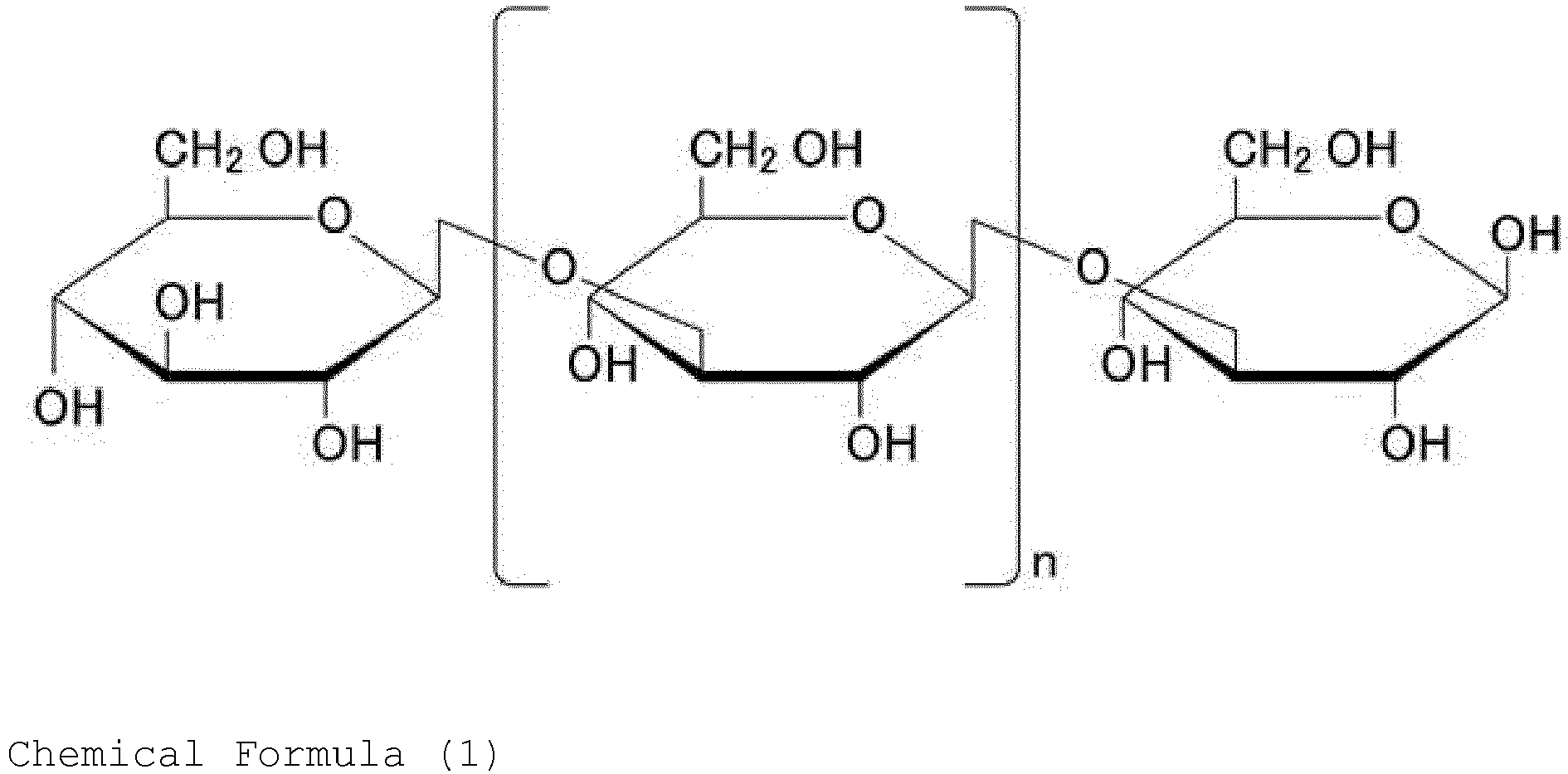
- the curdlan is ⁇ -1,3-glucan, which is a polysaccharide with a structure represented by Chemical Formula (1) below and found in soil bacteria.
- the curdlan has a molecular weight of about 1,000,000 and is characterized by having high strength but low fluidity.
- a curdlan ester derivative with a structure represented by Chemical Formula (2) below is obtained by esterifying at least some of hydroxy groups in the curdlan with an acid as described in detail later. The esterification may be carried out using conventionally known techniques.
- Paramylon is a ⁇ -1,3-glucan, which is a polysaccharide with a structure represented by Chemical Formula (1) below and found in euglena (green algae).
- the paramylon has a molecular weight of about 300,000 and is characterized by having high fluidity but low strength.
- a paramylon ester derivative with a structure represented by Chemical Formula (2) below is obtained by esterifying at least some of hydroxy groups in the paramylon with an acid as described in detail later. The esterification may be carried out using conventionally known techniques.
- the substituent R in Chemical Formula (2) above includes a short chain component that is an acyl group having 3 carbon atoms and a long chain component that is an acyl group having any of 6 to 8 carbon atoms. This makes it possible to synthesize it in a shorter time than when only a long chain component is introduced as the substituent. Specifically, this makes it possible to synthesize it in a shorter time than when a long chain component having more than 8 carbon atoms is introduced as the substituent.
- the ⁇ -1,3-glucan ester derivative is a heteroester having the short chain component and the long chain component that are different types of substituents, crystallinity and a thermal property (such as glass transition temperature and melt viscosity) of a molded product can be easily controlled and therefore injection moldability, rigidity, and flexibility can be adjusted to fall within a preferable range.
- the ⁇ -1,3-glucan ester derivative according to the present embodiment preferably does not include a substituent R having 4 and 5 carbon atoms. This makes it possible to suppress an odor such as a characteristic odor of a molded product and to apply the molded product to plumbing or household equipment.
- an overall degree of substitution DSs + DSl that is a sum of a degree of substitution with the short chain component DSs and a degree of substitution with the long chain component DS1 is 2.0 or more.
- the degree of substitution DSs and the degree of substitution DSl mean an average number of hydrogen atoms substituted with the short chain component and the long chain component per glucose unit, respectively.
- the DSs + DSl of 2.0 or more provides water resistance (hydrolysis resistance) and long-term durability that are demanded for plumbing or household equipment.
- the DSs + DSl of less than 2.0 increases a rate of a hydroxy group remaining in a molecule and therefore the resultant derivative cannot achieve satisfactory water resistance or long-term durability and cannot be preferably used in applications where it comes in contact with water.
- the DSs + DSl is preferably 2.5 or more and most preferably 3.0.
- a ratio DSs:DSl which is a ratio of the degree of substitution with the short chain component DSs to the degree of substitution with the long chain component DSl is preferably 1.2:1.8 to 2.1:0.9. This makes it possible to suppress poor fluidity during molding of a resin by injection molding. Furthermore, the resultant molded product can achieve both rigidity and flexibility. From the above viewpoints, the ratio DSs:DSl is more preferably 1.5:1.5 to 2.1:0.9.
- the degree of substitution with the short chain component DSs and the degree of substitution with the long chain component DSl may be determined by, for example, 1 HNMR.
- Structures of the short chain component which is an acyl group having 3 carbon atoms and the long chain component which is an acyl group having 6 to 8 carbon atoms are not particularly limited as long as each satisfies the above condition with regard to the number of carbon atoms.
- a linkage between carbons may be a saturated linkage or an unsaturated linkage may be included.
- the components may be any of those having a linear structure, a branched structure, and a cyclic structure.
- a saturated aliphatic acyl group having 3 carbon atoms and a linear structure i.e., a propanoyl group; one having a branched structure, i.e., an isopropanoyl group; one having a cyclic structure, i.e., a cyclopropanoyl group; saturated aliphatic acyl groups having 6 to 8 carbon atoms and a linear structure, i.e., an n-hexanoyl group, an n-heptanoyl group, and an n-octanoyl group; those having a branched structure, i.e., an isohexanoyl group, an isoheptanoyl group, and an isooctanoyl group; those having a cyclic structure, i.e., a cyclohexanoyl group, a cycloheptanoyl group, and a a cycl
- the hydrogen atoms in the hydroxy groups in the ⁇ -1,3-glucan are substituted with the short chain component and the long chain component via esterification with an acid as described above.
- the acid for use in esterification include carboxylic acids having the numbers of carbon atoms and structures corresponding to the short chain component and the long chain component.
- carboxylic acids for use in introduction of the short chain component that is a saturated aliphatic acyl group having 3 carbon atoms propionic acid is exemplified.
- isohexanoic acid, isoheptanoic acid, and isooctanoic acid are exemplified; for those having a cyclic structure, a cyclohexane carboxylic acid, a cycloheptane carboxylic acid, and a cyclooctane carboxylic acid are exemplified; for those having an unsaturated linkage, hexenoic acid, heptenoic acid, and octenoic acid are exemplified; and for those having an aromatic ring, benzoic acid is exemplified.
- the acid can also serve as a solvent for the resultant ⁇ -1,3-glucan ester derivative.
- An acid other than the acid for use in the esterification may be used in combination as the acid serving as a solvent.
- trifluoroacetic anhydride may be used in combination.
- the ⁇ -1,3-glucan ester derivative has been described as an example of the ⁇ -glucan ester derivative, but a ⁇ -1,4-glucan ester derivative according to the present embodiment has a comparable composition and effect.
- ⁇ -1,4-glucan is a polymer in which a plurality of glucoses are linked via a ⁇ -1,4-glycosidic linkage similar to the ⁇ -1,3-glucan, and, for example, a plant-derived cellulose is exemplified.
- the ⁇ -1,4-glucan ester derivative has a structure in which at least some of hydrogen atoms in hydroxy groups in ⁇ -1,4-glucan is substituted with the short chain component and the long chain component.
- the ⁇ -1,4-glucan ester derivative can be synthesized via esterification in the same manner as in the ⁇ -1,3-glucan ester derivative.
- a method of purifying the ⁇ -glucan ester derivative according to the present embodiment includes, for example, a deposition step for mixing a reprecipitation solvent and a synthetic reaction liquid containing the ⁇ -glucan ester derivative, and a cooling step for lowering a temperature of at least one of the reprecipitation solvent and the synthetic reaction liquid.
- the method may include a washing step for washing the resultant deposit from the deposition step.
- the deposition step is a step for mixing a reprecipitation solvent and a synthetic reaction liquid containing a ⁇ -glucan ester derivative produced by esterification of at least some of hydroxy groups in a ⁇ -glucan ester derivative with an acid.
- the ⁇ -glucan ester derivative is deposited or re-precipitated.
- the reprecipitation solvent is composed of, for example, a good solvent in which the ⁇ -glucan ester derivative has high solubility; and a poor solvent in which the ⁇ -glucan ester derivative has low solubility.
- the reprecipitation solvent is mixed with the synthetic reaction liquid to deposit a deposit including the ⁇ -glucan ester derivative.
- the reprecipitation solvent is preferably added to and mixed with the synthetic reaction liquid. More preferably, the good solvent is added to the synthetic reaction liquid and dissolved in it, and then the poor solvent is added dropwise to the resulting solution. This can prevent deposition at an interface between the synthetic reaction liquid and the solvent and suppress aggregation of deposits.
- the deposition step can be performed in a single vessel.
- the good solvent may be any solvent in which the ⁇ -glucan ester derivative is soluble.
- the good solvent is preferably an alcohol such as methanol, or a ketone such as acetone.
- a washing step for washing a re-precipitated product it is preferable to use a good solvent having a high ability to wash off the remaining acid used for esterification from the re-precipitated product.
- a single good solvent may be used, or a mixture of two or more good solvents may be used.
- the poor solvent is a solvent in which the ⁇ -glucan ester derivative has low solubility and in which the ⁇ -glucan ester derivative has lower solubility than that at least in the good solvent.
- the poor solvent is preferably water.
- a single poor solvent may be used, or a mixture of two or more poor solvents may be used.
- a cooling step is a step for lowering a temperature of at least one of the synthetic reaction liquid and the reprecipitation solvent.
- the cooling step may be a step for cooling at least one of the synthetic reaction liquid and the reprecipitation solvent before the synthetic reaction liquid is mixed with the reprecipitation solvent in the deposition step.
- the cooling step may be a step for cooling a mixture solution of the synthetic reaction liquid and the reprecipitation solvent after they are mixed in the deposition step.
- the cooling step can increase a yield of the ⁇ -glucan ester derivative.
- a washing step is a step for washing the deposit including the ⁇ -glucan ester derivative deposited in the deposition step.
- the washing step removes impurities included in the deposit, such as the acids used for esterification, from the deposit.
- the washing step may be performed using any appropriate solution in which the ⁇ -glucan ester derivative has low solubility and preferably in which the acid used for esterification has high solubility.
- the washing step may be performed using any known method without limitation.
- the ⁇ -glucan ester derivative purified by the purification method according to the present embodiment is then molded by any of various molding methods.
- injection molding, casting, compression molding, inflation molding, and other commonly used methods can be applied as the molding methods.
- the ⁇ -glucan ester derivative according to the present embodiment has a satisfactory melt viscosity and therefore is more preferably molded by injection molding.
- a molded product can be applied to various applications such as plumbing products for use in plumbing such as a bath and a kitchen in a house, household equipment, and an exterior material for a house.
- the resultant solid was repeatedly washed with a mixed solution of methanol and water a few times until the pH of the filtrate was 7, and dried at 100°C for 17 hours to thereby obtain 25.9 g of ⁇ -glucan ester derivative as a white solid.
- Example 1 Curdlan 15 600 Propionic acid 400ml n-hexanoic acid 200ml 77 25.9
- Example 2 Curdlan 8 320 Propionic acid 160ml n-hexanoic acid 160ml 60 17.5
- Example 3 Curdlan 15 600 Propionic acid 200ml n-hexanoic acid 400ml 60 31.6
- Example 5 Paramylon 0.75 30 Propionic acid 15ml n-hexanoic acid 15ml 60 1.4
- Example 6 Paramylon 15 600
- the ⁇ -glucan ester derivatives of Examples and Comparative Examples were measured for a weight average molecular weight (Mw) and a dispersity (Mw/Mn) that is a ratio of a weight average molecular weight (Mw) to a number average molecular weight (Mn).
- Mw weight average molecular weight
- Mw/Mn dispersity
- Solvent chloroform for HPLC, Column: dual column (K-806M, K-802, SHOWA DENKO K.K.), Flow rate: 0.8 mL/min, and Column oven: 40°C
- the ⁇ -glucan ester derivatives of Examples and Comparative Examples were measured for degrees of substitution with a short chain component and a long chain component by 1 HNMR (JNM-ECA (500 MHz), JEOL Ltd.). Chloroform-d (99.8% by ATOM, FUJIFILM Wako Pure Chemical Corporation) was used as a measurement solvent.
- the degrees of substitution with the short chain component and the long chain component were calculated from a ratio of peak areas of substituents corresponding to the short chain component and the long chain component in 1 H NMR spectra and a peak area of ring protons in a glucose unit.
- a sum of the degree of substitution with the short chain component (DSs) and the degree of substitution with the long chain component (DSl) when the maximum degree of substitution is 3 in terms of a glucose unit was determined as an overall degree of substitution. The results are shown in Table 2.
- the ⁇ -glucan ester derivatives of Examples and Comparative Examples were measured for a melting point (Tm, °C) and a glass transition temperature (Tg, °C) using DSC (DSC8500, PerkinElmer, Inc.). A sample was placed on an aluminum pan, and the temperature was increased from 30°C to 250°C at a heating rate of 20°C/min and held for 1 minute after reaching 250°C. Then, the temperature was decreased to -60°C at a cooling rate of 200°C/min and held for 1 minute after reaching -60°C. Then, the temperature was increased to 250°C at a heating rate of 20°C/min. The melting point (Tm, °C) and the glass transition temperature (Tg, °C) were calculated. The results are shown in Table 2.
- the ⁇ -glucan ester derivatives of Examples and Comparative Examples were injection-molded under the conditions shown in Table 3, thereby producing samples for use in physical property measurement.
- An injection molding device used was MiniJet Pro (manufactured by Thermo Fisher Scientific, Inc.).
- An injection pressure was 900 bar, 10 sec and dwelling was 250 bar, 10 sec.
- a sample mold having a length of 80 mm, a width of 12.5 mm, and a thickness of 2.5 mm (strip) was used.
- Example/ Comparative Example Tensile strength (MPa) Tensile modulus (MPa) Bending strength (MPa) Bending modulus (MPa) Charpy impact value (kJ/m 2 )
- Example 1 36 - 39 1039 10
- Example 2 27 - 26 721 16
- Example 3 28 1150 17 493 12
- Example 5 28 - 26 745 15
- Example 6 27 1234 16 476 12
- Example 9 14 1152 20 567 11
- Comparative Example 1 37 - 53 1342 6 Comparative Example 2 5 - 3 86 12 Comparative Example 3 35 2489 59 1523 12
- Comparative Example 4 5 - 3 77 16 Comparative Example 5 2 - 0.4 5 16 Comparative Example 6 DL - 0.7 10 10 Comparative Example 7 3 - 0.8 11 26 Comparative Example 8 DL - 0.4 3 9
Landscapes
- Chemical & Material Sciences (AREA)
- Health & Medical Sciences (AREA)
- Chemical Kinetics & Catalysis (AREA)
- Medicinal Chemistry (AREA)
- Polymers & Plastics (AREA)
- Organic Chemistry (AREA)
- Life Sciences & Earth Sciences (AREA)
- Engineering & Computer Science (AREA)
- Biochemistry (AREA)
- Materials Engineering (AREA)
- General Health & Medical Sciences (AREA)
- Molecular Biology (AREA)
- Polysaccharides And Polysaccharide Derivatives (AREA)
- Manufacture Of Macromolecular Shaped Articles (AREA)
Abstract
Description
- The present disclosure relates to a β-1,3-glucan ester derivative and a β-1,4-glucan ester derivative.
- In recent years, technologies related to bioplastics produced from microorganisms and plants have been proposed from the viewpoint of environmental protection. Known examples of the bioplastics produced by microorganisms are β-1,3-glucan ester derivatives obtained through esterification of at least some of hydroxy groups in β-1,3-glucan with an acid.
- It has been considered that the β-1,3-glucan ester derivatives and β-1,4-glucan ester derivatives having a similar structure thereto are molded for use in various applications. Conventionally, there has been disclosed a technology by which a β-1,3-glucan ester derivative having a mechanical property and thermoplasticity can be achieved by, for example, introducing a long-chain component having 14 or more carbon atoms (e.g., Patent Document 1).
- Patent Document 1:
PCT International Publication No. WO2020/013232 - The technology disclosed in Patent Document 1 has a problem of insufficient water resistance for use in applications such as household equipment and plumbing and is also problematic from the viewpoint of achieving both rigidity and flexibility. Furthermore, the technology also has problems in that moldability is insufficient and it takes a long time to introduce a long-chain component into a β-1,3-glucan ester.
- The present invention has been made considering the above and has an object to provide a β-1,3-glucan ester derivative and a β-1,4-glucan ester derivative capable of providing satisfactory water resistance, achieving both rigidity and flexibility, having excellent moldability, and being synthesized in a short time.
- The present invention relates to a β-1,3-glucan ester derivative and a β-1,4-glucan ester derivative in which at least some of hydrogen atoms in hydroxy groups in β-1,3-glucan or β-1,4-glucan is substituted with a short chain component that is an acyl group having 3 carbon atoms and a long chain component that is an acyl group having 6 to 8 carbon atoms.
- A β-1,3-glucan ester derivative and a β-1,4-glucan ester derivative (hereinafter, may be described as "β-glucan ester derivative") according to the present embodiment is a polymer including a plurality of glucoses linked via a glycosidic linkage and having a main chain constituted by a β-1,3 glycosidic linkage or a β-1,4 glycosidic linkage, respectively. Hereinafter, the β-1,3-glucan ester derivative will be described as an example.
- A β-1,3-glucan ester derivative according to the present embodiment is preferably a curdlan ester derivative or a paramylon ester derivative. Both of curdlan and paramylon are derived from microorganisms. These can be esterified to form ester derivatives, and microorganism-derived plastics can be produced using such ester derivatives. Curdlan and paramylon are each a type of polysaccharide, β-1,3-glucan. Although derived from microorganisms, the curdlan ester derivative and the paramylon ester derivative according to the present embodiment have a strength similar to, for example, that of polypropylene (PP) and have excellent moldability.
- The curdlan is β-1,3-glucan, which is a polysaccharide with a structure represented by Chemical Formula (1) below and found in soil bacteria. The curdlan has a molecular weight of about 1,000,000 and is characterized by having high strength but low fluidity. A curdlan ester derivative with a structure represented by Chemical Formula (2) below is obtained by esterifying at least some of hydroxy groups in the curdlan with an acid as described in detail later. The esterification may be carried out using conventionally known techniques.
- Paramylon is a β-1,3-glucan, which is a polysaccharide with a structure represented by Chemical Formula (1) below and found in euglena (green algae). The paramylon has a molecular weight of about 300,000 and is characterized by having high fluidity but low strength. Like the curdlan, a paramylon ester derivative with a structure represented by Chemical Formula (2) below is obtained by esterifying at least some of hydroxy groups in the paramylon with an acid as described in detail later. The esterification may be carried out using conventionally known techniques.


- The substituent R in Chemical Formula (2) above includes a short chain component that is an acyl group having 3 carbon atoms and a long chain component that is an acyl group having any of 6 to 8 carbon atoms. This makes it possible to synthesize it in a shorter time than when only a long chain component is introduced as the substituent. Specifically, this makes it possible to synthesize it in a shorter time than when a long chain component having more than 8 carbon atoms is introduced as the substituent. Furthermore, when the β-1,3-glucan ester derivative is a heteroester having the short chain component and the long chain component that are different types of substituents, crystallinity and a thermal property (such as glass transition temperature and melt viscosity) of a molded product can be easily controlled and therefore injection moldability, rigidity, and flexibility can be adjusted to fall within a preferable range. Note that, the β-1,3-glucan ester derivative according to the present embodiment preferably does not include a substituent R having 4 and 5 carbon atoms. This makes it possible to suppress an odor such as a characteristic odor of a molded product and to apply the molded product to plumbing or household equipment.
- For a degree of substitution with the substituent R in Chemical Formula (2) above, an overall degree of substitution DSs + DSl that is a sum of a degree of substitution with the short chain component DSs and a degree of substitution with the long chain component DS1 is 2.0 or more. The degree of substitution DSs and the degree of substitution DSl mean an average number of hydrogen atoms substituted with the short chain component and the long chain component per glucose unit, respectively. The DSs + DSl of 2.0 or more provides water resistance (hydrolysis resistance) and long-term durability that are demanded for plumbing or household equipment. The DSs + DSl of less than 2.0 increases a rate of a hydroxy group remaining in a molecule and therefore the resultant derivative cannot achieve satisfactory water resistance or long-term durability and cannot be preferably used in applications where it comes in contact with water. The DSs + DSl is preferably 2.5 or more and most preferably 3.0.
- A ratio DSs:DSl which is a ratio of the degree of substitution with the short chain component DSs to the degree of substitution with the long chain component DSl is preferably 1.2:1.8 to 2.1:0.9. This makes it possible to suppress poor fluidity during molding of a resin by injection molding. Furthermore, the resultant molded product can achieve both rigidity and flexibility. From the above viewpoints, the ratio DSs:DSl is more preferably 1.5:1.5 to 2.1:0.9. The degree of substitution with the short chain component DSs and the degree of substitution with the long chain component DSl may be determined by, for example, 1HNMR.
- Structures of the short chain component which is an acyl group having 3 carbon atoms and the long chain component which is an acyl group having 6 to 8 carbon atoms are not particularly limited as long as each satisfies the above condition with regard to the number of carbon atoms. A linkage between carbons may be a saturated linkage or an unsaturated linkage may be included. In addition thereto, the components may be any of those having a linear structure, a branched structure, and a cyclic structure. For example, a saturated aliphatic acyl group having 3 carbon atoms and a linear structure, i.e., a propanoyl group; one having a branched structure, i.e., an isopropanoyl group; one having a cyclic structure, i.e., a cyclopropanoyl group; saturated aliphatic acyl groups having 6 to 8 carbon atoms and a linear structure, i.e., an n-hexanoyl group, an n-heptanoyl group, and an n-octanoyl group; those having a branched structure, i.e., an isohexanoyl group, an isoheptanoyl group, and an isooctanoyl group; those having a cyclic structure, i.e., a cyclohexanoyl group, a cycloheptanoyl group, and a cyclooctanoyl group; those having an unsaturated linkage, i.e., a hexenoyl group, a heptenoyl group, and an octenoyl group; those having an aromatic ring, e.g., an acetylphenyl group; and the like can be exemplified.
- The hydrogen atoms in the hydroxy groups in the β-1,3-glucan are substituted with the short chain component and the long chain component via esterification with an acid as described above. Examples of the acid for use in esterification include carboxylic acids having the numbers of carbon atoms and structures corresponding to the short chain component and the long chain component. For example, as a carboxylic acid for use in introduction of the short chain component that is a saturated aliphatic acyl group having 3 carbon atoms, propionic acid is exemplified. As a carboxylic acid for use in introduction of the long chain component that is a saturated aliphatic acyl group having 6 to 8 carbon atoms and, for example, a linear structure, n-hexanoic acid, n-heptanoic acid, and n-octanoic acid are exemplified. Similarly, for those having a branched structure, isohexanoic acid, isoheptanoic acid, and isooctanoic acid are exemplified; for those having a cyclic structure, a cyclohexane carboxylic acid, a cycloheptane carboxylic acid, and a cyclooctane carboxylic acid are exemplified; for those having an unsaturated linkage, hexenoic acid, heptenoic acid, and octenoic acid are exemplified; and for those having an aromatic ring, benzoic acid is exemplified. The acid can also serve as a solvent for the resultant β-1,3-glucan ester derivative. An acid other than the acid for use in the esterification may be used in combination as the acid serving as a solvent. For example, trifluoroacetic anhydride may be used in combination.
- The β-1,3-glucan ester derivative has been described as an example of the β-glucan ester derivative, but a β-1,4-glucan ester derivative according to the present embodiment has a comparable composition and effect. In other words, β-1,4-glucan is a polymer in which a plurality of glucoses are linked via a β-1,4-glycosidic linkage similar to the β-1,3-glucan, and, for example, a plant-derived cellulose is exemplified. The β-1,4-glucan ester derivative has a structure in which at least some of hydrogen atoms in hydroxy groups in β-1,4-glucan is substituted with the short chain component and the long chain component. The β-1,4-glucan ester derivative can be synthesized via esterification in the same manner as in the β-1,3-glucan ester derivative.
- A method of purifying the β-glucan ester derivative according to the present embodiment includes, for example, a deposition step for mixing a reprecipitation solvent and a synthetic reaction liquid containing the β-glucan ester derivative, and a cooling step for lowering a temperature of at least one of the reprecipitation solvent and the synthetic reaction liquid. In addition to the steps mentioned above, the method may include a washing step for washing the resultant deposit from the deposition step.
- The deposition step is a step for mixing a reprecipitation solvent and a synthetic reaction liquid containing a β-glucan ester derivative produced by esterification of at least some of hydroxy groups in a β-glucan ester derivative with an acid. In the deposition step, the β-glucan ester derivative is deposited or re-precipitated.
- The reprecipitation solvent is composed of, for example, a good solvent in which the β-glucan ester derivative has high solubility; and a poor solvent in which the β-glucan ester derivative has low solubility. In the deposition step, the reprecipitation solvent is mixed with the synthetic reaction liquid to deposit a deposit including the β-glucan ester derivative. In the deposition step, the reprecipitation solvent is preferably added to and mixed with the synthetic reaction liquid. More preferably, the good solvent is added to the synthetic reaction liquid and dissolved in it, and then the poor solvent is added dropwise to the resulting solution. This can prevent deposition at an interface between the synthetic reaction liquid and the solvent and suppress aggregation of deposits. Moreover, the deposition step can be performed in a single vessel.
- The good solvent may be any solvent in which the β-glucan ester derivative is soluble. For example, the good solvent is preferably an alcohol such as methanol, or a ketone such as acetone. Additionally, when a washing step for washing a re-precipitated product is added, it is preferable to use a good solvent having a high ability to wash off the remaining acid used for esterification from the re-precipitated product. A single good solvent may be used, or a mixture of two or more good solvents may be used.
- The poor solvent is a solvent in which the β-glucan ester derivative has low solubility and in which the β-glucan ester derivative has lower solubility than that at least in the good solvent. Specifically, the poor solvent is preferably water. A single poor solvent may be used, or a mixture of two or more poor solvents may be used.
- A cooling step is a step for lowering a temperature of at least one of the synthetic reaction liquid and the reprecipitation solvent. For example, the cooling step may be a step for cooling at least one of the synthetic reaction liquid and the reprecipitation solvent before the synthetic reaction liquid is mixed with the reprecipitation solvent in the deposition step. Alternatively, the cooling step may be a step for cooling a mixture solution of the synthetic reaction liquid and the reprecipitation solvent after they are mixed in the deposition step. The cooling step can increase a yield of the β-glucan ester derivative.
- A washing step is a step for washing the deposit including the β-glucan ester derivative deposited in the deposition step. The washing step removes impurities included in the deposit, such as the acids used for esterification, from the deposit. The washing step may be performed using any appropriate solution in which the β-glucan ester derivative has low solubility and preferably in which the acid used for esterification has high solubility. The washing step may be performed using any known method without limitation.
- The β-glucan ester derivative purified by the purification method according to the present embodiment is then molded by any of various molding methods. For example, injection molding, casting, compression molding, inflation molding, and other commonly used methods can be applied as the molding methods. The β-glucan ester derivative according to the present embodiment has a satisfactory melt viscosity and therefore is more preferably molded by injection molding. A molded product can be applied to various applications such as plumbing products for use in plumbing such as a bath and a kitchen in a house, household equipment, and an exterior material for a house.
- The present disclosure is not limited to the embodiments described above and may be altered or modified as long as the object of the present disclosure can be achieved, and such altered or modified versions will fall within the scope of the present disclosure.
- Hereinafter, the present disclosure will be described in more detail with reference to examples, but is not limited thereto.
- Propionic acid (400 mL) and n-hexanoic acid (200 mL) were added to a reaction vessel and stirred at room temperature. Then, 600 mL of trifluoroacetic anhydride was added dropwise to the reaction vessel. After the completion of the addition, the resultant mixture was heated to 50°C, 15 g of curdlan which had been vacuum-dried at 100°C for 3 hours was added thereto and stirred until the curdlan was dissolved (reaction time: 77 minutes). Then, the resultant reaction liquid was cooled to 20°C, methanol was added thereto, and then water was added until a solid was deposited, at which time the reaction is quenched. The resultant solid was repeatedly washed with a mixed solution of methanol and water a few times until the pH of the filtrate was 7, and dried at 100°C for 17 hours to thereby obtain 25.9 g of β-glucan ester derivative as a white solid.
- β-glucan ester derivatives of Examples 2 to 10 and Comparative Examples 1 to 16 were obtained in the same manner as in Example 1, except that raw materials shown in Table 1 and reaction times shown in Table 1 were used.
[Table 1] Example/ Comparative Example β-qlucan Acid Reaction time (min) Yield (9) Type Weight (g) Trifluoroacetic anhydride(ml) Carboxylic acid Example 1 Curdlan 15 600 Propionic acid 400ml n-hexanoic acid 200ml 77 25.9 Example 2 Curdlan 8 320 Propionic acid 160ml n-hexanoic acid 160ml 60 17.5 Example 3 Curdlan 15 600 Propionic acid 200ml n-hexanoic acid 400ml 60 31.6 Example 4 Paramylon 15 600 Propionic acid 400ml n-hexanoic acid 200ml 65 29.8 Example 5 Paramylon 0.75 30 Propionic acid 15ml n-hexanoic acid 15ml 60 1.4 Example 6 Paramylon 15 600 Propionic acid 200ml n-hexanoic acid 400ml 65 34.1 Example 7 Curdlan 15 600 Propionic acid 300ml n-octanoic acid 300ml 56 33.1 Example 8 Curdlan 15 600 Propionic acid 200ml n-octanoic acid 400ml 53 35.8 Example 9 Paramylon 15 600 Propionic acid 300ml n-octanoic acid 300ml 68 32.9 Example 10 Paramylon 15 600 Propionic acid 200ml n-octanoic acid 400ml 85 37.1 Comparative Example 1 Curdlan 0.5 20 Propionic acid 10ml - 65 0. 8 Comparative Example 2 Curdlan 5 200 n-hexanoic acid 100ml - 120 11.4 Comparative Example 3 Paramylon 3 120 Propionic acid 60ml - 120 5.4 Comparative Example 4 Paramylon 3 120 n-hexanoic acid 60ml - 120 7.6 Comparative Example 5 Curdlan 15 600 Propionic acid 120ml n-octanoic acid 480ml 60 39.2 Comparative Example 6 Curdlan 2.5 100 n-octanoic acid 50ml - 120 7.2 Comparative Example 7 Paramylon 15 600 Propionic acid 120ml n-octanoic acid 480ml 80 40.7 Comparative Example 8 Paramylon 3 120 n-octanoic acid 60ml - 120 9.0 Comparative Example 9 Curdlan 3.5 140 Butyric acid 70ml - 70 4.9 Comparative Example 10 Curdlan 2.5 100 Valeric acid 50ml - 120 3.6 Comparative Example 11 Curdlan 1 40 Decanoic acid 20g - 120 2.4 Comparative Example 12 Curdlan 0.5 20 Lauric acid 10g - 180 3.1 Comparative Example 13 Paramylon 3 120 Butyric acid 60ml - 120 4.1 Comparative Example 14 Paramylon 3 120 Valeric acid 60ml - 120 4.7 Comparative Example 15 Paramylon 3 40 Decanoic acid 20g - 120 3.7 Comparative Example 16 Paramylon 3 40 Lauric acid 20g - 240 2.8 - The β-glucan ester derivatives of Examples and Comparative Examples were measured for a weight average molecular weight (Mw) and a dispersity (Mw/Mn) that is a ratio of a weight average molecular weight (Mw) to a number average molecular weight (Mn). The weight average molecular weight (Mw) and the number average molecular weight (Mn) were measured using GPC (10/20A series, Shimadzu Corporation) under the belowmentioned conditions. The results are shown in Table 2.
- Solvent: chloroform for HPLC, Column: dual column (K-806M, K-802, SHOWA DENKO K.K.), Flow rate: 0.8 mL/min, and Column oven: 40°C
- The β-glucan ester derivatives of Examples and Comparative Examples were measured for degrees of substitution with a short chain component and a long chain component by 1HNMR (JNM-ECA (500 MHz), JEOL Ltd.). Chloroform-d (99.8% by ATOM, FUJIFILM Wako Pure Chemical Corporation) was used as a measurement solvent. The degrees of substitution with the short chain component and the long chain component were calculated from a ratio of peak areas of substituents corresponding to the short chain component and the long chain component in 1H NMR spectra and a peak area of ring protons in a glucose unit. A sum of the degree of substitution with the short chain component (DSs) and the degree of substitution with the long chain component (DSl) when the maximum degree of substitution is 3 in terms of a glucose unit was determined as an overall degree of substitution. The results are shown in Table 2.
- The β-glucan ester derivatives of Examples and Comparative Examples were measured for a melting point (Tm, °C) and a glass transition temperature (Tg, °C) using DSC (DSC8500, PerkinElmer, Inc.). A sample was placed on an aluminum pan, and the temperature was increased from 30°C to 250°C at a heating rate of 20°C/min and held for 1 minute after reaching 250°C. Then, the temperature was decreased to -60°C at a cooling rate of 200°C/min and held for 1 minute after reaching -60°C. Then, the temperature was increased to 250°C at a heating rate of 20°C/min. The melting point (Tm, °C) and the glass transition temperature (Tg, °C) were calculated. The results are shown in Table 2.
- The β-glucan ester derivatives of Comparative Examples 1 to 4, 6, and 8 to 16, each of which was synthesized using a single carboxylic acid, were evaluated for odor according to the following criteria. One having a score of 2 or more was considered to have passed. The results are shown in Table 2.
- 4 No odor
- 3 Very weak acid odor or characteristic odor
- 2 Weak acid odor
- 1 Characteristic odor
- The β-glucan ester derivatives of Examples and Comparative Examples were injection-molded under the conditions shown in Table 3, thereby producing samples for use in physical property measurement. An injection molding device used was MiniJet Pro (manufactured by Thermo Fisher Scientific, Inc.). An injection pressure was 900 bar, 10 sec and dwelling was 250 bar, 10 sec. For a bending test and a Charpy test described below, a sample mold having a length of 80 mm, a width of 12.5 mm, and a thickness of 2.5 mm (strip) was used. For a tensile test described below, a sample mold having a length of 75 mm, a width of 12.5 mm, and a thickness of 2.0 mm (tensile specimen: ISO-527-2-5A) was used. Note that, molding temperatures and mold temperatures shown in Table 3 were adjusted depending on Tg and Tm, and fluidity upon molding.
- Molded products produced from the β-glucan ester derivatives of Examples and Comparative Examples were evaluated for crack under the following conditions. The results are shown in Table 3.
- 2
- There was no crack in molded product
- 1
- There was a crack in molded product
- Molded products produced from the β-glucan ester derivatives of Comparative Examples were evaluated for injection moldability under the following conditions. The results are shown in Table 3.
- 2
- Completely filled
- 1
- Unmoldable due to high viscosity
- The samples of Examples 1 to 10 and Comparative Examples 1 to 8 that had been molded as described above were measured for tensile strength and tensile modulus. This measurement was according to JIS K 7161. The measurement was performed in triplicate and an average value was calculated. One having a tensile strength of 10 MPa or more and a tensile modulus of 300 Mpa or more was considered to have passed. The results are shown in Table 4. Note that, "DL" in Table 4 means a detection limit.
- The samples of Examples 1 to 10 and Comparative Examples 1 to 8 that had been molded as described above were measured for bending strength and bending modulus. This measurement was according to JIS K 7171, except that a specimen having a thickness of 2.6 ± 0.2 mm was used. The measurement was performed in triplicate and an average value was calculated. One having a bending strength of 5 MPa or more and a bending modulus of 150 Mpa or more was considered to have passed. The results are shown in Table 4.
- The samples of Examples 1 to 10 and Comparative Examples 1 to 8 that had been molded as described above were measured for a Charpy impact value. This measurement was according to JIS K 7111. An edgewise impact specimen was produced and measured for a notched Charpy impact strength. The measurement was performed in pentaplicate and an average value was calculated. One having the Charpy impact value of 9 kJ/m2 or more was considered to have passed. The results are shown in Table 4.
[Table 4] Example/ Comparative Example Tensile strength (MPa) Tensile modulus (MPa) Bending strength (MPa) Bending modulus (MPa) Charpy impact value (kJ/m2) Example 1 36 - 39 1039 10 Example 2 27 - 26 721 16 Example 3 28 1150 17 493 12 Example 4 41 2120 38 883 9 Example 5 28 - 26 745 15 Example 6 27 1234 16 476 12 Example 7 20 1093 23 645 13 Example 8 15 672 9 298 12 Example 9 14 1152 20 567 11 Example 10 12 566 9 253 39 Comparative Example 1 37 - 53 1342 6 Comparative Example 2 5 - 3 86 12 Comparative Example 3 35 2489 59 1523 12 Comparative Example 4 5 - 3 77 16 Comparative Example 5 2 - 0.4 5 16 Comparative Example 6 DL - 0.7 10 10 Comparative Example 7 3 - 0.8 11 26 Comparative Example 8 DL - 0.4 3 9 - It was confirmed from the results of Examples and Comparative Examples that the β-glucan ester derivatives according to Examples took less time to react than the β-glucan ester derivative according to Comparative Examples. Furthermore, it was also confirmed that, for the β-glucan ester derivatives according to Examples, the resultant molded products had no crack, in other words, rigidity and flexibility were both achieved.
| Example/ Comparative Example | Molecular weight | Substituting structure | Physical property | Odor | |||
| Mw (Weight average molecular weight) | Dispersit y (Mw/Mn) | Overall degree of substitution DSs+DSl | Ratio of carbon chain DSs : DSl | Tm (°C) | Tg (°C) | ||
| Example 1 | 1.09×10⁶ | 2.1 | 3 | C3:C6=2.1:0.9 | 176 | 71 | 4 |
| Example 2 | 1.57×10⁶ | 1.7 | 3 | C3:C6=1.6:1.4 | 163 | 67 | 4 |
| Example 3 | 1.31×10⁶ | 2.3 | 3 | C3:C6=1.2:1.8 | 146 | 51 | 4 |
| Example 4 | 4.93×10⁵ | 2.5 | 3 | C3:C6=2.1:0.9 | 176 | 61 | 4 |
| Example 5 | 5.68×10⁵ | 2.3 | 3 | C3:C6=1.6:1.4 | 157 | 63 | 4 |
| Example 6 | 4.37×10⁵ | 2.1 | 3 | C3:C6=1.2:1.8 | 142 | 46 | 4 |
| Example 7 | 1.42×10⁶ | 2.5 | 3 | C3:C8=2.0:1.0 | - | - | 4 |
| Example 8 | 1.61×10⁶ | 2.2 | 3 | C3:C8=1.5:1.5 | - | - | 4 |
| Example 9 | 5.10×10⁵ | 2.2 | 3 | C3:C8=2.0:1.0 | - | - | 4 |
| Example 10 | 5.47×10⁵ | 2.1 | 3 | C3:C8=1.5:1.5 | - | - | 4 |
| Comparative Example 1 | 7.67×10⁵ | 2.1 | 3 | C3=3 | 234 | 114 | 2 |
| Comparative Example 2 | 1.86×10⁶ | 1.9 | 3 | C6=3 | 118 | 71 | 2 |
| Comparative Example 3 | 3.84×10⁵ | 2.0 | 3 | C3=3 | 213 | 119 | 2 |
| Comparative Example 4 | 7.69×10⁵ | 2.1 | 3 | C6=3 | 126 | - | 2 |
| Comparative Example 5 | 1.64×10⁶ | 2.3 | 3 | C3:C8=1.0:2.0 | - | - | 4 |
| Comparative Example 6 | 1.77×10⁶ | 2.4 | 3 | C8=3 | - | 50 | 2 |
| Comparative Example 7 | 5.10×10⁵ | 2.1 | 3 | C3:C8=1.1:1.9 | - | - | 4 |
| Comparative Example 8 | 7.72×10⁵ | 2.3 | 3 | C8=3 | - | - | 2 |
| Comparative Example 9 | 1.78×10⁶ | 2.0 | 3 | C4=3 | 190 | 74 | 1 |
| Comparative Example 10 | 2.10×10⁶ | 1.9 | 3 | C5=3 | 168 | 51 | 1 |
| Comparative Example 11 | 2.12×10⁶ | 2.2 | 3 | C10=3 | - | - | 3 |
| Comparative Example 12 | 9.71×10⁵ | 3.3 | 3 | C12=3 | - | - | 3 |
| Comparative Example 13 | 5.67×10⁵ | 1.9 | 3 | C4=3 | 211 | 70 | 1 |
| Comparative Example 14 | 8.30×10⁵ | 2.2 | 3 | C5=3 | 191 | - | 1 |
| Comparative Example 15 | 8.78×10⁵ | 2.2 | 3 | C10=3 | - | - | 3 |
| Comparative Example 16 | 8.74×10⁵ | 2.2 | 3 | C12=3 | - | - | 3 |
| Example/ Comparative Example | Molding temperature (°C) | Mold temperature (°C) | Crack in molded product | Injection moldability |
| Example 1 | 215 | 50 | 2 | 2 |
| Example 2 | 190 | 50 | 2 | 2 |
| Example 3 | 180 | 40 | 2 | 2 |
| Example 4 | 210 | 50 | 2 | 2 |
| Example 5 | 180 | 50 | 2 | 2 |
| Example 6 | 170 | 40 | 2 | 2 |
| Example 7 | 215 | 50 | 2 | 2 |
| Example 8 | 190 | 50 | 2 | 2 |
| Example 9 | 210 | 50 | 2 | 2 |
| Example 10 | 180 | 50 | 2 | 2 |
| Comparative Example 1 | 235 | 50 | - | 2 |
| Comparative Example 2 | 170 | 50 | - | 2 |
| Comparative Example 3 | 230 | 50 | - | 2 |
| Comparative Example 4 | 160 | 50 | - | 2 |
| Comparative Example 5 | 170 | 40 | 1 | - |
| Comparative Example 6 | 160 | 40 | - | 2 |
| Comparative Example 7 | 170 | 40 | 1 | - |
| Comparative Example 8 | 160 | 40 | - | 2 |
| Comparative Example 9 | - | - | - | 2 |
| Comparative Example 10 | - | - | - | 2 |
| Comparative Example 11 | - | - | - | 1 |
| Comparative Example 12 | - | - | - | 1 |
| Comparative Example 13 | - | - | - | 2 |
| Comparative Example 14 | - | - | - | 2 |
| Comparative Example 15 | - | - | - | 1 |
| Comparative Example 16 | - | - | - | 1 |
Claims (4)
- A β-1,3-glucan ester derivative and a β-1,4-glucan ester derivative, wherein at least some of hydrogen atoms in hydroxy groups in β-1,3-glucan or β-1,4-glucan is substituted with a short chain component that is an acyl group having 3 carbon atoms and a long chain component that is an acyl group having 6 to 8 carbon atoms.
- The β-1,3-glucan ester derivative and β-1,4-glucan ester derivative according to claim 1, wherein a sum of a degree of substitution with the short chain component DSs and a degree of substitution with the long chain component DSl is 2.0 or more.
- The β-1,3-glucan ester derivative and β-1,4-glucan ester derivative according to claim 1 or 2, wherein a ratio DSs:DSl of the degree of substitution with the short chain component DSs to the degree of substitution with the long chain component DSl is 1.2:1.8 to 2.1:0.9.
- The β-1,3-glucan ester derivative and β-1,4-glucan ester derivative according to any one of claims 1 to 3 for use as a material for injection molding.
Applications Claiming Priority (2)
| Application Number | Priority Date | Filing Date | Title |
|---|---|---|---|
| JP2020095896A JP7566274B2 (en) | 2020-06-02 | 2020-06-02 | β-1,3-glucan ester derivatives and β-1,4-glucan ester derivatives |
| PCT/JP2021/007728 WO2021246006A1 (en) | 2020-06-02 | 2021-03-01 | β-1,3-GLUCAN ESTER DERIVATIVE AND β-1,4-GLUCAN ESTER DERIVATIVE |
Publications (2)
| Publication Number | Publication Date |
|---|---|
| EP4159798A1 true EP4159798A1 (en) | 2023-04-05 |
| EP4159798A4 EP4159798A4 (en) | 2024-07-03 |
Family
ID=78830809
Family Applications (1)
| Application Number | Title | Priority Date | Filing Date |
|---|---|---|---|
| EP21818155.0A Pending EP4159798A4 (en) | 2020-06-02 | 2021-03-01 | ß-1,3-GLUCAN ESTER DERIVATIVE AND ß-1,4-GLUCAN ESTER DERIVATIVE |
Country Status (3)
| Country | Link |
|---|---|
| EP (1) | EP4159798A4 (en) |
| JP (1) | JP7566274B2 (en) |
| WO (1) | WO2021246006A1 (en) |
Families Citing this family (5)
| Publication number | Priority date | Publication date | Assignee | Title |
|---|---|---|---|---|
| WO2022255447A1 (en) * | 2021-06-03 | 2022-12-08 | 株式会社Lixil | β GLUCAN ESTER DERIVATIVE |
| JP2023111484A (en) * | 2022-01-31 | 2023-08-10 | 日本電気株式会社 | Marine biodegradable paramylon ester derivative, resin composition for molding, and molding |
| WO2023153079A1 (en) * | 2022-02-10 | 2023-08-17 | 日東電工株式会社 | PRODUCTION METHOD FOR β-1,3-GLUCAN DERIVATIVE |
| CN119403896A (en) * | 2022-06-22 | 2025-02-07 | 日东电工株式会社 | Adhesive composition, adhesive sheet, laminate, and method for producing β-1,3-glucan derivative |
| JPWO2023248726A1 (en) * | 2022-06-22 | 2023-12-28 |
Family Cites Families (6)
| Publication number | Priority date | Publication date | Assignee | Title |
|---|---|---|---|---|
| EP2921504B1 (en) * | 2012-11-14 | 2017-07-12 | National Institute of Advanced Industrial Science and Technology | Beta-1,3-glucan derivative and method for producing beta-1,3-glucan derivative |
| JP2017193667A (en) * | 2016-04-21 | 2017-10-26 | 国立研究開発法人産業技術総合研究所 | β-1,3-GLUCAN DERIVATIVE, METHOD FOR PRODUCING THE SAME, AND MOLDED BODY |
| JP2017218566A (en) * | 2016-06-03 | 2017-12-14 | 株式会社ユーグレナ | Paramylon ester derivatives and fibers |
| KR102695118B1 (en) * | 2017-03-29 | 2024-08-16 | 이스트만 케미칼 컴파니 | Position-selectively substituted cellulose esters |
| WO2020013232A1 (en) | 2018-07-10 | 2020-01-16 | 日本電気株式会社 | Paramylon-based resin, molding material, molded body, and paramylon-based resin production method |
| JP7152211B2 (en) * | 2018-07-23 | 2022-10-12 | 株式会社Lixil | Method for purifying β-1,3-glucan ester derivative |
-
2020
- 2020-06-02 JP JP2020095896A patent/JP7566274B2/en active Active
-
2021
- 2021-03-01 EP EP21818155.0A patent/EP4159798A4/en active Pending
- 2021-03-01 WO PCT/JP2021/007728 patent/WO2021246006A1/en not_active Ceased
Also Published As
| Publication number | Publication date |
|---|---|
| JP2021187977A (en) | 2021-12-13 |
| EP4159798A4 (en) | 2024-07-03 |
| WO2021246006A1 (en) | 2021-12-09 |
| JP7566274B2 (en) | 2024-10-15 |
Similar Documents
| Publication | Publication Date | Title |
|---|---|---|
| JP7566274B2 (en) | β-1,3-glucan ester derivatives and β-1,4-glucan ester derivatives | |
| EP2938639B1 (en) | Preparation of poly alpha-1,3-glucan esters | |
| EP2921504B1 (en) | Beta-1,3-glucan derivative and method for producing beta-1,3-glucan derivative | |
| AU2014367230B2 (en) | Films of poly alpha-1,3-glucan esters and method for their preparation | |
| US9403917B2 (en) | Preparation of poly alpha-1,3-glucan esters and films therefrom | |
| JP6817972B2 (en) | Preparation of poly α-1,3-glucan ester using cyclic organic anhydride | |
| EP3161012A1 (en) | Preparation of poly alpha-1,3-glucan ester films | |
| Doganci et al. | Mechanical, thermal and morphological properties of poly (lactic acid) by using star-shaped poly (ε-caprolactone) with POSS core | |
| Carvalho et al. | Synthesis of amphiphilic pullulan-graft-poly (ε-caprolactone) via click chemistry | |
| Vassilev et al. | Ultrasound-assisted synthesis of sucrose and fructooligosaccharides esters as bio-plasticizers | |
| JP2017193667A (en) | β-1,3-GLUCAN DERIVATIVE, METHOD FOR PRODUCING THE SAME, AND MOLDED BODY | |
| EP4349872A1 (en) | ß GLUCAN ESTER DERIVATIVE | |
| KR101407691B1 (en) | Bioplastic composition and method for preparing the same | |
| JP7084657B2 (en) | Composite material derived from lignocellulosic biomass and its manufacturing method | |
| CN112778548A (en) | Reversibly crosslinked aliphatic polyesters and process for their preparation | |
| Gädda et al. | Poly (ε‐caprolactone)‐grafted acetylated anhydroglucose oligomer by ring‐opening polymerization—Synthesis and characterization | |
| WO2020241421A1 (en) | BRANCHED CHAIN, ESTERIFIED α-1,3-GLUCAN DERIVATIVE | |
| KR101562094B1 (en) | Cellulose based resin and method for preparing the same | |
| Paban Kundu et al. | Miscibility of the Blend of Chitosan and Polymethylmethacrylate-co-Polyhydroxyethylmethacrylate Copolymer. |
Legal Events
| Date | Code | Title | Description |
|---|---|---|---|
| STAA | Information on the status of an ep patent application or granted ep patent |
Free format text: STATUS: THE INTERNATIONAL PUBLICATION HAS BEEN MADE |
|
| PUAI | Public reference made under article 153(3) epc to a published international application that has entered the european phase |
Free format text: ORIGINAL CODE: 0009012 |
|
| STAA | Information on the status of an ep patent application or granted ep patent |
Free format text: STATUS: REQUEST FOR EXAMINATION WAS MADE |
|
| 17P | Request for examination filed |
Effective date: 20221229 |
|
| AK | Designated contracting states |
Kind code of ref document: A1 Designated state(s): AL AT BE BG CH CY CZ DE DK EE ES FI FR GB GR HR HU IE IS IT LI LT LU LV MC MK MT NL NO PL PT RO RS SE SI SK SM TR |
|
| DAV | Request for validation of the european patent (deleted) | ||
| DAX | Request for extension of the european patent (deleted) | ||
| A4 | Supplementary search report drawn up and despatched |
Effective date: 20240531 |
|
| RIC1 | Information provided on ipc code assigned before grant |
Ipc: C08B 3/16 20060101ALI20240524BHEP Ipc: C08L 1/14 20060101ALI20240524BHEP Ipc: C08L 5/00 20060101ALI20240524BHEP Ipc: C08B 37/00 20060101ALI20240524BHEP Ipc: C08J 5/18 20060101AFI20240524BHEP |