EP4159771A1 - Mixed catalytic composition, catalyst comprising same, and methods for preparing same - Google Patents
Mixed catalytic composition, catalyst comprising same, and methods for preparing same Download PDFInfo
- Publication number
- EP4159771A1 EP4159771A1 EP21813877.4A EP21813877A EP4159771A1 EP 4159771 A1 EP4159771 A1 EP 4159771A1 EP 21813877 A EP21813877 A EP 21813877A EP 4159771 A1 EP4159771 A1 EP 4159771A1
- Authority
- EP
- European Patent Office
- Prior art keywords
- formula
- compound represented
- catalyst composition
- hybrid catalyst
- substituted
- Prior art date
- Legal status (The legal status is an assumption and is not a legal conclusion. Google has not performed a legal analysis and makes no representation as to the accuracy of the status listed.)
- Pending
Links
Classifications
-
- C—CHEMISTRY; METALLURGY
- C08—ORGANIC MACROMOLECULAR COMPOUNDS; THEIR PREPARATION OR CHEMICAL WORKING-UP; COMPOSITIONS BASED THEREON
- C08F—MACROMOLECULAR COMPOUNDS OBTAINED BY REACTIONS ONLY INVOLVING CARBON-TO-CARBON UNSATURATED BONDS
- C08F4/00—Polymerisation catalysts
- C08F4/42—Metals; Metal hydrides; Metallo-organic compounds; Use thereof as catalyst precursors
- C08F4/44—Metals; Metal hydrides; Metallo-organic compounds; Use thereof as catalyst precursors selected from light metals, zinc, cadmium, mercury, copper, silver, gold, boron, gallium, indium, thallium, rare earths or actinides
- C08F4/60—Metals; Metal hydrides; Metallo-organic compounds; Use thereof as catalyst precursors selected from light metals, zinc, cadmium, mercury, copper, silver, gold, boron, gallium, indium, thallium, rare earths or actinides together with refractory metals, iron group metals, platinum group metals, manganese, rhenium technetium or compounds thereof
- C08F4/62—Refractory metals or compounds thereof
- C08F4/64—Titanium, zirconium, hafnium or compounds thereof
- C08F4/659—Component covered by group C08F4/64 containing a transition metal-carbon bond
- C08F4/6592—Component covered by group C08F4/64 containing a transition metal-carbon bond containing at least one cyclopentadienyl ring, condensed or not, e.g. an indenyl or a fluorenyl ring
- C08F4/65922—Component covered by group C08F4/64 containing a transition metal-carbon bond containing at least one cyclopentadienyl ring, condensed or not, e.g. an indenyl or a fluorenyl ring containing at least two cyclopentadienyl rings, fused or not
-
- C—CHEMISTRY; METALLURGY
- C08—ORGANIC MACROMOLECULAR COMPOUNDS; THEIR PREPARATION OR CHEMICAL WORKING-UP; COMPOSITIONS BASED THEREON
- C08F—MACROMOLECULAR COMPOUNDS OBTAINED BY REACTIONS ONLY INVOLVING CARBON-TO-CARBON UNSATURATED BONDS
- C08F10/00—Homopolymers and copolymers of unsaturated aliphatic hydrocarbons having only one carbon-to-carbon double bond
-
- C—CHEMISTRY; METALLURGY
- C08—ORGANIC MACROMOLECULAR COMPOUNDS; THEIR PREPARATION OR CHEMICAL WORKING-UP; COMPOSITIONS BASED THEREON
- C08F—MACROMOLECULAR COMPOUNDS OBTAINED BY REACTIONS ONLY INVOLVING CARBON-TO-CARBON UNSATURATED BONDS
- C08F4/00—Polymerisation catalysts
- C08F4/02—Carriers therefor
- C08F4/025—Metal oxides
-
- C—CHEMISTRY; METALLURGY
- C08—ORGANIC MACROMOLECULAR COMPOUNDS; THEIR PREPARATION OR CHEMICAL WORKING-UP; COMPOSITIONS BASED THEREON
- C08F—MACROMOLECULAR COMPOUNDS OBTAINED BY REACTIONS ONLY INVOLVING CARBON-TO-CARBON UNSATURATED BONDS
- C08F4/00—Polymerisation catalysts
- C08F4/42—Metals; Metal hydrides; Metallo-organic compounds; Use thereof as catalyst precursors
- C08F4/44—Metals; Metal hydrides; Metallo-organic compounds; Use thereof as catalyst precursors selected from light metals, zinc, cadmium, mercury, copper, silver, gold, boron, gallium, indium, thallium, rare earths or actinides
- C08F4/46—Metals; Metal hydrides; Metallo-organic compounds; Use thereof as catalyst precursors selected from light metals, zinc, cadmium, mercury, copper, silver, gold, boron, gallium, indium, thallium, rare earths or actinides selected from alkali metals
- C08F4/461—Catalysts containing at least two different components covered by the same or by different subgroups of group C08F4/46, e.g. butyllithium + propylrubidium
-
- C—CHEMISTRY; METALLURGY
- C08—ORGANIC MACROMOLECULAR COMPOUNDS; THEIR PREPARATION OR CHEMICAL WORKING-UP; COMPOSITIONS BASED THEREON
- C08F—MACROMOLECULAR COMPOUNDS OBTAINED BY REACTIONS ONLY INVOLVING CARBON-TO-CARBON UNSATURATED BONDS
- C08F4/00—Polymerisation catalysts
- C08F4/42—Metals; Metal hydrides; Metallo-organic compounds; Use thereof as catalyst precursors
- C08F4/44—Metals; Metal hydrides; Metallo-organic compounds; Use thereof as catalyst precursors selected from light metals, zinc, cadmium, mercury, copper, silver, gold, boron, gallium, indium, thallium, rare earths or actinides
- C08F4/60—Metals; Metal hydrides; Metallo-organic compounds; Use thereof as catalyst precursors selected from light metals, zinc, cadmium, mercury, copper, silver, gold, boron, gallium, indium, thallium, rare earths or actinides together with refractory metals, iron group metals, platinum group metals, manganese, rhenium technetium or compounds thereof
- C08F4/62—Refractory metals or compounds thereof
- C08F4/64—Titanium, zirconium, hafnium or compounds thereof
- C08F4/659—Component covered by group C08F4/64 containing a transition metal-carbon bond
- C08F4/65904—Component covered by group C08F4/64 containing a transition metal-carbon bond in combination with another component of C08F4/64
-
- C—CHEMISTRY; METALLURGY
- C08—ORGANIC MACROMOLECULAR COMPOUNDS; THEIR PREPARATION OR CHEMICAL WORKING-UP; COMPOSITIONS BASED THEREON
- C08F—MACROMOLECULAR COMPOUNDS OBTAINED BY REACTIONS ONLY INVOLVING CARBON-TO-CARBON UNSATURATED BONDS
- C08F4/00—Polymerisation catalysts
- C08F4/42—Metals; Metal hydrides; Metallo-organic compounds; Use thereof as catalyst precursors
- C08F4/44—Metals; Metal hydrides; Metallo-organic compounds; Use thereof as catalyst precursors selected from light metals, zinc, cadmium, mercury, copper, silver, gold, boron, gallium, indium, thallium, rare earths or actinides
- C08F4/60—Metals; Metal hydrides; Metallo-organic compounds; Use thereof as catalyst precursors selected from light metals, zinc, cadmium, mercury, copper, silver, gold, boron, gallium, indium, thallium, rare earths or actinides together with refractory metals, iron group metals, platinum group metals, manganese, rhenium technetium or compounds thereof
- C08F4/62—Refractory metals or compounds thereof
- C08F4/64—Titanium, zirconium, hafnium or compounds thereof
- C08F4/659—Component covered by group C08F4/64 containing a transition metal-carbon bond
- C08F4/65912—Component covered by group C08F4/64 containing a transition metal-carbon bond in combination with an organoaluminium compound
-
- C—CHEMISTRY; METALLURGY
- C08—ORGANIC MACROMOLECULAR COMPOUNDS; THEIR PREPARATION OR CHEMICAL WORKING-UP; COMPOSITIONS BASED THEREON
- C08F—MACROMOLECULAR COMPOUNDS OBTAINED BY REACTIONS ONLY INVOLVING CARBON-TO-CARBON UNSATURATED BONDS
- C08F4/00—Polymerisation catalysts
- C08F4/42—Metals; Metal hydrides; Metallo-organic compounds; Use thereof as catalyst precursors
- C08F4/44—Metals; Metal hydrides; Metallo-organic compounds; Use thereof as catalyst precursors selected from light metals, zinc, cadmium, mercury, copper, silver, gold, boron, gallium, indium, thallium, rare earths or actinides
- C08F4/60—Metals; Metal hydrides; Metallo-organic compounds; Use thereof as catalyst precursors selected from light metals, zinc, cadmium, mercury, copper, silver, gold, boron, gallium, indium, thallium, rare earths or actinides together with refractory metals, iron group metals, platinum group metals, manganese, rhenium technetium or compounds thereof
- C08F4/62—Refractory metals or compounds thereof
- C08F4/64—Titanium, zirconium, hafnium or compounds thereof
- C08F4/659—Component covered by group C08F4/64 containing a transition metal-carbon bond
- C08F4/65916—Component covered by group C08F4/64 containing a transition metal-carbon bond supported on a carrier, e.g. silica, MgCl2, polymer
-
- C—CHEMISTRY; METALLURGY
- C08—ORGANIC MACROMOLECULAR COMPOUNDS; THEIR PREPARATION OR CHEMICAL WORKING-UP; COMPOSITIONS BASED THEREON
- C08F—MACROMOLECULAR COMPOUNDS OBTAINED BY REACTIONS ONLY INVOLVING CARBON-TO-CARBON UNSATURATED BONDS
- C08F4/00—Polymerisation catalysts
- C08F4/42—Metals; Metal hydrides; Metallo-organic compounds; Use thereof as catalyst precursors
- C08F4/44—Metals; Metal hydrides; Metallo-organic compounds; Use thereof as catalyst precursors selected from light metals, zinc, cadmium, mercury, copper, silver, gold, boron, gallium, indium, thallium, rare earths or actinides
- C08F4/60—Metals; Metal hydrides; Metallo-organic compounds; Use thereof as catalyst precursors selected from light metals, zinc, cadmium, mercury, copper, silver, gold, boron, gallium, indium, thallium, rare earths or actinides together with refractory metals, iron group metals, platinum group metals, manganese, rhenium technetium or compounds thereof
- C08F4/62—Refractory metals or compounds thereof
- C08F4/64—Titanium, zirconium, hafnium or compounds thereof
- C08F4/659—Component covered by group C08F4/64 containing a transition metal-carbon bond
- C08F4/6592—Component covered by group C08F4/64 containing a transition metal-carbon bond containing at least one cyclopentadienyl ring, condensed or not, e.g. an indenyl or a fluorenyl ring
- C08F4/65922—Component covered by group C08F4/64 containing a transition metal-carbon bond containing at least one cyclopentadienyl ring, condensed or not, e.g. an indenyl or a fluorenyl ring containing at least two cyclopentadienyl rings, fused or not
- C08F4/65925—Component covered by group C08F4/64 containing a transition metal-carbon bond containing at least one cyclopentadienyl ring, condensed or not, e.g. an indenyl or a fluorenyl ring containing at least two cyclopentadienyl rings, fused or not two cyclopentadienyl rings being mutually non-bridged
-
- Y—GENERAL TAGGING OF NEW TECHNOLOGICAL DEVELOPMENTS; GENERAL TAGGING OF CROSS-SECTIONAL TECHNOLOGIES SPANNING OVER SEVERAL SECTIONS OF THE IPC; TECHNICAL SUBJECTS COVERED BY FORMER USPC CROSS-REFERENCE ART COLLECTIONS [XRACs] AND DIGESTS
- Y02—TECHNOLOGIES OR APPLICATIONS FOR MITIGATION OR ADAPTATION AGAINST CLIMATE CHANGE
- Y02P—CLIMATE CHANGE MITIGATION TECHNOLOGIES IN THE PRODUCTION OR PROCESSING OF GOODS
- Y02P20/00—Technologies relating to chemical industry
- Y02P20/50—Improvements relating to the production of bulk chemicals
- Y02P20/52—Improvements relating to the production of bulk chemicals using catalysts, e.g. selective catalysts
Definitions
- the present invention relates to a hybrid catalyst composition comprising different transition metal compounds, to a catalyst for olefin polymerization comprising the same, and to processes for preparing the same.
- the present invention relates to a hybrid catalyst composition comprising two or more types of transition metal compounds having a non-bridged biscyclopentadienyl group with different central metals, to a catalyst for olefin polymerization comprising the same, and processes for preparing the hybrid catalyst composition and the catalyst.
- Polyolefin-based polymers are widely used in real life as materials for shopping bags, greenhouses, fishing nets, cigarette packages, instant noodle packages, yogurt bottles, battery cases, automobile bumpers, interior parts, shoe soles, washing machines, and the like.
- polyolefin-based polymers such as polyethylene, polypropylene, and ethylene-alpha olefin copolymers and their copolymers have been prepared using a heterogeneous catalyst such as a Ziegler-Natta catalyst made of a titanium compound and an alkyl aluminum compound.
- a heterogeneous catalyst such as a Ziegler-Natta catalyst made of a titanium compound and an alkyl aluminum compound.
- a metallocene catalyst is a compound in which a ligand such as cyclopentadienyl, indenyl, and cycloheptadienyl is coordinated to a transition metal or a transition metal halide compound. It has a sandwich structure in its basic form. Here, it has various molecular structures depending on the type of ligand and the type of core metal.
- a metallocene catalyst is a single compound having a specific structure, it is known as a single-site catalyst in which all active sites have the same polymerization characteristics.
- a metallocene catalyst since a metallocene catalyst has no activity as a polymerization catalyst by itself, it is used together with a cocatalyst such as methyl aluminoxane.
- the metallocene catalyst is activated as a cation by the action of the cocatalyst.
- the cocatalyst as an anion that is not coordinated with the metallocene catalyst stabilizes the unsaturated cationic active species to form a catalyst system having activity in the polymerization of various olefins.
- Such a metallocene catalyst has advantages in that copolymerization is readily carried out, the three-dimensional structure of a polymer can be controlled according to the symmetry of the catalyst, and the polymer prepared thereby has a narrow molecular weight distribution with uniform distribution of a comonomer.
- the polymers prepared by a metallocene catalyst have a shortcoming in that it has low processability despite excellent mechanical strength due to a narrow molecular weight distribution.
- various methods such as changing the molecular structure of a polymer or broadening the molecular weight distribution thereof have been proposed.
- U.S. Patent No. 5,272,236 discloses a catalyst for introducing a long chain branch (LCB) as a side branch to the main chain of a polymer to improve the processability of the polymer; however, the supported catalyst has a disadvantage of low activity.
- LCB long chain branch
- the polyolefins having a bimodal molecular weight distribution prepared in this way have improved processability, they have lower homogeneity due to different molecular weight distributions. Thus, there is a problem in that it is difficult to obtain a product having uniform physical properties after processing, and the mechanical strength is deteriorated.
- Korean Patent No. 1797890 discloses a hybrid metallocene catalyst in which a first transition metal compound containing a cyclopentadienyl group and an indenyl group, which are not connected by a bridge, and a second transition metal compound containing a substituted bisindenyl group connected by a silyl bridge are mixed.
- such a hybrid catalyst is prepared by preparing respective transition metal compounds, mixing them at a certain ratio, and then supporting them.
- An object of the present invention is to provide a hybrid catalyst composition comprising two or more types of transition metal compounds having a non-bridged biscyclopentadienyl (bisCp) group with different central metals and a catalyst for olefin polymerization comprising the same.
- bisCp biscyclopentadienyl
- Another object of the present invention is to provide a process for preparing a hybrid catalyst composition by adjusting the ratio of precursors of the transition metal compounds and a process for preparing a catalyst for olefin polymerization comprising the same.
- a hybrid catalyst composition comprising transition metal compounds represented by Formula 1 and Formula 2.
- M 1 and M 2 are different from each other and each independently titanium (Ti), zirconium (Zr), or hafnium (Hf).
- X is each independently halogen, C 1-20 alkyl, C 2-20 alkenyl, C 2-20 alkynyl, C 6-20 aryl, C 1-20 alkyl C 6-20 aryl, C 6-20 aryl C 1-20 alkyl, C 1-20 alkylamido, C 6-20 arylamido, or C 1-20 alkylidene, and R 1 to R 5 and R 6 to R 10 are each independently hydrogen, substituted or unsubstituted C 1-20 alkyl, substituted or unsubstituted C 2-20 alkenyl, substituted or unsubstituted C 6-20 aryl, substituted or unsubstituted C 1-20 alkyl C 6-20 aryl, substituted or unsubstituted C 6-20 aryl C 1-20 alkyl, substituted or unsubstituted C 1-20 heteroalkyl, substituted or unsubstituted C 3-20 heteroaryl, substituted or unsubstituted C 1-20 alkylamido
- the molar ratio of the compound represented by Formula 1 to the compound represented by Formula 2 is in the range of 100:1 to 1:100.
- the hybrid catalyst composition according to a specific embodiment of the present invention is a first hybrid catalyst composition, in which M 1 and M 2 are different from each other and may each be zirconium or hafnium, X may each be halogen, and R 1 to R 5 and R 6 to R 10 may each be hydrogen, substituted or unsubstituted C 1-20 alkyl, substituted or unsubstituted C 1-20 alkenyl, or substituted or unsubstituted C 6-20 aryl. More specifically, X in Formulae 1 and 2 may each be chlorine.
- the hybrid catalyst composition according to a specific embodiment of the present invention is a second hybrid catalyst composition, in which M 1 and M 2 are different from each other and may each be zirconium or hafnium, X may each be substituted or unsubstituted C 1-20 alkyl, and R 1 to R 5 and R 6 to R 10 may each be hydrogen, substituted or unsubstituted C 1-20 alkyl, substituted or unsubstituted C 1-20 alkenyl, or substituted or unsubstituted C 6-20 aryl. More specifically, X in Formulae 1 and 2 may each be methyl.
- the transition metal compound represented by Formula 1 is at least one of the transition metal compounds represented by Formulae 1-1 to 1-12, and the transition metal compound represented by Formula 2 is at least one of the transition metal compounds represented by Formulae 2-1 to 2-12.
- the transition metal compound represented by Formula 1 is at least one of the transition metal compounds represented by Formulae 1-13 to 1-24, and the transition metal compound represented by Formula 2 is at least one of the transition metal compounds represented by Formulae 2-13 to 2-24.
- a process for preparing a hybrid catalyst composition which comprises (1) dissolving a compound represented by Formula 3 in a solvent; (2) adding a compound represented by Formula 5 to the solution obtained in step (1) and reacting it under stirring; and (3) adding a compound represented by Formula 4 and a compound represented by Formula 6 to the solution obtained in step (2) and reacting them under stirring to obtain a first hybrid catalyst composition comprising transition metal compounds represented by Formulae 1 and 2, wherein the equivalent ratio of the compound represented by Formula 3 added in step (1) to the compound represented by Formula 5 added in step (2) is in the range of 1:1 to 1.5:1, and the equivalent ratio of the compound represented by Formula 5 added in step (2) to the compound represented by Formula 6 added in step (3) is 1:100 to 100:1.
- X is halogen
- M 1 , M 2 , R 1 to R 5 and R 6 to R 10 are as described above in the section of the hybrid catalyst composition comprising different transition metal compounds.
- the compound represented by Formula 3 may be at least one of the compounds represented by Formulae 3-1 to 3-6.
- the solvent may comprise at least one selected from the group consisting of hexane, pentane, toluene, benzene, dichloromethane, diethyl ether, tetrahydrofuran, acetone, and ethyl acetate.
- step (2) the compound represented by Formula 5 is ZrCl 4 .
- step (2) the reaction temperature is 0°C to 120°C, and the reaction time is 1 to 72 hours.
- the compound represented by Formula 4 is at least one of the compounds represented by Formulae 4-1 to 4-12.
- step (3) the compound represented by Formula 6 is HfCl 4 .
- step (3) the reaction temperature is 0°C to 120°C, and the reaction time is 1 to 72 hours.
- the process for preparing a hybrid catalyst composition according to an embodiment of the present invention may further comprise (3a) dissolving the first hybrid catalyst composition in a solvent; and (3b) adding a compound represented by Formula 7a, a compound represented by Formula 7b, or ammonium hydrogen fluoride (NH 4 HF 2 ) to the solution obtained in step (3a) and reacting it under stirring to obtain a second hybrid catalyst composition comprising transition metal compounds represented by Formulae 1 and 2.
- a compound represented by Formula 7a, a compound represented by Formula 7b, or ammonium hydrogen fluoride (NH 4 HF 2 ) to the solution obtained in step (3a) and reacting it under stirring to obtain a second hybrid catalyst composition comprising transition metal compounds represented by Formulae 1 and 2.
- X a and X c are each independently C 1-20 alkyl, C 2-20 alkenyl, C 2-20 alkynyl, C 6-20 aryl, C 1-20 alkyl C 6-20 aryl, C 6-20 aryl C 1-20 alkyl, C 1-20 alkylamido, C 6-20 arylamido, or C 1-20 alkylidene, and X b is halogen.
- the compound represented by Formula 7a may be MeMgBr
- the compound represented by Formula 7b may be MeLi.
- the solvent may comprise at least one selected from the group consisting of hexane, pentane, toluene, benzene, dichloromethane, diethyl ether, tetrahydrofuran, acetone, and ethyl acetate.
- the reaction temperature is 0°C to 120°C, and the reaction time is 1 to 72 hours.
- the process for preparing a hybrid catalyst composition according to an embodiment of the present invention may further comprise (3c) drying the first hybrid catalyst composition or the second hybrid catalyst composition.
- the process for preparing a hybrid catalyst composition according to an embodiment of the present invention may further comprise (3d) dissolving the the first hybrid catalyst composition or the second hybrid catalyst composition dried in step (3c) in a solvent and then removing unreacted substances and/or impurities with a filter.
- the solvent may comprise at least one selected from the group consisting of hexane, pentane, toluene, benzene, dichloromethane, diethyl ether, tetrahydrofuran, acetone, and ethyl acetate.
- a catalyst for olefin polymerization which comprises the first transition metal compound or the second transition metal compound; and a cocatalyst compound.
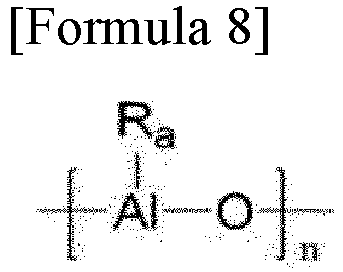
- the cocatalyst compound may be at least one selected from the group consisting of a compound represented by Formula 8, a compound represented by Formula 9, and a compound represented by Formula 10.
- a compound represented by Formula 8 a compound represented by Formula 9
- a compound represented by Formula 10 [L-H] + [Z(A) 4 ] - or [L] + [Z(A) 4 ] -
- n is an integer of 2 or more, and R a may each independently be a halogen atom, C 1-20 hydrocarbon, or C 1-20 hydrocarbon substituted with halogen.
- D is aluminum (Al) or boron (B), and R b , R c , and R d are each independently a halogen atom, C 1-20 hydrocarbon, C 1-20 hydrocarbon substituted with halogen, or C 1-20 alkoxy.
- L is a neutral or cationic Lewis acid
- Z is a group 13 element
- A is each independently substituted or unsubstituted C 6-20 aryl or substituted or unsubstituted C 1-20 alkyl.
- the compound represented by Formula 8 is at least one selected from the group consisting of methylaluminoxane, ethylaluminoxane, isobutylaluminoxane, and butylaluminoxane.
- the compound represented by Formula 9 is at least one selected from the group consisting of trimethylaluminum, triethylaluminum, triisobutylaluminum, tripropylaluminum, tributylaluminum, dimethylchloroaluminum, triisopropylaluminum, tri- s -butylaluminum, tricyclopentylaluminum, tripentylaluminum, triisopentyaluminum, trihexyaluminum, trioctyaluminum, ethyldimethylaluminum, methyldiethylaluminum, triphenylaluminum, tri- p -tolylaluminum, dimethylaluminummethoxide, dimethylaluminumethoxide, trimethylboron, triethylboron, triisobutylboron, tripropylboron, and tributylboron.
- the compound represented by Formula 10 is at least one selected from the group consisting of triethylammonium tetraphenylborate, tributylammonium tetraphenylborate, trimethylammonium tetraphenylborate, tripropylammonium tetraphenylborate, trimethylammonium tetra( p -tolyl)borate, trimethylammonium tetra( o,p- dimethylphenyl)borate, tributylammonium tetra( p -trifluoromethylphenyl)borate, trimethylammonium tetra( p -trifluoromethylphenyl)borate, tributylammonium tetrapentafluorophenylborate, N,N-diethylanilinium tetraphenylborate, N,N-diethylanilinium tetrapentafluorophenylborate
- the catalyst for olefin polymerization further comprises a carrier for supporting the hybrid catalyst composition.
- the carrier may support both of the hybrid catalyst composition and the cocatalyst.
- the carrier may comprise at least one selected from the group consisting of silica, alumina, and magnesia.
- the total amount of the hybrid transition metal compounds supported on the carrier is 0.001 to 1 mmole based on 1 g of the carrier, and the amount of the cocatalyst compound supported on the carrier is 2 to 15 mmoles based on the 1 g of the carrier.
- a process for preparing a catalyst for olefin polymerization which comprises (1) dissolving a compound represented by Formula 3 in a solvent; (2) adding a compound represented by Formula 5 to the solution obtained in step (1) and reacting it under stirring; (3) adding a compound represented by Formula 4 and a compound represented by Formula 6 to the solution obtained in step (2) and reacting them under stirring to obtain a first hybrid catalyst composition comprising transition metal compounds represented by Formulae 1 and 2; and (4) supporting the hybrid catalyst composition, a cocatalyst compound, or both on a carrier, wherein the equivalent ratio of the compound represented by Formula 3 added in step (1) to the compound represented by Formula 5 added in step (2) is in the range of 1:1 to 1.5:1, and the equivalent ratio of the compound represented by Formula 5 added in step (2) to the compound represented by Formula 6 added in step (3) is 1: 100 to 100:1.
- the process for preparing a catalyst for olefin polymerization may further comprise (3a) dissolving the first hybrid catalyst composition in a solvent; and (3b) adding a compound represented by Formula 7a, a compound represented by Formula 7b, or ammonium hydrogen fluoride (NH 4 HF 2 ) to the solution obtained in step (3a) and reacting it under stirring to obtain a second hybrid catalyst composition comprising transition metal compounds represented by Formulae 1 and 2.
- the hybrid catalyst composition comprising different transition metal compounds and the catalyst for olefin polymerization comprising the same according to the embodiments of the present invention, it is possible to prepare polyolefins having excellent processability and mechanical properties depending on the content of the corresponding transition metal compounds.
- Hybrid catalyst composition comprising different transition metal compounds
- a hybrid catalyst composition comprising transition metal compounds represented by Formulae 1 and 2.
- M 1 and M 2 are different from each other and each titanium (Ti), zirconium (Zr), or hafnium (Hf). Specifically, M 1 and M 2 are different from each other and may each be hafnium (Hf) or zirconium (Zr).
- X is each independently halogen, C 1-20 alkyl, C 2-20 alkenyl, C 2-20 alkynyl, C 6-20 aryl, C 1-20 alkyl C 6-20 aryl, C 6-20 aryl C 1-20 alkyl, C 1-20 alkylamido, C 6-20 arylamido, or C 1-20 alkylidene.
- X may each be halogen or substituted or unsubstituted C 1-20 alkyl.
- R 1 to R 5 and R 6 to R 12 are each independently hydrogen, substituted or unsubstituted C 1-20 alkyl, substituted or unsubstituted C 2-20 alkenyl, substituted or unsubstituted C 6-20 aryl, substituted or unsubstituted C 1-20 alkyl C 6-20 aryl, substituted or unsubstituted C 6-20 aryl C 1-20 alkyl, substituted or unsubstituted C 1-20 heteroalkyl, substituted or unsubstituted C 3-20 heteroaryl, substituted or unsubstituted C 1-20 alkylamido, substituted or unsubstituted C 6-20 arylamido, substituted or unsubstituted C 1-20 alkylidene, or substituted or unsubstituted C 1-20 silyl.
- R 1 to R 5 and R 6 to R 10 are each independently capable of being linked to adjacent groups to form a substituted or unsubstituted saturated or unsaturated C 4-20 ring.
- R 1 to R 5 and R 6 to R 10 may each be hydrogen, substituted or unsubstituted C 1-20 alkyl, substituted or unsubstituted C 1-20 alkenyl, or substituted or unsubstituted C 6-20 aryl.
- the molar ratio of the compound represented by Formula 1 to the compound represented by Formula 2 may be in the range of 100: 1 to 1:100.
- the molar ratio of these two compounds is 50:1 to 1:50. More preferably, the molar ratio of these two compounds is 10: 1 to 1:10.
- M 1 and M 2 are different from each other and may each be zirconium or hafnium
- X may each be halogen or substituted or unsubstituted C 1-20 alkyl
- R 1 to R 5 and R 6 to R 10 may each be hydrogen, substituted or unsubstituted C 1-20 alkyl, substituted or unsubstituted C 1-20 alkenyl, or substituted or unsubstituted C 6-20 aryl.
- the hybrid catalyst composition according to an embodiment of the present invention may be a first hybrid catalyst composition.
- M 1 and M 2 are different from each other and may each be zirconium or hafnium
- X may each be halogen, more specifically chlorine
- R 1 to R 5 and R 6 to R 10 may each be hydrogen, substituted or unsubstituted C 1-20 alkyl, substituted or unsubstituted C 1-20 alkenyl, or substituted or unsubstituted C 6-20 aryl.
- the hybrid catalyst composition according to an embodiment of the present invention may be a second hybrid catalyst composition.
- M 1 and M 2 are different from each other and may each be zirconium or hafnium
- X may each be substituted or unsubstituted C 1-20 alkyl, more specifically methyl
- R 1 to R 5 and R 6 to R 10 may each be hydrogen, substituted or unsubstituted C 1-20 alkyl, substituted or unsubstituted C 1-20 alkenyl, or substituted or unsubstituted C 6-20 aryl.
- the transition metal compound represented by Formula 1 may be at least one of the transition metal compounds represented by Formulae 1-1 to 1-12, and the transition metal compound represented by Formula 2 may be at least one of the transition metal compounds represented by Formulae 2-1 to 2-12.
- the transition metal compound represented by Formula 1 may be at least one of the transition metal compounds represented by Formulae 1-13 to 1-24, and the transition metal compound represented by Formula 2 may be at least one of the transition metal compounds represented by Formulae 2-13 to 2-24.
- a process for preparing a hybrid catalyst composition which comprises (1) dissolving a compound represented by Formula 3 in a solvent; (2) adding a compound represented by Formula 5 to the solution obtained in step (1) and reacting it under stirring; and (3) adding a compound represented by Formula 4 and a compound represented by Formula 6 to the solution obtained in step (2) and reacting them under stirring to obtain a first hybrid catalyst composition comprising transition metal compounds represented by Formulae 1 and 2, wherein the equivalent ratio of the compound represented by Formula 3 added in step (1) to the compound represented by Formula 5 added in step (2) is in the range of 1:1 to 1.5:1, and the equivalent ratio of the compound represented by Formula 5 added in step (2) to the compound represented by Formula 6 added in step (3) is 1: 100 to 100:1.
- X is halogen
- M 1 , M 2 , R 1 to R 5 and R 6 to R 10 are as described above in the section of the hybrid catalyst composition comprising different transition metal compounds.
- step (1) the compound represented by Formula 3 is dissolved in a solvent.
- the compound represented by Formula 3 may be at least one of the compounds represented by Formulae 3-1 to 3-6.
- the solvent may comprise at least one selected from the group consisting of aliphatic hydrocarbon solvents such as hexane and pentane, aromatic hydrocarbon solvents such as toluene and benzene, hydrocarbon solvents substituted with chlorine atoms such as dichloromethane, ether-based solvents such as diethyl ether and tetrahydrofuran, acetone, and ethyl acetate.
- the solvent may be toluene, but it is not particularly limited thereto.
- the temperature and dissolution time are not particularly limited.
- the compound represented by Formula 3 is added to a solvent at a temperature of -78°C to 80°C, preferably a temperature of -40°C to 60°C, more preferably room temperature, and stirred to be dissolved for 10 minutes to 17 hours, preferably 20 minutes to 10 hours, more preferably about 1 hour.
- step (2) a compound represented by Formula 5 is added to the solution obtained in step (1), which is reacted under stirring.
- the compound represented by Formula 5 may be any one of ZrCl 4 and HfCl 4 . More preferably, the compound represented by Formula 5 may be ZrCl 4 .
- the temperature at which the compound represented by Formula 5 is added is preferably in the range of -78°C to 30°C. More preferably, the temperature at which the compound represented by Formula 5 is added may be in the range of -40°C to 10°C. Most preferably, the temperature at which the compound represented by Formula 5 is added may be about -30°C.
- the temperature is gradually raised to a range of 0°C to 120°C, more preferably 25°C to 80°C, and most preferably about 65°C, and it is stirred for 1 to 72 hours, preferably 5 to 48 hours, and more preferably 12 to 24 hours to carry out the reaction.
- the equivalent ratio of the compound represented by Formula 3 added in step (1) to the compound represented by Formula 5 added in step (2) is 1: 1 to 1.5:1.
- the equivalent ratio of these two compounds is preferably 1.1:1 to 1.5:1, more preferably 1.2:1 to 1.5:1.
- a transition metal compound of Formula 2 having a central metal different from that of the transition metal compound of Formula 1 may be obtained.
- step (3) the compound represented by Formula 4 and the compound represented by Formula 6 are added to the solution obtained in step (2), which are reacted under stirring.
- the compound represented by Formula 4 may be at least one of the compounds represented by Formulae 4-1 to 4-12.
- the compound represented by Formula 6 may be the other one of ZrCl 4 and HfCl 4 .
- the compound represented by Formula 6 may be HfCl 4 .
- the temperature at which the compound represented by Formula 4 and the compound represented by Formula 6 are added is preferably in the range of -78°C to 30°C. More preferably, the temperature at which the compound represented by Formula 4 and the compound represented by Formula 6 are added may be in the range of -40°C to 10°C. Most preferably, the temperature at which the compound represented by Formula 4 and the compound represented by Formula 6 are added may be about -30°C.
- the temperature is gradually raised to a range of 0°C to 120°C, more preferably 0°C to 60°C, and most preferably room temperature, and it is stirred for 1 to 72 hours, preferably 3 to 48 hours, and more preferably about 7 to 22 hours to carry out the reaction.
- step (3) a first hybrid catalyst composition in which X is halogen in Formulae 1 and 2 is obtained. Specifically, a first hybrid catalyst composition in which X is chlorine in Formulae 1 and 2 is obtained.
- the molar ratio of the compound represented by Formula 5 to the compound represented by Formula 6 may be in the range of 100:1 to 1:100.
- the molar ratio of these two compounds is 50:1 to 1:50. More preferably, the molar ratio of these two compounds is 10: 1 to 1:10.
- the process for preparing a hybrid catalyst composition according to an embodiment of the present invention may further comprise (3a) dissolving the first hybrid catalyst composition in a solvent; and (3b) adding a compound represented by Formula 7a, a compound represented by Formula 7b, or ammonium hydrogen fluoride (NH 4 HF 2 ) to the solution obtained in step (3a) and reacting it under stirring to obtain a second hybrid catalyst composition comprising transition metal compounds represented by Formulae 1 and 2.
- the compound represented by Formula 7a may be a Grignard compound.
- X a and X c may each independently be C 1-20 alkyl, C 2-20 alkenyl, C 2-20 alkynyl, C 6-20 aryl, C 1-20 alkyl C 6-20 aryl, C 6-20 aryl C 1-20 alkyl, C 1-20 alkylamido, C 6-20 arylamido, or C 1-20 alkylidene, and X b may be halogen.
- the compound represented by Formula 7a may be MeMgBr
- the compound represented by Formula 7b may be MeLi.
- step (3a) the first hybrid catalyst composition is dissolved in a solvent.
- the solvent may be substantially the same as the solvent used in step (1) above.
- the solvent may be toluene, but it is not particularly limited thereto.
- step (3b) a compound represented by Formula 7 is added to the solution obtained in step (3a), which is reacted under stirring.
- the temperature at which the compound represented by Formula 7 is added is preferably in the range of -78°C to 30°C. More preferably, the temperature at which the compound represented by Formula 7 is added may be in the range of -40°C to 10°C. Most preferably, the temperature at which the compound represented by Formula 7 is added may be about -30°C.
- the temperature is gradually raised to a range of 0°C to 120°C, more preferably 0°C to 60°C, and most preferably room temperature, and it is stirred for 1 to 72 hours, preferably 1 to 24 hours, and more preferably about 3 to5 hours to carry out the reaction.
- step (3b) a second hybrid catalyst composition in which X is C 1-20 alkyl in Formulae 1 and 2 is obtained. Specifically, a second hybrid catalyst composition in which X is methyl in Formulae 1 and 2 is obtained.
- the process for preparing a hybrid catalyst composition according to an embodiment of the present invention may further comprise (3c) drying the first hybrid catalyst composition obtained in step (3) or the second hybrid catalyst composition obtained in step (3b).
- the drying conditions of the composition are not particularly limited, but it may be carried out in a temperature range of 25°C to 80°C, more preferably in a temperature range of 25°C to 50°C, and most preferably at a temperature of about 25°C.
- the process for preparing a hybrid catalyst composition according to an embodiment of the present invention may further comprise (3d) dissolving the the first hybrid catalyst composition or the second hybrid catalyst composition dried in step (3c) in a solvent and then removing unreacted substances and/or impurities with a filter.
- the solvent may be substantially the same as the solvent used in step (1) above.
- dichloromethane may be used, but it is not particularly limited thereto.
- the filter for removing unreacted substances and/or impurities is not particularly limited, but a Celite filter may preferably be used.
- a catalyst for olefin polymerization which comprises a hybrid catalyst composition comprising transition metal compounds represented by Formulae 1 and 2; and a cocatalyst compound.
- M 1 , M 2 , X, R 1 to R 5 and R 6 to R 10 are as described above in the section of the hybrid catalyst composition comprising different transition metal compounds.
- the molar ratio of the compound represented by Formula 1 to the compound represented by Formula 2 may be in the range of 100: 1 to 1:100.
- the molar ratio of these two compounds is 50:1 to 1:50. More preferably, the molar ratio of these two compounds is 10: 1 to 1:10.
- M 1 and M 2 are different from each other and may each be zirconium or hafnium
- X may each be halogen or substituted or unsubstituted C 1-20 alkyl
- R 1 to R 5 and R 6 to R 10 may each be hydrogen, substituted or unsubstituted C 1-20 alkyl, substituted or unsubstituted C 1-20 alkenyl, or substituted or unsubstituted C 6-20 aryl.
- the catalyst for olefin polymerization may comprise a first hybrid catalyst composition.
- M 1 and M 2 are different from each other and may each be zirconium or hafnium
- X may each be halogen, more specifically chlorine
- R 1 to R 5 and R 6 to R 10 may each be hydrogen, substituted or unsubstituted C 1-20 alkyl, substituted or unsubstituted C 1-20 alkenyl, or substituted or unsubstituted C 6-20 aryl.
- the catalyst for olefin polymerization may comprise a second hybrid catalyst composition.
- M 1 and M 2 are different from each other and may each be zirconium or hafnium
- X may each be substituted or unsubstituted C 1-20 alkyl, more specifically methyl
- R 1 to R 5 and R 6 to R 10 may each be hydrogen, substituted or unsubstituted C 1-20 alkyl, substituted or unsubstituted C 1-20 alkenyl, or substituted or unsubstituted C 6-20 aryl.
- the transition metal compound represented by Formula 1 may be at least one of the transition metal compounds represented by Formulae 1-1 to 1-12, and the transition metal compound represented by Formula 2 may be at least one of the transition metal compounds represented by Formulae 2-1 to 2-12.
- the transition metal compound represented by Formula 1 may be at least one of the transition metal compounds represented by Formulae 1-13 to 1-24, and the transition metal compound represented by Formula 2 may be at least one of the transition metal compounds represented by Formulae 2-13 to 2-24.
- the cocatalyst compound may comprise at least one of a compound represented by Formula 8, a compound represented by Formula 9, and a compound represented by Formula 10.
- n is an integer of 2 or more, and R a may each independently be halogen, C 1-20 hydrocarbon, or C 1-20 hydrocarbon substituted with halogen. Specifically, R a may be methyl, ethyl, n-butyl, or isobutyl.
- D is aluminum (Al) or boron (B), and R b , R c , and R d are each independently a halogen atom, C 1-20 hydrocarbon, C 1-20 hydrocarbon substituted with halogen, or C 1-20 alkoxy.
- R b , R c , and R d may each independently be methyl or isobutyl
- D is boron (B)
- R b , R c , and R d may each be pentafluorophenyl.
- L is a neutral or cationic Lewis acid
- Z is a group 13 element
- A is each independently substituted or unsubstituted C 6-20 aryl or substituted or unsubstituted C 1-20 alkyl.
- [LH] + may be a dimethylanilinium cation
- [Z(A) 4 ] - may be [B(C 6 F 5 ) 4 ] -
- [L] + may be [(C 6 H 5 ) 3 C] + .
- examples of the compound represented by Formula 8 include methylaluminoxane, ethylaluminoxane, isobutylaluminoxane, butylaluminoxane, and the like. Preferred is methylaluminoxane. But it is not limited thereto.
- Examples of the compound represented by Formula 9 include trimethylaluminum, triethylaluminum, triisobutylaluminum, tripropylaluminum, tributylaluminum, dimethylchloroaluminum, triisopropylaluminum, tri-s-butylaluminum, tricyclopentylaluminum, tripentylaluminum, triisopentyaluminum, trihexyaluminum, trioctyaluminum, ethyldimethylaluminum, methyldiethylaluminum, triphenylaluminum, tri-p-tolylaluminum, dimethylaluminummethoxide, dimethylaluminumethoxide, trimethylboron, triethylboron, triisobutylboron, tripropylboron, and tributylboron. Preferred are trimethylaluminum, triethylaluminum, and triiso
- Examples of the compound represented by Formula 10 include triethylammonium tetraphenylborate, tributylammonium tetraphenylborate, trimethylammonium tetraphenylborate, tripropylammonium tetraphenylborate, trimethylammonium tetra( p- tolyl)borate, trimethylammonium tetra( o,p -dimethylphenyl)borate, tributylammonium tetra( p -trifluoromethylphenyl)borate, trimethylammonium tetra( p- trifluoromethylphenyl)borate, tributylammonium tetrapentafluorophenylborate, N,N-diethylanilinium tetraphenylborate, N,N-diethylanilinium tetrapentafluorophenylborate, diethylammonium
- the catalyst for olefin polymerization may further comprise a carrier for supporting the hybrid catalyst composition.
- the carrier may support both of the hybrid catalyst composition and the cocatalyst.
- the carrier may comprise a material containing a hydroxyl group on its surface.
- a material that has been dried to remove moisture from its surface and has a highly reactive hydroxyl group and a siloxane group may be used.
- the carrier may comprise at least one selected from the group consisting of silica, alumina, and magnesia.
- silica, silica-alumina, and silica-magnesia dried at high temperatures may be used as a carrier. They usually contain oxides, carbonates, sulfates, and nitrates components such as Na 2 O, K 2 CO 3 , BaSO 4 , and Mg(NO 3 ) 2 .
- they may comprise carbon, zeolite, magnesium chloride, and the like.
- the carrier is not limited thereto. It is not particularly limited as long as it can support the transition metal compound and the cocatalyst compound.
- the carrier may have an average particle size of 10 to 250 ⁇ m, preferably an average particle size of 10 to 150 ⁇ m, and more preferably 20 to 100 ⁇ m.
- the carrier may have a micropore volume of 0.1 to 10 cc/g, preferably 0.5 to 5 cc/g, and more preferably 1.0 to 3.0 cc/g.
- the carrier may have a specific surface area of 1 to 1,000 m 2 /g, preferably 100 to 800 m 2 /g, more preferably 200 to 600 m 2 /g.
- the drying temperature of the silica may be from room temperature to 900°C.
- the drying temperature may preferably be from room temperature to 800°C, more preferably from room temperature to 700°C. If the drying temperature is lower than room temperature, there would be too much moisture so that the moisture on the surface and the cocatalyst may react. If it exceeds 900°C, the structure of the carrier may collapse.
- the dried silica may have a concentration of hydroxy groups of 0.1 to 5 mmoles/g, preferably 0.7 to 4 mmoles/g, and more preferably 1.0 to 2 mmoles/g. If the concentration of hydroxy groups is less than 0.1 mmole/g, the amount of supported cocatalyst may be low. If it exceeds 5 mmole/g, there may arise a problem that the catalyst component may be deactivated.
- the total amount of the hybrid transition metal compounds supported on a carrier may be 0.001 to 1 mmole based on 1 g of the carrier.
- an appropriate level of activity of the supported catalyst may be exhibited, which is advantageous from the viewpoint of maintaining the activity of the catalyst and economical efficiency.
- the amount of the cocatalyst compound supported on a carrier may be 2 to 15 mmoles based on the 1 g of the carrier.
- both the hybrid catalyst composition and the cocatalyst compound may be supported on one type of a carrier, or the hybrid catalyst composition and the cocatalyst compound may be supported on two or more types of a carrier, respectively.
- either one of the hybrid catalyst composition and the cocatalyst compound may be supported on a carrier.
- a process for preparing a catalyst for olefin polymerization which comprises (1) dissolving a compound represented by Formula 3 in a solvent; (2) adding a compound represented by Formula 5 to the solution obtained in step (1) and reacting it under stirring; (3) adding a compound represented by Formula 4 and a compound represented by Formula 6 to the solution obtained in step (2) and reacting them under stirring to obtain a first hybrid catalyst composition comprising transition metal compounds represented by Formulae 1 and 2; and (4) supporting the hybrid catalyst composition, a cocatalyst compound, or both on a carrier, wherein the equivalent ratio of the compound represented by Formula 3 added in step (1) to the compound represented by Formula 5 added in step (2) is in the range of 1:1 to 1.5:1, and the equivalent ratio of the compound represented by Formula 5 added in step (2) to the compound represented by Formula 6 added in step (3) is 1: 100 to 100:1.
- X is halogen
- M 1 , M 2 , R 1 to R 5 and R 6 to R 10 are as described above in the section of the hybrid catalyst composition comprising different transition metal compounds.
- steps (1) to (3) are substantially the same as steps (1) to (3) of the process for preparing a hybrid catalyst composition described above.
- the process for preparing a catalyst for olefin polymerization may further comprise (3a) dissolving the first hybrid catalyst composition in a solvent; and (3b) adding a compound represented by Formula 7a, a compound represented by Formula 7b, or ammonium hydrogen fluoride (NH 4 HF 2 ) to the solution obtained in step (3a) and reacting it under stirring to obtain a second hybrid catalyst composition comprising transition metal compounds represented by Formulae 1 and 2.
- a compound represented by Formula 7a, a compound represented by Formula 7b, or ammonium hydrogen fluoride (NH 4 HF 2 ) to the solution obtained in step (3a) and reacting it under stirring to obtain a second hybrid catalyst composition comprising transition metal compounds represented by Formulae 1 and 2.
- X a , X b , and X c are as described above in the section of the process for preparing a hybrid catalyst composition.
- steps (3a) and (3b) are substantially the same as steps (3a) and (3b) of the process for preparing a hybrid catalyst composition described above.
- the process for preparing a catalyst for olefin polymerization may further comprise (3c) drying the first hybrid catalyst composition obtained in step (3) or the second hybrid catalyst composition obtained in step (3b).
- steps (3c) are substantially the same as step (3c) of the process for preparing a hybrid catalyst composition described above.
- the process for preparing a hybrid catalyst composition according to an embodiment of the present invention may further comprise (3d) dissolving the the first hybrid catalyst composition or the second hybrid catalyst composition dried in step (3c) in a solvent and then removing unreacted substances and/or impurities with a filter.
- step (3d) details of step (3d) are substantially the same as step (3d) of the process for preparing a hybrid catalyst composition described above.
- step (4) the hybrid catalyst composition, a cocatalyst compound, or both are supported on a carrier.
- a physical adsorption method or a chemical adsorption method may be used as a method of supporting the hybrid catalyst composition and/or the cocatalyst compound employed in a catalyst for olefin polymerization on the carrier.
- the physical adsorption method may be a method of contacting a solution in which the hybrid catalyst composition has been dissolved with a carrier and then drying the same; a method of contacting a solution in which the hybrid catalyst composition and a cocatalyst compound have been dissolved with a carrier and then drying the same; or a method of contacting a solution in which the hybrid catalyst composition has been dissolved with a carrier and then drying the same to prepare the carrier that supports the hybrid catalyst composition, separately contacting a solution in which a cocatalyst compound has been dissolved with a carrier and then drying the same to prepare the carrier that supports the cocatalyst compound, and then mixing them.
- the chemical adsorption method may be a method of supporting a cocatalyst compound on the surface of a carrier, and then supporting the hybrid catalyst composition on the cocatalyst compound; or a method of covalently bonding a functional group on the surface of a carrier (e.g., a hydroxy group (-OH) on the silica surface in the case of silica) with the hybrid transition metal compounds.
- a functional group on the surface of a carrier e.g., a hydroxy group (-OH) on the silica surface in the case of silica
- the solvent used in supporting the hybrid catalyst composition and/or the cocatalyst compound is not particularly limited.
- the solvent may comprise at least one selected from the group consisting of aliphatic hydrocarbon solvents such as hexane and pentane, aromatic hydrocarbon solvents such as toluene and benzene, hydrocarbon solvents substituted with chlorine atoms such as dichloromethane, ether-based solvents such as diethyl ether and tetrahydrofuran, acetone, and ethyl acetate.
- the procedure in which the hybrid catalyst composition and/or the cocatalyst compound are supported on the carrier in step (4) may be carried out at a temperature of 0 to 100°C, preferably at a temperature from room temperature to 90°C.
- the procedure in which the hybrid catalyst composition and/or the cocatalyst compound are supported on the carrier in step (4) may be carried out as a mixture of the hybrid catalyst composition and/or the cocatalyst compound and the carrier is sufficiently stirred for 1 minute to 24 hours, preferably 5 minutes to 15 hours.
- An olefinic monomer may be polymerized in the presence of the catalyst for olefin polymerization according to an embodiment of the present invention to prepare a polyolefin.
- the polyolefin may be a homopolymer of an olefinic monomer or a copolymer of an olefinic monomer and an olefinic comonomer.
- the olefinic monomer is at least one selected from the group consisting of a C 2-20 alpha-olefin, a C 1-20 diolefin, a C 3-20 cycloolefin, and a C 3-20 cyclodiolefin.
- the olefinic monomer may be ethylene, propylene, 1-butene, 1-pentene, 4-methyl-1-pentene, 1-hexene, 1-heptene, 1-octene, 1-decene, 1-undecene, 1-dodecene, 1-tetradecene, 1-hexadecene, or the like
- the polyolefin may be a homopolymer comprising only one olefinic monomer or a copolymer comprising two or more olefinic monomers exemplified above.
- the polyolefin may be a copolymer in which ethylene and a C 3-20 alpha-olefin are copolymerized.
- Preferred is a copolymer in which ethylene and 1-hexene are copolymerized. But it is not limited thereto.
- the content of ethylene is preferably 55 to 99.9% by weight, more preferably 90 to 99.9% by weight.
- the content of the alpha-olefinic comonomer is preferably 0.1 to 45% by weight, more preferably 0.1 to 10% by weight.
- the polyolefin according to an embodiment of the present invention may be prepared by a polymerization reaction such as free radical, cationic, coordination, condensation, and addition, but it is not limited thereto.
- the polyolefin may be prepared by a gas phase polymerization method, a solution polymerization method, a slurry polymerization method, or the like.
- a solvent that may be used include C 5-12 aliphatic hydrocarbon solvents such as pentane, hexane, heptane, nonane, decane, and isomers thereof; aromatic hydrocarbon solvents such as toluene and benzene; hydrocarbon solvents substituted with chlorine atoms such as dichloromethane and chlorobenzene; and mixtures thereof, but it is not limited thereto.
- Lithium chloride (LiCl) was removed with a Celite filter, and the product was dried to obtain 294 mg (yield: 77%) of a mixture of the compound of Formula 1-1 ((pentamethylcyclopentadienyl)(n-propylcyclopentadienyl) zirconium dichloride) and the compound of Formula 2-1 (bis(n-propycyclopentadienyl) hafnium dichloride).
- the hybrid catalyst composition comprising different transition metal compounds and the catalyst for olefin polymerization comprising the same according to embodiments of the present invention, it is possible to prepare various polyolefins having excellent processability and mechanical properties depending on the content of the corresponding transition metal compounds.
- the hybrid catalyst composition comprising different transition metal compounds and the catalyst for olefin polymerization comprising the same according to embodiments of the present invention, it is possible to prepare various polyolefins having excellent processability and mechanical properties depending on the content of the corresponding transition metal compounds.
Landscapes
- Chemical & Material Sciences (AREA)
- Engineering & Computer Science (AREA)
- Materials Engineering (AREA)
- Health & Medical Sciences (AREA)
- Chemical Kinetics & Catalysis (AREA)
- Medicinal Chemistry (AREA)
- Polymers & Plastics (AREA)
- Organic Chemistry (AREA)
- Crystallography & Structural Chemistry (AREA)
- Transition And Organic Metals Composition Catalysts For Addition Polymerization (AREA)
Abstract
Description
- The present invention relates to a hybrid catalyst composition comprising different transition metal compounds, to a catalyst for olefin polymerization comprising the same, and to processes for preparing the same. Specifically, the present invention relates to a hybrid catalyst composition comprising two or more types of transition metal compounds having a non-bridged biscyclopentadienyl group with different central metals, to a catalyst for olefin polymerization comprising the same, and processes for preparing the hybrid catalyst composition and the catalyst.
- Polyolefin-based polymers are widely used in real life as materials for shopping bags, greenhouses, fishing nets, cigarette packages, instant noodle packages, yogurt bottles, battery cases, automobile bumpers, interior parts, shoe soles, washing machines, and the like.
- Conventionally, polyolefin-based polymers such as polyethylene, polypropylene, and ethylene-alpha olefin copolymers and their copolymers have been prepared using a heterogeneous catalyst such as a Ziegler-Natta catalyst made of a titanium compound and an alkyl aluminum compound.
- In recent years, a method for preparing polyolefin using a metallocene catalyst, which is a homogeneous catalyst with a very high catalytic activity, has been studied. A metallocene catalyst is a compound in which a ligand such as cyclopentadienyl, indenyl, and cycloheptadienyl is coordinated to a transition metal or a transition metal halide compound. It has a sandwich structure in its basic form. Here, it has various molecular structures depending on the type of ligand and the type of core metal.
- In a Ziegler-Natta catalyst as a heterogeneous catalyst, the metal component serving as the active sites is dispersed on an inert solid surface, whereby the properties of the active sites are not uniform. On the other hand, since a metallocene catalyst is a single compound having a specific structure, it is known as a single-site catalyst in which all active sites have the same polymerization characteristics.
- In general, since a metallocene catalyst has no activity as a polymerization catalyst by itself, it is used together with a cocatalyst such as methyl aluminoxane. The metallocene catalyst is activated as a cation by the action of the cocatalyst. At the same time, the cocatalyst as an anion that is not coordinated with the metallocene catalyst stabilizes the unsaturated cationic active species to form a catalyst system having activity in the polymerization of various olefins.
- Such a metallocene catalyst has advantages in that copolymerization is readily carried out, the three-dimensional structure of a polymer can be controlled according to the symmetry of the catalyst, and the polymer prepared thereby has a narrow molecular weight distribution with uniform distribution of a comonomer.
- On the other hand, the polymers prepared by a metallocene catalyst have a shortcoming in that it has low processability despite excellent mechanical strength due to a narrow molecular weight distribution. In order to solve this shortcoming, various methods such as changing the molecular structure of a polymer or broadening the molecular weight distribution thereof have been proposed. For example,
U.S. Patent No. 5,272,236 discloses a catalyst for introducing a long chain branch (LCB) as a side branch to the main chain of a polymer to improve the processability of the polymer; however, the supported catalyst has a disadvantage of low activity. - In order to solve this shortcoming of a single metallocene catalyst and to develop a catalyst with excellent activity and improved processability in a convenient way, a method of hybrid supporting metallocene catalysts (different metallocene catalysts) having different properties is proposed. For example,
U.S. Patent Nos. 4,935,474 ,6,828,394 , and6,894,128 ,Korean Patent No. 1437509 U.S. Patent No. 6,841,631 disclose a process for producing a polyolefin having a bimodal molecular weight distribution using catalysts having different reactivities for comonomers. Although the polyolefins having a bimodal molecular weight distribution prepared in this way have improved processability, they have lower homogeneity due to different molecular weight distributions. Thus, there is a problem in that it is difficult to obtain a product having uniform physical properties after processing, and the mechanical strength is deteriorated. - Meanwhile,
Korean Patent No. 1797890 - In general, such a hybrid catalyst is prepared by preparing respective transition metal compounds, mixing them at a certain ratio, and then supporting them.
- An object of the present invention is to provide a hybrid catalyst composition comprising two or more types of transition metal compounds having a non-bridged biscyclopentadienyl (bisCp) group with different central metals and a catalyst for olefin polymerization comprising the same.
- Another object of the present invention is to provide a process for preparing a hybrid catalyst composition by adjusting the ratio of precursors of the transition metal compounds and a process for preparing a catalyst for olefin polymerization comprising the same.
- According to an embodiment of the present invention for accomplishing the object, there is provided a hybrid catalyst composition comprising transition metal compounds represented by Formula 1 and Formula 2.


- In Formulae 1 and 2, M1 and M2 are different from each other and each independently titanium (Ti), zirconium (Zr), or hafnium (Hf).
- X is each independently halogen, C1-20 alkyl, C2-20 alkenyl, C2-20 alkynyl, C6-20 aryl, C1-20 alkyl C6-20 aryl, C6-20 aryl C1-20 alkyl, C1-20 alkylamido, C6-20 arylamido, or C1-20 alkylidene, and
R1 to R5 and R6 to R10 are each independently hydrogen, substituted or unsubstituted C1-20 alkyl, substituted or unsubstituted C2-20 alkenyl, substituted or unsubstituted C6-20 aryl, substituted or unsubstituted C1-20 alkyl C6-20 aryl, substituted or unsubstituted C6-20 aryl C1-20 alkyl, substituted or unsubstituted C1-20 heteroalkyl, substituted or unsubstituted C3-20 heteroaryl, substituted or unsubstituted C1-20 alkylamido, substituted or unsubstituted C6-20 arylamido, substituted or unsubstituted C1-20 alkylidene, or substituted or unsubstituted C1-20 silyl, provided that R1 to R5 and R6 to R10 are each independently capable of being linked to adjacent groups to form a substituted or unsubstituted, saturated or unsaturated C4-20 ring. - Preferably, the molar ratio of the compound represented by Formula 1 to the compound represented by Formula 2 is in the range of 100:1 to 1:100.
- Specifically, the hybrid catalyst composition according to a specific embodiment of the present invention is a first hybrid catalyst composition, in which M1 and M2 are different from each other and may each be zirconium or hafnium, X may each be halogen, and R1 to R5 and R6 to R10 may each be hydrogen, substituted or unsubstituted C1-20 alkyl, substituted or unsubstituted C1-20 alkenyl, or substituted or unsubstituted C6-20 aryl. More specifically, X in Formulae 1 and 2 may each be chlorine.
- Alternatively, the hybrid catalyst composition according to a specific embodiment of the present invention is a second hybrid catalyst composition, in which M1 and M2 are different from each other and may each be zirconium or hafnium, X may each be substituted or unsubstituted C1-20 alkyl, and R1 to R5 and R6 to R10 may each be hydrogen, substituted or unsubstituted C1-20 alkyl, substituted or unsubstituted C1-20 alkenyl, or substituted or unsubstituted C6-20 aryl. More specifically, X in Formulae 1 and 2 may each be methyl.
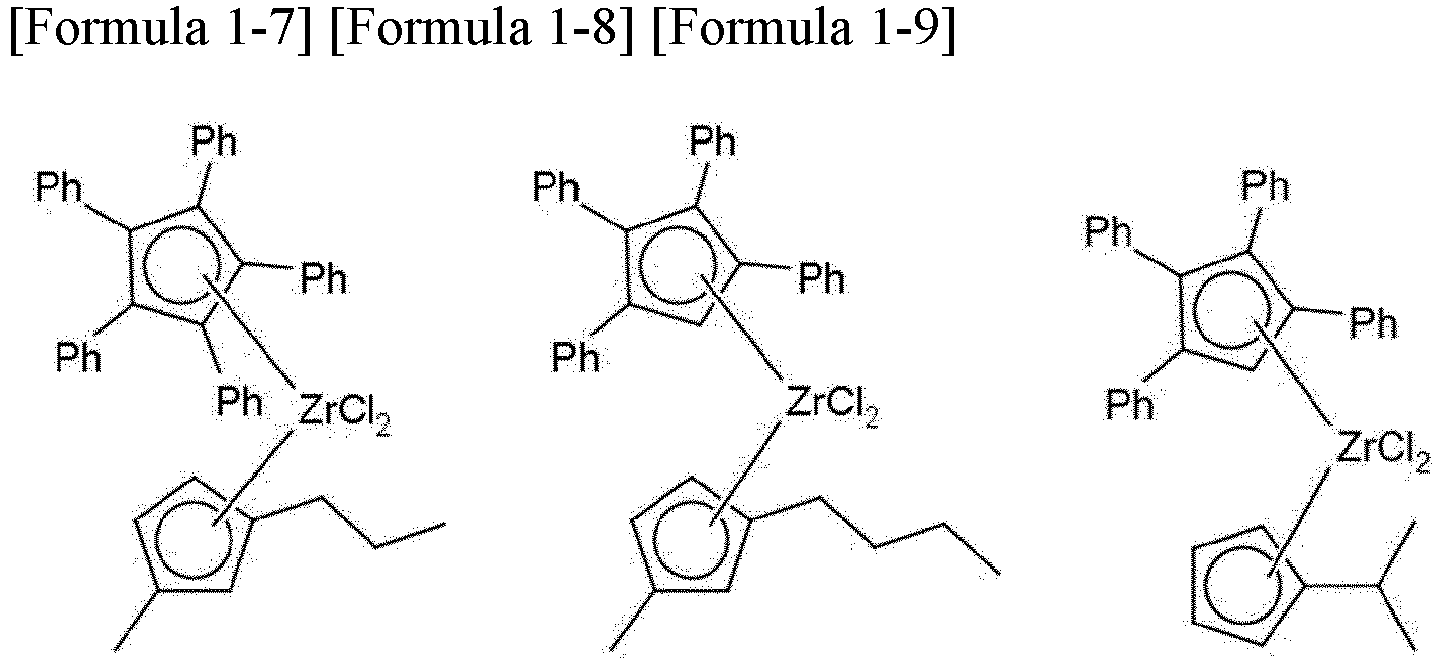
- Preferably, the transition metal compound represented by Formula 1 is at least one of the transition metal compounds represented by Formulae 1-1 to 1-12, and the transition metal compound represented by Formula 2 is at least one of the transition metal compounds represented by Formulae 2-1 to 2-12.







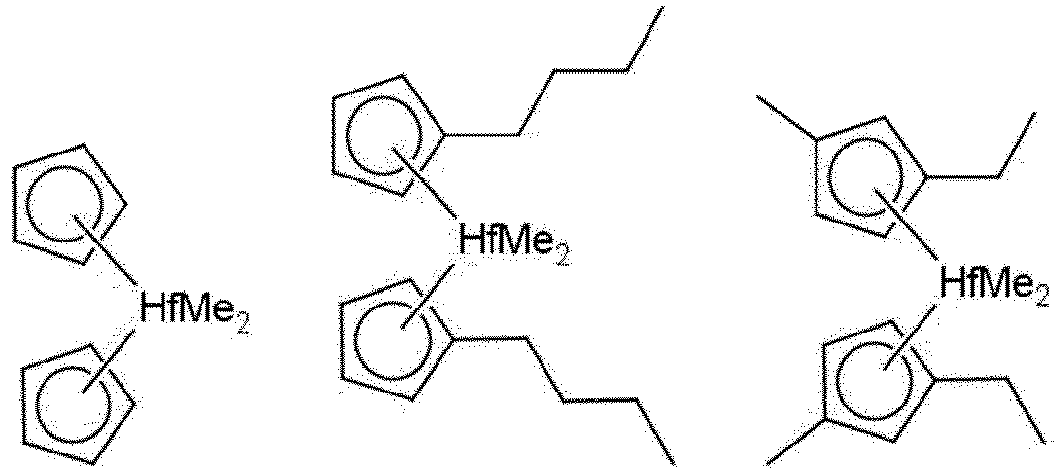
- Alternatively, the transition metal compound represented by Formula 1 is at least one of the transition metal compounds represented by Formulae 1-13 to 1-24, and the transition metal compound represented by Formula 2 is at least one of the transition metal compounds represented by Formulae 2-13 to 2-24.




- According to an embodiment of the present invention, there is provided a process for preparing a hybrid catalyst composition, which comprises (1) dissolving a compound represented by Formula 3 in a solvent; (2) adding a compound represented by Formula 5 to the solution obtained in step (1) and reacting it under stirring; and (3) adding a compound represented by Formula 4 and a compound represented by Formula 6 to the solution obtained in step (2) and reacting them under stirring to obtain a first hybrid catalyst composition comprising transition metal compounds represented by Formulae 1 and 2, wherein the equivalent ratio of the compound represented by Formula 3 added in step (1) to the compound represented by Formula 5 added in step (2) is in the range of 1:1 to 1.5:1, and the equivalent ratio of the compound represented by Formula 5 added in step (2) to the compound represented by Formula 6 added in step (3) is 1:100 to 100:1.


[Formula 5] M1X4
[Formula 6] M2X4
- In Formulae 3 to 6, X is halogen, and M1, M2, R1 to R5 and R6 to R10 are as described above in the section of the hybrid catalyst composition comprising different transition metal compounds.
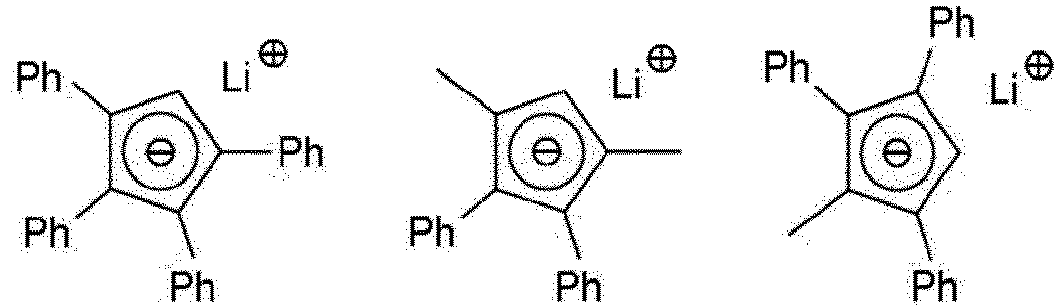
- Preferably, in step (1), the compound represented by Formula 3 may be at least one of the compounds represented by Formulae 3-1 to 3-6.


- In step (1), the solvent may comprise at least one selected from the group consisting of hexane, pentane, toluene, benzene, dichloromethane, diethyl ether, tetrahydrofuran, acetone, and ethyl acetate.
- Preferably, in step (2), the compound represented by Formula 5 is ZrCl4.
- In step (2), the reaction temperature is 0°C to 120°C, and the reaction time is 1 to 72 hours.
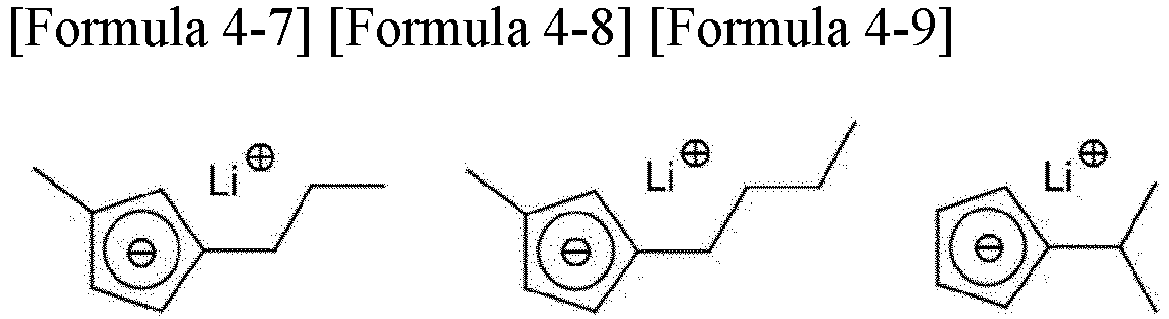
- Preferably, in step (3), the compound represented by Formula 4 is at least one of the compounds represented by Formulae 4-1 to 4-12.



- In addition, in step (3), the compound represented by Formula 6 is HfCl4.
- In step (3), the reaction temperature is 0°C to 120°C, and the reaction time is 1 to 72 hours.
- The process for preparing a hybrid catalyst composition according to an embodiment of the present invention may further comprise (3a) dissolving the first hybrid catalyst composition in a solvent; and (3b) adding a compound represented by Formula 7a, a compound represented by Formula 7b, or ammonium hydrogen fluoride (NH4HF2) to the solution obtained in step (3a) and reacting it under stirring to obtain a second hybrid catalyst composition comprising transition metal compounds represented by Formulae 1 and 2.
[Formula 7a] XaMgXb
[Formula 7b] XcLi
- In Formulae 7a and 7b, Xa and Xc are each independently C1-20 alkyl, C2-20 alkenyl, C2-20 alkynyl, C6-20 aryl, C1-20 alkyl C6-20 aryl, C6-20 aryl C1-20 alkyl, C1-20 alkylamido, C6-20 arylamido, or C1-20 alkylidene, and Xb is halogen. Preferably, the compound represented by Formula 7a may be MeMgBr, and the compound represented by Formula 7b may be MeLi.
- In step (3a), the solvent may comprise at least one selected from the group consisting of hexane, pentane, toluene, benzene, dichloromethane, diethyl ether, tetrahydrofuran, acetone, and ethyl acetate.
- Preferably, in step (3b), the reaction temperature is 0°C to 120°C, and the reaction time is 1 to 72 hours.
- The process for preparing a hybrid catalyst composition according to an embodiment of the present invention may further comprise (3c) drying the first hybrid catalyst composition or the second hybrid catalyst composition.
- In addition, the process for preparing a hybrid catalyst composition according to an embodiment of the present invention may further comprise (3d) dissolving the the first hybrid catalyst composition or the second hybrid catalyst composition dried in step (3c) in a solvent and then removing unreacted substances and/or impurities with a filter.
- In step (3d), the solvent may comprise at least one selected from the group consisting of hexane, pentane, toluene, benzene, dichloromethane, diethyl ether, tetrahydrofuran, acetone, and ethyl acetate.
- According to an embodiment of the present invention to accomplish another object of the present invention, there is provided a catalyst for olefin polymerization, which comprises the first transition metal compound or the second transition metal compound; and a cocatalyst compound.
- Here, the cocatalyst compound may be at least one selected from the group consisting of a compound represented by Formula 8, a compound represented by Formula 9, and a compound represented by Formula 10.

[Formula 10] [L-H]+[Z(A)4]- or [L]+[Z(A)4]-
- In Formula 8, n is an integer of 2 or more, and Ra may each independently be a halogen atom, C1-20 hydrocarbon, or C1-20 hydrocarbon substituted with halogen.
- In Formula 9, D is aluminum (Al) or boron (B), and Rb, Rc, and Rd are each independently a halogen atom, C1-20 hydrocarbon, C1-20 hydrocarbon substituted with halogen, or C1-20 alkoxy.
- In Formula 10, L is a neutral or cationic Lewis acid, [L-H]+ and [L]+ a Brönsted acid, Z is a group 13 element, and A is each independently substituted or unsubstituted C6-20 aryl or substituted or unsubstituted C1-20 alkyl.
- Specifically, the compound represented by Formula 8 is at least one selected from the group consisting of methylaluminoxane, ethylaluminoxane, isobutylaluminoxane, and butylaluminoxane.
- In addition, the compound represented by Formula 9 is at least one selected from the group consisting of trimethylaluminum, triethylaluminum, triisobutylaluminum, tripropylaluminum, tributylaluminum, dimethylchloroaluminum, triisopropylaluminum, tri-s-butylaluminum, tricyclopentylaluminum, tripentylaluminum, triisopentyaluminum, trihexyaluminum, trioctyaluminum, ethyldimethylaluminum, methyldiethylaluminum, triphenylaluminum, tri-p-tolylaluminum, dimethylaluminummethoxide, dimethylaluminumethoxide, trimethylboron, triethylboron, triisobutylboron, tripropylboron, and tributylboron.
- In addition, the compound represented by Formula 10 is at least one selected from the group consisting of triethylammonium tetraphenylborate, tributylammonium tetraphenylborate, trimethylammonium tetraphenylborate, tripropylammonium tetraphenylborate, trimethylammonium tetra(p-tolyl)borate, trimethylammonium tetra(o,p-dimethylphenyl)borate, tributylammonium tetra(p-trifluoromethylphenyl)borate, trimethylammonium tetra(p-trifluoromethylphenyl)borate, tributylammonium tetrapentafluorophenylborate, N,N-diethylanilinium tetraphenylborate, N,N-diethylanilinium tetrapentafluorophenylborate, diethylammonium tetrapentafluorophenylborate, triphenylphosphonium tetraphenylborate, trimethylphosphonium tetraphenylborate, triethylammonium tetraphenylaluminate, tributylammonium tetraphenylaluminate, trimethylammonium tetraphenylaluminate, tripropylammonium tetraphenylaluminate, trimethylammonium tetra(p-tolyl)aluminate, tripropylammonium tetra(p-tolyl)aluminate, triethylammonium tetra(o,p-dimethylphenyl)aluminate, tributylammonium tetra(p-trifluoromethylphenyl)aluminate, trimethylammonium tetra(p-trifluoromethylphenyl)aluminate, tributylammonium tetrapentafluorophenylaluminate, N,N-diethylanilinium tetraphenylaluminate, N,N-diethylanilinium tetrapentafluorophenylaluminate, diethylammonium tetrapentatetraphenylaluminate, triphenylphosphonium tetraphenylaluminate, trimethylphosphonium tetraphenylaluminate, tripropylammonium tetra(p-tolyl)borate, triethylammonium tetra(o,p-dimethylphenyl)borate, tributylammonium tetra(p-trifluoromethylphenyl) borate, triphenylcarbonium tetra(p-trifluoromethylphenyl)borate, and triphenylcarbonium tetrapentafluorophenylborate.
- Preferably, the catalyst for olefin polymerization further comprises a carrier for supporting the hybrid catalyst composition. Specifically, the carrier may support both of the hybrid catalyst composition and the cocatalyst.
- Specifically, the carrier may comprise at least one selected from the group consisting of silica, alumina, and magnesia.
- Here, the total amount of the hybrid transition metal compounds supported on the carrier is 0.001 to 1 mmole based on 1 g of the carrier, and the amount of the cocatalyst compound supported on the carrier is 2 to 15 mmoles based on the 1 g of the carrier.
- According to another embodiment of the present invention, there is provided a process for preparing a catalyst for olefin polymerization, which comprises (1) dissolving a compound represented by Formula 3 in a solvent; (2) adding a compound represented by Formula 5 to the solution obtained in step (1) and reacting it under stirring; (3) adding a compound represented by Formula 4 and a compound represented by Formula 6 to the solution obtained in step (2) and reacting them under stirring to obtain a first hybrid catalyst composition comprising transition metal compounds represented by Formulae 1 and 2; and (4) supporting the hybrid catalyst composition, a cocatalyst compound, or both on a carrier, wherein the equivalent ratio of the compound represented by Formula 3 added in step (1) to the compound represented by Formula 5 added in step (2) is in the range of 1:1 to 1.5:1, and the equivalent ratio of the compound represented by Formula 5 added in step (2) to the compound represented by Formula 6 added in step (3) is 1: 100 to 100:1.
- The process for preparing a catalyst for olefin polymerization according to an embodiment of the present invention may further comprise (3a) dissolving the first hybrid catalyst composition in a solvent; and (3b) adding a compound represented by Formula 7a, a compound represented by Formula 7b, or ammonium hydrogen fluoride (NH4HF2) to the solution obtained in step (3a) and reacting it under stirring to obtain a second hybrid catalyst composition comprising transition metal compounds represented by Formulae 1 and 2.
- In the hybrid catalyst composition comprising different transition metal compounds and the catalyst for olefin polymerization comprising the same according to the embodiments of the present invention, it is possible to prepare polyolefins having excellent processability and mechanical properties depending on the content of the corresponding transition metal compounds.
- In addition, in the processes for preparing a hybrid catalyst composition comprising different transition metal compounds and for preparing a catalyst for olefin polymerization comprising the same, it is possible to easily provide a catalyst for the polymerization of polyolefins having excellent processability and mechanical properties by precisely controlling the ratio of the hybrid transition metal compounds.
- Hereinafter, the present invention will be described in more detail.
- According to an embodiment of the present invention, there is provided a hybrid catalyst composition comprising transition metal compounds represented by Formulae 1 and 2.


- In Formulae 1 and 2, M1 and M2 are different from each other and each titanium (Ti), zirconium (Zr), or hafnium (Hf). Specifically, M1 and M2 are different from each other and may each be hafnium (Hf) or zirconium (Zr).
- X is each independently halogen, C1-20 alkyl, C2-20 alkenyl, C2-20 alkynyl, C6-20 aryl, C1-20 alkyl C6-20 aryl, C6-20 aryl C1-20 alkyl, C1-20 alkylamido, C6-20 arylamido, or C1-20 alkylidene. Specifically, X may each be halogen or substituted or unsubstituted C1-20 alkyl.
- R1 to R5 and R6 to R12 are each independently hydrogen, substituted or unsubstituted C1-20 alkyl, substituted or unsubstituted C2-20 alkenyl, substituted or unsubstituted C6-20 aryl, substituted or unsubstituted C1-20 alkyl C6-20 aryl, substituted or unsubstituted C6-20 aryl C1-20 alkyl, substituted or unsubstituted C1-20 heteroalkyl, substituted or unsubstituted C3-20 heteroaryl, substituted or unsubstituted C1-20 alkylamido, substituted or unsubstituted C6-20 arylamido, substituted or unsubstituted C1-20 alkylidene, or substituted or unsubstituted C1-20 silyl. Here, R1 to R5 and R6 to R10 are each independently capable of being linked to adjacent groups to form a substituted or unsubstituted saturated or unsaturated C4-20 ring. Specifically, R1 to R5 and R6 to R10 may each be hydrogen, substituted or unsubstituted C1-20 alkyl, substituted or unsubstituted C1-20 alkenyl, or substituted or unsubstituted C6-20 aryl.
- In a preferred embodiment of the present invention, the molar ratio of the compound represented by Formula 1 to the compound represented by Formula 2 may be in the range of 100: 1 to 1:100. Preferably, the molar ratio of these two compounds is 50:1 to 1:50. More preferably, the molar ratio of these two compounds is 10: 1 to 1:10.
- In a preferred specific embodiment of the present invention, in Formulae 1 and 2, M1 and M2 are different from each other and may each be zirconium or hafnium, X may each be halogen or substituted or unsubstituted C1-20 alkyl, R1 to R5 and R6 to R10 may each be hydrogen, substituted or unsubstituted C1-20 alkyl, substituted or unsubstituted C1-20 alkenyl, or substituted or unsubstituted C6-20 aryl.
- Specifically, the hybrid catalyst composition according to an embodiment of the present invention may be a first hybrid catalyst composition. In such an event, in Formulae 1 and 2, M1 and M2 are different from each other and may each be zirconium or hafnium, X may each be halogen, more specifically chlorine, R1 to R5 and R6 to R10 may each be hydrogen, substituted or unsubstituted C1-20 alkyl, substituted or unsubstituted C1-20 alkenyl, or substituted or unsubstituted C6-20 aryl.
- Alternatively, the hybrid catalyst composition according to an embodiment of the present invention may be a second hybrid catalyst composition. In such an event, in Formulae 1 and 2, M1 and M2 are different from each other and may each be zirconium or hafnium, X may each be substituted or unsubstituted C1-20 alkyl, more specifically methyl, R1 to R5 and R6 to R10 may each be hydrogen, substituted or unsubstituted C1-20 alkyl, substituted or unsubstituted C1-20 alkenyl, or substituted or unsubstituted C6-20 aryl.
- In a preferred embodiment of the present invention, the transition metal compound represented by Formula 1 may be at least one of the transition metal compounds represented by Formulae 1-1 to 1-12, and the transition metal compound represented by Formula 2 may be at least one of the transition metal compounds represented by Formulae 2-1 to 2-12.


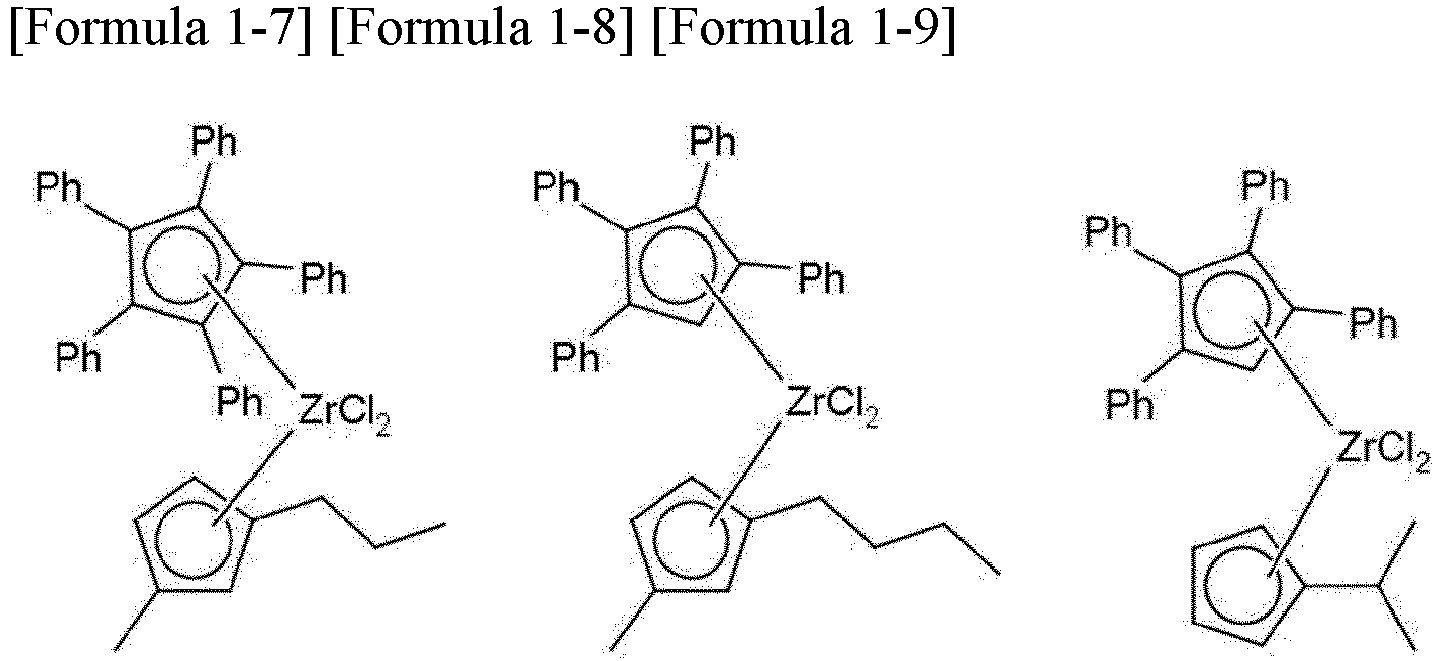


- Alternatively, in a preferred embodiment of the present invention, the transition metal compound represented by Formula 1 may be at least one of the transition metal compounds represented by Formulae 1-13 to 1-24, and the transition metal compound represented by Formula 2 may be at least one of the transition metal compounds represented by Formulae 2-13 to 2-24.


- There is provided a process for preparing a hybrid catalyst composition, which comprises (1) dissolving a compound represented by Formula 3 in a solvent; (2) adding a compound represented by Formula 5 to the solution obtained in step (1) and reacting it under stirring; and (3) adding a compound represented by Formula 4 and a compound represented by Formula 6 to the solution obtained in step (2) and reacting them under stirring to obtain a first hybrid catalyst composition comprising transition metal compounds represented by Formulae 1 and 2, wherein the equivalent ratio of the compound represented by Formula 3 added in step (1) to the compound represented by Formula 5 added in step (2) is in the range of 1:1 to 1.5:1, and the equivalent ratio of the compound represented by Formula 5 added in step (2) to the compound represented by Formula 6 added in step (3) is 1: 100 to 100:1.


[Formula 5] M1X4
[Formula 6] M2X4
- In Formulae 3 to 6, X is halogen, and M1, M2, R1 to R5 and R6 to R10 are as described above in the section of the hybrid catalyst composition comprising different transition metal compounds.
- Specifically, in step (1), the compound represented by Formula 3 is dissolved in a solvent.
- Preferably, the compound represented by Formula 3 may be at least one of the compounds represented by Formulae 3-1 to 3-6.


- Here, the solvent may comprise at least one selected from the group consisting of aliphatic hydrocarbon solvents such as hexane and pentane, aromatic hydrocarbon solvents such as toluene and benzene, hydrocarbon solvents substituted with chlorine atoms such as dichloromethane, ether-based solvents such as diethyl ether and tetrahydrofuran, acetone, and ethyl acetate. Preferably, the solvent may be toluene, but it is not particularly limited thereto.
- When the compound represented by Formula 3 is dissolved in a solvent, the temperature and dissolution time are not particularly limited. For example, the compound represented by Formula 3 is added to a solvent at a temperature of -78°C to 80°C, preferably a temperature of -40°C to 60°C, more preferably room temperature, and stirred to be dissolved for 10 minutes to 17 hours, preferably 20 minutes to 10 hours, more preferably about 1 hour.
- In step (2), a compound represented by Formula 5 is added to the solution obtained in step (1), which is reacted under stirring.
- Preferably, the compound represented by Formula 5 may be any one of ZrCl4 and HfCl4. More preferably, the compound represented by Formula 5 may be ZrCl4.
- The temperature at which the compound represented by Formula 5 is added is preferably in the range of -78°C to 30°C. More preferably, the temperature at which the compound represented by Formula 5 is added may be in the range of -40°C to 10°C. Most preferably, the temperature at which the compound represented by Formula 5 is added may be about -30°C.
- Once the compound represented by Formula 5 has been added, the temperature is gradually raised to a range of 0°C to 120°C, more preferably 25°C to 80°C, and most preferably about 65°C, and it is stirred for 1 to 72 hours, preferably 5 to 48 hours, and more preferably 12 to 24 hours to carry out the reaction.
- In the preparation process according to a preferred embodiment of the present invention, the equivalent ratio of the compound represented by Formula 3 added in step (1) to the compound represented by Formula 5 added in step (2) is 1: 1 to 1.5:1. The equivalent ratio of these two compounds is preferably 1.1:1 to 1.5:1, more preferably 1.2:1 to 1.5:1. In such a case, a transition metal compound of Formula 2 having a central metal different from that of the transition metal compound of Formula 1 may be obtained.
- In step (3), the compound represented by Formula 4 and the compound represented by Formula 6 are added to the solution obtained in step (2), which are reacted under stirring.
- Preferably, the compound represented by Formula 4 may be at least one of the compounds represented by Formulae 4-1 to 4-12.




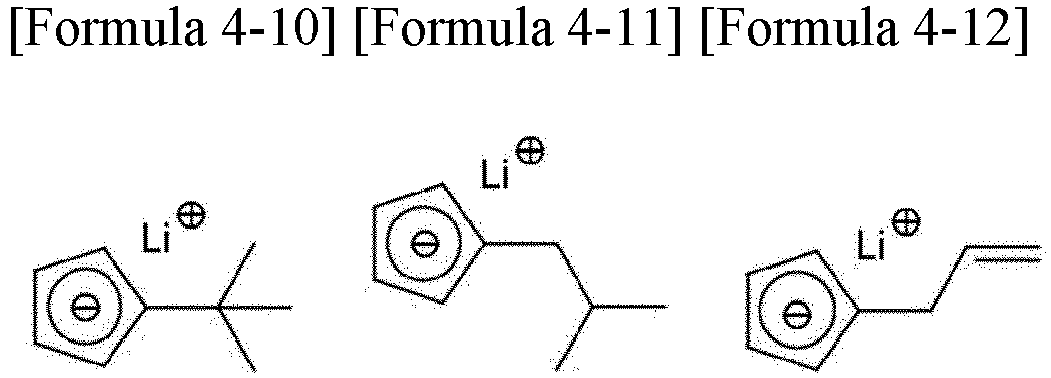
- In addition, the compound represented by Formula 6 may be the other one of ZrCl4 and HfCl4. Preferably, the compound represented by Formula 6 may be HfCl4.
- The temperature at which the compound represented by Formula 4 and the compound represented by Formula 6 are added is preferably in the range of -78°C to 30°C. More preferably, the temperature at which the compound represented by Formula 4 and the compound represented by Formula 6 are added may be in the range of -40°C to 10°C. Most preferably, the temperature at which the compound represented by Formula 4 and the compound represented by Formula 6 are added may be about -30°C.
- Once the compound represented by Formula 4 and the compound represented by Formula 6 have been added, the temperature is gradually raised to a range of 0°C to 120°C, more preferably 0°C to 60°C, and most preferably room temperature, and it is stirred for 1 to 72 hours, preferably 3 to 48 hours, and more preferably about 7 to 22 hours to carry out the reaction.
- In step (3), a first hybrid catalyst composition in which X is halogen in Formulae 1 and 2 is obtained. Specifically, a first hybrid catalyst composition in which X is chlorine in Formulae 1 and 2 is obtained.
- In the preparation process according to a preferred embodiment of the present invention, the molar ratio of the compound represented by Formula 5 to the compound represented by Formula 6 may be in the range of 100:1 to 1:100. Preferably, the molar ratio of these two compounds is 50:1 to 1:50. More preferably, the molar ratio of these two compounds is 10: 1 to 1:10.
- The process for preparing a hybrid catalyst composition according to an embodiment of the present invention may further comprise (3a) dissolving the first hybrid catalyst composition in a solvent; and (3b) adding a compound represented by Formula 7a, a compound represented by Formula 7b, or ammonium hydrogen fluoride (NH4HF2) to the solution obtained in step (3a) and reacting it under stirring to obtain a second hybrid catalyst composition comprising transition metal compounds represented by Formulae 1 and 2. Here, the compound represented by Formula 7a may be a Grignard compound.
[Formula 7a] XaMgXb
[Formula 7b] XcLi
- In Formulae 7a and 7b, Xa and Xc may each independently be C1-20 alkyl, C2-20 alkenyl, C2-20 alkynyl, C6-20 aryl, C1-20 alkyl C6-20 aryl, C6-20 aryl C1-20 alkyl, C1-20 alkylamido, C6-20 arylamido, or C1-20 alkylidene, and Xb may be halogen. Preferably, the compound represented by Formula 7a may be MeMgBr, and the compound represented by Formula 7b may be MeLi.
- In step (3a), the first hybrid catalyst composition is dissolved in a solvent.
- Here, the solvent may be substantially the same as the solvent used in step (1) above. Preferably, the solvent may be toluene, but it is not particularly limited thereto.
- In step (3b), a compound represented by Formula 7 is added to the solution obtained in step (3a), which is reacted under stirring.
- The temperature at which the compound represented by Formula 7 is added is preferably in the range of -78°C to 30°C. More preferably, the temperature at which the compound represented by Formula 7 is added may be in the range of -40°C to 10°C. Most preferably, the temperature at which the compound represented by Formula 7 is added may be about -30°C.
- Once the compound represented by Formula 7 has been added, the temperature is gradually raised to a range of 0°C to 120°C, more preferably 0°C to 60°C, and most preferably room temperature, and it is stirred for 1 to 72 hours, preferably 1 to 24 hours, and more preferably about 3 to5 hours to carry out the reaction.
- In step (3b), a second hybrid catalyst composition in which X is C1-20 alkyl in Formulae 1 and 2 is obtained. Specifically, a second hybrid catalyst composition in which X is methyl in Formulae 1 and 2 is obtained.
- The process for preparing a hybrid catalyst composition according to an embodiment of the present invention may further comprise (3c) drying the first hybrid catalyst composition obtained in step (3) or the second hybrid catalyst composition obtained in step (3b). Here, the drying conditions of the composition are not particularly limited, but it may be carried out in a temperature range of 25°C to 80°C, more preferably in a temperature range of 25°C to 50°C, and most preferably at a temperature of about 25°C.
- In addition, the process for preparing a hybrid catalyst composition according to an embodiment of the present invention may further comprise (3d) dissolving the the first hybrid catalyst composition or the second hybrid catalyst composition dried in step (3c) in a solvent and then removing unreacted substances and/or impurities with a filter. Here, the solvent may be substantially the same as the solvent used in step (1) above. Preferably, dichloromethane may be used, but it is not particularly limited thereto. The filter for removing unreacted substances and/or impurities is not particularly limited, but a Celite filter may preferably be used.
- According to another embodiment of the present invention, there is provided a catalyst for olefin polymerization, which comprises a hybrid catalyst composition comprising transition metal compounds represented by Formulae 1 and 2; and a cocatalyst compound.


- In Formulae 1 and 2, M1, M2, X, R1 to R5 and R6 to R10 are as described above in the section of the hybrid catalyst composition comprising different transition metal compounds.
- In a preferred embodiment of the present invention, the molar ratio of the compound represented by Formula 1 to the compound represented by Formula 2 may be in the range of 100: 1 to 1:100. Preferably, the molar ratio of these two compounds is 50:1 to 1:50. More preferably, the molar ratio of these two compounds is 10: 1 to 1:10.
- In a preferred specific embodiment of the present invention, in Formulae 1 and 2, M1 and M2 are different from each other and may each be zirconium or hafnium, X may each be halogen or substituted or unsubstituted C1-20 alkyl, R1 to R5 and R6 to R10 may each be hydrogen, substituted or unsubstituted C1-20 alkyl, substituted or unsubstituted C1-20 alkenyl, or substituted or unsubstituted C6-20 aryl.
- Specifically, the catalyst for olefin polymerization according to an embodiment of the present invention may comprise a first hybrid catalyst composition. In such an event, in Formulae 1 and 2, M1 and M2 are different from each other and may each be zirconium or hafnium, X may each be halogen, more specifically chlorine, R1 to R5 and R6 to R10 may each be hydrogen, substituted or unsubstituted C1-20 alkyl, substituted or unsubstituted C1-20 alkenyl, or substituted or unsubstituted C6-20 aryl.
- Alternatively, the catalyst for olefin polymerization according to an embodiment of the present invention may comprise a second hybrid catalyst composition. In such an event, in Formulae 1 and 2, M1 and M2 are different from each other and may each be zirconium or hafnium, X may each be substituted or unsubstituted C1-20 alkyl, more specifically methyl, R1 to R5 and R6 to R10 may each be hydrogen, substituted or unsubstituted C1-20 alkyl, substituted or unsubstituted C1-20 alkenyl, or substituted or unsubstituted C6-20 aryl.
- In a preferred embodiment of the present invention, the transition metal compound represented by Formula 1 may be at least one of the transition metal compounds represented by Formulae 1-1 to 1-12, and the transition metal compound represented by Formula 2 may be at least one of the transition metal compounds represented by Formulae 2-1 to 2-12.


- Alternatively, in a preferred embodiment of the present invention, the transition metal compound represented by Formula 1 may be at least one of the transition metal compounds represented by Formulae 1-13 to 1-24, and the transition metal compound represented by Formula 2 may be at least one of the transition metal compounds represented by Formulae 2-13 to 2-24.


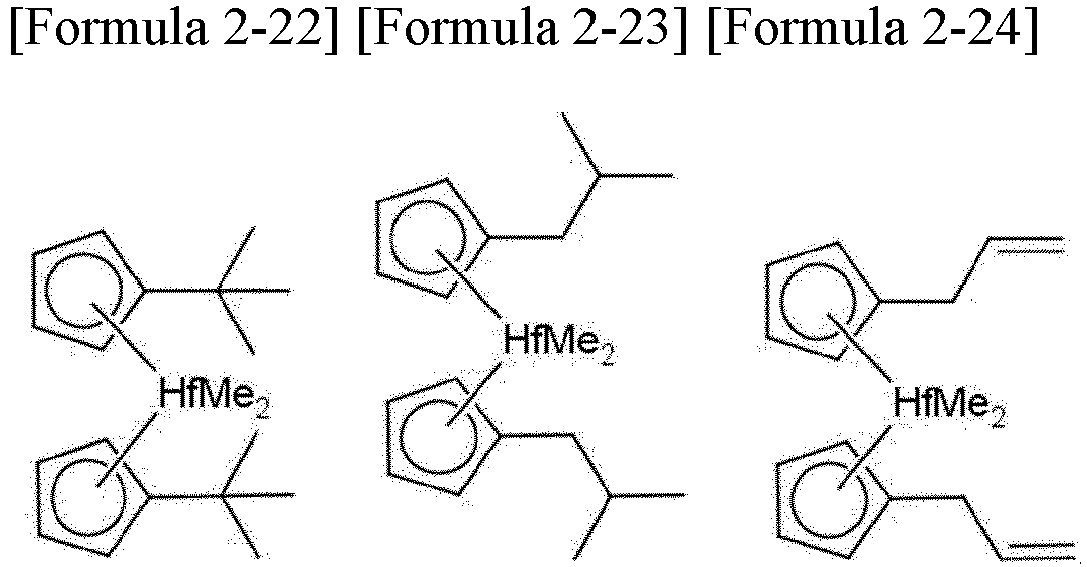
- Meanwhile, the cocatalyst compound may comprise at least one of a compound represented by Formula 8, a compound represented by Formula 9, and a compound represented by Formula 10.


- In Formula 8, n is an integer of 2 or more, and Ra may each independently be halogen, C1-20 hydrocarbon, or C1-20 hydrocarbon substituted with halogen. Specifically, Ra may be methyl, ethyl, n-butyl, or isobutyl.

- In Formula 9, D is aluminum (Al) or boron (B), and Rb, Rc, and Rd are each independently a halogen atom, C1-20 hydrocarbon, C1-20 hydrocarbon substituted with halogen, or C1-20 alkoxy. Specifically, when D is aluminum (Al), Rb, Rc, and Rd may each independently be methyl or isobutyl, and when D is boron (B), Rb, Rc, and Rd may each be pentafluorophenyl.
[Formula 10] [L-H]+[Z(A)4]- or [L]+[Z(A)4]-
- In Formula 10, L is a neutral or cationic Lewis acid, [L-H]+ and [L]+ a Brönsted acid, Z is a group 13 element, and A is each independently substituted or unsubstituted C6-20 aryl or substituted or unsubstituted C1-20 alkyl. Specifically, [LH]+ may be a dimethylanilinium cation, [Z(A)4]- may be [B(C6F5)4]-, and [L]+ may be [(C6H5)3C]+.
- Specifically, examples of the compound represented by Formula 8 include methylaluminoxane, ethylaluminoxane, isobutylaluminoxane, butylaluminoxane, and the like. Preferred is methylaluminoxane. But it is not limited thereto.
- Examples of the compound represented by Formula 9 include trimethylaluminum, triethylaluminum, triisobutylaluminum, tripropylaluminum, tributylaluminum, dimethylchloroaluminum, triisopropylaluminum, tri-s-butylaluminum, tricyclopentylaluminum, tripentylaluminum, triisopentyaluminum, trihexyaluminum, trioctyaluminum, ethyldimethylaluminum, methyldiethylaluminum, triphenylaluminum, tri-p-tolylaluminum, dimethylaluminummethoxide, dimethylaluminumethoxide, trimethylboron, triethylboron, triisobutylboron, tripropylboron, and tributylboron. Preferred are trimethylaluminum, triethylaluminum, and triisobutylaluminum. But it is not limited thereto.
- Examples of the compound represented by Formula 10 include triethylammonium tetraphenylborate, tributylammonium tetraphenylborate, trimethylammonium tetraphenylborate, tripropylammonium tetraphenylborate, trimethylammonium tetra(p-tolyl)borate, trimethylammonium tetra(o,p-dimethylphenyl)borate, tributylammonium tetra(p-trifluoromethylphenyl)borate, trimethylammonium tetra(p-trifluoromethylphenyl)borate, tributylammonium tetrapentafluorophenylborate, N,N-diethylanilinium tetraphenylborate, N,N-diethylanilinium tetrapentafluorophenylborate, diethylammonium tetrapentafluorophenylborate, triphenylphosphonium tetraphenylborate, trimethylphosphonium tetraphenylborate, triethylammonium tetraphenylaluminate, tributylammonium tetraphenylaluminate, trimethylammonium tetraphenylaluminate, tripropylammonium tetraphenylaluminate, trimethylammonium tetra(p-tolyl)aluminate, tripropylammonium tetra(p-tolyl)aluminate, triethylammonium tetra(o,p-dimethylphenyl)aluminate, tributylammonium tetra(p-trifluoromethylphenyl)aluminate, trimethylammonium tetra(p-trifluoromethylphenyl)aluminate, tributylammonium tetrapentafluorophenylaluminate, N,N-diethylanilinium tetraphenylaluminate, N,N-diethylanilinium tetrapentafluorophenylaluminate, diethylammonium tetrapentatetraphenylaluminate, triphenylphosphonium tetraphenylaluminate, trimethylphosphonium tetraphenylaluminate, tripropylammonium tetra(p-tolyl)borate, triethylammonium tetra(o,p-dimethylphenyl)borate, tributylammonium tetra(p-trifluoromethylphenyl) borate, triphenylcarbonium tetra(p-trifluoromethylphenyl)borate, and triphenylcarbonium tetrapentafluorophenylborate.
- In a preferred embodiment of the present invention, the catalyst for olefin polymerization may further comprise a carrier for supporting the hybrid catalyst composition. Specifically, the carrier may support both of the hybrid catalyst composition and the cocatalyst.
- In such an event, the carrier may comprise a material containing a hydroxyl group on its surface. Preferably, a material that has been dried to remove moisture from its surface and has a highly reactive hydroxyl group and a siloxane group may be used. For example, the carrier may comprise at least one selected from the group consisting of silica, alumina, and magnesia. Specifically, silica, silica-alumina, and silica-magnesia dried at high temperatures may be used as a carrier. They usually contain oxides, carbonates, sulfates, and nitrates components such as Na2O, K2CO3, BaSO4, and Mg(NO3)2. In addition, they may comprise carbon, zeolite, magnesium chloride, and the like. However, the carrier is not limited thereto. It is not particularly limited as long as it can support the transition metal compound and the cocatalyst compound.
- The carrier may have an average particle size of 10 to 250 µm, preferably an average particle size of 10 to 150 µm, and more preferably 20 to 100 µm.
- The carrier may have a micropore volume of 0.1 to 10 cc/g, preferably 0.5 to 5 cc/g, and more preferably 1.0 to 3.0 cc/g.
- The carrier may have a specific surface area of 1 to 1,000 m2/g, preferably 100 to 800 m2/g, more preferably 200 to 600 m2/g.
- In a preferred example, when the carrier is silica, the drying temperature of the silica may be from room temperature to 900°C. The drying temperature may preferably be from room temperature to 800°C, more preferably from room temperature to 700°C. If the drying temperature is lower than room temperature, there would be too much moisture so that the moisture on the surface and the cocatalyst may react. If it exceeds 900°C, the structure of the carrier may collapse.
- The dried silica may have a concentration of hydroxy groups of 0.1 to 5 mmoles/g, preferably 0.7 to 4 mmoles/g, and more preferably 1.0 to 2 mmoles/g. If the concentration of hydroxy groups is less than 0.1 mmole/g, the amount of supported cocatalyst may be low. If it exceeds 5 mmole/g, there may arise a problem that the catalyst component may be deactivated.
- The total amount of the hybrid transition metal compounds supported on a carrier may be 0.001 to 1 mmole based on 1 g of the carrier. When the content ratio of the hybrid transition metal compounds and the carrier satisfies the above range, an appropriate level of activity of the supported catalyst may be exhibited, which is advantageous from the viewpoint of maintaining the activity of the catalyst and economical efficiency.
- The amount of the cocatalyst compound supported on a carrier may be 2 to 15 mmoles based on the 1 g of the carrier. When the content ratio of the cocatalyst compound and the carrier satisfies the above range, it is advantageous from the viewpoint of maintaining the activity of the catalyst and economical efficiency.
- One or two or more types of a carrier may be used. For example, both the hybrid catalyst composition and the cocatalyst compound may be supported on one type of a carrier, or the hybrid catalyst composition and the cocatalyst compound may be supported on two or more types of a carrier, respectively. In addition, either one of the hybrid catalyst composition and the cocatalyst compound may be supported on a carrier.
- According to another embodiment of the present invention, there is provided a process for preparing a catalyst for olefin polymerization, which comprises (1) dissolving a compound represented by Formula 3 in a solvent; (2) adding a compound represented by Formula 5 to the solution obtained in step (1) and reacting it under stirring; (3) adding a compound represented by Formula 4 and a compound represented by Formula 6 to the solution obtained in step (2) and reacting them under stirring to obtain a first hybrid catalyst composition comprising transition metal compounds represented by Formulae 1 and 2; and (4) supporting the hybrid catalyst composition, a cocatalyst compound, or both on a carrier, wherein the equivalent ratio of the compound represented by Formula 3 added in step (1) to the compound represented by Formula 5 added in step (2) is in the range of 1:1 to 1.5:1, and the equivalent ratio of the compound represented by Formula 5 added in step (2) to the compound represented by Formula 6 added in step (3) is 1: 100 to 100:1.


[Formula 5] M1X4
[Formula 6] M2X4
- In Formulae 1 to 6, X is halogen, and M1, M2, R1 to R5 and R6 to R10 are as described above in the section of the hybrid catalyst composition comprising different transition metal compounds.
- Details of steps (1) to (3) are substantially the same as steps (1) to (3) of the process for preparing a hybrid catalyst composition described above.
- The process for preparing a catalyst for olefin polymerization according to an embodiment of the present invention may further comprise (3a) dissolving the first hybrid catalyst composition in a solvent; and (3b) adding a compound represented by Formula 7a, a compound represented by Formula 7b, or ammonium hydrogen fluoride (NH4HF2) to the solution obtained in step (3a) and reacting it under stirring to obtain a second hybrid catalyst composition comprising transition metal compounds represented by Formulae 1 and 2.
[Formula 7a] XaMgXb
[Formula 7b] XcLi
- In Formulae 7a and 7b, Xa, Xb, and Xc are as described above in the section of the process for preparing a hybrid catalyst composition.
- Details of steps (3a) and (3b) are substantially the same as steps (3a) and (3b) of the process for preparing a hybrid catalyst composition described above.
- The process for preparing a catalyst for olefin polymerization according to an embodiment of the present invention may further comprise (3c) drying the first hybrid catalyst composition obtained in step (3) or the second hybrid catalyst composition obtained in step (3b). Here, details of step (3c) are substantially the same as step (3c) of the process for preparing a hybrid catalyst composition described above.
- In addition, the process for preparing a hybrid catalyst composition according to an embodiment of the present invention may further comprise (3d) dissolving the the first hybrid catalyst composition or the second hybrid catalyst composition dried in step (3c) in a solvent and then removing unreacted substances and/or impurities with a filter. Here, details of step (3d) are substantially the same as step (3d) of the process for preparing a hybrid catalyst composition described above.
- In step (4), the hybrid catalyst composition, a cocatalyst compound, or both are supported on a carrier.
- As a method of supporting the hybrid catalyst composition and/or the cocatalyst compound employed in a catalyst for olefin polymerization on the carrier, a physical adsorption method or a chemical adsorption method may be used.
- For example, the physical adsorption method may be a method of contacting a solution in which the hybrid catalyst composition has been dissolved with a carrier and then drying the same; a method of contacting a solution in which the hybrid catalyst composition and a cocatalyst compound have been dissolved with a carrier and then drying the same; or a method of contacting a solution in which the hybrid catalyst composition has been dissolved with a carrier and then drying the same to prepare the carrier that supports the hybrid catalyst composition, separately contacting a solution in which a cocatalyst compound has been dissolved with a carrier and then drying the same to prepare the carrier that supports the cocatalyst compound, and then mixing them.
- The chemical adsorption method may be a method of supporting a cocatalyst compound on the surface of a carrier, and then supporting the hybrid catalyst composition on the cocatalyst compound; or a method of covalently bonding a functional group on the surface of a carrier (e.g., a hydroxy group (-OH) on the silica surface in the case of silica) with the hybrid transition metal compounds.
- Here, the solvent used in supporting the hybrid catalyst composition and/or the cocatalyst compound is not particularly limited. For example, the solvent may comprise at least one selected from the group consisting of aliphatic hydrocarbon solvents such as hexane and pentane, aromatic hydrocarbon solvents such as toluene and benzene, hydrocarbon solvents substituted with chlorine atoms such as dichloromethane, ether-based solvents such as diethyl ether and tetrahydrofuran, acetone, and ethyl acetate.
- In a preferred embodiment, the procedure in which the hybrid catalyst composition and/or the cocatalyst compound are supported on the carrier in step (4) may be carried out at a temperature of 0 to 100°C, preferably at a temperature from room temperature to 90°C.
- In addition, the procedure in which the hybrid catalyst composition and/or the cocatalyst compound are supported on the carrier in step (4) may be carried out as a mixture of the hybrid catalyst composition and/or the cocatalyst compound and the carrier is sufficiently stirred for 1 minute to 24 hours, preferably 5 minutes to 15 hours.
- An olefinic monomer may be polymerized in the presence of the catalyst for olefin polymerization according to an embodiment of the present invention to prepare a polyolefin.
- Here, the polyolefin may be a homopolymer of an olefinic monomer or a copolymer of an olefinic monomer and an olefinic comonomer.
- The olefinic monomer is at least one selected from the group consisting of a C2-20 alpha-olefin, a C1-20 diolefin, a C3-20 cycloolefin, and a C3-20 cyclodiolefin.
- For example, the olefinic monomer may be ethylene, propylene, 1-butene, 1-pentene, 4-methyl-1-pentene, 1-hexene, 1-heptene, 1-octene, 1-decene, 1-undecene, 1-dodecene, 1-tetradecene, 1-hexadecene, or the like, and the polyolefin may be a homopolymer comprising only one olefinic monomer or a copolymer comprising two or more olefinic monomers exemplified above.
- As an exemplary example, the polyolefin may be a copolymer in which ethylene and a C3-20 alpha-olefin are copolymerized. Preferred is a copolymer in which ethylene and 1-hexene are copolymerized. But it is not limited thereto.
- In such an event, the content of ethylene is preferably 55 to 99.9% by weight, more preferably 90 to 99.9% by weight. The content of the alpha-olefinic comonomer is preferably 0.1 to 45% by weight, more preferably 0.1 to 10% by weight.
- The polyolefin according to an embodiment of the present invention may be prepared by a polymerization reaction such as free radical, cationic, coordination, condensation, and addition, but it is not limited thereto.
- As a preferred example, the polyolefin may be prepared by a gas phase polymerization method, a solution polymerization method, a slurry polymerization method, or the like. When the polyolefin is prepared by a solution polymerization method or a slurry polymerization method, examples of a solvent that may be used include C5-12 aliphatic hydrocarbon solvents such as pentane, hexane, heptane, nonane, decane, and isomers thereof; aromatic hydrocarbon solvents such as toluene and benzene; hydrocarbon solvents substituted with chlorine atoms such as dichloromethane and chlorobenzene; and mixtures thereof, but it is not limited thereto.
- Hereinafter, the present invention will be described in detail with reference to Examples. However, the following examples are intended to further illustrate the present invention. The scope of the present invention is not limited thereto only.
- 72 mg (0.52 mmole, 1.2 eq.) of lithium pentamethylcyclopentadienide of Formula 3-1 was dissolved in 10 ml of toluene at room temperature. While it was slowly stirred, 100 mg (0.43 mmole, 1.0 eq.) of zirconium chloride (ZrCl4) was slowly added thereto, which was stirred at 65°C for 24 hours. The temperature was lowered to -30°C, and 147 mg (1.29 mmole, 3.0 eq.) of lithium n-propylcyclopentadienide of Formula 4-1 and 137 mg (0.43 mmole, 1.0 eq.) of hafnium chloride (HfCl4) were then added to the reaction mixture. They were reacted under stirring at room temperature for 22 hours. Lithium chloride (LiCl) was removed with a Celite filter, and the product was dried to obtain 294 mg (yield: 77%) of a mixture of the compound of Formula 1-1 ((pentamethylcyclopentadienyl)(n-propylcyclopentadienyl) zirconium dichloride) and the compound of Formula 2-1 (bis(n-propycyclopentadienyl) hafnium dichloride).
- The structure of the hybrid (3:2) transition metal compounds of the compound of Formula 1-1 and the compound of Formula 2-1 was confirmed by 1H NMR.
- 1H-NMR (CDCl3, 300 MHz) 6.18 (t, 4H), 6.09-6.08 (m, 4H), 6.02 (t, 3H), 5.95-5.93 (m, 3H), 5.89-5.87 (m, 2H), 2.65-2.55 (m, 7H), 2.02 (s, 23H), 1.60-1.52 (m, 7H), 0.95-0.90 (m, 10.5H).
- 92 mg (0.65 mmole, 10.8 eq.) of lithium pentamethylcyclopentadienide of Formula 3-1 was dissolved in 10 ml of toluene at room temperature. While it was slowly stirred, 125 mg (0.54 mmole, 9.0 eq.) of zirconium chloride (ZrCl4) was slowly added thereto at - 30°C, which was stirred at 65°C for 12 hours. The temperature was lowered to -30°C, and 82 mg (0.72 mmole, 12.1 eq.) of lithium n-propylcyclopentadienide of Formula 4-1 and 19 mg (0.06 mmole, 1.0 eq.) of hafnium chloride (HfCl4) were then added to the reaction mixture. They were reacted under stirring at room temperature for 7 hours. Lithium chloride (LiCl) was removed with a Celite filter, and the product was dried to obtain 189 mg (yield: 77%) of a mixture of the compound of Formula 1-1 and the compound of Formula 2-1.
- The structure of the hybrid (100:7) transition metal compounds of the compound of Formula 1-1 and the compound of Formula 2-1 was confirmed by 1H NMR.
- 1H-NMR (CDCl3, 600 MHz) 6.19 (t, 0.3H), 6.10 (t, 0.3H), 6.06 (t, 2H), 5.96 (t, 2H), 5.89-5.87 (t, 2H), 2.58 (t, 2H), 2.03 (s, 15H), 1.60-1.54 (m, 2H), 0.95-0.90 (m, 3H).
- 288 mg (0.67 mmole, 1.0 eq.) of the hybrid transition metal compounds obtained in Example 1 was dissolved in 10 ml of toluene at room temperature. It was cooled to - 30°C while it was slowly stirred. A MeMgBr (500 µl, 2.2 eq.) solution (3.0 M in diethyl ether) was slowly added thereto, followed by stirring thereof at room temperature for 3 hours to carry out the reaction. After the solvent was removed, it was dissolved in 30 ml of dichloromethane. Lithium chloride was then removed using a Celite filter. The product was dried to obtain 224 mg (yield: 88%) of a mixture of the compound of Formula 1-13 and the compound of Formula 2-13.
- The structure of the hybrid (2:3) transition metal compounds of the compound of Formula 1-13 and the compound of Formula 2-13 was confirmed by 1H NMR.
- 1H-NMR (CDCl3, 300 MHz) 5.80 (t, 4H), 5.76 (t, 2H), 5.73 (t, 4H), 5.46 (t, 2H), 2.41 (t, 6H), 1.87 (s, 15H), 1.65-1.55 (m, 6H), 1.01-0.93 (m, 9H), -0.67 (s, 6H), -0.74 (s, 6H).
- The reactants and the ratio of products of the Examples are shown in Tables 1 and 2 below.
[Table 1] Example Reactant (eq.) Product (molar ratio) Yield (%) Formula 3-1 Formula 5-1 Formula 4-1 Formula 6-1 Formula 1-1 Formula 2-1 1 1.2 1.0 3.0 1.0 3 2 77 2 10.8 9.0 12.0 1.0 100 7 77 [Table 2] Example Reactant (eq.) Product (molar ratio) Yield (%) Formula 1-1 Formula 2-1 Formula 7-1 Formula 1-13 Formula 2-13 3 0.6 0.4 2.2 0.5 0.5 88 - In the hybrid catalyst composition comprising different transition metal compounds and the catalyst for olefin polymerization comprising the same according to embodiments of the present invention, it is possible to prepare various polyolefins having excellent processability and mechanical properties depending on the content of the corresponding transition metal compounds.
- In the hybrid catalyst composition comprising different transition metal compounds and the catalyst for olefin polymerization comprising the same according to embodiments of the present invention, it is possible to prepare various polyolefins having excellent processability and mechanical properties depending on the content of the corresponding transition metal compounds.
- In addition, in the processes for preparing a hybrid catalyst composition and for preparing a catalyst for olefin polymerization comprising the same, it is possible to easily provide a catalyst for polymerization of polyolefins having excellent processability and mechanical properties by precisely controlling the ratio of the hybrid transition metal compounds.
Claims (30)
- A hybrid catalyst composition comprising transition metal compounds represented by Formulae 1 and 2:

 in Formulae 1 and 2, M1 and M2 are different from each other and each independently titanium (Ti), zirconium (Zr), or hafnium (Hf),X is each independently halogen, C1-20 alkyl, C2-20 alkenyl, C2-20 alkynyl, C6-20 aryl, C1-20 alkyl C6-20 aryl, C6-20 aryl C1-20 alkyl, C1-20 alkylamido, C6-20 arylamido, or C1-20 alkylidene, andR1 to R5 and R6 to R10 are each independently hydrogen, substituted or unsubstituted C1-20 alkyl, substituted or unsubstituted C2-20 alkenyl, substituted or unsubstituted C6-20 aryl, substituted or unsubstituted C1-20 alkyl C6-20 aryl, substituted or unsubstituted C6-20 aryl C1-20 alkyl, substituted or unsubstituted C1-20 heteroalkyl, substituted or unsubstituted C3-20 heteroaryl, substituted or unsubstituted C1-20 alkylamido, substituted or unsubstituted C6-20 arylamido, substituted or unsubstituted C1-20 alkylidene, or substituted or unsubstituted C1-20 silyl, provided that R1 to R5 and R6 to R10 are each independently capable of being linked to adjacent groups to form a substituted or unsubstituted, saturated or unsaturated C4-20 ring.
 - The hybrid catalyst composition of claim 1, wherein the molar ratio of the compound represented by Formula 1 to the compound represented by Formula 2 is in the range of 100: 1 to 1:100.
- The hybrid catalyst composition of claim 1, wherein the hybrid catalyst composition is a first hybrid catalyst composition, in which M1 and M2 are different from each other and are each zirconium or hafnium, X is each halogen, and R1 to R5 and R6 to R10 are each hydrogen, substituted or unsubstituted C1-20 alkyl, substituted or unsubstituted C1-20 alkenyl, or substituted or unsubstituted C6-20 aryl.
- The hybrid catalyst composition of claim 1, wherein the hybrid catalyst composition is a second hybrid catalyst composition, in which M1 and M2 are different from each other and are each zirconium or hafnium, X is each substituted or unsubstituted C1-20 alkyl, and R1 to R5 and R6 to R10 are each hydrogen, substituted or unsubstituted C1-20 alkyl, substituted or unsubstituted C1-20 alkenyl, or substituted or unsubstituted C6-20 aryl.
- The hybrid catalyst composition of claim 3, wherein the transition metal compound represented by Formula 1 is at least one of the transition metal compounds represented by Formulae 1-1 to 1-12, and the transition metal compound represented by Formula 2 is at least one of the transition metal compounds represented by Formulae 2-1 to 2-12:


- The hybrid catalyst composition of claim 4, wherein the transition metal compound represented by Formula 1 is at least one of the transition metal compounds represented by Formulae 1-13 to 1-24, and the transition metal compound represented by Formula 2 is at least one of the transition metal compounds represented by Formulae 2-13 to 2-24:


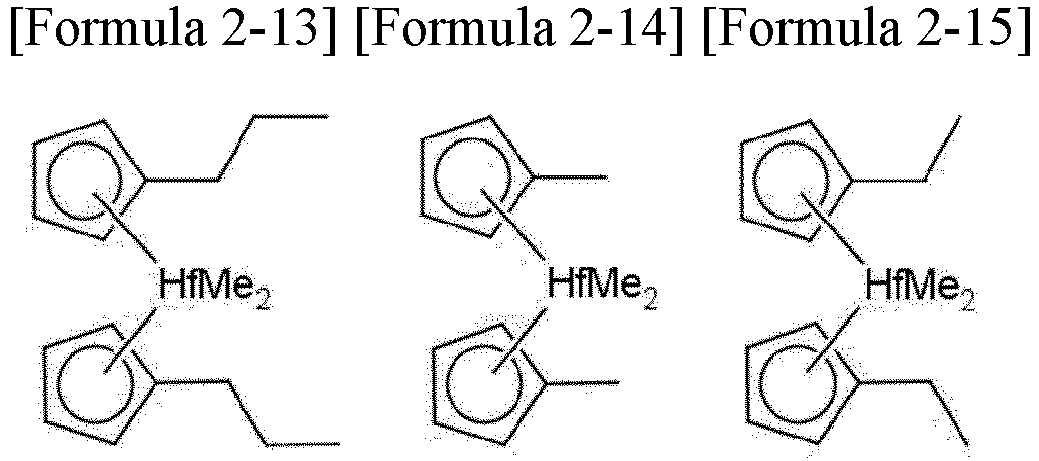


- A process for preparing a hybrid catalyst composition, which comprises (1) dissolving a compound represented by Formula 3 in a solvent; (2) adding a compound represented by Formula 5 to the solution obtained in step (1) and reacting it under stirring; and (3) adding a compound represented by Formula 4 and a compound represented by Formula 6 to the solution obtained in step (2) and reacting them under stirring to obtain a first hybrid catalyst composition comprising transition metal compounds represented by Formulae 1 and 2, wherein the molar ratio of the compound represented by Formula 3 added in step (1) to the compound represented by Formula 5 added in step (2) is in the range of 1:1 to 1.5:1, and the equivalent ratio of the compound represented by Formula 5 added in step (2) to the compound represented by Formula 6 added in step (3) is 1:100 to 100:1:


[Formula 5] M1X4
[Formula 6] M2X4
in Formulae 1 to 6, X is halogen, and M1, M2, R1 to R5 and R6 to R10 are as defined in claim 1. - The process for preparing a hybrid catalyst composition of claim 7, wherein the compound represented by Formula 3 is at least one of the compounds represented by Formulae 3-1 to 3-6:



- The process for preparing a hybrid catalyst composition of claim 7, wherein the solvent in step (1) comprises at least one selected from the group consisting of hexane, pentane, toluene, benzene, dichloromethane, diethyl ether, tetrahydrofuran, acetone, and ethyl acetate.
- The process for preparing a hybrid catalyst composition of claim 7, wherein, in step (2), the compound represented by Formula 5 is ZrCl4.
- The process for preparing a hybrid catalyst composition of claim 7, wherein, in step (2), the reaction temperature is 0°C to 120°C, and the reaction time is 1 to 72 hours.
- The process for preparing a hybrid catalyst composition of claim 7, wherein, in step (3), the compound represented by Formula 4 is at least one of the compounds represented by Formulae 4-1 to 4-12:


- The process for preparing a hybrid catalyst composition of claim 7, wherein, in step (3), the compound represented by Formula 6 is HfCl4.
- The process for preparing a hybrid catalyst composition of claim 7, wherein, in step (3), the reaction temperature is 0°C to 120°C, and the reaction time is 1 to 72 hours.
- The process for preparing a hybrid catalyst composition of claim 7, which further comprises (3a) dissolving the first hybrid catalyst composition in a solvent; and (3b) adding a compound represented by Formula 7a, a compound represented by Formula 7b, or ammonium hydrogen fluoride (NH4HF2) to the solution obtained in step (3a) and reacting it under stirring to obtain a second hybrid catalyst composition comprising transition metal compounds represented by Formulae 1 and 2:
[Formula 7a] XaMgXb
[Formula 7b] XcLi
in Formulae 7a and 7b, Xa and Xc are each independently C1-20 alkyl, C2-20 alkenyl, C2-20 alkynyl, C6-20 aryl, C1-20 alkyl C6-20 aryl, C6-20 aryl C1-20 alkyl, C1-20 alkylamido, C6-20 arylamido, or C1-20 alkylidene, and Xb is halogen. - The process for preparing a hybrid catalyst composition of claim 15, wherein, in step (3a), the solvent comprises at least one selected from the group consisting of hexane, pentane, toluene, benzene, dichloromethane, diethyl ether, tetrahydrofuran, acetone, and ethyl acetate.
- The process for preparing a hybrid catalyst composition of claim 15, wherein, in step (3b), the reaction temperature is 0°C to 120°C, and the reaction time is 1 to 72 hours.
- The process for preparing a hybrid catalyst composition of claim 7 or 15, which further comprises (3c) drying the first hybrid catalyst composition or the second hybrid catalyst composition.
- The process for preparing a hybrid catalyst composition of claim 18, which further comprises (3d) dissolving the dried hybrid catalyst composition obtained in step (3c) in a solvent and then removing unreacted substances and/or impurities with a filter.
- The process for preparing a hybrid catalyst composition of claim 19, wherein, in step (3d), the solvent comprises at least one selected from the group consisting of hexane, pentane, toluene, benzene, dichloromethane, diethyl ether, tetrahydrofuran, acetone, and ethyl acetate.
- A catalyst for olefin polymerization, which comprises the hybrid catalyst composition of any one of claims 1 to 6; and a cocatalyst compound.
- The catalyst for olefin polymerization of claim 21, wherein the cocatalyst compound is at least one selected from the group consisting of a compound represented by Formula 8, a compound represented by Formula 9, and a compound represented by Formula 10:


[Formula 10] [L-H]+[Z(A)4]- or [L]+[Z(A)4]-
in Formula 8, n is an integer of 2 or more, and Ra may each independently be a halogen atom, C1-20 hydrocarbon, or C1-20 hydrocarbon substituted with halogen,in Formula 9, D is aluminum (Al) or boron (B), and Rb, Rc, and Rd are each independently a halogen atom, C1-20 hydrocarbon, C1-20 hydrocarbon substituted with halogen, or C1-20 alkoxy, andin Formula 10, L is a neutral or cationic Lewis acid, [L-H]+ and [L]+ a Brönsted acid, Z is a group 13 element, and A is each independently substituted or unsubstituted C6-20 aryl or substituted or unsubstituted C1-20 alkyl. - The catalyst for olefin polymerization of claim 22, wherein the compound represented by Formula 8 is at least one selected from the group consisting of methylaluminoxane, ethylaluminoxane, isobutylaluminoxane, and butylaluminoxane.
- The catalyst for olefin polymerization of claim 22, wherein the compound represented by Formula 9 is at least one selected from the group consisting of trimethylaluminum, triethylaluminum, triisobutylaluminum, tripropylaluminum, tributylaluminum, dimethylchloroaluminum, triisopropylaluminum, tri-s-butylaluminum, tricyclopentylaluminum, tripentylaluminum, triisopentyaluminum, trihexyaluminum, trioctyaluminum, ethyldimethylaluminum, methyldiethylaluminum, triphenylaluminum, tri-p-tolylaluminum, dimethylaluminummethoxide, dimethylaluminumethoxide, trimethylboron, triethylboron, triisobutylboron, tripropylboron, and tributylboron.
- The catalyst for olefin polymerization of claim 22, wherein the compound represented by Formula 10 is at least one selected from the group consisting of triethylammonium tetraphenylborate, tributylammonium tetraphenylborate, trimethylammonium tetraphenylborate, tripropylammonium tetraphenylborate, trimethylammonium tetra(p-tolyl)borate, trimethylammonium tetra(o,p-dimethylphenyl)borate, tributylammonium tetra(p-trifluoromethylphenyl)borate, trimethylammonium tetra(p-trifluoromethylphenyl)borate, tributylammonium tetrapentafluorophenylborate, N,N-diethylanilinium tetraphenylborate, N,N-diethylanilinium tetrapentafluorophenylborate, diethylammonium tetrapentafluorophenylborate, triphenylphosphonium tetraphenylborate, trimethylphosphonium tetraphenylborate, triethylammonium tetraphenylaluminate, tributylammonium tetraphenylaluminate, trimethylammonium tetraphenylaluminate, tripropylammonium tetraphenylaluminate, trimethylammonium tetra(p-tolyl)aluminate, tripropylammonium tetra(p-tolyl)aluminate, triethylammonium tetra(o,p-dimethylphenyl)aluminate, tributylammonium tetra(p-trifluoromethylphenyl)aluminate, trimethylammonium tetra(p-trifluoromethylphenyl)aluminate, tributylammonium tetrapentafluorophenylaluminate, N,N-diethylanilinium tetraphenylaluminate, N,N-diethylanilinium tetrapentafluorophenylaluminate, diethylammonium tetrapentatetraphenylaluminate, triphenylphosphonium tetraphenylaluminate, trimethylphosphonium tetraphenylaluminate, tripropylammonium tetra(p-tolyl)borate, triethylammonium tetra(o,p-dimethylphenyl)borate, tributylammonium tetra(p-trifluoromethylphenyl) borate, triphenylcarbonium tetra(p-trifluoromethylphenyl)borate, and triphenylcarbonium tetrapentafluorophenylborate.
- The catalyst for olefin polymerization of claim 21, which further comprises a carrier for supporting the hybrid catalyst composition, the cocatalyst compound, or both.
- The catalyst for olefin polymerization of claim 26, wherein the carrier comprises at least one selected from the group consisting of silica, alumina, and magnesia.
- The catalyst for olefin polymerization of claim 26, wherein the total amount of the hybrid transition metal compounds supported on the carrier is 0.001 to 1 mmole based on 1 g of the carrier, and the amount of the cocatalyst compound supported on the carrier is 2 to 15 mmoles based on the 1 g of the carrier.
- A process for preparing a catalyst for olefin polymerization, which comprises (1) dissolving a compound represented by Formula 3 in a solvent; (2) adding a compound represented by Formula 5 to the solution obtained in step (1) and reacting it under stirring; (3) adding a compound represented by Formula 4 and a compound represented by Formula 6 to the solution obtained in step (2) and reacting them under stirring to obtain a first hybrid catalyst composition comprising transition metal compounds represented by Formulae 1 and 2; and (4) supporting the hybrid catalyst composition, a cocatalyst compound, or both on a carrier, wherein the equivalent ratio of the compound represented by Formula 3 added in step (1) to the compound represented by Formula 5 added in step (2) is in the range of 1:1 to 1.5:1, and the equivalent ratio of the compound represented by Formula 5 added in step (2) to the compound represented by Formula 6 added in step (3) is 1: 100 to 100:1.


[Formula 5] M1X4
[Formula 6] M2X4
in Formulae 1 to 6, X is halogen, and M1, M2, R1 to R5 and R6 to R10 are as defined in claim 1. - The process for preparing a catalyst for olefin polymerization of claim 29, which further comprises (3a) dissolving the first hybrid catalyst composition in a solvent; and (3b) adding a compound represented by Formula 7a, a compound represented by Formula 7b, or ammonium hydrogen fluoride (NH4HF2) to the solution obtained in step (3a) and reacting it under stirring to obtain a second hybrid catalyst composition comprising transition metal compounds represented by Formulae 1 and 2:
[Formula 7a] XaMgXb
[Formula 7b] XcLi
in Formulae 7a and 7b, Xa, Xb, and Xc are as defined in claim 15.
Applications Claiming Priority (2)
| Application Number | Priority Date | Filing Date | Title |
|---|---|---|---|
| KR1020200064285A KR102668044B1 (en) | 2020-05-28 | 2020-05-28 | Mixed Catalytic Composition, Catalyst Comprising the Same, and Processes for Preparing the Same |
| PCT/KR2021/006049 WO2021241927A1 (en) | 2020-05-28 | 2021-05-14 | Mixed catalytic composition, catalyst comprising same, and methods for preparing same |
Publications (2)
| Publication Number | Publication Date |
|---|---|
| EP4159771A1 true EP4159771A1 (en) | 2023-04-05 |
| EP4159771A4 EP4159771A4 (en) | 2024-06-12 |
Family
ID=78744713
Family Applications (1)
| Application Number | Title | Priority Date | Filing Date |
|---|---|---|---|
| EP21813877.4A Pending EP4159771A4 (en) | 2020-05-28 | 2021-05-14 | MIXED CATALYTIC COMPOSITION, CATALYST THEREOF AND METHOD FOR THE PRODUCTION THEREOF |
Country Status (6)
| Country | Link |
|---|---|
| US (1) | US20230192911A1 (en) |
| EP (1) | EP4159771A4 (en) |
| JP (1) | JP7562702B2 (en) |
| KR (1) | KR102668044B1 (en) |
| CN (1) | CN115667325B (en) |
| WO (1) | WO2021241927A1 (en) |
Cited By (1)
| Publication number | Priority date | Publication date | Assignee | Title |
|---|---|---|---|---|
| EP4122938A4 (en) * | 2020-03-17 | 2024-04-24 | Hanwha Solutions Corporation | MANUFACTURING PROCESS FOR TRANSITION METAL COMPOUND |
Families Citing this family (1)
| Publication number | Priority date | Publication date | Assignee | Title |
|---|---|---|---|---|
| EP4554952A1 (en) * | 2022-08-05 | 2025-05-21 | Dow Global Technologies LLC | Symmetrical hafnium metallocene for making polymers with broad-orthogonal composition distributions |
Family Cites Families (23)
| Publication number | Priority date | Publication date | Assignee | Title |
|---|---|---|---|---|
| US4935474A (en) | 1983-06-06 | 1990-06-19 | Exxon Research & Engineering Company | Process and catalyst for producing polyethylene having a broad molecular weight distribution |
| US5272236A (en) | 1991-10-15 | 1993-12-21 | The Dow Chemical Company | Elastic substantially linear olefin polymers |
| IT1255365B (en) * | 1992-09-15 | 1995-10-31 | Enichem Polimeri | CATALYST AND PROCEDURE FOR ALFA-OLEFINE POLYMERIZATION |
| JP3237249B2 (en) * | 1992-12-17 | 2001-12-10 | 住友化学工業株式会社 | Olefin polymerization catalyst and method for producing ethylene-α-olefin copolymer using the catalyst |
| US5679816A (en) * | 1996-01-03 | 1997-10-21 | The Dow Chemical Company | Preparation of biscyclopentadienyl diene complexes |
| JP3228328B2 (en) * | 1996-12-25 | 2001-11-12 | 日亜化学工業株式会社 | Method for synthesizing metallocene compounds |
| US6242545B1 (en) * | 1997-12-08 | 2001-06-05 | Univation Technologies | Polymerization catalyst systems comprising substituted hafinocenes |
| US6274684B1 (en) | 1999-10-22 | 2001-08-14 | Univation Technologies, Llc | Catalyst composition, method of polymerization, and polymer therefrom |
| JP4020862B2 (en) | 2001-07-19 | 2007-12-12 | ユニベーション・テクノロジーズ・エルエルシー | Mixed metallocene catalyst system containing comonomer minor incorporation catalyst and comonomer major incorporation catalyst |
| JP2003105029A (en) * | 2001-07-25 | 2003-04-09 | Japan Polychem Corp | Olefin polymer and its production process |
| US7410926B2 (en) * | 2003-12-30 | 2008-08-12 | Univation Technologies, Llc | Polymerization process using a supported, treated catalyst system |
| US7119153B2 (en) * | 2004-01-21 | 2006-10-10 | Jensen Michael D | Dual metallocene catalyst for producing film resins with good machine direction (MD) elmendorf tear strength |
| CA2615982C (en) * | 2005-07-19 | 2012-02-21 | Exxonmobil Chemical Patents Inc. | Polyalpha-olefin compositions and processes to produce the same |
| KR101437509B1 (en) | 2012-12-03 | 2014-09-03 | 대림산업 주식회사 | Catalyst composition for preparing multimodal polyolefin resin having superior moldability and mechanical properties and polymerization method using the same |
| JP2015113282A (en) * | 2013-12-09 | 2015-06-22 | 広栄化学工業株式会社 | Mixed composition of hafnium compound and zirconium compound and method for producing the same |
| BR112016019334B1 (en) * | 2014-02-11 | 2021-03-09 | Univation Technologies, Llc | method for forming a catalyst composition |
| CN107531839B (en) * | 2015-04-24 | 2021-05-25 | 尤尼威蒂恩技术有限责任公司 | Method for operating a polymerization reactor |
| KR101725004B1 (en) * | 2016-04-27 | 2017-04-18 | 한화케미칼 주식회사 | Supported hybrid metallocene catalyst and good processability polyolefin using the same |
| KR101797890B1 (en) | 2017-01-20 | 2017-11-14 | 한화케미칼 주식회사 | Hybride catalyst compositon, preparation method thereof, and manufactured polyolefin using the same |
| WO2019027585A1 (en) * | 2017-08-04 | 2019-02-07 | Exxonmobil Chemical Patents Inc. | Mixed catalysts with unbridged hafnocenes with -ch2-sime3 moieties |
| KR102116476B1 (en) * | 2019-01-18 | 2020-05-28 | 대림산업 주식회사 | Catalyst composition for polymerizing polyolefin, method for producing polyolefin, and polyolefin resin |
| KR102372974B1 (en) * | 2019-04-05 | 2022-03-10 | 한화솔루션 주식회사 | Mixed Catalytic Composition, Catalyst Comprising the Same, and Processes for Preparing the Same |
| KR102611686B1 (en) * | 2020-12-17 | 2023-12-08 | 한화솔루션 주식회사 | Polyolefin and Process for Preparing the Same |
-
2020
- 2020-05-28 KR KR1020200064285A patent/KR102668044B1/en active Active
-
2021
- 2021-05-14 CN CN202180037585.2A patent/CN115667325B/en active Active
- 2021-05-14 US US17/999,086 patent/US20230192911A1/en active Pending
- 2021-05-14 EP EP21813877.4A patent/EP4159771A4/en active Pending
- 2021-05-14 WO PCT/KR2021/006049 patent/WO2021241927A1/en not_active Ceased
- 2021-05-14 JP JP2022571869A patent/JP7562702B2/en active Active
Cited By (1)
| Publication number | Priority date | Publication date | Assignee | Title |
|---|---|---|---|---|
| EP4122938A4 (en) * | 2020-03-17 | 2024-04-24 | Hanwha Solutions Corporation | MANUFACTURING PROCESS FOR TRANSITION METAL COMPOUND |
Also Published As
| Publication number | Publication date |
|---|---|
| KR102668044B1 (en) | 2024-05-23 |
| KR20210147290A (en) | 2021-12-07 |
| CN115667325A (en) | 2023-01-31 |
| US20230192911A1 (en) | 2023-06-22 |
| CN115667325B (en) | 2024-11-01 |
| WO2021241927A1 (en) | 2021-12-02 |
| JP2023527337A (en) | 2023-06-28 |
| EP4159771A4 (en) | 2024-06-12 |
| JP7562702B2 (en) | 2024-10-07 |
Similar Documents
| Publication | Publication Date | Title |
|---|---|---|
| EP3925981A1 (en) | Mixed catalyst composition, catalyst comprising same, and preparation methods therefor | |
| JPH10502342A (en) | Monocyclopentadienyl metal compound for catalyst for producing ethylene-α-olefin copolymer | |
| EP4265654A1 (en) | Olefin-based polymer and preparation method therefor | |
| JP7562702B2 (en) | Hybrid catalyst composition, catalysts containing same and methods for preparing same - Patents.com | |
| EP4047025A1 (en) | Method for preparing olefin polymerization hybrid catalyst, olefin polymerization hybrid catalyst, and olefin-based polymer | |
| US12606645B2 (en) | Mixed catalytic composition, catalyst comprising the same, and processes for preparing the same | |
| EP1448633B1 (en) | Two-step polymerization process | |
| EP4201970A1 (en) | Catalyst containing hybrid transition metal compound, olefin-based polymer produced by using same, and methods for producing catalyst and polymer | |
| EP4261236A1 (en) | Olefinic polymer, and method for preparing same | |
| US7332551B2 (en) | Partially fluorinated naphthyl-based borates | |
| TWI873430B (en) | Process for preparing a polyolefin and polyolefin prepared using the same | |
| KR20000005030A (en) | Polymerizing method of heterocyclic metal complex and olefine | |
| EP4249532A1 (en) | Olefin-based polymer and method for preparing same | |
| KR102778095B1 (en) | Mixed Catalytic Composition, Catalyst Comprising the Same, and Processes for Preparing the Same | |
| EP4269453A1 (en) | Hybrid catalyst composition, catalyst comprising same, and method for preparing olefin-based polymer using same | |
| KR102888043B1 (en) | Mixed Catalytic Composition, Catalyst Comprising the Same, and Processes for Preparing the Same | |
| KR102579801B1 (en) | Mixed Catalytic Composition, Catalyst Comprising the Same, and Processes for Preparing the Same | |
| KR102475975B1 (en) | Mixed Catalytic Composition, Catalyst Comprising the Same, and Processes for Preparing the Same | |
| KR20240166790A (en) | Mixed catalytic composition, manufacturing method thereof and catalyst comprising the same | |
| KR101496383B1 (en) | Catalyst compositon for preparing alpha-olefin copolymer and preparation method of alpha-olefin copolymer | |
| KR20220101482A (en) | Novel metallocene compound, catalyst composition comprising the same, and method for preparing olefin polymer using the same |
Legal Events
| Date | Code | Title | Description |
|---|---|---|---|
| STAA | Information on the status of an ep patent application or granted ep patent |
Free format text: STATUS: THE INTERNATIONAL PUBLICATION HAS BEEN MADE |
|
| PUAI | Public reference made under article 153(3) epc to a published international application that has entered the european phase |
Free format text: ORIGINAL CODE: 0009012 |
|
| STAA | Information on the status of an ep patent application or granted ep patent |
Free format text: STATUS: REQUEST FOR EXAMINATION WAS MADE |
|
| 17P | Request for examination filed |
Effective date: 20221129 |
|
| AK | Designated contracting states |
Kind code of ref document: A1 Designated state(s): AL AT BE BG CH CY CZ DE DK EE ES FI FR GB GR HR HU IE IS IT LI LT LU LV MC MK MT NL NO PL PT RO RS SE SI SK SM TR |
|
| DAV | Request for validation of the european patent (deleted) | ||
| DAX | Request for extension of the european patent (deleted) | ||
| REG | Reference to a national code |
Ref country code: DE Ref legal event code: R079 Free format text: PREVIOUS MAIN CLASS: C08F0004659200 Ipc: C08F0010000000 |
|
| A4 | Supplementary search report drawn up and despatched |
Effective date: 20240513 |
|
| RIC1 | Information provided on ipc code assigned before grant |
Ipc: C08F 4/6592 20060101ALI20240506BHEP Ipc: C08F 4/659 20060101ALI20240506BHEP Ipc: C08F 10/00 20060101AFI20240506BHEP |