EP4159571B1 - Vehicle control system - Google Patents
Vehicle control system Download PDFInfo
- Publication number
- EP4159571B1 EP4159571B1 EP21818571.8A EP21818571A EP4159571B1 EP 4159571 B1 EP4159571 B1 EP 4159571B1 EP 21818571 A EP21818571 A EP 21818571A EP 4159571 B1 EP4159571 B1 EP 4159571B1
- Authority
- EP
- European Patent Office
- Prior art keywords
- vehicle
- communication
- communication line
- manned
- speed
- Prior art date
- Legal status (The legal status is an assumption and is not a legal conclusion. Google has not performed a legal analysis and makes no representation as to the accuracy of the status listed.)
- Active
Links
Images





Classifications
-
- G—PHYSICS
- G05—CONTROLLING; REGULATING
- G05D—SYSTEMS FOR CONTROLLING OR REGULATING NON-ELECTRIC VARIABLES
- G05D1/00—Control of position, course, altitude or attitude of land, water, air or space vehicles, e.g. using automatic pilots
- G05D1/0011—Control of position, course, altitude or attitude of land, water, air or space vehicles, e.g. using automatic pilots associated with a remote control arrangement
-
- B—PERFORMING OPERATIONS; TRANSPORTING
- B60—VEHICLES IN GENERAL
- B60W—CONJOINT CONTROL OF VEHICLE SUB-UNITS OF DIFFERENT TYPE OR DIFFERENT FUNCTION; CONTROL SYSTEMS SPECIALLY ADAPTED FOR HYBRID VEHICLES; ROAD VEHICLE DRIVE CONTROL SYSTEMS FOR PURPOSES NOT RELATED TO THE CONTROL OF A PARTICULAR SUB-UNIT
- B60W30/00—Purposes of road vehicle drive control systems not related to the control of a particular sub-unit, e.g. of systems using conjoint control of vehicle sub-units
- B60W30/14—Adaptive cruise control
- B60W30/16—Control of distance between vehicles, e.g. keeping a distance to preceding vehicle
-
- B—PERFORMING OPERATIONS; TRANSPORTING
- B60—VEHICLES IN GENERAL
- B60W—CONJOINT CONTROL OF VEHICLE SUB-UNITS OF DIFFERENT TYPE OR DIFFERENT FUNCTION; CONTROL SYSTEMS SPECIALLY ADAPTED FOR HYBRID VEHICLES; ROAD VEHICLE DRIVE CONTROL SYSTEMS FOR PURPOSES NOT RELATED TO THE CONTROL OF A PARTICULAR SUB-UNIT
- B60W30/00—Purposes of road vehicle drive control systems not related to the control of a particular sub-unit, e.g. of systems using conjoint control of vehicle sub-units
- B60W30/14—Adaptive cruise control
- B60W30/16—Control of distance between vehicles, e.g. keeping a distance to preceding vehicle
- B60W30/165—Automatically following the path of a preceding lead vehicle, e.g. "electronic tow-bar"
-
- B—PERFORMING OPERATIONS; TRANSPORTING
- B60—VEHICLES IN GENERAL
- B60W—CONJOINT CONTROL OF VEHICLE SUB-UNITS OF DIFFERENT TYPE OR DIFFERENT FUNCTION; CONTROL SYSTEMS SPECIALLY ADAPTED FOR HYBRID VEHICLES; ROAD VEHICLE DRIVE CONTROL SYSTEMS FOR PURPOSES NOT RELATED TO THE CONTROL OF A PARTICULAR SUB-UNIT
- B60W60/00—Drive control systems specially adapted for autonomous road vehicles
- B60W60/001—Planning or execution of driving tasks
-
- G—PHYSICS
- G05—CONTROLLING; REGULATING
- G05D—SYSTEMS FOR CONTROLLING OR REGULATING NON-ELECTRIC VARIABLES
- G05D1/00—Control of position, course, altitude or attitude of land, water, air or space vehicles, e.g. using automatic pilots
- G05D1/02—Control of position or course in two dimensions
- G05D1/021—Control of position or course in two dimensions specially adapted to land vehicles
- G05D1/0212—Control of position or course in two dimensions specially adapted to land vehicles with means for defining a desired trajectory
- G05D1/0223—Control of position or course in two dimensions specially adapted to land vehicles with means for defining a desired trajectory involving speed control of the vehicle
-
- G—PHYSICS
- G05—CONTROLLING; REGULATING
- G05D—SYSTEMS FOR CONTROLLING OR REGULATING NON-ELECTRIC VARIABLES
- G05D1/00—Control of position, course, altitude or attitude of land, water, air or space vehicles, e.g. using automatic pilots
- G05D1/02—Control of position or course in two dimensions
- G05D1/021—Control of position or course in two dimensions specially adapted to land vehicles
- G05D1/0276—Control of position or course in two dimensions specially adapted to land vehicles using signals provided by a source external to the vehicle
- G05D1/028—Control of position or course in two dimensions specially adapted to land vehicles using signals provided by a source external to the vehicle using a RF signal
- G05D1/0282—Control of position or course in two dimensions specially adapted to land vehicles using signals provided by a source external to the vehicle using a RF signal generated in a local control room
-
- G—PHYSICS
- G05—CONTROLLING; REGULATING
- G05D—SYSTEMS FOR CONTROLLING OR REGULATING NON-ELECTRIC VARIABLES
- G05D1/00—Control of position, course, altitude or attitude of land, water, air or space vehicles, e.g. using automatic pilots
- G05D1/02—Control of position or course in two dimensions
- G05D1/021—Control of position or course in two dimensions specially adapted to land vehicles
- G05D1/0287—Control of position or course in two dimensions specially adapted to land vehicles involving a plurality of land vehicles, e.g. fleet or convoy travelling
- G05D1/0291—Fleet control
- G05D1/0295—Fleet control by at least one leading vehicle of the fleet
-
- G—PHYSICS
- G05—CONTROLLING; REGULATING
- G05D—SYSTEMS FOR CONTROLLING OR REGULATING NON-ELECTRIC VARIABLES
- G05D1/00—Control of position, course, altitude or attitude of land, water, air or space vehicles, e.g. using automatic pilots
- G05D1/60—Intended control result
- G05D1/69—Coordinated control of the position or course of two or more vehicles
- G05D1/698—Control allocation
- G05D1/6985—Control allocation using a lead vehicle, e.g. primary-secondary arrangements
-
- H—ELECTRICITY
- H04—ELECTRIC COMMUNICATION TECHNIQUE
- H04W—WIRELESS COMMUNICATION NETWORKS
- H04W4/00—Services specially adapted for wireless communication networks; Facilities therefor
- H04W4/02—Services making use of location information
- H04W4/029—Location-based management or tracking services
-
- H—ELECTRICITY
- H04—ELECTRIC COMMUNICATION TECHNIQUE
- H04W—WIRELESS COMMUNICATION NETWORKS
- H04W4/00—Services specially adapted for wireless communication networks; Facilities therefor
- H04W4/30—Services specially adapted for particular environments, situations or purposes
- H04W4/40—Services specially adapted for particular environments, situations or purposes for vehicles, e.g. vehicle-to-pedestrians [V2P]
- H04W4/46—Services specially adapted for particular environments, situations or purposes for vehicles, e.g. vehicle-to-pedestrians [V2P] for vehicle-to-vehicle communication [V2V]
-
- H—ELECTRICITY
- H04—ELECTRIC COMMUNICATION TECHNIQUE
- H04W—WIRELESS COMMUNICATION NETWORKS
- H04W64/00—Locating users or terminals or network equipment for network management purposes, e.g. mobility management
-
- H—ELECTRICITY
- H04—ELECTRIC COMMUNICATION TECHNIQUE
- H04W—WIRELESS COMMUNICATION NETWORKS
- H04W76/00—Connection management
- H04W76/10—Connection setup
- H04W76/14—Direct-mode setup
-
- B—PERFORMING OPERATIONS; TRANSPORTING
- B60—VEHICLES IN GENERAL
- B60W—CONJOINT CONTROL OF VEHICLE SUB-UNITS OF DIFFERENT TYPE OR DIFFERENT FUNCTION; CONTROL SYSTEMS SPECIALLY ADAPTED FOR HYBRID VEHICLES; ROAD VEHICLE DRIVE CONTROL SYSTEMS FOR PURPOSES NOT RELATED TO THE CONTROL OF A PARTICULAR SUB-UNIT
- B60W2556/00—Input parameters relating to data
- B60W2556/45—External transmission of data to or from the vehicle
- B60W2556/65—Data transmitted between vehicles
-
- B—PERFORMING OPERATIONS; TRANSPORTING
- B60—VEHICLES IN GENERAL
- B60W—CONJOINT CONTROL OF VEHICLE SUB-UNITS OF DIFFERENT TYPE OR DIFFERENT FUNCTION; CONTROL SYSTEMS SPECIALLY ADAPTED FOR HYBRID VEHICLES; ROAD VEHICLE DRIVE CONTROL SYSTEMS FOR PURPOSES NOT RELATED TO THE CONTROL OF A PARTICULAR SUB-UNIT
- B60W2754/00—Output or target parameters relating to objects
- B60W2754/10—Spatial relation or speed relative to objects
-
- G—PHYSICS
- G08—SIGNALLING
- G08G—TRAFFIC CONTROL SYSTEMS
- G08G1/00—Traffic control systems for road vehicles
- G08G1/01—Detecting movement of traffic to be counted or controlled
- G08G1/0104—Measuring and analyzing of parameters relative to traffic conditions
- G08G1/0137—Measuring and analyzing of parameters relative to traffic conditions for specific applications
- G08G1/0145—Measuring and analyzing of parameters relative to traffic conditions for specific applications for active traffic flow control
Definitions
- the present invention relates to a vehicle control system, and particularly relates to a vehicle control system that enables speed control of autonomous travel vehicles at a mining site or the like.
- Patent Document 1 discloses a technology in which inter-vehicle positional data is transmitted to monitor mutual positional relations, and in a case where vehicles have approached each other too much, the vehicles are decelerated or stopped to avoid interference.
- Patent Document 2 discloses a technology in which an emergency stop signal is transmitted to all haulage vehicles travelling in a mining site only when an emergency stop input apparatus is operated for a haulage vehicle travelling in the mining site.
- Patent Document 3 discloses a vehicle interference avoidance technology in which the range of presence of a vehicle taking into consideration a length of time required for measuring the position of the vehicle is determined to thereby enable a safe prediction of the position of the vehicle even in a case where the frequency of wireless communication is low, and enable avoidance of interference between unmanned vehicles or manned vehicles in the entire area of a large work site.
- Patent Document 4 describes a safety device for a vehicle traveling system that allows manned and unmanned vehicles to travel together. The system ensures safety by detecting abnormalities in safety devices mounted on manned vehicles. When an abnormality is detected, the system prohibits the manned vehicle from traveling, thereby preventing unexpected interference between manned and unmanned vehicles, especially in large-scale work sites where separating travel areas is impractical.
- Patent Document 1 Patent Document 2, and Patent Document 3 described above, to ensure the safety and enhance the productivity at the same time.
- the present invention has been made in view of the problem described above, and an object of the present invention is to provide a vehicle control system that makes it possible to ensure the safety and enhance the productivity at the same time.
- An unmanned dump 10 is an autonomous travel vehicle configured to be capable of travelling in an unmanned state on the basis of control by the vehicle control system 1000, and is operated in principle without a driver getting on it.
- controlled objects of the vehicle control system 1000 are the unmanned dumps 10 in the present embodiment
- autonomous travel vehicles which are controlled objects of the vehicle control system 1000 are not limited to unmanned dumps, and manned dumps also may be controlled objects at the same time, and it is also possible to perform control similar to that for the unmanned dumps 10.
- a vehicle-mounted transmitting terminal 2 is a vehicle-mounted apparatus mounted on a manned vehicle 20.
- the vehicle-mounted transmitting terminal 2 also has a functionality as an emergency stop apparatus, and a driver or personnel on board the manned vehicle 20 can give an instruction for emergently stopping the unmanned dumps 10 by using the vehicle-mounted transmitting terminal 2 at a time of emergency.
- the vehicle-mounted receiving terminals 3-1 to 3-4 are wireless receiving apparatuses mounted on the unmanned dumps 10-1 to 10-4, respectively.
- the vehicle-mounted receiving terminals 3-1 to 3-4 can receive signals transmitted from the mobile transmitting terminals 1 or the vehicle-mounted transmitting terminals 2.
- the signals include emergency stop command signals for stopping the unmanned dumps 10-1 to 10-4.
- the unmanned dumps 10-1 to 10-4 stop travelling.
- Installation locations of antennas of the vehicle-mounted receiving terminals 3 mounted on the unmanned dumps 10 are not limited to particular locations.
- the antennas can be installed at locations with good reception of radio waves, for example at front portions on the upper surfaces of the unmanned dumps 10.
- Each relay base station 4 or the central-control base station 5 is a wireless base station that relays communication related to the unmanned dumps 10 and the manned vehicles 20.
- the position where each relay base station 4 or the central-control base station 5 is installed is determined such that wireless communication of the unmanned dumps 10 and the manned vehicles 20 becomes possible.
- areas where there is a possibility that the unmanned dumps 10 or the manned vehicles 20 move include the roads 100, the loading site 200, the soil-dropping site 300, and the like, and the position of each relay base station 4 or the central-control base station 5 is determined such that wireless communication of the unmanned dumps 10 and the manned vehicles 20 positioned in those areas becomes possible.
- the relay base stations 4 are connected with each other by wireless lines.
- the relay base stations 4 and the central-control base station 5 also are connected with each other by wireless lines.
- the relay base stations 4 and the central-control base station 5 relay emergency stop command signals transmitted from the mobile transmitting terminals 1 and the vehicle-mounted transmitting terminals 2, and thereby a command for emergently stopping all the unmanned dumps 10 in the mining site can be given.
- the mobile transmitting terminals 1 and the vehicle-mounted transmitting terminals 2 are terminals that can transmit emergency stop command signals as instructions for stopping the unmanned dumps 10.
- the unmanned dumps 10 stop upon receiving the emergency stop command signals.
- the vehicle-mounted transmitting terminals 2 and the vehicle-mounted receiving terminals 3-1 to 3-4 have mounted thereon GPS receivers as means for acquiring information about their own positions.
- GPS receivers By using the GPS receivers, the manned vehicles 20 and the unmanned dumps 10 can acquire the information about their own positions.
- FIG. 2 is a diagram depicting in detail a relation among wireless lines related to a mobile transmitting terminal 1, a vehicle-mounted transmitting terminal 2, a vehicle-mounted receiving terminal 3, a relay base station 4, the central-control base station 5, an unmanned dump 10, and a manned vehicle 20.
- FIG. 3 is a diagram depicting an example of a wireless frame and subframes used in the vehicle control system 1000.
- CSMA-CA Carrier Sense Multiple Access/Collision Avoidance
- TDMA Time Division Multiple Access
- OFDM Orthogonal Frequency Division Multiple
- OFDMA Orthogonal Frequency Division Multiple Access
- the CSMA-CA method has a problem that it becomes difficult to obtain communication opportunities if the numbers of wireless base stations and wireless terminals increase. Because of this, in a wireless system that places importance on safety, the time division multiplexing method in which opportunities for communication are given regularly is adopted often.
- a wireless frame is divided at predetermined intervals according to the time division multiplexing method.
- each wireless frame has a duration of one second.
- the wireless frame can be divided into a control communication subframe 1500 for allocating control communication, an infrastructure-to-infrastructure communication subframe 1510 for allocating the infrastructure-to-infrastructure communication 510, an infrastructure-to-vehicle communication subframe 1520 for allocating the infrastructure-to-vehicle communication 520, a pedestrian-to-vehicle communication subframe 1530 for allocating the pedestrian-to-vehicle communication 530, a pedestrian-to-infrastructure communication subframe 1540 for allocating the pedestrian-to-infrastructure communication 540, and a vehicle-to-vehicle communication subframe 1550 for allocating the vehicle-to-vehicle communication 550.
- the control communication includes communication for distributing notification parameters necessary for the mobile transmitting terminals 1, the vehicle-mounted transmitting terminals 2, the vehicle-mounted receiving terminals 3, and the relay base stations 4 to start communication, and communication for going through a connection procedure necessary for starting mutual communication thereamong.
- intervals called as guard time for avoiding interference due to differences between propagation delays are actually provided between the subframes.
- the subframes can be divided into two for the downlink and the uplink.
- the FDD method Frequency Division Duplex in which different frequencies are used for communication on a downlink and an uplink can also be adopted.
- each of the mobile transmitting terminals 1, the vehicle-mounted transmitting terminals 2, the vehicle-mounted receiving terminals 3, the relay base stations 4, or the central-control base station 5 is allocated a subframe that is decided in advance depending on which it communicates with. Since a subframe is given for each wireless frame, in each wireless frame, each of the mobile transmitting terminals 1, the vehicle-mounted transmitting terminals 2, the vehicle-mounted receiving terminals 3, the relay base stations 4, or the central-control base station 5 is necessarily given a communication opportunity, and an emergency stop signal and positional information are exchanged.
- a subframe may further be divided corresponding to each of the plurality of terminals or stations (or corresponding to each combination of them).
- FIG. 4 is a diagram depicting an example of operation of approach detection and emergency stop in the vehicle control system 1000 of the first embodiment.
- a manned vehicle 20 acquires information about its own position from the GPS receiver (not depicted) mounted on the vehicle-mounted transmitting terminal 2.
- the manned vehicle 20 uses a first communication line to transmit the information about its own position and an emergency stop signal to an unmanned dump 10.
- the first communication line is a communication line that goes through a wireless base station.
- it is a line that goes through infrastructure-to-vehicle communication 520-1, the infrastructure-to-infrastructure communication 510, and infrastructure-to-vehicle communication 520-2 in this order.
- the manned vehicle 20 uses a second communication line to transmit the information about its own position and an emergency stop signal to an unmanned dump 10.
- the second communication line is a line including communication paths different from those of the first communication line.
- the second communication line is a communication line that does not go through a wireless base station, that is, a line that does not go through the infrastructure-to-vehicle communication 520 and the infrastructure-to-infrastructure communication 510.
- the second communication line includes only the vehicle-to-vehicle communication 550.
- the first communication line and the second communication line can be used in the time division multiplexing method.
- the first communication line and the second communication line can be used in mutually overlapping frequency bands, and this allows efficient use of communication bandwidths.
- the unmanned dump 10 and the manned vehicle 20 have a positional relation that allows direct communication, they can communicate with each other at a high speed without using a communication line that goes through the infrastructure-to-vehicle communication 520 and the infrastructure-to-infrastructure communication 510, and in a case where the unmanned dump 10 and the manned vehicle 20 have a positional relation that does not allow direct communication, they can use a wide area communication line that goes through the infrastructure-to-vehicle communication 520 and the infrastructure-to-infrastructure communication 510.
- the unmanned dump 10 uses the first communication line and the second communication line to receive the positional information about the manned vehicle 20.
- the unmanned dump 10 acquires information about its own position (for example, similarly to the manned vehicle 20). Then, the unmanned dump 10 determines an inter-vehicle distance X between the unmanned dump 10 and the manned vehicle 20 by using the information about its own position and the positional information about the manned vehicle 20.
- the unmanned dump 10 decides whether or not the inter-vehicle distance X to the manned vehicle 20 is equal to or shorter than a preset reference distance Y.
- the reference distance Y is a reference distance for detecting that the unmanned dump 10 and the manned vehicle 20 have approached each other, and in a case where the inter-vehicle distance X is equal to or shorter than the reference distance Y, it is decided that it is detected that the unmanned dump 10 and the manned vehicle 20 have approached each other.
- the unmanned dump 10 decelerates to a preset travel speed for ensuring safety. Note that a method of determining the travel speed after the deceleration is mentioned later.
- a "speed" is a value representing only a speed not including directional information, for example.
- a communication delay related to each communication line in FIG. 4 is defined as follows.
- the total of communication delays in a case where positional information is transferred from a manned vehicle 20 to an unmanned dump 10 by using the first communication line is T1 + T2 + T2 + T3. This total value can be measured in advance, and stored on a storage apparatus of the unmanned dump 10 or the vehicle-mounted receiving terminal 3.
- a communication delay in a case where positional information is transferred from a manned vehicle 20 by using the second communication line includes only T4. This value can be measured in advance, and stored on a storage apparatus of the unmanned dump 10 or the vehicle-mounted receiving terminal 3.
- the communication delay related to the second communication line is shorter than the communication delay related to the first communication line. That is, T4 ⁇ T1 + T2 + T2 + T3.
- FIG. 6 is a schematic diagram depicting how it appears in a case where a manned vehicle 20 and an unmanned dump 10 have approached each other.
- FIG. 6 is a diagram about a time point at which the inter-vehicle distance X becomes equal to the reference distance Y.
- An area that has its center on the unmanned dump 10, and has a radius which is equal to the reference distance Y is defined as a movable range 600.
- FIG. 6 depicts a breakdown of the reference distance Y corresponding to communication using each communication line.
- the unmanned dump 10 travels at a second speed V2 in a case where communication using only the first communication line is performed. That is, this is equivalent to a case where the second communication line is unavailable.
- the unmanned dump 10 travels at a first speed V1 in a case where communication using the second communication line is possible.
- the first speed V1 and the second speed V2 are upper limits, and the unmanned dump 10 travels at a speed lower than them depending on the situation in some cases. In an example in explained below, the unmanned dump 10 always travels at one of those upper limits.
- Free running distances 612 and 622 can be computed on the basis of a travel speed and free running time, and can be computed by multiplying these, for example.
- the free running time is a length of time that elapses until a communication interruption is detected after the occurrence of the communication interruption, and differs depending on the communication lines.
- the free running time is set to a value which is equal to a communication delay of each communication line. That is, in a case where neither positional information nor an emergency stop signal can be received in a period equivalent to the communication delay, it is decided that a communication interruption is detected. Note that a communication delay of each communication line can be predetermined and stored in the manner mentioned above.
- the unmanned dump 10 decides that a communication interruption of the second communication line is detected.
- a decision regarding the first communication line also may be made similarly.
- the unmanned dump 10 is travelling at the predetermined normal speed V0.
- the manned vehicle 20 transmits, to the relay base station 4, information about its own position by using the first communication line, that is, by using the infrastructure-to-vehicle communication 520 using the infrastructure-to-vehicle communication subframe 1520, at intervals of a predetermined length of time (e.g. one second).
- the relay base station 4 transmits, to the central-control base station 5, the positional information about the manned vehicle 20 by using the infrastructure-to-infrastructure communication 510 using the infrastructure-to-infrastructure communication subframe 1510.
- the central-control base station 5 transmits, to the relay base station 4, the positional information about the manned vehicle 20 by using the infrastructure-to-infrastructure communication 510 using the infrastructure-to-infrastructure communication subframe 1510.
- the relay base station 4 transmits, to the unmanned dump 10, the positional information about the manned vehicle 20 by using the infrastructure-to-vehicle communication 520 using the infrastructure-to-vehicle communication subframe 1520.
- the communication delay of the first communication line is (T1 + T2 + T2 + T3).
- the manned vehicle 20 directly transmits the information about its own position also by using the second communication line, that is, by using the vehicle-to-vehicle communication 550 using the vehicle-to-vehicle communication subframe 1550, at intervals of a predetermined length of time (e.g. one second).
- the communication delay of the second communication line includes only T4.
- the unmanned dump 10 gets to be able to receive the second communication line, that is, the second communication line is established, when the manned vehicle 20 approaches the unmanned dump 10. It is supposed that the manned vehicle 20 further approaches the unmanned dump 10, and the inter-vehicle distance X has become equal to or shorter than the reference distance Y. In a case where the inter-vehicle distance X is equal to or shorter than the reference distance Y, the unmanned dump 10 decides whether or not the second communication line is established.
- the unmanned dump 10 sets the upper limit of its own travel speed to the first speed V1.
- the specific process of the speed control at this time can be designed by those skilled in the art as appropriate. Note that while the inter-vehicle distance X is equal to or shorter than the reference distance Y, the unmanned dump 10 may receive the positional information about the manned vehicle 20 transmitted by using the second communication line, and calculate the inter-vehicle distance X.
- the unmanned dump 10 sets the upper limit of its own travel speed to the normal speed V0.
- the specific process of the speed control at this time can be designed by those skilled in the art as appropriate.
- the manned vehicle 20 is travelling at the predetermined normal speed V0.
- the manned vehicle 20 uses the first communication line and the second communication line to transmit information about its own position.
- the unmanned dump 10 is designed to be capable of receiving the second communication line if the manned vehicle 20 has approached the unmanned dump 10, the second communication line is not established depending on the wireless environment, in some cases. It is supposed that when the manned vehicle 20 approaches the unmanned dump 10, and the inter-vehicle distance X has become equal to or shorter than the reference distance Y, it is decided that the second communication line is not established. In this case, the unmanned dump 10 sets the upper limit of its own travel speed to the second speed V2. The specific process of the speed control at this time can be designed by those skilled in the art as appropriate. In this case, the unmanned dump 10 receives positional information about the manned vehicle 20 transmitted by using the first communication line, and calculates the inter-vehicle distance X.
- the unmanned dump 10 sets the upper limit of its own travel speed to the normal speed V0, similarly to the case in FIG. 7 .
- an emergency stop signal is transmitted along with the positional information, and it is possible for the manned vehicle 20 to emergently stop the unmanned dump 10 any time by operation of the emergency stop button.
- the unmanned dump 10 decides whether or not the second communication line is established. Then, in a case where the second communication line is established and communication therethrough is possible, the travel speed of the unmanned dump 10 can be increased or the deceleration time can be shortened as compared to a case where the second communication line is not established and communication therethrough is not possible, and thus the mining work efficiency of a mine can be enhanced.
- the method for deciding whether or not the second communication line is established can be designed by those skilled in the art as desired.
- the decision can be made on the basis of received power, a bit error rate, a packet error rate, and the like, but these are not the sole examples.
- a vehicle control system that makes it possible to ensure the safety and enhance the productivity at the same time can be provided.
- control can also be performed to cause an unmanned dump 10 to take a bypass route, and so on. That is, as long as a technique for avoiding a collision between an unmanned dump 10 and another vehicle or the like is adopted, the method of avoiding such a collision is not limited to a particular one.
- a block diagram in FIG. 9 depicts a configuration example of the vehicle-mounted transmitting terminals 2 according to the embodiment described above.
- a vehicle-mounted transmitting terminal 2 has a transmission/reception antenna 101, a wireless apparatus 102, a power supply apparatus 105, a display apparatus 106, an emergency stop button 107, a controller 108, a GPS receiver 109, and a GPS antenna 110.
- the controller 108 includes a microcomputer apparatus 104 and a baseband apparatus 103.
- the wireless apparatus 102 may have the functionality of the baseband apparatus 103.
- the power supply apparatus 105 includes, a battery 810, a voltage converter 811, and the like.
- the power supply apparatus 105 has a functionality of converting electric power supplied from the battery 810 into a required voltage at the voltage converter 811, and thereafter supplying the electric power to each section in the vehicle-mounted transmitting terminal 2.
- the display apparatus 106 includes an LED, a liquid crystal display apparatus, or the like, and is connected to the power supply apparatus 105 and the microcomputer apparatus 104.
- the display apparatus 106 has a functionality of informing an operator of the normality of the power supply and a result of an out-of-range determination about a wireless area.
- the emergency stop button 107 is connected with the microcomputer apparatus 104 of the controller 108, and includes an operation button to be used by the operator to give a command for emergently stopping an unmanned dump 10. Similarly to the emergency stop input apparatus 32 of the control center 30, the emergency stop button 107 gives a command for emergently stopping the unmanned dump 10, but this emergency stop button 107 is provided in the vehicle-mounted transmitting terminal 2.
- the emergency stop button 107 can have a press-button structure that detects that an instruction from the operator is given when the emergency stop button 107 is pressed. In addition, it is desirable if the emergency stop button 107 has such a mechanism that it is locked in a case where it is pressed, and is kept being pressed unless an unlocking operation is performed.
- the GPS receiver 109 is connected with the GPS antenna 110 and the microcomputer apparatus 104 of the controller 108, and acquires positional information representing the current position of the manned vehicle 20 from a GPS reception signal received via the GPS antenna 110.
- the GPS receiver 109 outputs the positional information representing the current position of the manned vehicle 20 to the microcomputer apparatus 104 regularly (e.g. every second).
- the microcomputer apparatus 104 of the controller 108 is a microcomputer.
- the microcomputer apparatus 104 is connected with the display apparatus 106, the emergency stop button 107, the baseband apparatus 103, and the GPS receiver 109.
Landscapes
- Engineering & Computer Science (AREA)
- Automation & Control Theory (AREA)
- Aviation & Aerospace Engineering (AREA)
- Radar, Positioning & Navigation (AREA)
- Remote Sensing (AREA)
- Physics & Mathematics (AREA)
- General Physics & Mathematics (AREA)
- Signal Processing (AREA)
- Computer Networks & Wireless Communication (AREA)
- Transportation (AREA)
- Mechanical Engineering (AREA)
- Human Computer Interaction (AREA)
- Control Of Position, Course, Altitude, Or Attitude Of Moving Bodies (AREA)
- Mobile Radio Communication Systems (AREA)
- Traffic Control Systems (AREA)
- Control Of Driving Devices And Active Controlling Of Vehicle (AREA)
- Vehicle Body Suspensions (AREA)
Description
- The present invention relates to a vehicle control system, and particularly relates to a vehicle control system that enables speed control of autonomous travel vehicles at a mining site or the like.
- There is a great demand about mining sites for causing haulage vehicles to autonomously travel due to an increase in labor costs, and requests for enhancement of the safety. To meet this demand, there are known technologies in which haulage vehicles that haul earth/sand or mineral at mining sites are caused to autonomously travel according to instructions from a control server or the like, not depending on human driving.
- For example,
Patent Document 1 discloses a technology in which inter-vehicle positional data is transmitted to monitor mutual positional relations, and in a case where vehicles have approached each other too much, the vehicles are decelerated or stopped to avoid interference. - In addition,
Patent Document 2 discloses a technology in which an emergency stop signal is transmitted to all haulage vehicles travelling in a mining site only when an emergency stop input apparatus is operated for a haulage vehicle travelling in the mining site. - In addition,
Patent Document 3 discloses a vehicle interference avoidance technology in which the range of presence of a vehicle taking into consideration a length of time required for measuring the position of the vehicle is determined to thereby enable a safe prediction of the position of the vehicle even in a case where the frequency of wireless communication is low, and enable avoidance of interference between unmanned vehicles or manned vehicles in the entire area of a large work site. Additionally,Patent Document 4 describes a safety device for a vehicle traveling system that allows manned and unmanned vehicles to travel together. The system ensures safety by detecting abnormalities in safety devices mounted on manned vehicles. When an abnormality is detected, the system prohibits the manned vehicle from traveling, thereby preventing unexpected interference between manned and unmanned vehicles, especially in large-scale work sites where separating travel areas is impractical. -
- Patent Document 1:
JP-H10-222227-A - Patent Document 2:
JP-2017-72946-A - Patent Document 3:
Japanese Patent Application No. H11-152026 - Patent Document 4:
JP 2000-315 112 A - However, if haulage vehicles are decelerated or stopped frequently, the haulage efficiency lowers, leading to a lower productivity of the mining work at a mine. Because of this, there is a demand for a technology to decelerate or stop haulage vehicles only when needed.
- Taking safety into consideration, also a functionality to transmit and receive inter-vehicle positional data, monitor mutual positional relations, and ensure the safety by decelerating vehicles in a case where the vehicles have approached each other is necessary. In that case, there is a demand, from the perspective of maintaining the productivity of the mining work at a mine, for increasing the speed after the deceleration as much as possible or for shortening the deceleration time as much as possible while ensuring the safety.
- However, it is difficult, with the technologies disclosed in
Patent Document 1,Patent Document 2, andPatent Document 3 described above, to ensure the safety and enhance the productivity at the same time. - The present invention has been made in view of the problem described above, and an object of the present invention is to provide a vehicle control system that makes it possible to ensure the safety and enhance the productivity at the same time.
- The invention is set out in the appended set of claims. Preferable embodiments are defined in the dependent claims.
- The present specification makes reference the content disclosed by
Japanese Patent Application No. 2020-095568 - According to the vehicle control system of the present invention, it becomes possible to reduce unnecessary decelerations of an autonomous travel vehicle while maintaining the safety in a case where the autonomous travel vehicle and a manned vehicle have approached each other, and it becomes possible to enhance the safety and enhance the productivity at the same time.
-
-
FIG. 1 is a schematic diagram depicting an example of overall configuration of a vehicle control system according to a first embodiment. -
FIG. 2 is a diagram depicting in detail a relation between wireless lines in the vehicle control system inFIG. 1 . -
FIG. 3 is a schematic diagram depicting an example of a wireless frame and subframes used in the vehicle control system inFIG. 1 . -
FIG. 4 is a diagram in which communication delays are given to the wireless lines inFIG. 2 . -
FIG. 5 is a diagram depicting an inter-vehicle distance threshold used for deciding that approach is detected. -
FIG. 6 is a schematic diagram depicting a movable distance of an unmanned dump. -
FIG. 7 is a sequence diagram depicting overall operation of the vehicle control system inFIG. 1 in a case where a second communication line is established. -
FIG. 8 is a sequence diagram depicting overall operation of the vehicle control system inFIG. 1 in a case where the second communication line is not established. -
FIG. 9 is a block diagram depicting a configuration example of a vehicle-mounted transmitting terminal. -
FIG. 10 is a flowchart for explaining operation of the vehicle-mounted transmitting terminal. - An embodiment is explained below in detail on the basis of the diagrams. Note that in all the diagrams for explaining the embodiment, members having an identical functionality are given the same or related reference characters, and repetitive explanations thereof are omitted in some cases. In addition, in the following embodiment, explanations of the same or similar portions are not repeated in principle, except when they are particularly necessary.
- The explanation of the following embodiment is divided into a plurality of sections or embodiments when it is necessary to do so for convenience. In a case where quantities or the like related to an element (including the number of the element, a numerical value related to the element, the amount of the element, a range related to the element, and so on) are mentioned in the following embodiment, the quantities are not limited to particular numbers unless clearly noted otherwise particularly, except when those quantities are obviously limited to the particular numbers in principle, and so on, and the quantities may be equal to or greater than or equal to or smaller than the particular numbers. Note that constituent elements (including processing steps and the like) of the following embodiment are not necessarily essential unless clearly noted otherwise particularly, except when those constituent elements are obviously essential in principle, and so on.
- A vehicle control system according to a first embodiment of the present invention is explained below in detail with reference to diagrams.
FIG. 1 is a schematic diagram depicting an example of overall configuration of avehicle control system 1000 of the first embodiment. Thevehicle control system 1000 functions also as an emergency stop system that stops autonomous travel vehicles at a time of emergency. - In
FIG. 1 , thevehicle control system 1000 includes: mobile transmitting terminals 1-1 to 1-2; vehicle-mounted transmitting terminals 2-1 to 2-2; vehicle-mounted receiving terminals 3-1 to 3-4; relay base stations 4-1 to 4-2; a central-control base station 5; autonomous travel vehicles (hereinafter called "unmanned dumps") 10-1 to 10-4; manned vehicles 20-1 to 20-2 that are driven by humans; and acontrol center 30. - For example, the
vehicle control system 1000 is installed at a mine. The unmanned dumps 10-1 to 10-4 are vehicles that can travel autonomously in an unmanned state. For example, the unmanned dumps 10-1 to 10-4 are used as haulage vehicles that haul earth/sand or mining objects for the purpose of hauling a load such as earth/sand or ore. In addition, anoperation management system 31 and an emergencystop input apparatus 32 are installed in thecontrol center 30. - Note that the number of each type of apparatus is not limited to a number depicted in the diagrams or to a particular number. For example, there may be only one vehicle-mounted receiving terminal and unmanned dump, or there may be a plurality of vehicle-mounted receiving terminals and/or unmanned dumps. In addition, there may be only one vehicle-mounted transmitting terminal and manned vehicle, or there may be a plurality of vehicle-mounted transmitting terminals and/or manned vehicles.
- In addition, although not depicted, an autonomous travelling assisting system for autonomous travelling of the unmanned dumps 10-1 to 10-4 is provided at a work site in a mine.
- All the mobile transmitting terminals 1-1 and 1-2 may have identical configuration or may each have different configuration. In the description below, the mobile transmitting terminals 1-1 and 1-2 are collectively referred to as "mobile transmitting
terminals 1" without making a distinction therebetween, in some cases. Similarly, the vehicle-mounted transmitting terminals 2-1 and 2-2, the vehicle-mounted receiving terminals 3-1 to 3-4, and the relay base stations 4-1 and 4-2 also are collectively referred to as "vehicle-mountedtransmitting terminals 2," "vehicle-mountedreceiving terminals 3," and "relay base stations 4," respectively, in the description in some cases. In addition, since all the unmanned dumps 10-1 to 10-4 also may have identical configuration, they are described as "unmanned dumps 10" in a case where they are collectively referred to, in some cases. The manned vehicles 20-1 and 20-2 also are collectively referred to as "manned vehicles 20" in some cases. - An
unmanned dump 10 is an autonomous travel vehicle configured to be capable of travelling in an unmanned state on the basis of control by thevehicle control system 1000, and is operated in principle without a driver getting on it. Note that, whereas controlled objects of thevehicle control system 1000 are theunmanned dumps 10 in the present embodiment, autonomous travel vehicles which are controlled objects of thevehicle control system 1000 are not limited to unmanned dumps, and manned dumps also may be controlled objects at the same time, and it is also possible to perform control similar to that for the unmanned dumps 10. - In an unmanned state, the
unmanned dumps 10 autonomously travel onroads 100 that are preset in a mining site. For example, excavators that perform work of loading earth/sand or ore are deployed at aloading site 200, and theunmanned dumps 10 go back and forth between the excavators and a soil-droppingsite 300 along theroads 100, and haul the loads. - Note that at the mining site, the
manned vehicles 20 also are travelling, in addition to theunmanned dumps 10 that haul loads such as earth/sand or ore. Themanned vehicles 20 are vehicles that are configured such that drivers or other personnel can get on them, and are configured such that the drivers can perform driving operation of them. Examples of themanned vehicles 20 include excavators as mentioned above, bulldozers that level the road surfaces of theroads 100, water-sprinkling vehicles, service cars that patrol the mining site, and the like. - A mobile transmitting
terminal 1 is a mobile apparatus that can be carried by an operator in the mining site. Themobile transmitting terminal 1 has a functionality as an emergency stop apparatus that gives an instruction for emergently stopping anunmanned dump 10 at a time of emergency. - A vehicle-mounted
transmitting terminal 2 is a vehicle-mounted apparatus mounted on a mannedvehicle 20. The vehicle-mountedtransmitting terminal 2 also has a functionality as an emergency stop apparatus, and a driver or personnel on board the mannedvehicle 20 can give an instruction for emergently stopping theunmanned dumps 10 by using the vehicle-mountedtransmitting terminal 2 at a time of emergency. - The
mobile transmitting terminals 1 and the vehicle-mountedtransmitting terminals 2 can transmit emergency stop command signals. For example, the emergency stop command signals can be transmitted from theroads 100, theloading site 200, the soil-droppingsite 300, and the like in the site. - In addition, a vehicle-mounted
receiving terminal 3 can directly or indirectly receive emergency stop command signals transmitted from themobile transmitting terminals 1 or the vehicle-mountedtransmitting terminals 2. - Note that the definition of a "time of emergency" is not limited particularly in the present embodiment, and an operator or a driver of a manned
vehicle 20 or the like can determine that it is a time of emergency as her/his decision. Typical criteria used for determining that it is a time of emergency are those related to general situations where it is necessary to stop anunmanned dump 10, and, for example, the situations include a situation where there is a possibility of collision and/or interference betweenunmanned dumps 10 or between anunmanned dump 10 and a mannedvehicle 20, a situation where there is a possibility of collision and/or interference between an operator and anunmanned dump 10, and the like. - The vehicle-mounted receiving terminals 3-1 to 3-4 are wireless receiving apparatuses mounted on the unmanned dumps 10-1 to 10-4, respectively. The vehicle-mounted receiving terminals 3-1 to 3-4 can receive signals transmitted from the
mobile transmitting terminals 1 or the vehicle-mountedtransmitting terminals 2. The signals include emergency stop command signals for stopping the unmanned dumps 10-1 to 10-4. - Emergency stop command signals can also be directly received from the
mobile transmitting terminals 1 or the vehicle-mountedtransmitting terminals 2, and emergency stop command signals can also be received by being relayed via therelay base stations 4 or the central-control base station 5. - If the vehicle-mounted receiving terminals 3-1 to 3-4 receive emergency stop command signals, in response, the unmanned dumps 10-1 to 10-4 stop travelling. Installation locations of antennas of the vehicle-mounted
receiving terminals 3 mounted on theunmanned dumps 10 are not limited to particular locations. As an example, the antennas can be installed at locations with good reception of radio waves, for example at front portions on the upper surfaces of the unmanned dumps 10. - Each
relay base station 4 or the central-control base station 5 is a wireless base station that relays communication related to theunmanned dumps 10 and themanned vehicles 20. The position where eachrelay base station 4 or the central-control base station 5 is installed is determined such that wireless communication of theunmanned dumps 10 and themanned vehicles 20 becomes possible. For example, areas where there is a possibility that theunmanned dumps 10 or themanned vehicles 20 move include theroads 100, theloading site 200, the soil-droppingsite 300, and the like, and the position of eachrelay base station 4 or the central-control base station 5 is determined such that wireless communication of theunmanned dumps 10 and themanned vehicles 20 positioned in those areas becomes possible. - The
relay base stations 4 are connected with each other by wireless lines. In addition, therelay base stations 4 and the central-control base station 5 also are connected with each other by wireless lines. Therelay base stations 4 and the central-control base station 5 relay emergency stop command signals transmitted from themobile transmitting terminals 1 and the vehicle-mountedtransmitting terminals 2, and thereby a command for emergently stopping all theunmanned dumps 10 in the mining site can be given. - In a case where an emergency stop command signal is given from any of the
mobile transmitting terminals 1 and the vehicle-mountedtransmitting terminals 2, not onlyunmanned dumps 10 that are actually required to stop, but all theunmanned dumps 10 are stopped, in possible configuration. - In this manner, the
mobile transmitting terminals 1 and the vehicle-mountedtransmitting terminals 2 are terminals that can transmit emergency stop command signals as instructions for stopping the unmanned dumps 10. The unmanned dumps 10 stop upon receiving the emergency stop command signals. - The emergency
stop input apparatus 32 is installed in thecontrol center 30. The emergencystop input apparatus 32 and the central-control base station 5 are connected communicatively with each other by acable line 33. The emergencystop input apparatus 32 is an apparatus that gives an emergency stop command according to operation by an operator. An operator in thecontrol center 30 can give an emergency stop command to all theunmanned dumps 10 through the central-control base station 5 by using the emergencystop input apparatus 32. Note that whereas the emergencystop input apparatus 32 is explained as being connected with the central-control base station 5, it may be connected not with the central-control base station 5, but with arelay base station 4, in other possible configuration. The emergencystop input apparatus 32 also is a terminal that can transmit an emergency stop command signal as an instruction for stopping the unmanned dumps 10. - For example, the vehicle-mounted
transmitting terminals 2 and the vehicle-mounted receiving terminals 3-1 to 3-4 have mounted thereon GPS receivers as means for acquiring information about their own positions. By using the GPS receivers, themanned vehicles 20 and theunmanned dumps 10 can acquire the information about their own positions. - A vehicle-mounted
transmitting terminal 2 mounted on a mannedvehicle 20 has a functionality of transmitting information about its own position. A vehicle-mountedreceiving terminal 3 mounted on anunmanned dump 10 can determine a distance (inter-vehicle distance) between theunmanned dump 10 and eachmanned vehicle 20 by using positional information about the mannedvehicle 20 sent from the mannedvehicle 20, and information about its own position acquired from a GPS receiver mounted on theunmanned dump 10. Note that certainly there are no problems even if the method of acquiring information about its own position is a method that does not use a GPS. -
FIG. 2 is a diagram depicting in detail a relation among wireless lines related to a mobile transmittingterminal 1, a vehicle-mountedtransmitting terminal 2, a vehicle-mountedreceiving terminal 3, arelay base station 4, the central-control base station 5, anunmanned dump 10, and a mannedvehicle 20. - Note that wireless lines set in this
vehicle control system 1000 are defined as follows in the explanation of the present embodiment. - A wireless line for performing mutual communication between
relay base stations 4 or between arelay base station 4 and the central-control base station 5 is called as "infrastructure-to-infrastructure communication 510." - A wireless line for performing mutual communication between a
relay base station 4 and anunmanned dump 10 or a mannedvehicle 20 is called as "infrastructure-to-vehicle communication 520." - A wireless line for performing mutual communication between a mobile transmitting
terminal 1 and anunmanned dump 10 is called as "pedestrian-to-vehicle communication 530." - A wireless line for performing mutual communication between a mobile transmitting
terminal 1 and arelay base station 4 is called as "pedestrian-to-infrastructure communication 540." - A wireless line for performing mutual communication between an
unmanned dump 10 and a mannedvehicle 20 is called as "vehicle-to-vehicle communication 550." -
FIG. 3 is a diagram depicting an example of a wireless frame and subframes used in thevehicle control system 1000. When a plurality of communication channels related to a plurality of wireless base stations and a plurality of wireless terminals are multiplexed, various multiplexing methods are adopted for avoiding mutual communication interference. - Known multiplexing methods for avoiding interference include: the CSMA-CA (Carrier Sense Multiple Access/Collision Avoidance) method using carrier-sense used in a Wi-Fi system or the like; and the time division multiplexing method called as TDMA (Time Division Multiple Access) in which a wireless frame is divided in advance into units called as subframes, and communication opportunities are given regularly. Note that, in a case where OFDM (Orthogonal Frequency Division Multiple) is adopted as a modulation method in addition to these, this means that orthogonal frequency division multiplexing called as OFDMA (Orthogonal Frequency Division Multiple Access) is used.
- Typically, the CSMA-CA method has a problem that it becomes difficult to obtain communication opportunities if the numbers of wireless base stations and wireless terminals increase. Because of this, in a wireless system that places importance on safety, the time division multiplexing method in which opportunities for communication are given regularly is adopted often.
- In
subframe allocation 2000 depicted inFIG. 3 , a wireless frame is divided at predetermined intervals according to the time division multiplexing method. For example, each wireless frame has a duration of one second. For example, in accordance with a plurality of communication channels, the wireless frame can be divided into acontrol communication subframe 1500 for allocating control communication, an infrastructure-to-infrastructure communication subframe 1510 for allocating the infrastructure-to-infrastructure communication 510, an infrastructure-to-vehicle communication subframe 1520 for allocating the infrastructure-to-vehicle communication 520, a pedestrian-to-vehicle communication subframe 1530 for allocating the pedestrian-to-vehicle communication 530, a pedestrian-to-infrastructure communication subframe 1540 for allocating the pedestrian-to-infrastructure communication 540, and a vehicle-to-vehicle communication subframe 1550 for allocating the vehicle-to-vehicle communication 550. - The control communication includes communication for distributing notification parameters necessary for the
mobile transmitting terminals 1, the vehicle-mountedtransmitting terminals 2, the vehicle-mountedreceiving terminals 3, and therelay base stations 4 to start communication, and communication for going through a connection procedure necessary for starting mutual communication thereamong. - Note that although not depicted in
FIG. 3 , intervals called as guard time for avoiding interference due to differences between propagation delays are actually provided between the subframes. In addition, in a case where the TDD (Time Division Duplex) method in which the same frequency is used for communication on an uplink and a downlink is adopted, the subframes can be divided into two for the downlink and the uplink. Instead of the TDD method, the FDD method (Frequency Division Duplex) in which different frequencies are used for communication on a downlink and an uplink can also be adopted. - Note that each of the
mobile transmitting terminals 1, the vehicle-mountedtransmitting terminals 2, the vehicle-mountedreceiving terminals 3, therelay base stations 4, or the central-control base station 5 is allocated a subframe that is decided in advance depending on which it communicates with. Since a subframe is given for each wireless frame, in each wireless frame, each of themobile transmitting terminals 1, the vehicle-mountedtransmitting terminals 2, the vehicle-mountedreceiving terminals 3, therelay base stations 4, or the central-control base station 5 is necessarily given a communication opportunity, and an emergency stop signal and positional information are exchanged. - In a case where there are a plurality of any of
mobile transmitting terminals 1, vehicle-mountedtransmitting terminals 2, vehicle-mountedreceiving terminals 3, andrelay base stations 4, a subframe may further be divided corresponding to each of the plurality of terminals or stations (or corresponding to each combination of them). -
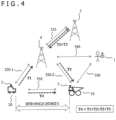
FIG. 4 is a diagram depicting an example of operation of approach detection and emergency stop in thevehicle control system 1000 of the first embodiment. At the normal time, a mannedvehicle 20 acquires information about its own position from the GPS receiver (not depicted) mounted on the vehicle-mountedtransmitting terminal 2. - The manned
vehicle 20 uses a first communication line to transmit the information about its own position and an emergency stop signal to anunmanned dump 10. For example, the first communication line is a communication line that goes through a wireless base station. In the present embodiment, it is a line that goes through infrastructure-to-vehicle communication 520-1, the infrastructure-to-infrastructure communication 510, and infrastructure-to-vehicle communication 520-2 in this order. - In addition, the manned
vehicle 20 uses a second communication line to transmit the information about its own position and an emergency stop signal to anunmanned dump 10. The second communication line is a line including communication paths different from those of the first communication line. For example, the second communication line is a communication line that does not go through a wireless base station, that is, a line that does not go through the infrastructure-to-vehicle communication 520 and the infrastructure-to-infrastructure communication 510. In the present embodiment, the second communication line includes only the vehicle-to-vehicle communication 550. - In this manner, the first communication line and the second communication line can be used in the time division multiplexing method. In that case, the first communication line and the second communication line can be used in mutually overlapping frequency bands, and this allows efficient use of communication bandwidths.
- By preparing two types of communication line in this manner, it becomes possible to perform efficient communication according to the situation. For example, in a case where the
unmanned dump 10 and the mannedvehicle 20 have a positional relation that allows direct communication, they can communicate with each other at a high speed without using a communication line that goes through the infrastructure-to-vehicle communication 520 and the infrastructure-to-infrastructure communication 510, and in a case where theunmanned dump 10 and the mannedvehicle 20 have a positional relation that does not allow direct communication, they can use a wide area communication line that goes through the infrastructure-to-vehicle communication 520 and the infrastructure-to-infrastructure communication 510. - On the other hand, the
unmanned dump 10 uses the first communication line and the second communication line to receive the positional information about the mannedvehicle 20. In addition, theunmanned dump 10 acquires information about its own position (for example, similarly to the manned vehicle 20). Then, theunmanned dump 10 determines an inter-vehicle distance X between theunmanned dump 10 and the mannedvehicle 20 by using the information about its own position and the positional information about the mannedvehicle 20. - In this manner, the
vehicle control system 1000 includes a plurality of communication lines connecting theunmanned dumps 10 and themanned vehicles 20 with each other. Note that whereas both the first communication line and the second communication line are available in the state supposed in the description above, one or both of the communication lines is/are unavailable depending on the situation, in some possible cases. - As depicted in
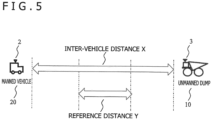
FIG. 5 , on the basis of the positional information about the mannedvehicle 20 received by using the first communication line from the mannedvehicle 20, theunmanned dump 10 decides whether or not the inter-vehicle distance X to the mannedvehicle 20 is equal to or shorter than a preset reference distance Y. The reference distance Y is a reference distance for detecting that theunmanned dump 10 and the mannedvehicle 20 have approached each other, and in a case where the inter-vehicle distance X is equal to or shorter than the reference distance Y, it is decided that it is detected that theunmanned dump 10 and the mannedvehicle 20 have approached each other. - In a case where the inter-vehicle distance X is equal to or shorter than the reference distance Y, the
unmanned dump 10 decelerates to a preset travel speed for ensuring safety. Note that a method of determining the travel speed after the deceleration is mentioned later. - In the present specification, a "speed" is a value representing only a speed not including directional information, for example.
- Here, a communication delay related to each communication line in
FIG. 4 is defined as follows. - A communication delay of the infrastructure-to-
vehicle communication 520 for performing mutual communication between arelay base station 4 and a mannedvehicle 20 is defined as T1. - A communication delay of the infrastructure-to-
infrastructure communication 510 for performing mutual communication between arelay base station 4 and the central-control base station 5 is defined as T2. - A communication delay of the infrastructure-to-
vehicle communication 520 for performing mutual communication between arelay base station 4 and anunmanned dump 10 is defined as T3. - A communication delay of the vehicle-to-
vehicle communication 550 for performing mutual communication between anunmanned dump 10 and a mannedvehicle 20 is defined as T4. - The total of communication delays in a case where positional information is transferred from a manned
vehicle 20 to anunmanned dump 10 by using the first communication line is T1 + T2 + T2 + T3. This total value can be measured in advance, and stored on a storage apparatus of theunmanned dump 10 or the vehicle-mountedreceiving terminal 3. - On the other hand, a communication delay in a case where positional information is transferred from a manned
vehicle 20 by using the second communication line (e.g. by using the vehicle-to-vehicle communication 550 for performing direct communication between anunmanned dump 10 and the manned vehicle 20) includes only T4. This value can be measured in advance, and stored on a storage apparatus of theunmanned dump 10 or the vehicle-mountedreceiving terminal 3. - It is supposed in this example that the communication delay related to the second communication line is shorter than the communication delay related to the first communication line. That is, T4 < T1 + T2 + T2 + T3.
-
FIG. 6 is a schematic diagram depicting how it appears in a case where a mannedvehicle 20 and anunmanned dump 10 have approached each other.FIG. 6 is a diagram about a time point at which the inter-vehicle distance X becomes equal to the reference distance Y. An area that has its center on theunmanned dump 10, and has a radius which is equal to the reference distance Y is defined as amovable range 600. - For example, the reference distance Y is computed in advance as such a distance that the
unmanned dump 10 travelling toward the stopped mannedvehicle 20 can stop safely if theunmanned dump 10 starts being braked when it is at the distance. In the present embodiment, the reference distance Y is computed according to the estimated sum of a braking distance, a free running distance and an error of positional information. -
FIG. 6 depicts a breakdown of the reference distance Y corresponding to communication using each communication line. Theunmanned dump 10 travels at a second speed V2 in a case where communication using only the first communication line is performed. That is, this is equivalent to a case where the second communication line is unavailable. - It is supposed that the
unmanned dump 10 travels at a first speed V1 in a case where communication using the second communication line is possible. - The first speed V1 and the second speed V2 are upper limits, and the
unmanned dump 10 travels at a speed lower than them depending on the situation in some cases. In an example in explained below, theunmanned dump 10 always travels at one of those upper limits. - The method for acquiring
braking distances braking distances braking distances braking distances - Free running distances 612 and 622 can be computed on the basis of a travel speed and free running time, and can be computed by multiplying these, for example. For example, the free running time is a length of time that elapses until a communication interruption is detected after the occurrence of the communication interruption, and differs depending on the communication lines.
- In the present embodiment, the free running time is set to a value which is equal to a communication delay of each communication line. That is, in a case where neither positional information nor an emergency stop signal can be received in a period equivalent to the communication delay, it is decided that a communication interruption is detected. Note that a communication delay of each communication line can be predetermined and stored in the manner mentioned above.
-
Positional information errors - As a specific example, in a case where time that has elapsed after the last reception of positional information about the manned
vehicle 20 using the second communication line has become longer than the communication delay related to the second communication line, theunmanned dump 10 decides that a communication interruption of the second communication line is detected. A decision regarding the first communication line also may be made similarly. - The explanation above is summarized below. The reference distance Y is a constant. The braking distances 611 and 621 are constants or computed in accordance with functions including the travel speed related to each situation as variables. Since the free running time is a constant that differs depending on the situation as described above, the free running distances 612 and 622 also are computed in accordance with functions including the travel speed as variables. Both the
positional information errors - Regarding a case where only the first communication line is established, and a case where the second communication line is established in addition to the first communication line as depicted in
FIG. 6 , specific examples of the method of calculating the travel speed related to each situation are explained below. - First, the case where only the first communication line is established is explained. It is supposed that the reference distance Y is 35 m. It is supposed that the
positional information error 613 in the case where only the first communication line is established is 10 m. It is supposed that thebraking distance 611 is a fixed value of 10 m. In this case, thefree running distance 612 is 35 - 10 - 10 = 15 [m]. Supposing that the communication delay of the first communication line is three seconds, the second speed V2 is 15/3 = 5 [m/s] = 18 [km/h]. - Accordingly, in a case where it is decided that the inter-vehicle distance X to the manned
vehicle 20 is equal to or shorter than the reference distance Y, theunmanned dump 10 is decelerated to 18 km/h, and passes by the mannedvehicle 20 at 18 km/h. It is supposed that thereafter they move away from each other, and the inter-vehicle distance X becomes longer than the reference distance Y. In that case, theunmanned dump 10 travels at a predetermined normal speed V0 determined in advance. The normal speed V0 is a speed higher than the first speed V1 and the second speed V2, and is 60 km/h, for example. By designing the normal speed V0 as a speed higher than the first speed V1 and the second speed V2 in this manner, normal-time operation efficiency is increased. - Next, the case where the second communication line also is established in addition to the first communication line is explained. It is supposed that the reference distance Y is 35 m as well, and the
positional information error 623 also is 10 m as well. It is supposed that thebraking distance 621 is a fixed value of 15 m. In this case, thefree running distance 622 is 35 - 10 - 15 = 10 [m]. Supposing that the communication delay of the second communication line is one second, the first speed V1 is 10/1 = 10 [m/s] = 36 [km/h]. - Accordingly, in a case where it is decided that the inter-vehicle distance X to the manned
vehicle 20 is equal to or shorter than the reference distance Y, theunmanned dump 10 is decelerated to 36 km/h, and passes by the mannedvehicle 20 at 36 km/h while ensuring safety. In this manner, theunmanned dump 10 can continue travelling at a speed higher than the travel speed (18 km/h) of theunmanned dump 10 in a case where the first communication line is used, and it becomes possible to reduce unnecessary decelerations of autonomous travel vehicles while maintaining safety. In this manner, enhancement of the safety and enhancement of the productivity are attained at the same time. - Note that whereas a method of increasing a travel speed to which the
unmanned dump 10 is decelerated while ensuring safety in a case where theunmanned dump 10 passes by the mannedvehicle 20 is mentioned in the explanation described above, a method of shortening a length of time of deceleration while ensuring safety in a case where theunmanned dump 10 passes by the mannedvehicle 20 may be adopted. - Next, with reference to a sequence diagram in
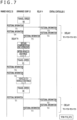
FIG. 7 , the overall procedure of a mannedvehicle 20, anunmanned dump 10, arelay base station 4, and the central-control base station 5 in a case where the second communication line is established is explained. Theunmanned dump 10 is travelling at the predetermined normal speed V0. - The manned
vehicle 20 transmits, to therelay base station 4, information about its own position by using the first communication line, that is, by using the infrastructure-to-vehicle communication 520 using the infrastructure-to-vehicle communication subframe 1520, at intervals of a predetermined length of time (e.g. one second). Therelay base station 4 transmits, to the central-control base station 5, the positional information about the mannedvehicle 20 by using the infrastructure-to-infrastructure communication 510 using the infrastructure-to-infrastructure communication subframe 1510. The central-control base station 5 transmits, to therelay base station 4, the positional information about the mannedvehicle 20 by using the infrastructure-to-infrastructure communication 510 using the infrastructure-to-infrastructure communication subframe 1510. Therelay base station 4 transmits, to theunmanned dump 10, the positional information about the mannedvehicle 20 by using the infrastructure-to-vehicle communication 520 using the infrastructure-to-vehicle communication subframe 1520. The communication delay of the first communication line is (T1 + T2 + T2 + T3). - In addition, the manned
vehicle 20 directly transmits the information about its own position also by using the second communication line, that is, by using the vehicle-to-vehicle communication 550 using the vehicle-to-vehicle communication subframe 1550, at intervals of a predetermined length of time (e.g. one second). The communication delay of the second communication line includes only T4. - The
unmanned dump 10 gets to be able to receive the second communication line, that is, the second communication line is established, when the mannedvehicle 20 approaches theunmanned dump 10. It is supposed that the mannedvehicle 20 further approaches theunmanned dump 10, and the inter-vehicle distance X has become equal to or shorter than the reference distance Y. In a case where the inter-vehicle distance X is equal to or shorter than the reference distance Y, theunmanned dump 10 decides whether or not the second communication line is established. - In a case where it is decided that the second communication line is established, the
unmanned dump 10 sets the upper limit of its own travel speed to the first speed V1. The specific process of the speed control at this time can be designed by those skilled in the art as appropriate. Note that while the inter-vehicle distance X is equal to or shorter than the reference distance Y, theunmanned dump 10 may receive the positional information about the mannedvehicle 20 transmitted by using the second communication line, and calculate the inter-vehicle distance X. - It is supposed that thereafter the manned
vehicle 20 moves away from theunmanned dump 10, and it is decided that the inter-vehicle distance X between themanned vehicle 20 and theunmanned dump 10 has become longer than the reference distance Y. In a case where the inter-vehicle distance X is longer than the reference distance Y, theunmanned dump 10 sets the upper limit of its own travel speed to the normal speed V0. The specific process of the speed control at this time can be designed by those skilled in the art as appropriate. - Next, with reference to a sequence diagram in
FIG. 8 , the overall procedure of a mannedvehicle 20, anunmanned dump 10, arelay base station 4, and the central-control base station 5 in a case where the second communication line is not established is explained. The mannedvehicle 20 is travelling at the predetermined normal speed V0. - Similarly to the case in
FIG. 7 , the mannedvehicle 20 uses the first communication line and the second communication line to transmit information about its own position. - Although the
unmanned dump 10 is designed to be capable of receiving the second communication line if the mannedvehicle 20 has approached theunmanned dump 10, the second communication line is not established depending on the wireless environment, in some cases. It is supposed that when the mannedvehicle 20 approaches theunmanned dump 10, and the inter-vehicle distance X has become equal to or shorter than the reference distance Y, it is decided that the second communication line is not established. In this case, theunmanned dump 10 sets the upper limit of its own travel speed to the second speed V2. The specific process of the speed control at this time can be designed by those skilled in the art as appropriate. In this case, theunmanned dump 10 receives positional information about the mannedvehicle 20 transmitted by using the first communication line, and calculates the inter-vehicle distance X. - It is supposed that thereafter if the manned
vehicle 20 moves away from theunmanned dump 10, theunmanned dump 10 sets the upper limit of its own travel speed to the normal speed V0, similarly to the case inFIG. 7 . - Note that although not depicted, an emergency stop signal is transmitted along with the positional information, and it is possible for the manned
vehicle 20 to emergently stop theunmanned dump 10 any time by operation of the emergency stop button. - Note that in a case where the second communication line has been established at a time point at which the inter-vehicle distance X between the
manned vehicle 20 and theunmanned dump 10 has become equal to or shorter than the reference distance Y, and thereafter the second communication line is no longer established while the inter-vehicle distance X is equal to or shorter than the reference distance Y, speed control is executed such that the travel speed of theunmanned dump 10 is switched from the first speed V1 to the second speed V2. - As explained above, according to the vehicle control system of the first embodiment, in a case where it is decided that the inter-vehicle distance X between the
unmanned dump 10 and the mannedvehicle 20 is equal to or shorter than the reference distance Y decided in advance, theunmanned dump 10 decides whether or not the second communication line is established. Then, in a case where the second communication line is established and communication therethrough is possible, the travel speed of theunmanned dump 10 can be increased or the deceleration time can be shortened as compared to a case where the second communication line is not established and communication therethrough is not possible, and thus the mining work efficiency of a mine can be enhanced. - Note that the method for deciding whether or not the second communication line is established can be designed by those skilled in the art as desired. For example, the decision can be made on the basis of received power, a bit error rate, a packet error rate, and the like, but these are not the sole examples.
- According to this first embodiment, a vehicle control system that makes it possible to ensure the safety and enhance the productivity at the same time can be provided.
- Note that whereas control is performed to decelerate an
unmanned dump 10 at a time of approach in the explanation described above, instead of deceleration, control can also be performed to cause anunmanned dump 10 to take a bypass route, and so on. That is, as long as a technique for avoiding a collision between anunmanned dump 10 and another vehicle or the like is adopted, the method of avoiding such a collision is not limited to a particular one. - A block diagram in
FIG. 9 depicts a configuration example of the vehicle-mountedtransmitting terminals 2 according to the embodiment described above. As an example, a vehicle-mountedtransmitting terminal 2 has a transmission/reception antenna 101, awireless apparatus 102, apower supply apparatus 105, adisplay apparatus 106, anemergency stop button 107, acontroller 108, aGPS receiver 109, and aGPS antenna 110. In addition, thecontroller 108 includes amicrocomputer apparatus 104 and abaseband apparatus 103. Thewireless apparatus 102 may have the functionality of thebaseband apparatus 103. - The
power supply apparatus 105 includes, abattery 810, avoltage converter 811, and the like. Thepower supply apparatus 105 has a functionality of converting electric power supplied from thebattery 810 into a required voltage at thevoltage converter 811, and thereafter supplying the electric power to each section in the vehicle-mountedtransmitting terminal 2. - The
display apparatus 106 includes an LED, a liquid crystal display apparatus, or the like, and is connected to thepower supply apparatus 105 and themicrocomputer apparatus 104. Thedisplay apparatus 106 has a functionality of informing an operator of the normality of the power supply and a result of an out-of-range determination about a wireless area. - The
emergency stop button 107 is connected with themicrocomputer apparatus 104 of thecontroller 108, and includes an operation button to be used by the operator to give a command for emergently stopping anunmanned dump 10. Similarly to the emergencystop input apparatus 32 of thecontrol center 30, theemergency stop button 107 gives a command for emergently stopping theunmanned dump 10, but thisemergency stop button 107 is provided in the vehicle-mountedtransmitting terminal 2. Theemergency stop button 107 can have a press-button structure that detects that an instruction from the operator is given when theemergency stop button 107 is pressed. In addition, it is desirable if theemergency stop button 107 has such a mechanism that it is locked in a case where it is pressed, and is kept being pressed unless an unlocking operation is performed. - The
GPS receiver 109 is connected with theGPS antenna 110 and themicrocomputer apparatus 104 of thecontroller 108, and acquires positional information representing the current position of the mannedvehicle 20 from a GPS reception signal received via theGPS antenna 110. TheGPS receiver 109 outputs the positional information representing the current position of the mannedvehicle 20 to themicrocomputer apparatus 104 regularly (e.g. every second). - The
microcomputer apparatus 104 of thecontroller 108 is a microcomputer. Themicrocomputer apparatus 104 is connected with thedisplay apparatus 106, theemergency stop button 107, thebaseband apparatus 103, and theGPS receiver 109. - The
microcomputer apparatus 104 has a CPU 801 (calculation processing apparatus) and a storage apparatus 802 (a main memory, a flash memory, etc.). By calculations of a program stored on thestorage apparatus 802 being executed by theCPU 801, functionalities explained below are realized. - Part or the whole of the
microcomputer apparatus 104 may be configured by using an integrated circuit or the like. In addition to the functionalities described above, themicrocomputer apparatus 104 makes a determination as to whether thepower supply apparatus 105 is operating normally, and an out-of-range determination as to whether or not the mannedvehicle 20 is in a wireless area formed by eachrelay base station 4 and the central-control base station 5. - The
baseband apparatus 103 of thecontroller 108 is a unit that is configured by using an integrated circuit or the like, and performs communication with another apparatus in accordance with the time division multiplexing method. Thebaseband apparatus 103 outputs a signal in a subframe allocated in advance or in a subframe allocated to itself by the infrastructure-to-infrastructure communication 510, in a plurality of subframes obtained by dividing specified unit time (e.g. one second). Under the control of themicrocomputer apparatus 104, thebaseband apparatus 103 controls thewireless apparatus 102 such that a signal is transmitted in a subframe allocated to itself. - on the basis of control by the
baseband apparatus 103, thewireless apparatus 102 implements processes such as error correcting coding, modulation, frequency conversion, filtering, or amplification on data output from thebaseband apparatus 103, and generates a wireless signal. Thewireless apparatus 102 sends the generated wireless signal to the transmission/reception antenna 101. - Next, operation of a vehicle-mounted
transmitting terminal 2 is explained in detail with reference to a flowchart inFIG. 10 . It is supposed that the flowchart inFIG. 10 is implemented at intervals of a predetermined length of time (e.g. one second). - As a first communication method, the vehicle-mounted
transmitting terminal 2 sets parameters such that thebaseband apparatus 103 of the vehicle-mountedtransmitting terminal 2 operates on the first communication line (Step S002). For example, a modulation method and a coding rate used for the first communication line are set. - In parallel with this, as a second communication method, the vehicle-mounted
transmitting terminal 2 sets parameters such that thebaseband apparatus 103 of the vehicle-mountedtransmitting terminal 2 operates on the second communication line (Step S006). For example, a modulation method and a coding rate used for the second communication line are set. - After the communication method of the first communication line is set, the
GPS antenna 110 of the vehicle-mountedtransmitting terminal 2 receives a GPS signal (Step S003), and, on the basis of the GPS signal, theGPS receiver 109 acquires positional information representing the current position of the manned vehicle 20 (Step S004). Then, themicrocomputer apparatus 104 generates information data about its own position for the first communication line (Step S005). - After the communication method of the second communication line is set, operation identical to Steps 003 and 004 is performed at Steps S007 and 008. The
microcomputer apparatus 104 generates information data about its own position for the second communication line (Step S009). - Subsequently, the process proceeds to Step S010, and it is determined whether or not the
emergency stop button 107 is being pressed. In a case where it is determined that theemergency stop button 107 is not being pressed (No at Step S010), themicrocomputer apparatus 104 generates an emergency stop signal "0" on an application layer 123 (Step S011). On the other hand, in a case where it is determined that theemergency stop button 107 is being pressed (Yes at Step S010), themicrocomputer apparatus 104 generates an emergency stop signal "1" on the application layer 123 (Step S012). The emergency stop signal "1" is an emergency stop command signal. - Then, the microcomputer apparatus generates transmission data including the obtained positional information and emergency stop signal (Step S013). The generated transmission data is subjected to a transmission process necessary for functional safety on a safety communication layer 122, and then transmitted (Step S014). The
baseband apparatus 103 implements, on the received data, a transmission process necessary for wireless communication on a wireless communication layer 121. - In a case where the data after being subjected to the transmission process is transmission data generated in accordance with the first communication method, the data is output to the
wireless apparatus 102 at a timing at which it is transmitted in a relevant slot of the infrastructure-to-vehicle communication subframe 1520 (Step S015). In a case where the data is transmission data generated according to the second communication method, the data is output to thewireless apparatus 102 at a timing at which it is transmitted in a relevant slot of the vehicle-to-vehicle communication subframe 1550 (Step S015 as well). - The
wireless apparatus 102 implements processes such as modulation, frequency conversion, filtering, or amplification on the data received from thebaseband apparatus 103, and outputs an ACK signal from the transmission/reception antenna 101 (Step S016). The process loops back to START (S001) every second after this Step S016 is ended. - By the operation according to the flowchart in
FIG. 10 , information about its own position is transmitted regularly, and while theemergency stop button 107 is being pressed (S010: Yes), "1" is transmitted as an emergency stop signal continuously (i.e. an emergency stop command signal is transmitted). In addition, if theemergency stop button 107 is unlocked (S010: No), themicrocomputer apparatus 104 transmits "0" as the emergency stop signal. - Note that by executing the communication method of the first communication line and the communication method of the second communication line in parallel in
FIG. 10 , it becomes possible to perform stable communication even if the communication distance of the first communication line and the communication distance of the second communication line are significantly different from each other. In addition, the precision of positional information related to the first communication line and the precision of positional information related to the second communication line may be made different from each other. - Since, even if the second communication line is not established, information about its own position is transferred stably by the first communication line, and additionally an emergency stop signal also is transferred, thus the safety never becomes a problem. On the other hand, in a case where the second communication line is established, it becomes possible to increase the travel speed to which an
unmanned dump 10 is decelerated, shorten the deceleration time, and so on, thereby attaining enhancement of the productivity. - Note that whereas an embodiment is explained by using, as an example, unmanned dumps of a mining site in the embodiment described above, autonomous travel vehicles are not limited to unmanned dumps at a mine, but may be manned dumps, and may be construction machines or the like at a construction site.
- As explained in detail thus far, according to the present embodiment, it is possible to increase the travel speed to which an autonomously-travelling unmanned dump is decelerated, shorten the deceleration time, remotely stopping a moving haulage vehicle at a time of emergency, and so on.
- Note that the present invention is not limited to the embodiment described above, but includes various modification examples. For example, the embodiment described above is explained in detail in order to explain the present invention in an easy-to-understand manner, and the present invention is not necessarily limited to the embodiment including all the constituent elements explained. In addition, some of the constituent elements of an embodiment can be replaced with constituent elements of another embodiment, and also the constituent elements of an embodiment can additionally have constituent elements of another embodiment. In addition, some of the constituent elements of each embodiment can additionally have other constituent elements, can be deleted, or can be replaced with other constituent elements. In addition, some or all of constituent elements, functionalities, processing sections, processing means, and the like described above may be realized by hardware by, for example, designing them in an integrated circuit and so on. In addition, constituent elements, functionalities, and the like described above may be realized by software by a processor interpreting and executing a program to realize respective functionalities. Information such as a program, a table, or a file to realize each functionality can be placed in a recording apparatus such as a memory, a hard disk, or an SSD (Solid State Drive) or a recording medium such as an IC card, an SD card, or a DVD.
-
- 1: Mobile transmitting terminal (terminal)
- 2: Vehicle-mounted transmitting terminal (terminal)
- 3: Vehicle-mounted receiving terminal
- 4: Relay base station (wireless base station)
- 5: Central-control base station (wireless base station)
- 10: Unmanned dump (autonomous travel vehicle)
- 20: Manned vehicle
- 30: Control center
- 31: Operation management system
- 32: Emergency stop input apparatus (terminal)
- 33: Cable line
- 100: Road
- 101: Transmission/reception antenna
- 102: Wireless apparatus
- 103: Baseband apparatus
- 104: Microcomputer apparatus
- 105: Power supply apparatus
- 106: Display apparatus
- 107: Emergency stop button
- 108: Controller
- 109: GPS receiver
- 110: GPS antenna
- 200: Loading site
- 300: Soil-dropping site
- 500: Control communication
- 510: Infrastructure-to-infrastructure communication (first communication line)
- 520: Infrastructure-to-vehicle communication (first communication line)
- 530: Pedestrian-to-vehicle communication
- 540: Pedestrian-to-infrastructure communication
- 550: Vehicle-to-vehicle communication (second communication line)
- 600: Movable range
- 1000: Vehicle control system
- T1 to T4: Communication delay
- V0: Normal speed
- V1: First speed
- V2: Second speed
- X: Inter-vehicle distance
- Y: Reference distance
Claims (6)
- A vehicle control system (1000) comprising:an autonomous travel vehicle (10);a manned vehicle (20); anda plurality of communication lines (510, 520, 550) configured to connect the autonomous travel vehicle (10) and the manned vehicle (20) with each other, whereinthe manned vehicle (20) is configured to transmit positional information about the manned vehicle (20) by using a first communication line (510),the autonomous travel vehicle (10) is configured to use the first communication line (510) to receive the positional information about the manned vehicle (20),the autonomous travel vehicle (10) is configured to decide whether or not an inter-vehicle distance (X) between the autonomous travel vehicle (10) and the manned vehicle (20) is equal to or shorter than a reference distance (Y) on a basis of the positional information about the manned vehicle (20) and positional information about the autonomous travel vehicle (10),in a case where the inter-vehicle distance (X) is equal to or shorter than the reference distance (Y), the autonomous travel vehicle (10) is configured to- decide whether or not a second communication line (550) that uses a communication path different from the first communication line (510) is established between the autonomous travel vehicle (10) and the manned vehicle (20),- set an upper limit of a travel speed of the autonomous travel vehicle (10) to a first speed (V1) in a case where it is decided that the second communication line (550) is established, and travels under the upper limit,- set the upper limit of the travel speed of the autonomous travel vehicle (10) to a second speed (V2), which is not zero, in a case where it is decided that the second communication line (550) is not established, and travels under the upper limit, whereina communication delay related to the second communication line (550) is shorter than a communication delay related to the first communication line (510), and whereinthe first speed (V1) is higher than the second speed (V2).
- The vehicle control system (1000) according to claim 1, whereinthe first communication line (510) is a communication line that goes through a wireless base station (4), andthe second communication (550) line is a communication line that does not go through a wireless base station (5).
- The vehicle control system (1000) according to claim 1, further comprising:
a terminal configured to transmit an emergency stop command signal as an instruction for stopping the autonomous travel vehicle (10). - The vehicle control system (1000) according to claim 3, wherein
the manned vehicle (20) includes the terminal, and is configured to use the first communication line (510) to transmit the emergency stop command signal. - The vehicle control system (1000) according to claim 1, wherein
the first communication line (510) and the second communication line (550) are used in a time division multiplexing method in a mutually overlapping frequency band. - The vehicle control system (1000) according to claim 1, whereinthe upper limit of the travel speed of the autonomous travel vehicle (10) is set to a predetermined normal speed (V0) in a case where the inter-vehicle distance (X) is longer than the reference distance (Y), andthe normal speed (V0) is higher than the first speed (V1) and the second speed (V2).
Applications Claiming Priority (2)
| Application Number | Priority Date | Filing Date | Title |
|---|---|---|---|
| JP2020095568A JP7379273B2 (en) | 2020-06-01 | 2020-06-01 | vehicle control system |
| PCT/JP2021/017822 WO2021246114A1 (en) | 2020-06-01 | 2021-05-11 | Vehicle control system |
Publications (3)
| Publication Number | Publication Date |
|---|---|
| EP4159571A1 EP4159571A1 (en) | 2023-04-05 |
| EP4159571A4 EP4159571A4 (en) | 2024-04-10 |
| EP4159571B1 true EP4159571B1 (en) | 2025-07-09 |
Family
ID=78830897
Family Applications (1)
| Application Number | Title | Priority Date | Filing Date |
|---|---|---|---|
| EP21818571.8A Active EP4159571B1 (en) | 2020-06-01 | 2021-05-11 | Vehicle control system |
Country Status (7)
| Country | Link |
|---|---|
| US (1) | US12275428B2 (en) |
| EP (1) | EP4159571B1 (en) |
| JP (1) | JP7379273B2 (en) |
| CN (1) | CN115605387A (en) |
| AU (1) | AU2021284330B2 (en) |
| CA (1) | CA3180448A1 (en) |
| WO (1) | WO2021246114A1 (en) |
Families Citing this family (1)
| Publication number | Priority date | Publication date | Assignee | Title |
|---|---|---|---|---|
| JP7701299B2 (en) * | 2022-03-28 | 2025-07-01 | 株式会社日立製作所 | Wireless control system and wireless control method |
Family Cites Families (26)
| Publication number | Priority date | Publication date | Assignee | Title |
|---|---|---|---|---|
| US5365516A (en) * | 1991-08-16 | 1994-11-15 | Pinpoint Communications, Inc. | Communication system and method for determining the location of a transponder unit |
| JP3745484B2 (en) * | 1997-02-12 | 2006-02-15 | 株式会社小松製作所 | Vehicle monitoring device |
| US6292725B1 (en) * | 1997-04-04 | 2001-09-18 | Komatsu Ltd. | Interference preventing device for vehicle |
| JP2000315112A (en) * | 1999-04-30 | 2000-11-14 | Komatsu Ltd | Safety devices for vehicle driving systems |
| JP2000339029A (en) * | 1999-05-31 | 2000-12-08 | Komatsu Ltd | Vehicle interference prevention device |
| JP4506568B2 (en) * | 2005-06-02 | 2010-07-21 | トヨタ自動車株式会社 | Parking assistance device |
| JP4605805B2 (en) * | 2007-08-27 | 2011-01-05 | 株式会社小松製作所 | Vehicle travel control device |
| JP6123443B2 (en) * | 2013-04-09 | 2017-05-10 | 株式会社デンソー | Dangerous vehicle notification device, dangerous vehicle notification program, and recording medium recording dangerous vehicle notification program |
| JP6211449B2 (en) * | 2014-03-27 | 2017-10-11 | 日立建機株式会社 | Operation management server, in-vehicle terminal device, and operation management system |
| JP6267059B2 (en) | 2014-05-28 | 2018-01-24 | 日立建機株式会社 | Vehicle management system |
| JP2016071403A (en) * | 2014-09-26 | 2016-05-09 | 日立建機株式会社 | Transport vehicle |
| JP6539502B2 (en) * | 2015-06-03 | 2019-07-03 | 日立建機株式会社 | Wireless communication system, control server, and base station switching operation control method |
| JP6402085B2 (en) | 2015-10-06 | 2018-10-10 | 日立建機株式会社 | Emergency stop system for transport vehicles |
| JP6551209B2 (en) * | 2015-12-15 | 2019-07-31 | 株式会社デンソー | Driving assistance device |
| DE112016005304T5 (en) * | 2015-12-17 | 2018-08-02 | Scania Cv Ab | A method and system for facilitating the following of a Leader Vehicle along a road |
| WO2017153979A1 (en) * | 2016-03-06 | 2017-09-14 | Foresight Automotive Ltd. | Running vehicle alerting system and method |
| US9791864B2 (en) * | 2016-03-10 | 2017-10-17 | Ford Global Technologies, Llc | Systems and methods for driving risk index estimation |
| KR101822945B1 (en) * | 2016-07-05 | 2018-01-29 | 엘지전자 주식회사 | Mobile terminal |
| JP6873875B2 (en) * | 2017-09-14 | 2021-05-19 | 本田技研工業株式会社 | Vehicle control devices, vehicle control methods, and programs |
| JP6928184B2 (en) * | 2018-01-08 | 2021-09-01 | ノキア テクノロジーズ オサケユイチア | Target vehicle selection and message delivery in the vehicle system |
| US12017648B2 (en) * | 2018-05-15 | 2024-06-25 | Hitachi Astemo, Ltd. | Vehicle control device |
| CN109606367B (en) * | 2018-11-06 | 2020-04-17 | 北京工业大学 | Optimal linear control method and device of cruise control system based on Internet of vehicles |
| JP2020095568A (en) | 2018-12-14 | 2020-06-18 | キヤノン株式会社 | Information processor, control method of information processor, and program |
| EP3700238B1 (en) * | 2019-02-20 | 2026-04-08 | Volkswagen Aktiengesellschaft | Method for performing a wireless communication, mobile station, vehicle and base station |
| WO2020195358A1 (en) * | 2019-03-28 | 2020-10-01 | パナソニックIpマネジメント株式会社 | Skid information control system and skid information control method |
| US20210080948A1 (en) * | 2019-09-12 | 2021-03-18 | Transportation Ip Holdings, Llc | Vehicle control system |
-
2020
- 2020-06-01 JP JP2020095568A patent/JP7379273B2/en active Active
-
2021
- 2021-05-11 EP EP21818571.8A patent/EP4159571B1/en active Active
- 2021-05-11 AU AU2021284330A patent/AU2021284330B2/en active Active
- 2021-05-11 US US17/928,110 patent/US12275428B2/en active Active
- 2021-05-11 WO PCT/JP2021/017822 patent/WO2021246114A1/en not_active Ceased
- 2021-05-11 CA CA3180448A patent/CA3180448A1/en active Pending
- 2021-05-11 CN CN202180035655.0A patent/CN115605387A/en active Pending
Also Published As
| Publication number | Publication date |
|---|---|
| US20230202512A1 (en) | 2023-06-29 |
| US12275428B2 (en) | 2025-04-15 |
| EP4159571A4 (en) | 2024-04-10 |
| AU2021284330B2 (en) | 2024-10-24 |
| CN115605387A (en) | 2023-01-13 |
| AU2021284330A1 (en) | 2023-01-19 |
| WO2021246114A1 (en) | 2021-12-09 |
| JP2021187345A (en) | 2021-12-13 |
| JP7379273B2 (en) | 2023-11-14 |
| EP4159571A1 (en) | 2023-04-05 |
| CA3180448A1 (en) | 2021-12-09 |
Similar Documents
| Publication | Publication Date | Title |
|---|---|---|
| CN113785254B (en) | Vehicle control system | |
| AU2014388516B2 (en) | Vehicle driving management system and operation management server | |
| JP5245522B2 (en) | Radio resource allocation device, radio resource allocation system, and radio resource allocation method | |
| EP1695890B1 (en) | Signaling system, train with control apparatus and point protection apparatus | |
| EP3104355A1 (en) | Work vehicle control system | |
| CN102372012B (en) | Train Control Device And Overground Device | |
| JP6402085B2 (en) | Emergency stop system for transport vehicles | |
| EP4159571B1 (en) | Vehicle control system | |
| JP2020184195A5 (en) | ||
| CN112544100A (en) | Management server and management method | |
| CN114074881B (en) | Elevator car mover that provides intelligent control based on battery state of charge | |
| JP6783580B2 (en) | Wireless train control system and ground system | |
| JP7018363B2 (en) | Emergency stop device, emergency stop wireless system | |
| JP5800768B2 (en) | Train radio system and on-board equipment | |
| JP5787844B2 (en) | Radio base station, train management system, and slot allocation method | |
| US12252147B2 (en) | Method and system for prompting an evasive maneuver of autonomous or semi-autonomous vehicles | |
| CN115257866B (en) | Train line switching method and device | |
| WO2022260033A1 (en) | Vehicle control system | |
| KR101874896B1 (en) | Method for transporting traffic information | |
| JP7792004B2 (en) | Train Control System | |
| Hwang et al. | What If Vehicles are Controlled by the Road? | |
| CN120742881A (en) | Driving control system and method and unmanned vehicle | |
| JP6814050B2 (en) | Train control system and ground control device | |
| KR20250154638A (en) | System and method for validating the starting position of the train | |
| JP2017105465A (en) | On-ground device, on-vehicle device and vehicle control device |
Legal Events
| Date | Code | Title | Description |
|---|---|---|---|
| STAA | Information on the status of an ep patent application or granted ep patent |
Free format text: STATUS: THE INTERNATIONAL PUBLICATION HAS BEEN MADE |
|
| PUAI | Public reference made under article 153(3) epc to a published international application that has entered the european phase |
Free format text: ORIGINAL CODE: 0009012 |
|
| STAA | Information on the status of an ep patent application or granted ep patent |
Free format text: STATUS: REQUEST FOR EXAMINATION WAS MADE |
|
| 17P | Request for examination filed |
Effective date: 20230102 |
|
| AK | Designated contracting states |
Kind code of ref document: A1 Designated state(s): AL AT BE BG CH CY CZ DE DK EE ES FI FR GB GR HR HU IE IS IT LI LT LU LV MC MK MT NL NO PL PT RO RS SE SI SK SM TR |
|
| DAV | Request for validation of the european patent (deleted) | ||
| DAX | Request for extension of the european patent (deleted) | ||
| REG | Reference to a national code |
Ref country code: DE Ref legal event code: R079 Ipc: G05D0001000000 Ref country code: DE Ref legal event code: R079 Ref document number: 602021033914 Country of ref document: DE Free format text: PREVIOUS MAIN CLASS: B60W0050040000 Ipc: G05D0001000000 |
|
| A4 | Supplementary search report drawn up and despatched |
Effective date: 20240313 |
|
| RIC1 | Information provided on ipc code assigned before grant |
Ipc: H04W 4/46 20180101ALI20240306BHEP Ipc: H04W 4/029 20180101ALI20240306BHEP Ipc: G08G 1/16 20060101ALI20240306BHEP Ipc: B60W 60/00 20200101ALI20240306BHEP Ipc: B60W 30/08 20120101ALI20240306BHEP Ipc: B60W 50/04 20060101ALI20240306BHEP Ipc: G05D 1/00 20060101AFI20240306BHEP |
|
| STAA | Information on the status of an ep patent application or granted ep patent |
Free format text: STATUS: EXAMINATION IS IN PROGRESS |
|
| 17Q | First examination report despatched |
Effective date: 20241025 |
|
| GRAP | Despatch of communication of intention to grant a patent |
Free format text: ORIGINAL CODE: EPIDOSNIGR1 |
|
| STAA | Information on the status of an ep patent application or granted ep patent |
Free format text: STATUS: GRANT OF PATENT IS INTENDED |
|
| INTG | Intention to grant announced |
Effective date: 20250124 |
|
| GRAS | Grant fee paid |
Free format text: ORIGINAL CODE: EPIDOSNIGR3 |
|
| GRAA | (expected) grant |
Free format text: ORIGINAL CODE: 0009210 |
|
| STAA | Information on the status of an ep patent application or granted ep patent |
Free format text: STATUS: THE PATENT HAS BEEN GRANTED |
|
| AK | Designated contracting states |
Kind code of ref document: B1 Designated state(s): AL AT BE BG CH CY CZ DE DK EE ES FI FR GB GR HR HU IE IS IT LI LT LU LV MC MK MT NL NO PL PT RO RS SE SI SK SM TR |
|
| REG | Reference to a national code |
Ref country code: GB Ref legal event code: FG4D |
|
| REG | Reference to a national code |
Ref country code: CH Ref legal event code: EP |
|
| REG | Reference to a national code |
Ref country code: IE Ref legal event code: FG4D |
|
| REG | Reference to a national code |
Ref country code: DE Ref legal event code: R096 Ref document number: 602021033914 Country of ref document: DE |
|
| REG | Reference to a national code |
Ref country code: NL Ref legal event code: MP Effective date: 20250709 |
|
| PG25 | Lapsed in a contracting state [announced via postgrant information from national office to epo] |
Ref country code: PT Free format text: LAPSE BECAUSE OF FAILURE TO SUBMIT A TRANSLATION OF THE DESCRIPTION OR TO PAY THE FEE WITHIN THE PRESCRIBED TIME-LIMIT Effective date: 20251110 |
|
| PG25 | Lapsed in a contracting state [announced via postgrant information from national office to epo] |
Ref country code: NL Free format text: LAPSE BECAUSE OF FAILURE TO SUBMIT A TRANSLATION OF THE DESCRIPTION OR TO PAY THE FEE WITHIN THE PRESCRIBED TIME-LIMIT Effective date: 20250709 |
|
| REG | Reference to a national code |
Ref country code: AT Ref legal event code: MK05 Ref document number: 1812396 Country of ref document: AT Kind code of ref document: T Effective date: 20250709 |
|
| PG25 | Lapsed in a contracting state [announced via postgrant information from national office to epo] |
Ref country code: IS Free format text: LAPSE BECAUSE OF FAILURE TO SUBMIT A TRANSLATION OF THE DESCRIPTION OR TO PAY THE FEE WITHIN THE PRESCRIBED TIME-LIMIT Effective date: 20251109 |
|
| PG25 | Lapsed in a contracting state [announced via postgrant information from national office to epo] |
Ref country code: NO Free format text: LAPSE BECAUSE OF FAILURE TO SUBMIT A TRANSLATION OF THE DESCRIPTION OR TO PAY THE FEE WITHIN THE PRESCRIBED TIME-LIMIT Effective date: 20251009 |
|
| REG | Reference to a national code |
Ref country code: LT Ref legal event code: MG9D |
|
| PG25 | Lapsed in a contracting state [announced via postgrant information from national office to epo] |
Ref country code: AT Free format text: LAPSE BECAUSE OF FAILURE TO SUBMIT A TRANSLATION OF THE DESCRIPTION OR TO PAY THE FEE WITHIN THE PRESCRIBED TIME-LIMIT Effective date: 20250709 |
|
| PG25 | Lapsed in a contracting state [announced via postgrant information from national office to epo] |
Ref country code: FI Free format text: LAPSE BECAUSE OF FAILURE TO SUBMIT A TRANSLATION OF THE DESCRIPTION OR TO PAY THE FEE WITHIN THE PRESCRIBED TIME-LIMIT Effective date: 20250709 |
|
| PG25 | Lapsed in a contracting state [announced via postgrant information from national office to epo] |
Ref country code: HR Free format text: LAPSE BECAUSE OF FAILURE TO SUBMIT A TRANSLATION OF THE DESCRIPTION OR TO PAY THE FEE WITHIN THE PRESCRIBED TIME-LIMIT Effective date: 20250709 |
|
| PG25 | Lapsed in a contracting state [announced via postgrant information from national office to epo] |
Ref country code: GR Free format text: LAPSE BECAUSE OF FAILURE TO SUBMIT A TRANSLATION OF THE DESCRIPTION OR TO PAY THE FEE WITHIN THE PRESCRIBED TIME-LIMIT Effective date: 20251010 |
|
| PG25 | Lapsed in a contracting state [announced via postgrant information from national office to epo] |
Ref country code: SE Free format text: LAPSE BECAUSE OF FAILURE TO SUBMIT A TRANSLATION OF THE DESCRIPTION OR TO PAY THE FEE WITHIN THE PRESCRIBED TIME-LIMIT Effective date: 20250709 |
|
| PG25 | Lapsed in a contracting state [announced via postgrant information from national office to epo] |
Ref country code: LV Free format text: LAPSE BECAUSE OF FAILURE TO SUBMIT A TRANSLATION OF THE DESCRIPTION OR TO PAY THE FEE WITHIN THE PRESCRIBED TIME-LIMIT Effective date: 20250709 |
|
| PG25 | Lapsed in a contracting state [announced via postgrant information from national office to epo] |
Ref country code: BG Free format text: LAPSE BECAUSE OF FAILURE TO SUBMIT A TRANSLATION OF THE DESCRIPTION OR TO PAY THE FEE WITHIN THE PRESCRIBED TIME-LIMIT Effective date: 20250709 Ref country code: PL Free format text: LAPSE BECAUSE OF FAILURE TO SUBMIT A TRANSLATION OF THE DESCRIPTION OR TO PAY THE FEE WITHIN THE PRESCRIBED TIME-LIMIT Effective date: 20250709 |
|
| PG25 | Lapsed in a contracting state [announced via postgrant information from national office to epo] |
Ref country code: RS Free format text: LAPSE BECAUSE OF FAILURE TO SUBMIT A TRANSLATION OF THE DESCRIPTION OR TO PAY THE FEE WITHIN THE PRESCRIBED TIME-LIMIT Effective date: 20251009 |
|
| PG25 | Lapsed in a contracting state [announced via postgrant information from national office to epo] |
Ref country code: ES Free format text: LAPSE BECAUSE OF FAILURE TO SUBMIT A TRANSLATION OF THE DESCRIPTION OR TO PAY THE FEE WITHIN THE PRESCRIBED TIME-LIMIT Effective date: 20250709 |
|
| PG25 | Lapsed in a contracting state [announced via postgrant information from national office to epo] |
Ref country code: SM Free format text: LAPSE BECAUSE OF FAILURE TO SUBMIT A TRANSLATION OF THE DESCRIPTION OR TO PAY THE FEE WITHIN THE PRESCRIBED TIME-LIMIT Effective date: 20250709 |
|
| PG25 | Lapsed in a contracting state [announced via postgrant information from national office to epo] |
Ref country code: DK Free format text: LAPSE BECAUSE OF FAILURE TO SUBMIT A TRANSLATION OF THE DESCRIPTION OR TO PAY THE FEE WITHIN THE PRESCRIBED TIME-LIMIT Effective date: 20250709 |
|
| PG25 | Lapsed in a contracting state [announced via postgrant information from national office to epo] |
Ref country code: IT Free format text: LAPSE BECAUSE OF FAILURE TO SUBMIT A TRANSLATION OF THE DESCRIPTION OR TO PAY THE FEE WITHIN THE PRESCRIBED TIME-LIMIT Effective date: 20250709 |
|
| PG25 | Lapsed in a contracting state [announced via postgrant information from national office to epo] |
Ref country code: CZ Free format text: LAPSE BECAUSE OF FAILURE TO SUBMIT A TRANSLATION OF THE DESCRIPTION OR TO PAY THE FEE WITHIN THE PRESCRIBED TIME-LIMIT Effective date: 20250709 |
|
| PG25 | Lapsed in a contracting state [announced via postgrant information from national office to epo] |
Ref country code: SK Free format text: LAPSE BECAUSE OF FAILURE TO SUBMIT A TRANSLATION OF THE DESCRIPTION OR TO PAY THE FEE WITHIN THE PRESCRIBED TIME-LIMIT Effective date: 20250709 Ref country code: EE Free format text: LAPSE BECAUSE OF FAILURE TO SUBMIT A TRANSLATION OF THE DESCRIPTION OR TO PAY THE FEE WITHIN THE PRESCRIBED TIME-LIMIT Effective date: 20250709 |