EP4159014B1 - Kupplungseinrichtung für einen unterlenker eines dreipunkt-krafthebers - Google Patents
Kupplungseinrichtung für einen unterlenker eines dreipunkt-krafthebers Download PDFInfo
- Publication number
- EP4159014B1 EP4159014B1 EP22193579.4A EP22193579A EP4159014B1 EP 4159014 B1 EP4159014 B1 EP 4159014B1 EP 22193579 A EP22193579 A EP 22193579A EP 4159014 B1 EP4159014 B1 EP 4159014B1
- Authority
- EP
- European Patent Office
- Prior art keywords
- locking
- coupling device
- coupling
- locking latch
- catch hook
- Prior art date
- Legal status (The legal status is an assumption and is not a legal conclusion. Google has not performed a legal analysis and makes no representation as to the accuracy of the status listed.)
- Active
Links
Images


Classifications
-
- A—HUMAN NECESSITIES
- A01—AGRICULTURE; FORESTRY; ANIMAL HUSBANDRY; HUNTING; TRAPPING; FISHING
- A01B—SOIL WORKING IN AGRICULTURE OR FORESTRY; PARTS, DETAILS, OR ACCESSORIES OF AGRICULTURAL MACHINES OR IMPLEMENTS, IN GENERAL
- A01B59/00—Devices specially adapted for connection between animals or tractors and agricultural machines or implements
- A01B59/06—Devices specially adapted for connection between animals or tractors and agricultural machines or implements for machines mounted on tractors
- A01B59/066—Devices specially adapted for connection between animals or tractors and agricultural machines or implements for machines mounted on tractors of the type comprising at least two lower arms and one upper arm generally arranged in a triangle, e.g. three-point hitches
-
- B—PERFORMING OPERATIONS; TRANSPORTING
- B60—VEHICLES IN GENERAL
- B60D—VEHICLE CONNECTIONS
- B60D1/00—Traction couplings; Hitches; Draw-gear; Towing devices
- B60D1/01—Traction couplings or hitches characterised by their type
- B60D1/04—Hook or hook-and-hasp couplings
-
- B—PERFORMING OPERATIONS; TRANSPORTING
- B60—VEHICLES IN GENERAL
- B60D—VEHICLE CONNECTIONS
- B60D1/00—Traction couplings; Hitches; Draw-gear; Towing devices
- B60D2001/001—Traction couplings; Hitches; Draw-gear; Towing devices specially adapted for use on vehicles other than cars
- B60D2001/008—Traction couplings; Hitches; Draw-gear; Towing devices specially adapted for use on vehicles other than cars specially adapted for implements, e.g. towed tools
Definitions
- the invention relates to a coupling device for a lower link of a three-point power lift, comprising a coupling body with a catch hook for receiving a coupling element designed to be complementary to a fastening area of the catch hook, wherein a locking mechanism with a housing is arranged on the catch hook, within which a sliding fit for the longitudinally displaceable mounting of a locking bolt is designed such that the locking bolt can be deflected against a restoring spring force from a first locking position blocking the catch hook into a second locking position releasing the catch hook.
- Such coupling devices are offered by various manufacturers and typically feature a locking mechanism with a locking latch that engages the catch hook.
- This latch can be moved, against a restoring spring force, into a position that releases the catch hook when a coupling ball enclosed by an attachment interface is engaged. As soon as the coupling ball reaches its end position, the locking latch snaps back into its original position, simultaneously locking the catch hook.
- the components of the locking mechanism are housed in a housing located on top of the catch hook. This housing is designed to be disassembled for maintenance reasons and is therefore complex to manufacture.
- the document DE 27 49 311 A1 discloses a three-point coupling in which locking links of catch hooks arranged on the lower links can be actuated jointly by means of a simple and reliable actuating device via pulling elements from the driver's seat.
- the coupling device for a lower link of a three-point linkage comprises a coupling body with a catch hook for receiving a coupling element complementarily configured with a fastening region of the catch hook.
- a locking mechanism with a housing is arranged on the catch hook, within which a sliding fit for the longitudinally displaceable mounting of a locking bolt is configured such that the locking bolt can be deflected, against a restoring spring force, from a first locking position locking the catch hook into a second locking position releasing the catch hook.
- the sliding fit is configured as an ovalized inner contour extending continuously along the deflection direction of the locking bolt.
- the entire housing of the locking mechanism can be a one-piece component of the coupling body, with the sliding fit within it being CNC milled into a forged steel blank in a single operation with correspondingly high precision. This significantly simplifies the production of the coupling device.
- the lower link is a component of a conventional three-point linkage on an agricultural tractor. More specifically, there are left and right lower links, which are symmetrical to each other and each equipped with a coupling device.
- the two lower links are articulated in a lower area of a rear differential housing of the agricultural tractor and can be raised and lowered by means of a hydraulic lifting mechanism at the operator's request.
- the locking bolt is manufactured from rolled or forged steel bars that are prefabricated to an outer contour that corresponds to the inner contour of the sliding fit.
- prefabricated bars allows the locking bolt to be manufactured cost-effectively with particularly low effort.
- a maintenance opening can be provided on the rear side of the housing facing away from the catch hook attachment area, into which the sliding fit extends as an extension, allowing the locking latch, including the remaining components of the locking mechanism, to be inserted backward into the housing and locked using a removable maintenance cover. This results in a particularly compact and robust design of the locking mechanism.
- a locking device can be formed on the pull lever, by means of which the locking bar can be locked in the second locking position.
- the locking device is a recess formed along the pull lever, which can be hooked into an edge of the rear outlet opening. This takes into account the fact that the three-point power lift is provided with left and right lower links with respective coupling devices, and the associated locking mechanisms cannot be actuated by the operator at the same time.
- the locking device allows the locking bars of both coupling devices to be moved to the second locking position, so that the coupling elements of an attachment interface to be attached to the three-point power lift can be inserted more easily and synchronously into the catch hooks.
- an elastic stop element is provided within the housing to limit the longitudinal displacement of the locking bar toward the first locking position.
- the elastic stop element could, for example, be an elastomer strip inserted into an internal housing groove.
- a counter-stop that interacts with the elastic stop element can be formed on the pull lever.
- the restoring spring force acting on the locking bolt compresses the counter-stop against the elastic stop element, thus defining the position of the first locking position.
- the counter stop can be designed as an L-shaped extension on the pull lever.
- a concave contact contour to run along the locking bar, facing the fastening area, which corresponds in particular to the outer curvature of a coupling element to be received therein. This particularly takes into account the case where the coupling element is a coupling ball. If the coupling ball is in contact with the concave contact contour, the rising flank of the concave contact contour prevents the coupling ball from sliding open the locking bar.
- the concave contact contour can taper off on a side facing away from a free end of the locking bar in such a way that, viewed in the deflection direction of the locking bar, it intersects the fastening area at a distance that is smaller than a coupling diameter of the catch hook for a coupling element to be received therein.
- a coupling element located in the catch hook thus forms a redundant stop for the locking bar in the direction of the first locking position.
- the locking bar can be deflected from the first locking position, while releasing the fastening area, exclusively perpendicular to a receiving direction determined by the opening path of the catch hook in the fastening area, wherein the locking bar in the first locking position projects beyond the fastening area in the determined receiving direction by more than half. If a coupling element designed as a coupling ball is used in the fastening area, the locking bar extends beyond the apex facing the locking bar in the receiving direction. This largely eliminates the possibility of the locking bar being pushed open due to the force exerted by the coupling element. The locking mechanism thus formed therefore eliminates the need for separate securing measures.
- the properties of the locking mechanism described above also make it easy to exert a downward force on the ground via the two lower links on a soil tillage implement attached to it. This is important because the catch hooks on the lower links open upwards, meaning that almost the entire applied force is exerted on the coupling elements of the attachment interface via the locking latches or the locking mechanism.
- a recess for receiving a spring element generating the restoring spring force can be formed in the locking latch, wherein the recess communicates with a drainage opening for fluid drainage.
- the drainage opening can be a housing opening leading into the sliding fit. This reliably prevents excessive accumulation of water penetrating the locking mechanism, thus preventing corrosion-related damage. in particular on the spring element located in the recess, which is usually a helical compression spring made of steel wire.
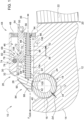
- Fig. 1 shows an embodiment of the coupling device according to the invention.
- the coupling device 10 comprises a coupling body 12 with a catch hook 14 for receiving a coupling element 18 complementary to a fastening area 16 of the catch hook 14.
- the coupling body 12 is welded to an end area 20 of a lower link 22, which is a component of a three-point linkage (not shown) of an agricultural tractor. More precisely, the three-point linkage has left and right lower links that are symmetrical to one another and each have the Fig. 1 are equipped with the coupling device 10 shown.
- a coupling element 18 designed as a coupling ball 24, which is encompassed by an attachment interface (not shown) of a soil tillage device, such as a plough, a harrow or a seed drill, or a carried attachment in the form of a fertilizer spreader, a spray boom or the like.
- the coupling device 10 has a locking mechanism 26 with a locking latch 28.
- the Locking bolt 28 is mounted in a sliding fit 32 formed in a housing 30 of the locking mechanism 26, perpendicular to a receiving direction 34 of the coupling ball 24 determined by the opening path of the catch hook 14 in the fastening area 16.
- the sliding fit 32 is designed as an ovalized inner contour running along the deflection direction 36 of the locking bolt 28, which in this case has an A-shaped, widened cross-sectional profile. Under the effect of a restoring spring force F back, the locking bolt 28 is forced into a first locking position 38 blocking the catch hook 14, so that the coupling ball 24 located in the fastening area 16 is locked in the catch hook 14 (see also Fig. 1 ).
- the catch hook 14 has a mouth-shaped receiving area 40 for centering the coupling ball 24, which then transitions into the actual fastening area 16.
- the coupling ball 24 is designed to complement the fastening area 16, except for a predetermined bearing clearance ⁇ d.
- the opening of the catch hook 14 in the fastening area 16 guides the coupling ball 24 along the defined receiving direction 34.
- the locking bolt 28 in the first locking position 38 projects more than halfway beyond the fastening area 16 in the predetermined receiving direction 34. If, as here, there is a coupling ball 24 in the fastening area 16 coupling element 18, the locking bolt 28 extends accordingly beyond the apex 42 facing the locking bolt 28 in the receiving direction 34.
- the complete housing 30 is a one-piece component of the coupling body 12, with the sliding fit 32 running therein being machined into a blank made of forged steel by means of CNC milling in a single operation with correspondingly high precision.
- the one-piece construction of the coupling body 12 is best illustrated by the Fig. 4 reproduced perspective view of the coupling device 10.
- the sliding fit 32 for the longitudinally displaceable mounting of the locking bolt 28 is designed such that the locking bolt 28 can be deflected against a restoring spring force F back from a first locking position 38 blocking the catch hook 14 into a second locking position 52 releasing the catch hook 14.
- a locking device 68 is formed on the pull lever 50, by means of which the locking latch 28 can be locked in the second locking position 52.
- the locking device 68 is a recess 70 formed along the pull lever 50, which can be hooked into an edge 72 of the rear outlet opening 56.
- an elastic stop element 74 is provided within the housing 30 to limit longitudinal displacement of the locking latch 28 toward the first locking position 38.
- the elastic stop element 74 is, for example, an elastomer strip 78 inserted into an internal housing groove 76.
- a counter-stop 80 in the form of an L-shaped protruding extension 82 is formed on the pull lever 50 and cooperates with the elastic stop element 74.
- the restoring spring force F back acting on the locking latch 28 compresses the counter-stop 80 against the elastic stop element 74, thus defining the position of the first locking position 38.
- the compressibility of the associated elastomer strip 78 is dimensioned such that it keeps the counter-stop 80 formed on the pull lever 50 out of contact with the adjacent housing section in the first locking position 38.
- the locking latch 28 is thus clamped or mounted in a "floating" manner in the first locking position 38 under the action of the restoring spring force F back .
- the locking latch 28 is beveled at a free end 84 located in the receiving direction 34 such that it is pushed into the second locking position 52 upon insertion of the coupling ball 24 into the catch hook 14. As soon as the coupling ball 24 has assumed its final position, the locking latch 28 automatically returns to the first locking position 38 under the action of the restoring spring force F back . In this way, a snap closure is realized that allows the coupling process to be carried out with an attachment interface particularly conveniently.
- the restoring spring force F schx is built up by means of a spring element 86 in the form of a helical compression spring 88 made of steel wire, which is received with a first end 90 in a blind hole 92 formed on an inner side of the locking bolt 28 and is supported with a second end 94 on the maintenance cover 48 of the housing 30.
- a guide rod 96 attached to the maintenance cover 48, which ensures that the compression spring 88 is compressed without kinking when the locking bolt 28 is moved in the direction of the second locking position 52.
- a concave contact contour 98 runs along the locking latch 28, facing the fastening area 16, which corresponds to an outer curvature of the coupling ball 24 located in the fastening area 16. If the coupling ball 24 is in contact with the concave contact contour 98, sliding of the locking latch 28 by the coupling ball 24 is blocked by the rising flank 100 of the concave contact contour 98.
- the coupling ball 24 has a specific bearing clearance ⁇ d within the mounting area 16. This is in the range of 2 to 3 millimeters. This enables a contamination-tolerant "positive fit" between the coupling ball 24 and the locking latch 28, ensuring smooth opening and closing of the locking mechanism 26 even under adverse conditions.
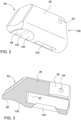
- Fig. 2 shows a detailed view of the locking mechanism 26 according to Fig. 1
- a drainage opening 104 for fluid drainage can be seen, which, according to the sectional view in Fig. 3 with the recess provided for receiving the compression spring 88 in the form of the blind hole 92 and in the installed state according to Fig. 1 also communicates with an outer housing opening 106 opening into the sliding fit 32.
- rolled or forged steel bars are used, which are prefabricated with an outer contour corresponding to the inner contour of the sliding fit 32. During the manufacturing process, the bars are first cut to the appropriate length. Subsequently, the end contours and all recesses and bores are created.
- the concave contact contour 98 is spherical except for an interruption in the form of a cylindrical section 102 and is thus adapted to the outer curvature of the coupling ball 24.
- the cylindrical section 102 results in a certain longitudinal play with respect to the deflection direction 36 of the locking latch 28, which takes into account possible fit tolerances of the coupling ball 24.
- the width of the cylindrical section 102 is between 3 and 4 mm for this purpose.
- FIG. 5 an operating situation is shown in the event of loss of the rotatable fastening between the locking bolt 28 and the pull lever 50, for example in the event of a breakage of the bolt 66 or the fastening eye 60.
- the compression spring 88 pushes the locking bolt 28 beyond the first locking position 38 and out of the sliding fit 32.
- the concave contact contour 98 tapers off on a side 108 facing away from the free end 84 of the locking bolt 28 in such a way that it intersects the fastening area 16, viewed in the deflection direction 36 of the locking bolt 28, at a distance A which is smaller than the coupling diameter D k of the catch hook 14 for the element to be received or
- the coupling ball 24 located in the catch hook 14 thus forms a redundant stop for the locking bolt 28 in the direction of the first locking position 38.
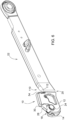
- FIG. 6 The lower link 22, equipped with the coupling device 10, is shown. This is designed as a 3D-formed steel forging. A free area 110 allows easy access to the locking mechanism 26 and the pull lever 50 provided for its actuation.
Landscapes
- Engineering & Computer Science (AREA)
- Life Sciences & Earth Sciences (AREA)
- Mechanical Engineering (AREA)
- Transportation (AREA)
- Zoology (AREA)
- Soil Sciences (AREA)
- Environmental Sciences (AREA)
- Clamps And Clips (AREA)
- Agricultural Machines (AREA)
Description
- Die Erfindung betrifft eine Kupplungseinrichtung für einen Unterlenker eines Dreipunkt-Krafthebers, umfassend einen Kupplungskörper mit einem Fanghaken zur Aufnahme eines mit einem Befestigungsbereich des Fanghakens komplementär ausgebildeten Kupplungselements, wobei an dem Fanghaken ein Verschlussmechanismus mit einem Gehäuse angeordnet ist, innerhalb dessen eine Gleitpassung zur längsverschiebbaren Lagerung eines Verschlussriegels derart ausgebildet ist, dass sich der Verschlussriegel entgegen einer rückstellenden Federkraft aus einer den Fanghaken sperrenden ersten Verschlussposition in eine den Fanghaken freigebende zweite Verschlussposition auslenken lässt.
- Derartige Kupplungseinrichtungen werden von verschiedenen Herstellern angeboten und weisen üblicherweise einen Verschlussmechanismus mit einem in den Fanghaken eingreifenden Verschlussriegel auf, der sich entgegen einer rückstellenden Federkraft beim Einkuppeln einer von einer Anbaugeräteschnittstelle umfassten Kupplungskugel in eine den Fanghaken freigebende Position verschieben lässt. Sobald die Kupplungskugel ihre Endlage erreicht hat, schnappt der Verschlussriegel unter gleichzeitiger Sperrung des Fanghakens in seine ursprüngliche Position zurück. Die Komponenten des Verschlussmechanismus sind in einem auf einer Oberseite des Fanghakens angeordneten Gehäuse untergebracht, das aus Wartungsgründen zerlegbar aufgebaut und dementsprechend aufwendig herzustellen ist. Das Dokument
DE 27 49 311 A1 offenbart eine Dreipunktkupplung, bei der sich Riegelglieder von an den Unterlenkern angeordneten Fanghaken mittels einer einfachen und betriebssicheren Betätigungsvorrichtung gemeinsam über Zugorgane vom Fahrersitz her betätigen lassen. - Es ist Aufgabe der vorliegenden Erfindung, eine Kupplungseinrichtung der eingangs genannten Art hinsichtlich einer vereinfachten Herstellung weiterzuentwickeln.
- Diese Aufgabe wird durch eine Kupplungseinrichtung mit den Merkmalen des Patentanspruchs 1 gelöst.
- Die Kupplungseinrichtung für einen Unterlenker eines Dreipunkt-Krafthebers umfasst einen Kupplungskörper mit einem Fanghaken zur Aufnahme eines mit einem Befestigungsbereich des Fanghakens komplementär ausgebildeten Kupplungselements, wobei an dem Fanghaken ein Verschlussmechanismus mit einem Gehäuse angeordnet ist, innerhalb dessen eine Gleitpassung zur längsverschiebbaren Lagerung eines Verschlussriegels derart ausgebildet ist, dass sich der Verschlussriegel entgegen einer rückstellenden Federkraft aus einer den Fanghaken sperrenden ersten Verschlussposition in eine den Fanghaken freigebende zweite Verschlussposition auslenken lässt. Erfindungsgemäß ist die Gleitpassung als entlang der Auslenkungsrichtung des Verschlussriegels durchgehende ovalisierte Innenkontur ausgebildet.
- Das komplette Gehäuse des Verschlussmechanismus kann in diesem Fall einstückiger Bestandteil des Kupplungskörpers sein, wobei die darin verlaufende Gleitpassung im Wege der CNC-Fräsbearbeitung in einem einzigen Arbeitsgang mit entsprechend hoher Genauigkeit in einen aus geschmiedetem Stahl bestehenden Rohkörper eingebracht werden kann. Die Herstellung der Kupplungseinrichtung lässt sich auf diese Weise maßgeblich vereinfachen.
- Der Unterlenker ist Bestandteil eines herkömmlichen Dreipunkt-Krafthebers eines landwirtschaftlichen Traktors. Genauer gesagt sind linke und rechte Unterlenker vorhanden, die symmetrisch zueinander verlaufen und jeweils mit der Kupplungseinrichtung ausgestattet sind. Die beiden Unterlenker sind in einem unteren Bereich eines heckseitigen Differentialgehäuses des landwirtschaftlichen Traktors angelenkt und lassen sich mittels eines hydraulischen Hubwerks auf Veranlassung eines Bedieners anheben und absenken.
- Vorteilhafte Weiterbildungen der erfindungsgemäßen Kupplungseinrichtung gehen aus den Unteransprüchen hervor.
- Vorzugsweise findet zur Herstellung des Verschlussriegels aus Walz- oder Schmiedestahl bestehende Stangenware Verwendung, die hinsichtlich einer mit der Innenkontur der Gleitpassung korrespondierenden Außenkontur vorgefertigt ist. Der Einsatz vorgefertigter Stangenware erlaubt es, den Verschlussriegel mit besonders geringem Aufwand kostengünstig herzustellen.
- An einer dem Befestigungsbereich des Fanghakens abgewandten Gehäuserückseite kann eine Wartungsöffnung eingebracht sein, in die die Gleitpassung als Verlängerung einmündet, sodass sich der Verschlussriegel einschließlich der übrigen Komponenten des Verschlussmechanismus rückwärtig in das Gehäuse einführen und mittels eines abnehmbaren Wartungsdeckels darin verschließen lässt. Hierdurch ergibt sich ein besonders kompakter und robuster Aufbau des Verschlussmechanismus.
- Des Weiteren besteht die Möglichkeit, dass an dem Verschlussriegel ein Zughebel angebracht ist, mittels dessen sich der Verschlussriegel von Hand in Richtung der zweiten Verschlussposition auslenken lässt. Der Zughebel bzw. ein daran ausgebildetes Handstück erstreckt sich zu diesem Zweck rückwärtig aus dem Gehäuse bzw. einer in dem abnehmbaren Wartungsdeckel ausgebildeten Austrittöffnung nach außen heraus.
- An dem Zughebel kann eine Rastvorrichtung ausgebildet sein, mittels derer sich der Verschlussriegel in der zweiten Verschlussposition arretieren lässt. Bei der Rastvorrichtung handelt es sich im einfachsten Fall um eine entlang des Zughebels ausgebildete Ausnehmung, die in einer Kante der rückwärtigen Austrittsöffnung einhängbar ist. Dies trägt dem Umstand Rechnung, dass an dem Dreipunkt-Kraftheber linke und rechte Unterlenker mit jeweiligen Kupplungseinrichtungen vorgesehen sind und sich die zugehörigen Verschlussmechanismen vom Bediener nicht zur gleichen Zeit betätigen lassen. Die Arretierung erlaubt es, die Verschlussriegel beider Kupplungseinrichtungen in die zweite Verschlussposition zu versetzen, sodass sich die Kupplungselemente einer an dem Dreipunkt-Kraftheber anzubringenden Anbaugeräteschnittstelle leichter synchron in die Fanghaken einführen lassen.
- Als Schutz vor Beschädigungen des Verschlussmechanismus, wie sie bei einem plötzlichen Loslassen des Zughebels unter der Wirkung der rückstellenden Federkraft in ausgelenktem Zustand auftreten können, ist es denkbar, dass innerhalb des Gehäuses ein elastisches Anschlagelement zur Begrenzung einer Längsverschiebung des Verschlussriegels in Richtung der ersten Verschlussposition vorgesehen ist. Bei dem elastischen Anschlagelement handelt es sich zum Beispiel um einen in eine innenliegende Gehäusenut eingelegten Elastomerstreifen.
- An dem Zughebel kann ein mit dem elastischen Anschlagelement zusammenwirkender Gegenanschlag ausgebildet sein. Die auf den Verschlussriegel wirkende rückstellende Federkraft presst den Gegenanschlag komprimierend gegen das elastische Anschlagelement und definiert so die Lage der ersten Verschlussposition.
- Der Gegenanschlag kann am Zughebel als L-förmiger Fortsatz ausgebildet sein.
- Ferner besteht die Möglichkeit, dass an dem Verschlussriegel eine dem Befestigungsbereich zugewandte konkave Anlagekontur verläuft, die insbesondere mit einer äußeren Wölbung eines darin aufzunehmenden Kupplungselements korrespondiert. Letzteres trägt insbesondere dem Fall Rechnung, dass es sich bei dem Kupplungselement um eine Kupplungskugel handelt. Steht die Kupplungskugel mit der konkaven Anlagekontur in Kontakt, so wird ein Aufschieben des Verschlussriegels seitens der Kupplungskugel durch die ansteigende Flanke der konkaven Anlagekontur blockiert.
- Die konkave Anlagekontur kann an einer einem freien Ende des Verschlussriegels abgewandten Seite derart auslaufen, dass diese den Befestigungsbereich in Auslenkungsrichtung des Verschlussriegels gesehen in einem Abstand schneidet, der kleiner ist als ein Kupplungsdurchmesser des Fanghakens für ein darin aufzunehmendes Kupplungselement. Ein im Fanghaken befindliches Kupplungselement bildet somit einen redundanten Anschlag für den Verschlussriegel in Richtung der ersten Verschlussposition.
- Weiterhin ist es denkbar, dass sich der Verschlussriegel unter Freigabe des Befestigungsbereichs ausschließlich senkrecht zu einer durch den Öffnungsverlauf des Fanghakens im Befestigungsbereich festgelegten Aufnahmerichtung aus der ersten Verschlussposition auslenken lässt, wobei der in der ersten Verschlussposition befindliche Verschlussriegel den Befestigungsbereich in der festgelegten Aufnahmerichtung um mehr als die Hälfte sperrend überragt. Befindet sich in dem Befestigungsbereich ein als Kupplungskugel ausgebildetes Kupplungselement, so erstreckt sich der Verschlussriegel dementsprechend über den dem Verschlussriegel in Aufnahmerichtung zugewandten Scheitelpunkt hinaus. Hierdurch lässt sich die Möglichkeit eines Aufschiebens des Verschlussriegels infolge einer Krafteinwirkung des Kupplungselements weitgehend ausschließen. Der so gebildete Verschlussmechanismus macht daher die Notwendigkeit separater Sicherungsmaßnahmen überflüssig.
- Finden zur Betätigung des von dem Dreipunkt-Kraftheber umfassten hydraulischen Hubwerks doppeltwirkende Hydraulikzylinder Verwendung, so ist es aufgrund der vorstehend beschriebenen Eigenschaften des Verschlussmechanismus auch ohne weiteres möglich, über die beiden Unterlenker an einem daran angebrachten Bodenbearbeitungsgerät eine nach unten gerichtete Kraft auf den Erdboden auszuüben. Dies ist insofern von Beachtung, als sich die Fanghaken an den Unterlenkern nach oben hin öffnen, mithin nahezu die gesamte aufgewandte Kraft über die Verschlussriegel bzw. den Verschlussmechanismus auf die Kupplungselemente der Anbaugeräteschnittstelle ausgeübt wird.
- In dem Verschlussriegel kann des Weiteren eine Ausnehmung zur Aufnahme eines die rückstellende Federkraft erzeugenden Federelements ausgebildet sein, wobei die Ausnehmung mit einer Drainageöffnung zur Flüssigkeitsableitung kommuniziert. Bei letzterer kann es sich um eine in die Gleitpassung mündende Gehäuseöffnung handeln. Eine übermäßige Ansammlung von in den Verschlussmechanismus eindringenden Wassers lässt sich so verlässlich unterbinden, sodass korrosionsbedingte Schäden insbesondere an dem in der Ausnehmung befindlichen Federelement, bei dem es sich üblicherweise um eine aus Stahldraht bestehende schraubenförmigen Druckfeder handelt, vermieden werden können.
- Die erfindungsgemäße Kupplungseinrichtung für einen Unterlenker eines Dreipunkt-Krafthebers wird im Folgenden anhand der beigefügten Zeichnungen näher erläutert. Dabei beziehen sich identische Bezugszeichen auf übereinstimmende oder bezüglich ihrer Funktion vergleichbare Komponenten. Es zeigen:
- Fig. 1
- eine Schnittdarstellung eines Ausführungsbeispiels der erfindungsgemäßen Kupplungseinrichtung mit einem Kupplungskörper, umfassend einen Fanghaken und einen Verschlussmechanismus zur Arretierung einer darin aufgenommenen Kupplungskugel,
- Fig. 2
- eine Detailansicht eines von dem Verschlussmechanismus gemäß
Fig. 1 umfassten Verschlussriegels mit einer konkaven Anlagekontur, - Fig. 3
- eine Schnittdarstellung des in
Fig. 2 wiedergegebenen Verschlussriegels, - Fig. 4
- eine perspektivische Ansicht der in
Fig. 1 gezeigten Kupplungseinrichtung mit einem als Bestandteil des Kupplungskörpers einstückig ausgebildeten Gehäuse des Verschlussmechanismus, - Fig. 5
- eine anhand der Kupplungseinrichtung gemäß
Fig. 1 veranschaulichte Betriebssituation, in der ein durch die Kupplungskugel gebildeter redundanter Anschlag für den Verschlussriegel gebildet ist, und - Fig. 6
- ein mit der Kupplungseinrichtung gemäß
Fig. 3 ausgestatteter Unterlenker für einen Dreipunkt-Kraftheber eines landwirtschaftlichen Traktors. -
Fig. 1 zeigt ein Ausführungsbeispiel der erfindungsgemäßen Kupplungseinrichtung. - Die Kupplungseinrichtung 10 umfasst einen Kupplungskörper 12 mit einem Fanghaken 14 zur Aufnahme eines mit einem Befestigungsbereich 16 des Fanghakens 14 komplementär ausgebildeten Kupplungselements 18. Der Kupplungskörper 12 ist in einem Endbereich 20 eines Unterlenkers 22 angeschweißt, der Bestandteil eines nicht gezeigten Dreipunkt-Krafthebers eines landwirtschaftlichen Traktors ist. Genauer gesagt weist der Dreipunkt-Kraftheber linke und rechte Unterlenker auf, die symmetrisch zueinander verlaufen und jeweils mit der in
Fig. 1 dargestellten Kupplungseinrichtung 10 ausgestattet sind. - Beispielsgemäß befindet sich in dem Befestigungsbereich 16 ein als Kupplungskugel 24 ausgebildetes Kupplungselement 18, das von einer nicht gezeigten Anbaugeräteschnittstelle eines Bodenbearbeitungsgeräts, wie beispielsweise eines Pflugs, einer Egge oder einer Sämaschine, oder aber eines getragenen Anbaugeräts in Gestalt eines Düngerstreuers, eines Spritzgestänges, oder dergleichen umfasst ist.
- Des Weiteren weist die Kupplungseinrichtung 10 einen Verschlussmechanismus 26 mit einem Verschlussriegel 28 auf. Der Verschlussriegel 28 ist in einer in einem Gehäuse 30 des Verschlussmechanismus 26 ausgebildeten Gleitpassung 32 senkrecht zu einer durch den Öffnungsverlauf des Fanghakens 14 im Befestigungsbereich 16 festgelegten Aufnahmerichtung 34 der Kupplungskugel 24 längsverschiebbar gelagert. Gemäß der perspektivischen Ansicht der Kupplungseinrichtung 10 in
Fig. 4 ist die Gleitpassung 32 als entlang der Auslenkungsrichtung 36 des Verschlussriegels 28 durchgehende ovalisierte Innenkontur, die vorliegend einen A-förmig aufgeweiteten Querschnittsverlauf aufweist, ausgebildet. Unter der Wirkung einer rückstellenden Federkraft Frück wird der Verschlussriegel 28 in eine den Fanghaken 14 sperrende erste Verschlussposition 38 gedrängt, sodass die im Befestigungsbereich 16 befindliche Kupplungskugel 24 in dem Fanghaken 14 arretiert wird (siehe hierzu auchFig. 1 ). - Der Fanghaken 14 weist einen maulförmigen Aufnahmebereich 40 zur Zentrierung der Kupplungskugel 24 auf, der anschließend in den eigentlichen Befestigungsbereich 16 übergeht. Die Kupplungskugel 24 ist bis auf ein vorgegebenes Lagerspiel Δd komplementär mit dem Befestigungsbereich 16 ausgebildet. Durch den Öffnungsverlauf des Fanghakens 14 im Befestigungsbereich 16 wird die Kupplungskugel 24 entlang der festgelegten Aufnahmerichtung 34 geführt.
- Wie in
Fig. 1 zu erkennen ist, überragt der in der ersten Verschlussposition 38 befindliche Verschlussriegel 28 den Befestigungsbereich 16 in der festgelegten Aufnahmerichtung 34 sperrend um mehr als die Hälfte. Befindet sich wie hier im Befestigungsbereich 16 ein als Kupplungskugel 24 ausgestaltetes Kupplungselement 18, so erstreckt sich der Verschlussriegel 28 dementsprechend über den dem Verschlussriegel 28 in Aufnahmerichtung 34 zugewandten Scheitelpunkt 42 hinaus. - An einer dem Befestigungsbereich 16 des Fanghakens 14 abgewandten Gehäuserückseite 44 ist eine Wartungsöffnung 46 eingebracht, in die die Gleitpassung 32 als Verlängerung einmündet, sodass sich der Verschlussriegel 28 einschließlich der übrigen (nachfolgend beschriebenen) Komponenten des Verschlussmechanismus 26 rückwärtig in das Gehäuse 30 einführen und mittels eines abnehmbaren Wartungsdeckels 48 darin verschließen lässt.
- Genauer gesagt ist das komplette Gehäuse 30 einstückiger Bestandteil des Kupplungskörpers 12, wobei die darin verlaufende Gleitpassung 32 im Wege der CNC-Fräsbearbeitung in einem einzigen Arbeitsgang mit entsprechend hoher Genauigkeit in einen aus geschmiedetem Stahl bestehenden Rohkörper eingebracht wird. Der einstückige Aufbau des Kupplungskörpers 12 ist am besten anhand der in
Fig. 4 wiedergegebenen perspektivischen Ansicht der Kupplungseinrichtung 10 erkennbar. - Zur Freigabe der Kupplungskugel 24 lässt sich der Verschlussriegel 28 mittels eines an dem Verschlussriegel 28 gelenkig angebrachten Zughebels 50 entgegen der rückstellenden Federkraft Frück in eine den Fanghaken 14 freigebende zweite Verschlussposition 52 auslenken. Der Zughebel 50 bzw. ein daran ausgebildetes Handstück 54 erstreckt sich zu diesem Zweck rückwärtig aus dem Gehäuse 30 bzw. einer in dem abnehmbaren Wartungsdeckel 48 ausgebildeten Austrittöffnung 56 nach außen heraus. Zur gelenkigen Anbringung weist der Zughebel 50 ein von einer taschenförmigen Ausnehmung 58 des Verschlussriegels 28 aufgenommenes Befestigungsauge 60 auf, das darin mittels eines in gegenüberliegenden Lagerbohrungen 62, 64 (siehe hierzu
Fig. 2 und 3 ) gehaltenen Bolzens 66 drehbar befestigt ist. - Mit anderen Worten ist innerhalb des Gehäuses 30 die Gleitpassung 32 zur längsverschiebbaren Lagerung des Verschlussriegels 28 derart ausgebildet, dass sich der Verschlussriegel 28 entgegen einer rückstellenden Federkraft Frück aus einer den Fanghaken 14 sperrenden ersten Verschlussposition 38 in eine den Fanghaken 14 freigebende zweite Verschlussposition 52 auslenken lässt.
- An dem Zughebel 50 ist eine Rastvorrichtung 68 ausgebildet, mittels derer sich der Verschlussriegel 28 in der zweiten Verschlussposition 52 arretieren lässt. Bei der Rastvorrichtung 68 handelt es sich um eine entlang des Zughebels 50 ausgebildete Ausnehmung 70, die in einer Kante 72 der rückwärtigen Austrittsöffnung 56 einhängbar ist.
- Als Schutz vor Beschädigungen des Verschlussmechanismus 26 ist innerhalb des Gehäuses 30 ein elastisches Anschlagelement 74 zur Begrenzung einer Längsverschiebung des Verschlussriegels 28 in Richtung der ersten Verschlussposition 38 vorgesehen. Bei dem elastischen Anschlagelement 74 handelt es sich beispielsgemäß um einen in eine innenliegende Gehäusenut 76 eingelegten Elastomerstreifen 78.
- Ferner ist an dem Zughebel 50 ein mit dem elastischen Anschlagelement 74 zusammenwirkender Gegenanschlag 80 in Gestalt eines L-förmig hervorspringenden Fortsatzes 82 ausgebildet. Die auf den Verschlussriegel 28 wirkende rückstellende Federkraft Frück presst den Gegenanschlag 80 komprimierend gegen das elastische Anschlagelement 74 und definiert so die Lage der ersten Verschlussposition 38. Die Kompressibilität des zugehörigen Elastomerstreifens 78 ist derart bemessen, dass dieser den am Zughebel 50 ausgebildeten Gegenanschlag 80 in der ersten Verschlussposition 38 außer Kontakt zum angrenzenden Gehäuseabschnitt hält. Der Verschlussriegel 28 ist insofern unter der Wirkung der rückstellenden Federkraft Frück in der ersten Verschlussposition 38 "schwimmend" eingespannt bzw. gelagert.
- Der Verschlussriegel 28 ist an einem in Aufnahmerichtung 34 liegenden freien Ende 84 derart abgeschrägt, dass dieser beim Einführen der Kupplungskugel 24 in den Fanghaken 14 in die zweite Verschlussposition 52 gedrängt wird. Sobald die Kupplungskugel 24 ihre endgültige Lage eingenommen hat, kehrt der Verschlussriegel 28 unter der Wirkung der rückstellenden Federkraft Frück von selbst in die erste Verschlussposition 38 zurück. Auf diese Weise ist ein Schnappverschluss verwirklicht, der es erlaubt, den Kuppelvorgang mit einer Anbaugeräteschnittstelle besonders komfortabel durchzuführen.
- Wie in der Schnittdarstellung von
Fig. 1 zu erkennen ist, wird die rückstellende Federkraft Frücx mittels eines Federelements 86 in Gestalt einer aus Stahldraht bestehenden schraubenförmigen Druckfeder 88 aufgebaut, die mit einem ersten Ende 90 in einem auf einer Innenseite des Verschlussriegels 28 ausgebildeten Sackloch 92 aufgenommen ist und sich mit einem zweiten Ende 94 an dem Wartungsdeckel 48 des Gehäuses 30 abstützt. Innerhalb der Druckfeder 88 verläuft ein an dem Wartungsdeckel 48 angebrachter Führungsstab 96, der sicherstellt, dass die Druckfeder 88 beim Verschieben des Verschlussriegels 28 in Richtung der zweiten Verschlussposition 52 knickfrei komprimiert wird. - Zusätzlich verläuft an dem Verschlussriegel 28 eine dem Befestigungsbereich 16 zugewandte konkave Anlagekontur 98, die mit einer äußeren Wölbung der in dem Befestigungsbereich 16 befindlichen Kupplungskugel 24 korrespondiert. Steht die Kupplungskugel 24 mit der konkaven Anlagekontur 98 in Kontakt, so wird ein Aufschieben des Verschlussriegels 28 seitens der Kupplungskugel 24 durch die ansteigende Flanke 100 der konkaven Anlagekontur 98 blockiert.
- Wie bereits erwähnt, weist die Kupplungskugel 24 innerhalb des Befestigungsbereichs 16 ein bestimmtes Lagerspiel Δd auf. Dieses liegt in der Größenordnung von 2 bis 3 Millimetern. Hierdurch wird ein verschmutzungstoleranter "Formschluss" zwischen Kupplungskugel 24 und Verschlussriegel 28 ermöglicht, der auch unter widrigen Umständen ein problemloses Öffnen und Schließen des Verschlussmechanismus 26 sicherstellt.
-
Fig. 2 zeigt eine Detailansicht des von dem Verschlussmechanismus 26 gemäßFig. 1 umfassten Verschlussriegels 28. Auf dessen Unterseite ist eine Drainageöffnung 104 zur Flüssigkeitsableitung zu erkennen, die gemäß der Schnittdarstellung inFig. 3 mit der zur Aufnahme der Druckfeder 88 vorgesehenen Ausnehmung in Gestalt des Sacklochs 92 und in eingebautem Zustand entsprechendFig. 1 zudem mit einer in die Gleitpassung 32 mündenden äußeren Gehäuseöffnung 106 kommuniziert. - Zur Herstellung des Verschlussriegels 28 findet aus Walz- oder Schmiedestahl bestehende Stangenware Verwendung, die hinsichtlich einer mit der Innenkontur der Gleitpassung 32 korrespondierenden Außenkontur vorgefertigt ist. Während des Fertigungsprozesses wird die Stangenware zunächst passend abgelängt. Anschließend werden die stirnseitigen Konturen sowie sämtliche Ausnehmungen bzw. Bohrungen eingebracht.
- Gemäß
Fig. 2 ist die konkave Anlagekontur 98 bis auf eine Unterbrechung in Gestalt eines zylindrischen Abschnitts 102 kugelförmig ausgebildet und insoweit an die äußere Wölbung der Kupplungskugel 24 angepasst. Der zylindrische Abschnitt 102 führt gegenüber einer in dem Befestigungsbereich 16 befindlichen Kupplungskugel 24 zu einem gewissen Längsspiel bezüglich der Auslenkungsrichtung 36 des Verschlussriegels 28, das möglichen Passungstoleranzen der Kupplungskugel 24 Rechnung trägt. Die Breite des zylindrischen Abschnitts 102 beträgt hierzu zwischen 3 bis 4 mm. - In
Fig. 5 ist eine Betriebssituation bei Verlust der drehbaren Befestigung zwischen Verschlussriegel 28 und Zughebel 50 wiedergegeben, beispielsweise im Falle eines Bruchs des Bolzens 66 oder des Befestigungsauges 60. In einem solchen Fall schiebt die Druckfeder 88 den Verschlussriegel 28 über die erste Verschlussposition 38 hinweg aus der Gleitpassung 32 heraus. Um ein Herausfallen des Verschlussriegels 28 zu unterbinden, läuft die konkave Anlagekontur 98 an einer dem freien Ende 84 des Verschlussriegels 28 abgewandten Seite 108 derart aus, dass diese den Befestigungsbereich 16 in Auslenkungsrichtung 36 des Verschlussriegels 28 gesehen in einem Abstand A schneidet, der kleiner ist als der Kupplungsdurchmesser Dk des Fanghakens 14 für die darin aufzunehmende bzw. aufgenommene Kupplungskugel 24. Die im Fanghaken 14 befindliche Kupplungskugel 24 bildet somit einen redundanten Anschlag für den Verschlussriegel 28 in Richtung der ersten Verschlussposition 38. - In
Fig. 6 ist der mit der Kupplungseinrichtung 10 ausgestattete Unterlenker 22 Unterlenker abgebildet. Dieser ist als 3D-geformtes Stahlschmiedeteil ausgebildet. Ein freier Bereich 110 erlaubt einen problemlosen Zugriff auf den Verschlussmechanismus 26 bzw. den zu dessen Betätigung vorgesehenen Zughebel 50. - Um eine Betätigung des Zughebels 50 zu erleichtern, verläuft durch eine an dem Handstück 54 vorgesehene Öse ein Betätigungsring 112. Durch den Betätigungsring 112 ist beispielsweise ein Schraubenzieher hindurchführbar, dessen Klinge sich am Unterlenker 22 abstützen und so als Hebel verwenden lässt.
Claims (11)
- Kupplungseinrichtung für einen Unterlenker eines Dreipunkt-Krafthebers, umfassend einen Kupplungskörper (12) mit einem Fanghaken (14) zur Aufnahme eines mit einem Befestigungsbereich (16) des Fanghakens (14) komplementär ausgebildeten Kupplungselements (18), wobei an dem Fanghaken (14) ein Verschlussmechanismus (26) mit einem Gehäuse (30) angeordnet ist, innerhalb dessen eine Gleitpassung (32) zur längsverschiebbaren Lagerung eines Verschlussriegels (28) derart ausgebildet ist, dass sich der Verschlussriegel (28) entgegen einer rückstellenden Federkraft (Frück) aus einer den Fanghaken (14) sperrenden ersten Verschlussposition (38) in eine den Fanghaken (14) freigebende zweite Verschlussposition (52) auslenken lässt, dadurch gekennzeichnet, dass die Gleitpassung (32) als entlang der Auslenkungsrichtung (36) des Verschlussriegels (28) durchgehende ovalisierte Innenkontur ausgebildet ist.
- Kupplungseinrichtung nach Anspruch 1, dadurch gekennzeichnet, dass zur Herstellung des Verschlussriegels (28) aus Walz- oder Schmiedestahl bestehende Stangenware Verwendung findet, die hinsichtlich einer mit der Innenkontur der Gleitpassung (32) korrespondierenden Außenkontur vorgefertigt ist.
- Kupplungseinrichtung nach Anspruch 1 oder 2, dadurch gekennzeichnet, dass an einer dem Befestigungsbereich (16) des Fanghakens (14) abgewandten Gehäuserückseite (44) eine Wartungsöffnung (46) eingebracht ist, in die die Gleitpassung (32) als Verlängerung einmündet.
- Kupplungseinrichtung nach wenigstens einem der vorhergehenden Ansprüche, dadurch gekennzeichnet, dass an dem Verschlussriegel (28) ein Zughebel (50) angebracht ist, mittels dessen sich der Verschlussriegel (28) von Hand in Richtung der zweiten Verschlussposition (52) auslenken lässt.
- Kupplungseinrichtung nach Anspruch 4, dadurch gekennzeichnet, dass an dem Zughebel (50) eine Rastvorrichtung (68) ausgebildet ist, mittels derer sich der Verschlussriegel (28) in der zweiten Verschlussposition (52) arretieren lässt.
- Kupplungseinrichtung Anspruch 4 oder 5, dadurch gekennzeichnet, dass innerhalb des Gehäuses (30) ein elastisches Anschlagelement (74) zur Begrenzung einer Längsverschiebung des Verschlussriegels (28) in Richtung der ersten Verschlussposition (38) vorgesehen ist.
- Kupplungseinrichtung nach Anspruch 6, dadurch gekennzeichnet, dass an dem Zughebel (50) ein mit dem elastischen Anschlagelement (74) zusammenwirkender Gegenanschlag (80) ausgebildet ist.
- Kupplungseinrichtung nach Anspruch 7, dadurch gekennzeichnet, dass an dem Verschlussriegel (28) eine dem Befestigungsbereich (16) zugewandte konkave Anlagekontur (98) verläuft, die insbesondere mit einer äußeren Wölbung eines darin aufzunehmenden Kupplungselements (18) korrespondiert.
- Kupplungseinrichtung nach Anspruch 8, dadurch gekennzeichnet, dass die konkave Anlagekontur (98) an einer einem freien Ende (84) des Verschlussriegels (28) abgewandten Seite (108) derart ausläuft, dass diese den Befestigungsbereich (16) in Auslenkungsrichtung (36) des Verschlussriegels (28) gesehen in einem Abstand (A) schneidet, der kleiner ist als ein Kupplungsdurchmesser (Dk) des Fanghakens (14) für ein darin aufzunehmendes Kupplungselement (18).
- Kupplungseinrichtung nach wenigstens einem der vorhergehenden Ansprüche, dadurch gekennzeichnet, dass sich der Verschlussriegel (28) unter Freigabe des Befestigungsbereichs (16) ausschließlich senkrecht zu einer durch den Öffnungsverlauf des Fanghakens (14) im Befestigungsbereich (16) festgelegten Aufnahmerichtung (34) aus der ersten Verschlussposition (38) auslenken lässt, wobei der in der ersten Verschlussposition (38) befindliche Verschlussriegel (28) den Befestigungsbereich (16) in der festgelegten Aufnahmerichtung (34) um mehr als die Hälfte sperrend überragt.
- Kupplungseinrichtung nach wenigstens einem der vorhergehenden Ansprüche, dadurch gekennzeichnet, in dem Verschlussriegel (28) eine Ausnehmung (92) zur Aufnahme eines die rückstellende Federkraft (Frück) erzeugenden Federelements (86) ausgebildet ist, wobei die Ausnehmung (92) mit einer Drainageöffnung (104) zur Flüssigkeitsableitung kommuniziert.
Applications Claiming Priority (1)
| Application Number | Priority Date | Filing Date | Title |
|---|---|---|---|
| DE102021125526.0A DE102021125526A1 (de) | 2021-10-01 | 2021-10-01 | Kupplungseinrichtung für einen Unterlenker eines Dreipunkt-Krafthebers |
Publications (2)
| Publication Number | Publication Date |
|---|---|
| EP4159014A1 EP4159014A1 (de) | 2023-04-05 |
| EP4159014B1 true EP4159014B1 (de) | 2025-04-16 |
Family
ID=83191922
Family Applications (1)
| Application Number | Title | Priority Date | Filing Date |
|---|---|---|---|
| EP22193579.4A Active EP4159014B1 (de) | 2021-10-01 | 2022-09-02 | Kupplungseinrichtung für einen unterlenker eines dreipunkt-krafthebers |
Country Status (2)
| Country | Link |
|---|---|
| EP (1) | EP4159014B1 (de) |
| DE (1) | DE102021125526A1 (de) |
Family Cites Families (4)
| Publication number | Priority date | Publication date | Assignee | Title |
|---|---|---|---|---|
| GB1557823A (en) * | 1976-06-05 | 1979-12-12 | Jeffes Eng Ltd | Drawbar |
| DE2749311A1 (de) * | 1977-11-04 | 1979-05-10 | Josef Hasberg | Dreipunkthakenkupplung fuer die kupplung eines arbeitsgeraetes mit einem schlepper |
| US9736976B2 (en) * | 2014-11-07 | 2017-08-22 | Agco Corporation | Windrower with quick header attachment |
| US10247223B2 (en) * | 2015-01-17 | 2019-04-02 | Travel Caddy, Inc. | Multi-glide locking snap hook fastener |
-
2021
- 2021-10-01 DE DE102021125526.0A patent/DE102021125526A1/de active Pending
-
2022
- 2022-09-02 EP EP22193579.4A patent/EP4159014B1/de active Active
Also Published As
| Publication number | Publication date |
|---|---|
| DE102021125526A1 (de) | 2023-04-06 |
| EP4159014A1 (de) | 2023-04-05 |
Similar Documents
| Publication | Publication Date | Title |
|---|---|---|
| EP2314807B1 (de) | Schliesssystem | |
| EP3083344B1 (de) | Verbindungsanordnung zum verbinden eines wischblatts mit einem wischarm, wischblatt und wischarm | |
| EP3057394B1 (de) | Werkzeugkombination mit einem leitelement | |
| EP3560311A1 (de) | Dreipunkt-kraftheber für einen landwirtschaftlichen traktor | |
| EP4346365A1 (de) | Kupplungseinrichtung für einen unterlenker eines dreipunkt-krafthebers | |
| EP0129758B1 (de) | Adapter zum Ausschalten der Seitenbeweglichkeit von Unterlenkern eines Ackerschleppers | |
| EP3438382B1 (de) | Fallenanordnung eines schlosses | |
| EP4159014B1 (de) | Kupplungseinrichtung für einen unterlenker eines dreipunkt-krafthebers | |
| EP3884743A1 (de) | Anbaudrehpflug | |
| EP0210426A1 (de) | Fernbetätigungsvorrichtung | |
| EP2399764B1 (de) | Kupplungsvorrichtung für ein landwirtschaftliches Zugfahrzeug | |
| DE19747043C2 (de) | Endoskopisches Instrument | |
| CH687775A5 (de) | Schnellwechselsystem fuer Loeffelbagger. | |
| EP3821687B1 (de) | Kupplungsvorrichtung | |
| DE2538616A1 (de) | Vorrichtung zur gelenkigen zuordnung von insbesondere landwirtschaftlichen arbeitsgeraeten, wie pfluegen u. dgl. an zugmaschinen, wie traktoren | |
| EP3760019B1 (de) | Schare für ein bodenbearbeitungsgerät | |
| EP4162781B1 (de) | Dreipunkt-kraftheber eines landwirtschaftlichen traktors | |
| EP3347626B1 (de) | Parksperrenvorrichtung für ein kraftfahrzeuggetriebe | |
| EP4480290B1 (de) | Kupplungsanordnung für einen dreipunkt-kraftheber eines landwirtschaftlichen traktors | |
| EP4197305B1 (de) | Arretierungseinrichtung für einen seitenstabilisator eines dreipunkt-krafthebers | |
| DE102018110289A1 (de) | Hydraulische kolben-/zylindereinheit mit einer schutzvorrichtung für eine kolbenstange sowie arbeitsfahrzeug damit | |
| EP4328051A1 (de) | Kugelkupplungsanordnung für einen landwirtschaftlichen traktor | |
| EP4437819A1 (de) | Landwirtschaftliches gerät mit fangarm | |
| DE102005012297B4 (de) | Schmiedemaschine | |
| EP4446525A1 (de) | Rosette sowie tür- oder fensterbeschlag mit einer solchen rosette |
Legal Events
| Date | Code | Title | Description |
|---|---|---|---|
| PUAI | Public reference made under article 153(3) epc to a published international application that has entered the european phase |
Free format text: ORIGINAL CODE: 0009012 |
|
| STAA | Information on the status of an ep patent application or granted ep patent |
Free format text: STATUS: THE APPLICATION HAS BEEN PUBLISHED |
|
| AK | Designated contracting states |
Kind code of ref document: A1 Designated state(s): AL AT BE BG CH CY CZ DE DK EE ES FI FR GB GR HR HU IE IS IT LI LT LU LV MC MK MT NL NO PL PT RO RS SE SI SK SM TR |
|
| STAA | Information on the status of an ep patent application or granted ep patent |
Free format text: STATUS: REQUEST FOR EXAMINATION WAS MADE |
|
| 17P | Request for examination filed |
Effective date: 20231005 |
|
| RBV | Designated contracting states (corrected) |
Designated state(s): AL AT BE BG CH CY CZ DE DK EE ES FI FR GB GR HR HU IE IS IT LI LT LU LV MC MK MT NL NO PL PT RO RS SE SI SK SM TR |
|
| GRAP | Despatch of communication of intention to grant a patent |
Free format text: ORIGINAL CODE: EPIDOSNIGR1 |
|
| STAA | Information on the status of an ep patent application or granted ep patent |
Free format text: STATUS: GRANT OF PATENT IS INTENDED |
|
| INTG | Intention to grant announced |
Effective date: 20241206 |
|
| GRAS | Grant fee paid |
Free format text: ORIGINAL CODE: EPIDOSNIGR3 |
|
| GRAA | (expected) grant |
Free format text: ORIGINAL CODE: 0009210 |
|
| STAA | Information on the status of an ep patent application or granted ep patent |
Free format text: STATUS: THE PATENT HAS BEEN GRANTED |
|
| AK | Designated contracting states |
Kind code of ref document: B1 Designated state(s): AL AT BE BG CH CY CZ DE DK EE ES FI FR GB GR HR HU IE IS IT LI LT LU LV MC MK MT NL NO PL PT RO RS SE SI SK SM TR |
|
| REG | Reference to a national code |
Ref country code: GB Ref legal event code: FG4D Free format text: NOT ENGLISH |
|
| REG | Reference to a national code |
Ref country code: CH Ref legal event code: EP Ref country code: DE Ref legal event code: R096 Ref document number: 502022003579 Country of ref document: DE |
|
| REG | Reference to a national code |
Ref country code: IE Ref legal event code: FG4D Free format text: LANGUAGE OF EP DOCUMENT: GERMAN |
|
| REG | Reference to a national code |
Ref country code: NL Ref legal event code: MP Effective date: 20250416 |
|
| PG25 | Lapsed in a contracting state [announced via postgrant information from national office to epo] |
Ref country code: NL Free format text: LAPSE BECAUSE OF FAILURE TO SUBMIT A TRANSLATION OF THE DESCRIPTION OR TO PAY THE FEE WITHIN THE PRESCRIBED TIME-LIMIT Effective date: 20250416 |
|
| PG25 | Lapsed in a contracting state [announced via postgrant information from national office to epo] |
Ref country code: FI Free format text: LAPSE BECAUSE OF FAILURE TO SUBMIT A TRANSLATION OF THE DESCRIPTION OR TO PAY THE FEE WITHIN THE PRESCRIBED TIME-LIMIT Effective date: 20250416 Ref country code: PT Free format text: LAPSE BECAUSE OF FAILURE TO SUBMIT A TRANSLATION OF THE DESCRIPTION OR TO PAY THE FEE WITHIN THE PRESCRIBED TIME-LIMIT Effective date: 20250818 Ref country code: ES Free format text: LAPSE BECAUSE OF FAILURE TO SUBMIT A TRANSLATION OF THE DESCRIPTION OR TO PAY THE FEE WITHIN THE PRESCRIBED TIME-LIMIT Effective date: 20250416 |
|
| PGFP | Annual fee paid to national office [announced via postgrant information from national office to epo] |
Ref country code: DE Payment date: 20250820 Year of fee payment: 4 |
|
| REG | Reference to a national code |
Ref country code: LT Ref legal event code: MG9D |
|
| PG25 | Lapsed in a contracting state [announced via postgrant information from national office to epo] |
Ref country code: NO Free format text: LAPSE BECAUSE OF FAILURE TO SUBMIT A TRANSLATION OF THE DESCRIPTION OR TO PAY THE FEE WITHIN THE PRESCRIBED TIME-LIMIT Effective date: 20250716 Ref country code: GR Free format text: LAPSE BECAUSE OF FAILURE TO SUBMIT A TRANSLATION OF THE DESCRIPTION OR TO PAY THE FEE WITHIN THE PRESCRIBED TIME-LIMIT Effective date: 20250717 |
|
| PG25 | Lapsed in a contracting state [announced via postgrant information from national office to epo] |
Ref country code: PL Free format text: LAPSE BECAUSE OF FAILURE TO SUBMIT A TRANSLATION OF THE DESCRIPTION OR TO PAY THE FEE WITHIN THE PRESCRIBED TIME-LIMIT Effective date: 20250416 |
|
| PG25 | Lapsed in a contracting state [announced via postgrant information from national office to epo] |
Ref country code: BG Free format text: LAPSE BECAUSE OF FAILURE TO SUBMIT A TRANSLATION OF THE DESCRIPTION OR TO PAY THE FEE WITHIN THE PRESCRIBED TIME-LIMIT Effective date: 20250416 |
|
| PG25 | Lapsed in a contracting state [announced via postgrant information from national office to epo] |
Ref country code: HR Free format text: LAPSE BECAUSE OF FAILURE TO SUBMIT A TRANSLATION OF THE DESCRIPTION OR TO PAY THE FEE WITHIN THE PRESCRIBED TIME-LIMIT Effective date: 20250416 |
|
| PGFP | Annual fee paid to national office [announced via postgrant information from national office to epo] |
Ref country code: FR Payment date: 20250925 Year of fee payment: 4 Ref country code: AT Payment date: 20251020 Year of fee payment: 4 |
|
| PG25 | Lapsed in a contracting state [announced via postgrant information from national office to epo] |
Ref country code: RS Free format text: LAPSE BECAUSE OF FAILURE TO SUBMIT A TRANSLATION OF THE DESCRIPTION OR TO PAY THE FEE WITHIN THE PRESCRIBED TIME-LIMIT Effective date: 20250716 |
|
| PG25 | Lapsed in a contracting state [announced via postgrant information from national office to epo] |
Ref country code: IS Free format text: LAPSE BECAUSE OF FAILURE TO SUBMIT A TRANSLATION OF THE DESCRIPTION OR TO PAY THE FEE WITHIN THE PRESCRIBED TIME-LIMIT Effective date: 20250816 |
|
| PG25 | Lapsed in a contracting state [announced via postgrant information from national office to epo] |
Ref country code: LV Free format text: LAPSE BECAUSE OF FAILURE TO SUBMIT A TRANSLATION OF THE DESCRIPTION OR TO PAY THE FEE WITHIN THE PRESCRIBED TIME-LIMIT Effective date: 20250416 |
|
| PG25 | Lapsed in a contracting state [announced via postgrant information from national office to epo] |
Ref country code: DK Free format text: LAPSE BECAUSE OF FAILURE TO SUBMIT A TRANSLATION OF THE DESCRIPTION OR TO PAY THE FEE WITHIN THE PRESCRIBED TIME-LIMIT Effective date: 20250416 Ref country code: SM Free format text: LAPSE BECAUSE OF FAILURE TO SUBMIT A TRANSLATION OF THE DESCRIPTION OR TO PAY THE FEE WITHIN THE PRESCRIBED TIME-LIMIT Effective date: 20250416 |
|
| PGFP | Annual fee paid to national office [announced via postgrant information from national office to epo] |
Ref country code: IT Payment date: 20250930 Year of fee payment: 4 |
|
| REG | Reference to a national code |
Ref country code: DE Ref legal event code: R097 Ref document number: 502022003579 Country of ref document: DE |
|
| PG25 | Lapsed in a contracting state [announced via postgrant information from national office to epo] |
Ref country code: CZ Free format text: LAPSE BECAUSE OF FAILURE TO SUBMIT A TRANSLATION OF THE DESCRIPTION OR TO PAY THE FEE WITHIN THE PRESCRIBED TIME-LIMIT Effective date: 20250416 |
|
| PG25 | Lapsed in a contracting state [announced via postgrant information from national office to epo] |
Ref country code: EE Free format text: LAPSE BECAUSE OF FAILURE TO SUBMIT A TRANSLATION OF THE DESCRIPTION OR TO PAY THE FEE WITHIN THE PRESCRIBED TIME-LIMIT Effective date: 20250416 |
|
| PG25 | Lapsed in a contracting state [announced via postgrant information from national office to epo] |
Ref country code: SK Free format text: LAPSE BECAUSE OF FAILURE TO SUBMIT A TRANSLATION OF THE DESCRIPTION OR TO PAY THE FEE WITHIN THE PRESCRIBED TIME-LIMIT Effective date: 20250416 |
|
| PG25 | Lapsed in a contracting state [announced via postgrant information from national office to epo] |
Ref country code: RO Free format text: LAPSE BECAUSE OF FAILURE TO SUBMIT A TRANSLATION OF THE DESCRIPTION OR TO PAY THE FEE WITHIN THE PRESCRIBED TIME-LIMIT Effective date: 20250416 |
|
| PLBE | No opposition filed within time limit |
Free format text: ORIGINAL CODE: 0009261 |
|
| STAA | Information on the status of an ep patent application or granted ep patent |
Free format text: STATUS: NO OPPOSITION FILED WITHIN TIME LIMIT |
|
| REG | Reference to a national code |
Ref country code: CH Ref legal event code: L10 Free format text: ST27 STATUS EVENT CODE: U-0-0-L10-L00 (AS PROVIDED BY THE NATIONAL OFFICE) Effective date: 20260225 |
|
| 26N | No opposition filed |
Effective date: 20260119 |
|
| REG | Reference to a national code |
Ref country code: CH Ref legal event code: H13 Free format text: ST27 STATUS EVENT CODE: U-0-0-H10-H13 (AS PROVIDED BY THE NATIONAL OFFICE) Effective date: 20260425 |