EP4157719B1 - Adjustable friction slider assembly for passenger seat - Google Patents
Adjustable friction slider assembly for passenger seat Download PDFInfo
- Publication number
- EP4157719B1 EP4157719B1 EP20746420.7A EP20746420A EP4157719B1 EP 4157719 B1 EP4157719 B1 EP 4157719B1 EP 20746420 A EP20746420 A EP 20746420A EP 4157719 B1 EP4157719 B1 EP 4157719B1
- Authority
- EP
- European Patent Office
- Prior art keywords
- assembly
- friction
- adjustable
- rail member
- carriage assembly
- Prior art date
- Legal status (The legal status is an assumption and is not a legal conclusion. Google has not performed a legal analysis and makes no representation as to the accuracy of the status listed.)
- Active
Links
Images


Classifications
-
- B—PERFORMING OPERATIONS; TRANSPORTING
- B64—AIRCRAFT; AVIATION; COSMONAUTICS
- B64D—EQUIPMENT FOR FITTING IN OR TO AIRCRAFT; FLIGHT SUITS; PARACHUTES; ARRANGEMENT OR MOUNTING OF POWER PLANTS OR PROPULSION TRANSMISSIONS IN AIRCRAFT
- B64D11/00—Passenger or crew accommodation; Flight-deck installations not otherwise provided for
- B64D11/0015—Arrangements for entertainment or communications, e.g. radio, television
- B64D11/00152—Seat back fixtures for removable monitors, e.g. tablet computers
-
- B—PERFORMING OPERATIONS; TRANSPORTING
- B60—VEHICLES IN GENERAL
- B60N—SEATS SPECIALLY ADAPTED FOR VEHICLES; VEHICLE PASSENGER ACCOMMODATION NOT OTHERWISE PROVIDED FOR
- B60N2/00—Seats specially adapted for vehicles; Arrangement or mounting of seats in vehicles
- B60N2/80—Head-rests
- B60N2/806—Head-rests movable or adjustable
- B60N2/809—Head-rests movable or adjustable vertically slidable
- B60N2/812—Head-rests movable or adjustable vertically slidable characterised by their locking devices
- B60N2/821—Head-rests movable or adjustable vertically slidable characterised by their locking devices with continuous positioning
-
- B—PERFORMING OPERATIONS; TRANSPORTING
- B60—VEHICLES IN GENERAL
- B60N—SEATS SPECIALLY ADAPTED FOR VEHICLES; VEHICLE PASSENGER ACCOMMODATION NOT OTHERWISE PROVIDED FOR
- B60N3/00—Arrangements or adaptations of other passenger fittings, not otherwise provided for
- B60N3/001—Arrangements or adaptations of other passenger fittings, not otherwise provided for of tables or trays
- B60N3/002—Arrangements or adaptations of other passenger fittings, not otherwise provided for of tables or trays of trays
- B60N3/004—Arrangements or adaptations of other passenger fittings, not otherwise provided for of tables or trays of trays of foldable trays mounted on the back-rest
-
- B—PERFORMING OPERATIONS; TRANSPORTING
- B60—VEHICLES IN GENERAL
- B60R—VEHICLES, VEHICLE FITTINGS, OR VEHICLE PARTS, NOT OTHERWISE PROVIDED FOR
- B60R11/00—Arrangements for holding or mounting articles, not otherwise provided for
- B60R11/02—Arrangements for holding or mounting articles, not otherwise provided for for radio sets, television sets, telephones, or the like; Arrangement of controls thereof
-
- B—PERFORMING OPERATIONS; TRANSPORTING
- B60—VEHICLES IN GENERAL
- B60R—VEHICLES, VEHICLE FITTINGS, OR VEHICLE PARTS, NOT OTHERWISE PROVIDED FOR
- B60R11/00—Arrangements for holding or mounting articles, not otherwise provided for
- B60R11/02—Arrangements for holding or mounting articles, not otherwise provided for for radio sets, television sets, telephones, or the like; Arrangement of controls thereof
- B60R11/0229—Arrangements for holding or mounting articles, not otherwise provided for for radio sets, television sets, telephones, or the like; Arrangement of controls thereof for displays, e.g. cathodic tubes
- B60R11/0235—Arrangements for holding or mounting articles, not otherwise provided for for radio sets, television sets, telephones, or the like; Arrangement of controls thereof for displays, e.g. cathodic tubes of flat type, e.g. LCD
-
- B—PERFORMING OPERATIONS; TRANSPORTING
- B64—AIRCRAFT; AVIATION; COSMONAUTICS
- B64D—EQUIPMENT FOR FITTING IN OR TO AIRCRAFT; FLIGHT SUITS; PARACHUTES; ARRANGEMENT OR MOUNTING OF POWER PLANTS OR PROPULSION TRANSMISSIONS IN AIRCRAFT
- B64D11/00—Passenger or crew accommodation; Flight-deck installations not otherwise provided for
- B64D11/06—Arrangements of seats, or adaptations or details specially adapted for aircraft seats
- B64D11/0646—Seats characterised by special features of stationary arms, foot or head rests
-
- B—PERFORMING OPERATIONS; TRANSPORTING
- B60—VEHICLES IN GENERAL
- B60R—VEHICLES, VEHICLE FITTINGS, OR VEHICLE PARTS, NOT OTHERWISE PROVIDED FOR
- B60R11/00—Arrangements for holding or mounting articles, not otherwise provided for
- B60R2011/0001—Arrangements for holding or mounting articles, not otherwise provided for characterised by position
- B60R2011/0003—Arrangements for holding or mounting articles, not otherwise provided for characterised by position inside the vehicle
- B60R2011/0012—Seats or parts thereof
- B60R2011/0015—Back-rests
-
- B—PERFORMING OPERATIONS; TRANSPORTING
- B60—VEHICLES IN GENERAL
- B60R—VEHICLES, VEHICLE FITTINGS, OR VEHICLE PARTS, NOT OTHERWISE PROVIDED FOR
- B60R11/00—Arrangements for holding or mounting articles, not otherwise provided for
- B60R2011/0042—Arrangements for holding or mounting articles, not otherwise provided for characterised by mounting means
- B60R2011/008—Adjustable or movable supports
- B60R2011/0084—Adjustable or movable supports with adjustment by linear movement in their operational position
Definitions
- the field of the invention relates to a linear sliding mechanism for a passenger seat.
- Passenger vehicles are incorporating an increasing number of adjustable features into the passenger seats of each passenger vehicle.
- a passenger seat of an airplane may have sub-assemblies, such as a headrest or an in-flight entertainment system, adjustably attached to the passenger seat so that a passenger may move the headrest and/or the in-flight entertainment system to different suitable heights.
- Conventional linear sliding systems have been used to enable the movement of these sub-assemblies.
- many sub-assemblies have vastly different sizes and weights so that different individual linear sliding systems are needed to support the different sub-assemblies when they are in a static position.
- the need for different individual linear sliding systems adds additional costs in the design for manufacturing of precise "interference/friction fit" linear sliding systems that rely critically on tolerance stack-up to maintain performance with minimal maintenance over the lifetime of the linear sliding system.
- Document US2016/214513 describes an adjustable headrest that can be used in connection with various types of passenger vehicles.
- the headrest includes slide mechanisms for permitting easy height adjustment of the headrest and also includes an adjustment mechanism for adjusting the headrest forwardly and rearwardly.
- Document US2013/234490 describes an adjustable headrest including slide assemblies that permit multiple height adjustments of the headrest. More particularly, the headrest can be moved from a first lower position to a second intermediate position and finally to an uppermost position.
- Document US2004/007910 describes an adjustable headrest mounting plate for a seat, including a base for being attached to a seat back of the seat, and first and second pairs of side head supports mounted on the base and extending laterally away from the base. Each of the pairs of side head supports includes an upper side head support and a lower side head support.
- the upper side head support and lower side head support of each of the first and second pairs of side head supports are mounted on the base for independent fore and aft movement as desired by the passenger.
- Document US2018/105087 describes an adjustable headrest including a guide configured to be coupled to a seat, a head support coupled to the guide and configured to be movable along an adjustment path relative to the seat, and a slider having a surface defining a recess receiving the guide such that the surface of the slider contacts a surface of the guide.
- the adjustment headrest further includes a retainer positioned to urge the surface of the slider against the surface of the guide, thereby maintaining friction between the surface of the slider and the surface of the guide and resisting unintended movement of the slider with respect to the guide along the adjustment path.
- an adjustable friction slider assembly comprises: a rail member; and a carriage assembly moveably coupled to the rail member, the carriage assembly comprising: a bracket member; and a plurality of roller elements moveably coupled to the rail member and coupled to the bracket member using a plurality of attachment members, the plurality of roller elements comprising at least one adjustable roller element coupled to the bracket member using a moveable attachment member, wherein moving the moveable attachment member adjusts a friction between the plurality of roller elements and the rail member.
- the adjustable friction slider assembly further comprises a moveable sub-assembly coupled to the bracket member, wherein the friction is adjusted based on the moveable sub-assembly.
- the moveable sub-assembly comprises a headrest, a video monitor, a tray table, or a portable electronic device holder.
- the friction may comprise a static friction that causes the carriage assembly to maintain a position along the rail member.
- a moving force that overcomes the static friction is applied to the carriage assembly to move the carriage assembly along the rail member.
- the rail member in certain embodiments, comprises a longitudinal axis, and the at least one adjustable roller element is moveable in a direction substantially perpendicular to the longitudinal axis.
- the carriage assembly in some embodiments, further comprises a friction adjustment member coupled to the moveable attachment member and moving the friction adjustment member adjusts the friction between the plurality of roller elements and the rail member.
- a passenger seat comprises an adjustable friction slider assembly comprising: a rail member coupled to the passenger seat; and a carriage assembly moveably coupled to the rail member, the carriage assembly comprising: a bracket member; and a plurality of roller elements moveably coupled to the rail member and coupled to the bracket member using a plurality of attachment members, the plurality of roller elements comprising at least one adjustable roller element coupled to the bracket member using a moveable attachment member, wherein moving the moveable attachment member adjusts a friction between the plurality of roller elements and the rail member.
- the passenger seat may further comprise a moveable sub-assembly coupled to the bracket member, wherein the friction is adjusted based on the moveable sub-assembly.
- the moveable sub-assembly comprises a headrest, a video monitor, a tray table, or a portable electronic device holder.
- the friction comprises a static friction that causes the carriage assembly to maintain a position along the rail member.
- a moving force that overcomes the static friction may be applied to the carriage assembly to move the carriage assembly along the rail member.
- the rail member in some embodiments, comprises a longitudinal axis, and the at least one adjustable roller element is moveable in a direction substantially perpendicular to the longitudinal axis.
- the carriage assembly in certain embodiments, further comprises a friction adjustment member coupled to the moveable attachment member and moving the friction adjustment member adjusts the friction between the plurality of roller elements and the rail member.
- a method for adjusting a friction of an adjustable friction slider assembly comprises: coupling a carriage assembly to a rail member, the carriage assembly comprising a plurality of roller elements, the plurality of roller elements comprising at least one adjustable roller element; and moving the at least one adjustable roller element relative to the rail member to adjust the friction between the plurality of roller elements and the rail member.
- the friction may be adjusted based on a moveable sub-assembly coupled to the carriage assembly.
- moving the at least one adjustable roller element comprises moving a moveable attachment member, and wherein the moveable attachment member couples the at least one adjustable roller element to the carriage assembly.
- moving the at least one adjustable roller element relative to the rail member comprises moving the at least one adjustable roller element in a direction substantially perpendicular to a longitudinal axis of the rail member.
- the method may further comprise applying a moving force to the carriage assembly that overcomes a static friction between the carriage assembly and the rail member to move the carriage assembly along the rail member.
- the method further comprises: removing the moving force from the carriage assembly; and maintaining the carriage assembly at a location along the rail member where the moving force is removed due to the static friction between the carriage assembly and the rail member.
- adjustable friction slider assembly for passenger seats. While the adjustable friction slider assembly is discussed for use with aircraft seats, it is by no means so limited. Rather, embodiments of the adjustable friction slider assembly may be used in passenger seats or other seats of any type or otherwise as desired.
- an adjustable friction slider assembly 110 comprises a rail member 112 and a carriage assembly 114.
- the carriage assembly 114 comprises a bracket member 116 and at least one roller element 118.
- the carriage assembly 114 may comprise at least one attachment member 120 and/or a friction adjustment member 122.
- the adjustable friction slider assembly 110 and any component of the adjustable friction slider assembly 110 may be formed of materials including but not limited to aluminum, stainless steel, aramid fibers, polycarbonate, polypropylene, other metallic materials, composite materials, or other similar materials. Due to the nature of the repetitive use of the adjustable friction slider assembly 110, the material(s) used to form the various components of the adjustable friction slider assembly 110 may be selected based on the wear resistance of the material(s). Additionally, each of the components of the adjustable friction slider assembly 110 may be formed of the same material, different materials, or any combination of the same or different materials.
- the various components of the adjustable friction slider assembly 110 may each be any suitable shape.
- the bracket member 116 may be circular, triangular, rectangular, square-shaped, oval-shaped, etc.
- the rail member 112 may be any suitable length and depth and may have any suitable cross-section, such as a rectangular cross-section, a square cross-section, a circular cross-section, an oval cross-section, a curved cross-section, a parabolic cross-section, etc.
- the carriage assembly 114 is moveably coupled to the rail member 112 so that the carriage assembly 114 may move along the length or longitudinal axis of the rail member 112.
- the at least one roller element 118 may be coupled to the bracket member 116 so that the at least one roller element 118 moveably couples the carriage assembly 114 to the rail member 112.
- the at least one roller element 118 may be a bearing, e.g., a roller bearing, circulating bearing wheel, etc., or any other suitable device having a low dynamic friction and a high static friction.
- the at least one roller element 118 may include at least one flanged edge 124 that may assist with keeping the carriage assembly 114 coupled to the rail member 112.
- the at least one flanged edge 124 of the at least one roller element 118 may form a groove that enables the at least one roller element 118 to capture the rail member 112.
- the at least one roller element 118 may have any suitable cross-section that enables the at least one roller element 118 to be coupled with and securely capture the rail member 112.
- the at least one roller element 118 may be coupled to the bracket member 116 of the carriage assembly 114.
- at least one attachment member 120 may extend through at least one opening in the bracket member 116 and through at least one opening in each of the at least one roller elements 118 to attach each of the at least one roller elements 118 to the carriage assembly 114.
- the at least one attachment member 120 may be any suitable device for securing the at least one roller element 118 to the bracket member 116, e.g., a pin, a screw, a bolt, a nail, etc.
- the at least one roller element 118 may include a spacer member 126 extending through the at least one roller element 118.
- the at least one attachment member 120 may extend through the spacer member 126.
- the spacer member 126 may then assist with securing the at least one roller element 118 to the at least one attachment member 120 while permitting the at least one roller element 118 to freely rotate relative to the at least one attachment member 120.
- the carriage assembly 114 may include any suitable number of roller elements 118, e.g., one, two, three, four, five, six, seven, etc.
- the number of attachment members 120 and spacer members 126 corresponds to the number of roller elements 118. Having at least three roller elements 118 as part of the carriage assembly 114 may restrict the number of degrees of freedom of the carriage assembly 114 to a single degree of freedom and thus fully constrain the carriage assembly 114.
- the single degree of freedom of the carriage assembly 114 may permit movement of the carriage assembly 114 along the longitudinal axis of the rail member 112.
- At least one of the roller elements 118 is an adjustable roller element 128.
- the adjustable roller element 128 may be coupled with the bracket member 116 using a moveable attachment member 120 so that the adjustable roller element 128 is moveable relative to the carriage assembly 114 and the rail member 112.
- the adjustable roller element 128 may move in a direction substantially perpendicular to the longitudinal axis of the rail member 112.
- Moving the adjustable roller element 128 may adjust the amount of friction between the roller elements 118 and the rail member 112. Moving the adjustable roller element 128 towards or away from the rail member 112 changes the amount of force applied to the rail member 112 by the adjustable roller element 128 and, as a result, any of the non-adjustable roller elements 118 that are part of the carriage assembly 114 as well. For example, moving the adjustable roller element 128 towards the rail member 112 increases the amount of force applied to the rail member 112 by the adjustable roller element 128 and the non-adjustable roller elements 118. Thus the friction, and more specifically the static friction, between the rail member 112 and the carriage assembly 114 increases.
- the adjustable roller element 128 may be moved using the friction adjustment member 122.
- the friction adjustment member 122 and the attachment member 120 extending through the adjustable roller element 128 may be a singular element or separate elements.
- the friction adjustment member 122 may be a threaded pin, screw, compounding springs, a spring force actuator, any combination of these devices, or any other similar device that is coupled with the attachment member 120.
- the amount of friction between the adjustable roller element 128, the roller elements 118, and the rail member 112 may be controlled by moving the friction adjustment member 122.
- the friction adjustment member 122 may be rotated, as represented by arrow 132, which causes the adjustable roller element 128 to move towards or away from the rail member 112 and to adjust the friction between the carriage assembly 114 and the rail member 112.
- Arrow 134 represents movement of the attachment member 120 and the adjustable roller element 128 away from the rail member 112 due to the rotation of the friction adjustment member 122.
- any number of the roller elements 118 may be an adjustable roller element 128.
- all of the roller elements 118 of the carriage assembly 114 may be adjustable roller elements 128. Increasing the number of adjustable roller elements 128 incorporated into the carriage assembly 114 may enable more fine-tuned and uniform adjustments of the friction between the carriage assembly 114 and the rail member 112.
- an adjustable friction slider assembly 210 may be used to couple a sub-assembly 230 to a passenger seat.
- the adjustable friction slider assembly 210 may be the same or similar to the adjustable friction slider assembly 110 described above in reference to FIGS. 1A-1C .
- the adjustable friction slider assembly 210 may comprise a rail member 212 and a carriage assembly 214 where the carriage assembly 214 may comprise a bracket member 216, at least one roller element 218, at least one attachment member 220, and/or a friction adjustment member 222.
- the various components of the adjustable friction slider assembly 210 may include any of the features described above in relation to FIGS. 1A-1C .
- the sub-assembly 230 may be a headrest, an in-flight entertainment or video monitor, a tray table, a portable electronic device holder, etc.
- the sub-assembly 230 is a headrest.
- the sub-assembly 230 may be coupled to the adjustable friction slider assembly 210.
- the sub-assembly 230 may be coupled to the bracket member 216 using any suitable form of chemical or mechanical attachment including, but not limited to, nuts and bolts, screws, pins and rivets, a snap-fit connection, a friction fit connection, adhesive, welding, other mechanical fasteners, and/or other chemical fasteners.
- the sub-assembly 230 may be coupled directly or indirectly to the bracket member 216.
- the sub-assembly 230 may be coupled to an intermediate member that is then attached to the bracket member 216.
- the intermediate member may assist with restricting any movement of the sub-assembly 230 relative to the bracket member 216 or the intermediate member may permit pivoting of the sub-assembly 230 relative to the bracket member 216. Permitting pivoting of the sub-assembly 230 relative to the bracket member 216 may enable a passenger to adjust the angle of the sub-assembly 230.
- an adjustable friction slider assembly 310 may be used to couple a sub-assembly 330 to a passenger seat.
- the sub-assembly 330 shown is an in-flight entertainment monitor.
- the adjustable friction slider assembly 310 may be the same or similar to the adjustable friction slider assembly 110, 210 described above in reference to FIGS. 1A-2B .
- the adjustable friction slider assembly 310 may comprise a rail member 312 and a carriage assembly 314 where the carriage assembly 314 may comprise a bracket member 316, at least one roller element 318, at least one attachment member 320, and/or a friction adjustment member 322.
- the various components of the adjustable friction slider assembly 310 may include any of the features described above in relation to FIGS. 1A-2B .
- an adjustable friction slider assembly 410 may be used to couple a sub-assembly 430 to a passenger seat 400.
- the adjustable friction slider assembly 410 may be the same or similar to the adjustable friction slider assembly 110, 210, 310 described above in reference to FIGS. 1A-3B and the sub-assembly 430 may be the same or similar to the sub-assembly 230, 330 described above in reference to FIGS. 2A-3B .
- the adjustable friction slider assembly 410 may comprise a rail member 412 and a carriage assembly where the carriage assembly may comprise a bracket member, at least one roller element, at least one attachment member, and/or a friction adjustment member.
- the various components of the adjustable friction slider assembly 410 may include any of the features described above in relation to FIGS. 1A-3B .
- the adjustable friction slider assembly 410 may be housed in an outer casing 432 that at least partially or wholly encloses the adjustable friction slider assembly 410.
- the outer casing 432 may protect the adjustable friction slider assembly 410 from damage and prevent tampering with the adjustable friction slider assembly 410.
- the outer casing 432 may also provide a more seamless and finished aesthetic to the adjustable friction slider assembly 410.
- the rail member 412 may be part of or integrally formed with a seat back shroud 434 or the rail member 412 may be a discrete element that extends at least partially into a seat back or other portion of a passenger seat 400.
- an adjustable friction slider assembly 510 may be used to couple a sub-assembly 530 to a passenger seat 500.
- the adjustable friction slider assembly 510 may be the same or similar to the adjustable friction slider assembly 110, 210, 310, 410 described above in reference to FIGS. 1A-4B and the sub-assembly 530 may be the same or similar to the sub-assembly 230, 330, 430 described above in reference to FIGS. 2A-4B .
- the adjustable friction slider assembly 510 may comprise a rail member and a carriage assembly where the carriage assembly may comprise a bracket member, at least one roller element, at least one attachment member, and/or a friction adjustment member.
- the various components of the adjustable friction slider assembly 510 may include any of the features described above in relation to FIGS. 1A-4B .
- the same adjustable friction slider assembly 510 may be used regardless of the type of sub-assembly 530 being used.
- the same adjustable friction slider assembly 510 may be used to attach both the in-flight entertainment monitor 532 and the personal electronic device holder 534 to the passenger seat 500 because of the adjustability of the friction of the adjustable friction slider assembly 510.
- each adjustable friction slider assembly 510 is coupled to the rail member and the adjustable roller element is moved towards or away from the rail member to adjust the amount of force the carriage assembly applies against the rail member.
- the adjustable friction slider assembly 510 used to attach the in-flight entertainment monitor 532 and the adjustable friction slider assembly 510 used to attach the personal electronic device holder 534 may each be adjusted to create different amounts of friction in the respective adjustable friction slider assembly 510.
- the adjustment of the adjustable roller element may be based on the amount of force necessary to create sufficient static friction to hold the adjustable friction slider assembly 510 in a stationary position supporting the sub-assembly 530 while having a relatively low dynamic friction that permits a smooth movement of the adjustable friction slider assembly 510 along the rail member.
- the amount of friction necessary for an in-flight entertainment monitor versus a personal electronic device holder or any other sub-assembly will be different and will largely depend on the size and weight of the sub-assembly 530.
- the manufacturer or installer of the passenger seat 500 may move the adjustable roller element of each adjustable friction slider assembly 510 to create the necessary amount of friction for the respective sub-assembly 530 that each adjustable friction slider assembly 510 supports.
- the carriage assembly may be permitted to slide along the rail member after the friction is set by the adjustable roller element.
- a downward force represented by arrows 536
- the downward force is enough to overcome the static friction of the respective adjustable friction slider assemblies 510, the dynamic friction between the carriage assembly and the rail member permits a smooth movement of the carriage assembly along the rail member.
- an upward force may also be applied to each sub-assembly 530 to cause the sub-assemblies 530 to move.
- the static friction between the carriage assembly and the rail member once again causes the adjustable friction slider assembly 510 to maintain a stationary position. So a user may adjust a position of the sub-assembly 530 relative to the rail member by applying a force to the sub-assembly 530 or in some cases by applying a force directly to the adjustable friction slider assembly 510. Once the sub-assembly 530 is at the new location, the user may stop applying the force. The sub-assembly 530 will then remain at the new location due to the static friction created by the adjustable friction slider assembly 510.
- adjustable friction slider assembly 510 may reduce the cost of manufacturing the passenger seat 500 and increase the interchangeability of the various types of sub-assemblies due to the need for only a single design of the adjustable friction slider assembly 510 regardless of the type of sub-assembly used. This may lead to easier customization of the passenger seats 500 because the sub-assemblies may be removed and replaced without the need to replace the adjustable friction slider assembly 510.
- an adjustable friction slider assembly 610 may incorporate at least one elastic band 630.
- the adjustable friction slider assembly 610 may be the same or similar to the adjustable friction slider assembly 110, 210, 310, 410, 510 described above in reference to FIGS. 1A-5 .
- the adjustable friction slider assembly 610 may comprise a rail member 612 and a carriage assembly 614 where the carriage assembly 614 may comprise a bracket member 616, at least one roller element 618, at least one attachment member 620, and/or a friction adjustment member 622.
- the various components of the adjustable friction slider assembly 610 may include any of the features described above in relation to FIGS. 1A-1C .
- the at least one elastic band 630 may be positioned around the at least one roller element 618. Positioning the at least one elastic band 630 around the at least one roller element 618 may increase the static friction as well as the dynamic friction of the adjustable friction slider assembly 610.
- the at least one elastic band 630 may be positioned around the at least one roller element 618 so that at least one portion of the at least one elastic band 630 is positioned at least partially between the at least one roller element 618 and the rail member 612. As the carriage assembly 614 moves along the rail member 612, the at least one elastic band 630 moves with the at least one roller element 618.
- the adjustable friction slider assembly 610 may include a plurality of roller elements 618 positioned on multiple sides of the rail member 612.
- An elastic band 630 may be positioned around each set of roller elements 618 arranged linearly in the longitudinal direction of the rail member 612. For example, two roller elements 618 may be linearly aligned on a left side of the rail member 612 and two separate roller elements 618 may be linearly aligned on a right side of the rail member 612.
- One elastic band 630 may be positioned around each set of roller elements 618 so that at least a portion of each elastic band 630 is positioned between each respective roller element 618 and the rail member 612.
- Positioning the at least one portion of the at least one elastic band 630 between the at least one roller element 618 and the rail member 612 may help to dampen any sound created as the at least one roller element 618 moves along the rail member 612, may assist in maintaining constant friction, and thus minimizing slippage, between the carriage assembly 614 and the rail member 612, and may minimize wear on the at least one roller element 618 and the rail member 612.
Landscapes
- Engineering & Computer Science (AREA)
- Aviation & Aerospace Engineering (AREA)
- Mechanical Engineering (AREA)
- Transportation (AREA)
- Seats For Vehicles (AREA)
- Bearings For Parts Moving Linearly (AREA)
Description
- The field of the invention relates to a linear sliding mechanism for a passenger seat.
- Passenger vehicles are incorporating an increasing number of adjustable features into the passenger seats of each passenger vehicle. For example, a passenger seat of an airplane may have sub-assemblies, such as a headrest or an in-flight entertainment system, adjustably attached to the passenger seat so that a passenger may move the headrest and/or the in-flight entertainment system to different suitable heights. Conventional linear sliding systems have been used to enable the movement of these sub-assemblies. However, many sub-assemblies have vastly different sizes and weights so that different individual linear sliding systems are needed to support the different sub-assemblies when they are in a static position. The need for different individual linear sliding systems adds additional costs in the design for manufacturing of precise "interference/friction fit" linear sliding systems that rely critically on tolerance stack-up to maintain performance with minimal maintenance over the lifetime of the linear sliding system.
- Document
US2016/214513 describes an adjustable headrest that can be used in connection with various types of passenger vehicles. The headrest includes slide mechanisms for permitting easy height adjustment of the headrest and also includes an adjustment mechanism for adjusting the headrest forwardly and rearwardly.
DocumentUS2013/234490 describes an adjustable headrest including slide assemblies that permit multiple height adjustments of the headrest. More particularly, the headrest can be moved from a first lower position to a second intermediate position and finally to an uppermost position.
DocumentUS2004/007910 describes an adjustable headrest mounting plate for a seat, including a base for being attached to a seat back of the seat, and first and second pairs of side head supports mounted on the base and extending laterally away from the base. Each of the pairs of side head supports includes an upper side head support and a lower side head support. The upper side head support and lower side head support of each of the first and second pairs of side head supports are mounted on the base for independent fore and aft movement as desired by the passenger.
DocumentUS2018/105087 describes an adjustable headrest including a guide configured to be coupled to a seat, a head support coupled to the guide and configured to be movable along an adjustment path relative to the seat, and a slider having a surface defining a recess receiving the guide such that the surface of the slider contacts a surface of the guide. The adjustment headrest further includes a retainer positioned to urge the surface of the slider against the surface of the guide, thereby maintaining friction between the surface of the slider and the surface of the guide and resisting unintended movement of the slider with respect to the guide along the adjustment path.
Description section below. This summary is not intended to identify key or essential features of the claimed subject matter, nor is it intended to be used in isolation to determine the scope of the claimed subject matter. The subject matter should be understood by reference to appropriate portions of the entire specification of this patent, any or all drawings and each claim. - The terms "invention," "the invention," "this invention" and "the present invention" used in this patent are intended to refer broadly to all of the subject matter of this patent and the patent claims below. Statements containing these terms should be understood not to limit the subject matter described herein or to limit the meaning or scope of the patent claims below. Embodiments of the invention covered by this patent are defined by the claims below, not this summary. This summary is a high-level overview of various aspects of the invention and introduces some of the concepts that are further described in the Detailed
- According to certain embodiments of the present invention, an adjustable friction slider assembly comprises: a rail member; and a carriage assembly moveably coupled to the rail member, the carriage assembly comprising: a bracket member; and a plurality of roller elements moveably coupled to the rail member and coupled to the bracket member using a plurality of attachment members, the plurality of roller elements comprising at least one adjustable roller element coupled to the bracket member using a moveable attachment member, wherein moving the moveable attachment member adjusts a friction between the plurality of roller elements and the rail member.
- In some embodiments, the adjustable friction slider assembly further comprises a moveable sub-assembly coupled to the bracket member, wherein the friction is adjusted based on the moveable sub-assembly.
- In certain embodiments, the moveable sub-assembly comprises a headrest, a video monitor, a tray table, or a portable electronic device holder.
- The friction may comprise a static friction that causes the carriage assembly to maintain a position along the rail member.
- In some embodiments, a moving force that overcomes the static friction is applied to the carriage assembly to move the carriage assembly along the rail member.
- The rail member, in certain embodiments, comprises a longitudinal axis, and the at least one adjustable roller element is moveable in a direction substantially perpendicular to the longitudinal axis.
- The carriage assembly, in some embodiments, further comprises a friction adjustment member coupled to the moveable attachment member and moving the friction adjustment member adjusts the friction between the plurality of roller elements and the rail member.
- According to certain embodiments of the present invention, a passenger seat comprises an adjustable friction slider assembly comprising: a rail member coupled to the passenger seat; and a carriage assembly moveably coupled to the rail member, the carriage assembly comprising: a bracket member; and a plurality of roller elements moveably coupled to the rail member and coupled to the bracket member using a plurality of attachment members, the plurality of roller elements comprising at least one adjustable roller element coupled to the bracket member using a moveable attachment member, wherein moving the moveable attachment member adjusts a friction between the plurality of roller elements and the rail member.
- The passenger seat may further comprise a moveable sub-assembly coupled to the bracket member, wherein the friction is adjusted based on the moveable sub-assembly.
- In certain embodiments, the moveable sub-assembly comprises a headrest, a video monitor, a tray table, or a portable electronic device holder.
- In some embodiments, the friction comprises a static friction that causes the carriage assembly to maintain a position along the rail member.
- A moving force that overcomes the static friction may be applied to the carriage assembly to move the carriage assembly along the rail member.
- The rail member, in some embodiments, comprises a longitudinal axis, and the at least one adjustable roller element is moveable in a direction substantially perpendicular to the longitudinal axis.
- The carriage assembly, in certain embodiments, further comprises a friction adjustment member coupled to the moveable attachment member and moving the friction adjustment member adjusts the friction between the plurality of roller elements and the rail member.
- According to certain embodiments of the present invention, a method for adjusting a friction of an adjustable friction slider assembly comprises: coupling a carriage assembly to a rail member, the carriage assembly comprising a plurality of roller elements, the plurality of roller elements comprising at least one adjustable roller element; and moving the at least one adjustable roller element relative to the rail member to adjust the friction between the plurality of roller elements and the rail member.
- The friction may be adjusted based on a moveable sub-assembly coupled to the carriage assembly.
- In certain embodiments, moving the at least one adjustable roller element comprises moving a moveable attachment member, and wherein the moveable attachment member couples the at least one adjustable roller element to the carriage assembly.
- In some embodiments, moving the at least one adjustable roller element relative to the rail member comprises moving the at least one adjustable roller element in a direction substantially perpendicular to a longitudinal axis of the rail member.
- The method may further comprise applying a moving force to the carriage assembly that overcomes a static friction between the carriage assembly and the rail member to move the carriage assembly along the rail member.
- The method, in some embodiments, further comprises: removing the moving force from the carriage assembly; and maintaining the carriage assembly at a location along the rail member where the moving force is removed due to the static friction between the carriage assembly and the rail member.
-
-
Figure 1A is a front perspective view of an adjustable friction slider assembly, according to certain embodiments of the present invention. -
Figure 1B is an exploded perspective view of the adjustable friction slider assembly ofFigure 1A . -
Figure 1C is a front perspective view of the adjustable friction slider assembly ofFigure 1A with a movement of an adjustable roller element. -
Figure 2A is a front view of a headrest coupled to an adjustable friction slider assembly, according to certain embodiments of the present invention. -
Figure 2B is a rear perspective view of the headrest ofFigure 2A . -
Figure 3A is a front view of an in-flight entertainment monitor coupled to an adjustable friction slider assembly, according to certain embodiments of the present invention. -
Figure 3B is a rear perspective view of the in-flight entertainment monitor ofFigure 3A . -
Figure 4A is a rear perspective view of a passenger seat incorporating adjustable friction slider assemblies, according to certain embodiments of the present invention. -
Figure 4B is a right side view of the passenger seat ofFigure 4A . -
Figure 5 is a rear perspective view of a row of passenger seats incorporating adjustable friction slider assemblies, according to certain embodiments of the present invention. -
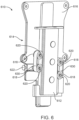
Figure 6 is a rear perspective view of an adjustable friction slider assembly incorporating elastic belts, according to certain embodiments of the present invention. - The subject matter of embodiments of the present invention is described here with specificity to meet statutory requirements, but this description is not necessarily intended to limit the scope of the claims. The claimed subject matter may be embodied in other ways, may include different elements or steps, and may be used in conjunction with other existing or future technologies. This description should not be interpreted as implying any particular order or arrangement among or between various steps or elements except when the order of individual steps or arrangement of elements is explicitly described.
- The described embodiments of the invention provide an adjustable friction slider assembly for passenger seats. While the adjustable friction slider assembly is discussed for use with aircraft seats, it is by no means so limited. Rather, embodiments of the adjustable friction slider assembly may be used in passenger seats or other seats of any type or otherwise as desired.
- According to certain embodiments of the present invention, as best shown in
Figures 1A-1C , an adjustablefriction slider assembly 110 comprises arail member 112 and acarriage assembly 114. Thecarriage assembly 114 comprises abracket member 116 and at least oneroller element 118. In some embodiments, thecarriage assembly 114 may comprise at least oneattachment member 120 and/or afriction adjustment member 122. - The adjustable
friction slider assembly 110 and any component of the adjustable friction slider assembly 110 (e.g., therail member 112, thecarriage assembly 114, thebracket member 116, the at least oneroller element 118, the at least oneattachment member 120, or the friction adjustment member 122) may be formed of materials including but not limited to aluminum, stainless steel, aramid fibers, polycarbonate, polypropylene, other metallic materials, composite materials, or other similar materials. Due to the nature of the repetitive use of the adjustablefriction slider assembly 110, the material(s) used to form the various components of the adjustablefriction slider assembly 110 may be selected based on the wear resistance of the material(s). Additionally, each of the components of the adjustablefriction slider assembly 110 may be formed of the same material, different materials, or any combination of the same or different materials. - The various components of the adjustable
friction slider assembly 110 may each be any suitable shape. For example, thebracket member 116 may be circular, triangular, rectangular, square-shaped, oval-shaped, etc. Therail member 112 may be any suitable length and depth and may have any suitable cross-section, such as a rectangular cross-section, a square cross-section, a circular cross-section, an oval cross-section, a curved cross-section, a parabolic cross-section, etc. - In some embodiments, the
carriage assembly 114 is moveably coupled to therail member 112 so that thecarriage assembly 114 may move along the length or longitudinal axis of therail member 112. The at least oneroller element 118 may be coupled to thebracket member 116 so that the at least oneroller element 118 moveably couples thecarriage assembly 114 to therail member 112. The at least oneroller element 118 may be a bearing, e.g., a roller bearing, circulating bearing wheel, etc., or any other suitable device having a low dynamic friction and a high static friction. Additionally, the at least oneroller element 118 may include at least oneflanged edge 124 that may assist with keeping thecarriage assembly 114 coupled to therail member 112. The at least oneflanged edge 124 of the at least oneroller element 118 may form a groove that enables the at least oneroller element 118 to capture therail member 112. In fact, the at least oneroller element 118 may have any suitable cross-section that enables the at least oneroller element 118 to be coupled with and securely capture therail member 112. - The at least one
roller element 118 may be coupled to thebracket member 116 of thecarriage assembly 114. For example, at least oneattachment member 120 may extend through at least one opening in thebracket member 116 and through at least one opening in each of the at least oneroller elements 118 to attach each of the at least oneroller elements 118 to thecarriage assembly 114. The at least oneattachment member 120 may be any suitable device for securing the at least oneroller element 118 to thebracket member 116, e.g., a pin, a screw, a bolt, a nail, etc. Additionally, the at least oneroller element 118 may include aspacer member 126 extending through the at least oneroller element 118. The at least oneattachment member 120 may extend through thespacer member 126. Thespacer member 126 may then assist with securing the at least oneroller element 118 to the at least oneattachment member 120 while permitting the at least oneroller element 118 to freely rotate relative to the at least oneattachment member 120. - The
carriage assembly 114 may include any suitable number ofroller elements 118, e.g., one, two, three, four, five, six, seven, etc. In some embodiments, the number ofattachment members 120 andspacer members 126 corresponds to the number ofroller elements 118. Having at least threeroller elements 118 as part of thecarriage assembly 114 may restrict the number of degrees of freedom of thecarriage assembly 114 to a single degree of freedom and thus fully constrain thecarriage assembly 114. The single degree of freedom of thecarriage assembly 114 may permit movement of thecarriage assembly 114 along the longitudinal axis of therail member 112. - In some embodiments, at least one of the
roller elements 118 is anadjustable roller element 128. Theadjustable roller element 128 may be coupled with thebracket member 116 using amoveable attachment member 120 so that theadjustable roller element 128 is moveable relative to thecarriage assembly 114 and therail member 112. For example, theadjustable roller element 128 may move in a direction substantially perpendicular to the longitudinal axis of therail member 112. - Moving the
adjustable roller element 128 may adjust the amount of friction between theroller elements 118 and therail member 112. Moving theadjustable roller element 128 towards or away from therail member 112 changes the amount of force applied to therail member 112 by theadjustable roller element 128 and, as a result, any of thenon-adjustable roller elements 118 that are part of thecarriage assembly 114 as well. For example, moving theadjustable roller element 128 towards therail member 112 increases the amount of force applied to therail member 112 by theadjustable roller element 128 and thenon-adjustable roller elements 118. Thus the friction, and more specifically the static friction, between therail member 112 and thecarriage assembly 114 increases. - In some embodiments, as best illustrated in
FIG. 1C , theadjustable roller element 128 may be moved using thefriction adjustment member 122. In some embodiments, thefriction adjustment member 122 and theattachment member 120 extending through theadjustable roller element 128 may be a singular element or separate elements. For example, thefriction adjustment member 122 may be a threaded pin, screw, compounding springs, a spring force actuator, any combination of these devices, or any other similar device that is coupled with theattachment member 120. Thus the amount of friction between theadjustable roller element 128, theroller elements 118, and therail member 112 may be controlled by moving thefriction adjustment member 122. For example, thefriction adjustment member 122 may be rotated, as represented byarrow 132, which causes theadjustable roller element 128 to move towards or away from therail member 112 and to adjust the friction between thecarriage assembly 114 and therail member 112.Arrow 134 represents movement of theattachment member 120 and theadjustable roller element 128 away from therail member 112 due to the rotation of thefriction adjustment member 122. - It should be understood that any number of the
roller elements 118 may be anadjustable roller element 128. In fact, all of theroller elements 118 of thecarriage assembly 114 may beadjustable roller elements 128. Increasing the number ofadjustable roller elements 128 incorporated into thecarriage assembly 114 may enable more fine-tuned and uniform adjustments of the friction between thecarriage assembly 114 and therail member 112. - According to certain embodiments of the present invention, as best shown in
Figures 2A-2B , an adjustablefriction slider assembly 210 may be used to couple a sub-assembly 230 to a passenger seat. The adjustablefriction slider assembly 210 may be the same or similar to the adjustablefriction slider assembly 110 described above in reference toFIGS. 1A-1C . For example, the adjustablefriction slider assembly 210 may comprise arail member 212 and acarriage assembly 214 where thecarriage assembly 214 may comprise abracket member 216, at least oneroller element 218, at least oneattachment member 220, and/or afriction adjustment member 222. The various components of the adjustablefriction slider assembly 210 may include any of the features described above in relation toFIGS. 1A-1C . - In some embodiments, the sub-assembly 230 may be a headrest, an in-flight entertainment or video monitor, a tray table, a portable electronic device holder, etc. The sub-assembly 230 is a headrest. The sub-assembly 230 may be coupled to the adjustable
friction slider assembly 210. For example the sub-assembly 230 may be coupled to thebracket member 216 using any suitable form of chemical or mechanical attachment including, but not limited to, nuts and bolts, screws, pins and rivets, a snap-fit connection, a friction fit connection, adhesive, welding, other mechanical fasteners, and/or other chemical fasteners. - The sub-assembly 230 may be coupled directly or indirectly to the
bracket member 216. In some embodiments, the sub-assembly 230 may be coupled to an intermediate member that is then attached to thebracket member 216. The intermediate member may assist with restricting any movement of the sub-assembly 230 relative to thebracket member 216 or the intermediate member may permit pivoting of the sub-assembly 230 relative to thebracket member 216. Permitting pivoting of the sub-assembly 230 relative to thebracket member 216 may enable a passenger to adjust the angle of thesub-assembly 230. - According to certain embodiments of the present invention, as best shown in
Figures 3A-3B , an adjustablefriction slider assembly 310 may be used to couple a sub-assembly 330 to a passenger seat. The sub-assembly 330 shown is an in-flight entertainment monitor. The adjustablefriction slider assembly 310 may be the same or similar to the adjustablefriction slider assembly FIGS. 1A-2B . For example, the adjustablefriction slider assembly 310 may comprise arail member 312 and acarriage assembly 314 where thecarriage assembly 314 may comprise abracket member 316, at least oneroller element 318, at least oneattachment member 320, and/or afriction adjustment member 322. The various components of the adjustablefriction slider assembly 310 may include any of the features described above in relation toFIGS. 1A-2B . - According to certain embodiments of the present invention, as best shown in
Figures 4A-4B , an adjustablefriction slider assembly 410 may be used to couple a sub-assembly 430 to apassenger seat 400. The adjustablefriction slider assembly 410 may be the same or similar to the adjustablefriction slider assembly FIGS. 1A-3B and the sub-assembly 430 may be the same or similar to the sub-assembly 230, 330 described above in reference toFIGS. 2A-3B . For example, the adjustablefriction slider assembly 410 may comprise arail member 412 and a carriage assembly where the carriage assembly may comprise a bracket member, at least one roller element, at least one attachment member, and/or a friction adjustment member. The various components of the adjustablefriction slider assembly 410 may include any of the features described above in relation toFIGS. 1A-3B . - In some embodiments, the adjustable
friction slider assembly 410 may be housed in anouter casing 432 that at least partially or wholly encloses the adjustablefriction slider assembly 410. Theouter casing 432 may protect the adjustablefriction slider assembly 410 from damage and prevent tampering with the adjustablefriction slider assembly 410. Theouter casing 432 may also provide a more seamless and finished aesthetic to the adjustablefriction slider assembly 410. Additionally, therail member 412 may be part of or integrally formed with a seat backshroud 434 or therail member 412 may be a discrete element that extends at least partially into a seat back or other portion of apassenger seat 400. - According to certain embodiments of the present invention, as best shown in
Figure 5 , an adjustablefriction slider assembly 510 may be used to couple a sub-assembly 530 to apassenger seat 500. The adjustablefriction slider assembly 510 may be the same or similar to the adjustablefriction slider assembly FIGS. 1A-4B and the sub-assembly 530 may be the same or similar to the sub-assembly 230, 330, 430 described above in reference toFIGS. 2A-4B . For example, the adjustablefriction slider assembly 510 may comprise a rail member and a carriage assembly where the carriage assembly may comprise a bracket member, at least one roller element, at least one attachment member, and/or a friction adjustment member. The various components of the adjustablefriction slider assembly 510 may include any of the features described above in relation toFIGS. 1A-4B . - The same adjustable
friction slider assembly 510 may be used regardless of the type ofsub-assembly 530 being used. For example, the same adjustablefriction slider assembly 510 may be used to attach both the in-flight entertainment monitor 532 and the personalelectronic device holder 534 to thepassenger seat 500 because of the adjustability of the friction of the adjustablefriction slider assembly 510. - As described above in reference to
FIGS. 1A-1C , the carriage assembly of each adjustablefriction slider assembly 510 is coupled to the rail member and the adjustable roller element is moved towards or away from the rail member to adjust the amount of force the carriage assembly applies against the rail member. The adjustablefriction slider assembly 510 used to attach the in-flight entertainment monitor 532 and the adjustablefriction slider assembly 510 used to attach the personalelectronic device holder 534 may each be adjusted to create different amounts of friction in the respective adjustablefriction slider assembly 510. - The adjustment of the adjustable roller element may be based on the amount of force necessary to create sufficient static friction to hold the adjustable
friction slider assembly 510 in a stationary position supporting the sub-assembly 530 while having a relatively low dynamic friction that permits a smooth movement of the adjustablefriction slider assembly 510 along the rail member. The amount of friction necessary for an in-flight entertainment monitor versus a personal electronic device holder or any other sub-assembly will be different and will largely depend on the size and weight of thesub-assembly 530. In some embodiments, the manufacturer or installer of thepassenger seat 500 may move the adjustable roller element of each adjustablefriction slider assembly 510 to create the necessary amount of friction for therespective sub-assembly 530 that each adjustablefriction slider assembly 510 supports. - In some embodiments, the carriage assembly may be permitted to slide along the rail member after the friction is set by the adjustable roller element. For example, a downward force, represented by
arrows 536, may be applied to each sub-assembly 530. When the downward force is enough to overcome the static friction of the respective adjustablefriction slider assemblies 510, the dynamic friction between the carriage assembly and the rail member permits a smooth movement of the carriage assembly along the rail member. It should be understood that an upward force may also be applied to each sub-assembly 530 to cause thesub-assemblies 530 to move. - After the downward force is removed, the static friction between the carriage assembly and the rail member once again causes the adjustable
friction slider assembly 510 to maintain a stationary position. So a user may adjust a position of the sub-assembly 530 relative to the rail member by applying a force to the sub-assembly 530 or in some cases by applying a force directly to the adjustablefriction slider assembly 510. Once thesub-assembly 530 is at the new location, the user may stop applying the force. The sub-assembly 530 will then remain at the new location due to the static friction created by the adjustablefriction slider assembly 510. - Using the adjustable
friction slider assembly 510 may reduce the cost of manufacturing thepassenger seat 500 and increase the interchangeability of the various types of sub-assemblies due to the need for only a single design of the adjustablefriction slider assembly 510 regardless of the type of sub-assembly used. This may lead to easier customization of the passenger seats 500 because the sub-assemblies may be removed and replaced without the need to replace the adjustablefriction slider assembly 510. - According to certain embodiments of the present invention, as best shown in
Figure 6 , an adjustablefriction slider assembly 610 may incorporate at least oneelastic band 630. The adjustablefriction slider assembly 610 may be the same or similar to the adjustablefriction slider assembly FIGS. 1A-5 . For example, the adjustablefriction slider assembly 610 may comprise arail member 612 and acarriage assembly 614 where thecarriage assembly 614 may comprise abracket member 616, at least oneroller element 618, at least oneattachment member 620, and/or afriction adjustment member 622. The various components of the adjustablefriction slider assembly 610 may include any of the features described above in relation toFIGS. 1A-1C . - In some embodiments, the at least one
elastic band 630 may be positioned around the at least oneroller element 618. Positioning the at least oneelastic band 630 around the at least oneroller element 618 may increase the static friction as well as the dynamic friction of the adjustablefriction slider assembly 610. The at least oneelastic band 630 may be positioned around the at least oneroller element 618 so that at least one portion of the at least oneelastic band 630 is positioned at least partially between the at least oneroller element 618 and therail member 612. As thecarriage assembly 614 moves along therail member 612, the at least oneelastic band 630 moves with the at least oneroller element 618. - The adjustable
friction slider assembly 610 may include a plurality ofroller elements 618 positioned on multiple sides of therail member 612. Anelastic band 630 may be positioned around each set ofroller elements 618 arranged linearly in the longitudinal direction of therail member 612. For example, tworoller elements 618 may be linearly aligned on a left side of therail member 612 and twoseparate roller elements 618 may be linearly aligned on a right side of therail member 612. Oneelastic band 630 may be positioned around each set ofroller elements 618 so that at least a portion of eachelastic band 630 is positioned between eachrespective roller element 618 and therail member 612. - Positioning the at least one portion of the at least one
elastic band 630 between the at least oneroller element 618 and therail member 612 may help to dampen any sound created as the at least oneroller element 618 moves along therail member 612, may assist in maintaining constant friction, and thus minimizing slippage, between thecarriage assembly 614 and therail member 612, and may minimize wear on the at least oneroller element 618 and therail member 612. - Different arrangements of the components depicted in the drawings or described above, as well as components and steps not shown or described are possible. Similarly, some features and sub-combinations are useful and may be employed without reference to other features and sub-combinations. Embodiments of the invention have been described for illustrative and not restrictive purposes, and alternative embodiments will become apparent to readers of this patent. Accordingly, the present invention is not limited to the embodiments described above or depicted in the drawings, and various embodiments and modifications may be made without departing from the scope of the claims below.
Claims (14)
- An adjustable friction slider assembly (110) comprising:a rail member (112); anda carriage assembly (114) moveably coupled to the rail member (112), the carriage assembly (114) comprising:a bracket member (116); anda plurality of roller elements (118) moveably coupled to the rail member (112) and coupled to the bracket member (116) using a plurality of attachment members (120),characterized in that the plurality of roller elements (118) comprises at least one adjustable roller element (118) coupled to the bracket member (116) using a moveable attachment member (120),wherein moving the moveable attachment member (120) adjusts a friction between the plurality of roller elements (118) and the rail member (112).
- The adjustable friction slider assembly of claim 1, characterized in that it further comprises a moveable sub-assembly (230) coupled to the bracket member (116), wherein the friction is adjusted based on the moveable sub-assembly (230).
- The adjustable friction slider assembly of claim 2, characterized in that the moveable sub-assembly (230) comprises a headrest, a video monitor, a tray table, or a portable electronic device holder.
- The adjustable friction slider assembly of any of the claims 1 to 3, characterized in that the friction comprises a static friction that causes the carriage assembly (114) to maintain a position along the rail member (112).
- The adjustable friction slider assembly of claim 4, characterized in that a moving force that overcomes the static friction is applied to the carriage assembly (114) to move the carriage assembly (114) along the rail member (112).
- The adjustable friction slider assembly of any of the claims 1 to 5, characterized in that the rail member (112) comprises a longitudinal axis, and the at least one adjustable roller element (118) is moveable in a direction substantially perpendicular to the longitudinal axis.
- The adjustable friction slider assembly of any of the claims 1 to 6, characterized in that the carriage assembly (114) further comprises a friction adjustment member (122) coupled to the moveable attachment member (120) and moving the friction adjustment member (122) adjusts the friction between the plurality of roller elements (118) and the rail member (112).
- A passenger seat comprising an adjustable friction slider assembly according to any of the preceding claims.
- A method for adjusting a friction of an adjustable friction slider assembly according to any of the preceding claims characterized in that it comprises:coupling a carriage assembly (114) to a rail member (112), the carriage assembly (114) comprising a plurality of roller elements (118), the plurality of roller elements (118) comprising at least one adjustable roller element (118); andmoving the at least one adjustable roller element (118) relative to the rail member (112) to adjust the friction between the plurality of roller elements (118) and the rail member (112).
- The method of claim 9, characterized in that the friction is adjusted based on a moveable sub-assembly (230) coupled to the carriage assembly (114).
- The method of claim 9 or 10, characterized in that moving the at least one adjustable roller element (118) comprises moving a moveable attachment member (120), and in that the moveable attachment member (120) couples the at least one adjustable roller element (118) to the carriage assembly (114).
- The method of any of the claims 9 to 11, characterized in that moving the at least one adjustable roller element (118) relative to the rail member (112) comprises moving the at least one adjustable roller element (118) in a direction substantially perpendicular to a longitudinal axis of the rail member (112).
- The method of any of the claims 9 to 12, characterized in that it further comprises applying a moving force to the carriage assembly (114) that overcomes a static friction between the carriage assembly (114) and the rail member (112) to move the carriage assembly (114) along the rail member (112).
- The method of claim 13, characterized in that it further comprises:removing the moving force from the carriage assembly (114); andmaintaining the carriage assembly (114) at a location along the rail member (112) where the moving force is removed due to the static friction between the carriage assembly (114) and the rail member (112).
Applications Claiming Priority (1)
| Application Number | Priority Date | Filing Date | Title |
|---|---|---|---|
| PCT/US2020/035348 WO2021242261A1 (en) | 2020-05-29 | 2020-05-29 | Adjustable friction slider assembly for passenger seat |
Publications (2)
| Publication Number | Publication Date |
|---|---|
| EP4157719A1 EP4157719A1 (en) | 2023-04-05 |
| EP4157719B1 true EP4157719B1 (en) | 2024-09-04 |
Family
ID=71787119
Family Applications (1)
| Application Number | Title | Priority Date | Filing Date |
|---|---|---|---|
| EP20746420.7A Active EP4157719B1 (en) | 2020-05-29 | 2020-05-29 | Adjustable friction slider assembly for passenger seat |
Country Status (4)
| Country | Link |
|---|---|
| US (1) | US12227293B2 (en) |
| EP (1) | EP4157719B1 (en) |
| CN (1) | CN115697845B (en) |
| WO (1) | WO2021242261A1 (en) |
Family Cites Families (10)
| Publication number | Priority date | Publication date | Assignee | Title |
|---|---|---|---|---|
| DE19638075C1 (en) | 1996-08-29 | 1998-02-26 | Jungjohann Thomas | Braking device for a movable component of a furniture element, in particular upholstered furniture element |
| US7264313B2 (en) * | 2000-09-20 | 2007-09-04 | Robert Clough | Seat headrest |
| US7364239B2 (en) * | 2000-09-20 | 2008-04-29 | Robert Clough | Seat headrest |
| US20040007910A1 (en) * | 2002-07-12 | 2004-01-15 | Skelly Trevor B. | Headrest mounting plate, seat headrest, and passenger seat with headrest |
| JP5818810B2 (en) * | 2009-12-23 | 2015-11-18 | オーチス エレベータ カンパニーOtis Elevator Company | Elevator brake device |
| US9028000B2 (en) * | 2012-03-06 | 2015-05-12 | Sergio Millan | Seat headrest |
| US9393892B1 (en) * | 2015-01-22 | 2016-07-19 | Reinhold Industries, Inc. | Seat headrest |
| US10538185B2 (en) * | 2015-03-16 | 2020-01-21 | Southco, Inc. | Friction module, friction hinge, and adjustable headrest including the friction module and/or friction hinge |
| JP6787914B2 (en) * | 2015-03-16 | 2020-11-18 | サウスコ,インコーポレイティド | Adjustable headrests including friction modules, friction hinges, and friction modules and / or friction hinges |
| DE102016208364B4 (en) * | 2016-05-17 | 2021-11-18 | Lear Corporation | Seat track assembly and method of making a seat track assembly |
-
2020
- 2020-05-29 WO PCT/US2020/035348 patent/WO2021242261A1/en not_active Ceased
- 2020-05-29 US US17/926,003 patent/US12227293B2/en active Active
- 2020-05-29 EP EP20746420.7A patent/EP4157719B1/en active Active
- 2020-05-29 CN CN202080101490.8A patent/CN115697845B/en active Active
Also Published As
| Publication number | Publication date |
|---|---|
| US20230202659A1 (en) | 2023-06-29 |
| CN115697845B (en) | 2025-08-05 |
| US12227293B2 (en) | 2025-02-18 |
| EP4157719A1 (en) | 2023-04-05 |
| CN115697845A (en) | 2023-02-03 |
| WO2021242261A1 (en) | 2021-12-02 |
Similar Documents
| Publication | Publication Date | Title |
|---|---|---|
| EP3271248B1 (en) | Friction module, friction hinge, and adjustable headrest including the friction module and/or friction hinge | |
| US10960801B2 (en) | Friction module, friction hinge, and adjustable headrest including the friction module and/or friction hinge | |
| US8777310B2 (en) | Seat back assembly | |
| US10144515B2 (en) | Aircraft seating assembly and components | |
| US8888161B1 (en) | Vehicle seat with multi-axis energy attenuation | |
| EP0065982B1 (en) | Vehicle crashworthy seat | |
| US10000142B2 (en) | Head and neck restraining system | |
| EP3458363A1 (en) | Adjustable armrest assembly | |
| EP3749546B1 (en) | Food tray for passenger seat | |
| EP4157719B1 (en) | Adjustable friction slider assembly for passenger seat | |
| US10293943B1 (en) | Seat back pocket spring and method | |
| EP2474446A1 (en) | An aircraft light | |
| EP3814670B1 (en) | Spring clutch arm assembly | |
| RU140478U1 (en) | FOLDING TABLE MODULE FOR CAR SEAT AND VEHICLE SEAT WITH FOLDING TABLE MODULE | |
| CN116552351B (en) | Friction module and adjustable headrest comprising the same | |
| US12252253B2 (en) | Aircraft seat with nested energy attenuation guide system | |
| US20260116540A1 (en) | Vehicle operator seat incorporating pivoting hip armor |
Legal Events
| Date | Code | Title | Description |
|---|---|---|---|
| STAA | Information on the status of an ep patent application or granted ep patent |
Free format text: STATUS: UNKNOWN |
|
| STAA | Information on the status of an ep patent application or granted ep patent |
Free format text: STATUS: THE INTERNATIONAL PUBLICATION HAS BEEN MADE |
|
| PUAI | Public reference made under article 153(3) epc to a published international application that has entered the european phase |
Free format text: ORIGINAL CODE: 0009012 |
|
| STAA | Information on the status of an ep patent application or granted ep patent |
Free format text: STATUS: REQUEST FOR EXAMINATION WAS MADE |
|
| 17P | Request for examination filed |
Effective date: 20221118 |
|
| AK | Designated contracting states |
Kind code of ref document: A1 Designated state(s): AL AT BE BG CH CY CZ DE DK EE ES FI FR GB GR HR HU IE IS IT LI LT LU LV MC MK MT NL NO PL PT RO RS SE SI SK SM TR |
|
| DAV | Request for validation of the european patent (deleted) | ||
| DAX | Request for extension of the european patent (deleted) | ||
| GRAP | Despatch of communication of intention to grant a patent |
Free format text: ORIGINAL CODE: EPIDOSNIGR1 |
|
| STAA | Information on the status of an ep patent application or granted ep patent |
Free format text: STATUS: GRANT OF PATENT IS INTENDED |
|
| RIC1 | Information provided on ipc code assigned before grant |
Ipc: B60R 11/00 20060101ALI20240529BHEP Ipc: B60R 11/02 20060101ALI20240529BHEP Ipc: B60N 3/00 20060101ALI20240529BHEP Ipc: B64D 11/06 20060101ALI20240529BHEP Ipc: B60N 2/809 20180101ALI20240529BHEP Ipc: B60N 2/821 20180101ALI20240529BHEP Ipc: B64D 11/00 20060101AFI20240529BHEP |
|
| INTG | Intention to grant announced |
Effective date: 20240617 |
|
| GRAS | Grant fee paid |
Free format text: ORIGINAL CODE: EPIDOSNIGR3 |
|
| GRAA | (expected) grant |
Free format text: ORIGINAL CODE: 0009210 |
|
| STAA | Information on the status of an ep patent application or granted ep patent |
Free format text: STATUS: THE PATENT HAS BEEN GRANTED |
|
| AK | Designated contracting states |
Kind code of ref document: B1 Designated state(s): AL AT BE BG CH CY CZ DE DK EE ES FI FR GB GR HR HU IE IS IT LI LT LU LV MC MK MT NL NO PL PT RO RS SE SI SK SM TR |
|
| REG | Reference to a national code |
Ref country code: GB Ref legal event code: FG4D |
|
| REG | Reference to a national code |
Ref country code: CH Ref legal event code: EP |
|
| REG | Reference to a national code |
Ref country code: IE Ref legal event code: FG4D |
|
| REG | Reference to a national code |
Ref country code: DE Ref legal event code: R096 Ref document number: 602020037103 Country of ref document: DE |
|
| REG | Reference to a national code |
Ref country code: LT Ref legal event code: MG9D |
|
| REG | Reference to a national code |
Ref country code: NL Ref legal event code: MP Effective date: 20240904 |
|
| PG25 | Lapsed in a contracting state [announced via postgrant information from national office to epo] |
Ref country code: NO Free format text: LAPSE BECAUSE OF FAILURE TO SUBMIT A TRANSLATION OF THE DESCRIPTION OR TO PAY THE FEE WITHIN THE PRESCRIBED TIME-LIMIT Effective date: 20241204 |
|
| PG25 | Lapsed in a contracting state [announced via postgrant information from national office to epo] |
Ref country code: PL Free format text: LAPSE BECAUSE OF FAILURE TO SUBMIT A TRANSLATION OF THE DESCRIPTION OR TO PAY THE FEE WITHIN THE PRESCRIBED TIME-LIMIT Effective date: 20240904 Ref country code: GR Free format text: LAPSE BECAUSE OF FAILURE TO SUBMIT A TRANSLATION OF THE DESCRIPTION OR TO PAY THE FEE WITHIN THE PRESCRIBED TIME-LIMIT Effective date: 20241205 Ref country code: FI Free format text: LAPSE BECAUSE OF FAILURE TO SUBMIT A TRANSLATION OF THE DESCRIPTION OR TO PAY THE FEE WITHIN THE PRESCRIBED TIME-LIMIT Effective date: 20240904 |
|
| PG25 | Lapsed in a contracting state [announced via postgrant information from national office to epo] |
Ref country code: BG Free format text: LAPSE BECAUSE OF FAILURE TO SUBMIT A TRANSLATION OF THE DESCRIPTION OR TO PAY THE FEE WITHIN THE PRESCRIBED TIME-LIMIT Effective date: 20240904 |
|
| PG25 | Lapsed in a contracting state [announced via postgrant information from national office to epo] |
Ref country code: LV Free format text: LAPSE BECAUSE OF FAILURE TO SUBMIT A TRANSLATION OF THE DESCRIPTION OR TO PAY THE FEE WITHIN THE PRESCRIBED TIME-LIMIT Effective date: 20240904 |
|
| PG25 | Lapsed in a contracting state [announced via postgrant information from national office to epo] |
Ref country code: HR Free format text: LAPSE BECAUSE OF FAILURE TO SUBMIT A TRANSLATION OF THE DESCRIPTION OR TO PAY THE FEE WITHIN THE PRESCRIBED TIME-LIMIT Effective date: 20240904 |
|
| PG25 | Lapsed in a contracting state [announced via postgrant information from national office to epo] |
Ref country code: ES Free format text: LAPSE BECAUSE OF FAILURE TO SUBMIT A TRANSLATION OF THE DESCRIPTION OR TO PAY THE FEE WITHIN THE PRESCRIBED TIME-LIMIT Effective date: 20240904 Ref country code: RS Free format text: LAPSE BECAUSE OF FAILURE TO SUBMIT A TRANSLATION OF THE DESCRIPTION OR TO PAY THE FEE WITHIN THE PRESCRIBED TIME-LIMIT Effective date: 20241204 |
|
| PG25 | Lapsed in a contracting state [announced via postgrant information from national office to epo] |
Ref country code: RS Free format text: LAPSE BECAUSE OF FAILURE TO SUBMIT A TRANSLATION OF THE DESCRIPTION OR TO PAY THE FEE WITHIN THE PRESCRIBED TIME-LIMIT Effective date: 20241204 Ref country code: PL Free format text: LAPSE BECAUSE OF FAILURE TO SUBMIT A TRANSLATION OF THE DESCRIPTION OR TO PAY THE FEE WITHIN THE PRESCRIBED TIME-LIMIT Effective date: 20240904 Ref country code: NO Free format text: LAPSE BECAUSE OF FAILURE TO SUBMIT A TRANSLATION OF THE DESCRIPTION OR TO PAY THE FEE WITHIN THE PRESCRIBED TIME-LIMIT Effective date: 20241204 Ref country code: LV Free format text: LAPSE BECAUSE OF FAILURE TO SUBMIT A TRANSLATION OF THE DESCRIPTION OR TO PAY THE FEE WITHIN THE PRESCRIBED TIME-LIMIT Effective date: 20240904 Ref country code: HR Free format text: LAPSE BECAUSE OF FAILURE TO SUBMIT A TRANSLATION OF THE DESCRIPTION OR TO PAY THE FEE WITHIN THE PRESCRIBED TIME-LIMIT Effective date: 20240904 Ref country code: GR Free format text: LAPSE BECAUSE OF FAILURE TO SUBMIT A TRANSLATION OF THE DESCRIPTION OR TO PAY THE FEE WITHIN THE PRESCRIBED TIME-LIMIT Effective date: 20241205 Ref country code: FI Free format text: LAPSE BECAUSE OF FAILURE TO SUBMIT A TRANSLATION OF THE DESCRIPTION OR TO PAY THE FEE WITHIN THE PRESCRIBED TIME-LIMIT Effective date: 20240904 Ref country code: ES Free format text: LAPSE BECAUSE OF FAILURE TO SUBMIT A TRANSLATION OF THE DESCRIPTION OR TO PAY THE FEE WITHIN THE PRESCRIBED TIME-LIMIT Effective date: 20240904 Ref country code: BG Free format text: LAPSE BECAUSE OF FAILURE TO SUBMIT A TRANSLATION OF THE DESCRIPTION OR TO PAY THE FEE WITHIN THE PRESCRIBED TIME-LIMIT Effective date: 20240904 |
|
| REG | Reference to a national code |
Ref country code: AT Ref legal event code: MK05 Ref document number: 1720150 Country of ref document: AT Kind code of ref document: T Effective date: 20240904 |
|
| PG25 | Lapsed in a contracting state [announced via postgrant information from national office to epo] |
Ref country code: NL Free format text: LAPSE BECAUSE OF FAILURE TO SUBMIT A TRANSLATION OF THE DESCRIPTION OR TO PAY THE FEE WITHIN THE PRESCRIBED TIME-LIMIT Effective date: 20240904 |
|
| PG25 | Lapsed in a contracting state [announced via postgrant information from national office to epo] |
Ref country code: IS Free format text: LAPSE BECAUSE OF FAILURE TO SUBMIT A TRANSLATION OF THE DESCRIPTION OR TO PAY THE FEE WITHIN THE PRESCRIBED TIME-LIMIT Effective date: 20250104 Ref country code: PT Free format text: LAPSE BECAUSE OF FAILURE TO SUBMIT A TRANSLATION OF THE DESCRIPTION OR TO PAY THE FEE WITHIN THE PRESCRIBED TIME-LIMIT Effective date: 20250106 |
|
| PG25 | Lapsed in a contracting state [announced via postgrant information from national office to epo] |
Ref country code: RO Free format text: LAPSE BECAUSE OF FAILURE TO SUBMIT A TRANSLATION OF THE DESCRIPTION OR TO PAY THE FEE WITHIN THE PRESCRIBED TIME-LIMIT Effective date: 20240904 Ref country code: SM Free format text: LAPSE BECAUSE OF FAILURE TO SUBMIT A TRANSLATION OF THE DESCRIPTION OR TO PAY THE FEE WITHIN THE PRESCRIBED TIME-LIMIT Effective date: 20240904 |
|
| PG25 | Lapsed in a contracting state [announced via postgrant information from national office to epo] |
Ref country code: EE Free format text: LAPSE BECAUSE OF FAILURE TO SUBMIT A TRANSLATION OF THE DESCRIPTION OR TO PAY THE FEE WITHIN THE PRESCRIBED TIME-LIMIT Effective date: 20240904 Ref country code: AT Free format text: LAPSE BECAUSE OF FAILURE TO SUBMIT A TRANSLATION OF THE DESCRIPTION OR TO PAY THE FEE WITHIN THE PRESCRIBED TIME-LIMIT Effective date: 20240904 |
|
| PG25 | Lapsed in a contracting state [announced via postgrant information from national office to epo] |
Ref country code: CZ Free format text: LAPSE BECAUSE OF FAILURE TO SUBMIT A TRANSLATION OF THE DESCRIPTION OR TO PAY THE FEE WITHIN THE PRESCRIBED TIME-LIMIT Effective date: 20240904 |
|
| PG25 | Lapsed in a contracting state [announced via postgrant information from national office to epo] |
Ref country code: IT Free format text: LAPSE BECAUSE OF FAILURE TO SUBMIT A TRANSLATION OF THE DESCRIPTION OR TO PAY THE FEE WITHIN THE PRESCRIBED TIME-LIMIT Effective date: 20240904 Ref country code: SK Free format text: LAPSE BECAUSE OF FAILURE TO SUBMIT A TRANSLATION OF THE DESCRIPTION OR TO PAY THE FEE WITHIN THE PRESCRIBED TIME-LIMIT Effective date: 20240904 |
|
| REG | Reference to a national code |
Ref country code: DE Ref legal event code: R097 Ref document number: 602020037103 Country of ref document: DE |
|
| PGFP | Annual fee paid to national office [announced via postgrant information from national office to epo] |
Ref country code: DE Payment date: 20250519 Year of fee payment: 6 |
|
| PG25 | Lapsed in a contracting state [announced via postgrant information from national office to epo] |
Ref country code: DK Free format text: LAPSE BECAUSE OF FAILURE TO SUBMIT A TRANSLATION OF THE DESCRIPTION OR TO PAY THE FEE WITHIN THE PRESCRIBED TIME-LIMIT Effective date: 20240904 |
|
| PGFP | Annual fee paid to national office [announced via postgrant information from national office to epo] |
Ref country code: GB Payment date: 20250527 Year of fee payment: 6 |
|
| PLBE | No opposition filed within time limit |
Free format text: ORIGINAL CODE: 0009261 |
|
| STAA | Information on the status of an ep patent application or granted ep patent |
Free format text: STATUS: NO OPPOSITION FILED WITHIN TIME LIMIT |
|
| PGFP | Annual fee paid to national office [announced via postgrant information from national office to epo] |
Ref country code: FR Payment date: 20250526 Year of fee payment: 6 |
|
| 26N | No opposition filed |
Effective date: 20250605 |
|
| PG25 | Lapsed in a contracting state [announced via postgrant information from national office to epo] |
Ref country code: SE Free format text: LAPSE BECAUSE OF FAILURE TO SUBMIT A TRANSLATION OF THE DESCRIPTION OR TO PAY THE FEE WITHIN THE PRESCRIBED TIME-LIMIT Effective date: 20240904 |
|
| REG | Reference to a national code |
Ref country code: CH Ref legal event code: H13 Free format text: ST27 STATUS EVENT CODE: U-0-0-H10-H13 (AS PROVIDED BY THE NATIONAL OFFICE) Effective date: 20251223 |
|
| PG25 | Lapsed in a contracting state [announced via postgrant information from national office to epo] |
Ref country code: LU Free format text: LAPSE BECAUSE OF NON-PAYMENT OF DUE FEES Effective date: 20250529 |
|
| PG25 | Lapsed in a contracting state [announced via postgrant information from national office to epo] |
Ref country code: CH Free format text: LAPSE BECAUSE OF NON-PAYMENT OF DUE FEES Effective date: 20250531 |
|
| REG | Reference to a national code |
Ref country code: BE Ref legal event code: MM Effective date: 20250531 |
|
| PG25 | Lapsed in a contracting state [announced via postgrant information from national office to epo] |
Ref country code: MC Free format text: LAPSE BECAUSE OF FAILURE TO SUBMIT A TRANSLATION OF THE DESCRIPTION OR TO PAY THE FEE WITHIN THE PRESCRIBED TIME-LIMIT Effective date: 20240904 |
|
| PG25 | Lapsed in a contracting state [announced via postgrant information from national office to epo] |
Ref country code: IE Free format text: LAPSE BECAUSE OF NON-PAYMENT OF DUE FEES Effective date: 20250529 |
|
| PG25 | Lapsed in a contracting state [announced via postgrant information from national office to epo] |
Ref country code: BE Free format text: LAPSE BECAUSE OF NON-PAYMENT OF DUE FEES Effective date: 20250531 |