EP4156828A2 - Synchronisierte rahmenplanungsverfahren und systeme für ofdma-basierte drahtlose systeme - Google Patents
Synchronisierte rahmenplanungsverfahren und systeme für ofdma-basierte drahtlose systeme Download PDFInfo
- Publication number
- EP4156828A2 EP4156828A2 EP22195515.6A EP22195515A EP4156828A2 EP 4156828 A2 EP4156828 A2 EP 4156828A2 EP 22195515 A EP22195515 A EP 22195515A EP 4156828 A2 EP4156828 A2 EP 4156828A2
- Authority
- EP
- European Patent Office
- Prior art keywords
- framing
- stas
- bursts
- slot
- slots
- Prior art date
- Legal status (The legal status is an assumption and is not a legal conclusion. Google has not performed a legal analysis and makes no representation as to the accuracy of the status listed.)
- Pending
Links
Images






Classifications
-
- H—ELECTRICITY
- H04—ELECTRIC COMMUNICATION TECHNIQUE
- H04W—WIRELESS COMMUNICATION NETWORKS
- H04W74/00—Wireless channel access
- H04W74/08—Non-scheduled access, e.g. ALOHA
- H04W74/0808—Non-scheduled access, e.g. ALOHA using carrier sensing, e.g. carrier sense multiple access [CSMA]
- H04W74/0816—Non-scheduled access, e.g. ALOHA using carrier sensing, e.g. carrier sense multiple access [CSMA] with collision avoidance
-
- H—ELECTRICITY
- H04—ELECTRIC COMMUNICATION TECHNIQUE
- H04W—WIRELESS COMMUNICATION NETWORKS
- H04W74/00—Wireless channel access
- H04W74/08—Non-scheduled access, e.g. ALOHA
- H04W74/0866—Non-scheduled access, e.g. ALOHA using a dedicated channel for access
- H04W74/0891—Non-scheduled access, e.g. ALOHA using a dedicated channel for access for synchronized access
-
- H—ELECTRICITY
- H04—ELECTRIC COMMUNICATION TECHNIQUE
- H04L—TRANSMISSION OF DIGITAL INFORMATION, e.g. TELEGRAPHIC COMMUNICATION
- H04L5/00—Arrangements affording multiple use of the transmission path
- H04L5/14—Two-way operation using the same type of signal, i.e. duplex
- H04L5/1469—Two-way operation using the same type of signal, i.e. duplex using time-sharing
-
- H—ELECTRICITY
- H04—ELECTRIC COMMUNICATION TECHNIQUE
- H04W—WIRELESS COMMUNICATION NETWORKS
- H04W74/00—Wireless channel access
- H04W74/04—Scheduled access
- H04W74/06—Scheduled access using polling
-
- H—ELECTRICITY
- H04—ELECTRIC COMMUNICATION TECHNIQUE
- H04W—WIRELESS COMMUNICATION NETWORKS
- H04W84/00—Network topologies
- H04W84/02—Hierarchically pre-organised networks, e.g. paging networks, cellular networks, WLAN [Wireless Local Area Network] or WLL [Wireless Local Loop]
- H04W84/10—Small scale networks; Flat hierarchical networks
- H04W84/12—WLAN [Wireless Local Area Networks]
Definitions
- the present invention in some embodiments thereof, relates to synchronized framing scheduling methods and systems, and more specifically, but not exclusively, to synchronized framing scheduling methods and systems for OFDMA (Orthogonal Frequency-Division Multiple Access) based wireless systems such as IEEE 802.11 standard for wireless local-area networks.
- OFDMA Orthogonal Frequency-Division Multiple Access
- Typical IEEE 802.11 (which is the standard body for WiFi products) supports Carrier-Sense Multiple Access with Collision Avoidance (CSMA/CA) scheduling mechanism, also known as LBT ("Listen Before Talk") mechanism.
- CSMA/CA Carrier-Sense Multiple Access with Collision Avoidance
- LBT Listen Before Talk
- FIG 1 shows 802.11 CSMA/CA scheduler mechanism, which enables the standard WiFi LBT approach, in accordance with the prior art.
- all stations or wireless nodes
- the sender/receiver and other stations have equal access to the air resource.
- the station When a station wishes to send data over the air, the station must listen to DIFS (DCF (Distributed coordination function) Interframe Space) timer and if other signals are not received and the air is free, the station may send 802.11 data frame (known as PPDU- Physical Layer Protocol Data Unit) to other stations.
- DIFS distributed coordination function
- the sender addresses the PPDU to a specific receiver station. Accordingly, the receiver station should acknowledge the received PPDU during the short SIFS (Short InterFrame Space) timer.
- SIFS Short InterFrame Space
- the IEEE 802.11 standard defined a backoff/contention window mechanism to avoid or minimize collision between the stations.
- the current 802.11 CSMA/CA scheduling method has a very large overhead due to backoff mechanism to avoid a collision. Therefore, for better radio link utilization for massive communication scenarios, the industry developed TDMA (Time Division Multiple Access) based scheduler on top of 802.11 PHY.
- TDMA Time Division Multiple Access
- 802.11 standard solutions are efficient not only for unlicensed home usage but also for Private Wireless Networks, where high quality, high scalability and inter-cell interference management are required.
- some companies developed proprietary wireless solutions for private network use cases using synchronized TDMA protocol based on previous 802.11 standard versions.
- legacy 802.11 standards (last one is 802.11ac) used OFDM PHY/MAC structure.
- IEEE 802.11ax-2021 standard for wireless local-area networks (WLANs) defined a completely new OFDMA PHY framing structure compared to the prior OFDM (Orthogonal frequency-division multiplexing) based structure of previous 802.11 versions.
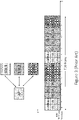
- FIG 2 illustrates the conceptual difference between OFDM and OFDMA framing structure, according to the prior art.
- OFDM is configured to enable point-to-multipoint (PTMP) communication using only time domain, meaning that during specific time periods only one device communicates with other APs (Access Point) or STA as shown in Figure 3 (OFDM TDMA based PTMP Communication), while OFDMA enables multiple devices to communicate with the AP simultaneously and therefore OFDMA leverages more flexible radio resources allocation in time and frequency domains as shown in Figure 4 (OFDMA PTMP Communication).
- PTMP point-to-multipoint
- legacy 802.11 standards OFDM PHY/MAC based structure as well as current IEEE 802.11ax-2021 standard for wireless local-area networks (WLANs) OFDMA PHY based structure are both using CSMA/CA as in previous 802.11 and providing opportunistic, non-synchronized scheduling process, which doesn't enable DL and UL continuous behavior (e.g. DL and UL transmission opportunities are not managed) and therefore may not effectively compete or replace 4G, 5G, and other 3GPP communication standards.
- CSMA/CA in 802.11 is the scheduling mechanism which defines the transmission opportunities period of 802.11 devices after sensing the wireless media to avoid the collision of multiple 802.11 devices transmitting simultaneously.
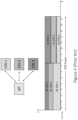
- the sensing timing and collision avoidance mechanisms as defined in 802.11 OFDMA-based scheduler use CSMA/CA scheduling in the following manner: DL and UL have a sequence of transmission bursts between AP and STAs (as shown in Figure 5 ).
- 802.11 protocol uses TXoP (Tx Opportunity) timeout, which indicates all other 802.11 devices in the proximity area to be quiet during this period.
- TXoP Tx Opportunity
- 802.11ax opens opportunity for other 802.11 devices transmission once DL or UL sequence is completed and therefore does not allow continuous and synchronized communication as provided for example by 4G and 5G radio networks.
- an improved scheduling methods and systems using a new framing structure that overcomes at least some of the above mentioned deficiencies of the prior scheduling methods would be beneficial.
- such a should enable simultaneous switching between downlink and uplink transmission, massive communication, latency, fast roaming, overhead reduction convenient and convenient to use.
- a method for scheduling downlink (DL) and uplink (UL) transmissions in Point-to-Multipoint (PTMP) one or more IEEE 802.11 orthogonal frequency division multiple access (OFDMA) based wireless communication networks each network comprising one or more IEEE 802.11 OFDMA based Access Points (APs) wherein each AP of said one or more APs comprises associated IEEE 802.11 OFDMA stations (STAs), the method comprising the steps of: synchronizing the one or more STAs within each network using one or more synchronization signals transmitted between the one or more APs and the one or more STAs; allocating one or more Framing Slots, wherein each Framing Slot having a fixed time duration; dividing each Framing Slot of said one or more Framing Slots into DL burst transmission and UL burst transmission periods wherein the DL burst transmission periods comprise one or more DL Data Units Bursts and wherein each DL Data Unit
- OFDMA orthogonal frequency division multiple access
- the DL and UL burst transmission periods in the one or more Framing Slots have different time durations and wherein the time durations ratio between them defines TDD split.
- each of said UL Data Unit Bursts or said DL Data Unit Bursts may have different time length based on the one or more APs scheduling decision, and wherein the total time length of UL Data Unit Bursts cannot exceed the UL transmission period time and wherein the total time length of DL Data Unit Bursts cannot exceed the DL transmission period.
- the DL Data Unit Bursts or UL Data Unit Bursts comprises using PPDU 802.11 frames in the DL or UL direction.
- the method further comprising: communicating with any associated and non-associate STAs approaching said one or more APs using UORA (Uplink OFDMA Random Access) mechanism as in said DL Trigger Frame.
- UORA Uplink OFDMA Random Access
- the method further comprising allocating different RU of different STAs by different Data Units bursts.
- the method further comprising: generating one or more Multi-Frames, each said one or more Multi-Frames comprising a plurality of said one or more Framing Slots wherein each Framing Slot of said plurality Framing Slots is numbered and wherein one or more of said plurality Framing Slots is allocated as a Maintenance Framing Slot.
- the Maintenance Framing Slot comprising: information broadcasting, said information broadcasting comprises Framing Slot scheduling profile announcement per following Multi-Frame and beamforming training procedures within the Maintenance Framing Slot.
- the method further comprising: broadcasting the Multi-Frame duration by the one or more APs to the one or more STAs by the Maintenance Framing Slot to the following Multi-Frames to synchronize said Framing Slot sequence between the AP and STAs.
- the Maintenance Framing Slot comprises a Beacon message for broadcasting specific network information and optionally Beamforming Training procedure.
- the Framing Slot numbering is derived from a Timestamp transmitted in each Data Unit Burst.
- the Multi-Frame is a semi-synchronous Multi-Frame for scheduling the DL and UL transmissions between the one or more APs and the one or more STAs and wherein the semi-synchronous Multi-Frame is configured to synchronize between the one or more APs and associated one or more STAs, but not synchronize between the one or more APs within the same network.
- a Multi-Frame structure for scheduling downlink (DL) and uplink (UL) transmissions between an access point (AP) and a plurality of stations (STAs) in an orthogonal frequency division multiple access (OFDMA) wireless communication system
- the Multi-Frame structure comprising: multiple Framing Slots, wherein each of said multiple Framing Slots is numbered across the same synchronized network and wherein one of said multiple Framing Slots is allocated as a Maintenance Framing Slot, said Maintenance Framing Slot comprising: information broadcasting, said information broadcasting comprises Framing Slot scheduling profile announcement per following Multi-Frame and beamforming training procedures within the Maintenance Framing Slot.
- the Maintenance Framing Slot has the same time duration as each of the other Framing Slots or doesn't have the same time duration as the other Framing Slots.
- an IEEE 802.11 OFDMA based Access Point for scheduling one or more Framing Slots between the AP and a plurality of stations (STAs) in an 802.11 orthogonal frequency division multiple access (OFDMA) based wireless communication network, said AP comprising:
- At least one synchronization source for time synchronization in said OFDMA wireless communication system
- the DL and UL burst transmission periods in the Framing Slot have different time durations and wherein the time durations ratio between them defines TDD split.
- each of said UL Data Unit Bursts or said DL Data Unit Bursts may have different time length based on the AP scheduling decision, and wherein the total time length of the one or more UL Data Unit Bursts cannot exceed the UL transmission period time and wherein the total time length of DL Data Unit Bursts cannot exceed the DL transmission period.
- the plurality of Framing Slots are scheduled in a Multi-Frame.
- the plurality of Framing Slots in said Multi-Frame are numbered and wherein one or more of said plurality Framing Slots is allocated as a Maintenance Framing Slot.
- the Multi-Frame is a semi-synchronous Multi-Frame.
- Datagram(s) as used herein will generally mean control and data information transmitted after the PHY header.
- Transmission Burst(s) or "DL burst' Transmission or "UL burst' Transmission or 'OFDM burst' as used herein will generally mean a broadcast of a relatively high-bandwidth transmission over a short period.
- Data Unit(s) or “Data Unit Burst(s)” as used herein will generally mean a physical layer (PHY) frame (i.e. the unit of data exchanged between PHY entities).
- Data Unit may be PPDU as defined by IEEE 802.11 standard.
- RU Resource Unit(s)
- STA STA allocation and the like, as defined by IEEE 802.11ax amendment (for example each block in Datagram as shown herein below with respect to Figure 8 ).
- the present invention in some embodiments thereof, relates to synchronized framing scheduling methods, devices and systems for enabling high-quality communication in a wireless network, and, more specifically, but not exclusively, to synchronized framing scheduling methods for OFDMA-based wireless systems such as IEEE 802.11 standard releases for example 802.11ax.
- the 802.11ax standard amendments specified completely new PHY & MAC processes, which didn't exist in previous 802.11 versions.
- the 802.11ax standard amendments include downlink (DL) and uplink (UL) resource scheduling, UL poling (using Trigger Control Frame), and process for updating existing processes as specified for example in IEEE 802.11-2016 standard (e.g. RTS/CTS, Beamforming Training, NAV), which is incorporated herein by reference.
- the present invention defines a new synchronized framed scheduling methods devices and systems which includes generating sets of new mechanisms to enable high-quality communication as required for example by Industry 4.0.
- the framed scheduling methods and systems in accordance with embodiments, may effectively compete and/or replace 4G, 5G and other 3GPP communication standards as it includes using cost-effective 802.11 ecosystems.
- the major reused IEEE 802.11ax mechanisms may include for example:
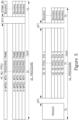
- Figure 6 shows the RUs as shown in the standard while the AP can assign RU size for the STAs in DL or UL directions per traffic demand.
- the numbers in each block represent the number of OFDM subcarriers for each RU.
- the standard as illustrated in Figure 6 is strict and mandatory with respect to the number of subcarriers in each RU.
- TDD Time Division Duplex
- the scheduling mechanism in accordance with embodiments, is also applicable for FDD (Frequency Division Duplex), HD-FDD (Half Duplex FDD) communication types, and the like.
- the synchronized framed scheduling methods and systems may be used in PTMP (point-to-multi-point) communication systems using multiple AP/BSs (e.g. similar to a cellular deployment) as illustrated in Figure 7A .
- Figure 7A shows a PTMP deployment topology network 700, in accordance with embodiments, including units A and B which function as AP/BS, while units A1, A2, ... An and units B1, B2, ... Bk function as STAs (e.g. stations or end devices).
- Units A and B are connected/in communication to/with one or more Synchronization Sources 708 such as GPS used for time synchronization.
- Synchronization Sources 708 such as GPS used for time synchronization.
- the network may be a IEEE 802.11 orthogonal frequency division multiple access (OFDMA) based wireless communication network
- the APs such as AP A and AP B are IEEE 802.11 OFDMA based Access Points (APs)
- the one or more STAs are IEEE 802.11 OFDMA (STAs), wherein each AP has its associated STAs in the PTMP topology.
- OFDMA orthogonal frequency division multiple access
- a STA associated to an AP is a STA which have mutual context with the AP for example after passing an initial authentication context.
- the STAs in Figure 7A are associated respectively with units A and B via one or more wireless links 702 and 704 . Since network 700 supports mobility each one of STAs (A1-An or B1-Bk) may roam between AP A and AP B. Typically, networks comprise many AP/BSs and each one of them may be in communication with many STAs.
- Figure 7B is a block diagram of a device such as AP 710 or Base Station, in accordance with embodiments.
- device 710 may include a memory 712, one or more processors such as processor 713, and one or more Radio Frequency (RF) units such as RF unit 714.
- RF Radio Frequency
- the RF unit 714 may be in communication (e.g., connected) with the processor 713 and may transmit/receive, respectively, one or more radio signals via one or more RF antennas 715 using one or more Receivers 717 and/or Transmitters 716.
- the RF unit 714 may transmit the signals by for example up-converting data received from processor 713 to a transmission/reception band.
- the one or more Synchronization Sources 708 may be in communication (e.g. wireless/ wire communication ) with the RF Unit 714 and/or the Processor 713.
- the Synchronization Sources 708 may be a GPS used for time synchronization.
- the RF unit 714 may include one or more transceivers configured and enabled to transmit and/or receive RF signals from/to device 710.
- the one or more processors 713 may implement the physical layer and/or the MAC layer according, for example, to the IEEE 802.11/LTE system using for example the RF unit 714.
- the processor 713 may be constructed to perform one or more operations according to the various embodiments of the present invention and according to the drawings and description.
- the module or methods for implementing the operation of the device 710 according to the various embodiments of the present invention described herein above and below may be stored in memory 712 and executed by processor 713.
- the processor 713 is configured and enabled to control the transceiver and/or the one or more transmitters 716 and receivers 717.
- memory 712 may be connected to processor 713, and may store various types of information for execution by processor 713. In some cases, memory 712 may be included in processor 713 or installed exterior to processor 713, and/or may be connected to processor 713 by well-known means.
- device 710 may include single or multiple antennas.
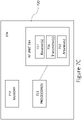
- FIG. 7C is a block diagram of a device such as STA 720, in accordance with embodiments.
- STA 720 may include all or some of the elements of AP 710 excluding for example the synchronization source 708.
- scheduling methods and systems for scheduling downlink (DL) and/or uplink (UL) transmissions between one or more access points (APs) and a plurality of stations (STAs) in 802.11 orthogonal frequency division multiple access (OFDMA) wireless communication system such as the PTMP deployment topology network 700 of Figure 7A .
- OFDMA orthogonal frequency division multiple access
- the scheduling methods and systems leverage 802.11 OFDMA-based PHY structure.
- 802.11 OFDMA-based PHY assigns resource allocation in the frequency domain enabling AP to communicate with multiple STAs using for example a single burst transmission (HE MU-PPDU) in DL.
- HE MU-PPDU single burst transmission
- multiple STAs transmit HE TB-PPDU bursts using triggering instructions provided by the AP.
- previous IEEE 802.11 OFDM-based PHY STAs are limited to time-domain only and enable AP to communicate with just a single STA in DL and/or UL directions.
- the scheduling methods and systems of the present invention may be used in OFDMA-based PHY structure as specified in IEEE 802.11ax and following revisions.
- the scheduling methods and systems are configured and enabled to provide one or more or a combination of the following capabilities (which for example may not be provided by prior schedulers such as CSMA/CA schedulers as used by standard 802.11 systems):
- the configurations disclosed herein can be combined in one or more of many ways to provide improved methods and systems enabling synchronized framed scheduling for 802.11 standards such as the latest 802.11ax standard.
- the methods and systems for enabling synchronized framed scheduling may include providing a scheduling method and system (e.g., synchronized framed scheduling) that is configured and enabled to generate predefined Framing Slots.
- a scheduling method and system e.g., synchronized framed scheduling
- the IEEE 802.11 OFDMA scheduling methods and systems in accordance with embodiments are configured and enabled to yield radio capabilities equivalent to 5G NR (5G New Radio) systems.
- IEEE 802.11 OFDMA scheduling methods and systems in accordance with embodiments include natural synchronized OFDMA based framing structure.
- 5G NR comprise framed structure dividing the time domain into slots. Each slot includes 14 OFDM symbols creating a continuous time and frequency domains grid, where all control and synchronization signals are mapped into designated Resource Elements (RE) as specified in 3GPP.
- the 802.11 OFDMA-based framed structure in accordance with embodiments, comprises burst transmissions inserted into fixed time periods for either DL and/or UL directions. Each Data Unit burst transmission includes its own synchronization signals (e.g. Timestamp) and allows the receiver to adjust its clock. Accordingly, it allows AP and STAs to send and receive the bursts within specific timings as described herein and below with respect to Figure 8 and Figure 10 .
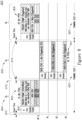
- Figure 8 shows a Framing Slot structure and scheduling method and system 800 for OFDMA based wireless systems such as IEEE 802.11 standard, in accordance with embodiments.
- each network may comprise an access point (AP) and a plurality of stations (e.g. STAs A1, A2..An) in 802.11 OFDMA wireless communication system.
- AP access point
- STAs A1, A2..An stations
- 802.11 OFDMA wireless communication system 802.11 OFDMA wireless communication system.
- the AP synchronizes the plurality of STAs within each network using one or more synchronization signals over the air (e.g. using Timestamps) delivered between the AP and the STAs.
- the method includes allocating one or more Framing Slots, such as Framing Slot 802 and Framing Slot 803.
- Each Framing Slot (e.g. Framing Slot i, Framing Slot i+1...), comprises a fixed time duration (e.g. 2 msec).
- the Framing Slot's time duration may vary per traffic characteristics (e.g. latency, throughput, etc.).
- each Framing Slot such as Framing Slot 802 comprises DL and UL transmission periods 804 and 806.
- the AP e.g. AP A
- may transmit datagrams e.g. Data STA1, Data STA A2, Data STA3 to multiple STAs (e.g. A1, A2, A3) using for example one or more Data Units such as Data Units 805 (e.g. HE MU-PPDU 802.11 frame) in the DL direction.
- Data Units 805 e.g. HE MU-PPDU 802.11 frame
- the Framing Slot structure further defines, in accordance with embodiments, a piggyback mechanism, where part of RUs is used for Trigger Frame 808 for UL RU allocation and part of RUs is used for Block Ack messages 809 for previous Framing Slots for non-allocated STAs (e.g. STA 4 and 5).
- each Framing Slot is numbered 0, 1, .. i, i+1 and Guard Time intervals 810 are included between each DL and UL transmission to compensate on the two-way signal propagation time over the air between AP and associated STAs.
- the defined allocations such as Framing Slot 802 include a number of time slots in which each time slot is scheduled as follows:
- the DL and UL transmission periods such as DL and UL transmission periods 804 and 806 included in the Framing Slot 802 may have different time durations and the duration ratio between them defines TDD split.
- the network system may provide DL and UL or symmetric oriented services.
- the synchronized scheduling method and system in accordance with embodiments provide managed DL and UL with continuous behavior, hence, bursts (such as Data Units 805 and 807 ) are transmitted continually one burst following the previous burst, while prior 802.11 schedulers provide opportunistic (e.g. not managed and not continuous) DL and UL scheduling transmissions opportunities.
- the framing structure as described in accordance with embodiments includes one or more DL transmission bursts such as DL Data Unit 805 (e.g. HE MU-PPDU) during the fixed-time DL period 804 and UL transmission bursts such as UL Data Unit 807 (e.g. HE TB PPDU) during fixed-time UL period 806.
- DL Data Unit 805 e.g. HE MU-PPDU
- UL transmission bursts such as UL Data Unit 807 (e.g. HE TB PPDU) during fixed-time UL period 806.
- the first burst is transmitted by AP at the beginning of each Framing Slot. If more than one DL burst is transmitted during the DL period (as illustrated for example in Figure 10 ) the following DL bursts are transmitted with a time offset from the beginning of the Framing Slot as per AP scheduling decision. The total time for all DL burst transmissions will not exceed the fixed-time DL period, e.g. time DL period 804.
- the STAs transmit to the AP a first burst (Data Unit 807 such as HE TB PPDU) at the beginning of the UL period within the Framing Slot 802. If more than one UL burst is transmitted by another set of STAs within the UL period of the Framing Slot (as illustrated in Figure 10 ), these bursts should be transmitted with time-offset from the beginning of the UL period as indicated by AP to the STAs during the DL period. The total time for all UL burst transmissions will not exceed the fixed-time UL period.
- Data Unit 807 such as HE TB PPDU
- the fixed-time Framing Slots are transmitted constantly, while AP and STAs are completely synchronized one with the other on the same transmission timings, transmission durations and numbering sequence of the Framing Slots.
- a set of functionalities per each Framing Slot are defined as follows, in accordance with embodiments:
- a Group of Framing Slots generates a Multi-Frame as explained hereinafter with respect to Figure 11A, Figure 11B and Figure 11C .
- Figure 9 shows UORA (UL OFDMA Random Access) mechanism as specified by current 802.11ax standard.
- UORA U OFDMA Random Access
- the usage of UORA mechanism using piggybacked Trigger Frame is to enable communication with any associated and non-associate STAs approaching AP.
- each Framing Slot may support one or more Data Units (e.g. PPDU frames) per each DL transmission and each UL transmission.
- Figure 8 shows an example of a single Data Unit (e.g. PPDU frame) per DL transmission and UL transmission (for explanation simplicity)
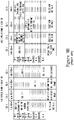
- Figure 10 shows an example including two Data Units in DL and two Data Units in UL per Framing Slot.
- the number and duration of Data Units in DL and UL slots can vary as long as the total time duration of data units is not exceeding the DL and UL time duration as set by TDD split in the system.
- the systems and methods in accordance with embodiments may define scheduling methods and systems configured and enabled for transmitting/receiving multiple Data Units (such as 802.11ax HE MU-PPDU) per Framing Slot in each DL and UL direction.
- multiple Data Units such as 802.11ax HE MU-PPDU
- Each Framing Slot such as Framing Slot 1010 includes a DL transmission period 1012 and UL transmission period 1016.
- the DL transmission period 1012 and UL transmission period 1016 comprise respectively one or more DL Data Unit bursts and one or more UL Data Unit bursts such as DL Data Unit bursts 1013 and 1014 (e.g. HE MU PPDU) and UL Data unit bursts 1017 and 1018 (e.g. HE TB PPDU).
- each Data Unit Burst may have a different time length based on the AP scheduling decision, but the total time length of all transmission bursts cannot exceed the fixed DL period time.
- different Data Units may allocate RU to a different set of Data Units, and/or the same STAs may belong to a different set of STAs.
- STA1 may be in the first Data Unit 1013 and also in the second Data Unit 1014.
- AP in operation AP, such AP A, transmits one or more DL Data Unit bursts (Data Units 1013 and 1014) to one or more STAs (STA1, STA2, STA3 , TA4 and STA5) during DL transmission period 1012.
- Each DL Data Unit burst comprises:
- STAs which are communicating with AP (Such AP A) and which received UL transmission instructions in Trigger Frame during the DL transmission period send UL Data Unit Bursts 1017 and 1018 (such as 802.11ax HE TB-PPDU ) during the UL transmission period (e.g. UL transmission period 1016) as allocated in accordance with embodiments, as follows:
- Figure 10 presents an example of two Data Units (e.g. two PPDUs) per Framing Slot
- the systems, devices and methods, in accordance with embodiments may include any combination of Data Units per Framing Slot.
- the Data Units time duration can vary, but is limited to the DL and UL periods, which are fixed in the synchronized network.
- a Multi-Frame for OFDMA based wireless systems such as IEEE 802.11 standard for wireless local-area networks.
- the Multi-Frame comprises multiple Framing Slots, for example, a predefined group of Framing Slots.
- the Multi-Frame comprises consequent Framing Slots, where AP and STAs are synchronized, respectively, one with the others by having common (e.g. same) timing to identify the beginning and end of the Multi-Frame. Additionally, AP and STAs are both synchronized one with the others with shared Framing Slot ordering and numbering within the Multi-Frame.
- one or more Multi-Frames may be transmitted continuously one after the other.
- one, some, or all Framing Slots of the Multi-Frame may be the Framing Slot 802 shown in Figure 8 or Framing Slot 1010 shown in Figure 10 .
- the numbering of Framing Slots is circulated per Multi-Frame size.
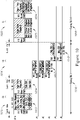
- FIG 11A shows, in accordance with embodiments, a plurality of Multi-Frames 1101(e.g. Multi Frame i, Multi Frame i +1) and Multi Frame structure, in accordance with embodiments.
- Multi-Frames 1101 e.g. Multi Frame i, Multi Frame i +1
- Multi Frame structure in accordance with embodiments.
- Each Multi-Frame may comprise for example 16 Framing Slots. It is stressed that the Multi-Frame structure may include any number of Framing Slots, for example, more or less than 16 Framing Slots.
- one or more of the Framing Slots of each Multi-Frame may be used as Maintenance Framing Slot such as Framing Slot 1110 and 1110' (slot numbered '0').
- the Maintenance Framing Slot time duration is equivalent to each of the other fixed Frame Slots (slots '1'- '15') time duration in the Multi-Frame.
- the time duration of the Maintenance Framing Slot 1110 and other Framing Slots is the same.
- the Maintenance Framing Slot 1110 is numbered '0' and located at the beginning of Multi-Frame 1100.
- the Multi-Frame 1100 total time duration and number of Framing Slots may vary between different Multi-Frames, hence, the time duration of a Multi-Frame is determined according to the number of Framing Slots in the Mult-Frame and time duration of each Framing Slot.
- the Multi-Frame duration can be broadcasted by AP to all STAs by the Maintenance Framing Slot 1110 in a Multi-Frame for the following Multi-Frames to synchronize Framing Slot sequence (e.g. numbering) between AP and STAs.
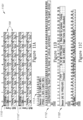
- FIG 11B shows a Maintenance Framing Slot 1112 (in Synchronous Mode) comprising Long BF Training and Figure 11C shows a Maintenance Framing Slot (Synchronous Mode) 1122 w/o BF Training.
- the Maintenance Framing Slot 1112 may comprise, in accordance with embodiments, a Beacon message 1113 for broadcasting specific network information as described hereinbelow and optionally also Beamforming Training procedure. When no Beamforming training procedure exists, the Maintenance Slot 1112 includes DL and UL PPDU following the Beacon message.
- the numbering in the Maintenance Framing Slot 1112 relates to the typical OFDM symbols numbers needed to transmit DL broadcast message (e.g. Beacon message) and Beamforming training messages sequence.
- the Multi-Frame structure in accordance with embodiments, supports the following capabilities:
- the AP/BST for the Framing Slot scheduling profile announcement (e.g. per following Multi-Frame) and other 802.11 broadcasting information (such as SSID (Service Set Identifier) broadcasting in according to 802.11).
- 802.11 broadcasting information such as SSID (Service Set Identifier) broadcasting in according to 802.11.
- Such announcements can be broadcasted using for example 802.11 Beacon message.
- the Framing Slot scheduling profile information includes (but not limited to), in accordance with embodiments:
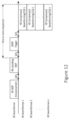
- Figure 12 shows the Beamforming training procedure as specified in 802.11ax. Such procedure may be included in the Maintenance Framing Slot as shown in Figure 11B and Figure 11C .
- BF Beamforming
- the Maintenance Framing Slot can be used for such procedure, while AP (HE beamformer) and associated STAs (HE beamformee) may use calculated beamforming matrixes until the next Beamforming Training procedure.
- AP HE beamformer
- STAs STAs
- the nodes (STAs) are aware of the following beamforming procedure and therefore AP may enable more optimized beamforming training procedure vs opportunistic scheduler.
- the Maintenance Framing Slot structure as shown in Figure 11B may be divided to transmission bursts (based on the typical OFDM symbols numbering) as follows:
- the Maintenance Framing Slot structure as shown in Figure 11C may be divided to transmission bursts (based on the typical OFDM symbols numbering) as follows:
- the structure of the Maintenance Framing Slot is mandatory however the number of symbols per each OFDM burst can vary.
- a Semi-Synchronous Multi-Frame structure which is a subset of the fully synchronous Framing Scheduler.
- the Semi-Synchronous Multi-Frame structure may be applicable for small networks (limited number of APs per network), where DL and UL transmission synchronization is not essential for inter-cell interference avoidance. Such deployment does not require a synchronization source (like as GPS or IEEE 1588).
- Another advantage of the Semi-Synchronous Multi-Frame structure is R&D implementation simplicity, where most of standard 802.11ax procedures can be used as is.
- the Semi-Synchronous Multi-Frame structure is suitable for example for unlicensed bands, where regulation requires LBT.
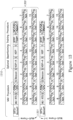
- FIG. 13 shows a plurality of Multi-Frames 1301 and a Multi-Frame structure 1300 for non-synchronized network, in accordance with embodiments.
- the Multi-Frame structure 1300 includes Maintenance Framing Slot 1310, which don't have a fixed time i.e. Maintenance Framing Slot 1310 may have different time durations than the other fixed time/regular Framing Slots (slots '0'-'15') and therefore must be transmitted before the regular Framing Slots are performed. Since this structure is not network synchronized it may include CSMA/CA timers (e.g. DIFS and Backoff) prior to any Multi-Frame.
- This Multi-Frame structure enables using NAV mechanism as defined in 802.11 using MU RTS/CTS messages and TXOP field.
- the Maintenance Framing Slot 1310 includes:
- FIG 14 shows an example of a Framing Slot 1400, which can be used for Semi-Synchronous Multi-Frame procedure, for OFDMA based wireless systems such as IEEE 802.11 standard, in accordance with embodiments.
- the Framing Slot 1400 may reuse the procedures as defined in 802.11ax and shown in Figure 5 .
- the Framing Slot 1400 for semi-synchronized scheduler comprises, in accordance with embodiments, DL and UL procedures- DL procedure 1410 includes Data Unit 1412 (e.g. HE MU-PPDU) signaled by AP toward STAs and in response an acknowledgment message Data unit 1414 (ACK/Block Ack in HE TB PPDU) from STAs toward AP.
- UL procedure 1420 includes Trigger Frame 1425 sent by AP toward STAs in order to instruct and synchronize regarding simultaneous UL transmission from STAs. Following Trigger Frame 1425, the STAs send Data Units 1426 (e.g. HE TB-PPDU) toward AP.
- AP responds with an acknowledgment (Block ACK) toward STAs.
- Block ACK acknowledgment
- Each duration of DL and UL procedures can vary in time, however, in accordance with embodiments, the combined DL and UL procedures within the Framing Slot are fixed in time (e.g. 2 msec) and predefined.
- the semi-synchronous Framing Slot 1400 may include using piggyback approach for Trigger Frame and acknowledgment information as defined for Synchronized Framing Slot as shown in Figure 8 and Figure 10 , however, between each 802.11 PPDU the system should keep SIFS 1430 timers and consider the SIFS periods as part of the semi-synchronized Framing Slot total duration.
- the present invention refers to any OFDMA based systems and networks such as 802.11 standard releases for example 802.11ax.
- the processing unit may be a digital processing device including one or more hardware central processing units (CPU) that carry out the device's functions.
- the digital processing device further comprises an operating system configured to perform executable instructions.
- the digital processing device is optionally connected to a computer network.
- the digital processing device is optionally connected to the Internet such that it accesses the World Wide Web.
- the digital processing device is optionally connected to a cloud computing infrastructure.
- the digital processing device is optionally connected to an intranet.
- the digital processing device is optionally connected to a data storage device.
- suitable digital processing devices include, by way of non-limiting examples, server computers, desktop computers, laptop computers, notebook computers, sub-notebook computers, netbook computers, netpad computers, set-top computers, handheld computers, Internet appliances, mobile smartphones, tablet computers, personal digital assistants, video game consoles, and vehicles.
- server computers desktop computers, laptop computers, notebook computers, sub-notebook computers, netbook computers, netpad computers, set-top computers, handheld computers, Internet appliances, mobile smartphones, tablet computers, personal digital assistants, video game consoles, and vehicles.
- smartphones are suitable for use in the system described herein.
- Suitable tablet computers include those with booklet, slate, and convertible configurations, known to those of skill in the art.
- the digital processing device includes an operating system configured to perform executable instructions.
- the operating system is, for example, software, including programs and data, which manages the device's hardware and provides services for execution of applications.
- the device such as the AP/BST/STA includes a storage and/or memory device.
- the storage and/or memory device is one or more physical apparatuses used to store data or programs on a temporary or permanent basis.
- the device is volatile memory and requires power to maintain stored information.
- the device is non-volatile memory and retains stored information when the digital processing device is not powered.
- the non-volatile memory comprises flash memory.
- the non-volatile memory comprises dynamic random-access memory (DRAM).
- the non-volatile memory comprises ferroelectric random access memory (FRAM).
- the non-volatile memory comprises phase-change random access memory (PRAM).
- the device is a storage device including, by way of non-limiting examples, flash memory devices, magnetic disk drives, magnetic tapes drives, optical disk drives, and cloud computing based storage.
- the storage and/or memory device is a combination of devices such as those disclosed herein.
- the digital processing device includes an input device to receive information from a user.
- the input device is a keyboard.
- the input device is a pointing device including, by way of non-limiting examples, a mouse, trackball, track pad, joystick, game controller, or stylus.
- the input device is a touch screen or a multi-touch screen.
- the input device is a microphone to capture voice or other sound input.
- the input device is a video camera to capture motion or visual input.
- the input device is a combination of devices such as those disclosed herein.
- the system disclosed herein includes one or more non-transitory computer readable storage media encoded with a program including instructions executable by the operating system of an optionally networked digital processing device.
- a computer readable storage medium is a tangible component of a digital processing device.
- a computer readable storage medium is optionally removable from a digital processing device.
- a computer program comprises one sequence of instructions. In some embodiments, a computer program comprises a plurality of sequences of instructions. In some embodiments, a computer program is provided from one location. In other embodiments, a computer program is provided from a plurality of locations. In various embodiments, a computer program includes one or more software modules. In various embodiments, a computer program includes, in part or in whole, one or more web applications, one or more mobile applications, one or more standalone applications, one or more web browser plug-ins, extensions, add-ins, or addons, or combinations thereof. In some embodiments, a computer program includes a mobile application provided to a mobile digital processing device. In some embodiments, the mobile application is provided to a mobile digital processing device at the time it is manufactured. In other embodiments, the mobile application is provided to a mobile digital processing device via the computer network described herein.
- the system disclosed herein includes software, server, and/or database modules, or use of the same.
- software modules are created by techniques known to those of skill in the art using machines, software, and languages known to the art.
- the software modules disclosed herein are implemented in a multitude of ways.
- a software module comprises a file, a section of code, a programming object, a programming structure, or combinations thereof.
- a software module comprises a plurality of files, a plurality of sections of code, a plurality of programming objects, a plurality of programming structures, or combinations thereof.
- the one or more software modules comprise, by way of non-limiting examples, a web application, a mobile application, and a standalone application.
- software modules are in one computer program or application. In other embodiments, software modules are in more than one computer program or application. In some embodiments, software modules are hosted on one machine. In other embodiments, software modules are hosted on more than one machine. In further embodiments, software modules are hosted on cloud computing platforms. In some embodiments, software modules are hosted on one or more machines in one location. In other embodiments, software modules are hosted on one or more machines in more than one location.
- the system disclosed herein includes one or more databases, or use of the same.
- suitable databases include, by way of non-limiting examples, relational databases, nonrelational databases, object oriented databases, object databases, entity-relationship model databases, associative databases, and XML databases.
- a database is internet-based.
- a database is web-based.
- a database is cloud computing-based.
- a database is based on one or more local computer storage devices.
Landscapes
- Engineering & Computer Science (AREA)
- Signal Processing (AREA)
- Computer Networks & Wireless Communication (AREA)
- Mobile Radio Communication Systems (AREA)
Applications Claiming Priority (1)
| Application Number | Priority Date | Filing Date | Title |
|---|---|---|---|
| US202163246863P | 2021-09-22 | 2021-09-22 |
Publications (2)
| Publication Number | Publication Date |
|---|---|
| EP4156828A2 true EP4156828A2 (de) | 2023-03-29 |
| EP4156828A3 EP4156828A3 (de) | 2023-05-31 |
Family
ID=83319090
Family Applications (1)
| Application Number | Title | Priority Date | Filing Date |
|---|---|---|---|
| EP22195515.6A Pending EP4156828A3 (de) | 2021-09-22 | 2022-09-14 | Synchronisierte rahmenplanungsverfahren und systeme für ofdma-basierte drahtlose systeme |
Country Status (2)
| Country | Link |
|---|---|
| US (2) | US12245278B2 (de) |
| EP (1) | EP4156828A3 (de) |
Family Cites Families (20)
| Publication number | Priority date | Publication date | Assignee | Title |
|---|---|---|---|---|
| US8599822B2 (en) | 2005-03-23 | 2013-12-03 | Cisco Technology, Inc. | Slot-based transmission synchronization mechanism in wireless mesh networks |
| US7706249B2 (en) | 2006-02-08 | 2010-04-27 | Motorola, Inc. | Method and apparatus for a synchronization channel in an OFDMA system |
| US7599341B2 (en) * | 2006-02-28 | 2009-10-06 | Motorola, Inc. | System and method for managing communication routing within a wireless multi-hop network |
| US8948094B2 (en) * | 2008-09-15 | 2015-02-03 | Google Technology Holdings LLC | Method and apparatus for optimizing downlink transmission in a wireless communication network |
| KR101605326B1 (ko) | 2010-02-26 | 2016-04-01 | 엘지전자 주식회사 | 신호 송수신 방법 및, 그를 위한 기지국 및 사용자기기 |
| US9467379B2 (en) | 2013-08-28 | 2016-10-11 | Qualcomm Incorporated | Methods and apparatus for multiple user uplink |
| KR102462973B1 (ko) | 2014-08-27 | 2022-11-04 | 엘지전자 주식회사 | 무선 통신 시스템에서 데이터 전송 방법 및 이를 위한 장치 |
| US9742543B2 (en) | 2014-09-23 | 2017-08-22 | Newracom, Inc. | Acknowledgment mechanisms for OFDMA operation |
| US10531433B2 (en) | 2014-10-29 | 2020-01-07 | Qualcomm Incorporated | Methods and apparatus for multiple user uplink access |
| US9756626B2 (en) | 2014-11-13 | 2017-09-05 | Intel IP Corporation | High-efficiency Wi-Fi (HEW) station and access point (AP) and method for signaling of channel resource allocations |
| WO2016104886A1 (ko) * | 2014-12-25 | 2016-06-30 | 엘지전자 주식회사 | 트리거 프레임을 기반으로 한 데이터 단위의 전송 방법 및 장치 |
| US20180035387A1 (en) | 2015-03-27 | 2018-02-01 | Intel IP Corporation | Frame structure design for ofdma based power control in 802.11ax standards and system |
| WO2016167431A1 (ko) * | 2015-04-16 | 2016-10-20 | 엘지전자(주) | 무선 통신 시스템에서의 데이터 전송 방법 및 이를 위한 장치 |
| US10057021B2 (en) | 2015-04-24 | 2018-08-21 | Ubiquiti Networks, Inc. | Resource allocation in a wireless communication system |
| US10181930B2 (en) | 2015-05-10 | 2019-01-15 | Newracom, Inc. | Multiplexing acknowledgment messages in response to downlink frames |
| US10264597B2 (en) | 2015-07-17 | 2019-04-16 | Ondas Networks Inc. | Method and system for best effort scheduling for a point to multipoint broadband wireless system |
| GB2549967A (en) * | 2016-05-04 | 2017-11-08 | Canon Kk | Improved reservation of channels in an 802.11AX network |
| US10911120B2 (en) | 2017-07-24 | 2021-02-02 | Qualcomm Incorporated | Downlink (DL) coordinated beamforming protocols for WiFi |
| FI20185326A1 (en) | 2018-04-06 | 2019-10-07 | Nokia Technologies Oy | Monitoring in wireless backhaul networks |
| US11490390B2 (en) | 2019-08-28 | 2022-11-01 | Qualcomm Incorporated | Enhanced resource management for mobile integrated access backhaul (IAB) |
-
2022
- 2022-09-14 EP EP22195515.6A patent/EP4156828A3/de active Pending
- 2022-09-21 US US17/933,987 patent/US12245278B2/en active Active
-
2025
- 2025-01-17 US US19/027,726 patent/US20250168883A1/en active Pending
Also Published As
| Publication number | Publication date |
|---|---|
| US20250168883A1 (en) | 2025-05-22 |
| US12245278B2 (en) | 2025-03-04 |
| EP4156828A3 (de) | 2023-05-31 |
| US20230089936A1 (en) | 2023-03-23 |
Similar Documents
| Publication | Publication Date | Title |
|---|---|---|
| US12010629B2 (en) | Method and device for uplink power control | |
| US11463886B2 (en) | Radio (NR) for spectrum sharing | |
| US11864122B2 (en) | Method and device for uplink power control | |
| KR102391726B1 (ko) | 비면허 스펙트럼 상에서 lte 셀들의 효율적인 동작을 위한 방법 | |
| US10548157B2 (en) | Unlicensed spectrum scheduling method and device, and user equipment UE | |
| KR102130953B1 (ko) | Lte 셀의 타이밍 정렬 및 비허가된 스펙트럼 상의 오퍼레이터 간 공존을 위한 시스템 및 방법 | |
| US9991998B2 (en) | Ratio resource sharing and contention scheme for device-to-device communication in white space spectrum bands | |
| US10631333B2 (en) | Synchronized medium sharing with private network | |
| CN112470541B (zh) | 用于新无线电非许可(nr-u)和新无线电同步共享(nr-ss)的传输机会(txop)结构 | |
| TWI673987B (zh) | 用於ofdm符元之靈活訊框架構之方法以及使用者設備 | |
| CN105659683B (zh) | 用于设置循环前缀长度的系统和方法 | |
| CN105165100A (zh) | 用于wlan的分数载波侦听多点接入/冲突避免(csma/ca)的系统和方法 | |
| CN105191469B (zh) | 一种包含蜂窝接口和Wi-Fi接口的无线用户设备的操作系统和方法 | |
| CN104185188A (zh) | 干扰处理方法及设备 | |
| US11297641B2 (en) | Scheduling of periodic traffic due to a missed transmission opportunity in unlicensed spectrum | |
| US12245278B2 (en) | Synchronized framing scheduling methods and systems for OFDMA based wireless systems | |
| US11382094B2 (en) | Optimized self-contained transmission in NR-SS | |
| WO2013170782A1 (zh) | 配置信道测量和进行上行信道测量的方法、系统及设备 | |
| EP4156824B1 (de) | Synchronisierte rahmenplanungsverfahren und systeme für drahtlose baum-mesh-netzwerke | |
| Filo | 5G Ultra-Dense Cellular Networks-performance analysis and MAC protocol design | |
| JP2023055765A (ja) | ユーザ機器及び基地局 | |
| JP2023109827A (ja) | ユーザ機器及び基地局 | |
| JP2022191326A (ja) | ユーザ機器及び基地局 |
Legal Events
| Date | Code | Title | Description |
|---|---|---|---|
| PUAI | Public reference made under article 153(3) epc to a published international application that has entered the european phase |
Free format text: ORIGINAL CODE: 0009012 |
|
| STAA | Information on the status of an ep patent application or granted ep patent |
Free format text: STATUS: THE APPLICATION HAS BEEN PUBLISHED |
|
| AK | Designated contracting states |
Kind code of ref document: A2 Designated state(s): AL AT BE BG CH CY CZ DE DK EE ES FI FR GB GR HR HU IE IS IT LI LT LU LV MC MK MT NL NO PL PT RO RS SE SI SK SM TR |
|
| PUAL | Search report despatched |
Free format text: ORIGINAL CODE: 0009013 |
|
| AK | Designated contracting states |
Kind code of ref document: A3 Designated state(s): AL AT BE BG CH CY CZ DE DK EE ES FI FR GB GR HR HU IE IS IT LI LT LU LV MC MK MT NL NO PL PT RO RS SE SI SK SM TR |
|
| RIC1 | Information provided on ipc code assigned before grant |
Ipc: H04W 84/12 20090101ALN20230426BHEP Ipc: H04W 72/12 20230101AFI20230426BHEP |
|
| STAA | Information on the status of an ep patent application or granted ep patent |
Free format text: STATUS: REQUEST FOR EXAMINATION WAS MADE |
|
| 17P | Request for examination filed |
Effective date: 20231130 |
|
| RBV | Designated contracting states (corrected) |
Designated state(s): AL AT BE BG CH CY CZ DE DK EE ES FI FR GB GR HR HU IE IS IT LI LT LU LV MC MK MT NL NO PL PT RO RS SE SI SK SM TR |
|
| STAA | Information on the status of an ep patent application or granted ep patent |
Free format text: STATUS: EXAMINATION IS IN PROGRESS |
|
| 17Q | First examination report despatched |
Effective date: 20250813 |