EP4156748A1 - Strahltrainingsverfahren, netzwerkvorrichtung, endgerät, system und speichermedium - Google Patents
Strahltrainingsverfahren, netzwerkvorrichtung, endgerät, system und speichermedium Download PDFInfo
- Publication number
- EP4156748A1 EP4156748A1 EP21822099.4A EP21822099A EP4156748A1 EP 4156748 A1 EP4156748 A1 EP 4156748A1 EP 21822099 A EP21822099 A EP 21822099A EP 4156748 A1 EP4156748 A1 EP 4156748A1
- Authority
- EP
- European Patent Office
- Prior art keywords
- query
- operating
- beams
- pilot information
- time
- Prior art date
- Legal status (The legal status is an assumption and is not a legal conclusion. Google has not performed a legal analysis and makes no representation as to the accuracy of the status listed.)
- Pending
Links
Images




Classifications
-
- H—ELECTRICITY
- H04—ELECTRIC COMMUNICATION TECHNIQUE
- H04W—WIRELESS COMMUNICATION NETWORKS
- H04W16/00—Network planning, e.g. coverage or traffic planning tools; Network deployment, e.g. resource partitioning or cells structures
- H04W16/24—Cell structures
- H04W16/28—Cell structures using beam steering
-
- H—ELECTRICITY
- H04—ELECTRIC COMMUNICATION TECHNIQUE
- H04B—TRANSMISSION
- H04B7/00—Radio transmission systems, i.e. using radiation field
- H04B7/02—Diversity systems; Multi-antenna system, i.e. transmission or reception using multiple antennas
- H04B7/04—Diversity systems; Multi-antenna system, i.e. transmission or reception using multiple antennas using two or more spaced independent antennas
- H04B7/06—Diversity systems; Multi-antenna system, i.e. transmission or reception using multiple antennas using two or more spaced independent antennas at the transmitting station
- H04B7/0613—Diversity systems; Multi-antenna system, i.e. transmission or reception using multiple antennas using two or more spaced independent antennas at the transmitting station using simultaneous transmission
- H04B7/0615—Diversity systems; Multi-antenna system, i.e. transmission or reception using multiple antennas using two or more spaced independent antennas at the transmitting station using simultaneous transmission of weighted versions of same signal
- H04B7/0617—Diversity systems; Multi-antenna system, i.e. transmission or reception using multiple antennas using two or more spaced independent antennas at the transmitting station using simultaneous transmission of weighted versions of same signal for beam forming
-
- H—ELECTRICITY
- H04—ELECTRIC COMMUNICATION TECHNIQUE
- H04B—TRANSMISSION
- H04B7/00—Radio transmission systems, i.e. using radiation field
- H04B7/02—Diversity systems; Multi-antenna system, i.e. transmission or reception using multiple antennas
- H04B7/04—Diversity systems; Multi-antenna system, i.e. transmission or reception using multiple antennas using two or more spaced independent antennas
- H04B7/06—Diversity systems; Multi-antenna system, i.e. transmission or reception using multiple antennas using two or more spaced independent antennas at the transmitting station
- H04B7/0613—Diversity systems; Multi-antenna system, i.e. transmission or reception using multiple antennas using two or more spaced independent antennas at the transmitting station using simultaneous transmission
- H04B7/0615—Diversity systems; Multi-antenna system, i.e. transmission or reception using multiple antennas using two or more spaced independent antennas at the transmitting station using simultaneous transmission of weighted versions of same signal
- H04B7/0619—Diversity systems; Multi-antenna system, i.e. transmission or reception using multiple antennas using two or more spaced independent antennas at the transmitting station using simultaneous transmission of weighted versions of same signal using feedback from receiving side
- H04B7/0621—Feedback content
- H04B7/0626—Channel coefficients, e.g. channel state information [CSI]
-
- H—ELECTRICITY
- H04—ELECTRIC COMMUNICATION TECHNIQUE
- H04B—TRANSMISSION
- H04B7/00—Radio transmission systems, i.e. using radiation field
- H04B7/02—Diversity systems; Multi-antenna system, i.e. transmission or reception using multiple antennas
- H04B7/04—Diversity systems; Multi-antenna system, i.e. transmission or reception using multiple antennas using two or more spaced independent antennas
- H04B7/06—Diversity systems; Multi-antenna system, i.e. transmission or reception using multiple antennas using two or more spaced independent antennas at the transmitting station
- H04B7/0613—Diversity systems; Multi-antenna system, i.e. transmission or reception using multiple antennas using two or more spaced independent antennas at the transmitting station using simultaneous transmission
- H04B7/0615—Diversity systems; Multi-antenna system, i.e. transmission or reception using multiple antennas using two or more spaced independent antennas at the transmitting station using simultaneous transmission of weighted versions of same signal
- H04B7/0619—Diversity systems; Multi-antenna system, i.e. transmission or reception using multiple antennas using two or more spaced independent antennas at the transmitting station using simultaneous transmission of weighted versions of same signal using feedback from receiving side
- H04B7/0621—Feedback content
- H04B7/0632—Channel quality parameters, e.g. channel quality indicator [CQI]
-
- H—ELECTRICITY
- H04—ELECTRIC COMMUNICATION TECHNIQUE
- H04B—TRANSMISSION
- H04B7/00—Radio transmission systems, i.e. using radiation field
- H04B7/02—Diversity systems; Multi-antenna system, i.e. transmission or reception using multiple antennas
- H04B7/04—Diversity systems; Multi-antenna system, i.e. transmission or reception using multiple antennas using two or more spaced independent antennas
- H04B7/06—Diversity systems; Multi-antenna system, i.e. transmission or reception using multiple antennas using two or more spaced independent antennas at the transmitting station
- H04B7/0686—Hybrid systems, i.e. switching and simultaneous transmission
- H04B7/0695—Hybrid systems, i.e. switching and simultaneous transmission using beam selection
- H04B7/06952—Selecting one or more beams from a plurality of beams, e.g. beam training, management or sweeping
- H04B7/0696—Determining beam pairs
-
- H—ELECTRICITY
- H04—ELECTRIC COMMUNICATION TECHNIQUE
- H04B—TRANSMISSION
- H04B7/00—Radio transmission systems, i.e. using radiation field
- H04B7/02—Diversity systems; Multi-antenna system, i.e. transmission or reception using multiple antennas
- H04B7/04—Diversity systems; Multi-antenna system, i.e. transmission or reception using multiple antennas using two or more spaced independent antennas
- H04B7/08—Diversity systems; Multi-antenna system, i.e. transmission or reception using multiple antennas using two or more spaced independent antennas at the receiving station
- H04B7/0837—Diversity systems; Multi-antenna system, i.e. transmission or reception using multiple antennas using two or more spaced independent antennas at the receiving station using pre-detection combining
- H04B7/0842—Weighted combining
- H04B7/086—Weighted combining using weights depending on external parameters, e.g. direction of arrival [DOA], predetermined weights or beamforming
-
- H—ELECTRICITY
- H04—ELECTRIC COMMUNICATION TECHNIQUE
- H04B—TRANSMISSION
- H04B7/00—Radio transmission systems, i.e. using radiation field
- H04B7/02—Diversity systems; Multi-antenna system, i.e. transmission or reception using multiple antennas
- H04B7/04—Diversity systems; Multi-antenna system, i.e. transmission or reception using multiple antennas using two or more spaced independent antennas
- H04B7/08—Diversity systems; Multi-antenna system, i.e. transmission or reception using multiple antennas using two or more spaced independent antennas at the receiving station
- H04B7/0868—Hybrid systems, i.e. switching and combining
- H04B7/088—Hybrid systems, i.e. switching and combining using beam selection
-
- H—ELECTRICITY
- H04—ELECTRIC COMMUNICATION TECHNIQUE
- H04L—TRANSMISSION OF DIGITAL INFORMATION, e.g. TELEGRAPHIC COMMUNICATION
- H04L5/00—Arrangements affording multiple use of the transmission path
- H04L5/0001—Arrangements for dividing the transmission path
- H04L5/0014—Three-dimensional division
- H04L5/0023—Time-frequency-space
-
- H—ELECTRICITY
- H04—ELECTRIC COMMUNICATION TECHNIQUE
- H04L—TRANSMISSION OF DIGITAL INFORMATION, e.g. TELEGRAPHIC COMMUNICATION
- H04L5/00—Arrangements affording multiple use of the transmission path
- H04L5/003—Arrangements for allocating sub-channels of the transmission path
- H04L5/0048—Allocation of pilot signals, i.e. of signals known to the receiver
- H04L5/0051—Allocation of pilot signals, i.e. of signals known to the receiver of dedicated pilots, i.e. pilots destined for a single user or terminal
-
- H—ELECTRICITY
- H04—ELECTRIC COMMUNICATION TECHNIQUE
- H04W—WIRELESS COMMUNICATION NETWORKS
- H04W72/00—Local resource management
- H04W72/04—Wireless resource allocation
- H04W72/044—Wireless resource allocation based on the type of the allocated resource
- H04W72/046—Wireless resource allocation based on the type of the allocated resource the resource being in the space domain, e.g. beams
-
- H—ELECTRICITY
- H04—ELECTRIC COMMUNICATION TECHNIQUE
- H04L—TRANSMISSION OF DIGITAL INFORMATION, e.g. TELEGRAPHIC COMMUNICATION
- H04L5/00—Arrangements affording multiple use of the transmission path
- H04L5/0091—Signalling for the administration of the divided path, e.g. signalling of configuration information
- H04L5/0094—Indication of how sub-channels of the path are allocated
Definitions
- the present disclosure relates to the technical field of communication, and in particular to a beam training method, a network device, a terminal device, a system and a storage medium.
- the use of high carrier frequencies has attracted extensive attention in the communication industry.
- the high carrier frequencies can bring rich spectrum resources, high frequency signals may undergo high intensity loss, remarkable atmospheric absorption, heavy rain attenuation or the like during the propagation in a free space propagation path, which has a significant impact on the coverage distance of the high frequency signals.
- multiple beams need to be designed on both the base station side and the terminal device side, and an optimal beam pair for communication between the base station side and the terminal device side is obtained through beam training.
- An embodiment of the present disclosure provides a beam training method.
- the method includes: acquiring an operating beam set and a query beam set, the operating beam set including at least one operating beam, the query beam set including K 1 query beams, the K 1 query beams being divided into Q 1 query beam groups; and, issuing pilot information by utilizing time-frequency resource positions within Q 1 beam training periods to train the operating beam set and the query beam set, where each of the beam training periods includes an operating beam issuing time and a query beam issuing time.
- the issuing pilot information by utilizing time-frequency resource positions within Q 1 beam training periods includes: for each beam training period, transmitting, at a time-frequency resource position within an operating beam issuing time corresponding to the beam training period, pilot information by utilizing an operating beam in the operating beam set; and, transmitting, at a time-frequency resource position within a query beam issuing time corresponding to the beam training period, pilot information by utilizing a query beam in any of the query beam groups.
- An embodiment of the present disclosure further provides a beam training method.
- the method includes: receiving, at time-frequency resource positions within Q 1 beam training periods, multiple pieces of pilot information from a network device, the multiple pieces of pilot information including at least one piece of operating beam pilot information and K 1 pieces of query beam pilot information, the operating beam pilot information being pilot information transmitted using an operating beam by the network device within Q 1 operating beam issuing times of Q 1 beam training periods, the query beam pilot information being pilot information transmitted using any query beam group by the network device within Q 1 query beam issuing times of Q 1 beam training periods; detecting signal quality of the multiple pieces of pilot information; and, feeding signal quality of beams corresponding to the multiple pieces of pilot information back to the network device.
- the present disclosure further provides a network device.
- the network device includes a memory, a processor and a program stored in the memory and executable by the processor which, when executed by the processor, causes the processor to implement the first beam training method described above.
- the present disclosure further provides a terminal device.
- the terminal device includes a memory, a processor and a program stored in the memory and executable by the processor which, when executed by the processor, causes the processor to implement the second beam training method described above.
- the present disclosure further provides a beam training system.
- the system includes a network device configured to execute the first beam training method described above, and a terminal device configured to execute the second beam training method described above.
- the present disclosure further provides a storage medium for computer-readable storage, storing one or more programs executable by one or more processors which, when executed by the one or more processors, cause the one or more processors to implement methods described above.
- high carrier frequencies include 28 GHz, 39 GHz, 60 GHz, 70 GHz, terahertz, etc. Although the high carrier frequencies can bring rich spectrum resources, high frequency signals may undergo high intensity loss, remarkable atmospheric absorption, heavy rain attenuation or the like during the propagation in a free space propagation path, which has a significant impact on the coverage distance and scenarios of the high frequency signals in actual use.
- Massive antenna arrays well make up for this defect in high frequency communication systems by a high beamforming gain.
- a high antenna gain can be obtained by the massive antenna array and beamforming, thereby ensuring sufficient link coverage.
- the massive Multiple-Input Multiple-Output (MIMO) beamforming has the advantage of providing a large antenna gain in one direction, but the gain beam is often very narrow. Therefore, the use of multiple beams becomes a typical feature of high frequency communication.
- multiple beams need to be designed for the network device and the terminal device.
- multiple beams 110 are designed for the network device 100
- multiple beams 120 are designed for the terminal device 200.
- An optimal beam pair for communication between the network device 100 and the terminal device 200 is obtained through beam training.
- a large number of beams will be trained, causing a high system overhead.
- pilot information needs to be issued by utilizing all beams to be trained within the beam training period, resulting in a long beam training period and high system overhead. Therefore, how to reduce the system overhead in the beam training stage is a problem to be solved.
- the present disclosure provides a beam training method, a network device, a terminal device, a system and a storage medium, which can reduce the resources used in beam training, improve the beam training efficiency and reduce the system overhead.
- an embodiment of the present disclosure provides a beam training method, which is applied to a network device.
- the method includes the following steps S110 to S120.
- an operating beam set and a query beam set are acquired, where the operating beam set includes at least one operating beam, the query beam set includes K 1 query beams, and the K 1 query beams are divided into Q 1 query beam groups.
- N beams covering a target region are acquired as a beam set Z, i.e., ⁇ Z 1 ,Z 2 , whil,Z N ⁇ .
- a beam set to be issued is selected from the beam set Z for beam training.
- the issued beam set includes an operating beam set and a query beam set.
- the operating beam set is W, i.e., ⁇ W 1 ,W 2 , whil,W M ⁇ , and has a total of M operating beams, where M is a positive integer greater than or equal to 2; and, the query beam set is S, i.e., ⁇ S 1 ,S 2 ,. hence,S K 1 ⁇ , and has a total of K 1 query beams, where K 1 is a positive integer greater than or equal to 2, with W ⁇ Z, S ⁇ Z, W ⁇ S ⁇ Z, and M+K 1 ⁇ N.
- the operating beams cover the beams in the target region, and the query beams may be determined by changing a beam width and/or coverage distance of the operating beams.
- the operating beams in the operating beam set are used for long-time communication of a control channel and a service channel between the network device and the terminal device.
- the query beams in the query beam set are used for beam discovery in the beam training process, and may be used for short-time communication of the control channel and the service channel between the network device and the terminal device.
- the network device is a base station, or may be other network devices which can realize the function of the base station.
- pilot information is issued by utilizing time-frequency resource positions within Q 1 beam training periods to train the operating beam set and the query beam set.
- beam training periods T are set, and each beam training period T includes an operating beam issuing time and a query beam issuing time.
- the pilot information is transmitted during the operating beam issuing time by utilizing an operating beam, while the pilot information is transmitted at the query beam issuing time by utilizing a query beam.
- the pilot information is known information defined through a protocol by the network device and the terminal device.
- time-frequency resource positions are time positions where the pilot information is placed in a frame structure
- the time-frequency resource positions are in one-to-one mapping with the operating beams (that is, one time-frequency resource position maps one operating beam and one operating beam number)
- the time-frequency resource positions of the query beams are in one-to-multiple mapping with the query beams, that is, one time-frequency resource position maps multiple query beams and query beam numbers.
- S120 includes following steps of S121 to S122.
- pilot information is transmitted at a time-frequency resource position within the operating beam issuing time corresponding to beam training period by utilizing an operating beam in the operating beam set.
- the beam training of the operating beam set and the query beam set is completed by utilizing Q 1 beam training periods.
- the network device transmits pilot information to the terminal device by utilizing M operating beams in the beam set at M corresponding time-frequency resource positions.
- pilot information is transmitted at a time-frequency resource position within the query beam issuing time corresponding to each beam training period by utilizing a query beam in any query beam group.
- the network device transmits pilot information to the terminal device by utilizing R 1 query beams in any query beam group.
- the network device may also transmit pilot information to the terminal device by utilizing the query beams in Q 1 query beam groups, respectively, so as to train the Q 1 query beam groups within Q 1 corresponding beam training periods, thereby training the query beams in the query beam set.
- the pilot information is transmitted to the terminal device at R 1 corresponding time-frequency resource positions by utilizing R 1 query beams in a first query beam group; in a second beam training period, the pilot information is transmitted to the terminal device at R 1 corresponding time-frequency resource positions by utilizing R 1 query beams in a second query beam group; and by that analogy, in a Q 1 th beam training period, the pilot information is transmitted to the terminal device at R 1 corresponding time-frequency resource positions by utilizing R 1 query beams in the Q 1 th query beam group.
- the query beams in the Q 1 query beam groups may or may not be trained in the above order as long as it can be ensured that the Q 1 query beam groups are trained within Q 1 corresponding beam training periods so as to train the query beams in the query beam set.
- M+K 1 time-frequency resource positions need to be issued within the beam training periods.
- the operating beams and the query beams are issued by the base station.
- the query beams are issued in Q 1 groups, so that the number of time-frequency resource positions issued within each training period (the number M of operating beams + the number R 1 of query beams in each group) is decreased. Accordingly, more beams are trained by utilizing fewer time-frequency resource positions, resulting in an improved beam training efficiency and reduced system overhead.
- the operating beams since the operating beams are issued within each beam training period, the operating beams have been repeatedly issued for Q 1 times after Q 1 beam training periods. Due to the increase in the number of operating beams, the opportunity of receiving operating beams by the terminal device is increased, and the coverage area of the base station is expanded.
- the beam training method further includes a following step S130.
- the terminal device is notified of the number of pieces of pilot information issued within each beam training period, such that the terminal device can receive the operating beams and the query beams according to the number of pieces of pilot information.
- M+R 1 time-frequency resource positions are issued within each bean training period, and the time-frequency resource positions are time positions where the pieces of pilot information are placed in a frame structure.
- the number of pieces of pilot information issued within each beam training period is M+R 1
- the number of pieces of pilot information issued within Q 1 beam training periods is also M+K 1 .
- the network device needs to notify the terminal device of the number M+R 1 of pieces of pilot information issued within each beam training period and the number M+K 1 of pieces of pilot information issued within Q 1 beam training periods.
- the terminal device receives M pieces of operating beam pilot information and R 1 pieces of query beam pilot information at M+R 1 occasions and corresponding time-frequency resource positions within each beam training period.
- the beam training method further includes the following steps S140 to S150.
- an optimal beam pair set is determined according to the signal quality of the operating beams and the query beams.
- the terminal device upon receiving M pieces of operating beam pilot information and R 1 pieces of query beam pilot information, the terminal device detects the signal quality of the pilot information and then feed the signal quality and beam numbers of M+R 1 beams back to the network device.
- the network device receives the signal quality of the operating beams and the query beams (i.e., the signal quality of the pilot information of the operating beam and the signal quality of the pilot information of the query beam) fed back by the terminal device, and then determines an optimal beam pair set according to the signal quality of the operating beams and the query beams to train beam pairs.
- the beam pair is a pair of communication links formed by a network device beam and a terminal device beam.
- the optimal beam pair set may include one or more optimal beam pairs.
- the optimal beam pair may be a pair of optimal operating beams for communication between the network device and the terminal device, or may be a pair of optimal query beams for communication between the network device and the terminal device. It should be understood that, if there is only one terminal device on the terminal device side, there is only one optimal beam pair; and, if there are multiple terminal devices on the terminal device side, there are multiple optimal beam pairs in the optimal beam pair set, that is, there is an optimal beam pair between the network device and each terminal device.
- parameters of the single quality fed back by the terminal device include, but not limited to, Reference Signal Receiving Power (RSRP) and Signal to Interference plus Noise Ratio (SINR).
- RSRP Reference Signal Receiving Power
- SINR Signal to Interference plus Noise Ratio
- the beam training method further includes the following steps S160 to S170.
- the signal quality of an operating beam is compared with the signal quality of a query beam in the optimal beam pair set.
- the operating beam set and the query beam set are updated according to a result of comparison.
- the operating beam set and the query beam set need to be updated.
- the network device updates the operating beams in the operating beam set and the query beams in the query beam set.
- S170 includes the following steps S171 to S173.
- the query beam is deleted from the query beam set, and added into the operating beam set as an operating beam.
- the signal quality of the operating beam is subtracted from the signal quality of the query beam. If the difference is greater than the first threshold value, it indicates that the query beam has better communication quality (in this case, the optimal beam is the query beam), and the query beam is deleted from the query beam set and added into the operating beam set as an operating beam; otherwise, the operating beam set and the query beam set are remained unchanged.
- S170 further includes the following steps S174 to S175.
- the operating beam is deleted from the operating beam set, and added into the query beam set as a query beam.
- the signal quality of the query beam is subtracted from the signal quality of the operating beam. If the difference is less than the second threshold value, it indicates that the operating beam has poorer communication quality, and the operating beam is deleted from the operating beam set and added into the query beam set as a query beam.
- the operating beam since the operating beam is used for long-time communication between the network device and terminal device, a determination mechanism needs to be added for the deletion of the operating beam to avoid erroneous determination.
- the signal quality of the query beam is subtracted from the signal quality of the operating beam. If the difference is less than the second threshold value and lasts for a preset time, it indicates that the operating beam has poorer communication quality within this preset time, and the operating beam is deleted from the operating beam set and added into the query beam set as a query beam.
- the network device updates the beam sets according to the feedback from one terminal device. If there are multiple terminal devices on the terminal device side, in some embodiments, the network device may update the beam sets under a certain criterion according to the feedback from multiple terminal devices.
- S140 includes a following step S141.
- the S150 includes a following step S151.
- an optimal beam pair set is determined according to the signal quality of the multiple operating beams and the multiple query beams.
- the beam training method further includes a following step S180 or S190.
- the operating beam set and the query beam set are updated according to a proportion of optimal beams in the optimal beam pair set being a query beam fed back by the terminal device.
- the operating beam set and the query beam set are updated according to attribute parameters of the terminal device.
- the determined optimal beam pair set includes multiple optimal beam pairs, that is, there is an optimal beam pair between the network device and each of the terminal devices.
- the network device determines an optimal beam pair set according to the signal quality of multiple operating beams and multiple query beams fed back multiple terminal devices, and calculates the proportion of the optimal beams in the optimal beam pair set being a query beam. If the proportion is greater than a preset proportion, the steps S160 and S170 will be executed to update the operating beam set and the query beam set.
- the operating beam set and the query beam set may also be updated according to the attribute parameters of the terminal device.
- the attribute parameters of the terminal device may be soft attribute parameters of the terminal device, for example, the class of service of the terminal device. Taking the class of service of the terminal device including a high-priority terminal device and a common-class terminal device as an example, if the terminal device is a high-priority terminal device, regardless of the signal quality of the operating beams and the query beams or the proportion fed back by different terminal devices in the network, the network device updates the operating beams for the high-priority terminal device to ensure the normal communication between the network device and the high-priority terminal device. If the terminal device is a common-class terminal device, the network device may determine, according to the influence of the feedback from multiple terminal devices on the overall performance of the system, whether or not to update the operating beams.
- the network device after the network device updates the operating beam set and the query beam set, the network device also updates the time-frequency resource positions according to the updated operating beam set and the updated query beam set.
- M+K 1 beams are meant to be trained by utilizing M+K 1 time-frequency resource positions; however, with the beam training method provided by the embodiments of the present disclosure, M+K 1 beams can be trained by utilizing only M+R 1 time-frequency resource positions, so that the beam training efficiency is improved and the system overhead is reduced.
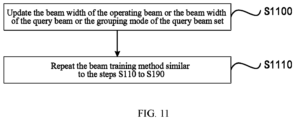
- the beam training method further includes the following steps S1100 to S1110.
- the beam width of the operating beam or the beam width of the query beam or the grouping mode of the query beam set is updated.
- the beam training method similar to the steps S110 to S190 is repeated.
- 51100 includes the following steps 51111 to S1119.
- the updated operating beam set and the updated query beam set are acquired, where the updated operating beam set includes at least one operating beam, the updated query beam set includes K 2 query beams, the K 2 query beams are divided into Q 2 query beam groups, and both K 2 and Q 2 are positive integers greater than or equal to 2.
- pilot information is issued by utilizing time-frequency resource positions within Q 2 beam training periods to train the updated operating beam set and the updated query beam set.
- the terminal device is notified of the number of pieces of pilot information issued within each beam training period, such that the terminal device can receive the operating beams and the query beams according to the number of pieces of pilot information.
- the signal quality of the operating beams and the query beams fed back by the terminal device is received.
- an optimal beam pair set is determined according to the signal quality of the operating beams and the query beams.
- the signal quality of the operating beams is compared with the signal quality of the query beams in the optimal beam pair set.
- the operating beam set and the query beam set are updated according to the result of comparison.
- the operating beam set and the query beam set are updated according to the proportion of the optimal beams in the optimal beam pair set being a query beam.
- the operating beam set and the query beam set are updated according to attribute parameters of the terminal device.
- the process from S1111 to S1119 may refer to the description of the steps S110 to S 190 and will not be repeated here.
- the steps S110 to S190 of the beam training method are executed in a first total beam training period (the first total beam training period includes Q 1 beam training periods) for beam training.
- the beam width of the operating beam or the beam width of the query beam or the grouping mode of the query beam set is updated, and S1110 is executed in a second total beam training period (the second total beam training period includes Q 2 beam training periods) for beam training.
- the beam width of the operating beam or the beam width of the query beam or the grouping mode of the query beam set to repeat the above beam training method by updating the beam width of the operating beam or the beam width of the query beam or the grouping mode of the query beam set to repeat the above beam training method, more types of beams can be trained, so that the communication between the base station and more types of terminal devices can be realized.
- the beam width is used to represent the size of the region covered by the beam.
- the beam width is inversely related to the number of beams. For example, if the beam width of query beams in the second beam training period is reduced by 2 times in comparison to the beam width of query beams in the first beam training period, the number of query beams to be issued in the second beam training period is twice the number of query beams to be issued in the first beam training period.
- two types of query beams are trained by updating the beam width of query beams.
- updating the grouping mode of the query beam set may be updating the number of query beams and the number of query beams in each query beam group. For example, 24 query beams are divided into 8 groups, and each group has 3 query beams. After updating, 48 query beams are divided into 8 groups, and each group has 6 query beams.
- an embodiment of the present disclosure provides a beam training method, which is applied to a terminal device.
- the terminal device may be a mobile terminal device or a non-mobile terminal device.
- the mobile terminal device may be a mobile phone, a tablet computer, a notebook computer, a palmtop computer, a vehicle-mounted terminal device, a wearable device, a super mobile personal computer, a netbook, a personal digital assistant, etc.
- the non-mobile terminal device may be a personal computer, a TV set, a teller machine, a self-service machine, etc. This will not be specifically limited in the embodiments of the present disclosure.
- the method includes the following steps S210 to S230.
- multiple pieces of pilot information from a network device are received at time-frequency resource positions within Q 1 beam training periods, where the multiple pieces of pilot information include at least one piece of operating beam pilot information and K 1 pieces of query beam pilot information, the operating beam pilot information is pilot information transmitted using an operating beam by the network device within Q 1 operating beam issuing times of Q 1 beam training periods, and the query beam pilot information is pilot information transmitted using any query beam group by the network device within Q 1 query beam issuing times of Q 1 beam training periods.
- the network device transmits operating beam pilot information to the terminal device within Q 1 operating beam issuing times of Q 1 beam training periods by utilizing an operating beam, and transmits query beam pilot information to the terminal device within Q 1 operating beam issuing times of Q 1 beam training periods by utilizing any query beam group.
- the terminal device receives the operating beam pilot information and the query beam pilot information at the time-frequency resource positions within Q 1 beam training periods. If the operating beam set acquired by the network device has M operating beams and the query beam set has K 1 operating beams, the number of pieces of pilot information received by the terminal device is M+K 1 .
- the signal quality of multiple pieces of pilot information is detected.
- the terminal device upon receiving the operating beam pilot information and the query beam pilot information, the terminal device detects the signal quality of the operating beam pilot information and the query beam pilot information.
- Parameters to be detected include, but not limited to, Reference Signal Receiving Power (RSRP) and Signal to Interference plus Noise Ratio (SINR).
- RSRP Reference Signal Receiving Power
- SINR Signal to Interference plus Noise Ratio
- the signal quality of beams corresponding to the multiple pieces of pilot information is fed back to the network device.
- the terminal device after the terminal device detects the signal quality of the operating beam pilot information and the query beam pilot information, the terminal device feeds the signal quality of beams corresponding to the pilot information back to the network device, such that the network device determines an optimal beam pair set according to the feedback from the terminal device and then updates the operating beam set and the query beam set according to the signal quality of the operating beams and the signal quality of the query beams in the optimal beam pair set.
- the updating process may refer to the description in the first aspect.
- the beam training method further includes a following step S240.
- the number of pieces of pilot information issued within each beam training period from the network device is received.
- S210 includes: receiving pilot information corresponding to the number of pieces of pilot information at time-frequency resource positions within each beam training period.
- the terminal device receives the number of pieces of pilot information issued within each beam training period from the network device. If the operating beam set acquired by the network device has M operating beams and the query beam set has R 1 query beams, the number of pieces of pilot information received by the terminal device within one beam training period is M+R 1 .
- the terminal device receives, at the time-frequency resource positions within each beam training period, M+R 1 pieces of pilot information, i.e., receiving M pieces of operating beam pilot information and R 1 pieces of query beam pilot information.
- the terminal device detects the signal quality of the pilot information and then feeds the signal quality and beam numbers of the M+R 1 pieces of beam pilot information back to the network device.
- an embodiment of the present disclosure provides a beam training method, which is applied to a system including a network device and a terminal device.
- the beam training method includes the beam training method described in the first aspect and the beam training method described in the second aspect.
- the network device is a base station.
- the operating beams have the same beam width
- the query beams also have the same beam width
- a beam set to be issued is selected from the beam set Z for beam training.
- the issued query beams are issued in groups. During the query beam issuing time within a first beam training period, a first group of query beams are issued; during the query beam issuing time within a second beam training period, a second group of query beams are issued; and by that analogy, during the query beam issuing time within a sixth beam training period, a sixth group of query beams are issued.
- This beam issuing process is repeated until all query beam groups are transmitted for one time.
- the terminal device receives 16 pieces of operating beam pilot information and 8 pieces of query beam pilot information at 24 occasions and corresponding time-frequency resource positions, detects the signal quality (including but not limited to RSRP and SINR) of the known pilot information, and feeds 24 beam numbers and signal qualities to the base station. That is, the beam numbers are in one-to-one correspondence to the signal quality of the corresponding beams, so that the base station can know the signal quality corresponding to each operating beam or query beam.
- the signal quality including but not limited to RSRP and SINR
- the base station selects, according to the signal quality of the operating beams and the query beams fed back by the terminal device, an optimal beam pair set between the base station and the terminal device to complete beam training.
- the base station uses 24 time-frequency resource positions and trains 64 beams; however, in some cases, 64 time-frequency resource positions are needed for training 64 beams. Therefore, the beam training method in this embodiment significantly reduces the system overhead and improves the beam training efficiency.
- the operating beams have the same beam width
- the query beams have different beam widths.
- the first total beam training period includes three beam training periods T
- the second total beam training period includes six beam training periods T.
- One wide beam of the query beams in the first total beam training period and two narrow beams of the query beams in the second total beam training period correspond to the same coverage region. It should be understood that the number of query beams in the second total beam training period is 2 times the number of query beams in the first total beam training period.
- the first total beam training period (the query beams are wide beams) is described below.
- a beam set to be issued is selected from the beam set Z for beam training.
- the issued query beams are issued in groups.
- a first group of query beams are issued; during the query beam issuing time within a second beam training period, a second group of query beams are issued; and by that analogy, at the query beam issuing time within a third beam training period, a third group of query beams are issued.
- This beam issuing process is repeated until all query beam groups are transmitted for one time.
- the terminal device receives 16 pieces of operating beam pilot information and 8 pieces of query beam pilot information at 24 occasions and corresponding time-frequency resource positions, detects the signal quality (including but not limited to RSRP and SINR) of the known pilot information, and feeds 24 beam numbers and signal qualities to the base station.
- the signal quality including but not limited to RSRP and SINR
- the base station selects, according to the signal quality of the operating beams and the query beams fed back by the terminal device, an optimal beam pair set between the base station and the terminal device to complete beam training.
- the base station uses 24 time-frequency resource positions and trains 40 beams, so that the system overhead is significantly reduced and the beam training efficiency is improved.
- the second total beam training period (the query beams are narrow beams) is described below.
- a beam set to be issued is selected from the beam set Z for beam training.
- the issued query beams are issued in groups. During the query beam issuing time within a first beam training period, a first group of query beams are issued; during the query beam issuing time within a second beam training period, a second group of query beams are issued; and by that analogy, during the query beam issuing time within a sixth beam training period, a sixth group of query beams are issued.
- This beam issuing process is repeated until all query beam groups are transmitted for one time.
- the terminal device receives 16 pieces of operating beam pilot information and 8 pieces of query beam pilot information at 24 occasions and corresponding time-frequency resource positions, detects the signal quality (including but not limited to RSRP and SINR) of the known pilot information, and feeds 24 beam numbers and signal qualities to the base station.
- the signal quality including but not limited to RSRP and SINR
- the base station selects, according to the signal quality of the operating beams and the query beams fed back by the terminal device, an optimal beam pair set between the base station and the terminal device to complete beam training.
- the base station uses 24 time-frequency resource positions and trains 64 beams, so that the system overhead is significantly reduced and the beam training efficiency is improved.
- each terminal device is configured with ID information.
- a beam set to be issued is selected from the beam set Z for beam training.
- the issued query beams are issued in groups. At the query beam issuing time within a first beam training period, a first group of query beams are issued; during the query beam issuing time within a second beam training period, a second group of query beams are issued; and by that analogy, during the query beam issuing time within a sixth beam training period, a sixth group of query beams are issued.
- This beam issuing process is repeated until all query beam groups are transmitted for one time.
- the terminal device receives 16 pieces of operating beam pilot information and 8 pieces of query beam pilot information at 24 occasions and corresponding time-frequency resource positions, detects the signal quality (including but not limited to RSRP and SINR) of the known pilot information, and feeds 24 beam numbers and signal qualities as well as the ID information of the terminal devices to the base station.
- the signal quality including but not limited to RSRP and SINR
- the base station receives the signal quality fed back by multiple terminal devices, and selects, according to the signal quality of the operating beams and the query beams fed back by the multiple terminal devices and the ID information of the terminal devices, an optimal beam pair set between the base station and the corresponding terminal device to complete beam training.
- the base station compares the signal quality of the operating beam with the signal quality of the query beam in the optimal beam pair set, and updates the operating beam set and the query beam set according to the result of comparison.
- the base station After the base station updates the operating beam set and the query beam set, the base station further updates the time-frequency resource positions according to the updated operating beam set and the updated query beam set.
- the number of time-frequency resource positions is updated according to the number of operating beams in the updated operating beam set and the number of query beams in the updated query beam set.
- the operating beams have different beam widths
- the query beams also have different beam widths.
- the first total beam training period includes three beam training periods T
- the second total beam training period includes five beam training periods T.
- the number of time-frequency resource positions may be changed in each total beam training period.
- the number of time-frequency resource positions in the first total beam training period is 24, and the number of time-frequency resource positions in the second total beam training period is 32.
- the first total beam training period (the number of time-frequency resource positions is 24) is described below.
- a beam set to be issued is selected from the beam set Z for beam training.
- the issued query beams are issued in groups.
- a first group of query beams are issued; during the query beam issuing time within a second beam training period, a second group of query beams are issued; and by that analogy, during the query beam issuing time within a third beam training period, a third group of query beams are issued.
- This beam issuing process is repeated until all query beam groups are transmitted for one time.
- the terminal device receives 16 pieces of operating beam pilot information and 8 pieces of query beam pilot information at 24 occasions and corresponding time-frequency resource positions, detects the signal quality (including but not limited to RSRP and SINR) of the known pilot information, and feeds 24 beam numbers and signal qualities to the base station.
- the signal quality including but not limited to RSRP and SINR
- the base station selects, according to the signal quality of the operating beams and the query beams fed back by the terminal device, an optimal beam pair set between the base station and the terminal device for beam training.
- the base station uses 24 time-frequency resource positions and trains 40 beams, so that the system overhead is significantly reduced and the beam training efficiency is improved.
- the second total beam training period (the number of time-frequency resource positions is 32) is described below.
- a beam set to be issued is selected from the beam set Z for beam training.
- the issued query beams are issued in groups. At the query beam issuing time within a first beam training period, a first group of query beams are issued; during the query beam issuing time within a second beam training period, a second group of query beams are issued; and by that analogy, at the query beam issuing time within a fifth beam training period, a fifth group of query beams are issued.
- This beam issuing process is repeated until all query beam groups are transmitted for one time.
- the terminal device receives 24 pieces of operating beam pilot information and 8 pieces of query beam pilot information at 32 occasions and corresponding time-frequency resource positions, detects the signal quality (including but not limited to RSRP and SINR) of the known pilot information, and feeds 32 beam numbers and signal qualities to the base station.
- the signal quality including but not limited to RSRP and SINR
- the base station selects, according to the signal quality of the operating beams and the query beams fed back by the terminal device, an optimal beam pair set between the base station and the terminal device to complete beam training.
- the base station uses 32 time-frequency resource positions and trains 64 beams, so that the system overhead is significantly reduced and the beam training efficiency is improved.
- both the operating beam set and the query beam set are changed.
- the opportunity of receiving operating beams by the terminal device is increased, and query is continuously performed by utilizing query beams, thereby expanding the coverage region of the base station.
- an embodiment of the present disclosure provides a network device.
- the network device includes a memory, a processor and a program stored in the memory and executable by the processor which, when executed by the processor, causes the processor to implement the beam training method described in the first aspect.
- the network device is a base station, or may be other network devices which can realize the function of the base station.
- an embodiment of the present disclosure provides a terminal device.
- the terminal device includes a memory, a processor and a program stored in the memory and executable by the processor which, when executed by the processor, causes the processor to implement the beam training method described in the second aspect.
- the terminal device may be a mobile terminal device or a non-mobile terminal device.
- the mobile terminal device may be a mobile phone, a tablet computer, a notebook computer, a palmtop computer, a vehicle-mounted terminal device, a wearable device, a super mobile personal computer, a netbook, a personal digital assistant, etc.
- the non-mobile terminal device may be a personal computer, a TV set, a teller machine, a self-service machine, etc. This will not be specifically limited in the embodiments of the present disclosure.
- an embodiment of the present disclosure provides a beam training system.
- the system includes a network device and a terminal device.
- the network device is configured to execute the steps in the beam training method described in the first aspect
- the terminal device is configured to execute the steps in the beam training method described in the second aspect, thus performing the beam training between the network device and the terminal device.
- the network device is a base station, or may be other network devices which can realize the function of the base station.
- the terminal device may be a mobile terminal device or a non-mobile terminal device.
- the mobile terminal device may be a mobile phone, a tablet computer, a notebook computer, a palmtop computer, a vehicle-mounted terminal device, a wearable device, a super mobile personal computer, a netbook, a personal digital assistant, etc.
- the non-mobile terminal device may be a personal computer, a TV set, a teller machine, a self-service machine, etc. This will not be specifically limited in the embodiments of the present disclosure.
- an embodiment of the present disclosure provides a storage medium for computer-readable storage.
- the storage medium stores one or more programs executable by one or more processors which, when executed by the one or more processors, cause the one or more processor to implement the beam training method described in the first aspect or the beam training method described in the second aspect.
- the embodiments of the present disclosure are mainly to provide a beam training method, a network device, a terminal device, a system and a storage medium, which are intended to train more beams by utilizing fewer time-frequency resource positions, so as to improve the beam training efficiency and reduce the system overhead.
- the operating beams and the query beams are issued by the base station.
- the query beams are issued in groups, so that the number of time-frequency resource positions issued within each training period (the number of operating beams + the number of query beams in each group) is decreased. Accordingly, more beams are trained by utilizing fewer time-frequency resource positions, so that the beam training efficiency is improved and the system overhead is reduced.
- the division of the functional modules/units mentioned above does not necessarily correspond to the division of physical components.
- one physical component may have multiple functions, or one function or step may be cooperatively executed by multiple physical components.
- Some or all of the physical components may be implemented as software executed by processors such as central processors, digital signal processors or microprocessors, or implemented as hardware, or implemented as integrated circuits such as application-specific integrated circuits.
- processors such as central processors, digital signal processors or microprocessors, or implemented as hardware, or implemented as integrated circuits such as application-specific integrated circuits.
- Such software may be distributed on computer-readable mediums, and the computer-readable mediums may include computer storage mediums (or non-transitory mediums) and communication mediums (or transitory mediums).
- the term computer storage medium includes volatile or non-volatile and removable or non-removable mediums implemented in any method or technology used to store information (such as computer-readable instructions, data structures, program modules or other data).
- the computer storage mediums may include, but not limited to, RAMs, ROMs, EEPROMs, flash memories and other memory technologies, CD-ROMs, digital versatile disks (DVDs) or other optical disk storages, magnetic cassettes, magnetic tapes, magnetic disk storages or other magnetic storage devices, or any other mediums that can be used to store desired information and can be accessed by computers.
- the communication mediums generally contain computer-readable instructions, data structures, program modules or other data in modulation data signals such as carriers or other transmission mechanisms, and may include any information transfer medium.
Landscapes
- Engineering & Computer Science (AREA)
- Signal Processing (AREA)
- Computer Networks & Wireless Communication (AREA)
- Mobile Radio Communication Systems (AREA)
Applications Claiming Priority (2)
| Application Number | Priority Date | Filing Date | Title |
|---|---|---|---|
| CN202010528228.3A CN113810920B (zh) | 2020-06-11 | 2020-06-11 | 波束训练方法、网络设备、终端、系统和存储介质 |
| PCT/CN2021/098157 WO2021249278A1 (zh) | 2020-06-11 | 2021-06-03 | 波束训练方法、网络设备、终端、系统和存储介质 |
Publications (2)
| Publication Number | Publication Date |
|---|---|
| EP4156748A1 true EP4156748A1 (de) | 2023-03-29 |
| EP4156748A4 EP4156748A4 (de) | 2023-12-06 |
Family
ID=78845261
Family Applications (1)
| Application Number | Title | Priority Date | Filing Date |
|---|---|---|---|
| EP21822099.4A Pending EP4156748A4 (de) | 2020-06-11 | 2021-06-03 | Strahltrainingsverfahren, netzwerkvorrichtung, endgerät, system und speichermedium |
Country Status (4)
| Country | Link |
|---|---|
| US (1) | US12413289B2 (de) |
| EP (1) | EP4156748A4 (de) |
| CN (1) | CN113810920B (de) |
| WO (1) | WO2021249278A1 (de) |
Families Citing this family (2)
| Publication number | Priority date | Publication date | Assignee | Title |
|---|---|---|---|---|
| CN113810920B (zh) * | 2020-06-11 | 2025-02-07 | 中兴通讯股份有限公司 | 波束训练方法、网络设备、终端、系统和存储介质 |
| WO2024159458A1 (zh) * | 2023-02-01 | 2024-08-08 | 新华三技术有限公司 | 训练数据采集方法、装置、基站、终端及存储介质 |
Family Cites Families (15)
| Publication number | Priority date | Publication date | Assignee | Title |
|---|---|---|---|---|
| US10355761B2 (en) * | 2014-10-07 | 2019-07-16 | Mediatek Inc. | Beam administration methods for cellular/wireless networks |
| WO2017088898A1 (en) | 2015-11-23 | 2017-06-01 | Nokia Solutions And Networks Oy | User device beamforming training in wireless networks |
| CN106911371B (zh) * | 2015-12-22 | 2021-11-23 | 中兴通讯股份有限公司 | 一种波束训练方法和装置 |
| CN106936487B (zh) * | 2015-12-31 | 2021-01-05 | 华为技术有限公司 | 一种波束训练方法和装置 |
| US11791882B2 (en) | 2016-04-13 | 2023-10-17 | Qualcomm Incorporated | System and method for beam management |
| CN108092698B (zh) * | 2016-11-22 | 2021-01-15 | 华为技术有限公司 | 一种波束训练方法及装置 |
| US11082105B2 (en) * | 2017-03-17 | 2021-08-03 | Qualcomm Incorporated | RLM monitoring using signaled dynamic parameter |
| WO2018212606A1 (ko) * | 2017-05-17 | 2018-11-22 | 엘지전자(주) | 무선 통신 시스템에서 하향링크 채널을 수신하는 방법 및 이를 위한 장치 |
| CN110649947B (zh) * | 2018-06-26 | 2023-09-08 | 华为技术有限公司 | 波束赋形训练的方法和装置 |
| CN113810920B (zh) * | 2020-06-11 | 2025-02-07 | 中兴通讯股份有限公司 | 波束训练方法、网络设备、终端、系统和存储介质 |
| CN114006640A (zh) * | 2020-07-27 | 2022-02-01 | 索尼公司 | 电子设备、无线通信方法和计算机可读存储介质 |
| CN114070370B (zh) * | 2020-08-03 | 2025-03-25 | 维沃移动通信有限公司 | 波束训练方法、装置、终端设备及网络设备 |
| US12244374B2 (en) * | 2021-11-17 | 2025-03-04 | Qualcomm Incorporated | Adaptive beamforming from a configured beam subset |
| CN117177361A (zh) * | 2022-05-23 | 2023-12-05 | 华为技术有限公司 | 一种通信的方法和装置 |
| US12369088B2 (en) * | 2022-06-30 | 2025-07-22 | Qualcomm Incorporated | Soft access point and peer to peer operation |
-
2020
- 2020-06-11 CN CN202010528228.3A patent/CN113810920B/zh active Active
-
2021
- 2021-06-03 EP EP21822099.4A patent/EP4156748A4/de active Pending
- 2021-06-03 US US18/001,381 patent/US12413289B2/en active Active
- 2021-06-03 WO PCT/CN2021/098157 patent/WO2021249278A1/zh not_active Ceased
Also Published As
| Publication number | Publication date |
|---|---|
| US12413289B2 (en) | 2025-09-09 |
| EP4156748A4 (de) | 2023-12-06 |
| US20230216561A1 (en) | 2023-07-06 |
| WO2021249278A1 (zh) | 2021-12-16 |
| CN113810920A (zh) | 2021-12-17 |
| CN113810920B (zh) | 2025-02-07 |
Similar Documents
| Publication | Publication Date | Title |
|---|---|---|
| US20230388030A1 (en) | Information sending and receiving method and device, storage medium and processor | |
| US9515714B2 (en) | Apparatus and method for transmitting and receiving feedback information in beamforming communication system | |
| CN111147211B (zh) | 一种信息传输方法、装置和设备 | |
| US11432165B2 (en) | Method and apparatus for adjusting broadcast beam domain | |
| US10432281B2 (en) | Communication beam determining method and corresponding apparatus | |
| US20220109977A1 (en) | Methods for polarization reporting; related wireless devices and related network nodes | |
| US20200163059A1 (en) | Signal transmission method and system, and control information transmission method and device | |
| US10999872B2 (en) | Random access technique in mobile communication system using beamforming | |
| US11736182B2 (en) | Operating devices in a wireless communication system | |
| KR102321422B1 (ko) | 레이더-통신 결합 시스템의 신호 생성 방법 | |
| EP4156748A1 (de) | Strahltrainingsverfahren, netzwerkvorrichtung, endgerät, system und speichermedium | |
| US11057867B2 (en) | Signal transmission apparatus, system, and method | |
| CN106487437A (zh) | 基于宽窄波束接入的高频同步实现方法、系统及装置 | |
| US11405093B2 (en) | Wireless device, beam recovery method and wireless system | |
| KR20230049491A (ko) | 무선 통신 시스템에서 빔을 선택하기 위한 방법 및 장치 | |
| US12237901B2 (en) | Beam reporting from a communication device | |
| US20200169347A1 (en) | Operating method of terminal in wireless communication system and terminal for performing the method | |
| US11856522B2 (en) | Method and device for uplink power control, and storage medium | |
| KR20220005581A (ko) | 빔 스캐닝 및 통신의 구현 방법 및 장치 | |
| CN117833965A (zh) | 波束赋形方法、系统、装置、通信设备和存储介质 | |
| KR102000667B1 (ko) | 협력 전송 기반의 다중 안테나 시스템에서의 전송 파워 결정 방법 | |
| US11722285B1 (en) | Methods and apparatus for searching and tracking intercell interference in communication networks | |
| US12538143B1 (en) | Method for communication and access point | |
| KR101973776B1 (ko) | 상향링크 신호 수신 방법 및 장치 | |
| US20180316397A1 (en) | Base station |
Legal Events
| Date | Code | Title | Description |
|---|---|---|---|
| STAA | Information on the status of an ep patent application or granted ep patent |
Free format text: STATUS: THE INTERNATIONAL PUBLICATION HAS BEEN MADE |
|
| PUAI | Public reference made under article 153(3) epc to a published international application that has entered the european phase |
Free format text: ORIGINAL CODE: 0009012 |
|
| STAA | Information on the status of an ep patent application or granted ep patent |
Free format text: STATUS: REQUEST FOR EXAMINATION WAS MADE |
|
| 17P | Request for examination filed |
Effective date: 20221219 |
|
| AK | Designated contracting states |
Kind code of ref document: A1 Designated state(s): AL AT BE BG CH CY CZ DE DK EE ES FI FR GB GR HR HU IE IS IT LI LT LU LV MC MK MT NL NO PL PT RO RS SE SI SK SM TR |
|
| DAV | Request for validation of the european patent (deleted) | ||
| DAX | Request for extension of the european patent (deleted) | ||
| REG | Reference to a national code |
Ref country code: DE Ref legal event code: R079 Free format text: PREVIOUS MAIN CLASS: H04W0016280000 Ipc: H04L0005000000 |
|
| A4 | Supplementary search report drawn up and despatched |
Effective date: 20231107 |
|
| RIC1 | Information provided on ipc code assigned before grant |
Ipc: H04W 72/04 20230101ALI20231031BHEP Ipc: H04B 7/08 20060101ALI20231031BHEP Ipc: H04B 7/06 20060101ALI20231031BHEP Ipc: H04W 16/28 20090101ALI20231031BHEP Ipc: H04L 5/00 20060101AFI20231031BHEP |
|
| STAA | Information on the status of an ep patent application or granted ep patent |
Free format text: STATUS: EXAMINATION IS IN PROGRESS |