EP4155880B1 - Verfahren, das von einer informationsverarbeitungsvorrichtung durchgeführt wird, programmprodukt und system zur verarbeitung von kontextbezogenen betriebs- und menschlichen mentalen hirnaktivitätsdaten - Google Patents
Verfahren, das von einer informationsverarbeitungsvorrichtung durchgeführt wird, programmprodukt und system zur verarbeitung von kontextbezogenen betriebs- und menschlichen mentalen hirnaktivitätsdaten Download PDFInfo
- Publication number
- EP4155880B1 EP4155880B1 EP22196975.1A EP22196975A EP4155880B1 EP 4155880 B1 EP4155880 B1 EP 4155880B1 EP 22196975 A EP22196975 A EP 22196975A EP 4155880 B1 EP4155880 B1 EP 4155880B1
- Authority
- EP
- European Patent Office
- Prior art keywords
- data
- human
- context
- real
- brain activity
- Prior art date
- Legal status (The legal status is an assumption and is not a legal conclusion. Google has not performed a legal analysis and makes no representation as to the accuracy of the status listed.)
- Active
Links
Images




Classifications
-
- G—PHYSICS
- G06—COMPUTING OR CALCULATING; COUNTING
- G06F—ELECTRIC DIGITAL DATA PROCESSING
- G06F3/00—Input arrangements for transferring data to be processed into a form capable of being handled by the computer; Output arrangements for transferring data from processing unit to output unit, e.g. interface arrangements
- G06F3/01—Input arrangements or combined input and output arrangements for interaction between user and computer
- G06F3/011—Arrangements for interaction with the human body, e.g. for user immersion in virtual reality
- G06F3/015—Input arrangements based on nervous system activity detection, e.g. brain waves [EEG] detection, electromyograms [EMG] detection, electrodermal response detection
-
- G—PHYSICS
- G06—COMPUTING OR CALCULATING; COUNTING
- G06N—COMPUTING ARRANGEMENTS BASED ON SPECIFIC COMPUTATIONAL MODELS
- G06N5/00—Computing arrangements using knowledge-based models
- G06N5/02—Knowledge representation; Symbolic representation
- G06N5/022—Knowledge engineering; Knowledge acquisition
-
- G—PHYSICS
- G06—COMPUTING OR CALCULATING; COUNTING
- G06F—ELECTRIC DIGITAL DATA PROCESSING
- G06F3/00—Input arrangements for transferring data to be processed into a form capable of being handled by the computer; Output arrangements for transferring data from processing unit to output unit, e.g. interface arrangements
- G06F3/01—Input arrangements or combined input and output arrangements for interaction between user and computer
- G06F3/011—Arrangements for interaction with the human body, e.g. for user immersion in virtual reality
-
- G—PHYSICS
- G06—COMPUTING OR CALCULATING; COUNTING
- G06F—ELECTRIC DIGITAL DATA PROCESSING
- G06F3/00—Input arrangements for transferring data to be processed into a form capable of being handled by the computer; Output arrangements for transferring data from processing unit to output unit, e.g. interface arrangements
- G06F3/01—Input arrangements or combined input and output arrangements for interaction between user and computer
- G06F3/011—Arrangements for interaction with the human body, e.g. for user immersion in virtual reality
- G06F3/012—Head tracking input arrangements
-
- G—PHYSICS
- G06—COMPUTING OR CALCULATING; COUNTING
- G06F—ELECTRIC DIGITAL DATA PROCESSING
- G06F3/00—Input arrangements for transferring data to be processed into a form capable of being handled by the computer; Output arrangements for transferring data from processing unit to output unit, e.g. interface arrangements
- G06F3/01—Input arrangements or combined input and output arrangements for interaction between user and computer
- G06F3/011—Arrangements for interaction with the human body, e.g. for user immersion in virtual reality
- G06F3/013—Eye tracking input arrangements
-
- G—PHYSICS
- G06—COMPUTING OR CALCULATING; COUNTING
- G06N—COMPUTING ARRANGEMENTS BASED ON SPECIFIC COMPUTATIONAL MODELS
- G06N20/00—Machine learning
-
- G—PHYSICS
- G16—INFORMATION AND COMMUNICATION TECHNOLOGY [ICT] SPECIALLY ADAPTED FOR SPECIFIC APPLICATION FIELDS
- G16H—HEALTHCARE INFORMATICS, i.e. INFORMATION AND COMMUNICATION TECHNOLOGY [ICT] SPECIALLY ADAPTED FOR THE HANDLING OR PROCESSING OF MEDICAL OR HEALTHCARE DATA
- G16H40/00—ICT specially adapted for the management or administration of healthcare resources or facilities; ICT specially adapted for the management or operation of medical equipment or devices
- G16H40/60—ICT specially adapted for the management or administration of healthcare resources or facilities; ICT specially adapted for the management or operation of medical equipment or devices for the operation of medical equipment or devices
- G16H40/67—ICT specially adapted for the management or administration of healthcare resources or facilities; ICT specially adapted for the management or operation of medical equipment or devices for the operation of medical equipment or devices for remote operation
-
- G—PHYSICS
- G06—COMPUTING OR CALCULATING; COUNTING
- G06F—ELECTRIC DIGITAL DATA PROCESSING
- G06F2203/00—Indexing scheme relating to G06F3/00 - G06F3/048
- G06F2203/01—Indexing scheme relating to G06F3/01
- G06F2203/011—Emotion or mood input determined on the basis of sensed human body parameters such as pulse, heart rate or beat, temperature of skin, facial expressions, iris, voice pitch, brain activity patterns
-
- G—PHYSICS
- G06—COMPUTING OR CALCULATING; COUNTING
- G06N—COMPUTING ARRANGEMENTS BASED ON SPECIFIC COMPUTATIONAL MODELS
- G06N3/00—Computing arrangements based on biological models
- G06N3/02—Neural networks
- G06N3/04—Architecture, e.g. interconnection topology
- G06N3/0464—Convolutional networks [CNN, ConvNet]
Definitions
- the present application relates to data processing performed and implemented in an information processing device, such as but not limited to a computer, a computing device, a virtual machine, a server, or a plurality of cooperatively operating computers, computing devices, virtual machines, or servers. More specifically, the present application concerns the processing of operational data and human brain activity data by machine learning technology.
- Machine Learning, ML, technology has become indispensable in modern society.
- Data processing systems using ML technology have proven to handle and complete tasks commonly associated with human beings with more precision and in less time than would be possible for humans.
- ML comprises the use and development of computer systems that can learn and adapt without following explicit instructions, by using algorithms and statistical models, including but not limited to those implemented using neural networks, to analyze and draw inferences from patterns or other systematic regularities in data.
- Such weak or narrow Al algorithms are generally trained through many iterations of their respective task, receiving performance feedback from an evaluation function, or reward function, error function, etc. in order to reinforce or otherwise learn beneficial behavior and/or unlearn or disincentivize actions that do not lead to beneficial behavior or intended outcomes within the given context.
- ANI has in recent years reached human-level or even greater performance in specific, well-defined tasks through advances in machine learning, and deep learning in particular, by processing larger amounts of operational or contextual data, among which environmental data, information data, measurement data, control data and state data of a plurality of devices operating in a particular well-defined context or environment.
- Human observers may, for example, monitor an ML algorithm traversing a space performing various actions, and explicitly communicate whether or not each change in movement direction or each chosen action is conducive to the goal.
- Neuroadaptive technology works by identifying low-level data on brain activation, such as event-related potentials, which is then co-registered against the technology's repertoire of possible responses or states.
- the user's neurophysiological activity in response to known contextual changes is implicitly and continuously monitored, and this activity is cross-referenced in real-time with the changes that caused them. This enables the generative creation of a model that represents the intentions, preferences, interpretations, attitudes, associations, and/or goals of the user.
- EEG electroencephalographic
- saccadic and pupillary data are recorded from subjects as they move through a small part of a 3D virtual city under free-viewing conditions.
- the neural and ocular signals evoked by the objects they encounter are integrated and labelled to infer which ones are of subjective interest to them.
- a tool to assess information about brain activity of an individual is a so-called passive Brain-Computer Interface, pBCI, operating one or more classifiers responsive to the human brain activity.
- pBCI passive Brain-Computer Interface
- a pBCI differs significantly from classic Brain-Computer Interfaces, BCls, i.e. active or reactive BCls, which are built on brain activity that is generated or modulated by the operator intentionally to transfer specific control signals to a computer system, thereby replacing other means of input such as a keyboard or computer mouse.
- BCls classic Brain-Computer Interfaces
- pBCI data are based on implicit or passive, involuntary, unintentional, or subconscious human participation, different from explicit or active, i.e. conscious, voluntary, intentional, human interaction with the context.
- Specific brain activity has been identified in several scientific studies to adapt or replace an action in a task performed by an ANI ML system, based on a cognitive or affective, i.e. mental, state of a human user involved with and/or monitoring the performance of the task, and/or to learn a model or create a memory of the user responses through an ongoing evaluation of neurophysiological activity of the human user.
- a pBCI distinguishes between different cognitive or affective aspects of a human user state, typically recorded through an electroencephalogram, EEG. An immediate action or activity in a context may then be linked to the current mental state or specific aims of a user.
- EEG electroencephalogram
- Integrating human mental data in the processing of operational data originating in relation to a real-life context or environment i.e. rendering the system neuroadaptive, presents a further problem because ambiguities and inconsistencies in the relationship between operational data and human mental data of a human participating in the context pose a potential source of error in the data processing of the ML system.
- the present method is practically applicable in various real-life scenarios or contexts where humans interact with machines, personal computers, robots, avatars, and many other technical applications.
- the expression 'human metal engagement with an aspect of the real-life context' refers to what aspect or aspects a human participating with a real-life context - from which operational data originate - is momentarily involved with.
- the involvement comprised by the expression 'human mental engagement with an aspect of the real-life context' includes both active, conscious or explicit involvement, i.e. the human interacts, is in charge with and/or controls tasks, processes and operations that occur in the real-life context and/or need to be accomplished, and inactive, subconscious or implicit involvement, i.e. when the human is not particularly focused on events, changes, adaptations, modifications etc. that happen in or in relation with the real-life context they nevertheless attract attention, arousal or are otherwise noticed, perceived, or mentally processed by the human.
- Mental engagement with an aspect of the real-life context can be sensed from human physiological measurements, that are measurements of the physiological state of a human which can be continuously monitored from pBCI data, operating a respective classifier or classifiers, as well as from measurement data provided by other, different sensors and devices connected to or in data communication with the human, separate from the pBCI.
- human physiological measurements that are measurements of the physiological state of a human which can be continuously monitored from pBCI data, operating a respective classifier or classifiers, as well as from measurement data provided by other, different sensors and devices connected to or in data communication with the human, separate from the pBCI.
- either one or both of the analysis and inferencing by the ML algorithm and aspects of the real-life context are controlled and may be adapted by the information processing device, i.e. the system becomes neuroadaptive.
- the information processing device i.e. the system becomes neuroadaptive.
- the ML algorithm for operational data acquired from operating in a real-life context, handling multiple, versatile, and non-predefined tasks, acquiring and maintaining repertoires of known states and actions originating from the real-life context and corresponding human mental brain activity, said repertoire thus providing subjective meaning, valuations, interpretations, labels, et cetera, to the and novel operational data, and enabling the prediction of human mental states based on operational data, for example.
- multiple pBCls each operating a different classifier directed to sense different brain activity associated with different types of response or mental states, i.e. mental brain activity data, of a human participant may be used.
- tens or hundreds, or more, of classifiers may be deployed.
- At least one of the analysis and inferencing by the machine learning algorithm and aspects of the real-life context are controlled by the information processing device by associating the identified operational data and human mental brain activity data.
- human mental engagement can inform the ML algorithm which parts of the operational data relate to which mental brain activity data or vice versa, on which basis an association between the two may be established for the purpose of further control and possible adaptation, for example.
- the establishment of an association can furthermore be used as an identification of the specific relevance of parts of the data, and to enable the above-mentioned context-dependent valuations, interpretations, meaning, etc.
- an ML system operating on a battlefield may have any number of context sensors providing operational data to perceive its environment: cameras, thermal imagers, microphones, radar, lidar, chemical composition sensors, seismometers, gyroscopes, etc., and may thus be capable of recording this context and the events taking place within it to any possible degree of objective accuracy.
- the ML system now can track which parts of the context the human is consciously and subconsciously attending to.
- This human may, for example, observe a configuration in the context reminiscent of a trap experienced before. This will automatically and possibly subconsciously evoke a pattern of brain activity that signals the significance of this aspect of the context.
- a pBCI can detect this human mental engagement and classify this response and provide it to the ML algorithm, essentially serving as an additional human sensor providing an evaluation of aspects of the environment.
- the ML algorithm by the operational data now having available to it a representation of a specific aspect of this real-life context identified through the human's mental engagement with it, and the human's mental evaluation data of this aspect assessed from the identified human mental brain activity data, by combining or associating these pieces of information learns by controlling or adapting its analyzing and inferencing capabilities how to identify, classify, respond to or adapt to different aspects of the real-life context.
- At least one of the analysis and inferencing by the machine learning algorithm and aspects of the real-life context are adapted by the information processing device based on at least one of human mental engagement with respect to respective operations and interactions in the real-life context and engagement of the information processing device with respective operations and interactions in said real-life context.
- the ML algorithm By incorporating this information into its analyzing and inferencing structure, the ML algorithm not only becomes more intelligent but also learns to mimic the human's preferences, behaviors, interpretations, norms, and values given respective operations and interactions in a real-life context, thus becoming more alike in its own interpretations and actions to the human it learned from.
- Such moral rules may, however, vary by culture, with for example Japanese car manufacturers' decisions not necessarily corresponding to those a North American car occupant would want its vehicle to make.
- the occupant of an autonomous vehicle could configure these decisions themself, for example by answering a large number of questions relating to hypothetical scenarios. Such questions may appear to be impossible to truly answer, however, and such a configuration may additionally need to be repeated more often as attitudes may drift.
- a corpus of questions can be devised that covers the range of decisions that may be encountered in real life, which is obviously not feasible. Any unforeseen situation may still have to rely on default rule-based behavior that the occupant may not have authorized if given the chance.
- the ML algorithm operating the vehicle would have access to the general moral alignment of its occupant, as well as any momentary moral judgements to inform any immediate decision to be made.
- the ML system may, for example, as operational data detect the presence of different categories of road users, identify whether or not the human occupant of the vehicle is aware of these road users, i.e. the human's mental engagement with the real-life context, and subsequently extract from the brain activity using a pBCI the moral alignment with respect to these road users.
- the vehicle When driving through a neighborhood, the vehicle may for example pass by playing children, which the vehicle identifies as such through its cameras, and the occupant also recognizes same, as identified by the detection of human mental engagement through the pBCI. Having thus identified the presence of children and the occupant's awareness of them, the pBCI can subsequently be used to identify the occupant's interpretation of these children: an adverse reaction to children or these children in particular can be differentiated from a favorable mental response based on the presence of specific patterns of brain activity.
- a natural and otherwise uneventful encounter can be used to implicitly ascertain an element of the occupant's moral values. This can then be used to adjust the ML algorithm's decision process for such scenarios, either in the future or in that very moment, without at any point requiring any explicit communication from the occupant to the vehicle ML system.
- the ML algorithm learns to incorporate moral values, problem solving strategies, preferences, associations, distributions of degrees of acceptance, etc. such that a convergence of human and machine intelligence is initiated and continuously pursued. Over time the ML algorithm learns about the human's subjective interpretations in a bigger scale, building up a profile/model of that human's subjective interpretations.
- a striking example of this is a nursing robot in an elderly care facility that has an ML algorithm that allows it to exhibit a range of different behaviors appropriate for the preferences of the respective patients it supports.
- one important dimension here is the degree of autonomy the patient wishes to experience.
- different patients will prefer the robot to perform different amounts and different kinds of tasks.
- This sentiment may change gradually over time, deviate daily depending on a patient's condition, and may additionally be a function of further situational factors such as visits by family or current actions undertaken by the patient.
- the robot tasked to support the patients as best it can, is thus operating in a highly complex and dynamic environment where many of its own operational goals depend on the patient's general or momentary preferences.
- the patient may interpret this in various ways: for example, they may or may not appreciate it, feel it is in error, or feel guilty for not having performed the task themself.
- the robot performs or begins to perform a specific task, it can ensure the patient is aware of its actions by monitoring the patient's mental engagement with itself or the object of its actions.
- the robot may for example track the patient's eye gaze to itself, may be connected to other devices tracking the patient's eye gaze, identify the patient's attention-directing movements through motion tracking happening at the same time the robot begins the task, may perceive and interpret an auditory reaction from the patient, may itself make a noise or perform another action such as to ensure the patient's awareness, or may ascertain the patient's engagement from patterns of brain activity dependent on the events taking place.
- the patient's interpretation of those actions may be implicitly derived from the patient's brain activity using a pBCI.
- the patient's brain activity may exhibit certain patterns which can be meaningfully classified and interpreted by the robot as a favorable or unfavorable interpretation of its actions.
- the corresponding variable spatiotemporal patterns of brain activity may occur once following (mental engagement with) a specific action or may accompany the action throughout to various degrees.
- the robot can furthermore sense additional situational parameters such as the presence and potentially the identity of other persons in the environment, the time of day, the time since a last meal/medication/bathroom visit, the temperature, humidity, etc. Based on this, the robot can learn that, given the current context as expressed through the sensed situational or operational parameters, the patient mentally responds in the perceived manner to the performed actions. With this information, it can adapt its behavioral routines to maximize the patient's state of mental wellbeing by, for example, avoiding those actions that have previously been unfavorably received by the patient, and repeating those actions that have been favorably received, considering various situational factors that may be found to partially account for those preferences when actions are repeated in different contexts.
- additional situational parameters such as the presence and potentially the identity of other persons in the environment, the time of day, the time since a last meal/medication/bathroom visit, the temperature, humidity, etc.
- an aspect, or aspects of the real-life context itself may be directly adapted, such as but not limited to switching on or off, or otherwise changing the state of a particular device operating in the real-life context.
- the robot may actively decide to perform those actions for the specific reason of learning the patient's preferences, by adapting the context. For example, it may regulate the temperature or lighting conditions in the room for the sole purpose of evaluating the patient's implicit mental responses to the changed conditions, based on which responses the robot can learn the patient's preferences and work to adhere to these preferences in the future.
- At least one of the analysis and inferencing by the machine learning algorithm and aspects of the real-life context may also be adapted by the information processing device based on engagement of the information processing device with respective operations and interactions in the real-life context.
- aspects of the context may be momentarily adapted to retrieve the required or missing information. That is, an aspect or aspects of the context may be adapted by introducing, changing, or deleting information, processes, tasks, events etc. to invoke a response of the participating human, either consciously or subconsciously.
- Such adaptation may involve any of the momentary actions or processes handled, a momentary technological state of devices operating in the real-life context, but also virtual adaptations to invoke a particular mental response of the participating human to investigate a moral opinion, for example.
- knowledge, proclivities, preferences, and moral values can be built up by the ML algorithm up on a trial-and-error basis to improve itself by means of Active Learning and cognitive/affective probing.
- the present method serves to impart human knowledge, intelligence, and subjective interpretations as well as human advise about tasks, processes, devices, and information perceived and the ML algorithm changing its own actions accordingly, in both training of and performing operations in real-life contexts.
- the real-life context may comprise a specific cognitive probing event for training purposes.
- Cognitive or affective probing refers to an application of active learning or active sampling where repeated sampling is done by eliciting implicit brain responses.
- a cognitive or affective probe is a technological state change that is initiated or manipulated by the same technology that uses it to learn from the user's implicit, situational, cognitive, or affective brain response to it.
- Cognitive probing or affective probing is the repeated use of probes in order to generate a model in which the learned information is registered.
- the term cognitive probing is used as the general term including both cognitive and affective probing.
- the method presented is not limited to the processing of human brain activity data of a single human individual but may also be practiced for the processing of brain activity data of a group of individuals participating in a respective real-life context.
- the situational awareness of the road users may be identified from multiple occupants of the vehicle, if applicable, i.e. their mental engagement with the real-life context, and subsequently extract from the brain activity of respective or all occupants their moral alignment with respect to the road users.
- Brain activity data may then be acquired from each individual of a group separately, while mental engagement with the context may by sensed of the group as a whole, of a sub-group or for each individual separately. This, dependent on a particular context, as will be appreciated.
- training of an ML algorithm can be significantly speeded up compared to training by a single user or can make use of a group consensus or a majority vote rather than individual judgements thus making the resulting information more reliable or more general, for example.
- differences in the aspect or aspects sensed from human mental engagement among the individuals of a group as well as differences in the evaluation and perception of operations and interactions among individuals of group participating in a common real-life context may reveal additional operational information for controlling and/or adapting the ML algorithm and/or the context more quickly compared to an individual user, for example.
- human mental engagement with an aspect of the real-life context is identified from human bio-signal data sensed by at least one bio-signal sensor, including the pBCI.
- Bio-signals in the context of the present application, are signals that are generated by or from human beings, and that can be continuously measured and monitored by commercially available sensors and devices.
- bio-signals refers to both electrical and non-electrical time-varying signals. Electrical skin conductivity, heart rate variability, body temperature, gestures, body movements, pupil dilation, eye movements, gaze, etc. are non-limiting examples of bio-signals. Brain waves, i.e. brain activity data are also bio-signals for the purpose of the present method. Which type of bio-signal sensor is to be used may be selected based on a particular context and/or a specific human participation, for example.
- bio-signal data for sensing human mental engagement of an individual or a group of individuals participating with a respective context can be acquired based on implicit human participation.
- one or more separate bio-signal sensors may be used for sensing and assessing implicit human participation with the context, in accordance with the present method.
- the awareness of the occupant or occupants can be based on data provided by human bio-signal sensors such as eye-tracking equipment worn by or otherwise operatively connected with or aimed at an occupant, or a head motion sensor, for example, in data communication with the information processing device operating the ML algorithm.
- human bio-signal sensors such as eye-tracking equipment worn by or otherwise operatively connected with or aimed at an occupant, or a head motion sensor, for example, in data communication with the information processing device operating the ML algorithm.
- An ML system arranged in accordance with the present methods, operating in a store may identify through body motion sensing or eye tracking which items visitors are looking at, and may identify by means of a pBCI their emotional or cognitive response upon viewing that item.
- Cognitive probes may additionally be used to specifically present the visitor with a range of items available in the store.
- the visitor's implicit responses may be reflected in patterns of brain activity that reflect for example subjective preferences or purchase intentions.
- Pieces of information can be jointly processed, with the mental responses providing labels or descriptors for the items in the store, allowing the ML system to generate individualized profiles of the visitors' preferences, generic profiles to classify the items in the store, individualized recommendations of other items to visitors, general recommendations with respect to the items for the store managers, and personalized and/or general dynamic changes in the layout of the store to highlight specific items which the ML system has learned or predicts to be preferred by the current visitors, for example.
- the present method provides a mechanism that assesses human objective an intuitive intelligence directly and automatically out of the brain, not requiring explicit actions or awareness from a human participating in a given real-life context. This not only significantly improves ease of use and comfort to participate in a real-life context by a human user, but also avoids cognitive overload or any distraction from the ongoing context and significantly speeds up training and operation compared to ML requiring explicit user actions.
- the method according to the present application is excellently applicable for processing operational data, human mental brain activity data and human mental engagement data in real-time or quasi real-time, and in particular for the processing data pertaining to a time critical context.
- the present method is versatile and applicable in a variety of real-life contexts from which operational data originate pertaining to technological states and technological state changes of a technical device or devices operating in a respective context, in particular a device or devices controlled by the information processing device operating the ML algorithm.
- Technological states comprise any of but not limited to device input states, device output states, device operational states, device game states, computer aided design states, computer simulated design states, computer peripheral device states, and computer-controlled machinery states and respective state changes.
- a technological state change in a context is any action undertaken by a piece of technology.
- technology collectively refers to any and all (connected) technological elements in any potential situation or real-life context. With a technology's state being its specific current configuration, a technological state change is thus any change in configuration that the technology undergoes.
- operational data may comprise any sensed, perceived, or otherwise identified objects, facts, quantities, properties, and other aspects and elements present in a real-life context. It is noted that operational data in the light of the present disclosure and the attached claims also refers to information relating to a real-life context as such, i.e. environmental information obtained from sources not directly controlled by the information processing device, such as a weather forecast, for example.
- Operational data may comprise physical data and/or virtual data originating from the real-life context.
- virtual data refers to data available from a software program or software application operating in a respective context. That is, for acquiring this type of data no separate sensors, measurement equipment or other peripheral data recording equipment are required.
- Non-limiting examples of real-life contexts or fields at which the present method can be applied to already solve existing problems or extend the capabilities of given systems are human-computer interaction, human-machine systems, human-robotic interaction, robotics, assistive technologies, medical technology, treatment/curing of health conditions, artificial intelligence, brain computer interfacing, cyber security and cyber technology, as well as in the sectors of law enforcement and interrogation, mind control, psychological modification and weapon systems, or combinations of such fields.
- Reinforcement learning is an ML method that allows learning from trial and error.
- Each approach to solve a problem or each step in solving the problem is evaluated by a so-called evaluation or reward function.
- This function provides a score that indicates how well the approach or step worked in the solution. With that, a comparison is made with other approaches or steps and the best solution is identified or approximated over time.
- Deep reinforcement learning uses methods from deep learning to learn from the evaluation function. Based on many iterations and large amounts of data (deep) reinforcement learning has provided solutions for problems.
- the information processing device operates a reinforcement machine learning algorithm, in particular a deep reinforcement machine learning algorithm, wherein the implicit human mental brain activity data provides the reward function.
- the human brain constantly predicts the (near) future of its own state and the input it receives. After progressing to that timepoint, the real state of the human brain and its received input is compared to the initial prediction. With that, the prediction mechanism is evaluated and tuned to work better in future predictions.
- This approach is very similar to the above-mentioned reinforcement learning. The important part is that the brain generates 'its own evaluation function' by itself.
- the present patent application presents a mechanism that assesses human objective and intuitive intelligence directly and automatically out of the brain, not requiring explicit actions from a person participating in a given context, it is the insight of the inventors to use the implicit human mental brain activity data processed in accordance with the present method as the reward or evaluation function of a reinforcement ML algorithm.
- the human's implicit brain responses may serve as an evaluation function for that ML algorithm.
- the assessed human mental brain activity data can not only be interpreted binary, i.e. correct or wrong, but also continuously, i.e. any number between 0 and 1, indicating the degree of subjective agreement to the perceived contextual event
- the method presently presented may be used to support an Artificial General Intelligence, AGI, data processing algorithm for handling plural tasks in real-life contexts with intelligence proportional to human general intelligence.
- a machine working in the same context as a human user can thus use the human reward or evaluation function as a context-sensitive evaluation function for its own (deep) reinforcement learning.
- Other mental states, such as agreement or satisfaction, can also be seen as an implicit judgement of perceived information, and may be utilized in a similar function.
- Neuroadaptive reinforcement learning refers to an ML algorithm that uses human mental brain activity data to model how an agent should take actions in an environment (real-life context) to further a goal or maximize a reward.
- the term 'human mental brain activity data' may refer to any sensed, recorded, or otherwise obtained data, be it raw, processed, classified, labelled, converted, transformed, or augmented, originating from and reflecting the activity of a human nervous system.
- the current method provides a tool to automatically assess a human brain's implicit interpretation of a perceived event in a given real-life context, in quasi real-time after the occurrence of that event.
- a tool provides for both continuous and event-related monitoring of the mental states of the human and allows an automized view in the subjective, situational interpretation of a person and allows to make this information available for further processing, such as to transfer key aspects of the cognition and mindset of a human into a machine.
- Neuroadaptive learning in accordance with the present method is, in a broader sense, not limited to reinforcement learning, but may be applied with other ML algorithms, such as but not limited to a multi-modal network with supervised learning, Monte Carlo techniques, Temporal Difference learning, and Q learning.
- a practical implementation of the present data processing method implemented in an information processing device operating a machine learning algorithm for processing operational data originating from a real-life context and human mental brain activity data relating to implicit human participation with such context, may comprise the steps of:
- the information processing device may operate multiple algorithms, such as but not limited to at least one further algorithm for at least one of sensing, performing, acquiring, processing, and pre-processing of at least one of brain activity data, operational data, human mental engagement, aspect identification, mental state data, human bio-signal data and for control or adaptation of the machine learning algorithm and aspects of the context.
- the controlling step may comprise associating the identified operational data and human mental brain activity data.
- parts of the processing of data according to the present method may be performed by plural ML algorithms operated by a single or multiple cooperating information processing devices, or so-called virtual machines, which processing is deemed to be covered by the scope of the attached claims.
- the present application provides a program product, comprising, i.e. encoded with instructions stored on any of a transitory and a non-transitory medium readable by an information processing device, which instructions arranged or configured to perform the method according to any of the aspects disclosed above when these instructions are executed by an information processing device, including any of a computer and a computer application.
- the present application provides a data processing system, comprising means arranged for performing the data processing method disclosed in conjunction with the first aspect above.
- An embodiment of the present invention provides a system comprising a processor, memory, a context sensor, and a scalp electroencephalogram, wherein the processor runs a machine learning algorithm from the memory comprising processing operational data originating from a real-life context from the context sensor and human mental brain activity data relating to implicit human participation with this real-life context and provided by the scalp electroencephalogram.
- the present application comprises a trained machine-learning model trained in accordance with the data processing method disclosed in conjunction with the first aspect above.
- the machine learning algorithm may be trained 'on the fly', i.e. in a real-life context, or based on training data comprising known real-life context data, and human mental brain activity data relating to implicit human participation with the (known) real-life context.
- This SAMANAI tool can be applied for increasing the learning rate of an ML algorithm by integrating preprocessed evaluation of the human mind into the analyzing and inferencing procedure of the ML algorithm, without the need of active input by the human participant or observer, i.e. implicitly, with the effect that the learning will be quicker and less erroneous than using human input through button presses.
- SAMANAI provides information to the learning process that would not be available otherwise.
- the present application relates to data processing performed by and implemented in an information processing device operating a machine learning algorithm arranged for processing a plurality of operational data acquired from devices operating in a certain context and human mental brain activity data of human participation with or in that context, provided by a passive brain-computer interface.
- reference numeral 10 schematically represents a particular real-life or real-world context, that is a non-predefined or authentic context or environment, occurring in reality or practice, illustrated by a dashed line, typically composed of a plurality of devices performing and handling multiple, different, and non-predefined tasks.
- Non-limiting examples of such devices are audible alarms, illustrated by an alarm clock 11, sensing camera's such as a daylight camera 12 and/or a night vision Infra-Red, IR, camera 13, lighting devices 14, including flashing lights, temperature sensors or meters 15, traffic lights 16 and speedometers 17 in case of a driving vehicle context, for example, (virtual) buttons, keys or knobs 18 to be operated, audio equipment 19, message systems 20 presenting spoken, written or video messages, a display or displays 21, and one or more actuators represented by a motor 22.
- sensing camera's such as a daylight camera 12 and/or a night vision Infra-Red, IR, camera 13
- lighting devices 14 including flashing lights, temperature sensors or meters 15, traffic lights 16 and speedometers 17 in case of a driving vehicle context, for example, (virtual) buttons, keys or knobs 18 to be operated, audio equipment 19, message systems 20 presenting spoken, written or video messages, a display or displays 21, and one or more actuators represented by a motor 22.
- Reference numeral 23 represents a software application, for example control software, simulation software, gaming software, communication software, or so-called apps.
- Reference numeral 24 refers to at least one organism or living being, such as a person or persons, or an animal or animals acting in the context 10.
- the organism or living being forms part of the context 10 and acts performed by, and behavior observed from, such an organism or living being are treated as operational data originating from the context 10.
- Reference numeral 30 refers to a human being participating in or with the context 10. The manner and degree of participation or involvement of the human 30 may vary dependent on a respective context. In some scenarios the human 30 will only perceive actions and events occurring in a context 10 and has no control over the devices, for example, while in other scenarios the human is also actively involved in the operations occurring in the context 10, such as pushing buttons 18, turning on lights 14, evoking alarms 11, etc.
- Curved arrows 31, 32 schematically represent the human participation.
- Arrow 31 illustrates the perception of the context 10 by the human 30 and arrow 32 illustrates active interaction of the human 30 with the context 10, i.e. the human 30 is in charge with and/or controls tasks, processes and operations that occur in the context 10 and/or need to be accomplished.
- Reference numeral 50 refers to an information processing device, typically including a computer, a computing device, a virtual machine, a server, or a plurality of cooperatively operating computers, computing devices, virtual machines, or servers, either operating stand-alone or on-site and/or in a cloud computing environment (not specifically illustrated).
- the information processing device 50 operates a Machine Learning, ML, algorithm 51 arranged for processing a plurality of operational or contextual data acquired from the devices 11 - 23 operating in the context 10.
- the ML algorithm 51 is typically arranged for analyzing and inferencing data processed by the ML algorithm 51, as schematically indicated by reference numeral 52.
- a curved arrow 58 Acquisition of operational data from the context 10 is illustrated by a curved arrow 58.
- Operational data for controlling, by the information processing device 50, of one or more of the devices operating in the context 10 is illustrated by a curved arrow 59.
- the devices 11 - 23, when operating in the context 10, are in data communication with the information processing device 50, either via an individual or shared wired, wireless or cloud or internet data communication connection, for example operating an Internet-of-Things, loT, a WiFi, a Bluetooth TM or any other data communication protocol.
- Brain activity signals 33 of the human 30 participating with or in the context 10 are provided by a passive Brain-Computer Interface, pBCI.
- the pBCI is illustrated in two parts that are in data communication with each other, illustrated by a curved arrow 45 representing brain activity data of the human 30.
- pBCI software 54 for use with the present method includes BCILAB and OpenViBE, for example. In practice, prior to registering brain activity data by a pBCI, a calibration procedure may have to be applied.
- the software part 54 may process multiple pBCls each operating a different classifier directed to sense different brain activity associated with different types of response or mental states of a human participant may be used. In practice, tens or hundreds of classifiers may be deployed.
- ML software that may serve as a basis for operating the present method is available as open-source software, such as TensorFlow, Keras, and scikit-learn, for example.
- Figure 2 shows a typical electrode placing of the hardware part 35 of a pBCI for registering brain activity signals based on EEG and used for operating the teachings of the present invention.
- MEG Magnetoencephalography
- fNIRS Near-InfraRed Spectroscopy
- fMRI Magnetic Resonance Imaging
- ECoG ElectroCorticoGraphy
- pBCI data are provided based on implicit or passive human participation, different from explicit or active, i.e. voluntary, intentional, conscious, human interaction with the context 10.
- a dash-dotted circle in Figure 1 schematically illustrates an aspect 39 of the context 10 with which the human 30 is momentarily in mental engagement, in accordance with the present method, sensed from human physiological measurements. For example, it is sensed that the attention of the human 30 is attracted by a change in the traffic light 39, for example from green to orange, in a context of an occupant of an autonomously driving vehicle. As the context 10 changes continuously, at a later moment in time the human 30 may be engaged with another aspect, such as alarm 11, etc. Hence, over time, the human is mentally engaged with a plurality of aspects 39 of the context 10.
- Measurements of the physiological state of the human 30 can be continuously monitored from the brain activity signals 33, for example by the pBCI 35 or a separate pBCI (not shown), as well as from measurement data provided by sensors and devices attached or operatively connected to the human 30.
- Sensors for human physiological measurements such as measurements of bio-signals for use with the present method are commercially available.
- Examples of such sensors are eye-tracking equipment 36, heart rate monitoring equipment 37 or body motion sensors 38, that are worn or otherwise operatively connected with the human 30 and are in data communication with the information processing device 50, as illustrated by curved arrows 46, 47 and 48, respectively.
- bio-signal sensor which type of bio-signal sensor is to be used may depend on a particular context and/or a specific human participation, for example. It will be appreciated that the bio-signal sensors shown in Figure 1 and discussed above are just examples of suitable sensors and any other or future bio-signal sensor may be applied with the teachings of the present invention, such as but not limited to direct and indirect measurements of electro cardiac activity, body temperature, eye movements, pupillometric, hemodynamic, electromyographic, electrodermal, oculomotor, respiratory, salivary, gastrointestinal, and genital activity.
- the human bio-signal data communicated 46, 47, 48 to the information processing device 50 may also be processed by one or a plurality of classifiers arranged for processing the bio-signal data 46, 47, 48 received from the bio-signal sensors 36, 37, 38, and also using commercially available software operated by the information processing device 50.
- the information processing device 50 may operate plural ML algorithms 51 and/or plural algorithms for data sensing of sensors 36, 37, 38, input/output of operational data 58, 59, processing and pre-processing in real-time or quasi real-time, and time-synchronization, in particular in a time critical context, of at least one of brain activity data, operational data, human mental engagement data, aspect identification data, mental state data, bio-signal data, and for control and adaptation of the machine learning algorithm 51, i.e. the analyzing and inferencing part 52 thereof.
- Such algorithms are collectively referred to by refence numeral 53.
- reference numeral 55 represents a database or data repository or any other type of memory devices for storing data acquired and processed by the information processing device 50, such as is generally known.
- the database may be fully or partly located externally from the information processing device 50, for example remote in a cloud computing environment or data center, and/or be fully or partly located internally with the information processing device 50.
- the database 55 may contain files, lists, libraries, or any other collection of information for use in the processing of data according to the present invention, as generally designated by block 56.
- the information processing device 50 operates multiple algorithms 52, 53 as described above, potentially all such algorithms may be controlled and adapted based on the data processing performed in accordance with the present method, inclusive control and adaptation of multiple operated ML algorithms 52, data storage 55 and respective contexts.
- Operational data 58, 59 may comprise physical data produced by or for the control of physical devices, equipment, sensors, etc. in the context 10, such as technological device states like device input states, device output states, device operational states, device game states, computer aided design states, computer simulated design states, computer peripheral device states, and computer-controlled machinery states and respective state changes, as well as so-called virtual operational data originating from the context 10.
- the latter are data relating to, for example, the software program or software application 23 operating in the context 10, and/or data received from the camera's 12, 13, for example, or any other sensor operating in the context 10.
- the embodiments of the present invention provide for a continuous and event-related monitoring of the human mindset and mental states of the human and allows an automatic view into the knowledge, intelligence, moral values, subjective and situational interpretations as well as human advise about tasks, processes, devices, and information perceived by the human.
- the human mindset and mental states is very schematically illustrated by the brain cloud 34.
- the set-up discussed above is representative for both a real-life operational application and as a cognitive probing context 10.
- the set-up presented is ideally suited for operating an Artificial General Intelligence, AGI, data processing ML algorithm.
- the present invention also comprises a program product comprising instructions stored on any of a transitory and a non-transitory medium 60 readable and executable by an information processing device 50.
- the embodiments according to the present invention also provide a trained machine-learning algorithm or model 61, that enables an ML algorithm to learn from a human brain directly in contexts, environments or scenarios comprising multiple sources of information, processes, tasks, events, etc.
- the trained model 61 may be stored on any of a transitory and a non-transitory medium 60 readable and executable by an information processing device 50, as illustratively shown in Figure 1 .
- SAMANAI Situationally Aware Mental Assessment for Neuroadaptive Artificial Intelligence
- the SAMANAI tool may take the form of a program product, comprising instructions stored on any of a transitory and a non-transitory medium 60 readable and executable by an information processing device 50.
- a SAMANAI-enabled autonomous vehicle may contain the following elements and may function as subsequently described.
- the SAMANAI-enabled autonomous vehicle is or can be fully operated by its ML system.
- This ML system has visible-light and infra-red cameras, radar, and lidar sensors on the basis of which it is capable of identifying specific objects and events in the external environment using state of the art object localization and recognition algorithms such as region-based convolutional neural networks.
- this ML system contains a software model that enables it to make decisions in morally critical situations, such as situations where a collision avoidance decision has to be made.
- this Al has access to a list of situations, events, and objects that have been identified by human experts as having a moral dimension: this list contains objects such as children, seniors, non-autonomous vehicles, cyclists, etc. and may be stored in the database 55 as a file 56, for example.
- the autonomous vehicle also possesses internal sensors with which the Al can monitor and identify the behavior of the vehicle's human occupant 30.
- a camera 12 and motion sensor 38 is used to monitor the occupant's head position and orientation, and an eye tracking system 36 is used to monitor their eye gaze and blinking behavior.
- the vehicle is equipped with an EEG system 35 to monitor the occupant's brain activity 33.
- the system contains thirty-two electrodes, such as those shown by small circles in Figure 2 , worn by the occupant 30 providing broad coverage of the occupant's scalp, twelve of which in particular are placed such that they cover the projection sites and the projection boundaries of the occipital-parietal areas of the cerebral cortex and the precuneus, which electrodes are connected wirelessly through Bluetooth to an amplifier sampling the occupant's brain activity at 100 Hz in order to accurately capture spatiotemporal variations of at least 50 ms in duration.
- thirty-two electrodes such as those shown by small circles in Figure 2 , worn by the occupant 30 providing broad coverage of the occupant's scalp, twelve of which in particular are placed such that they cover the projection sites and the projection boundaries of the occipital-parietal areas of the cerebral cortex and the precuneus, which electrodes are connected wirelessly through Bluetooth to an amplifier sampling the occupant's brain activity at 100 Hz in order to accurately capture spatiotemporal variations of at least 50 ms in duration.
- the vehicle also has all necessary software algorithms 53 to process the internal sensors and extract from them the mentioned aspects of the occupant's head position and location and gaze direction.
- the vehicle possesses a preprocessing algorithm which is capable of state of the art artefact rejection, including Artefact Subspace Reconstruction, ASR, and Online Recursive Independent Component Analysis, ORICA, see, e.g. S. -H. Hsu, T. R. Mullen, T. -P. Jung and G. Cauwenberghs, "Real-Time Adaptive EEG Source Separation Using Online Recursive Independent Component Analysis," in IEEE Transactions on Neural Systems and Rehabilitation Engineering, vol. 24, no. 3, pp.
- ASR refers to an adaptive method for the online or offline correction of artifacts comprising multichannel EEG recordings, see, e.g. T. R. Mullen, C. A. E. Kothe, Y. M. Chi, A. Ojeda, T. Kerth, S. Makeig, T. -P. Jung, and G. Cauwenberghs, "Real-Time Neuroimaging and Cognitive Monitoring Using Wearable Dry EEG," in IEEE Transactions on Biomedical Engineering, vol. 62, no. 11, pp. 2553-2567, November 2015 .
- the other internal and external sensors operate at least 100 Hz in order to retain synchrony with the EEG. Different sensors may operate at different frequencies, which can be handled by proper synchronization software, for example, as mentioned above, or any other of the software 53 executed by the information processing device.
- the autonomous vehicle furthermore contains two passive brain-computer interfaces, pBCls, implemented as software algorithms 54 with access to above-mentioned EEG system's measurements of the occupant's brain activity 33.
- pBCls passive brain-computer interfaces
- One pBCI is capable of identifying visual processing of perceived objects and events.
- the other pBCI is capable of identifying moral evaluations of perceived objects and events.
- pBCI algorithms are capable of producing, from measured brain activity plus an onset marker indicating a specific event, a binary estimate of the visual processing of the respective event, and a binary estimate of the moral judgement of the respective event, as well as an estimate of the accuracy of these estimates, in real time or quasi-real time. It will be appreciated that the vehicle may comprise more than two pBCls.
- the autonomous vehicle furthermore contains all the hard- and software components necessary to bundle and simultaneously record 55 the data generated by all above-mentioned sensors, in particular a software implementation, such as one similar to the ANSI/CTA-2060 standard providing a streaming and storage format combining continuous time series and static metadata of multiple modalities potentially operating at different frequencies.
- a software implementation such as one similar to the ANSI/CTA-2060 standard providing a streaming and storage format combining continuous time series and static metadata of multiple modalities potentially operating at different frequencies.
- the Al is steering the autonomous vehicle along a path while its external sensors continuously monitor the objects and events in the external environment. While doing so, it detects an object in its environment that is contained in its list 56 of objects with moral relevance. Upon identifying this object, it ascertains whether or not the occupant 30 is likely to have perceived the same.
- this information is fed back to the ML algorithm.
- the ML algorithm uses this additional information to adjust its decision-making model in morally critical situations, such that this model more closely matches the moral judgements of the occupant 30.
- the ML algorithm uses its inherent inference and analysis methods 52 on the basis of all previously and newly available information considering their estimated accuracy.
- Figure 3c shows an average event-related potential recorded by the inventors at electrode CPz 62, following the visual display of either morally negative, curve 68, or morally positive, curve 67, material, as well as the difference between the two ERPs, curve 69.
- Raw EEG data was referenced to the common average, filtered between 1 and 15 Hz, epoched relative to the onset of the respective visual material, baseline-corrected, and averaged.
- Figure 3d shows an interpolated scalp projection of brain activity originating from the precuneus 70, where the moral processing represented by the ERP shown in Figure 3c primarily takes place.
- the robot tasked to support the patients as best it can, is operating in a highly complex environment where many of its own operational goals depend on the general or momentary preferences of a human patient 30.
- the SAMANAI tool 61 can be used to access these preferences and alter behaviors accordingly.
- the SAMANAI-enabled robot would be equipped with hardware similar to that mentioned in the autonomous car driving example above, allowing it to sense both the environment and the patient.
- the ML system controlling the robot has a repertoire of behaviors, and, for each patient 30, a patient model or user model, in which the preferences of the respective patient can be stored. Both models may be stored as a file 56 in the database 55, for example.
- At least one pBCI algorithm 54 is present, capable of assessing robot actions as wanted or unwanted.
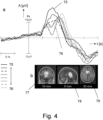
- the corresponding processed brain activity could, for example, look like the activity and originate in the cortical areas indicated in Figures 4a, 4b , 4c and 4d.
- the ML system furthermore has access to additional physical and virtual sensors, like the ones as shown in Figure 1 , providing situational parameters such as the presence and potentially the identity of other persons 49 (see Figure 1 ) in the environment, the time of day, the time since a last meal/medication/bathroom visit, the temperature, humidity, etc.
- the human patient 30 may interpret this in various ways: for example, they may or may not appreciate it, feel it is in error, or feel guilty for not having performed the task themself.
- the robot performs or begins to perform a specific task, it ensures that the patient is aware of its actions by monitoring the patient's mental engagement with itself or the object of its actions.
- the patient's interpretation of those actions is implicitly derived from the patient's brain activity 33 using the passive brain-computer interface 35, 54. That is, the onset of the patient's mental engagement 16 is established and, relative to this onset, the patient's brain activity 33 is analyzed to produce an estimate of the patient's favorable or unfavorable interpretation of the respective action. Based on this, the robot ML algorithm can learn that, given the current context 10, as expressed through the sensed situational or operational parameters, the patient mentally responds in the perceived manner to the performed actions.
- the SAMANAI-enabled robot can, in that very moment, change its behavior to reflect the patient's momentary preferences, as well as control and/or adapt its behavioral routines to maximize the patient's state of mental wellbeing in the long term by, for example, avoiding those actions that have previously been unfavorably received by the patient, and repeating those actions that have been favorably received, taking into account the situational factors that may be found to partially account for those preferences when actions are repeated in different contexts.
- the robot may actively decide to perform those actions for the specific reason of learning the patient's preferences.
- Figure 4a shows average event-related potential recorded by the inventors at electrode Fz 61, see Figure 2 , following specific actions taken by an autonomous agent which the human observer 30 approves to varying degrees, separated into eight categories ranging from complete approval, solid black line 75, to complete disapproval, dotted grey line 76.
- Raw EEG data was referenced to the common average, filtered between 0.1 and 15 Hz, epoched relative to the visible onset of the action taken, baseline-corrected, and averaged. The amplitude between approximately 150 and 200 ms scales linearly as a function of the degree of approval.
- Figure 4b shows brain areas 77, 78, 79, i.e. the white spots in Figure 4b , identified by the inventors primarily contributing to the effect represented by the ERP shown in Figure 4a , highlighted on an average brain model. Brighter areas contribute more to the effect than darker areas.
- the human's implicit brain responses can serve as an evaluation function for that ML.
- a given ML system operating on a battlefield has a large number of sensors to perceive its environment: cameras, thermal imagers, microphones, radar, lidar, chemical composition sensors, seismometers, gyroscopes, et cetera. It is thus capable of recording this context and the events taking place within it to any possible degree of objective accuracy.
- the appropriate algorithms such as those mentioned in the above example of the autonomously driving car, it is also capable of identifying specific objects and events in that context.
- the ML algorithm in this context additionally has a brain monitoring system such as an EEG, MEG, ECoG or fNIRS system, with accompanying components including i.e. electrodes, an amplifier, and necessary signal processing algorithms. It will also have at least one pBCI capable of interpreting this brain activity as reflecting relevant judgements of the context such as surprise.
- This pBCI can operate in an event-related fashion as described in the example of the autonomously driving car above, or can operate continuously using, instead of the feature extraction and machine learning methods mentioned in that example, the method of filter bank common spatial patterns following appropriate corresponding preprocessing steps, as illustrated with Figure 6 .
- the ML algorithm can track which parts of the context the human is attending to using human bio-signal data, e.g. its eye trackers and motion sensors.
- This human may, for example, observe a configuration in the environment reminiscent of a trap they have experienced before. This will automatically and potentially subconsciously evoke a pattern of brain activity that signals the significance of this aspect of the context.
- the pBCI operating at least one classifier, can detect and classify this response and provide it to the ML, essentially serving as an additional human sensor providing an evaluation of aspects of the environment.
- the Al now having available to it a representation of the real-life context, a representation of a specific aspect of this context identified through the human's engagement with it, and the human's mental evaluation of this aspect, can jointly and/or separately process these pieces of information using its inherent inference and analysis methods in order to control or learn how to respond or adapt to different aspects of the context.
- the ML algorithm may be exhibiting behavior of a continuous nature, such as moving towards the edge of a building. Distance to this edge is a continuous variable with dynamically associated risk.
- the Al can assess the human's mental engagement with this behavior as stated before, and continuously (following every n newly recorded samples, or with a given frequency) request from the continuous pBCI an evaluation of the current mental state of the human with respect to their approval of the current situation. This continuous interpretation is then jointly processed with operational data, allowing the Al to control or learn the appropriate behavior in this situation.
- FIGS 5a and 5c show an example wherein the spatio-temporal filtering method Common Spatial Patterns, CSP, or its multi-frequency extension Filter Bank Common Spatial Pattern is used to track changes in the band power of a selected frequency range or frequency ranges resulting from the activity in a certain area of the cortex. Due to an eigenvalue comparison of examples of trials indicating different levels of activity in that cortical area, a linear combination of channels is derived, maximizing the band power difference between these levels. Two exemplary linear distributions 90 and 91 are depicted here, forming a so-called CSP pattern pair, respectively.
- Figures 5b and 5d show that the band power in a certain frequency range of the EEG can reflect transient changes of cognitive states, like mental workload or the level of agreement.
- the linear combination of the EEG channels resulting from the CSP approach, shown in Figures 5a and 5c leads to meta-channels aggregating the activity resulting from changes in that cognitive state.
- raw EEG was referenced to the common average and filtered between 7 and 13 Hz and CSP was applied.
- Amplitude changes in the activity of the meta-channel produced by a CSP pattern illustrated here, indicates transient changes of the investigated cognitive state. Light grey reflects activity related to one cognitive state, while dark grey indicates activity related to another cognitive state.
- Figure 6 illustrates in a flow-chart type diagram 90 steps of the method according to the present application, implemented and executed by an information processing device operating an ML algorithm.
- a step 91 that may be continuously operated, operational data, implicit human mental brain activity data and human mental engagement of a human participating with a particular context are acquired, as disclosed above.
- a step 92 an aspect of the context is identified from the human mental engagement with the context sensed in step 91.
- operational data and human brain activity data with the identified aspect are selected from the data acquired.
- a step 94 from the selected implicit human brain activity data, human mental state data are assessed.
- step 95 The acquired operational data and assessed human mental state data are processed in step 95, which may comprise associating operational data and human mental brain activity data, i.e. assessed human mental state data, and based on this data processing, analysis and inferencing by the ML algorithm and/or aspect(s) of the context and/or any other software executed may be controlled or adapted, as depicted in step 96.
- the data processing in step 95 may comprise, among others, combining or associating operational data and human mental brain activity data, i.e. assessed human mental state data.
- the methods and systems described herein can be implemented in many ways.
- the method can be encoded on a computer-readable media, such as CD-ROMs, memory cards, optical drives, magnetic drives, flash drive, or the like.
- the system can be implemented on a general use computer, a specialized computing system, or implemented in hardware/firmware. These are collectively known as "information processing devices" herein.
Landscapes
- Engineering & Computer Science (AREA)
- Theoretical Computer Science (AREA)
- General Engineering & Computer Science (AREA)
- Physics & Mathematics (AREA)
- General Physics & Mathematics (AREA)
- Health & Medical Sciences (AREA)
- Human Computer Interaction (AREA)
- Biomedical Technology (AREA)
- Software Systems (AREA)
- Computing Systems (AREA)
- General Health & Medical Sciences (AREA)
- Evolutionary Computation (AREA)
- Data Mining & Analysis (AREA)
- Artificial Intelligence (AREA)
- Mathematical Physics (AREA)
- Medical Informatics (AREA)
- Business, Economics & Management (AREA)
- Epidemiology (AREA)
- General Business, Economics & Management (AREA)
- Primary Health Care (AREA)
- Public Health (AREA)
- Computational Linguistics (AREA)
- Computer Vision & Pattern Recognition (AREA)
- Dermatology (AREA)
- Neurology (AREA)
- Neurosurgery (AREA)
- Measurement And Recording Of Electrical Phenomena And Electrical Characteristics Of The Living Body (AREA)
- Measurement Of The Respiration, Hearing Ability, Form, And Blood Characteristics Of Living Organisms (AREA)
Claims (15)
- Datenverarbeitungsverfahren, das von einer Informationsverarbeitungsvorrichtung (50) durchgeführt wird, die einen Algorithmus für maschinelles Lernen (51) betreibt, wobei dieser Algorithmus für maschinelles Lernen (51) operative Daten (58), die aus einem Kontext stammen, verarbeitet und menschliche mentale Gehirnaktivitätsdaten (45), die sich auf die menschliche Teilhabe (31, 32) an dem Kontext beziehen, und die von einer Gehirn-Computer-Schnittstelle bereitgestellt werden, die einen entsprechenden Klassifikator betreibt, wobei die operative Daten (58) und die menschlichen mentalen Gehirnaktivitätsdaten (45) durch Erfassen (46, 47, 48) menschlichen mentalen Auseinandersetzung mit einem Aspekt des Kontexts identifiziert werden, und wobei mindestens eines von Analyse und Schlussfolgerung (52) durch den Algorithmus für maschinelles Lernen (51) und Aspekte des Kontexts durch die Informationsverarbeitungsvorrichtung (50) auf der Grundlage der Datenverarbeitung (52) gesteuert (59) werden, dadurch gekennzeichnet, dass die operative Daten (58) mindestens eines von erfassten, wahrgenommenen, erhaltenen oder anderweitig identifizierten physischen Daten, virtuellen Daten und Umgebungsinformationen umfassen, die aus dem Kontext stammen oder sich auf den Kontext beziehen, der ein realer Kontext (10) ist, welcher ein nicht-vordefinierter oder authentischer nicht-virtueller Kontext oder eine nicht-virtuelle Umgebung ist, der/die in der Realität oder in der Praxis vorkommt, und die menschlichen mentalen Gehirnaktivitätsdaten (45) eine implizite menschliche Teilhabe an dem realen Kontext (10) umfassen, die von der Gehirn-Computer-Schnittstelle bereitgestellt wird, die eine passive Gehirn-Computer-Schnittstelle (35, 54) ist, die einen oder mehrere Klassifikatoren (54) betreibt, die an verschiedene Arten von Reaktionen oder mentalen Zuständen menschlichen Teilhabe verknüpft sind, wobei die operative Daten (58) und die menschlichen mentalen Gehirnaktivitätsdaten (45), die von dem Algorithmus für maschinelles Lernen (51) verarbeitet werden, durch Erfassen der menschlichen mentalen Auseinandersetzung mit einem Aspekt des realen Kontexts (10) identifiziert werden, der sich darauf bezieht, mit welchem Aspekt oder welchen Aspekten (39) des realen Kontexts (10) die menschliche Teilhabe (31, 32) momentan implizit beschäftigt ist, kontinuierlich überwacht von der passiven Gehirn-Computer-Schnittstelle (35, 54), die einen entsprechenden Klassifikator oder Klassifikatoren (54) betreibt, und wobei mindestens eine der Analysen und Schlussfolgerungen (52) durch den Algorithmus für maschinelles Lernen (51) und Aspekte (39) des realen Kontexts (10) durch die Informationsverarbeitungsvorrichtung (50) auf der Grundlage der Datenverarbeitung (52) gesteuert (59) werden, um menschliches Wissen, Intelligenz, subjektive Interpretationen und menschliche Ratschläge über Aufgaben, Prozesse, Geräte und Informationen, die aus dem realen Kontext (10) wahrgenommen werden, zu vermitteln.
- Datenverarbeitungsverfahren nach Anspruch 1, wobei mindestens eine der Analysen und Schlussfolgerungen (52) durch den Algorithmus für maschinelles Lernen (51) und Aspekte (39) des realen Kontexts (10) durch die Informationsverarbeitungsvorrichtung (50) gesteuert werden, durch verknüpfen der identifizierten operativen Daten (58) und der menschlichen mentalen Gehirnaktivitätsdaten (45).
- Datenverarbeitungsverfahren nach einem der vorhergehenden Ansprüche, wobei mindestens eine der Analysen und Schlussfolgerungen (52) durch den Algorithmus für maschinelles Lernen (50) und Aspekte (39) des realen Kontexts (10) durch die Informationsverarbeitungsvorrichtung (50) angepasst werden auf der Grundlage von mindestens eines der menschlicher mentaler Auseinandersetzung in Bezug auf entsprechende Operationen und Interaktionen in dem realen Kontext (10) und Einsatz der Informationsverarbeitungsvorrichtung (50) mit entsprechenden Operationen und Interaktionen in dem realen Kontext (10).
- Datenverarbeitungsverfahren nach einem der vorhergehenden Ansprüche, wobei der reale Kontext (10) ein kognitives Sondierungsereignis umfasst.
- Datenverarbeitungsverfahren nach einem der vorhergehenden Ansprüche, wobei die menschlichen Gehirnaktivitätsdaten (45) die implizite menschliche Teilhabe an dem realen Kontext (10) mindestens eines von einem Individuum (30) und einer Gruppe von Individuen (49) umfassen.
- Datenverarbeitungsverfahren nach einem der vorhergehenden Ansprüche, wobei menschliche mentale Auseinandersetzung mit einem Aspekt (39) des realen Kontexts (10) anhand von menschlichen Biosignaldaten (46, 47, 48) identifiziert wird, die von mindestens einem Biosignalsensor (36, 37, 38) erfasst werden.
- Datenverarbeitungsverfahren nach einem der vorhergehenden Ansprüche, wobei operative Daten (58, 59), menschlichen Gehirnaktivitätsdaten (45) und menschlichen mentalen Auseinandersetzungsdaten (45, 46, 47, 48) in Echtzeit oder Quasi-Echtzeit verarbeitet (52) werden, insbesondere Daten, die sich auf einen zeitkritischen realen Kontext (10) beziehen.
- Datenverarbeitungsverfahren nach einem der vorhergehenden Ansprüche, wobei die operative Daten (58, 59) mindestens eines von physikalischen Daten und virtuellen Daten umfassen, die aus dem realen Kontext (10) stammen, insbesondere Daten, die sich auf technologische Zustände und technologische Zustandsänderungen von mindestens einer Vorrichtung (11-23) beziehen, die in dem realen Kontext arbeitet, insbesondere mindestens eine von der Informationsverarbeitungsvorrichtung (50) gesteuerte Vorrichtung, und die beliebig viele des Folgenden umfassen: Vorrichtungseingangszustände, Vorrichtungsausgangszustände, Vorrichtungsbetriebszustände, Vorrichtungsspielzustände, computergestützte Entwurfszustände, computersimulierte Entwurfszustände, Computerperipherie-vorrichtungszustände, computergesteuerte Maschinenzustände und entsprechende Zustandsänderungen.
- Datenverarbeitungsverfahren nach einem der vorhergehenden Ansprüche, wobei die Informationsverarbeitungsvorrichtung (50) einen Algorithmus für maschinelles bestärkendes Lernen (52), insbesondere einen Algorithmus für tiefes maschinelles bestärkendes Lernen, betreibt, der eine Belohnungsfunktion umfasst, wobei die impliziten menschlichen mentalen Gehirnaktivitätsdaten (45) die Belohnungsfunktion liefern.
- Datenverarbeitungsverfahren nach einem der vorhergehenden Ansprüche, wobei der Algorithmus für maschinelles Lernen einen Datenverarbeitungsalgorithmus (52) für künstliche allgemeine Intelligenz, AGI, umfasst.
- Datenverarbeitungsverfahren (90) nach einem der vorhergehenden Ansprüche, umfassend die Schritte:- Identifizieren (92), durch die Informationsverarbeitungsvorrichtung (50), eines Aspekts (39) des realen Kontexts (10), wobei der Aspekt (90) durch Erfassen (35, 54; 46, 47, 48) menschlichen mentalen Auseinandersetzung mit dem realen Kontext (10) identifiziert wird;- Erwerben (93), durch die Informationsverarbeitungsvorrichtung (50), von operativen Daten (58) die sich auf den identifizierten Aspekt (39) beziehen;- Erwerben (93), durch die Informationsverarbeitungsvorrichtung (50), von menschlichen mentalen Gehirnaktivitätsdaten (45) der impliziten menschlichen Teilhabe an dem realen Kontext (10), die sich auf den identifizierten Aspekt (39) beziehen;- Verarbeiten (95), durch den Algorithmus für maschinelles Lernen (51), der erworben operativen Daten (58) und mentalen Zustandsdaten die aus den erworben menschlichen mentalen Gehirnaktivitätsdaten (45) ermittelt (94) wurden, und- Steuern (96), durch die Informationsverarbeitungsvorrichtung (50), von mindestens einer von Analyse und Schlussfolgerung (52) durch den Algorithmus für maschinelles Lernen (51) und Aspekten (39) des realen Kontexts (10), basierend auf der Datenverarbeitung (52).
- Datenverarbeitungsverfahren nach einem der vorhergehenden Ansprüche, wobei die Informationsverarbeitungsvorrichtung (50) mindestens einen weiteren Algorithmus (53) betreibt zur Erfassung, Durchführung, Ermittlung, Verarbeitung und Vorverarbeitung von mindestens einem von Gehirnaktivitätsdaten (45), operative Daten (58, 59), menschliche mentale Auseinandersetzung (54), Aspekterkennung (39), mentale Zustandsdaten (54), menschliche Biosignaldaten (46, 47, 48) und Steuerung des Algorithmus für maschinelles Lernen (51) und Aspekte (39) des realen Kontexts (10).
- Programmprodukt (60), das mit Instruktionen kodiert ist, die auf einem transitorischen oder einem nicht-transitorischen Medium gespeichert sind, das von einer Informationsverarbeitungsvorrichtung (50) gelesen werden kann, wobei die Instruktionen so angeordnet sind, dass sie das Datenverarbeitungsverfahren gemäß einem der vorhergehenden Ansprüche durchführen, wenn die Instruktionen von der Informationsverarbeitungsvorrichtung (50) ausgeführt werden, einschließlich eines von einem Computer und einer Computeranwendung.
- Programmprodukt nach Anspruch 13, das einen trainierten Algorithmus für maschinelles Lernen (61) speichert, der gemäß dem Datenverarbeitungsverfahren nach einem der Ansprüche 1 bis 12 trainiert wurde
- Datenverarbeitungssystem (50), das Mittel zur Durchführung des Datenverarbeitungsverfahrens nach einem der Ansprüche 1 bis 12 enthält.
Applications Claiming Priority (1)
| Application Number | Priority Date | Filing Date | Title |
|---|---|---|---|
| NL1044171A NL1044171B1 (en) | 2021-09-22 | 2021-09-22 | A method performed by an information processing device, a program product and a system for processing context related operational and human mental brain activity data. |
Publications (3)
| Publication Number | Publication Date |
|---|---|
| EP4155880A1 EP4155880A1 (de) | 2023-03-29 |
| EP4155880C0 EP4155880C0 (de) | 2025-04-23 |
| EP4155880B1 true EP4155880B1 (de) | 2025-04-23 |
Family
ID=83689339
Family Applications (1)
| Application Number | Title | Priority Date | Filing Date |
|---|---|---|---|
| EP22196975.1A Active EP4155880B1 (de) | 2021-09-22 | 2022-09-21 | Verfahren, das von einer informationsverarbeitungsvorrichtung durchgeführt wird, programmprodukt und system zur verarbeitung von kontextbezogenen betriebs- und menschlichen mentalen hirnaktivitätsdaten |
Country Status (3)
| Country | Link |
|---|---|
| US (1) | US20230093444A1 (de) |
| EP (1) | EP4155880B1 (de) |
| NL (1) | NL1044171B1 (de) |
Families Citing this family (7)
| Publication number | Priority date | Publication date | Assignee | Title |
|---|---|---|---|---|
| US20230206081A1 (en) * | 2018-09-21 | 2023-06-29 | David Allan Edgar | System, method, and computer program product for the production and consumption of natural intelligence using an artificial brain |
| EP4466952A1 (de) * | 2022-01-19 | 2024-11-27 | Signify Holding B.V. | Gehirnsteuerungsschnittstellensystem zur steuerung einer steuerbaren vorrichtung |
| NL1044409B1 (en) * | 2022-08-30 | 2024-03-15 | Zander Laboratories B V | A method performed by an information processing device, a program product, and a system for acquiring artificial intelligence from processing context related operational, human bio-signal and human conduct data. |
| US12417274B2 (en) * | 2022-12-08 | 2025-09-16 | Arm Limited | Brain-computer interface device, system and operating method |
| US12599306B2 (en) | 2023-06-30 | 2026-04-14 | Rockwell Collins, Inc. | Pupil dynamics, physiology, and performance for estimating competency in situational awareness |
| US12510963B2 (en) | 2023-11-11 | 2025-12-30 | Rajshekar Guda Subhash | Human-computer interface system and method for selecting targets |
| WO2026009134A1 (en) * | 2024-07-03 | 2026-01-08 | Sony Group Corporation | Situational-context based control of user-assistive actuators using multi-modal neural language (mmnl) model |
Family Cites Families (29)
| Publication number | Priority date | Publication date | Assignee | Title |
|---|---|---|---|---|
| US9480583B2 (en) * | 2010-05-17 | 2016-11-01 | Commissariat A L'energie Atomique Et Aux Energies Alternatives | Direct neural interface system and method of calibrating it |
| WO2015164477A1 (en) * | 2014-04-25 | 2015-10-29 | The General Hospital Corporation | Hybrid system for treating mental and emotional disorders with responsive brain stimulation |
| EP3149662B1 (de) * | 2014-05-30 | 2026-01-28 | The Regents of The University of Michigan | Hirn-computer-schnittstelle zur direkten auswahl von mehrfachauswahl-antworten und zur identifizierung von zustandsänderungen |
| US10120413B2 (en) * | 2014-09-11 | 2018-11-06 | Interaxon Inc. | System and method for enhanced training using a virtual reality environment and bio-signal data |
| US20190246982A1 (en) * | 2015-08-05 | 2019-08-15 | Emotiv Inc. | Method and system for collecting and processing bioelectrical signals |
| WO2017177128A1 (en) * | 2016-04-08 | 2017-10-12 | The Trustees Of Columbia University In The City Of New York | Systems and methods for deep reinforcement learning using a brain-artificial intelligence interface |
| US20210138249A1 (en) * | 2016-04-22 | 2021-05-13 | Newton Howard | System and method for neural stimulation using spike frequency modulation |
| US20170337834A1 (en) * | 2016-05-17 | 2017-11-23 | Rajaa Shindi | Interactive brain trainer |
| CN111629653B (zh) * | 2017-08-23 | 2024-06-21 | 神经股份有限公司 | 具有高速眼睛跟踪特征的大脑-计算机接口 |
| US10795441B2 (en) * | 2017-10-23 | 2020-10-06 | Korea University Research And Business Foundation | Method of recognizing user intention by estimating brain signals, and brain-computer interface apparatus based on head mounted display implementing the method |
| KR102871382B1 (ko) * | 2017-11-13 | 2025-10-16 | 뉴레이블 인크. | 고속, 정확도 및 직관적 사용자 상호작용을 위한 적응을 갖춘 두뇌-컴퓨터 인터페이스 |
| US11478603B2 (en) * | 2017-12-31 | 2022-10-25 | Neuroenhancement Lab, LLC | Method and apparatus for neuroenhancement to enhance emotional response |
| US11402905B2 (en) * | 2018-01-09 | 2022-08-02 | Holland Bloorview Kids Rehabilitation Hospital | EEG brain-computer interface platform and process for detection of changes to mental state |
| US10901508B2 (en) * | 2018-03-20 | 2021-01-26 | X Development Llc | Fused electroencephalogram and machine learning for precognitive brain-computer interface for computer control |
| US20210390366A1 (en) * | 2018-10-25 | 2021-12-16 | Arctop Ltd | Empathic Computing System and Methods for Improved Human Interactions With Digital Content Experiences |
| GB2579827A (en) * | 2018-12-14 | 2020-07-08 | Brainpatch Ltd | Brain interfacing apparatus and method |
| CL2018003843A1 (es) * | 2018-12-27 | 2020-11-13 | Univ Pontificia Catolica Chile | Sistema y método de tratamiento de adicciones de un individuo que lo necesite, con bajas tasas de recaida |
| WO2021019088A1 (en) * | 2019-07-31 | 2021-02-04 | Nextmind Sas | Brain-computer interface |
| US20210041953A1 (en) * | 2019-08-06 | 2021-02-11 | Neuroenhancement Lab, LLC | System and method for communicating brain activity to an imaging device |
| NL2024573B1 (en) * | 2019-12-24 | 2021-09-06 | Mindspeller Bv | Associative model in brain computer interface |
| RU2741215C1 (ru) * | 2020-02-07 | 2021-01-22 | Общество с ограниченной ответственностью "АйТи Юниверс" | Система нейрореабилитации и способ нейрореабилитации |
| US20230068531A1 (en) * | 2020-02-07 | 2023-03-02 | Georgia Tech Research Corporation | Methods and Systems to Facilitate Silent Communication |
| US20210290890A1 (en) * | 2020-02-07 | 2021-09-23 | Washington University | Recursive artificial intelligence neuromodulation system |
| US20230051757A1 (en) * | 2020-02-14 | 2023-02-16 | Newton Howard | Brain monitoring and stimulation devices and methods |
| US20230144166A1 (en) * | 2020-09-11 | 2023-05-11 | Hi Llc | Systems and methods used to enhance artificial intelligence systems by mitigating harmful artificial intelligence actions |
| US20220101981A1 (en) * | 2020-09-28 | 2022-03-31 | xSensa Labs | Method and system for neuromodulation |
| US12210682B2 (en) * | 2021-03-19 | 2025-01-28 | MindPortal, Inc. | Systems and methods involving devices that detect mind/brain activity, generation of control instructions via same and/or other features |
| US12555414B2 (en) * | 2021-08-25 | 2026-02-17 | Battelle Memorial Institute | Neuromuscular electrical stimulation controlled by computer vision |
| US12164688B2 (en) * | 2021-09-09 | 2024-12-10 | University of Pittsburgh—of the Commonwealth System of Higher Education | Systems and methods of transient-based decoding of neural signals |
-
2021
- 2021-09-22 NL NL1044171A patent/NL1044171B1/en active
-
2022
- 2022-09-21 US US17/934,160 patent/US20230093444A1/en active Pending
- 2022-09-21 EP EP22196975.1A patent/EP4155880B1/de active Active
Also Published As
| Publication number | Publication date |
|---|---|
| US20230093444A1 (en) | 2023-03-23 |
| EP4155880C0 (de) | 2025-04-23 |
| EP4155880A1 (de) | 2023-03-29 |
| NL1044171B1 (en) | 2023-03-29 |
Similar Documents
| Publication | Publication Date | Title |
|---|---|---|
| EP4155880B1 (de) | Verfahren, das von einer informationsverarbeitungsvorrichtung durchgeführt wird, programmprodukt und system zur verarbeitung von kontextbezogenen betriebs- und menschlichen mentalen hirnaktivitätsdaten | |
| Parekh et al. | Fatigue detection using artificial intelligence framework | |
| Rashid et al. | Current status, challenges, and possible solutions of EEG-based brain-computer interface: a comprehensive review | |
| Ko et al. | Emotion recognition using EEG signals with relative power values and Bayesian network | |
| JP2009508553A (ja) | 眼球性質を解析することで、人間の感情を決定するシステムおよび方法 | |
| Kirchner et al. | On the applicability of brain reading for predictive human-machine interfaces in robotics | |
| Jyotsna et al. | Predicteye: Personalized time series model for mental state prediction using eye tracking | |
| EP4332849A1 (de) | Verfahren, programmprodukt und system zur erfassung von künstlicher intelligenz aus betriebs-, mensch-biosignal- und mensch-führungdaten | |
| Tavares et al. | Physiologically attentive user interface for improved robot teleoperation | |
| Pires et al. | A new error-monitoring brain–computer interface based on reinforcement learning for people with autism spectrum disorders | |
| Loewe et al. | Physio-adaptive systems-a state-of-the-art review and future research directions | |
| JP2022162549A (ja) | システム1タスクまたはシステム2タスクとしてユーザタスクを分類するためのシステムと方法 | |
| Arpaia et al. | A wearable brain-computer interface to play an endless runner game by self-paced motor imagery | |
| KR101630398B1 (ko) | 역치 이하 자극을 이용한 보안 서비스 제공 방법 및 장치 | |
| Savur | A Physiological Computing System to Improve Human-Robot Collaboration by Using Human Comfort Index | |
| Kumari et al. | Combining biosignals with RFID to develop a multimodal-shared control interface | |
| Rafique et al. | Towards estimation of emotions from eye pupillometry with low-cost devices | |
| Andreeßen | Towards real-world applicability of neuroadaptive technologies: investigating subject-independence, task-independence and versatility of passive brain-computer interfaces | |
| Ehrlich | Error-related potentials in passive brain-computer interfaces for quantitative assessment and adaptation of robotic systems during human-robot interaction | |
| Monaldini | Neuro-symbolic approach for tantrum monitoring and prevention in individuals with autism spectrum disorder: A protocol for virtual agents | |
| De et al. | EEG-Based BCI Technology in IoT Enabled Smart Home Environment: An In-Depth Comparative Analysis on Human–Computer Interaction Techniques | |
| Leon et al. | Prospect of smart home-based detection of subclinical depressive disorders | |
| Giakoumis et al. | Service robot behaviour adaptation based on user mood, towards better personalized support of mci patients at home | |
| Lotte et al. | Brain-computer interaction and neuroergonomics | |
| Ashley | Improving classification of error related potentials using novel feature extraction and classification algorithms for an assistive robotic device |
Legal Events
| Date | Code | Title | Description |
|---|---|---|---|
| PUAI | Public reference made under article 153(3) epc to a published international application that has entered the european phase |
Free format text: ORIGINAL CODE: 0009012 |
|
| STAA | Information on the status of an ep patent application or granted ep patent |
Free format text: STATUS: THE APPLICATION HAS BEEN PUBLISHED |
|
| AK | Designated contracting states |
Kind code of ref document: A1 Designated state(s): AL AT BE BG CH CY CZ DE DK EE ES FI FR GB GR HR HU IE IS IT LI LT LU LV MC MK MT NL NO PL PT RO RS SE SI SK SM TR |
|
| STAA | Information on the status of an ep patent application or granted ep patent |
Free format text: STATUS: REQUEST FOR EXAMINATION WAS MADE |
|
| 17P | Request for examination filed |
Effective date: 20230927 |
|
| RBV | Designated contracting states (corrected) |
Designated state(s): AL AT BE BG CH CY CZ DE DK EE ES FI FR GB GR HR HU IE IS IT LI LT LU LV MC MK MT NL NO PL PT RO RS SE SI SK SM TR |
|
| GRAP | Despatch of communication of intention to grant a patent |
Free format text: ORIGINAL CODE: EPIDOSNIGR1 |
|
| STAA | Information on the status of an ep patent application or granted ep patent |
Free format text: STATUS: GRANT OF PATENT IS INTENDED |
|
| RIC1 | Information provided on ipc code assigned before grant |
Ipc: G06N 20/00 20190101ALI20241203BHEP Ipc: G06N 3/08 20230101ALI20241203BHEP Ipc: G06F 3/01 20060101AFI20241203BHEP |
|
| INTG | Intention to grant announced |
Effective date: 20241217 |
|
| GRAS | Grant fee paid |
Free format text: ORIGINAL CODE: EPIDOSNIGR3 |
|
| GRAA | (expected) grant |
Free format text: ORIGINAL CODE: 0009210 |
|
| STAA | Information on the status of an ep patent application or granted ep patent |
Free format text: STATUS: THE PATENT HAS BEEN GRANTED |
|
| AK | Designated contracting states |
Kind code of ref document: B1 Designated state(s): AL AT BE BG CH CY CZ DE DK EE ES FI FR GB GR HR HU IE IS IT LI LT LU LV MC MK MT NL NO PL PT RO RS SE SI SK SM TR |
|
| REG | Reference to a national code |
Ref country code: GB Ref legal event code: FG4D |
|
| REG | Reference to a national code |
Ref country code: CH Ref legal event code: EP |
|
| REG | Reference to a national code |
Ref country code: DE Ref legal event code: R096 Ref document number: 602022013464 Country of ref document: DE |
|
| REG | Reference to a national code |
Ref country code: IE Ref legal event code: FG4D |
|
| U01 | Request for unitary effect filed |
Effective date: 20250516 |
|
| U07 | Unitary effect registered |
Designated state(s): AT BE BG DE DK EE FI FR IT LT LU LV MT NL PT RO SE SI Effective date: 20250522 |
|
| U20 | Renewal fee for the european patent with unitary effect paid |
Year of fee payment: 4 Effective date: 20250703 |
|
| PG25 | Lapsed in a contracting state [announced via postgrant information from national office to epo] |
Ref country code: ES Free format text: LAPSE BECAUSE OF FAILURE TO SUBMIT A TRANSLATION OF THE DESCRIPTION OR TO PAY THE FEE WITHIN THE PRESCRIBED TIME-LIMIT Effective date: 20250423 |
|
| PG25 | Lapsed in a contracting state [announced via postgrant information from national office to epo] |
Ref country code: GR Free format text: LAPSE BECAUSE OF FAILURE TO SUBMIT A TRANSLATION OF THE DESCRIPTION OR TO PAY THE FEE WITHIN THE PRESCRIBED TIME-LIMIT Effective date: 20250724 Ref country code: NO Free format text: LAPSE BECAUSE OF FAILURE TO SUBMIT A TRANSLATION OF THE DESCRIPTION OR TO PAY THE FEE WITHIN THE PRESCRIBED TIME-LIMIT Effective date: 20250723 |
|
| PG25 | Lapsed in a contracting state [announced via postgrant information from national office to epo] |
Ref country code: PL Free format text: LAPSE BECAUSE OF FAILURE TO SUBMIT A TRANSLATION OF THE DESCRIPTION OR TO PAY THE FEE WITHIN THE PRESCRIBED TIME-LIMIT Effective date: 20250423 |
|
| PG25 | Lapsed in a contracting state [announced via postgrant information from national office to epo] |
Ref country code: HR Free format text: LAPSE BECAUSE OF FAILURE TO SUBMIT A TRANSLATION OF THE DESCRIPTION OR TO PAY THE FEE WITHIN THE PRESCRIBED TIME-LIMIT Effective date: 20250423 |
|
| PG25 | Lapsed in a contracting state [announced via postgrant information from national office to epo] |
Ref country code: RS Free format text: LAPSE BECAUSE OF FAILURE TO SUBMIT A TRANSLATION OF THE DESCRIPTION OR TO PAY THE FEE WITHIN THE PRESCRIBED TIME-LIMIT Effective date: 20250723 |
|
| PG25 | Lapsed in a contracting state [announced via postgrant information from national office to epo] |
Ref country code: IS Free format text: LAPSE BECAUSE OF FAILURE TO SUBMIT A TRANSLATION OF THE DESCRIPTION OR TO PAY THE FEE WITHIN THE PRESCRIBED TIME-LIMIT Effective date: 20250823 |
|
| REG | Reference to a national code |
Ref country code: CH Ref legal event code: U11 Free format text: ST27 STATUS EVENT CODE: U-0-0-U10-U11 (AS PROVIDED BY THE NATIONAL OFFICE) Effective date: 20251204 |
|
| PG25 | Lapsed in a contracting state [announced via postgrant information from national office to epo] |
Ref country code: SM Free format text: LAPSE BECAUSE OF FAILURE TO SUBMIT A TRANSLATION OF THE DESCRIPTION OR TO PAY THE FEE WITHIN THE PRESCRIBED TIME-LIMIT Effective date: 20250423 |
|
| PGFP | Annual fee paid to national office [announced via postgrant information from national office to epo] |
Ref country code: CH Payment date: 20251204 Year of fee payment: 4 |
|
| PG25 | Lapsed in a contracting state [announced via postgrant information from national office to epo] |
Ref country code: CZ Free format text: LAPSE BECAUSE OF FAILURE TO SUBMIT A TRANSLATION OF THE DESCRIPTION OR TO PAY THE FEE WITHIN THE PRESCRIBED TIME-LIMIT Effective date: 20250423 |
|
| PG25 | Lapsed in a contracting state [announced via postgrant information from national office to epo] |
Ref country code: SK Free format text: LAPSE BECAUSE OF FAILURE TO SUBMIT A TRANSLATION OF THE DESCRIPTION OR TO PAY THE FEE WITHIN THE PRESCRIBED TIME-LIMIT Effective date: 20250423 |
|
| PLBE | No opposition filed within time limit |
Free format text: ORIGINAL CODE: 0009261 |
|
| STAA | Information on the status of an ep patent application or granted ep patent |
Free format text: STATUS: NO OPPOSITION FILED WITHIN TIME LIMIT |
|
| REG | Reference to a national code |
Ref country code: CH Ref legal event code: L10 Free format text: ST27 STATUS EVENT CODE: U-0-0-L10-L00 (AS PROVIDED BY THE NATIONAL OFFICE) Effective date: 20260304 |
|
| 26N | No opposition filed |
Effective date: 20260126 |