EP4155617A1 - Temperature and humidity comprehensive adjustment control method, and adjustment device, adjustment system and medium - Google Patents
Temperature and humidity comprehensive adjustment control method, and adjustment device, adjustment system and medium Download PDFInfo
- Publication number
- EP4155617A1 EP4155617A1 EP21853772.8A EP21853772A EP4155617A1 EP 4155617 A1 EP4155617 A1 EP 4155617A1 EP 21853772 A EP21853772 A EP 21853772A EP 4155617 A1 EP4155617 A1 EP 4155617A1
- Authority
- EP
- European Patent Office
- Prior art keywords
- temperature
- interval
- humidity
- determining
- regulation device
- Prior art date
- Legal status (The legal status is an assumption and is not a legal conclusion. Google has not performed a legal analysis and makes no representation as to the accuracy of the status listed.)
- Pending
Links
Images

Classifications
-
- F—MECHANICAL ENGINEERING; LIGHTING; HEATING; WEAPONS; BLASTING
- F24—HEATING; RANGES; VENTILATING
- F24F—AIR-CONDITIONING; AIR-HUMIDIFICATION; VENTILATION; USE OF AIR CURRENTS FOR SCREENING
- F24F11/00—Control or safety arrangements
- F24F11/30—Control or safety arrangements for purposes related to the operation of the system, e.g. for safety or monitoring
- F24F11/46—Improving electric energy efficiency or saving
-
- F—MECHANICAL ENGINEERING; LIGHTING; HEATING; WEAPONS; BLASTING
- F24—HEATING; RANGES; VENTILATING
- F24F—AIR-CONDITIONING; AIR-HUMIDIFICATION; VENTILATION; USE OF AIR CURRENTS FOR SCREENING
- F24F11/00—Control or safety arrangements
- F24F11/62—Control or safety arrangements characterised by the type of control or by internal processing, e.g. using fuzzy logic, adaptive control or estimation of values
- F24F11/63—Electronic processing
- F24F11/64—Electronic processing using pre-stored data
-
- F—MECHANICAL ENGINEERING; LIGHTING; HEATING; WEAPONS; BLASTING
- F24—HEATING; RANGES; VENTILATING
- F24F—AIR-CONDITIONING; AIR-HUMIDIFICATION; VENTILATION; USE OF AIR CURRENTS FOR SCREENING
- F24F11/00—Control or safety arrangements
- F24F11/70—Control systems characterised by their outputs; Constructional details thereof
-
- F—MECHANICAL ENGINEERING; LIGHTING; HEATING; WEAPONS; BLASTING
- F24—HEATING; RANGES; VENTILATING
- F24F—AIR-CONDITIONING; AIR-HUMIDIFICATION; VENTILATION; USE OF AIR CURRENTS FOR SCREENING
- F24F11/00—Control or safety arrangements
- F24F11/70—Control systems characterised by their outputs; Constructional details thereof
- F24F11/80—Control systems characterised by their outputs; Constructional details thereof for controlling the temperature of the supplied air
-
- F—MECHANICAL ENGINEERING; LIGHTING; HEATING; WEAPONS; BLASTING
- F24—HEATING; RANGES; VENTILATING
- F24F—AIR-CONDITIONING; AIR-HUMIDIFICATION; VENTILATION; USE OF AIR CURRENTS FOR SCREENING
- F24F2110/00—Control inputs relating to air properties
- F24F2110/10—Temperature
-
- F—MECHANICAL ENGINEERING; LIGHTING; HEATING; WEAPONS; BLASTING
- F24—HEATING; RANGES; VENTILATING
- F24F—AIR-CONDITIONING; AIR-HUMIDIFICATION; VENTILATION; USE OF AIR CURRENTS FOR SCREENING
- F24F2110/00—Control inputs relating to air properties
- F24F2110/10—Temperature
- F24F2110/12—Temperature of the outside air
-
- F—MECHANICAL ENGINEERING; LIGHTING; HEATING; WEAPONS; BLASTING
- F24—HEATING; RANGES; VENTILATING
- F24F—AIR-CONDITIONING; AIR-HUMIDIFICATION; VENTILATION; USE OF AIR CURRENTS FOR SCREENING
- F24F2110/00—Control inputs relating to air properties
- F24F2110/20—Humidity
-
- F—MECHANICAL ENGINEERING; LIGHTING; HEATING; WEAPONS; BLASTING
- F24—HEATING; RANGES; VENTILATING
- F24F—AIR-CONDITIONING; AIR-HUMIDIFICATION; VENTILATION; USE OF AIR CURRENTS FOR SCREENING
- F24F2120/00—Control inputs relating to users or occupants
- F24F2120/10—Occupancy
- F24F2120/14—Activity of occupants
-
- F—MECHANICAL ENGINEERING; LIGHTING; HEATING; WEAPONS; BLASTING
- F24—HEATING; RANGES; VENTILATING
- F24F—AIR-CONDITIONING; AIR-HUMIDIFICATION; VENTILATION; USE OF AIR CURRENTS FOR SCREENING
- F24F2130/00—Control inputs relating to environmental factors not covered by group F24F2110/00
- F24F2130/10—Weather information or forecasts
Definitions
- the present application relates to the technical field of virtual reality, and in particular to a method for comprehensively regulating temperature and humidity, a regulation device, a regulation system and a computer readable storage medium.
- the humidifier needs to be turned on when the air conditioner is turned on.
- the humidification function and the temperature regulation function can only be controlled independently, resulting in lowering relative humidity in the room when the air conditioner performs cooling regulation.
- the main purpose of the present application is to provide a method for comprehensively regulating temperature and humidity, a regulation device, a regulation system and a computer readable storage medium, aiming at reducing energy consumption of the air conditioner.
- the present application provides a method for comprehensively regulating temperature and humidity, including:
- the thermal comfort impact parameters include a dressing index of the user, an activity amount of the user, and/or a human metabolic rate.
- the method before the operation of obtaining the thermal comfort impact parameters and the preset relative humidity interval corresponding to the user in the action space of the regulation device, the method further includes:
- the operation of determining the dressing index according to the outdoor ambient temperature includes: determining the obtained dressing index corresponding to the outdoor ambient temperature according to a pre-stored corresponding relationship between the outdoor ambient temperature and the dressing index.
- the operation of obtaining the outdoor ambient temperature corresponding to the space where the regulation device is located includes:
- the operation of determining the dressing index according to the outdoor ambient temperature includes:
- the method before the operation of obtaining the thermal comfort impact parameters and the preset relative humidity interval corresponding to the user in the action space of the regulation device, the method further includes:
- the operation of determining the target temperature interval according to the preset relative humidity interval and at least one of the dressing index and the activity amount includes:
- the method before the operation of determining the target moisture content interval according to the preset relative humidity interval, the method further includes:
- the method before the operation of determining the operating parameters of the regulation device according to the current temperature, the current moisture content, the target moisture content interval, and the target temperature interval in the action space, and controlling the regulation device to operate according to the determined operating parameters, the method further includes: obtaining the current temperature and the current moisture content in an action space of an air conditioner.
- the operation of determining the operating parameters of the regulation device according to the current temperature, the current moisture content, the target moisture content interval, and the target temperature interval in the action space, and controlling the regulation device to operate according to the determined operating parameters includes:
- the regulation device includes a temperature regulation assembly and a humidity regulation assembly, and the temperature regulation assembly and the humidity regulation assembly are separated or integrated together.
- the present application also provides a regulation device, including: a memory, a processor and a program for comprehensively regulating temperature and humidity that is stored on the memory and operable on the processor, the program for comprehensively regulating temperature and humidity when executed by the processor implements the method for comprehensively regulating temperature and humidity as mentioned.
- the present application also provides a regulation system, including: a humidity regulation device, a temperature regulation device and a control unit, the control unit comprises a memory, a processor and a program for comprehensively regulating temperature and humidity that is stored on the memory and operable on the processor, the program for comprehensively regulating temperature and humidity when executed by the processor implements the method for comprehensively regulating temperature and humidity as mentioned above.
- the present application also provides a computer readable storage medium, the computer readable storage medium stores a program for comprehensively regulating temperature and humidity, the program for comprehensively regulating temperature and humidity when executed by the processor implements the method for comprehensively regulating temperature and humidity as mentioned above.
- the embodiments of the present application provide a method for comprehensively regulating temperature and humidity.
- Thermal comfort impact parameters and a preset relative humidity interval corresponding to a user in an action space of a regulation device are first obtained; then, a target temperature interval is determined according to the thermal comfort impact parameters and the preset relative humidity interval, and a target moisture content interval is determined according to the preset relative humidity interval; and finally operating parameters of the regulation device are determined according to a current temperature, a current moisture content, the target moisture content interval, and the target temperature interval in the action space, and the regulation device is controlled to operate according to the determined operating parameters.
- the air conditioner is regulated according to the determined operating parameters by combining the humidity and temperature, thus avoiding the phenomenon that when the air conditioner is regulated independently to reduce the temperature, the relative humidity in the room will decrease, hence the energy consumption of the air conditioner can be reduced.
- the humidity and temperature can be integrated to regulate the operating parameters of the air conditioner, to avoid the decline in comfort caused by independent regulation, to improve the comfort of the air conditioner.
- the air conditioner is regulated according to the determined operating parameters by combining the humidity and temperature, thus avoiding the phenomenon that when the air conditioner is regulated independently to reduce the temperature, the relative humidity in the room will decrease, hence the energy consumption of the air conditioner can be reduced.
- the humidity and temperature can be integrated to regulate the operating parameters of the air conditioner, to avoid the decline in comfort caused by independent regulation, to improve the comfort of the air conditioner.
- FIG. 1 is a schematic diagram of the terminal structure of the hardware operating environment according to the embodiment of the present application.
- the terminal of the present application embodiment may be a terminal device such as an air conditioner.
- the terminal may include: a processor 1001, such as a CPU, a network interface 1004, a user interface 1003, a memory 1005, and a communication bus 1002.
- the communication bus 1002 is used to implement communication among these components.
- a user interface 1003 can include a display, an input unit such as a keyboard, etc..
- the user interface 1003 can optionally include a standard wired interface, a wireless interface.
- the network interface 1004 optionally can include a standard wired interface, a wireless interface (such as WI-FI interface).
- the memory 1005 can be a high-speed RAM memory, or a non-volatile memory, such as a disk memory.
- the memory 1005 optionally may also be a storage device independent of the aforementioned processor 1001.
- terminal structure illustrated in FIG. 1 does not limit the terminal and may include more or fewer components than illustrated, or a combination of certain components, or a different arrangement of components.
- the memory 1005 which is a computer storage medium, may include an operating system, a network communication module, a user interface module, and a program for comprehensively regulating temperature and humidity.
- the network interface 1004 is primarily used to connect to the backend server and communicate with the backend server for data; the processor 1001 can invoke the program for comprehensively regulating temperature and humidity stored in the memory 1005 and perform the following operations:
- the processor 1001 may invoke the program for comprehensively regulating temperature and humidity stored in the memory 1005, and further perform the following operations:
- the processor 1001 may invoke the program for comprehensively regulating temperature and humidity stored in the memory 1005, and further perform the following operations: determining the obtained dressing index corresponding to the outdoor ambient temperature according to a pre-stored corresponding relationship between the outdoor ambient temperature and the dressing index.
- the processor 1001 may invoke the program for comprehensively regulating temperature and humidity stored in the memory 1005, and further perform the following operations:
- the processor 1001 may invoke the program for comprehensively regulating temperature and humidity stored in the memory 1005, and further perform the following operations:
- the processor 1001 may invoke the program for comprehensively regulating temperature and humidity stored in the memory 1005, and further perform the following operations:
- the processor 1001 may invoke the program for comprehensively regulating temperature and humidity stored in the memory 1005, and further perform the following operations:
- the processor 1001 may invoke the program for comprehensively regulating temperature and humidity stored in the memory 1005, and further perform the following operations:
- the processor 1001 may invoke the program for comprehensively regulating temperature and humidity stored in the memory 1005, and further perform the following operations: obtaining the current temperature and the current moisture content in an action space of an air conditioner.
- the processor 1001 may invoke the program for comprehensively regulating temperature and humidity stored in the memory 1005, and further perform the following operations:
- the method for comprehensively regulating temperature and humidity includes:
- the temperature control and humidity control are performed independently, resulting that conventional air conditioners reduce relative humidity in the room when lowering the temperature.
- a separate humidifier needs to be turned on for humidification, which raises the energy consumption of the air conditioner.
- the present application proposes a method for comprehensively regulating temperature and humidity, which aims to comprehensively regulate the temperature and the humidity of the air conditioner, so as to reduce the energy consumption of the air conditioner.
- the air conditioner is controlled by combining the temperature and the humidity, which can also make the air conditioner maintain both temperature and humidity within a comfortable range, to improve the comfort of the air conditioner.
- the thermal comfort impact parameters are quantifiable data that affects the thermal comfort of the user, which may include, for example, a dressing index of the user, an activity amount of the user, and/or a human metabolic rate.
- a dressing index of the user may include, for example, a dressing index of the user, an activity amount of the user, and/or a human metabolic rate.
- the present application is explained by using an air conditioner that has humidification and temperature regulation functions as an execution device.
- the air conditioner may first obtain at least one of a dressing index and an activity amount corresponding to a user in the action space of the air conditioner, and obtain a preset relative humidity interval.
- the preset relative humidity interval may be determined by the producer of the air conditioner according to experimental data and pre-stored in a database corresponding to the air conditioner.
- the database may be a local database of the air conditioner, and/or a network database set on a server.
- the air conditioner is further provided with a network module that enables the air conditioner to communicate with the server, to enable the air conditioner to access the data stored in the network database that is set at the server, and/or receive the updated packets sent by the network server, and update the specific values in the preset relative humidity interval that is stored in the local database, according to the updated packets sent by the network server.
- the outdoor ambient temperature corresponding to the position of the air conditioner may be obtained first, and then the dressing index may be determined according to the outdoor ambient temperature, and/or the air conditioner may also be provided with an infrared detection sensor, such that the air conditioner may detect the temperature detection data corresponding to the user in the action space by the infrared detection sensor, and then determine the dressing index of the user and/or the activity amount according to the temperature detection data.
- An air conditioner is provided with an outdoor ambient temperature detection sensor, such that the air conditioner can obtain the outdoor ambient temperature by the outdoor ambient temperature detection sensor, and/or the air conditioner is connected to a network, such that the air conditioner can first determine its' positioning data according to its' connected network, and then obtain the current time according to its' connected network, and/or obtain the current time according to the local data. Then the positioning data is sent to the server to obtain the weather forecast data corresponding to the positioning data through the server. Then, the outdoor ambient temperature is determined according to the current time and the weather forecast data.
- a corresponding relationship between the outdoor ambient temperature and the dressing index can be obtained, and then the current moment and the dressing index corresponding to the user in the action space are determined according to the corresponding relationship.
- the corresponding relationship between the outdoor ambient temperature and the dressing index may be stored in the database of the air conditioner in the form of a table, as shown in Table 1 below.
- Table 1 outdoor ambient temperature T4/°C dressing index T4 > 32 0.3 30 ⁇ T4 ⁇ 32 0.5 26 ⁇ T4 ⁇ 30 0.7 22 ⁇ T4 ⁇ 26 0.7 17 ⁇ T4 ⁇ 22 0.9 10 ⁇ T4 ⁇ 17 1.0 T4 ⁇ 10 1.1
- a temperature respective chart corresponding to the user in the space can be generated according to the temperature detection data, and then the activity amount of the user can be determined according to the temperature respective chart.
- the target temperature interval may be determined first.
- the producer of the air conditioner may pre-store a first body sensory index and a second body sensory index in the air conditioner, the first body sensory index may be lower than the second body sensory index.
- the first body sensory index and the second body sensory index can be predicted mean vote (PMV) pre-stored in the database, the predicted mean vote is an evaluation index indicating the thermal response of the human body.
- PMV predicted mean vote
- the PMV can be set to correspond to different areas according to different application areas of the air conditioner. For example, when the application area of the air conditioner is China, the first body sensory index and second body sensory index are set to PMV chn (the expected average heat sensory index suitable for Chinese people).
- the first body sensory index is -0.2 and the second heat sensory index is 0.3.
- PMV chn a ⁇ M ⁇ W ⁇ 3.05 ⁇ 10 ⁇ 3 ⁇ 5733 ⁇ 6.99 M ⁇ W p a ⁇ 0.42 ⁇ M ⁇ W ⁇ 58.15 ⁇ 1 . 7 ⁇ 10 ⁇ 5 M 5876 ⁇ P a ⁇ 0.0014 M 34 ⁇ t a ⁇ 3.96 ⁇ 10 ⁇ 8 ⁇ cl ⁇ t cl + 273 4 ⁇ t r ⁇ + 273 4 ⁇ cl h c t cl ⁇ a + b
- t cl indicates a surface temperature of clothes in°C
- M is a metabolic rate in W/m 2 and is equal to 70 W/m 2 according to GB/T33658-2017.
- W is the heat consumed by external work (negligible for most activities), in W/m 2 .
- I cl is a thermal resistance of clothes, in m 2 ⁇ °C/W, calculated as I cl is equal to dressing index Ci multiplied by 0.155, the dressing index Ci is determined according to the outdoor ambient temperature and the corresponding season, with a range of 0.3 to 1.1.
- T1 is an air temperature in °C.
- t r is an average radiation temperature in °C, approximated as the air temperature T1.
- v ar is an air flow speed (wind speed) in m/s.
- P a is a water vapor partial pressure in P a , calculated from an formula (X-X).
- a is a thermal sensitivity characteristic coefficient, indicating the sensitivity of the human body to the thermal environment, the larger the coefficient is, the more sensitive to changes in the thermal environment under this operating condition, the narrower the comfort interval is, a is equal to 0.0260.
- b is a thermal sensitivity characteristic coefficient, indicating the deviation degree of a human thermal sensation from the theoretical comfort temperature, the larger the absolute value of the coefficient, the greater the deviation degree from the relative comfort temperature under this operating condition, a positive coefficient indicates cold-resistant and fear of heat, a negative coefficient indicates cold-resistant and fear of cold, b is equal to -0.2074.
- ta is the temperature value
- the first body sensory index and the second body sensory index are determined, since all parameters other than the dressing index and the activity amount are fixed constants, or values of operating parameters can be directly determined by the air conditioner.
- a temperature inverse function can be calculated according to the dressing index, the activity amount, the first heat sensory index and the preset relative humidity interval, and the first temperature curve can then be determined according to the temperature inverse function.
- the second temperature curve can be determined according to the second body sensory index, and the target temperature interval is determined according to the above temperature curves. That is, in the temperature icon, the target temperature interval takes the first temperature curve as a lower boundary and the second temperature curve as an upper boundary.
- first temperature boundary value and a second temperature boundary value are determined only according to the dressing index or the activity amount.
- One of the dressing index and the activity amount may be used as data obtained in real time and the other is a fixed constant pre-stored in the air conditioner.
- a calculation model can be generated and saved in the air conditioner according to the above formulas, such that the air conditioner, after obtaining the dressing index and or the activity amount, can directly derive the corresponding target temperature interval by the calculation model.
- a moisture content interval may also be determined according to the preset humidity interval.
- the vapor partial pressure value i.e., saturated water vapor partial pressure
- the vapor partial pressure value can be calculated according to the Hyland-Wexler formula.
- the target moisture content interval can be determined according to the vapor partial pressure value and the preset relative humidity interval.
- the preset relative humidity interval [m, n] intersects with the first temperature curve and the second temperature curve at points A, B, C and D, respectively, and then the moisture content curves d1, d2, d3 and d4 corresponding to points A, B, C and D, respectively, can be calculated according to the vapor partial pressure value and the temperature value.
- the boundary value corresponding to the target moisture content interval can be calculated according to the vapor partial pressure value and the preset relative humidity interval.
- the target moisture content interval and the target temperature interval are determined, the current temperature and the current moisture content in the action space can be obtained, and then the operating parameters of the air conditioner can be determined according to the current temperature, the current moisture content, the target moisture content interval, and the target temperature interval in the action space, and the air conditioner can be controlled to operate according to the determined operating parameters.
- a first corresponding relationship between the current temperature value and the target temperature interval, and a second corresponding relationship between the current moisture content and the target moisture content interval may be determined, and then the operating parameters of the air conditioner are determined according to the first corresponding relationship and the second corresponding relationship, and the air conditioner is controlled to operate according to the determined operating parameters.
- the first corresponding relationship includes a lower boundary where the current temperature is lower than the target temperature interval, and an upper boundary where the current temperature is within and greater than the target temperature interval.
- the second corresponding relationship includes a lower boundary where the current moisture content is lower than the target moisture content interval, and an upper boundary where the current moisture content is within and greater than the target moisture content interval.
- the regulation system includes a humidity regulation device, a temperature regulation device, and a control unit.
- the control unit is used to determine the operating parameters of the humidity regulation device and the temperature regulation device according to the method for comprehensively regulating temperature and humidity, so as to comprehensively control the humidity regulation device and the temperature regulation device to comprehensively regulate the temperature and humidity.
- the temperature regulation device can be an air conditioner
- the humidity regulation device can be a humidifier.
- the humidifier and the air conditioner can be wired or wireless with the control unit.
- the control unit can be set up with the humidifier or air conditioner as a whole, or can be set up independently of the humidifier and the air conditioner, which are not limited in the embodiment.
- At least one of the dressing index and the activity amount corresponding to the user in the action space of the air conditioner and the preset relative humidity interval are first obtained, then the target temperature interval is determined according to the preset relative humidity interval and at least one of the dressing index and the activity amount, and the target moisture content interval is determined according to the preset relative humidity interval, and finally operating parameters of the air conditioner is determined according to the current temperature, the current moisture content, the target moisture content interval, and the target temperature interval in the action space, and control the air conditioner to operate according to the determined operating parameters.
- the air conditioner is regulated according to the determined operating parameters by combining the humidity and temperature into account, thus avoiding the phenomenon of lowering the relative humidity in the room at reducing of the temperature caused by when the air conditioner is regulated independently, to reduce the energy consumption of the air conditioner.
- the humidity and temperature can be integrated to regulate the operating parameters of the air conditioner, to avoid the decline in comfort caused by independent regulation, to improve the comfort of the air conditioner.
- the operation of determining the operating parameters of the air conditioner according to the current temperature, the current moisture content, the target moisture content interval, and the target temperature interval in the action space, and controlling the air conditioner to operate according to the determined operating parameters includes:
- a first corresponding relationship between the current temperature value and the target temperature interval, and a second corresponding relationship between the current moisture content and the target moisture content interval can be determined first, and then the operating mode of the air conditioner can be determined according to the first corresponding relationship and the second corresponding relationship.
- the air conditioner pre-stores the operating parameters corresponding to different operating modes, so that after determining the operating mode, the operating parameters corresponding to the determined operating mode can be obtained.
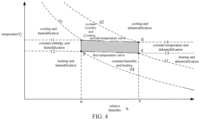
- the mapping relationship between the first corresponding relationship, the second corresponding relationship and the operating mode can be pre-saved. It is understood that, with reference to FIG. 4 , t1, t4 are the temperature upper boundary T max extension lines of the comfort zone , t2, t3 are the temperature lower boundary T min extension lines of the comfort zone; d1 is the moisture content line between the temperature lower boundary and an endpoint n of the humidity right boundary , d2 is the moisture content line between the temperature upper boundary and an endpoint of the humidity right boundary, d3 is the moisture content line between the temperature upper boundary and an endpoint m of the humidity left boundary, d4 is the moisture content line between the lower temperature boundary and the humidity left boundary endpoints.
- the mapping relationship between the first corresponding relationship and the second corresponding relationship to the operating modes may be stored in the database in the form of a table, as shown in Table 2 below.
- Table 2 operating mode the first corresponding relationship the second corresponding relationship cooling and dehumidification T>t4 d>d 2 constant humidity and cooling T>T max d ⁇ [d 3 , d 4 ] cooling and humidification T>t 3 d ⁇ d 4 constant enthalpy and humidification T ⁇ [t 2 , t 1 ] d ⁇ m heating and humidification T ⁇ t 2 d ⁇ d 4 constant humidity and heating T ⁇ T min d ⁇ [d 4 , d 1 ] heating and dehumidification T ⁇ t 3 d>d 1 constant temperature and T ⁇ [t 3 , t 4 ] d>n dehumidification
- the air conditioner In the cooling and dehumidification mode, it is determined that there is a demand for cooling and dehumidification in the action space, at this time, the air conditioner operates in the cooling and dehumidification mode and controls the temperature of the indoor heat exchanger to be lower than the dew point temperature for cooling and dehumidification.
- the indoor heat exchanger of the air conditioner can be controlled to cool at a state higher than the dew point temperature, to avoid decreasing humidity due to condensation of water from the indoor heat exchanger, so as to achieve constant humidity and cooling.
- the indoor heat exchanger of the air conditioner can also be controlled to be slightly lower than the dew point temperature in the constant humidity and cooling mode.
- the difference between the dew point temperature and the temperature of the heat exchanger is lower than a preset difference.
- the preset difference can be set by the producer.
- the humidifier is controlled to operate according to the difference to maintain humidity in the home.
- the air conditioner In the cooling and humidification mode, it is determined that there is a demand for the cooling and humidification in the action space, so the air conditioner operates in the cooling and humidification mode, and cooling and humidifying of the air conditioner are avoided at the same time to prevent the condensation of the cold air for cooling meeting the water vapor for humidifying. Specifically, first cooling is performed without humidification, and then when the temperature is reached, the cooling is closed and humidification is performed; or the cooling and humidification are performed intermittently.
- the air conditioner In the constant enthalpy and humidification mode, it is determined that the air conditioner only requires to humidify, so the air conditioner can be controlled to operate directly in the humidification mode.
- the air conditioner In the heating and humidification mode, it is determined that there is a demand for humidification and heating in the action space, and the air conditioner operates in the heating and humidification mode at this time.
- the air conditioner In the heating and dehumidification mode, it is determined that there is a demand for dehumidification and heating in the action space, at this time, the air conditioner operates in the dehumidification and reheating mode, and for the system with heat recovery reheating system, the evaporating temperature is controlled to be lower than the target dew point temperature for dehumidification according to the control method of the system, and then the reheater is used to heat the dehumidified air to raise the output air temperature.
- the air conditioner with electric auxiliary reheating performs cooling according to the control method of the system to control evaporating temperature to be lower than the target dew point temperature for dehumidification, and then the electric auxiliary heat power is controlled to heat the dehumidified air to raise the output air temperature.
- the air conditioner In the constant temperature and dehumidification mode, it is determined that there is a demand for maintaining the temperature and dehumidification in the action space, and at this time, the air conditioner operates in the constant temperature and dehumidification mode, and the control method is the same as that in the heating and dehumidification mode.
- the air conditioner is controlled to operate according to the determined operating parameters.
- a first corresponding relationship between the current temperature and the target temperature interval, and a second corresponding relationship between the current moisture content and the target moisture content interval are first determined, and then the operating parameters of the air conditioner are determined according to the first corresponding relationship and the second corresponding relationship, and the air conditioner is controlled to operate according to the determined operating parameters, which achieves the effect of comprehensively regulating the air conditioner by combining humidity and temperature.
- the current time information can be obtained after obtaining the outdoor ambient temperature, the current season information is determined according to the outdoor ambient temperature and the current time information, and then the dressing index is determined according to a correlation relationship between the outdoor ambient temperature, the season information and the dressing index.
- the correlation relationship may be pre-stored in the database in the form of a table, as shown in Table 3 below. Table 3.
- the dressing index is determined according to the twenty-four solar terms and the outdoor environment temperature, or the dressing index can be determined in combination with the seasons and the twenty-four solar terms and the outdoor ambient temperature.
- the current time information is obtained
- the current season information is determined according to the outdoor ambient temperature and the current time information
- the dressing index is determined according to the correlation relationship between the outdoor ambient temperature and the season information and the dressing index, to improve the accuracy of the obtained dressing index.
- embodiments of the present application propose an air conditioner, the air conditioner includes a memory, a processor and a program for comprehensively regulating temperature and humidity that is stored on the memory and operable on the processor, the program for comprehensively regulating temperature and humidity when executed by the processor implements the method for comprehensively regulating temperature and humidity according to the above embodiments.
- embodiments of the present application provide a computer readable storage medium, the computer readable storage medium stores a program for comprehensively regulating temperature and humidity, the program for comprehensively regulating temperature and humidity when executed by the processor implements the method for comprehensively regulating temperature and humidity according to the above embodiments.
- the method in the above embodiments can be implemented with the aid of software plus the necessary common hardware platform, or of course with hardware, but in many cases the former is the better implementation.
- the technical solution of the present application in essence or the part that contributes to the prior art, may be embodied in the form of a software product stored in a storage medium (e.g., a ROM/RAM, a disk, a CD-ROM) as described above, including a number of instructions to cause a terminal device (which may be an air conditioner, etc.) to perform the method in various embodiments of the present application.
- a storage medium e.g., a ROM/RAM, a disk, a CD-ROM
Landscapes
- Engineering & Computer Science (AREA)
- Chemical & Material Sciences (AREA)
- Combustion & Propulsion (AREA)
- Mechanical Engineering (AREA)
- General Engineering & Computer Science (AREA)
- Signal Processing (AREA)
- Physics & Mathematics (AREA)
- Fuzzy Systems (AREA)
- Mathematical Physics (AREA)
- Air Conditioning Control Device (AREA)
Abstract
Description
- The present application claims priority to
Chinese Patent Application No. 202010793953.3, and filed on August 7, 2020 - The present application relates to the technical field of virtual reality, and in particular to a method for comprehensively regulating temperature and humidity, a regulation device, a regulation system and a computer readable storage medium.
- To improve the comfort of the air conditioner, the humidifier needs to be turned on when the air conditioner is turned on. The humidification function and the temperature regulation function can only be controlled independently, resulting in lowering relative humidity in the room when the air conditioner performs cooling regulation. To protect the humidity in the home, it is necessary to turn on an independent humidifier for humidification, which causes a waste of resources and energy.
- The foregoing is intended only to assist in understanding the technical solution of the present application and does not represent an admission that the foregoing is prior art.
- The main purpose of the present application is to provide a method for comprehensively regulating temperature and humidity, a regulation device, a regulation system and a computer readable storage medium, aiming at reducing energy consumption of the air conditioner.
- In order to achieve the above purpose, the present application provides a method for comprehensively regulating temperature and humidity, including:
- obtaining thermal comfort impact parameters and a preset relative humidity interval corresponding to a user in an action space of a regulation device;
- determining a target temperature interval according to the thermal comfort impact parameters and the preset relative humidity interval;
- determining a target moisture content interval according to the preset relative humidity interval; and
- determining operating parameters of the regulation device according to a current temperature, a current moisture content, the target moisture content interval, and the target temperature interval in the action space, and controlling the regulation device to operate according to the determined operating parameters.
- In an embodiment, the thermal comfort impact parameters include a dressing index of the user, an activity amount of the user, and/or a human metabolic rate.
- In an embodiment, before the operation of obtaining the thermal comfort impact parameters and the preset relative humidity interval corresponding to the user in the action space of the regulation device, the method further includes:
- obtaining an outdoor ambient temperature corresponding to a space where the regulation device is located;
- wherein the operation of obtaining the thermal comfort impact parameters and the preset relative humidity interval corresponding to the user in the action space of the regulation device includes:
- determining the dressing index according to the outdoor ambient temperature; and
- obtaining the preset relative humidity interval.
- In an embodiment, the operation of determining the dressing index according to the outdoor ambient temperature includes:
determining the obtained dressing index corresponding to the outdoor ambient temperature according to a pre-stored corresponding relationship between the outdoor ambient temperature and the dressing index. - In an embodiment, the operation of obtaining the outdoor ambient temperature corresponding to the space where the regulation device is located includes:
- obtaining position information of the regulation device and weather forecast data; and
- determining the outdoor ambient temperature according to the position information and the weather forecast data.
- In an embodiment, the operation of determining the dressing index according to the outdoor ambient temperature includes:
- obtaining a current time; and
- determining a current season and/or a current seasonal weather corresponding to the space where the regulation device is located according to the current time and the position information;
- wherein the operation of determining the dressing index according to the outdoor ambient temperature includes:
- determining the dressing index according to the current time, the outdoor ambient temperature, and at least one of the current season and the current seasonal weather.
- In an embodiment, before the operation of obtaining the thermal comfort impact parameters and the preset relative humidity interval corresponding to the user in the action space of the regulation device, the method further includes:
- obtaining temperature detection data detected by an infrared detection sensor in the space where the regulation device is located;
- wherein the operation of obtaining the thermal comfort impact parameters and the preset relative humidity interval corresponding to the user in the action space of the regulation device comprises:
- determining the activity amount corresponding to the user in the action space of the regulation device according to the temperature detection data, and obtaining the preset relative humidity interval.
- In an embodiment, the operation of determining the target temperature interval according to the preset relative humidity interval and at least one of the dressing index and the activity amount includes:
- obtaining a first heat-sensing index and a second heat-sensing index that are pre-stored, wherein the first heat-sensing index is lower than the second heat-sensing index;
- determining a first temperature curve according to the first heat-sensing index, the preset relative humidity interval, and at least one of the dressing index and the activity amount;
- determining a second temperature curve according to the second heat-sensing index, the preset relative humidity interval, and at least one of the dressing index and the activity amount; and
- determining the target temperature interval according to the first temperature curve and the second temperature curve.
- In an embodiment, before the operation of determining the target moisture content interval according to the preset relative humidity interval, the method further includes:
- obtaining a vapor partial pressure value in the action space of the regulation device;
- wherein the operation of determining the target moisture content interval according to the preset relative humidity interval includes:
- determining a moisture content curve according to the vapor partial pressure value, the target temperature interval, and the preset relative humidity interval; and
- determining the target moisture content interval according to the moisture content curve.
- In an embodiment, before the operation of determining the operating parameters of the regulation device according to the current temperature, the current moisture content, the target moisture content interval, and the target temperature interval in the action space, and controlling the regulation device to operate according to the determined operating parameters, the method further includes:
obtaining the current temperature and the current moisture content in an action space of an air conditioner. - In an embodiment, the operation of determining the operating parameters of the regulation device according to the current temperature, the current moisture content, the target moisture content interval, and the target temperature interval in the action space, and controlling the regulation device to operate according to the determined operating parameters includes:
- determining a first corresponding relationship between the current temperature and the target temperature interval, and a second corresponding relationship between the current moisture content and the target moisture content interval;
- determining operating parameters of the regulation device according to the first corresponding relationship and the second corresponding relationship; and
- controlling the regulation device to operate according to the determined operating parameters.
- In an embodiment, the regulation device includes a temperature regulation assembly and a humidity regulation assembly, and the temperature regulation assembly and the humidity regulation assembly are separated or integrated together.
- In addition, in order to achieve the above purpose, the present application also provides a regulation device, including: a memory, a processor and a program for comprehensively regulating temperature and humidity that is stored on the memory and operable on the processor, the program for comprehensively regulating temperature and humidity when executed by the processor implements the method for comprehensively regulating temperature and humidity as mentioned.
- In addition, in order to achieve the above purpose, the present application also provides a regulation system, including: a humidity regulation device, a temperature regulation device and a control unit, the control unit comprises a memory, a processor and a program for comprehensively regulating temperature and humidity that is stored on the memory and operable on the processor, the program for comprehensively regulating temperature and humidity when executed by the processor implements the method for comprehensively regulating temperature and humidity as mentioned above.
- In addition, in order to achieve the above purpose, the present application also provides a computer readable storage medium, the computer readable storage medium stores a program for comprehensively regulating temperature and humidity, the program for comprehensively regulating temperature and humidity when executed by the processor implements the method for comprehensively regulating temperature and humidity as mentioned above.
- The embodiments of the present application provide a method for comprehensively regulating temperature and humidity. Thermal comfort impact parameters and a preset relative humidity interval corresponding to a user in an action space of a regulation device are first obtained; then, a target temperature interval is determined according to the thermal comfort impact parameters and the preset relative humidity interval, and a target moisture content interval is determined according to the preset relative humidity interval; and finally operating parameters of the regulation device are determined according to a current temperature, a current moisture content, the target moisture content interval, and the target temperature interval in the action space, and the regulation device is controlled to operate according to the determined operating parameters. Since the humidity and temperature are taken into account when determining the operating parameters, the air conditioner is regulated according to the determined operating parameters by combining the humidity and temperature, thus avoiding the phenomenon that when the air conditioner is regulated independently to reduce the temperature, the relative humidity in the room will decrease, hence the energy consumption of the air conditioner can be reduced. In addition, the humidity and temperature can be integrated to regulate the operating parameters of the air conditioner, to avoid the decline in comfort caused by independent regulation, to improve the comfort of the air conditioner.
-
-
FIG. 1 is a schematic diagram of the terminal structure of the hardware operating environment according to an embodiment of the present application. -
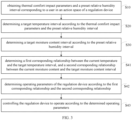
FIG. 2 is a flowchart of a method for comprehensively regulating temperature and humidity according to an embodiment of the present application. -
FIG. 3 a flowchart of a method for comprehensively regulating temperature and humidity according to another embodiment of the present application. -
FIG. 4 is a schematic diagram of a comfort zone according to an embodiment of the present application. - The realization of the purpose, functional features and advantages of the present application will be further described in conjunction with the embodiments, with reference to the drawings.
- It should be understood that the specific embodiments described herein are intended to explain the present application only and are not intended to limit the present application.
- The primary solutions of embodiments of the present application are as follows:
- obtaining thermal comfort impact parameters and a preset relative humidity interval corresponding to a user in an action space of a regulation device;
- determining a target temperature interval according to the thermal comfort impact parameters and the preset relative humidity interval;
- determining a target moisture content interval according to the preset relative humidity interval; and
- determining operating parameters of the regulation device according to a current temperature, a current moisture content, the target moisture content interval, and the target temperature interval in the action space, and controlling the regulation device to operate according to the determined operating parameters.
- Since the humidity and temperature are taken into account when determining the operating parameters, the air conditioner is regulated according to the determined operating parameters by combining the humidity and temperature, thus avoiding the phenomenon that when the air conditioner is regulated independently to reduce the temperature, the relative humidity in the room will decrease, hence the energy consumption of the air conditioner can be reduced. In addition, the humidity and temperature can be integrated to regulate the operating parameters of the air conditioner, to avoid the decline in comfort caused by independent regulation, to improve the comfort of the air conditioner.
- As shown in
FIG. 1, FIG. 1 is a schematic diagram of the terminal structure of the hardware operating environment according to the embodiment of the present application. - The terminal of the present application embodiment may be a terminal device such as an air conditioner.
- As shown in
FIG. 1 , the terminal may include: aprocessor 1001, such as a CPU, anetwork interface 1004, auser interface 1003, amemory 1005, and acommunication bus 1002. Thecommunication bus 1002 is used to implement communication among these components. Auser interface 1003 can include a display, an input unit such as a keyboard, etc.. Theuser interface 1003 can optionally include a standard wired interface, a wireless interface. Thenetwork interface 1004 optionally can include a standard wired interface, a wireless interface (such as WI-FI interface). Thememory 1005 can be a high-speed RAM memory, or a non-volatile memory, such as a disk memory. Thememory 1005 optionally may also be a storage device independent of theaforementioned processor 1001. - It will be understood by those skilled in the art that the terminal structure illustrated in
FIG. 1 does not limit the terminal and may include more or fewer components than illustrated, or a combination of certain components, or a different arrangement of components. - As shown in
FIG. 1 , thememory 1005, which is a computer storage medium, may include an operating system, a network communication module, a user interface module, and a program for comprehensively regulating temperature and humidity. - In the terminal shown in
FIG. 1 , thenetwork interface 1004 is primarily used to connect to the backend server and communicate with the backend server for data; theprocessor 1001 can invoke the program for comprehensively regulating temperature and humidity stored in thememory 1005 and perform the following operations: - obtaining thermal comfort impact parameters and a preset relative humidity interval corresponding to a user in an action space of a regulation device;
- determining a target temperature interval according to the thermal comfort impact parameters and the preset relative humidity interval;
- determining a target moisture content interval according to the preset relative humidity interval; and
- determining operating parameters of the regulation device according to a current temperature, a current moisture content, the target moisture content interval, and the target temperature interval in the action space, and controlling the regulation device to operate according to the determined operating parameters.
- In an embodiment, the
processor 1001 may invoke the program for comprehensively regulating temperature and humidity stored in thememory 1005, and further perform the following operations: - obtaining an outdoor ambient temperature corresponding to a space where the regulation device is located;
- the operation of obtaining the thermal comfort impact parameters and the preset relative humidity interval corresponding to the user in the space where the regulation device is located includes:
- determining the dressing index according to the outdoor ambient temperature; and
- obtaining the preset relative humidity interval.
- In an embodiment, the
processor 1001 may invoke the program for comprehensively regulating temperature and humidity stored in thememory 1005, and further perform the following operations:
determining the obtained dressing index corresponding to the outdoor ambient temperature according to a pre-stored corresponding relationship between the outdoor ambient temperature and the dressing index. - In an embodiment, the
processor 1001 may invoke the program for comprehensively regulating temperature and humidity stored in thememory 1005, and further perform the following operations: - obtaining position information of the regulation device and weather forecast data; and
- determining the outdoor ambient temperature according to the position information and the weather forecast data.
- In an embodiment, the
processor 1001 may invoke the program for comprehensively regulating temperature and humidity stored in thememory 1005, and further perform the following operations: - obtaining a current time;
- determining a current season and/or a current seasonal weather corresponding to the space where the regulation device is located according to the current time and the position information;
- the operation of determining the dressing index according to the outdoor ambient temperature includes:
- determining the dressing index according to the current time, the outdoor ambient temperature, and at least one of the current season and the current seasonal weather.
- In an embodiment, the
processor 1001 may invoke the program for comprehensively regulating temperature and humidity stored in thememory 1005, and further perform the following operations: - obtaining temperature detection data detected by an infrared detection sensor in the space where the regulation device is located;
- the operation of obtaining the thermal comfort impact parameters and the preset relative humidity interval corresponding to the user in the space where the regulation device is located includes:
- determining the activity amount corresponding to the user in the action space of the regulation device according to the temperature detection data, and obtaining the preset relative humidity interval.
- In an embodiment, the
processor 1001 may invoke the program for comprehensively regulating temperature and humidity stored in thememory 1005, and further perform the following operations: - obtaining a first heat-sensing index and a second heat-sensing index that are pre-stored, wherein the first heat-sensing index is lower than the second heat-sensing index;
- determining a first temperature curve according to the first heat-sensing index, the preset relative humidity interval, and at least one of the dressing index and the activity amount;
- determining a second temperature curve according to the second heat-sensing index, the preset relative humidity interval, and at least one of the dressing index and the activity amount; and
- determining the target temperature interval according to the first temperature curve and the second temperature curve.
- In an embodiment, the
processor 1001 may invoke the program for comprehensively regulating temperature and humidity stored in thememory 1005, and further perform the following operations: - obtaining a vapor partial pressure value in the space where the regulation device is located;
- the operation of determining the target moisture content interval according to the preset relative humidity interval includes:
- determining a moisture content curve according to the vapor partial pressure value, the target temperature interval, and the preset relative humidity interval; and
- determining the target moisture content interval according to the moisture content curve.
- In an embodiment, the
processor 1001 may invoke the program for comprehensively regulating temperature and humidity stored in thememory 1005, and further perform the following operations:
obtaining the current temperature and the current moisture content in an action space of an air conditioner. - In an embodiment, the
processor 1001 may invoke the program for comprehensively regulating temperature and humidity stored in thememory 1005, and further perform the following operations: - determining a first corresponding relationship between the current temperature and the target temperature interval, and a second corresponding relationship between the current moisture content and the target moisture content interval;
- determining operating parameters of the regulation device according to the first corresponding relationship and the second corresponding relationship; and
- controlling the regulation device to operate according to the determined operating parameters.
- Referring to
FIG. 2 , in an embodiment of the method for comprehensively regulating temperature and humidity of the present application, the method for comprehensively regulating temperature and humidity includes: - operation S10, obtaining thermal comfort impact parameters and a preset relative humidity interval corresponding to a user in an action space of a regulation device;
- operation S20, determining a target temperature interval according to the thermal comfort impact parameters and the preset relative humidity interval;
- operation S30, determining a target moisture content interval according to the preset relative humidity interval; and
- operation S40, determining operating parameters of the regulation device according to a current temperature, a current moisture content, the target moisture content interval, and the target temperature interval in the action space, and controlling the regulation device to operate according to the determined operating parameters.
- In conventional air conditioners, the temperature control and humidity control are performed independently, resulting that conventional air conditioners reduce relative humidity in the room when lowering the temperature. To ensure the humidity in the home, a separate humidifier needs to be turned on for humidification, which raises the energy consumption of the air conditioner. In order to solve the above defects of the conventional air conditioner, the present application proposes a method for comprehensively regulating temperature and humidity, which aims to comprehensively regulate the temperature and the humidity of the air conditioner, so as to reduce the energy consumption of the air conditioner. Moreover, the air conditioner is controlled by combining the temperature and the humidity, which can also make the air conditioner maintain both temperature and humidity within a comfortable range, to improve the comfort of the air conditioner.
- In the embodiment, the thermal comfort impact parameters are quantifiable data that affects the thermal comfort of the user, which may include, for example, a dressing index of the user, an activity amount of the user, and/or a human metabolic rate. In the following, the present application is explained by using an air conditioner that has humidification and temperature regulation functions as an execution device.
- The air conditioner may first obtain at least one of a dressing index and an activity amount corresponding to a user in the action space of the air conditioner, and obtain a preset relative humidity interval. It should be understood that the preset relative humidity interval may be determined by the producer of the air conditioner according to experimental data and pre-stored in a database corresponding to the air conditioner. It should be understood that the database may be a local database of the air conditioner, and/or a network database set on a server. The air conditioner is further provided with a network module that enables the air conditioner to communicate with the server, to enable the air conditioner to access the data stored in the network database that is set at the server, and/or receive the updated packets sent by the network server, and update the specific values in the preset relative humidity interval that is stored in the local database, according to the updated packets sent by the network server.
- In an embodiment, the outdoor ambient temperature corresponding to the position of the air conditioner may be obtained first, and then the dressing index may be determined according to the outdoor ambient temperature, and/or the air conditioner may also be provided with an infrared detection sensor, such that the air conditioner may detect the temperature detection data corresponding to the user in the action space by the infrared detection sensor, and then determine the dressing index of the user and/or the activity amount according to the temperature detection data.
- An air conditioner is provided with an outdoor ambient temperature detection sensor, such that the air conditioner can obtain the outdoor ambient temperature by the outdoor ambient temperature detection sensor, and/or the air conditioner is connected to a network, such that the air conditioner can first determine its' positioning data according to its' connected network, and then obtain the current time according to its' connected network, and/or obtain the current time according to the local data. Then the positioning data is sent to the server to obtain the weather forecast data corresponding to the positioning data through the server. Then, the outdoor ambient temperature is determined according to the current time and the weather forecast data.
- In an embodiment, when the outdoor ambient temperature is determined, a corresponding relationship between the outdoor ambient temperature and the dressing index can be obtained, and then the current moment and the dressing index corresponding to the user in the action space are determined according to the corresponding relationship.
- In an embodiment, the corresponding relationship between the outdoor ambient temperature and the dressing index may be stored in the database of the air conditioner in the form of a table, as shown in Table 1 below.
Table 1: outdoor ambient temperature T4/°C dressing index T4 > 32 0.3 30≤T4≤32 0.5 26≤T4 < 30 0.7 22 < T4 < 26 0.7 17 < T4≤22 0.9 10≤T4≤17 1.0 T4 < 10 1.1 - When the temperature detection data is obtained, a temperature respective chart corresponding to the user in the space can be generated according to the temperature detection data, and then the activity amount of the user can be determined according to the temperature respective chart.
- In an embodiment, after the air conditioner obtains the preset relative humidity interval and at least one of the dressing index and/or the activity amount, the target temperature interval may be determined first.
- In an embodiment, the producer of the air conditioner may pre-store a first body sensory index and a second body sensory index in the air conditioner, the first body sensory index may be lower than the second body sensory index. The first body sensory index and the second body sensory index can be predicted mean vote (PMV) pre-stored in the database, the predicted mean vote is an evaluation index indicating the thermal response of the human body. It can be understood that the PMV can be set to correspond to different areas according to different application areas of the air conditioner. For example, when the application area of the air conditioner is China, the first body sensory index and second body sensory index are set to PMVchn (the expected average heat sensory index suitable for Chinese people). When PMVchn is 0, the comfort level is the best; when PMVchn is positive, the comfort level is slightly hotter, and the larger the absolute value is, the hotter it is; when PMVchn is negative, the comfort level is slightly colder, and the larger the absolute value is, the colder it is.
- In an embodiment, the first body sensory index is -0.2 and the second heat sensory index is 0.3.
- Since the PMV chn can be calculated according to the following formulas.

- Where tcl indicates a surface temperature of clothes in°C, its calculation formula is:

- hc is a convective heat transfer coefficient in W/(m2·°C), related to the air flow rate and a temperature difference between the ambient temperature and the surface temperature of clothes;

- fcl is a ratio of a surface area of human body when dressed to a surface area of human body when naked.

- M is a metabolic rate in W/m2 and is equal to 70 W/m2 according to GB/T33658-2017.
- W is the heat consumed by external work (negligible for most activities), in W/m2.
- Icl is a thermal resistance of clothes, in m2·°C/W, calculated as Icl is equal to dressing index Ci multiplied by 0.155, the dressing index Ci is determined according to the outdoor ambient temperature and the corresponding season, with a range of 0.3 to 1.1.
- Where T1 is an air temperature in °C.
- Where
tr is an average radiation temperature in °C, approximated as the air temperature T1. - Where var is an air flow speed (wind speed) in m/s.
- Where Pa is a water vapor partial pressure in Pa, calculated from an formula (X-X).
- Where a is a thermal sensitivity characteristic coefficient, indicating the sensitivity of the human body to the thermal environment, the larger the coefficient is, the more sensitive to changes in the thermal environment under this operating condition, the narrower the comfort interval is, a is equal to 0.0260.
- Where b is a thermal sensitivity characteristic coefficient, indicating the deviation degree of a human thermal sensation from the theoretical comfort temperature, the larger the absolute value of the coefficient, the greater the deviation degree from the relative comfort temperature under this operating condition, a positive coefficient indicates cold-resistant and fear of heat, a negative coefficient indicates cold-resistant and fear of cold, b is equal to -0.2074.
- Where Pa indicates the water vapor partial pressure.
- Where ta is the temperature value.
- Where H is a relative humidity.
- Based on the above formulas, it can be seen that when the first body sensory index and the second body sensory index are determined, since all parameters other than the dressing index and the activity amount are fixed constants, or values of operating parameters can be directly determined by the air conditioner. Thus, based on the above formulas, a temperature inverse function can be calculated according to the dressing index, the activity amount, the first heat sensory index and the preset relative humidity interval, and the first temperature curve can then be determined according to the temperature inverse function. Similarly, the second temperature curve can be determined according to the second body sensory index, and the target temperature interval is determined according to the above temperature curves. That is, in the temperature icon, the target temperature interval takes the first temperature curve as a lower boundary and the second temperature curve as an upper boundary. It should be understood that when a first temperature boundary value and a second temperature boundary value are determined only according to the dressing index or the activity amount. One of the dressing index and the activity amount may be used as data obtained in real time and the other is a fixed constant pre-stored in the air conditioner.
- It can be understood that, in order to reduce the amount of computing of the processor of the air conditioner and reduce the system overhead, a calculation model can be generated and saved in the air conditioner according to the above formulas, such that the air conditioner, after obtaining the dressing index and or the activity amount, can directly derive the corresponding target temperature interval by the calculation model.
- In an embodiment, a moisture content interval may also be determined according to the preset humidity interval. Specifically, the vapor partial pressure value (i.e., saturated water vapor partial pressure) in the action space of the air conditioner can be obtained first, the vapor partial pressure value can be calculated according to the Hyland-Wexler formula.
- When the vapor partial pressure value is determined, the target moisture content interval can be determined according to the vapor partial pressure value and the preset relative humidity interval. Referring to
FIG. 4 , the preset relative humidity interval [m, n] intersects with the first temperature curve and the second temperature curve at points A, B, C and D, respectively, and then the moisture content curves d1, d2, d3 and d4 corresponding to points A, B, C and D, respectively, can be calculated according to the vapor partial pressure value and the temperature value. - In an embodiment, the boundary value corresponding to the target moisture content interval can be calculated according to the vapor partial pressure value and the preset relative humidity interval. When the target moisture content interval and the target temperature interval are determined, the current temperature and the current moisture content in the action space can be obtained, and then the operating parameters of the air conditioner can be determined according to the current temperature, the current moisture content, the target moisture content interval, and the target temperature interval in the action space, and the air conditioner can be controlled to operate according to the determined operating parameters.
- In an embodiment, a first corresponding relationship between the current temperature value and the target temperature interval, and a second corresponding relationship between the current moisture content and the target moisture content interval may be determined, and then the operating parameters of the air conditioner are determined according to the first corresponding relationship and the second corresponding relationship, and the air conditioner is controlled to operate according to the determined operating parameters.
- It should be noted that the first corresponding relationship includes a lower boundary where the current temperature is lower than the target temperature interval, and an upper boundary where the current temperature is within and greater than the target temperature interval. The second corresponding relationship includes a lower boundary where the current moisture content is lower than the target moisture content interval, and an upper boundary where the current moisture content is within and greater than the target moisture content interval. When the operating parameters are determined, the air conditioner can be controlled to operate according to the determined operating parameters.
- It should be noted that when the method for comprehensively regulating temperature and humidity is performed by a regulation system, the regulation system includes a humidity regulation device, a temperature regulation device, and a control unit. The control unit is used to determine the operating parameters of the humidity regulation device and the temperature regulation device according to the method for comprehensively regulating temperature and humidity, so as to comprehensively control the humidity regulation device and the temperature regulation device to comprehensively regulate the temperature and humidity. The temperature regulation device can be an air conditioner, and the humidity regulation device can be a humidifier. The humidifier and the air conditioner can be wired or wireless with the control unit. The control unit can be set up with the humidifier or air conditioner as a whole, or can be set up independently of the humidifier and the air conditioner, which are not limited in the embodiment.
- In the technical solution disclosed in the embodiment, at least one of the dressing index and the activity amount corresponding to the user in the action space of the air conditioner and the preset relative humidity interval are first obtained, then the target temperature interval is determined according to the preset relative humidity interval and at least one of the dressing index and the activity amount, and the target moisture content interval is determined according to the preset relative humidity interval, and finally operating parameters of the air conditioner is determined according to the current temperature, the current moisture content, the target moisture content interval, and the target temperature interval in the action space, and control the air conditioner to operate according to the determined operating parameters. Since the humidity and temperature are taken into account when determining the operating parameters, the air conditioner is regulated according to the determined operating parameters by combining the humidity and temperature into account, thus avoiding the phenomenon of lowering the relative humidity in the room at reducing of the temperature caused by when the air conditioner is regulated independently, to reduce the energy consumption of the air conditioner. In addition, the humidity and temperature can be integrated to regulate the operating parameters of the air conditioner, to avoid the decline in comfort caused by independent regulation, to improve the comfort of the air conditioner.
- In an embodiment, the operation of determining the operating parameters of the air conditioner according to the current temperature, the current moisture content, the target moisture content interval, and the target temperature interval in the action space, and controlling the air conditioner to operate according to the determined operating parameters includes:
- operation S41, determining a first corresponding relationship between the current temperature and the target temperature interval, and a second corresponding relationship between the current moisture content and the target moisture content interval;
- operation S42, determining operating parameters of the regulation device according to the first corresponding relationship and the second corresponding relationship; and
- operation S43, controlling the regulation device to operate according to the determined operating parameters.
- In the embodiment, a first corresponding relationship between the current temperature value and the target temperature interval, and a second corresponding relationship between the current moisture content and the target moisture content interval can be determined first, and then the operating mode of the air conditioner can be determined according to the first corresponding relationship and the second corresponding relationship. The air conditioner pre-stores the operating parameters corresponding to different operating modes, so that after determining the operating mode, the operating parameters corresponding to the determined operating mode can be obtained.
- In an embodiment, the mapping relationship between the first corresponding relationship, the second corresponding relationship and the operating mode can be pre-saved. It is understood that, with reference to
FIG. 4 , t1, t4 are the temperature upper boundary Tmax extension lines of the comfort zone , t2, t3 are the temperature lower boundary Tmin extension lines of the comfort zone; d1 is the moisture content line between the temperature lower boundary and an endpoint n of the humidity right boundary , d2 is the moisture content line between the temperature upper boundary and an endpoint of the humidity right boundary, d3 is the moisture content line between the temperature upper boundary and an endpoint m of the humidity left boundary, d4 is the moisture content line between the lower temperature boundary and the humidity left boundary endpoints. The mapping relationship between the first corresponding relationship and the second corresponding relationship to the operating modes may be stored in the database in the form of a table, as shown in Table 2 below.Table 2: operating mode the first corresponding relationship the second corresponding relationship cooling and dehumidification T>t4 d>d2 constant humidity and cooling T>Tmax d∈[d3, d4] cooling and humidification T>t3 d<d4 constant enthalpy and humidification T∈[t2, t1] d<m heating and humidification T<t2 d<d4 constant humidity and heating T<Tmin d∈[d4, d1] heating and dehumidification T<t3 d>d1 constant temperature and T∈[t3, t4] d>n dehumidification - In the cooling and dehumidification mode, it is determined that there is a demand for cooling and dehumidification in the action space, at this time, the air conditioner operates in the cooling and dehumidification mode and controls the temperature of the indoor heat exchanger to be lower than the dew point temperature for cooling and dehumidification.
- In the constant humidity and cooling mode, it is determined that there is only a demand for constant humidity and cooling in the action space, so the indoor heat exchanger of the air conditioner can be controlled to cool at a state higher than the dew point temperature, to avoid decreasing humidity due to condensation of water from the indoor heat exchanger, so as to achieve constant humidity and cooling.
- In an embodiment, to ensure the cooling effect of the air conditioner, the indoor heat exchanger of the air conditioner can also be controlled to be slightly lower than the dew point temperature in the constant humidity and cooling mode. When the temperature of the heat exchanger is lower than the dew point temperature, the difference between the dew point temperature and the temperature of the heat exchanger is lower than a preset difference. The preset difference can be set by the producer. The humidifier is controlled to operate according to the difference to maintain humidity in the home.
- In the cooling and humidification mode, it is determined that there is a demand for the cooling and humidification in the action space, so the air conditioner operates in the cooling and humidification mode, and cooling and humidifying of the air conditioner are avoided at the same time to prevent the condensation of the cold air for cooling meeting the water vapor for humidifying. Specifically, first cooling is performed without humidification, and then when the temperature is reached, the cooling is closed and humidification is performed; or the cooling and humidification are performed intermittently.
- In the constant enthalpy and humidification mode, it is determined that the air conditioner only requires to humidify, so the air conditioner can be controlled to operate directly in the humidification mode.
- In the heating and humidification mode, it is determined that there is a demand for humidification and heating in the action space, and the air conditioner operates in the heating and humidification mode at this time.
- In the constant humidity and heating mode, it is determined that there are only demands for heating in the action space, and the air conditioner operates in the heating mode without humidification at this time.
- In the heating and dehumidification mode, it is determined that there is a demand for dehumidification and heating in the action space, at this time, the air conditioner operates in the dehumidification and reheating mode, and for the system with heat recovery reheating system, the evaporating temperature is controlled to be lower than the target dew point temperature for dehumidification according to the control method of the system, and then the reheater is used to heat the dehumidified air to raise the output air temperature. The air conditioner with electric auxiliary reheating performs cooling according to the control method of the system to control evaporating temperature to be lower than the target dew point temperature for dehumidification, and then the electric auxiliary heat power is controlled to heat the dehumidified air to raise the output air temperature.
- In the constant temperature and dehumidification mode, it is determined that there is a demand for maintaining the temperature and dehumidification in the action space, and at this time, the air conditioner operates in the constant temperature and dehumidification mode, and the control method is the same as that in the heating and dehumidification mode.
- In an embodiment, after the current determination of operating parameters, the air conditioner is controlled to operate according to the determined operating parameters.
- In the technical solution disclosed in the embodiment, a first corresponding relationship between the current temperature and the target temperature interval, and a second corresponding relationship between the current moisture content and the target moisture content interval are first determined, and then the operating parameters of the air conditioner are determined according to the first corresponding relationship and the second corresponding relationship, and the air conditioner is controlled to operate according to the determined operating parameters, which achieves the effect of comprehensively regulating the air conditioner by combining humidity and temperature.
- In an embodiment, in order to improve the accuracy of the obtained dressing index, the current time information can be obtained after obtaining the outdoor ambient temperature, the current season information is determined according to the outdoor ambient temperature and the current time information, and then the dressing index is determined according to a correlation relationship between the outdoor ambient temperature, the season information and the dressing index. The correlation relationship may be pre-stored in the database in the form of a table, as shown in Table 3 below.
Table 3. outdoor ambient temperature T4/ °C season, weather dressing index T4 > 32 hot 0.3 30≤T4≤32 summer 0.5 26≤T4 < 30 early summer 0.7 22 < T4 < 26 early summer, April to October 0.7 22 < T4 < 26 early winter, November to March 0.9 17 < T4≤22 early winter 0.9 10≤T4≤17 winter 1.0 T4 < 10 frigid 1.1 - It should be noted that the dressing index is determined according to the twenty-four solar terms and the outdoor environment temperature, or the dressing index can be determined in combination with the seasons and the twenty-four solar terms and the outdoor ambient temperature.
- In the embodiment, after the outdoor ambient temperature is obtained, the current time information is obtained, the current season information is determined according to the outdoor ambient temperature and the current time information, and then the dressing index is determined according to the correlation relationship between the outdoor ambient temperature and the season information and the dressing index, to improve the accuracy of the obtained dressing index.
- In addition, embodiments of the present application propose an air conditioner, the air conditioner includes a memory, a processor and a program for comprehensively regulating temperature and humidity that is stored on the memory and operable on the processor, the program for comprehensively regulating temperature and humidity when executed by the processor implements the method for comprehensively regulating temperature and humidity according to the above embodiments.
- In addition, embodiments of the present application provide a computer readable storage medium, the computer readable storage medium stores a program for comprehensively regulating temperature and humidity, the program for comprehensively regulating temperature and humidity when executed by the processor implements the method for comprehensively regulating temperature and humidity according to the above embodiments.
- It is noted that herein the terms "including", "comprising", or any other variation thereof are intended to cover non-exclusive inclusion such that a process, a method, an article, or a system comprising a set of elements includes not only those elements, but also other elements that are not explicitly listed, or that are inherent to such process, the method, the article, or the system. Without further limitation, an element defined by the statement "including a ......" does not preclude the existence of additional identical elements in the process, the method, the article, or the system that includes that element.
- The serial numbers of the embodiments of the present application are for descriptive purposes only and do not represent the merits of the embodiments.
- From the above description of the embodiments, it will be clear to those skilled in the art that the method in the above embodiments can be implemented with the aid of software plus the necessary common hardware platform, or of course with hardware, but in many cases the former is the better implementation. Based on such an understanding, the technical solution of the present application, in essence or the part that contributes to the prior art, may be embodied in the form of a software product stored in a storage medium (e.g., a ROM/RAM, a disk, a CD-ROM) as described above, including a number of instructions to cause a terminal device (which may be an air conditioner, etc.) to perform the method in various embodiments of the present application.
- The above are only some embodiments of the present application and are not intended to limit the scope of the present application. Any equivalent structure or equivalent process transformation using the contents of the specification and the drawings of the present application, or any direct or indirect application in other related fields of technology, all fall in the scope of the present application.
Claims (16)
- A method for comprehensively regulating temperature and humidity, characterized by comprising:obtaining thermal comfort impact parameters and a preset relative humidity interval corresponding to a user in an action space of a regulation device;determining a target temperature interval according to the thermal comfort impact parameters and the preset relative humidity interval;determining a target moisture content interval according to the preset relative humidity interval; anddetermining operating parameters of the regulation device according to a current temperature, a current moisture content, the target moisture content interval, and the target temperature interval in the action space, and controlling the regulation device to operate according to the determined operating parameters.
- The method for comprehensively regulating temperature and humidity according to claim 1, wherein the thermal comfort impact parameters comprise a dressing index of the user, an activity amount of the user, and/or a human metabolic rate.
- The method for comprehensively regulating temperature and humidity according to claim 2, wherein before the operation of obtaining the thermal comfort impact parameters and the preset relative humidity interval corresponding to the user in the action space of the regulation device, the method further comprises:obtaining an outdoor ambient temperature corresponding to a space where the regulation device is located;wherein the operation of obtaining the thermal comfort impact parameters and the preset relative humidity interval corresponding to the user in the action space of the regulation device comprises:determining the dressing index according to the outdoor ambient temperature; andobtaining the preset relative humidity interval.
- The method for comprehensively regulating temperature and humidity according to claim 3, wherein the operation of determining the dressing index according to the outdoor ambient temperature comprises:
determining the obtained dressing index corresponding to the outdoor ambient temperature according to a pre-stored corresponding relationship between the outdoor ambient temperature and the dressing index. - The method for comprehensively regulating temperature and humidity according to claim 3, wherein the operation of obtaining the outdoor ambient temperature corresponding to the space where the regulation device is located comprises:obtaining position information of the regulation device and weather forecast data; anddetermining the outdoor ambient temperature according to the position information and the weather forecast data.
- The method for comprehensively regulating temperature and humidity according to claim 5, wherein the operation of determining the dressing index according to the outdoor ambient temperature comprises:obtaining a current time; anddetermining a current season and/or a current seasonal weather corresponding to the space where the regulation device is located according to the current time and the position information;wherein the operation of determining the dressing index according to the outdoor ambient temperature comprises:
determining the dressing index according to the current time, the outdoor ambient temperature, and at least one of the current season and the current seasonal weather. - The method for comprehensively regulating temperature and humidity according to claim 2, wherein before the operation of obtaining the thermal comfort impact parameters and the preset relative humidity interval corresponding to the user in the action space of the regulation device, the method further comprises:obtaining temperature detection data detected by an infrared detection sensor in the space where the regulation device is located;wherein the operation of obtaining the thermal comfort impact parameters and the preset relative humidity interval corresponding to the user in the action space of the regulation device comprises:
determining the activity amount corresponding to the user in the action space of the regulation device according to the temperature detection data, and obtaining the preset relative humidity interval. - The method for comprehensively regulating temperature and humidity according to claim 1, wherein the operation of determining the target temperature interval according to the preset relative humidity interval and at least one of the dressing index and the activity amount comprises:obtaining a first heat-sensing index and a second heat-sensing index that are pre-stored, wherein the first heat-sensing index is lower than the second heat-sensing index;determining a first temperature curve according to the first heat-sensing index, the preset relative humidity interval, and at least one of the dressing index and the activity amount;determining a second temperature curve according to the second heat-sensing index, the preset relative humidity interval, and at least one of the dressing index and the activity amount; anddetermining the target temperature interval according to the first temperature curve and the second temperature curve.
- The method for comprehensively regulating temperature and humidity according to claim 1, wherein before the operation of determining the target moisture content interval according to the preset relative humidity interval, the method further comprises:obtaining a vapor partial pressure value in the action space of the regulation device;wherein the operation of determining the target moisture content interval according to the preset relative humidity interval comprises:determining a moisture content curve according to the vapor partial pressure value, the target temperature interval, and the preset relative humidity interval; anddetermining the target moisture content interval according to the moisture content curve.
- The method for comprehensively regulating temperature and humidity according to claim 1, wherein before the operation of determining the operating parameters of the regulation device according to the current temperature, the current moisture content, the target moisture content interval, and the target temperature interval in the action space, and controlling the regulation device to operate according to the determined operating parameters, the method further comprises:
obtaining the current temperature and the current moisture content in an action space of an air conditioner. - The method for comprehensively regulating temperature and humidity according to claim 10, wherein the operation of determining the operating parameters of the regulation device according to the current temperature, the current moisture content, the target moisture content interval, and the target temperature interval in the action space, and controlling the regulation device to operate according to the determined operating parameters comprises:determining a first corresponding relationship between the current temperature and the target temperature interval, and a second corresponding relationship between the current moisture content and the target moisture content interval;determining operating parameters of the regulation device according to the first corresponding relationship and the second corresponding relationship; andcontrolling the regulation device to operate according to the determined operating parameters.
- The method for comprehensively regulating temperature and humidity according to claim 1, wherein the regulation device comprises a temperature regulation assembly and a humidity regulation assembly, and the temperature regulation assembly and the humidity regulation assembly are separated or integrated together.
- A regulation device, characterized by comprising: a memory, a processor and a program for comprehensively regulating temperature and humidity that is stored on the memory and operable on the processor, wherein the program for comprehensively regulating temperature and humidity when executed by the processor implements the method for comprehensively regulating temperature and humidity according to any one of claims 1 to 12.
- The regulation device according to claim 13, wherein the regulation device is an air conditioner having a humidity regulation function and a temperature regulation function.
- A regulation system, characterized by comprising: a humidity regulation device, a temperature regulation device and a control unit, wherein the control unit comprises a memory, a processor and a program for comprehensively regulating temperature and humidity that is stored on the memory and operable on the processor, wherein the program for comprehensively regulating temperature and humidity when executed by the processor implements the method for comprehensively regulating temperature and humidity according to any one of claims 1 to 12.
- A computer readable storage medium, characterized in that, the computer readable storage medium stores a program for comprehensively regulating temperature and humidity, wherein the program for comprehensively regulating temperature and humidity when executed by the processor implements the method for comprehensively regulating temperature and humidity according to any one of claims 1 to 12.
Applications Claiming Priority (2)
| Application Number | Priority Date | Filing Date | Title |
|---|---|---|---|
| CN202010793953.3A CN114061038B (en) | 2020-08-07 | 2020-08-07 | Temperature and humidity comprehensive regulation control method, regulation equipment, regulation system and medium |
| PCT/CN2021/096574 WO2022028063A1 (en) | 2020-08-07 | 2021-05-28 | Temperature and humidity comprehensive adjustment control method, and adjustment device, adjustment system and medium |
Publications (2)
| Publication Number | Publication Date |
|---|---|
| EP4155617A1 true EP4155617A1 (en) | 2023-03-29 |
| EP4155617A4 EP4155617A4 (en) | 2023-11-29 |
Family
ID=80119873
Family Applications (1)
| Application Number | Title | Priority Date | Filing Date |
|---|---|---|---|
| EP21853772.8A Pending EP4155617A4 (en) | 2020-08-07 | 2021-05-28 | Temperature and humidity comprehensive adjustment control method, and adjustment device, adjustment system and medium |
Country Status (3)
| Country | Link |
|---|---|
| EP (1) | EP4155617A4 (en) |
| CN (1) | CN114061038B (en) |
| WO (1) | WO2022028063A1 (en) |
Families Citing this family (8)
| Publication number | Priority date | Publication date | Assignee | Title |
|---|---|---|---|---|
| CN114738951B (en) * | 2022-03-28 | 2024-02-20 | 海尔(深圳)研发有限责任公司 | Indoor air conditioning methods, regulating devices and smart home systems |
| CN116576547A (en) * | 2023-03-27 | 2023-08-11 | 青岛海尔空调电子有限公司 | Air conditioner control method and air conditioner |
| CN116381163B (en) * | 2023-05-29 | 2024-02-23 | 宁德时代新能源科技股份有限公司 | Humidity detection method, device, electronic equipment and storage medium |
| CN116624986B (en) * | 2023-06-13 | 2025-10-31 | 中国标准化研究院 | Environmental temperature and humidity adjusting method and device based on body comfort and storage medium |
| CN118394163B (en) * | 2024-06-21 | 2024-10-22 | 徐州达峰物联网研究院有限公司 | Temperature and humidity controller and control method and system |
| CN119002603B (en) * | 2024-09-03 | 2025-03-14 | 威海汉威人造板机械制造有限公司 | Temperature and humidity control method and system based on energy-saving dryer |
| CN118732751B (en) * | 2024-09-04 | 2024-12-31 | 上海迪乐姆信息科技有限公司 | Temperature and humidity control method and system for simulated environment |
| CN121433363B (en) * | 2025-12-31 | 2026-03-31 | 北京厚力德仪器设备有限公司 | Automatic water supply and humidity maintenance control method and system for inner wall of cloud chamber cylinder |
Family Cites Families (19)
| Publication number | Priority date | Publication date | Assignee | Title |
|---|---|---|---|---|
| JP2007285579A (en) * | 2006-04-14 | 2007-11-01 | Toshiba Corp | Air conditioning controller |
| JP5012777B2 (en) * | 2008-12-03 | 2012-08-29 | パナソニック株式会社 | Air conditioner |
| JP2010151337A (en) * | 2008-12-24 | 2010-07-08 | Daikin Ind Ltd | Air conditioning system |
| CN102042653B (en) * | 2009-10-15 | 2013-01-02 | 珠海格力电器股份有限公司 | Air conditioner and air conditioner control method |
| JP4852159B2 (en) * | 2010-02-24 | 2012-01-11 | 株式会社東芝 | Image processing apparatus, image processing method, and air conditioning control apparatus |
| CN102192569B (en) * | 2010-03-11 | 2013-08-07 | 珠海格力电器股份有限公司 | Air conditioner control method based on thermal comfort zone |
| JP5988196B2 (en) * | 2012-03-29 | 2016-09-07 | パナソニックIpマネジメント株式会社 | Device control device, device control system and program |
| CN103375876B (en) * | 2012-04-25 | 2015-09-16 | 珠海格力电器股份有限公司 | Air conditioner, its control method, device, and dehumidification control method for the air conditioner |
| CN102778002A (en) * | 2012-07-09 | 2012-11-14 | 广东美的电器股份有限公司 | Air conditioner for controlling thermal comfort feeling of human body and control method |
| CN103542490B (en) * | 2012-07-16 | 2016-09-14 | 珠海格力电器股份有限公司 | Humidity control method and device under air conditioner sleeping environment |
| CN105003998A (en) * | 2014-04-17 | 2015-10-28 | 美的集团股份有限公司 | Comfort control method and device of air conditioner |
| CN104456841B (en) * | 2014-11-13 | 2017-01-25 | 重庆大学 | Thermal and humid environment integrated control air-conditioning system and method based on thermal comfort evaluation |
| CN106016620B (en) * | 2016-06-15 | 2019-02-19 | 湖南大学 | Energy saving and thermal comfort control method of air conditioning system |
| CN107062532B (en) * | 2017-03-07 | 2020-08-04 | 青岛海尔空调器有限总公司 | Control method of air conditioner |
| CN110454930B (en) * | 2018-05-08 | 2020-10-30 | 中国科学院理化技术研究所 | Estimation method, equipment and air conditioning control method and device for optimal thermal comfort of human body |
| CN109323409B (en) * | 2018-09-30 | 2021-06-18 | 广东美的制冷设备有限公司 | Air conditioner and control method and device thereof |
| CN109539462A (en) * | 2018-11-14 | 2019-03-29 | 海信(山东)空调有限公司 | Air conditioning control method and device |
| CN110030699A (en) * | 2019-04-04 | 2019-07-19 | 珠海格力电器股份有限公司 | Air conditioning equipment control method, air conditioner and storage medium |
| CN110274356A (en) * | 2019-06-17 | 2019-09-24 | 湖南大学 | The air-conditioning decentralised control methodology of meter and user's hot comfort |
-
2020
- 2020-08-07 CN CN202010793953.3A patent/CN114061038B/en active Active
-
2021
- 2021-05-28 EP EP21853772.8A patent/EP4155617A4/en active Pending
- 2021-05-28 WO PCT/CN2021/096574 patent/WO2022028063A1/en not_active Ceased
Also Published As
| Publication number | Publication date |
|---|---|
| WO2022028063A1 (en) | 2022-02-10 |
| EP4155617A4 (en) | 2023-11-29 |
| CN114061038B (en) | 2023-01-24 |
| CN114061038A (en) | 2022-02-18 |
Similar Documents
| Publication | Publication Date | Title |
|---|---|---|
| EP4155617A1 (en) | Temperature and humidity comprehensive adjustment control method, and adjustment device, adjustment system and medium | |
| US8615327B2 (en) | Device and method for humidity estimation | |
| CN103307701B (en) | The control method of air-conditioning system human comfort and air-conditioner | |
| CN104456841B (en) | Thermal and humid environment integrated control air-conditioning system and method based on thermal comfort evaluation | |
| CN103542490B (en) | Humidity control method and device under air conditioner sleeping environment | |
| CN105003998A (en) | Comfort control method and device of air conditioner | |
| CN105318504B (en) | The warm and humid dual control method and air-conditioning of air-conditioning | |
| US20130134229A1 (en) | Air conditioner and method of controlling an air conditioner | |
| CN108444080A (en) | The control method and air conditioner of air conditioner | |
| CN103471207B (en) | Air conditioner comfort control method | |
| Sehar et al. | A peak-load reduction computing tool sensitive to commercial building environmental preferences | |
| US20070240437A1 (en) | Air conditioning controller | |
| CN105020836B (en) | The pleasant climate method and device of air conditioner | |
| CN102778002A (en) | Air conditioner for controlling thermal comfort feeling of human body and control method | |
| CN108317694B (en) | A sleep mode control method and air conditioner based on warm and cold sensation | |
| US9429334B2 (en) | HVAC personal comfort control | |
| CN106225164A (en) | Air-conditioner progress control method and device | |
| CN114623563A (en) | Control method and device of air conditioner, air conditioner and storage medium | |
| JP2004301505A (en) | Air conditioning controller | |
| WO2018120626A1 (en) | Method and device for controlling air conditioner, and air conditioner | |
| CN105020835A (en) | Method and device for controlling comfortableness of air conditioner | |
| CN105020837A (en) | Comfort control method and device for air conditioner | |
| CN107062532B (en) | Control method of air conditioner | |
| CN103836770A (en) | Air conditioner with temperature regulated based on indoor relative humidity and control method thereof | |
| WO2019104790A1 (en) | Air conditioner, and control method therefor and device thereof |
Legal Events
| Date | Code | Title | Description |
|---|---|---|---|
| STAA | Information on the status of an ep patent application or granted ep patent |
Free format text: STATUS: THE INTERNATIONAL PUBLICATION HAS BEEN MADE |
|
| PUAI | Public reference made under article 153(3) epc to a published international application that has entered the european phase |
Free format text: ORIGINAL CODE: 0009012 |
|
| STAA | Information on the status of an ep patent application or granted ep patent |
Free format text: STATUS: REQUEST FOR EXAMINATION WAS MADE |
|
| 17P | Request for examination filed |
Effective date: 20221220 |
|
| AK | Designated contracting states |
Kind code of ref document: A1 Designated state(s): AL AT BE BG CH CY CZ DE DK EE ES FI FR GB GR HR HU IE IS IT LI LT LU LV MC MK MT NL NO PL PT RO RS SE SI SK SM TR |
|
| DAV | Request for validation of the european patent (deleted) | ||
| DAX | Request for extension of the european patent (deleted) | ||
| A4 | Supplementary search report drawn up and despatched |
Effective date: 20231030 |
|
| RIC1 | Information provided on ipc code assigned before grant |
Ipc: F24F 110/20 20180101ALI20231024BHEP Ipc: F24F 11/80 20180101ALI20231024BHEP Ipc: F24F 11/64 20180101AFI20231024BHEP |
|
| STAA | Information on the status of an ep patent application or granted ep patent |
Free format text: STATUS: EXAMINATION IS IN PROGRESS |
|
| 17Q | First examination report despatched |
Effective date: 20251020 |