EP4155297A1 - Method to prepare furan-based surfactants - Google Patents
Method to prepare furan-based surfactants Download PDFInfo
- Publication number
- EP4155297A1 EP4155297A1 EP21198883.7A EP21198883A EP4155297A1 EP 4155297 A1 EP4155297 A1 EP 4155297A1 EP 21198883 A EP21198883 A EP 21198883A EP 4155297 A1 EP4155297 A1 EP 4155297A1
- Authority
- EP
- European Patent Office
- Prior art keywords
- methylene
- furan
- based surfactant
- carbon atoms
- formula
- Prior art date
- Legal status (The legal status is an assumption and is not a legal conclusion. Google has not performed a legal analysis and makes no representation as to the accuracy of the status listed.)
- Withdrawn
Links
- YLQBMQCUIZJEEH-UHFFFAOYSA-N Furan Chemical compound C=1C=COC=1 YLQBMQCUIZJEEH-UHFFFAOYSA-N 0.000 title claims abstract description 138
- 239000004094 surface-active agent Substances 0.000 title claims abstract description 99
- 238000000034 method Methods 0.000 title claims description 47
- 125000001931 aliphatic group Chemical group 0.000 claims abstract description 69
- 239000002243 precursor Substances 0.000 claims abstract description 56
- 150000001875 compounds Chemical class 0.000 claims abstract description 23
- 238000002360 preparation method Methods 0.000 claims abstract description 13
- 150000003839 salts Chemical class 0.000 claims abstract description 7
- 125000004432 carbon atom Chemical group C* 0.000 claims description 49
- 230000002209 hydrophobic effect Effects 0.000 claims description 26
- -1 polyammonium Chemical compound 0.000 claims description 22
- 238000006606 decarbonylation reaction Methods 0.000 claims description 13
- CBOIHMRHGLHBPB-UHFFFAOYSA-N hydroxymethyl Chemical compound O[CH2] CBOIHMRHGLHBPB-UHFFFAOYSA-N 0.000 claims description 12
- 150000001728 carbonyl compounds Chemical class 0.000 claims description 10
- 238000007259 addition reaction Methods 0.000 claims description 9
- BDHFUVZGWQCTTF-UHFFFAOYSA-M sulfonate Chemical compound [O-]S(=O)=O BDHFUVZGWQCTTF-UHFFFAOYSA-M 0.000 claims description 9
- 238000005984 hydrogenation reaction Methods 0.000 claims description 8
- 238000007327 hydrogenolysis reaction Methods 0.000 claims description 8
- QGZKDVFQNNGYKY-UHFFFAOYSA-O Ammonium Chemical compound [NH4+] QGZKDVFQNNGYKY-UHFFFAOYSA-O 0.000 claims description 7
- 238000011065 in-situ storage Methods 0.000 claims description 6
- 150000007942 carboxylates Chemical class 0.000 claims description 5
- 238000006114 decarboxylation reaction Methods 0.000 claims description 5
- 238000006772 olefination reaction Methods 0.000 claims description 5
- 229940071089 sarcosinate Drugs 0.000 claims description 5
- 229940104261 taurate Drugs 0.000 claims description 5
- XOAAWQZATWQOTB-UHFFFAOYSA-N taurine Chemical compound NCCS(O)(=O)=O XOAAWQZATWQOTB-UHFFFAOYSA-N 0.000 claims description 5
- 229910019142 PO4 Inorganic materials 0.000 claims description 4
- QAOWNCQODCNURD-UHFFFAOYSA-L Sulfate Chemical compound [O-]S([O-])(=O)=O QAOWNCQODCNURD-UHFFFAOYSA-L 0.000 claims description 4
- 229910052739 hydrogen Inorganic materials 0.000 claims description 4
- DOUHZFSGSXMPIE-UHFFFAOYSA-N hydroxidooxidosulfur(.) Chemical compound [O]SO DOUHZFSGSXMPIE-UHFFFAOYSA-N 0.000 claims description 4
- 125000000325 methylidene group Chemical group [H]C([H])=* 0.000 claims description 4
- NBIIXXVUZAFLBC-UHFFFAOYSA-K phosphate Chemical compound [O-]P([O-])([O-])=O NBIIXXVUZAFLBC-UHFFFAOYSA-K 0.000 claims description 4
- 239000010452 phosphate Substances 0.000 claims description 4
- UEZVMMHDMIWARA-UHFFFAOYSA-M phosphonate Chemical compound [O-]P(=O)=O UEZVMMHDMIWARA-UHFFFAOYSA-M 0.000 claims description 4
- DHCDFWKWKRSZHF-UHFFFAOYSA-N sulfurothioic S-acid Chemical compound OS(O)(=O)=S DHCDFWKWKRSZHF-UHFFFAOYSA-N 0.000 claims description 4
- 125000006273 (C1-C3) alkyl group Chemical group 0.000 claims description 3
- BSKHPKMHTQYZBB-UHFFFAOYSA-N 2-methylpyridine Chemical compound CC1=CC=CC=N1 BSKHPKMHTQYZBB-UHFFFAOYSA-N 0.000 claims description 3
- KLDXJTOLSGUMSJ-JGWLITMVSA-N Isosorbide Chemical compound O[C@@H]1CO[C@@H]2[C@@H](O)CO[C@@H]21 KLDXJTOLSGUMSJ-JGWLITMVSA-N 0.000 claims description 3
- 229920003171 Poly (ethylene oxide) Polymers 0.000 claims description 3
- 150000001412 amines Chemical class 0.000 claims description 3
- XPPKVPWEQAFLFU-UHFFFAOYSA-J diphosphate(4-) Chemical compound [O-]P([O-])(=O)OP([O-])([O-])=O XPPKVPWEQAFLFU-UHFFFAOYSA-J 0.000 claims description 3
- 235000011180 diphosphates Nutrition 0.000 claims description 3
- RBLWMQWAHONKNC-UHFFFAOYSA-N hydroxyazanium Chemical compound O[NH3+] RBLWMQWAHONKNC-UHFFFAOYSA-N 0.000 claims description 3
- 229960002479 isosorbide Drugs 0.000 claims description 3
- XYFCBTPGUUZFHI-UHFFFAOYSA-O phosphonium Chemical compound [PH4+] XYFCBTPGUUZFHI-UHFFFAOYSA-O 0.000 claims description 3
- 229920001983 poloxamer Polymers 0.000 claims description 3
- JUJWROOIHBZHMG-UHFFFAOYSA-O pyridinium Chemical compound C1=CC=[NH+]C=C1 JUJWROOIHBZHMG-UHFFFAOYSA-O 0.000 claims description 3
- ZUFONQSOSYEWCN-UHFFFAOYSA-M sodium;2-(methylamino)acetate Chemical compound [Na+].CNCC([O-])=O ZUFONQSOSYEWCN-UHFFFAOYSA-M 0.000 claims description 3
- RWSOTUBLDIXVET-UHFFFAOYSA-O sulfonium Chemical compound [SH3+] RWSOTUBLDIXVET-UHFFFAOYSA-O 0.000 claims description 3
- DCGAZEUEQCRILY-UHFFFAOYSA-N (2-oxo-1,3,2lambda5-dioxaphosphetan-2-yl) dihydrogen phosphate Chemical compound OP(O)(=O)OP1(=O)OCO1 DCGAZEUEQCRILY-UHFFFAOYSA-N 0.000 claims description 2
- QLAJNZSPVITUCQ-UHFFFAOYSA-N 1,3,2-dioxathietane 2,2-dioxide Chemical compound O=S1(=O)OCO1 QLAJNZSPVITUCQ-UHFFFAOYSA-N 0.000 claims description 2
- VJZKRCMMKBITFO-UHFFFAOYSA-N 1-methylidene-2h-pyridin-1-ium Chemical compound C=[N+]1CC=CC=C1 VJZKRCMMKBITFO-UHFFFAOYSA-N 0.000 claims description 2
- FHHPEPGEFKOMOF-UHFFFAOYSA-N 2-hydroxy-1,3,2lambda5-dioxaphosphetane 2-oxide Chemical compound OP1(=O)OCO1 FHHPEPGEFKOMOF-UHFFFAOYSA-N 0.000 claims description 2
- KGIGUEBEKRSTEW-UHFFFAOYSA-N 2-vinylpyridine Chemical compound C=CC1=CC=CC=N1 KGIGUEBEKRSTEW-UHFFFAOYSA-N 0.000 claims description 2
- CSPRQIBHHQZZNR-UHFFFAOYSA-N C=S(=O)O Chemical compound C=S(=O)O CSPRQIBHHQZZNR-UHFFFAOYSA-N 0.000 claims description 2
- DBTDEFJAFBUGPP-UHFFFAOYSA-N Methanethial Chemical compound S=C DBTDEFJAFBUGPP-UHFFFAOYSA-N 0.000 claims description 2
- TTZMPOZCBFTTPR-UHFFFAOYSA-N O=P1OCO1 Chemical compound O=P1OCO1 TTZMPOZCBFTTPR-UHFFFAOYSA-N 0.000 claims description 2
- 125000003010 ionic group Chemical group 0.000 claims description 2
- HIQXJRBKNONWAH-UHFFFAOYSA-N methylidenephosphane Chemical compound P=C HIQXJRBKNONWAH-UHFFFAOYSA-N 0.000 claims description 2
- SQDFHQJTAWCFIB-UHFFFAOYSA-N n-methylidenehydroxylamine Chemical compound ON=C SQDFHQJTAWCFIB-UHFFFAOYSA-N 0.000 claims description 2
- MTNDZQHUAFNZQY-UHFFFAOYSA-N imidazoline Chemical compound C1CN=CN1 MTNDZQHUAFNZQY-UHFFFAOYSA-N 0.000 claims 2
- HYZJCKYKOHLVJF-UHFFFAOYSA-N 1H-benzimidazole Chemical compound C1=CC=C2NC=NC2=C1 HYZJCKYKOHLVJF-UHFFFAOYSA-N 0.000 claims 1
- PTBGZESVAJXTHX-UHFFFAOYSA-N 1h-benzimidazole;hydrate Chemical compound O.C1=CC=C2NC=NC2=C1 PTBGZESVAJXTHX-UHFFFAOYSA-N 0.000 claims 1
- XLYOFNOQVPJJNP-UHFFFAOYSA-O oxonium Chemical compound [OH3+] XLYOFNOQVPJJNP-UHFFFAOYSA-O 0.000 claims 1
- HYBBIBNJHNGZAN-UHFFFAOYSA-N furfural Chemical compound O=CC1=CC=CO1 HYBBIBNJHNGZAN-UHFFFAOYSA-N 0.000 description 37
- 238000006243 chemical reaction Methods 0.000 description 21
- 239000000203 mixture Substances 0.000 description 13
- AKEJUJNQAAGONA-UHFFFAOYSA-N sulfur trioxide Inorganic materials O=S(=O)=O AKEJUJNQAAGONA-UHFFFAOYSA-N 0.000 description 10
- NOEGNKMFWQHSLB-UHFFFAOYSA-N 5-hydroxymethylfurfural Chemical compound OCC1=CC=C(C=O)O1 NOEGNKMFWQHSLB-UHFFFAOYSA-N 0.000 description 9
- 150000001299 aldehydes Chemical class 0.000 description 9
- 239000003054 catalyst Substances 0.000 description 9
- 230000006324 decarbonylation Effects 0.000 description 9
- KDLHZDBZIXYQEI-UHFFFAOYSA-N Palladium Chemical compound [Pd] KDLHZDBZIXYQEI-UHFFFAOYSA-N 0.000 description 7
- WEVYAHXRMPXWCK-UHFFFAOYSA-N Acetonitrile Chemical compound CC#N WEVYAHXRMPXWCK-UHFFFAOYSA-N 0.000 description 6
- XEKOWRVHYACXOJ-UHFFFAOYSA-N Ethyl acetate Chemical compound CCOC(C)=O XEKOWRVHYACXOJ-UHFFFAOYSA-N 0.000 description 6
- 239000007787 solid Substances 0.000 description 6
- XLYOFNOQVPJJNP-UHFFFAOYSA-N water Substances O XLYOFNOQVPJJNP-UHFFFAOYSA-N 0.000 description 6
- 125000001424 substituent group Chemical group 0.000 description 5
- RTZKZFJDLAIYFH-UHFFFAOYSA-N Diethyl ether Chemical compound CCOCC RTZKZFJDLAIYFH-UHFFFAOYSA-N 0.000 description 4
- KFZMGEQAYNKOFK-UHFFFAOYSA-N Isopropanol Chemical compound CC(C)O KFZMGEQAYNKOFK-UHFFFAOYSA-N 0.000 description 4
- PXHVJJICTQNCMI-UHFFFAOYSA-N Nickel Chemical compound [Ni] PXHVJJICTQNCMI-UHFFFAOYSA-N 0.000 description 4
- 150000001732 carboxylic acid derivatives Chemical class 0.000 description 4
- 239000003599 detergent Substances 0.000 description 4
- 235000014113 dietary fatty acids Nutrition 0.000 description 4
- 239000000194 fatty acid Substances 0.000 description 4
- 229930195729 fatty acid Natural products 0.000 description 4
- 150000004665 fatty acids Chemical class 0.000 description 4
- RJGBSYZFOCAGQY-UHFFFAOYSA-N hydroxymethylfurfural Natural products COC1=CC=C(C=O)O1 RJGBSYZFOCAGQY-UHFFFAOYSA-N 0.000 description 4
- BASFCYQUMIYNBI-UHFFFAOYSA-N platinum Chemical compound [Pt] BASFCYQUMIYNBI-UHFFFAOYSA-N 0.000 description 4
- 239000007858 starting material Substances 0.000 description 4
- QAEDZJGFFMLHHQ-UHFFFAOYSA-N trifluoroacetic anhydride Chemical compound FC(F)(F)C(=O)OC(=O)C(F)(F)F QAEDZJGFFMLHHQ-UHFFFAOYSA-N 0.000 description 4
- DSLRVRBSNLHVBH-UHFFFAOYSA-N 2,5-furandimethanol Chemical compound OCC1=CC=C(CO)O1 DSLRVRBSNLHVBH-UHFFFAOYSA-N 0.000 description 3
- OKTJSMMVPCPJKN-UHFFFAOYSA-N Carbon Chemical group [C] OKTJSMMVPCPJKN-UHFFFAOYSA-N 0.000 description 3
- KWYUFKZDYYNOTN-UHFFFAOYSA-M Potassium hydroxide Chemical compound [OH-].[K+] KWYUFKZDYYNOTN-UHFFFAOYSA-M 0.000 description 3
- 238000005575 aldol reaction Methods 0.000 description 3
- 125000000217 alkyl group Chemical group 0.000 description 3
- 125000000129 anionic group Chemical group 0.000 description 3
- 239000002738 chelating agent Substances 0.000 description 3
- 239000003153 chemical reaction reagent Substances 0.000 description 3
- 150000004696 coordination complex Chemical class 0.000 description 3
- 239000001257 hydrogen Substances 0.000 description 3
- 239000007788 liquid Substances 0.000 description 3
- 239000000693 micelle Substances 0.000 description 3
- 229910052763 palladium Inorganic materials 0.000 description 3
- 238000003756 stirring Methods 0.000 description 3
- 239000002699 waste material Substances 0.000 description 3
- 208000033962 Fontaine progeroid syndrome Diseases 0.000 description 2
- UFHFLCQGNIYNRP-UHFFFAOYSA-N Hydrogen Chemical compound [H][H] UFHFLCQGNIYNRP-UHFFFAOYSA-N 0.000 description 2
- CDBYLPFSWZWCQE-UHFFFAOYSA-L Sodium Carbonate Chemical compound [Na+].[Na+].[O-]C([O-])=O CDBYLPFSWZWCQE-UHFFFAOYSA-L 0.000 description 2
- WYURNTSHIVDZCO-UHFFFAOYSA-N Tetrahydrofuran Chemical compound C1CCOC1 WYURNTSHIVDZCO-UHFFFAOYSA-N 0.000 description 2
- 238000007239 Wittig reaction Methods 0.000 description 2
- 239000008346 aqueous phase Substances 0.000 description 2
- 125000004429 atom Chemical group 0.000 description 2
- 229910052799 carbon Inorganic materials 0.000 description 2
- 125000002091 cationic group Chemical group 0.000 description 2
- 125000004122 cyclic group Chemical group 0.000 description 2
- KSMVZQYAVGTKIV-UHFFFAOYSA-N decanal Chemical compound CCCCCCCCCC=O KSMVZQYAVGTKIV-UHFFFAOYSA-N 0.000 description 2
- 238000001914 filtration Methods 0.000 description 2
- 239000006260 foam Substances 0.000 description 2
- 238000002290 gas chromatography-mass spectrometry Methods 0.000 description 2
- 239000008233 hard water Substances 0.000 description 2
- 125000002887 hydroxy group Chemical group [H]O* 0.000 description 2
- 150000002576 ketones Chemical class 0.000 description 2
- 229910052759 nickel Inorganic materials 0.000 description 2
- 239000002736 nonionic surfactant Substances 0.000 description 2
- 229910052697 platinum Inorganic materials 0.000 description 2
- 239000000047 product Substances 0.000 description 2
- 239000000376 reactant Substances 0.000 description 2
- 238000009736 wetting Methods 0.000 description 2
- NSQYDLCQAQCMGE-UHFFFAOYSA-N 2-butyl-4-hydroxy-5-methylfuran-3-one Chemical compound CCCCC1OC(C)=C(O)C1=O NSQYDLCQAQCMGE-UHFFFAOYSA-N 0.000 description 1
- YCHOIEWPPPNUFM-UHFFFAOYSA-N 2-dodecylfuran Chemical compound CCCCCCCCCCCCC1=CC=CO1 YCHOIEWPPPNUFM-UHFFFAOYSA-N 0.000 description 1
- UGFAIRIUMAVXCW-UHFFFAOYSA-N Carbon monoxide Chemical compound [O+]#[C-] UGFAIRIUMAVXCW-UHFFFAOYSA-N 0.000 description 1
- 241000004297 Draba Species 0.000 description 1
- LFQSCWFLJHTTHZ-UHFFFAOYSA-N Ethanol Chemical compound CCO LFQSCWFLJHTTHZ-UHFFFAOYSA-N 0.000 description 1
- 238000007341 Heck reaction Methods 0.000 description 1
- 229920002488 Hemicellulose Polymers 0.000 description 1
- DGAQECJNVWCQMB-PUAWFVPOSA-M Ilexoside XXIX Chemical compound C[C@@H]1CC[C@@]2(CC[C@@]3(C(=CC[C@H]4[C@]3(CC[C@@H]5[C@@]4(CC[C@@H](C5(C)C)OS(=O)(=O)[O-])C)C)[C@@H]2[C@]1(C)O)C)C(=O)O[C@H]6[C@@H]([C@H]([C@@H]([C@H](O6)CO)O)O)O.[Na+] DGAQECJNVWCQMB-PUAWFVPOSA-M 0.000 description 1
- WHXSMMKQMYFTQS-UHFFFAOYSA-N Lithium Chemical compound [Li] WHXSMMKQMYFTQS-UHFFFAOYSA-N 0.000 description 1
- 239000007832 Na2SO4 Substances 0.000 description 1
- NPYPAHLBTDXSSS-UHFFFAOYSA-N Potassium ion Chemical compound [K+] NPYPAHLBTDXSSS-UHFFFAOYSA-N 0.000 description 1
- PMZURENOXWZQFD-UHFFFAOYSA-L Sodium Sulfate Chemical compound [Na+].[Na+].[O-]S([O-])(=O)=O PMZURENOXWZQFD-UHFFFAOYSA-L 0.000 description 1
- 240000006394 Sorghum bicolor Species 0.000 description 1
- 238000006069 Suzuki reaction reaction Methods 0.000 description 1
- 150000001298 alcohols Chemical class 0.000 description 1
- 229910001413 alkali metal ion Inorganic materials 0.000 description 1
- 229910001420 alkaline earth metal ion Inorganic materials 0.000 description 1
- 150000001336 alkenes Chemical class 0.000 description 1
- 230000029936 alkylation Effects 0.000 description 1
- 238000005804 alkylation reaction Methods 0.000 description 1
- 238000005576 amination reaction Methods 0.000 description 1
- 125000003277 amino group Chemical group 0.000 description 1
- 150000008064 anhydrides Chemical class 0.000 description 1
- 125000003118 aryl group Chemical group 0.000 description 1
- 230000015572 biosynthetic process Effects 0.000 description 1
- 229910002091 carbon monoxide Inorganic materials 0.000 description 1
- 125000002843 carboxylic acid group Chemical group 0.000 description 1
- 150000001735 carboxylic acids Chemical class 0.000 description 1
- 230000003247 decreasing effect Effects 0.000 description 1
- 230000001419 dependent effect Effects 0.000 description 1
- 239000002270 dispersing agent Substances 0.000 description 1
- 238000007337 electrophilic addition reaction Methods 0.000 description 1
- 239000003995 emulsifying agent Substances 0.000 description 1
- 230000007613 environmental effect Effects 0.000 description 1
- 230000032050 esterification Effects 0.000 description 1
- 238000005886 esterification reaction Methods 0.000 description 1
- 150000002148 esters Chemical class 0.000 description 1
- 125000001495 ethyl group Chemical group [H]C([H])([H])C([H])([H])* 0.000 description 1
- 238000011066 ex-situ storage Methods 0.000 description 1
- 230000002349 favourable effect Effects 0.000 description 1
- 239000000706 filtrate Substances 0.000 description 1
- 238000005187 foaming Methods 0.000 description 1
- 239000004088 foaming agent Substances 0.000 description 1
- 238000009472 formulation Methods 0.000 description 1
- 150000002240 furans Chemical class 0.000 description 1
- 239000007789 gas Substances 0.000 description 1
- 229910052736 halogen Inorganic materials 0.000 description 1
- 150000002367 halogens Chemical group 0.000 description 1
- 230000007062 hydrolysis Effects 0.000 description 1
- 238000006460 hydrolysis reaction Methods 0.000 description 1
- 230000016507 interphase Effects 0.000 description 1
- 239000002563 ionic surfactant Substances 0.000 description 1
- 150000002500 ions Chemical class 0.000 description 1
- 229910052744 lithium Inorganic materials 0.000 description 1
- 238000004519 manufacturing process Methods 0.000 description 1
- 229910021645 metal ion Inorganic materials 0.000 description 1
- 125000002496 methyl group Chemical group [H]C([H])([H])* 0.000 description 1
- XKBGEWXEAPTVCK-UHFFFAOYSA-M methyltrioctylammonium chloride Chemical compound [Cl-].CCCCCCCC[N+](C)(CCCCCCCC)CCCCCCCC XKBGEWXEAPTVCK-UHFFFAOYSA-M 0.000 description 1
- 230000003278 mimic effect Effects 0.000 description 1
- 239000012038 nucleophile Substances 0.000 description 1
- 238000005935 nucleophilic addition reaction Methods 0.000 description 1
- 230000003647 oxidation Effects 0.000 description 1
- 238000007254 oxidation reaction Methods 0.000 description 1
- 230000001590 oxidative effect Effects 0.000 description 1
- 125000001997 phenyl group Chemical group [H]C1=C([H])C([H])=C(*)C([H])=C1[H] 0.000 description 1
- 239000002798 polar solvent Substances 0.000 description 1
- 238000001556 precipitation Methods 0.000 description 1
- 125000001436 propyl group Chemical group [H]C([*])([H])C([H])([H])C([H])([H])[H] 0.000 description 1
- 229920006395 saturated elastomer Polymers 0.000 description 1
- 238000013341 scale-up Methods 0.000 description 1
- 239000002002 slurry Substances 0.000 description 1
- 239000011734 sodium Substances 0.000 description 1
- 229910052708 sodium Inorganic materials 0.000 description 1
- 229910000029 sodium carbonate Inorganic materials 0.000 description 1
- 229910052938 sodium sulfate Inorganic materials 0.000 description 1
- 239000000126 substance Substances 0.000 description 1
- 238000006467 substitution reaction Methods 0.000 description 1
- 125000000542 sulfonic acid group Chemical group 0.000 description 1
- UDYFLDICVHJSOY-UHFFFAOYSA-N sulfur trioxide-pyridine complex Substances O=S(=O)=O.C1=CC=NC=C1 UDYFLDICVHJSOY-UHFFFAOYSA-N 0.000 description 1
- 238000003786 synthesis reaction Methods 0.000 description 1
- 125000003396 thiol group Chemical group [H]S* 0.000 description 1
- 230000009466 transformation Effects 0.000 description 1
- 238000000844 transformation Methods 0.000 description 1
- 238000005292 vacuum distillation Methods 0.000 description 1
Images

Classifications
-
- C—CHEMISTRY; METALLURGY
- C07—ORGANIC CHEMISTRY
- C07D—HETEROCYCLIC COMPOUNDS
- C07D307/00—Heterocyclic compounds containing five-membered rings having one oxygen atom as the only ring hetero atom
- C07D307/02—Heterocyclic compounds containing five-membered rings having one oxygen atom as the only ring hetero atom not condensed with other rings
- C07D307/34—Heterocyclic compounds containing five-membered rings having one oxygen atom as the only ring hetero atom not condensed with other rings having two or three double bonds between ring members or between ring members and non-ring members
- C07D307/38—Heterocyclic compounds containing five-membered rings having one oxygen atom as the only ring hetero atom not condensed with other rings having two or three double bonds between ring members or between ring members and non-ring members with substituted hydrocarbon radicals attached to ring carbon atoms
-
- C—CHEMISTRY; METALLURGY
- C11—ANIMAL OR VEGETABLE OILS, FATS, FATTY SUBSTANCES OR WAXES; FATTY ACIDS THEREFROM; DETERGENTS; CANDLES
- C11D—DETERGENT COMPOSITIONS; USE OF SINGLE SUBSTANCES AS DETERGENTS; SOAP OR SOAP-MAKING; RESIN SOAPS; RECOVERY OF GLYCEROL
- C11D1/00—Detergent compositions based essentially on surface-active compounds; Use of these compounds as a detergent
- C11D1/66—Non-ionic compounds
- C11D1/667—Neutral esters, e.g. sorbitan esters
-
- C—CHEMISTRY; METALLURGY
- C11—ANIMAL OR VEGETABLE OILS, FATS, FATTY SUBSTANCES OR WAXES; FATTY ACIDS THEREFROM; DETERGENTS; CANDLES
- C11D—DETERGENT COMPOSITIONS; USE OF SINGLE SUBSTANCES AS DETERGENTS; SOAP OR SOAP-MAKING; RESIN SOAPS; RECOVERY OF GLYCEROL
- C11D1/00—Detergent compositions based essentially on surface-active compounds; Use of these compounds as a detergent
- C11D1/66—Non-ionic compounds
- C11D1/74—Carboxylates or sulfonates esters of polyoxyalkylene glycols
-
- C—CHEMISTRY; METALLURGY
- C11—ANIMAL OR VEGETABLE OILS, FATS, FATTY SUBSTANCES OR WAXES; FATTY ACIDS THEREFROM; DETERGENTS; CANDLES
- C11D—DETERGENT COMPOSITIONS; USE OF SINGLE SUBSTANCES AS DETERGENTS; SOAP OR SOAP-MAKING; RESIN SOAPS; RECOVERY OF GLYCEROL
- C11D1/00—Detergent compositions based essentially on surface-active compounds; Use of these compounds as a detergent
- C11D1/88—Ampholytes; Electroneutral compounds
- C11D1/92—Sulfobetaines ; Sulfitobetaines
Definitions
- the invention is in the field of surfactants.
- the invention is directed to a method to prepare furan-based surfactants.
- Surfactants are chemical compounds that are capable of lowering the surface tension between two liquids or between a gas and a liquid. Surfactants are widely used for a range of applications, such as detergents, emulsifiers, foaming agents and dispersants. Typically, the compounds are amphiphilics, i . e . compounds with both a hydrophobic tail and a hydrophilic head. This combination may allow for a water-soluble component and a water-insoluble ( i . e . oil-soluble) component. Accordingly, the surfactant may absorb at i . a . oil/water interphases and can provide interesting properties for a variety of applications.
- LAS surfactants are typically a mixture of compounds based on a hydrophilic sulfonate head attached to a hydrophobic benzene ring which is attached to a hydrophobic alkyl chain.
- the big advantage of LAS is its tolerance of hard water, which commonly inhibits the functioning of other groups of surfactants.
- LAS typically has a low critical micelle concentration, low Krafft temperature, fast wetting and good foaming behaviour. LAS is accordingly suitable for broad use in a variety of applications.
- LAS is fossil-based and has a negative environmental impact. Accordingly, there is a strong desire to provide more sustainable surfactants which have comparable or improved properties compared to LAS.
- surfactants produced from bio-based chemicals such as sugar-derived furans
- bio-based chemicals such as sugar-derived furans
- Park et al. ACS Cent. Sci. 2016, 2, 11, 820-824
- oleo-furan surfactants derived from furan and fatty acids are described.
- the surfactant properties could be altered.
- the surfactants could better tolerate the metal ions contained in hard water, therefore making chelating agents, which are typically added to e.g. detergents, unnecessary.
- the surfactants are synthesized from furan.
- bio-based surfactants are described by Kipshagen et al. (Green Chem. 2019, 21, 3882 ).
- furfural and 5-hydroxymethylfurfural (5-HMF) are used as the basis for the surfactants.
- furfural it is converted into tetrahydrofuran followed by side-chain manipulation and the introduction of a hydrophilic head.
- HMF 2,5-bis(hydroxymethyl)furan
- 5-HMF has also been used as a starting material for surfactants as described in WO2016028845 , wherein the final surfactants were prepared by esterification, amination and alkylation to produce non-ionic surfactants. However, these do not mimic LAS.
- surfactants are described in e.g. WO2021/083642 , WO2015/084813 and WO2017/079719 .
- the present inventors realized that this can be achieved by a process comprising a reaction of a furfural compound and an aldehyde, ester or ketone. It was found that this approach advantageously provides access to surfactants with a variety of hydrophobic tails and hydrophilic heads, enabling fine-tuning of the furan-based surfactant specific to the particular application of the surfactant.
- the method according to the present invention is further advantageously efficient and suitable to be scaled-up.
- Figure 1 illustrates a schematic overview of the possible reaction paths according to preferred embodiments of the present invention.
- the present invention thus advantageously provides access to furan-based surfactants or salts thereof according to any of formula (IVa)-(IVf), wherein R 3 is H, OR 4 or R 4 ; R 2 , R 4 , R 5 and R 6 independently are an aliphatic group, preferably an aliphatic chain, such that they together form a hydrophobic tail comprising six or more carbon atoms attached to the furan moiety; and wherein G is a moiety comprising a hydrophilic group.
- the groups R 2 , R 4 , R 5 and R 6 form together with the carbon atoms with which they are attached to the furan moiety the hydrophobic tail.
- these groups whichever may be present, comprise 6 or more carbon atoms, preferably 6 to 26 carbon atoms, most preferably between 6 and 18 carbon atoms together with the carbon atoms with which they are attached to the furan moiety.
- the substituents ⁇ CH(R 5 )-CH(R 2 )(R 6 ), - CH 2 -CH 2 R 2 , ⁇ CH 2 -CH(R 2 )-CH 2 R 3 , ⁇ CH(R 5 )-CH 2 (R 2 ), ⁇ CH(R 5 )-CH(R 2 )-CH 2 R 3 , and ⁇ CH CHR 2 of formulae (IVa)-(IV)f respectively, each represent the hydrophobic tail comprising 6 or more carbon atoms, preferably 6 to 26 carbon atoms, most preferably between 6 and 18 carbon atoms.
- the present invention advantageously provides good control over the substitution pattern of the hydrophobic chain.
- these compounds are all accessible from furfural or HMF through a first furan-based surfactant precursor of formula (I), wherein R 1 is H or CH 2 OH, R 2 is H or an aliphatic group, preferably an aliphatic chain, and R 3 is H, OR 4 or R 4 , wherein R 4 is H, an aliphatic group, or an aliphatic chain.
- the invention is directed to a method for the preparation of a furan-based surfactant precursor (I) according to formula (I) or a salt thereof.
- the invention is directed to a method for the preparation of a first furan-based surfactant precursor of formula (I), said method comprising reacting a furanic compound according to formula (V) with a carbonyl compound according to formula (VI),
- Aliphatic group is herein used to describe aliphatic groups comprising one or more carbon atoms, e.g. methyl, ethyl, propyl and the like.
- the aliphatic group may be an aliphatic chain.
- Aliphatic chain is herein used to describe a carbon chain comprising multiple carbon atoms that may be linear, branched, or cyclic, saturated or unsaturated but not aromatic.
- the carbons in the aliphatic chain may be joined by single bonds, one or more carbon pairs may be joined by a double bond and/or one or more carbons may be joined by a triple bond.
- the chain may comprise one or more non-aromatic carbocyclic moieties.
- the main chain i . e . the longest chain of carbon atoms
- the hydrophilic tail may suitably be an aliphatic hydrocarbon chain or an aliphatic ether.
- the backbone chain comprises said number of carbon atoms, e.g. at least 6 carbon atoms.
- the branch may on itself also be an aliphatic chain.
- polar, apolar, hydrophilic and hydrophobic are commonly used in the field of surfactants. It is commonly known that a surfactant is amphiphilic and comprises hydrophobic (or apolar) and hydrophilic (or polar) moieties. Accordingly, if a compound in accordance with the present invention acts as a surfactant, the moiety of the substituents G of the compound are considered to be hydrophilic, while the aliphatic chain is considered hydrophobic.
- hydrophilic is used to describe the capacity of a molecular entity or of a substituent to interact with polar solvents, in particular with water, or with other polar groups and the tendency to mix, be wetted and/or dissolve in water.
- hydrophobic is used for moieties that form Van der Waals bonds and minimal to no hydrogen bonds. For instance, aliphatic chains may be considered hydrophobic, while sulfonic and carboxylic acid groups are considered hydrophilic.
- the hydrophilic moiety may thus be an ionic moiety, e.g. an anionic moiety, a cationic, or a non-ionic moiety, in accordance with conventionally known ionic and non-ionic surfactants.
- G may independently comprise anionic moieties such as sulfate, sulfonate, sulfinate, thiosulfate, carboxylate, phosphate, phosphonate and the like.
- G may comprise include poly(ethylene oxide), poly(co-ethylene oxide co-propylene oxide) (also referred to as poloxamers), polyglycosides, isosorbide and its derivatives, 1,4-sorbitane and its derivatives, and the like.
- the furanic compound may for instance be derived from a C 5 -sugar, such as furfural, or from a C 6-sugar , such as HMF.
- Using furfural as a starting material increases the atom efficiency as there is no decarbonylation step involved, in contrast to furan.
- furfural is typically more stable and easier to purify than 5-HMF. Accordingly, the furanic moiety is preferably furfural.
- furfural is a readily available furanic compound as it is for instance currently commercially produced from hemicellulose waste streams from the agricultural industry (e.g. corn, sugar).
- the furfural is preferably bio-based.
- the method according to one aspect of the invention comprises a reaction of the furanic compound of formula (V) with the carbonyl compound of formula (VI).
- a reaction is under certain conditions known as an aldol reaction.
- the aldehyde and/or ketone can also be formed in situ by oxidation of an alcohol and/or reduction of a carboxylic acid or derivative thereof.
- compound (VI) may be in situ prepared by oxidizing R 2 (CH 2 ) 2 OH or by reducing R 2 CH 2 CO 2 R 4 .
- the carbonyl compound of formula (VI) preferably comprises at least one hydrophobic tail.
- the hydrophobic tail may suitably be an aliphatic hydrocarbon chain or an aliphatic ether.
- the carbonyl compound of formula (VI) can be based on a fatty acid.
- the hydrophobic tail preferably comprises an aliphatic chain of preferably at least 6 carbon atoms in the backbone chain.
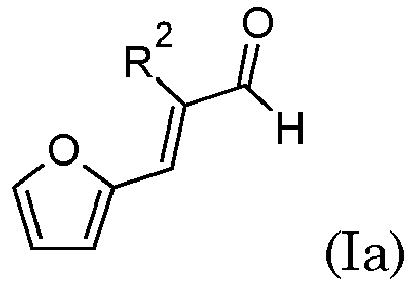
- the method according to one aspect of the invention is carried out using furfural and an aldehyde comprising a hydrophobic tail to form an alpha-beta-unsaturated aldehyde in accordance with formula (Ia).
- the reaction using furfural or HMF is favorable over the reaction described in the aforementioned article by Park et al . as the present method involves the use of an aldehyde as reagent, instead of an anhydride. This beneficially reduces the number of processing steps and may allow for reduced cost, time and the number of equivalents of feedstock required ( i . e . improve the atom-efficiency). Additionally, there is no need for trifluoroacetic anhydride (TFAA), which is an expensive reagent and required in equimolar amounts.
- TFAA trifluoroacetic anhydride
- the biodegradability, solubility and surfactant properties may be altered.
- Surfactant properties may include critical micelle concentration, Krafft temperature, Draves wetting, foam growth rate, foam height and micelle stability.
- a more hydrophobic or more hydrophilic surfactant may be desirable. For instance, a longer alkyl chain would typically result in an increased hydrophobicity. This potential tuning of the surfactant properties can also be seen in the article by Park et al .
- the surfactant precursor according to formula (I) can be further subjected to a variety of transformations to the surfactants according to any of formulae (IVa)-(IVd).
- An overview of the reaction paths can be seen in Figure 1 .
- the basic principles behind these reactions are in general known in the art and can for instance be categorized as decarbonylation, hydrogenolysis, hydrogenation and/or addition reactions.
- R 1 is H or CH 2 OH
- R 2 is H or an aliphatic group, preferably an aliphatic chain
- R 3 is H, OR 4 or R 4 , wherein R 4 is H or an aliphatic group, preferably an aliphatic chain
- R 5 is an aliphatic group, preferably an aliphatic chain.
- Decarbonylation is a reaction that involves the loss of CO from an aldehyde.
- the decarbonylation can be performed in the presence of a catalyst, such as a soluble metal complex.
- Decarbonylation may be the reaction to be performed on the surfactant precursor (I) and it can result in intermediate (IIa).
- Decarboxylation is a reaction that involves the loss of CO 2 from a carboxylic acid.
- the decarboxylation can be performed in the presence of a catalyst, such as a soluble metal complex.
- Decarbonylation may be the reaction to be performed on the surfactant precursor (I) and it can result in intermediate (IIa).
- Such a reaction may be referred to as a decarbonylative olefination as described by e.g. Ainembabazi et al. (J. Am. Chem. Soc. 2020, 142, 2, 696-699 ).
- Decarbonylative olefination can be considered as a more atom-economical alternative to a conventional Wittig reaction.
- a catalyst such as a palladium (Pd) catalyst is typically required.
- Pd palladium
- another aspect of the present invention is directed to the preparation of the first furan-based surfactant precursor of formula (IIa), said method comprising reacting a furanic compound according to formula (V) with a carbonyl compound according to formula (VIa) ( i . e . the carbonyl compound of formula (VI) wherein R 3 is H) in a decarbonylative olefination reaction, according to the following scheme.
- R 1 and R 2 are as defined for formula (VI) and (II).
- Formula IIa represents both regioisomers (E- and Z-conformation on the double bond), as represented by R 2 .
- the first furan-based surfactant precursor may further be subjected to hydrogenolysis and hydrogenation to obtain the second furan-based surfactant precursor of formula (IIb).
- Both hydrogenolysis and hydrogenation are generally carried out with hydrogen in the presence of a catalyst, such as a catalyst surface comprising palladium, nickel and/or platinum.
- the first furan-based surfactant precursor is reacted in an addition reaction to form the second furan-based surfactant precursor of formula (IIc).
- the addition reaction typically comprises a conjugate addition, also referred to as a 1,4-addition.
- the reactant introducing R 5 may be any suitable reactant to introduce an aliphatic chain.
- the second furan-based surfactant precursor of formula (IIb) and (IIc) may be any stereoisomer or a mixture of one or more stereoisomers. Dependent on the nucleophile, R 5 is an addition moiety.
- the addition moiety can be, but is not limited to a halogen, amine group, thiol group, or an aliphatic chain. It may be appreciated that the skilled person is aware of many possible moieties that are a result of an addition reaction to an alpha-beta unsaturated system.
- the second furan-based surfactant precursors can be prepared from a first furan-based surfactant precursor that is obtained according to the reaction of the furanic compound of formula (V) with the carbonyl compound of formula (VI), but that the first furan-based surfactant precursors may also be provided otherwise.
- the second furan-based surfactant precursors are directly converted to surfactant compound, e.g. (IIb) to (IVc) and (IIa) to (IVa).
- surfactant compound e.g. (IIb) to (IVc) and (IIa) to (IVa).
- a further aspect of the present invention is directed to the preparation of a third-generation furan-based surfactant precursor, i.e. a third furan-based surfactant precursor of any of formulae (IIIa)-(IIId).
- Said method comprises reacting the second furan-based surfactant precursor of formula (IIa), (IIa), (IIc) wherein R 3 is H and (IIc), respectively, in an addition reaction, a hydrogenation reaction, a decarbonylation reaction, or a hydrogenolysis reaction, respectively.
- R 1 is H or CH 2 OH
- R 2 is H or an aliphatic group, preferably an aliphatic chain
- R 5 and R 6 are independently H or an aliphatic group, preferably an aliphatic chain.
- the groups R 2 , R 4 , R 5 and R 6 form together with the carbon atoms with which they are attached to the furan moiety the hydrophobic tail.
- these groups comprise 6 or more carbon atoms, preferably 6 to 26 carbon atoms, most preferably between 6 and 18 carbon atoms together with the carbon atoms with which they are attached to the furan moiety.
- the third furan-based surfactant precursors can be prepared from a second furan-based surfactant precursor that is obtained according to the reaction of the first furan-based surfactant precursor of formula (I) as described herein, but that the second furan-based surfactant precursors may also be provided otherwise.
- the addition reaction of the second furan-based surfactant precursor of formula (IIa) to form the third furan-based surfactant precursor of formula (IIIa) can be a commonly known electrophilic addition reaction, metal-catalyzed alkene addition and the like. Examples thereof include the Heck reaction and the Suzuki reaction.
- the decarbonylation can be performed in the presence of a catalyst, such as a soluble metal complex.
- a catalyst such as a soluble metal complex.
- the hydrogenation and the hydrogenolysis of the second furan-based surfactant precursor of formulae (IIa) and (IIc) to form the third furan-based surfactant precursor of formulae (IIIb) and (IIId), respectively can also generally be carried out with hydrogen in the presence of a catalyst, such as a catalyst surface comprising palladium, nickel and/or platinum.
- the third furan-based surfactant precursor of formula (IIIa), (IIIc) and (IIId) may be any stereoisomer or a mixture of one or more stereoisomers.
- the first, second and third surfactant precursors can be used to prepare furan-based surfactants of formulae (IVa)-(IVf) or salts thereof.
- furan-based surfactants can also function as chelating agents, typically reducing or completely removing the need to add any additional chelating agents to a formulation such as a detergent.
- a further aspect of the present invention is directed to a method for the preparation of a furan-based surfactant or a salt thereof according to any of formula (IVa)-(IVf), said method comprising reacting the first or second furan-based surfactant precursor of any of formulae (IIIa), (IIIb), (IIb), (IIIc), (IIId) and (IIa) respectively, to introduce the hydrophilic group G,
- R 1 is H or CH 2 OH
- R 3 is H, OR 4 or R 4
- R 2 is H or an aliphatic group, preferably an aliphatic chain
- R 4 , R 5 and R 6 are independently an aliphatic groups, preferably an aliphatic chain
- G is a moiety comprising a hydrophilic group.
- the groups R 2 , R 4 , R 5 and R 6 form together with the carbon atoms with which they are attached to the furan moiety the hydrophobic tail.
- these groups whichever may be present, comprise 6 or more carbon atoms, preferably 6 to 26 carbon atoms, most preferably between 6 and 18 carbon atoms together with the carbon atoms with which they are attached to the furan moiety.
- the substituents ⁇ CH(R 5 )-CH(R 2 )(R 6 ), - CH 2 -CH 2 R 2 , ⁇ CH 2 -CH(R 2 )-CH 2 R 3 , ⁇ CH(R 5 )-CH 2 R 2 , ⁇ CH(R 5 )-CH(R 2 )-CH 2 R 3 , and ⁇ CH CHR 2 of formulae (IIIa), (IIb), (IIIc), (IIId) and (IIa) respectively, as well as of formulae (IVa)-(IVf) respectively, each represent the hydrophobic tail comprising 6 or more carbon atoms, preferably 6 to 26 carbon atoms, most preferably between 6 and 18 carbon atoms.
- furan-based surfactants of formula (IVa), (IVc), (IVd) and (IVe) may be any stereoisomer or a mixture of one or more stereoisomers.
- Formula (IVf) represents both regioisomers (E- and Z-conformation on the double bond), as represented by R 2 .
- the furan-based surfactant or a salt thereof can be prepared from a third or a second furan-based surfactant precursor that is directly obtained according to the reaction of the first and second furan-based surfactant precursors as described herein, but that the second or third furan-based surfactant precursors may also be provided otherwise.
- G is a moiety comprising a hydrophilic group.
- G may represent the hydrophilic group.
- G may represent a -CH 2 -hydrophilic group.
- the hydrophilic moiety may thus be an ionic moiety, e.g. an anionic, a cationic, or a non-ionic moiety.
- suitable non-ionic moieties that G may comprise include poly(ethylene oxide), poly(co-ethylene oxide co-propylene oxide) (also referred to as poloxamers), polyglycosides, isosorbide and its derivatives, 1,4-sorbitane and its derivatives, and the like. These moieties can readily be introduced by a reaction of the hydroxyl group of the second and third precursors wherein R 1 is CH 2 OH.
- the hydrophilic group is preferably an ionic group and can be present with a counter-ion to balance the charges.
- the counter-ions can be any ion that balances the charge, for instance, if the hydrophilic group has a monovalent negative charge, the counter-ion can be e.g. sodium (Na + ), potassium (K + ), lithium (Li + ) and/or ammonium (NH 4 + ).
- the counter-ion is an ammonium ion, an alkali metal ion or alkaline earth metal ion.
- Suitable hydrophilic groups and counter-ions are for instance described in WO2017/079719 .
- the hydrophilic group is preferably selected from the group consisting of sulfate (-O-SO 3 - ), sulfonate (-SO 3 - ), sulfinate (-SO 2 - ), thiosulfate (-O-S 2 O 2 - ), sulfamidate (-NH-SO 3 - ), carboxylate (-CO 2 - ), sarcosinate and taurate (-NR-R-CO 2 - ), phosphate (-O-PO 3 - or -O-PO 2 -OR - ), pyrophosphate (-O-PO 2 -O-PO 2 -OR 2- ), phosphonate (-PO 2 R - or - PO 3 - ), amines or ammonium (-NR 3 + ), polyammonium (-NR 2 -R-NR 3 2+ ), hydroxyammonium (-NR 2 OH + ), pyridinium (-NC 5
- the method to prepare the furan-based surfactant comprises introducing the hydrophilic group to the appropriate second or third precursor.
- the skilled person can suitable select appropriate reactions to introduce the hydrophilic group.
- sulfonate as the hydrophilic group may be introduced by reacting the appropriate second or third precursor with sulfur trioxide. This is a particular could method for those second or third precursor wherein R 1 is H.
- the hydroxyl of the second and/or third precursors wherein R 1 is CH 2 OH can be substituted by a hydrophilic group.
- G may be selected from the group consisting of methylene sulfate (-CH 2 O-SO 3 - ), methylene sulfonate (-CH 2 SO 3 - ), methylene sulfinate (-CH 2 SO 2 - ), methylene thiosulfate (-CH 2 O-S 2 O 2 - ), methylene sulfamidate (-CH 2 NH-SO 3 - ), methylene carboxylate (-CH 2 CO 2 - ), methylene sarcosinate and taurate (-CH 2 NR-R-CO 2 - ), methylene phosphate (-CH 2 O-PO 3 - or - CH 2 O-PO 2 -OR - ), methylene pyrophosphate (-CH 2 O-PO 2 -O-PO 2
- furfural and an aldehyde of a fatty acid are used as a starting material for the surfactant precursor and a sulfonate is introduced as hydrophilic group.
- a sulfonate is introduced as hydrophilic group.
- Schemes 1-7 are merely illustrative for the specific embodiments wherein furfural, an aldehyde and sulfur trioxide are used. Accordingly, any other reagents as mentioned in this description can be used as a substitute in Schemes 1-7.
- alkyl chains in any of the compounds described herein, illustrated as R 2 , R 4 , R 5 and R 6 in the various formulae, may serve as the hydrophobic tail or tails.
- the number of carbon atoms in each chain, the ratio of carbon atoms between the chains, and their position with respect to the furan and the hydrophilic group can suitably be selected depending on the desired properties of the surfactant.
- the invention may further be illustrated by the following nonlimiting examples.
- a reactor was charged with potassium hydroxide (0.18 g) and Aliquat-336 (0.84 g, 1.0 ml). Stirring was started intensively then furfural (2.00 g, 1.72 ml) was added dropwise to the mixture. Stirred for 5 minutes. Decanal (3.84 g, 4.62 ml) was added dropwise to the mixture over ⁇ 20 minutes. Stirred at room temperature for 24 hours. The mixture was partitioned between ethyl acetate (20 ml) and water (20 ml). The organics were separated and the aqueous extracted with a second portion of ethyl acetate (20 ml). The combined organics were dried (Na 2 SO 4 ), filtered and concentrated to a liquid. This was purified by vacuum distillation to yield the desired ⁇ , ⁇ -unsaturated aldehyde (3.785 g, 78 %). The structure was confirmed by NMR and GCMS.
Landscapes
- Chemical & Material Sciences (AREA)
- Organic Chemistry (AREA)
- Life Sciences & Earth Sciences (AREA)
- Engineering & Computer Science (AREA)
- Chemical Kinetics & Catalysis (AREA)
- Oil, Petroleum & Natural Gas (AREA)
- Wood Science & Technology (AREA)
- Furan Compounds (AREA)
Abstract
The invention is directed to the preparation of furan-based surfactant or a salt thereof according to any of formula (IVa)-(IVf), wherein R<sup>3</sup> is H, OR<sup>4</sup> or R<sup>4</sup>; R<sup>2</sup> is H or an aliphatic chain, R<sup>4</sup>, R<sup>5</sup> and R<sup>6</sup> independently are an aliphatic chain; and wherein G is a moiety comprising a hydrophilic group.These compounds are accessible through a first furan-based surfactant precursor of formula (I), wherein R<sup>1</sup> is H or CH<sub>2</sub>OH, R<sup>2</sup> is H or an aliphatic chain, and R<sup>3</sup> is H, OR<sup>4</sup> or R<sup>4</sup>, wherein R<sub>4</sub> is H or an aliphatic chain.
Description
- The invention is in the field of surfactants. In particular, the invention is directed to a method to prepare furan-based surfactants.
- Surfactants, or surface-active agents, are chemical compounds that are capable of lowering the surface tension between two liquids or between a gas and a liquid. Surfactants are widely used for a range of applications, such as detergents, emulsifiers, foaming agents and dispersants. Typically, the compounds are amphiphilics, i.e. compounds with both a hydrophobic tail and a hydrophilic head. This combination may allow for a water-soluble component and a water-insoluble (i.e. oil-soluble) component. Accordingly, the surfactant may absorb at i.a. oil/water interphases and can provide interesting properties for a variety of applications.
- It is expected that the market for surfactants undergoes continuous growth in the coming years. The main contributor to the market constitutes detergents and cleaners for households as over 50% of all surfactants typically end up in these products. Currently, the largest production comprises petrochemical-based linear alkylbenzene sulfonates (LAS), with around 4 million tons per year being produced and consumed.
- LAS surfactants are typically a mixture of compounds based on a hydrophilic sulfonate head attached to a hydrophobic benzene ring which is attached to a hydrophobic alkyl chain. The big advantage of LAS is its tolerance of hard water, which commonly inhibits the functioning of other groups of surfactants. Further, LAS typically has a low critical micelle concentration, low Krafft temperature, fast wetting and good foaming behaviour. LAS is accordingly suitable for broad use in a variety of applications.
- However, LAS is fossil-based and has a negative environmental impact. Accordingly, there is a strong desire to provide more sustainable surfactants which have comparable or improved properties compared to LAS.
- One method to provide surfactants produced from bio-based chemicals such as sugar-derived furans is described in e.g.
WO2017/079718 and by Park et al. (ACS Cent. Sci. 2016, 2, 11, 820-824). Here, oleo-furan surfactants derived from furan and fatty acids are described. By adjusting the fatty acid the surfactant properties could be altered. Additionally, the surfactants could better tolerate the metal ions contained in hard water, therefore making chelating agents, which are typically added to e.g. detergents, unnecessary. However, the surfactants are synthesized from furan. While it is a bio-based molecule, it requires decarbonylation of furfural to prepare furan, thereby decreasing the atom efficiency and resulting in a waste stream of carbon monoxide. Furthermore, it requires an additional processing step, resulting in increased cost and inefficiency. Moreover, the process may be challenging to scale-up. - Other bio-based surfactants are described by Kipshagen et al. (Green Chem. 2019, 21, 3882). Here i.a. furfural and 5-hydroxymethylfurfural (5-HMF) are used as the basis for the surfactants. In the case of furfural, it is converted into tetrahydrofuran followed by side-chain manipulation and the introduction of a hydrophilic head. In the case of HMF, it is first hydrogenated to 2,5-bis(hydroxymethyl)furan (BHMF) followed by side-chain manipulation and introduction of the hydrophilic head.
- 5-HMF has also been used as a starting material for surfactants as described in
WO2016028845 , wherein the final surfactants were prepared by esterification, amination and alkylation to produce non-ionic surfactants. However, these do not mimic LAS. -
- It is an object of the present inventors to provide an improved method to prepare furan-based surfactants that overcomes at least part of the above-mentioned drawbacks. The present inventors realized that this can be achieved by a process comprising a reaction of a furfural compound and an aldehyde, ester or ketone. It was found that this approach advantageously provides access to surfactants with a variety of hydrophobic tails and hydrophilic heads, enabling fine-tuning of the furan-based surfactant specific to the particular application of the surfactant. The method according to the present invention is further advantageously efficient and suitable to be scaled-up.
-
Figure 1 illustrates a schematic overview of the possible reaction paths according to preferred embodiments of the present invention. - The present invention thus advantageously provides access to furan-based surfactants or salts thereof according to any of formula (IVa)-(IVf), wherein R3 is H, OR4 or R4; R2, R4, R5 and R6 independently are an aliphatic group, preferably an aliphatic chain, such that they together form a hydrophobic tail comprising six or more carbon atoms attached to the furan moiety; and wherein G is a moiety comprising a hydrophilic group.


- The groups R2, R4, R5 and R6 form together with the carbon atoms with which they are attached to the furan moiety the hydrophobic tail. As such, these groups, whichever may be present, comprise 6 or more carbon atoms, preferably 6 to 26 carbon atoms, most preferably between 6 and 18 carbon atoms together with the carbon atoms with which they are attached to the furan moiety. In other words, the substituents ―CH(R5)-CH(R2)(R6), - CH2-CH2R2, ―CH2-CH(R2)-CH2R3, ―CH(R5)-CH2(R2), ―CH(R5)-CH(R2)-CH2R3, and ―CH=CHR2 of formulae (IVa)-(IV)f respectively, each represent the hydrophobic tail comprising 6 or more carbon atoms, preferably 6 to 26 carbon atoms, most preferably between 6 and 18 carbon atoms. Thus, the present invention advantageously provides good control over the substitution pattern of the hydrophobic chain.
- As shown in the overview illustrated in
Figure 1 , these compounds are all accessible from furfural or HMF through a first furan-based surfactant precursor of formula (I), wherein R1 is H or CH2OH, R2 is H or an aliphatic group, preferably an aliphatic chain, and R3 is H, OR4 or R4, wherein R4 is H, an aliphatic group, or an aliphatic chain.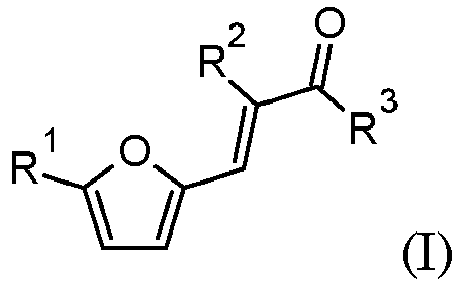
- More specifically, the invention is directed to a method for the preparation of a first furan-based surfactant precursor of formula (I), said method comprising reacting a furanic compound according to formula (V) with a carbonyl compound according to formula (VI),

- wherein R1 is H or CH2OH;
- R2 is H or an aliphatic group, preferably an aliphatic chain; and
- R3 is H, OR4 or R4, wherein R4 is H, an aliphatic group or an aliphatic chain.
- Aliphatic group is herein used to describe aliphatic groups comprising one or more carbon atoms, e.g. methyl, ethyl, propyl and the like. The aliphatic group may be an aliphatic chain. Aliphatic chain is herein used to describe a carbon chain comprising multiple carbon atoms that may be linear, branched, or cyclic, saturated or unsaturated but not aromatic. Thus, the carbons in the aliphatic chain may be joined by single bonds, one or more carbon pairs may be joined by a double bond and/or one or more carbons may be joined by a triple bond. Also, the chain may comprise one or more non-aromatic carbocyclic moieties. In case the aliphatic chain is branched or cyclic, the main chain (i.e. the longest chain of carbon atoms) is considered the backbone chain. The hydrophilic tail may suitably be an aliphatic hydrocarbon chain or an aliphatic ether. Preferably, if the aliphatic chain comprises a certain number of carbon atoms, e.g. at least 6 carbon atoms, it is preferred that the backbone chain comprises said number of carbon atoms, e.g. at least 6 carbon atoms. The branch may on itself also be an aliphatic chain.
- The terms polar, apolar, hydrophilic and hydrophobic are commonly used in the field of surfactants. It is commonly known that a surfactant is amphiphilic and comprises hydrophobic (or apolar) and hydrophilic (or polar) moieties. Accordingly, if a compound in accordance with the present invention acts as a surfactant, the moiety of the substituents G of the compound are considered to be hydrophilic, while the aliphatic chain is considered hydrophobic. In general, hydrophilic is used to describe the capacity of a molecular entity or of a substituent to interact with polar solvents, in particular with water, or with other polar groups and the tendency to mix, be wetted and/or dissolve in water. Typically, hydrophobic is used for moieties that form Van der Waals bonds and minimal to no hydrogen bonds. For instance, aliphatic chains may be considered hydrophobic, while sulfonic and carboxylic acid groups are considered hydrophilic.
- In the field of surfactants, various polar head groups are known. The hydrophilic moiety may thus be an ionic moiety, e.g. an anionic moiety, a cationic, or a non-ionic moiety, in accordance with conventionally known ionic and non-ionic surfactants. Accordingly, suitably, G may independently comprise anionic moieties such as sulfate, sulfonate, sulfinate, thiosulfate, carboxylate, phosphate, phosphonate and the like.
- Examples of suitable non-ionic moieties that G may comprise include poly(ethylene oxide), poly(co-ethylene oxide co-propylene oxide) (also referred to as poloxamers), polyglycosides, isosorbide and its derivatives, 1,4-sorbitane and its derivatives, and the like.
- The furanic compound may for instance be derived from a C5-sugar, such as furfural, or from a C6-sugar, such as HMF. The present inventors surprisingly found that furfural can particularly beneficially be used in the present method. Using furfural as a starting material increases the atom efficiency as there is no decarbonylation step involved, in contrast to furan. Additionally, furfural is typically more stable and easier to purify than 5-HMF. Accordingly, the furanic moiety is preferably furfural.
- Further, advantageously, furfural is a readily available furanic compound as it is for instance currently commercially produced from hemicellulose waste streams from the agricultural industry (e.g. corn, sugar). The furfural is preferably bio-based.
- The method according to one aspect of the invention comprises a reaction of the furanic compound of formula (V) with the carbonyl compound of formula (VI). Such a reaction is under certain conditions known as an aldol reaction. It may be appreciated that the aldehyde and/or ketone can also be formed in situ by oxidation of an alcohol and/or reduction of a carboxylic acid or derivative thereof. For example, in an embodiment wherein R3 is H, compound (VI) may be in situ prepared by oxidizing R2(CH2)2OH or by reducing R2CH2CO2R4.
- Alcohols and/or carboxylic acids may be preferred in order to in situ or ex situ prepare the carbonyl compound of formula (VI) as these can be bio-based. Aldol reactions are well-known in the art. The carbonyl compound of formula (VI) preferably comprises at least one hydrophobic tail. The hydrophobic tail may suitably be an aliphatic hydrocarbon chain or an aliphatic ether. For instance, the carbonyl compound of formula (VI) can be based on a fatty acid. The hydrophobic tail preferably comprises an aliphatic chain of preferably at least 6 carbon atoms in the backbone chain.
- In a particularly preferred embodiment, the method according to one aspect of the invention is carried out using furfural and an aldehyde comprising a hydrophobic tail to form an alpha-beta-unsaturated aldehyde in accordance with formula (Ia).
- The reaction using furfural or HMF is favorable over the reaction described in the aforementioned article by Park et al. as the present method involves the use of an aldehyde as reagent, instead of an anhydride. This beneficially reduces the number of processing steps and may allow for reduced cost, time and the number of equivalents of feedstock required (i.e. improve the atom-efficiency). Additionally, there is no need for trifluoroacetic anhydride (TFAA), which is an expensive reagent and required in equimolar amounts.
- By amending the length and composition of the hydrophobic tail, the biodegradability, solubility and surfactant properties may be altered. Surfactant properties may include critical micelle concentration, Krafft temperature, Draves wetting, foam growth rate, foam height and micelle stability. Depending on the final application, a more hydrophobic or more hydrophilic surfactant may be desirable. For instance, a longer alkyl chain would typically result in an increased hydrophobicity. This potential tuning of the surfactant properties can also be seen in the article by Park et al.
- The surfactant precursor according to formula (I) can be further subjected to a variety of transformations to the surfactants according to any of formulae (IVa)-(IVd). An overview of the reaction paths can be seen in
Figure 1 . The basic principles behind these reactions are in general known in the art and can for instance be categorized as decarbonylation, hydrogenolysis, hydrogenation and/or addition reactions. - Accordingly, in a further aspect, the present invention is directed to a method for the preparation of a second furan-based surfactant precursor of any of formulae (IIa)-(IIc), said method comprising reacting the first furan-based surfactant precursor of formula (I) in, respectively, a decarbonylation reaction wherein R3 is H or decarboxylation reaction wherein R3 = OR4), a hydrogenation and hydrogenolysis, or an addition reaction,

- Decarbonylation is a reaction that involves the loss of CO from an aldehyde. The decarbonylation can be performed in the presence of a catalyst, such as a soluble metal complex. Decarbonylation may be the reaction to be performed on the surfactant precursor (I) and it can result in intermediate (IIa).
- Decarboxylation is a reaction that involves the loss of CO2 from a carboxylic acid. The decarboxylation can be performed in the presence of a catalyst, such as a soluble metal complex. The carboxylic acid (i.e. the compound of formula (I) wherein R3 = OH) can be obtained directly from the reaction of (V) and (VI) when R3 = OH or the carboxylic acid can be obtained in situ in the decarboxylation reaction by a hydrolysis of the compound of formula (I) wherein R3 = OR4, wherein R4 is an aliphatic chain. Decarbonylation may be the reaction to be performed on the surfactant precursor (I) and it can result in intermediate (IIa).
- It may be preferred to combine the aldol reaction and decarbonylation to obtain the second furan-based surfactant precursor (IIa). Such a reaction may be referred to as a decarbonylative olefination as described by e.g. Ainembabazi et al. (J. Am. Chem. Soc. 2020, 142, 2, 696-699). Decarbonylative olefination can be considered as a more atom-economical alternative to a conventional Wittig reaction. For decarbonylative olefination, a catalyst such as a palladium (Pd) catalyst is typically required. Advantageously, such a reaction results in less waste and reduces processing inefficiencies when compared to the separate two-step synthesis and the conventional Wittig reaction.
- Accordingly, another aspect of the present invention is directed to the preparation of the first furan-based surfactant precursor of formula (IIa), said method comprising reacting a furanic compound according to formula (V) with a carbonyl compound according to formula (VIa) (i.e. the carbonyl compound of formula (VI) wherein R3 is H) in a decarbonylative olefination reaction, according to the following scheme.
 R2.
R2.
- The first furan-based surfactant precursor may further be subjected to hydrogenolysis and hydrogenation to obtain the second furan-based surfactant precursor of formula (IIb). Both hydrogenolysis and hydrogenation are generally carried out with hydrogen in the presence of a catalyst, such as a catalyst surface comprising palladium, nickel and/or platinum.
- In another embodiment, the first furan-based surfactant precursor is reacted in an addition reaction to form the second furan-based surfactant precursor of formula (IIc). The addition reaction typically comprises a conjugate addition, also referred to as a 1,4-addition. Such reactions are commonly known in the art and refer to nucleophilic addition directed to the electrophilic carbon of a C=C in an alpha-beta unsaturated system. The reactant introducing R5 may be any suitable reactant to introduce an aliphatic chain. The second furan-based surfactant precursor of formula (IIb) and (IIc) may be any stereoisomer or a mixture of one or more stereoisomers. Dependent on the nucleophile, R5 is an addition moiety. The addition moiety can be, but is not limited to a halogen, amine group, thiol group, or an aliphatic chain. It may be appreciated that the skilled person is aware of many possible moieties that are a result of an addition reaction to an alpha-beta unsaturated system.
- It may be appreciated that the second furan-based surfactant precursors can be prepared from a first furan-based surfactant precursor that is obtained according to the reaction of the furanic compound of formula (V) with the carbonyl compound of formula (VI), but that the first furan-based surfactant precursors may also be provided otherwise.
- In particular embodiments, the second furan-based surfactant precursors are directly converted to surfactant compound, e.g. (IIb) to (IVc) and (IIa) to (IVa). However, it may be preferred to introduce more aliphatic chains and/or to take out a compound's functionality (e.g. reduce a double or triple bond).
- Accordingly, a further aspect of the present invention is directed to the preparation of a third-generation furan-based surfactant precursor, i.e. a third furan-based surfactant precursor of any of formulae (IIIa)-(IIId). Said method comprises reacting the second furan-based surfactant precursor of formula (IIa), (IIa), (IIc) wherein R3 is H and (IIc), respectively, in an addition reaction, a hydrogenation reaction, a decarbonylation reaction, or a hydrogenolysis reaction, respectively.


- It may be appreciated that the third furan-based surfactant precursors can be prepared from a second furan-based surfactant precursor that is obtained according to the reaction of the first furan-based surfactant precursor of formula (I) as described herein, but that the second furan-based surfactant precursors may also be provided otherwise.
- The addition reaction of the second furan-based surfactant precursor of formula (IIa) to form the third furan-based surfactant precursor of formula (IIIa) can be a commonly known electrophilic addition reaction, metal-catalyzed alkene addition and the like. Examples thereof include the Heck reaction and the Suzuki reaction.
- As described for the second furan-based surfactant precursor above, the decarbonylation can be performed in the presence of a catalyst, such as a soluble metal complex. Similarly, the hydrogenation and the hydrogenolysis of the second furan-based surfactant precursor of formulae (IIa) and (IIc) to form the third furan-based surfactant precursor of formulae (IIIb) and (IIId), respectively, can also generally be carried out with hydrogen in the presence of a catalyst, such as a catalyst surface comprising palladium, nickel and/or platinum.
- The third furan-based surfactant precursor of formula (IIIa), (IIIc) and (IIId) may be any stereoisomer or a mixture of one or more stereoisomers.
- The first, second and third surfactant precursors can be used to prepare furan-based surfactants of formulae (IVa)-(IVf) or salts thereof. Such furan-based surfactants can also function as chelating agents, typically reducing or completely removing the need to add any additional chelating agents to a formulation such as a detergent.
- Accordingly, a further aspect of the present invention is directed to a method for the preparation of a furan-based surfactant or a salt thereof according to any of formula (IVa)-(IVf), said method comprising reacting the first or second furan-based surfactant precursor of any of formulae (IIIa), (IIIb), (IIb), (IIIc), (IIId) and (IIa) respectively, to introduce the hydrophilic group G,


- The furan-based surfactants of formula (IVa), (IVc), (IVd) and (IVe) may be any stereoisomer or a mixture of one or more stereoisomers. Formula (IVf) represents both regioisomers (E- and Z-conformation on the double bond), as represented byR2.

- It may be appreciated that the furan-based surfactant or a salt thereof can be prepared from a third or a second furan-based surfactant precursor that is directly obtained according to the reaction of the first and second furan-based surfactant precursors as described herein, but that the second or third furan-based surfactant precursors may also be provided otherwise.
- In formulae (IVa)-(IVf), G is a moiety comprising a hydrophilic group. In particular embodiments wherein furfural is used as a starting material, G may represent the hydrophilic group. In particular embodiments wherein HMF is used, G may represent a -CH2-hydrophilic group.
- The hydrophilic moiety may thus be an ionic moiety, e.g. an anionic, a cationic, or a non-ionic moiety. Examples of suitable non-ionic moieties that G may comprise include poly(ethylene oxide), poly(co-ethylene oxide co-propylene oxide) (also referred to as poloxamers), polyglycosides, isosorbide and its derivatives, 1,4-sorbitane and its derivatives, and the like. These moieties can readily be introduced by a reaction of the hydroxyl group of the second and third precursors wherein R1 is CH2OH.
- The hydrophilic group is preferably an ionic group and can be present with a counter-ion to balance the charges. It may be appreciated that the counter-ions can be any ion that balances the charge, for instance, if the hydrophilic group has a monovalent negative charge, the counter-ion can be e.g. sodium (Na+), potassium (K+), lithium (Li+) and/or ammonium (NH4 +). Preferably, the counter-ion is an ammonium ion, an alkali metal ion or alkaline earth metal ion. Suitable hydrophilic groups and counter-ions are for instance described in
WO2017/079719 . - The hydrophilic group, and preferably G as such, is preferably selected from the group consisting of sulfate (-O-SO3 -), sulfonate (-SO3 -), sulfinate (-SO2 -), thiosulfate (-O-S2O2 -), sulfamidate (-NH-SO3 -), carboxylate (-CO2 -), sarcosinate and taurate (-NR-R-CO2 -), phosphate (-O-PO3 - or -O-PO2-OR-), pyrophosphate (-O-PO2-O-PO2-OR2-), phosphonate (-PO2R- or - PO3 -), amines or ammonium (-NR3 +), polyammonium (-NR2-R-NR3 2+), hydroxyammonium (-NR2OH+), pyridinium (-NC5H5 +), picolinium (-NC5H5-R+), imidazolinium

 represents the bond to the furanic ring and R is H or a C1-C3 alkyl. Particularly good surfactant properties are obtained for sulfonate as hydrophilic group.
- The method to prepare the furan-based surfactant comprises introducing the hydrophilic group to the appropriate second or third precursor. The skilled person can suitable select appropriate reactions to introduce the hydrophilic group. For example, sulfonate as the hydrophilic group may be introduced by reacting the appropriate second or third precursor with sulfur trioxide. This is a particular could method for those second or third precursor wherein R1 is H.
- In a particular embodiment, the hydroxyl of the second and/or third precursors wherein R1 is CH2OH can be substituted by a hydrophilic group. In such embodiments, G may be selected from the group consisting of methylene sulfate (-CH2O-SO3 -), methylene sulfonate (-CH2SO3 -), methylene sulfinate (-CH2SO2 -), methylene thiosulfate (-CH2O-S2O2 -), methylene sulfamidate (-CH2NH-SO3 -), methylene carboxylate (-CH2CO2 -), methylene sarcosinate and taurate (-CH2NR-R-CO2 -), methylene phosphate (-CH2O-PO3 - or - CH2O-PO2-OR-), methylene pyrophosphate (-CH2O-PO2-O-PO2-OR2- ), methylene phosphonate (-CH2PO2R- or - CH2PO3 -), methylene amines or ammonium (-CH2NR3 +), methylene polyammonium (-CH2NR2-R-NR3 2+), methylene hydroxyammonium (-CH2NR2OH+), methylene pyridinium (-CH2NC5H5 +), methylene picolinium (-CH2NC5H5-R+), methylene imidazolinium


- In a particularly preferred embodiment, furfural and an aldehyde of a fatty acid are used as a starting material for the surfactant precursor and a sulfonate is introduced as hydrophilic group. Accordingly, in particular embodiments, the full process from furfural to the furan-based surfactant is according to any of Schemes 1-7.


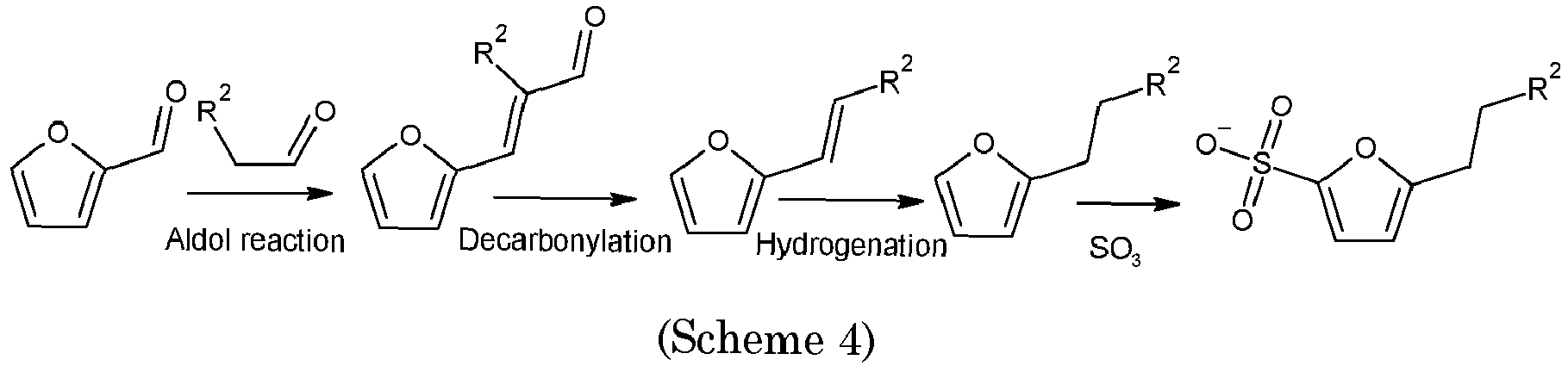


- It may be appreciated that Schemes 1-7 are merely illustrative for the specific embodiments wherein furfural, an aldehyde and sulfur trioxide are used. Accordingly, any other reagents as mentioned in this description can be used as a substitute in Schemes 1-7.
- The alkyl chains in any of the compounds described herein, illustrated as R2, R4, R5 and R6 in the various formulae, may serve as the hydrophobic tail or tails. In general, any of these chains and preferably all of these, independently and individually comprise at least 4 carbon atoms, preferably at least 6 carbon atoms, more preferably between 6 to 26 carbon atoms, most preferably between 6 and 18 carbon atoms. The number of carbon atoms in each chain, the ratio of carbon atoms between the chains, and their position with respect to the furan and the hydrophilic group can suitably be selected depending on the desired properties of the surfactant.
- For the purpose of clarity and a concise description, features are described herein as part of the same or separate embodiments, however, it will be appreciated that the scope of the invention may include embodiments having combinations of all or some of the features described.
- The invention may further be illustrated by the following nonlimiting examples.
-

- A reactor was charged with potassium hydroxide (0.18 g) and Aliquat-336 (0.84 g, 1.0 ml). Stirring was started intensively then furfural (2.00 g, 1.72 ml) was added dropwise to the mixture. Stirred for 5 minutes. Decanal (3.84 g, 4.62 ml) was added dropwise to the mixture over ~20 minutes. Stirred at room temperature for 24 hours. The mixture was partitioned between ethyl acetate (20 ml) and water (20 ml). The organics were separated and the aqueous extracted with a second portion of ethyl acetate (20 ml). The combined organics were dried (Na2SO4), filtered and concentrated to a liquid. This was purified by vacuum distillation to yield the desired α,β-unsaturated aldehyde (3.785 g, 78 %). The structure was confirmed by NMR and GCMS.
-

- To a reactor was charged sulfur trioxide-pyridine complex (5.8 g) and acetonitrile (25 ml) and the stirring was started. To this slurry was added a solution of 2-dodecylfuran (8.5 g) in acetonitrile (9 ml). Stirred at room temperature for 5 days. The mixture was slowly poured into a stirred reactor containing water (125 ml). Heated to 70°C and held for 1 hour. The organic aqueous phase was separated and the organics extracted with a second portion of water (50 ml). The combined aqueous phase was adjusted to pH7 with solid sodium carbonate. The mixture was concentrated to induce precipitation of a solid. The mixture was cooled to room temperature with stirring and the solid was isolated by filtration, then washed with isopropanol (20 ml). The filtrates were then concentrated further and a further batch of solid began to precipitate, then the mixture was cooled and the solid was isolated by filtration, then washed with isopropanol. The isolated solid was dried under vacuum to yield the desired product (6.68 g, 59 %). The structure was confirmed by NMR and GCMS.
Claims (15)
- Method for the preparation of a first furan-based surfactant precursor of formula (I), said method comprising reacting a furanic compound according to formula (V) with a carbonyl compound according to formula (VI),
 wherein R1 is H or CH2OH;R2 is H or an aliphatic group, preferably an aliphatic chain; andR3 is H, OR4 or R4, wherein R4 is H or an aliphatic group, preferably an aliphatic chain.
 - Method for the preparation of the first furan-based surfactant precursor, wherein R3 is H and wherein compound (VI) is prepared by in situ oxidition of R2(CH2)2OH or by in situ reduction of R2-CH2-CO2R4.
- Method for the preparation of a second furan-based surfactant precursor of any of formulae (IIa)-(IIc), said method comprising reacting a first furan-based surfactant precursor of formula (I) in, respectively, a decarbonylation reaction wherein R3 is H or a decarboxylation reaction wherein R3 is OR4, a hydrogenation and hydrogenolysis, or an addition reaction,
 wherein R1 is H or CH2OH;R2 is H or an aliphatic group, preferably an aliphatic chain;R3 is H, OR4 or R4, wherein R4 is H or an aliphatic groups, preferably an aliphatic chain; andwherein R5 is an aliphatic group, preferably an aliphatic chain.
 - Method according to the previous claim, wherein the first furan-based surfactant precursor of formula (I) is prepared according to a method according to any of claims 1-2.
- Method for the preparation of the first furan-based surfactant precursor of formula (IIa), said method comprising, reacting a furanic compound according to formula (V) with a carbonyl compound according to formula (VIa) in a decarbonylative olefination reaction,
 wherein R1 is H or CH2OH;R2 is H or an aliphatic group, preferably an aliphatic chain.
 - Method for the preparation of a third furan-based surfactant precursor of any of formulae (IIIa)-(IIId), said method comprising reacting a second furan-based surfactant precursor of, respectively, formula (IIa), (IIa), (IIc) and (IIc) wherein R3 is H, in an addition reaction, a hydrogenation reaction, a decarbonylation reaction, or a hydrogenolysis reaction respectively,


 wherein R1 is H or CH2OH;R2 is H or an aliphatic group, preferably an aliphatic chain;R5 and R6 independently are an aliphatic group, preferably an aliphatic chain, andwherein ―CH(R5)-CH(R2)(R6), ―CH2-CH2R2, ―CH(R5)-CH2(R2), and ―CH(R5)-CH(R2)-CH2R3 of formulae (IIIa)-(IIId) respectively, each represent the hydrophobic tail comprising 6 or more carbon atoms, preferably 6 to 26 carbon atoms, most preferably between 6 and 18 carbon atoms.
 - Method according to the previous claim, wherein the second furan-based surfactant precursor of any of formulae (IIa) and (IIc) is prepared according to a method according to any of claims 3-5.
- Method for the preparation of a furan-based surfactant or a salt thereof according to any of formula (IVa)-(IVf), said method comprising reacting a first or second furan-based surfactant precursor of any of formulae (IIIa), (IIIb), (IIb), (IIIc), (IIId) and (IIa) respectively, to introduce a hydrophilic group,


 wherein R1 is H or CH2OH;R3 is H, OR4 or R4;R2 is H or an aliphatic group, preferably an aliphatic chain,R4, R5 and R6 independently are an aliphatic group, preferably an aliphatic chain; andwherein G is a moiety comprising a hydrophilic group, andwherein ―CH(R5)-CH(R2)(R6), ―CH2-CH2R2, ―CH2-CH(R2)-CH2R3, ―CH(R5)-CH2R2, ―CH(R5)-CH(R2)-CH2R3, and ―CH=CHR2 of formulae (IIIa), (IIb), (IIIc), (IIId) and (IIa) respectively, as well as of formulae (IVa)-(IVf) respectively, each represent the hydrophobic tail comprising 6 or more carbon atoms, preferably 6 to 26 carbon atoms, most preferably between 6 and 18 carbon atoms.
 - Method according to the previous claim, wherein the first furan-based surfactant precursor of any of formulae (IIa) and (IIb) is prepared according to a method according to any of claims 3-5.
- Method according to claim 8, wherein the second furan-based surfactant precursor of any of formulae (IIIa)-(IIIc) is prepared according to a method according to any of claims 6-7.
- Method according to any of claim 8-10, wherein the hydrophilic group is selected from the group consisting of sulfate, sulfonate, sulfinate, thiosulfate, sulfamidate, carboxylate, sarcosinate and taurate, phosphate, pyrophosphate, phosphonate, amines or ammonium, polyammonium, hydroxyammonium, pyridinium, picolinium, imidazolinium, benzimidazolinium, oxonium, sulfonium and phosphonium.
- Method according to any of claim 8-10, wherein the hydrophilic group comprises non-ionic group, preferably poly(ethylene oxide), poly(co-ethylene oxide co-propylene oxide) (also referred to as poloxamers), polyglycosides, isosorbide and its derivatives, 1,4-sorbitane and its derivatives, and the like.
- Method according to any of claim 8-11, wherein G is selected from the group consisting of sulfate (-O-SO3 -), sulfonate (-SO3 -), sulfinate (-SO2 -), thiosulfate (-O-S2O2 -), sulfamidate (-NH-SO3 -), carboxylate (-CO2 -), sarcosinate and taurate (-NR-R-CO2 -), phosphate (-O-PO3 - or -O-PO2-OR-), pyrophosphate (-O-PO2-O-PO2-OR2-), phosphonate (-PO2R- or -PO3 -), amines or ammonium (-NR3 +), polyammonium (-NR2-R-NR3 2+), hydroxyammonium (-NR2OH+), pyridinium (-NC5H5 +), picolinium (-NC5H5-R+), imidazolinium (


- Method according to any of the previous claims, wherein R1 is H and/or wherein R3 is H.
- Method according to any of the previous claims, wherein any of R2, R4, R5 and R6, independently comprise an aliphatic chain comprising at least 4 carbon atoms, preferably at least 6 carbon atoms, more preferably between 6 to 26 carbon atoms, most preferably between 6 and 18 carbon atoms.
Priority Applications (4)
| Application Number | Priority Date | Filing Date | Title |
|---|---|---|---|
| EP21198883.7A EP4155297A1 (en) | 2021-09-24 | 2021-09-24 | Method to prepare furan-based surfactants |
| US18/694,242 US20240409844A1 (en) | 2021-09-24 | 2022-09-26 | Method to Prepare Furan-Based Surfactants |
| PCT/NL2022/050541 WO2023048574A1 (en) | 2021-09-24 | 2022-09-26 | Method to prepare furan-based surfactants |
| EP22789327.8A EP4405341A1 (en) | 2021-09-24 | 2022-09-26 | Method to prepare furan-based surfactants |
Applications Claiming Priority (1)
| Application Number | Priority Date | Filing Date | Title |
|---|---|---|---|
| EP21198883.7A EP4155297A1 (en) | 2021-09-24 | 2021-09-24 | Method to prepare furan-based surfactants |
Publications (1)
| Publication Number | Publication Date |
|---|---|
| EP4155297A1 true EP4155297A1 (en) | 2023-03-29 |
Family
ID=77951553
Family Applications (2)
| Application Number | Title | Priority Date | Filing Date |
|---|---|---|---|
| EP21198883.7A Withdrawn EP4155297A1 (en) | 2021-09-24 | 2021-09-24 | Method to prepare furan-based surfactants |
| EP22789327.8A Pending EP4405341A1 (en) | 2021-09-24 | 2022-09-26 | Method to prepare furan-based surfactants |
Family Applications After (1)
| Application Number | Title | Priority Date | Filing Date |
|---|---|---|---|
| EP22789327.8A Pending EP4405341A1 (en) | 2021-09-24 | 2022-09-26 | Method to prepare furan-based surfactants |
Country Status (3)
| Country | Link |
|---|---|
| US (1) | US20240409844A1 (en) |
| EP (2) | EP4155297A1 (en) |
| WO (1) | WO2023048574A1 (en) |
Citations (7)
| Publication number | Priority date | Publication date | Assignee | Title |
|---|---|---|---|---|
| CN102633756A (en) * | 2012-03-30 | 2012-08-15 | 大连职业技术学院 | Novel method for synthetizing alpha-furylacrylic acid |
| US20150150768A1 (en) * | 2013-12-04 | 2015-06-04 | Los Alamos National Security Llc | Furan Based Composition |
| WO2016028845A1 (en) | 2014-08-19 | 2016-02-25 | Archer Daniels Midland Company | Synthesis of non-ionic surfactants from 5-hydroxymethyl-2-furfural, furan-2,5-dimethanol and bis-2,5-dihydroxymethyltetrahydrofurans |
| WO2017079719A1 (en) | 2015-11-06 | 2017-05-11 | Regents Of The University Of Minnesota | Aromatic surfactants |
| WO2017079718A1 (en) | 2015-11-06 | 2017-05-11 | Regents Of The University Of Minnesota | Methods of forming aromatic containing compounds |
| US20200308475A1 (en) * | 2019-03-28 | 2020-10-01 | Halliburton Energy Services, Inc. | Oleofuransulfonate surfactants for use in wellbore applications |
| WO2021083642A1 (en) | 2019-10-29 | 2021-05-06 | Henkel Ag & Co. Kgaa | Use of surfactants from renewable raw materials |
-
2021
- 2021-09-24 EP EP21198883.7A patent/EP4155297A1/en not_active Withdrawn
-
2022
- 2022-09-26 WO PCT/NL2022/050541 patent/WO2023048574A1/en not_active Ceased
- 2022-09-26 EP EP22789327.8A patent/EP4405341A1/en active Pending
- 2022-09-26 US US18/694,242 patent/US20240409844A1/en active Pending
Patent Citations (8)
| Publication number | Priority date | Publication date | Assignee | Title |
|---|---|---|---|---|
| CN102633756A (en) * | 2012-03-30 | 2012-08-15 | 大连职业技术学院 | Novel method for synthetizing alpha-furylacrylic acid |
| US20150150768A1 (en) * | 2013-12-04 | 2015-06-04 | Los Alamos National Security Llc | Furan Based Composition |
| WO2015084813A1 (en) | 2013-12-04 | 2015-06-11 | The Procter & Gamble Company | Furan-based composition |
| WO2016028845A1 (en) | 2014-08-19 | 2016-02-25 | Archer Daniels Midland Company | Synthesis of non-ionic surfactants from 5-hydroxymethyl-2-furfural, furan-2,5-dimethanol and bis-2,5-dihydroxymethyltetrahydrofurans |
| WO2017079719A1 (en) | 2015-11-06 | 2017-05-11 | Regents Of The University Of Minnesota | Aromatic surfactants |
| WO2017079718A1 (en) | 2015-11-06 | 2017-05-11 | Regents Of The University Of Minnesota | Methods of forming aromatic containing compounds |
| US20200308475A1 (en) * | 2019-03-28 | 2020-10-01 | Halliburton Energy Services, Inc. | Oleofuransulfonate surfactants for use in wellbore applications |
| WO2021083642A1 (en) | 2019-10-29 | 2021-05-06 | Henkel Ag & Co. Kgaa | Use of surfactants from renewable raw materials |
Non-Patent Citations (4)
| Title |
|---|
| AINEMBABAZI ET AL., J. AM. CHEM. SOC., vol. 142, no. 2, 2020, pages 696 - 699 |
| DAE SUNG PARK ET AL: "Tunable Oleo-Furan Surfactants by Acylation of Renewable Furans", ACS CENTRAL SCIENCE, vol. 2, no. 11, 19 October 2016 (2016-10-19), pages 820 - 824, XP055634356, ISSN: 2374-7943, DOI: 10.1021/acscentsci.6b00208 * |
| KIPSHAGEN, GREEN CHEM, vol. 21, 2019, pages 3882 |
| PARK ET AL., ACS CENT. SCI., vol. 2, no. 11, 2016, pages 820 - 824 |
Also Published As
| Publication number | Publication date |
|---|---|
| US20240409844A1 (en) | 2024-12-12 |
| WO2023048574A1 (en) | 2023-03-30 |
| EP4405341A1 (en) | 2024-07-31 |
Similar Documents
| Publication | Publication Date | Title |
|---|---|---|
| US10618881B2 (en) | Methods of forming aromatic containing compounds | |
| EP2432773A1 (en) | Method for producing 2-substituted tetrahydropyranoles | |
| WO2017079719A1 (en) | Aromatic surfactants | |
| CN105814030A (en) | Mono- and dialkyl ethers of furan-2,5-dimethanol and (tetra-hydrofuran-2,5-diyl)dimethanol and amphiphilic derivatives thereof | |
| EP3131413A1 (en) | Synthesis of reduced sugar alcohols, furan derivatives | |
| JPH0517493A (en) | Preparation of alkali polyglycoside | |
| JP6549162B2 (en) | Composition of monoalkyl ether of monoanhydro-hexitol, process for its preparation and its use | |
| JP6449907B2 (en) | Synthesis of furan derivatives of R-glucoside, sugar alcohol, reducing sugar alcohol and reducing sugar alcohol | |
| US20240409844A1 (en) | Method to Prepare Furan-Based Surfactants | |
| KR101056461B1 (en) | Manufacturing method of heterocyclic mercapto compound | |
| JP2023547270A (en) | Method for causing a Mitsunobu reaction between an alcoholic hydroxyl donor and an active hydrogen donor | |
| EP4155311A1 (en) | Surfactants from bio-based feedstock | |
| EP4183779A1 (en) | Malonate and furan based surfactants | |
| DE102005016152A1 (en) | Preparation of (co) surfactants by reaction of polyols with olefins | |
| JP5702795B2 (en) | Amphiphilic compounds and methods for their preparation and use | |
| CN115698030B (en) | Polymeric amphoteric surfactant compounds | |
| RU2481267C2 (en) | Method of producing fullerenols | |
| CN118475573A (en) | Method for synthesizing 5- ((2-methyl-1H-imidazol-1-yl) methyl) furan-2-formaldehyde and method for synthesizing nitrone from 5- ((2-methyl-1H-imidazol-1-yl) methyl) furan-2-formaldehyde | |
| KR100369117B1 (en) | Method for manufacturing sugar ester and purifying thereof | |
| JPH08500350A (en) | Alkyl glycoside manufacturing method | |
| CN119486998A (en) | Sulfonated and sulfated aryl-alkyl compounds useful as surfactants | |
| JPH03120285A (en) | Production of diacetal | |
| NO742234L (en) | ||
| JPS5835988B2 (en) | Method for producing naphthalene disulfonic acid di-lower alkyl ester | |
| BE526995A (en) |
Legal Events
| Date | Code | Title | Description |
|---|---|---|---|
| PUAI | Public reference made under article 153(3) epc to a published international application that has entered the european phase |
Free format text: ORIGINAL CODE: 0009012 |
|
| STAA | Information on the status of an ep patent application or granted ep patent |
Free format text: STATUS: THE APPLICATION HAS BEEN PUBLISHED |
|
| AK | Designated contracting states |
Kind code of ref document: A1 Designated state(s): AL AT BE BG CH CY CZ DE DK EE ES FI FR GB GR HR HU IE IS IT LI LT LU LV MC MK MT NL NO PL PT RO RS SE SI SK SM TR |
|
| P01 | Opt-out of the competence of the unified patent court (upc) registered |
Effective date: 20230522 |
|
| STAA | Information on the status of an ep patent application or granted ep patent |
Free format text: STATUS: THE APPLICATION IS DEEMED TO BE WITHDRAWN |
|
| 18D | Application deemed to be withdrawn |
Effective date: 20230930 |