EP4154963B1 - Filtration system - Google Patents
Filtration system Download PDFInfo
- Publication number
- EP4154963B1 EP4154963B1 EP22193398.9A EP22193398A EP4154963B1 EP 4154963 B1 EP4154963 B1 EP 4154963B1 EP 22193398 A EP22193398 A EP 22193398A EP 4154963 B1 EP4154963 B1 EP 4154963B1
- Authority
- EP
- European Patent Office
- Prior art keywords
- blocking
- filtration system
- operating element
- filters
- operating
- Prior art date
- Legal status (The legal status is an assumption and is not a legal conclusion. Google has not performed a legal analysis and makes no representation as to the accuracy of the status listed.)
- Active
Links
Images




Classifications
-
- B—PERFORMING OPERATIONS; TRANSPORTING
- B01—PHYSICAL OR CHEMICAL PROCESSES OR APPARATUS IN GENERAL
- B01D—SEPARATION
- B01D35/00—Filtering devices having features not specifically covered by groups B01D24/00 - B01D33/00, or for applications not specifically covered by groups B01D24/00 - B01D33/00; Auxiliary devices for filtration; Filter housing constructions
- B01D35/12—Devices for taking out of action one or more units of multi- unit filters, e.g. for regeneration
-
- F—MECHANICAL ENGINEERING; LIGHTING; HEATING; WEAPONS; BLASTING
- F02—COMBUSTION ENGINES; HOT-GAS OR COMBUSTION-PRODUCT ENGINE PLANTS
- F02M—SUPPLYING COMBUSTION ENGINES IN GENERAL WITH COMBUSTIBLE MIXTURES OR CONSTITUENTS THEREOF
- F02M37/00—Apparatus or systems for feeding liquid fuel from storage containers to carburettors or fuel-injection apparatus; Arrangements for purifying liquid fuel specially adapted for, or arranged on, internal-combustion engines
- F02M37/22—Arrangements for purifying liquid fuel specially adapted for, or arranged on, internal-combustion engines, e.g. arrangements in the feeding system
- F02M37/32—Arrangements for purifying liquid fuel specially adapted for, or arranged on, internal-combustion engines, e.g. arrangements in the feeding system characterised by filters or filter arrangements
-
- B—PERFORMING OPERATIONS; TRANSPORTING
- B01—PHYSICAL OR CHEMICAL PROCESSES OR APPARATUS IN GENERAL
- B01D—SEPARATION
- B01D27/00—Cartridge filters of the throw-away type
- B01D27/14—Cartridge filters of the throw-away type having more than one filtering element
- B01D27/142—Cartridge filters of the throw-away type having more than one filtering element connected in parallel
-
- B—PERFORMING OPERATIONS; TRANSPORTING
- B01—PHYSICAL OR CHEMICAL PROCESSES OR APPARATUS IN GENERAL
- B01D—SEPARATION
- B01D35/00—Filtering devices having features not specifically covered by groups B01D24/00 - B01D33/00, or for applications not specifically covered by groups B01D24/00 - B01D33/00; Auxiliary devices for filtration; Filter housing constructions
- B01D35/30—Filter housing constructions
- B01D35/301—Constructions of two or more housings
- B01D35/303—Constructions of two or more housings the housings being modular, e.g. standardised
-
- B—PERFORMING OPERATIONS; TRANSPORTING
- B01—PHYSICAL OR CHEMICAL PROCESSES OR APPARATUS IN GENERAL
- B01D—SEPARATION
- B01D2201/00—Details relating to filtering apparatus
- B01D2201/40—Special measures for connecting different parts of the filter
- B01D2201/4007—Use of cam or ramp systems
Definitions
- the present application relates to a filtration system comprising a plurality of filters, in particular oil or fuel filters.
- the filter system may for example be used in an engine, for example for filtering the oil of the cooling and/or lubrication circuit of the engine.
- a filtration system according to the preamble of claim 1, where separate operating elements are provided for the two filters, which are interconnected by a mechanical blocking mechanism, is known from US 2,505,375 A .
- the filter cartridge of one filter can be exchanged while the other filter is still operative, such that the exchange can be done during the operation of the system, with the other filter doing all the filtering for the time that is required for the exchange.
- each filter system may still be provided with an operating element to be able to exchange a filter cartridge of one filter while the other is operable.
- the inventor of the present invention has however realized that simply duplicating existing filtration systems will lead to an increased risk of failure.
- the object of the present invention is therefore to provide an improved filtration system.
- the present invention provides a filtration system comprising a plurality of filters, in particular oil or fuel filters, a first operating element movable from a default position to a least one isolating position for isolating at least one filter of a first group of filters from the filtration system and a second operating element movable from a default position to at least one isolating position for isolating at least one filter of a second group of filters from the filtration system.
- At least two filters are associated to each operating element, the operating element being configured to selectively isolate at least one first filter out of the at least two filters from the filtration system in a first isolating position and at least one second filter out of the at least two filters in a second isolating position.
- system comprises a mechanical blocking mechanism that is actuated by a movement of the first operating element out of its default position to block the second operating element in its default position and actuated by a movement of the second operating element out of its default position to block the first operating element in its default position.
- the present invention therefore uses a mechanical blocking mechanism to eliminate this risk.
- the blocking mechanism is in particular designed to avoid a situation where both operating elements are moved to an isolating position, and therefore avoids a situation where two filters are isolated at the same time.
- This system can be applied for different media, such as fuel or oil, and is not restricted to engines but can be used in any filtration system as soon as a plurality of filters are used.
- both operating elements are arranged in their respective default position.
- all the filters of the respective group of filters are connected to the filtration system.
- the operating element is configured to selectively isolate in each isolating position at least one out of the two filters associated to the operating element from the filtration system while keeping the at least one other filter out of the at least two filters operative and connected to the filtration system.
- each filter is at least a duplex filter comprising two filter elements or filters arranged in parallel.
- the two filter elements or filters may be isolated from and connected to the filtration system by the operating element in parallel.
- all the filters are arranged in parallel in a fluid duct of the filtration system when connected by the respective operating element to the filtration system.
- the mechanical blocking mechanism comprises a blocking element operated by the first operating element to block the second operating element and a second blocking element operated by the second operating element to block the first operating element.
- the two blocking elements may be separate elements and/or can be moved independently from each other.
- the blocking elements are slidably arranged on the filtration system to be moved from a default position to a blocking position.
- the first blocking element is operatively connected to a drive element of the first operating element and the second blocking element in operatively connected to a driving element of the second operating element.
- each blocking element is operatively connected to the respective drive element in one of its end sections.
- the drive elements of the operating elements each comprise a guide interacting with a pin of the respective blocking element, wherein the guide is preferably configured as a slot.
- the drive elements are cut from a plate material.
- the drive elements are fixedly connected to an axis of the operating element.
- the operating elements are rotatable from the default position to the isolating position or positions.
- a drive element for driving a blocking element is rotated by the rotation of the operating element.
- a pin of the blocking element is arranged in the default section of the guide when the operating element is in the default position and moves from the default section to the arcuate section once the operating element is rotated away from the default position to an isolating position, such that the blocking element is displaced by the difference in the radius of the guide in the default section to the arcuate section.
- the guide has arcuate sections on both sides of the default section corresponding to the two isolating positions.
- the operating elements comprise and/or operate a valve element that is rotated in a valve body for establishing at least one fluid communication through a fluid passage of the valve element in the default position and blocking the fluid communication in the isolating position.
- the valve element is provided in or fixedly connected to a rotation axis of the operating element.
- the valve element may be provided by cut-outs provided in a rotation axis of the operating element.
- the blocking sections of the blocking elements are formed by respective end sections of the blocking elements.
- the blocking sections of the operating elements are formed by respective recesses.
- the blocking sections block rotational movement of the respective operating element when engaged with each other.
- the blocking sections of the operating elements are formed in a plate element fixedly connected to the rotation axis of the operating element.
- each filter or filter element comprises at least one filtration head housing and a replaceable filter cartridge.
- the filtration system arranged in a fluid duct of an engine, in particular in an oil or fuel duct of the engine.
- the present invention further comprises a machine comprising a fluid duct and a filtration system as described herein arranged in the fluid duct.
- the machine is an engine, in particular an internal combustion engine.
- the fluid duct is an oil or fuel duct.
- the filtration system is arranged in a cooling and/or lubrication circuit of the machine, in particular of the engine.
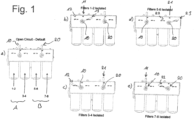
- Fig. 1 shows an embodiment of a filtration system of the present invention.
- the filtration system comprises two groups A and B of filters arranged in parallel in a fluid pathway of the filtration system.
- Each group comprises at least a first filter 1-2, 5-6 and a second filter 2-3, 7-8.
- duplex filters are used.
- Each duplex filter comprises two filters or filter elements arranged and operated in parallel.
- the first group A therefore comprises the first filter elements 1-2 forming a first duplex filter, and the second filters 3-4 forming a second duplex filter.
- the second group B comprises the first filters 5-6 forming a first duplex filter and the second filters 7-8 forming a second duplex filter.
- the present invention could also be use single filters or filters having more than two filters arranged and operated in parallel.
- Each group of filters A, B comprises an operating element 10, 20 for selectively isolating either the first or the second filters from the filtration system. In a default position of the operating element, both the first and second filters are connected to the filtration system.
- the filter cartridge of the filter can be exchanged.
- the filtration system can be operated using the filters which are still connected.
- Each of the operating elements is configured such that it only isolates, in each isolating position, either the first or the second filters from the filtration system, while the remaining second or first filters are still connected to the filtration system. This principle allows replacing a filter cartridge while the filtration system is working, because for each group of filters, at least one out of the first and the second filters will be connected to the filtration system and therefore working.
- the filtration system of the present invention therefore comprises a mechanical blocking mechanism that will avoid such a situation, because moving the one operating element out of its default position will actuate the blocking mechanism to block the other operating element in its default position.
- Fig. 1 shows the five possible switching positions of the operating elements 10 and 20.
- both operating elements 10, 20 are in their default position, such that all filters are connected to the filtration system.
- the first operating element 10 is in its first isolating position 13, isolating the first filters 1-2.
- the first operating element 10 is in its second isolating position 12, isolating the second filters 3-4.
- the second operating element 20 is in its first isolating position 23, isolating the first filters 5-6.
- the second operating element 20 is in its second isolating position 22, isolating the second filters 7-8.
- the second operating element 20 is in its default position 21, while in situations d) and e), the first operating element 10 is in its default position 11. Situations where both operating elements are in an isolating position are avoided by the mechanical blocking mechanism.
- Fig. 2 shows some of the main components of an embodiment of the mechanical blocking mechanism. These components of the mechanical blocking mechanism also shown in fig. 3 separately for groups A and B.
- the mechanical blocking mechanism comprises a first blocking element 30 operated by the first operating element 10 to block the second operating element 20, and a second blocking element 40 operated by the second operating element 20 to block the first operating element 10.
- the blocking elements 30, 40 are respectively operated by a driving element 14, 24, fixedly connected to the respective operating element 10, 20.
- Each driving element 14, 24 comprises a guide 15, 25 cooperating with a respective pin 31, 41 connected to the respective blocking element 30, 40.
- the operating elements each have an axis of rotation 18, 28, and can be rotated from the default position 11, 21 to the two isolating positions 12, 13 and 22, 23 respectively.
- the isolating positions are arranged on opposite sides of the default position.
- each operating element 10, 20 operates, by this rotation, a valve element 16, 26 to either open fluid passages or close fluid passages in a valve.
- the valve element 16 is integrated into the axis of each operating element.
- Section 17, 27 separates an inlet passage of the valve from an outlet passage of the valve, which are both closed and opened by each valve element 16, 26.
- the corresponding drive element 14, 24 will equally rotate, such that the guide will be displaced in a rotational movement. Because the distance of the guide 15, 25 to the axis of the respective operating element varies along the extension of the guide, the respective pin 31, 41 slidably engaged within the respective guide 15, 25 will be displaced by such a rotation.
- both blocking elements 30, 40 are linearly movable from a default position to a blocking position.
- guide pins 51 engage with long holes 33, 43 of the blocking elements to allow a sliding movement of each blocking element along a linear path.
- the guide pins 31, 41 connected to the blocking elements 30, 40 will displace the blocking elements, depending on the position of the drive element 14, 24, along this linear direction.
- the blocking elements are arranged to extend from the respective drive element that will operate the blocking element to a counter element of the other operating element to engage with the counter element in their blocking position.
- the blocking elements are plate elements or bars extending between the two operating elements.
- the two blocking elements are placed on top of each other, with the same guiding pins 51 reaching through guide holes 33, 43 in both blocking elements.
- the blocking elements are arranged to extend along a line connecting the two axes 18, 28 of the two operating elements, 10, 20.
- At least one of the blocking elements 30, 40 has a slot 42 arranged in the end section opposite the pin 41, in order to allow the pin 31 of the other blocking element to extend through the blocking element 40 in order to engage with the respective drive element 14.
- each guide 15, 25 has a first guide section 15', 25' in which the respective pin 31, 41 is arranged if the operating element in in its default position. Further, second guide sections 15", 25" extend on both sides of the first guide section 15', 25'. Once the operating element is moved from its default position in the directions of one of its isolating positions, the pin 31, 41 will move from the first guide section 15', 25' into one of the second guide sections 15", 25".
- the second guide sections 15", 25" are arcuate sections extending at a radius with respect to the axis of the respective operating element which is larger than the distance of the first guide sections 15', 25' to the respective axis.
- Fig. 4b shows the valve elements 16 in the respective default positions opening flow channels to the respective filters.
- Each operating element 10, 18 has a handle 18, 28 for rotating the operating element.
- the handle is a lever.
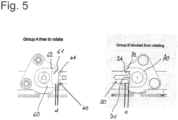
- Fig. 5 shows the two possible configurations between a blocking element and its respective counter element.
- the ends of the blocking elements 30, 40 opposite the respective pins 31, 41 have blocking edges 34, 44 that can be engaged with a recess 61, 71 of the respective counter element 60, 70.
- the recess 61, 71 therefore forms a blocking section engaging with the blocking element.
- Fig. 5 shows on the left hand side a situation where group A, i.e. the first operating element 10, is free to rotate because the second blocking element 40 comprising the blocking edges 44 is not engaged with the recess 61 of the counter element 60, with a distance d remaining between the sides 62 of the recess 61 and the blocking edges 44.
- group B i.e. the second operating element 20
- the blocking edges 34 of the first blocking element 30 are engaged into the recess 71, with an interference e between the blocking edges 34 and the sides 72 of the recess 70 blocking a rotational movement.
- the sides 62, 72 of the recesses 61, 71 therefore form counter-blocking edges cooperating with the blocking edges of the blocking elements.
- the respective counter elements 60, 70 are fixedly attached to the respective operating elements 10, 20 to block the rotational movement of the respective operating element 10, 20 when engaged with the blocking element.
- FIG. 6 to 8 now shows different switching positions of the filtration system and the respective positions of the blocking elements and their counter elements.
- Fig. 6 shows situation a) of Fig. 1 , i.e. where both operating elements are in their default position. Therefore, the pins 31 and 41 are arranged in the respective default sections 15', 25' of the guides such that the blocking element are in their default positions, with the blocking edges 34, 44 arranged with a distance d to the sides 62, 72 of the recesses 61, 71, such that both operating elements are free to rotate.
- Fig. 7 shows situation b) of Fig. 1 , with the first operating element in its first isolation position isolating the first filters 1 - 2.
- pin 31 of the first blocking element 30 is in the isolating section 15" of the guide 15, moving the blocking element 30 in the direction of the second operating element 20.
- the blocking edges 34 engage into the recess 71, with an interference e between the blocking edges 34 of the blocking element 30 and the sides 72 of the recess 71 blocking rotation of the counter element 70.
- group B and therefore the second operating element is blocked from rotating.
- Fig. 8 shows the corresponding situation for group A or the first operating element 10 being blocked by the second operating 20 being in the first isolating position, corresponding to situation d) of Fig. 1 .
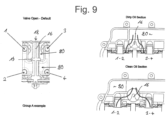
- valve element 16 is shown in Fig. 9 for the first operating element 10 or group A.
- the configuration of the second operating element 20 and group B is the same.
- the valve has two sections, one for the inlets to the filters, one or the outlets.
- the sections for the inlets correspond to the dirty oil section 80, the sections for the outlets to the clean oil sections 90 shown in fig. 9 .
- the two sections are arranged next to each other along the axial direction of the valve element, and separated by a separating block 17.
- the valve element 16 will open a respective flow path from a fluid duct 80, 90 of the filtration system to the corresponding inlets or outlets of all the filters associated to the respective valve.
- a rotation in the second direction will block the inlets and outlets of the second filters while leaving the inlets and outlets of the first filters connected.
- the filters 1 - 2 of the first duplex filter are connected in parallel both on the outlet and on the inlet side to the valve.
- the same is true for the filters 3 - 4 of the second duplex filter.
- single filters could equally be used.
- each filter has a filter head housing 90 comprising the connections to the respective valve, and a filter cartridge housing 91 connected to the filter head housing 90.
- the filter cartridge housing 91 can be removed, the filter cartridge replaced and the filter cartridge housing installed again.
- the filtration system of the present invention can for example be used for internal combustion engines, in particular as a filtration system of the lubricating system.
- the filtration system can also be used in any other application where a number of filters are operating in parallel in a fluid duct.
Landscapes
- Chemical & Material Sciences (AREA)
- Engineering & Computer Science (AREA)
- Chemical Kinetics & Catalysis (AREA)
- Combustion & Propulsion (AREA)
- Mechanical Engineering (AREA)
- General Engineering & Computer Science (AREA)
- Lubrication Details And Ventilation Of Internal Combustion Engines (AREA)
- Filtration Of Liquid (AREA)
Description
- The present application relates to a filtration system comprising a plurality of filters, in particular oil or fuel filters. The filter system may for example be used in an engine, for example for filtering the oil of the cooling and/or lubrication circuit of the engine.
- In such a system, in order to exchange the filter cartridge of a filter, it is necessary to isolate the filter from the filtration system, i. e. from the fluid line in which the filter is arranged.
- For this purpose, it is known from filtration systems having two filters operating in parallel to provide an operating element movable from a default position where both filters operate in parallel to a first or to a second isolating position for isolating the first filter or the second filter from the filtration system, respectively.
- A filtration system according to the preamble of
claim 1, where separate operating elements are provided for the two filters, which are interconnected by a mechanical blocking mechanism, is known fromUS 2,505,375 A . - A further filtration system with two filters is known from
US 2018/0361282 A1 . - Thereby, the filter cartridge of one filter can be exchanged while the other filter is still operative, such that the exchange can be done during the operation of the system, with the other filter doing all the filtering for the time that is required for the exchange.
- If two such filter systems are used in parallel, each filter system may still be provided with an operating element to be able to exchange a filter cartridge of one filter while the other is operable.
- The inventor of the present invention has however realized that simply duplicating existing filtration systems will lead to an increased risk of failure.
- The object of the present invention is therefore to provide an improved filtration system.
- This object is solved by a filtration system according to
claim 1. Preferred embodiments of the present invention are the subject matter of the dependent claims. - The present invention provides a filtration system comprising a plurality of filters, in particular oil or fuel filters, a first operating element movable from a default position to a least one isolating position for isolating at least one filter of a first group of filters from the filtration system and a second operating element movable from a default position to at least one isolating position for isolating at least one filter of a second group of filters from the filtration system. At least two filters are associated to each operating element, the operating element being configured to selectively isolate at least one first filter out of the at least two filters from the filtration system in a first isolating position and at least one second filter out of the at least two filters in a second isolating position. Further, the system comprises a mechanical blocking mechanism that is actuated by a movement of the first operating element out of its default position to block the second operating element in its default position and actuated by a movement of the second operating element out of its default position to block the first operating element in its default position.
- Using two parallel filtration systems without the present invention, there is the risk that the operator is switching off two filters at the same time, with the risk to get too much flow through the remaining filters and then damage them and pollute the circuit.
- Risk analysis has shown that the oil circuit could be polluted followed by a major engine failure in this case, i.e. if the operator is not respecting a correct sequence during filter cartridge replacement.
- The safety when using two filtration systems would, without the present invention, therefore only rely on the operating manual and/or training of the operators, teaching them to respect some sequence during filter cartridge replacement that will avoid a parallel isolation of several filters.
- The present invention therefore uses a mechanical blocking mechanism to eliminate this risk. The blocking mechanism is in particular designed to avoid a situation where both operating elements are moved to an isolating position, and therefore avoids a situation where two filters are isolated at the same time.
- This system can be applied for different media, such as fuel or oil, and is not restricted to engines but can be used in any filtration system as soon as a plurality of filters are used.
- In an embodiment of the present invention, in a default state of the filtration system, both operating elements are arranged in their respective default position.
- According to the present invention, in the default position of an operating element, all the filters of the respective group of filters are connected to the filtration system.
- Preferably, the operating element is configured to selectively isolate in each isolating position at least one out of the two filters associated to the operating element from the filtration system while keeping the at least one other filter out of the at least two filters operative and connected to the filtration system.
- In an embodiment of the present invention, each filter is at least a duplex filter comprising two filter elements or filters arranged in parallel. In particular, the two filter elements or filters may be isolated from and connected to the filtration system by the operating element in parallel.
- In particular, in such an embodiment, whenever the previous or the following definitions relate to at least one filter, the at least one filter may be formed by two filter elements or filters arranged in parallel. Further, whenever the previous or the following definitions relate to at least two filters, each of these at least two filters may be formed by two filter elements or filters arranged in parallel.
- In an embodiment of the present invention, all the filters are arranged in parallel in a fluid duct of the filtration system when connected by the respective operating element to the filtration system.
- In an embodiment of the present invention, the mechanical blocking mechanism comprises a blocking element operated by the first operating element to block the second operating element and a second blocking element operated by the second operating element to block the first operating element. In particular, the two blocking elements may be separate elements and/or can be moved independently from each other.
- In an embodiment of the present invention, the blocking elements are slidably arranged on the filtration system to be moved from a default position to a blocking position.
- In an embodiment of the present invention, the blocking elements may be plates, bars and/or rods extending longitudinally between the two operating elements.
- In an embodiment of the present invention, the first blocking element and the second blocking element are arranged on top of each other and are preferably guided by one or more guide pins extending through linear slots in the blocking elements.
- In an embodiment of the present invention, the first blocking element is operatively connected to a drive element of the first operating element and the second blocking element in operatively connected to a driving element of the second operating element.
- In an embodiment of the present invention, each blocking element is operatively connected to the respective drive element in one of its end sections.
- In an embodiment of the present invention, the drive elements of the operating elements each comprise a guide interacting with a pin of the respective blocking element, wherein the guide is preferably configured as a slot.
- In an embodiment of the present invention, the drive elements are cut from a plate material.
- In an embodiment of the present invention, the drive elements are fixedly connected to an axis of the operating element.
- In an embodiment of the present invention, the operating elements are rotatable from the default position to the isolating position or positions.
- In an embodiment of the present invention, the operating elements are rotatable from the default position in two opposite directions into the respective isolating positions.
- In an embodiment of the present invention, a drive element for driving a blocking element is rotated by the rotation of the operating element.
- In an embodiment of the present invention, a guide of the drive element is located at a first radial distance with respect to a rotation axis of the drive element in a default section and extends from the default section to an arcuate section where it extends at a second radial distance to the rotation axis of the drive element.
- In an embodiment of the present invention, a pin of the blocking element is arranged in the default section of the guide when the operating element is in the default position and moves from the default section to the arcuate section once the operating element is rotated away from the default position to an isolating position, such that the blocking element is displaced by the difference in the radius of the guide in the default section to the arcuate section.
- In an embodiment of the present invention, the guide has arcuate sections on both sides of the default section corresponding to the two isolating positions.
- In an embodiment of the present invention, the operating elements comprise and/or operate a valve element that is rotated in a valve body for establishing at least one fluid communication through a fluid passage of the valve element in the default position and blocking the fluid communication in the isolating position.
- In an embodiment of the present invention, the valve element establishes a first and a second fluid communication to an entry port and an exit port of each filter associated to the operating element in the default position and blocks the first and the second fluid communication to at least one filter in an isolating position.
- In an embodiment of the present invention, the valve element is provided in or fixedly connected to a rotation axis of the operating element. In particular, the valve element may be provided by cut-outs provided in a rotation axis of the operating element.
- In an embodiment of the present invention, a first blocking element has a blocking section that is movable into blocking engagement with a blocking section of the first operating element and a second blocking element has a blocking section that is movable into blocking engagement with a blocking section of the second operating element.
- In an embodiment of the present invention, the blocking sections of the blocking elements are formed by respective end sections of the blocking elements.
- In an embodiment of the present invention, the blocking sections of the operating elements are formed by respective recesses.
- In an embodiment of the present invention, the blocking sections block rotational movement of the respective operating element when engaged with each other.
- In an embodiment of the present invention, the blocking sections of the operating elements are formed in a plate element fixedly connected to the rotation axis of the operating element.
- In an embodiment of the present invention, each operating element comprises a handle, in particular a lever, connected to the rotational axis of the operating element.
- In an embodiment of the present invention, each filter or filter element comprises at least one filtration head housing and a replaceable filter cartridge.
- In an embodiment of the present invention, the filtration system arranged in a fluid duct of an engine, in particular in an oil or fuel duct of the engine.
- The present invention further comprises a machine comprising a fluid duct and a filtration system as described herein arranged in the fluid duct.
- In an embodiment of the present invention, the machine is an engine, in particular an internal combustion engine.
- In an embodiment of the present invention, the fluid duct is an oil or fuel duct.
- In an embodiment of the present invention, the filtration system is arranged in a cooling and/or lubrication circuit of the machine, in particular of the engine.
- The present invention will now be described in more detail with reference to figures and embodiments.
- The figures show:
- Fig. 1:
- the various switching positions of the operating elements of an embodiment of the filtration system of the present invention,
- Fig. 2:
- an embodiment of the mechanical blocking mechanism,
- Fig. 3:
- perspective views of the main elements of the blocking system,
- Fig. 4a:
- a frontal view of the blocking system with the two operating elements in their default positions,
- Fig. 4b:
- a cut view through the plane defined by the axes of the operating elements in the situation shown in
Fig. 4a , - Fig. 5:
- detailed views of elements of the blocking mechanism, where the first operating element is free to rotate and the second operating element is blocked,
- Fig. 6:
- a frontal and a cut view of the mechanical blocking system together with enlarged portions in a situation where both operating elements are in the default position,
- Fig. 7:
- a frontal and a cut view of the mechanical blocking system together with enlarged portions for a situation where the first operating element is in an isolating position,
- Fig. 8:
- a frontal and a cut view of the mechanical blocking system together with enlarged portions for a situation where the second operating element is in an isolating position and
- Fig. 9:
- cut views through the valve element of the first operating element in the default position.
-
Fig. 1 shows an embodiment of a filtration system of the present invention. The filtration system comprises two groups A and B of filters arranged in parallel in a fluid pathway of the filtration system. Each group comprises at least a first filter 1-2, 5-6 and a second filter 2-3, 7-8. In the embodiment, duplex filters are used. Each duplex filter comprises two filters or filter elements arranged and operated in parallel. - The first group A therefore comprises the first filter elements 1-2 forming a first duplex filter, and the second filters 3-4 forming a second duplex filter. The second group B comprises the first filters 5-6 forming a first duplex filter and the second filters 7-8 forming a second duplex filter. Instead of using duplex filters, the present invention could also be use single filters or filters having more than two filters arranged and operated in parallel.
- Each group of filters A, B comprises an operating
element - Therefore, in a first isolating
position 13, 23, the respective first filters 1-2, 5-6 are isolated. In a second isolatingposition 12, 22, the respective second filters 3-4, 7-8 are isolated. In thedefault position 11, 21, all filters 1-2, 5-6, 3-4, 7-8 are connected. - Once a filter is isolated from the filtration system, the filter cartridge of the filter can be exchanged. The filtration system can be operated using the filters which are still connected.
- Each of the operating elements is configured such that it only isolates, in each isolating position, either the first or the second filters from the filtration system, while the remaining second or first filters are still connected to the filtration system. This principle allows replacing a filter cartridge while the filtration system is working, because for each group of filters, at least one out of the first and the second filters will be connected to the filtration system and therefore working.
- However, if the two operating elements operate independently from each other and both operating elements are in an isolating position, half of all the filters may be isolated. The remaining filtration power may therefore not be sufficient for maintaining a safe operation of the system.
- The filtration system of the present invention therefore comprises a mechanical blocking mechanism that will avoid such a situation, because moving the one operating element out of its default position will actuate the blocking mechanism to block the other operating element in its default position.
-
Fig. 1 shows the five possible switching positions of theoperating elements elements first operating element 10 is in its first isolating position 13, isolating the first filters 1-2. In situation c), thefirst operating element 10 is in its second isolatingposition 12, isolating the second filters 3-4. In situation d), thesecond operating element 20 is in its first isolatingposition 23, isolating the first filters 5-6. In situation e), thesecond operating element 20 is in its second isolating position 22, isolating the second filters 7-8. In situations b) and c), thesecond operating element 20 is in itsdefault position 21, while in situations d) and e), thefirst operating element 10 is in its default position 11. Situations where both operating elements are in an isolating position are avoided by the mechanical blocking mechanism. -
Fig. 2 shows some of the main components of an embodiment of the mechanical blocking mechanism. These components of the mechanical blocking mechanism also shown infig. 3 separately for groups A and B. - In particular, the mechanical blocking mechanism comprises a
first blocking element 30 operated by thefirst operating element 10 to block thesecond operating element 20, and asecond blocking element 40 operated by thesecond operating element 20 to block thefirst operating element 10. - The blocking
elements element respective operating element element guide respective pin respective blocking element - The operating elements each have an axis of
rotation 18, 28, and can be rotated from thedefault position 11, 21 to the two isolatingpositions - As can be seen from
fig. 3 , each operatingelement valve element valve element 16 is integrated into the axis of each operating element.Section 17, 27 separates an inlet passage of the valve from an outlet passage of the valve, which are both closed and opened by eachvalve element - Once an operating
element drive element guide respective pin respective guide - In particular, both blocking
elements long holes - Therefore, the guide pins 31, 41 connected to the blocking
elements drive element - The blocking elements are arranged to extend from the respective drive element that will operate the blocking element to a counter element of the other operating element to engage with the counter element in their blocking position.
- In the embodiment, the blocking elements are plate elements or bars extending between the two operating elements.
- In the embodiment, the two blocking elements are placed on top of each other, with the same guiding pins 51 reaching through guide holes 33, 43 in both blocking elements.
- Further, the blocking elements are arranged to extend along a line connecting the two
axes 18, 28 of the two operating elements, 10, 20. - At least one of the blocking
elements pin 41, in order to allow thepin 31 of the other blocking element to extend through the blockingelement 40 in order to engage with therespective drive element 14. - As shown in
Fig. 4a , eachguide respective pin second guide sections 15", 25" extend on both sides of the first guide section 15', 25'. Once the operating element is moved from its default position in the directions of one of its isolating positions, thepin second guide sections 15", 25". - The
second guide sections 15", 25" are arcuate sections extending at a radius with respect to the axis of the respective operating element which is larger than the distance of the first guide sections 15', 25' to the respective axis. Thereby, once the respective operating element is moved from the default position in the direction of an isolating position, therespective pin element element - The above described configuration of the two blocking elements arranged on top of each other, with the
pin 31 of thefirst blocking element 30 reaching trough a slit 42 in the end section of thesecond blocking element 40 to engage with theguide 15 of thedrive element 14 of the first operating element, is shown inFig. 4b. Fig. 4b also shows thevalve elements 16 in the respective default positions opening flow channels to the respective filters. - Each operating
element handle 18, 28 for rotating the operating element. In the embodiment, the handle is a lever. -
Fig. 5 shows the two possible configurations between a blocking element and its respective counter element. - In particular, the ends of the blocking
elements respective pins edges recess respective counter element 60, 70. Therecess -
Fig. 5 shows on the left hand side a situation where group A, i.e. thefirst operating element 10, is free to rotate because thesecond blocking element 40 comprising the blocking edges 44 is not engaged with therecess 61 of thecounter element 60, with a distance d remaining between thesides 62 of therecess 61 and the blocking edges 44. On the right hand side,Fig. 5 shows the situation where group B, i.e. thesecond operating element 20, is blocked from rotating because thefirst blocking element 30 engages with the corresponding counter element 70. In particular, the blocking edges 34 of thefirst blocking element 30 are engaged into therecess 71, with an interference e between the blocking edges 34 and the sides 72 of the recess 70 blocking a rotational movement. Thesides 62, 72 of therecesses - The
respective counter elements 60, 70 are fixedly attached to therespective operating elements respective operating element -
Figures 6 to 8 now shows different switching positions of the filtration system and the respective positions of the blocking elements and their counter elements. -
Fig. 6 shows situation a) ofFig. 1 , i.e. where both operating elements are in their default position. Therefore, thepins sides 62, 72 of therecesses -
Fig. 7 shows situation b) ofFig. 1 , with the first operating element in its first isolation position isolating the first filters 1 - 2. Thereby, pin 31 of thefirst blocking element 30 is in the isolatingsection 15" of theguide 15, moving the blockingelement 30 in the direction of thesecond operating element 20. Thereby, the blocking edges 34 engage into therecess 71, with an interference e between the blocking edges 34 of the blockingelement 30 and the sides 72 of therecess 71 blocking rotation of the counter element 70. Thereby, group B and therefore the second operating element is blocked from rotating. -
Fig. 8 shows the corresponding situation for group A or thefirst operating element 10 being blocked by thesecond operating 20 being in the first isolating position, corresponding to situation d) ofFig. 1 . - The configuration of the
valve element 16 is shown inFig. 9 for thefirst operating element 10 or group A. The configuration of thesecond operating element 20 and group B is the same. - The valve has two sections, one for the inlets to the filters, one or the outlets. The sections for the inlets correspond to the
dirty oil section 80, the sections for the outlets to the clean oil sections 90 shown infig. 9 . The two sections are arranged next to each other along the axial direction of the valve element, and separated by a separatingblock 17. In each section, thevalve element 16 will open a respective flow path from afluid duct 80, 90 of the filtration system to the corresponding inlets or outlets of all the filters associated to the respective valve. By rotating the valve element in a first direction, the inlets and the outlets of the first filters will be blocked from the respective fluid paths of the filtration system, while the second filters will still be connected. A rotation in the second direction will block the inlets and outlets of the second filters while leaving the inlets and outlets of the first filters connected. - As can be seen from
fig. 9 , the filters 1 - 2 of the first duplex filter are connected in parallel both on the outlet and on the inlet side to the valve. The same is true for the filters 3 - 4 of the second duplex filter. Instead of using duplex filters, single filters could equally be used. - As shown in
Fig. 2 , each filter has a filter head housing 90 comprising the connections to the respective valve, and afilter cartridge housing 91 connected to the filter head housing 90. Thereby, if the filter is isolated from the filtration system, thefilter cartridge housing 91 can be removed, the filter cartridge replaced and the filter cartridge housing installed again. - The filtration system of the present invention can for example be used for internal combustion engines, in particular as a filtration system of the lubricating system.
- The filtration system can also be used in any other application where a number of filters are operating in parallel in a fluid duct.
Claims (14)
- A filtration system comprisinga plurality of filters (1-2, 3-4, 5-6, 7-8), in particular oil or fuel filters,a first operating element (10) movable from a default position (11) to a least one isolating position (12, 13) for isolating at least one filter (1-2, 3-4) of a first group (A) of filters from the filtration system,a second operating element (20) movable from a default position (21) to at least one isolating position (22, 23) for isolating at least one filter (5-6, 7-8) of a second group (B) of filters from the filtration system, anda mechanical blocking mechanism that is actuated by a movement of the first operating element (10) out of its default position (11) to block the second operating element (20) in its default position (21) and actuated by a movement of the second operating element (20) out of its default position (21) to block the first operating element (10) in its default position (11),wherein in the default position (11, 21) of the first and second operating element (10, 20), all the filters of the respective group of filters (A,B) are connected to the filtration system,characterized in thatat least two filters are associated to each operating element (10, 20), the operating element (10, 20) being configured to selectively isolate at least one first filter (1-2, 5-6) out of the at least two filters from the filtration system in a first isolating position (13, 23) and at least one second filter (3-4, 7-8) out of the at least two filters in a second isolating position (12, 22).
- The filtration system according to claim 1, wherein each filter (1-2, 3-4, 5-6, 7-8) is at least a duplex filter comprising two filters or filter elements arranged in parallel.
- The filtration system according to any one of the preceding claims, wherein all the filters (1-2, 3-4, 5-6, 7-8) are arranged in parallel in a fluid duct of the filtration system.
- The filtration system according to any one of the preceding claims, wherein the mechanical blocking mechanism comprises a first blocking element (30) operated by the first operating element (10) to block the second operating element (20) and a second blocking element (40) operated by the second operating element (20) to block the first operating element (10).
- The filtration system according to claim 4, wherein the blocking elements (30, 40) are slidably arranged on the filtration system to be moved from a default position to a blocking position.
- The filtration system according to claim 4 or 5, wherein the first blocking element (30) and the second blocking element (40) are arranged on top of each other and are preferably guided by one or more guide pins (51) extending through linear slots (33, 43) in the blocking elements.
- The filtration system according to any one of claims 4 to 6, wherein the first blocking element (30) is operatively connected to a drive element (14) of the first operating element (10) and the second blocking element (40) in operatively connected to a driving element (24) of the second operating element (20), wherein the blocking elements (30 ,40) are preferably operatively connected to the respective drive element (14, 24) in one of the end sections of the respective blocking elements and/or wherein the drive elements (14, 24) preferably each comprise a guide (15, 25) interacting with a pin (31, 41) of the respective blocking element, wherein the guide is preferably configured as a slot.
- The filtration system according to any one of the preceding claims, wherein the operating elements (10, 20) are rotatable from the default position (11, 21) to the isolating positions (12, 13, 22, 23), wherein preferably, the operating elements (10, 20) are rotatable from the default position in two opposite directions into the respective isolating positions (12, 13, 22, 23).
- The filtration system according to claim 8, wherein a drive element (14, 24) for driving a blocking element (30, 40) is rotated by the rotation of the operating element (10, 20), wherein preferably a guide (15, 25) of the drive element is located at a first radial distance with respect to a rotation axis of the drive element (14, 24) in a default section and extends from the default section to an arcuate section where it extends at a second radial distance to the rotation axis of the drive element, wherein preferably a pin (31, 41) of the blocking element (30, 40) is arranged in the default section of the guide (15, 25) when the operating element is in the default position (11, 21) and moves from the default section to the arcuate section once the operating element is rotated away from the default position (11, 21) to an isolating position (12, 13, 22, 23), such that the blocking element (30, 40) is displaced by the difference in the radius of the guide in the default section to the arcuate section, wherein preferably the guide (15, 25) has arcuate sections on both sides of the default section corresponding to the two isolating positions.
- The filtration system according to claim 8 or 9, wherein the operating elements (10, 20) comprise and/or operate a valve element (16, 26) that is rotated in a valve body for establishing at least one fluid communication through a fluid passage of the valve element (16, 26) in the default position and blocking the fluid communication in the isolating position, wherein preferably, the valve element (16, 26) establishes a first and a second fluid communication to an entry port and an exit port of each filter associated to the operating element (10, 20) in the default position and blocks the first and the second fluid communication to at least one filter in an isolating position.
- The filtration system according to any one of the preceding claims, wherein a first blocking element (30) has a blocking section (34) that is movable into blocking engagement with a blocking section (62) of the first operating element and a second blocking element (40) has a blocking section (44) that is movable into blocking engagement with a blocking section (72) of the second operating element.
- The filtration system according to claim 11, wherein the blocking sections (34, 44) of the blocking elements are formed by respective end sections of the blocking elements and/or wherein the blocking sections (62, 72) of the operating elements are formed by respective recesses and/or wherein the blocking sections block rotational movement of the respective operating element when engaged with each other.
- The filtration system according to any one of the preceding claims, wherein each filter or filter element comprises at least one filtration head housing and a replaceable filter cartridge.
- A machine comprising a fluid duct and a filtration system according to any one of the preceding claims arranged in the fluid duct, wherein the machine preferably is an engine and/or the fluid duct is an oil or fuel duct.
Applications Claiming Priority (1)
| Application Number | Priority Date | Filing Date | Title |
|---|---|---|---|
| DE102021125041 | 2021-09-28 |
Publications (2)
| Publication Number | Publication Date |
|---|---|
| EP4154963A1 EP4154963A1 (en) | 2023-03-29 |
| EP4154963B1 true EP4154963B1 (en) | 2024-11-20 |
Family
ID=83151592
Family Applications (1)
| Application Number | Title | Priority Date | Filing Date |
|---|---|---|---|
| EP22193398.9A Active EP4154963B1 (en) | 2021-09-28 | 2022-09-01 | Filtration system |
Country Status (2)
| Country | Link |
|---|---|
| US (1) | US12241440B2 (en) |
| EP (1) | EP4154963B1 (en) |
Families Citing this family (1)
| Publication number | Priority date | Publication date | Assignee | Title |
|---|---|---|---|---|
| US11946439B2 (en) * | 2022-05-09 | 2024-04-02 | Caterpillar Inc. | Fuel module for engine having service valve assembly for common drain from primary and secondary filters |
Family Cites Families (7)
| Publication number | Priority date | Publication date | Assignee | Title |
|---|---|---|---|---|
| DE112510C (en) * | 1899-04-16 | 1900-08-10 | ||
| US2505375A (en) * | 1948-12-28 | 1950-04-25 | Bethlehem Steel Corp | Duplex fluid strainer |
| DE19851193C1 (en) | 1998-11-06 | 2000-04-13 | Hydac Filtertechnik Gmbh | Dual chamber filter change-over valve has lever operated by one hand only, simultaneously performing the three functions of unlocking, inter-chamber pressure equalization and turning of valve plug |
| NL1013330C2 (en) | 1999-10-18 | 2001-04-19 | Indufil B V | Switching device and medium flow optionally through a first or second treatment member. |
| CA2707230A1 (en) | 2009-06-11 | 2010-12-11 | Thomas Rahm | Filter switching apparatus |
| US10926205B2 (en) * | 2017-06-20 | 2021-02-23 | Eaton Intelligent Power Limited | Cast filter assembly-modular design |
| CN111085033B (en) * | 2019-12-29 | 2022-05-17 | 西安昊池环保工程有限公司 | Parallel lubricating oil fine filtration method based on overpressure conducting valve |
-
2022
- 2022-09-01 EP EP22193398.9A patent/EP4154963B1/en active Active
- 2022-09-21 US US17/934,130 patent/US12241440B2/en active Active
Also Published As
| Publication number | Publication date |
|---|---|
| US20230123929A1 (en) | 2023-04-20 |
| EP4154963A1 (en) | 2023-03-29 |
| US12241440B2 (en) | 2025-03-04 |
Similar Documents
| Publication | Publication Date | Title |
|---|---|---|
| EP4154963B1 (en) | Filtration system | |
| EP2696118B1 (en) | Impulse duty cycle valves | |
| DE19637174C2 (en) | switching valve | |
| EP1596104A2 (en) | Control device for a plurality of shift cylinders and hydraulic supply system for a dual clutch transmission | |
| EP2971894A1 (en) | Transflow valve with an isolation and switching mechanism for double block and bleed arrangement | |
| DE69814539T2 (en) | Solenoid valve with three connections in the housing of a solenoid valve with five connections | |
| DE102005019516A1 (en) | Arrangement for control of several hydraulic shift cylinders and hydraulic supply system for dual clutch operated transmission unit | |
| EP2378127B1 (en) | Flow guiding component with pump and fitting | |
| GB2033546A (en) | Multi-valve interlock apparatus and method of manufacture | |
| EP0993574A4 (en) | MULTI-FUNCTION FLUIDIC CONTROL VALVE | |
| SE465637B (en) | CONTROL VALVES FOR REFRIGERANT | |
| KR102812080B1 (en) | Filtration unit with improved cover assembly | |
| RU2559654C2 (en) | Fluid supply switching device | |
| DE4027610C2 (en) | Valve | |
| DE102019220442A1 (en) | Pump unit | |
| EP3368772B1 (en) | Extractable valve group with obturator group with a plurality of active portions | |
| US4047540A (en) | Multi-path valve structure having extended life and backwashing capability | |
| US5855226A (en) | Valve actuator | |
| EP2080455A1 (en) | Reusable blocking device for fluids, in particular for use in automatic drink machines | |
| DE10209335A1 (en) | valve means | |
| DE102012010681A1 (en) | Hybrid drive device, has refrigerant circuit cooling engine lubricant and connected to first heat exchange horizontal bar of heat exchanger, and exhaust system heating lubricant and connected to second heat exchange horizontal bar | |
| EP3901501A1 (en) | Servo valve | |
| DE102013104869A1 (en) | Power and working machine with rotary piston | |
| DE102014011746B4 (en) | Coolant circuit for a vehicle and turntable for such a coolant circuit | |
| DE112023000568T5 (en) | PLANETARY FLUID CONTROL VALVE |
Legal Events
| Date | Code | Title | Description |
|---|---|---|---|
| PUAI | Public reference made under article 153(3) epc to a published international application that has entered the european phase |
Free format text: ORIGINAL CODE: 0009012 |
|
| STAA | Information on the status of an ep patent application or granted ep patent |
Free format text: STATUS: THE APPLICATION HAS BEEN PUBLISHED |
|
| AK | Designated contracting states |
Kind code of ref document: A1 Designated state(s): AL AT BE BG CH CY CZ DE DK EE ES FI FR GB GR HR HU IE IS IT LI LT LU LV MC MK MT NL NO PL PT RO RS SE SI SK SM TR |
|
| STAA | Information on the status of an ep patent application or granted ep patent |
Free format text: STATUS: REQUEST FOR EXAMINATION WAS MADE |
|
| 17P | Request for examination filed |
Effective date: 20230928 |
|
| GRAP | Despatch of communication of intention to grant a patent |
Free format text: ORIGINAL CODE: EPIDOSNIGR1 |
|
| STAA | Information on the status of an ep patent application or granted ep patent |
Free format text: STATUS: GRANT OF PATENT IS INTENDED |
|
| INTG | Intention to grant announced |
Effective date: 20240708 |
|
| GRAS | Grant fee paid |
Free format text: ORIGINAL CODE: EPIDOSNIGR3 |
|
| GRAA | (expected) grant |
Free format text: ORIGINAL CODE: 0009210 |
|
| STAA | Information on the status of an ep patent application or granted ep patent |
Free format text: STATUS: THE PATENT HAS BEEN GRANTED |
|
| AK | Designated contracting states |
Kind code of ref document: B1 Designated state(s): AL AT BE BG CH CY CZ DE DK EE ES FI FR GB GR HR HU IE IS IT LI LT LU LV MC MK MT NL NO PL PT RO RS SE SI SK SM TR |
|
| RAP3 | Party data changed (applicant data changed or rights of an application transferred) |
Owner name: LIEBHERR-COMPONENTS COLMAR SAS |
|
| REG | Reference to a national code |
Ref country code: GB Ref legal event code: FG4D |
|
| REG | Reference to a national code |
Ref country code: CH Ref legal event code: EP |
|
| REG | Reference to a national code |
Ref country code: DE Ref legal event code: R096 Ref document number: 602022007868 Country of ref document: DE |
|
| REG | Reference to a national code |
Ref country code: IE Ref legal event code: FG4D |
|
| REG | Reference to a national code |
Ref country code: AT Ref legal event code: UEP Ref document number: 1743080 Country of ref document: AT Kind code of ref document: T Effective date: 20241120 |
|
| REG | Reference to a national code |
Ref country code: LT Ref legal event code: MG9D |
|
| REG | Reference to a national code |
Ref country code: NL Ref legal event code: MP Effective date: 20241120 |
|
| PG25 | Lapsed in a contracting state [announced via postgrant information from national office to epo] |
Ref country code: HR Free format text: LAPSE BECAUSE OF FAILURE TO SUBMIT A TRANSLATION OF THE DESCRIPTION OR TO PAY THE FEE WITHIN THE PRESCRIBED TIME-LIMIT Effective date: 20241120 Ref country code: IS Free format text: LAPSE BECAUSE OF FAILURE TO SUBMIT A TRANSLATION OF THE DESCRIPTION OR TO PAY THE FEE WITHIN THE PRESCRIBED TIME-LIMIT Effective date: 20250320 Ref country code: PT Free format text: LAPSE BECAUSE OF FAILURE TO SUBMIT A TRANSLATION OF THE DESCRIPTION OR TO PAY THE FEE WITHIN THE PRESCRIBED TIME-LIMIT Effective date: 20250320 |
|
| PG25 | Lapsed in a contracting state [announced via postgrant information from national office to epo] |
Ref country code: NL Free format text: LAPSE BECAUSE OF FAILURE TO SUBMIT A TRANSLATION OF THE DESCRIPTION OR TO PAY THE FEE WITHIN THE PRESCRIBED TIME-LIMIT Effective date: 20241120 Ref country code: FI Free format text: LAPSE BECAUSE OF FAILURE TO SUBMIT A TRANSLATION OF THE DESCRIPTION OR TO PAY THE FEE WITHIN THE PRESCRIBED TIME-LIMIT Effective date: 20241120 |
|
| PG25 | Lapsed in a contracting state [announced via postgrant information from national office to epo] |
Ref country code: BG Free format text: LAPSE BECAUSE OF FAILURE TO SUBMIT A TRANSLATION OF THE DESCRIPTION OR TO PAY THE FEE WITHIN THE PRESCRIBED TIME-LIMIT Effective date: 20241120 |
|
| PG25 | Lapsed in a contracting state [announced via postgrant information from national office to epo] |
Ref country code: ES Free format text: LAPSE BECAUSE OF FAILURE TO SUBMIT A TRANSLATION OF THE DESCRIPTION OR TO PAY THE FEE WITHIN THE PRESCRIBED TIME-LIMIT Effective date: 20241120 |
|
| PG25 | Lapsed in a contracting state [announced via postgrant information from national office to epo] |
Ref country code: NO Free format text: LAPSE BECAUSE OF FAILURE TO SUBMIT A TRANSLATION OF THE DESCRIPTION OR TO PAY THE FEE WITHIN THE PRESCRIBED TIME-LIMIT Effective date: 20250220 |
|
| PG25 | Lapsed in a contracting state [announced via postgrant information from national office to epo] |
Ref country code: LV Free format text: LAPSE BECAUSE OF FAILURE TO SUBMIT A TRANSLATION OF THE DESCRIPTION OR TO PAY THE FEE WITHIN THE PRESCRIBED TIME-LIMIT Effective date: 20241120 Ref country code: GR Free format text: LAPSE BECAUSE OF FAILURE TO SUBMIT A TRANSLATION OF THE DESCRIPTION OR TO PAY THE FEE WITHIN THE PRESCRIBED TIME-LIMIT Effective date: 20250221 |
|
| PG25 | Lapsed in a contracting state [announced via postgrant information from national office to epo] |
Ref country code: PL Free format text: LAPSE BECAUSE OF FAILURE TO SUBMIT A TRANSLATION OF THE DESCRIPTION OR TO PAY THE FEE WITHIN THE PRESCRIBED TIME-LIMIT Effective date: 20241120 |
|
| PG25 | Lapsed in a contracting state [announced via postgrant information from national office to epo] |
Ref country code: RS Free format text: LAPSE BECAUSE OF FAILURE TO SUBMIT A TRANSLATION OF THE DESCRIPTION OR TO PAY THE FEE WITHIN THE PRESCRIBED TIME-LIMIT Effective date: 20250220 |
|
| PG25 | Lapsed in a contracting state [announced via postgrant information from national office to epo] |
Ref country code: SM Free format text: LAPSE BECAUSE OF FAILURE TO SUBMIT A TRANSLATION OF THE DESCRIPTION OR TO PAY THE FEE WITHIN THE PRESCRIBED TIME-LIMIT Effective date: 20241120 |
|
| PG25 | Lapsed in a contracting state [announced via postgrant information from national office to epo] |
Ref country code: DK Free format text: LAPSE BECAUSE OF FAILURE TO SUBMIT A TRANSLATION OF THE DESCRIPTION OR TO PAY THE FEE WITHIN THE PRESCRIBED TIME-LIMIT Effective date: 20241120 |
|
| PG25 | Lapsed in a contracting state [announced via postgrant information from national office to epo] |
Ref country code: EE Free format text: LAPSE BECAUSE OF FAILURE TO SUBMIT A TRANSLATION OF THE DESCRIPTION OR TO PAY THE FEE WITHIN THE PRESCRIBED TIME-LIMIT Effective date: 20241120 |
|
| PG25 | Lapsed in a contracting state [announced via postgrant information from national office to epo] |
Ref country code: RO Free format text: LAPSE BECAUSE OF FAILURE TO SUBMIT A TRANSLATION OF THE DESCRIPTION OR TO PAY THE FEE WITHIN THE PRESCRIBED TIME-LIMIT Effective date: 20241120 |
|
| PG25 | Lapsed in a contracting state [announced via postgrant information from national office to epo] |
Ref country code: SK Free format text: LAPSE BECAUSE OF FAILURE TO SUBMIT A TRANSLATION OF THE DESCRIPTION OR TO PAY THE FEE WITHIN THE PRESCRIBED TIME-LIMIT Effective date: 20241120 |
|
| PG25 | Lapsed in a contracting state [announced via postgrant information from national office to epo] |
Ref country code: CZ Free format text: LAPSE BECAUSE OF FAILURE TO SUBMIT A TRANSLATION OF THE DESCRIPTION OR TO PAY THE FEE WITHIN THE PRESCRIBED TIME-LIMIT Effective date: 20241120 |
|
| REG | Reference to a national code |
Ref country code: DE Ref legal event code: R097 Ref document number: 602022007868 Country of ref document: DE |
|
| PG25 | Lapsed in a contracting state [announced via postgrant information from national office to epo] |
Ref country code: SE Free format text: LAPSE BECAUSE OF FAILURE TO SUBMIT A TRANSLATION OF THE DESCRIPTION OR TO PAY THE FEE WITHIN THE PRESCRIBED TIME-LIMIT Effective date: 20241120 |
|
| PLBE | No opposition filed within time limit |
Free format text: ORIGINAL CODE: 0009261 |
|
| STAA | Information on the status of an ep patent application or granted ep patent |
Free format text: STATUS: NO OPPOSITION FILED WITHIN TIME LIMIT |
|
| REG | Reference to a national code |
Ref country code: CH Ref legal event code: U11 Free format text: ST27 STATUS EVENT CODE: U-0-0-U10-U11 (AS PROVIDED BY THE NATIONAL OFFICE) Effective date: 20251001 |
|
| PGFP | Annual fee paid to national office [announced via postgrant information from national office to epo] |
Ref country code: FR Payment date: 20250926 Year of fee payment: 4 Ref country code: AT Payment date: 20251020 Year of fee payment: 4 |
|
| 26N | No opposition filed |
Effective date: 20250821 |
|
| PGFP | Annual fee paid to national office [announced via postgrant information from national office to epo] |
Ref country code: DE Payment date: 20251002 Year of fee payment: 4 |
|
| PGFP | Annual fee paid to national office [announced via postgrant information from national office to epo] |
Ref country code: IT Payment date: 20250930 Year of fee payment: 4 |
|
| PGFP | Annual fee paid to national office [announced via postgrant information from national office to epo] |
Ref country code: CH Payment date: 20251001 Year of fee payment: 4 |