EP4154586B1 - Verfahren und systeme zur multicast-datenweiterleitung während mobilitätsverfahren in drahtlosen kommunikationsnetzen - Google Patents
Verfahren und systeme zur multicast-datenweiterleitung während mobilitätsverfahren in drahtlosen kommunikationsnetzen Download PDFInfo
- Publication number
- EP4154586B1 EP4154586B1 EP20895299.4A EP20895299A EP4154586B1 EP 4154586 B1 EP4154586 B1 EP 4154586B1 EP 20895299 A EP20895299 A EP 20895299A EP 4154586 B1 EP4154586 B1 EP 4154586B1
- Authority
- EP
- European Patent Office
- Prior art keywords
- data packets
- flow
- ran
- ran node
- multicast
- Prior art date
- Legal status (The legal status is an assumption and is not a legal conclusion. Google has not performed a legal analysis and makes no representation as to the accuracy of the status listed.)
- Active
Links
Images





Classifications
-
- H—ELECTRICITY
- H04—ELECTRIC COMMUNICATION TECHNIQUE
- H04W—WIRELESS COMMUNICATION NETWORKS
- H04W12/00—Security arrangements; Authentication; Protecting privacy or anonymity
- H04W12/08—Access security
-
- H—ELECTRICITY
- H04—ELECTRIC COMMUNICATION TECHNIQUE
- H04W—WIRELESS COMMUNICATION NETWORKS
- H04W36/00—Hand-off or reselection arrangements
- H04W36/0005—Control or signalling for completing the hand-off
- H04W36/0007—Control or signalling for completing the hand-off for multicast or broadcast services, e.g. MBMS
-
- H—ELECTRICITY
- H04—ELECTRIC COMMUNICATION TECHNIQUE
- H04W—WIRELESS COMMUNICATION NETWORKS
- H04W36/00—Hand-off or reselection arrangements
- H04W36/02—Buffering or recovering information during reselection ; Modification of the traffic flow during hand-off
- H04W36/026—Multicasting of data during hand-off
-
- H—ELECTRICITY
- H04—ELECTRIC COMMUNICATION TECHNIQUE
- H04W—WIRELESS COMMUNICATION NETWORKS
- H04W4/00—Services specially adapted for wireless communication networks; Facilities therefor
- H04W4/06—Selective distribution of broadcast services, e.g. multimedia broadcast multicast service [MBMS]; Services to user groups; One-way selective calling services
-
- H—ELECTRICITY
- H04—ELECTRIC COMMUNICATION TECHNIQUE
- H04W—WIRELESS COMMUNICATION NETWORKS
- H04W88/00—Devices specially adapted for wireless communication networks, e.g. terminals, base stations or access point devices
- H04W88/18—Service support devices; Network management devices
-
- Y—GENERAL TAGGING OF NEW TECHNOLOGICAL DEVELOPMENTS; GENERAL TAGGING OF CROSS-SECTIONAL TECHNOLOGIES SPANNING OVER SEVERAL SECTIONS OF THE IPC; TECHNICAL SUBJECTS COVERED BY FORMER USPC CROSS-REFERENCE ART COLLECTIONS [XRACs] AND DIGESTS
- Y02—TECHNOLOGIES OR APPLICATIONS FOR MITIGATION OR ADAPTATION AGAINST CLIMATE CHANGE
- Y02D—CLIMATE CHANGE MITIGATION TECHNOLOGIES IN INFORMATION AND COMMUNICATION TECHNOLOGIES [ICT], I.E. INFORMATION AND COMMUNICATION TECHNOLOGIES AIMING AT THE REDUCTION OF THEIR OWN ENERGY USE
- Y02D30/00—Reducing energy consumption in communication networks
- Y02D30/70—Reducing energy consumption in communication networks in wireless communication networks
Definitions
- WO 2019/223780 A1 US 2013/301509 A1 and US 2019/313295 A1 are related prior art documents.
- a data communication method includes receiving, by a first radio access node, a multicast flow comprising data packets of a multicast service, determining, by the first radio access node, whether to initiate a handover procedure for a user device from the first radio access node to a second radio access node, replacing, upon determination to initiate the handover procedure, by the first radio access node, a first portion of the data packets with a flow identifier of a unicast flow, and forwarding, by the first radio access node, the data packets of the multicast service including the flow identifier of the unicast flow to the second radio access node.
- a data communication method includes receiving, by a second radio access node, from a first radio access node, a multicast flow comprising data packets of a multicast service including a flow identifier for a user device during a handover procedure from the first radio access node, determining, by the second radio access node, whether the flow identifier indicates a flow for a multicast service, and transmitting, by the second radio access node, to a user device, the data packets of the multicast service through a unicast flow.
- a data communication method includes receiving, by a target radio access node, data packets of a multicast service in a handover procedure, determining, by the target radio access node, whether the data packets of the multicast service include a quality-of-service (QoS) flow identifier (QFI) indicating that the data packets are forwarded from a source radio access node, and transmitting, upon determination that the data packets include the QFI, by the target radio access node, the data packets to the mobile device in a unicast mode.
- QoS quality-of-service
- QFI quality-of-service flow identifier
- 5G systems include multicast/broadcast services. An aspect of these services is multi-cast discovery and the starting and ending of multicast services.
- User equipment UEs may simultaneously operate using unicast (also referred to as unicast) and multicast services. When a UE moves from one radio access network (RAN) node to another RAN node, service continuity of the broadcast and multicast services is needed.
- RAN radio access network
- a multicast service is a communications service in which the same service and the same content data are provided simultaneously to a set of authorized UEs (i.e., not all UEs in the multicast coverage are authorized to receive the data).
- a broadcast service is a communications service in which the same service and the same content data are provided simultaneously to all UEs in a geographical area (i.e., all UEs in the broadcast coverage area are authorized to receive the data).
- FIG. 1 depicts an example architecture 100 for a 5G system.
- the 5G System architecture consists of the network functions (NF) as well as other functions described below.
- NF network functions
- the access and mobility management function (AMF) 125 performs functions including UE mobility management, reachability management, connection management, and other functions.
- the AMF terminates the radio access network control plane (RAN CP) interface (also referred to as N2 interface 142) and non-access stratum (NAS) (also referred to as N1 interface 137), NAS ciphering and integrity protection.
- the AMF also distributes the session management (SM) NAS to the proper session management functions (SMFs) via the N11 interface 127.
- RAN CP radio access network control plane
- NAS non-access stratum
- SM session management
- SMFs session management functions
- the session management function (SMF) 130 includes user equipment (UE) internet protocol (IP) address allocation and management, selection and control of an UP function, PDU connection management, etc.
- UE user equipment
- IP internet protocol
- the user plane function (UPF) 145 is an anchor point for intra-/inter-radio access technology (RAT) mobility and the external protocol data unit (PDU) session point of interconnect to a data network.
- the UPF also routes and forwards data packets as indicated by the SMF, and the UPF buffers the downlink (DL) data when the UE is in idle mode.
- RAT intra-/inter-radio access technology
- PDU protocol data unit
- the unified data management (UDM) 110 manages the subscription profiles for the UEs.
- the subscription includes the data used for mobility management (e.g., restricted area), session management (e.g., quality of service (QoS) profile per slice per data network name (DNN)).
- the subscription data also includes slice selection parameters which are used by the AMF to select an SMF.
- the AMF and SMF get the subscription from the UDM and the subscription data is stored in the unified data repository (UDR).
- the UDM uses the data upon receipt of a request from the AMF or SMF.
- the policy control function (PCF) 115 governs network behavior based on the subscription and indication from the application function (AF) 120.
- the PCF provides policy rules to be enforced by the control plane (CP) functions such as the AMF and/or SMF.
- the PCF accesses the UDR to retrieve policy data.
- CP control plane
- a network exposure function (NEF) (not shown) may be included in the system for exchanging information between a core network (5GC) and an external third party.
- the AF 120 may store the application information in the UDR via the NEF.
- Multicast/broadcast multimedia subsystem was developed for video broadcasting and streaming services. Since its initial development, the MBMS system has been updated to support new services such as public safety, consumer internet of things (CIoT) and vehicle to everything (V2X). With the development and maturity of 5GS, 5GS is may provide multicast-broadcast services for vertical businesses.
- CCIoT consumer internet of things
- V2X vehicle to everything
- FIG. 2 depicts an example of an enhanced 5G system architecture 200 to provide broadcast/multicast services to a user equipment 230.
- the multicast/broadcast service function (MBSF) 235 is a network function (NF) to handle a signaling part of a service layer capability and provides an interface to application server 245. It may be a standalone entity or collocated with an MB-SMF.
- NF network function
- the multicast/broadcast service user plane (MBSU) 240 handles a payload part of the service layer capability and may be a standalone entity or collocated with the MBSF or MB-UPF.
- the SMF and UPF may be enhanced to support the multicast/broadcast service.
- the AMF may also be enhanced to make transparent the signaling for multicast/broadcast service between the RAN/UE and multicast/broadcast-SMF (MB-SMF) 225.
- M-SMF multicast/broadcast-SMF
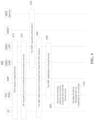
- FIG. 3 depicts examples of phases in a process for providing a multicast service.
- a subscription is the agreement of a user to receive service(s) offered by an operator.
- the relationship between the user and the service provider is established during the subscription.
- a relationship may be stored in the unified data repository (UDR) statically or pushed dynamically from the MBS server to the related PCF.
- UDR unified data repository
- the MBS server triggers the MBSF to start the session to send multicast data.
- the MBSF triggers an MBS session establishment in 5GS. Session start occurs independently of activation of the service by the user (i.e., a given user may activate the service before or after session start). Session start is the trigger for bearer resource establishment for MBMS data transfer.
- the UE may initiate a unicast PDU session establishment to retrieve a multicast service configuration or setup an association with the MBSF. This may occur before phase 310.
- the UE may subscribe to a multicast service dynamically via an established PDU session. This phase may also occur after phase 340 in a case where the multicast service starts before a UE joins the multicast service.
- the multicast service announcement/discovery mechanisms allow users to request or to be informed of the range of available multicast services.
- the announcement is also used to distribute information to users about the services parameters required for service activation (e.g., IP multicast address(es)) and possibly other service-related parameters (e.g., service start time).
- the UE initiates the joining process in order to become a member of a multicast group.
- data transfer phase 360 data is transferred to the UE.
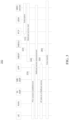
- FIG. 4 depicts an example of a process for establishing a shared tunnel to transfer a multicast service in a 5G system.
- the process occurs after the UE has established a PDU session.
- the UE initiates a unicast PDU session establishment process.
- an MBS-SMF supporting unicast and multicast is selected based on a specific DNN and single network slice selection assistance information (S-NSSAI).
- S-NSSAI single network slice selection assistance information
- the UE may retrieve a multicast service configuration.
- the UE initiates a joining request via UP data or NAS message to join a multicast communication service.
- the MB-SMF requests the MBSF to authorize the UE.
- the MBSF checks whether the UE is allowed to access the service. If it is, the MBSF checks whether a multicast context for the multicast group exists (i.e., whether a UE has already joined the multicast group). If the multicast context for the multicast group does not exist, then the SMF creates it when the first UE joins the multicast group. The check may involve the MBS server, PCF, and/or UDM.
- the MBS server may store the group membership in the UDM or send it to the PCF before the 430.
- the MBSF or MB-SMF may retrieve the information during the association establishment between the MBSF/MB-SMF and the PCF/UDM. If there is no interaction between the MBSF and the PCF/UDM, the MBSF may retrieve the information from the MB-SMF.
- the MBSF triggers the MB-SMF to establish a dummy QoS (quality-of-service) flow into an existing unicast PDU session or a new unicast PDU session.
- QoS quality-of-service
- the MBSF triggers the MB-SMF to establish an MBS flow via a shared tunnel for UEs that belong to the same multicast group under the same NG-RAN node.
- the dummy flow included in the unicast PDU session is not used to transfer multicast service data.
- the multicast service data is transferred via the MBS flow in the shared tunnel to the NG-RAN node.
- the session using the shared channel can be characterized as a multicast/broadcast service (MBS) session which includes one or more MBS QoS flows.
- MBS multicast/broadcast service
- 450 may be skipped.
- the NG-RAN node is provided the information from 440 and/or 450 to bind the shared tunnel and one or more dummy flows (e.g., one or more dummy flows can bind with one or more MBS flows in a shared tunnel) linked in the unicast PDU session.
- the information may include flow identifiers, and/or TMSI and/or session identifier.
- the SMF allocates a QFI for the dummy QoS flow, and a QoS profile is also generated.
- the SMF may maintain a common QoS profile for the dummy flow and MBS QoS flow.
- the common QoS includes the QoS parameter (e.g. MGBR, 5QI, etc.), the QFI of the dummy flow, and the identity of the MBS flow.
- the identity of the MBS flow may include at least one of a TMGI, a multicast address, or a QFI of the MBS flow.
- the SMF may maintain two separate QoS profiles for the dummy flow and MBS flow.
- the QoS parameters included in such two QoS profiles are the same, but the identities of the dummy flow and MBS flow are different.
- the QoS parameters should be transferred to the NG-RAN.
- the NG-RAN may determine to deliver the multicast flow via a broadcast mode or a unicast mode on a radio interface. If the unicast mode is used, the dummy multicast flow is used for transferring the multicast flow via a dedicated data radio bearer (DRB) on the radio interface. If the broadcast mode is used, the UEs in the same group of such a multicast service receive the multicast data via a shared DRB on the radio interface.
- DRB dedicated data radio bearer
- operations for the service continuity of the unicast service may be performed during the handover procedure.
- the embodiments of the disclosed technology can be implemented to provide techniques to ensure the service continuity of a multicast service of a mobile UE during the handover procedure.
- the word "dummy flow” is used to indicate a flow that is formed between the UE and the core network (5GC) in a certain situation via the radio access network (NG-RAN).
- the multicast service data is transferred not via the dummy flow between the NG-RAN and 5GC, but via the MBS flow included in MBS session using the shared tunnel between the NG-RAN and 5GC.
- the NG-RAN may not allocate a flow unless the 5GC informs the NG-RAN of the flow.
- the NG-RAN when the NG-RAN decides to use a unicast mode on the radio interface, the NG-RAN can use QoS information of the dummy flow which has been generated and sent to the NG-RAN to schedule the radio resource and need not inform the 5GC of lack of flow information.
- the SMF may allocate a dummy flow and send to the NG-RAN, and the NG-RAN may use the dummy flow on the radio interface.
- a UE When moving from a source NG-RAN to a target NG-RAN in a handover scenario, a UE can receive the multicast service data from the source NG-RAN and the target NG-RAN separately. If both the source NG-RAN and target NG-RAN send the multicast service data to the UE in a broadcast mode, however, neither the source NG-RAN nor the target NG-RAN is responsible for ensuring the data transfer for each UE in the same group to avoid packet loss, affecting the service continuity.
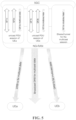
- FIG. 5 depicts a process for transferring the multicast service data by a core network (CN) to a radio access network (NG-RAN) based on some example embodiments of the disclosed technology.
- CN core network
- NG-RAN radio access network
- a first user device UEa has a unicast PDU session, and server unicast QoS flows (e.g., QF1a, QF2a) are established.
- a second user device UEb has a unicast PDU session, and server unicast QoS flows (e.g., QF1b, QF2b) are established.
- the first and second user devices UEa and UEb are in the same group to receive the same multicast service.
- the first and second user devices UEa and UEb camp on the same NG-RAN.
- a core network 5GC determines to establish a shared tunnel to transfer the multicast data.
- a session that uses such a shared tunnel may include a multicast session.
- the core network e.g., 5GC
- the core network also establishes a dummy QoS flow (QF) in the existing unicast PDU session or in a new unicast PDU session for each user device UE that belongs to such a group.
- the core network (e.g., 5GC) sends the mapping information of the dummy flow in the unicast existing/new PDU session and a flow in shared tunnel to the NG-RAN.
- the core network e.g., 5GC assigns a QoS flow identifier (QFI) for a new QoS flow and makes sure the uniqueness of the QFI within a PDU session.
- QFI QoS flow identifier
- the core network 5GC When both the dummy flow and the flow (which can be called as MBS flow) in shared tunnel have been established and the multicast data is transferred, the core network 5GC only sends the multicast data in the shared tunnel.
- the NG-RAN decides to use either a unicast data radio bearer (DRB) DRB1a or DRB1b or a broadcast DRB to transfer the multicast service data on the radio interface.
- DRB unicast data radio bearer
- the unicast DRB is dedicated to a certain user device UE, whereas all the user devices UEs camping on the cell can receive the data transferred via the broadcast DRB.
- the NG-RAN can also decide to use both unicast DRB and broadcast DBR.
- some user devices UEs can receive the multicast service data via the unicast DRB (e.g., DRB1a) and other user devices UEs camping on the same cell can receive the multicast service data via the broadcast DRB.
- the unicast DRB e.g., DRB1a
- the unicast data radio bearer DRB1a is the unicast DRB for the first user device UEa and the dummy flow for the multicast data is included in the unicast data radio bearer DRB 1a.
- the unicast data radio bearer DRB1b is the unicast DRB for the second user device UEb and the dummy flow for the multicast data is included in the unicast data radio bearer DRB 1b.
- FIG. 6 depicts a process for transferring the multicast service data in a handover procedure based on some example embodiments of the disclosed technology.
- the source RAN may use the broadcast DRB to transfer the multicast service data to all the user devices UEs with such services.
- the source RAN decides to handover the user device UEa to the target RAN.
- Scenario 1 In a scenario where the target RAN supports transferring the multicast service data via the broadcast DRB, the target RAN receives the multicast service data via the shared tunnel from the core network 5GC.
- the shared tunnel can be established before the user device UEa moves into the coverage of the target RAN. In another example, the shared tunnel can be established during the handover procedure.
- the source RAN When the source RAN decides to handover the user device UEa to the target RAN and the source RAN finds that the user device UEa has multicast service data to receive, the source RAN implemented based on some embodiments of the disclosed technology may buffer the multicast service data and then forward the multicast service data via a direct or indirect tunnel. In some embodiments, when the source RAN forwards the buffered multicast service data, the QFI of the dummy flow in the unicast PDU session, which is mapped to the multicast flow in the multicast session, is added to the multicast service data to replace the identifier of the MBS flow in an encapsulation header of the multicast service data.
- the target NG-RAN When the target NG-RAN receives, from the source NG-RAN, the multicast service data identified by the QFI, the target NG-RAN sends the multicast service data received from the source NG-RAN via the unicast data radio bearer DRB1a to the user device UEa.
- a radio access network node retrieves information for mapping between the identifier of the dummy flow and the identifier of the multicast flow from the core network.
- the RAN node may also retrieve QoS information from the core network.
- the unicast PDU sessions including the PDU session with the dummy flow will be transferred to the target side and the contexts of such PDU session will be sent to the target NG-RAN.
- the mapping between the MBS flow and the dummy flow is sent to the target NG-RAN during the handover procedure or an MBS session establishment procedure combined with the handover procedure (i.e., the shared tunnel can be established during the handover procedure).
- the source RAN may generate one or more end markers and forward them to the target RAN via the direct tunnel or indirect tunnel.
- the target RAN can determine that the buffered multicast service data have been sent out.
- the target RAN can decide to transfer multicast service data that is not the buffered multicast service data via the broadcast DRB if a broadcast mode on the radio interface is selected. In case of the broadcast mode on the radio interface, the dummy flow included in the unicast DRB may not be scheduled on the radio interface.
- the data packets may include (1) multicast service data packets that are buffered in the source RAN and forwarded to the target RAN, and (2) data packets of unicast flows that are received from the core network. If data packets are forwarded from the source RAN to the target RAN, the source RAN generates one or more end markers upon completion of the forwarding of all the data packets. If the data packets are transferred from the core network to the target RAN, the core network generates one or more end markers upon completion of the transmission of the data packets.
- the "forwarded" multicast service data which is buffered in the source RAN and forwarded to the target RAN, is transmitted to the user device UE through a unicast mode.
- the multicast service data that is received from the core network can be transmitted to the user device UE through a unicast mode or a multicast/broadcast mode.
- the end marker may be generated by the core network 5GC to indicate the termination of the buffered packets of unicast flows.
- the core network 5GC transferring the multicast service data in a shared tunnel for a group of user devices UEs may not buffer the packets for a specific UE and generate an end marker to indicate the termination of the buffered packets of multicast flows for a specific user device UE in the group.
- the multicast service data for the user device UE in a handover situation is buffered in the source NG-RAN, and thus the end marker is generated by the source NG-RAN to indicate that the buffered multicast service data has been transmitted to the target NG-RAN.
- the dummy flow within the unicast PDU session is used to transfer the multicast service data from the core network 5GC to the use device UE via the target NG-RAN.
- the target RAN can only use the unicast DRB to transfer the multicast service data.
- FIG. 7 depicts an example of a process 700 for wireless communication based on some example embodiments of the disclosed technology.
- the method 700 includes receiving, by a first radio access node (e.g., source NG-RAN), a multicast flow comprising data packets of a multicast service.
- the method includes determining, by the first radio access node, whether to initiate a handover procedure for a user device (e.g., UE) from the first radio access node to a second radio access node (e.g., target NG-RAN).
- a user device e.g., UE
- the method includes replacing, upon determination to initiate the handover procedure, by the first radio access node, a first portion of the data packets with a flow identifier (e.g., QFI) of a unicast flow.
- the method includes forwarding, by the first radio access node, the data packets of the multicast service including the flow identifier of the unicast flow to the second radio access node.
- a flow identifier e.g., QFI
- FIG. 8 shows another example of a process 800 for wireless communication based on some example embodiments of the disclosed technology.
- the method 800 includes receiving, by a second radio access node (e.g., target NG-RAN), from a first radio access node (e.g., source NG-RAN), a multicast flow comprising data packets of a multicast service including a flow identifier for a user device during a handover procedure from the first radio access node.
- the method includes determining, by the second radio access node, whether the flow identifier indicates a flow for a multicast service.
- the method includes transmitting, by the second radio access node, to a user device, the data packets of the multicast service through a unicast flow.
- FIG. 9 shows another example of a process 900 for wireless communication based on some example embodiments of the disclosed technology.
- the method 900 includes receiving, by a target radio access node, data packets of a multicast service in a handover procedure.
- the method includes determining, by the target radio access node, whether the data packets of the multicast service include a quality-of-service (QoS) flow identifier (QFI) indicating that the data packets are forwarded from a source radio access node.
- QoS quality-of-service
- the method includes transmitting, upon determination that the data packets include the QFI, by the target radio access node, the data packets to the mobile device in a unicast mode.
- QoS quality-of-service
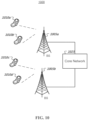
- FIG. 10 shows an example of a wireless communication system 1000 where techniques in accordance with one or more embodiments of the present technology can be applied.
- a wireless communication system 1000 can include one or more base stations (BSs) 1005a, 1005b, one or more wireless devices 1010a, 1010b, 1010c, 1010d, and a core network 1025.
- a base station 1005a, 1005b can provide wireless service to wireless devices 1010a, 1010b, 1010c and 1010d in one or more wireless sectors.
- a base station 1005a, 1005b includes directional antennas to produce two or more directional beams to provide wireless coverage in different sectors.
- the core network 1025 can communicate with one or more base stations 1005a, 1005b.
- the core network 1025 provides connectivity with other wireless communication systems and wired communication systems.
- the core network may include one or more service subscription databases to store information related to the subscribed wireless devices 1010a, 1010b, 1010c, and 1010d.
- a first base station 1005a can provide wireless service based on a first radio access technology
- a second base station 1005b can provide wireless service based on a second radio access technology.
- the base stations 1005a and 1005b may be co-located or may be separately installed in the field according to the deployment scenario.
- the wireless devices 1010a, 1010b, 1010c, and 1010d can support multiple different radio access technologies.
- the techniques and embodiments described in the present document may be implemented by the base stations of wireless devices described in the present document.
- FIG. 11 is a block diagram representation of a portion of a radio station in accordance with one or more embodiments of the present technology can be applied.
- a radio 1105 such as a base station or a wireless device (or UE) can include processor electronics 1110 such as a microprocessor that implements one or more of the wireless techniques presented in this document.
- the radio 1105 can include transceiver electronics 1115 to send and/or receive wireless signals over one or more communication interfaces such as antenna 1120.
- the radio 1105 can include other communication interfaces for transmitting and receiving data.
- Radio 1105 can include one or more memories (not explicitly shown) configured to store information such as data and/or instructions.
- the processor electronics 1110 can include at least a portion of the transceiver electronics 1115.
- at least some of the disclosed techniques, modules or functions are implemented using the radio 1105.
- the radio 1105 may be configured to perform the methods described in this document.
- the present document discloses techniques that can be embodied in various embodiments to establish and manage multicast sessions in various scenarios.
- the disclosed and other embodiments, modules and the functional operations described in this document can be implemented in digital electronic circuitry, or in computer software, firmware, or hardware, including the structures disclosed in this document and their structural equivalents, or in combinations of one or more of them.
- the disclosed and other embodiments can be implemented as one or more computer program products, i.e., one or more modules of computer program instructions encoded on a computer readable medium for execution by, or to control the operation of, data processing apparatus.
- the computer readable medium can be a machine-readable storage device, a machine-readable storage substrate, a memory device, a composition of matter effecting a machine-readable propagated signal, or a combination of one or more them.
- data processing apparatus encompasses all apparatus, devices, and machines for processing data, including by way of example a programmable processor, a computer, or multiple processors or computers.
- the apparatus can include, in addition to hardware, code that creates an execution environment for the computer program in question, e.g., code that constitutes processor firmware, a protocol stack, a database management system, an operating system, or a combination of one or more of them.
- a propagated signal is an artificially generated signal, e.g., a machine-generated electrical, optical, or electromagnetic signal, that is generated to encode information for transmission to suitable receiver apparatus.
- a computer program (also known as a program, software, software application, script, or code) can be written in any form of programming language, including compiled or interpreted languages, and it can be deployed in any form, including as a stand-alone program or as a module, component, subroutine, or other unit suitable for use in a computing environment.
- a computer program does not necessarily correspond to a file in a file system.
- a program can be stored in a portion of a file that holds other programs or data (e.g., one or more scripts stored in a markup language document), in a single file dedicated to the program in question, or in multiple coordinated files (e.g., files that store one or more modules, sub programs, or portions of code).
- a computer program can be deployed to be executed on one computer or on multiple computers that are located at one site or distributed across multiple sites and interconnected by a communication network.
- the processes and logic flows described in this document can be performed by one or more programmable processors executing one or more computer programs to perform functions by operating on input data and generating output.
- the processes and logic flows can also be performed by, and apparatus can also be implemented as, special purpose logic circuitry, e.g., an FPGA (field programmable gate array) or an ASIC (application specific integrated circuit).
- processors suitable for the execution of a computer program include, by way of example, both general and special purpose microprocessors, and any one or more processors of any kind of digital computer.
- a processor will receive instructions and data from a read only memory or a random-access memory or both.
- the essential elements of a computer are a processor for performing instructions and one or more memory devices for storing instructions and data.
- a computer will also include, or be operatively coupled to receive data from or transfer data to, or both, one or more mass storage devices for storing data, e.g., magnetic, magneto optical disks, or optical disks.
- mass storage devices for storing data, e.g., magnetic, magneto optical disks, or optical disks.
- a computer need not have such devices.
- Computer readable media suitable for storing computer program instructions and data include all forms of non-volatile memory, media and memory devices, including by way of example semiconductor memory devices, e.g., EPROM, EEPROM, and flash memory devices; magnetic disks, e.g., internal hard disks or removable disks; magneto optical disks; and CD ROM and DVD-ROM disks.
- semiconductor memory devices e.g., EPROM, EEPROM, and flash memory devices
- magnetic disks e.g., internal hard disks or removable disks
- magneto optical disks e.g., CD ROM and DVD-ROM disks.
- the processor and the memory can be supplemented by, or incorporated in, special purpose logic circuitry.
Landscapes
- Engineering & Computer Science (AREA)
- Computer Networks & Wireless Communication (AREA)
- Signal Processing (AREA)
- Computer Security & Cryptography (AREA)
- Multimedia (AREA)
- Mobile Radio Communication Systems (AREA)
Claims (15)
- Datenkommunikationsverfahren, das aufweist:Empfangen, durch einen ersten Funkzugangsnetzwerk-, RAN-, Knoten, eines Multicast-Flusses, der Datenpakete eines Multicast-Dienstes aufweist;Bestimmen, durch den ersten RAN-Knoten, ob eine Übergabeprozedur für ein Benutzergerät von dem ersten RAN-Knoten zu einem zweiten RAN-Knoten eingeleitet werden soll;Ersetzen, wenn bestimmt wird, dass die Übergabeprozedur eingeleitet werden soll, eines ersten Teils der Datenpakete durch eine Flusskennung eines Unicast-Flusses durch den ersten RAN-Knoten; undWeiterleiten, durch den ersten RAN-Knoten, der Datenpakete des Multicast-Dienstes, die die Flusskennung des Unicast-Flusses enthalten, an den zweiten RAN-Knoten.
- Verfahren nach Anspruch 1, wobei der erste Teil der Datenpakete eine Identität des Multicast-Flusses in einem Einkapselungs-Header der Datenpakete des Multicast-Dienstes enthält.
- Verfahren nach Anspruch 1, das ferner, wenn bestimmt wird, dass die Übergabeprozedur eingeleitet werden soll, das Puffern, durch den ersten RAN-Knoten, der Datenpakete des Multicast-Dienstes für das Benutzergerät aufweist.
- Verfahren nach Anspruch 1, wobei das Weiterleiten der Datenpakete des Multicast-Dienstes an den zweiten RAN-Knoten mindestens einen aufweist von: Übertragen der Datenpakete des Multicast-Dienstes durch einen direkten Tunnel zwischen dem ersten und dem zweiten RAN-Knoten; oder Übertragen der Datenpakete des Multicast-Dienstes durch indirekte Tunnel zwischen dem ersten RAN-Knoten und einer Benutzerebenenfunktion und zwischen dem zweiten RAN-Knoten und der Benutzerebenenfunktion.
- Verfahren nach Anspruch 1, wobei der erste RAN-Knoten konfiguriert ist, mindestens eines zu empfangen von: die Datenpakete des Multicast-Dienstes durch einen gemeinsamen Tunnel, der zwischen einem Kernnetzwerk und dem ersten RAN-Knoten eingerichtet ist; oder Abbildungsinformationen zwischen einer Identität des Multicast-Flusses und einer Flusskennung des Unicast-Flusses.
- Datenkommunikationsverfahren, das aufweist:Empfangen, durch einen zweiten Funkzugangsnetzwerk-, RAN-, Knoten, von einem ersten RAN-Knoten, eines Multicast-Flusses, der Datenpakete eines Multicast-Dienstes aufweist, die eine Flusskennung für ein Benutzergerät während einer Übergabeprozedur vom ersten RAN-Knoten enthalten;Bestimmen, durch den zweiten RAN-Knoten, ob die Flusskennung einen Fluss für einen Multicast-Dienst anzeigt; undÜbertragen durch den zweiten RAN-Knoten an ein Benutzergerät der Datenpakete des Multicast-Dienstes über einen Unicast-Fluss.
- Verfahren nach Anspruch 6, das ferner aufweist:Empfangen von ersten Datenpaketen, durch den zweiten RAN-Knoten, von einem Kernnetzwerk;Bestimmen, durch den zweiten RAN-Knoten, ob die ersten Datenpakete durch den Unicast-Fluss oder den Multicast-Fluss an das Benutzergerät übertragen werden sollen; undÜbertragen, durch den zweiten RAN-Knoten, der ersten Datenpakete an das Benutzergerät durch den Unicast-Fluss oder den Multicast-Fluss, basierend auf der Bestimmung über eine Übertragung der ersten Datenpakete.
- Verfahren nach Anspruch 6, wobei das Empfangen der Datenpakete des Multicast-Dienstes vom ersten RAN-Knoten mindestens eines aufweist von: Empfangen der Datenpakete des Multicast-Dienstes durch einen direkten Tunnel zwischen dem ersten und dem zweiten RAN-Knoten; oder Empfangen der Datenpakete des Multicast-Dienstes durch indirekte Tunnel zwischen dem ersten RAN-Knoten und einer Benutzerebenenfunktion und zwischen dem zweiten RAN-Knoten und der Benutzerebenenfunktion.
- Verfahren nach einem der Ansprüche 1 bis 8, wobei die Flusskennung, die den Unicast-Fluss anzeigt, eine Dienstgüte (QoS)-Flusskennung (QFI) enthält, die konfiguriert ist, einen QoS-Fluss zu identifizieren.
- Verfahren nach einem der Ansprüche 1 bis 8, wobei die Datenpakete des Multicast-Dienstes durch einen gemeinsamen Tunnel übertragen werden, der zwischen einem Kernnetzwerk und dem ersten RAN-Knoten eingerichtet ist.
- Verfahren nach einem der Ansprüche 1 bis 10, wobei der erste RAN-Knoten ein Quellfunknetzwerk aufweist und der zweite RAN-Knoten ein Zielfunknetzwerk in der Übergabeprozedur aufweist.
- Verfahren nach Anspruch 6, wobei der zweite RAN-Knoten ein Ziel-Funkzugangsnetzwerk-, RAN-, Knoten, ist und der erste RAN-Knoten ein Quell-Funkzugangsnetzwerk-, RAN-, Knoten, ist,
wobei die Flusskennung eine Dienstgüte (QoS)-Flusskennung (QFI) ist, die anzeigt, dass die Datenpakete vom RAN-Knoten weitergeleitet werden. - Verfahren nach Anspruch 12, wobei, wenn bestimmt wird, dass die Datenpakete die QFI enthalten, die Datenpakete über einen Unicast-Datenfunkträger übertragen werden.
- Verfahren nach Anspruch 12, das ferner aufweist, dass bei Empfang einer Endmarkierung in den Datenpaketen, die eine Beendigung der Weiterleitung der Datenpakete vom Quell-RAN-Knoten anzeigt, die Datenpakete in einem Multicast-Modus an das Benutzergerät übertragen werden.
- Erster oder ein zweiter Funkzugangsnetz-, RAN-, Knoten zur drahtlosen Kommunikation, der einen Speicher und einen Prozessor aufweist, wobei der Prozessor Code aus dem Speicher liest und ein Verfahren nach den Ansprüchen 1 bis 5 bzw. nach den Ansprüchen 6 bis 14 implementiert.
Applications Claiming Priority (1)
| Application Number | Priority Date | Filing Date | Title |
|---|---|---|---|
| PCT/CN2020/091021 WO2021109474A1 (en) | 2020-05-19 | 2020-05-19 | Methods and systems for multicast data forwarding during mobility procedures in wireless communication networks |
Publications (3)
| Publication Number | Publication Date |
|---|---|
| EP4154586A1 EP4154586A1 (de) | 2023-03-29 |
| EP4154586A4 EP4154586A4 (de) | 2023-10-25 |
| EP4154586B1 true EP4154586B1 (de) | 2024-10-23 |
Family
ID=76221446
Family Applications (1)
| Application Number | Title | Priority Date | Filing Date |
|---|---|---|---|
| EP20895299.4A Active EP4154586B1 (de) | 2020-05-19 | 2020-05-19 | Verfahren und systeme zur multicast-datenweiterleitung während mobilitätsverfahren in drahtlosen kommunikationsnetzen |
Country Status (6)
| Country | Link |
|---|---|
| US (1) | US12513586B2 (de) |
| EP (1) | EP4154586B1 (de) |
| JP (1) | JP7635261B2 (de) |
| KR (1) | KR20230011314A (de) |
| CN (1) | CN115669024B (de) |
| WO (1) | WO2021109474A1 (de) |
Families Citing this family (9)
| Publication number | Priority date | Publication date | Assignee | Title |
|---|---|---|---|---|
| CN115361656A (zh) * | 2019-11-07 | 2022-11-18 | 华为技术有限公司 | 通信方法、装置及设备 |
| WO2022027443A1 (en) * | 2020-08-06 | 2022-02-10 | Lenovo (Beijing) Limited | Method and apparatus for multicast and broadcast services |
| US12627950B2 (en) * | 2020-08-28 | 2026-05-12 | Lenovo (Beijing) Limited | Method and apparatus for multicast and broadcast services |
| WO2022061842A1 (zh) * | 2020-09-27 | 2022-03-31 | 华为技术有限公司 | 数据通信方法及通信装置 |
| US11882435B2 (en) * | 2020-10-29 | 2024-01-23 | Apple Inc. | MBS-key distribution and traffic protection |
| CN117859372A (zh) * | 2021-10-22 | 2024-04-09 | 中兴通讯股份有限公司 | 切换中的无损的多播和广播数据传输 |
| EP4240100A1 (de) * | 2022-02-09 | 2023-09-06 | Nokia Technologies Oy | Rundfunkdienstwiederherstellung für multicast-/rundfunkdienst bei ausfall oder neustart eines funkzugangsknotens |
| US12185206B2 (en) * | 2022-04-06 | 2024-12-31 | Qualcomm Incorporated | Service discovery and session establishment for machine-learning-based beam prediction in wireless communications |
| US12477418B2 (en) * | 2023-03-30 | 2025-11-18 | Cisco Technology, Inc. | Handovers in wireless controller-based systems |
Family Cites Families (13)
| Publication number | Priority date | Publication date | Assignee | Title |
|---|---|---|---|---|
| US9007980B2 (en) * | 2011-06-07 | 2015-04-14 | Verizon Patent And Licensing Inc. | Multicast-unicast handoff services |
| US8750181B2 (en) | 2012-05-14 | 2014-06-10 | Blackberry Limited | Maintaining MBMS continuity |
| EP3079400B1 (de) * | 2014-01-03 | 2019-08-14 | Huawei Technologies Co., Ltd. | Benutzergerätweiterreichungsverfahren und basisstation |
| WO2015103746A1 (en) | 2014-01-08 | 2015-07-16 | Qualcomm Incorporated | Small mbsfn enhancement |
| US20210058748A1 (en) * | 2017-03-24 | 2021-02-25 | Apple Inc. | Systems and methods for group based services provisioning |
| CN109392004B (zh) | 2017-08-11 | 2021-09-21 | 华为技术有限公司 | 通信方法、基站、终端设备和系统 |
| CN110351794A (zh) | 2018-04-04 | 2019-10-18 | 北京三星通信技术研究有限公司 | 支持切换的方法及对应的基站和网络节点 |
| WO2019223005A1 (en) * | 2018-05-25 | 2019-11-28 | Qualcomm Incorporated | Mixed mode multicast architecture |
| CN110636575B (zh) * | 2018-06-22 | 2020-11-24 | 华为技术有限公司 | 一种切换方法及装置 |
| CN113411857B (zh) * | 2018-06-28 | 2022-08-26 | 华为技术有限公司 | 通信方法及装置 |
| US11758408B2 (en) * | 2018-09-07 | 2023-09-12 | Huawei Technologies Co., Ltd. | Shared radio bearer and management of UE radio ID and ran path |
| CN113079548B (zh) * | 2020-01-03 | 2022-05-13 | 华为技术有限公司 | 通信方法及装置 |
| CN113498132B (zh) * | 2020-04-03 | 2022-09-20 | 维沃移动通信有限公司 | 移动性管理方法、源基站、目标基站及终端设备 |
-
2020
- 2020-05-19 EP EP20895299.4A patent/EP4154586B1/de active Active
- 2020-05-19 CN CN202080101015.0A patent/CN115669024B/zh active Active
- 2020-05-19 KR KR1020227040233A patent/KR20230011314A/ko active Pending
- 2020-05-19 WO PCT/CN2020/091021 patent/WO2021109474A1/en not_active Ceased
- 2020-05-19 JP JP2022570307A patent/JP7635261B2/ja active Active
-
2022
- 2022-11-18 US US18/057,044 patent/US12513586B2/en active Active
Also Published As
| Publication number | Publication date |
|---|---|
| CN115669024B (zh) | 2025-07-29 |
| CN115669024A (zh) | 2023-01-31 |
| JP2023526074A (ja) | 2023-06-20 |
| JP7635261B2 (ja) | 2025-02-25 |
| US20230081286A1 (en) | 2023-03-16 |
| EP4154586A4 (de) | 2023-10-25 |
| EP4154586A1 (de) | 2023-03-29 |
| US12513586B2 (en) | 2025-12-30 |
| KR20230011314A (ko) | 2023-01-20 |
| WO2021109474A1 (en) | 2021-06-10 |
Similar Documents
| Publication | Publication Date | Title |
|---|---|---|
| US12538186B1 (en) | Multicast and broadcast service continuity during mobility | |
| US20230017217A1 (en) | Multicast or broadcast session establishment and management | |
| US12513586B2 (en) | Methods and systems for multicast data forwarding during mobility procedures in wireless communication networks | |
| CN113411857B (zh) | 通信方法及装置 | |
| US12520108B2 (en) | Methods and systems for multicast and broadcast service establishment in wireless communication networks | |
| Tran et al. | Enabling multicast and broadcast in the 5G core for converged fixed and mobile networks | |
| US12520379B2 (en) | Multicast and broadcast service establishment | |
| US12621882B2 (en) | Tunnel reuse for multicast and broadcast service | |
| US20230199439A1 (en) | Multicast and broadcast service session reception mode switching in wireless communication networks |
Legal Events
| Date | Code | Title | Description |
|---|---|---|---|
| STAA | Information on the status of an ep patent application or granted ep patent |
Free format text: STATUS: THE INTERNATIONAL PUBLICATION HAS BEEN MADE |
|
| PUAI | Public reference made under article 153(3) epc to a published international application that has entered the european phase |
Free format text: ORIGINAL CODE: 0009012 |
|
| STAA | Information on the status of an ep patent application or granted ep patent |
Free format text: STATUS: REQUEST FOR EXAMINATION WAS MADE |
|
| 17P | Request for examination filed |
Effective date: 20221121 |
|
| AK | Designated contracting states |
Kind code of ref document: A1 Designated state(s): AL AT BE BG CH CY CZ DE DK EE ES FI FR GB GR HR HU IE IS IT LI LT LU LV MC MK MT NL NO PL PT RO RS SE SI SK SM TR |
|
| DAV | Request for validation of the european patent (deleted) | ||
| DAX | Request for extension of the european patent (deleted) | ||
| A4 | Supplementary search report drawn up and despatched |
Effective date: 20230927 |
|
| RIC1 | Information provided on ipc code assigned before grant |
Ipc: H04W 12/08 20210101ALN20230921BHEP Ipc: H04W 4/06 20090101ALN20230921BHEP Ipc: H04W 28/16 20090101ALI20230921BHEP Ipc: H04W 36/02 20090101ALI20230921BHEP Ipc: H04W 36/00 20090101AFI20230921BHEP |
|
| GRAP | Despatch of communication of intention to grant a patent |
Free format text: ORIGINAL CODE: EPIDOSNIGR1 |
|
| STAA | Information on the status of an ep patent application or granted ep patent |
Free format text: STATUS: GRANT OF PATENT IS INTENDED |
|
| RIC1 | Information provided on ipc code assigned before grant |
Ipc: H04W 12/08 20210101ALN20240625BHEP Ipc: H04W 4/06 20090101ALN20240625BHEP Ipc: H04W 28/16 20090101ALI20240625BHEP Ipc: H04W 36/02 20090101ALI20240625BHEP Ipc: H04W 36/00 20090101AFI20240625BHEP |
|
| INTG | Intention to grant announced |
Effective date: 20240712 |
|
| GRAS | Grant fee paid |
Free format text: ORIGINAL CODE: EPIDOSNIGR3 |
|
| GRAJ | Information related to disapproval of communication of intention to grant by the applicant or resumption of examination proceedings by the epo deleted |
Free format text: ORIGINAL CODE: EPIDOSDIGR1 |
|
| GRAL | Information related to payment of fee for publishing/printing deleted |
Free format text: ORIGINAL CODE: EPIDOSDIGR3 |
|
| STAA | Information on the status of an ep patent application or granted ep patent |
Free format text: STATUS: REQUEST FOR EXAMINATION WAS MADE |
|
| GRAP | Despatch of communication of intention to grant a patent |
Free format text: ORIGINAL CODE: EPIDOSNIGR1 |
|
| STAA | Information on the status of an ep patent application or granted ep patent |
Free format text: STATUS: GRANT OF PATENT IS INTENDED |
|
| GRAA | (expected) grant |
Free format text: ORIGINAL CODE: 0009210 |
|
| STAA | Information on the status of an ep patent application or granted ep patent |
Free format text: STATUS: THE PATENT HAS BEEN GRANTED |
|
| INTG | Intention to grant announced |
Effective date: 20240902 |
|
| RIC1 | Information provided on ipc code assigned before grant |
Ipc: H04W 12/08 20210101ALN20240826BHEP Ipc: H04W 4/06 20090101ALN20240826BHEP Ipc: H04W 28/16 20090101ALI20240826BHEP Ipc: H04W 36/02 20090101ALI20240826BHEP Ipc: H04W 36/00 20090101AFI20240826BHEP |
|
| AK | Designated contracting states |
Kind code of ref document: B1 Designated state(s): AL AT BE BG CH CY CZ DE DK EE ES FI FR GB GR HR HU IE IS IT LI LT LU LV MC MK MT NL NO PL PT RO RS SE SI SK SM TR |
|
| REG | Reference to a national code |
Ref country code: GB Ref legal event code: FG4D |
|
| REG | Reference to a national code |
Ref country code: CH Ref legal event code: EP |
|
| REG | Reference to a national code |
Ref country code: DE Ref legal event code: R096 Ref document number: 602020040085 Country of ref document: DE |
|
| REG | Reference to a national code |
Ref country code: IE Ref legal event code: FG4D |
|
| REG | Reference to a national code |
Ref country code: LT Ref legal event code: MG9D |
|
| REG | Reference to a national code |
Ref country code: NL Ref legal event code: MP Effective date: 20241023 |
|
| REG | Reference to a national code |
Ref country code: AT Ref legal event code: MK05 Ref document number: 1735864 Country of ref document: AT Kind code of ref document: T Effective date: 20241023 |
|
| PG25 | Lapsed in a contracting state [announced via postgrant information from national office to epo] |
Ref country code: NL Free format text: LAPSE BECAUSE OF FAILURE TO SUBMIT A TRANSLATION OF THE DESCRIPTION OR TO PAY THE FEE WITHIN THE PRESCRIBED TIME-LIMIT Effective date: 20241023 |
|
| PG25 | Lapsed in a contracting state [announced via postgrant information from national office to epo] |
Ref country code: NL Free format text: LAPSE BECAUSE OF FAILURE TO SUBMIT A TRANSLATION OF THE DESCRIPTION OR TO PAY THE FEE WITHIN THE PRESCRIBED TIME-LIMIT Effective date: 20241023 |
|
| PG25 | Lapsed in a contracting state [announced via postgrant information from national office to epo] |
Ref country code: IS Free format text: LAPSE BECAUSE OF FAILURE TO SUBMIT A TRANSLATION OF THE DESCRIPTION OR TO PAY THE FEE WITHIN THE PRESCRIBED TIME-LIMIT Effective date: 20250223 Ref country code: PT Free format text: LAPSE BECAUSE OF FAILURE TO SUBMIT A TRANSLATION OF THE DESCRIPTION OR TO PAY THE FEE WITHIN THE PRESCRIBED TIME-LIMIT Effective date: 20250224 Ref country code: HR Free format text: LAPSE BECAUSE OF FAILURE TO SUBMIT A TRANSLATION OF THE DESCRIPTION OR TO PAY THE FEE WITHIN THE PRESCRIBED TIME-LIMIT Effective date: 20241023 |
|
| PG25 | Lapsed in a contracting state [announced via postgrant information from national office to epo] |
Ref country code: FI Free format text: LAPSE BECAUSE OF FAILURE TO SUBMIT A TRANSLATION OF THE DESCRIPTION OR TO PAY THE FEE WITHIN THE PRESCRIBED TIME-LIMIT Effective date: 20241023 |
|
| PG25 | Lapsed in a contracting state [announced via postgrant information from national office to epo] |
Ref country code: BG Free format text: LAPSE BECAUSE OF FAILURE TO SUBMIT A TRANSLATION OF THE DESCRIPTION OR TO PAY THE FEE WITHIN THE PRESCRIBED TIME-LIMIT Effective date: 20241023 |
|
| PG25 | Lapsed in a contracting state [announced via postgrant information from national office to epo] |
Ref country code: ES Free format text: LAPSE BECAUSE OF FAILURE TO SUBMIT A TRANSLATION OF THE DESCRIPTION OR TO PAY THE FEE WITHIN THE PRESCRIBED TIME-LIMIT Effective date: 20241023 |
|
| PG25 | Lapsed in a contracting state [announced via postgrant information from national office to epo] |
Ref country code: NO Free format text: LAPSE BECAUSE OF FAILURE TO SUBMIT A TRANSLATION OF THE DESCRIPTION OR TO PAY THE FEE WITHIN THE PRESCRIBED TIME-LIMIT Effective date: 20250123 |
|
| PG25 | Lapsed in a contracting state [announced via postgrant information from national office to epo] |
Ref country code: LV Free format text: LAPSE BECAUSE OF FAILURE TO SUBMIT A TRANSLATION OF THE DESCRIPTION OR TO PAY THE FEE WITHIN THE PRESCRIBED TIME-LIMIT Effective date: 20241023 Ref country code: GR Free format text: LAPSE BECAUSE OF FAILURE TO SUBMIT A TRANSLATION OF THE DESCRIPTION OR TO PAY THE FEE WITHIN THE PRESCRIBED TIME-LIMIT Effective date: 20250124 Ref country code: AT Free format text: LAPSE BECAUSE OF FAILURE TO SUBMIT A TRANSLATION OF THE DESCRIPTION OR TO PAY THE FEE WITHIN THE PRESCRIBED TIME-LIMIT Effective date: 20241023 |
|
| PG25 | Lapsed in a contracting state [announced via postgrant information from national office to epo] |
Ref country code: PL Free format text: LAPSE BECAUSE OF FAILURE TO SUBMIT A TRANSLATION OF THE DESCRIPTION OR TO PAY THE FEE WITHIN THE PRESCRIBED TIME-LIMIT Effective date: 20241023 |
|
| PG25 | Lapsed in a contracting state [announced via postgrant information from national office to epo] |
Ref country code: RS Free format text: LAPSE BECAUSE OF FAILURE TO SUBMIT A TRANSLATION OF THE DESCRIPTION OR TO PAY THE FEE WITHIN THE PRESCRIBED TIME-LIMIT Effective date: 20250123 |
|
| PG25 | Lapsed in a contracting state [announced via postgrant information from national office to epo] |
Ref country code: SM Free format text: LAPSE BECAUSE OF FAILURE TO SUBMIT A TRANSLATION OF THE DESCRIPTION OR TO PAY THE FEE WITHIN THE PRESCRIBED TIME-LIMIT Effective date: 20241023 |
|
| PGFP | Annual fee paid to national office [announced via postgrant information from national office to epo] |
Ref country code: DE Payment date: 20250521 Year of fee payment: 6 |
|
| PG25 | Lapsed in a contracting state [announced via postgrant information from national office to epo] |
Ref country code: DK Free format text: LAPSE BECAUSE OF FAILURE TO SUBMIT A TRANSLATION OF THE DESCRIPTION OR TO PAY THE FEE WITHIN THE PRESCRIBED TIME-LIMIT Effective date: 20241023 |
|
| PG25 | Lapsed in a contracting state [announced via postgrant information from national office to epo] |
Ref country code: EE Free format text: LAPSE BECAUSE OF FAILURE TO SUBMIT A TRANSLATION OF THE DESCRIPTION OR TO PAY THE FEE WITHIN THE PRESCRIBED TIME-LIMIT Effective date: 20241023 |
|
| PGFP | Annual fee paid to national office [announced via postgrant information from national office to epo] |
Ref country code: FR Payment date: 20250528 Year of fee payment: 6 |
|
| PG25 | Lapsed in a contracting state [announced via postgrant information from national office to epo] |
Ref country code: RO Free format text: LAPSE BECAUSE OF FAILURE TO SUBMIT A TRANSLATION OF THE DESCRIPTION OR TO PAY THE FEE WITHIN THE PRESCRIBED TIME-LIMIT Effective date: 20241023 |
|
| REG | Reference to a national code |
Ref country code: DE Ref legal event code: R097 Ref document number: 602020040085 Country of ref document: DE |
|
| PG25 | Lapsed in a contracting state [announced via postgrant information from national office to epo] |
Ref country code: SK Free format text: LAPSE BECAUSE OF FAILURE TO SUBMIT A TRANSLATION OF THE DESCRIPTION OR TO PAY THE FEE WITHIN THE PRESCRIBED TIME-LIMIT Effective date: 20241023 |
|
| PG25 | Lapsed in a contracting state [announced via postgrant information from national office to epo] |
Ref country code: CZ Free format text: LAPSE BECAUSE OF FAILURE TO SUBMIT A TRANSLATION OF THE DESCRIPTION OR TO PAY THE FEE WITHIN THE PRESCRIBED TIME-LIMIT Effective date: 20241023 |
|
| PG25 | Lapsed in a contracting state [announced via postgrant information from national office to epo] |
Ref country code: IT Free format text: LAPSE BECAUSE OF FAILURE TO SUBMIT A TRANSLATION OF THE DESCRIPTION OR TO PAY THE FEE WITHIN THE PRESCRIBED TIME-LIMIT Effective date: 20241023 |
|
| PLBE | No opposition filed within time limit |
Free format text: ORIGINAL CODE: 0009261 |
|
| STAA | Information on the status of an ep patent application or granted ep patent |
Free format text: STATUS: NO OPPOSITION FILED WITHIN TIME LIMIT |
|
| PG25 | Lapsed in a contracting state [announced via postgrant information from national office to epo] |
Ref country code: SE Free format text: LAPSE BECAUSE OF FAILURE TO SUBMIT A TRANSLATION OF THE DESCRIPTION OR TO PAY THE FEE WITHIN THE PRESCRIBED TIME-LIMIT Effective date: 20241023 |
|
| 26N | No opposition filed |
Effective date: 20250724 |
|
| REG | Reference to a national code |
Ref country code: CH Ref legal event code: H13 Free format text: ST27 STATUS EVENT CODE: U-0-0-H10-H13 (AS PROVIDED BY THE NATIONAL OFFICE) Effective date: 20251223 |
|
| PG25 | Lapsed in a contracting state [announced via postgrant information from national office to epo] |
Ref country code: LU Free format text: LAPSE BECAUSE OF NON-PAYMENT OF DUE FEES Effective date: 20250519 |
|
| PG25 | Lapsed in a contracting state [announced via postgrant information from national office to epo] |
Ref country code: CH Free format text: LAPSE BECAUSE OF NON-PAYMENT OF DUE FEES Effective date: 20250531 |
|
| REG | Reference to a national code |
Ref country code: BE Ref legal event code: MM Effective date: 20250531 |
|
| PG25 | Lapsed in a contracting state [announced via postgrant information from national office to epo] |
Ref country code: MC Free format text: LAPSE BECAUSE OF FAILURE TO SUBMIT A TRANSLATION OF THE DESCRIPTION OR TO PAY THE FEE WITHIN THE PRESCRIBED TIME-LIMIT Effective date: 20241023 |
|
| PGFP | Annual fee paid to national office [announced via postgrant information from national office to epo] |
Ref country code: GB Payment date: 20260306 Year of fee payment: 7 |
|
| PG25 | Lapsed in a contracting state [announced via postgrant information from national office to epo] |
Ref country code: IE Free format text: LAPSE BECAUSE OF NON-PAYMENT OF DUE FEES Effective date: 20250519 |
|
| PG25 | Lapsed in a contracting state [announced via postgrant information from national office to epo] |
Ref country code: BE Free format text: LAPSE BECAUSE OF NON-PAYMENT OF DUE FEES Effective date: 20250531 |