EP4154154B1 - Verfahren, vorrichtungen und computerprogrammanweisungen für lokal private nichtinteraktive kommunikation - Google Patents
Verfahren, vorrichtungen und computerprogrammanweisungen für lokal private nichtinteraktive kommunikation Download PDFInfo
- Publication number
- EP4154154B1 EP4154154B1 EP21851905.6A EP21851905A EP4154154B1 EP 4154154 B1 EP4154154 B1 EP 4154154B1 EP 21851905 A EP21851905 A EP 21851905A EP 4154154 B1 EP4154154 B1 EP 4154154B1
- Authority
- EP
- European Patent Office
- Prior art keywords
- input data
- computing system
- representative
- computer
- encoded
- Prior art date
- Legal status (The legal status is an assumption and is not a legal conclusion. Google has not performed a legal analysis and makes no representation as to the accuracy of the status listed.)
- Active
Links
Images





Classifications
-
- H—ELECTRICITY
- H04—ELECTRIC COMMUNICATION TECHNIQUE
- H04L—TRANSMISSION OF DIGITAL INFORMATION, e.g. TELEGRAPHIC COMMUNICATION
- H04L63/00—Network architectures or network communication protocols for network security
- H04L63/04—Network architectures or network communication protocols for network security for providing a confidential data exchange among entities communicating through data packet networks
- H04L63/0428—Network architectures or network communication protocols for network security for providing a confidential data exchange among entities communicating through data packet networks wherein the data content is protected, e.g. by encrypting or encapsulating the payload
-
- G—PHYSICS
- G06—COMPUTING OR CALCULATING; COUNTING
- G06F—ELECTRIC DIGITAL DATA PROCESSING
- G06F21/00—Security arrangements for protecting computers, components thereof, programs or data against unauthorised activity
- G06F21/60—Protecting data
- G06F21/604—Tools and structures for managing or administering access control systems
Definitions
- the present disclosure relates generally to systems and methods for locally private non-interactive communications. More particularly, the present disclosure relates to differentially private k-means clustering in the one-round, non-interactive local model.
- Clustering such as k-means clustering, relates to grouping or clustering a set of dimensional input points into clusters based on distance from the points to a cluster center.
- the points are clustered based on Euclidean distance from the points to their respective cluster center, with the goal of assigning points to candidate centers to minimize the total cost across all points, and potentially subject to other constraints.
- Differential privacy has emerged as a popular definition of privacy, providing strong guarantees and mathematical rigor. Differential privacy provides that slight changes in input sets are not traceable at the output.
- Two predominant models of differential privacy have emerged: the central model, in which a trusted central curator encodes data to be differentially private; and distributed models such as the local model, in which there is no central curator, and instead outputs from each client are expected to be differentially private.
- LDP local differential privacy
- the algorithm significantly reduces the additive error while keeping the multiplicative error the same as in previous state-of-the-art results.
- Bertino Elisa Et Al "Differentially Private K-Means Clustering" XP055903425 , discloses interactive vs. non-interactive approaches and propose a hybrid approach that combines interactive and noninteractive, using k-means clustering as an example.
- the present disclosure is directed to a computer-implemented method for encoding data for communications with improved privacy.
- the method can include obtaining, by a computing system comprising one or more computing devices, input data including one or more input data points.
- the method can include constructing, by the computing system, a net tree including potential representatives of the one or more input data points, the potential representatives arranged in a plurality of levels, the net tree including a hierarchical data structure including a plurality of hierarchically organized nodes.
- the method can include determining, by the computing system, a representative of each of the one or more input data points from the potential representatives of the net tree, the representative including one of the plurality of hierarchically organized nodes.
- the method can include encoding, by the computing system, the representative of each of the one or more input data points for communication.
- the present disclosure is directed to a computer-implemented method for decoding data encoded by a net tree based encoding algorithm.
- the method can include obtaining, by a computing system can include one or more computing devices, encoded input data including encoded histogram data.
- the method can include determining, by the computing system, a decoded frequency oracle based at least in part on the encoded histogram data.
- the method can include constructing, by the computing system, a net tree based at least in part on the decoded frequency oracle, the net tree including a plurality of leaves.
- the method can include performing, by the computing system, a k-means approximation algorithm on the net tree to partition the plurality of leaves according to respective closest centers into a plurality of partitions.
- the present disclosure is directed to systems and methods for locally private non-interactive communications.
- Systems and methods according to example aspects of the present disclosure can employ a hierarchical object called a net tree to construct a private coreset of a plurality of private input points.
- the private coreset can then be encoded to preserve user privacy with strong differential privacy guarantees.
- a decoder model e.g., at an aggregator computing device
- a decoder model can then run an approximation algorithm, which may not necessarily be private, on the encoded coreset.
- Systems and methods according to example aspects of the present disclosure can work in the non-interactive local model for differential privacy, as each source can encode all potential representatives of its respective input point(s) without requiring any interaction (e.g., any back-and-forth communication) with the aggregator.
- Differential privacy can be formally defined such that, for ⁇ > 0 and ⁇ ⁇ [0,1], a randomized algorithm is ( ⁇ , ⁇ )-DP if for every pair X,X' of inputs that differ on one point and for every subset S of the algorithm's possible outputs, it holds that Pr[ ( X ) ⁇ S ] ⁇ e ⁇ ⁇ Pr[ ( X ') ⁇ S ] + ⁇ .
- ⁇ 0, the algorithm is said to be ⁇ -DP.
- An algorithm in the local DP model consists of an encoder whose input is the data held by one user and whose output is a sequence of messages, and a decoder, whose input is the concatenation of the messages from all the encoders and whose output is the output of the algorithm.
- systems and methods according to example aspects of the present disclosure can provide for differentially private and/or noninteractive (e.g., one-round) communications between a plurality of source computing devices, such as those associated with a user (e.g., a mobile device, laptop, etc.) or a client device (e.g., in communication with a central server), and an aggregator computing device (also referred to as an analyzer).
- a plurality of source computing devices such as those associated with a user (e.g., a mobile device, laptop, etc.) or a client device (e.g., in communication with a central server), and an aggregator computing device (also referred to as an analyzer).
- the aggregator device may not be trustworthy. For instance, it is assumed that the aggregator itself and/or devices capable of intercepting transmissions between the source computing devices and aggregator computing device are host to adverse parties or otherwise should not be privy to private user data. Because of this, in the distributed models, it is required that each transmission from the source
- systems and methods according to example aspects of the present disclosure can provide for solutions to these and other challenges related to approximating k-means and/or providing differentially private and/or noninteractive communications.
- systems and methods according to example aspects of the present disclosure can provide for a k-means approximation algorithm that provides an approximation ratio that is arbitrarily close to approximation ratios of non-private algorithms.
- systems and methods according to example aspects of the present disclosure can provide noninteractive differentially private communications that can be performed with only a single communication from the source to the aggregator.
- systems and methods according to example aspects of the present disclosure can be applied to various differentially private models, including, for instance, the local model, shuffled model, and/or other distributed models.
- a computing system including one or more computing devices can obtain private data including one or more input data points.
- the computing system can be or can include a source computing device.
- the source computing device may be a user computing device operated by a user, such as a mobile device, desktop computer, wearable computing device, or any other suitable computing device.
- the private data (e.g., the one or more input data points) can be user data.
- the private data can be or can include vector or other tensor data.
- the input data points can be points (e.g., represented by vectors or other tensors) in a d-dimensional space, or having a dimensionality d .
- Example aspects of the present disclosure can provide for systems and methods for constructing a net tree representative of the private data (e.g., including the input data points).
- An approximate frequency e.g., a frequency oracle
- the approximate frequency can provide an approximation of a number of input data points for which a given node is a representative of. For instance, considering each node in a tree as a bucket, where each input data point contributes to a bucket, the approximate frequency can approximate a number of contributions to the bucket.
- Net trees essentially provide for constructing coresets of inputs, especially for cases where dimension of the inputs is small.
- a weighted point set S' is a (k, ⁇ , t)-coreset of a weighted point set S if, for every set C ⁇ B d of k centers, it holds that (1 - ⁇ ) ⁇ cost S ( C ) - t ⁇ cost s ,( C ) ⁇ (1 + ⁇ ) ⁇ cost s ( C ) + t.
- S ' is referred to as just a ( ⁇ , t)-coreset of X .
- a coreset can serve as a good approximation of the original weighted point set (e.g., an original set of input data points).
- the computing system can construct a net tree including potential representatives of the one or more input data points.
- the potential representatives can be arranged in a plurality of levels.
- the net tree can be or can include a hierarchical data structure including a plurality of hierarchically organized nodes.
- the tree may additionally include a plurality of mappings between the plurality of hierarchically organized nodes.
- the computing system can determine a representative of each of the one or more input data points from potential representatives of the net tree.
- the representative can be one of the plurality of hierarchically organized nodes.
- the representative of an input data point of the one or more input data points can be a closest potential representative to the input data point.
- the closest potential representative to the input data point can include a potential representative having a smallest (e.g., Euclidean) distance to the input data point relative to each of the other potential representatives in the net tree.
- a net tree can include a plurality of nets.
- the plurality of nets can form respective levels of the tree, wherein the nodes at each level of the tree correspond to elements in a respective net of the plurality of nets.
- the net tree can be constructed based at least in part on a (e.g., approximate) frequency oracle on the plurality of nets.
- the frequency oracle can approximate, at each node of the net tree, a number of input data points (e.g., representative of a number of sources) that the node is a representative of.
- the frequency oracle can approximate, for each representative, a number of input data point sources that provide points for which the representative is assigned.
- a complete net tree is defined as a net tree wherein a number of layers in the tree is one greater than a number of nets in the plurality of nets.
- the one additional layer may be a root layer.
- the net tree may be rooted at zero.
- a complete net tree is defined as a net tree with ( T + 1) levels.
- the nodes in level i include (e.g., exactly) the elements of .
- the parent of a given node z ⁇ is the closest node in the prior layer i - 1, or ⁇ i -1 ( z ) ⁇ .
- An incomplete net tree refers to a subtree of the complete net tree (e.g., rooted at zero). Each node in the incomplete net tree must either be a leaf or all children of the node must be present in the incomplete net tree.
- the representative point set of a tree (and frequency oracle f ⁇ ), denoted by , is the weighted point set where every leaf z ⁇ leaves ( ) receives a weight of f ⁇ z .
- Each input data point e.g., from a source
- the plurality of nets can be or can include efficiently decodable nets.
- a net tree can include a plurality of efficiently decodable nets.
- B d B d 0,1 , also called the unit ball.
- L ⁇ B d be a finite set.
- Its covering radius, denoted ⁇ ( ), is defined as max x ⁇ B d min y ⁇ L x ⁇ y .
- Its packing radius, denoted ⁇ ( ), is defined as the largest ⁇ such that the open balls around each point of of radius ⁇ are disjoint. is said to be a ( ⁇ , ⁇ )- net if ⁇ ( ) ⁇ ⁇ and ⁇ ( ) ⁇ ⁇ .
- An efficiently decodable net is a net such that, given any point, points in the net that are sufficiently close to the point can be found in exp(O(d)) time.
- Example aspects of the present disclosure can provide for balancing between these two errors to optimize for an overall k-means objective.
- nodes of the net tree can be expanded throughout the levels of the tree with regard to an expansion threshold (referred to herein as ⁇ ) for a net tree.
- the expansion threshold can be indicative of a number of nodes to expand at each level of the net tree.
- the expansion threshold can effectively balance the additive error associated with including nodes against the accuracy lost by including too few nodes.
- the nodes at a first level can be ranked according to any suitable criteria, such as approximate frequency.
- a number of highest ranking nodes in the first level can be expanded to produce a second level of the tree, where the number of highest ranking nodes is equal to the expansion threshold.
- An example threshold computation algorithm is given in Algorithm 2 (depicted in Figure 3 and below).
- constructing, by the computing system, the net tree including potential representatives of the one or more input data points can include determining, by the computing system, an expansion threshold. Additionally, constructing the net tree can include identifying, by the computing system, a number of one or more highest-ranking nodes in the net tree at a first level in the net tree. The number of identified highest-ranking nodes can be equal to the expansion threshold. For instance, the computing system can identify ⁇ highest-ranking nodes. Constructing the tree can then include expanding, by the computing system, the one or more highest-ranking nodes at a second level in the net tree. For instance, the selected nodes can be expanded by having children at the second level (e.g., as opposed to being a leaf node).
- the expansion threshold can be based at least in part on an optimal transport cost, such as an optimal transport cost between the one or more input data points and the potential representatives.
- the optimal transport cost can result from a solution to an optimal transport problem, such as Monge's optimal transport problem.
- the optimal transport problem seeks to find a map that transports a first measure on a metric space to a second measure on the metric space, while minimizing the cost.
- the cost can be any suitable cost, and may be, for example, defined in terms of a total mass moved multiplied by a function of a distance moved. Such a mapping is not guaranteed, such as in cases where masses are different.
- mismatched masses can be allowed but compensated for by penalizing based on an L1 difference.
- the expansion threshold can be based at least in part on a minimum cost of a set of centers C and a multiset X, denoted OPT X k , where the minimum cost is based on distance between the set of centers and elements in the multiset (e.g., a minimum-cost clustering solution).
- the minimum cost can be unknown, and the expansion threshold can be based on a lower bound of the minimum cost.
- the expansion threshold is based at least in part on a lower bound on a minimum cost between the one or more input data points and the potential representatives.
- T 1 , ... , T ka + b ⁇ R d be any ka + b disjoint sets such that for any point c ⁇ R d it holds that
- Net trees provide for certain properties that are useful according to example aspects of the present disclosure.
- one property of a net tree is that a potential representation of point x at level i cannot be undesirably far from x.
- the distance between the point x and all potential representatives is bounded by an exponentially decreasing factor at deeper layers, or ⁇ x - ⁇ i ( ⁇ ( ⁇ T ( x )) ⁇ ) ⁇ ⁇ 2 1- i .
- a second property of net trees is that the number of children at each node z is small (e.g., bounded by packing radius and/or dimension).
- a third property of net trees is that there is an upper bound on the optimal transport cost from a given weighted point set to a representative point set created via a net tree T.
- the computing system can encode the representative of each of the one or more input data points for noninteractive differentially private communication.
- the representatives of each input data point can make up a coreset that is representative of the private data.
- These representatives can be encoded by the source computing system(s) and transmitted to the aggregator computing system, which can then decode the encoded representatives while providing differential privacy guarantees at the source computing devices.
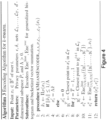
- An example algorithm for differentially private, noninteractive encoding is given in Algorithm 3 (depicted in Figure 4 and below).
- encoding, by the computing system, the representative of each of the one or more input data points for noninteractive differentially private communication can include encoding, by the computing system, the representative by a generalized bucketized vector summation encoder model.
- the vector summation encoder model can include a vector encoding of a dot product of a shared uniform random component and a potential representative.
- the generalized bucketized vector summation encoder model can include a mathematical model configured such that z i ⁇ ( Z yi,i ⁇ x i ).
- one example generalized bucketized vector summation encoder model is given in Algorithm 7 depicted in Figure 7A .
- the generalized bucketized vector summation encoder can encode the representatives with an input vector x.
- encoding, by the computing system, the representative of each of the one or more input data points for noninteractive differentially private communication can include encoding, by the computing system, the representative by a generalized histogram encoder model.
- the generalized histogram encoder model produces an output based on a shared uniform random component, wherein the output is positive with probability e ⁇ e ⁇ + 1 and negative with probability 1 e ⁇ + 1 , where ⁇ is a hyperparameter of differential privacy.
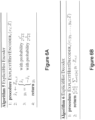
- a generalized histogram encoder model is given in Algorithm 6 depicted in Figure 6A .
- the computing system can project the one or more input data points to a random subspace.
- the random subspace can be based on shared randomness between the computing device and other computing devices, such as other source computing devices and/or the aggregator computing device.
- the computing device can scale the projected input data points to a subspace having reduced dimensionality. For instance, representatives in the net tree can be computed for the projected input data points in the reduced dimensionality subspace. Random projections and dimensionality reduction can remove an exponential dependency on d from the additive error, which can improve performance of the encoder.
- the input data points may not be randomly projected to a lower-dimensionality subspace, as LSH is a form of dimensionality reduction. Additionally due to this, it is also possible directly compute the approximate centers of all the nodes in the tree and then use a non-private algorithm (e.g., k- means++) to compute the k centers on this privatized dataset.
- a non-private algorithm e.g., k- means++
- systems and methods according to example aspects of the present disclosure can provide a computer-implemented method for decoding private data encoded by a net tree based encoding algorithm.
- a computing system including one or more computing devices can obtain encoded private input data.
- the encoded private input data can be received from one or more (e.g., a plurality of) source computing devices.
- the computing system can be or can include an aggregator computing device.
- the aggregator computing device can aggregate the differentially private encoded input data from a plurality of sources while maintaining privacy of the individual sources.
- An example algorithm for decoding the private data is given by Algorithm 4 (shown in Figure 5 and below).
- the encoded private input data can include encoded histogram data.
- the encoded histogram data can be encoded by the generalized histogram encoder model (e.g., as described in Algorithm 5 shown in Figure 6A and below).
- the computing system can determine a decoded frequency oracle based at least in part on the encoded histogram data. In some implementations, determining, by the computing system, the decoded frequency oracle is performed at least in part by summing the encoded histogram data according to e ⁇ + 1 e ⁇ ⁇ 1 . ⁇ i ⁇ [ n ] y i ⁇ Z v,i .
- an example histogram decoder model that can be used to decode the decoded frequency oracle is given in Algorithm 6 (shown in Figure 6B and below).
- the combination of the generalized histogram encoder model and the decoder model can be an O nlog Y / ⁇ / ⁇ , ⁇ -accurate ⁇ -DP algorithm for a histogram in the local model. Moreover, it can be made to run in time poly ( n, log
- the computing system can then construct a net tree based at least in part on the decoded frequency oracle. For instance, the computing system can attempt to recreate the net tree that was constructed for encoding the encoded private input data at the source, based on the decoded frequency oracle. To decode the encoded data, the computing system can first use the encoded histogram to build a frequency oracle, from which the computing system can construct a net tree using the algorithms described herein (e.g., Algorithm 1 of Figure 2 ).
- the computing system can then run any suitable approximation algorithm for k-means on the representative set of the net tree.
- the net tree can include a plurality of leaves.
- the computing system can then perform a k-means approximation algorithm on the net tree to partition the plurality of leaves according to respective closest centers into a plurality of partitions.
- the approximation algorithm is not required to be private.
- the output of gives a partition of the leaves of according to which centers they are the closest.
- the encoded private input data can further include encoded vector summation data.
- the encoded vector summation data can be encoded by the generalized bucket summation algorithm (e.g., as described in Figure 7A ).
- the encoded vector summation data can be decoded to determine a vector summation oracle.
- the computing system can determine a decoded vector summation oracle based at least in part on the encoded vector summation data.
- determining the decoded vector summation oracle is performed at least in part by summing the encoded vector summation data according to ⁇ i ⁇ [ n ] z i ⁇ Z v,i .
- an example vector summation decoder is given in Algorithm 8 depicted in Figure 7B .
- the vector summation oracle can be used on the plurality of partitions to determine the k centers of the original input data in the original, high-dimensional space.
- the computing system can upscale the plurality of partitions to an original higher-dimensionality space based at least in part on the decoded vector summation oracle.
- the differentially private noninteractive communications for which the private data is encoded can be a local model of differential privacy.
- the differentially private noninteractive communications can be a shuffled model of differential privacy.
- systems and methods according to example aspects of the present disclosure can provide for a number of technical effects and benefits, including improvements to computing technologies.
- systems and methods according to example aspects of the present disclosure can provide for constructing, by the computing system, a net tree including potential representatives of the one or more input data points, the potential representatives arranged in a plurality of levels, the net tree including a hierarchical data structure including a plurality of hierarchically organized nodes and may include a plurality of mappings between the plurality of hierarchically organized nodes.
- the net tree can, in turn, provide for encoding the one or more input data points for noninteractive differentially private communication.
- systems and methods according to example aspects of the present disclosure can provide for and even enable noninteractive differentially private communications with reduced approximation ratios (e.g., closer performance to actual nonprivate algorithms) in turn providing for more accurate conveyance of information while maintaining privacy guarantees.
- FIG. 1 depicts a block diagram of an example computing system 100 that performs locally differentially private communications according to example embodiments of the present disclosure.
- the computing system 100 can include a plurality of source computing devices 102 in communication with a centralized aggregator computing device 104.
- the source computing devices 102 can each transmit differentially private communications 106 to the aggregator computing device 104.
- the aggregator computing device 104 can aggregate the communications 106 and output information about the system 100, such as aggregated private data results. It is desirable to maintain privacy of the source computing devices 102 with regard to the communications 106 and the aggregator computing device 104.
- Figures 2 through 7B depict mathematically notated algorithms for various operations according to example aspects of the present disclosure.
- the algorithms described herein are provided for the purposes of illustrating example aspects of the present disclosure, and implementations of those algorithms may include modified and/or additional operations.
- data or variables in implementations of those algorithms may be rounded, discretized, privatized, or in other ways manipulated beyond the operations explicitly notated in the algorithms.
- the algorithms may be implemented on binary computers, such as the computing device 1000 of Figure 10 .
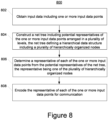
- Figure 8 depicts a flow chart diagram of an example method to perform encoding private user data for noninteractive differentially private communications according to example embodiments of the present disclosure.
- Figure 8 depicts steps performed in a particular order for purposes of illustration and discussion, the methods of the present disclosure are not limited to the particularly illustrated order or arrangement.
- the various steps of the method 800 can be omitted, rearranged, combined, and/or adapted in various ways .
- a computing system can obtain private data including one or more input data points.
- the computing system can be or can include a source computing device.
- the source computing device may be a user computing device operated by a user, such as a mobile device, desktop computer, wearable computing device, or any other suitable computing device.
- the private data (e.g., the one or more input data points) can be user data.
- the private data can be or can include vector or other tensor data.
- the input data points can be points (e.g., represented by vectors or other tensors) in a d-dimensional space, or having a dimensionality d.
- the computing system can construct a net tree including potential representatives of the one or more input data points.
- the potential representatives can be arranged in a plurality of levels.
- the net tree can be or can include a hierarchical data structure including a plurality of hierarchically organized nodes.
- the tree may additionally include a plurality of mappings between the plurality of hierarchically organized nodes.
- the representative can be one of the plurality of hierarchically organized nodes.
- the representative of an input data point of the one or more input data points can be a closest potential representative to the input data point.
- the closest potential representative to the input data point can include a potential representative having a smallest (e.g., Euclidean) distance to the input data point relative to each of the other potential representatives in the net tree.
- the computing system can determine a representative of each of the one or more input data points from potential representatives of the net tree.
- the representative can be one of the plurality of hierarchically organized nodes.
- the representative of an input data point of the one or more input data points can be a closest potential representative to the input data point.
- the closest potential representative to the input data point can include a potential representative having a smallest (e.g., Euclidean) distance to the input data point relative to each of the other potential representatives in the net tree..
- the computing system can encode the representative of each of the one or more input data points for noninteractive differentially private communication.
- the representatives of each input data point can make up a coreset that is representative of the private data.
- These representatives can be encoded by the source computing system(s) and transmitted to the aggregator computing system, which can then decode the encoded representatives while providing differential privacy guarantees at the source computing devices.
- An example algorithm for differentially private, noninteractive encoding is given in Algorithm 3 depicted in Figure 4 .
- encoding, by the computing system, the representative of each of the one or more input data points for noninteractive differentially private communication can include encoding, by the computing system, the representative by a generalized bucketized vector summation encoder model.
- the generalized bucketized vector summation encoder model can include a mathematical model configured such that z i ⁇ ( Z yi,i ⁇ x i ).
- one example generalized bucketized vector summation encoder model is given in Algorithm 7 depicted in Figure 7A .
- the generalized bucketized vector summation encoder can encode the representatives with an input vector x.
- encoding, by the computing system, the representative of each of the one or more input data points for noninteractive differentially private communication can include encoding, by the computing system, the representative by a generalized histogram encoder model.
- one example generalized histogram encoder model is given in Algorithm 6 depicted in Figure 6A .
- Figure 9 depicts a flow chart diagram of an example method to perform decoding private data encoded by a net tree based encoding algorithm according to example embodiments of the present disclosure.
- Figure 9 depicts steps performed in a particular order for purposes of illustration and discussion, the methods of the present disclosure are not limited to the particularly illustrated order or arrangement.
- the various steps of the method 900 can be omitted, rearranged, combined, and/or adapted in various ways.
- a computing system including one or more computing devices can obtain encoded private input data.
- the encoded private input data can be received from one or more (e.g., a plurality of) source computing devices.
- the computing system can be or can include an aggregator computing device.
- the aggregator computing device can aggregate the differentially private encoded input data from a plurality of sources while maintaining privacy of the individual sources.
- An example algorithm for decoding the private data is given by Algorithm 4 of Figure 5 .
- the encoded private input data can include encoded histogram data.
- the encoded histogram data can be encoded by the generalized histogram encoder model (e.g., as described in Figure 6A ).
- the computing system can determine a decoded frequency oracle based at least in part on the encoded histogram data. In some implementations, determining, by the computing system, the decoded frequency oracle is performed at least in part by summing the encoded histogram data according to e ⁇ + 1 e ⁇ ⁇ 1 . ⁇ i ⁇ [ n ] y i ⁇ Z v,i .
- an example histogram decoder model that can be used to decode the decoded frequency oracle is given in Algorithm 6 of Figure 6B .
- the combination of the generalized histogram encoder model and the decoder model can be an O nlog Y / ⁇ / ⁇ , ⁇ -accurate ⁇ -DP algorithm for a histogram in the local model. Moreover, it can be made to run in time poly ( n, log
- the computing system can then construct a net tree based at least in part on the decoded frequency oracle. For instance, the computing system can attempt to recreate the net tree that was constructed for encoding the encoded private input data at the source, based on the decoded frequency oracle. To decode the encoded data, the computing system can first use the encoded histogram to build a frequency oracle, from which the computing system can construct a net tree using the algorithms described herein (e.g., Algorithm 1 of Figure 2 ).
- the computing system can then run any suitable approximation algorithm for k-means on the representative set of the net tree.
- the net tree can include a plurality of leaves.
- the computing system can then perform a k-means approximation algorithm on the net tree to partition the plurality of leaves according to respective closest centers into a plurality of partitions.
- the approximation algorithm is not required to be private.
- the output of gives a partition of the leaves of according to which centers they are the closest.
- the encoded private input data can further include encoded vector summation data.
- the encoded vector summation data can be encoded by the generalized bucket summation algorithm (e.g., as described in Figure 7A ).
- the encoded vector summation data can be decoded to determine a vector summation oracle.
- the computing system can, at 910, determine a decoded vector summation oracle based at least in part on the encoded vector summation data.
- determining the decoded vector summation oracle is performed at least in part by summing the encoded vector summation data according to ⁇ i ⁇ [ n ] z i ⁇ Z v,i .
- an example vector summation decoder is given in Algorithm 8 depicted in Figure 7B .
- the vector summation oracle can be used on the plurality of partitions to determine the k centers of the original input data in the original, high-dimensional space.
- the computing system can, at 912, upscale the plurality of partitions to an original higher-dimensionality space based at least in part on the decoded vector summation oracle.
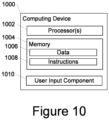
- Figure 10 depicts a block diagram of an example computing device 1000 configured to perform any of the operations described herein according to example embodiments of the present disclosure.
- the computing device 1000 can be a source computing device (e.g., source computing device 102 of Figure 1 ), an aggregator computing device (e.g., aggregator computing device 104 of Figure 1 ), and/or any other suitable computing device.
- the computing device 1000 can be any type of computing device, such as, for example, a personal computing device (e.g., laptop or desktop), a mobile computing device (e.g., smartphone or tablet), a gaming console or controller, a wearable computing device, an embedded computing device, or any other type of computing device.
- the computing device 1000 includes one or more processors 1002 and a memory 1004.
- the one or more processors 1002 can be any suitable processing device (e.g., a processor core, a microprocessor, an ASIC, an FPGA, a controller, a microcontroller, etc.) and can be one processor or a plurality of processors that are operatively connected.
- the memory 1004 can include one or more non-transitory computer-readable storage media, such as RAM, ROM, EEPROM, EPROM, flash memory devices, magnetic disks, etc., and combinations thereof.
- the memory 1004 can store data 1006 and instructions 1008 which are executed by the processor 1002 to cause the computing device 1000 to perform operations.
- the operations can be any suitable operations for implementations of systems and methods according to example aspects of the present disclosure.
- the operations can cause the computing device 1000 to perform encoding private user data for noninteractive differentially private communications, such as according to the method 800 of Figure 8 .
- the operations can cause the computing device 1000 to perform decoding private data encoded by a net tree based encoding algorithm, such as according to the method 900 of Figure 9 .
- the operations can additionally and/or alternatively include other operations, such as intermediate operations, data processing operations, or other suitable operations.
- the computing device 1000 can also include one or more user input components 1010 that receives user input.
- the user input component 1010 can be a touch-sensitive component (e.g., a touch-sensitive display screen or a touch pad) that is sensitive to the touch of a user input object (e.g., a finger or a stylus).
- the touch-sensitive component can serve to implement a virtual keyboard.
- Other example user input components include a microphone, a traditional keyboard, or other means by which a user can provide user input.
- the technology discussed herein makes reference to servers, databases, software applications, and other computer-based systems, as well as actions taken and information sent to and from such systems.
- the inherent flexibility of computer-based systems allows for a great variety of possible configurations, combinations, and divisions of tasks and functionality between and among components.
- processes discussed herein can be implemented using a single device or component or multiple devices or components working in combination.
- Databases and applications can be implemented on a single system or distributed across multiple systems. Distributed components can operate sequentially or in parallel.
Landscapes
- Engineering & Computer Science (AREA)
- Computer Security & Cryptography (AREA)
- Computer Hardware Design (AREA)
- Theoretical Computer Science (AREA)
- General Engineering & Computer Science (AREA)
- Health & Medical Sciences (AREA)
- Signal Processing (AREA)
- Automation & Control Theory (AREA)
- Computer Networks & Wireless Communication (AREA)
- Bioethics (AREA)
- General Health & Medical Sciences (AREA)
- Software Systems (AREA)
- Physics & Mathematics (AREA)
- General Physics & Mathematics (AREA)
- Computing Systems (AREA)
- Compression, Expansion, Code Conversion, And Decoders (AREA)
- Management, Administration, Business Operations System, And Electronic Commerce (AREA)
Claims (15)
- Computerimplementiertes Verfahren zum Codieren von Daten zur Kommunikation mit verbessertem Datenschutz, wobei das Verfahren Folgendes umfasst:Erlangen (802) von Eingabedaten, die einen oder mehrere Eingabedatenpunkte umfassen, durch ein Rechensystem (100), das eine oder mehrere Rechenvorrichtungen (102) umfasst;Konstruieren (804) eines Netzbaums, der potentielle Repräsentanten des einen oder der mehreren Eingabedatenpunkte umfasst, durch das Rechensystem, wobei die potentiellen Repräsentanten in einer Vielzahl von Stufen angeordnet sind und der Netzbaum eine hierarchische Datenstruktur umfasst, die eine Vielzahl von hierarchisch organisierten Knoten umfasst;Bestimmen (806) eines Repräsentanten für jeden der einen oder mehreren Eingabedatenpunkte aus den potentiellen Repräsentanten des Netzbaums durch das Rechensystem, wobei der Repräsentant einen der Vielzahl von hierarchisch organisierten Knoten umfasst;Codieren (808) des Repräsentanten jedes der einen oder mehreren Eingabedaten für die Kommunikation durch das Rechensystem.
- Computerimplementiertes Verfahren nach einem der vorstehenden Ansprüche, ferner umfassend:vor dem Bestimmen eines Repräsentanten für jeden der einen oder mehreren Eingabedatenpunkte aus den potentiellen Repräsentanten des Netzbaums, Projizieren des einen oder der mehreren Eingabedatenpunkte auf einen zufälligen Teilraum; undnachfolgend dem Projizieren des einen oder der mehreren Eingabedatenpunkte auf den zufälligen Teilraum, Skalieren der projizierten Eingabedatenpunkte auf einen Teilraum, der eine verringerte Dimensionalität aufweist.
- Computerimplementiertes Verfahren nach einem der vorhergehenden Ansprüche, wobei das Codieren des Repräsentanten jedes der einen oder mehreren Eingabedatenpunkte für die Kommunikation durch das Rechensystem (100) das Codieren des Repräsentanten durch ein verallgemeinertes Bucket-Vektorsummierungs-Codierermodell umfasst, durch das Rechensystem; und optional
wobei das verallgemeinerte Bucket-Vektorsummierungs-Codierermodell eine Vektorcodierung eines Skalarprodukts aus einer gemeinsam genutzten einheitlichen Zufallskomponente und einem potentiellen Repräsentanten umfasst. - Computerimplementiertes Verfahren nach einem der vorhergehenden Ansprüche, wobei das Codieren des Repräsentanten jedes der einen oder mehreren Eingabedatenpunkte für die Kommunikation durch das Rechensystem (100) das Codieren des Repräsentanten durch ein verallgemeinertes Histogramm-Codierermodell umfasst, durch das Rechensystem; und optional wobei das verallgemeinerte Histogramm-Codierermodell eine Ausgabe basierend auf einer gemeinsam genutzten einheitlichen Zufallskomponente erzeugt, wobei die Ausgabe mit Wahrscheinlichkeit positiv und mit Wahrscheinlichkeit negativ ist, wobei 8 ein Hyperparameter des differentiellen Datenschutzes ist.
- Computerimplementiertes Verfahren nach einem der vorhergehenden Ansprüche, wobei der Repräsentant eines Eingabedatenpunkts des einen oder der mehreren Eingabedatenpunkte einen nächstgelegenen potentiellen Repräsentanten des Eingabedatenpunkts darstellt; und optional wobei der dem Eingabedatenpunkt nächstgelegene potentielle Repräsentant einen potentiellen Repräsentanten mit dem kleinsten euklidischen Abstand zu dem Eingabedatenpunkt relativ zu jedem der anderen potentiellen Repräsentanten in dem Netzbaum umfasst.
- Computerimplementiertes Verfahren nach einem der vorhergehenden Ansprüche, wobei die Kommunikation ein lokales Modell des differentiellen Datenschutzes umfasst; oder/und optional
wobei die Kommunikation ein gemischtes Modell des differentiellen Datenschutzes umfasst. - Computerimplementiertes Verfahren nach einem der vorhergehenden Ansprüche, wobei das Konstruieren des Netzbaums, der potentielle Repräsentanten des einen oder der mehreren Eingabedatenpunkte umfasst, durch das Rechensystem (100) Folgendes umfasst:Bestimmen eines Expansionsschwellenwerts durch das Rechensystem;Identifizieren einer Anzahl von einem oder mehreren Knoten mit höchstem Rang in dem Netzbaum auf einer ersten Stufe in dem Netzbaum durch das Rechensystem, wobei die Anzahl gleich dem Expansionsschwellenwert ist; undExpandieren des einen oder der mehreren Knoten mit dem höchsten Rang auf einer zweiten Stufe des Netzbaums durch das Rechensystem.
- Computerimplementiertes Verfahren nach Anspruch 7, wobei der Expansionsschwellenwert mindestens teilweise auf einem optimalen Kostenfaktor für den Transport zwischen dem einen oder den mehreren Eingabedaten und den potentiellen Repräsentanten basiert.
- Computerimplementiertes Verfahren nach Anspruch 7, wobei der Expansionsschwellenwert mindestens teilweise auf einer unteren Grenze eines minimalen Kostenfaktors zwischen dem einen oder den mehreren Eingabedaten und den potentiellen Repräsentanten basiert.
- Computerimplementiertes Verfahren nach einem vorhergehenden Anspruch, wobei der Netzbaum eine Vielzahl von effizient decodierbaren Netzen umfasst.
- Computerimplementiertes Verfahren zum Decodieren von Daten, die durch einen auf einem Netzbaum basierenden Codieralgorithmus codiert sind, wobei das computerimplementierte Verfahren Folgendes umfasst:Erlangen (902) von codierten Eingabedaten, die codierte Histogrammdaten umfassen, durch ein Rechensystem (100), das eine oder mehrere Rechenvorrichtungen (102) umfasst;Bestimmen (904) eines decodierten Frequenz-Orakels durch das Rechensystem, basierend zumindest teilweise auf den codierten Histogrammdaten;Konstruieren (906) eines Netzbaums durch das Rechensystem, basierend zumindest teilweise auf dem decodierten Frequenz-Orakel, wobei der Netzbaum eine Vielzahl von Blättern umfasst;Durchführen (908) eines K-Milltel-Approximationsalgorithmus auf dem Netzbaum durch das Rechensystem, um die Vielzahl von Blättern gemäß jeweiligen nächstgelegenen Mittelpunkten in eine Vielzahl von Partitionen zu unterteilen.
- Computerimplementiertes Verfahren nach Anspruch 11, wobei die codierten Eingabedaten ferner codierte Vektor Vektorsummierungsdaten umfassen; und wobei das computerimplementierte Verfahren ferner Folgendes umfasst:Bestimmen (910) eines decodierten Vektorsummierungs-Orakels durch das Rechensystem (100), zumindest teilweise basierend auf den codierten Vektorsummierungsdaten; undHochskalierung (912) der Vielzahl von Partitionen in einen ursprünglichen höherdimensionalen Raum durch das Rechensystem, basierend zumindest teilweise auf dem decodierten Vektorsummierungs-Orakel; und optional,wobei das Bestimmen des decodierten Vektorsummierungs-Orakels zumindest teilweise durch Summieren der codierten Vektorsummierungsdaten multipliziert mit einer gemeinsam genutzten Zufallskomponente durchgeführt wird.
- Computerimplementiertes Verfahren nach Anspruch 11 oder 12, wobei das Bestimmen des decodierten Frequenz-Orakels zumindest teilweise durch Summieren der codierten Histogrammdaten, multipliziert mit einer gemeinsamen Zufallskomponente durch das Rechensystem (100) durchgeführt wird.
- Rechenvorrichtung (0100), umfassend:einen oder mehrere Prozessoren (1002); undnichttransitorisches computerlesbares Medium (1004), das darauf gespeicherte Anweisungen (1008) aufweist, die, wenn sie von dem einen oder den mehreren Prozessoren ausgeführt werden, den einen oder die mehreren Prozessoren veranlassen, das Verfahren nach einem der Ansprüche 1 bis 13 durchzuführen.
- Programmanweisungen, die, wenn sie von einem oder mehreren Prozessoren (1002) einer Rechenvorrichtung (1000) ausgeführt werden, die Rechenvorrichtung veranlassen, das Verfahren nach einem der Ansprüche 1 bis 13 durchzuführen.
Applications Claiming Priority (2)
| Application Number | Priority Date | Filing Date | Title |
|---|---|---|---|
| US202163168533P | 2021-03-31 | 2021-03-31 | |
| PCT/US2021/064371 WO2022211863A1 (en) | 2021-03-31 | 2021-12-20 | Systems and methods for locally private non-interactive communications |
Publications (2)
| Publication Number | Publication Date |
|---|---|
| EP4154154A1 EP4154154A1 (de) | 2023-03-29 |
| EP4154154B1 true EP4154154B1 (de) | 2025-02-05 |
Family
ID=80123424
Family Applications (1)
| Application Number | Title | Priority Date | Filing Date |
|---|---|---|---|
| EP21851905.6A Active EP4154154B1 (de) | 2021-03-31 | 2021-12-20 | Verfahren, vorrichtungen und computerprogrammanweisungen für lokal private nichtinteraktive kommunikation |
Country Status (4)
| Country | Link |
|---|---|
| US (1) | US20230308422A1 (de) |
| EP (1) | EP4154154B1 (de) |
| CN (1) | CN115997211A (de) |
| WO (1) | WO2022211863A1 (de) |
Family Cites Families (15)
| Publication number | Priority date | Publication date | Assignee | Title |
|---|---|---|---|---|
| US20100067113A1 (en) * | 2008-09-18 | 2010-03-18 | Matthew John Harrison | Apparatus and Method for Displaying Hierarchical Data |
| US11698990B2 (en) * | 2016-04-29 | 2023-07-11 | Privitar Limited | Computer-implemented privacy engineering system and method |
| US11023594B2 (en) * | 2017-05-22 | 2021-06-01 | Georgetown University | Locally private determination of heavy hitters |
| US10770171B2 (en) * | 2018-04-12 | 2020-09-08 | International Business Machines Corporation | Augmenting datasets using de-identified data and selected authorized records |
| KR102175167B1 (ko) * | 2018-05-09 | 2020-11-05 | 서강대학교 산학협력단 | K-평균 클러스터링 기반의 데이터 마이닝 시스템 및 이를 이용한 k-평균 클러스터링 방법 |
| WO2020207593A1 (en) * | 2019-04-11 | 2020-10-15 | Fraunhofer-Gesellschaft zur Förderung der angewandten Forschung e.V. | Audio decoder, apparatus for determining a set of values defining characteristics of a filter, methods for providing a decoded audio representation, methods for determining a set of values defining characteristics of a filter and computer program |
| US11443240B2 (en) * | 2019-09-06 | 2022-09-13 | Oracle International Corporation | Privacy preserving collaborative learning with domain adaptation |
| US11102179B2 (en) * | 2020-01-21 | 2021-08-24 | Vmware, Inc. | System and method for anonymous message broadcasting |
| US20220019441A1 (en) * | 2020-07-14 | 2022-01-20 | The Regents Of The University Of California | Circuits, methods, and articles of manufacture for hyper-dimensional computing systems and related applications |
| US11616765B2 (en) * | 2020-07-31 | 2023-03-28 | Apple Inc. | Practical private algorithms for robust statistics |
| US12481891B2 (en) * | 2020-10-26 | 2025-11-25 | Google Llc | Training neural networks with label differential privacy |
| US12223088B2 (en) * | 2022-10-11 | 2025-02-11 | Jpmorgan Chase Bank, N.A. | Method and system for differentially private learning of Hawkes processes |
| US20240202518A1 (en) * | 2022-12-19 | 2024-06-20 | Microsoft Technology Licensing, Llc | Privacy-preserving generation of synthesized training data |
| US20240265294A1 (en) * | 2023-01-19 | 2024-08-08 | Google Llc | Training Machine-Learned Models with Label Differential Privacy |
| US20240249153A1 (en) * | 2023-01-23 | 2024-07-25 | International Business Machines Corporation | Privacy enhanced federated training and inference over vertically and horizontally partitioned data |
-
2021
- 2021-12-20 EP EP21851905.6A patent/EP4154154B1/de active Active
- 2021-12-20 US US18/011,995 patent/US20230308422A1/en active Pending
- 2021-12-20 WO PCT/US2021/064371 patent/WO2022211863A1/en not_active Ceased
- 2021-12-20 CN CN202180046496.4A patent/CN115997211A/zh active Pending
Also Published As
| Publication number | Publication date |
|---|---|
| US20230308422A1 (en) | 2023-09-28 |
| EP4154154A1 (de) | 2023-03-29 |
| CN115997211A (zh) | 2023-04-21 |
| WO2022211863A1 (en) | 2022-10-06 |
Similar Documents
| Publication | Publication Date | Title |
|---|---|---|
| Bun et al. | Heavy hitters and the structure of local privacy | |
| Ergun et al. | Learning-augmented $ k $-means clustering | |
| Züfle et al. | Representative clustering of uncertain data | |
| Shang et al. | The application of differential privacy for rank aggregation: Privacy and accuracy | |
| Moustafa et al. | Subgraph pattern matching over uncertain graphs with identity linkage uncertainty | |
| Chen et al. | Handling high-dimensional data with missing values by modern machine learning techniques | |
| Lung et al. | Game theory and extremal optimization for community detection in complex dynamic networks | |
| Asi et al. | Element level differential privacy: The right granularity of privacy | |
| Anagnostopoulos et al. | Scaling out big data missing value imputations: pythia vs. godzilla | |
| Zhao et al. | Statistical inference for community detection in signed networks | |
| Xie et al. | On the Gini-impurity preservation for privacy random forests | |
| Bachrach et al. | Sketching for big data recommender systems using fast pseudo-random fingerprints | |
| US9438705B2 (en) | Communication and message-efficient protocol for computing the intersection between different sets of data | |
| EP4154154B1 (de) | Verfahren, vorrichtungen und computerprogrammanweisungen für lokal private nichtinteraktive kommunikation | |
| Dmitriev et al. | Self‐Organized Criticality on Twitter: Phenomenological Theory and Empirical Investigation Based on Data Analysis Results | |
| Ghosh et al. | JENNER: just-in-time enrichment in query processing | |
| Doğuç | Data mining applications in banking sector while preserving customer privacy | |
| Hamidi et al. | A secure distributed framework for agglomerative hierarchical clustering construction | |
| Ma et al. | Pseudo-Bayesian classified mixed model prediction | |
| US20210312497A1 (en) | Analyzing randomized geo experiments using trimmed match | |
| Nelson | Sketching and streaming high-dimensional vectors | |
| Ukkonen | Clustering algorithms for chains | |
| Carraher et al. | Multi-probe random projection clustering to secure very large distributed datasets | |
| Li et al. | Non-Interactive Butterfly Counting in Bipartite Graphs Based on Local Differential Privacy | |
| Shahbazi et al. | Weighted Set Multi-Cover on Bounded Universe and Applications in Package Recommendation |
Legal Events
| Date | Code | Title | Description |
|---|---|---|---|
| STAA | Information on the status of an ep patent application or granted ep patent |
Free format text: STATUS: UNKNOWN |
|
| STAA | Information on the status of an ep patent application or granted ep patent |
Free format text: STATUS: THE INTERNATIONAL PUBLICATION HAS BEEN MADE |
|
| PUAI | Public reference made under article 153(3) epc to a published international application that has entered the european phase |
Free format text: ORIGINAL CODE: 0009012 |
|
| STAA | Information on the status of an ep patent application or granted ep patent |
Free format text: STATUS: REQUEST FOR EXAMINATION WAS MADE |
|
| 17P | Request for examination filed |
Effective date: 20221219 |
|
| AK | Designated contracting states |
Kind code of ref document: A1 Designated state(s): AL AT BE BG CH CY CZ DE DK EE ES FI FR GB GR HR HU IE IS IT LI LT LU LV MC MK MT NL NO PL PT RO RS SE SI SK SM TR |
|
| REG | Reference to a national code |
Ref country code: DE Ref legal event code: R079 Free format text: PREVIOUS MAIN CLASS: G06F0021620000 Ipc: H04L0009400000 Ref country code: DE Ref legal event code: R079 Ref document number: 602021025835 Country of ref document: DE Free format text: PREVIOUS MAIN CLASS: G06F0021620000 Ipc: H04L0009400000 |
|
| GRAP | Despatch of communication of intention to grant a patent |
Free format text: ORIGINAL CODE: EPIDOSNIGR1 |
|
| STAA | Information on the status of an ep patent application or granted ep patent |
Free format text: STATUS: GRANT OF PATENT IS INTENDED |
|
| DAV | Request for validation of the european patent (deleted) | ||
| DAX | Request for extension of the european patent (deleted) | ||
| RIC1 | Information provided on ipc code assigned before grant |
Ipc: G06F 21/62 20130101ALI20240613BHEP Ipc: H04L 9/40 20220101AFI20240613BHEP |
|
| INTG | Intention to grant announced |
Effective date: 20240710 |
|
| GRAS | Grant fee paid |
Free format text: ORIGINAL CODE: EPIDOSNIGR3 |
|
| GRAA | (expected) grant |
Free format text: ORIGINAL CODE: 0009210 |
|
| STAA | Information on the status of an ep patent application or granted ep patent |
Free format text: STATUS: THE PATENT HAS BEEN GRANTED |
|
| P01 | Opt-out of the competence of the unified patent court (upc) registered |
Free format text: CASE NUMBER: APP_64446/2024 Effective date: 20241205 |
|
| AK | Designated contracting states |
Kind code of ref document: B1 Designated state(s): AL AT BE BG CH CY CZ DE DK EE ES FI FR GB GR HR HU IE IS IT LI LT LU LV MC MK MT NL NO PL PT RO RS SE SI SK SM TR |
|
| REG | Reference to a national code |
Ref country code: GB Ref legal event code: FG4D |
|
| REG | Reference to a national code |
Ref country code: CH Ref legal event code: EP |
|
| REG | Reference to a national code |
Ref country code: IE Ref legal event code: FG4D |
|
| REG | Reference to a national code |
Ref country code: DE Ref legal event code: R096 Ref document number: 602021025835 Country of ref document: DE |
|
| REG | Reference to a national code |
Ref country code: NL Ref legal event code: MP Effective date: 20250205 |
|
| PG25 | Lapsed in a contracting state [announced via postgrant information from national office to epo] |
Ref country code: RS Free format text: LAPSE BECAUSE OF FAILURE TO SUBMIT A TRANSLATION OF THE DESCRIPTION OR TO PAY THE FEE WITHIN THE PRESCRIBED TIME-LIMIT Effective date: 20250505 |
|
| PG25 | Lapsed in a contracting state [announced via postgrant information from national office to epo] |
Ref country code: FI Free format text: LAPSE BECAUSE OF FAILURE TO SUBMIT A TRANSLATION OF THE DESCRIPTION OR TO PAY THE FEE WITHIN THE PRESCRIBED TIME-LIMIT Effective date: 20250205 |
|
| PG25 | Lapsed in a contracting state [announced via postgrant information from national office to epo] |
Ref country code: PL Free format text: LAPSE BECAUSE OF FAILURE TO SUBMIT A TRANSLATION OF THE DESCRIPTION OR TO PAY THE FEE WITHIN THE PRESCRIBED TIME-LIMIT Effective date: 20250205 |
|
| PG25 | Lapsed in a contracting state [announced via postgrant information from national office to epo] |
Ref country code: ES Free format text: LAPSE BECAUSE OF FAILURE TO SUBMIT A TRANSLATION OF THE DESCRIPTION OR TO PAY THE FEE WITHIN THE PRESCRIBED TIME-LIMIT Effective date: 20250205 |
|
| REG | Reference to a national code |
Ref country code: LT Ref legal event code: MG9D |
|
| PG25 | Lapsed in a contracting state [announced via postgrant information from national office to epo] |
Ref country code: NO Free format text: LAPSE BECAUSE OF FAILURE TO SUBMIT A TRANSLATION OF THE DESCRIPTION OR TO PAY THE FEE WITHIN THE PRESCRIBED TIME-LIMIT Effective date: 20250505 Ref country code: IS Free format text: LAPSE BECAUSE OF FAILURE TO SUBMIT A TRANSLATION OF THE DESCRIPTION OR TO PAY THE FEE WITHIN THE PRESCRIBED TIME-LIMIT Effective date: 20250605 |
|
| PG25 | Lapsed in a contracting state [announced via postgrant information from national office to epo] |
Ref country code: NL Free format text: LAPSE BECAUSE OF FAILURE TO SUBMIT A TRANSLATION OF THE DESCRIPTION OR TO PAY THE FEE WITHIN THE PRESCRIBED TIME-LIMIT Effective date: 20250205 |
|
| PG25 | Lapsed in a contracting state [announced via postgrant information from national office to epo] |
Ref country code: HR Free format text: LAPSE BECAUSE OF FAILURE TO SUBMIT A TRANSLATION OF THE DESCRIPTION OR TO PAY THE FEE WITHIN THE PRESCRIBED TIME-LIMIT Effective date: 20250205 |
|
| PG25 | Lapsed in a contracting state [announced via postgrant information from national office to epo] |
Ref country code: PT Free format text: LAPSE BECAUSE OF FAILURE TO SUBMIT A TRANSLATION OF THE DESCRIPTION OR TO PAY THE FEE WITHIN THE PRESCRIBED TIME-LIMIT Effective date: 20250605 Ref country code: LV Free format text: LAPSE BECAUSE OF FAILURE TO SUBMIT A TRANSLATION OF THE DESCRIPTION OR TO PAY THE FEE WITHIN THE PRESCRIBED TIME-LIMIT Effective date: 20250205 |
|
| PG25 | Lapsed in a contracting state [announced via postgrant information from national office to epo] |
Ref country code: BG Free format text: LAPSE BECAUSE OF FAILURE TO SUBMIT A TRANSLATION OF THE DESCRIPTION OR TO PAY THE FEE WITHIN THE PRESCRIBED TIME-LIMIT Effective date: 20250205 Ref country code: GR Free format text: LAPSE BECAUSE OF FAILURE TO SUBMIT A TRANSLATION OF THE DESCRIPTION OR TO PAY THE FEE WITHIN THE PRESCRIBED TIME-LIMIT Effective date: 20250506 |
|
| REG | Reference to a national code |
Ref country code: AT Ref legal event code: MK05 Ref document number: 1765081 Country of ref document: AT Kind code of ref document: T Effective date: 20250205 |
|
| PG25 | Lapsed in a contracting state [announced via postgrant information from national office to epo] |
Ref country code: SE Free format text: LAPSE BECAUSE OF FAILURE TO SUBMIT A TRANSLATION OF THE DESCRIPTION OR TO PAY THE FEE WITHIN THE PRESCRIBED TIME-LIMIT Effective date: 20250205 |
|
| PG25 | Lapsed in a contracting state [announced via postgrant information from national office to epo] |
Ref country code: SM Free format text: LAPSE BECAUSE OF FAILURE TO SUBMIT A TRANSLATION OF THE DESCRIPTION OR TO PAY THE FEE WITHIN THE PRESCRIBED TIME-LIMIT Effective date: 20250205 |
|
| PG25 | Lapsed in a contracting state [announced via postgrant information from national office to epo] |
Ref country code: DK Free format text: LAPSE BECAUSE OF FAILURE TO SUBMIT A TRANSLATION OF THE DESCRIPTION OR TO PAY THE FEE WITHIN THE PRESCRIBED TIME-LIMIT Effective date: 20250205 |
|
| PG25 | Lapsed in a contracting state [announced via postgrant information from national office to epo] |
Ref country code: IT Free format text: LAPSE BECAUSE OF FAILURE TO SUBMIT A TRANSLATION OF THE DESCRIPTION OR TO PAY THE FEE WITHIN THE PRESCRIBED TIME-LIMIT Effective date: 20250205 |
|
| PG25 | Lapsed in a contracting state [announced via postgrant information from national office to epo] |
Ref country code: AT Free format text: LAPSE BECAUSE OF FAILURE TO SUBMIT A TRANSLATION OF THE DESCRIPTION OR TO PAY THE FEE WITHIN THE PRESCRIBED TIME-LIMIT Effective date: 20250205 |
|
| PG25 | Lapsed in a contracting state [announced via postgrant information from national office to epo] |
Ref country code: EE Free format text: LAPSE BECAUSE OF FAILURE TO SUBMIT A TRANSLATION OF THE DESCRIPTION OR TO PAY THE FEE WITHIN THE PRESCRIBED TIME-LIMIT Effective date: 20250205 Ref country code: CZ Free format text: LAPSE BECAUSE OF FAILURE TO SUBMIT A TRANSLATION OF THE DESCRIPTION OR TO PAY THE FEE WITHIN THE PRESCRIBED TIME-LIMIT Effective date: 20250205 |
|
| PG25 | Lapsed in a contracting state [announced via postgrant information from national office to epo] |
Ref country code: RO Free format text: LAPSE BECAUSE OF FAILURE TO SUBMIT A TRANSLATION OF THE DESCRIPTION OR TO PAY THE FEE WITHIN THE PRESCRIBED TIME-LIMIT Effective date: 20250205 |
|
| PG25 | Lapsed in a contracting state [announced via postgrant information from national office to epo] |
Ref country code: SK Free format text: LAPSE BECAUSE OF FAILURE TO SUBMIT A TRANSLATION OF THE DESCRIPTION OR TO PAY THE FEE WITHIN THE PRESCRIBED TIME-LIMIT Effective date: 20250205 |
|
| REG | Reference to a national code |
Ref country code: DE Ref legal event code: R097 Ref document number: 602021025835 Country of ref document: DE |
|
| PLBE | No opposition filed within time limit |
Free format text: ORIGINAL CODE: 0009261 |
|
| STAA | Information on the status of an ep patent application or granted ep patent |
Free format text: STATUS: NO OPPOSITION FILED WITHIN TIME LIMIT |
|
| PGFP | Annual fee paid to national office [announced via postgrant information from national office to epo] |
Ref country code: GB Payment date: 20251229 Year of fee payment: 5 |
|
| 26N | No opposition filed |
Effective date: 20251106 |
|
| PGFP | Annual fee paid to national office [announced via postgrant information from national office to epo] |
Ref country code: DE Payment date: 20251229 Year of fee payment: 5 |