EP4152432A1 - Electrode for secondary battery and secondary battery - Google Patents
Electrode for secondary battery and secondary battery Download PDFInfo
- Publication number
- EP4152432A1 EP4152432A1 EP22196194.9A EP22196194A EP4152432A1 EP 4152432 A1 EP4152432 A1 EP 4152432A1 EP 22196194 A EP22196194 A EP 22196194A EP 4152432 A1 EP4152432 A1 EP 4152432A1
- Authority
- EP
- European Patent Office
- Prior art keywords
- region
- active material
- groove
- material layer
- cross
- Prior art date
- Legal status (The legal status is an assumption and is not a legal conclusion. Google has not performed a legal analysis and makes no representation as to the accuracy of the status listed.)
- Pending
Links
Images


Classifications
-
- H—ELECTRICITY
- H01—ELECTRIC ELEMENTS
- H01M—PROCESSES OR MEANS, e.g. BATTERIES, FOR THE DIRECT CONVERSION OF CHEMICAL ENERGY INTO ELECTRICAL ENERGY
- H01M4/00—Electrodes
- H01M4/02—Electrodes composed of, or comprising, active material
- H01M4/13—Electrodes for accumulators with non-aqueous electrolyte, e.g. for lithium-accumulators; Processes of manufacture thereof
-
- H—ELECTRICITY
- H01—ELECTRIC ELEMENTS
- H01M—PROCESSES OR MEANS, e.g. BATTERIES, FOR THE DIRECT CONVERSION OF CHEMICAL ENERGY INTO ELECTRICAL ENERGY
- H01M10/00—Secondary cells; Manufacture thereof
- H01M10/05—Accumulators with non-aqueous electrolyte
- H01M10/058—Construction or manufacture
-
- H—ELECTRICITY
- H01—ELECTRIC ELEMENTS
- H01M—PROCESSES OR MEANS, e.g. BATTERIES, FOR THE DIRECT CONVERSION OF CHEMICAL ENERGY INTO ELECTRICAL ENERGY
- H01M4/00—Electrodes
- H01M4/02—Electrodes composed of, or comprising, active material
- H01M4/04—Processes of manufacture in general
- H01M4/0402—Methods of deposition of the material
- H01M4/0404—Methods of deposition of the material by coating on electrode collectors
-
- H—ELECTRICITY
- H01—ELECTRIC ELEMENTS
- H01M—PROCESSES OR MEANS, e.g. BATTERIES, FOR THE DIRECT CONVERSION OF CHEMICAL ENERGY INTO ELECTRICAL ENERGY
- H01M10/00—Secondary cells; Manufacture thereof
- H01M10/05—Accumulators with non-aqueous electrolyte
- H01M10/052—Li-accumulators
- H01M10/0525—Rocking-chair batteries, i.e. batteries with lithium insertion or intercalation in both electrodes; Lithium-ion batteries
-
- H—ELECTRICITY
- H01—ELECTRIC ELEMENTS
- H01M—PROCESSES OR MEANS, e.g. BATTERIES, FOR THE DIRECT CONVERSION OF CHEMICAL ENERGY INTO ELECTRICAL ENERGY
- H01M4/00—Electrodes
- H01M4/02—Electrodes composed of, or comprising, active material
- H01M2004/021—Physical characteristics, e.g. porosity, surface area
-
- H—ELECTRICITY
- H01—ELECTRIC ELEMENTS
- H01M—PROCESSES OR MEANS, e.g. BATTERIES, FOR THE DIRECT CONVERSION OF CHEMICAL ENERGY INTO ELECTRICAL ENERGY
- H01M4/00—Electrodes
- H01M4/02—Electrodes composed of, or comprising, active material
- H01M2004/025—Electrodes composed of, or comprising, active material with shapes other than plane or cylindrical
-
- H—ELECTRICITY
- H01—ELECTRIC ELEMENTS
- H01M—PROCESSES OR MEANS, e.g. BATTERIES, FOR THE DIRECT CONVERSION OF CHEMICAL ENERGY INTO ELECTRICAL ENERGY
- H01M4/00—Electrodes
- H01M4/02—Electrodes composed of, or comprising, active material
- H01M4/04—Processes of manufacture in general
- H01M4/043—Processes of manufacture in general involving compressing or compaction
- H01M4/0435—Rolling or calendering
-
- H—ELECTRICITY
- H01—ELECTRIC ELEMENTS
- H01M—PROCESSES OR MEANS, e.g. BATTERIES, FOR THE DIRECT CONVERSION OF CHEMICAL ENERGY INTO ELECTRICAL ENERGY
- H01M4/00—Electrodes
- H01M4/02—Electrodes composed of, or comprising, active material
- H01M4/36—Selection of substances as active materials, active masses, active liquids
- H01M4/58—Selection of substances as active materials, active masses, active liquids of inorganic compounds other than oxides or hydroxides, e.g. sulfides, selenides, tellurides, halogenides or LiCoFy; of polyanionic structures, e.g. phosphates, silicates or borates
- H01M4/583—Carbonaceous material, e.g. graphite-intercalation compounds or CFx
- H01M4/587—Carbonaceous material, e.g. graphite-intercalation compounds or CFx for inserting or intercalating light metals
-
- Y—GENERAL TAGGING OF NEW TECHNOLOGICAL DEVELOPMENTS; GENERAL TAGGING OF CROSS-SECTIONAL TECHNOLOGIES SPANNING OVER SEVERAL SECTIONS OF THE IPC; TECHNICAL SUBJECTS COVERED BY FORMER USPC CROSS-REFERENCE ART COLLECTIONS [XRACs] AND DIGESTS
- Y02—TECHNOLOGIES OR APPLICATIONS FOR MITIGATION OR ADAPTATION AGAINST CLIMATE CHANGE
- Y02E—REDUCTION OF GREENHOUSE GAS [GHG] EMISSIONS, RELATED TO ENERGY GENERATION, TRANSMISSION OR DISTRIBUTION
- Y02E60/00—Enabling technologies; Technologies with a potential or indirect contribution to GHG emissions mitigation
- Y02E60/10—Energy storage using batteries
Definitions
- the present disclosure relates to an electrode for a secondary battery and a secondary battery.
- Japanese Patent Laying-Open No. 2021-009846 discloses a technique for enhancing electrolytic solution impregnation force and gas discharge force by embodying a patterned adhesive force on a surface of a separation film.
- a “secondary battery” refers to a battery capable of charge and discharge.
- a secondary battery may be simply called “a battery”.
- a battery includes an electrode and an electrolyte solution.
- the electrode includes an active material layer.
- the active material layer is porous.
- the electrolyte solution permeates the active material layer.
- a groove (a linear depressed portion) may be formed in a surface of the active material layer, for example.
- the groove may serve as a channel for an electrolyte solution. Forming the groove is expected to facilitate permeation of the electrolyte solution.
- the active material layer expands and shrinks due to charge and discharge. While the active material layer expands, the electrolyte solution is ejected from the active material layer. With a groove formed in the active material layer, ejection of the electrolyte solution may be facilitated. If ejection of the electrolyte solution is facilitated, the electrolyte solution in the active material layer may become exhausted. As a result, cycling performance may decrease, contrary to the original intention.
- An object of the present disclosure is to provide an electrode which enables easy permeation of an electrolyte solution but does not enable easy ejection thereof.
- the groove includes a first region and a second region.
- the second region is interposed between the open portion and the first region.
- the first region has a first cross-sectional area
- the second region has a second cross-sectional area.
- the second cross-sectional area is smaller than the first cross-sectional area.
- the groove extends linearly on a surface of the active material layer.
- the groove opens at a periphery of the active material layer.
- the open portion of the groove serves as an inlet/outlet for an electrolyte solution.
- the direction in which the groove extends is also called "an extending direction”.
- the cross-sectional area of the groove refers to the area of a cross section perpendicular to the extending direction. Conventionally, the cross-sectional area of the groove does not change. In the present disclosure, the cross-sectional area of the groove does change. That is, the groove includes a first region and a second region. The second region is closer to the open portion (an inlet/outlet) than the first region is. The cross-sectional area of the second region is smaller than the cross-sectional area of the first region.
- the second region may function as a weir or a check valve.
- the groove is a channel for an electrolyte solution. When the electrolyte solution passes through the groove, pressure loss occurs.
- the groove can be regarded as a pipe to allow for estimating the pressure loss.
- Fig. 1 is a view for describing pressure loss.
- the vertical axis represents pressure loss
- the horizontal axis represents the pipe diameter.
- the pipe diameter may be regarded as the square root of the cross-sectional area of the groove.
- the square root of the cross-sectional area of the groove may also be called “the groove diameter”.
- the groove shrinks.
- the pressure loss during expansion of the active material layer is “ ⁇ P exp ".
- the groove enlarges.
- the pressure loss during shrinkage of the active material layer (during enlargement of the groove) is “ ⁇ P con ".
- the pressure loss during expansion of the active material layer is “ ⁇ P' exp "
- the pressure loss during shrinkage of the active material layer is “ ⁇ P' con "
- ⁇ P' exp " and " ⁇ P con " are determined by assigning the length of the first region into “Li”, the diameter of the first region into “di”, the average flow speed of the first region into “Ui”, the length of the second region into “L 2 ", the diameter of the second region into “d 2 ", and the average flow speed of the second region into “U 2 ".
- “d 2 ⁇ d 1 " is satisfied.
- the amount of change in pressure loss due to charge and discharge is " ⁇ P' exp - ⁇ P' con ".
- the amount of change in pressure loss due to charge and discharge may increase significantly.
- the electrolyte solution may be sucked through the open portion into the active material layer. While the electrolyte solution is being sucked, the presence of the second region with a smaller cross-sectional area may significantly facilitate permeation of the electrolyte solution. It seems to be attributed to capillary action.
- the first region may have a first depth
- the second region may have a second depth.
- the second depth may be smaller than the first depth
- the depth of each region may be changed so as to adjust the cross-sectional area of the region.
- the first region may have a first width
- the second region may have a second width.
- the second width may be smaller than the first width
- the width of each region may be changed so as to adjust the cross-sectional area of the region.
- the groove may include two second regions.
- the first region may be interposed between the two second regions.
- the second region may be connected to both ends of the first region.
- nonuniform distribution of the electrolyte solution in a planar direction is expected to be reduced, for example.
- the second region may be connected to the open portion.
- a secondary battery includes the electrode according to the above items 1 to 7 and an electrolyte solution.
- the battery may exhibit an excellent cycling performance, for example. It may be because the electrolyte solution easily permeates into the electrode and the electrolyte solution is not easily ejected from the electrode.
- expressions such as “comprise”, “include”, and “have”, and other similar expressions are open-ended expressions.
- an additional component may or may not be further included.
- the expression “consist of” is a closed-end expression.
- impurities present under ordinary circumstances as well as an additional element irrelevant to the technique according to the present disclosure are not excluded.
- the expression “consist essentially of” is a semiclosed-end expression. A semiclosed-end expression tolerates addition of an element that does not substantially affect the fundamental, novel features of the technique according to the present disclosure.
- any geometric term should not be interpreted solely in its exact meaning.
- "parallel” may mean a geometric state that is deviated, to some extent, from exact “parallel”.
- Any geometric term herein may include tolerances and/or errors in terms of design, operation, production, and/or the like.
- the dimensional relationship in each figure may not necessarily coincide with the actual dimensional relationship.
- the dimensional relationship (in length, width, thickness, and the like) in each figure may have been changed for the purpose of assisting the understanding of the technique according to the present disclosure. Further, a part of a configuration may have been omitted.
- a numerical range such as “from m to n%”, for example, includes both the upper limit and the lower limit, unless otherwise specified. That is, “from m to n%” means a numerical range of "not less than m% and not more than n%". “Not less than m% and not more than n%” includes “more than m% and less than n%". Moreover, any numerical value selected from a certain numerical range may be used as a new upper limit or a new lower limit. For example, any numerical value from a certain numerical range may be combined with any numerical value described in another location of the present specification or in a table or a drawing to set a new numerical range.
- each numerical value may be an approximate value that can vary depending on the implementation configuration of the technique according to the present disclosure.
- Each numerical value may be expressed in significant figures.
- Each measured value may be the average value obtained from multiple measurements performed. The number of measurements may be 3 or more, or may be 5 or more, or may be 10 or more. Generally, the greater the number of measurements is, the more reliable the average value is expected to be.
- Each measured value may be rounded off based on the number of the significant figures.
- Each measured value may include an error occurring due to an identification limit of the measurement apparatus, for example.
- D50 is defined as a particle size in volume-based particle size distribution at which cumulative frequency of particle sizes accumulated from the small size side reaches 50%.
- the volume-based particle size distribution may be obtained by measurement with a laser-diffraction particle size distribution analyzer.
- composition ratio may be non-stoichiometric.
- LiCoO 2 lithium cobalt oxide
- a lithium-ion battery is described.
- a lithium-ion battery is merely an example of a secondary battery.
- the present embodiment may be applied to any secondary battery.
- SOC state of charge
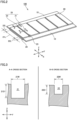
- Fig. 2 is a schematic view illustrating an electrode according to the present embodiment.
- Electrode 100 is for a secondary battery.
- the secondary battery is described below.
- Electrode 100 may be a positive electrode, or may be a negative electrode, or may be a bipolar electrode.
- Electrode 100 is in sheet form.
- Electrode 100 includes a substrate 10 and an active material layer 20.
- Substrate 10 is a support for active material layer 20.
- Substrate 10 may be in sheet form, or may be in mesh form, for example.
- Substrate 10 may have a belt-like planar shape, for example.
- Substrate 10 may be electrically conductive.
- the substrate may function as a current collector.
- Part of substrate 10 may be exposed from active material layer 20.
- a current-collecting member and/or the like may be bonded, for example.
- Substrate 10 may have any thickness. Substrate 10 may have a thickness from 5 to 50 ⁇ m, or may have a thickness from 5 to 20 ⁇ m, for example.
- Substrate 10 may include a metal foil and/or the like, for example.
- Substrate 10 may include at least one selected from the group consisting of an aluminum (Al) foil, an Al alloy foil, a copper (Cu) foil, a Cu alloy foil, a nickel (Ni) foil, a Ni alloy foil, a titanium (Ti) foil, and a Ti alloy foil, for example.
- Al aluminum
- Cu copper
- Cu copper
- Cu copper
- Cu copper
- Cu copper
- Cu copper
- Ni copper
- Ni nickel
- Ti Ni alloy foil
- Ti titanium foil
- Ti titanium
- Active material layer 20 is placed on a surface of substrate 10. Active material layer 20 may be placed on only one side, or on both sides, of substrate 10. Active material layer 20 may have any thickness. Active material layer 20 may have a thickness from 5 to 1000 ⁇ m, or may have a thickness from 10 to 500 ⁇ m, or may have a thickness from 50 to 250 ⁇ m, for example.
- grooves 25 are formed in a surface of active material layer 20, in a surface of active material layer 20, one or more grooves 25 (depressed portions) are formed.
- Groove 25 may be formed by embossing and/or the like, for example.
- a single groove 25 may be formed, or a plurality of grooves 25 may be formed.
- the plurality of grooves 25 may be formed as parallel lines, or may be formed in a grid pattern, for example.
- the "parallel lines” refer to a group of lines that are parallel to each other.
- the pitch (the interval) between adjacent grooves 25 may be from 0.1 to 10 mm, for example.
- Groove 25 may have a length from 1 to 5000 mm, or may have a length from 1 to 1000 mm, for example.
- Groove 25 extends in a direction perpendicular to a thickness direction of active material layer 20 (namely, to the Z-axis direction).
- the extending direction (the X-axis direction) in Fig. 2 is an example thereof. As long as it is perpendicular to the thickness direction, the extending direction may be not limited.
- Groove 25 extends linearly. Groove 25 may be a straight line, or may be bent, or may be curved, or may be wavy, for example. Groove 25 may be an unbranched line, or may be a branched line. A plurality of grooves 25 may merge together.
- Groove 25 may run across the surface of active material layer 20, for example.
- Groove 25 has an open portion 23 on a periphery of active material layer 20. Open portion 23 opens in the direction perpendicular to the thickness direction (in the X-axis direction in Fig. 2 ). In other words, groove 25 opens in a side wall of active material layer 20. The side wall of active material layer 20 may be inclined. Open portion 23 may serve as an inlet/outlet for an electrolyte solution.
- Groove 25 may have a plurality of open portions 23. For example, a single groove 25 may branch into multiple grooves to form a plurality of open portions 23.
- Groove 25 includes a first region 21 and a second region 22.
- First region 21 may also be called “a main groove portion", “a central portion”, and/or the like, for example.
- Second region 22 may also be called “a narrow portion”, “a sub-groove portion”, “an end portion”, and/or the like, for example.
- First region 21 is connected to second region 22.
- Second region 22 is interposed between open portion 23 and first region 21.
- Second region 22 may be provided on only one side of first region 21, or may be provided on both sides of first region 21.
- groove 25 may include two second regions 22.
- First region 21 may be interposed between two second regions 22.
- Second region 22 may be connected to open portion 23. Second region 22 may be located apart from open portion 23.
- First region 21 has a first length 21L.
- Second region 22 has a second length 22L.
- Second length 22L may be shorter than first length 21L.
- the ratio of second length 22L to first length 21L may be from 0.01 to 0.5, or may be from 0.05 to 0.5, or may be from 0.1 to 0.3, for example.
- Fig. 3 is schematic cross-sectional views of an example of a first region and an example of a second region.
- FIG. 3 Illustrated in Fig. 3 are the A-A cross section in Fig. 2 and the B-B cross section in Fig. 2 .
- Each cross section is perpendicular to the extending direction of groove 25.
- First region 21 and second region 22, independently, may have any cross-sectional profile.
- the bottom face of each of these regions may be flat.
- the bottom face of each of these regions may be not flat.
- a side wall of each of these regions may be perpendicular to the surface of active material layer 20.
- a side wall of each of these regions may be inclined.
- the cross-sectional profile of each of these regions may be rectangular, or may be U-shaped, or may be V-shaped, for example.
- First region 21 has a first cross-sectional area.
- Second region 22 has a second cross-sectional area.
- the second cross-sectional area is smaller than the first cross-sectional area.
- second region 22 is capable of functioning as a weir for the electrolyte solution.
- the ratio of the second cross-sectional area to the first cross-sectional area may be from 0.1 to 0.9, or may be from 0.3 to 0.7.
- one or more other grooves having a uniform cross-sectional area may be further formed in the surface of active material layer 20.
- its cross-sectional area may not change, or may change.
- the depth of groove 25 may continuously change in a slope manner.
- the width of groove 25 may continuously change in a tapered manner.
- first region 21 and second region 22 there may be a difference in level between first region 21 and second region 22.
- the cross-sectional area of groove 25 may change stepwise between first region 21 and second region 22.
- first region 21 and second region 22 there may be no difference in level between first region 21 and second region 22.
- the cross-sectional area of groove 25 may change continuously between first region 21 and second region 22.
- groove 25 may extend in a tapered shape. In other words, groove 25 may become narrower toward open portion 23.
- groove 25 may extend in a tapered shape. In other words, groove 25 may become shallower toward open portion 23.
- first region 21 having the first cross-sectional area and second region 22 having the second cross-sectional area are present.
- First region 21 may have a first depth 21D.
- Second region 22 may have a second depth 22D.
- Second depth 22D may be smaller than first depth 21D.
- the ratio of second depth 22D to first depth 21D may be from 0.1 to 0.9, or may be from 0.3 to 0.7, for example.
- First depth 21D may be from 10 to 400 ⁇ m, or may be from 50 to 300 ⁇ m, or may be from 50 to 200 ⁇ m, or may be from 50 to 150 ⁇ m, for example. When the depth is not uniform in the target region, the depth at the deepest point is regarded as the depth of the target region.
- First region 21 may have a first width 21W.
- Second region 22 may have a second width 22W.
- Second width 22W may be smaller than first width 21W.
- the ratio of second width 22W to first width 21W may be from 0.1 to 0.9, or may be from 0.3 to 0.7, for example.
- First width 21W may be from 10 to 500 ⁇ m, or may be from 50 to 300 ⁇ m, or may be from 50 to 200 ⁇ m, or may be from 50 to 150 ⁇ m, for example.
- the width is perpendicular to the depth. When the width is not uniform in the target region, the largest width of the target region is regarded as the width of the target region.
- each of " ⁇ P con , ⁇ P exp , ⁇ P' con , ⁇ P' exp " represents pressure loss.
- ⁇ P exp - ⁇ P con represents the amount of change in pressure loss due to charge and discharge on the assumption that groove 25 consists of first region 21.
- ⁇ P' exp - ⁇ P' con represents the amount of change in pressure loss due to charge and discharge when groove 25 includes first region 21 and second region 22.
- the left side of Expression 6 may be 6.4 or more, or may be 19 or more, for example.
- the left side of Expression 6 may be from 5.5 to 19, or may be from 6.4 to 19, or may be from 5.5 to 6.4, for example.
- di may be first depth 21D, or may be first width 21W, for example.
- d 2 may be second depth 22D, or may be second width 22W, for example.
- Active material layer 20 includes an active material.
- active material layer 20 may further include a binder, a conductive material, and/or the like.
- active material layer 20 may be formed by applying a slurry to a surface of substrate 10 in a layered manner.
- active material layer 20 may be formed by shaping a wet powdery and granular material into a sheet form.
- the active material may be in particle form, for example.
- the active material may have a D50 from 1 to 30 ⁇ m, for example.
- the active material may include a positive electrode active material, for example.
- the positive electrode active material is capable of occluding and releasing lithium ions at an electric potential higher than that of the negative electrode active material.
- the positive electrode active material may include an optional component.
- the positive electrode active material may include, for example, at least one selected from the group consisting of LiCoO 2 , LiNiO 2 , LiMnO 2 , LiMn 2 O 4 , Li(NiCoMn)O 2 , Li(NiCoAl)O 2 , and LiFePO 4 .
- (NiCoMn)" in “Li(NiCoMn)O 2 means that the constituents within the parentheses are collectively regarded as a single unit in the entire composition ratio. As long as (NiCoMn) is collectively regarded as a single unit in the entire composition ratio, the amounts of individual constituents are not particularly limited.
- Li(NiCoMn)O 2 may include Li(Ni 1/3 Co 1/3 Mn 1/3 )O 2 , Li(Ni 0.5 Co 0.2 Mn 0.3 )O 2 , Li(Ni 0.8 Co 0.1 Mn 0.1 )O 2 , and/or the like, for example.
- the active material may include a negative electrode active material, for example.
- the negative electrode active material is capable of occluding and releasing lithium ions at an electric potential lower than that of the positive electrode active material.
- the negative electrode active material may include an optional component.
- the negative electrode active material may include, for example, at least one selected from the group consisting of graphite, soft carbon, hard carbon, silicon, silicon oxide, silicon-based alloy, tin, tin oxide, tin-based alloy, and Li 4 Ti 5 O 12 .
- the conductive material is capable of forming an electron conduction path.
- the amount of the conductive material to be used may be, for example, from 0.1 to 10 parts by mass relative to 100 parts by mass of the active material.
- the conductive material may include an optional component.
- the conductive material may include, for example, at least one selected from the group consisting of carbon black, vapor grown carbon fiber, carbon nanotube, and graphene flake.
- the binder is capable of bonding the solid materials to each other.
- the amount of the binder to be used may be, for example, from 0.1 to 10 parts by mass relative to 100 parts by mass of the active material.
- the binder may include an optional component.
- the binder may include, for example, at least one selected from the group consisting of polyvinylidene difluoride (PVDF), polytetrafluoroethylene (PTFE), vinylidene difluoride-hexafluoropropylene copolymer (PVDF-HFP), styrenebutadiene rubber (SBR), carboxymethylcellulose (CMC), polyimide (PI), polyamideimide (PAI), and polyacrylic acid (PAA).
- PVDF polyvinylidene difluoride
- PTFE polytetrafluoroethylene
- PVDF-HFP vinylidene difluoride-hexafluoropropylene copolymer
- SBR styrenebuta
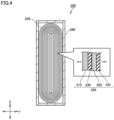
- Fig. 4 is a schematic cross-sectional view illustrating a secondary battery according to the present embodiment.
- a battery 200 includes a casing 260.
- Casing 260 may be hermetically sealed.
- Casing 260 may have any form.
- Casing 260 may be a pouch made of a metal-foil-laminated film, and/or the like, for example.
- Casing 260 may be a metal vessel and/or the like, for example.
- Casing 260 may be prismatic, or may be cylindrical, for example.
- Casing 260 may include Al and/or the like, for example.
- Casing 260 includes an electrode group 250 and an electrolyte solution (not illustrated).
- the electrolyte solution permeates electrode group 250. Part of the electrolyte solution may remain in the bottom of casing 260.
- Electrode group 250 may have any form. In Fig. 4 , a wound-type electrode group 250 is illustrated as an example. Electrode group 250 may be a stack-type one, for example. Electrode group 250 includes a positive electrode 210 and a negative electrode 220. Electrode group 250 may further include a separator 230. At least one of positive electrode 210 and negative electrode 220 is the above-described electrode 100. That is, battery 200 includes electrode 100 and the electrolyte solution.
- Separator 230 may be interposed between positive electrode 210 and negative electrode 220. Separator 230 is electrically insulating. Separator 230 is porous. Separator 230 may be made of polyolefin and/or the like, for example.
- the electrolyte solution is a liquid electrolyte.
- the electrolyte solution may have a density from 500 to 2000 kg/cm 3 , for example.
- the electrolyte solution includes a lithium salt and a solvent.
- the electrolyte solution may further include an optional additive.
- the lithium salt is dissolved in the solvent.
- the lithium salt may include, for example, at least one selected from the group consisting of LiPF 6 , LiBF 4 , and Li(FSO 2 ) 2 N.
- the concentration of the lithium salt may be from 0.5 to 2 mol/L, for example.
- the solvent may include an optional component.
- the solvent may include, for example, at least one selected from the group consisting of ethylene carbonate (EC), propylene carbonate (PC), butylene carbonate (BC), ethyl methyl carbonate (EMC), dimethyl carbonate (DMC), and diethyl carbonate (DEC).
- the additive may include, for example, at least one selected from the group consisting of vinylene carbonate (VC), vinylethylene carbonate (VEC), 1,3-propane sultone (PS), cyclohexylbenzene (CHB), tert-amylbenzene (TAB), and lithium bis(oxalato)borate (LiBOB).
- Test electrodes Nos. 1-1, 1-2, 2-1, 2-2, 2-3 were produced (see Table 1 below). Each test electrode was a negative electrode. Each test electrode included an active material layer. The active material included graphite. " ⁇ " was 0.9.
- Fig. 5 presents top views of a groove of the test electrodes.
- the groove according to Nos. 1-1, 2-1 does not include a second region.
- the groove according to Nos. 1-1, 2-1 consists of a first region. That is, the groove according to Nos. 1-1, 2-1 has a uniform cross-sectional area.
- the groove according to Nos. 1-2, 2-2, 2-3 includes a first region and a second region.
- the cross-sectional area of the second region is smaller than that of the first region. In the present example, the cross-sectional area of each region was adjusted by changing the width of the region.
- Nos. 1-1, 2-1 do not include a second region, but for the sake of convenience, cells for "Second region Length” and the like are filled with numerical values.
- cells for "Second region Width" and the like for Nos. 1-1, 2-1 are filled with the same numerical values as for the first region.
- An electrolyte solution was prepared.
- the density (p) of the electrolyte solution was 1300 kg/m 3 .
- the test electrode was subjected to an electrolyte solution permeation test. Time required for permeation of the electrolyte solution (permeation time) was divided by the number of grooves, and thereby permeation time per groove was determined.
- test electrode with a second region required less permeation time than a test electrode without a second region (No. 1-1). It seems that the second region facilitated permeation of the electrolyte solution.
- test electrode with a second region (Nos. 2-2, 2-3) required less permeation time than a test electrode without a second region (No. 2-1). It seems that the second region facilitated permeation of the electrolyte solution.
- present embodiment and the present example are illustrative in any respect.
- present embodiment and the present example are non-restrictive.
- technical scope of the present disclosure encompasses any modifications within the meaning and the scope equivalent to the terms of the claims. For example, it is expected that certain configurations of the present embodiments and the present examples can be optionally combined.
Landscapes
- Chemical & Material Sciences (AREA)
- Engineering & Computer Science (AREA)
- Chemical Kinetics & Catalysis (AREA)
- Electrochemistry (AREA)
- General Chemical & Material Sciences (AREA)
- Manufacturing & Machinery (AREA)
- Materials Engineering (AREA)
- Battery Electrode And Active Subsutance (AREA)
- Secondary Cells (AREA)
Abstract
An electrode for a secondary battery includes a substrate and an active material layer. The active material layer is placed on a surface of the substrate. In a surface of the active material layer, one or more grooves are formed. The groove extends linearly in a direction perpendicular to a thickness direction of the active material layer. The groove has an open portion on a periphery of the active material layer. The open portion opens in the direction perpendicular to the thickness direction. The groove includes a first region and a second region. The second region is interposed between the open portion and the first region. In a cross section perpendicular to a direction in which the groove extends, the first region has a first cross-sectional area, and the second region has a second cross-sectional area. The second cross-sectional area is smaller than the first cross-sectional area.
Description
- This nonprovisional application is based on
Japanese Patent Application No. 2021-153017 filed on September 21, 2021 - The present disclosure relates to an electrode for a secondary battery and a secondary battery.
-
Japanese Patent Laying-Open No. 2021-009846 - A "secondary battery" refers to a battery capable of charge and discharge. Hereinafter, a secondary battery may be simply called "a battery". Generally, a battery includes an electrode and an electrolyte solution. The electrode includes an active material layer. The active material layer is porous. The electrolyte solution permeates the active material layer.
- When permeation of the electrolyte solution into the active material layer is insufficient, inconvenient phenomena such as a decrease in cycling performance, for example, are expected to occur. To address this problem, a groove (a linear depressed portion) may be formed in a surface of the active material layer, for example. The groove may serve as a channel for an electrolyte solution. Forming the groove is expected to facilitate permeation of the electrolyte solution.
- The active material layer expands and shrinks due to charge and discharge. While the active material layer expands, the electrolyte solution is ejected from the active material layer. With a groove formed in the active material layer, ejection of the electrolyte solution may be facilitated. If ejection of the electrolyte solution is facilitated, the electrolyte solution in the active material layer may become exhausted. As a result, cycling performance may decrease, contrary to the original intention.
- An object of the present disclosure is to provide an electrode which enables easy permeation of an electrolyte solution but does not enable easy ejection thereof.
- Hereinafter, the technical configuration and effects of the present disclosure will be described. It should be noted that the action mechanism according to the present specification includes presumption. The action mechanism does not limit the technical scope of the present disclosure.
- 1. An electrode for a secondary battery includes a substrate and an active material layer. The active material layer is placed on a surface of the substrate. In a surface of the active material layer, one or more grooves are formed. The groove extends linearly in a direction perpendicular to a thickness direction of the active material layer. The groove has an open portion on a periphery of the active material layer. The open portion opens in the direction perpendicular to the thickness direction.
- The groove includes a first region and a second region. The second region is interposed between the open portion and the first region. In a cross section perpendicular to a direction in which the groove extends, the first region has a first cross-sectional area, and the second region has a second cross-sectional area. The second cross-sectional area is smaller than the first cross-sectional area.
- The groove extends linearly on a surface of the active material layer. The groove opens at a periphery of the active material layer. The open portion of the groove serves as an inlet/outlet for an electrolyte solution. Hereinafter, the direction in which the groove extends is also called "an extending direction". The cross-sectional area of the groove refers to the area of a cross section perpendicular to the extending direction. Conventionally, the cross-sectional area of the groove does not change. In the present disclosure, the cross-sectional area of the groove does change. That is, the groove includes a first region and a second region. The second region is closer to the open portion (an inlet/outlet) than the first region is. The cross-sectional area of the second region is smaller than the cross-sectional area of the first region. The second region may function as a weir or a check valve.
- The groove is a channel for an electrolyte solution. When the electrolyte solution passes through the groove, pressure loss occurs. The groove can be regarded as a pipe to allow for estimating the pressure loss.
-
Fig. 1 is a view for describing pressure loss. - In the graphs in
Fig. 1 , the vertical axis represents pressure loss, and the horizontal axis represents the pipe diameter. The pipe diameter may be regarded as the square root of the cross-sectional area of the groove. For the sake of convenience, the square root of the cross-sectional area of the groove may also be called "the groove diameter". The curve in the graph is derived by the Darcy-Weisbach equation "ΔP = λLρU2/(2d)", where "ΔP" represents pressure loss, "λ" represents the pipe friction factor, "L" represents the groove length, "p" represents the electrolyte solution density, "U" represents the average flow speed, and "d" represents the groove diameter. - When the active material layer expands, the groove shrinks. The pressure loss during expansion of the active material layer (during shrinkage of the groove) is "ΔPexp". When the active material layer shrinks, the groove enlarges. The pressure loss during shrinkage of the active material layer (during enlargement of the groove) is "ΔPcon". "ε" is the ratio of the volume of the active material layer during a shrunk period (during a discharged period) to the volume of the active material layer during an expanded period (during a charged period), "ε" may change depending on, for example, the type of an active material. For example, "ε = 0.9" may be satisfied. As the volume of the active material layer changes due to charge and discharge, the pressure loss of the groove also changes. During expansion of the active material layer (during shrinkage of the groove), pressure loss increases. During shrinkage of the active material layer (during enlargement of the groove), pressure loss decreases. The amount of change in pressure loss due to charge and discharge is "ΔPexp - ΔPcon".
- When the groove includes a first region and a second region, the pressure loss during expansion of the active material layer (during shrinkage of the groove) is "ΔP'exp", and the pressure loss during shrinkage of the active material layer (during enlargement of the groove) is "ΔP'con" "ΔP'exp" and "ΔPcon" are determined by assigning the length of the first region into "Li", the diameter of the first region into "di", the average flow speed of the first region into "Ui", the length of the second region into "L2", the diameter of the second region into "d2", and the average flow speed of the second region into "U2". In the present disclosure, "d2 < d1" is satisfied. The amount of change in pressure loss due to charge and discharge is "ΔP'exp - ΔP'con".
- When the second region with a smaller cross-sectional area is present, the amount of change in pressure loss due to charge and discharge, "ΔP'exp - ΔP'con", may increase significantly. According to a novel finding of the present disclosure, the greater the amount of change in pressure loss due to charge and discharge is, the more inhibited the ejection of the electrolyte solution tends to be during expansion of the active material layer.
- Further, during shrinkage of the active material layer, the electrolyte solution may be sucked through the open portion into the active material layer. While the electrolyte solution is being sucked, the presence of the second region with a smaller cross-sectional area may significantly facilitate permeation of the electrolyte solution. It seems to be attributed to capillary action.
- As a result of the above actions working synergistically, in the present disclosure, it is possible to provide an electrode which enables easy permeation of an electrolyte solution but does not enable easy ejection thereof.
- 2. In the cross section perpendicular to a direction in which the groove extends, the first region may have a first depth, and the second region may have a second depth. The second depth may be smaller than the first depth.
- For example, the depth of each region may be changed so as to adjust the cross-sectional area of the region.
- 3. In the cross section perpendicular to a direction in which the groove extends, the first region may have a first width, and the second region may have a second width. The second width may be smaller than the first width.
- For example, the width of each region may be changed so as to adjust the cross-sectional area of the region.
- 4. The groove may include two second regions. The first region may be interposed between the two second regions.
- For example, the second region may be connected to both ends of the first region. When the second region is connected to both ends of the first region, nonuniform distribution of the electrolyte solution in a planar direction is expected to be reduced, for example.
- 5. The second region may be connected to the open portion.
- When the second region is directly connected to the inlet/outlet, the function as a weir is expected to be enhanced.
- 6. The following
Expressions 1 to 5 may be satisfied:


- "λ1" represents a pipe friction factor in the first region,
- "λ2" represents a pipe friction factor in the second region,
- "Li" represents a length of the first region in the direction in which the groove extends,
- "L2" represents a length of the second region in the direction in which the groove extends,
- "U1" represents an average flow speed in the first region,
- "U2" represents an average flow speed in the second region,
- "d1" represents a square root of the first cross-sectional area,
- "d2" represents a square root of the second cross-sectional area, and
- "ε" represents a ratio of a volume of the active material layer during a discharged period to a volume of the active material layer during a charged period.
- When the
above Expression 1 is satisfied, it is expected that permeation of the electrolyte solution is facilitated and ejection of the electrolyte solution is inhibited. - The
above Expressions 2 to 5 are derived by the Darcy-Weisbach equation. Usually, the Darcy-Weisbach equation includes "fluid density (p)" (seeFig. 1 ). However, fluid density can be cancelled in the division in theabove Expression 1, so in theabove Expressions 2 to 5, "fluid density (p)" is omitted. - 7. The following Expression 6 may be further satisfied:

- When the above Expression 6 is satisfied, it is expected that permeation of the electrolyte solution is further facilitated and ejection of the electrolyte solution is further inhibited.
- 8. A secondary battery includes the electrode according to the
above items 1 to 7 and an electrolyte solution. - The battery may exhibit an excellent cycling performance, for example. It may be because the electrolyte solution easily permeates into the electrode and the electrolyte solution is not easily ejected from the electrode.
- The foregoing and other objects, features, aspects and advantages of the present disclosure will become more apparent from the following detailed description of the present disclosure when taken in conjunction with the accompanying drawings.
-
-
Fig. 1 is a view for describing pressure loss. -
Fig. 2 is a schematic view illustrating an electrode according to the present embodiment. -
Fig. 3 is schematic cross-sectional views of an example of a first region and an example of a second region. -
Fig. 4 is a schematic cross-sectional view illustrating a secondary battery according to the present embodiment. -
Fig. 5 presents top views of a groove of test electrodes. - Next, an embodiment of the present disclosure (which may also be simply called "the present embodiment") and an example of the present disclosure (which may also be simply called "the present example") will be described. It should be noted that neither the present embodiment nor the present example limits the technical scope of the present disclosure.
- Herein, expressions such as "comprise", "include", and "have", and other similar expressions (such as "be composed of", for example) are open-ended expressions. In an open-ended expression, in addition to an essential component, an additional component may or may not be further included. The expression "consist of" is a closed-end expression. However, even when a closed-end expression is used, impurities present under ordinary circumstances as well as an additional element irrelevant to the technique according to the present disclosure are not excluded. The expression "consist essentially of" is a semiclosed-end expression. A semiclosed-end expression tolerates addition of an element that does not substantially affect the fundamental, novel features of the technique according to the present disclosure.
- Herein, a singular form also includes its plural meaning, unless otherwise specified.
- Herein, expressions such as "may" and "can" are not intended to mean "must" (obligation) but rather mean "there is a possibility" (tolerance).
- Herein, any geometric term (such as "parallel", "vertical", and "perpendicular", for example) should not be interpreted solely in its exact meaning. For example, "parallel" may mean a geometric state that is deviated, to some extent, from exact "parallel". Any geometric term herein may include tolerances and/or errors in terms of design, operation, production, and/or the like. The dimensional relationship in each figure may not necessarily coincide with the actual dimensional relationship. The dimensional relationship (in length, width, thickness, and the like) in each figure may have been changed for the purpose of assisting the understanding of the technique according to the present disclosure. Further, a part of a configuration may have been omitted.
- Herein, a numerical range, such as "from m to n%", for example, includes both the upper limit and the lower limit, unless otherwise specified. That is, "from m to n%" means a numerical range of "not less than m% and not more than n%". "Not less than m% and not more than n%" includes "more than m% and less than n%". Moreover, any numerical value selected from a certain numerical range may be used as a new upper limit or a new lower limit. For example, any numerical value from a certain numerical range may be combined with any numerical value described in another location of the present specification or in a table or a drawing to set a new numerical range.
- Herein, all numerical values are regarded as being modified by the term "about". The term "about" may mean ±5%, ±3%, ±1%, and/or the like, for example. Each numerical value may be an approximate value that can vary depending on the implementation configuration of the technique according to the present disclosure. Each numerical value may be expressed in significant figures. Each measured value may be the average value obtained from multiple measurements performed. The number of measurements may be 3 or more, or may be 5 or more, or may be 10 or more. Generally, the greater the number of measurements is, the more reliable the average value is expected to be. Each measured value may be rounded off based on the number of the significant figures. Each measured value may include an error occurring due to an identification limit of the measurement apparatus, for example.
- Herein, "D50" is defined as a particle size in volume-based particle size distribution at which cumulative frequency of particle sizes accumulated from the small size side reaches 50%. The volume-based particle size distribution may be obtained by measurement with a laser-diffraction particle size distribution analyzer.
- Herein, when a compound is represented by a stoichiometric composition formula such as "LiCoO2", for example, this stoichiometric composition formula is merely a typical example. Alternatively, the composition ratio may be non-stoichiometric. For example, when lithium cobalt oxide is represented as "LiCoO2", the composition ratio of lithium cobalt oxide is not limited to "Li/Co/O = 1/1/2" but Li, Co, and O may be included in any composition ratio, unless otherwise specified. Further, doping with a trace element and/or substitution may also be tolerated.
- In the present specification, "a lithium-ion battery" is described. However, a lithium-ion battery is merely an example of a secondary battery. The present embodiment may be applied to any secondary battery.
- "SOC (state of charge)" herein refers to the percentage of the charged capacity of an electrode at a point in time in question relative to the full charge capacity of the electrode.
-
Fig. 2 is a schematic view illustrating an electrode according to the present embodiment. - An
electrode 100 is for a secondary battery. The secondary battery is described below.Electrode 100 may be a positive electrode, or may be a negative electrode, or may be a bipolar electrode.Electrode 100 is in sheet form.Electrode 100 includes asubstrate 10 and anactive material layer 20. -
Substrate 10 is a support foractive material layer 20.Substrate 10 may be in sheet form, or may be in mesh form, for example.Substrate 10 may have a belt-like planar shape, for example.Substrate 10 may be electrically conductive. The substrate may function as a current collector. Part ofsubstrate 10 may be exposed fromactive material layer 20. To the exposed part ofsubstrate 10, a current-collecting member and/or the like may be bonded, for example. -
Substrate 10 may have any thickness.Substrate 10 may have a thickness from 5 to 50 µm, or may have a thickness from 5 to 20 µm, for example. -
Substrate 10 may include a metal foil and/or the like, for example.Substrate 10 may include at least one selected from the group consisting of an aluminum (Al) foil, an Al alloy foil, a copper (Cu) foil, a Cu alloy foil, a nickel (Ni) foil, a Ni alloy foil, a titanium (Ti) foil, and a Ti alloy foil, for example. Whenelectrode 100 is a positive electrode,substrate 10 may include an Al foil and/or the like, for example. Whenelectrode 100 is a negative electrode,substrate 10 may include a Cu foil and/or the like, for example. -
Active material layer 20 is placed on a surface ofsubstrate 10.Active material layer 20 may be placed on only one side, or on both sides, ofsubstrate 10.Active material layer 20 may have any thickness.Active material layer 20 may have a thickness from 5 to 1000 µm, or may have a thickness from 10 to 500 µm, or may have a thickness from 50 to 250 µm, for example. - In a surface of
active material layer 20, one or more grooves 25 (depressed portions) are formed.Groove 25 may be formed by embossing and/or the like, for example. Asingle groove 25 may be formed, or a plurality ofgrooves 25 may be formed. The plurality ofgrooves 25 may be formed as parallel lines, or may be formed in a grid pattern, for example. The "parallel lines" refer to a group of lines that are parallel to each other. When a plurality ofgrooves 25 are formed, the pitch (the interval) betweenadjacent grooves 25 may be from 0.1 to 10 mm, for example.Groove 25 may have a length from 1 to 5000 mm, or may have a length from 1 to 1000 mm, for example. -
Groove 25 extends in a direction perpendicular to a thickness direction of active material layer 20 (namely, to the Z-axis direction). The extending direction (the X-axis direction) inFig. 2 is an example thereof. As long as it is perpendicular to the thickness direction, the extending direction may be not limited.Groove 25 extends linearly.Groove 25 may be a straight line, or may be bent, or may be curved, or may be wavy, for example.Groove 25 may be an unbranched line, or may be a branched line. A plurality ofgrooves 25 may merge together. -
Groove 25 may run across the surface ofactive material layer 20, for example.Groove 25 has anopen portion 23 on a periphery ofactive material layer 20.Open portion 23 opens in the direction perpendicular to the thickness direction (in the X-axis direction inFig. 2 ). In other words, groove 25 opens in a side wall ofactive material layer 20. The side wall ofactive material layer 20 may be inclined.Open portion 23 may serve as an inlet/outlet for an electrolyte solution.Groove 25 may have a plurality ofopen portions 23. For example, asingle groove 25 may branch into multiple grooves to form a plurality ofopen portions 23. -
Groove 25 includes afirst region 21 and asecond region 22.First region 21 may also be called "a main groove portion", "a central portion", and/or the like, for example.Second region 22 may also be called "a narrow portion", "a sub-groove portion", "an end portion", and/or the like, for example.First region 21 is connected tosecond region 22.Second region 22 is interposed betweenopen portion 23 andfirst region 21.Second region 22 may be provided on only one side offirst region 21, or may be provided on both sides offirst region 21. In other words, groove 25 may include twosecond regions 22.First region 21 may be interposed between twosecond regions 22. Whensecond regions 22 are connected to both ends offirst region 21, nonuniform distribution of the electrolyte solution in a planar direction ofactive material layer 20 is expected to be reduced, for example.Second region 22 may be connected to openportion 23.Second region 22 may be located apart fromopen portion 23. -
First region 21 has afirst length 21L.Second region 22 has asecond length 22L.Second length 22L may be shorter thanfirst length 21L. For example, the ratio ofsecond length 22L tofirst length 21L may be from 0.01 to 0.5, or may be from 0.05 to 0.5, or may be from 0.1 to 0.3, for example. -
Fig. 3 is schematic cross-sectional views of an example of a first region and an example of a second region. - Illustrated in
Fig. 3 are the A-A cross section inFig. 2 and the B-B cross section inFig. 2 . Each cross section is perpendicular to the extending direction ofgroove 25.First region 21 andsecond region 22, independently, may have any cross-sectional profile. The bottom face of each of these regions may be flat. The bottom face of each of these regions may be not flat. A side wall of each of these regions may be perpendicular to the surface ofactive material layer 20. A side wall of each of these regions may be inclined. The cross-sectional profile of each of these regions may be rectangular, or may be U-shaped, or may be V-shaped, for example. -
First region 21 has a first cross-sectional area.Second region 22 has a second cross-sectional area. The second cross-sectional area is smaller than the first cross-sectional area. Thus,second region 22 is capable of functioning as a weir for the electrolyte solution. For example, the ratio of the second cross-sectional area to the first cross-sectional area may be from 0.1 to 0.9, or may be from 0.3 to 0.7. - As long as one or
more grooves 25 each includingfirst region 21 andsecond region 22 are formed in the surface ofactive material layer 20, one or more other grooves having a uniform cross-sectional area (not illustrated), for example, may be further formed in the surface ofactive material layer 20. - As for respective regions, its cross-sectional area may not change, or may change. For example, within
first region 21, the depth ofgroove 25 may continuously change in a slope manner. For example, withinsecond region 22, the width ofgroove 25 may continuously change in a tapered manner. - For example, there may be a difference in level between
first region 21 andsecond region 22. In other words, the cross-sectional area ofgroove 25 may change stepwise betweenfirst region 21 andsecond region 22. - For example, there may be no difference in level between
first region 21 andsecond region 22. In other words, the cross-sectional area ofgroove 25 may change continuously betweenfirst region 21 andsecond region 22. For example, in the XY plane inFig. 2 , groove 25 may extend in a tapered shape. In other words, groove 25 may become narrower towardopen portion 23. Alternatively, in the XZ plane inFig. 2 , groove 25 may extend in a tapered shape. In other words, groove 25 may become shallower towardopen portion 23. In the present embodiment, even when there is no difference in level, it is considered thatfirst region 21 having the first cross-sectional area andsecond region 22 having the second cross-sectional area are present. -
First region 21 may have afirst depth 21D.Second region 22 may have asecond depth 22D.Second depth 22D may be smaller thanfirst depth 21D. The ratio ofsecond depth 22D tofirst depth 21D may be from 0.1 to 0.9, or may be from 0.3 to 0.7, for example.First depth 21D may be from 10 to 400 µm, or may be from 50 to 300 µm, or may be from 50 to 200 µm, or may be from 50 to 150 µm, for example. When the depth is not uniform in the target region, the depth at the deepest point is regarded as the depth of the target region. -
First region 21 may have afirst width 21W.Second region 22 may have asecond width 22W.Second width 22W may be smaller thanfirst width 21W. The ratio ofsecond width 22W tofirst width 21W may be from 0.1 to 0.9, or may be from 0.3 to 0.7, for example.First width 21W may be from 10 to 500 µm, or may be from 50 to 300 µm, or may be from 50 to 200 µm, or may be from 50 to 150 µm, for example. The width is perpendicular to the depth. When the width is not uniform in the target region, the largest width of the target region is regarded as the width of the target region. - Regarding
electrode 100, the followingExpressions 1 to 5 may be satisfied:




- "λ1" represents a pipe friction factor in
first region 21, - "λ2" represents a pipe friction factor in
second region 22, - "L1" represents a length of
first region 21 in the extending direction, - "L2" represents a length of
second region 22 in the extending direction, - "U1" represents an average flow speed in
first region 21, - "U2" represents an average flow speed in
second region 22, - "d1" represents a square root of the first cross-sectional area,
- "d2" represents a square root of the second cross-sectional area, and
- "ε" represents a ratio of a volume of
active material layer 20 during a discharged period (during a shrunk period) to a volume ofactive material layer 20 during a charged period (during an expanded period). - In the
above Expressions 1 to 5, each of "ΔPcon, ΔPexp, ΔP'con, ΔP'exp" represents pressure loss. In theabove Expression 1, "ΔPexp - ΔPcon" represents the amount of change in pressure loss due to charge and discharge on the assumption thatgroove 25 consists offirst region 21. In theabove Expression 1, "ΔP'exp - ΔP'con" represents the amount of change in pressure loss due to charge and discharge whengroove 25 includesfirst region 21 andsecond region 22. When the left side of theabove Expression 1 is greater than 1, it is expected that permeation of the electrolyte solution is facilitated and ejection of the electrolyte solution is inhibited. The greater the left side of theabove Expression 1 is, the more facilitated the permeation of the electrolyte solution may be and the more inhibited the ejection of the electrolyte solution may be. For example, the following Expression 6 may be satisfied.
- The left side of Expression 6 may be 6.4 or more, or may be 19 or more, for example. The left side of Expression 6 may be from 5.5 to 19, or may be from 6.4 to 19, or may be from 5.5 to 6.4, for example.
- "di" may be
first depth 21D, or may befirst width 21W, for example. "d2" may besecond depth 22D, or may besecond width 22W, for example. - "During a charged period" refers to a fully charged state (SOC = 100%). "During a discharged period" refers to a fully discharged state (SOC = 0%). "ε" may be from 0.2 to 0.99, for example. "ε" may vary depending on the type of an active material, and/or the like. For example, when the active material includes graphite, "ε = 0.7 to 0.9" may be satisfied. For example, when the active material includes silicon, "ε = 0.25 to 0.9" may be satisfied. For example, when the active material includes silicon oxide, "ε = 0.5 to 0.9" may be satisfied. For example, when the active material includes a positive electrode active material, "ε = 0.9 to 0.99" may be satisfied.
- "U1" and "U2" may be derived by the following Expressions 7, 8:


- "µ" represents the coefficient of viscosity,
- "ΔPlos" represents straight pipe pressure loss, and
- "ΔPcap" represents capillary action pressure.
- "ΔPcap" may be derived by the following Expression 9:

- "d1" or "d2" may be assigned into "d",
- "σ" represents surface tension, and
- "θ" represents contact angle.
- "λ1" and "λ2" may be derived by the following
Expressions 10, 11;

- "ρ" represents the density of the electrolyte solution.
-
Active material layer 20 includes an active material. In addition to the active material,active material layer 20 may further include a binder, a conductive material, and/or the like. For example,active material layer 20 may be formed by applying a slurry to a surface ofsubstrate 10 in a layered manner. For example,active material layer 20 may be formed by shaping a wet powdery and granular material into a sheet form. - The active material may be in particle form, for example. The active material may have a D50 from 1 to 30 µm, for example. The active material may include a positive electrode active material, for example. The positive electrode active material is capable of occluding and releasing lithium ions at an electric potential higher than that of the negative electrode active material. The positive electrode active material may include an optional component. The positive electrode active material may include, for example, at least one selected from the group consisting of LiCoO2, LiNiO2, LiMnO2, LiMn2O4, Li(NiCoMn)O2, Li(NiCoAl)O2, and LiFePO4. "(NiCoMn)" in "Li(NiCoMn)O2", for example, means that the constituents within the parentheses are collectively regarded as a single unit in the entire composition ratio. As long as (NiCoMn) is collectively regarded as a single unit in the entire composition ratio, the amounts of individual constituents are not particularly limited. Li(NiCoMn)O2 may include Li(Ni1/3Co1/3Mn1/3)O2, Li(Ni0.5Co0.2Mn0.3)O2, Li(Ni0.8Co0.1Mn0.1)O2, and/or the like, for example.
- The active material may include a negative electrode active material, for example. The negative electrode active material is capable of occluding and releasing lithium ions at an electric potential lower than that of the positive electrode active material. The negative electrode active material may include an optional component. The negative electrode active material may include, for example, at least one selected from the group consisting of graphite, soft carbon, hard carbon, silicon, silicon oxide, silicon-based alloy, tin, tin oxide, tin-based alloy, and Li4Ti5O12.
- The conductive material is capable of forming an electron conduction path. The amount of the conductive material to be used may be, for example, from 0.1 to 10 parts by mass relative to 100 parts by mass of the active material. The conductive material may include an optional component. The conductive material may include, for example, at least one selected from the group consisting of carbon black, vapor grown carbon fiber, carbon nanotube, and graphene flake.
- The binder is capable of bonding the solid materials to each other. The amount of the binder to be used may be, for example, from 0.1 to 10 parts by mass relative to 100 parts by mass of the active material. The binder may include an optional component. The binder may include, for example, at least one selected from the group consisting of polyvinylidene difluoride (PVDF), polytetrafluoroethylene (PTFE), vinylidene difluoride-hexafluoropropylene copolymer (PVDF-HFP), styrenebutadiene rubber (SBR), carboxymethylcellulose (CMC), polyimide (PI), polyamideimide (PAI), and polyacrylic acid (PAA).
-
Fig. 4 is a schematic cross-sectional view illustrating a secondary battery according to the present embodiment. - A
battery 200 includes acasing 260. Casing 260 may be hermetically sealed. Casing 260 may have any form. Casing 260 may be a pouch made of a metal-foil-laminated film, and/or the like, for example. Casing 260 may be a metal vessel and/or the like, for example. Casing 260 may be prismatic, or may be cylindrical, for example. Casing 260 may include Al and/or the like, for example. - Casing 260 includes an
electrode group 250 and an electrolyte solution (not illustrated). The electrolyte solution permeateselectrode group 250. Part of the electrolyte solution may remain in the bottom ofcasing 260.Electrode group 250 may have any form. InFig. 4 , a wound-type electrode group 250 is illustrated as an example.Electrode group 250 may be a stack-type one, for example.Electrode group 250 includes apositive electrode 210 and anegative electrode 220.Electrode group 250 may further include aseparator 230. At least one ofpositive electrode 210 andnegative electrode 220 is the above-describedelectrode 100. That is,battery 200 includeselectrode 100 and the electrolyte solution. -
Separator 230 may be interposed betweenpositive electrode 210 andnegative electrode 220.Separator 230 is electrically insulating.Separator 230 is porous.Separator 230 may be made of polyolefin and/or the like, for example. - The electrolyte solution is a liquid electrolyte. The electrolyte solution may have a density from 500 to 2000 kg/cm3, for example. The electrolyte solution includes a lithium salt and a solvent. The electrolyte solution may further include an optional additive. The lithium salt is dissolved in the solvent. The lithium salt may include, for example, at least one selected from the group consisting of LiPF6, LiBF4, and Li(FSO2)2N. The concentration of the lithium salt may be from 0.5 to 2 mol/L, for example. The solvent may include an optional component. The solvent may include, for example, at least one selected from the group consisting of ethylene carbonate (EC), propylene carbonate (PC), butylene carbonate (BC), ethyl methyl carbonate (EMC), dimethyl carbonate (DMC), and diethyl carbonate (DEC). The additive may include, for example, at least one selected from the group consisting of vinylene carbonate (VC), vinylethylene carbonate (VEC), 1,3-propane sultone (PS), cyclohexylbenzene (CHB), tert-amylbenzene (TAB), and lithium bis(oxalato)borate (LiBOB).
- Next, the present example is described.
- Test electrodes Nos. 1-1, 1-2, 2-1, 2-2, 2-3 were produced (see Table 1 below). Each test electrode was a negative electrode. Each test electrode included an active material layer. The active material included graphite. "ε" was 0.9.
-
Fig. 5 presents top views of a groove of the test electrodes. - In the surface of the active material layer, a plurality of grooves as illustrated in
Fig. 5 were formed. The groove according to Nos. 1-1, 2-1 does not include a second region. The groove according to Nos. 1-1, 2-1 consists of a first region. That is, the groove according to Nos. 1-1, 2-1 has a uniform cross-sectional area. The groove according to Nos. 1-2, 2-2, 2-3 includes a first region and a second region. The cross-sectional area of the second region is smaller than that of the first region. In the present example, the cross-sectional area of each region was adjusted by changing the width of the region. - The dimensions and the like of each region are given in Table 1 below. Nos. 1-1, 2-1 do not include a second region, but for the sake of convenience, cells for "Second region Length" and the like are filled with numerical values. For the sake of convenience, cells for "Second region Width" and the like for Nos. 1-1, 2-1 are filled with the same numerical values as for the first region.
- An electrolyte solution was prepared. The density (p) of the electrolyte solution was 1300 kg/m3. The test electrode was subjected to an electrolyte solution permeation test. Time required for permeation of the electrolyte solution (permeation time) was divided by the number of grooves, and thereby permeation time per groove was determined.
-
Table 1 No. 1-1 No. 1-2 No. 2-1 No. 2-2 No. 2-3 First region Length L1 (mm) 8 8 320 320 320 Second region Length L2 (mm) 2 2 80 80 80 First region Width d1 (µm) 100 100 100 100 100 Second region Width d2 (µm) 100 50 100 50 50 First region Friction coefficient λ1 (-) 1.23 1.23 1.23 1.23 1.23 Second region Friction coefficient λ2 (-) 1.23 2.45 1.23 2.45 2.45 First region Average flow speed U1 (m/s) 4. 02∗10-3 5. 02∗10-3 1. 00∗10-1 1. 26∗10-4 1. 26∗10-4 Second region Average flow speed U2 (m/s) 4. 02∗10-3 1. 00∗10-2 1. 00∗10-4 2.51∗10-4 5. 02∗10-4 ΔPcon=λ1(L1+L2)ρU1 2/(2d1) (Pa) -1.29 -1.29 -0.032 -0.032 -0.032 ΔPexp=λ1(L1+L2)ρU1 2/(2εd1) (Pa) -1.43 -1.43 -0.036 -0.036 -0.036 ΔP'con=λ1L1ρU1 2/(2d1)+X2L2ρU2 2/(2d2) (Pa) -1.29 -8.03 -0.032 -0.200 -0.683 ΔP'exp=λ1L1ρU1 2/(2εd1)+λ2L2ρU2 2/(2εd2) (Pa) -1.43 -8.92 -0.036 -2.222 -0. 759 (ΔP'exp-ΔP'con) / (ΔPexp-ΔPcon) (-) 1 6.4 1 5.5 19 Electrolyte solution permeation test (Permeation time per groove) (s) 2.49 1.79 4000 2858 2698 ε=0.9
ρ =1300 kg/m3 - A test electrode with a second region (No. 1-2) required less permeation time than a test electrode without a second region (No. 1-1). It seems that the second region facilitated permeation of the electrolyte solution.
- A test electrode with a second region (Nos. 2-2, 2-3) required less permeation time than a test electrode without a second region (No. 2-1). It seems that the second region facilitated permeation of the electrolyte solution.
- The greater the value "(ΔP'exp - ΔP'con)/(ΔPexp - ΔPcon)" is, the more reduced the permeation time tends to be.
- The present embodiment and the present example are illustrative in any respect. The present embodiment and the present example are non-restrictive. The technical scope of the present disclosure encompasses any modifications within the meaning and the scope equivalent to the terms of the claims. For example, it is expected that certain configurations of the present embodiments and the present examples can be optionally combined.
Claims (8)
- An electrode for a secondary battery, comprising:a substrate (10); andan active material layer (20), whereinthe active material layer (20) is placed on a surface of the substrate (10),one or more grooves (25) are formed in a surface of the active material layer (20),the groove (25) extends linearly in a direction perpendicular to a thickness direction of the active material layer (20),the groove (25) has an open portion (23) on a periphery of the active material layer (20),the open portion (23) opens in the direction perpendicular to the thickness direction,the groove (25) includes a first region (21) and a second region (22),the second region (22) is interposed between the open portion (23) and the first region (21), andin a cross section perpendicular to a direction in which the groove (25) extends,the first region (21) has a first cross-sectional area,the second region (22) has a second cross-sectional area, andthe second cross-sectional area is smaller than the first cross-sectional area.
- The electrode for a secondary battery according to claim 1, wherein
in the cross section perpendicular to a direction in which the groove (25) extends,the first region (21) has a first depth (21D),the second region (22) has a second depth (22D), andthe second depth (22D) is smaller than the first depth (21D). - The electrode for a secondary battery according to claim 1 or 2, wherein
in the cross section perpendicular to a direction in which the groove (25) extends,the first region (21) has a first width (21W),the second region (22) has a second width (22W), andthe second width (22W) is smaller than the first width (21W). - The electrode for a secondary battery according to any one of claims 1 to 3, whereinthe groove (25) includes two second regions (22), andthe first region (21) is interposed between the two second regions (22).
- The electrode for a secondary battery according to any one of claims 1 to 4, wherein the second region (22) is connected to the open portion (23).
- The electrode for a secondary battery according to any one of claims 1 to 5, wherein the following Expressions 1 to 5 are satisfied:



 λ1 represents a pipe friction factor in the first region (21),λ2 represents a pipe friction factor in the second region (22),L1 represents a length (21L) of the first region (21) in the direction in which the groove (25) extends,L2 represents a length (22L) of the second region (22) in the direction in which the groove (25) extends,U1 represents an average flow speed in the first region (21),U2 represents an average flow speed in the second region (22),d1 represents a square root of the first cross-sectional area,d2 represents a square root of the second cross-sectional area, andε represents a ratio of a volume of the active material layer (20) during a discharged period to a volume of the active material layer (20) during a charged period.
 - The electrode for a secondary battery according to claim 6, wherein the following Expression 6 is further satisfied:

- A secondary battery comprising:an electrode (100) for a secondary battery according to any one of claims 1 to 7; andan electrolyte solution.
Applications Claiming Priority (1)
| Application Number | Priority Date | Filing Date | Title |
|---|---|---|---|
| JP2021153017A JP7528898B2 (en) | 2021-09-21 | 2021-09-21 | Secondary battery electrode and secondary battery |
Publications (1)
| Publication Number | Publication Date |
|---|---|
| EP4152432A1 true EP4152432A1 (en) | 2023-03-22 |
Family
ID=83361291
Family Applications (1)
| Application Number | Title | Priority Date | Filing Date |
|---|---|---|---|
| EP22196194.9A Pending EP4152432A1 (en) | 2021-09-21 | 2022-09-16 | Electrode for secondary battery and secondary battery |
Country Status (5)
| Country | Link |
|---|---|
| US (2) | US12597592B2 (en) |
| EP (1) | EP4152432A1 (en) |
| JP (1) | JP7528898B2 (en) |
| KR (1) | KR102847467B1 (en) |
| CN (1) | CN115842084B (en) |
Cited By (1)
| Publication number | Priority date | Publication date | Assignee | Title |
|---|---|---|---|---|
| EP4210123A3 (en) * | 2022-01-05 | 2023-10-18 | Toyota Jidosha Kabushiki Kaisha | Electrode and secondary battery |
Families Citing this family (1)
| Publication number | Priority date | Publication date | Assignee | Title |
|---|---|---|---|---|
| CN119234326A (en) * | 2022-05-23 | 2024-12-31 | 株式会社丰田自动织机 | Electrode for lithium ion secondary battery and lithium ion secondary battery |
Citations (5)
| Publication number | Priority date | Publication date | Assignee | Title |
|---|---|---|---|---|
| KR20120049145A (en) * | 2010-11-08 | 2012-05-16 | 닛산 지도우샤 가부시키가이샤 | Electrode, battery and manufacturing method of electrode |
| US20130071552A1 (en) * | 2011-09-20 | 2013-03-21 | Kuniko TERAKI | Battery electrode manufacturing method and battery manufacturing method |
| CN103682249A (en) * | 2012-09-07 | 2014-03-26 | 罗伯特·博世有限公司 | Battery with porous electrode |
| JP2021009846A (en) | 2017-05-24 | 2021-01-28 | エルジー・ケム・リミテッド | Plasma generating device for secondary battery |
| JP2021153017A (en) | 2020-03-24 | 2021-09-30 | 大阪瓦斯株式会社 | Cell-cell connection member, solid oxide fuel cell, sofc monogeneration system, sofc cogeneration system, and manufacturing method of cell-cell connection member |
Family Cites Families (16)
| Publication number | Priority date | Publication date | Assignee | Title |
|---|---|---|---|---|
| DE69830712T2 (en) * | 1997-04-23 | 2005-12-15 | Japan Storage Battery Co. Ltd., Kyoto | ELECTRODE AND BATTERY |
| JP2001035484A (en) | 1999-05-19 | 2001-02-09 | Nec Corp | Nonaqueous electrolyte secondary battery |
| US6444357B1 (en) * | 1999-05-19 | 2002-09-03 | Nec Tokin Corporation | Non-aqueous electrolyte secondary battery |
| JP3745594B2 (en) | 2000-06-29 | 2006-02-15 | 三菱電機株式会社 | Battery and electrode forming apparatus for the battery |
| KR101249133B1 (en) | 2000-10-20 | 2013-04-02 | 매사츄세츠 인스티튜트 오브 테크놀러지 | Bipolar device |
| KR100590100B1 (en) * | 2004-06-23 | 2006-06-14 | 삼성에스디아이 주식회사 | Secondary Battery and Electrode Assembly Used in the Same |
| KR100901048B1 (en) * | 2005-12-28 | 2009-06-04 | 파나소닉 주식회사 | Nonaqueous electrolyte secondary battery |
| JP4359331B2 (en) * | 2007-07-17 | 2009-11-04 | パナソニック株式会社 | Secondary battery and method for manufacturing secondary battery |
| US20140342225A1 (en) | 2011-09-14 | 2014-11-20 | Zeon Corporation | Electrode for electrochemical device |
| JP2013077560A (en) | 2011-09-14 | 2013-04-25 | Nippon Zeon Co Ltd | Method for manufacturing electrode for electrochemical element |
| JP2013134894A (en) | 2011-12-26 | 2013-07-08 | Toyota Industries Corp | Electrode, power storage device, vehicle and method of manufacturing electrode |
| KR101502080B1 (en) * | 2014-04-30 | 2015-03-12 | 한국기계연구원 | Method for producing a stretchable electrode structure for energy storage device, an electrode structure produced by the method and an energy storage device having the electrode structure |
| KR20160024148A (en) * | 2014-08-25 | 2016-03-04 | 주식회사 엘지화학 | Electrode for Secondary Battery Having Fine Slits on Surface thereof |
| US10790535B2 (en) | 2016-12-15 | 2020-09-29 | Nissan Motor Co., Ltd. | Electrode for secondary cell, and secondary cell |
| DE102017114243A1 (en) | 2017-06-27 | 2018-12-27 | Psc Technologies Gmbh | Process for the preparation of silicon carbide-containing fibers and foams and their use |
| JP7204408B2 (en) | 2018-10-10 | 2023-01-16 | 株式会社豊田自動織機 | Bipolar electrodes and alkaline storage batteries |
-
2021
- 2021-09-21 JP JP2021153017A patent/JP7528898B2/en active Active
-
2022
- 2022-09-13 US US17/943,689 patent/US12597592B2/en active Active
- 2022-09-13 KR KR1020220115043A patent/KR102847467B1/en active Active
- 2022-09-16 EP EP22196194.9A patent/EP4152432A1/en active Pending
- 2022-09-20 CN CN202211141902.8A patent/CN115842084B/en active Active
-
2024
- 2024-02-21 US US18/583,541 patent/US12609295B2/en active Active
Patent Citations (5)
| Publication number | Priority date | Publication date | Assignee | Title |
|---|---|---|---|---|
| KR20120049145A (en) * | 2010-11-08 | 2012-05-16 | 닛산 지도우샤 가부시키가이샤 | Electrode, battery and manufacturing method of electrode |
| US20130071552A1 (en) * | 2011-09-20 | 2013-03-21 | Kuniko TERAKI | Battery electrode manufacturing method and battery manufacturing method |
| CN103682249A (en) * | 2012-09-07 | 2014-03-26 | 罗伯特·博世有限公司 | Battery with porous electrode |
| JP2021009846A (en) | 2017-05-24 | 2021-01-28 | エルジー・ケム・リミテッド | Plasma generating device for secondary battery |
| JP2021153017A (en) | 2020-03-24 | 2021-09-30 | 大阪瓦斯株式会社 | Cell-cell connection member, solid oxide fuel cell, sofc monogeneration system, sofc cogeneration system, and manufacturing method of cell-cell connection member |
Cited By (2)
| Publication number | Priority date | Publication date | Assignee | Title |
|---|---|---|---|---|
| EP4210123A3 (en) * | 2022-01-05 | 2023-10-18 | Toyota Jidosha Kabushiki Kaisha | Electrode and secondary battery |
| US12531276B2 (en) | 2022-01-05 | 2026-01-20 | Toyota Jidosha Kabushiki Kaisha | Electrode and secondary battery |
Also Published As
| Publication number | Publication date |
|---|---|
| KR102847467B1 (en) | 2025-08-18 |
| KR20230042568A (en) | 2023-03-28 |
| US20240194851A1 (en) | 2024-06-13 |
| US12597592B2 (en) | 2026-04-07 |
| CN115842084A (en) | 2023-03-24 |
| US12609295B2 (en) | 2026-04-21 |
| JP2023044903A (en) | 2023-04-03 |
| US20230085681A1 (en) | 2023-03-23 |
| JP7528898B2 (en) | 2024-08-06 |
| CN115842084B (en) | 2025-01-28 |
Similar Documents
| Publication | Publication Date | Title |
|---|---|---|
| CN112864546B (en) | Non-aqueous electrolyte secondary battery | |
| EP2854203B1 (en) | Battery | |
| EP3358653B1 (en) | Negative electrode for lithium ion secondary batteries and lithium ion secondary battery | |
| US12609295B2 (en) | Electrode for secondary battery and secondary battery | |
| US20180233772A1 (en) | Lithium ion secondary battery, and method for producing the same and method for evaluating the same | |
| KR102014474B1 (en) | Method for estimating reaction of secondary battery and secondary battery comprising battery cell used for the method | |
| KR101838377B1 (en) | Non-aqueous electrolyte secondary battery and method of manufacturing the same | |
| KR20250160214A (en) | Deterioration state estimation device, deterioration state estimation method, and program | |
| JP2007335143A (en) | Lithium ion secondary battery | |
| EP3131149B1 (en) | Flat-type secondary battery | |
| US20250372616A1 (en) | Positive electrode sheet, secondary battery, and electric device | |
| KR20230022915A (en) | Electrode for a secondary battery with improved rapid charging performance, a method of manufaturing the same and secondary battery comprising the same | |
| EP3131135B1 (en) | Flat secondary battery | |
| WO2015029248A1 (en) | Negative electrode active material-coating material, negative electrode material using same, negative electrode, lithium ion secondary battery, battery system, monomer, and method for synthesizing monomer | |
| KR102496615B1 (en) | Electrode for a secondary battery with improved rapid charging performance, a method of manufaturing the same and secondary battery comprising the same | |
| RU2632182C2 (en) | Secondary battery with nonaqueous electrolyte and method of its manufacture | |
| US20240243357A1 (en) | Method for preparing polymer solid electrolyte and polymer solid electrolyte prepared thereby | |
| EP4210123A2 (en) | Electrode and secondary battery | |
| CN102956868B (en) | Battery design | |
| JP2008010183A (en) | Lithium ion secondary battery | |
| CN116404103B (en) | Electrodes and secondary batteries | |
| EP4723186A1 (en) | Non-aqueous electrolyte secondary battery | |
| EP4723203A1 (en) | Non-aqueous electrolyte secondary battery | |
| EP4586334A1 (en) | Anode for secondary battery and lithium secondary battery including the same | |
| JP2019110091A (en) | Lithium ion secondary battery |
Legal Events
| Date | Code | Title | Description |
|---|---|---|---|
| PUAI | Public reference made under article 153(3) epc to a published international application that has entered the european phase |
Free format text: ORIGINAL CODE: 0009012 |
|
| STAA | Information on the status of an ep patent application or granted ep patent |
Free format text: STATUS: REQUEST FOR EXAMINATION WAS MADE |
|
| 17P | Request for examination filed |
Effective date: 20221002 |
|
| AK | Designated contracting states |
Kind code of ref document: A1 Designated state(s): AL AT BE BG CH CY CZ DE DK EE ES FI FR GB GR HR HU IE IS IT LI LT LU LV MC MK MT NL NO PL PT RO RS SE SI SK SM TR |