EP4151696A1 - Solid heat storage material having regulated thermal conductivity and composite - Google Patents
Solid heat storage material having regulated thermal conductivity and composite Download PDFInfo
- Publication number
- EP4151696A1 EP4151696A1 EP21804325.5A EP21804325A EP4151696A1 EP 4151696 A1 EP4151696 A1 EP 4151696A1 EP 21804325 A EP21804325 A EP 21804325A EP 4151696 A1 EP4151696 A1 EP 4151696A1
- Authority
- EP
- European Patent Office
- Prior art keywords
- vanadium dioxide
- heat storage
- storage material
- copper
- thermally conductive
- Prior art date
- Legal status (The legal status is an assumption and is not a legal conclusion. Google has not performed a legal analysis and makes no representation as to the accuracy of the status listed.)
- Granted
Links
Images




Classifications
-
- F—MECHANICAL ENGINEERING; LIGHTING; HEATING; WEAPONS; BLASTING
- F28—HEAT EXCHANGE IN GENERAL
- F28D—HEAT-EXCHANGE APPARATUS, NOT PROVIDED FOR IN ANOTHER SUBCLASS, IN WHICH THE HEAT-EXCHANGE MEDIA DO NOT COME INTO DIRECT CONTACT
- F28D20/00—Heat storage plants or apparatus in general; Regenerative heat-exchange apparatus not covered by groups F28D17/00 or F28D19/00
- F28D20/02—Heat storage plants or apparatus in general; Regenerative heat-exchange apparatus not covered by groups F28D17/00 or F28D19/00 using latent heat
-
- C—CHEMISTRY; METALLURGY
- C09—DYES; PAINTS; POLISHES; NATURAL RESINS; ADHESIVES; COMPOSITIONS NOT OTHERWISE PROVIDED FOR; APPLICATIONS OF MATERIALS NOT OTHERWISE PROVIDED FOR
- C09K—MATERIALS FOR MISCELLANEOUS APPLICATIONS, NOT PROVIDED FOR ELSEWHERE
- C09K5/00—Heat-transfer, heat-exchange or heat-storage materials, e.g. refrigerants; Materials for the production of heat or cold by chemical reactions other than by combustion
- C09K5/08—Materials not undergoing a change of physical state when used
- C09K5/14—Solid materials, e.g. powdery or granular
-
- H—ELECTRICITY
- H10—SEMICONDUCTOR DEVICES; ELECTRIC SOLID-STATE DEVICES NOT OTHERWISE PROVIDED FOR
- H10W—GENERIC PACKAGES, INTERCONNECTIONS, CONNECTORS OR OTHER CONSTRUCTIONAL DETAILS OF DEVICES COVERED BY CLASS H10
- H10W40/00—Arrangements for thermal protection or thermal control
- H10W40/20—Arrangements for cooling
- H10W40/25—Arrangements for cooling characterised by their materials
- H10W40/255—Arrangements for cooling characterised by their materials having a laminate or multilayered structure, e.g. direct bond copper [DBC] ceramic substrates
-
- H—ELECTRICITY
- H10—SEMICONDUCTOR DEVICES; ELECTRIC SOLID-STATE DEVICES NOT OTHERWISE PROVIDED FOR
- H10W—GENERIC PACKAGES, INTERCONNECTIONS, CONNECTORS OR OTHER CONSTRUCTIONAL DETAILS OF DEVICES COVERED BY CLASS H10
- H10W40/00—Arrangements for thermal protection or thermal control
- H10W40/20—Arrangements for cooling
- H10W40/25—Arrangements for cooling characterised by their materials
- H10W40/258—Metallic materials
-
- F—MECHANICAL ENGINEERING; LIGHTING; HEATING; WEAPONS; BLASTING
- F28—HEAT EXCHANGE IN GENERAL
- F28D—HEAT-EXCHANGE APPARATUS, NOT PROVIDED FOR IN ANOTHER SUBCLASS, IN WHICH THE HEAT-EXCHANGE MEDIA DO NOT COME INTO DIRECT CONTACT
- F28D20/00—Heat storage plants or apparatus in general; Regenerative heat-exchange apparatus not covered by groups F28D17/00 or F28D19/00
- F28D20/0056—Heat storage plants or apparatus in general; Regenerative heat-exchange apparatus not covered by groups F28D17/00 or F28D19/00 using solid heat storage material
-
- Y—GENERAL TAGGING OF NEW TECHNOLOGICAL DEVELOPMENTS; GENERAL TAGGING OF CROSS-SECTIONAL TECHNOLOGIES SPANNING OVER SEVERAL SECTIONS OF THE IPC; TECHNICAL SUBJECTS COVERED BY FORMER USPC CROSS-REFERENCE ART COLLECTIONS [XRACs] AND DIGESTS
- Y02—TECHNOLOGIES OR APPLICATIONS FOR MITIGATION OR ADAPTATION AGAINST CLIMATE CHANGE
- Y02E—REDUCTION OF GREENHOUSE GAS [GHG] EMISSIONS, RELATED TO ENERGY GENERATION, TRANSMISSION OR DISTRIBUTION
- Y02E60/00—Enabling technologies; Technologies with a potential or indirect contribution to GHG emissions mitigation
- Y02E60/14—Thermal energy storage
Definitions
- the present invention relates to a solid heat storage material adjusted in thermal conductivity and a composite including the solid heat storage material, and relates more particularly to a solid heat storage material including an bonding of vanadium dioxide and a highly thermally conductive substance, the solid heat storage material being adjusted in thermal conductivity, the solid heat storage material enabling wide-range adjustment in heat dissipation and heat storage.
- An electronic device including a power semiconductor has encountered the problem of heat generation due to a reduction in the size of a chip or the like.
- One of the measures is that an improvement is made in heat dissipation with a member, which excels in thermal conductivity (e.g., a heat spreader), provided directly beneath a chip.
- the other is that an increase in thermal capacity inhibits a rise in temperature. In the latter case, for achievement of both a reduction in size and an increase in thermal capacity, utilization of latent heat has been examined (Patent Literature 1 and Patent Literature 2).
- Patent Literature 3 In recent years, developed has been a solid heat storage material employing solid-solid phase transition (Patent Literature 3).
- the material described in Patent Literature 3 has electronic phase transition as the origin of latent heat and thus keeps its shape before and after phase transition without fusion.
- the present material can be used as a structural material having latent heat storage performance (Patent Literature 4, Patent Literature 5, and Non Patent Literature 1). That is, the present material can be used, for example, as a material for a heat exchanger, without any change. Because of no need to consider liquid leakage and no increase in thermal resistance due to capsulation, vanadium dioxide has received attention as a solid heat storage material that can overcome problems with a meltable heat storage material.
- vanadium dioxide is inadequate as a heat dissipation material and has, as a disadvantage, a low effect of suppressing an excessive rise in temperature.
- the present invention has been made in order to solve such problems with the conventional technology as above, and an object of the present invention is to provide a solid heat storage material adjusted in thermal conductivity, the solid heat storage material having a large thermal conductivity and a high effect of suppressing an excessive rise in temperature and enabling wide-range adjustment in heat dissipation and heat storage.
- the following solid heat storage material is provided.
- a substance that excels in thermal conductivity is bonded densely to vanadium dioxide, so that a heat absorption/heat generation characteristic that excels in time response is acquired, enabling effective utilization of a high heat storage density based on latent heat. Therefore, achieved is a solid heat storage material adjusted in thermal conductivity, the solid heat storage material having a large thermal conductivity and a high effect of suppressing an excessive rise in temperature and enabling wide-range adjustment in heat dissipation and heat storage.
- the thermal conductivity of a material requires improving.
- a single crystal has few imperfections that scatter thermal vibration and thus is regarded as the maximum value in the thermal conductivity of its substance. It has been reported that the thermal conductivity of a vanadium dioxide single crystal is approximately 6 W/mK at room temperature (Non Patent Literature 2 and Non Patent Literature 3).
- Non Patent Literature 2 and Non Patent Literature 3 Even an improvement in the crystallinity of vanadium dioxide or control of crystalline orientation of a polycrystal is not expected to make an improvement to a large thermal conductivity exceeding the value. Therefore, for an improvement in thermal conductivity, mixture with and dense and close adhesion to a substance that excels in thermal conductivity (e.g., copper, aluminum, or carbon fiber) are effective.
- the thermal conductivity of a mixture of dissimilar materials is maximum with a smallest quantity of dispersion in a case where the highly thermally conductive substance is oriented in one direction.
- the volume fraction of the high thermal conductive substance is required to satisfy the following expression: V highk ⁇ k limit ⁇ k VO 2 / k highk ⁇ k VO 2
- the thermal conductivity is required to have a value not less than that of a typical metallic material. That is, the thermal conductivity is required to be not less than 15 W/mK corresponding to the thermal conductivity of stainless steel.
- the thermal conductivity of vanadium dioxide is 6 W/mK and the thermal conductivity of a typical highly thermally conductive substance (copper or silver) is approximately 400 W/mK, the volume fraction of the highly thermally conductive substance is required to be 0.03 or more for a thermal conductivity of 15 W/mK or more.
- the steady state method is desirable in consideration of the influence of latent heat.
- an appropriate selection is required to be made, for example, in accordance with the shape of the sample.
- a differential scanning calorimeter is desirable for measurement of the quantity of latent heat.
- the wettability between an oxide and metal or carbon is low, leading to difficulty in high-density bonding. That is, material selection is required.
- indirect bonding with brazing material or direct bonding is performed. The latter is desirable because of easily firmer bonding and a low interfacial thermal resistance.
- a suitable range of sintering temperature for vanadium dioxide is 550 to 1050°C. Matching between the temperature range and the sintering temperature of a highly thermally conductive material enables uniform bonding with a wide-range volume fraction.
- the sintering temperature of copper ranges from 500 to 800°C.
- the sintering temperature of aluminum ranges 500 to 600°C.
- carbon is difficult to sinter in the range of sintering temperature of vanadium dioxide.
- Examples of a method of mixing an oxide and a highly thermally conductive substance include mixing physically the respective raw materials thereof and coating oxide powder with the highly thermally conductive substance by plating or sputtering.
- the latter method enables, as an advantage, uniform mixture even with a small quantity of addition.
- such a physically mixing method is suitable to an increase in the volume ratio of a mixture.
- An appropriate selection is required to be made in accordance with a targeted form of mixture quantity/dispersion.
- the form of the highly thermally conductive substance is typically granulous, linear, or tabular.
- an appropriate selection is required to be made from thereamong. That is, for isotropic heat dissipation/heat absorption, a granulous highly thermally conductive substance is required, and for unidirectional heat transfer of heat dissipation/heat absorption, a linear or tabular highly thermally conductive substance is required to be oriented parallel to the direction. In the latter case, even a small quantity of highly thermally conductive substance has a large thermal conductivity, leading to retainment of a high volume fraction of vanadium dioxide. Thus, a reduction in latent heat due to the highly thermally conductive substance can be inhibited.
- the phase transition temperature of vanadium dioxide can be adjusted by atomic doping, such as tungsten doping or chromium doping. There is no large difference between the sintering behavior of vanadium dioxide subjected to doping and the sintering behavior of vanadium dioxide not subjected to doping, so that vanadium dioxide subjected to doping can be sintered in a similar condition to that of vanadium dioxide not subjected to doping. That is, the above-described form can be applied in bonding without any change.
- the interface between bonded materials causes interfacial thermal resistance, and thus control thereof is important.
- the thermal conductivity of the reaction phase is low due to solid solution effect, leading to an increase in interfacial thermal resistance. Therefore, from the viewpoint of thermal resistance, desirably, no reaction phase or diffusion layer is generated at the interface.
- vanadium oxide has a problem with environment resistance (Patent Literature 6).
- vanadium oxide forms a hydrate, and thus attention needs to be paid to atmosphere in use.
- corrosion progresses easily under an acid environment.
- use under an acid environment should be avoided.
- bonding with a metal (copper or aluminum) smaller in work function than vanadium dioxide enables prevention of corrosion, so that a considerable improvement can be made in environment resistance.
- all vanadium dioxide is not necessarily coated, differently from Patent Literature 6, but is required to be in electrical conduction.
- a solid heat storage material includes an aggregate of vanadium dioxide and a highly thermally conductive substance higher in thermal conductivity than the vanadium dioxide, the highly thermally conductive substance being dispersed in the vanadium dioxide, the highly thermally conductive substance and the vanadium dioxide adhering closely and densely together, in which the highly thermally conductive substance has a volume fraction of 0.03 or more.
- Examples of the highly thermally conductive substance higher in thermal conductivity than the vanadium dioxide include copper, silver, aluminum, an alloy including any metal of copper, silver, and aluminum, and carbon material. In particular, copper is preferable.
- the aggregate included in the solid heat storage material according to the present invention requires the vanadium dioxide and the highly thermally conductive substance higher in thermal conductivity than the vanadium dioxide adhering closely and densely together.
- the "densely" denotes close adhesion at 90% or more of the theoretical density, more preferably, at 95% or more of the theoretical density.
- heat treatment is performed at 250°C for 20 minutes in the air in advance.
- the temperature of heat treatment and the duration of heat treatment can be properly set in consideration of the type of the highly thermally conductive substance and voidage to be achieved.
- a method based on Archimedes' principle is desirable in order to measure porosity accurately.
- the volume fraction of the highly thermally conductive substance has a lower limit of 0.03 (percentage: 3%).
- An increase in the volume fraction of the highly thermally conductive substance causes a linear decrease in the quantity of latent heat, and thus the volume fraction of the highly thermally conductive substance has an upper limit of approximately 0.75 (percentage: 75%).
- an appropriate volume fraction is required to be determined in the range. Because of the reciprocity between the quantity of latent heat and thermal response, for priority on the quantity of latent heat, preferably, the volume fraction is adjusted in the range of 0.03 to 0.40 (percentage: 3 to 40%).
- the volume fraction is adjusted in the range of 0.40 to 0.60 (percentage: 40 to 60%).
- the volume fraction is adjusted in the range of 0.60 to 0.75 (percentage: 60 to 75%).
- the surface of vanadium dioxide is made to have an excess of oxygen.
- the solid heat storage material according to the present invention can be bonded to a highly thermally conductive material, such as a copper plate, for use. That is, a composite according to the present invention includes the solid heat storage material according to the present invention, and copper, in which the solid heat storage material and the copper are bonded together. As a bonding method, bonding with brazing material or diffusion bonding can be applied. For a reduction in interfacial thermal resistance, such diffusion bonding is desirable.
- the solid heat storage material and the composite according to the present invention are not limited to the above embodiments.
- Theoretical density density of vanadium dioxide ⁇ volume fraction of vanadium dioxide + density of copper ⁇ volume fraction of copper
- Fig. 1 is an electron micrograph of a polished surface of a sample produced in the present example. Referring to Fig. 1 , it was found that vanadium dioxide and copper are bonded together without any void.
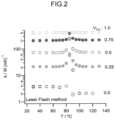
- the thermal conductivities (k) of the produced samples were measured by a laser flash method (Netzsch LFA447). Results of the measurement are shown in Fig. 2 . Referring to Fig. 2 , it was found that an increase in the volume ratio of copper causes a considerable improvement in thermal conductivity all over the temperature range.
- Fig. 3 illustrates the dependence of latent heat (L) and thermal conductivity (k) on the volume fraction of copper. Referring to Fig. 3 , it was found that the latent heat (L) decreases proportionately with the volume fraction of copper (V Cu ) but the thermal conductivity (k) increases quadratically.
- Example 2 Aluminum powder (purity 99% up, particle size 300 ⁇ m mesh under, atomized powder) and vanadium dioxide powder were bonded together.
- the vanadium dioxide powder was subjected to heat treatment in advance, similarly to Example 1. Weighing was performed such that a volume fraction of 0.50 is obtained for aluminum, and then mixture was performed by a planetary stirrer. After that, in a vacuum, heat treatment was performed by an electric-current sintering apparatus with a molding pressure of 30 MPa at a temperature of 600°C for 30 minutes. As a result, a dense sintered body having 93% of the theoretical density was obtained as an aluminum/vanadium dioxide bonded sample. It was confirmed that its thermal conductivity is 13 W/mK higher than 4 W/mK corresponding to the thermal conductivity of vanadium dioxide itself.
- Example 1 The copper powder in Example 1, vanadium dioxide powder (subjected to heat treatment), and carbon fiber (pitch-based, chopped fibers, length 6 mm) were kneaded together with a mortar.
- the volume fractions of copper, vanadium dioxide, and carbon fiber were, respectively, 0.25, 0.5, and 0.25.
- heat treatment was performed by an electric-current sintering apparatus with a molding pressure of 30 MPa at a temperature of 700°C for 30 minutes.
- a dense sintered body having 96% of the theoretical density. It was confirmed that its thermal conductivity is 27 W/mK and is higher than the thermal conductivity of vanadium dioxide itself.
- Aluminum powder (purity 99% up, particle size 300 ⁇ m mesh under, atomized powder) or carbon fiber (pitch-based, chopped fibers, length 6 mm) was bonded to vanadium dioxide powder (purity 99.9%, average particle diameter 1 ⁇ m).
- vanadium dioxide powder was subjected to heat treatment in advance, similarly to Example 1. Weighing was performed such that a volume fraction of 0.50 is obtained for each of aluminum and carbon fiber, and then mixture was performed by a planetary stirrer. Note that, before use, the carbon fiber was dispersed ultrasonically in ethanol in advance. After that, in a vacuum, sintering was performed by an electric-current sintering apparatus with a molding pressure of 30 MPa.
- the aluminum/vanadium dioxide was heated at 550°C for 30 minutes, and the carbon fiber/vanadium dioxide was heated at 950°C for 30 minutes.
- an aluminum/vanadium dioxide bonded sample had 87% of the theoretical density and a carbon fiber/vanadium dioxide bonded sample had 75% of the theoretical density.
- no dense sintered body was obtained in both cases.
- V2O3 was generated due to the progress of chemical reaction of each material.
- thermocamera For testing, a ceramic microheater having dimensions of 10 ⁇ 10 ⁇ 1 mm was stuck onto the center of each substrate with silver paste for die bonding and then heat generation of a chip was simulated with the output of the heater.
- the surface temperature of the chip namely, the heater
- the surface temperature of the substrate temperature of a place at a distance of 5 mm from the chip
- Heating conditions were as follows: the output of the heater 9 W, and the duration of the output 180 seconds.
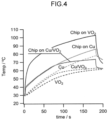
- Results are shown in Fig. 4 .
- the temperature of the chip on each substrate is indicated with a solid line, and the temperature of each substrate is indicated with a broken line.
- the chip mounted on the copper substrate gradually rises in temperature as heating time elapses.
- the chip mounted on the vanadium dioxide substrate rapidly rises in temperature at the beginning of heating, leading to a higher temperature than that of the copper substrate.
- the vanadium dioxide substrate has a low thermal conductivity, the substrate is not heated uniformly, namely, only the periphery of the place on which the chip is mounted is heated.
- the effect of latent heat of the substrate does not work to suppression of a rise in the temperature of the chip.
- the copper/vanadium dioxide substrate improved in thermal conductivity when its plate material reaches the transition temperature, a rise in the temperature of the chip is suppressed, so that a rise in temperature can be further suppressed in comparison to the copper plate.
- a copper plate material having a thickness of 0.1 mm (purity 99.96%) and vanadium dioxide powder were layered one on another, and then were in a vacuum treated by an electric-current sintering apparatus with a molding pressure of 30 MPa at 550°C for 30 minutes.
- the vanadium dioxide powder was subjected to heat treatment in advance, similarly to Example 1.
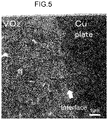
- Fig. 5 is an electron micrograph of the bonded interface of a sample in Example 5. Referring to Fig. 5 , it can be found that the copper plate material and vanadium dioxide are bonded together without any void.
- Example 5 underwent a heat cycle test covering the metal-insulator transition temperature. As a temperature profile, heating/cooling was repeated in the range of from 45 to 90°C at 5°C/min. Even under a 100-cycle test, no detachment occurred.
- Fig. 7 illustrates EDX composition maps. Referring to Fig. 7 , it was revealed that a pure interface is formed because of no observation of any diffusion layer or reaction phase near the interface.
- FIG. 6 is an electron micrograph of the bonded interface of a sample in Comparative Example 2. Referring to Fig. 6 , it can be found that many voids are present because the copper plate material and vanadium dioxide are low in close adhesion.
- Fig. 8 illustrates EDX composition maps.
- STEM scanning transmission electron micrographs
- EDX energy dispersive X-ray fluorescence analyzer
- Example 5 Under conditions similar to those in Example 5, produced was a layered body including a plurality of layers identical in thickness each including a copper plate material having a thickness of 0.1 mm and vanadium dioxide layered one on another.
- the volume fraction of copper was 0.29.
- the thermal conductivity vertically aligned copper
- Results are shown in Table 1.
- Data in Example 1 is also shown for comparison. Referring to Table 1, it can be found that a considerable improvement is made in thermal conductivity even with the same volume ratio of copper content. Note that, as described in Example 1, the quantity of latent heat is determined based on the volume fraction of vanadium dioxide.
- the present layered body underwent a heat cycle test covering the metal-insulator transition temperature. Heating/cooling was repeated in the range of from 45 to 90°C at 10°C/min. Even under a 100-cycle test, no detachment occurred. After the heat cycle test, no deterioration occurred in thermal conductivity. (Table 1)
- Copper powder purity 99.9%, particle size 45 ⁇ m mesh under, electrolytic copper powder
- tungsten-doped vanadium dioxide powder phase transition temperature 10°C, average particle diameter 1 ⁇ m
- the tungsten-doped vanadium dioxide powder was subjected to heat treatment at 250°C for 20 minutes in the air in advance, resulting in having an excess of oxygen.
- Each type of powder was weighed such that a volume fraction of 0.50 is obtained for copper, and then mixing was performed with a mortar. After that, in a vacuum, treatment was performed by an electric-current sintering apparatus with a molding pressure of 30 MPa at 550°C for 30 minutes.
- a produced sample was a dense sintered body having 96% of the theoretical density.
- Example 1 The copper powder in Example 1 and chromium-doped vanadium dioxide powder (phase transition temperature 120°C, average particle diameter 1 ⁇ m) were bonded together.
- the chromium-doped vanadium dioxide powder was subjected to heat treatment in advance, resulting in having an excess of oxygen.
- Each type of powder was weighed such that a volume fraction of 0.50 is obtained for copper, and then mixing was performed with a mortar. After that, in a vacuum, treatment was performed by an electric-current sintering apparatus with a molding pressure of 30 MPa at 700°C for 30 minutes.
- a produced sample was a dense aggregate having 97% of the theoretical density. It was confirmed that its thermal conductivity is 31 W/mK and is higher than the thermal conductivity of vanadium dioxide itself.
- Example 2 An aggregate of vanadium dioxide and copper produced under the conditions in Example 1 (volume fraction of copper 0.50) was immersed in dilute sulfuric acid having a molar concentration of 2 mol/L for 24 hours. As a result, the shape of the sample was the same as that before the immersion. No coloring of the dilute sulfuric acid occurred.
- Vanadium dioxide produced under the conditions in Example 1 (volume fraction of copper 0.00) was immersed in dilute sulfuric acid having a molar concentration of 2 mol/L for 24 hours. As a result, the sample dissolved completely in the dilute sulfuric acid, and the dilute sulfuric acid colored in blue.
- Example 2 Under the conditions in Example 1, a dense sinter of vanadium dioxide powder and copper powder (volume fraction 0.50) (solid heat storage material) was produced in advance and then was made tabular in shape.
- the dense sintered body and a copper plate (purity 99.96%, thickness 1 mm) were stacked together, and then were heated at 600°C under a pressure of 30 MPa for 30 minutes. In this case, the atmosphere was a vacuum.
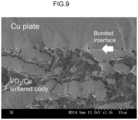
- An obtained bonded body of the sinter and the copper plate was cut orthogonally to its interface with a cutter. Then, a section was polished and then was subjected to ion milling. The bonded interface was observed with a scanning electron microscope. As illustrated in Fig. 9 , an interface in close adhesion is formed. It was confirmed that a favorable composite of the sintered body and the copper plate material is obtained due to diffusion bonding.
Landscapes
- Engineering & Computer Science (AREA)
- Chemical & Material Sciences (AREA)
- Physics & Mathematics (AREA)
- Thermal Sciences (AREA)
- Chemical Kinetics & Catalysis (AREA)
- Combustion & Propulsion (AREA)
- Materials Engineering (AREA)
- Organic Chemistry (AREA)
- Mechanical Engineering (AREA)
- General Engineering & Computer Science (AREA)
- Cooling Or The Like Of Semiconductors Or Solid State Devices (AREA)
Abstract
Description
- The present invention relates to a solid heat storage material adjusted in thermal conductivity and a composite including the solid heat storage material, and relates more particularly to a solid heat storage material including an bonding of vanadium dioxide and a highly thermally conductive substance, the solid heat storage material being adjusted in thermal conductivity, the solid heat storage material enabling wide-range adjustment in heat dissipation and heat storage.
- An electronic device including a power semiconductor has encountered the problem of heat generation due to a reduction in the size of a chip or the like. There are two typical measures against the problem. One of the measures is that an improvement is made in heat dissipation with a member, which excels in thermal conductivity (e.g., a heat spreader), provided directly beneath a chip. The other is that an increase in thermal capacity inhibits a rise in temperature. In the latter case, for achievement of both a reduction in size and an increase in thermal capacity, utilization of latent heat has been examined (
Patent Literature 1 and Patent Literature 2). - Many conventional latent heat storage materials employ the heat of fusion due to the phase change from a solid to a liquid, and thus heat storage density (latent heat per unit weight or per unit volume) is important in characteristic. Meanwhile, thermal conduction as an important factor in heat exchange has not been sufficiently examined. For example, the thermal conductivity of paraffin as a representative heat storage material is approximately 0.2 W/mK, which is too low for prompt heat dissipation/heat absorption. Therefore, for example, a structure having a large contact area between a heat storage material and a container that houses the heat storage material hermetically and selection of a material high in thermal conductivity for the container are essentially important in designing a heat exchanger. That is, the structure tends to be intricate.
- In recent years, developed has been a solid heat storage material employing solid-solid phase transition (Patent Literature 3). The material described in Patent Literature 3 has electronic phase transition as the origin of latent heat and thus keeps its shape before and after phase transition without fusion. Thus, the present material can be used as a structural material having latent heat storage performance (Patent Literature 4, Patent Literature 5, and Non Patent Literature 1). That is, the present material can be used, for example, as a material for a heat exchanger, without any change. Because of no need to consider liquid leakage and no increase in thermal resistance due to capsulation, vanadium dioxide has received attention as a solid heat storage material that can overcome problems with a meltable heat storage material.
- However, the thermal conductivity of vanadium dioxide is approximately 6 W/mK (
Non Patent Literature 2 and Non Patent Literature 3). Thus, vanadium dioxide is inadequate as a heat dissipation material and has, as a disadvantage, a low effect of suppressing an excessive rise in temperature. -
- Patent Literature 1:
WO 2017/081833 A - Patent Literature 2:
WO 2017/073010 A - Patent Literature 3:
JP 568825 B2 JP 2009-163510 A - Patent Literature 4:
JP 2018-128190 A - Patent Literature 5:
JP 2016-79351 A - Patent Literature 6:
WO 2019/026773 A -
- Non Patent Literature 1: Press release, "Development of phase change heat storage member having both a high heat storage density and robustness", National Institute of Advanced Industrial Science and Technology, 2019/03/01. (https://www.aist.go.jp/aistj/press_release/ pr2019/pr20190301/pr20190301.html)
- Non Patent Literature 2: C. N. Berglund and H. J. Guggenhein, "Electric properties of VO2 near the semiconductor-metal transition", Physical Review B 185, 1022-33 (1969).
- Non Patent Literature 3: S. Lee, K. Hippalgaonkar, F. Yang et al., "Anomalously low electronic thermal conductivity in metallic vanadium dioxide", Science 355, 371-374 (2017).
- The present invention has been made in order to solve such problems with the conventional technology as above, and an object of the present invention is to provide a solid heat storage material adjusted in thermal conductivity, the solid heat storage material having a large thermal conductivity and a high effect of suppressing an excessive rise in temperature and enabling wide-range adjustment in heat dissipation and heat storage.
- According to the present invention, in order to solve the above problems, the following solid heat storage material is provided.
- [1] A solid heat storage material including an bonding of vanadium dioxide and a highly thermally conductive substance higher in thermal conductivity than the vanadium dioxide, the highly thermally conductive substance being dispersed in the vanadium dioxide, the vanadium dioxide and the highly thermally conductive substance adhering closely and densely together, the highly thermally conductive substance having a volume fraction of 0.03 or more.
- [2] The solid heat storage material according to [1] in the invention, in which the highly thermally conductive substance is copper.
- [3] The solid heat storage material according to [1] or [2] in the invention, in which the vanadium dioxide as raw material has an excess of oxygen.
- [4] The solid heat storage material according to any of [1] to [3] in the invention, in which no diffusion layer and no reaction phase are present at a bonded interface between the vanadium dioxide and the highly thermally conductive substance.
- [5] The solid heat storage material according to any of [1] to [4] in the invention, in which the solid heat storage material is resistant to oxidative corrosion.
- [6] The solid heat storage material according to any of [1] to [5] in the invention, in which the highly thermally conductive substance is oriented parallel to a direction of heat transfer.
- [7] The solid heat storage material according to any of [1] to [6] in the invention, in which the vanadium dioxide has a transition temperature adjusted by doping.
- [8] A composite including: the solid heat storage material according to any of [1] to [7] in the invention; and copper; in which the solid heat storage material and the copper are bonded together.
- According to the present invention, a substance that excels in thermal conductivity is bonded densely to vanadium dioxide, so that a heat absorption/heat generation characteristic that excels in time response is acquired, enabling effective utilization of a high heat storage density based on latent heat. Therefore, achieved is a solid heat storage material adjusted in thermal conductivity, the solid heat storage material having a large thermal conductivity and a high effect of suppressing an excessive rise in temperature and enabling wide-range adjustment in heat dissipation and heat storage.
-
-
Fig. 1 is an electron micrograph of the bonded state between vanadium dioxide (VO2) and electrolytic copper powder (Cu) based on a sample in Example 1. -
Fig. 2 illustrates the temperature dependence of thermal conductivity (k) of a vanadium dioxide/copper powder aggregate based on each sample in Example 1, where VCu represents the volume fraction of copper. -
Fig. 3 illustrates the dependence of latent heat (L) and thermal conductivity (k) at room temperature on the volume fraction of copper (VCu) based on the samples in Example 1. -
Fig. 4 illustrates changes in the temperatures of chips mounted on respective types of substrates based on samples in Example 4 (indicated with solid lines) with the temperatures of the substrates indicated with dotted lines, the substrates being of three types: a substrate of copper (Cu), a substrate of copper having a volume fraction of 0.50 and vanadium dioxide having a volume fraction of 0.50 (Cu/VO2), and a substrate of vanadium dioxide (VO2). -
Fig. 5 is an electron micrograph of the bonded state between vanadium dioxide (VO2) and a copper plate material (Cu plate material) based on a sample in Example 5. -
Fig. 6 is an electron micrograph of the bonded state between vanadium dioxide (VO2) with no heat treatment and a copper plate material (Cu plate material) based on a sample in Comparative Example 2. -
Fig. 7 shows results of EDX composition mapping of the sample in Example 5. -
Fig. 8 shows results of EDX composition mapping of the sample in Comparative Example 2. -
Fig. 9 is a scanning electron micrograph of the bonded interface of a bonded body in Example 11. - The present invention will be described in detail below on the basis of embodiments.
- For an improvement in thermal response, the thermal conductivity of a material requires improving. A single crystal has few imperfections that scatter thermal vibration and thus is regarded as the maximum value in the thermal conductivity of its substance. It has been reported that the thermal conductivity of a vanadium dioxide single crystal is approximately 6 W/mK at room temperature (
Non Patent Literature 2 and Non Patent Literature 3). For example, even an improvement in the crystallinity of vanadium dioxide or control of crystalline orientation of a polycrystal is not expected to make an improvement to a large thermal conductivity exceeding the value. Therefore, for an improvement in thermal conductivity, mixture with and dense and close adhesion to a substance that excels in thermal conductivity (e.g., copper, aluminum, or carbon fiber) are effective. However, an increase in the ratio of volume of a highly thermally conductive substance causes a linear decrease in the quantity of latent heat to the ratio of volume. Thus, although a large quantity of mixture is restricted, an excessively small quantity of mixture does not effect an improvement in thermal response. - The thermal conductivity of a mixture of dissimilar materials is maximum with a smallest quantity of dispersion in a case where the highly thermally conductive substance is oriented in one direction. The thermal conductivity k of a two-phase material is as follows:

- Therefore, for a desired thermal conductivity (klimit) or more, the volume fraction of the high thermal conductive substance is required to satisfy the following expression:

- For measurement of thermal conductivity, there are a steady state method and an unsteady state method. For measurement about transition temperature, the steady state method is desirable in consideration of the influence of latent heat. However, for measurement out of the neighborhood of transition temperature, an appropriate selection is required to be made, for example, in accordance with the shape of the sample. For measurement of the quantity of latent heat, a differential scanning calorimeter is desirable.
- In general, the wettability between an oxide and metal or carbon is low, leading to difficulty in high-density bonding. That is, material selection is required. For bonding of an oxide and metal, indirect bonding with brazing material or direct bonding is performed. The latter is desirable because of easily firmer bonding and a low interfacial thermal resistance.
- Integration based on direct bonding progresses in a process similar to that of sintering. Thus, for examination with direct bonding, it is important to select a proper process temperature on the basis of the sintering temperature of each individual material.
- A suitable range of sintering temperature for vanadium dioxide is 550 to 1050°C. Matching between the temperature range and the sintering temperature of a highly thermally conductive material enables uniform bonding with a wide-range volume fraction. For example, the sintering temperature of copper ranges from 500 to 800°C. The sintering temperature of aluminum ranges 500 to 600°C. However, carbon is difficult to sinter in the range of sintering temperature of vanadium dioxide.
- In consideration of copper having a fusing point of 1085°C, its process window ranges from 550 to 1050°C, enabling a process in a wide temperature range. Thus, copper is suitable for combination with vanadium dioxide. Meanwhile, in consideration of aluminum having a film of oxide on its surface and having a low fusing point, which is 660°C, its process window ranges from 550 to 600°C, which is narrow. Thus, a favorable bond is unlikely to be obtained. In addition, carbon material requires a high temperature process at 900°C or more. Furthermore, carbon has a problem with reaction to vanadium dioxide.
- Facilitation of interface formation between dissimilar materials is important in bonding. Copper enables formation of a favorable interface with vanadium dioxide and thus is a preferable material. In particular, utilization of reaction between vanadium dioxide and oxygen enables obtainment of an interface that excels in close adhesion. Thus, preferably, the surface of vanadium dioxide is made to have an excess of oxygen.
- Examples of a method of mixing an oxide and a highly thermally conductive substance include mixing physically the respective raw materials thereof and coating oxide powder with the highly thermally conductive substance by plating or sputtering. The latter method enables, as an advantage, uniform mixture even with a small quantity of addition. Meanwhile, such a physically mixing method is suitable to an increase in the volume ratio of a mixture. An appropriate selection is required to be made in accordance with a targeted form of mixture quantity/dispersion.
- The form of the highly thermally conductive substance is typically granulous, linear, or tabular. In accordance with the direction of heat transfer, an appropriate selection is required to be made from thereamong. That is, for isotropic heat dissipation/heat absorption, a granulous highly thermally conductive substance is required, and for unidirectional heat transfer of heat dissipation/heat absorption, a linear or tabular highly thermally conductive substance is required to be oriented parallel to the direction. In the latter case, even a small quantity of highly thermally conductive substance has a large thermal conductivity, leading to retainment of a high volume fraction of vanadium dioxide. Thus, a reduction in latent heat due to the highly thermally conductive substance can be inhibited.
- The phase transition temperature of vanadium dioxide can be adjusted by atomic doping, such as tungsten doping or chromium doping. There is no large difference between the sintering behavior of vanadium dioxide subjected to doping and the sintering behavior of vanadium dioxide not subjected to doping, so that vanadium dioxide subjected to doping can be sintered in a similar condition to that of vanadium dioxide not subjected to doping. That is, the above-described form can be applied in bonding without any change.
- The interface between bonded materials causes interfacial thermal resistance, and thus control thereof is important. In particular, in a case where a reaction phase is generated at the interface, the thermal conductivity of the reaction phase is low due to solid solution effect, leading to an increase in interfacial thermal resistance. Therefore, from the viewpoint of thermal resistance, desirably, no reaction phase or diffusion layer is generated at the interface.
- It has been reported that vanadium oxide has a problem with environment resistance (Patent Literature 6). In fact, vanadium oxide forms a hydrate, and thus attention needs to be paid to atmosphere in use. In particular, corrosion progresses easily under an acid environment. Thus, in general, use under an acid environment should be avoided. However, from the viewpoint of cathodic protection, bonding with a metal (copper or aluminum) smaller in work function than vanadium dioxide enables prevention of corrosion, so that a considerable improvement can be made in environment resistance. In this case, because of cathodic protection, all vanadium dioxide is not necessarily coated, differently from Patent Literature 6, but is required to be in electrical conduction.
- A solid heat storage material according to the present invention includes an aggregate of vanadium dioxide and a highly thermally conductive substance higher in thermal conductivity than the vanadium dioxide, the highly thermally conductive substance being dispersed in the vanadium dioxide, the highly thermally conductive substance and the vanadium dioxide adhering closely and densely together, in which the highly thermally conductive substance has a volume fraction of 0.03 or more.
- Examples of the highly thermally conductive substance higher in thermal conductivity than the vanadium dioxide include copper, silver, aluminum, an alloy including any metal of copper, silver, and aluminum, and carbon material. In particular, copper is preferable.
- The aggregate included in the solid heat storage material according to the present invention requires the vanadium dioxide and the highly thermally conductive substance higher in thermal conductivity than the vanadium dioxide adhering closely and densely together. The "densely" denotes close adhesion at 90% or more of the theoretical density, more preferably, at 95% or more of the theoretical density. For an improvement in close adhesion, for example, desirably, heat treatment is performed at 250°C for 20 minutes in the air in advance. The temperature of heat treatment and the duration of heat treatment can be properly set in consideration of the type of the highly thermally conductive substance and voidage to be achieved.
For measurement of density, a method based on Archimedes' principle is desirable in order to measure porosity accurately. - In the present invention, for an improvement in thermal response, the volume fraction of the highly thermally conductive substance has a lower limit of 0.03 (percentage: 3%). An increase in the volume fraction of the highly thermally conductive substance causes a linear decrease in the quantity of latent heat, and thus the volume fraction of the highly thermally conductive substance has an upper limit of approximately 0.75 (percentage: 75%). In accordance with a purpose, an appropriate volume fraction is required to be determined in the range. Because of the reciprocity between the quantity of latent heat and thermal response, for priority on the quantity of latent heat, preferably, the volume fraction is adjusted in the range of 0.03 to 0.40 (percentage: 3 to 40%). For the quantity of latent heat and thermal response in balance, preferably, the volume fraction is adjusted in the range of 0.40 to 0.60 (percentage: 40 to 60%). For priority on thermal response, preferably, the volume fraction is adjusted in the range of 0.60 to 0.75 (percentage: 60 to 75%).
- As described above, facilitation of interface formation between dissimilar materials is important in bonding. Thus, for obtainment of an interface that excels in close adhesion with reaction between vanadium dioxide and oxygen, preferably, the surface of vanadium dioxide is made to have an excess of oxygen. The excess of oxygen denotes that oxygen is excessively included, approximately, by x = 0.01 in the notation VO2+x.
- The solid heat storage material according to the present invention can be bonded to a highly thermally conductive material, such as a copper plate, for use. That is, a composite according to the present invention includes the solid heat storage material according to the present invention, and copper, in which the solid heat storage material and the copper are bonded together. As a bonding method, bonding with brazing material or diffusion bonding can be applied. For a reduction in interfacial thermal resistance, such diffusion bonding is desirable.
- The solid heat storage material and the composite according to the present invention are not limited to the above embodiments.
- The present invention will be further described in detail below with examples and comparative examples. However, the present invention is not limited to the following examples.
- Copper powder (purity 99.9%, particle size 45 µm mesh under, electrolytic copper powder) and vanadium dioxide powder (purity 99.9%,
average particle diameter 1 µm) were bonded together. For an improvement in close adhesion, the vanadium dioxide powder was subjected to heat treatment at 250°C for 20 minutes in the air in advance, resulting in having an excess of oxygen. Each type of powder was weighed such that a volume fraction of 0.00, a volume fraction of 0.25, a volume fraction of 0.50, a volume fraction of 0.75, and a volume fraction of 1.00 are obtained for copper, and then mixture was performed by a planetary stirrer. After that, in a vacuum, treatment was performed by an electric-current sintering apparatus with a molding pressure of 30 MPa at 550°C for 30 minutes, resulting in obtainment of dense composite. All samples had 95% or more of the theoretical density. The theoretical density for vanadium dioxide-copper is determined by rule of mixture without any reactant as follows:
-
Fig. 1 is an electron micrograph of a polished surface of a sample produced in the present example. Referring toFig. 1 , it was found that vanadium dioxide and copper are bonded together without any void. - In X-ray diffraction measurement, a diffraction pattern due to the copper and vanadium dioxide was detected, but no presence of any other impurity phase was recognized.
- The thermal conductivities (k) of the produced samples were measured by a laser flash method (Netzsch LFA447). Results of the measurement are shown in
Fig. 2 . Referring toFig. 2 , it was found that an increase in the volume ratio of copper causes a considerable improvement in thermal conductivity all over the temperature range. - The latent heats (L) of the samples were measured by differential thermal analysis (Bruker DSC3300SA).
Fig. 3 illustrates the dependence of latent heat (L) and thermal conductivity (k) on the volume fraction of copper. Referring toFig. 3 , it was found that the latent heat (L) decreases proportionately with the volume fraction of copper (VCu) but the thermal conductivity (k) increases quadratically. - Aluminum powder (purity 99% up,
particle size 300 µm mesh under, atomized powder) and vanadium dioxide powder were bonded together. For an improvement in close adhesion, the vanadium dioxide powder was subjected to heat treatment in advance, similarly to Example 1. Weighing was performed such that a volume fraction of 0.50 is obtained for aluminum, and then mixture was performed by a planetary stirrer. After that, in a vacuum, heat treatment was performed by an electric-current sintering apparatus with a molding pressure of 30 MPa at a temperature of 600°C for 30 minutes. As a result, a dense sintered body having 93% of the theoretical density was obtained as an aluminum/vanadium dioxide bonded sample. It was confirmed that its thermal conductivity is 13 W/mK higher than 4 W/mK corresponding to the thermal conductivity of vanadium dioxide itself. - The copper powder in Example 1, vanadium dioxide powder (subjected to heat treatment), and carbon fiber (pitch-based, chopped fibers, length 6 mm) were kneaded together with a mortar. The volume fractions of copper, vanadium dioxide, and carbon fiber were, respectively, 0.25, 0.5, and 0.25. After that, in a vacuum, heat treatment was performed by an electric-current sintering apparatus with a molding pressure of 30 MPa at a temperature of 700°C for 30 minutes. As a result, obtained was a dense sintered body having 96% of the theoretical density. It was confirmed that its thermal conductivity is 27 W/mK and is higher than the thermal conductivity of vanadium dioxide itself.
- Aluminum powder (purity 99% up,
particle size 300 µm mesh under, atomized powder) or carbon fiber (pitch-based, chopped fibers, length 6 mm) was bonded to vanadium dioxide powder (purity 99.9%,average particle diameter 1 µm). For an improvement in close adhesion, the vanadium dioxide powder was subjected to heat treatment in advance, similarly to Example 1. Weighing was performed such that a volume fraction of 0.50 is obtained for each of aluminum and carbon fiber, and then mixture was performed by a planetary stirrer. Note that, before use, the carbon fiber was dispersed ultrasonically in ethanol in advance. After that, in a vacuum, sintering was performed by an electric-current sintering apparatus with a molding pressure of 30 MPa. The aluminum/vanadium dioxide was heated at 550°C for 30 minutes, and the carbon fiber/vanadium dioxide was heated at 950°C for 30 minutes. As a result, an aluminum/vanadium dioxide bonded sample had 87% of the theoretical density and a carbon fiber/vanadium dioxide bonded sample had 75% of the theoretical density. Thus, no dense sintered body was obtained in both cases. In the carbon fiber/vanadium dioxide bonded sample, V2O3 was generated due to the progress of chemical reaction of each material. - Examined was influence on the material of a substrate due to heating of a chip. Used were three types of substrates different in composition: 1) the volume fraction of copper 1.00 (hereinafter, referred to as a copper substrate), 2) the volume fraction of copper 0.50 and the volume fraction of vanadium dioxide 0.50 (hereinafter, referred to as a copper/vanadium dioxide substrate), and 3) the volume fraction of vanadium dioxide 1.00 (hereinafter, referred to as a vanadium dioxide substrate). Preparations in material for the substrates are the same as those in Example 1. Each sample was made into a plate material having dimensions of 30 × 30 × 5 mm by machining, for use as a substrate.
- For testing, a ceramic microheater having dimensions of 10 × 10 × 1 mm was stuck onto the center of each substrate with silver paste for die bonding and then heat generation of a chip was simulated with the output of the heater. The surface temperature of the chip (namely, the heater) and the surface temperature of the substrate (temperature of a place at a distance of 5 mm from the chip) were measured by a thermocamera. Heating conditions were as follows: the output of the heater 9 W, and the duration of the output 180 seconds.
- Results are shown in
Fig. 4 . The temperature of the chip on each substrate is indicated with a solid line, and the temperature of each substrate is indicated with a broken line. The chip mounted on the copper substrate gradually rises in temperature as heating time elapses. However, the chip mounted on the vanadium dioxide substrate rapidly rises in temperature at the beginning of heating, leading to a higher temperature than that of the copper substrate. The reason is that, since the vanadium dioxide substrate has a low thermal conductivity, the substrate is not heated uniformly, namely, only the periphery of the place on which the chip is mounted is heated. Thus, although the temperature of the substrate is suppressed at or below the transition temperature, the effect of latent heat of the substrate does not work to suppression of a rise in the temperature of the chip. Meanwhile, regarding the copper/vanadium dioxide substrate improved in thermal conductivity, when its plate material reaches the transition temperature, a rise in the temperature of the chip is suppressed, so that a rise in temperature can be further suppressed in comparison to the copper plate. - A copper plate material having a thickness of 0.1 mm (purity 99.96%) and vanadium dioxide powder were layered one on another, and then were in a vacuum treated by an electric-current sintering apparatus with a molding pressure of 30 MPa at 550°C for 30 minutes. The vanadium dioxide powder was subjected to heat treatment in advance, similarly to Example 1.
-
Fig. 5 is an electron micrograph of the bonded interface of a sample in Example 5. Referring toFig. 5 , it can be found that the copper plate material and vanadium dioxide are bonded together without any void. - The layered body in Example 5 underwent a heat cycle test covering the metal-insulator transition temperature. As a temperature profile, heating/cooling was repeated in the range of from 45 to 90°C at 5°C/min. Even under a 100-cycle test, no detachment occurred.
- The interface of the sample in Example 5 was analyzed through scanning transmission electron micrographs (STEM) and by an energy dispersive X-ray fluorescence analyzer (EDX).
Fig. 7 illustrates EDX composition maps. Referring toFig. 7 , it was revealed that a pure interface is formed because of no observation of any diffusion layer or reaction phase near the interface. - A copper plate material having a thickness of 0.1 mm (purity 99.96%) and vanadium dioxide powder were layered one on another, and then were in a vacuum treated by an electric-current sintering apparatus with a molding pressure of 30 MPa at 550°C for 30 minutes. The vanadium dioxide powder was subjected to no heat treatment in advance.
Fig. 6 is an electron micrograph of the bonded interface of a sample in Comparative Example 2. Referring toFig. 6 , it can be found that many voids are present because the copper plate material and vanadium dioxide are low in close adhesion. - The interface of the sample in Comparative Example 2 was analyzed through scanning transmission electron micrographs (STEM) and by an energy dispersive X-ray fluorescence analyzer (EDX).
Fig. 8 illustrates EDX composition maps. As a result, as illustrated inFig. 8 , a Cu2O phase was present at the interface, and an amorphous Cu-V-O diffusion layer was clearly observed near the grain boundary of VO2 near the interface. It can be thought that formation of such reaction phases prevents formation of a dense interface. - Under conditions similar to those in Example 5, produced was a layered body including a plurality of layers identical in thickness each including a copper plate material having a thickness of 0.1 mm and vanadium dioxide layered one on another. The volume fraction of copper was 0.29. With the direction of heat transfer of the layered body in Example 6 defined as the planar direction of the copper plate, the thermal conductivity (vertically aligned copper) was measured. Results are shown in Table 1. Data in Example 1 is also shown for comparison. Referring to Table 1, it can be found that a considerable improvement is made in thermal conductivity even with the same volume ratio of copper content. Note that, as described in Example 1, the quantity of latent heat is determined based on the volume fraction of vanadium dioxide. Therefore, the orientation of copper is effective for an increase in thermal conductivity with the quantity of latent heat kept.
[Table 1] Thermal conductivity [W/m K] Copper/vanadium dioxide layered body (vertical orientation) 103±2 Copper/vanadium dioxide powder bonded material (volume fraction of copper 0.29), from interpolation in Fig. 3 24 Copper/vanadium dioxide layered body (vertical orientation) after heat cycle test 102±1 - The present layered body underwent a heat cycle test covering the metal-insulator transition temperature. Heating/cooling was repeated in the range of from 45 to 90°C at 10°C/min. Even under a 100-cycle test, no detachment occurred. After the heat cycle test, no deterioration occurred in thermal conductivity. (Table 1)
- Copper powder (purity 99.9%, particle size 45 µm mesh under, electrolytic copper powder) and tungsten-doped vanadium dioxide powder (
phase transition temperature 10°C,average particle diameter 1 µm) were bonded together. For an improvement in close adhesion, the tungsten-doped vanadium dioxide powder was subjected to heat treatment at 250°C for 20 minutes in the air in advance, resulting in having an excess of oxygen. Each type of powder was weighed such that a volume fraction of 0.50 is obtained for copper, and then mixing was performed with a mortar. After that, in a vacuum, treatment was performed by an electric-current sintering apparatus with a molding pressure of 30 MPa at 550°C for 30 minutes. A produced sample was a dense sintered body having 96% of the theoretical density. - The copper powder in Example 1 and chromium-doped vanadium dioxide powder (
phase transition temperature 120°C,average particle diameter 1 µm) were bonded together. For an improvement in close adhesion, the chromium-doped vanadium dioxide powder was subjected to heat treatment in advance, resulting in having an excess of oxygen. Each type of powder was weighed such that a volume fraction of 0.50 is obtained for copper, and then mixing was performed with a mortar. After that, in a vacuum, treatment was performed by an electric-current sintering apparatus with a molding pressure of 30 MPa at 700°C for 30 minutes. A produced sample was a dense aggregate having 97% of the theoretical density. It was confirmed that its thermal conductivity is 31 W/mK and is higher than the thermal conductivity of vanadium dioxide itself. - An aggregate of vanadium dioxide and copper produced under the conditions in Example 1 (volume fraction of copper 0.50) was immersed in dilute sulfuric acid having a molar concentration of 2 mol/L for 24 hours. As a result, the shape of the sample was the same as that before the immersion. No coloring of the dilute sulfuric acid occurred.
- Vanadium dioxide produced under the conditions in Example 1 (volume fraction of copper 0.00) was immersed in dilute sulfuric acid having a molar concentration of 2 mol/L for 24 hours. As a result, the sample dissolved completely in the dilute sulfuric acid, and the dilute sulfuric acid colored in blue.
- Under the conditions in Example 1, a dense sinter of vanadium dioxide powder and copper powder (volume fraction 0.50) (solid heat storage material) was produced in advance and then was made tabular in shape. The dense sintered body and a copper plate (purity 99.96%,
thickness 1 mm) were stacked together, and then were heated at 600°C under a pressure of 30 MPa for 30 minutes. In this case, the atmosphere was a vacuum. An obtained bonded body of the sinter and the copper plate was cut orthogonally to its interface with a cutter. Then, a section was polished and then was subjected to ion milling. The bonded interface was observed with a scanning electron microscope. As illustrated inFig. 9 , an interface in close adhesion is formed. It was confirmed that a favorable composite of the sintered body and the copper plate material is obtained due to diffusion bonding.
Claims (8)
- A solid heat storage material comprising a bonding of vanadium dioxide and a highly thermally conductive substance higher in thermal conductivity than the vanadium dioxide, the highly thermally conductive substance being dispersed in the vanadium dioxide, the vanadium dioxide and the highly thermally conductive substance adhering closely and densely together, the highly thermally conductive substance having a volume fraction of 0.03 or more.
- The solid heat storage material according to claim 1, wherein the highly thermally conductive substance is copper.
- The solid heat storage material according to claim 1 or 2, wherein the vanadium dioxide as raw material has an excess of oxygen.
- The solid heat storage material according to any of claims 1 to 3, wherein no diffusion layer and no reaction phase are present at a bonded interface between the vanadium dioxide and the highly thermally conductive substance.
- The solid heat storage material according to any of claims 1 to 4, wherein the solid heat storage material is resistant to oxidative corrosion.
- The solid heat storage material according to any of claims 1 to 5, wherein the highly thermally conductive substance is oriented parallel to a direction of heat transfer.
- The solid heat storage material according to any of claims 1 to 6, wherein the vanadium dioxide has a transition temperature adjusted by doping.
- A composite comprising: the solid heat storage material according to any of claims 1 to 7; and copper; wherein the solid heat storage material and the copper are bonded together.
Applications Claiming Priority (2)
| Application Number | Priority Date | Filing Date | Title |
|---|---|---|---|
| JP2020085223 | 2020-05-14 | ||
| PCT/JP2021/018448 WO2021230357A1 (en) | 2020-05-14 | 2021-05-14 | Solid heat storage material having regulated thermal conductivity and composite |
Publications (3)
| Publication Number | Publication Date |
|---|---|
| EP4151696A1 true EP4151696A1 (en) | 2023-03-22 |
| EP4151696A4 EP4151696A4 (en) | 2024-05-29 |
| EP4151696B1 EP4151696B1 (en) | 2025-11-19 |
Family
ID=78524563
Family Applications (1)
| Application Number | Title | Priority Date | Filing Date |
|---|---|---|---|
| EP21804325.5A Active EP4151696B1 (en) | 2020-05-14 | 2021-05-14 | Solid heat storage material having regulated thermal conductivity and composite |
Country Status (5)
| Country | Link |
|---|---|
| US (1) | US12385698B2 (en) |
| EP (1) | EP4151696B1 (en) |
| JP (1) | JP7366466B2 (en) |
| CN (1) | CN115605558B (en) |
| WO (1) | WO2021230357A1 (en) |
Families Citing this family (2)
| Publication number | Priority date | Publication date | Assignee | Title |
|---|---|---|---|---|
| JP7845047B2 (en) * | 2022-05-26 | 2026-04-14 | 富士電機株式会社 | Permanent magnet fields, rotating machines, linear motors |
| CN115927897A (en) * | 2022-12-05 | 2023-04-07 | 上海交通大学 | A kind of Al-VO2 phase change composite material and preparation method thereof |
Family Cites Families (21)
| Publication number | Priority date | Publication date | Assignee | Title |
|---|---|---|---|---|
| JPS52148014A (en) | 1976-06-02 | 1977-12-08 | Mitsubishi Chem Ind Ltd | Preparation of 1,4-glycoldiester |
| US5596877A (en) * | 1995-08-16 | 1997-01-28 | Baltimore Aircoil Company, Inc. | Header and coil arrangement for cooling apparatus |
| JP5049141B2 (en) | 2008-01-07 | 2012-10-17 | 株式会社エヌ・ティ・ティ・ドコモ | Communication terminal and program |
| JP2014505651A (en) * | 2011-01-21 | 2014-03-06 | 中国科学院上海硅酸塩研究所 | Doped vanadium dioxide powder, dispersions and their production and application |
| CN102816944B (en) | 2012-08-24 | 2014-01-08 | 西安理工大学 | A kind of preparation method of thermosensitive copper-based composite material |
| JP6167873B2 (en) * | 2013-06-27 | 2017-07-26 | ソニー株式会社 | Electronic device and control method of electronic device |
| EP3020779B1 (en) * | 2013-12-11 | 2018-06-20 | Fuji Polymer Industries Co., Ltd. | Heat-storage composition |
| JP6409465B2 (en) * | 2014-09-30 | 2018-10-24 | 株式会社デンソー | Heat storage system |
| JP2016079351A (en) * | 2014-10-22 | 2016-05-16 | 株式会社デンソー | Composite heat-storing material |
| US20170043553A1 (en) * | 2015-01-06 | 2017-02-16 | Fuji Polymer Industries Co., Ltd. | Heat-storage, thermally conductive sheet |
| JPWO2017073010A1 (en) | 2015-10-27 | 2018-08-16 | ソニー株式会社 | Electronics |
| WO2017081833A1 (en) | 2015-11-10 | 2017-05-18 | ソニー株式会社 | Electronic device |
| JP6642247B2 (en) * | 2016-04-28 | 2020-02-05 | 株式会社デンソー | Refrigeration cycle device |
| KR101907605B1 (en) | 2016-07-20 | 2018-12-05 | 주식회사 모브릭 | Current sensing device based on Metal-Insulator Transition and conductive substrate and current control system for using the same |
| JP6733570B2 (en) | 2017-02-08 | 2020-08-05 | 株式会社デンソー | Heat storage device |
| JP2018154517A (en) * | 2017-03-16 | 2018-10-04 | コニカミノルタ株式会社 | Method for producing vanadium dioxide-containing particle and vanadium dioxide-containing particle |
| JP6874978B2 (en) * | 2017-04-14 | 2021-05-19 | 国立研究開発法人産業技術総合研究所 | Storage and heat storage equipment, electronic devices, and heat storage and heat storage methods |
| WO2019026773A1 (en) | 2017-07-29 | 2019-02-07 | 株式会社村田製作所 | Heat-storing particles, composition for constant temperature device, and constant temperature device |
| US20220064510A1 (en) | 2019-01-09 | 2022-03-03 | National Institute Of Advanced Industrial Science And Technology | Powder material for sintering and solid latent heat storage member including the same |
| JP2021021128A (en) | 2019-07-30 | 2021-02-18 | 国立研究開発法人宇宙航空研究開発機構 | Powder molding material, sintering molding and method for producing sintering molding |
| JP7394301B2 (en) * | 2021-12-10 | 2023-12-08 | 日東紡績株式会社 | Double-stranded nucleic acid melting temperature increasing agent and its uses |
-
2021
- 2021-05-14 US US17/924,167 patent/US12385698B2/en active Active
- 2021-05-14 JP JP2022522220A patent/JP7366466B2/en active Active
- 2021-05-14 CN CN202180035268.7A patent/CN115605558B/en active Active
- 2021-05-14 EP EP21804325.5A patent/EP4151696B1/en active Active
- 2021-05-14 WO PCT/JP2021/018448 patent/WO2021230357A1/en not_active Ceased
Also Published As
| Publication number | Publication date |
|---|---|
| US12385698B2 (en) | 2025-08-12 |
| WO2021230357A1 (en) | 2021-11-18 |
| JPWO2021230357A1 (en) | 2021-11-18 |
| EP4151696A4 (en) | 2024-05-29 |
| US20230175789A1 (en) | 2023-06-08 |
| CN115605558A (en) | 2023-01-13 |
| JP7366466B2 (en) | 2023-10-23 |
| CN115605558B (en) | 2026-03-13 |
| EP4151696B1 (en) | 2025-11-19 |
Similar Documents
| Publication | Publication Date | Title |
|---|---|---|
| Zheng et al. | Realizing high thermoelectric performance in highly (0l0)-textured flexible Cu2Se thin film for wearable energy harvesting | |
| Ji et al. | Excellent thermal performance of gallium-based liquid metal alloy as thermal interface material between aluminum substrates | |
| Zhao et al. | SnSe: a remarkable new thermoelectric material | |
| Peng et al. | Fabrication of high-strength Cu–Cu joint by low-temperature sintering micron–nano Cu composite paste | |
| Chen et al. | The effect of Te doping on the electronic structure and thermoelectric properties of SnSe | |
| Moore et al. | Thermal conductivity suppression in bismuth nanowires | |
| McCandless et al. | Interdiffusion of CdS/CdTe thin films: Modeling x-ray diffraction line profiles | |
| EP4151696B1 (en) | Solid heat storage material having regulated thermal conductivity and composite | |
| CN102373032B (en) | Thermal Expansion Suppressing Parts and Thermal Expansion Resistant Parts | |
| EP2999016A1 (en) | Clathrate compound, thermoelectric material, and method for producing thermoelectric material | |
| Xun et al. | Bifunctional Al dopant for enhancing bulk and grain boundary conductivities in sodium ion conducting NASICON ceramics | |
| Kosonowski et al. | Thermal conductivity of PbTe–CoSb 3 bulk polycrystalline composite: role of microstructure and interface thermal resistance | |
| Supriya et al. | Rapid microwave-assisted synthesis and characterization of a novel CuCoTe nanocomposite material for optoelectronic and dielectric applications | |
| Zhang et al. | Improved contact performance and thermal stability of Co–Ni alloy barrier layer for bismuth telluride-based thermoelectric devices | |
| Ke et al. | Multi-beam spark plasma sintering and excellent performance of Bi 0.5 Sb 1.5 Te 3/epoxy thermoelectric films with insulating substrates | |
| EP4472391A1 (en) | Thermoelectric conversion module and thermoelectric conversion system | |
| WO2019035253A1 (en) | Magnesium thermoelectric conversion material, magnesium thermoelectric conversion element, and method for producing magnesium thermoelectric conversion material | |
| Li et al. | Thermal conductivity of a single Bi0. 5Sb1. 5Te3 single-crystalline nanowire | |
| Liu et al. | Laser sintering mechanism and shear performance of Cu–Ag–Cu joints with mixed bimodal size Ag nanoparticles | |
| Yang et al. | Tailoring thermal conductivity of diamond/InSnBi composite by surface treatment of diamonds | |
| Diliberto et al. | Influence of pulsed electrodeposition on stoichiometry and thermoelectric properties of bismuth telluride films | |
| Li et al. | Manganese doping induced record-high medium-temperature AgCuTe thermoelectrics | |
| Zhang et al. | Relation of silver electrode solderability to intermetallic compound growth rate | |
| Xinling et al. | Cu/diamond composite electrodes for low thermal resistance packaging in high-power IGCTs | |
| Li et al. | High serving temperature GaSn-based thermal interface material added with Cu@ Ni core-shell particles featuring proper fluidity and thermal performance |
Legal Events
| Date | Code | Title | Description |
|---|---|---|---|
| STAA | Information on the status of an ep patent application or granted ep patent |
Free format text: STATUS: THE INTERNATIONAL PUBLICATION HAS BEEN MADE |
|
| PUAI | Public reference made under article 153(3) epc to a published international application that has entered the european phase |
Free format text: ORIGINAL CODE: 0009012 |
|
| STAA | Information on the status of an ep patent application or granted ep patent |
Free format text: STATUS: REQUEST FOR EXAMINATION WAS MADE |
|
| 17P | Request for examination filed |
Effective date: 20221129 |
|
| AK | Designated contracting states |
Kind code of ref document: A1 Designated state(s): AL AT BE BG CH CY CZ DE DK EE ES FI FR GB GR HR HU IE IS IT LI LT LU LV MC MK MT NL NO PL PT RO RS SE SI SK SM TR |
|
| DAV | Request for validation of the european patent (deleted) | ||
| DAX | Request for extension of the european patent (deleted) | ||
| A4 | Supplementary search report drawn up and despatched |
Effective date: 20240429 |
|
| RIC1 | Information provided on ipc code assigned before grant |
Ipc: F28D 20/00 20060101ALI20240423BHEP Ipc: C09K 5/14 20060101AFI20240423BHEP |
|
| STAA | Information on the status of an ep patent application or granted ep patent |
Free format text: STATUS: EXAMINATION IS IN PROGRESS |
|
| 17Q | First examination report despatched |
Effective date: 20250115 |
|
| GRAP | Despatch of communication of intention to grant a patent |
Free format text: ORIGINAL CODE: EPIDOSNIGR1 |
|
| STAA | Information on the status of an ep patent application or granted ep patent |
Free format text: STATUS: GRANT OF PATENT IS INTENDED |
|
| INTG | Intention to grant announced |
Effective date: 20250721 |
|
| GRAS | Grant fee paid |
Free format text: ORIGINAL CODE: EPIDOSNIGR3 |
|
| GRAA | (expected) grant |
Free format text: ORIGINAL CODE: 0009210 |
|
| STAA | Information on the status of an ep patent application or granted ep patent |
Free format text: STATUS: THE PATENT HAS BEEN GRANTED |
|
| AK | Designated contracting states |
Kind code of ref document: B1 Designated state(s): AL AT BE BG CH CY CZ DE DK EE ES FI FR GB GR HR HU IE IS IT LI LT LU LV MC MK MT NL NO PL PT RO RS SE SI SK SM TR |
|
| REG | Reference to a national code |
Ref country code: CH Ref legal event code: F10 Free format text: ST27 STATUS EVENT CODE: U-0-0-F10-F00 (AS PROVIDED BY THE NATIONAL OFFICE) Effective date: 20251119 Ref country code: GB Ref legal event code: FG4D |
|
| REG | Reference to a national code |
Ref country code: DE Ref legal event code: R096 Ref document number: 602021042735 Country of ref document: DE |
|
| REG | Reference to a national code |
Ref country code: IE Ref legal event code: FG4D |
|
| PG25 | Lapsed in a contracting state [announced via postgrant information from national office to epo] |
Ref country code: ES Free format text: LAPSE BECAUSE OF FAILURE TO SUBMIT A TRANSLATION OF THE DESCRIPTION OR TO PAY THE FEE WITHIN THE PRESCRIBED TIME-LIMIT Effective date: 20251119 |
|
| REG | Reference to a national code |
Ref country code: LT Ref legal event code: MG9D |
|
| PG25 | Lapsed in a contracting state [announced via postgrant information from national office to epo] |
Ref country code: NO Free format text: LAPSE BECAUSE OF FAILURE TO SUBMIT A TRANSLATION OF THE DESCRIPTION OR TO PAY THE FEE WITHIN THE PRESCRIBED TIME-LIMIT Effective date: 20260219 |
|
| PG25 | Lapsed in a contracting state [announced via postgrant information from national office to epo] |
Ref country code: FI Free format text: LAPSE BECAUSE OF FAILURE TO SUBMIT A TRANSLATION OF THE DESCRIPTION OR TO PAY THE FEE WITHIN THE PRESCRIBED TIME-LIMIT Effective date: 20251119 Ref country code: AT Free format text: LAPSE BECAUSE OF FAILURE TO SUBMIT A TRANSLATION OF THE DESCRIPTION OR TO PAY THE FEE WITHIN THE PRESCRIBED TIME-LIMIT Effective date: 20251119 Ref country code: HR Free format text: LAPSE BECAUSE OF FAILURE TO SUBMIT A TRANSLATION OF THE DESCRIPTION OR TO PAY THE FEE WITHIN THE PRESCRIBED TIME-LIMIT Effective date: 20251119 |
|
| REG | Reference to a national code |
Ref country code: AT Ref legal event code: MK05 Ref document number: 1858825 Country of ref document: AT Kind code of ref document: T Effective date: 20251119 |
|
| PG25 | Lapsed in a contracting state [announced via postgrant information from national office to epo] |
Ref country code: NL Free format text: LAPSE BECAUSE OF FAILURE TO SUBMIT A TRANSLATION OF THE DESCRIPTION OR TO PAY THE FEE WITHIN THE PRESCRIBED TIME-LIMIT Effective date: 20251119 |
|
| PG25 | Lapsed in a contracting state [announced via postgrant information from national office to epo] |
Ref country code: RS Free format text: LAPSE BECAUSE OF FAILURE TO SUBMIT A TRANSLATION OF THE DESCRIPTION OR TO PAY THE FEE WITHIN THE PRESCRIBED TIME-LIMIT Effective date: 20260219 |
|
| PG25 | Lapsed in a contracting state [announced via postgrant information from national office to epo] |
Ref country code: IS Free format text: LAPSE BECAUSE OF FAILURE TO SUBMIT A TRANSLATION OF THE DESCRIPTION OR TO PAY THE FEE WITHIN THE PRESCRIBED TIME-LIMIT Effective date: 20260319 |
|
| PG25 | Lapsed in a contracting state [announced via postgrant information from national office to epo] |
Ref country code: PT Free format text: LAPSE BECAUSE OF FAILURE TO SUBMIT A TRANSLATION OF THE DESCRIPTION OR TO PAY THE FEE WITHIN THE PRESCRIBED TIME-LIMIT Effective date: 20260319 |
|
| PG25 | Lapsed in a contracting state [announced via postgrant information from national office to epo] |
Ref country code: PL Free format text: LAPSE BECAUSE OF FAILURE TO SUBMIT A TRANSLATION OF THE DESCRIPTION OR TO PAY THE FEE WITHIN THE PRESCRIBED TIME-LIMIT Effective date: 20251119 |
|
| PG25 | Lapsed in a contracting state [announced via postgrant information from national office to epo] |
Ref country code: LV Free format text: LAPSE BECAUSE OF FAILURE TO SUBMIT A TRANSLATION OF THE DESCRIPTION OR TO PAY THE FEE WITHIN THE PRESCRIBED TIME-LIMIT Effective date: 20251119 |
|
| PG25 | Lapsed in a contracting state [announced via postgrant information from national office to epo] |
Ref country code: BG Free format text: LAPSE BECAUSE OF FAILURE TO SUBMIT A TRANSLATION OF THE DESCRIPTION OR TO PAY THE FEE WITHIN THE PRESCRIBED TIME-LIMIT Effective date: 20251119 |