EP4151672A1 - Amide compound, nitrogen-containing heterocyclic compound, and crosslinked product - Google Patents
Amide compound, nitrogen-containing heterocyclic compound, and crosslinked product Download PDFInfo
- Publication number
- EP4151672A1 EP4151672A1 EP21805023.5A EP21805023A EP4151672A1 EP 4151672 A1 EP4151672 A1 EP 4151672A1 EP 21805023 A EP21805023 A EP 21805023A EP 4151672 A1 EP4151672 A1 EP 4151672A1
- Authority
- EP
- European Patent Office
- Prior art keywords
- compound
- formula
- nitrogen
- organic group
- group
- Prior art date
- Legal status (The legal status is an assumption and is not a legal conclusion. Google has not performed a legal analysis and makes no representation as to the accuracy of the status listed.)
- Pending
Links
- -1 Amide compound Chemical class 0.000 title claims abstract description 177
- 150000001875 compounds Chemical class 0.000 claims abstract description 254
- 125000000623 heterocyclic group Chemical group 0.000 claims abstract description 119
- QJGQUHMNIGDVPM-UHFFFAOYSA-N nitrogen group Chemical group [N] QJGQUHMNIGDVPM-UHFFFAOYSA-N 0.000 claims abstract description 119
- 238000004132 cross linking Methods 0.000 claims abstract description 69
- 125000000962 organic group Chemical group 0.000 claims description 75
- 238000006116 polymerization reaction Methods 0.000 claims description 36
- 125000004432 carbon atom Chemical group C* 0.000 claims description 28
- 238000004519 manufacturing process Methods 0.000 claims description 18
- 125000003118 aryl group Chemical class 0.000 claims description 16
- 125000003545 alkoxy group Chemical group 0.000 claims description 13
- 239000011248 coating agent Substances 0.000 claims description 9
- 238000000576 coating method Methods 0.000 claims description 9
- 125000005843 halogen group Chemical group 0.000 claims description 9
- 125000001820 oxy group Chemical group [*:1]O[*:2] 0.000 claims description 9
- 239000004065 semiconductor Substances 0.000 claims description 8
- 125000006551 perfluoro alkylene group Chemical group 0.000 claims description 7
- 239000000463 material Substances 0.000 claims description 6
- 125000003785 benzimidazolyl group Chemical class N1=C(NC2=C1C=CC=C2)* 0.000 claims description 5
- 239000000853 adhesive Substances 0.000 claims description 4
- 230000001070 adhesive effect Effects 0.000 claims description 4
- 125000005462 imide group Chemical class 0.000 claims 1
- 239000000047 product Substances 0.000 description 148
- IJGRMHOSHXDMSA-UHFFFAOYSA-N Atomic nitrogen Chemical compound N#N IJGRMHOSHXDMSA-UHFFFAOYSA-N 0.000 description 145
- SECXISVLQFMRJM-UHFFFAOYSA-N N-Methylpyrrolidone Chemical compound CN1CCCC1=O SECXISVLQFMRJM-UHFFFAOYSA-N 0.000 description 112
- 229910052757 nitrogen Inorganic materials 0.000 description 73
- IAZDPXIOMUYVGZ-UHFFFAOYSA-N Dimethylsulphoxide Chemical compound CS(C)=O IAZDPXIOMUYVGZ-UHFFFAOYSA-N 0.000 description 64
- 239000000243 solution Substances 0.000 description 63
- 238000002411 thermogravimetry Methods 0.000 description 59
- 239000000758 substrate Substances 0.000 description 46
- ZMXDDKWLCZADIW-UHFFFAOYSA-N N,N-Dimethylformamide Chemical compound CN(C)C=O ZMXDDKWLCZADIW-UHFFFAOYSA-N 0.000 description 44
- 239000002904 solvent Substances 0.000 description 44
- 239000000203 mixture Substances 0.000 description 41
- OKKJLVBELUTLKV-UHFFFAOYSA-N Methanol Chemical compound OC OKKJLVBELUTLKV-UHFFFAOYSA-N 0.000 description 39
- 238000006243 chemical reaction Methods 0.000 description 38
- 230000004580 weight loss Effects 0.000 description 38
- WYURNTSHIVDZCO-UHFFFAOYSA-N Tetrahydrofuran Chemical compound C1CCOC1 WYURNTSHIVDZCO-UHFFFAOYSA-N 0.000 description 36
- 238000005033 Fourier transform infrared spectroscopy Methods 0.000 description 28
- YMWUJEATGCHHMB-UHFFFAOYSA-N Dichloromethane Chemical compound ClCCl YMWUJEATGCHHMB-UHFFFAOYSA-N 0.000 description 27
- 230000000704 physical effect Effects 0.000 description 25
- SJRJJKPEHAURKC-UHFFFAOYSA-N N-Methylmorpholine Chemical compound CN1CCOCC1 SJRJJKPEHAURKC-UHFFFAOYSA-N 0.000 description 24
- HEDRZPFGACZZDS-MICDWDOJSA-N Trichloro(2H)methane Chemical compound [2H]C(Cl)(Cl)Cl HEDRZPFGACZZDS-MICDWDOJSA-N 0.000 description 24
- 150000003949 imides Chemical class 0.000 description 24
- 238000000113 differential scanning calorimetry Methods 0.000 description 23
- 230000009477 glass transition Effects 0.000 description 23
- 239000000843 powder Substances 0.000 description 23
- FXHOOIRPVKKKFG-UHFFFAOYSA-N N,N-Dimethylacetamide Chemical compound CN(C)C(C)=O FXHOOIRPVKKKFG-UHFFFAOYSA-N 0.000 description 19
- 238000003763 carbonization Methods 0.000 description 19
- 229920001721 polyimide Polymers 0.000 description 19
- 238000003756 stirring Methods 0.000 description 19
- XLYOFNOQVPJJNP-UHFFFAOYSA-N water Substances O XLYOFNOQVPJJNP-UHFFFAOYSA-N 0.000 description 19
- IAZDPXIOMUYVGZ-WFGJKAKNSA-N Dimethyl sulfoxide Chemical compound [2H]C([2H])([2H])S(=O)C([2H])([2H])[2H] IAZDPXIOMUYVGZ-WFGJKAKNSA-N 0.000 description 18
- YLQBMQCUIZJEEH-UHFFFAOYSA-N tetrahydrofuran Natural products C=1C=COC=1 YLQBMQCUIZJEEH-UHFFFAOYSA-N 0.000 description 18
- CSCPPACGZOOCGX-UHFFFAOYSA-N Acetone Chemical compound CC(C)=O CSCPPACGZOOCGX-UHFFFAOYSA-N 0.000 description 17
- 125000001997 phenyl group Chemical group [H]C1=C([H])C([H])=C(*)C([H])=C1[H] 0.000 description 17
- 239000011521 glass Substances 0.000 description 16
- 238000010438 heat treatment Methods 0.000 description 16
- 125000002947 alkylene group Chemical group 0.000 description 15
- 125000001424 substituent group Chemical group 0.000 description 15
- 239000012043 crude product Substances 0.000 description 14
- 125000005702 oxyalkylene group Chemical group 0.000 description 14
- 125000000217 alkyl group Chemical group 0.000 description 13
- 229920001971 elastomer Polymers 0.000 description 13
- 239000000945 filler Substances 0.000 description 13
- 125000001153 fluoro group Chemical group F* 0.000 description 13
- CYSGHNMQYZDMIA-UHFFFAOYSA-N 1,3-Dimethyl-2-imidazolidinon Chemical compound CN1CCN(C)C1=O CYSGHNMQYZDMIA-UHFFFAOYSA-N 0.000 description 12
- UPGRRPUXXWPEMV-UHFFFAOYSA-N 5-(2-phenylethynyl)-2-benzofuran-1,3-dione Chemical compound C=1C=C2C(=O)OC(=O)C2=CC=1C#CC1=CC=CC=C1 UPGRRPUXXWPEMV-UHFFFAOYSA-N 0.000 description 12
- 238000004140 cleaning Methods 0.000 description 12
- 238000001644 13C nuclear magnetic resonance spectroscopy Methods 0.000 description 11
- 238000004293 19F NMR spectroscopy Methods 0.000 description 11
- 238000005160 1H NMR spectroscopy Methods 0.000 description 11
- 239000012153 distilled water Substances 0.000 description 11
- 238000009826 distribution Methods 0.000 description 11
- 239000002243 precursor Substances 0.000 description 11
- HEDRZPFGACZZDS-UHFFFAOYSA-N Chloroform Chemical compound ClC(Cl)Cl HEDRZPFGACZZDS-UHFFFAOYSA-N 0.000 description 10
- 229920000642 polymer Polymers 0.000 description 10
- 230000000379 polymerizing effect Effects 0.000 description 10
- 238000003860 storage Methods 0.000 description 10
- SRDQTCUHAMDAMG-UHFFFAOYSA-N 1,1,2,2,3,3,4,4,5,5,6,6,7,7,8,8-hexadecafluoro-1,8-diiodooctane Chemical compound FC(F)(I)C(F)(F)C(F)(F)C(F)(F)C(F)(F)C(F)(F)C(F)(F)C(F)(F)I SRDQTCUHAMDAMG-UHFFFAOYSA-N 0.000 description 9
- QTBSBXVTEAMEQO-UHFFFAOYSA-N Acetic acid Chemical compound CC(O)=O QTBSBXVTEAMEQO-UHFFFAOYSA-N 0.000 description 9
- RTZKZFJDLAIYFH-UHFFFAOYSA-N Diethyl ether Chemical compound CCOCC RTZKZFJDLAIYFH-UHFFFAOYSA-N 0.000 description 9
- 229910052731 fluorine Inorganic materials 0.000 description 9
- VLKZOEOYAKHREP-UHFFFAOYSA-N n-Hexane Chemical compound CCCCCC VLKZOEOYAKHREP-UHFFFAOYSA-N 0.000 description 9
- 239000003960 organic solvent Substances 0.000 description 9
- 238000003825 pressing Methods 0.000 description 9
- MEKOFIRRDATTAG-UHFFFAOYSA-N 2,2,5,8-tetramethyl-3,4-dihydrochromen-6-ol Chemical compound C1CC(C)(C)OC2=C1C(C)=C(O)C=C2C MEKOFIRRDATTAG-UHFFFAOYSA-N 0.000 description 8
- OKTJSMMVPCPJKN-UHFFFAOYSA-N Carbon Chemical group [C] OKTJSMMVPCPJKN-UHFFFAOYSA-N 0.000 description 8
- 230000015572 biosynthetic process Effects 0.000 description 8
- 125000004435 hydrogen atom Chemical group [H]* 0.000 description 8
- RYGMFSIKBFXOCR-UHFFFAOYSA-N Copper Chemical compound [Cu] RYGMFSIKBFXOCR-UHFFFAOYSA-N 0.000 description 7
- 238000000921 elemental analysis Methods 0.000 description 7
- 238000005227 gel permeation chromatography Methods 0.000 description 7
- 238000003786 synthesis reaction Methods 0.000 description 7
- FDRPZJWMPZUHBN-UHFFFAOYSA-N triazin-2-ium;chloride Chemical compound Cl.C1=CN=NN=C1 FDRPZJWMPZUHBN-UHFFFAOYSA-N 0.000 description 7
- 239000004642 Polyimide Substances 0.000 description 6
- 239000000654 additive Substances 0.000 description 6
- 125000001797 benzyl group Chemical group [H]C1=C([H])C([H])=C(C([H])=C1[H])C([H])([H])* 0.000 description 6
- 230000001747 exhibiting effect Effects 0.000 description 6
- HXJUTPCZVOIRIF-UHFFFAOYSA-N sulfolane Chemical compound O=S1(=O)CCCC1 HXJUTPCZVOIRIF-UHFFFAOYSA-N 0.000 description 6
- FYSNRJHAOHDILO-UHFFFAOYSA-N thionyl chloride Chemical compound ClS(Cl)=O FYSNRJHAOHDILO-UHFFFAOYSA-N 0.000 description 6
- 239000004793 Polystyrene Substances 0.000 description 5
- GTDPSWPPOUPBNX-UHFFFAOYSA-N ac1mqpva Chemical compound CC12C(=O)OC(=O)C1(C)C1(C)C2(C)C(=O)OC1=O GTDPSWPPOUPBNX-UHFFFAOYSA-N 0.000 description 5
- 239000003431 cross linking reagent Substances 0.000 description 5
- 238000006210 cyclodehydration reaction Methods 0.000 description 5
- 238000007872 degassing Methods 0.000 description 5
- 238000002844 melting Methods 0.000 description 5
- 230000008018 melting Effects 0.000 description 5
- 229910052751 metal Inorganic materials 0.000 description 5
- 239000002184 metal Substances 0.000 description 5
- 238000000034 method Methods 0.000 description 5
- 229920002223 polystyrene Polymers 0.000 description 5
- 238000000967 suction filtration Methods 0.000 description 5
- 238000005292 vacuum distillation Methods 0.000 description 5
- YZBBUYKPTHDZHF-KNVGNIICSA-N (3R)-7,2'-dihydroxy-4'-methoxyisoflavanol Chemical compound OC1=CC(OC)=CC=C1[C@H]1C(O)C2=CC=C(O)C=C2OC1 YZBBUYKPTHDZHF-KNVGNIICSA-N 0.000 description 4
- JYEUMXHLPRZUAT-UHFFFAOYSA-N 1,2,3-triazine Chemical compound C1=CN=NN=C1 JYEUMXHLPRZUAT-UHFFFAOYSA-N 0.000 description 4
- YEJRWHAVMIAJKC-UHFFFAOYSA-N 4-Butyrolactone Chemical compound O=C1CCCO1 YEJRWHAVMIAJKC-UHFFFAOYSA-N 0.000 description 4
- VYPSYNLAJGMNEJ-UHFFFAOYSA-N Silicium dioxide Chemical compound O=[Si]=O VYPSYNLAJGMNEJ-UHFFFAOYSA-N 0.000 description 4
- PMZURENOXWZQFD-UHFFFAOYSA-L Sodium Sulfate Chemical compound [Na+].[Na+].[O-]S([O-])(=O)=O PMZURENOXWZQFD-UHFFFAOYSA-L 0.000 description 4
- 235000002597 Solanum melongena Nutrition 0.000 description 4
- 239000012298 atmosphere Substances 0.000 description 4
- 229910052799 carbon Inorganic materials 0.000 description 4
- 239000003795 chemical substances by application Substances 0.000 description 4
- 238000001816 cooling Methods 0.000 description 4
- 150000005690 diesters Chemical class 0.000 description 4
- 238000005530 etching Methods 0.000 description 4
- 230000002140 halogenating effect Effects 0.000 description 4
- 125000005647 linker group Chemical group 0.000 description 4
- KWGKDLIKAYFUFQ-UHFFFAOYSA-M lithium chloride Chemical compound [Li+].[Cl-] KWGKDLIKAYFUFQ-UHFFFAOYSA-M 0.000 description 4
- 238000001020 plasma etching Methods 0.000 description 4
- 230000035484 reaction time Effects 0.000 description 4
- 238000001226 reprecipitation Methods 0.000 description 4
- JOQDDLBOAIKFQX-UHFFFAOYSA-N 1,1,2,2,3,3,4,4,5,5,6,6-dodecafluoro-1,6-diiodohexane Chemical compound FC(F)(I)C(F)(F)C(F)(F)C(F)(F)C(F)(F)C(F)(F)I JOQDDLBOAIKFQX-UHFFFAOYSA-N 0.000 description 3
- WFDIJRYMOXRFFG-UHFFFAOYSA-N Acetic anhydride Chemical compound CC(=O)OC(C)=O WFDIJRYMOXRFFG-UHFFFAOYSA-N 0.000 description 3
- QAOWNCQODCNURD-UHFFFAOYSA-N Sulfuric acid Chemical compound OS(O)(=O)=O QAOWNCQODCNURD-UHFFFAOYSA-N 0.000 description 3
- WGLPBDUCMAPZCE-UHFFFAOYSA-N Trioxochromium Chemical compound O=[Cr](=O)=O WGLPBDUCMAPZCE-UHFFFAOYSA-N 0.000 description 3
- 239000002253 acid Substances 0.000 description 3
- 230000000996 additive effect Effects 0.000 description 3
- 239000006227 byproduct Substances 0.000 description 3
- 238000010884 ion-beam technique Methods 0.000 description 3
- 238000005259 measurement Methods 0.000 description 3
- 239000012046 mixed solvent Substances 0.000 description 3
- 230000003647 oxidation Effects 0.000 description 3
- 238000007254 oxidation reaction Methods 0.000 description 3
- 210000002381 plasma Anatomy 0.000 description 3
- 239000011541 reaction mixture Substances 0.000 description 3
- 150000003839 salts Chemical class 0.000 description 3
- 239000003566 sealing material Substances 0.000 description 3
- UDHAWRUAECEBHC-UHFFFAOYSA-N 1-iodo-4-methylbenzene Chemical compound CC1=CC=C(I)C=C1 UDHAWRUAECEBHC-UHFFFAOYSA-N 0.000 description 2
- SMDGQEQWSSYZKX-UHFFFAOYSA-N 3-(2,3-dicarboxyphenoxy)phthalic acid Chemical compound OC(=O)C1=CC=CC(OC=2C(=C(C(O)=O)C=CC=2)C(O)=O)=C1C(O)=O SMDGQEQWSSYZKX-UHFFFAOYSA-N 0.000 description 2
- VLVCDUSVTXIWGW-UHFFFAOYSA-N 4-iodoaniline Chemical compound NC1=CC=C(I)C=C1 VLVCDUSVTXIWGW-UHFFFAOYSA-N 0.000 description 2
- WMWOMMJQVXRFAP-UHFFFAOYSA-N 5-chloro-4,6-dimethoxytriazine Chemical compound COC1=NN=NC(OC)=C1Cl WMWOMMJQVXRFAP-UHFFFAOYSA-N 0.000 description 2
- UXVMQQNJUSDDNG-UHFFFAOYSA-L Calcium chloride Chemical compound [Cl-].[Cl-].[Ca+2] UXVMQQNJUSDDNG-UHFFFAOYSA-L 0.000 description 2
- 239000005749 Copper compound Substances 0.000 description 2
- GSNUFIFRDBKVIE-UHFFFAOYSA-N DMF Natural products CC1=CC=C(C)O1 GSNUFIFRDBKVIE-UHFFFAOYSA-N 0.000 description 2
- XEEYBQQBJWHFJM-UHFFFAOYSA-N Iron Chemical compound [Fe] XEEYBQQBJWHFJM-UHFFFAOYSA-N 0.000 description 2
- 239000006057 Non-nutritive feed additive Substances 0.000 description 2
- 239000004696 Poly ether ether ketone Substances 0.000 description 2
- 239000004962 Polyamide-imide Substances 0.000 description 2
- 239000004693 Polybenzimidazole Substances 0.000 description 2
- 239000004734 Polyphenylene sulfide Substances 0.000 description 2
- 125000004018 acid anhydride group Chemical group 0.000 description 2
- 125000001931 aliphatic group Chemical class 0.000 description 2
- 238000004458 analytical method Methods 0.000 description 2
- 238000004380 ashing Methods 0.000 description 2
- TZCXTZWJZNENPQ-UHFFFAOYSA-L barium sulfate Chemical compound [Ba+2].[O-]S([O-])(=O)=O TZCXTZWJZNENPQ-UHFFFAOYSA-L 0.000 description 2
- WKDNYTOXBCRNPV-UHFFFAOYSA-N bpda Chemical compound C1=C2C(=O)OC(=O)C2=CC(C=2C=C3C(=O)OC(C3=CC=2)=O)=C1 WKDNYTOXBCRNPV-UHFFFAOYSA-N 0.000 description 2
- 239000001110 calcium chloride Substances 0.000 description 2
- 229910001628 calcium chloride Inorganic materials 0.000 description 2
- 150000001721 carbon Chemical group 0.000 description 2
- 239000006229 carbon black Substances 0.000 description 2
- 125000003178 carboxy group Chemical group [H]OC(*)=O 0.000 description 2
- 239000003054 catalyst Substances 0.000 description 2
- 239000003086 colorant Substances 0.000 description 2
- 229910052802 copper Inorganic materials 0.000 description 2
- 239000010949 copper Substances 0.000 description 2
- 150000001880 copper compounds Chemical class 0.000 description 2
- 238000009792 diffusion process Methods 0.000 description 2
- 238000001312 dry etching Methods 0.000 description 2
- 230000000694 effects Effects 0.000 description 2
- 238000002474 experimental method Methods 0.000 description 2
- 238000000605 extraction Methods 0.000 description 2
- 239000011256 inorganic filler Substances 0.000 description 2
- 229910003475 inorganic filler Inorganic materials 0.000 description 2
- 238000005468 ion implantation Methods 0.000 description 2
- AMXOYNBUYSYVKV-UHFFFAOYSA-M lithium bromide Chemical compound [Li+].[Br-] AMXOYNBUYSYVKV-UHFFFAOYSA-M 0.000 description 2
- 238000002156 mixing Methods 0.000 description 2
- 238000000655 nuclear magnetic resonance spectrum Methods 0.000 description 2
- 150000002894 organic compounds Chemical class 0.000 description 2
- 239000012766 organic filler Substances 0.000 description 2
- TWNQGVIAIRXVLR-UHFFFAOYSA-N oxo(oxoalumanyloxy)alumane Chemical compound O=[Al]O[Al]=O TWNQGVIAIRXVLR-UHFFFAOYSA-N 0.000 description 2
- SIWVEOZUMHYXCS-UHFFFAOYSA-N oxo(oxoyttriooxy)yttrium Chemical compound O=[Y]O[Y]=O SIWVEOZUMHYXCS-UHFFFAOYSA-N 0.000 description 2
- 125000000951 phenoxy group Chemical group [H]C1=C([H])C([H])=C(O*)C([H])=C1[H] 0.000 description 2
- 239000004014 plasticizer Substances 0.000 description 2
- 229920002492 poly(sulfone) Polymers 0.000 description 2
- 229920002312 polyamide-imide Polymers 0.000 description 2
- 229920002480 polybenzimidazole Polymers 0.000 description 2
- 229920002530 polyetherether ketone Polymers 0.000 description 2
- 229920000069 polyphenylene sulfide Polymers 0.000 description 2
- 229910052814 silicon oxide Inorganic materials 0.000 description 2
- 239000012265 solid product Substances 0.000 description 2
- TXEYQDLBPFQVAA-UHFFFAOYSA-N tetrafluoromethane Chemical compound FC(F)(F)F TXEYQDLBPFQVAA-UHFFFAOYSA-N 0.000 description 2
- 125000000876 trifluoromethoxy group Chemical group FC(F)(F)O* 0.000 description 2
- VLCPISYURGTGLP-UHFFFAOYSA-N 1-iodo-3-methylbenzene Chemical compound CC1=CC=CC(I)=C1 VLCPISYURGTGLP-UHFFFAOYSA-N 0.000 description 1
- UIGLAZDLBZDVBL-UHFFFAOYSA-N 1-phenylprop-2-yn-1-ol Chemical compound C#CC(O)C1=CC=CC=C1 UIGLAZDLBZDVBL-UHFFFAOYSA-N 0.000 description 1
- HYZJCKYKOHLVJF-UHFFFAOYSA-N 1H-benzimidazole Chemical compound C1=CC=C2NC=NC2=C1 HYZJCKYKOHLVJF-UHFFFAOYSA-N 0.000 description 1
- IRPGOXJVTQTAAN-UHFFFAOYSA-N 2,2,3,3,3-pentafluoropropanal Chemical compound FC(F)(F)C(F)(F)C=O IRPGOXJVTQTAAN-UHFFFAOYSA-N 0.000 description 1
- FFCSRWGYGMRBGD-UHFFFAOYSA-N 3-iodoaniline Chemical compound NC1=CC=CC(I)=C1 FFCSRWGYGMRBGD-UHFFFAOYSA-N 0.000 description 1
- CPFKVVLZVUUQGV-UHFFFAOYSA-N 4-[2-(3,4-diaminophenyl)-1,1,1,3,3,3-hexafluoropropan-2-yl]benzene-1,2-diamine Chemical compound C1=C(N)C(N)=CC=C1C(C(F)(F)F)(C(F)(F)F)C1=CC=C(N)C(N)=C1 CPFKVVLZVUUQGV-UHFFFAOYSA-N 0.000 description 1
- MVUGACGBTSGSKK-UHFFFAOYSA-N 4-[6-(4-aminophenyl)-1,1,2,2,3,3,4,4,5,5,6,6-dodecafluorohexyl]aniline Chemical compound FC(C(C(C(C(C(C1=CC=C(C=C1)N)(F)F)(F)F)(F)F)(F)F)(F)F)(C1=CC=C(C=C1)N)F MVUGACGBTSGSKK-UHFFFAOYSA-N 0.000 description 1
- KLZUFWVZNOTSEM-UHFFFAOYSA-K Aluminum fluoride Inorganic materials F[Al](F)F KLZUFWVZNOTSEM-UHFFFAOYSA-K 0.000 description 1
- 229910001369 Brass Inorganic materials 0.000 description 1
- IIHKCMWAHOYKNN-UHFFFAOYSA-N CC1=CC=C(C(C(C(C(C(C(C2=CC=C(C)C=C2)(F)F)(F)F)(F)F)(F)F)(F)F)(F)F)C=C1 Chemical compound CC1=CC=C(C(C(C(C(C(C(C2=CC=C(C)C=C2)(F)F)(F)F)(F)F)(F)F)(F)F)(F)F)C=C1 IIHKCMWAHOYKNN-UHFFFAOYSA-N 0.000 description 1
- GTGBOBFVMZPKJQ-UHFFFAOYSA-N NC1=CC=C(C(C(C(C(C(C(C(C(C(C=C2)=CC=C2N)(F)F)(F)F)(F)F)(F)F)(F)F)(F)F)(F)F)(F)F)C=C1 Chemical compound NC1=CC=C(C(C(C(C(C(C(C(C(C(C=C2)=CC=C2N)(F)F)(F)F)(F)F)(F)F)(F)F)(F)F)(F)F)(F)F)C=C1 GTGBOBFVMZPKJQ-UHFFFAOYSA-N 0.000 description 1
- LDWZKAIJMUYJHJ-UHFFFAOYSA-N NC1=CC=CC(C(C(C(C(C(C(C2=CC(N)=CC=C2)(F)F)(F)F)(F)F)(F)F)(F)F)(F)F)=C1 Chemical compound NC1=CC=CC(C(C(C(C(C(C(C2=CC(N)=CC=C2)(F)F)(F)F)(F)F)(F)F)(F)F)(F)F)=C1 LDWZKAIJMUYJHJ-UHFFFAOYSA-N 0.000 description 1
- FCAMDGUIVGPIOB-UHFFFAOYSA-N O=C(C1=CC=C(C(C(C(C(C(C(C(C=C2)=CC=C2C(Cl)=O)(F)F)(F)F)(F)F)(F)F)(F)F)(F)F)C=C1)Cl Chemical compound O=C(C1=CC=C(C(C(C(C(C(C(C(C=C2)=CC=C2C(Cl)=O)(F)F)(F)F)(F)F)(F)F)(F)F)(F)F)C=C1)Cl FCAMDGUIVGPIOB-UHFFFAOYSA-N 0.000 description 1
- LZBOSBVWLZNILV-UHFFFAOYSA-N OC(=O)C1=CC=C(C=C1)C(F)(F)C(F)(F)C(F)(F)C(F)(F)C(F)(F)C(F)(F)C1=CC=C(C=C1)C(O)=O Chemical compound OC(=O)C1=CC=C(C=C1)C(F)(F)C(F)(F)C(F)(F)C(F)(F)C(F)(F)C(F)(F)C1=CC=C(C=C1)C(O)=O LZBOSBVWLZNILV-UHFFFAOYSA-N 0.000 description 1
- 239000004695 Polyether sulfone Substances 0.000 description 1
- 239000004697 Polyetherimide Substances 0.000 description 1
- 229920000491 Polyphenylsulfone Polymers 0.000 description 1
- 229910052581 Si3N4 Inorganic materials 0.000 description 1
- 238000000944 Soxhlet extraction Methods 0.000 description 1
- 238000005299 abrasion Methods 0.000 description 1
- 150000007513 acids Chemical class 0.000 description 1
- 239000012790 adhesive layer Substances 0.000 description 1
- CAVCGVPGBKGDTG-UHFFFAOYSA-N alumanylidynemethyl(alumanylidynemethylalumanylidenemethylidene)alumane Chemical compound [Al]#C[Al]=C=[Al]C#[Al] CAVCGVPGBKGDTG-UHFFFAOYSA-N 0.000 description 1
- 229910052782 aluminium Inorganic materials 0.000 description 1
- XAGFODPZIPBFFR-UHFFFAOYSA-N aluminium Chemical compound [Al] XAGFODPZIPBFFR-UHFFFAOYSA-N 0.000 description 1
- 125000003277 amino group Chemical group 0.000 description 1
- 239000007864 aqueous solution Substances 0.000 description 1
- 239000012300 argon atmosphere Substances 0.000 description 1
- 239000010951 brass Substances 0.000 description 1
- 238000011088 calibration curve Methods 0.000 description 1
- 229910052801 chlorine Inorganic materials 0.000 description 1
- 125000001309 chloro group Chemical group Cl* 0.000 description 1
- 229910000423 chromium oxide Inorganic materials 0.000 description 1
- 239000004927 clay Substances 0.000 description 1
- 229910052570 clay Inorganic materials 0.000 description 1
- 230000003749 cleanliness Effects 0.000 description 1
- 230000000052 comparative effect Effects 0.000 description 1
- 238000000748 compression moulding Methods 0.000 description 1
- PMHQVHHXPFUNSP-UHFFFAOYSA-M copper(1+);methylsulfanylmethane;bromide Chemical compound Br[Cu].CSC PMHQVHHXPFUNSP-UHFFFAOYSA-M 0.000 description 1
- 239000013078 crystal Substances 0.000 description 1
- 125000004093 cyano group Chemical group *C#N 0.000 description 1
- 230000018044 dehydration Effects 0.000 description 1
- 238000006297 dehydration reaction Methods 0.000 description 1
- 238000001035 drying Methods 0.000 description 1
- 239000003480 eluent Substances 0.000 description 1
- 229920006351 engineering plastic Polymers 0.000 description 1
- 125000004185 ester group Chemical group 0.000 description 1
- 150000002170 ethers Chemical class 0.000 description 1
- 125000001301 ethoxy group Chemical group [H]C([H])([H])C([H])([H])O* 0.000 description 1
- 239000003733 fiber-reinforced composite Substances 0.000 description 1
- 239000007789 gas Substances 0.000 description 1
- 239000012210 heat-resistant fiber Substances 0.000 description 1
- 125000002887 hydroxy group Chemical group [H]O* 0.000 description 1
- 125000002883 imidazolyl group Chemical group 0.000 description 1
- 238000002329 infrared spectrum Methods 0.000 description 1
- 229910017053 inorganic salt Inorganic materials 0.000 description 1
- 229910052742 iron Inorganic materials 0.000 description 1
- 239000004973 liquid crystal related substance Substances 0.000 description 1
- 150000001247 metal acetylides Chemical class 0.000 description 1
- 229910044991 metal oxide Inorganic materials 0.000 description 1
- 150000004706 metal oxides Chemical class 0.000 description 1
- 125000000956 methoxy group Chemical group [H]C([H])([H])O* 0.000 description 1
- 238000000874 microwave-assisted extraction Methods 0.000 description 1
- 238000012986 modification Methods 0.000 description 1
- 230000004048 modification Effects 0.000 description 1
- 239000000178 monomer Substances 0.000 description 1
- 238000000465 moulding Methods 0.000 description 1
- RBYAGNRAPXMZGZ-UHFFFAOYSA-N n-(2-phenylethynyl)aniline Chemical compound C=1C=CC=CC=1NC#CC1=CC=CC=C1 RBYAGNRAPXMZGZ-UHFFFAOYSA-N 0.000 description 1
- VMXAIJCDNKFKPO-UHFFFAOYSA-N n-ethynylaniline Chemical compound C#CNC1=CC=CC=C1 VMXAIJCDNKFKPO-UHFFFAOYSA-N 0.000 description 1
- 150000004767 nitrides Chemical class 0.000 description 1
- 125000000449 nitro group Chemical group [O-][N+](*)=O 0.000 description 1
- 239000012299 nitrogen atmosphere Substances 0.000 description 1
- 239000003921 oil Substances 0.000 description 1
- 239000012044 organic layer Substances 0.000 description 1
- 239000007800 oxidant agent Substances 0.000 description 1
- 230000001590 oxidative effect Effects 0.000 description 1
- 238000012856 packing Methods 0.000 description 1
- UHZYTMXLRWXGPK-UHFFFAOYSA-N phosphorus pentachloride Chemical compound ClP(Cl)(Cl)(Cl)Cl UHZYTMXLRWXGPK-UHFFFAOYSA-N 0.000 description 1
- FAIAAWCVCHQXDN-UHFFFAOYSA-N phosphorus trichloride Chemical compound ClP(Cl)Cl FAIAAWCVCHQXDN-UHFFFAOYSA-N 0.000 description 1
- 238000005498 polishing Methods 0.000 description 1
- 229920001643 poly(ether ketone) Polymers 0.000 description 1
- 229920001230 polyarylate Polymers 0.000 description 1
- 229920002577 polybenzoxazole Polymers 0.000 description 1
- 229920006393 polyether sulfone Polymers 0.000 description 1
- 229920001601 polyetherimide Polymers 0.000 description 1
- 239000002861 polymer material Substances 0.000 description 1
- 238000010094 polymer processing Methods 0.000 description 1
- 239000012286 potassium permanganate Substances 0.000 description 1
- JKANAVGODYYCQF-UHFFFAOYSA-N prop-2-yn-1-amine Chemical compound NCC#C JKANAVGODYYCQF-UHFFFAOYSA-N 0.000 description 1
- TVDSBUOJIPERQY-UHFFFAOYSA-N prop-2-yn-1-ol Chemical compound OCC#C TVDSBUOJIPERQY-UHFFFAOYSA-N 0.000 description 1
- 238000001953 recrystallisation Methods 0.000 description 1
- 238000011160 research Methods 0.000 description 1
- 239000011347 resin Substances 0.000 description 1
- 229920005989 resin Polymers 0.000 description 1
- HBMJWWWQQXIZIP-UHFFFAOYSA-N silicon carbide Chemical compound [Si+]#[C-] HBMJWWWQQXIZIP-UHFFFAOYSA-N 0.000 description 1
- 229910010271 silicon carbide Inorganic materials 0.000 description 1
- 239000000377 silicon dioxide Substances 0.000 description 1
- HQVNEWCFYHHQES-UHFFFAOYSA-N silicon nitride Chemical compound N12[Si]34N5[Si]62N3[Si]51N64 HQVNEWCFYHHQES-UHFFFAOYSA-N 0.000 description 1
- 238000004544 sputter deposition Methods 0.000 description 1
- 238000000992 sputter etching Methods 0.000 description 1
- 229910001220 stainless steel Inorganic materials 0.000 description 1
- 239000010935 stainless steel Substances 0.000 description 1
- 238000000859 sublimation Methods 0.000 description 1
- 230000008022 sublimation Effects 0.000 description 1
- 239000000126 substance Substances 0.000 description 1
- 238000000194 supercritical-fluid extraction Methods 0.000 description 1
- 230000002194 synthesizing effect Effects 0.000 description 1
- 239000000454 talc Substances 0.000 description 1
- 229910052623 talc Inorganic materials 0.000 description 1
- 238000009864 tensile test Methods 0.000 description 1
- 230000000930 thermomechanical effect Effects 0.000 description 1
- 239000002966 varnish Substances 0.000 description 1
- 238000001039 wet etching Methods 0.000 description 1
Classifications
-
- C—CHEMISTRY; METALLURGY
- C08—ORGANIC MACROMOLECULAR COMPOUNDS; THEIR PREPARATION OR CHEMICAL WORKING-UP; COMPOSITIONS BASED THEREON
- C08G—MACROMOLECULAR COMPOUNDS OBTAINED OTHERWISE THAN BY REACTIONS ONLY INVOLVING UNSATURATED CARBON-TO-CARBON BONDS
- C08G69/00—Macromolecular compounds obtained by reactions forming a carboxylic amide link in the main chain of the macromolecule
- C08G69/42—Polyamides containing atoms other than carbon, hydrogen, oxygen, and nitrogen
-
- C—CHEMISTRY; METALLURGY
- C09—DYES; PAINTS; POLISHES; NATURAL RESINS; ADHESIVES; COMPOSITIONS NOT OTHERWISE PROVIDED FOR; APPLICATIONS OF MATERIALS NOT OTHERWISE PROVIDED FOR
- C09J—ADHESIVES; NON-MECHANICAL ASPECTS OF ADHESIVE PROCESSES IN GENERAL; ADHESIVE PROCESSES NOT PROVIDED FOR ELSEWHERE; USE OF MATERIALS AS ADHESIVES
- C09J179/00—Adhesives based on macromolecular compounds obtained by reactions forming in the main chain of the macromolecule a linkage containing nitrogen, with or without oxygen, or carbon only, not provided for in groups C09J161/00 - C09J177/00
- C09J179/04—Polycondensates having nitrogen-containing heterocyclic rings in the main chain; Polyhydrazides; Polyamide acids or similar polyimide precursors
- C09J179/08—Polyimides; Polyester-imides; Polyamide-imides; Polyamide acids or similar polyimide precursors
-
- C—CHEMISTRY; METALLURGY
- C07—ORGANIC CHEMISTRY
- C07D—HETEROCYCLIC COMPOUNDS
- C07D209/00—Heterocyclic compounds containing five-membered rings, condensed with other rings, with one nitrogen atom as the only ring hetero atom
- C07D209/02—Heterocyclic compounds containing five-membered rings, condensed with other rings, with one nitrogen atom as the only ring hetero atom condensed with one carbocyclic ring
- C07D209/44—Iso-indoles; Hydrogenated iso-indoles
- C07D209/48—Iso-indoles; Hydrogenated iso-indoles with oxygen atoms in positions 1 and 3, e.g. phthalimide
-
- C—CHEMISTRY; METALLURGY
- C08—ORGANIC MACROMOLECULAR COMPOUNDS; THEIR PREPARATION OR CHEMICAL WORKING-UP; COMPOSITIONS BASED THEREON
- C08G—MACROMOLECULAR COMPOUNDS OBTAINED OTHERWISE THAN BY REACTIONS ONLY INVOLVING UNSATURATED CARBON-TO-CARBON BONDS
- C08G69/00—Macromolecular compounds obtained by reactions forming a carboxylic amide link in the main chain of the macromolecule
- C08G69/02—Polyamides derived from amino-carboxylic acids or from polyamines and polycarboxylic acids
- C08G69/26—Polyamides derived from amino-carboxylic acids or from polyamines and polycarboxylic acids derived from polyamines and polycarboxylic acids
- C08G69/32—Polyamides derived from amino-carboxylic acids or from polyamines and polycarboxylic acids derived from polyamines and polycarboxylic acids from aromatic diamines and aromatic dicarboxylic acids with both amino and carboxylic groups aromatically bound
-
- C—CHEMISTRY; METALLURGY
- C08—ORGANIC MACROMOLECULAR COMPOUNDS; THEIR PREPARATION OR CHEMICAL WORKING-UP; COMPOSITIONS BASED THEREON
- C08G—MACROMOLECULAR COMPOUNDS OBTAINED OTHERWISE THAN BY REACTIONS ONLY INVOLVING UNSATURATED CARBON-TO-CARBON BONDS
- C08G69/00—Macromolecular compounds obtained by reactions forming a carboxylic amide link in the main chain of the macromolecule
- C08G69/48—Polymers modified by chemical after-treatment
-
- C—CHEMISTRY; METALLURGY
- C08—ORGANIC MACROMOLECULAR COMPOUNDS; THEIR PREPARATION OR CHEMICAL WORKING-UP; COMPOSITIONS BASED THEREON
- C08G—MACROMOLECULAR COMPOUNDS OBTAINED OTHERWISE THAN BY REACTIONS ONLY INVOLVING UNSATURATED CARBON-TO-CARBON BONDS
- C08G73/00—Macromolecular compounds obtained by reactions forming a linkage containing nitrogen with or without oxygen or carbon in the main chain of the macromolecule, not provided for in groups C08G12/00 - C08G71/00
- C08G73/06—Polycondensates having nitrogen-containing heterocyclic rings in the main chain of the macromolecule
- C08G73/10—Polyimides; Polyester-imides; Polyamide-imides; Polyamide acids or similar polyimide precursors
- C08G73/1003—Preparatory processes
- C08G73/1007—Preparatory processes from tetracarboxylic acids or derivatives and diamines
- C08G73/101—Preparatory processes from tetracarboxylic acids or derivatives and diamines containing chain terminating or branching agents
- C08G73/1014—Preparatory processes from tetracarboxylic acids or derivatives and diamines containing chain terminating or branching agents in the form of (mono)anhydrid
-
- C—CHEMISTRY; METALLURGY
- C08—ORGANIC MACROMOLECULAR COMPOUNDS; THEIR PREPARATION OR CHEMICAL WORKING-UP; COMPOSITIONS BASED THEREON
- C08G—MACROMOLECULAR COMPOUNDS OBTAINED OTHERWISE THAN BY REACTIONS ONLY INVOLVING UNSATURATED CARBON-TO-CARBON BONDS
- C08G73/00—Macromolecular compounds obtained by reactions forming a linkage containing nitrogen with or without oxygen or carbon in the main chain of the macromolecule, not provided for in groups C08G12/00 - C08G71/00
- C08G73/06—Polycondensates having nitrogen-containing heterocyclic rings in the main chain of the macromolecule
- C08G73/10—Polyimides; Polyester-imides; Polyamide-imides; Polyamide acids or similar polyimide precursors
- C08G73/1039—Polyimides; Polyester-imides; Polyamide-imides; Polyamide acids or similar polyimide precursors comprising halogen-containing substituents
-
- C—CHEMISTRY; METALLURGY
- C08—ORGANIC MACROMOLECULAR COMPOUNDS; THEIR PREPARATION OR CHEMICAL WORKING-UP; COMPOSITIONS BASED THEREON
- C08G—MACROMOLECULAR COMPOUNDS OBTAINED OTHERWISE THAN BY REACTIONS ONLY INVOLVING UNSATURATED CARBON-TO-CARBON BONDS
- C08G73/00—Macromolecular compounds obtained by reactions forming a linkage containing nitrogen with or without oxygen or carbon in the main chain of the macromolecule, not provided for in groups C08G12/00 - C08G71/00
- C08G73/06—Polycondensates having nitrogen-containing heterocyclic rings in the main chain of the macromolecule
- C08G73/10—Polyimides; Polyester-imides; Polyamide-imides; Polyamide acids or similar polyimide precursors
- C08G73/1046—Polyimides containing oxygen in the form of ether bonds in the main chain
- C08G73/1053—Polyimides containing oxygen in the form of ether bonds in the main chain with oxygen only in the tetracarboxylic moiety
-
- C—CHEMISTRY; METALLURGY
- C08—ORGANIC MACROMOLECULAR COMPOUNDS; THEIR PREPARATION OR CHEMICAL WORKING-UP; COMPOSITIONS BASED THEREON
- C08G—MACROMOLECULAR COMPOUNDS OBTAINED OTHERWISE THAN BY REACTIONS ONLY INVOLVING UNSATURATED CARBON-TO-CARBON BONDS
- C08G73/00—Macromolecular compounds obtained by reactions forming a linkage containing nitrogen with or without oxygen or carbon in the main chain of the macromolecule, not provided for in groups C08G12/00 - C08G71/00
- C08G73/06—Polycondensates having nitrogen-containing heterocyclic rings in the main chain of the macromolecule
- C08G73/10—Polyimides; Polyester-imides; Polyamide-imides; Polyamide acids or similar polyimide precursors
- C08G73/1067—Wholly aromatic polyimides, i.e. having both tetracarboxylic and diamino moieties aromatically bound
-
- C—CHEMISTRY; METALLURGY
- C08—ORGANIC MACROMOLECULAR COMPOUNDS; THEIR PREPARATION OR CHEMICAL WORKING-UP; COMPOSITIONS BASED THEREON
- C08G—MACROMOLECULAR COMPOUNDS OBTAINED OTHERWISE THAN BY REACTIONS ONLY INVOLVING UNSATURATED CARBON-TO-CARBON BONDS
- C08G73/00—Macromolecular compounds obtained by reactions forming a linkage containing nitrogen with or without oxygen or carbon in the main chain of the macromolecule, not provided for in groups C08G12/00 - C08G71/00
- C08G73/06—Polycondensates having nitrogen-containing heterocyclic rings in the main chain of the macromolecule
- C08G73/10—Polyimides; Polyester-imides; Polyamide-imides; Polyamide acids or similar polyimide precursors
- C08G73/1067—Wholly aromatic polyimides, i.e. having both tetracarboxylic and diamino moieties aromatically bound
- C08G73/1071—Wholly aromatic polyimides containing oxygen in the form of ether bonds in the main chain
-
- C—CHEMISTRY; METALLURGY
- C08—ORGANIC MACROMOLECULAR COMPOUNDS; THEIR PREPARATION OR CHEMICAL WORKING-UP; COMPOSITIONS BASED THEREON
- C08G—MACROMOLECULAR COMPOUNDS OBTAINED OTHERWISE THAN BY REACTIONS ONLY INVOLVING UNSATURATED CARBON-TO-CARBON BONDS
- C08G73/00—Macromolecular compounds obtained by reactions forming a linkage containing nitrogen with or without oxygen or carbon in the main chain of the macromolecule, not provided for in groups C08G12/00 - C08G71/00
- C08G73/06—Polycondensates having nitrogen-containing heterocyclic rings in the main chain of the macromolecule
- C08G73/10—Polyimides; Polyester-imides; Polyamide-imides; Polyamide acids or similar polyimide precursors
- C08G73/12—Unsaturated polyimide precursors
-
- C—CHEMISTRY; METALLURGY
- C08—ORGANIC MACROMOLECULAR COMPOUNDS; THEIR PREPARATION OR CHEMICAL WORKING-UP; COMPOSITIONS BASED THEREON
- C08G—MACROMOLECULAR COMPOUNDS OBTAINED OTHERWISE THAN BY REACTIONS ONLY INVOLVING UNSATURATED CARBON-TO-CARBON BONDS
- C08G73/00—Macromolecular compounds obtained by reactions forming a linkage containing nitrogen with or without oxygen or carbon in the main chain of the macromolecule, not provided for in groups C08G12/00 - C08G71/00
- C08G73/06—Polycondensates having nitrogen-containing heterocyclic rings in the main chain of the macromolecule
- C08G73/18—Polybenzimidazoles
-
- C—CHEMISTRY; METALLURGY
- C09—DYES; PAINTS; POLISHES; NATURAL RESINS; ADHESIVES; COMPOSITIONS NOT OTHERWISE PROVIDED FOR; APPLICATIONS OF MATERIALS NOT OTHERWISE PROVIDED FOR
- C09D—COATING COMPOSITIONS, e.g. PAINTS, VARNISHES OR LACQUERS; FILLING PASTES; CHEMICAL PAINT OR INK REMOVERS; INKS; CORRECTING FLUIDS; WOODSTAINS; PASTES OR SOLIDS FOR COLOURING OR PRINTING; USE OF MATERIALS THEREFOR
- C09D179/00—Coating compositions based on macromolecular compounds obtained by reactions forming in the main chain of the macromolecule a linkage containing nitrogen, with or without oxygen, or carbon only, not provided for in groups C09D161/00 - C09D177/00
- C09D179/04—Polycondensates having nitrogen-containing heterocyclic rings in the main chain; Polyhydrazides; Polyamide acids or similar polyimide precursors
- C09D179/08—Polyimides; Polyester-imides; Polyamide-imides; Polyamide acids or similar polyimide precursors
-
- C—CHEMISTRY; METALLURGY
- C09—DYES; PAINTS; POLISHES; NATURAL RESINS; ADHESIVES; COMPOSITIONS NOT OTHERWISE PROVIDED FOR; APPLICATIONS OF MATERIALS NOT OTHERWISE PROVIDED FOR
- C09D—COATING COMPOSITIONS, e.g. PAINTS, VARNISHES OR LACQUERS; FILLING PASTES; CHEMICAL PAINT OR INK REMOVERS; INKS; CORRECTING FLUIDS; WOODSTAINS; PASTES OR SOLIDS FOR COLOURING OR PRINTING; USE OF MATERIALS THEREFOR
- C09D7/00—Features of coating compositions, not provided for in group C09D5/00; Processes for incorporating ingredients in coating compositions
- C09D7/40—Additives
- C09D7/60—Additives non-macromolecular
- C09D7/63—Additives non-macromolecular organic
-
- C—CHEMISTRY; METALLURGY
- C09—DYES; PAINTS; POLISHES; NATURAL RESINS; ADHESIVES; COMPOSITIONS NOT OTHERWISE PROVIDED FOR; APPLICATIONS OF MATERIALS NOT OTHERWISE PROVIDED FOR
- C09J—ADHESIVES; NON-MECHANICAL ASPECTS OF ADHESIVE PROCESSES IN GENERAL; ADHESIVE PROCESSES NOT PROVIDED FOR ELSEWHERE; USE OF MATERIALS AS ADHESIVES
- C09J11/00—Features of adhesives not provided for in group C09J9/00, e.g. additives
- C09J11/02—Non-macromolecular additives
- C09J11/06—Non-macromolecular additives organic
Definitions
- the present disclosure relates to an amide compound, a nitrogen-containing heterocyclic ring-containing compound, and a crosslinked product.
- Non Patent Document 1 and Patent Document 1 describe that polyimide and polybenzimidazole have the highest level of heat resistance, strength, and chemical stability as polymer materials, and used in various fields as heat-resistant fibers, molded articles, coating varnishes, and the like.
- Non Patent Document 1 Japan Polyimide / Aromatic Polymer Research Group, "Newly Revised Latest Polyimides -Basics and Applications-", NTS Co., Ltd., published August 25, 2010, pp. 222 to 230 .
- Patent Document 1 Japanese Patent Laid-Open No. 9-208699
- an amide compound including a repeating unit represented by Formula (1) and a crosslinking site represented by Formula (2) at a molecular end.
- the average degree of polymerization of the repeating unit represented by Formula (1) is preferably 2 to 10.
- the repeating unit represented by Formula (1) is preferably a repeating unit represented by Formula (1a). (In Formula (1a),
- the repeating unit represented by Formula (1) is preferably a repeating unit represented by Formula (1b). (In Formula (1b),
- a nitrogen-containing heterocyclic ring-containing compound including a repeating unit represented by Formula (3) and a crosslinking site represented by Formula (2) at a molecular end.
- the average degree of polymerization of the repeating unit represented by Formula (3) is preferably 2 to 10.
- the repeating unit represented by Formula (3) is preferably a repeating unit represented by Formula (3a). (In Formula (3a),
- the repeating unit represented by Formula (3) is preferably a repeating unit represented by Formula (3b). (In Formula (3b),
- an adhesive including the above-mentioned amide compound or the above-mentioned nitrogen-containing heterocyclic ring-containing compound.
- a coating material including the above-mentioned amide compound or the above-mentioned nitrogen-containing heterocyclic ring-containing compound.
- a crosslinked product obtained by crosslinking the above-mentioned amide compound or the above-mentioned nitrogen-containing heterocyclic ring-containing compound.
- the above-mentioned crosslinked product can be suitably utilized as a member used in a semiconductor manufacturing apparatus.
- an amide compound that can obtain, by crosslinking, a crosslinked product exhibiting elastomeric characteristics at a high temperature and furthermore in a wide temperature range, and a crosslinked product having excellent heat resistance by crosslinking.
- a nitrogen-containing heterocyclic ring-containing compound that can obtain, by crosslinking, a crosslinked product exhibiting elastomeric characteristics at a high temperature and furthermore in a wide temperature range, and a crosslinked product having excellent heat resistance by crosslinking.
- a crosslinked product exhibiting elastomeric characteristics at a high temperature and furthermore in a wide temperature range, and a crosslinked product having excellent heat resistance.
- the amide compound of the present disclosure has a repeating unit represented by Formula (1) and a crosslinking site represented by Formula (2) at a molecular end. (In Formula (1),
- the fluorinated alkylene group is preferably a perfluoroalkylene group.
- the perfluoroalkylene group is an alkylene group in which all of the hydrogen atoms have been substituted with fluorine atoms, and is an alkylene group that does not include a carbon atom-hydrogen atom bond in the molecule.
- the number of carbon atoms of the fluorinated alkylene group is preferably 1 to 80, more preferably 2 or more, further preferably 3 or more, particularly preferably 4 or more, and most preferably 5 or more, and is more preferably 60 or less, further preferably 40 or less, particularly preferably 20 or less, and most preferably 10 or less.
- the fluorinated alkylene group may have 4, 6 or 8 carbon atoms, and may be 6 or 8 carbon atoms.
- the fluorinated alkylene group preferably includes a unit represented by -CRf 3 2 - (in the formula each Rf 3 independently represents F, a linear or branched chain fluorinated alkyl group having 1 to 8 carbon atoms, or a linear or branched chain fluorinated alkoxy group having 1 to 8 carbon atoms).
- the fluorinated alkylene group includes a unit represented by -CF 2 -, -CF(CF 3 )-, -C(CF 3 ) 2 -, -CF(OCF 3 )-, -CF(CC 2 F 5 )-, or -CF(OC 3 F 7 )-, further preferably a unit represented by -CF 2 -, - CF(CF 3 )-, -CF(CCF 3 )-, -CF(OC 2 F 5 )-, or -CF(CC 3 F 7 )-, and particularly preferably a unit represented by -CF 2 -.
- the fluorinated alkylene group is preferably a group represented by - (CF 2 -CF 2 ) n -, - (CF 2 -CF(CF 3 )) n -, -(CF 2 -CF(OCF 3 )) n -, -(CF 2 -CF(OC 2 F 5 )) n -, or - (CF 2 -CF(OC 3 F 7 )) n - (in each formula, n represents an integer of 1 to 8), and more preferably is a group represented by -(CF 2 -CF 2 ) n -. From the viewpoint of the elastomeric characteristics, heat resistance, and adhesiveness of the obtained crosslinked product, n is preferably an integer of
- the fluorinated (poly)oxyalkylene group may be a fluorinated oxyalkylene group and a fluorinated polyoxyalkylene group.
- the fluorinated polyoxyalkylene group is a group to which two or more fluorinated oxyalkylene groups are bonded.
- the fluorinated (poly)oxyalkylene group is preferably a perfluoro(poly)oxyalkylene group.
- the perfluoro(poly)oxyalkylene group is a (poly)oxyalkylene group in which all of the hydrogen atoms have been substituted with fluorine atoms, and is a (poly)oxyalkylene group that does not include a carbon atom-hydrogen atom bond in the molecule.
- the number of carbon atoms of the fluorinated (poly)oxyalkylene group is preferably 1 to 80, more preferably 2 or more, and further preferably 3 or more, and is more preferably 60 or less, further preferably 40 or less, and particularly preferably 20 or less.
- the fluorinated oxyalkylene group may have 4, 6 or 8 carbon atoms.
- the fluorinated (poly)oxyalkylene group preferably includes a unit represented by -O-CRf 3 2 - (in the formula each Rf 3 independently represents F, a linear or branched chain fluorinated alkyl group having 1 to 8 carbon atoms, or a linear or branched chain fluorinated alkoxy group having 1 to 8 carbon atoms).
- the fluorinated (poly)oxyalkylene group includes a unit represented by -O-CF 2 -, -O-CF(CF 3 )-, -O-CF(OCF 3 )-, -O-CF(OC 2 F 5 )-, or -O-CF(OC 3 F 7 )-.
- the fluorinated (poly)oxyalkylene group is preferably a group represented by -(O-CF 2 -CF 2 ) n -, -(O-CF 2 -CF(CF 3 )) n -, -(O-CF 2 -CF(OCF 3 )) n -, -(O-CF 2 -CF(OC 2 F 5 )) n -, or -(O-CF 2 -CF(OC 3 F 7 )) n - (in each formula, n represents an integer of 1 to 8).
- n is preferably an integer of 2 or more, and more preferably an integer of
- Rf 2 represents a single bond, -SO 2 -, -O-, -CO-, a divalent non-fluorinated organic group, or a divalent fluorinated organic group. From the perspective that it is possible to obtain a crosslinked product that exhibits elastomeric characteristics at a much higher temperature and furthermore in a much wider temperature range, and to obtain a crosslinked product that has much better heat resistance and that adheres much more firmly to a substrate, Rf 2 is preferably -O- or a divalent fluorinated organic group, and more preferably a divalent fluorinated organic group.
- the non-fluorinated organic group is a divalent organic group that does not have a fluorine atom.
- the non-fluorinated organic group is preferably a linear or branched chain non-fluorinated alkylene group or a divalent non-fluorinated aryl group.
- the fluorinated organic group is a divalent organic group having one or more fluorine atoms. From the perspective that it is possible to obtain a crosslinked product that exhibits elastomeric characteristics at a much higher temperature and furthermore in a much wider temperature range, and to obtain a crosslinked product that has much better heat resistance and that adheres much more firmly to a substrate, Rf 2 is preferably a linear or branched chain fluorinated alkylene group.
- the fluorinated alkylene group is preferably a perfluoroalkylene group.
- the number of carbon atoms of the fluorinated alkylene group is preferably 1 to 15, and more preferably 2 or more, and more preferably 10 or less, and further preferably 5 or less.
- the fluorinated alkylene group is preferably -C(CF 3 ) 2 -.
- Each R 1 is independently OH, an optionally-substituted linear or branched chain alkoxy group, an optionally-substituted aromatic oxy group, or a halogen atom.
- the number of carbon atoms of the alkoxy group as R 1 is preferably 1 to 12, and more preferably 1 to 6.
- the optional substituent of the alkoxy group and the aromatic oxy group as R 1 is preferably an alkoxy group, an alkyl group, a fluorinated alkyl group, a halo group (halogen atom), a nitro group, a cyano group, or an ester group, and more preferably is an alkoxy group.
- Examples of the aromatic oxy group as R 1 include a phenoxy group that does not have a substituent, an optionally-substituted triazinyloxy group, and the like.
- each R 1 is independently OH, a phenoxy group that does not have a substituent, a methoxy group, an ethoxy group, a chlorine atom, or the following.
- Each R 2 is independently H or a monovalent organic group.
- the monovalent organic group is a monovalent group containing a carbon atom or a group formed by removing one hydrogen atom from an organic compound. Examples of the monovalent organic group include an optionally-substituted aliphatic hydrocarbon group and an optionally-substituted aromatic group.
- the monovalent organic group examples include a lower alkyl group having 1 to 10 carbon atoms, and particularly 1 to 6 carbon atoms, such as -CH 3 , -C 2 H 5 , and -C 3 H 7 ; a fluorine atom-containing lower alkyl group having 1 to 10 carbon atoms, and particularly 1 to 6 carbon atoms, such as -CF 3 , -C 2 F 5 , -CH 2 F, -CH 2 CF 3 , and -CH 2 C 2 F 5 ; a phenyl group (without a substituent); a benzyl group (without a substituent); a phenyl group or a benzyl group in which 1 to 5 hydrogen atoms are substituted with a fluorine atom, such as -C 6 F 5 and -CH 2 C 6 F 5 ; and a phenyl group or a benzyl group in which 1 to 5 hydrogen atoms are substituted with a -CF 3 ,
- each R 2 is independently H or an optionally-substituted aromatic group, more preferably H or an optionally-substituted phenyl group, and further preferably H, a phenyl group not having a substituent, or a phenyl group substituted with a fluorine atom-containing alkyl group having 1 to 10 carbon atoms.
- R 2 is preferably a phenyl group not having a substituent, or a phenyl group substituted with a fluorine atom-containing alkyl group having 1 to 10 carbon atoms.
- the amide compound of the present disclosure has a crosslinking site at a molecular end in addition to having the above-mentioned repeating unit. Therefore, the amide compound of the present disclosure has crosslinkability, and a crosslinked product can be obtained by crosslinking the amide compound of the present disclosure. Since the amide compound of the present disclosure has such a structure, the crosslinked product obtained by crosslinking the amide compound of the present disclosure exhibits elastomeric characteristics at a high temperature, and furthermore in a wide temperature range. Further, since the amide compound of the present disclosure has such a structure, the crosslinked product obtained by crosslinking the amide compound of the present disclosure has excellent heat resistance and firmly adheres to a substrate.
- the amide compound of the present disclosure has a crosslinking site at a molecular end.
- the molecular end is the end of the chain including the repeating unit represented by Formula (1). Therefore, there are usually two molecular ends.
- the amide compound of the present disclosure can have a crosslinking site at one or both of the two ends of the main chain of the molecular end, and from the viewpoint of the elastomeric characteristics, heat resistance and adhesiveness of the obtained crosslinked product, it is preferable to have a crosslinking site at both of the two ends of the main chain. Further, it is preferable that the amide compound of the present disclosure has a crosslinking site at all of the molecular ends of the compound.
- the crosslinking site of the amide compound of the present disclosure is represented by Formula (2).
- Formula (2) -C ⁇ CX 1 (In Formula (2), X 1 represents H or a monovalent organic group.)
- X 1 is H or a monovalent organic group.
- the monovalent organic group is a monovalent group containing a carbon atom or a group formed by removing one hydrogen atom from an organic compound.
- Examples of the monovalent organic group include an optionally-substituted aliphatic hydrocarbon group and an optionally-substituted aromatic group.
- the monovalent organic group examples include a lower alkyl group having 1 to 10 carbon atoms, and particularly 1 to 6 carbon atoms, such as -CH 3 , -C 2 H 5 , and -C 3 H 7 ; a fluorine atom-containing lower alkyl group having 1 to 10 carbon atoms, and particularly 1 to 6 carbon atoms, such as -CF 3 , -C 2 F 5 , -CH 2 F, -CH 2 CF 3 , and -CH 2 C 2 F 5 ; a phenyl group (without a substituent); a benzyl group (without a substituent); a phenyl group or a benzyl group in which 1 to 5 hydrogen atoms are substituted with a fluorine atom, such as -C 6 F 5 and -CH 2 C 6 F 5 ; and a phenyl group or a benzyl group in which 1 to 5 hydrogen atoms are substituted with a -CF 3 ,
- X 1 is independently H or an optionally-substituted aromatic group, more preferably H or an optionally-substituted phenyl group, and further preferably H, a phenyl group not having a substituent, or a phenyl group substituted with a fluorine atom-containing alkyl group having 1 to 10 carbon atoms.
- X 1 is preferably a phenyl group not having a substituent, or a phenyl group substituted with a fluorine atom-containing alkyl group having 1 to 10 carbon atoms, and more preferably a phenyl group not having a substituent.
- the crosslinking site represented by Formula (2) can be bonded to a chain including the repeating unit represented by Formula (1) via an amide bond.
- Examples of the amide compound of the present disclosure include compounds represented by any of the following formulas. (In the formulas, Rf 1 , Rf 2 , A, and Y are the same as in Formula (1) .
- X 1 is the same as in Formula (2).
- L represents a linking group, and n represents the average degree of polymerization of the repeating unit represented by Formula (1).
- linking group L examples include a single bond, an optionally-substituted alkylene group, an optionally-substituted arylene group, and the like. Of these, an optionally-substituted arylene group is preferable.
- the substituent is preferably -COR 1 or -NHR 2 (R 1 and R 2 are as described above) .
- a structure including such a crosslinking site can be formed by modifying an end of the chain including the repeating unit represented by Formula (1) with a compound having the crosslinking site represented by Formula (2) (for example, compound (6) described later).
- the repeating unit represented by Formula (1) is preferably a repeating unit represented by Formula (1a).
- Rf 1 , Rf 2 , and R 1 are the same as in Formula (1).
- Examples of the amide compound containing the repeating unit represented by Formula (1a) include a compound represented by the following formula. (In the formula, Rf 1 , Rf 2 , and R 1 are the same as in Formula (1). X 1 is the same as in Formula (2). L represents a linking group, and n represents the average degree of polymerization of the repeating unit represented by Formula (1a).)
- the amide compound containing the repeating unit represented by Formula (1a) can be suitably used as a precursor of the nitrogen-containing heterocyclic ring-containing compound (imide compound) having the repeating unit represented by Formula (3a). Further, by thermally crosslinking the amide compound containing the repeating unit represented by Formula (1a), the crosslinked product described later can be obtained, and the obtained crosslinked product exhibits elastomeric characteristics at a high temperature and furthermore in a wide temperature range, while also having excellent heat resistance and firmly adhering to a substrate.
- Rf 1 , Rf 2 , and R 1 in Formula (1a) are the same as in Formula (1).
- a crosslinked product can be obtained that exhibits elastomeric characteristics at a much higher temperature and furthermore in a much wider temperature range, and a crosslinked product can be obtained that has much better heat resistance and that adheres much more firmly to a substrate.
- repeating unit represented by Formula (1) is preferably a repeating unit represented by Formula (1b).
- Rf 1 , Rf 2 , and R 2 are the same as in Formula (1) .
- Examples of the amide compound containing the repeating unit represented by Formula (1b) include a compound represented by the following formula. (In the formula, Rf 1 , Rf 2 , and R 2 are the same as in Formula (1). X 1 is the same as in Formula (2). L represents a linking group, and n represents the average degree of polymerization of the repeating unit represented by Formula (1b).)
- the amide compound containing the repeating unit represented by Formula (1b) can be suitably used as a precursor of the nitrogen-containing heterocyclic ring-containing compound (benzimidazole compound) having the repeating unit represented by Formula (3b). Further, by thermally crosslinking the amide compound containing the repeating unit represented by Formula (1b), the crosslinked product described later can be obtained, and the obtained crosslinked product exhibits elastomeric characteristics at a high temperature and furthermore in a wide temperature range, while also having excellent heat resistance and firmly adhering to a substrate.
- Rf 1 , Rf 2 , and R 2 in Formula (1b) are the same as in Formula (1).
- a crosslinked product can be obtained that exhibits elastomeric characteristics at a much higher temperature and furthermore in a much wider temperature range, and a crosslinked product can be obtained that has much better heat resistance and that adheres much more firmly to a substrate.
- the glass transition temperature of the amide compound of the present disclosure is preferably 100°C to 300°C, and more preferably 100°C to 250°C.
- the glass transition temperature is a value measured by differential scanning calorimetry (DSC).
- the average degree of polymerization of the repeating unit represented by Formula (1) is preferably 10 or less, more preferably 6 or less, and further preferably 4 or less, and may be 2 or more, or may be 3 or more.
- the average degree of polymerization is determined from the molar ratio of the monomers and the number average molecular weight of the amide compound when synthesizing the amide compound of the present disclosure.
- the amide compound is preferably an oligomer having a relatively small average degree of polymerization.
- a polymer having an average degree of polymerization of more than 10 may be used.
- the number average molecular weight (Mn) of the amide compound of the present disclosure is, in terms of standard polystyrene by gel permeation chromatography, preferably 1,000 or more, and more preferably 3,000 or more, and preferably 10,000 or less, and more preferably 5,000 or less.
- the molecular weight distribution (Mw/Mn) of the amide compound of the present disclosure is, in terms of standard polystyrene by gel permeation chromatography, preferably 1.2 or more, and more preferably 2 or more, and preferably 4 or less.
- the logarithmic viscosity ⁇ inh (dL/g) of the amide compound of the present disclosure is preferably 0.1 dL/g or more, and preferably 0.5 dL/g or less.
- the logarithmic viscosity ⁇ inh (dL/g) can be calculated by the following formula by dissolving the amide compound in N-methyl-2-pyrrolidone (NMP) as a solvent to prepare a solution having a solution concentration of 0.5 g/dL and measuring the solution viscosity of the prepared solution at 30°C.
- Logarithmic viscosity ⁇ inh ln solution viscosity / solvent viscosity / solution concentration
- the amide compound of the present disclosure can be suitably used as a precursor of the nitrogen-containing heterocyclic ring-containing compound having a repeating unit represented by Formula (3) described below. Further, by thermally crosslinking the amide compound of the present disclosure, the crosslinked product described later can be obtained.
- the nitrogen-containing heterocyclic ring-containing compound of the present disclosure includes a repeating unit represented by Formula (3) and a crosslinking site represented by Formula (2) at a molecular end.
- Rf 1 and Rf 2 are the same as in Formula (1), and ring C represents an optionally-substituted imide ring or benzimidazole ring.
- Rf 1 and Rf 2 are the same as in Formula (1).
- Rf 1 and Rf 2 have the same suitable structure as in Formula (1), a crosslinked product that exhibits elastomeric characteristics at a much higher temperature and furthermore in a much wider temperature range, and a crosslinked product that has much better heat resistance and that adheres much more firmly to a substrate, can be obtained.
- the ring C is an optionally-substituted imide ring or benzimidazole ring. It is preferable that the imide ring does not have a substituent.
- the benzimidazole ring is optionally substituted. Examples of the substituent that benzimidazole can have include a monovalent organic group, and the groups described for R 2 of Formula (1) are preferable.
- the nitrogen-containing heterocyclic ring-containing compound of the present disclosure has a crosslinking site at a molecular end in addition to having the above-mentioned repeating unit. Therefore, the nitrogen-containing heterocyclic ring-containing compound of the present disclosure has crosslinkability, and a crosslinked product can be obtained by crosslinking the nitrogen-containing heterocyclic ring-containing compound of the present disclosure. Since the nitrogen-containing heterocyclic ring-containing compound of the present disclosure has such a structure, the crosslinked product obtained by crosslinking the nitrogen-containing heterocyclic ring-containing compound of the present disclosure exhibits elastomeric characteristics at a high temperature, and furthermore in a wide temperature range.
- the crosslinked product obtained by crosslinking the nitrogen-containing heterocyclic ring-containing compound of the present disclosure has excellent heat resistance and firmly adheres to a substrate.
- the nitrogen-containing heterocyclic ring-containing compound of the present disclosure has a crosslinking site at a molecular end.
- the molecular end is the end of the chain including the repeating unit represented by Formula (3). Therefore, there are usually two molecular ends.
- the nitrogen-containing heterocyclic ring-containing compound of the present disclosure can have a crosslinking site at one or both of the two ends of the main chain of the molecular end, and from the viewpoint of the elastomeric characteristics, heat resistance and adhesiveness of the obtained crosslinked product, it is preferable to have a crosslinking site at both of the two ends of the main chain. Further, it is preferable that the nitrogen-containing heterocyclic ring-containing compound of the present disclosure has a crosslinking site at all of the molecular ends of the compound.
- the crosslinking site of the nitrogen-containing heterocyclic ring-containing compound of the present disclosure is represented by Formula (2).
- the crosslinking site represented by Formula (2) of the nitrogen-containing heterocyclic ring-containing compound of the present disclosure is the same as the crosslinking site of the amide compound of the present disclosure.
- the crosslinking site represented by Formula (2) can be bonded to a chain including the repeating unit represented by Formula (3) via an imide ring.
- Examples of the nitrogen-containing heterocyclic ring-containing compound of the present disclosure include compounds represented by any of the following formulas. (In the formulas, Rf 1 , Rf 2 , and Y are the same as in Formula (1).
- the ring C is the same as in Formula (3), X 1 is the same as in Formula (2), and n represents the average degree of polymerization of the repeating unit represented by Formula (3).)
- a structure including such a crosslinking site can be formed by modifying an end of the chain including the repeating unit represented by Formula (3) with a compound having the crosslinking site represented by Formula (2) (for example, compound (6) described later).
- the repeating unit represented by Formula (3) is preferably a repeating unit represented by Formula (3a).
- Examples of the nitrogen-containing heterocyclic ring-containing compound containing the repeating unit represented by Formula (3a) include a compound represented by the following formula. (In the formula, Rf 1 and Rf 2 are the same as in Formula (1). X 1 is the same as in Formula (2), and n represents the average degree of polymerization of the repeating unit represented by Formula (3a).)
- the crosslinked product described later By crosslinking the nitrogen-containing heterocyclic ring-containing compound (imide compound) containing the repeating unit represented by Formula (3a) as the repeating unit represented by Formula (3), the crosslinked product described later can be obtained, and the obtained crosslinked product exhibits elastomeric characteristics at a high temperature and furthermore in a wide temperature range, while also having excellent heat resistance and firmly adhering to a substrate.
- Rf 1 and Rf 2 in Formula (3a) are the same as in Formula (1).
- a crosslinked product can be obtained that exhibits elastomeric characteristics at a much higher temperature and furthermore in a much wider temperature range, and a crosslinked product can be obtained that has much better heat resistance and that adheres much more firmly to a substrate.
- repeating unit represented by Formula (3) is preferably a repeating unit represented by Formula (3b).
- Rf 1 , Rf 2 , and R 2 are the same as in Formula (1) .
- Examples of the nitrogen-containing heterocyclic ring-containing compound containing the repeating unit represented by Formula (3b) include a compound represented by the following formula. (In the formula, Rf 1 , Rf 2 , R 2 , and Y are the same as in Formula (1). X 1 is the same as in Formula (2), and n represents the average degree of polymerization of the repeating unit represented by Formula (3b).)
- the crosslinked product described later By crosslinking the nitrogen-containing heterocyclic ring-containing compound (benzimidazole compound) containing the repeating unit represented by Formula (3b) as the repeating unit represented by Formula (3), the crosslinked product described later can be obtained, and the obtained crosslinked product exhibits elastomeric characteristics at a high temperature and furthermore in a wide temperature range, while also having excellent heat resistance and firmly adhering to a substrate.
- Rf 1 , Rf 2 , and R 2 in Formula (3b) are the same as in Formula (1).
- a crosslinked product can be obtained that exhibits elastomeric characteristics at a much higher temperature and furthermore in a much wider temperature range, and a crosslinked product can be obtained that has much better heat resistance and that adheres much more firmly to a substrate.
- the repeating unit represented by Formula (3b) is preferably a repeating unit represented by Formula (3b-1) or Formula (3b-2).
- Formula (3b-1) Rf 1 , Rf 2 , and R 2 are the same as in Formula (1).
- (In Formula (3b-2), Rf 1 , Rf 2 , and R 2 are the same as in Formula (1) .)
- the glass transition temperature of the nitrogen-containing heterocyclic ring-containing compound of the present disclosure is preferably 80°C to 250°C, and more preferably 100°C to 200°C.
- the glass transition temperature is a value measured by differential scanning calorimetry (DSC).
- the average degree of polymerization of the repeating unit represented by Formula (3) is preferably 10 or less, more preferably 6 or less, and further preferably 4 or less, and may be 2 or more, or may be 3 or more.
- the average degree of polymerization is determined from the added molar ratio and the number average molecular weight of the nitrogen-containing heterocyclic ring-containing compound of the present disclosure.
- the nitrogen-containing heterocyclic ring-containing compound is preferably an oligomer having a relatively small average degree of polymerization.
- a polymer having an average degree of polymerization of more than 10 may be used.
- the number average molecular weight (Mn) of the nitrogen-containing heterocyclic ring-containing compound of the present disclosure is, in terms of standard polystyrene by gel permeation chromatography, preferably 1,000 or more, and more preferably 3,000 or more, and preferably 10,000 or less, and more preferably 5,000 or less.
- the molecular weight distribution (Mw/Mn) of the nitrogen-containing heterocyclic ring-containing compound of the present disclosure is, in terms of standard polystyrene by gel permeation chromatography, preferably 1.2 or more, and more preferably 2 or more, and preferably 5 or less, and more preferably 4 or less.
- the logarithmic viscosity ⁇ inh (dL/g) of the nitrogen-containing heterocyclic ring-containing compound of the present disclosure is preferably 0.1 dL/g or more, and preferably 0.5 dL/g or less.
- the logarithmic viscosity ⁇ inh (dL/g) can be calculated by the following formula by dissolving the nitrogen-containing heterocyclic ring-containing compound in N-methyl-2-pyrrolidone (NMP) as a solvent to prepare a solution having a solution concentration of 0.5 g/dL and measuring the solution viscosity of the prepared solution at 30°C.
- Logarithmic viscosity ⁇ inh ln solution viscosity / solvent viscosity / solution concentration
- the crosslinked product described later can be obtained by crosslinking the nitrogen-containing heterocyclic ring-containing compound of the present disclosure.
- the crosslinked product of the present disclosure can be obtained by crosslinking the amide compound or the nitrogen-containing heterocyclic ring-containing compound. For example, it is presumed that by heating the amide compound or the nitrogen-containing heterocyclic ring-containing compound, three crosslinking sites located at the end of each of three molecules react with each other to form a ring, thereby forming a crosslinked product. Due to the skeleton formed by the repeating unit of the amide compound or nitrogen-containing heterocyclic ring-containing compound, and the crosslinked structure formed by crosslinking, the crosslinked product of the present disclosure exhibits elastomeric characteristics at a high temperature, and furthermore, in a wide temperature range, and has excellent heat resistance and adheres firmly to a substrate.
- elastomeric characteristics refers to characteristics that enable the crosslinked product to stretch and to retain its original length when the force required to stretch the crosslinked product is no longer applied.
- the elastomeric characteristics can be confirmed by dynamic viscoelasticity analysis (DMA) of the crosslinked product to obtain a DMA curve and evaluating the temperature dependence of the storage elastic modulus (E').
- DMA dynamic viscoelasticity analysis
- the crosslinked product of the present disclosure may contain a filler.
- the filler include imide-based fillers having an imide structure such as polyimide, polyamideimide, and polyetherimide, organic fillers made of an engineering plastic such as polyarylate, polysulfone, polyethersulfone, polyphenylene sulfide, polyether ether ketone, polyether ketone, and polyoxybenzoate, metal oxide fillers such as aluminum oxide, silicon oxide, and yttrium oxide, metal carbides such as silicon carbide and aluminum carbide, metal nitride fillers such as silicon nitride and aluminum nitride, and inorganic fillers such as aluminum fluoride, carbon fluoride, barium sulfate, carbon black, silica, clay, and talc.
- imide-based fillers having an imide structure such as polyimide, polyamideimide, and polyetherimide
- organic fillers made of an engineering plastic such as polyarylate, polysulfone
- carbon black aluminum oxide, yttrium oxide, silicon oxide, polyimide, and carbon fluoride are preferable.
- inorganic fillers and organic fillers may be blended alone or in combination of two or more.
- the content of the filler in the crosslinked product is, based on 100 parts by mass of the total of the amide compound and the nitrogen-containing heterocyclic ring-containing compound, preferably 0.5 to 100 parts by mass, more preferably 5 to 50 parts by mass.
- crosslinked product of the present disclosure may optionally contain ordinary additives that are blended in rubber, for example, a processing aid, a plasticizer, a coloring agent, and the like.
- the amide compound of the present disclosure can be suitably produced by polymerizing a compound (4) represented by Formula (4) and a compound (5) represented by Formula (5) to obtain a compound having the repeating unit represented by Formula (1), and then reacting the group Y of the molecular end of the obtained compound with a compound (6) represented by Formula (6) to introduce the crosslinking site represented by Formula (2) onto the molecular end.
- a compound (4) represented by Formula (4) and a compound (5) represented by Formula (5) to obtain a compound having the repeating unit represented by Formula (1), and then reacting the group Y of the molecular end of the obtained compound with a compound (6) represented by Formula (6) to introduce the crosslinking site represented by Formula (2) onto the molecular end.
- Rf 1 and Y are the same as in Formula (1).
- Rf 2 and Y are the same as in Formula (1).
- Y in Formula (4) is -COR 1
- Y in Formula (5) is -NHR 2 .
- Y in Formula (4) is -NHR 2
- Y in Formula (5) is -COR 1
- two adjacent Y may be bonded to each other via an acid anhydride bond (-Co-O-Co-) to form a ring together with the two carbon atoms that the two Y's are bonded to.
- R 1 and R 2 are the same as in Formula (1).
- Formula (6) R 3 -C ⁇ CX 1 (In Formula (6), R 3 is a monovalent organic group having a reactive group capable of reacting with the group Y of the molecular end of the compound obtained by polymerizing the compound (4) and the compound (5), and X 1 is the same as in Formula (2).)
- the compound (4) is preferably a compound (4a) represented by general formula (4a) and the compound (5) is preferably a compound (5a) represented by general formula (5a), or the compound (4) is preferably a compound (4b) represented by general formula (4b) and the compound (5) is preferably a compound (5b) represented by general formula (5b).
- the amide compound having a repeating unit represented by Formula (1a) can be obtained by polymerizing the compound (4a) and the compound (5a). Further, the amide compound having a repeating unit represented by Formula (1b) can be obtained by polymerizing the compound (4b) and the compound (5b).
- the polymerization of the compound (4) and the compound (5) can be carried out in a solvent. It is desirable that the solvent does not substantially react with the compound (4) and the compound (5), has the property of dissolving the compound (4) and the compound (5) well, and is a good solvent for the compound obtained by polymerizing the compound (4) and the compound (5).
- a solvent is not limited, and examples thereof include dimethyl sulfoxide (DMSO), N,N-dimethylformamide (DMF), N,N-dimethylacetamide (DMAc), N-methyl-2-pyrrolidone (NMP), 1,3-dimethylimidazolidone (DMI), sulfolane, tetrahydrofuran (THF), and acetone.
- NMP N-methyl-2-pyrrolidone
- DMI 1,3-dimethylimidazolidone
- the amount of these solvents used is, based on 0.1 mol of the compound (4) or the compound (5), usually 10 to 1,000 mL, preferably 50 to 400 mL.
- the polymerization can also be carried out in the presence of additives.
- an inorganic salt such as lithium chloride or calcium chloride may be added in order to obtain a compound having a large molecular weight.
- lithium chloride is preferable as the additive.
- the amount of the additive added is, based on the amount of the solvent, preferably 10% by mass or less, and more preferably 5% by mass or less.
- the polymerization can be carried out by, for example, dissolving any one of the compound (4) and the compound (5) in the solvent, adding the other compound to the resulting solution, and then carrying out the reaction while stirring under an inert atmosphere such as nitrogen.
- the polymerization temperature is preferably -50 to 150°C, more preferably 0 to 100°C, and further preferably 35 to 80°C.
- the polymerization time is preferably 0.1 to 50 hours, and more preferably 1 to 24 hours.
- the average degree of polymerization of the repeating unit represented by Formula (1) can be adjusted by changing the molar ratio of the compound (4) to the compound (5), the concentration of the polymerization solution, the polymerization temperature, the polymerization time, and the like.
- a highly pure compound may be obtained by charging the reaction mixture into a poor solvent such as methanol or water to separate the polymer, and then purifying by a reprecipitation method to remove by-products, inorganic salts, and the like.
- a poor solvent such as methanol or water
- the compound represented by Formula (6) has a monovalent organic group R 3 having a reactive group capable of reacting with the group Y of the molecular end of the obtained compound.
- the reactive group in the organic group R 3 reacts with the group Y of the molecular end of the obtained compound, and the compound represented by Formula (6) is added to the compound obtained by polymerizing the compound (4) and the compound (5).
- Examples of the reactive group of R 3 in Formula (6) include a hydroxyl group, a carboxyl group, an acid anhydride group, and an amino group.
- the reactive group of R 3 in Formula (6) is preferably -NHR 2 .
- the reactive group of R 3 in Formula (6) is preferably -COR 1 or an acid anhydride group (-CO-O-CO-) .
- R 1 and R 2 are the same as in Formula (1) .
- Examples of the compound (6) include 4-phenylethynylphthalic anhydride (PEPA), propargyl alcohol, phenylpropargyl alcohol, propargylamine, phenylethynylaniline, ethynylaniline, and the like.
- PEPA 4-phenylethynylphthalic anhydride
- propargyl alcohol propargyl alcohol
- phenylpropargyl alcohol propargylamine
- phenylethynylaniline ethynylaniline
- ethynylaniline ethynylaniline
- the amount of the compound (6) used may be adjusted according to the equivalent amount of the group Y of the molecular end of the compound obtained by polymerizing the compound (4) and the compound (5).
- the amount of compound (6) used may be in the range of 2.0 to 2.5 mol based on 1 mol of the compound obtained by polymerizing the compound (4) and the compound (5) .
- the reaction conditions between the compound obtained by polymerizing the compound (4) and the compound (5) and the compound (6) are not limited.
- the reaction temperature is preferably 0 to 100°C, and more preferably 20 to 80°C.
- the reaction time is preferably 0.1 to 50 hours, and more preferably 1 to 24 hours.
- the reaction can be carried out in a solvent.
- a solvent is not limited, and examples thereof include dimethyl sulfoxide (DMSO), N,N-dimethylformamide (DMF), N,N-dimethylacetamide (DMAc), N-methyl-2-pyrrolidone (NMP), 1,3-dimethylimidazolidone (DMI), sulfolane, tetrahydrofuran (THF), and acetone.
- DMSO dimethyl sulfoxide
- DMF N,N-dimethylformamide
- DMAc N,N-dimethylacetamide
- NMP N-methyl-2-pyrrolidone
- DI 1,3-dimethylimidazolidone
- sulfolane tetrahydrofuran
- THF tetrahydrofuran
- acetone acetone
- N-methyl-2-pyrrolidone (NMP) and 1,3-dimethylimidazolidone (DMI) are
- a highly pure amide compound may be obtained by charging the reaction mixture into a poor solvent such as methanol or water to separate the amide compound, and then purifying by a reprecipitation method to remove by-products, inorganic salts, and the like.
- a poor solvent such as methanol or water
- the compound (4a-1) represented by Formula (4a-1) is a novel compound.
- R 2 is the same as in Formula (1).
- the compound (4a-1) can be produced by reacting the compound (7a) represented by Formula (7a) with 1,8-diiodoperfluorooctane.
- R 2 is the same as in Formula (1).
- the reaction between the compound (7a) and 1,8-diiodoperfluorooctane can be carried out in a solvent. It is desirable that the solvent does not substantially react with the compound (7a) and 1,8-diiodoperfluorooctane, has the property of dissolving the compound (7a) and 1,8-diiodoperfluorooctane well, and is a good solvent for the obtained compound (4a-1).
- Such a solvent is not limited, and examples thereof include dimethyl sulfoxide (DMSO), N,N-dimethylformamide (DMF), N,N-dimethylacetamide (DMAc), N-methyl-2-pyrrolidone (NMP), 1,3-dimethylimidazolidone (DMI), sulfolane, tetrahydrofuran (THF), and acetone.
- DMSO dimethyl sulfoxide
- the amount of these solvents used is, based on 0.1 mol of the compound (7a) or 1,8-diiodoperfluorooctane, usually 10 to 1,000 mL, preferably 50 to 400 mL.
- the reaction of between the compound (7a) and 1,8-diiodoperfluorooctane can be carried out by, for example, dissolving any one of the compound (7a) and 1,8-diiodoperfluorooctane in the solvent, adding the other compound to the resulting solution, and then carrying out the reaction while stirring under an inert atmosphere such as nitrogen.
- the reaction temperature is preferably 50 to 150°C, and more preferably 100 to 140°C.
- the reaction time is preferably 1 to 50 hours, and more preferably 1 to 30 hours.
- the reaction between the compound (7a) and 1,8-diiodoperfluorooctane may be carried out in the presence of a catalyst such as a copper compound.
- a highly pure compound (4a-1) may be obtained by charging the reaction mixture into a poor solvent such as methanol or water to separate the compound (4a-1), and then purifying by a recrystallization method to remove by-products, inorganic salts, and the like.
- a compound (4b) in which R 1 is OH can be produced by reacting a compound (7b1) represented by Formula (7b1) with a compound (7b2) represented by Formula (7b2) to obtain a compound (8) represented by Formula (8), and then oxidizing the obtained compound (8).
- the compound (7b1) is more preferably 4-iodotoluene or 3-iodotoluene.
- R-OH (In Formula (9), R is an optionally-substituted linear or branched chain alkyl group or an optionally-substituted aromatic group.)
- the reaction between the compound (7b1) and the compound (7b2) can be carried out in a solvent. It is desirable that the solvent does not substantially react with the compound (7b1) and compound (7b2), has the property of dissolving the compound (7b1) and compound (7b2) well, and is a good solvent for the obtained compound (8).
- a solvent is not limited, and examples thereof include dimethyl sulfoxide (DMSO), N,N-dimethylformamide (DMF), N,N-dimethylacetamide (DMAc), N-methyl-2-pyrrolidone (NMP), 1,3-dimethylimidazolidone (DMI), sulfolane, tetrahydrofuran (THF), and acetone. Of these, dimethyl sulfoxide (DMSO) is preferable.
- the amount of these solvents used is, based on 0.1 mol of the compound (7b1) or compound (7b2), usually 10 to 1,000 mL, preferably 50 to 400 mL.
- the reaction between the compound (7b1) and the compound (7b2) can be carried out by, for example, dissolving any one of the compound (7b1) and compound (7b2) in the solvent, adding the other compound to the resulting solution, and then carrying out the reaction while stirring under an inert atmosphere such as nitrogen.
- the reaction temperature is preferably 50 to 150°C, and more preferably 100 to 140°C.
- the reaction time is preferably 1 to 50 hours, and more preferably 1 to 30 hours.
- the reaction between the compound (7b1) and the compound (7b2) may be carried out in the presence of a catalyst such as copper or a copper compound.
- the oxidation of the compound (8) can be performed using, for example, an oxidizing agent such as CrO 3 or KMnO 4 . Further, the oxidation of the compound (8) is preferably carried out in the presence of an acidic compound such as sulfuric acid or acetic acid.
- an oxidizing agent such as CrO 3 or KMnO 4 .
- the oxidation of the compound (8) is preferably carried out in the presence of an acidic compound such as sulfuric acid or acetic acid.
- halogenating agent used in the reaction between the compound (4b) in which R 1 is OH and the halogenating agent examples include thionyl chloride, phosphorus trichloride, phosphorus pentachloride, and the like.
- the reaction temperature may be, for example, 20 to 100°C.
- the reaction between the compound (4b) and the halogenating agent can also be carried out in a solvent.
- the solvent include ethers such as diethyl ether and tetrahydrofuran.
- the reaction between the compound (4b) in which R 1 is OH and the triazine chloride compound can be carried out in a solvent in the presence of N-methylmorpholine (NMM).
- NMM N-methylmorpholine
- a triazine-based active diester can be synthesized. It is desirable that the solvent does not substantially react with the compound (4b), the triazine chloride compound, and N-methylmorpholine (NMM), has the property of dissolving the compound (4b), the triazine chloride compound, and N-methylmorpholine (NMM) well, and is a good solvent for the obtained triazine-based active diester.
- Such a solvent is not limited, and examples thereof include dimethyl sulfoxide (DMSO), N,N-dimethylformamide (DMF), N,N-dimethylacetamide (DMAc), N-methyl-2-pyrrolidone (NMP), 1,3-dimethylimidazolidone (DMI), sulfolane, tetrahydrofuran (THF), and acetone.
- DMSO dimethyl sulfoxide
- DMF N,N-dimethylformamide
- DMAc N,N-dimethylacetamide
- NMP N-methyl-2-pyrrolidone
- DI 1,3-dimethylimidazolidone
- sulfolane tetrahydrofuran
- THF tetrahydrofuran
- acetone acetone
- N-methyl-2-pyrrolidone (NMP) is preferable.
- the amount of these solvents used is, based on 0.1 mol of the compound (4b) or
- the reaction between the compound (4b) in which R 1 is OH and the triazine chloride compound can be carried out by, for example, dissolving any one of the compound (4b) in which R 1 is OH and the triazine chloride compound in the solvent, adding the other compound to the resulting solution, and then carrying out the reaction while stirring under an inert atmosphere such as nitrogen.
- the reaction temperature is preferably 0 to 150°C, more preferably 50 to 150°C, and further preferably 100 to 140°C.
- the reaction time is preferably 1 to 50 hours, and more preferably 1 to 30 hours.
- the nitrogen-containing heterocyclic ring-containing compound of the present disclosure can be suitably produced by a production method of obtaining an amide compound by the production method described above, and then cyclodehydrating the amide compound. Further, when producing the amide compound, in a case in which the reaction between the compound (6) and the compound obtained by polymerizing the compound (4) and the compound (5) is carried out in a heated state, a part or all of the compound undergoes cyclodehydration, which may result the nitrogen-containing heterocyclic ring-containing compound of the present disclosure being obtained as a part or all of the product. That is, the present disclosure also includes mixtures of the amide compound and the nitrogen-containing heterocyclic ring-containing compound.
- the cyclodehydration of the amide compound can be carried out by heating the amide compound.
- the heating temperature for the cyclodehydration is preferably a temperature at which the crosslinking reaction does not proceed.
- the heating temperature for the cyclodehydration is preferably 110 to 290°C, and more preferably 150 to 260°C.
- the heating time is preferably 0.1 to 10 hours, and more preferably 0.5 to 8 hours.
- the cyclodehydration can be carried out in air, in a nitrogen or argon atmosphere, or under reduced pressure.
- a solution of the amide compound or nitrogen-containing heterocyclic ring-containing compound is obtained by the production method described above.
- the obtained solution may be used as it is for various purposes, or the obtained solution may be charged into a poor solvent such as methanol or water to separate the nitrogen-containing heterocyclic ring-containing compound, which is then dried to produce a powder of the nitrogen-containing heterocyclic ring-containing compound, and the obtained powder may be used.
- the crosslinked product of the present disclosure can be suitably produced by a production method of obtaining an amide compound or a nitrogen-containing heterocyclic ring-containing compound by the production method described above, and then crosslinking the amide compound or the nitrogen-containing heterocyclic ring-containing compound.
- the amide compound, the nitrogen-containing heterocyclic ring-containing compound, or a mixture of the amide compound and the nitrogen-containing heterocyclic ring-containing compound can be used.
- the amide compound or the amide compound in the mixture is cyclodehydrated at the same time as the crosslinking to give a crosslinked product having the same structure as the crosslinked product obtained by crosslinking the nitrogen-containing heterocyclic ring-containing compound.
- the amide compound of the present disclosure is a thermally crosslinkable amide compound
- the nitrogen-containing heterocyclic ring-containing compound of the present disclosure is a thermally crosslinkable nitrogen-containing heterocyclic ring compound. Therefore, the crosslinking can be performed by heating the amide compound or the nitrogen-containing heterocyclic ring-containing compound.
- the heating temperature for the crosslinking is preferably 250 to 550°C, and more preferably 320 to 400°C.
- the heating time is preferably 0.1 to 5 hours, and more preferably 0.5 to 4 hours.
- the amide compound or nitrogen-containing heterocyclic ring-containing compound may be heated so as to slowly raise the temperature of the amide compound or nitrogen-containing heterocyclic ring-containing compound.
- the temperature-increasing rate may be 1 to 10°C/min.
- the amide compound or nitrogen-containing heterocyclic ring-containing compound may be heated to 300 to 330°C, and then heated at a rate of 1 to 10°C/min to raise the temperature by 30°C or more.
- the amide compound or nitrogen-containing heterocyclic ring-containing compound may be molded into a desired shape.
- the molding can be performed by a known method, such as compression molding.
- the amide compound or nitrogen-containing heterocyclic ring-containing compound may be molded by heating and melting, or may be molded by preparing a solution containing the amide compound or the nitrogen-containing heterocyclic ring-containing compound, and impregnating a substrate with the obtained solution or coating the obtained solution on the substrate.
- the amide compound or nitrogen-containing heterocyclic ring-containing compound may be mixed with a filler.
- a filler By mixing with a filler, a crosslinked product containing a filler can be obtained.
- the amide compound or nitrogen-containing heterocyclic ring-containing compound may be mixed with ordinary additives that are blended in rubber, for example, a processing aid, a plasticizer, a coloring agent, and the like.
- a conventional polymer processing machine for example, an open roll, a Banbury mixer, a kneader, a closed mixer, and the like can be used.
- the crosslinked product of the present disclosure exhibits elastomeric characteristics at a high temperature, and moreover in a wide temperature range, the crosslinked product of the present disclosure can be suitably used as a member of a semiconductor manufacturing apparatus that in particular requires heat resistance, in particular as a sealing material of a semiconductor manufacturing apparatus.
- the sealing material include O-rings, square-rings, gaskets, packings, oil seals, bearing seals, lip seals, and the like.
- crosslinked product of the present disclosure can also be used as various polymer products used in a semiconductor manufacturing apparatus, such as diaphragms, tubes, hoses, various rubber rolls, and belts. Further, the crosslinked product of the present disclosure can also be used as a coating material and a lining material.
- the semiconductor manufacturing apparatus referred to in the present disclosure is not limited to an apparatus for manufacturing semiconductors, and widely includes general manufacturing apparatus used in the semiconductor field requiring a high level of cleanliness, such as apparatus for manufacturing liquid crystal panels and plasma panels. Examples thereof include the following.
- the crosslinked product of the present disclosure exhibits excellent performance as a sealing material for, for example, a CVD apparatus, a plasma etching apparatus, a reactive ion etching apparatus, an ashing apparatus, or an excimer laser exposure apparatus.
- a solution in which the amide compound or nitrogen-containing heterocyclic ring-containing compound of the present disclosure is dissolved in a solvent can be used as a coating material. Since the amide compound or nitrogen-containing heterocyclic ring-containing compound of the present disclosure has excellent heat resistance and adhesiveness to a substrate, the amide compound or nitrogen-containing heterocyclic ring-containing compound can be suitably applied for coating the surface of the substrate. For example, a heat-resistant coating can be formed by applying a solution in which the amide compound or nitrogen-containing heterocyclic ring-containing compound of the present disclosure is dissolved in a solvent to the surface of a substrate and drying by heating.
- the substrate examples include a metal substrate, a glass substrate, a resin substrate, a rubber substrate, and the like. From the perspective of obtaining a particularly high adhesiveness, a metal substrate is preferable.
- the metal substrate examples include a substrate made of iron, copper, stainless steel, aluminum, brass, and the like.
- a solution containing a filler in addition to the amide compound or nitrogen-containing heterocyclic ring-containing compound of the present disclosure may be prepared and applied to the substrate.
- the filler include those described above.
- a solution containing another polymer in addition to the amide compound or nitrogen-containing heterocyclic ring-containing compound of the present disclosure may be prepared and applied to the substrate.
- the other polymer a polymer having excellent heat resistance is preferable. Examples thereof include polyether ether ketone, polyphenylene sulfide, polyphenylsulfone, polysulfone, polyamideimide, polybenzoxazole, polybenzimidazole, polyimide, and the like.
- the content of the amide compound or nitrogen-containing heterocyclic ring-containing compound of the present disclosure may be, for example, 0.0001 to 10,000 parts by mass based on 100 parts by mass of the other polymer.
- a fiber-reinforced composite material can be obtained by impregnating a fibrous substrate with a solution in which the amide compound or nitrogen-containing heterocyclic ring-containing compound of the present disclosure is dissolved in a solvent.
- a solution in which the amide compound or nitrogen-containing heterocyclic ring-containing compound of the present disclosure is dissolved in a solvent can be used as an adhesive.
- an adhesive containing the amide compound or nitrogen-containing heterocyclic ring-containing compound of the present disclosure an adhesive layer having excellent heat resistance can be formed.
- the solvent for dissolving the amide compound or nitrogen-containing heterocyclic ring-containing compound of the present disclosure is not limited, and examples thereof include dimethyl sulfoxide (DMSO), N,N-dimethylformamide (DMF), N,N-dimethylacetamide (DMAc), N-methyl-2-pyrrolidone (NMP), 1,3-dimethylimidazolidone (DMI), sulfolane, tetrahydrofuran (THF), and acetone.
- DMSO dimethyl sulfoxide
- DMF N,N-dimethylacetamide
- NMP N-methyl-2-pyrrolidone
- DAI 1,3-dimethylimidazolidone
- sulfolane tetrahydrofuran
- THF tetrahydrofuran
- acetone acetone
- 4-iodoaniline (15 g, 69 mmol) and DMSO (60 mL) were charged into a 100 mL eggplant flask equipped with a stirrer, a Dimroth condenser, and a three-way cock, and made to dissolve. Then, the mixture was quickly charged with copper powder (21.6 g, 342 mmol) so as not to oxidize in air, and quickly charged with 1,6-diiodoperfluorohexane (18.9 g, 33 mmol) before it deliquesced. Then, the temperature was raised to 120°C, and the mixture was reacted while stirring for 24 hours at 120°C.
- the mixture was cooled to room temperature and suction filtered to recover the DMSO solution.
- the DMSO was distilled off from the DMSO solution by vacuum distillation to obtain a crude product.
- the crude product was dissolved in dichloromethane, washed with distilled water, the dichloromethane solution was recovered, and the resulting product was dried over anhydrous sodium sulfate overnight.
- the dichloromethane was distilled off with an evaporator to obtain a yellow crude product.
- the yellow crude product was recrystallized from hexane, and dried under reduced pressure at room temperature.
- the product was dissolved in methanol and decolorized with activated carbon. After removing the methanol, the product was dried under reduced pressure at 60°C overnight to obtain APDF6 (yield amount: 10.8 g, yield: 65%) in the form of a yellow powder.
- 4-iodoaniline (7.5 g, 34 mmol) and DMSO (20 mL) were charged into a 100 mL eggplant flask equipped with a stirrer, a Dimroth condenser, and a three-way cock, and made to dissolve. Then, the mixture was quickly charged with copper powder (10 g, 172 mmol) so as not to oxidize in air, and quickly charged with 1,8-diiodoperfluorooctane (11.6 g, 17 mmol) before it deliquesced. Then, the temperature was raised to 120°C, and the mixture was reacted while stirring for 24 hours at 120°C.
- the mixture was cooled to room temperature and suction filtered to recover the DMSO solution.
- the DMSO was distilled off from the DMSO solution by vacuum distillation to obtain a crude product.
- the crude product was dissolved in dichloromethane, washed with distilled water, the dichloromethane solution was recovered, and the resulting product was dried over anhydrous sodium sulfate overnight.
- the dichloromethane was distilled off with an evaporator, and 8.4 g (80%) of a crude product was collected.
- the crude product was recrystallized from hexane, and dried under reduced pressure at room temperature.
- the product was dissolved in methanol and decolorized with activated carbon. The methanol was removed to obtain APHF8 (yield amount: 5.9 g, yield: 58%) in the form of a yellow powder.
- 3-iodoaniline (5.0 g, 22.8 mmol) and DMSO (20 mL) were charged into a 100 mL eggplant flask equipped with a stirrer, a Dimroth condenser, and a three-way cock, and made to dissolve. Then, the mixture was quickly charged with copper powder (7.2 g, 114 mmol) so as not to oxidize in air, and quickly charged with 1,6-diiodoperfluorohexane (6.3 g, 11.4 mmol) before it deliquesced. Then, the temperature was raised to 120°C, and the mixture was reacted while stirring for 24 hours at 120°C.
- the mixture was cooled to room temperature and suction filtered to recover the DMSO solution.
- the DMSO was distilled off from the DMSO solution by vacuum distillation to obtain a crude product.
- the crude product was dissolved in dichloromethane, washed with distilled water, the dichloromethane solution was recovered, and the resulting product was dried over anhydrous sodium sulfate overnight.
- the dichloromethane was distilled off with an evaporator to obtain a yellow crude product.
- the yellow crude product was recrystallized from a mixed solvent of methanol / distilled water, and dried under reduced pressure at 60°C.
- the product was dissolved in methanol and decolorized with activated carbon. After removing the methanol, the product was dried under reduced pressure at 60°C overnight to obtain mAPDF6 (yield amount: 3.0 g, yield: 54%) in the form of a yellow powder.
- TDF6 1,6-Bis(p-tolyl)dodecafluorohexane
- the product was collected by suction filtration, and dried under reduced pressure for 12 hours at 100°C.
- the yield amount obtained was 15.9 g (98% yield).
- the dried product was recrystallized from a mixed solvent of DMF / distilled water, and dried under reduced pressure for 12 hours at 100°C to obtain a product in the form of a white powder (yield amount: 6.35 g, yield: 39%) .
- the product was collected by suction filtration and dried under reduced pressure for 12 hours at 50°C.
- the crude yield amount was 32.8 g (crude yield 80%).
- the dried crude product was recrystallized from a mixed solvent of chloroform / hexane, and dried under reduced pressure for 12 hours at 50°C to obtain a product in the form of a white powder (yield amount: 21.33 g, yield: 52%).
- the polymerization solution was charged into distilled water (300 mL) to precipitate an amide compound.
- the precipitated amide compound was collected by suction filtration, and dried under reduced pressure at room temperature for 12 hours. The crude yield was 98%.
- the dried polymer was dissolved in NMP (9 mL) and purified by reprecipitation with distilled water to obtain an amide compound (6FTA-p-DFBBT) in the form of a pale yellow powder (yield amount: 3.11 g, yield: 81%).
- 6FTAPh (2.58 g, 5 mmol) and NMP (9 mL) were charged into a 100 mL three-necked flask equipped with a stirrer and a nitrogen introduction tube, and made to dissolve.
- a triazine-based active diester (p-DFBBT) (3.28 g, 4 mmol) was added so that the number of repeating units (n) of the amide compound was 4, and the mixture was reacted for 12 hours at room temperature.
- the polymerization solution was charged into distilled water (300 mL) to precipitate an amide compound.
- the precipitated amide compound was collected by suction filtration, and dried under reduced pressure at room temperature for 12 hours.
- the crude yield was 94%.
- the dried amide compound was dissolved in NMP (9 mL) and purified by reprecipitation with distilled water to obtain an amide compound in the form of a white powder (6FTAPh- p -DFBBT) (yield amount: 3.44 g, yield: 77%).
- the polymerization solution was coated on a glass plate, dried under reduced pressure for 6 hours at room temperature, 6 hours at 60°C, 6 hours at 100°C, 1 hour at 150°C, 1 hour at 200°C, and 1 hour at 250°C, to obtain an amide compound having a crosslinkable group introduced at an end.
- Nitrogen-containing heterocyclic ring-containing compound (imide compound: APDF6-6FDA-PEPA)
- a 100 mL three-necked flask equipped with a stirrer, a Dimroth condenser, a flat stopper, and a nitrogen introduction tube was heated and dried with a burner. Then, APDF6 (1.211 g, 2.50 mmol) and distilled NMP (7.0 mL) were charged into the flask, and the mixture was completely dissolved by stirring. Then, 4,4'- (hexafluoroisopylidene) diphthalic acid dianhydride (6FDA) (0.888 g, 2.00 mmol) was added, and the mixture was placed in an ice bath and stirred for 1 hour at 0 to 5°C.
- APDF6 (1.211 g, 2.50 mmol) and distilled NMP (7.0 mL) were charged into the flask, and the mixture was completely dissolved by stirring. Then, 4,4'- (hexafluoroisopylidene) diphthalic acid dianhydride (6FDA) (0.888
- PEPA 4-phenylethynylphthalic anhydride
- the precursor amide compound was dried under reduced pressure in a program consisting of 1 hour at 80°C, 1 hour at 100°C, 1 hour at 150°C, 1 hour at 200°C, and 1 hour at 250°C to obtain a nitrogen-containing heterocyclic ring-containing compound (imide compound) in the form of a yellow powder.
- Nitrogen-containing heterocyclic ring-containing compound (imide compound: APDF6-ODPA-PEPA)
- a 100 mL three-necked flask equipped with a stirrer, a Dimroth condenser, a flat stopper, and a nitrogen introduction tube was heated and dried with a burner. Then, APDF6 (1.211 g, 2.50 mmol) and distilled NMP (7.7 mL) were charged into the flask, and the mixture was completely dissolved by stirring. Then, oxydiphthalic acid dianhydride (ODPA) (0.620 g, 2.00 mmol) was added, and the mixture was placed in an ice bath and stirred for 1 hour at 0 to 5°C.
- ODPA oxydiphthalic acid dianhydride
- PEPA 4-phenylethynylphthalic anhydride
- the precursor amide compound was dried under reduced pressure in a program consisting of 1 hour at 80°C, 1 hour at 100°C, 1 hour at 150°C, 1 hour at 200°C, and 1 hour at 250°C to obtain a nitrogen-containing heterocyclic ring-containing compound (imide compound) in the form of a yellow powder.
- Nitrogen-containing heterocyclic ring-containing compound (imide compound: APDF6-BPDA-PEPA)
- a nitrogen-containing heterocyclic ring-containing compound (imide compound) in the form of a yellow powder was obtained in the same manner using 3,3',4,4'-biphenyltetracarboxylic acid dianhydride (BPDA) instead of the ODPA of Example 3.
- BPDA 3,3',4,4'-biphenyltetracarboxylic acid dianhydride
- Nitrogen-containing heterocyclic ring-containing compound (imide compound: APHF8-6FDA-PEPA)
- a 100 mL three-necked flask equipped with a stirrer, a Dimroth condenser, a flat stopper, and a nitrogen introduction tube was heated and dried with a burner. Then, APHF8 (1.461 g, 2.50 mmol) and distilled NMP (9.7 mL) were charged into the flask, and the mixture was completely dissolved by stirring. Then, 4,4'- (hexafluoroisopylidene) diphthalic acid dianhydride (6FDA) (0.888 g, 2.00 mmol) was added, and the mixture was placed in an ice bath and stirred for 1 hour at 0 to 5°C.
- APHF8 1.61 g, 2.50 mmol
- NMP 9.7 mL
- 6FDA 4,4'- (hexafluoroisopylidene) diphthalic acid dianhydride
- PEPA 4-phenylethynylphthalic anhydride
- the precursor amide compound was dried under reduced pressure in a program consisting of 1 hour at 80°C, 1 hour at 100°C, 1 hour at 150°C, 1 hour at 200°C, and 1 hour at 250°C to obtain a nitrogen-containing heterocyclic ring-containing compound (imide compound) in the form of a yellow powder.
- Nitrogen-containing heterocyclic ring-containing compound (imide compound: APHF8-ODPA-PEPA)
- a 100 mL three-necked flask equipped with a stirrer, a Dimroth condenser, a flat stopper, and a nitrogen introduction tube was heated and dried with a burner. Then, APHF8 (1.461 g, 2.50 mmol) and distilled NMP (8.7 mL) were charged into the flask, and the mixture was completely dissolved by stirring. Then, oxydiphthalic acid dianhydride (ODPA) (0.620 g, 2.00 mmol) was added, and the mixture was placed in an ice bath and stirred for 1 hour at 0 to 5°C.
- ODPA oxydiphthalic acid dianhydride
- PEPA 4-phenylethynylphthalic anhydride
- the precursor amide compound was dried under reduced pressure in a program consisting of 1 hour at 80°C, 1 hour at 100°C, 1 hour at 150°C, 1 hour at 200°C, and 1 hour at 250°C to obtain a nitrogen-containing heterocyclic ring-containing compound (imide compound) in the form of a yellow powder.
- Nitrogen-containing heterocyclic ring-containing compound (imide compound: mAPDF6- 6FDA- PEPA)
- a nitrogen-containing heterocyclic ring-containing compound (imide compound) in the form of a yellow powder was obtained in the same manner using mAPDF6 instead of the APDF6 of Example 2.
- Nitrogen-containing heterocyclic ring-containing compound (imide compound: mAPDF6-ODPA-PEPA)
- a nitrogen-containing heterocyclic ring-containing compound (imide compound) in the form of a yellow powder was obtained in the same manner using mAPDF6 instead of the APDF6 of Example 3.
- Nitrogen-containing heterocyclic ring-containing compound (imide compound: mAPDF6-BPDA-PEPA)
- a nitrogen-containing heterocyclic ring-containing compound (imide compound) in the form of a yellow powder was obtained in the same manner using mAPDF6 instead of the APDF6 of Example 4.
- a powder (0.55 g) of an amide compound (6FTA-p-DFBBT-PEPA) having a crosslinkable group was placed in a polyimide film mold cut into a 5 cm ⁇ 6 cm mold, and melted by heating at 320°C.
- a degassing operation was carried out 5 times by applying pressure at 3 MPa.
- the melted powder was pressed at 320°C for 10 minutes at 5 MPa and at 10 MPa, and further pressed while heating at 370°C for 1 hour at 15 MPa to obtain a crosslinked product film through generation of an imidazole ring by heat dehydration and a crosslinking reaction.
- a polyimide film was placed on a SUS plate, a polyimide film from which a 5 cm ⁇ 6 cm mold had been cut out was placed thereon, and a powder (0.6 g) of an imide compound (APDF6-6FDA-PEPA) was placed in the mold.
- a polyimide film and a SUS plate were placed thereon, and the imide compound was melted by heating for 20 minutes at 320°C. Then, degassing was carried out by applying a pressure of 3 MPa for 1 minute, and this operation was repeated 5 times. Pressing was performed at 320°C for 10 minutes at a pressure of 5 MPa, and for further 10 minutes at a pressure of 10 MPa.
- a polyimide film was placed on a SUS plate, a polyimide film from which a 5 cm ⁇ 6 cm mold had been cut out was placed thereon, and a powder (0.6 g) of an imide compound (APDF6-ODPA-PEPA) was placed in the mold.
- a polyimide film and a SUS plate were placed thereon, and the imide compound was melted by heating for 20 minutes at 320°C. Then, degassing was carried out by applying a pressure of 3 MPa for 1 minute, and this operation was repeated 5 times. Pressing was performed at 320°C for 10 minutes at a pressure of 5 MPa, and for further 10 minutes at a pressure of 10 MPa. Then, the temperature was raised to 370°C, and pressing was performed at 370°C for 1 hour at a pressure of 13 MPa to produce a dark-brown opaque crosslinked product film.
- a brown transparent crosslinked product film was produced in the same manner as in Example 12.
- a polyimide film was placed on a SUS plate, a polyimide film from which a 5 cm ⁇ 6 cm mold had been cut out was placed thereon, and a powder (0.6 g) of an imide compound (APHF8-6FDA-PEPA) was placed in the mold.
- a polyimide film and a SUS plate were placed thereon, and the imide compound was melted by heating for 20 minutes at 320°C. Then, degassing was carried out by applying a pressure of 3 MPa for 1 minute, and this operation was repeated 5 times. Pressing was performed at 320°C for 10 minutes at a pressure of 5 MPa, and for further 10 minutes at a pressure of 10 MPa. Then, the temperature was raised to 370°C, and pressing was performed at 370°C for 1 hour at a pressure of 10 MPa to produce a brown transparent crosslinked product film.
- a polyimide film was placed on a SUS plate, a polyimide film from which a 5 cm ⁇ 6 cm mold had been cut out was placed thereon, and a powder (0.6 g) of an imide compound (APHF8-ODPA-PEPA) was placed in the mold.
- a polyimide film and a SUS plate were placed thereon, and the imide compound was melted by heating for 20 minutes at 320°C. Then, degassing was carried out by applying a pressure of 3 MPa for 1 minute, and this operation was repeated 5 times. Pressing was performed at 320°C for 10 minutes at a pressure of 5 MPa, and for further 10 minutes at a pressure of 10 MPa. Then, the temperature was raised to 370°C, and pressing was performed at 370°C for 1 hour at a pressure of 10 MPa to produce a dark-brown opaque crosslinked product film.
- a brown transparent crosslinked product film was produced in the same manner as in Example 11.
- a brown transparent crosslinked product film was produced in the same manner as in Example 11.
- a brown transparent crosslinked product film was produced in the same manner as in Example 11.
- a 100 mL three-necked flask equipped with a stirring rod, a stirring blade, a Dimroth condenser, and a nitrogen introduction tube was heated and dried with a burner, then APDF6 (0.726 g, 1.50 mmol) and distilled NMP (3 mL) were added, and the mixture was stirred to dissolve. Then, 4,4'-(hexafluoroisopylidene)diphthalic acid dianhydride (6FDA) (0.666 g, 1.50 mmol) was added, the temperature was gradually raised, and the mixture was reacted by stirring for 18 hours at 60°C to obtain a solution of the amide compound.
- APDF6 0.726 g, 1.50 mmol
- distilled NMP 3 mL
- 6FDA 4,4'-(hexafluoroisopylidene)diphthalic acid dianhydride
- the logarithmic viscosity ( ⁇ inh ) of the amide compound was 0.32 dL/g (NMP solution having a concentration of 0.5 g/dL, measured at 30°C) .
- the solution was cooled to room temperature, distilled NMP (2 mL) was added, the mixture was stirred to dilute the concentration of the entire solution, and the solution was cast on a glass plate.
- the cast mixture was dried under reduced pressure for 3 hours at room temperature, then dried under reduced pressure in a program consisting of 6 hours at 60°C, 1 hour at 100°C, 1 hour at 150°C, 1 hour at 200°C, and 1 hour at 250°C to obtain a yellow transparent imide compound film (thickness 22 ⁇ m).
Landscapes
- Chemical & Material Sciences (AREA)
- Organic Chemistry (AREA)
- Chemical Kinetics & Catalysis (AREA)
- Health & Medical Sciences (AREA)
- Medicinal Chemistry (AREA)
- Polymers & Plastics (AREA)
- Materials Engineering (AREA)
- Engineering & Computer Science (AREA)
- Life Sciences & Earth Sciences (AREA)
- Wood Science & Technology (AREA)
- General Chemical & Material Sciences (AREA)
- Addition Polymer Or Copolymer, Post-Treatments, Or Chemical Modifications (AREA)
- Polyoxymethylene Polymers And Polymers With Carbon-To-Carbon Bonds (AREA)
- Paints Or Removers (AREA)
- Adhesives Or Adhesive Processes (AREA)
- Macromolecular Compounds Obtained By Forming Nitrogen-Containing Linkages In General (AREA)
- Polyamides (AREA)
- Laminated Bodies (AREA)
- Compositions Of Macromolecular Compounds (AREA)
Abstract
-C≡CX1
at a molecular end.
Description
- The present disclosure relates to an amide compound, a nitrogen-containing heterocyclic ring-containing compound, and a crosslinked product.
- Non Patent Document 1 and Patent Document 1 describe that polyimide and polybenzimidazole have the highest level of heat resistance, strength, and chemical stability as polymer materials, and used in various fields as heat-resistant fibers, molded articles, coating varnishes, and the like.
- Non Patent Document 1: Japan Polyimide / Aromatic Polymer Research Group, "Newly Revised Latest Polyimides -Basics and Applications-", NTS Co., Ltd., published August 25, 2010, pp. 222 to 230.
- Patent Document 1:
Japanese Patent Laid-Open No. 9-208699 - It is an object of the present disclosure to provide an amide compound that can obtain, by crosslinking, a crosslinked product exhibiting elastomeric characteristics at a high temperature and furthermore in a wide temperature range, and a crosslinked product having excellent heat resistance by crosslinking.
- Further, it is an object of the present disclosure to provide a nitrogen-containing heterocyclic ring-containing compound that can obtain, by crosslinking, a crosslinked product exhibiting elastomeric characteristics at a high temperature and furthermore in a wide temperature range, and a crosslinked product having excellent heat resistance by crosslinking.
- Further, it is an object of the present disclosure to provide a crosslinked product exhibiting elastomeric characteristics at a high temperature and furthermore in a wide temperature range, and a crosslinked product having excellent heat resistance.
- According to the present disclosure, there is provided an amide compound including a repeating unit represented by Formula (1) and a crosslinking site represented by Formula (2) at a molecular end.

- Rf1 represents a divalent fluorinated organic group,
- Rf2 represents a single bond, -SO2-, -O-, -CO-, a divalent non-fluorinated organic group, or a divalent fluorinated organic group,
- A represents an amide bond,
- each Y independently represents -COR1 or -NHR2,
- each R1 independently represents OH, an optionally-substituted linear or branched chain alkoxy group, an optionally-substituted aromatic oxy group, or a halogen atom, and
- each R2 independently represents H or a monovalent organic group.)
- The average degree of polymerization of the repeating unit represented by Formula (1) is preferably 2 to 10.
- The repeating unit represented by Formula (1) is preferably a repeating unit represented by Formula (1a).

- Rf1 represents a divalent fluorinated organic group,
- Rf2 represents a single bond, -SO2-, -O-, -CO-, a divalent non-fluorinated organic group, or a divalent fluorinated organic group, and
- each R1 independently represents OH, an optionally-substituted linear or branched chain alkoxy group, an optionally-substituted aromatic oxy group, or a halogen atom.)
- The repeating unit represented by Formula (1) is preferably a repeating unit represented by Formula (1b).

- Rf1 represents a divalent fluorinated organic group,
- Rf2 represents a single bond, -SO2-, -O-, -CO-, a divalent non-fluorinated organic group, or a divalent fluorinated organic group, and
- each R2 independently represents H or a monovalent organic group.)
- Rf1 is preferably a perfluoroalkylene group having 4 or more carbon atoms.
- Further, according to the present disclosure, there is provided a nitrogen-containing heterocyclic ring-containing compound including a repeating unit represented by Formula (3) and a crosslinking site represented by Formula (2) at a molecular end.

- Rf1 represents a divalent fluorinated organic group,
- Rf2 represents a single bond, -SO2-, -O-, -CO-, a divalent non-fluorinated organic group, or a divalent fluorinated organic group, and
- a ring C represents an optionally-substituted imide ring or benzimidazole ring.)
- The average degree of polymerization of the repeating unit represented by Formula (3) is preferably 2 to 10.
- The repeating unit represented by Formula (3) is preferably a repeating unit represented by Formula (3a).


- Rf1 represents a divalent fluorinated organic group, and
- Rf2 represents a single bond, -SO2-, -O-, -CO-, a divalent non-fluorinated organic group, or a divalent fluorinated organic group.)
- The repeating unit represented by Formula (3) is preferably a repeating unit represented by Formula (3b).

- Rf1 represents a divalent fluorinated organic group,
- Rf2 represents a single bond, -SO2-, -O-, -CO-, a divalent non-fluorinated organic group, or a divalent fluorinated organic group, and
- each R2 independently represents H or a monovalent organic group.)
- Rf1 is preferably a perfluoroalkylene group having 4 or more carbon atoms.
- Further, according to the present disclosure, there is provided an adhesive including the above-mentioned amide compound or the above-mentioned nitrogen-containing heterocyclic ring-containing compound.
- Further, according to the present disclosure, there is provided a coating material including the above-mentioned amide compound or the above-mentioned nitrogen-containing heterocyclic ring-containing compound.
- Further, according to the present disclosure, there is provided a crosslinked product obtained by crosslinking the above-mentioned amide compound or the above-mentioned nitrogen-containing heterocyclic ring-containing compound.
- The above-mentioned crosslinked product can be suitably utilized as a member used in a semiconductor manufacturing apparatus.
- According to the present disclosure, there can be provided an amide compound that can obtain, by crosslinking, a crosslinked product exhibiting elastomeric characteristics at a high temperature and furthermore in a wide temperature range, and a crosslinked product having excellent heat resistance by crosslinking.
- Further, according to the present disclosure, there can be provided a nitrogen-containing heterocyclic ring-containing compound that can obtain, by crosslinking, a crosslinked product exhibiting elastomeric characteristics at a high temperature and furthermore in a wide temperature range, and a crosslinked product having excellent heat resistance by crosslinking.
- Further, according to the present disclosure, there can be provided a crosslinked product exhibiting elastomeric characteristics at a high temperature and furthermore in a wide temperature range, and a crosslinked product having excellent heat resistance.
- Hereinafter, specific embodiments of the present disclosure will be described in detail, but the present disclosure is not limited to the following embodiments.
- The amide compound of the present disclosure has a repeating unit represented by Formula (1) and a crosslinking site represented by Formula (2) at a molecular end.

- Rf1 represents a divalent fluorinated organic group,
- Rf2 represents a single bond, -SO2-, -O-, -CO-, a divalent non-fluorinated organic group, or a divalent fluorinated organic group,
- A represents an amide bond,
- each Y independently represents -COR1 or -NHR2,
- each R1 independently represents OH, an optionally-substituted linear or branched chain alkoxy group, an optionally-substituted aromatic oxy group, or a halogen atom, and
- each R2 independently represents H or a monovalent organic group.)
- Rf1 represents a divalent fluorinated organic group. The fluorinated organic group is a divalent organic group having one or more fluorine atoms. From the perspective that it is possible to obtain a crosslinked product that exhibits elastomeric characteristics at a much higher temperature and furthermore in a much wider temperature range, and to obtain a crosslinked product that has much better heat resistance and that adheres much more firmly to a substrate, Rf1 is preferably a linear or branched chain fluorinated alkylene group or a linear or branched chain fluorinated (poly)oxyalkylene group, and more preferably a linear or branched chain fluorinated alkylene group.
- From the perspective that it is possible to obtain a crosslinked product that exhibits elastomeric characteristics at a much higher temperature and furthermore in a much wider temperature range, and to obtain a crosslinked product that has much better heat resistance and that adheres much more firmly to a substrate, the fluorinated alkylene group is preferably a perfluoroalkylene group. The perfluoroalkylene group is an alkylene group in which all of the hydrogen atoms have been substituted with fluorine atoms, and is an alkylene group that does not include a carbon atom-hydrogen atom bond in the molecule.
- From the perspective that it is possible to obtain a crosslinked product that exhibits elastomeric characteristics at a much higher temperature and furthermore in a much wider temperature range, and to obtain a crosslinked product that has much better heat resistance and that adheres much more firmly to a substrate, the number of carbon atoms of the fluorinated alkylene group is preferably 1 to 80, more preferably 2 or more, further preferably 3 or more, particularly preferably 4 or more, and most preferably 5 or more, and is more preferably 60 or less, further preferably 40 or less, particularly preferably 20 or less, and most preferably 10 or less. The fluorinated alkylene group may have 4, 6 or 8 carbon atoms, and may be 6 or 8 carbon atoms.
- From the perspective that it is possible to obtain a crosslinked product that exhibits elastomeric characteristics at a much higher temperature and furthermore in a much wider temperature range, and to obtain a crosslinked product that has much better heat resistance and that adheres much more firmly to a substrate, the fluorinated alkylene group preferably includes a unit represented by -CRf3 2- (in the formula each Rf3 independently represents F, a linear or branched chain fluorinated alkyl group having 1 to 8 carbon atoms, or a linear or branched chain fluorinated alkoxy group having 1 to 8 carbon atoms). More preferably, the fluorinated alkylene group includes a unit represented by -CF2-, -CF(CF3)-, -C(CF3)2-, -CF(OCF3)-, -CF(CC2F5)-, or -CF(OC3F7)-, further preferably a unit represented by -CF2-, - CF(CF3)-, -CF(CCF3)-, -CF(OC2F5)-, or -CF(CC3F7)-, and particularly preferably a unit represented by -CF2-.
- From the perspective that it is possible to obtain a crosslinked product that exhibits elastomeric characteristics at a much higher temperature and furthermore in a much wider temperature range, and to obtain a crosslinked product that has much better heat resistance and that adheres much more firmly to a substrate, the fluorinated alkylene group is preferably a group represented by - (CF2-CF2)n-, - (CF2-CF(CF3))n-, -(CF2-CF(OCF3))n-, -(CF2-CF(OC2F5))n-, or - (CF2-CF(OC3F7))n- (in each formula, n represents an integer of 1 to 8), and more preferably is a group represented by -(CF2-CF2)n-. From the viewpoint of the elastomeric characteristics, heat resistance, and adhesiveness of the obtained crosslinked product, n is preferably an integer of 2 or more, more preferably an integer of 2 to 4, and further preferably 3 or 4.
- The fluorinated (poly)oxyalkylene group may be a fluorinated oxyalkylene group and a fluorinated polyoxyalkylene group. The fluorinated polyoxyalkylene group is a group to which two or more fluorinated oxyalkylene groups are bonded.
- From the perspective that it is possible to obtain a crosslinked product that exhibits elastomeric characteristics at a much higher temperature and furthermore in a much wider temperature range, and to obtain a crosslinked product that has much better heat resistance and that adheres much more firmly to a substrate, the fluorinated (poly)oxyalkylene group is preferably a perfluoro(poly)oxyalkylene group. The perfluoro(poly)oxyalkylene group is a (poly)oxyalkylene group in which all of the hydrogen atoms have been substituted with fluorine atoms, and is a (poly)oxyalkylene group that does not include a carbon atom-hydrogen atom bond in the molecule.
- From the perspective that it is possible to obtain a crosslinked product that exhibits elastomeric characteristics at a much higher temperature and furthermore in a much wider temperature range, and to obtain a crosslinked product that has much better heat resistance and that adheres much more firmly to a substrate, the number of carbon atoms of the fluorinated (poly)oxyalkylene group is preferably 1 to 80, more preferably 2 or more, and further preferably 3 or more, and is more preferably 60 or less, further preferably 40 or less, and particularly preferably 20 or less. The fluorinated oxyalkylene group may have 4, 6 or 8 carbon atoms.
- From the perspective that it is possible to obtain a crosslinked product that exhibits elastomeric characteristics at a much higher temperature and furthermore in a much wider temperature range, and to obtain a crosslinked product that has much better heat resistance and that adheres much more firmly to a substrate, the fluorinated (poly)oxyalkylene group preferably includes a unit represented by -O-CRf3 2- (in the formula each Rf3 independently represents F, a linear or branched chain fluorinated alkyl group having 1 to 8 carbon atoms, or a linear or branched chain fluorinated alkoxy group having 1 to 8 carbon atoms). More preferably, the fluorinated (poly)oxyalkylene group includes a unit represented by -O-CF2-, -O-CF(CF3)-, -O-CF(OCF3)-, -O-CF(OC2F5)-, or -O-CF(OC3F7)-.
- From the perspective that it is possible to obtain a crosslinked product that exhibits elastomeric characteristics at a much higher temperature and furthermore in a much wider temperature range, and to obtain a crosslinked product that has much better heat resistance and that adheres much more firmly to a substrate, the fluorinated (poly)oxyalkylene group is preferably a group represented by -(O-CF2-CF2)n-, -(O-CF2-CF(CF3))n-, -(O-CF2-CF(OCF3))n-, -(O-CF2-CF(OC2F5))n-, or -(O-CF2-CF(OC3F7))n- (in each formula, n represents an integer of 1 to 8). From the viewpoint of the elastomeric characteristics, heat resistance, and adhesiveness of the obtained crosslinked product, n is preferably an integer of 2 or more, and more preferably an integer of 2 to 4.
- Rf2 represents a single bond, -SO2-, -O-, -CO-, a divalent non-fluorinated organic group, or a divalent fluorinated organic group. From the perspective that it is possible to obtain a crosslinked product that exhibits elastomeric characteristics at a much higher temperature and furthermore in a much wider temperature range, and to obtain a crosslinked product that has much better heat resistance and that adheres much more firmly to a substrate, Rf2 is preferably -O- or a divalent fluorinated organic group, and more preferably a divalent fluorinated organic group.
- The non-fluorinated organic group is a divalent organic group that does not have a fluorine atom. The non-fluorinated organic group is preferably a linear or branched chain non-fluorinated alkylene group or a divalent non-fluorinated aryl group.
- The fluorinated organic group is a divalent organic group having one or more fluorine atoms. From the perspective that it is possible to obtain a crosslinked product that exhibits elastomeric characteristics at a much higher temperature and furthermore in a much wider temperature range, and to obtain a crosslinked product that has much better heat resistance and that adheres much more firmly to a substrate, Rf2 is preferably a linear or branched chain fluorinated alkylene group.
- From the perspective that it is possible to obtain a crosslinked product that exhibits elastomeric characteristics at a much higher temperature and furthermore in a much wider temperature range, and to obtain a crosslinked product that has much better heat resistance and that adheres much more firmly to a substrate, the fluorinated alkylene group is preferably a perfluoroalkylene group.
- From the perspective that it is possible to obtain a crosslinked product that exhibits elastomeric characteristics at a much higher temperature and furthermore in a much wider temperature range, and to obtain a crosslinked product that has much better heat resistance and that adheres much more firmly to a substrate, the number of carbon atoms of the fluorinated alkylene group is preferably 1 to 15, and more preferably 2 or more, and more preferably 10 or less, and further preferably 5 or less.
- From the perspective that it is possible to obtain a crosslinked product that exhibits elastomeric characteristics at a much higher temperature and furthermore in a much wider temperature range, and to obtain a crosslinked product that has much better heat resistance and that adheres much more firmly to a substrate, the fluorinated alkylene group is preferably -C(CF3)2-.
- Each R1 is independently OH, an optionally-substituted linear or branched chain alkoxy group, an optionally-substituted aromatic oxy group, or a halogen atom.
- The number of carbon atoms of the alkoxy group as R1 is preferably 1 to 12, and more preferably 1 to 6.
- The optional substituent of the alkoxy group and the aromatic oxy group as R1 is preferably an alkoxy group, an alkyl group, a fluorinated alkyl group, a halo group (halogen atom), a nitro group, a cyano group, or an ester group, and more preferably is an alkoxy group.
- Examples of the aromatic oxy group as R1 include a phenoxy group that does not have a substituent, an optionally-substituted triazinyloxy group, and the like.
- It is preferable that each R1 is independently OH, a phenoxy group that does not have a substituent, a methoxy group, an ethoxy group, a chlorine atom, or the following.

- Each R2 is independently H or a monovalent organic group. The monovalent organic group is a monovalent group containing a carbon atom or a group formed by removing one hydrogen atom from an organic compound. Examples of the monovalent organic group include an optionally-substituted aliphatic hydrocarbon group and an optionally-substituted aromatic group.
- Specific examples of the monovalent organic group include a lower alkyl group having 1 to 10 carbon atoms, and particularly 1 to 6 carbon atoms, such as -CH3, -C2H5, and -C3H7; a fluorine atom-containing lower alkyl group having 1 to 10 carbon atoms, and particularly 1 to 6 carbon atoms, such as -CF3, -C2F5, -CH2F, -CH2CF3, and -CH2C2F5; a phenyl group (without a substituent); a benzyl group (without a substituent); a phenyl group or a benzyl group in which 1 to 5 hydrogen atoms are substituted with a fluorine atom, such as -C6F5 and -CH2C6F5; and a phenyl group or a benzyl group in which 1 to 5 hydrogen atoms are substituted with a -CF3, such as -C6H5-n(CF3)n, -CH2C6H5-n(CF3)n (n is an integer of 1 to 5) .
- It is preferable that each R2 is independently H or an optionally-substituted aromatic group, more preferably H or an optionally-substituted phenyl group, and further preferably H, a phenyl group not having a substituent, or a phenyl group substituted with a fluorine atom-containing alkyl group having 1 to 10 carbon atoms.
- From the perspective that it is possible to obtain a crosslinked product that exhibits elastomeric characteristics at a much higher temperature and furthermore in a much wider temperature range, and to obtain a crosslinked product that has much better heat resistance and that adheres much more firmly to a substrate, R2 is preferably a phenyl group not having a substituent, or a phenyl group substituted with a fluorine atom-containing alkyl group having 1 to 10 carbon atoms.
- The amide compound of the present disclosure has a crosslinking site at a molecular end in addition to having the above-mentioned repeating unit. Therefore, the amide compound of the present disclosure has crosslinkability, and a crosslinked product can be obtained by crosslinking the amide compound of the present disclosure. Since the amide compound of the present disclosure has such a structure, the crosslinked product obtained by crosslinking the amide compound of the present disclosure exhibits elastomeric characteristics at a high temperature, and furthermore in a wide temperature range. Further, since the amide compound of the present disclosure has such a structure, the crosslinked product obtained by crosslinking the amide compound of the present disclosure has excellent heat resistance and firmly adheres to a substrate.
- The amide compound of the present disclosure has a crosslinking site at a molecular end. The molecular end is the end of the chain including the repeating unit represented by Formula (1). Therefore, there are usually two molecular ends. The amide compound of the present disclosure can have a crosslinking site at one or both of the two ends of the main chain of the molecular end, and from the viewpoint of the elastomeric characteristics, heat resistance and adhesiveness of the obtained crosslinked product, it is preferable to have a crosslinking site at both of the two ends of the main chain. Further, it is preferable that the amide compound of the present disclosure has a crosslinking site at all of the molecular ends of the compound.
- The crosslinking site of the amide compound of the present disclosure is represented by Formula (2).
Formula (2): -C≡CX1
(In Formula (2), X1 represents H or a monovalent organic group.) - X1 is H or a monovalent organic group. The monovalent organic group is a monovalent group containing a carbon atom or a group formed by removing one hydrogen atom from an organic compound. Examples of the monovalent organic group include an optionally-substituted aliphatic hydrocarbon group and an optionally-substituted aromatic group.
- Specific examples of the monovalent organic group include a lower alkyl group having 1 to 10 carbon atoms, and particularly 1 to 6 carbon atoms, such as -CH3, -C2H5, and -C3H7; a fluorine atom-containing lower alkyl group having 1 to 10 carbon atoms, and particularly 1 to 6 carbon atoms, such as -CF3, -C2F5, -CH2F, -CH2CF3, and -CH2C2F5; a phenyl group (without a substituent); a benzyl group (without a substituent); a phenyl group or a benzyl group in which 1 to 5 hydrogen atoms are substituted with a fluorine atom, such as -C6F5 and -CH2C6F5; and a phenyl group or a benzyl group in which 1 to 5 hydrogen atoms are substituted with a -CF3, such as -C6H5-n(CF3)n, -CH2C6H5-n(CF3)n (n is an integer of 1 to 5) .
- It is preferable that X1 is independently H or an optionally-substituted aromatic group, more preferably H or an optionally-substituted phenyl group, and further preferably H, a phenyl group not having a substituent, or a phenyl group substituted with a fluorine atom-containing alkyl group having 1 to 10 carbon atoms.
- From the perspective that it is possible to obtain a crosslinked product that exhibits elastomeric characteristics at a much higher temperature and furthermore in a much wider temperature range, and to obtain a crosslinked product that has much better heat resistance and that adheres much more firmly to a substrate, X1 is preferably a phenyl group not having a substituent, or a phenyl group substituted with a fluorine atom-containing alkyl group having 1 to 10 carbon atoms, and more preferably a phenyl group not having a substituent.
- The crosslinking site represented by Formula (2) can be bonded to a chain including the repeating unit represented by Formula (1) via an amide bond. Examples of the amide compound of the present disclosure include compounds represented by any of the following formulas.


- Examples of the linking group L include a single bond, an optionally-substituted alkylene group, an optionally-substituted arylene group, and the like. Of these, an optionally-substituted arylene group is preferable. The substituent is preferably -COR1 or -NHR2 (R1 and R2 are as described above) .
- A structure including such a crosslinking site can be formed by modifying an end of the chain including the repeating unit represented by Formula (1) with a compound having the crosslinking site represented by Formula (2) (for example, compound (6) described later).
- The repeating unit represented by Formula (1) is preferably a repeating unit represented by Formula (1a).

- Examples of the amide compound containing the repeating unit represented by Formula (1a) include a compound represented by the following formula.

- For the repeating unit represented by Formula (1), the amide compound containing the repeating unit represented by Formula (1a) can be suitably used as a precursor of the nitrogen-containing heterocyclic ring-containing compound (imide compound) having the repeating unit represented by Formula (3a). Further, by thermally crosslinking the amide compound containing the repeating unit represented by Formula (1a), the crosslinked product described later can be obtained, and the obtained crosslinked product exhibits elastomeric characteristics at a high temperature and furthermore in a wide temperature range, while also having excellent heat resistance and firmly adhering to a substrate.
- Rf1, Rf2, and R1 in Formula (1a) are the same as in Formula (1). By having the same suitable structure as Formula (1), a crosslinked product can be obtained that exhibits elastomeric characteristics at a much higher temperature and furthermore in a much wider temperature range, and a crosslinked product can be obtained that has much better heat resistance and that adheres much more firmly to a substrate.
- Further, the repeating unit represented by Formula (1) is preferably a repeating unit represented by Formula (1b).

- Examples of the amide compound containing the repeating unit represented by Formula (1b) include a compound represented by the following formula.

- For the repeating unit represented by Formula (1), the amide compound containing the repeating unit represented by Formula (1b) can be suitably used as a precursor of the nitrogen-containing heterocyclic ring-containing compound (benzimidazole compound) having the repeating unit represented by Formula (3b). Further, by thermally crosslinking the amide compound containing the repeating unit represented by Formula (1b), the crosslinked product described later can be obtained, and the obtained crosslinked product exhibits elastomeric characteristics at a high temperature and furthermore in a wide temperature range, while also having excellent heat resistance and firmly adhering to a substrate.
- Rf1, Rf2, and R2 in Formula (1b) are the same as in Formula (1). By having the same suitable structure as Formula (1), a crosslinked product can be obtained that exhibits elastomeric characteristics at a much higher temperature and furthermore in a much wider temperature range, and a crosslinked product can be obtained that has much better heat resistance and that adheres much more firmly to a substrate.
- The glass transition temperature of the amide compound of the present disclosure is preferably 100°C to 300°C, and more preferably 100°C to 250°C. The glass transition temperature is a value measured by differential scanning calorimetry (DSC).
- In the amide compound of the present disclosure, the average degree of polymerization of the repeating unit represented by Formula (1) is preferably 10 or less, more preferably 6 or less, and further preferably 4 or less, and may be 2 or more, or may be 3 or more. The average degree of polymerization is determined from the molar ratio of the monomers and the number average molecular weight of the amide compound when synthesizing the amide compound of the present disclosure.
- From the perspective that excellent characteristics can be obtained after crosslinking, the amide compound is preferably an oligomer having a relatively small average degree of polymerization. For example, a polymer having an average degree of polymerization of more than 10 may be used.
- The number average molecular weight (Mn) of the amide compound of the present disclosure is, in terms of standard polystyrene by gel permeation chromatography, preferably 1,000 or more, and more preferably 3,000 or more, and preferably 10,000 or less, and more preferably 5,000 or less.
- The molecular weight distribution (Mw/Mn) of the amide compound of the present disclosure is, in terms of standard polystyrene by gel permeation chromatography, preferably 1.2 or more, and more preferably 2 or more, and preferably 4 or less.
- The logarithmic viscosity ηinh (dL/g) of the amide compound of the present disclosure is preferably 0.1 dL/g or more, and preferably 0.5 dL/g or less. The logarithmic viscosity ηinh (dL/g) can be calculated by the following formula by dissolving the amide compound in N-methyl-2-pyrrolidone (NMP) as a solvent to prepare a solution having a solution concentration of 0.5 g/dL and measuring the solution viscosity of the prepared solution at 30°C.

- The amide compound of the present disclosure can be suitably used as a precursor of the nitrogen-containing heterocyclic ring-containing compound having a repeating unit represented by Formula (3) described below. Further, by thermally crosslinking the amide compound of the present disclosure, the crosslinked product described later can be obtained.
- The nitrogen-containing heterocyclic ring-containing compound of the present disclosure includes a repeating unit represented by Formula (3) and a crosslinking site represented by Formula (2) at a molecular end.

Formula (2): -C≡CX1
(In Formula (2), X1 is as described above.) - Rf1 and Rf2 are the same as in Formula (1). By making Rf1 and Rf2 have the same suitable structure as in Formula (1), a crosslinked product that exhibits elastomeric characteristics at a much higher temperature and furthermore in a much wider temperature range, and a crosslinked product that has much better heat resistance and that adheres much more firmly to a substrate, can be obtained.
- The ring C is an optionally-substituted imide ring or benzimidazole ring. It is preferable that the imide ring does not have a substituent. The benzimidazole ring is optionally substituted. Examples of the substituent that benzimidazole can have include a monovalent organic group, and the groups described for R2 of Formula (1) are preferable.
- The nitrogen-containing heterocyclic ring-containing compound of the present disclosure has a crosslinking site at a molecular end in addition to having the above-mentioned repeating unit. Therefore, the nitrogen-containing heterocyclic ring-containing compound of the present disclosure has crosslinkability, and a crosslinked product can be obtained by crosslinking the nitrogen-containing heterocyclic ring-containing compound of the present disclosure. Since the nitrogen-containing heterocyclic ring-containing compound of the present disclosure has such a structure, the crosslinked product obtained by crosslinking the nitrogen-containing heterocyclic ring-containing compound of the present disclosure exhibits elastomeric characteristics at a high temperature, and furthermore in a wide temperature range. Further, since the nitrogen-containing heterocyclic ring-containing compound of the present disclosure has such a structure, the crosslinked product obtained by crosslinking the nitrogen-containing heterocyclic ring-containing compound of the present disclosure has excellent heat resistance and firmly adheres to a substrate.
- The nitrogen-containing heterocyclic ring-containing compound of the present disclosure has a crosslinking site at a molecular end. The molecular end is the end of the chain including the repeating unit represented by Formula (3). Therefore, there are usually two molecular ends. The nitrogen-containing heterocyclic ring-containing compound of the present disclosure can have a crosslinking site at one or both of the two ends of the main chain of the molecular end, and from the viewpoint of the elastomeric characteristics, heat resistance and adhesiveness of the obtained crosslinked product, it is preferable to have a crosslinking site at both of the two ends of the main chain. Further, it is preferable that the nitrogen-containing heterocyclic ring-containing compound of the present disclosure has a crosslinking site at all of the molecular ends of the compound.
- The crosslinking site of the nitrogen-containing heterocyclic ring-containing compound of the present disclosure is represented by Formula (2). The crosslinking site represented by Formula (2) of the nitrogen-containing heterocyclic ring-containing compound of the present disclosure is the same as the crosslinking site of the amide compound of the present disclosure. By making the crosslinking site represented by Formula (2) included in the nitrogen-containing heterocyclic ring-containing compound of the present disclosure have the same suitable structure as that of the amide compound of the present disclosure, a crosslinked product that exhibits elastomeric characteristics at a much higher temperature and furthermore in a much wider temperature range, and a crosslinked product that has much better heat resistance and that adheres much more firmly to a substrate, can be obtained.
- The crosslinking site represented by Formula (2) can be bonded to a chain including the repeating unit represented by Formula (3) via an imide ring. Examples of the nitrogen-containing heterocyclic ring-containing compound of the present disclosure include compounds represented by any of the following formulas.


- A structure including such a crosslinking site can be formed by modifying an end of the chain including the repeating unit represented by Formula (3) with a compound having the crosslinking site represented by Formula (2) (for example, compound (6) described later).
- The repeating unit represented by Formula (3) is preferably a repeating unit represented by Formula (3a). Formula (3a):
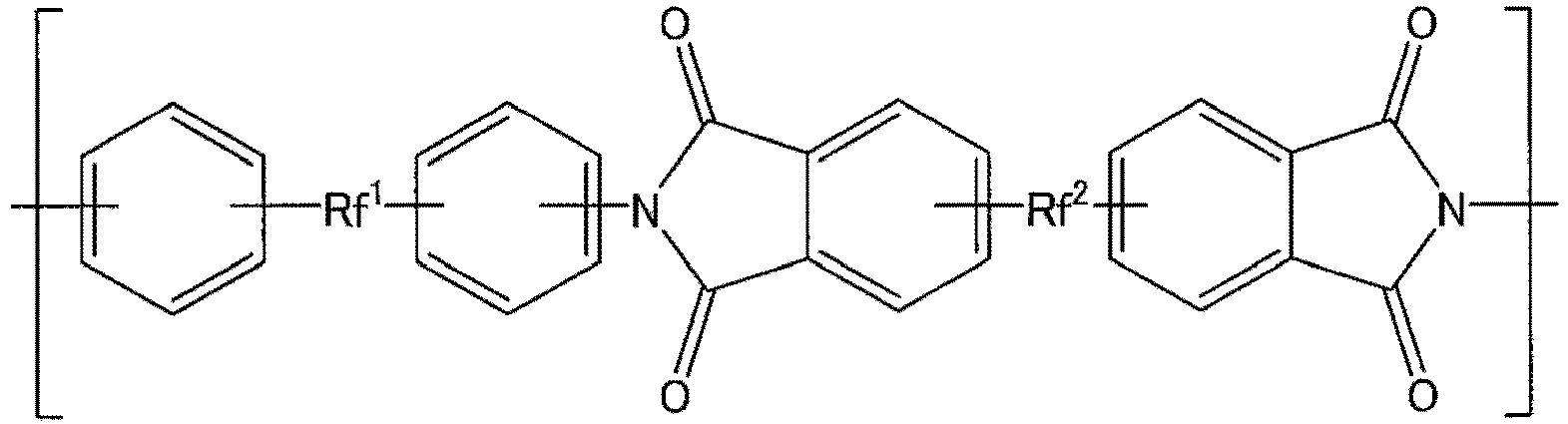
- Examples of the nitrogen-containing heterocyclic ring-containing compound containing the repeating unit represented by Formula (3a) include a compound represented by the following formula.

- By crosslinking the nitrogen-containing heterocyclic ring-containing compound (imide compound) containing the repeating unit represented by Formula (3a) as the repeating unit represented by Formula (3), the crosslinked product described later can be obtained, and the obtained crosslinked product exhibits elastomeric characteristics at a high temperature and furthermore in a wide temperature range, while also having excellent heat resistance and firmly adhering to a substrate.
- Rf1 and Rf2 in Formula (3a) are the same as in Formula (1). By having the same suitable structure as Formula (1), a crosslinked product can be obtained that exhibits elastomeric characteristics at a much higher temperature and furthermore in a much wider temperature range, and a crosslinked product can be obtained that has much better heat resistance and that adheres much more firmly to a substrate.
- Further, the repeating unit represented by Formula (3) is preferably a repeating unit represented by Formula (3b).

- Examples of the nitrogen-containing heterocyclic ring-containing compound containing the repeating unit represented by Formula (3b) include a compound represented by the following formula.

- By crosslinking the nitrogen-containing heterocyclic ring-containing compound (benzimidazole compound) containing the repeating unit represented by Formula (3b) as the repeating unit represented by Formula (3), the crosslinked product described later can be obtained, and the obtained crosslinked product exhibits elastomeric characteristics at a high temperature and furthermore in a wide temperature range, while also having excellent heat resistance and firmly adhering to a substrate.
- Rf1, Rf2, and R2 in Formula (3b) are the same as in Formula (1). By having the same suitable structure as Formula (1), a crosslinked product can be obtained that exhibits elastomeric characteristics at a much higher temperature and furthermore in a much wider temperature range, and a crosslinked product can be obtained that has much better heat resistance and that adheres much more firmly to a substrate.
- From the perspective that it is possible to obtain a nitrogen-containing heterocyclic ring-containing compound that exhibits much better heat resistance and adheres much more firmly to a substrate, the repeating unit represented by Formula (3b) is preferably a repeating unit represented by Formula (3b-1) or Formula (3b-2).


- The glass transition temperature of the nitrogen-containing heterocyclic ring-containing compound of the present disclosure is preferably 80°C to 250°C, and more preferably 100°C to 200°C. The glass transition temperature is a value measured by differential scanning calorimetry (DSC).
- In the nitrogen-containing heterocyclic ring-containing compound of the present disclosure, the average degree of polymerization of the repeating unit represented by Formula (3) is preferably 10 or less, more preferably 6 or less, and further preferably 4 or less, and may be 2 or more, or may be 3 or more. The average degree of polymerization is determined from the added molar ratio and the number average molecular weight of the nitrogen-containing heterocyclic ring-containing compound of the present disclosure.
- From the perspective that excellent characteristics can be obtained after crosslinking, the nitrogen-containing heterocyclic ring-containing compound is preferably an oligomer having a relatively small average degree of polymerization. For example, a polymer having an average degree of polymerization of more than 10 may be used.
- The number average molecular weight (Mn) of the nitrogen-containing heterocyclic ring-containing compound of the present disclosure is, in terms of standard polystyrene by gel permeation chromatography, preferably 1,000 or more, and more preferably 3,000 or more, and preferably 10,000 or less, and more preferably 5,000 or less.
- The molecular weight distribution (Mw/Mn) of the nitrogen-containing heterocyclic ring-containing compound of the present disclosure is, in terms of standard polystyrene by gel permeation chromatography, preferably 1.2 or more, and more preferably 2 or more, and preferably 5 or less, and more preferably 4 or less.
- The logarithmic viscosity ηinh (dL/g) of the nitrogen-containing heterocyclic ring-containing compound of the present disclosure is preferably 0.1 dL/g or more, and preferably 0.5 dL/g or less. The logarithmic viscosity ηinh (dL/g) can be calculated by the following formula by dissolving the nitrogen-containing heterocyclic ring-containing compound in N-methyl-2-pyrrolidone (NMP) as a solvent to prepare a solution having a solution concentration of 0.5 g/dL and measuring the solution viscosity of the prepared solution at 30°C.

- The crosslinked product described later can be obtained by crosslinking the nitrogen-containing heterocyclic ring-containing compound of the present disclosure.
- The crosslinked product of the present disclosure can be obtained by crosslinking the amide compound or the nitrogen-containing heterocyclic ring-containing compound. For example, it is presumed that by heating the amide compound or the nitrogen-containing heterocyclic ring-containing compound, three crosslinking sites located at the end of each of three molecules react with each other to form a ring, thereby forming a crosslinked product. Due to the skeleton formed by the repeating unit of the amide compound or nitrogen-containing heterocyclic ring-containing compound, and the crosslinked structure formed by crosslinking, the crosslinked product of the present disclosure exhibits elastomeric characteristics at a high temperature, and furthermore, in a wide temperature range, and has excellent heat resistance and adheres firmly to a substrate.
- As used herein, "elastomeric characteristics" (rubber characteristics) refers to characteristics that enable the crosslinked product to stretch and to retain its original length when the force required to stretch the crosslinked product is no longer applied. The elastomeric characteristics can be confirmed by dynamic viscoelasticity analysis (DMA) of the crosslinked product to obtain a DMA curve and evaluating the temperature dependence of the storage elastic modulus (E').
- The crosslinked product of the present disclosure may contain a filler. Examples of the filler include imide-based fillers having an imide structure such as polyimide, polyamideimide, and polyetherimide, organic fillers made of an engineering plastic such as polyarylate, polysulfone, polyethersulfone, polyphenylene sulfide, polyether ether ketone, polyether ketone, and polyoxybenzoate, metal oxide fillers such as aluminum oxide, silicon oxide, and yttrium oxide, metal carbides such as silicon carbide and aluminum carbide, metal nitride fillers such as silicon nitride and aluminum nitride, and inorganic fillers such as aluminum fluoride, carbon fluoride, barium sulfate, carbon black, silica, clay, and talc.
- Among these, from the viewpoint of a shielding effect of various plasmas, carbon black, aluminum oxide, yttrium oxide, silicon oxide, polyimide, and carbon fluoride are preferable.
- Further, the above-mentioned inorganic fillers and organic fillers may be blended alone or in combination of two or more.
- The content of the filler in the crosslinked product is, based on 100 parts by mass of the total of the amide compound and the nitrogen-containing heterocyclic ring-containing compound, preferably 0.5 to 100 parts by mass, more preferably 5 to 50 parts by mass.
- Further, the crosslinked product of the present disclosure may optionally contain ordinary additives that are blended in rubber, for example, a processing aid, a plasticizer, a coloring agent, and the like.
- The amide compound of the present disclosure can be suitably produced by polymerizing a compound (4) represented by Formula (4) and a compound (5) represented by Formula (5) to obtain a compound having the repeating unit represented by Formula (1), and then reacting the group Y of the molecular end of the obtained compound with a compound (6) represented by Formula (6) to introduce the crosslinking site represented by Formula (2) onto the molecular end.


Formula (6) : R3-C≡CX1
(In Formula (6), R3 is a monovalent organic group having a reactive group capable of reacting with the group Y of the molecular end of the compound obtained by polymerizing the compound (4) and the compound (5), and X1 is the same as in Formula (2).) - As the compound (4) and the compound (5), the compound (4) is preferably a compound (4a) represented by general formula (4a) and the compound (5) is preferably a compound (5a) represented by general formula (5a), or the compound (4) is preferably a compound (4b) represented by general formula (4b) and the compound (5) is preferably a compound (5b) represented by general formula (5b). The amide compound having a repeating unit represented by Formula (1a) can be obtained by polymerizing the compound (4a) and the compound (5a). Further, the amide compound having a repeating unit represented by Formula (1b) can be obtained by polymerizing the compound (4b) and the compound (5b).



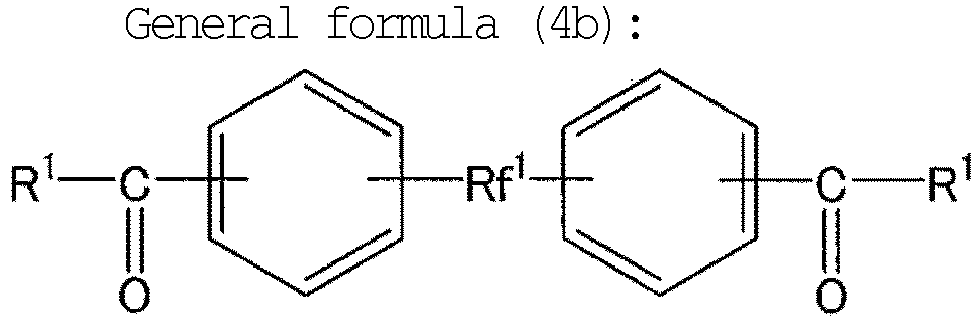

- The polymerization of the compound (4) and the compound (5) can be carried out in a solvent. It is desirable that the solvent does not substantially react with the compound (4) and the compound (5), has the property of dissolving the compound (4) and the compound (5) well, and is a good solvent for the compound obtained by polymerizing the compound (4) and the compound (5). Such a solvent is not limited, and examples thereof include dimethyl sulfoxide (DMSO), N,N-dimethylformamide (DMF), N,N-dimethylacetamide (DMAc), N-methyl-2-pyrrolidone (NMP), 1,3-dimethylimidazolidone (DMI), sulfolane, tetrahydrofuran (THF), and acetone. Of these, N-methyl-2-pyrrolidone (NMP) and 1,3-dimethylimidazolidone (DMI) are preferable. The amount of these solvents used is, based on 0.1 mol of the compound (4) or the compound (5), usually 10 to 1,000 mL, preferably 50 to 400 mL.
- The polymerization can also be carried out in the presence of additives. For example, an inorganic salt such as lithium chloride or calcium chloride may be added in order to obtain a compound having a large molecular weight. OF these, lithium chloride is preferable as the additive. The amount of the additive added is, based on the amount of the solvent, preferably 10% by mass or less, and more preferably 5% by mass or less.
- The polymerization can be carried out by, for example, dissolving any one of the compound (4) and the compound (5) in the solvent, adding the other compound to the resulting solution, and then carrying out the reaction while stirring under an inert atmosphere such as nitrogen. The polymerization temperature is preferably -50 to 150°C, more preferably 0 to 100°C, and further preferably 35 to 80°C. The polymerization time is preferably 0.1 to 50 hours, and more preferably 1 to 24 hours.
- The average degree of polymerization of the repeating unit represented by Formula (1) can be adjusted by changing the molar ratio of the compound (4) to the compound (5), the concentration of the polymerization solution, the polymerization temperature, the polymerization time, and the like.
- After completion of the polymerization, a highly pure compound may be obtained by charging the reaction mixture into a poor solvent such as methanol or water to separate the polymer, and then purifying by a reprecipitation method to remove by-products, inorganic salts, and the like.
- Next, the obtained compound is reacted with the compound represented by Formula (6) to introduce the crosslinking site represented by Formula (2) at a molecular end of the compound. The compound represented by Formula (6) has a monovalent organic group R3 having a reactive group capable of reacting with the group Y of the molecular end of the obtained compound. The reactive group in the organic group R3 reacts with the group Y of the molecular end of the obtained compound, and the compound represented by Formula (6) is added to the compound obtained by polymerizing the compound (4) and the compound (5).
- Examples of the reactive group of R3 in Formula (6) include a hydroxyl group, a carboxyl group, an acid anhydride group, and an amino group. When the group Y of the molecular end of the obtained compound is -COR1, the reactive group of R3 in Formula (6) is preferably -NHR2. Further, when the group Y of the molecular end of the obtained compound is -NHR2, the reactive group of R3 in Formula (6) is preferably -COR1 or an acid anhydride group (-CO-O-CO-) . R1 and R2 are the same as in Formula (1) .
- Examples of the compound (6) include 4-phenylethynylphthalic anhydride (PEPA), propargyl alcohol, phenylpropargyl alcohol, propargylamine, phenylethynylaniline, ethynylaniline, and the like.
- The amount of the compound (6) used may be adjusted according to the equivalent amount of the group Y of the molecular end of the compound obtained by polymerizing the compound (4) and the compound (5). For example, the amount of compound (6) used may be in the range of 2.0 to 2.5 mol based on 1 mol of the compound obtained by polymerizing the compound (4) and the compound (5) .
- The reaction conditions between the compound obtained by polymerizing the compound (4) and the compound (5) and the compound (6) are not limited. The reaction temperature is preferably 0 to 100°C, and more preferably 20 to 80°C. The reaction time is preferably 0.1 to 50 hours, and more preferably 1 to 24 hours.
- The reaction can be carried out in a solvent. It is preferable that the solvent can dissolve the compound obtained by the polymerization of the compound (4) and the compound (5). Such a solvent is not limited, and examples thereof include dimethyl sulfoxide (DMSO), N,N-dimethylformamide (DMF), N,N-dimethylacetamide (DMAc), N-methyl-2-pyrrolidone (NMP), 1,3-dimethylimidazolidone (DMI), sulfolane, tetrahydrofuran (THF), and acetone. Of these, N-methyl-2-pyrrolidone (NMP) and 1,3-dimethylimidazolidone (DMI) are preferable. The amount of these solvents used is, based on 0.1 mol of the compound, usually 10 to 1,000 mL, preferably 50 to 400 mL.
- After completion of the reaction, a highly pure amide compound may be obtained by charging the reaction mixture into a poor solvent such as methanol or water to separate the amide compound, and then purifying by a reprecipitation method to remove by-products, inorganic salts, and the like.
- Of the compounds (4a), the compound (4a-1) represented by Formula (4a-1) is a novel compound.

- The compound (4a-1) can be produced by reacting the compound (7a) represented by Formula (7a) with 1,8-diiodoperfluorooctane.

- The reaction between the compound (7a) and 1,8-diiodoperfluorooctane can be carried out in a solvent. It is desirable that the solvent does not substantially react with the compound (7a) and 1,8-diiodoperfluorooctane, has the property of dissolving the compound (7a) and 1,8-diiodoperfluorooctane well, and is a good solvent for the obtained compound (4a-1). Such a solvent is not limited, and examples thereof include dimethyl sulfoxide (DMSO), N,N-dimethylformamide (DMF), N,N-dimethylacetamide (DMAc), N-methyl-2-pyrrolidone (NMP), 1,3-dimethylimidazolidone (DMI), sulfolane, tetrahydrofuran (THF), and acetone. Of these, dimethyl sulfoxide (DMSO) is preferable. The amount of these solvents used is, based on 0.1 mol of the compound (7a) or 1,8-diiodoperfluorooctane, usually 10 to 1,000 mL, preferably 50 to 400 mL.
- The reaction of between the compound (7a) and 1,8-diiodoperfluorooctane can be carried out by, for example, dissolving any one of the compound (7a) and 1,8-diiodoperfluorooctane in the solvent, adding the other compound to the resulting solution, and then carrying out the reaction while stirring under an inert atmosphere such as nitrogen. The reaction temperature is preferably 50 to 150°C, and more preferably 100 to 140°C. The reaction time is preferably 1 to 50 hours, and more preferably 1 to 30 hours.
- The reaction between the compound (7a) and 1,8-diiodoperfluorooctane may be carried out in the presence of a catalyst such as a copper compound.
- After completion of the reaction, a highly pure compound (4a-1) may be obtained by charging the reaction mixture into a poor solvent such as methanol or water to separate the compound (4a-1), and then purifying by a recrystallization method to remove by-products, inorganic salts, and the like.
- Next, a method for producing the compound (4b) will be described. A compound (4b) in which R1 is OH can be produced by reacting a compound (7b1) represented by Formula (7b1) with a compound (7b2) represented by Formula (7b2) to obtain a compound (8) represented by Formula (8), and then oxidizing the obtained compound (8).

Formula (7b2): I-Rf1-I
(In Formula (7), Rf1 is the same as in Formula (1).)

- The compound (7b1) is more preferably 4-iodotoluene or 3-iodotoluene.
- Further, by reacting the compound (4b) in which R1 is OH with a compound (9) represented by Formula (9), a compound (4b) having a desired group represented by R1 (for example, an alkoxy group or an aromatic oxy group) can be produced.
Formula (9): R-OH
(In Formula (9), R is an optionally-substituted linear or branched chain alkyl group or an optionally-substituted aromatic group.) - Further, by reacting the compound (4b) in which R1 is OH with a halogenating agent, a compound (4b) in which R1 is a halogen atom can be produced.
- Further, by reacting the compound (4b) in which R1 is OH with a triazine chloride compound, a compound (4b) in which R1 is a triazinyloxy group can be produced.
- The reaction between the compound (7b1) and the compound (7b2) can be carried out in a solvent. It is desirable that the solvent does not substantially react with the compound (7b1) and compound (7b2), has the property of dissolving the compound (7b1) and compound (7b2) well, and is a good solvent for the obtained compound (8). Such a solvent is not limited, and examples thereof include dimethyl sulfoxide (DMSO), N,N-dimethylformamide (DMF), N,N-dimethylacetamide (DMAc), N-methyl-2-pyrrolidone (NMP), 1,3-dimethylimidazolidone (DMI), sulfolane, tetrahydrofuran (THF), and acetone. Of these, dimethyl sulfoxide (DMSO) is preferable. The amount of these solvents used is, based on 0.1 mol of the compound (7b1) or compound (7b2), usually 10 to 1,000 mL, preferably 50 to 400 mL.
- The reaction between the compound (7b1) and the compound (7b2) can be carried out by, for example, dissolving any one of the compound (7b1) and compound (7b2) in the solvent, adding the other compound to the resulting solution, and then carrying out the reaction while stirring under an inert atmosphere such as nitrogen. The reaction temperature is preferably 50 to 150°C, and more preferably 100 to 140°C. The reaction time is preferably 1 to 50 hours, and more preferably 1 to 30 hours.
- The reaction between the compound (7b1) and the compound (7b2) may be carried out in the presence of a catalyst such as copper or a copper compound.
- The oxidation of the compound (8) can be performed using, for example, an oxidizing agent such as CrO3 or KMnO4. Further, the oxidation of the compound (8) is preferably carried out in the presence of an acidic compound such as sulfuric acid or acetic acid.
- Examples of the halogenating agent used in the reaction between the compound (4b) in which R1 is OH and the halogenating agent include thionyl chloride, phosphorus trichloride, phosphorus pentachloride, and the like. The reaction temperature may be, for example, 20 to 100°C. The reaction between the compound (4b) and the halogenating agent can also be carried out in a solvent. Examples of the solvent include ethers such as diethyl ether and tetrahydrofuran.
- The reaction between the compound (4b) in which R1 is OH and the triazine chloride compound can be carried out in a solvent in the presence of N-methylmorpholine (NMM). As a result of this reaction, a triazine-based active diester can be synthesized. It is desirable that the solvent does not substantially react with the compound (4b), the triazine chloride compound, and N-methylmorpholine (NMM), has the property of dissolving the compound (4b), the triazine chloride compound, and N-methylmorpholine (NMM) well, and is a good solvent for the obtained triazine-based active diester. Such a solvent is not limited, and examples thereof include dimethyl sulfoxide (DMSO), N,N-dimethylformamide (DMF), N,N-dimethylacetamide (DMAc), N-methyl-2-pyrrolidone (NMP), 1,3-dimethylimidazolidone (DMI), sulfolane, tetrahydrofuran (THF), and acetone. Of these, N-methyl-2-pyrrolidone (NMP) is preferable. The amount of these solvents used is, based on 0.1 mol of the compound (4b) or triazine chloride compound, usually 10 to 1,000 mL, preferably 50 to 400 mL.
- The reaction between the compound (4b) in which R1 is OH and the triazine chloride compound can be carried out by, for example, dissolving any one of the compound (4b) in which R1 is OH and the triazine chloride compound in the solvent, adding the other compound to the resulting solution, and then carrying out the reaction while stirring under an inert atmosphere such as nitrogen. The reaction temperature is preferably 0 to 150°C, more preferably 50 to 150°C, and further preferably 100 to 140°C. The reaction time is preferably 1 to 50 hours, and more preferably 1 to 30 hours.
- The nitrogen-containing heterocyclic ring-containing compound of the present disclosure can be suitably produced by a production method of obtaining an amide compound by the production method described above, and then cyclodehydrating the amide compound. Further, when producing the amide compound, in a case in which the reaction between the compound (6) and the compound obtained by polymerizing the compound (4) and the compound (5) is carried out in a heated state, a part or all of the compound undergoes cyclodehydration, which may result the nitrogen-containing heterocyclic ring-containing compound of the present disclosure being obtained as a part or all of the product. That is, the present disclosure also includes mixtures of the amide compound and the nitrogen-containing heterocyclic ring-containing compound.
- The cyclodehydration of the amide compound can be carried out by heating the amide compound. The heating temperature for the cyclodehydration is preferably a temperature at which the crosslinking reaction does not proceed. The heating temperature for the cyclodehydration is preferably 110 to 290°C, and more preferably 150 to 260°C. The heating time is preferably 0.1 to 10 hours, and more preferably 0.5 to 8 hours. The cyclodehydration can be carried out in air, in a nitrogen or argon atmosphere, or under reduced pressure.
- Generally, a solution of the amide compound or nitrogen-containing heterocyclic ring-containing compound is obtained by the production method described above. The obtained solution may be used as it is for various purposes, or the obtained solution may be charged into a poor solvent such as methanol or water to separate the nitrogen-containing heterocyclic ring-containing compound, which is then dried to produce a powder of the nitrogen-containing heterocyclic ring-containing compound, and the obtained powder may be used.
- The crosslinked product of the present disclosure can be suitably produced by a production method of obtaining an amide compound or a nitrogen-containing heterocyclic ring-containing compound by the production method described above, and then crosslinking the amide compound or the nitrogen-containing heterocyclic ring-containing compound. For the crosslinking, the amide compound, the nitrogen-containing heterocyclic ring-containing compound, or a mixture of the amide compound and the nitrogen-containing heterocyclic ring-containing compound can be used. The amide compound or the amide compound in the mixture is cyclodehydrated at the same time as the crosslinking to give a crosslinked product having the same structure as the crosslinked product obtained by crosslinking the nitrogen-containing heterocyclic ring-containing compound.
- The amide compound of the present disclosure is a thermally crosslinkable amide compound, and the nitrogen-containing heterocyclic ring-containing compound of the present disclosure is a thermally crosslinkable nitrogen-containing heterocyclic ring compound. Therefore, the crosslinking can be performed by heating the amide compound or the nitrogen-containing heterocyclic ring-containing compound. The heating temperature for the crosslinking is preferably 250 to 550°C, and more preferably 320 to 400°C. The heating time is preferably 0.1 to 5 hours, and more preferably 0.5 to 4 hours. During the crosslinking, the amide compound or nitrogen-containing heterocyclic ring-containing compound may be heated so as to slowly raise the temperature of the amide compound or nitrogen-containing heterocyclic ring-containing compound. The temperature-increasing rate may be 1 to 10°C/min. For example, the amide compound or nitrogen-containing heterocyclic ring-containing compound may be heated to 300 to 330°C, and then heated at a rate of 1 to 10°C/min to raise the temperature by 30°C or more.
- Prior to the crosslinking, the amide compound or nitrogen-containing heterocyclic ring-containing compound may be molded into a desired shape. The molding can be performed by a known method, such as compression molding. The amide compound or nitrogen-containing heterocyclic ring-containing compound may be molded by heating and melting, or may be molded by preparing a solution containing the amide compound or the nitrogen-containing heterocyclic ring-containing compound, and impregnating a substrate with the obtained solution or coating the obtained solution on the substrate.
- Prior to the crosslinking, the amide compound or nitrogen-containing heterocyclic ring-containing compound may be mixed with a filler. By mixing with a filler, a crosslinked product containing a filler can be obtained. Further, prior to the crosslinking, the amide compound or nitrogen-containing heterocyclic ring-containing compound may be mixed with ordinary additives that are blended in rubber, for example, a processing aid, a plasticizer, a coloring agent, and the like.
- In the case of mixing the amide compound or nitrogen-containing heterocyclic ring-containing compound with a filler or an additive, a conventional polymer processing machine, for example, an open roll, a Banbury mixer, a kneader, a closed mixer, and the like can be used.
- Since the crosslinked product of the present disclosure exhibits elastomeric characteristics at a high temperature, and moreover in a wide temperature range, the crosslinked product of the present disclosure can be suitably used as a member of a semiconductor manufacturing apparatus that in particular requires heat resistance, in particular as a sealing material of a semiconductor manufacturing apparatus. Examples of the sealing material include O-rings, square-rings, gaskets, packings, oil seals, bearing seals, lip seals, and the like.
- In addition, the crosslinked product of the present disclosure can also be used as various polymer products used in a semiconductor manufacturing apparatus, such as diaphragms, tubes, hoses, various rubber rolls, and belts. Further, the crosslinked product of the present disclosure can also be used as a coating material and a lining material.
- As used herein, the semiconductor manufacturing apparatus referred to in the present disclosure is not limited to an apparatus for manufacturing semiconductors, and widely includes general manufacturing apparatus used in the semiconductor field requiring a high level of cleanliness, such as apparatus for manufacturing liquid crystal panels and plasma panels. Examples thereof include the following.
- (1) Etching apparatus
- Dry etching apparatus
- Plasma etching apparatus
- Reactive ion etching apparatus
- Reactive ion beam etching apparatus
- Sputter etching apparatus
- Ion beam etching apparatus
- Wet etching apparatus
- Ashing apparatus
- (2) Cleaning apparatus dry etching cleaning apparatus
- UV/O3 cleaning apparatus
- Ion beam cleaning apparatus
- Laser beam cleaning apparatus
- Plasma cleaning apparatus
- Gas etching cleaning apparatus
- Extraction cleaning apparatus
- Soxhlet extraction cleaning apparatus
- High-temperature high-pressure extraction cleaning apparatus
- Microwave extraction cleaning apparatus
- Supercritical extraction cleaning apparatus
- (3) Exposure apparatus
- Stepper
- Coater/developer
- (4) Polishing apparatus
CMP apparatus - (5) Film formation apparatus
- CVD apparatus
- Sputtering apparatus
- (6) Diffusion/ion implantation apparatus
- Oxidation diffusion apparatus
- Ion implantation apparatus
- The crosslinked product of the present disclosure exhibits excellent performance as a sealing material for, for example, a CVD apparatus, a plasma etching apparatus, a reactive ion etching apparatus, an ashing apparatus, or an excimer laser exposure apparatus.
- Further, a solution in which the amide compound or nitrogen-containing heterocyclic ring-containing compound of the present disclosure is dissolved in a solvent can be used as a coating material. Since the amide compound or nitrogen-containing heterocyclic ring-containing compound of the present disclosure has excellent heat resistance and adhesiveness to a substrate, the amide compound or nitrogen-containing heterocyclic ring-containing compound can be suitably applied for coating the surface of the substrate. For example, a heat-resistant coating can be formed by applying a solution in which the amide compound or nitrogen-containing heterocyclic ring-containing compound of the present disclosure is dissolved in a solvent to the surface of a substrate and drying by heating.
- Examples of the substrate include a metal substrate, a glass substrate, a resin substrate, a rubber substrate, and the like. From the perspective of obtaining a particularly high adhesiveness, a metal substrate is preferable. Examples of the metal substrate include a substrate made of iron, copper, stainless steel, aluminum, brass, and the like.
- Further, a solution containing a filler in addition to the amide compound or nitrogen-containing heterocyclic ring-containing compound of the present disclosure may be prepared and applied to the substrate. Examples of the filler include those described above. By using a filler, various physical properties such as heat resistance, hardness, and abrasion resistance of the heat-resistant coating can be improved.
- A solution containing another polymer in addition to the amide compound or nitrogen-containing heterocyclic ring-containing compound of the present disclosure may be prepared and applied to the substrate. As the other polymer, a polymer having excellent heat resistance is preferable. Examples thereof include polyether ether ketone, polyphenylene sulfide, polyphenylsulfone, polysulfone, polyamideimide, polybenzoxazole, polybenzimidazole, polyimide, and the like. The content of the amide compound or nitrogen-containing heterocyclic ring-containing compound of the present disclosure may be, for example, 0.0001 to 10,000 parts by mass based on 100 parts by mass of the other polymer.
- Further, a fiber-reinforced composite material can be obtained by impregnating a fibrous substrate with a solution in which the amide compound or nitrogen-containing heterocyclic ring-containing compound of the present disclosure is dissolved in a solvent.
- Further, a solution in which the amide compound or nitrogen-containing heterocyclic ring-containing compound of the present disclosure is dissolved in a solvent can be used as an adhesive. By using an adhesive containing the amide compound or nitrogen-containing heterocyclic ring-containing compound of the present disclosure, an adhesive layer having excellent heat resistance can be formed.
- The solvent for dissolving the amide compound or nitrogen-containing heterocyclic ring-containing compound of the present disclosure is not limited, and examples thereof include dimethyl sulfoxide (DMSO), N,N-dimethylformamide (DMF), N,N-dimethylacetamide (DMAc), N-methyl-2-pyrrolidone (NMP), 1,3-dimethylimidazolidone (DMI), sulfolane, tetrahydrofuran (THF), and acetone. Of these, N-methyl-2-pyrrolidone (NMP) and 1,3-dimethylimidazolidone (DMI) are preferable.
- Embodiments of the present disclosure have been described above, but it will be understood that various modifications can be made to the embodiments and details thereof without departing from the gist and scope of the claims.
- Next, the embodiments of the present disclosure will be described with reference to examples, but the present disclosure is not limited to such examples.
- The numerical values in the examples were measured by the following methods.
- (1) GPC: High-speed GPC System HLC-8220GPC, manufactured by Tosoh Corporation (column: Tosoh TSKgel (α-M), column temperature: 45°C, detector: UV-8020, wavelength 254 nm, eluent: N-methyl-2-pyrrolidone (NMP) (including 0.01 mol/L lithium bromide), calibration curve: standard polystyrene, column flow velocity: 0.2 mL/min)
- (2) Infrared spectrum (FT-IR): FT/IR-4200, manufactured by JASCO Corporation
- (3) Nuclear magnetic resonance spectrum (NMR) : AC400P, manufactured by BRUKER
- (4) Thermogravimetric analysis (TGA): TG/DTA7300, manufactured by Hitachi High-Tech Science Corporation, temperature-increasing rate 10°C/min
- (5) Differential scanning calorimetry (DSC): DSC7000, manufactured by Hitachi High-Tech Science Corporation, temperature-increasing rate 10°C/min
- (6) Thermomechanical analysis (TMA) : IMA7000, manufactured by Hitachi High-Tech Science Corporation, temperature-increasing rate 10°C/min
- (7) Dynamic viscoelasticity measurement (DMA): DMA7100, manufactured by Hitachi High-Tech Science Corporation, temperature-increasing rate 2°C/min
- (8) Tensile test: Autograph AGS-D type, manufactured by Shimadzu Corporation, tensile speed 10 mm/min
- (9) Dielectric constant measurement: Dielectric constant / dielectric tangent measuring device (cavity resonator type, 20 GHz) manufactured by AET
-

- 4-iodoaniline (15 g, 69 mmol) and DMSO (60 mL) were charged into a 100 mL eggplant flask equipped with a stirrer, a Dimroth condenser, and a three-way cock, and made to dissolve. Then, the mixture was quickly charged with copper powder (21.6 g, 342 mmol) so as not to oxidize in air, and quickly charged with 1,6-diiodoperfluorohexane (18.9 g, 33 mmol) before it deliquesced. Then, the temperature was raised to 120°C, and the mixture was reacted while stirring for 24 hours at 120°C. After completion of the reaction, the mixture was cooled to room temperature and suction filtered to recover the DMSO solution. The DMSO was distilled off from the DMSO solution by vacuum distillation to obtain a crude product. The crude product was dissolved in dichloromethane, washed with distilled water, the dichloromethane solution was recovered, and the resulting product was dried over anhydrous sodium sulfate overnight. The dichloromethane was distilled off with an evaporator to obtain a yellow crude product. The yellow crude product was recrystallized from hexane, and dried under reduced pressure at room temperature. The product was dissolved in methanol and decolorized with activated carbon. After removing the methanol, the product was dried under reduced pressure at 60°C overnight to obtain APDF6 (yield amount: 10.8 g, yield: 65%) in the form of a yellow powder.
- The structure was confirmed by FT-IR, 1H-NMR, 13C-NMR, 19F-NMR, and elemental analysis.
- FT-IR (KBr, cm-1): 3444 (N-H), 3057 (C-H), 1609 (C=C), 1185 (C-F)
- 1H-NMR (DMSO-d6, ppm) : 5.82 (s, 4H, NH2), 6.62 (d, 4H, Ar-H), 7.20 (d, 4H, Ar-H)
- 13C-NMR (DMSO-d6, ppm): 113.0, 127.6, 152.4
- 19F-NMR (DMSO-d6, ppm) : -122.2, -121.5, -108.0
- Melting point: 79.4°C (DSC)
- Elemental analysis: Calculated C, 44.64%; H, 2.50%; N, 5.78%
Measured C, 44.66%; H, 2.72%; N, 5.49% -

- 4-iodoaniline (7.5 g, 34 mmol) and DMSO (20 mL) were charged into a 100 mL eggplant flask equipped with a stirrer, a Dimroth condenser, and a three-way cock, and made to dissolve. Then, the mixture was quickly charged with copper powder (10 g, 172 mmol) so as not to oxidize in air, and quickly charged with 1,8-diiodoperfluorooctane (11.6 g, 17 mmol) before it deliquesced. Then, the temperature was raised to 120°C, and the mixture was reacted while stirring for 24 hours at 120°C. After completion of the reaction, the mixture was cooled to room temperature and suction filtered to recover the DMSO solution. The DMSO was distilled off from the DMSO solution by vacuum distillation to obtain a crude product. The crude product was dissolved in dichloromethane, washed with distilled water, the dichloromethane solution was recovered, and the resulting product was dried over anhydrous sodium sulfate overnight. The dichloromethane was distilled off with an evaporator, and 8.4 g (80%) of a crude product was collected. The crude product was recrystallized from hexane, and dried under reduced pressure at room temperature. The product was dissolved in methanol and decolorized with activated carbon. The methanol was removed to obtain APHF8 (yield amount: 5.9 g, yield: 58%) in the form of a yellow powder.
- The structure was confirmed by FT-IR, 1H-NMR, 13C-NMR, and 19F-NMR. FT-IR (KBr, cm-1): 3489-3392 (N-H), 3050 (C-H), 1581 (C=C), 1259-1145 (C-F) 1H-NMR (DMSO-d6, ppm): 5.86 (s, 4H, NH2), 6.66 (d, 4H, Ar-H), 7.22 (d, 4H, Ar-H)
- 13C-NMR (DMSO-d6, ppm): 113.0, 127.8, 152.4
- 19F-NMR (DMSO-d6, ppm): -121.7, -121.1, -107.5
- Melting point: 85.8°C (DSC)
- Elemental analysis: Calculated C, 41.16%; H, 2.08%; N, 4.80%
Measured C, 41.23%; H, 2.28%; N, 4.85% -

- 3-iodoaniline (5.0 g, 22.8 mmol) and DMSO (20 mL) were charged into a 100 mL eggplant flask equipped with a stirrer, a Dimroth condenser, and a three-way cock, and made to dissolve. Then, the mixture was quickly charged with copper powder (7.2 g, 114 mmol) so as not to oxidize in air, and quickly charged with 1,6-diiodoperfluorohexane (6.3 g, 11.4 mmol) before it deliquesced. Then, the temperature was raised to 120°C, and the mixture was reacted while stirring for 24 hours at 120°C. After completion of the reaction, the mixture was cooled to room temperature and suction filtered to recover the DMSO solution. The DMSO was distilled off from the DMSO solution by vacuum distillation to obtain a crude product. The crude product was dissolved in dichloromethane, washed with distilled water, the dichloromethane solution was recovered, and the resulting product was dried over anhydrous sodium sulfate overnight. The dichloromethane was distilled off with an evaporator to obtain a yellow crude product. The yellow crude product was recrystallized from a mixed solvent of methanol / distilled water, and dried under reduced pressure at 60°C. The product was dissolved in methanol and decolorized with activated carbon. After removing the methanol, the product was dried under reduced pressure at 60°C overnight to obtain mAPDF6 (yield amount: 3.0 g, yield: 54%) in the form of a yellow powder.
- The structure was confirmed by 1H-NMR, 13C-NMR, 19F-NMR, and elemental analysis.
- 1H-NMR (CDCl3, ppm) : 3.81 (s, 4H, NH2), 6.83 (d, 2H, Ar-H), 6.85 (s, 2H, Ar-H), 6.95 (d, 2H, Ar-H), 7.24 (t, 2H, Ar-H)
- 13C-NMR (CDCl3, ppm): 113.1, 116.9, 118.2, 129.6, 130.3, 146.7
- 19F-NMR (CDCl3, ppm): -121.9, -121.3, -110.7
- Melting point: 79.4°C (DSC)
- Elemental analysis: Calculated C, 44.64%; H, 2.50%; N, 5.78%
Measured C, 44.75%; H, 2.80%; N, 5.52% - <Synthesis example 4>
-

- 4-Iodotoluene (8.72 g, 40 mmol) and DMSO (20 mL) were charged into a 100 mL three-necked flask equipped with a stirrer, a condenser, and a nitrogen introduction tube, and made to dissolve. Next, 1,6-diiodoperfluorohexane (11.08 g, 20 mmol) and copper powder (12.69 g, 200 mmol) were added, the temperature was increased in steps to 120°C, and the mixture was reacted for 24 hours at 120°C. After completion of the reaction, the mixture was allowed to cool to room temperature, the copper powder was removed by suction filtration, and the DMSO was distilled off by vacuum distillation. The obtained crude product was dissolved in diethyl ether (100 mL), and washed with distilled water. The organic layer was separated and dehydrated overnight with anhydrous sodium sulfate. The diethyl ether was distilled off with an evaporator to obtain a white product (TDF6) (yield amount: 8.59 g, yield: 89%).
- The physical properties of the obtained product are shown below.
- 1H-NMR (CDCl3, ppm): 2.34 (s, 6H, CH3), 7.41 (d, 4H, Ar-H), 7.51 (d, 4H, Ar-H)
- 13C-NMR (CDCl3, ppm): 20.86, 126.46, 129.67, 136.58, 136.67, 138.60, 138.71, 142.90
- 19F-NMR (CDCl3, ppm): -109.72, -121.57, -122.13
- <Synthesis example 5>
-

- TDF6 (14.47 g, 30 mmol), acetic acid (150 mL), and concentrated sulfuric acid (20 mL) were charged into a 500 mL three-necked flask equipped with a stirrer, a nitrogen introduction tube, a thermometer, and a dropping funnel, made to dissolve, and the resulting mixture was cooled to 0°C. A solution prepared by dissolving chromium oxide (10.00 g, 100 mmol) in acetic anhydride (50 mL) was added dropwise, and after the addition was completed, the mixture was reacted for 12 hours at room temperature while stirring. After completion of the reaction, the reaction solution was charged into distilled water (1 L) to precipitate a product. The product was collected by suction filtration, and dried under reduced pressure for 12 hours at 100°C. The yield amount obtained was 15.9 g (98% yield). The dried product was recrystallized from a mixed solvent of DMF / distilled water, and dried under reduced pressure for 12 hours at 100°C to obtain a product in the form of a white powder (yield amount: 6.35 g, yield: 39%) .
- The physical properties of the obtained product are shown below.
- 1H-NMR (DMSO-d6, ppm) : 7.80 (d, 4H, Ar-H), 8.13 (d, 4H, Ar-H), 13.50 (s, 1H, COOH)
- 13C-NMR (DMSO-d6, ppm) : 127.15, 129.93, 131.19, 134.74, 136.57, 136.66, 138.70, 166.23
- 19F-NMR (DMSO-d6, ppm) : -110.41, -121.57, -122.04
-

- CPDF6 (5.38 g, 9.9 mmol) and thionyl chloride (40 mL) were charged into an eggplant flask (100 mL) equipped with a stirrer, a condenser, and a calcium chloride tube, the temperature was slowly raised to 85°C, and the mixture was stirred for 1 hour. The mixture was allowed to cool to room temperature, and excess thionyl chloride was distilled off by vacuum distillation to obtain a solid product. The obtained solid product was purified by sublimation (140°C/0.8 Torr) to obtain a white needle-like crystal product (yield amount: 4.4 g, yield: 77%).
- The structure was confirmed by FT-IR, 1H-NMR, 13C-NMR, 19F-NMR, and elemental analysis.
- FT-IR (KBr, cm-1): 3063 (Ar-H), 1746 (C=O), 1142 (C-F)
- 1H-NMR (CDCl3, ppm): 8.24 (d, 4H, Ar-H), 7.75 (d, 4H, Ar-H)
- 13C-NMR (CDCl3, ppm): 127.78, 131.40, 135.49, 136.44, 167.76,
- 19F-NMR (CDCl3, ppm): -111.33, -121.10, -121.60
- Melting point: 129 to 130°C
- Elemental analysis: Calculated C, 41.48%; H, 1.39%
Measured C, 41.43%; H, 1.48% -

- CPDF6 (27.11 g, 50 mmol), chlorodimethoxytriazine (CDMT) (17.51 g, 100 mmol), and NMP (400 mL) were charged into a 500 mL three-necked flask equipped with a stirrer, a nitrogen introduction tube, and a thermometer, made to dissolve, and the resulting mixture was cooled to 0°C. Then, N-methylmorpholine (NMM) (11.59 mL, 110 mmol) was added, and the mixture was reacted for 1 hour at 0°C. After completion of the reaction, the reaction solution was charged into 400 mL of an aqueous solution adjusted to pH 3 using acetic acid to precipitate a product. The product was collected by suction filtration and dried under reduced pressure for 12 hours at 50°C. The crude yield amount was 32.8 g (crude yield 80%). The dried crude product was recrystallized from a mixed solvent of chloroform / hexane, and dried under reduced pressure for 12 hours at 50°C to obtain a product in the form of a white powder (yield amount: 21.33 g, yield: 52%).
- The physical properties of the obtained product are shown below.
- 1H-NMR (CDCl3, ppm): 4.09 (s, 12H, CH3), 7.76 (d, 4H, Ar-H), 8.30 (s, 4H, Ar-H)
- 13C-NMR (CDCl3, ppm): 56.20, 127.64, 130.90, 131.61, 137.01, 137.10, 139.19, 161.54, 170.70, 171.13, 174.39
- 19F-NMR (CDCl3, ppm): -112.65, -122.53, -123.10
-

- 2,2-Bis(3,4-diaminophenyl)hexafluoropropane (6FTA) (1.82 g, 5 mmol) and NMP (9 mL) were charged into a 100 mL three-necked flask equipped with a stirrer and a nitrogen introduction tube, made to dissolve, and the resulting mixture was cooled to 0°C. Next, a triazine-based active diester (p-DFBBT) (3.28 g, 4 mmol) was added so that the number of repeating units (n) of the amide compound was 4, and the mixture was reacted for 1 hour at 0°C. Then, the mixture was reacted for 12 hours at room temperature. After completion of the reaction, the polymerization solution was charged into distilled water (300 mL) to precipitate an amide compound. The precipitated amide compound was collected by suction filtration, and dried under reduced pressure at room temperature for 12 hours. The crude yield was 98%. The dried polymer was dissolved in NMP (9 mL) and purified by reprecipitation with distilled water to obtain an amide compound (6FTA-p-DFBBT) in the form of a pale yellow powder (yield amount: 3.11 g, yield: 81%).
- The physical properties of the obtained amide compound are shown below.
- FT-IR (KBr, cm-1): 1,658 (C=O), 1,500 (C=C), 1,170 (C-F)
- Number average molecular weight (Mn): 3,600 (calculated value 3,700), molecular weight distribution (Mw / Mn): 2.2
- Solubility: Dissolved in NMP, DMAc, DMF, DMSO, THF, acetone, methanol at room temperature
-

- 6FTAPh (2.58 g, 5 mmol) and NMP (9 mL) were charged into a 100 mL three-necked flask equipped with a stirrer and a nitrogen introduction tube, and made to dissolve. Next, a triazine-based active diester (p-DFBBT) (3.28 g, 4 mmol) was added so that the number of repeating units (n) of the amide compound was 4, and the mixture was reacted for 12 hours at room temperature. After completion of the reaction, the polymerization solution was charged into distilled water (300 mL) to precipitate an amide compound. The precipitated amide compound was collected by suction filtration, and dried under reduced pressure at room temperature for 12 hours. The crude yield was 94%. The dried amide compound was dissolved in NMP (9 mL) and purified by reprecipitation with distilled water to obtain an amide compound in the form of a white powder (6FTAPh-p-DFBBT) (yield amount: 3.44 g, yield: 77%).
- The physical properties of the obtained amide compound are shown below.
- FT-IR (KBr, cm-1): 1,661 (C=O), 1,598 (C=C), 1,169 (C-F)
- Logarithmic viscosity: 0.25 dL/g (NMP solution having a 0.5 g/dL concentration, measured at 30°C)
- Number average molecular weight (Mn): 4,500 (calculated value 4,600), molecular weight distribution (Mw / Mn): 2.0
- Solubility: Dissolved in NMP, DMAc, DMF, DMSO, THF, chloroform, acetone, methanol at room temperature
-

- An amide compound (6FTA-p-DFBBT) (0.371 g, 0.1 mmol) and NMP (1.6 mL) were charged into a 100 mL three-necked flask equipped with a stirrer and a nitrogen introduction tube, and made to dissolve. Next, 4-phenylethynylphthalic anhydride (PEPA) (0.050 g, 0.2 mmol) as a cross-linking agent was added, and the mixture was reacted for 12 hours at room temperature. After completion of the reaction, the polymerization solution was coated on a glass plate, dried under reduced pressure for 6 hours at room temperature, 6 hours at 60°C, 6 hours at 100°C, 1 hour at 150°C, 1 hour at 200°C, and 1 hour at 250°C, to obtain an amide compound having a crosslinkable group introduced at an end.
- The physical properties of the obtained amide compound are shown below.
- FT-IR (KBr, cm-1): 2,214 (C≡C), 1,725 (C=O), 1,657 (C=O), 1,617 (C=C), 1,185 (C-F)
- Solubility: Dissolved in NMP, DMAc, and DMF at room temperature
- Glass transition temperature: 250°C (DSC measurement)
- 5% Weight loss temperature: 429°C (in air), 433°C (in nitrogen) (TGA)
- 10% Weight loss temperature: 496°C (in air), 504°C (in nitrogen) (TGA)
- Carbonization yield: 57% (800°C in nitrogen) (TGA)
-

- A 100 mL three-necked flask equipped with a stirrer, a Dimroth condenser, a flat stopper, and a nitrogen introduction tube was heated and dried with a burner. Then, APDF6 (1.211 g, 2.50 mmol) and distilled NMP (7.0 mL) were charged into the flask, and the mixture was completely dissolved by stirring. Then, 4,4'- (hexafluoroisopylidene) diphthalic acid dianhydride (6FDA) (0.888 g, 2.00 mmol) was added, and the mixture was placed in an ice bath and stirred for 1 hour at 0 to 5°C. Then, after gradually raising the temperature and stirring for 6 hours at 60°C, 4-phenylethynylphthalic anhydride (PEPA) (0.248 g, 1.00 mmol) as a cross-linking agent was added, and the mixture was stirred for 15 hours at 60°C. After cooling to room temperature, the polymerization solution was cast on a glass plate, and dried under reduced pressure for 3 hours at room temperature to obtain a precursor amide compound. Then, the precursor amide compound was dried under reduced pressure in a program consisting of 1 hour at 80°C, 1 hour at 100°C, 1 hour at 150°C, 1 hour at 200°C, and 1 hour at 250°C to obtain a nitrogen-containing heterocyclic ring-containing compound (imide compound) in the form of a yellow powder.
- The physical properties of the obtained nitrogen-containing heterocyclic ring-containing compound (imide compound) are shown below.
- FT-IR (KBr, cm-1): 2,214 (C≡C), 1,787 (C=O), 1,727 (C=O), 1,373 (C-N), 1,298 (C-F), 745 (imide ring)
- Logarithmic viscosity (ηinh): 0.14 dL/g (NMP solution having a 0.5 g/dL concentration, measured at 30°C)
- Number average molecular weight (Mn): 4,700 (calculated value 4,500), molecular weight distribution (Mw/Mn): 2.4
- Solubility: Dissolved in NMP, EMSO, DMAc, DMF, DMI, γ-butyrolactone, THF, and chloroform at room temperature
- 5% Weight loss temperature: 522°C (in air), 526°C (in nitrogen) (TGA)
- 10% Weight loss temperature: 547°C (in air), 551°C (in nitrogen) (TGA)
- Carbonization yield: 50% (800°C in nitrogen) (TGA)
- Glass transition temperature: 171°C (DSC)
-

- A 100 mL three-necked flask equipped with a stirrer, a Dimroth condenser, a flat stopper, and a nitrogen introduction tube was heated and dried with a burner. Then, APDF6 (1.211 g, 2.50 mmol) and distilled NMP (7.7 mL) were charged into the flask, and the mixture was completely dissolved by stirring. Then, oxydiphthalic acid dianhydride (ODPA) (0.620 g, 2.00 mmol) was added, and the mixture was placed in an ice bath and stirred for 1 hour at 0 to 5°C. Then, after gradually raising the temperature and stirring for 6 hours at 60°C, 4-phenylethynylphthalic anhydride (PEPA) (0.248 g, 1.00 mmol) as a cross-linking agent was added, and the mixture was stirred for 12 hours at 60°C. After cooling to room temperature, the polymerization solution was cast on a glass plate, and dried under reduced pressure for 3 hours at room temperature to obtain a precursor amide compound. Then, the precursor amide compound was dried under reduced pressure in a program consisting of 1 hour at 80°C, 1 hour at 100°C, 1 hour at 150°C, 1 hour at 200°C, and 1 hour at 250°C to obtain a nitrogen-containing heterocyclic ring-containing compound (imide compound) in the form of a yellow powder.
- The physical properties of the obtained nitrogen-containing heterocyclic ring-containing compound (imide compound) are shown below.
- FT-IR (KBr, cm-1): 2,213 (C≡C), 1,785 (C=O), 1,727 (C=O), 1,370 (C-N), 1,275 (C-F), 743 (imide ring)
- Logarithmic viscosity (ηinh): 0.19 dL/g (NMP solution having a 0.5 g/dL concentration, measured at 30°C)
- Number average molecular weight (Mn): 4,100 (calculated value 4,000), molecular weight distribution (Mw/Mn): 4.0
- Solubility: Dissolved in NMP, DMAc, and DMI at room temperature
- 5% Weight loss temperature: 504°C (in air), 523°C (in nitrogen) (TGA)
- 10% Weight loss temperature: 539°C (in air), 550°C (in nitrogen) (TGA)
- Carbonization yield: 51% (800°C in nitrogen) (TGA)
- Glass transition temperature: 118°C (DSC)
- A nitrogen-containing heterocyclic ring-containing compound (imide compound) in the form of a yellow powder was obtained in the same manner using 3,3',4,4'-biphenyltetracarboxylic acid dianhydride (BPDA) instead of the ODPA of Example 3.
- The physical properties of the obtained nitrogen-containing heterocyclic ring-containing compound (imide compound) are shown below.
- FT-IR (KBr, cm-1): 2,214 (C≡C), 1,787 (C=O), 1,727 (C=O), 1,373 (C-N), 1,298 (C-F), 745 (imide ring)
- Logarithmic viscosity (ηinh): 0.21 dL/g (NMP solution having a 0.5 g/dL concentration, measured at 30°C)
- 5% Weight loss temperature: 518°C (in air), 534°C (in nitrogen) (TGA)
- 10% Weight loss temperature: 557°C (in air), 562°C (in nitrogen) (TGA)
- Carbonization yield: 53% (800°C in nitrogen) (TGA)
- Glass transition temperature: 128°C (DSC)
-
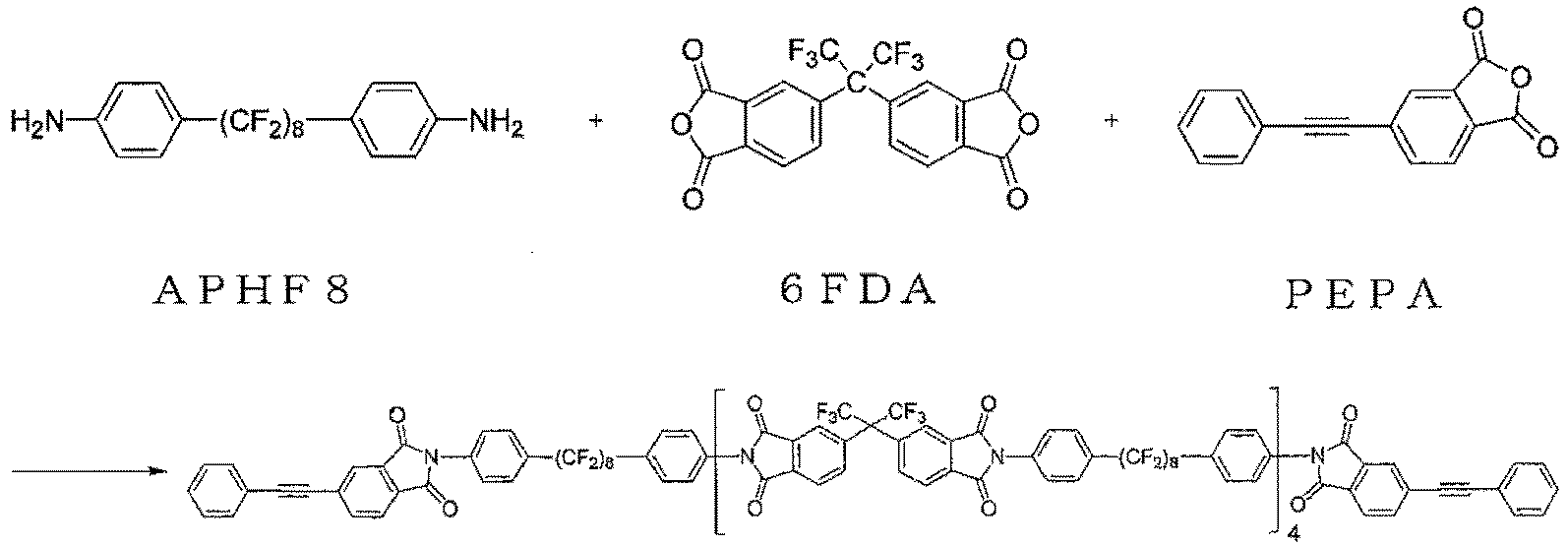
- A 100 mL three-necked flask equipped with a stirrer, a Dimroth condenser, a flat stopper, and a nitrogen introduction tube was heated and dried with a burner. Then, APHF8 (1.461 g, 2.50 mmol) and distilled NMP (9.7 mL) were charged into the flask, and the mixture was completely dissolved by stirring. Then, 4,4'- (hexafluoroisopylidene) diphthalic acid dianhydride (6FDA) (0.888 g, 2.00 mmol) was added, and the mixture was placed in an ice bath and stirred for 1 hour at 0 to 5°C. Then, after gradually raising the temperature and stirring for 6 hours at 60°C, 4-phenylethynylphthalic anhydride (PEPA) (0.248 g, 1.00 mmol) as a cross-linking agent was added, and the mixture was stirred for 15 hours at 60°C. After cooling to room temperature, the polymerization solution was cast on a glass plate, and dried under reduced pressure for 3 hours at room temperature to obtain a precursor amide compound. Then, the precursor amide compound was dried under reduced pressure in a program consisting of 1 hour at 80°C, 1 hour at 100°C, 1 hour at 150°C, 1 hour at 200°C, and 1 hour at 250°C to obtain a nitrogen-containing heterocyclic ring-containing compound (imide compound) in the form of a yellow powder.
- The physical properties of the obtained nitrogen-containing heterocyclic ring-containing compound (imide compound) are shown below.
- FT-IR (KBr, cm-1): 2,208 (C≡C), 1,785 (C=O), 1,728 (C=O), 1,370 (C-N), 1,258 (C-F), 745 (imide ring)
- Logarithmic viscosity (ηinh): 0.14 dL/g (NMP solution having a 0.5 g/dL concentration, measured at 30°C)
- Number average molecular weight (Mn): 4,900 (calculated value 4,500), molecular weight distribution (Mw/Mn): 2.3
- Solubility: Dissolved in NMP, DMAc, DMF, DMI, γ-butyrolactone, THF, and chloroform at room temperature
- 5% Weight loss temperature: 526°C (in air), 537°C (in nitrogen) (TGA)
- 10% Weight loss temperature: 557°C (in air), 558°C (in nitrogen) (TGA)
- Carbonization yield: 49% (800°C in nitrogen) (TGA)
- Glass transition temperature: 106°C (DSC)
-

- A 100 mL three-necked flask equipped with a stirrer, a Dimroth condenser, a flat stopper, and a nitrogen introduction tube was heated and dried with a burner. Then, APHF8 (1.461 g, 2.50 mmol) and distilled NMP (8.7 mL) were charged into the flask, and the mixture was completely dissolved by stirring. Then, oxydiphthalic acid dianhydride (ODPA) (0.620 g, 2.00 mmol) was added, and the mixture was placed in an ice bath and stirred for 1 hour at 0 to 5°C. Then, after gradually raising the temperature and stirring for 6 hours at 60°C, 4-phenylethynylphthalic anhydride (PEPA) (0.248 g, 1.00 mmol) as a cross-linking agent was added, and the mixture was stirred for 15 hours at 60°C. After cooling to room temperature, the polymerization solution was cast on a glass plate, and dried under reduced pressure for 3 hours at room temperature to obtain a precursor amide compound. Then, the precursor amide compound was dried under reduced pressure in a program consisting of 1 hour at 80°C, 1 hour at 100°C, 1 hour at 150°C, 1 hour at 200°C, and 1 hour at 250°C to obtain a nitrogen-containing heterocyclic ring-containing compound (imide compound) in the form of a yellow powder.
- The physical properties of the obtained nitrogen-containing heterocyclic ring-containing compound (imide compound) are shown below.
- FT-IR (KBr, cm-1): 2,212 (C≡C), 1,785 (C=O), 1,727 (C=O), 1,375 (C-N), 1,276 (C-F), 744 (imide ring)
- Logarithmic viscosity (ηinh): 0.15 dL/g (NMP solution having a 0.5 g/dL concentration, measured at 30°C)
- 5% Weight loss temperature: 520°C (in air), 529°C (in nitrogen) (TGA)
- 10% Weight loss temperature: 545°C (in air), 553°C (in nitrogen) (TGA)
- Carbonization yield: 53% (800°C in nitrogen) (TGA)
- Glass transition temperature: 156°C (DSC)
- <Example 7>
- A nitrogen-containing heterocyclic ring-containing compound (imide compound) in the form of a yellow powder was obtained in the same manner using mAPDF6 instead of the APDF6 of Example 2.
- The physical properties of the obtained nitrogen-containing heterocyclic ring-containing compound (imide compound) are shown below.
- FT-IR (KBr, cm-1): 2,214 (C≡C), 1,787 (C=O), 1,727 (C=O), 1,373 (C-N), 1,298 (C-F), 745 (imide ring)
- Logarithmic viscosity (ηinh): 0.15 dL/g (NMP solution having a 0.5 g/dL concentration, measured at 30°C)
- Number average molecular weight (Mn): 5,000 (calculated value 4,500), molecular weight distribution (Mw/Mn): 1.9
- 5% Weight loss temperature: 495°C (in air), 526°C (in nitrogen) (TGA)
- 10% Weight loss temperature: 527°C (in air), 552°C (in nitrogen) (TGA)
- Carbonization yield: 54% (800°C in nitrogen) (TGA)
- Glass transition temperature: 146°C (DSC)
- A nitrogen-containing heterocyclic ring-containing compound (imide compound) in the form of a yellow powder was obtained in the same manner using mAPDF6 instead of the APDF6 of Example 3.
- The physical properties of the obtained nitrogen-containing heterocyclic ring-containing compound (imide compound) are shown below.
- FT-IR (KBr, cm-1): 2,214 (C≡C), 1,787 (C=O), 1,727 (C=O), 1,373 (C-N), 1,298 (C-F), 745 (imide ring)
- Logarithmic viscosity (ηinh): 0.16 dL/g (NMP solution having a 0.5 g/dL concentration, measured at 30°C)
- Number average molecular weight (Mn): 4,200 (calculated value 4,000), molecular weight distribution (Mw/Mn): 2.5
- 5% Weight loss temperature: 528°C (in air), 535°C (in nitrogen) (TGA)
- 10% Weight loss temperature: 568°C (in air), 568°C (in nitrogen) (TGA)
- Carbonization yield: 53% (800°C in nitrogen) (TGA)
- Glass transition temperature: 126°C (DSC)
- A nitrogen-containing heterocyclic ring-containing compound (imide compound) in the form of a yellow powder was obtained in the same manner using mAPDF6 instead of the APDF6 of Example 4.
- The physical properties of the obtained nitrogen-containing heterocyclic ring-containing compound (imide compound) are shown below.
- FT-IR (KBr, cm-1): 2,214 (C≡C), 1,787 (C=O), 1,727 (C=O), 1,373 (C-N), 1,298 (C-F), 745 (imide ring)
- Logarithmic viscosity (ηinh): 0.17 dL/g (NMP solution having a 0.5 g/dL concentration, measured at 30°C)
- Number average molecular weight (Mn): 5,000 (calculated value 3,900), molecular weight distribution (Mw/Mn) 2.6
- 5% Weight loss temperature: 526°C (in air), 539°C (in nitrogen) (TGA)
- 10% Weight loss temperature: 579°C (in air), 575°C (in nitrogen) (TGA)
- Carbonization yield: 53% (800°C in nitrogen) (TGA)
- Glass transition temperature: 140°C (DSC)
- A powder (0.55 g) of an amide compound (6FTA-p-DFBBT-PEPA) having a crosslinkable group was placed in a polyimide film mold cut into a 5 cm × 6 cm mold, and melted by heating at 320°C. Next, a degassing operation was carried out 5 times by applying pressure at 3 MPa. Then, the melted powder was pressed at 320°C for 10 minutes at 5 MPa and at 10 MPa, and further pressed while heating at 370°C for 1 hour at 15 MPa to obtain a crosslinked product film through generation of an imidazole ring by heat dehydration and a crosslinking reaction.
- The physical properties of the obtained crosslinked product film are shown below.
- FT-IR (KBr, cm-1): 1,725 (C=O), 1,495 (C=C), 1,460 (C=N), 1,171 (C-F) Solubility: Insoluble in organic solvents
- Glass transition temperature: 297°C (DMA)
- 5% Weight loss temperature: 493°C (in air), 515°C (in nitrogen) (TGA)
- 10% Weight loss temperature: 519°C (in air), 544°C (in nitrogen) (TGA)
- Carbonization yield: 60% (800°C in nitrogen) (TGA)
- Storage elastic modulus (E') : 9×10⁸ Pa (room temperature to 280°C, glass region), 2×10⁷ Pa (360 to 400°C, rubber region) (DMA)
- A polyimide film was placed on a SUS plate, a polyimide film from which a 5 cm × 6 cm mold had been cut out was placed thereon, and a powder (0.6 g) of an imide compound (APDF6-6FDA-PEPA) was placed in the mold. A polyimide film and a SUS plate were placed thereon, and the imide compound was melted by heating for 20 minutes at 320°C. Then, degassing was carried out by applying a pressure of 3 MPa for 1 minute, and this operation was repeated 5 times. Pressing was performed at 320°C for 10 minutes at a pressure of 5 MPa, and for further 10 minutes at a pressure of 10 MPa.
- Then, the temperature was raised to 370°C, and pressing was performed at 370°C for 1 hour at a pressure of 13 MPa to produce a brown transparent crosslinked product film.
- The physical properties of the obtained crosslinked product film are shown below.
- FT-IR (film, cm-1): 1,785 (C=O), 1,728 (C=O), 1,375 (C-N), 1,258 (C-F), 735 (imide ring)
- Solubility: Insoluble in organic solvents
- 5% Weight loss temperature: 498°C (in air), 514°C (in nitrogen) (TGA)
- 10% Weight loss temperature: 519°C (in air), 538°C (in nitrogen) (TGA)
- Carbonization yield: 52% (800°C in nitrogen) (TGA)
- Glass transition temperature: 237°C (DSC), 234°C (DMA), 227°C (TMA)
- Storage elastic modulus (E') : 1×10⁹ Pa (room temperature to 220°C, glass region), 2×10⁷ Pa (260 to 410°C, rubber region) (DMA)
- Thermal expansion coefficient: 73 ppm/°C
- Tensile breaking strength: 75 MPa (room temperature) Elongation at break: 6.7% (room temperature)
- Tensile elasticity: 2.4 GPa (room temperature) Dielectric constant: 2.61 (20 GHz)
- Dielectric tangent: 0.0045 (20 GHz)
- A polyimide film was placed on a SUS plate, a polyimide film from which a 5 cm × 6 cm mold had been cut out was placed thereon, and a powder (0.6 g) of an imide compound (APDF6-ODPA-PEPA) was placed in the mold. A polyimide film and a SUS plate were placed thereon, and the imide compound was melted by heating for 20 minutes at 320°C. Then, degassing was carried out by applying a pressure of 3 MPa for 1 minute, and this operation was repeated 5 times. Pressing was performed at 320°C for 10 minutes at a pressure of 5 MPa, and for further 10 minutes at a pressure of 10 MPa. Then, the temperature was raised to 370°C, and pressing was performed at 370°C for 1 hour at a pressure of 13 MPa to produce a dark-brown opaque crosslinked product film.
- The physical properties of the obtained crosslinked product film are shown below.
- FT-IR (film, cm-1): 1,785 (C=O), 1,727 (C=O), 1,375 (C-N), 1,276 (C-F), 744 (imide ring)
- Solubility: Insoluble in organic solvents
- 5% Weight loss temperature: 494°C (in air), 508°C (in nitrogen) (TGA)
- 10% Weight loss temperature: 522°C (in air), 537°C (in nitrogen) (TGA)
- Carbonization yield: 52% (800°C in nitrogen) (TGA)
- Glass transition temperature: 206°C (DSC), 218°C (DMA), 210°C (TMA)
- Storage elastic modulus (E') : 1×10⁹ Pa (room temperature to 200°C, glass region), 2×10⁷ Pa (260 to 380°C, rubber region) (DMA)
- Thermal expansion coefficient: 70 ppm/°C
- Dielectric constant: 2.87 (20 GHz)
- Dielectric tangent: 0.0037 (20 GHz)
- A brown transparent crosslinked product film was produced in the same manner as in Example 12.
- The physical properties of the obtained crosslinked product film are shown below.
- FT-IR (film, cm-1): 1,785 (C=O), 1,727 (C=O), 1,375 (C-N), 1,276 (C-F), 744 (imide ring)
- Solubility: Insoluble in organic solvents
- 5% Weight loss temperature: 517°C (in air), 533°C (in nitrogen) (TGA)
- 10% Weight loss temperature: 534°C (in air), 560°C (in nitrogen) (TGA)
- Carbonization yield: 56% (800°C in nitrogen) (TGA)
- Glass transition temperature: 299°C (DMA), 274°C (TMA)
- Thermal expansion coefficient: 66 ppm/°C
- Dielectric constant: 2.80 (20 GHz)
- Dielectric tangent: 0.0035 (20 GHz)
- A polyimide film was placed on a SUS plate, a polyimide film from which a 5 cm × 6 cm mold had been cut out was placed thereon, and a powder (0.6 g) of an imide compound (APHF8-6FDA-PEPA) was placed in the mold. A polyimide film and a SUS plate were placed thereon, and the imide compound was melted by heating for 20 minutes at 320°C. Then, degassing was carried out by applying a pressure of 3 MPa for 1 minute, and this operation was repeated 5 times. Pressing was performed at 320°C for 10 minutes at a pressure of 5 MPa, and for further 10 minutes at a pressure of 10 MPa. Then, the temperature was raised to 370°C, and pressing was performed at 370°C for 1 hour at a pressure of 10 MPa to produce a brown transparent crosslinked product film.
- The physical properties of the obtained crosslinked product film are shown below.
- FT-IR (film, cm-1): 1,785 (C=O), 1,728 (C=O), 1,375 (C-N), 1,258 (C-F), 735 (imide ring)
- Solubility: Insoluble in organic solvents
- 5% Weight loss temperature: 519°C (in air), 530°C (in nitrogen) (TGA)
- 10% Weight loss temperature: 546°C (in air), 555°C (in nitrogen) (TGA)
- Carbonization yield: 45% (800°C in nitrogen) (TGA)
- Glass transition temperature: 193°C (DSC), 193°C (DMA), 205°C (TMA)
- Storage elastic modulus (E') : 1×10⁹ Pa (room temperature to 185°C, glass region), 2×10⁷ Pa (250 to 410°C, rubber region) (DMA)
- Thermal expansion coefficient: 112 ppm/°C
- Tensile breaking strength: 46 MPa (room temperature) Elongation at break: 3.3% (room temperature)
- Tensile elasticity: 1.5 GPa (room temperature) Dielectric constant: 2.58 (20 GHz)
- Dielectric tangent: 0.0022 (20 GHz)
- A polyimide film was placed on a SUS plate, a polyimide film from which a 5 cm × 6 cm mold had been cut out was placed thereon, and a powder (0.6 g) of an imide compound (APHF8-ODPA-PEPA) was placed in the mold. A polyimide film and a SUS plate were placed thereon, and the imide compound was melted by heating for 20 minutes at 320°C. Then, degassing was carried out by applying a pressure of 3 MPa for 1 minute, and this operation was repeated 5 times. Pressing was performed at 320°C for 10 minutes at a pressure of 5 MPa, and for further 10 minutes at a pressure of 10 MPa. Then, the temperature was raised to 370°C, and pressing was performed at 370°C for 1 hour at a pressure of 10 MPa to produce a dark-brown opaque crosslinked product film.
- The physical properties of the obtained crosslinked product film are shown below.
- FT-IR (film, cm-1): 1,785 (C=O), 1,727 (C=O), 1,375 (C-N), 1,276 (C-F), 744 (imide ring)
- Solubility: Insoluble in organic solvents
- 5% Weight loss temperature: 496°C (in air), 515°C (in nitrogen) (TGA)
- 10% Weight loss temperature: 516°C (in air), 540°C (in nitrogen) (TGA)
- Carbonization yield: 51% (800°C in nitrogen) (TGA)
- Glass transition temperature: 229°C (DSC), 225°C (DMA), 228°C (TMA)
- Storage elastic modulus (E') : 1×10⁹ Pa (room temperature to 200°C, glass region), 9×10⁷ Pa (260 to 370°C, rubber region) (DMA)
- Thermal expansion coefficient: 82 ppm/°C
- Dielectric constant: 2.77 (20 GHz)
- Dielectric tangent: 0.0024 (20 GHz)
- A brown transparent crosslinked product film was produced in the same manner as in Example 11.
- The physical properties of the obtained crosslinked product film are shown below.
- FT-IR (film, cm-1): 1,785 (C=O), 1,727 (C=O), 1,375 (C-N), 1,276 (C-F), 744 (imide ring)
- Solubility: Insoluble in organic solvents
- 5% Weight loss temperature: 496°C (in air), 493°C (in nitrogen) (TGA)
- 10% Weight loss temperature: 521°C (in air), 519°C (in nitrogen) (TGA)
- Carbonization yield: 49% (800°C in nitrogen) (TGA)
- Glass transition temperature: 196°C (DSC), 189°C (DMA), 193°C (TMA)
- Storage elastic modulus (E') : 1×10⁹ Pa (room temperature to 180°C, glass region), 1×10⁷ Pa (260 to 400°C, rubber region) (DMA)
- Thermal expansion coefficient: 95 ppm/°C
- Dielectric constant: 2.59 (20 GHz)
- Dielectric tangent: 0.0026 (20 GHz)
- A brown transparent crosslinked product film was produced in the same manner as in Example 11.
- The physical properties of the obtained crosslinked product film are shown below.
- FT-IR (film, cm-1): 1,785 (C=O), 1,727 (C=O), 1,375 (C-N), 1,276 (C-F), 744 (imide ring)
- Solubility: Insoluble in organic solvents
- 5% Weight loss temperature: 534°C (in air), 535°C (in nitrogen) (TGA)
- 10% Weight loss temperature: 565°C (in air), 568°C (in nitrogen) (TGA)
- Carbonization yield: 53% (800°C in nitrogen) (TGA)
- Glass transition temperature: 184°C (DSC), 178°C (DMA), 176°C (TMA)
- Storage elastic modulus (E') : 1×10⁹ Pa (room temperature to 150°C, glass region), 2×10⁷ Pa (220 to 400°C, rubber region) (DMA)
- Thermal expansion coefficient: 93 ppm/°C
- A brown transparent crosslinked product film was produced in the same manner as in Example 11.
- The physical properties of the obtained crosslinked product film are shown below.
- FT-IR (film, cm-1): 1,785 (C=O), 1,727 (C=O), 1,375 (C-N), 1,276 (C-F), 744 (imide ring)
- Solubility: Insoluble in organic solvents
- 5% Weight loss temperature: 545°C (in air), 543°C (in nitrogen) (TGA)
- 10% Weight loss temperature: 576°C (in air), 572°C (in nitrogen) (TGA)
- Carbonization yield: 56% (800°C in nitrogen) (TGA)
- Glass transition temperature: 207°C (DSC), 203°C (DMA), 199°C (TMA)
- Storage elastic modulus (E'): 1×10⁹ Pa (room temperature to 200°C, glass region), 2×10⁷ Pa (260 to 400°C, rubber region) (DMA)
- Thermal expansion coefficient: 67 ppm/°C
- Dielectric constant: 2.69 (20 GHz)
- Dielectric tangent: 0.0024 (20 GHz)
-

- A 100 mL three-necked flask equipped with a stirring rod, a stirring blade, a Dimroth condenser, and a nitrogen introduction tube was heated and dried with a burner, then APDF6 (0.726 g, 1.50 mmol) and distilled NMP (3 mL) were added, and the mixture was stirred to dissolve. Then, 4,4'-(hexafluoroisopylidene)diphthalic acid dianhydride (6FDA) (0.666 g, 1.50 mmol) was added, the temperature was gradually raised, and the mixture was reacted by stirring for 18 hours at 60°C to obtain a solution of the amide compound. The logarithmic viscosity (ηinh) of the amide compound was 0.32 dL/g (NMP solution having a concentration of 0.5 g/dL, measured at 30°C) . The solution was cooled to room temperature, distilled NMP (2 mL) was added, the mixture was stirred to dilute the concentration of the entire solution, and the solution was cast on a glass plate. The cast mixture was dried under reduced pressure for 3 hours at room temperature, then dried under reduced pressure in a program consisting of 6 hours at 60°C, 1 hour at 100°C, 1 hour at 150°C, 1 hour at 200°C, and 1 hour at 250°C to obtain a yellow transparent imide compound film (thickness 22 µm).
- The physical properties of the obtained imide compound film are shown below.
- FT-IR (KBr, cm-1): 1,789 (C=O), 1,725 (C=O), 1,376 (C-N), 1,199 (C-F), 745 (imide ring)
- Logarithmic viscosity (ηinh): 0.52 dL/g (NMP solution having a 0.5 g/dL concentration, measured at 30°C)
- GPC: Number average molecular weight (Mn) 47,000, molecular weight distribution (Mw/Mn) 2.5
- Solubility: Dissolved in NMP, DMAc, DMF, DMI, THF, and chloroform at room temperature
- 5% Weight loss temperature: 509°C (in air), 524°C (in nitrogen) (TGA)
- 10% Weight loss temperature: 527°C (in air), 544°C (in nitrogen) (TGA)
- Carbonization yield: 52% (800°C in nitrogen) (TGA)
- Glass transition temperature: 221°C (DSC), 215°C (DMA), 213°C (TMA)
- Storage elastic modulus (E') : 9×10⁸ Pa (room temperature to 200°C, glass region) (DMA)
Formula (2): -C≡CX1
(In Formula (2), X1 represents H or a monovalent organic group.)
Formula (2): -C≡CX1
(In Formula (2), X1 represents H or a monovalent organic group.)
Claims (14)
- An amide compound comprising a repeating unit represented by Formula (1) and a crosslinking site represented by Formula (2) at a molecular end:
 Rf1 represents a divalent fluorinated organic group,Rf2 represents a single bond, -SO2-, -O-, -CO-, a divalent non-fluorinated organic group, or a divalent fluorinated organic group,A represents an amide bond,each Y independently represents -COR1 or -NHR2,each R1 independently represents OH, an optionally-substituted linear or branched chain alkoxy group, an optionally-substituted aromatic oxy group, or a halogen atom, andeach R2 independently represents H or a monovalent organic group;
Formula (2): -C≡CX1
wherein X1 represents H or a monovalent organic group. - The amide compound according to claim 1, wherein an average degree of polymerization of the repeating unit represented by Formula (1) is 2 to 10.
- The amide compound according to claim 1 or 2, wherein the repeating unit represented by Formula (1) is a repeating unit represented by Formula (1a):
 Rf1 represents a divalent fluorinated organic group,Rf2 represents a single bond, -SO2-, -O-, -CO-, a divalent non-fluorinated organic group, or a divalent fluorinated organic group, andeach R1 independently represents OH, an optionally-substituted linear or branched chain alkoxy group, an optionally-substituted aromatic oxy group, or a halogen atom.
 - The amide compound according to claim 1 or 2, wherein the repeating unit represented by Formula (1) is a repeating unit represented by Formula (1b):
 Rf1 represents a divalent fluorinated organic group,Rf2 represents a single bond, -SO2-, -O-, -CO-, a divalent non-fluorinated organic group, or a divalent fluorinated organic group, andeach R2 independently represents H or a monovalent organic group.
 - The amide compound according to any of claims 1 to 4, wherein Rf1 is a perfluoroalkylene group having 4 or more carbon atoms.
- A nitrogen-containing heterocyclic ring-containing compound comprising a repeating unit represented by Formula (3) and a crosslinking site represented by Formula (2) at a molecular end:
 Rf1 represents a divalent fluorinated organic group,Rf2 represents a single bond, -SO2-, -O-, -CO-, a divalent non-fluorinated organic group, or a divalent fluorinated organic group, anda ring C represents an optionally-substituted imide ring or benzimidazole ring;
Formula (2): -C≡CX1
wherein X1 represents H or a monovalent organic group. - The nitrogen-containing heterocyclic ring-containing compound according to claim 6, wherein an average degree of polymerization of the repeating unit represented by Formula (3) is 2 to 10.
- The nitrogen-containing heterocyclic ring-containing compound according to claim 6 or 7, wherein the repeating unit represented by Formula (3) is a repeating unit represented by Formula (3a):

 Rf1 represents a divalent fluorinated organic group, andRf2 represents a single bond, -SO2-, -O-, -CO-, a divalent non-fluorinated organic group, or a divalent fluorinated organic group.
 - The nitrogen-containing heterocyclic ring-containing compound according to claim 6 or 7, wherein the repeating unit represented by Formula (3) is a repeating unit represented by Formula (3b):
 Rf1 represents a divalent fluorinated organic group,Rf2 represents a single bond, -SO2-, -O-, -CO-, a divalent non-fluorinated organic group, or a divalent fluorinated organic group, andeach R2 independently represents H or a monovalent organic group.
 - The nitrogen-containing heterocyclic ring-containing compound according to any of claims 6 to 9, wherein Rf1 is a perfluoroalkylene group having 4 or more carbon atoms.
- An adhesive comprising the amide compound according to any of claims 1 to 5 or the nitrogen-containing heterocyclic ring-containing compound according to any of claims 6 to 10.
- A coating material comprising the amide compound according to any of claims 1 to 5 or the nitrogen-containing heterocyclic ring-containing compound according to any of claims 6 to 10.
- A crosslinked product obtained by crosslinking the amide compound according to any of claims 1 to 5 or the nitrogen-containing heterocyclic ring-containing compound according to any of claims 6 to 10.
- The crosslinked product according to claim 13, which is a member used in a semiconductor manufacturing apparatus.
Applications Claiming Priority (2)
| Application Number | Priority Date | Filing Date | Title |
|---|---|---|---|
| JP2020083262 | 2020-05-11 | ||
| PCT/JP2021/017951 WO2021230254A1 (en) | 2020-05-11 | 2021-05-11 | Amide compound, nitrogen-containing heterocyclic compound, and crosslinked product |
Publications (2)
| Publication Number | Publication Date |
|---|---|
| EP4151672A1 true EP4151672A1 (en) | 2023-03-22 |
| EP4151672A4 EP4151672A4 (en) | 2024-05-29 |
Family
ID=78510989
Family Applications (1)
| Application Number | Title | Priority Date | Filing Date |
|---|---|---|---|
| EP21805023.5A Pending EP4151672A4 (en) | 2020-05-11 | 2021-05-11 | AMIDE COMPOUND, COMPOUND COMPRISING A HETEROCYCLE WITH NITROGEN CONTENT, AND CROSS-LINKED PRODUCT |
Country Status (4)
| Country | Link |
|---|---|
| US (1) | US20230094470A1 (en) |
| EP (1) | EP4151672A4 (en) |
| JP (1) | JP7262511B2 (en) |
| WO (1) | WO2021230254A1 (en) |
Families Citing this family (2)
| Publication number | Priority date | Publication date | Assignee | Title |
|---|---|---|---|---|
| WO2022168979A1 (en) * | 2021-02-08 | 2022-08-11 | 国立大学法人お茶の水女子大学 | Polyimide compound |
| JP7830630B2 (en) * | 2022-05-09 | 2026-03-16 | ダイキン工業株式会社 | Fluorinated polyamide compounds, fluorinated polyimide compounds, low dielectric materials, and high-frequency electronic components |
Family Cites Families (10)
| Publication number | Priority date | Publication date | Assignee | Title |
|---|---|---|---|---|
| GB1216505A (en) * | 1967-06-06 | 1970-12-23 | Nat Res Dev | Improvements in or relating to aromatic polyimides |
| US5055550A (en) * | 1987-11-24 | 1991-10-08 | Hoechst Celanese Corp. | Polymers prepared from 4,4'-bis(2-[3,4(dicarboxyphenyl)hexafluoroisopropyl] diphenyl ether dianhydride |
| US4952666A (en) * | 1988-05-06 | 1990-08-28 | Hughes Aircraft Company | Hexafluoroisopropylidene-containing polyimide oligomers and polymers |
| JP3022939B2 (en) * | 1992-09-11 | 2000-03-21 | 鐘淵化学工業株式会社 | Polyimide resin composition |
| JPH0693118A (en) * | 1992-09-14 | 1994-04-05 | Kanegafuchi Chem Ind Co Ltd | Heat-resistant laminated material and manufacturing method thereof |
| US5344982A (en) * | 1993-04-02 | 1994-09-06 | The United States Of America As Represented By The Administrator Of The National Aeronautics And Space Administration | Diamines and polyimides containing pendent ethynyl groups |
| JP3593200B2 (en) | 1996-02-07 | 2004-11-24 | クラリアント インターナショナル リミテッド | Low metal content polybenzimidazole material and its production method |
| JP2005146077A (en) * | 2003-11-13 | 2005-06-09 | Nippon Kayaku Co Ltd | Fluoropolyimide |
| US20090004508A1 (en) * | 2007-06-14 | 2009-01-01 | Daicel Chemical Industries, Ltd. | Thin-film materials, thin films and producing method thereof |
| US20110003955A1 (en) * | 2008-02-07 | 2011-01-06 | Daiwa Can Company | Imide Oligomer And Polyimide Resin Obtained By Thermal Curing Thereof |
-
2021
- 2021-05-11 WO PCT/JP2021/017951 patent/WO2021230254A1/en not_active Ceased
- 2021-05-11 EP EP21805023.5A patent/EP4151672A4/en active Pending
- 2021-05-11 JP JP2021080679A patent/JP7262511B2/en active Active
-
2022
- 2022-11-10 US US17/984,540 patent/US20230094470A1/en active Pending
Also Published As
| Publication number | Publication date |
|---|---|
| JP7262511B2 (en) | 2023-04-21 |
| EP4151672A4 (en) | 2024-05-29 |
| US20230094470A1 (en) | 2023-03-30 |
| JP2021178955A (en) | 2021-11-18 |
| WO2021230254A1 (en) | 2021-11-18 |
Similar Documents
| Publication | Publication Date | Title |
|---|---|---|
| EP2463323B1 (en) | Polyarylene ether polymer which is both transparent and resistant to high-temperature heat, and method for preparing same | |
| US8846854B2 (en) | Sulfonated poly(arylenes), polymer compounds and methods of producing the same | |
| Hasegawa et al. | Polyimides containing trans-1, 4-cyclohexane unit. Polymerizability of their precursors and Low-CTE, low-K and high-Tg properties | |
| Wang et al. | Synthesis and properties of fluorinated polyimides with multi-bulky pendant groups | |
| Chen et al. | Sulfonated poly (fluorenyl ether ketone) membrane prepared via direct polymerization for PEM fuel cell application | |
| Hao et al. | Ultra-low dielectric constant materials with hydrophobic property derived from polyhedral oligomeric silsequioxane (POSS) and perfluoro-aromatics | |
| US20230094470A1 (en) | Amide compound, nitrogen-containing heterocyclic compound, and crosslinked product | |
| Shockravi et al. | Preparation and properties of new ortho-linked polyamide-imides bearing ether, sulfur, and trifluoromethyl linkages | |
| US20230099704A1 (en) | Fluorinated amide compound, compound containing fluorinated nitrogen-containing heterocyclic ring, and fluorinated compound | |
| GB2395952A (en) | Block copolymer and use thereof | |
| Ghorai et al. | Trifluoromethyl functionalized sulfonated polytriazoles from diphenylphosphine oxide-based dialkyne via click polymerization: Effect of high content of phosphorus on the proton exchange membrane properties | |
| WO2019054471A1 (en) | Polybenzimidazole, precursor polyamide thereof, and method for producing same | |
| TW202212321A (en) | Fluorine-containing diamine or salt thereof, method for producing fluorine-containing diamine or salt thereof, polyamide, method for producing polyamide, polyamide solution, cyclized polyamide, method for producing cyclized polyamide, insulating material for high frequency electronic components, method for producing insulating material for high frequency electronic components, high frequency electronic components, high frequency equipment, and insulation material for producing high frequency electronic components | |
| CN101591436B (en) | Polybenzimidazole containing diazanaphthalene terphenyl structure and preparation method thereof | |
| JP2009235158A (en) | Proton acid group-containing block copolymer, its manufacturing method, and polymeric electrolytic membrane | |
| EP4339226A1 (en) | Fluorine-containing polyether compound | |
| JP2016516885A (en) | Polyarylene ether sulfone (PAES) composition | |
| EP3448917B1 (en) | Methods for making poly(aryl ether sulfone) polymers and polymer compositions and articles including the same | |
| Xie et al. | Synthesis and characterization of poly (aryl ether ketone) s with fluorinated phenyl in the side chain | |
| JP2025001688A (en) | Polyether ether ketone compound and method for producing the same | |
| JP7830630B2 (en) | Fluorinated polyamide compounds, fluorinated polyimide compounds, low dielectric materials, and high-frequency electronic components | |
| CN114222778A (en) | Composition for resin raw material | |
| JP2025079275A (en) | Resin composition and cured product | |
| US20250059327A1 (en) | Polyimide, producing method of imide compound, and producing method of recycled polyimide | |
| JP2025079274A (en) | Fluorinated polyamide compound, fluorinated polyimide compound, curable composition and cured product |
Legal Events
| Date | Code | Title | Description |
|---|---|---|---|
| STAA | Information on the status of an ep patent application or granted ep patent |
Free format text: STATUS: THE INTERNATIONAL PUBLICATION HAS BEEN MADE |
|
| PUAI | Public reference made under article 153(3) epc to a published international application that has entered the european phase |
Free format text: ORIGINAL CODE: 0009012 |
|
| STAA | Information on the status of an ep patent application or granted ep patent |
Free format text: STATUS: REQUEST FOR EXAMINATION WAS MADE |
|
| 17P | Request for examination filed |
Effective date: 20221110 |
|
| AK | Designated contracting states |
Kind code of ref document: A1 Designated state(s): AL AT BE BG CH CY CZ DE DK EE ES FI FR GB GR HR HU IE IS IT LI LT LU LV MC MK MT NL NO PL PT RO RS SE SI SK SM TR |
|
| P01 | Opt-out of the competence of the unified patent court (upc) registered |
Effective date: 20230525 |
|
| DAV | Request for validation of the european patent (deleted) | ||
| DAX | Request for extension of the european patent (deleted) | ||
| A4 | Supplementary search report drawn up and despatched |
Effective date: 20240425 |
|
| RIC1 | Information provided on ipc code assigned before grant |
Ipc: C09J 179/08 20060101ALI20240419BHEP Ipc: C09D 179/08 20060101ALI20240419BHEP Ipc: C09D 179/04 20060101ALI20240419BHEP Ipc: C08G 73/18 20060101ALI20240419BHEP Ipc: C08G 73/12 20060101AFI20240419BHEP |