EP4150819B1 - Harq-pufferverwaltung für sidelink-konfigurierte berechtigungen - Google Patents
Harq-pufferverwaltung für sidelink-konfigurierte berechtigungen Download PDFInfo
- Publication number
- EP4150819B1 EP4150819B1 EP21727251.7A EP21727251A EP4150819B1 EP 4150819 B1 EP4150819 B1 EP 4150819B1 EP 21727251 A EP21727251 A EP 21727251A EP 4150819 B1 EP4150819 B1 EP 4150819B1
- Authority
- EP
- European Patent Office
- Prior art keywords
- configured grant
- receiving
- period
- response
- sidelink
- Prior art date
- Legal status (The legal status is an assumption and is not a legal conclusion. Google has not performed a legal analysis and makes no representation as to the accuracy of the status listed.)
- Active
Links
Images
Classifications
-
- H—ELECTRICITY
- H04—ELECTRIC COMMUNICATION TECHNIQUE
- H04L—TRANSMISSION OF DIGITAL INFORMATION, e.g. TELEGRAPHIC COMMUNICATION
- H04L1/00—Arrangements for detecting or preventing errors in the information received
- H04L1/12—Arrangements for detecting or preventing errors in the information received by using return channel
- H04L1/16—Arrangements for detecting or preventing errors in the information received by using return channel in which the return channel carries supervisory signals, e.g. repetition request signals
- H04L1/18—Automatic repetition systems, e.g. Van Duuren systems
- H04L1/1867—Arrangements specially adapted for the transmitter end
- H04L1/1887—Scheduling and prioritising arrangements
-
- H—ELECTRICITY
- H04—ELECTRIC COMMUNICATION TECHNIQUE
- H04L—TRANSMISSION OF DIGITAL INFORMATION, e.g. TELEGRAPHIC COMMUNICATION
- H04L1/00—Arrangements for detecting or preventing errors in the information received
- H04L1/12—Arrangements for detecting or preventing errors in the information received by using return channel
- H04L1/16—Arrangements for detecting or preventing errors in the information received by using return channel in which the return channel carries supervisory signals, e.g. repetition request signals
- H04L1/18—Automatic repetition systems, e.g. Van Duuren systems
- H04L1/1822—Automatic repetition systems, e.g. Van Duuren systems involving configuration of automatic repeat request [ARQ] with parallel processes
-
- H—ELECTRICITY
- H04—ELECTRIC COMMUNICATION TECHNIQUE
- H04L—TRANSMISSION OF DIGITAL INFORMATION, e.g. TELEGRAPHIC COMMUNICATION
- H04L1/00—Arrangements for detecting or preventing errors in the information received
- H04L1/12—Arrangements for detecting or preventing errors in the information received by using return channel
- H04L1/16—Arrangements for detecting or preventing errors in the information received by using return channel in which the return channel carries supervisory signals, e.g. repetition request signals
- H04L1/18—Automatic repetition systems, e.g. Van Duuren systems
- H04L1/1867—Arrangements specially adapted for the transmitter end
- H04L1/1874—Buffer management
-
- H—ELECTRICITY
- H04—ELECTRIC COMMUNICATION TECHNIQUE
- H04L—TRANSMISSION OF DIGITAL INFORMATION, e.g. TELEGRAPHIC COMMUNICATION
- H04L1/00—Arrangements for detecting or preventing errors in the information received
- H04L1/12—Arrangements for detecting or preventing errors in the information received by using return channel
- H04L1/16—Arrangements for detecting or preventing errors in the information received by using return channel in which the return channel carries supervisory signals, e.g. repetition request signals
- H04L1/18—Automatic repetition systems, e.g. Van Duuren systems
- H04L1/1867—Arrangements specially adapted for the transmitter end
- H04L1/188—Time-out mechanisms
-
- H—ELECTRICITY
- H04—ELECTRIC COMMUNICATION TECHNIQUE
- H04L—TRANSMISSION OF DIGITAL INFORMATION, e.g. TELEGRAPHIC COMMUNICATION
- H04L1/00—Arrangements for detecting or preventing errors in the information received
- H04L1/12—Arrangements for detecting or preventing errors in the information received by using return channel
- H04L1/16—Arrangements for detecting or preventing errors in the information received by using return channel in which the return channel carries supervisory signals, e.g. repetition request signals
- H04L1/18—Automatic repetition systems, e.g. Van Duuren systems
- H04L1/1867—Arrangements specially adapted for the transmitter end
- H04L1/189—Transmission or retransmission of more than one copy of a message
-
- H—ELECTRICITY
- H04—ELECTRIC COMMUNICATION TECHNIQUE
- H04L—TRANSMISSION OF DIGITAL INFORMATION, e.g. TELEGRAPHIC COMMUNICATION
- H04L1/00—Arrangements for detecting or preventing errors in the information received
- H04L2001/0092—Error control systems characterised by the topology of the transmission link
Definitions
- the subject matter disclosed herein relates generally to wireless communications and more particularly relates to managing hybrid automatic repeat request buffers for sidelink configured grants. There is disclosed herein a method and a transmitting user equipment apparatus.
- a type 1 or type 2 configured grant provides a set of resources in a periodic manner for multiple sidelink (“SL”) transmissions.
- a SL grant is used for initial transmission or retransmission within the periodicity is determined by the user equipment (“UE") implementation.
- the transport block (“TB) stored in a SL process that has been transmitted in CG resources of a period may not use the CG resources of the next period associated with the same hybrid automatic repeat request (“HARQ”) process.
- HARQ hybrid automatic repeat request
- R1- 1912552 is a 3GPP discussion document titled "Mode 1 resource allocation schemes on sidelink" submitted by ZTE & Sanechips at TSG RAN WG1 #99, in Reno, Nevada, USA, on 18th November 2019 , and discusses some further details of dynamic and semi-static resource allocation of mode 1 scheme.
- R1-2000546 is a 3GPP discussion document titled "Remaining issues on mode 1 resource allocation for NR V2X" submitted by Fujitsu at TSG RAN WG1 #100 e-Meeting on 24th February 2020 , and proposes that for configured grant, if there is no need to prevent the case where a transmitter UE receives ACK via PSFCH earlier than the ReTx resources scheduled by a DCI, then the UE does not perform retransmission on the ReTx resources and transmits ACK on the PUCCH resource indicated by the DCI.
- Claim 1 defines a method and claim 11 defines a transmitting user equipment apparatus.
- any method and/or apparatus referred to as embodiments but nevertheless do not fall within the scope of the appended claims are to be understood as examples helpful in understanding the invention.
- PSFCH physical sidelink feedback channel
- DTX discontinuous transmission
- the subject matter recited herein is directed to a UE that starts a timer upon having sent a negative acknowledgement ("NACK") on the physical uplink control channel (“PUCCH”) to the gNB for the transmission of a TB on CG resource(s) within a period.
- NACK negative acknowledgement
- PUCCH physical uplink control channel
- the UE shall for cases when the timer is running retransmit the TB pending in the HARQ buffer on subsequent CG resource(s) associated with the same HARQ process.
- the UE shall consider the new data indicator ("NDI") to have been toggled for the HARQ process and generate a new TB, if SL data is available for transmission.
- the timer is stopped upon receiving a SL grant indicating a new transmission for the same HARQ process.
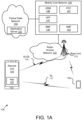
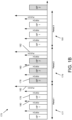
- the UE performs a retransmission on the next CG resource within a period (e.g., period 1 177, period 2 179, or period 3 181) for the same HARQ process (e.g., HP1 176, or HP2 178), if a NACK was received on PSFCH 180 for the previous CG transmission of the same HARQ process (e.g., HP1 176, or HP2 178) within the same period (e.g., period 1 177, period 2 179, or period 3 181).
- a period e.g., period 1 177, period 2 179, or period 3 181
- the UE may retransmit the TB on the next CG resources or alternatively keep the TB in the HARQ buffer but not perform a retransmission (skip the SL transmission on the next CG resource).
- the UE Upon expiry of the timer, in further embodiments, the UE uses the HARQ process (e.g., HP1 176, or HP2 178) for the transmission of a new TB, e.g., the UE may flush the HARQ buffer and generate a new TB and store it in the buffer.
- the UE Upon reception of a HARQ ACK for the transmission of a TB, in various embodiments, the UE considers the associated timer as expired.
- the UE for cases when the UE has a CG resource for a HARQ process (e.g., HP1 176, or HP2 178) and the timer is not running for the HARQ process, the UE generates a new TB for the CG resource and/or HARQ process (e.g., HP1 176, or HP2 178).
- a CG resource for a HARQ process e.g., HP1 176, or HP2 178
- a SL grant e.g., DCI
- a new transmission for the same HARQ process e.g., HP1 176, or HP2 178
- stops the timer and, for example, the corresponding SL transmission will start the timer.
- the UE flushes the HARQ buffer of the associated HARQ process (e.g., HP1 176, or HP2 178) and considers the HARQ process as available for another SL transmission, e.g., the UE may generate a new TB and store for transmission in the HARQ buffer and/or process (e.g., HP1 176, or HP2 178).
- the TX UE continuously (re)transmits a generated TB on CG resources associated with the same HARQ process (e.g., HP1 176, or HP2 178) as long as the maximum number of retransmissions is not reached and/or the packet delay budget of the TB is not exceeded - even across different periods (e.g., period 1 177, period 2 179, or period 3 181) - unless an ACK has been received on PSFCH 180 from the Rx UE for the TB.
- CG resources associated with the same HARQ process e.g., HP1 176, or HP2 178
- the packet delay budget of the TB is not exceeded - even across different periods (e.g., period 1 177, period 2 179, or period 3 181) - unless an ACK has been received on PSFCH 180 from the Rx UE for the TB.
- the Tx UE will also stop the (re)transmission of this TB once the gNB schedules with an SL grant (e.g., DCI) an initial transmission for the same HARQ process (e.g., HP1 176, or HP2 178).
- the Tx UE stops the (autonomous) retransmission of a TB on CG resources associated with the same HARQ process (e.g., HP1 176, or HP2 178) upon having received an SL grant from the gNB (e.g., DCI), which schedules a retransmission of the TB for the same HARQ process (e.g., HP1 176, or HP2 178) dynamically.
- SL grant e.g., DCI
- only further subsequent dynamically scheduled retransmission(s) of the TB may follow, e.g., no autonomous retransmissions of the TB performed by the Tx UE.
- UE may flush the corresponding HARQ Tx buffer at the beginning of the next period associated with the same HARQ process, e.g., before the first CG resource of the next period.
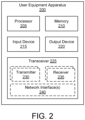
- Figure 2 depicts a user equipment apparatus 200 that may be used for managing hybrid automatic repeat request buffers for sidelink configured grants.
- the user equipment apparatus 200 is used to implement one or more of the solutions described above.
- the user equipment apparatus 200 may be one embodiment of the remote unit 105 and/or the UE 205, described above.
- the user equipment apparatus 200 may include a processor 205, a memory 210, an input device 215, an output device 220, and a transceiver 225.
- the input device 215 and the output device 220 are combined into a single device, such as a touchscreen.
- the user equipment apparatus 200 may not include any input device 215 and/or output device 220.
- the user equipment apparatus 200 may include one or more of: the processor 205, the memory 210, and the transceiver 225, and may not include the input device 215 and/or the output device 220.
- the processor 205 controls the user equipment apparatus 200 to implement UE behavior according to one or more of the above described embodiments.
- the memory 210 in one embodiment, is a computer readable storage medium.
- the memory 210 includes volatile computer storage media.
- the memory 210 may include a RAM, including dynamic RAM (“DRAM”), synchronous dynamic RAM (“SDRAM”), and/or static RAM (“SRAM”).
- the memory 210 includes non-volatile computer storage media.
- the memory 210 may include a hard disk drive, a flash memory, or any other suitable non-volatile computer storage device.
- the memory 210 includes both volatile and non-volatile computer storage media.
- the memory 210 stores data related to managing hybrid automatic repeat request buffers for sidelink configured grants.
- the memory 210 may store various parameters, configurations, policies, and the like as described above.
- the memory 210 also stores program code and related data, such as an operating system or other controller algorithms operating on the apparatus 200.
- the input device 215, in one embodiment, may include any known computer input device including a touch panel, a button, a keyboard, a stylus, a microphone, or the like.
- the input device 215 may be integrated with the output device 220, for example, as a touchscreen or similar touch-sensitive display.
- the input device 215 includes a touchscreen such that text may be input using a virtual keyboard displayed on the touchscreen and/or by handwriting on the touchscreen.
- the input device 215 includes two or more different devices, such as a keyboard and a touch panel.
- the output device 220 in one embodiment, is designed to output visual, audible, and/or haptic signals.
- the output device 220 includes an electronically controllable display or display device capable of outputting visual data to a user.
- the output device 220 may include, but is not limited to, an LCD display, an LED display, an OLED display, a projector, or similar display device capable of outputting images, text, or the like to a user.
- the output device 220 may include a wearable display separate from, but communicatively coupled to, the rest of the user equipment apparatus 200, such as a smart watch, smart glasses, a heads-up display, or the like.
- the output device 220 may be a component of a smart phone, a personal digital assistant, a television, a table computer, a notebook (laptop) computer, a personal computer, a vehicle dashboard, or the like.
- the output device 220 includes one or more speakers for producing sound.
- the output device 220 may produce an audible alert or notification (e.g., a beep or chime).
- the output device 220 includes one or more haptic devices for producing vibrations, motion, or other haptic feedback.
- all, or portions of the output device 220 may be integrated with the input device 215.
- the input device 215 and output device 220 may form a touchscreen or similar touch-sensitive display. In other embodiments, the output device 220 may be located near the input device 215.
- the transceiver 225 communicates with one or more network functions of a mobile communication network via one or more access networks.
- the transceiver 225 operates under the control of the processor 205 to transmit messages, data, and other signals and also to receive messages, data, and other signals.
- the processor 205 may selectively activate the transceiver 225 (or portions thereof) at particular times in order to send and receive messages.
- the transceiver 225 includes at least transmitter 230 and at least one receiver 235.
- One or more transmitters 230 may be used to provide UL communication signals to a base unit 110, such as the UL transmissions described herein.
- one or more receivers 235 may be used to receive DL communication signals from the base unit 110, as described herein.
- the user equipment apparatus 200 may have any suitable number of transmitters 230 and receivers 235.
- the transmitter(s) 230 and the receiver(s) 235 may be any suitable type of transmitters and receivers.
- the transceiver 225 includes a first transmitter/receiver pair used to communicate with a mobile communication network over licensed radio spectrum and a second transmitter/receiver pair used to communicate with a mobile communication network over unlicensed radio spectrum.
- the first transmitter/receiver pair used to communicate with a mobile communication network over licensed radio spectrum and the second transmitter/receiver pair used to communicate with a mobile communication network over unlicensed radio spectrum may be combined into a single transceiver unit, for example a single chip performing functions for use with both licensed and unlicensed radio spectrum.
- the first transmitter/receiver pair and the second transmitter/receiver pair may share one or more hardware components.
- certain transceivers 225, transmitters 230, and receivers 235 may be implemented as physically separate components that access a shared hardware resource and/or software resource, such as for example, the network interface 240.
- one or more transmitters 230 and/or one or more receivers 235 may be implemented and/or integrated into a single hardware component, such as a multi-transceiver chip, a system-on-a-chip, an ASIC, or other type of hardware component.
- one or more transmitters 230 and/or one or more receivers 235 may be implemented and/or integrated into a multi-chip module.
- other components such as the network interface 240 or other hardware components/circuits may be integrated with any number of transmitters 230 and/or receivers 235 into a single chip.
- the transmitters 230 and receivers 235 may be logically configured as a transceiver 225 that uses one more common control signals or as modular transmitters 230 and receivers 235 implemented in the same hardware chip or in a multi-chip module.
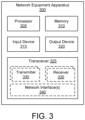
- Figure 3 depicts a network equipment apparatus 300 that may be used for managing hybrid automatic repeat request buffers for sidelink configured grants, according to embodiments of the disclosure.
- the network equipment apparatus 300 may be one embodiment of the base unit 110 or RAN node, described above.
- the base network equipment apparatus 300 may include a processor 305, a memory 310, an input device 315, an output device 320, and a transceiver 325.
- the input device 315 and the output device 320 are combined into a single device, such as a touchscreen.
- the network equipment apparatus 300 may not include any input device 315 and/or output device 320.
- the network equipment apparatus 300 may include one or more of: the processor 305, the memory 310, and the transceiver 325, and may not include the input device 315 and/or the output device 320.
- the processor 305 may include any known controller capable of executing computer-readable instructions and/or capable of performing logical operations.
- the processor 305 may be a microcontroller, a microprocessor, a CPU, a GPU, an auxiliary processing unit, a FPGA, or similar programmable controller.
- the processor 305 executes instructions stored in the memory 310 to perform the methods and routines described herein.
- the processor 305 is communicatively coupled to the memory 310, the input device 315, the output device 320, and the transceiver 325.
- the network equipment apparatus 300 is a RAN node (e.g., gNB), as described herein.
- the processor 305 controls the network equipment apparatus 300 to perform the above described behaviors. For example, the processor 305 may receive PSFCH content, retransmit a TB on next CG resource in response to the PSFCH content comprising a NACK, and cease transmissions of the TB within a CG period in response to the PSFCH content comprising an ACK.
- the memory 310 in one embodiment, is a computer readable storage medium.
- the memory 310 includes volatile computer storage media.
- the memory 310 may include a RAM, including dynamic RAM (“DRAM”), synchronous dynamic RAM (“SDRAM”), and/or static RAM (“SRAM”).
- the memory 310 includes non-volatile computer storage media.
- the memory 310 may include a hard disk drive, a flash memory, or any other suitable non-volatile computer storage device.
- the memory 310 includes both volatile and non-volatile computer storage media.
- the memory 310 stores data related to managing hybrid automatic repeat request buffers for sidelink configured grants.
- the memory 310 may store various parameters, configurations, policies, and the like as described above.
- the memory 310 also stores program code and related data, such as an operating system or other controller algorithms operating on the network equipment apparatus 300.
- the input device 315 may include any known computer input device including a touch panel, a button, a keyboard, a stylus, a microphone, or the like.
- the input device 315 may be integrated with the output device 320, for example, as a touchscreen or similar touch-sensitive display.
- the input device 315 includes a touchscreen such that text may be input using a virtual keyboard displayed on the touchscreen and/or by handwriting on the touchscreen.
- the input device 315 includes two or more different devices, such as a keyboard and a touch panel.
- the output device 320 in one embodiment, is designed to output visual, audible, and/or haptic signals.
- the output device 320 includes an electronically controllable display or display device capable of outputting visual data to a user.
- the output device 320 may include, but is not limited to, an LCD display, an LED display, an OLED display, a projector, or similar display device capable of outputting images, text, or the like to a user.
- the output device 320 may include a wearable display separate from, but communicatively coupled to, the rest of the network equipment apparatus 300, such as a smart watch, smart glasses, a heads-up display, or the like.
- the output device 320 may be a component of a smart phone, a personal digital assistant, a television, a table computer, a notebook (laptop) computer, a personal computer, a vehicle dashboard, or the like.
- the output device 320 includes one or more speakers for producing sound.
- the output device 320 may produce an audible alert or notification (e.g., a beep or chime).
- the output device 320 includes one or more haptic devices for producing vibrations, motion, or other haptic feedback.
- all, or portions of the output device 320 may be integrated with the input device 315.
- the input device 315 and output device 320 may form a touchscreen or similar touch-sensitive display.
- the output device 320 may be located near the input device 315.
- the first method includes considering NDI as toggled in response to the timer expiring and generating a new TB for transmission. In one embodiment, the first method includes stopping the timer in response to receiving a sidelink grant for an initial transmission of a new TB. In one embodiment, the first method includes flushing the buffer and generating a new TB for storage in the buffer in response to expiration of the timer.
- the first apparatus includes a processor that buffers the TB in a HARQ buffer in response to not receiving any feedback from the receiving UE device over the PSFCH and in response to a time between an end of a last symbol of the PFSCH and a first symbol of a next configured grant resource for a HARQ process being less than a minimum processing time.
Landscapes
- Engineering & Computer Science (AREA)
- Computer Networks & Wireless Communication (AREA)
- Signal Processing (AREA)
- Mobile Radio Communication Systems (AREA)
Claims (15)
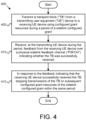
- Verfahren (400), umfassend:Übertragen (405) eines Transportblocks, TB, aus einem Puffer einer übertragenden Benutzereinrichtungsvorrichtung, UE-Vorrichtung, an eine empfangende UE-Vorrichtung unter Verwendung konfigurierter Grant-Ressourcen während eines Zeitraums eines sidelinkkonfigurierten Grants;Empfangen (410), an der übertragenden UE-Vorrichtung während des Zeitraums, von Feedback von der empfangenden UE-Vorrichtung über einen physischen Sidelink-Feedback-Kanal, PSFCH, das angibt, ob der TB erfolgreich empfangen wurde; undals Reaktion auf das Feedback, das angibt, dass die empfangende UE-Vorrichtung den TB erfolgreich empfangen hat, Stoppen (415) von Übertragungen des TB auf nachfolgenden konfigurierten Grant-Ressourcen des sidelinkkonfigurierten Grants innerhalb desselben Zeitraums, wobei das Verfahren gekennzeichnet ist durch erneutes Übertragen eines ausstehenden TB von einem anderen Prozess hybrider automatischer Wiederholungsanforderung, HARQ, während des Zeitraums des sidelinkkonfigurierten Grants, wobei der TB aus dem Puffer geleert wird; undErzeugen eines neuen TB und Durchführen einer anfänglichen Übertragung des neuen TB auf nächsten konfigurierten Grant-Ressourcen während des Zeitraums des sidelinkkonfigurierten Grants als Reaktion auf das Feedback, das angibt, dass die empfangende UE-Vorrichtung den erneut übertragenen TB erfolgreich empfangen hat.
- Verfahren (400) nach Anspruch 1, ferner umfassend das Angeben innerhalb von Sidelink-Steuerinformationen für die übertragende UE-Vorrichtung eines Bezeichners für den HARQ-Prozess des ausstehenden TB, der erneut übertragen wird.
- Verfahren (400) nach Anspruch 1, ferner umfassend, als Reaktion auf das Feedback, das angibt, dass die empfangende UE-Vorrichtung den TB erfolgreich empfangen hat, ein Verwenden der verbleibenden konfigurierten Grant-Ressourcen für den Zeitraum des sidelinkkonfigurierten Grants zum Übertragen eines anderen TB.
- Verfahren (400) nach Anspruch 1, ferner umfassend das erneute Übertragen des TB auf nächsten konfigurierten Grant-Ressourcen während des Zeitraums des sidelinkkonfigurierten Grants als Reaktion auf das Feedback, das angibt, dass die empfangende UE-Vorrichtung den TB nicht erfolgreich empfangen hat.
- Verfahren (400) nach Anspruch 1, ferner umfassend das erneute Übertragen des TB auf nächsten konfigurierten Grant-Ressourcen, als Reaktion auf das Nichtempfangen von Feedback von der empfangenden UE-Vorrichtung über den PSFCH.
- Verfahren nach Anspruch 1, ferner umfassend, als Reaktion auf das Feedback, das angibt, dass die empfangende UE-Vorrichtung den TB nicht erfolgreich empfangen hat:Senden einer Angabe an ein Netzelement eines mobilen Drahtloskommunikationsnetzes, das den sidelinkkonfigurierten Grant bereitstellt, dass die empfangende UE-Vorrichtung den TB nicht erfolgreich empfangen hat, wobei der TB für erneute Übertragung gepuffert wird;Starten eines Zeitgebers, der mit der erneuten Übertragung des TB verknüpft ist;während der Zeitgeber läuft:Verhindern, dass neue TBs erzeugt werden und den TB in dem Puffer überschreiben; underneutes Übertragen des gepufferten TB auf nachfolgenden konfigurierten Grant-Ressourcen, bis einer der Zeitgeber abläuft und das Feedback angibt, dass die empfangende UE-Vorrichtung den TB erfolgreich empfangen hat.
- Verfahren nach Anspruch 6, ferner umfassend das erneute Übertragen des TB als Reaktion auf das Empfangen eines Neuübertragungs-Grants für den TB innerhalb einer vordefinierten Zeit vor einer nachfolgenden konfigurierten Grant-Ressource.
- Verfahren nach Anspruch 6, ferner umfassend das Erzeugen eines neuen TB für Übertragung als Reaktion auf das Nichtempfangen eines Neuübertragungs-Grants für den TB innerhalb einer vordefinierten Zeit vor einer nachfolgenden konfigurierten Grant-Ressource.
- Verfahren nach Anspruch 1, ferner umfassend:Starten eines Zeitgebers als Reaktion auf das Senden des TB auf einer konfigurierten Grant-Ressource während des Zeitraums des sidelinkkonfigurierten Grants; undStoppen des Zeitgebers als Reaktion auf das Feedback, das angibt, dass die empfangende UE-Vorrichtung den TB erfolgreich empfangen hat.
- Verfahren nach Anspruch 9, ferner umfassend ein Betrachten von NDI als umgeschaltet als Reaktion auf das Ablaufen des Zeitgebers und das Erzeugen eines neuen TB für Übertragung.
- Übertragendes Benutzereinrichtungsgerät, UE-Gerät (200), umfassend:einen Transceiver (225) in Kommunikation mit einer empfangenden UE-Vorrichtung und einem Netzelement eines mobilen Drahtloskommunikationsnetzes; undeinen Prozessor (205), der eingerichtet ist zum:Übertragen, über den Transceiver (225), eines Transportblocks, TB, an die empfangende UE-Vorrichtung unter Verwendung konfigurierter Grant-Ressourcen während eines Zeitraums eines sidelinkkonfigurierten Grants;Empfangen, über den Transceiver während des Zeitraums, von Feedback von der empfangenden UE-Vorrichtung über einen physischen Sidelink-Feedback-Kanal, PSFCH, das angibt, ob der TB erfolgreich empfangen wurde; undals Reaktion auf das Feedback, das angibt, dass die empfangende UE-Vorrichtung den TB erfolgreich empfangen hat, Stoppen von Übertragungen des TB auf nachfolgenden konfigurierten Grant-Ressourcen des sidelinkkonfigurierten Grants innerhalb desselben Zeitraums, wobei er ferner gekennzeichnet ist dadurch, dass er eingerichtet ist, um einen ausstehenden TB von einem anderen Prozess hybrider automatischer Wiederholungsanforderung, HARQ, während des Zeitraums des sidelinkkonfigurierten Grants, erneut zu übertragen, wobei der TB aus dem Puffer geleert wird; undErzeugen eines neuen TB und Durchführen einer anfänglichen Übertragung des neuen TB auf nächsten konfigurierten Grant-Ressourcen während des Zeitraums des sidelinkkonfigurierten Grants als Reaktion auf das Feedback, das angibt, dass die empfangende UE-Vorrichtung den erneut übertragenen TB erfolgreich empfangen hat.
- Gerät (200) nach Anspruch 11, wobei der Prozessor (205) ferner eingerichtet ist, um innerhalb von Sidelink-Steuerinformationen für die übertragende UE-Vorrichtung einen Bezeichner für den HARQ-Prozess des ausstehenden TB anzugeben, der erneut übertragen wird.
- Gerät (200) nach Anspruch 11, wobei der Prozessor (205) ferner eingerichtet ist, um, als Reaktion auf das Feedback, das angibt, dass die empfangende UE-Vorrichtung den TB erfolgreich empfangen hat, verbleibende konfigurierte Grant-Ressourcen für den Zeitraum des sidelinkkonfigurierten Grants zum Übertragen eines anderen TB zu verwenden.
- Gerät (200) nach Anspruch 11, wobei der Prozessor (205) ferner eingerichtet ist, um den TB auf nächsten konfigurierten Grant-Ressourcen während des Zeitraums des sidelinkkonfigurierten Grants erneut zu übertragen, als Reaktion auf das Feedback, das angibt, dass die empfangende UE-Vorrichtung den TB nicht erfolgreich empfangen hat.
- Gerät (200) nach Anspruch 11, wobei der Prozessor (205) ferner eingerichtet ist, um den TB auf nächsten konfigurierten Grant-Ressourcen zu übertragen, als Reaktion auf das Nichtempfangen von Feedback von der empfangenden UE-Vorrichtung über den PSFCH.
Applications Claiming Priority (2)
| Application Number | Priority Date | Filing Date | Title |
|---|---|---|---|
| US202063025136P | 2020-05-14 | 2020-05-14 | |
| PCT/IB2021/054173 WO2021229541A1 (en) | 2020-05-14 | 2021-05-14 | Harq buffer management for sidelink configured grants |
Publications (3)
| Publication Number | Publication Date |
|---|---|
| EP4150819A1 EP4150819A1 (de) | 2023-03-22 |
| EP4150819C0 EP4150819C0 (de) | 2025-07-02 |
| EP4150819B1 true EP4150819B1 (de) | 2025-07-02 |
Family
ID=76059943
Family Applications (1)
| Application Number | Title | Priority Date | Filing Date |
|---|---|---|---|
| EP21727251.7A Active EP4150819B1 (de) | 2020-05-14 | 2021-05-14 | Harq-pufferverwaltung für sidelink-konfigurierte berechtigungen |
Country Status (4)
| Country | Link |
|---|---|
| US (1) | US20240014952A1 (de) |
| EP (1) | EP4150819B1 (de) |
| CN (1) | CN115699649B (de) |
| WO (1) | WO2021229541A1 (de) |
Families Citing this family (4)
| Publication number | Priority date | Publication date | Assignee | Title |
|---|---|---|---|---|
| US12382486B2 (en) * | 2020-05-13 | 2025-08-05 | Lg Electronics Inc. | Method and device for reporting SL HARQ feedback to base station in NR V2X |
| EP4616667A1 (de) * | 2022-11-11 | 2025-09-17 | Telefonaktiebolaget LM Ericsson (publ) | Sidelink-kommunikation mit mehreren rückkopplungsressourcen |
| WO2024168631A1 (zh) * | 2023-02-15 | 2024-08-22 | 北京小米移动软件有限公司 | 一种侧行cgt的启动或重启方法及通信装置 |
| WO2024168637A1 (zh) * | 2023-02-15 | 2024-08-22 | 北京小米移动软件有限公司 | 自动重传方法、装置 |
Family Cites Families (7)
| Publication number | Priority date | Publication date | Assignee | Title |
|---|---|---|---|---|
| WO2017165405A2 (en) * | 2016-03-22 | 2017-09-28 | Intel IP Corporation | Co-existence of grantless uplink and scheduled transmissions |
| CN111052657B (zh) * | 2017-06-15 | 2022-11-15 | 三星电子株式会社 | 用于无授权配置的终端、基站及其方法 |
| US11523422B2 (en) * | 2017-11-16 | 2022-12-06 | Lenovo (Singapore) Pte. Ltd. | Determining transport block generation timing of an uplink transmission |
| US20200037343A1 (en) * | 2018-07-24 | 2020-01-30 | Samsung Electronics Co., Ltd. | Method and apparatus for network controlled resource allocation in nr v2x |
| US11456826B2 (en) * | 2019-04-08 | 2022-09-27 | Huawei Technologies Co., Ltd. | HARQ feedback and retransmission mechanism for sidelink transmission |
| WO2020220285A1 (en) * | 2019-04-30 | 2020-11-05 | Nokia Shanghai Bell Co., Ltd. | Configured grant operation |
| CN115428373A (zh) * | 2020-02-13 | 2022-12-02 | 瑞典爱立信有限公司 | 有条件地处理配置许可激活过程中的混合自动重传请求进程 |
-
2021
- 2021-05-14 US US18/001,054 patent/US20240014952A1/en active Pending
- 2021-05-14 CN CN202180041011.2A patent/CN115699649B/zh active Active
- 2021-05-14 WO PCT/IB2021/054173 patent/WO2021229541A1/en not_active Ceased
- 2021-05-14 EP EP21727251.7A patent/EP4150819B1/de active Active
Also Published As
| Publication number | Publication date |
|---|---|
| WO2021229541A1 (en) | 2021-11-18 |
| US20240014952A1 (en) | 2024-01-11 |
| EP4150819C0 (de) | 2025-07-02 |
| CN115699649A (zh) | 2023-02-03 |
| EP4150819A1 (de) | 2023-03-22 |
| CN115699649B (zh) | 2025-05-16 |
Similar Documents
| Publication | Publication Date | Title |
|---|---|---|
| US12476743B2 (en) | HARQ process for sidelink transmission | |
| EP4193514B1 (de) | Daten- und feedbackweiterleitung | |
| US20230379089A1 (en) | Sl harq buffer management for nr vehicular communication | |
| US20200274654A1 (en) | Autonomously triggering retransmission of data | |
| US11523422B2 (en) | Determining transport block generation timing of an uplink transmission | |
| EP4150819B1 (de) | Harq-pufferverwaltung für sidelink-konfigurierte berechtigungen | |
| US11627605B2 (en) | Transmitting a TB after successful LBT procedure | |
| US20230051440A1 (en) | Uplink control information retransmission | |
| EP4098022B1 (de) | Verhinderung von übertragung beim umschalten eines aktiven uplink-bandbreitenteils | |
| EP4150804B1 (de) | Übertragung von sidelink-steuerinformationen zur anzeige von nicht-sidelink-daten | |
| US20230216613A1 (en) | Combined blind and feedback based retransmissions | |
| US12556317B2 (en) | Methods and apparatus for transmitting sidelink control information indicating no sidelink data | |
| US20230198685A1 (en) | Methods and apparatus for transmitting sidelink control information indicating no sidelink data |
Legal Events
| Date | Code | Title | Description |
|---|---|---|---|
| STAA | Information on the status of an ep patent application or granted ep patent |
Free format text: STATUS: UNKNOWN |
|
| STAA | Information on the status of an ep patent application or granted ep patent |
Free format text: STATUS: THE INTERNATIONAL PUBLICATION HAS BEEN MADE |
|
| PUAI | Public reference made under article 153(3) epc to a published international application that has entered the european phase |
Free format text: ORIGINAL CODE: 0009012 |
|
| STAA | Information on the status of an ep patent application or granted ep patent |
Free format text: STATUS: REQUEST FOR EXAMINATION WAS MADE |
|
| 17P | Request for examination filed |
Effective date: 20221110 |
|
| AK | Designated contracting states |
Kind code of ref document: A1 Designated state(s): AL AT BE BG CH CY CZ DE DK EE ES FI FR GB GR HR HU IE IS IT LI LT LU LV MC MK MT NL NO PL PT RO RS SE SI SK SM TR |
|
| DAV | Request for validation of the european patent (deleted) | ||
| DAX | Request for extension of the european patent (deleted) | ||
| REG | Reference to a national code |
Ref country code: DE Ref legal event code: R079 Free format text: PREVIOUS MAIN CLASS: H04L0001180000 Ipc: H04L0001182200 Ref country code: DE Ref legal event code: R079 Ref document number: 602021033342 Country of ref document: DE Free format text: PREVIOUS MAIN CLASS: H04L0001180000 Ipc: H04L0001182200 |
|
| GRAP | Despatch of communication of intention to grant a patent |
Free format text: ORIGINAL CODE: EPIDOSNIGR1 |
|
| STAA | Information on the status of an ep patent application or granted ep patent |
Free format text: STATUS: GRANT OF PATENT IS INTENDED |
|
| RIC1 | Information provided on ipc code assigned before grant |
Ipc: H04L 1/00 20060101ALN20241216BHEP Ipc: H04L 1/1867 20230101ALI20241216BHEP Ipc: H04L 1/1822 20230101AFI20241216BHEP |
|
| INTG | Intention to grant announced |
Effective date: 20250107 |
|
| GRAS | Grant fee paid |
Free format text: ORIGINAL CODE: EPIDOSNIGR3 |
|
| GRAA | (expected) grant |
Free format text: ORIGINAL CODE: 0009210 |
|
| STAA | Information on the status of an ep patent application or granted ep patent |
Free format text: STATUS: THE PATENT HAS BEEN GRANTED |
|
| AK | Designated contracting states |
Kind code of ref document: B1 Designated state(s): AL AT BE BG CH CY CZ DE DK EE ES FI FR GB GR HR HU IE IS IT LI LT LU LV MC MK MT NL NO PL PT RO RS SE SI SK SM TR |
|
| REG | Reference to a national code |
Ref country code: GB Ref legal event code: FG4D |
|
| REG | Reference to a national code |
Ref country code: CH Ref legal event code: EP |
|
| REG | Reference to a national code |
Ref country code: DE Ref legal event code: R096 Ref document number: 602021033342 Country of ref document: DE |
|
| REG | Reference to a national code |
Ref country code: IE Ref legal event code: FG4D |
|
| U01 | Request for unitary effect filed |
Effective date: 20250721 |
|
| U07 | Unitary effect registered |
Designated state(s): AT BE BG DE DK EE FI FR IT LT LU LV MT NL PT RO SE SI Effective date: 20250728 |
|
| PG25 | Lapsed in a contracting state [announced via postgrant information from national office to epo] |
Ref country code: IS Free format text: LAPSE BECAUSE OF FAILURE TO SUBMIT A TRANSLATION OF THE DESCRIPTION OR TO PAY THE FEE WITHIN THE PRESCRIBED TIME-LIMIT Effective date: 20251102 |
|
| PG25 | Lapsed in a contracting state [announced via postgrant information from national office to epo] |
Ref country code: NO Free format text: LAPSE BECAUSE OF FAILURE TO SUBMIT A TRANSLATION OF THE DESCRIPTION OR TO PAY THE FEE WITHIN THE PRESCRIBED TIME-LIMIT Effective date: 20251002 |
|
| PG25 | Lapsed in a contracting state [announced via postgrant information from national office to epo] |
Ref country code: HR Free format text: LAPSE BECAUSE OF FAILURE TO SUBMIT A TRANSLATION OF THE DESCRIPTION OR TO PAY THE FEE WITHIN THE PRESCRIBED TIME-LIMIT Effective date: 20250702 |
|
| PG25 | Lapsed in a contracting state [announced via postgrant information from national office to epo] |
Ref country code: GR Free format text: LAPSE BECAUSE OF FAILURE TO SUBMIT A TRANSLATION OF THE DESCRIPTION OR TO PAY THE FEE WITHIN THE PRESCRIBED TIME-LIMIT Effective date: 20251003 |
|
| PG25 | Lapsed in a contracting state [announced via postgrant information from national office to epo] |
Ref country code: CZ Free format text: LAPSE BECAUSE OF FAILURE TO SUBMIT A TRANSLATION OF THE DESCRIPTION OR TO PAY THE FEE WITHIN THE PRESCRIBED TIME-LIMIT Effective date: 20250702 |
|
| PG25 | Lapsed in a contracting state [announced via postgrant information from national office to epo] |
Ref country code: PL Free format text: LAPSE BECAUSE OF FAILURE TO SUBMIT A TRANSLATION OF THE DESCRIPTION OR TO PAY THE FEE WITHIN THE PRESCRIBED TIME-LIMIT Effective date: 20250702 |
|
| PG25 | Lapsed in a contracting state [announced via postgrant information from national office to epo] |
Ref country code: RS Free format text: LAPSE BECAUSE OF FAILURE TO SUBMIT A TRANSLATION OF THE DESCRIPTION OR TO PAY THE FEE WITHIN THE PRESCRIBED TIME-LIMIT Effective date: 20251002 |
|
| PG25 | Lapsed in a contracting state [announced via postgrant information from national office to epo] |
Ref country code: ES Free format text: LAPSE BECAUSE OF FAILURE TO SUBMIT A TRANSLATION OF THE DESCRIPTION OR TO PAY THE FEE WITHIN THE PRESCRIBED TIME-LIMIT Effective date: 20250702 |