EP4149122B1 - Procédé et appareil de commande adaptative de filtres de décorrélation - Google Patents
Procédé et appareil de commande adaptative de filtres de décorrélation Download PDFInfo
- Publication number
- EP4149122B1 EP4149122B1 EP22203950.5A EP22203950A EP4149122B1 EP 4149122 B1 EP4149122 B1 EP 4149122B1 EP 22203950 A EP22203950 A EP 22203950A EP 4149122 B1 EP4149122 B1 EP 4149122B1
- Authority
- EP
- European Patent Office
- Prior art keywords
- decorrelation
- filter length
- control parameter
- decorrelation filter
- targeted
- Prior art date
- Legal status (The legal status is an assumption and is not a legal conclusion. Google has not performed a legal analysis and makes no representation as to the accuracy of the status listed.)
- Active
Links
Images




Classifications
-
- H—ELECTRICITY
- H04—ELECTRIC COMMUNICATION TECHNIQUE
- H04S—STEREOPHONIC SYSTEMS
- H04S5/00—Pseudo-stereo systems, e.g. in which additional channel signals are derived from monophonic signals by means of phase shifting, time delay or reverberation
-
- G—PHYSICS
- G10—MUSICAL INSTRUMENTS; ACOUSTICS
- G10L—SPEECH ANALYSIS TECHNIQUES OR SPEECH SYNTHESIS; SPEECH RECOGNITION; SPEECH OR VOICE PROCESSING TECHNIQUES; SPEECH OR AUDIO CODING OR DECODING
- G10L19/00—Speech or audio signals analysis-synthesis techniques for redundancy reduction, e.g. in vocoders; Coding or decoding of speech or audio signals, using source filter models or psychoacoustic analysis
- G10L19/008—Multichannel audio signal coding or decoding using interchannel correlation to reduce redundancy, e.g. joint-stereo, intensity-coding or matrixing
-
- G—PHYSICS
- G10—MUSICAL INSTRUMENTS; ACOUSTICS
- G10L—SPEECH ANALYSIS TECHNIQUES OR SPEECH SYNTHESIS; SPEECH RECOGNITION; SPEECH OR VOICE PROCESSING TECHNIQUES; SPEECH OR AUDIO CODING OR DECODING
- G10L19/00—Speech or audio signals analysis-synthesis techniques for redundancy reduction, e.g. in vocoders; Coding or decoding of speech or audio signals, using source filter models or psychoacoustic analysis
- G10L19/04—Speech or audio signals analysis-synthesis techniques for redundancy reduction, e.g. in vocoders; Coding or decoding of speech or audio signals, using source filter models or psychoacoustic analysis using predictive techniques
- G10L19/16—Vocoder architecture
-
- G—PHYSICS
- G10—MUSICAL INSTRUMENTS; ACOUSTICS
- G10L—SPEECH ANALYSIS TECHNIQUES OR SPEECH SYNTHESIS; SPEECH RECOGNITION; SPEECH OR VOICE PROCESSING TECHNIQUES; SPEECH OR AUDIO CODING OR DECODING
- G10L19/00—Speech or audio signals analysis-synthesis techniques for redundancy reduction, e.g. in vocoders; Coding or decoding of speech or audio signals, using source filter models or psychoacoustic analysis
- G10L19/04—Speech or audio signals analysis-synthesis techniques for redundancy reduction, e.g. in vocoders; Coding or decoding of speech or audio signals, using source filter models or psychoacoustic analysis using predictive techniques
- G10L19/26—Pre-filtering or post-filtering
-
- G—PHYSICS
- G10—MUSICAL INSTRUMENTS; ACOUSTICS
- G10L—SPEECH ANALYSIS TECHNIQUES OR SPEECH SYNTHESIS; SPEECH RECOGNITION; SPEECH OR VOICE PROCESSING TECHNIQUES; SPEECH OR AUDIO CODING OR DECODING
- G10L25/00—Speech or voice analysis techniques not restricted to a single one of groups G10L15/00 - G10L21/00
- G10L25/78—Detection of presence or absence of voice signals
- G10L25/81—Detection of presence or absence of voice signals for discriminating voice from music
-
- H—ELECTRICITY
- H04—ELECTRIC COMMUNICATION TECHNIQUE
- H04S—STEREOPHONIC SYSTEMS
- H04S3/00—Systems employing more than two channels, e.g. quadraphonic
- H04S3/008—Systems employing more than two channels, e.g. quadraphonic in which the audio signals are in digital form, i.e. employing more than two discrete digital channels
-
- H—ELECTRICITY
- H04—ELECTRIC COMMUNICATION TECHNIQUE
- H04S—STEREOPHONIC SYSTEMS
- H04S2400/00—Details of stereophonic systems covered by H04S but not provided for in its groups
- H04S2400/01—Multi-channel, i.e. more than two input channels, sound reproduction with two speakers wherein the multi-channel information is substantially preserved
-
- H—ELECTRICITY
- H04—ELECTRIC COMMUNICATION TECHNIQUE
- H04S—STEREOPHONIC SYSTEMS
- H04S2420/00—Techniques used stereophonic systems covered by H04S but not provided for in its groups
- H04S2420/03—Application of parametric coding in stereophonic audio systems
-
- H—ELECTRICITY
- H04—ELECTRIC COMMUNICATION TECHNIQUE
- H04S—STEREOPHONIC SYSTEMS
- H04S2420/00—Techniques used stereophonic systems covered by H04S but not provided for in its groups
- H04S2420/07—Synergistic effects of band splitting and sub-band processing
Definitions
- the present application relates to spatial audio coding and rendering.
- Spatial or 3D audio is a generic formulation, which denotes various kinds of multi-channel audio signals.
- the audio scene is represented by a spatial audio format.
- Typical spatial audio formats defined by the capturing method are for example denoted as stereo, binaural, ambisonics, etc.
- Spatial audio rendering systems are able to render spatial audio scenes with stereo (left and right channels 2.0) or more advanced multichannel audio signals (2.1, 5.1, 7.1, etc.).
- Recent technologies for the transmission and manipulation of such audio signals allow the end user to have an enhanced audio experience with higher spatial quality often resulting in a better intelligibility as well as an augmented reality.
- Spatial audio coding techniques such as MPEG Surround or MPEG-H 3D Audio, generate a compact representation of spatial audio signals which is compatible with data rate constraint applications such as streaming over the internet for example.
- the transmission of spatial audio signals is however limited when the data rate constraint is strong and therefore post-processing of the decoded audio channels is also used to enhanced the spatial audio playback.
- Commonly used techniques are for example able to blindly up-mix decoded mono or stereo signals into multi-channel audio (5.1 channels or more).
- the spatial audio coding and processing technologies make use of the spatial characteristics of the multi-channel audio signal.
- the time and level differences between the channels of the spatial audio capture are used to approximate the inter-aural cues, which characterize our perception of directional sounds in space. Since the inter-channel time and level differences are only an approximation of what the auditory system is able to detect (i.e. the inter-aural time and level differences at the ear entrances), it is of high importance that the inter-channel time difference is relevant from a perceptual aspect.
- inter-channel time and level differences are commonly used to model the directional components of multi-channel audio signals while the inter-channel cross-correlation (ICC) - that models the inter-aural cross-correlation (IACC) - is used to characterize the width of the audio image.
- ICC inter-channel cross-correlation
- IACC inter-aural cross-correlation
- ICPD inter-channel phase differences
- inter-aural level difference ILD
- inter-aural time difference ITD
- inter-aural coherence or correlation IC or IACC
- ICLD inter-channel level difference
- ICTD inter-channel time difference
- ICC inter-channel coherence or correlation
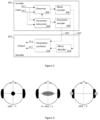
- FIG 2 a typical setup employing the parametric spatial audio analysis is shown.
- Figure 2 illustrates a basic block diagram of a parametric stereo coder.
- a stereo signal pair is input to the stereo encoder 201.
- the parameter extraction 202 aids the down-mix process, where a downmixer 204 prepares a single channel representation of the two input channels to be encoded with a mono encoder 206.
- the extracted parameters are encoded by a parameter encoder 208. That is, the stereo channels are down-mixed into a mono signal 207 that is encoded and transmitted to the decoder 203 together with encoded parameters 205 describing the spatial image.
- the decoder performs stereo synthesis based on the decoded mono signal and the transmitted parameters. That is, the decoder reconstructs the single channel using a mono decoder 210 and synthesizes the stereo channels using the parametric representation.
- the decoded mono signal and received encoded parameters are input to a parametric synthesis unit 212 or process that decodes the parameters, synthesizes the stereo channels using the decoded parameters, and outputs a synthesized stereo signal pair.
- the encoded parameters are used to render spatial audio for the human auditory system, it is important that the inter-channel parameters are extracted and encoded with perceptual considerations for maximized perceived quality.
- the side channel can be approximated by decorrelation of the mid channel.
- the decorrelation technique is typically a filtering method used to generate an output signal that is incoherent with the input signal from a fine-structure point of view.
- the spectral and temporal envelopes of the decorrelated signal shall ideally remain.
- Decorrelation filters are typically all-pass filters with phase modifications of the input signal.
- US 2016/0005406 A1 discloses an audio signal processing method for determining decorrelation filter parameters for a decorrelator.
- the method involves calculating combined frequency coefficients of a composite coupling channel based on frequency coefficients of two or more channels, and computing cross-correlation coefficients between frequency coefficients of a first channel and the combined frequency coefficients.
- the method comprises averaging the cross-correlation coefficients and determining a variance of the cross-correlation coefficients.
- the essence of embodiments is an adaptive control of the character of a decorrelator for representation of non-coherent signal components utilized in a multi-channel audio decoder.
- the adaptation is based on a transmitted performance measure and how it varies over time.
- Different aspects of the decorrelator may be adaptively controlled using the same basic method in order to match the character of the input signal.
- One of the most important aspects of decorrelation character is the choice of decorrelator filter length, which is described in the detailed description.
- Other aspects of the decorrelator may be adaptively controlled in a similar way, such as the control of the strength of the decorrelated component or other aspects that may need to be adaptively controlled to match the character of the input signal.
- an audio signal processing method for adaptation of a decorrelation filter length in decoding of an audio signal.
- the method comprises obtaining a control parameter and estimating mean and variation of the control parameter. Ratio of the variation and mean of the control parameter is calculated, and a targeted decorrelation filter length is calculated based on the said ratio.
- the targeted decorrelation filter length is provided to a decorrelator.
- the decorrelated signal will not be adapted to properties of the input signals which are affected by variations in the auditory scene.
- the ambience in a recording of a single speech source in a low reverb environment would be represented by decorrelated signal components from the same filter as for a recording of a symphony orchestra in a big concert hall with significantly longer reverberation.
- Even if the amount of decorrelated components is controlled over time the reverberation length and other properties of the decorrelation is not controlled. This may cause the ambience for the low reverb recording sound too spacious while the auditory scene for the high reverb recording is perceived to be too narrow.
- a short reverberation length which is desirable for low reverb recordings, often results in metallic and unnatural ambience for recordings of more spacious recordings.
- the proposed solution improves the control of non-coherent audio signals by taking into account how the non-coherent audio varies over time and uses that information to adaptively control the character of the decorrelation, e.g. the reverberation length, in the representation of non-coherent components in a decoded and rendered multi-channel audio signal.
- the character of the decorrelation e.g. the reverberation length
- the adaptation can be based on signal properties of the input signals in the encoder and controlled by transmission of one or several control parameters to the decoder. Alternatively, it can be controlled without transmission of an explicit control parameter but from information already available at the decoder or by a combination of available and transmitted information (i.e. information received by the decoder from the encoder).
- a transmitted control parameter may for example be based on an estimated performance of the parametric description of the spatial properties, i.e. the stereo image in case of two-channel input. That is, the control parameter may be a performance measure.
- the performance measure may be obtained from estimated reverberation length, correlation measures, estimation of spatial width or prediction gain.
- the essence of embodiments is an adaptive control of a decorrelation filter length for representation of non-coherent signal components utilized in a multi-channel audio decoder.
- the adaptation is based on a transmitted performance measure and how it varies over time.
- the strength of the decorrelated component may be controlled based on the same control parameter as the decorrelation length.
- the proposed solution may operate on frames or samples in the time domain on frequency bands in a filterbank or transform domain, e.g. utilizing Discrete Fourier Transform (DFT), for processing on frequency coefficients of frequency bands. Operations performed in one domain may be equally performed in another domain and the given embodiments are not limited to the exemplified domain.
- DFT Discrete Fourier Transform
- the proposed solution is utilized for a stereo audio codec with a coded down-mix channel and a parametric description of the spatial properties, i.e. as illustrated in figure 2 .
- the parametric analysis may extract one or more parameters describing non-coherent components between the channels which can be used to adaptively adjust the perceived amount of non-coherent components in the synthesized stereo audio.
- the IACC i.e. the coherence between the channels, will affect the perceived width of a spatial auditory object or scene. When the IACC decreases, the source width increases until the sound is perceived as two distinct uncorrelated audio sources.
- non-coherent components between the channels have to be synthesized at the decoder.
- the down-mix matrix U 1 may be chosen such that the M channel energy is maximized and the S channel energy is minimized.
- the down-mix operation may include phase or time alignment of the input signals.
- the side channel S may not be explicitly encoded but parametrically modelled for example by using a prediction filter where ⁇ is predicted from the decoded mid channel M ⁇ and used at the decoder for spatial synthesis.
- prediction parameters e.g. prediction filter coefficients, may be encoded and transmitted to the decoder.
- the decorrelation technique is typically a filtering method used to generate an output signal that is incoherent with the input signal from a fine-structure point of view.
- the spectral and temporal envelopes of the decorrelated signal shall ideally remain.
- Decorrelation filters are typically all-pass filters with phase modifications of the input signal.
- the up-mix matrix controls the amount of M ⁇ and D in the synthesized left ( X ⁇ ) and right ( ⁇ ) channel. It is to be noted that the up-mix can also involve additional signal components, such as a coded residual signal.
- ILD 10 log 10 ⁇ x n 2 ⁇ y n 2
- n [1, ..., N ] is the sample index over a frame of N samples.
- the coherence between channels can be estimated through the inter-channel cross correlation (ICC).
- ICC inter-channel cross correlation
- CCF cross-correlation function
- Additional parameters may be used in the description of the stereo image. These can for example reflect phase or time differences between the channels.
- a decorrelation filter may be defined by its impulse response h d ( n ) or transfer function H d ( k ) in the DFT domain where n and k are the sample and frequency index, respectively.
- ⁇ [ a ] and d [ a ] specifies the decay and the delay of the feedback.
- the decay factors ⁇ [ a ] may be chosen in the interval [0,1) as a value larger than 1 would result in an instable filter.
- Multi-channel audio or in this example two-channel audio, has naturally a varying amount of coherence between the channels depending on the signal characteristics. For a single speaker recorded in a well-damped environment there will be a low amount of reflections and reverberation which will result in high coherence between the channels. As the reverberation increases the coherence will generally decrease. This means that for clean speech signals with low amount of noise and ambience the length of the decorrelation filter should probably be shorter than for a single speaker in a reverberant environment. The length of the decorrelator filter is one important parameter that controls the character of the generated decorrelated signal. Embodiments of the invention may also be used to adaptively control other parameters in order to match the character of the decorrelated signal to that of the input signal, such as parameters related to the level control of the decorrelated signal.
- the amount of delay may be controlled in order to adapt to different spatial characteristics of the encoded audio. More generally one can control the length of the impulse response of a decorrelation filter. As mentioned above controlling the filter length can be equivalent to controlling the delay of a reverberator without feedback.
- ⁇ pos and ⁇ neg may be chosen such that upward and downward changes of r are followed differently.
- r c i r i ⁇ r mean i .
- the smoothing factors ⁇ pos and ⁇ neg may be chosen such that upward and downward changes of r c are followed differently.
- transition between the two smoothing factors may be made for any threshold that the update value of the current frame is compared to. I.e., in the given example of equation 25 r c [ i ] > ⁇ thres .
- ⁇ pos ⁇ pos _ high
- ⁇ neg ⁇ neg _ high if f thres c 1 > ⁇ high
- ⁇ pos ⁇ pos _ low
- ⁇ neg ⁇ neg _ low otherwise .
- the set of filter lengths utilized for decorrelation may be limited in order to reduce the number of different colorations obtained when mixing signals. For example, there might be two different lengths where the first one is relatively short and the second one is longer.
- a set of two available filters of different lengths d 1 and d 2 are used.
- d 2 is assumed to be larger than d 1 .
- the target filter length is a control parameter but different filter lengths or reverberator delays may be utilized for different frequencies. This means that shorter or longer filters than the targeted length may be used for certain frequency sub-bands or coefficients.
- the decorrelation filter strength s controlling the amount of decorrelated signal D in the synthesized channels X ⁇ and ⁇ may be controlled by the same control parameters, in this case with one control parameter, the performance measure c 1 ⁇ r .
- the adaptation of the decorrelation filter length is done in several, i.e. at least two, sub-bands so that each frequency band can have the optimal decorrelation filter length.
- the reverberation length may additionally be specially controlled for transients, i.e. sudden energy increases, or for other signals with special characteristics.
- Figure 4 shows an example of a signal where the first half contains clean speech and the second half classical music.
- the performance measure mean is relatively high for the second half containing music.
- the performance measure variation is also higher for the second half but the ratio between them is considerably lower.
- a signal where the performance measure variation is much higher than the performance measure mean is considered to be a signal with continuous high amounts of diffuse components and therefore the length of the decorrelation filter should be lower for the first half of this example than the second.
- the signals in the graphs have all been smoothed and partly restricted for a more controlled behavior.
- the targeted decorrelation filter length is expressed in a discrete number of frames but in other embodiments the filter length may vary continuously.
- Figures 5 and 6 illustrate an example method for adjusting a decorrelator.
- the method comprises obtaining a control parameter, and calculating mean and variation of the control parameter. Ratio of the variation and mean of the control parameter is calculated, and a decorrelation parameter is calculated based on the ratio. The decorrelation parameter is then provided to a decorrelator.
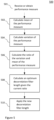
- FIG. 5 describes steps involved in the adaptation of the decorrelation filter length.
- the method 500 starts with receiving 501 a performance measure parameter, i.e. a control parameter.
- the performance measure is calculated in an audio encoder and transmitted to an audio decoder.
- the control parameter is obtained from information already available at a decoder or by a combination of available and transmitted information.
- First a mean and a variation of the performance measure is calculated as shown in blocks 502 and 504. Then the ratio of the variation and the mean of the performance measure is calculated 506.
- An optimum decorrelation filter length is calculated 508 based on the ratio.
- a new decorrelation filter length is applied 510 to obtain a decorrelated signal from, e.g. the received mono signal.
- FIG. 6 describes another embodiment of the adaptation of the decorrelation filter length.
- the method 600 starts with receiving 601 a performance measure parameter, i.e. a control parameter.
- the performance measure is calculated in an audio encoder and transmitted to an audio decoder.
- the control parameter is obtained from information already available at a decoder or by a combination of available and transmitted information.
- First a mean and a variation of the performance measure is calculated as shown in blocks 602 and 604. Then the ratio of the variation and the mean of the performance measure is calculated 606.
- a targeted decorrelation filter length is calculated 608 based on the ratio.
- Final step is to provide 610 the new targeted decorrelation filter length to a decorrelator.
- the methods may be performed by a parametric stereo decoder or a stereo audio codec.
- FIG 7 shows an example of an apparatus performing the method illustrated in Figures 5 and 6 .
- the apparatus 700 comprises a processor 710, e.g. a central processing unit (CPU), and a computer program product 720 in the form of a memory for storing the instructions, e.g. computer program 730 that, when retrieved from the memory and executed by the processor 710 causes the apparatus 700 to perform processes connected with embodiments of adaptively adjusting a decorrelator
- the processor 710 is communicatively coupled to the memory 720.
- the apparatus may further comprise an input node for receiving input parameters, i.e., the performance measure, and an output node for outputting processed parameters such as a decorrelation filter length.
- the input node and the output node are both communicatively coupled to the processor 710.
- the apparatus 700 may be comprised in an audio decoder, such as the parametric stereo decoder shown in a lower part of figure 2 . It may be comprised in a stereo audio codec.
- an audio decoder such as the parametric stereo decoder shown in a lower part of figure 2 . It may be comprised in a stereo audio codec.
- the software or computer program 730 may be realized as a computer program product, which is normally carried or stored on a computer-readable medium, preferably non-volatile computer-readable storage medium.
- the computer-readable medium may include one or more removable or non-removable memory devices including, but not limited to a Read-Only Memory (ROM), a Random Access Memory (RAM), a Compact Disc (CD), a Digital Versatile Disc (DVD), a Blue-ray disc, a Universal Serial Bus (USB) memory, a Hard Disk Drive (HDD) storage device, a flash memory, a magnetic tape, or any other conventional memory device.
- ROM Read-Only Memory
- RAM Random Access Memory
- CD Compact Disc
- DVD Digital Versatile Disc
- USB Universal Serial Bus
- HDD Hard Disk Drive
- Embodiments of the present invention may be implemented in software, hardware, application logic or a combination of software, hardware and application logic.
- the software, application logic and/or hardware may reside on a memory, a microprocessor or a central processing unit. If desired, part of the software, application logic and/or hardware may reside on a host device or on a memory, a microprocessor or a central processing unit of the host.
- the application logic, software or an instruction set is maintained on any one of various conventional computer-readable media.
Landscapes
- Engineering & Computer Science (AREA)
- Physics & Mathematics (AREA)
- Acoustics & Sound (AREA)
- Signal Processing (AREA)
- Multimedia (AREA)
- Health & Medical Sciences (AREA)
- Computational Linguistics (AREA)
- Audiology, Speech & Language Pathology (AREA)
- Human Computer Interaction (AREA)
- Mathematical Physics (AREA)
- Stereophonic System (AREA)
- Circuit For Audible Band Transducer (AREA)
- Filters That Use Time-Delay Elements (AREA)
Claims (14)
- Procédé de traitement de signal audio (500, 600) pour l'adaptation d'une longueur de filtre de décorrélation lors du décodage d'un signal audio, le procédé comprenant :l'obtention (601) d'un paramètre de contrôle ;l'estimation (602) d'une moyenne du paramètre de contrôle ;l'estimation (604) d'une variation du paramètre de contrôle ;le calcul (606) d'un rapport entre ladite variation et la moyenne du paramètre de contrôle ;le calcul (608) d'une longueur de filtre de décorrélation ciblée sur la base dudit rapport ; etla fourniture (610) de la longueur du filtre de décorrélation ciblée à un décorrélateur.
- Procédé selon la revendication 1, comprenant en outre le calcul d'une intensité de signal de décorrélation sur la base de la longueur de filtre de décorrélation ciblée calculée.
- Procédé selon la revendication 1 ou 2, dans lequel le paramètre de contrôle est obtenu à partir de la longueur de réverbération estimée, des mesures de corrélation, de l'estimation de la largeur spatiale ou du gain de prédiction.
- Procédé selon l'une quelconque des revendications 1 à 3, dans lequel la longueur de filtre de décorrélation ciblée est calculée sur la base de deux longueurs de filtre différentes.
- Procédé selon l'une quelconque des revendications 1 à 4, dans lequel l'adaptation de la longueur du filtre de décorrélation est effectuée dans au moins deux sous-bandes, chaque bande de fréquence ayant une longueur de filtre de décorrélation adaptée.
- Procédé selon l'une quelconque des revendications 2 à 5, dans lequel au moins l'une de la longueur du filtre de décorrélation et de l'intensité du signal de décorrélation sont contrôlées en fonction de deux ou plusieurs paramètres de contrôle différents.
- Appareil (700, 802) pour l'adaptation d'une longueur de filtre de décorrélation lors du décodage d'un signal audio, l'appareil étant adapté pour :obtenir un paramètre de contrôle ;estimer une moyenne du paramètre de contrôle ;estimer une variation du paramètre de contrôle ;calculer un rapport entre ladite variation et la moyenne du paramètre de contrôle ;calculer une longueur de filtre de décorrélation ciblée sur la base dudit rapport ; etfournir la longueur du filtre de décorrélation ciblée à un décorrélateur.
- Appareil selon la revendication 7, en outre adapté pour calculer une intensité de signal de décorrélation sur la base de la longueur de filtre de décorrélation ciblée calculée.
- Appareil selon la revendication 7 ou 8, dans lequel le paramètre de contrôle est obtenu à partir de la longueur de réverbération estimée, des mesures de corrélation, de l'estimation de la largeur spatiale ou du gain de prédiction.
- Appareil selon l'une quelconque des revendications 7 à 9, en outre adapté pour calculer la longueur de filtre de décorrélation ciblée sur la base de deux longueurs de filtre différentes.
- Appareil selon l'une quelconque des revendications 7 à 10, en outre adapté pour effectuer une adaptation de la longueur du filtre de décorrélation dans au moins deux sous-bandes, chaque bande de fréquence ayant une longueur de filtre de décorrélation adaptée.
- Appareil selon l'une quelconque des revendications 8 à 11, en outre adapté pour contrôler au moins l'une de la longueur du filtre de décorrélation et de l'intensité du signal de décorrélation en fonction de deux ou plusieurs paramètres de contrôle différents.
- Codec audio stéréo ou multicanal comprenant l'appareil selon la revendication 7.
- Décodeur stéréo paramétrique comprenant l'appareil selon la revendication 7.
Applications Claiming Priority (5)
| Application Number | Priority Date | Filing Date | Title |
|---|---|---|---|
| US201662425861P | 2016-11-23 | 2016-11-23 | |
| US201662430569P | 2016-12-06 | 2016-12-06 | |
| EP17803944.2A EP3545693B1 (fr) | 2016-11-23 | 2017-11-23 | Procédé et appareil de commande adaptative de filtres de décorrélation |
| PCT/EP2017/080219 WO2018096036A1 (fr) | 2016-11-23 | 2017-11-23 | Procédé et appareil de commande adaptative de filtres de décorrélation |
| EP20180704.7A EP3734998B1 (fr) | 2016-11-23 | 2017-11-23 | Procédé et appareil pour la commande adaptative de filtres de décorrélation |
Related Parent Applications (2)
| Application Number | Title | Priority Date | Filing Date |
|---|---|---|---|
| EP17803944.2A Division EP3545693B1 (fr) | 2016-11-23 | 2017-11-23 | Procédé et appareil de commande adaptative de filtres de décorrélation |
| EP20180704.7A Division EP3734998B1 (fr) | 2016-11-23 | 2017-11-23 | Procédé et appareil pour la commande adaptative de filtres de décorrélation |
Publications (3)
| Publication Number | Publication Date |
|---|---|
| EP4149122A1 EP4149122A1 (fr) | 2023-03-15 |
| EP4149122C0 EP4149122C0 (fr) | 2025-07-02 |
| EP4149122B1 true EP4149122B1 (fr) | 2025-07-02 |
Family
ID=60450667
Family Applications (3)
| Application Number | Title | Priority Date | Filing Date |
|---|---|---|---|
| EP17803944.2A Active EP3545693B1 (fr) | 2016-11-23 | 2017-11-23 | Procédé et appareil de commande adaptative de filtres de décorrélation |
| EP22203950.5A Active EP4149122B1 (fr) | 2016-11-23 | 2017-11-23 | Procédé et appareil de commande adaptative de filtres de décorrélation |
| EP20180704.7A Active EP3734998B1 (fr) | 2016-11-23 | 2017-11-23 | Procédé et appareil pour la commande adaptative de filtres de décorrélation |
Family Applications Before (1)
| Application Number | Title | Priority Date | Filing Date |
|---|---|---|---|
| EP17803944.2A Active EP3545693B1 (fr) | 2016-11-23 | 2017-11-23 | Procédé et appareil de commande adaptative de filtres de décorrélation |
Family Applications After (1)
| Application Number | Title | Priority Date | Filing Date |
|---|---|---|---|
| EP20180704.7A Active EP3734998B1 (fr) | 2016-11-23 | 2017-11-23 | Procédé et appareil pour la commande adaptative de filtres de décorrélation |
Country Status (9)
| Country | Link |
|---|---|
| US (5) | US10950247B2 (fr) |
| EP (3) | EP3545693B1 (fr) |
| JP (3) | JP6843992B2 (fr) |
| KR (2) | KR102349931B1 (fr) |
| CN (2) | CN110024421B (fr) |
| ES (1) | ES2808096T3 (fr) |
| IL (1) | IL266580B (fr) |
| MX (1) | MX2019005805A (fr) |
| WO (1) | WO2018096036A1 (fr) |
Families Citing this family (7)
| Publication number | Priority date | Publication date | Assignee | Title |
|---|---|---|---|---|
| EP3545693B1 (fr) | 2016-11-23 | 2020-06-24 | Telefonaktiebolaget LM Ericsson (PUBL) | Procédé et appareil de commande adaptative de filtres de décorrélation |
| WO2020044244A1 (fr) | 2018-08-29 | 2020-03-05 | Audible Reality Inc. | Système et procédé de commande d'un moteur audio tridimensionnel |
| WO2020046349A1 (fr) * | 2018-08-30 | 2020-03-05 | Hewlett-Packard Development Company, L.P. | Caractéristiques spatiales d'audio source multicanal |
| US12073842B2 (en) * | 2019-06-24 | 2024-08-27 | Qualcomm Incorporated | Psychoacoustic audio coding of ambisonic audio data |
| CN112653985B (zh) * | 2019-10-10 | 2022-09-27 | 高迪奥实验室公司 | 使用2声道立体声扬声器处理音频信号的方法和设备 |
| KR102735772B1 (ko) | 2021-10-16 | 2024-11-27 | 김은일 | 외장 태양에너지시스템과 이의 건설방법 |
| GB2623999A (en) * | 2022-11-03 | 2024-05-08 | The Univ Of Derby | Speaker system and calibration method |
Family Cites Families (23)
| Publication number | Priority date | Publication date | Assignee | Title |
|---|---|---|---|---|
| US5956674A (en) * | 1995-12-01 | 1999-09-21 | Digital Theater Systems, Inc. | Multi-channel predictive subband audio coder using psychoacoustic adaptive bit allocation in frequency, time and over the multiple channels |
| JP4221222B2 (ja) * | 2001-01-23 | 2009-02-12 | コーニンクレッカ フィリップス エレクトロニクス エヌ ヴィ | 非対称マルチチャンネルフィルタ |
| EP1255368A1 (fr) * | 2001-04-30 | 2002-11-06 | Siemens Information and Communication Networks S.p.A. | Procède pour l'adaptation de liaison en systèmes de communication cellulaire amélioré utilisant plusieurs schémas de modulation et codage |
| SE0301273D0 (sv) * | 2003-04-30 | 2003-04-30 | Coding Technologies Sweden Ab | Advanced processing based on a complex-exponential-modulated filterbank and adaptive time signalling methods |
| JP4867914B2 (ja) * | 2004-03-01 | 2012-02-01 | ドルビー ラボラトリーズ ライセンシング コーポレイション | マルチチャンネルオーディオコーディング |
| TWI393121B (zh) | 2004-08-25 | 2013-04-11 | 杜比實驗室特許公司 | 處理一組n個聲音信號之方法與裝置及與其相關聯之電腦程式 |
| JP2007065497A (ja) | 2005-09-01 | 2007-03-15 | Matsushita Electric Ind Co Ltd | 信号処理装置 |
| EP1879181B1 (fr) * | 2006-07-11 | 2014-05-21 | Nuance Communications, Inc. | Procédé pour la compensation des composants d'un signal audio dans un système de communication dans une voiture et un système pour ça |
| JP4928918B2 (ja) * | 2006-11-27 | 2012-05-09 | 株式会社東芝 | 適応フィルタを用いた信号処理装置 |
| JP5554065B2 (ja) * | 2007-02-06 | 2014-07-23 | コーニンクレッカ フィリップス エヌ ヴェ | 複雑さの軽減されたパラメトリックステレオデコーダ |
| CN101521010B (zh) * | 2008-02-29 | 2011-10-05 | 华为技术有限公司 | 一种音频信号的编解码方法和装置 |
| WO2009129008A1 (fr) * | 2008-04-17 | 2009-10-22 | University Of Utah Research Foundation | Système et procédé d'annulation d'écho acoustique à multiples canaux |
| WO2011072729A1 (fr) * | 2009-12-16 | 2011-06-23 | Nokia Corporation | Traitement audio multicanaux |
| US8977542B2 (en) * | 2010-07-16 | 2015-03-10 | Telefonaktiebolaget L M Ericsson (Publ) | Audio encoder and decoder and methods for encoding and decoding an audio signal |
| JP5730555B2 (ja) | 2010-12-06 | 2015-06-10 | 富士通テン株式会社 | 音場制御装置 |
| WO2012089288A1 (fr) * | 2011-06-06 | 2012-07-05 | Bridge Mediatech, S.L. | Méthode et système de hachage audio robuste |
| GB201109731D0 (en) | 2011-06-10 | 2011-07-27 | System Ltd X | Method and system for analysing audio tracks |
| KR102097343B1 (ko) | 2011-12-21 | 2020-04-07 | 더 리전츠 오브 더 유니버시티 오브 콜로라도, 어 바디 코퍼레이트 | RAL GTPases를 타겟으로 하는 항암용 화합물 및 이의 사용방법 |
| JP2013156109A (ja) * | 2012-01-30 | 2013-08-15 | Hitachi Ltd | 距離計測装置 |
| WO2014126689A1 (fr) | 2013-02-14 | 2014-08-21 | Dolby Laboratories Licensing Corporation | Procédés pour contrôler la cohérence inter-canaux de signaux audio mélangés |
| TWI618050B (zh) * | 2013-02-14 | 2018-03-11 | 杜比實驗室特許公司 | 用於音訊處理系統中之訊號去相關的方法及設備 |
| US10839302B2 (en) * | 2015-11-24 | 2020-11-17 | The Research Foundation For The State University Of New York | Approximate value iteration with complex returns by bounding |
| EP3545693B1 (fr) | 2016-11-23 | 2020-06-24 | Telefonaktiebolaget LM Ericsson (PUBL) | Procédé et appareil de commande adaptative de filtres de décorrélation |
-
2017
- 2017-11-23 EP EP17803944.2A patent/EP3545693B1/fr active Active
- 2017-11-23 WO PCT/EP2017/080219 patent/WO2018096036A1/fr not_active Ceased
- 2017-11-23 EP EP22203950.5A patent/EP4149122B1/fr active Active
- 2017-11-23 ES ES17803944T patent/ES2808096T3/es active Active
- 2017-11-23 KR KR1020217000273A patent/KR102349931B1/ko active Active
- 2017-11-23 CN CN201780072339.4A patent/CN110024421B/zh active Active
- 2017-11-23 EP EP20180704.7A patent/EP3734998B1/fr active Active
- 2017-11-23 CN CN202011398462.5A patent/CN112397076A/zh active Pending
- 2017-11-23 KR KR1020197017588A patent/KR102201308B1/ko active Active
- 2017-11-23 JP JP2019527437A patent/JP6843992B2/ja active Active
- 2017-11-23 US US16/463,619 patent/US10950247B2/en active Active
- 2017-11-23 MX MX2019005805A patent/MX2019005805A/es unknown
-
2019
- 2019-05-12 IL IL266580A patent/IL266580B/en unknown
-
2021
- 2021-02-24 JP JP2021027961A patent/JP7201721B2/ja active Active
- 2021-03-15 US US17/201,030 patent/US11501785B2/en active Active
-
2022
- 2022-11-14 US US17/986,830 patent/US11942098B2/en active Active
- 2022-12-22 JP JP2022205672A patent/JP7591549B2/ja active Active
-
2024
- 2024-02-21 US US18/582,932 patent/US12462818B2/en active Active
-
2025
- 2025-10-24 US US19/368,101 patent/US20260112376A1/en active Pending
Also Published As
Similar Documents
| Publication | Publication Date | Title |
|---|---|---|
| US12462818B2 (en) | Method and apparatus for adaptive control of decorrelation filters | |
| US20250166641A1 (en) | Apparatus, method and computer program for upmixing a downmix audio signal using a phase value smoothing | |
| US11869518B2 (en) | Method and apparatus for increasing stability of an inter-channel time difference parameter | |
| EP2671222B1 (fr) | Détermination de la différence de temps entre canaux pour un signal audio multicanal | |
| EP2169666B1 (fr) | Procédé et appareil de traitement de signal |
Legal Events
| Date | Code | Title | Description |
|---|---|---|---|
| PUAI | Public reference made under article 153(3) epc to a published international application that has entered the european phase |
Free format text: ORIGINAL CODE: 0009012 |
|
| STAA | Information on the status of an ep patent application or granted ep patent |
Free format text: STATUS: THE APPLICATION HAS BEEN PUBLISHED |
|
| AC | Divisional application: reference to earlier application |
Ref document number: 3545693 Country of ref document: EP Kind code of ref document: P Ref document number: 3734998 Country of ref document: EP Kind code of ref document: P |
|
| AK | Designated contracting states |
Kind code of ref document: A1 Designated state(s): AL AT BE BG CH CY CZ DE DK EE ES FI FR GB GR HR HU IE IS IT LI LT LU LV MC MK MT NL NO PL PT RO RS SE SI SK SM TR |
|
| STAA | Information on the status of an ep patent application or granted ep patent |
Free format text: STATUS: REQUEST FOR EXAMINATION WAS MADE |
|
| 17P | Request for examination filed |
Effective date: 20230907 |
|
| RBV | Designated contracting states (corrected) |
Designated state(s): AL AT BE BG CH CY CZ DE DK EE ES FI FR GB GR HR HU IE IS IT LI LT LU LV MC MK MT NL NO PL PT RO RS SE SI SK SM TR |
|
| GRAP | Despatch of communication of intention to grant a patent |
Free format text: ORIGINAL CODE: EPIDOSNIGR1 |
|
| STAA | Information on the status of an ep patent application or granted ep patent |
Free format text: STATUS: GRANT OF PATENT IS INTENDED |
|
| INTG | Intention to grant announced |
Effective date: 20250203 |
|
| RIC1 | Information provided on ipc code assigned before grant |
Ipc: G10L 25/81 20130101ALN20250124BHEP Ipc: G10L 19/008 20130101ALN20250124BHEP Ipc: H04S 5/00 20060101AFI20250124BHEP |
|
| GRAS | Grant fee paid |
Free format text: ORIGINAL CODE: EPIDOSNIGR3 |
|
| GRAA | (expected) grant |
Free format text: ORIGINAL CODE: 0009210 |
|
| STAA | Information on the status of an ep patent application or granted ep patent |
Free format text: STATUS: THE PATENT HAS BEEN GRANTED |
|
| AC | Divisional application: reference to earlier application |
Ref document number: 3545693 Country of ref document: EP Kind code of ref document: P Ref document number: 3734998 Country of ref document: EP Kind code of ref document: P |
|
| AK | Designated contracting states |
Kind code of ref document: B1 Designated state(s): AL AT BE BG CH CY CZ DE DK EE ES FI FR GB GR HR HU IE IS IT LI LT LU LV MC MK MT NL NO PL PT RO RS SE SI SK SM TR |
|
| REG | Reference to a national code |
Ref country code: GB Ref legal event code: FG4D |
|
| REG | Reference to a national code |
Ref country code: CH Ref legal event code: EP |
|
| REG | Reference to a national code |
Ref country code: DE Ref legal event code: R096 Ref document number: 602017090405 Country of ref document: DE |
|
| REG | Reference to a national code |
Ref country code: IE Ref legal event code: FG4D |
|
| U01 | Request for unitary effect filed |
Effective date: 20250702 |
|
| U07 | Unitary effect registered |
Designated state(s): AT BE BG DE DK EE FI FR IT LT LU LV MT NL PT RO SE SI Effective date: 20250709 |
|
| U20 | Renewal fee for the european patent with unitary effect paid |
Year of fee payment: 9 Effective date: 20251126 |
|
| PG25 | Lapsed in a contracting state [announced via postgrant information from national office to epo] |
Ref country code: IS Free format text: LAPSE BECAUSE OF FAILURE TO SUBMIT A TRANSLATION OF THE DESCRIPTION OR TO PAY THE FEE WITHIN THE PRESCRIBED TIME-LIMIT Effective date: 20251102 |
|
| PGFP | Annual fee paid to national office [announced via postgrant information from national office to epo] |
Ref country code: GB Payment date: 20251127 Year of fee payment: 9 |
|
| PG25 | Lapsed in a contracting state [announced via postgrant information from national office to epo] |
Ref country code: NO Free format text: LAPSE BECAUSE OF FAILURE TO SUBMIT A TRANSLATION OF THE DESCRIPTION OR TO PAY THE FEE WITHIN THE PRESCRIBED TIME-LIMIT Effective date: 20251002 |
|
| PG25 | Lapsed in a contracting state [announced via postgrant information from national office to epo] |
Ref country code: HR Free format text: LAPSE BECAUSE OF FAILURE TO SUBMIT A TRANSLATION OF THE DESCRIPTION OR TO PAY THE FEE WITHIN THE PRESCRIBED TIME-LIMIT Effective date: 20250702 |
|
| PG25 | Lapsed in a contracting state [announced via postgrant information from national office to epo] |
Ref country code: GR Free format text: LAPSE BECAUSE OF FAILURE TO SUBMIT A TRANSLATION OF THE DESCRIPTION OR TO PAY THE FEE WITHIN THE PRESCRIBED TIME-LIMIT Effective date: 20251003 |
|
| PG25 | Lapsed in a contracting state [announced via postgrant information from national office to epo] |
Ref country code: CZ Free format text: LAPSE BECAUSE OF FAILURE TO SUBMIT A TRANSLATION OF THE DESCRIPTION OR TO PAY THE FEE WITHIN THE PRESCRIBED TIME-LIMIT Effective date: 20250702 |
|
| PG25 | Lapsed in a contracting state [announced via postgrant information from national office to epo] |
Ref country code: PL Free format text: LAPSE BECAUSE OF FAILURE TO SUBMIT A TRANSLATION OF THE DESCRIPTION OR TO PAY THE FEE WITHIN THE PRESCRIBED TIME-LIMIT Effective date: 20250702 |
|
| PG25 | Lapsed in a contracting state [announced via postgrant information from national office to epo] |
Ref country code: RS Free format text: LAPSE BECAUSE OF FAILURE TO SUBMIT A TRANSLATION OF THE DESCRIPTION OR TO PAY THE FEE WITHIN THE PRESCRIBED TIME-LIMIT Effective date: 20251002 |
|
| PG25 | Lapsed in a contracting state [announced via postgrant information from national office to epo] |
Ref country code: ES Free format text: LAPSE BECAUSE OF FAILURE TO SUBMIT A TRANSLATION OF THE DESCRIPTION OR TO PAY THE FEE WITHIN THE PRESCRIBED TIME-LIMIT Effective date: 20250702 |
|
| PG25 | Lapsed in a contracting state [announced via postgrant information from national office to epo] |
Ref country code: SM Free format text: LAPSE BECAUSE OF FAILURE TO SUBMIT A TRANSLATION OF THE DESCRIPTION OR TO PAY THE FEE WITHIN THE PRESCRIBED TIME-LIMIT Effective date: 20250702 |
|
| PG25 | Lapsed in a contracting state [announced via postgrant information from national office to epo] |
Ref country code: SK Free format text: LAPSE BECAUSE OF FAILURE TO SUBMIT A TRANSLATION OF THE DESCRIPTION OR TO PAY THE FEE WITHIN THE PRESCRIBED TIME-LIMIT Effective date: 20250702 |
|
| PLBE | No opposition filed within time limit |
Free format text: ORIGINAL CODE: 0009261 |
|
| STAA | Information on the status of an ep patent application or granted ep patent |
Free format text: STATUS: NO OPPOSITION FILED WITHIN TIME LIMIT |
|
| REG | Reference to a national code |
Ref country code: CH Ref legal event code: L10 Free format text: ST27 STATUS EVENT CODE: U-0-0-L10-L00 (AS PROVIDED BY THE NATIONAL OFFICE) Effective date: 20260518 |
|
| 26N | No opposition filed |
Effective date: 20260407 |
|
| REG | Reference to a national code |
Ref country code: CH Ref legal event code: H13 Free format text: ST27 STATUS EVENT CODE: U-0-0-H10-H13 (AS PROVIDED BY THE NATIONAL OFFICE) Effective date: 20260623 |
|
| PG25 | Lapsed in a contracting state [announced via postgrant information from national office to epo] |
Ref country code: MC Free format text: LAPSE BECAUSE OF FAILURE TO SUBMIT A TRANSLATION OF THE DESCRIPTION OR TO PAY THE FEE WITHIN THE PRESCRIBED TIME-LIMIT Effective date: 20250702 |
|
| PG25 | Lapsed in a contracting state [announced via postgrant information from national office to epo] |
Ref country code: CH Free format text: LAPSE BECAUSE OF NON-PAYMENT OF DUE FEES Effective date: 20251130 |