EP4147912B1 - Lighting device - Google Patents
Lighting device Download PDFInfo
- Publication number
- EP4147912B1 EP4147912B1 EP22195565.1A EP22195565A EP4147912B1 EP 4147912 B1 EP4147912 B1 EP 4147912B1 EP 22195565 A EP22195565 A EP 22195565A EP 4147912 B1 EP4147912 B1 EP 4147912B1
- Authority
- EP
- European Patent Office
- Prior art keywords
- light emitter
- case
- substrate
- cover
- pair
- Prior art date
- Legal status (The legal status is an assumption and is not a legal conclusion. Google has not performed a legal analysis and makes no representation as to the accuracy of the status listed.)
- Active
Links
Images






Classifications
-
- F—MECHANICAL ENGINEERING; LIGHTING; HEATING; WEAPONS; BLASTING
- F21—LIGHTING
- F21V—FUNCTIONAL FEATURES OR DETAILS OF LIGHTING DEVICES OR SYSTEMS THEREOF; STRUCTURAL COMBINATIONS OF LIGHTING DEVICES WITH OTHER ARTICLES, NOT OTHERWISE PROVIDED FOR
- F21V19/00—Fastening of light sources or lamp holders
- F21V19/001—Fastening of light sources or lamp holders the light sources being semiconductors devices, e.g. LEDs
- F21V19/003—Fastening of light source holders, e.g. of circuit boards or substrates holding light sources
- F21V19/0035—Fastening of light source holders, e.g. of circuit boards or substrates holding light sources the fastening means being capable of simultaneously attaching of an other part, e.g. a housing portion or an optical component
-
- B—PERFORMING OPERATIONS; TRANSPORTING
- B60—VEHICLES IN GENERAL
- B60L—PROPULSION OF ELECTRICALLY-PROPELLED VEHICLES; SUPPLYING ELECTRIC POWER FOR AUXILIARY EQUIPMENT OF ELECTRICALLY-PROPELLED VEHICLES; ELECTRODYNAMIC BRAKE SYSTEMS FOR VEHICLES IN GENERAL; MAGNETIC SUSPENSION OR LEVITATION FOR VEHICLES; MONITORING OPERATING VARIABLES OF ELECTRICALLY-PROPELLED VEHICLES; ELECTRIC SAFETY DEVICES FOR ELECTRICALLY-PROPELLED VEHICLES
- B60L53/00—Methods of charging batteries, specially adapted for electric vehicles; Charging stations or on-board charging equipment therefor; Exchange of energy storage elements in electric vehicles
- B60L53/10—Methods of charging batteries, specially adapted for electric vehicles; Charging stations or on-board charging equipment therefor; Exchange of energy storage elements in electric vehicles characterised by the energy transfer between the charging station and the vehicle
- B60L53/14—Conductive energy transfer
- B60L53/16—Connectors, e.g. plugs or sockets, specially adapted for charging electric vehicles
-
- B—PERFORMING OPERATIONS; TRANSPORTING
- B60—VEHICLES IN GENERAL
- B60L—PROPULSION OF ELECTRICALLY-PROPELLED VEHICLES; SUPPLYING ELECTRIC POWER FOR AUXILIARY EQUIPMENT OF ELECTRICALLY-PROPELLED VEHICLES; ELECTRODYNAMIC BRAKE SYSTEMS FOR VEHICLES IN GENERAL; MAGNETIC SUSPENSION OR LEVITATION FOR VEHICLES; MONITORING OPERATING VARIABLES OF ELECTRICALLY-PROPELLED VEHICLES; ELECTRIC SAFETY DEVICES FOR ELECTRICALLY-PROPELLED VEHICLES
- B60L53/00—Methods of charging batteries, specially adapted for electric vehicles; Charging stations or on-board charging equipment therefor; Exchange of energy storage elements in electric vehicles
- B60L53/10—Methods of charging batteries, specially adapted for electric vehicles; Charging stations or on-board charging equipment therefor; Exchange of energy storage elements in electric vehicles characterised by the energy transfer between the charging station and the vehicle
-
- F—MECHANICAL ENGINEERING; LIGHTING; HEATING; WEAPONS; BLASTING
- F21—LIGHTING
- F21S—NON-PORTABLE LIGHTING DEVICES; SYSTEMS THEREOF; VEHICLE LIGHTING DEVICES SPECIALLY ADAPTED FOR VEHICLE EXTERIORS
- F21S43/00—Signalling devices specially adapted for vehicle exteriors, e.g. brake lamps, direction indicator lights or reversing lights
- F21S43/10—Signalling devices specially adapted for vehicle exteriors, e.g. brake lamps, direction indicator lights or reversing lights characterised by the light source
- F21S43/13—Signalling devices specially adapted for vehicle exteriors, e.g. brake lamps, direction indicator lights or reversing lights characterised by the light source characterised by the type of light source
- F21S43/14—Light emitting diodes [LED]
-
- F—MECHANICAL ENGINEERING; LIGHTING; HEATING; WEAPONS; BLASTING
- F21—LIGHTING
- F21S—NON-PORTABLE LIGHTING DEVICES; SYSTEMS THEREOF; VEHICLE LIGHTING DEVICES SPECIALLY ADAPTED FOR VEHICLE EXTERIORS
- F21S43/00—Signalling devices specially adapted for vehicle exteriors, e.g. brake lamps, direction indicator lights or reversing lights
- F21S43/10—Signalling devices specially adapted for vehicle exteriors, e.g. brake lamps, direction indicator lights or reversing lights characterised by the light source
- F21S43/19—Attachment of light sources or lamp holders
- F21S43/195—Details of lamp holders, terminals or connectors
-
- F—MECHANICAL ENGINEERING; LIGHTING; HEATING; WEAPONS; BLASTING
- F21—LIGHTING
- F21S—NON-PORTABLE LIGHTING DEVICES; SYSTEMS THEREOF; VEHICLE LIGHTING DEVICES SPECIALLY ADAPTED FOR VEHICLE EXTERIORS
- F21S43/00—Signalling devices specially adapted for vehicle exteriors, e.g. brake lamps, direction indicator lights or reversing lights
- F21S43/30—Signalling devices specially adapted for vehicle exteriors, e.g. brake lamps, direction indicator lights or reversing lights characterised by reflectors
- F21S43/37—Attachment thereof
-
- F—MECHANICAL ENGINEERING; LIGHTING; HEATING; WEAPONS; BLASTING
- F21—LIGHTING
- F21S—NON-PORTABLE LIGHTING DEVICES; SYSTEMS THEREOF; VEHICLE LIGHTING DEVICES SPECIALLY ADAPTED FOR VEHICLE EXTERIORS
- F21S45/00—Arrangements within vehicle lighting devices specially adapted for vehicle exteriors, for purposes other than emission or distribution of light
- F21S45/10—Protection of lighting devices
-
- B—PERFORMING OPERATIONS; TRANSPORTING
- B60—VEHICLES IN GENERAL
- B60K—ARRANGEMENT OR MOUNTING OF PROPULSION UNITS OR OF TRANSMISSIONS IN VEHICLES; ARRANGEMENT OR MOUNTING OF PLURAL DIVERSE PRIME-MOVERS IN VEHICLES; AUXILIARY DRIVES FOR VEHICLES; INSTRUMENTATION OR DASHBOARDS FOR VEHICLES; ARRANGEMENTS IN CONNECTION WITH COOLING, AIR INTAKE, GAS EXHAUST OR FUEL SUPPLY OF PROPULSION UNITS IN VEHICLES
- B60K15/00—Arrangement in connection with fuel supply of combustion engines or other fuel consuming energy converters, e.g. fuel cells; Mounting or construction of fuel tanks
- B60K15/03—Fuel tanks
- B60K15/04—Tank inlets
- B60K15/05—Inlet covers
-
- B—PERFORMING OPERATIONS; TRANSPORTING
- B60—VEHICLES IN GENERAL
- B60Q—ARRANGEMENT OF SIGNALLING OR LIGHTING DEVICES, THE MOUNTING OR SUPPORTING THEREOF OR CIRCUITS THEREFOR, FOR VEHICLES IN GENERAL
- B60Q1/00—Arrangement of optical signalling or lighting devices, the mounting or supporting thereof or circuits therefor
- B60Q1/26—Arrangement of optical signalling or lighting devices, the mounting or supporting thereof or circuits therefor the devices being primarily intended to indicate the vehicle, or parts thereof, or to give signals, to other traffic
- B60Q1/2661—Arrangement of optical signalling or lighting devices, the mounting or supporting thereof or circuits therefor the devices being primarily intended to indicate the vehicle, or parts thereof, or to give signals, to other traffic mounted on parts having other functions
-
- B—PERFORMING OPERATIONS; TRANSPORTING
- B60—VEHICLES IN GENERAL
- B60Q—ARRANGEMENT OF SIGNALLING OR LIGHTING DEVICES, THE MOUNTING OR SUPPORTING THEREOF OR CIRCUITS THEREFOR, FOR VEHICLES IN GENERAL
- B60Q1/00—Arrangement of optical signalling or lighting devices, the mounting or supporting thereof or circuits therefor
- B60Q1/26—Arrangement of optical signalling or lighting devices, the mounting or supporting thereof or circuits therefor the devices being primarily intended to indicate the vehicle, or parts thereof, or to give signals, to other traffic
- B60Q1/50—Arrangement of optical signalling or lighting devices, the mounting or supporting thereof or circuits therefor the devices being primarily intended to indicate the vehicle, or parts thereof, or to give signals, to other traffic for indicating other intentions or conditions, e.g. request for waiting or overtaking
- B60Q1/543—Arrangement of optical signalling or lighting devices, the mounting or supporting thereof or circuits therefor the devices being primarily intended to indicate the vehicle, or parts thereof, or to give signals, to other traffic for indicating other intentions or conditions, e.g. request for waiting or overtaking for indicating other states or conditions of the vehicle
-
- B—PERFORMING OPERATIONS; TRANSPORTING
- B60—VEHICLES IN GENERAL
- B60Y—INDEXING SCHEME RELATING TO ASPECTS CROSS-CUTTING VEHICLE TECHNOLOGY
- B60Y2400/00—Special features of vehicle units
- B60Y2400/92—Driver displays
-
- F—MECHANICAL ENGINEERING; LIGHTING; HEATING; WEAPONS; BLASTING
- F21—LIGHTING
- F21W—INDEXING SCHEME ASSOCIATED WITH SUBCLASSES F21K, F21L, F21S and F21V, RELATING TO USES OR APPLICATIONS OF LIGHTING DEVICES OR SYSTEMS
- F21W2107/00—Use or application of lighting devices on or in particular types of vehicles
- F21W2107/10—Use or application of lighting devices on or in particular types of vehicles for land vehicles
-
- F—MECHANICAL ENGINEERING; LIGHTING; HEATING; WEAPONS; BLASTING
- F21—LIGHTING
- F21W—INDEXING SCHEME ASSOCIATED WITH SUBCLASSES F21K, F21L, F21S and F21V, RELATING TO USES OR APPLICATIONS OF LIGHTING DEVICES OR SYSTEMS
- F21W2131/00—Use or application of lighting devices or systems not provided for in codes F21W2102/00-F21W2121/00
-
- F—MECHANICAL ENGINEERING; LIGHTING; HEATING; WEAPONS; BLASTING
- F21—LIGHTING
- F21Y—INDEXING SCHEME ASSOCIATED WITH SUBCLASSES F21K, F21L, F21S and F21V, RELATING TO THE FORM OR THE KIND OF THE LIGHT SOURCES OR OF THE COLOUR OF THE LIGHT EMITTED
- F21Y2115/00—Light-generating elements of semiconductor light sources
- F21Y2115/10—Light-emitting diodes [LED]
Definitions
- the present invention relates to a lighting device.
- JP 2013-200365 A proposes a display device including a case and a substrate.
- the case is made of a transparent or translucent member, has an opening, and is formed in a rectangular cylinder with a closed bottom.
- the substrate is inserted and installed in the case through the opening.
- LEDs light emitters
- light-shielding walls made of sponge material (sponges) are provided on the substrate.
- the sponges are fixed on the front surface of the substrate so as to surround at least partly the outer periphery side surface of at least one LED of the LEDs.
- JP 2021 106078 A , JP 2014 207247 A and JP 2018 043744 A disclose a lighting device for vehicles.
- EP 2 894 677 A1 discloses an optical sensor.
- JP H08 268152 A discloses a Fender markers for vehicle.
- US 2012/212967 A1 discloses an illumination unit for a charging connector.
- the sponges surround the LEDs in the lighting device above, it is possible to prevent damage to the LEDs due to contact of the LEDs with the case when the substrate in which the LEDs are installed is installed inside the case.
- release paper of double-sided tape is peeled from the sponges and attachment of the sponges on the substrate is performed by manually positioning the sponges on the substrate when the sponges are installed on the substrate. Thus, it takes time to install the sponges on the substrate.
- the sponges absorb light emitted by the LEDs depending on the color of the sponges, the sponges have a good light-shielding function but cause a reduction of the illumination intensity. Furthermore, in the lighting device above, since the sponges are vulcanized, long-term usage may cause chips of the LEDs to corrode and cause a reduction of the illumination intensity and brightness of the LEDs.
- An object of the present invention is to provide a lighting device capable of preventing damage to a light emitter due to contact of the light emitter with a case when a substrate is installed inside the case, and reducing the time taken to install a cover on the substrate.
- a lighting device in accordance with the present invention is defined in independent claim 1.
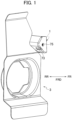
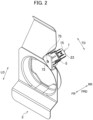
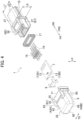
- a lighting device 1 As illustrated in Figs. 1 and 2 , a lighting device 1 according to a first embodiment of the present invention is used for illumination of a charge inlet of a vehicle (vehicle charge inlet) 3, for example. As illustrated in Figs. 3 and 4 , the lighting device 1 includes a case 5, a substrate (circuit substrate) 7, and a cover 9.
- a certain direction is referred to as a front-rear direction
- a direction perpendicular to the front-rear direction is referred to as a longitudinal direction
- a direction perpendicular to the front-rear direction and the longitudinal direction is referred to as a transverse direction.
- the directions of longitudinal, transverse, front, rear, and front-rear are denoted by LD, TD, FR, RR, and FRD, respectively.
- the case 5 is made from a rigid material allowing light (visible light, for example) to penetrate therethrough and has a cylinder shape with a closed bottom. That is, the case 5 is made from a material such as transparent or translucent synthetic resin and has a rectangular cylinder with a closed bottom (rectangular box shape), for example. An opening 11 is formed in a rear end of the case 5.
- the substrate 7 is made from a rigid material which does not allow light to penetrate therethrough and has a rectangular flat plate shape, for example.
- the substrate 7 includes a light emitter (an LED, for example) 13 configured to emit light (visible light, for example).
- the cover 9 is made from a rigid material such as synthetic resin.
- the cover 9 is inserted and press-fitted in the tip end portion (front end portion) of the substrate 7 and integrally installed in the substrate 7 so as to cover the light emitter 13.
- the cover 9 is provided in the substrate 7 in order to prevent the light emitter 13 from hitting the inner surface of the case 5 when the substrate 7 is installed inside the case 5.
- the cover 9 is installed inside the case 5 together with the substrate 7 (including the light emitter 13).
- the lighting device 1 further includes a housing 15, a packing 17, and terminals 19.
- the housing 15 is made from a rigid material such as synthetic resin.
- the packing 17 is made from an elastic material such as synthetic rubber.
- the terminals 19 are made from a conductive material such as metal.
- the term "rigid” herein means a rigidity with which only a subtle elastic deformation barely visible to the naked eye is generated by a force made with a person's finger.
- the housing 15 has a substantially cuboid shape.
- a connector frontage (connector joint portion) 23 to be connected to a vehicle-side connector 21 is formed in a rear end portion of the housing 15.
- an engaging portion 27 to be engaged with an engaged portion 25 of the case 5 is formed in a front end portion of the housing 15.
- the case 5 is installed in the housing 15 in a state where the engaged portion 25 of the case 5 is engaged with the engaging portion 27 of the housing 15. Thus, an opening 11 of the case 5 is blocked and an enclosed space 29 (see Figs. 3 , 11, and 12 ) is formed inside the case 5.
- the packing 17 has a rectangular annular shape.
- the packing 17 is provided in order to allow the enclosed space 29 inside the case 5 to be a confined space and prevent water and the like from coming into the enclosed space 29 from the outside of the lighting device 1.
- the packing 17 is provided at the site of (between) the engaged portion 25 of the case 5 and the engaging portion 27 of the housing 15 (see Fig. 12 ).
- the terminals 19 are locked to the housing 15.
- the terminals 19 are provided for energization between a conductive portion (an energization portion electrically connected to the connector joint portion 23) of the housing 15 and an electronic circuit module of the substrate 7. This energization allows the light emitter 13 to emit light.
- the substrate 7 is fixed to the terminals 19 in a state where a rear end portion of the substrate 7 is sandwiched by the terminals 19.
- the substrate 7, the light emitter 13, the terminals 19, and the cover 9 are present in the enclosed space 29 which is formed by the case 5 and the housing 15.
- the substrate 7, the light emitter 13, the terminals 19, and the cover 9 are blocked and protected from the outside by the case 5 and the housing 15.
- the case 5, the housing 15, the terminals 19, the substrate 7, and the cover 9 are integrally connected to each other.
- the vehicle-side connector 21 (see Fig. 10 ) is connected to the connector joint portion 23 of the housing 15, the light emitter 13 appropriately emits light, the light emitted by the light emitter 13 penetrates through the case 5, and then at least a part of the case 5 emits light.
- the positional relationship between the case 5 and the housing 15 is set to a prescribed appropriate relationship.
- the housing 15 is installed in the case 5 by moving the housing 15 forward to the case 5 from a state where the case 5 and the housing 15 are away from each other.
- an illuminated surface 31 (see Figs. 6 to 9 and 11 ) of the cover 9 is configured to, for example, reflect, while also diffusing, some or all light emitted by the light emitter 13 and with which the illuminated surface 31 is illuminated.
- the illuminated surface 31 is a surface to be illuminated with light emitted by the light emitter 13.
- the illuminated surface 31 includes at least a part of the cover 9.
- the entirety of the cover 9 is made from white non-transparent synthetic resin which is lightproof.
- a portion of the light emitted by the light emitter 13 and with which the illuminated surface 31 is illuminated is reflected by the illuminated surface 31.
- the case 5 includes a case body 33 and locked portions 35.
- the case body 33 has a rectangular box shape.
- the housing 15 includes a housing body 37 and locking portions 39.
- the dimension value L1 of the case body 33 in the transverse direction is greater than the dimension value L2 of the case body 33 in the longitudinal direction.
- the dimension value L3 of the housing body 37 in the transverse direction is greater than the dimension value L4 of the housing body 37 in the longitudinal direction.
- the locked portions 35 of the case 5 protrude from both ends of the case body 33 in the longitudinal direction.
- the locking portions 39 of the housing 15 protrude from both ends of the housing body 37 in the longitudinal direction.
- the case 5 is locked to the housing 15 and integrally installed in the housing 15 by engaging the engaged portion 25 of the case 5 with the engaging portion 27 of the housing 15 and locking the locked portions 35 to the locking portions 39.
- the dimension value L5 of the case 5 in the transverse direction and the dimension value L7 of the housing 15 in the transverse direction are respectively greater than the dimension value L6 of the case 5 in the longitudinal direction and the dimension value L8 of the housing 15 in the longitudinal direction (see Figs. 4 and 13 ).
- press-holding ribs 41 for holding the substrate 7 are provided inside the case 5 (case body 33).
- the case body 33 has a rectangular box shape and the opening 11 is located at the rear end of the case body 33 as described above.
- the case body 33 includes a side wall 43 and a bottom wall 45.
- the side wall 43 has a rectangular cylinder shape whose central axis extends in the front-rear direction.
- the bottom wall 45 has a rectangular flat plate shape which closes the front end of the side wall 43.
- the press-holding ribs 41 are provided in at least the bottom wall 45.
- the press-holding ribs 41 extend in the longitudinal direction (direction perpendicular to the sheet of Fig. 12 ) inside the case body 33 and slightly protrude rearward from the bottom wall 45.
- Recesses 47 are provided in parts (intermediate portions in the longitudinal direction) of the press-holding ribs 41.
- the recesses 47 are recessed forward from the rear end surfaces of the press-holding ribs 41.
- the tip end portion of the substrate 7 is fitted in the press-holding ribs 41 and the substrate 7 is sandwiched by the press-holding ribs 41 with a biasing force in the longitudinal direction.
- the press-holding ribs 41 may be integrally extended from the bottom wall 45, and may protrude from a wall surface of the inner wall of the side wall 43 separately from the bottom wall 45.
- a first light emitter 13A and a second light emitter 13B are provided as the light emitter 13.
- the thickness direction of the substrate 7 is the longitudinal direction.
- the first light emitter 13A is provided on the front surface (front mounting surface) of the substrate 7 which is one of the surfaces of the substrate 7 in the thickness direction.
- the first light emitter 13A is configured to emit light with a first solid angle (see the arrows A1 of Fig. 11 ) from the front surface of the substrate 7 toward a direction which is away from the substrate 7 in the longitudinal direction.
- the second light emitter 13B is provided on the back surface (back mounting surface) of the substrate 7 which is the other of the surfaces of the substrate 7 in the thickness direction.
- the second light emitter 13B is configured to emit light with a second solid angle (see the arrow B1 of Fig. 11 ) from the back surface of the substrate 7 toward the front direction.
- the value of the first solid angle is greater than the value of the second solid angle.
- a portion of the light emitted by the first light emitter 13A is reflected by the cover 9 and then the case 5 is illuminated with the reflected light (see the arrow A1a of Fig. 11 ).
- the case 5 is directly illuminated with the remaining light emitted by the first light emitter 13A (see the arrows A1 of Fig. 11 ).
- the case 5 is directly illuminated with light emitted by the second light emitter 13B (see the arrow B1 of Fig. 11 ).
- the first light emitter 13A is located at the central portion of the substrate 7 in the transverse direction and located at the front end portion of the substrate 7 in the front-rear direction.
- the second light emitter 13B is located at the central portion of the substrate 7 in the transverse direction and located at the front end portion of the substrate 7 in the front-rear direction.
- the first light emitter 13A is provided for lighting the vehicle charge inlet 3 which is an object to be illuminated for illumination.
- the second light emitter 13B is used as an indicator (an indicator indicating an amount of charge, for example). Light emitted by the first light emitter 13A comes out from the portion indicated by the reference numeral 73 in Figs. 1 and 2 . Light emitted by the second light emitter 13B comes out from the portion indicated by the reference numeral 75 in Figs. 1 and 2 .
- the cover 9 includes a cover body 49, a pair of cover side walls 51, and a pair of arms (arm bodies) 53.
- the cover body 49 has a rectangular flat plate shape whose thickness direction is the front-rear direction.
- a concave portion 55 is formed at the central portion of the cover body 49 in the transverse direction and at a first end which is one end of the cover body 49 in the longitudinal direction.
- the concave portion 55 is recessed toward a second end which is the other end of the cover body 49 in the longitudinal direction.
- the concave portion 55 penetrates through the cover body 49 in the front-rear direction.
- the tip end of the cover body 49 has slopes 69 and is sharp in Figs. 11 , 17, and 18 . However, the tip end of the cover body 49 may not be sharp as illustrated in Fig. 5 and other drawings.
- the pair of cover side walls 51 respectively have a rectangular flat plate shape whose thickness direction is the transverse direction.
- the pair of cover side walls 51 protrude rearward from both ends of the cover body 49 in the transverse direction located at the second end side of the cover body 49 in the longitudinal direction.
- the concave portion 55 of the cover body 49 is away from the pair of cover side walls 51 in the longitudinal direction.
- the pair of arms 53 respectively have a flat plate shape whose thickness direction is the transverse direction.
- the pair of arms 53 are away from the pair of cover side walls 51 in the longitudinal direction.
- the pair of arms 53 protrude rearward from both ends of the cover body 49 in the transverse direction located at the first end side in the longitudinal direction.
- the pair of arms 53 having cantilever structures are elastically deformable and capable of bending more than the pair of cover side walls 51.
- the pair of arms 53 respectively have protrusions 57.
- the protrusions 57 are provided in the rear end portions of the pair of arms 53 in the front-rear direction.
- the protrusions 57 are positioned forward of the rear ends of the pair of cover side walls 51 in the front-rear direction.
- the protrusions 57 are positioned toward (nearer to) the pair of cover side walls 51 (the second end) in the longitudinal direction.
- the protrusions 57 respectively have a triangle shape viewed from the transverse direction.
- the protrusions 57 respectively have slopes 59 at the rear ends thereof. The slopes 59 function as guide surfaces when the cover 9 is installed in the substrate 7.
- the central portion of the substrate 7 in the transverse direction at the forward end of the substrate 7 is sandwiched by and between the pair of cover side walls 51 and the pair of arms 53 (specifically, the protrusions 57) with a biasing force.
- the cover 9 is press-fitted and integrally installed in the substrate 7.
- the first light emitter 13A In a state where the cover 9 is installed in the substrate 7, the first light emitter 13A is located rearward of the portion of the cover body 49 in which the concave portion 55 is not formed, and is slightly away from the cover body 49 in the front-rear direction (see Figs. 11 , 16 , 17 , and other drawings). In a state where the cover 9 is installed in the substrate 7, the first light emitter 13A is located between the pair of cover side walls 51 and is slightly away from both the pair of cover side walls 51 in the transverse direction.
- a portion of the light emitted by the first light emitter 13A is reflected by the cover body 49 and the pair of cover side walls 51, and then the case 5 is illuminated with the reflected light.
- the remaining light emitted by the first light emitter 13A is not reflected by the cover body 49 and the pair of cover side walls 51, and the case 5 is directly illuminated with the remaining light emitted by the first light emitter 13A and passing through the space surrounded by the cover body 49 and the pair of cover side walls 51.
- the second light emitter 13B In a state where the cover 9 is installed in the substrate 7, the second light emitter 13B is located rearward of the concave portion 55 of the cover body 49 and is slightly away from the concave portion 55 of the cover body 49 in the front-rear direction. In a state where the cover 9 is installed in the substrate 7, the second light emitter 13B is located between the pair of arms 53 and is slightly away from both the pair of arms 53 in the transverse direction (see Fig. 11 ).
- the case 5 is directly illuminated with substantially all of the light emitted by the second light emitter 13B and passing through the concave portion 55 of the cover body 49 without illuminating the cover 9.
- Light emitted by the first light emitter 13A is blocked by the substrate 7, the cover body 49 of the cover 9, and the pair of cover side walls 51 of the cover 9, and thus does not reach the back side of the substrate 7.
- Light emitted by the second light emitter 13B is blocked by the substrate 7 and the pair of arms 53 of the cover 9, and thus does not reach the front side of the substrate 7.
- the lighting device 1 will be described in more detail.
- the engaged portion 25 of the case 5 is the inner surface of the side wall 43 of the case body 33 located at the rear side.
- the locked portions 35 of the case 5 are a pair of protrusions 61.
- the pair of the protrusions 61 respectively protrude from the side wall 43 of the case body 33 (the portions 43A and 43B thereof which face each other and whose thickness direction is the longitudinal direction) in the longitudinal direction.
- the pair of the protrusions 61 are long in the transverse direction, located at the rear side of the side wall 43 of the case body 33 in the front-rear direction, and located at the central portion of the side wall 43 in the transverse direction.
- the protrusion 61 is provided in a pair.
- Protection walls 63 are respectively provided in the portions 43A and 43B of the side wall 43 of the case body 33.
- the protection walls 63 are respectively located at the rear side of the portions 43A and 43B in the front-rear direction, and respectively provided at both end portions of the portions 43A and 43B in the transverse direction.
- the engaging portion 27 of the housing 15 is the outer surface of a rectangular tubular portion 67 of the housing body 37.
- the locking portions 39 of the housing 15 are U-shaped elastic arms (locking claws) 65 having cantilever structures.
- the elastic arm 65 is also provided in a pair as with the protrusion 61.
- the protrusions 61 are locked by the elastic arms 65, and the protection walls 63 surround and protect the elastic arms 65 which are the locking portions 39 of the housing 15 (see Fig. 3 ).
- the substrate 7 has a recess (a recess for a cover) 71 which is long in the transverse direction (see Figs. 4 , 5 , and 15 ).
- the recess 71 is formed in the front end portion of the substrate 7 in the front-rear direction and arranged at the central portion of the substrate 7 in the transverse direction.
- the cover 9 is coupled to the substrate 7 along the recess 71 provided in the substrate 7. That is, the cover 9 is guided by the recess 71 when the cover 9 is installed in the substrate 7.
- the cover 9 is installed in the substrate 7 in the initial state (see Fig. 14 ). Next, the substrate 7 and the cover 9 are installed in the housing 15 (see Fig. 16 ). Next, the housing 15, the substrate 7, and the cover 9 are installed in the case 5 as illustrated in Figs. 17 and 18 .
- the cover 9 is made from a rigid material such as synthetic resin and installed in the substrate 7 by press-fitting so as to cover the light emitter 13.
- the substrate 7 is installed inside the case 5
- the cover 9 may come in contact with the case 5
- the light emitter 13 does not come in contact with the case 5 and it is therefore possible to prevent damage to the light emitter 13 due to contact of the light emitter 13 with the case 5.
- the light emitter 13 does not come in contact with the case 5 even when the housing 15 and other components are tilted with respect to the case 5 as illustrated in Fig. 17 .
- the light emitter 13 does not come in contact with the case 5 even when the housing 15 and other components are tilted with respect to the case 5 as illustrated in Fig. 18 .
- a lighting device 301 includes a case 303 having a rectangular cylinder with a closed bottom, and a substrate 305 inserted through the opening of the case 303 and installed inside the case 303.
- the lighting device 301 In the lighting device 301 according to the comparative example, light emitters 307 and a light-shielding wall made of sponge material (sponge) 309 are provided on the substrate 305.
- the sponge 309 is fixed on the front surface of the substrate 305 so as to surround the light emitter 307. Since the sponge 309 surrounds the light emitter 307, it is possible to prevent damage to the light emitter 307 due to contact of the light emitter 307 with the case 303 when the substrate 305 in which the light emitter 307 is installed is installed inside the case 303 (see Figs. 23 and 24 ).
- release paper of double-sided tape is peeled from the sponge 309 and attachment of the sponge 309 on the substrate 305 is performed by manually positioning the sponge 309 on the substrate 305 when the sponge 309 is installed on the substrate 305.
- the sponge 309 absorbs light depending on the color of the sponge 309, the sponge 309 has a good light-shielding function but causes a reduction of the illumination intensity. Furthermore, in the lighting device 301 according to the comparative example, since the sponge 309 is vulcanized, long-term usage may cause chips of the light emitter 307 to corrode and cause a reduction of the illumination intensity and brightness of the light emitter 307.
- the illuminated surface 31 of the cover 9 is configured to reflect some or all light emitted by the light emitter 13 and with which the illuminated surface 31 is illuminated.
- the cover 9 allows light-shielding in directions in which illumination is unnecessary.
- the lighting device 1 does not use a vulcanized sponge(s), and thus a reduction of the illumination intensity and brightness of the light emitter 13 due to long-term usage can be prevented as much as possible.
- the thickness direction of the substrate 7 in which the light emitter 13 is installed and which has a thin flat plate shape is the longitudinal direction
- the dimension value L2 of the case body 33 in the longitudinal direction is smaller than the dimension value L1 of the case body 33 in the transverse direction.
- the locked portions 35 of the case 5 protrude from both ends of the case body 33 in the longitudinal direction, and the locking portions 39 of the housing 15 protrude from both ends of the housing body 37 in the longitudinal direction.
- the case 5 is installed in the housing 15 by locking the locked portions 35 to the locking portions 39.
- the press-holding ribs 41 for holding the substrate 7 are provided inside the case 5 (the case body 33).
- the case 5 the case body 33.
- the cover 9 increases the mass of the portion at the front side of the substrate 7, the tip end portion of the substrate 7 is held with the press-holding ribs 41 and thus it is possible to prevent the tip end portion of the substrate 7 from becoming unstable due to the increased mass.
- the first light emitter 13A and the second light emitter 13B are provided as the light emitter 13.
- the first light emitter 13A is provided on the front surface of the substrate 7 and is configured to emit light toward a direction which is away from the substrate 7 in the longitudinal direction.
- the second light emitter 13B is provided on the back surface of the substrate 7 which is the other of the surfaces of the substrate 7 in the thickness direction and is configured to emit light toward the front direction.
- the lighting device 1 a portion of the light emitted by the first light emitter 13A is reflected by the cover 9 and then the case 5 is illuminated with the reflected light, and the case 5 is directly illuminated with the remaining light emitted by the first light emitter 13A.
- the case 5 is directly illuminated with light emitted by the second light emitter 13B.
- the first light emitter 13A is provided for lighting the vehicle charge inlet 3 which is an object to be illuminated for illumination, and the second light emitter 13B is used as an indicator.
- the lighting device 1 can be appropriately used as a lighting device for lighting the vehicle charge inlet 3 and a device for indicating an amount of battery charge of a vehicle.
- the cover 9 includes the cover body 49 in which the concave portion 55 is formed, the pair of cover side walls 51, and the pair of arms 53.
- the cover 9 is installed in the substrate 7 in a state where the forward end of the substrate 7 is sandwiched by and between the pair of cover side walls 51 and the pair of arms 53 with a biasing force.
- the cover 9 can be installed in the substrate 7 by press-fitting with a simple configuration.
- the first light emitter 13A is located rearward of the cover body 49 in the front-rear direction and located between the pair of cover side walls 51 in the transverse direction. A portion of the light emitted by the first light emitter 13A is reflected by the cover body 49 and the pair of cover side walls 51, and then the case 5 is illuminated with the reflected light.
- the first light emitter 13A it is possible to prevent the first light emitter 13A from coming into contact with the case 5 when the substrate 7 is installed in the case 5, and prevent a reduction of the illumination intensity of the case 5 obtained by emitting from the first light emitter 13A.
- the second light emitter 13B is located rearward of the concave portion 55 of the cover body 49 in the front-rear direction and located between the pair of arms 53 in the transverse direction.
- the case 5 is directly illuminated with substantially all of the light emitted by the second light emitter 13B and passing through the concave portion 55 of the cover body 49.
- light emitted by the first light emitter 13A is blocked by the substrate 7, the cover body 49 of the cover 9, and the pair of cover side walls 51 of the cover 9, and thus does not reach the back side of the substrate 7.
- Light emitted by the second light emitter 13B is blocked by the substrate 7 and the pair of arms 53 of the cover 9, and thus does not reach the front side of the substrate 7.
- the lighting device 1a according to the second embodiment of the present invention has the same configuration as the lighting device 1 according to the first embodiment of the present invention other than the positions of the locked portions 35 of the case 5 and the positions of the locking portions 39 of the housing 15.
- the locked portions 35 of the case 5 protrude from both ends of the case body 33 in the transverse direction
- the locking portions 39 of the housing 15 protrude from both ends of the housing body 37 in the transverse direction.
- the case 5 is installed in the housing 15 by locking the locked portions 35 to the locking portions 39.
Landscapes
- Engineering & Computer Science (AREA)
- General Engineering & Computer Science (AREA)
- Power Engineering (AREA)
- Transportation (AREA)
- Mechanical Engineering (AREA)
- Physics & Mathematics (AREA)
- Microelectronics & Electronic Packaging (AREA)
- Optics & Photonics (AREA)
- Arrangements Of Lighting Devices For Vehicle Interiors, Mounting And Supporting Thereof, Circuits Therefore (AREA)
- Lighting Device Outwards From Vehicle And Optical Signal (AREA)
- Non-Portable Lighting Devices Or Systems Thereof (AREA)
Description
- The present invention relates to a lighting device.
-
JP 2013-200365 A - In the display device (lighting device) above, LEDs (light emitters) and light-shielding walls made of sponge material (sponges) are provided on the substrate. The sponges are fixed on the front surface of the substrate so as to surround at least partly the outer periphery side surface of at least one LED of the LEDs.
JP 2021 106078 A JP 2014 207247 A JP 2018 043744 A EP 2 894 677 A1 discloses an optical sensor.JP H08 268152 A US 2012/212967 A1 discloses an illumination unit for a charging connector. - Since the sponges surround the LEDs in the lighting device above, it is possible to prevent damage to the LEDs due to contact of the LEDs with the case when the substrate in which the LEDs are installed is installed inside the case.
- In the lighting device above, release paper of double-sided tape is peeled from the sponges and attachment of the sponges on the substrate is performed by manually positioning the sponges on the substrate when the sponges are installed on the substrate. Thus, it takes time to install the sponges on the substrate.
- Furthermore, in the lighting device above, since the sponges absorb light emitted by the LEDs depending on the color of the sponges, the sponges have a good light-shielding function but cause a reduction of the illumination intensity. Furthermore, in the lighting device above, since the sponges are vulcanized, long-term usage may cause chips of the LEDs to corrode and cause a reduction of the illumination intensity and brightness of the LEDs.
- An object of the present invention is to provide a lighting device capable of preventing damage to a light emitter due to contact of the light emitter with a case when a substrate is installed inside the case, and reducing the time taken to install a cover on the substrate.
- A lighting device in accordance with the present invention is defined in
independent claim 1. -
-
Fig. 1 is a perspective view of an attachment for a vehicle charge inlet light to which a lighting device according to an embodiment of the invention is applied. -
Fig. 2 is a perspective view of the attachment for the vehicle charge inlet light ofFig. 1 , viewed from the direction different fromFig. 1 . -
Fig. 3 is a perspective view of a lighting device according to a first embodiment of the invention. -
Fig. 4 is an exploded perspective view of the lighting device according to the first embodiment of the invention. -
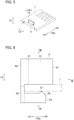
Fig. 5 is a perspective view of a substrate of the lighting device according to the first embodiment of the invention. -
Fig. 6 is a diagram of a cover of the lighting device according to the first embodiment of the invention, viewed from the transverse direction. -
Fig. 7 is an arrow view from the VII direction inFig. 6 . -
Fig. 8 is an arrow view from the VIII direction inFig. 6 . -
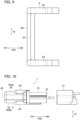
Fig. 9 is an arrow view from the IX direction inFig. 6 . -
Fig. 10 is a view of the lighting device according to the first embodiment of the invention immediately before a vehicle-side connector is connected to the lighting device. -
Fig. 11 is a cross-sectional view taken along the line XI-XI ofFig. 3 and indicating traveling directions of light emitted by a light emitter. -
Fig. 12 is a cross-sectional view taken along the line XII-XII ofFig. 3 . -
Fig. 13 is an arrow view from the XIII direction inFig. 3 . -
Fig. 14 is a view of the lighting device according to the first embodiment of the invention immediately before the substrate and the cover are installed in a housing. -
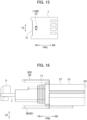
Fig. 15 is a view of the back surface of the substrate of the lighting device according to the first embodiment of the invention. -
Fig. 16 is a view of the lighting device according to the first embodiment of the invention in which the substrate and the cover have been installed in the housing. -
Fig. 17 is a view of the lighting device according to the first embodiment of the invention in which the housing and others illustrated inFig. 16 are being installed in a case. -
Fig. 18 is a view of the lighting device according to the first embodiment of the invention in which the housing and others illustrated inFig. 16 are being installed in the case. -
Fig. 19 is a perspective view of a lighting device according to a second embodiment of the invention. -
Fig. 20 is an arrow view from the XX direction inFig. 19 . -
Fig. 21 is a view of a lighting device according to a comparative example. -
Fig. 22 is a view of the lighting device according to the comparative example. -
Fig. 23 is a view of the lighting device according to the comparative example. -
Fig. 24 is a view of the lighting device according to the comparative example. - Various embodiments will be described hereinafter with reference to the accompanying drawings.
- As illustrated in
Figs. 1 and2 , alighting device 1 according to a first embodiment of the present invention is used for illumination of a charge inlet of a vehicle (vehicle charge inlet) 3, for example. As illustrated inFigs. 3 and4 , thelighting device 1 includes acase 5, a substrate (circuit substrate) 7, and acover 9. - For explanatory convenience, in the
lighting device 1, a certain direction is referred to as a front-rear direction, a direction perpendicular to the front-rear direction is referred to as a longitudinal direction, and a direction perpendicular to the front-rear direction and the longitudinal direction is referred to as a transverse direction. InFigs. 1 to 20 , the directions of longitudinal, transverse, front, rear, and front-rear are denoted by LD, TD, FR, RR, and FRD, respectively. - The
case 5 is made from a rigid material allowing light (visible light, for example) to penetrate therethrough and has a cylinder shape with a closed bottom. That is, thecase 5 is made from a material such as transparent or translucent synthetic resin and has a rectangular cylinder with a closed bottom (rectangular box shape), for example. Anopening 11 is formed in a rear end of thecase 5. - The
substrate 7 is made from a rigid material which does not allow light to penetrate therethrough and has a rectangular flat plate shape, for example. Thesubstrate 7 includes a light emitter (an LED, for example) 13 configured to emit light (visible light, for example). - The
cover 9 is made from a rigid material such as synthetic resin. Thecover 9 is inserted and press-fitted in the tip end portion (front end portion) of thesubstrate 7 and integrally installed in thesubstrate 7 so as to cover thelight emitter 13. Thecover 9 is provided in thesubstrate 7 in order to prevent thelight emitter 13 from hitting the inner surface of thecase 5 when thesubstrate 7 is installed inside thecase 5. Thecover 9 is installed inside thecase 5 together with the substrate 7 (including the light emitter 13). - The
lighting device 1 further includes ahousing 15, apacking 17, andterminals 19. - The
housing 15 is made from a rigid material such as synthetic resin. Thepacking 17 is made from an elastic material such as synthetic rubber. Theterminals 19 are made from a conductive material such as metal. The term "rigid" herein means a rigidity with which only a subtle elastic deformation barely visible to the naked eye is generated by a force made with a person's finger. - The
housing 15 has a substantially cuboid shape. As illustrated inFig. 10 , a connector frontage (connector joint portion) 23 to be connected to a vehicle-side connector 21 is formed in a rear end portion of thehousing 15. As illustrated inFig. 4 and other drawings, an engagingportion 27 to be engaged with an engagedportion 25 of thecase 5 is formed in a front end portion of thehousing 15. - The
case 5 is installed in thehousing 15 in a state where the engagedportion 25 of thecase 5 is engaged with the engagingportion 27 of thehousing 15. Thus, anopening 11 of thecase 5 is blocked and an enclosed space 29 (seeFigs. 3 ,11, and 12 ) is formed inside thecase 5. As illustrated inFig. 4 , the packing 17 has a rectangular annular shape. The packing 17 is provided in order to allow the enclosedspace 29 inside thecase 5 to be a confined space and prevent water and the like from coming into the enclosedspace 29 from the outside of thelighting device 1. The packing 17 is provided at the site of (between) the engagedportion 25 of thecase 5 and the engagingportion 27 of the housing 15 (seeFig. 12 ). - The
terminals 19 are locked to thehousing 15. Theterminals 19 are provided for energization between a conductive portion (an energization portion electrically connected to the connector joint portion 23) of thehousing 15 and an electronic circuit module of thesubstrate 7. This energization allows thelight emitter 13 to emit light. Thesubstrate 7 is fixed to theterminals 19 in a state where a rear end portion of thesubstrate 7 is sandwiched by theterminals 19. - In the
lighting device 1, thesubstrate 7, thelight emitter 13, theterminals 19, and thecover 9 are present in the enclosedspace 29 which is formed by thecase 5 and thehousing 15. Thus, thesubstrate 7, thelight emitter 13, theterminals 19, and thecover 9 are blocked and protected from the outside by thecase 5 and thehousing 15. - In the
lighting device 1, thecase 5, thehousing 15, theterminals 19, thesubstrate 7, and thecover 9 are integrally connected to each other. In thelighting device 1, the vehicle-side connector 21 (seeFig. 10 ) is connected to the connectorjoint portion 23 of thehousing 15, thelight emitter 13 appropriately emits light, the light emitted by thelight emitter 13 penetrates through thecase 5, and then at least a part of thecase 5 emits light. - The positional relationship between the
case 5 and thehousing 15 is set to a prescribed appropriate relationship. Thehousing 15 is installed in thecase 5 by moving thehousing 15 forward to thecase 5 from a state where thecase 5 and thehousing 15 are away from each other. - In the
lighting device 1, an illuminated surface 31 (seeFigs. 6 to 9 and11 ) of thecover 9 is configured to, for example, reflect, while also diffusing, some or all light emitted by thelight emitter 13 and with which the illuminatedsurface 31 is illuminated. The illuminatedsurface 31 is a surface to be illuminated with light emitted by thelight emitter 13. The illuminatedsurface 31 includes at least a part of thecover 9. - For example, the entirety of the
cover 9 is made from white non-transparent synthetic resin which is lightproof. Thus, a portion of the light emitted by thelight emitter 13 and with which the illuminatedsurface 31 is illuminated is reflected by the illuminatedsurface 31. - As illustrated in
Figs. 4 ,11 to 13 ,17, and 18 , thecase 5 includes acase body 33 and lockedportions 35. Thecase body 33 has a rectangular box shape. - As illustrated in
Figs. 4 and16 to 18 , thehousing 15 includes ahousing body 37 and lockingportions 39. As illustrated inFig. 13 , the dimension value L1 of thecase body 33 in the transverse direction is greater than the dimension value L2 of thecase body 33 in the longitudinal direction. Similarly, as illustrated inFig. 3 , the dimension value L3 of thehousing body 37 in the transverse direction is greater than the dimension value L4 of thehousing body 37 in the longitudinal direction. - As illustrated in
Fig. 13 , the lockedportions 35 of thecase 5 protrude from both ends of thecase body 33 in the longitudinal direction. As illustrated inFig. 14 , the lockingportions 39 of thehousing 15 protrude from both ends of thehousing body 37 in the longitudinal direction. - In the
lighting device 1, thecase 5 is locked to thehousing 15 and integrally installed in thehousing 15 by engaging the engagedportion 25 of thecase 5 with the engagingportion 27 of thehousing 15 and locking the lockedportions 35 to the lockingportions 39. - In the
lighting device 1, the dimension value L5 of thecase 5 in the transverse direction and the dimension value L7 of thehousing 15 in the transverse direction are respectively greater than the dimension value L6 of thecase 5 in the longitudinal direction and the dimension value L8 of thehousing 15 in the longitudinal direction (seeFigs. 4 and13 ). - As illustrated in
Fig. 12 , press-holdingribs 41 for holding thesubstrate 7 are provided inside the case 5 (case body 33). Thecase body 33 has a rectangular box shape and theopening 11 is located at the rear end of thecase body 33 as described above. Specifically, thecase body 33 includes aside wall 43 and abottom wall 45. Theside wall 43 has a rectangular cylinder shape whose central axis extends in the front-rear direction. Thebottom wall 45 has a rectangular flat plate shape which closes the front end of theside wall 43. - The press-holding
ribs 41 are provided in at least thebottom wall 45. The press-holdingribs 41 extend in the longitudinal direction (direction perpendicular to the sheet ofFig. 12 ) inside thecase body 33 and slightly protrude rearward from thebottom wall 45.Recesses 47 are provided in parts (intermediate portions in the longitudinal direction) of the press-holdingribs 41. Therecesses 47 are recessed forward from the rear end surfaces of the press-holdingribs 41. - The tip end portion of the
substrate 7 is fitted in the press-holdingribs 41 and thesubstrate 7 is sandwiched by the press-holdingribs 41 with a biasing force in the longitudinal direction. Note that the press-holdingribs 41 may be integrally extended from thebottom wall 45, and may protrude from a wall surface of the inner wall of theside wall 43 separately from thebottom wall 45. - In the
lighting device 1, afirst light emitter 13A and asecond light emitter 13B are provided as thelight emitter 13. The thickness direction of thesubstrate 7 is the longitudinal direction. - The
first light emitter 13A is provided on the front surface (front mounting surface) of thesubstrate 7 which is one of the surfaces of thesubstrate 7 in the thickness direction. Thefirst light emitter 13A is configured to emit light with a first solid angle (see the arrows A1 ofFig. 11 ) from the front surface of thesubstrate 7 toward a direction which is away from thesubstrate 7 in the longitudinal direction. - The
second light emitter 13B is provided on the back surface (back mounting surface) of thesubstrate 7 which is the other of the surfaces of thesubstrate 7 in the thickness direction. Thesecond light emitter 13B is configured to emit light with a second solid angle (see the arrow B1 ofFig. 11 ) from the back surface of thesubstrate 7 toward the front direction. The value of the first solid angle is greater than the value of the second solid angle. - A portion of the light emitted by the
first light emitter 13A is reflected by thecover 9 and then thecase 5 is illuminated with the reflected light (see the arrow A1a ofFig. 11 ). Thecase 5 is directly illuminated with the remaining light emitted by thefirst light emitter 13A (see the arrows A1 ofFig. 11 ). Thecase 5 is directly illuminated with light emitted by thesecond light emitter 13B (see the arrow B1 ofFig. 11 ). - As illustrated in
Fig. 5 , thefirst light emitter 13A is located at the central portion of thesubstrate 7 in the transverse direction and located at the front end portion of thesubstrate 7 in the front-rear direction. As illustrated inFig. 15 , thesecond light emitter 13B is located at the central portion of thesubstrate 7 in the transverse direction and located at the front end portion of thesubstrate 7 in the front-rear direction. - The
first light emitter 13A is provided for lighting thevehicle charge inlet 3 which is an object to be illuminated for illumination. Thesecond light emitter 13B is used as an indicator (an indicator indicating an amount of charge, for example). Light emitted by thefirst light emitter 13A comes out from the portion indicated by thereference numeral 73 inFigs. 1 and2 . Light emitted by thesecond light emitter 13B comes out from the portion indicated by thereference numeral 75 inFigs. 1 and2 . - As illustrated in
Figs. 6 to 9 , thecover 9 includes acover body 49, a pair ofcover side walls 51, and a pair of arms (arm bodies) 53. - The
cover body 49 has a rectangular flat plate shape whose thickness direction is the front-rear direction. Aconcave portion 55 is formed at the central portion of thecover body 49 in the transverse direction and at a first end which is one end of thecover body 49 in the longitudinal direction. Theconcave portion 55 is recessed toward a second end which is the other end of thecover body 49 in the longitudinal direction. Theconcave portion 55 penetrates through thecover body 49 in the front-rear direction. The tip end of thecover body 49 hasslopes 69 and is sharp inFigs. 11 ,17, and 18 . However, the tip end of thecover body 49 may not be sharp as illustrated inFig. 5 and other drawings. - The pair of
cover side walls 51 respectively have a rectangular flat plate shape whose thickness direction is the transverse direction. The pair ofcover side walls 51 protrude rearward from both ends of thecover body 49 in the transverse direction located at the second end side of thecover body 49 in the longitudinal direction. Theconcave portion 55 of thecover body 49 is away from the pair ofcover side walls 51 in the longitudinal direction. - The pair of
arms 53 respectively have a flat plate shape whose thickness direction is the transverse direction. The pair ofarms 53 are away from the pair ofcover side walls 51 in the longitudinal direction. The pair ofarms 53 protrude rearward from both ends of thecover body 49 in the transverse direction located at the first end side in the longitudinal direction. The pair ofarms 53 having cantilever structures are elastically deformable and capable of bending more than the pair ofcover side walls 51. - The pair of
arms 53 respectively have protrusions 57. Theprotrusions 57 are provided in the rear end portions of the pair ofarms 53 in the front-rear direction. Theprotrusions 57 are positioned forward of the rear ends of the pair ofcover side walls 51 in the front-rear direction. Theprotrusions 57 are positioned toward (nearer to) the pair of cover side walls 51 (the second end) in the longitudinal direction. Theprotrusions 57 respectively have a triangle shape viewed from the transverse direction. Theprotrusions 57 respectively haveslopes 59 at the rear ends thereof. Theslopes 59 function as guide surfaces when thecover 9 is installed in thesubstrate 7. - The central portion of the
substrate 7 in the transverse direction at the forward end of thesubstrate 7 is sandwiched by and between the pair ofcover side walls 51 and the pair of arms 53 (specifically, the protrusions 57) with a biasing force. Thus, thecover 9 is press-fitted and integrally installed in thesubstrate 7. - In a state where the
cover 9 is installed in thesubstrate 7, thefirst light emitter 13A is located rearward of the portion of thecover body 49 in which theconcave portion 55 is not formed, and is slightly away from thecover body 49 in the front-rear direction (seeFigs. 11 ,16 ,17 , and other drawings). In a state where thecover 9 is installed in thesubstrate 7, thefirst light emitter 13A is located between the pair ofcover side walls 51 and is slightly away from both the pair ofcover side walls 51 in the transverse direction. - A portion of the light emitted by the
first light emitter 13A is reflected by thecover body 49 and the pair ofcover side walls 51, and then thecase 5 is illuminated with the reflected light. The remaining light emitted by thefirst light emitter 13A is not reflected by thecover body 49 and the pair ofcover side walls 51, and thecase 5 is directly illuminated with the remaining light emitted by thefirst light emitter 13A and passing through the space surrounded by thecover body 49 and the pair ofcover side walls 51. - In a state where the
cover 9 is installed in thesubstrate 7, thesecond light emitter 13B is located rearward of theconcave portion 55 of thecover body 49 and is slightly away from theconcave portion 55 of thecover body 49 in the front-rear direction. In a state where thecover 9 is installed in thesubstrate 7, thesecond light emitter 13B is located between the pair ofarms 53 and is slightly away from both the pair ofarms 53 in the transverse direction (seeFig. 11 ). - The
case 5 is directly illuminated with substantially all of the light emitted by thesecond light emitter 13B and passing through theconcave portion 55 of thecover body 49 without illuminating thecover 9. - Light emitted by the
first light emitter 13A is blocked by thesubstrate 7, thecover body 49 of thecover 9, and the pair ofcover side walls 51 of thecover 9, and thus does not reach the back side of thesubstrate 7. Light emitted by thesecond light emitter 13B is blocked by thesubstrate 7 and the pair ofarms 53 of thecover 9, and thus does not reach the front side of thesubstrate 7. - The
lighting device 1 will be described in more detail. - As illustrated in
Fig. 4 and other drawings, the engagedportion 25 of thecase 5 is the inner surface of theside wall 43 of thecase body 33 located at the rear side. The lockedportions 35 of thecase 5 are a pair ofprotrusions 61. As illustrated inFigs. 3 ,4 ,13 ,17, and 18 , the pair of theprotrusions 61 respectively protrude from theside wall 43 of the case body 33 (theportions protrusions 61 are long in the transverse direction, located at the rear side of theside wall 43 of thecase body 33 in the front-rear direction, and located at the central portion of theside wall 43 in the transverse direction. Theprotrusion 61 is provided in a pair. -
Protection walls 63 are respectively provided in theportions side wall 43 of thecase body 33. Theprotection walls 63 are respectively located at the rear side of theportions portions - As illustrated in
Fig. 4 and other drawings, the engagingportion 27 of thehousing 15 is the outer surface of a rectangulartubular portion 67 of thehousing body 37. The lockingportions 39 of thehousing 15 are U-shaped elastic arms (locking claws) 65 having cantilever structures. Theelastic arm 65 is also provided in a pair as with theprotrusion 61. - In a state where the
housing 15 is installed in thecase 5, theprotrusions 61 are locked by theelastic arms 65, and theprotection walls 63 surround and protect theelastic arms 65 which are the lockingportions 39 of the housing 15 (seeFig. 3 ). - The
substrate 7 has a recess (a recess for a cover) 71 which is long in the transverse direction (seeFigs. 4 ,5 , and15 ). Therecess 71 is formed in the front end portion of thesubstrate 7 in the front-rear direction and arranged at the central portion of thesubstrate 7 in the transverse direction. Thecover 9 is coupled to thesubstrate 7 along therecess 71 provided in thesubstrate 7. That is, thecover 9 is guided by therecess 71 when thecover 9 is installed in thesubstrate 7. - Next, the assembly of the
lighting device 1 will be described. - As an initial state, it is assumed that the packing 17 and the
terminals 19 are installed in thehousing 15 while thecase 5, thesubstrate 7, and thecover 9 are not installed in thehousing 15. - The
cover 9 is installed in thesubstrate 7 in the initial state (seeFig. 14 ). Next, thesubstrate 7 and thecover 9 are installed in the housing 15 (seeFig. 16 ). Next, thehousing 15, thesubstrate 7, and thecover 9 are installed in thecase 5 as illustrated inFigs. 17 and 18 . - In the
lighting device 1, thecover 9 is made from a rigid material such as synthetic resin and installed in thesubstrate 7 by press-fitting so as to cover thelight emitter 13. Thus, when thesubstrate 7 is installed inside thecase 5, even though thecover 9 may come in contact with thecase 5, thelight emitter 13 does not come in contact with thecase 5 and it is therefore possible to prevent damage to thelight emitter 13 due to contact of thelight emitter 13 with thecase 5. - Specifically, the
light emitter 13 does not come in contact with thecase 5 even when thehousing 15 and other components are tilted with respect to thecase 5 as illustrated inFig. 17 . Thelight emitter 13 does not come in contact with thecase 5 even when thehousing 15 and other components are tilted with respect to thecase 5 as illustrated inFig. 18 . - Installation of the
cover 9 in thesubstrate 7 by press-fitting reduces the time required for assembly of thecover 9 to thesubstrate 7. - As illustrated in
Figs. 21 and 22 , alighting device 301 according to a comparative example includes acase 303 having a rectangular cylinder with a closed bottom, and asubstrate 305 inserted through the opening of thecase 303 and installed inside thecase 303. - In the
lighting device 301 according to the comparative example,light emitters 307 and a light-shielding wall made of sponge material (sponge) 309 are provided on thesubstrate 305. Thesponge 309 is fixed on the front surface of thesubstrate 305 so as to surround thelight emitter 307. Since thesponge 309 surrounds thelight emitter 307, it is possible to prevent damage to thelight emitter 307 due to contact of thelight emitter 307 with thecase 303 when thesubstrate 305 in which thelight emitter 307 is installed is installed inside the case 303 (seeFigs. 23 and 24 ). - However, in the
lighting device 301 according to the comparative example, release paper of double-sided tape is peeled from thesponge 309 and attachment of thesponge 309 on thesubstrate 305 is performed by manually positioning thesponge 309 on thesubstrate 305 when thesponge 309 is installed on thesubstrate 305. Thus, it takes time to install thesponge 309 on thesubstrate 305. - Furthermore, in the
lighting device 301 according to the comparative example, since thesponge 309 absorbs light depending on the color of thesponge 309, thesponge 309 has a good light-shielding function but causes a reduction of the illumination intensity. Furthermore, in thelighting device 301 according to the comparative example, since thesponge 309 is vulcanized, long-term usage may cause chips of thelight emitter 307 to corrode and cause a reduction of the illumination intensity and brightness of thelight emitter 307. - In the
lighting device 1, the illuminatedsurface 31 of thecover 9 is configured to reflect some or all light emitted by thelight emitter 13 and with which the illuminatedsurface 31 is illuminated. Thus, it is possible to prevent light emitted by thelight emitter 13 from being absorbed by thecover 9 as much as possible and prevent a reduction of the illumination intensity due to installation of thecover 9. Furthermore, thecover 9 allows light-shielding in directions in which illumination is unnecessary. - The
lighting device 1 does not use a vulcanized sponge(s), and thus a reduction of the illumination intensity and brightness of thelight emitter 13 due to long-term usage can be prevented as much as possible. - In the
lighting device 1, the thickness direction of thesubstrate 7 in which thelight emitter 13 is installed and which has a thin flat plate shape is the longitudinal direction, and the dimension value L2 of thecase body 33 in the longitudinal direction is smaller than the dimension value L1 of thecase body 33 in the transverse direction. - In the
lighting device 1, the lockedportions 35 of thecase 5 protrude from both ends of thecase body 33 in the longitudinal direction, and the lockingportions 39 of thehousing 15 protrude from both ends of thehousing body 37 in the longitudinal direction. Thecase 5 is installed in thehousing 15 by locking the lockedportions 35 to the lockingportions 39. - According to the configuration above, it is possible to easily reduce the size of the lighting device 1 (particularly in the transverse direction).
- In the
lighting device 1, the press-holdingribs 41 for holding thesubstrate 7 are provided inside the case 5 (the case body 33). Thus, it is possible to increase the rigidity of thecase 5 and prevent thesubstrate 7 from falling off thecase 5 at the same time. It is also possible to increase the integrity of thesubstrate 7 and thecase 5 and prevent thesubstrate 7 from swinging inside thecase 5. Particularly, although provision of thecover 9 increases the mass of the portion at the front side of thesubstrate 7, the tip end portion of thesubstrate 7 is held with the press-holdingribs 41 and thus it is possible to prevent the tip end portion of thesubstrate 7 from becoming unstable due to the increased mass. - In the
lighting device 1, thefirst light emitter 13A and thesecond light emitter 13B are provided as thelight emitter 13. Thefirst light emitter 13A is provided on the front surface of thesubstrate 7 and is configured to emit light toward a direction which is away from thesubstrate 7 in the longitudinal direction. In thelighting device 1, thesecond light emitter 13B is provided on the back surface of thesubstrate 7 which is the other of the surfaces of thesubstrate 7 in the thickness direction and is configured to emit light toward the front direction. - In the
lighting device 1, a portion of the light emitted by thefirst light emitter 13A is reflected by thecover 9 and then thecase 5 is illuminated with the reflected light, and thecase 5 is directly illuminated with the remaining light emitted by thefirst light emitter 13A. Thecase 5 is directly illuminated with light emitted by thesecond light emitter 13B. - According to the configuration above, it is possible to prevent a reduction of the illumination intensity of the
case 5 obtained by emitting from thefirst light emitter 13A and a reduction of the illumination intensity of thecase 5 obtained by emitting from thesecond light emitter 13B as much as possible. - In the
lighting device 1, thefirst light emitter 13A is provided for lighting thevehicle charge inlet 3 which is an object to be illuminated for illumination, and thesecond light emitter 13B is used as an indicator. Thus, thelighting device 1 can be appropriately used as a lighting device for lighting thevehicle charge inlet 3 and a device for indicating an amount of battery charge of a vehicle. - In the
lighting device 1, thecover 9 includes thecover body 49 in which theconcave portion 55 is formed, the pair ofcover side walls 51, and the pair ofarms 53. Thecover 9 is installed in thesubstrate 7 in a state where the forward end of thesubstrate 7 is sandwiched by and between the pair ofcover side walls 51 and the pair ofarms 53 with a biasing force. Thus, thecover 9 can be installed in thesubstrate 7 by press-fitting with a simple configuration. - In the
lighting device 1, thefirst light emitter 13A is located rearward of thecover body 49 in the front-rear direction and located between the pair ofcover side walls 51 in the transverse direction. A portion of the light emitted by thefirst light emitter 13A is reflected by thecover body 49 and the pair ofcover side walls 51, and then thecase 5 is illuminated with the reflected light. Thus, with a simple configuration, it is possible to prevent thefirst light emitter 13A from coming into contact with thecase 5 when thesubstrate 7 is installed in thecase 5, and prevent a reduction of the illumination intensity of thecase 5 obtained by emitting from thefirst light emitter 13A. - In the
lighting device 1, thesecond light emitter 13B is located rearward of theconcave portion 55 of thecover body 49 in the front-rear direction and located between the pair ofarms 53 in the transverse direction. Thecase 5 is directly illuminated with substantially all of the light emitted by thesecond light emitter 13B and passing through theconcave portion 55 of thecover body 49. Thus, with a simple configuration, it is possible to prevent thesecond light emitter 13B from coming into contact with thecase 5 when thesubstrate 7 is installed in thecase 5, and prevent a reduction of the illumination intensity of thecase 5 obtained by emitting from thesecond light emitter 13B. - In the
lighting device 1, light emitted by thefirst light emitter 13A is blocked by thesubstrate 7, thecover body 49 of thecover 9, and the pair ofcover side walls 51 of thecover 9, and thus does not reach the back side of thesubstrate 7. Light emitted by thesecond light emitter 13B is blocked by thesubstrate 7 and the pair ofarms 53 of thecover 9, and thus does not reach the front side of thesubstrate 7. - According to the configuration above, it is possible to prevent mixture (color mixture) of light emitted by the
first light emitter 13A and light emitted by thesecond light emitter 13B, and particularly assure a function as an indicator. That is, it is possible to prevent erroneous indication in an indicator which uses light emitted by thefirst light emitter 13A. - Next, a
lighting device 1a according to a second embodiment of the present invention will be described by referringFigs. 19 and 20 . Thelighting device 1a according to the second embodiment of the present invention has the same configuration as thelighting device 1 according to the first embodiment of the present invention other than the positions of the lockedportions 35 of thecase 5 and the positions of the lockingportions 39 of thehousing 15. - In the
lighting device 1a according to the second embodiment, the lockedportions 35 of thecase 5 protrude from both ends of thecase body 33 in the transverse direction, and the lockingportions 39 of thehousing 15 protrude from both ends of thehousing body 37 in the transverse direction. - The
case 5 is installed in thehousing 15 by locking the lockedportions 35 to the lockingportions 39. - Although the present invention has been described above by reference to the embodiment, the present invention is not limited thereto and the configuration of parts can be replaced with any configuration having a similar function, as long as they lie within the scope of the claims.
Claims (9)
- A lighting device (1, 1a) having a front-rear direction (FRD) and comprising:a case (5) made from a material allowing light to penetrate therethrough and having a cylinder shape with a closed bottom in a front end and an opening (11) in a rear end;a substrate (7) including a light emitter (13) configured to emit light; anda cover (9) made from a rigid material, wherein the cover (9) includes a cover body (49), a pair of cover side walls (51), and a pair of arms (53), and press-fitted and installed in the substrate (7) in the tip end portion, the tip end portion being on the side of the front end of the case (5) so as to cover the light emitter (13), and installed inside the case (5) together with the substrate (7), wherein the central portion of the substrate (7) in a transverse direction (TD) at the forward end of the substrate (7) is sandwiched by and between the pair of cover side walls (51) and the pair of arms (53) in a longitudinal direction (LD), wherein a direction perpendicular to the front-rear direction (FRD) of the lighting device (1, 1a) is referred to as a longitudinal direction (LD), and a direction perpendicular to the front-rear direction and the longitudinal direction is referred to as a transverse direction (TD), and wherein the thickness direction of the substrate (7) in which the light emitter (13) is installed and which has a thin flat plate shape is the longitudinal direction (LD).
- The lighting device (1, 1a) according to claim 1, whereinthe cover (9) has an illuminated surface (31) which is a surface to be illuminated with light emitted by the light emitter (13), andthe illuminated surface (31) is configured to reflect some or all light emitted by the light emitter (13) and with which the illuminated surface (31) is illuminated.
- The lighting device (1) according to claim 1 or 2, further comprising a housing (15) including a housing body (37) and locking portions (39), whereinthe case (5) includes a case body (33) and locked portions (35),the case body (33) has a rectangular box shape,a dimension value of the case body (33) in a transverse direction is greater than a dimension value of the case body (33) in a longitudinal direction,a dimension value of the housing body (37) in the transverse direction is greater than a dimension value of the housing body (37) in the longitudinal direction,the locked portions (35) respectively protrude from both ends of the case body (33) in the longitudinal direction,the locking portions (39) respectively protrude from both ends of the housing body (37) in the longitudinal direction, andthe case (5) is installed in the housing (15) with the locked portions (35) being locked by the locking portions (39).
- The lighting device (1, 1a) according to any one of claims 1 to 3, wherein a pair of press-holding ribs (41) configured to press-hold the substrate (7) are provided inside the case (5) at least in the bottom wall (45),to extend in the longitudinal direction inside the case (5) and protrudes rearward from the bottom wall (45)
wherein the press-holding ribs are provided with recesses (47) recessed forward from the rear end surfaces of the press-holding ribs (41). - The lighting device (1, 1a) according to any one of claims 1 to 4, whereinthe light emitter (13) includes a first light emitter (13A) and a second light emitter (13B),the first light emitter (13A) is provided on a front surface of the substrate (7),the first light emitter (13A) is configured to emit light from the front surface of the substrate (7) toward a direction which is away from the substrate (7) in the longitudinal direction,the second light emitter (13B) is provided on a back surface of the substrate (7),the second light emitter (13B) is configured to emit light from the back surface of the substrate (7) in a front direction,the case (5) is illuminated with a portion of light emitted by the first light emitter (13A) and reflected by the cover (9), and the case (5) is directly illuminated with remaining light of the light emitted by the first light emitter (13A), and
the case (5) is directly illuminated with light emitted by the second light emitter (13B),
wherein a direction perpendicular to the front-rear direction of the case (5) and orthogonal to the substrate (7) is referred to as a longitudinal direction. - The lighting device (1, 1a) according to claim 5, whereinthe first light emitter (13A) is provided for lighting a vehicle charge inlet (3) which is an object to be illuminated, andthe second light emitter (13B) is used as an indicator.
- The lighting device (1, 1a) according to claim 5 or 6, whereinthe cover (9) includes:a cover body (49) having a flat plate shape whose thickness direction is a front-rear direction, the cover body (49) having a concave portion (55) at a central portion of the cover body (49) in a transverse direction and at a first end which is one end of the cover body (49) in the longitudinal direction, the concave portion (55) being recessed toward a second end which is the other end of the cover body (49) in the longitudinal direction;a pair of cover side walls (51) each having a flat plate shape whose thickness direction is the transverse direction, the pair of cover side walls (51) protruding rearward from both ends of the cover body (49) in the transverse direction located toward the second end in the longitudinal direction; anda pair of arms (53) each having a flat plate shape whose thickness direction is the transverse direction, the pair of arms (53) being away from the pair of cover side walls (51) in the longitudinal direction and protruding rearward from both ends of the cover body (49) in the transverse direction located toward the first end in the longitudinal direction,the cover (9) is installed in the substrate (7) with a forward end of the substrate (7) being sandwiched by and between the pair of cover side walls (51) and the pair of arms (53),the first light emitter (13A) is located rearward of the cover body (49) in the front-rear direction,the first light emitter (13A) is located between the pair of cover side walls (51) in the transverse direction,the case (5) is illuminated with a portion of light emitted by the first light emitter (13A) and reflected by the cover body (49) and the pair of cover side walls (51),the second light emitter (13B) is located rearward of the concave portion (55) of the cover body (49) in the front-rear direction,the second light emitter (13B) is located between the pair of arms (53) in the transverse direction, andthe case (5) is illuminated with light emitted by the second light emitter (13B) and having passed through the concave portion (55) of the cover body (49),wherein a direction perpendicular to the front-rear direction is referred to as a longitudinal direction, and a direction perpendicular to the front-rear direction and the longitudinal direction is referred to as a transverse direction,.
- Use of a lighting device (1, 1a) according to any one of claims 1 to 7 for illumination of a vehicle charge inlet (3).
- A vehicle charge inlet comprising a lighting device according to any one of claims 1 to 7.
Applications Claiming Priority (1)
| Application Number | Priority Date | Filing Date | Title |
|---|---|---|---|
| JP2021149127A JP7431784B2 (en) | 2021-09-14 | 2021-09-14 | lighting equipment |
Publications (2)
| Publication Number | Publication Date |
|---|---|
| EP4147912A1 EP4147912A1 (en) | 2023-03-15 |
| EP4147912B1 true EP4147912B1 (en) | 2024-03-13 |
Family
ID=83318957
Family Applications (1)
| Application Number | Title | Priority Date | Filing Date |
|---|---|---|---|
| EP22195565.1A Active EP4147912B1 (en) | 2021-09-14 | 2022-09-14 | Lighting device |
Country Status (4)
| Country | Link |
|---|---|
| US (1) | US11852323B2 (en) |
| EP (1) | EP4147912B1 (en) |
| JP (1) | JP7431784B2 (en) |
| CN (1) | CN115807930B (en) |
Cited By (1)
| Publication number | Priority date | Publication date | Assignee | Title |
|---|---|---|---|---|
| GB2630691A (en) * | 2023-05-30 | 2024-12-04 | Yazaki Corp | Illumination unit |
Families Citing this family (2)
| Publication number | Priority date | Publication date | Assignee | Title |
|---|---|---|---|---|
| JP2024171500A (en) * | 2023-05-30 | 2024-12-12 | 矢崎総業株式会社 | Lighting Unit |
| JP2025000251A (en) * | 2023-06-19 | 2025-01-07 | 矢崎総業株式会社 | Lighting device |
Family Cites Families (16)
| Publication number | Priority date | Publication date | Assignee | Title |
|---|---|---|---|---|
| JP3112226B2 (en) * | 1993-12-27 | 2000-11-27 | 矢崎総業株式会社 | Charging connector for electric vehicles |
| JP3249028B2 (en) | 1995-03-30 | 2002-01-21 | 株式会社小糸製作所 | Fender marker |
| JP4720938B2 (en) * | 2009-12-18 | 2011-07-13 | 三菱自動車工業株式会社 | Vehicle charging port structure |
| JP5684600B2 (en) | 2011-02-21 | 2015-03-11 | 矢崎総業株式会社 | Lighting unit for charging connector |
| JP2012250622A (en) | 2011-06-03 | 2012-12-20 | Yazaki Corp | Assembly structure of illumination unit |
| US8579635B2 (en) * | 2011-09-28 | 2013-11-12 | Tesla Motors, Inc. | Funnel shaped charge inlet |
| JP5981183B2 (en) | 2012-03-23 | 2016-08-31 | 矢崎総業株式会社 | Display device |
| JP6006108B2 (en) | 2012-12-20 | 2016-10-12 | 株式会社アルファ | Optical sensor unit |
| CN104934807B (en) * | 2014-03-18 | 2017-10-31 | 富士康(昆山)电脑接插件有限公司 | Plug connector |
| JP6022510B2 (en) * | 2014-08-04 | 2016-11-09 | 株式会社小糸製作所 | Light source unit and vehicle lamp |
| CN204083944U (en) * | 2014-09-30 | 2015-01-07 | 深圳市艾雷激光科技有限公司 | The two-sided area source lamp of a kind of LED |
| JP6905400B2 (en) * | 2016-09-08 | 2021-07-21 | 株式会社ニフコ | Vehicle lighting device |
| WO2018047582A1 (en) * | 2016-09-08 | 2018-03-15 | 株式会社ニフコ | Vehicle lighting apparatus |
| JP6559723B2 (en) * | 2017-01-27 | 2019-08-14 | 矢崎総業株式会社 | Lighting unit |
| WO2020151813A1 (en) * | 2019-01-23 | 2020-07-30 | HELLA GmbH & Co. KGaA | Illumination device for a vehicle with positioning means |
| JP2021106078A (en) | 2019-12-26 | 2021-07-26 | 東芝ライテック株式会社 | Vehicular illuminating device, vehicular illuminating device set, and vehicular lighting fixture |
-
2021
- 2021-09-14 JP JP2021149127A patent/JP7431784B2/en active Active
-
2022
- 2022-09-08 CN CN202211093804.1A patent/CN115807930B/en active Active
- 2022-09-13 US US17/943,601 patent/US11852323B2/en active Active
- 2022-09-14 EP EP22195565.1A patent/EP4147912B1/en active Active
Cited By (2)
| Publication number | Priority date | Publication date | Assignee | Title |
|---|---|---|---|---|
| GB2630691A (en) * | 2023-05-30 | 2024-12-04 | Yazaki Corp | Illumination unit |
| GB2630691B (en) * | 2023-05-30 | 2025-05-21 | Yazaki Corp | Illumination unit |
Also Published As
| Publication number | Publication date |
|---|---|
| CN115807930A (en) | 2023-03-17 |
| JP2023042051A (en) | 2023-03-27 |
| US20230184412A1 (en) | 2023-06-15 |
| JP7431784B2 (en) | 2024-02-15 |
| CN115807930B (en) | 2026-02-27 |
| EP4147912A1 (en) | 2023-03-15 |
| US11852323B2 (en) | 2023-12-26 |
Similar Documents
| Publication | Publication Date | Title |
|---|---|---|
| EP4147912B1 (en) | Lighting device | |
| US9434313B2 (en) | Low profile optical lighting assembly for use in outside vehicle mirror and method of forming same | |
| CN102009616A (en) | Side turn signal lamp | |
| US8282252B2 (en) | Vehicle interior light source unit | |
| EP0928980A1 (en) | Cap for optical connector | |
| JP2023114063A (en) | luminous emblem | |
| CN103562626A (en) | Assembling structure of illumination unit | |
| JP5116432B2 (en) | Vehicle lamp | |
| CN210083069U (en) | Light scattering component, blind area detection alarm device and rearview mirror | |
| JP3249028B2 (en) | Fender marker | |
| KR20190088684A (en) | Back light unit with connector structure | |
| US9487133B2 (en) | Turn lamp for door mirror | |
| US10921181B2 (en) | Photoelectric sensor | |
| JP5147356B2 (en) | Vehicle lamp | |
| CN216139945U (en) | Luminous sign of car and mounting structure of luminous sign of car | |
| JP7853251B2 (en) | Lighting unit | |
| JP2018097981A (en) | Luminaire | |
| CN220281261U (en) | Rear view mirror assemblies for vehicles and vehicles | |
| JP3250595B2 (en) | Fender marker | |
| CN222507105U (en) | Three-dimensional side luminous marker light | |
| US12237625B2 (en) | Illumination unit | |
| CN219533589U (en) | Optical unit and image pickup apparatus | |
| CN219919034U (en) | Image pickup apparatus | |
| JP2024171501A (en) | Lighting Unit | |
| US9950660B2 (en) | Lighting device |
Legal Events
| Date | Code | Title | Description |
|---|---|---|---|
| PUAI | Public reference made under article 153(3) epc to a published international application that has entered the european phase |
Free format text: ORIGINAL CODE: 0009012 |
|
| STAA | Information on the status of an ep patent application or granted ep patent |
Free format text: STATUS: REQUEST FOR EXAMINATION WAS MADE |
|
| 17P | Request for examination filed |
Effective date: 20220914 |
|
| AK | Designated contracting states |
Kind code of ref document: A1 Designated state(s): AL AT BE BG CH CY CZ DE DK EE ES FI FR GB GR HR HU IE IS IT LI LT LU LV MC MK MT NL NO PL PT RO RS SE SI SK SM TR |
|
| STAA | Information on the status of an ep patent application or granted ep patent |
Free format text: STATUS: EXAMINATION IS IN PROGRESS |
|
| RAP3 | Party data changed (applicant data changed or rights of an application transferred) |
Owner name: YAZAKI CORPORATION |
|
| 17Q | First examination report despatched |
Effective date: 20230605 |
|
| GRAP | Despatch of communication of intention to grant a patent |
Free format text: ORIGINAL CODE: EPIDOSNIGR1 |
|
| STAA | Information on the status of an ep patent application or granted ep patent |
Free format text: STATUS: GRANT OF PATENT IS INTENDED |
|
| GRAS | Grant fee paid |
Free format text: ORIGINAL CODE: EPIDOSNIGR3 |
|
| INTG | Intention to grant announced |
Effective date: 20231212 |
|
| RIN1 | Information on inventor provided before grant (corrected) |
Inventor name: SAWAYANAGI, MASAHIRO Inventor name: SUZUKI, HIROYUKI Inventor name: HORI, TAKAHIRO |
|
| GRAA | (expected) grant |
Free format text: ORIGINAL CODE: 0009210 |
|
| STAA | Information on the status of an ep patent application or granted ep patent |
Free format text: STATUS: THE PATENT HAS BEEN GRANTED |
|
| AK | Designated contracting states |
Kind code of ref document: B1 Designated state(s): AL AT BE BG CH CY CZ DE DK EE ES FI FR GB GR HR HU IE IS IT LI LT LU LV MC MK MT NL NO PL PT RO RS SE SI SK SM TR |
|
| REG | Reference to a national code |
Ref country code: GB Ref legal event code: FG4D |
|
| REG | Reference to a national code |
Ref country code: CH Ref legal event code: EP |
|
| REG | Reference to a national code |
Ref country code: DE Ref legal event code: R096 Ref document number: 602022002357 Country of ref document: DE |
|
| REG | Reference to a national code |
Ref country code: IE Ref legal event code: FG4D |
|
| PG25 | Lapsed in a contracting state [announced via postgrant information from national office to epo] |
Ref country code: LT Free format text: LAPSE BECAUSE OF FAILURE TO SUBMIT A TRANSLATION OF THE DESCRIPTION OR TO PAY THE FEE WITHIN THE PRESCRIBED TIME-LIMIT Effective date: 20240313 |
|
| REG | Reference to a national code |
Ref country code: LT Ref legal event code: MG9D |
|
| PG25 | Lapsed in a contracting state [announced via postgrant information from national office to epo] |
Ref country code: GR Free format text: LAPSE BECAUSE OF FAILURE TO SUBMIT A TRANSLATION OF THE DESCRIPTION OR TO PAY THE FEE WITHIN THE PRESCRIBED TIME-LIMIT Effective date: 20240614 |
|
| REG | Reference to a national code |
Ref country code: NL Ref legal event code: MP Effective date: 20240313 |
|
| PG25 | Lapsed in a contracting state [announced via postgrant information from national office to epo] |
Ref country code: HR Free format text: LAPSE BECAUSE OF FAILURE TO SUBMIT A TRANSLATION OF THE DESCRIPTION OR TO PAY THE FEE WITHIN THE PRESCRIBED TIME-LIMIT Effective date: 20240313 Ref country code: RS Free format text: LAPSE BECAUSE OF FAILURE TO SUBMIT A TRANSLATION OF THE DESCRIPTION OR TO PAY THE FEE WITHIN THE PRESCRIBED TIME-LIMIT Effective date: 20240613 |
|
| PG25 | Lapsed in a contracting state [announced via postgrant information from national office to epo] |
Ref country code: ES Free format text: LAPSE BECAUSE OF FAILURE TO SUBMIT A TRANSLATION OF THE DESCRIPTION OR TO PAY THE FEE WITHIN THE PRESCRIBED TIME-LIMIT Effective date: 20240313 |
|
| PG25 | Lapsed in a contracting state [announced via postgrant information from national office to epo] |
Ref country code: RS Free format text: LAPSE BECAUSE OF FAILURE TO SUBMIT A TRANSLATION OF THE DESCRIPTION OR TO PAY THE FEE WITHIN THE PRESCRIBED TIME-LIMIT Effective date: 20240613 Ref country code: NO Free format text: LAPSE BECAUSE OF FAILURE TO SUBMIT A TRANSLATION OF THE DESCRIPTION OR TO PAY THE FEE WITHIN THE PRESCRIBED TIME-LIMIT Effective date: 20240613 Ref country code: LT Free format text: LAPSE BECAUSE OF FAILURE TO SUBMIT A TRANSLATION OF THE DESCRIPTION OR TO PAY THE FEE WITHIN THE PRESCRIBED TIME-LIMIT Effective date: 20240313 Ref country code: HR Free format text: LAPSE BECAUSE OF FAILURE TO SUBMIT A TRANSLATION OF THE DESCRIPTION OR TO PAY THE FEE WITHIN THE PRESCRIBED TIME-LIMIT Effective date: 20240313 Ref country code: GR Free format text: LAPSE BECAUSE OF FAILURE TO SUBMIT A TRANSLATION OF THE DESCRIPTION OR TO PAY THE FEE WITHIN THE PRESCRIBED TIME-LIMIT Effective date: 20240614 Ref country code: FI Free format text: LAPSE BECAUSE OF FAILURE TO SUBMIT A TRANSLATION OF THE DESCRIPTION OR TO PAY THE FEE WITHIN THE PRESCRIBED TIME-LIMIT Effective date: 20240313 Ref country code: ES Free format text: LAPSE BECAUSE OF FAILURE TO SUBMIT A TRANSLATION OF THE DESCRIPTION OR TO PAY THE FEE WITHIN THE PRESCRIBED TIME-LIMIT Effective date: 20240313 Ref country code: BG Free format text: LAPSE BECAUSE OF FAILURE TO SUBMIT A TRANSLATION OF THE DESCRIPTION OR TO PAY THE FEE WITHIN THE PRESCRIBED TIME-LIMIT Effective date: 20240313 |
|
| REG | Reference to a national code |
Ref country code: AT Ref legal event code: MK05 Ref document number: 1665466 Country of ref document: AT Kind code of ref document: T Effective date: 20240313 |
|
| PG25 | Lapsed in a contracting state [announced via postgrant information from national office to epo] |
Ref country code: SE Free format text: LAPSE BECAUSE OF FAILURE TO SUBMIT A TRANSLATION OF THE DESCRIPTION OR TO PAY THE FEE WITHIN THE PRESCRIBED TIME-LIMIT Effective date: 20240313 Ref country code: LV Free format text: LAPSE BECAUSE OF FAILURE TO SUBMIT A TRANSLATION OF THE DESCRIPTION OR TO PAY THE FEE WITHIN THE PRESCRIBED TIME-LIMIT Effective date: 20240313 |
|
| PG25 | Lapsed in a contracting state [announced via postgrant information from national office to epo] |
Ref country code: NL Free format text: LAPSE BECAUSE OF FAILURE TO SUBMIT A TRANSLATION OF THE DESCRIPTION OR TO PAY THE FEE WITHIN THE PRESCRIBED TIME-LIMIT Effective date: 20240313 |
|
| PG25 | Lapsed in a contracting state [announced via postgrant information from national office to epo] |
Ref country code: NL Free format text: LAPSE BECAUSE OF FAILURE TO SUBMIT A TRANSLATION OF THE DESCRIPTION OR TO PAY THE FEE WITHIN THE PRESCRIBED TIME-LIMIT Effective date: 20240313 |
|
| PG25 | Lapsed in a contracting state [announced via postgrant information from national office to epo] |
Ref country code: IS Free format text: LAPSE BECAUSE OF FAILURE TO SUBMIT A TRANSLATION OF THE DESCRIPTION OR TO PAY THE FEE WITHIN THE PRESCRIBED TIME-LIMIT Effective date: 20240713 |
|
| PG25 | Lapsed in a contracting state [announced via postgrant information from national office to epo] |
Ref country code: PT Free format text: LAPSE BECAUSE OF FAILURE TO SUBMIT A TRANSLATION OF THE DESCRIPTION OR TO PAY THE FEE WITHIN THE PRESCRIBED TIME-LIMIT Effective date: 20240715 Ref country code: SM Free format text: LAPSE BECAUSE OF FAILURE TO SUBMIT A TRANSLATION OF THE DESCRIPTION OR TO PAY THE FEE WITHIN THE PRESCRIBED TIME-LIMIT Effective date: 20240313 |
|
| PG25 | Lapsed in a contracting state [announced via postgrant information from national office to epo] |
Ref country code: CZ Free format text: LAPSE BECAUSE OF FAILURE TO SUBMIT A TRANSLATION OF THE DESCRIPTION OR TO PAY THE FEE WITHIN THE PRESCRIBED TIME-LIMIT Effective date: 20240313 Ref country code: EE Free format text: LAPSE BECAUSE OF FAILURE TO SUBMIT A TRANSLATION OF THE DESCRIPTION OR TO PAY THE FEE WITHIN THE PRESCRIBED TIME-LIMIT Effective date: 20240313 |
|
| PG25 | Lapsed in a contracting state [announced via postgrant information from national office to epo] |
Ref country code: AT Free format text: LAPSE BECAUSE OF FAILURE TO SUBMIT A TRANSLATION OF THE DESCRIPTION OR TO PAY THE FEE WITHIN THE PRESCRIBED TIME-LIMIT Effective date: 20240313 |
|
| PG25 | Lapsed in a contracting state [announced via postgrant information from national office to epo] |
Ref country code: PL Free format text: LAPSE BECAUSE OF FAILURE TO SUBMIT A TRANSLATION OF THE DESCRIPTION OR TO PAY THE FEE WITHIN THE PRESCRIBED TIME-LIMIT Effective date: 20240313 |
|
| PG25 | Lapsed in a contracting state [announced via postgrant information from national office to epo] |
Ref country code: SK Free format text: LAPSE BECAUSE OF FAILURE TO SUBMIT A TRANSLATION OF THE DESCRIPTION OR TO PAY THE FEE WITHIN THE PRESCRIBED TIME-LIMIT Effective date: 20240313 |
|
| PG25 | Lapsed in a contracting state [announced via postgrant information from national office to epo] |
Ref country code: SM Free format text: LAPSE BECAUSE OF FAILURE TO SUBMIT A TRANSLATION OF THE DESCRIPTION OR TO PAY THE FEE WITHIN THE PRESCRIBED TIME-LIMIT Effective date: 20240313 Ref country code: SK Free format text: LAPSE BECAUSE OF FAILURE TO SUBMIT A TRANSLATION OF THE DESCRIPTION OR TO PAY THE FEE WITHIN THE PRESCRIBED TIME-LIMIT Effective date: 20240313 Ref country code: RO Free format text: LAPSE BECAUSE OF FAILURE TO SUBMIT A TRANSLATION OF THE DESCRIPTION OR TO PAY THE FEE WITHIN THE PRESCRIBED TIME-LIMIT Effective date: 20240313 Ref country code: PT Free format text: LAPSE BECAUSE OF FAILURE TO SUBMIT A TRANSLATION OF THE DESCRIPTION OR TO PAY THE FEE WITHIN THE PRESCRIBED TIME-LIMIT Effective date: 20240715 Ref country code: PL Free format text: LAPSE BECAUSE OF FAILURE TO SUBMIT A TRANSLATION OF THE DESCRIPTION OR TO PAY THE FEE WITHIN THE PRESCRIBED TIME-LIMIT Effective date: 20240313 Ref country code: IS Free format text: LAPSE BECAUSE OF FAILURE TO SUBMIT A TRANSLATION OF THE DESCRIPTION OR TO PAY THE FEE WITHIN THE PRESCRIBED TIME-LIMIT Effective date: 20240713 Ref country code: EE Free format text: LAPSE BECAUSE OF FAILURE TO SUBMIT A TRANSLATION OF THE DESCRIPTION OR TO PAY THE FEE WITHIN THE PRESCRIBED TIME-LIMIT Effective date: 20240313 Ref country code: CZ Free format text: LAPSE BECAUSE OF FAILURE TO SUBMIT A TRANSLATION OF THE DESCRIPTION OR TO PAY THE FEE WITHIN THE PRESCRIBED TIME-LIMIT Effective date: 20240313 Ref country code: AT Free format text: LAPSE BECAUSE OF FAILURE TO SUBMIT A TRANSLATION OF THE DESCRIPTION OR TO PAY THE FEE WITHIN THE PRESCRIBED TIME-LIMIT Effective date: 20240313 |
|
| PG25 | Lapsed in a contracting state [announced via postgrant information from national office to epo] |
Ref country code: IT Free format text: LAPSE BECAUSE OF FAILURE TO SUBMIT A TRANSLATION OF THE DESCRIPTION OR TO PAY THE FEE WITHIN THE PRESCRIBED TIME-LIMIT Effective date: 20240313 |
|
| REG | Reference to a national code |
Ref country code: DE Ref legal event code: R097 Ref document number: 602022002357 Country of ref document: DE |
|
| PG25 | Lapsed in a contracting state [announced via postgrant information from national office to epo] |
Ref country code: IT Free format text: LAPSE BECAUSE OF FAILURE TO SUBMIT A TRANSLATION OF THE DESCRIPTION OR TO PAY THE FEE WITHIN THE PRESCRIBED TIME-LIMIT Effective date: 20240313 |
|
| PG25 | Lapsed in a contracting state [announced via postgrant information from national office to epo] |
Ref country code: DK Free format text: LAPSE BECAUSE OF FAILURE TO SUBMIT A TRANSLATION OF THE DESCRIPTION OR TO PAY THE FEE WITHIN THE PRESCRIBED TIME-LIMIT Effective date: 20240313 |
|
| PLBE | No opposition filed within time limit |
Free format text: ORIGINAL CODE: 0009261 |
|
| STAA | Information on the status of an ep patent application or granted ep patent |
Free format text: STATUS: NO OPPOSITION FILED WITHIN TIME LIMIT |
|
| PG25 | Lapsed in a contracting state [announced via postgrant information from national office to epo] |
Ref country code: DK Free format text: LAPSE BECAUSE OF FAILURE TO SUBMIT A TRANSLATION OF THE DESCRIPTION OR TO PAY THE FEE WITHIN THE PRESCRIBED TIME-LIMIT Effective date: 20240313 |
|
| 26N | No opposition filed |
Effective date: 20241216 |
|
| PG25 | Lapsed in a contracting state [announced via postgrant information from national office to epo] |
Ref country code: MC Free format text: LAPSE BECAUSE OF FAILURE TO SUBMIT A TRANSLATION OF THE DESCRIPTION OR TO PAY THE FEE WITHIN THE PRESCRIBED TIME-LIMIT Effective date: 20240313 Ref country code: SI Free format text: LAPSE BECAUSE OF FAILURE TO SUBMIT A TRANSLATION OF THE DESCRIPTION OR TO PAY THE FEE WITHIN THE PRESCRIBED TIME-LIMIT Effective date: 20240313 |
|
| PG25 | Lapsed in a contracting state [announced via postgrant information from national office to epo] |
Ref country code: LU Free format text: LAPSE BECAUSE OF NON-PAYMENT OF DUE FEES Effective date: 20240914 |
|
| REG | Reference to a national code |
Ref country code: BE Ref legal event code: MM Effective date: 20240930 |
|
| PG25 | Lapsed in a contracting state [announced via postgrant information from national office to epo] |
Ref country code: BE Free format text: LAPSE BECAUSE OF NON-PAYMENT OF DUE FEES Effective date: 20240930 |
|
| PG25 | Lapsed in a contracting state [announced via postgrant information from national office to epo] |
Ref country code: FR Free format text: LAPSE BECAUSE OF NON-PAYMENT OF DUE FEES Effective date: 20240930 |
|
| PG25 | Lapsed in a contracting state [announced via postgrant information from national office to epo] |
Ref country code: IE Free format text: LAPSE BECAUSE OF NON-PAYMENT OF DUE FEES Effective date: 20240914 |
|
| PGFP | Annual fee paid to national office [announced via postgrant information from national office to epo] |
Ref country code: DE Payment date: 20250730 Year of fee payment: 4 |
|
| PG25 | Lapsed in a contracting state [announced via postgrant information from national office to epo] |
Ref country code: CY Free format text: LAPSE BECAUSE OF FAILURE TO SUBMIT A TRANSLATION OF THE DESCRIPTION OR TO PAY THE FEE WITHIN THE PRESCRIBED TIME-LIMIT; INVALID AB INITIO Effective date: 20220914 |
|
| PG25 | Lapsed in a contracting state [announced via postgrant information from national office to epo] |
Ref country code: HU Free format text: LAPSE BECAUSE OF FAILURE TO SUBMIT A TRANSLATION OF THE DESCRIPTION OR TO PAY THE FEE WITHIN THE PRESCRIBED TIME-LIMIT; INVALID AB INITIO Effective date: 20220914 |