EP4147806A1 - Alloy nanoparticles, method for the alloy nanoparticles, and alloy nanocatalyst comprising the alloy nanoparticles - Google Patents
Alloy nanoparticles, method for the alloy nanoparticles, and alloy nanocatalyst comprising the alloy nanoparticles Download PDFInfo
- Publication number
- EP4147806A1 EP4147806A1 EP21799843.4A EP21799843A EP4147806A1 EP 4147806 A1 EP4147806 A1 EP 4147806A1 EP 21799843 A EP21799843 A EP 21799843A EP 4147806 A1 EP4147806 A1 EP 4147806A1
- Authority
- EP
- European Patent Office
- Prior art keywords
- metal
- compound
- alloy
- pyridine
- fept
- Prior art date
- Legal status (The legal status is an assumption and is not a legal conclusion. Google has not performed a legal analysis and makes no representation as to the accuracy of the status listed.)
- Pending
Links
Images









Classifications
-
- B—PERFORMING OPERATIONS; TRANSPORTING
- B22—CASTING; POWDER METALLURGY
- B22F—WORKING METALLIC POWDER; MANUFACTURE OF ARTICLES FROM METALLIC POWDER; MAKING METALLIC POWDER; APPARATUS OR DEVICES SPECIALLY ADAPTED FOR METALLIC POWDER
- B22F1/00—Metallic powder; Treatment of metallic powder, e.g. to facilitate working or to improve properties
- B22F1/05—Metallic powder characterised by the size or surface area of the particles
- B22F1/054—Nanosized particles
-
- B—PERFORMING OPERATIONS; TRANSPORTING
- B01—PHYSICAL OR CHEMICAL PROCESSES OR APPARATUS IN GENERAL
- B01J—CHEMICAL OR PHYSICAL PROCESSES, e.g. CATALYSIS OR COLLOID CHEMISTRY; THEIR RELEVANT APPARATUS
- B01J21/00—Catalysts comprising the elements, oxides, or hydroxides of magnesium, boron, aluminium, carbon, silicon, titanium, zirconium, or hafnium
- B01J21/18—Carbon
-
- B—PERFORMING OPERATIONS; TRANSPORTING
- B01—PHYSICAL OR CHEMICAL PROCESSES OR APPARATUS IN GENERAL
- B01J—CHEMICAL OR PHYSICAL PROCESSES, e.g. CATALYSIS OR COLLOID CHEMISTRY; THEIR RELEVANT APPARATUS
- B01J23/00—Catalysts comprising metals or metal oxides or hydroxides, not provided for in group B01J21/00
- B01J23/70—Catalysts comprising metals or metal oxides or hydroxides, not provided for in group B01J21/00 of the iron group metals or copper
- B01J23/89—Catalysts comprising metals or metal oxides or hydroxides, not provided for in group B01J21/00 of the iron group metals or copper combined with noble metals
-
- B—PERFORMING OPERATIONS; TRANSPORTING
- B01—PHYSICAL OR CHEMICAL PROCESSES OR APPARATUS IN GENERAL
- B01J—CHEMICAL OR PHYSICAL PROCESSES, e.g. CATALYSIS OR COLLOID CHEMISTRY; THEIR RELEVANT APPARATUS
- B01J23/00—Catalysts comprising metals or metal oxides or hydroxides, not provided for in group B01J21/00
- B01J23/70—Catalysts comprising metals or metal oxides or hydroxides, not provided for in group B01J21/00 of the iron group metals or copper
- B01J23/89—Catalysts comprising metals or metal oxides or hydroxides, not provided for in group B01J21/00 of the iron group metals or copper combined with noble metals
- B01J23/8906—Iron and noble metals
-
- B—PERFORMING OPERATIONS; TRANSPORTING
- B01—PHYSICAL OR CHEMICAL PROCESSES OR APPARATUS IN GENERAL
- B01J—CHEMICAL OR PHYSICAL PROCESSES, e.g. CATALYSIS OR COLLOID CHEMISTRY; THEIR RELEVANT APPARATUS
- B01J35/00—Catalysts, in general, characterised by their form or physical properties
- B01J35/30—Catalysts, in general, characterised by their form or physical properties characterised by their physical properties
- B01J35/396—Distribution of the active metal ingredient
- B01J35/398—Egg yolk like
-
- B—PERFORMING OPERATIONS; TRANSPORTING
- B01—PHYSICAL OR CHEMICAL PROCESSES OR APPARATUS IN GENERAL
- B01J—CHEMICAL OR PHYSICAL PROCESSES, e.g. CATALYSIS OR COLLOID CHEMISTRY; THEIR RELEVANT APPARATUS
- B01J35/00—Catalysts, in general, characterised by their form or physical properties
- B01J35/40—Catalysts, in general, characterised by their form or physical properties characterised by dimensions, e.g. grain size
-
- B—PERFORMING OPERATIONS; TRANSPORTING
- B01—PHYSICAL OR CHEMICAL PROCESSES OR APPARATUS IN GENERAL
- B01J—CHEMICAL OR PHYSICAL PROCESSES, e.g. CATALYSIS OR COLLOID CHEMISTRY; THEIR RELEVANT APPARATUS
- B01J35/00—Catalysts, in general, characterised by their form or physical properties
- B01J35/40—Catalysts, in general, characterised by their form or physical properties characterised by dimensions, e.g. grain size
- B01J35/45—Nanoparticles
-
- B—PERFORMING OPERATIONS; TRANSPORTING
- B01—PHYSICAL OR CHEMICAL PROCESSES OR APPARATUS IN GENERAL
- B01J—CHEMICAL OR PHYSICAL PROCESSES, e.g. CATALYSIS OR COLLOID CHEMISTRY; THEIR RELEVANT APPARATUS
- B01J37/00—Processes, in general, for preparing catalysts; Processes, in general, for activation of catalysts
- B01J37/02—Impregnation, coating or precipitation
- B01J37/0201—Impregnation
-
- B—PERFORMING OPERATIONS; TRANSPORTING
- B01—PHYSICAL OR CHEMICAL PROCESSES OR APPARATUS IN GENERAL
- B01J—CHEMICAL OR PHYSICAL PROCESSES, e.g. CATALYSIS OR COLLOID CHEMISTRY; THEIR RELEVANT APPARATUS
- B01J37/00—Processes, in general, for preparing catalysts; Processes, in general, for activation of catalysts
- B01J37/08—Heat treatment
- B01J37/082—Decomposition and pyrolysis
- B01J37/088—Decomposition of a metal salt
-
- B—PERFORMING OPERATIONS; TRANSPORTING
- B01—PHYSICAL OR CHEMICAL PROCESSES OR APPARATUS IN GENERAL
- B01J—CHEMICAL OR PHYSICAL PROCESSES, e.g. CATALYSIS OR COLLOID CHEMISTRY; THEIR RELEVANT APPARATUS
- B01J37/00—Processes, in general, for preparing catalysts; Processes, in general, for activation of catalysts
- B01J37/32—Freeze drying, i.e. lyophilisation
-
- B—PERFORMING OPERATIONS; TRANSPORTING
- B22—CASTING; POWDER METALLURGY
- B22F—WORKING METALLIC POWDER; MANUFACTURE OF ARTICLES FROM METALLIC POWDER; MAKING METALLIC POWDER; APPARATUS OR DEVICES SPECIALLY ADAPTED FOR METALLIC POWDER
- B22F1/00—Metallic powder; Treatment of metallic powder, e.g. to facilitate working or to improve properties
- B22F1/14—Treatment of metallic powder
- B22F1/142—Thermal or thermo-mechanical treatment
-
- B—PERFORMING OPERATIONS; TRANSPORTING
- B22—CASTING; POWDER METALLURGY
- B22F—WORKING METALLIC POWDER; MANUFACTURE OF ARTICLES FROM METALLIC POWDER; MAKING METALLIC POWDER; APPARATUS OR DEVICES SPECIALLY ADAPTED FOR METALLIC POWDER
- B22F1/00—Metallic powder; Treatment of metallic powder, e.g. to facilitate working or to improve properties
- B22F1/16—Metallic particles coated with a non-metal
-
- B—PERFORMING OPERATIONS; TRANSPORTING
- B22—CASTING; POWDER METALLURGY
- B22F—WORKING METALLIC POWDER; MANUFACTURE OF ARTICLES FROM METALLIC POWDER; MAKING METALLIC POWDER; APPARATUS OR DEVICES SPECIALLY ADAPTED FOR METALLIC POWDER
- B22F9/00—Making metallic powder or suspensions thereof
- B22F9/16—Making metallic powder or suspensions thereof using chemical processes
- B22F9/18—Making metallic powder or suspensions thereof using chemical processes with reduction of metal compounds
- B22F9/20—Making metallic powder or suspensions thereof using chemical processes with reduction of metal compounds starting from solid metal compounds
-
- H—ELECTRICITY
- H01—ELECTRIC ELEMENTS
- H01M—PROCESSES OR MEANS, e.g. BATTERIES, FOR THE DIRECT CONVERSION OF CHEMICAL ENERGY INTO ELECTRICAL ENERGY
- H01M4/00—Electrodes
- H01M4/86—Inert electrodes with catalytic activity, e.g. for fuel cells
- H01M4/8647—Inert electrodes with catalytic activity, e.g. for fuel cells consisting of more than one material, e.g. consisting of composites
- H01M4/8657—Inert electrodes with catalytic activity, e.g. for fuel cells consisting of more than one material, e.g. consisting of composites layered
-
- H—ELECTRICITY
- H01—ELECTRIC ELEMENTS
- H01M—PROCESSES OR MEANS, e.g. BATTERIES, FOR THE DIRECT CONVERSION OF CHEMICAL ENERGY INTO ELECTRICAL ENERGY
- H01M4/00—Electrodes
- H01M4/86—Inert electrodes with catalytic activity, e.g. for fuel cells
- H01M4/90—Selection of catalytic material
- H01M4/92—Metals of platinum group
- H01M4/921—Alloys or mixtures with metallic elements
-
- H—ELECTRICITY
- H01—ELECTRIC ELEMENTS
- H01M—PROCESSES OR MEANS, e.g. BATTERIES, FOR THE DIRECT CONVERSION OF CHEMICAL ENERGY INTO ELECTRICAL ENERGY
- H01M4/00—Electrodes
- H01M4/86—Inert electrodes with catalytic activity, e.g. for fuel cells
- H01M4/90—Selection of catalytic material
- H01M4/92—Metals of platinum group
- H01M4/925—Metals of platinum group supported on carriers, e.g. powder carriers
-
- H—ELECTRICITY
- H01—ELECTRIC ELEMENTS
- H01M—PROCESSES OR MEANS, e.g. BATTERIES, FOR THE DIRECT CONVERSION OF CHEMICAL ENERGY INTO ELECTRICAL ENERGY
- H01M4/00—Electrodes
- H01M4/86—Inert electrodes with catalytic activity, e.g. for fuel cells
- H01M4/90—Selection of catalytic material
- H01M4/92—Metals of platinum group
- H01M4/925—Metals of platinum group supported on carriers, e.g. powder carriers
- H01M4/926—Metals of platinum group supported on carriers, e.g. powder carriers on carbon or graphite
-
- B—PERFORMING OPERATIONS; TRANSPORTING
- B22—CASTING; POWDER METALLURGY
- B22F—WORKING METALLIC POWDER; MANUFACTURE OF ARTICLES FROM METALLIC POWDER; MAKING METALLIC POWDER; APPARATUS OR DEVICES SPECIALLY ADAPTED FOR METALLIC POWDER
- B22F2301/00—Metallic composition of the powder or its coating
- B22F2301/35—Iron
-
- B—PERFORMING OPERATIONS; TRANSPORTING
- B22—CASTING; POWDER METALLURGY
- B22F—WORKING METALLIC POWDER; MANUFACTURE OF ARTICLES FROM METALLIC POWDER; MAKING METALLIC POWDER; APPARATUS OR DEVICES SPECIALLY ADAPTED FOR METALLIC POWDER
- B22F2303/00—Functional details of metal or compound in the powder or product
- B22F2303/15—Intermetallic
-
- H—ELECTRICITY
- H01—ELECTRIC ELEMENTS
- H01M—PROCESSES OR MEANS, e.g. BATTERIES, FOR THE DIRECT CONVERSION OF CHEMICAL ENERGY INTO ELECTRICAL ENERGY
- H01M4/00—Electrodes
- H01M4/86—Inert electrodes with catalytic activity, e.g. for fuel cells
- H01M2004/8678—Inert electrodes with catalytic activity, e.g. for fuel cells characterised by the polarity
- H01M2004/8689—Positive electrodes
-
- Y—GENERAL TAGGING OF NEW TECHNOLOGICAL DEVELOPMENTS; GENERAL TAGGING OF CROSS-SECTIONAL TECHNOLOGIES SPANNING OVER SEVERAL SECTIONS OF THE IPC; TECHNICAL SUBJECTS COVERED BY FORMER USPC CROSS-REFERENCE ART COLLECTIONS [XRACs] AND DIGESTS
- Y02—TECHNOLOGIES OR APPLICATIONS FOR MITIGATION OR ADAPTATION AGAINST CLIMATE CHANGE
- Y02E—REDUCTION OF GREENHOUSE GAS [GHG] EMISSIONS, RELATED TO ENERGY GENERATION, TRANSMISSION OR DISTRIBUTION
- Y02E60/00—Enabling technologies; Technologies with a potential or indirect contribution to GHG emissions mitigation
- Y02E60/30—Hydrogen technology
- Y02E60/50—Fuel cells
Definitions
- the present invention relates to alloy nanoparticles, a method for forming the alloy nanoparticles, and a alloy nanocatalyst comprising the alloy nanoparticles.
- Alloy nanoparticles exhibit novel properties that distinguish them from single metal nanoparticles because they have unique electronic and geometric structures. In particular, it has been actively studied as a fuel cell electrocatalyst because it exhibits improved activity and stability compared to single metal-based catalysts.
- colloidal synthesis has been widely used for alloy nanoparticles because the size, composition and shape can be easily controlled.
- colloidal methods require toxic and expensive surfactants and reducing agents.
- additional steps such as loading of alloy nanoparticles on the support and removal of protective ligands are required.
- the present invention provides alloy nanoparticles having good performance.
- the present invention provides a method for forming the alloy nanoparticles.
- the present invention provides a alloy nanocatalyst having good performance.
- Alloy nanoparticles according to the embodiments of the present invention are formed by a method comprising mixing a first metal complex including a first metal and a second metal complex including a second metal to form a multimetal compound and heat-treating the multimetal compound to form a alloy compound.
- the first metal and the second metal comprise transition metal
- the first metal complex comprises a pyridine-based ligand
- a carbon shell containing N is formed on the surface of the alloy compound by the heat treatment.
- the pyridine-based ligand may comprise at least one of a pyridine ligand and a polypyridine ligand, the pyridine ligand may comprise a pyridine and derivatives derived from the pyridine, and the polypyridine ligand may comprise a polypyridine and derivatives derived from the polypyridine.
- the second metal complex may comprise a halogen element.
- the first metal may comprise at least one of Fe, Co, and Ni, and the second metal may comprise Pt.
- the first metal complex may comprise M 1 (PY) m a+ (M 1 represents the first metal, PY represents the pyridine-based ligand, and m represents an integer of 6 or less), and the second metal complex may comprise M 2 X n a- (M 2 represents the second metal, X represents a halogen element, and n represents an integer of 6 or less).
- the first metal complex may comprise [M 1A (PY) m ] x [M 1B (PY) m ] 1-x a+ (M 1A represents the first metal, M 1B represents the first metal different from M 1A , PY represents the pyridine-based ligand, and m represents an integer of 6 or less), and the second metal complex may comprise M 2 X n a- (M 2 represents the second metal, X represents a halogen element, and n represents an integer of 6 or less).
- the method may further comprise performing a thermal etching on the alloy compound, and at least a portion of the shell may be removed by the thermal etching.
- the heat treatment may be performed after adsorbing the multimetal compound to a carbon support.
- a method for forming the alloy nanoparticles according to the embodiments of the present invention comprises mixing a first metal complex including a first metal and a second metal complex including a second metal to form a multimetal compound, adsorbing the multimetal compound to a support, and heat-treating the multimetal compound to form a alloy compound.
- the first metal and the second metal comprise transition metal
- the first metal complex comprises a pyridine-based ligand
- a carbon shell containing N is formed on the surface of the alloy compound by the heat treatment.
- the pyridine-based ligand may comprise at least one of a pyridine ligand and a polypyridine ligand, the pyridine ligand may comprise a pyridine and derivatives derived from the pyridine, and the polypyridine ligand may comprise a polypyridine and derivatives derived from the polypyridine.
- the second metal complex may comprise a halogen element.
- the first metal may comprise at least one of Fe, Co, and Ni, and the second metal may comprise Pt.
- the first metal complex may comprise M 1 (PY) m a+ (M 1 represents the first metal, PY represents the pyridine-based ligand, and m represents an integer of 6 or less), and the second metal complex may comprise M 2 X n a- (M 2 represents the second metal, X represents a halogen element, and n represents an integer of 6 or less).
- the first metal complex may comprise [M 1A (PY) m ] x [M 1B (PY) m ] 1-x a+ (M 1A represents the first metal, M 1B represents the first metal different from M 1A , PY represents the pyridine-based ligand, and m represents an integer of 6 or less), and the second metal complex may comprise M 2 X n a- (M 2 represents the second metal, X represents a halogen element, and n represents an integer of 6 or less).
- the method for forming alloy nanoparticles may further comprise performing a thermal etching on the alloy compound, and at least a portion of the shell may be removed by the thermal etching.
- the first metal complex and the second metal complex may be coupled to each other through electrostatic attraction.
- a wetting of the multimetal compound may occur on the support by the heat treatment, and the multimetal compund may be decomposed into the alloy compound.
- the method for forming alloy nanoparticles may further comprise freeze-drying the support to which the multimetal compound is adsorbed before the heat treatment.
- the support may comprise a carbon support.
- a alloy nanocatalyst according to the embodiments of the present invention comprises the alloy nanoparticles.
- Alloy nanoparticles and a alloy nanocatalyst according to the embodiments of the present invention have good performance.
- the alloy nanoparticles and the alloy nanocatalyst may have good activity and stability.
- the alloy nanoparticles and the alloy nanocatalyst can be easily formed by a simple process.
- the alloy nanocatalyst may have good ORR (oxygen reduction reaction) activity, and thus may be used as an electrocatalyst.
- Alloy nanoparticles according to the embodiments of the present invention are formed by a method comprising mixing a first metal complex including a first metal and a second metal complex including a second metal to form a multimetal compound and heat-treating the multimetal compound to form a alloy compound.
- the first metal and the second metal comprise transition metal
- the first metal complex comprises a pyridine-based ligand
- a carbon shell containing N is formed on the surface of the alloy compound by the heat treatment.
- the pyridine-based ligand may comprise at least one of a pyridine ligand and a polypyridine ligand, the pyridine ligand may comprise a pyridine and derivatives derived from the pyridine, and the polypyridine ligand may comprise a polypyridine and derivatives derived from the polypyridine.
- the polypyridine may comprise bipyridine, phenanthroline, terpyridine, quaterpyridine, and the like.
- the second metal complex may comprise a halogen element.
- the first metal may comprise at least one of Fe, Co, and Ni, and the second metal may comprise Pt.
- the first metal complex may comprise M 1 (PY) m a+ (M 1 represents the first metal, PY represents the pyridine-based ligand, and m represents an integer of 6 or less), and the second metal complex may comprise M 2 X n a- (M 2 represents the second metal, X represents a halogen element, and n represents an integer of 6 or less).
- the first metal complex may comprise [M 1A (PY) m ] x [M 1B (PY) m ] 1-x a+ (M 1A represents the first metal, M 1B represents the first metal different from M 1A , PY represents the pyridine-based ligand, and m represents an integer of 6 or less), and the second metal complex may comprise M 2 X n a- (M 2 represents the second metal, X represents a halogen element, and n represents an integer of 6 or less).
- the second metal complex is not limited to M 2 X n a- and may be expanded to include two or more different second metals.
- the method may further comprise performing a thermal etching on the alloy compound, and at least a portion of the shell may be removed by the thermal etching.
- the heat treatment may be performed after adsorbing the multimetal compound to a carbon support.
- the carbon support may comprise graphene oxide or the like.
- a method for forming the alloy nanoparticles according to the embodiments of the present invention comprises mixing a first metal complex including a first metal and a second metal complex including a second metal to form a multimetal compound, adsorbing the multimetal compound to a support, and heat-treating the multimetal compound to form a alloy compound.
- the first metal and the second metal comprise transition metal
- the first metal complex comprises a pyridine-based ligand
- a carbon shell containing N is formed on the surface of the alloy compound by the heat treatment.
- the pyridine-based ligand may comprise at least one of a pyridine ligand and a polypyridine ligand, the pyridine ligand may comprise a pyridine and derivatives derived from the pyridine, and the polypyridine ligand may comprise a polypyridine and derivatives derived from the polypyridine.
- the polypyridine may comprise bipyridine, phenanthroline, terpyridine, quaterpyridine, and the like.
- the second metal complex may comprise a halogen element.
- the first metal may comprise at least one of Fe, Co, and Ni, and the second metal may comprise Pt.
- the first metal complex may comprise M 1 (PY) m a+ (M 1 represents the first metal, PY represents the pyridine-based ligand, and m represents an integer of 6 or less), and the second metal complex may comprise M 2 X n a- (M 2 represents the second metal, X represents a halogen element, and n represents an integer of 6 or less).
- the first metal complex may comprise [M 1A (PY) m ] x [M 1B (PY) m ] 1-x a+ (M 1A represents the first metal, M 1B represents the first metal different from M 1A , PY represents the pyridine-based ligand, and m represents an integer of 6 or less), and the second metal complex may comprise M 2 X n a- (M 2 represents the second metal, X represents a halogen element, and n represents an integer of 6 or less).
- the second metal complex is not limited to M 2 X n a- and may be expanded to include two or more different second metals.
- the method for forming alloy nanoparticles may further comprise performing a thermal etching on the alloy compound, and at least a portion of the shell may be removed by the thermal etching.
- the first metal complex and the second metal complex may be coupled to each other through electrostatic attraction.
- a wetting of the multimetal compound may occur on the support by the heat treatment, and the multimetal compund may be decomposed into the alloy compound.
- the method for forming alloy nanoparticles may further comprise freeze-drying the support to which the multimetal compound is adsorbed before the heat treatment.
- the support may comprise a carbon support.
- the carbon support may comprise graphene oxide or the like.
- a alloy nanocatalyst according to the embodiments of the present invention comprises the alloy nanoparticles.
- Fig. 1 schematically shows a method for forming ordered FePt alloy nanoparticles having a carbon shell containing N and supported by reduced graphene oxide (rGO)
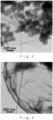
- Fig. 2 shows a TEM image of the [Fe(bpy) 3 ][PtCl 6 ]/GO in Fig. 1
- Fig. 3 shows a TEM image of the intermediate in Fig. 1
- Fig. 4 shows a TEM image of the FePt/rGO in Fig. 1 .
- FePt alloy nanoparticles can be formed through two main steps.
- a bimetallic [Fe(bpy) 3 ][PtCl 6 ] compound (represented as FePt compound) is formed by electrostatic attraction between a cationic Fe(bpy) 3 2+ complex and an equimolar anionic PtCl 6 2- complex.
- the FePt compound adsorbed on graphene oxide can be directly converted into bimetallic alloy nanoparticles by annealing at 700°C.
- a pale yellow aqueous FeSO 4 immediately turns into dark red upon addition of 2,2'-bipyridine (bpy) due to the formation of Fe(bpy) 3 2+ complex.
- the FePt compound has a completely different crystal structure from the Fe(bpy) 3 SO 4 salt and has high crystallinity.
- the existence of Fe(bpy) 3 2+ and PtCl 6 2- complexes and the electrostatic attraction therebetween were analyzed.
- the absorption features of the two complexes confirm the existence of the anionic and cationic complexes, while a significant red-shift of 524 nm peak to 538 nm indicates an electrostatic attraction between them.
- the sequential dilution of the FePt compound results in a peak shift from 538 nm back to 524 nm, showing the weakening of the electrostatic attraction between Fe and Pt complexes.
- the FePt compound can be adsorbed on the GO surface in deionized water and then freeze-dried to prevent the GO layers from severe stacking. This mixture is heated to 700 °C, during which a complete wetting of the FePt compound onto the GO occurs followed by decomposition of the FePt compound into bimetallic alloy nanoparticles
- the product is washed several times with ethanol, centrifuged and dried in an oven at 40°C.
- the dried product is pulverized to obtain fine powder.
- the FePt compound [Fe(bpy) 3 ][PtCl 6 ]
- the product is washed several times with ethanol, centrifuged and dried in an oven at 40 °C.
- the dried product is pulverized to obtain fine powder.
- the FePt compound [Fe(phen) 3 ][PtCl 6 ]
- the product is washed several times with ethanol, centrifuged and dried in an oven at 40 °C.
- the dried product is pulverized to obtain fine powder. Thereby, the FePt compound ([Fe(terpy) 3 ][PtCl 6 ]) is formed.
- the FePt compound (36 mg and 144 mg FePt compound for loading about 24 wt% and 37 wt% of FePt) is dispersed in 80 mL of deionized water.
- the mixture in which the FePt compound is dispersed is sonicated for 10 minutes, stirred for 2 hours, and then 10 mL of an GO aqueous solution (4 mg/mL) is added dropwise.
- the mixture to which the GO aqueous solution is added is stirred for 2 hours and then freeze-dried to adsorb the FePt compound to the GO.
- the mixture containing FePt compound grains on GO foam is heat-treated at 700 °C for 6 hours in an argon flow of 100 sccm, during the heat treatment, wetting and decomposition of the FePt compound occurred on the GO surface, forming atomically ordered FePt alloy nanoparticles on rGO (FePt/rGO).
- FePt nanoparticles on carbon nanotube (CNT, 7-8 wt% in water) is performed according to the same procedure as that for FePt/rGO except that CNT aqueous solution is added dropwise instead of the GO solution.
- the synthesis of FePt nanoparticles on Ketjen Black (KB) and Vulcan XC (VC) is performed by the following procedure. After dispersing a certain amount of FePt compound in 80 mL of isopropanol (or ethanol), the solution is sonicated for 10 min and stirred for 2 h. 50 mg of KB or VC powder is added into the solution containing FePt compound and this mixture is sonicated for 10 min and stirred for 2 h. The mixture containing FePt compound grains on carbon support is obtained by rotary evaporation and dried in oven at 40 °C. The dried powder is ground and then heat-treated at 700 °C under argon atmosphere.
- CoPt compounds e.g., [Co(bpy) 3 ][PtCl 6 ], [Co(phen) 3 ][PtCl 6 ], [Co(terpy) 2 ][PtCl 6 ]
- NiPt compounds e.g., [Ni(bpy) 3 ][PtCl 6 ], [Ni(phen) 3 ][PtCl 6 ], [Ni(terpy) 2 ][PtCl 6 ]
- CoSO 4 ⁇ 7H 2 O and NiSO 4 ⁇ 6H 2 O are used in place of FeSO 4 ⁇ 7H 2 O.
- the subsequent synthetic processes for the synthesis of CoPt/rGO and NiPt/rGO is the same as that for the synthesis of FePt/rGO.
- the [Fe(bpy) 3 ]SO 4 solution and the [Co(bpy) 3 ]SO 4 solution are mixed and to this mixed solution, a 30 mL ethanol solution in which 0.5 mmol of H 2 PtCl 6 ⁇ 6H 2 O is dissolved is added at a time, and the mixture is stirred for 5 hours.
- the product is easily separated by centrifugation at 10,000 rpm (10 min).
- the product is washed several times with ethanol, centrifuged and dried in an oven at 40 °C.
- the dried product is pulverized to obtain fine powder.
- the FeCoPt compound [Fe(bpy) 3 ] x [Co(bpy) 3 ] 1 - x [PtCl 6 ]
- the [Fe(phen) 3 ]SO 4 solution and the [Co(phen) 3 ]SO 4 solution are mixed and to this mixed solution, a 30 mL ethanol solution in which 0.5 mmol of H 2 PtCl 6 ⁇ 6H 2 O is dissolved is added at a time, and the mixture is stirred for 5 hours.
- the product is easily separated by centrifugation at 10,000 rpm (10 min).
- the product is washed several times with ethanol, centrifuged and dried in an oven at 40 °C.
- the dried product is pulverized to obtain fine powder. Thereby, the FeCoPt compound ([Fe(phen) 3 ] x [Co(phen) 3 ] 1-x [PtCl 6 ]) is formed.
- the [Fe(terpy) 2 ]SO 4 solution and the [Co(terpy) 2 ]SO 4 solution are mixed and to this mixed solution, a 30 mL ethanol solution in which 0.5 mmol of H 2 PtCl 6 ⁇ 6H 2 O is dissolved is added at a time, and the mixture is stirred for 5 hours.
- the product is easily separated by centrifugation at 10,000 rpm (10 min).
- the product is washed several times with ethanol, centrifuged and dried in an oven at 40 °C.
- the dried product is pulverized to obtain fine powder. Thereby, the FeCoPt compound ([Fe(terpy) 2 ] x [Co(terpy) 2 ] 1-x [PtCl 6 ]) is formed.
- a solution containing a pyridine-based compound may be added to the solution.
- a solution containing a pyridine-based compound may be added to the solution.
- 0.25 mmol of FeSO 4 ⁇ 7H 2 O and 0.25 mmol of CoSO 4 ⁇ 7H 2 O are dissolved in 15 mL of deionized water (or 15 mL of ethanol), 1.5 mmol of 2,2'-bipyridine (or 1.5 mmol of phenanthroline, 1.0 mmol of terpyridine) is separately dissolved in 15 mL of ethanol, and then the two solutions may be mixed. Subsequent processes are the same as in synthesis examples 1 to 3 above.
- the FeCoPt compound is dispersed in 80 mL of deionized water.
- the mixture in which the FeCoPt compound is dispersed is sonicated for 10 minutes, stirred for 2 hours, and then 10 mL of an GO aqueous solution (4 mg/mL) is added dropwise.
- the mixture to which the GO aqueous solution is added is stirred for 2 hours and then freeze-dried to adsorb the FeCoPt compound to the GO.
- the mixture containing FeCoPt compound grains on GO foam is heat-treated at 700 °C for 6 hours in an argon flow of 100 sccm, during the heat treatment, wetting and decomposition of the FeCoPt compound occurred on the GO surface, forming atomically ordered FeCoPt alloy nanoparticles on rGO (FePt/rGO).
- FeCoPt nanoparticles on carbon nanotube (CNT, 7-8 wt% in water) is performed according to the same procedure as that for FeCoPt/rGO except that CNT aqueous solution is added dropwise instead of the GO solution.
- FeCoPt nanoparticles on Ketjen Black (KB) and Vulcan XC (VC) is performed by the following procedure. After dispersing a certain amount of FeCoPt compound in 80 mL of isopropanol (or ethanol), the solution is sonicated for 10 min and stirred for 2 h. 50 mg of KB or VC powder is added into the solution containing FeCoPt compound and this mixture is sonicated for 10 min and stirred for 2 h. The mixture containing FeCoPt compound grains on carbon support is obtained by rotary evaporation and dried in oven at 40 °C. The dried powder is ground and then heat-treated at 700 °C under argon atmosphere.
- FeNiPt compounds (e.g., [Fe(bpy) 3 ] x [Ni(bpy) 3 ] 1-x [PtCl 6 ], [Fe(phen) 3 ] x [Ni(phen) 3 ] 1-x [PtCl 6 ], [Fe(terpy) 2 ] x [Ni(terpy) 2 ] 1-x [PtCl 6 ]) and CoNiPt compounds (e.g., [Co(bpy) 3 ] x [Ni(bpy) 3 ] 1-x [PtCl 6 ], [Co(phen) 3 ] x [Ni(phen) 3 ] 1-x [PtCl 6 ], [Co(terpy) 2 ] x [Ni(terpy) 2 ] 1-x [PtCl 6 ]) are prepared by the same procedure for the synthesis of FeCoPt compound except that FeSO 4 ⁇ 7H 2 O and NiSO 4 ⁇ 6
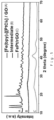
- Fig. 5 shows the results of powder XRD analysis of the [Fe(bpy) 3 ][PtCl 6 ]/GO, the intermediate, and the FePt/rGO
- Fig. 6 shows the results of FT-IR analysis of the [Fe(bpy) 3 ][PtCl 6 ]/GO, the intermediate, and the FePt/rGO
- Fig. 7 shows a STEM-EDS mapping image showing the uniform distribution of C, Pt, and Fe atoms in the intermediate.
- Fig. 8 shows the XRD pattern of 37 wt% FePt/rGO
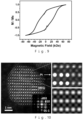
- Fig. 9 shows the magnetic hysteresis loop of 37 wt% FePt/rGO
- Fig. 10 shows a HAADF-STEM image of 37 wt% FePt/rGO and a magnified image and a simulated image of L1 0 -FePt nanocrystals
- Fig. 11 shows STEM-EDS images of a single FePt nanoparticle (top) and high magnification region (bottom) of 37 wt% FePt/rGO.
- the crystal structure of FePt nanoparticles can be evaluated through powder XRD analysis and magnetic analysis.
- the XRD peaks of FePt nanoparticles are in good agreement with the XRD peaks of the L1 0 -FePt phase, and are clearly different from other phases such as Fe, Pt, L1 2 -Fe 3 Pt and L1 2 -FePt3.
- the ferromagnetism on L1 0 -FePt phase is identified with a high coercive force of 22.5 kOe at room temperature.
- a layer-by-layer atomic arrangement along the (001) plane in a L1 0 -FePt nanoparticle is clearly distinguished by the large difference in the contrast of Fe and Pt atoms.
- the fast Fourier transform (FFT) pattern of the atomic image verifies the face-centered tetragonal crystal structure of the L1 0 -FePt phase.
- the homogeneous distribution of Fe and Pt atoms in the FePt nanoparticles is established by EDS single-particle mapping. Furthermore, a magnified EDS mapping reveals a layer-by-layer distribution of Fe and Pt atoms.
- the homogeneous 1:1 Fe to Pt atomic ratio of the FePt compound is maintained in an atomically ordered way after the formation of alloy nanoparticles on rGO, as corroborated by XRD, magnetic measurements, HAADF-STEM imaging, and EDS mapping.
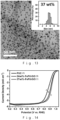
- Fig. 12 shows a TEM image of 24 wt% FePt/rGO, and the inset shows the size distribution of FePt nanoparticles
- Fig. 13 shows a TEM image of 37 wt% FePt/rGO, and the inset shows the size distribution of FePt nanoparticles.
- Insets in Figs. 12 and 13 show the size distribution of FePt nanoparticles.
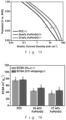
- Fig. 14 shows ORR polarization curves of FePt/rGO catalyst and commercial Pt/C catalyst
- Fig. 15 shows Tafel plots of FePt/rGO catalyst and commercial Pt/C catalyst.
- the FePt/rGO catalyst shows good ORR activity, and the reaction current density calculated from the Koutechy-Levich equation is compared in Tafel plots. In all regions, L1 0 -FePt alloy nanoparticles of FePt/rGO exhibit higher reaction current density than Pt/C.
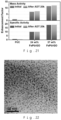
- Fig. 16 shows ECSA of FePt/rGO catalyst and commercial Pt/C catalyst
- Fig. 17 shows the activity per unit weight and per unit area of FePt/rGO catalyst and commercial Pt/C catalyst.
- the electrochemical surface area (ECSA) values calculated based on the oxidative charge of CO molecules were compared with those based on H upd .
- the ECSA CO values are 53.4 and 45.7 m 2 /g Pt for 24 wt%-FePt/rGO and 37 wt%-FePt/rGO, which are 32 and 41% lower than for Pt/C, respectively, due to the larger particle size.
- the activities per unit weight of 24 wt%-FePt/rGO and 37 wt%-FePt/rGO at 0.9 V are calculated as 1.18 and 1.96 A/mg Pt , which are 6.9 times and 11.5 times higher than that of commercial Pt/C, respectively.
- the activity per unit weight of 37 wt%-FePt/rGO is 66% higher than that of 24 wt%-FePt/rGO. This can be attributed to the higher level of Fe-Pt atomic alignment in 37 wt%-FePt/rGO.
- the improved ORR activity for the Pt alloy surface is due to the enhanced electronic interaction between Pt and transition metal atoms.
- the high level of atomic alignment in 37 wt%-FePt/rGO can maximize the ligand effect between Pt and Fe, resulting in much higher ORR activity per unit area.
- the activities per unit area of 24 wt%-FePt/rGO and 37 wt%-FePt/rGO at 0.9 V are 2.21 and 4.1 mA/cm Pt 2 , which are 10.2 times and 18.8 times higher than that of commercial Pt/C, respectively.
- Fig. 18 shows ORR polarization curves of FePt/rGO catalyst and commercial Pt/C catalyst before and after ADT (20,000 cycles)
- Fig. 19 shows Tafel plots of FePt/rGO catalyst and commercial Pt/C catalyst before and after ADT (20,000 cycles)
- Fig. 20 shows ECSA of FePt/rGO catalyst and commercial Pt/C catalyst before and after ADT (20,000 cycles)
- Fig. 21 shows activities per unit weight and per unit area of FePt/rGO catalyst and commercial Pt/C catalyst before and after ADT (20,000 cycles).
- accelerated degradation test was performed by cycling the electrode between 0.6 and 1.0 V for 20,000 cycles under Ar-saturation condition.
- FePt/rGO showed little change in the CV curve, whereas the H upd region of Pt/C decreased significantly.
- the strong stability of FePt/rGO compared to Pt/C can also be confirmed by ORR polarization curves and Tafel plots.
- the ECSA of Pt/C decreased by 30%, whereas the ECSA of the FePt/rGO sample increased slightly by 4-7%.
- Fig. 22 shows a TEM image of NiPt/rGO (46wt%) and Fig. 23 shows STEM-EDS images of NiPt/rGO (46wt%).
- Fig. 24 shows a TEM image of CoPt/rGO (22wt%) and Fig. 25 shows STEM-EDS images of CoPt/rGO (22wt%).
- Fig. 26 shows powder XRD patterns of NiPt/rGo and CoPt/rGo and Fig. 27 shows ORR polarization curves of NiPt/rGo and CoPt/rGo.
- platinum alloy nanoparticles can be formed by using [Ni(bpy) 3 ] 2+ or [Co(bpy) 3 ] 2+ instead of [Fe(bpy) 3 ] 2+ .
- NiPt compounds and CoPt compounds are thermally decomposed into NiPt and CoPt nanoparticles on rGO under the same annealing conditions as FePt compounds, respectively.
- NiPt and CoPt alloy nanocrystals are uniformly formed in rGO as in the case of FePt/rGO.
- the bimetallic alloy structure was confirmed by the XRD pattern, and the ORR activity of NiPt/rGO (46 wt%) and CoPt/rGO (22 wt%) was measured to be good.
- Alloy nanoparticles and a alloy nanocatalyst according to the embodiments of the present invention have good performance.
- the alloy nanoparticles and the alloy nanocatalyst may have good activity and stability.
- the alloy nanoparticles and the alloy nanocatalyst can be easily formed by a simple process.
- the alloy nanocatalyst may have good ORR (oxygen reduction reaction) activity, and thus may be used as an electrocatalyst.
Landscapes
- Chemical & Material Sciences (AREA)
- Engineering & Computer Science (AREA)
- Chemical Kinetics & Catalysis (AREA)
- Materials Engineering (AREA)
- Organic Chemistry (AREA)
- General Chemical & Material Sciences (AREA)
- Electrochemistry (AREA)
- Thermal Sciences (AREA)
- Physics & Mathematics (AREA)
- Inorganic Chemistry (AREA)
- Nanotechnology (AREA)
- Composite Materials (AREA)
- Catalysts (AREA)
- Powder Metallurgy (AREA)
- Inert Electrodes (AREA)
- Manufacture Of Metal Powder And Suspensions Thereof (AREA)
- Dispersion Chemistry (AREA)
Abstract
Description
- The present invention relates to alloy nanoparticles, a method for forming the alloy nanoparticles, and a alloy nanocatalyst comprising the alloy nanoparticles.
- Alloy nanoparticles exhibit novel properties that distinguish them from single metal nanoparticles because they have unique electronic and geometric structures. In particular, it has been actively studied as a fuel cell electrocatalyst because it exhibits improved activity and stability compared to single metal-based catalysts.
- Colloidal synthesis has been widely used for alloy nanoparticles because the size, composition and shape can be easily controlled. However, colloidal methods require toxic and expensive surfactants and reducing agents. In addition, additional steps such as loading of alloy nanoparticles on the support and removal of protective ligands are required.
- As such, it is difficult to control the size, composition, and shape of the alloy nanoparticles, and the manufacturing process is complicated and the manufacturing cost is high.
- In order to solve the above mentioned problems, the present invention provides alloy nanoparticles having good performance.
- The present invention provides a method for forming the alloy nanoparticles.
- The present invention provides a alloy nanocatalyst having good performance.
- The other objects of the present invention will be clearly understood by reference to the following detailed description and the accompanying drawings.
- Alloy nanoparticles according to the embodiments of the present invention are formed by a method comprising mixing a first metal complex including a first metal and a second metal complex including a second metal to form a multimetal compound and heat-treating the multimetal compound to form a alloy compound. The first metal and the second metal comprise transition metal, the first metal complex comprises a pyridine-based ligand, and a carbon shell containing N is formed on the surface of the alloy compound by the heat treatment.
- The pyridine-based ligand may comprise at least one of a pyridine ligand and a polypyridine ligand, the pyridine ligand may comprise a pyridine and derivatives derived from the pyridine, and the polypyridine ligand may comprise a polypyridine and derivatives derived from the polypyridine.
- The second metal complex may comprise a halogen element. The first metal may comprise at least one of Fe, Co, and Ni, and the second metal may comprise Pt.
- The first metal complex may comprise M1(PY)m a+ (M1 represents the first metal, PY represents the pyridine-based ligand, and m represents an integer of 6 or less), and the second metal complex may comprise M2Xn a- (M2 represents the second metal, X represents a halogen element, and n represents an integer of 6 or less).
- The first metal complex may comprise [M1A(PY)m]x[M1B(PY)m]1-x a+ (M1A represents the first metal, M1B represents the first metal different from M1A, PY represents the pyridine-based ligand, and m represents an integer of 6 or less), and the second metal complex may comprise M2Xn a-(M2 represents the second metal, X represents a halogen element, and n represents an integer of 6 or less).
- The method may further comprise performing a thermal etching on the alloy compound, and at least a portion of the shell may be removed by the thermal etching.
- The heat treatment may be performed after adsorbing the multimetal compound to a carbon support.
- A method for forming the alloy nanoparticles according to the embodiments of the present invention comprises mixing a first metal complex including a first metal and a second metal complex including a second metal to form a multimetal compound, adsorbing the multimetal compound to a support, and heat-treating the multimetal compound to form a alloy compound. The first metal and the second metal comprise transition metal, the first metal complex comprises a pyridine-based ligand, and a carbon shell containing N is formed on the surface of the alloy compound by the heat treatment.
- The pyridine-based ligand may comprise at least one of a pyridine ligand and a polypyridine ligand, the pyridine ligand may comprise a pyridine and derivatives derived from the pyridine, and the polypyridine ligand may comprise a polypyridine and derivatives derived from the polypyridine.
- The second metal complex may comprise a halogen element. The first metal may comprise at least one of Fe, Co, and Ni, and the second metal may comprise Pt.
- The first metal complex may comprise M1(PY)m a+ (M1 represents the first metal, PY represents the pyridine-based ligand, and m represents an integer of 6 or less), and the second metal complex may comprise M2Xn a- (M2 represents the second metal, X represents a halogen element, and n represents an integer of 6 or less).
- The first metal complex may comprise [M1A(PY)m]x[M1B(PY)m]1-x a+ (M1A represents the first metal, M1B represents the first metal different from M1A, PY represents the pyridine-based ligand, and m represents an integer of 6 or less), and the second metal complex may comprise M2Xn a-(M2 represents the second metal, X represents a halogen element, and n represents an integer of 6 or less).
- The method for forming alloy nanoparticles may further comprise performing a thermal etching on the alloy compound, and at least a portion of the shell may be removed by the thermal etching.
- The first metal complex and the second metal complex may be coupled to each other through electrostatic attraction.
- A wetting of the multimetal compound may occur on the support by the heat treatment, and the multimetal compund may be decomposed into the alloy compound.
- The method for forming alloy nanoparticles may further comprise freeze-drying the support to which the multimetal compound is adsorbed before the heat treatment.
- The support may comprise a carbon support.
- A alloy nanocatalyst according to the embodiments of the present invention comprises the alloy nanoparticles.
- Alloy nanoparticles and a alloy nanocatalyst according to the embodiments of the present invention have good performance. For example, the alloy nanoparticles and the alloy nanocatalyst may have good activity and stability. The alloy nanoparticles and the alloy nanocatalyst can be easily formed by a simple process. The alloy nanocatalyst may have good ORR (oxygen reduction reaction) activity, and thus may be used as an electrocatalyst.
-
-
Fig. 1 schematically shows a method for forming ordered FePt alloy nanoparticles having a carbon shell containing N and supported by reduced graphene oxide (rGO). -
Fig. 2 shows a TEM image of the [Fe(bpy)3][PtCl6]/GO inFig. 1 . -
Fig. 3 shows a TEM image of the intermediate inFig. 1 . -
Fig. 4 shows a TEM image of the FePt/rGO inFig. 1 . -
Fig. 5 shows the results of powder XRD analysis of the [Fe(bpy)3][PtCl6]/GO, the intermediate, and the FePt/rGO. -
Fig. 6 shows the results of FT-IR analysis of the [Fe(bpy)3][PtCl6]/GO, the intermediate, and the FePt/rGO. -
Fig. 7 shows a STEM-EDS mapping image showing the uniform distribution of C, Pt, and Fe atoms in the intermediate. -
Fig. 8 shows the XRD pattern of 37 wt% FePt/rGO. -
Fig. 9 shows the magnetic hysteresis loop of 37 wt% FePt/rGO. -
Fig. 10 shows a HAADF-STEM image of 37 wt% FePt/rGO and a magnified image and a simulated image of L10-FePt nanocrystals. -
Fig. 11 shows STEM-EDS images of a single FePt nanoparticle (top) and high magnification region (bottom) of 37 wt% FePt/rGO. -
Fig. 12 shows a TEM image of 24 wt% FePt/rGO, and the inset shows the size distribution of FePt nanoparticles. -
Fig. 13 shows a TEM image of 37 wt% FePt/rGO, and the inset shows the size distribution of FePt nanoparticles. -
Fig. 14 shows ORR polarization curves of FePt/rGO catalyst and commercial Pt/C catalyst. -
Fig. 15 shows Tafel plots of FePt/rGO catalyst and commercial Pt/C catalyst. -
Fig. 16 shows ECSA of FePt/rGO catalyst and commercial Pt/C catalyst. -
Fig. 17 shows the activity per unit weight and per unit area of FePt/rGO catalyst and commercial Pt/C catalyst. -
Fig. 18 shows ORR polarization curves of FePt/rGO catalyst and commercial Pt/C catalyst before and after ADT (20,000 cycles). -
Fig. 19 shows Tafel plots of FePt/rGO catalyst and commercial Pt/C catalyst before and after ADT (20,000 cycles). -
Fig. 20 shows ECSA of FePt/rGO catalyst and commercial Pt/C catalyst before and after ADT (20,000 cycles). -
Fig. 21 shows activities per unit weight and per unit area of FePt/rGO catalyst and commercial Pt/C catalyst before and after ADT (20,000 cycles). -
Fig. 22 shows a TEM image of NiPt/rGO (46wt%). -
Fig. 23 shows STEM-EDS images of NiPt/rGO (46wt%). -
Fig. 24 shows a TEM image of CoPt/rGO (22wt%). -
Fig. 25 shows STEM-EDS images of CoPt/rGO (22wt%). -
Fig. 26 shows powder XRD patterns of NiPt/rGo and CoPt/rGo. -
Fig. 27 shows ORR polarization curves of NiPt/rGo and CoPt/rGo. - Hereinafter, a detailed description will be given of the present invention with reference to the following embodiments. The purposes, features, and advantages of the present invention will be easily understood through the following embodiments. The present invention is not limited to such embodiments, but may be modified in other forms. The embodiments to be described below are nothing but the ones provided to bring the disclosure of the present invention to perfection and assist those skilled in the art to completely understand the present invention. Therefore, the following embodiments are not to be construed as limiting the present invention.
- Terms like 'first', 'second', etc., may be used to indicate various components, but the components should not be restricted by the terms. These terms are only used to distinguish one element, component, region, layer or section from another element, component, region, layer or section. A first element, component, region, layer or section could be termed a second element, component, region, layer or section without departing from the teaching of the embodiments of the present invention.
- The terminology used herein is for the purpose of describing particular embodiments only and is not intended to limit the invention. It is to be understood that the singular forms "a," "an," and "the" include plural references unless the context clearly dictates otherwise. It will be further understood that the terms "comprises" or "has," when used in this specification, specify the presence of stated features, integers, steps, operations, elements, and/or components, but do not preclude the presence or addition of one or more other features, integers, steps, operations, elements, components, and/or groups thereof.
- Alloy nanoparticles according to the embodiments of the present invention are formed by a method comprising mixing a first metal complex including a first metal and a second metal complex including a second metal to form a multimetal compound and heat-treating the multimetal compound to form a alloy compound. The first metal and the second metal comprise transition metal, the first metal complex comprises a pyridine-based ligand, and a carbon shell containing N is formed on the surface of the alloy compound by the heat treatment.
- The pyridine-based ligand may comprise at least one of a pyridine ligand and a polypyridine ligand, the pyridine ligand may comprise a pyridine and derivatives derived from the pyridine, and the polypyridine ligand may comprise a polypyridine and derivatives derived from the polypyridine. The polypyridine may comprise bipyridine, phenanthroline, terpyridine, quaterpyridine, and the like.
- The second metal complex may comprise a halogen element. The first metal may comprise at least one of Fe, Co, and Ni, and the second metal may comprise Pt.
- The first metal complex may comprise M1(PY)m a+ (M1 represents the first metal, PY represents the pyridine-based ligand, and m represents an integer of 6 or less), and the second metal complex may comprise M2Xn a- (M2 represents the second metal, X represents a halogen element, and n represents an integer of 6 or less).
- The first metal complex may comprise [M1A(PY)m]x[M1B(PY)m]1-x a+ (M1A represents the first metal, M1B represents the first metal different from M1A, PY represents the pyridine-based ligand, and m represents an integer of 6 or less), and the second metal complex may comprise M2Xn a-(M2 represents the second metal, X represents a halogen element, and n represents an integer of 6 or less). Just as the first metal complex is expanded to include two or more different first metals, the second metal complex is not limited to M2Xn a- and may be expanded to include two or more different second metals.
- The method may further comprise performing a thermal etching on the alloy compound, and at least a portion of the shell may be removed by the thermal etching.
- The heat treatment may be performed after adsorbing the multimetal compound to a carbon support. The carbon support may comprise graphene oxide or the like.
- A method for forming the alloy nanoparticles according to the embodiments of the present invention comprises mixing a first metal complex including a first metal and a second metal complex including a second metal to form a multimetal compound, adsorbing the multimetal compound to a support, and heat-treating the multimetal compound to form a alloy compound. The first metal and the second metal comprise transition metal, the first metal complex comprises a pyridine-based ligand, and a carbon shell containing N is formed on the surface of the alloy compound by the heat treatment.
- The pyridine-based ligand may comprise at least one of a pyridine ligand and a polypyridine ligand, the pyridine ligand may comprise a pyridine and derivatives derived from the pyridine, and the polypyridine ligand may comprise a polypyridine and derivatives derived from the polypyridine. The polypyridine may comprise bipyridine, phenanthroline, terpyridine, quaterpyridine, and the like.
- The second metal complex may comprise a halogen element. The first metal may comprise at least one of Fe, Co, and Ni, and the second metal may comprise Pt.
- The first metal complex may comprise M1(PY)m a+ (M1 represents the first metal, PY represents the pyridine-based ligand, and m represents an integer of 6 or less), and the second metal complex may comprise M2Xn a- (M2 represents the second metal, X represents a halogen element, and n represents an integer of 6 or less).
- The first metal complex may comprise [M1A(PY)m]x[M1B(PY)m]1-x a+ (M1A represents the first metal, M1B represents the first metal different from M1A, PY represents the pyridine-based ligand, and m represents an integer of 6 or less), and the second metal complex may comprise M2Xn a-(M2 represents the second metal, X represents a halogen element, and n represents an integer of 6 or less). Just as the first metal complex is expanded to include two or more different first metals, the second metal complex is not limited to M2Xn a- and may be expanded to include two or more different second metals.
- The method for forming alloy nanoparticles may further comprise performing a thermal etching on the alloy compound, and at least a portion of the shell may be removed by the thermal etching.
- The first metal complex and the second metal complex may be coupled to each other through electrostatic attraction.
- A wetting of the multimetal compound may occur on the support by the heat treatment, and the multimetal compund may be decomposed into the alloy compound.
- The method for forming alloy nanoparticles may further comprise freeze-drying the support to which the multimetal compound is adsorbed before the heat treatment.
- The support may comprise a carbon support. The carbon support may comprise graphene oxide or the like.
- A alloy nanocatalyst according to the embodiments of the present invention comprises the alloy nanoparticles.
-
Fig. 1 schematically shows a method for forming ordered FePt alloy nanoparticles having a carbon shell containing N and supported by reduced graphene oxide (rGO),Fig. 2 shows a TEM image of the [Fe(bpy)3][PtCl6]/GO inFig. 1 ,Fig. 3 shows a TEM image of the intermediate inFig. 1 , andFig. 4 shows a TEM image of the FePt/rGO inFig. 1 . - Referring to
Figs. 1 to 4 , FePt alloy nanoparticles can be formed through two main steps. In the first step, a bimetallic [Fe(bpy)3][PtCl6] compound (represented as FePt compound) is formed by electrostatic attraction between a cationic Fe(bpy)3 2+ complex and an equimolar anionic PtCl6 2- complex. In the second step, the FePt compound adsorbed on graphene oxide can be directly converted into bimetallic alloy nanoparticles by annealing at 700°C. - A pale yellow aqueous FeSO4 immediately turns into dark red upon addition of 2,2'-bipyridine (bpy) due to the formation of Fe(bpy)3 2+ complex.
- Addition of ethanolic H2PtCl6 into the Fe(bpy)3SO4 solution leads to the rapid precipitation of the FePt compound, which can be easily obtained as a fine powder after centrifugation and grinding. The atomic ratios of Fe and Pt are close to 1:1 over the five different sites, which was clearly confirmed by energy-dispersive X-ray spectroscopy (EDS) in scanning transmission electron microscopy (STEM).
- According to the powder XRD analysis results, the FePt compound has a completely different crystal structure from the Fe(bpy)3SO4 salt and has high crystallinity. In addition, based on the UV-vis absorption spectra of aqueous FePt compound, the existence of Fe(bpy)3 2+ and PtCl6 2- complexes and the electrostatic attraction therebetween were analyzed. The absorption features of the two complexes confirm the existence of the anionic and cationic complexes, while a significant red-shift of 524 nm peak to 538 nm indicates an electrostatic attraction between them. Conversely, the sequential dilution of the FePt compound results in a peak shift from 538 nm back to 524 nm, showing the weakening of the electrostatic attraction between Fe and Pt complexes.
- The FePt compound can be adsorbed on the GO surface in deionized water and then freeze-dried to prevent the GO layers from severe stacking. This mixture is heated to 700 °C, during which a complete wetting of the FePt compound onto the GO occurs followed by decomposition of the FePt compound into bimetallic alloy nanoparticles
- 0.5 mmol of FeSO4·7H2O is dissolved in 15 mL of deionized (DI) water (or 15 mL ethanol) and 1.5 mmol of 2,2'-bipyridine is dissolved in 15 mL of ethanol (99.9 %) separately. These two solutions are mixed to form [Fe(bpy)3]SO4 (bpy represents 2,2'-bipyridine), which is stirred at room temperature. To this solution, a 30 mL ethanol solution in which 0.5 mmol of H2PtCl6·6H2O is dissolved is added at a time, and the mixture is stirred for 5 hours. The product is easily separated by centrifugation at 10,000 rpm (10 min). The product is washed several times with ethanol, centrifuged and dried in an oven at 40°C. The dried product is pulverized to obtain fine powder. Thereby, the FePt compound ([Fe(bpy)3][PtCl6]) is formed.
- 0.5 mmol of FeSO4·7H2O is dissolved in 15 mL of deionized (DI) water (or 15 mL ethanol) and 1.5 mmol of phenanthroline is dissolved in 15 mL of ethanol (99.9 %) separately. These two solutions are mixed to form [Fe(phen)3]SO4 (phen represents phenanthroline), which is stirred at room temperature. To this solution, a 30 mL ethanol solution in which 0.5 mmol of H2PtCl6·6H2O is dissolved is added at a time, and the mixture is stirred for 5 hours. The product is easily separated by centrifugation at 10,000 rpm (10 min). The product is washed several times with ethanol, centrifuged and dried in an oven at 40 °C. The dried product is pulverized to obtain fine powder. Thereby, the FePt compound ([Fe(phen)3][PtCl6]) is formed.
- 0.5 mmol of FeSO4·7H2O is dissolved in 15 mL of deionized (DI) water (or 15 mL ethanol) and 1.0 mmol of terpyridine is dissolved in 15 mL of ethanol (99.9 %) separately. These two solutions are mixed to form [Fe(terpy)3]SO4 (therpy represents terpyridine), which is stirred at room temperature. To this solution, a 30 mL ethanol solution in which 0.5 mmol of H2PtCl6·6H2O is dissolved is added at a time, and the mixture is stirred for 5 hours. The product is easily separated by centrifugation at 10,000 rpm (10 min). The product is washed several times with ethanol, centrifuged and dried in an oven at 40 °C. The dried product is pulverized to obtain fine powder. Thereby, the FePt compound ([Fe(terpy)3][PtCl6]) is formed.
- The FePt compound (36 mg and 144 mg FePt compound for loading about 24 wt% and 37 wt% of FePt) is dispersed in 80 mL of deionized water. The mixture in which the FePt compound is dispersed is sonicated for 10 minutes, stirred for 2 hours, and then 10 mL of an GO aqueous solution (4 mg/mL) is added dropwise. The mixture to which the GO aqueous solution is added is stirred for 2 hours and then freeze-dried to adsorb the FePt compound to the GO. The mixture containing FePt compound grains on GO foam is heat-treated at 700 °C for 6 hours in an argon flow of 100 sccm, during the heat treatment, wetting and decomposition of the FePt compound occurred on the GO surface, forming atomically ordered FePt alloy nanoparticles on rGO (FePt/rGO).
- The synthesis of FePt nanoparticles on carbon nanotube (CNT, 7-8 wt% in water) is performed according to the same procedure as that for FePt/rGO except that CNT aqueous solution is added dropwise instead of the GO solution.
- The synthesis of FePt nanoparticles on Ketjen Black (KB) and Vulcan XC (VC) is performed by the following procedure. After dispersing a certain amount of FePt compound in 80 mL of isopropanol (or ethanol), the solution is sonicated for 10 min and stirred for 2 h. 50 mg of KB or VC powder is added into the solution containing FePt compound and this mixture is sonicated for 10 min and stirred for 2 h. The mixture containing FePt compound grains on carbon support is obtained by rotary evaporation and dried in oven at 40 °C. The dried powder is ground and then heat-treated at 700 °C under argon atmosphere.
- CoPt compounds (e.g., [Co(bpy)3][PtCl6], [Co(phen)3][PtCl6], [Co(terpy)2][PtCl6]) and NiPt compounds (e.g., [Ni(bpy)3][PtCl6], [Ni(phen)3][PtCl6], [Ni(terpy)2][PtCl6]) are prepared by the same procedure for the synthesis of FePt compound except that CoSO4·7H2O and NiSO4·6H2O are used in place of FeSO4·7H2O. The subsequent synthetic processes for the synthesis of CoPt/rGO and NiPt/rGO is the same as that for the synthesis of FePt/rGO.
- 0.25 mmol of FeSO4·7H2O is dissolved in 7.5 mL of deionized (DI) water (or 7.5 mL ethanol) and 0.75 mmol of 2,2'-bipyridine is dissolved in 7.5 mL of ethanol (99.9 %) separately. These two solutions are mixed to form [Fe(bpy)3]SO4 (bpy represents 2,2'-bipyridine), which is stirred at room temperature. 0.25 mmol of CoSO4·7H2O is dissolved in 7.5 mL of deionized (DI) water (or 7.5 mL ethanol) and 0.75 mmol of 2,2'-bipyridine is dissolved in 7.5 mL of ethanol (99.9 %) separately. These two solutions are mixed to form [Co(bpy)3]SO4, which is stirred at room temperature.
- The [Fe(bpy)3]SO4 solution and the [Co(bpy)3]SO4 solution are mixed and to this mixed solution, a 30 mL ethanol solution in which 0.5 mmol of H2PtCl6·6H2O is dissolved is added at a time, and the mixture is stirred for 5 hours. The product is easily separated by centrifugation at 10,000 rpm (10 min). The product is washed several times with ethanol, centrifuged and dried in an oven at 40 °C. The dried product is pulverized to obtain fine powder. Thereby, the FeCoPt compound ([Fe(bpy)3]x[Co(bpy)3]1-x[PtCl6]) is formed.
- 0.25 mmol of FeSO4·7H2O is dissolved in 7.5 mL of deionized (DI) water (or 7.5 mL ethanol) and 0.75 mmol of phenanthroline is dissolved in 7.5 mL of ethanol (99.9 %) separately. These two solutions are mixed to form [Fe(phen)3]SO4 (phen represents phenanthroline), which is stirred at room temperature. 0.25 mmol of CoSO4·7H2O is dissolved in 7.5 mL of deionized (DI) water (or 7.5 mL ethanol) and 0.75 mmol of phenanthroline is dissolved in 7.5 mL of ethanol (99.9 %) separately. These two solutions are mixed to form [Co(phen)3]SO4, which is stirred at room temperature.
- The [Fe(phen)3]SO4 solution and the [Co(phen)3]SO4 solution are mixed and to this mixed solution, a 30 mL ethanol solution in which 0.5 mmol of H2PtCl6·6H2O is dissolved is added at a time, and the mixture is stirred for 5 hours. The product is easily separated by centrifugation at 10,000 rpm (10 min). The product is washed several times with ethanol, centrifuged and dried in an oven at 40 °C. The dried product is pulverized to obtain fine powder. Thereby, the FeCoPt compound ([Fe(phen)3]x[Co(phen)3]1-x[PtCl6]) is formed.
- 0.25 mmol of FeSO4·7H2O is dissolved in 7.5 mL of deionized (DI) water (or 7.5 mL ethanol) and 0.75 mmol of terpyridine is dissolved in 7.5 mL of ethanol (99.9 %) separately. These two solutions are mixed to form [Fe(terpy)2]SO4 (terpy represents terpyridine), which is stirred at room temperature. 0.25 mmol of CoSO4·7H2O is dissolved in 7.5 mL of deionized (DI) water (or 7.5 mL ethanol) and 0.75 mmol of terpyridine is dissolved in 7.5 mL of ethanol (99.9 %) separately. These two solutions are mixed to form [Co(terpy)2]SO4, which is stirred at room temperature.
- The [Fe(terpy)2]SO4 solution and the [Co(terpy)2]SO4 solution are mixed and to this mixed solution, a 30 mL ethanol solution in which 0.5 mmol of H2PtCl6·6H2O is dissolved is added at a time, and the mixture is stirred for 5 hours. The product is easily separated by centrifugation at 10,000 rpm (10 min). The product is washed several times with ethanol, centrifuged and dried in an oven at 40 °C. The dried product is pulverized to obtain fine powder. Thereby, the FeCoPt compound ([Fe(terpy)2]x[Co(terpy)2]1-x[PtCl6]) is formed.
- Unlike synthesis examples 1 to 3, after dissolving FeSO4·7H2O and CoSO4·7H2O in deionized water (or ethanol), a solution containing a pyridine-based compound may be added to the solution. For example, 0.25 mmol of FeSO4·7H2O and 0.25 mmol of CoSO4·7H2O are dissolved in 15 mL of deionized water (or 15 mL of ethanol), 1.5 mmol of 2,2'-bipyridine (or 1.5 mmol of phenanthroline, 1.0 mmol of terpyridine) is separately dissolved in 15 mL of ethanol, and then the two solutions may be mixed. Subsequent processes are the same as in synthesis examples 1 to 3 above.
- The FeCoPt compound is dispersed in 80 mL of deionized water. The mixture in which the FeCoPt compound is dispersed is sonicated for 10 minutes, stirred for 2 hours, and then 10 mL of an GO aqueous solution (4 mg/mL) is added dropwise. The mixture to which the GO aqueous solution is added is stirred for 2 hours and then freeze-dried to adsorb the FeCoPt compound to the GO. The mixture containing FeCoPt compound grains on GO foam is heat-treated at 700 °C for 6 hours in an argon flow of 100 sccm, during the heat treatment, wetting and decomposition of the FeCoPt compound occurred on the GO surface, forming atomically ordered FeCoPt alloy nanoparticles on rGO (FePt/rGO).
- The synthesis of FeCoPt nanoparticles on carbon nanotube (CNT, 7-8 wt% in water) is performed according to the same procedure as that for FeCoPt/rGO except that CNT aqueous solution is added dropwise instead of the GO solution.
- The synthesis of FeCoPt nanoparticles on Ketjen Black (KB) and Vulcan XC (VC) is performed by the following procedure. After dispersing a certain amount of FeCoPt compound in 80 mL of isopropanol (or ethanol), the solution is sonicated for 10 min and stirred for 2 h. 50 mg of KB or VC powder is added into the solution containing FeCoPt compound and this mixture is sonicated for 10 min and stirred for 2 h. The mixture containing FeCoPt compound grains on carbon support is obtained by rotary evaporation and dried in oven at 40 °C. The dried powder is ground and then heat-treated at 700 °C under argon atmosphere.
- FeNiPt compounds (e.g., [Fe(bpy)3]x[Ni(bpy)3]1-x[PtCl6], [Fe(phen)3]x[Ni(phen)3]1-x[PtCl6], [Fe(terpy)2]x[Ni(terpy)2]1-x[PtCl6]) and CoNiPt compounds (e.g., [Co(bpy)3]x[Ni(bpy)3]1-x[PtCl6], [Co(phen)3]x[Ni(phen)3]1-x[PtCl6], [Co(terpy)2]x[Ni(terpy)2]1-x[PtCl6]) are prepared by the same procedure for the synthesis of FeCoPt compound except that FeSO4·7H2O and NiSO4·6H2O are used or CoSO4·7H2O and NiSO4·6H2O are used in place of FeSO4·7H2O and CoSO4·7H2O. The subsequent synthetic processes for the synthesis of FeNiPt/rGO and CoNiPt/rGO is the same as that for the synthesis of FeCoPt/rGO.
-
Fig. 5 shows the results of powder XRD analysis of the [Fe(bpy)3][PtCl6]/GO, the intermediate, and the FePt/rGO,Fig. 6 shows the results of FT-IR analysis of the [Fe(bpy)3][PtCl6]/GO, the intermediate, and the FePt/rGO, andFig. 7 shows a STEM-EDS mapping image showing the uniform distribution of C, Pt, and Fe atoms in the intermediate. - Referring to
Fig. 5 , the intermediate obtained at 500 °C has a smooth surface without any crystalline feature of FePt compound in the XRD pattern - Referring to
Fig. 6 , Fourier-transform infrared spectroscopy (FT-IR) provides additional structural information of the intermediate, indicating the decomposition of bipyridine ligands with the evolution of C-O and C=C functional groups - Referring to
Fig. 7 , STEM-EDS mapping clearly demonstrates the homogeneous decomposition of FePt compound on GO. As confirmed by TEM and SEM (scanning electron microscopy) images, uniform sized alloy nanoparticles are observed without significant agglomeration. Carbon shells containing N on the surface of nanoparticles are identified by high-resolution STEM and TEM images. The carbon shell may be derived from a bipyridine ligand, and acts as a protective shell, contributing to the uniform and stable growth of alloy nanoparticles during heat treatment at 700 °C. -
Fig. 8 shows the XRD pattern of 37 wt% FePt/rGO,Fig. 9 shows the magnetic hysteresis loop of 37 wt% FePt/rGO,Fig. 10 shows a HAADF-STEM image of 37 wt% FePt/rGO and a magnified image and a simulated image of L10-FePt nanocrystals, andFig. 11 shows STEM-EDS images of a single FePt nanoparticle (top) and high magnification region (bottom) of 37 wt% FePt/rGO. - Referring to
Figs. 8 and9 , the crystal structure of FePt nanoparticles can be evaluated through powder XRD analysis and magnetic analysis. The XRD peaks of FePt nanoparticles are in good agreement with the XRD peaks of the L10-FePt phase, and are clearly different from other phases such as Fe, Pt, L12-Fe3Pt and L12-FePt3. In addition, the ferromagnetism on L10-FePt phase is identified with a high coercive force of 22.5 kOe at room temperature. - Referring to
Fig. 10 , a layer-by-layer atomic arrangement along the (001) plane in a L10-FePt nanoparticle is clearly distinguished by the large difference in the contrast of Fe and Pt atoms. The fast Fourier transform (FFT) pattern of the atomic image verifies the face-centered tetragonal crystal structure of the L10-FePt phase. - Referring to
Fig. 11 , The homogeneous distribution of Fe and Pt atoms in the FePt nanoparticles is established by EDS single-particle mapping. Furthermore, a magnified EDS mapping reveals a layer-by-layer distribution of Fe and Pt atoms. - Thus, the homogeneous 1:1 Fe to Pt atomic ratio of the FePt compound is maintained in an atomically ordered way after the formation of alloy nanoparticles on rGO, as corroborated by XRD, magnetic measurements, HAADF-STEM imaging, and EDS mapping.
-
Fig. 12 shows a TEM image of 24 wt% FePt/rGO, and the inset shows the size distribution of FePt nanoparticles, andFig. 13 shows a TEM image of 37 wt% FePt/rGO, and the inset shows the size distribution of FePt nanoparticles. Insets inFigs. 12 and13 show the size distribution of FePt nanoparticles. -
Fig. 14 shows ORR polarization curves of FePt/rGO catalyst and commercial Pt/C catalyst, andFig. 15 shows Tafel plots of FePt/rGO catalyst and commercial Pt/C catalyst. - Referring to
Figs. 14 and15 , the FePt/rGO catalyst shows good ORR activity, and the reaction current density calculated from the Koutechy-Levich equation is compared in Tafel plots. In all regions, L10-FePt alloy nanoparticles of FePt/rGO exhibit higher reaction current density than Pt/C. -
Fig. 16 shows ECSA of FePt/rGO catalyst and commercial Pt/C catalyst, andFig. 17 shows the activity per unit weight and per unit area of FePt/rGO catalyst and commercial Pt/C catalyst. - Referring to
Fig. 16 , the electrochemical surface area (ECSA) values calculated based on the oxidative charge of CO molecules were compared with those based on Hupd. The ECSACO values are 53.4 and 45.7 m2/gPt for 24 wt%-FePt/rGO and 37 wt%-FePt/rGO, which are 32 and 41% lower than for Pt/C, respectively, due to the larger particle size. - Referring to
Fig. 17 , the activities per unit weight of 24 wt%-FePt/rGO and 37 wt%-FePt/rGO at 0.9 V are calculated as 1.18 and 1.96 A/mgPt, which are 6.9 times and 11.5 times higher than that of commercial Pt/C, respectively. Despite the 15% lower ECSA value, the activity per unit weight of 37 wt%-FePt/rGO is 66% higher than that of 24 wt%-FePt/rGO. This can be attributed to the higher level of Fe-Pt atomic alignment in 37 wt%-FePt/rGO. The improved ORR activity for the Pt alloy surface is due to the enhanced electronic interaction between Pt and transition metal atoms. - The high level of atomic alignment in 37 wt%-FePt/rGO can maximize the ligand effect between Pt and Fe, resulting in much higher ORR activity per unit area. The activities per unit area of 24 wt%-FePt/rGO and 37 wt%-FePt/rGO at 0.9 V are 2.21 and 4.1 mA/cmPt 2, which are 10.2 times and 18.8 times higher than that of commercial Pt/C, respectively.
-
Fig. 18 shows ORR polarization curves of FePt/rGO catalyst and commercial Pt/C catalyst before and after ADT (20,000 cycles),Fig. 19 shows Tafel plots of FePt/rGO catalyst and commercial Pt/C catalyst before and after ADT (20,000 cycles),Fig. 20 shows ECSA of FePt/rGO catalyst and commercial Pt/C catalyst before and after ADT (20,000 cycles), andFig. 21 shows activities per unit weight and per unit area of FePt/rGO catalyst and commercial Pt/C catalyst before and after ADT (20,000 cycles). - Referring to
Figs. 18 to 21 , to evaluate the long-term stability of FePt/rGO, accelerated degradation test (ADT) was performed by cycling the electrode between 0.6 and 1.0 V for 20,000 cycles under Ar-saturation condition. After ADT, FePt/rGO showed little change in the CV curve, whereas the Hupd region of Pt/C decreased significantly. The strong stability of FePt/rGO compared to Pt/C can also be confirmed by ORR polarization curves and Tafel plots. After ADT, the ECSA of Pt/C decreased by 30%, whereas the ECSA of the FePt/rGO sample increased slightly by 4-7%. In terms of activity per unit weight and activity per unit area, Pt/C showed a significant decrease of 60% and 44%, respectively, after ADT. However, the activity per unit weight of FePt/rGO slightly increased, whereas the activity per unit area remained almost unchanged after ADT. From TEM analysis and EDS mapping of three different sites, it was possible to further confirm the stability of FePt nanoparticles under harsh ADT conditions that induce particle-particle aggregation and Fe-dissolution. Therefore, the carbon shell containing N and the high degree of interatomic arrangement inside the FePt nanoparticles are major factors contributing to the stability of the FePt/rGO nanocatalyst synthesized according to the embodiment of the present invention. -
Fig. 22 shows a TEM image of NiPt/rGO (46wt%) andFig. 23 shows STEM-EDS images of NiPt/rGO (46wt%).Fig. 24 shows a TEM image of CoPt/rGO (22wt%) andFig. 25 shows STEM-EDS images of CoPt/rGO (22wt%).Fig. 26 shows powder XRD patterns of NiPt/rGo and CoPt/rGo andFig. 27 shows ORR polarization curves of NiPt/rGo and CoPt/rGo. - Referring to
Figs. 22 to 27 , other platinum alloy nanoparticles can be formed by using [Ni(bpy)3]2+ or [Co(bpy)3]2+ instead of [Fe(bpy)3]2+. - NiPt compounds and CoPt compounds are thermally decomposed into NiPt and CoPt nanoparticles on rGO under the same annealing conditions as FePt compounds, respectively. In the TEM and STEM-EDS images of NiPt/rGO and CoPt/rGO, NiPt and CoPt alloy nanocrystals are uniformly formed in rGO as in the case of FePt/rGO. The bimetallic alloy structure was confirmed by the XRD pattern, and the ORR activity of NiPt/rGO (46 wt%) and CoPt/rGO (22 wt%) was measured to be good.
- Although the embodiments of the present invention have been disclosed for illustrative purposes, those skilled in the art will appreciate that the present invention may be embodied in other specific ways without changing the technical spirit or essential features thereof. Therefore, the embodiments disclosed in the present invention are not restrictive but are illustrative. The scope of the present invention is given by the claims, rather than the specification, and also contains all modifications within the meaning and range equivalent to the claims.
- Alloy nanoparticles and a alloy nanocatalyst according to the embodiments of the present invention have good performance. For example, the alloy nanoparticles and the alloy nanocatalyst may have good activity and stability. The alloy nanoparticles and the alloy nanocatalyst can be easily formed by a simple process. The alloy nanocatalyst may have good ORR (oxygen reduction reaction) activity, and thus may be used as an electrocatalyst.
Claims (20)
- Alloy nanoparticles formed by a method comprising mixing a first metal complex including a first metal and a second metal complex including a second metal to form a multimetal compound and heat-treating the multimetal compound to form a alloy compound,wherein the first metal and the second metal comprise transition metal,wherein the first metal complex comprises a pyridine-based ligand, andwherein a carbon shell containing N is formed on the surface of the alloy compound by the heat treatment.
- The alloy nanoparticles of claim 1, wherein the pyridine-based ligand comprises at least one of a pyridine ligand and a polypyridine ligand,wherein the pyridine ligand comprises a pyridine and derivatives derived from the pyridine, andwherein the polypyridine ligand comprises a polypyridine and derivatives derived from the polypyridine.
- The alloy nanoparticles of claim 1, wherein the second metal complex comprises a halogen element.
- The alloy nanoparticles of claim 1, wherein the first metal comprises at least one of Fe, Co, and Ni, and the second metal comprises Pt.
- The alloy nanoparticles of claim 1, wherein the first metal complex comprises M1(PY)m a+ (M1 represents the first metal, PY represents the pyridine-based ligand, and m represents an integer of 6 or less), and
wherein the second metal complex comprises M2Xn a- (M2 represents the second metal, X represents a halogen element, and n represents an integer of 6 or less). - The alloy nanoparticles of claim 1, wherein the first metal complex comprises [M1A(PY)m]x[M1B(PY)m]1-x a+ (M1A represents the first metal, M1B represents the first metal different from M1A, PY represents the pyridine-based ligand, and m represents an integer of 6 or less), and
wherein the second metal complex comprises M2Xn a- (M2 represents the second metal, X represents a halogen element, and n represents an integer of 6 or less). - The alloy nanoparticles of claim 1, wherein the method further comprises performing a thermal etching on the alloy compound, and
wherein at least a portion of the shell is removed by the thermal etching. - The alloy nanoparticles of claim 1, wherein the heat treatment is performed after adsorbing the multimetal compound to a carbon support.
- A method for forming alloy nanoparticles comprising:mixing a first metal complex including a first metal and a second metal complex including a second metal to form a multimetal compound;adsorbing the multimetal compound to a support; andheat-treating the multimetal compound to form a alloy compound,wherein the first metal and the second metal comprise transition metal,wherein the first metal complex comprises a pyridine-based ligand, andwherein a carbon shell containing N is formed on the surface of the alloy compound by the heat treatment.
- The method for forming alloy nanoparticles of claim 9, wherein the pyridine-based ligand comprises at least one of a pyridine ligand and a polypyridine ligand,wherein the pyridine ligand comprises a pyridine and derivatives derived from the pyridine, andwherein the polypyridine ligand comprises a polypyridine and derivatives derived from the polypyridine.
- The method for forming alloy nanoparticles of claim 9, wherein the second metal complex comprises a halogen element.
- The method for forming alloy nanoparticles of claim 9, wherein the first metal comprises at least one of Fe, Co, and Ni, and the second metal comprises Pt.
- The method for forming alloy nanoparticles of claim 9, wherein the first metal complex comprises M1(PY)m a+ (M1 represents the first metal, PY represents the pyridine-based ligand, and m represents an integer of 6 or less), and
wherein the second metal complex comprises M2Xn a- (M2 represents the second metal, X represents a halogen element, and n represents an integer of 6 or less). - The method for forming alloy nanoparticles of claim 9, wherein the first metal complex comprises [M1A(PY)m]x[M1B(PY)m]1-x a+ (M1A represents the first metal, M1B represents the first metal different from M1A, PY represents the pyridine-based ligand, and m represents an integer of 6 or less), and
wherein the second metal complex comprises M2Xn a- (M2 represents the second metal, X represents a halogen element, and n represents an integer of 6 or less). - The method for forming alloy nanoparticles of claim 9, further comprising performing a thermal etching on the alloy compound,
wherein at least a portion of the shell is removed by the thermal etching. - The method for forming alloy nanoparticles of claim 9, wherein the first metal complex and the second metal complex are coupled to each other through electrostatic attraction.
- The method for forming alloy nanoparticles of claim 9, wherein a wetting of the multimetal compound occurs on the support by the heat treatment, and the multimetal compund is decomposed into the alloy compound.
- The method for forming alloy nanoparticles of claim 9, further comprising freeze-drying the support to which the multimetal compound is adsorbed before the heat treatment.
- The method for forming alloy nanoparticles of claim 9, wherein the support comprises a carbon support.
- A alloy nanocatalyst comprising the alloy nanoparticles of any one of claims 1 to 8.
Applications Claiming Priority (2)
| Application Number | Priority Date | Filing Date | Title |
|---|---|---|---|
| KR1020200054195A KR102295712B1 (en) | 2020-05-07 | 2020-05-07 | Alloy nanoparticle, method of forming the alloy nanoparticle, and alloy nanocatalyst comprising the alloy nanoparticle |
| PCT/KR2021/005704 WO2021225395A1 (en) | 2020-05-07 | 2021-05-07 | Alloy nanoparticles, method for the alloy nanoparticles, and alloy nanocatalyst comprising the alloy nanoparticles |
Publications (2)
| Publication Number | Publication Date |
|---|---|
| EP4147806A1 true EP4147806A1 (en) | 2023-03-15 |
| EP4147806A4 EP4147806A4 (en) | 2024-05-29 |
Family
ID=77489253
Family Applications (1)
| Application Number | Title | Priority Date | Filing Date |
|---|---|---|---|
| EP21799843.4A Pending EP4147806A4 (en) | 2020-05-07 | 2021-05-07 | ALLOY NANOPARTICLES, METHOD FOR THE ALLOY NANOPARTICLES AND ALLOY NANOCATALYSTS CONTAINING THE ALLOY NANOPARTICLES |
Country Status (6)
| Country | Link |
|---|---|
| US (1) | US20230226604A1 (en) |
| EP (1) | EP4147806A4 (en) |
| JP (1) | JP7601355B2 (en) |
| KR (1) | KR102295712B1 (en) |
| CN (1) | CN115485082B (en) |
| WO (1) | WO2021225395A1 (en) |
Families Citing this family (1)
| Publication number | Priority date | Publication date | Assignee | Title |
|---|---|---|---|---|
| CN117415317A (en) * | 2023-12-07 | 2024-01-19 | 电子科技大学 | Graphene-coated metal particles and preparation method thereof |
Family Cites Families (21)
| Publication number | Priority date | Publication date | Assignee | Title |
|---|---|---|---|---|
| US6232264B1 (en) * | 1998-06-18 | 2001-05-15 | Vanderbilt University | Polymetallic precursors and compositions and methods for making supported polymetallic nanocomposites |
| KR100524529B1 (en) * | 2002-11-30 | 2005-10-31 | 김진권 | Preparation Method of Nano-sized Metal Nitride Particle |
| JP2005175000A (en) * | 2003-12-08 | 2005-06-30 | Fuji Photo Film Co Ltd | Extraction method of hard magnetic alloy nano particle and magnetic recording material |
| JP5047706B2 (en) * | 2006-06-30 | 2012-10-10 | エヌ・イーケムキャット株式会社 | Method for producing metal nanoparticles |
| EP2342011A1 (en) * | 2008-09-18 | 2011-07-13 | NorthEastern University | Platinum alloy electrocatalyst with enhanced resistance to anion poisoning for low and medium temperature fuel cells |
| TWI567205B (en) * | 2011-05-04 | 2017-01-21 | 黎可德X印製金屬公司 | Method and composition for forming metal alloy from molecular ink |
| JP2015017317A (en) * | 2013-06-13 | 2015-01-29 | 独立行政法人物質・材料研究機構 | Platinum alloy nanoparticles, production method thereof, platinum alloy nanoparticle-containing electrode, and fuel cell |
| KR101768275B1 (en) * | 2014-08-14 | 2017-08-14 | 주식회사 엘지화학 | Method for fabricating metal nano particles |
| US11121379B2 (en) * | 2015-01-15 | 2021-09-14 | GM Global Technology Operations LLC | Caged nanoparticle electrocatalyst with high stability and gas transport property |
| CN105032460B (en) * | 2015-06-23 | 2018-02-02 | 华南理工大学 | Low-platinum catalyst based on nitride nano particle and preparation method thereof |
| JP6434868B2 (en) * | 2015-07-01 | 2018-12-05 | トヨタ自動車株式会社 | Method for producing alloy particles containing Bi and Te |
| KR101838287B1 (en) * | 2015-11-12 | 2018-03-15 | 서울대학교산학협력단 | Method for preparing N-doped carbon shell protected ordered PtFe nanoparticle and ordered PtFe nanoparticle obtained thereof and uses thereof |
| EP3207991B1 (en) * | 2016-02-17 | 2020-08-19 | Korea Institute of Energy Research | Direct synthesis method of a catalyst structure having nanostructured catalyst particles dispersed in a support |
| CN106378449B (en) * | 2016-10-11 | 2019-05-14 | 中国科学技术大学 | A kind of ruthenium cobalt alloy nanoparticles used as electrocatalyst, its preparation method and application |
| KR102015303B1 (en) * | 2017-02-02 | 2019-08-28 | 서강대학교산학협력단 | CATALYST CONTAINING FePt NANOPARTICLE WITH CONTROLLED Pt-SHELL THICKNESS, AND PREPARING METHOD OF THE SAME |
| US10384193B2 (en) * | 2017-03-22 | 2019-08-20 | Tda Research, Inc. | Nitrogen and phosphorous doped carbon supported nanoparticle platinum electrocatalyst and method of making |
| JP2018193582A (en) * | 2017-05-16 | 2018-12-06 | トヨタ自動車株式会社 | Method for synthesizing metal nanoparticles |
| CN109248712B (en) * | 2017-07-14 | 2021-07-16 | 中国科学院苏州纳米技术与纳米仿生研究所 | Metal single-atom doped nano-carbon material catalytic carrier and preparation method and application thereof |
| GB201811895D0 (en) * | 2018-07-20 | 2018-09-05 | Johnson Matthey Fuel Cells Ltd | Nanoparticles and preparation Method |
| EP3856951A1 (en) * | 2018-09-28 | 2021-08-04 | Danmarks Tekniske Universitet | Process for producing alloy nanoparticles |
| CN111069588B (en) * | 2018-10-22 | 2022-09-13 | 吉林大学 | Aluminum nanoparticles and method for preparing same |
-
2020
- 2020-05-07 KR KR1020200054195A patent/KR102295712B1/en active Active
-
2021
- 2021-05-07 US US17/997,879 patent/US20230226604A1/en active Pending
- 2021-05-07 JP JP2022567631A patent/JP7601355B2/en active Active
- 2021-05-07 WO PCT/KR2021/005704 patent/WO2021225395A1/en not_active Ceased
- 2021-05-07 EP EP21799843.4A patent/EP4147806A4/en active Pending
- 2021-05-07 CN CN202180032285.5A patent/CN115485082B/en active Active
Also Published As
| Publication number | Publication date |
|---|---|
| KR102295712B1 (en) | 2021-08-31 |
| US20230226604A1 (en) | 2023-07-20 |
| WO2021225395A1 (en) | 2021-11-11 |
| CN115485082B (en) | 2024-04-05 |
| JP2023533646A (en) | 2023-08-04 |
| JP7601355B2 (en) | 2024-12-17 |
| CN115485082A (en) | 2022-12-16 |
| EP4147806A4 (en) | 2024-05-29 |
Similar Documents
| Publication | Publication Date | Title |
|---|---|---|
| Jiang et al. | Ni–Pd core–shell nanoparticles with Pt-like oxygen reduction electrocatalytic performance in both acidic and alkaline electrolytes | |
| Carenco et al. | Controlled design of size-tunable monodisperse nickel nanoparticles | |
| US8178463B2 (en) | Highly durable nanoscale electrocatalyst based on core shell particles | |
| Tong et al. | Retracted Article: Monodisperse Ni 3 Fe single-crystalline nanospheres as a highly efficient catalyst for the complete conversion of hydrous hydrazine to hydrogen at room temperature | |
| US9205410B2 (en) | One-step synthesis of monodisperse transition metal core-shell nanoparticles with solid solution shells | |
| Boone et al. | Pt–Pd and Pt–Pd–(Cu or Fe or Co)/graphene nanoribbon nanocomposites as efficient catalysts toward the oxygen reduction reaction | |
| Eid et al. | One-step solution-phase synthesis of bimetallic PtCo nanodendrites with high electrocatalytic activity for oxygen reduction reaction | |
| KR102188587B1 (en) | Method of synthesizing transition metal single-atom catalysts | |
| Guo et al. | Novel honeycomb nanosphere Au@ Pt bimetallic nanostructure as a high performance electrocatalyst for methanol and formic acid oxidation | |
| Hong et al. | Facile synthesis of fully ordered L 10-FePt nanoparticles with controlled Pt-shell thicknesses for electrocatalysis | |
| Li et al. | A simple strategy to form hollow Pt3Co alloy nanosphere with ultrathin Pt shell with significant enhanced oxygen reduction reaction activity | |
| Nagao et al. | Formation of Pt decorated Ni–Pt nanocubes through low temperature atomic diffusion–time-resolved elemental analysis of nanoparticle formation | |
| Wang et al. | Solution synthesis of triangular and hexagonal nickel nanosheets with the aid of tungsten hexacarbonyl | |
| Yang et al. | Core-shell CdSe@ Pt nanocomposites with superior electrocatalytic activity enhanced by lateral strain effect | |
| Zhu et al. | Compressive surface strained atomic-layer Cu2O on Cu@ Ag nanoparticles | |
| Wu et al. | Controlled synthesis and multifunctional properties of FePt-Au heterostructures | |
| Wei et al. | Three-phase composites of NiFe2O4/Ni@ C nanoparticles derived from metal-organic frameworks as electrocatalysts for the oxygen evolution reaction | |
| Xu et al. | Cuprous sulfide intermediate assisted synthesis of PtCu 3 intermetallic electrocatalysts in multigram scale for oxygen reduction | |
| Cai et al. | Surface tuning of carbon supported chemically ordered nanoparticles for promoting their catalysis toward the oxygen reduction reaction | |
| Li et al. | Morphology‐controlled synthesis of multi‐metal‐based spinel oxide nanocatalysts and their performance for oxygen reduction | |
| Shen et al. | Facile synthesis of Pt3Ni alloy nanourchins by temperature modulation and their enhanced electrocatalytic properties | |
| EP4147806A1 (en) | Alloy nanoparticles, method for the alloy nanoparticles, and alloy nanocatalyst comprising the alloy nanoparticles | |
| US20230416935A1 (en) | Single-atomically dispersed metal / unconventional-phase transition-metal dichalcogenide nanosheet hybrids and methods of preparation and use thereof | |
| Osugi et al. | Few-nm-sized, phase-pure Au 5 Sn intermetallic nanoparticles: synthesis and characterization | |
| Bersani et al. | Transmetallation as an effective strategy for the preparation of bimetallic CoPd and CuPd nanoparticles |
Legal Events
| Date | Code | Title | Description |
|---|---|---|---|
| STAA | Information on the status of an ep patent application or granted ep patent |
Free format text: STATUS: THE INTERNATIONAL PUBLICATION HAS BEEN MADE |
|
| PUAI | Public reference made under article 153(3) epc to a published international application that has entered the european phase |
Free format text: ORIGINAL CODE: 0009012 |
|
| STAA | Information on the status of an ep patent application or granted ep patent |
Free format text: STATUS: REQUEST FOR EXAMINATION WAS MADE |
|
| 17P | Request for examination filed |
Effective date: 20221104 |
|
| AK | Designated contracting states |
Kind code of ref document: A1 Designated state(s): AL AT BE BG CH CY CZ DE DK EE ES FI FR GB GR HR HU IE IS IT LI LT LU LV MC MK MT NL NO PL PT RO RS SE SI SK SM TR |
|
| DAV | Request for validation of the european patent (deleted) | ||
| DAX | Request for extension of the european patent (deleted) | ||
| A4 | Supplementary search report drawn up and despatched |
Effective date: 20240502 |
|
| RIC1 | Information provided on ipc code assigned before grant |
Ipc: B22F 9/20 20060101ALI20240426BHEP Ipc: B22F 1/16 20220101ALI20240426BHEP Ipc: B22F 1/054 20220101ALI20240426BHEP Ipc: B22F 1/142 20220101ALI20240426BHEP Ipc: H01M 4/92 20060101ALI20240426BHEP Ipc: B01J 35/00 20060101ALI20240426BHEP Ipc: B01J 21/18 20060101ALI20240426BHEP Ipc: B01J 23/89 20060101ALI20240426BHEP Ipc: B01J 37/02 20060101ALI20240426BHEP Ipc: B01J 37/08 20060101ALI20240426BHEP Ipc: B22F 1/00 20060101AFI20240426BHEP |