EP4147776B1 - Oxygen reduction catalyst employing graphite of negative electrode of waste battery, and preparation method therefor - Google Patents
Oxygen reduction catalyst employing graphite of negative electrode of waste battery, and preparation method therefor Download PDFInfo
- Publication number
- EP4147776B1 EP4147776B1 EP21799463.1A EP21799463A EP4147776B1 EP 4147776 B1 EP4147776 B1 EP 4147776B1 EP 21799463 A EP21799463 A EP 21799463A EP 4147776 B1 EP4147776 B1 EP 4147776B1
- Authority
- EP
- European Patent Office
- Prior art keywords
- graphite
- preparation
- oxygen reduction
- negative electrodes
- reduction catalyst
- Prior art date
- Legal status (The legal status is an assumption and is not a legal conclusion. Google has not performed a legal analysis and makes no representation as to the accuracy of the status listed.)
- Active
Links
Images

Classifications
-
- B—PERFORMING OPERATIONS; TRANSPORTING
- B01—PHYSICAL OR CHEMICAL PROCESSES OR APPARATUS IN GENERAL
- B01J—CHEMICAL OR PHYSICAL PROCESSES, e.g. CATALYSIS OR COLLOID CHEMISTRY; THEIR RELEVANT APPARATUS
- B01J27/00—Catalysts comprising the elements or compounds of halogens, sulfur, selenium, tellurium, phosphorus or nitrogen; Catalysts comprising carbon compounds
- B01J27/24—Nitrogen compounds
-
- B—PERFORMING OPERATIONS; TRANSPORTING
- B01—PHYSICAL OR CHEMICAL PROCESSES OR APPARATUS IN GENERAL
- B01J—CHEMICAL OR PHYSICAL PROCESSES, e.g. CATALYSIS OR COLLOID CHEMISTRY; THEIR RELEVANT APPARATUS
- B01J35/00—Catalysts, in general, characterised by their form or physical properties
- B01J35/40—Catalysts, in general, characterised by their form or physical properties characterised by dimensions, e.g. grain size
-
- B—PERFORMING OPERATIONS; TRANSPORTING
- B01—PHYSICAL OR CHEMICAL PROCESSES OR APPARATUS IN GENERAL
- B01J—CHEMICAL OR PHYSICAL PROCESSES, e.g. CATALYSIS OR COLLOID CHEMISTRY; THEIR RELEVANT APPARATUS
- B01J35/00—Catalysts, in general, characterised by their form or physical properties
- B01J35/60—Catalysts, in general, characterised by their form or physical properties characterised by their surface properties or porosity
- B01J35/61—Surface area
- B01J35/617—500-1000 m2/g
-
- H—ELECTRICITY
- H01—ELECTRIC ELEMENTS
- H01M—PROCESSES OR MEANS, e.g. BATTERIES, FOR THE DIRECT CONVERSION OF CHEMICAL ENERGY INTO ELECTRICAL ENERGY
- H01M10/00—Secondary cells; Manufacture thereof
- H01M10/54—Reclaiming serviceable parts of waste accumulators
-
- H—ELECTRICITY
- H01—ELECTRIC ELEMENTS
- H01M—PROCESSES OR MEANS, e.g. BATTERIES, FOR THE DIRECT CONVERSION OF CHEMICAL ENERGY INTO ELECTRICAL ENERGY
- H01M4/00—Electrodes
- H01M4/02—Electrodes composed of, or comprising, active material
- H01M4/13—Electrodes for accumulators with non-aqueous electrolyte, e.g. for lithium-accumulators; Processes of manufacture thereof
- H01M4/133—Electrodes based on carbonaceous material, e.g. graphite-intercalation compounds or CFx
-
- H—ELECTRICITY
- H01—ELECTRIC ELEMENTS
- H01M—PROCESSES OR MEANS, e.g. BATTERIES, FOR THE DIRECT CONVERSION OF CHEMICAL ENERGY INTO ELECTRICAL ENERGY
- H01M4/00—Electrodes
- H01M4/02—Electrodes composed of, or comprising, active material
- H01M4/13—Electrodes for accumulators with non-aqueous electrolyte, e.g. for lithium-accumulators; Processes of manufacture thereof
- H01M4/139—Processes of manufacture
- H01M4/1393—Processes of manufacture of electrodes based on carbonaceous material, e.g. graphite-intercalation compounds or CFx
-
- H—ELECTRICITY
- H01—ELECTRIC ELEMENTS
- H01M—PROCESSES OR MEANS, e.g. BATTERIES, FOR THE DIRECT CONVERSION OF CHEMICAL ENERGY INTO ELECTRICAL ENERGY
- H01M4/00—Electrodes
- H01M4/02—Electrodes composed of, or comprising, active material
- H01M4/36—Selection of substances as active materials, active masses, active liquids
- H01M4/58—Selection of substances as active materials, active masses, active liquids of inorganic compounds other than oxides or hydroxides, e.g. sulfides, selenides, tellurides, halogenides or LiCoFy; of polyanionic structures, e.g. phosphates, silicates or borates
- H01M4/583—Carbonaceous material, e.g. graphite-intercalation compounds or CFx
- H01M4/587—Carbonaceous material, e.g. graphite-intercalation compounds or CFx for inserting or intercalating light metals
-
- H—ELECTRICITY
- H01—ELECTRIC ELEMENTS
- H01M—PROCESSES OR MEANS, e.g. BATTERIES, FOR THE DIRECT CONVERSION OF CHEMICAL ENERGY INTO ELECTRICAL ENERGY
- H01M4/00—Electrodes
- H01M4/02—Electrodes composed of, or comprising, active material
- H01M4/64—Carriers or collectors
- H01M4/66—Selection of materials
- H01M4/663—Selection of materials containing carbon or carbonaceous materials as conductive part, e.g. graphite, carbon fibres
-
- H—ELECTRICITY
- H01—ELECTRIC ELEMENTS
- H01M—PROCESSES OR MEANS, e.g. BATTERIES, FOR THE DIRECT CONVERSION OF CHEMICAL ENERGY INTO ELECTRICAL ENERGY
- H01M4/00—Electrodes
- H01M4/86—Inert electrodes with catalytic activity, e.g. for fuel cells
- H01M4/88—Processes of manufacture
- H01M4/8878—Treatment steps after deposition of the catalytic active composition or after shaping of the electrode being free-standing body
- H01M4/8882—Heat treatment, e.g. drying, baking
-
- H—ELECTRICITY
- H01—ELECTRIC ELEMENTS
- H01M—PROCESSES OR MEANS, e.g. BATTERIES, FOR THE DIRECT CONVERSION OF CHEMICAL ENERGY INTO ELECTRICAL ENERGY
- H01M4/00—Electrodes
- H01M4/86—Inert electrodes with catalytic activity, e.g. for fuel cells
- H01M4/90—Selection of catalytic material
- H01M4/9041—Metals or alloys
-
- H—ELECTRICITY
- H01—ELECTRIC ELEMENTS
- H01M—PROCESSES OR MEANS, e.g. BATTERIES, FOR THE DIRECT CONVERSION OF CHEMICAL ENERGY INTO ELECTRICAL ENERGY
- H01M4/00—Electrodes
- H01M4/86—Inert electrodes with catalytic activity, e.g. for fuel cells
- H01M4/90—Selection of catalytic material
- H01M4/9075—Catalytic material supported on carriers, e.g. powder carriers
- H01M4/9083—Catalytic material supported on carriers, e.g. powder carriers on carbon or graphite
-
- H—ELECTRICITY
- H01—ELECTRIC ELEMENTS
- H01M—PROCESSES OR MEANS, e.g. BATTERIES, FOR THE DIRECT CONVERSION OF CHEMICAL ENERGY INTO ELECTRICAL ENERGY
- H01M4/00—Electrodes
- H01M4/86—Inert electrodes with catalytic activity, e.g. for fuel cells
- H01M4/90—Selection of catalytic material
- H01M4/92—Metals of platinum group
- H01M4/925—Metals of platinum group supported on carriers, e.g. powder carriers
- H01M4/926—Metals of platinum group supported on carriers, e.g. powder carriers on carbon or graphite
-
- H—ELECTRICITY
- H01—ELECTRIC ELEMENTS
- H01M—PROCESSES OR MEANS, e.g. BATTERIES, FOR THE DIRECT CONVERSION OF CHEMICAL ENERGY INTO ELECTRICAL ENERGY
- H01M4/00—Electrodes
- H01M4/86—Inert electrodes with catalytic activity, e.g. for fuel cells
- H01M4/96—Carbon-based electrodes
-
- B—PERFORMING OPERATIONS; TRANSPORTING
- B01—PHYSICAL OR CHEMICAL PROCESSES OR APPARATUS IN GENERAL
- B01J—CHEMICAL OR PHYSICAL PROCESSES, e.g. CATALYSIS OR COLLOID CHEMISTRY; THEIR RELEVANT APPARATUS
- B01J21/00—Catalysts comprising the elements, oxides, or hydroxides of magnesium, boron, aluminium, carbon, silicon, titanium, zirconium, or hafnium
- B01J21/18—Carbon
-
- B—PERFORMING OPERATIONS; TRANSPORTING
- B01—PHYSICAL OR CHEMICAL PROCESSES OR APPARATUS IN GENERAL
- B01J—CHEMICAL OR PHYSICAL PROCESSES, e.g. CATALYSIS OR COLLOID CHEMISTRY; THEIR RELEVANT APPARATUS
- B01J23/00—Catalysts comprising metals or metal oxides or hydroxides, not provided for in group B01J21/00
- B01J23/70—Catalysts comprising metals or metal oxides or hydroxides, not provided for in group B01J21/00 of the iron group metals or copper
- B01J23/74—Iron group metals
- B01J23/745—Iron
-
- B—PERFORMING OPERATIONS; TRANSPORTING
- B01—PHYSICAL OR CHEMICAL PROCESSES OR APPARATUS IN GENERAL
- B01J—CHEMICAL OR PHYSICAL PROCESSES, e.g. CATALYSIS OR COLLOID CHEMISTRY; THEIR RELEVANT APPARATUS
- B01J37/00—Processes, in general, for preparing catalysts; Processes, in general, for activation of catalysts
- B01J37/0009—Use of binding agents; Moulding; Pressing; Powdering; Granulating; Addition of materials ameliorating the mechanical properties of the product catalyst
- B01J37/0027—Powdering
- B01J37/0036—Grinding
-
- B—PERFORMING OPERATIONS; TRANSPORTING
- B01—PHYSICAL OR CHEMICAL PROCESSES OR APPARATUS IN GENERAL
- B01J—CHEMICAL OR PHYSICAL PROCESSES, e.g. CATALYSIS OR COLLOID CHEMISTRY; THEIR RELEVANT APPARATUS
- B01J37/00—Processes, in general, for preparing catalysts; Processes, in general, for activation of catalysts
- B01J37/08—Heat treatment
-
- Y—GENERAL TAGGING OF NEW TECHNOLOGICAL DEVELOPMENTS; GENERAL TAGGING OF CROSS-SECTIONAL TECHNOLOGIES SPANNING OVER SEVERAL SECTIONS OF THE IPC; TECHNICAL SUBJECTS COVERED BY FORMER USPC CROSS-REFERENCE ART COLLECTIONS [XRACs] AND DIGESTS
- Y02—TECHNOLOGIES OR APPLICATIONS FOR MITIGATION OR ADAPTATION AGAINST CLIMATE CHANGE
- Y02E—REDUCTION OF GREENHOUSE GAS [GHG] EMISSIONS, RELATED TO ENERGY GENERATION, TRANSMISSION OR DISTRIBUTION
- Y02E60/00—Enabling technologies; Technologies with a potential or indirect contribution to GHG emissions mitigation
- Y02E60/30—Hydrogen technology
- Y02E60/50—Fuel cells
-
- Y—GENERAL TAGGING OF NEW TECHNOLOGICAL DEVELOPMENTS; GENERAL TAGGING OF CROSS-SECTIONAL TECHNOLOGIES SPANNING OVER SEVERAL SECTIONS OF THE IPC; TECHNICAL SUBJECTS COVERED BY FORMER USPC CROSS-REFERENCE ART COLLECTIONS [XRACs] AND DIGESTS
- Y02—TECHNOLOGIES OR APPLICATIONS FOR MITIGATION OR ADAPTATION AGAINST CLIMATE CHANGE
- Y02W—CLIMATE CHANGE MITIGATION TECHNOLOGIES RELATED TO WASTEWATER TREATMENT OR WASTE MANAGEMENT
- Y02W30/00—Technologies for solid waste management
- Y02W30/50—Reuse, recycling or recovery technologies
- Y02W30/84—Recycling of batteries or fuel cells
Definitions
- the present application belongs to the field of catalysts, and particularly relates to an oxygen reduction catalyst using graphite from waste battery negative electrodes and a preparation method therefor.
- waste lithium-ion batteries With the transformation and development of energy, the output of lithium-ion batteries is increasing day by day, and the waste lithium-ion batteries will gradually increase.
- the waste lithium-ion batteries have harmful impurities which can pollute the environment, and also have many valuable resources and materials, so that it is urgent to recycle and utilize the waste lithium-ion batteries.
- the CN 105,552,468 A discloses a recycling method for graphite anode material from waste lithium-ion battery.
- the CN 106,129,522 A discloses a preparation method for recycling graphite by negative electrodes of lithium-ion batteries.
- the CN 105,356,001 A discloses a method for repairing and modifying negative electrode waste of waste lithium-ion batteries.
- the CN 106,785,161 A discloses an environmental regeneration method for graphite negative electrode.
- CN 106,785,163 A discloses a method for repairing and regenerating graphite negative electrode materials for lithium-ion batteries.
- the present application is to provide an oxygen reduction catalyst using graphite from waste battery negative electrodes, a preparation method therefor and use thereof.
- the present application adopts graphite particles generated in the recycling process of waste lithium-ion batteries as a raw material, which reduces the cost of catalyst preparation, recycles the resources, reduces environmental pollution, and has both social and economic benefits.
- a preparation method for an oxygen reduction catalyst using graphite from waste battery negative electrodes including the following steps:
- the graphite particles in step (1) are prepared by drying, crushing and sieving the waste graphite negative electrodes, and then removing the large particle impurities in the negative electrodes.
- the drying has a temperature of 50 to 120 °C and a drying time of 2 to 12 h, and the sieving is carried out with a 100 to 400 mesh standard sieve.
- the heat treatment in step (1) has a temperature of 300 to 600 °C, a heating rate of 1 to 10 °C/min, and a time of 0.5 to 3 h.
- the iron salt in step (2) is one of ferric chloride, ferric nitrate or ferric sulfate.
- the nitrogenous organic compound in step (2) is at least one of melamine, aniline or urea.
- the graphite particles, the iron salt and the nitrogenous organic compound in step (2) have a mass ratio of 1:(1-5):(1-5).
- the ball milling in step (2) has a rate of 200 to 600 rpm and a time of 1 to 5 h.
- the inert gas in step (3) and step (4) is N 2 or Ar.
- the carbonization treatment in step (3) and step (4) has a temperature of 600 to 1100 °C, a heating rate of 1 to 10 °C/min, and a carbonization time of 1 to 5 h.
- the acid solution in step (4) is one of sulfuric acid, hydrochloric acid or nitric acid, and the acid solution has a concentration of 0.5 to 3 mol/L.
- the drying in step (4) has a temperature of 50 to 100 °C and a drying time of 2 to 24 h.
- An oxygen reduction catalyst using graphite from waste battery negative electrodes is provided, which is prepared by the preparation method; wherein the oxygen reduction catalyst using graphite from waste battery negative electrodes includes graphite with pores and loose structure, a transition metal inside the graphite and a nitrogen source on the graphite surface; the transition metal is at least one of Fe, Co, Mn or Ni.
- the oxygen reduction catalyst using graphite from waste battery negative electrodes has a surface area of 517.13 to 700 m 2 ⁇ g -1 , and a particle size of 4 to 22 ⁇ m.
- a fuel cell which includes the oxygen reduction catalyst using graphite from waste battery negative electrodes.
- the embodiments below are described for explanation. It should be noted that the embodiments below have no limitation on the protection scope claimed by the present application. Unless otherwise specified, the raw materials, reagents or devices used in the embodiments below can be obtained from conventional commercial channels, or can be obtained by the existing methods.
- a preparation method for an oxygen reduction catalyst using graphite from waste battery negative electrodes includes the following specific steps:
- a preparation method for an oxygen reduction catalyst using graphite from waste battery negative electrodes includes the following steps:
- a preparation method for an oxygen reduction catalyst using graphite from waste battery negative electrodes includes the following steps:
- a preparation method for an oxygen reduction catalyst using graphite from waste battery negative electrodes includes the following steps:
- a preparation method for an oxygen reduction catalyst using graphite from waste battery negative electrodes includes the following steps:
- a preparation method for an oxygen reduction catalyst using graphite from waste battery negative electrodes includes the following steps:
- the oxygen reduction catalysts with carbon base of graphite from waste battery negative electrodes prepared in the examples 1 to 6 were tested for their performance according to the methods below.
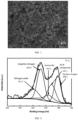
- FIG. 1 is the SEM image of the catalyst prepared in Example 1 of the present application
- FIG. 2 is the high-resolution XPS spectrum of N1s of the catalyst prepared in Example 1 of the present application
- FIG. 3 is the polarization curves of the catalyst prepared in Example 1 of the present application in 0.1 M KOH solution saturated with oxygen at different rotating speeds
- FIG. 4 is the cyclic voltammetric curves of the catalyst prepared in Example 1 of the present application in 0.1 M KOH solution saturated with oxygen
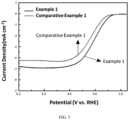
- FIG. 5 is the oxygen reduction polarization curves of the catalysts prepared in Example 1 and Comparative Example 1 of the present application in 0.1 M KOH solution saturated with oxygen. It can be seen from FIG.
- Example 1 that the catalyst prepared in Example 1 of the present application has loose structure and obvious pores on the catalyst surface; it can be seen from the XPS spectrum of FIG. 2 that the catalyst prepared in Example 1 of the present application contains high content of pyridine nitrogen and graphite nitrogen; according to the calculation based on Koutecky-Levich equation, the catalyst prepared in Example 1 of the present application reacts by four-electron transfer mechanism; it can be seen from FIG. 4 that the cyclic voltammetric curves of the catalyst in Example 1 have obvious oxygen reduction peak, which indicates that the catalyst prepared in Example 1 has good catalytic activity for oxygen reduction; it can be seen from FIG.
- the initial potential, half-wave potential and limiting current density of the catalyst prepared in Example 1 are all better than those of the catalyst prepared in Comparative Example 1, and the initial potential can reach 0.90 V vs. RHE and the half-wave potential can reach 0.79 V vs. RHE.
Landscapes
- Chemical & Material Sciences (AREA)
- Chemical Kinetics & Catalysis (AREA)
- Engineering & Computer Science (AREA)
- General Chemical & Material Sciences (AREA)
- Electrochemistry (AREA)
- Materials Engineering (AREA)
- Manufacturing & Machinery (AREA)
- Organic Chemistry (AREA)
- Inorganic Chemistry (AREA)
- Physics & Mathematics (AREA)
- Thermal Sciences (AREA)
- Inert Electrodes (AREA)
- Catalysts (AREA)
Description
- The present application belongs to the field of catalysts, and particularly relates to an oxygen reduction catalyst using graphite from waste battery negative electrodes and a preparation method therefor.
- With the transformation and development of energy, the output of lithium-ion batteries is increasing day by day, and the waste lithium-ion batteries will gradually increase. The waste lithium-ion batteries have harmful impurities which can pollute the environment, and also have many valuable resources and materials, so that it is urgent to recycle and utilize the waste lithium-ion batteries.
- At present, some researches have been reported on recycling waste lithium-ion battery positive electrode materials, which mainly adopt hydrometallurgy, pyrometallurgy and other methods to recycle the valuable metals. However, negative electrode materials also have great recycling value. Graphite has good structural ductility at molecular and morphological level, and strong tolerance to acid and base media, so it is a promising catalytic material.
- The
CN 105,552,468 A discloses a recycling method for graphite anode material from waste lithium-ion battery. - The
CN 106,129,522 A discloses a preparation method for recycling graphite by negative electrodes of lithium-ion batteries. - The
CN 105,356,001 A discloses a method for repairing and modifying negative electrode waste of waste lithium-ion batteries. - The
CN 106,785,161 A discloses an environmental regeneration method for graphite negative electrode. - Then
CN 106,785,163 A discloses a method for repairing and regenerating graphite negative electrode materials for lithium-ion batteries. - However, at present, graphite is usually directly activated and repaired to be continually used as graphite negative electrodes. More and more people realize that it is urgent to prepare useful materials in batteries using waste graphite as a raw material.
- Therefore, it is urgent to provide an oxygen reduction catalyst using graphite from waste battery negative electrodes, which has waste graphite as a raw material, simple preparation method, low cost and good economic benefits.
- The present application is to provide an oxygen reduction catalyst using graphite from waste battery negative electrodes, a preparation method therefor and use thereof. The present application adopts graphite particles generated in the recycling process of waste lithium-ion batteries as a raw material, which reduces the cost of catalyst preparation, recycles the resources, reduces environmental pollution, and has both social and economic benefits.
- The problem of the present invention is solved by a preparation method for an oxygen reduction catalyst according to the
independent claim 1 as well as by an oxygen reduction catalyst according to the independent claim 8 as well as by a fuel cell according to the independent claim 9. The dependent claims to further advantageous developments of the present invention. - In order to achieve the object, the present application adopts the technical solutions below.
- A preparation method for an oxygen reduction catalyst using graphite from waste battery negative electrodes, including the following steps:
- (1) collecting graphite particles from waste batteries, and then performing heat treatment on the graphite particles;
- (2) ball-milling the graphite particles after heat treatment, an iron salt and a nitrogenous organic compound to obtain a catalyst precursor;
- (3) performing carbonization treatment on the catalyst precursor in an inert atmosphere to obtain a carbon-based mixture containing iron and nitrogen; and
- (4) dissolving the carbon-based mixture containing iron and nitrogen in an acid solution, filtering and drying the same, and performing carbonization treatment in an inert atmosphere again to obtain the oxygen reduction catalyst using graphite from waste battery negative electrodes.
- Preferably, the graphite particles in step (1) are prepared by drying, crushing and sieving the waste graphite negative electrodes, and then removing the large particle impurities in the negative electrodes.
- More preferably, the drying has a temperature of 50 to 120 °C and a drying time of 2 to 12 h, and the sieving is carried out with a 100 to 400 mesh standard sieve.
- Preferably, the heat treatment in step (1) has a temperature of 300 to 600 °C, a heating rate of 1 to 10 °C/min, and a time of 0.5 to 3 h.
- Preferably, the iron salt in step (2) is one of ferric chloride, ferric nitrate or ferric sulfate. Preferably, the nitrogenous organic compound in step (2) is at least one of melamine, aniline or urea.
- Preferably, the graphite particles, the iron salt and the nitrogenous organic compound in step (2) have a mass ratio of 1:(1-5):(1-5).
- Preferably, the ball milling in step (2) has a rate of 200 to 600 rpm and a time of 1 to 5 h. Preferably, the inert gas in step (3) and step (4) is N2 or Ar.
- Preferably, the carbonization treatment in step (3) and step (4) has a temperature of 600 to 1100 °C, a heating rate of 1 to 10 °C/min, and a carbonization time of 1 to 5 h.
- Preferably, the acid solution in step (4) is one of sulfuric acid, hydrochloric acid or nitric acid, and the acid solution has a concentration of 0.5 to 3 mol/L.
- Preferably, the drying in step (4) has a temperature of 50 to 100 °C and a drying time of 2 to 24 h.
- An oxygen reduction catalyst using graphite from waste battery negative electrodes is provided, which is prepared by the preparation method; wherein the oxygen reduction catalyst using graphite from waste battery negative electrodes includes graphite with pores and loose structure, a transition metal inside the graphite and a nitrogen source on the graphite surface; the transition metal is at least one of Fe, Co, Mn or Ni.
- Preferably, the oxygen reduction catalyst using graphite from waste battery negative electrodes has a surface area of 517.13 to 700 m2·g-1, and a particle size of 4 to 22 µm.
- A fuel cell is provided, which includes the oxygen reduction catalyst using graphite from waste battery negative electrodes.
-
- (1) The present application adopts graphite particles generated in the recycling process of waste lithium-ion batteries as a raw material, which has wide sources and low cost, and can reduce environmental pollution and have good economic benefits.
- (2) The present application has simple preparation process, convenient operation, and high product value, and can be applied to mass production of fuel cells.
- (3) The oxygen reduction catalyst using graphite from waste battery negative electrodes prepared in the present application has very high catalytic activity. The present application creatively adopts waste graphite negative electrodes as a raw material, and the waste graphite contains a small amount of battery plastic, separators, organic impurities and metal impurities; in the preparing process of the oxygen reduction catalyst using graphite from waste battery negative electrodes, after removing plastic, separators and organic impurities, the remaining metal impurities are transition metals with catalytic activity, such as Fe, Co, Mn and Ni, which can improve the catalytic performance of the catalyst; the carbonization treatment allows the nitrogen and metal doped in the catalyst precursor uniformly loaded on the carbon carrier, so that the catalyst can possess catalytic activity; with the acid treatment, the components without oxygen reduction activity can be effectively removed from the product, and the subsequent carbonization treatment can repair the active sites and improve the activity of the catalyst; thus, the oxygen reduction catalyst using graphite from waste battery negative electrodes has an initial potential of 0.85 to 0.90 V(vs. RHE), a half-wave potential of 0.65 to 0.83 V(vs. RHE), and a limiting current density of 4.52 to 6.42 mA/cm2, which has the comparable catalytic performance of the Pt/C catalyst.
-
-
FIG. 1 is an SEM image of the oxygen reduction catalyst using graphite from waste battery negative electrodes in Example 1 of the present application; -
FIG. 2 is a high-resolution XPS spectrum of N1s of the oxygen reduction catalyst using graphite from waste battery negative electrodes in Example 1 of the present application; -
FIG. 3 is polarization curves of the oxygen reduction catalyst using graphite from waste battery negative electrodes in Example 1 of the present application in 0.1 M KOH solution saturated with oxygen at different rotating speeds; -
FIG. 4 is cyclic voltammetric curves of the oxygen reduction catalyst using graphite from waste battery negative electrodes in Example 1 of the present application in 0.1 M KOH solution saturated with oxygen. -
FIG. 5 is oxygen reduction polarization curves of the catalysts prepared in Example 1 and Comparative Example 1 of the present application in 0.1 M KOH solution saturated with oxygen. - In order to make the technical solutions of the present application more clear to those skilled in the art, the embodiments below are described for explanation. It should be noted that the embodiments below have no limitation on the protection scope claimed by the present application. Unless otherwise specified, the raw materials, reagents or devices used in the embodiments below can be obtained from conventional commercial channels, or can be obtained by the existing methods.
- In this example, a preparation method for an oxygen reduction catalyst using graphite from waste battery negative electrodes includes the following specific steps:
- (1) the collected waste graphite negative electrodes were dried at 65 °C for 6 h, crushed and sieved with a 300-mesh sieve, and large particle impurities in the negative electrodes were removed to obtain negative electrode graphite particles;
- (2) the graphite particles was subjected to heat treatment at 400 °C for 2 h with a heating rate of 3°C/min in an air atmosphere to remove the organic impurities in the graphite particles;
- (3) 4 g of the treated graphite particles, 5 g of Fe2(SO4)3 and 5 g of melamine were ball-milled and mixed at a ball milling rate of 350 rpm for 2 h to obtain a uniformly mixed catalyst precursor;
- (4) the catalyst precursor was subjected to carbonization treatment at 900 °C for 2 h with a heating rate of 5°C/min in a N2 atmosphere to obtain a carbon-based mixture containing iron and nitrogen; and
- (5) the carbon-based mixture containing iron and nitrogen was dissolved in 2 mol/L H2SO4 solution, filtered, dried at 65 °C for 12 h, and subjected to carbonization treatment at 900 °C for 2 h in a N2 atmosphere to obtain the oxygen reduction catalyst using graphite from waste battery negative electrodes.
- In this example, a preparation method for an oxygen reduction catalyst using graphite from waste battery negative electrodes includes the following steps:
- (1) the collected waste graphite negative electrodes were dried at 80 °C for 4 h, crushed and sieved with a 400-mesh sieve, and large particle impurities in the negative electrodes were removed to obtain negative electrode graphite particles;
- (2) the graphite particles were subjected to heat treatment at 350 °C for 3 h with a heating rate of 2 °C/min in an air atmosphere to remove the organic impurities in the graphite particles;
- (3) 4 g of the treated graphite particles, 4 g of FeCl3·6H2O and 4 g of melamine were ball-milled and mixed at a ball milling rate of 350 rpm for 2 h to obtain a uniformly mixed catalyst precursor;
- (4) the catalyst precursor was subjected to carbonization treatment at 800 °C for 3 h with a heating rate of 5 °C/min in a N2 atmosphere to obtain a carbon-based mixture containing iron and nitrogen; and
- (5) the carbon-based mixture containing iron and nitrogen was dissolved in 2.5 mol/L HCl solution, filtered, dried at 80 °C for 8 h, and subjected to carbonization treatment at 800 °C for 3 h in a N2 atmosphere to obtain the oxygen reduction catalyst using graphite from waste battery negative electrodes.
- In this example, a preparation method for an oxygen reduction catalyst using graphite from waste battery negative electrodes includes the following steps:
- (1) the collected waste graphite negative electrodes were dried at 70 °C for 3 h, crushed and sieved with a 200-mesh sieve, and large particle impurities in the negative electrodes were removed to obtain graphite particles;
- (2) the graphite particles were subjected to heat treatment at 480 °C for 2.5 h with a heating rate of 2 °C/min in an air atmosphere to remove the organic impurities in the graphite particles;
- (3) 4 g of the treated graphite particles, 8 g of Fe(NO3)3·9H2O and 5 g of melamine were ball-milled and mixed at a ball milling rate of 450 rpm for 2.5 h to obtain a uniformly mixed catalyst precursor;
- (4) the catalyst precursor was subjected to carbonization treatment at 1000 °C for 1 h with a heating rate of 3 °C/min in an Ar atmosphere to obtain a carbon-based mixture containing iron and nitrogen; and
- (5) the carbon-based mixture containing iron and nitrogen was dissolved in 1.5 mol/L HNO3 solution, filtered, dried at 70 °C for 10 h, and subjected to carbonization treatment at 1000 °C for 1 h in an Ar atmosphere to obtain the oxygen reduction catalyst using graphite from waste battery negative electrodes.
- In this example, a preparation method for an oxygen reduction catalyst using graphite from waste battery negative electrodes includes the following steps:
- (1) the collected waste graphite negative electrodes were dried at 120 °C for 2 h, crushed and sieved with a 300-mesh sieve, and large particle impurities in the negative electrodes were removed to obtain graphite particles;
- (2) the graphite particles was subjected to heat treatment at 360 °C for 3 h with a heating rate of 2 °C/min in an air atmosphere to remove the organic impurities in the graphite particles;
- (3) 4 g of the treated graphite particles, 10 g of FeCl3·6H2O and 8 g of melamine were ball-milled and mixed at a ball milling rate of 450 rpm for 2.5 h to obtain a uniformly mixed catalyst precursor;
- (4) the catalyst precursor was subjected to carbonization treatment at 1100 °C for 1 h with a heating rate of 3 °C/min in an Ar atmosphere to obtain a carbon-based mixture containing iron and nitrogen; and
- (5) the carbon-based mixture containing iron and nitrogen was dissolved in 1.5 mol/L H2SO4 solution, filtered, dried at 120 °C for 5 h, and subjected to carbonization treatment at 1100 °C for 1 h in an Ar atmosphere to obtain the oxygen reduction catalyst using graphite from waste battery negative electrodes.
- In this example, a preparation method for an oxygen reduction catalyst using graphite from waste battery negative electrodes includes the following steps:
- (1) the collected waste graphite negative electrodes were dried at 90 °C for 6 h, crushed and sieved with a 400-mesh sieve, and large particle impurities in the negative electrodes were removed to obtain graphite particles;
- (2) the graphite particles were subjected to heat treatment at 450 °C for 4 h with a heating rate of 3 °C/min in an air atmosphere to remove the organic impurities in the graphite particles;
- (3) 4 g of the treated graphite particles, 8 g of Fe(NO3)3·9H2O and 6 g of melamine were ball-milled and mixed at a ball milling rate of 400 rpm for 4 h to obtain a uniformly mixed catalyst precursor;
- (4) the catalyst precursor was subjected to carbonization treatment at 950 °C for 3 h with a heating rate of 4 °C/min in a N2 atmosphere to obtain a carbon-based mixture containing iron and nitrogen; and
- (5) the carbon-based mixture containing iron and nitrogen was dissolved in 2 mol/L HCl solution, filtered, dried at 90 °C for 10 h, and subj ected to carbonization treatment at 950 °C for 3 h in a N2 atmosphere to obtain the oxygen reduction catalyst using graphite from waste battery negative electrodes.
- A preparation method for an oxygen reduction catalyst using graphite from waste battery negative electrodes includes the following steps:
- (1) 4 g of commercial graphite, 5 g of Fe2(SO4)3 and 5 g of melamine were ball-milled and mixed at a ball milling rate of 350 rpm for 2 h to obtain a uniformly mixed catalyst precursor;
- (2) the catalyst precursor was subjected to carbonization treatment at 900 °C for 2 h with a heating rate of 5 °C/min in a N2 atmosphere to obtain a carbon-based mixture containing iron and nitrogen; and
- (3) the carbon-based mixture containing iron and nitrogen was dissolved in 2 mol/L H2SO4 solution, filtered, dried at 65 °C for 12 h, and subjected to carbonization treatment at 900 °C for 2 h in a N2 atmosphere to obtain the oxygen reduction catalyst using graphite from waste battery negative electrodes.
- The oxygen reduction catalysts with carbon base of graphite from waste battery negative electrodes prepared in the examples 1 to 6 were tested for their performance according to the methods below.
- (1) 6 mg of the catalyst was added into 1 mL of ethanol and Nafion solution with a mass fraction of 5 %, in which ethanol and Nafion had a volume ratio of 9:1, and the mixture was subjected to ultrasonic dispersion for 2 hours. 20 µL of the catalyst solution was transferred with a pipette to a rotating disc electrode of a rotating disc with a diameter of 5 mm, and naturally dried in the air.
- (2) Electrochemical test was carried out on P3000A-DX electrochemical workstation, using the above electrode as a working electrode, a platinum wire as a counter electrode and an Ag/AgCl electrode as a reference electrode.
- (3) The catalyst was tested at a scan rate of 5 mV·s-1 in 0.1 M KOH solution to obtain the cyclic voltammetric curves in saturated oxygen and the polarization curves at different rotating speeds.
-
FIG. 1 is the SEM image of the catalyst prepared in Example 1 of the present application,FIG. 2 is the high-resolution XPS spectrum of N1s of the catalyst prepared in Example 1 of the present application,FIG. 3 is the polarization curves of the catalyst prepared in Example 1 of the present application in 0.1 M KOH solution saturated with oxygen at different rotating speeds,FIG. 4 is the cyclic voltammetric curves of the catalyst prepared in Example 1 of the present application in 0.1 M KOH solution saturated with oxygen, andFIG. 5 is the oxygen reduction polarization curves of the catalysts prepared in Example 1 and Comparative Example 1 of the present application in 0.1 M KOH solution saturated with oxygen. It can be seen fromFIG. 1 that the catalyst prepared in Example 1 of the present application has loose structure and obvious pores on the catalyst surface; it can be seen from the XPS spectrum ofFIG. 2 that the catalyst prepared in Example 1 of the present application contains high content of pyridine nitrogen and graphite nitrogen; according to the calculation based on Koutecky-Levich equation, the catalyst prepared in Example 1 of the present application reacts by four-electron transfer mechanism; it can be seen fromFIG. 4 that the cyclic voltammetric curves of the catalyst in Example 1 have obvious oxygen reduction peak, which indicates that the catalyst prepared in Example 1 has good catalytic activity for oxygen reduction; it can be seen fromFIG. 5 that the initial potential, half-wave potential and limiting current density of the catalyst prepared in Example 1 are all better than those of the catalyst prepared in Comparative Example 1, and the initial potential can reach 0.90 V vs. RHE and the half-wave potential can reach 0.79 V vs. RHE. - The oxygen reduction catalyst using graphite from waste battery negative electrodes and the preparation method therefor provided by the present application are described in detail hereinabove. In this disclosure, the principle and implementation of the present application are described through embodiments. The embodiments are merely used for a better understanding of the methods and concept in the present application, including the optimal example, and the embodiments also enable those skilled in the art to carry out the present application, including fabricating and using any device or system, and implementing any related method.
Claims (9)
- A preparation method for an oxygen reduction catalyst using graphite from waste battery negative electrodes, comprising the following steps:(1) collecting graphite particles from waste batteries, and then performing heat treatment on the graphite particles;(2) ball-milling and mixing the treated graphite particles, an iron salt and a nitrogenous organic compound to obtain a catalyst precursor;(3) performing carbonization treatment on the catalyst precursor in an inert atmosphere to obtain a carbon-based mixture containing iron and nitrogen; and(4) dissolving the carbon-based mixture containing iron and nitrogen in an acid solution, filtering and drying the same, and performing carbonization treatment in an inert atmosphere again to obtain the oxygen reduction catalyst using graphite from waste battery negative electrodes.
- The preparation method according to claim 1, wherein the heat treatment in step (1) has a temperature of 300 to 600 °C, a heating rate of 1 to 10 °C/min, and a time of 0.5 to 3 h.
- The preparation method according to claim 1, wherein the iron salt in step (2) is one of ferric chloride, ferric nitrate or ferric sulfate.
- The preparation method according to claim 1, wherein the nitrogenous organic compound in step (2) is at least one of melamine, aniline or urea.
- The preparation method according to claim 1, wherein the graphite particles, the iron salt and the nitrogenous organic compound in step (2) have a mass ratio of 1:(1-5):(1-5).
- The preparation method according to claim 1, wherein the inert gas in step (3) and step (4) is N2 or Ar; the carbonization treatment in step (3) has a temperature of 600 to 1100 °C, a heating rate of 1 to 10 °C/min, and a carbonization time of 1 to 5 h.
- The preparation method according to claim 1, wherein the acid solution in step (4) is one of sulfuric acid, hydrochloric acid or nitric acid, and the acid solution has a concentration of 0.5 to 3 mol/L.
- An oxygen reduction catalyst using graphite from waste battery negative electrodes, which is prepared by the preparation method according to any one of claims 1 to 7; wherein the oxygen reduction catalyst using graphite from waste battery negative electrodes comprises graphite with pores, a transition metal inside the graphite and a nitrogen source on the graphite surface; the transition metal is at least one of Fe, Co, Mn or Ni.
- A fuel cell, comprising the oxygen reduction catalyst using graphite from waste battery negative electrodes according to claim 8.
Applications Claiming Priority (2)
| Application Number | Priority Date | Filing Date | Title |
|---|---|---|---|
| CN202010376942.5A CN111644189B (en) | 2020-05-07 | 2020-05-07 | Oxygen reduction catalyst using waste battery negative electrode graphite and preparation method thereof |
| PCT/CN2021/088764 WO2021223597A1 (en) | 2020-05-07 | 2021-04-21 | Oxygen reduction catalyst employing graphite of negative electrode of waste battery, and preparation method therefor |
Publications (3)
| Publication Number | Publication Date |
|---|---|
| EP4147776A1 EP4147776A1 (en) | 2023-03-15 |
| EP4147776A4 EP4147776A4 (en) | 2024-06-12 |
| EP4147776B1 true EP4147776B1 (en) | 2025-06-04 |
Family
ID=72343860
Family Applications (1)
| Application Number | Title | Priority Date | Filing Date |
|---|---|---|---|
| EP21799463.1A Active EP4147776B1 (en) | 2020-05-07 | 2021-04-21 | Oxygen reduction catalyst employing graphite of negative electrode of waste battery, and preparation method therefor |
Country Status (6)
| Country | Link |
|---|---|
| US (1) | US11837734B2 (en) |
| EP (1) | EP4147776B1 (en) |
| CN (1) | CN111644189B (en) |
| ES (1) | ES3033862T3 (en) |
| HU (1) | HUE072396T2 (en) |
| WO (1) | WO2021223597A1 (en) |
Families Citing this family (11)
| Publication number | Priority date | Publication date | Assignee | Title |
|---|---|---|---|---|
| CN112106241B (en) * | 2018-05-15 | 2022-08-30 | 国立研究开发法人产业技术综合研究所 | Electrochemical oxygen reduction catalyst |
| CN111644189B (en) | 2020-05-07 | 2022-10-18 | 广东邦普循环科技有限公司 | Oxygen reduction catalyst using waste battery negative electrode graphite and preparation method thereof |
| CN112652779A (en) * | 2020-12-11 | 2021-04-13 | 广东邦普循环科技有限公司 | High-activity oxygen reduction catalyst and preparation method and application thereof |
| CN112670605B (en) * | 2020-12-23 | 2022-07-12 | 北京理工大学前沿技术研究院 | Method for regenerating graphite cathode material of waste lithium ion battery |
| CN114583315B (en) * | 2022-03-11 | 2023-05-26 | 西安交通大学 | Method for recycling carbon cathode material from waste lithium ion battery |
| CN115646438B (en) * | 2022-07-20 | 2024-04-02 | 上海交通大学 | A method for preparing dye adsorbent by using waste lithium battery negative electrode graphite |
| CN115148483A (en) * | 2022-07-28 | 2022-10-04 | 中国科学院生态环境研究中心 | Method for preparing LiFe5O8 magnetic material by using waste lithium iron phosphate battery |
| CN115520850B (en) * | 2022-08-30 | 2024-01-26 | 河南师范大学 | A comprehensive resource recycling method for titanium dioxide by-product ferrous sulfate and waste graphite anode materials |
| CN115863679A (en) * | 2022-12-20 | 2023-03-28 | 上海神力科技有限公司 | Microporous carbon-coated platinum nanoparticle electrocatalyst and preparation method thereof |
| CN117899865A (en) * | 2023-12-14 | 2024-04-19 | 安徽工业大学 | Method for preparing catalyst by using waste lithium ion battery diaphragm, catalyst and application |
| CN119702046A (en) * | 2025-02-27 | 2025-03-28 | 池州西恩新材料科技有限公司 | Method for preparing platinum catalyst by adopting waste lithium battery negative electrode graphite and application of platinum catalyst |
Family Cites Families (21)
| Publication number | Priority date | Publication date | Assignee | Title |
|---|---|---|---|---|
| DE10132490B4 (en) * | 2001-07-03 | 2007-04-12 | Hahn-Meitner-Institut Berlin Gmbh | Platinum-free chelate catalyst material for selective oxygen reduction and process for its preparation |
| JP5863645B2 (en) * | 2010-04-20 | 2016-02-16 | 日清紡ホールディングス株式会社 | Carbon catalyst for cathode of direct type fuel cell and cathode and direct type fuel cell for direct type fuel cell using the same |
| CN103041827B (en) * | 2011-10-17 | 2015-06-17 | 中国科学院大连化学物理研究所 | Nitrogen-doped nano carbon electrocatalyst for fuel cell, and preparation and application of nitrogen-doped nano carbon electrocatalyst |
| CN102974380B (en) * | 2012-11-13 | 2014-07-23 | 中国科学院长春应用化学研究所 | Iron and nitrogen doped carbon black catalyst and preparation method thereof |
| CN103252250B (en) * | 2013-04-25 | 2015-07-08 | 西北师范大学 | Preparation method and application of nitrogen and iron modified carbon material |
| CN103599805B (en) * | 2013-11-20 | 2016-03-30 | 东华大学 | A kind of Synthesis and applications of nitrogen-doped graphene fuel-cell catalyst |
| CN105356001A (en) * | 2015-12-14 | 2016-02-24 | 天津理工大学 | Repairing modifying method of cathode waste material of waste lithium ion battery |
| WO2017117410A1 (en) | 2015-12-29 | 2017-07-06 | Northeastern University | Non-noble metal electrocatalysts for oxygen depolarized cathodes and their application in chlor-alkali electrolysis cells |
| CN105552468A (en) * | 2016-01-21 | 2016-05-04 | 河南环宇赛尔新能源科技有限公司 | Recycling method for graphite anode material from waste lithium-ion battery |
| CN105680060B (en) * | 2016-02-23 | 2018-05-15 | 东华大学 | A kind of nitrogen, sulphur or chlorine adulterate the preparation and application of three-dimensional porous graphen catalyst |
| CN106129522A (en) * | 2016-08-31 | 2016-11-16 | 合肥国轩高科动力能源有限公司 | A kind of preparation method of recycling graphite by lithium-ion battery negative electrode |
| CN106395812B (en) * | 2016-10-10 | 2018-10-30 | 东莞市凯金新能源科技股份有限公司 | A kind of processing method of artificial graphite waste material |
| CN106785161B (en) * | 2016-11-19 | 2019-05-03 | 天津赫维科技有限公司 | A kind of regeneration treating method of the graphite cathode of environmental protection |
| CN106785163A (en) * | 2016-11-29 | 2017-05-31 | 荆门市格林美新材料有限公司 | The method of reparative regeneration graphite negative material of lithium ion battery |
| CN106876728B (en) * | 2017-02-14 | 2020-01-03 | 中国科学技术大学 | High-density transition metal monoatomic load graphene-based catalyst and preparation method thereof |
| CN108879014B (en) * | 2018-07-26 | 2020-11-27 | 桑顿新能源科技有限公司 | Method for recovering lithium ion battery negative electrode material |
| CN109279600B (en) * | 2018-11-28 | 2021-02-19 | 北京化工大学 | A kind of multi-doped carbon material and its preparation method and application |
| CN109888318A (en) | 2019-02-13 | 2019-06-14 | 上海交通大学 | A kind of preparation method and application of metal-nitrogen co-doped carbon-based composite material |
| CN110767912B (en) * | 2019-11-04 | 2022-02-01 | 石河子大学 | Preparation method of pitch-derived carbon-based non-noble metal oxygen reduction catalyst |
| CN111644189B (en) * | 2020-05-07 | 2022-10-18 | 广东邦普循环科技有限公司 | Oxygen reduction catalyst using waste battery negative electrode graphite and preparation method thereof |
| CN111634907A (en) * | 2020-06-08 | 2020-09-08 | 惠州市贝特瑞新材料科技有限公司 | Nitrogen-iron co-doped graphite carbon and preparation method and application thereof |
-
2020
- 2020-05-07 CN CN202010376942.5A patent/CN111644189B/en active Active
-
2021
- 2021-04-21 HU HUE21799463A patent/HUE072396T2/en unknown
- 2021-04-21 EP EP21799463.1A patent/EP4147776B1/en active Active
- 2021-04-21 US US17/923,847 patent/US11837734B2/en active Active
- 2021-04-21 WO PCT/CN2021/088764 patent/WO2021223597A1/en not_active Ceased
- 2021-04-21 ES ES21799463T patent/ES3033862T3/en active Active
Also Published As
| Publication number | Publication date |
|---|---|
| WO2021223597A1 (en) | 2021-11-11 |
| US11837734B2 (en) | 2023-12-05 |
| US20230178757A1 (en) | 2023-06-08 |
| CN111644189A (en) | 2020-09-11 |
| EP4147776A1 (en) | 2023-03-15 |
| ES3033862T3 (en) | 2025-08-08 |
| CN111644189B (en) | 2022-10-18 |
| EP4147776A4 (en) | 2024-06-12 |
| HUE072396T2 (en) | 2025-11-28 |
Similar Documents
| Publication | Publication Date | Title |
|---|---|---|
| US11837734B2 (en) | Oxygen reduction catalyst employing graphite of negative electrode of waste battery, and preparation method therefor | |
| CN107649160B (en) | Graphene-loaded transition group metal monodisperse atomic catalyst and preparation method and application thereof | |
| CN105854918B (en) | Composite material of nano-scale cobalt-based particles and nitrogen-doped carbon, synthetic method and application | |
| CN113707893B (en) | A carbon-based electrocatalyst prepared by using waste lithium iron phosphate battery cathode material, and preparation method and application thereof | |
| CN104923204A (en) | Preparation method for graphene-coated metal nanometer particle catalyst and application of graphene-coated metal nanometer particle catalyst | |
| CN102891326A (en) | Nitrogen-doped hollow carbon ball loaded palladium-based catalyst and preparation method thereof, and alcohol fuel cell applying same | |
| CN112103520B (en) | Anode catalyst of alcohol fuel cell | |
| CN109718822A (en) | Method for preparing metal-carbon composite catalytic material and application thereof | |
| CN113201759B (en) | Three-dimensional porous carbon supported bismuth sulfide/bismuth oxide composite catalyst and preparation method and application thereof | |
| CN109686988A (en) | A kind of carbon carrying transition metal atom pair elctro-catalyst and the preparation method and application thereof | |
| CN110600752B (en) | A method for preparing carbon-supported Pt alloy catalyst by H2 gas-phase thermal reduction | |
| CN109950566A (en) | A kind of high-performance oxygen reduction catalyst and its preparation method based on function of surface enhancing | |
| CN112652779A (en) | High-activity oxygen reduction catalyst and preparation method and application thereof | |
| CN109873172B (en) | Preparation method of methanol fuel cell catalyst | |
| CN118645642B (en) | Nitrogen-doped carbon nanotube-supported carbon-coated iron selenide bifunctional catalyst and preparation method and application thereof | |
| CN114620772A (en) | Doped transition metal oxide and preparation method and application thereof | |
| CN110429290A (en) | Method for preparing nitrogen-doped carbon material supported transition metal compound catalyst | |
| CN102810678B (en) | Direct methanol fuel cell catalyst and preparation method thereof | |
| CN111952607B (en) | Oxygen reduction catalyst prepared from waste graphite and preparation method thereof | |
| CN114400338B (en) | Mn-PtM/C type platinum-based oxygen reduction catalyst and preparation method and application thereof | |
| CN111653794B (en) | Carbon-based oxygen reduction catalyst utilizing waste battery negative electrode graphite and preparation method thereof | |
| CN118970256B (en) | Method for recycling waste lithium iron phosphate positive electrode powder for preparing high-performance water electrolysis anode catalyst and extracting lithium element | |
| CN114583190A (en) | Recovery and conversion of metal in waste lithium ion battery and application of metal in zinc-air battery | |
| CN114105143A (en) | Preparation method of iron carbide/porous carbon aerogel zinc-air battery cathode catalyst with defect structure | |
| CN109037717A (en) | A kind of ferrum-based catalyst and preparation method of alkaline fuel cell |
Legal Events
| Date | Code | Title | Description |
|---|---|---|---|
| STAA | Information on the status of an ep patent application or granted ep patent |
Free format text: STATUS: THE INTERNATIONAL PUBLICATION HAS BEEN MADE |
|
| PUAI | Public reference made under article 153(3) epc to a published international application that has entered the european phase |
Free format text: ORIGINAL CODE: 0009012 |
|
| STAA | Information on the status of an ep patent application or granted ep patent |
Free format text: STATUS: REQUEST FOR EXAMINATION WAS MADE |
|
| 17P | Request for examination filed |
Effective date: 20221124 |
|
| AK | Designated contracting states |
Kind code of ref document: A1 Designated state(s): AL AT BE BG CH CY CZ DE DK EE ES FI FR GB GR HR HU IE IS IT LI LT LU LV MC MK MT NL NO PL PT RO RS SE SI SK SM TR |
|
| P01 | Opt-out of the competence of the unified patent court (upc) registered |
Effective date: 20230503 |
|
| DAV | Request for validation of the european patent (deleted) | ||
| DAX | Request for extension of the european patent (deleted) | ||
| A4 | Supplementary search report drawn up and despatched |
Effective date: 20240515 |
|
| RIC1 | Information provided on ipc code assigned before grant |
Ipc: B01J 37/08 20060101ALI20240508BHEP Ipc: B01J 37/00 20060101ALI20240508BHEP Ipc: H01M 4/587 20100101ALI20240508BHEP Ipc: H01M 4/96 20060101ALI20240508BHEP Ipc: H01M 4/92 20060101ALI20240508BHEP Ipc: H01M 4/88 20060101ALI20240508BHEP Ipc: H01M 4/66 20060101ALI20240508BHEP Ipc: H01M 4/1393 20100101ALI20240508BHEP Ipc: H01M 4/133 20100101ALI20240508BHEP Ipc: B01J 21/18 20060101ALI20240508BHEP Ipc: B01J 23/745 20060101ALI20240508BHEP Ipc: H01M 4/90 20060101ALI20240508BHEP Ipc: H01M 10/54 20060101ALI20240508BHEP Ipc: B01J 27/24 20060101AFI20240508BHEP |
|
| GRAP | Despatch of communication of intention to grant a patent |
Free format text: ORIGINAL CODE: EPIDOSNIGR1 |
|
| STAA | Information on the status of an ep patent application or granted ep patent |
Free format text: STATUS: GRANT OF PATENT IS INTENDED |
|
| INTG | Intention to grant announced |
Effective date: 20250117 |
|
| GRAS | Grant fee paid |
Free format text: ORIGINAL CODE: EPIDOSNIGR3 |
|
| GRAA | (expected) grant |
Free format text: ORIGINAL CODE: 0009210 |
|
| STAA | Information on the status of an ep patent application or granted ep patent |
Free format text: STATUS: THE PATENT HAS BEEN GRANTED |
|
| AK | Designated contracting states |
Kind code of ref document: B1 Designated state(s): AL AT BE BG CH CY CZ DE DK EE ES FI FR GB GR HR HU IE IS IT LI LT LU LV MC MK MT NL NO PL PT RO RS SE SI SK SM TR |
|
| RAP3 | Party data changed (applicant data changed or rights of an application transferred) |
Owner name: HUNAN BRUNP EV RECYCLING CO., LTD. Owner name: HUNAN BRUNP RECYCLING TECHNOLOGY CO., LTD. Owner name: GUANGDONG BRUNP RECYCLING TECHNOLOGY CO., LTD |
|
| REG | Reference to a national code |
Ref country code: GB Ref legal event code: FG4D |
|
| REG | Reference to a national code |
Ref country code: CH Ref legal event code: EP |
|
| REG | Reference to a national code |
Ref country code: DE Ref legal event code: R096 Ref document number: 602021031880 Country of ref document: DE |
|
| REG | Reference to a national code |
Ref country code: IE Ref legal event code: FG4D |
|
| REG | Reference to a national code |
Ref country code: ES Ref legal event code: FG2A Ref document number: 3033862 Country of ref document: ES Kind code of ref document: T3 Effective date: 20250808 |
|
| REG | Reference to a national code |
Ref country code: NL Ref legal event code: MP Effective date: 20250604 |
|
| PG25 | Lapsed in a contracting state [announced via postgrant information from national office to epo] |
Ref country code: FI Free format text: LAPSE BECAUSE OF FAILURE TO SUBMIT A TRANSLATION OF THE DESCRIPTION OR TO PAY THE FEE WITHIN THE PRESCRIBED TIME-LIMIT Effective date: 20250604 |
|
| REG | Reference to a national code |
Ref country code: LT Ref legal event code: MG9D |
|
| PG25 | Lapsed in a contracting state [announced via postgrant information from national office to epo] |
Ref country code: NO Free format text: LAPSE BECAUSE OF FAILURE TO SUBMIT A TRANSLATION OF THE DESCRIPTION OR TO PAY THE FEE WITHIN THE PRESCRIBED TIME-LIMIT Effective date: 20250904 Ref country code: GR Free format text: LAPSE BECAUSE OF FAILURE TO SUBMIT A TRANSLATION OF THE DESCRIPTION OR TO PAY THE FEE WITHIN THE PRESCRIBED TIME-LIMIT Effective date: 20250905 |
|
| PG25 | Lapsed in a contracting state [announced via postgrant information from national office to epo] |
Ref country code: PL Free format text: LAPSE BECAUSE OF FAILURE TO SUBMIT A TRANSLATION OF THE DESCRIPTION OR TO PAY THE FEE WITHIN THE PRESCRIBED TIME-LIMIT Effective date: 20250604 |
|
| PG25 | Lapsed in a contracting state [announced via postgrant information from national office to epo] |
Ref country code: BG Free format text: LAPSE BECAUSE OF FAILURE TO SUBMIT A TRANSLATION OF THE DESCRIPTION OR TO PAY THE FEE WITHIN THE PRESCRIBED TIME-LIMIT Effective date: 20250604 |
|
| PG25 | Lapsed in a contracting state [announced via postgrant information from national office to epo] |
Ref country code: HR Free format text: LAPSE BECAUSE OF FAILURE TO SUBMIT A TRANSLATION OF THE DESCRIPTION OR TO PAY THE FEE WITHIN THE PRESCRIBED TIME-LIMIT Effective date: 20250604 |
|
| PG25 | Lapsed in a contracting state [announced via postgrant information from national office to epo] |
Ref country code: RS Free format text: LAPSE BECAUSE OF FAILURE TO SUBMIT A TRANSLATION OF THE DESCRIPTION OR TO PAY THE FEE WITHIN THE PRESCRIBED TIME-LIMIT Effective date: 20250904 |
|
| PG25 | Lapsed in a contracting state [announced via postgrant information from national office to epo] |
Ref country code: LV Free format text: LAPSE BECAUSE OF FAILURE TO SUBMIT A TRANSLATION OF THE DESCRIPTION OR TO PAY THE FEE WITHIN THE PRESCRIBED TIME-LIMIT Effective date: 20250604 |
|
| PG25 | Lapsed in a contracting state [announced via postgrant information from national office to epo] |
Ref country code: NL Free format text: LAPSE BECAUSE OF FAILURE TO SUBMIT A TRANSLATION OF THE DESCRIPTION OR TO PAY THE FEE WITHIN THE PRESCRIBED TIME-LIMIT Effective date: 20250604 |
|
| REG | Reference to a national code |
Ref country code: HU Ref legal event code: AG4A Ref document number: E072396 Country of ref document: HU |
|
| PG25 | Lapsed in a contracting state [announced via postgrant information from national office to epo] |
Ref country code: PT Free format text: LAPSE BECAUSE OF FAILURE TO SUBMIT A TRANSLATION OF THE DESCRIPTION OR TO PAY THE FEE WITHIN THE PRESCRIBED TIME-LIMIT Effective date: 20251006 |
|
| REG | Reference to a national code |
Ref country code: AT Ref legal event code: MK05 Ref document number: 1799866 Country of ref document: AT Kind code of ref document: T Effective date: 20250604 |
|
| PG25 | Lapsed in a contracting state [announced via postgrant information from national office to epo] |
Ref country code: IS Free format text: LAPSE BECAUSE OF FAILURE TO SUBMIT A TRANSLATION OF THE DESCRIPTION OR TO PAY THE FEE WITHIN THE PRESCRIBED TIME-LIMIT Effective date: 20251004 |
|
| PG25 | Lapsed in a contracting state [announced via postgrant information from national office to epo] |
Ref country code: AT Free format text: LAPSE BECAUSE OF FAILURE TO SUBMIT A TRANSLATION OF THE DESCRIPTION OR TO PAY THE FEE WITHIN THE PRESCRIBED TIME-LIMIT Effective date: 20250604 Ref country code: SM Free format text: LAPSE BECAUSE OF FAILURE TO SUBMIT A TRANSLATION OF THE DESCRIPTION OR TO PAY THE FEE WITHIN THE PRESCRIBED TIME-LIMIT Effective date: 20250604 |
|
| PG25 | Lapsed in a contracting state [announced via postgrant information from national office to epo] |
Ref country code: CZ Free format text: LAPSE BECAUSE OF FAILURE TO SUBMIT A TRANSLATION OF THE DESCRIPTION OR TO PAY THE FEE WITHIN THE PRESCRIBED TIME-LIMIT Effective date: 20250604 |
|
| PG25 | Lapsed in a contracting state [announced via postgrant information from national office to epo] |
Ref country code: EE Free format text: LAPSE BECAUSE OF FAILURE TO SUBMIT A TRANSLATION OF THE DESCRIPTION OR TO PAY THE FEE WITHIN THE PRESCRIBED TIME-LIMIT Effective date: 20250604 |
|
| PG25 | Lapsed in a contracting state [announced via postgrant information from national office to epo] |
Ref country code: SK Free format text: LAPSE BECAUSE OF FAILURE TO SUBMIT A TRANSLATION OF THE DESCRIPTION OR TO PAY THE FEE WITHIN THE PRESCRIBED TIME-LIMIT Effective date: 20250604 |
|
| PG25 | Lapsed in a contracting state [announced via postgrant information from national office to epo] |
Ref country code: IT Free format text: LAPSE BECAUSE OF FAILURE TO SUBMIT A TRANSLATION OF THE DESCRIPTION OR TO PAY THE FEE WITHIN THE PRESCRIBED TIME-LIMIT Effective date: 20250604 |
|
| REG | Reference to a national code |
Ref country code: DE Ref legal event code: R097 Ref document number: 602021031880 Country of ref document: DE |
|
| PLBE | No opposition filed within time limit |
Free format text: ORIGINAL CODE: 0009261 |
|
| STAA | Information on the status of an ep patent application or granted ep patent |
Free format text: STATUS: NO OPPOSITION FILED WITHIN TIME LIMIT |
|
| PG25 | Lapsed in a contracting state [announced via postgrant information from national office to epo] |
Ref country code: DK Free format text: LAPSE BECAUSE OF FAILURE TO SUBMIT A TRANSLATION OF THE DESCRIPTION OR TO PAY THE FEE WITHIN THE PRESCRIBED TIME-LIMIT Effective date: 20250604 |
|
| REG | Reference to a national code |
Ref country code: CH Ref legal event code: L10 Free format text: ST27 STATUS EVENT CODE: U-0-0-L10-L00 (AS PROVIDED BY THE NATIONAL OFFICE) Effective date: 20260416 |
|
| 26N | No opposition filed |
Effective date: 20260305 |