EP4144330A1 - Recloseable underwear-type disposable article for wearing and manufacturing method therefor - Google Patents
Recloseable underwear-type disposable article for wearing and manufacturing method therefor Download PDFInfo
- Publication number
- EP4144330A1 EP4144330A1 EP21797473.2A EP21797473A EP4144330A1 EP 4144330 A1 EP4144330 A1 EP 4144330A1 EP 21797473 A EP21797473 A EP 21797473A EP 4144330 A1 EP4144330 A1 EP 4144330A1
- Authority
- EP
- European Patent Office
- Prior art keywords
- pair
- flaps
- touch fasteners
- front panel
- touch
- Prior art date
- Legal status (The legal status is an assumption and is not a legal conclusion. Google has not performed a legal analysis and makes no representation as to the accuracy of the status listed.)
- Granted
Links
Images







Classifications
-
- A—HUMAN NECESSITIES
- A61—MEDICAL OR VETERINARY SCIENCE; HYGIENE
- A61F—FILTERS IMPLANTABLE INTO BLOOD VESSELS; PROSTHESES; DEVICES PROVIDING PATENCY TO, OR PREVENTING COLLAPSING OF, TUBULAR STRUCTURES OF THE BODY, e.g. STENTS; ORTHOPAEDIC, NURSING OR CONTRACEPTIVE DEVICES; FOMENTATION; TREATMENT OR PROTECTION OF EYES OR EARS; BANDAGES, DRESSINGS OR ABSORBENT PADS; FIRST-AID KITS
- A61F13/00—Bandages or dressings; Absorbent pads
- A61F13/15—Absorbent pads, e.g. sanitary towels, swabs or tampons for external or internal application to the body; Supporting or fastening means therefor; Tampon applicators
- A61F13/45—Absorbent pads, e.g. sanitary towels, swabs or tampons for external or internal application to the body; Supporting or fastening means therefor; Tampon applicators characterised by the shape
- A61F13/49—Absorbent pads, e.g. sanitary towels, swabs or tampons for external or internal application to the body; Supporting or fastening means therefor; Tampon applicators characterised by the shape specially adapted to be worn around the waist, e.g. diapers, nappies
- A61F13/496—Absorbent pads, e.g. sanitary towels, swabs or tampons for external or internal application to the body; Supporting or fastening means therefor; Tampon applicators characterised by the shape specially adapted to be worn around the waist, e.g. diapers, nappies in the form of pants or briefs
-
- A—HUMAN NECESSITIES
- A61—MEDICAL OR VETERINARY SCIENCE; HYGIENE
- A61F—FILTERS IMPLANTABLE INTO BLOOD VESSELS; PROSTHESES; DEVICES PROVIDING PATENCY TO, OR PREVENTING COLLAPSING OF, TUBULAR STRUCTURES OF THE BODY, e.g. STENTS; ORTHOPAEDIC, NURSING OR CONTRACEPTIVE DEVICES; FOMENTATION; TREATMENT OR PROTECTION OF EYES OR EARS; BANDAGES, DRESSINGS OR ABSORBENT PADS; FIRST-AID KITS
- A61F13/00—Bandages or dressings; Absorbent pads
- A61F13/15—Absorbent pads, e.g. sanitary towels, swabs or tampons for external or internal application to the body; Supporting or fastening means therefor; Tampon applicators
- A61F13/15577—Apparatus or processes for manufacturing
- A61F13/15756—Applying tabs, strips, tapes, loops; Knotting the ends of pads
-
- A—HUMAN NECESSITIES
- A61—MEDICAL OR VETERINARY SCIENCE; HYGIENE
- A61F—FILTERS IMPLANTABLE INTO BLOOD VESSELS; PROSTHESES; DEVICES PROVIDING PATENCY TO, OR PREVENTING COLLAPSING OF, TUBULAR STRUCTURES OF THE BODY, e.g. STENTS; ORTHOPAEDIC, NURSING OR CONTRACEPTIVE DEVICES; FOMENTATION; TREATMENT OR PROTECTION OF EYES OR EARS; BANDAGES, DRESSINGS OR ABSORBENT PADS; FIRST-AID KITS
- A61F13/00—Bandages or dressings; Absorbent pads
- A61F13/15—Absorbent pads, e.g. sanitary towels, swabs or tampons for external or internal application to the body; Supporting or fastening means therefor; Tampon applicators
- A61F13/15577—Apparatus or processes for manufacturing
- A61F13/15764—Transferring, feeding or handling devices; Drives
-
- A—HUMAN NECESSITIES
- A61—MEDICAL OR VETERINARY SCIENCE; HYGIENE
- A61F—FILTERS IMPLANTABLE INTO BLOOD VESSELS; PROSTHESES; DEVICES PROVIDING PATENCY TO, OR PREVENTING COLLAPSING OF, TUBULAR STRUCTURES OF THE BODY, e.g. STENTS; ORTHOPAEDIC, NURSING OR CONTRACEPTIVE DEVICES; FOMENTATION; TREATMENT OR PROTECTION OF EYES OR EARS; BANDAGES, DRESSINGS OR ABSORBENT PADS; FIRST-AID KITS
- A61F13/00—Bandages or dressings; Absorbent pads
- A61F13/15—Absorbent pads, e.g. sanitary towels, swabs or tampons for external or internal application to the body; Supporting or fastening means therefor; Tampon applicators
- A61F13/15577—Apparatus or processes for manufacturing
- A61F13/15804—Plant, e.g. involving several steps
-
- A—HUMAN NECESSITIES
- A61—MEDICAL OR VETERINARY SCIENCE; HYGIENE
- A61F—FILTERS IMPLANTABLE INTO BLOOD VESSELS; PROSTHESES; DEVICES PROVIDING PATENCY TO, OR PREVENTING COLLAPSING OF, TUBULAR STRUCTURES OF THE BODY, e.g. STENTS; ORTHOPAEDIC, NURSING OR CONTRACEPTIVE DEVICES; FOMENTATION; TREATMENT OR PROTECTION OF EYES OR EARS; BANDAGES, DRESSINGS OR ABSORBENT PADS; FIRST-AID KITS
- A61F13/00—Bandages or dressings; Absorbent pads
- A61F13/15—Absorbent pads, e.g. sanitary towels, swabs or tampons for external or internal application to the body; Supporting or fastening means therefor; Tampon applicators
- A61F13/56—Supporting or fastening means
- A61F13/5622—Supporting or fastening means specially adapted for diapers or the like
- A61F13/565—Supporting or fastening means specially adapted for diapers or the like pants type diaper
- A61F13/5655—Supporting or fastening means specially adapted for diapers or the like pants type diaper adjustable pants type diapers
-
- A—HUMAN NECESSITIES
- A61—MEDICAL OR VETERINARY SCIENCE; HYGIENE
- A61F—FILTERS IMPLANTABLE INTO BLOOD VESSELS; PROSTHESES; DEVICES PROVIDING PATENCY TO, OR PREVENTING COLLAPSING OF, TUBULAR STRUCTURES OF THE BODY, e.g. STENTS; ORTHOPAEDIC, NURSING OR CONTRACEPTIVE DEVICES; FOMENTATION; TREATMENT OR PROTECTION OF EYES OR EARS; BANDAGES, DRESSINGS OR ABSORBENT PADS; FIRST-AID KITS
- A61F13/00—Bandages or dressings; Absorbent pads
- A61F13/15—Absorbent pads, e.g. sanitary towels, swabs or tampons for external or internal application to the body; Supporting or fastening means therefor; Tampon applicators
- A61F13/56—Supporting or fastening means
- A61F13/62—Mechanical fastening means ; Fabric strip fastener elements, e.g. hook and loop
-
- A—HUMAN NECESSITIES
- A61—MEDICAL OR VETERINARY SCIENCE; HYGIENE
- A61F—FILTERS IMPLANTABLE INTO BLOOD VESSELS; PROSTHESES; DEVICES PROVIDING PATENCY TO, OR PREVENTING COLLAPSING OF, TUBULAR STRUCTURES OF THE BODY, e.g. STENTS; ORTHOPAEDIC, NURSING OR CONTRACEPTIVE DEVICES; FOMENTATION; TREATMENT OR PROTECTION OF EYES OR EARS; BANDAGES, DRESSINGS OR ABSORBENT PADS; FIRST-AID KITS
- A61F13/00—Bandages or dressings; Absorbent pads
- A61F13/15—Absorbent pads, e.g. sanitary towels, swabs or tampons for external or internal application to the body; Supporting or fastening means therefor; Tampon applicators
- A61F13/56—Supporting or fastening means
- A61F13/62—Mechanical fastening means ; Fabric strip fastener elements, e.g. hook and loop
- A61F13/622—Fabric strip fastener elements, e.g. hook and loop
-
- G—PHYSICS
- G06—COMPUTING OR CALCULATING; COUNTING
- G06F—ELECTRIC DIGITAL DATA PROCESSING
- G06F13/00—Interconnection of, or transfer of information or other signals between, memories, input/output devices or central processing units
- G06F13/14—Handling requests for interconnection or transfer
- G06F13/20—Handling requests for interconnection or transfer for access to input/output bus
-
- G—PHYSICS
- G06—COMPUTING OR CALCULATING; COUNTING
- G06F—ELECTRIC DIGITAL DATA PROCESSING
- G06F13/00—Interconnection of, or transfer of information or other signals between, memories, input/output devices or central processing units
- G06F13/14—Handling requests for interconnection or transfer
- G06F13/20—Handling requests for interconnection or transfer for access to input/output bus
- G06F13/28—Handling requests for interconnection or transfer for access to input/output bus using burst mode transfer, e.g. direct memory access DMA, cycle steal
-
- G—PHYSICS
- G06—COMPUTING OR CALCULATING; COUNTING
- G06F—ELECTRIC DIGITAL DATA PROCESSING
- G06F18/00—Pattern recognition
- G06F18/20—Analysing
- G06F18/21—Design or setup of recognition systems or techniques; Extraction of features in feature space; Blind source separation
- G06F18/214—Generating training patterns; Bootstrap methods, e.g. bagging or boosting
- G06F18/2148—Generating training patterns; Bootstrap methods, e.g. bagging or boosting characterised by the process organisation or structure, e.g. boosting cascade
Definitions
- the present invention relates to a reclosable pants-type disposable worn article and a method for manufacturing the same.
- the front panel is separated or separable into left and right parts, and these front panels are engaged with the crotch member with touch fasteners therebetween (the first patent document and the second patent document below).
- the front panel is separated or separable into left and right parts, and these front panels are engaged with the crotch member with touch fasteners therebetween (the first patent document and the second patent document below).
- the touch fastener of one front panel is engaged with the outer surface of the other front panel.
- the outer surface of the other front panel is made of non-woven fabric, not a fastener member, and therefore a sufficient engagement force cannot be obtained.
- a fluffy material such as a loop material.
- an object of the present invention is to provide a reclosable pants-type disposable worn article and a method for manufacturing the same, with which a sufficient engagement force can be obtained from the touch fastener after size adjustment even if the material of the front panel is made of an ordinary non-woven fabric.
- a worn article of the present invention is a reclosable pants-type disposable worn article N including:
- a manufacturing method of the present invention is a method for manufacturing a reclosable pants-type disposable worn article N, wherein the worn article includes:
- the present invention it is possible to adjust the around-torso size by changing the position of engagement of the second touch fastener relative to the first touch fastener.
- an ordinary non-woven fabric can be used as the material of the front panel, and there is no need to use a loop material.
- FIG. 1A to FIG. 5B the welded portion (side seal portion) between the front panel and the back panel is shown in gray.
- the female touch fastener is shown in gray.
- FIG. 4B and FIG. 5B the female touch fastener is shown in a geometric pattern
- FIG. 4B , FIG. 5B and FIG. 10A the male touch fastener is shown in a dot pattern.
- FIG. 1A and FIG. 1B show a pants-type article in an unused state.
- a worn article N includes a front panel 1, a back panel 2 and a crotch member 3.
- the front panel 1 and the back panel 2 cover the torso of the wearer.
- the crotch member 3 covers the crotch of the wearer, and connects between the front panel 1 and the back panel 2 as shown in FIG. 2 .
- the crotch member 3 includes a longitudinal portion 30 that extends from a crotch portion 31 covering the crotch to a front torso portion 32 covering the front torso of the wearer.
- the front panel 1 and the back panel 2 may be formed with a large number of elastic members 5, extending in the around-torso direction, i.e., the left-right direction X, sandwiched between two sheets of non-woven fabric.
- the crotch member 3 may have a structure with which an absorbent body (not shown) can be attached/detached to/from the crotch member 3.
- the front panel 1 and the back panel 2 of FIG. 1A are welded to each other along a side seal portion 6 at the side edge so as to be continuous with each other.
- the front panel 1 includes a separation portion 10. With the separation portion 10, the front panel 1 is separated or separable into left and right parts. In the case of the present embodiment, the front panel 1 is cut along the longitudinal direction (direction orthogonal to the left-right direction) at the center in the left-right direction X.
- the separation portion 10 may be formed by perforations or thermally-deteriorated fragile portions so that the front panel 1 is continuous in the left-right direction when unused and is separable by being torn when in use.
- the separation portion 10 may be separated in the left-right direction in advance when unused.
- a pair of flaps 4, 4 are provided in an area of the crotch member 3 that opposes the front panel 1.
- the pair of flaps 4, 4 include a flap body 40 separate from the crotch member 3, the flap body 40 being attached to the front torso portion 32 of the longitudinal portion 30.
- the flaps 4, 4 may be formed integral with the crotch member 3.
- the left and right flaps 4 of FIG. 4A each include a proximal end portion 41 attached to the front torso portion 32 of the longitudinal portion 30 and a protruding end portion 42 protruding in the left-right direction X from the front torso portion 32.
- a female touch fastener (an example of the first touch fastener) F is provided on the non-skin-contact side 4B extending from the proximal end portion 41 to the protruding end portion 42 of each flap.
- a male touch fastener (an example of the second touch fastener) M is provided on the skin-contact side 1F of separation end portions 1E of the left and right front panels 1 of FIG. 4A .
- the male touch fasteners M engage with the female touch fasteners F.
- the pair of left and right separation end portions 1E, 1E are adjacent to each other with the separation portion 10 interposed therebetween.
- skin-contact side refers to the side opposing the skin of the wearer
- non-skin-contact side refers to the side opposite to the skin-contact side
- the male touch fasteners M of FIG. 1A are separated from each other with the separation portion 10 interposed therebetween, and engage/disengage with/from the female touch fasteners F so that the front panel 1 can be re-fastened to the crotch member 3 as shown in FIG. 5A and FIG. 3B .
- the male touch fasteners M do not always need to be separated in advance as long as the male touch fasteners M are provided on both of the separation end portions 1E, 1E on the left side and the right side of the separation portion 10 with the separation portion 10 interposed therebetween.
- the present worn article N is used as its form is changed from the unused folded state of FIG. 3A to the worn state of FIG. 3B .
- the flaps 4 are folded so that the protruding end portions 42 thereof engage with the male touch fasteners M with the female touch fasteners F therebetween, and at least portions of the proximal end portions 41 thereof are hidden by at least portions of the protruding end portions 42. Note that it is only required that the protruding end portions 42 be folded so as to come closer to the proximal end portions 41.
- the flaps 4 are configured to be developed so that the female touch fasteners F of the protruding end portions 42 can oppose the male touch fasteners M and engage with the male touch fasteners M.
- the flaps 4 may be folded in a Z-letter shape or S-letter shape with two folded portions 43, as in the case of this example.
- the male touch fasteners M engage with the female touch fasteners F of the protruding end portions 42.
- each male touch fastener M engages with the female touch fastener F in the protruding end portion 42 of the flap 4.
- each male touch fastener M engages with the female touch fastener F in the proximal end portion 41 of the flap 4.
- the male touch fastener M engages with the female touch fastener F whether the waist size of the wearer is large or small. Therefore, it is possible to obtain a sufficient engagement force by touch fasteners after size adjustment.
- Female touch fastener members WF and flap members W4, attached together, of FIG. 7(a) are supplied in the continuous direction to a first folder device 61 of FIG. 6 .
- the first folder device 61 folds the end portions of the female touch fastener members WF and the flap members W4 at the first folded portions 43 in such a direction that the flap members W4 face (oppose) each other.
- a second folder device 62 FIG. 6 ) folds the female touch fastener members WF and the flap members W4 at the second folded portions 43 in such a direction that the female touch fastener members WF face (oppose) each other.
- the flap member W4 to which the female touch fastener members WF are attached is folded in left-right symmetry so that one end portion is folded in a Z-letter shape and the other end portion in an inverted Z-letter shape. As shown in FIG. 8 , these folding steps are performed while the female touch fastener member WF and the flap member W4 are a continuous body that is continuous in the conveyance direction.
- the flap members W4 to be the flaps 4 are folded so that the proximal end portions 41 of the pair of flaps 4 described above are hidden by the protruding end portions 42 and so that the female touch fasteners F are exposed in the protruding end portions 42.
- the female touch fastener members WF to be the female touch fasteners F are folded together with the flap members W4 to be the flap bodies 40.
- a tentative fastening step may be performed.
- a portion of the female touch fastener F of FIG. 7(d) may be welded by a welding roll 63 of FIG. 6 so that the proximal end portion 41 and the protruding end portion 42 are mildly attached together with a middle portion 45 therebetween at the tentative fastening portion 44.
- the flap member W4 of FIG. 8 is severed by a cutter roll 64 of FIG. 6 into individual units of worn articles, which are then arranged on a crotch continuous body W3 to be the crotch member 3 of FIG. 8 by a cut-and-slip method well known in the art.
- the crotch continuous body W3 of FIG. 6 is severed by a cutter 65 into individual units of crotch members 3, and the attitude of each crotch member 3 is changed by 90° by a re-pitch turn drum 66 as shown in FIG. 8 .
- the flaps 4, 4 in a folded state are bonded to the crotch member 3.
- a rear continuous body W2 to be the back panel 2 is conveyed in such a manner that the around-torso direction is the conveyance direction
- a front continuous body W1 to be the front panel 1 is conveyed in such a manner that the around-torso direction is the conveyance direction.
- These are conveyed in parallel to each other, and the crotch member 3 is provided so as to bridge between the rear continuous body W2 and the front continuous body W1 being conveyed.
- a pair of male touch fasteners M are bonded, for each unit of the worn article N, to the front continuous body W1 to be the front panel 1.
- the bridging step is performed by the re-pitch turn drum 66 and a vacuum drum 67 of FIG. 6 .
- the crotch member 3 of FIG. 9 is provided so as to bridge between the front continuous body W1 and the rear continuous body W2 while the female touch fastener F (first touch fastener) of FIG. 7(f) is exposed and so that a pair of male touch fasteners M (second touch fasteners) arranged on the front continuous body W1 engage with the female touch fastener F.
- a front portion cutter 68 being in contact with the vacuum drum 67 of FIG. 6 severs the front continuous body W1 as shown in FIG. 9 so as to form the separation portion 10 for each front panel 1.
- the crotch member 3 and the flap 4 are arranged on the front continuous body W1 with the separation portion 10 of FIG. 7(f) formed therein.
- the pair of crotch members 3 and the flaps 4 of FIG. 7(f) are arranged so as to bridge the separation portion 10. That is, the female touch fastener F of one flap 4 and the female touch fastener F of the other flap 4 are arranged so as to be apart from each other with the separation portion 10 interposed therebetween.
- the pair of female touch fasteners F, F of the crotch member 3 are pressed against facing the pair of male touch fasteners M, M of the front panel 1. Therefore, the pair of female touch fasteners F, F engage with the pair of male touch fasteners M, M.
- the crotch member 3 is detachably fixed to the front panel 1 via male and female fasteners.
- the front panel 1, which is separated by the separation portion 10 is fixed to the crotch member 3 without inadvertently moving in the around-torso direction.
- the crotch member 3 is folded in two so that the front panel 1 is laid on the back panel 2, the front panel 1 and the back panel 2 are further welded together at the side seal portion 6, and then severed into units of worn articles N.
- FIG. 10A and FIG. 10B Next, another embodiment of the structure of the front panel will be described with reference to FIG. 10A and FIG. 10B .
- a reinforcement strip 1S is provided between the front panel 1 and the male touch fastener M in the separation end portion 1E of the front panel 1 of FIG. 10B close to the separation portion 10 (see FIG. 1A ).
- This reinforcement strip 1S is provided in an area that is larger than the male touch fastener M, and the male touch fastener M is provided in the area where the reinforcement strip 1S is provided.
- the reinforcement strip 1S may include two strips of non-woven fabric layered on each other, for example.
- FIGS. 7(e) and 7(f) the crotch continuous body W3 is layered on the flap member W4, and then the crotch member 3 is laid on the front panel 1.
- FIGS. 11(e) and 11(f) the flaps 4 are laid on a precursor member to be the front panel 1 so that the female touch fastener F engages on the male touch fastener M of the front panel 1, and then the crotch member 3 is laid on the flaps 4.
- the flap member W4 ( FIG. 11(a) ) is shaped by the first folder device 61, the second folder device 62 and the welding roll 63, the flap member W4 is cut by a cutter roll 75 into flaps of units of individual worn articles by a cut-and-slip method well known in the art, and then supplied to a re-pitch turn drum 76.
- the produced flaps 4 ( FIG. 11(e) ) are arranged on the front continuous body W1 on the vacuum drum 67. Then, after the front continuous body W1 is attached to the rear continuous body W2, the front continuous body W1 is supplied to a drum 87 of FIG. 12 .
- the crotch member 3 (FIG. 11(0), which is obtained by severing the crotch continuous body W3 by a cutter 85, is supplied onto a re-pitch turn drum 86, and then attached to the flap 4 on the drum 87 as shown in FIG. 11(f) .
- the folded state of the flaps is maintained until the product reaches consumers.
- the tentative fastening may be a bonded portions where materials forming the flaps 4 are bonded by a tentative fastening agent or welded portions where the materials are welded.
- each female touch fastener F (first touch fastener) is provided so as to extend from the proximal end portion 41 to the protruding end portion 42.
- the male touch fastener M (second touch fastener) can be fastened at any appropriate position ranging from the proximal end portion 41 to the protruding end portion 42 of the flaps 4, thereby facilitating size adjustment.
- the flaps 4 are folded in a Z-letter shape having two folded portions 43, and the male touch fastener M engages with the female touch fastener F of the protruding end portion 42.
- the flaps 4 folded in a Z-letter shape significantly expand when developed.
- the crotch member 3 includes the longitudinal portion 30 extending from the crotch portion 31 covering the crotch to the front torso portion 32 covering the front torso of the wearer, and the pair of flaps 4; and the proximal end portions 41 of the pair of flaps 4 are attached to the front torso portion 32, and the protruding end portions 42 protrude in the left-right direction X from the front torso portion 32.
- the flaps protruding in the left-right direction X from the front torso portion increase the around-torso size to which adjustment can be made.
- the pair of flaps 4 include one flap body 40 attached to the front torso portion 32, and the female touch fasteners F, wherein the female touch fasteners F may be provided on the non-skin-contact side 4B of the flap body 40.
- the reinforcement strip 1S is provided between the front panel 1 and the male touch fastener M in the separation end portion 1E of the front panel 1 that is close to the separation portion 10.
- the rigidity of the separation end portion 1E increases and it is possible to more firmly attach the male touch fastener M to the flap 4.
- the reinforcement strip 1S is provided in an area larger than the male touch fastener M, and the male touch fastener M is arranged in the area where the reinforcement strip 1S is provided.
- a manufacturing method may further include the step of forming the separation portion 10 for each worn article on the front continuous body W1 to be the precursor member.
- the front continuous body W1 is severed along a virtual cut-off line perpendicular to an around-torso direction at the center in the around-torso direction of the front panel 1, thereby forming the separation portion 10.
- the crotch member 3 includes the longitudinal portion 30 extending from the crotch portion 31 covering the crotch to the front torso portion 32 covering the front torso of the wearer, and the pair of flaps 4, wherein the pair of flaps 4 include a pair of female touch fasteners F arranged on one flap body 40 being continuous with each other in the around-torso direction; and the folding step is performed by folding the female touch fastener F together with the flap body 40.
- the crotch member 3 is provided so as to bridge between the precursor member and the rear continuous body W2 in the bridging step while the female touch fastener F is exposed and so that the pair of male touch fasteners M arranged on the precursor member engage with the female touch fastener F.
- the engagement step is performed prior to the bridging step, and the crotch member 3 is provided so as to bridge between the flap 4 and the rear continuous body W2 in the bridging step.
- the female touch fastener F of the flap 4 which is not bonded to the crotch member 3, is fastened to the male touch fastener M. Therefore, members to be fastened together do not include a thick part such as a core, making the fastening easier. This as a result increases the reproducibility of the fastened state and decreases the variations of the fastened state, improving the reliability of the fastening.
- the male touch fastener may be provided on the flap, and the female touch fastener on the front panel.
- the flap may be continuous with the crotch member.
- the present invention is applicable to a reclosable pants-type disposable worn article and a method for manufacturing the same.
Landscapes
- Health & Medical Sciences (AREA)
- Engineering & Computer Science (AREA)
- Life Sciences & Earth Sciences (AREA)
- Vascular Medicine (AREA)
- Biomedical Technology (AREA)
- Heart & Thoracic Surgery (AREA)
- Epidemiology (AREA)
- Animal Behavior & Ethology (AREA)
- General Health & Medical Sciences (AREA)
- Public Health (AREA)
- Veterinary Medicine (AREA)
- Manufacturing & Machinery (AREA)
- Mechanical Engineering (AREA)
- Botany (AREA)
- Absorbent Articles And Supports Therefor (AREA)
Abstract
Description
- The present invention relates to a reclosable pants-type disposable worn article and a method for manufacturing the same.
- With a worn article of this type, the front panel is separated or separable into left and right parts, and these front panels are engaged with the crotch member with touch fasteners therebetween (the first patent document and the second patent document below). With such a reclosable worn article, it is possible to adjust the around-torso sizes by disengaging the touch fasteners of the left and right front panels.
-
- [FIRST PATENT DOCUMENT]
JP 4,574,548 B - [SECOND PATENT DOCUMENT]
JP 6,013,331 B - With the conventional techniques, however, when adjusting the around-torso size to a smaller size, the touch fastener of one front panel is engaged with the outer surface of the other front panel. The outer surface of the other front panel is made of non-woven fabric, not a fastener member, and therefore a sufficient engagement force cannot be obtained. In order to realize a large engagement force, there is a need to change the outer surface of the front panel to a fluffy material such as a loop material.
- Thus, it is an object of the present invention is to provide a reclosable pants-type disposable worn article and a method for manufacturing the same, with which a sufficient engagement force can be obtained from the touch fastener after size adjustment even if the material of the front panel is made of an ordinary non-woven fabric.
- A worn article of the present invention is a reclosable pants-type disposable worn article N including:
- a
front panel 1 and aback panel 2 covering a torso of a wearer; - a
crotch member 3 covering crotch of the wearer and connecting between thefront panel 1 and theback panel 2; - a
separation portion 10 formed on thefront panel 1, thereby making thefront panel 1 separated or separable into left and right parts; - a pair of
flaps 4 provided in an area of thecrotch member 3 that opposes thefront panel 1 and extending in a left-right direction X from aproximal end portion 41 to aprotruding end portion 42; - a pair of left and right first touch fasteners F provided on a non-skin-
contact side 4B of at least the protrudingend portion 42 of the pair offlaps 4; and - a pair of second touch fasteners M provided on a skin-
contact side 1F of thefront panel 1 and engaging with the pair of first touch fasteners F, thereby allowing thefront panel 1 to be re-fastened to thecrotch member 3, wherein:- the pair of second touch fasteners M are provided both on a left side and a right side of the
separation portion 10 with theseparation portion 10 interposed therebetween; - while in an unused folded state of the worn article, the
flaps 4 are engaged with the second touch fasteners M in theprotruding end portion 42 via the first touch fasteners F, and theflaps 4 are folded so that the protrudingend portion 42 comes closer to theproximal end portion 41; and - while in a worn state in which the worn article is used, the
flaps 4 can be developed so that the first touch fasteners F of the protrudingend portion 42 can oppose and engage with the second touch fasteners M.
- the pair of second touch fasteners M are provided both on a left side and a right side of the
- A manufacturing method of the present invention is a method for manufacturing a reclosable pants-type disposable worn article N, wherein the worn article includes:
- a
front panel 1 and aback panel 2 covering a torso of a wearer; - a
crotch member 3 covering crotch of the wearer and connecting between thefront panel 1 and theback panel 2; - a
separation portion 10 formed on thefront panel 1, thereby making thefront panel 1 separated or separable into left and right parts; - a pair of
flaps 4 provided in an area of thecrotch member 3 that opposes thefront panel 1 and extending in a left-right direction X from aproximal end portion 41 to aprotruding end portion 42; - a pair of left and right first touch fasteners F provided on a non-skin-
contact side 4B of at least the protrudingend portion 42 of the pair offlaps 4; and - a pair of second touch fasteners M provided on a skin-
contact side 1F of thefront panel 1 and engaging with the pair of first touch fasteners F, thereby allowing thefront panel 1 to be re-fastened to thecrotch member 3, wherein:- the pair of second touch fasteners M are provided both on a left side and a right side of the
separation portion 10 with theseparation portion 10 interposed therebetween; and - the method for manufacturing a worn article includes:
- the pair of second touch fasteners M are provided both on a left side and a right side of the
- a step of conveying a rear continuous body W2 to be the
back panel 2 in such a manner that an around-torso direction is a conveyance direction; - a step of conveying a precursor member to be the
front panel 1 in such a manner that an around-torso direction is a conveyance direction; - a bridging step of providing the
crotch member 3 so as to bridge between the rear continuous body W2 and the precursor member being conveyed; - a step of, prior to the bridging step, folding a flap member W4 to be the
flaps 4 so that the protrudingend portion 42 of the pair offlaps 4 comes closer to theproximal end portion 41 and so that the first touch fasteners F are exposed in the protrudingend portion 42; and - an engagement step of, while the first touch fasteners F is exposed, engaging a pair of second touch fasteners M arranged on the precursor member with the first touch fasteners F.
- According to the present invention, it is possible to adjust the around-torso size by changing the position of engagement of the second touch fastener relative to the first touch fastener. Moreover, an ordinary non-woven fabric can be used as the material of the front panel, and there is no need to use a loop material.
-
-
FIG. 1A and FIG. 1B relate to one embodiment of a worn article of the present invention, whereinFIG. 1A is a plan view of an unused worn article andFIG. 1B is a front view thereof. -
FIG. 2 is a developed view of the worn article. -
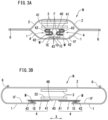
FIG. 3A is a plan view of the unused worn article, andFIG. 3B is a plan view of the worn article being used. Note that whileFIG. 3A is the same view asFIG. 1A andFIG. 3B is the same view asFIG. 4A , the views are arranged one on top of the other so that it is easy to see differences between when unused and when being used. -
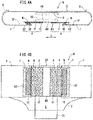
FIG. 4A is a plan view of the same when being used, andFIG. 4B is a front view thereof. -
FIG. 5A is a plan view of the worn article where the around-torso size is reduced, andFIG. 5B is a front view thereof. -
FIG. 6 is a layout diagram showing an example of an equipment for manufacturing a worn article. -
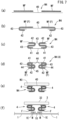
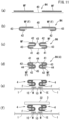
FIG. 7 is a step-by-step view showing a method for manufacturing a worn article including flaps. -
FIG. 8 is a plan view showing a method for manufacturing a crotch member. -
FIG. 9 is a plan view showing a method for manufacturing a worn article. -
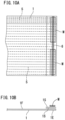
FIG. 10A and FIG. 10B show a part of a front panel according to another embodiment of the worn article of the present invention, whereinFIG. 10A is a front view of a front panel and a male touch fastener as viewed from the skin-contact side andFIG. 10B is a bottom view thereof. -
FIG. 11 is a step-by-step view showing another method for manufacturing a worn article including a flap. -
FIG. 12 is a layout diagram showing another example of an equipment for manufacturing the worn article including a flap. - In
FIG. 1A to FIG. 5B , the welded portion (side seal portion) between the front panel and the back panel is shown in gray. InFIG. 8 andFIG. 9 , the female touch fastener is shown in gray. InFIG. 4B andFIG. 5B , the female touch fastener is shown in a geometric pattern, and inFIG. 4B ,FIG. 5B andFIG. 10A , the male touch fastener is shown in a dot pattern. - The present invention will be understood more clearly from the following description of preferred embodiments taken in conjunction with the accompanying drawings. Note however that the embodiments and the drawings are merely illustrative and should not be taken to define the scope of the present invention. The scope of the present invention shall be defined only by the appended claims. In the accompanying drawings, like reference numerals denote like components throughout the plurality of figures.
- One embodiment of the present invention will now be described with reference to the drawings.
-
FIG. 1A and FIG. 1B show a pants-type article in an unused state. As shown in these figures, a worn article N includes afront panel 1, aback panel 2 and acrotch member 3. - In a used state shown in
FIG. 4A and FIG. 4B , thefront panel 1 and theback panel 2 cover the torso of the wearer. On the other hand, thecrotch member 3 covers the crotch of the wearer, and connects between thefront panel 1 and theback panel 2 as shown inFIG. 2 . Thecrotch member 3 includes alongitudinal portion 30 that extends from acrotch portion 31 covering the crotch to afront torso portion 32 covering the front torso of the wearer. - As shown in
FIG. 2 , thefront panel 1 and theback panel 2 may be formed with a large number ofelastic members 5, extending in the around-torso direction, i.e., the left-right direction X, sandwiched between two sheets of non-woven fabric. On the other hand, thecrotch member 3 may have a structure with which an absorbent body (not shown) can be attached/detached to/from thecrotch member 3. - As shown in gray in
FIG. 1B , thefront panel 1 and theback panel 2 ofFIG. 1A are welded to each other along aside seal portion 6 at the side edge so as to be continuous with each other. On the other hand, thefront panel 1 includes aseparation portion 10. With theseparation portion 10, thefront panel 1 is separated or separable into left and right parts. In the case of the present embodiment, thefront panel 1 is cut along the longitudinal direction (direction orthogonal to the left-right direction) at the center in the left-right direction X. - The
separation portion 10 may be formed by perforations or thermally-deteriorated fragile portions so that thefront panel 1 is continuous in the left-right direction when unused and is separable by being torn when in use. Theseparation portion 10 may be separated in the left-right direction in advance when unused. - As shown in
FIG. 4A and FIG. 4B , a pair offlaps crotch member 3 that opposes thefront panel 1. In the present embodiment, the pair offlaps flap body 40 separate from thecrotch member 3, theflap body 40 being attached to thefront torso portion 32 of thelongitudinal portion 30. Note that theflaps crotch member 3. - The left and
right flaps 4 ofFIG. 4A each include aproximal end portion 41 attached to thefront torso portion 32 of thelongitudinal portion 30 and aprotruding end portion 42 protruding in the left-right direction X from thefront torso portion 32. A female touch fastener (an example of the first touch fastener) F is provided on the non-skin-contact side 4B extending from theproximal end portion 41 to theprotruding end portion 42 of each flap. - On the other hand, a male touch fastener (an example of the second touch fastener) M is provided on the skin-
contact side 1F ofseparation end portions 1E of the left and rightfront panels 1 ofFIG. 4A . The male touch fasteners M engage with the female touch fasteners F. The pair of left and rightseparation end portions separation portion 10 interposed therebetween. - In the present invention, "skin-contact side" refers to the side opposing the skin of the wearer, and "non-skin-contact side" refers to the side opposite to the skin-contact side.
- The male touch fasteners M of
FIG. 1A are separated from each other with theseparation portion 10 interposed therebetween, and engage/disengage with/from the female touch fasteners F so that thefront panel 1 can be re-fastened to thecrotch member 3 as shown inFIG. 5A andFIG. 3B . Note that the male touch fasteners M do not always need to be separated in advance as long as the male touch fasteners M are provided on both of theseparation end portions separation portion 10 with theseparation portion 10 interposed therebetween. - As will be described below, the present worn article N is used as its form is changed from the unused folded state of
FIG. 3A to the worn state ofFIG. 3B . - In the unused folded state of
FIG. 3A , theflaps 4 are folded so that theprotruding end portions 42 thereof engage with the male touch fasteners M with the female touch fasteners F therebetween, and at least portions of theproximal end portions 41 thereof are hidden by at least portions of theprotruding end portions 42. Note that it is only required that theprotruding end portions 42 be folded so as to come closer to theproximal end portions 41. On the other hand, as shown inFIG. 4A , theflaps 4 are configured to be developed so that the female touch fasteners F of theprotruding end portions 42 can oppose the male touch fasteners M and engage with the male touch fasteners M. - In the unused state of
FIG. 3A , theflaps 4 may be folded in a Z-letter shape or S-letter shape with two foldedportions 43, as in the case of this example. In this state, the male touch fasteners M engage with the female touch fasteners F of theprotruding end portions 42. - As shown in
FIG. 3B , when being used by a wearer having a large waist size, each male touch fastener M engages with the female touch fastener F in theprotruding end portion 42 of theflap 4. On the other hand, as shown inFIG. 5B and FIG. 5A , when being used by a wearer having a small waist size, each male touch fastener M engages with the female touch fastener F in theproximal end portion 41 of theflap 4. - Thus, with the worn article N of the present embodiment, the male touch fastener M engages with the female touch fastener F whether the waist size of the wearer is large or small. Therefore, it is possible to obtain a sufficient engagement force by touch fasteners after size adjustment.
- Next, prior to the description of the overall manufacturing method for manufacturing the worn article N, a method for manufacturing the
crotch member 3 ofFIG. 7 andFIG. 8 will be described. - Female touch fastener members WF and flap members W4, attached together, of
FIG. 7(a) are supplied in the continuous direction to afirst folder device 61 ofFIG. 6 . As shown inFIG. 7(b) , thefirst folder device 61 folds the end portions of the female touch fastener members WF and the flap members W4 at the first foldedportions 43 in such a direction that the flap members W4 face (oppose) each other. Then, as shown inFIG. 7(c) , a second folder device 62 (FIG. 6 ) folds the female touch fastener members WF and the flap members W4 at the second foldedportions 43 in such a direction that the female touch fastener members WF face (oppose) each other. - Thus, the flap member W4 to which the female touch fastener members WF are attached is folded in left-right symmetry so that one end portion is folded in a Z-letter shape and the other end portion in an inverted Z-letter shape. As shown in
FIG. 8 , these folding steps are performed while the female touch fastener member WF and the flap member W4 are a continuous body that is continuous in the conveyance direction. - That is, as shown in
FIG. 7(c) , in these folding steps, the flap members W4 to be theflaps 4 are folded so that theproximal end portions 41 of the pair offlaps 4 described above are hidden by theprotruding end portions 42 and so that the female touch fasteners F are exposed in theprotruding end portions 42. Thus, the female touch fastener members WF to be the female touch fasteners F are folded together with the flap members W4 to be theflap bodies 40. - After the folding, a tentative fastening step may be performed. In the tentative fastening step, a portion of the female touch fastener F of
FIG. 7(d) may be welded by awelding roll 63 ofFIG. 6 so that theproximal end portion 41 and theprotruding end portion 42 are mildly attached together with amiddle portion 45 therebetween at thetentative fastening portion 44. - After the tentative fastening step, the flap member W4 of
FIG. 8 is severed by acutter roll 64 ofFIG. 6 into individual units of worn articles, which are then arranged on a crotch continuous body W3 to be thecrotch member 3 ofFIG. 8 by a cut-and-slip method well known in the art. - The crotch continuous body W3 of
FIG. 6 is severed by acutter 65 into individual units ofcrotch members 3, and the attitude of eachcrotch member 3 is changed by 90° by are-pitch turn drum 66 as shown inFIG. 8 . Thus, as shown inFIG. 7(e) , theflaps crotch member 3. - Next, the overall manufacturing method for manufacturing the worn article N will be described with reference to
FIG. 6 andFIG. 9 . - As shown in
FIG. 9 , a rear continuous body W2 to be theback panel 2 is conveyed in such a manner that the around-torso direction is the conveyance direction, and a front continuous body W1 to be thefront panel 1 is conveyed in such a manner that the around-torso direction is the conveyance direction. These are conveyed in parallel to each other, and thecrotch member 3 is provided so as to bridge between the rear continuous body W2 and the front continuous body W1 being conveyed. A pair of male touch fasteners M are bonded, for each unit of the worn article N, to the front continuous body W1 to be thefront panel 1. - These steps are ordinary steps, and the bridging step is performed by the
re-pitch turn drum 66 and avacuum drum 67 ofFIG. 6 . In this bridging step, thecrotch member 3 ofFIG. 9 is provided so as to bridge between the front continuous body W1 and the rear continuous body W2 while the female touch fastener F (first touch fastener) ofFIG. 7(f) is exposed and so that a pair of male touch fasteners M (second touch fasteners) arranged on the front continuous body W1 engage with the female touch fastener F. - Here, before the
crotch member 3 is provided so as to bridge between the front continuous body W1 and the rear continuous body W2, afront portion cutter 68 being in contact with thevacuum drum 67 ofFIG. 6 severs the front continuous body W1 as shown inFIG. 9 so as to form theseparation portion 10 for eachfront panel 1. Thus, thecrotch member 3 and theflap 4 are arranged on the front continuous body W1 with theseparation portion 10 ofFIG. 7(f) formed therein. - In this process, the pair of
crotch members 3 and theflaps 4 ofFIG. 7(f) are arranged so as to bridge theseparation portion 10. That is, the female touch fastener F of oneflap 4 and the female touch fastener F of theother flap 4 are arranged so as to be apart from each other with theseparation portion 10 interposed therebetween. - In this arrangement process, the pair of female touch fasteners F, F of the
crotch member 3 are pressed against facing the pair of male touch fasteners M, M of thefront panel 1. Therefore, the pair of female touch fasteners F, F engage with the pair of male touch fasteners M, M. - Thus, the
crotch member 3 is detachably fixed to thefront panel 1 via male and female fasteners. On the other hand, thefront panel 1, which is separated by theseparation portion 10, is fixed to thecrotch member 3 without inadvertently moving in the around-torso direction. - After the arrangement of the
crotch member 3 ofFIG. 9 , thecrotch member 3 is folded in two so that thefront panel 1 is laid on theback panel 2, thefront panel 1 and theback panel 2 are further welded together at theside seal portion 6, and then severed into units of worn articles N. - Next, another embodiment of the structure of the front panel will be described with reference to
FIG. 10A and FIG. 10B . - As shown in
FIG. 10A and FIG. 10B , a reinforcement strip 1S is provided between thefront panel 1 and the male touch fastener M in theseparation end portion 1E of thefront panel 1 ofFIG. 10B close to the separation portion 10 (seeFIG. 1A ). - This reinforcement strip 1S is provided in an area that is larger than the male touch fastener M, and the male touch fastener M is provided in the area where the reinforcement strip 1S is provided.
- The reinforcement strip 1S may include two strips of non-woven fabric layered on each other, for example.
- Next, another method for manufacturing a worn article including flaps will be described with reference to
FIG. 11 . - In the method for manufacturing a worn article shown in
FIG. 11, (a) to (d) are the same as the method shown inFIG. 7 , and the manufacturing procedures of (e) and (f) differ from the method shown inFIG. 7 . - That is, in
FIGS. 7(e) and 7(f) , the crotch continuous body W3 is layered on the flap member W4, and then thecrotch member 3 is laid on thefront panel 1. In contrast, inFIGS. 11(e) and 11(f) , theflaps 4 are laid on a precursor member to be thefront panel 1 so that the female touch fastener F engages on the male touch fastener M of thefront panel 1, and then thecrotch member 3 is laid on theflaps 4. - Next, another method for manufacturing the worn article N will be described briefly with reference to
FIG. 12 . - In
FIG. 12 , after the flap member W4 (FIG. 11(a) ) is shaped by thefirst folder device 61, thesecond folder device 62 and thewelding roll 63, the flap member W4 is cut by acutter roll 75 into flaps of units of individual worn articles by a cut-and-slip method well known in the art, and then supplied to are-pitch turn drum 76. - The produced flaps 4 (
FIG. 11(e) ) are arranged on the front continuous body W1 on thevacuum drum 67. Then, after the front continuous body W1 is attached to the rear continuous body W2, the front continuous body W1 is supplied to adrum 87 ofFIG. 12 . On the other hand, the crotch member 3 (FIG. 11(0), which is obtained by severing the crotch continuous body W3 by acutter 85, is supplied onto are-pitch turn drum 86, and then attached to theflap 4 on thedrum 87 as shown inFIG. 11(f) . - Other methods of the present manufacturing method are similar to those shown in
FIG. 6 andFIG. 7 , and will not be further described below. - Next, technical concepts that can be grasped from the embodiment described above will be described together with their effects.
- In a preferred worn article, tentative fastening for maintaining the unused folded state of the
flaps 4 is provided on theflaps 4. - In such a case, the folded state of the flaps is maintained until the product reaches consumers.
- For example, the tentative fastening may be a bonded portions where materials forming the
flaps 4 are bonded by a tentative fastening agent or welded portions where the materials are welded. - Preferably, each female touch fastener F (first touch fastener) is provided so as to extend from the
proximal end portion 41 to theprotruding end portion 42. - In such a case, the male touch fastener M (second touch fastener) can be fastened at any appropriate position ranging from the
proximal end portion 41 to theprotruding end portion 42 of theflaps 4, thereby facilitating size adjustment. - More preferably, in the unused state, the
flaps 4 are folded in a Z-letter shape having two foldedportions 43, and the male touch fastener M engages with the female touch fastener F of theprotruding end portion 42. - The
flaps 4 folded in a Z-letter shape significantly expand when developed. - Preferably, the
crotch member 3 includes thelongitudinal portion 30 extending from thecrotch portion 31 covering the crotch to thefront torso portion 32 covering the front torso of the wearer, and the pair offlaps 4; and
theproximal end portions 41 of the pair offlaps 4 are attached to thefront torso portion 32, and theprotruding end portions 42 protrude in the left-right direction X from thefront torso portion 32. - The flaps protruding in the left-right direction X from the front torso portion increase the around-torso size to which adjustment can be made.
- In such a case, the pair of
flaps 4 include oneflap body 40 attached to thefront torso portion 32, and the female touch fasteners F, wherein the female touch fasteners F may be provided on the non-skin-contact side 4B of theflap body 40. - Preferably, the reinforcement strip 1S is provided between the
front panel 1 and the male touch fastener M in theseparation end portion 1E of thefront panel 1 that is close to theseparation portion 10. - This increases the thickness of the
separation end portion 1E and increases the rigidity of theseparation end portion 1E, thereby preventing theflap 4 from inadvertently folding to theseparation end portion 1E at the time of attachment, and improving the appearance. As the thickness of theseparation end portion 1E increases, the rigidity of theseparation end portion 1E increases and it is possible to more firmly attach the male touch fastener M to theflap 4. - Preferably, the reinforcement strip 1S is provided in an area larger than the male touch fastener M, and the male touch fastener M is arranged in the area where the reinforcement strip 1S is provided.
- Stress localization is likely to occur if the male touch fastener M is attached directly to the
front panel 1. However, since the male touch fastener M is arranged in the area of the reinforcement strip 1S, stress localization is unlikely to occur and it is possible to prevent theflap 4 from inadvertently folding. - A manufacturing method may further include the step of forming the
separation portion 10 for each worn article on the front continuous body W1 to be the precursor member. - Preferably, the front continuous body W1 is severed along a virtual cut-off line perpendicular to an around-torso direction at the center in the around-torso direction of the
front panel 1, thereby forming theseparation portion 10. - With the
separation portion 10 obtained by severing thefront panel 1 in advance, it is easy to open up thefront panel 1 when wearing. - Preferably, the
crotch member 3 includes thelongitudinal portion 30 extending from thecrotch portion 31 covering the crotch to thefront torso portion 32 covering the front torso of the wearer, and the pair offlaps 4, wherein the pair offlaps 4 include a pair of female touch fasteners F arranged on oneflap body 40 being continuous with each other in the around-torso direction; and
the folding step is performed by folding the female touch fastener F together with theflap body 40. - With the female touch fastener F layered on the
flap body 40, it is possible to obtain a sufficient rigidity for theflap 4. - Preferably, the
crotch member 3 is provided so as to bridge between the precursor member and the rear continuous body W2 in the bridging step while the female touch fastener F is exposed and so that the pair of male touch fasteners M arranged on the precursor member engage with the female touch fastener F. - In such a case, what is obtained by layering together the crotch continuous body W3 and the flap member W4 is cut into units of individual worn articles (the crotch members 3), which are provided so as to bridge between the
front panel 1 and theback panel 2, and it can therefore be done with a single re-pitch turn step (re-pitch turn drum), thus enabling reduction in the equipment cost. - Preferably, the engagement step is performed prior to the bridging step, and the
crotch member 3 is provided so as to bridge between theflap 4 and the rear continuous body W2 in the bridging step. - In such a case, the female touch fastener F of the
flap 4, which is not bonded to thecrotch member 3, is fastened to the male touch fastener M. Therefore, members to be fastened together do not include a thick part such as a core, making the fastening easier. This as a result increases the reproducibility of the fastened state and decreases the variations of the fastened state, improving the reliability of the fastening. - Any feature illustrated and/or depicted in conjunction with one embodiment or preferred embodiments may be used in the same or similar form in one or more of the other embodiments, and/or may be used in combination with, or in place of, the other embodiments.
- While preferred embodiments have been described above with reference to the drawings, obvious variations and modifications will readily occur to those skilled in the art upon reading the present specification.
- For example, the male touch fastener may be provided on the flap, and the female touch fastener on the front panel.
- The flap may be continuous with the crotch member.
- Thus, such variations and modifications shall fall within the scope of the present invention as defined by the appended claims.
- The present invention is applicable to a reclosable pants-type disposable worn article and a method for manufacturing the same.
-
- 1: Front panel, 1E: Separation end portion, 1F: Skin-contact side, 1S: Reinforcement strip, 10: Separation portion
- 2: Back panel
- 3: Crotch member, 30: Longitudinal portion, 31: Crotch portion, 32: Front torso portion
- 4: Flap, 4B: Non-skin-contact side, 40: Flap body, 41: Proximal end portion, 42: Protruding end portion, 43: Folded portion, 44: Tentative fastening portion, 45: Middle portion
- 5: Elastic member
- 6: Side seal portion, 61: First folder device, 62: Second folder device, 63: Welding roll
- 64: Cutter roll, 65: Cutter, 66: Re-pitch turn drum, 67: Vacuum drum, 68: Front portion cutter, 75: Cutter roll, 76: Re-pitch turn drum
- 85: Cutter, 86: Re-pitch turn drum, 87: Drum
- F: First touch fastener (female touch fastener), M: Second touch fastener (male touch fastener)
- N: Worn article
- X: Left-right direction
- W1: Front continuous body (an example of precursor member), W2: Rear continuous body, W3: Crotch continuous body, W4: Flap member, WF: Female touch fastener member
Claims (15)
- A reclosable pants-type disposable worn article comprising:a front panel 1 and a back panel 2 covering a torso of a wearer;a crotch member 3 covering crotch of the wearer and connecting between the front panel 1 and the back panel 2;a separation portion 10 formed on the front panel 1, thereby making the front panel 1 separated or separable into left and right parts;a pair of flaps 4 provided in an area of the crotch member 3, the pair of flaps 4 opposing the front panel 1 and each extending in a left-right direction X from a proximal end portion 41 to a protruding end portion 42;a pair of left and right first touch fasteners F,the left first touch fastener F provided on at least a non-skin-contact side 4B of the protruding end portion 42 of one of the pair of flaps 4,the right first touch fastener F provided on at least the non-skin-contact side 4B of the protruding end portion 42 of another one of the pair of flaps 4; anda pair of second touch fasteners M provided on a skin-contact side 1F of the front panel 1 and engaging with the pair of first touch fasteners F, thereby allowing the front panel 1 to be re-fastened to the crotch member 3, wherein:the separation portion 10 is interposed between the pair of second touch fasteners M;one of the pair of second touch fasteners M is provided on a left side of the separation portion 10;another one of the pair of second touch fasteners M is provided on a right side of the separation portion 10; andwhile in an unused folded state of the worn article, the flaps 4 are engaged with the second touch fasteners M in the protruding end portions 42 via the first touch fasteners F, and the flaps 4 are folded so that the protruding end portions 42 come closer to the respective proximal end portions 41; andwhile in a worn state in which the worn article is used, the flaps 4 are capable of being developed so that the first touch fasteners F of the protruding end portions 42 are capable of opposing and engaging with the second touch fasteners M.
- The worn article according to claim 1, wherein tentative fastening for maintaining the unused folded state of the flaps 4 is provided on the flaps 4.
- The worn article according to claim 2, wherein the tentative fastening is a bonded portion where a material forming the flaps 4 is bonded by a tentative fastening agent or a welded portion where the material is welded.
- The worn article according to claim 1, wherein the first touch fasteners F are each provided extending from the proximal end portion 41 to the protruding end portion 42.
- The worn article according to claim 4, wherein in the unused state, the flaps 4 each are folded in a Z-letter shape having two folded portions 43, and the second touch fasteners M engage with the first touch fasteners F of the protruding end portions 42.
- The worn article according to claim 2, wherein:the crotch member 3 includes a longitudinal portion 30 extending from a crotch portion 31 covering the crotch to a front torso portion 32 covering a front torso of the wearer, and the pair of flaps 4; andthe proximal end portions 41 of the pair of flaps 4 are attached to the front torso portion 32, and the protruding end portions 42 protrude in the left-right direction X from the front torso portion 32.
- The worn article according to claim 6, wherein the pair of flaps 4 include one flap body 40 attached to the front torso portion 32, and the first touch fasteners F, wherein the first touch fasteners F are provided on the non-skin-contact side 4B of the flap body 40.
- A method for manufacturing a reclosable pants-type disposable worn article, wherein the worn article includes:a front panel 1 and a back panel 2 covering a torso of a wearer;a crotch member 3 covering crotch of the wearer and connecting between the front panel 1 and the back panel 2;a separation portion 10 formed on the front panel 1, thereby making the front panel 1 separated or separable into left and right parts;a pair of flaps 4 provided in an area of the crotch member 3, the pair of flaps 4 opposing the front panel 1 and each extending in a left-right direction X from a proximal end portion 41 to a protruding end portion 42;a pair of left and right first touch fasteners F,the left first touch fastener F provided on at least a non-skin-contact side 4B of the protruding end portion 42 of one of the pair of flaps 4,the right first touch fastener F provided on at least the non-skin-contact side 4B of the protruding end portion 42 of another one of the pair of flaps 4; anda pair of second touch fasteners M provided on a skin-contact side 1F of the front panel 1 and engaging with the pair of first touch fasteners F, thereby allowing the front panel 1 to be re-fastened to the crotch member 3, wherein:the separation portion 10 is interposed between the pair of second touch fasteners M;one of the pair of second touch fasteners M is provided on a left side of the separation portion 10;another one of the pair of second touch fasteners M is provided on a right side of the separation portion 10; andthe method for manufacturing the worn article comprises:a step of conveying a rear continuous body W2 to be the back panel 2 in such a manner that an around-torso direction is a conveyance direction;a step of conveying a precursor member to be the front panel 1 in such a manner that an around-torso direction is the conveyance direction;a bridging step of providing the crotch member 3 so as to bridge between the rear continuous body W2 and the precursor member being conveyed;a step of, prior to the bridging step, folding a flap member W4 to be the flaps 4 so that the protruding end portions 42 of the pair of flaps 4 come closer to the respective proximal end portions 41 and so that the first touch fasteners F are exposed in the protruding end portions 42; andan engagement step of, while the first touch fasteners F are exposed, engaging the pair of second touch fasteners M arranged on the precursor member with the first touch fasteners F.
- The manufacturing method according to claim 8, further comprising the step of forming the separation portion 10 for each worn article on a front continuous body W1 to be the precursor member.
- The manufacturing method according to claim 9, wherein the separation portion 10 is formed by severing the front continuous body W1 along a virtual cut-off line perpendicular to the around-torso direction at a center in the around-torso direction of an area corresponding to the front panel 1.
- The manufacturing method according to claim 8, wherein:the crotch member 3 includes a longitudinal portion 30 extending from a crotch portion 31 covering the crotch to a front torso portion 32 covering a front torso of the wearer, and the pair of flaps 4,wherein the pair of flaps 4 include the pair of first touch fasteners F arranged on one flap body 40 being continuous with the flaps in the around-torso direction; andthe folding step is performed by folding the first touch fasteners F together with the flap body 40.
- The manufacturing method according to any one of claims 8 to 11, wherein the crotch member 3 is provided so as to bridge between the precursor member and the rear continuous body W2 in the bridging step while the first touch fasteners F are exposed and so that the pair of second touch fasteners M arranged on the precursor member engage with the first touch fasteners F.
- The manufacturing method according to any one of claims 8 to 11, wherein the engagement step is performed prior to the bridging step, and
the crotch member 3 is provided so as to bridge between the corresponding flap 4 and the rear continuous body W2 in the bridging step. - The manufacturing method according to any one of claims 1 to 6, wherein a reinforcement strip 1S is provided between the front panel 1 and each of the second touch fasteners M in a separation end portion 1E of the front panel 1 that is close to the separation portion 10.
- The manufacturing method according to claim 14, wherein the reinforcement strip 1S is provided in an area larger than the respective second touch fasteners M, and each of the second touch fasteners M is arranged within the area where the reinforcement strip 1S is provided.
Applications Claiming Priority (2)
| Application Number | Priority Date | Filing Date | Title |
|---|---|---|---|
| JP2020079873 | 2020-04-29 | ||
| PCT/JP2021/016007 WO2021220878A1 (en) | 2020-04-29 | 2021-04-20 | Recloseable underwear-type disposable article for wearing and manufacturing method therefor |
Publications (3)
| Publication Number | Publication Date |
|---|---|
| EP4144330A1 true EP4144330A1 (en) | 2023-03-08 |
| EP4144330A4 EP4144330A4 (en) | 2023-09-20 |
| EP4144330B1 EP4144330B1 (en) | 2026-04-29 |
Family
ID=78373546
Family Applications (1)
| Application Number | Title | Priority Date | Filing Date |
|---|---|---|---|
| EP21797473.2A Active EP4144330B1 (en) | 2020-04-29 | 2021-04-20 | Recloseable underwear-type disposable article for wearing and manufacturing method therefor |
Country Status (5)
| Country | Link |
|---|---|
| US (1) | US12582563B2 (en) |
| EP (1) | EP4144330B1 (en) |
| JP (1) | JP7397177B2 (en) |
| CN (1) | CN115379820B (en) |
| WO (1) | WO2021220878A1 (en) |
Families Citing this family (1)
| Publication number | Priority date | Publication date | Assignee | Title |
|---|---|---|---|---|
| JP2025519753A (en) | 2022-06-30 | 2025-06-26 | ザ プロクター アンド ギャンブル カンパニー | ABSORBENT ARTICLE HAVING ABSORBENT CHASSIS AND BELT ELASTIC STRUCTURES AND WEAK PATHS - Patent application |
Family Cites Families (13)
| Publication number | Priority date | Publication date | Assignee | Title |
|---|---|---|---|---|
| US2477914A (en) * | 1948-04-06 | 1949-08-02 | Robert O Webb | Pinless adjustable diaper |
| DE19813334B4 (en) * | 1998-03-26 | 2007-09-06 | Paul Hartmann Ag | Diapers or incontinence briefs and methods of making the same |
| US20020123730A1 (en) * | 2001-03-05 | 2002-09-05 | Popp Robert Lee | Tucked fastener for improved fastener performance |
| US20030088223A1 (en) * | 2001-04-13 | 2003-05-08 | Kimberly-Clark Worldwide, Inc. | Passive bonds for personal care article |
| JP4574548B2 (en) | 2002-10-24 | 2010-11-04 | 株式会社瑞光 | Disposable wearing article and method of manufacturing the same |
| JP4566730B2 (en) * | 2004-12-24 | 2010-10-20 | 株式会社瑞光 | Disposable diapers |
| JP5282020B2 (en) * | 2009-12-10 | 2013-09-04 | 王子ネピア株式会社 | Tape type disposable diaper |
| CN102811687B (en) * | 2010-07-12 | 2014-08-13 | 株式会社瑞光 | Bale structure of disposable diapers and its manufacturing and folding method |
| BR112013007607B1 (en) * | 2010-11-16 | 2020-05-26 | Zuiko Corporation | METHOD AND APPARATUS TO MAKE DISPOSABLE CLOTHING ARTICLE |
| JP6044790B2 (en) * | 2011-01-13 | 2016-12-14 | ファメッカニカ.データ エス.ピー.エー. | Training pants manufacturing method and training pants |
| JP6013331B2 (en) | 2011-06-23 | 2016-10-25 | 株式会社瑞光 | Method for manufacturing worn article |
| US20140114272A1 (en) * | 2012-10-24 | 2014-04-24 | Kimberly-Clark Worldwide, Inc. | Method And Apparatus For Forming An Adjustable Pant-Like Disposable Undergarment With Fully Severed Front Panel With Line Of Weakness |
| JP2014226144A (en) * | 2013-05-17 | 2014-12-08 | 株式会社リブドゥコーポレーション | Disposable diaper |
-
2021
- 2021-04-20 EP EP21797473.2A patent/EP4144330B1/en active Active
- 2021-04-20 CN CN202180025542.2A patent/CN115379820B/en active Active
- 2021-04-20 JP JP2022517654A patent/JP7397177B2/en active Active
- 2021-04-20 US US17/917,960 patent/US12582563B2/en active Active
- 2021-04-20 WO PCT/JP2021/016007 patent/WO2021220878A1/en not_active Ceased
Also Published As
| Publication number | Publication date |
|---|---|
| CN115379820B (en) | 2023-08-08 |
| JP7397177B2 (en) | 2023-12-12 |
| EP4144330A4 (en) | 2023-09-20 |
| EP4144330B1 (en) | 2026-04-29 |
| WO2021220878A1 (en) | 2021-11-04 |
| JPWO2021220878A1 (en) | 2021-11-04 |
| US12582563B2 (en) | 2026-03-24 |
| US20230127980A1 (en) | 2023-04-27 |
| CN115379820A (en) | 2022-11-22 |
Similar Documents
| Publication | Publication Date | Title |
|---|---|---|
| JP4694569B2 (en) | Diaper manufacturing method | |
| EP1698313B1 (en) | Wearing article and method of manufacturing the same | |
| US9132041B2 (en) | Disposable worn article in pants form with cut-outs and method for manufacturing same | |
| CN103189027B (en) | Manufacturing method and manufacturing device of disposable wearable article | |
| EP3103425B1 (en) | Method for manufacturing disposable wear | |
| WO2006068081A1 (en) | Method of manufacturing disposable wearing article | |
| US12582563B2 (en) | Reclosable underwear-type disposable article for wearing and manufacturing method therefor | |
| US8382928B2 (en) | Method for manufacturing pants-type diaper | |
| CN101466337B (en) | Disposable wearable article manufacturing method | |
| JP2006526461A (en) | Method for manufacturing a closed part suitable for use in a diaper | |
| EP3162331B1 (en) | Method for producing disposable wearable article | |
| EP4098234B1 (en) | Method and device for manufacturing waist part of wearable article | |
| EP3162333B1 (en) | Method for producing disposable wearable article | |
| JP3401627B2 (en) | Absorbent product and method for producing the same | |
| CN223759998U (en) | A type of shorts-style clothing item | |
| EP4166120B1 (en) | Method for producing cuffs for wearable article | |
| CN106413646A (en) | Method for manufacturing disposable wearable article | |
| HK1017601A (en) | Method of producing reclosable absorbent garments and absorbent garments obtained thereby |
Legal Events
| Date | Code | Title | Description |
|---|---|---|---|
| STAA | Information on the status of an ep patent application or granted ep patent |
Free format text: STATUS: THE INTERNATIONAL PUBLICATION HAS BEEN MADE |
|
| PUAI | Public reference made under article 153(3) epc to a published international application that has entered the european phase |
Free format text: ORIGINAL CODE: 0009012 |
|
| STAA | Information on the status of an ep patent application or granted ep patent |
Free format text: STATUS: REQUEST FOR EXAMINATION WAS MADE |
|
| 17P | Request for examination filed |
Effective date: 20221013 |
|
| AK | Designated contracting states |
Kind code of ref document: A1 Designated state(s): AL AT BE BG CH CY CZ DE DK EE ES FI FR GB GR HR HU IE IS IT LI LT LU LV MC MK MT NL NO PL PT RO RS SE SI SK SM TR |
|
| DAV | Request for validation of the european patent (deleted) | ||
| DAX | Request for extension of the european patent (deleted) | ||
| A4 | Supplementary search report drawn up and despatched |
Effective date: 20230822 |
|
| RIC1 | Information provided on ipc code assigned before grant |
Ipc: A61F 13/62 20060101ALI20230816BHEP Ipc: A61F 13/56 20060101ALI20230816BHEP Ipc: A61F 13/496 20060101ALI20230816BHEP Ipc: A61F 13/493 20060101ALI20230816BHEP Ipc: A61F 13/15 20060101AFI20230816BHEP |
|
| STAA | Information on the status of an ep patent application or granted ep patent |
Free format text: STATUS: EXAMINATION IS IN PROGRESS |
|
| 17Q | First examination report despatched |
Effective date: 20241106 |
|
| GRAP | Despatch of communication of intention to grant a patent |
Free format text: ORIGINAL CODE: EPIDOSNIGR1 |
|
| STAA | Information on the status of an ep patent application or granted ep patent |
Free format text: STATUS: GRANT OF PATENT IS INTENDED |
|
| INTG | Intention to grant announced |
Effective date: 20251126 |
|
| GRAS | Grant fee paid |
Free format text: ORIGINAL CODE: EPIDOSNIGR3 |
|
| GRAA | (expected) grant |
Free format text: ORIGINAL CODE: 0009210 |
|
| STAA | Information on the status of an ep patent application or granted ep patent |
Free format text: STATUS: THE PATENT HAS BEEN GRANTED |
|
| AK | Designated contracting states |
Kind code of ref document: B1 Designated state(s): AL AT BE BG CH CY CZ DE DK EE ES FI FR GB GR HR HU IE IS IT LI LT LU LV MC MK MT NL NO PL PT RO RS SE SI SK SM TR |
|
| REG | Reference to a national code |
Ref country code: CH Ref legal event code: F10 Free format text: ST27 STATUS EVENT CODE: U-0-0-F10-F00 (AS PROVIDED BY THE NATIONAL OFFICE) Effective date: 20260429 Ref country code: GB Ref legal event code: FG4D |