EP4144147B1 - Nachrichtenpriorisierung in einem direktzugriffsverfahren - Google Patents
Nachrichtenpriorisierung in einem direktzugriffsverfahren Download PDFInfo
- Publication number
- EP4144147B1 EP4144147B1 EP21722435.1A EP21722435A EP4144147B1 EP 4144147 B1 EP4144147 B1 EP 4144147B1 EP 21722435 A EP21722435 A EP 21722435A EP 4144147 B1 EP4144147 B1 EP 4144147B1
- Authority
- EP
- European Patent Office
- Prior art keywords
- pusch
- transmit power
- random access
- transmission
- priority
- Prior art date
- Legal status (The legal status is an assumption and is not a legal conclusion. Google has not performed a legal analysis and makes no representation as to the accuracy of the status listed.)
- Active
Links
Images




Classifications
-
- H—ELECTRICITY
- H04—ELECTRIC COMMUNICATION TECHNIQUE
- H04W—WIRELESS COMMUNICATION NETWORKS
- H04W74/00—Wireless channel access
- H04W74/08—Non-scheduled access, e.g. ALOHA
- H04W74/0866—Non-scheduled access, e.g. ALOHA using a dedicated channel for access
- H04W74/0875—Non-scheduled access, e.g. ALOHA using a dedicated channel for access with assigned priorities based access
-
- H—ELECTRICITY
- H04—ELECTRIC COMMUNICATION TECHNIQUE
- H04W—WIRELESS COMMUNICATION NETWORKS
- H04W74/00—Wireless channel access
- H04W74/002—Transmission of channel access control information
-
- H—ELECTRICITY
- H04—ELECTRIC COMMUNICATION TECHNIQUE
- H04W—WIRELESS COMMUNICATION NETWORKS
- H04W52/00—Power management, e.g. Transmission Power Control [TPC] or power classes
- H04W52/04—Transmission power control [TPC]
- H04W52/06—TPC algorithms
- H04W52/08—Closed loop power control
-
- H—ELECTRICITY
- H04—ELECTRIC COMMUNICATION TECHNIQUE
- H04W—WIRELESS COMMUNICATION NETWORKS
- H04W52/00—Power management, e.g. Transmission Power Control [TPC] or power classes
- H04W52/04—Transmission power control [TPC]
- H04W52/18—TPC being performed according to specific parameters
- H04W52/28—TPC being performed according to specific parameters using user profile, e.g. mobile speed, priority or network state, e.g. standby, idle or non-transmission
- H04W52/281—TPC being performed according to specific parameters using user profile, e.g. mobile speed, priority or network state, e.g. standby, idle or non-transmission taking into account user or data type priority
-
- H—ELECTRICITY
- H04—ELECTRIC COMMUNICATION TECHNIQUE
- H04W—WIRELESS COMMUNICATION NETWORKS
- H04W52/00—Power management, e.g. Transmission Power Control [TPC] or power classes
- H04W52/04—Transmission power control [TPC]
- H04W52/30—Transmission power control [TPC] using constraints in the total amount of available transmission power
- H04W52/32—TPC of broadcast or control channels
- H04W52/325—Power control of control or pilot channels
-
- H—ELECTRICITY
- H04—ELECTRIC COMMUNICATION TECHNIQUE
- H04W—WIRELESS COMMUNICATION NETWORKS
- H04W52/00—Power management, e.g. Transmission Power Control [TPC] or power classes
- H04W52/04—Transmission power control [TPC]
- H04W52/30—Transmission power control [TPC] using constraints in the total amount of available transmission power
- H04W52/36—Transmission power control [TPC] using constraints in the total amount of available transmission power with a discrete range or set of values, e.g. step size, ramping or offsets
- H04W52/362—Aspects of the step size
-
- H—ELECTRICITY
- H04—ELECTRIC COMMUNICATION TECHNIQUE
- H04W—WIRELESS COMMUNICATION NETWORKS
- H04W74/00—Wireless channel access
- H04W74/08—Non-scheduled access, e.g. ALOHA
- H04W74/0833—Random access procedures, e.g. with 4-step access
-
- H—ELECTRICITY
- H04—ELECTRIC COMMUNICATION TECHNIQUE
- H04W—WIRELESS COMMUNICATION NETWORKS
- H04W74/00—Wireless channel access
- H04W74/002—Transmission of channel access control information
- H04W74/006—Transmission of channel access control information in the downlink, i.e. towards the terminal
-
- H—ELECTRICITY
- H04—ELECTRIC COMMUNICATION TECHNIQUE
- H04W—WIRELESS COMMUNICATION NETWORKS
- H04W74/00—Wireless channel access
- H04W74/08—Non-scheduled access, e.g. ALOHA
- H04W74/0833—Random access procedures, e.g. with 4-step access
- H04W74/0836—Random access procedures, e.g. with 4-step access with 2-step access
-
- H—ELECTRICITY
- H04—ELECTRIC COMMUNICATION TECHNIQUE
- H04W—WIRELESS COMMUNICATION NETWORKS
- H04W74/00—Wireless channel access
- H04W74/08—Non-scheduled access, e.g. ALOHA
- H04W74/0833—Random access procedures, e.g. with 4-step access
- H04W74/0838—Random access procedures, e.g. with 4-step access using contention-free random access [CFRA]
Definitions
- Embodiments herein relate to prioritized messaging in connection with a random access procedure for mission critical or other prioritized services and devices.
- First responders such as fire-fighters, the police, and emergency medical service providers, often require fast, reliable and secure communications in various mission critical (MC) situations.
- MC mission critical
- first responders as well as other essential public safety service providers rely on the availability of MC network services to coordinate their operations. Therefore, cellular coverage can be essential.
- eMBB enhanced Mobile Broadband
- the coverage requirements for public safety communications are typically more strict (e.g., 99% of the population, 99% of landmass, 99.5% outdoor, 95% indoor, etc.).
- an MC device e.g., user equipment (UEs)
- RRC radio resource control
- UEs user equipment
- RRC radio resource control
- a mechanism is not available for adapting the random access procedure to ensure fast and reliable network connection establishment for MC devices. Accordingly, there remains a need for systems, methods, and devices for prioritization of certain communications, and in particular, for MC communications where a network is shared between MC devices and commercial devices.
- the invention provides a method for use in a device, the method comprising: receiving broadcast system information from a node indicating one or more priority transmission configurations for high priority devices; determining that the device is enabled for at least one of the priority transmission configurations based at least in part on the broadcasted system information and a status of the device, wherein the at least one priority transmission configuration indicates a transmit power for random access procedure physical uplink shared channel, PUSCH, transmissions by high priority devices; and sending a random access procedure PUSCH transmission using the transmit power indicated by the at least one priority transmission configuration.
- the invention provides a method for use in a device, the method comprising: receiving a grant message from a node indicating a first transmit power; and sending a random access procedure physical uplink shared channel, PUSCH, transmission to the node with the first transmit power, wherein the first transmit power is based at least in part on a high priority status of the device.
- the invention provides a computer program comprising instructions which when executed by processing circuitry of an apparatus causes the apparatus to perform the method of any one of claims 1-9 or claims 10-13.
- the invention provides a carrier containing the computer program of claim 14, wherein the carrier is one of an electronic signal, an optical signal, a radio signal, and a computer readable storage medium.
- the invention provides a device, the device being configured to: receive broadcast system information from a node indicating one or more priority transmission configurations for high priority devices; determine that the device is enabled for at least one of the priority transmission configurations based at least in part on the broadcasted system information and a status of the device, wherein the at least priority transmission configuration indicates a transmit power for random access procedure physical uplink shared channel, PUSCH, transmissions by high priority devices; and send a random access procedure PUSCH transmission using the transmit power indicated by the at least one priority transmission configuration.
- Preferred embodiments of the device of claim 16 are defined by claim 17.
- the invention provides a device, the device being configured to: receive a grant message from a node indicating a first transmit power; and send a random access procedure physical uplink shared channel, PUSCH, transmission to the node with the first transmit power, wherein the first transmit power is based at least in part on a high priority status of the device.
- Preferred embodiments of the device of claim 18 are defined by claim 19.
- certain messages may be the weakest uplink physical channel, thus limiting network coverage in a random access procedure.
- These messages could include, for example, physical uplink share channel (PUSCH) carrying Msg3 and/or MsgA. Therefore, it may be important to prioritize and improve the robustness of such messages (e.g., Msg3 and MsgA PUSCH transmissions) for MC devices.
- PUSCH physical uplink share channel
- a UE can apply differentiated random access procedure message transmission configurations depending on priority, such that transmissions from a high priority UE can be prioritized and received by the network node in a fast and reliable way. This could include, for instance, Msg3 or MsgA PUSCH transmissions.
- a UE Before a UE can properly communicate within a network, it typically must carry out a cell search to find, synchronize, and identify a cell. Then, it can acquire basic system information and perform random access procedures to establish a connection to the cell.
- SS synchronization signals
- PBCH physical broadcast channel
- SS/PBCH block Similar to LTE, a pair of SS, primary synchronization signal (PSS) and secondary synchronization signal (SSS), is periodically transmitted on downlink from each cell to allow a UE to initially access to the network.
- PSS primary synchronization signal
- SSS secondary synchronization signal
- a UE can obtain the physical cell identity, achieve downlink synchronization in both time and frequency, and acquire the timing for the physical broadcast channel (PBCH).
- PBCH carries the master information block (MIB), which contains minimum system information that a UE needs to acquire system information block 1 (SIB1).
- SIB1 carries the remaining minimum system information that is needed for a UE to be able to perform a subsequent random access procedure.
- Two types of random access procedures in NR are the 4-step and 2-step procedures. Aspects of this disclosure use the 4-step and s-step random access procedures as examples (including exemplary use of Msg3 and MsgA); however, embodiments can also be used for other random access procedures and for prioritization of other initial messaging for mission critical communications or other prioritized transmissions.
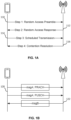
- a UE initiates the random access procedure by transmitting 110 in the uplink (UL) a random access preamble (Msg1 in this example) on a physical random access channel (PRACH).
- the node e.g., gNB
- RAR random access response
- PDSCH physical downlink share channel
- the gNB transmits in DL a PDSCH (Msg4) for contention resolution.
- Msg4 PDSCH
- contention There can be cases that multiple UEs select the same random access preamble and transmit the preamble on the same PRACH time/frequency resource. This preamble collision is called contention.
- One of the purposes of applying step 3 and step 4 is to resolve such potential contention.
- a UE may use prioritized transmission configurations for messaging in step 3, for instance, based on an access identity and/or category of the UE.
- the Msg3 can be scheduled by the random access response (RAR) in a 4-step procedure, for example, as illustrated with respect to FIG. 1A .
- RAR random access response
- the gNB can respond by transmitting in the DL an RAR on a PDSCH (Msg2).
- the PDSCH carrying RAR is scheduled by a physical downlink control channel (PDCCH) carrying DCI format 1_0 with CRC scrambled by a RA-RNTI in this example.
- the RA-RNTI is associated with the PRACH occasion in which the preamble is detected.
- the Msg2 carried on a PDSCH will consist of multiple RARs.
- the UE derives its corresponding RA-RNTI based on the PRACH occasion selected for its preamble transmission. After transmitting a random access preamble, the UE will start monitoring the PDCCH candidates scrambled by the corresponding RA-RNTI within a time window, which is provided by the parameter ra-Response Window in SIB1.
- a UE detects a PDCCH with its corresponding RA-RNTI within the RAR window and if it successfully decodes the associated PDSCH carrying Msg2, then, the UE will check whether the RAPID contained in the RAR(s) contained in Msg2 matches with its selected preamble index. If so, the UE considers this RAR reception successful. Otherwise, the UE can start a new random access attempt after the time window expires, until a successful Msg2 reception or it reaches the maximum allowed number of preambles transmissions.
- the content of the RAR for a detected random access preamble can include the following: (i) the random access preamble ID (RAPID), which indicates the received preamble index; (ii) a timing advance command, which indicates the index value to be used for adjusting the timing for the subsequent UL transmissions; (iii) an UL grant, also referred to as an RAR UL grant, which is used for scheduling PUSCH carrying Msg3; and (iv) temporary C-RNTI (TC-RNTI), which indicates the temporary ID that a UE can use for Msg3 transmission.
- RAPID random access preamble ID
- a timing advance command which indicates the index value to be used for adjusting the timing for the subsequent UL transmissions
- an UL grant also referred to as an RAR UL grant, which is used for scheduling PUSCH carrying Msg3
- TC-RNTI temporary C-RNTI
- RAR grant content field size is illustrated in 3GPP TS 38.38.212, which is shown below in Table A.
- Table A TABLE A RAR grant field Number of bits Frequency hopping flag 1 PUSCH frequency resource allocation 14, for operation without shared spectrum channel access 12, for operation with shared spectrum channel access PUSCH time resource allocation 4 MCS 4 TPC command for PUSCH 3 CSI request 1 ChannelAccess-CPext 0, for operation without shared spectrum channel access 2, for operation with shared spectrum channel access
- a UE performs initial Msg3 transmission on PUSCH based on the UL grant received in RAR.
- a gNB can schedule a Msg3 PUSCH retransmission using a DCI format 0_0 with CRC scrambled by the TC-RNTI provided in the corresponding RAR.
- any potential Msg3 coverage enhancements would be achieved at the cost of increased latency. For instance, when a base station cannot detect a previously transmitted PUSCH, it will schedule the UE to retransmit UL data on PUSCH. This creates additional latency and signaling. Some embodiments using prioritized configurations can provide for robust coverage enhancement without the increased latency associated with such scheduling.
- the TPC command included in RAR is for the dynamic power control for Msg3 initial transmission. For retransmissions of Msg3, it is included in DCI format 0_0 with CRC scrambled by TC-RNTI.
- a 2-step random access procedure also referred to as Type-2 random access procedure, is illustrated in FIG. 1B .
- a UE sends 120 a message A (MsgA), including a random access PRACH together with higher layer data such as a RRC connection request.
- MsgA message A
- the network sends 122 an RAR (called MsgB here) that includes a UE identifier assignment, timing advance information, and contention resolution message, etc.
- MsgB carries RAR and it is transmitted on a PDSCH, which is scheduled by PDCCH with CRC scrambled by MsgB-RNTI.
- the value of MsgB-RNTI is derived by adding a fixed offset to the RA-RNTI calculated based on the time and frequency resource of the PRACH occasion used for the transmission of the MsgA preamble part.
- a UE monitors the MsgB in a RAR window with maximum length (e.g., 40ms) after the transmission of MsgA.
- the MsgA can include a transmission on PUSCH, such as a small payload for the message with data.
- a PUSCH occasion is typically defined as the time and frequency resource used for one MsgA PUSCH transmission.
- one or more DMRS resources can be configured, one of which will be selected for each PUSCH transmission within the PUSCH occasion.
- a set of PUSCH occasions are cell-specifically configured per MsgA PUSCH configuration, which are relative to and mapped by a group of preambles in a set of PRACH occasions in one PRACH slot. An exemplary mapping between one or multiple MsgA preambles and a MsgA PUSCH occasion associated with a DMRS resource is described below.
- N preamble ceil ( T preamble / T PUSCH )
- T preamble is a total number of valid PRACH occasions per association pattern period multiplied by the number of preambles per valid PRACH occasion provided by msgA-PUSCH-PreambleGroup
- T PUSCH is a total number of valid PUSCH occasions per PUSCH configuration per association pattern period multiplied by the number of DMRS resource indexes per valid PUSCH occasion provided by msgA-DMRS-Config.
- the mapping is: first, in increasing order of preamble indexes within a single PRACH occasion; second, in increasing order of frequency resource indexes for frequency multiplexed PRACH occasions; and third, in increasing order of time resource indexes for time multiplexed PRACH occasions within a PRACH slot.
- the mapping can also be: first, in increasing order of frequency resource indexes f id for frequency multiplexed PUSCH occasion; second, in increasing order of DMRS resource indexes within a PUSCH occasion, where a DMRS resource index DMRS id is determined first in an ascending order of a DMRS port index and second in an ascending order of a DMRS sequence index (TS 38.211); third, in increasing order of time resource indexes t id for time multiplexed PUSCH occasions within a PUSCH slot; and fourth, in increasing order of indexes for N s PUSCH slots.
- the power control of MsgA PUSCH can rely on the power ramping of the whole MsgA, and the power offset between MsgA PUSCH and the preamble part.
- a power offset is defined between the MsgA PUSCH and MsgA PRACH based on a priority status of the device.
- MCS tables can be used for PDSCH.
- NR for PDSCH or for PUSCH with CP-OFDM waveforms, three tables are provided in 3GPP TS 38.214 V16.0.0.
- the first (Table B) is for normal spectrum efficiency with maximum modulation order of 6, i.e. 64QAM.
- the second (Table C) is for normal spectrum efficiency with maximum modulation order of 8, i.e. 256QAM.
- the third (Table D) is for low spectrum efficiency with maximum modulation order of 6, i.e. 64QAM.
- Msg3 or MsgA PUSCH with CP-OFDM i.e.
- MCS tables For PUSCH with DFT-s-OFDM waveform, i.e. when transform precoding is enabled, two MCS tables are provided in 3GPP TS 38.214 V16.0.0: a first (Table E) with transform precoding is for normal spectrum efficiency with maximum modulation order of 6, i.e. 64QAM; and a second (Table F) with transform precoding for low spectrum efficiency with maximum modulation order of 6, i.e. 64QAM.
- normal spectrum efficiency table i.e. Table E
- the MCS Index is restricted to be no more than 15, i.e. I MCS ⁇ 16.
- a 2-bit field signaling the channel access type and CP extension can be included in the UL grant in a random access response message or in DCI format 0_0 with CRC scrambled by TC-RNTI, respectively.
- the 2-bit field indicates the row index of below table (Table G), which provides list of channel access types and CP extension durations as defined in 3GPP TS 37.213 for operation of channel access with shared spectrum, e.g . operation on unlicensed spectrum.
- Type2C-ULChannelAccess defined in [clause 4.2.1.2.3 in 37.213]
- Type2A-ULChannelAccess defined in [clause 4.2.1.2.1 in 37.213]
- Type2A-ULChannelAccess defined in [clause 4.2.1.2.1 in 37.213]
- different methods are provided on how to configure a prioritized, fast, and robust Msg3 or MsgA PUSCH transmission for a UE configured with high priority services.
- a higher transmit power can be configured for the transmission of Msg3 or MsgA PUSCH from a high priority device, such as a UE.
- a differentiated transmit power configuration is used for Msg3 PUSCH and/or MsgA PUSCH based on the service priority of a UE.
- the priority of a UE can be defined (or determined) based on the UE Access Identity number(s) that are provisioned or otherwise stored in the SIM/USIM of the UE, and/or the UE Access Category associated to its service type. Therefore, it is possible for a network to configure differentiated transmit power configurations for the transmission of Msg3 PUSCH or MsgA PUSCH, where the implementation is dependent on the UE access identity and/or categories.
- differentiated transmit power values for random access procedure messages such asMsg3 PUSCH and/or MsgA PUSCH transmissions.
- differentiated transmit power for Msg3 PUSCH and/or MsgA PUSCH messages is enforced by a UE. Such an approach does not require network knowledge of the priority of a particular UE.
- differentiated transmit power for Msg3 PUSCH and/or MsgA PUSCH messages is fully controlled by a network node. This type of approach may require that the network node has knowledge of UE priority when scheduling Msg3 PUSCH and/or MsgA PUSCH transmissions. In certain aspects, combinations of these embodiments may be used. For instance, prioritized transmission characteristics can be applied based on both node-side knowledge, as well as one or more determinations by the UE itself.
- a UE itself checks if it should apply a higher transmit power for messaging, such as random access procedure messaging, including a Msg3 PUSCH and/or MsgA PUSCH transmission. This can be done, for instance, by checking the broadcasted system information received from the network node to see whether a differentiated transmit power control for Msg3 PUSCH and/or MsgA PUSCH is enabled for its configured priority. It may also comprise checking stored information on the UE. In embodiments, differentiated transmit power for Msg3 PUSCH and/or MsgA PUSCH is enforced by a UE based on its configured access identity(ies) and/or access category.
- a differentiated transmit power for Msg3 PUSCH and/or MsgA PUSCH is enforced by a UE based on its configured access identity(ies) and/or access category.
- Access Identity 1 and Access Identity 2 can be used for UEs configured with multimedia priority services and mission critical services, respectively.
- NR Rel-16 has introduced a field ra-PrioritizationforAccessIdentity in the RACH-ConfigCommon IE in SIB1 , with the purpose to support the configuration of prioritized PRACH retransmission for 4-step random access procedure.
- the parameter, ra-PrioritizationForAI-r 16 in the field ra-PrioritizationforAccessIdentity is a 2-bit bitmap, which indicates whether Access Identity 1 (for UEs configured with multimedia priority services), or Access Identity 2 (for UEs configured with mission critical services) are enabled for prioritized PRACH or not.
- An example is shown below:
- the legacy field ra-PrioritizationforAccessIdentity in the RACH-ConfigCommon IE in SIB1 can be reused for a network node to enable prioritized Msg3 PUSCH transmission.
- the existing field ra-PrioritizationForAccessIdentityTwoStep-r16 in the RACH-ConfigCommonTwoStepRA IE in SIB1 can be reused to enable prioritized MsgA PUSCH transmission.
- Embodiments may be applied with respect to a 4-step random access procedure.
- a new UE behavior is defined for 4-step random access procedure such that if the legacy parameter ra-PrioritizationForAI-r16 is present in the RACH-ConfigCommon IE in SIB1 , it also indicates that prioritized Msg3 PUSCH is enabled for UEs configured with Access Identity 1 and/or 2. This may mean, for instance, that for Rel-16 UEs, if the parameter ra-PrioritizationForAI-r16 is present, then, prioritized PRACH is enabled for UEs configured with Access Identity 1 and/or 2. For new release UEs, if the parameter ra-PrioritizationForAI-r16 is present, then, both prioritized PRACH and prioritized msg3 PUSCH is enabled for UEs configured with Access Identity 1 and/or 2.
- a new parameter similar to ra-PrioritizationForAI-r16 is introduced in the field ra-PrioritizationforAccessIdentity in the RACH-ConfigCommon IE in SIB1.
- a UE behavior can be defined for 4-step random access procedure such that if the new parameter is present, then, it at least indicates that prioritized Msg3 PUSCH is enabled for UEs configured with Access Identity 1 and/or 2. This can mean that for Rel-16 UEs, the legacy parameter ra-PrioritizationForAI-r16 is used for prioritized PRACH configuration. For new release UEs, they will read a new parameter (e.g., PrioritizationForAI-r17 ) to determine if prioritized msg3 PUSCH is enabled or not.
- a new parameter e.g., PrioritizationForAI-r17
- a high priority UE After checking the information received from SIB1 , a high priority UE can know if prioritized Msg3 PUSCH is enabled or not. According to embodiments, a prioritized Msg3 PUSCH transmission can mean a higher transmit power for Msg3 PUSCH transmitted from high priority UEs. Therefore, if prioritized Msg3 PUSCH is enabled by the network, a high priority UE may further derive the transmit power for its Msg3 transmission. In an embodiment, the transmit power for prioritized Msg3 PUSCH is derived at the UE by applying a different interpretation of the "TPC command for PUSCH" field of the corresponding RAR grant, where the different interpretation of the "TPC command for PUSCH" field can be enabled using different mechanisms.
- the legacy Msg3 PUSCH TPC command table can be reused for prioritized Msg3 PUSCH.
- a UE applies an offset to the values indicated in the legacy TPC command table when deriving the transmit power for prioritized Msg3 PUSCH.
- This could include where the offset value is fixed in the standard, e.g., 4dB, or where the offset value is indicated by a new parameter added in the field ra-PrioritizationForAccessIdentity or the RACH-ConfigCommon IE in SIB1.
- the new parameter can consist of two bits, pointing to four different offset values.
- the network node could select which offset value to use based on the predicted high priority UE location information, network traffic information, etc.
- Table H shows the legacy TPC command table specified for Msg3 PUSCH transmission (Table 8.2-2 in 38.213), including TPC Command ⁇ msg 2 ,b,f,c for PUSCH. TABLE H TPC Command Value (in dB) 0 -6 1 -4 2 -2 3 0 4 2 5 4 6 6 7 8
- a new or modified TPC command table can be defined for prioritized Msg3 PUSCH.
- a new table, Table I below can be added for high priority UEs to use. TABLE I TPC Command Value for prioritized Msg3 PUSCH (in dB) 0 -3 1 0 2 3 3 4 4 6 5 8 6 10 7 12
- the transmit power for prioritized Msg3 PUSCH is signaled to a UE by using a new RRC parameter introduced in SIB1.
- a new parameter, ra-Prioritization-msg3-DeltaPreamble can be added in the field ra-PrioritizationforAccessIdentity in the RACH-ConfigCommon IE in SIB1.
- This new parameter may indicate a power offset between prioritized Msg3 PUSCH and PRACH preamble transmission.
- the legacy parameter, ra-PrioritizationForAI-r16 is a 2-bit bitmap, which is also used to indicate whether Access Identity 1 (for UEs configured with multimedia priority services), or Access Identity 2 (for UEs configured with mission critical services) are enabled for prioritized msg3 PUSCH or not.
- Access Identity 1 for UEs configured with multimedia priority services
- Access Identity 2 for UEs configured with mission critical services
- aspects of the disclosure may also be applied with respect to a 2-step random access procedure. That is, similar methods can be used for a UE to have prioritized MsgA PUSCH transmission.
- a new UE behavior is defined for a 2-step random access procedure such that if the parameter ra-PrioritizationForAI-r16 is present in ra-PrioritizationForAccessIdentityTwoStep-r16 in RACH-ConfigCommonTwoStepRA IE in SIB1 , it indicates that a prioritized MsgA PUSCH is enabled for UEs configured with the Access Identity 1 and/or 2.
- a new parameter similar to ra-PrioritizationForAI-r16 e.g., ra-PrioritizationForAI-r17
- ra-PrioritizationForAI-r17 is introduced in the field ra-PrioritizationforAccessIdentityTwoStep-r16 in the RACH-ConfigCommonTwoStepRA IE in SIB1.
- a UE behavior is defined for a 2-step random access procedure such that if the new parameter is present, then, it at least indicates that a prioritized MsgA PUSCH is enabled for UEs configured with the Access Identity 1 and/or 2.
- a high priority UE after checking the information received from SIB1 , a high priority UE knows if prioritized MsgA PUSCH is enabled or not. If prioritized MsgA PUSCH is enabled by the network, a high priority UE can further derive the transmit power for its MsgA transmission.
- a dedicated TPC command is configured in CFRA with 2-step RA type for high priority UEs with similar methods discussed in previous embodiments on the TPC command for Msg3 PUSCH transmissions.
- the transmit power for prioritized MsgA PUSCH is signaled to a UE by using a new RRC parameter.
- a new parameter, ra-Prioritization-msgA-DeltaPreamble is added in the field ra-PrioritizationforAccessIdentityTwoStep-r16 in the RACH-ConfigCommonTwoStepRA IE.
- This new parameter indicates a power offset between prioritized Msg3 PUSCH and Msg3 PRACH preamble transmission.
- the legacy parameter, ra-PrioritizationForAI-r16 is a 2-bit bitmap, which is also used to indicate whether Access Identity 1 (for UEs configured with multimedia priority services), or Access Identity 2 (for UEs configured with mission critical services) are enabled for prioritized MsgA PUSCH or not.
- An example is provided below:
- Differentiated transmit power for Msg3 PUSCH and/or MsgA PUSCH can also be controlled by a network node.
- the methods of this type require that the network node has the knowledge of UE priority when scheduling Msg3 PUSCH and/or MsgA PUSCH transmission.
- a new field is introduced in an RAR grant to indicate the TPC offset value for prioritized Msg3 PUSCH.
- the legacy field "TPC command for PUSCH” and the new filed are used jointly for a UE to derive the transmit power for Msg3 PUSCH.
- Table J with modified random access response grant
- Table K TPC offset for PUSCH with high priority
- This method can allow a network node to configure the TPC offset value for each high priority UE individually; therefore, it can further optimize the Msg3 transmit power configuration for each individual UEs configured with high priority services.
- This method may include that the network node has the knowledge of the UE priority information when scheduling Msg3 transmission.
- the TPC command for Msg3 transmission from high priority UEs or services can be separately configured with one or more of the following: (i) a TPC command configured in the fallback RAR messages when a high priority UE fallbacks from a 2-step random access procedure to a 4-step random access procedure, which is used for the Msg3 transmissions after reception of the fallback RAR; (ii) a TPC command configured in RRC messages for high priority UEs or services; and (iii) a TPC command configured in the DCI for scheduling retransmission of Msg3.
- a network node configures a high TPC command value in the RAR grant for scheduling the transmission of Msg3 PUSCH for a high priority UE. This can enable a network node to select a larger value of TPC command in Table H or I when scheduling Msg3 PUSCH for high priority UEs or services.
- a higher power ramping step and/or shorter backoff window are configured for Msg1 reattempts so that a higher power Msg3 and earlier Msg3 can be achieved.
- a higher power ramping step and/or shorter backoff window are applied for MsgA PUSCH reattempts so that a higher power MsgA PUSCH and/or earlier MsgA PUSCH can be achieved.
- a higher power ramping and/or shorter backoff window (e.g., relative to non-priority UEs) can be configured in the field ra-PrioritizationforAccessIdentity in the RACH-ConfigCommon in SIB1 by the node.
- a network configures a higher power offset value between MsgA/Msg3 PUSCH and the associated preamble for the transmission of a prioritized MsgA/Msg3 PUSCH.
- the configuration can be signaled, for instance, by using RRC signaling, introducing a new parameter in RAR grant, using an existing field in RAR grant, or DCI signaling when scheduling MsgA/Msg3 PUSCH retransmission.
- one or more prioritization approaches may be combined.
- one or more of the UE-side approaches may be combined with one or more of the approaches described with respect to knowledge and decision-making by the network.
- solutions of a given type may also be combined.
- solutions described with respect to the foregoing approaches can be combined with other solutions described herein.
- one or more methods can be applied to improve the reliability of Msg3 PUSCH for high priority UEs.
- Such methods may use one or more of transport block (TB) scaling, a low SE MCS table, and PI/2 BPSK enablement.
- TB transport block
- a network node configures one or more of the following for the Msg3 or MsgA PUSCH transmission to improve the reliability for high priority UEs: (i) a lower transport block (TB) scaling factor to reduce the channel coding rate, and (ii) a low MCS index.
- the low spectrum efficiency MCS table is used for Msg3 or MsgA PUSCH transmissions for high priority UEs.
- the MCS Table 5.1.3.1-3 in 38.213 V16.0.0 or Table D can be supported and can be configured for Msg3 or MsgA PUSCH for high priority UEs when transform precoding is disabled.
- the MCS Table 6.1.4.1-1 in 38.213 V16.0.0 or Table E can be supported and can be configured for Msg3 or MsgA PUSCH for high priority UEs.
- PI/2 BPSK is enabled for Msg3 or MsgA PUSCH transmissions for high priority UEs.
- repetition may be used.
- Msg3 or MsgA PUSCH repetition can be used to improve reliability, and enhance the coverage for Msg3 or MsgA PUSCH transmissions from higher priority UE(s).
- a Msg3 PUSCH or MsgA PUSCH for a high priority UE(s) is configured with repetition.
- Different signaling methods can be used for a network node to indicate the repetition to a UE.
- a parameter is added in RRC signaling to indicate the Msg3 or MsgA PUSCH repetition factor for higher priority UEs or UEs in high priority services.
- a new RRC parameter, ra-Msg3PUSCHRepetition is added within the field ra-PrioritizationforAccessIdentity in the RACH-ConfigCommon in SIB1.
- the parameter, ra-PrioritizationForAI-r16 , in the field ra-PrioritizationforAccessIdentity is a 2-bit bitmap, which indicates whether Access Identity 1 (for UEs configured with multimedia priority services), or Access Identity 2 (for UEs configured with mission critical services) are enabled.
- SIB1 When the field is present in SIB1 , it indicates that Msg3 repetition for UEs configured with the Access Identity 1 and/or 2 is enabled for that network node.
- a RACH-ConfigCommon information element is illustrated below:
- ra-MsAPUSCHRepetition can be included in ra-PrioritizationForAccessIdentityTwoStep in RACH-ConfigCommonTwoStepRA IE to indicate the repetition factor of MsgA PUSCH.
- a repetition factor is signaled via the "PUSCH time resource allocation" to indicate a row of the time domain resource allocation list (table) where a repetition is included.
- Table L shows an RAR grant content field size. TABLE L RAR grant field Number of bits Frequency hopping flag 1 PUSCH frequency resource allocation 14, for operation without shared spectrum channel access 12, for operation with shared spectrum channel access PUSCH time resource allocation 4 MCS 4 TPC command for PUSCH 3 CSI request 1 ChannelAccess-CPext 0, for operation without shared spectrum channel access 2, for operation with shared spectrum channel access
- a repetition factor is signaled in the random access messages for Msg3 transmissions from high priority UEs.
- a "Push Repetition Factor" can be included in the RAR UL grant, which indicates a repetition of Msg3 PUSCH, which can be no repetition, 2 repetitions, or 4 repetitions, for example.
- Table M shows an RAR grant content field size. TABLE M RAR grant field Number of bits Frequency hopping flag 1 PUSCH frequency resource allocation 14, for operation without shared spectrum channel access 12, for operation with shared spectrum channel access PUSCH time resource allocation 4 MCS 4 TPC command for PUSCH 3 CSI request 1 ChannelAccess-CPext 0, for operation without shared spectrum channel access 2, for operation with shared spectrum channel access PUSCH repetition factor 2
- an RRC parameter in SIB1 together with a field in DCI format 1_0 are used to configure Msg3 or MsgA PUSCH repetition.
- a repetition field is added in the DCI format 1_0 with CRC scrambled TC-RNTI for the repetition configuration for Msg3 PUSCH retransmissions.
- a repetition field is added in the DCI format 1_0 with CRC scrambled RA-RNTI and/or MsgB-RNTI for Msg3 or MsgA PUSCH repetition configuration.
- repetition of transmission increases the chances of a successful connection between a high priority UE and node. This may be, for instance, by increasing the chances that a gNB can successfully decode a Msg3.
- repetition may comprise a node scheduling (e.g., via an UL grant) multiple PUSCHs transmitted on multiple time occasions, such as in multiple consecutive time slots. The node can then detect the UL data using these multiple PUSCHs (e.g., by coherent/no-coherent combing of these multiple copies of the data).
- a benefit of this approach is that a Msg3 of high priority users can be transmitted in a fast and reliable way.
- aspects of proposed solutions can also enable prioritized/more-robust Msg3 transmission for a high priority user compared to a normal user when the two users are scheduled with their Msg3 transmissions on the same PUSCH resources (e.g., contention).
- the RAR message size can be kept the same.
- a 2-bit field "RepetitionFactorPUSCH" can be used to signal no repetition, or a repetition of 2, 4, 8 PUSCH transmissions, for Msg3 or MsgA PUSCH.
- information is transmitted by way of the DCI format 1_0 with CRC scrambled by RA-RNTI or msgB-RNTI.
- information may be transmitted:
- CP extension and/or channel access type is configured for MsgA or Msg3 PUSCH transmissions from high priority UEs or services.
- the LBT time can be critical to get resources for transmission.
- CP extension can improve the chance that MsgA PUSCH and MsgA PRACH are as close as possible so that a single LBT can be possible for the UE to transmit both the MsgA PRACH and MsgA PUSCH.
- a high priority channel access type with shorter LBT duration can improve the chances that a UE will get a channel for transmissions.
- a MsgA and Msg3 PUSCH CP extension and shorter LBT time can be configured or otherwise enabled to improve the fast PUSCH transmissions.
- MsgA PUSCH for a high priority UE(s) is configured or enabled with CP extension and/or shorter LBT duration.
- CP extension and channel access type in SIB1 is configured for MsgA PUSCH in contention based random access.
- a CP extension can be enabled to reduce the number LBTs needed for 2-step random access.
- a 2 bit ChannelAccess-CPext field for MsgA PUSCH can be included in SIB1 , e.g. in RACH-ConfigCommonTwoStepRA IE and is interpreted with Table N, shown below. Aspects of channel access type can be defined in clause 4.2.1.2 of 37.213. TABLE N Bit field mapped to index Channel Access Type CP extension 0 Type2C-ULChannelAccess C2*symbol length - 16 us - TA 1 Type2A-ULChannelAccess C3 *symbol length - 25 us - TA 2 Type2A-ULChannelAccess C1*symbol length - 25 us 3 Type1-ULChannelAccess 0
- CP extension and channel access type are configured in dedicated RRC signaling for MsgA PUSCH in contention free random access.
- a CP extension can be enabled to reduce the number LBTs needed for 2-step random access.
- a 2 bit ChannelAccess-CPext field for MsgA PUSCH can be included in RACH-ConfigDedicated IE and interpreted with Table N.
- Msg3 PUSCH for a high priority UE(s) is configured with CP extension and/or shorter LBT duration.
- the channel access type and CP extension can be configured in RAR (3GPP TS38.213 section 8.2) for initial Msg3 transmissions and in DCI with CRC scrambled by TC-RNTI (3GPP TS38.212 section 7.3.1.1.1) for retransmissions of Msg3.
- the network can enable a proper CP extension and channel access type so that a short LBT is needed for fast channel access.
- a fixed CP extension configuration and channel access type is always assumed for MsgA or Msg3 PUSCH for high priority UEs.
- a fixed CP extension configuration and channel access type can be assumed for MsgA or Msg3 PUSCH for high priority UEs so that a short LBT time is used and a long CP extension is always configured.
- a network node can combine one or more of the embodiments in the foregoing methods to support prioritized, fast and robust Msg3 and/or MsgA PUSCH transmissions for a higher priority UE.
- the system may, for instance, implement 5G new radio (NR) and include a first node 203, a second node 204, a first UE 201, and a second UE 202.
- the nodes may be, for instance, base stations, such as NBs, eNBs, gNBs or other types of wireless access points or network nodes.
- the UEs may be any form of UE according to embodiments, such as mobile telephones, personal digital assistants, electronic readers, portable electronic tablets, wireless sensors, machine communication devices, personal computers, and laptop computers.
- UEs 201 and 202 may communicate, for instance, with one or more of the nodes (e.g., node 204).
- the nodes may similarly communicate with each other.
- one or more device has access to network 210.
- a node (e.g., gNB) 203, 204 can exchange messages with two UEs having different priority statuses. For instance, they may exchange messages as part of a random access procedure.
- a first higher priority UE 201 may use differentiated transmit configurations (e.g., power configurations or other setups), while a second UE 202 (e.g., a standard UE) may use typical configurations.
- the node 203, 204 may be able to differentiate the UEs' statuses and enable prioritized configurations accordingly. In other aspects, the node 203, 204 may not have knowledge of the relative statuses.
- FIG. 3 is a block diagram of an apparatus 300 (e.g., a network node such as nodes 203, 204), according to some embodiments.
- apparatus 300 may comprise: processing circuitry (PC) 302, which may include one or more processors (P) 355 (e.g., one or more general purpose microprocessors and/or one or more other processors, such as an application specific integrated circuit (ASIC), field-programmable gate arrays (FPGAs), and the like), which processors may be co-located in a single housing or in a single data center or may be geographically distributed ( i.e ., apparatus 300 may be a distributed computing apparatus); a network interface 368 comprising a transmitter (Tx) 365 and a receiver (Rx) 367 for enabling apparatus 300 to transmit data to and receive data from other nodes connected to a network 210 (e.g., an Internet Protocol (IP) network) to which network interface 368 is connected; communication circuitry 348
- IP Internet Protocol
- CPP computer program product
- CPP 341 includes a computer readable medium (CRM) 342 storing a computer program (CP) 343 comprising computer readable instructions (CRI) 344.
- CRM 342 may be a non-transitory computer readable medium, such as, magnetic media (e.g., a hard disk), optical media, memory devices (e.g., random access memory, flash memory), and the like.
- the CRI 344 of computer program 343 is configured such that when executed by PC 302, the CRI causes apparatus 300 to perform steps described herein (e.g., steps described herein with reference to the flow charts).
- apparatus 300 may be configured to perform steps described herein without the need for code. That is, for example, PC 302 may consist merely of one or more ASICs. Hence, the features of the embodiments described herein may be implemented in hardware and/or software.
- FIG. 4 is a block diagram of a device (e.g., a UE such as UEs 201, 202), according to some embodiments.
- UE 201, 202 may comprise: processing circuitry (PC) 402, which may include one or more processors (P) 455 (e.g., one or more general purpose microprocessors and/or one or more other processors, such as an application specific integrated circuit (ASIC), field-programmable gate arrays (FPGAs), and the like); communication circuitry 448, which is coupled to an antenna arrangement 449 comprising one or more antennas and which comprises a transmitter (Tx) 445 and a receiver (Rx) 447 for enabling UE 201, 2020 to transmit data and receive data (e.g., wirelessly transmit/receive data); and a local storage unit (a.k.a., "data storage system”) 408, which may include one or more non-volatile storage devices and/or one or more volatile storage devices.
- PC processing circuitry
- P processors
- CPP 441 includes a computer readable medium (CRM) 442 storing a computer program (CP) 443 comprising computer readable instructions (CRI) 444.
- CRM 442 may be a non-transitory computer readable medium, such as, magnetic media (e.g., a hard disk), optical media, memory devices (e.g., random access memory, flash memory), and the like.
- the CRI 444 of computer program 443 is configured such that when executed by PC 402, the CRI causes UE 201, 202 to perform steps described herein (e.g., steps described herein with reference to the flow charts).
- UE 201, 202 may be configured to perform steps described herein without the need for code. That is, for example, PC 402 may consist merely of one or more ASICs. Hence, the features of the embodiments described herein may be implemented in hardware and/or software.
- a device e.g., UE
- a node e.g. a gNB
- differentiated transmission power or other transmission configurations based on the UE's status.
- the methods may be used where a UE is associated with an essential public safety service (e.g., mission critical services such as mission critical push-to-talk, mission critical data, or mission critical video for fire-fighters, police, or emergency medical service providers).
- mission critical services such as mission critical push-to-talk, mission critical data, or mission critical video for fire-fighters, police, or emergency medical service providers.
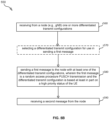
- FIG. 5A illustrates a process 500 according to some embodiments.
- the process may be performed, for instance, by a UE 201, 202 as part of a random access procedure (e.g., a 2- or 4-step procedure) with a node, such as node 203, 204 in system 200.
- a random access procedure e.g., a 2- or 4-step procedure
- Process 500 may begin with step s510, which may be optional in some embodiments.
- step s510 a transmit power and/or priority status of the UE is determined. For instance, the UE may determine that it has a high priority status, and may further select a transmit power based on that status. For instance, the UE may be enabled to use an increased transmit power if it is a high priority device.
- the UE sends a first message to a node (e.g., gNB) with a first transmit power, wherein the first message is a random access procedure PUSCH transmission and the first transmit power is based at least in part on a high priority status of the UE.
- the transmit power of step s520 may be based on the determination of step s510.
- the determining the UE status and/or first transmit power is based at least in part on an access identity (e.g., provisioned/stored in the SIM/USIM of the UE) and/or access category of the UE (e.g., associated with the UE's service type).
- the determining the UE status and/or first transmit power is based at least in part on receipt of a parameter indicating that an access identity of the UE (e.g., access identity 1 and/or 2) is enabled for prioritized transmission of the first message (e.g., Msg3 or MsgA).
- a parameter indicating that an access identity of the UE e.g., access identity 1 and/or 2
- Msg3 or MsgA e.g., Msg3 or MsgA
- the UE receives a second message from the node.
- the process 500 may be part of a 4-step random access procedure, the first message a Msg3, and the second message a Msg4.
- the process 500 may be part of a 2-step random access procedure, where the first message is a MsgA and the second message is a MsgB
- FIG. 5B illustrates a process 550 according to some embodiments.
- the process may be performed, for instance, by a UE 201, 202 as part of a random access procedure (e.g., a 2- or 4-step procedure) with a node, such as node 203, 204 in system 200.
- a random access procedure e.g., a 2- or 4-step procedure
- Process 550 may begin with step s560.
- the UE receives one or more differentiated transmit configurations from a node (e.g., gNB).
- the differentiated transmit configurations, used for sending a first message can be one or more of a repetition setting, ramping configuration, reduced transport block (TB) scaling factor, a low MCS index, use of a low spectrum efficiency MCS table (e.g., for Msg3 or MsgA PUSCH), and enabled P1/2 BPSK (e.g., for Msg3 or MsgA PUSCH), as examples.
- step s570 the UE selects one or more of the transmit configurations for use in sending a message.
- the UE sends a first message to the node using at least one of the differentiated transmit configurations.
- the first message may be a random access procedure PUSCH transmission, and the differentiated transmit configuration can be based at least in part on a high priority status of the UE (e.g., as selected in step s570).
- step s590 the UE receives a second message from the node.
- process 550 may also be part of a 2- or 4-step random access procedure in which one of more of Msg3, Msg4, MsgA, and MsgB are exchanged between the UE and node.
- a node e.g., gNB
- a device e.g., UE
- the methods may be used where a UE is associated with an essential public safety service (e.g., mission critical services such as mission critical push-to-talk, mission critical data, or mission critical video for fire-fighters, police, or emergency medical service providers).
- the node may have knowledge of a specific UE's status.
- the node may authorize (and receive) prioritized messaging without knowing any UE's specific priority.
- the processes of FIGs. 6A and 6B are part of a 2- or 4-step random access procedure in which one of more of Msg3, Msg4, MsgA, and MsgB are exchanged between the UE and node.
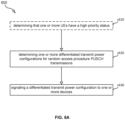
- FIG. 6A illustrates a process 600 according to some embodiments.
- the process may be performed, for instance, by a node 203, 204 as part of a random access procedure (e.g., a 2- or 4-step procedure) with a UE, such as UE 201, 202 in system 200.
- a random access procedure e.g., a 2- or 4-step procedure
- step s610 the node determines that one or more UEs have a high priority status. However, in some embodiments, process 600 may proceed without the node having knowledge of a UE's priority.
- the node determines one or more differentiated transmit power configurations for random access procedure PUSCH transmissions.
- the node may also determine whether such prioritized transmissions are enabled at a given time or in given cell (or other location).
- the node may tailor/individualize the transmit power for those UEs.
- the node signals a differentiated transmit power to one or more UEs.
- the differentiated power configurations are indicated to the UE based on UE priority status (e.g., based on or associated with access identity and/or access category of a UE).
- differentiated configurations can be identified and selected by a UE based on its access identity and/or access category.
- the signaling enables prioritized transmissions; however, prioritized transmissions may be separately enabled via other signaling (e.g., in broadcast information and/or via RRC). Similarly, different signaling may be used in conjunction by the UE to determine the appropriate transmission configuration for a given message.
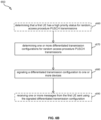
- FIG. 6B illustrates a process 650 according to some embodiments.
- the process may be performed, for instance, by a UE 201, 202 as part of a random access procedure (e.g., a 2- or 4-step procedure) with a node, such as node 203, 204 in system 200.
- a random access procedure e.g., a 2- or 4-step procedure
- step s660 the node determines that a first UE has a high priority status (e.g., for random access procedure PUSCH transmissions).
- the node determines one or more differentiated transmission configurations (e.g., for random access procedure PUSCH transmissions).
- the node signals a differentiated transmission configuration to one or more devices (e.g., to a first UE).
- signaling the differentiated transmission configuration comprises one or more of: signaling a reduced transport block (TB) scaling factor, signaling a low MCS index, signaling use of a low spectrum efficiency MCS table (e.g., for Msg3 or MsgA PUSCH), and enabling P1/2 BPSK (e.g., for Msg3 or MsgA PUSCH).
- the signaling may also be related to one or more of repetition, ramping, and cyclic prefix extension configurations.
- the various differentiated transmission configurations can be linked to UE status, for instance, using access identity and/or access category.
- the node receives one or more messages (including, e.g., Msg3 or MsgA) from the first UE, where the one or more messages were sent using the signaled differentiated transmission configuration.
- one or more messages including, e.g., Msg3 or MsgA
- a device e.g., UE
- a node e.g. a gNB
- the methods 700, 800 may be used where a UE is associated with an essential public safety service (e.g., mission critical services such as mission critical push-to-talk, mission critical data, or mission critical video for fire-fighters, police, or emergency medical service providers).
- an essential public safety service e.g., mission critical services such as mission critical push-to-talk, mission critical data, or mission critical video for fire-fighters, police, or emergency medical service providers.
- the processes of FIGs. 7 and 8 may be performed, for instance, by a UE 201, 202 as part of a random access procedure (e.g., a 2- or 4-step procedure) with a node, such as node 203, 204 in system 200.
- FIG. 7 illustrates a process 700 according to some embodiments.
- the process 700 may begin with step s710.
- step s710 the device receives broadcast system information from a node indicating one or more priority transmission configurations for high priority devices.
- step s720 the device determines that it is enabled for at least one of the priority transmission configurations based at least in part on the broadcasted system information and a status of the device.
- step s730 which may be optional in some embodiments, the device determines a transmit power for the random access message based at least in part on a priority transmission configuration enabled for the device.
- step s740 the device sends a random access procedure physical uplink share channel, PUSCH, transmission using the at least one priority transmission configuration.
- the random access procedure transmission is a Msg3 transmission sent as part of a 4-step random access procedure or a MsgA sent as part of a 2-step random access procedure.
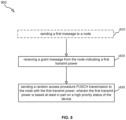
- FIG. 8 illustrates a process 800 according to some embodiments.
- the process 800 may begin with step s810, which may be optional in some embodiments.
- the device sends a first message to a node.
- the device receives a grant message from the node indicating a first transmit power.
- the device sends a random access procedure PUSCH transmission to the node with the first transmit power, wherein the first transmit power is based at least in part on a high priority status of the device.
- a node e.g., gNB
- the process may be performed, for instance, by a node 203, 204 as part of a random access procedure (e.g., a 2- or 4-step procedure) with a UE, such as UE 201, 202 in system 200.
- the methods 900, 1000 may be used where a UE is associated with an essential public safety service (e.g., mission critical services such as mission critical push-to-talk, mission critical data, or mission critical video for fire-fighters, police, or emergency medical service providers).
- an essential public safety service e.g., mission critical services such as mission critical push-to-talk, mission critical data, or mission critical video for fire-fighters, police, or emergency medical service providers.
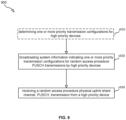
- FIG. 9 illustrates a process 900 according to some embodiments.
- the process 900 may begin with step s910, which may be optional in some embodiments.
- the node determines one or more priority transmission configurations for high priority devices.
- the node broadcasts system information indicating one or more priority transmission configurations for random access procedure PUSCH transmissions by high priority devices. According to some embodiments, the broadcasted system information indicates prioritized transmission configurations for devices based on one or more of access identity and access category.
- the node receives a random access procedure physical uplink share channel, PUSCH, transmission from a high priority device.
- the received random access procedure transmission is a Msg3 transmission sent as part of a 4-step random access procedure or a MsgA sent as part of a 2-step random access procedure.
- FIG. 10 illustrates a process 1000 according to some embodiments.
- the process may begin with step s1010, which may be optional in some embodiments.
- the node determines that a device has a high priority status.
- the node determines a priority transmission configuration for random access procedure PUSCH transmissions from the high priority device. According to some embodiments, determining one or more of the priority transmission configuration and device status is based at least in part on an access identity and/or access category of the device.
- the node sends a grant message to the device indicating the priority transmission configuration.
- the node receives a random access procedure PUSCH transmission from the device.
- the priority transmission configuration comprises an indication of transmit power for random access procedure PUSCH transmissions.
Landscapes
- Engineering & Computer Science (AREA)
- Computer Networks & Wireless Communication (AREA)
- Signal Processing (AREA)
- Mobile Radio Communication Systems (AREA)
Claims (19)
- Verfahren (700) zur Verwendung in einer Vorrichtung, wobei das Verfahren Folgendes umfasst:Empfangen (710) von Sendesysteminformationen von einem Knoten, die eine oder mehr Konfigurationen für prioritäre Übertragung für Vorrichtungen mit hoher Priorität angeben;Bestimmen (720), dass die Vorrichtung für mindestens eine der Konfigurationen für prioritäre Übertragung freigegeben ist, zumindest teilweise basierend auf den gesendeten Systeminformationen und einem Status der Vorrichtung, wobei die mindestens eine Konfiguration für prioritäre Übertragung eine Sendeleistung für gemeinsame physische Uplink-Kanal-, PUSCH-, Übertragungen im Direktzugriffsverfahren durch Vorrichtungen mit hoher Priorität angibt; undSenden (740) einer PUSCH-Übertragung im Direktzugriffsverfahren unter Verwendung der durch die mindestens eine Konfiguration für prioritäre Übertragung angegebenen Sendeleistung.
- Verfahren nach Anspruch 1, wobei die Übertragung im Direktzugriffsverfahren eine Msg3-Übertragung, die als Teil eines vierstufigen Direktzugriffsverfahrens gesendet wird, oder eine MsgA, die als Teil eines zweitstufigen Direktzugriffsverfahrens gesendet wird, ist.
- Verfahren nach Anspruch 1 oder 2, wobei die gesendeten Systeminformationen basierend auf einer oder mehr von einer Zugangsidentität oder Zugangskategorie Konfigurationen für prioritäre Übertragung für Vorrichtungen angeben und das Bestimmen mindestens teilweise auf einer oder mehr von einer Zugangsidentität oder Zugangskategorie der Vorrichtung basiert.
- Verfahren nach den Ansprüchen 1-3, das ferner Folgendes umfasst:
Bestimmen (730) der Sendeleistung für die Direktzugriffsmitteilung, mindestens teilweise basierend auf der mindestens einen Konfiguration für prioritäre Übertragung, die für die Vorrichtung freigegeben ist. - Verfahren nach einem der Ansprüche 1-4, wobei eines oder mehr von Folgendem gilt:(i) die angegebene Sendeleistung ist für Vorrichtungen mit hoher Priorität höher als für andere Vorrichtungen;(ii) die mindestens eine Konfiguration gibt einen Sendeleistungsversatz an;(iii) die mindestens eine Konfiguration gibt einen PUSCH-Sendeleistungsversatz relativ zu einer Präambel-Sendeleistung an;(iv) ein Sendeleistungsversatz für die Mitteilung wird durch einen Parameter angegeben, der in einem Systeminformationsblock von dem Knoten empfangen wurde, wobei der Parameter eine Vielzahl von Versätzen angibt und die Sendeleistung basierend auf einem Wertauswahlindikator bestimmt wird; oder(v) die Sendeleistung wird mindestens teilweise basierend auf einem TPC-Befehl für PUSCH ein einer Direktzugriffsantwort-, RAR-, Freigabe bestimmt, die von dem Knoten empfangen wurde.
- Verfahren nach einem der Ansprüche 1-5, wobei die mindestens eine Konfiguration für prioritäre Übertragung eines oder mehr von Folgendem bereitstellt:(i) einen reduzierten Transportblock-, TB-, Skalierungsfaktor;(ii) einen niedrigen MCS-Index;(iii) eine MCS-Tabelle für geringe Frequenzeffizienz;(iv) P1/2 BPSK;(v) eine Erweiterung für ein zyklisches Präfix (CP);(vi) einen physischen Direktzugriffskanal, PRACH, für MsgA und PUSCH-Inhalte in dem gleichen LBT;(vii) erweitertes CP und gekürztes LBT; oder(viii) differenzierte Steigerungseigenschaften für Vorrichtungen mit hoher Priorität.
- Verfahren nach einem der Ansprüche 1-6, wobei:(i) die mindestens eine Konfiguration für prioritäre Übertragung die Vorrichtung für Wiederholung konfiguriert;(ii) über einen Parameter in einer Funkressourcensteuerung, RRC, in dem Zuordnungsfeld für PUSCH-Zeitressourcen einer RAR-Uplink-Freigabe ein Wiederholungsfaktor an die Vorrichtung signalisiert wird;(iii) über einen bestimmten Parameter in einer RAR-Uplink-Freigabe ein Wiederholungsfaktor an die Vorrichtung signalisiert wird;(iv) über einen RRC-Parameter ein Wiederholungsfaktor an die Vorrichtung signalisiert wird, zusammen mit einem Feld im DCI-Format 1_0; oder(v) unter Verwendung eines Wiederholungsfelds, das in einem DCI-Format 1_0 oder RAR mit CRC-verschlüsselten TC-RNTI oder RA-RNTI bereitgestellt wird, ein Wiederholungsfaktor an die Vorrichtung signalisiert wird.
- Verfahren nach einem der Ansprüche 1-7, wobei die Vorrichtung mit einem essentiellen Dienst für öffentliche Sicherheit oder einem prioritären Multimediadienst assoziiert ist.
- Verfahren nach einem der Ansprüche 1-8, wobei die mindestens eine Konfiguration für prioritäre Übertragung ferner eine Priorisierung der PRACH-Übertragung angibt.
- Verfahren (800) zur Verwendung in einer Vorrichtung, wobei das Verfahren Folgendes umfasst:Empfangen (820) einer Freigabemitteilung von einem Knoten, die eine erste Sendeleistung angibt; undSenden (830) einer gemeinsamen physischen Uplink-Kanal-, PUSCH-, Übertragung im Direktzugriffsverfahren an den Knoten mit der ersten Sendeleistung, wobei die erste Sendeleistung mindestens teilweise auf einem Status hoher Priorität der Vorrichtung basiert.
- Verfahren nach Anspruch 10, das ferner Folgendes umfasst:Senden (810) einer ersten Mitteilung an den Knoten,wobei die Freigabemitteilung eine RAR-Freigabe in Antwort auf die erste Mitteilung ist, undwobei die erste Mitteilung eine Msg1 und die PUSCH-Übertragung im Direktzugriffsverfahren eine Msg3 ist, die als Teil eines vierstufigen Direktzugriffsverfahrens gesendet wird.
- Verfahren nach Anspruch 10 oder 11, wobei:(i) die Freigabemitteilung einen Leistungsversatzwert für priorisierte Übertragungen angibt;(ii) die Freigabemitteilung eine Versatzleistung relativ zu einer Präambel-Sendeleistung angibt;(iii) die erste Sendeleistung durch einen Wert in einem TPC-Befehlsfeld und/oder einem TPC-Versatzfeld der Freigabemitteilung signalisiert wird; oder(iv) die erste Sendeleistung durch einen Wert in der Freigabemitteilung angegeben ist, der einer Tabelle von Sende- oder Versatzleistungswerten für PUSCH-Übertragungen von Vorrichtungen mit hoher Priorität zugeordnet wird.
- Verfahren nach einem der Ansprüche 10-12, wobei die erste Sendeleistung durch einen TPC-Befehl angegeben ist, der in einer RAR-Rückfallmitteilung, einer RRC-Mitteilung für Benutzerendgeräte oder Dienste mit hoher Priorität oder Downlink-Steuerungsinformationen, DCI, zum Planen einer Neuübertragung von Msg3 konfiguriert ist.
- Computerprogramm, das Anweisungen umfasst, die, wenn sie durch eine Verarbeitungsschaltung eines Geräts ausgeführt werden, das Gerät dazu veranlassen, das Verfahren nach einem der Ansprüche 1-9 oder der Ansprüche 10-13 durchzuführen.
- Träger, der das Computerprogramm nach Anspruch 14 enthält, wobei der Träger eines von einem elektronischen Signal, einem optischen Signal, einem Funksignal und einem computerlesbaren Speichermedium ist.
- Vorrichtung (201, 202), wobei die Vorrichtung zu Folgendem konfiguriert ist:Empfangen von Sendesysteminformationen von einem Knoten, die eine oder mehr Konfigurationen für prioritäre Übertragung für Vorrichtungen mit hoher Priorität angeben;Bestimmen, dass die Vorrichtung für mindestens eine der Konfigurationen für prioritäre Übertragung freigegeben ist, zumindest teilweise basierend auf den gesendeten Systeminformationen und einem Status der Vorrichtung, wobei die mindestens eine Konfiguration für prioritäre Übertragung eine Sendeleistung für gemeinsame physische Uplink-Kanal-, PUSCH-, Übertragungen im Direktzugriffsverfahren durch Vorrichtungen mit hoher Priorität angibt; undSenden einer PUSCH-Übertragung im Direktzugriffsverfahren unter Verwendung der durch die mindestens eine Konfiguration für prioritäre Übertragung angegebenen Sendeleistung.
- Vorrichtung nach Anspruch 16, wobei die Vorrichtung ferner dazu konfiguriert ist, die Schritte nach einem der Ansprüche 2-9 durchzuführen.
- Vorrichtung (201, 202), wobei die Vorrichtung zu Folgendem konfiguriert ist:Empfangen einer Freigabemitteilung von einem Knoten, die eine erste Sendeleistung angibt; undSenden einer gemeinsamen physischen Uplink-Kanal-, PUSCH-, Übertragung im Direktzugriffsverfahren an den Knoten mit der ersten Sendeleistung, wobei die erste Sendeleistung mindestens teilweise auf einem Status hoher Priorität der Vorrichtung basiert.
- Vorrichtung nach Anspruch 18, wobei die Vorrichtung ferner dazu konfiguriert ist, die Schritte nach einem der Ansprüche 11-13 durchzuführen.
Applications Claiming Priority (2)
| Application Number | Priority Date | Filing Date | Title |
|---|---|---|---|
| CN2020087782 | 2020-04-29 | ||
| PCT/EP2021/061066 WO2021219690A1 (en) | 2020-04-29 | 2021-04-28 | Message prioritization in random access procedure |
Publications (2)
| Publication Number | Publication Date |
|---|---|
| EP4144147A1 EP4144147A1 (de) | 2023-03-08 |
| EP4144147B1 true EP4144147B1 (de) | 2024-02-14 |
Family
ID=75746625
Family Applications (1)
| Application Number | Title | Priority Date | Filing Date |
|---|---|---|---|
| EP21722435.1A Active EP4144147B1 (de) | 2020-04-29 | 2021-04-28 | Nachrichtenpriorisierung in einem direktzugriffsverfahren |
Country Status (4)
| Country | Link |
|---|---|
| US (1) | US20230199862A1 (de) |
| EP (1) | EP4144147B1 (de) |
| PL (1) | PL4144147T3 (de) |
| WO (1) | WO2021219690A1 (de) |
Families Citing this family (8)
| Publication number | Priority date | Publication date | Assignee | Title |
|---|---|---|---|---|
| US12063683B2 (en) * | 2020-05-24 | 2024-08-13 | Qualcomm Incorporated | Modulation and coding schemes for high band wireless communications |
| US12052761B2 (en) * | 2020-08-04 | 2024-07-30 | Ofinno, Llc | Random access response reception of random access procedure |
| CN116326143B (zh) * | 2020-10-14 | 2025-03-18 | 苹果公司 | 针对能力降低用户装备的随机接入消息传输 |
| US12245283B2 (en) * | 2020-10-16 | 2025-03-04 | Qualcomm Incorporated | Message 2 indication of message 3 repetition and frequency hopping for message 3 repetition |
| CN112640336B (zh) * | 2020-11-18 | 2023-04-11 | 北京小米移动软件有限公司 | 调制与编码策略mcs的配置方法、装置及通信设备 |
| CN115333698B (zh) * | 2021-05-11 | 2024-09-13 | 上海朗帛通信技术有限公司 | 一种被用于无线通信的节点中的方法和装置 |
| US12574966B2 (en) * | 2021-07-30 | 2026-03-10 | Asustek Computer Inc. | Method and apparatus for listen-before-talk mode for random access response in a wireless communication system |
| CN114040512B (zh) * | 2021-11-23 | 2023-07-25 | 新华三技术有限公司 | 随机接入方法及装置 |
Family Cites Families (13)
| Publication number | Priority date | Publication date | Assignee | Title |
|---|---|---|---|---|
| CN103024923B (zh) * | 2011-09-26 | 2015-09-09 | 华为技术有限公司 | 一种保证并行数据随机接入的方法及用户设备 |
| CN106413117B (zh) * | 2015-07-29 | 2021-08-17 | 索尼公司 | 无线通信系统、基站侧和用户设备侧的装置及方法 |
| JP6776332B2 (ja) * | 2015-08-06 | 2020-10-28 | テレフオンアクチーボラゲット エルエム エリクソン(パブル) | Mtc動作のためのアップリンクharq手続 |
| US10492151B2 (en) * | 2017-06-09 | 2019-11-26 | Qualcomm Incorporated | Power control in new radio systems |
| US11533758B2 (en) * | 2017-09-27 | 2022-12-20 | Lg Electronics Inc. | Method for transmitting and receiving uplink data between terminal and base station in wireless communication system and device supporting same |
| EP3462797A1 (de) * | 2017-09-28 | 2019-04-03 | Panasonic Intellectual Property Corporation of America | Benutzergerät und basisstation mit beteiligung am priorisierten direktzugriff |
| EP3905797B1 (de) * | 2019-02-01 | 2024-09-18 | LG Electronics Inc. | Verfahren und vorrichtung zur durchführung von direktzugriffsverfahren in einem drahtloskommunikationssystem |
| US12167457B2 (en) * | 2019-02-15 | 2024-12-10 | Lenovo (Singapore) Pte. Ltd. | Method and apparatus for receiving a PDSCH in response to transmitting a PRACH preamble and a PUSCH |
| JP7550795B2 (ja) * | 2019-05-14 | 2024-09-13 | サムスン エレクトロニクス カンパニー リミテッド | 無線通信システムにおける制御情報送信方法及び装置 |
| WO2020235884A1 (en) * | 2019-05-17 | 2020-11-26 | Samsung Electronics Co., Ltd. | Method and apparatus for transmitting and receiving data in a wireless communication system |
| US20220417869A1 (en) * | 2019-11-07 | 2022-12-29 | Ntt Docomo, Inc. | Terminal and communication method |
| US11606812B2 (en) * | 2020-03-27 | 2023-03-14 | Samsung Electronics Co., Ltd. | Method of prioritizing random access for multimedia priority and mission critical services and apparatus thereof |
| WO2021206499A1 (ko) * | 2020-04-09 | 2021-10-14 | 엘지전자 주식회사 | 무선 통신 시스템에서 동작하는 장치 및 동작 방법 |
-
2021
- 2021-04-28 EP EP21722435.1A patent/EP4144147B1/de active Active
- 2021-04-28 US US17/921,714 patent/US20230199862A1/en active Pending
- 2021-04-28 PL PL21722435.1T patent/PL4144147T3/pl unknown
- 2021-04-28 WO PCT/EP2021/061066 patent/WO2021219690A1/en not_active Ceased
Also Published As
| Publication number | Publication date |
|---|---|
| EP4144147A1 (de) | 2023-03-08 |
| PL4144147T3 (pl) | 2024-06-24 |
| WO2021219690A1 (en) | 2021-11-04 |
| US20230199862A1 (en) | 2023-06-22 |
Similar Documents
| Publication | Publication Date | Title |
|---|---|---|
| EP3855850B1 (de) | Direktzugriffsverfahren und kommunikationsvorrichtung | |
| EP4144147A1 (de) | Nachrichtenpriorisierung in einem direktzugriffsverfahren | |
| US9215729B2 (en) | Method and arrangement in a telecommunications system | |
| EP3043615B1 (de) | Verfahren, benutzervorrichtung und basisstation zur vorbestimmung einer ressource bei direktzugriff | |
| US20150296542A1 (en) | Performing random access in carrier aggregation | |
| US11864240B2 (en) | Telecommunications apparatus and methods | |
| US9872312B2 (en) | Conditional parallel execution of access stratum (AS) and non-access stratum (NAS) signaling | |
| CN115462127A (zh) | Cfra过程中的第一消息区分 | |
| EP4035488B1 (de) | Verfahren und vorrichtung für direktzugriffsvorgang | |
| WO2021109388A1 (en) | Systems and methods for reporting random access information in wireless communication networks | |
| CN101346906A (zh) | E-utra系统中的非同步、同步和同步待机通信的方法及过程 | |
| TW202014038A (zh) | 判斷對話前監聽和通道存取優先級等級之方法及使用者設備 | |
| EP2943016A1 (de) | Abdeckungserweiterung in drahtloser Kommunikation | |
| CN115362745A (zh) | 优先化多媒体优先级和任务关键服务的随机接入的方法及其装置 | |
| EP3592085B1 (de) | Verfahren und vorrichtung zum erhalten von systeminformationen | |
| US9814020B2 (en) | Method of transmitting RRC messages in RRC-idle mode | |
| EP3427536B1 (de) | Klassifizierung eines benutzergeräts mit erweitertem satz von direktzugriffspräambeln | |
| EP4353042B1 (de) | Wiederholung einer ersten nachricht für missionskritische benutzergeräte | |
| CN114245471B (zh) | 随机接入信号处理方法、随机接入方法、装置及存储介质 | |
| CN116368903A (zh) | 消息3重复的消息2指示和消息3重复的跳频 | |
| US20230379963A1 (en) | Second messaging differentiation in random access procedure | |
| WO2021219714A1 (en) | Prioritized early csi reporting | |
| EP4144173B1 (de) | Unterscheidung zweiter nachrichten in einem direktzugriffsverfahren | |
| US20220248482A1 (en) | Method and apparatus for supporting device to device communication | |
| CN119678450A (zh) | 重复传输方法、终端设备和网络设备 |
Legal Events
| Date | Code | Title | Description |
|---|---|---|---|
| STAA | Information on the status of an ep patent application or granted ep patent |
Free format text: STATUS: UNKNOWN |
|
| STAA | Information on the status of an ep patent application or granted ep patent |
Free format text: STATUS: THE INTERNATIONAL PUBLICATION HAS BEEN MADE |
|
| PUAI | Public reference made under article 153(3) epc to a published international application that has entered the european phase |
Free format text: ORIGINAL CODE: 0009012 |
|
| STAA | Information on the status of an ep patent application or granted ep patent |
Free format text: STATUS: REQUEST FOR EXAMINATION WAS MADE |
|
| 17P | Request for examination filed |
Effective date: 20221101 |
|
| AK | Designated contracting states |
Kind code of ref document: A1 Designated state(s): AL AT BE BG CH CY CZ DE DK EE ES FI FR GB GR HR HU IE IS IT LI LT LU LV MC MK MT NL NO PL PT RO RS SE SI SK SM TR |
|
| DAV | Request for validation of the european patent (deleted) | ||
| DAX | Request for extension of the european patent (deleted) | ||
| RIC1 | Information provided on ipc code assigned before grant |
Ipc: H04W 74/08 20090101ALN20230814BHEP Ipc: H04W 74/00 20090101ALI20230814BHEP Ipc: H04W 52/36 20090101ALI20230814BHEP Ipc: H04W 52/32 20090101ALI20230814BHEP Ipc: H04W 52/08 20090101ALI20230814BHEP Ipc: H04W 52/28 20090101AFI20230814BHEP |
|
| GRAP | Despatch of communication of intention to grant a patent |
Free format text: ORIGINAL CODE: EPIDOSNIGR1 |
|
| STAA | Information on the status of an ep patent application or granted ep patent |
Free format text: STATUS: GRANT OF PATENT IS INTENDED |
|
| RIC1 | Information provided on ipc code assigned before grant |
Ipc: H04W 74/08 20090101ALN20230907BHEP Ipc: H04W 74/00 20090101ALI20230907BHEP Ipc: H04W 52/36 20090101ALI20230907BHEP Ipc: H04W 52/32 20090101ALI20230907BHEP Ipc: H04W 52/08 20090101ALI20230907BHEP Ipc: H04W 52/28 20090101AFI20230907BHEP |
|
| INTG | Intention to grant announced |
Effective date: 20231002 |
|
| P01 | Opt-out of the competence of the unified patent court (upc) registered |
Effective date: 20231114 |
|
| GRAS | Grant fee paid |
Free format text: ORIGINAL CODE: EPIDOSNIGR3 |
|
| GRAA | (expected) grant |
Free format text: ORIGINAL CODE: 0009210 |
|
| STAA | Information on the status of an ep patent application or granted ep patent |
Free format text: STATUS: THE PATENT HAS BEEN GRANTED |
|
| AK | Designated contracting states |
Kind code of ref document: B1 Designated state(s): AL AT BE BG CH CY CZ DE DK EE ES FI FR GB GR HR HU IE IS IT LI LT LU LV MC MK MT NL NO PL PT RO RS SE SI SK SM TR |
|
| REG | Reference to a national code |
Ref country code: GB Ref legal event code: FG4D |
|
| REG | Reference to a national code |
Ref country code: CH Ref legal event code: EP |
|
| REG | Reference to a national code |
Ref country code: DE Ref legal event code: R096 Ref document number: 602021009422 Country of ref document: DE |
|
| REG | Reference to a national code |
Ref country code: IE Ref legal event code: FG4D |
|
| REG | Reference to a national code |
Ref country code: NL Ref legal event code: FP |
|
| PGFP | Annual fee paid to national office [announced via postgrant information from national office to epo] |
Ref country code: NL Payment date: 20240426 Year of fee payment: 4 |
|
| REG | Reference to a national code |
Ref country code: LT Ref legal event code: MG9D |
|
| PG25 | Lapsed in a contracting state [announced via postgrant information from national office to epo] |
Ref country code: IS Free format text: LAPSE BECAUSE OF FAILURE TO SUBMIT A TRANSLATION OF THE DESCRIPTION OR TO PAY THE FEE WITHIN THE PRESCRIBED TIME-LIMIT Effective date: 20240614 |
|
| PG25 | Lapsed in a contracting state [announced via postgrant information from national office to epo] |
Ref country code: LT Free format text: LAPSE BECAUSE OF FAILURE TO SUBMIT A TRANSLATION OF THE DESCRIPTION OR TO PAY THE FEE WITHIN THE PRESCRIBED TIME-LIMIT Effective date: 20240214 |
|
| PG25 | Lapsed in a contracting state [announced via postgrant information from national office to epo] |
Ref country code: GR Free format text: LAPSE BECAUSE OF FAILURE TO SUBMIT A TRANSLATION OF THE DESCRIPTION OR TO PAY THE FEE WITHIN THE PRESCRIBED TIME-LIMIT Effective date: 20240515 |
|
| REG | Reference to a national code |
Ref country code: AT Ref legal event code: MK05 Ref document number: 1658138 Country of ref document: AT Kind code of ref document: T Effective date: 20240214 |
|
| PG25 | Lapsed in a contracting state [announced via postgrant information from national office to epo] |
Ref country code: RS Free format text: LAPSE BECAUSE OF FAILURE TO SUBMIT A TRANSLATION OF THE DESCRIPTION OR TO PAY THE FEE WITHIN THE PRESCRIBED TIME-LIMIT Effective date: 20240514 Ref country code: HR Free format text: LAPSE BECAUSE OF FAILURE TO SUBMIT A TRANSLATION OF THE DESCRIPTION OR TO PAY THE FEE WITHIN THE PRESCRIBED TIME-LIMIT Effective date: 20240214 |
|
| PG25 | Lapsed in a contracting state [announced via postgrant information from national office to epo] |
Ref country code: ES Free format text: LAPSE BECAUSE OF FAILURE TO SUBMIT A TRANSLATION OF THE DESCRIPTION OR TO PAY THE FEE WITHIN THE PRESCRIBED TIME-LIMIT Effective date: 20240214 |
|
| PG25 | Lapsed in a contracting state [announced via postgrant information from national office to epo] |
Ref country code: AT Free format text: LAPSE BECAUSE OF FAILURE TO SUBMIT A TRANSLATION OF THE DESCRIPTION OR TO PAY THE FEE WITHIN THE PRESCRIBED TIME-LIMIT Effective date: 20240214 |
|
| PG25 | Lapsed in a contracting state [announced via postgrant information from national office to epo] |
Ref country code: RS Free format text: LAPSE BECAUSE OF FAILURE TO SUBMIT A TRANSLATION OF THE DESCRIPTION OR TO PAY THE FEE WITHIN THE PRESCRIBED TIME-LIMIT Effective date: 20240514 Ref country code: NO Free format text: LAPSE BECAUSE OF FAILURE TO SUBMIT A TRANSLATION OF THE DESCRIPTION OR TO PAY THE FEE WITHIN THE PRESCRIBED TIME-LIMIT Effective date: 20240514 Ref country code: LT Free format text: LAPSE BECAUSE OF FAILURE TO SUBMIT A TRANSLATION OF THE DESCRIPTION OR TO PAY THE FEE WITHIN THE PRESCRIBED TIME-LIMIT Effective date: 20240214 Ref country code: IS Free format text: LAPSE BECAUSE OF FAILURE TO SUBMIT A TRANSLATION OF THE DESCRIPTION OR TO PAY THE FEE WITHIN THE PRESCRIBED TIME-LIMIT Effective date: 20240614 Ref country code: HR Free format text: LAPSE BECAUSE OF FAILURE TO SUBMIT A TRANSLATION OF THE DESCRIPTION OR TO PAY THE FEE WITHIN THE PRESCRIBED TIME-LIMIT Effective date: 20240214 Ref country code: GR Free format text: LAPSE BECAUSE OF FAILURE TO SUBMIT A TRANSLATION OF THE DESCRIPTION OR TO PAY THE FEE WITHIN THE PRESCRIBED TIME-LIMIT Effective date: 20240515 Ref country code: FI Free format text: LAPSE BECAUSE OF FAILURE TO SUBMIT A TRANSLATION OF THE DESCRIPTION OR TO PAY THE FEE WITHIN THE PRESCRIBED TIME-LIMIT Effective date: 20240214 Ref country code: ES Free format text: LAPSE BECAUSE OF FAILURE TO SUBMIT A TRANSLATION OF THE DESCRIPTION OR TO PAY THE FEE WITHIN THE PRESCRIBED TIME-LIMIT Effective date: 20240214 Ref country code: BG Free format text: LAPSE BECAUSE OF FAILURE TO SUBMIT A TRANSLATION OF THE DESCRIPTION OR TO PAY THE FEE WITHIN THE PRESCRIBED TIME-LIMIT Effective date: 20240214 Ref country code: AT Free format text: LAPSE BECAUSE OF FAILURE TO SUBMIT A TRANSLATION OF THE DESCRIPTION OR TO PAY THE FEE WITHIN THE PRESCRIBED TIME-LIMIT Effective date: 20240214 |
|
| PG25 | Lapsed in a contracting state [announced via postgrant information from national office to epo] |
Ref country code: PT Free format text: LAPSE BECAUSE OF FAILURE TO SUBMIT A TRANSLATION OF THE DESCRIPTION OR TO PAY THE FEE WITHIN THE PRESCRIBED TIME-LIMIT Effective date: 20240614 |
|
| PG25 | Lapsed in a contracting state [announced via postgrant information from national office to epo] |
Ref country code: SE Free format text: LAPSE BECAUSE OF FAILURE TO SUBMIT A TRANSLATION OF THE DESCRIPTION OR TO PAY THE FEE WITHIN THE PRESCRIBED TIME-LIMIT Effective date: 20240214 Ref country code: PT Free format text: LAPSE BECAUSE OF FAILURE TO SUBMIT A TRANSLATION OF THE DESCRIPTION OR TO PAY THE FEE WITHIN THE PRESCRIBED TIME-LIMIT Effective date: 20240614 Ref country code: LV Free format text: LAPSE BECAUSE OF FAILURE TO SUBMIT A TRANSLATION OF THE DESCRIPTION OR TO PAY THE FEE WITHIN THE PRESCRIBED TIME-LIMIT Effective date: 20240214 |
|
| PG25 | Lapsed in a contracting state [announced via postgrant information from national office to epo] |
Ref country code: DK Free format text: LAPSE BECAUSE OF FAILURE TO SUBMIT A TRANSLATION OF THE DESCRIPTION OR TO PAY THE FEE WITHIN THE PRESCRIBED TIME-LIMIT Effective date: 20240214 |
|
| PG25 | Lapsed in a contracting state [announced via postgrant information from national office to epo] |
Ref country code: SM Free format text: LAPSE BECAUSE OF FAILURE TO SUBMIT A TRANSLATION OF THE DESCRIPTION OR TO PAY THE FEE WITHIN THE PRESCRIBED TIME-LIMIT Effective date: 20240214 |
|
| PG25 | Lapsed in a contracting state [announced via postgrant information from national office to epo] |
Ref country code: CZ Free format text: LAPSE BECAUSE OF FAILURE TO SUBMIT A TRANSLATION OF THE DESCRIPTION OR TO PAY THE FEE WITHIN THE PRESCRIBED TIME-LIMIT Effective date: 20240214 Ref country code: EE Free format text: LAPSE BECAUSE OF FAILURE TO SUBMIT A TRANSLATION OF THE DESCRIPTION OR TO PAY THE FEE WITHIN THE PRESCRIBED TIME-LIMIT Effective date: 20240214 |
|
| PG25 | Lapsed in a contracting state [announced via postgrant information from national office to epo] |
Ref country code: SK Free format text: LAPSE BECAUSE OF FAILURE TO SUBMIT A TRANSLATION OF THE DESCRIPTION OR TO PAY THE FEE WITHIN THE PRESCRIBED TIME-LIMIT Effective date: 20240214 |
|
| PG25 | Lapsed in a contracting state [announced via postgrant information from national office to epo] |
Ref country code: SM Free format text: LAPSE BECAUSE OF FAILURE TO SUBMIT A TRANSLATION OF THE DESCRIPTION OR TO PAY THE FEE WITHIN THE PRESCRIBED TIME-LIMIT Effective date: 20240214 Ref country code: SK Free format text: LAPSE BECAUSE OF FAILURE TO SUBMIT A TRANSLATION OF THE DESCRIPTION OR TO PAY THE FEE WITHIN THE PRESCRIBED TIME-LIMIT Effective date: 20240214 Ref country code: RO Free format text: LAPSE BECAUSE OF FAILURE TO SUBMIT A TRANSLATION OF THE DESCRIPTION OR TO PAY THE FEE WITHIN THE PRESCRIBED TIME-LIMIT Effective date: 20240214 Ref country code: EE Free format text: LAPSE BECAUSE OF FAILURE TO SUBMIT A TRANSLATION OF THE DESCRIPTION OR TO PAY THE FEE WITHIN THE PRESCRIBED TIME-LIMIT Effective date: 20240214 Ref country code: DK Free format text: LAPSE BECAUSE OF FAILURE TO SUBMIT A TRANSLATION OF THE DESCRIPTION OR TO PAY THE FEE WITHIN THE PRESCRIBED TIME-LIMIT Effective date: 20240214 Ref country code: CZ Free format text: LAPSE BECAUSE OF FAILURE TO SUBMIT A TRANSLATION OF THE DESCRIPTION OR TO PAY THE FEE WITHIN THE PRESCRIBED TIME-LIMIT Effective date: 20240214 |
|
| REG | Reference to a national code |
Ref country code: DE Ref legal event code: R097 Ref document number: 602021009422 Country of ref document: DE |
|
| PG25 | Lapsed in a contracting state [announced via postgrant information from national office to epo] |
Ref country code: MC Free format text: LAPSE BECAUSE OF FAILURE TO SUBMIT A TRANSLATION OF THE DESCRIPTION OR TO PAY THE FEE WITHIN THE PRESCRIBED TIME-LIMIT Effective date: 20240214 |
|
| PG25 | Lapsed in a contracting state [announced via postgrant information from national office to epo] |
Ref country code: MC Free format text: LAPSE BECAUSE OF FAILURE TO SUBMIT A TRANSLATION OF THE DESCRIPTION OR TO PAY THE FEE WITHIN THE PRESCRIBED TIME-LIMIT Effective date: 20240214 |
|
| REG | Reference to a national code |
Ref country code: CH Ref legal event code: PL |
|
| PG25 | Lapsed in a contracting state [announced via postgrant information from national office to epo] |
Ref country code: IT Free format text: LAPSE BECAUSE OF FAILURE TO SUBMIT A TRANSLATION OF THE DESCRIPTION OR TO PAY THE FEE WITHIN THE PRESCRIBED TIME-LIMIT Effective date: 20240214 |
|
| PG25 | Lapsed in a contracting state [announced via postgrant information from national office to epo] |
Ref country code: LU Free format text: LAPSE BECAUSE OF NON-PAYMENT OF DUE FEES Effective date: 20240428 |
|
| PLBE | No opposition filed within time limit |
Free format text: ORIGINAL CODE: 0009261 |
|
| STAA | Information on the status of an ep patent application or granted ep patent |
Free format text: STATUS: NO OPPOSITION FILED WITHIN TIME LIMIT |
|
| REG | Reference to a national code |
Ref country code: BE Ref legal event code: MM Effective date: 20240430 |
|
| PG25 | Lapsed in a contracting state [announced via postgrant information from national office to epo] |
Ref country code: LU Free format text: LAPSE BECAUSE OF NON-PAYMENT OF DUE FEES Effective date: 20240428 Ref country code: IT Free format text: LAPSE BECAUSE OF FAILURE TO SUBMIT A TRANSLATION OF THE DESCRIPTION OR TO PAY THE FEE WITHIN THE PRESCRIBED TIME-LIMIT Effective date: 20240214 |
|
| PG25 | Lapsed in a contracting state [announced via postgrant information from national office to epo] |
Ref country code: BE Free format text: LAPSE BECAUSE OF NON-PAYMENT OF DUE FEES Effective date: 20240430 |
|
| PG25 | Lapsed in a contracting state [announced via postgrant information from national office to epo] |
Ref country code: FR Free format text: LAPSE BECAUSE OF NON-PAYMENT OF DUE FEES Effective date: 20240430 |
|
| 26N | No opposition filed |
Effective date: 20241115 |
|
| PG25 | Lapsed in a contracting state [announced via postgrant information from national office to epo] |
Ref country code: FR Free format text: LAPSE BECAUSE OF NON-PAYMENT OF DUE FEES Effective date: 20240430 Ref country code: BE Free format text: LAPSE BECAUSE OF NON-PAYMENT OF DUE FEES Effective date: 20240430 Ref country code: CH Free format text: LAPSE BECAUSE OF NON-PAYMENT OF DUE FEES Effective date: 20240430 |
|
| PG25 | Lapsed in a contracting state [announced via postgrant information from national office to epo] |
Ref country code: IE Free format text: LAPSE BECAUSE OF NON-PAYMENT OF DUE FEES Effective date: 20240428 |
|
| PG25 | Lapsed in a contracting state [announced via postgrant information from national office to epo] |
Ref country code: SI Free format text: LAPSE BECAUSE OF FAILURE TO SUBMIT A TRANSLATION OF THE DESCRIPTION OR TO PAY THE FEE WITHIN THE PRESCRIBED TIME-LIMIT Effective date: 20240214 |
|
| PGFP | Annual fee paid to national office [announced via postgrant information from national office to epo] |
Ref country code: PL Payment date: 20250408 Year of fee payment: 5 Ref country code: DE Payment date: 20250429 Year of fee payment: 5 |
|
| PGFP | Annual fee paid to national office [announced via postgrant information from national office to epo] |
Ref country code: GB Payment date: 20250428 Year of fee payment: 5 |
|
| PG25 | Lapsed in a contracting state [announced via postgrant information from national office to epo] |
Ref country code: CY Free format text: LAPSE BECAUSE OF FAILURE TO SUBMIT A TRANSLATION OF THE DESCRIPTION OR TO PAY THE FEE WITHIN THE PRESCRIBED TIME-LIMIT; INVALID AB INITIO Effective date: 20210428 |
|
| PG25 | Lapsed in a contracting state [announced via postgrant information from national office to epo] |
Ref country code: HU Free format text: LAPSE BECAUSE OF FAILURE TO SUBMIT A TRANSLATION OF THE DESCRIPTION OR TO PAY THE FEE WITHIN THE PRESCRIBED TIME-LIMIT; INVALID AB INITIO Effective date: 20210428 |
|
| REG | Reference to a national code |
Ref country code: NL Ref legal event code: MM Effective date: 20250501 |
|
| PG25 | Lapsed in a contracting state [announced via postgrant information from national office to epo] |
Ref country code: NL Free format text: LAPSE BECAUSE OF NON-PAYMENT OF DUE FEES Effective date: 20250501 |