EP4142445A1 - Electronic device comprising heat dissipation sheet - Google Patents
Electronic device comprising heat dissipation sheet Download PDFInfo
- Publication number
- EP4142445A1 EP4142445A1 EP21793574.1A EP21793574A EP4142445A1 EP 4142445 A1 EP4142445 A1 EP 4142445A1 EP 21793574 A EP21793574 A EP 21793574A EP 4142445 A1 EP4142445 A1 EP 4142445A1
- Authority
- EP
- European Patent Office
- Prior art keywords
- heat dissipation
- electronic device
- dissipation sheet
- filler
- rear plate
- Prior art date
- Legal status (The legal status is an assumption and is not a legal conclusion. Google has not performed a legal analysis and makes no representation as to the accuracy of the status listed.)
- Pending
Links
Images






Classifications
-
- H—ELECTRICITY
- H05—ELECTRIC TECHNIQUES NOT OTHERWISE PROVIDED FOR
- H05K—PRINTED CIRCUITS; CASINGS OR CONSTRUCTIONAL DETAILS OF ELECTRIC APPARATUS; MANUFACTURE OF ASSEMBLAGES OF ELECTRICAL COMPONENTS
- H05K7/00—Constructional details common to different types of electric apparatus
- H05K7/20—Modifications to facilitate cooling, ventilating, or heating
- H05K7/2039—Modifications to facilitate cooling, ventilating, or heating characterised by the heat transfer by conduction from the heat generating element to a dissipating body
- H05K7/20436—Inner thermal coupling elements in heat dissipating housings, e.g. protrusions or depressions integrally formed in the housing
- H05K7/20445—Inner thermal coupling elements in heat dissipating housings, e.g. protrusions or depressions integrally formed in the housing the coupling element being an additional piece, e.g. thermal standoff
- H05K7/20472—Sheet interfaces
- H05K7/20481—Sheet interfaces characterised by the material composition exhibiting specific thermal properties
-
- H—ELECTRICITY
- H02—GENERATION; CONVERSION OR DISTRIBUTION OF ELECTRIC POWER
- H02J—ELECTRIC POWER NETWORKS; CIRCUIT ARRANGEMENTS OR SYSTEMS FOR SUPPLYING OR DISTRIBUTING ELECTRIC POWER; SYSTEMS FOR STORING ELECTRIC ENERGY
- H02J50/00—Circuit arrangements or systems for wireless supply or distribution of electric power
- H02J50/005—Mechanical details of housing or structure aiming to accommodate the power transfer means, e.g. mechanical integration of coils, antennas or transducers into emitting or receiving devices
-
- H—ELECTRICITY
- H02—GENERATION; CONVERSION OR DISTRIBUTION OF ELECTRIC POWER
- H02J—ELECTRIC POWER NETWORKS; CIRCUIT ARRANGEMENTS OR SYSTEMS FOR SUPPLYING OR DISTRIBUTING ELECTRIC POWER; SYSTEMS FOR STORING ELECTRIC ENERGY
- H02J50/00—Circuit arrangements or systems for wireless supply or distribution of electric power
- H02J50/10—Circuit arrangements or systems for wireless supply or distribution of electric power using inductive coupling
Definitions
- Various embodiments of the disclosure relate to an electronic device including a heat dissipation sheet.
- Electronic devices may output stored information in a form of a sound or an image.
- a single electronic device such as a mobile communication terminal
- various functions For example, not only a communication function, but also an entertainment function such as gaming, a multimedia function such as music/video playback, communication and security functions for mobile banking and the like, a scheduling function, and an electronic wallet function may be integrated into a single electronic device.
- a sensor embedded in an electronic device and power supply have increased in importance in order for information and communication devices to be connected and operated with each other regardless of time or place in an information-based society.
- mobile devices such as a mobile phone have been rapidly increased in number, charging a battery has required time and effort of users.
- wireless power transmission technology has recently drawn attention.
- a wireless power reception device such as a mobile device for wirelessly receiving energy may be driven by the received wireless power or may charge a battery by using the received wireless power and be driven by the charged power.
- a wireless power transmission (or wireless energy transfer) technology refers to a technology of wirelessly transferring electrical energy from a transmitter to a receiver by using the principle of magnetic induction.
- Wireless energy transfer schemes may include a magnetic induction scheme, an electromagnetic resonance scheme, and a power transmission scheme using a short-wavelength radio frequency.
- An electronic device having a communication function such as mobile terminals
- a communication function such as mobile terminals
- components used in mobile terminals are developed to have high performance and thus have increased heating temperatures.
- the increased heating temperature influences adjacent components and thus cause degradation of the overall performance of the mobile terminals.
- components of an electronic device may increase in temperature.
- a dissipation sheet to improve the performance degradation caused by the heating is disposed closer to the outer surface of an electronic device, and thus the heat may be efficiently dispersed.
- a material having thermal conductivity may have low electrical resistance and thus when the heat dissipation sheet having high thermal conductivity is located outside a wireless charging coil, wireless charging efficiency may be reduced.
- a heat dissipation sheet having a low electrical resistance is used, a dissipation effect of the dissipation sheet may be reduced.
- An electronic device may provide a heat dissipation sheet disposed between a rear plate and a wireless charging coil to effectively disperse heat generated from a heat generation source.
- Various embodiments of the disclosure may provide an electronic device including a heat dissipation sheet for improving heat generation inside the electronic device without substantial reduction in wireless charging efficiency.
- An electronic device may include a housing including a front plate and a rear plate, a printed circuit board disposed between the front plate and the rear plate, a wireless charging coil disposed between the printed circuit board and the rear plate, and a heat dissipation sheet disposed between the wireless charging coil and the rear plate.
- the heat dissipation sheet may include a heat dissipation filler including a first heat dissipation filler including flake-type graphite, and a second heat dissipation filler having an electrical resistance higher than the electrical resistance of the first heat dissipation filler, wherein the weight of the first heat dissipation filler may be 80 wt% to 93 wt% of the whole weight of the heat dissipation sheet.
- the heat dissipation sheet may include a heat dissipation filler including a first heat dissipation filler including flake-type graphite and a second heat dissipation filler having an electrical resistance higher than the electrical resistance of the first heat dissipation filler, a base resin including synthetic rubber, and a binder for increasing density of the base resin, wherein the weight of the first heat dissipation filler may be 80 wt% to 93 wt% of the whole weight of the heat dissipation sheet.
- heat generated from a heat generation source may be effectively dispersed.
- An electronic device may include a high thermal conductivity heat dissipation material and a non-conductive heat dissipation material to have high thermal conductivity while preventing wireless charging efficiency from being degraded.
- FIG. 1 is a block diagram illustrating an electronic device 101 in a network environment 100 according to various embodiments.
- the electronic device 101 in the network environment 100 may communicate with an electronic device 102 via a first network 198 (e.g., a short-range wireless communication network), or an electronic device 104 or a server 108 via a second network 199 (e.g., a long-range wireless communication network).
- a first network 198 e.g., a short-range wireless communication network
- an electronic device 104 or a server 108 via a second network 199 (e.g., a long-range wireless communication network).
- the electronic device 101 may communicate with the electronic device 104 via the server 108.
- the electronic device 101 may include a processor 120, memory 130, an input device 150, a sound output device 155, a display device 160, an audio module 170, a sensor module 176, an interface 177, a haptic module 179, a camera module 180, a power management module 188, a battery 189, a communication module 190, a subscriber identification module (SIM) 196, or an antenna module 197.
- at least one (e.g., the display device 160 or the camera module 180) of the components may be omitted from the electronic device 101, or one or more other components may be added in the electronic device 101.
- some of the components may be implemented as single integrated circuitry.
- the sensor module 176 e.g., a fingerprint sensor, an iris sensor, or an illuminance sensor
- the display device 160 e.g., a display
- an haptic module 179 e.g., a camera module 180
- a power management module 188 e.g., the display
- the processor 120 may execute, for example, software (e.g., a program 140) to control at least one other component (e.g., a hardware or software component) of the electronic device 101 coupled with the processor 120, and may perform various data processing or computation. According to one embodiment, as at least part of the data processing or computation, the processor 120 may load a command or data received from another component (e.g., the sensor module 176 or the communication module 190) in volatile memory 132, process the command or the data stored in the volatile memory 132, and store resulting data in non-volatile memory 134.
- software e.g., a program 140
- the processor 120 may load a command or data received from another component (e.g., the sensor module 176 or the communication module 190) in volatile memory 132, process the command or the data stored in the volatile memory 132, and store resulting data in non-volatile memory 134.
- the processor 120 may include a main processor 121 (e.g., a central processing unit (CPU) or an application processor (AP)), and an auxiliary processor 123 (e.g., a graphics processing unit (GPU), an image signal processor (ISP), a sensor hub processor, or a communication processor (CP)) that is operable independently from, or in conjunction with, the main processor 121.
- auxiliary processor 123 may be adapted to consume less power than the main processor 121, or to be specific to a specified function.
- the auxiliary processor 123 may be implemented as separate from, or as part of the main processor 121.
- the auxiliary processor 123 may control, for example, at least some of functions or states related to at least one component (e.g., the display device 160, the sensor module 176, or the communication module 190) among the components of the electronic device 101, instead of the main processor 121 while the main processor 121 is in an inactive (e.g., sleep) state, or together with the main processor 121 while the main processor 121 is in an active (e.g., executing an application) state.
- the auxiliary processor 123 e.g., an image signal processor or a communication processor
- the memory 130 may store various data used by at least one component (e.g., the processor 120 or the sensor module 176) of the electronic device 101.
- the various data may include, for example, software (e.g., the program 140) and input data or output data for a command related thereto.
- the memory 130 may include the volatile memory 132 or the non-volatile memory 134.
- the program 140 may be stored in the memory 130 as software, and may include, for example, an operating system (OS) 142, middleware 144, or an application 146.
- OS operating system
- middleware middleware
- application application
- the input device 150 may receive a command or data to be used by a component (e.g., the processor 120) of the electronic device 101, from the outside (e.g., a user) of the electronic device 101.
- the input device 150 may include, for example, a microphone, a mouse, a keyboard, or a digital pen (e.g., a stylus pen).
- the sound output device 155 may output sound signals to the outside of the electronic device 101.
- the sound output device 155 may include, for example, a speaker or a receiver.
- the speaker may be used for general purposes, such as playing multimedia or playing record, and the receiver may be used for incoming calls. According to an embodiment, the receiver may be implemented as separate from, or as part of the speaker.
- the display device 160 may visually provide information to the outside (e.g., a user) of the electronic device 101.
- the display device 160 may include, for example, a display, a hologram device, or a projector and control circuitry to control a corresponding one of the display, hologram device, and projector.
- the display device 160 may include touch circuitry adapted to detect a touch, or sensor circuitry (e.g., a pressure sensor) adapted to measure the intensity of force incurred by the touch.
- the audio module 170 may convert a sound into an electrical signal and vice versa. According to an embodiment, the audio module 170 may obtain the sound via the input device 150, or output the sound via the sound output device 155 or an external electronic device (e.g., an electronic device 102 (e.g., a speaker or a headphone)) directly or wirelessly coupled with the electronic device 101.
- an electronic device 102 e.g., a speaker or a headphone
- the sensor module 176 may detect an operational state (e.g., power or temperature) of the electronic device 101 or an environmental state (e.g., a state of a user) external to the electronic device 101, and then generate an electrical signal or data value corresponding to the detected state.
- the sensor module 176 may include, for example, a gesture sensor, a gyro sensor, an atmospheric pressure sensor, a magnetic sensor, an acceleration sensor, a grip sensor, a proximity sensor, a color sensor, an infrared (IR) sensor, a biometric sensor, a temperature sensor, a humidity sensor, or an illuminance sensor.
- the interface 177 may support one or more specified protocols to be used for the electronic device 101 to be coupled with the external electronic device (e.g., the electronic device 102) directly or wirelessly.
- the interface 177 may include, for example, a high definition multimedia interface (HDMI), a universal serial bus (USB) interface, a secure digital (SD) card interface, or an audio interface.
- HDMI high definition multimedia interface
- USB universal serial bus
- SD secure digital
- a connecting terminal 178 may include a connector via which the electronic device 101 may be physically connected with the external electronic device (e.g., the electronic device 102).
- the connecting terminal 178 may include, for example, an HDMI connector, a USB connector, an SD card connector, or an audio connector (e.g., a headphone connector).
- the haptic module 179 may convert an electrical signal into a mechanical stimulus (e.g., a vibration or a movement) or electrical stimulus which may be recognized by a user via his tactile sensation or kinesthetic sensation.
- the haptic module 179 may include, for example, a motor, a piezoelectric element, or an electric stimulator.
- the camera module 180 may capture a still image and moving images.
- the camera module 180 may include one or more lenses, image sensors, image signal processors, or flashes.
- the power management module 188 may manage power supplied to the electronic device 101.
- the power management module 388 may be implemented as at least part of, for example, a power management integrated circuit (PMIC).
- PMIC power management integrated circuit
- the battery 189 may supply power to at least one component of the electronic device 101.
- the battery 189 may include, for example, a primary cell which is not rechargeable, a secondary cell which is rechargeable, or a fuel cell.
- the communication module 190 may support establishing a direct (e.g., wired) communication channel or a wireless communication channel between the electronic device 101 and the external electronic device (e.g., the electronic device 102, the electronic device 104, or the server 108) and performing communication via the established communication channel.
- the communication module 190 may include one or more communication processors that are operable independently from the processor 120 (e.g., the application processor (AP)) and support a direct (e.g., wired) communication or a wireless communication.
- AP application processor
- the communication module 190 may include a wireless communication module 192 (e.g., a cellular communication module, a short-range wireless communication module, or a global navigation satellite system (GNSS) communication module) or a wired communication module 194 (e.g., a local area network (LAN) communication module or a power line communication (PLC) module).
- a wireless communication module 192 e.g., a cellular communication module, a short-range wireless communication module, or a global navigation satellite system (GNSS) communication module
- GNSS global navigation satellite system
- wired communication module 194 e.g., a local area network (LAN) communication module or a power line communication (PLC) module.
- LAN local area network
- PLC power line communication
- a corresponding one of these communication modules may communicate with the external electronic device via the first network 198 (e.g., a short-range communication network, such as BluetoothTM, wireless-fidelity (Wi-Fi) direct, or infrared data association (IrDA)) or the second network 199 (e.g., a long-range communication network, such as a cellular network, the Internet, or a computer network (e.g., LAN or wide area network (WAN)).
- the first network 198 e.g., a short-range communication network, such as BluetoothTM, wireless-fidelity (Wi-Fi) direct, or infrared data association (IrDA)
- the second network 199 e.g., a long-range communication network, such as a cellular network, the Internet, or a computer network (e.g., LAN or wide area network (WAN)
- These various types of communication modules may be implemented as a single component (e.g., a single chip), or may be implemented as multi components (e.
- the wireless communication module 192 may identify and authenticate the electronic device 101 in a communication network, such as the first network 198 or the second network 199, using subscriber information (e.g., international mobile subscriber identity (IMSI)) stored in the subscriber identification module 196.
- subscriber information e.g., international mobile subscriber identity (IMSI)
- the antenna module 197 may transmit or receive a signal or power to or from the outside (e.g., the external electronic device) of the electronic device 101.
- the antenna module may include an antenna including a radiating element composed of a conductive material or a conductive pattern formed in or on a substrate (e.g., PCB).
- the antenna module 197 may include a plurality of antennas. In such a case, at least one antenna appropriate for a communication scheme used in the communication network, such as the first network 198 or the second network 199, may be selected, for example, by the communication module 190 from the plurality of antennas. The signal or the power may then be transmitted or received between the communication module 190 and the external electronic device via the selected at least one antenna.
- another component e.g., a radio frequency integrated circuit (RFIC)
- RFIC radio frequency integrated circuit
- At least some of the above-described components may be coupled mutually and communicate signals (e.g., commands or data) therebetween via an inter-peripheral communication scheme (e.g., a bus, general purpose input and output (GPIO), serial peripheral interface (SPI), or mobile industry processor interface (MIPI)).
- an inter-peripheral communication scheme e.g., a bus, general purpose input and output (GPIO), serial peripheral interface (SPI), or mobile industry processor interface (MIPI)
- commands or data may be transmitted or received between the electronic device 101 and the external electronic device 104 via the server 108 coupled with the second network 199.
- Each of the electronic devices 102 and 104 may be a device of a same type as, or a different type, from the electronic device 101.
- all or some of operations to be executed at the electronic device 101 may be executed at one or more of the external electronic devices 102, 104, or 108. For example, if the electronic device 101 should perform a function or a service automatically, or in response to a request from a user or another device, the electronic device 101, instead of, or in addition to, executing the function or the service, may request the one or more external electronic devices to perform at least part of the function or the service.
- the one or more external electronic devices receiving the request may perform the at least part of the function or the service requested, or an additional function or an additional service related to the request, and transfer an outcome of the performing to the electronic device 101.
- the electronic device 101 may provide the outcome, with or without further processing of the outcome, as at least part of a reply to the request.
- a cloud computing, distributed computing, or client-server computing technology may be used, for example.
- the electronic device may be one of various types of electronic devices.
- the electronic devices may include, for example, a portable communication device (e.g., a smartphone), a computer device, a portable multimedia device, a portable medical device, a camera, a wearable device, or a home appliance. According to an embodiment of the disclosure, the electronic devices are not limited to those described above.
- each of such phrases as “A or B”, “at least one of A and B”, “at least one of A or B”, “A, B, or C”, “at least one of A, B, and C”, and “at least one of A, B, or C”, may include any one of, or all possible combinations of the items enumerated together in a corresponding one of the phrases.
- such terms as “1st” and “2nd”, or “first” and “second” may be used to simply distinguish a corresponding component from another, and does not limit the components in other aspect (e.g., importance or order).
- an element e.g., a first element
- the element may be coupled with the other element directly (e.g., wiredly), wirelessly, or via a third element.
- module may include a unit implemented in hardware, software, or firmware, and may interchangeably be used with other terms, for example, “logic”, “logic block”, “part”, or “circuitry”.
- a module may be a single integral component, or a minimum unit or part thereof, adapted to perform one or more functions.
- the module may be implemented in a form of an application-specific integrated circuit (ASIC).
- ASIC application-specific integrated circuit
- each component e.g., a module or a program of the above-described components may include a single entity or multiple entities. According to various embodiments, one or more of the above-described components or operations may be omitted, or one or more other components or operations may be added. Alternatively or additionally, a plurality of components (e.g., modules or programs) may be integrated into a single component. In such a case, the integrated component may still perform one or more functions of each of the plurality of components in the same or similar manner as they are performed by a corresponding one of the plurality of components before the integration.
- operations performed by the module, the program, or another component may be carried out sequentially, in parallel, repeatedly, or heuristically, or one or more of the operations may be executed in a different order or omitted, or one or more other operations may be added.
- FIG. 2 is a front perspective view of an electronic device 101 according to various embodiments of the disclosure.
- FIG. 3 is a rear perspective view of an electronic device 101 according to various embodiments of the disclosure.
- the electronic device 101 may include a housing 310 (e.g., the housing 310 in FIG. 2 to FIG. 3 ) including a front surface 310A, a rear surface 310B, and a lateral surface 310C (e.g., the lateral surface 310C in FIG. 2 to FIG. 3 ) surrounding a space between the front surface 310A and the rear surface 310B.
- the housing 310 may refer to a structure for configuring a portion of the front surface 310A in FIG. 2 , and the rear surface 310B and the lateral surface 310C in FIG. 3 .
- the front surface 310A may be formed by a substantially transparent front plate 302 (e.g., a glass plate including various coating layers, or polymer plate).
- the rear surface 310B may be formed by a rear plate 311.
- the rear plate 311 may be formed by, for example, coated or colored glass, ceramic, polymers, metals (e.g., aluminum, stainless steel (STS), or magnesium), or a combination of at least two thereof.
- the lateral surface 310C may be coupled to the front plate 302 and the rear plate 311 and formed by a lateral bezel structure (or a "lateral member") 318 including a metal and/or polymer.
- the rear plate 311 and the lateral bezel structure 318 may be integrally formed and include the same material (e.g., a metal material such as aluminum, or ceramic).
- the front plate 302 may include two first edge areas 310D bent toward the rear plate 311 from the front surface 310A to seamlessly extend and disposed at the opposite ends of a long edge of the front plate 302.
- the rear plate 311 may include two second edge areas 310E bent toward the front plate 302 from the rear plate 310B and disposed at the opposite ends of a long edge.
- the front plate 302 (or the rear plate 311) may include only one of the first edge areas 310D (or the second edge areas 310E). In another embodiment, a portion of the first edge areas 310D or the second edge areas 310E may not be included.
- the lateral bezel structure 318 when viewed from a lateral side of the electronic device 101, may have a first thickness (or width) at a lateral surface in which the first edge areas 310D and the second edge areas 310E are not included, and may have a second thickness thinner than the first thickness at a lateral surface in which the first edge areas 310D and the second edge areas 310E are included.
- the electronic device 101 may include at least one of a display 301, an audio module 303, 307, 314 (e.g., the audio module 170 of FIG. 1 ), a sensor module (e.g., the sensor module 176 of FIG. 1 ), a camera module 305, 312, a key input device 317 (e.g., the input module 150 of FIG. 1 ), and a connector hole 308, 309 (e.g., the connection terminal 178 of FIG. 1 ).
- the electronic device 101 may omit at least one of the components (for example, the connector hole 309) or additionally include another component.
- the display 301 may be exposed to the outside through, for example, a substantial portion of the front plate 302.
- at least a part of the display 301 may be exposed through the front plate 302 configuring the first surface 310A and the first edge areas 310D of the lateral surface 310C.
- an edge of the display 301 may be formed to be substantially identical to a shape of an outer periphery adjacent to the front plate 302.
- a gap between an outer periphery of the display 301 and an outer periphery of the front plate 302 may be formed to be substantially identical.
- the surface (or the front plate 302) of the housing 310 may include a screen display area formed by visually exposing the display 301.
- the screen display area may include the front surface 310A and the first edge areas 310D of the lateral surface.
- the display 301 may include a recess or an opening formed on a portion of a screen display area thereof (e.g., the front surface 310A, the first edge area 310D), and may include at least one of an audio module 314, a sensor module 304, a light-emitting element (not shown), and a camera module 305 which are aligned with the recess or the opening.
- the display 301 may include at least one of an audio module 314, a sensor module (not shown), a camera module 305, a fingerprint sensor 316, and an light-emitting element (not shown) on the rear surface of the screen display area.
- the display 301 may be combined with or disposed adjacent to a touch sensing circuit, a pressure sensor for measuring a strength (pressure) of a touch, and/or a digitizer for detecting a magnetic field-type stylus pen.
- At least a portion of the key input device 317 may be disposed on the first edge areas 310D and/or the second edge areas 310E.
- the audio module 303, 307, 314 may include, for example, a microphone hole 303 and a speaker hole 307, 314.
- a microphone for obtaining a sound from outside may be disposed in the microphone hole 303 and in another embodiment, multiple microphones may be arranged to detect a direction of a sound.
- the speaker hole 307, 314 may include an outer speaker hole 307 and a receiver hole 314 used for calling.
- the speaker hole 307, 314 and the microphone hole 303 may be implemented into one hole, or a speaker may be included without a speaker hole 307, 314 (e.g., a piezo speaker).
- a sensor module may generate an electrical signal or a data value corresponding to, for example, an internal operation state or external environment state of the electronic device 101.
- the sensor module may include, for example, a first sensor module (now shown) (e.g., a proximity sensor) and/or a second sensor module (not shown) (e.g., a fingerprint sensor) disposed at the front surface 310A of the housing 310, and/or a third sensor module (not shown) (e.g., an HRM sensor) and/or a fourth sensor module (not shown) (e.g., a fingerprint sensor) disposed at the rear surface 310B of the housing 310.
- the fingerprint sensor may be disposed at the rear surface 310B as well as at the front surface 310A (e.g., the display 301) of the housing 310.
- the electronic device 101 may further include at least one sensor module not shown in the drawings, for example, a gesture sensor, a gyro sensor, an air pressure sensor, a magnetic sensor, an acceleration sensor, a grip sensor, a color sensor, an infrared (IR) sensor, a biometric sensor, a temperature sensor, humidity sensor, or an illuminance sensor (not shown).
- the camera module 305, 312 may include a first camera module 305 disposed at the front surface 310A of the electronic device 101, and a second camera module 312 and/or a flash 313 disposed on the rear surface 310B.
- the camera module 305, 312 may include one or more of lenses, an image sensor, and/or an image signal processor.
- the flash 313 may include, for example, a light-emitting diode or a xenon lamp.
- two or more lenses (an infrared camera, and wide-angle and telephoto lens) and image sensors may be arranged on one surface of the electronic device 101.
- the key input device 317 may be disposed on the lateral surface 310C of the housing 310. According to another embodiment, the electronic device 101 may not include a portion or entirety of the key input device 317 described above, and the omitted key input device 317 may be implemented as various forms such as a soft key on the display 301.
- the light emitting element may be disposed on, for example, the front surface 310A of the housing 310.
- the light emitting element (not shown) may provide state information of the electronic device 101 in a form of light, for example.
- the light emitting element (not shown) may provide, for example, a light source linked to an operation of the camera module 305.
- the light emitting element (not shown) may include, for example, a LED, an IR LED, and/or a xenon lamp.
- the connector hole 308, 309 may include, for example, a first connector hole 308 capable of receiving a connector (for example, a USB connector) for transmitting/receiving power and/or data to/from an external electronic device, and/or a second connector hole 309 (for example, an earphone jack) capable of receiving a connector for transmitting/receiving an audio signal to/from an external electronic device.
- a connector for example, a USB connector
- a second connector hole 309 for example, an earphone jack
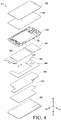
- FIG. 4 is an exploded perspective view of an electronic device 101 according to various embodiments of the disclosure.
- the electronic device 101 may include a front plate 320 (e.g., the front plate 302 in FIG. 2 ), a display 330 (e.g., the display 301 in FIG. 2 ), a first support member 332 (e.g., a bracket), a main printed circuit board 340, a battery 350, a second support member 360 (e.g., a rear case), an antenna 370, a rear plate 380 (e.g., the rear plate 311 in FIG. 3 ), an antenna module 390, and a heat dissipation sheet 400.
- a front plate 320 e.g., the front plate 302 in FIG. 2
- a display 330 e.g., the display 301 in FIG. 2
- a first support member 332 e.g., a bracket
- main printed circuit board 340 e.g., a main printed circuit board 340
- a battery 350 e.g., a battery 350
- a second support member 360 e
- the electronic device 101 may omit at least one of the components (e.g., the first support member 332 or the second support member 360) or additionally include another component. At least one of the components of the electronic device 101 may be the same as or similar to at least one of the components of the electronic device 101 in FIG. 2 or FIG. 3 , and thus the overlapping description thereof will be omitted.
- the first support member 332 may be disposed in the electronic device 101 to be connected to the lateral bezel structure 331 or integrally formed with the lateral bezel structure 331.
- the lateral bezel structure 331 may be an edge of the first support member 332 surrounding a lateral surface of the first support member 332.
- the first support member 332 may be formed of, for example, a metal material and/or a non-metal (e.g., a polymer) material.
- the first support member 332 may have one surface coupled to the display 330 and the other surface coupled to the printed circuit board 340.
- a processor, a memory, and/or an interface may be mounted on the printed circuit board 340.
- the processor may include one or more of, for example, a central processing unit, an application processor, a graphics processing unit, an image signal processor, a sensor hub processor, or a communication processor.
- the memory may include, for example, a volatile memory or a nonvolatile memory.
- the interface may include, for example, a high-definition multimedia interface (HDMI), a universal serial bus (USB) interface, an SD card interface, and/or an audio interface.
- HDMI high-definition multimedia interface
- USB universal serial bus
- the interface may electrically or physically connect the electronic device 101 to an external electronic device, and may include a USB connector, an SD card/MMC connector, or an audio connector.
- the antenna 370 may be disposed between the rear plate 380 and the battery 350.
- the antenna 370 may include, for example, a near field communication (NFC) antenna, a wireless charging antenna, and/or a magnetic secure transmission (MST) antenna.
- the antenna 370 may transmit and receive power required for charging or perform near field communication with an external device, for example.
- the antenna 370 may include a coil for wireless charging.
- an antenna structure may be formed of a portion or a combination of the lateral bezel structure 331 and/or the first support member 332.
- another antenna module may be disposed at a second position, which is separated from the first position on the printed circuit board 340.
- one antenna module and another antenna module may be arranged in consideration of the mutual separation distance according to a diversity characteristic.
- the antenna module 390 may include a wireless communication circuit that processes radio waves transmitted/received in an ultra-high-frequency band (e.g., 6 GHz or higher and 300 GHz or lower).
- a conductive plate of the antenna module 390 may include, for example, a patch-type radiation conductor or a conductive plate having a dipole structure extending in one direction and multiple conductive plates may be arrayed to form an antenna array.
- a chip in which a portion of the wireless communication circuit is implemented may be disposed on one side of the area in which the conductive plate is disposed or on the surface that faces away from the surface on which the conductive plate is disposed, and may be electrically connected to the conductive plate via wiring made of a printed circuit pattern.
- the heat dissipation sheet 400 may be disposed between the rear plate 380 and the antenna 370.
- the heat dissipation sheet 400 may disperse heat of the electronic device 101.
- FIG. 5 is a projection view of the interior viewed through the rear surface of the electronic device according to various embodiments of the disclosure.
- FIG. 6 is a front view of a rear plate on which a heat dissipation sheet is disposed according to various embodiments of the disclosure.
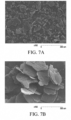
- FIG. 7A and FIG. 7B are views illustrating a first dissipation filler including flake-type graphite according to various embodiments of the disclosure.
- an electronic device may include a lateral bezel structure 331, a first support member 332, a rear plate 380, an antenna module 600, a heat dissipation sheet 400, and a wireless charging coil 500.
- the configuration of the lateral bezel structure 331, the first support member 332, the real plate 380, the antenna module 600, the heat dissipation sheet 400, and the wireless charging coil 500 of FIG. 5 and FIG. 6 may be partially or entirely identical to the configuration of the lateral bezel structure 331, the first support member 332, the real plate 380, the antenna module 390, the heat dissipation sheet 400, and antenna 370 of FIG. 4 .
- the electronic device 101 may receive various electronic components.
- the electronic device 101 may include a first area A1 in which a printed circuit board (e.g., the printed circuit board 340 in FIG. 4 ) is received, and a second area A2 in which the battery 350 is received.
- a temperature of the first area A1 having the printed circuit board 340 positioned thereon may be higher than that of the second area A2 having the battery 350 positioned thereon.
- the heat dissipation sheet 400 may disperse heat incurred inside the electronic device.
- the electronic device 101 may include high-performance electronic components (e.g., the printed circuit board 340) such as an application processor (AP), a memory, and communication chip, and when electronic components operate, a hot spot area (e.g., the first area A1) where heat is concentrated in a localized area may occur.
- the heat dissipation sheet 400 may transfer the heat incurred in the hot spot area to an area (e.g., the second area A2 and the outside of the electronic device 101) on which the printed circuit board is not disposed.
- the heat dissipation sheet 400 may be disposed between the rear plate 380 and the wireless charging coil 500.
- the heat dissipation sheet 400 may have a second surface 400b facing a second direction (the -Z direction) and adhesively disposed on the rear plate 380 and a first surface 400a facing a first direction (the +Z direction) and facing at least a portion of the wireless charging coil 500.
- the heat dissipation sheet 400 is disposed to directly face the rear plate 380 (e.g., FIG. 4 )
- a distance between the heat dissipation sheet 400 and the outside of the electronic device 101 decreases, thereby improving a dissipation effect compared to an electronic device including the heat dissipation sheet 400 under the wireless charging coil 500.
- the wireless charging coil 500 may wirelessly transmit/receive power required for the battery 350 by using at least one of electromagnetic induction, magnetic resonance, or electromagnetic waves.
- the wireless charging coil 500 may supply power to the battery 350 based on a magnetic field induced by a magnetic field generated by a coil of an external electronic device.
- the wireless charging coil 500 may supply power to an electronic device by generating a magnetic field.
- the wireless charging coil 500 may cover at least a portion of the battery 350.
- the wireless charging coil 500 may overlap at least a portion of the battery 350.
- charge efficiency may increase.
- multiple antenna modules 600 may be arranged to form various directional beams.
- the antenna module 600 may include at least one of a first antenna module 610, a second antenna module 620, and a third antenna module 630.
- the first antenna module 610 may be disposed to allow one surface of an antenna radiator to face the rear plate 380 so as to radiate electromagnetic waves toward the rear surface of the electronic device 101.
- the second antenna module 620 and the third antenna module 630 may be disposed to be spaced apart to radiate electromagnetic waves in different directions (e.g., perpendicular or opposite directions).
- the antenna module 600 may be disposed on the first support member 332. According to an embodiment, at least a portion of the antenna 600 may be disposed to face at least one rear plate 380. For example, when viewing the electronic device 101 from the second direction (the -Z direction), the antenna module 600 may not overlap the heat dissipation sheet 400 and directly face the rear plate 380.
- the rear plate 380 may include an antenna-facing area 602 facing the antenna module 600.
- the rear plate 380 may have one area coupled to the heat dissipation sheet 400 and another area facing the antenna-facing area 602.
- the antenna-facing area 602 may include a first antenna-facing area 612 directly facing the first antenna module 610, a second antenna-facing area 622 directly facing the second antenna module 620, and a third antenna-facing area 632 directly facing the third antenna module 630.
- the heat dissipation sheet 400 may include a heat dissipation filler 410 configured to disperse heat.
- the heat dissipation filler 410 may include a first heat dissipation filler 412 having heat conductivity of 100 W/mK to 5000 W/mK or a second heat dissipation filler 414 having heat conductivity of 2 W/mK to 250 W/mK.
- the first heat dissipation filler 412 may be formed of various materials.
- the first heat dissipation filler 412 may include at least one of graphite, a carbon fiber, or graphene, and may preferably include graphite.
- heat conductivity of the heat dissipation sheet 400 may change according to a shape of the graphite included in the first heat dissipation filler 412.
- the first heat dissipation filler 412 may include flake type graphite.
- [Table 1] below shows difference in a temperature of the electronic device 101 including the heat dissipation sheet 400 according to an embodiment of the disclosure and a temperature of an electronic device including another sheet according to comparative examples.
- [Table 1] Classification Maximum temperature (°C) of P1 Temperature (°C) of P2 Comparative example 1 59.9 66.2 Comparative example 2 57.8 65.6 Embodiment 1 48.0 60.6
- a maximum temperature of an area of the heat dissipation sheet 400 according to a shape of a graphite particle may be identified. For example, it may be identified that a heat dissipation effect of the heat dissipation sheet 400 including the first heat dissipation filler 412 formed of flake-type graphite is higher than that of the heat dissipation sheet 400 including the first heat dissipation filler 412 formed of expanded-type graphite.
- a first position P1 in Table 1, 2, and 4 may be an area of the rear plate 380 adjacent to the printed circuit board 340 and a second position P2 may be the first area A1.
- the heat dissipation sheet of comparative example 1 may be a general heat dissipation not including graphite. It may be identified that a temperature of a rear plate of an electronic device including the heat dissipation sheet of comparative example 1 is raised to 59.9°C and a temperature of an internal electronic component (e.g., a printed circuit board) is raised to 66.2°C.
- the heat dissipation sheet of comparative example 2 may be a heat dissipation including expanded-type graphite. It may be identified that a temperature of a rear plate of an electronic device including the heat dissipation sheet of comparative example 2 is raised to 57.8°C and a temperature of an internal electronic component (e.g., a printed circuit board) is raised to 65.6°C.
- the heat dissipation sheet 400 (e.g., embodiment 1) according to an embodiment of the disclosure may be a sheet different from the first heat dissipation filler 412 in material compared to comparative example 2.
- the first heat dissipation filler 412 may include flake-type graphite.
- the heat conductivity of a heat dissipation sheet (e.g., the heat dissipation sheet of embodiment 1) including flake-type graphite may be higher than the heat conductivity of a heat dissipation sheet (e.g., the heat dissipation sheet of comparative example 2) including expanded-type graphite.
- a sectional area relative to a volume of the flake-type graphite may be smaller than that of the expanded-type graphite.
- a packing rate with respect to the heat dissipation 400 including the flake-type graphite may be larger than a packing rate with respect to the heat dissipation sheet 400 including the expanded-type graphite.
- a particle size of flake-type graphite may be formed in various ways.
- flake-type graphite may be formed to have a particle size of 50 ⁇ m to 100 ⁇ m, 20 ⁇ m to 45 ⁇ m, or 20 ⁇ m to 90 ⁇ m.
- the first heat dissipation filler 412 may include flake-type graphite having an average particle size of 60 ⁇ m to 120 ⁇ m.
- the first heat dissipation filler 412 may include flake-type graphite having a particle size of 150 ⁇ m to 300 ⁇ m.
- heat conductivity of the heat dissipation filler 410 may increase but electrical resistance may decrease.
- a maximum temperature of an area of the heat dissipation sheet 400 according to a size of a graphite particle may be identified.
- the graphite particle may be flake-type graphite. According to [Table 2], as a size of a graphite particle increases, heat conductivity of the heat dissipation sheet 400 may increase.
- electrical resistance of the second heat dissipation filler 414 may be higher than that of the first heat dissipation filler 412.
- the second heat dissipation filler 414 may be formed of a substantially non-conductive material (e.g., volume resistance of 10 13 or more) so that generation of eddy current which reduces charge efficiency of the wireless charging coil 500 may be reduced.
- the second heat dissipation filler 414 may be formed of various materials.
- the second heat dissipation filler 414 may include at least one of alumina, boron nitride, yttria, zirconia, aluminum nitride, silicon nitride, silicon carbide, or single crystal silicon.
- the second heat dissipation filler 414 may include alumina or boron nitride.
- the heat dissipation filler 410 may include a functional heat dissipation material for increasing heat dissipation of the heat dissipation sheet.
- the heat dissipation filler 410 may include at least one of a carbon nanotube (CNT), a boron nitride nanotube (BNNT), or diamond.
- the heat dissipation sheet 400 may include a base resin 420.
- the base resin 420 may be mixed with the heat dissipation filler 410 to form at least a portion of the heat dissipation sheet 400.
- the base resin 420 may be formed to have a sheet shape after being mixed with the heat dissipation filler 410 through a solvent (e.g., toluene).
- the base resin 420 may include synthetic rubber.
- the base resin 420 may include at least one of styrene butadiene rubber (SBR), acryl rubber, or ethylene propylene diene monomer rubber.
- the base resin 420 may be formed of substantially non-conductive (e.g., permittivity of 3.5 or less) material.
- the base resin 420 may include styrene butadien rubber having a low molecular weight among styrene butadien rubbers (SBR).
- the heat dissipation sheet 400 may include a binder 430.
- the binder 430 may increase density of the base resin 420.
- the binder 430 may increase a binding force between molecules of the base resin 420 so as to increase density and decrease a thickness of the heat dissipation sheet 400.
- the binder 430 may be formed of various materials.
- the binder 430 may be a polyolefine-based binder, an isocyanate-based binder, or a peroxide-based binder, and may preferably be a peroxide-based binder.
- the heat dissipation sheet 400 may include a second heat dissipation filler 414.
- the heat dissipation sheet 400 including the heat dissipation filler 410 and the base resin 420 includes peroxide-based curing agent 430 the heat dissipation sheet may be reduced in thickness and density, compared with the heat dissipation sheet 400 including another curing agent (e.g., a polyolefine-based curing agent, and an isocyanate-based curing agent).
- another curing agent e.g., a polyolefine-based curing agent, and an isocyanate-based curing agent.
- the heat dissipation sheet 400 may include a coupling agent 440.
- the coupling agent 440 may be configured to disperse particles forming the heat dissipation sheet 400.
- the coupling agent 440 may be applied on the heat dissipation sheet 400 to increase affinity of at least one of the heat dissipation filler 410, the base resin 420, or the binder 430 with a dispersant 450.
- the coupling agent 440 may include various materials.
- the coupling agent 440 may include at least one of acetoalkoxy aluminium diisopropylate or isopropyl triisostearoyl titanate.
- the coupling agent 440 may be disposed on a surface of the heat dissipation sheet 400.
- the coupling agent 440 may be applied or coated on the heat dissipation sheet 400 formed by mixing the heat dissipation filler 410 and the base resin 420.
- the coupling agent 440 may be mixed together with the heat dissipation filler 410 and the base resin 420 to form the heat dissipation sheet 400.
- the heat dissipation sheet 400 may include the dispersant 450.
- the dispersant 450 may reduce surface tension to increase dispersion of the heat dissipation filler 410 and the base resin 420 so as to increase binding force of the heat dissipation filler 410 and the base resin 420 with respect to the coupling agent 440.
- the heat dissipation sheet 400 including the coupling agent 440 and the dispersant 450 of comparative example 3 may be the heat dissipation sheet 400 including the first heat dissipation filler 412 including flake-type graphite having a particle size of 50 ⁇ m to 100 ⁇ m.
- the heat dissipation sheet 400 of embodiment 2 may be the heat dissipation sheet 400 including the coupling agent 440 and the dispersant 450.
- the heat dissipation sheet 400 of embodiment 2 may include the first heat dissipation filler 412 including flake-type graphite having a particle size of 50 ⁇ m to 100 ⁇ m, the coupling agent 440 including acetoalkoxy aluminium diisopropylate, and the dispersant.
- the dispersant 450 may increase dispersion of the heat dissipation filler 410 and the base resin 420 to increase heat conductivity of the heat dissipation sheet 400.
- the heat dissipation sheet 400 of embodiment 2 may have a heat conductivity of about 107 W/mK and the heat dissipation sheet 400 of comparative example 3 may have a heat conductivity of about 89 W/mK.
- the heat conductivity of the heat dissipation sheet 400 and the efficiency of the wireless charging coil 500 may change based on the rate of the first heat dissipation filler 412.
- the first heat dissipation filler 412 may be a main component of the heat dissipation sheet 400.
- the first heat dissipation filler 412 may account for 80 wt% to 93 wt% of the total weight of the heat dissipation sheet 400 to reduce efficiency degradation of wireless charging while the heat dissipation sheet 400 is formed to have a heat conductivity of 120 w/mK.
- FIG. 8 is a graph showing a temperature of an electronic device according to heat conductivity of a heat dissipation sheet.
- FIG. 9 is a view of illustrating temperature distribution of an electronic device according to various embodiments of the disclosure.
- the higher the heat conductivity of the heat dissipation sheet 400, the lower the temperature of the electronic device 101 may be.
- heat conductivity of the heat dissipation sheet 400 increases, heat is dispersed from a printed circuit board (e.g., the printed circuit board 340 in FIG. 4 ) of the electronic device 101 to the outside of the electronic device 101, and temperatures of the inside (e.g., the printed circuit board 340 in FIG. 4 ) and a surface (e.g., the rear plate 380) may decrease.
- the electronic device including a low dielectric (e.g., permittivity of about 3.2) heat dissipation sheet having heat conductivity of about 40 W/mK of comparative example 5 may have a temperature of about 50.9°C.
- the electronic device (embodiment 3) including the heat dissipation sheet 400 having heat conductivity of about 120 W/mK may have a temperature of about 49.0°C.
- Table 5 shows wireless charging efficiency of the heat dissipation sheet 400 and a temperature of the electronic device 101 according to various embodiments of the disclosure.
- charging efficiency of the electronic device 101 and a temperature of the electronic device which change according to a type of the heat dissipation sheet may be identified.
- the temperature may be a temperature of a printed circuit board (e.g., the printed circuit board 340 in FIG. 4 ) of the electronic device 101.
- the wireless charging efficiency may decrease.
- the electronic device 101 of comparative example 4 may not include a heat dissipation sheet.
- the wireless charging efficiency of the electronic device not including the heat dissipation sheet is higher than that of comparative example 5 or embodiment 3, the electronic device 101 of comparative example 4 is formed to have a temperature of about 52.8°C and thus overall performance of the electronic device 101 may deteriorate or user inconvenience may occur.
- the electronic device 101 of comparative example 5 may include a low dielectric (e.g., permittivity of about 4.0 or less) heat dissipation sheet 400.
- a low dielectric e.g., permittivity of about 4.0 or less
- the wireless charging efficiency of the electronic device 101 including the low dielectric heat dissipation sheet is higher than that of embodiment 3, the electronic device 101 of comparative example 5 is formed to have a temperature of about 52.8°C and thus overall performance of the electronic device 101 may deteriorate or user inconvenience may occur.
- the electronic device 101 of comparative example 6 may include the heat dissipation sheet 400 formed of a conductive metal (e.g., copper).
- the electronic device 101 of comparative example 6 has a high heat conductivity (e.g., 400 W/mK) to increase a heat dissipation effect of the electronic device but has too high electrical resistance (e.g., 10 -8 ⁇ ) to be used for wireless charging.
- the electronic device 101 of comparative example 7 may include the heat dissipation sheet 400 formed of synthetic graphite.
- the electronic device 101 of comparative example 7 is formed to have a high heat conductivity (e.g., 1500 W/mK) to increase a heat dissipation effect of the electronic device but has too high electrical resistance (e.g., 10 -4 ⁇ ) to be used for wireless charging.
- the electronic device 101 of embodiment 3 may be an electronic device 101 including a heat dissipation filler (e.g., the heat dissipation 410 of FIG. 5 ).
- the electronic device 101 of embodiment 1 may perform wireless charging substantially without wireless charging efficiency reduction (e.g., about 80%).
- the electronic device 101 of embodiment 3 may have a temperature of 50 degrees or less (e.g., about 49.0°C) so that performance degradation of the electronic device 101 or inconvenience of a user may be reduced.
- the heat conductivity (e.g., about 50 W/mK) of the electronic device of comparative example 5C may be higher than the heat conductivity (e.g., about 120 W/mK) of embodiment 3E, and the temperature (e.g., about 49.0°C) of the rear plate of the electronic device of comparative example 5C may be higher than the temperature (e.g., about 48.0°C) of the real plate of the electronic device of embodiment 3E.
- an electronic device may include a housing including a front plate (e.g., the front plate 302 in FIG. 2 ) and a rear plate (e.g., the rear plate 311 in FIG. 3 ), a printed circuit board (e.g., the printed circuit board 340 in FIG. 4 ) disposed between the front plate and the rear plate, a wireless charging coil (e.g., the wireless charging coil 500 in FIG. 5 ) disposed between the printed circuit board and the rear plate, and a heat dissipation sheet (e.g., the heat dissipation sheet 400 in FIG.
- a housing including a front plate (e.g., the front plate 302 in FIG. 2 ) and a rear plate (e.g., the rear plate 311 in FIG. 3 ), a printed circuit board (e.g., the printed circuit board 340 in FIG. 4 ) disposed between the front plate and the rear plate, a wireless charging coil (e.g., the wireless charging coil 500 in FIG. 5 )
- the heat dissipation sheet may include a heat dissipation filler 410 including a first heat dissipation filler (e.g., the first heat dissipation filler 412 in FIG. 5 ) including flake-type graphite, and a second heat dissipation filler 414 having an electrical resistance higher than the electrical resistance of the first heat dissipation filler, and the weight of the first heat dissipation filler may account for 80 wt% to 93 wt% of the whole weight of the heat dissipation sheet.
- a heat dissipation filler 410 including a first heat dissipation filler (e.g., the first heat dissipation filler 412 in FIG. 5 ) including flake-type graphite
- a second heat dissipation filler 414 having an electrical resistance higher than the electrical resistance of the first heat dissipation filler
- heat conductivity of the heat dissipation sheet may be 120 W/mK to 600 W/mK.
- heat conductivity of the first heat dissipation filler may be 100 W/mK to 5000 W/mK
- heat conductivity of the second heat dissipation filler may be 2 W/mK to 250 W/mK.
- the second heat dissipation filler may include at least one of alumina, boron nitride, yttria, zirconia, aluminum nitride, silicon nitride, silicon carbide, or single crystal silicon.
- the heat dissipation sheet may include a base resin (e.g., the base resin 420 in FIG. 5 ) including synthetic rubber and a binder (e.g., the binder 430 in FIG. 5 ) for increasing density of the base resin.
- a base resin e.g., the base resin 420 in FIG. 5
- a binder e.g., the binder 430 in FIG. 5
- the base resin may include at least one of styrene butadiene rubber (SBR), acryl rubber, or ethylene propylene diene monomer (EPDM) rubber.
- SBR styrene butadiene rubber
- EPDM ethylene propylene diene monomer
- the binder may be a peroxide-based binder.
- the heat dissipation sheet may include a coupling agent (e.g., the coupling agent 440 in FIG. 5 ) configured to increase binding force between the heat dissipation filler and the base resin.
- a coupling agent e.g., the coupling agent 440 in FIG. 5
- the coupling agent may include at least one of acetoalkoxy aluminium diisopropylate or isopropyl triisostearoyl titanate.
- the heat dissipation sheet may include a dispersant (e.g., the dispersant 450 in FIG. 5 ) configured to reduce dispersion force of at least one of the heat dissipation filler, the base resin, and the coupling agent.
- a dispersant e.g., the dispersant 450 in FIG. 5
- the heat dissipation sheet may include a first surface (e.g., the first surface 400a in FIG. 4 ) facing the wireless charging coil and a second surface (e.g., the first surface 400b in FIG. 4 ) facing the rear plate, and the coupling agent may be disposed on at least one of the first surface or the second surface.
- the heat dissipation sheet may include a carbon nanotube configured to be coupled to the first heat dissipation filler.
- an average particle size of the flake-type graphite may be 50 ⁇ m to 100 ⁇ m.
- the housing may include a lateral member (e.g., the lateral member 318 in FIG. 3 ) surrounding at least a portion between the front plate and the rear plate and the electronic device may further include an antenna module (e.g., the antenna module 600 in FIG. 5 ) disposed on the lateral member and including a conductive radiator.
- a lateral member e.g., the lateral member 318 in FIG. 3
- the electronic device may further include an antenna module (e.g., the antenna module 600 in FIG. 5 ) disposed on the lateral member and including a conductive radiator.
- the heat dissipation sheet when viewing the heat dissipation sheet from above, may overlap at least a portion of the wireless charging coil and the antenna module may directly face the rear plate.
- a heat dissipation sheet (e.g., the heat dissipation sheet 400 in FIG. 4 ) may include a heat dissipation filler (e.g., the heat dissipation filler 410 in FIG. 5 ) including a first heat dissipation filler (e.g., the first heat dissipation filler 412 in FIG. 5 ) including flake-type graphite and a second heat dissipation filler (e.g., the second heat dissipation filler 414 in FIG.
- a heat dissipation filler e.g., the heat dissipation filler 410 in FIG. 5
- a first heat dissipation filler e.g., the first heat dissipation filler 412 in FIG. 5
- flake-type graphite e.g., the second heat dissipation filler 414 in FIG.
- the weight of the first heat dissipation filler may be 80 wt% to 93 wt% of the whole weight of the heat dissipation sheet.
- heat conductivity of the heat dissipation sheet may be 120 W/mK to 600 W/mK.
- the second heat dissipation filler may include at least one of alumina, boron nitride, yttria, zirconia, aluminum nitride, silicon nitride, silicon carbide, or single crystal silicon.
- the heat dissipation sheet may further include a coupling agent configured to increase binding force between the heat dissipation filler and the base resin.
- an average particle size of the flake-type graphite may be 50 ⁇ m to 100 ⁇ m.
Landscapes
- Engineering & Computer Science (AREA)
- Physics & Mathematics (AREA)
- Thermal Sciences (AREA)
- Microelectronics & Electronic Packaging (AREA)
- Telephone Set Structure (AREA)
- Computer Networks & Wireless Communication (AREA)
- Power Engineering (AREA)
- Cooling Or The Like Of Electrical Apparatus (AREA)
Abstract
Description
- Various embodiments of the disclosure relate to an electronic device including a heat dissipation sheet.
- Electronic devices may output stored information in a form of a sound or an image. In line with the high degree of integration of electronic devices and the widespread use of super-fast large-capacity wireless communication, it has recently become possible to equip a single electronic device, such as a mobile communication terminal, with various functions. For example, not only a communication function, but also an entertainment function such as gaming, a multimedia function such as music/video playback, communication and security functions for mobile banking and the like, a scheduling function, and an electronic wallet function may be integrated into a single electronic device.
- Furthermore, a sensor embedded in an electronic device and power supply have increased in importance in order for information and communication devices to be connected and operated with each other regardless of time or place in an information-based society. As the types of mobile devices such as a mobile phone have been rapidly increased in number, charging a battery has required time and effort of users. As a way to address this issue, wireless power transmission technology has recently drawn attention. For example, a wireless power reception device such as a mobile device for wirelessly receiving energy may be driven by the received wireless power or may charge a battery by using the received wireless power and be driven by the charged power.
- A wireless power transmission (or wireless energy transfer) technology refers to a technology of wirelessly transferring electrical energy from a transmitter to a receiver by using the principle of magnetic induction. Wireless energy transfer schemes may include a magnetic induction scheme, an electromagnetic resonance scheme, and a power transmission scheme using a short-wavelength radio frequency.
- An electronic device having a communication function, such as mobile terminals, is becoming compact in size and light in weight to maximize the user's portability and convenience, and integrated components are being mounted in a small space for high-performance. Accordingly, components used in mobile terminals are developed to have high performance and thus have increased heating temperatures. The increased heating temperature influences adjacent components and thus cause degradation of the overall performance of the mobile terminals. In addition, when a battery is charged by using wireless power, components of an electronic device may increase in temperature. A dissipation sheet to improve the performance degradation caused by the heating is disposed closer to the outer surface of an electronic device, and thus the heat may be efficiently dispersed. However, generally, a material having thermal conductivity may have low electrical resistance and thus when the heat dissipation sheet having high thermal conductivity is located outside a wireless charging coil, wireless charging efficiency may be reduced. In addition, when a heat dissipation sheet having a low electrical resistance is used, a dissipation effect of the dissipation sheet may be reduced.
- An electronic device according to various embodiments of the disclosure may provide a heat dissipation sheet disposed between a rear plate and a wireless charging coil to effectively disperse heat generated from a heat generation source.
- Various embodiments of the disclosure may provide an electronic device including a heat dissipation sheet for improving heat generation inside the electronic device without substantial reduction in wireless charging efficiency.
- It should be understood, however, that the present invention is not limited to the above-described embodiments, but may be variously modified without departing from the spirit and scope of the invention.
- An electronic device according to various embodiments of the present disclosure may include a housing including a front plate and a rear plate, a printed circuit board disposed between the front plate and the rear plate, a wireless charging coil disposed between the printed circuit board and the rear plate, and a heat dissipation sheet disposed between the wireless charging coil and the rear plate. The heat dissipation sheet may include a heat dissipation filler including a first heat dissipation filler including flake-type graphite, and a second heat dissipation filler having an electrical resistance higher than the electrical resistance of the first heat dissipation filler, wherein the weight of the first heat dissipation filler may be 80 wt% to 93 wt% of the whole weight of the heat dissipation sheet.
- The heat dissipation sheet according to various embodiments may include a heat dissipation filler including a first heat dissipation filler including flake-type graphite and a second heat dissipation filler having an electrical resistance higher than the electrical resistance of the first heat dissipation filler, a base resin including synthetic rubber, and a binder for increasing density of the base resin, wherein the weight of the first heat dissipation filler may be 80 wt% to 93 wt% of the whole weight of the heat dissipation sheet.
- According to various embodiments, by using a heat dissipation sheet disposed between a rear plate and a wireless charging coil, heat generated from a heat generation source may be effectively dispersed.
- An electronic device according to various embodiments of the disclosure may include a high thermal conductivity heat dissipation material and a non-conductive heat dissipation material to have high thermal conductivity while preventing wireless charging efficiency from being degraded.
-
-
FIG. 1 is a block diagram illustrating an electronic device in a network environment according to various embodiments of the disclosure. -
FIG. 2 is a front perspective view of an electronic device according to various embodiments of the disclosure. -
FIG. 3 is a rear perspective view of an electronic device according to various embodiments of the disclosure. -
FIG. 4 is an exploded perspective view of an electronic device according to various embodiments of the disclosure. -
FIG. 5 is a projection view of the interior of an electronic device according to various embodiments of the disclosure viewed through the rear surface of the electronic device. -
FIG. 6 is a front view of a rear sheet on which a heat dissipation sheet is disposed according to various embodiments of the disclosure. -
FIG. 7A and FIG. 7B are views illustrating a first dissipation filler including flake-type graphite according to various embodiments of the disclosure. -
FIG. 8 is a graph showing a temperature of an electronic device according to heat conductivity of a heat dissipation sheet. -
FIG. 9 is a view of illustrating temperature distribution of an electronic device according to various embodiments of the disclosure. -
FIG. 1 is a block diagram illustrating anelectronic device 101 in anetwork environment 100 according to various embodiments. - Referring to
FIG. 1 , theelectronic device 101 in thenetwork environment 100 may communicate with anelectronic device 102 via a first network 198 (e.g., a short-range wireless communication network), or anelectronic device 104 or aserver 108 via a second network 199 (e.g., a long-range wireless communication network). According to an embodiment, theelectronic device 101 may communicate with theelectronic device 104 via theserver 108. According to an embodiment, theelectronic device 101 may include aprocessor 120,memory 130, aninput device 150, asound output device 155, adisplay device 160, anaudio module 170, asensor module 176, aninterface 177, ahaptic module 179, acamera module 180, apower management module 188, abattery 189, acommunication module 190, a subscriber identification module (SIM) 196, or anantenna module 197. In some embodiments, at least one (e.g., thedisplay device 160 or the camera module 180) of the components may be omitted from theelectronic device 101, or one or more other components may be added in theelectronic device 101. In some embodiments, some of the components may be implemented as single integrated circuitry. For example, the sensor module 176 (e.g., a fingerprint sensor, an iris sensor, or an illuminance sensor) may be implemented as embedded in the display device 160 (e.g., a display). - The
processor 120 may execute, for example, software (e.g., a program 140) to control at least one other component (e.g., a hardware or software component) of theelectronic device 101 coupled with theprocessor 120, and may perform various data processing or computation. According to one embodiment, as at least part of the data processing or computation, theprocessor 120 may load a command or data received from another component (e.g., thesensor module 176 or the communication module 190) involatile memory 132, process the command or the data stored in thevolatile memory 132, and store resulting data innon-volatile memory 134. According to an embodiment, theprocessor 120 may include a main processor 121 (e.g., a central processing unit (CPU) or an application processor (AP)), and an auxiliary processor 123 (e.g., a graphics processing unit (GPU), an image signal processor (ISP), a sensor hub processor, or a communication processor (CP)) that is operable independently from, or in conjunction with, themain processor 121. Additionally or alternatively, theauxiliary processor 123 may be adapted to consume less power than themain processor 121, or to be specific to a specified function. Theauxiliary processor 123 may be implemented as separate from, or as part of themain processor 121. - The
auxiliary processor 123 may control, for example, at least some of functions or states related to at least one component (e.g., thedisplay device 160, thesensor module 176, or the communication module 190) among the components of theelectronic device 101, instead of themain processor 121 while themain processor 121 is in an inactive (e.g., sleep) state, or together with themain processor 121 while themain processor 121 is in an active (e.g., executing an application) state. According to an embodiment, the auxiliary processor 123 (e.g., an image signal processor or a communication processor) may be implemented as part of another component (e.g., thecamera module 180 or the communication module 190) functionally related to theauxiliary processor 123. - The
memory 130 may store various data used by at least one component (e.g., theprocessor 120 or the sensor module 176) of theelectronic device 101. The various data may include, for example, software (e.g., the program 140) and input data or output data for a command related thereto. Thememory 130 may include thevolatile memory 132 or thenon-volatile memory 134. - The
program 140 may be stored in thememory 130 as software, and may include, for example, an operating system (OS) 142,middleware 144, or anapplication 146. - The
input device 150 may receive a command or data to be used by a component (e.g., the processor 120) of theelectronic device 101, from the outside (e.g., a user) of theelectronic device 101. Theinput device 150 may include, for example, a microphone, a mouse, a keyboard, or a digital pen (e.g., a stylus pen). - The
sound output device 155 may output sound signals to the outside of theelectronic device 101. Thesound output device 155 may include, for example, a speaker or a receiver. The speaker may be used for general purposes, such as playing multimedia or playing record, and the receiver may be used for incoming calls. According to an embodiment, the receiver may be implemented as separate from, or as part of the speaker. - The
display device 160 may visually provide information to the outside (e.g., a user) of theelectronic device 101. Thedisplay device 160 may include, for example, a display, a hologram device, or a projector and control circuitry to control a corresponding one of the display, hologram device, and projector. According to an embodiment, thedisplay device 160 may include touch circuitry adapted to detect a touch, or sensor circuitry (e.g., a pressure sensor) adapted to measure the intensity of force incurred by the touch. - The
audio module 170 may convert a sound into an electrical signal and vice versa. According to an embodiment, theaudio module 170 may obtain the sound via theinput device 150, or output the sound via thesound output device 155 or an external electronic device (e.g., an electronic device 102 (e.g., a speaker or a headphone)) directly or wirelessly coupled with theelectronic device 101. - The
sensor module 176 may detect an operational state (e.g., power or temperature) of theelectronic device 101 or an environmental state (e.g., a state of a user) external to theelectronic device 101, and then generate an electrical signal or data value corresponding to the detected state. According to an embodiment, thesensor module 176 may include, for example, a gesture sensor, a gyro sensor, an atmospheric pressure sensor, a magnetic sensor, an acceleration sensor, a grip sensor, a proximity sensor, a color sensor, an infrared (IR) sensor, a biometric sensor, a temperature sensor, a humidity sensor, or an illuminance sensor. - The
interface 177 may support one or more specified protocols to be used for theelectronic device 101 to be coupled with the external electronic device (e.g., the electronic device 102) directly or wirelessly. According to an embodiment, theinterface 177 may include, for example, a high definition multimedia interface (HDMI), a universal serial bus (USB) interface, a secure digital (SD) card interface, or an audio interface. - A connecting
terminal 178 may include a connector via which theelectronic device 101 may be physically connected with the external electronic device (e.g., the electronic device 102). According to an embodiment, the connectingterminal 178 may include, for example, an HDMI connector, a USB connector, an SD card connector, or an audio connector (e.g., a headphone connector). - The
haptic module 179 may convert an electrical signal into a mechanical stimulus (e.g., a vibration or a movement) or electrical stimulus which may be recognized by a user via his tactile sensation or kinesthetic sensation. According to an embodiment, thehaptic module 179 may include, for example, a motor, a piezoelectric element, or an electric stimulator. - The
camera module 180 may capture a still image and moving images. According to an embodiment, thecamera module 180 may include one or more lenses, image sensors, image signal processors, or flashes. - The
power management module 188 may manage power supplied to theelectronic device 101. According to one embodiment, the power management module 388 may be implemented as at least part of, for example, a power management integrated circuit (PMIC). - The
battery 189 may supply power to at least one component of theelectronic device 101. According to an embodiment, thebattery 189 may include, for example, a primary cell which is not rechargeable, a secondary cell which is rechargeable, or a fuel cell. - The
communication module 190 may support establishing a direct (e.g., wired) communication channel or a wireless communication channel between theelectronic device 101 and the external electronic device (e.g., theelectronic device 102, theelectronic device 104, or the server 108) and performing communication via the established communication channel. Thecommunication module 190 may include one or more communication processors that are operable independently from the processor 120 (e.g., the application processor (AP)) and support a direct (e.g., wired) communication or a wireless communication. According to an embodiment, thecommunication module 190 may include a wireless communication module 192 (e.g., a cellular communication module, a short-range wireless communication module, or a global navigation satellite system (GNSS) communication module) or a wired communication module 194 (e.g., a local area network (LAN) communication module or a power line communication (PLC) module). A corresponding one of these communication modules may communicate with the external electronic device via the first network 198 (e.g., a short-range communication network, such as BluetoothTM, wireless-fidelity (Wi-Fi) direct, or infrared data association (IrDA)) or the second network 199 (e.g., a long-range communication network, such as a cellular network, the Internet, or a computer network (e.g., LAN or wide area network (WAN)). These various types of communication modules may be implemented as a single component (e.g., a single chip), or may be implemented as multi components (e.g., multi chips) separate from each other. Thewireless communication module 192 may identify and authenticate theelectronic device 101 in a communication network, such as thefirst network 198 or thesecond network 199, using subscriber information (e.g., international mobile subscriber identity (IMSI)) stored in thesubscriber identification module 196. - The
antenna module 197 may transmit or receive a signal or power to or from the outside (e.g., the external electronic device) of theelectronic device 101. According to an embodiment, the antenna module may include an antenna including a radiating element composed of a conductive material or a conductive pattern formed in or on a substrate (e.g., PCB). According to an embodiment, theantenna module 197 may include a plurality of antennas. In such a case, at least one antenna appropriate for a communication scheme used in the communication network, such as thefirst network 198 or thesecond network 199, may be selected, for example, by thecommunication module 190 from the plurality of antennas. The signal or the power may then be transmitted or received between thecommunication module 190 and the external electronic device via the selected at least one antenna. According to an embodiment, another component (e.g., a radio frequency integrated circuit (RFIC)) other than the radiating element may be additionally formed as part of theantenna module 197. - At least some of the above-described components may be coupled mutually and communicate signals (e.g., commands or data) therebetween via an inter-peripheral communication scheme (e.g., a bus, general purpose input and output (GPIO), serial peripheral interface (SPI), or mobile industry processor interface (MIPI)).
- According to an embodiment, commands or data may be transmitted or received between the
electronic device 101 and the externalelectronic device 104 via theserver 108 coupled with thesecond network 199. Each of theelectronic devices electronic device 101. According to an embodiment, all or some of operations to be executed at theelectronic device 101 may be executed at one or more of the externalelectronic devices electronic device 101 should perform a function or a service automatically, or in response to a request from a user or another device, theelectronic device 101, instead of, or in addition to, executing the function or the service, may request the one or more external electronic devices to perform at least part of the function or the service. The one or more external electronic devices receiving the request may perform the at least part of the function or the service requested, or an additional function or an additional service related to the request, and transfer an outcome of the performing to theelectronic device 101. Theelectronic device 101 may provide the outcome, with or without further processing of the outcome, as at least part of a reply to the request. To that end, a cloud computing, distributed computing, or client-server computing technology may be used, for example. - The electronic device according to various embodiments may be one of various types of electronic devices. The electronic devices may include, for example, a portable communication device (e.g., a smartphone), a computer device, a portable multimedia device, a portable medical device, a camera, a wearable device, or a home appliance. According to an embodiment of the disclosure, the electronic devices are not limited to those described above.
- It should be appreciated that various embodiments of the disclosure and the terms used therein are not intended to limit the technological features set forth herein to particular embodiments and include various changes, equivalents, or replacements for a corresponding embodiment. With regard to the description of the drawings, similar reference numerals may be used to refer to similar or related elements. It is to be understood that a singular form of a noun corresponding to an item may include one or more of the things, unless the relevant context clearly indicates otherwise. As used herein, each of such phrases as "A or B", "at least one of A and B", "at least one of A or B", "A, B, or C", "at least one of A, B, and C", and "at least one of A, B, or C", may include any one of, or all possible combinations of the items enumerated together in a corresponding one of the phrases. As used herein, such terms as "1st" and "2nd", or "first" and "second" may be used to simply distinguish a corresponding component from another, and does not limit the components in other aspect (e.g., importance or order). It is to be understood that if an element (e.g., a first element) is referred to, with or without the term "operatively" or "communicatively", as "coupled with", "coupled to", "connected with", or "connected to" another element (e.g., a second element), it means that the element may be coupled with the other element directly (e.g., wiredly), wirelessly, or via a third element.
- As used herein, the term "module" may include a unit implemented in hardware, software, or firmware, and may interchangeably be used with other terms, for example, "logic", "logic block", "part", or "circuitry". A module may be a single integral component, or a minimum unit or part thereof, adapted to perform one or more functions. For example, according to an embodiment, the module may be implemented in a form of an application-specific integrated circuit (ASIC).
- According to various embodiments, each component (e.g., a module or a program) of the above-described components may include a single entity or multiple entities. According to various embodiments, one or more of the above-described components or operations may be omitted, or one or more other components or operations may be added. Alternatively or additionally, a plurality of components (e.g., modules or programs) may be integrated into a single component. In such a case, the integrated component may still perform one or more functions of each of the plurality of components in the same or similar manner as they are performed by a corresponding one of the plurality of components before the integration. According to various embodiments, operations performed by the module, the program, or another component may be carried out sequentially, in parallel, repeatedly, or heuristically, or one or more of the operations may be executed in a different order or omitted, or one or more other operations may be added.
-
FIG. 2 is a front perspective view of anelectronic device 101 according to various embodiments of the disclosure.FIG. 3 is a rear perspective view of anelectronic device 101 according to various embodiments of the disclosure. - Referring to
FIG. 2 andFIG. 3 , theelectronic device 101 according to an embodiment may include a housing 310 (e.g., thehousing 310 inFIG. 2 to FIG. 3 ) including afront surface 310A, arear surface 310B, and alateral surface 310C (e.g., thelateral surface 310C inFIG. 2 to FIG. 3 ) surrounding a space between thefront surface 310A and therear surface 310B. According to another embodiment (not shown), thehousing 310 may refer to a structure for configuring a portion of thefront surface 310A inFIG. 2 , and therear surface 310B and thelateral surface 310C inFIG. 3 . According to an embodiment, at least a portion of thefront surface 310A may be formed by a substantially transparent front plate 302 (e.g., a glass plate including various coating layers, or polymer plate). Therear surface 310B may be formed by arear plate 311. Therear plate 311 may be formed by, for example, coated or colored glass, ceramic, polymers, metals (e.g., aluminum, stainless steel (STS), or magnesium), or a combination of at least two thereof. Thelateral surface 310C may be coupled to thefront plate 302 and therear plate 311 and formed by a lateral bezel structure (or a "lateral member") 318 including a metal and/or polymer. In an embodiment, therear plate 311 and thelateral bezel structure 318 may be integrally formed and include the same material (e.g., a metal material such as aluminum, or ceramic). - In the embodiment shown in the drawing, the
front plate 302 may include twofirst edge areas 310D bent toward therear plate 311 from thefront surface 310A to seamlessly extend and disposed at the opposite ends of a long edge of thefront plate 302. In the embodiment (seeFIG. 3 ) shown in the drawing, therear plate 311 may include twosecond edge areas 310E bent toward thefront plate 302 from therear plate 310B and disposed at the opposite ends of a long edge. In some embodiment, the front plate 302 (or the rear plate 311) may include only one of thefirst edge areas 310D (or thesecond edge areas 310E). In another embodiment, a portion of thefirst edge areas 310D or thesecond edge areas 310E may not be included. In the embodiments, when viewed from a lateral side of theelectronic device 101, thelateral bezel structure 318 may have a first thickness (or width) at a lateral surface in which thefirst edge areas 310D and thesecond edge areas 310E are not included, and may have a second thickness thinner than the first thickness at a lateral surface in which thefirst edge areas 310D and thesecond edge areas 310E are included. - According to an embodiment, the
electronic device 101 may include at least one of adisplay 301, anaudio module audio module 170 ofFIG. 1 ), a sensor module (e.g., thesensor module 176 ofFIG. 1 ), acamera module input module 150 ofFIG. 1 ), and aconnector hole 308, 309 (e.g., theconnection terminal 178 ofFIG. 1 ). In an embodiment, theelectronic device 101 may omit at least one of the components (for example, the connector hole 309) or additionally include another component. - According to an embodiment, the
display 301 may be exposed to the outside through, for example, a substantial portion of thefront plate 302. In an embodiment, at least a part of thedisplay 301 may be exposed through thefront plate 302 configuring thefirst surface 310A and thefirst edge areas 310D of thelateral surface 310C. According to an embodiment, an edge of thedisplay 301 may be formed to be substantially identical to a shape of an outer periphery adjacent to thefront plate 302. According to another embodiment (not shown), in order to expand an area through which thedisplay 301 is exposed, a gap between an outer periphery of thedisplay 301 and an outer periphery of thefront plate 302 may be formed to be substantially identical. - According to an embodiment, the surface (or the front plate 302) of the
housing 310 may include a screen display area formed by visually exposing thedisplay 301. By way of example, the screen display area may include thefront surface 310A and thefirst edge areas 310D of the lateral surface. - In another embodiment (not shown), the
display 301 may include a recess or an opening formed on a portion of a screen display area thereof (e.g., thefront surface 310A, thefirst edge area 310D), and may include at least one of anaudio module 314, a sensor module 304, a light-emitting element (not shown), and acamera module 305 which are aligned with the recess or the opening. In another embodiment (not shown), thedisplay 301 may include at least one of anaudio module 314, a sensor module (not shown), acamera module 305, a fingerprint sensor 316, and an light-emitting element (not shown) on the rear surface of the screen display area. - In another embodiment (not shown), the
display 301 may be combined with or disposed adjacent to a touch sensing circuit, a pressure sensor for measuring a strength (pressure) of a touch, and/or a digitizer for detecting a magnetic field-type stylus pen. - In an embodiment, at least a portion of the
key input device 317 may be disposed on thefirst edge areas 310D and/or thesecond edge areas 310E. - According to an embodiment, the
audio module microphone hole 303 and aspeaker hole microphone hole 303 and in another embodiment, multiple microphones may be arranged to detect a direction of a sound. Thespeaker hole outer speaker hole 307 and areceiver hole 314 used for calling. In an embodiment, thespeaker hole microphone hole 303 may be implemented into one hole, or a speaker may be included without aspeaker hole 307, 314 (e.g., a piezo speaker). - According to an embodiment, a sensor module (not shown) may generate an electrical signal or a data value corresponding to, for example, an internal operation state or external environment state of the
electronic device 101. The sensor module (not shown) may include, for example, a first sensor module (now shown) (e.g., a proximity sensor) and/or a second sensor module (not shown) (e.g., a fingerprint sensor) disposed at thefront surface 310A of thehousing 310, and/or a third sensor module (not shown) (e.g., an HRM sensor) and/or a fourth sensor module (not shown) (e.g., a fingerprint sensor) disposed at therear surface 310B of thehousing 310. In an embodiment (not shown), the fingerprint sensor may be disposed at therear surface 310B as well as at thefront surface 310A (e.g., the display 301) of thehousing 310. Theelectronic device 101 may further include at least one sensor module not shown in the drawings, for example, a gesture sensor, a gyro sensor, an air pressure sensor, a magnetic sensor, an acceleration sensor, a grip sensor, a color sensor, an infrared (IR) sensor, a biometric sensor, a temperature sensor, humidity sensor, or an illuminance sensor (not shown). - According to an embodiment, the
camera module first camera module 305 disposed at thefront surface 310A of theelectronic device 101, and asecond camera module 312 and/or aflash 313 disposed on therear surface 310B. Thecamera module flash 313 may include, for example, a light-emitting diode or a xenon lamp. In an embodiment, two or more lenses (an infrared camera, and wide-angle and telephoto lens) and image sensors may be arranged on one surface of theelectronic device 101. - According to an embodiment, the
key input device 317 may be disposed on thelateral surface 310C of thehousing 310. According to another embodiment, theelectronic device 101 may not include a portion or entirety of thekey input device 317 described above, and the omittedkey input device 317 may be implemented as various forms such as a soft key on thedisplay 301. - According to an embodiment, the light emitting element (not shown) may be disposed on, for example, the
front surface 310A of thehousing 310. The light emitting element (not shown) may provide state information of theelectronic device 101 in a form of light, for example. In another embodiment, the light emitting element (not shown) may provide, for example, a light source linked to an operation of thecamera module 305. The light emitting element (not shown) may include, for example, a LED, an IR LED, and/or a xenon lamp. - According to an embodiment, the
connector hole first connector hole 308 capable of receiving a connector (for example, a USB connector) for transmitting/receiving power and/or data to/from an external electronic device, and/or a second connector hole 309 (for example, an earphone jack) capable of receiving a connector for transmitting/receiving an audio signal to/from an external electronic device. -
FIG. 4 is an exploded perspective view of anelectronic device 101 according to various embodiments of the disclosure. - Referring to
FIG. 4 , the electronic device 101 (e.g., theelectronic device 101 inFIG. 2 orFIG. 3 ) may include a front plate 320 (e.g., thefront plate 302 inFIG. 2 ), a display 330 (e.g., thedisplay 301 inFIG. 2 ), a first support member 332 (e.g., a bracket), a main printedcircuit board 340, abattery 350, a second support member 360 (e.g., a rear case), anantenna 370, a rear plate 380 (e.g., therear plate 311 inFIG. 3 ), anantenna module 390, and aheat dissipation sheet 400. In an embodiment, theelectronic device 101 may omit at least one of the components (e.g., thefirst support member 332 or the second support member 360) or additionally include another component. At least one of the components of theelectronic device 101 may be the same as or similar to at least one of the components of theelectronic device 101 inFIG. 2 orFIG. 3 , and thus the overlapping description thereof will be omitted. - According to an embodiment, the
first support member 332 may be disposed in theelectronic device 101 to be connected to thelateral bezel structure 331 or integrally formed with thelateral bezel structure 331. For example, thelateral bezel structure 331 may be an edge of thefirst support member 332 surrounding a lateral surface of thefirst support member 332. Thefirst support member 332 may be formed of, for example, a metal material and/or a non-metal (e.g., a polymer) material. Thefirst support member 332 may have one surface coupled to thedisplay 330 and the other surface coupled to the printedcircuit board 340. A processor, a memory, and/or an interface may be mounted on the printedcircuit board 340. The processor may include one or more of, for example, a central processing unit, an application processor, a graphics processing unit, an image signal processor, a sensor hub processor, or a communication processor. - According to an embodiment, the memory may include, for example, a volatile memory or a nonvolatile memory.
- According to an embodiment, the interface may include, for example, a high-definition multimedia interface (HDMI), a universal serial bus (USB) interface, an SD card interface, and/or an audio interface. The interface, for example, may electrically or physically connect the
electronic device 101 to an external electronic device, and may include a USB connector, an SD card/MMC connector, or an audio connector. - According to an embodiment, the
antenna 370 may be disposed between therear plate 380 and thebattery 350. Theantenna 370 may include, for example, a near field communication (NFC) antenna, a wireless charging antenna, and/or a magnetic secure transmission (MST) antenna. Theantenna 370 may transmit and receive power required for charging or perform near field communication with an external device, for example. For example, theantenna 370 may include a coil for wireless charging. In another embodiment, an antenna structure may be formed of a portion or a combination of thelateral bezel structure 331 and/or thefirst support member 332. - According to an embodiment, in consideration of transmission/reception characteristics of radio waves, when one antenna module is disposed at a first position on the printed
circuit board 340, another antenna module may be disposed at a second position, which is separated from the first position on the printedcircuit board 340. As another example, one antenna module and another antenna module may be arranged in consideration of the mutual separation distance according to a diversity characteristic. - According to an embodiment, the
antenna module 390 may include a wireless communication circuit that processes radio waves transmitted/received in an ultra-high-frequency band (e.g., 6 GHz or higher and 300 GHz or lower). A conductive plate of theantenna module 390 may include, for example, a patch-type radiation conductor or a conductive plate having a dipole structure extending in one direction and multiple conductive plates may be arrayed to form an antenna array. A chip in which a portion of the wireless communication circuit is implemented (e.g., an integrated circuit chip) may be disposed on one side of the area in which the conductive plate is disposed or on the surface that faces away from the surface on which the conductive plate is disposed, and may be electrically connected to the conductive plate via wiring made of a printed circuit pattern. - According to various embodiments, the
heat dissipation sheet 400 may be disposed between therear plate 380 and theantenna 370. Theheat dissipation sheet 400 may disperse heat of theelectronic device 101. -
FIG. 5 is a projection view of the interior viewed through the rear surface of the electronic device according to various embodiments of the disclosure.FIG. 6 is a front view of a rear plate on which a heat dissipation sheet is disposed according to various embodiments of the disclosure.FIG. 7A and FIG. 7B are views illustrating a first dissipation filler including flake-type graphite according to various embodiments of the disclosure. - According to
FIG. 5 ,FIG. 6 ,FIG. 7A, and FIG. 7B , an electronic device (e.g., theelectronic device 101 inFIG. 1 to FIG. 4 ) may include alateral bezel structure 331, afirst support member 332, arear plate 380, anantenna module 600, aheat dissipation sheet 400, and awireless charging coil 500. The configuration of thelateral bezel structure 331, thefirst support member 332, thereal plate 380, theantenna module 600, theheat dissipation sheet 400, and thewireless charging coil 500 ofFIG. 5 andFIG. 6 may be partially or entirely identical to the configuration of thelateral bezel structure 331, thefirst support member 332, thereal plate 380, theantenna module 390, theheat dissipation sheet 400, andantenna 370 ofFIG. 4 . - According to various embodiments, the
electronic device 101 may receive various electronic components. For example, theelectronic device 101 may include a first area A1 in which a printed circuit board (e.g., the printedcircuit board 340 inFIG. 4 ) is received, and a second area A2 in which thebattery 350 is received. According to an embodiment, when theelectronic device 101 operates, a temperature of the first area A1 having the printedcircuit board 340 positioned thereon may be higher than that of the second area A2 having thebattery 350 positioned thereon. - According to various embodiments, the
heat dissipation sheet 400 may disperse heat incurred inside the electronic device. For example, theelectronic device 101 may include high-performance electronic components (e.g., the printed circuit board 340) such as an application processor (AP), a memory, and communication chip, and when electronic components operate, a hot spot area (e.g., the first area A1) where heat is concentrated in a localized area may occur. Theheat dissipation sheet 400 may transfer the heat incurred in the hot spot area to an area (e.g., the second area A2 and the outside of the electronic device 101) on which the printed circuit board is not disposed. As the heat of the hot spot area is dispersed through theheat dissipation sheet 400, performance degradation due to overheating of the printedcircuit board 340 may be prevented and transmission of high heat to a user body (e.g., a hand grip) may be prevented. - According to various embodiments, the
heat dissipation sheet 400 may be disposed between therear plate 380 and thewireless charging coil 500. For example, theheat dissipation sheet 400 may have a second surface 400b facing a second direction (the -Z direction) and adhesively disposed on therear plate 380 and a first surface 400a facing a first direction (the +Z direction) and facing at least a portion of thewireless charging coil 500. In case that theheat dissipation sheet 400 is disposed to directly face the rear plate 380 (e.g.,FIG. 4 ), a distance between theheat dissipation sheet 400 and the outside of theelectronic device 101 decreases, thereby improving a dissipation effect compared to an electronic device including theheat dissipation sheet 400 under thewireless charging coil 500. - According to various embodiments, the
wireless charging coil 500 may wirelessly transmit/receive power required for thebattery 350 by using at least one of electromagnetic induction, magnetic resonance, or electromagnetic waves. For example, thewireless charging coil 500 may supply power to thebattery 350 based on a magnetic field induced by a magnetic field generated by a coil of an external electronic device. For another example, thewireless charging coil 500 may supply power to an electronic device by generating a magnetic field. - According to various embodiments, the
wireless charging coil 500 may cover at least a portion of thebattery 350. For example, when viewing thewireless charging coil 500 from the first direction (the +Z direction), thewireless charging coil 500 may overlap at least a portion of thebattery 350. As a ratio at which thebattery 350 overlaps thewireless charging coil 500 increases, charge efficiency may increase. - According to various embodiments,
multiple antenna modules 600 may be arranged to form various directional beams. For example, theantenna module 600 may include at least one of afirst antenna module 610, asecond antenna module 620, and athird antenna module 630. Thefirst antenna module 610 may be disposed to allow one surface of an antenna radiator to face therear plate 380 so as to radiate electromagnetic waves toward the rear surface of theelectronic device 101. Thesecond antenna module 620 and thethird antenna module 630 may be disposed to be spaced apart to radiate electromagnetic waves in different directions (e.g., perpendicular or opposite directions). - According to various embodiments, the
antenna module 600 may be disposed on thefirst support member 332. According to an embodiment, at least a portion of theantenna 600 may be disposed to face at least onerear plate 380. For example, when viewing theelectronic device 101 from the second direction (the -Z direction), theantenna module 600 may not overlap theheat dissipation sheet 400 and directly face therear plate 380. - According to various embodiments, the
rear plate 380 may include an antenna-facing area 602 facing theantenna module 600. According to an embodiment, therear plate 380 may have one area coupled to theheat dissipation sheet 400 and another area facing the antenna-facing area 602. For example, the antenna-facing area 602 may include a first antenna-facingarea 612 directly facing thefirst antenna module 610, a second antenna-facingarea 622 directly facing thesecond antenna module 620, and a third antenna-facingarea 632 directly facing thethird antenna module 630. - According to various embodiments, the
heat dissipation sheet 400 may include aheat dissipation filler 410 configured to disperse heat. For example, theheat dissipation filler 410 may include a firstheat dissipation filler 412 having heat conductivity of 100 W/mK to 5000 W/mK or a secondheat dissipation filler 414 having heat conductivity of 2 W/mK to 250 W/mK. - According to various embodiments, the first
heat dissipation filler 412 may be formed of various materials. For example, the firstheat dissipation filler 412 may include at least one of graphite, a carbon fiber, or graphene, and may preferably include graphite. - According to an embodiment, heat conductivity of the
heat dissipation sheet 400 may change according to a shape of the graphite included in the firstheat dissipation filler 412. For example, the firstheat dissipation filler 412 may include flake type graphite. - [Table 1] below shows difference in a temperature of the
electronic device 101 including theheat dissipation sheet 400 according to an embodiment of the disclosure and a temperature of an electronic device including another sheet according to comparative examples.[Table 1] Classification Maximum temperature (°C) of P1 Temperature (°C) of P2 Comparative example 1 59.9 66.2 Comparative example 2 57.8 65.6 Embodiment 1 48.0 60.6 - Referring to [Table 1], a maximum temperature of an area of the
heat dissipation sheet 400 according to a shape of a graphite particle may be identified. For example, it may be identified that a heat dissipation effect of theheat dissipation sheet 400 including the firstheat dissipation filler 412 formed of flake-type graphite is higher than that of theheat dissipation sheet 400 including the firstheat dissipation filler 412 formed of expanded-type graphite. A first position P1 in Table 1, 2, and 4 may be an area of therear plate 380 adjacent to the printedcircuit board 340 and a second position P2 may be the first area A1. - According to an embodiment, the heat dissipation sheet of comparative example 1 may be a general heat dissipation not including graphite. It may be identified that a temperature of a rear plate of an electronic device including the heat dissipation sheet of comparative example 1 is raised to 59.9°C and a temperature of an internal electronic component (e.g., a printed circuit board) is raised to 66.2°C.
- According to an embodiment, the heat dissipation sheet of comparative example 2 may be a heat dissipation including expanded-type graphite. It may be identified that a temperature of a rear plate of an electronic device including the heat dissipation sheet of comparative example 2 is raised to 57.8°C and a temperature of an internal electronic component (e.g., a printed circuit board) is raised to 65.6°C.
- The heat dissipation sheet 400 (e.g., embodiment 1) according to an embodiment of the disclosure may be a sheet different from the first
heat dissipation filler 412 in material compared to comparative example 2. For example, the firstheat dissipation filler 412 may include flake-type graphite. - Referring to [Table 1], the heat conductivity of a heat dissipation sheet (e.g., the heat dissipation sheet of embodiment 1) including flake-type graphite may be higher than the heat conductivity of a heat dissipation sheet (e.g., the heat dissipation sheet of comparative example 2) including expanded-type graphite. For example, a sectional area relative to a volume of the flake-type graphite may be smaller than that of the expanded-type graphite. In addition, a packing rate with respect to the
heat dissipation 400 including the flake-type graphite may be larger than a packing rate with respect to theheat dissipation sheet 400 including the expanded-type graphite. - According to various embodiments, a particle size of flake-type graphite may be formed in various ways. For example, flake-type graphite may be formed to have a particle size of 50 µm to 100µm, 20 µm to 45 µm, or 20µm to 90µm. Referring to
FIG. 7A , the firstheat dissipation filler 412 may include flake-type graphite having an average particle size of 60 µm to 120 µm. Referring toFIG. 7B , the firstheat dissipation filler 412 may include flake-type graphite having a particle size of 150 µm to 300 µm. According to an embodiment, as the particle size of the flake-type graphite increases, heat conductivity of theheat dissipation filler 410 may increase but electrical resistance may decrease. - [Table 2] below shows temperature difference of the
electronic device 101 according to a particle size of flake-type graphite.[Table 2] Size of particle (µm) Maximum temperature (°C) of P1 Temperature (°C) of P2 50 to 100 48.0 60.6 20 to 45 51.1 61.7 20 to 90 48.8 60.5 - Referring to [Table 2], a maximum temperature of an area of the
heat dissipation sheet 400 according to a size of a graphite particle may be identified. The graphite particle may be flake-type graphite. According to [Table 2], as a size of a graphite particle increases, heat conductivity of theheat dissipation sheet 400 may increase. - According to various embodiments, electrical resistance of the second
heat dissipation filler 414 may be higher than that of the firstheat dissipation filler 412. For example, the secondheat dissipation filler 414 may be formed of a substantially non-conductive material (e.g., volume resistance of 1013 or more) so that generation of eddy current which reduces charge efficiency of thewireless charging coil 500 may be reduced. - According to various embodiments, the second
heat dissipation filler 414 may be formed of various materials. For example, the secondheat dissipation filler 414 may include at least one of alumina, boron nitride, yttria, zirconia, aluminum nitride, silicon nitride, silicon carbide, or single crystal silicon. According to an embodiment, the secondheat dissipation filler 414 may include alumina or boron nitride. - According to various embodiments, the
heat dissipation filler 410 may include a functional heat dissipation material for increasing heat dissipation of the heat dissipation sheet. For example, theheat dissipation filler 410 may include at least one of a carbon nanotube (CNT), a boron nitride nanotube (BNNT), or diamond. - According to various embodiments, the
heat dissipation sheet 400 may include abase resin 420. Thebase resin 420 may be mixed with theheat dissipation filler 410 to form at least a portion of theheat dissipation sheet 400. For example, thebase resin 420 may be formed to have a sheet shape after being mixed with theheat dissipation filler 410 through a solvent (e.g., toluene). - According to an embodiment, the
base resin 420 may include synthetic rubber. For example, thebase resin 420 may include at least one of styrene butadiene rubber (SBR), acryl rubber, or ethylene propylene diene monomer rubber. According to an embodiment, thebase resin 420 may be formed of substantially non-conductive (e.g., permittivity of 3.5 or less) material. According to an embodiment, thebase resin 420 may include styrene butadien rubber having a low molecular weight among styrene butadien rubbers (SBR). - According to various embodiments, the
heat dissipation sheet 400 may include abinder 430. According to an embodiment, thebinder 430 may increase density of thebase resin 420. For example, thebinder 430 may increase a binding force between molecules of thebase resin 420 so as to increase density and decrease a thickness of theheat dissipation sheet 400. - According to various embodiments, the
binder 430 may be formed of various materials. For example, thebinder 430 may be a polyolefine-based binder, an isocyanate-based binder, or a peroxide-based binder, and may preferably be a peroxide-based binder. - [Table 3] below shows a thickness and density of the
heat dissipation sheet 400 according to a type of thebinder 430.[Table 3] Classification Thickness (µm) Density (g/cm3) Polyolefine-based 118 1.54 Isocyanate-based 101 1.71 Peroxide-based 82 1.81 - Referring to [Table 3] above, a thickness and density of the
heat dissipation sheet 400 according to a type of thebinder 430 may be identified. Theheat dissipation sheet 400 may include a secondheat dissipation filler 414. According to an embodiment, when theheat dissipation sheet 400 including theheat dissipation filler 410 and thebase resin 420 includes peroxide-basedcuring agent 430, the heat dissipation sheet may be reduced in thickness and density, compared with theheat dissipation sheet 400 including another curing agent (e.g., a polyolefine-based curing agent, and an isocyanate-based curing agent). According to various embodiments, theheat dissipation sheet 400 may include acoupling agent 440. Thecoupling agent 440 may be configured to disperse particles forming theheat dissipation sheet 400. For example, thecoupling agent 440 may be applied on theheat dissipation sheet 400 to increase affinity of at least one of theheat dissipation filler 410, thebase resin 420, or thebinder 430 with adispersant 450. - According to various embodiments, the
coupling agent 440 may include various materials. For example, thecoupling agent 440 may include at least one of acetoalkoxy aluminium diisopropylate or isopropyl triisostearoyl titanate. - According to an embodiment, the
coupling agent 440 may be disposed on a surface of theheat dissipation sheet 400. For example, thecoupling agent 440 may be applied or coated on theheat dissipation sheet 400 formed by mixing theheat dissipation filler 410 and thebase resin 420. According to another embodiment, thecoupling agent 440 may be mixed together with theheat dissipation filler 410 and thebase resin 420 to form theheat dissipation sheet 400. - According to various embodiments, the
heat dissipation sheet 400 may include thedispersant 450. Thedispersant 450 may reduce surface tension to increase dispersion of theheat dissipation filler 410 and thebase resin 420 so as to increase binding force of theheat dissipation filler 410 and thebase resin 420 with respect to thecoupling agent 440. - [Table 4] below shows a temperature of the rear plate of the
electronic device 101 including thecoupling agent 440 and thedispersant 450.[Table 4] Classification Maximum temperature (°C) of P1 Temperature (°C) of P2 Heat conductivity (W/mK) Comparative example 3 48.0 60.6 89 Embodiment 2 47.8 60.9 107 - Referring to [Table 4], the
heat dissipation sheet 400 including thecoupling agent 440 and thedispersant 450 of comparative example 3 may be theheat dissipation sheet 400 including the firstheat dissipation filler 412 including flake-type graphite having a particle size of 50 µm to 100 µm. - The
heat dissipation sheet 400 of embodiment 2 may be theheat dissipation sheet 400 including thecoupling agent 440 and thedispersant 450. For example, theheat dissipation sheet 400 of embodiment 2 may include the firstheat dissipation filler 412 including flake-type graphite having a particle size of 50 µm to 100 µm, thecoupling agent 440 including acetoalkoxy aluminium diisopropylate, and the dispersant. - According to various embodiments, the
dispersant 450 may increase dispersion of theheat dissipation filler 410 and thebase resin 420 to increase heat conductivity of theheat dissipation sheet 400. For example, theheat dissipation sheet 400 of embodiment 2 may have a heat conductivity of about 107 W/mK and theheat dissipation sheet 400 of comparative example 3 may have a heat conductivity of about 89 W/mK. - According to various embodiments, the heat conductivity of the
heat dissipation sheet 400 and the efficiency of thewireless charging coil 500 may change based on the rate of the firstheat dissipation filler 412. According to an embodiment, the firstheat dissipation filler 412 may be a main component of theheat dissipation sheet 400. For example, the firstheat dissipation filler 412 may account for 80 wt% to 93 wt% of the total weight of theheat dissipation sheet 400 to reduce efficiency degradation of wireless charging while theheat dissipation sheet 400 is formed to have a heat conductivity of 120 w/mK. -
FIG. 8 is a graph showing a temperature of an electronic device according to heat conductivity of a heat dissipation sheet.FIG. 9 is a view of illustrating temperature distribution of an electronic device according to various embodiments of the disclosure. - Referring to
FIG. 8 , the higher the heat conductivity of theheat dissipation sheet 400, the lower the temperature of theelectronic device 101 may be. For example, as the heat conductivity of theheat dissipation sheet 400 increases, heat is dispersed from a printed circuit board (e.g., the printedcircuit board 340 inFIG. 4 ) of theelectronic device 101 to the outside of theelectronic device 101, and temperatures of the inside (e.g., the printedcircuit board 340 inFIG. 4 ) and a surface (e.g., the rear plate 380) may decrease. According to an embodiment, the electronic device including a low dielectric (e.g., permittivity of about 3.2) heat dissipation sheet having heat conductivity of about 40 W/mK of comparative example 5 may have a temperature of about 50.9°C. According to an embodiment, the electronic device (embodiment 3) including theheat dissipation sheet 400 having heat conductivity of about 120 W/mK may have a temperature of about 49.0°C.[Table 5] Classification Temperature (°C) of P1 Wireless charging efficiency (%) Electrical resistance (Ω) Heat conductivity (W/mK) Comparative example 4 52.8 80.6 - - Comparative example 5 50.9 80.5 106 40 Comparative example 6 - - 10-8 400 Comparative example 7 - - 10-4 1500 Embodiment 3 49.0 79.9 4.5 120 - [Table 5] shows wireless charging efficiency of the
heat dissipation sheet 400 and a temperature of theelectronic device 101 according to various embodiments of the disclosure. - Referring to [Table 5], charging efficiency of the
electronic device 101 and a temperature of the electronic device which change according to a type of the heat dissipation sheet may be identified. The temperature may be a temperature of a printed circuit board (e.g., the printedcircuit board 340 inFIG. 4 ) of theelectronic device 101. According to an embodiment, as electrical resistance of the heat dissipation sheet increases, the wireless charging efficiency may decrease. - According to an embodiment, the
electronic device 101 of comparative example 4 may not include a heat dissipation sheet. Although the wireless charging efficiency of the electronic device not including the heat dissipation sheet is higher than that of comparative example 5 or embodiment 3, theelectronic device 101 of comparative example 4 is formed to have a temperature of about 52.8°C and thus overall performance of theelectronic device 101 may deteriorate or user inconvenience may occur. - According to an embodiment, the
electronic device 101 of comparative example 5 may include a low dielectric (e.g., permittivity of about 4.0 or less)heat dissipation sheet 400. Although the wireless charging efficiency of theelectronic device 101 including the low dielectric heat dissipation sheet is higher than that of embodiment 3, theelectronic device 101 of comparative example 5 is formed to have a temperature of about 52.8°C and thus overall performance of theelectronic device 101 may deteriorate or user inconvenience may occur. - According to an embodiment, the
electronic device 101 of comparative example 6 may include theheat dissipation sheet 400 formed of a conductive metal (e.g., copper). Theelectronic device 101 of comparative example 6 has a high heat conductivity (e.g., 400 W/mK) to increase a heat dissipation effect of the electronic device but has too high electrical resistance (e.g., 10-8 Ω) to be used for wireless charging. - According to an embodiment, the
electronic device 101 of comparative example 7 may include theheat dissipation sheet 400 formed of synthetic graphite. Theelectronic device 101 of comparative example 7 is formed to have a high heat conductivity (e.g., 1500 W/mK) to increase a heat dissipation effect of the electronic device but has too high electrical resistance (e.g., 10-4 Ω) to be used for wireless charging. - According to various embodiments, the
electronic device 101 of embodiment 3 may be anelectronic device 101 including a heat dissipation filler (e.g., theheat dissipation 410 ofFIG. 5 ). According to an embodiment, theelectronic device 101 of embodiment 1 may perform wireless charging substantially without wireless charging efficiency reduction (e.g., about 80%). According to an embodiment, theelectronic device 101 of embodiment 3 may have a temperature of 50 degrees or less (e.g., about 49.0°C) so that performance degradation of theelectronic device 101 or inconvenience of a user may be reduced. - According to
FIG. 9 , the heat conductivity (e.g., about 50 W/mK) of the electronic device of comparative example 5C may be higher than the heat conductivity (e.g., about 120 W/mK) of embodiment 3E, and the temperature (e.g., about 49.0°C) of the rear plate of the electronic device of comparative example 5C may be higher than the temperature (e.g., about 48.0°C) of the real plate of the electronic device of embodiment 3E. - According to various embodiments of the disclosure, an electronic device (e.g., the
electronic device 101 inFIG. 1 ) may include a housing including a front plate (e.g., thefront plate 302 inFIG. 2 ) and a rear plate (e.g., therear plate 311 inFIG. 3 ), a printed circuit board (e.g., the printedcircuit board 340 inFIG. 4 ) disposed between the front plate and the rear plate, a wireless charging coil (e.g., thewireless charging coil 500 inFIG. 5 ) disposed between the printed circuit board and the rear plate, and a heat dissipation sheet (e.g., theheat dissipation sheet 400 inFIG. 4 ) disposed between the wireless charging coil and the rear plate, wherein the heat dissipation sheet may include aheat dissipation filler 410 including a first heat dissipation filler (e.g., the firstheat dissipation filler 412 inFIG. 5 ) including flake-type graphite, and a secondheat dissipation filler 414 having an electrical resistance higher than the electrical resistance of the first heat dissipation filler, and the weight of the first heat dissipation filler may account for 80 wt% to 93 wt% of the whole weight of the heat dissipation sheet. - According to various embodiments, heat conductivity of the heat dissipation sheet may be 120 W/mK to 600 W/mK.
- According to various embodiments, heat conductivity of the first heat dissipation filler may be 100 W/mK to 5000 W/mK, and heat conductivity of the second heat dissipation filler may be 2 W/mK to 250 W/mK.
- According to various embodiment, the second heat dissipation filler may include at least one of alumina, boron nitride, yttria, zirconia, aluminum nitride, silicon nitride, silicon carbide, or single crystal silicon.
- According to various embodiment, the heat dissipation sheet may include a base resin (e.g., the
base resin 420 inFIG. 5 ) including synthetic rubber and a binder (e.g., thebinder 430 inFIG. 5 ) for increasing density of the base resin. - According to various embodiment, the base resin may include at least one of styrene butadiene rubber (SBR), acryl rubber, or ethylene propylene diene monomer (EPDM) rubber.
- According to various embodiments, the binder may be a peroxide-based binder.
- According to various embodiments, the heat dissipation sheet may include a coupling agent (e.g., the
coupling agent 440 inFIG. 5 ) configured to increase binding force between the heat dissipation filler and the base resin. - According to various embodiments, the coupling agent may include at least one of acetoalkoxy aluminium diisopropylate or isopropyl triisostearoyl titanate.
- According to various embodiments, the heat dissipation sheet may include a dispersant (e.g., the
dispersant 450 inFIG. 5 ) configured to reduce dispersion force of at least one of the heat dissipation filler, the base resin, and the coupling agent. - According to various embodiments, the heat dissipation sheet may include a first surface (e.g., the first surface 400a in
FIG. 4 ) facing the wireless charging coil and a second surface (e.g., the first surface 400b inFIG. 4 ) facing the rear plate, and the coupling agent may be disposed on at least one of the first surface or the second surface. - According to various embodiments, the heat dissipation sheet may include a carbon nanotube configured to be coupled to the first heat dissipation filler.
- According to various embodiments, an average particle size of the flake-type graphite may be 50 µm to 100 µm.
- According to various embodiments, the housing may include a lateral member (e.g., the
lateral member 318 inFIG. 3 ) surrounding at least a portion between the front plate and the rear plate and the electronic device may further include an antenna module (e.g., theantenna module 600 inFIG. 5 ) disposed on the lateral member and including a conductive radiator. - According to various embodiments, when viewing the heat dissipation sheet from above, the heat dissipation sheet may overlap at least a portion of the wireless charging coil and the antenna module may directly face the rear plate.
- According to various embodiments of the disclosure, a heat dissipation sheet (e.g., the
heat dissipation sheet 400 inFIG. 4 ) may include a heat dissipation filler (e.g., theheat dissipation filler 410 inFIG. 5 ) including a first heat dissipation filler (e.g., the firstheat dissipation filler 412 inFIG. 5 ) including flake-type graphite and a second heat dissipation filler (e.g., the secondheat dissipation filler 414 inFIG. 5 ) having an electrical resistance higher than the electrical resistance of the first heat dissipation filler, a base resin (e.g., thebase resin 420 inFIG. 5 ) including synthetic rubber, and a binder (e.g., thebinder 430 inFIG. 5 ) for increasing density of the base resin, wherein the weight of the first heat dissipation filler may be 80 wt% to 93 wt% of the whole weight of the heat dissipation sheet. - According to various embodiments, heat conductivity of the heat dissipation sheet may be 120 W/mK to 600 W/mK.
- According to various embodiment, the second heat dissipation filler may include at least one of alumina, boron nitride, yttria, zirconia, aluminum nitride, silicon nitride, silicon carbide, or single crystal silicon.
- According to various embodiments, the heat dissipation sheet may further include a coupling agent configured to increase binding force between the heat dissipation filler and the base resin.
- According to various embodiments, an average particle size of the flake-type graphite may be 50 µm to 100 µm.
- The electronic device including various heat dissipation sheets of the disclosure described above is not limited to the embodiments and drawings described above, and it will be apparent to those of ordinary skill in the art to which the present disclosure pertains that various substitutions, modifications, and changes are possible within the technical scope of the disclosure.
Claims (15)
- An electronic device comprising:a housing comprising a front plate and a rear plate;a printed circuit board disposed between the front plate and the rear plate;a wireless charging coil disposed between the printed circuit board and the rear plate; anda heat dissipation sheet disposed between the wireless charging coil and the rear plate,wherein the heat dissipation sheet comprises a heat dissipation filler comprising a first heat dissipation filler including flake-type graphite and a second heat dissipation filler having an electrical resistance higher than the electrical resistance of the first heat dissipation filler, and the weight of the first heat dissipation filler is 80 wt% to 93 wt% of the whole weight of the heat dissipation sheet.
- The electronic device of claim 1, wherein heat conductivity of the heat dissipation sheet is 120 W/mK to 600 W/mK.
- The electronic device of claim 2, wherein heat conductivity of the first heat dissipation filler is 100 W/mK to 5000 W/ and heat conductivity of the second heat dissipation filler is 2 W/mK to 250 W/mK.
- The electronic device of claim 1, wherein the second heat dissipation filler comprises at least one of alumina, boron nitride, yttria, zirconia, aluminum nitride, silicon nitride, silicon carbide, or single crystal silicon.
- The electronic device of claim 1, wherein the heat dissipation sheet comprises a base resin including synthetic rubber and a binder for increasing density of the base resin.
- The electronic device of claim 5, wherein the base resin comprises at least one of styrene butadiene rubber, acryl rubber, or ethylene propylene rubber.
- The electronic device of claim 5, wherein the binder is a peroxide-based binder.
- The electronic device of claim 5, wherein the heat dissipation sheet comprises a coupling agent configured to increase binding force between the heat dissipation filler and the base resin.
- The electronic device of claim 8, wherein the coupling agent comprises at least one of acetoalkoxy aluminium diisopropylate or isopropyl triisostearoyl titanate.
- The electronic device of claim 8, wherein the heat dissipation sheet comprises a dispersant configured to reduce dispersion force of at least one of the heat dissipation filler, the base resin, and the coupling agent.
- The electronic device of claim 8, wherein the heat dissipation sheet comprises a first surface facing the wireless charging coil and a second surface facing the rear plate, and
the coupling agent is disposed on at least one of the first surface or the second surface. - The electronic device of claim 1, wherein the heat dissipation sheet comprises a carbon nanotube configured to be coupled to the first heat dissipation filler.
- The electronic device of claim 1, wherein a particle size of the flake-type graphite is 50 µm to 100 µm.
- The electronic device of claim 1, wherein the housing comprises a lateral member configured to surround at least a portion between the front plate and the rear plate, and
the electronic device further comprises an antenna module disposed on the lateral member and including a conductive radiator. - The electronic device of claim 14, wherein in case that the heat dissipation sheet is viewed from above, the heat dissipation sheet overlaps at least a portion of the wireless charging coil and the antenna module directly faces the rear plate.
Applications Claiming Priority (2)
| Application Number | Priority Date | Filing Date | Title |
|---|---|---|---|
| KR1020200049637A KR102847184B1 (en) | 2020-04-23 | 2020-04-23 | Electronic device inclduing heat dissipation sheet |
| PCT/KR2021/004364 WO2021215708A1 (en) | 2020-04-23 | 2021-04-07 | Electronic device comprising heat dissipation sheet |
Publications (2)
| Publication Number | Publication Date |
|---|---|
| EP4142445A1 true EP4142445A1 (en) | 2023-03-01 |
| EP4142445A4 EP4142445A4 (en) | 2024-07-31 |
Family
ID=78269711
Family Applications (1)
| Application Number | Title | Priority Date | Filing Date |
|---|---|---|---|
| EP21793574.1A Pending EP4142445A4 (en) | 2020-04-23 | 2021-04-07 | ELECTRONIC DEVICE WITH HEAT DISSIPATION FILM |
Country Status (3)
| Country | Link |
|---|---|
| EP (1) | EP4142445A4 (en) |
| KR (1) | KR102847184B1 (en) |
| WO (1) | WO2021215708A1 (en) |
Families Citing this family (1)
| Publication number | Priority date | Publication date | Assignee | Title |
|---|---|---|---|---|
| CN117954206A (en) * | 2022-10-28 | 2024-04-30 | 华为技术有限公司 | Coil modules and electronic equipment |
Family Cites Families (6)
| Publication number | Priority date | Publication date | Assignee | Title |
|---|---|---|---|---|
| JP6034876B2 (en) * | 2012-11-21 | 2016-12-07 | 株式会社高木化学研究所 | Highly filled high thermal conductivity material, method for producing the same, composition, coating liquid, and molded article |
| KR102092675B1 (en) * | 2013-06-26 | 2020-03-24 | 엘지전자 주식회사 | Heat discharging sheet and method for manufacturing the same |
| KR102184621B1 (en) * | 2014-02-21 | 2020-11-30 | 삼성전자주식회사 | Mobile communication terminal with radiat-heat sheet |
| KR101762030B1 (en) * | 2015-09-11 | 2017-07-26 | 삼성전기주식회사 | Conductive plate and electronic device having the same |
| KR20170010868A (en) * | 2017-01-18 | 2017-02-01 | 주식회사 아모센스 | A wireless charging receiver module |
| CN111328337B (en) * | 2017-11-15 | 2022-01-25 | 阿莫绿色技术有限公司 | Composition for producing graphite-polymer composite material and graphite-polymer composite material embodied by the same |
-
2020
- 2020-04-23 KR KR1020200049637A patent/KR102847184B1/en active Active
-
2021
- 2021-04-07 EP EP21793574.1A patent/EP4142445A4/en active Pending
- 2021-04-07 WO PCT/KR2021/004364 patent/WO2021215708A1/en not_active Ceased
Also Published As
| Publication number | Publication date |
|---|---|
| KR20210131179A (en) | 2021-11-02 |
| KR102847184B1 (en) | 2025-08-20 |
| EP4142445A4 (en) | 2024-07-31 |
| WO2021215708A1 (en) | 2021-10-28 |
Similar Documents
| Publication | Publication Date | Title |
|---|---|---|
| KR102639492B1 (en) | Antenna module, and electronic device with the same | |
| KR102697330B1 (en) | Electronic device including antenna and heat radiating structure | |
| US12021296B2 (en) | Electronic device including antenna | |
| EP3964041B1 (en) | Electronic device including heat dissipation structure | |
| CN116998233B (en) | Electronic devices including heat dissipation structures | |
| KR102787138B1 (en) | Heat radiation sheet and electronic device including the same | |
| EP3734761B1 (en) | Loop type antenna and electronic device including same | |
| KR20200011183A (en) | Electronic device including heat radiating structure | |
| US20240407076A1 (en) | Heat dissipating structure and electronic apparatus including heat dissipating structure | |
| US11962069B2 (en) | Electronic device including grip sensing pad | |
| EP4142445A1 (en) | Electronic device comprising heat dissipation sheet | |
| KR102574774B1 (en) | Antenna and electronic device including the same | |
| EP4203639B1 (en) | Contact structure of camera module and electronic device comprising same | |
| US12453017B2 (en) | Electronic device including battery | |
| KR102960119B1 (en) | Wireless charging coil and electronic device with the same | |
| KR102893336B1 (en) | Electronic device including heat radiating structure | |
| US12150238B2 (en) | Electronic device including shielding member and heat radiating structure | |
| US20250220854A1 (en) | Electronic device including heat dissipation member | |
| EP4611495A1 (en) | Electronic device comprising thermal interface material having phase change material | |
| KR20240011066A (en) | Heat dissipation structure and electronic device including the same | |
| KR20210009641A (en) | Complex sheet and electronic device including the same |
Legal Events
| Date | Code | Title | Description |
|---|---|---|---|
| STAA | Information on the status of an ep patent application or granted ep patent |
Free format text: STATUS: THE INTERNATIONAL PUBLICATION HAS BEEN MADE |
|
| PUAI | Public reference made under article 153(3) epc to a published international application that has entered the european phase |
Free format text: ORIGINAL CODE: 0009012 |
|
| STAA | Information on the status of an ep patent application or granted ep patent |
Free format text: STATUS: REQUEST FOR EXAMINATION WAS MADE |
|
| 17P | Request for examination filed |
Effective date: 20221121 |
|
| AK | Designated contracting states |
Kind code of ref document: A1 Designated state(s): AL AT BE BG CH CY CZ DE DK EE ES FI FR GB GR HR HU IE IS IT LI LT LU LV MC MK MT NL NO PL PT RO RS SE SI SK SM TR |
|
| DAV | Request for validation of the european patent (deleted) | ||
| DAX | Request for extension of the european patent (deleted) | ||
| A4 | Supplementary search report drawn up and despatched |
Effective date: 20240701 |
|
| RIC1 | Information provided on ipc code assigned before grant |
Ipc: H02J 50/10 20160101ALI20240625BHEP Ipc: H05K 7/20 20060101AFI20240625BHEP |