EP4142271A1 - Relay device, communication system, relaying method, and program - Google Patents
Relay device, communication system, relaying method, and program Download PDFInfo
- Publication number
- EP4142271A1 EP4142271A1 EP21808411.9A EP21808411A EP4142271A1 EP 4142271 A1 EP4142271 A1 EP 4142271A1 EP 21808411 A EP21808411 A EP 21808411A EP 4142271 A1 EP4142271 A1 EP 4142271A1
- Authority
- EP
- European Patent Office
- Prior art keywords
- incoming call
- push notification
- notification
- representative number
- mobile terminal
- Prior art date
- Legal status (The legal status is an assumption and is not a legal conclusion. Google has not performed a legal analysis and makes no representation as to the accuracy of the status listed.)
- Granted
Links
Images



Classifications
-
- H—ELECTRICITY
- H04—ELECTRIC COMMUNICATION TECHNIQUE
- H04M—TELEPHONIC COMMUNICATION
- H04M3/00—Automatic or semi-automatic exchanges
- H04M3/42—Systems providing special services or facilities to subscribers
- H04M3/42025—Calling or Called party identification service
- H04M3/42085—Called party identification service
- H04M3/42102—Making use of the called party identifier
-
- H—ELECTRICITY
- H04—ELECTRIC COMMUNICATION TECHNIQUE
- H04M—TELEPHONIC COMMUNICATION
- H04M3/00—Automatic or semi-automatic exchanges
- H04M3/42—Systems providing special services or facilities to subscribers
- H04M3/42314—Systems providing special services or facilities to subscribers in private branch exchanges
-
- H—ELECTRICITY
- H04—ELECTRIC COMMUNICATION TECHNIQUE
- H04M—TELEPHONIC COMMUNICATION
- H04M3/00—Automatic or semi-automatic exchanges
- H04M3/02—Calling substations, e.g. by ringing
-
- H—ELECTRICITY
- H04—ELECTRIC COMMUNICATION TECHNIQUE
- H04M—TELEPHONIC COMMUNICATION
- H04M3/00—Automatic or semi-automatic exchanges
- H04M3/42—Systems providing special services or facilities to subscribers
- H04M3/42212—Call pickup
-
- H—ELECTRICITY
- H04—ELECTRIC COMMUNICATION TECHNIQUE
- H04Q—SELECTING
- H04Q3/00—Selecting arrangements
- H04Q3/58—Arrangements providing connection between main exchange and sub-exchange or satellite
- H04Q3/62—Arrangements providing connection between main exchange and sub-exchange or satellite for connecting to private branch exchanges
-
- H—ELECTRICITY
- H04—ELECTRIC COMMUNICATION TECHNIQUE
- H04Q—SELECTING
- H04Q2213/00—Indexing scheme relating to selecting arrangements in general and for multiplex systems
- H04Q2213/1322—PBX
Definitions
- the present invention relates to a relay apparatus, a communication system, a relay method, and a program.
- Patent Literature 1 discloses a system which includes a private branch exchange and a caller information notification management device, and enables a smartphone which receives telephone transfer via the private branch exchange to surely confirm the caller information.
- the private branch exchange transfers an incoming call to an extension terminal transmitted from a source telephone to a smartphone, and transmits an incoming call notification including the telephone number of the source telephone and the telephone number of the extension terminal to a caller information notification management device.
- the caller information notification management device Upon receiving the incoming call notification from the private branch exchange, the caller information notification management device transmits a request for push notification of the caller information including the telephone number of the caller telephone with the smartphone as the delivery destination to the push notification server.
- Patent Literature 2 discloses a telephone exchange apparatus that connects a plurality of telephone terminals to each other via a communication network for transmitting voice packets and allows the plurality of telephone terminals to communicate with each other.
- the telephone exchange apparatus When a connection request addressed to an extension group is generated, the telephone exchange apparatus according to Patent Literature 2 performs connection control for the telephone terminal of the corresponding extension group by referring to the group table.
- the telephone exchange apparatus When connecting to the extension group, transfers the voice packet sent from the request source to all telephone terminals belonging to the extension group through the communication network.
- a private branch telephone exchange (telephone exchange apparatus) transmits (transfers) an incoming call notification to a terminal belonging to a group of the extension representative number.
- the telephone exchange apparatus according to Patent Literature 2 generates a group paging request signal including group setting information for all telephone terminals belonging to the extension group.
- the private branch exchange transmits the notification information as many as the number of all terminals belonging to the group of the extension representative number for each incoming call to the extension representative number. Therefore, the load on the private branch exchange may increase.
- the present disclosure has been made in order to solve the aforementioned problem and an object of the present disclosure is to provide a relay apparatus, a communication system, a relay method, and a program capable of reducing a load on a private branch exchange when an incoming call is made to an extension representative number.
- a relay apparatus includes: reception means for receiving, from a private branch exchange, incoming call notification information indicating an incoming call notification, which is a notification indicating that an incoming call is made to an extension representative number; generation means for generating a push notification request corresponding to the incoming call notification for each of a plurality of mobile terminals belonging to a group of the extension representative number based on the incoming call notification information; and transmission means for performing processing for transmitting the push notification request to the corresponding mobile terminal.
- a communication system includes: a relay apparatus and the private branch exchange.
- a relay method includes: receiving, from a private branch exchange, incoming call notification information indicating an incoming call notification, which is a notification indicating that an incoming call is made to an extension representative number; generating a push notification request corresponding to the incoming call notification for each of a plurality of mobile terminals belonging to a group of the extension representative number based on the incoming call notification information; and performing processing for transmitting the push notification request to the corresponding mobile terminal.
- a program causes a computer to execute the following steps of: receiving, from a private branch exchange, incoming call notification information indicating an incoming call notification, which is a notification indicating that an incoming call is made to an extension representative number; generating a push notification request corresponding to the incoming call notification for each of a plurality of mobile terminals belonging to a group of the extension representative number based on the incoming call notification information; and performing processing for transmitting the push notification request to the corresponding mobile terminal.
- a relay device capable of reducing a load on a private branch exchange when an incoming call is made to an extension representative number.
- Fig. 1 is a diagram showing an outline of a relay apparatus 1 according to an example embodiment of the present disclosure.
- the relay apparatus 1 is, for example, a computer such as a server. Therefore, the relay apparatus 1 functions as a relay server.
- the relay apparatus 1 is communicably connected to a private branch exchange (PBX).
- the relay apparatus 1 includes a reception unit 2, a generation unit 4, and a transmission unit 6.
- the reception unit 2 includes a function as reception means.
- the generation unit 4 includes a function as generation means.
- the transmission unit 6 includes a function as a transmission means. The processing of the reception unit 2, the generation unit 4, and the transmission unit 6 will be described below.
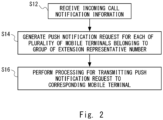
- Fig. 2 is a flowchart showing a relay method executed by the relay apparatus 1 shown in Fig. 1 .
- the reception unit 2 receives, from the private branch exchange, incoming call notification information indicating an incoming call notification, which is a notification indicating that the incoming call is made to the extension representative number (Step S12).
- the generation unit 4 generates a push notification request corresponding to the incoming call notification for each of a plurality of mobile terminals belonging to the group of the extension representative number based on the incoming call notification information (Step S14).
- the transmission unit 6 performs processing for transmitting the push notification request to the corresponding mobile terminal (Step S16). For example, the transmission unit 6 may transmit the push notification request to the push notification server. Accordingly, the push notification request is transmitted to the mobile terminal.
- the push notification server is communicatively connected to the relay apparatus 1.
- the push notification server is a server which transmits a push notification to a mobile terminal.
- Fig. 3 is a diagram conceptually showing a flow of an incoming call notification when an incoming call is made to an extension representative number.
- an incoming call is made to an extension representative number a1 by an extension call or an external call.
- the relay apparatus 1 generates a push notification request corresponding to the incoming call notification for the mobile terminal number a3 of a plurality of mobile terminals belonging to an extension representative number group a2 which is a group of the extension representative number a1. Then, the relay apparatus 1 transmits the push notification request to each of the mobile terminals through, for example, the push notification server.
- the relay apparatus 1 distributes the incoming call to a plurality of the mobile terminals belonging to the extension representative number group a2.
- the incoming call notification is displayed on each of the mobile terminals. Note that, even when a non-response notification is made to the private branch exchange after the incoming call is made, the relay apparatus 1 generates a push notification request corresponding to the non-response notification for the mobile terminal number a3 of a plurality of the mobile terminals belonging to the extension representative number group a2.
- the relay apparatus 1 is configured to generate, when an incoming call to the extension representative number is made for the private branch exchange, the push notification request corresponding to the incoming call notification for each of a plurality of mobile terminals belonging to the group of the extension representative number. Accordingly, it is not necessary for the private branch exchange to generate incoming call notification information for a plurality of mobile terminals belonging to the group of the extension representative number and transmit the information to each mobile terminal. Therefore, the load on the private branch exchange (network load, etc.) can be reduced. Thus, the private branch exchange can smoothly perform other exchange processing (the process of exchanging information over a network, such as receiving, responding, and transferring telephone calls).
- the relay method shown in Fig. 2 and the program for implementing the relay method can also reduce the load on the private branch exchange.
- the communication system including the relay apparatus 1 and the private branch exchange can also reduce the load on the private branch exchange.
- Fig. 4 is a diagram showing a configuration of a communication system 10 according to the first example embodiment.
- the communication system 10 includes a telephone 20, a private branch exchange 40 (PBX), a relay server 100, a push notification server 60, and a plurality of mobile terminals 70 (70A, 70B,--).
- the private branch exchange 40 is connected to the telephone 20 via an extension or external telephone network 11.
- the private branch exchange 40 is connected to the relay server 100 via the Internet 12.
- the private branch exchange 40 may be connected to the mobile terminal 70 via the Internet.
- One relay server 100 may be connected to a plurality of private branch exchanges 40. In this case, a plurality of private branch exchanges 40 may share one relay server 100.
- the relay server 100 is connected to the push notification server 60 via the Internet 13.
- the push notification server 60 is connected to the mobile terminals 70 via the mobile carrier network 14.
- the Internet 12 and the Internet 13 are shown separately in the figure, they may be the same Internet (for example, the Internet 12).
- the private branch exchange 40 may be, for example, a computer.
- the private branch exchange 40 relays communication between the telephone 20 and the mobile terminals 70 through the telephone network 11 and the Internet 12.
- the private branch exchange 40 retrieves the mobile terminal number of the mobile terminal 70 belonging to the extension representative number group related to the extension representative number by using the database of the extension representative number group.
- the private branch exchange 40 transmits the retrieved mobile terminal number to the relay server 100.
- the private branch exchange 40 receives an incoming call to the extension representative number from the telephone 20, it transmits the incoming call notification information including information on the extension representative number group to the relay server 100.
- the extension representative number is, for example, an extension number addressed to any (all) terminals of an organization in an enterprise or the like.
- the relay server 100 corresponds to the relay apparatus 1 shown in Fig. 1 .
- the relay server 100 is, for example, a computer.
- the relay server 100 communicates with the push notification server 60 instead of the private branch exchange 40.
- the relay server 100 relays the communication between the private branch exchange 40 and the push notification server 60. Therefore, the relay server 100 functions as a proxy server (push proxy server).
- the configuration of the relay server 100 will be described later.
- the relay server 100 generates a push notification request for each mobile terminal number from the information of the extension representative number group received from the private branch exchange 40 and transmits it to the push notification server. Specifically, the relay server 100 converts the incoming call notification information regarding the extension representative number group transmitted from the private branch exchange 40 into incoming call notification information addressed to the respective mobile terminals 70. Then, the relay server 100 transmits, to the push notification server 60, the converted incoming call notification information as the push notification request. Here, the relay server 100 converts the incoming call notification transmitted from the private branch exchange 40 into the push notification request so as to meet the specifications of the push notification server 60.
- the push notification server 60 is, for example, a computer.
- the push notification server 60 transmits the push notification to the corresponding mobile terminal 70 based on the push notification request received from the relay server 100.
- the mobile terminal 70 is, for example, a computer.
- the mobile terminal 70 is connected to the private branch exchange 40 via the extension telephone network or the Internet 12.
- the mobile terminal 70 can make an extension call (i.e., extension-to-extension call) and an external call via the private branch exchange 40.
- the mobile terminal 70 receives the push notification from the push notification server 60 via the mobile carrier network 14. Based on the contents of the push notification, the mobile terminal 70 makes the incoming call notification by screen display, sound or vibration. Accordingly, the user of the mobile terminal 70 can perform an operation to respond to an incoming call to the extension representative number.
- Fig. 5 is a diagram illustrating a database of extension representative number groups according to the first example embodiment.
- the mobile terminal number of the mobile terminal 70 belonging to the extension representative number group " 1100" includes the mobile terminal number #1-1, the mobile terminal number #1-2, the mobile terminal number #1-3, and the mobile terminal number #1-4.
- the mobile terminal number #1-1 is "Extension phone number 1101, External phone number 090-1234-1101".
- the mobile terminal number #1-2 is "Extension phone number 1102, External phone number 090-1234-1102".
- the mobile terminal number #1-3 is "Extension phone number 1103, External phone number 090-1234-1103".
- the mobile terminal number #1-4 is "Extension phone number 1104, External phone number 090-1234-1104". The same is applicable to extension number group " 1200" and the like.
- the private branch exchange 40 When, for example, the private branch exchange 40 receives an incoming call to the extension representative number "1100" from the telephone 20, the private branch exchange 40 retrieves the mobile terminal number #1-1, the mobile terminal number #1-2, the mobile terminal number #1-3 and the mobile terminal number #1-4 by using the database illustrated in Fig. 5 .
- the private branch exchange 40 transmits the mobile terminal number #1-1, the mobile terminal number #1-2, the mobile terminal number #1-3, and the mobile terminal number #1-4 to the relay server 100.
- the private branch exchange 40 transmits information related to the extension representative number group "1100" to the relay server 100.
- the private branch exchange 40 retrieves the mobile terminal numbers in the extension representative number group.
- the private branch exchange 40 transmits the incoming call notification information including the retrieved mobile terminal numbers and the information of the extension representative number group to the relay server 100.
- the relay server 100 combines the transmitted mobile terminal number and the information of the extension representative number group to generate a push notification request for each of the mobile terminals 70 in a form conforming to the specifications of the push notification server 60.
- Fig. 6 is a diagram showing a configuration of the relay server 100 according to the first example embodiment.
- the relay server 100 includes, as main hardware configurations, a control unit 102, a storage unit 104, a communication unit 106, and an interface unit (IF) 108.
- the control unit 102, the storage unit 104, the communication unit 106, and the interface unit 108 are connected to one another via a data bus or the like.
- the telephone 20, the private branch exchange 40, the push notification server 60, and the mobile terminal 70 shown in Fig. 4 may also include the hardware configurations shown in Fig. 6 .
- the control unit 102 is, for example, a processor such as a Central Processing Unit (CPU).
- the control unit 102 has a function as an arithmetic apparatus that performs, for example, control processing and arithmetic processing.
- the storage unit 104 is, for example, a storage device such as a memory or a hard disc.
- the storage unit 104 is, for example, a Read Only Memory (ROM) or a Random Access Memory (RAM).
- the storage unit 104 has a function for storing, for example, a control program(s) and an arithmetic program(s) executed by the control unit 102. Further, the storage unit 104 has a function for temporarily storing processing data and the like.
- Storage 104 may include a database.
- the communication unit 106 performs processing necessary for communicating with the private branch exchange 40 and the push notification server 60.
- the communication unit 106 may include, for example, a communication port, a router, and a firewall.
- the interface unit (IF) 108 is, for example, a user interface (UI).
- the interface unit 108 includes an input device such as a keyboard, a touch panel, or a mouse, and an output device such as a display or a speaker.
- the interface unit 108 receives an operation of inputting data performed by a system administrator and outputs information to the system administrator.
- the relay server 100 includes, as components, a reception unit 112, a generation unit 114, and a transmission unit 116.
- the reception unit 112 corresponds to the reception unit 2 shown in Fig. 1 .
- the reception unit 112 includes a function as reception means.
- the generation unit 114 corresponds to the generation unit 4 shown in Fig. 1 .
- the generation unit 114 includes a function as generation means.
- the transmission unit 116 corresponds to the transmission unit 6 shown in Fig. 1 .
- the transmission unit 116 includes a function as transmission means.
- each of the aforementioned components may be implemented, for example, by executing a program under the control of the control unit 102. More specifically, each of the components may be implemented by the control unit 102 executing a program stored in the storage unit 104. Further, each of the components may be implemented by installing a necessary program stored in any nonvolatile recording medium as required. Further, each of the components is not necessarily implemented by software executed by a program, and may instead be implemented, for example, by any combination of hardware, firmware, and software. Further, each of the components may also be implemented using a user-programmable integrated circuit, such as a field-programmable gate array (FPGA) or a microcomputer. In this case, a program composed of each of the aforementioned components may be implemented by using this integrated circuit.
- FPGA field-programmable gate array
- Figs. 7 and 8 are sequence diagrams showing a communication method (relay method) executed by the communication system 10 according to the first example embodiment.
- Fig. 7 shows a processing flow when any of the mobile terminals 70 responds to the incoming call notification.
- the telephone 20 makes a call to the extension representative number (Step S102).
- the private branch exchange 40 receives an incoming call to the extension representative number from the telephone 20.
- the private branch exchange 40 transmits the incoming call notification information to the relay server 100 (Step S104).
- the relay server 100 transmits a push notification request addressed to each mobile terminal 70 (Step S106).
- the reception unit 112 receives the incoming call notification information including the mobile terminal numbers and information on the extension representative number group from the private branch exchange 40 via the Internet 12 and the communication unit 106.
- the reception unit 112 outputs the received incoming call notification information to the generation unit 114.
- the generation unit 114 analyzes the incoming call notification information and generates a push notification request corresponding to the incoming call notification information for each of a plurality of mobile terminals 70 belonging to the extension representative number group.
- the transmission unit 116 transmits the push notification request to the push notification server 60 via the communication unit 106 and the network.
- the generation unit 114 converts the incoming call notification information into the push notification request addressed to each mobile terminal 70. More specifically, the generation unit 114 generates, from the mobile terminal numbers in the extension representative number group and the extension representative number, push notification requests addressed to the corresponding mobile terminals 70 for the number of the mobile terminals 70. At this time, the generation unit 114 may generate the push notification request so that the mobile terminal number in the extension representative number group is set as a destination (transmission destination).
- the generation unit 114 generates the push notification request including a call pickup special number, an extension representative number, and a caller number (i.e., caller ID).
- the call pickup special number is a number for responding to an incoming call to the extension representative number.
- the caller number is the number (i.e., phone number) of the telephone 20 which has made a call to the extension representative number.
- the private branch exchange 40 transmits a notification (incoming call notification information) of the simultaneous call transmission to the extension representative number "1100" to the relay server 100 (S104).
- the generation unit 114 of the relay server 100 converts the incoming call notification information indicating the extension representative number "1100" into incoming call notification information (push notification request) indicating a mobile phone number belonging to the extension representative number group.
- the generation unit 114 converts the incoming call notification information indicating the extension representative number "1100” into incoming call notification information indicating the mobile phone number "090-1234-1101" belonging to the extension representative number group.
- the generation unit 114 of the relay server 100 converts the incoming call notification information indicating the extension representative number "1100” into incoming call notification information indicating the mobile phone number "090-1234-1102" belonging to the extension representative number group.
- the transmission unit 116 transmits the converted incoming call notification information (push notification request) to the mobile terminal 70 corresponding to the mobile phone number indicated in the converted incoming call notification information, via the push notification server 60.
- the push notification server 60 Upon receiving the push notification request from the relay server 100, the push notification server 60 transmits a push notification corresponding to the push notification request to each mobile terminal 70 (Step S108). Accordingly, the push notifications are delivered to the mobile terminals 70A and 70B belonging to the extension representative number group via the mobile carrier network 14. Thus, the mobile terminals 70A, 70B start the incoming call notification.
- the mobile terminal 70 can respond to the extension representative number for which the incoming call is being made by the telephone 20 in response to the received push notification.
- the mobile terminal 70A (mobile terminal A) performs a response operation.
- the mobile terminal 70A makes a call pickup response to the private branch exchange 40 (Step S 112).
- the push notification includes information (number) necessary for a response operation, such as the call pickup special number, the extension representative number, and the caller number. Therefore, when the mobile terminal 70A performs a response operation after receiving the push notification, the mobile terminal 70A performs a transmitting operation (call pickup response) of the response request to the private branch exchange 40 by using the above-described number.
- the private branch exchange 40 Upon receiving the response request from the mobile terminal 70A, the private branch exchange 40 performs response to the originating call (S102), to the telephone 20 (Step S114). Specifically, the private branch exchange 40 analyzes the above-described number transmitted from the mobile terminal 70A, and transmits a response request to the call originated from the telephone 20, to the telephone 20. Thus, the private branch exchange 40 performs connection processing between the telephone 20 and the mobile terminal 70A. In this way, a call between the telephone 20 and the mobile terminal 70A is started (Step S116).
- the non-response notification information is delivered to the mobile terminal 70 by the same route as in the incoming call notification (S104 to S108), and the incoming call notification is terminated (S124 to S128).
- the private branch exchange 40 transmits the non-response notification information (Step S124).
- the non-response notification information is information indicating a notification which indicates an instruction not to respond to the incoming call to the extension representative number for which the incoming call is currently being made.
- the non-response notification information indicates a notification that one of a plurality of the mobile terminals 70 has responded to the incoming call to the extension representative number.
- the non-response notification information may indicate the extension representative number to which a certain mobile terminal 70 has responded. For example, when the mobile terminal 70 responds to the extension representative number "1100", the non-response notification information indicates the extension representative number "1100".
- the relay server 100 transmits a push notification request addressed to each mobile terminal 70 (Step S126).
- the reception unit 112 receives non-response notification information including information related to the extension representative number group from the private branch exchange 40, via the Internet 12 and the communication unit 106.
- the reception unit 112 outputs the received non-response notification information to the generation unit 114.
- the generation unit 114 analyzes the non-response notification information and generates a push notification request corresponding to the non-response notification information for each of a plurality of mobile terminals 70 belonging to the extension representative number group.
- the transmission unit 116 transmits the push notification request to the push notification server 60, via the communication unit 106 and the network.
- the generation unit 114 generates the push notification request corresponding to the non-response notification information for each of all the mobile terminals 70, belonging to the extension representative number group, including the mobile terminal 70 which is responding to the incoming call. Then, the transmission unit 116 transmits the push notification request corresponding to the non-response notification information, to all the mobile terminals 70. For example, when the mobile terminal 70A responds to the extension representative number "1100", the transmission unit 116 transmits the push notification request corresponding to the non-response notification information to all the mobile terminals 70, belonging to the extension representative number group, including the mobile terminal 70A.
- the push notification server 60 Upon receiving the push notification request from the relay server 100, the push notification server 60 transmits a push notification corresponding to the push notification request to each mobile terminal 70 (Step S128). Accordingly, the push notification is delivered to the mobile terminals 70A and 70B belonging to the extension representative number group via the mobile carrier network 14. As a result, the incoming call notification is terminated in the mobile terminal 70B. In this case, the mobile terminal 70A communicating with the telephone 20 is configured to ignore the push notification (non-response notification). In this way, by collectively transmitting the non-response notification to all the mobile terminals 70 belonging to the extension representative number group, it becomes unnecessary for the private branch exchange 40 to search for which mobile terminal 70 has responded. Therefore, the load on the private branch exchange 40 can be reduced.
- Fig. 8 shows a processing flow when the telephone 20 disconnects the call before the mobile terminal 70 responds to the incoming call notification. Note that the processing of S102 to S108 are substantially the same as the processing shown in Fig. 7 , and therefore the description thereof will be omitted.
- the private branch exchange 40 receives the disconnection of the call for the extension representative number from the telephone 20.
- the private branch exchange 40 transmits the non-response notification information (Step S134).
- the non-response notification information is information indicating a notification which indicates an instruction not to respond to the incoming call to the extension representative number for which the incoming call is currently being made, since the call to the extension representative number has been disconnected.
- the non-response notification information may indicate the extension representative number corresponding to the disconnected call. For example, when the call to the extension representative number "1100" is disconnected, the non-response notification information indicates the extension representative number "1100".
- the relay server 100 transmits a push notification request addressed to each mobile terminal 70 (Step S136).
- the reception unit 112 receives non-response notification information including information related to the extension representative number group from the private branch exchange 40, via the Internet 12 and the communication unit 106.
- the reception unit 112 outputs the received non-response notification information to the generation unit 114.
- the generation unit 114 analyzes the non-response notification information and generates a push notification request corresponding to the non-response notification information for each of a plurality of mobile terminals 70 belonging to the extension representative number group.
- the transmission unit 116 transmits the push notification request to the push notification server 60, via the communication unit 106 and the network.
- the push notification server 60 Upon receiving the push notification request from the relay server 100, the push notification server 60 transmits a push notification corresponding to the push notification request to each mobile terminal 70 (Step S138). Accordingly, the push notification is delivered to the mobile terminals 70A and 70B belonging to the extension representative number group via the mobile carrier network 14. As a result, the incoming call notification is terminated in the mobile terminals 70A and 70B.
- the private branch exchange when an incoming call to the extension representative number is received, the private branch exchange simultaneously transmits incoming call instructions to the fixed terminals and the mobile terminals which belong to the extension representative number group to which the incoming call is received. That is, the private branch exchange according to the related art uses the extension representative number group to make simultaneous notification of an incoming call to the extension representative number to the fixed terminals and the portable terminals registered in the extension representative number group. Thus, the fixed terminals and the portable terminals registered in the extension representative number group can respond to the incoming call to the extension representative number.
- the application of the mobile terminals can receive an incoming call instruction only when the sleep state is released.
- the operating system (OS) of a mobile terminal restricts background execution of an application.
- the mobile terminal can receive the notification only at the timing when the sleep state of the OS is released.
- the private branch exchange simultaneously transmits the incoming call instruction to the mobile terminals belonging to the extension representative number group, the reception can be confirmed only in the mobile terminals in which the sleep state of the application is released at the timing when the incoming call instruction is transmitted. Therefore, the user of the mobile terminal cannot stably confirm the incoming call instruction to the extension representative number group.
- the mobile terminal often performs the incoming call notification with the Session Initiation Protocol (SIP) method.
- SIP Session Initiation Protocol
- push notifications could be used to make the incoming call notification even when the mobile terminal is in the sleep state.
- the mobile terminal can activate any application in the sleep state. That is, by transmitting the push notification to the mobile terminal and activating the call application, the mobile terminal can receive the incoming call notification information, perform the incoming call notification, and be ready to respond. Further, since the application can be operated only when necessary, the notification can be stably delivered while the battery consumption of the mobile terminal is reduced.
- the load on the private branch exchange increases. That is, when an attempt is made to convert an incoming call notification into a push notification in accordance with the specifications of the push notification server, the network load on the private branch exchange increases. This may affect the primary function of the private branch exchange for exchanging information on the network, such as receiving, responding, and transferring telephone calls.
- the private branch exchange when the private branch exchange transmits a notification to be transmitted to all the mobile terminals belonging to the extension representative number group, the private branch exchange needs to transmit the notification information as many as the number of all the terminals belonging to the extension representative number group, for each incoming call to the extension representative number. Therefore, the network load on the private branch exchange at the time of incoming call increases. For example, in the case of simultaneous call transmission (paging) to an extension representative number, it is necessary for the private branch exchange to convert the extension representative number to which the call is made into a mobile phone number belonging to the extension representative number group and transmit it to the public mobile network toward each mobile phone terminal. Therefore, a large load is placed on the private branch exchange because a call to one internal extension representative number becomes a plurality of external line calls.
- the relay server 100 is configured to convert the incoming call notification information into the push notification request addressed to each mobile terminal. In this way, by distributing the load of the incoming call notification to the relay server 100, the network load on the private branch exchange can be reduced. Thus, the influence on the primary function of the private branch exchange can be reduced.
- the private branch exchange 40 may include a function of confirming, when the mobile terminal 70 responds to the incoming call to the extension representative number, that the display of the caller number on the application of the mobile terminal 70 matches the caller number of a phone which actually makes a call to the responding extension representative number.
- the mobile terminal 70 which has received the incoming call notification displays the caller number and the extension representative number (or the extension representative number group name (for example, "General Affairs Department Representative").
- callers X and Y which are callers (telephones) different from each other, sequentially make and disconnect calls to the same extension representative number.
- the order in which the push notification is delivered to the mobile terminal 70 may be an incoming call notification of the caller X, an incoming call notification of the caller Y, a non-response notification of the caller X, and a non-response notification of the caller Y, in that order.
- a problem that it is connected to the caller Y even though the display of the caller number is the number of the caller X, may occur.
- the mobile terminal 70 when responding to an incoming call to the extension representative number (S112 in Fig. 7 ), the mobile terminal 70 adds the caller number to the destination information of the INVITE request of the SIP sequence as follows: call pickup special number + extension representative number + separator + caller number @ domain name .
- the call pickup special number is "#123”
- the extension representative number to which the incoming call has been made is "1000”
- the caller number is "8000”
- the separator is "sep”
- the domain name is "sample.com”
- the destination information of the INVITE request is "#123 1000sep8000@sample.com”.
- the private branch exchange 40 Upon receiving the INVITE request, the private branch exchange 40 reads the number between the separator and the domain name as the caller number. The private branch exchange 40 compares the read caller number with the caller number calling the extension representative number. If they match, the private branch exchange 40 connects the call between the caller and the mobile terminal 70 so that it can respond to the incoming call. On the other hand, if they do not match, the private branch exchange 40 does not connect the call so that it cannot respond to the incoming call. By performing such processing, even when the push notification of the non-response notification information is not delivered to the mobile terminal 70 in a normal timing, it is possible to prevent or reduce the mismatch between the display of the caller number on the mobile terminal 70 and the caller number to which it actually responds.
- the mobile terminal 70 may also be notified of call state information such as response, hold, and transfer. That is, the private branch exchange 40 transmits the call state information to the relay server 100 (S104).
- the relay server 100 transmits, to the push notification server 60, a push notification request addressed to the mobile terminals 70 belonging to the extension representative number group and corresponding to the call state information (S106).
- the push notification server 60 transmits a push notification to each of the mobile terminals 70 (S108). Accordingly, the call state is displayed on each of the mobile terminals 70.
- the information of the calling party may be transmitted together as additional information.
- the additional information includes the history or memo of the caller.
- the private branch exchange 40 retrieves information on the caller and transmits the retrieved information, as additional information, together with the incoming call notification information (S104).
- the relay server 100 transmits, to the push notification server 60, a push notification request addressed to the mobile terminals 70 belonging to the extension representative number group and corresponding to the incoming call notification information and the additional information (S106).
- the push notification server 60 transmits a push notification to each of the mobile terminals 70 (S108).
- the additional information of the caller (calling party) at the time of incoming call is displayed on each of the mobile terminals 70.
- changing the notification content from the private branch exchange 40 from the incoming call notification to the private broadcast can cause the mobile terminals 70 belonging to the extension representative number group to output the private broadcast.
- the private branch exchange 40 transmits, to the relay server 100, information for outputting the private broadcast (private broadcast information) (S104).
- the relay server 100 transmits a push notification request addressed to the mobile terminals 70 belonging to the extension representative number group and corresponding to the private broadcast information to the push notification server 60 (S106).
- the push notification server 60 transmits a push notification to each of the mobile terminals 70 (S108). As a result, each of the mobile terminals 70 outputs the private broadcast.
- the extension representative number is an extension number addressed to any terminal of an organization such as an enterprise, but this configuration is merely one example.
- the extension representative number may be an extension number addressed to a plurality of terminals of one individual. Therefore, the extension representative number group may be a group consisting of a plurality of terminals of one individual. In this case, for example, the extension representative number may be a fixed telephone number of one's own seat, and the mobile terminal belonging to the extension representative number group may be a mobile terminal number owned by the: individual. Accordingly, the mobile terminal can receive an incoming call even when the individual is away from his/her seat.
- Non-transitory computer readable media include any type of tangible storage media.
- Examples of non-transitory computer readable media include magnetic storage media (such as flexible disks, magnetic tapes, hard disk drives, etc.), optical magnetic storage media (e.g., magneto-optical disks), CD-Read Only Memory (ROM), CD-R, CD-R/W, and semiconductor memories (such as mask ROM, Programmable ROM (PROM), Erasable PROM (EPROM), flash ROM, Random Access Memory (RAM), etc.).
- the program(s) be provided to a computer using any type of transitory computer readable media.
- Transitory computer readable media examples include electric signals, optical signals, and electromagnetic waves.
- Transitory computer readable media can provide the program to a computer via a wired communication line (e.g., electric wires, and optical fibers) or a wireless communication line.
- a relay apparatus comprising:
- the relay apparatus according to Supplementary Note 1, wherein the generation means converts the incoming call notification information into a push notification request addressed to each mobile terminal.
- the relay apparatus wherein the generation means generates the push notification request from terminal numbers of a plurality of the mobile terminals belonging to the group of the extension representative number included in the incoming call notification information and the extension representative number.
- the relay apparatus wherein the generation means generates the push notification request including a call pickup special number which is a number for responding to an incoming call to the extension representative number, the extension representative number, and a caller number which is a number of a telephone which has made a call to the extension representative number.
- the relay apparatus according to any one of Supplementary Notes 1 to 4, wherein the transmission means transmits the push notification request to a push notification server that transmits a push notification to the mobile terminal.
- a communication system comprising:
- the private branch exchange compares a caller number, which is a number of a telephone that has made a call to the extension representative number, with a caller number included in a request transmitted from the mobile terminal that has responded to the incoming call, and connects a call between the telephone and the mobile terminal that has responded to the incoming call when both of them match.
- the communication system further comprising a push notification server that is a server configured to transmit a push notification to a mobile terminal, wherein the transmission means transmits the push notification request to the push notification server that transmits a push notification to the mobile terminal.
- a relay method comprising:
- the relay method according to Supplementary Note 10 further comprising converting the incoming call notification information into a push notification request addressed to each mobile terminal.
- the relay method further comprising generating the push notification request from terminal numbers of a plurality of the mobile terminals belonging to the group of the extension representative number included in the incoming call notification information and the extension representative number.
- the relay method further comprising generating the push notification request including a call pickup special number which is a number for responding to an incoming call to the extension representative number, the extension representative number, and a caller number which is a number of a telephone which has made a call to the extension representative number.
- the relay method according to any one of Supplementary Notes 10 to 13, further comprising transmitting the push notification request to a push notification server that transmits a push notification to the mobile terminal.
Landscapes
- Engineering & Computer Science (AREA)
- Signal Processing (AREA)
- Physics & Mathematics (AREA)
- Astronomy & Astrophysics (AREA)
- General Physics & Mathematics (AREA)
- Computer Networks & Wireless Communication (AREA)
- Sub-Exchange Stations And Push- Button Telephones (AREA)
- Telephonic Communication Services (AREA)
- Mobile Radio Communication Systems (AREA)
- Radio Relay Systems (AREA)
- Communication Control (AREA)
Abstract
Description
- The present invention relates to a relay apparatus, a communication system, a relay method, and a program.
- The technology of private branch exchange (PBX) which connects many private branch telephones to public switched telephone network have been known. With regard to one such technique, Patent Literature 1 discloses a system which includes a private branch exchange and a caller information notification management device, and enables a smartphone which receives telephone transfer via the private branch exchange to surely confirm the caller information. In Patent Literature 1, the private branch exchange transfers an incoming call to an extension terminal transmitted from a source telephone to a smartphone, and transmits an incoming call notification including the telephone number of the source telephone and the telephone number of the extension terminal to a caller information notification management device. Upon receiving the incoming call notification from the private branch exchange, the caller information notification management device transmits a request for push notification of the caller information including the telephone number of the caller telephone with the smartphone as the delivery destination to the push notification server.
-
Patent Literature 2 discloses a telephone exchange apparatus that connects a plurality of telephone terminals to each other via a communication network for transmitting voice packets and allows the plurality of telephone terminals to communicate with each other. When a connection request addressed to an extension group is generated, the telephone exchange apparatus according toPatent Literature 2 performs connection control for the telephone terminal of the corresponding extension group by referring to the group table. When connecting to the extension group, the telephone exchange apparatus transfers the voice packet sent from the request source to all telephone terminals belonging to the extension group through the communication network. -
- [Patent Literature 1]
Japanese Unexamined Patent Application Publication No. 2019-212942 - [Patent Literature 2]
Japanese Unexamined Patent Application Publication No. 2006-019984 - According to the techniques disclosed in the aforementioned Patent Literature, when an incoming call is made to an extension representative number, a private branch telephone exchange (telephone exchange apparatus) transmits (transfers) an incoming call notification to a terminal belonging to a group of the extension representative number. In particular, the telephone exchange apparatus according to
Patent Literature 2 generates a group paging request signal including group setting information for all telephone terminals belonging to the extension group. As described above, in the technique disclosed in the aforementioned the Patent Literature, when an incoming call is made to the extension representative number, the private branch exchange transmits the notification information as many as the number of all terminals belonging to the group of the extension representative number for each incoming call to the extension representative number. Therefore, the load on the private branch exchange may increase. - The present disclosure has been made in order to solve the aforementioned problem and an object of the present disclosure is to provide a relay apparatus, a communication system, a relay method, and a program capable of reducing a load on a private branch exchange when an incoming call is made to an extension representative number.
- A relay apparatus according to the present disclosure includes: reception means for receiving, from a private branch exchange, incoming call notification information indicating an incoming call notification, which is a notification indicating that an incoming call is made to an extension representative number; generation means for generating a push notification request corresponding to the incoming call notification for each of a plurality of mobile terminals belonging to a group of the extension representative number based on the incoming call notification information; and transmission means for performing processing for transmitting the push notification request to the corresponding mobile terminal.
- Further, a communication system according to the present disclosure includes: a relay apparatus and the private branch exchange.
- Further, a relay method according to the present disclosure includes: receiving, from a private branch exchange, incoming call notification information indicating an incoming call notification, which is a notification indicating that an incoming call is made to an extension representative number; generating a push notification request corresponding to the incoming call notification for each of a plurality of mobile terminals belonging to a group of the extension representative number based on the incoming call notification information; and performing processing for transmitting the push notification request to the corresponding mobile terminal.
- Further, a program according to the present disclosure causes a computer to execute the following steps of: receiving, from a private branch exchange, incoming call notification information indicating an incoming call notification, which is a notification indicating that an incoming call is made to an extension representative number; generating a push notification request corresponding to the incoming call notification for each of a plurality of mobile terminals belonging to a group of the extension representative number based on the incoming call notification information; and performing processing for transmitting the push notification request to the corresponding mobile terminal.
- According to the present disclosure, it is possible to provide a relay device, a communication system, a relay method, and a program capable of reducing a load on a private branch exchange when an incoming call is made to an extension representative number.
-
-
Fig. 1 is a diagram showing an outline of a relay apparatus according to an example embodiment of the present disclosure; -
Fig. 2 is a flowchart showing a relay method executed by the relay apparatus shown inFig. 1 ; -
Fig. 3 is a diagram conceptually showing a flow of an incoming call notification when an incoming call is made to an extension representative number; -
Fig. 4 is a diagram showing a configuration of a communication system according to a first example embodiment; -
Fig. 5 is a diagram illustrating a database of extension representative number groups according to the first example embodiment; -
Fig. 6 is a diagram showing a configuration of a relay server according to the first example embodiment; -
Fig. 7 is a sequence diagram showing a communication method (relay method) executed by the communication system according to the first example embodiment; and -
Fig. 8 is a sequence diagram showing a communication method (relay method) executed by the communication system according to the first example embodiment. - Prior to giving the description of example embodiments of the present disclosure, an outline of the example embodiments according to the present disclosure will be described.
Fig. 1 is a diagram showing an outline of a relay apparatus 1 according to an example embodiment of the present disclosure. The relay apparatus 1 is, for example, a computer such as a server. Therefore, the relay apparatus 1 functions as a relay server. - The relay apparatus 1 is communicably connected to a private branch exchange (PBX). The relay apparatus 1 includes a
reception unit 2, a generation unit 4, and atransmission unit 6. Thereception unit 2 includes a function as reception means. The generation unit 4 includes a function as generation means. Thetransmission unit 6 includes a function as a transmission means. The processing of thereception unit 2, the generation unit 4, and thetransmission unit 6 will be described below. -
Fig. 2 is a flowchart showing a relay method executed by the relay apparatus 1 shown inFig. 1 . Thereception unit 2 receives, from the private branch exchange, incoming call notification information indicating an incoming call notification, which is a notification indicating that the incoming call is made to the extension representative number (Step S12). The generation unit 4 generates a push notification request corresponding to the incoming call notification for each of a plurality of mobile terminals belonging to the group of the extension representative number based on the incoming call notification information (Step S14). Thetransmission unit 6 performs processing for transmitting the push notification request to the corresponding mobile terminal (Step S16). For example, thetransmission unit 6 may transmit the push notification request to the push notification server. Accordingly, the push notification request is transmitted to the mobile terminal. The push notification server is communicatively connected to the relay apparatus 1. The push notification server is a server which transmits a push notification to a mobile terminal. -
Fig. 3 is a diagram conceptually showing a flow of an incoming call notification when an incoming call is made to an extension representative number. Assume that an incoming call is made to an extension representative number a1 by an extension call or an external call. In this case, the relay apparatus 1 generates a push notification request corresponding to the incoming call notification for the mobile terminal number a3 of a plurality of mobile terminals belonging to an extension representative number group a2 which is a group of the extension representative number a1. Then, the relay apparatus 1 transmits the push notification request to each of the mobile terminals through, for example, the push notification server. - In this way, the relay apparatus 1 distributes the incoming call to a plurality of the mobile terminals belonging to the extension representative number group a2. Thus, the incoming call notification is displayed on each of the mobile terminals. Note that, even when a non-response notification is made to the private branch exchange after the incoming call is made, the relay apparatus 1 generates a push notification request corresponding to the non-response notification for the mobile terminal number a3 of a plurality of the mobile terminals belonging to the extension representative number group a2.
- As described above, the relay apparatus 1 according to the present example embodiment is configured to generate, when an incoming call to the extension representative number is made for the private branch exchange, the push notification request corresponding to the incoming call notification for each of a plurality of mobile terminals belonging to the group of the extension representative number. Accordingly, it is not necessary for the private branch exchange to generate incoming call notification information for a plurality of mobile terminals belonging to the group of the extension representative number and transmit the information to each mobile terminal. Therefore, the load on the private branch exchange (network load, etc.) can be reduced. Thus, the private branch exchange can smoothly perform other exchange processing (the process of exchanging information over a network, such as receiving, responding, and transferring telephone calls). The relay method shown in
Fig. 2 and the program for implementing the relay method can also reduce the load on the private branch exchange. The communication system including the relay apparatus 1 and the private branch exchange can also reduce the load on the private branch exchange. - Hereinafter, with reference to the drawings, example embodiments will be described. In order to clarify the explanation, the following descriptions and the drawings are omitted and simplified as appropriate. Further, throughout the drawings, the same components are denoted by the same reference symbols and overlapping descriptions are omitted as necessary.
-
Fig. 4 is a diagram showing a configuration of acommunication system 10 according to the first example embodiment. Thecommunication system 10 includes atelephone 20, a private branch exchange 40 (PBX), arelay server 100, apush notification server 60, and a plurality of mobile terminals 70 (70A, 70B,--). Theprivate branch exchange 40 is connected to thetelephone 20 via an extension orexternal telephone network 11. Theprivate branch exchange 40 is connected to therelay server 100 via theInternet 12. Theprivate branch exchange 40 may be connected to the mobile terminal 70 via the Internet. Onerelay server 100 may be connected to a plurality of private branch exchanges 40. In this case, a plurality ofprivate branch exchanges 40 may share onerelay server 100. - The
relay server 100 is connected to thepush notification server 60 via theInternet 13. Thepush notification server 60 is connected to the mobile terminals 70 via themobile carrier network 14. Although theInternet 12 and theInternet 13 are shown separately in the figure, they may be the same Internet (for example, the Internet 12). - The
private branch exchange 40 may be, for example, a computer. Theprivate branch exchange 40 relays communication between thetelephone 20 and the mobile terminals 70 through thetelephone network 11 and theInternet 12. When receiving an incoming call to the extension representative number from thetelephone 20, theprivate branch exchange 40 retrieves the mobile terminal number of the mobile terminal 70 belonging to the extension representative number group related to the extension representative number by using the database of the extension representative number group. Theprivate branch exchange 40 transmits the retrieved mobile terminal number to therelay server 100. When theprivate branch exchange 40 receives an incoming call to the extension representative number from thetelephone 20, it transmits the incoming call notification information including information on the extension representative number group to therelay server 100. Here, the extension representative number is, for example, an extension number addressed to any (all) terminals of an organization in an enterprise or the like. - The
relay server 100 corresponds to the relay apparatus 1 shown inFig. 1 . Therelay server 100 is, for example, a computer. Therelay server 100 communicates with thepush notification server 60 instead of theprivate branch exchange 40. In other words, therelay server 100 relays the communication between theprivate branch exchange 40 and thepush notification server 60. Therefore, therelay server 100 functions as a proxy server (push proxy server). The configuration of therelay server 100 will be described later. - The
relay server 100 generates a push notification request for each mobile terminal number from the information of the extension representative number group received from theprivate branch exchange 40 and transmits it to the push notification server. Specifically, therelay server 100 converts the incoming call notification information regarding the extension representative number group transmitted from theprivate branch exchange 40 into incoming call notification information addressed to the respective mobile terminals 70. Then, therelay server 100 transmits, to thepush notification server 60, the converted incoming call notification information as the push notification request. Here, therelay server 100 converts the incoming call notification transmitted from theprivate branch exchange 40 into the push notification request so as to meet the specifications of thepush notification server 60. - The
push notification server 60 is, for example, a computer. Thepush notification server 60 transmits the push notification to the corresponding mobile terminal 70 based on the push notification request received from therelay server 100. - The mobile terminal 70 is, for example, a computer. The mobile terminal 70 is connected to the
private branch exchange 40 via the extension telephone network or theInternet 12. The mobile terminal 70 can make an extension call (i.e., extension-to-extension call) and an external call via theprivate branch exchange 40. The mobile terminal 70 receives the push notification from thepush notification server 60 via themobile carrier network 14. Based on the contents of the push notification, the mobile terminal 70 makes the incoming call notification by screen display, sound or vibration. Accordingly, the user of the mobile terminal 70 can perform an operation to respond to an incoming call to the extension representative number. -
Fig. 5 is a diagram illustrating a database of extension representative number groups according to the first example embodiment. In the example ofFig. 5 , for example, the mobile terminal number of the mobile terminal 70 belonging to the extension representative number group " 1100" includes the mobile terminal number #1-1, the mobile terminal number #1-2, the mobile terminal number #1-3, and the mobile terminal number #1-4. The mobile terminal number #1-1 is "Extension phone number 1101, External phone number 090-1234-1101". The mobile terminal number #1-2 is "Extension phone number 1102, External phone number 090-1234-1102". The mobile terminal number #1-3 is "Extension phone number 1103, External phone number 090-1234-1103". The mobile terminal number #1-4 is "Extension phone number 1104, External phone number 090-1234-1104". The same is applicable to extension number group " 1200" and the like. - When, for example, the
private branch exchange 40 receives an incoming call to the extension representative number "1100" from thetelephone 20, theprivate branch exchange 40 retrieves the mobile terminal number #1-1, the mobile terminal number #1-2, the mobile terminal number #1-3 and the mobile terminal number #1-4 by using the database illustrated inFig. 5 . Theprivate branch exchange 40 transmits the mobile terminal number #1-1, the mobile terminal number #1-2, the mobile terminal number #1-3, and the mobile terminal number #1-4 to therelay server 100. Theprivate branch exchange 40 transmits information related to the extension representative number group "1100" to therelay server 100. - As described above, in the
communication system 10 according to the first example embodiment, theprivate branch exchange 40 retrieves the mobile terminal numbers in the extension representative number group. Theprivate branch exchange 40 transmits the incoming call notification information including the retrieved mobile terminal numbers and the information of the extension representative number group to therelay server 100. Therelay server 100 combines the transmitted mobile terminal number and the information of the extension representative number group to generate a push notification request for each of the mobile terminals 70 in a form conforming to the specifications of thepush notification server 60. -
Fig. 6 is a diagram showing a configuration of therelay server 100 according to the first example embodiment. Therelay server 100 includes, as main hardware configurations, acontrol unit 102, astorage unit 104, acommunication unit 106, and an interface unit (IF) 108. Thecontrol unit 102, thestorage unit 104, thecommunication unit 106, and theinterface unit 108 are connected to one another via a data bus or the like. Note that thetelephone 20, theprivate branch exchange 40, thepush notification server 60, and the mobile terminal 70 shown inFig. 4 may also include the hardware configurations shown inFig. 6 . - The
control unit 102 is, for example, a processor such as a Central Processing Unit (CPU). Thecontrol unit 102 has a function as an arithmetic apparatus that performs, for example, control processing and arithmetic processing. Thestorage unit 104 is, for example, a storage device such as a memory or a hard disc. Thestorage unit 104 is, for example, a Read Only Memory (ROM) or a Random Access Memory (RAM). Thestorage unit 104 has a function for storing, for example, a control program(s) and an arithmetic program(s) executed by thecontrol unit 102. Further, thestorage unit 104 has a function for temporarily storing processing data and the like.Storage 104 may include a database. - The
communication unit 106 performs processing necessary for communicating with theprivate branch exchange 40 and thepush notification server 60. Thecommunication unit 106 may include, for example, a communication port, a router, and a firewall. The interface unit (IF) 108 is, for example, a user interface (UI). Theinterface unit 108 includes an input device such as a keyboard, a touch panel, or a mouse, and an output device such as a display or a speaker. Theinterface unit 108 receives an operation of inputting data performed by a system administrator and outputs information to the system administrator. - The
relay server 100 according to the first example embodiment includes, as components, areception unit 112, ageneration unit 114, and atransmission unit 116. Thereception unit 112 corresponds to thereception unit 2 shown inFig. 1 . Thereception unit 112 includes a function as reception means. Thegeneration unit 114 corresponds to the generation unit 4 shown inFig. 1 . Thegeneration unit 114 includes a function as generation means. Thetransmission unit 116 corresponds to thetransmission unit 6 shown inFig. 1 . Thetransmission unit 116 includes a function as transmission means. The processing of thereception unit 112, thegeneration unit 114, and thetransmission unit 116 will be described with reference to a sequence diagram to be described later. - Note that each of the aforementioned components may be implemented, for example, by executing a program under the control of the
control unit 102. More specifically, each of the components may be implemented by thecontrol unit 102 executing a program stored in thestorage unit 104. Further, each of the components may be implemented by installing a necessary program stored in any nonvolatile recording medium as required. Further, each of the components is not necessarily implemented by software executed by a program, and may instead be implemented, for example, by any combination of hardware, firmware, and software. Further, each of the components may also be implemented using a user-programmable integrated circuit, such as a field-programmable gate array (FPGA) or a microcomputer. In this case, a program composed of each of the aforementioned components may be implemented by using this integrated circuit. -
Figs. 7 and8 are sequence diagrams showing a communication method (relay method) executed by thecommunication system 10 according to the first example embodiment.Fig. 7 shows a processing flow when any of the mobile terminals 70 responds to the incoming call notification. Thetelephone 20 makes a call to the extension representative number (Step S102). Accordingly, theprivate branch exchange 40 receives an incoming call to the extension representative number from thetelephone 20. Theprivate branch exchange 40 transmits the incoming call notification information to the relay server 100 (Step S104). - The
relay server 100 transmits a push notification request addressed to each mobile terminal 70 (Step S106). Specifically, thereception unit 112 receives the incoming call notification information including the mobile terminal numbers and information on the extension representative number group from theprivate branch exchange 40 via theInternet 12 and thecommunication unit 106. Thereception unit 112 outputs the received incoming call notification information to thegeneration unit 114. Thegeneration unit 114 analyzes the incoming call notification information and generates a push notification request corresponding to the incoming call notification information for each of a plurality of mobile terminals 70 belonging to the extension representative number group. Thetransmission unit 116 transmits the push notification request to thepush notification server 60 via thecommunication unit 106 and the network. - A specific process of the
generation unit 114 will be described. Thegeneration unit 114 converts the incoming call notification information into the push notification request addressed to each mobile terminal 70. More specifically, thegeneration unit 114 generates, from the mobile terminal numbers in the extension representative number group and the extension representative number, push notification requests addressed to the corresponding mobile terminals 70 for the number of the mobile terminals 70. At this time, thegeneration unit 114 may generate the push notification request so that the mobile terminal number in the extension representative number group is set as a destination (transmission destination). - For example, the
generation unit 114 generates the push notification request including a call pickup special number, an extension representative number, and a caller number (i.e., caller ID). Here, the call pickup special number is a number for responding to an incoming call to the extension representative number. The caller number is the number (i.e., phone number) of thetelephone 20 which has made a call to the extension representative number. Thus, as will be described later, a call between the mobile terminal 70 and thetelephone 20 can be established. - For example, in the example of
Fig. 5 , it is assumed that there is a simultaneous call transmission (paging) to the extension representative number "1100" from the telephone 20 (S102). In this case, theprivate branch exchange 40 transmits a notification (incoming call notification information) of the simultaneous call transmission to the extension representative number "1100" to the relay server 100 (S104). In this case, thegeneration unit 114 of therelay server 100 converts the incoming call notification information indicating the extension representative number "1100" into incoming call notification information (push notification request) indicating a mobile phone number belonging to the extension representative number group. That is, thegeneration unit 114 converts the incoming call notification information indicating the extension representative number "1100" into incoming call notification information indicating the mobile phone number "090-1234-1101" belonging to the extension representative number group. Similarly, thegeneration unit 114 of therelay server 100 converts the incoming call notification information indicating the extension representative number "1100" into incoming call notification information indicating the mobile phone number "090-1234-1102" belonging to the extension representative number group. The same applies to mobile phone numbers "090-1234-1103", "090-1234-1104" and the like. Then, thetransmission unit 116 transmits the converted incoming call notification information (push notification request) to the mobile terminal 70 corresponding to the mobile phone number indicated in the converted incoming call notification information, via thepush notification server 60. - Upon receiving the push notification request from the
relay server 100, thepush notification server 60 transmits a push notification corresponding to the push notification request to each mobile terminal 70 (Step S108). Accordingly, the push notifications are delivered to themobile terminals mobile carrier network 14. Thus, themobile terminals - Then, the mobile terminal 70 can respond to the extension representative number for which the incoming call is being made by the
telephone 20 in response to the received push notification. In the example ofFig. 7 , themobile terminal 70A (mobile terminal A) performs a response operation. As a result, themobile terminal 70A makes a call pickup response to the private branch exchange 40 (Step S 112). - Specifically, according to the push notification request generated by the
generation unit 114, the push notification includes information (number) necessary for a response operation, such as the call pickup special number, the extension representative number, and the caller number. Therefore, when themobile terminal 70A performs a response operation after receiving the push notification, themobile terminal 70A performs a transmitting operation (call pickup response) of the response request to theprivate branch exchange 40 by using the above-described number. - Upon receiving the response request from the
mobile terminal 70A, theprivate branch exchange 40 performs response to the originating call (S102), to the telephone 20 (Step S114). Specifically, theprivate branch exchange 40 analyzes the above-described number transmitted from themobile terminal 70A, and transmits a response request to the call originated from thetelephone 20, to thetelephone 20. Thus, theprivate branch exchange 40 performs connection processing between thetelephone 20 and themobile terminal 70A. In this way, a call between thetelephone 20 and themobile terminal 70A is started (Step S116). - Further, when one of the mobile terminals 70 belonging to the extension representative number group responds during the incoming call notification, the non-response notification information is delivered to the mobile terminal 70 by the same route as in the incoming call notification (S104 to S108), and the incoming call notification is terminated (S124 to S128). Specifically, when one of the mobile terminals 70 belonging to the extension representative number group responds, the
private branch exchange 40 transmits the non-response notification information (Step S124). The non-response notification information is information indicating a notification which indicates an instruction not to respond to the incoming call to the extension representative number for which the incoming call is currently being made. In this case, the non-response notification information indicates a notification that one of a plurality of the mobile terminals 70 has responded to the incoming call to the extension representative number. The non-response notification information may indicate the extension representative number to which a certain mobile terminal 70 has responded. For example, when the mobile terminal 70 responds to the extension representative number "1100", the non-response notification information indicates the extension representative number "1100". - The
relay server 100 transmits a push notification request addressed to each mobile terminal 70 (Step S126). Specifically, thereception unit 112 receives non-response notification information including information related to the extension representative number group from theprivate branch exchange 40, via theInternet 12 and thecommunication unit 106. Thereception unit 112 outputs the received non-response notification information to thegeneration unit 114. Thegeneration unit 114 analyzes the non-response notification information and generates a push notification request corresponding to the non-response notification information for each of a plurality of mobile terminals 70 belonging to the extension representative number group. Thetransmission unit 116 transmits the push notification request to thepush notification server 60, via thecommunication unit 106 and the network. - In this case, the
generation unit 114 generates the push notification request corresponding to the non-response notification information for each of all the mobile terminals 70, belonging to the extension representative number group, including the mobile terminal 70 which is responding to the incoming call. Then, thetransmission unit 116 transmits the push notification request corresponding to the non-response notification information, to all the mobile terminals 70. For example, when themobile terminal 70A responds to the extension representative number "1100", thetransmission unit 116 transmits the push notification request corresponding to the non-response notification information to all the mobile terminals 70, belonging to the extension representative number group, including themobile terminal 70A. - Upon receiving the push notification request from the
relay server 100, thepush notification server 60 transmits a push notification corresponding to the push notification request to each mobile terminal 70 (Step S128). Accordingly, the push notification is delivered to themobile terminals mobile carrier network 14. As a result, the incoming call notification is terminated in themobile terminal 70B. In this case, themobile terminal 70A communicating with thetelephone 20 is configured to ignore the push notification (non-response notification). In this way, by collectively transmitting the non-response notification to all the mobile terminals 70 belonging to the extension representative number group, it becomes unnecessary for theprivate branch exchange 40 to search for which mobile terminal 70 has responded. Therefore, the load on theprivate branch exchange 40 can be reduced. -
Fig. 8 shows a processing flow when thetelephone 20 disconnects the call before the mobile terminal 70 responds to the incoming call notification. Note that the processing of S102 to S108 are substantially the same as the processing shown inFig. 7 , and therefore the description thereof will be omitted. When thetelephone 20 disconnects the call (Step S132), theprivate branch exchange 40 receives the disconnection of the call for the extension representative number from thetelephone 20. At this time, theprivate branch exchange 40 transmits the non-response notification information (Step S134). In this case, the non-response notification information is information indicating a notification which indicates an instruction not to respond to the incoming call to the extension representative number for which the incoming call is currently being made, since the call to the extension representative number has been disconnected. The non-response notification information may indicate the extension representative number corresponding to the disconnected call. For example, when the call to the extension representative number "1100" is disconnected, the non-response notification information indicates the extension representative number "1100". - The
relay server 100 transmits a push notification request addressed to each mobile terminal 70 (Step S136). Specifically, thereception unit 112 receives non-response notification information including information related to the extension representative number group from theprivate branch exchange 40, via theInternet 12 and thecommunication unit 106. Thereception unit 112 outputs the received non-response notification information to thegeneration unit 114. Thegeneration unit 114 analyzes the non-response notification information and generates a push notification request corresponding to the non-response notification information for each of a plurality of mobile terminals 70 belonging to the extension representative number group. Thetransmission unit 116 transmits the push notification request to thepush notification server 60, via thecommunication unit 106 and the network. - Upon receiving the push notification request from the
relay server 100, thepush notification server 60 transmits a push notification corresponding to the push notification request to each mobile terminal 70 (Step S138). Accordingly, the push notification is delivered to themobile terminals mobile carrier network 14. As a result, the incoming call notification is terminated in themobile terminals - In the related art described above, when an incoming call to the extension representative number is received, the private branch exchange simultaneously transmits incoming call instructions to the fixed terminals and the mobile terminals which belong to the extension representative number group to which the incoming call is received. That is, the private branch exchange according to the related art uses the extension representative number group to make simultaneous notification of an incoming call to the extension representative number to the fixed terminals and the portable terminals registered in the extension representative number group. Thus, the fixed terminals and the portable terminals registered in the extension representative number group can respond to the incoming call to the extension representative number.
- However, in recent mobile terminals, in order to save power, there is a case where the application of the mobile terminals can receive an incoming call instruction only when the sleep state is released. For example, there is a case where the operating system (OS) of a mobile terminal restricts background execution of an application. In this case, if the execution of the application used for the incoming call is restricted by the processing of the OS, the mobile terminal can receive the notification only at the timing when the sleep state of the OS is released. In other words, even if the private branch exchange simultaneously transmits the incoming call instruction to the mobile terminals belonging to the extension representative number group, the reception can be confirmed only in the mobile terminals in which the sleep state of the application is released at the timing when the incoming call instruction is transmitted. Therefore, the user of the mobile terminal cannot stably confirm the incoming call instruction to the extension representative number group.
- In addition, the mobile terminal often performs the incoming call notification with the Session Initiation Protocol (SIP) method. In this method, it is necessary to always activate the call application in order to receive the SIP message, which may increase power consumption.
- To solve this problem, push notifications could be used to make the incoming call notification even when the mobile terminal is in the sleep state. Specifically, by transmitting the push notification to the mobile terminal, the mobile terminal can activate any application in the sleep state. That is, by transmitting the push notification to the mobile terminal and activating the call application, the mobile terminal can receive the incoming call notification information, perform the incoming call notification, and be ready to respond. Further, since the application can be operated only when necessary, the notification can be stably delivered while the battery consumption of the mobile terminal is reduced.
- If the private branch exchange transmits such a push notification to the mobile terminal, the load on the private branch exchange increases. That is, when an attempt is made to convert an incoming call notification into a push notification in accordance with the specifications of the push notification server, the network load on the private branch exchange increases. This may affect the primary function of the private branch exchange for exchanging information on the network, such as receiving, responding, and transferring telephone calls.
- Also, as in the related art, when the private branch exchange transmits a notification to be transmitted to all the mobile terminals belonging to the extension representative number group, the private branch exchange needs to transmit the notification information as many as the number of all the terminals belonging to the extension representative number group, for each incoming call to the extension representative number. Therefore, the network load on the private branch exchange at the time of incoming call increases. For example, in the case of simultaneous call transmission (paging) to an extension representative number, it is necessary for the private branch exchange to convert the extension representative number to which the call is made into a mobile phone number belonging to the extension representative number group and transmit it to the public mobile network toward each mobile phone terminal. Therefore, a large load is placed on the private branch exchange because a call to one internal extension representative number becomes a plurality of external line calls.
- On the other hand, the
relay server 100 according to the first example embodiment is configured to convert the incoming call notification information into the push notification request addressed to each mobile terminal. In this way, by distributing the load of the incoming call notification to therelay server 100, the network load on the private branch exchange can be reduced. Thus, the influence on the primary function of the private branch exchange can be reduced. - Note that the
private branch exchange 40 may include a function of confirming, when the mobile terminal 70 responds to the incoming call to the extension representative number, that the display of the caller number on the application of the mobile terminal 70 matches the caller number of a phone which actually makes a call to the responding extension representative number. In this method, the mobile terminal 70 which has received the incoming call notification displays the caller number and the extension representative number (or the extension representative number group name (for example, "General Affairs Department Representative"). - In this case, it is assumed that callers X and Y, which are callers (telephones) different from each other, sequentially make and disconnect calls to the same extension representative number. At this time, due to congestion on the Internet or the like, the order in which the push notification is delivered to the mobile terminal 70 may be an incoming call notification of the caller X, an incoming call notification of the caller Y, a non-response notification of the caller X, and a non-response notification of the caller Y, in that order. In this case, when the mobile terminal 70 responds to the incoming call, a problem, that it is connected to the caller Y even though the display of the caller number is the number of the caller X, may occur.
- In order to solve this problem, when responding to an incoming call to the extension representative number (S112 in
Fig. 7 ), the mobile terminal 70 adds the caller number to the destination information of the INVITE request of the SIP sequence as follows:
- For example, if the call pickup special number is "#123", the extension representative number to which the incoming call has been made is "1000", the caller number is "8000", the separator is "sep", and the domain name is "sample.com", the destination information of the INVITE request is "#123 1000sep8000@sample.com".
- Upon receiving the INVITE request, the
private branch exchange 40 reads the number between the separator and the domain name as the caller number. Theprivate branch exchange 40 compares the read caller number with the caller number calling the extension representative number. If they match, theprivate branch exchange 40 connects the call between the caller and the mobile terminal 70 so that it can respond to the incoming call. On the other hand, if they do not match, theprivate branch exchange 40 does not connect the call so that it cannot respond to the incoming call. By performing such processing, even when the push notification of the non-response notification information is not delivered to the mobile terminal 70 in a normal timing, it is possible to prevent or reduce the mismatch between the display of the caller number on the mobile terminal 70 and the caller number to which it actually responds. - Note that the present invention is not limited to the aforementioned example embodiment and may be changed as appropriate within the scope of the present invention. In the above-described flowcharts and sequence diagrams, the order of each process (step) may be changed as appropriate. Further, one or more of a plurality of processes (steps) may be omitted.
- In the aforementioned example embodiment, the case of transmitting the incoming call notification to the mobile terminal 70 has been described, but this configuration is merely one example. For example, similarly to the processes of S104 to S108 shown in
Fig. 7 , the mobile terminal 70 may also be notified of call state information such as response, hold, and transfer. That is, theprivate branch exchange 40 transmits the call state information to the relay server 100 (S104). Therelay server 100 transmits, to thepush notification server 60, a push notification request addressed to the mobile terminals 70 belonging to the extension representative number group and corresponding to the call state information (S106). Thepush notification server 60 transmits a push notification to each of the mobile terminals 70 (S108). Accordingly, the call state is displayed on each of the mobile terminals 70. - In the processing of S104 to S108 shown in
Fig. 7 , when the incoming call notification information is transmitted, the information of the calling party (caller) may be transmitted together as additional information. The additional information includes the history or memo of the caller. Specifically, when transmitting the incoming call notification information, theprivate branch exchange 40 retrieves information on the caller and transmits the retrieved information, as additional information, together with the incoming call notification information (S104). Therelay server 100 transmits, to thepush notification server 60, a push notification request addressed to the mobile terminals 70 belonging to the extension representative number group and corresponding to the incoming call notification information and the additional information (S106). Thepush notification server 60 transmits a push notification to each of the mobile terminals 70 (S108). As a result, the additional information of the caller (calling party) at the time of incoming call is displayed on each of the mobile terminals 70. - Further, changing the notification content from the
private branch exchange 40 from the incoming call notification to the private broadcast (i.e., public-address announcement) can cause the mobile terminals 70 belonging to the extension representative number group to output the private broadcast. Specifically, theprivate branch exchange 40 transmits, to therelay server 100, information for outputting the private broadcast (private broadcast information) (S104). Therelay server 100 transmits a push notification request addressed to the mobile terminals 70 belonging to the extension representative number group and corresponding to the private broadcast information to the push notification server 60 (S106). Thepush notification server 60 transmits a push notification to each of the mobile terminals 70 (S108). As a result, each of the mobile terminals 70 outputs the private broadcast. - In the above-described example embodiment, the extension representative number is an extension number addressed to any terminal of an organization such as an enterprise, but this configuration is merely one example. The extension representative number may be an extension number addressed to a plurality of terminals of one individual. Therefore, the extension representative number group may be a group consisting of a plurality of terminals of one individual. In this case, for example, the extension representative number may be a fixed telephone number of one's own seat, and the mobile terminal belonging to the extension representative number group may be a mobile terminal number owned by the: individual. Accordingly, the mobile terminal can receive an incoming call even when the individual is away from his/her seat.
- In the above-described examples, the program(s) can be stored and provided to a computer using any type of non-transitory computer readable media. Non-transitory computer readable media include any type of tangible storage media. Examples of non-transitory computer readable media include magnetic storage media (such as flexible disks, magnetic tapes, hard disk drives, etc.), optical magnetic storage media (e.g., magneto-optical disks), CD-Read Only Memory (ROM), CD-R, CD-R/W, and semiconductor memories (such as mask ROM, Programmable ROM (PROM), Erasable PROM (EPROM), flash ROM, Random Access Memory (RAM), etc.). Further, the program(s) be provided to a computer using any type of transitory computer readable media. Examples of transitory computer readable media include electric signals, optical signals, and electromagnetic waves. Transitory computer readable media can provide the program to a computer via a wired communication line (e.g., electric wires, and optical fibers) or a wireless communication line.
- The whole or part of the example embodiment disclosed above can be described as, but not limited to, the following supplementary notes.
- A relay apparatus comprising:
- reception means for receiving, from a private branch exchange, incoming call notification information indicating an incoming call notification, which is a notification indicating that an incoming call is made to an extension representative number;
- generation means for generating a push notification request corresponding to the incoming call notification for each of a plurality of mobile terminals belonging to a group of the extension representative number based on the incoming call notification information; and
- transmission means for performing processing for transmitting the push notification request to the corresponding mobile terminal.
- The relay apparatus according to Supplementary Note 1, wherein the generation means converts the incoming call notification information into a push notification request addressed to each mobile terminal.
- The relay apparatus according to
Supplementary Note 2, wherein the generation means generates the push notification request from terminal numbers of a plurality of the mobile terminals belonging to the group of the extension representative number included in the incoming call notification information and the extension representative number. - The relay apparatus according to Supplementary Note 3, wherein the generation means generates the push notification request including a call pickup special number which is a number for responding to an incoming call to the extension representative number, the extension representative number, and a caller number which is a number of a telephone which has made a call to the extension representative number.
- The relay apparatus according to any one of Supplementary Notes 1 to 4, wherein the transmission means transmits the push notification request to a push notification server that transmits a push notification to the mobile terminal.
- The relay apparatus according to any one of Supplementary Notes 1 to 5, wherein,
- when the reception means receives, from the private branch exchange, non-response notification information indicating a notification that one of a plurality of the mobile terminals has responded to an incoming call to the extension representative number,
- the generation means generates a push notification request corresponding to the non-response notification information to each of all the mobile terminals, belonging to the group of the extension representative number, including the mobile terminal which is responding to the incoming call, and
- the transmission means transmits the push notification request corresponding to the non-response notification information to all the mobile terminals.
- A communication system comprising:
- the relay apparatus according to any one of Supplementary Notes 1 to 6; and
- the private branch exchange.
- The communication system according to Supplementary Note 7, wherein the private branch exchange compares a caller number, which is a number of a telephone that has made a call to the extension representative number, with a caller number included in a request transmitted from the mobile terminal that has responded to the incoming call, and connects a call between the telephone and the mobile terminal that has responded to the incoming call when both of them match.
- The communication system according to Supplementary Note 7 or 8, further comprising a push notification server that is a server configured to transmit a push notification to a mobile terminal,
wherein the transmission means transmits the push notification request to the push notification server that transmits a push notification to the mobile terminal. - A relay method comprising:
- receiving, from a private branch exchange, incoming call notification information indicating an incoming call notification, which is a notification indicating that an incoming call is made to an extension representative number;
- generating a push notification request corresponding to the incoming call notification for each of a plurality of mobile terminals belonging to a group of the extension representative number based on the incoming call notification information; and
- performing processing for transmitting the push notification request to the corresponding mobile terminal.
- The relay method according to
Supplementary Note 10, further comprising converting the incoming call notification information into a push notification request addressed to each mobile terminal. - The relay method according to
Supplementary Note 11, further comprising generating the push notification request from terminal numbers of a plurality of the mobile terminals belonging to the group of the extension representative number included in the incoming call notification information and the extension representative number. - The relay method according to
Supplementary Note 12, further comprising generating the push notification request including a call pickup special number which is a number for responding to an incoming call to the extension representative number, the extension representative number, and a caller number which is a number of a telephone which has made a call to the extension representative number. - The relay method according to any one of
Supplementary Notes 10 to 13, further comprising transmitting the push notification request to a push notification server that transmits a push notification to the mobile terminal. - The relay method according to any one of
Supplementary Notes 10 to 14, further comprising, - when receiving, from the private branch exchange, non-response notification information indicating a notification that one of a plurality of the mobile terminals has responded to an incoming call to the extension representative number,
- generating a push notification request corresponding to the non-response notification information to each of all the mobile terminals, belonging to the group of the extension representative number, including the mobile terminal which is responding to the incoming call, and
- transmitting the push notification request corresponding to the non-response notification information to all the mobile terminals.
- A program for causing a computer to execute the following steps of:
- receiving, from a private branch exchange, incoming call notification information indicating an incoming call notification, which is a notification indicating that an incoming call is made to an extension representative number;
- generating a push notification request corresponding to the incoming call notification for each of a plurality of mobile terminals belonging to a group of the extension representative number based on the incoming call notification information; and
- performing processing for transmitting the push notification request to the corresponding mobile terminal.
- While the present disclosure has been described with reference to the example embodiment, the present disclosure is not limited to the above example embodiment. Various changes that may be understood by those skilled in the art may be made to the configurations and the details of the present application.
- This application is based upon and claims the benefit of priority from
Japanese Patent Application No. 2020 087881, filed on May 20, 2020 -
- 1
- Relay Apparatus
- 2
- Reception Unit
- 4
- Generation Unit
- 6
- Transmission Unit
- 10
- Communication System
- 11
- Telephone Network
- 12,13
- Internet
- 14
- Mobile Carrier Network
- 20
- Telephone
- 40
- Private Branch Exchange
- 60
- Push Notification Server
- 70
- Mobile Terminal
- 100
- Relay Server
- 112
- Reception Unit
- 114
- Generation Unit
- 116
- Transmission Unit
Claims (16)
- A relay apparatus comprising:reception means for receiving, from a private branch exchange, incoming call notification information indicating an incoming call notification, which is a notification indicating that an incoming call is made to an extension representative number;generation means for generating a push notification request corresponding to the incoming call notification for each of a plurality of mobile terminals belonging to a group of the extension representative number based on the incoming call notification information; andtransmission means for performing processing for transmitting the push notification request to the corresponding mobile terminal.
- The relay apparatus according to Claim 1, wherein the generation means converts the incoming call notification information into a push notification request addressed to each mobile terminal.
- The relay apparatus according to Claim 2, wherein the generation means generates the push notification request from terminal numbers of a plurality of the mobile terminals belonging to the group of the extension representative number included in the incoming call notification information and the extension representative number.
- The relay apparatus according to Claim 3, wherein the generation means generates the push notification request including a call pickup special number which is a number for responding to an incoming call to the extension representative number, the extension representative number, and a caller number which is a number of a telephone which has made a call to the extension representative number.
- The relay apparatus according to any one of Claims 1 to 4, wherein the transmission means transmits the push notification request to a push notification server that transmits a push notification to the mobile terminal.
- The relay apparatus according to any one of Claims 1 to 5, wherein, when the reception means receives, from the private branch exchange, non-response notification information indicating a notification that one of a plurality of the mobile terminals has responded to an incoming call to the extension representative number, the generation means generates a push notification request corresponding to the non-response notification information to each of all the mobile terminals, belonging to the group of the extension representative number, including the mobile terminal which is responding to the incoming call, and the transmission means transmits the push notification request corresponding to the non-response notification information to all the mobile terminals.
- A communication system comprising:the relay apparatus according to any one of Claims 1 to 6; andthe private branch exchange.
- The communication system according to Claim 7, wherein the private branch exchange compares a caller number, which is a number of a telephone that has made a call to the extension representative number, with a caller number included in a request transmitted from the mobile terminal that has responded to the incoming call, and connects a call between the telephone and the mobile terminal that has responded to the incoming call when both of them match.
- The communication system according to Claim 7 or 8, further comprising a push notification server that is a server configured to transmit a push notification to a mobile terminal, wherein the transmission means transmits the push notification request to the push notification server that transmits a push notification to the mobile terminal.
- A relay method comprising:receiving, from a private branch exchange, incoming call notification information indicating an incoming call notification, which is a notification indicating that an incoming call is made to an extension representative number;generating a push notification request corresponding to the incoming call notification for each of a plurality of mobile terminals belonging to a group of the extension representative number based on the incoming call notification information; andperforming processing for transmitting the push notification request to the corresponding mobile terminal.
- The relay method according to Claim 10, further comprising converting the incoming call notification information into a push notification request addressed to each mobile terminal.
- The relay method according to Claim 11, further comprising generating the push notification request from terminal numbers of a plurality of the mobile terminals belonging to the group of the extension representative number included in the incoming call notification information and the extension representative number.
- The relay method according to Claim 12, further comprising generating the push notification request including a call pickup special number which is a number for responding to an incoming call to the extension representative number, the extension representative number, and a caller number which is a number of a telephone which has made a call to the extension representative number.
- The relay method according to any one of Claims 10 to 13, further comprising transmitting the push notification request to a push notification server that transmits a push notification to the mobile terminal.
- The relay method according to any one of Claims 10 to 14, further comprising, when receiving, from the private branch exchange, non-response notification information indicating a notification that one of a plurality of the mobile terminals has responded to an incoming call to the extension representative number, generating a push notification request corresponding to the non-response notification information to each of all the mobile terminals, belonging to the group of the extension representative number, including the mobile terminal which is responding to the incoming call, and transmitting the push notification request corresponding to the non-response notification information to all the mobile terminals.
- A program for causing a computer to execute the relay method according to any one of Claims 10 to 15.
Applications Claiming Priority (2)
| Application Number | Priority Date | Filing Date | Title |
|---|---|---|---|
| JP2020087881A JP6973871B2 (en) | 2020-05-20 | 2020-05-20 | Relay device, communication system, relay method and program |
| PCT/JP2021/015763 WO2021235149A1 (en) | 2020-05-20 | 2021-04-16 | Relay device, communication system, relaying method, and program |
Publications (4)
| Publication Number | Publication Date |
|---|---|
| EP4142271A1 true EP4142271A1 (en) | 2023-03-01 |
| EP4142271A4 EP4142271A4 (en) | 2023-10-11 |
| EP4142271B1 EP4142271B1 (en) | 2025-01-29 |
| EP4142271C0 EP4142271C0 (en) | 2025-01-29 |
Family
ID=78606886
Family Applications (1)
| Application Number | Title | Priority Date | Filing Date |
|---|---|---|---|
| EP21808411.9A Active EP4142271B1 (en) | 2020-05-20 | 2021-04-16 | Relay device, communication system, relaying method, and program |
Country Status (6)
| Country | Link |
|---|---|
| US (1) | US12052388B2 (en) |
| EP (1) | EP4142271B1 (en) |
| JP (1) | JP6973871B2 (en) |
| CN (1) | CN115668903B (en) |
| AU (1) | AU2021275168B2 (en) |
| WO (1) | WO2021235149A1 (en) |
Families Citing this family (3)
| Publication number | Priority date | Publication date | Assignee | Title |
|---|---|---|---|---|
| JP7115797B1 (en) * | 2022-03-25 | 2022-08-09 | Hy技研株式会社 | phone system |
| JP7603355B1 (en) | 2024-08-22 | 2024-12-20 | Hy技研株式会社 | Telephone systems and programs |
| JP7733957B1 (en) * | 2025-05-21 | 2025-09-04 | Hy技研株式会社 | Telephone Systems and Programs |
Family Cites Families (17)
| Publication number | Priority date | Publication date | Assignee | Title |
|---|---|---|---|---|
| JP4189360B2 (en) | 2004-06-30 | 2008-12-03 | 株式会社東芝 | Telephone exchange device and network telephone system |
| US20100272250A1 (en) * | 2009-04-28 | 2010-10-28 | Michael Shen-Yuan Yap | Method and System for Pulling a Call |
| JP2013207320A (en) * | 2012-03-27 | 2013-10-07 | Saxa Inc | Telephone system and program |
| US9591048B2 (en) * | 2013-03-15 | 2017-03-07 | Intelmate Llc | Dynamic VoIP routing and adjustment |
| US10298628B2 (en) * | 2015-05-05 | 2019-05-21 | IPalive AB | Establishing media paths in real time communications |
| KR101654479B1 (en) * | 2015-09-25 | 2016-09-05 | 라인 가부시키가이샤 | Method and system for efficient call processing |
| US10298749B2 (en) * | 2016-05-14 | 2019-05-21 | Kirusa, Inc. | Callback notification from devices with insufficient credit for communication |
| JP6288736B2 (en) * | 2016-07-21 | 2018-03-07 | Necプラットフォームズ株式会社 | Incoming call number notification apparatus, exchange, incoming call number notification system, and incoming call number notification program |
| JP6321264B1 (en) * | 2017-05-23 | 2018-05-09 | 株式会社トランス・アーキテクト | Call transfer system and program |
| JP2018198418A (en) * | 2018-04-03 | 2018-12-13 | 株式会社トランス・アーキテクト | Call pickup system and program |
| JP6667146B2 (en) * | 2018-04-06 | 2020-03-18 | パナソニックIpマネジメント株式会社 | Server and calling method |
| US20190349829A1 (en) * | 2018-05-08 | 2019-11-14 | Avaya Inc. | System and method for switching a communication channel from a data network to a cellular network during observed audio/video quality degradation |
| JP7023795B2 (en) * | 2018-05-31 | 2022-02-22 | 株式会社Phone Appli | Caller information notification system, caller information notification management device, and its control method |
| US11202212B2 (en) * | 2018-07-12 | 2021-12-14 | T-Mobile Usa, Inc. | User call quality improvement |
| JP7122648B2 (en) * | 2018-09-14 | 2022-08-22 | サクサ株式会社 | phone system |
| JP6814193B2 (en) | 2018-11-30 | 2021-01-13 | 本田技研工業株式会社 | Vehicle lights |
| CN110418015A (en) * | 2019-06-28 | 2019-11-05 | 深圳市潮流网络技术有限公司 | Method of calling and device, calculate equipment at computer readable storage medium |
-
2020
- 2020-05-20 JP JP2020087881A patent/JP6973871B2/en active Active
-
2021
- 2021-04-16 WO PCT/JP2021/015763 patent/WO2021235149A1/en not_active Ceased
- 2021-04-16 CN CN202180036415.2A patent/CN115668903B/en active Active
- 2021-04-16 EP EP21808411.9A patent/EP4142271B1/en active Active
- 2021-04-16 AU AU2021275168A patent/AU2021275168B2/en active Active
- 2021-04-16 US US17/924,452 patent/US12052388B2/en active Active
Also Published As
| Publication number | Publication date |
|---|---|
| AU2021275168B2 (en) | 2026-07-23 |
| CN115668903B (en) | 2026-02-03 |
| CN115668903A (en) | 2023-01-31 |
| US20230300245A1 (en) | 2023-09-21 |
| CA3184198A1 (en) | 2021-11-25 |
| JP2021182710A (en) | 2021-11-25 |
| WO2021235149A1 (en) | 2021-11-25 |
| EP4142271B1 (en) | 2025-01-29 |
| US12052388B2 (en) | 2024-07-30 |
| AU2021275168A1 (en) | 2022-11-24 |
| JP6973871B2 (en) | 2021-12-01 |
| EP4142271A4 (en) | 2023-10-11 |
| EP4142271C0 (en) | 2025-01-29 |
Similar Documents
| Publication | Publication Date | Title |
|---|---|---|
| EP4319120A1 (en) | Switching system, telephone switching method, and computer-readable medium | |
| EP4142271B1 (en) | Relay device, communication system, relaying method, and program | |
| US10498894B1 (en) | System, device, and method for routing communications in an emergency service network | |
| KR101233736B1 (en) | System and method for bridge call appearance in distributed peer-to-peer network | |
| US20250310437A1 (en) | Gateway apparatus, private branch exchange system, and private branch exchange method | |
| EP4231619B1 (en) | Telephone relay device, teleconference server, teleconference system, telephone relay method, audio call relay method, and program | |
| EP2536174B1 (en) | Method, system and base station for implementing compatibility between mobile call waiting and cluster call waiting | |
| US10187523B2 (en) | Method and system for automatic transmission of status information | |
| US9444944B2 (en) | Systems and methods for connecting telephony communications | |
| CN101150770B (en) | Method, device and system for controlling mobile terminal to forward call | |
| CA3184198C (en) | Relay apparatus, communication system, relay method, and program | |
| RU2553452C1 (en) | Method of managing connections within mobile wireless telephone communication network | |
| WO2005125258A1 (en) | Communication system and communication method | |
| US20220217235A1 (en) | Computer-implemented method of processing an emergency incident and emergency communication network | |
| US8718240B2 (en) | Third party call control | |
| JP2023142766A (en) | telephone system | |
| CN117956072A (en) | Call processing method, device, equipment, and computer-readable storage medium | |
| US11838439B2 (en) | Call processing apparatus, origination number converting method, and origination number converting program | |
| JP4225259B2 (en) | Carrier selection processing method, transmission processing method, and IP telephone apparatus | |
| JP2002218055A (en) | Exchange control system and exchange control method | |
| CN114143875A (en) | Call forwarding method and device based on instant messaging social application program | |
| JP2805265B2 (en) | Terminal adapter and connection control method thereof | |
| JP2021082890A (en) | Extension telephone system, main device, program, and origination method for extension telephone system | |
| JP2012084992A (en) | Private branch exchange | |
| JP2008306607A (en) | Server device, terminal device, and program |
Legal Events
| Date | Code | Title | Description |
|---|---|---|---|
| STAA | Information on the status of an ep patent application or granted ep patent |
Free format text: STATUS: THE INTERNATIONAL PUBLICATION HAS BEEN MADE |
|
| PUAI | Public reference made under article 153(3) epc to a published international application that has entered the european phase |
Free format text: ORIGINAL CODE: 0009012 |
|
| STAA | Information on the status of an ep patent application or granted ep patent |
Free format text: STATUS: REQUEST FOR EXAMINATION WAS MADE |
|
| 17P | Request for examination filed |
Effective date: 20221121 |
|
| AK | Designated contracting states |
Kind code of ref document: A1 Designated state(s): AL AT BE BG CH CY CZ DE DK EE ES FI FR GB GR HR HU IE IS IT LI LT LU LV MC MK MT NL NO PL PT RO RS SE SI SK SM TR |
|
| DAV | Request for validation of the european patent (deleted) | ||
| DAX | Request for extension of the european patent (deleted) | ||
| STAA | Information on the status of an ep patent application or granted ep patent |
Free format text: STATUS: EXAMINATION IS IN PROGRESS |
|
| A4 | Supplementary search report drawn up and despatched |
Effective date: 20230907 |
|
| RIC1 | Information provided on ipc code assigned before grant |
Ipc: H04Q 3/62 20060101ALI20230901BHEP Ipc: H04M 3/42 20060101ALI20230901BHEP Ipc: H04M 3/00 20060101AFI20230901BHEP |
|
| 17Q | First examination report despatched |
Effective date: 20230919 |
|
| GRAP | Despatch of communication of intention to grant a patent |
Free format text: ORIGINAL CODE: EPIDOSNIGR1 |
|
| STAA | Information on the status of an ep patent application or granted ep patent |
Free format text: STATUS: GRANT OF PATENT IS INTENDED |
|
| INTG | Intention to grant announced |
Effective date: 20241018 |
|
| GRAS | Grant fee paid |
Free format text: ORIGINAL CODE: EPIDOSNIGR3 |
|
| GRAA | (expected) grant |
Free format text: ORIGINAL CODE: 0009210 |
|
| STAA | Information on the status of an ep patent application or granted ep patent |
Free format text: STATUS: THE PATENT HAS BEEN GRANTED |
|
| AK | Designated contracting states |
Kind code of ref document: B1 Designated state(s): AL AT BE BG CH CY CZ DE DK EE ES FI FR GB GR HR HU IE IS IT LI LT LU LV MC MK MT NL NO PL PT RO RS SE SI SK SM TR |
|
| REG | Reference to a national code |
Ref country code: GB Ref legal event code: FG4D |
|
| REG | Reference to a national code |
Ref country code: CH Ref legal event code: EP |
|
| REG | Reference to a national code |
Ref country code: DE Ref legal event code: R096 Ref document number: 602021025537 Country of ref document: DE |
|
| REG | Reference to a national code |
Ref country code: IE Ref legal event code: FG4D |
|
| U01 | Request for unitary effect filed |
Effective date: 20250205 |
|
| U07 | Unitary effect registered |
Designated state(s): AT BE BG DE DK EE FI FR IT LT LU LV MT NL PT RO SE SI Effective date: 20250211 |
|
| U20 | Renewal fee for the european patent with unitary effect paid |
Year of fee payment: 5 Effective date: 20250425 |
|
| PG25 | Lapsed in a contracting state [announced via postgrant information from national office to epo] |
Ref country code: RS Free format text: LAPSE BECAUSE OF FAILURE TO SUBMIT A TRANSLATION OF THE DESCRIPTION OR TO PAY THE FEE WITHIN THE PRESCRIBED TIME-LIMIT Effective date: 20250429 |
|
| PG25 | Lapsed in a contracting state [announced via postgrant information from national office to epo] |
Ref country code: PL Free format text: LAPSE BECAUSE OF FAILURE TO SUBMIT A TRANSLATION OF THE DESCRIPTION OR TO PAY THE FEE WITHIN THE PRESCRIBED TIME-LIMIT Effective date: 20250129 |
|
| PG25 | Lapsed in a contracting state [announced via postgrant information from national office to epo] |
Ref country code: ES Free format text: LAPSE BECAUSE OF FAILURE TO SUBMIT A TRANSLATION OF THE DESCRIPTION OR TO PAY THE FEE WITHIN THE PRESCRIBED TIME-LIMIT Effective date: 20250129 |
|
| PG25 | Lapsed in a contracting state [announced via postgrant information from national office to epo] |
Ref country code: NO Free format text: LAPSE BECAUSE OF FAILURE TO SUBMIT A TRANSLATION OF THE DESCRIPTION OR TO PAY THE FEE WITHIN THE PRESCRIBED TIME-LIMIT Effective date: 20250429 Ref country code: IS Free format text: LAPSE BECAUSE OF FAILURE TO SUBMIT A TRANSLATION OF THE DESCRIPTION OR TO PAY THE FEE WITHIN THE PRESCRIBED TIME-LIMIT Effective date: 20250529 |
|
| PG25 | Lapsed in a contracting state [announced via postgrant information from national office to epo] |
Ref country code: HR Free format text: LAPSE BECAUSE OF FAILURE TO SUBMIT A TRANSLATION OF THE DESCRIPTION OR TO PAY THE FEE WITHIN THE PRESCRIBED TIME-LIMIT Effective date: 20250129 |
|
| PG25 | Lapsed in a contracting state [announced via postgrant information from national office to epo] |
Ref country code: GR Free format text: LAPSE BECAUSE OF FAILURE TO SUBMIT A TRANSLATION OF THE DESCRIPTION OR TO PAY THE FEE WITHIN THE PRESCRIBED TIME-LIMIT Effective date: 20250430 |
|
| PG25 | Lapsed in a contracting state [announced via postgrant information from national office to epo] |
Ref country code: SM Free format text: LAPSE BECAUSE OF FAILURE TO SUBMIT A TRANSLATION OF THE DESCRIPTION OR TO PAY THE FEE WITHIN THE PRESCRIBED TIME-LIMIT Effective date: 20250129 |
|
| PG25 | Lapsed in a contracting state [announced via postgrant information from national office to epo] |
Ref country code: CZ Free format text: LAPSE BECAUSE OF FAILURE TO SUBMIT A TRANSLATION OF THE DESCRIPTION OR TO PAY THE FEE WITHIN THE PRESCRIBED TIME-LIMIT Effective date: 20250129 |
|
| PG25 | Lapsed in a contracting state [announced via postgrant information from national office to epo] |
Ref country code: SK Free format text: LAPSE BECAUSE OF FAILURE TO SUBMIT A TRANSLATION OF THE DESCRIPTION OR TO PAY THE FEE WITHIN THE PRESCRIBED TIME-LIMIT Effective date: 20250129 |
|
| REG | Reference to a national code |
Ref country code: CH Ref legal event code: H13 Free format text: ST27 STATUS EVENT CODE: U-0-0-H10-H13 (AS PROVIDED BY THE NATIONAL OFFICE) Effective date: 20251125 |
|
| PLBE | No opposition filed within time limit |
Free format text: ORIGINAL CODE: 0009261 |
|
| STAA | Information on the status of an ep patent application or granted ep patent |
Free format text: STATUS: NO OPPOSITION FILED WITHIN TIME LIMIT |
|
| PG25 | Lapsed in a contracting state [announced via postgrant information from national office to epo] |
Ref country code: MC Free format text: LAPSE BECAUSE OF FAILURE TO SUBMIT A TRANSLATION OF THE DESCRIPTION OR TO PAY THE FEE WITHIN THE PRESCRIBED TIME-LIMIT Effective date: 20250129 |
|
| 26N | No opposition filed |
Effective date: 20251030 |
|
| PG25 | Lapsed in a contracting state [announced via postgrant information from national office to epo] |
Ref country code: CH Free format text: LAPSE BECAUSE OF NON-PAYMENT OF DUE FEES Effective date: 20250430 |
|
| PG25 | Lapsed in a contracting state [announced via postgrant information from national office to epo] |
Ref country code: IE Free format text: LAPSE BECAUSE OF NON-PAYMENT OF DUE FEES Effective date: 20250416 |
|
| U20 | Renewal fee for the european patent with unitary effect paid |
Year of fee payment: 6 Effective date: 20260428 |
|
| PG25 | Lapsed in a contracting state [announced via postgrant information from national office to epo] |
Ref country code: CY Free format text: LAPSE BECAUSE OF FAILURE TO SUBMIT A TRANSLATION OF THE DESCRIPTION OR TO PAY THE FEE WITHIN THE PRESCRIBED TIME-LIMIT Effective date: 20250129 |
|
| PGFP | Annual fee paid to national office [announced via postgrant information from national office to epo] |
Ref country code: GB Payment date: 20260424 Year of fee payment: 6 |