EP4142192A1 - Verfahren zur bestimmung des steuersignalformats, anzeigeverfahren und vorrichtung - Google Patents
Verfahren zur bestimmung des steuersignalformats, anzeigeverfahren und vorrichtung Download PDFInfo
- Publication number
- EP4142192A1 EP4142192A1 EP21791778.0A EP21791778A EP4142192A1 EP 4142192 A1 EP4142192 A1 EP 4142192A1 EP 21791778 A EP21791778 A EP 21791778A EP 4142192 A1 EP4142192 A1 EP 4142192A1
- Authority
- EP
- European Patent Office
- Prior art keywords
- control signaling
- format
- indication information
- information
- domain
- Prior art date
- Legal status (The legal status is an assumption and is not a legal conclusion. Google has not performed a legal analysis and makes no representation as to the accuracy of the status listed.)
- Pending
Links
Images


Classifications
-
- H—ELECTRICITY
- H04—ELECTRIC COMMUNICATION TECHNIQUE
- H04L—TRANSMISSION OF DIGITAL INFORMATION, e.g. TELEGRAPHIC COMMUNICATION
- H04L1/00—Arrangements for detecting or preventing errors in the information received
- H04L1/0001—Systems modifying transmission characteristics according to link quality, e.g. power backoff
- H04L1/0023—Systems modifying transmission characteristics according to link quality, e.g. power backoff characterised by the signalling
- H04L1/0028—Formatting
-
- H—ELECTRICITY
- H04—ELECTRIC COMMUNICATION TECHNIQUE
- H04L—TRANSMISSION OF DIGITAL INFORMATION, e.g. TELEGRAPHIC COMMUNICATION
- H04L5/00—Arrangements affording multiple use of the transmission path
- H04L5/003—Arrangements for allocating sub-channels of the transmission path
- H04L5/0048—Allocation of pilot signals, i.e. of signals known to the receiver
-
- H—ELECTRICITY
- H04—ELECTRIC COMMUNICATION TECHNIQUE
- H04L—TRANSMISSION OF DIGITAL INFORMATION, e.g. TELEGRAPHIC COMMUNICATION
- H04L5/00—Arrangements affording multiple use of the transmission path
- H04L5/0091—Signalling for the administration of the divided path, e.g. signalling of configuration information
- H04L5/0094—Indication of how sub-channels of the path are allocated
-
- H—ELECTRICITY
- H04—ELECTRIC COMMUNICATION TECHNIQUE
- H04L—TRANSMISSION OF DIGITAL INFORMATION, e.g. TELEGRAPHIC COMMUNICATION
- H04L1/00—Arrangements for detecting or preventing errors in the information received
- H04L1/0001—Systems modifying transmission characteristics according to link quality, e.g. power backoff
- H04L1/0036—Systems modifying transmission characteristics according to link quality, e.g. power backoff arrangements specific to the receiver
- H04L1/0038—Blind format detection
-
- H—ELECTRICITY
- H04—ELECTRIC COMMUNICATION TECHNIQUE
- H04L—TRANSMISSION OF DIGITAL INFORMATION, e.g. TELEGRAPHIC COMMUNICATION
- H04L5/00—Arrangements affording multiple use of the transmission path
- H04L5/003—Arrangements for allocating sub-channels of the transmission path
- H04L5/0053—Allocation of signalling, i.e. of overhead other than pilot signals
-
- H—ELECTRICITY
- H04—ELECTRIC COMMUNICATION TECHNIQUE
- H04L—TRANSMISSION OF DIGITAL INFORMATION, e.g. TELEGRAPHIC COMMUNICATION
- H04L5/00—Arrangements affording multiple use of the transmission path
- H04L5/0091—Signalling for the administration of the divided path, e.g. signalling of configuration information
-
- H—ELECTRICITY
- H04—ELECTRIC COMMUNICATION TECHNIQUE
- H04W—WIRELESS COMMUNICATION NETWORKS
- H04W28/00—Network traffic management; Network resource management
- H04W28/02—Traffic management, e.g. flow control or congestion control
- H04W28/06—Optimizing the usage of the radio link, e.g. header compression, information sizing, discarding information
-
- H—ELECTRICITY
- H04—ELECTRIC COMMUNICATION TECHNIQUE
- H04L—TRANSMISSION OF DIGITAL INFORMATION, e.g. TELEGRAPHIC COMMUNICATION
- H04L1/00—Arrangements for detecting or preventing errors in the information received
- H04L1/004—Arrangements for detecting or preventing errors in the information received by using forward error control
- H04L1/0056—Systems characterized by the type of code used
- H04L1/0061—Error detection codes
-
- H—ELECTRICITY
- H04—ELECTRIC COMMUNICATION TECHNIQUE
- H04W—WIRELESS COMMUNICATION NETWORKS
- H04W72/00—Local resource management
- H04W72/20—Control channels or signalling for resource management
- H04W72/23—Control channels or signalling for resource management in the downlink direction of a wireless link, i.e. towards a terminal
- H04W72/232—Control channels or signalling for resource management in the downlink direction of a wireless link, i.e. towards a terminal the control data signalling from the physical layer, e.g. DCI signalling
Definitions
- This application belongs to the field of mobile communication technologies, and specifically, to a method for determining a format of control signaling, an indication method, and a device.
- control signaling is designed with more flexible and diverse formats according to requirements during use.
- a first version supports four formats of downlink control signaling (Downlink Control Information, DCI): 0_0, 0_1, 1_0, and 1_1, which are respectively used for uplink and downlink scheduling; and new DCI formats 0_2 and 1_2 are then introduced to support more flexible sizes of the DCI, and there may be more formats in the future.
- DCI Downlink Control Information
- a quantity of formats of control signaling exceeds a limit of a quantity of pieces of control signaling with different sizes supported by a user-side device (User Equipment, UE), so that the hardware cost and the complexity of blind detection of the UE are improved.
- UE User Equipment
- Objectives of embodiments of this application are to provide a method for determining a format of control signaling, an indication method, and a device, which can resolve the problem that the hardware cost and the complexity of blind detection of a UE are improved because a quantity of formats of control signaling exceeds a limit of a quantity of pieces of control signaling of the UE that is specified by a system
- an embodiment of this application provides a method for determining a format of control signaling, including: obtaining indication information of control signaling, where the indication information is used for indicating a format of the control signaling.
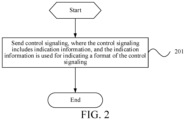
- an embodiment of this application provides a method for indicating a format of control signaling, including: sending control signaling, where the control signaling includes indication information, and the indication information is used for indicating a format of the control signaling.
- an embodiment of this application provides an apparatus for determining a format of control signaling, including: an obtaining module, configured to obtain indication information of control signaling, where the indication information is used for indicating a format of the control signaling.
- an embodiment of this application provides an apparatus for indicating a format of control signaling, including: a first sending module, configured to send a control signaling, where the control signaling includes indication information, and the indication information is used for indicating a format of the control signaling.
- an embodiment of this application further provides an electronic device.
- the electronic device includes a processor, a memory, and a program or instruction stored in the memory and executable on the processor, the program or instruction, when executed by the processor, implementing the steps of the method according to the first aspect, or implementing the steps of the method according to the second aspect.
- an embodiment of this application further provides a readable storage medium.
- the readable storage medium stores a program or instruction, the program or instruction, when executed by a processor, implementing the steps of the method according to the first aspect, or implementing the steps of the method according to the second aspect.
- an embodiment of this application further provides a chip, including: a processor and a communication interface, where the communication interface is coupled to the processor, and the processor is configured to run a program or instruction, to implement the method according to the first aspect.
- a format of the control signaling can be directly known from the indication information, so that a limit of a size of control signaling blindly detected by a user-side device can be maintained while a plurality of formats of control signaling are flexibly supported, thereby reducing the implementation complexity of the user-side device, and saving power consumption and costs of the user device.
- the method for determining a format of control signaling in the embodiments of this application is applied to a user-side device UE, which may be specifically an access terminal, a user unit, a subscriber unit, a user station, a mobile station, a mobile console, a remote station, a remote terminal, a mobile device, a user terminal, a terminal, a wireless communication device, a user agent, or a user apparatus.
- a user-side device UE may be specifically an access terminal, a user unit, a subscriber unit, a user station, a mobile station, a mobile console, a remote station, a remote terminal, a mobile device, a user terminal, a terminal, a wireless communication device, a user agent, or a user apparatus.
- the terminal device may also be a cellular phone, a cordless phone, a session initiation protocol (session initiation protocol, SIP) phone, a wireless local loop (wireless local loop, WLL) station, a personal digital assistant (personal digital assistant, PDA), a handheld device having a wireless communication function, a computing device, another processing device connected to a wireless modem, an in-vehicle device, or a wearable device.
- SIP session initiation protocol
- WLL wireless local loop
- PDA personal digital assistant
- a method for determining a format of control signaling in this embodiment of this application includes: Step 101. Obtain indication information of control signaling, where the indication information is used for indicating a format of the control signaling.
- a user-side device can directly know, by obtaining indication information of control signaling, a format of the control signaling from the indication information, so that a limit of a size of control signaling blindly detected by the user-side device can be maintained while a plurality of formats of control signaling are flexibly supported, thereby reducing the implementation complexity of the user-side device, and saving power consumption and costs of the user device.
- the control signaling may be DCI, or may be radio resource control signaling (Radio Resource Control, RRC), or may be media access control control element signaling (Media Access Control Control Element, MAC CE), or the like.
- RRC Radio Resource Control
- MAC CE Media Access Control Control Element
- a UE to which the method for determining a format of control signaling in this embodiment of this application is applied can know, by obtaining indication information of the DCI, a specific format of the DCI from the indication information, such as DCI 1-1, rather than be limited to knowing that the DCI is used for uplink scheduling or downlink scheduling.
- the indication information can distinguish different common DCI, and can also distinguish the common DCI and UE-specific DCI.
- the indication information is information in a first information domain of the control signaling, where the first information domain is dedicatedly used for indicating the format of the control signaling.
- a dedicated domain namely, the first information domain
- the first information domain always exists when the UE monitors all bandwith parts BWP, all search spaces, and all monitoring occasions of the control signaling.
- a first information domain T is introduced in the DCI, and is used for indicating a specific format of the DCI.
- the domain T may indicate one format of the DCI used for downlink scheduling, that is, the UE knows through the domain T that the DCI is DCI 1_0, DCI 1_2, or DCI 1_x.
- the first information domain is located at a preset location in the control signaling, and the preset location is:
- the first information domain may be located at the start location in the control signaling, that is, the first information domain is a first domain of the control signaling.
- the first information domain may be located at the end location in the control signaling, that is, the first information domain is a last domain of the control signaling, but the domain is located before a cyclic redundancy check (Cyclic redundancy check, CRC).
- CRC Cyclic redundancy check
- the first information domain may be located at the location before or after the target domain in the control signaling.
- the location of T may be a location after the domain of Identifiers for DCI formats.
- the target domain is a carrier indicator (Carrier indicator) domain, an uplink or supplementary uplink indicator (UL/SUL indicator) domain, a bandwidth part indicator (Bandwidth part indicator) domain, a deep flow inspection flag (Deep Flow Inspection Flag, DFI flag) domain, a frequency domain resource assignment (Frequency domain resource assignment) domain, or the like
- the location of T may be a location before the target domain.
- the method further includes:
- the UE can know, according to the received configuration information, whether the indication information exists in the control signaling, thereby obtaining the indication information.
- the configuration information may also include information indicating a specific location of the indication information in the control signaling, a size of the indication information, content of the indication information, the format corresponding to the control signaling having the indication information, or the like.
- the configuration information may be carried by the RRC, the MAC CE, or the DCI (such as group common (group common) DCI) sent by a network-side device.
- control signaling carries the indication information.
- the control signaling carries the indication information in a case that the preset condition is met.
- whether the first information domain exists is determined according to whether the preset condition is met.
- the DCI may introduce T to carry the indication information.
- the control signaling does not carry the indication information may also be represented as that a value of the first information domain is set to a preset value (such as, 0).
- the preset condition includes at least one of the following:
- the control signaling carries the indication information indicating the format of the control signaling.
- the first preset format may be a specific format, and certainly, may also be one group of or a plurality of formats of a specific type.
- a first preset format corresponding to the DCI may be only DCI 1_0, and may also be DCI formats used for downlink scheduling: the DCI 1_0, DCI 1_1, and DCI 1_2.
- the first size is a size of the control signaling determined based on a function or payload (payload) of the control signaling, and the control signaling with the first size is not considered whether to include the indication information indicating the format of the control signaling.
- the preset value may be a quantity of pieces of DCI with different sizes that is pre-defined by a system, configured by a network, or supported by the UE.
- a preset value corresponding to the DCI may be a DCI size budget size budget of the UE, and the DCI size budget is a quantity of pieces of DCI with different sizes that are at most monitored by the UE for each cell. For example, if a first size of a monitored DCI format A is the same as a first size of a DCI format B, but monitoring occasions or CCEs do not overlap, the indication information is not carried.
- the first information domain includes the indication information.
- T includes the indication information indicating the DCI format.
- control signaling is one or more pieces of control signaling meeting the preset condition.
- the one or more pieces of control signaling carry the indication information.
- which pieces of control signaling that may carry the indication information may be determined by formats of the control signaling.
- the preset condition is that there is at least two pieces of DCI with a same first size in a plurality of monitored pieces of DCI.
- the at least two pieces of DCI may all carry the indication information, or may partially carry the indication information.
- part of pieces of DCI carrying the indication information may be non-basic scheduling non-fallback DCI.
- basic scheduling fallback DCI includes DCI 1_0 and 0_0, which may be monitored in a common search space (Common search space, CSS).
- the non-fallback DCI refers to other UE-specific DCI formats other than the fallback DCI.
- control signaling is control signaling in a second preset format.
- the second preset format may be a specific format, and certainly, may also be one group or a plurality of formats of a specific type.
- a second preset format corresponding to the DCI may be only DCI 0_1, and may also be a non-fallback uplink scheduling format, namely, the DCI 0_1 and DCI 0_2.
- the indication information is information in the first information domain of the control signaling, and corresponds to the second preset format
- the first information domain is associated with the second preset format, that is, control signaling in a non-second preset format does not include the first information domain.
- the second preset format is the DCI 0_1
- T is associated with the DCI 0_1
- the DCI 0_2 does not include T, so that the UE may distinguish different DCI formats according to DCI sizes.
- a size of the indication information is configured by a network-side device.
- the size of the indication information may be equal to the quantity of formats of the control signaling including the indication information, or may be calculated by using a preset related function based on the quantity of formats of the control signaling including the indication information.
- the second preset format is an uplink scheduling format, namely, DCI 0_0 and DCI 0_1
- a quantity of formats of DCI including the indication information is 2, and the size of the indication information is 1 bit.
- the size of the indication information is the size of the first information domain.
- the content of the indication information is predefined, or configured by the network-side device.
- the UE obtains the indication information, and can directly know the format of the control signaling indicated by the indication information.
- the UE needs to first know configuration for the content of the indication information through the configuration information of the network-side device, and then can know the format of the control signaling indicated by the indication information after obtaining the indication information.
- each code point corresponds to the format of the control signaling in the indication information; or a value of the indication information corresponds to the format of the control signaling.
- each code point in the indication information corresponds to the format of the control signaling; and the other implementation is that the value of the indication information corresponds to the format of the control signaling.
- the size of the indication information may be 4 bits, and each bit corresponds to one DCI format.
- the indication information of the DCI is "1000", it may indicate that the DCI is in the format A; in a case that the indication information of the DCI is "0100", it may indicate that the DCI is in the format B; in a case that the indication information of the DCI is "0010", it may indicate that the DCI is in the format C; and in a case that the indication information of the DCI is "0001 ", it may indicate that the DCI is in the format D.
- the size of the indication information may be 2 bits, and a value of 2-bit information corresponds to one DCI format.
- the indication information of the DCI is "00", it may indicate that the DCI is in the format A; in a case that the indication information of the DCI is "01”, it may indicate that the DCI is in the format B; in a case that the indication information of the DCI is "10”, it may indicate that the DCI is in the format C; and in a case that the indication information of the DCI is "11", it may indicate that the DCI is in the format D.
- the above formats A, B, C, and D may also be one pair or one group of specific DCI formats.
- a second size of the control signaling is the same as a second size of another piece of control signaling including the indication information.
- second sizes of a plurality of pieces of control signaling including the indication information are the same. If the control signaling introduces the first information domain, for a plurality of pieces of control signaling introducing the first information domain, second sizes of the control signaling including the first information domain are the same. If the second sizes of the control signaling including the first information domain are different, the control signaling may be filled and aligned to a same size
- the indication information and information about a preset domain are jointly encoded.
- the preset domain is the domain of Identifiers for DCI formats
- each code point simultaneously indicates that the DCI format is uplink or downlink scheduling, and is DCI x_1 or x_2, x_3 ....
- the preset domain may also be another domain other than this, which is listed herein again.
- DCI 1_1 in a 1-bit domain of Identifiers for DCI formats, values of bits are always set to 1 for representing a downlink DL DCI format.
- T is located after the domain of Identifiers for DCI formats. The size of T is 0 or 1 bit, and is determined by a high-level parameter. If values of T are always set to 0, it represents that the DCI format is 1_1. In this case, the domain T may be further used for DCI format verification.
- the UE blindly detects the DCI 1_1, but the values corresponding to the domain T are different from a predefined or configured value (for example, the values of T are always set to 1, but detected values are 0), it means that the blind detection is a false alarm (false alarm).
- the blind detection is a false alarm (false alarm).
- other domains are set in the format. Details are not described herein again.
- DCI 1_3 in a 1-bit domain of Identifiers for DCI formats, values of bits are always set to 1 for representing a downlink DL DCI format.
- T is located after the domain of Identifiers for DCI formats. The size of T is 0 or 1 bit, and is determined by a high-level parameter. If values of T are always set to 0, it represents that the DCI format is 1_3. Certainly, other domains are set in the format. Details are not described herein again.
- the network-side device configures the size of T and values of T corresponding to different DCI formats.
- DCI 1_1 in a 1-bit domain of Identifiers for DCI formats, values of bits are always set to 1 for representing a downlink DL DCI format.
- T is located after the domain of Identifiers for DCI formats.
- the size of T is 0, 1, or 2 bits, and is determined by a high-level parameter.
- the values of T are configured by the high-level parameter. Certainly, other domains are set in the format. Details are not described herein again.
- DCI 1_3 in a 1-bit domain of Identifiers for DCI formats, values of bits are always set to 1 for representing a downlink DL DCI format.
- T is located after the domain of Identifiers for DCI formats.
- the size of T is 0, 1, or 2 bits, and is determined by a high-level parameter.
- the values of T are configured by the high-level parameter. Certainly, other domains are set in the format. Details are not described herein again.
- the network-side device configures that sizes of the DCI 1_1 and the DCI 1_3 are equal on all BWPs, so that a DCI budget of the UE can be shared and the complexity of blind detection can be reduced.
- the network-side device configures the domain T in the DCI, and the size of T is 1 bit, so that the UE can distinguish the DCI 1_1 and the DCI 1_3 according to the domain T.
- the network-side device configures that sizes of the DCI 1_1 and the DCI 1_3 are equal, so that a DCI budget of the UE can be shared and the complexity of blind detection can be reduced.
- the network-side device respectively configures different search spaces or different CORESETs for the DCI 1_1 and the DCI 1_3.
- the UE blindly detects DCI formats associated with the search spaces or the CORESETs in the search spaces or the CORESETs, so that the UE can distinguish the DCI 1_1 and the DCI 1_3 according to the domain T.
- the network-side device configures that sizes of the DCI 1_1 and the DCI 1_3 are equal, so that a DCI budget of the UE can be shared and the complexity of blind detection can be reduced.
- the network-side device configures, through the RRC, the domain T used for distinguishing the DCI 1_1 and the DCI 1_3 in the DCI.
- the network-side device indicates, through the MAC CE, whether the domain T actually exists in DCI of a cell, or a BWP, or a CORESET, or a search space (that is, the MAC CE activates the domain T as 0 bits or 1 bit).
- the UE blindly detects, according to the indication of the MAC CE, a physical downlink control channel PDCCH according to different DCI sizes. If the MAC CE indicates that the domain T exists, the UE distinguishes the DCI 1_1 and the DCI 1_3 according to the domain T. If the MAC CE indicates that the domain T does not exist, the UE blindly detects the PDCCH according to a predefined format (which may be the DCI 1_1 or the DCI 1_3). In this scenario, the network-side device may dynamically open the domain T according to actual needs.
- the network-side device configures the DCI 1_1 and the DCI 1_3 whose sizes are different, and configures the domain T used for distinguishing the DCI 1_1 and the DCI 1_3. If a quantity of pieces of DCI with different sizes currently monitored by the UE is less than the DCI budget (such as, 4), blind detection is performed according to each DCI size, and the domain T does not exist in the DCI. If the quantity of pieces of DCI with different sizes currently monitored by the UE exceeds the DCI budget, sizes of the DCI 1_1 and the DCI 1_3 are aligned, and the domain T exists in the DCI, and is used for distinguishing the DCI formats.
- the DCI budget such as, 4
- the indication information is information in a second information domain of the control signaling, where the second information domain is reused for indicating the format of the control signaling.
- the second information domain may be further used for carrying one or more pieces of other information.
- part or all of bits (or code points) are used for indicating the format of the control signaling.
- the network-side device configures which bits (or code points) used for indicating the format of the control signaling, and the format of the control signaling corresponding to each bit (or code point) in the second information domain.
- the network-side device configures that a cell 1 and a cell 2 are scheduled across carriers (so that a Carrier indicator exists in the DCI 1_1), and configures the DCI 1_3 on the cell 1 so that the cell 1 and a cell 3 can be jointly scheduled. Sizes of the DCI 1_1 and the DCI 1_3 are equal, so that a DCI budget of the UE can be shared and the complexity of blind detection can be reduced.
- a Carrier indicator domain (CIF) in the DCI 1_1 has 3 bits, and the cell 2 is scheduled across carriers (in this case, a CIF corresponding to the cell 1 is 0, and a CIF corresponding to the cell 2 is 1). Therefore, high two bits of the CIF are fixed to 00.
- high one or two bits of the CIF may be used for indicating the DCI 1_1 and 1_3, that is, if a highest bit of the CIF is 0, it represents the DCI format 1_1; otherwise, it represents the DCI format 1_3.
- a CIF in the DCI 1_3 may have 2 or 3 bits, and a highest bit thereof is 1.
- a Bandwidth part indicator domain the domain of Identifiers for DCI formats, and the like may also be used.
- the UE does not need to monitor uplink scheduling (that is, does not need to monitor the DCI 0_1), and the UE does not need to distinguish uplink and downlink DCI formats (namely, the DCI 1_1 and the DCI 0_1) through the domain of Identifiers for DCI formats. Therefore, the domain of Identifiers for DCI formats may be reused for distinguishing the two downlink DCI formats DCI 1_1 and 1_3.
- a user-side device can directly know, by obtaining indication information of control signaling, a format of the control signaling from the indication information, so that a limit of a size of control signaling blindly detected by the user-side device can be maintained while a plurality of formats of control signaling are flexibly supported, thereby reducing the implementation complexity of the user-side device, and saving power consumption and costs of the user device.
- an embodiment of this application provides a method for indicating a format of control signaling, including: Step 201. Send control signaling, where the control signaling includes indication information, and the indication information is used for indicating a format of the control signaling.
- control signaling is sent, so that a user-side device can directly know, by obtaining indication information of the control signaling, a format of the control signaling from the indication information, so that a limit of a size of control signaling blindly detected by the user-side device can be maintained while a plurality of formats of control signaling are flexibly supported, thereby reducing the implementation complexity of the user-side device, and saving power consumption and costs of the user device.
- the control signaling may be DCI, or may be RRC (Radio Resource Control, radio resource control signaling), or may be MAC CE (Media Access Control Control Element, media access control control element signaling), or the like.
- the DCI is used as an example for specific description in the following embodiments.
- a UE can know, by obtaining indication information of the DCI, a specific format of the DCI from the indication information, such as DCI 1-1, rather than be limited to knowing that the DCI is used for uplink scheduling or downlink scheduling.
- the indication information can distinguish different common DCI, and can also distinguish the common DCI and UE-specific DCI.
- the indication information is information in a first information domain of the control signaling, where the first information domain is dedicatedly used for indicating the format of the control signaling.
- a dedicated domain namely, the first information domain
- the first information domain always exists when the UE monitors all bandwith parts BWP, all search spaces, and all monitoring occasions of the control signaling.
- a first information domain T is introduced in the DCI, and is used for indicating a specific format of the DCI.
- the domain T may indicate one format of the DCI used for downlink scheduling, that is, the UE knows through the domain T that the DCI is DCI 1_0, DCI 1_2, or DCI 1_x.
- the first information domain is located at a preset location in the control signaling, and the preset location is:
- the first information domain may be located at the start location in the control signaling, that is, the first information domain is a first domain of the control signaling.
- the first information domain may be located at the end location in the control signaling, that is, the first information domain is a last domain of the control signaling, but the domain is located before a CRC.
- the first information domain may be located at the location before or after the target domain in the control signaling.
- the target domain is a 1-bit domain of identifiers for DCI formats Identifier for DCI formats used for distinguishing uplink and downlink formats
- the location of T may be a location after the domain of Identifiers for DCI formats.
- the location of T may be a location before the target domain.
- the method further includes: sending configuration information, where the configuration information is used for indicating whether the indication information exists in the control signaling.
- the UE can know, according to the received configuration information, whether the indication information exists in the control signaling, thereby obtaining the indication information.
- the configuration information may also include information indicating a specific location of the indication information in the control signaling, a size of the indication information, content of the indication information, the format corresponding to the control signaling having the indication information, or the like.
- the configuration information may be carried by the RRC, the MAC CE, or the DCI (such as group common (group common) DCI) sent by a network-side device.
- control signaling carries the indication information.
- the control signaling carries the indication information in a case that the preset condition is met.
- whether the first information domain exists is determined according to whether the preset condition is met.
- the DCI may introduce T to carry the indication information.
- the control signaling does not carry the indication information may also be represented as that a value of the first information domain is set to a preset value (such as, 0).
- the preset condition includes at least one of the following:
- the control signaling carries the indication information indicating the format of the control signaling.
- the first preset format may be a specific format, and certainly, may also be one group of or a plurality of formats of a specific type.
- a first preset format corresponding to the DCI may be only DCI 1_0, and may also be DCI formats used for downlink scheduling: the DCI 1_0, DCI 1_1, and DCI 1_2.
- the first size is a size of the control signaling determined based on a function or payload (payload) of the control signaling, and the control signaling with the first size is not considered whether to include the indication information indicating the format of the control signaling.
- the preset value may be a quantity of pieces of DCI with different sizes that is pre-defined by a system, configured by a network, or supported by the UE.
- a preset value corresponding to the DCI may be a DCI size budget size budget of the UE, and the DCI size budget is a quantity of pieces of DCI with different sizes that are at most monitored by the UE for each cell.
- a first size of a monitored DCI format A is the same as a first size of a DCI format B, but monitoring occasions or CCEs do not overlap, the indication information is not carried.
- the first information domain includes the indication information.
- T includes the indication information indicating the DCI format.
- control signaling is one or more pieces of control signaling meeting the preset condition.
- the one or more pieces of control signaling carry the indication information.
- which pieces of control signaling that may carry the indication information may be determined by formats of the control signaling.
- the preset condition is that there is at least two pieces of DCI with a same first size in a plurality of monitored pieces of DCI.
- the at least two pieces of DCI may all carry the indication information, or may partially carry the indication information.
- part of pieces of DCI carrying the indication information may be non-basic scheduling non-fallback DCI.
- basic scheduling fallback DCI includes DCI 1_0 and 0_0, which may be monitored in a CSS.
- the non-fallback DCI refers to other UE-specific DCI formats other than the fallback DCI.
- control signaling is control signaling in a second preset format.
- the second preset format may be a specific format, and certainly, may also be one group or a plurality of formats of a specific type.
- a second preset format corresponding to the DCI may be only DCI 0_1, and may also be a non-fallback uplink scheduling format, namely, the DCI 0_1 and DCI 0_2.
- the indication information is information in the first information domain of the control signaling, and corresponds to the second preset format
- the first information domain is associated with the second preset format, that is, control signaling in a non-second preset format does not include the first information domain.
- the second preset format is the DCI 0_1
- T is associated with the DCI 0_1
- the DCI 0_2 does not include T, so that the UE may distinguish different DCI formats according to DCI sizes.
- a size of the indication information is configured by a network-side device.
- the size of the indication information may be equal to the quantity of formats of the control signaling including the indication information, or may be calculated by using a preset related function based on the quantity of formats of the control signaling including the indication information.
- the second preset format is an uplink scheduling format, namely, DCI 0_0 and DCI 0_1
- a quantity of formats of DCI including the indication information is 2, and the size of the indication information is 1 bit.
- the size of the indication information is the size of the first information domain.
- the content of the indication information is predefined, or configured by the network-side device.
- the UE obtains the indication information, and can directly know the format of the control signaling indicated by the indication information.
- the UE needs to first know configuration for the content of the indication information through the configuration information of the network-side device, and then can know the format of the control signaling indicated by the indication information after obtaining the indication information.
- each code point corresponds to the format of the control signaling in the indication information; or a value of the indication information corresponds to the format of the control signaling.
- each code point in the indication information corresponds to the format of the control signaling; and the other implementation is that the value of the indication information corresponds to the format of the control signaling.
- the size of the indication information may be 4 bits, and each bit corresponds to one DCI format.
- the indication information of the DCI is "1000", it may indicate that the DCI is in the format A; in a case that the indication information of the DCI is "0100", it may indicate that the DCI is in the format B; in a case that the indication information of the DCI is "0010", it may indicate that the DCI is in the format C; and in a case that the indication information of the DCI is "0001 ", it may indicate that the DCI is in the format D.
- the size of the indication information may be 2 bits, and a value of 2-bit information corresponds to one DCI format.
- the indication information of the DCI is "00", it may indicate that the DCI is in the format A; in a case that the indication information of the DCI is "01”, it may indicate that the DCI is in the format B; in a case that the indication information of the DCI is "10”, it may indicate that the DCI is in the format C; and in a case that the indication information of the DCI is "11", it may indicate that the DCI is in the format D.
- the above formats A, B, C, and D may also be one pair or one group of specific DCI formats.
- a second size of the control signaling is the same as a second size of another piece of control signaling including the indication information.
- second sizes of a plurality of pieces of control signaling including the indication information are the same. If the control signaling introduces the first information domain, for a plurality of pieces of control signaling introducing the first information domain, second sizes of the control signaling including the first information domain are the same. If the second sizes of the control signaling including the first information domain are different, the control signaling may be filled and aligned to a same size
- the indication information and information about a preset domain are jointly encoded.
- the preset domain is the domain of Identifiers for DCI formats
- each code point simultaneously indicates that the DCI format is uplink or downlink scheduling, and is DCI x_1 or x_2, x_3 ....
- the preset domain may also be another domain other than this, which is listed herein again.
- the indication information is information in a second information domain of the control signaling, where the second information domain is reused for indicating the format of the control signaling.
- the second information domain may be further used for carrying one or more pieces of other information.
- part or all of bits (or code points) are used for indicating the format of the control signaling.
- the network-side device configures which bits (or code points) used for indicating the format of the control signaling, and the format of the control signaling corresponding to each bit (or code point) in the second information domain.
- a network-side device sends control signaling, so that a user-side device can directly know, by obtaining indication information of the control signaling, a format of the control signaling from the indication information, so that a limit of a size of control signaling blindly detected by the user-side device can be maintained while a plurality of formats of control signaling are flexibly supported, thereby reducing the implementation complexity of the user-side device, and saving power consumption and costs of the user device.
- an execution entity may be an apparatus for determining a format of control signaling, or a control module configured to execute and load the method for determining a format of control signaling in the apparatus for determining a format of control signaling.
- an example in which the apparatus for determining a format of control signaling executes and loads the method for determining a format of control signaling is used to describe the method for determining a format of control signaling provided in the embodiments of this application.
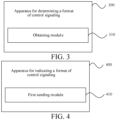
- FIG. 3 is a block diagram of an apparatus for determining a format of control signaling according to an embodiment of this application.
- An apparatus 300 for determining a format of control signaling shown in FIG. 3 includes an obtaining module 310.
- the obtaining module 310 is configured to obtain indication information of control signaling, where the indication information is used for indicating a format of the control signaling.
- the indication information is information in a first information domain of the control signaling, where the first information domain is dedicatedly used for indicating the format of the control signaling.
- the apparatus further includes: a receiving module, configured to receive configuration information sent by a network-side device, where the configuration information is used for indicating whether the indication information exists in the control signaling.
- a receiving module configured to receive configuration information sent by a network-side device, where the configuration information is used for indicating whether the indication information exists in the control signaling.
- control signaling carries the indication information.
- the preset condition includes at least one of the following:
- control signaling is one or more pieces of control signaling meeting the preset condition.
- control signaling is control signaling in a second preset format.
- a size of the indication information is configured by a network-side device.
- the content of the indication information is predefined, or configured by the network-side device.
- each code point corresponds to the format of the control signaling in the indication information; or a value of the indication information corresponds to the format of the control signaling.
- the indication information and information about a preset domain are jointly encoded.
- the first information domain is located at a preset location in the control signaling, and the preset location is:
- a second size of the control signaling is the same as a second size of another piece of control signaling including the indication information.
- the indication information is information in a second information domain of the control signaling, where the second information domain is reused for indicating the format of the control signaling.
- the apparatus for determining a format of control signaling in this embodiment of this application may be an apparatus, or may be a component, an integrated circuit, or a chip in the user-side device.
- the apparatus may be a mobile electronic device or a non-mobile electronic device.
- the mobile electronic device may be a mobile phone, a tablet computer, a notebook computer, a palmtop computer, an in-vehicle electronic device, a wearable device, an ultra-mobile personal computer (ultra-mobile personal computer, UMPC), a netbook, a personal digital assistant (personal digital assistant, PDA), or the like
- the non-mobile electronic device may be a server, a network attached memory (Network Attached Storage, NAS), a personal computer (personal computer, PC), a television (television, TV), a teller machine, a self-service machine, or the like. This is not specifically limited in this embodiment of this application.
- the apparatus for determining a format of control signaling in this embodiment of this application may be an apparatus having an operating system.
- the operating system may be an android (Android) operating system, may be an ios operating system, and may also be another possible operating system. This is not specifically limited in this embodiment of this application.
- the apparatus for determining a format of control signaling provided in this embodiment of this application can implement all processes implemented by the user-side device in the method embodiment of FIG. 1 . To avoid repetition, details are not described herein again.
- An apparatus in this embodiment of this application can directly know, by obtaining indication information of control signaling, a format of the control signaling from the indication information, so that a limit of a size of control signaling blindly detected by a user-side device can be maintained while a plurality of formats of control signaling are flexibly supported, thereby reducing the implementation complexity of the user-side device, and saving power consumption and costs of the user device.
- an execution entity may be an apparatus for indicating a format of control signaling, or a control module configured to execute and load the method for indicating a format of control signaling in the apparatus for indicating a format of control signaling.
- an example in which the apparatus for indicating a format of control signaling executes and loads the method for indicating a format of control signaling is used to describe the method for indicating a format of control signaling provided in the embodiments of this application.
- FIG. 4 is a block diagram of an apparatus for indicating a format of control signaling according to an embodiment of this application.
- An apparatus 400 for indicating a format of control signaling shown in FIG. 4 includes a first sending module 410.
- the first sending module 410 is configured to send a control signaling, where the control signaling includes indication information, and the indication information is used for indicating a format of the control signaling.
- the indication information is information in a first information domain of the control signaling, where the first information domain is dedicatedly used for indicating the format of the control signaling.
- the apparatus further includes: a second sending module, configured to send configuration information, where the configuration information is used for indicating whether the indication information exists in the control signaling.
- a second sending module configured to send configuration information, where the configuration information is used for indicating whether the indication information exists in the control signaling.
- control signaling carries the indication information.
- the preset condition includes at least one of the following:
- control signaling is one or more pieces of control signaling meeting the preset condition.
- control signaling is control signaling in a second preset format.
- a size of the indication information is configured by a network-side device.
- the content of the indication information is predefined, or configured by the network-side device.
- each code point corresponds to the format of the control signaling in the indication information
- a value of the indication information corresponds to the format of the control signaling.
- the indication information and information about a preset domain are jointly encoded.
- the first information domain is located at a preset location in the control signaling, and the preset location is:
- a second size of the control signaling is the same as a second size of another piece of control signaling including the indication information.
- the indication information is information in a second information domain of the control signaling, where the second information domain is reused for indicating the format of the control signaling.
- the apparatus for indicating a format of control signaling provided in this embodiment of this application can implement all processes implemented by the network-side device in the method embodiment of FIG. 2 . To avoid repetition, details are not described herein again.
- An apparatus in this embodiment of this application sends control signaling, so that a user-side device can directly know, by obtaining indication information of the control signaling, a format of the control signaling from the indication information, so that a limit of a size of control signaling blindly detected by the user-side device can be maintained while a plurality of formats of control signaling are flexibly supported, thereby reducing the implementation complexity of the user-side device, and saving power consumption and costs of the user device.
- an embodiment of this application further provides an electronic device, including a processor, a memory and, and a program or instruction stored in the memory and executable on the processor.
- the program or instruction when executed by the processor, implements all processes of the embodiments of the steps of the method for determining a format of control signaling described above, or implements all processes of the embodiments of the steps of the method for indicating a format of control signaling described above, and can achieve the same technical effects. To avoid repetition, details are not described herein again.
- the electronic device in this embodiment of this application includes the above user-side device and network-side device.
- FIG. 5 is a schematic diagram of a hardware structure of a user-side device that implements the embodiments of this application.
- a user-side device 500 includes, but is not limited to, components such as a radio frequency unit 501, a network module 502, an audio output unit 503, an input unit 504, a sensor 505, a display unit 506, a user input unit 507, an interface unit 508, a memory 509, a processor 510, and a power supply 511.
- components such as a radio frequency unit 501, a network module 502, an audio output unit 503, an input unit 504, a sensor 505, a display unit 506, a user input unit 507, an interface unit 508, a memory 509, a processor 510, and a power supply 511.
- the structure of the user-side device shown in FIG. 5 constitutes no limitation on the user-side device, and the user-side device may include more or fewer components than those shown in the figure, or some components may be combined, or a different component deployment may be used.
- the user-side device includes, but is not limited to, a mobile phone, a tablet computer, a notebook computer, a palmtop computer, an in-vehicle terminal, a wearable device, a pedometer, and the like.
- the processor 510 is configured to obtain indication information of control signaling, where the indication information is used for indicating a format of the control signaling.
- a user-side device can directly know, by obtaining indication information of control signaling, a format of the control signaling from the indication information, so that a limit of a size of control signaling blindly detected by the user-side device can be maintained while a plurality of formats of control signaling are flexibly supported, thereby reducing the implementation complexity of the user-side device, and saving power consumption and costs of the user device.
- the indication information is information in a first information domain of the control signaling, where the first information domain is dedicatedly used for indicating the format of the control signaling.
- the radio frequency unit 501 is configured to receive configuration information sent by a network-side device, where the configuration information is used for indicating whether the indication information exists in the control signaling.
- control signaling carries the indication information.
- the preset condition includes at least one of the following:
- control signaling is one or more pieces of control signaling meeting the preset condition.
- control signaling is control signaling in a second preset format.
- a size of the indication information is configured by a network-side device.
- the content of the indication information is predefined, or configured by the network-side device.
- each code point corresponds to the format of the control signaling in the indication information; or a value of the indication information corresponds to the format of the control signaling.
- the indication information and information about a preset domain are jointly encoded.
- the first information domain is located at a preset location in the control signaling, and the preset location is:
- a second size of the control signaling is the same as a second size of another piece of control signaling including the indication information.
- the indication information is information in a second information domain of the control signaling, where the second information domain is reused for indicating the format of the control signaling.
- the radio frequency unit 501 may be configured to transmit and receive information or transmit and receive signals during a call.
- the radio frequency unit is configured to receive downlink data from a base station and transmit downlink data to the processor 510 for processing.
- the radio frequency unit transmits uplink data to the base station.
- the radio frequency unit 501 includes, but is not limited to, an antenna, at least one amplifier, a transceiver, a coupler, a low noise amplifier, a duplexer, and the like.
- the radio frequency unit 501 may further communicate with another device through a wireless communication system and a network.
- the user-side device provides wireless broadband Internet access for a user by using the network module 502, for example, allowing the user to send and receive emails, browse webpages, access streaming media content, and the like.
- the audio output unit 503 may convert audio data received by the radio frequency unit 501 or the network module 502 or stored in the memory 509 into audio signals and output the audio signals as sounds. In addition, the audio output unit 503 may further provide an audio output that is related to a particular function executed by the user-side device 500 (for example, a call signal receiving sound or a message receiving sound).
- the audio output unit 503 includes a speaker, a buzzer, a receiver, and the like
- the input unit 504 is configured to receive an audio or video signal.
- the input unit 504 may include a graphics processing unit (Graphics Processing Unit, GPU) 5041 and a microphone 5042.
- the graphics processing unit 5041 performs processing on image data of a static picture or a video that is obtained by an image acquisition apparatus (for example, a camera) in a video acquisition mode or an image acquisition mode.
- the processed image frame may be displayed on the display unit 506.
- An image frame that has been processed by the graphics processing unit 5041 may be stored in the memory 509 (or another storage medium) or sent by using the radio frequency unit 501 or the network module 502.
- the microphone 5042 may receive a sound and can process such a sound into audio data.
- the processed audio data may be converted, in a phone call mode, into a format that may be sent by the radio frequency unit 501 to a mobile communication base station.
- the user-side device 500 further includes at least one sensor 505 such as an optical sensor, a motion sensor, or another sensor.
- the optical sensor includes an ambient light sensor and a proximity sensor.
- the ambient light sensor may adjust luminance of a display panel 5061 according to brightness of the ambient light.
- the proximity sensor may switch off the display panel 5061 and/or backlight when the user-side device 500 is moved to the ear.
- an acceleration sensor can detect magnitudes of accelerations in various directions (generally, on three axes), may detect a magnitude and a direction of the gravity in a static state, and may be applied to recognizing an altitude of the user-side device (for example, switching between a landscape state and a portrait state, a related game, and magnetometer attitude calibration), a function related to vibration recognition (such as a pedometer and a knock), and the like.
- the sensor 505 may further include a fingerprint sensor, a pressure sensor, an iris sensor, a molecular sensor, a gyroscope, a barometer, a hygrometer, a thermometer, an infrared sensor, and the like, which are not described herein in detail.
- the display unit 506 is configured to display information inputted by the user or information provided for the user.
- the display unit 506 may include a display panel 5061.
- the display panel 5061 may be configured by using a liquid crystal display (Liquid Crystal Display, LCD), an organic light-emitting diode (Organic Light-Emitting Diode, OLED), or the like.
- the user input unit 507 may be configured to receive input digit or character information, and generate a keyboard signal input related to the user setting and function control of the user-side device.
- the user input unit 507 includes a touch panel 5071 and another input device 5072.
- the touch panel 5071 also referred to as a touchscreen, may collect a touch operation of a user on or near the touch panel (such as an operation of a user on or near the touch panel 5071 by using any suitable object or attachment, such as a finger or a touch pen).
- the touch panel 5071 may include two parts: a touch detection apparatus and a touch controller.
- the touch detection apparatus detects a touch position of the user, detects a signal generated by the touch operation, and transfers the signal to the touch controller.
- the touch controller receives the touch information from the touch detection apparatus, converts the touch information into touch point coordinates, and transmits the touch point coordinates to the processor 510. Moreover, the touch controller may receive and execute a command transmitted from the processor 510.
- the touch panel 5071 may be implemented by using various types, such as a resistive type, a capacitance type, an infrared type, and a surface acoustic wave type.
- the user input unit 507 may further include the another input device 5072.
- the another input device 5072 may include, but is not limited to, a physical keyboard, a functional key (for example, a volume control key or a switch key), a track ball, a mouse, and a joystick, and the details will not be described herein again.
- a functional key for example, a volume control key or a switch key
- a track ball for example, a mouse, and a joystick
- the touch panel 5071 may cover the display panel 5061. After detecting a touch operation on or near the touch panel, the touch panel 5071 transfers the touch operation to the processor 510, to determine a type of a touch event. Then, the processor 510 provides a corresponding visual output on the display panel 5061 according to the type of the touch event.
- the touch panel 5071 and the display panel 5061 implement, as two independent parts, input and output functions of the user-side device. However, in some embodiments, the touch panel 5071 and the display panel 5061 may be integrated to implement the input and output functions of the user-side device. The details are not limited herein.
- the interface unit 508 is an interface for connecting an external apparatus and the user-side device 500.
- the external apparatus may include a wired or wireless headset port, an external power supply (or a battery charger) port, a wired or wireless data port, a storage card port, a port used to connect an apparatus having an identification module, an audio input/output (I/O) port, a video I/O port, an earphone port, and the like.
- the interface unit 508 may be configured to receive an input (for example, data information or power) from an external apparatus, and transmit the received input to one or more elements in the user-side device 500, or may be configured to transmit data between the user-side device 500 and the external apparatus.
- the memory 509 may be configured to store a software program and various data.
- the memory 509 may mainly include a program storage region and a data storage region.
- the program storage region may store an operating system, an application program required by at least one function (for example, a sound playback function and an image playback function), or the like.
- the data storage region may store data (for example, audio data and a phone book) created according to use of the mobile phone.
- the memory 509 may include a high speed random access memory, and may also include a non-volatile memory, such as at least one magnetic disk storage device, a flash memory, or another volatile solid-state storage device.
- the processor 510 is a control center of the user-side device, and connects to various parts of the user-side device by using various interfaces and lines. By running or executing the software program and/or module stored in the memory 509, and invoking data stored in the memory 509, the processor performs various functions and data processing of the user-side device, thereby performing overall monitoring on the user-side device.
- the processor 510 may include one or more processing units.
- the processor 510 may integrate an application processor and a modem.
- the application processor mainly processes an operating system, a user interface, an application program, and the like.
- the modem mainly processes wireless communication. It may be understood that the foregoing modem may not be integrated into the processor 510.
- the user-side device 500 may further include the power supply 511 (for example, a battery) for supplying power to the components.
- the power supply 511 may be logically connected to the processor 510 by a power management system, thereby implementing functions such as charging, discharging, and power consumption management by using the power management system.
- the user-side device 500 includes some functional module that are not shown, which are not described herein in detail.
- An embodiment of this application further provides a readable storage medium, storing a program or instruction.
- the program or instruction when executed by a processor, implements all processes of the embodiments of the method for determining a format of control signaling described above, or implements all processes of the embodiments of the method for indicating a format of control signaling described above, and can achieve the same technical effects. To avoid repetition, details are not described herein again.
- the processor is the processor in the above electronic device in the foregoing embodiments.
- the readable storage medium includes a computer-readable storage medium, for example, a read-only memory (Read-Only Memory, ROM), a random access memory (Random Access Memory, RAM), a magnetic disk, or an optical disc.
- An embodiment of this application further provides a chip, including: a processor and a communication interface, where the communication interface is coupled to the processor, and the processor is configured to run a program or instruction, to implement all processes of the embodiments of the method for determining a format of control signaling described above, or implement all processes of the embodiments of the method for indicating a format of control signaling described above, and can achieve the same technical effects. To avoid repetition, details are not described herein again.
- the chip mentioned in this embodiment of this application may also be referred to as a system-level chip, a system chip, a chip system, a system on chip, or the like.
- a module, a unit, a sub-module, and a subunit may be implemented in one or more application-specific integrated circuits (Application Specific Integrated Circuits, ASIC), a digital signal processor (Digital Signal Processing, DSP), a digital signal processing device (DSP Device, DSPD), a programmable logic device (Programmable Logic Device, PLD), a field-programmable gate array (Field-Programmable Gate Array, FPGA), a general purpose processor, a controller, a micro-controller, a microprocessor, and other electronic units configured to execute the functions described in this application, or a combination of the above.
- ASIC Application Specific Integrated Circuits
- DSP Digital Signal Processing
- DSP Device digital signal processing device
- PLD programmable logic device
- FPGA field-programmable gate array
- a general purpose processor a controller, a micro-controller, a microprocessor, and other electronic units configured to execute the functions described in this application, or a combination of the above.
- the computer software product is stored in a storage medium (for example, a read-only memory (ROM)/random access memory (RAM), a magnetic disk or an optical disc), and includes several instructions for instructing a terminal (which may be a mobile phone, a computer, a server, an air conditioner, a network device, or the like) to perform the method described in the embodiments of this application.
- a storage medium for example, a read-only memory (ROM)/random access memory (RAM), a magnetic disk or an optical disc
- a terminal which may be a mobile phone, a computer, a server, an air conditioner, a network device, or the like
Landscapes
- Engineering & Computer Science (AREA)
- Signal Processing (AREA)
- Computer Networks & Wireless Communication (AREA)
- Quality & Reliability (AREA)
- Mobile Radio Communication Systems (AREA)
- Communication Control (AREA)
Applications Claiming Priority (2)
| Application Number | Priority Date | Filing Date | Title |
|---|---|---|---|
| CN202010323610.0A CN113541860B (zh) | 2020-04-22 | 2020-04-22 | 控制信令格式确定方法、指示方法及设备 |
| PCT/CN2021/087717 WO2021213260A1 (zh) | 2020-04-22 | 2021-04-16 | 控制信令格式确定方法、指示方法及设备 |
Publications (2)
| Publication Number | Publication Date |
|---|---|
| EP4142192A1 true EP4142192A1 (de) | 2023-03-01 |
| EP4142192A4 EP4142192A4 (de) | 2023-10-18 |
Family
ID=78094124
Family Applications (1)
| Application Number | Title | Priority Date | Filing Date |
|---|---|---|---|
| EP21791778.0A Pending EP4142192A4 (de) | 2020-04-22 | 2021-04-16 | Verfahren zur bestimmung des steuersignalformats, anzeigeverfahren und vorrichtung |
Country Status (7)
| Country | Link |
|---|---|
| US (1) | US20230042801A1 (de) |
| EP (1) | EP4142192A4 (de) |
| JP (1) | JP7417761B2 (de) |
| KR (1) | KR102706936B1 (de) |
| CN (1) | CN113541860B (de) |
| PH (1) | PH12022552814A1 (de) |
| WO (1) | WO2021213260A1 (de) |
Families Citing this family (1)
| Publication number | Priority date | Publication date | Assignee | Title |
|---|---|---|---|---|
| CN113677008B (zh) * | 2020-05-15 | 2025-09-02 | 华为技术有限公司 | 一种通信方法、装置及存储介质 |
Family Cites Families (27)
| Publication number | Priority date | Publication date | Assignee | Title |
|---|---|---|---|---|
| CN101345984A (zh) * | 2007-07-12 | 2009-01-14 | 大唐移动通信设备有限公司 | 一种控制信道传输格式的指示方法及系统 |
| WO2009041785A2 (en) * | 2007-09-28 | 2009-04-02 | Lg Electronics Inc. | Method for detecting control information in wireless communication system |
| CN102237961A (zh) * | 2010-05-04 | 2011-11-09 | 株式会社Ntt都科摩 | 一种多输入多输出相关信息传输方法 |
| CN102404085B (zh) * | 2010-09-17 | 2014-11-05 | 华为技术有限公司 | 一种信道状态信息的上报方法、基站和用户设备 |
| CN102137504B (zh) * | 2011-04-12 | 2016-01-20 | 电信科学技术研究院 | 一种调度多子帧传输的方法及装置 |
| CN103312398B (zh) * | 2012-03-16 | 2018-01-19 | 中兴通讯股份有限公司 | 一种增强下行控制信息的传输方法及传输系统及用户设备 |
| US20160309542A1 (en) * | 2015-04-16 | 2016-10-20 | Sharp Laboratories Of America, Inc. | Systems and methods for constellation superposition |
| CN106559201A (zh) * | 2015-09-25 | 2017-04-05 | 中兴通讯股份有限公司 | 传输方式的指示方法及装置 |
| CN109361496B (zh) * | 2015-11-06 | 2019-11-05 | 华为技术有限公司 | 无线通信系统中的方法和节点 |
| US10674484B2 (en) * | 2016-05-12 | 2020-06-02 | Asustek Computer Inc. | Method and apparatus for improving uplink grants in a shortened transmission time interval (TTI) in a wireless communication system |
| EP4709012A3 (de) * | 2016-09-28 | 2026-03-25 | InterDigital Patent Holdings, Inc. | 5g-nr-datenbereitstellung für flexible funkdienste |
| DE102016122282A1 (de) * | 2016-11-18 | 2018-05-24 | Helmut-Schmidt-Universität Universität der Bundeswehr Hamburg | System und verfahren zur reduktion von auf eine wirbelsäule wirkenden kräften |
| WO2018126453A1 (zh) * | 2017-01-06 | 2018-07-12 | 广东欧珀移动通信有限公司 | 一种切换方法、基站及终端 |
| WO2018227614A1 (en) * | 2017-06-16 | 2018-12-20 | Qualcomm Incorporated | Channel state information feedback for flexible uplink control signaling |
| CN109309547B (zh) * | 2017-07-28 | 2020-09-22 | 维沃移动通信有限公司 | 下行控制信息检测方法、传输方法、终端及网络设备 |
| CN111010889B (zh) * | 2017-08-10 | 2021-07-09 | 夏普株式会社 | 终端装置、基站和方法 |
| EP3698599B1 (de) * | 2017-10-19 | 2024-07-03 | InterDigital Patent Holdings, Inc. | Kanalzugangsverfahren für richtungssysteme in unlizenzierten bändern |
| ES2905482T3 (es) * | 2017-11-02 | 2022-04-08 | Nokia Technologies Oy | Indicación de formato de ranura a un grupo de UE en una célula de una estación base |
| US10666480B2 (en) * | 2017-11-16 | 2020-05-26 | Ofinno, Llc | Bandwidth part slot format indication |
| CN109802755B (zh) * | 2017-11-17 | 2021-12-17 | 华为技术有限公司 | 下行控制信息确定方法和通信装置 |
| CN110034894B (zh) * | 2018-01-12 | 2022-05-27 | 大唐移动通信设备有限公司 | 一种控制信令、数据的传输方法及装置 |
| US11096043B2 (en) * | 2018-02-16 | 2021-08-17 | Apple Inc. | Downlink control information format for ultra-reliable physical downlink control channel |
| WO2019191948A1 (zh) * | 2018-04-04 | 2019-10-10 | 北京小米移动软件有限公司 | 下行控制信息格式大小的确定方法及装置 |
| MX2020007980A (es) * | 2018-04-06 | 2020-09-07 | Ericsson Telefon Ab L M | Control de potencia para se?alizacion de retroalimentacion. |
| EP3791527B1 (de) * | 2018-05-11 | 2023-05-03 | Telefonaktiebolaget LM Ericsson (publ) | Konfigurierbarer dci-formatierungsindikator |
| CN110719633B (zh) * | 2018-07-13 | 2022-08-09 | 大唐移动通信设备有限公司 | 一种上行资源分配方法、装置、基站及终端 |
| US12219558B2 (en) * | 2018-09-28 | 2025-02-04 | Telefonaktiebolaget Lm Ericsson (Publ) | Transitioning between different scheduling delay assumptions |
-
2020
- 2020-04-22 CN CN202010323610.0A patent/CN113541860B/zh active Active
-
2021
- 2021-04-16 PH PH1/2022/552814A patent/PH12022552814A1/en unknown
- 2021-04-16 EP EP21791778.0A patent/EP4142192A4/de active Pending
- 2021-04-16 KR KR1020227040838A patent/KR102706936B1/ko active Active
- 2021-04-16 WO PCT/CN2021/087717 patent/WO2021213260A1/zh not_active Ceased
- 2021-04-16 JP JP2022564273A patent/JP7417761B2/ja active Active
-
2022
- 2022-10-20 US US17/970,210 patent/US20230042801A1/en active Pending
Also Published As
| Publication number | Publication date |
|---|---|
| WO2021213260A1 (zh) | 2021-10-28 |
| PH12022552814A1 (en) | 2024-02-12 |
| EP4142192A4 (de) | 2023-10-18 |
| KR20230002970A (ko) | 2023-01-05 |
| CN113541860A (zh) | 2021-10-22 |
| JP2023525478A (ja) | 2023-06-16 |
| CN113541860B (zh) | 2023-08-22 |
| KR102706936B1 (ko) | 2024-09-19 |
| JP7417761B2 (ja) | 2024-01-18 |
| US20230042801A1 (en) | 2023-02-09 |
Similar Documents
| Publication | Publication Date | Title |
|---|---|---|
| US11876749B2 (en) | DCI transmission method, terminal, and base station | |
| US11985712B2 (en) | Information transmission method, information detection method, terminal device, and network device | |
| US12133257B2 (en) | Uplink transmission method, user equipment, and network-side device | |
| US12593347B2 (en) | Method for transmitting indication signal, terminal and network device | |
| EP3986032A1 (de) | Pdcch-überwachungsverfahren und endgerät | |
| US12501381B2 (en) | SSB transmission indication method and apparatus, terminal, device, and medium | |
| EP4376338A2 (de) | Funkrufanzeigeverfahren, -vorrichtung und -system | |
| US12401546B2 (en) | Uplink transmission method and apparatus, device, and storage medium | |
| CN111615205B (zh) | 一种半静态调度配置的配置方法、设备及系统 | |
| CN110149185B (zh) | Csi资源类型的确定方法、终端和网络侧设备 | |
| EP3940983A1 (de) | Übertragungsverfahren, netzwerkvorrichtung und endgerät | |
| CN110391867A (zh) | Dci检测方法、dci发送方法、终端和基站 | |
| US12513618B2 (en) | Method for secondary cell dormancy indication and communication device | |
| US20230042801A1 (en) | Method for determining format of control signaling, indication method, and device | |
| US12446009B2 (en) | Resource indication method and communications device | |
| EP3860201A1 (de) | Verfahren zur meldung von leistungsreserven und endgerätevorrichtung | |
| CN112584479A (zh) | 功率余量报告处理方法、终端及网络设备 |
Legal Events
| Date | Code | Title | Description |
|---|---|---|---|
| STAA | Information on the status of an ep patent application or granted ep patent |
Free format text: STATUS: THE INTERNATIONAL PUBLICATION HAS BEEN MADE |
|
| PUAI | Public reference made under article 153(3) epc to a published international application that has entered the european phase |
Free format text: ORIGINAL CODE: 0009012 |
|
| STAA | Information on the status of an ep patent application or granted ep patent |
Free format text: STATUS: REQUEST FOR EXAMINATION WAS MADE |
|
| 17P | Request for examination filed |
Effective date: 20221114 |
|
| AK | Designated contracting states |
Kind code of ref document: A1 Designated state(s): AL AT BE BG CH CY CZ DE DK EE ES FI FR GB GR HR HU IE IS IT LI LT LU LV MC MK MT NL NO PL PT RO RS SE SI SK SM TR |
|
| DAV | Request for validation of the european patent (deleted) | ||
| DAX | Request for extension of the european patent (deleted) | ||
| A4 | Supplementary search report drawn up and despatched |
Effective date: 20230915 |
|
| RIC1 | Information provided on ipc code assigned before grant |
Ipc: H04L 5/00 20060101ALI20230911BHEP Ipc: H04L 1/00 20060101AFI20230911BHEP |
|
| STAA | Information on the status of an ep patent application or granted ep patent |
Free format text: STATUS: EXAMINATION IS IN PROGRESS |
|
| 17Q | First examination report despatched |
Effective date: 20250918 |