EP4141151A1 - Bismuth-substituted rare earth iron garnet single crystal, faraday rotator, optical isolator, and production method for bismuth-substituted rare earth iron garnet single crystal - Google Patents
Bismuth-substituted rare earth iron garnet single crystal, faraday rotator, optical isolator, and production method for bismuth-substituted rare earth iron garnet single crystal Download PDFInfo
- Publication number
- EP4141151A1 EP4141151A1 EP20932331.0A EP20932331A EP4141151A1 EP 4141151 A1 EP4141151 A1 EP 4141151A1 EP 20932331 A EP20932331 A EP 20932331A EP 4141151 A1 EP4141151 A1 EP 4141151A1
- Authority
- EP
- European Patent Office
- Prior art keywords
- rare earth
- bismuth
- garnet single
- single crystal
- earth iron
- Prior art date
- Legal status (The legal status is an assumption and is not a legal conclusion. Google has not performed a legal analysis and makes no representation as to the accuracy of the status listed.)
- Pending
Links
Images

Classifications
-
- G—PHYSICS
- G02—OPTICS
- G02F—OPTICAL DEVICES OR ARRANGEMENTS FOR THE CONTROL OF LIGHT BY MODIFICATION OF THE OPTICAL PROPERTIES OF THE MEDIA OF THE ELEMENTS INVOLVED THEREIN; NON-LINEAR OPTICS; FREQUENCY-CHANGING OF LIGHT; OPTICAL LOGIC ELEMENTS; OPTICAL ANALOGUE/DIGITAL CONVERTERS
- G02F1/00—Devices or arrangements for the control of the intensity, colour, phase, polarisation or direction of light arriving from an independent light source, e.g. switching, gating or modulating; Non-linear optics
- G02F1/0009—Materials therefor
- G02F1/0036—Magneto-optical materials
-
- G—PHYSICS
- G02—OPTICS
- G02F—OPTICAL DEVICES OR ARRANGEMENTS FOR THE CONTROL OF LIGHT BY MODIFICATION OF THE OPTICAL PROPERTIES OF THE MEDIA OF THE ELEMENTS INVOLVED THEREIN; NON-LINEAR OPTICS; FREQUENCY-CHANGING OF LIGHT; OPTICAL LOGIC ELEMENTS; OPTICAL ANALOGUE/DIGITAL CONVERTERS
- G02F1/00—Devices or arrangements for the control of the intensity, colour, phase, polarisation or direction of light arriving from an independent light source, e.g. switching, gating or modulating; Non-linear optics
- G02F1/01—Devices or arrangements for the control of the intensity, colour, phase, polarisation or direction of light arriving from an independent light source, e.g. switching, gating or modulating; Non-linear optics for the control of the intensity, phase, polarisation or colour
- G02F1/09—Devices or arrangements for the control of the intensity, colour, phase, polarisation or direction of light arriving from an independent light source, e.g. switching, gating or modulating; Non-linear optics for the control of the intensity, phase, polarisation or colour based on magneto-optical elements, e.g. exhibiting Faraday effect
- G02F1/093—Devices or arrangements for the control of the intensity, colour, phase, polarisation or direction of light arriving from an independent light source, e.g. switching, gating or modulating; Non-linear optics for the control of the intensity, phase, polarisation or colour based on magneto-optical elements, e.g. exhibiting Faraday effect used as non-reciprocal devices, e.g. optical isolators, circulators
-
- C—CHEMISTRY; METALLURGY
- C01—INORGANIC CHEMISTRY
- C01G—COMPOUNDS CONTAINING METALS NOT COVERED BY SUBCLASSES C01D OR C01F
- C01G55/00—Compounds of ruthenium, rhodium, palladium, osmium, iridium, or platinum
- C01G55/004—Oxides; Hydroxides
-
- C—CHEMISTRY; METALLURGY
- C30—CRYSTAL GROWTH
- C30B—SINGLE-CRYSTAL GROWTH; UNIDIRECTIONAL SOLIDIFICATION OF EUTECTIC MATERIAL OR UNIDIRECTIONAL DEMIXING OF EUTECTOID MATERIAL; REFINING BY ZONE-MELTING OF MATERIAL; PRODUCTION OF A HOMOGENEOUS POLYCRYSTALLINE MATERIAL WITH DEFINED STRUCTURE; SINGLE CRYSTALS OR HOMOGENEOUS POLYCRYSTALLINE MATERIAL WITH DEFINED STRUCTURE; AFTER-TREATMENT OF SINGLE CRYSTALS OR A HOMOGENEOUS POLYCRYSTALLINE MATERIAL WITH DEFINED STRUCTURE; APPARATUS THEREFOR
- C30B15/00—Single-crystal growth by pulling from a melt, e.g. Czochralski method
- C30B15/10—Crucibles or containers for supporting the melt
-
- C—CHEMISTRY; METALLURGY
- C30—CRYSTAL GROWTH
- C30B—SINGLE-CRYSTAL GROWTH; UNIDIRECTIONAL SOLIDIFICATION OF EUTECTIC MATERIAL OR UNIDIRECTIONAL DEMIXING OF EUTECTOID MATERIAL; REFINING BY ZONE-MELTING OF MATERIAL; PRODUCTION OF A HOMOGENEOUS POLYCRYSTALLINE MATERIAL WITH DEFINED STRUCTURE; SINGLE CRYSTALS OR HOMOGENEOUS POLYCRYSTALLINE MATERIAL WITH DEFINED STRUCTURE; AFTER-TREATMENT OF SINGLE CRYSTALS OR A HOMOGENEOUS POLYCRYSTALLINE MATERIAL WITH DEFINED STRUCTURE; APPARATUS THEREFOR
- C30B15/00—Single-crystal growth by pulling from a melt, e.g. Czochralski method
- C30B15/36—Single-crystal growth by pulling from a melt, e.g. Czochralski method characterised by the seed, e.g. its crystallographic orientation
-
- C—CHEMISTRY; METALLURGY
- C30—CRYSTAL GROWTH
- C30B—SINGLE-CRYSTAL GROWTH; UNIDIRECTIONAL SOLIDIFICATION OF EUTECTIC MATERIAL OR UNIDIRECTIONAL DEMIXING OF EUTECTOID MATERIAL; REFINING BY ZONE-MELTING OF MATERIAL; PRODUCTION OF A HOMOGENEOUS POLYCRYSTALLINE MATERIAL WITH DEFINED STRUCTURE; SINGLE CRYSTALS OR HOMOGENEOUS POLYCRYSTALLINE MATERIAL WITH DEFINED STRUCTURE; AFTER-TREATMENT OF SINGLE CRYSTALS OR A HOMOGENEOUS POLYCRYSTALLINE MATERIAL WITH DEFINED STRUCTURE; APPARATUS THEREFOR
- C30B19/00—Liquid-phase epitaxial-layer growth
- C30B19/02—Liquid-phase epitaxial-layer growth using molten solvents, e.g. flux
- C30B19/04—Liquid-phase epitaxial-layer growth using molten solvents, e.g. flux the solvent being a component of the crystal composition
-
- C—CHEMISTRY; METALLURGY
- C30—CRYSTAL GROWTH
- C30B—SINGLE-CRYSTAL GROWTH; UNIDIRECTIONAL SOLIDIFICATION OF EUTECTIC MATERIAL OR UNIDIRECTIONAL DEMIXING OF EUTECTOID MATERIAL; REFINING BY ZONE-MELTING OF MATERIAL; PRODUCTION OF A HOMOGENEOUS POLYCRYSTALLINE MATERIAL WITH DEFINED STRUCTURE; SINGLE CRYSTALS OR HOMOGENEOUS POLYCRYSTALLINE MATERIAL WITH DEFINED STRUCTURE; AFTER-TREATMENT OF SINGLE CRYSTALS OR A HOMOGENEOUS POLYCRYSTALLINE MATERIAL WITH DEFINED STRUCTURE; APPARATUS THEREFOR
- C30B29/00—Single crystals or homogeneous polycrystalline material with defined structure characterised by the material or by their shape
- C30B29/10—Inorganic compounds or compositions
- C30B29/16—Oxides
- C30B29/22—Complex oxides
- C30B29/28—Complex oxides with formula A3Me5O12 wherein A is a rare earth metal and Me is Fe, Ga, Sc, Cr, Co or Al, e.g. garnets
-
- C—CHEMISTRY; METALLURGY
- C01—INORGANIC CHEMISTRY
- C01P—INDEXING SCHEME RELATING TO STRUCTURAL AND PHYSICAL ASPECTS OF SOLID INORGANIC COMPOUNDS
- C01P2006/00—Physical properties of inorganic compounds
- C01P2006/42—Magnetic properties
-
- C—CHEMISTRY; METALLURGY
- C01—INORGANIC CHEMISTRY
- C01P—INDEXING SCHEME RELATING TO STRUCTURAL AND PHYSICAL ASPECTS OF SOLID INORGANIC COMPOUNDS
- C01P2006/00—Physical properties of inorganic compounds
- C01P2006/60—Optical properties, e.g. expressed in CIELAB-values
Definitions
- the present invention relates to an optical isolator used in opto-processing and optical measurement and a crystal for a Faraday rotator used therein.
- the laser oscillation becomes unstable when the emitted laser light is reflected on the surface of a material provided in the propagation path and the reflected light returns to the laser light source.
- an optical isolator using a Faraday rotator which non-reciprocally rotates the polarization plane is used.
- a metal oxide such as TiOz is put into a crucible material such as a platinum crucible together with other materials when garnet single crystals are produced, and a small amount of Ti (titanium) is added to the garnet single crystal to balance with Pt ions dissolved from the platinum crucible and suppress valence fluctuation of Fe ions.
- Ti titanium
- the amount of Ti required to balance the trace amounts of Pt ions dissolved from the platinum crucible is also very small.
- the amount of TiO 2 put into the Pt crucible to introduce Ti into the garnet single-crystal is also very small, and it is difficult to introduce Ti uniformly so that it is balanced with Pt ions in all areas of the garnet single-crystal.
- Patent Document 1 Japanese Patent No. 3490143
- the purpose of the present invention is to provide bismuth-substituted rare earth iron garnet single crystals suitable for Faraday rotators and optical isolators with reduced insertion loss due to suppressed valence fluctuation of Fe ions.
- the inventors have found that it is easy to reduce insertion loss by adding an excess of MgO along with TiO 2 to the raw material melt when growing garnet single crystals, and by balancing the composition ratio of Pt and Ti combined with that of Mg.
- the bismuth-substituted rare earth iron garnet single crystal of the present invention is characterized by the composition formula (Gd a Ln b Bi c Mg 3-(a+b+c) )(Fe d Ga e Ti f Pt 5-(d+e+f) )O 12 .
- the composition formula above 0.02 ⁇ f ⁇ 0.05, 0.02 ⁇ 3-(a+b+c) ⁇ 0.08, and -0.01 ⁇ 3-(a+b+c) ⁇ - ⁇ f+5-(d+e+f) ⁇ 0.01.
- Ln is a rare earth element and may be selected from Eu, Dy, Gd, Ho, Tm, Yb, Lu, and Y. It is especially good when Ln is Ho. A plurality of these rare earth elements may be used simultaneously.
- the bismuth-substituted rare earth iron garnet single crystal may be grown with a PbO-free melt composition.
- This configuration facilitates adjustment of the composition of the single crystal growth melt by adding Ti, and Mg, which are valence fluctuating elements in excess, rather than simply suppressing the valence fluctuation of Fe caused by the amount of Pt mixed in as impurities with high precision. It also expands the adjustment range of divalent and tetravalent ions in the grown crystals, resulting in suppression of the generation of Fe 2+ and Fe 4+ ions, which are light absorption factors. However, adding too much excess Ti and Mg will reduce the ratio of Fe elements in the single crystal, resulting in a decrease in Faraday rotation ability per unit length. In other words, the longer Faraday rotator length increases the crystal growth time.
- the upper limit of Ti composition ratio is 0.08 or less, and the upper limit of Mg composition ratio is 0.05 or less.
- the Faraday rotator is characterized in that it is composed of the above bismuth-substituted rare earth iron garnet single crystal described above.
- the optical isolator is characterized in that it is composed of the Faraday rotator described above.
- the production method for bismuth-substituted rare earth iron garnet single crystal comprises steps of: preparing a garnet single crystal substrate as a base substrate; melting a metal oxide containing at least TiO 2 and MgO as raw materials in a platinum crucible to prepare a raw material melt; and bringing the base substrate into contact with the raw material melt and pulling up the base substrate, thereby growing a bismuth-substituted rare earth iron garnet single crystal film.
- the raw material melt may have a PbO-free composition.
- the present invention is a method for easily controlling the valence fluctuation of Fe ions caused by dissolved Pt ions with a small amount of additive elements when growing garnet single-crystal films in a Pt crucible, and garnet single-crystal films with low insertion loss can be easily obtained.
- This bismuth-substituted rare earth iron garnet single crystal is suitable for use in a Faraday rotator and an optical isolator.
- the bismuth-substituted rare earth iron garnet single crystal is represented by the following composition formula (1). (GdaLnbBicMg3- (a+b+c) )(FedGaeTifPts- (d+e+f) )O 12 ... (1)
- Ln in the composition formula (1) is a rare earth element selected from Eu, Dy, Gd, Ho, Tm, Yb, Lu, and Y. A plurality of these rare earth elements may be used simultaneously. It is especially good if Ln is Ho among these.
- the Ti composition ratio is 0.02 ⁇ f ⁇ 0.05
- the Mg composition ratio is 0.02 ⁇ (3-(a+b+c) ⁇ 0.08
- the difference between the Mg and Ti composition ratios is -0.01 ⁇ 3-(a+b+c) ⁇ - ⁇ f+5-(d+e+f) ⁇ 0.01, a>0, b>0, c>0, d>0, e>0, and 0 ⁇ d+e+f ⁇ 5.0.
- Ln, Bi, and Fe are elements added to improve the Verde constant and light transmittance of the garnet single crystal.
- Fe is highly effective in improving the Verde constant and can be stably present as a trivalent ion in the garnet single crystal.
- composition formula (1) Pt is taken into the crystal by dissolving out of the platinum crucible used to the produce garnet single crystal.
- Ti and Mg are elements added to suppress valence fluctuations of Fe ions caused by Pt ions dissolved from the platinum crucible.
- the range of f which indicates the composition ratio of Ti
- the range of ⁇ 3-(a+b+c) ⁇ which indicates the composition ratio of Mg
- the range of ⁇ 3-(a+b+c) ⁇ which indicates the composition ratio of Mg, is 0.02 ⁇ ⁇ 3-(a+b+c) ⁇ ⁇ 0.08.
- the relative decrease in the ratio of Fe elements in the garnet single crystal can be prevented and the light transmittance can be prevented from decreasing. Since a decrease in light transmittance can be prevented, the thickness of the single-crystal film required to rotate the polarization plane by a predetermined angle (e.g. , 45 degrees) can be made thinner, resulting in advantages such as reduced manufacturing time for the single-crystal film and miniaturization of the Faraday rotator and optical isolator.
- a predetermined angle e.g. 45 degrees
- the valence fluctuation of Fe ions can be suppressed while preventing a decrease in the light transmittance of garnet single crystals.
- the bismuth-substituted rare earth iron garnet single crystal of the present invention may be grown with a PbO-free melt composition.
- a specific example of the production method for bismuth-substituted rare earth iron garnet single crystal is explained below with reference to the flowchart shown in Fig. 1 .
- a garnet single-crystal substrate (hereinafter referred to as "base substrate") used as a substrate for the growth of bismuth-substituted rare earth iron garnet single crystal is prepared (Step S10).
- the substrate to be prepared may be, for example, a Gd 3 Ga 5 O 12 (GGG; gadolinium, gallium, garnet) single-crystal substrate to which Ca, Mg, Zr, Y, etc. is added.
- GGG Gd 3 Ga 5 O 12
- Such a substrate can be obtained by pulling single crystal by the Choklarsky method.
- the metal oxide that will be the raw material for the bismuth-substituted rare earth iron garnet single crystal is melted in a platinum crucible to prepare the raw material melt (Step S20).
- the raw metal oxides include, for example, Gd 2 O 3 , Ho 2 O 3 , Bi 2 O 3 , Fe 2 O 3 , Ga 2 O 3 , TiO 2 , and MgO.
- the raw material melt is prepared by preparing these metal oxides in predetermined molar weight ratios, putting them in a platinum crucible, and heating and melting them at a predetermined temperature.
- the amount of Pt that will be dissolved out of the Pt crucible is determined experimentally by material analysis of a single crystal prepared with a composition that does not include Ti.
- the amount of TiO 2 and/or MgO to be added is adjusted to balance based on the amount of Pt to be dissolved.
- a single-crystal film is grown by bringing the base substrate in contact with the prepared raw material melt and pulling it up (step S30).
- the grown single-crystal film is then cut and polished to obtain a bismuth-substituted rare earth iron garnet single crystal that can be used for a Faraday rotator and an optical isolator (step S40).
- a garnet single-crystal substrate was prepared as a base substrate for growing a single-crystal film of bismuth-substituted rare-earth iron garnet crystals.
- the base substrate may be NOG (product name of Shin-Etsu Chemical Co., Ltd.) or SGGG (product name of Saint-Gobain), which is Gd3Ga5O12 to which Ca, Mg, Zr, Y, etc. is added.
- Such substrates can be obtained by pulling single crystal by the Choklarsky method.
- the lattice constant on this substrate was 12.496 ⁇ 0.004 ⁇ .
- the raw material melt was then prepared as the raw material for bismuth-substituted rare earth iron garnet single crystals.
- metal oxides Gd 2 O 3 : 46.9g, Ho 2 O 3 : 48.8g, Bi 2 O 3 : 5810g, Fe 2 O 3 : 363.5g, and GaaOs: 12.1g were prepared, and these were placed in a platinum crucible and heated to 1100°C. Thereby the raw melt was obtained.
- the raw material melt was then set to 790-785°C, and the substrate was brought into contact and pulled up to obtain a garnet single-crystal film with a thickness of 612 ⁇ m.
- the single crystal was analyzed by ICP and found to be the compound shown as (GdHoBi) 3 (FeGaPt) 5 O 12 . That is, a garnet single-crystal film with conventional compositions were obtained, in which Pt derived from the platinum crucible was mixed in, while Ti and Mg were not added to suppress valence fluctuations of Fe ions due to Pt.
- the single-crystal film was then peeled off from the substrate, the peeled single-crystal film was cut and polished, and the film surface was coated with an antireflection coating against air and cut to 1.5 x 1.5 x 0.51 mm.
- the magneto-optical properties at a wavelength of 1.55 um of the single-crystal film after the cutting process were investigated, and the results were as follows: Faraday rotation angle of 46.3 degrees, optical absorption loss of 0.35 dB, and saturation magnetization of 650 G.
- the addition of Mg and Ti tends to suppress insertion loss.
- the insertion loss of the optical isolator was found to be particularly low, less than 0.05 dB, when the difference between the composition ratio of Mg and the composition ratio of Ti and Pt combined was in the range of -0.01 to 0.01 (compositions No. 3 to 9).
- the difference between the composition ratio of Mg and the composition ratio of Ti and Pt combined is in the range of -0.01 to 0.01, the thickness of the crystal required to rotate the polarization by 45 degrees increases as the amount of substitution increases because the composition ratio of Fe in the crystal decreases relatively.
- the difference between the composition ratio of Mg and the composition ratio of Ti and Pt combined should be in the range of -0.01 to 0.01, and the composition ratio of Ti should be 0.05 or less, and the composition ratio of Mg should be 0.08 or less.
Landscapes
- Chemical & Material Sciences (AREA)
- Organic Chemistry (AREA)
- Physics & Mathematics (AREA)
- Engineering & Computer Science (AREA)
- Materials Engineering (AREA)
- Crystallography & Structural Chemistry (AREA)
- Metallurgy (AREA)
- Nonlinear Science (AREA)
- Inorganic Chemistry (AREA)
- Optics & Photonics (AREA)
- General Physics & Mathematics (AREA)
- Power Engineering (AREA)
- Crystals, And After-Treatments Of Crystals (AREA)
- Optical Modulation, Optical Deflection, Nonlinear Optics, Optical Demodulation, Optical Logic Elements (AREA)
- Inorganic Compounds Of Heavy Metals (AREA)
Abstract
Description
- The present invention relates to an optical isolator used in opto-processing and optical measurement and a crystal for a Faraday rotator used therein.
- In a laser light source used in an opto-processing machine or an optical measuring machine, the laser oscillation becomes unstable when the emitted laser light is reflected on the surface of a material provided in the propagation path and the reflected light returns to the laser light source. In order to block such reflected and returned light, an optical isolator using a Faraday rotator which non-reciprocally rotates the polarization plane is used.
- Conventionally, as materials for magneto-optical elements such as optical isolators, bismuth-substituted rare earth iron garnet single crystals grown on substrate crystals by the liquid phase epitaxial method are used. Pb (lead) ions derived from lead oxide as a flux component used in manufacturing and Pt (platinum) ions from platinum as a crucible material are mixed into these garnet single crystals. As a result, the valence of Fe (iron) ions, which exist as trivalent ions in garnet single-crystals, fluctuates to divalent or tetravalent, which results in a decrease in light transmittance of garnet single crystals.
- When garnet single crystals containing Fe ions of valence other than trivalent as described above are used in optical isolators and magneto-optical elements, optical absorption at wavelengths commonly used in optical processing and optical measurement (0.8 um, 1.3 um, 1.55 µm) increases, resulting in increased insertion loss in optical isolators and magneto-optical elements.
- As a method to reduce insertion loss in optical isolators, it is known that a metal oxide such as TiOz is put into a crucible material such as a platinum crucible together with other materials when garnet single crystals are produced, and a small amount of Ti (titanium) is added to the garnet single crystal to balance with Pt ions dissolved from the platinum crucible and suppress valence fluctuation of Fe ions. However, the amount of Ti required to balance the trace amounts of Pt ions dissolved from the platinum crucible is also very small. Therefore, the amount of TiO2 put into the Pt crucible to introduce Ti into the garnet single-crystal is also very small, and it is difficult to introduce Ti uniformly so that it is balanced with Pt ions in all areas of the garnet single-crystal.
- Patent Document 1:
Japanese Patent No. 3490143 - The purpose of the present invention is to provide bismuth-substituted rare earth iron garnet single crystals suitable for Faraday rotators and optical isolators with reduced insertion loss due to suppressed valence fluctuation of Fe ions.
- The inventors have found that it is easy to reduce insertion loss by adding an excess of MgO along with TiO2 to the raw material melt when growing garnet single crystals, and by balancing the composition ratio of Pt and Ti combined with that of Mg.
- In other words, to solve the above problem, the bismuth-substituted rare earth iron garnet single crystal of the present invention is characterized by the composition formula (GdaLnbBicMg3-(a+b+c))(FedGaeTifPt5-(d+e+f))O12. In the composition formula above, 0.02≤f≤0.05, 0.02≤{3-(a+b+c)}≤0.08, and -0.01≤{3-(a+b+c)}-{f+5-(d+e+f)}≤0.01. Ln is a rare earth element and may be selected from Eu, Dy, Gd, Ho, Tm, Yb, Lu, and Y. It is especially good when Ln is Ho. A plurality of these rare earth elements may be used simultaneously. The bismuth-substituted rare earth iron garnet single crystal may be grown with a PbO-free melt composition.
- This configuration facilitates adjustment of the composition of the single crystal growth melt by adding Ti, and Mg, which are valence fluctuating elements in excess, rather than simply suppressing the valence fluctuation of Fe caused by the amount of Pt mixed in as impurities with high precision. It also expands the adjustment range of divalent and tetravalent ions in the grown crystals, resulting in suppression of the generation of Fe2+ and Fe4+ ions, which are light absorption factors. However, adding too much excess Ti and Mg will reduce the ratio of Fe elements in the single crystal, resulting in a decrease in Faraday rotation ability per unit length. In other words, the longer Faraday rotator length increases the crystal growth time. In addition, even if the insertion loss per unit length is equal, the increase in Faraday rotator length leads to an increase in insertion loss. Moreover, the longer Faraday rotator length increases the optical isolator. This leads to disadvantages such as enlarged isolator geometry. To solve these problems, the upper limit of Ti composition ratio is 0.08 or less, and the upper limit of Mg composition ratio is 0.05 or less.
- The Faraday rotator is characterized in that it is composed of the above bismuth-substituted rare earth iron garnet single crystal described above. The optical isolator is characterized in that it is composed of the Faraday rotator described above.
- The production method for bismuth-substituted rare earth iron garnet single crystal according to the present invention comprises steps of: preparing a garnet single crystal substrate as a base substrate; melting a metal oxide containing at least TiO2 and MgO as raw materials in a platinum crucible to prepare a raw material melt; and bringing the base substrate into contact with the raw material melt and pulling up the base substrate, thereby growing a bismuth-substituted rare earth iron garnet single crystal film. In the production method, the raw material melt may have a PbO-free composition.
- The present invention is a method for easily controlling the valence fluctuation of Fe ions caused by dissolved Pt ions with a small amount of additive elements when growing garnet single-crystal films in a Pt crucible, and garnet single-crystal films with low insertion loss can be easily obtained.
-
-
Fig. 1 shows a flowchart of the production method for bismuth-substituted rare earth iron garnet single crystal. -
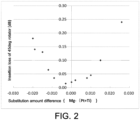
Fig. 2 shows the corresponding relationship between the difference between the composition ratio of Mg and the composition ratio of Pt and Ti combined and the insertion loss of the optical isolator. - Hereinafter, embodiments of the present invention will be described in detail, but the present invention is not limited thereto.
- The following is a description of the bismuth-substituted rare earth iron garnet single crystal of the present invention. This bismuth-substituted rare earth iron garnet single crystal is suitable for use in a Faraday rotator and an optical isolator. The bismuth-substituted rare earth iron garnet single crystal is represented by the following composition formula (1).
(GdaLnbBicMg3-(a+b+c))(FedGaeTifPts-(d+e+f))O12 ... (1)
- Ln in the composition formula (1) is a rare earth element selected from Eu, Dy, Gd, Ho, Tm, Yb, Lu, and Y. A plurality of these rare earth elements may be used simultaneously. It is especially good if Ln is Ho among these. In composition formula (1), the Ti composition ratio is 0.02≤f≤0.05, the Mg composition ratio is 0.02≤(3-(a+b+c)}≤0.08, the difference between the Mg and Ti composition ratios is -0.01≤{3-(a+b+c)}-{f+5-(d+e+f)}≤0.01, a>0, b>0, c>0, d>0, e>0, and 0<d+e+f<5.0.
- In composition formula (1), Ln, Bi, and Fe are elements added to improve the Verde constant and light transmittance of the garnet single crystal. In particular, Feis highly effective in improving the Verde constant and can be stably present as a trivalent ion in the garnet single crystal.
- In composition formula (1), Pt is taken into the crystal by dissolving out of the platinum crucible used to the produce garnet single crystal. In composition formula (1), Ti and Mg are elements added to suppress valence fluctuations of Fe ions caused by Pt ions dissolved from the platinum crucible. As mentioned above, the range of f, which indicates the composition ratio of Ti, is 0.02 ≤ f ≤ 0.05, and the range of {3-(a+b+c)}, which indicates the composition ratio of Mg, is 0.02 ≤ {3-(a+b+c)} ≤ 0.08.
- By setting the lower limits of the composition ratio of Ti and the composition ratio of Mg as shown above, respectively, the amount of the element added to suppress the valence fluctuation of Fe ions can be easily adjusted.
- By setting the upper limits of the composition ratios of Ti and Mg as described above, respectively, the relative decrease in the ratio of Fe elements in the garnet single crystal can be prevented and the light transmittance can be prevented from decreasing. Since a decrease in light transmittance can be prevented, the thickness of the single-crystal film required to rotate the polarization plane by a predetermined angle (e.g. , 45 degrees) can be made thinner, resulting in advantages such as reduced manufacturing time for the single-crystal film and miniaturization of the Faraday rotator and optical isolator.
- Furthermore, by balancing the difference between the composition ratio of Mg and the composition ratio of Ti and Pt combined in the composition formula (1) as described above as -0.01≤{3-(a+b+c)}-{f+5-(d+e+f)}≤0.01, the valence fluctuation of Fe ions can be suppressed while preventing a decrease in the light transmittance of garnet single crystals.
- The bismuth-substituted rare earth iron garnet single crystal of the present invention may be grown with a PbO-free melt composition. A specific example of the production method for bismuth-substituted rare earth iron garnet single crystal is explained below with reference to the flowchart shown in
Fig. 1 . - First, a garnet single-crystal substrate (hereinafter referred to as "base substrate") used as a substrate for the growth of bismuth-substituted rare earth iron garnet single crystal is prepared (Step S10). The substrate to be prepared may be, for example, a Gd3Ga5O12 (GGG; gadolinium, gallium, garnet) single-crystal substrate to which Ca, Mg, Zr, Y, etc. is added. Such a substrate can be obtained by pulling single crystal by the Choklarsky method.
- Next, the metal oxide that will be the raw material for the bismuth-substituted rare earth iron garnet single crystal is melted in a platinum crucible to prepare the raw material melt (Step S20). The raw metal oxides include, for example, Gd2O3, Ho2O3, Bi2O3, Fe2O3, Ga2O3, TiO2, and MgO. The raw material melt is prepared by preparing these metal oxides in predetermined molar weight ratios, putting them in a platinum crucible, and heating and melting them at a predetermined temperature. The amount of Pt that will be dissolved out of the Pt crucible is determined experimentally by material analysis of a single crystal prepared with a composition that does not include Ti. The amount of TiO2 and/or MgO to be added is adjusted to balance based on the amount of Pt to be dissolved.
- Then, a single-crystal film is grown by bringing the base substrate in contact with the prepared raw material melt and pulling it up (step S30). The grown single-crystal film is then cut and polished to obtain a bismuth-substituted rare earth iron garnet single crystal that can be used for a Faraday rotator and an optical isolator (step S40).
- In order to confirm the effectiveness of the present invention, bismuth-substituted rare earth iron garnet single crystals were prepared and Faraday rotators made from these crystals were evaluated as follows.
- First, a garnet single-crystal substrate was prepared as a base substrate for growing a single-crystal film of bismuth-substituted rare-earth iron garnet crystals. The base substrate may be NOG (product name of Shin-Etsu Chemical Co., Ltd.) or SGGG (product name of Saint-Gobain), which is Gd3Ga5O12 to which Ca, Mg, Zr, Y, etc. is added. Such substrates can be obtained by pulling single crystal by the Choklarsky method. The lattice constant on this substrate was 12.496 ± 0.004 Å.
- The raw material melt was then prepared as the raw material for bismuth-substituted rare earth iron garnet single crystals. As metal oxides, Gd2O3: 46.9g, Ho2O3: 48.8g, Bi2O3: 5810g, Fe2O3: 363.5g, and GaaOs: 12.1g were prepared, and these were placed in a platinum crucible and heated to 1100°C. Thereby the raw melt was obtained.
- The raw material melt was then set to 790-785°C, and the substrate was brought into contact and pulled up to obtain a garnet single-crystal film with a thickness of 612 µm.
- The single crystal was analyzed by ICP and found to be the compound shown as (GdHoBi)3(FeGaPt)5O12. That is, a garnet single-crystal film with conventional compositions were obtained, in which Pt derived from the platinum crucible was mixed in, while Ti and Mg were not added to suppress valence fluctuations of Fe ions due to Pt.
- The single-crystal film was then peeled off from the substrate, the peeled single-crystal film was cut and polished, and the film surface was coated with an antireflection coating against air and cut to 1.5 x 1.5 x 0.51 mm. The magneto-optical properties at a wavelength of 1.55 um of the single-crystal film after the cutting process were investigated, and the results were as follows: Faraday rotation angle of 46.3 degrees, optical absorption loss of 0.35 dB, and saturation magnetization of 650 G.
- Thirteen different raw material melts were prepared by placing oxides of Gd, Ho, Bi, Fe, and Ga in a platinum crucible as in the comparative case and further adding TiO2 in the range of 0 to 5.0 g and MgO in the range of 0 to 15 g, and heating to melt them. Thirteen different single-crystal films of bismuth-substituted rare earth iron garnet (composition No. 1-13) were prepared using these raw material melts . The results of the magneto-optical properties of each single-crystal film are shown in Table 1. A graph showing the relationship between the difference between the composition ratio of Mg and the composition ratio of Ti and Pt combined (substitution amount difference) and insertion loss is shown in
Fig. 2 .[Table 1] No. Mg Composition ratio Ti Composition ratio Pt Composition ratio {Mg - (Ti + Pt)} substitution amount difference Insertion loss [dB] 45 deg thickness [µm] 3-(a+b+c) f 5-(d+e+f) 1 0.080 0.030 0.024 0.026 0.24 501 2 0.050 0.015 0.020 0.015 0.10 499 3 0.050 0.020 0.020 0.010 0.05 499 4 0.080 0.050 0.022 0.008 0.04 503 5 0.075 0.050 0.023 0.002 0.03 503 6 0.045 0.015 0.030 0.000 0.02 500 7 0.042 0.025 0.020 -0.003 0.02 500 8 0.050 0.025 0.028 -0.003 0.02 501 9 0.060 0.045 0.024 -0.009 0.04 502 10 0.065 0.055 0.022 -0.012 0.07 503 11 0.015 0.008 0.022 -0.015 0.13 498 12 0.020 0.015 0.024 -0.019 0.14 499 13 0.045 0.045 0.020 -0.020 0.18 502 - As shown in Table 1, the addition of Mg and Ti tends to suppress insertion loss. In particular, the insertion loss of the optical isolator was found to be particularly low, less than 0.05 dB, when the difference between the composition ratio of Mg and the composition ratio of Ti and Pt combined was in the range of -0.01 to 0.01 (compositions No. 3 to 9).
- Even if the difference between the composition ratio of Mg and the composition ratio of Ti and Pt combined is in the range of -0.01 to 0.01, the thickness of the crystal required to rotate the polarization by 45 degrees increases as the amount of substitution increases because the composition ratio of Fe in the crystal decreases relatively. To achieve both miniaturization of the optical isolator and reduction of insertion loss, the difference between the composition ratio of Mg and the composition ratio of Ti and Pt combined should be in the range of -0.01 to 0.01, and the composition ratio of Ti should be 0.05 or less, and the composition ratio of Mg should be 0.08 or less.
- In general, it is very difficult to control the crystal composition uniformly in the plane with a small amount of additive elements. However, according to the present invention described above, by replacing the corresponding elements such as divalent and tetravalent, the growth condition range of single-crystal films can be relaxed, and it is easy to obtain single-crystal films of bismuth-substituted rare earth iron garnet with low insertion loss below 0.05 dB.
- Although embodiments are described above, the present invention is not limited to these examples. Any addition, deletion, or design modification of components as appropriate by those skilled in the art to the aforementioned embodiments, as well as any combination of features of each embodiment as appropriate, are included within the scope of the invention as long as they provide the gist of the invention.
Claims (6)
- A Bismuth-substituted rare earth iron garnet single crystal characterized by the composition formula (GdaLnbBicMg3-(a+b+c))(FedGaeTifPt5-(d+e+f))O12, wherein in the composition formula above, 0.02≤f≤0.05, 0.02≤{3-(a+b+c)}≤0.08, and -0.01≤{3-(a+b+c)}-{f+5-(d+e+f)}≤0.01, and Ln is a rare earth element selected from Eu, Dy, Gd, Ho, Tm, Yb, Lu, and Y.
- The bismuth-substituted rare earth iron garnet single crystal as claimed in claim 1, wherein the crystal is grown with a PbO-free melt composition.
- A Faraday rotator comprising the bismuth-substituted rare earth iron garnet single crystal as claimed in claim 1.
- An optical isolator comprising the Faraday rotator as claimed in claim 3.
- A production method for bismuth-substituted rare earth iron garnet single crystal as claimed in claim 1 comprising:a step of preparing a garnet single-crystal substrate as a base substrate;a step of melting a metal oxide containing at least TiO2 and MgO as raw materials in a platinum crucible to prepare a raw material melt; anda step of bringing the base substrate into contact with the raw material melt and pulling up the base substrate, thereby growing a bismuth-substituted rare earth iron garnet single crystal film.
- The production method according to claim 5, wherein the raw material melt has PbO-free composition.
Applications Claiming Priority (2)
| Application Number | Priority Date | Filing Date | Title |
|---|---|---|---|
| JP2020075708A JP7246341B2 (en) | 2020-04-21 | 2020-04-21 | Bismuth-substituted rare earth iron garnet single crystal, Faraday rotator, optical isolator, and method for producing bismuth-substituted rare earth iron garnet single crystal |
| PCT/JP2020/047330 WO2021215048A1 (en) | 2020-04-21 | 2020-12-18 | Bismuth-substituted rare earth iron garnet single crystal, faraday rotator, optical isolator, and production method for bismuth-substituted rare earth iron garnet single crystal |
Publications (2)
| Publication Number | Publication Date |
|---|---|
| EP4141151A1 true EP4141151A1 (en) | 2023-03-01 |
| EP4141151A4 EP4141151A4 (en) | 2024-05-22 |
Family
ID=78270404
Family Applications (1)
| Application Number | Title | Priority Date | Filing Date |
|---|---|---|---|
| EP20932331.0A Pending EP4141151A4 (en) | 2020-04-21 | 2020-12-18 | BISMUTH-SUBSTITUTED RARE EARTH IRON GARNET SINGLE CRYSTAL, FARADAY ROTATOR, OPTICAL ISOLATOR AND PRODUCTION PROCESS FOR BISMUTH-SUBSTITUTED RARE EARTH IRON GARNET SINGLE CRYSTAL |
Country Status (6)
| Country | Link |
|---|---|
| US (1) | US12585146B2 (en) |
| EP (1) | EP4141151A4 (en) |
| JP (1) | JP7246341B2 (en) |
| CN (1) | CN115362286B (en) |
| CA (1) | CA3174520A1 (en) |
| WO (1) | WO2021215048A1 (en) |
Family Cites Families (28)
| Publication number | Priority date | Publication date | Assignee | Title |
|---|---|---|---|---|
| JPS49143B1 (en) | 1969-02-22 | 1974-01-05 | ||
| US5198923A (en) * | 1991-01-17 | 1993-03-30 | Shin-Etsu Chemical Co., Ltd. | Optical isolator |
| US5640516A (en) * | 1991-04-02 | 1997-06-17 | Tdk Corporation | Faraday rotator |
| JP2786078B2 (en) * | 1993-05-14 | 1998-08-13 | 信越化学工業株式会社 | Faraday rotator and optical isolator |
| JP3490143B2 (en) | 1994-07-01 | 2004-01-26 | 信越化学工業株式会社 | Oxide garnet single crystal |
| EP1055957A3 (en) * | 1999-05-28 | 2004-03-10 | Shin-Etsu Chemical Company, Ltd. | Faraday rotator and magneto-optical element using the same |
| JP2002287104A (en) * | 2001-03-28 | 2002-10-03 | Photocrystal Inc | Method of manufacturing faraday rotator without using magnet |
| US7133189B2 (en) * | 2002-02-22 | 2006-11-07 | Tdk Corporation | Magnetic garnet material, faraday rotator, optical device, bismuth-substituted rare earth-iron-garnet single-crystal film and method for producing the same and crucible for producing the same |
| US6724514B2 (en) * | 2002-03-18 | 2004-04-20 | American Optics Science | Faraday rotator with improved magnetooptic property |
| JP4225472B2 (en) | 2002-07-05 | 2009-02-18 | Tdk株式会社 | Magnetic garnet material, Faraday rotator, optical device, method for producing bismuth-substituted rare earth iron garnet single crystal film, and single crystal film |
| JP2004206078A (en) | 2002-12-13 | 2004-07-22 | Tdk Corp | Faraday rotator and optical device equipped with the same |
| US7811465B2 (en) * | 2004-11-19 | 2010-10-12 | Tdk Corporation | Magnetic garnet single crystal and optical element using same as well as method of producing single crystal |
| US7585474B2 (en) * | 2005-10-13 | 2009-09-08 | The Research Foundation Of State University Of New York | Ternary oxide nanostructures and methods of making same |
| JP5393271B2 (en) * | 2009-06-09 | 2014-01-22 | 信越化学工業株式会社 | Oxides and magneto-optical devices |
| JP5528827B2 (en) * | 2010-01-25 | 2014-06-25 | 信越化学工業株式会社 | Optical isolator |
| JP2012012283A (en) * | 2010-05-31 | 2012-01-19 | Namiki Precision Jewel Co Ltd | Bi-SUBSTITUTED RARE EARTH IRON GARNET SINGLE CRYSTAL, METHOD FOR PRODUCING SAME AND OPTICAL DEVICE |
| JP5762715B2 (en) * | 2010-10-06 | 2015-08-12 | 信越化学工業株式会社 | Magneto-optic material, Faraday rotator, and optical isolator |
| JP5858242B2 (en) * | 2010-12-25 | 2016-02-10 | 並木精密宝石株式会社 | Bi-substituted rare earth iron garnet single crystal, manufacturing method thereof, and optical device |
| US9091813B2 (en) * | 2011-06-08 | 2015-07-28 | Skorpios Technologies, Inc. | Systems and methods for photonic polarization beam splitters |
| JP5568073B2 (en) * | 2011-10-28 | 2014-08-06 | 信越化学工業株式会社 | Bismuth-substituted rare earth iron garnet crystal, method for producing the same, and Faraday rotator |
| EP2930159A4 (en) * | 2012-12-06 | 2016-07-20 | Shinetsu Chemical Co | RARE AND BISMUTH-SUBSTITUTED SINGLE-IRON IRON-TYPE SINK MATERIAL AND MAGNETO-OPTICAL DEVICE |
| JP5377785B1 (en) * | 2013-03-28 | 2013-12-25 | 株式会社グラノプト | Bismuth-substituted rare earth iron garnet single crystal and method for producing the same |
| JP6132429B2 (en) * | 2013-04-01 | 2017-05-24 | 信越化学工業株式会社 | Faraday rotator and method of manufacturing optical isolator |
| JP6052800B2 (en) * | 2013-07-12 | 2016-12-27 | 信越化学工業株式会社 | Optical isolator |
| JP2018205586A (en) * | 2017-06-07 | 2018-12-27 | 信越化学工業株式会社 | Optical isolator and semiconductor laser module |
| JP6894865B2 (en) * | 2018-04-09 | 2021-06-30 | 信越化学工業株式会社 | Method for manufacturing garnet-type crystals |
| JP7063694B2 (en) * | 2018-04-09 | 2022-05-09 | 信越化学工業株式会社 | Faraday rotator manufacturing method |
| JP6973953B2 (en) * | 2018-11-16 | 2021-12-01 | 信越化学工業株式会社 | Manufacturing method of optical isolator and manufacturing method of Faraday rotator |
-
2020
- 2020-04-21 JP JP2020075708A patent/JP7246341B2/en active Active
- 2020-12-18 CA CA3174520A patent/CA3174520A1/en active Pending
- 2020-12-18 EP EP20932331.0A patent/EP4141151A4/en active Pending
- 2020-12-18 CN CN202080099322.XA patent/CN115362286B/en active Active
- 2020-12-18 US US17/995,987 patent/US12585146B2/en active Active
- 2020-12-18 WO PCT/JP2020/047330 patent/WO2021215048A1/en not_active Ceased
Also Published As
| Publication number | Publication date |
|---|---|
| WO2021215048A1 (en) | 2021-10-28 |
| CA3174520A1 (en) | 2021-10-28 |
| US20230194902A1 (en) | 2023-06-22 |
| EP4141151A4 (en) | 2024-05-22 |
| JP7246341B2 (en) | 2023-03-27 |
| CN115362286B (en) | 2025-02-25 |
| US12585146B2 (en) | 2026-03-24 |
| CN115362286A (en) | 2022-11-18 |
| JP2021172539A (en) | 2021-11-01 |
Similar Documents
| Publication | Publication Date | Title |
|---|---|---|
| US9201167B2 (en) | Bi-substituted rare earth iron garnet single crystal, method for producing same, and optical device | |
| US9227851B2 (en) | Bi-substituted rare earth iron garnet single crystal, method of manufacturing the same, and optical device | |
| JP5292544B2 (en) | Bi-substituted rare earth iron garnet single crystal, manufacturing method thereof, and optical device | |
| EP4141151A1 (en) | Bismuth-substituted rare earth iron garnet single crystal, faraday rotator, optical isolator, and production method for bismuth-substituted rare earth iron garnet single crystal | |
| US7758766B2 (en) | Magnetic garnet single crystal and Faraday rotator using the same | |
| US12012668B2 (en) | Bismuth-substituted rare earth iron garnet single crystal, faraday rotator, optical isolator, and method for producing bismuth-substituted rare earth iron garnet single crystal | |
| EP4177383A1 (en) | Bismuth-substituted rare earth iron garnet single crystal film production method, faraday rotator, and optical isolator | |
| JP6481552B2 (en) | Bismuth-substituted rare earth iron garnet crystal film manufacturing method, bismuth-substituted rare earth iron garnet crystal film | |
| JP2001044026A (en) | Magnetic garnet single crystal and faraday rotator using the same | |
| JP5292543B2 (en) | Bi-substituted rare earth iron garnet single crystal, manufacturing method thereof, and optical device | |
| JP5966945B2 (en) | Heat treatment method of bismuth-substituted rare earth iron garnet single crystal | |
| JP4942029B2 (en) | Magnetic garnet single crystal and method for producing the same | |
| JP4720730B2 (en) | Optical element manufacturing method | |
| JP2007210879A (en) | Magnetic garnet single crystal, its production method, and optical element using the same | |
| JP2002308696A (en) | Garnet single crystal substrate and method for producing bismuth-substituted rare earth garnet single crystal film using the same | |
| JP2006273594A (en) | Magnetooptic garnet thick-film single crystal and method for producing the same | |
| JPH11268992A (en) | Bismuth-substituted garnet thick film material and method for producing the same | |
| JP2005247589A (en) | Magnetic garnet single crystal and optical element using the same | |
| JP2004331454A (en) | Bismuth-substituted magnetic garnet film and manufacturing method thereof | |
| JP2004168657A (en) | Magnetic garnet single crystal and faraday rotator using it | |
| JP2004319575A (en) | YbTbBiFe-based magnetic garnet film and method for producing the same |
Legal Events
| Date | Code | Title | Description |
|---|---|---|---|
| STAA | Information on the status of an ep patent application or granted ep patent |
Free format text: STATUS: THE INTERNATIONAL PUBLICATION HAS BEEN MADE |
|
| PUAI | Public reference made under article 153(3) epc to a published international application that has entered the european phase |
Free format text: ORIGINAL CODE: 0009012 |
|
| STAA | Information on the status of an ep patent application or granted ep patent |
Free format text: STATUS: REQUEST FOR EXAMINATION WAS MADE |
|
| 17P | Request for examination filed |
Effective date: 20221020 |
|
| AK | Designated contracting states |
Kind code of ref document: A1 Designated state(s): AL AT BE BG CH CY CZ DE DK EE ES FI FR GB GR HR HU IE IS IT LI LT LU LV MC MK MT NL NO PL PT RO RS SE SI SK SM TR |
|
| DAV | Request for validation of the european patent (deleted) | ||
| DAX | Request for extension of the european patent (deleted) | ||
| A4 | Supplementary search report drawn up and despatched |
Effective date: 20240423 |
|
| RIC1 | Information provided on ipc code assigned before grant |
Ipc: G02F 1/09 20060101ALI20240417BHEP Ipc: C30B 19/04 20060101ALI20240417BHEP Ipc: C01G 55/00 20060101ALI20240417BHEP Ipc: C30B 29/28 20060101AFI20240417BHEP |
|
| STAA | Information on the status of an ep patent application or granted ep patent |
Free format text: STATUS: EXAMINATION IS IN PROGRESS |
|
| 17Q | First examination report despatched |
Effective date: 20240918 |