EP4139919B1 - Kostengünstige anpassung des bass-nachfilters - Google Patents
Kostengünstige anpassung des bass-nachfilters Download PDFInfo
- Publication number
- EP4139919B1 EP4139919B1 EP21721487.3A EP21721487A EP4139919B1 EP 4139919 B1 EP4139919 B1 EP 4139919B1 EP 21721487 A EP21721487 A EP 21721487A EP 4139919 B1 EP4139919 B1 EP 4139919B1
- Authority
- EP
- European Patent Office
- Prior art keywords
- signal
- post
- energy
- ratio
- filter
- Prior art date
- Legal status (The legal status is an assumption and is not a legal conclusion. Google has not performed a legal analysis and makes no representation as to the accuracy of the status listed.)
- Active
Links
Images






Classifications
-
- G—PHYSICS
- G10—MUSICAL INSTRUMENTS; ACOUSTICS
- G10L—SPEECH ANALYSIS TECHNIQUES OR SPEECH SYNTHESIS; SPEECH RECOGNITION; SPEECH OR VOICE PROCESSING TECHNIQUES; SPEECH OR AUDIO CODING OR DECODING
- G10L19/00—Speech or audio signals analysis-synthesis techniques for redundancy reduction, e.g. in vocoders; Coding or decoding of speech or audio signals, using source filter models or psychoacoustic analysis
- G10L19/04—Speech or audio signals analysis-synthesis techniques for redundancy reduction, e.g. in vocoders; Coding or decoding of speech or audio signals, using source filter models or psychoacoustic analysis using predictive techniques
- G10L19/26—Pre-filtering or post-filtering
-
- G—PHYSICS
- G10—MUSICAL INSTRUMENTS; ACOUSTICS
- G10L—SPEECH ANALYSIS TECHNIQUES OR SPEECH SYNTHESIS; SPEECH RECOGNITION; SPEECH OR VOICE PROCESSING TECHNIQUES; SPEECH OR AUDIO CODING OR DECODING
- G10L25/00—Speech or voice analysis techniques not restricted to a single one of groups G10L15/00 - G10L21/00
- G10L25/48—Speech or voice analysis techniques not restricted to a single one of groups G10L15/00 - G10L21/00 specially adapted for particular use
- G10L25/51—Speech or voice analysis techniques not restricted to a single one of groups G10L15/00 - G10L21/00 specially adapted for particular use for comparison or discrimination
-
- Y—GENERAL TAGGING OF NEW TECHNOLOGICAL DEVELOPMENTS; GENERAL TAGGING OF CROSS-SECTIONAL TECHNOLOGIES SPANNING OVER SEVERAL SECTIONS OF THE IPC; TECHNICAL SUBJECTS COVERED BY FORMER USPC CROSS-REFERENCE ART COLLECTIONS [XRACs] AND DIGESTS
- Y02—TECHNOLOGIES OR APPLICATIONS FOR MITIGATION OR ADAPTATION AGAINST CLIMATE CHANGE
- Y02D—CLIMATE CHANGE MITIGATION TECHNOLOGIES IN INFORMATION AND COMMUNICATION TECHNOLOGIES [ICT], I.E. INFORMATION AND COMMUNICATION TECHNOLOGIES AIMING AT THE REDUCTION OF THEIR OWN ENERGY USE
- Y02D30/00—Reducing energy consumption in communication networks
- Y02D30/70—Reducing energy consumption in communication networks in wireless communication networks
Definitions
- the present disclosure relates generally to communications, and more particularly to methods and apparatuses for mono, stereo or multi-channel audio encoding and decoding.
- the ACELP algebraic code-excited linear prediction
- the ACELP model is composed of a linear predictor (LP) filter, which models the vocal tract and provides the coarse spectral shape of the reconstructed voice.
- the LP filter is driven by two codebooks: a pitch codebook (or adaptive codebook) which models the periodic component of the voice and an innovation codebook (or fixed codebook) which generates the non-periodic voice segments and also builds the pitch codebook.
- the core algorithm of the ACELP algorithm has been further enhanced, including post-processing tools such as post-filters.
- the two main such filters are the formant post-filter and the pitch-post filter, which both make use of parameters that are part of the ACELP speech model.
- the formant post-filter enhances the coarse spectral shape using the linear predictor filter (LP), and the pitch post-filter reduces inter-harmonic distortion by emphasizing the pitch period.
- a variant of the pitch post-filter, targeting the low frequency range, is the bass post-filter (BPF).
- BPF bass post-filter
- This tool is present in recent speech codec standards, such as ITU-T G.718 and 3GPP EVS as illustrated in 3GPP TS 26.445 V16.0.0, Codec for Enhanced Voice Services (EVS); Detailed Algorithmic Description, 6.1.4.2 Bass post-filter [1].
- the bass post-filter generally improves the quality of the decoded audio, it may have a negative impact on some signals.
- Several adaptation methods have been used to control the post-filter strength.
- the post-filter strength is adapted to how well the post-filtered signal correlates with the input signal. A low correlation suggests the filter may have a degrading impact, and as a result the filter output is attenuated.
- the post-filter strength is also adapted to the LP filter stability, where a low stability leads to an attenuated filter.
- US 9,224,403 describes further adaptation methods of the bass post-filter.
- US 9,224,403 has taken into consideration that the codec may use multiple modes, where the CELP or ACELP algorithm is one of these modes. Since the bass post-filter is only active for the ACELP mode, the strength of the bass post-filter may be adapted to avoid artefacts when enabling and disabling the filter in cases where there are frequent mode switches.
- U.S. patent 9,224,403 further considers how well the input signal is represented by the ACELP or CELP coding model. If there is significant energy loss, it is likely that the signal is not well modeled, and the bass post-filter may be harmful.
- the post-filter strength may also be adapted gradually to give smoother transitions.
- the analysis of the filter impact may be done on a filter difference signal, describing the difference between the filtered and non-filtered signal. It may also be done on an approximate difference signal to reduce the computational complexity of the method.
- the suitability of the bass post-filter may depend on the pitch, or fundamental frequency, of the signal.
- the post-filter strength is limited as a function of the pitch, such that post-filter is attenuated for lower frequencies.
- the output of the filter is also low-pass filtered with a cut-off frequency that depends on the fundamental frequency, yielding lower operating bandwidth for lower fundamental frequencies.
- US2019/214035 A1 discloses a decision whether to use the post filter taken separately from the decision as to the most suitable coding mode. This makes it possible to maintain one post filtering status throughout a period of such length that the switching will not annoy the listener.
- the encoding method may prescribe that the post filter will be kept inactive even though it switches into a coding mode where the filter is conventionally active. It also discloses as an option, wherein a decoding section extracts an intermediate decoded signal, whereby the approximate difference signal can be computed as the difference between the intermediate decoded signal and the intermediate decoded signal when subjected to post filtering.
- US 2012/101824 A1 discloses a method for avoiding frame boundary discontinuities when performing pitch-based pre-filtering and pitch-based post-filtering of an audio signal is also described herein.
- the post-filters are intended to reduce noise, but in some cases they may introduce new artefacts.
- abrupt changes in the parameters such as a pitch period parameter or post-filter strength, may introduce discontinuities that become audible in the low energy regions of the spectrum.
- a method for audio decoding where an encoded primary signal is decoded to form a decoded primary signal, followed by a post-filtering of the decoded primary signal to form a post-filtered signal, where an output signal of the decoder is one of the decoded primary signal and the post-filtered signal.
- An energy estimation of at least a part of a frequency spectrum of the primary signal being reconstructed by the decoder and an analysis of discontinuities in time domain that is caused by the post-filtering of the decoded primary signal are obtained.
- a decision variable is generated based on the energy estimation and the analysis of discontinuities obtained.
- the decision variable is compared to a threshold and the output signal is set to be the decoded primary signal or the post-filtered signal based on the comparing of the decision variable to the threshold.
- a decoder adapted to perform operations comprising: obtaining an energy estimation of at least a part of a frequency spectrum of a primary signal being reconstructed by the decoder to form a decoded primary signal; obtaining an analysis of discontinuities in time domain that is caused by post-filtering of the decoded primary signal; generating a decision variable based on the energy estimation obtained and the analysis of discontinuities obtained; comparing the decision variable to a threshold; and setting the output signal to be the decoded primary signal or a post-filtered signal based on the comparing of the decision variable to the threshold.
- a computer program comprising program code to be executed by processing circuitry of a decoder, whereby execution of the program code causes the decoder to perform operations comprising: obtaining an energy estimation of at least a part of a frequency spectrum of a primary signal being reconstructed by the decoder to form a decoded primary signal; obtaining an analysis of discontinuities in time domain that is caused by post-filtering of the decoded primary signal; generating a decision variable based on the energy estimation obtained and the analysis of discontinuities obtained; comparing the decision variable to a threshold; and setting the output signal to be the primary signal decoded or a post-filtered signal based on the comparing of the decision variable to the threshold.
- One advantage that may be obtained using the inventive concepts described herein is the addition of an adaptation of a post-filter such that the benefits of the post-filter are maintained, while the problematic cases are mitigated by attenuating or disabling the post-filter. Further, this advantage achieved by a low complex method which has a limited impact on the overall computational complexity of the audio decoder.
- Figure 1 illustrates an example of an operating environment of a decoder 100 that may be used to decode mono, stereo or multi-channel bitstreams as described herein.
- the decoder 100 may be part of a media player, a mobile device, a set-top device, a desktop computer, and the like.
- the decoder 100 receives encoded bitstreams.
- the bitstreams may be sent from an encoder, from a storage device 104, from a device on the cloud via network 102, etc.
- decoder 100 receives and processes the frames of the bitstream as described herein.
- the decoder 100 outputs audio signals (e.g., mono, stereo or multi-channel audio signals) and transmits the audio signals to an audio player 106 having at least one loudspeaker for playback of mono, stereo or multi-channel audio signals.
- Storage device 104 may be part of a storage depository of mono, stereo or multi-channel audio signals such as a storage repository of a store or a streaming music service, a separate storage component, a component of a mobile device, etc.
- An audio player may be a Bluetooth speaker, a device having at least one loudspeaker, a mobile device, a streaming music service, etc.
- FIG. 10 is a block diagram illustrating elements of a decoder device 100 configured to provide wireless communication according to embodiments of inventive concepts.
- a decoder 100 may be part of a mobile terminal, a mobile communication terminal, a wireless communication device, a wireless terminal, a wireless communication terminal, user equipment, UE, a user equipment node/terminal/device, etc.
- decoder 100 may include a network interface circuit 1005, also referred to as a network interface, configured to provide communications with other devices/entities/functions/etc.
- the decoder 100 may also include a processor circuit 1001, also referred to as a processor, operatively coupled to the network interface circuit 1005, and a memory circuit 1003, also referred to as memory, operatively coupled to the processor circuit.
- the memory circuit 1003 may include computer readable program code that when executed by the processor circuit 1001 causes the processor circuit to perform operations according to embodiments disclosed herein.
- processor circuit 1001 may be defined to include memory so that a separate memory circuit is not required.
- operations of the decoder 100 may be performed by processor 1001 and/or network interface 1005.
- processor 1001 may control network interface 1005 to transmit communications to multi-channel audio players and/or to receive communications through network interface 1005 from one or more other network nodes/entities/servers such as encoder nodes, depository servers, etc.
- modules may be stored in memory 1003, and these modules may provide instructions so that when instructions of a module are executed by processor 1001, processor 1001 performs respective operations.
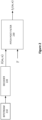
- FIG. 2 illustrates an audio decoding system including a pitch post-filter.
- the decoder 220 receives a bitstream 210 from e.g. a transmission network or a storage medium.
- the decoder generates a reconstructed time domain signal ⁇ ( m, n ) where n is the sample index and m is the frame number.
- the reconstructed time domain signal ⁇ ( m, n) may also be referred to as a primary signal or a decoded primary signal in the description that follows.
- the reconstructed time domain signal ⁇ ( m, n) is further enhanced by a pitch post-filter 230 which may also utilize a pitch period T.
- the pitch period T is obtained through pitch analysis done on the decoded audio, or it may come from an analysis in the encoder or decoder on the target signal or a related audio signal which may have the same or similar dominant pitch as the post-filter input signal.
- s diff ( m, n ) ⁇ ( ⁇ ( m, n ) - s p ( m, n )) is the impact of the filter expressed as a negative difference signal or a correction signal or an error signal.
- the parameters ⁇ and T are typically updated each subframe, where a subframe may be 4 or 5 ms long.
- the post-filter strength ⁇ is adapted based on the spectral stability of the signal. It also has a built-in failsafe mechanism by measuring the correlation with the post-filtered audio with the input signal. If the correlation is low, it means the filter is likely to have a negative impact on the quality and the filter is dampened or switched off.
- the post-filtered signal ⁇ f ( m, n) is output from the decoder system to be played back by an audio player or potentially stored or transmitted in a decoded PCM format.
- the decoder system may include further processing of the post-filtered signal before the final signal is output, such as additional enhancements or combinations with other signals or signal components.
- the reconstructed signal may in such cases correspond to a difference signal, or residual signal, as outlined in ITU-T G.718 "Frame error robust narrow-band and wideband embedded variable bit-rate coding of speech and audio from 8-32 kbit/s", section 7.14.1.2 Dual bass post-filter.
- the residual signal may be combined with another signal to provide an enhanced output signal.
- a drawback with the bass post-filter of Figure 2 is that the abrupt change of the bass post-filter parameters at the subframe boundary may cause undesired discontinuities in the filtered signal, as illustrated by the discontinuities 300 in Figure 3 . These discontinuities may give distortions that spread across the frequency range. Depending on the spectrum of the input signal, these distortions may be noticeable and become disturbing.
- the spectra 400 in Figure 4 where the post-filter operation generates audible noise 402 above approximately 1 kHz. Note that the filter still has the desired effect below 200 Hz, where the inter-harmonic distortion is reduced.
- the failsafe mechanism of the filter which measures the correlation of the filter output with the filter input signal, does not address the problem of the subframe transitions. Since the correlation is computed within each subframe, the transitions between subframes and their potential impact has not been considered.
- a possible technique to reduce the effects of the discontinuities is to apply smoothing through low-pass filtering the parameters or by cross-fading the post-filter output between subframes. Although such operations were found to reduce the artefacts, the operations also slowed down the adaptation of the filter such that the positive effects of the filter were reduced. Further, even though the low-pass filtering of the parameters reduced the artefacts, switching the post-filter off for these critical segments was found to be better. Hence, it seems desirable to keep the post-filter untouched for the regions where it has a positive impact while it should be switched off completely when it has a negative impact.
- An adaptation of the post-filter which can anticipate the distortions and disable the filter whenever needed can reduce and, in some embodiments, eliminate the effects of discontinuities.
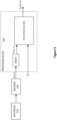
- the decoder as outlined in Figure 5 provides such an adaptation.
- the decoder 520 receives a bitstream 510 and produces a reconstructed signal S(m, k) in frequency domain where m is the frame number and k is the frequency bin index.
- a transform which is often used in audio encoder and decoder systems is MDCT (modified discrete cosine transform). It should be noted that the concepts presented herein are applicable for any transform domain where energy calculations are possible, such as DFT (discrete Fourier transform), QMF (quadrature mirror filterbank) or a Hybrid QMF filterbank.
- the processing block 530 performs the inverse MDCT (IMDCT) transform and applies the post-filter.
- IMDCT inverse MDCT
- a post-filter adaptation method can be described by substituting the processing block 530 of Figure 5 with the adaptive post-filter block 600 of Figure 6 .
- the reconstructed signal 620 in frequency domain S(m, k) is transformed to time domain.
- the resulting time domain signal is input to a post-filter difference generating block 610.
- the post-filter difference s diff ( m, n) 630 and the reconstructed signal S(m, k) 620 in frequency domain are input to the post-filter adaptor 640, which forms a decision 650 whether or not the post-filter should be applied.
- the decision 650 is used to control the output 660 of the adaptive post-filter block by activating or deactivating subtraction of the post-filter difference from the reconstructed primary signal.
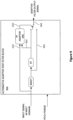
- FIG. 9 An alternative method, where the post-filter outputs the filtered signal rather than the filter difference signal is shown in Figure 9 .
- the decision mechanism of alternative adaptive post-filter block 900 decides whether to use the filtered signal 902 or the non-filtered signal 904.
- the time domain analysis of the filtered signal is performed on the filtered signal 902 instead of the difference signal, which will obtain similar results.
- the post-filter adaptor 640 of Figure 6 can be further described by the elements of Figure 7 that perform the steps outlined in Figure 8 . Based on the analysis of the problematic items as illustrated in Figure 3 and Figure 4 , a post-filter adaptation method may be based on detecting two conditions:
- Detecting a strong tilt or a deep valley in the spectrum may be done by measuring the energy of the spectrum in a certain critical band. A low energy in the critical band could then indicate that a deep valley is found in a perceptually sensitive part of the spectrum.
- the energy measurement E ⁇ cb ( m ) for each frame m may be done on the reconstructed signal S(m, k) in MDCT domain.
- the MDCT domain energy estimator 710 performs block 800 by measuring the energy of the critical band.
- the critical band may be adaptive and e.g. depend on the reconstructed signal. The critical band could for instance be focused around an identified low energy region measured on a perceptual weighted spectrum. A perceptually weighted spectrum can be generated based on the spectrum of the reconstructed signal and transformed in frequency and level dimensions such that perceptually important regions are emphasized. An adaptive critical band can also take into consideration for which frequency range the post-filter may generate distortion.
- E ⁇ S ⁇ cb m ⁇ E S ⁇ cb m + 1 ⁇ ⁇ E S ⁇ cb m ⁇ 1 .
- ⁇ E (0,1] is a low-pass filtering coefficient which e.g. depends on the shape of the MDCT synthesis windows and the length of the overlap.
- the size of the discontinuities is measured by averaging the step at the subframe boundaries of the filter difference signal s diff ( m, n) in block 820 using the subframe discontinuity analyzer 730:
- m denotes the frame number
- i is the subframe number
- N sf is the number of subframes
- n 1 , n 2 , ..., n N sf is the sample indices of the subframe boundaries marking the start of each new subframe.
- a decision variable is formed at block 830 at multiplier 740 as the ratio between ⁇ step ( m ) and ⁇ ⁇ cb ( m ).
- E ⁇ ratio m E ⁇ step m E ⁇ S ⁇ cb m
- a decision variable is formed as the ratio between ⁇ step ( m ) and E ⁇ cb ( m ), where E ⁇ cb ( m ) is the energy estimate calculated in block 800.
- the post-filter activation decision in various embodiments is taken by comparing the low-pass filtered energy ratio with the threshold at threshold comparator 770 in block 850 and determining whether or not to use (e.g., activate) the post-filter in block 860.
- adding some hysteresis for the switching to reduce toggling may be useful if the low-pass filtered energy ratio is hovering around the threshold.
- One way to implement hysteresis is to have two thresholds: one for activation and one for deactivation. If the activation threshold is a bit higher than the deactivation threshold this creates a "dead zone" for the decision variable and reduces toggling if the variable is hovering around the threshold.
- Another way to implement hysteresis is to determine a count of the number of times the low-pass filtered energy ratio goes below (or alternatively, above) the threshold in a time period and activate (or deactivate) the post-filter after a predetermined number of times the low-pass filtered energy ratio goes below (or alternatively, above) the threshold in the time period.
- a critical band is used.
- more than one critical band, corresponding to more than one spectral valley may be present.
- the critical band selected to analyze is the most sensitive region and the decision whether or not to use the post-filter is performed for the selected critical band.
- One way to account for this may be summing the contribution from several critical bands and deciding whether to set the output to be the primary signal or the post-filtered signal based on the embodiments described above.
- An alternative approach is to analyze the bands separately, and then disable the post-filter if the threshold is triggered for any one of the bands being analyzed.
- An alternative method for deciding if the noise will be masked is to compare the energy of the signal in the critical region before and after the post-filter. This alternative method was found to give similar results as the inventive concepts described under Embodiment A, but at the cost of higher delay and complexity.
- a decision D(m) to activate or disable the post-filter for frame m can be formed by comparing the energy ratio of the critical band of the signals before and after applying the post-filter to a decision threshold E thr as illustrated below where active indicates the post-filter is activated and inactive indicates the post-filter is disabled.
- the threshold E thr is set to 1. In other words, when the energy above a certain cut-off frequency is higher after applying the post-filter, the energy increase is assumed to be caused by noise and the post-filter is disabled.
- D m ⁇ active , E s f m E s ⁇ cb m ⁇ E thr inactive , E s f m E s ⁇ cb m ⁇ E thr
- Disabling the post-filter for frame m can be implemented in some embodiments by using the decoded signal ⁇ ( m, n) instead of the post-filtered version ⁇ f ( m, n). If the filter routine produces a filter difference signal s diff ( m, n ), the disabling of the filter can be implemented by skipping the subtraction of the filter difference signal from the decoded signal ⁇ ( m, n ).
- hysteresis for the switching between the primary signal and the post-filtered signal to reduce toggling if the energy ratio is hovering around the threshold.
- One way to implement hysteresis is to have two thresholds: one for activation and one for deactivation. If the activation threshold is a bit higher than the deactivation threshold this creates a "dead zone" for the decision variable and reduces toggling if the variable is hovering around the threshold.
- Another way to implement hysteresis is to determine a count of the number of times the low-pass filtered energy ratio goes below (or alternatively, above) the threshold in a time period and activate (or deactivate) the post-filter after a predetermined number of times the low-pass filtered energy ratio goes below (or alternatively, above) the threshold in the time period.
- modules may be stored in memory 1003 of Figure 3 , and these modules may provide instructions so that when the instructions of a module are executed by respective communication device processing circuitry 1001, processing circuitry 1001 performs respective operations of the flow chart.
- the processing circuitry 1001 obtains an energy estimation of at least a part of a frequency spectrum of the primary signal being reconstructed, i.e., decoded, by the decoder 100.
- the primary signal reconstruction may be done in the frequency domain.
- the operations of block 1101 are analogous to the operations of block 800 described above.
- the processing circuitry 1001 may obtain the energy estimation by summing energy coefficients of the at least a part of the frequency spectrum in the frequency domain.
- the processing circuitry 1001 obtains an analysis of discontinuities in time domain that is caused by post-filtering of the primary signal.
- the operations of block 1103 are analogous to the operations of block 820 described above.
- the processing circuitry 1001 may obtain the analysis of the discontinuities in time domain by measuring an average energy of a size of the discontinuities.
- the processing circuitry 1001 generates a decision variable based on the energy estimation obtained and the analysis of discontinuities obtained.
- the operations of block 1105 are analogous to the operations of block 830 described above.
- the processing circuitry 1001 may limit the decision variable to a maximum value in block 1201 and low pass filter the decision variable in block 1203.
- the operations of blocks 1201 and 1203 are analogous to the operations of block 840 described above.
- ⁇ ratio ( m ) is an energy ratio between ⁇ step ( m ) and ⁇ ⁇ cb ( m )
- ⁇ step ( m ) is an average energy of a step at subframe boundaries
- ⁇ ⁇ cb ( m ) is a low-pass filtered energy E ⁇ cb ( m ) of a critical band of a reconstructed signal
- the processing circuitry 1001 compares the decision variable to a threshold. For example, as described above, when the decision variable is the energy ratio between ⁇ step ( m ) and ⁇ ⁇ cb ( m ), the energy ratio is compared to a threshold E thr .
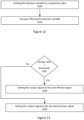
- FIG. 13 An example of setting the output signal is illustrated in Figure 13 .
- the processing circuitry 1001 in block 1301 compares the energy ratio between an average energy of a step at subframe boundaries and an energy estimation of the at least a part of the frequency spectrum of the primary signal to a threshold.
- the processing circuitry 1001 sets the output signal to be the post-filtered signal.
- the processing circuitry 1001 sets the output signal to be the decoded primary signal.
- hysteresis can be added for setting the output between the decoded primary signal and the post-filtered signal to reduce toggling if the energy ratio is hovering around the threshold.
- the terms “comprise”, “comprising”, “comprises”, “include”, “including”, “includes”, “have”, “has”, “having”, or variants thereof are open-ended, and include one or more stated features, integers, elements, steps, components or functions but does not preclude the presence or addition of one or more other features, integers, elements, steps, components, functions or groups thereof.
- the common abbreviation “e.g.”, which derives from the Latin phrase “exempli gratia” may be used to introduce or specify a general example or examples of a previously mentioned item, and is not intended to be limiting of such item.
- the common abbreviation “i.e.”, which derives from the Latin phrase “id est,” may be used to specify a particular item from a more general recitation.
- Example embodiments are described herein with reference to block diagrams and/or flowchart illustrations of computer-implemented methods, apparatus (systems and/or devices) and/or computer program products. It is understood that a block of the block diagrams and/or flowchart illustrations, and combinations of blocks in the block diagrams and/or flowchart illustrations, can be implemented by computer program instructions that are performed by one or more computer circuits.
- These computer program instructions may be provided to a processor circuit of a general purpose computer circuit, special purpose computer circuit, and/or other programmable data processing circuit to produce a machine, such that the instructions, which execute via the processor of the computer and/or other programmable data processing apparatus, transform and control transistors, values stored in memory locations, and other hardware components within such circuitry to implement the functions/acts specified in the block diagrams and/or flowchart block or blocks, and thereby create means (functionality) and/or structure for implementing the functions/acts specified in the block diagrams and/or flowchart block(s).
Landscapes
- Engineering & Computer Science (AREA)
- Computational Linguistics (AREA)
- Signal Processing (AREA)
- Health & Medical Sciences (AREA)
- Audiology, Speech & Language Pathology (AREA)
- Human Computer Interaction (AREA)
- Physics & Mathematics (AREA)
- Acoustics & Sound (AREA)
- Multimedia (AREA)
- Compression, Expansion, Code Conversion, And Decoders (AREA)
- Transmission Systems Not Characterized By The Medium Used For Transmission (AREA)
Claims (15)
- Verfahren zur Audiodecodierung, wobei ein codiertes Primärsignal decodiert wird, um ein decodiertes Primärsignal zu bilden, woraufhin ein Nachfiltern des decodierten Primärsignals folgt, um ein nachgefiltertes Signal zu bilden, wobei ein Ausgangssignal des Decoders eines von dem decodierten Primärsignal und dem nachgefilterten Signal ist, wobei das Verfahren umfasst:Erhalten (1101, 800) einer Energieschätzung mindestens eines Teils eines Frequenzspektrums des Primärsignals, das vom Decoder rekonstruiert wird;Erhalten (1103, 820) einer Analyse von Diskontinuitäten in der Zeitdomäne, die durch das Nachfiltern des decodierten Primärsignals verursacht werden;Erzeugen (1105, 830) einer Entscheidungsvariablen basierend auf der erhaltenen Energieschätzung und der erhaltenen Analyse von Diskontinuitäten;Vergleichen (1107, 850) der Entscheidungsvariablen mit einem Schwellenwert; undFestlegen (1109) des Ausgangssignals als das decodierte Primärsignal oder das nachgefilterte Signal basierend auf dem Vergleich der Entscheidungsvariablen mit dem Schwellenwert.
- Verfahren nach Anspruch 1, wobei die Primärsignalrekonstruktion in der Frequenzdomäne erfolgt.
- Verfahren nach Anspruch 2, wobei das Erhalten der Energieschätzung ein Summieren von Energiekoeffizienten des mindestens einen Teils des Frequenzspektrums in der Frequenzdomäne umfasst.
- Verfahren nach Anspruch 3, wobei das Erhalten der Energieschätzung ein Messen einer Energie eines kritischen Bandes eines rekonstruierten Signals umfasst gemäß

cb (m) eine Energie eines kritischen Bandes eines rekonstruierten Signals ist, Ŝ(m, k) ein rekonstruiertes Signal ist und Frequenzbin-Grenzen kstart und kend so festgelegt werden, dass sie mit einem Frequenzbereich eines kritischen Bandes übereinstimmen. - Verfahren nach Anspruch 4, ferner umfassend ein Anwenden eines Tiefpassfilters auf die Energie EŜ
cb (m) des kritischen Bandes des rekonstruierten Signals gemäß
- Verfahren nach einem der Ansprüche 1 bis 5, wobei das Erhalten der Analyse der Diskontinuitäten in der Zeitdomäne ein Messen einer mittleren Energie einer Größe der Diskontinuitäten umfasst.
- Verfahren nach Anspruch 6, wobei das Messen der mittleren Energie der Größe der Diskontinuitäten ein Mitteln eines Schritts an Unterrahmengrenzen eines Filterdifferenzsignals sdiff (m, n) umfasst gemäß

sf Abtastwertindizes der Unterrahmengrenzen sind, die den Beginn jedes Unterrahmens markieren. - Verfahren nach einem der Ansprüche 1 bis 7, wobei das Erzeugen der Entscheidungsvariablen ein Begrenzen (1201, 840) der Entscheidungsvariablen auf einen maximalen Wert umfasst.
- Verfahren nach einem der Ansprüche 1 bis 8, ferner umfassend ein Tiefpassfiltern (1203, 840) der Entscheidungsvariablen.
- Verfahren nach Anspruch 9, wobei das Erzeugen der Entscheidungsvariablen ein Erzeugen der Entscheidungsvariablen Ẽratio,LP (m) umfasst gemäß


cb (m) ist, Ẽstep (m) eine mittlere Energie eines Schritts an den Unterrahmengrenzen ist, ẼŜcb (m) eine tiefpassgefilterte Energie EŜcb (m) eines kritischen Bandes eines rekonstruierten Signals ist, β ∈ (0,1] ein Tiefpassfilterkoeffizient ist und Ẽratio,lim eine Obergrenze für das Energieverhältnis ist. - Verfahren nach einem der Ansprüche 1 bis 10, wobei das Festlegen des Ausgangssignals als das decodierte Primärsignal oder das nachgefilterte Signal basierend auf dem Vergleich der Entscheidungsvariablen mit dem Schwellenwert umfasst: in Reaktion darauf, dass ein Energieverhältnis zwischen einer mittleren Energie eines Schritts an den Unterrahmengrenzen und einer Energieschätzung des mindestens einen Teils des Frequenzspektrums des Primärsignals unter einem Schwellenwert liegt (1301), Festlegen (1303) des Ausgangssignals als das nachgefilterte Signal; und in Reaktion darauf, dass das Energieverhältnis zwischen der mittleren Energie des Schritts an den Unterrahmengrenzen und der Energie des mindestens einen Teils des Frequenzspektrums des Primärsignals gleich dem Schwellenwert ist oder über dem Schwellenwert liegt (1301), Festlegen (1305) des Ausgangssignals als das decodierte Primärsignal.
- Verfahren nach Anspruch 11, ferner umfassend: Bereitstellen einer Hysterese zum Vergleichen der Entscheidungsvariablen mit dem Schwellenwert, um zu verhindern, dass das Ausgangssignal zwischen dem Primärsignal und dem nachgefilterten Signal hin- und hergeschaltet wird, wenn das Energieverhältnis in einem spezifizierten Zeitraum über oder unter den Schwellenpegel fällt.
- Decoder (100), der zum Durchführen von Operationen ausgelegt ist, die umfassen: Erhalten (1101, 800) einer Energieschätzung mindestens eines Teils eines Frequenzspektrums des Primärsignals, das vom Decoder rekonstruiert wird; Erhalten (1103, 820) einer Analyse von Diskontinuitäten in der Zeitdomäne, die durch das Nachfiltern des decodierten Primärsignals verursacht werden; Erzeugen (1105, 830) einer Entscheidungsvariablen basierend auf der erhaltenen Energieschätzung und der erhaltenen Analyse von Diskontinuitäten; Vergleichen (1107, 850) der Entscheidungsvariablen mit einem Schwellenwert; und Festlegen (1109) des Ausgangssignals als das decodierte Primärsignal oder das nachgefilterte Signal basierend auf dem Vergleich der Entscheidungsvariablen mit dem Schwellenwert.
- Decoder (100) nach Anspruch 13, wobei der Decoder (100) zum Durchführen von Operationen nach einem der Ansprüche 2 bis 12 ausgelegt ist.
- Computerprogramm, umfassend Programmcode, der von Verarbeitungsschaltungsanordnung (1001) eines Decoders (100) auszuführen ist, wobei die Ausführung des Programmcodes den Decoder (100) zum Durchführen von Operationen veranlasst, die umfassen: Erhalten (1101, 800) einer Energieschätzung mindestens eines Teils eines Frequenzspektrums des Primärsignals, das vom Decoder rekonstruiert wird; Erhalten (1103, 820) einer Analyse von Diskontinuitäten in der Zeitdomäne, die durch das Nachfiltern des decodierten Primärsignals verursacht werden; Erzeugen (1105, 830) einer Entscheidungsvariablen basierend auf der erhaltenen Energieschätzung und der erhaltenen Analyse von Diskontinuitäten; Vergleichen (1107, 850) der Entscheidungsvariablen mit einem Schwellenwert; und Festlegen (1109) des Ausgangssignals als das decodierte Primärsignal oder das nachgefilterte Signal basierend auf dem Vergleich der Entscheidungsvariablen mit dem Schwellenwert.
Priority Applications (1)
| Application Number | Priority Date | Filing Date | Title |
|---|---|---|---|
| EP24201242.5A EP4478357A1 (de) | 2020-04-24 | 2021-04-23 | Kostengünstige anpassung des bass-nachfilters |
Applications Claiming Priority (2)
| Application Number | Priority Date | Filing Date | Title |
|---|---|---|---|
| US202063014917P | 2020-04-24 | 2020-04-24 | |
| PCT/EP2021/060643 WO2021214280A1 (en) | 2020-04-24 | 2021-04-23 | Low cost adaptation of bass post-filter |
Related Child Applications (2)
| Application Number | Title | Priority Date | Filing Date |
|---|---|---|---|
| EP24201242.5A Division-Into EP4478357A1 (de) | 2020-04-24 | 2021-04-23 | Kostengünstige anpassung des bass-nachfilters |
| EP24201242.5A Division EP4478357A1 (de) | 2020-04-24 | 2021-04-23 | Kostengünstige anpassung des bass-nachfilters |
Publications (3)
| Publication Number | Publication Date |
|---|---|
| EP4139919A1 EP4139919A1 (de) | 2023-03-01 |
| EP4139919C0 EP4139919C0 (de) | 2024-10-30 |
| EP4139919B1 true EP4139919B1 (de) | 2024-10-30 |
Family
ID=75674835
Family Applications (2)
| Application Number | Title | Priority Date | Filing Date |
|---|---|---|---|
| EP21721487.3A Active EP4139919B1 (de) | 2020-04-24 | 2021-04-23 | Kostengünstige anpassung des bass-nachfilters |
| EP24201242.5A Pending EP4478357A1 (de) | 2020-04-24 | 2021-04-23 | Kostengünstige anpassung des bass-nachfilters |
Family Applications After (1)
| Application Number | Title | Priority Date | Filing Date |
|---|---|---|---|
| EP24201242.5A Pending EP4478357A1 (de) | 2020-04-24 | 2021-04-23 | Kostengünstige anpassung des bass-nachfilters |
Country Status (8)
| Country | Link |
|---|---|
| US (1) | US20230154479A1 (de) |
| EP (2) | EP4139919B1 (de) |
| JP (3) | JP7504216B2 (de) |
| CN (2) | CN119360866A (de) |
| BR (1) | BR112022018082A2 (de) |
| ES (1) | ES2995244T3 (de) |
| MX (1) | MX2022013100A (de) |
| WO (1) | WO2021214280A1 (de) |
Family Cites Families (9)
| Publication number | Priority date | Publication date | Assignee | Title |
|---|---|---|---|---|
| JP3270922B2 (ja) * | 1996-09-09 | 2002-04-02 | 富士通株式会社 | 符号化,復号化方法及び符号化,復号化装置 |
| TW376611B (en) * | 1998-05-26 | 1999-12-11 | Koninkl Philips Electronics Nv | Transmission system with improved speech encoder |
| EP2535894B1 (de) * | 2007-03-02 | 2015-01-07 | Telefonaktiebolaget L M Ericsson (PUBL) | Verfahren und Anordnungen in einem Telekommunikationsnetzwerk |
| KR101972762B1 (ko) * | 2010-07-02 | 2019-04-29 | 돌비 인터네셔널 에이비 | 선택적인 베이스 포스트 필터 |
| US8738385B2 (en) * | 2010-10-20 | 2014-05-27 | Broadcom Corporation | Pitch-based pre-filtering and post-filtering for compression of audio signals |
| EP2980796A1 (de) * | 2014-07-28 | 2016-02-03 | Fraunhofer-Gesellschaft zur Förderung der angewandten Forschung e.V. | Verfahren und Vorrichtung zur Verarbeitung eines Audiosignals, Audiodecodierer und Audiocodierer |
| EP2980799A1 (de) * | 2014-07-28 | 2016-02-03 | Fraunhofer-Gesellschaft zur Förderung der angewandten Forschung e.V. | Vorrichtung und Verfahren zur Verarbeitung eines Audiosignals mit Verwendung einer harmonischen Nachfilterung |
| CN105118520B (zh) * | 2015-07-13 | 2017-11-10 | 腾讯科技(深圳)有限公司 | 一种音频开头爆音的消除方法及装置 |
| CN110169041B (zh) * | 2016-12-30 | 2022-03-22 | 哈曼贝克自动系统股份有限公司 | 一种声回波消除的方法和系统 |
-
2021
- 2021-04-23 EP EP21721487.3A patent/EP4139919B1/de active Active
- 2021-04-23 BR BR112022018082A patent/BR112022018082A2/pt active IP Right Grant
- 2021-04-23 US US17/918,289 patent/US20230154479A1/en active Pending
- 2021-04-23 EP EP24201242.5A patent/EP4478357A1/de active Pending
- 2021-04-23 CN CN202411528150.XA patent/CN119360866A/zh active Pending
- 2021-04-23 MX MX2022013100A patent/MX2022013100A/es unknown
- 2021-04-23 CN CN202180030319.7A patent/CN115428069A/zh active Pending
- 2021-04-23 ES ES21721487T patent/ES2995244T3/es active Active
- 2021-04-23 JP JP2022554398A patent/JP7504216B2/ja active Active
- 2021-04-23 WO PCT/EP2021/060643 patent/WO2021214280A1/en not_active Ceased
-
2024
- 2024-06-11 JP JP2024094470A patent/JP7730399B2/ja active Active
-
2025
- 2025-08-15 JP JP2025135459A patent/JP2025183227A/ja active Pending
Also Published As
| Publication number | Publication date |
|---|---|
| JP7504216B2 (ja) | 2024-06-21 |
| EP4139919C0 (de) | 2024-10-30 |
| WO2021214280A1 (en) | 2021-10-28 |
| JP2024133490A (ja) | 2024-10-02 |
| CN115428069A (zh) | 2022-12-02 |
| EP4139919A1 (de) | 2023-03-01 |
| JP2023522562A (ja) | 2023-05-31 |
| ES2995244T3 (en) | 2025-02-07 |
| JP7730399B2 (ja) | 2025-08-27 |
| JP2025183227A (ja) | 2025-12-16 |
| CN119360866A (zh) | 2025-01-24 |
| US20230154479A1 (en) | 2023-05-18 |
| EP4478357A1 (de) | 2024-12-18 |
| MX2022013100A (es) | 2022-12-08 |
| BR112022018082A2 (pt) | 2022-11-01 |
Similar Documents
| Publication | Publication Date | Title |
|---|---|---|
| US10964334B2 (en) | Audio decoder and method for providing a decoded audio information using an error concealment modifying a time domain excitation signal | |
| US10269359B2 (en) | Audio decoder and method for providing a decoded audio information using an error concealment based on a time domain excitation signal | |
| EP2774148B1 (de) | Bandbreitenerweiterung von audiosignalen | |
| EP4139919B1 (de) | Kostengünstige anpassung des bass-nachfilters | |
| RU2574849C2 (ru) | Устройство и способ для кодирования и декодирования аудиосигнала с использованием выровненной части опережающего просмотра | |
| HK1257257B (en) | Audio decoder and method for providing a decoded audio information using an error concealment modifying a time domain excitation signal | |
| HK1259431B (en) | Audio decoder and method for providing a decoded audio information using an error concealment modifying a time domain excitation signal | |
| HK1227541B (en) | Audio decoder and method for providing a decoded audio information using an error concealment based on a time domain excitation signal | |
| HK1227541A1 (en) | Audio decoder and method for providing a decoded audio information using an error concealment based on a time domain excitation signal | |
| HK1227542B (en) | Audio decoder and method for providing a decoded audio information using an error concealment modifying a time domain excitation signal | |
| HK1227542A1 (en) | Audio decoder and method for providing a decoded audio information using an error concealment modifying a time domain excitation signal |
Legal Events
| Date | Code | Title | Description |
|---|---|---|---|
| STAA | Information on the status of an ep patent application or granted ep patent |
Free format text: STATUS: UNKNOWN |
|
| STAA | Information on the status of an ep patent application or granted ep patent |
Free format text: STATUS: THE INTERNATIONAL PUBLICATION HAS BEEN MADE |
|
| PUAI | Public reference made under article 153(3) epc to a published international application that has entered the european phase |
Free format text: ORIGINAL CODE: 0009012 |
|
| STAA | Information on the status of an ep patent application or granted ep patent |
Free format text: STATUS: REQUEST FOR EXAMINATION WAS MADE |
|
| 17P | Request for examination filed |
Effective date: 20221122 |
|
| AK | Designated contracting states |
Kind code of ref document: A1 Designated state(s): AL AT BE BG CH CY CZ DE DK EE ES FI FR GB GR HR HU IE IS IT LI LT LU LV MC MK MT NL NO PL PT RO RS SE SI SK SM TR |
|
| DAV | Request for validation of the european patent (deleted) | ||
| DAX | Request for extension of the european patent (deleted) | ||
| GRAP | Despatch of communication of intention to grant a patent |
Free format text: ORIGINAL CODE: EPIDOSNIGR1 |
|
| STAA | Information on the status of an ep patent application or granted ep patent |
Free format text: STATUS: GRANT OF PATENT IS INTENDED |
|
| INTG | Intention to grant announced |
Effective date: 20240605 |
|
| GRAS | Grant fee paid |
Free format text: ORIGINAL CODE: EPIDOSNIGR3 |
|
| GRAA | (expected) grant |
Free format text: ORIGINAL CODE: 0009210 |
|
| STAA | Information on the status of an ep patent application or granted ep patent |
Free format text: STATUS: THE PATENT HAS BEEN GRANTED |
|
| AK | Designated contracting states |
Kind code of ref document: B1 Designated state(s): AL AT BE BG CH CY CZ DE DK EE ES FI FR GB GR HR HU IE IS IT LI LT LU LV MC MK MT NL NO PL PT RO RS SE SI SK SM TR |
|
| REG | Reference to a national code |
Ref country code: GB Ref legal event code: FG4D |
|
| REG | Reference to a national code |
Ref country code: CH Ref legal event code: EP |
|
| REG | Reference to a national code |
Ref country code: IE Ref legal event code: FG4D |
|
| REG | Reference to a national code |
Ref country code: DE Ref legal event code: R096 Ref document number: 602021021007 Country of ref document: DE |
|
| U01 | Request for unitary effect filed |
Effective date: 20241030 |
|
| U07 | Unitary effect registered |
Designated state(s): AT BE BG DE DK EE FI FR IT LT LU LV MT NL PT RO SE SI Effective date: 20241106 |
|
| REG | Reference to a national code |
Ref country code: ES Ref legal event code: FG2A Ref document number: 2995244 Country of ref document: ES Kind code of ref document: T3 Effective date: 20250207 |
|
| PG25 | Lapsed in a contracting state [announced via postgrant information from national office to epo] |
Ref country code: IS Free format text: LAPSE BECAUSE OF FAILURE TO SUBMIT A TRANSLATION OF THE DESCRIPTION OR TO PAY THE FEE WITHIN THE PRESCRIBED TIME-LIMIT Effective date: 20250228 Ref country code: HR Free format text: LAPSE BECAUSE OF FAILURE TO SUBMIT A TRANSLATION OF THE DESCRIPTION OR TO PAY THE FEE WITHIN THE PRESCRIBED TIME-LIMIT Effective date: 20241030 |
|
| PG25 | Lapsed in a contracting state [announced via postgrant information from national office to epo] |
Ref country code: NO Free format text: LAPSE BECAUSE OF FAILURE TO SUBMIT A TRANSLATION OF THE DESCRIPTION OR TO PAY THE FEE WITHIN THE PRESCRIBED TIME-LIMIT Effective date: 20250130 |
|
| PG25 | Lapsed in a contracting state [announced via postgrant information from national office to epo] |
Ref country code: GR Free format text: LAPSE BECAUSE OF FAILURE TO SUBMIT A TRANSLATION OF THE DESCRIPTION OR TO PAY THE FEE WITHIN THE PRESCRIBED TIME-LIMIT Effective date: 20250131 |
|
| PG25 | Lapsed in a contracting state [announced via postgrant information from national office to epo] |
Ref country code: PL Free format text: LAPSE BECAUSE OF FAILURE TO SUBMIT A TRANSLATION OF THE DESCRIPTION OR TO PAY THE FEE WITHIN THE PRESCRIBED TIME-LIMIT Effective date: 20241030 |
|
| PG25 | Lapsed in a contracting state [announced via postgrant information from national office to epo] |
Ref country code: RS Free format text: LAPSE BECAUSE OF FAILURE TO SUBMIT A TRANSLATION OF THE DESCRIPTION OR TO PAY THE FEE WITHIN THE PRESCRIBED TIME-LIMIT Effective date: 20250130 |
|
| U20 | Renewal fee for the european patent with unitary effect paid |
Year of fee payment: 5 Effective date: 20250428 |
|
| PG25 | Lapsed in a contracting state [announced via postgrant information from national office to epo] |
Ref country code: SM Free format text: LAPSE BECAUSE OF FAILURE TO SUBMIT A TRANSLATION OF THE DESCRIPTION OR TO PAY THE FEE WITHIN THE PRESCRIBED TIME-LIMIT Effective date: 20241030 |
|
| PGFP | Annual fee paid to national office [announced via postgrant information from national office to epo] |
Ref country code: GB Payment date: 20250428 Year of fee payment: 5 Ref country code: ES Payment date: 20250505 Year of fee payment: 5 |
|
| PG25 | Lapsed in a contracting state [announced via postgrant information from national office to epo] |
Ref country code: SK Free format text: LAPSE BECAUSE OF FAILURE TO SUBMIT A TRANSLATION OF THE DESCRIPTION OR TO PAY THE FEE WITHIN THE PRESCRIBED TIME-LIMIT Effective date: 20241030 |
|
| PG25 | Lapsed in a contracting state [announced via postgrant information from national office to epo] |
Ref country code: CZ Free format text: LAPSE BECAUSE OF FAILURE TO SUBMIT A TRANSLATION OF THE DESCRIPTION OR TO PAY THE FEE WITHIN THE PRESCRIBED TIME-LIMIT Effective date: 20241030 |
|
| PLBE | No opposition filed within time limit |
Free format text: ORIGINAL CODE: 0009261 |
|
| STAA | Information on the status of an ep patent application or granted ep patent |
Free format text: STATUS: NO OPPOSITION FILED WITHIN TIME LIMIT |
|
| 26N | No opposition filed |
Effective date: 20250731 |
|
| REG | Reference to a national code |
Ref country code: CH Ref legal event code: H13 Free format text: ST27 STATUS EVENT CODE: U-0-0-H10-H13 (AS PROVIDED BY THE NATIONAL OFFICE) Effective date: 20251125 |
|
| PG25 | Lapsed in a contracting state [announced via postgrant information from national office to epo] |
Ref country code: MC Free format text: LAPSE BECAUSE OF FAILURE TO SUBMIT A TRANSLATION OF THE DESCRIPTION OR TO PAY THE FEE WITHIN THE PRESCRIBED TIME-LIMIT Effective date: 20241030 |
|
| PG25 | Lapsed in a contracting state [announced via postgrant information from national office to epo] |
Ref country code: CH Free format text: LAPSE BECAUSE OF NON-PAYMENT OF DUE FEES Effective date: 20250430 |