EP4138043A1 - Verstärkungsmodifizierung auf basis von benutzerinteraktion mit einer szene mit erweiterter realität - Google Patents
Verstärkungsmodifizierung auf basis von benutzerinteraktion mit einer szene mit erweiterter realität Download PDFInfo
- Publication number
- EP4138043A1 EP4138043A1 EP22190005.3A EP22190005A EP4138043A1 EP 4138043 A1 EP4138043 A1 EP 4138043A1 EP 22190005 A EP22190005 A EP 22190005A EP 4138043 A1 EP4138043 A1 EP 4138043A1
- Authority
- EP
- European Patent Office
- Prior art keywords
- scene
- computing device
- user interaction
- virtual object
- physical
- Prior art date
- Legal status (The legal status is an assumption and is not a legal conclusion. Google has not performed a legal analysis and makes no representation as to the accuracy of the status listed.)
- Pending
Links
Images


Classifications
-
- G—PHYSICS
- G06—COMPUTING OR CALCULATING; COUNTING
- G06T—IMAGE DATA PROCESSING OR GENERATION, IN GENERAL
- G06T19/00—Manipulating three-dimensional [3D] models or images for computer graphics
- G06T19/006—Mixed reality
-
- G—PHYSICS
- G06—COMPUTING OR CALCULATING; COUNTING
- G06F—ELECTRIC DIGITAL DATA PROCESSING
- G06F3/00—Input arrangements for transferring data to be processed into a form capable of being handled by the computer; Output arrangements for transferring data from processing unit to output unit, e.g. interface arrangements
- G06F3/002—Specific input/output arrangements not covered by G06F3/01 - G06F3/16
- G06F3/005—Input arrangements through a video camera
-
- G—PHYSICS
- G06—COMPUTING OR CALCULATING; COUNTING
- G06F—ELECTRIC DIGITAL DATA PROCESSING
- G06F3/00—Input arrangements for transferring data to be processed into a form capable of being handled by the computer; Output arrangements for transferring data from processing unit to output unit, e.g. interface arrangements
- G06F3/01—Input arrangements or combined input and output arrangements for interaction between user and computer
- G06F3/011—Arrangements for interaction with the human body, e.g. for user immersion in virtual reality
- G06F3/013—Eye tracking input arrangements
-
- G—PHYSICS
- G06—COMPUTING OR CALCULATING; COUNTING
- G06F—ELECTRIC DIGITAL DATA PROCESSING
- G06F3/00—Input arrangements for transferring data to be processed into a form capable of being handled by the computer; Output arrangements for transferring data from processing unit to output unit, e.g. interface arrangements
- G06F3/01—Input arrangements or combined input and output arrangements for interaction between user and computer
- G06F3/011—Arrangements for interaction with the human body, e.g. for user immersion in virtual reality
-
- G—PHYSICS
- G06—COMPUTING OR CALCULATING; COUNTING
- G06F—ELECTRIC DIGITAL DATA PROCESSING
- G06F3/00—Input arrangements for transferring data to be processed into a form capable of being handled by the computer; Output arrangements for transferring data from processing unit to output unit, e.g. interface arrangements
- G06F3/01—Input arrangements or combined input and output arrangements for interaction between user and computer
- G06F3/017—Gesture based interaction, e.g. based on a set of recognized hand gestures
-
- G—PHYSICS
- G06—COMPUTING OR CALCULATING; COUNTING
- G06F—ELECTRIC DIGITAL DATA PROCESSING
- G06F3/00—Input arrangements for transferring data to be processed into a form capable of being handled by the computer; Output arrangements for transferring data from processing unit to output unit, e.g. interface arrangements
- G06F3/16—Sound input; Sound output
- G06F3/167—Audio in a user interface, e.g. using voice commands for navigating, audio feedback
Definitions
- the present disclosure relates to the field of augmented reality, and in particular, to modifying augmented reality in response to user interaction.
- Augmented reality and mixed reality applications create environments that may blur the limits between virtual and real worlds.
- augmented reality may include augmentations of a physical scene with virtual artefacts, which may not be responsive to interactions with the user based on the user's natural interaction modalities, such as facial expressions, gestures, voice commands, and the like.
- the apparatus for modifying augmented reality may include a processor, a scene capture camera coupled with the processor to capture a physical scene, and an augmentation management module to be operated by the processor.
- the augmentation management module may obtain and analyze the physical scene, generate one or more virtual articles to augment a rendering of the physical scene based on a result of the analysis, track user interaction with the rendered augmented scene, and modify or complement the virtual articles in response to the tracked user interaction.
- phrase “A and/or B” means (A), (B), (A) or (B), or (A and B).
- phrase “A, B, and/or C” means (A), (B), (C), (A and B), (A and C), (B and C), or (A, B, and C).
- logic and “module” may refer to, be part of, or include an application specific integrated circuit (ASIC), an electronic circuit, a processor (shared, dedicated, or group), and/or memory (shared, dedicated, or group) that execute one or more software or firmware programs, a combinational logic circuit, and/or other suitable components that provide the described functionality.
- ASIC application specific integrated circuit
- processor shared, dedicated, or group
- memory shared, dedicated, or group
- FIG. 1 is a block diagram illustrating an example apparatus 100 for modifying augmented reality in response to user interaction, in accordance with various embodiments.
- the apparatus 100 may include a processor 112, a memory 114, an augmentation management module 140, display 134, model library 138, a scene capture camera 102, and an interaction capture camera 104, communicatively coupled with each other.
- the apparatus 100 may be, for example, a laptop computing device, a tablet computing device, a mobile computing device, or all-in-one (AIO) computing device.
- AIO all-in-one
- Scene capture camera 102 may be disposed in or coupled with the apparatus 100 to capture images/video of a physical scene.
- the physical scene may include images of one or more physical objects.
- the images captured by camera 102 may include both color information and depth information.
- Interaction capture camera 104 may be disposed in or coupled with the apparatus 100 to capture images/video of user interaction with an augmented physical scene rendered to the user, as will be described in greater detail in FIG. 2 .
- Cameras 102 and 104 may be peripherally attached or integrated into apparatus 100. Cameras 102 and 104 may be communicatively coupled with apparatus 100 via a wired or wireless connection suitable for transmitting data captured by cameras 102 and 104. As indicated above, cameras 102 and 104 may be configured to capture both depth and color information. For example, in some embodiments, cameras 102 and 104 may incorporate a depth sensor, such as, an infrared emitter utilized in combination with an infrared camera, as well as a two-dimensional (2D) image capture sensor, such as a red, green, and blue (RGB) camera sensor.
- a depth sensor such as, an infrared emitter utilized in combination with an infrared camera, as well as a two-dimensional (2D) image capture sensor, such as a red, green, and blue (RGB) camera sensor.
- cameras 102 and 104 may have 2D or three-dimensional (3D) image capture capabilities and may be embodied as a 3D camera, depth camera, or bifocal camera, and/or be otherwise capable of generating a depth image, channel, or stream.
- Cameras 102, 104 may include a still camera, a video camera, a webcam, an infrared (IR) camera, or other device capable of capturing video and/or images.
- At least interaction capture camera 104 may include a user interface (e.g., microphone) for voice commands applied to augmented reality rendered to a user.
- Apparatus 100 may be configured to receive the captured images of physical scene and user interaction with the scene from cameras 102 and 104 and provide the captured images to augmentation management module 140.
- the augmentation management module 140 may obtain and analyze the physical scene from scene capture camera 102 and generate one or more virtual articles to augment a rendering of the physical scene, based on a result of the analysis.
- the augmentation management module 140 may also track user interaction with the rendered augmented scene based on images provided by interaction capture camera 104, and modify or complement the generated virtual articles, in response to the tracked user interaction. The operation of the augmentation management module 140 is described below in greater detail.
- the augmentation management module 140 may include one or more components (not shown) configured to merge the color information and depth information included with the images to create 3D renderings of the images provided by cameras 102 and 104.
- the augmentation management module 140 may further include a scene augmentation component 110 configured to analyze the physical scene images provided by scene capture camera 102 and generate one or more virtual articles to augment a rendering of the physical scene, based on a result of the analysis.
- the rendering of the physical scene on display 134 may be provided, for example, by the augmentation management module 140 or by a respective management component of an operating system of the apparatus 100.
- the scene augmentation component 110 may include an object recognition and analysis module 122 to recognize predefined physical objects contained in the images. This may be accomplished, for example, through a feature extraction and comparison of the extracted features with features of predefined physical objects.
- the predefined physical objects may be contained in a database of predefined physical objects.
- the scene augmentation component 110 may be configured to enable a user of apparatus 100 to define new physical objects. This may be accomplished by capturing one or more images of the physical object via camera 102.
- the object recognition and analysis component 122 may be configured to extract features associated with the physical object from the one or more images and generate feature data sufficient to identify the physical object in an image of a physical scene. These features may be stored in a physical object repository (e.g., memory 114) to be utilized for identifying the physical object in future physical scenes.
- the object recognition and analysis component 122 may be configured to generate one or more virtual articles and augment the 3D rendering of the recognized physical object with one or more virtual articles for output on display 134.
- the object recognition and analysis module 122 may be configured to recognize key colors or other identifiers in markers associated with the object, to trigger a generation of one or more virtual articles in association with the object, in response to the recognition of the color or other identifier.
- a physical object comprises a tree
- it may be augmented with the addition of one or more virtual birds, squirrels, nuts, fruit, etc., e.g., according to identifiers associated with the tree and identified by the object recognition and analysis module 122.
- the scene augmentation component 110 may be configured to dynamically track the location of the physical objects in the rendered scene to determine movement of the physical objects and cause the generated virtual articles to behave in accordance with the movement. This may be considered a type of context based augmentation, where the context may be based on the movement of the physical objects.
- the augmentation management module 140 may be configured to track user interaction with the augmented physical scene rendered on display 134 in real- or near-real time, based on images of user interaction captured and provided by interaction capture camera 104 (in some embodiments, in conjunction with user interaction information provided by sensors that may be distributed around the apparatus 100 for user interaction tracking purposes as described below).
- User interaction with the augmented rendered scene may take different forms.
- indications of user interaction may include, but may not be limited to, a gesture, a change of a user's facial expression, a verbal command issued by a user, a change in the user's eye gaze, a change of the user's posture, a change of the user's head pose, or a combination thereof.
- User interaction may include various types of interaction with one or more virtual articles provided by the scene augmentation component 110 to the augmented scene rendered on display 134.
- the interaction capture camera 104 may be configured to capture user interaction with the rendered augmented scene and provide the captured information to the user interaction tracking component 120.
- the interaction capture camera 104 may be placed in or around the apparatus 100 to face the user of the apparatus 100, in order to capture a facial expression of the user, gestures, and/or changes in posture, pose, eye gaze, and the like.
- apparatus 100 in addition or in the alternative to interaction capture camera 104, may include a plurality of sensors 136 to track indications of user interactions with the rendered augmented scene.
- the sensors 136 may include proximity sensors, inertial sensors, optical sensors, light sensors, audio sensors, temperature sensors, thermistors, motion sensors, vibration sensors, microphones, cameras, and/or other types of sensors.
- the sensors 136 may be distributed across the apparatus 100 in a number of different ways. For example, some sensors (e.g., a microphone to capture audio associated with a user voice command) may reside in the interaction capture camera 104, while others may be embedded around the body of the apparatus 100. Some sensors, such as motion sensors (e.g., accelerometers, gyroscopes, and the like) may be placed in or around the object of the physical scene captured by the scene capture camera 102 to detect position and speed change associated with the object, and the like.
- Some sensors such as motion sensors (e.g., accelerometers, gyroscopes, and the like) may be placed in or around the object of the physical scene captured by the scene capture camera 102 to detect position and speed change associated with the object, and the like.
- the sensors 136 may include a recording device to record content associated with user interaction, such as images of user interaction or voice commands, for example.
- the recording device may be embodied as any external peripheral or integrated device.
- the augmentation management module 140 may further include a user interaction tracking component 120 configured to track, in real- or near-real time, user interaction with the augmented physical scene, based on user interaction information provided by interaction capture camera 104 and/or sensors 136.
- a user interaction tracking component 120 configured to track, in real- or near-real time, user interaction with the augmented physical scene, based on user interaction information provided by interaction capture camera 104 and/or sensors 136.
- the user interaction tracking component 120 may include a processing component 150 configured to receive, pre-process (e.g., digitize and timestamp) data provided by the interaction capture camera 104 and/or sensors 136 and provide the pre-processed data for further processing described below.
- pre-process e.g., digitize and timestamp
- the user interaction tracking component 120 may include a voice recognition component 124 configured to recognize voice commands provided by the user in association with particular virtual articles in the rendered augmented scene.
- the voice recognition component 124 may include a converter to match voices for multiple users of apparatus 100, who may be eligible to provide the voice commands associated with virtual articles.
- the user interaction tracking component 120 may include a facial expression tracking component 115 configured to track facial expressions of the user (e.g., mouth or eye movement), detect facial expression changes, record facial expression changes, and interpret the changes in the user's facial expression in relation to particular virtual articles in the rendered augmented scene.
- the facial expression tracking component 115 may analyze user facial expressions and enable manipulation of the virtual articles in the augmented scene in response to the changes in the facial expression and/or audio narrative provided by the user via voice commands.
- the facial expression tracking component 115 may also be configured to track the user's gaze and provide eye tracking information regarding changes in the user's gaze with respect to a virtual article.
- the user interaction tracking component 120 may further include a gesture tracking component 116 to track gestures provided by the user in relation to particular virtual articles in the rendered augmented scene. Gestures, alone or in combination with other indications of user interaction, such as voice commands, may serve as indications to manipulate the virtual articles in the augmented scene in response to the indications.
- the augmentation management module 140 may include an augmentation modification component 130 (for illustration purposes shown as part of the scene augmentation component 110) configured to modify or complement the one or more virtual articles, in response to the tracked user interaction.
- the augmentation modification component 130 may be configured to align a virtual article in the rendered augmented scene with the indicated user interaction with the virtual article in the rendered augmented scene detected by the user interaction tracking component 120.
- the augmentation modification component 130 may be configured to alter the position of a virtual article in the rendered augmented scene in response to the indication of the user interaction with the virtual article provided by the user interaction tracking component 120.
- the augmentation modification component 130 may be configured to alter (e.g., change dimensions, color, etc.) the virtual articles in the rendered augmented scene in response to the indication of the user interaction with the virtual articles in the rendered augmented scene.
- the apparatus 100 may include a model library 138 configured as a repository for augmentation modifications to a virtual article based on detected interaction indications.
- the model library 138 may include rules configured to determine modifications or complements to a virtual article based on associated indications or user interaction with the virtual article, based on, for example, heuristics.
- the model library 138 may store an index of gestures, voice commands, or facial expressions with particular properties and corresponding types of modification or complements to an associated virtual article.
- any or all of the illustrated components may be separate from and remote to, but communicatively coupled with, the apparatus 100.
- some or all of the functionalities of the apparatus 100 such as processing power and/or memory capacity, may be used or shared with the augmentation management module 140.
- at least some components of the augmentation management module 140 e.g., library 138
- the augmentation management module 140 may be accessible by (e.g., communicatively coupled with) the apparatus 100, but may not necessarily reside on the apparatus 100.
- One or more of the components mentioned above may be distributed across the apparatus 100 and/or reside on a cloud computing service to host these components.
- one or more of the illustrative components may be incorporated in, or otherwise form a portion of, another component.
- the memory 114, or portions thereof may be incorporated in the processor 112 in some embodiments.
- augmentation management module 140 may comprise hardware, software (e.g., stored in memory 114), or a combination thereof.
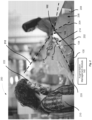
- FIG. 2 illustrates an example computing environment 200 in accordance with various embodiments of the present disclosure. At least some of the components of the computing environment 200 may correspond to the components of apparatus 100 of FIG. 1 .
- Computing environment 200 may include apparatus 100, such as a laptop computing device that may include display 134 and the augmentation management module 140. Computing environment 200 may further include the scene capture camera 102 and interaction capture camera 104 coupled with computing device 100. While depicted herein as being integrated into computing device 100, cameras 102 and 104 may, in some embodiments, be peripherally attached to the computing device 100.
- scene capture camera 102 is facing a physical scene substantially in front of the computing device 100, to enable capturing 204 (indicated with dashed lines) of the physical scene 206.
- the physical scene includes an object (cup) 208.
- Interaction capture camera 104 is facing a user 210, to enable capturing 212 (indicated with dashed lines) of user interaction with an augmented scene 214 rendered on the display 134.
- the computing device 100 may be placed in a stationary position, e.g., on a surface 202, to enable capture of the physical scene 206 with the object 208, user interaction with the augmented scene 214, and scene 214 augmentation modification described herein.
- the scene capture camera 102 may capture 204 the physical scene 206 with the object 208 and provide the captured scene to the augmentation management module 140 for processing and augmentation as described in reference to FIG. 1 .
- the augmentation management module 140 may analyze the captured scene 206, identify the object 208, and provide augmentation of the captured scene 214.
- the augmentation management module 140 may generate one or more relevant virtual articles to augment the recognized object 208.
- object 208 may be augmented with virtual articles, such as a flower 216 and butterfly 218, as shown in FIG. 2 .
- the interaction capture camera 104 may capture 212 user interaction with the augmented scene 214 rendered on the display 134, and provide the captured image to the augmentation management module 140 for processing and analysis as described in reference to FIG. 1 .
- the user interaction may be captured by a plurality of sensors 136 (not shown in FIG. 2 ), in addition to the interaction capture camera 104.
- the camera 104 is operating in concert with the sensors to capture user interaction and the interaction capture will be described in relation to the interaction capture camera 104, for simplicity of description.
- the user 210 may interact with augmented rendered scene 214 in a variety of ways.
- the user 210 may use hand gestures, voice commands, facial expressions, eye movement, or combinations of voice commands, gestures, and facial expressions.
- the user 210 may manipulate virtual article 218 (butterfly), such as attempt to catch the butterfly with her hands 220, or attempt to move the butterfly with the movement of her eyes 222.
- the augmentation management module 140 may modify or complement the virtual articles 216, 218 in the rendered augmented scene 214. For example, the augmentation management module 140 may align the virtual article (e.g., butterfly 218) in the rendered augmented scene 214 with the indicated user interaction, such as attempt to catch the butterfly 218. In other words, the augmentation management module 140 may cause the butterfly 218 to virtually move towards, e.g., "into" the user's hands 220 in the rendered augmented scene 214.
- the virtual article e.g., butterfly 218
- the augmentation management module 140 may alter the position of the butterfly 218 in response to the user's hands 220's attempt to catch it, such as virtually move the butterfly 218 "away" from the user's hands 220 in the scene 214.
- the augmentation management module 140 may alter the virtual article in response to the detected indication of the user interaction with the virtual article. For example, the augmentation management module 140 may cause the flower 216 to virtually blossom in response to the user's hands 220 waiving or other indication of the user interaction.
- the augmentation management module 140 may align the virtual article in response to the user 210's change of a view point (e.g., via changing head pose).
- the augmented scene 214 with the described manipulations of the virtual articles may be re-rendered to the user 210 on the display 134.
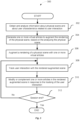
- FIG. 3 illustrates an example process for modifying augmented reality in response to user interaction, in accordance with some embodiments.
- the process 300 may be performed, for example, by the apparatus 100 (e.g., computing device) configured with augmentation management module 140 described in reference to FIGS. 1 and 2 .
- the apparatus 100 e.g., computing device
- augmentation management module 140 described in reference to FIGS. 1 and 2 .
- the process 300 may begin at block 302, and include obtaining and analyzing information about the physical scene and about user characteristics related to user interaction with augmented reality.
- the scene capture camera may capture a physical scene and provide the captured scene to the augmentation management module for processing and augmentation.
- the augmentation management module may analyze the captured scene and identify objects in the scene, to provide augmentation of the captured scene.
- the interaction capture camera may capture an image of the user of the computing device and provide the captured image to the augmentation management module for analysis.
- the analysis may include identification and gathering information about the user's personal modalities, such as posture, position relative to the camera 104, head pose, facial expression, eye gaze, hand gestures, and the like.
- the process 300 may include generating one or more virtual articles to augment a rendering of the physical scene that may be displayed to the user, based on the analysis of the physical scene. More specifically, one or more relevant virtual articles may be generated to augment the recognized object in the rendered augmented scene.
- the process 300 may include augmenting the rendering of a physical scene with the virtual articles that were generated at block 304.
- the process 300 may include tracking user interaction with the rendered augmented scene.
- the interaction capture camera may continuously or periodically capture, in real- or near-real time, user personal modalities and provide the captured information to the augmentation management module, for tracking and detecting indications of user interaction with the augmented rendered scene.
- the process 300 may include modifying or complementing one or more articles in the rendered augmented scene in response to the tracking of the user interaction. For example, if an indication of user interaction with a virtual article in the rendered augmented scene is detected, the augmented scene may be modified by aligning the virtual article in the rendered augmented scene with the indicated user interaction in the rendered augmented scene. In another example, the augmented scene may be modified by altering a position of the virtual article in the rendered augmented scene in response to the detected indication of the user interaction. In another example, the augmented scene may be modified by altering the virtual article in the rendered augmented scene in response to the indication of the user interaction.
- the process 300 may include a determination of whether the user session with the computing device has ended. If the session has not ended, the process 300 may return to block 308. Otherwise, the process 300 may end.
- FIG. 4 illustrates an example computing device 400 suitable for use to practice aspects of the present disclosure, in accordance with various embodiments.
- computing device 400 may include one or more processors or processor cores 402, and system memory 404.
- processors or processor cores 402
- system memory 404 For the purpose of this application, including the claims, the terms “processor” and “processor cores” may be considered synonymous, unless the context clearly requires otherwise.
- the processor 402 may include any type of processors, such as a central processing unit (CPU), a microprocessor, and the like.
- the processor 402 may be implemented as an integrated circuit having multi-cores, e.g., a multi-core microprocessor.
- the computing device 400 may include mass storage devices 406 (such as diskette, hard drive, volatile memory (e.g., DRAM), compact disc read only memory (CD-ROM), digital versatile disk (DVD) and so forth).
- volatile memory e.g., DRAM
- CD-ROM compact disc read only memory
- DVD digital versatile disk
- system memory 404 and/or mass storage devices 406 may be temporal and/or persistent storage of any type, including, but not limited to, volatile and non-volatile memory, optical, magnetic, and/or solid state mass storage, and so forth.
- Volatile memory may include, but not be limited to, static and/or dynamic random access memory.
- Non-volatile memory may include, but not be limited to, electrically erasable programmable read only memory, phase change memory, resistive memory, and so forth.
- the computing device 400 may further include input/output (I/O) devices 408 (such as a display 134), keyboard, cursor control, remote control, gaming controller, image capture device, and so forth and communication interfaces (comm. INTF) 410 (such as network interface cards, modems, infrared receivers, radio receivers (e.g., Bluetooth), and so forth.
- I/O devices 408 may further include cameras 102 and 104 and sensors 136, as shown.
- the communication interfaces 410 may include communication chips (not shown) that may be configured to operate the device 400 (or 100) in accordance with a Global System for Mobile Communication (GSM), General Packet Radio Service (GPRS), Universal Mobile Telecommunications System (UMTS), High Speed Packet Access (HSPA), Evolved HSPA (E-HSPA), or LTE network.
- the communication chips may also be configured to operate in accordance with Enhanced Data for GSM Evolution (EDGE), GSM EDGE Radio Access Network (GERAN), Universal Terrestrial Radio Access Network (UTRAN), or Evolved UTRAN (E-UTRAN).
- EDGE Enhanced Data for GSM Evolution
- GERAN GSM EDGE Radio Access Network
- UTRAN Universal Terrestrial Radio Access Network
- E-UTRAN Evolved UTRAN
- the communication chips may be configured to operate in accordance with Code Division Multiple Access (CDMA), Time Division Multiple Access (TDMA), Digital Enhanced Cordless Telecommunications (DECT), Evolution-Data Optimized (EV-DO), derivatives thereof, as well as any other wireless protocols that are designated as 3G, 4G, 5G, and beyond.
- CDMA Code Division Multiple Access
- TDMA Time Division Multiple Access
- DECT Digital Enhanced Cordless Telecommunications
- EV-DO Evolution-Data Optimized
- derivatives thereof as well as any other wireless protocols that are designated as 3G, 4G, 5G, and beyond.
- the communication interfaces 410 may operate in accordance with other wireless protocols in other embodiments.
- system bus 412 may represent one or more buses. In the case of multiple buses, they may be bridged by one or more bus bridges (not shown). Each of these elements may perform its conventional functions known in the art.
- system memory 404 and mass storage devices 406 may be employed to store a working copy and a permanent copy of the programming instructions implementing the operations associated with apparatus 100, e.g., operations associated with providing augmentation management module 140 as described in reference to FIGS. 1-3 , generally shown as computational logic 422.
- Computational logic 422 may be implemented by assembler instructions supported by processor(s) 402 or high-level languages that may be compiled into such instructions.
- the permanent copy of the programming instructions may be placed into mass storage devices 406 in the factory, or in the field, through, for example, a distribution medium (not shown), such as a compact disc (CD), or through communication interfaces 410 (from a distribution server (not shown)).
- a distribution medium such as a compact disc (CD)
- CD compact disc
- communication interfaces 410 from a distribution server (not shown)
- FIG. 5 illustrates an example non-transitory computer-readable storage media 502 having instructions configured to practice all or selected ones of the operations associated with the processes described above.
- non-transitory computer-readable storage medium 502 may include a number of programming instructions 504 (e.g., including augmentation management module 140).
- Programming instructions 504 may be configured to enable a device, e.g., computing device 400, in response to execution of the programming instructions, to perform one or more operations of the processes described in reference to FIGS. 1-3 .
- programming instructions 504 may be disposed on multiple non-transitory computer-readable storage media 502 instead.
- programming instructions 504 may be encoded in transitory computer-readable signals.
- processors 402 may be packaged together with memory having computational logic 422 configured to practice aspects of embodiments described in reference to FIGS. 1-4 .
- computational logic 422 may be configured to include or access content augmentation module 140, such as component 120 described in reference to FIG. 1 .
- at least one of the processors 402 may be packaged together with memory having computational logic 422 configured to practice aspects of process 300 of FIG. 3 to form a System in Package (SiP) or a System on Chip (SoC).
- SiP System in Package
- SoC System on Chip
- the computing device 500 may comprise a laptop, a netbook, a notebook, an ultrabook, a smartphone, a tablet, a personal digital assistant (PDA), an ultra mobile PC, a mobile phone, a desktop computer, a server, a printer, a scanner, a monitor, a set-top box, an entertainment control unit, a digital camera, a portable music player, or a digital video recorder.
- the computing device 400 may be any other electronic device that processes data.
- Example 1 is an apparatus for providing augmented reality computing, comprising: a processor; a scene capture camera coupled with the processor to capture a physical scene; and an augmentation management module to be operated by the processor to: obtain and analyze the physical scene, generate one or more virtual articles to augment a rendering of the physical scene, based on a result of the analysis, rack user interaction with the rendered augmented scene, and modify or complement the one or more virtual articles, in response to the tracked user interaction.
- Example 2 may include the subject matter of Example 1, further comprising: an interaction capture camera coupled with the processor to capture the user interaction with the augmented scene and to provide information about the captured interaction to the augmentation management module for tracking.
- Example 3 may include the subject matter of Example 2, wherein the apparatus is selected from one of: a laptop computing device, a tablet computing device, a mobile computing device, or an all-in-one (AIO) computing device.
- the apparatus is selected from one of: a laptop computing device, a tablet computing device, a mobile computing device, or an all-in-one (AIO) computing device.
- AIO all-in-one
- Example 4 may include the subject matter of Example 1, wherein the augmentation management module to track user interaction with the rendered augmented scene includes to obtain an indication of user interaction with at least one of the one or more virtual articles in the rendered augmented scene.
- Example 5 may include the subject matter of Example 4, wherein the augmentation management module to modify or complement the rendered augmented scene includes to: align the at least one of the one or more virtual articles in the rendered augmented scene with the indicated user interaction with the at least one of the one or more virtual articles in the rendered augmented scene; alter a position of the at least one of the one or more virtual articles in the rendered augmented scene in response to the indication of the user interaction with the at least one of the one or more virtual articles in the rendered augmented scene; or alter the at least one of the one or more virtual articles in the rendered augmented scene in response to the indication of the user interaction with the at least one of the one or more virtual articles in the rendered augmented scene.
- Example 6 may include the subject matter of Example 4, wherein the indication of user interaction includes at least a selected one of: a gesture, a change of facial expression, a verbal command, a change in eye gaze, a change of posture, or a change of a head pose.
- Example 7 may include the subject matter of Example 1, further comprising: a display device coupled with the processor to display the rendered augmented scene to the user.
- Example 8 may include the subject matter of Example 1, wherein the augmentation management module to augment a rendering of the physical scene with one or more virtual articles includes to augment the rendering based at least in part on one or more markers associated with the physical scene.
- Example 9 may include the subject matter of any of Examples 1 to 8, wherein the augmentation management module is to modify or complement the augmented scene substantially simultaneously with the tracking of the user interaction.
- Example 10 may include the subject matter of Example 2, wherein each of the cameras comprises a two-dimensional (2D) or three-dimensional (3D) camera to capture a real-time depth data and color data associated with the physical scene or the user interaction respectively, wherein the color data includes red, green, and blue (RGB) data.
- each of the cameras comprises a two-dimensional (2D) or three-dimensional (3D) camera to capture a real-time depth data and color data associated with the physical scene or the user interaction respectively, wherein the color data includes red, green, and blue (RGB) data.
- 2D two-dimensional
- 3D three-dimensional
- Example 11 may include the subject matter of Example 10, wherein the apparatus is placed on a substantially horizontal surface, to enable the capture of the physical scene and the user interaction.
- Example 12 is a computer-implemented method for providing augmented reality computing, comprising: augmenting, by a computing device, a rendering of a physical scene with one or more virtual articles; tracking, by the computing device, user interaction with the rendered augmented scene, and modifying or complementing, by the computing device, the one or more virtual articles in the rendered augmented scene in response to the tracking of the user interaction.
- Example 13 may include the subject matter of Example 12, further comprising: obtaining and analyzing, by the computing device, the physical scene; and generating, by the computing device, the one or more virtual articles to augment the rendering of the physical scene, based on the analyzing the physical scene.
- Example 14 may include the subject matter of any of Examples 12 to 13, further comprising: rendering, by the computing device, the augmented scene for display.
- Example 15 may include the subject matter of Example 14, wherein tracking user interaction with the rendered augmented scene includes: obtaining, by the computing device, an indication of user interaction with at least one of the one or more virtual articles in the rendered augmented scene, and wherein modifying or complementing the one or more articles further includes: aligning, by the computing device, the at least one of the one or more virtual articles in the rendered augmented scene with the indicated user interaction substantially simultaneously with and in response to obtaining of indication of the user interaction with the at least one of the one or more virtual articles in the rendered augmented scene.
- Example 16 may include the subject matter of Example 15, wherein obtaining an indication of user interaction includes detecting, by the computing device, at least a selected one of: a gesture, a change of facial expression, a verbal command, a change in eye gaze, a change of posture, or a change of a head pose.
- Example 17 is one or more computer-readable media having instructions for providing augmented reality computing stored thereon that, in response to execution by a computing device, provide the computing device with an augmentation management environment to: augment a rendering of a physical scene with one or more virtual articles; track user interaction with the rendered augmented scene, and modify or complement the one or more articles in the rendered augmented scene in response to the tracking of the user interaction.
- Example 18 may include the subject matter of Example 17, wherein the computing device is further provided with the augmentation management environment to: obtain information about the physical scene; analyze information about the physical scene; and generate the one or more virtual articles to augment the rendering of the physical scene based on a result of the analysis of the physical scene.
- Example 19 may include the subject matter of any of Examples 17 to 18, wherein the computing device is provided with the augmentation management environment to track user interaction with the rendered augmented scene includes the augmentation management environment to: obtain an indication of user interaction with at least one of the one or more virtual articles in the rendered augmented scene.
- Example 20 may include the subject matter of Example 19, wherein the computing device is provided with the augmentation management environment to modify or complement the one or more articles includes the augmentation management environment to align the at least one of the one or more virtual articles in the scene with the indicated user interaction substantially simultaneously with and in response to the obtaining of the indication of user interaction with the at least one of the one or more virtual articles.
- Example 21 is an apparatus for providing augmented reality computing, comprising: means for augmenting a rendering of a physical scene with one or more virtual articles; means for tracking user interaction with the rendered augmented scene, and means for modifying or complementing the one or more articles in the rendered augmented scene in response to the tracking of the user interaction.
- Example 22 may include the subject matter of Example 21, further comprising: means for obtaining information about the physical scene; means for analyzing information about the physical scene; and means for generating the one or more virtual articles to augment the rendering of the physical scene based on a result of the analysis of the physical scene.
- Example 23 may include the subject matter of any of Examples 21 to 22, wherein means for tracking user interaction with the rendered augmented scene include means for obtaining an indication of user interaction with at least one of the one or more virtual articles in the rendered augmented scene.
- Example 24 may include the subject matter of Example 23, wherein means for modifying or complementing the one or more articles in the rendered augmented scene in response to the tracking of the user interaction include means for aligning the at least one of the one or more virtual articles in the scene with the indicated user interaction substantially simultaneously with and in response to the obtaining of the indication of user interaction with the at least one of the one or more virtual articles.
- Computer-readable media including non-transitory computer-readable media
- methods, apparatuses, systems, and devices for performing the above-described techniques are illustrative examples of embodiments disclosed herein. Additionally, other devices in the above-described interactions may be configured to perform various disclosed techniques.
- Example 1 An apparatus for providing augmented reality computing, comprising:
- Example 2 The apparatus of example 1, further comprising: an interaction capture camera coupled with the processor to capture the user interaction with the augmented scene and to provide information about the captured interaction to the augmentation management module for tracking.
- an interaction capture camera coupled with the processor to capture the user interaction with the augmented scene and to provide information about the captured interaction to the augmentation management module for tracking.
- Example 3 The apparatus of example 2, wherein the apparatus is selected from one of: a laptop computing device, a tablet computing device, a mobile computing device, or an all-in-one (AIO) computing device.
- a laptop computing device a tablet computing device
- a mobile computing device a mobile computing device
- AIO all-in-one
- Example 4 The apparatus of example 1, wherein the augmentation management module to track user interaction with the rendered augmented scene includes to obtain an indication of user interaction with at least one of the one or more virtual articles in the rendered augmented scene.
- Example 5 The apparatus of example 4, wherein the augmentation management module to modify or complement the rendered augmented scene includes to:
- Example 6 The apparatus of example 4, wherein the indication of user interaction includes at least a selected one of: a gesture, a change of facial expression, a verbal command, a change in eye gaze, a change of posture, or a change of a head pose.
- Example 7 The apparatus of example 1, further comprising: a display device coupled with the processor to display the rendered augmented scene to the user.
- Example 8 The apparatus of example 1, wherein the augmentation management module to augment a rendering of the physical scene with one or more virtual articles includes to augment the rendering based at least in part on one or more markers associated with the physical scene.
- Example 9 The apparatus of any of examples 1 to 8, wherein the augmentation management module is to modify or complement the augmented scene substantially simultaneously with the tracking of the user interaction.
- Example 10 The apparatus of example 2, wherein each of the cameras comprises a two-dimensional (2D) or three-dimensional (3D) camera to capture a real-time depth data and color data associated with the physical scene or the user interaction respectively, wherein the color data includes red, green, and blue (RGB) data.
- 2D two-dimensional
- 3D three-dimensional
- Example 11 The apparatus of example 10, wherein the apparatus is placed on a substantially horizontal surface, to enable the capture of the physical scene and the user interaction.
- Example 12 A computer-implemented method for providing augmented reality computing, comprising:
- Example 13 The computer-implemented method of example 12, further comprising: obtaining and analyzing, by the computing device, the physical scene; and generating, by the computing device, the one or more virtual articles to augment the rendering of the physical scene, based on the analyzing the physical scene.
- Example 14 The computer-implemented method of any of examples 12 to 13, further comprising: rendering, by the computing device, the augmented scene for display.
- Example 15 The computer-implemented method of example 14, wherein tracking user interaction with the rendered augmented scene includes:
- Example 16 The computer-implemented method of example 15, wherein obtaining an indication of user interaction includes detecting, by the computing device, at least a selected one of: a gesture, a change of facial expression, a verbal command, a change in eye gaze, a change of posture, or a change of a head pose.
- Example 17 One or more computer-readable media having instructions for providing augmented reality computing stored thereon that, in response to execution by a computing device, provide the computing device with an augmentation management environment to: augment a rendering of a physical scene with one or more virtual articles; track user interaction with the rendered augmented scene, and modify or complement the one or more articles in the rendered augmented scene in response to the tracking of the user interaction.
- Example 18 The computer-readable media of example 17, wherein the computing device is further provided with the augmentation management environment to:
- Example 19 The computer-readable media of any of examples 17 to 18, wherein the computing device is provided with the augmentation management environment to track user interaction with the rendered augmented scene includes the augmentation management environment to: obtain an indication of user interaction with at least one of the one or more virtual articles in the rendered augmented scene.
- Example 20 The computer-readable media of example 19, wherein the computing device is provided with the augmentation management environment to modify or complement the one or more articles includes the augmentation management environment to align the at least one of the one or more virtual articles in the scene with the indicated user interaction substantially simultaneously with and in response to the obtaining of the indication of user interaction with the at least one of the one or more virtual articles.
- Example A An apparatus comprising: a first camera to collect images of physical scene; at least one sensor to track an eye gaze of a user; at least one screen; at least one microphone to detect a voice command of the user; at least one storage device; and at least one processor to execute instruction to: cause display on the at least one screen of at least one virtual object overlaid with respect to the physical scene; determine an interaction with the at least one virtual object based on the eye gaze of the user in combination with the voice command of the user; and cause the screen to simulate a manipulation with the at least one virtual object of the at least one virtual object on the at least one screen in response to the at least one sensor detecting the eye gaze and the voice commands from the user.
- Example B The apparatus of example A, wherein the apparatus is selected from one of a laptop computing device, a tablet computing device, a mobile computing device, an all-in-one (AIO) computing device or a computer.
- a laptop computing device a tablet computing device
- a mobile computing device a mobile computing device
- AIO all-in-one
- Example C The apparatus of example A or B, wherein the processor is to cause the screen to simulate the manipulation of the at least one virtual object on the at least one screen, by causing the at least one virtual object to move.
- Example D The apparatus of any one of examples A-C, further comprising an interaction capture camera coupled with the processor to capture the user interaction with the at least one virtual object.
- Example E The apparatus of any one of examples A-D, wherein the processor is to track the user interaction with the at least one virtual object.
- Example F The apparatus of example E, wherein the processor is to modify or complement the one or more virtual articles, in response to the tracked user interaction.
- Example G The apparatus of example F, wherein the processor is to modify or complement the one or more virtual articles substantially simultaneously with the tracking of the user interaction.
- Example H A method comprising: causing display on at least one screen of at least one virtual object overlaid with respect to a physical scene; determining an interaction with the at least one virtual object based on an eye gaze of a user in combination with a voice command of the user; and causing the screen to simulate a manipulation with the at least one virtual object of the at least one virtual object on the at least one screen in response to detecting the eye gaze and the voice commands from the user.
- Example I The method of example H, wherein the causing the screen to simulate the manipulation of the at least one virtual object on the at least one screen comprises causing the at least one virtual object to move.
- Example J The method of example H or I, further comprising tracking the user interaction with the at least one virtual object.
- Example K The method of any one of examples H-J, further comprising modifying or complementing the one or more virtual articles, in response to the tracked user interaction.
- Example L The method of example K, wherein the modifying or complementing the one or more virtual articles substantially simultaneously with the tracking of the user interaction.
- Example M A machine-readable medium including instructions that, when executed by a machine, cause the machine to perform any method of examples H-L.
- Example N A system comprising means to perform any method of examples H-L.
Landscapes
- Engineering & Computer Science (AREA)
- Theoretical Computer Science (AREA)
- General Engineering & Computer Science (AREA)
- Physics & Mathematics (AREA)
- General Physics & Mathematics (AREA)
- Human Computer Interaction (AREA)
- Multimedia (AREA)
- Computer Graphics (AREA)
- Computer Hardware Design (AREA)
- Software Systems (AREA)
- Health & Medical Sciences (AREA)
- Audiology, Speech & Language Pathology (AREA)
- General Health & Medical Sciences (AREA)
- User Interface Of Digital Computer (AREA)
- Architecture (AREA)
Applications Claiming Priority (4)
| Application Number | Priority Date | Filing Date | Title |
|---|---|---|---|
| US14/667,302 US9791917B2 (en) | 2015-03-24 | 2015-03-24 | Augmentation modification based on user interaction with augmented reality scene |
| EP20203609.1A EP3786901A1 (de) | 2015-03-24 | 2016-02-18 | Verstärkungsmodifizierung auf basis von benutzerinteraktion mit einer szene mit erweiterter realität |
| EP16769233.4A EP3274965A4 (de) | 2015-03-24 | 2016-02-18 | Verstärkungsmodifizierung auf basis von benutzerinteraktion mit einer szene mit erweiterter realität |
| PCT/US2016/018524 WO2016153647A1 (en) | 2015-03-24 | 2016-02-18 | Augmentation modification based on user interaction with augmented reality scene |
Related Parent Applications (2)
| Application Number | Title | Priority Date | Filing Date |
|---|---|---|---|
| EP20203609.1A Division EP3786901A1 (de) | 2015-03-24 | 2016-02-18 | Verstärkungsmodifizierung auf basis von benutzerinteraktion mit einer szene mit erweiterter realität |
| EP16769233.4A Division EP3274965A4 (de) | 2015-03-24 | 2016-02-18 | Verstärkungsmodifizierung auf basis von benutzerinteraktion mit einer szene mit erweiterter realität |
Publications (1)
| Publication Number | Publication Date |
|---|---|
| EP4138043A1 true EP4138043A1 (de) | 2023-02-22 |
Family
ID=56974181
Family Applications (3)
| Application Number | Title | Priority Date | Filing Date |
|---|---|---|---|
| EP22190005.3A Pending EP4138043A1 (de) | 2015-03-24 | 2016-02-18 | Verstärkungsmodifizierung auf basis von benutzerinteraktion mit einer szene mit erweiterter realität |
| EP16769233.4A Withdrawn EP3274965A4 (de) | 2015-03-24 | 2016-02-18 | Verstärkungsmodifizierung auf basis von benutzerinteraktion mit einer szene mit erweiterter realität |
| EP20203609.1A Pending EP3786901A1 (de) | 2015-03-24 | 2016-02-18 | Verstärkungsmodifizierung auf basis von benutzerinteraktion mit einer szene mit erweiterter realität |
Family Applications After (2)
| Application Number | Title | Priority Date | Filing Date |
|---|---|---|---|
| EP16769233.4A Withdrawn EP3274965A4 (de) | 2015-03-24 | 2016-02-18 | Verstärkungsmodifizierung auf basis von benutzerinteraktion mit einer szene mit erweiterter realität |
| EP20203609.1A Pending EP3786901A1 (de) | 2015-03-24 | 2016-02-18 | Verstärkungsmodifizierung auf basis von benutzerinteraktion mit einer szene mit erweiterter realität |
Country Status (4)
| Country | Link |
|---|---|
| US (4) | US9791917B2 (de) |
| EP (3) | EP4138043A1 (de) |
| CN (2) | CN107251102B (de) |
| WO (1) | WO2016153647A1 (de) |
Families Citing this family (41)
| Publication number | Priority date | Publication date | Assignee | Title |
|---|---|---|---|---|
| US9791917B2 (en) | 2015-03-24 | 2017-10-17 | Intel Corporation | Augmentation modification based on user interaction with augmented reality scene |
| US10409443B2 (en) * | 2015-06-24 | 2019-09-10 | Microsoft Technology Licensing, Llc | Contextual cursor display based on hand tracking |
| US20190302880A1 (en) * | 2016-06-06 | 2019-10-03 | Devar Entertainment Limited | Device for influencing virtual objects of augmented reality |
| US11182976B2 (en) * | 2016-06-06 | 2021-11-23 | Devar Entertainment Limited | Device for influencing virtual objects of augmented reality |
| US10445936B1 (en) | 2016-08-01 | 2019-10-15 | Snap Inc. | Audio responsive augmented reality |
| US10235788B2 (en) | 2017-01-17 | 2019-03-19 | Opentv, Inc. | Overlay contrast control in augmented reality displays |
| US10152815B2 (en) | 2017-01-17 | 2018-12-11 | Opentv, Inc. | Overlay emphasis modification in augmented reality displays |
| EP3413167A1 (de) * | 2017-06-06 | 2018-12-12 | Thomson Licensing | Verfahren und vorrichtung zum animieren eines betrachters zum drehen in richtung einer bezugsrichtung beim konsumieren eines immersiven inhaltselements |
| CN107918949A (zh) * | 2017-12-11 | 2018-04-17 | 网易(杭州)网络有限公司 | 虚拟资源对象的渲染方法、存储介质、处理器及终端 |
| TWI633500B (zh) * | 2017-12-27 | 2018-08-21 | 中華電信股份有限公司 | 擴增實境應用產生系統及方法 |
| US11614794B2 (en) | 2018-05-04 | 2023-03-28 | Google Llc | Adapting automated assistant based on detected mouth movement and/or gaze |
| KR102512446B1 (ko) | 2018-05-04 | 2023-03-22 | 구글 엘엘씨 | 자동화된 어시스턴트 기능(들)의 핫-워드 프리 적응 |
| US10890969B2 (en) | 2018-05-04 | 2021-01-12 | Google Llc | Invoking automated assistant function(s) based on detected gesture and gaze |
| US10984600B2 (en) | 2018-05-25 | 2021-04-20 | Tiff's Treats Holdings, Inc. | Apparatus, method, and system for presentation of multimedia content including augmented reality content |
| US10818093B2 (en) | 2018-05-25 | 2020-10-27 | Tiff's Treats Holdings, Inc. | Apparatus, method, and system for presentation of multimedia content including augmented reality content |
| US11200811B2 (en) | 2018-08-03 | 2021-12-14 | International Business Machines Corporation | Intelligent recommendation of guidance instructions |
| CN109345637B (zh) * | 2018-08-27 | 2021-01-26 | 创新先进技术有限公司 | 基于增强现实的互动方法及装置 |
| CN108874156A (zh) * | 2018-08-30 | 2018-11-23 | 合肥虹慧达科技有限公司 | 增强现实交互系统及其使用方法 |
| KR102539579B1 (ko) | 2018-12-18 | 2023-06-05 | 삼성전자주식회사 | 정보의 표시 영역을 적응적으로 변경하기 위한 전자 장치 및 그의 동작 방법 |
| US10890992B2 (en) * | 2019-03-14 | 2021-01-12 | Ebay Inc. | Synchronizing augmented or virtual reality (AR/VR) applications with companion device interfaces |
| US11150788B2 (en) | 2019-03-14 | 2021-10-19 | Ebay Inc. | Augmented or virtual reality (AR/VR) companion device techniques |
| US20200301553A1 (en) * | 2019-03-22 | 2020-09-24 | Sony Interactive Entertainment Inc. | Establishing and using virtual assets on tangible objects in augmented reality (ar) and virtual reality (vr) |
| EP3726344A1 (de) | 2019-04-16 | 2020-10-21 | InterDigital CE Patent Holdings | Verfahren und vorrichtung zur benutzersteuerung einer anwendung und entsprechende vorrichtung |
| US11055919B2 (en) | 2019-04-26 | 2021-07-06 | Google Llc | Managing content in augmented reality |
| WO2020219109A1 (en) * | 2019-04-26 | 2020-10-29 | Google Llc | System and method for creating persistent mappings in augmented reality |
| US11151792B2 (en) | 2019-04-26 | 2021-10-19 | Google Llc | System and method for creating persistent mappings in augmented reality |
| US11163997B2 (en) | 2019-05-05 | 2021-11-02 | Google Llc | Methods and apparatus for venue based augmented reality |
| US11308698B2 (en) * | 2019-12-05 | 2022-04-19 | Facebook Technologies, Llc. | Using deep learning to determine gaze |
| CN113204282B (zh) * | 2021-04-12 | 2024-04-05 | 领悦数字信息技术有限公司 | 交互装置、交互方法、计算机可读存储介质以及计算机程序产品 |
| CN113244616B (zh) | 2021-06-24 | 2023-09-26 | 腾讯科技(深圳)有限公司 | 基于虚拟场景的互动方法、装置、设备及可读存储介质 |
| US12189841B2 (en) * | 2021-11-29 | 2025-01-07 | Sony Interactive Entertainment LLC | Input prediction for pre-loading of rendering data |
| CN114185330B (zh) * | 2021-12-12 | 2024-06-11 | 深圳市集智创新信息技术有限公司 | 基于多场景交互的控制方法及控制装置 |
| US12020704B2 (en) | 2022-01-19 | 2024-06-25 | Google Llc | Dynamic adaptation of parameter set used in hot word free adaptation of automated assistant |
| US11792243B2 (en) | 2022-01-19 | 2023-10-17 | Bank Of America Corporation | System and method for conducting multi-session user interactions |
| US12548558B2 (en) | 2022-01-19 | 2026-02-10 | Google Llc | Mitigating false positives and/or false negatives in hot word free adaptation of automated assistant |
| US12524967B2 (en) * | 2022-02-18 | 2026-01-13 | State Farm Mutual Automobile Insurance Company | Extended reality methods and systems for processing vehicle-related information |
| US12158796B2 (en) | 2022-07-28 | 2024-12-03 | Bank Of America Corporation | System and method for dynamic error resolution in extended reality using machine learning |
| CN116030224B (zh) * | 2022-12-30 | 2023-12-26 | 广州市玄武无线科技股份有限公司 | 一种ar产品展示方法、装置、电子设备及存储介质 |
| CN116909407B (zh) * | 2023-09-12 | 2024-01-12 | 深圳康荣电子有限公司 | 基于虚拟现实的触控显示屏全景交互方法及控制系统 |
| CN119963777A (zh) * | 2025-01-07 | 2025-05-09 | 北京印刷学院 | 结合虚拟现实的艺术展览智能交互管理方法 |
| CN120103621A (zh) * | 2025-05-08 | 2025-06-06 | 中科北纬(北京)科技有限公司 | 一种用于沙盘展示的mr眼镜三维成像系统 |
Citations (3)
| Publication number | Priority date | Publication date | Assignee | Title |
|---|---|---|---|---|
| US20130194164A1 (en) * | 2012-01-27 | 2013-08-01 | Ben Sugden | Executable virtual objects associated with real objects |
| EP2680230A2 (de) * | 2012-06-29 | 2014-01-01 | Disney Enterprises, Inc. | Erweiterte Realität mit Simulation von Interaktionen zwischen physischen und virtuellen Objekten |
| US20140375547A1 (en) * | 2012-03-13 | 2014-12-25 | Eyesight Mobile Technologies Ltd. | Touch free user interface |
Family Cites Families (38)
| Publication number | Priority date | Publication date | Assignee | Title |
|---|---|---|---|---|
| EP1069534A3 (de) * | 1999-07-12 | 2002-08-28 | Styleclick.Com | Verfahren und Vorrichtung zur Visualisierung und Aktualisierung von dreidimensionalen Szenen |
| US20060119575A1 (en) * | 2004-12-06 | 2006-06-08 | Naturalpoint, Inc. | Systems and methods for using a movable object to control a computer |
| US8730156B2 (en) * | 2010-03-05 | 2014-05-20 | Sony Computer Entertainment America Llc | Maintaining multiple views on a shared stable virtual space |
| US8781162B2 (en) * | 2011-01-05 | 2014-07-15 | Ailive Inc. | Method and system for head tracking and pose estimation |
| JP5045172B2 (ja) * | 2007-03-20 | 2012-10-10 | マツダ株式会社 | 車両用運転支援装置 |
| US20080266323A1 (en) * | 2007-04-25 | 2008-10-30 | Board Of Trustees Of Michigan State University | Augmented reality user interaction system |
| WO2008144729A2 (en) * | 2007-05-21 | 2008-11-27 | World Golf Tour, Inc. | Electronic game utilizing photographs |
| US20110107216A1 (en) | 2009-11-03 | 2011-05-05 | Qualcomm Incorporated | Gesture-based user interface |
| US9164577B2 (en) * | 2009-12-22 | 2015-10-20 | Ebay Inc. | Augmented reality system, method, and apparatus for displaying an item image in a contextual environment |
| KR101135186B1 (ko) * | 2010-03-03 | 2012-04-16 | 광주과학기술원 | 상호작용형 실시간 증강현실 시스템과 그 방법, 및 상기 방법을 구현하는 프로그램이 기록된 기록매체 |
| US8381108B2 (en) * | 2010-06-21 | 2013-02-19 | Microsoft Corporation | Natural user input for driving interactive stories |
| US20120113223A1 (en) | 2010-11-05 | 2012-05-10 | Microsoft Corporation | User Interaction in Augmented Reality |
| US9142062B2 (en) * | 2011-03-29 | 2015-09-22 | Qualcomm Incorporated | Selective hand occlusion over virtual projections onto physical surfaces using skeletal tracking |
| US20130155108A1 (en) | 2011-12-15 | 2013-06-20 | Mitchell Williams | Augmented Reality User Interaction Methods, Computing Devices, And Articles Of Manufacture |
| US20140068526A1 (en) * | 2012-02-04 | 2014-03-06 | Three Bots Ltd | Method and apparatus for user interaction |
| WO2013119221A1 (en) | 2012-02-08 | 2013-08-15 | Intel Corporation | Augmented reality creation using a real scene |
| US9035970B2 (en) * | 2012-06-29 | 2015-05-19 | Microsoft Technology Licensing, Llc | Constraint based information inference |
| US9514570B2 (en) * | 2012-07-26 | 2016-12-06 | Qualcomm Incorporated | Augmentation of tangible objects as user interface controller |
| US20150193977A1 (en) * | 2012-08-31 | 2015-07-09 | Google Inc. | Self-Describing Three-Dimensional (3D) Object Recognition and Control Descriptors for Augmented Reality Interfaces |
| US9760180B2 (en) * | 2012-10-05 | 2017-09-12 | Nec Solution Innovators, Ltd. | User interface device and user interface method |
| US8878846B1 (en) * | 2012-10-29 | 2014-11-04 | Google Inc. | Superimposing virtual views of 3D objects with live images |
| CN102981616B (zh) * | 2012-11-06 | 2017-09-22 | 中兴通讯股份有限公司 | 增强现实中对象的识别方法及系统和计算机 |
| US9846965B2 (en) | 2013-03-15 | 2017-12-19 | Disney Enterprises, Inc. | Augmented reality device with predefined object data |
| US9454220B2 (en) * | 2014-01-23 | 2016-09-27 | Derek A. Devries | Method and system of augmented-reality simulations |
| US9367136B2 (en) * | 2013-04-12 | 2016-06-14 | Microsoft Technology Licensing, Llc | Holographic object feedback |
| US9245388B2 (en) * | 2013-05-13 | 2016-01-26 | Microsoft Technology Licensing, Llc | Interactions of virtual objects with surfaces |
| TW201447375A (zh) * | 2013-06-13 | 2014-12-16 | Hsiu-Chi Yeh | 擴增實境之頭戴式電子裝置及方法 |
| CN104240277B (zh) * | 2013-06-24 | 2019-07-19 | 腾讯科技(深圳)有限公司 | 基于人脸检测的增强现实交互方法和系统 |
| US9292764B2 (en) * | 2013-09-17 | 2016-03-22 | Qualcomm Incorporated | Method and apparatus for selectively providing information on objects in a captured image |
| CN103760973B (zh) * | 2013-12-18 | 2017-01-11 | 微软技术许可有限责任公司 | 增强现实的信息细节 |
| US9201578B2 (en) * | 2014-01-23 | 2015-12-01 | Microsoft Technology Licensing, Llc | Gaze swipe selection |
| US9883138B2 (en) * | 2014-02-26 | 2018-01-30 | Microsoft Technology Licensing, Llc | Telepresence experience |
| CN103941861B (zh) * | 2014-04-02 | 2017-02-08 | 北京理工大学 | 一种应用混合现实技术的多人合作训练系统 |
| US10416760B2 (en) * | 2014-07-25 | 2019-09-17 | Microsoft Technology Licensing, Llc | Gaze-based object placement within a virtual reality environment |
| US9508195B2 (en) * | 2014-09-03 | 2016-11-29 | Microsoft Technology Licensing, Llc | Management of content in a 3D holographic environment |
| US9754416B2 (en) * | 2014-12-23 | 2017-09-05 | Intel Corporation | Systems and methods for contextually augmented video creation and sharing |
| US9685005B2 (en) * | 2015-01-02 | 2017-06-20 | Eon Reality, Inc. | Virtual lasers for interacting with augmented reality environments |
| US9791917B2 (en) | 2015-03-24 | 2017-10-17 | Intel Corporation | Augmentation modification based on user interaction with augmented reality scene |
-
2015
- 2015-03-24 US US14/667,302 patent/US9791917B2/en active Active
-
2016
- 2016-02-18 CN CN201680009802.6A patent/CN107251102B/zh active Active
- 2016-02-18 EP EP22190005.3A patent/EP4138043A1/de active Pending
- 2016-02-18 EP EP16769233.4A patent/EP3274965A4/de not_active Withdrawn
- 2016-02-18 CN CN202210964904.0A patent/CN115239926A/zh active Pending
- 2016-02-18 WO PCT/US2016/018524 patent/WO2016153647A1/en not_active Ceased
- 2016-02-18 EP EP20203609.1A patent/EP3786901A1/de active Pending
-
2017
- 2017-10-17 US US15/786,035 patent/US10488915B2/en active Active
-
2019
- 2019-11-25 US US16/694,597 patent/US20200166987A1/en not_active Abandoned
-
2022
- 2022-02-14 US US17/671,173 patent/US20220236787A1/en not_active Abandoned
Patent Citations (3)
| Publication number | Priority date | Publication date | Assignee | Title |
|---|---|---|---|---|
| US20130194164A1 (en) * | 2012-01-27 | 2013-08-01 | Ben Sugden | Executable virtual objects associated with real objects |
| US20140375547A1 (en) * | 2012-03-13 | 2014-12-25 | Eyesight Mobile Technologies Ltd. | Touch free user interface |
| EP2680230A2 (de) * | 2012-06-29 | 2014-01-01 | Disney Enterprises, Inc. | Erweiterte Realität mit Simulation von Interaktionen zwischen physischen und virtuellen Objekten |
Also Published As
| Publication number | Publication date |
|---|---|
| US20200166987A1 (en) | 2020-05-28 |
| US20180260020A1 (en) | 2018-09-13 |
| WO2016153647A1 (en) | 2016-09-29 |
| US9791917B2 (en) | 2017-10-17 |
| EP3274965A4 (de) | 2018-08-15 |
| US20160284134A1 (en) | 2016-09-29 |
| US20220236787A1 (en) | 2022-07-28 |
| CN115239926A (zh) | 2022-10-25 |
| US10488915B2 (en) | 2019-11-26 |
| CN107251102A (zh) | 2017-10-13 |
| EP3786901A1 (de) | 2021-03-03 |
| EP3274965A1 (de) | 2018-01-31 |
| CN107251102B (zh) | 2022-12-16 |
Similar Documents
| Publication | Publication Date | Title |
|---|---|---|
| US20220236787A1 (en) | Augmentation modification based on user interaction with augmented reality scene | |
| US11275480B2 (en) | Dynamic interactive objects | |
| US20160171739A1 (en) | Augmentation of stop-motion content | |
| US20180088663A1 (en) | Method and system for gesture-based interactions | |
| EP3216008B1 (de) | Avatarvideovorrichtung und -verfahren | |
| US11334621B2 (en) | Image search system, image search method and storage medium | |
| US20150123901A1 (en) | Gesture disambiguation using orientation information | |
| WO2016045005A1 (en) | User gesture driven avatar apparatus and method | |
| US20140282223A1 (en) | Natural user interface scrolling and targeting | |
| US11106949B2 (en) | Action classification based on manipulated object movement | |
| WO2017197394A1 (en) | Editing animations using a virtual reality controller | |
| CN109154862B (zh) | 用于处理虚拟现实内容的装置、方法和计算机可读介质 | |
| CN103106388B (zh) | 图像识别方法和系统 | |
| CN113282167B (zh) | 头戴式显示设备的交互方法、装置及头戴式显示设备 | |
| JP2017531226A (ja) | 動作認識方法及び動作認識装置 | |
| KR20180080697A (ko) | 인터랙티브 시네마 그램 방법 및 장치 | |
| TW202247107A (zh) | 用於訓練模型之臉部擷取人工智慧 |
Legal Events
| Date | Code | Title | Description |
|---|---|---|---|
| PUAI | Public reference made under article 153(3) epc to a published international application that has entered the european phase |
Free format text: ORIGINAL CODE: 0009012 |
|
| STAA | Information on the status of an ep patent application or granted ep patent |
Free format text: STATUS: THE APPLICATION HAS BEEN PUBLISHED |
|
| AC | Divisional application: reference to earlier application |
Ref document number: 3274965 Country of ref document: EP Kind code of ref document: P Ref document number: 3786901 Country of ref document: EP Kind code of ref document: P |
|
| AK | Designated contracting states |
Kind code of ref document: A1 Designated state(s): AL AT BE BG CH CY CZ DE DK EE ES FI FR GB GR HR HU IE IS IT LI LT LU LV MC MK MT NL NO PL PT RO RS SE SI SK SM TR |
|
| STAA | Information on the status of an ep patent application or granted ep patent |
Free format text: STATUS: REQUEST FOR EXAMINATION WAS MADE |
|
| 17P | Request for examination filed |
Effective date: 20230816 |
|
| RBV | Designated contracting states (corrected) |
Designated state(s): AL AT BE BG CH CY CZ DE DK EE ES FI FR GB GR HR HU IE IS IT LI LT LU LV MC MK MT NL NO PL PT RO RS SE SI SK SM TR |
|
| STAA | Information on the status of an ep patent application or granted ep patent |
Free format text: STATUS: EXAMINATION IS IN PROGRESS |
|
| 17Q | First examination report despatched |
Effective date: 20250127 |