EP4137686B1 - Propulsion systems for aircraft - Google Patents
Propulsion systems for aircraft Download PDFInfo
- Publication number
- EP4137686B1 EP4137686B1 EP22190642.3A EP22190642A EP4137686B1 EP 4137686 B1 EP4137686 B1 EP 4137686B1 EP 22190642 A EP22190642 A EP 22190642A EP 4137686 B1 EP4137686 B1 EP 4137686B1
- Authority
- EP
- European Patent Office
- Prior art keywords
- heat exchanger
- flow path
- fuel
- shaft
- turbine
- Prior art date
- Legal status (The legal status is an assumption and is not a legal conclusion. Google has not performed a legal analysis and makes no representation as to the accuracy of the status listed.)
- Active
Links
Images

Classifications
-
- F—MECHANICAL ENGINEERING; LIGHTING; HEATING; WEAPONS; BLASTING
- F02—COMBUSTION ENGINES; HOT-GAS OR COMBUSTION-PRODUCT ENGINE PLANTS
- F02K—JET-PROPULSION PLANTS
- F02K3/00—Plants including a gas turbine driving a compressor or a ducted fan
- F02K3/08—Plants including a gas turbine driving a compressor or a ducted fan with supplementary heating of the working fluid; Control thereof
- F02K3/105—Heating the by-pass flow
- F02K3/115—Heating the by-pass flow by means of indirect heat exchange
-
- F—MECHANICAL ENGINEERING; LIGHTING; HEATING; WEAPONS; BLASTING
- F02—COMBUSTION ENGINES; HOT-GAS OR COMBUSTION-PRODUCT ENGINE PLANTS
- F02C—GAS-TURBINE PLANTS; AIR INTAKES FOR JET-PROPULSION PLANTS; CONTROLLING FUEL SUPPLY IN AIR-BREATHING JET-PROPULSION PLANTS
- F02C1/00—Gas-turbine plants characterised by the use of hot gases or unheated pressurised gases, as the working fluid
- F02C1/04—Gas-turbine plants characterised by the use of hot gases or unheated pressurised gases, as the working fluid the working fluid being heated indirectly
- F02C1/10—Closed cycles
-
- F—MECHANICAL ENGINEERING; LIGHTING; HEATING; WEAPONS; BLASTING
- F02—COMBUSTION ENGINES; HOT-GAS OR COMBUSTION-PRODUCT ENGINE PLANTS
- F02C—GAS-TURBINE PLANTS; AIR INTAKES FOR JET-PROPULSION PLANTS; CONTROLLING FUEL SUPPLY IN AIR-BREATHING JET-PROPULSION PLANTS
- F02C1/00—Gas-turbine plants characterised by the use of hot gases or unheated pressurised gases, as the working fluid
- F02C1/04—Gas-turbine plants characterised by the use of hot gases or unheated pressurised gases, as the working fluid the working fluid being heated indirectly
-
- F—MECHANICAL ENGINEERING; LIGHTING; HEATING; WEAPONS; BLASTING
- F02—COMBUSTION ENGINES; HOT-GAS OR COMBUSTION-PRODUCT ENGINE PLANTS
- F02C—GAS-TURBINE PLANTS; AIR INTAKES FOR JET-PROPULSION PLANTS; CONTROLLING FUEL SUPPLY IN AIR-BREATHING JET-PROPULSION PLANTS
- F02C3/00—Gas-turbine plants characterised by the use of combustion products as the working fluid
- F02C3/20—Gas-turbine plants characterised by the use of combustion products as the working fluid using a special fuel, oxidant, or dilution fluid to generate the combustion products
- F02C3/22—Gas-turbine plants characterised by the use of combustion products as the working fluid using a special fuel, oxidant, or dilution fluid to generate the combustion products the fuel or oxidant being gaseous at standard temperature and pressure
-
- F—MECHANICAL ENGINEERING; LIGHTING; HEATING; WEAPONS; BLASTING
- F02—COMBUSTION ENGINES; HOT-GAS OR COMBUSTION-PRODUCT ENGINE PLANTS
- F02C—GAS-TURBINE PLANTS; AIR INTAKES FOR JET-PROPULSION PLANTS; CONTROLLING FUEL SUPPLY IN AIR-BREATHING JET-PROPULSION PLANTS
- F02C6/00—Plural gas-turbine plants; Combinations of gas-turbine plants with other apparatus; Adaptations of gas-turbine plants for special use
- F02C6/20—Adaptations of gas-turbine plants for driving vehicles
- F02C6/206—Adaptations of gas-turbine plants for driving vehicles the vehicles being airscrew driven
-
- F—MECHANICAL ENGINEERING; LIGHTING; HEATING; WEAPONS; BLASTING
- F02—COMBUSTION ENGINES; HOT-GAS OR COMBUSTION-PRODUCT ENGINE PLANTS
- F02C—GAS-TURBINE PLANTS; AIR INTAKES FOR JET-PROPULSION PLANTS; CONTROLLING FUEL SUPPLY IN AIR-BREATHING JET-PROPULSION PLANTS
- F02C7/00—Features, components parts, details or accessories, not provided for in, or of interest apart form groups F02C1/00 - F02C6/00; Air intakes for jet-propulsion plants
- F02C7/08—Heating air supply before combustion, e.g. by exhaust gases
- F02C7/10—Heating air supply before combustion, e.g. by exhaust gases by means of regenerative heat-exchangers
-
- F—MECHANICAL ENGINEERING; LIGHTING; HEATING; WEAPONS; BLASTING
- F02—COMBUSTION ENGINES; HOT-GAS OR COMBUSTION-PRODUCT ENGINE PLANTS
- F02C—GAS-TURBINE PLANTS; AIR INTAKES FOR JET-PROPULSION PLANTS; CONTROLLING FUEL SUPPLY IN AIR-BREATHING JET-PROPULSION PLANTS
- F02C7/00—Features, components parts, details or accessories, not provided for in, or of interest apart form groups F02C1/00 - F02C6/00; Air intakes for jet-propulsion plants
- F02C7/22—Fuel supply systems
- F02C7/224—Heating fuel before feeding to the burner
-
- F—MECHANICAL ENGINEERING; LIGHTING; HEATING; WEAPONS; BLASTING
- F02—COMBUSTION ENGINES; HOT-GAS OR COMBUSTION-PRODUCT ENGINE PLANTS
- F02C—GAS-TURBINE PLANTS; AIR INTAKES FOR JET-PROPULSION PLANTS; CONTROLLING FUEL SUPPLY IN AIR-BREATHING JET-PROPULSION PLANTS
- F02C7/00—Features, components parts, details or accessories, not provided for in, or of interest apart form groups F02C1/00 - F02C6/00; Air intakes for jet-propulsion plants
- F02C7/36—Power transmission arrangements between the different shafts of the gas turbine plant, or between the gas-turbine plant and the power user
-
- F—MECHANICAL ENGINEERING; LIGHTING; HEATING; WEAPONS; BLASTING
- F02—COMBUSTION ENGINES; HOT-GAS OR COMBUSTION-PRODUCT ENGINE PLANTS
- F02K—JET-PROPULSION PLANTS
- F02K3/00—Plants including a gas turbine driving a compressor or a ducted fan
- F02K3/02—Plants including a gas turbine driving a compressor or a ducted fan in which part of the working fluid by-passes the turbine and combustion chamber
- F02K3/04—Plants including a gas turbine driving a compressor or a ducted fan in which part of the working fluid by-passes the turbine and combustion chamber the plant including ducted fans, i.e. fans with high volume, low pressure outputs, for augmenting the jet thrust, e.g. of double-flow type
- F02K3/06—Plants including a gas turbine driving a compressor or a ducted fan in which part of the working fluid by-passes the turbine and combustion chamber the plant including ducted fans, i.e. fans with high volume, low pressure outputs, for augmenting the jet thrust, e.g. of double-flow type with front fan
-
- F—MECHANICAL ENGINEERING; LIGHTING; HEATING; WEAPONS; BLASTING
- F05—INDEXING SCHEMES RELATING TO ENGINES OR PUMPS IN VARIOUS SUBCLASSES OF CLASSES F01-F04
- F05D—INDEXING SCHEME FOR ASPECTS RELATING TO NON-POSITIVE-DISPLACEMENT MACHINES OR ENGINES, GAS-TURBINES OR JET-PROPULSION PLANTS
- F05D2220/00—Application
- F05D2220/30—Application in turbines
- F05D2220/32—Application in turbines in gas turbines
- F05D2220/323—Application in turbines in gas turbines for aircraft propulsion, e.g. jet engines
-
- F—MECHANICAL ENGINEERING; LIGHTING; HEATING; WEAPONS; BLASTING
- F05—INDEXING SCHEMES RELATING TO ENGINES OR PUMPS IN VARIOUS SUBCLASSES OF CLASSES F01-F04
- F05D—INDEXING SCHEME FOR ASPECTS RELATING TO NON-POSITIVE-DISPLACEMENT MACHINES OR ENGINES, GAS-TURBINES OR JET-PROPULSION PLANTS
- F05D2240/00—Components
- F05D2240/35—Combustors or associated equipment
-
- F—MECHANICAL ENGINEERING; LIGHTING; HEATING; WEAPONS; BLASTING
- F05—INDEXING SCHEMES RELATING TO ENGINES OR PUMPS IN VARIOUS SUBCLASSES OF CLASSES F01-F04
- F05D—INDEXING SCHEME FOR ASPECTS RELATING TO NON-POSITIVE-DISPLACEMENT MACHINES OR ENGINES, GAS-TURBINES OR JET-PROPULSION PLANTS
- F05D2260/00—Function
- F05D2260/20—Heat transfer, e.g. cooling
- F05D2260/213—Heat transfer, e.g. cooling by the provision of a heat exchanger within the cooling circuit
-
- F—MECHANICAL ENGINEERING; LIGHTING; HEATING; WEAPONS; BLASTING
- F05—INDEXING SCHEMES RELATING TO ENGINES OR PUMPS IN VARIOUS SUBCLASSES OF CLASSES F01-F04
- F05D—INDEXING SCHEME FOR ASPECTS RELATING TO NON-POSITIVE-DISPLACEMENT MACHINES OR ENGINES, GAS-TURBINES OR JET-PROPULSION PLANTS
- F05D2260/00—Function
- F05D2260/20—Heat transfer, e.g. cooling
- F05D2260/232—Heat transfer, e.g. cooling characterized by the cooling medium
-
- F—MECHANICAL ENGINEERING; LIGHTING; HEATING; WEAPONS; BLASTING
- F05—INDEXING SCHEMES RELATING TO ENGINES OR PUMPS IN VARIOUS SUBCLASSES OF CLASSES F01-F04
- F05D—INDEXING SCHEME FOR ASPECTS RELATING TO NON-POSITIVE-DISPLACEMENT MACHINES OR ENGINES, GAS-TURBINES OR JET-PROPULSION PLANTS
- F05D2260/00—Function
- F05D2260/60—Fluid transfer
- F05D2260/606—Bypassing the fluid
-
- Y—GENERAL TAGGING OF NEW TECHNOLOGICAL DEVELOPMENTS; GENERAL TAGGING OF CROSS-SECTIONAL TECHNOLOGIES SPANNING OVER SEVERAL SECTIONS OF THE IPC; TECHNICAL SUBJECTS COVERED BY FORMER USPC CROSS-REFERENCE ART COLLECTIONS [XRACs] AND DIGESTS
- Y02—TECHNOLOGIES OR APPLICATIONS FOR MITIGATION OR ADAPTATION AGAINST CLIMATE CHANGE
- Y02T—CLIMATE CHANGE MITIGATION TECHNOLOGIES RELATED TO TRANSPORTATION
- Y02T50/00—Aeronautics or air transport
- Y02T50/60—Efficient propulsion technologies, e.g. for aircraft
Definitions
- the present disclosure relates generally to aircraft propulsion systems.
- Gas turbine engines such as those utilized in commercial and military aircraft, include a compressor section that compresses air, a combustor section in which the compressed air is mixed with a fuel and ignited, and a turbine section across which the resultant combustion products are expanded.
- the expansion of the combustion products drives the turbine section to rotate.
- the turbine section is connected to the compressor section via a shaft, the rotation of the turbine section further drives the compressor section to rotate.
- a fan is also connected to the shaft and is driven to rotate via rotation of the turbine.
- US 2017/356340 1 A prior art aircraft propulsion system having the features of the preamble of claim 1 is disclosed in US 2017/356340 1 .
- US 2017/58834 A1 discloses another prior art aircraft propulsion system.
- an aircraft propulsion system is provided in accordance with claim 1.
- further embodiments of the aircraft propulsion systems may include that the supercritical fluid is CO 2 that is passed through the turbine, the cooler heat exchanger, the compressor, and the recovery heat exchanger.
- further embodiments of the aircraft propulsion systems may include a gear system coupled to the shaft between the turbine and the fan.
- further embodiments of the aircraft propulsion systems may include that the closed loop-supercritical fluid system further comprises a recuperator heat exchanger arranged between the turbine and the cooler heat exchanger along the closed-loop flow path.
- recuperator heat exchanger is a supercritical fluid-to-supercritical fluid heat exchanger.
- further embodiments of the aircraft propulsion systems may include a cryogenic fuel tank configured to supply fuel to the burner through a fuel flow path, wherein the cooler heat exchanger is a fuel-to-supercritical fluid heat exchanger.
- further embodiments of the aircraft propulsion systems may include a turbo expander operably coupled to the shaft and arranged between the cryogenic fuel tank and the burner.
- cooler heat exchanger is an air-to-supercritical fluid heat exchanger.
- further embodiments of the aircraft propulsion systems may include that the cooler heat exchanger is arranged within a bypass duct downstream of the fan.
- further embodiments of the aircraft propulsion systems may include a bypass flow path defining a flow path of air that passes through an air inlet, through the fan coupled to a shaft, through a bypass duct, and out a bypass nozzle, a hot gas flow path defining a flow path of air that passes through the air inlet, through the fan, into the burner for combustion with fuel to generate combusted gas, and through the recovery heat exchanger, and out the exhaust nozzle, and a closed-loop flow path defining a closed-loop flow path of a supercritical fluid that passes through the turbine operably coupled to the shaft to drive rotation of the shaft, the cooler heat exchanger, the compressor coupled to the shaft, into the recovery heat exchanger, and back to the turbine.
- the turbine of the closed-loop flow path drives rotation of the shaft, the compressor, and the fan.
- further embodiments of the aircraft propulsion systems may include a fuel flow path defining a flow path from a fuel tank to the burner of the hot gas flow path.
- further embodiments of the aircraft propulsion systems may include a turbo expander coupled to the shaft and configured to expand a fuel prior to injection into the burner.
- further embodiments of the aircraft propulsion systems may include a first gear system coupled to the shaft between the turbine and the turbo expander and a second gear system coupled to the shaft between the turbo expander and the fan.
- further embodiments of the aircraft propulsion systems may include that a fuel in the fuel flow path is cryogenic fuel.
- further embodiments of the aircraft propulsion systems may include that the cryogenic fuel is hydrogen.
- further embodiments of the aircraft propulsion systems may include that the cooler heat exchanger of the closed-loop flow path receives fuel to form a fuel-to-supercritical fluid heat exchanger.
- further embodiments of the aircraft propulsion systems may include a gear system coupled to the shaft between the turbine and the fan.
- further embodiments of the aircraft propulsion systems may include that the hot gas flow path further comprises a blower arranged between the fan and the burner to increase a speed of the air passing through the hot gas flow path.
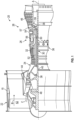
- FIG. 1 schematically illustrates a gas turbine engine 20.
- the gas turbine engine 20 is configured as a two-spool turbofan that has a fan section 22, a compressor section 24, a combustor section 26, and a turbine section 28.
- the illustrative gas turbine engine 20 is merely for example and discussion purposes, and those of skill in the art will appreciate that alternative configurations of gas turbine engines may employ embodiments of the present disclosure.
- the fan section 22 includes a fan 42 that is configured to drive air along a bypass flow path B in a bypass duct defined within a nacelle 15.
- the fan 42 is also configured to drive air along a core flow path C for compression and communication into the combustor section 26 then expansion through the turbine section 28.
- FIG. 1 schematically illustrates a gas turbine engine 20.
- the gas turbine engine 20 is configured as a two-spool turbofan that has a fan section 22, a compressor section 24, a combustor section 26, and a turbine section 28.
- the gas turbine engine 20 includes a low speed spool 30 and a high speed spool 32 mounted for rotation about an engine central longitudinal axis A relative to an engine static structure 36 via one or more bearing systems 38.
- various bearing systems 38 at various locations may be provided, and the location of bearing systems 38 may be varied as appropriate to a particular application and/or engine configuration.
- the low speed spool 30 includes an inner shaft 40 that interconnects the fan 42 of the fan section 22, a first (or low) pressure compressor 44, and a first (or low) pressure turbine 46.
- the inner shaft 40 is connected to the fan 42 through a speed change mechanism, which, in this illustrative gas turbine engine 20, is as a geared architecture 48 to drive the fan 42 at a lower speed than the low speed spool 30.
- the high speed spool 32 includes an outer shaft 50 that interconnects a second (or high) pressure compressor 52 and a second (or high) pressure turbine 54.
- a combustor 56 is arranged in the combustor section 26 between the high pressure compressor 52 and the high pressure turbine 54.
- a mid-turbine frame 57 of the engine static structure 36 is arranged between the high pressure turbine 54 and the low pressure turbine 46.
- the mid-turbine frame 57 may be configured to support one or more of the bearing systems 38 in the turbine section 28.
- the inner shaft 40 and the outer shaft 50 are concentric and rotate via the bearing systems 38 about the engine central longitudinal axis A which is collinear with their longitudinal axes.
- the core airflow through core airflow path C is compressed by the low pressure compressor 44 then the high pressure compressor 52, mixed and burned with fuel in the combustor 56, then expanded over the high pressure turbine 54 and low pressure turbine 46.
- the mid-turbine frame 57 includes airfoils 59 (e.g., vanes) which are arranged in the core airflow path C.
- the turbines 46, 54 rotationally drive the respective low speed spool 30 and high speed spool 32 in response to the expansion of the core airflow. It will be appreciated that each of the positions of the fan section 22, the compressor section 24, the combustor section 26, the turbine section 28, and geared architecture 48 or other fan drive gear system may be varied.
- the geared architecture 48 may be located aft of the combustor section 26 or even aft of the turbine section 28, and the fan section 22 may be positioned forward or aft of the location of the geared architecture 48.
- the gas turbine engine 20 in one example is a high-bypass geared aircraft engine.
- the gas turbine engine 20 has a bypass ratio that is greater than about six, with an example embodiment being greater than about ten.
- the geared architecture 48 is an epicyclic gear train, such as a planetary gear system or other gear system, with a gear reduction ratio of greater than about 2.3 and the low pressure turbine 46 has a pressure ratio that is greater than about five.
- the bypass ratio of the gas turbine engine 20 is greater than about ten, a diameter of the fan 42 is significantly larger than that of the low pressure compressor 44, and the low pressure turbine 46 has a pressure ratio that is greater than about five.
- the low pressure turbine 46 pressure ratio is pressure measured prior to inlet of low pressure turbine 46 as related to the pressure at the outlet of the low pressure turbine 46 prior to an exhaust nozzle.
- the geared architecture 48 may be an epicycle gear train, such as a planetary gear system or other gear system, with a gear reduction ratio of greater than about 2.3:1. It should be understood, however, that the above parameters are only for example and explanatory of one non-limiting embodiment of a geared architecture engine and that the present disclosure is applicable to other gas turbine engines including turbojets or direct drive turbofans or turboshafts.
- the fan section 22 of the gas turbine engine 20 is designed for a particular flight condition -- typically cruise at about 0.8 Mach and about 35,000 feet (10,668 meters).
- 'TSFC' Thrust Specific Fuel Consumption
- Low fan pressure ratio is the pressure ratio across the fan blade alone, without a Fan Exit Guide Vane (“FEGV”) system.
- the low fan pressure ratio as disclosed herein according to one non-limiting embodiment is less than about 1.45.
- the "Low corrected fan tip speed” as disclosed herein according to one non-limiting embodiment is less than about 1150 ft / second (350.5 meters/second).
- Embodiments of the present disclosure are directed to propulsion systems that have reduced or no emissions and achieve a high thermal efficiency. Additionally, low altitude thrust lapse is a problem caused by a density drop that air experiences in a traditional jet engine. However, altitude-invariant engines do not currently exist. Embodiments, of the present disclosure are directed to closed loop CO 2 propulsion systems that can provide a system of effectively no lapse due to altitude.
- Embodiments of the present disclosure are directed to supercritical fluid closed-loop driven turbofan arrangements to generate propulsion for an aircraft.
- the supercritical fluid may be CO 2 .
- air will enter the system and a blower fan will be used as a booster for air that is heated by a burner (e.g., a convention combustion chamber).
- a duct behind the burner allows the air to even out or to become uniform (or more uniform), prior to entering an annular heat exchanger that will heat the fluid of a closed-loop supercritical fluid system.
- the pressure and temperature profiles may become more uniform (e.g., inner diameter to outer diameter and circumferentially) upon entering the heat exchanger or otherwise substantially uniform across whatever shape defines an entrance to the heat exchanger.
- the duct or diffuser conduit diffuses the flow resulting in a reduced flow velocity and more even flow profile.
- the supercritical fluid system includes a turbine on a shaft that is operably connected to the blower and a bypass air fan.
- one or more gear systems are arranged between the turbine and the blower and/or bypass air fan to ensure proper gearing and transition of power from the turbine to the blower/fan.
- the bypass air provides most of the engine thrust.
- a turboexpander could be added to the system.
- the turboexpander may be used to expand a cryogenic fuel (e.g., hydrogen, methane, etc.) prior to combustion within the burner.
- the turboexpander may be driven on the same shaft driven by the closed-loop turbine, upstream relative to the burner, and may be arranged to extract additional work within the system.
- heat not recovered by the supercritical fluid closed-loop system may be recovered by an additional heat exchanger downstream (prior to atmosphere), to then use that recovered heat within a cryogenic fuel system.
- a CO 2 closed-loop system will only be heated to a CO 2 system optimum efficiency (e.g., about 1500° F).
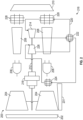
- the aircraft propulsion system 200 may be configured to be mounted to an aircraft to generate propulsive force for flight.
- the aircraft propulsion system 200 includes an air inlet 202, a fan 204 (and/or low pressure compressor), a burner 206, a diffuser conduit 208, and an exhaust nozzle 210.
- the fan 204 is arranged along a shaft 212 that is driven by a turbine 214.
- the turbine 214 is part of a closed loop-supercritical fluid system 216.
- a gearing system 218 is arranged between the turbine 214 and the fan 204 along the shaft 212.
- the gearing system 218 is configured to transition a high speed rotation from the turbine 214 to a lower speed rotation for the fan 204.
- the closed loop-supercritical fluid system 216 is a closed loop system containing a supercritical fluid within a fluid line 220.
- the supercritical fluid may be CO 2 .
- the closed loop-supercritical fluid system 216 includes the turbine 214, an optional recuperator heat exchanger 222, a cooler heat exchanger 224, a compressor 226, and a recovery heat exchanger 228.
- the supercritical fluid passes through the fluid line 220 it will drive the turbine 214 which in turn drives rotation of the shaft 212.
- the compressor 226 and the fan 204 are coupled to the shaft 212 and thus are driven by the turbine 214.
- the supercritical fluid will be directed to the optional recuperator heat exchanger 222.
- the recuperator heat exchanger 222 is a supercritical fluid-to-supercritical fluid heat exchanger with both flow paths through the recuperator heat exchanger 222 containing the supercritical fluid.
- the supercritical fluid will then flow into the cooler heat exchanger 224, or directly to the cooler heat exchanger 224 if no recuperator heat exchanger 222 is present.
- the cooler heat exchanger 224 is configured to cool the supercritical fluid.
- the cooler heat exchanger 224 may be an air-to-supercritical fluid or fuel-to-supercritical fluid heat exchanger.
- the cooler heat exchanger 224 is employed to reject heat of the supercritical fluid (e.g., sCO 2 ) into the air stream forward of the burner 206 and is then recovered into the air stream that feeds the recovery heat exchanger 228.
- the cooler heat exchanger 224 may be arranged in a duct, such as a bypass duct or bypass stream 231 of the aircraft propulsion system 200, such as downstream from the air inlet 202 and downstream of the fan 204.
- the bypass duct would direct air from the air inlet 202 toward the exhaust nozzle 210 without the air interacting with other components and, in some embodiment, may be the primary thrust generator of the aircraft propulsion system 200.
- the cooler heat exchanger 224 may receive a fuel to be provided into the burner 206 for combustion and provide heat exchange between the fuel and the supercritical fluid.
- the fuel may be jet fuel, biofuels, or cryogenic fuels (e.g., hydrogen, methane, etc.).
- the supercritical fluid will then pass into the compressor 226, which is driven on the shaft 212 by the turbine 214.
- the supercritical fluid will then flow through the optional recuperator heat exchanger 222, if present, and into the recovery heat exchanger 228.
- the recovery heat exchanger 228 may be an annular structure arranged about and/or proximate to the exhaust nozzle 210. Hot gases from the burner(s) 206 will flow along the diffuser conduit 208 and into the recovery heat exchanger 228.
- the supercritical fluid will experience heat pickup within the recovery heat exchanger 228 which takes advantage of the waste heat generated by the burner(s) 206.
- the heated supercritical fluid will then enter the turbine 214 and drive rotation thereof.
- the closed loop-supercritical fluid system 216 provides the primary driving force for rotating the shaft 212.
- the second is an air flow path that passes through the aircraft propulsion system 200.
- the bulk of the air will enter at the air inlet 202, be driven by the fan 204, and then pass through a bypass channel to provide thrust.
- a portion of the air will be directed from the fan 204 into the burner 206 to be combusted with a fuel, such as jet fuel, hydrogen, or the like.
- the combusted fuel and air will be passed into and through the diffuser conduit 208 prior to entering the recovery heat exchanger 228 and then exit the aircraft propulsion system 200 through the exhaust nozzle 210.
- This exhaust will generate some amount of thrust to supplement the primary thrust generator in a bypass, with the bypass being similar to that shown and described with respect to FIG. 1 and/or as otherwise described herein.
- the aircraft propulsion system 200 is distinct from prior gas turbine engines, particularly in that the primary driving force to drive the fan 202 is not a convention combustor-turbine configuration.
- the combusted fuel is not the primary driving force, but rather the closed-loop cycle of the closed loop-supercritical fluid system 216 provides the motive force to drive the fan 202 and generate thrust for flight.
- the closed loop-supercritical fluid system 216 is a closed-loop system, there is no requirement for a direct fuel injection or reliance upon the fuel itself.
- the closed-loop cycle enables elimination of efficiency dependency that is due to a density drop associated with altitude changes when using traditional jet engines. That is, the aircraft propulsion system 200 provides for an altitude-invariant engine. As a result, embodiments of the present disclosure provide for systems having effectively no efficiency lapse due to altitude.
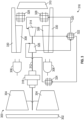
- FIG. 3 a schematic diagram of an aircraft propulsion system 300 in accordance with an embodiment of the present disclosure is shown.
- the aircraft propulsion system 300 may be substantially similar to that shown in FIG. 2 .
- the aircraft propulsion system 300 includes an air inlet 302, a fan 304 (and/or low pressure compressor), a burner 306, a diffuser conduit 308, and an exhaust nozzle 310.
- the fan 304 is arranged along a shaft 312 that is driven by a turbine 314 of a closed loop-supercritical fluid system 316, similar to that described above.
- a gearing system 318 is arranged between the turbine 314 and the fan 304 along the shaft 312.
- the gearing system 318 is configured to transition a high speed rotation from the turbine 314 to a lower speed rotation for the fan 304.
- the closed loop-supercritical fluid system 316 is a closed loop system containing a supercritical fluid within a fluid line 320.
- the closed loop-supercritical fluid system 316 includes the turbine 314, an optional recuperator heat exchanger 322, a cooler heat exchanger 324, a compressor 326, and a recovery heat exchanger 328.
- the cooler heat exchanger 324 may be arranged between the fan 304 and the burner 306. As such, heat from the supercritical fluid may be rejected into the air stream forward of the burner 306 and be recovered into the air stream that feeds the recovery heat exchanger 228.
- the cooler heat exchanger 224 can be optionally arranged within a bypass stream of the system.
- As the supercritical fluid passes through the fluid line 320 it will drive the turbine 314 which in turn drives rotation of the shaft 312.
- the compressor 326 and the fan 304 are coupled to the shaft 312 and thus are driven by the turbine 314.
- a heat exchanger bypass 330 is arranged along the flow path of the air that passes from the fan 304 to the exhaust nozzle 310.
- a portion of the combusted gases exiting the burner 306 may be used to provide additional thrust, without a portion of the energy extracted within the recovery heat exchanger 328.
- this configuration can potentially generate additional thrust through air passing through the heat exchanger bypass 330.
- the size of the recovery heat exchanger 328 may be smaller than the similar recovery heat exchanger 228 in the configuration of FIG. 2 . This is because less air is passing through the recovery heat exchanger 328 and thus weight savings may be achieved, while also gaining increased thrust potential.
- FIG. 4 a schematic diagram of an aircraft propulsion system 400 in accordance with an embodiment of the present disclosure is shown.
- the aircraft propulsion system 400 may be similar in function as those described above.
- the aircraft propulsion system 400 includes a bypass flow path 402, a hot gas flow path 404, and a closed-loop flow path 406.
- the bypass flow path 402 is an air flow path that generates the majority of the thrust for the aircraft propulsion system 400. Air enters the bypass flow path 402 at an air inlet 408. The air is driven by a rotating fan 410 into a bypass duct 412. The air is then ejected or driven out of a bypass nozzle 414.
- the hot gas flow path 404 is also an air flow path that is used to generate heat for the aircraft propulsion system 400.
- Air is sourced from the air inlet 408, passed through the fan 410, and is accelerated through an optional blower 416.
- the accelerated air is then passed through a burner 418 where the air is mixed and combusted with a fuel.
- the hot combusted gas is then passed through a hot stream duct 420 where the flow evens out and reduces turbulence prior to entering a recovery heat exchanger 422 and ejected out a hot stream nozzle 424.
- the closed-loop flow path 406 is part of a closed loop-supercritical fluid system 426 and contains a supercritical fluid within a fluid line.
- the closed loop-supercritical fluid system 426 includes a turbine 428, an optional recuperator heat exchanger 430, a cooler heat exchanger 432, a compressor 434, and the recovery heat exchangers 422. As the supercritical fluid passes through the closed-loop flow path 406 it will drive the turbine 428 which in turn drives rotation of a shaft 436.
- the compressor 434 of the closed-loop flow path 406, the optional blower 416 of the hot gas flow path 404, and the fan 410 of the bypass flow path 402 are each coupled to the shaft 436 and thus are driven by the turbine 428.
- the shaft 436 may include one or more gear systems 438a, 438b.
- the gear systems 438a, 438b may be configured to step the rotational speed of the shaft to appropriately drive the optional blower 416 and/or the fan 410.
- the gear systems may be configured to provide an overall gear ratio across both gear systems 438a, 438b between 10:1 to 20:1, although other gear ratios and gearing may be employed without departing from the scope of the present disclosure, as will be appreciated by those of skill in the art.
- the cooler heat exchanger 432 of the closed-loop flow path 406 is arranged within the bypass duct 412 of the bypass flow path 402.
- the cooler heat exchanger 432 in this embodiment is an air-to-supercritical fluid heat exchanger.
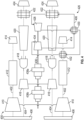
- FIG. 5 a schematic diagram of an aircraft propulsion system 500 in accordance with an embodiment of the present disclosure is shown.
- the aircraft propulsion system 500 may be similar in function as those described above.
- the aircraft propulsion system 500 includes a bypass flow path 502, a hot gas flow path 504, a closed-loop flow path 506, and a fuel flow path 540.
- the bypass flow path 502 is an air flow path that generates the majority of the thrust for the aircraft propulsion system 500. Air enters the bypass flow path 502 at an air inlet 508. The air is driven by a rotating fan 510 into a bypass duct 512. The air is then ejected or driven out of a bypass nozzle 514.
- the hot gas flow path 504 is also an air flow path that is used to generate heat for the aircraft propulsion system 500.
- Air is sourced from the air inlet 508, passed through the fan 510, and is accelerated through a blower 516.
- the accelerated air is then passed through a burner 518 where the air is mixed and combusted with a fuel.
- the hot combusted gas is then passed through a hot stream duct 520 where the flow evens out and reduces turbulence prior to entering a recovery heat exchanger 522 and ejected out a hot stream nozzle 524.
- an optional pump 523 may be arranged upstream of recovery heat exchanger 522.
- the potential phase change to liquid within the closed-loop flow path 506 may enable the use of pumps. Such pumping may enable boosting the working fluid within the closed-loop flow path 506 to a higher pressure that may reduce the required compression work, thus improving overall efficiencies.
- the closed-loop flow path 506 is part of a closed loop-supercritical fluid system 526 and contains a supercritical fluid within a fluid line.
- the closed loop-supercritical fluid system 526 includes a turbine 528, an optional recuperator heat exchanger 530, a cooler heat exchanger 532, a compressor 534, and the recovery heat exchangers 522.
- the fuel flow path 540 is configured to supply fuel from a fuel tank 542 to the burner 518 for combustion with the air in the hot gas flow path 504.
- the fuel flow path 540 is part of a cryogenic fuel system 544.
- the cryogenic fuel system 544 provides a supply of fuel that is stored in a cryogenic state (such as liquid hydrogen or the like).
- the fuel is extracted from the fuel tank 542 (e.g., by a pump or the like) and passed through a power electronics heat exchanger 546 that begins the warming process of the fuel from its cryogenic state.
- an additional heat exchanger may be arranged within a fan stream of the engine, as discussed above, which can result in reduced size heat exchangers throughout the system.
- the cooler heat exchanger 532 provides the cryogenic fuel as a cold sink side for the hot working fluid passing through the closed-loop flow path 506.
- an additional heat exchanger may be arranged downstream of the cooler heat exchanger 532, in a similar fan stream position to, for example, cooler heat exchanger 432 shown in FIG. 4 . That is, there may be multiple cooler heat exchanges arranged along the closed-loop flow path 506 and arranged in different arrangements along the closed-loop flow path 506 based on thermal considerations, for example, and/or upon physical limitations of the specific engine configurations.
- the fuel is then passed through the cooler heat exchanger 532 of the closed-loop flow path 506 where the fuel picks up heat from the fluid of the closed-loop flow path 506.
- the fuel is then passed through a turbo expander 548 and subsequently supplied into the burner 518 for combustion with the air of the hot gas flow path 504.
- the cryogenic fuel could be passed through other engine and/or aircraft heat exchangers as a coolant prior to entering the combustor, and the present flow path is not to be limiting.
- the compressor 534 of the closed-loop flow path 506, the blower 516 of the hot gas flow path 504, the fan 510 of the bypass flow path 502, and the turbo expander 548 of the fuel flow path 540 are each coupled to the shaft 536 and thus are driven by the turbine 528.
- the shaft 536 may include one or more gear systems 538a, 538b.
- the gear systems 538a, 538b may be configured to step the rotational speed of the shaft to appropriately drive the blower 516, the turbo expander 548, and/or the fan 510.
- the schematic illustrations herein are more diagrams rather than structural configurations. Further, although it may appear that two of each element are illustrated, such may not be the case, rather a single structure or a multiple of different components may be included.
- the ducts and fans illustrated as two separate structures may in fact be portions of an annular structure.
- the elements may be representative of multiple components arranged about a central axis.
- the burners may be a number of discrete and separate burners (e.g., combustion chambers) arranged about a central axis, which may be defined by the shaft of the propulsion systems described herein.
- the illustrations are not to be limiting but rather are provided for explanatory and illustrative purposes only, as described herein.
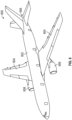
- FIG. 6 a schematic illustration of an aircraft 600 that may incorporate embodiments of the present disclosure is shown.
- the aircraft 600 includes a fuselage 602, wings 604, and a tail 606.
- the aircraft 600 includes wing-mounted aircraft propulsion systems 608.
- the wing-mounted aircraft propulsion systems 608 may be arranged as the aircraft propulsion systems shown and described above. It will be appreciated that other aircraft configurations may employ the propulsion systems of the present disclosure without departing from the scope of the present disclosure.
- fuselage-mounted and/or tail-mounted configurations are possible.
- any number of propulsion systems may be employed, from one to four or more, depending on the aircraft configuration and power and thrust needs thereof.
- embodiments of the present disclosure provide for an alternative aircraft propulsion system that may generate less waste and/or pollutants while providing improved efficiency that is not dependent upon altitude.
- Such aircraft propulsion systems may be zero or near-zero CO 2 emission aircraft propulsion systems.
- a new engine architecture is provided herein where the primary motive force is provided from a closed-loop cycle, rather than the conventional air-breathing Brayton cycles that primarily rely upon combustion to drive rotation of a shaft. Accordingly, the amount of fuel may be reduced, the size of components may be optimized, and improved efficiencies may be achieved.
- an altitude invariant engine design is provided by embodiments of the present disclosure. Further, improved thermal efficiencies of flight-ready engines are provided by the configurations described herein.
- the term "about” is intended to include the degree of error associated with measurement of the particular quantity based upon the equipment available at the time of filing the application. For example, “about” may include a range of ⁇ 8%, or 5%, or 2% of a given value or other percentage change as will be appreciated by those of skill in the art for the particular measurement and/or dimensions referred to herein.
Landscapes
- Engineering & Computer Science (AREA)
- Chemical & Material Sciences (AREA)
- Combustion & Propulsion (AREA)
- Mechanical Engineering (AREA)
- General Engineering & Computer Science (AREA)
- Structures Of Non-Positive Displacement Pumps (AREA)
Description
- The present disclosure relates generally to aircraft propulsion systems.
- Gas turbine engines, such as those utilized in commercial and military aircraft, include a compressor section that compresses air, a combustor section in which the compressed air is mixed with a fuel and ignited, and a turbine section across which the resultant combustion products are expanded. The expansion of the combustion products drives the turbine section to rotate. As the turbine section is connected to the compressor section via a shaft, the rotation of the turbine section further drives the compressor section to rotate. In some configurations, a fan is also connected to the shaft and is driven to rotate via rotation of the turbine.
- However, such gas turbine engines generate waste products, such as CO2. It may be advantageous to have aircraft propulsion systems that do not generate waste byproducts or generate less waste, including CO2.
- A prior art aircraft propulsion system having the features of the preamble of claim 1 is disclosed in
US 2017/356340 1 .US 2017/58834 A1 discloses another prior art aircraft propulsion system. - According to an aspect of the present invention, an aircraft propulsion system is provided in accordance with claim 1.
- In addition to one or more of the features described above, or as an alternative, further embodiments of the aircraft propulsion systems may include that the supercritical fluid is CO2 that is passed through the turbine, the cooler heat exchanger, the compressor, and the recovery heat exchanger.
- In addition to one or more of the features described above, or as an alternative, further embodiments of the aircraft propulsion systems may include a gear system coupled to the shaft between the turbine and the fan.
- In addition to one or more of the features described above, or as an alternative, further embodiments of the aircraft propulsion systems may include that the closed loop-supercritical fluid system further comprises a recuperator heat exchanger arranged between the turbine and the cooler heat exchanger along the closed-loop flow path.
- In addition to one or more of the features described above, or as an alternative, further embodiments of the aircraft propulsion systems may include that the recuperator heat exchanger is a supercritical fluid-to-supercritical fluid heat exchanger.
- In addition to one or more of the features described above, or as an alternative, further embodiments of the aircraft propulsion systems may include a cryogenic fuel tank configured to supply fuel to the burner through a fuel flow path, wherein the cooler heat exchanger is a fuel-to-supercritical fluid heat exchanger.
- In addition to one or more of the features described above, or as an alternative, further embodiments of the aircraft propulsion systems may include a turbo expander operably coupled to the shaft and arranged between the cryogenic fuel tank and the burner.
- In addition to one or more of the features described above, or as an alternative, further embodiments of the aircraft propulsion systems may include that the cooler heat exchanger is an air-to-supercritical fluid heat exchanger.
- In addition to one or more of the features described above, or as an alternative, further embodiments of the aircraft propulsion systems may include that the cooler heat exchanger is arranged within a bypass duct downstream of the fan.
- In addition to one or more of the features described above, or as an alternative, further embodiments of the aircraft propulsion systems may include a bypass flow path defining a flow path of air that passes through an air inlet, through the fan coupled to a shaft, through a bypass duct, and out a bypass nozzle, a hot gas flow path defining a flow path of air that passes through the air inlet, through the fan, into the burner for combustion with fuel to generate combusted gas, and through the recovery heat exchanger, and out the exhaust nozzle, and a closed-loop flow path defining a closed-loop flow path of a supercritical fluid that passes through the turbine operably coupled to the shaft to drive rotation of the shaft, the cooler heat exchanger, the compressor coupled to the shaft, into the recovery heat exchanger, and back to the turbine. The turbine of the closed-loop flow path drives rotation of the shaft, the compressor, and the fan.
- In addition to one or more of the features described above, or as an alternative, further embodiments of the aircraft propulsion systems may include a fuel flow path defining a flow path from a fuel tank to the burner of the hot gas flow path.
- In addition to one or more of the features described above, or as an alternative, further embodiments of the aircraft propulsion systems may include a turbo expander coupled to the shaft and configured to expand a fuel prior to injection into the burner.
- In addition to one or more of the features described above, or as an alternative, further embodiments of the aircraft propulsion systems may include a first gear system coupled to the shaft between the turbine and the turbo expander and a second gear system coupled to the shaft between the turbo expander and the fan.
- In addition to one or more of the features described above, or as an alternative, further embodiments of the aircraft propulsion systems may include that a fuel in the fuel flow path is cryogenic fuel.
- In addition to one or more of the features described above, or as an alternative, further embodiments of the aircraft propulsion systems may include that the cryogenic fuel is hydrogen.
- In addition to one or more of the features described above, or as an alternative, further embodiments of the aircraft propulsion systems may include that the cooler heat exchanger of the closed-loop flow path receives fuel to form a fuel-to-supercritical fluid heat exchanger.
- In addition to one or more of the features described above, or as an alternative, further embodiments of the aircraft propulsion systems may include a gear system coupled to the shaft between the turbine and the fan.
- In addition to one or more of the features described above, or as an alternative, further embodiments of the aircraft propulsion systems may include that the hot gas flow path further comprises a blower arranged between the fan and the burner to increase a speed of the air passing through the hot gas flow path.
- The foregoing features and elements may be executed or utilized in various combinations without exclusivity, unless expressly indicated otherwise. These features and elements as well as the operation thereof will become more apparent in light of the following description and the accompanying drawings. It should be understood, however, that the following description and drawings are intended to be illustrative and explanatory in nature and non-limiting.
- The subject matter is particularly pointed out and distinctly claimed at the conclusion of the specification. The foregoing and other features, and advantages of the present disclosure are apparent from the following detailed description taken in conjunction with the accompanying drawings in which:
-
FIG. 1 is a schematic cross-sectional illustration of a gas turbine engine architecture; -
FIG. 2 is a schematic diagram of an aircraft propulsion system in accordance with an embodiment of the present disclosure; -
FIG. 3 is a schematic diagram of an aircraft propulsion system in accordance with an embodiment of the present disclosure; -
FIG. 4 is a schematic diagram of an aircraft propulsion system in accordance with an embodiment of the present disclosure; -
FIG. 5 is a schematic diagram of an aircraft propulsion system in accordance with an embodiment of the present disclosure; and -
FIG. 6 is a schematic illustration of an aircraft that may incorporate embodiment of the present disclosure. -
FIG. 1 schematically illustrates agas turbine engine 20. As illustratively shown, thegas turbine engine 20 is configured as a two-spool turbofan that has afan section 22, acompressor section 24, acombustor section 26, and aturbine section 28. The illustrativegas turbine engine 20 is merely for example and discussion purposes, and those of skill in the art will appreciate that alternative configurations of gas turbine engines may employ embodiments of the present disclosure. Thefan section 22 includes afan 42 that is configured to drive air along a bypass flow path B in a bypass duct defined within anacelle 15. Thefan 42 is also configured to drive air along a core flow path C for compression and communication into thecombustor section 26 then expansion through theturbine section 28. Although depicted as a two-spool turbofan gas turbine engine in the disclosed non-limiting embodiment, it should be understood that the concepts described herein are not limited to use with two-spool turbofans as the teachings may be applied to other types of turbine engines. - In this two-spool configuration, the
gas turbine engine 20 includes alow speed spool 30 and ahigh speed spool 32 mounted for rotation about an engine central longitudinal axis A relative to an enginestatic structure 36 via one or morebearing systems 38. It should be understood thatvarious bearing systems 38 at various locations may be provided, and the location ofbearing systems 38 may be varied as appropriate to a particular application and/or engine configuration. - The
low speed spool 30 includes aninner shaft 40 that interconnects thefan 42 of thefan section 22, a first (or low)pressure compressor 44, and a first (or low)pressure turbine 46. Theinner shaft 40 is connected to thefan 42 through a speed change mechanism, which, in this illustrativegas turbine engine 20, is as a gearedarchitecture 48 to drive thefan 42 at a lower speed than thelow speed spool 30. Thehigh speed spool 32 includes anouter shaft 50 that interconnects a second (or high)pressure compressor 52 and a second (or high)pressure turbine 54. Acombustor 56 is arranged in thecombustor section 26 between thehigh pressure compressor 52 and thehigh pressure turbine 54. Amid-turbine frame 57 of the enginestatic structure 36 is arranged between thehigh pressure turbine 54 and thelow pressure turbine 46. Themid-turbine frame 57 may be configured to support one or more of thebearing systems 38 in theturbine section 28. Theinner shaft 40 and theouter shaft 50 are concentric and rotate via thebearing systems 38 about the engine central longitudinal axis A which is collinear with their longitudinal axes. - The core airflow through core airflow path C is compressed by the
low pressure compressor 44 then thehigh pressure compressor 52, mixed and burned with fuel in thecombustor 56, then expanded over thehigh pressure turbine 54 andlow pressure turbine 46. Themid-turbine frame 57 includes airfoils 59 (e.g., vanes) which are arranged in the core airflow path C. Theturbines low speed spool 30 andhigh speed spool 32 in response to the expansion of the core airflow. It will be appreciated that each of the positions of thefan section 22, thecompressor section 24, thecombustor section 26, theturbine section 28, and gearedarchitecture 48 or other fan drive gear system may be varied. For example, in some embodiments, the gearedarchitecture 48 may be located aft of thecombustor section 26 or even aft of theturbine section 28, and thefan section 22 may be positioned forward or aft of the location of the gearedarchitecture 48. - The
gas turbine engine 20 in one example is a high-bypass geared aircraft engine. In some such examples, thegas turbine engine 20 has a bypass ratio that is greater than about six, with an example embodiment being greater than about ten. In some embodiments, the gearedarchitecture 48 is an epicyclic gear train, such as a planetary gear system or other gear system, with a gear reduction ratio of greater than about 2.3 and thelow pressure turbine 46 has a pressure ratio that is greater than about five. In one non-limiting embodiment, the bypass ratio of thegas turbine engine 20 is greater than about ten, a diameter of thefan 42 is significantly larger than that of thelow pressure compressor 44, and thelow pressure turbine 46 has a pressure ratio that is greater than about five. Thelow pressure turbine 46 pressure ratio is pressure measured prior to inlet oflow pressure turbine 46 as related to the pressure at the outlet of thelow pressure turbine 46 prior to an exhaust nozzle. In some embodiments, the gearedarchitecture 48 may be an epicycle gear train, such as a planetary gear system or other gear system, with a gear reduction ratio of greater than about 2.3:1. It should be understood, however, that the above parameters are only for example and explanatory of one non-limiting embodiment of a geared architecture engine and that the present disclosure is applicable to other gas turbine engines including turbojets or direct drive turbofans or turboshafts. - A significant amount of thrust is provided by the bypass flow B due to the high bypass ratio. The
fan section 22 of thegas turbine engine 20 is designed for a particular flight condition -- typically cruise at about 0.8 Mach and about 35,000 feet (10,668 meters). The flight condition of 0.8 Mach and 35,000 ft (10,668 meters), with the engine at its best fuel consumption - also known as "bucket cruise Thrust Specific Fuel Consumption ('TSFC')" - is the industry standard parameter of lbm of fuel being burned divided by lbf of thrust the engine produces at that minimum point. "Low fan pressure ratio" is the pressure ratio across the fan blade alone, without a Fan Exit Guide Vane ("FEGV") system. The low fan pressure ratio as disclosed herein according to one non-limiting embodiment is less than about 1.45. "Low corrected fan tip speed" is the actual fan tip speed in ft/sec divided by an industry standard temperature correction of [(Tram °R) / (518.7 °R)]^0.5 (where °R = 9/5 x K). The "Low corrected fan tip speed" as disclosed herein according to one non-limiting embodiment is less than about 1150 ft / second (350.5 meters/second). - As noted above, conventional gas turbine engines, such as shown in
FIG. 1 , generate waste heat and chemicals. However, it is difficult to achieve zero carbon emission flight. Embodiments of the present disclosure are directed to propulsion systems that have reduced or no emissions and achieve a high thermal efficiency. Additionally, low altitude thrust lapse is a problem caused by a density drop that air experiences in a traditional jet engine. However, altitude-invariant engines do not currently exist. Embodiments, of the present disclosure are directed to closed loop CO2 propulsion systems that can provide a system of effectively no lapse due to altitude. - Embodiments of the present disclosure are directed to supercritical fluid closed-loop driven turbofan arrangements to generate propulsion for an aircraft. In some embodiments, the supercritical fluid may be CO2. In operation, air will enter the system and a blower fan will be used as a booster for air that is heated by a burner (e.g., a convention combustion chamber). A duct behind the burner allows the air to even out or to become uniform (or more uniform), prior to entering an annular heat exchanger that will heat the fluid of a closed-loop supercritical fluid system. For example, the pressure and temperature profiles may become more uniform (e.g., inner diameter to outer diameter and circumferentially) upon entering the heat exchanger or otherwise substantially uniform across whatever shape defines an entrance to the heat exchanger. The duct or diffuser conduit diffuses the flow resulting in a reduced flow velocity and more even flow profile. The supercritical fluid system includes a turbine on a shaft that is operably connected to the blower and a bypass air fan. In some embodiments, one or more gear systems are arranged between the turbine and the blower and/or bypass air fan to ensure proper gearing and transition of power from the turbine to the blower/fan. For aircraft propulsion, the bypass air provides most of the engine thrust. In some embodiments, a turboexpander could be added to the system. In some such embodiments, the turboexpander may be used to expand a cryogenic fuel (e.g., hydrogen, methane, etc.) prior to combustion within the burner. The turboexpander may be driven on the same shaft driven by the closed-loop turbine, upstream relative to the burner, and may be arranged to extract additional work within the system. In some embodiments, heat not recovered by the supercritical fluid closed-loop system may be recovered by an additional heat exchanger downstream (prior to atmosphere), to then use that recovered heat within a cryogenic fuel system. In one non-limiting example in accordance with the present disclosure, a CO2 closed-loop system will only be heated to a CO2 system optimum efficiency (e.g., about 1500° F).
- Turning now to
FIG. 2 , a schematic diagram of anaircraft propulsion system 200 in accordance with an embodiment of the present disclosure is shown. Theaircraft propulsion system 200 may be configured to be mounted to an aircraft to generate propulsive force for flight. Theaircraft propulsion system 200 includes anair inlet 202, a fan 204 (and/or low pressure compressor), aburner 206, adiffuser conduit 208, and anexhaust nozzle 210. Thefan 204 is arranged along ashaft 212 that is driven by aturbine 214. Theturbine 214 is part of a closed loop-supercritical fluid system 216. Agearing system 218 is arranged between theturbine 214 and thefan 204 along theshaft 212. Thegearing system 218 is configured to transition a high speed rotation from theturbine 214 to a lower speed rotation for thefan 204. - The closed loop-
supercritical fluid system 216 is a closed loop system containing a supercritical fluid within afluid line 220. In some non-limiting embodiments, the supercritical fluid may be CO2. Along thefluid line 220 the closed loop-supercritical fluid system 216 includes theturbine 214, an optionalrecuperator heat exchanger 222, acooler heat exchanger 224, acompressor 226, and arecovery heat exchanger 228. As the supercritical fluid passes through thefluid line 220 it will drive theturbine 214 which in turn drives rotation of theshaft 212. Thecompressor 226 and thefan 204 are coupled to theshaft 212 and thus are driven by theturbine 214. - Starting at the
turbine 214, the supercritical fluid will be directed to the optionalrecuperator heat exchanger 222. Therecuperator heat exchanger 222 is a supercritical fluid-to-supercritical fluid heat exchanger with both flow paths through therecuperator heat exchanger 222 containing the supercritical fluid. The supercritical fluid will then flow into thecooler heat exchanger 224, or directly to thecooler heat exchanger 224 if norecuperator heat exchanger 222 is present. Thecooler heat exchanger 224 is configured to cool the supercritical fluid. As such, thecooler heat exchanger 224 may be an air-to-supercritical fluid or fuel-to-supercritical fluid heat exchanger. In operation, thecooler heat exchanger 224 is employed to reject heat of the supercritical fluid (e.g., sCO2) into the air stream forward of theburner 206 and is then recovered into the air stream that feeds therecovery heat exchanger 228. Optionally, in an air-to-supercritical fluid configuration, thecooler heat exchanger 224 may be arranged in a duct, such as a bypass duct orbypass stream 231 of theaircraft propulsion system 200, such as downstream from theair inlet 202 and downstream of thefan 204. In such a configuration the bypass duct would direct air from theair inlet 202 toward theexhaust nozzle 210 without the air interacting with other components and, in some embodiment, may be the primary thrust generator of theaircraft propulsion system 200. In the fuel-to-supercritical fluid, thecooler heat exchanger 224 may receive a fuel to be provided into theburner 206 for combustion and provide heat exchange between the fuel and the supercritical fluid. In some embodiments, the fuel may be jet fuel, biofuels, or cryogenic fuels (e.g., hydrogen, methane, etc.). - The supercritical fluid will then pass into the
compressor 226, which is driven on theshaft 212 by theturbine 214. The supercritical fluid will then flow through the optionalrecuperator heat exchanger 222, if present, and into therecovery heat exchanger 228. Therecovery heat exchanger 228 may be an annular structure arranged about and/or proximate to theexhaust nozzle 210. Hot gases from the burner(s) 206 will flow along thediffuser conduit 208 and into therecovery heat exchanger 228. The supercritical fluid will experience heat pickup within therecovery heat exchanger 228 which takes advantage of the waste heat generated by the burner(s) 206. The heated supercritical fluid will then enter theturbine 214 and drive rotation thereof. - There are two primary fluid paths through the
aircraft propulsion system 200. First, there is the closed loop-supercritical fluid system 216. This closed loop-supercritical fluid system 216 provides the primary driving force for rotating theshaft 212. The second is an air flow path that passes through theaircraft propulsion system 200. The bulk of the air will enter at theair inlet 202, be driven by thefan 204, and then pass through a bypass channel to provide thrust. A portion of the air will be directed from thefan 204 into theburner 206 to be combusted with a fuel, such as jet fuel, hydrogen, or the like. The combusted fuel and air will be passed into and through thediffuser conduit 208 prior to entering therecovery heat exchanger 228 and then exit theaircraft propulsion system 200 through theexhaust nozzle 210. This exhaust will generate some amount of thrust to supplement the primary thrust generator in a bypass, with the bypass being similar to that shown and described with respect toFIG. 1 and/or as otherwise described herein. - The
aircraft propulsion system 200 is distinct from prior gas turbine engines, particularly in that the primary driving force to drive thefan 202 is not a convention combustor-turbine configuration. The combusted fuel is not the primary driving force, but rather the closed-loop cycle of the closed loop-supercritical fluid system 216 provides the motive force to drive thefan 202 and generate thrust for flight. Advantageously, because the closed loop-supercritical fluid system 216 is a closed-loop system, there is no requirement for a direct fuel injection or reliance upon the fuel itself. The closed-loop cycle enables elimination of efficiency dependency that is due to a density drop associated with altitude changes when using traditional jet engines. That is, theaircraft propulsion system 200 provides for an altitude-invariant engine. As a result, embodiments of the present disclosure provide for systems having effectively no efficiency lapse due to altitude. - Turning now to
FIG. 3 , a schematic diagram of anaircraft propulsion system 300 in accordance with an embodiment of the present disclosure is shown. Theaircraft propulsion system 300 may be substantially similar to that shown inFIG. 2 . Theaircraft propulsion system 300 includes anair inlet 302, a fan 304 (and/or low pressure compressor), aburner 306, adiffuser conduit 308, and anexhaust nozzle 310. Thefan 304 is arranged along ashaft 312 that is driven by aturbine 314 of a closed loop-supercritical fluid system 316, similar to that described above. Agearing system 318 is arranged between theturbine 314 and thefan 304 along theshaft 312. Thegearing system 318 is configured to transition a high speed rotation from theturbine 314 to a lower speed rotation for thefan 304. - The closed loop-
supercritical fluid system 316 is a closed loop system containing a supercritical fluid within afluid line 320. Along thefluid line 220 the closed loop-supercritical fluid system 316 includes theturbine 314, an optionalrecuperator heat exchanger 322, acooler heat exchanger 324, acompressor 326, and arecovery heat exchanger 328. Similar to the above described configurations, thecooler heat exchanger 324 may be arranged between thefan 304 and theburner 306. As such, heat from the supercritical fluid may be rejected into the air stream forward of theburner 306 and be recovered into the air stream that feeds therecovery heat exchanger 228. In some embodiments, thecooler heat exchanger 224 can be optionally arranged within a bypass stream of the system. As the supercritical fluid passes through thefluid line 320 it will drive theturbine 314 which in turn drives rotation of theshaft 312. Thecompressor 326 and thefan 304 are coupled to theshaft 312 and thus are driven by theturbine 314. - In this embodiment, a
heat exchanger bypass 330 is arranged along the flow path of the air that passes from thefan 304 to theexhaust nozzle 310. As such, a portion of the combusted gases exiting theburner 306 may be used to provide additional thrust, without a portion of the energy extracted within therecovery heat exchanger 328. As such, this configuration can potentially generate additional thrust through air passing through theheat exchanger bypass 330. In this configuration, the size of therecovery heat exchanger 328 may be smaller than the similarrecovery heat exchanger 228 in the configuration ofFIG. 2 . This is because less air is passing through therecovery heat exchanger 328 and thus weight savings may be achieved, while also gaining increased thrust potential. - Turning now to
FIG. 4 , a schematic diagram of anaircraft propulsion system 400 in accordance with an embodiment of the present disclosure is shown. Theaircraft propulsion system 400 may be similar in function as those described above. In this illustrative embodiment, there are three main flow paths of fluids through theaircraft propulsion system 400. Theaircraft propulsion system 400 includes abypass flow path 402, a hotgas flow path 404, and a closed-loop flow path 406. - The
bypass flow path 402 is an air flow path that generates the majority of the thrust for theaircraft propulsion system 400. Air enters thebypass flow path 402 at anair inlet 408. The air is driven by a rotatingfan 410 into abypass duct 412. The air is then ejected or driven out of abypass nozzle 414. - The hot
gas flow path 404 is also an air flow path that is used to generate heat for theaircraft propulsion system 400. Air is sourced from theair inlet 408, passed through thefan 410, and is accelerated through anoptional blower 416. The accelerated air is then passed through aburner 418 where the air is mixed and combusted with a fuel. The hot combusted gas is then passed through ahot stream duct 420 where the flow evens out and reduces turbulence prior to entering arecovery heat exchanger 422 and ejected out ahot stream nozzle 424. - The closed-
loop flow path 406 is part of a closed loop-supercritical fluid system 426 and contains a supercritical fluid within a fluid line. The closed loop-supercritical fluid system 426 includes aturbine 428, an optionalrecuperator heat exchanger 430, acooler heat exchanger 432, acompressor 434, and therecovery heat exchangers 422. As the supercritical fluid passes through the closed-loop flow path 406 it will drive theturbine 428 which in turn drives rotation of ashaft 436. - The
compressor 434 of the closed-loop flow path 406, theoptional blower 416 of the hotgas flow path 404, and thefan 410 of thebypass flow path 402 are each coupled to theshaft 436 and thus are driven by theturbine 428. Theshaft 436 may include one ormore gear systems gear systems optional blower 416 and/or thefan 410. For example, in some non-limiting embodiments, the gear systems may be configured to provide an overall gear ratio across bothgear systems - In this illustrative embodiment, the
cooler heat exchanger 432 of the closed-loop flow path 406 is arranged within thebypass duct 412 of thebypass flow path 402. As such, thecooler heat exchanger 432 in this embodiment is an air-to-supercritical fluid heat exchanger. - Turning now to
FIG. 5 , a schematic diagram of anaircraft propulsion system 500 in accordance with an embodiment of the present disclosure is shown. Theaircraft propulsion system 500 may be similar in function as those described above. In this illustrative embodiment, there are four main flow paths of fluids through theaircraft propulsion system 500. Theaircraft propulsion system 500 includes abypass flow path 502, a hotgas flow path 504, a closed-loop flow path 506, and afuel flow path 540. - The
bypass flow path 502 is an air flow path that generates the majority of the thrust for theaircraft propulsion system 500. Air enters thebypass flow path 502 at anair inlet 508. The air is driven by a rotatingfan 510 into abypass duct 512. The air is then ejected or driven out of abypass nozzle 514. - The hot
gas flow path 504 is also an air flow path that is used to generate heat for theaircraft propulsion system 500. Air is sourced from theair inlet 508, passed through thefan 510, and is accelerated through ablower 516. The accelerated air is then passed through aburner 518 where the air is mixed and combusted with a fuel. The hot combusted gas is then passed through ahot stream duct 520 where the flow evens out and reduces turbulence prior to entering arecovery heat exchanger 522 and ejected out ahot stream nozzle 524. In some embodiments, anoptional pump 523 may be arranged upstream ofrecovery heat exchanger 522. For example, the potential phase change to liquid within the closed-loop flow path 506 may enable the use of pumps. Such pumping may enable boosting the working fluid within the closed-loop flow path 506 to a higher pressure that may reduce the required compression work, thus improving overall efficiencies. - The closed-
loop flow path 506 is part of a closed loop-supercritical fluid system 526 and contains a supercritical fluid within a fluid line. The closed loop-supercritical fluid system 526 includes aturbine 528, an optionalrecuperator heat exchanger 530, acooler heat exchanger 532, acompressor 534, and therecovery heat exchangers 522. As the supercritical fluid passes through the closed-loop flow path 506 it will drive theturbine 528 which in turn drives rotation of a shaft 536. - The
fuel flow path 540 is configured to supply fuel from afuel tank 542 to theburner 518 for combustion with the air in the hotgas flow path 504. Thefuel flow path 540 is part of acryogenic fuel system 544. Thecryogenic fuel system 544 provides a supply of fuel that is stored in a cryogenic state (such as liquid hydrogen or the like). In this embodiment, the fuel is extracted from the fuel tank 542 (e.g., by a pump or the like) and passed through a powerelectronics heat exchanger 546 that begins the warming process of the fuel from its cryogenic state. In some embodiments, an additional heat exchanger may be arranged within a fan stream of the engine, as discussed above, which can result in reduced size heat exchangers throughout the system. - In some embodiments, the
cooler heat exchanger 532 provides the cryogenic fuel as a cold sink side for the hot working fluid passing through the closed-loop flow path 506. In some embodiments, an additional heat exchanger may be arranged downstream of thecooler heat exchanger 532, in a similar fan stream position to, for example,cooler heat exchanger 432 shown inFIG. 4 . That is, there may be multiple cooler heat exchanges arranged along the closed-loop flow path 506 and arranged in different arrangements along the closed-loop flow path 506 based on thermal considerations, for example, and/or upon physical limitations of the specific engine configurations. The fuel is then passed through thecooler heat exchanger 532 of the closed-loop flow path 506 where the fuel picks up heat from the fluid of the closed-loop flow path 506. The fuel is then passed through aturbo expander 548 and subsequently supplied into theburner 518 for combustion with the air of the hotgas flow path 504. It will be appreciated that the cryogenic fuel could be passed through other engine and/or aircraft heat exchangers as a coolant prior to entering the combustor, and the present flow path is not to be limiting. - The
compressor 534 of the closed-loop flow path 506, theblower 516 of the hotgas flow path 504, thefan 510 of thebypass flow path 502, and theturbo expander 548 of thefuel flow path 540 are each coupled to the shaft 536 and thus are driven by theturbine 528. The shaft 536 may include one ormore gear systems gear systems blower 516, theturbo expander 548, and/or thefan 510. - It will be appreciated that the schematic illustrations herein are more diagrams rather than structural configurations. Further, although it may appear that two of each element are illustrated, such may not be the case, rather a single structure or a multiple of different components may be included. For example, in some embodiments, the ducts and fans illustrated as two separate structures may in fact be portions of an annular structure. In other instances, the elements may be representative of multiple components arranged about a central axis. For example, the burners may be a number of discrete and separate burners (e.g., combustion chambers) arranged about a central axis, which may be defined by the shaft of the propulsion systems described herein. Thus, the illustrations are not to be limiting but rather are provided for explanatory and illustrative purposes only, as described herein.
- Turning now to
FIG. 6 , a schematic illustration of anaircraft 600 that may incorporate embodiments of the present disclosure is shown. Theaircraft 600 includes afuselage 602,wings 604, and atail 606. In this illustrated embodiment, theaircraft 600 includes wing-mountedaircraft propulsion systems 608. The wing-mountedaircraft propulsion systems 608 may be arranged as the aircraft propulsion systems shown and described above. It will be appreciated that other aircraft configurations may employ the propulsion systems of the present disclosure without departing from the scope of the present disclosure. For example, fuselage-mounted and/or tail-mounted configurations are possible. Further, any number of propulsion systems may be employed, from one to four or more, depending on the aircraft configuration and power and thrust needs thereof. - Advantageously, embodiments of the present disclosure provide for an alternative aircraft propulsion system that may generate less waste and/or pollutants while providing improved efficiency that is not dependent upon altitude. Such aircraft propulsion systems may be zero or near-zero CO2 emission aircraft propulsion systems. A new engine architecture is provided herein where the primary motive force is provided from a closed-loop cycle, rather than the conventional air-breathing Brayton cycles that primarily rely upon combustion to drive rotation of a shaft. Accordingly, the amount of fuel may be reduced, the size of components may be optimized, and improved efficiencies may be achieved. Advantageously, an altitude invariant engine design is provided by embodiments of the present disclosure. Further, improved thermal efficiencies of flight-ready engines are provided by the configurations described herein.
- As used herein, the term "about" is intended to include the degree of error associated with measurement of the particular quantity based upon the equipment available at the time of filing the application. For example, "about" may include a range of ± 8%, or 5%, or 2% of a given value or other percentage change as will be appreciated by those of skill in the art for the particular measurement and/or dimensions referred to herein.
- The terminology used herein is for the purpose of describing particular embodiments only and is not intended to be limiting of the present disclosure. As used herein, the singular forms "a," "an," and "the" are intended to include the plural forms as well, unless the context clearly indicates otherwise. It will be further understood that the terms "comprises" and/or "comprising," when used in this specification, specify the presence of stated features, integers, steps, operations, elements, and/or components, but do not preclude the presence or addition of one or more other features, integers, steps, operations, element components, and/or groups thereof. It should be appreciated that relative positional terms such as "forward," "aft," "upper," "lower," "above," "below," "radial," "axial," "circumferential," and the like are with reference to normal operational attitude and should not be considered otherwise limiting.
- Accordingly, the present disclosure is not to be seen as limited by the foregoing description, but is only limited by the scope of the appended claims.
Claims (15)
- An aircraft propulsion system (200; 300; 400; 500) comprising:a closed loop-supercritical fluid system (216; 316; 426; 526) having a turbine (214; 314; 428; 528), a cooler heat exchanger (224; 324; 432; 532), a compressor (226; 326; 434; 534), and a recovery heat exchanger (228; 328; 422; 522) arranged along a closed-loop flow path (220; 320; 406; 506) of a supercritical fluid;a shaft (212; 312; 436; 536) operably coupled to the turbine (214...528) and configured to be rotationally driven by the turbine (214... 528), wherein the compressor (226...534) is arranged on the shaft (212...536) and configured to be rotationally driven by the shaft (212...536);a fan (204; 304; 410; 510) configured to generate thrust, the fan (204...520) operably coupled to the shaft (212...536) to be rotationally driven by the shaft (212...536); anda burner (206; 306; 418; 518) configured to combust a fuel and air from the fan (204... 510) to generate a combusted gas and supply said combusted gas to the recovery heat exchanger (228...522) of the closed loop-supercritical fluid system (216...526) and out an exhaust nozzle (210; 310; 424; 524),characterized by:
a diffuser conduit (208; 308) arranged between the burner (206; 306) and the recovery heat exchanger (228; 338) with the burner (206; 306) arranged to direct combusted fuel and air into the diffuser conduit (208; 308) and the recovery heat exchanger (228; 338) arranged downstream from the diffuser conduit (208; 308), the diffuser conduit (208; 308) configured to slow down and even out a profile of a flow of the combusted gas prior to entry into the recovery heat exchanger (228; 338). - The aircraft propulsion system of claim 1, wherein the supercritical fluid is CO2 that is passed through the turbine (214...528), the cooler heat exchanger (224...532), the compressor (226...534), and the recovery heat exchanger (228...522).
- The aircraft propulsion system of claim 1 or 2, further comprising a gear system (218; 318; 438a, 438b; 538a, 538b) coupled to the shaft (212...536) between the turbine (214...528) and the fan (204...510).
- The aircraft propulsion system of any preceding claim, wherein the closed loop-supercritical fluid system (216...526) further comprises a recuperator heat exchanger (222; 322; 430; 530) arranged between the turbine (214...528) and the cooler heat exchanger (224; 532) along the closed-loop flow path (220...506).
- The aircraft propulsion system of claim 4, wherein the recuperator heat exchanger (222...530) is a supercritical fluid-to-supercritical fluid heat exchanger.
- The aircraft propulsion system of any preceding claim, further comprising a cryogenic fuel tank (542) configured to supply fuel to the burner (518) through a fuel flow path (540), wherein the cooler heat exchanger (532) is a fuel-to-supercritical fluid heat exchanger.
- The aircraft propulsion system of claim 6, further comprising a turbo expander (548) operably coupled to the shaft (536) and arranged between the cryogenic fuel tank (542) and the burner (518).
- The aircraft propulsion system of any preceding claim, wherein the cooler heat exchanger (224...532) is an air-to-supercritical fluid heat exchanger, and/or the cooler heat exchanger (224...532) is arranged within a bypass duct (231; 412; 512) downstream of the fan (204...510).
- The aircraft propulsion system (400) of claim 1, further comprising:a bypass flow path (402; 502) defining a flow path of air that passes through an air inlet (202; 302; 408; 508), through the fan (204...510), through a bypass duct (231; 412; 512), and out a bypass nozzle (514; 414);a hot gas flow path (404; 504) defining a flow path of air that passes through the air inlet (202...508), through the fan (204...510), into the burner (206...518) for combustion with fuel to generate combusted gas, and through the recovery heat exchanger (228... 522), and out the exhaust nozzle (210... 524); anda closed-loop flow path (220; 320; 406; 506) defining a closed-loop flow path of a supercritical fluid that passes through the turbine (214...528) operably coupled to the shaft (212...536) to drive rotation of the shaft (212...536), the cooler heat exchanger (224...532), the compressor (226...534) coupled to the shaft (212...536), into the recovery heat exchanger (228... 522), and back to the turbine (214... 528),wherein the turbine (214... 528) of the closed-loop flow path (406; 506) drives rotation of the shaft (212...536), the compressor (226...534), and the fan (204...510).
- The aircraft propulsion system of claim 9, further comprising a fuel flow path (540) defining a flow path from a fuel tank (542) to the burner (518) of the hot gas flow path (504).
- The aircraft propulsion system of claim 10, wherein a fuel in the fuel flow path (540) is cryogenic fuel, and, optionally, the cryogenic fuel is hydrogen.
- The aircraft propulsion system of claim 9, 10 or 11, further comprising a turbo expander (548) coupled to the shaft (536) and configured to expand a fuel prior to injection into the burner (518).
- The aircraft propulsion system of claim 12, further comprising a first gear system (538a) coupled to the shaft (536) between the turbine (528) and the turbo expander (548) and a second gear system (538b) coupled to the shaft between the turbo expander (548) and the fan (510).
- The aircraft propulsion system of claim 9 to 13, wherein the cooler heat exchanger (224...532) of the closed-loop flow path (220...506) is configured to receive fuel to form a fuel-to-supercritical fluid heat exchanger.
- The aircraft propulsion system of claim 9 to 14, wherein the hot gas flow path (404; 504) further comprises a blower (416; 516) arranged between the fan (410; 510) and the burner (418; 518) to increase a speed of the air passing through the hot gas flow path (404; 504) and/or further comprising a gear system (218...538b) coupled to the shaft (212...536) between the turbine (214...528) and the fan (204...510).
Applications Claiming Priority (1)
| Application Number | Priority Date | Filing Date | Title |
|---|---|---|---|
| US17/407,880 US11754021B2 (en) | 2021-08-20 | 2021-08-20 | Propulsion systems for aircraft |
Publications (2)
| Publication Number | Publication Date |
|---|---|
| EP4137686A1 EP4137686A1 (en) | 2023-02-22 |
| EP4137686B1 true EP4137686B1 (en) | 2025-04-16 |
Family
ID=82939937
Family Applications (1)
| Application Number | Title | Priority Date | Filing Date |
|---|---|---|---|
| EP22190642.3A Active EP4137686B1 (en) | 2021-08-20 | 2022-08-16 | Propulsion systems for aircraft |
Country Status (2)
| Country | Link |
|---|---|
| US (1) | US11754021B2 (en) |
| EP (1) | EP4137686B1 (en) |
Families Citing this family (8)
| Publication number | Priority date | Publication date | Assignee | Title |
|---|---|---|---|---|
| US11305879B2 (en) | 2018-03-23 | 2022-04-19 | Raytheon Technologies Corporation | Propulsion system cooling control |
| US12044176B2 (en) | 2021-07-09 | 2024-07-23 | Rtx Corporation | Turbine engines having hydrogen fuel systems |
| GB202203007D0 (en) * | 2022-03-04 | 2022-04-20 | Rolls Royce Plc | Combined cycles |
| US11987377B2 (en) * | 2022-07-08 | 2024-05-21 | Rtx Corporation | Turbo expanders for turbine engines having hydrogen fuel systems |
| US12103699B2 (en) | 2022-07-08 | 2024-10-01 | Rtx Corporation | Hybrid electric power for turbine engines having hydrogen fuel systems |
| CN116733559B (en) * | 2023-06-05 | 2025-05-09 | 浙江大学 | Carbon dioxide-to-Brayton cooling and power cogeneration system and method coupled with fuel latent heat |
| US12460577B2 (en) | 2024-03-27 | 2025-11-04 | Rtx Corporation | AFT gear based engine with heat recovery system |
| US20260036089A1 (en) * | 2024-08-02 | 2026-02-05 | Rtx Corporation | Cryogenic fuel semi-closed recirculating bottoming cycle |
Family Cites Families (10)
| Publication number | Priority date | Publication date | Assignee | Title |
|---|---|---|---|---|
| US9014791B2 (en) * | 2009-04-17 | 2015-04-21 | Echogen Power Systems, Llc | System and method for managing thermal issues in gas turbine engines |
| CA2858471C (en) | 2011-12-15 | 2020-10-13 | Nestec S.A. | Extensional viscosity to promote safe swallowing of food boluses |
| US9885283B2 (en) | 2014-06-05 | 2018-02-06 | Rolls-Royce Corporation | Gas turbine engine driven by supercritical power generation system |
| GB2531775B (en) * | 2014-10-30 | 2018-05-09 | Rolls Royce Plc | A gas turbine using cryogenic fuel passed through a fuel turbine |
| EP3106645B1 (en) * | 2015-06-15 | 2018-08-15 | Rolls-Royce Corporation | Gas turbine engine driven by sco2 cycle with advanced heat rejection |
| EP3109433B1 (en) | 2015-06-19 | 2018-08-15 | Rolls-Royce Corporation | Engine driven by sc02 cycle with independent shafts for combustion cycle elements and propulsion elements |
| EP3153690B1 (en) * | 2015-10-08 | 2025-06-04 | Rolls-Royce Corporation | All co2 aircraft |
| US10364744B2 (en) * | 2016-06-08 | 2019-07-30 | Rolls-Royce Corporation | Deep heat recovery gas turbine engine |
| US11434823B2 (en) * | 2020-01-06 | 2022-09-06 | Raytheon Technologies Corporation | Systems and methods for power transfer in cryogenic fuel applications |
| US11480102B2 (en) * | 2020-05-01 | 2022-10-25 | Hamilton Sundstrand Corporation | Gearbox mechanically coupled fuel cell and CO2 combined cycle power generation |
-
2021
- 2021-08-20 US US17/407,880 patent/US11754021B2/en active Active
-
2022
- 2022-08-16 EP EP22190642.3A patent/EP4137686B1/en active Active
Also Published As
| Publication number | Publication date |
|---|---|
| US20230056536A1 (en) | 2023-02-23 |
| EP4137686A1 (en) | 2023-02-22 |
| US11754021B2 (en) | 2023-09-12 |
Similar Documents
| Publication | Publication Date | Title |
|---|---|---|
| EP4137686B1 (en) | Propulsion systems for aircraft | |
| EP4019752B1 (en) | Gas turbine engines having cryogenic fuel systems | |
| US11391211B2 (en) | Waste heat recovery system | |
| EP3296543B1 (en) | Gas turbine engine with intercooled cooling air and turbine drive | |
| US11236639B2 (en) | Gas turbine engine and an airflow control system | |
| US10641169B2 (en) | Hybrid combustor assembly and method of operation | |
| US12281850B2 (en) | Multi-fluid heat exchanger | |
| US20210140641A1 (en) | Method and system for rotating detonation combustion | |
| US20180231256A1 (en) | Rotating Detonation Combustor | |
| EP3039264B1 (en) | Gas turbine engine diffuser cooling and mixing arrangement | |
| US20180356099A1 (en) | Bulk swirl rotating detonation propulsion system | |
| US12037943B2 (en) | Waste heat recovery system | |
| US10337401B2 (en) | Turbine engine with a turbo-compressor | |
| EP4303416B1 (en) | Turbo expanders for turbine engines having hydrogen fuel systems | |
| US20240102417A1 (en) | Air recuperated engine with air reinjection | |
| US20220389884A1 (en) | Variable cycle jet engine | |
| US12031478B2 (en) | Air bottoming cycle driven propulsor | |
| US20250290445A1 (en) | Hydrogen fuel heating with open loop waste heat recovery cycle | |
| EP4431702A1 (en) | Steam cooling turbine stator vane array | |
| EP4311917A1 (en) | Bleed hole flow discourager | |
| CN117988985A (en) | Air guide for gas turbine engines |
Legal Events
| Date | Code | Title | Description |
|---|---|---|---|
| PUAI | Public reference made under article 153(3) epc to a published international application that has entered the european phase |
Free format text: ORIGINAL CODE: 0009012 |
|
| STAA | Information on the status of an ep patent application or granted ep patent |
Free format text: STATUS: THE APPLICATION HAS BEEN PUBLISHED |
|
| AK | Designated contracting states |
Kind code of ref document: A1 Designated state(s): AL AT BE BG CH CY CZ DE DK EE ES FI FR GB GR HR HU IE IS IT LI LT LU LV MC MK MT NL NO PL PT RO RS SE SI SK SM TR |
|
| STAA | Information on the status of an ep patent application or granted ep patent |
Free format text: STATUS: REQUEST FOR EXAMINATION WAS MADE |
|
| 17P | Request for examination filed |
Effective date: 20230818 |
|
| RBV | Designated contracting states (corrected) |
Designated state(s): AL AT BE BG CH CY CZ DE DK EE ES FI FR GB GR HR HU IE IS IT LI LT LU LV MC MK MT NL NO PL PT RO RS SE SI SK SM TR |
|
| RAP3 | Party data changed (applicant data changed or rights of an application transferred) |
Owner name: RTX CORPORATION |
|
| GRAP | Despatch of communication of intention to grant a patent |
Free format text: ORIGINAL CODE: EPIDOSNIGR1 |
|
| STAA | Information on the status of an ep patent application or granted ep patent |
Free format text: STATUS: GRANT OF PATENT IS INTENDED |
|
| INTG | Intention to grant announced |
Effective date: 20241108 |
|
| GRAS | Grant fee paid |
Free format text: ORIGINAL CODE: EPIDOSNIGR3 |
|
| GRAA | (expected) grant |
Free format text: ORIGINAL CODE: 0009210 |
|
| STAA | Information on the status of an ep patent application or granted ep patent |
Free format text: STATUS: THE PATENT HAS BEEN GRANTED |
|
| AK | Designated contracting states |
Kind code of ref document: B1 Designated state(s): AL AT BE BG CH CY CZ DE DK EE ES FI FR GB GR HR HU IE IS IT LI LT LU LV MC MK MT NL NO PL PT RO RS SE SI SK SM TR |
|
| REG | Reference to a national code |
Ref country code: GB Ref legal event code: FG4D |
|
| REG | Reference to a national code |
Ref country code: CH Ref legal event code: EP |
|
| REG | Reference to a national code |
Ref country code: IE Ref legal event code: FG4D |
|
| REG | Reference to a national code |
Ref country code: DE Ref legal event code: R096 Ref document number: 602022013166 Country of ref document: DE |
|
| REG | Reference to a national code |
Ref country code: NL Ref legal event code: MP Effective date: 20250416 |
|
| PG25 | Lapsed in a contracting state [announced via postgrant information from national office to epo] |
Ref country code: NL Free format text: LAPSE BECAUSE OF FAILURE TO SUBMIT A TRANSLATION OF THE DESCRIPTION OR TO PAY THE FEE WITHIN THE PRESCRIBED TIME-LIMIT Effective date: 20250416 |
|
| REG | Reference to a national code |
Ref country code: AT Ref legal event code: MK05 Ref document number: 1785835 Country of ref document: AT Kind code of ref document: T Effective date: 20250416 |
|
| PG25 | Lapsed in a contracting state [announced via postgrant information from national office to epo] |
Ref country code: FI Free format text: LAPSE BECAUSE OF FAILURE TO SUBMIT A TRANSLATION OF THE DESCRIPTION OR TO PAY THE FEE WITHIN THE PRESCRIBED TIME-LIMIT Effective date: 20250416 Ref country code: ES Free format text: LAPSE BECAUSE OF FAILURE TO SUBMIT A TRANSLATION OF THE DESCRIPTION OR TO PAY THE FEE WITHIN THE PRESCRIBED TIME-LIMIT Effective date: 20250416 Ref country code: PT Free format text: LAPSE BECAUSE OF FAILURE TO SUBMIT A TRANSLATION OF THE DESCRIPTION OR TO PAY THE FEE WITHIN THE PRESCRIBED TIME-LIMIT Effective date: 20250818 |
|
| PGFP | Annual fee paid to national office [announced via postgrant information from national office to epo] |
Ref country code: DE Payment date: 20250724 Year of fee payment: 4 |
|
| REG | Reference to a national code |
Ref country code: LT Ref legal event code: MG9D |
|
| PG25 | Lapsed in a contracting state [announced via postgrant information from national office to epo] |
Ref country code: NO Free format text: LAPSE BECAUSE OF FAILURE TO SUBMIT A TRANSLATION OF THE DESCRIPTION OR TO PAY THE FEE WITHIN THE PRESCRIBED TIME-LIMIT Effective date: 20250716 Ref country code: GR Free format text: LAPSE BECAUSE OF FAILURE TO SUBMIT A TRANSLATION OF THE DESCRIPTION OR TO PAY THE FEE WITHIN THE PRESCRIBED TIME-LIMIT Effective date: 20250717 |
|
| PG25 | Lapsed in a contracting state [announced via postgrant information from national office to epo] |
Ref country code: PL Free format text: LAPSE BECAUSE OF FAILURE TO SUBMIT A TRANSLATION OF THE DESCRIPTION OR TO PAY THE FEE WITHIN THE PRESCRIBED TIME-LIMIT Effective date: 20250416 |
|
| PG25 | Lapsed in a contracting state [announced via postgrant information from national office to epo] |
Ref country code: BG Free format text: LAPSE BECAUSE OF FAILURE TO SUBMIT A TRANSLATION OF THE DESCRIPTION OR TO PAY THE FEE WITHIN THE PRESCRIBED TIME-LIMIT Effective date: 20250416 |
|
| PG25 | Lapsed in a contracting state [announced via postgrant information from national office to epo] |
Ref country code: HR Free format text: LAPSE BECAUSE OF FAILURE TO SUBMIT A TRANSLATION OF THE DESCRIPTION OR TO PAY THE FEE WITHIN THE PRESCRIBED TIME-LIMIT Effective date: 20250416 |
|
| PG25 | Lapsed in a contracting state [announced via postgrant information from national office to epo] |
Ref country code: AT Free format text: LAPSE BECAUSE OF FAILURE TO SUBMIT A TRANSLATION OF THE DESCRIPTION OR TO PAY THE FEE WITHIN THE PRESCRIBED TIME-LIMIT Effective date: 20250416 |
|
| PGFP | Annual fee paid to national office [announced via postgrant information from national office to epo] |
Ref country code: FR Payment date: 20250723 Year of fee payment: 4 |
|
| PG25 | Lapsed in a contracting state [announced via postgrant information from national office to epo] |
Ref country code: RS Free format text: LAPSE BECAUSE OF FAILURE TO SUBMIT A TRANSLATION OF THE DESCRIPTION OR TO PAY THE FEE WITHIN THE PRESCRIBED TIME-LIMIT Effective date: 20250716 |
|
| PG25 | Lapsed in a contracting state [announced via postgrant information from national office to epo] |
Ref country code: IS Free format text: LAPSE BECAUSE OF FAILURE TO SUBMIT A TRANSLATION OF THE DESCRIPTION OR TO PAY THE FEE WITHIN THE PRESCRIBED TIME-LIMIT Effective date: 20250816 |
|
| PG25 | Lapsed in a contracting state [announced via postgrant information from national office to epo] |
Ref country code: LV Free format text: LAPSE BECAUSE OF FAILURE TO SUBMIT A TRANSLATION OF THE DESCRIPTION OR TO PAY THE FEE WITHIN THE PRESCRIBED TIME-LIMIT Effective date: 20250416 |
|
| PG25 | Lapsed in a contracting state [announced via postgrant information from national office to epo] |
Ref country code: DK Free format text: LAPSE BECAUSE OF FAILURE TO SUBMIT A TRANSLATION OF THE DESCRIPTION OR TO PAY THE FEE WITHIN THE PRESCRIBED TIME-LIMIT Effective date: 20250416 Ref country code: SM Free format text: LAPSE BECAUSE OF FAILURE TO SUBMIT A TRANSLATION OF THE DESCRIPTION OR TO PAY THE FEE WITHIN THE PRESCRIBED TIME-LIMIT Effective date: 20250416 |
|
| REG | Reference to a national code |
Ref country code: DE Ref legal event code: R097 Ref document number: 602022013166 Country of ref document: DE |
|
| PG25 | Lapsed in a contracting state [announced via postgrant information from national office to epo] |
Ref country code: CZ Free format text: LAPSE BECAUSE OF FAILURE TO SUBMIT A TRANSLATION OF THE DESCRIPTION OR TO PAY THE FEE WITHIN THE PRESCRIBED TIME-LIMIT Effective date: 20250416 |
|
| PG25 | Lapsed in a contracting state [announced via postgrant information from national office to epo] |
Ref country code: EE Free format text: LAPSE BECAUSE OF FAILURE TO SUBMIT A TRANSLATION OF THE DESCRIPTION OR TO PAY THE FEE WITHIN THE PRESCRIBED TIME-LIMIT Effective date: 20250416 |
|
| PG25 | Lapsed in a contracting state [announced via postgrant information from national office to epo] |
Ref country code: SK Free format text: LAPSE BECAUSE OF FAILURE TO SUBMIT A TRANSLATION OF THE DESCRIPTION OR TO PAY THE FEE WITHIN THE PRESCRIBED TIME-LIMIT Effective date: 20250416 |
|
| PG25 | Lapsed in a contracting state [announced via postgrant information from national office to epo] |
Ref country code: IT Free format text: LAPSE BECAUSE OF FAILURE TO SUBMIT A TRANSLATION OF THE DESCRIPTION OR TO PAY THE FEE WITHIN THE PRESCRIBED TIME-LIMIT Effective date: 20250416 |
|
| PG25 | Lapsed in a contracting state [announced via postgrant information from national office to epo] |
Ref country code: RO Free format text: LAPSE BECAUSE OF FAILURE TO SUBMIT A TRANSLATION OF THE DESCRIPTION OR TO PAY THE FEE WITHIN THE PRESCRIBED TIME-LIMIT Effective date: 20250416 |
|
| PLBE | No opposition filed within time limit |
Free format text: ORIGINAL CODE: 0009261 |
|
| STAA | Information on the status of an ep patent application or granted ep patent |
Free format text: STATUS: NO OPPOSITION FILED WITHIN TIME LIMIT |
|
| REG | Reference to a national code |
Ref country code: CH Ref legal event code: L10 Free format text: ST27 STATUS EVENT CODE: U-0-0-L10-L00 (AS PROVIDED BY THE NATIONAL OFFICE) Effective date: 20260225 |
|
| REG | Reference to a national code |
Ref country code: CH Ref legal event code: H13 Free format text: ST27 STATUS EVENT CODE: U-0-0-H10-H13 (AS PROVIDED BY THE NATIONAL OFFICE) Effective date: 20260324 |
|
| 26N | No opposition filed |
Effective date: 20260119 |
|
| PG25 | Lapsed in a contracting state [announced via postgrant information from national office to epo] |
Ref country code: MC Free format text: LAPSE BECAUSE OF FAILURE TO SUBMIT A TRANSLATION OF THE DESCRIPTION OR TO PAY THE FEE WITHIN THE PRESCRIBED TIME-LIMIT Effective date: 20250416 |
|
| PG25 | Lapsed in a contracting state [announced via postgrant information from national office to epo] |
Ref country code: LU Free format text: LAPSE BECAUSE OF NON-PAYMENT OF DUE FEES Effective date: 20250816 |
|
| PG25 | Lapsed in a contracting state [announced via postgrant information from national office to epo] |
Ref country code: CH Free format text: LAPSE BECAUSE OF NON-PAYMENT OF DUE FEES Effective date: 20250831 |