EP4137549A1 - Thermally conductive structural adhesive for new energy power battery and manufacturing method therefor - Google Patents
Thermally conductive structural adhesive for new energy power battery and manufacturing method therefor Download PDFInfo
- Publication number
- EP4137549A1 EP4137549A1 EP22734859.6A EP22734859A EP4137549A1 EP 4137549 A1 EP4137549 A1 EP 4137549A1 EP 22734859 A EP22734859 A EP 22734859A EP 4137549 A1 EP4137549 A1 EP 4137549A1
- Authority
- EP
- European Patent Office
- Prior art keywords
- formula
- telechelic
- epoxy
- cas
- isocyanate
- Prior art date
- Legal status (The legal status is an assumption and is not a legal conclusion. Google has not performed a legal analysis and makes no representation as to the accuracy of the status listed.)
- Granted
Links
Images

Classifications
-
- C—CHEMISTRY; METALLURGY
- C09—DYES; PAINTS; POLISHES; NATURAL RESINS; ADHESIVES; COMPOSITIONS NOT OTHERWISE PROVIDED FOR; APPLICATIONS OF MATERIALS NOT OTHERWISE PROVIDED FOR
- C09J—ADHESIVES; NON-MECHANICAL ASPECTS OF ADHESIVE PROCESSES IN GENERAL; ADHESIVE PROCESSES NOT PROVIDED FOR ELSEWHERE; USE OF MATERIALS AS ADHESIVES
- C09J1/00—Adhesives based on inorganic constituents
-
- H—ELECTRICITY
- H01—ELECTRIC ELEMENTS
- H01M—PROCESSES OR MEANS, e.g. BATTERIES, FOR THE DIRECT CONVERSION OF CHEMICAL ENERGY INTO ELECTRICAL ENERGY
- H01M10/00—Secondary cells; Manufacture thereof
- H01M10/60—Heating or cooling; Temperature control
- H01M10/65—Means for temperature control structurally associated with the cells
- H01M10/653—Means for temperature control structurally associated with the cells characterised by electrically insulating or thermally conductive materials
-
- C—CHEMISTRY; METALLURGY
- C09—DYES; PAINTS; POLISHES; NATURAL RESINS; ADHESIVES; COMPOSITIONS NOT OTHERWISE PROVIDED FOR; APPLICATIONS OF MATERIALS NOT OTHERWISE PROVIDED FOR
- C09J—ADHESIVES; NON-MECHANICAL ASPECTS OF ADHESIVE PROCESSES IN GENERAL; ADHESIVE PROCESSES NOT PROVIDED FOR ELSEWHERE; USE OF MATERIALS AS ADHESIVES
- C09J109/00—Adhesives based on homopolymers or copolymers of conjugated diene hydrocarbons
-
- C—CHEMISTRY; METALLURGY
- C08—ORGANIC MACROMOLECULAR COMPOUNDS; THEIR PREPARATION OR CHEMICAL WORKING-UP; COMPOSITIONS BASED THEREON
- C08G—MACROMOLECULAR COMPOUNDS OBTAINED OTHERWISE THAN BY REACTIONS ONLY INVOLVING UNSATURATED CARBON-TO-CARBON BONDS
- C08G18/00—Polymeric products of isocyanates or isothiocyanates
- C08G18/06—Polymeric products of isocyanates or isothiocyanates with compounds having active hydrogen
- C08G18/28—Polymeric products of isocyanates or isothiocyanates with compounds having active hydrogen characterised by the compounds used containing active hydrogen
- C08G18/40—High-molecular-weight compounds
- C08G18/48—Polyethers
- C08G18/50—Polyethers having heteroatoms other than oxygen
- C08G18/5021—Polyethers having heteroatoms other than oxygen having nitrogen
- C08G18/5024—Polyethers having heteroatoms other than oxygen having nitrogen containing primary and/or secondary amino groups
-
- C—CHEMISTRY; METALLURGY
- C08—ORGANIC MACROMOLECULAR COMPOUNDS; THEIR PREPARATION OR CHEMICAL WORKING-UP; COMPOSITIONS BASED THEREON
- C08G—MACROMOLECULAR COMPOUNDS OBTAINED OTHERWISE THAN BY REACTIONS ONLY INVOLVING UNSATURATED CARBON-TO-CARBON BONDS
- C08G18/00—Polymeric products of isocyanates or isothiocyanates
- C08G18/06—Polymeric products of isocyanates or isothiocyanates with compounds having active hydrogen
- C08G18/28—Polymeric products of isocyanates or isothiocyanates with compounds having active hydrogen characterised by the compounds used containing active hydrogen
- C08G18/30—Low-molecular-weight compounds
- C08G18/38—Low-molecular-weight compounds having heteroatoms other than oxygen
- C08G18/3893—Low-molecular-weight compounds having heteroatoms other than oxygen containing silicon
-
- C—CHEMISTRY; METALLURGY
- C08—ORGANIC MACROMOLECULAR COMPOUNDS; THEIR PREPARATION OR CHEMICAL WORKING-UP; COMPOSITIONS BASED THEREON
- C08G—MACROMOLECULAR COMPOUNDS OBTAINED OTHERWISE THAN BY REACTIONS ONLY INVOLVING UNSATURATED CARBON-TO-CARBON BONDS
- C08G18/00—Polymeric products of isocyanates or isothiocyanates
- C08G18/06—Polymeric products of isocyanates or isothiocyanates with compounds having active hydrogen
- C08G18/28—Polymeric products of isocyanates or isothiocyanates with compounds having active hydrogen characterised by the compounds used containing active hydrogen
- C08G18/40—High-molecular-weight compounds
- C08G18/61—Polysiloxanes
-
- C—CHEMISTRY; METALLURGY
- C08—ORGANIC MACROMOLECULAR COMPOUNDS; THEIR PREPARATION OR CHEMICAL WORKING-UP; COMPOSITIONS BASED THEREON
- C08G—MACROMOLECULAR COMPOUNDS OBTAINED OTHERWISE THAN BY REACTIONS ONLY INVOLVING UNSATURATED CARBON-TO-CARBON BONDS
- C08G18/00—Polymeric products of isocyanates or isothiocyanates
- C08G18/06—Polymeric products of isocyanates or isothiocyanates with compounds having active hydrogen
- C08G18/28—Polymeric products of isocyanates or isothiocyanates with compounds having active hydrogen characterised by the compounds used containing active hydrogen
- C08G18/40—High-molecular-weight compounds
- C08G18/62—Polymers of compounds having carbon-to-carbon double bonds
- C08G18/6204—Polymers of olefins
-
- C—CHEMISTRY; METALLURGY
- C08—ORGANIC MACROMOLECULAR COMPOUNDS; THEIR PREPARATION OR CHEMICAL WORKING-UP; COMPOSITIONS BASED THEREON
- C08G—MACROMOLECULAR COMPOUNDS OBTAINED OTHERWISE THAN BY REACTIONS ONLY INVOLVING UNSATURATED CARBON-TO-CARBON BONDS
- C08G18/00—Polymeric products of isocyanates or isothiocyanates
- C08G18/06—Polymeric products of isocyanates or isothiocyanates with compounds having active hydrogen
- C08G18/70—Polymeric products of isocyanates or isothiocyanates with compounds having active hydrogen characterised by the isocyanates or isothiocyanates used
- C08G18/72—Polyisocyanates or polyisothiocyanates
- C08G18/73—Polyisocyanates or polyisothiocyanates acyclic
-
- C—CHEMISTRY; METALLURGY
- C08—ORGANIC MACROMOLECULAR COMPOUNDS; THEIR PREPARATION OR CHEMICAL WORKING-UP; COMPOSITIONS BASED THEREON
- C08G—MACROMOLECULAR COMPOUNDS OBTAINED OTHERWISE THAN BY REACTIONS ONLY INVOLVING UNSATURATED CARBON-TO-CARBON BONDS
- C08G18/00—Polymeric products of isocyanates or isothiocyanates
- C08G18/06—Polymeric products of isocyanates or isothiocyanates with compounds having active hydrogen
- C08G18/70—Polymeric products of isocyanates or isothiocyanates with compounds having active hydrogen characterised by the isocyanates or isothiocyanates used
- C08G18/72—Polyisocyanates or polyisothiocyanates
- C08G18/74—Polyisocyanates or polyisothiocyanates cyclic
- C08G18/75—Polyisocyanates or polyisothiocyanates cyclic cycloaliphatic
- C08G18/751—Polyisocyanates or polyisothiocyanates cyclic cycloaliphatic containing only one cycloaliphatic ring
- C08G18/752—Polyisocyanates or polyisothiocyanates cyclic cycloaliphatic containing only one cycloaliphatic ring containing at least one isocyanate or isothiocyanate group linked to the cycloaliphatic ring by means of an aliphatic group
- C08G18/753—Polyisocyanates or polyisothiocyanates cyclic cycloaliphatic containing only one cycloaliphatic ring containing at least one isocyanate or isothiocyanate group linked to the cycloaliphatic ring by means of an aliphatic group containing one isocyanate or isothiocyanate group linked to the cycloaliphatic ring by means of an aliphatic group having a primary carbon atom next to the isocyanate or isothiocyanate group
- C08G18/755—Polyisocyanates or polyisothiocyanates cyclic cycloaliphatic containing only one cycloaliphatic ring containing at least one isocyanate or isothiocyanate group linked to the cycloaliphatic ring by means of an aliphatic group containing one isocyanate or isothiocyanate group linked to the cycloaliphatic ring by means of an aliphatic group having a primary carbon atom next to the isocyanate or isothiocyanate group and at least one isocyanate or isothiocyanate group linked to a secondary carbon atom of the cycloaliphatic ring, e.g. isophorone diisocyanate
-
- C—CHEMISTRY; METALLURGY
- C08—ORGANIC MACROMOLECULAR COMPOUNDS; THEIR PREPARATION OR CHEMICAL WORKING-UP; COMPOSITIONS BASED THEREON
- C08G—MACROMOLECULAR COMPOUNDS OBTAINED OTHERWISE THAN BY REACTIONS ONLY INVOLVING UNSATURATED CARBON-TO-CARBON BONDS
- C08G18/00—Polymeric products of isocyanates or isothiocyanates
- C08G18/06—Polymeric products of isocyanates or isothiocyanates with compounds having active hydrogen
- C08G18/70—Polymeric products of isocyanates or isothiocyanates with compounds having active hydrogen characterised by the isocyanates or isothiocyanates used
- C08G18/72—Polyisocyanates or polyisothiocyanates
- C08G18/74—Polyisocyanates or polyisothiocyanates cyclic
- C08G18/76—Polyisocyanates or polyisothiocyanates cyclic aromatic
- C08G18/7614—Polyisocyanates or polyisothiocyanates cyclic aromatic containing only one aromatic ring
- C08G18/7621—Polyisocyanates or polyisothiocyanates cyclic aromatic containing only one aromatic ring being toluene diisocyanate including isomer mixtures
-
- C—CHEMISTRY; METALLURGY
- C08—ORGANIC MACROMOLECULAR COMPOUNDS; THEIR PREPARATION OR CHEMICAL WORKING-UP; COMPOSITIONS BASED THEREON
- C08G—MACROMOLECULAR COMPOUNDS OBTAINED OTHERWISE THAN BY REACTIONS ONLY INVOLVING UNSATURATED CARBON-TO-CARBON BONDS
- C08G59/00—Polycondensates containing more than one epoxy group per molecule; Macromolecules obtained by polymerising compounds containing more than one epoxy group per molecule using curing agents or catalysts which react with the epoxy groups
- C08G59/14—Polycondensates modified by chemical after-treatment
- C08G59/1433—Polycondensates modified by chemical after-treatment with organic low-molecular-weight compounds
-
- C—CHEMISTRY; METALLURGY
- C08—ORGANIC MACROMOLECULAR COMPOUNDS; THEIR PREPARATION OR CHEMICAL WORKING-UP; COMPOSITIONS BASED THEREON
- C08G—MACROMOLECULAR COMPOUNDS OBTAINED OTHERWISE THAN BY REACTIONS ONLY INVOLVING UNSATURATED CARBON-TO-CARBON BONDS
- C08G59/00—Polycondensates containing more than one epoxy group per molecule; Macromolecules obtained by polymerising compounds containing more than one epoxy group per molecule using curing agents or catalysts which react with the epoxy groups
- C08G59/18—Macromolecules obtained by polymerising compounds containing more than one epoxy group per molecule using curing agents or catalysts which react with the epoxy groups ; e.g. general methods of curing
- C08G59/20—Macromolecules obtained by polymerising compounds containing more than one epoxy group per molecule using curing agents or catalysts which react with the epoxy groups ; e.g. general methods of curing characterised by the epoxy compounds used
- C08G59/32—Epoxy compounds containing three or more epoxy groups
- C08G59/3254—Epoxy compounds containing three or more epoxy groups containing atoms other than carbon, hydrogen, oxygen or nitrogen
- C08G59/3281—Epoxy compounds containing three or more epoxy groups containing atoms other than carbon, hydrogen, oxygen or nitrogen containing silicon
-
- C—CHEMISTRY; METALLURGY
- C08—ORGANIC MACROMOLECULAR COMPOUNDS; THEIR PREPARATION OR CHEMICAL WORKING-UP; COMPOSITIONS BASED THEREON
- C08L—COMPOSITIONS OF MACROMOLECULAR COMPOUNDS
- C08L23/00—Compositions of homopolymers or copolymers of unsaturated aliphatic hydrocarbons having only one carbon-to-carbon double bond; Compositions of derivatives of such polymers
- C08L23/02—Compositions of homopolymers or copolymers of unsaturated aliphatic hydrocarbons having only one carbon-to-carbon double bond; Compositions of derivatives of such polymers not modified by chemical after-treatment
- C08L23/10—Homopolymers or copolymers of propene
- C08L23/12—Polypropene
-
- C—CHEMISTRY; METALLURGY
- C08—ORGANIC MACROMOLECULAR COMPOUNDS; THEIR PREPARATION OR CHEMICAL WORKING-UP; COMPOSITIONS BASED THEREON
- C08L—COMPOSITIONS OF MACROMOLECULAR COMPOUNDS
- C08L23/00—Compositions of homopolymers or copolymers of unsaturated aliphatic hydrocarbons having only one carbon-to-carbon double bond; Compositions of derivatives of such polymers
- C08L23/02—Compositions of homopolymers or copolymers of unsaturated aliphatic hydrocarbons having only one carbon-to-carbon double bond; Compositions of derivatives of such polymers not modified by chemical after-treatment
- C08L23/18—Homopolymers or copolymers of hydrocarbons having four or more carbon atoms
- C08L23/20—Homopolymers or copolymers of hydrocarbons having four or more carbon atoms having four to nine carbon atoms
- C08L23/22—Copolymers of isobutene; Butyl rubber; Homopolymers or copolymers of other iso-olefins
-
- C—CHEMISTRY; METALLURGY
- C08—ORGANIC MACROMOLECULAR COMPOUNDS; THEIR PREPARATION OR CHEMICAL WORKING-UP; COMPOSITIONS BASED THEREON
- C08L—COMPOSITIONS OF MACROMOLECULAR COMPOUNDS
- C08L63/00—Compositions of epoxy resins; Compositions of derivatives of epoxy resins
- C08L63/10—Epoxy resins modified by unsaturated compounds
-
- C—CHEMISTRY; METALLURGY
- C08—ORGANIC MACROMOLECULAR COMPOUNDS; THEIR PREPARATION OR CHEMICAL WORKING-UP; COMPOSITIONS BASED THEREON
- C08L—COMPOSITIONS OF MACROMOLECULAR COMPOUNDS
- C08L75/00—Compositions of polyureas or polyurethanes; Compositions of derivatives of such polymers
- C08L75/04—Polyurethanes
-
- C—CHEMISTRY; METALLURGY
- C08—ORGANIC MACROMOLECULAR COMPOUNDS; THEIR PREPARATION OR CHEMICAL WORKING-UP; COMPOSITIONS BASED THEREON
- C08L—COMPOSITIONS OF MACROMOLECULAR COMPOUNDS
- C08L75/00—Compositions of polyureas or polyurethanes; Compositions of derivatives of such polymers
- C08L75/04—Polyurethanes
- C08L75/08—Polyurethanes from polyethers
-
- C—CHEMISTRY; METALLURGY
- C08—ORGANIC MACROMOLECULAR COMPOUNDS; THEIR PREPARATION OR CHEMICAL WORKING-UP; COMPOSITIONS BASED THEREON
- C08L—COMPOSITIONS OF MACROMOLECULAR COMPOUNDS
- C08L83/00—Compositions of macromolecular compounds obtained by reactions forming in the main chain of the macromolecule a linkage containing silicon with or without sulfur, nitrogen, oxygen or carbon only; Compositions of derivatives of such polymers
- C08L83/10—Block- or graft-copolymers containing polysiloxane sequences
-
- C—CHEMISTRY; METALLURGY
- C09—DYES; PAINTS; POLISHES; NATURAL RESINS; ADHESIVES; COMPOSITIONS NOT OTHERWISE PROVIDED FOR; APPLICATIONS OF MATERIALS NOT OTHERWISE PROVIDED FOR
- C09J—ADHESIVES; NON-MECHANICAL ASPECTS OF ADHESIVE PROCESSES IN GENERAL; ADHESIVE PROCESSES NOT PROVIDED FOR ELSEWHERE; USE OF MATERIALS AS ADHESIVES
- C09J11/00—Features of adhesives not provided for in group C09J9/00, e.g. additives
- C09J11/02—Non-macromolecular additives
- C09J11/04—Non-macromolecular additives inorganic
-
- C—CHEMISTRY; METALLURGY
- C09—DYES; PAINTS; POLISHES; NATURAL RESINS; ADHESIVES; COMPOSITIONS NOT OTHERWISE PROVIDED FOR; APPLICATIONS OF MATERIALS NOT OTHERWISE PROVIDED FOR
- C09J—ADHESIVES; NON-MECHANICAL ASPECTS OF ADHESIVE PROCESSES IN GENERAL; ADHESIVE PROCESSES NOT PROVIDED FOR ELSEWHERE; USE OF MATERIALS AS ADHESIVES
- C09J11/00—Features of adhesives not provided for in group C09J9/00, e.g. additives
- C09J11/02—Non-macromolecular additives
- C09J11/06—Non-macromolecular additives organic
-
- C—CHEMISTRY; METALLURGY
- C09—DYES; PAINTS; POLISHES; NATURAL RESINS; ADHESIVES; COMPOSITIONS NOT OTHERWISE PROVIDED FOR; APPLICATIONS OF MATERIALS NOT OTHERWISE PROVIDED FOR
- C09J—ADHESIVES; NON-MECHANICAL ASPECTS OF ADHESIVE PROCESSES IN GENERAL; ADHESIVE PROCESSES NOT PROVIDED FOR ELSEWHERE; USE OF MATERIALS AS ADHESIVES
- C09J115/00—Adhesives based on rubber derivatives
-
- C—CHEMISTRY; METALLURGY
- C09—DYES; PAINTS; POLISHES; NATURAL RESINS; ADHESIVES; COMPOSITIONS NOT OTHERWISE PROVIDED FOR; APPLICATIONS OF MATERIALS NOT OTHERWISE PROVIDED FOR
- C09J—ADHESIVES; NON-MECHANICAL ASPECTS OF ADHESIVE PROCESSES IN GENERAL; ADHESIVE PROCESSES NOT PROVIDED FOR ELSEWHERE; USE OF MATERIALS AS ADHESIVES
- C09J163/00—Adhesives based on epoxy resins; Adhesives based on derivatives of epoxy resins
-
- C—CHEMISTRY; METALLURGY
- C09—DYES; PAINTS; POLISHES; NATURAL RESINS; ADHESIVES; COMPOSITIONS NOT OTHERWISE PROVIDED FOR; APPLICATIONS OF MATERIALS NOT OTHERWISE PROVIDED FOR
- C09J—ADHESIVES; NON-MECHANICAL ASPECTS OF ADHESIVE PROCESSES IN GENERAL; ADHESIVE PROCESSES NOT PROVIDED FOR ELSEWHERE; USE OF MATERIALS AS ADHESIVES
- C09J171/00—Adhesives based on polyethers obtained by reactions forming an ether link in the main chain; Adhesives based on derivatives of such polymers
- C09J171/02—Polyalkylene oxides
-
- C—CHEMISTRY; METALLURGY
- C09—DYES; PAINTS; POLISHES; NATURAL RESINS; ADHESIVES; COMPOSITIONS NOT OTHERWISE PROVIDED FOR; APPLICATIONS OF MATERIALS NOT OTHERWISE PROVIDED FOR
- C09J—ADHESIVES; NON-MECHANICAL ASPECTS OF ADHESIVE PROCESSES IN GENERAL; ADHESIVE PROCESSES NOT PROVIDED FOR ELSEWHERE; USE OF MATERIALS AS ADHESIVES
- C09J175/00—Adhesives based on polyureas or polyurethanes; Adhesives based on derivatives of such polymers
- C09J175/04—Polyurethanes
-
- C—CHEMISTRY; METALLURGY
- C09—DYES; PAINTS; POLISHES; NATURAL RESINS; ADHESIVES; COMPOSITIONS NOT OTHERWISE PROVIDED FOR; APPLICATIONS OF MATERIALS NOT OTHERWISE PROVIDED FOR
- C09J—ADHESIVES; NON-MECHANICAL ASPECTS OF ADHESIVE PROCESSES IN GENERAL; ADHESIVE PROCESSES NOT PROVIDED FOR ELSEWHERE; USE OF MATERIALS AS ADHESIVES
- C09J175/00—Adhesives based on polyureas or polyurethanes; Adhesives based on derivatives of such polymers
- C09J175/04—Polyurethanes
- C09J175/08—Polyurethanes from polyethers
-
- C—CHEMISTRY; METALLURGY
- C09—DYES; PAINTS; POLISHES; NATURAL RESINS; ADHESIVES; COMPOSITIONS NOT OTHERWISE PROVIDED FOR; APPLICATIONS OF MATERIALS NOT OTHERWISE PROVIDED FOR
- C09J—ADHESIVES; NON-MECHANICAL ASPECTS OF ADHESIVE PROCESSES IN GENERAL; ADHESIVE PROCESSES NOT PROVIDED FOR ELSEWHERE; USE OF MATERIALS AS ADHESIVES
- C09J183/00—Adhesives based on macromolecular compounds obtained by reactions forming in the main chain of the macromolecule a linkage containing silicon, with or without sulfur, nitrogen, oxygen, or carbon only; Adhesives based on derivatives of such polymers
- C09J183/04—Polysiloxanes
- C09J183/06—Polysiloxanes containing silicon bound to oxygen-containing groups
-
- C—CHEMISTRY; METALLURGY
- C09—DYES; PAINTS; POLISHES; NATURAL RESINS; ADHESIVES; COMPOSITIONS NOT OTHERWISE PROVIDED FOR; APPLICATIONS OF MATERIALS NOT OTHERWISE PROVIDED FOR
- C09J—ADHESIVES; NON-MECHANICAL ASPECTS OF ADHESIVE PROCESSES IN GENERAL; ADHESIVE PROCESSES NOT PROVIDED FOR ELSEWHERE; USE OF MATERIALS AS ADHESIVES
- C09J183/00—Adhesives based on macromolecular compounds obtained by reactions forming in the main chain of the macromolecule a linkage containing silicon, with or without sulfur, nitrogen, oxygen, or carbon only; Adhesives based on derivatives of such polymers
- C09J183/04—Polysiloxanes
- C09J183/08—Polysiloxanes containing silicon bound to organic groups containing atoms other than carbon, hydrogen, and oxygen
-
- C—CHEMISTRY; METALLURGY
- C09—DYES; PAINTS; POLISHES; NATURAL RESINS; ADHESIVES; COMPOSITIONS NOT OTHERWISE PROVIDED FOR; APPLICATIONS OF MATERIALS NOT OTHERWISE PROVIDED FOR
- C09J—ADHESIVES; NON-MECHANICAL ASPECTS OF ADHESIVE PROCESSES IN GENERAL; ADHESIVE PROCESSES NOT PROVIDED FOR ELSEWHERE; USE OF MATERIALS AS ADHESIVES
- C09J183/00—Adhesives based on macromolecular compounds obtained by reactions forming in the main chain of the macromolecule a linkage containing silicon, with or without sulfur, nitrogen, oxygen, or carbon only; Adhesives based on derivatives of such polymers
- C09J183/10—Block or graft copolymers containing polysiloxane sequences
-
- C—CHEMISTRY; METALLURGY
- C09—DYES; PAINTS; POLISHES; NATURAL RESINS; ADHESIVES; COMPOSITIONS NOT OTHERWISE PROVIDED FOR; APPLICATIONS OF MATERIALS NOT OTHERWISE PROVIDED FOR
- C09J—ADHESIVES; NON-MECHANICAL ASPECTS OF ADHESIVE PROCESSES IN GENERAL; ADHESIVE PROCESSES NOT PROVIDED FOR ELSEWHERE; USE OF MATERIALS AS ADHESIVES
- C09J183/00—Adhesives based on macromolecular compounds obtained by reactions forming in the main chain of the macromolecule a linkage containing silicon, with or without sulfur, nitrogen, oxygen, or carbon only; Adhesives based on derivatives of such polymers
- C09J183/10—Block or graft copolymers containing polysiloxane sequences
- C09J183/12—Block or graft copolymers containing polysiloxane sequences containing polyether sequences
-
- C—CHEMISTRY; METALLURGY
- C09—DYES; PAINTS; POLISHES; NATURAL RESINS; ADHESIVES; COMPOSITIONS NOT OTHERWISE PROVIDED FOR; APPLICATIONS OF MATERIALS NOT OTHERWISE PROVIDED FOR
- C09J—ADHESIVES; NON-MECHANICAL ASPECTS OF ADHESIVE PROCESSES IN GENERAL; ADHESIVE PROCESSES NOT PROVIDED FOR ELSEWHERE; USE OF MATERIALS AS ADHESIVES
- C09J187/00—Adhesives based on unspecified macromolecular compounds, obtained otherwise than by polymerisation reactions only involving unsaturated carbon-to-carbon bonds
-
- C—CHEMISTRY; METALLURGY
- C09—DYES; PAINTS; POLISHES; NATURAL RESINS; ADHESIVES; COMPOSITIONS NOT OTHERWISE PROVIDED FOR; APPLICATIONS OF MATERIALS NOT OTHERWISE PROVIDED FOR
- C09J—ADHESIVES; NON-MECHANICAL ASPECTS OF ADHESIVE PROCESSES IN GENERAL; ADHESIVE PROCESSES NOT PROVIDED FOR ELSEWHERE; USE OF MATERIALS AS ADHESIVES
- C09J9/00—Adhesives characterised by their physical nature or the effects produced, e.g. glue sticks
-
- C—CHEMISTRY; METALLURGY
- C08—ORGANIC MACROMOLECULAR COMPOUNDS; THEIR PREPARATION OR CHEMICAL WORKING-UP; COMPOSITIONS BASED THEREON
- C08K—Use of inorganic or non-macromolecular organic substances as compounding ingredients
- C08K3/00—Use of inorganic substances as compounding ingredients
- C08K3/18—Oxygen-containing compounds, e.g. metal carbonyls
- C08K3/20—Oxides; Hydroxides
- C08K3/22—Oxides; Hydroxides of metals
- C08K2003/2217—Oxides; Hydroxides of metals of magnesium
- C08K2003/2224—Magnesium hydroxide
-
- C—CHEMISTRY; METALLURGY
- C08—ORGANIC MACROMOLECULAR COMPOUNDS; THEIR PREPARATION OR CHEMICAL WORKING-UP; COMPOSITIONS BASED THEREON
- C08K—Use of inorganic or non-macromolecular organic substances as compounding ingredients
- C08K3/00—Use of inorganic substances as compounding ingredients
- C08K3/18—Oxygen-containing compounds, e.g. metal carbonyls
- C08K3/20—Oxides; Hydroxides
- C08K3/22—Oxides; Hydroxides of metals
- C08K2003/2227—Oxides; Hydroxides of metals of aluminium
-
- C—CHEMISTRY; METALLURGY
- C08—ORGANIC MACROMOLECULAR COMPOUNDS; THEIR PREPARATION OR CHEMICAL WORKING-UP; COMPOSITIONS BASED THEREON
- C08K—Use of inorganic or non-macromolecular organic substances as compounding ingredients
- C08K3/00—Use of inorganic substances as compounding ingredients
- C08K3/28—Nitrogen-containing compounds
- C08K2003/282—Binary compounds of nitrogen with aluminium
-
- C—CHEMISTRY; METALLURGY
- C08—ORGANIC MACROMOLECULAR COMPOUNDS; THEIR PREPARATION OR CHEMICAL WORKING-UP; COMPOSITIONS BASED THEREON
- C08K—Use of inorganic or non-macromolecular organic substances as compounding ingredients
- C08K3/00—Use of inorganic substances as compounding ingredients
- C08K3/32—Phosphorus-containing compounds
- C08K2003/321—Phosphates
- C08K2003/322—Ammonium phosphate
-
- C—CHEMISTRY; METALLURGY
- C08—ORGANIC MACROMOLECULAR COMPOUNDS; THEIR PREPARATION OR CHEMICAL WORKING-UP; COMPOSITIONS BASED THEREON
- C08K—Use of inorganic or non-macromolecular organic substances as compounding ingredients
- C08K2201/00—Specific properties of additives
- C08K2201/001—Conductive additives
-
- C—CHEMISTRY; METALLURGY
- C08—ORGANIC MACROMOLECULAR COMPOUNDS; THEIR PREPARATION OR CHEMICAL WORKING-UP; COMPOSITIONS BASED THEREON
- C08K—Use of inorganic or non-macromolecular organic substances as compounding ingredients
- C08K3/00—Use of inorganic substances as compounding ingredients
- C08K3/01—Use of inorganic substances as compounding ingredients characterized by their specific function
- C08K3/016—Flame-proofing or flame-retarding additives
-
- C—CHEMISTRY; METALLURGY
- C08—ORGANIC MACROMOLECULAR COMPOUNDS; THEIR PREPARATION OR CHEMICAL WORKING-UP; COMPOSITIONS BASED THEREON
- C08K—Use of inorganic or non-macromolecular organic substances as compounding ingredients
- C08K5/00—Use of organic ingredients
- C08K5/0008—Organic ingredients according to more than one of the "one dot" groups of C08K5/01 - C08K5/59
- C08K5/0066—Flame-proofing or flame-retarding additives
-
- C—CHEMISTRY; METALLURGY
- C08—ORGANIC MACROMOLECULAR COMPOUNDS; THEIR PREPARATION OR CHEMICAL WORKING-UP; COMPOSITIONS BASED THEREON
- C08K—Use of inorganic or non-macromolecular organic substances as compounding ingredients
- C08K5/00—Use of organic ingredients
- C08K5/49—Phosphorus-containing compounds
- C08K5/51—Phosphorus bound to oxygen
- C08K5/52—Phosphorus bound to oxygen only
- C08K5/521—Esters of phosphoric acids, e.g. of H3PO4
- C08K5/523—Esters of phosphoric acids, e.g. of H3PO4 with hydroxyaryl compounds
-
- C—CHEMISTRY; METALLURGY
- C08—ORGANIC MACROMOLECULAR COMPOUNDS; THEIR PREPARATION OR CHEMICAL WORKING-UP; COMPOSITIONS BASED THEREON
- C08L—COMPOSITIONS OF MACROMOLECULAR COMPOUNDS
- C08L2203/00—Applications
- C08L2203/20—Applications use in electrical or conductive gadgets
- C08L2203/206—Applications use in electrical or conductive gadgets use in coating or encapsulating of electronic parts
-
- C—CHEMISTRY; METALLURGY
- C08—ORGANIC MACROMOLECULAR COMPOUNDS; THEIR PREPARATION OR CHEMICAL WORKING-UP; COMPOSITIONS BASED THEREON
- C08L—COMPOSITIONS OF MACROMOLECULAR COMPOUNDS
- C08L2205/00—Polymer mixtures characterised by other features
- C08L2205/03—Polymer mixtures characterised by other features containing three or more polymers in a blend
- C08L2205/035—Polymer mixtures characterised by other features containing three or more polymers in a blend containing four or more polymers in a blend
-
- C—CHEMISTRY; METALLURGY
- C09—DYES; PAINTS; POLISHES; NATURAL RESINS; ADHESIVES; COMPOSITIONS NOT OTHERWISE PROVIDED FOR; APPLICATIONS OF MATERIALS NOT OTHERWISE PROVIDED FOR
- C09J—ADHESIVES; NON-MECHANICAL ASPECTS OF ADHESIVE PROCESSES IN GENERAL; ADHESIVE PROCESSES NOT PROVIDED FOR ELSEWHERE; USE OF MATERIALS AS ADHESIVES
- C09J2203/00—Applications of adhesives in processes or use of adhesives in the form of films or foils
- C09J2203/33—Applications of adhesives in processes or use of adhesives in the form of films or foils for batteries or fuel cells
-
- C—CHEMISTRY; METALLURGY
- C09—DYES; PAINTS; POLISHES; NATURAL RESINS; ADHESIVES; COMPOSITIONS NOT OTHERWISE PROVIDED FOR; APPLICATIONS OF MATERIALS NOT OTHERWISE PROVIDED FOR
- C09J—ADHESIVES; NON-MECHANICAL ASPECTS OF ADHESIVE PROCESSES IN GENERAL; ADHESIVE PROCESSES NOT PROVIDED FOR ELSEWHERE; USE OF MATERIALS AS ADHESIVES
- C09J2301/00—Additional features of adhesives in the form of films or foils
- C09J2301/40—Additional features of adhesives in the form of films or foils characterized by the presence of essential components
- C09J2301/408—Additional features of adhesives in the form of films or foils characterized by the presence of essential components additives as essential feature of the adhesive layer
-
- C—CHEMISTRY; METALLURGY
- C09—DYES; PAINTS; POLISHES; NATURAL RESINS; ADHESIVES; COMPOSITIONS NOT OTHERWISE PROVIDED FOR; APPLICATIONS OF MATERIALS NOT OTHERWISE PROVIDED FOR
- C09J—ADHESIVES; NON-MECHANICAL ASPECTS OF ADHESIVE PROCESSES IN GENERAL; ADHESIVE PROCESSES NOT PROVIDED FOR ELSEWHERE; USE OF MATERIALS AS ADHESIVES
- C09J2400/00—Presence of inorganic and organic materials
- C09J2400/10—Presence of inorganic materials
-
- C—CHEMISTRY; METALLURGY
- C09—DYES; PAINTS; POLISHES; NATURAL RESINS; ADHESIVES; COMPOSITIONS NOT OTHERWISE PROVIDED FOR; APPLICATIONS OF MATERIALS NOT OTHERWISE PROVIDED FOR
- C09J—ADHESIVES; NON-MECHANICAL ASPECTS OF ADHESIVE PROCESSES IN GENERAL; ADHESIVE PROCESSES NOT PROVIDED FOR ELSEWHERE; USE OF MATERIALS AS ADHESIVES
- C09J2409/00—Presence of diene rubber
-
- C—CHEMISTRY; METALLURGY
- C09—DYES; PAINTS; POLISHES; NATURAL RESINS; ADHESIVES; COMPOSITIONS NOT OTHERWISE PROVIDED FOR; APPLICATIONS OF MATERIALS NOT OTHERWISE PROVIDED FOR
- C09J—ADHESIVES; NON-MECHANICAL ASPECTS OF ADHESIVE PROCESSES IN GENERAL; ADHESIVE PROCESSES NOT PROVIDED FOR ELSEWHERE; USE OF MATERIALS AS ADHESIVES
- C09J2463/00—Presence of epoxy resin
-
- C—CHEMISTRY; METALLURGY
- C09—DYES; PAINTS; POLISHES; NATURAL RESINS; ADHESIVES; COMPOSITIONS NOT OTHERWISE PROVIDED FOR; APPLICATIONS OF MATERIALS NOT OTHERWISE PROVIDED FOR
- C09J—ADHESIVES; NON-MECHANICAL ASPECTS OF ADHESIVE PROCESSES IN GENERAL; ADHESIVE PROCESSES NOT PROVIDED FOR ELSEWHERE; USE OF MATERIALS AS ADHESIVES
- C09J2471/00—Presence of polyether
-
- C—CHEMISTRY; METALLURGY
- C09—DYES; PAINTS; POLISHES; NATURAL RESINS; ADHESIVES; COMPOSITIONS NOT OTHERWISE PROVIDED FOR; APPLICATIONS OF MATERIALS NOT OTHERWISE PROVIDED FOR
- C09J—ADHESIVES; NON-MECHANICAL ASPECTS OF ADHESIVE PROCESSES IN GENERAL; ADHESIVE PROCESSES NOT PROVIDED FOR ELSEWHERE; USE OF MATERIALS AS ADHESIVES
- C09J2483/00—Presence of polysiloxane
-
- Y—GENERAL TAGGING OF NEW TECHNOLOGICAL DEVELOPMENTS; GENERAL TAGGING OF CROSS-SECTIONAL TECHNOLOGIES SPANNING OVER SEVERAL SECTIONS OF THE IPC; TECHNICAL SUBJECTS COVERED BY FORMER USPC CROSS-REFERENCE ART COLLECTIONS [XRACs] AND DIGESTS
- Y02—TECHNOLOGIES OR APPLICATIONS FOR MITIGATION OR ADAPTATION AGAINST CLIMATE CHANGE
- Y02E—REDUCTION OF GREENHOUSE GAS [GHG] EMISSIONS, RELATED TO ENERGY GENERATION, TRANSMISSION OR DISTRIBUTION
- Y02E60/00—Enabling technologies; Technologies with a potential or indirect contribution to GHG emissions mitigation
- Y02E60/10—Energy storage using batteries
Definitions
- This application relates to design and manufacture of polymer-based composite materials, high-strength bonding materials and thermally-conductive functional materials, and more specifically to a thermally-conductive structural adhesive for new energy power batteries and a method of preparing the same.
- the power battery module suffers serious heat generation during operation, and the long-term high temperature will weaken the range of the new energy vehicle, shorten the service life of the power battery, and even cause safety accidents.
- the battery cell As the weakest and most unstable part of a battery system, the battery cell is closely associated with the safety, reliability and environmental adaptability of the battery system, and for a qualified battery pack, the cell temperature difference should be controlled within ⁇ 5°C ( Zhang Jianbo, Lu Languang & Li Zhe. Key technologies and subject frontiers of automotive power battery systems [J]. Journal of Automotive Safety and Energy, 2012, 3(2):87-104 ). Both the General Motors Company and the Tesla, Inc. are striving to control the cell temperature difference to be within ⁇ 2°C. In order to ensure the temperature stability between the cells, some car companies use a serpentine thermally-conductive silicone sheets as a heat transfer medium between the cells. The cell shell and the thermally-conductive silicone sheet cannot be in complete contact, causing a low heat transfer rate. In order to improve the heat transfer efficiency, the thermally-conductive interface material is required to have excellent flowability for easy potting before forming.
- the Design Failure Mode and Effects Analysis shows that in order to enable the 25-year service life (in-service life and out-of-service energy storage life), the thermally-conductive structural adhesive is required to have a shear bonding strength of greater than or equal to 8 MPa, and a tensile strength of greater than or equal to 13 MPa.
- the above patented thermally-conductive silicone adhesive and thermally-conductive polyurethane adhesive cannot achieve the goal of replacing the fastening components.
- thermally-conductive structural adhesive with the shear bonding strength greater than or equal to 8 MPa, the tensile strength greater than or equal to 13 MPa and the breaking elongation greater than or equal to 20% and easy potting.
- An object of the present disclosure is to provide a thermally-conductive structural adhesive for new energy power batteries and a method of preparing the same, where the thermally-conductive structural adhesive has good insulation and easy potting, and has a shear bonding strength greater than or equal to 8 MPa, a tensile strength greater than or equal to 13 MPa and a breaking elongation greater than or equal to 20%.
- this application provides a thermally-conductive structural adhesive for new energy power batteries, comprising:
- this application provides a method for preparing a thermally-conductive structural adhesive for new energy power batteries, comprising:
- the block polymerized telechelic carboxyl compound is selected from the group consisting of telechelic carboxyl polybutadiene of formula (1), a product formed by reaction of isocyanate and the telechelic carboxyl polybutadiene according to formula (2) and removal of carbon dioxide, a product formed by reaction of epoxy resin and the telechelic carboxyl polybutadiene according to formula (3), a product formed by reaction of epoxy polyalkylsiloxane and the telechelic carboxyl polybutadiene according to formula (4) and a combination thereof;
- the block polymerized telechelic amino compound is selected from the group consisting of a telechelic amino polypropylene oxide of formula (5), an aminopolyalkylsiloxane of formula (6), a product formed by reaction of isocyanate and the telechelic amino polypropylene oxide according to formula (7), a product formed by reaction of isocyanate and the aminopolyalkylsiloxane according to formula (8), a reaction product formed by reaction of an epoxy resin and the telechelic amino polypropylene oxide according to formula (9), a product formed by reaction of the epoxy resin and the aminopolyalkylsiloxane according to formula (10), a product formed by reaction of epoxy polyalkylsiloxane and the telechelic amino polypropylene oxide according to formula (11), a product formed by reaction of the epoxy polyalkylsiloxane and the aminopolyalkylsiloxane according to formula (12);
- the block polymerized telechelic isocyanate compound is selected from the group consisting of an isocyanate of formula (13), a product formed by reaction of the isocyanate and a telechelic carboxyl polybutadiene according to formula (14) and removal of carbon dioxide, a product formed by reaction of the isocyanate and telechelic amino polypropylene oxide according to formula (15), a product formed by reaction of the isocyanate and aminopolyalkylsiloxane according to formula (16) and a combination thereof;
- the block polymerized telechelic epoxy compound is selected from the group consisting of an epoxy resin of formula (17), a product formed by reaction of the epoxy resin and telechelic carboxyl polybutadiene according to formula (18), a product formed by reaction of the epoxy resin and telechelic amino polypropylene oxide according to formula (19), a product formed by reaction of the epoxy resin and aminopolyalkylsiloxane according to formula (20), epoxy polyalkylsiloxane of formula (21), a product formed by reaction of the epoxy polyalkylsiloxane and the telechelic carboxyl polybutadiene according to formula (22), a product formed by reaction of the epoxy polyalkylsiloxane and the telechelic amino polypropylene oxide according to formula (23), a product formed by reaction of the epoxy polyalkylsiloxane and the aminopolyalkylsiloxane according to formula (24) and a combination thereof;
- the first coupling agent and the second coupling agent are independently selected from the group consisting of hexadecyltrimethoxysilane [CAS: 16415-12-6], hexadecyl triethoxysilane [CAS:16415-13-7], 3-glycidoxypropyltrimethoxysilane [CAS: 2530-83-8], 3-glycidoxypropyltriethoxysilane [CAS:2602-34-8], ⁇ -aminopropyltrimethoxysilane [CAS: 13822-56-5], ⁇ -aminopropyl triethoxysilane [CAS: 919-30-2], n-( ⁇ -aminoethyl)- ⁇ -aminopropyltrimethoxysilane [CAS: 1760-24-3], n- ⁇ -aminoethyl)- ⁇ -aminopropyltriethoxysilane [CAS: 5089-72-5], ⁇ -(methacryloyloxy
- the first curing accelerator and the second curing accelerator are independently selected from the group consisting of phenol [CAS: 108-95-2], 2,4,6-tris(dimethylaminomethyl)phenol [CAS:90-72-2], triphenylphosphine [CAS:603-35-0], imidazole [CAS:288-32-4] and a combination thereof.
- the first thermally-conductive powder and the second thermally-conductive powder are independently selected from the group consisting of aluminum oxide (Al 2 O 3 ), magnesium oxide (MgO), silicon oxide (SiO 2 ), aluminum nitride (AlN), boron nitride (BN), zinc oxide (ZnO), silicon nitride (Si 3 N 4 ), silicon carbide (SiC), boron carbide (B 4 C) and a combination thereof;
- the first thermally-conductive powder and the second thermally-conductive powder are independently spherical powder, flake powder, fibrous powder, irregular powder, hexagonal powder, cubic powder or a combination thereof; and with respect to the first thermally-conductive powder and the second thermally-conductive powder, an average particle size D 50 of single particle and agglomerated particle is (0.16-120) ⁇ m.
- the first flame retardant agent and the second flame retardant agent are independently selected from the group consisting of aluminum hydroxide (Al(OH) 3 ), magnesium hydroxide (Mg(OH) 2 ), melamine cyanurate [CAS:37640-57-6], ammonium polyphosphate (APP), aluminum hypophosphite (Al(H 2 PO 2 ) 3 ), tricresyl phosphate [CAS:1330-78-5], diethyl ethyl phosphate [CAS: 682-30-4] and a combination thereof; and with respect to the first flame retardant agent and the second flame retardant agent, an average particle size D 50 of single particle and agglomerated particle is (0.3-30) ⁇ m.
- step (1) the block polymerization of the telechelic carboxyl compound is performed through steps of:
- step (2) is performed as follows:
- a pressure is a gauge pressure; the positive pressure reaction is performed at 0.0-0.1 MPa; the negative pressure reaction is performed at (-0.01)-(-0.1) MPa to remove air, carbon dioxide, moisture and low-molecule impurities; the positive pressure reaction or the negative pressure reaction also comprises at least one of reactions expressed by formulas (2-4) and (7-12); and at least one of reactions expressed by formulas (14-16), (18-20) and (22-24); wherein while performing step (2) or at a later stage of step (2), a vacuum pump is started to reduce the pressure to -0.1 MPa.
- step (4) the heating and cooling are performed as follows:
- the reactor is selected from the group consisting of a kneader with or without the jacket, a planetary mixer or a chemical reaction kettle; a material of the reactor is selected from the group consisting of metal, enamel, glass, or ceramics; a shape of an inner cavity of the reactor is selected from the group consisting of a cuboid, a cylinder, an ellipsoid, a sphere and a combination thereof.
- the present disclosure has the following beneficial effects.
- Fig. 1 shows test results of a shear bonding strength of a combination of Example 7 and Example 19 in a volume ratio of 1 :(0.25-2.0) after cured.
- thermally-conductive structural adhesive for a new energy vehicle power battery Provided herein were examples of material formulation of a thermally-conductive structural adhesive for a new energy vehicle power battery, which were specifically described as follows.
- step (1) a block polymerization of the telechelic carboxyl compound was performed through the following steps.
- a first material and telechelic carboxyl polybutadiene were added to a reactor in a molar ratio of Table 1.
- a stirring device was started to mix the telechelic carboxyl polybutadiene with the first material evenly to obtain a first reaction mixture.
- the first material was isocyanate, epoxy resin or epoxy polyalkylsiloxane.
- the first material was the isocyanate
- a temperature of the first reaction mixture was controlled at 25-45°C for 6 h, and the first block polymerized product was obtained according to a formula (2).
- the first material was epoxy resin
- a temperature of the first reaction mixture was controlled at 75-135°C for 4 h, and the first block polymerized product was obtained according to a formula (3).
- the first material was epoxy polyalkylsiloxane
- a temperature of the first reaction mixture was controlled at 75-135°C for 3.5 h
- the first block polymerized product was obtained according to a formula (4).
- step (1) the block polymerization of the telechelic amino compound was performed as follows.
- a second material and a third material were added to a reactor in a molar ratio of Table 1.
- the stirring device was started to mix the second material with the third material evenly to obtain a second reaction mixture.
- the second material was isocyanate, epoxy resin or epoxy polyalkylsiloxane.
- the third material was telechelic amino polypropylene oxide or aminopolyalkylsiloxane.
- the second material was the isocyanate and the third material is the telechelic amino polypropylene oxide
- a temperature of the second reaction mixture was controlled at 60-85°C for 1.5 h, and the first block polymerized product was obtained according to a formula (7).
- the second material was the isocyanate and the third material is aminopolyalkylsiloxane
- a temperature of the second reaction mixture was controlled at 60-85°C for 2 h, and the first block polymerized product was obtained according to a formula (8).
- the second material was epoxy resin and the third material is the telechelic amino polypropylene oxide
- a temperature of the second reaction mixture was controlled at 65-90°C for 1.5 h, and the first block polymerized product was obtained according to a formula (9).
- the second material was epoxy resin and the third material is aminopolyalkylsiloxane
- a temperature of the second reaction mixture was controlled at 65-90°C for 2.0 h, and the first block polymerized product was obtained according to a formula (10).
- the second material was epoxy polyalkylsiloxane and the third material was the telechelic amino polypropylene oxide
- a temperature of the second reaction mixture was controlled at 55-75°C for 3.5 h, and the first block polymerized product was obtained according to a formula (11).
- the second material was epoxy polyalkylsiloxane and the third material was aminopolyalkylsiloxane
- a temperature of the second reaction mixture was controlled at 50-70°C for 5.5 h, and the first block polymerized product was obtained according to a formula (12).
- step (1) a block polymerization of the telechelic isocyanate compound was performed as follows.
- the isocyanate and a fourth material were added to a reactor in a molar ratio of Table 2.
- the stirring device was started to mix the isocyanate with the fourth material evenly to obtain a third reaction mixture.
- the fourth material was telechelic carboxyl polybutadiene, telechelic amino polypropylene oxide or aminopolyalkylsiloxane.
- a block polymerization of the telechelic epoxy compound was performed as follows.
- the fifth material and a six material were added to a reactor in a molar ratio of Table 2.
- the stirring device was started to mix the fifth material with the sixth material evenly to obtain a fourth reaction mixture.
- the fifth material was epoxy resin or epoxy polyalkylsiloxane.
- the sixth material was telechelic carboxyl polybutadiene, telechelic amino polypropylene oxide or aminopolyalkylsiloxane.
- the telechelic carboxyl compound and/or the telechelic amino compound, and the first powder mixture were added; where the first powder mixture included a first coupling agent and/or a first modifier, and a first curing accelerator, a first thermally-conductive powder and a first flame retardant agent in a molar ratio of Table 1.
- the telechelic isocyanate compound or the telechelic epoxy compound and the second powder mixture were added; where the second powder mixture included a second coupling agent and/or a second modifier, and a second curing accelerator, a second thermally-conductive powder and a second flame retardant agent in a molar ratio of Table 2.
- the first thermally-conductive powder and the first flame retardant agent were added together and stirred by the stirring device at 100-1000 r/min, and the second thermally-conductive powder and the second flame retardant agent were added together and stirred by the stirring device at 100-1000 r/min.
- the method for controlling the positive pressure reaction or the negative pressure reaction was performed as follows.
- step (2) was performed or at a later stage, a vacuum pump was started to slowly reduce the pressure to (-0.1) MPa for (0.25-1.5) h.
- step (4) the heating and cooling were performed as follows.
- a heat transfer medium was filled into a jacket of a reactor.
- a fluid circulation device was configured to drive the heat transfer medium to perform heating and cooling.
- the heat transfer medium was a heat transfer oil.
- a heat source was an electric heating.
- the fluid circulation device was a mold temperature controller.
- a density of the thermally-conductive structural adhesive was 2.41-2.89 g/cm 3
- a thermal conductivity was 5.90-10.82 W/(m ⁇ K)
- a tensile strength was 4.0-15.5 MPa
- a breaking elongation was 11-78%
- a secant modulus was 11-320 MPa
- a shear bonding strength was 4.5-11.3 MPa
- a disruptive strength was 19.0-22.3 kV/mm
- a volume resistivity was 1.8 ⁇ 10 14 -4.8 ⁇ 10 14
- a flame retardancy was V-0-extinguished from fire.
- Example 37 9.8 39.9 49.7 0.25 3.6
- Example 38 11.3 39.1 50.4 0.29 9.1
- Example 39 12.6 37.7 50.3 0.33
- Example 40 14.6 35.4 50.0 0.41 13.9
- Example 41 16.9 33.3 50.2 0.51 14.9
- Example 42 21.2 28.9 50.1 0.73 13.5
- Example 43 24.8 25.1 49.9 1.0 10.7
- Example 44 28.9 21.4 50.3 1.4 3.8
- Example 45 31.0 19.1 50.1 1.6 2.4
- Example 46 33.2 16.8 50.0 2.0 0.7
Landscapes
- Chemical & Material Sciences (AREA)
- Organic Chemistry (AREA)
- Chemical Kinetics & Catalysis (AREA)
- Health & Medical Sciences (AREA)
- Medicinal Chemistry (AREA)
- Polymers & Plastics (AREA)
- General Chemical & Material Sciences (AREA)
- Manufacturing & Machinery (AREA)
- Electrochemistry (AREA)
- Engineering & Computer Science (AREA)
- Inorganic Chemistry (AREA)
- Epoxy Resins (AREA)
- Polyurethanes Or Polyureas (AREA)
- Adhesives Or Adhesive Processes (AREA)
Abstract
Description
- This application relates to design and manufacture of polymer-based composite materials, high-strength bonding materials and thermally-conductive functional materials, and more specifically to a thermally-conductive structural adhesive for new energy power batteries and a method of preparing the same.
- With the accelerated development of new energy vehicle technology, higher and higher requirements are raised for the energy density and battery capacity of the power battery. The power battery module suffers serious heat generation during operation, and the long-term high temperature will weaken the range of the new energy vehicle, shorten the service life of the power battery, and even cause safety accidents.
- At present, all new energy vehicle power battery modules are equipped with an active water-cooling system, and the heat-conductive connection between the power battery module and the water-cooling system is achieved by using a thermally-conductive interface material.
- As the weakest and most unstable part of a battery system, the battery cell is closely associated with the safety, reliability and environmental adaptability of the battery system, and for a qualified battery pack, the cell temperature difference should be controlled within ±5°C (Zhang Jianbo, Lu Languang & Li Zhe. Key technologies and subject frontiers of automotive power battery systems [J]. Journal of Automotive Safety and Energy, 2012, 3(2):87-104). Both the General Motors Company and the Tesla, Inc. are striving to control the cell temperature difference to be within ±2°C. In order to ensure the temperature stability between the cells, some car companies use a serpentine thermally-conductive silicone sheets as a heat transfer medium between the cells. The cell shell and the thermally-conductive silicone sheet cannot be in complete contact, causing a low heat transfer rate. In order to improve the heat transfer efficiency, the thermally-conductive interface material is required to have excellent flowability for easy potting before forming.
-
Chinese Patent Application No. 202010452609.8 -
Chinese Patent Application No. 201911307211.9 - Based on the requirements of "12 m free fall, 45° inclined impact, no short-circuit combustion" or 25G deceleration impact for the car battery pack, the Design Failure Mode and Effects Analysis (DFEAM) shows that in order to enable the 25-year service life (in-service life and out-of-service energy storage life), the thermally-conductive structural adhesive is required to have a shear bonding strength of greater than or equal to 8 MPa, and a tensile strength of greater than or equal to 13 MPa. Obviously, due to the low shear bonding strength and poor tensile strength, the above patented thermally-conductive silicone adhesive and thermally-conductive polyurethane adhesive cannot achieve the goal of replacing the fastening components.
- Though a pure epoxy resin-based thermal-conductive structural adhesive has high enough shear bonding strength and tensile strength, the bonding surface is prone to fracture failure after the long-term impact exposure since the epoxy resin has high brittleness.
- Therefore, it is necessary to develop a thermally-conductive structural adhesive with the shear bonding strength greater than or equal to 8 MPa, the tensile strength greater than or equal to 13 MPa and the breaking elongation greater than or equal to 20% and easy potting.
- An object of the present disclosure is to provide a thermally-conductive structural adhesive for new energy power batteries and a method of preparing the same, where the thermally-conductive structural adhesive has good insulation and easy potting, and has a shear bonding strength greater than or equal to 8 MPa, a tensile strength greater than or equal to 13 MPa and a breaking elongation greater than or equal to 20%.
- The technical solutions of the present disclosure are described as follows.
- In a first aspect, this application provides a thermally-conductive structural adhesive for new energy power batteries, comprising:
- a composition A comprising 3.3-14% by weight of a block polymerized telechelic carboxyl compound, a block polymerized telechelic amino compound or a combination thereof;
- 0.1-1.0% by weight of a first coupling agent, a first modifier or a combination thereof;
- 0-1.6% by weight of a first curing accelerator;
- 84-92% by weight of a first thermally-conductive powder; and
- 0.3-3.0% by weight of a first flame retardant agent; and
- a composition B comprising 3.3-14% by weight of a block polymerized telechelic isocyanate compound, a block polymerized telechelic epoxy compound or a combination thereof;
- 0-1.0% by weight of a second coupling agent, a second modifier or a combination thereof;
- 0-1.6% by weight of a second curing accelerator;
- 84-92% by weight of a second thermally-conductive powder; and
- 0.3-3% by weight of a second flame retardant agent;
- wherein a weight or volume ratio of the composition A to the composition B is 1:(0.25-2);
- the composition A and the composition B are mixed evenly and cured to obtain the thermally-conductive structural adhesive.
- In a second aspect, this application provides a method for preparing a thermally-conductive structural adhesive for new energy power batteries, comprising:
- (1) subjecting a telechelic carboxyl compound, a telechelic amino compound or a combination thereof to block polymerization to obtain a first block polymerized product, and subjecting a telechelic isocyanate compound, a telechelic epoxy compound or a combination thereof to block polymerization to obtain a second block polymerized product; wherein during the block polymerization, an orientation of "head-to-head" or "head-to-tail" connection of molecular chains is random, and an atomic arrangement orientation of a cis or trans molecular segment is random;
- (2) subjecting the first block polymerized product to powder modification with a first powder mixture under controlled shear strength to obtain a composition A; and subjecting the second block polymerized product to powder modification with a second powder mixture under controlled shear strength to obtain a composition B;
- (3) controlling a positive or negative pressure reaction; and
- (4) performing heating and cooling;
- In an embodiment, the block polymerized telechelic carboxyl compound is selected from the group consisting of telechelic carboxyl polybutadiene of formula (1), a product formed by reaction of isocyanate and the telechelic carboxyl polybutadiene according to formula (2) and removal of carbon dioxide, a product formed by reaction of epoxy resin and the telechelic carboxyl polybutadiene according to formula (3), a product formed by reaction of epoxy polyalkylsiloxane and the telechelic carboxyl polybutadiene according to formula (4) and a combination thereof;
- wherein the formula (1) is expressed as:

- wherein in the formula (1), x=1, and y is a mole ratio relative to x, and selected from 0-1.0; z represents number-average degree of polymerization, and is selected from 9-27, and a number-average functionality of a carboxyl group is 2.1-2.2; and R8 is a vinyl or a cyano group;
- the formula (2) is expressed as:

- wherein in the formula (2), a number-average functionality of an isocyanate group in isocyanate OCN-R1-NCO is 2.0; and R1 is selected from the group consisting of alkylene, unsubstituted phenylene, substituted phenylene, unsubstituted arylene, substituted arylene, unsubstituted heterocyclic alkene, substituted heterocyclic alkene and a combination thereof, wherein alkene is a group formed after a carbon-hydrogen bond in an organic compound is homolytically cleaved to remove two hydrogen atoms;
- the formula (3) is expressed as:

- wherein in the formula (3), an epoxy compound meets a definition of formula (17);
- the formula (4) is expressed as:

- wherein in the formula (4), an epoxy compound meets a definition of formula (21).
- In an embodiment, the block polymerized telechelic amino compound is selected from the group consisting of a telechelic amino polypropylene oxide of formula (5), an aminopolyalkylsiloxane of formula (6), a product formed by reaction of isocyanate and the telechelic amino polypropylene oxide according to formula (7), a product formed by reaction of isocyanate and the aminopolyalkylsiloxane according to formula (8), a reaction product formed by reaction of an epoxy resin and the telechelic amino polypropylene oxide according to formula (9), a product formed by reaction of the epoxy resin and the aminopolyalkylsiloxane according to formula (10), a product formed by reaction of epoxy polyalkylsiloxane and the telechelic amino polypropylene oxide according to formula (11), a product formed by reaction of the epoxy polyalkylsiloxane and the aminopolyalkylsiloxane according to formula (12);
- the formula (5) is expressed as:

- wherein in the formula (5), k represents a number-average degree of polymerization, and is selected from 25-50; and a number-average functionality of an amino group is 2.0-2.3;
- the formula (6) is expressed as:

- wherein in the formula (6), number-average degree of polymerization m is 0-1, and number-average degree of polymerization n is 8-22; a number-average functionality of an amino group is 2.9-3.3; R2 is a C2-C5 alkylene; and R3, R4, R5 and R6 are independently selected from the group consisting of alkyl, unsubstituted phenyl, substituted phenyl, unsubstituted aryl, substituted aryl, unsubstituted heterocyclic group, substituted heterocyclic group and a combination thereof;
- the formula (7) is expressed as:

- the formula (8) is expressed as:

- the formula (9) is expressed as:

- the formula (10) is expressed as:

- the formula (11) is expressed as:

- the formula (12) is expressed as:

- In an embodiment, the block polymerized telechelic isocyanate compound is selected from the group consisting of an isocyanate of formula (13), a product formed by reaction of the isocyanate and a telechelic carboxyl polybutadiene according to formula (14) and removal of carbon dioxide, a product formed by reaction of the isocyanate and telechelic amino polypropylene oxide according to formula (15), a product formed by reaction of the isocyanate and aminopolyalkylsiloxane according to formula (16) and a combination thereof;
- the formula (13) is expressed as:
OCN-R1-NCO (13);
- wherein in the formula (13), a number-average functionality of an isocyanate group is 2.0; and R1 is selected from the group consisting of alkylene, unsubstituted phenylene, substituted phenylene, unsubstituted arylene, substituted arylene, unsubstituted heterocyclic alkene, substituted heterocyclic alkene and a combination thereof;
- the formula (14) is expressed as:

- the formula (15) is expressed as:

- the formula (16) is expressed as:

- In an embodiment, the block polymerized telechelic epoxy compound is selected from the group consisting of an epoxy resin of formula (17), a product formed by reaction of the epoxy resin and telechelic carboxyl polybutadiene according to formula (18), a product formed by reaction of the epoxy resin and telechelic amino polypropylene oxide according to formula (19), a product formed by reaction of the epoxy resin and aminopolyalkylsiloxane according to formula (20), epoxy polyalkylsiloxane of formula (21), a product formed by reaction of the epoxy polyalkylsiloxane and the telechelic carboxyl polybutadiene according to formula (22), a product formed by reaction of the epoxy polyalkylsiloxane and the telechelic amino polypropylene oxide according to formula (23), a product formed by reaction of the epoxy polyalkylsiloxane and the aminopolyalkylsiloxane according to formula (24) and a combination thereof;
- the formula (17) is expressed as:

- wherein in the formula (17), a number-average functionality of an epoxy group is 2.0 or 3.0; and R7 is selected from the group consisting of a group of formula (25), a group of formula (26), alkylene, unsubstituted phenylene, substituted phenylene, unsubstituted arylene, substituted arylene, unsubstituted heterocyclic alkene, substituted heterocyclic alkene and a combination thereof;
- the formula (18) is expressed as:

- the formula (19) is expressed as:

- the formula (20) is expressed as:

- the formula (21) is expressed as:

- wherein in the formula (21), m and n respectively represent a number-average polymerization degree of alkyl siloxane, m is greater than or equal to 0, and n is 5-50; a number-average functionality of epoxy group is 2.8-3.0; R2 is a C2-C5 alkylene; and R3, R4, R5 and R6 are independently selected from the group consisting of alkyl, unsubstituted phenyl, substituted phenyl, unsubstituted aryl, substituted aryl, unsubstituted heterocyclic group, substituted heterocyclic group and a combination thereof;
- the formula (22) is expressed as:

- the formula (23) is expressed as:

- the formula (24) is expressed as:

- the formula (25) is expressed as:

- wherein in the formula (25), a number-average degree of polymerization q is 1-2; a number-average functionality of epoxy group is 2.0 or 3.0; and R9 is selected from the group consisting of hydrogen, C1-C5 alkyl, unsubstituted phenyl, substituted phenyl, unsubstituted aryl, substituted aryl, unsubstituted heterocyclic group, substituted heterocyclic group and a combination thereof;
- the formula (26) is expressed as:

- wherein in the formula (26), a number-average degree of polymerization q is 1-2; a number-average functionality of epoxy group is 2.0 or 3.0; and R9 is selected from the group consisting of hydrogen, C1-C5 alkyl, unsubstituted phenyl, substituted phenyl, unsubstituted aryl, substituted aryl, unsubstituted heterocyclic group, substituted heterocyclic group and a combination thereof.
- In an embodiment, the first coupling agent and the second coupling agent are independently selected from the group consisting of hexadecyltrimethoxysilane [CAS: 16415-12-6], hexadecyl triethoxysilane [CAS:16415-13-7], 3-glycidoxypropyltrimethoxysilane [CAS: 2530-83-8], 3-glycidoxypropyltriethoxysilane [CAS:2602-34-8], γ-aminopropyltrimethoxysilane [CAS: 13822-56-5], γ-aminopropyl triethoxysilane [CAS: 919-30-2], n-(β-aminoethyl)-γ-aminopropyltrimethoxysilane [CAS: 1760-24-3], n-β-aminoethyl)-γ-aminopropyltriethoxysilane [CAS: 5089-72-5], γ-(methacryloyloxy)propyltrimethoxysilane [CAS: 2530-85-0], γ-(methacryloyloxy)propyltriethoxysilane [CAS: 21142-29-0], γ-pinyltriamine propylmethyldimethoxy silane [CAS:99740-64-4], isopropyldioleic (dioctylphosphosphate) titanate [CAS: 61417-49-0], isopropyl tri(dioctylphosphate) titanate [CAS: 65345-34-8], titanium triisostearoylisopropoxide [CAS: 61417-49-0], bis(P,P-bis-ethylhexyl diphosphato)ethanediolato titanate [CAS:65467-75-6], tetraisopropyl di(dioctylphosphate) titanate [CAS: 65460-52-8] and a combination thereof; and
the first modifier and the second modifier are independently selected from the group consisting of: oleic acid [CAS: 112-80-1], lauric acid [CAS: 143-07-7], caprylic acid [CAS: 124-07-2], ricinoleic acid [CAS: 141-22-0], rosin acid [CAS: 514-10-3], salicylic acid [CAS: 69-72-7], benzoic acid [CAS: 65-85-0], dodecylbenzene sulfonic acid [CAS: 27176-87-0], benzotriazole [CAS: 95-14-7], methylbenzotriazole [CAS: 29385-43-1] and a combination thereof. - In an embodiment, the first curing accelerator and the second curing accelerator are independently selected from the group consisting of phenol [CAS: 108-95-2], 2,4,6-tris(dimethylaminomethyl)phenol [CAS:90-72-2], triphenylphosphine [CAS:603-35-0], imidazole [CAS:288-32-4] and a combination thereof.
- In an embodiment, the first thermally-conductive powder and the second thermally-conductive powder are independently selected from the group consisting of aluminum oxide (Al2O3), magnesium oxide (MgO), silicon oxide (SiO2), aluminum nitride (AlN), boron nitride (BN), zinc oxide (ZnO), silicon nitride (Si3N4), silicon carbide (SiC), boron carbide (B4C) and a combination thereof;
the first thermally-conductive powder and the second thermally-conductive powder are independently spherical powder, flake powder, fibrous powder, irregular powder, hexagonal powder, cubic powder or a combination thereof; and with respect to the first thermally-conductive powder and the second thermally-conductive powder, an average particle size D50 of single particle and agglomerated particle is (0.16-120) µm. - In an embodiment, the first flame retardant agent and the second flame retardant agent are independently selected from the group consisting of aluminum hydroxide (Al(OH)3), magnesium hydroxide (Mg(OH)2), melamine cyanurate [CAS:37640-57-6], ammonium polyphosphate (APP), aluminum hypophosphite (Al(H2PO2)3), tricresyl phosphate [CAS:1330-78-5], diethyl ethyl phosphate [CAS: 682-30-4] and a combination thereof; and with respect to the first flame retardant agent and the second flame retardant agent, an average particle size D50 of single particle and agglomerated particle is (0.3-30) µm.
- In an embodiment, in step (1), the block polymerization of the telechelic carboxyl compound is performed through steps of:
- adding a first material and telechelic carboxyl polybutadiene to a reactor in a molar ratio of 1: (1.8-5);
- starting a stirring device to mix the telechelic carboxyl polybutadiene with the first material evenly to obtain a first reaction mixture; and
- keeping the first reaction mixture at a temperature ranging from room temperature to 145°C for 0.5-6 h to obtain the first block polymerized product;
- wherein the higher the temperature is, the shorter a keeping time is; and the first material is isocyanate, epoxy resin or epoxy polyalkylsiloxane;
- when the first material is the isocyanate, the first block polymerized product is obtained according to formula (2);
- when the first material is epoxy resin, the first block polymerized product is obtained according to formula (3);
- when the first material is epoxy polyalkylsiloxane, the first block polymerized product is obtained according to formula (4); and
- if a molar ratio of the telechelic carboxyl polybutadiene to the isocyanate or the epoxy resin is greater than 2, and a molar ratio of the telechelic carboxyl polybutadiene to the epoxy polyalkylsiloxane is greater than 3, the telechelic carboxyl polybutadiene is in excess;
- in step (1), the block polymerization of the telechelic amino compound is performed as follows:
- adding a second material and a third material to a reactor;
- starting a stirring device to mix the second material with the third material evenly to obtain a second reaction mixture; and
- keeping the second reaction mixture at a temperature ranging from room temperature to 145°C for 0.5-6 h;
- wherein the higher the temperature is, the shorter a keeping time is;
- the second material is isocyanate, epoxy resin or epoxy polyalkylsiloxane;
- the third material is telechelic amino polypropylene oxide or aminopolyalkylsiloxane;
- when the second material is isocyanate or epoxy resin, a molar ratio of the second material to the third material is 1:(1.8-5); and when the second material is epoxy polyalkylsiloxane, a molar ratio of the second material to the third material is 1 :(2.8-8);
- when the second material is the isocyanate and the third material is the telechelic amino polypropylene oxide, the first block polymerized product is obtained according to formula (7);
- when the second material is the isocyanate and the third material is aminopolyalkylsiloxane, the first block polymerized product is obtained according to formula (8);
- when the second material is epoxy resin and the third material is the telechelic amino polypropylene oxide, the first block polymerized product is obtained according to formula (9);
- when the second material is epoxy resin and the third material is aminopolyalkylsiloxane, the first block polymerized product is obtained according to formula (10);
- when the second material is epoxy polyalkylsiloxane and the third material is the telechelic amino polypropylene oxide, the first block polymerized product is obtained according to formula (11);
- when the second material is epoxy polyalkylsiloxane and the third material is aminopolyalkylsiloxane, the first block polymerized product is obtained according to formula (12);
- in formulas (7-10), if a molar ratio of aminopolyalkylsiloxane or the telechelic amino polypropylene oxide to the epoxy resin or the isocyanate is greater than 2, the aminopolyalkylsiloxane or the telechelic amino polypropylene is in excess; and
- in formulas (11-12), if a molar ratio of the aminopolyalkylsiloxane or the telechelic amino polypropylene oxide to the epoxy polyalkylsiloxane is greater than 3, the aminopolyalkylsiloxane or the telechelic amino polypropylene oxide is in excess;
- in step (1), the block polymerization of the telechelic isocyanate compound is performed as follows:
- adding isocyanate and a fourth material to a reactor;
- starting a stirring device to mix the isocyanate with the fourth material evenly to obtain a third reaction mixture; and
- keeping the third reaction mixture at a temperature ranging from room temperature to 145°C for 0.5-6 h;
- wherein the higher the temperature is, the shorter a keeping time is; and the fourth material is telechelic carboxyl polybutadiene, telechelic amino polypropylene oxide or aminopolyalkylsiloxane;
- wherein when the fourth material is telechelic carboxyl polybutadiene or telechelic amino polypropylene oxide, a molar ratio of the isocyanate to the fourth material is (1.8-5): 1; and when the fourth material is aminopolyalkylsiloxane, a molar ratio of the isocyanate to the fourth material is (2.8-8): 1;
- when the fourth material is the telechelic carboxyl polybutadiene, the second block polymerized product is obtained according to formula (14);
- when the fourth material is the telechelic amino polypropylene oxide, the second block polymerized product is obtained according to formula (15);
- when the fourth material is aminopolyalkylsiloxane, the second block polymerized product is obtained according to formula (16);
- in formulas (14-15), if a molar ratio of the isocyanate to the telechelic carboxyl polybutadiene or telechelic amino polypropylene oxide is greater than 2, the isocyanate is in excess; and
- in formula (16), if a molar ratio of the isocyanate to the aminopolyalkylsiloxane is greater than 3, the isocyanate is in excess; and
- in step (1), the block polymerization of the telechelic epoxy compound is performed as follows:
- adding a fifth material and a sixth material to a reactor;
- starting a stirring device to mix the fifth material with the sixth material evenly to obtain a fourth reaction mixture; and
- keeping the fourth reaction mixture at a temperature ranging from room temperature to 145°C for (0.5-6) h;
- wherein the higher the temperature is, the shorter a keeping time is; the fifth material is epoxy resin or epoxy polyalkylsiloxane; the sixth material is telechelic carboxyl polybutadiene, telechelic amino polypropylene oxide or aminopolyalkylsiloxane; when the sixth material is telechelic carboxyl polybutadiene or telechelic amino polypropylene oxide, a molar ratio of the fifth material to the sixth material is (1.8-5):1; and when the sixth material is aminopolyalkylsiloxane, a molar ratio of the fifth material to the sixth material is (2.8-8):1;
- when the fifth material is the epoxy resin and the sixth material is the telechelic carboxyl polybutadiene, the second block polymerized product is obtained according to formula (18);
- when the fifth material is the epoxy resin and the sixth material is the telechelic amino polypropylene oxide, the second block polymerized product is obtained according to formula (19);
- when the fifth material is the epoxy polyalkylsiloxane and the sixth material is the telechelic carboxyl polybutadiene, the second block polymerized product is obtained according to formula (22);
- when the fifth material is the epoxy polyalkylsiloxane and the sixth material is the telechelic amino polypropylene oxide, the second block polymerized product is obtained according to formula (23);
- when the fifth material is the epoxy resin and the sixth material is aminopolyalkylsiloxane, the second block polymerized product is obtained according to formula (20);
- when the fifth material is the epoxy polyalkylsiloxane and the sixth material is aminopolyalkylsiloxane, the second block polymerized product is obtained according to formula (24);
- in formulas (18-19) and (22-23), if a molar ratio of the epoxy resin or the epoxy polyalkylsiloxane to the telechelic carboxyl polybutadiene or telechelic amino polypropylene oxide is greater than 2, the epoxy resin or the epoxy polyalkylsiloxane is in excess; and
- in formulas (20) and (24), if a molar ratio of the epoxy resin or the epoxy polyalkylsiloxane to the aminopolyalkylsiloxane is greater than 3, the epoxy resin or the epoxy polyalkylsiloxane is in excess.
- In an embodiment, the step (2) is performed as follows:
- in a reactor A equipped with a stirring device and/or a high-shear dispersing device, adding the telechelic carboxyl compound and/or the telechelic amino compound, and the first powder mixture; wherein the first powder mixture comprises a first coupling agent and/or a first modifier, and a first curing accelerator, a first thermally-conductive powder and a first flame retardant agent;
- in a reactor B equipped with a stirring device and/or a high-shear dispersing device, adding the telechelic isocyanate compound or the telechelic epoxy compound, and the second powder mixture; wherein the second powder mixture comprises a second coupling agent and/or a second modifier, and a second curing accelerator, a second thermally-conductive powder and a second flame retardant agent;
- wherein individual ingredients of the first powder mixture are batchwise added according to average particle size D50 in order from small to large, and individual ingredients of the second powder mixture are batchwise added according to average particle size D50 in order from small to large;
- wherein each time an ingredient is added, a diameter of a stator and rotor is changed or a rotation speed of the high-shear dispersing device is adjusted to control a shear strength within 1200-233000 s-1, and a slurry temperature is controlled within 0-145°C for 0.1-4 h;
- the shear strength is controlled as follows:

- wherein Ss represents shear strength, in "1/s" or "s-1";
- V is a rotational linear velocity of an outer diameter of the rotor, or a rotational linear velocity of an outer diameter of the rotor relative to an adjacent rotor, in "m/s"; and
- δ is a minimum clearance between the stator and an adjacent rotor, or between two adjacent rotors, in "m";
- when an average particle size D50 of the first thermally-conductive powder, the first flame retardant agent, the second thermally-conductive powder and the second flame retardant agent is greater than 1.0 µm, the high-shear dispersing device is not required; in this case, the first thermally-conductive powder and the first flame retardant agent are added together and stirred by the stirring device at 100-1000 r/min, and the second thermally-conductive powder and the second flame retardant agent are added together and stirred by the stirring device at 100-1000 r/min.
- In an embodiment, in step (3),
a pressure is a gauge pressure; the positive pressure reaction is performed at 0.0-0.1 MPa; the negative pressure reaction is performed at (-0.01)-(-0.1) MPa to remove air, carbon dioxide, moisture and low-molecule impurities; the positive pressure reaction or the negative pressure reaction also comprises at least one of reactions expressed by formulas (2-4) and (7-12); and at least one of reactions expressed by formulas (14-16), (18-20) and (22-24); wherein while performing step (2) or at a later stage of step (2), a vacuum pump is started to reduce the pressure to -0.1 MPa. - In an embodiment, in step (4), the heating and cooling are performed as follows:
- while performing steps (1), (2) and (3), filling a heat transfer medium into a jacket of a reactor; and
- driving, by a fluid circulation device, the heat transfer medium to perform heating and cooling;
- wherein a heat source is a heat transfer oil furnace or an electric heating device; the heat transfer medium is a heat transfer oil, water or a cooling agent; and the fluid circulation device is a mold temperature controller, a magnetic drive pump, a reciprocating plunger pump, a peristaltic pump or a centrifugal pump.
- In an embodiment, the reactor is selected from the group consisting of a kneader with or without the jacket, a planetary mixer or a chemical reaction kettle; a material of the reactor is selected from the group consisting of metal, enamel, glass, or ceramics; a shape of an inner cavity of the reactor is selected from the group consisting of a cuboid, a cylinder, an ellipsoid, a sphere and a combination thereof.
- Compared to the prior art, the present disclosure has the following beneficial effects.
- 1. A ratio of a hard segment and a soft segment of the molecular chain can be adjusted in a wide range by the block synthesis method, and the bonding strength, the tensile strength and a secant modulus of the cured product can be flexibly obtained in a wide range;
- 2. reaction conditions are mild, and the purpose of the present disclosure can be achieved within a room temperature to 145 °C and a pressure range of (-0.1-0.1) MPa; and
- 3. the thermal conductivity can reach 11 W/(m K), the shear bonding strength can reach 14 MPa, for the flame retardancy can be V0-extinguished from fire, and the density is less than 2.89 g/cm3, which can meet the thermal conductivity and structural strength requirements of the CTP battery pack during a normal service and even a full life cycle.
-
Fig. 1 shows test results of a shear bonding strength of a combination of Example 7 and Example 19 in a volume ratio of 1 :(0.25-2.0) after cured. - The disclosure will be described completely and clearly below with reference to the accompanying drawings and embodiments to make the object, technical solutions, and beneficial effects of the present disclosure clearer.
- Provided herein were examples of material formulation of a thermally-conductive structural adhesive for a new energy vehicle power battery, which were specifically described as follows.
- a) Examples 1-12 were typical formulations of composition A, which were specifically described in Table 1;
- b) Examples 13-24 were typical formulations of composition B, which were specifically described in Table 2;
- c) Examples 25-36 were physical, chemical and electrical performance test results of composition A and composition B mixed and cured with a volume ratio of Va to Vb of 1:1, which were specifically described in Table 3;
- d) Example 37-46 were the test results of the shear bonding strength of combinations of the composition A in Example 7 and the composition B in Example 19, the composition A and the composition B were mixed and cured with a volume ratio of 1:(0.25-2.0), which were shown in Table 4 and
Fig. 1 . - It can be seen from Tables 1-4 that the 46 examples of the material formulations can be regarded as typical formulations in a wide range within the boundaries of the present disclosure.
- Provided herein was a method for preparing a thermally-conductive structural adhesive for a new energy vehicle power battery, which was carried out in conjunction with the 46 material formulations, and can be regarded as a typical process within the scope of the present disclosure.
- In step (1), a block polymerization of the telechelic carboxyl compound was performed through the following steps.
- A first material and telechelic carboxyl polybutadiene were added to a reactor in a molar ratio of Table 1. A stirring device was started to mix the telechelic carboxyl polybutadiene with the first material evenly to obtain a first reaction mixture.
- The first material was isocyanate, epoxy resin or epoxy polyalkylsiloxane.
- When the first material was the isocyanate, a temperature of the first reaction mixture was controlled at 25-45°C for 6 h, and the first block polymerized product was obtained according to a formula (2).
- When the first material was epoxy resin, a temperature of the first reaction mixture was controlled at 75-135°C for 4 h, and the first block polymerized product was obtained according to a formula (3).
- When the first material was epoxy polyalkylsiloxane, a temperature of the first reaction mixture was controlled at 75-135°C for 3.5 h, and the first block polymerized product was obtained according to a formula (4).
- Since a molar ratio of the telechelic carboxyl polybutadiene to the isocyanate or the epoxy resin were greater than, and a molar ratio of the telechelic carboxyl polybutadiene to the epoxy polyalkylsiloxane was greater than 3, an excess of the telechelic carboxyl polybutadiene was negligible.
- In step (1), the block polymerization of the telechelic amino compound was performed as follows.
- A second material and a third material were added to a reactor in a molar ratio of Table 1. The stirring device was started to mix the second material with the third material evenly to obtain a second reaction mixture.
- The second material was isocyanate, epoxy resin or epoxy polyalkylsiloxane.
- The third material was telechelic amino polypropylene oxide or aminopolyalkylsiloxane.
- When the second material was the isocyanate and the third material is the telechelic amino polypropylene oxide, a temperature of the second reaction mixture was controlled at 60-85°C for 1.5 h, and the first block polymerized product was obtained according to a formula (7).
- When the second material was the isocyanate and the third material is aminopolyalkylsiloxane, a temperature of the second reaction mixture was controlled at 60-85°C for 2 h, and the first block polymerized product was obtained according to a formula (8).
- When the second material was epoxy resin and the third material is the telechelic amino polypropylene oxide, a temperature of the second reaction mixture was controlled at 65-90°C for 1.5 h, and the first block polymerized product was obtained according to a formula (9).
- When the second material was epoxy resin and the third material is aminopolyalkylsiloxane, a temperature of the second reaction mixture was controlled at 65-90°C for 2.0 h, and the first block polymerized product was obtained according to a formula (10).
- When the second material was epoxy polyalkylsiloxane and the third material was the telechelic amino polypropylene oxide, a temperature of the second reaction mixture was controlled at 55-75°C for 3.5 h, and the first block polymerized product was obtained according to a formula (11).
- When the second material was epoxy polyalkylsiloxane and the third material was aminopolyalkylsiloxane, a temperature of the second reaction mixture was controlled at 50-70°C for 5.5 h, and the first block polymerized product was obtained according to a formula (12).
- Since a molar ratio of aminopolyalkylsiloxane or the telechelic amino polypropylene oxide to the epoxy resin or the isocyanate was greater than 2, an excess of the aminopolyalkylsiloxane or the telechelic amino polypropylene oxide was negligible. Since a molar ratio of the aminopolyalkylsiloxane or the telechelic amino polypropylene oxide to the epoxy polyalkylsiloxane was greater than 3, an excess of the aminopolyalkylsiloxane or the telechelic amino polypropylene oxide was negligible.
- In step (1), a block polymerization of the telechelic isocyanate compound was performed as follows.
- The isocyanate and a fourth material were added to a reactor in a molar ratio of Table 2. The stirring device was started to mix the isocyanate with the fourth material evenly to obtain a third reaction mixture. The fourth material was telechelic carboxyl polybutadiene, telechelic amino polypropylene oxide or aminopolyalkylsiloxane.
- When the fourth material was the telechelic carboxyl polybutadiene, a temperature of the third reaction mixture was controlled at 25-45°C for 5.5 h, and a second block polymerized product was obtained according to a formula (14).
- When the fourth material was the telechelic amino polypropylene oxide, a temperature of the third reaction mixture was controlled at 25-45°C for 5.5 h, and the second block polymerized product was obtained according to a formula (15).
- When the fourth material was aminopolyalkylsiloxane, a temperature of the third reaction mixture was controlled at 60-85°C for 1.0 h, and the second block polymerized product was obtained according to a formula (16).
- Since a molar ratio of the isocyanate to the telechelic carboxyl polybutadiene or telechelic amino polypropylene oxide was greater than 2, an excess of the isocyanate was negligible. Since a molar ratio of the isocyanate to the aminopolyalkylsiloxane was greater than 3, an excess of the isocyanate was negligible.
- A block polymerization of the telechelic epoxy compound was performed as follows.
- The fifth material and a six material were added to a reactor in a molar ratio of Table 2. The stirring device was started to mix the fifth material with the sixth material evenly to obtain a fourth reaction mixture.
- The fifth material was epoxy resin or epoxy polyalkylsiloxane.
- The sixth material was telechelic carboxyl polybutadiene, telechelic amino polypropylene oxide or aminopolyalkylsiloxane.
- When the fifth material was the epoxy resin and the sixth material was the telechelic carboxyl polybutadiene, a temperature of the fourth reaction mixture was controlled at 55-75°C for 3.5 h, and the second block polymerized product was obtained according to formula (18).
- When the fifth material was the epoxy resin and the sixth material was the telechelic amino polypropylene oxide, a temperature of the fourth reaction mixture was controlled at 55-75°C for 3.5 h, and the second block polymerized product was obtained according to formula (19).
- When the fifth material was the epoxy polyalkylsiloxane and the sixth material was the telechelic carboxyl polybutadiene, a temperature of the fourth reaction mixture was controlled at 55-75°C for 3.5 h, and the second block polymerized product was obtained according to formula (22).
- When the fifth material was the epoxy polyalkylsiloxane and the sixth material was the telechelic amino polypropylene oxide, a temperature of the fourth reaction mixture was controlled at 55-75°C for 3.5 h, and the second block polymerized product was obtained according to formula (23).
- When the fifth material was the epoxy resin and the sixth material was aminopolyalkylsiloxane, a temperature of the fourth reaction mixture was controlled at 45-65°C for 4.5 h, and the second block polymerized product was obtained according to a formula (20).
- When the fifth material was the epoxy polyalkylsiloxane and the sixth material was aminopolyalkylsiloxane, a temperature of the fourth reaction mixture was controlled at 45-65°C for 4.5 h, and the second block polymerized product was obtained according to formula (24).
- Since a molar ratio of the epoxy resin or the epoxy polyalkylsiloxane to the telechelic carboxyl polybutadiene or telechelic amino polypropylene oxide was greater than 2, an excess of the epoxy resin or the epoxy polyalkylsiloxane was negligible. Since a molar ratio of the epoxy resin or the epoxy polyalkylsiloxane to the aminopolyalkylsiloxane was greater than 3, an excess of the epoxy resin or the epoxy polyalkylsiloxane was negligible.
- In a reactor A equipped with a stirring device and a high-shear dispersing device, the telechelic carboxyl compound and/or the telechelic amino compound, and the first powder mixture were added; where the first powder mixture included a first coupling agent and/or a first modifier, and a first curing accelerator, a first thermally-conductive powder and a first flame retardant agent in a molar ratio of Table 1.
- In a reactor B equipped with a stirring device and a high-shear dispersing device, the telechelic isocyanate compound or the telechelic epoxy compound and the second powder mixture were added; where the second powder mixture included a second coupling agent and/or a second modifier, and a second curing accelerator, a second thermally-conductive powder and a second flame retardant agent in a molar ratio of Table 2.
- Individual ingredients of the first powder mixture were batchwise added according to average particle size D50 in order from small to large, and individual ingredients of the second powder mixture were batchwise added according to average particle size D50 in order from small to large. Each time an ingredient was added, a diameter of a stator and rotation was adjusted to control a shear strength within 1200-5000 s-1, and a slurry temperature was controlled within 5-155°C for 0.25 h. The shear strength was expressed as follows:

- The first thermally-conductive powder and the first flame retardant agent were added together and stirred by the stirring device at 100-1000 r/min, and the second thermally-conductive powder and the second flame retardant agent were added together and stirred by the stirring device at 100-1000 r/min.
- The method for controlling the positive pressure reaction or the negative pressure reaction was performed as follows.
- While the step (2) was performed or at a later stage, a vacuum pump was started to slowly reduce the pressure to (-0.1) MPa for (0.25-1.5) h.
- In step (4), the heating and cooling were performed as follows.
- While the step (a), (b) and (c) were performed, a heat transfer medium was filled into a jacket of a reactor. A fluid circulation device was configured to drive the heat transfer medium to perform heating and cooling. The heat transfer medium was a heat transfer oil. A heat source was an electric heating. The fluid circulation device was a mold temperature controller.
- From mentioned above, the present disclosure has the following beneficial effects.
- 1. Using the block polymerization, a ratio of a hard segment and a soft segment of the molecular chain can be flexibly adjusted in a wide range to obtain physical, chemical and electrical properties of the thermally-conductive structural adhesive.
- When the volume ratio of the composition A to the composition B was 1:1, a density of the thermally-conductive structural adhesive was 2.41-2.89 g/cm3, a thermal conductivity was 5.90-10.82 W/(m·K), a tensile strength was 4.0-15.5 MPa, a breaking elongation was 11-78%, a secant modulus was 11-320 MPa, a shear bonding strength was 4.5-11.3 MPa, a disruptive strength was 19.0-22.3 kV/mm, a volume resistivity was 1.8×10¹⁴-4.8×10¹⁴, a flame retardancy was V-0-extinguished from fire.
- When the volume ratio of the composition A to the composition B was 1:(0.25-2), a shear bonding strength was 0.7-14.9 MPa, which was continuously adjustable and controllable.
- 2. The thermal conductivity can meet the thermal conductivity and structural strength requirements of the CTP battery pack during a normal service and even a full life cycle.


Table 4 Test results of a shear bonding strength of a thermally-conductive structural adhesive with different volume ratios of composition A and composition B Sample Composition A in Example 7, Va (mL) Composition B in Example 19, Vb (mL) Va +Vb (mL) Volume ratio of Va :Vb Shear bonding strength (MPa) Example 37 9.8 39.9 49.7 0.25 3.6 Example 38 11.3 39.1 50.4 0.29 9.1 Example 39 12.6 37.7 50.3 0.33 10.7 Example 40 14.6 35.4 50.0 0.41 13.9 Example 41 16.9 33.3 50.2 0.51 14.9 Example 42 21.2 28.9 50.1 0.73 13.5 Example 43 24.8 25.1 49.9 1.0 10.7 Example 44 28.9 21.4 50.3 1.4 3.8 Example 45 31.0 19.1 50.1 1.6 2.4 Example 46 33.2 16.8 50.0 2.0 0.7
Claims (14)
- A thermally-conductive structural adhesive for new energy power batteries, comprising:a composition A comprising 3.3-14% by weight of a block polymerized telechelic carboxyl compound, a block polymerized telechelic amino compound or a combination thereof;0.1-1.0% by weight of a first coupling agent, a first modifier or a combination thereof;0-1.6% by weight of a first curing accelerator;84-92% by weight of a first thermally-conductive powder; and0.3-3.0% by weight of a first flame retardant agent; anda composition B comprising 3.3-14% by weight of a block polymerized telechelic isocyanate compound, a block polymerized telechelic epoxy compound or a combination thereof;0-1.0% by weight of a second coupling agent, a second modifier or a combination thereof;0-1.6% by weight of a second curing accelerator;84-92% by weight of a second thermally-conductive powder; and0.3-3% by weight of a second flame retardant agent;wherein a weight or volume ratio of the composition A to the composition B is 1:(0.25-2);the composition A and the composition B are mixed evenly and cured to obtain the thermally-conductive structural adhesive.
- A method for preparing a thermally-conductive structural adhesive for new energy power batteries, comprising:(1) subjecting a telechelic carboxyl compound, a telechelic amino compound or a combination thereof to block polymerization to obtain a first block polymerized product, and subjecting a telechelic isocyanate compound, a telechelic epoxy compound or a combination thereof to block polymerization to obtain a second block polymerized product; wherein during the block polymerization, an orientation of "head-to-head" or "head-to-tail" connection of molecular chains is random, and an atomic arrangement orientation of a cis or trans molecular segment is random;(2) subjecting the first block polymerized product to powder modification with a first powder mixture under controlled shear strength to obtain a composition A; and subjecting the second block polymerized product to powder modification with a second powder mixture under controlled shear strength to obtain a composition B;(3) controlling a positive or negative pressure reaction; and(4) performing heating and cooling;wherein at least two of the steps (1)-(4) are combined or steps (1) and (2) are combined.
- The thermally-conductive structural adhesive according to claim 1, characterized in that the block polymerized telechelic carboxyl compound is selected from the group consisting of telechelic carboxyl polybutadiene of formula (1), a product formed by reaction of isocyanate and the telechelic carboxyl polybutadiene according to formula (2) and removal of carbon dioxide, a product formed by reaction of epoxy resin and the telechelic carboxyl polybutadiene according to formula (3), a product formed by reaction of epoxy polyalkylsiloxane and the telechelic carboxyl polybutadiene according to formula (4) and a combination thereof;wherein the formula (1) is expressed as:
 wherein in the formula (1), x=1, and y is a mole ratio relative to x, and selected from 0-1.0; z represents number-average degree of polymerization, and is selected from 9-27, and a number-average functionality of a carboxyl group is 2.1-2.2; and R8 is a vinyl or a cyano group;the formula (2) is expressed as:
 wherein in the formula (2), a number-average functionality of an isocyanate group in isocyanate OCN-R1-NCO is 2.0; and R1 is selected from the group consisting of alkylene, unsubstituted phenylene, substituted phenylene, unsubstituted arylene, substituted arylene, unsubstituted heterocyclic alkene, substituted heterocyclic alkene and a combination thereof, wherein alkene is a group formed after a carbon-hydrogen bond in an organic compound is homolytically cleaved to remove two hydrogen atoms;the formula (3) is expressed as:
 wherein in the formula (3), an epoxy compound meets a definition of formula (17);the formula (4) is expressed as:
 wherein in the formula (4), an epoxy compound meets a definition of formula (21).
 - The thermally-conductive structural adhesive according to claim 1, characterized in that the block polymerized telechelic amino compound is selected from the group consisting of a telechelic amino polypropylene oxide of formula (5), an aminopolyalkylsiloxane of formula (6), a product formed by reaction of isocyanate and the telechelic amino polypropylene oxide according to formula (7), a product formed by reaction of isocyanate and the aminopolyalkylsiloxane according to formula (8), a reaction product formed by reaction of an epoxy resin and the telechelic amino polypropylene oxide according to formula (9), a product formed by reaction of the epoxy resin and the aminopolyalkylsiloxane according to formula (10), a product formed by reaction of epoxy polyalkylsiloxane and the telechelic amino polypropylene oxide according to formula (11), a product formed by reaction of the epoxy polyalkylsiloxane and the aminopolyalkylsiloxane according to formula (12);the formula (5) is expressed as:
 wherein in the formula (5), k represents a number-average degree of polymerization, and is selected from 25-50; and a number-average functionality of an amino group is 2.0-2.3;the formula (6) is expressed as:
 wherein in the formula (6), number-average degree of polymerization m is 0-1, and number-average degree of polymerization n is 8-22; a number-average functionality of an amino group is 2.9-3.3; R2 is a C2-C5 alkylene; and R3, R4, R5 and R6 are independently selected from the group consisting of alkyl, unsubstituted phenyl, substituted phenyl, unsubstituted aryl, substituted aryl, unsubstituted heterocyclic group, substituted heterocyclic group and a combination thereof;the formula (7) is expressed as:
 the formula (8) is expressed as:
 the formula (9) is expressed as:
 the formula (10) is expressed as:
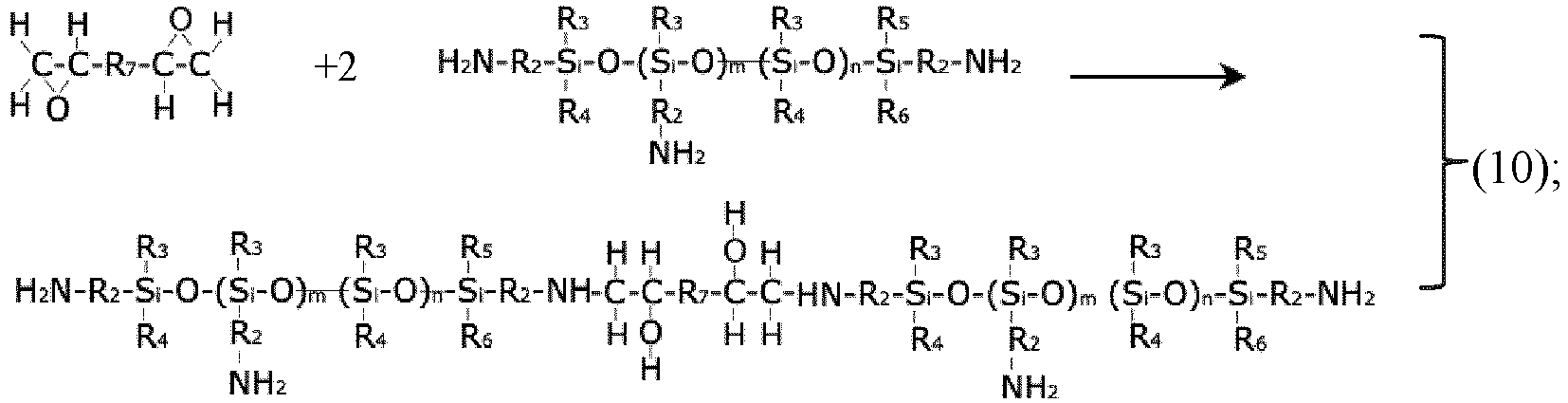 the formula (11) is expressed as:
 the formula (12) is expressed as:
- The thermally-conductive structural adhesive according to claim 1, characterized in that the block polymerized telechelic isocyanate compound is selected from the group consisting of an isocyanate of formula (13), a product formed by reaction of the isocyanate and a telechelic carboxyl polybutadiene according to formula (14) and removal of carbon dioxide, a product formed by reaction of the isocyanate and telechelic amino polypropylene oxide according to formula (15), a product formed by reaction of the isocyanate and aminopolyalkylsiloxane according to formula (16) and a combination thereof;the formula (13) is expressed as:
OCN-R1-NCO (13);
wherein in the formula (13), a number-average functionality of an isocyanate group is 2.0; and R1 is selected from the group consisting of alkylene, unsubstituted phenylene, substituted phenylene, unsubstituted arylene, substituted arylene, unsubstituted heterocyclic alkene, substituted heterocyclic alkene and a combination thereof;the formula (14) is expressed as: the formula (15) is expressed as:
 the formula (16) is expressed as:
- The thermally-conductive structural adhesive according to claim 1, characterized in that the block polymerized telechelic epoxy compound is selected from the group consisting of an epoxy resin of formula (17), a product formed by reaction of the epoxy resin and telechelic carboxyl polybutadiene according to formula (18), a product formed by reaction of the epoxy resin and telechelic amino polypropylene oxide according to formula (19), a product formed by reaction of the epoxy resin and aminopolyalkylsiloxane according to formula (20), epoxy polyalkylsiloxane of formula (21), a product formed by reaction of the epoxy polyalkylsiloxane and the telechelic carboxyl polybutadiene according to formula (22), a product formed by reaction of the epoxy polyalkylsiloxane and the telechelic amino polypropylene oxide according to formula (23), a product formed by reaction of the epoxy polyalkylsiloxane and the aminopolyalkylsiloxane according to formula (24) and a combination thereof;the formula (17) is expressed as:
 wherein in the formula (17), a number-average functionality of an epoxy group is 2.0 or 3.0; and R7 is selected from the group consisting of a group of formula (25), a group of formula (26), alkylene, unsubstituted phenylene, substituted phenylene, unsubstituted arylene, substituted arylene, unsubstituted heterocyclic alkene, substituted heterocyclic alkene and a combination thereof;the formula (18) is expressed as:
 the formula (19) is expressed as:
 the formula (20) is expressed as:
 the formula (21) is expressed as:
 wherein in the formula (21), m and n respectively represent a number-average polymerization degree of alkyl siloxane, m is greater than or equal to 0, and n is 5-50; a number-average functionality of epoxy group is 2.8-3.0; R2 is a C2-C5 alkylene; and R3, R4, R5 and R6 are independently selected from the group consisting of alkyl, unsubstituted phenyl, substituted phenyl, unsubstituted aryl, substituted aryl, unsubstituted heterocyclic group, substituted heterocyclic group and a combination thereof;the formula (22) is expressed as:
 the formula (23) is expressed as:
 the formula (24) is expressed as:
 the formula (25) is expressed as:
 wherein in the formula (25), a number-average degree of polymerization q is 1-2; a number-average functionality of epoxy group is 2.0 or 3.0; and R9 is selected from the group consisting of hydrogen, C1-C5 alkyl, unsubstituted phenyl, substituted phenyl, unsubstituted aryl, substituted aryl, unsubstituted heterocyclic group, substituted heterocyclic group and a combination thereof;the formula (26) is expressed as:
 wherein in the formula (26), a number-average degree of polymerization q is 1-2; a number-average functionality of epoxy group is 2.0 or 3.0; and R9 is selected from the group consisting of hydrogen, C1-C5 alkyl, unsubstituted phenyl, substituted phenyl, unsubstituted aryl, substituted aryl, unsubstituted heterocyclic group, substituted heterocyclic group and a combination thereof.
 - The thermally-conductive structural adhesive according to claim 1, characterized in that the first coupling agent and the second coupling agent are independently selected from the group consisting of hexadecyltrimethoxysilane [CAS: 16415-12-6], hexadecyl triethoxysilane [CAS:16415-13-7], 3-glycidoxypropyltrimethoxysilane [CAS: 2530-83-8], 3-glycidoxypropyltriethoxysilane [CAS:2602-34-8], γ-aminopropyltrimethoxysilane [CAS: 13822-56-5], γ-aminopropyl triethoxysilane [CAS: 919-30-2], n-β-aminoethyl)-γ-aminopropyltrimethoxysilane [CAS: 1760-24-3], n-(β-aminoethyl)-γ-aminopropyltriethoxysilane [CAS: 5089-72-5], γ-(methacryloyloxy)propyltrimethoxysilane [CAS: 2530-85-0], γ-(methacryloyloxy)propyltriethoxysilane [CAS: 21142-29-0], γ-pinyltriamino propylmethyldimethoxy silane [CAS:99740-64-4], isopropyldioleic (dioctylphosphosphate) titanate [CAS: 61417-49-0], isopropyl tri(dioctylphosphate) titanate [CAS: 65345-34-8], titanium triisostearoylisopropoxide [CAS: 61417-49-0], bis(P,P-bis-ethylhexyl diphosphato)ethanediolato titanate [CAS:65467-75-6], tetraisopropyl di(dioctylphosphate) titanate [CAS: 65460-52-8] and a combination thereof; and
the first modifier and the second modifier are independently selected from the group consisting of: oleic acid [CAS: 112-80-1], lauric acid [CAS: 143-07-7], caprylic acid [CAS: 124-07-2], ricinoleic acid [CAS: 141-22-0], rosin acid [CAS: 514-10-3], salicylic acid [CAS: 69-72-7], benzoic acid [CAS: 65-85-0], dodecylbenzene sulfonic acid [CAS: 27176-87-0], benzotriazole [CAS: 95-14-7], methylbenzotriazole [CAS: 29385-43-1] and a combination thereof. - The thermally-conductive structural adhesive according to claim 1, characterized in that the first curing accelerator and the second curing accelerator are independently selected from the group consisting of phenol [CAS: 108-95-2], 2,4,6-tris(dimethylaminomethyl)phenol [CAS:90-72-2], triphenylphosphine [CAS:603-35-0], imidazole [CAS:288-32-4] and a combination thereof.
- The thermally-conductive structural adhesive according to claim 1, characterized in that the first thermally-conductive powder and the second thermally-conductive powder are independently selected from the group consisting of aluminum oxide (Al2O3), magnesium oxide (MgO), silicon oxide (SiO2), aluminum nitride (AlN), boron nitride (BN), zinc oxide (ZnO), silicon nitride (Si3N4), silicon carbide (SiC), boron carbide (B4C) and a combination thereof;
the first thermally-conductive powder and the second thermally-conductive powder are independently spherical powder, flake powder, fibrous powder, irregular powder, hexagonal powder, cubic powder or a combination thereof; and with respect to the first thermally-conductive powder and the second thermally-conductive powder, an average particle size D50 of single particle and agglomerated particle is (0.16-120) µm. - The thermally-conductive structural adhesive according to claim 1, characterized in that the first flame retardant agent and the second flame retardant agent are independently selected from the group consisting of aluminum hydroxide (Al(OH)3), magnesium hydroxide (Mg(OH)2), melamino cyanurate [CAS:37640-57-6], ammonium polyphosphate (APP), aluminum hypophosphite (Al(H2PO2)3), tricresyl phosphate [CAS: 1330-78-5], diethyl ethyl phosphate [CAS: 682-30-4] and a combination thereof; and with respect to the first flame retardant agent and the second flame retardant agent, an average particle size D50 of single particle and agglomerated particle is (0.3-30) µm.
- The method according to claim 2, characterized in that in step (1), the block polymerization of the telechelic carboxyl compound is performed through steps of:adding a first material and telechelic carboxyl polybutadiene to a reactor in a molar ratio of 1: (1.8-5);starting a stirring device to mix the telechelic carboxyl polybutadiene with the first material evenly to obtain a first reaction mixture; andkeeping the first reaction mixture at a temperature ranging from room temperature to 145°C for 0.5-6 h to obtain the first block polymerized product;wherein the higher the temperature is, the shorter a keeping time is; and the first material is isocyanate, epoxy resin or epoxy polyalkylsiloxane;when the first material is the isocyanate, the first block polymerized product is obtained according to formula (2);when the first material is epoxy resin, the first block polymerized product is obtained according to formula (3);when the first material is epoxy polyalkylsiloxane, the first block polymerized product is obtained according to formula (4); andif a molar ratio of the telechelic carboxyl polybutadiene to the isocyanatemolar ratio or the epoxy resin is greater than 2, and a molar ratio of the telechelic carboxyl polybutadiene to the epoxy polyalkylsiloxane is greater than 3, the telechelic carboxyl polybutadiene is in excess;in step (1), the block polymerization of the telechelic amino compound is performed as follows:adding a second material and a third material to a reactor;starting a stirring device to mix the second material with the third material evenly to obtain a second reaction mixture; andkeeping the second reaction mixture at a temperature ranging from room temperature to 145°C for 0.5-6 h;wherein the higher the temperature is, the shorter a keeping time is;the second material is isocyanate, epoxy resin or epoxy polyalkylsiloxane;the third material is telechelic amino polypropylene oxide or aminopolyalkylsiloxane;when the second material is isocyanate or epoxy resin, a molar ratio of the second material to the third material is 1:(1.8-5); and when the second material is epoxy polyalkylsiloxane, a molar ratio of the second material to the third material is 1 :(2.8-8);when the second material is the isocyanate and the third material is the telechelic amino polypropylene oxide, the first block polymerized product is obtained according to formula (7);when the second material is the isocyanate and the third material is aminopolyalkylsiloxane, the first block polymerized product is obtained according to formula (8);when the second material is epoxy resin and the third material is the telechelic amino polypropylene oxide, the first block polymerized product is obtained according to formula (9);when the second material is epoxy resin and the third material is aminopolyalkylsiloxane, the first block polymerized product is obtained according to formula (10);when the second material is epoxy polyalkylsiloxane and the third material is the telechelic amino polypropylene oxide, the first block polymerized product is obtained according to formula (11);when the second material is epoxy polyalkylsiloxane and the third material is aminopolyalkylsiloxane, the first block polymerized product is obtained according to formula (12);in formulas (7-10), if a molar ratio of aminopolyalkylsiloxane or the telechelic amino polypropylene oxide to the epoxy resin or the isocyanate is greater than 2, the aminopolyalkylsiloxane or the telechelic amino polypropylene is in excess; andin formulas (11-12), if a molar ratio of the aminopolyalkylsiloxane or the telechelic amino polypropylene oxide to the epoxy polyalkylsiloxane is greater than 3, the aminopolyalkylsiloxane or the telechelic amino polypropylene oxide is in excess;in step (1), the block polymerization of the telechelic isocyanate compound is performed as follows:adding isocyanate and a fourth material to a reactor;starting a stirring device to mix the isocyanate with the fourth material evenly to obtain a third reaction mixture; andkeeping the third reaction mixture at a temperature ranging from room temperature to 145°C for 0.5-6 h;wherein the higher the temperature is, the shorter a keeping time is; and the fourth material is telechelic carboxyl polybutadiene, telechelic amino polypropylene oxide or aminopolyalkylsiloxane;wherein when the fourth material is telechelic carboxyl polybutadiene or telechelic amino polypropylene oxide, a molar ratio of the isocyanate to the fourth material is (1.8-5): 1; and when the fourth material is aminopolyalkylsiloxane, a molar ratio of the isocyanate to the fourth material is (2.8-8): 1;when the fourth material is the telechelic carboxyl polybutadiene, the second block polymerized product is obtained according to formula (14);when the fourth material is the telechelic amino polypropylene oxide, the second block polymerized product is obtained according to formula (15);when the fourth material is aminopolyalkylsiloxane, the second block polymerized product is obtained according to formula (16);in formulas (14-15), if a molar ratio of the isocyanate to the telechelic carboxyl polybutadiene or telechelic amino polypropylene oxide is greater than 2, the isocyanate is in excess; andin formula (16), if a molar ratio of the isocyanate to the aminopolyalkylsiloxane is greater than 3, the isocyanate is in excess; andin step (1), the block polymerization of the telechelic epoxy compound is performed as follows:adding a fifth material and a sixth material to a reactor;starting a stirring device to mix the fifth material with the sixth material evenly to obtain a fourth reaction mixture; andkeeping the fourth reaction mixture at a temperature ranging from room temperature to 145°C for (0.5-6) h;wherein the higher the temperature is, the shorter a keeping time is; the fifth material is epoxy resin or epoxy polyalkylsiloxane; the sixth material is telechelic carboxyl polybutadiene, telechelic amino polypropylene oxide or aminopolyalkylsiloxane; when the sixth material is telechelic carboxyl polybutadiene or telechelic amino polypropylene oxide, a molar ratio of the fifth material to the sixth material is (1.8-5):1; and when the sixth material is aminopolyalkylsiloxane, a molar ratio of the fifth material to the sixth material is (2.8-8):1;when the fifth material is the epoxy resin and the sixth material is the telechelic carboxyl polybutadiene, the second block polymerized product is obtained according to formula (18);when the fifth material is the epoxy resin and the sixth material is the telechelic amino polypropylene oxide, the second block polymerized product is obtained according to formula (19);when the fifth material is the epoxy polyalkylsiloxane and the sixth material is the telechelic carboxyl polybutadiene, the second block polymerized product is obtained according to formula (22);when the fifth material is the epoxy polyalkylsiloxane and the sixth material is the telechelic amino polypropylene oxide, the second block polymerized product is obtained according to formula (23);when the fifth material is the epoxy resin and the sixth material is aminopolyalkylsiloxane, the second block polymerized product is obtained according to formula (20);when the fifth material is the epoxy polyalkylsiloxane and the sixth material is aminopolyalkylsiloxane, the second block polymerized product is obtained according to formula (24);in formulas (18-19) and (22-23), if a molar ratio of the epoxy resin or the epoxy polyalkylsiloxane to the telechelic carboxyl polybutadiene or telechelic amino polypropylene oxide is greater than 2, the epoxy resin or the epoxy polyalkylsiloxane is in excess; andin formulas (20) and (24), if a molar ratio of the epoxy resin or the epoxy polyalkylsiloxane to the aminopolyalkylsiloxane is greater than 3, the epoxy resin or the epoxy polyalkylsiloxane is in excess.
- The method according to claim 2, characterized in that the step (2) is performed as follows:in a reactor A equipped with a stirring device and/or a high-shear dispersing device, adding the telechelic carboxyl compound and/or the telechelic amino compound, and the first powder mixture; wherein the first powder mixture comprises a first coupling agent and/or a first modifier, and a first curing accelerator, a first thermally-conductive powder and a first flame retardant agent;in a reactor B equipped with a stirring device and/or a high-shear dispersing device, adding the telechelic isocyanate compound or the telechelic epoxy compound, and the second powder mixture; wherein the second powder mixture comprises a second coupling agent and/or a second modifier, and a second curing accelerator, a second thermally-conductive powder and a second flame retardant agent;wherein individual ingredients of the first powder mixture are batchwise added according to average particle size D50 in order from small to large, and individual ingredients of the second powder mixture are batchwise added according to average particle size D50 in order from small to large;wherein each time an ingredient is added, a diameter of a stator and rotor is changed or a rotation speed of the high-shear dispersing device is adjusted to control a shear strength within 1200-233000 s-1, and a slurry temperature is controlled within 0-145°C for 0.1-4 h;the shear strength is controlled as follows:
 wherein Ss represents shear strength, in "1/s" or "s-1";V is a rotational linear velocity of an outer diameter of the rotor, or a rotational linear velocity of an outer diameter of the rotor relative to an adjacent rotor, in "m/s"; andδ is a minimum clearance between the stator and an adjacent rotor, or between two adjacent rotors, in "m";when an average particle size D50 of the first thermally-conductive powder, the first flame retardant agent, the second thermally-conductive powder and the second flame retardant agent is greater than 1.0 µm, the high-shear dispersing device is not required; in this case, the first thermally-conductive powder and the first flame retardant agent are added together and stirred by the stirring device at 100-1000 r/min, and the second thermally-conductive powder and the second flame retardant agent are added together and stirred by the stirring device at 100-1000 r/min.
 - The method according to claim 1, characterized in that in step (3), a pressure is a gauge pressure; the positive pressure reaction is performed at 0.0-0.1 MPa; the negative pressure reaction is performed at (-0.01)-(-0.1) MPa to remove air, carbon dioxide, moisture and low-molecule impurities; the positive pressure reaction or the negative pressure reaction also comprises at least one of reactions expressed by formulas (2-4) and (7-12); and at least one of reactions expressed by formulas (14-16), (18-20) and (22-24); wherein while performing step (2) or at a later stage of step (2), a vacuum pump is started to reduce the pressure to -0.1 MPa.
- The method according to claim 1, characterized in that in step (4), the heating and cooling are performed as follows:while performing steps (1), (2) and (3), filling a heat transfer medium into a jacket of a reactor; anddriving, by a fluid circulation device, the heat transfer medium to perform heating and cooling;wherein a heat source is a heat transfer oil furnace or an electric heating device; the heat transfer medium is a heat transfer oil, water or a cooling agent; and the fluid circulation device is a mold temperature controller, a magnetic drive pump, a reciprocating plunger pump, a peristaltic pump or a centrifugal pump.
Applications Claiming Priority (2)
| Application Number | Priority Date | Filing Date | Title |
|---|---|---|---|
| CN202110765837.5A CN113528056A (en) | 2021-06-29 | 2021-06-29 | Heat-conducting structural adhesive for new energy power battery and manufacturing method thereof |
| PCT/CN2022/088056 WO2023273538A1 (en) | 2021-06-29 | 2022-04-21 | Thermally conductive structural adhesive for new energy power battery and manufacturing method therefor |
Publications (4)
| Publication Number | Publication Date |
|---|---|
| EP4137549A1 true EP4137549A1 (en) | 2023-02-22 |
| EP4137549A4 EP4137549A4 (en) | 2024-01-03 |
| EP4137549C0 EP4137549C0 (en) | 2026-01-14 |
| EP4137549B1 EP4137549B1 (en) | 2026-01-14 |
Family
ID=84284423
Family Applications (1)
| Application Number | Title | Priority Date | Filing Date |
|---|---|---|---|
| EP22734859.6A Active EP4137549B1 (en) | 2021-06-29 | 2022-04-21 | Thermally conductive structural adhesive for new energy power battery and manufacturing method therefor |
Country Status (4)
| Country | Link |
|---|---|
| US (1) | US11949081B2 (en) |
| EP (1) | EP4137549B1 (en) |
| JP (1) | JP2023536026A (en) |
| KR (1) | KR20230005110A (en) |
Families Citing this family (1)
| Publication number | Priority date | Publication date | Assignee | Title |
|---|---|---|---|---|
| US20260005331A1 (en) * | 2024-06-27 | 2026-01-01 | Kyma Batteries LLC | Battery cells with thermally conductive potting |
Family Cites Families (7)
| Publication number | Priority date | Publication date | Assignee | Title |
|---|---|---|---|---|
| US5576388A (en) | 1994-10-11 | 1996-11-19 | Shell Oil Company | Telechelic polymers and heterotelechelic polydiene block polymers with dual cure systems |
| CA2202279A1 (en) | 1994-10-11 | 1996-04-18 | David John St. Clair | Pressure sensitive structural adhesives and sealants based on telechelic/heterotelechelic polymers with dual cure systems |
| JP7211693B2 (en) * | 2016-10-03 | 2023-01-24 | 味の素株式会社 | resin composition |
| CN109880571A (en) * | 2019-01-24 | 2019-06-14 | 深圳市锦昊辉矿业发展有限公司 | Bi-component curable polyurethane ceramic sealant |
| CN113461901A (en) | 2021-06-29 | 2021-10-01 | 深圳市金菱通达电子有限公司 | A cluster of telechelic active functional group compositions, methods of manufacture and uses thereof |
| CN113480968A (en) * | 2021-06-29 | 2021-10-08 | 深圳市金菱通达电子有限公司 | Heat-insulating structural adhesive for new energy power battery and manufacturing method thereof |
| CN113528056A (en) | 2021-06-29 | 2021-10-22 | 深圳市金菱通达电子有限公司 | Heat-conducting structural adhesive for new energy power battery and manufacturing method thereof |
-
2022
- 2022-04-21 EP EP22734859.6A patent/EP4137549B1/en active Active
- 2022-04-21 KR KR1020227025157A patent/KR20230005110A/en not_active Ceased
- 2022-04-21 JP JP2022543540A patent/JP2023536026A/en active Pending
- 2022-07-13 US US17/864,309 patent/US11949081B2/en active Active
Also Published As
| Publication number | Publication date |
|---|---|
| US11949081B2 (en) | 2024-04-02 |
| EP4137549A4 (en) | 2024-01-03 |
| EP4137549C0 (en) | 2026-01-14 |
| EP4137549B1 (en) | 2026-01-14 |
| US20220393264A1 (en) | 2022-12-08 |
| KR20230005110A (en) | 2023-01-09 |
| JP2023536026A (en) | 2023-08-23 |
Similar Documents
| Publication | Publication Date | Title |
|---|---|---|
| CN109337630B (en) | Preparation method of double-component room-temperature fast-curing anti-seismic heat-conducting structure adhesive | |
| CN111040698B (en) | Epoxy resin pouring sealant, preparation method and novel electric drive motor | |
| WO2023273538A1 (en) | Thermally conductive structural adhesive for new energy power battery and manufacturing method therefor | |
| CN111995979B (en) | Polyurethane heat-conducting structural adhesive capable of being quickly cured at room temperature | |
| CN115103881B (en) | Elastomeric silicone materials and their applications | |
| JP2011208007A (en) | Resin composite composition and application thereof | |
| CN112679962B (en) | Organic silicon flame retardant, flame-retardant organic silicon rubber for safe lithium battery pack and preparation method of flame-retardant organic silicon rubber | |
| CN112105687B (en) | Controlled Cure Thermally Conductive Gap Filler | |
| EP4137549A1 (en) | Thermally conductive structural adhesive for new energy power battery and manufacturing method therefor | |
| CN115087705A (en) | Elastomeric silicone materials and uses thereof | |
| CN106349711A (en) | Porcelainizable organosilicon encapsulating material for electromobile safety power battery pack and preparation method thereof | |
| KR20200098778A (en) | Method of preparing Thermal Interface Material for Battery Package of Electrical Vehicle | |
| CN112029199A (en) | High enthalpy flame-retardant phase-change material and preparation method thereof | |
| WO2020031669A1 (en) | Silicone composition and method for manufacturing same | |
| CN113461901A (en) | A cluster of telechelic active functional group compositions, methods of manufacture and uses thereof | |
| CN113480968A (en) | Heat-insulating structural adhesive for new energy power battery and manufacturing method thereof | |
| JP3824066B2 (en) | Epoxy resin composition for semiconductor encapsulation and semiconductor device | |
| KR102619037B1 (en) | Gap filler composition and battery pack | |
| CN115975596A (en) | Bi-component organic silicon pouring sealant and preparation method thereof | |
| KR102877706B1 (en) | Gap filler composition and battery pack | |
| KR102832948B1 (en) | Gap filler composition and battery pack | |
| KR102705606B1 (en) | Gap filler composition and battery pack | |
| EP3819328A1 (en) | Thermally-conductive curable composition | |
| KR20240115200A (en) | Gap filler composition and battery pack | |
| CN119371624A (en) | Low-density silicone-polyurethane potting material and preparation method and use thereof |
Legal Events
| Date | Code | Title | Description |
|---|---|---|---|
| STAA | Information on the status of an ep patent application or granted ep patent |
Free format text: STATUS: UNKNOWN |
|
| STAA | Information on the status of an ep patent application or granted ep patent |
Free format text: STATUS: THE INTERNATIONAL PUBLICATION HAS BEEN MADE |
|
| PUAI | Public reference made under article 153(3) epc to a published international application that has entered the european phase |
Free format text: ORIGINAL CODE: 0009012 |
|
| STAA | Information on the status of an ep patent application or granted ep patent |
Free format text: STATUS: REQUEST FOR EXAMINATION WAS MADE |
|
| 17P | Request for examination filed |
Effective date: 20220711 |
|
| AK | Designated contracting states |
Kind code of ref document: A1 Designated state(s): AL AT BE BG CH CY CZ DE DK EE ES FI FR GB GR HR HU IE IS IT LI LT LU LV MC MK MT NL NO PL PT RO RS SE SI SK SM TR |
|
| A4 | Supplementary search report drawn up and despatched |
Effective date: 20231205 |
|
| RIC1 | Information provided on ipc code assigned before grant |
Ipc: C09J 109/00 20060101AFI20231129BHEP |
|
| STAA | Information on the status of an ep patent application or granted ep patent |
Free format text: STATUS: EXAMINATION IS IN PROGRESS |
|
| DAV | Request for validation of the european patent (deleted) | ||
| DAX | Request for extension of the european patent (deleted) | ||
| 17Q | First examination report despatched |
Effective date: 20240926 |
|
| GRAP | Despatch of communication of intention to grant a patent |
Free format text: ORIGINAL CODE: EPIDOSNIGR1 |
|
| STAA | Information on the status of an ep patent application or granted ep patent |
Free format text: STATUS: GRANT OF PATENT IS INTENDED |
|
| INTG | Intention to grant announced |
Effective date: 20251027 |
|
| RAP3 | Party data changed (applicant data changed or rights of an application transferred) |
Owner name: SHENZHEN GOLDLINK TONGDA ELECTRONICS CO., LTD. Owner name: DONGGUAN GOLDLINK TONGDA THERMALCONDUCTIVE MATERIALS MFG CO., LTD. |
|
| GRAS | Grant fee paid |
Free format text: ORIGINAL CODE: EPIDOSNIGR3 |
|
| GRAA | (expected) grant |
Free format text: ORIGINAL CODE: 0009210 |
|
| STAA | Information on the status of an ep patent application or granted ep patent |
Free format text: STATUS: THE PATENT HAS BEEN GRANTED |
|
| AK | Designated contracting states |
Kind code of ref document: B1 Designated state(s): AL AT BE BG CH CY CZ DE DK EE ES FI FR GB GR HR HU IE IS IT LI LT LU LV MC MK MT NL NO PL PT RO RS SE SI SK SM TR |
|
| REG | Reference to a national code |
Ref country code: CH Ref legal event code: F10 Free format text: ST27 STATUS EVENT CODE: U-0-0-F10-F00 (AS PROVIDED BY THE NATIONAL OFFICE) Effective date: 20260114 Ref country code: GB Ref legal event code: FG4D |
|
| REG | Reference to a national code |
Ref country code: DE Ref legal event code: R096 Ref document number: 602022028433 Country of ref document: DE |
|
| REG | Reference to a national code |
Ref country code: IE Ref legal event code: FG4D |
|
| U01 | Request for unitary effect filed |
Effective date: 20260116 |
|
| U07 | Unitary effect registered |
Designated state(s): AT BE BG DE DK EE FI FR IT LT LU LV MT NL PT RO SE SI Effective date: 20260121 |
|
| PGFP | Annual fee paid to national office [announced via postgrant information from national office to epo] |
Ref country code: GB Payment date: 20260320 Year of fee payment: 5 |
|
| U20 | Renewal fee for the european patent with unitary effect paid |
Year of fee payment: 5 Effective date: 20260320 |