EP4137086A2 - Mécanismes d'entraînement d'effecteur terminal pour instruments chirurgicaux tels que ceux destinés à être utilisés dans des systèmes chirurgicaux robotiques - Google Patents
Mécanismes d'entraînement d'effecteur terminal pour instruments chirurgicaux tels que ceux destinés à être utilisés dans des systèmes chirurgicaux robotiques Download PDFInfo
- Publication number
- EP4137086A2 EP4137086A2 EP22190360.2A EP22190360A EP4137086A2 EP 4137086 A2 EP4137086 A2 EP 4137086A2 EP 22190360 A EP22190360 A EP 22190360A EP 4137086 A2 EP4137086 A2 EP 4137086A2
- Authority
- EP
- European Patent Office
- Prior art keywords
- jaw members
- lever
- input
- tissue
- housing
- Prior art date
- Legal status (The legal status is an assumption and is not a legal conclusion. Google has not performed a legal analysis and makes no representation as to the accuracy of the status listed.)
- Pending
Links
Images


Classifications
-
- A—HUMAN NECESSITIES
- A61—MEDICAL OR VETERINARY SCIENCE; HYGIENE
- A61B—DIAGNOSIS; SURGERY; IDENTIFICATION
- A61B34/00—Computer-aided surgery; Manipulators or robots specially adapted for use in surgery
- A61B34/70—Manipulators specially adapted for use in surgery
- A61B34/76—Manipulators having means for providing feel, e.g. force or tactile feedback
-
- A—HUMAN NECESSITIES
- A61—MEDICAL OR VETERINARY SCIENCE; HYGIENE
- A61B—DIAGNOSIS; SURGERY; IDENTIFICATION
- A61B18/00—Surgical instruments, devices or methods for transferring non-mechanical forms of energy to or from the body
- A61B18/04—Surgical instruments, devices or methods for transferring non-mechanical forms of energy to or from the body by heating
- A61B18/12—Surgical instruments, devices or methods for transferring non-mechanical forms of energy to or from the body by heating by passing a current through the tissue to be heated, e.g. high-frequency current
- A61B18/1206—Generators therefor
-
- A—HUMAN NECESSITIES
- A61—MEDICAL OR VETERINARY SCIENCE; HYGIENE
- A61B—DIAGNOSIS; SURGERY; IDENTIFICATION
- A61B18/00—Surgical instruments, devices or methods for transferring non-mechanical forms of energy to or from the body
- A61B18/04—Surgical instruments, devices or methods for transferring non-mechanical forms of energy to or from the body by heating
- A61B18/12—Surgical instruments, devices or methods for transferring non-mechanical forms of energy to or from the body by heating by passing a current through the tissue to be heated, e.g. high-frequency current
- A61B18/14—Probes or electrodes therefor
- A61B18/1442—Probes having pivoting end effectors, e.g. forceps
-
- A—HUMAN NECESSITIES
- A61—MEDICAL OR VETERINARY SCIENCE; HYGIENE
- A61B—DIAGNOSIS; SURGERY; IDENTIFICATION
- A61B18/00—Surgical instruments, devices or methods for transferring non-mechanical forms of energy to or from the body
- A61B18/04—Surgical instruments, devices or methods for transferring non-mechanical forms of energy to or from the body by heating
- A61B18/12—Surgical instruments, devices or methods for transferring non-mechanical forms of energy to or from the body by heating by passing a current through the tissue to be heated, e.g. high-frequency current
- A61B18/14—Probes or electrodes therefor
- A61B18/1442—Probes having pivoting end effectors, e.g. forceps
- A61B18/1445—Probes having pivoting end effectors, e.g. forceps at the distal end of a shaft, e.g. forceps or scissors at the end of a rigid rod
-
- A—HUMAN NECESSITIES
- A61—MEDICAL OR VETERINARY SCIENCE; HYGIENE
- A61B—DIAGNOSIS; SURGERY; IDENTIFICATION
- A61B34/00—Computer-aided surgery; Manipulators or robots specially adapted for use in surgery
- A61B34/30—Surgical robots
- A61B34/37—Leader-follower robots
-
- A—HUMAN NECESSITIES
- A61—MEDICAL OR VETERINARY SCIENCE; HYGIENE
- A61B—DIAGNOSIS; SURGERY; IDENTIFICATION
- A61B17/00—Surgical instruments, devices or methods
- A61B2017/00367—Details of actuation of instruments, e.g. relations between pushing buttons, or the like, and activation of the tool, working tip, or the like
-
- A—HUMAN NECESSITIES
- A61—MEDICAL OR VETERINARY SCIENCE; HYGIENE
- A61B—DIAGNOSIS; SURGERY; IDENTIFICATION
- A61B17/00—Surgical instruments, devices or methods
- A61B17/28—Surgical forceps
- A61B17/29—Forceps for use in minimally invasive surgery
- A61B17/2909—Handles
- A61B2017/2912—Handles transmission of forces to actuating rod or piston
-
- A—HUMAN NECESSITIES
- A61—MEDICAL OR VETERINARY SCIENCE; HYGIENE
- A61B—DIAGNOSIS; SURGERY; IDENTIFICATION
- A61B18/00—Surgical instruments, devices or methods for transferring non-mechanical forms of energy to or from the body
- A61B2018/00571—Surgical instruments, devices or methods for transferring non-mechanical forms of energy to or from the body for achieving a particular surgical effect
- A61B2018/0063—Sealing
-
- A—HUMAN NECESSITIES
- A61—MEDICAL OR VETERINARY SCIENCE; HYGIENE
- A61B—DIAGNOSIS; SURGERY; IDENTIFICATION
- A61B18/00—Surgical instruments, devices or methods for transferring non-mechanical forms of energy to or from the body
- A61B2018/00636—Sensing and controlling the application of energy
- A61B2018/00696—Controlled or regulated parameters
- A61B2018/00702—Power or energy
-
- A—HUMAN NECESSITIES
- A61—MEDICAL OR VETERINARY SCIENCE; HYGIENE
- A61B—DIAGNOSIS; SURGERY; IDENTIFICATION
- A61B18/00—Surgical instruments, devices or methods for transferring non-mechanical forms of energy to or from the body
- A61B2018/00636—Sensing and controlling the application of energy
- A61B2018/00773—Sensed parameters
-
- A—HUMAN NECESSITIES
- A61—MEDICAL OR VETERINARY SCIENCE; HYGIENE
- A61B—DIAGNOSIS; SURGERY; IDENTIFICATION
- A61B18/00—Surgical instruments, devices or methods for transferring non-mechanical forms of energy to or from the body
- A61B2018/00636—Sensing and controlling the application of energy
- A61B2018/00773—Sensed parameters
- A61B2018/00875—Resistance or impedance
-
- A—HUMAN NECESSITIES
- A61—MEDICAL OR VETERINARY SCIENCE; HYGIENE
- A61B—DIAGNOSIS; SURGERY; IDENTIFICATION
- A61B18/00—Surgical instruments, devices or methods for transferring non-mechanical forms of energy to or from the body
- A61B2018/0091—Handpieces of the surgical instrument or device
-
- A—HUMAN NECESSITIES
- A61—MEDICAL OR VETERINARY SCIENCE; HYGIENE
- A61B—DIAGNOSIS; SURGERY; IDENTIFICATION
- A61B18/00—Surgical instruments, devices or methods for transferring non-mechanical forms of energy to or from the body
- A61B18/04—Surgical instruments, devices or methods for transferring non-mechanical forms of energy to or from the body by heating
- A61B18/12—Surgical instruments, devices or methods for transferring non-mechanical forms of energy to or from the body by heating by passing a current through the tissue to be heated, e.g. high-frequency current
- A61B18/14—Probes or electrodes therefor
- A61B18/1442—Probes having pivoting end effectors, e.g. forceps
- A61B2018/1452—Probes having pivoting end effectors, e.g. forceps including means for cutting
- A61B2018/1455—Probes having pivoting end effectors, e.g. forceps including means for cutting having a moving blade for cutting tissue grasped by the jaws
-
- A—HUMAN NECESSITIES
- A61—MEDICAL OR VETERINARY SCIENCE; HYGIENE
- A61B—DIAGNOSIS; SURGERY; IDENTIFICATION
- A61B34/00—Computer-aided surgery; Manipulators or robots specially adapted for use in surgery
- A61B34/70—Manipulators specially adapted for use in surgery
- A61B34/74—Manipulators with manual electric input means
- A61B2034/742—Joysticks
-
- A—HUMAN NECESSITIES
- A61—MEDICAL OR VETERINARY SCIENCE; HYGIENE
- A61B—DIAGNOSIS; SURGERY; IDENTIFICATION
- A61B90/00—Instruments, implements or accessories specially adapted for surgery or diagnosis and not covered by any of the groups A61B1/00 - A61B50/00, e.g. for luxation treatment or for protecting wound edges
- A61B90/06—Measuring instruments not otherwise provided for
- A61B2090/064—Measuring instruments not otherwise provided for for measuring force, pressure or mechanical tension
- A61B2090/066—Measuring instruments not otherwise provided for for measuring force, pressure or mechanical tension for measuring torque
-
- A—HUMAN NECESSITIES
- A61—MEDICAL OR VETERINARY SCIENCE; HYGIENE
- A61B—DIAGNOSIS; SURGERY; IDENTIFICATION
- A61B2562/00—Details of sensors; Constructional details of sensor housings or probes; Accessories for sensors
- A61B2562/02—Details of sensors specially adapted for in-vivo measurements
- A61B2562/0252—Load cells
-
- A—HUMAN NECESSITIES
- A61—MEDICAL OR VETERINARY SCIENCE; HYGIENE
- A61B—DIAGNOSIS; SURGERY; IDENTIFICATION
- A61B2562/00—Details of sensors; Constructional details of sensor housings or probes; Accessories for sensors
- A61B2562/02—Details of sensors specially adapted for in-vivo measurements
- A61B2562/0261—Strain gauges
-
- A—HUMAN NECESSITIES
- A61—MEDICAL OR VETERINARY SCIENCE; HYGIENE
- A61B—DIAGNOSIS; SURGERY; IDENTIFICATION
- A61B34/00—Computer-aided surgery; Manipulators or robots specially adapted for use in surgery
- A61B34/30—Surgical robots
Definitions
- the present disclosure relates to surgical instruments and, more specifically, to end effector drive mechanisms for surgical instruments such as for use in robotic surgical systems.
- Robotic surgical systems are increasingly utilized in various different surgical procedures.
- Some robotic surgical systems include a console supporting a robotic arm.
- One or more different surgical instruments may be configured for use with the robotic surgical system and selectively mountable to the robotic arm.
- the robotic arm provides one or more inputs to the mounted surgical instrument to enable operation of the mounted surgical instrument.
- a surgical forceps one type of instrument capable of being utilized with a robotic surgical system, relies on mechanical action between its jaw members to grasp, clamp, and constrict tissue. Electrosurgical forceps utilize both mechanical clamping action and energy to heat tissue to treat, e.g., coagulate, cauterize, or seal, tissue. Typically, once tissue is treated, the tissue is severed using a cutting element. Accordingly, electrosurgical forceps are designed to incorporate a cutting element to effectively sever treated tissue. Alternatively, energy-based, e.g., thermal, electrical, ultrasonic, etc., cutting mechanisms may be implemented.
- haptic feedback may be lost or sacrificed for ease of use to offset among other things, surgical fatigue.
- distal refers to the portion that is being described which is farther from an operator (whether a human surgeon or a surgical robot), while the term “proximal” refers to the portion that is being described which is closer to the operator.
- proximal refers to the portion that is being described which is closer to the operator.
- the terms "about,” substantially,” and the like, as utilized herein, are meant to account for manufacturing, material, environmental, use, and/or measurement tolerances and variations, and in any event may encompass differences of up to 10%. Further, to the extent consistent, any of the aspects described herein may be used in conjunction with any or all of the other aspects described herein.
- a robotic surgical system including an electrosurgical instrument including an instrument housing having a shaft extending therefrom.
- An end effector assembly is disposed at a distal end of the shaft and includes first and second jaw members movable between a first position wherein at least one of the jaw members is spaced relative to the other of the jaw members and a second position wherein the first and second jaw members cooperate to grasp tissue.
- An input is operably coupled to the instrument housing and is configured to move the jaw members between the first and second positions.
- the input is configured to operably couple to a torque sensor configured to measure the torque of the input during rotation thereof.
- One or more handles is remotely disposed relative to the instrument housing and is configured to communicate with the input for controlling the movement of the jaw members.
- the handle includes a housing having a lever operably coupled thereto, the housing defining a cavity therein configured to house one or more components configured to operably connect to the input such that movement of the lever relative to the housing correlates to movement of the jaw members between the first and second positions.
- the one or more components is configured to operably regulate the resistance of the lever in response to the feedback from the torque sensor.
- the one or more components are configured to operably regulate the resistance of the lever relative to a baseline torque measurement of the input measured during manufacturing. In other aspects according to the present disclosure, the one or more components are configured to operably regulate the resistance of the lever relative to a torque curve of the input.
- the correlation of the resistance of the lever to the torque of the input is linear. In other aspects according to the present disclosure, the correlation of the resistance of the lever to the torque of the input is non-linear.
- the combination of components disposed in the cavity include levers, gears, linkages, and springs.
- a robotic surgical system including an electrosurgical instrument including an instrument housing having a shaft extending therefrom.
- An end effector assembly is disposed at a distal end of the shaft and includes first and second jaw members having opposing tissue-contacting surfaces.
- the jaw members are movable between a first position wherein at least one of the jaw members is spaced relative to the other of the jaw members and a second position wherein the first and second jaw members cooperate to grasp tissue.
- the opposing tissue-contacting surfaces are operably connected to opposite polarities of the generator.
- An input is operably coupled to the instrument housing and is configured to move the jaw members between the first and second positions.
- One or more handles is remotely disposed relative to the instrument housing and is configured to communicate with the input for controlling the movement of the jaw members.
- the handle includes a housing having a lever operably coupled thereto.
- the housing includes a cavity defined therein configured to house one or more components therein configured to operably connect to the input such that movement of the lever relative to the housing correlates to movement of the jaw members between the first and second positions.
- the generator Prior to the supplying electrosurgical energy to the opposing tissue-contacting surfaces, the generator is configured to sense an impedance between the opposing tissue contacting surfaces and determine an amount of tissue disposed therebetween.
- the one or more components are configured to operably regulate a resistance of the lever in response to the impedance feedback from the generator.
- the generator is configured to send a low energy signal across the opposing tissue-contacting surfaces to determine the presence of tissue and the corresponding impedance thereof disposed therebetween.
- the correlation of the resistance of the lever to the impedance is linear. In other aspects according to the present disclosure, the correlation of the resistance of the lever to the impedance is non-linear.
- the combination of components disposed in the cavity include levers, gears, linkages, and springs.
- the system further includes a switch operably disposed on the lever or the housing, the switch moveable between a first position where the lever, upon movement thereof, cooperates with the input to impart movement to the jaw members between the first and second positions with a closure pressure within the range of about 0.1 kg/cm 2 to about 2 kg/cm 2 and a second position wherein movement of the lever imparts movement to the jaw members with a closure pressure within the range of about 3 kg/cm 2 to about 16 kg/cm 2 .
- the resistance of the lever is configured to correlate with the position of the switch.
- system further includes a tactile, visual and/or audible indicator of the closure pressure between the jaw members.
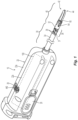
- a surgical instrument 10 provided in accordance with the present disclosure generally includes a housing 20, a shaft 30 extending distally from housing 20, an end effector assembly 40 extending distally from shaft 30, and an actuation assembly 100 disposed within housing 20 and operably associated with shaft 30 and end effector assembly 40.
- Instrument 10 is detailed herein as an articulating electrosurgical forceps configured for use with a robotic surgical system, e.g., robotic surgical system 500 ( FIG. 3 ).
- robotic surgical system 500 FIG. 3
- the aspects and features of instrument 10 provided in accordance with the present disclosure, detailed below, are equally applicable for use with other suitable surgical instruments (including non-robotic surgical instrument) and/or in other suitable surgical systems (including non-robotic surgical systems).
- Housing 20 of instrument 10 includes first and second body portion 22a, 22b and a proximal face plate 24 ( FIG. 2 ) that cooperate to enclose actuation assembly 100 therein.
- Proximal face plate 24 includes apertures defined therein through which inputs 110-140 of actuation assembly 100 extend.
- a pair of latch levers 26 (only one of which is illustrated in FIG. 1 ) extend outwardly from opposing sides of housing 20 and enables releasable engagement (directly or indirectly) of housing 20 with a robotic arm of a surgical system, e.g., robotic surgical system 500 ( FIG. 3 ).
- An aperture 28 defined through housing 20 permits thumbwheel 440 to extend therethrough to enable manual manipulation of thumbwheel 440 from the exterior of housing 20 to permit manual opening and closing of end effector assembly 40.
- Shaft 30 of instrument 10 includes a distal segment 32, a proximal segment 34, and an articulating section 36 disposed between the distal and proximal segments 32, 34, respectively.
- Articulating section 36 includes one or more articulating components 37, e.g., links, joints, etc.
- a plurality of articulation cables 38 e.g., four (4) articulation cables, or other suitable actuators, extends through articulating section 36.
- articulation cables 38 are operably coupled to distal segment 32 of shaft 30 at the distal ends thereof and extend proximally from distal segment 32 of shaft 30, through articulating section 36 of shaft 30 and proximal segment 34 of shaft 30, and into housing 20, wherein articulation cables 38 operably couple with an articulation assembly 200 of actuation assembly 100 to enable selective articulation of distal segment 32 (and, thus end effector assembly 40) relative to proximal segment 34 and housing 20, e.g., about at least two axes of articulation (yaw and pitch articulation, for example).
- Articulation cables 38 are arranged in a generally rectangular configuration, although other suitable configurations are also contemplated.
- actuation of articulation cables 38 is effected in pairs. More specifically, in order to pitch end effector assembly 40, the upper pair of cables 38 is actuated in a similar manner while the lower pair of cables 38 is actuated in a similar manner relative to one another but an opposite manner relative to the upper pair of cables 38. With respect to yaw articulation, the right pair of cables 38 is actuated in a similar manner while the left pair of cables 38 is actuated in a similar manner relative to one another but an opposite manner relative to the right pair of cables 38.
- Distal segment 32 of shaft 30 defines a clevis portion of end effector assembly 40 that supports first and second jaw members 42, 44, respectively.
- Each jaw member 42, 44 includes a proximal extension portion 43a, 45a and a distal body portion 43b, 45b, respectively.
- Distal body portions 43b, 45b define opposed tissue-contacting surfaces 46, 48, respectively.
- Proximal extension portions 43a, 45a are pivotably coupled to one another about a pivot pin 50 and are operably coupled to one another via a cam drive mechanism 52 (described in greater detail below) to enable pivoting of jaw member 42 relative to jaw member 44 and distal segment 32 of shaft 30 between a spaced-apart position (e.g., an open position of end effector assembly 40) and an approximated position (e.g., a closed position of end effector assembly 40) for grasping tissue between tissue-contacting surfaces 46, 48.
- a bilateral configuration may be provided whereby both jaw members 42, 44 are pivotable relative to one another and distal segment 32 of shaft 30.
- Opposing longitudinally-extending channels are defined through tissue-contacting surfaces 46, 48, respectively, of jaw members 42, 44.
- a translating cutting element (not shown) is provided and selectively advanceable to enable cutting of tissue grasped between tissue-contacting surfaces 46, 48 of jaw members 42, 44, respectively.
- a cutting drive assembly 300 ( FIG. 2 ) of actuation assembly 100 provides for selective actuation of cutting element through channel(s) of jaw members 42, 44 to cut tissue grasped between tissue-contacting surfaces 46, 48.
- Cutting drive assembly 300 is operably coupled to third input 130 of actuation assembly 100 such that, upon receipt of appropriate rotational input into third input 130, cutting drive assembly 300 advances the cutting element between jaw members 42, 44 to cut tissue grasped between tissue-contacting surfaces 46, 48.
- a drive rod (not shown) is operably coupled to end effector assembly 40 such that longitudinal actuation of drive rod pivots jaw member 42 relative to jaw member 44 between the spaced-apart and approximated positions, as detailed below. More specifically, urging drive rod proximally pivots jaw member 42 relative to jaw member 44 towards the approximated position while urging drive rod distally pivots jaw member 42 relative to jaw member 44 towards the spaced-apart position.
- the reverse configuration is also contemplated.
- Drive rod extends proximally from end effector assembly 40 through shaft 30 and into housing 20 wherein drive rod is operably coupled with a jaw drive assembly 400 of actuation assembly 100 to enable selective actuation of end effector assembly 40 to grasp tissue therebetween and apply a closure force within an appropriate jaw closure force range, e.g., in response to an appropriate rotational input into fourth input 140.
- Tissue-contacting surfaces 46, 48 of jaw members 42, 44, respectively are at least partially formed from an electrically conductive material and are energizable to different potentials to enable the conduction of electrical energy through tissue grasped therebetween, although tissue-contacting surfaces 46, 48 may alternatively be configured to supply any suitable energy, e.g., thermal, microwave, light, ultrasonic, etc., through tissue grasped therebetween for energy-based tissue treatment.
- tissue-contacting surfaces 46, 48 may alternatively be configured to supply any suitable energy, e.g., thermal, microwave, light, ultrasonic, etc., through tissue grasped therebetween for energy-based tissue treatment.
- Instrument 10 defines conductive pathways extending through housing 20 and shaft 30 to end effector assembly 40 that may include lead wires, contacts, and/or electrically-conductive components to enable electrical connection of tissue-contacting surfaces 46, 48 of jaw members 42, 44, respectively, to an energy source (not shown), e.g., an electrosurgical generator via an electrosurgical cable extending therebetween, for supplying energy to tissue-contacting surfaces 46, 48 to treat, e.g., seal, tissue grasped between tissue-contacting surfaces 46, 48.
- an energy source e.g., an electrosurgical generator via an electrosurgical cable extending therebetween
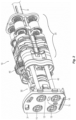
- Actuation assembly 100 is disposed within housing 20 and includes articulation assembly 200, cutting drive assembly 300, and jaw drive assembly 400.
- Articulation assembly 200 is operably coupled between first and second inputs 110, 120, respectively, of actuation assembly 100 and articulation cables 38 such that, upon receipt of appropriate rotational inputs into first and/or second inputs 110, 120, articulation assembly 200 manipulates cables 38 ( FIG. 1 ) to articulate end effector assembly 40 in a desired direction, e.g., to pitch and/or yaw end effector assembly 40.
- Cutting drive assembly 300 as noted above, enables reciprocation of the cutting element between jaw members 42, 44 to cut tissue grasped between tissue-contacting surfaces 46, 48 in response to receipt of appropriate rotational input into third input 130.
- Jaw drive assembly 400 is operably coupled between fourth input 140 of actuation assembly 100 and drive rod such that, upon receipt of appropriate rotational input into fourth input 140, jaw drive assembly 400 pivots jaw members 42, 44 between the spaced-apart and approximated positions to grasp tissue therebetween and apply a closure force within an appropriate closure force range.
- Actuation assembly 100 is configured to operably interface with a robotic surgical system 500 ( FIG. 3 ) when instrument 10 is mounted on robotic surgical system 500 ( FIG. 3 ), to enable robotic operation of actuation assembly 100 to provide the above-detailed functionality. That is, robotic surgical system 500 ( FIG. 3 ) selectively provides rotational inputs to inputs 110-140 of actuation assembly 100 to articulate end effector assembly 40, grasp tissue between jaw members 42, 44, and/or cut tissue grasped between jaw members 42, 44.
- actuation assembly 100 be configured to interface with any other suitable surgical system, e.g., a manual surgical handle, a powered surgical handle, etc.
- robotic surgical system 500 FIG. 3
- robotic surgical system 500 is generally described.
- FIG. 3 a schematic representation of a robotic surgical system 500 is configured for use in accordance with the present disclosure. Aspects and features of robotic surgical system 500 not germane to the understanding of the present disclosure are omitted to avoid obscuring the aspects and features of the present disclosure in unnecessary detail.
- Robotic surgical system 500 generally includes a plurality of robot arms 502, 503; a control device 504; and an operating console 505 coupled with control device 504.
- Operating console 505 may include a display device 506, which may be set up in particular to display three-dimensional images; and manual input devices or handles 507, 508, by means of which a person, e.g., a surgeon, may be able to telemanipulate robot arms 502, 503 in a first operating mode.
- Robotic surgical system 500 may be configured for use on a patient 513 lying on a patient table 512 to be treated in a minimally invasive manner.
- Robotic surgical system 500 may further include a database 514, in particular coupled to control device 504, in which are stored, for example, pre-operative data from patient 513 and/or anatomical atlases.
- Each of the robot arms 502, 503 may include a plurality of members, which are connected through joints, and a mounted device which may be, for example, a surgical tool "ST.”
- a surgical tool "ST” may be instrument 10 ( FIG. 1 ), thus providing such functionality on a robotic surgical system 500.
- Robot arms 502, 503 may be driven by electric drives, e.g., motors, connected to control device 504.
- Control device 504 e.g., a computer
- Control device 504 may be configured to activate the motors, in particular by means of a computer program, in such a way that robot arms 502, 503, and, thus, their mounted surgical tools "ST" execute a desired movement and/or function according to a corresponding input from manual input devices 507, 508, respectively.
- Control device 504 may also be configured in such a way that it regulates the movement of robot arms 502, 503 and/or of the motors.
- FIGS. 4A and 4B portions of the operating console 505 are depicted in more detail, namely, input devices or handles 507, 508.
- Each input device or handle 507, 508 includes similar components and, as such, only input device or handle 508 is depicted in FIG. 4B .
- Input device 508 includes a housing 520 defining a cavity 521 therein configured to house an actuation assembly 550 configured to communicate with one or more of the inputs 110-140 described in detail above.
- Housing 520 may be coupled to one or more gimbal mechanisms 540a-540c to control the extension, rotation, articulation, et. al. of the end effector assembly 40 as described above.
- Actuation assembly 550 is operatively coupled to a lever 530 which, upon actuation thereof relative to housing 520, opens and closes jaw members 42, 44 of end effector assembly 40. More particularly, lever 530 couples to a series of components, e.g., links, couplers, and/or actuators 551-555, configured for communication with input 140 for controlling the closure of jaw members 42, 44 relative to one another as described above. Although depicted as a series of links, couplers and/or actuators 551-555, any type of mechanical or electromechanical arrangement is contemplated. Moreover, and as explained below, actuation of lever 530 relative to the actuation of the jaw members 42, 44 may be linear 1:1, non-linear 1:2 or variable during the entire range of movement or stroke of the lever 530.
- actuation of lever 530 relative to the actuation of the jaw members 42, 44 may be linear 1:1, non-linear 1:2 or variable during the entire range of movement or stroke of the lever 530.
- Lever 530 includes a finger support 535 which is configured to facilitate relative movement of the lever 530 to the housing 520. More particularly, finger support 535 may be cuff-like to envelop one or more fingers of the user to promote retraction of the lever 530 away from the housing 520 and facilitate rotation of the housing about one or more of the above-identified gimbal mechanisms 540a-540c.
- the actuation of the jaw members 42, 44 is controlled through motor rotations which are mapped to the actuation lever 530. Since the forces required to generate a proper seal are typically on the order of 100 psi or greater, the software maps the relative movement of the surgeon's fingers and lever 530 to the housing 520 and correlates this relative movement to the jaw members 42, 44. Various software algorithms are utilized for this purpose. As a result, very little force is required to move the lever 530 relative to the housing 520 via the surgeon's fingers to generate the proper pressure for sealing tissue. This also helps to offset surgical fatigue.
- the robotic sealer is designed to generate sealing pressures at the jaw members 42, 44 with far less comparative forces at the lever 530, in some instances too much pressure, e.g., pressures associated with sealing tissue, may be applied to a vessel or tissue bundle when the surgeon's intention is to simply grasp, manipulate or cut tissue.
- a torque sensor “TS” may be operably coupled to input 140 of instrument 10 or, alternatively, coupled to the motor control device 504.
- the torque sensor “TS” is operably coupled the one or more of the internal components 551-555 of drive assembly 550 of handle 508. Any changes in torque sensed by the torque sensor “TS” are converted into haptic feedback, e.g., resistance, in the lever 530.
- haptic feedback e.g., resistance
- actuation assembly 550 (and components 551-555) is operatively coupled to a lever 530 which, upon actuation, opens and closes jaw members 42, 44 of end effector assembly 40.
- the components 551-555 operably couple or are configured for communication with input 140 for controlling the closure of jaw members 42, 44 relative to one another as described above.
- actuation of lever 530 relative to the actuation of the jaw members 42, 44 may be linear 1:1, non-linear 1:2 or variable during the entire range of movement or stroke of the lever 530.
- a variable correlation between the lever 530 and the jaw members 42, 44 may lessen the overall lever force required to generate the appropriate closure pressure at the jaw members 42, 44 for certain instrument functions, e.g., sealing tissue.
- the ratio of the lever force to jaw closure pressure may be linear 1:1 or even have a reverse ratio 2:1 depending upon a particular purpose.
- the ratios may be greater.
- the torque sensor "TS' may need to be calibrated during manufacturing or during a so-called “homing” operation as new end effector assemblies 40 are interchanged. Details relating to various homing algorithms are disclosed in commonly-owned U.S. Patent Application Serial No. 63/183,089 entitled MOTOR POSITION CONTROL AND METHODS FOR ROBOTIC ASSISTED SEALING INSTRUMENT, the entire contents of which being incorporated by reference herein.
- a baseline torque may be recorded (or a baseline torque curve could be recorded) in the torque sensor "TS", robotic controller 505 or control device 504 which is utilized by a software algorithm (or drive assembly 550 or one or more individual components 551-555) to adjust the lever 530 accordingly.
- the torque sensor "TS” senses an increase in torque, the force required to actuate the lever 530 is adjusted accordingly, e.g., along a torque curve, depending upon the intended function of the instrument, e.g., grasp or seal.
- a switch 536 may be operably coupled to handle 508 and utilized to convey the surgeon's intent to the software for allocating the correct haptic response.
- one or more activation switches 525 may be included on the handle 508 which supply electrosurgical energy to the jaw members 42, 44 for sealing tissue. Activation of one or more of the switches 525 may adjust the torque curve to correlate the resistive force of the lever 530 with a sealing pressure between the jaw members 42, 44. A delay may be instituted in the software algorithm to accomplish this purpose.
- the software may include one or more "smart” features generally shown as smart feature “S” ( FIG. 3 ) configured to distinguish normal variations in torque sensitivity of input 140 due to friction loss or offsets with moving components, articulation of shaft 30, repeated and normal wear and the like versus actual feedback as it relates to tissue.
- Smart features "S” may include a low-pass filter that attenuates the signals from the torque sensor "TS” to regulate the haptic response of lever 530 to more closely reflect actual tissue feedback.
- the jaw members 42, 44 include respective opposed tissue-contacting surfaces 46, 48 configured to receive electrosurgical energy of opposite potentials from an electrosurgical energy source, e.g., a generator "G” such that, when the generator “G” is activated, tissue disposed between the opposing tissue-contacting surfaces 46, 48 is treated.
- an electrosurgical energy source e.g., a generator "G”
- the type of tissue treatment or amount of electrosurgical energy (or both) may be dependent on the amount of tissue disposed between tissue-contacting surfaces 46, 48.
- a low energy signal may be continuously sent across one or both tissue-contacting surfaces 46, 48 and the generator "G" may be configured to sense a "short" condition.
- the generator "G” will not sense a “short” condition and may prevent activation of the electrosurgical energy.
- tissue will cause a low energy "short” condition which is detected by the generator “G” freeing the generator “G” for activation via switch 525.
- the impedance level of the "short” may be measured and correlated to a look-up table or algorithm to determine how much tissue is disposed between the tissue-contacting surfaces 46, 48.
- the robotic controller 504 may be configured to provide feedback to the handle 508 to adjust the haptic feedback or resistance of the lever 535 according to the amount of tissue detected.
- the surgeon would be able to remotely "feel" differences in tissue, e.g., thickness, amount, etc., disposed between the jaw members 42, 44 and the relative closure pressure being applied thereto.
- the ratio of the lever force to jaw closure pressure may be linear 1:1 or even have a reverse ratio 2:1 depending upon a particular purpose.
- the ratios may be greater.
- actuation of lever 530 relative to the actuation of the jaw members 42, 44 may be non-linear 1:2 or variable during the entire range of movement or stroke of the lever 530.
- Various visual or audible feedback 545 may be conveyed to the surgeon relating to the amount of tissue between the jaw members 42, 44 and the requisite pressure to be applied for the intended tissue action, e.g., manipulation, grasping, cutting or sealing.
- the feedback may be as simple as a "SAFE" signal when the surgeon intends to manipulate, grasp or cut tissue, e.g., green light, safe tone, or may be metered in relation to the amount of pressure being applied to tissue.
- Metering of the feedback either visually or audibly may provide feedback to the surgeon when he/she is approaching unintended pressures between the jaw members 42, 44 for these tissue actions. If the surgeon intends to seal tissue, the impedance level of the "short" may be measured and correlated to a look-up table or algorithm to determine how much tissue is disposed between the tissue-contacting surfaces 46, 48 to generate a proper tissue seal.
- Switch 536 may be utilized to convey the surgeon's intent to the generator "G" for allocating the correct haptic response.
- the lever 530 In a first position, the lever 530, upon movement thereof, cooperates with the input to impart movement to the jaw members 42, 44 between the first and second positions with a closure pressure within the range of about 0.1 kg/cm 2 to about 2 kg/cm 2 . Pressures up to and including the lower range of the below-identified sealing pressure range are also contemplated.
- movement of the lever 530 imparts movement to the jaw members 42, 44 with a closure pressure within the range of about 3 kg/cm 2 to about 16 kg/cm 2 .
- FIG. 5 another embodiment of a handle 708 is envisioned which adjusts the haptic feedback of the lever 730 based on empirical data such that each lever stroke continues from a fully open position, through a typical grasping position and to a position for sealing tissue.
- the switch 736 may be configured to accommodate this purpose.
- point "A” position on the lever 730 indicates a fully open position wherein the jaw members 42, 44 are fully open to orient tissue therebetween. Between point “A” and point “B", with the lever 730 starting to close, there is only a slight haptic force associated with the lever 730, e.g., very little resistance on the lever 730.
- Point “B” may be customizable depending on the particular instrument or based on empirical data, e.g., point “B” is configured on the lever 730 as the point between a large vessel disposed within the jaws 42, 44 and nothing in the jaws 42, 44. Again, the switch 736 may be customized to accommodate this purpose. In other instances, point “B” may be customizable based on the feedback from sensors or torque.
- the lever 730 begins to compress a spring (or some other pressure control mechanism (not shown)) which will provide direct haptic feedback to the surgeon regarding pressure between jaw members 42, 44.
- the lever 730 and spring relationship may be linear or exponential or may be a combination, e.g., initially linear and then exponential.
- moving the lever between points “B” and “C” may induce a pressure within the above-identified sealing range and the surgeon may opt to seal tissue based on perceived haptic feedback within this stroke range.
- a point “C” may be included within the lever stroke that definitively identifies that the jaw pressure is within the sealing range.
- the movement of switch 736 may be customizable to effect the position of point "C" depending upon a particular purpose.
- any further movement of the lever 730 does not increase the pressure between the jaw members 42, 44, e.g., the pressure is offloaded by the spring (or some other pressure control mechanism (not shown)) to not over-compress the tissue.
- Point “D” may be included as a bottom out point of the lever 730.
- Various safety measures may be employed using one or more mechanical, electromechanical or software that would only allow a sealing pressure to be delivered when energy is being applied. For example, a slight delay may be programmed into the control software to delay activation of electrosurgical energy until a proper jaw pressure is applied between the jaw members 42, 44 via the lever 530.
Landscapes
- Health & Medical Sciences (AREA)
- Engineering & Computer Science (AREA)
- Surgery (AREA)
- Life Sciences & Earth Sciences (AREA)
- Biomedical Technology (AREA)
- Public Health (AREA)
- Nuclear Medicine, Radiotherapy & Molecular Imaging (AREA)
- Veterinary Medicine (AREA)
- General Health & Medical Sciences (AREA)
- Heart & Thoracic Surgery (AREA)
- Medical Informatics (AREA)
- Molecular Biology (AREA)
- Animal Behavior & Ethology (AREA)
- Physics & Mathematics (AREA)
- Otolaryngology (AREA)
- Plasma & Fusion (AREA)
- Robotics (AREA)
- Surgical Instruments (AREA)
- Manipulator (AREA)
Applications Claiming Priority (1)
| Application Number | Priority Date | Filing Date | Title |
|---|---|---|---|
| US17/403,504 US20230047289A1 (en) | 2021-08-16 | 2021-08-16 | End effector drive mechanisms for surgical instruments such as for use in robotic surgical systems |
Publications (2)
| Publication Number | Publication Date |
|---|---|
| EP4137086A2 true EP4137086A2 (fr) | 2023-02-22 |
| EP4137086A3 EP4137086A3 (fr) | 2023-05-03 |
Family
ID=82932656
Family Applications (1)
| Application Number | Title | Priority Date | Filing Date |
|---|---|---|---|
| EP22190360.2A Pending EP4137086A3 (fr) | 2021-08-16 | 2022-08-15 | Mécanismes d'entraînement d'effecteur terminal pour instruments chirurgicaux tels que ceux destinés à être utilisés dans des systèmes chirurgicaux robotiques |
Country Status (4)
| Country | Link |
|---|---|
| US (1) | US20230047289A1 (fr) |
| EP (1) | EP4137086A3 (fr) |
| JP (1) | JP2023027028A (fr) |
| CN (1) | CN115887007A (fr) |
Family Cites Families (7)
| Publication number | Priority date | Publication date | Assignee | Title |
|---|---|---|---|---|
| NL1018874C2 (nl) * | 2001-09-03 | 2003-03-05 | Michel Petronella Hub Vleugels | Chirurgisch instrument. |
| US10532466B2 (en) * | 2008-08-22 | 2020-01-14 | Titan Medical Inc. | Robotic hand controller |
| US9161803B2 (en) * | 2010-11-05 | 2015-10-20 | Ethicon Endo-Surgery, Inc. | Motor driven electrosurgical device with mechanical and electrical feedback |
| US9198714B2 (en) * | 2012-06-29 | 2015-12-01 | Ethicon Endo-Surgery, Inc. | Haptic feedback devices for surgical robot |
| KR102651324B1 (ko) * | 2016-01-12 | 2024-03-27 | 인튜어티브 서지컬 오퍼레이션즈 인코포레이티드 | 햅틱 액추에이터들의 균일한 스케일링 |
| EP4410230A3 (fr) * | 2016-01-12 | 2024-09-04 | Intuitive Surgical Operations, Inc. | Transition étagée de rétroaction de force entre des états de commande |
| US11317937B2 (en) * | 2018-03-08 | 2022-05-03 | Cilag Gmbh International | Determining the state of an ultrasonic end effector |
-
2021
- 2021-08-16 US US17/403,504 patent/US20230047289A1/en active Pending
-
2022
- 2022-08-15 JP JP2022129280A patent/JP2023027028A/ja active Pending
- 2022-08-15 EP EP22190360.2A patent/EP4137086A3/fr active Pending
- 2022-08-15 CN CN202210973076.7A patent/CN115887007A/zh active Pending
Also Published As
| Publication number | Publication date |
|---|---|
| EP4137086A3 (fr) | 2023-05-03 |
| JP2023027028A (ja) | 2023-03-01 |
| CN115887007A (zh) | 2023-04-04 |
| US20230047289A1 (en) | 2023-02-16 |
Similar Documents
| Publication | Publication Date | Title |
|---|---|---|
| US9622810B2 (en) | Surgical forceps | |
| US20170215944A1 (en) | Jaw aperture position sensor for electrosurgical forceps | |
| US12127782B2 (en) | Energy-activation mechanisms for surgical instruments | |
| EP4151169A1 (fr) | Scelleuse de vaisseaux avec découpe intelligente | |
| WO2016169036A1 (fr) | Dispositif de dissection pour diviser et obturer des vaisseaux très fins à fonction de progression par bonds | |
| EP3253314B1 (fr) | Contrôle des forces de la mâchoire avec un ensemble ressort | |
| EP4137086A2 (fr) | Mécanismes d'entraînement d'effecteur terminal pour instruments chirurgicaux tels que ceux destinés à être utilisés dans des systèmes chirurgicaux robotiques | |
| CN116867447A (zh) | 诸如用于机器人外科系统中的外科器械的末端执行器驱动机构 | |
| EP4201353A1 (fr) | Mécanismes d'entraînement d'effecteur terminal pour instruments chirurgicaux tels que ceux destinés à être utilisés dans des systèmes chirurgicaux robotiques | |
| EP4137081A1 (fr) | Mécanismes d'entraînement d'effecteur terminal pour instruments chirurgicaux tels que ceux destinés à être utilisés dans des systèmes chirurgicaux robotiques | |
| US12491045B2 (en) | Hybrid ball joint for articulation shaft of a surgical instrument | |
| US20220079660A1 (en) | Surgical instruments having an articulating section such as for use in robotic surgical systems | |
| CN111182843B (zh) | 间隙受控的血管密封和解剖 | |
| US20240138871A1 (en) | Thick tissue application of directional energy to jaw members | |
| US12161386B2 (en) | Surgical instruments having an articulating section such as for use in robotic surgical systems | |
| WO2024252260A1 (fr) | Système robotique chirurgical et procédé de retour de force basée sur la vitesse dans un dispositif de commande de poignée | |
| CN110418618A (zh) | 具有触发器驱动的切割功能的电外科器械 | |
| WO2025149929A1 (fr) | Configurations de fente de came pour instruments chirurgicaux | |
| CN121218944A (zh) | 包括厚组织传感器的电外科手术钳 | |
| WO2022055666A1 (fr) | Éléments de coupe pour instruments chirurgicaux, tels que ceux destinés à être utilisés dans des systèmes chirurgicaux robotisés |
Legal Events
| Date | Code | Title | Description |
|---|---|---|---|
| PUAI | Public reference made under article 153(3) epc to a published international application that has entered the european phase |
Free format text: ORIGINAL CODE: 0009012 |
|
| STAA | Information on the status of an ep patent application or granted ep patent |
Free format text: STATUS: REQUEST FOR EXAMINATION WAS MADE |
|
| 17P | Request for examination filed |
Effective date: 20220815 |
|
| AK | Designated contracting states |
Kind code of ref document: A2 Designated state(s): AL AT BE BG CH CY CZ DE DK EE ES FI FR GB GR HR HU IE IS IT LI LT LU LV MC MK MT NL NO PL PT RO RS SE SI SK SM TR |
|
| PUAL | Search report despatched |
Free format text: ORIGINAL CODE: 0009013 |
|
| AK | Designated contracting states |
Kind code of ref document: A3 Designated state(s): AL AT BE BG CH CY CZ DE DK EE ES FI FR GB GR HR HU IE IS IT LI LT LU LV MC MK MT NL NO PL PT RO RS SE SI SK SM TR |
|
| RIC1 | Information provided on ipc code assigned before grant |
Ipc: A61B 90/00 20160101ALI20230324BHEP Ipc: A61B 18/00 20060101ALI20230324BHEP Ipc: A61B 34/37 20160101ALI20230324BHEP Ipc: A61B 18/14 20060101ALI20230324BHEP Ipc: A61B 34/00 20160101AFI20230324BHEP |
|
| STAA | Information on the status of an ep patent application or granted ep patent |
Free format text: STATUS: EXAMINATION IS IN PROGRESS |
|
| 17Q | First examination report despatched |
Effective date: 20260126 |