EP4135988B1 - Improved tyre - Google Patents
Improved tyre Download PDFInfo
- Publication number
- EP4135988B1 EP4135988B1 EP21719136.0A EP21719136A EP4135988B1 EP 4135988 B1 EP4135988 B1 EP 4135988B1 EP 21719136 A EP21719136 A EP 21719136A EP 4135988 B1 EP4135988 B1 EP 4135988B1
- Authority
- EP
- European Patent Office
- Prior art keywords
- belt
- tyre
- width
- equal
- cord angle
- Prior art date
- Legal status (The legal status is an assumption and is not a legal conclusion. Google has not performed a legal analysis and makes no representation as to the accuracy of the status listed.)
- Active
Links
Images


Classifications
-
- B—PERFORMING OPERATIONS; TRANSPORTING
- B60—VEHICLES IN GENERAL
- B60C—VEHICLE TYRES; TYRE INFLATION; TYRE CHANGING; CONNECTING VALVES TO INFLATABLE ELASTIC BODIES IN GENERAL; DEVICES OR ARRANGEMENTS RELATED TO TYRES
- B60C11/00—Tyre tread bands; Tread patterns; Anti-skid inserts
- B60C11/03—Tread patterns
- B60C11/0306—Patterns comprising block rows or discontinuous ribs
-
- B—PERFORMING OPERATIONS; TRANSPORTING
- B60—VEHICLES IN GENERAL
- B60C—VEHICLE TYRES; TYRE INFLATION; TYRE CHANGING; CONNECTING VALVES TO INFLATABLE ELASTIC BODIES IN GENERAL; DEVICES OR ARRANGEMENTS RELATED TO TYRES
- B60C11/00—Tyre tread bands; Tread patterns; Anti-skid inserts
- B60C11/03—Tread patterns
-
- B—PERFORMING OPERATIONS; TRANSPORTING
- B60—VEHICLES IN GENERAL
- B60C—VEHICLE TYRES; TYRE INFLATION; TYRE CHANGING; CONNECTING VALVES TO INFLATABLE ELASTIC BODIES IN GENERAL; DEVICES OR ARRANGEMENTS RELATED TO TYRES
- B60C9/00—Reinforcements or ply arrangement of pneumatic tyres
- B60C9/18—Structure or arrangement of belts or breakers, crown-reinforcing or cushioning layers
- B60C9/20—Structure or arrangement of belts or breakers, crown-reinforcing or cushioning layers built-up from rubberised plies each having all cords arranged substantially parallel
- B60C9/2003—Structure or arrangement of belts or breakers, crown-reinforcing or cushioning layers built-up from rubberised plies each having all cords arranged substantially parallel characterised by the materials of the belt cords
- B60C9/2006—Structure or arrangement of belts or breakers, crown-reinforcing or cushioning layers built-up from rubberised plies each having all cords arranged substantially parallel characterised by the materials of the belt cords consisting of steel cord plies only
-
- B—PERFORMING OPERATIONS; TRANSPORTING
- B60—VEHICLES IN GENERAL
- B60C—VEHICLE TYRES; TYRE INFLATION; TYRE CHANGING; CONNECTING VALVES TO INFLATABLE ELASTIC BODIES IN GENERAL; DEVICES OR ARRANGEMENTS RELATED TO TYRES
- B60C9/00—Reinforcements or ply arrangement of pneumatic tyres
- B60C9/18—Structure or arrangement of belts or breakers, crown-reinforcing or cushioning layers
- B60C9/28—Structure or arrangement of belts or breakers, crown-reinforcing or cushioning layers characterised by the belt or breaker dimensions or curvature relative to carcass
-
- B—PERFORMING OPERATIONS; TRANSPORTING
- B60—VEHICLES IN GENERAL
- B60C—VEHICLE TYRES; TYRE INFLATION; TYRE CHANGING; CONNECTING VALVES TO INFLATABLE ELASTIC BODIES IN GENERAL; DEVICES OR ARRANGEMENTS RELATED TO TYRES
- B60C9/00—Reinforcements or ply arrangement of pneumatic tyres
- B60C9/18—Structure or arrangement of belts or breakers, crown-reinforcing or cushioning layers
- B60C9/20—Structure or arrangement of belts or breakers, crown-reinforcing or cushioning layers built-up from rubberised plies each having all cords arranged substantially parallel
- B60C2009/2012—Structure or arrangement of belts or breakers, crown-reinforcing or cushioning layers built-up from rubberised plies each having all cords arranged substantially parallel with particular configuration of the belt cords in the respective belt layers
- B60C2009/2019—Structure or arrangement of belts or breakers, crown-reinforcing or cushioning layers built-up from rubberised plies each having all cords arranged substantially parallel with particular configuration of the belt cords in the respective belt layers comprising cords at an angle of 30 to 60 degrees to the circumferential direction
-
- B—PERFORMING OPERATIONS; TRANSPORTING
- B60—VEHICLES IN GENERAL
- B60C—VEHICLE TYRES; TYRE INFLATION; TYRE CHANGING; CONNECTING VALVES TO INFLATABLE ELASTIC BODIES IN GENERAL; DEVICES OR ARRANGEMENTS RELATED TO TYRES
- B60C9/00—Reinforcements or ply arrangement of pneumatic tyres
- B60C9/18—Structure or arrangement of belts or breakers, crown-reinforcing or cushioning layers
- B60C9/20—Structure or arrangement of belts or breakers, crown-reinforcing or cushioning layers built-up from rubberised plies each having all cords arranged substantially parallel
- B60C2009/2074—Physical properties or dimension of the belt cord
- B60C2009/208—Modulus of the cords
-
- B—PERFORMING OPERATIONS; TRANSPORTING
- B60—VEHICLES IN GENERAL
- B60C—VEHICLE TYRES; TYRE INFLATION; TYRE CHANGING; CONNECTING VALVES TO INFLATABLE ELASTIC BODIES IN GENERAL; DEVICES OR ARRANGEMENTS RELATED TO TYRES
- B60C9/00—Reinforcements or ply arrangement of pneumatic tyres
- B60C9/18—Structure or arrangement of belts or breakers, crown-reinforcing or cushioning layers
- B60C9/20—Structure or arrangement of belts or breakers, crown-reinforcing or cushioning layers built-up from rubberised plies each having all cords arranged substantially parallel
- B60C2009/2074—Physical properties or dimension of the belt cord
- B60C2009/2093—Elongation of the reinforcements at break point
-
- B—PERFORMING OPERATIONS; TRANSPORTING
- B60—VEHICLES IN GENERAL
- B60C—VEHICLE TYRES; TYRE INFLATION; TYRE CHANGING; CONNECTING VALVES TO INFLATABLE ELASTIC BODIES IN GENERAL; DEVICES OR ARRANGEMENTS RELATED TO TYRES
- B60C9/00—Reinforcements or ply arrangement of pneumatic tyres
- B60C9/18—Structure or arrangement of belts or breakers, crown-reinforcing or cushioning layers
- B60C9/20—Structure or arrangement of belts or breakers, crown-reinforcing or cushioning layers built-up from rubberised plies each having all cords arranged substantially parallel
- B60C9/22—Structure or arrangement of belts or breakers, crown-reinforcing or cushioning layers built-up from rubberised plies each having all cords arranged substantially parallel the plies being arranged with all cords disposed along the circumference of the tyre
- B60C2009/2252—Physical properties or dimension of the zero degree ply cords
- B60C2009/2261—Modulus of the cords
-
- B—PERFORMING OPERATIONS; TRANSPORTING
- B60—VEHICLES IN GENERAL
- B60C—VEHICLE TYRES; TYRE INFLATION; TYRE CHANGING; CONNECTING VALVES TO INFLATABLE ELASTIC BODIES IN GENERAL; DEVICES OR ARRANGEMENTS RELATED TO TYRES
- B60C9/00—Reinforcements or ply arrangement of pneumatic tyres
- B60C9/18—Structure or arrangement of belts or breakers, crown-reinforcing or cushioning layers
- B60C9/20—Structure or arrangement of belts or breakers, crown-reinforcing or cushioning layers built-up from rubberised plies each having all cords arranged substantially parallel
- B60C9/22—Structure or arrangement of belts or breakers, crown-reinforcing or cushioning layers built-up from rubberised plies each having all cords arranged substantially parallel the plies being arranged with all cords disposed along the circumference of the tyre
- B60C2009/2252—Physical properties or dimension of the zero degree ply cords
- B60C2009/228—Elongation of the reinforcements at break point
-
- B—PERFORMING OPERATIONS; TRANSPORTING
- B60—VEHICLES IN GENERAL
- B60C—VEHICLE TYRES; TYRE INFLATION; TYRE CHANGING; CONNECTING VALVES TO INFLATABLE ELASTIC BODIES IN GENERAL; DEVICES OR ARRANGEMENTS RELATED TO TYRES
- B60C11/00—Tyre tread bands; Tread patterns; Anti-skid inserts
- B60C11/03—Tread patterns
- B60C2011/0337—Tread patterns characterised by particular design features of the pattern
- B60C2011/0339—Grooves
- B60C2011/0341—Circumferential grooves
- B60C2011/0348—Narrow grooves, i.e. having a width of less than 4 mm
-
- B—PERFORMING OPERATIONS; TRANSPORTING
- B60—VEHICLES IN GENERAL
- B60C—VEHICLE TYRES; TYRE INFLATION; TYRE CHANGING; CONNECTING VALVES TO INFLATABLE ELASTIC BODIES IN GENERAL; DEVICES OR ARRANGEMENTS RELATED TO TYRES
- B60C11/00—Tyre tread bands; Tread patterns; Anti-skid inserts
- B60C11/03—Tread patterns
- B60C2011/0337—Tread patterns characterised by particular design features of the pattern
- B60C2011/0339—Grooves
- B60C2011/0341—Circumferential grooves
- B60C2011/0353—Circumferential grooves characterised by width
-
- B—PERFORMING OPERATIONS; TRANSPORTING
- B60—VEHICLES IN GENERAL
- B60C—VEHICLE TYRES; TYRE INFLATION; TYRE CHANGING; CONNECTING VALVES TO INFLATABLE ELASTIC BODIES IN GENERAL; DEVICES OR ARRANGEMENTS RELATED TO TYRES
- B60C2200/00—Tyres specially adapted for particular applications
- B60C2200/06—Tyres specially adapted for particular applications for heavy duty vehicles
Definitions
- the present invention relates to an improved tyre provided with a closed pattern design of the tread, in particular a truck or bus tyre.
- Conventional truck or bus tyre pattern is featuring a geometry with one or more longitudinal grooves having a width that ranges from 6 to 15 millimeters.
- the "closed pattern technology” provides to reduce the width of one or more tread grooves, resulting in a groove width that generically ranges from 0,5 to 4 millimeters, with the aim of improving tyre rolling losses.
- a closed pattern design of the tread allows to reduce rolling resistance by increasing tread compression stiffness and reducing rib/block deformation in loading/rolling.
- a graph is shown, wherein each portion of the graph below a groove imagine numbered by I., II. or III., respectively corresponding to little, medium and big grooves, refers to the void ratio of the specific kind of groove.
- grooves are defined "little” if their width is equal to about 2 mm, “medium” if their width is equal to about 6 mm, and “big” if their width is equal to about 10 mm.
- the growing of the rolling resistance passing from little to big grooves is shown by line A, wherein the interrupted line B represents the decreasing of the stiffness passing form little to big grooves.
- ribs are subject to vertical pressure during rolling of the tyre. Due to rubber Poisson's effect, the deformed shape of the ribs will expand in a direction perpendicular to the direction of compression, thus contributing to the global rolling resistance of the tyre.
- tyre compression stiffness is increased by reducing the distance of grooves' walls, which causes interlocking deformations of opposite faces of groove during rolling of the tyre ( Figures 3A-3C ).
- One of the trade-off of the closed pattern design is an increase of the ply-steer effect, which has a negative impact on tyre wear and irregular wear.
- the rolling resistance coefficient RRc associated to a closed pattern tyre is about 2% lower than that of a standard pattern tyre.
- a tyre crown structure is made with multiple layers of plies bonded together to realize multi-ply systems, which twist and bend when subjected to simple tensile load. The result is a combination of bending, shearing and stretching of the laminate.
- tyres generate measurable lateral force and self-aligning moment under straight rolling condition.
- Ply steer side force is an inherent property of a belted radial tyre, which is the nonzero side force at zero slip angles.
- WO2017/103431 A1 relates to a tire with a radial carcass reinforcement intended to be fitted to vehicles carrying heavy loads and traveling at sustained speed, such as trucks.
- US2019/135052 A1 is aimed to solve the problem of suppressing asymmetrical deformation of run-flat radial tires with a comparatively large tire cross-section height during run-flat running, and of increasing durability during run-flat running.
- EP3130483 A1 discloses a pneumatic tire capable of achieving steering stability, noise performance, and on-snow performance.
- the tire comprises circumferential sipes (4, 11) continuously extending in the tread circumferential direction and having a width comprised between 0.5 to 1.5 mm, to ensure the edge component against the side force direction, and improve the on-snow performance during cornering.
- US2014238568 A1 discloses a tire for use in a heavy load vehicle such as a truck, which tire exhibits good performances in both fuel efficiency and drainage thanks to the presence of narrow grooves.
- US2010147438 A1 discloses a tire with a radial carcass reinforcement, intended to be fitted to vehicles that carry heavy loads and drive at sustained speeds.
- the tire has a radial carcass reinforcement comprising a crown reinforcement formed of at least two working crown layers of inextensible reinforcing elements, crossed from one layer to the other making angles of between 10° and 45° with the circumferential direction.
- the technical problem posed and solved by the present invention is therefore to provide a tyre which allows overcoming the disadvantages mentioned above with reference to the known art.
- a tyre comprising a carcass, an external tread portion provided with a closed pattern design and at least one high elongation (HE) belt, applied as a single cord or as a strip of multiple cords, in particular arranged between bias working belts, is provided.
- HE high elongation
- High Elongation Belt refers to a belt characterized by a stiffness module variable as a function of strain.
- the stiffness module is directly proportional to the strain, that means the stiffness module is low for little strain, and higher for higher strain.
- a High Elongation Belt is a belt embedding a cord provided with a stiffness module variable between about 3.000 MPa (low modulus, from 0 to about 2% of strain or elongation) and 1.125.000 MPa (high modulus, for strain higher than about 2%), said cord having an elongation at break between 2.5% and 3.5%.
- the elongation at break being measured on a sample extracted from a vulcanized tyre.
- the at least one High Elongation Belt could be applied as a single cord or as a strip of multiple cord, for example six or nine cords.
- the above stiffness properties are not due to the belt itself, but to the single cord configuration that makes up the belt (i.e. the plurality of single cords arranged parallel to each other or the strips of six or nine cords arranged also parallel to each other).
- At least one High Elongation Belt preferably a system comprising one or at most two high elongation belts, provides great advantages with respect to the traditional belt construction.
- the at least one high elongation belt of the claimed invention is applied as a single cord strip.
- the switching from a strip of plurality of cords to a single cord strongly reduces the belt cord angle ⁇ , and moreover avoids the need of a turn on edge (no free edges).
- the at least one high elongation belt is applied at 0°, as a longitudinal belt.
- a lower asymmetry of the belt package, due to a low belt cord angle ⁇ of the HE application, will result in a lower ply-steer force.
- the comparative Table 1 shows the main differences, regarding parameters such as axial width A and belt cord angle ⁇ (the angle comprised between the cord and the longitudinal direction L shown in Figures 1 and 2 ), between a prior art belt system and a preferred embodiment of belt system according to the claimed invention provided with one high elongation belt, the two compared belt systems having the same closed pattern and comprising four belts (numbered 1 to 4): Table 1.
- L and R reported near the belt cord angle values in Table 1 correspond respectively to the Left or Right direction according to which the amplitude of the concerned belt cord angle is measured, starting from the circumferential direction.
- R corresponds to an angle measured clockwise starting from the circumferential direction
- L corresponds to an angle measured counterclockwise starting from the circumferential direction.
- the combination of a closed pattern technology with the at least one high elongation belt according to the claimed tyre configuration allows to obtain a low ply-steer force, and thus low wear and irregular wear performances of the tyre.
- the application of at least one high elongation belt to a closed pattern tyre allows to neutralize the negative effects provided by the closed pattern, and to enjoy only the positive effects thereof.
- An improved tyre according to the present invention provides a new belt construction in combination with a closed pattern design of the tread, in order to balance ply-steer trade off and enhance rolling resistance RRc and wear performances, so to avoid the disadvantages of the prior art tyre having a closed pattern design.
- the tyre according to the present invention comprises an external tread portion provided with two or more grooves designed to realize a closed pattern.
- a preferred embodiment of tyre 10 comprises a tread portion 6 provided with two or more grooves 7, the grooves 7 extending according to a circumferential direction L around said tread portion 6.
- the axial width W g of at least one of said grooves 7, measured according to an axial direction A parallel to an axis of rotation R of the tyre 10 and orthogonal to said circumferential direction L, ranges from 0,5 to 4 millimeters, in particular is lower than, or at least equal to, 2 millimeters.
- the axial width W g of said groove 7 is substantially constant over the full depth of the groove.
- the radial depth D g of at least one of said grooves 7, measured according to a radial direction of the tyre 10, ranges from 7 to 14 millimeters, preferably 8 to 13 millimeters, more preferably from 9 to 12 millimeters.
- At least one of said grooves 7 is the groove closest to the tyre equatorial plane CL (or centerline CL) in a tyre axial direction.
- the tyre equatorial plane CL is the plane dividing the tread portion 6 into two eqally wide portions.
- two of said grooves 7 are the grooves closest to the tyre equatorial plane CL (or centerline CL) in a tyre axial direction.
- two of said grooves 7 are the grooves closest to the tyre equatorial plane CL (or centerline CL) in a tyre axial direction, wherein the two grooves 7 are disposed on both sides, one on each side, of the tyre equatorial plane CL (or centerline CL) in a tyre axial direction.
- two or three of said grooves 7 are disposed on both sides of the tyre equatorial plane CL (or centerline CL) in a tyre axial direction.
- said grooves 7 are positioned within a maximum axial distance from the equatorial plane CL that corresponds to 30% of the axial width W 1 , W 2 , W 3 , W 4 of the widest tread belt 1, 2, 3, 4.
- the tyre 10 according to the invention further comprises a carcass 5 (which may include one or more inner body plies), and at least one high elongation belt.
- the at least one high elongation belt is applied radially, as a single cord strip, externally to the carcass 5.
- the at least one high elongation belt is applied onto the most radially external side of an inner body ply of the tyre.
- a tyre comprising a plurality of belts radially superimposed to each other is provided, comprising one high elongation belt which corresponds to the second belt, starting from the carcass and going towards the tread portion.
- the tyre 10 comprises four belts, in particular a first, a second, a third and a fourth belt, starting from the carcass 5 and going towards the tread portion 8, respectively denoted by the numerical references 1, 2, 3, 4.
- each of the four belts 1, 2, 3, 4 is applied in such a manner to define a respective belt cord angle, denoted in Figure 1A with the references ⁇ 1 , ⁇ 2 , ⁇ 3 and ⁇ 4 respectively, and more preferably each of said belt cord angle ⁇ 1 , ⁇ 2 , ⁇ 3 , ⁇ 4 is different from the other ones.
- At least one of said first, second, third and fourth belt 1, 2, 3, 4 is a high elongation belt, applied as a single cord strip and having a belt cord angle equal to 0°. That is, the high elongation belt is configured as a longitudinal belt.
- the single cord strip is spirally applied, and thanks to such a kind of application the obtainment of a belt cord angle equal to 0° is facilitated.
- the value of each belt cord angle ⁇ 1 , ⁇ 2 , ⁇ 3 , ⁇ 4 ranges from 0° to 80°, measured with respect to the circumferential axis L.
- the belt cord angle is the lowest angle (having a positive or negative value of amplitude, wherein a positive amplitude is measured according to a clockwise direction, and a negative amplitude is measured according to a counterclockwise direction) comprised between the circumferential axis L and the cords main extension axis.
- belt cord angles ⁇ 1 and ⁇ 4 are shown having an amplitude equal to about 45°, according to a counterclockwise direction.
- the second belt 2 is provided as a high elongation belt, applied as a single cord strip and being configured to define, as already said, a second belt cord angle ⁇ 2 equal to 0°.
- the tyre 10 comprises a first belt 1, defining a first belt cord angle ⁇ 1 ranging from 35° to 60°; a second high elongation belt 2, defining a second belt cord angle ⁇ 2 equal to 0°; a third belt 3, defining a third belt cord angle ⁇ 3 ranging from 20° to 40°; and a fourth belt 4, defining a fourth belt cord angle ⁇ 4 ranging from 40° to 60°.
- the ratio between the angles of the belts with respect to the first belt cord angle ⁇ 1 is defined as follows:
- the first belt 1 defines a first belt cord angle ⁇ 1 equal to 40°
- the second belt 2 defines a second belt cord angle ⁇ 2 equal to 0°
- the third belt 3 defines a third belt cord angle ⁇ 3 equal to 28°
- the fourth belt 4 defines a belt cord angle ⁇ 4 equal to 52°.
- only the first belt 1 is a high elongation belt, being applied as a single cord strip and defining, according to such an embodiment, a first belt cord angle ⁇ 1 equal to 0°.
- both the first and the second belts 1, 2 are high elongation belts, being applied as a single cord strip and defining, respectively, a first ⁇ 1 and a second ⁇ 2 belt cord angle equal to 0°.
- each of said first, second, third and fourth belt 1, 2, 3, 4 has a respective width W 1 , W 2 , W 3 , W 4 , measured according said axial direction A, which ranges from 100 to 300 millimeters. According to a preferred embodiment of the invention, said width could range from 130 to 250 millimeters.
- the ratio between said width W 2 , W 3 , W 4 of the second, third and fourth belt 2, 3, 4 with respect to said width W 1 of the first belt 1 is defined as follows:
- the first belt 1 has a first width W 1 equal to 230 millimeters
- the second belt 2 has a second width W 2 equal to 215 millimeters
- the third belt 3 has a third width W 3 equal to 250 millimeters
- the fourth belt 4 has a fourth width W 4 equal to 130 millimeters.
- the four belts 1, 2, 3, 4 are radially superimposed to each other in such a manner to realize a sandwich structure or belt system.
- the first belt 1 is at an innermost position and the fourth belt 4 is at an outermost position with respect to the other belts 2, 3.
- the second belt 2 is interposed between the first 1 and the third belt 3, whereas the third belt 3 is interposed between the second belt 2 and the fourth belt 4.
- the tyre according to the embodiments above disclosed is particularly intended to be a truck or bus tyre.
Landscapes
- Engineering & Computer Science (AREA)
- Mechanical Engineering (AREA)
- Tires In General (AREA)
Description
- The present invention relates to an improved tyre provided with a closed pattern design of the tread, in particular a truck or bus tyre.
- Tyres provided with a "closed pattern technology" are well known in the art.
- Conventional truck or bus tyre pattern is featuring a geometry with one or more longitudinal grooves having a width that ranges from 6 to 15 millimeters. The "closed pattern technology" provides to reduce the width of one or more tread grooves, resulting in a groove width that generically ranges from 0,5 to 4 millimeters, with the aim of improving tyre rolling losses.
- Tyre rolling losses are due to tyre cyclic deformation under rolling and depend on rubber strain, material viscoelasticity and rubber volumes, according to the following known relation (wherein RRc is the Rolling resistance coefficient):

- According to the standard practice, a closed pattern design of the tread allows to reduce rolling resistance by increasing tread compression stiffness and reducing rib/block deformation in loading/rolling. As way of example, in
Figure 2 a graph is shown, wherein each portion of the graph below a groove imagine numbered by I., II. or III., respectively corresponding to little, medium and big grooves, refers to the void ratio of the specific kind of groove. In the present specification, grooves are defined "little" if their width is equal to about 2 mm, "medium" if their width is equal to about 6 mm, and "big" if their width is equal to about 10 mm. In the graph, the growing of the rolling resistance passing from little to big grooves (groove images I. to III.) is shown by line A, wherein the interrupted line B represents the decreasing of the stiffness passing form little to big grooves. - In order to assess how such technical effects could be achieved, it should be considered that ribs are subject to vertical pressure during rolling of the tyre. Due to rubber Poisson's effect, the deformed shape of the ribs will expand in a direction perpendicular to the direction of compression, thus contributing to the global rolling resistance of the tyre.
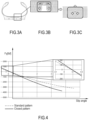
- In closed patterns, tyre compression stiffness is increased by reducing the distance of grooves' walls, which causes interlocking deformations of opposite faces of groove during rolling of the tyre (
Figures 3A-3C ). - One of the trade-off of the closed pattern design is an increase of the ply-steer effect, which has a negative impact on tyre wear and irregular wear. In particular, the rolling resistance coefficient RRc associated to a closed pattern tyre is about 2% lower than that of a standard pattern tyre.
- Generally, a tyre crown structure is made with multiple layers of plies bonded together to realize multi-ply systems, which twist and bend when subjected to simple tensile load. The result is a combination of bending, shearing and stretching of the laminate.
- Moreover, when the tyre is in a condition of free rolling, the toroidal shape of tyre becomes flat at the contact patch, so lateral and longitudinal shear stresses are generated in the contact area (tread blocks). In addition, in plane, shear also occurs due to change in belt tension at contact patch. Such shear stresses, applied to the individual tread blocks, cause coupled reaction forces, resulting in an aligning torque.
- Thus, tyres generate measurable lateral force and self-aligning moment under straight rolling condition. Ply steer side force is an inherent property of a belted radial tyre, which is the nonzero side force at zero slip angles.
- Pulling forces that stretch the belt package (causing ply-steer) are generated at the inflation stage, then tyre loading/bending is relaxing the belt tension. The higher is the tyre bending, the higher is the belt relaxation and consequently the lower are the ply-steer forces. The closed pattern stiffens the tyre crown and constrains the tyre bending, thus leading to lower belt relaxation and higher ply-steer forces.
-
WO2017/103431 A1 relates to a tire with a radial carcass reinforcement intended to be fitted to vehicles carrying heavy loads and traveling at sustained speed, such as trucks. -
US2019/135052 A1 is aimed to solve the problem of suppressing asymmetrical deformation of run-flat radial tires with a comparatively large tire cross-section height during run-flat running, and of increasing durability during run-flat running. -
EP3130483 A1 discloses a pneumatic tire capable of achieving steering stability, noise performance, and on-snow performance. The tire comprises circumferential sipes (4, 11) continuously extending in the tread circumferential direction and having a width comprised between 0.5 to 1.5 mm, to ensure the edge component against the side force direction, and improve the on-snow performance during cornering. -
US2014238568 A1 discloses a tire for use in a heavy load vehicle such as a truck, which tire exhibits good performances in both fuel efficiency and drainage thanks to the presence of narrow grooves. -
US2010147438 A1 discloses a tire with a radial carcass reinforcement, intended to be fitted to vehicles that carry heavy loads and drive at sustained speeds. The tire has a radial carcass reinforcement comprising a crown reinforcement formed of at least two working crown layers of inextensible reinforcing elements, crossed from one layer to the other making angles of between 10° and 45° with the circumferential direction. - In order to evaluate the impact of tread geometry on ply-steer effect, a FEM simulation has been run using two different pattern geometries of the tread: standard and closed pattern. The results of such simulation are shown in attached
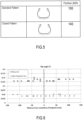
Figures 4 and5 , and clearly show that closed pattern geometry leads to a negative incrementation of the ply-steer effect. - The technical problem posed and solved by the present invention is therefore to provide a tyre which allows overcoming the disadvantages mentioned above with reference to the known art.
- This problem is solved by a tyre according to
claim 1. Preferred features of the present invention are object of the dependent claims. - According to a first aspect of the invention, a tyre comprising a carcass, an external tread portion provided with a closed pattern design and at least one high elongation (HE) belt, applied as a single cord or as a strip of multiple cords, in particular arranged between bias working belts, is provided.
- In the present application, the expression "High Elongation Belt" refers to a belt characterized by a stiffness module variable as a function of strain. In particular, the stiffness module is directly proportional to the strain, that means the stiffness module is low for little strain, and higher for higher strain.
- This allows the cord (or cords) to expand during the vulcanization process and to ensure high stiffness modulus during operation. The steel cord (or cords) guarantees such technical effect, thanks to the geometry of the strand.
- For better clarity, a High Elongation Belt is a belt embedding a cord provided with a stiffness module variable between about 3.000 MPa (low modulus, from 0 to about 2% of strain or elongation) and 1.125.000 MPa (high modulus, for strain higher than about 2%), said cord having an elongation at break between 2.5% and 3.5%.The elongation at break being measured on a sample extracted from a vulcanized tyre.
- A plurality of known types of High Elongation Belt are currently available.
- According to the invention, the at least one High Elongation Belt could be applied as a single cord or as a strip of multiple cord, for example six or nine cords.
- To this extent, the above stiffness properties are not due to the belt itself, but to the single cord configuration that makes up the belt (i.e. the plurality of single cords arranged parallel to each other or the strips of six or nine cords arranged also parallel to each other).
- The application of at least one High Elongation Belt, preferably a system comprising one or at most two high elongation belts, provides great advantages with respect to the traditional belt construction.
- The latter traditional kind of construction, with reference to low profiles truck or bus tyre, usually provides the posing of one or two longitudinal 'wavy belts', also known as 'waved belts', applied as a strip of plurality of calendered cords (preferably nine cords) with a certain 'posing angle', or 'belt cord angle', θ. Moreover, the edges of such a strip need to be protected with an additional overlap of belt strip, to avoid durability issues.
- Furthermore, during the construction of conventional (wavy) tyre, after the wrapping of the nine cords strip, an additional complete turn of the strip is added at the beginning and at the end of the wrapping, in order to avoid the lasting of free cords: in this way, a turn on edge is realized.
- Belt strip application angle and the presence of the turn on edge affect ply-steer forces by increasing them, since an increasing of the thickness between the crossing belts (turn on edges) and also a residual belt cord angle θ is provided.
- On the contrary, the at least one high elongation belt of the claimed invention is applied as a single cord strip. The switching from a strip of plurality of cords to a single cord strongly reduces the belt cord angle θ, and moreover avoids the need of a turn on edge (no free edges).
- In particular, the at least one high elongation belt is applied at 0°, as a longitudinal belt. Advantageously, a lower asymmetry of the belt package, due to a low belt cord angle θ of the HE application, will result in a lower ply-steer force.
- The comparative Table 1 provided below shows the main differences, regarding parameters such as axial width A and belt cord angle θ (the angle comprised between the cord and the longitudinal direction L shown in
Figures 1 and2 ), between a prior art belt system and a preferred embodiment of belt system according to the claimed invention provided with one high elongation belt, the two compared belt systems having the same closed pattern and comprising four belts (numbered 1 to 4):Table 1. TYRE 1 2 3 4 A θ A θ A θ A θ Traditional belt package 230 52° L 200 0° (Waved) 250 28° R 100 28°L Proposed Belt package 230 40°L 215 0° (HE) 250 28°R 130 52°L - The letters L and R reported near the belt cord angle values in Table 1 correspond respectively to the Left or Right direction according to which the amplitude of the concerned belt cord angle is measured, starting from the circumferential direction. R corresponds to an angle measured clockwise starting from the circumferential direction, whereas L corresponds to an angle measured counterclockwise starting from the circumferential direction.
- In the attached
Figure 6 , experimental data (wear energy in several tyre pattern points) are reported, showing how ply-steer forces change from the above cited prior art belt system (in particular a wavy tyre) and the preferred embodiment of belt system according to the claimed invention (High Elongation tyre), which reference is made in Table 1. - In
Figure 6 , the portion of abscissa axis ranging from about -125 a 125 mm refers to the lateral position of the considered points onto the tread.Figure 6 clearly shows that average slip angle, for fixed lateral force (Fy=0), is higher for the prior art wavy tyre, which means the prior art tyre is associated to higher ply-steer forces for a slip angle equal to 0°. - Therefore, the combination of a closed pattern technology with the at least one high elongation belt according to the claimed tyre configuration allows to obtain a low ply-steer force, and thus low wear and irregular wear performances of the tyre.
- That is, the application of at least one high elongation belt to a closed pattern tyre allows to neutralize the negative effects provided by the closed pattern, and to enjoy only the positive effects thereof.
- Other advantages, features and modes of employ of the present invention will become evident from the following detailed description of some embodiments, presented by way of example and not of limitation.
- Reference will be made to the Figures of the enclosed drawings, wherein:
- ▪
Figure 1 shows a schematic cross-sectional view of a preferred embodiment of a tyre according to the present invention, of which, for greater clarity, only a section has been represented, some parts of which being exemplified; - ▪
Figure 1A is a simplified representation of a top view of the four belts comprised in the tyre shown inFigure 1 ; - ▪
Figure 2 is a diagram showing rolling resistance trend as function of Volume Void Ratio %; - ▪
Figure 3A shows a schematic cross-sectional view of a prior art tyre provided with a closed pattern tread; - ▪
Figure 3B shows an enlarged detail ofFigure 3A , relating in particular to a standard groove of the tyre tread pattern of this latterFigure 3A , under loading conditions; - ▪
Figure 3C shows an enlarged detail ofFigure 3A , relating in particular to a closed pattern groove of the tyre tread pattern of this latterFigure 3A , subject to vertical load; - ▪
Figure 4 is a diagram showing the residual force Fy trend as a function of slip angle for standard pattern and closed pattern tread design, respectively; - ▪
Figures 5 shows exemplary values of the ply steer effect with reference to a standard pattern tyre according to the prior art and a closed pattern tyre according to the prior art; - ▪
Figures 6 shows exemplary values of wear energy with reference to standard wavy tyre according to the prior art and a tyre provided with a high elongation belt and a closed pattern tread, according to a preferred embodiment of the invention. - The dimensions, as well as thicknesses and curvatures, shown in the Figures introduced above are to be understood as purely exemplary and are not necessarily shown in proportion. Moreover, as said, in said Figures some layers/components of the tyre may have been omitted, for a clearer illustration of aspects of the present invention.
- Hereinafter, several embodiments and variations of the invention will be described, with reference to the Figures introduced above.
- Moreover, the different embodiments and variants described in the following are possibly employed in combination, when they are compatible.
- An improved tyre according to the present invention provides a new belt construction in combination with a closed pattern design of the tread, in order to balance ply-steer trade off and enhance rolling resistance RRc and wear performances, so to avoid the disadvantages of the prior art tyre having a closed pattern design.
- As just said, the tyre according to the present invention comprises an external tread portion provided with two or more grooves designed to realize a closed pattern. With reference to
Figure 1 , a preferred embodiment oftyre 10 comprises a tread portion 6 provided with two or more grooves 7, the grooves 7 extending according to a circumferential direction L around said tread portion 6. - The axial width Wg of at least one of said grooves 7, measured according to an axial direction A parallel to an axis of rotation R of the
tyre 10 and orthogonal to said circumferential direction L, ranges from 0,5 to 4 millimeters, in particular is lower than, or at least equal to, 2 millimeters. - The axial width Wg of said groove 7 is substantially constant over the full depth of the groove. By substantially it is meant that the groove walls might have a slinght inclination of between 2 to 5 degrees with respect to the orthogonal plane in the point they intersect the tread rolling surface.
- The radial depth Dg of at least one of said grooves 7, measured according to a radial direction of the
tyre 10, ranges from 7 to 14 millimeters, preferably 8 to 13 millimeters, more preferably from 9 to 12 millimeters. - In a preferred embodiment at least one of said grooves 7 is the groove closest to the tyre equatorial plane CL (or centerline CL) in a tyre axial direction.
- The tyre equatorial plane CL is the plane dividing the tread portion 6 into two eqally wide portions.
- In another preferred embodiment two of said grooves 7 are the grooves closest to the tyre equatorial plane CL (or centerline CL) in a tyre axial direction.
- In another preferred embodiment two of said grooves 7 are the grooves closest to the tyre equatorial plane CL (or centerline CL) in a tyre axial direction, wherein the two grooves 7 are disposed on both sides, one on each side, of the tyre equatorial plane CL (or centerline CL) in a tyre axial direction.
- In another preferred embodiment one, two or three of said grooves 7 are disposed on both sides of the tyre equatorial plane CL (or centerline CL) in a tyre axial direction.
- The advantage of said grooves 7 being in the central area of the pattern, i.e. in an area closer to the equatorial plane CL, is that the stiffness of the tread pattern is thereby increased, resulting in an improved rolling resistance.
- In a preferred embodiment said grooves 7 are positioned within a maximum axial distance from the equatorial plane CL that corresponds to 30% of the axial width W1, W2, W3, W4 of the
widest tread belt - The
tyre 10 according to the invention further comprises a carcass 5 (which may include one or more inner body plies), and at least one high elongation belt. The at least one high elongation belt is applied radially, as a single cord strip, externally to the carcass 5. - According to particular embodiments of the invention, the at least one high elongation belt is applied onto the most radially external side of an inner body ply of the tyre. According to preferred embodiments of the invention, a tyre comprising a plurality of belts radially superimposed to each other is provided, comprising one high elongation belt which corresponds to the second belt, starting from the carcass and going towards the tread portion.
- According to the preferred embodiment shown in
Figure 1 , thetyre 10 comprises four belts, in particular a first, a second, a third and a fourth belt, starting from the carcass 5 and going towards the tread portion 8, respectively denoted by thenumerical references - Preferably, each of the four
belts Figure 1A with the references θ1, θ2, θ3 and θ4 respectively, and more preferably each of said belt cord angle θ1, θ 2 , θ3, θ4 is different from the other ones. - At least one of said first, second, third and
fourth belt - In particular, the single cord strip is spirally applied, and thanks to such a kind of application the obtainment of a belt cord angle equal to 0° is facilitated. Preferably, the value of each belt cord angle θ1, θ 2 , θ3, θ4 ranges from 0° to 80°, measured with respect to the circumferential axis L.
- More specifically, the belt cord angle is the lowest angle (having a positive or negative value of amplitude, wherein a positive amplitude is measured according to a clockwise direction, and a negative amplitude is measured according to a counterclockwise direction) comprised between the circumferential axis L and the cords main extension axis. As way of example, in
Figure 1A belt cord angles θ1 and θ4 are shown having an amplitude equal to about 45°, according to a counterclockwise direction. - According to the preferred embodiment of the invention shown in
Figures 1 ad 1A, thesecond belt 2 is provided as a high elongation belt, applied as a single cord strip and being configured to define, as already said, a second belt cord angle θ2 equal to 0°. - In particular, the
tyre 10 comprises afirst belt 1, defining a first belt cord angle θ1 ranging from 35° to 60°; a secondhigh elongation belt 2, defining a second belt cord angle θ2 equal to 0°; athird belt 3, defining a third belt cord angle θ3 ranging from 20° to 40°; and afourth belt 4, defining a fourth belt cord angle θ4 ranging from 40° to 60°. - According to the invention, the ratio between the angles of the belts with respect to the first belt cord angle θ1 is defined as follows:
- The second belt cord angle θ2 equals to 0°;
- The third belt cord angle θ3 equals to 60% - 80%, preferably to 70% of the first belt cord angle 81 and
- the fourth belt cord angle θ4 equals to 120% - 140%, preferably to 130% of the first belt cord angle θ1
- According to a more preferred embodiment of the invention, the
first belt 1 defines a first belt cord angle θ1 equal to 40°, thesecond belt 2 defines a second belt cord angle θ2 equal to 0°, thethird belt 3 defines a third belt cord angle θ3 equal to 28°, and thefourth belt 4 defines a belt cord angle θ4 equal to 52°. - Instead, according to an alternative embodiment of the invention, only the
first belt 1 is a high elongation belt, being applied as a single cord strip and defining, according to such an embodiment, a first belt cord angle θ1 equal to 0°. - According to still another embodiment of the invention, both the first and the
second belts - Referring again to the preferred embodiment of
tyre 10 shown inFigures 1 and1A , each of said first, second, third andfourth belt - According to a preferred embodiment of the invention, the ratio between said width W2, W3, W4 of the second, third and
fourth belt first belt 1 is defined as follows: - The width W2 of the
second belt 2 equals to 85% - 100%, preferably to 92% - 94% of the width W1 offirst belt 1, - the width W3 of the third belt equals to 95% - 115%, preferably to 107% - 109% of the width W1 of
first belt 1 and - the width W4 of the
fourth belt 4 equals to 45% - 60%, preferably to 55% - 57% of the width W1 of thefirst belt 1. - In particular, the
first belt 1 has a first width W1 equal to 230 millimeters, thesecond belt 2 has a second width W2 equal to 215 millimeters, thethird belt 3 has a third width W3 equal to 250 millimeters, and thefourth belt 4 has a fourth width W4 equal to 130 millimeters. - As visible in
Figure 1 , the fourbelts first belt 1 is at an innermost position and thefourth belt 4 is at an outermost position with respect to theother belts second belt 2 is interposed between the first 1 and thethird belt 3, whereas thethird belt 3 is interposed between thesecond belt 2 and thefourth belt 4. - The tyre according to the embodiments above disclosed is particularly intended to be a truck or bus tyre.
- The present invention has been up to here described with reference to preferred embodiments. It is to be intended that other embodiments are possible within the same inventive core, as defined by the scope of protection of the following claims.
Claims (18)
- A tyre (10), comprising:- a carcass (5);- at least one high elongation belt (2), being applied as a single cord strip radially externally to said carcass (5),
said high elongation belt (2) embedding a cord provided with a stiffness module variable between about 3.000 MPa for a strain value of said cord ranging from 0 to about 2% and 125.000 MPa for a strain value of said cord higher than about 2%; and- an external tread portion (6), provided with two or more grooves (7) extending according to a circumferential direction (L) around said tread portion (6),
wherein the axial width (Wg) of both said grooves (7), measured according to an axial direction (A) parallel to an axis of rotation (R) of said tyre (10) and orthogonal to said circumferential direction (L), is lower than, or at least equal to, 2 millimeters.the tyre (10) comprising a first belt (1), a second belt (2), a third belt (3) and a fourth belt (4), each having a respective belt cord angle (θ1, θ2, θ3, θ4), wherein at least one of said first, second, third and fourth belt (1, 2, 3, 4) is a high elongation belt (2) applied as a single cord strip and having a belt cord angle (θ2) equal to 0°,wherein the ratio between the angles of the belts with respect to the first belt cord angle (θ1) is defined as follows:- The second belt cord angle (θ2) equals to 0°;- The third belt cord angle (θ3) equals to 60% - 80%, preferably to 70% of the first belt cord angle (θ1) and- the fourth belt cord angle (θ4) equals to 120% - 140%, preferably to 130% of the first belt cord angle (Θ1), - The tyre (10) according to claim 1, wherein said cord embedded in said high elongation belt (2) has an elongation at break between 2.5% and 3.5%
- The tyre (10) according to claim 1 or 2, wherein both said grooves (7) have a depth in the radial direction and the axial width (Wg) of both said grooves (7) is substantially constant over the full depth of said grooves (7).
- The tyre (10) according to anyone of the preceding claims, wherein said first, second, third and fourth belts (1, 2, 3, 4) are radially superimposed to each other starting from said first belt (1) to said fourth belt (4), wherein said first belt (1) is at an innermost position and said fourth belt (4) is at an outermost position with respect to the other belts (2, 3).
- The tyre (10) according to anyone of the preceding claims, wherein said second belt (2) is a high elongation belt applied as a single cord strip and having a belt cord angle (θ2) equal to 0°.
- The tyre (10) according to anyone of the preceding claims, comprising:- a first belt (1), defining a first belt cord angle (θ1) ranging from 35° to 60°;- a second high elongation belt (2), defining a second belt cord angle (θ2) equal to 0°;- a third belt (3), defining a third belt cord angle (θ3) ranging from 20° to 40°; and- a fourth belt (4), defining a fourth belt cord angle (θ4) ranging from 40° to 60°.
- The tyre (10) according to claim 6, wherein:- said first belt cord angle (θ1) is equal to 40°;- said third belt cord angle (θ3) is equal to 28°; and- said fourth belt cord angle (θ4) is equal to 52°.
- The tyre (10) according to anyone of the preceding claims, wherein each of said first, second, third and fourth belt (1, 2, 3, 4) has a respective width (W1, W2, W3, W4), measured according said axial direction (A), which ranges from 100 to 300 millimeters.
- The tyre (10) according to claim 8, wherein said width (W1, W2, W3, W4) ranges from 130 to 250 millimeters.
- The tyre (10) according to claim 8 or 9 wherein the ratio between said width (W2, W3, W4) of the second, third and fourth belt (2, 3, 4) with respect to said width (W1) of the first belt (1) is defined as follows:- The width (W2) of the second belt (2) equals to 85% - 100%, preferably to 92% - 94% of the width (W1) of first belt (1),- the width (W3) of the third belt equals to 95% - 115%, preferably to 107% - 109% of the width (W1) of first belt (1) and- the width (W4) of the fourth belt (4) equals to 45% - 60%, preferably to 55% - 57% of the width (W1) of the first belt (1).
- The tyre (10) according to claim 9, comprising:- a first belt (1) having a first width (W1) equal to 230 millimeters;- a second belt (2) having a second width (W2) equal to 215 millimeters,- a third belt (3) having a third width (W3) equal to 250 millimeters; and- a fourth belt (4) having a fourth width (W4) equal to 130 millimeters.
- The tyre (10) according to claim 4, wherein said first belt (1) is a high elongation belt applied as a single cord strip and having a belt cord angle (θ1) equal to 0°.
- The tyre (10) according to claim 12, wherein said first and second belt (1, 2) are both high elongation belts applied as a single cord strip and defining a belt cord angle (θ1, θ2) equal to 0°.
- The tyre (10) according to any preceding claim, wherein two of said two or more grooves (7) are the grooves closest to a tyre equatorial plane (CL) in a tyre axial direction.
- The tyre (10) according to claim 14, wherein said two grooves (7) are disposed one on each side of the tyre equatorial plane (CL) in a tyre axial direction.
- The tyre (10) according to claim 15, wherein more than 1 groove (7) is disposed on each side of the equatorial plane (CL) in a tyre axial direction.
- The tyre (10) according to claim 15 or 16, wherein between one and three grooves (7) are disposed on each side of the equatorial plane (CL) in a tyre axial direction.
- The tyre (10) according to any of the preceding claims, which is a truck tyre.
Applications Claiming Priority (2)
| Application Number | Priority Date | Filing Date | Title |
|---|---|---|---|
| EP20170043.2A EP3895913A1 (en) | 2020-04-17 | 2020-04-17 | Improved tyre |
| PCT/EP2021/059907 WO2021209598A1 (en) | 2020-04-17 | 2021-04-16 | Improved tyre |
Publications (2)
| Publication Number | Publication Date |
|---|---|
| EP4135988A1 EP4135988A1 (en) | 2023-02-22 |
| EP4135988B1 true EP4135988B1 (en) | 2024-10-09 |
Family
ID=70295000
Family Applications (2)
| Application Number | Title | Priority Date | Filing Date |
|---|---|---|---|
| EP20170043.2A Pending EP3895913A1 (en) | 2020-04-17 | 2020-04-17 | Improved tyre |
| EP21719136.0A Active EP4135988B1 (en) | 2020-04-17 | 2021-04-16 | Improved tyre |
Family Applications Before (1)
| Application Number | Title | Priority Date | Filing Date |
|---|---|---|---|
| EP20170043.2A Pending EP3895913A1 (en) | 2020-04-17 | 2020-04-17 | Improved tyre |
Country Status (5)
| Country | Link |
|---|---|
| US (1) | US12285981B2 (en) |
| EP (2) | EP3895913A1 (en) |
| JP (1) | JP7503147B2 (en) |
| CN (1) | CN115702082B (en) |
| WO (1) | WO2021209598A1 (en) |
Families Citing this family (1)
| Publication number | Priority date | Publication date | Assignee | Title |
|---|---|---|---|---|
| JP2023180553A (en) * | 2022-06-09 | 2023-12-21 | 住友ゴム工業株式会社 | tire |
Family Cites Families (23)
| Publication number | Priority date | Publication date | Assignee | Title |
|---|---|---|---|---|
| US2699193A (en) * | 1951-07-12 | 1955-01-11 | Cymax Corp | Pneumatic tire |
| IT1223508B (en) * | 1987-12-17 | 1990-09-19 | Pirelli | TIRE BELT STRUCTURE FOR VEHICLE WHEELS |
| FR2719257B1 (en) * | 1994-04-28 | 1996-07-19 | Dunlop Sa | Reinforced radial tire for trucks. |
| US6851463B1 (en) * | 1999-04-08 | 2005-02-08 | Alliedsignal Inc. | Composite comprising organic fibers having a low twist multiplier and improved compressive modulus |
| BRPI0412723B1 (en) | 2003-07-18 | 2013-12-24 | Michelin Rech Tech | RADIAL HOUSING PNEUMATIC |
| PL1646750T3 (en) * | 2003-07-22 | 2008-09-30 | N V Bekaert Sa | Hybrid high elongation cord |
| JP2007217807A (en) * | 2006-02-15 | 2007-08-30 | Bridgestone Corp | Steel cord, rubber-steel cord composite and tire |
| EP2123483B1 (en) | 2006-12-26 | 2017-06-07 | Bridgestone Corporation | Pneumatic tire |
| FR2916160B1 (en) * | 2007-05-14 | 2009-07-17 | Michelin Soc Tech | PNEUMATIC FOR HEAVY VEHICLES |
| CN102369321B (en) * | 2009-04-03 | 2014-08-13 | 贝卡尔特公司 | High elongation steel cord with preformed strands |
| FR2943950B1 (en) | 2009-04-07 | 2011-04-15 | Michelin Soc Tech | TIRE FOR HEAVY VEHICLES COMPRISING A CIRCUMFERENTIAL ELEMENT LAYER. |
| BRPI1014590B1 (en) * | 2009-04-22 | 2020-02-27 | Pirelli Tyre S.P.A. | HEAVY LOAD VEHICLE WHEEL TIRE |
| DE102011000703A1 (en) * | 2011-02-14 | 2012-08-16 | Continental Reifen Deutschland Gmbh | Method for producing a pneumatic vehicle tire |
| US8550134B2 (en) * | 2011-03-02 | 2013-10-08 | The Goodyear Tire & Rubber Company | Low aspect ratio super single truck tire with a split breaker |
| US20140238568A1 (en) * | 2011-10-03 | 2014-08-28 | Bridgestone Corporation | Pneumatic tire for heavy load |
| DE102014209423A1 (en) * | 2014-05-19 | 2015-11-19 | Continental Reifen Deutschland Gmbh | Vehicle tires |
| US10195904B2 (en) * | 2014-05-29 | 2019-02-05 | Bridgestone Corporation | Pneumatic tire |
| JP6557064B2 (en) | 2015-06-18 | 2019-08-07 | 株式会社ブリヂストン | Heavy duty tire |
| FR3045486B1 (en) * | 2015-12-16 | 2017-12-22 | Michelin & Cie | PNEUMATIC HAVING IMPROVED WEAR PROPERTIES |
| JP6684644B2 (en) * | 2016-04-28 | 2020-04-22 | 株式会社ブリヂストン | Runflat radial tires |
| JP6805561B2 (en) | 2016-06-13 | 2020-12-23 | 横浜ゴム株式会社 | Pneumatic tires |
| DE102017215186A1 (en) * | 2017-08-30 | 2019-02-28 | Continental Reifen Deutschland Gmbh | Vehicle tires |
| JP7077619B2 (en) | 2017-12-28 | 2022-05-31 | 横浜ゴム株式会社 | Pneumatic tires |
-
2020
- 2020-04-17 EP EP20170043.2A patent/EP3895913A1/en active Pending
-
2021
- 2021-04-16 CN CN202180040327.XA patent/CN115702082B/en active Active
- 2021-04-16 WO PCT/EP2021/059907 patent/WO2021209598A1/en not_active Ceased
- 2021-04-16 EP EP21719136.0A patent/EP4135988B1/en active Active
- 2021-04-16 US US17/919,361 patent/US12285981B2/en active Active
- 2021-04-16 JP JP2022562888A patent/JP7503147B2/en active Active
Also Published As
| Publication number | Publication date |
|---|---|
| WO2021209598A1 (en) | 2021-10-21 |
| EP3895913A1 (en) | 2021-10-20 |
| JP2023522875A (en) | 2023-06-01 |
| US20230150311A1 (en) | 2023-05-18 |
| CN115702082A (en) | 2023-02-14 |
| US12285981B2 (en) | 2025-04-29 |
| CN115702082B (en) | 2025-05-06 |
| JP7503147B2 (en) | 2024-06-19 |
| EP4135988A1 (en) | 2023-02-22 |
Similar Documents
| Publication | Publication Date | Title |
|---|---|---|
| EP2113398B1 (en) | Pneumatic radial tire | |
| EP2213484B1 (en) | Pneumatic tire | |
| US10183531B2 (en) | Pneumatic tire | |
| EP2676812B1 (en) | Pneumatic tire | |
| US8800619B2 (en) | Tire | |
| EP2123483B1 (en) | Pneumatic tire | |
| CN103764411B (en) | Pneumatic tire | |
| US9987883B2 (en) | Pneumatic tire | |
| EP2979900B1 (en) | Heavy load pneumatic tire | |
| EP2957435B1 (en) | Heavy duty tire | |
| EP2641751B1 (en) | Agricultural tire | |
| EP2623336A1 (en) | Pneumatic tyre | |
| EP3141404B1 (en) | Pneumatic tire | |
| US9950570B2 (en) | Pneumatic tire | |
| EP4135988B1 (en) | Improved tyre | |
| JP5308781B2 (en) | Pneumatic tire | |
| JP3973414B2 (en) | Pneumatic radial tire | |
| JP2009173131A (en) | Pneumatic tire | |
| WO2024185192A1 (en) | Pneumatic tire | |
| JP6077736B2 (en) | Pneumatic tire | |
| JP7813126B2 (en) | pneumatic tires | |
| JP7278899B2 (en) | pneumatic tire | |
| CN120569298A (en) | Optimizing structure of civil engineering tire | |
| EP2248682A1 (en) | Studless tire | |
| JP2025024553A (en) | Pneumatic tires |
Legal Events
| Date | Code | Title | Description |
|---|---|---|---|
| STAA | Information on the status of an ep patent application or granted ep patent |
Free format text: STATUS: UNKNOWN |
|
| STAA | Information on the status of an ep patent application or granted ep patent |
Free format text: STATUS: THE INTERNATIONAL PUBLICATION HAS BEEN MADE |
|
| PUAI | Public reference made under article 153(3) epc to a published international application that has entered the european phase |
Free format text: ORIGINAL CODE: 0009012 |
|
| STAA | Information on the status of an ep patent application or granted ep patent |
Free format text: STATUS: REQUEST FOR EXAMINATION WAS MADE |
|
| 17P | Request for examination filed |
Effective date: 20221117 |
|
| AK | Designated contracting states |
Kind code of ref document: A1 Designated state(s): AL AT BE BG CH CY CZ DE DK EE ES FI FR GB GR HR HU IE IS IT LI LT LU LV MC MK MT NL NO PL PT RO RS SE SI SK SM TR |
|
| RAP3 | Party data changed (applicant data changed or rights of an application transferred) |
Owner name: BRIDGESTONE EUROPE NV/SA |
|
| DAV | Request for validation of the european patent (deleted) | ||
| DAX | Request for extension of the european patent (deleted) | ||
| GRAP | Despatch of communication of intention to grant a patent |
Free format text: ORIGINAL CODE: EPIDOSNIGR1 |
|
| STAA | Information on the status of an ep patent application or granted ep patent |
Free format text: STATUS: GRANT OF PATENT IS INTENDED |
|
| INTG | Intention to grant announced |
Effective date: 20240429 |
|
| GRAS | Grant fee paid |
Free format text: ORIGINAL CODE: EPIDOSNIGR3 |
|
| GRAA | (expected) grant |
Free format text: ORIGINAL CODE: 0009210 |
|
| STAA | Information on the status of an ep patent application or granted ep patent |
Free format text: STATUS: THE PATENT HAS BEEN GRANTED |
|
| AK | Designated contracting states |
Kind code of ref document: B1 Designated state(s): AL AT BE BG CH CY CZ DE DK EE ES FI FR GB GR HR HU IE IS IT LI LT LU LV MC MK MT NL NO PL PT RO RS SE SI SK SM TR |
|
| REG | Reference to a national code |
Ref country code: CH Ref legal event code: EP |
|
| REG | Reference to a national code |
Ref country code: DE Ref legal event code: R096 Ref document number: 602021019945 Country of ref document: DE |
|
| REG | Reference to a national code |
Ref country code: IE Ref legal event code: FG4D |
|
| REG | Reference to a national code |
Ref country code: LT Ref legal event code: MG9D |
|
| REG | Reference to a national code |
Ref country code: NL Ref legal event code: MP Effective date: 20241009 |
|
| REG | Reference to a national code |
Ref country code: AT Ref legal event code: MK05 Ref document number: 1730208 Country of ref document: AT Kind code of ref document: T Effective date: 20241009 |
|
| PG25 | Lapsed in a contracting state [announced via postgrant information from national office to epo] |
Ref country code: NL Free format text: LAPSE BECAUSE OF FAILURE TO SUBMIT A TRANSLATION OF THE DESCRIPTION OR TO PAY THE FEE WITHIN THE PRESCRIBED TIME-LIMIT Effective date: 20241009 |
|
| PG25 | Lapsed in a contracting state [announced via postgrant information from national office to epo] |
Ref country code: NL Free format text: LAPSE BECAUSE OF FAILURE TO SUBMIT A TRANSLATION OF THE DESCRIPTION OR TO PAY THE FEE WITHIN THE PRESCRIBED TIME-LIMIT Effective date: 20241009 |
|
| P01 | Opt-out of the competence of the unified patent court (upc) registered |
Free format text: CASE NUMBER: APP_8766/2025 Effective date: 20250220 |
|
| PG25 | Lapsed in a contracting state [announced via postgrant information from national office to epo] |
Ref country code: PT Free format text: LAPSE BECAUSE OF FAILURE TO SUBMIT A TRANSLATION OF THE DESCRIPTION OR TO PAY THE FEE WITHIN THE PRESCRIBED TIME-LIMIT Effective date: 20250210 Ref country code: HR Free format text: LAPSE BECAUSE OF FAILURE TO SUBMIT A TRANSLATION OF THE DESCRIPTION OR TO PAY THE FEE WITHIN THE PRESCRIBED TIME-LIMIT Effective date: 20241009 Ref country code: IS Free format text: LAPSE BECAUSE OF FAILURE TO SUBMIT A TRANSLATION OF THE DESCRIPTION OR TO PAY THE FEE WITHIN THE PRESCRIBED TIME-LIMIT Effective date: 20250209 |
|
| PG25 | Lapsed in a contracting state [announced via postgrant information from national office to epo] |
Ref country code: FI Free format text: LAPSE BECAUSE OF FAILURE TO SUBMIT A TRANSLATION OF THE DESCRIPTION OR TO PAY THE FEE WITHIN THE PRESCRIBED TIME-LIMIT Effective date: 20241009 |
|
| PG25 | Lapsed in a contracting state [announced via postgrant information from national office to epo] |
Ref country code: BG Free format text: LAPSE BECAUSE OF FAILURE TO SUBMIT A TRANSLATION OF THE DESCRIPTION OR TO PAY THE FEE WITHIN THE PRESCRIBED TIME-LIMIT Effective date: 20241009 |
|
| PG25 | Lapsed in a contracting state [announced via postgrant information from national office to epo] |
Ref country code: ES Free format text: LAPSE BECAUSE OF FAILURE TO SUBMIT A TRANSLATION OF THE DESCRIPTION OR TO PAY THE FEE WITHIN THE PRESCRIBED TIME-LIMIT Effective date: 20241009 |
|
| PG25 | Lapsed in a contracting state [announced via postgrant information from national office to epo] |
Ref country code: NO Free format text: LAPSE BECAUSE OF FAILURE TO SUBMIT A TRANSLATION OF THE DESCRIPTION OR TO PAY THE FEE WITHIN THE PRESCRIBED TIME-LIMIT Effective date: 20250109 |
|
| PG25 | Lapsed in a contracting state [announced via postgrant information from national office to epo] |
Ref country code: LV Free format text: LAPSE BECAUSE OF FAILURE TO SUBMIT A TRANSLATION OF THE DESCRIPTION OR TO PAY THE FEE WITHIN THE PRESCRIBED TIME-LIMIT Effective date: 20241009 Ref country code: GR Free format text: LAPSE BECAUSE OF FAILURE TO SUBMIT A TRANSLATION OF THE DESCRIPTION OR TO PAY THE FEE WITHIN THE PRESCRIBED TIME-LIMIT Effective date: 20250110 Ref country code: AT Free format text: LAPSE BECAUSE OF FAILURE TO SUBMIT A TRANSLATION OF THE DESCRIPTION OR TO PAY THE FEE WITHIN THE PRESCRIBED TIME-LIMIT Effective date: 20241009 |
|
| PG25 | Lapsed in a contracting state [announced via postgrant information from national office to epo] |
Ref country code: PL Free format text: LAPSE BECAUSE OF FAILURE TO SUBMIT A TRANSLATION OF THE DESCRIPTION OR TO PAY THE FEE WITHIN THE PRESCRIBED TIME-LIMIT Effective date: 20241009 |
|
| PG25 | Lapsed in a contracting state [announced via postgrant information from national office to epo] |
Ref country code: RS Free format text: LAPSE BECAUSE OF FAILURE TO SUBMIT A TRANSLATION OF THE DESCRIPTION OR TO PAY THE FEE WITHIN THE PRESCRIBED TIME-LIMIT Effective date: 20250109 |
|
| PG25 | Lapsed in a contracting state [announced via postgrant information from national office to epo] |
Ref country code: SM Free format text: LAPSE BECAUSE OF FAILURE TO SUBMIT A TRANSLATION OF THE DESCRIPTION OR TO PAY THE FEE WITHIN THE PRESCRIBED TIME-LIMIT Effective date: 20241009 |
|
| PGFP | Annual fee paid to national office [announced via postgrant information from national office to epo] |
Ref country code: DE Payment date: 20250319 Year of fee payment: 5 |
|
| PG25 | Lapsed in a contracting state [announced via postgrant information from national office to epo] |
Ref country code: DK Free format text: LAPSE BECAUSE OF FAILURE TO SUBMIT A TRANSLATION OF THE DESCRIPTION OR TO PAY THE FEE WITHIN THE PRESCRIBED TIME-LIMIT Effective date: 20241009 |
|
| REG | Reference to a national code |
Ref country code: DE Ref legal event code: R097 Ref document number: 602021019945 Country of ref document: DE |
|
| PG25 | Lapsed in a contracting state [announced via postgrant information from national office to epo] |
Ref country code: EE Free format text: LAPSE BECAUSE OF FAILURE TO SUBMIT A TRANSLATION OF THE DESCRIPTION OR TO PAY THE FEE WITHIN THE PRESCRIBED TIME-LIMIT Effective date: 20241009 |
|
| PG25 | Lapsed in a contracting state [announced via postgrant information from national office to epo] |
Ref country code: RO Free format text: LAPSE BECAUSE OF FAILURE TO SUBMIT A TRANSLATION OF THE DESCRIPTION OR TO PAY THE FEE WITHIN THE PRESCRIBED TIME-LIMIT Effective date: 20241009 |
|
| PG25 | Lapsed in a contracting state [announced via postgrant information from national office to epo] |
Ref country code: SK Free format text: LAPSE BECAUSE OF FAILURE TO SUBMIT A TRANSLATION OF THE DESCRIPTION OR TO PAY THE FEE WITHIN THE PRESCRIBED TIME-LIMIT Effective date: 20241009 |
|
| PG25 | Lapsed in a contracting state [announced via postgrant information from national office to epo] |
Ref country code: CZ Free format text: LAPSE BECAUSE OF FAILURE TO SUBMIT A TRANSLATION OF THE DESCRIPTION OR TO PAY THE FEE WITHIN THE PRESCRIBED TIME-LIMIT Effective date: 20241009 |
|
| PLBE | No opposition filed within time limit |
Free format text: ORIGINAL CODE: 0009261 |
|
| STAA | Information on the status of an ep patent application or granted ep patent |
Free format text: STATUS: NO OPPOSITION FILED WITHIN TIME LIMIT |
|
| PG25 | Lapsed in a contracting state [announced via postgrant information from national office to epo] |
Ref country code: SE Free format text: LAPSE BECAUSE OF FAILURE TO SUBMIT A TRANSLATION OF THE DESCRIPTION OR TO PAY THE FEE WITHIN THE PRESCRIBED TIME-LIMIT Effective date: 20241009 |
|
| 26N | No opposition filed |
Effective date: 20250710 |
|
| REG | Reference to a national code |
Ref country code: CH Ref legal event code: H13 Free format text: ST27 STATUS EVENT CODE: U-0-0-H10-H13 (AS PROVIDED BY THE NATIONAL OFFICE) Effective date: 20251125 |
|
| PG25 | Lapsed in a contracting state [announced via postgrant information from national office to epo] |
Ref country code: LU Free format text: LAPSE BECAUSE OF NON-PAYMENT OF DUE FEES Effective date: 20250416 |
|
| PG25 | Lapsed in a contracting state [announced via postgrant information from national office to epo] |
Ref country code: MC Free format text: LAPSE BECAUSE OF FAILURE TO SUBMIT A TRANSLATION OF THE DESCRIPTION OR TO PAY THE FEE WITHIN THE PRESCRIBED TIME-LIMIT Effective date: 20241009 |
|
| REG | Reference to a national code |
Ref country code: BE Ref legal event code: MM Effective date: 20250430 |
|
| PG25 | Lapsed in a contracting state [announced via postgrant information from national office to epo] |
Ref country code: BE Free format text: LAPSE BECAUSE OF NON-PAYMENT OF DUE FEES Effective date: 20250430 |
|
| PG25 | Lapsed in a contracting state [announced via postgrant information from national office to epo] |
Ref country code: CH Free format text: LAPSE BECAUSE OF NON-PAYMENT OF DUE FEES Effective date: 20250430 |
|
| PGFP | Annual fee paid to national office [announced via postgrant information from national office to epo] |
Ref country code: GB Payment date: 20260319 Year of fee payment: 6 |
|
| PG25 | Lapsed in a contracting state [announced via postgrant information from national office to epo] |
Ref country code: IE Free format text: LAPSE BECAUSE OF NON-PAYMENT OF DUE FEES Effective date: 20250416 |
|
| PGFP | Annual fee paid to national office [announced via postgrant information from national office to epo] |
Ref country code: IT Payment date: 20260319 Year of fee payment: 6 |
|
| PGFP | Annual fee paid to national office [announced via postgrant information from national office to epo] |
Ref country code: FR Payment date: 20260320 Year of fee payment: 6 |
|
| PGFP | Annual fee paid to national office [announced via postgrant information from national office to epo] |
Ref country code: TR Payment date: 20260325 Year of fee payment: 6 |