EP4134946A1 - Neuronaler modellierer von audiosystemen - Google Patents
Neuronaler modellierer von audiosystemen Download PDFInfo
- Publication number
- EP4134946A1 EP4134946A1 EP22184822.9A EP22184822A EP4134946A1 EP 4134946 A1 EP4134946 A1 EP 4134946A1 EP 22184822 A EP22184822 A EP 22184822A EP 4134946 A1 EP4134946 A1 EP 4134946A1
- Authority
- EP
- European Patent Office
- Prior art keywords
- audio system
- neural network
- reference audio
- error signal
- signal
- Prior art date
- Legal status (The legal status is an assumption and is not a legal conclusion. Google has not performed a legal analysis and makes no representation as to the accuracy of the status listed.)
- Pending
Links
Images





Classifications
-
- G—PHYSICS
- G06—COMPUTING OR CALCULATING; COUNTING
- G06N—COMPUTING ARRANGEMENTS BASED ON SPECIFIC COMPUTATIONAL MODELS
- G06N3/00—Computing arrangements based on biological models
- G06N3/02—Neural networks
- G06N3/08—Learning methods
-
- G—PHYSICS
- G06—COMPUTING OR CALCULATING; COUNTING
- G06F—ELECTRIC DIGITAL DATA PROCESSING
- G06F3/00—Input arrangements for transferring data to be processed into a form capable of being handled by the computer; Output arrangements for transferring data from processing unit to output unit, e.g. interface arrangements
- G06F3/16—Sound input; Sound output
- G06F3/165—Management of the audio stream, e.g. setting of volume, audio stream path
-
- G—PHYSICS
- G06—COMPUTING OR CALCULATING; COUNTING
- G06N—COMPUTING ARRANGEMENTS BASED ON SPECIFIC COMPUTATIONAL MODELS
- G06N3/00—Computing arrangements based on biological models
- G06N3/02—Neural networks
- G06N3/04—Architecture, e.g. interconnection topology
- G06N3/044—Recurrent networks, e.g. Hopfield networks
- G06N3/0442—Recurrent networks, e.g. Hopfield networks characterised by memory or gating, e.g. long short-term memory [LSTM] or gated recurrent units [GRU]
-
- G—PHYSICS
- G06—COMPUTING OR CALCULATING; COUNTING
- G06N—COMPUTING ARRANGEMENTS BASED ON SPECIFIC COMPUTATIONAL MODELS
- G06N3/00—Computing arrangements based on biological models
- G06N3/02—Neural networks
- G06N3/04—Architecture, e.g. interconnection topology
- G06N3/045—Combinations of networks
-
- G—PHYSICS
- G06—COMPUTING OR CALCULATING; COUNTING
- G06N—COMPUTING ARRANGEMENTS BASED ON SPECIFIC COMPUTATIONAL MODELS
- G06N3/00—Computing arrangements based on biological models
- G06N3/02—Neural networks
- G06N3/04—Architecture, e.g. interconnection topology
- G06N3/0464—Convolutional networks [CNN, ConvNet]
-
- G—PHYSICS
- G06—COMPUTING OR CALCULATING; COUNTING
- G06N—COMPUTING ARRANGEMENTS BASED ON SPECIFIC COMPUTATIONAL MODELS
- G06N3/00—Computing arrangements based on biological models
- G06N3/02—Neural networks
- G06N3/08—Learning methods
- G06N3/09—Supervised learning
-
- G—PHYSICS
- G10—MUSICAL INSTRUMENTS; ACOUSTICS
- G10H—ELECTROPHONIC MUSICAL INSTRUMENTS; INSTRUMENTS IN WHICH THE TONES ARE GENERATED BY ELECTROMECHANICAL MEANS OR ELECTRONIC GENERATORS, OR IN WHICH THE TONES ARE SYNTHESISED FROM A DATA STORE
- G10H1/00—Details of electrophonic musical instruments
- G10H1/0091—Means for obtaining special acoustic effects
-
- G—PHYSICS
- G10—MUSICAL INSTRUMENTS; ACOUSTICS
- G10H—ELECTROPHONIC MUSICAL INSTRUMENTS; INSTRUMENTS IN WHICH THE TONES ARE GENERATED BY ELECTROMECHANICAL MEANS OR ELECTRONIC GENERATORS, OR IN WHICH THE TONES ARE SYNTHESISED FROM A DATA STORE
- G10H3/00—Instruments in which the tones are generated by electromechanical means
- G10H3/12—Instruments in which the tones are generated by electromechanical means using mechanical resonant generators, e.g. strings or percussive instruments, the tones of which are picked up by electromechanical transducers, the electrical signals being further manipulated or amplified and subsequently converted to sound by a loudspeaker or equivalent instrument
- G10H3/14—Instruments in which the tones are generated by electromechanical means using mechanical resonant generators, e.g. strings or percussive instruments, the tones of which are picked up by electromechanical transducers, the electrical signals being further manipulated or amplified and subsequently converted to sound by a loudspeaker or equivalent instrument using mechanically actuated vibrators with pick-up means
- G10H3/18—Instruments in which the tones are generated by electromechanical means using mechanical resonant generators, e.g. strings or percussive instruments, the tones of which are picked up by electromechanical transducers, the electrical signals being further manipulated or amplified and subsequently converted to sound by a loudspeaker or equivalent instrument using mechanically actuated vibrators with pick-up means using a string, e.g. electric guitar
- G10H3/186—Means for processing the signal picked up from the strings
- G10H3/187—Means for processing the signal picked up from the strings for distorting the signal, e.g. to simulate tube amplifiers
-
- G—PHYSICS
- G10—MUSICAL INSTRUMENTS; ACOUSTICS
- G10L—SPEECH ANALYSIS TECHNIQUES OR SPEECH SYNTHESIS; SPEECH RECOGNITION; SPEECH OR VOICE PROCESSING TECHNIQUES; SPEECH OR AUDIO CODING OR DECODING
- G10L15/00—Speech recognition
- G10L15/08—Speech classification or search
- G10L15/16—Speech classification or search using artificial neural networks
-
- H—ELECTRICITY
- H04—ELECTRIC COMMUNICATION TECHNIQUE
- H04R—LOUDSPEAKERS, MICROPHONES, GRAMOPHONE PICK-UPS OR LIKE ACOUSTIC ELECTROMECHANICAL TRANSDUCERS; ELECTRIC HEARING AIDS; PUBLIC ADDRESS SYSTEMS
- H04R3/00—Circuits for transducers
- H04R3/04—Circuits for transducers for correcting frequency response
-
- G—PHYSICS
- G10—MUSICAL INSTRUMENTS; ACOUSTICS
- G10H—ELECTROPHONIC MUSICAL INSTRUMENTS; INSTRUMENTS IN WHICH THE TONES ARE GENERATED BY ELECTROMECHANICAL MEANS OR ELECTRONIC GENERATORS, OR IN WHICH THE TONES ARE SYNTHESISED FROM A DATA STORE
- G10H2210/00—Aspects or methods of musical processing having intrinsic musical character, i.e. involving musical theory or musical parameters or relying on musical knowledge, as applied in electrophonic musical tools or instruments
- G10H2210/155—Musical effects
- G10H2210/315—Dynamic effects for musical purposes, i.e. musical sound effects controlled by the amplitude of the time domain audio envelope, e.g. loudness-dependent tone colour or musically desired dynamic range compression or expansion
-
- G—PHYSICS
- G10—MUSICAL INSTRUMENTS; ACOUSTICS
- G10H—ELECTROPHONIC MUSICAL INSTRUMENTS; INSTRUMENTS IN WHICH THE TONES ARE GENERATED BY ELECTROMECHANICAL MEANS OR ELECTRONIC GENERATORS, OR IN WHICH THE TONES ARE SYNTHESISED FROM A DATA STORE
- G10H2250/00—Aspects of algorithms or signal processing methods without intrinsic musical character, yet specifically adapted for or used in electrophonic musical processing
- G10H2250/311—Neural networks for electrophonic musical instruments or musical processing, e.g. for musical recognition or control, automatic composition or improvisation
-
- G—PHYSICS
- G10—MUSICAL INSTRUMENTS; ACOUSTICS
- G10L—SPEECH ANALYSIS TECHNIQUES OR SPEECH SYNTHESIS; SPEECH RECOGNITION; SPEECH OR VOICE PROCESSING TECHNIQUES; SPEECH OR AUDIO CODING OR DECODING
- G10L25/00—Speech or voice analysis techniques not restricted to a single one of groups G10L15/00 - G10L21/00
- G10L25/27—Speech or voice analysis techniques not restricted to a single one of groups G10L15/00 - G10L21/00 characterised by the analysis technique
- G10L25/30—Speech or voice analysis techniques not restricted to a single one of groups G10L15/00 - G10L21/00 characterised by the analysis technique using neural networks
Definitions
- Various aspects of the present disclosure relate generally to modeling audio systems, and more specifically to the use of artificial neural networks to model audio systems.
- Amplifier modeling is a process by which a physical amplifier, e.g., a guitar amplifier, is emulated by a modeling platform.
- Amplifier modeling can be implemented using analog circuitry, digital signal processing, or a combination thereof.
- amplifier modeling provides a flexible way to emulate a large number of different physical amplifiers using a common platform of hardware and software.
- a process for creating digital audio systems comprises training a neural network that digitally models a reference audio system. Training the neural network is carried out by repeatedly performing predicting, evaluating, and updating operations.
- the prediction operation comprises predicting by the neural network, a model output based upon an input, where the output approximates an expected output of the reference audio system.
- the prediction is carried out in the time domain.
- the evaluation operation comprises applying a perceptual loss function to the neural network based upon a determined psychoacoustic property, where the perceptual loss function is applied in the frequency domain.
- the update operation comprises adjusting the neural network responsive to the output of the perceptual loss function, e.g., changing at least one parameter of the neural network responsive to the output of the perceptual loss function.
- the process further comprises outputting a neural model file that can be loaded to generate a virtualization of the reference audio system, e.g., after the neural network has been suitably trained.
- a process comprises training a neural network that digitally models a reference audio system. More particularly, training enables the neural network to implement a first role that models at least one nonlinearity of the reference audio system and a second role that models at least one linear aspect and/or at least one temporal dependency of the reference audio system. Moreover, training may be carried out using a perceptual loss function.
- the perceptual loss function is implemented by a frequency domain process based upon a determined psychoacoustic property.
- the process may comprise outputting a neural model file that can be loaded to generate a virtualization of the reference audio system.
- a process may comprise training each role of the neural network at the same time such that all the parameters of the model are learned simultaneously.
- the first role, or first sub neural network, and the second role, or second sub neural network are trained simultaneously.
- all parameters of the model are learned simultaneously in a time saving manner.
- training the neural network to implement a first role that models a nonlinearity of the reference audio systems may comprise modeling a non-linear behavior of the reference audio system. Additionally, training the neural network to implement a second role that models a first linear aspect and/or a temporal dependency of the reference audio system comprises modeling a first linear aspect of the reference audio system. Training the neural network further comprises modeling a linear aspect of the reference audio system. The process further comprises training such that a third role of the neural network models a second linear aspect of the reference audio system, wherein the neural network forms a Wiener-Hammerstein topology.
- nonlinear reference audio systems may be decomposed into linear and nonlinear transfer functions. Thus, finding a singular transfer function is easier than without using the Wiener-Hammerstein topology or model.
- modeling a nonlinearity of the reference audio system may be arranged in series and/or in parallel and/or in a combination thereof.
- training a neural network may comprise training a convolutional neural network.
- a convolutional neural network By using a convolutional neural network, memory requirements may be significantly reduced in contrast to non-convolutional neural networks. Thus, by using a convolutional neural network, training time can be drastically reduced. Hence, using convolutional neural networks may be preferred when time and/or computational requisites demand this.
- applying a perceptual loss function to the neural network may comprise establishing a loudness threshold such that a signal below the threshold is not optimized further.
- time and/or computational resources may be saved when applying a perceptual loss function in combination with applying a loudness threshold to the neural network.
- establishing said loudness threshold may comprise establishing a threshold of hearing for each of multiple frequency bins, wherein, for each frequency bin, a loudness threshold may be independently set under which a signal is not optimized further in order to optimize further that particular frequency bin.
- applying a perceptual loss function to the neural network may comprise implementing frequency masking such that a frequency component is not further processed if a computed error is below a masking threshold.
- the masking threshold is based upon a target signal.
- implementing a frequency masking may comprise selecting a specific masking threshold for each of multiple frequency bins.
- select a specific masking threshold for each of multiple frequency bins By setting different masking thresholds for different frequency bins, user-specific application of a perceptual loss function to the neural network can be achieved as function of the frequency bins. Therefore, time and/or computational resources may be saved while achieving a user-specific trained neural network.
- training a neural network may comprise training a recurrent neural network.
- the recurrent neural network shows a memory effect.
- training time may be shortened.
- initializing the neural network may be based on measurements of the reference audio system.
- the training of the network may be based on actual measurement signals of the system which is to be mimicked.
- initializing the neural network may comprise initializing the neural network using measurements based on sine sweeps.
- the step of initializing the neural network is standardized and easily reproducible.
- the neural network may be extended to any combination and/or order of waveshapers and filters.
- Waveshapers, or waveshaping functions may be e.g. sin, arctan, and/or polynomial functions.
- Filters may be e.g. lowpass filter, high-pass filter, and/or bandpass filter.
- training time of the neural network may be reduced and/or computational resources while training the neural network may be effectively used when using the neural network in combination with waveshapers and/or filters, as these additional "nodes" do not have to be trained in a preferred situation.
- User-specific waveshapers and/or filters may be used.
- the process may comprise computing an error signal.
- the error signal may be computed by receiving a target signal and an associated predicted signal given from the neural network, and computing therefrom in the time domain, the error signal.
- computing an error signal can comprise converting the target signal and the error signal to the frequency domain. This may be done be any suitable transformation, as e.g. a Fourier transformation.
- computing an error signal can further comprises applying critical band filtering, such as bandpass filtering with small bandwidth, to the target signal and to the error signal in the frequency domain. By converting both, the error signal and the target signal to the frequency domain, band filtering can be applied and easy comparison between both signals is enabled in the frequency domain.
- computing the error signal may comprise thresholding the error signal in the frequency domain according to a frequency-dependent threshold level.
- the threshold level is established based upon a predetermined threshold of hearing.
- the step of computing said error signal may comprise establishing a frequency-dependent mask thresholding level based on the target.
- thresholding the error signal in the frequency domain according to a frequency-dependent threshold level can further comprise thresholding the error signal in the frequency domain according to the established frequency-dependent mask thresholding level.
- all of the operations may be differentiable. Therefore, gradients with regard to the predicted signal can be calculated.
- the evaluation operation may comprise applying a perceptual loss function to the neural network, where the perceptual loss function is applied preferably in the frequency domain.
- the perceptual loss function is implemented by receiving a target signal and sorting the received target signal into target critical bands. For instance, one or more target critical bands may be based upon a range of frequencies.
- the perceptual loss function is further implemented by generating from the target signal in each target critical band, an associated masking threshold.
- the perceptual loss function is implemented by receiving an error signal generated from the target signal and an associated prediction signal, where the error signal is sorted into error signal critical bands. Analogous to the target critical bands, one or more error signal critical bands may be based upon a range of frequencies.
- the perceptual loss function is still further implemented by applying a threshold of hearing function to the error signal.
- a threshold of hearing function to the error signal.
- an error signal below an associated hearing threshold of a corresponding error signal critical band does not contribute to a final error.
- the perceptual loss function is implemented by applying a masking function to the error signal.
- an error signal below the associated masking threshold of a corresponding error signal critical band does not contribute to the final error.
- the update operation comprises changing at least one parameter of the neural network responsive to the final error output of the perceptual loss function.
- the process for creating and using digital audio systems may further comprise loading the neural model file into a model audio system to define a virtualization of the reference audio system.
- the process further comprises outputting an audio signal using the virtualization such that the output of the model audio system includes at least one characteristic of an output of the reference audio system.
- outputting the audio signal may be performed upon coupling a musical instrument based on an input from the musical instrument to the model audio system.
- a user upon coupling a musical instrument to the model audio system, a user can perform using the virtualization in place of the reference audio system such that an output of the model audio system includes at least one characteristic of an output of the reference audio system.
- a process for creating and using digital audio systems comprises training a neural network that digitally models a reference audio system. Training the neural network is carried out by repeatedly performing predicting, evaluating, and updating operations.
- the prediction operation comprises predicting by the neural network, a model output based upon an input, where the output approximates an expected output of the reference audio system.
- the prediction is carried out in the time domain.
- a data processing system comprising a processor configured to perform any one or more of the process(es) as described prior, is disclosed.
- a data processing system may be a control unit, preferably an electronic control unit.
- a computer program product comprising instructions, which, when the program is executed by a computer, cause the computer to carry out any one or more of the process(es) as described prior.
- a computer-readable storage medium comprising instructions, which, when executed by a computer, cause the computer to carry out any one or more of the process(es) as described prior.
- a computer readable storage medium may be e.g. a RAM, hard drive, flash memory or ROM.
- a hardware system includes an analog to digital converter, a digital to analog converter, and processing circuitry that couples to the analog to digital converter and the digital to analog converter.
- the processing circuitry includes a processor coupled to memory, where the processor executes instructions that train a neural network in a manner analogous to that described above. Specifically, the processor executes instructions that train a neural network that digitally models a reference audio system by repeatedly performing instructions. Such instructions are performed to predict by the neural network, a model output based upon an input, where the output approximates an expected output of the reference audio system, and the prediction is carried out in the time domain.
- said instructions are performed to apply a perceptual loss function to the neural network, where the perceptual loss function is applied in the frequency domain.
- the perceptual loss function may be implemented to receive a target signal and sort the received target signal into target critical bands. Further, the loss function is implemented to generate from the target signal in each target critical band an associated masking threshold. Further, the loss function is implemented to receive an error signal generated from the target signal and an associated prediction signal, where the error signal is sorted into error signal critical bands.
- the loss function is further implemented to apply a threshold of hearing function to the error signal, wherein an error signal below an associated hearing threshold of a corresponding error signal critical band does not contribute to a final error.
- the perceptual loss function is further implemented to apply a masking function to the error signal, wherein an error signal below the associated masking threshold of a corresponding error signal critical band does not contribute to the final error.
- the instructions are performed to change at least one parameter of the neural network responsive to the final error output of the perceptual loss function.
- the processor executes instructions that generate a neural model file.
- the processor loads the virtualization into a model audio system.
- a virtualization of the reference audio system is defined. As such, upon coupling a musical instrument to the hardware system, a user can perform using the virtualization in place of the reference audio system such that an output of the model audio system includes at least one characteristic of an output of the reference audio system.
- FIG. 1 a block diagram 100 illustrates various components that can be used for creating, constructing, editing, using, combinations thereof, etc., a neural network system to virtualize an audio system.
- a reference audio system 102 that is implemented as a guitar amplifier.
- references audio system 102 it may not always be desirable or practical to use the reference audio system 102, e.g., when performing.
- aspects of the present disclosure provide a virtualization of the reference audio system 102 that can be used in lieu of the reference audio system 102.
- a user plugs an output of an instrument 104 (e.g., electric guitar) into a modeling audio system 106 that models at least some of the characteristic behavior of the reference audio system 102.
- the modeling audio system 106 will comprise some form of analog circuitry, digital circuitry, and software (e.g., a dedicated hardware unit or a general purpose computer in combination with an audio interface).
- the instrument signal is processed through an analog to digital converter 108 (ADC) that converts the analog audio signal into a digital signal equivalent.
- ADC analog to digital converter
- the digital signal is input into a virtualization 110 that is specifically trained or otherwise programmed to mimic some or all of the characteristics of the reference audio system 102.
- the output of virtualization 110 is processed by a digital to analog converter 112 (DAC) that converts the digital output into an analog signal equivalent of the processed output, and the analog output is coupled to an amplifier/speaker 114 where the sound of the signal is produced.
- DAC digital to analog converter 112
- modeling of the reference audio system 102 is carried out using at least one artificial neural network.
- aspects herein define a neural modeler of audio systems.
- the virtualization 110 includes a model and at least one initialization file (referred to herein as a neural model file).
- the model becomes specifically configured such that the model output resembles a corresponding reference audio system.
- the model can be extended to resemble different reference audio systems, e.g., different makes and/or models of amplifiers, by loading different neural model files into the model, each neural model file corresponding to a different reference audio system.
- the virtualization 110 can also include additional functionality to carry out processing that is extrinsic to the reference audio system 102.
- the virtualization 110 can include a user interface that enables a user to select emulations of different speakers, speaker cabinets, dynamics processing, effects processing, equalization, etc., that is not within the native capability of the reference audio system 102.
- Such processing can be consistent across multiple neural model files (e.g., to implement a common set of interface options), such processing can vary based upon the loaded neural model file, combinations thereof, etc.
- an example way to train an artificial neural network is to capture and use information from the reference audio system 102 itself.
- a sound source 120 e.g., a sweep generator
- the output of the reference audio system 102 is captured (e.g., via a microphone 122, direct out, or other capture device) to define captured information 124 representing one or more samples collected from the reference audio system 102.
- the captured information can also include a capture of the test signal generated by the sound source 120, e.g., where such information is not otherwise available.
- the captured information 124 of the reference audio system 102 is utilized either as training data, or to generate training data to train an artificial neural network 126 so as to model the reference audio system 102.
- the captured information 124 e.g., output of the reference audio system 102 and/or the test signal
- the captured information 124 is processed, e.g., by collecting a set of features such as signal processing measurements, which are stored in memory for further use.
- feature extraction from the captured information 124 may be considered a pre-training operation to generate training data.
- other training data 128 can be used in addition to or in lieu of the training data derived from the captured information 124 to train the artificial neural network 126.
- the other training data 128 may be already sorted into feature sets so that the data can be directly applied as training data.
- the other training data may include audio such as additional test signals, pre-recorded samples, real-time generated audio signals such as samples of an instrument played through the reference audio system 102, noise, etc.
- the pre-training step of feature extraction should be carried out to prepare the optional additional training data 128 for use to train the artificial neural network 126.
- the artificial neural network 126 is trained.
- the network is comprised of neurons (mathematical functions) where each neuron has any number of inputs.
- a weight vector is defined based upon the number of inputs to each neuron.
- each neuron has a corresponding weight vector.
- These weights are fixed when the training is complete (e.g., at which time, the artificial neural network is ready for use in a manner that models at least one characteristic of an output of the reference audio system 102). However, during training, these weights are adjusted to tune the network.
- Example training operations are described more fully herein. Regardless of the training technique used, the purpose of training the artificial neural network 126 is to derive a set of weight vectors with appropriate values such that the overall output of the artificial neural network converges towards an output representative of the reference audio system 102.
- a process can store, archive, save, load, etc., a neural model file 130 (e.g., an initialization file) created as part of the training process.
- the neural model file 130 includes sufficient data such that that when read out and processed by the modeling audio system 106, a functioning model of the reference audio system 102 is realized.
- the neural model file 130 can include some or all of the parameters required by the model, such as weights, weight vectors, information about the model structure and size, meta data, audio-related parameters (e.g., sample rate etc.), combinations thereof, etc.
- the artificial neural network 126 is a computing system, i.e., a network of nodes, which implements a model that can be trained (learn how to simulate) or is otherwise programmed (e.g., configured by the neural model file 130) to simulate the performance of the reference audio system 102.
- the virtualization 110 is the system that is being used in lieu of reference audio system 102.
- the virtualization 110 can be the artificial neural network 126, such as where the modeling audio system 106 itself is used to build the neural network as described above.
- the virtualization 110 can alternatively include a copy of the artificial neural network 126 or a variation thereof, such as where a separate device independent of the modeling audio system 106 is used to build the artificial neural network 126.
- the virtualization 110 can include a specific neural network, e.g., the artificial neural network 126, or the neural network can have a general framework that enables the modeling audio system 106 to model different reference amplifiers by loading an associated neural model file 130 into the modeling audio system 106 for each reference audio system to be modeled.
- the virtualization 110 can also include other capabilities.
- the virtualization 110 can include metadata, initialization data, executable code to carry out additional processing (effects, virtual tone controls, and other signal processing) to make the device more flexible and usable.
- the modeling audio system 106 is essentially the entire circuitry including conversion circuitry (e.g., ADC and DAC) the virtualization 110, optional additional signal processing, e.g., other processing not provided by the virtualization 110, etc.
- conversion circuitry e.g., ADC and DAC
- additional signal processing e.g., other processing not provided by the virtualization 110
- the modeling audio system 106 e.g., dedicated hardware or computer and audio interface
- an artificial neural network forms a core component of the modeling audio system 106 that is suitable for use in real-time applications.
- the modeling audio system 106 is capable of processing audio in the time domain (i.e., the input and the output of the neural network correspond to time domain audio signals). Examples of building, training, using, combinations thereof, etc., the artificial neural network are set out in greater detail herein.
- Training is conceptually illustrated in FIG. 1 outside the modeling audio system 106 solely for clarity of example.
- training the artificial neural network 126 can occur within the modeling audio system 106 itself.
- the modeling audio system 106 can include the sound source 120, e.g., signal generator, means (e.g., built in microphone, audio input, etc.) to capture the output of the reference audio system 102, and other inputs, outputs and processing necessary to implement training as described more fully herein.
- the modeling audio system 106 can include memory to store one or more files so that the modeling audio system 106 can be controlled by a user to load any practical number of alternative reference audio systems (e.g., guitar amplifier virtualizations).
- initialization files e.g., neural model files 130
- a process 200 is provided for creating digital audio systems.
- the process 200 can be utilized, for example, to create the artificial neural network 126, neural model file 130, virtualization 110, combination thereof, etc., ( FIG. 1 ).
- the process 200 can be carried by the modeling audio system 106 ( FIG. 1 ), by external dedicated hardware, by an external computer, etc.
- the process 200 comprises training, at 202, a neural network that digitally models a reference audio system.
- training is carried out until a predetermined stopping condition is met.
- a stopping condition may include processing all available training data, e.g., for a predetermined number of iterations, such as up to, or exceeding 20,000 iterations.
- a predetermined stopping condition can also include converging on a representation that is similar to the reference audio system within a predetermined and designated error.
- a stopping condition may include a manual/user initiated stop, or other established condition.
- an output of the reference audio system may depend linearly or non-linearly on a corresponding input to the reference audio system.
- the nonlinearity need not extend over the entire range of input signal that can be applied to the reference audio system. Rather, the reference audio system may operate in such a way to have a linear range and a nonlinear range.
- the nonlinear range may be based upon amplitude, frequency, a combination thereof, other factors, etc. Regardless, the neural network should track such linear and/or non-linear relationships as closely as possible.
- training a neural network can comprise training a recurrent neural network (RNN).
- RNN recurrent neural network
- other neural network configurations can be utilized.
- training of the artificial neural network is carried out by initializing the neural network based on training data, e.g., features such as measurements of the reference audio system.
- training data can be generated based upon inputting sine sweeps into the reference audio system, and capturing measurements of the reference audio system that are output in response to the sine sweeps.
- the neural network can be initialized using measurements based on sine sweeps.
- other test signals can also and/or alternatively be utilized.
- initialization can be carried out using measurements based on sine sweeps, noise, recordings of a musical instrument, real-time inputs, other recorded material, live performance data captured by a user playing an instrument plugged into the reference audio system 102, combinations thereof, etc., as described more fully with regard to FIG. 1 .
- the training at 202 includes repeatedly performing a set of operations, including predicting at 204, applying a perceptual loss function at 206, and adjusting parameters at 208. More particularly, the process includes predicting at 204, by the neural network, a model output based upon an input, where the output approximates an expected output (e.g., a target output) of the reference audio system. Notably, the prediction in example embodiments is carried out in the time domain.
- the process 200 may additionally comprise computing an error based upon the model output and the expected output (e.g., target output) of the reference audio system responsive to the input.
- the expected output e.g., target output
- the training at 202 also includes applying at 206, a perceptual loss function to the neural network.
- the perceptual loss function is based upon a determined psychoacoustic property.
- the perceptual loss function is applied in the frequency domain.
- Applying a perceptual loss function to the neural network can be implemented by establishing a loudness threshold such that a signal below the threshold is not optimized further.
- establishing a loudness threshold is carried out by establishing a threshold of hearing for each of multiple frequency bins, such that for each frequency bin, a loudness threshold is independently set.
- a signal that falls under a specific loudness threshold is not optimized further in order to optimize further that particular frequency bin.
- applying a perceptual loss function to the neural network can be carried out by implementing frequency masking such that a frequency component is not further processed if a computed error is below a masking threshold, where the masking threshold is based upon a target signal.
- a frequency component is not further processed if a computed error rate is less than a predetermined range of a target signal.
- frequency masking is performed for an error rate that falls outside a predetermined decibel range of the target signal.
- frequency masking can be based upon frequency bins, e.g., by selecting a specific masking threshold for each of multiple frequency bins.
- applying a perceptual loss function to the neural network can be carried out by establishing a set of frequency bands that are selected to model a predetermined pattern.
- applying a perceptual loss function includes implementing one or more of the above-described perceptual loss functions.
- the training at 202 yet further includes adjusting the neural network parameters at 208, e.g., changing or otherwise adjusting at least one parameter of the neural network responsive to the output of the perceptual loss function.
- adjusting the neural network parameters at 208 e.g., changing or otherwise adjusting at least one parameter of the neural network responsive to the output of the perceptual loss function.
- the process 200 also comprises outputting, at 212, e.g., outputting a neural model file that can be loaded to generate a virtualization of the reference audio system.
- the output can also and/or alternatively comprise a virtualization of the reference audio system, a trained artificial neural network, etc.
- the output can be a set of weight vectors, other data characterizing the reference audio amplifier, e.g., the neural model file 130 ( FIG. 1 ), the artificial neural network itself, etc.
- the systems and processes herein provide several notable features. For instance, training is end-to-end, such that all parameters are trained at the same time.
- the modeling audio system is capable of real-time processing of an input audio signal, to produce a real-time output.
- the modeling audio system is intended to be used as an alternative to a reference audio system, e.g., guitar amplifier.
- the response must be real-time or near real-time so as to audibly seem like real-time.
- the system must be able to be used in the time domain (e.g., respond to a musician performing in real-time through the modeling audio system (i.e., not merely limited to processing files).
- an example of using the virtualization only consists of time domain processing, whereas training consists of a mix of time domain and frequency domain processing.
- the system trains a causal (or almost casual) systems.
- the process herein can train a neural network that digitally models a reference audio system, where the neural network is trained in an end-to-end fashion (all parameters are updated simultaneously during training), processes audio in the time domain (i.e., the input and the output of the neural network correspond to time domain audio signals), is defined as a causal system or a system with an imperceptible algorithmic latency (e.g., ⁇ 20ms), combinations thereof, etc.
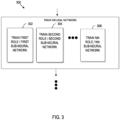
- a process 300 illustrates an example implementation that results from training a neural network (e.g., as carried out by training 202 FIG. 2 ).
- a first role 302 of the neural network models a nonlinearity of the reference audio system.
- a second role 304 of the neural network models a first linear aspect and/or a temporal dependency of the reference audio system.
- the above can be extended to include other roles 306 (conceptually illustrated as an Nth sub-neural network for illustration).
- the roles can be reversed.
- the first role 302 can model a first linear aspect and/or a temporal dependency of the reference audio system
- the second role 304 can model a nonlinearity of the reference audio system.
- Training each role of the neural network can occur at the same time such that all the parameters of the model are learned simultaneously. In other embodiments, training can be carried out in discrete sections or steps, e.g., depending upon the selected architecture for the sub-neural networks.
- the first role 302 of the neural network can be implemented as a multi-layer perceptron that models the nonlinearity present in the reference audio system.
- Training the neural network can also comprise training a convolutional neural network.
- the second role 304 of the neural network can be implemented as a convolutional neural network that models at least one linear aspect and/or at least one temporal dependency of the reference audio system.
- the process 300 can further comprise training, at 306, a third role/sub-neural network to model a second linear (or other) aspect of the reference audio system.
- the process 300 comprises training such that a first role of the neural network models a non-linear behavior of the reference audio system, a second role of the neural network models a first linear aspect of the reference audio system, and a third role of the neural network models a second linear aspect of the reference audio system.
- the first role of the neural network, the second role of the neural network, and the third role of the neural network can essentially form a Wiener-Hammerstein topology.
- the first sub-neural network, the second sub-neural network, the third sub-neural network can be arranged in series, parallel, or a combination thereof.
- modeling a nonlinearity of the reference audio system, modeling a first linear aspect and/or a temporal dependency of the reference audio system, and modeling a second linear aspect of the reference audio system can be carried out so as to be arranged in series, parallel, or a combination thereof.
- the first sub-neural network and the second sub-neural network can be extended to a paralleled filter-waveshaper-filter configuration.
- the first sub-neural network and the second sub-neural network are extended to any combination order of waveshapers and filters.
- the term "sub-neural network" can be construed physically or conceptually, e.g., to designate role, depending upon the application.
- aspects herein may be implemented largely in software, e.g., using a computer (e.g., desktop, laptop, etc.), and audio interface.
- a computer e.g., desktop, laptop, etc.
- other aspects herein are implemented in specialized hardware, e.g., a digital signal processor (DSP) executing in a form factor suitable for use by musicians, e.g., on stages, studios, and other performance settings.
- DSP digital signal processor
- the perceptual loss function (e.g., see applying at 206, the perceptual loss function in FIG. 2 ) can be used to make decisions about training such that a reference audio system can be virtualized in a timeframe tolerable by musicians, e.g., orders of minutes compared to the hours conventionally required by typical artificial neural networks.
- the perceptual loss function applies a first thresholding function and a second thresholding function.
- the first and second thresholding functions shorten training cycles, and hence speed up the time required to train the artificial neural network.
- the first thresholding function exploits the concept of absolute threshold of hearing. That is, the neural network is not penalized for errors in the prediction which the human ear is typically not sensitive enough to pick up, even in optimal, quiet conditions.
- a threshold level of the first thresholding function can be set at a level such that even if the error signal by itself were output to the listener, the listener would not hear the frequency components which fall under the absolute threshold of hearing.
- the second thresholding function exploits auditory masking.
- Masking refers to the phenomenon where a louder sound masks a quieter sound happening simultaneously such that a typical listener cannot hear the quieter sound.
- This algorithm enables the concept of masking, since the perceptual loss function processes two signals that are "playing" simultaneously.
- the error is below a masking threshold, e.g., if the error is much smaller than the target (e.g. -24 dB), then the error of the model is judged to be sufficiently inaudible, and the prediction is judged to sound sufficiently identical to the target.
- the neural network is not penalized for errors in the prediction where the prediction is below the masking threshold (e.g., at each critical band).
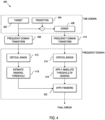
- FIG. 4 a block diagram illustrates an example process 400 for implementing the perceptual loss function, e.g., applying at 206, the perceptual loss function in FIG. 2 , training the artificial neural network 126 in FIG. 1 , etc.
- the process 400 calculates an error signal 406 in the time domain.
- the process 400 the proceeds to implement a perceptual loss function.
- the perceptual loss function takes into account both the target and the error.
- the process 400 converts the target to the frequency domain at 408, and converts the error to the frequency domain at 410.
- the process 400 applies a target critical band filter 412 to the transformed target signal so as to produce a target signal component at each critical band of the target critical band filter 412.
- the process 400 may also and/or alternatively apply an error critical band filter 414 to the transformed error signal to produce an error signal at each error critical band.
- the target critical band filter 412 and the error critical band filter 414 may be similar, or the target critical band filter 412 and the error critical band filter 414 may comprehend different bands.
- a critical band filter is a band-pass filter that aggregates frequencies that are close enough to each other that they are perceptually indistinguishable, or at least judged to be indistinguishable for the particular implementation.
- a critical band is analogous to a frequency bin described more fully herein.
- the range of frequencies that are grouped into each band can be selected based predetermined conditions and/or definitions, rules, dynamically detectable conditions, combinations thereof, etc. Since each critical band is defined around a center frequency, multiple critical bands are typically used to cover the whole frequency range.
- several critical bands are used jointly based upon predetermined ranges derived from knowledge of auditory perception, addressing different parts of the audible frequency range.
- aspects herein either reference in plural (critical bands), or to a "critical band filter bank" , where a filter bank is essentially a set of filters applied all together (e.g., frequency bin).
- the process 400 can comprise thresholding the error signal in the frequency domain according to a frequency-dependent threshold level, where the threshold level is established based upon a predetermined threshold of hearing.
- an absolute threshold of hearing 416 is applied to the error signal that has been processed by the critical band filter 414. Applying the absolute threshold of hearing 416 can be carried out for instance, so that the error at each critical band is not minimized further if it is estimated to be inaudible at that critical band by the process 400.
- a frequency-dependent absolute threshold of hearing curve is used to establish a unique threshold for each critical band.
- the curve data may be derived from, for instance, a curve that takes into account the sensitivity of human hearing at different frequencies (e.g., based upon an average listener or other metric) to establish frequency dependent threshold values.
- the process 400 can comprise establishing a frequency-dependent mask thresholding level based on the target signal, and thresholding the error signal in the frequency domain according to the established frequency-dependent mask thresholding level.
- a masking threshold 418 is estimated from the target signal at each critical band of the target critical band filter 412.
- the masking threshold is estimated as a level below a predetermined amount of the energy of the target signal at each critical band (e.g., -24 dB of the energy of the target signal).
- frequency masking can be utilized by the perceptual loss function.
- the masking threshold 418 estimated from the target signal is applied to the error signal via masking 420.
- frequency masking is dependent on the target signal, but it is applied to the error signal in the illustrated example.
- the output of the masking 420 is a final error that is used to adjust the weights of the artificial neural network.
- the absolute threshold of hearing 416 and applying masking 420 can occur in any order, series, parallel, etc.
- the operations described here are differentiable.
- the system can calculate loss gradients with regard to the predicted signal (i.e., carry out error backpropagation for updating the terms in a neural network).
- all of the operations are differentiable so as to be able to calculate gradients with regard to the predicted signal.
- a process of applying a perceptual loss function thus comprises receiving a target signal and an error signal (computed from the target and a predicted output of the model). Moreover, the process includes converting the target signal and the error signal to the frequency domain, applying critical band filtering to the target signal in the frequency domain, and applying critical band filtering to the error signal in the frequency domain. The process also comprises thresholding the error signal, e.g., using the concept of the absolute threshold of hearing, such that errors at critical bands which are estimated inaudible by the process 400, e.g., based upon data indicative of the average listener, are not further minimized.
- the above process may further comprise attenuating the target signal for establishing a frequency masking level, which is used to threshold the error signal in the frequency domain to verify that the error signal contains loud enough information for further processing.
- a frequency masking level which is used to threshold the error signal in the frequency domain to verify that the error signal contains loud enough information for further processing.
- not all of the illustrated perceptual loss functions need be applied. Rather, any combination of critical banding, masking, attenuation, thresholding, other processes, combinations thereof, etc., can be applied.
- perceptual loss function provides numerous unexpected improvements in addition to providing high sonic quality.
- the perceptual loss function as described above, e.g., with reference to FIG. 4 , provides an efficient way to train, resulting in fast training that relies upon relatively smaller training sets compared to conventional approaches, and converges to usable virtualizations relatively faster than conventional approaches to amplifier modeling. This enables training to be implemented in hardware, e.g., the modeling audio system 106 of FIG. 1 . For instance, a conventional approach that could require hours to train can now be trained on an order of magnitude of minutes.
- a reference audio system e.g., a guitar amplifier used by a user/musician.
- musicians can utilize the modeling audio system 106 in a form factor of a pedalboard, rackmount, or tabletop processor without the requirement of a general purpose computer.
- aspects herein can be implemented in a software solution that runs on a general purpose computer, e.g., a laptop, in combination with a suitable audio interface.
- a general purpose computer e.g., a laptop
- the trained model with a physical device with less processing power as needed for training the neural network.
- the final error signal output from the masking 420 provides more information than merely masking.
- the amount of error is also an indication of how good the virtualization is at the current state of training. That is, the smaller the error, the closer the virtualization will sound to the musician like the reference audio system.
- some conventional neural networks may digress in such a way to spend considerable resources processing training data that minimizes error in ways that are not in a meaningful metric to a musician/user that is using the virtualization to simulate a reference audio system.
- training data is minimized by stopping error feedback where improvements, although feasible, do not have an audible impact.
- aspects of the present disclosure apply perceptually motivated frequency domain processing on the target signal and on the error signal. This is in contrast to conventional approaches, which apply processing on the target signal and the prediction signal. Notably, this approach retains the phase information in the target signal.
- the model can match not only the frequency response magnitude of the reference audio system, but also the frequency response phase. While the human hearing is somewhat insensitive to phase, in practice, it is difficult to create accurate models of these systems if the loss function does not penalize for phase mismatches. Also, in some reference audio systems, retaining the phase information is crucial for creating faithful models of these systems. In this regard, computing the error signal in the time domain allows the process to do so while simultaneously applying perceptually motivated functions such as critical banding in the frequency domain.
- critical banding is applied simultaneously with strict phase matching on a single loss function.
- aspects herein simultaneously preserves phase but also allow penalizing different frequency bands in a perceptually relevant way.
- a pre-training i.e., smart initialization
- a user may be able to select a configuration/structure of the model, e.g., either at the time of building the artificial neural network, or within the modeling audio system.
- a user can use models to build new and/or different audio systems, including audio systems that never existed before, but which are based upon at least one existing reference audio system.
- the modeling audio system provides an interface, e.g., a graphical user interface, that enables a user to build modular systems by assembling functional processing blocks in series, parallel, or a combination thereof.
- FIG. 5-FIG. 9 depict various example models that can be created for instance, within the modeling audio system 106 of FIG. 1 .
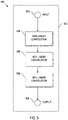
- a block diagram 500 of a model 502 is built using an input 504 that feeds a series of non-linear convolutions 506 that terminate in an output 508.
- a model is built based upon the trained neural network, or a series combination of trained neural networks, with a single input and a single output.
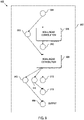
- a block diagram 600 illustrates that a model 602 is built using an input 604 that feeds a series of non-linear convolutions 606 that terminate in an output 608. Also, the input 604 feeds a bypass loop 610 that terminates at the output 608.
- This modular setup illustrates an example set of user customized connections to allow a linear combination between a pre-trained model and input signal.
- a block diagram 700 illustrates that a model 702 is built using an input 704 that feeds a first series of non-linear convolutions 706 that terminate in an output 708.
- the input 704 also feeds a second series of non-linear convolutions 706 that terminate in the output 708.
- This modular setup illustrates an example set of user customized connections to allow parallel models. In example implementations, a user controls the amount of each model fed to the output.
- a block diagram 800 illustrates that a model 802 is built using an input 804 that feeds a first series of non-linear convolutions 806 that terminate in a mixing stage 808.
- the input 804 also feeds a second series of non-linear convolutions 806 that terminate in the mixing stage 808.
- the mixing stage 808 provides one or more independent output channels 810.
- This modular setup illustrates an example set of user customized connections to allow parallel models.
- a user controls the amount of each model fed to the output(s), so as to create a multi-channel audio system for performance in mono, stereo, multi-channel, etc., configurations.
- a block diagram 900 illustrates that a model 902 is built using an input 904 that feeds non-linear convolutions 806 that ultimately terminate in an output 908.
- the input 904 can also feed one or more parallel paths with intermediate nodes 910, each node serving as a mixing node, summing node, difference node, splitter node, node that carries out a pre-programmed function, weighted function, etc.
- This configuration is merely illustrative as a user may have the ability to fully customize series and parallel paths, with any combination of non-linear convolutions 906 and/or intermediate nodes 910.
- the system itself may auto derive a configuration, e.g., based upon an automated analysis of some pre-recorded audio, by receiving metadata, configuration data, combinations thereof, etc.
- Data processing system 1000 may comprise at least one processor 1010 connected to system bus 1020. Also connected to the system bus 1020 is memory 1030. A bridge 1040 interfaces the system bus 1020 to an I/O bus 1050.
- the I/O bus 1050 is utilized to support one or more buses and corresponding devices, such as storage 1060, removable media storage 1070, input/output devices 1080, a network adapter 1090, other devices, combinations thereof, etc.
- a network adapter 1090 can be used to enable the data processing system 1000 to communicate with other data processing systems or storage devices through intervening private or public networks.
- the memory 1030, storage 1060, removable media storage 1070, or combinations thereof can be used to store program code that is executed by the processor(s) 1010 to implement any aspect of the present disclosure described and illustrated in FIGS. 1-9 .
- aspects of the present disclosure may be embodied as a system, method or computer program product. Moreover, some aspects of the present disclosure may be implemented in hardware, in software (including firmware, resident software, micro-code, etc.), or by combining software and hardware aspects. Furthermore, aspects of the present disclosure may take the form of a computer program product embodied in one or more computer readable storage medium(s) having computer readable program code embodied thereon.
- the computer readable medium may be a computer readable storage medium or a computer readable signal medium.
- a computer readable storage medium may be a primary storage device, or a secondary storage device (which may be internal, external, or removable from the host hardware processing device).
- a computer readable storage medium may be any tangible (hardware) medium that can contain, or otherwise store a program for use by or in connection with an instruction execution system, apparatus, or device.
Landscapes
- Engineering & Computer Science (AREA)
- Physics & Mathematics (AREA)
- Theoretical Computer Science (AREA)
- Health & Medical Sciences (AREA)
- Artificial Intelligence (AREA)
- Computational Linguistics (AREA)
- Evolutionary Computation (AREA)
- General Physics & Mathematics (AREA)
- General Engineering & Computer Science (AREA)
- General Health & Medical Sciences (AREA)
- Acoustics & Sound (AREA)
- Computing Systems (AREA)
- Multimedia (AREA)
- Data Mining & Analysis (AREA)
- Biophysics (AREA)
- Mathematical Physics (AREA)
- Software Systems (AREA)
- Biomedical Technology (AREA)
- Molecular Biology (AREA)
- Life Sciences & Earth Sciences (AREA)
- Audiology, Speech & Language Pathology (AREA)
- Human Computer Interaction (AREA)
- Signal Processing (AREA)
- Nonlinear Science (AREA)
- Circuit For Audible Band Transducer (AREA)
- Stereophonic System (AREA)
Applications Claiming Priority (2)
| Application Number | Priority Date | Filing Date | Title |
|---|---|---|---|
| US201962941986P | 2019-11-29 | 2019-11-29 | |
| EP20151065.8A EP3828878B1 (de) | 2019-11-29 | 2020-01-09 | Neuronaler modellierer von audiosystemen |
Related Parent Applications (2)
| Application Number | Title | Priority Date | Filing Date |
|---|---|---|---|
| EP20151065.8A Division-Into EP3828878B1 (de) | 2019-11-29 | 2020-01-09 | Neuronaler modellierer von audiosystemen |
| EP20151065.8A Division EP3828878B1 (de) | 2019-11-29 | 2020-01-09 | Neuronaler modellierer von audiosystemen |
Publications (1)
| Publication Number | Publication Date |
|---|---|
| EP4134946A1 true EP4134946A1 (de) | 2023-02-15 |
Family
ID=69157656
Family Applications (2)
| Application Number | Title | Priority Date | Filing Date |
|---|---|---|---|
| EP22184822.9A Pending EP4134946A1 (de) | 2019-11-29 | 2020-01-09 | Neuronaler modellierer von audiosystemen |
| EP20151065.8A Active EP3828878B1 (de) | 2019-11-29 | 2020-01-09 | Neuronaler modellierer von audiosystemen |
Family Applications After (1)
| Application Number | Title | Priority Date | Filing Date |
|---|---|---|---|
| EP20151065.8A Active EP3828878B1 (de) | 2019-11-29 | 2020-01-09 | Neuronaler modellierer von audiosystemen |
Country Status (3)
| Country | Link |
|---|---|
| US (2) | US11532318B2 (de) |
| EP (2) | EP4134946A1 (de) |
| PL (1) | PL3828878T3 (de) |
Families Citing this family (8)
| Publication number | Priority date | Publication date | Assignee | Title |
|---|---|---|---|---|
| US12014108B2 (en) * | 2021-02-12 | 2024-06-18 | Neural DSP Technologies Oy | Robotic system for controlling audio systems |
| CN114783449B (zh) * | 2022-03-23 | 2024-09-17 | 武汉大学 | 神经网络训练方法、装置、电子设备及介质 |
| US12682874B2 (en) * | 2022-03-24 | 2026-07-14 | Yamaha Corporation | Sound processing device and method of outputting parameter of sound processing device |
| CN115297420B (zh) * | 2022-06-22 | 2023-06-13 | 荣耀终端有限公司 | 信号处理方法、设备及存储介质 |
| CN115831147B (zh) * | 2022-10-20 | 2024-02-02 | 广州优谷信息技术有限公司 | 基于音频补偿的朗读检测方法、系统、装置及介质 |
| CN116564252B (zh) * | 2023-04-11 | 2026-07-24 | 北京达佳互联信息技术有限公司 | 音效参数调整模型的训练方法及相关设备 |
| US20250111843A1 (en) * | 2023-10-02 | 2025-04-03 | Georgios Gkountouras | Systems and methods for modeling an audio system |
| US20260186729A1 (en) * | 2024-12-30 | 2026-07-02 | Harman Becker Automotive Systems, Inc. | System and method for an audio emulator |
Citations (3)
| Publication number | Priority date | Publication date | Assignee | Title |
|---|---|---|---|---|
| US20080037804A1 (en) * | 2006-08-01 | 2008-02-14 | Dts, Inc. | Neural network filtering techniques for compensating linear and non-linear distortion of an audio transducer |
| US20190164052A1 (en) * | 2017-11-24 | 2019-05-30 | Electronics And Telecommunications Research Institute | Audio signal encoding method and apparatus and audio signal decoding method and apparatus using psychoacoustic-based weighted error function |
| WO2019199995A1 (en) * | 2018-04-11 | 2019-10-17 | Dolby Laboratories Licensing Corporation | Perceptually-based loss functions for audio encoding and decoding based on machine learning |
Family Cites Families (12)
| Publication number | Priority date | Publication date | Assignee | Title |
|---|---|---|---|---|
| US6292791B1 (en) | 1998-02-27 | 2001-09-18 | Industrial Technology Research Institute | Method and apparatus of synthesizing plucked string instruments using recurrent neural networks |
| US6476308B1 (en) | 2001-08-17 | 2002-11-05 | Hewlett-Packard Company | Method and apparatus for classifying a musical piece containing plural notes |
| US7799986B2 (en) * | 2002-07-16 | 2010-09-21 | Line 6, Inc. | Stringed instrument for connection to a computer to implement DSP modeling |
| DE102006035188B4 (de) | 2006-07-29 | 2009-12-17 | Christoph Kemper | Musikinstrument mit Schallwandler |
| US8600068B2 (en) | 2007-04-30 | 2013-12-03 | University Of Central Florida Research Foundation, Inc. | Systems and methods for inducing effects in a signal |
| US9064483B2 (en) | 2013-02-06 | 2015-06-23 | Andrew J. Alt | System and method for identifying and converting frequencies on electrical stringed instruments |
| US9099066B2 (en) | 2013-03-14 | 2015-08-04 | Stephen Welch | Musical instrument pickup signal processor |
| US10564923B2 (en) | 2014-03-31 | 2020-02-18 | Sony Corporation | Method, system and artificial neural network |
| US20160179458A1 (en) | 2014-12-22 | 2016-06-23 | Fractal Audio Systems | Digital signal processing using a combination of direct and multi-band convolution algorithms in the time domain |
| US20160328501A1 (en) | 2015-05-05 | 2016-11-10 | Fractal Audio Systems | Automatic AMP Matching |
| US9626949B2 (en) | 2015-07-21 | 2017-04-18 | Positive Grid LLC | System of modeling characteristics of a musical instrument |
| EP3182339A1 (de) | 2015-12-17 | 2017-06-21 | Vrije Universiteit Brussel | Vorrichtung zum reservoir-computing |
-
2020
- 2020-01-09 EP EP22184822.9A patent/EP4134946A1/de active Pending
- 2020-01-09 EP EP20151065.8A patent/EP3828878B1/de active Active
- 2020-01-09 PL PL20151065.8T patent/PL3828878T3/pl unknown
- 2020-01-09 US US16/738,512 patent/US11532318B2/en active Active
-
2022
- 2022-12-16 US US18/067,069 patent/US12620407B2/en active Active
Patent Citations (3)
| Publication number | Priority date | Publication date | Assignee | Title |
|---|---|---|---|---|
| US20080037804A1 (en) * | 2006-08-01 | 2008-02-14 | Dts, Inc. | Neural network filtering techniques for compensating linear and non-linear distortion of an audio transducer |
| US20190164052A1 (en) * | 2017-11-24 | 2019-05-30 | Electronics And Telecommunications Research Institute | Audio signal encoding method and apparatus and audio signal decoding method and apparatus using psychoacoustic-based weighted error function |
| WO2019199995A1 (en) * | 2018-04-11 | 2019-10-17 | Dolby Laboratories Licensing Corporation | Perceptually-based loss functions for audio encoding and decoding based on machine learning |
Non-Patent Citations (3)
| Title |
|---|
| ALEC WRIGHT ET AL: "Perceptual Loss Function for Neural Modelling of Audio Systems", ARXIV.ORG, CORNELL UNIVERSITY LIBRARY, 201 OLIN LIBRARY CORNELL UNIVERSITY ITHACA, NY 14853, 20 November 2019 (2019-11-20), XP081536313 * |
| M MARTINEZ RAMIREZ ET AL: "End-to-end equalization with convolutional neural networks", PROCEEDINGS OF THE 21 ST INTERNATIONAL CONFERENCE ON DIGITAL AUDIO EFFECTS PROCEEDINGS OF THE 21 ST INTERNATIONAL CONFERENCE ON DIGITAL AUDIO EFFECTS (DAFX-18), 7 September 2018 (2018-09-07), XP055696749 * |
| SCOTT H HAWLEY ET AL: "SignalTrain: Profiling Audio Compressors with Deep Neural Networks", ARXIV.ORG, CORNELL UNIVERSITY LIBRARY, 201 OLIN LIBRARY CORNELL UNIVERSITY ITHACA, NY 14853, 28 May 2019 (2019-05-28), XP081365552 * |
Also Published As
| Publication number | Publication date |
|---|---|
| US20230119557A1 (en) | 2023-04-20 |
| EP3828878B1 (de) | 2023-11-22 |
| US20210166718A1 (en) | 2021-06-03 |
| US11532318B2 (en) | 2022-12-20 |
| PL3828878T3 (pl) | 2024-04-29 |
| EP3828878C0 (de) | 2023-11-22 |
| US12620407B2 (en) | 2026-05-05 |
| EP3828878A1 (de) | 2021-06-02 |
Similar Documents
| Publication | Publication Date | Title |
|---|---|---|
| US12620407B2 (en) | Neural modeler of audio systems | |
| Ramírez et al. | Modeling nonlinear audio effects with end-to-end deep neural networks | |
| US12399673B2 (en) | Emulating behavior of audio systems | |
| US9099066B2 (en) | Musical instrument pickup signal processor | |
| Eichas et al. | Block-oriented modeling of distortion audio effects using iterative minimization | |
| Covert et al. | A vacuum-tube guitar amplifier model using a recurrent neural network | |
| Orcioni et al. | Identification of Volterra models of tube audio devices using multiple-variance method | |
| CN113643714B (zh) | 音频处理方法、装置、存储介质及计算机程序 | |
| Esqueda et al. | Differentiable white-box virtual analog modeling | |
| Hawley et al. | Signaltrain: Profiling audio compressors with deep neural networks | |
| Hawley et al. | Profiling audio compressors with deep neural networks | |
| US20230352058A1 (en) | System for automated multitrack mixing | |
| CN105229947A (zh) | 音频混合器系统 | |
| Juvela et al. | End-to-end amp modeling: from data to controllable guitar amplifier models | |
| Ick et al. | Sound event detection in urban audio with single and multi-rate PCEN | |
| US20250111843A1 (en) | Systems and methods for modeling an audio system | |
| TW202226227A (zh) | 揚聲器系統及其補償方法 | |
| Simionato et al. | Fully conditioned and low-latency black-box modeling of analog compression | |
| Comunità et al. | Differentiable black-box and gray-box modeling of nonlinear audio effects | |
| Yu et al. | DiffVox: A differentiable model for capturing and analysing vocal effects distributions | |
| CN102903367A (zh) | 离线迭代的声重放系统频响均衡方法和装置 | |
| EP4044171B1 (de) | Emulation des verhaltens von audiosystemen | |
| Holzmann | Reservoir computing: a powerful black-box framework for nonlinear audio processing | |
| Papaleo et al. | Evaluating neural networks architectures for spring reverb modelling | |
| CN113921007A (zh) | 提升远场语音交互性能的方法和远场语音交互系统 |
Legal Events
| Date | Code | Title | Description |
|---|---|---|---|
| PUAI | Public reference made under article 153(3) epc to a published international application that has entered the european phase |
Free format text: ORIGINAL CODE: 0009012 |
|
| STAA | Information on the status of an ep patent application or granted ep patent |
Free format text: STATUS: THE APPLICATION HAS BEEN PUBLISHED |
|
| AC | Divisional application: reference to earlier application |
Ref document number: 3828878 Country of ref document: EP Kind code of ref document: P |
|
| AK | Designated contracting states |
Kind code of ref document: A1 Designated state(s): AL AT BE BG CH CY CZ DE DK EE ES FI FR GB GR HR HU IE IS IT LI LT LU LV MC MK MT NL NO PL PT RO RS SE SI SK SM TR |
|
| STAA | Information on the status of an ep patent application or granted ep patent |
Free format text: STATUS: REQUEST FOR EXAMINATION WAS MADE |
|
| 17P | Request for examination filed |
Effective date: 20230801 |
|
| RBV | Designated contracting states (corrected) |
Designated state(s): AL AT BE BG CH CY CZ DE DK EE ES FI FR GB GR HR HU IE IS IT LI LT LU LV MC MK MT NL NO PL PT RO RS SE SI SK SM TR |
|
| RAP3 | Party data changed (applicant data changed or rights of an application transferred) |
Owner name: NEURAL DSP TECHNOLOGIES OY |
|
| STAA | Information on the status of an ep patent application or granted ep patent |
Free format text: STATUS: EXAMINATION IS IN PROGRESS |
|
| 17Q | First examination report despatched |
Effective date: 20250130 |
|
| GRAP | Despatch of communication of intention to grant a patent |
Free format text: ORIGINAL CODE: EPIDOSNIGR1 |
|
| STAA | Information on the status of an ep patent application or granted ep patent |
Free format text: STATUS: GRANT OF PATENT IS INTENDED |
|
| INTG | Intention to grant announced |
Effective date: 20260710 |