EP4134874B1 - Vorrichtung und verfahren zur diagnostischen abdeckung eines neuronalen netzwerkbeschleunigers - Google Patents
Vorrichtung und verfahren zur diagnostischen abdeckung eines neuronalen netzwerkbeschleunigers Download PDFInfo
- Publication number
- EP4134874B1 EP4134874B1 EP21190615.1A EP21190615A EP4134874B1 EP 4134874 B1 EP4134874 B1 EP 4134874B1 EP 21190615 A EP21190615 A EP 21190615A EP 4134874 B1 EP4134874 B1 EP 4134874B1
- Authority
- EP
- European Patent Office
- Prior art keywords
- spe
- matrix
- operations
- multiply
- results
- Prior art date
- Legal status (The legal status is an assumption and is not a legal conclusion. Google has not performed a legal analysis and makes no representation as to the accuracy of the status listed.)
- Active
Links
Images



Classifications
-
- G—PHYSICS
- G06—COMPUTING OR CALCULATING; COUNTING
- G06N—COMPUTING ARRANGEMENTS BASED ON SPECIFIC COMPUTATIONAL MODELS
- G06N3/00—Computing arrangements based on biological models
- G06N3/02—Neural networks
- G06N3/06—Physical realisation, i.e. hardware implementation of neural networks, neurons or parts of neurons
- G06N3/063—Physical realisation, i.e. hardware implementation of neural networks, neurons or parts of neurons using electronic means
-
- G—PHYSICS
- G06—COMPUTING OR CALCULATING; COUNTING
- G06F—ELECTRIC DIGITAL DATA PROCESSING
- G06F11/00—Error detection; Error correction; Monitoring
- G06F11/07—Responding to the occurrence of a fault, e.g. fault tolerance
- G06F11/16—Error detection or correction of the data by redundancy in hardware
- G06F11/1629—Error detection by comparing the output of redundant processing systems
- G06F11/1637—Error detection by comparing the output of redundant processing systems using additional compare functionality in one or some but not all of the redundant processing components
-
- G—PHYSICS
- G06—COMPUTING OR CALCULATING; COUNTING
- G06F—ELECTRIC DIGITAL DATA PROCESSING
- G06F11/00—Error detection; Error correction; Monitoring
- G06F11/07—Responding to the occurrence of a fault, e.g. fault tolerance
- G06F11/16—Error detection or correction of the data by redundancy in hardware
- G06F11/1629—Error detection by comparing the output of redundant processing systems
- G06F11/1641—Error detection by comparing the output of redundant processing systems where the comparison is not performed by the redundant processing components
-
- G—PHYSICS
- G06—COMPUTING OR CALCULATING; COUNTING
- G06F—ELECTRIC DIGITAL DATA PROCESSING
- G06F17/00—Digital computing or data processing equipment or methods, specially adapted for specific functions
- G06F17/10—Complex mathematical operations
- G06F17/16—Matrix or vector computation, e.g. matrix-matrix or matrix-vector multiplication, matrix factorization
-
- G—PHYSICS
- G06—COMPUTING OR CALCULATING; COUNTING
- G06F—ELECTRIC DIGITAL DATA PROCESSING
- G06F7/00—Methods or arrangements for processing data by operating upon the order or content of the data handled
- G06F7/02—Comparing digital values
-
- G—PHYSICS
- G06—COMPUTING OR CALCULATING; COUNTING
- G06F—ELECTRIC DIGITAL DATA PROCESSING
- G06F7/00—Methods or arrangements for processing data by operating upon the order or content of the data handled
- G06F7/38—Methods or arrangements for performing computations using exclusively denominational number representation, e.g. using binary, ternary, decimal representation
- G06F7/48—Methods or arrangements for performing computations using exclusively denominational number representation, e.g. using binary, ternary, decimal representation using non-contact-making devices, e.g. tube, solid state device; using unspecified devices
- G06F7/50—Adding; Subtracting
-
- G—PHYSICS
- G06—COMPUTING OR CALCULATING; COUNTING
- G06F—ELECTRIC DIGITAL DATA PROCESSING
- G06F7/00—Methods or arrangements for processing data by operating upon the order or content of the data handled
- G06F7/38—Methods or arrangements for performing computations using exclusively denominational number representation, e.g. using binary, ternary, decimal representation
- G06F7/48—Methods or arrangements for performing computations using exclusively denominational number representation, e.g. using binary, ternary, decimal representation using non-contact-making devices, e.g. tube, solid state device; using unspecified devices
- G06F7/52—Multiplying; Dividing
- G06F7/523—Multiplying only
- G06F7/53—Multiplying only in parallel-parallel fashion, i.e. both operands being entered in parallel
-
- G—PHYSICS
- G06—COMPUTING OR CALCULATING; COUNTING
- G06F—ELECTRIC DIGITAL DATA PROCESSING
- G06F7/00—Methods or arrangements for processing data by operating upon the order or content of the data handled
- G06F7/38—Methods or arrangements for performing computations using exclusively denominational number representation, e.g. using binary, ternary, decimal representation
- G06F7/48—Methods or arrangements for performing computations using exclusively denominational number representation, e.g. using binary, ternary, decimal representation using non-contact-making devices, e.g. tube, solid state device; using unspecified devices
- G06F7/544—Methods or arrangements for performing computations using exclusively denominational number representation, e.g. using binary, ternary, decimal representation using non-contact-making devices, e.g. tube, solid state device; using unspecified devices for evaluating functions by calculation
- G06F7/5443—Sum of products
-
- G—PHYSICS
- G06—COMPUTING OR CALCULATING; COUNTING
- G06N—COMPUTING ARRANGEMENTS BASED ON SPECIFIC COMPUTATIONAL MODELS
- G06N3/00—Computing arrangements based on biological models
- G06N3/02—Neural networks
- G06N3/04—Architecture, e.g. interconnection topology
- G06N3/0464—Convolutional networks [CNN, ConvNet]
-
- G—PHYSICS
- G06—COMPUTING OR CALCULATING; COUNTING
- G06F—ELECTRIC DIGITAL DATA PROCESSING
- G06F11/00—Error detection; Error correction; Monitoring
- G06F11/07—Responding to the occurrence of a fault, e.g. fault tolerance
- G06F11/16—Error detection or correction of the data by redundancy in hardware
- G06F11/1675—Temporal synchronisation or re-synchronisation of redundant processing components
Definitions
- An emerging technology field is machine learning or Artificial Intelligence (AI), with a neural network being one type of a machine learning model.
- Artificial Intelligence is widely used in various automotive applications, more specifically Convolutional Neural Networks (CNN) are found to provide significant accuracy improvements compared to traditional algorithms for Perception and other applications.
- CNN Convolutional Neural Networks
- Neural networks such as CNN's have demonstrated excellent performance at tasks such as hand-written digit classification and face detection. Additionally, neural networks have also shown promise for performing well in other, more challenging, visual classification tasks.
- Other applications for neural networks include speech recognition, language modeling, sentiment analysis, text prediction, and others.
- a software application supplies a neural network to an inference accelerator hardware engine.
- the accelerator is a Multiply-Accumulate (MAC) Array comprising multiple processing elements each capable of performing multiply-and-add or multiply-accumulate operations.
- MAC Multiply-Accumulate
- a typical implementation for monitoring the inference accelerator inserts monitoring logic into the inference accelerator processing hardware sub-blocks.
- a machine check architecture is a mechanism whereby monitoring logic in the processing hardware checks for abnormal behavior.
- Fulfillment of reliability requirements and regulations, etc. may require ensuring a hardware reliability level including continuous fault detection.
- many existing popular fault detection and handling techniques used for microcontrollers are also applicable and can be used for AI accelerators. However, these techniques may have disadvantages.
- a Lockstep Core method ( US5915082A , WO2011117155A1 ), with two hardware resources running the same function and comparing results, is a widely used approach in automotive Electronic Control Units (ECU's) to achieve high diagnostic coverage.
- ECU's Automotive Electronic Control Units
- This approach can potentially claim a diagnostic coverage of 100% of compute elements for single point faults; however, it requires doubling the hardware resources, which has an adverse impact on the cost, space, and power budget.
- BIST built-in self-test
- functional logic may provide high diagnostic coverage, but may introduce latency overheads in addition to the required runtime for the self-tests, as many implementations need to safely pause, store intermediate results of the function application to run the self-test and then restart the function afterwards, thereby causing additional performance degradation. Retention of intermediate results of the application while performing the self-test is another major concern. This approach also requires additional circuitry to be implemented.
- inventive approach provides improvements in reducing the added cost of additional hardware resources to achieve high coverage as compared to existing approaches (e.g. redundant hardware for a lockstep approach or BIST circuitry for self-test). Another improvement concerns the reduction of additional runtime overheads, which might be due to switching between the function application and self-test or software-based safety tests at runtime, without compromising on diagnostic coverage. Likewise, the inventive approach can minimize or eliminate a potential break in the flow of operation which might be required both in the case of BIST and of STL. Finally, the inventive approach may offer a deterministic diagnostic coverage of AI hardware accelerators, since many existing accelerators do not include a functionality to provide deterministic diagnostic coverage.
- Neural Networks are known to be highly compute intensive applications, especially those involving convolutions and Matrix Multiplications, which are essentially Multiply-Accumulate (MAC) operations.
- a typical Convolutional Neural Network (CNN) application may comprise convolutions which account for more than 90% of its computational requirements.
- AI Hardware Accelerators or inference accelerators may have multiple MAC processors, or the equivalent, consuming much of the active processor area (excluding memory), total processing power, etc.
- Our solution takes advantage of this unique feature of NN and AI accelerators, which accelerate applications such as CNN, Long short-term memory (LSTM), Recurrent Neural Networks (RNN), etc. Indeed, the concept may find application for any architecture comprising a MAC array, thereby ensuring a high safety coverage of such an array.
- a convolution or matrix multiplication is an operation comprising multiple MAC operations, whereby an input matrix [x] and a filter matrix [w] are used as inputs and an output matrix [y] is generated.
- Existing accelerators may perform these computations using a cluster of Processing Engines (PE) as a MAC Array, where each PE is responsible to perform one MAC operation.
- PE Processing Engines
- the size of the MAC Array is one of the factors determining the parallelizability of the architecture and is constrained by factors such as the internal memory to store input data and intermediate results of the computations, or the availability of Input/Output (IO) or power or silicon area. For example, a simple 3x3 convolution would require at most 9 PE to permit all operations of a matrix multiplication to happen in parallel.
- the operations are then repeated for each successive convolution to be performed.
- the repeated or continuous operation may be often found in real-time data processing applications, such as those use cases found in automotive applications.
- CNNs typically perform overlapped convolutions with an input matrix of higher dimensionality together with a small filter matrix.
- the input matrix is sliced into small overlapping matrices, followed by the dot product and summation of each small input matrix with the filter matrix to complete the corresponding convolution operation.
- each input data value of the input matrix in successive iterations, is multiplied by a different weight of the filter matrix and ends up being multiplied by all the weights of the filter matrix individually.
- the inventive solution proposes to include one or more additional or shared processing engines into the MAC Array, which might be called Safe Processing Engine (SPE), and which in embodiments performs three operations.
- SPE Safe Processing Engine
- the sum of the intermediate multiplications of the same input data element with different weights of the filter matrix We note that the corresponding multiplications are already performed in existing different PE's of the MAC Array, so the SPE only needs to perform the corresponding additions; the same input data element has a different relative position in every successive slice of the matrix, which position may progress with each addition cycle.
- the SPE needs to perform the corresponding multiplication with the value corresponding to the weights.
- a comparison of the results permits to verify if the computations were performed correctly.
- the number of additional processing elements in the SPE is a subject of design choice, including considerations of the number of PE's and the types of convolutions, as well as the kernel size that the hardware intends to support.
- the system only needs one processing element in the SPE for every convolution, or for every second convolution.
- multiple processing elements in the SPE serve to accelerate the calculations used to verify the operation of the MAC Array.
- a tradeoff exists, where the number of operations performed by an SPE increases as the number of individual PE's to be verified per cycle increases.
- a system can be envisaged where verification is performed at widely spaced regular intervals, depending on the safety requirements of the system.
- Various embodiments also support strided convolutions, wherein the convolution is performed with strides greater than 1 (default stride is equal to 1), pointwise convolution (convolutions with kernel size equal to 1) and Matrix Multiplication operations.
- inventive approach may provide an improved coverage of hardware faults with fewer hardware resources as compared to other approaches, whereby we note that the number of cycles needed to perform a check or verification will increase accordingly.
- Additional advantages of embodiments may include no or limited requirements for redundant hardware, which - for example - may mean significantly reduced HW in comparison to lockstep approaches, or no necessity of additional circuitry for performing BIST at startup. Likewise, there may be no need of an additional system reboot typically required after a BIST operation (as BIST may well lose the state of internal registers during test, requiring a reset after BIST). Also, embodiments may offer significantly higher coverage compared to software approaches, and even certain BIST methods.
- Embodiments may well be possible to save cost, area, power as compared to other approaches without degrading speed performance and while maintaining high and continuous coverage.
- Embodiments may be capable of ensuring coverage comparable or close to that of the lockstep approach for NN Accelerators or other convolution accelerators with significantly reduced overall additional computations.
- the inventive approach provides a new hardware architecture with hardware safety mechanisms integrated into the design to achieve high diagnostic coverage against random hardware faults, thereby ensuring the hardware to be capable of implementing safety-critical applications in an efficient manner.
- Embodiments of the inventive concept may permit to reduce or even eliminate the need of periodic tests for the MAC Array of an accelerator, which often accounts for a substantial portion of the area and computational needs of a hardware accelerator. Likewise, embodiments permit to have no break in the flow of operation, to perform any safety-related tests, and to obtain deterministic coverage of the accelerator. Embodiments also offer negligible compute and memory requirements for ensuring safety as compared to the overall compute and memory requirements of the acceleration function. Indeed, it can be envisaged to use embodiments for IC testing during the IC production flow.
- a system includes a safety-critical neural network application, a safety processor, and an inference accelerator engine.
- the safety processor receives an input image, test data (e.g., test vectors), and a neural network specification (e.g., layers and weights) from the safety-critical neural network application.
- test data e.g., test vectors
- a neural network specification e.g., layers and weights
- the disclosed approach may be used for (but is not restricted to) AI Inference, wherein a trained AI Neural Network (NN) is compiled to be executed on a dedicated processor, also known as an Accelerator.
- NN AI Neural Network
- FIG. 1a one implementation of a computing system 100, which is not according to the claimed invention, for a typical use case of an accelerator such as a Multiply-Accumulate (MAC) Array 110 is shown.
- an NN binary (including the model graph, weights and parameters) is executed on the hardware as a convolution.
- Input data may be provided e.g. from a sensor such as a camera, to a first layer, the results of the first layer are used as input to the second layer and so on, to finally obtain the output of the application.
- each input data value of the input matrix in successive iterations, is multiplied by a different weight of the filter matrix and ends up being multiplied by all the weights of the filter matrix individually.
- the sum of the intermediate multiplications of the same input data element with different weights of the filter matrix is shown in hardware as 110.
- the system comprises multiple PE's arranged as a MAC Array.
- a succession of Processor Elements PE 121, 122, 123 receive inputs i[j], i[j+1], i[j+2].
- Each PE contains a weight w[0,0], w[0,1], w[0,2] which is which is used as multiplicand by the corresponding PE.
- three inputs can be each multiplied by the corresponding weight, and the result be provided to the next processing element.
- This particular example is based on, but not restricted to, the weight-stationary dataflow, wherein typically a PE, as shown in figure 1b comprises of a local memory element 113, known as Register File, which stores the weight element to be multiplied with different input elements being transferred via Memory Bank to the multiplier 128 and added to the partial-sum element in the adder 129, to complete one MAC operation.
- Register File a local memory element 113
- the illustration is only one example implementation amongst many other variations possible.
- the inventive approach is not restricted to a certain dataflow or implementation and finds application wherever a continuous data processing is required. Embodiments are elaborated in more detail in the subsequent paragraphs and figures.
- Figure 1c shows a corresponding graphical view, where the input values are multiplied by their respective weights and summed according to equation 130. These individual input values are shown as i[0]...i[4] at 131, multiplied by the respective weights shown as 132, and summed to calculate the result shown as 133.
- FIG. 2a is shown the same implementation 210 of a computing system 200 for a typical use case of an accelerator, together with an implementation of a Safe Processing Element SPE as 211.
- the system comprises multiple PE's arranged as a MAC Array.
- the sum of the intermediate multiplications of the same input data element with different weights of the filter matrix is shown in hardware as 210.
- a succession of Processor Elements PE 221, 222, 223 receive inputs i[0], i[1], i[2].
- Each PE contains a weight w[0,0], w[0,1], w[0,2] which is which is used as multiplicand by the corresponding PE.
- three inputs can be each multiplied by the corresponding weight, and the result be provided to the next processing element. If in embodiments one multiply-addition operation defines a cycle, then a P[0,0] result will be generated after each cycle, a P[0,1] result will be generated each cycle starting after the second cycle, and a result Y[j+1] will start being available after the third cycle. In this example, the results are sent to Memory Bank 226.
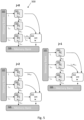
- FIG. 3 this elaborates the functions of SPE to perform safety checks on the hardware.
- the figure illustrates a standard 1d convolution operation as shown in 330, wherein a stream of input data and weights are convolved to generate a stream of outputs 331, 332 and 333, potentially at different machine cycles running on a computing system 100.
- Figures 4a and 4b show additional details of the embodiment.
- the addition of the SPE 411 to, e.g., the computing system 200, as shown in Figure 4a provides the possibility to perform safety checks on the hardware used to perform these operations and detect possible faults.
- a sum of intermediate multiplication results 335, 336 and 337, which are available in different PE's at different machine cycles, is performed in 412.
- the same input data element has a different relative position in every successive slice of the matrix or Multiply-Accumulate cycle as denoted here by xi_i.
- An expression and graphic representation of this operation is shown as Figure 4b .
- the sum of weights as per 440 is locally stored in the register file 413.
- the multiplication as shown in Figure 4b in 441 is performed in 414.
- a comparison of s1 and s2 is performed in 415 to verify if the computations were performed correctly.
- the result of the sum of 335, 336 and 337 should be equal to the result of 441. If there is a mismatch of the two values, this may be taken as indicative of a hardware failure.
- the evaluation of a mismatch may be a simple comparison of digits, or it may be a comparison of values which is dependent on the operations being performed.
- K operations of the SPE will be needed to verify the operation of K PE's or K operations performed by PE's, depending on the specific configuration of the MAC array.
- the SPE 511 receives the intermediate results 335, 336 and 337 for summation from the PE's 523, 522 and 521 respectively. Therefore, the SPE 511 in its comparison operation 415 should be able to detect any errors in calculation induced due to single point hardware faults.
- the SPE 511 itself may or may not be a separate, specialized PE used to perform the safety checks and calculations needed to verify the correct operation.
- the inventive concept can be envisaged in a system where there is a separate SPE with dedicated connections and memory.
- the inventive concept can be envisaged in a system with a pool of PE's, most of which are used for the ongoing calculations of the MAC array, and at least one of which is used as an SPE to check the operation of the other PE's. Combinations are also possible, where multiple PE's are available and there is a specialized data connection for the SPE operation, or where global data busses are used for transfer, and there is a dedicated array of PE's as well as a separate SPE to perform the check operation.
- the comparison of results may happen in the SPE, or it may happen in a separate processor. In embodiments, the comparison of results occurs in a central processor or system control processor.
- the SPE can also be envisaged as a block implemented in software, or even as a block integrated into an inference or AI model, e.g. at compile time.
- FIG 6a a typical computing system 600, comprising memory banks 625 and 626 in addition to the array of PE's 610 including the SPE 611.
- a single convolution layer is shown in Figure 6b with the input data 605, the weights 606 and the resultant output of the layer 607.
- 605 to be high resolution feature map of resolution 1024x1024x2 and the weights kernel size of 3x3
- the convolution layer can perform 18 MAC operations per machine cycle in the given array 610 of 25 PE's.
- a single additional SPE 611 connected to all the PE's in 610 should be able to successfully perform the necessary safety checks as elaborated in Figures 2 to 5 .
- multiple blocks of the type shown as 610 may require one or more SPE's in the overall computing system.
- Other implementations may use different combinations of SPE's in the computing system. There may be a tradeoff between the speed of the verification or checking operation, and the number of SPE's used.
- Figures 7 shows the inventive concept applied to implement safety checks for different types of computations.
- the SPE in embodiments performs the same three steps of operation as described above. However, possible variations and flexibility are shown to implement safety checks for different operations.
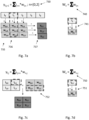
- a convolution layer has multiple filter kernels 735 to generate multiple features as output 737 as per the expression 730.
- a column of weights is shown as 736.
- the sum of the weights used in SPE may be defined as 740 instead of 440, such that the resultant 741 can be compared to the sum of elements 736 similar to the working of SPE described in 411.
- FIG. 7c and 7d Another variation of computation, typical of Matrix Multiplication, is shown in Figures 7c and 7d , which may incorporate the inventive concept of safety check into the design with a similar SPE and its three steps, but with a modified function for the sum of weights as shown in 750, such that the resultant 751 can be compared to the sum of elements 752.
- the repetitive operations combined with a systolic movement of data create the possibility to use a separate SPE comprising one or more processing elements to perform a subset of the operations and in that way to verify the operation of a PE array.
- a separate SPE comprising one or more processing elements to perform a subset of the operations and in that way to verify the operation of a PE array.
- embodiments may address almost all forms of convolution, such as depthwise or group convolutions, or dilated and atrous convolutions, in addition to the strided and pointwise convolutions.
- the inference accelerator engine or MAC array implements one or more layers of a convolutional neural network.
- the inference accelerator engine implements one or more convolutional layers and/or one or more fully connected layers.
- the inference accelerator engine implements one or more layers of a recurrent neural network.
- an "inference engine” or “inference accelerator engine” is defined as hardware and/or software which, for example, receives image data and generates one or more label probabilities for the image data.
- an "inference engine” or “inference accelerator engine” is referred to as a "classification engine” or a "classifier”.
- an inference accelerator engine may analyze an image or video frame to generate one or more label probabilities for the frame. Potential use cases include at least eye tracking, object recognition, point cloud estimation, ray tracing, light field modeling, depth tracking, and others.
- An inference accelerator engine can be used by any of a variety of different safety-critical applications which vary according to the implementation.
- inference accelerator engine is used in an automotive application, where the inference accelerator engine may control one or more functions of a self-driving vehicle (i.e., autonomous vehicle), driver-assist vehicle, or advanced driver assistance system.
- the inference accelerator engine may be trained and customized for other types of use cases.
- the inference accelerator engine may generate probabilities of classification results for various objects detected in an input image or video frame.
- Memory subsystems 125, 126 may include any number and type of memory devices, and the two memory subsystems 125 and 126 may be combined as a single memory or in any other configuration.
- the type of memory in a memory subsystem can include high-bandwidth memory (HBM), non- volatile memory (NVM), Dynamic Random Access Memory (DRAM), Static Random Access Memory (SRAM), NAND Flash memory, NOR flash memory, Ferroelectric Random Access Memory (FeRAM), or others.
- Memory subsystems 125 and 126 may be accessible by the inference accelerator engine and by other processor(s).
- I/O interfaces may include any sort of data transfer bus or channel (e.g., peripheral component interconnect (PCI) bus, PCI-Extended (PCI-X), PCIE (PCI Express) bus, gigabit Ethernet (GBE) bus, universal serial bus (USB)).
- PCI peripheral component interconnect
- PCI-X PCI-Extended
- PCIE PCIE Express
- GEE gigabit Ethernet
- USB universal serial bus
- computing systems 100, 200, 500, 600 or one or more portions thereof are integrated within a robotic system, self-driving vehicle, autonomous drone, surgical tool, or other types of mechanical devices or systems.
- inventive concept finds application in any system where safety, security and/or reliability of the hardware is needed or desired.
- the number of components of computing system 100 varies from implementation to implementation. For example, in other implementations, there are more or fewer of each component than the number shown in the figures.
- computing system 100 includes other components not shown in Figure 1 and the other figures. Additionally, in other implementations, computing system 100 is structured in other ways than shown in the figures.
Landscapes
- Engineering & Computer Science (AREA)
- Physics & Mathematics (AREA)
- General Physics & Mathematics (AREA)
- Theoretical Computer Science (AREA)
- Computational Mathematics (AREA)
- Mathematical Analysis (AREA)
- Pure & Applied Mathematics (AREA)
- General Engineering & Computer Science (AREA)
- Mathematical Optimization (AREA)
- Computing Systems (AREA)
- Mathematical Physics (AREA)
- Data Mining & Analysis (AREA)
- Biophysics (AREA)
- Health & Medical Sciences (AREA)
- Life Sciences & Earth Sciences (AREA)
- Software Systems (AREA)
- Biomedical Technology (AREA)
- Molecular Biology (AREA)
- Computational Linguistics (AREA)
- Evolutionary Computation (AREA)
- General Health & Medical Sciences (AREA)
- Artificial Intelligence (AREA)
- Quality & Reliability (AREA)
- Neurology (AREA)
- Algebra (AREA)
- Databases & Information Systems (AREA)
- Complex Calculations (AREA)
- Hardware Redundancy (AREA)
- Test And Diagnosis Of Digital Computers (AREA)
Claims (7)
- System (100, 600), das Folgendes umfasst: ein Multiplikations-Akkumulations-Array (MAC-Array) (110, 610), das mehrere Verarbeitungselemente (PE, 122) umfasst; und eine Sicherheitsverarbeitungs-Engine (SPE, 211, 411), wobei das MAC-Array ausgebildet ist um:Matrixmultiplikationsoperationen parallel in mehreren PE's durchzuführen, um eine Faltung an dem MAC-Array zu betreiben; eine Teilmenge der Matrixmultiplikationsoperationen an der SPE durchzuführen; die Ergebnisse der Teilmenge von Matrixmultiplikationsoperationen, die parallel in mehreren PEs und an der SPE durchgeführt werden, zu vergleichen; und eine Fehlerbedingung basierend auf einer Fehlanpassung der Ergebnisse zu bestimmen,wobei die Matrixmultiplikationsoperationen Matrixmultiplikationsoperationen eines Eingabedatenelements mit unterschiedlichen Gewichtungen einer Filtermatrix umfassen, undwobei die SPE Folgendes durchführt: eine erste Operation zum Berechnen einer Summe der Ergebnisse der Matrixmultiplikationsoperationen eines Eingabedatenelements mit unterschiedlichen Gewichtungen einer Filtermatrix,eine zweite Operation einer Multiplikation des Eingabedatenelements mit einem Wert, der der Summe der unterschiedlichen Gewichtungen entspricht, undeine dritte Operation nach der ersten Operation und der zweiten Operation eines Vergleichs des Ergebnisses der ersten Operation mit dem Ergebnis der zweiten Operation.
- System nach Anspruch 1, wobei der Vergleich der Ergebnisse der Teilmenge von Matrixmultiplikationsoperationen es ermöglicht, die Operation mehrerer Verarbeitungselemente des Multiplikations-Akkumulations-Arrays zu verifizieren.
- System nach Anspruch 1 oder 2, wobei der Vergleich der Ergebnisse der Teilmenge von Matrixmultiplikationsoperationen es ermöglicht, die Operation aller Verarbeitungselemente des Multiplikations-Akkumulations-Arrays zu verifizieren.
- System nach einem der vorhergehenden Ansprüche, wobei die SPE sequenziell Eingabewerte eines Eingabevektors empfängt und jeden Eingabewert mit einer Gewichtung multipliziert.
- System nach Anspruch 4, wobei die SPE sequenziell gestufte Eingabewerte empfängt, die eine Teilmenge der Werte eines gegebenen Eingabevektors umfassen.
- System nach einem der vorhergehenden Ansprüche, wobei das System einen Pool von PEs umfasst, von denen die meisten für die laufenden Berechnungen des MAC-Arrays verwendet werden und von denen mindestens eines als SPE verwendet wird, um die Operation der anderen PEs zu überprüfen.
- Verfahren, das Folgendes umfasst: kontinuierliches Durchführen einer Matrixoperationsberechnung, die einen Satz von Multiplikations-Akkumulationsoperationen an einem Array von Verarbeitungselementen (PEs, 122) umfasst; getrenntes und kontinuierliches Durchführen einer Teilmenge der Multiplikations-Akkumulationsoperationen als eine Verifikationsoperation und Vergleichen der Ergebnisse, wobei das Vergleichen der Ergebnisse es ermöglicht, zu verifizieren, ob die Matrixoperationsberechnung korrekt durchgeführt wurde, wobei die Multiplikations-Akkumulationsoperationen Multiplikations-Akkumulationsoperationen eines Eingabedatenelements mit unterschiedlichen Gewichtungen einer Filtermatrix umfassen und wobei die Verifikationsoperation umfassteine erste Operation, um eine Summe der Ergebnisse der Multiplikations-Akkumulationsoperationen eines Eingabedatenelements mit unterschiedlichen Gewichtungen einer Filtermatrix durchzuführen,eine zweite Operation, um eine Multiplikation des Eingabedatenelements mit einem Wert durchzuführen, der der Summe der unterschiedlichen Gewichtungen entspricht, undeine dritte Operation, die der ersten Operation und der zweiten Operation folgt, um einen Vergleich des Ergebnisses der ersten Operation mit dem Ergebnis der zweiten Operation durchzuführen,wobei die Verifikationsoperation in einem separaten Sicherheitsverarbeitungselement (SPE, 211, 411) durchgeführt wird.
Priority Applications (5)
| Application Number | Priority Date | Filing Date | Title |
|---|---|---|---|
| EP21190615.1A EP4134874B1 (de) | 2021-08-10 | 2021-08-10 | Vorrichtung und verfahren zur diagnostischen abdeckung eines neuronalen netzwerkbeschleunigers |
| JP2024506558A JP7730411B2 (ja) | 2021-08-10 | 2022-07-25 | ニューラルネットワークアクセラレータの診断カバレッジのための装置及び方法 |
| CN202280055432.5A CN117813611A (zh) | 2021-08-10 | 2022-07-25 | 用于神经网络加速器的诊断覆盖率的设备和方法 |
| US18/683,068 US20240354058A1 (en) | 2021-08-10 | 2022-07-25 | Apparatus and method for diagnostic coverage of a neural network accelerator |
| PCT/EP2022/070743 WO2023016785A1 (en) | 2021-08-10 | 2022-07-25 | Apparatus and method for diagnostic coverage of a neural network accelerator |
Applications Claiming Priority (1)
| Application Number | Priority Date | Filing Date | Title |
|---|---|---|---|
| EP21190615.1A EP4134874B1 (de) | 2021-08-10 | 2021-08-10 | Vorrichtung und verfahren zur diagnostischen abdeckung eines neuronalen netzwerkbeschleunigers |
Publications (2)
| Publication Number | Publication Date |
|---|---|
| EP4134874A1 EP4134874A1 (de) | 2023-02-15 |
| EP4134874B1 true EP4134874B1 (de) | 2024-12-11 |
Family
ID=77300747
Family Applications (1)
| Application Number | Title | Priority Date | Filing Date |
|---|---|---|---|
| EP21190615.1A Active EP4134874B1 (de) | 2021-08-10 | 2021-08-10 | Vorrichtung und verfahren zur diagnostischen abdeckung eines neuronalen netzwerkbeschleunigers |
Country Status (5)
| Country | Link |
|---|---|
| US (1) | US20240354058A1 (de) |
| EP (1) | EP4134874B1 (de) |
| JP (1) | JP7730411B2 (de) |
| CN (1) | CN117813611A (de) |
| WO (1) | WO2023016785A1 (de) |
Family Cites Families (4)
| Publication number | Priority date | Publication date | Assignee | Title |
|---|---|---|---|---|
| US5915082A (en) | 1996-06-07 | 1999-06-22 | Lockheed Martin Corporation | Error detection and fault isolation for lockstep processor systems |
| WO2011117155A1 (de) | 2010-03-23 | 2011-09-29 | Continental Teves Ag & Co. Ohg | Redundante zwei-prozessor-steuerung und steuerungsverfahren |
| JP2017211735A (ja) | 2016-05-24 | 2017-11-30 | ソニー株式会社 | 演算処理装置、及び、演算処理方法 |
| DE102018202095A1 (de) * | 2018-02-12 | 2019-08-14 | Robert Bosch Gmbh | Verfahren und Vorrichtung zum Überprüfen einer Neuronenfunktion in einem neuronalen Netzwerk |
-
2021
- 2021-08-10 EP EP21190615.1A patent/EP4134874B1/de active Active
-
2022
- 2022-07-25 CN CN202280055432.5A patent/CN117813611A/zh active Pending
- 2022-07-25 WO PCT/EP2022/070743 patent/WO2023016785A1/en not_active Ceased
- 2022-07-25 US US18/683,068 patent/US20240354058A1/en active Pending
- 2022-07-25 JP JP2024506558A patent/JP7730411B2/ja active Active
Also Published As
| Publication number | Publication date |
|---|---|
| US20240354058A1 (en) | 2024-10-24 |
| WO2023016785A1 (en) | 2023-02-16 |
| CN117813611A (zh) | 2024-04-02 |
| JP2024528185A (ja) | 2024-07-26 |
| JP7730411B2 (ja) | 2025-08-27 |
| EP4134874A1 (de) | 2023-02-15 |
Similar Documents
| Publication | Publication Date | Title |
|---|---|---|
| Hari et al. | Making convolutions resilient via algorithm-based error detection techniques | |
| Ozen et al. | Sanity-check: Boosting the reliability of safety-critical deep neural network applications | |
| US20230230367A1 (en) | Safety monitor for image misclassification | |
| Kundu et al. | Trouble-shooting at gan point: Improving functional safety in deep learning accelerators | |
| US11710030B2 (en) | Fault detectable and tolerant neural network | |
| US20220365853A1 (en) | Fault detection in neural networks | |
| US11971803B2 (en) | Safety monitor for invalid image transform | |
| Matsubara et al. | A 12-nm autonomous driving processor with 60.4 tops, 13.8 TOPS/W CNN executed by task-separated ASIL D control | |
| Geissler et al. | Towards a safety case for hardware fault tolerance in convolutional neural networks using activation range supervision | |
| US20230252299A1 (en) | Detecting and mitigating fault in sparsity computation in deep neural network | |
| Biasielli et al. | Approximation-based fault tolerance in image processing applications | |
| EP4134874B1 (de) | Vorrichtung und verfahren zur diagnostischen abdeckung eines neuronalen netzwerkbeschleunigers | |
| CN117520353A (zh) | 检查有用数据的处理的方法 | |
| US12045675B2 (en) | Safety monitor for incorrect kernel computation | |
| EP4134875A1 (de) | Verfahren und vorrichtung zur diagnostischen abdeckung von ki-hardware-beschleunigern | |
| US12253918B2 (en) | Inference calculation for neural networks with protection against memory errors | |
| Sanic et al. | Towards reliable AI applications via algorithm-based fault tolerance on NVDLA | |
| Libano et al. | On the Reliability of Xilinx's Deep Processing Unit and Systolic Arrays for Matrix Multiplication | |
| Ramzanpour et al. | Association rule mining based algorithm for recovery of silent data corruption in convolutional neural network data storage | |
| Peltekis et al. | GCN-ABFT: Low-cost online error checking for graph convolutional networks | |
| JP2024528185A5 (de) | ||
| Wilson | Evaluating and Improving the SEU Reliability of Artificial NeuralNetworks Implemented in SRAM-Based FPGAs with TMR | |
| Jagannathan et al. | Efficient Fault Tolerant Architecture for Neural Network Compute | |
| KR102850971B1 (ko) | 신경망들을 위한 오류 보호식 추론 계산 | |
| Das et al. | One Bit-Flip Away from Collapse: Security and Safety in AI Models and Accelerators |
Legal Events
| Date | Code | Title | Description |
|---|---|---|---|
| PUAI | Public reference made under article 153(3) epc to a published international application that has entered the european phase |
Free format text: ORIGINAL CODE: 0009012 |
|
| STAA | Information on the status of an ep patent application or granted ep patent |
Free format text: STATUS: THE APPLICATION HAS BEEN PUBLISHED |
|
| AK | Designated contracting states |
Kind code of ref document: A1 Designated state(s): AL AT BE BG CH CY CZ DE DK EE ES FI FR GB GR HR HU IE IS IT LI LT LU LV MC MK MT NL NO PL PT RO RS SE SI SK SM TR |
|
| STAA | Information on the status of an ep patent application or granted ep patent |
Free format text: STATUS: REQUEST FOR EXAMINATION WAS MADE |
|
| 17P | Request for examination filed |
Effective date: 20230816 |
|
| RBV | Designated contracting states (corrected) |
Designated state(s): AL AT BE BG CH CY CZ DE DK EE ES FI FR GB GR HR HU IE IS IT LI LT LU LV MC MK MT NL NO PL PT RO RS SE SI SK SM TR |
|
| STAA | Information on the status of an ep patent application or granted ep patent |
Free format text: STATUS: EXAMINATION IS IN PROGRESS |
|
| 17Q | First examination report despatched |
Effective date: 20240122 |
|
| GRAP | Despatch of communication of intention to grant a patent |
Free format text: ORIGINAL CODE: EPIDOSNIGR1 |
|
| STAA | Information on the status of an ep patent application or granted ep patent |
Free format text: STATUS: GRANT OF PATENT IS INTENDED |
|
| INTG | Intention to grant announced |
Effective date: 20240730 |
|
| RIC1 | Information provided on ipc code assigned before grant |
Ipc: G06F 11/16 20060101ALI20240719BHEP Ipc: G06F 17/16 20060101ALI20240719BHEP Ipc: G06F 7/544 20060101ALI20240719BHEP Ipc: G06N 3/0464 20230101ALI20240719BHEP Ipc: G06N 3/063 20230101AFI20240719BHEP |
|
| GRAS | Grant fee paid |
Free format text: ORIGINAL CODE: EPIDOSNIGR3 |
|
| GRAA | (expected) grant |
Free format text: ORIGINAL CODE: 0009210 |
|
| STAA | Information on the status of an ep patent application or granted ep patent |
Free format text: STATUS: THE PATENT HAS BEEN GRANTED |
|
| AK | Designated contracting states |
Kind code of ref document: B1 Designated state(s): AL AT BE BG CH CY CZ DE DK EE ES FI FR GB GR HR HU IE IS IT LI LT LU LV MC MK MT NL NO PL PT RO RS SE SI SK SM TR |
|
| REG | Reference to a national code |
Ref country code: GB Ref legal event code: FG4D |
|
| REG | Reference to a national code |
Ref country code: CH Ref legal event code: EP |
|
| REG | Reference to a national code |
Ref country code: IE Ref legal event code: FG4D |
|
| REG | Reference to a national code |
Ref country code: DE Ref legal event code: R096 Ref document number: 602021023164 Country of ref document: DE |
|
| REG | Reference to a national code |
Ref country code: LT Ref legal event code: MG9D |
|
| PG25 | Lapsed in a contracting state [announced via postgrant information from national office to epo] |
Ref country code: HR Free format text: LAPSE BECAUSE OF FAILURE TO SUBMIT A TRANSLATION OF THE DESCRIPTION OR TO PAY THE FEE WITHIN THE PRESCRIBED TIME-LIMIT Effective date: 20241211 |
|
| PG25 | Lapsed in a contracting state [announced via postgrant information from national office to epo] |
Ref country code: FI Free format text: LAPSE BECAUSE OF FAILURE TO SUBMIT A TRANSLATION OF THE DESCRIPTION OR TO PAY THE FEE WITHIN THE PRESCRIBED TIME-LIMIT Effective date: 20241211 |
|
| PG25 | Lapsed in a contracting state [announced via postgrant information from national office to epo] |
Ref country code: BG Free format text: LAPSE BECAUSE OF FAILURE TO SUBMIT A TRANSLATION OF THE DESCRIPTION OR TO PAY THE FEE WITHIN THE PRESCRIBED TIME-LIMIT Effective date: 20241211 |
|
| REG | Reference to a national code |
Ref country code: NL Ref legal event code: MP Effective date: 20241211 |
|
| PG25 | Lapsed in a contracting state [announced via postgrant information from national office to epo] |
Ref country code: ES Free format text: LAPSE BECAUSE OF FAILURE TO SUBMIT A TRANSLATION OF THE DESCRIPTION OR TO PAY THE FEE WITHIN THE PRESCRIBED TIME-LIMIT Effective date: 20241211 |
|
| PG25 | Lapsed in a contracting state [announced via postgrant information from national office to epo] |
Ref country code: NO Free format text: LAPSE BECAUSE OF FAILURE TO SUBMIT A TRANSLATION OF THE DESCRIPTION OR TO PAY THE FEE WITHIN THE PRESCRIBED TIME-LIMIT Effective date: 20250311 |
|
| PG25 | Lapsed in a contracting state [announced via postgrant information from national office to epo] |
Ref country code: LV Free format text: LAPSE BECAUSE OF FAILURE TO SUBMIT A TRANSLATION OF THE DESCRIPTION OR TO PAY THE FEE WITHIN THE PRESCRIBED TIME-LIMIT Effective date: 20241211 Ref country code: GR Free format text: LAPSE BECAUSE OF FAILURE TO SUBMIT A TRANSLATION OF THE DESCRIPTION OR TO PAY THE FEE WITHIN THE PRESCRIBED TIME-LIMIT Effective date: 20250312 |
|
| PG25 | Lapsed in a contracting state [announced via postgrant information from national office to epo] |
Ref country code: RS Free format text: LAPSE BECAUSE OF FAILURE TO SUBMIT A TRANSLATION OF THE DESCRIPTION OR TO PAY THE FEE WITHIN THE PRESCRIBED TIME-LIMIT Effective date: 20250311 |
|
| PG25 | Lapsed in a contracting state [announced via postgrant information from national office to epo] |
Ref country code: NL Free format text: LAPSE BECAUSE OF FAILURE TO SUBMIT A TRANSLATION OF THE DESCRIPTION OR TO PAY THE FEE WITHIN THE PRESCRIBED TIME-LIMIT Effective date: 20241211 |
|
| REG | Reference to a national code |
Ref country code: AT Ref legal event code: MK05 Ref document number: 1750978 Country of ref document: AT Kind code of ref document: T Effective date: 20241211 |
|
| PG25 | Lapsed in a contracting state [announced via postgrant information from national office to epo] |
Ref country code: SM Free format text: LAPSE BECAUSE OF FAILURE TO SUBMIT A TRANSLATION OF THE DESCRIPTION OR TO PAY THE FEE WITHIN THE PRESCRIBED TIME-LIMIT Effective date: 20241211 |
|
| PG25 | Lapsed in a contracting state [announced via postgrant information from national office to epo] |
Ref country code: PL Free format text: LAPSE BECAUSE OF FAILURE TO SUBMIT A TRANSLATION OF THE DESCRIPTION OR TO PAY THE FEE WITHIN THE PRESCRIBED TIME-LIMIT Effective date: 20241211 |
|
| REG | Reference to a national code |
Ref country code: DE Ref legal event code: R081 Ref document number: 602021023164 Country of ref document: DE Owner name: AUMOVIO AUTONOMOUS MOBILITY GERMANY GMBH, DE Free format text: FORMER OWNER: CONTINENTAL AUTONOMOUS MOBILITY GERMANY GMBH, 85057 INGOLSTADT, DE |
|
| PG25 | Lapsed in a contracting state [announced via postgrant information from national office to epo] |
Ref country code: IS Free format text: LAPSE BECAUSE OF FAILURE TO SUBMIT A TRANSLATION OF THE DESCRIPTION OR TO PAY THE FEE WITHIN THE PRESCRIBED TIME-LIMIT Effective date: 20250411 |
|
| PG25 | Lapsed in a contracting state [announced via postgrant information from national office to epo] |
Ref country code: PT Free format text: LAPSE BECAUSE OF FAILURE TO SUBMIT A TRANSLATION OF THE DESCRIPTION OR TO PAY THE FEE WITHIN THE PRESCRIBED TIME-LIMIT Effective date: 20250411 |
|
| PG25 | Lapsed in a contracting state [announced via postgrant information from national office to epo] |
Ref country code: EE Free format text: LAPSE BECAUSE OF FAILURE TO SUBMIT A TRANSLATION OF THE DESCRIPTION OR TO PAY THE FEE WITHIN THE PRESCRIBED TIME-LIMIT Effective date: 20241211 |
|
| PG25 | Lapsed in a contracting state [announced via postgrant information from national office to epo] |
Ref country code: AT Free format text: LAPSE BECAUSE OF FAILURE TO SUBMIT A TRANSLATION OF THE DESCRIPTION OR TO PAY THE FEE WITHIN THE PRESCRIBED TIME-LIMIT Effective date: 20241211 Ref country code: RO Free format text: LAPSE BECAUSE OF FAILURE TO SUBMIT A TRANSLATION OF THE DESCRIPTION OR TO PAY THE FEE WITHIN THE PRESCRIBED TIME-LIMIT Effective date: 20241211 |
|
| PG25 | Lapsed in a contracting state [announced via postgrant information from national office to epo] |
Ref country code: SK Free format text: LAPSE BECAUSE OF FAILURE TO SUBMIT A TRANSLATION OF THE DESCRIPTION OR TO PAY THE FEE WITHIN THE PRESCRIBED TIME-LIMIT Effective date: 20241211 |
|
| PG25 | Lapsed in a contracting state [announced via postgrant information from national office to epo] |
Ref country code: CZ Free format text: LAPSE BECAUSE OF FAILURE TO SUBMIT A TRANSLATION OF THE DESCRIPTION OR TO PAY THE FEE WITHIN THE PRESCRIBED TIME-LIMIT Effective date: 20241211 |
|
| PG25 | Lapsed in a contracting state [announced via postgrant information from national office to epo] |
Ref country code: IT Free format text: LAPSE BECAUSE OF FAILURE TO SUBMIT A TRANSLATION OF THE DESCRIPTION OR TO PAY THE FEE WITHIN THE PRESCRIBED TIME-LIMIT Effective date: 20241211 |
|
| RAP4 | Party data changed (patent owner data changed or rights of a patent transferred) |
Owner name: AUMOVIO AUTONOMOUS MOBILITY GERMANY GMBH |
|
| PG25 | Lapsed in a contracting state [announced via postgrant information from national office to epo] |
Ref country code: SE Free format text: LAPSE BECAUSE OF FAILURE TO SUBMIT A TRANSLATION OF THE DESCRIPTION OR TO PAY THE FEE WITHIN THE PRESCRIBED TIME-LIMIT Effective date: 20241211 |
|
| REG | Reference to a national code |
Ref country code: DE Ref legal event code: R097 Ref document number: 602021023164 Country of ref document: DE |
|
| PG25 | Lapsed in a contracting state [announced via postgrant information from national office to epo] |
Ref country code: DK Free format text: LAPSE BECAUSE OF FAILURE TO SUBMIT A TRANSLATION OF THE DESCRIPTION OR TO PAY THE FEE WITHIN THE PRESCRIBED TIME-LIMIT Effective date: 20241211 |
|
| PGFP | Annual fee paid to national office [announced via postgrant information from national office to epo] |
Ref country code: DE Payment date: 20250831 Year of fee payment: 5 |
|
| PLBE | No opposition filed within time limit |
Free format text: ORIGINAL CODE: 0009261 |
|
| STAA | Information on the status of an ep patent application or granted ep patent |
Free format text: STATUS: NO OPPOSITION FILED WITHIN TIME LIMIT |
|
| PGFP | Annual fee paid to national office [announced via postgrant information from national office to epo] |
Ref country code: FR Payment date: 20250828 Year of fee payment: 5 |
|
| REG | Reference to a national code |
Ref country code: CH Ref legal event code: L10 Free format text: ST27 STATUS EVENT CODE: U-0-0-L10-L00 (AS PROVIDED BY THE NATIONAL OFFICE) Effective date: 20251022 |
|
| 26N | No opposition filed |
Effective date: 20250912 |
|
| REG | Reference to a national code |
Ref country code: CH Ref legal event code: H13 Free format text: ST27 STATUS EVENT CODE: U-0-0-H10-H13 (AS PROVIDED BY THE NATIONAL OFFICE) Effective date: 20260324 |
|
| PG25 | Lapsed in a contracting state [announced via postgrant information from national office to epo] |
Ref country code: MC Free format text: LAPSE BECAUSE OF FAILURE TO SUBMIT A TRANSLATION OF THE DESCRIPTION OR TO PAY THE FEE WITHIN THE PRESCRIBED TIME-LIMIT Effective date: 20241211 |
|
| PG25 | Lapsed in a contracting state [announced via postgrant information from national office to epo] |
Ref country code: LU Free format text: LAPSE BECAUSE OF NON-PAYMENT OF DUE FEES Effective date: 20250810 |
|
| PG25 | Lapsed in a contracting state [announced via postgrant information from national office to epo] |
Ref country code: CH Free format text: LAPSE BECAUSE OF NON-PAYMENT OF DUE FEES Effective date: 20250831 |