EP4132201B1 - Verfahren und vorrichtung zur durchführung von mehrfachuniversellen teilnehmeridentitätsmoduloperationen - Google Patents
Verfahren und vorrichtung zur durchführung von mehrfachuniversellen teilnehmeridentitätsmoduloperationen Download PDFInfo
- Publication number
- EP4132201B1 EP4132201B1 EP22188959.5A EP22188959A EP4132201B1 EP 4132201 B1 EP4132201 B1 EP 4132201B1 EP 22188959 A EP22188959 A EP 22188959A EP 4132201 B1 EP4132201 B1 EP 4132201B1
- Authority
- EP
- European Patent Office
- Prior art keywords
- gap
- network
- nwa
- implementations
- configuration
- Prior art date
- Legal status (The legal status is an assumption and is not a legal conclusion. Google has not performed a legal analysis and makes no representation as to the accuracy of the status listed.)
- Active
Links
Images


Classifications
-
- H—ELECTRICITY
- H04—ELECTRIC COMMUNICATION TECHNIQUE
- H04W—WIRELESS COMMUNICATION NETWORKS
- H04W88/00—Devices specially adapted for wireless communication networks, e.g. terminals, base stations or access point devices
- H04W88/02—Terminal devices
- H04W88/06—Terminal devices adapted for operation in multiple networks or having at least two operational modes, e.g. multi-mode terminals
-
- H—ELECTRICITY
- H04—ELECTRIC COMMUNICATION TECHNIQUE
- H04W—WIRELESS COMMUNICATION NETWORKS
- H04W76/00—Connection management
- H04W76/20—Manipulation of established connections
- H04W76/28—Discontinuous transmission [DTX]; Discontinuous reception [DRX]
-
- H—ELECTRICITY
- H04—ELECTRIC COMMUNICATION TECHNIQUE
- H04W—WIRELESS COMMUNICATION NETWORKS
- H04W12/00—Security arrangements; Authentication; Protecting privacy or anonymity
- H04W12/60—Context-dependent security
- H04W12/69—Identity-dependent
- H04W12/72—Subscriber identity
-
- H—ELECTRICITY
- H04—ELECTRIC COMMUNICATION TECHNIQUE
- H04W—WIRELESS COMMUNICATION NETWORKS
- H04W24/00—Supervisory, monitoring or testing arrangements
- H04W24/08—Testing, supervising or monitoring using real traffic
-
- H—ELECTRICITY
- H04—ELECTRIC COMMUNICATION TECHNIQUE
- H04W—WIRELESS COMMUNICATION NETWORKS
- H04W76/00—Connection management
- H04W76/10—Connection setup
- H04W76/15—Setup of multiple wireless link connections
-
- H—ELECTRICITY
- H04—ELECTRIC COMMUNICATION TECHNIQUE
- H04W—WIRELESS COMMUNICATION NETWORKS
- H04W76/00—Connection management
- H04W76/30—Connection release
- H04W76/38—Connection release triggered by timers
Definitions
- next-generation wireless communication systems such as fifth-generation (5G) New Radio (NR)
- 5G fifth-generation
- NR New Radio
- the 5G NR system is designed to provide flexibility and configurability to optimize network services and types, thus accommodating various use cases, such as enhanced Mobile Broadband (eMBB), massive Machine-Type Communication (mMTC), and Ultra-Reliable and Low-Latency Communication (URLLC).
- eMBB enhanced Mobile Broadband
- mMTC massive Machine-Type Communication
- URLLC Ultra-Reliable and Low-Latency Communication
- the method includes connecting to a first network associated with a first USIM of the plurality of USIMs; transmitting a request message to the first network, the request message including assistance information to request a time gap for the MUSIM operation; receiving a first time gap configuration from the first network in a case that a type of the time gap requested by the UE is aperiodic, the first time gap configuration indicating a starting System Frame Number (SFN) and a starting subframe of a first configured time gap; and in a case that the UE receives the first time gap configuration, switching to a second network, while keeping a connection to the first network, during the first configured time gap according to the first time gap configuration, the second network being associated with a second USIM of the plurality of USIMs.
- SFN System Frame Number
- the assistance information includes an indication of whether the type of the time gap requested by the UE is aperiodic.
- the method further includes, after switching to the second network, monitoring a downlink channel on the second network during the first configured time gap.
- the at least one processor is further configured to: receive, by the transmission and reception circuitry, a second time gap configuration from the first network in a case that the type of the time gap requested by the UE is periodic, the second time gap configuration indicating a repetition period of a second configured time gap.
- the at least one processor is further configured to: transmit, via the transmission and reception circuitry, a gap release message to the first network; receive, by the transmission and reception circuitry, a release message from the first network; and release the second time gap configuration in response to receiving the release message.
- the assistance information indicates a preferred starting SFN of the time gap and a preferred starting subframe of the time gap.
- the assistance information includes an indication of whether the type of the time gap requested by the UE is aperiodic.
- the at least one processor is further configured to: start a prohibit timer upon transmitting the assistance information to the first network, wherein the UE is prohibited from transmitting another request message to the first network when the prohibit timer is running.
- the computer-readable medium may include, but is not limited to, Random Access Memory (RAM), Read-Only Memory (ROM), Erasable Programmable Read-Only Memory (EPROM), Electrically Erasable Programmable Read-Only Memory (EEPROM), flash memory, Compact Disc Read-Only Memory (CD-ROM), magnetic cassettes, magnetic tape, magnetic disk storage, or any other equivalent medium capable of storing computer-readable instructions.
- RAM Random Access Memory
- ROM Read-Only Memory
- EPROM Erasable Programmable Read-Only Memory
- EEPROM Electrically Erasable Programmable Read-Only Memory
- CD-ROM Compact Disc Read-Only Memory
- magnetic cassettes magnetic tape
- magnetic disk storage or any other equivalent medium capable of storing computer-readable instructions.
- Each cell may provide services to serve one or more UEs within its radio coverage such that each cell schedules the downlink (DL) and optionally uplink (UL) resources to at least one UE within its radio coverage for DL and optionally UL packet transmissions.
- the BS may communicate with one or more UEs in the radio communication system via the plurality of cells.
- a cell may allocate Sidelink (SL) resources for supporting Proximity Service (ProSe), LTE SL services, LTE/NR sidelink communication services, LTE/NR sidelink discovery services, and/or LTE/NR Vehicle-to-Everything (V2X) services.
- SL Sidelink
- Proximity Service Proximity Service
- LTE SL services LTE/NR sidelink communication services
- LTE/NR sidelink discovery services LTE/NR sidelink discovery services
- V2X Vehicle-to-Everything
- Multi-Universal Subscriber Identity Module (USIM) devices have been more and more popular in different areas and countries. For example, a user may have both a personal subscription and a business subscription in one device or have two personal subscriptions in one device for different services (e.g., one individual subscription and one "family circle" plan subscription).
- support for multi-USIM within a device is currently handled in an implementation-specific manner without any support from 3GPP specifications, resulting in a variety of implementations and UE behaviors. Such a situation may cause an increasing complexity for UE vendors, unexpected UE behavior for network vendors or operators, and degraded user experience. It would be beneficial to provide standardizing support for a multi-USIM (or MUSIM) UE from a performance perspective in that network functionality can be based on predictable UE behavior.
- a multi-USIM (or multi-Subscriber Identity Module (multi-SIM)) UE may refer to a UE that is adapted to be equipped with a plurality of USIMs (or Subscriber Identity Modules (SIMs)) and is capable of using the equipped USIMs or SIMs to perform a MUSIM operation with one or more networks. If the number of USIMs or SIMs equipped on a multi-USIM/SIM UE is two, such a multi-USIM/SIM UE may also be referred to as a dual-USIM UE or dual-SIM UE. Unless otherwise specified, the "UE" mentioned in the present disclosure may refer to a multi-USIM UE or a MUSIM UE.
- MUSIM multi-SIM
- multi-USIM multi-USIM
- gap duration time gap
- switching gap switching gap
- the UE behavior of receiving Earthquake and Tsunami Warning System (ETWS)/Commercial Mobile Alert System (CMAS) messages while the UE is performing network switching mechanisms may also be considered.
- EWS Earthquake and Tsunami Warning System
- CMAS Commercial Mobile Alert System
- the UE may switch the connection from NWA to NWB (e.g., by switching DL reception capability and/or UL transmission capability from data/signal reception/transmission of NWA to data/signal reception/transmission of NWB during the configured (switching) gap.)
- the UE may not be allowed to perform some periodic and/or aperiodic activities (e.g., including monitoring PDCCH occasions, monitoring paging DCI, receiving paging messages, performing measurements, acquiring SI, performing a registration procedure, performing a Tracking Area Update (TAU) procedure, performing a RAN-based Notification Area Update (RNAU) procedure, etc.) in NWA but the UE may be allowed to perform some periodic and/or aperiodic activities (e.g., monitoring PDCCH occasions, monitoring paging DCI, receiving paging messages, performing measurements, acquiring SI, performing a registration procedure, performing a TAU procedure, performing an RNAU procedure, etc.) in NWB.
- the periodic and/or aperiodic activities mentioned above may only take the UE a relatively short period of time to perform. Therefore, the UE can remain in RRC CONNECTED state in NWA while the UE is switching to NWB to perform the periodic and/or aperiodic activities on NWB. Whether the UE transitions to RRC IDLE / RRC INACTIVE state in NWA or remains in RRC CONNECTED state in NWA may depend on the decision of NWA.
- a switching gap for the network switching may be required for a UE in a multi-USIM mode (or a multi-USIM UE).
- NWA or current network
- the UE may negotiate with each other and/or exchange information to set a switching gap configuration.
- NWA may send/configure the UE with one or more switching gap configurations for the UE.
- a UE e.g., a multi-USIM UE with 1RX/1TX
- a UE may be configured with at least one normal periodic/aperiodic gap pattern/gap configuration.
- a UE e.g., a multi-USIM UE with 2RX/1TX
- a gap pattern/gap configuration may be a normal periodic gap pattern/gap configuration.
- a gap pattern/gap configuration may be an aperiodic gap pattern/gap configuration with capability loan.
- the UE may schedule part of RX capability to NWB for data/signal reception and may still be capable of receiving the data/signal from NWA.
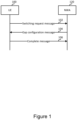
- Figure 1 is a communication diagram of a procedure for acquiring a gap configuration from NWA, according to an example implementation of the present disclosure.
- UE 100 transmits a switching request message to NWA 120.
- NWA 120 transmits a gap configuration message to UE 100 in response to the switching request message.
- UE 100 may reply to NWA 120 with a complete message.
- a UE may send to NWA a switching request message including gap assistance information to ask for normal periodic gap(s), so as to, e.g., receive paging related to NWB or perform measurements related to NWB.
- the gap assistance information may include at least one of the following: a suggested/required starting timing information (e.g., offset value or starting SFN and/or starting subframe) of a gap, a suggested/required gap length, a suggested/required gap repetition period, a UE capability type, a suggested/required Gap Usage, and a suggested/required Gap ID.
- a UE may send a switching request message to the NWA to ask for periodic gap(s) with a capability loan (e.g., to receive paging related to NWB or performing measurements related to NWB).
- the switching request message may contain gap assistance information and/or DRX-related information.
- the gap assistance information may include suggested/required starting timing information (e.g., offset value or starting SFN and/or starting subframe) of a gap, a suggested/required gap length, a suggested/required gap repetition period, a UE capability type, a suggested/required Gap Usage, and/or a suggested/required Gap ID.
- the UE may need to ask for a new gap pattern/gap configuration for receiving paging on the new PO(s) in NWB.
- a UE may send a new switching request message in a case that a new (target) cell is reselected (e.g., the UE camps on a new cell of NWB, or the UE hands over to a new (target) serving cell of NWA).
- NWA may reconfigure a new gap pattern(s)/new gap configuration to the UE accordingly.
- a UE may not successfully receive paging related to NWB by using the configured gap(s) (e.g., the gap duration is not long enough).
- a UE may send a switching request message to ask for a (longer or shorter) duration update for an aperiodic gap pattern/gap configuration while the aperiodic gap pattern/gap configuration cannot satisfy the UE's requirement (e.g., the requirement for performing SI acquisition and/or for performing a registration procedure, a TAU procedure, or an RNAU procedure in NWB).
- a new indicator may be added in a gap configuration IE for MUSIM use, as shown in Table 1.
- a Gap Usage may indicate that the gap is used for acquiring system information.
- the Gap Usage may indicate that the associated gap pattern/gap configuration is configured for the UE to acquire system information related to another network (e.g., NWB) during gap(s) of the associated gap pattern/gap configuration.
- NWB another network
- a UE may send a release request message to ask for releasing periodic gap patterns/gap configuration(s) (e.g., for receiving paging or performing measurements in NWB) and/or releasing DRX-related information (e.g., DRX cycle) of NWB, to NWA.
- a UE may send a release request message while (re)selecting a new cell during cell reselection in NWB.
- the PO/PF and/or paging related parameters of NWB may be changed. Therefore, the UE may ask for releasing the existing gap pattern(s)/gap configuration(s) for receiving paging on the previous PO(s) in NWB.
- a UE may not resend a release request message to the network to ask for releasing periodic gap pattern(s)/gap configuration(s) until a timer (e.g., delay budget) expires if the UE does not receive the release gap configuration message from NWA.
- the timer may (re)start when a UE sends a release request message.
- a timer may stop when the UE receives a command from a network (e.g., a release gap configuration message from NWA). While the timer is running, the UE may be prohibited from (re)sending a release request message. When/after the timer expires, the UE may be allowed to (re)send a release request message.
- a UE may change/update assistance information included in a previous switching request message and resend the switching request message with the new assistance information if the UE receives a reject message in response to the previous switching request message from NWA.
- the UE may stop resending the switching request message until the UE receives corresponding Gap pattern(s)/gap configuration(s) message from NWA.
- a UE may autonomously leave the current serving network (e.g., NWA) if NWA doesn't respond to a switching request message (e.g., for a long period). Leaving the current serving network (e.g., NWA) may cause the UE to transition to RRC_IDLE or RRC INACTIVE state in NWA.
- a UE may switch the MUSIM mode to OFF if NWA doesn't respond for a switching request message (e.g., for a long period). For example, the UE may deregister from NWA. For example, the UE may switch off the USIM associated with NWA.
- a Gap Activation/Deactivation MAC CE may have a variable size. In some implementations, a Gap Activation/Deactivation MAC CE may have a variable size with one or more G i fields. In some implementations, a Gap Activation/Deactivation MAC CE may have a variable size with one or more R fields. In some implementations, a single octet bitmap may be used to indicate the activation/deactivation status of the configured gap pattern(s)/gap configuration(s) if the highest configured GAP ID is less than a specfic value (e.g., 8).
- a specfic value e.g. 8
- a four-octet bitmap may be used to indicate the activation/deactivation status of the configured gap pattern(s)/gap configuration(s) if the highest configured GAP ID is equal to or more than a specfic value (e.g., 8).
- the G i field may indicate the activation/deactivation status of the gap pattern/gap configuration #i, where i is an index associated with the GAP ID. In some implementations, the G i field may indicate the activation/deactivation status of the gap pattern(s)/gap confuration #i, where i is an index ranked based on an ascending order (or a decending order) of those gap patterns/gap configurations considered/identified/configured as periodic gap patterns/gap configurations.
- the G i field may be set to a specific value (e.g., 1) to indicate that the associated gap pattern/gap confguraiton is suggested/indicated to be activated, or set to a specific value (e.g., 0) to indicate that the associated gap pattern/gap configuration is suggested/indicated to be deactivated.
- Figure 3 is a communication diagram of a MAC CE Activation/Deactivation procedure for a configured gap, according to an example implementation of the present disclosure.
- Figure 4 is a communication diagram of a MAC CE Activation/Deactivation procedure for a configured gap, according to an example implementation of the present disclosure.
- a UE may send a MAC CE to inform the NWA of certain periodic and/or aperiodic gaps that the UE suggests to activate/de-activate.
- the UE may activate/de-activate the gap(s) after receiving NWA's response/confirmation/approval (e.g., a Confirmation MAC CE from NWA).
- a UE may send a MAC CE to a network (e.g., NWA) to suggest/indicate activating/deactivating configured periodic/aperiodic gap pattern(s)/gap configuration(s). For example, after receiving a gap pattern/gap configuration, a UE may send a Gap Activation/Deactivation MAC CE to activate the gap pattern/gap configuration by setting the associated G i field of the gap pattern/gap configuration to a specific value (e.g., 1). For example, a UE may send a MAC CE containing a G 1 field with a value of "1" to NWA to activate periodic gap pattern/gap configuration associated with the G 1 field. For example, a UE may send a MAC CE containing a G 2 field with a value of 0 to NWA to deactivate aperiodic gap pattern/gap configuration associated with the G 2 field.
- NWA Network
- the initial status of a received gap pattern/gap configuration may be considered/configured/indicated as inactivated/de-activated/disabled.
- the UE may need to send a Gap Activation/Deactivation MAC CE to activate the gap pattern/gap configuration when the UE requires the corresponding gap(s).
- the initial status of a received gap pattern/gap configuration may be considered/configured/indicated as activated/enabled.
- the UE may need to send a Gap Activation/Deactivation MAC CE to deactivate the gap pattern/gap configuration when the UE does not require the corresponding gap(s).
- a UE does not resend a MAC CE for requesting periodic and/or aperiodic gap(s) activating/de-activating until a timer expires if the UE does not receive the control MAC CE from NWA.
- the timer may (re)start when a UE sends a MAC CE.
- a timer may stop when the UE receives a command from the network (e.g., a control MAC CE from NWA). While the timer is running, the UE may be prohibited from sending another MAC CE to activate/deactivate gaps. When the timer expires, the UE may be allowed to send another MAC CE to activate/deactivate gaps.
- a UE may send a MAC CE to the network (e.g., NWA) to suggest/indicate activating/deactivating configured periodic/aperiodic gap pattern(s)/gap configuration(s) while a cell is (re)selected (e.g., the UE camps on a new cell in NWB or hands over to a new serving cell in NWA).
- NWA the network
- the UE may send a MAC CE to the network (e.g., NWA) to suggest/indicate activating/deactivating configured periodic/aperiodic gap pattern(s)/gap configuration(s) while a cell is (re)selected (e.g., the UE camps on a new cell in NWB or hands over to a new serving cell in NWA).
- a UE may send a MAC CE to the network (e.g., NWA) to suggest/indicate activating/deactivating configured periodic/aperiodic gap pattern(s)/gap configuration(s) while UE's MUSIM status is off.
- NWA the network
- a UE may ignore/suspend configured periodic/aperiodic gap pattern(s)/gap configuration(s) configured by NWA for multi-USIM usage while receiving paging (e.g., paging DCI, short message, or paging message) which may include ETWS indication and/or CMAS indication and/or Public Warning System (PWS) indication (e.g., provided by NWA/NWB).
- paging e.g., paging DCI, short message, or paging message
- PWS Public Warning System
- a UE may ignore/suspend configured periodic/aperiodic gap pattern(s)/gap configuration(s) configured by NWA to acquire ETWS/CMAS/PWS notification(s) (or message(s)).
- a short message in the received paging DCI may include ETWS indication and/or CMAS indication and/or PWS indication (e.g., provided by NWA or NWB).
- ETWS/CMAS/PWS notification(s) (or message(s)) acquisition the UE may ignore/suspend the activated gap pattern(s)/gap configuration(s) or associated gap(s) configured by NWA for multi-USIM usage.
- the UE may acquire SIB6, SIB7, or SIB8 immediately.
- a UE may switch back to NWA in a case that the UE completes certain actions (e.g., monitoring paging DCI and/or receiving paging message, especially the short message (e.g., paging for ETWS and CMAS indication and/or system information modification) and/or performing measurements and/or acquiring SI and/or performing a registration procedure and/or performing a TAU procedure) in NWB before the normal periodic/aperiodic gap pattern/gap configuration expires.
- certain actions e.g., monitoring paging DCI and/or receiving paging message, especially the short message (e.g., paging for ETWS and CMAS indication and/or system information modification) and/or performing measurements and/or acquiring SI and/or performing a registration procedure and/or performing a TAU procedure
- a UE may use the normal periodic gap pattern(s)/gap configuration(s) for receiving paging (e.g., paging DCI, short message, or paging message) at NWB.
- paging e.g., paging DCI, short message, or paging message
- the paging message especially the short message, may include the ETWS indication and/or CMAS indication and/or PWS indication.
- a UE may use the periodic gap pattern(s)/gap configuration(s) with capability loan for receiving paging (e.g., paging DCI, short message, or paging message) at NWB.
- paging e.g., paging DCI, short message, or paging message
- the paging message especially the short message, may include the ETWS indication and/or CMAS indication and/or PWS indication.
- the UE may schedule RX resources back to the NWA after the UE acquires the ETWS information (e.g., the primary/secondary/integrated notification of the ETWS) and/or CMAS information (e.g., the warning notification of the CMAS) and the UE may remain in RRC_CONNECTED state in NWA.
- the ETWS information e.g., the primary/secondary/integrated notification of the ETWS
- CMAS information e.g., the warning notification of the CMAS
- the UE may need to read the system information for acquiring the ETWS information (e.g., the primary/secondary/integrated notification of the ETWS) and/or CMAS information (e.g., the warning notification of the CMAS) and may ignore/suspend the following normal periodic/aperiodic gap pattern(s)/gap configuration(s) configured by NWA and measurement gap in NWA to acquire the ETWS information (e.g., the primary/secondary/integrated notification of the ETWS) and/or CMAS information (e.g., the warning notification of the CMAS).
- P-RNTI Paging Radio Network Temporary Identifier
- the UE may stop DL reception on NWA and switch the RX resource to NWB for acquiring the ETWS information (e.g., the primary/secondary/integrated notification of the ETWS) and/or CMAS information (e.g., the warning notification of the CMAS).
- the UE may acquire SIB6, SIB7, or SIB8 immediately.
- the UE may schedule the RX resource back to the NWA after the UE acquires the ETWS information (e.g., the primary/secondary/integrated notification of the ETWS) and/or CMAS information (e.g., the warning notification of the CMAS) and the UE may remain in RRC_CONNECTED state in NWA.
- the UE connects to a first network (e.g., NWA) associated with a first USIM of the plurality of USIMs.
- NWA a first network
- the network e.g., the first network
- the network may be aware of the type of the (requested) time gap being aperiodic (or periodic) based on the assistance information included in the request message, even if there is no explicit indication of the type of the (requested) time gap in the assistance information.
- the second time gap configuration may indicate a repetition period of a second configured time gap.
- the second configured time gap may periodically occur since its type is periodic.
- the repetition period may determine the time interval of two adjacent second configured time gaps.
- the UE is allowed to request a (preferred) gap type from the network, so that the network can know in advance when the UE will likely switch to another network for data reception.
- the network to which the UE is connected can be prevented from sending data to the UE during an inappropriate period, resulting in missed data reception. Therefore, method 600 improves the efficiency of the MUSIM operation.
- the transceiver 720 has a transmitter 722 (e.g., transmitting/transmission circuitry) and a receiver 724 (e.g., receiving/reception circuitry) and may be configured to transmit and/or receive time and/or frequency resource partitioning information.
- the transceiver 720 may be configured to transmit in different types of subframes and slots including, but not limited to, usable, non-usable, and flexibly usable subframes and slot formats.
- the transceiver 720 may be configured to receive data and control channels.
- the computer-readable media may include computer-storage media and communication media.
- Computer-storage media may include both volatile (and/or non-volatile media) and removable (and/or non-removable) media implemented in any method or technology for storage of information, such as computer-readable instructions, data structures, program modules or data.
- modulated data signal may mean a signal that has one or more of its characteristics set or changed in such a manner as to encode information in the signal.
- Communication media may include wired media such as a wired network or direct-wired connection, and wireless media such as acoustic, radio frequency (RF), infrared, and other wireless media. Combinations of any of the previously listed components should also be included within the scope of computer-readable media.
- the processor 728 may include an intelligent hardware device, e.g., a Central Processing Unit (CPU), a microcontroller, an ASIC, etc.
- the processor 728 may include memory.
- the processor 728 may process the data 730 and the program 732 received from the memory 734, and information transmitted and received via the transceiver 720, the baseband communications module, and/or the network communications module.
- the processor 728 may also process information to send to the transceiver 720 for transmission via the antenna 736 to the network communications module for transmission to a Core Network (CN).
- CN Core Network
Landscapes
- Engineering & Computer Science (AREA)
- Computer Networks & Wireless Communication (AREA)
- Signal Processing (AREA)
- Computer Security & Cryptography (AREA)
- Mobile Radio Communication Systems (AREA)
Claims (11)
- Verfahren für ein Benutzerendgerät, UE (700), das dafür ausgelegt ist, mit einer Vielzahl von Universal Subscriber Identity Modules, USIMs, ausgestattet zu werden, um einen Betrieb eines Multi-Universal Subscriber Identity Module, MUSIM, durchzuführen, wobei das Verfahren aufweist:Verbinden mit einem ersten Netzwerk, das einem ersten USIM der Vielzahl von USIMs zugeordnet ist;Senden einer Anforderungsnachricht an das erste Netzwerk, wobei die Anforderungsnachricht Hilfsinformationen aufweist, um einen Zeitabstand für den MUSIM-Betrieb anzufordern;Empfangen einer ersten Zeitabstandskonfiguration von dem ersten Netzwerk, wobei in einem Fall, dass die erste Zeitabstandskonfiguration ein aperiodisches Abstandsmuster bereitstellt, die erste Zeitabstandskonfiguration eine Start-Systemrahmennummer, SFN, und einen Start-Unterrahmen eines ersten konfigurierten Zeitabstands angibt; undin einem Fall, dass das UE (700) die erste Zeitabstandskonfiguration empfängt, Umschalten zu einem zweiten Netzwerk, während eine Verbindung zu dem ersten Netzwerk aufrechterhalten wird, während des ersten konfigurierten Zeitabstands gemäß der ersten Zeitabstandskonfiguration, wobei das zweite Netzwerk einem zweiten USIM der Vielzahl von USIMs zugeordnet ist.
- Verfahren nach Anspruch 1, das ferner aufweist:
Empfangen einer zweiten Zeitabstandskonfiguration von dem ersten Netzwerk in einem Fall, dass der Typ des von dem UE (700) angeforderten Zeitabstands periodisch ist, wobei die zweite Zeitabstandskonfiguration eine Wiederholungsperiode eines zweiten konfigurierten Zeitabstands angibt. - Verfahren nach Anspruch 2, das ferner aufweist:
in einem Fall, dass das UE (700) die zweite Zeitabstandskonfiguration empfängt, Umschalten zu dem zweiten Netzwerk, während die Verbindung zu dem ersten Netzwerk aufrechterhalten wird, während des zweiten konfigurierten Zeitabstands gemäß der zweiten Zeitabstandskonfiguration. - Verfahren nach Anspruch 2, das ferner aufweist:Senden einer Abstandsfreigabenachricht an das erste Netzwerk;Empfangen einer Freigabenachricht von dem ersten Netzwerk; undFreigeben der zweiten Zeitabstandskonfiguration in Reaktion auf das Empfangen der Freigabenachricht.
- Verfahren nach Anspruch 1, wobei die Hilfsinformationen eine bevorzugte Start-SFN des Zeitabstands und einen bevorzugten Start-Unterrahmen des Zeitabstands angeben.
- Verfahren nach Anspruch 1, wobei die Hilfsinformationen eine Angabe aufweisen, ob der Typ des von dem UE (700) angeforderten Zeitabstands aperiodisch ist.
- Verfahren nach Anspruch 1, wobei die erste Zeitabstandskonfiguration eine Angabe aufweist, ob ein Typ des ersten konfigurierten Zeitabstands aperiodisch ist.
- Verfahren nach Anspruch 1, das ferner aufweist:Starten eines Verbotszeitgebers beim Senden der Hilfsinformationen an das erste Netzwerk,wobei dem UE (700) verboten ist, eine andere Anforderungsnachricht an das erste Netzwerk zu senden, während der Verbotszeitgeber läuft.
- Verfahren nach Anspruch 1, wobei der erste konfigurierte Zeitabstand an dem Start-Unterrahmen mit der Start-SFN beginnt.
- Verfahren nach Anspruch 1, das ferner nach dem Umschalten zu dem zweiten Netzwerk das Überwachen eines Downlinkkanals auf dem zweiten Netzwerk während des ersten konfigurierten Zeitabstands aufweist.
- Benutzerendgerät, UE (700), das dafür ausgelegt ist, mit einer Vielzahl von Universal Subscriber Identity Modules, USIMs, ausgestattet zu werden, um einen Betrieb eines Multi-Universal Subscriber Identity Module, MUSIM, durchzuführen, wobei das UE (700) aufweist:eine Sende- und Empfangsschaltungsanordnung (720); undmindestens einen Prozessor (728), der mit der Sende- und Empfangsschaltungsanordnung (720) gekoppelt und dafür konfiguriert ist, das Verfahren nach einem der Ansprüche 1-10 durchzuführen.
Applications Claiming Priority (1)
| Application Number | Priority Date | Filing Date | Title |
|---|---|---|---|
| US202163260049P | 2021-08-06 | 2021-08-06 |
Publications (2)
| Publication Number | Publication Date |
|---|---|
| EP4132201A1 EP4132201A1 (de) | 2023-02-08 |
| EP4132201B1 true EP4132201B1 (de) | 2025-04-16 |
Family
ID=83232783
Family Applications (1)
| Application Number | Title | Priority Date | Filing Date |
|---|---|---|---|
| EP22188959.5A Active EP4132201B1 (de) | 2021-08-06 | 2022-08-05 | Verfahren und vorrichtung zur durchführung von mehrfachuniversellen teilnehmeridentitätsmoduloperationen |
Country Status (3)
| Country | Link |
|---|---|
| US (1) | US12232207B2 (de) |
| EP (1) | EP4132201B1 (de) |
| CN (1) | CN115707067A (de) |
Families Citing this family (7)
| Publication number | Priority date | Publication date | Assignee | Title |
|---|---|---|---|---|
| US20230147159A1 (en) * | 2021-11-11 | 2023-05-11 | Qualcomm Incorporated | Time gaps for segment-based uplink transmissions in non-terrestrial networks |
| US20230371018A1 (en) * | 2022-05-16 | 2023-11-16 | Qualcomm Incorporated | Multiple user subscriber identity module gap pattern modification |
| US12309597B2 (en) * | 2022-09-16 | 2025-05-20 | Verizon Patent And Licensing Inc. | Systems and methods for service-based automatic identity switching for a device in a private network |
| WO2024172422A1 (en) * | 2023-02-14 | 2024-08-22 | Samsung Electronics Co., Ltd. | Method and apparatus for configuring musim gaps in dual connectivity in a communication system |
| WO2024228607A2 (ko) * | 2023-05-02 | 2024-11-07 | 삼성전자 주식회사 | 복수의 가입자 식별 모듈들을 지원하는 전자 장치 및 그 동작 방법 |
| CN119497071A (zh) * | 2023-08-18 | 2025-02-21 | 中国电信股份有限公司技术创新中心 | 终端能力通知方法、装置、通信设备和存储介质 |
| US20260082431A1 (en) * | 2024-09-16 | 2026-03-19 | Qualcomm Incorporated | Postponement in contention-based transmission occasion groups |
Family Cites Families (5)
| Publication number | Priority date | Publication date | Assignee | Title |
|---|---|---|---|---|
| US10623946B1 (en) * | 2019-03-25 | 2020-04-14 | Qualcomm Incorporated | Multi-SIM assistance information |
| CN111800558B (zh) * | 2019-04-09 | 2022-02-18 | 三赢科技(深圳)有限公司 | 相机系统及摄像方法 |
| CN114208314A (zh) * | 2019-08-08 | 2022-03-18 | 三星电子株式会社 | 在无线通信系统中运行包括多个用户识别模块的用户装置的方法 |
| WO2021153927A1 (ko) * | 2020-01-31 | 2021-08-05 | 주식회사 케이티 | 복수의 유심을 이용하여 통신을 수행하는 방법 및 그 장치 |
| KR20230021341A (ko) * | 2021-08-05 | 2023-02-14 | 삼성전자주식회사 | 차세대 이동 통신 시스템에서 복수 개의 usim을 지원하는 단말이 이중 접속을 지원하는 방법 및 장치 |
-
2022
- 2022-08-05 US US17/882,154 patent/US12232207B2/en active Active
- 2022-08-05 EP EP22188959.5A patent/EP4132201B1/de active Active
- 2022-08-05 CN CN202210937490.2A patent/CN115707067A/zh active Pending
Also Published As
| Publication number | Publication date |
|---|---|
| US12232207B2 (en) | 2025-02-18 |
| CN115707067A (zh) | 2023-02-17 |
| US20230048297A1 (en) | 2023-02-16 |
| EP4132201A1 (de) | 2023-02-08 |
Similar Documents
| Publication | Publication Date | Title |
|---|---|---|
| EP4082247B1 (de) | Benutzergerät und verfahren für multi-sim-betrieb | |
| EP4132201B1 (de) | Verfahren und vorrichtung zur durchführung von mehrfachuniversellen teilnehmeridentitätsmoduloperationen | |
| US11997643B2 (en) | Method and apparatus for performing paging monitoring in radio access networks | |
| EP3834482B1 (de) | Verfahren und vorrichtung zur steuerung des rrc-zustands | |
| US12309680B2 (en) | Public warning system messaging in private and public networks | |
| CN115299104B (zh) | 用于非公共网络控制机制的无线通信方法和用户设备 | |
| EP4027718B1 (de) | Verfahren zur durchführung eines funkrufempfangs und benutzergerät damit | |
| US11974356B2 (en) | Method for maintaining multi-SIM configuration and user equipment | |
| US12363677B2 (en) | Method and apparatus for paging control | |
| US20230189212A1 (en) | User equipment and method for multi-sim operation | |
| EP4068873B1 (de) | Verfahren zur durchführung von funkrufempfang und zugehörige vorrichtung |
Legal Events
| Date | Code | Title | Description |
|---|---|---|---|
| PUAI | Public reference made under article 153(3) epc to a published international application that has entered the european phase |
Free format text: ORIGINAL CODE: 0009012 |
|
| STAA | Information on the status of an ep patent application or granted ep patent |
Free format text: STATUS: THE APPLICATION HAS BEEN PUBLISHED |
|
| AK | Designated contracting states |
Kind code of ref document: A1 Designated state(s): AL AT BE BG CH CY CZ DE DK EE ES FI FR GB GR HR HU IE IS IT LI LT LU LV MC MK MT NL NO PL PT RO RS SE SI SK SM TR |
|
| STAA | Information on the status of an ep patent application or granted ep patent |
Free format text: STATUS: REQUEST FOR EXAMINATION WAS MADE |
|
| 17P | Request for examination filed |
Effective date: 20230420 |
|
| RBV | Designated contracting states (corrected) |
Designated state(s): AL AT BE BG CH CY CZ DE DK EE ES FI FR GB GR HR HU IE IS IT LI LT LU LV MC MK MT NL NO PL PT RO RS SE SI SK SM TR |
|
| STAA | Information on the status of an ep patent application or granted ep patent |
Free format text: STATUS: EXAMINATION IS IN PROGRESS |
|
| 17Q | First examination report despatched |
Effective date: 20230615 |
|
| GRAP | Despatch of communication of intention to grant a patent |
Free format text: ORIGINAL CODE: EPIDOSNIGR1 |
|
| STAA | Information on the status of an ep patent application or granted ep patent |
Free format text: STATUS: GRANT OF PATENT IS INTENDED |
|
| INTG | Intention to grant announced |
Effective date: 20240222 |
|
| GRAJ | Information related to disapproval of communication of intention to grant by the applicant or resumption of examination proceedings by the epo deleted |
Free format text: ORIGINAL CODE: EPIDOSDIGR1 |
|
| STAA | Information on the status of an ep patent application or granted ep patent |
Free format text: STATUS: EXAMINATION IS IN PROGRESS |
|
| INTC | Intention to grant announced (deleted) | ||
| GRAP | Despatch of communication of intention to grant a patent |
Free format text: ORIGINAL CODE: EPIDOSNIGR1 |
|
| STAA | Information on the status of an ep patent application or granted ep patent |
Free format text: STATUS: GRANT OF PATENT IS INTENDED |
|
| RAP1 | Party data changed (applicant data changed or rights of an application transferred) |
Owner name: SHARP KABUSHIKI KAISHA |
|
| INTG | Intention to grant announced |
Effective date: 20241120 |
|
| GRAS | Grant fee paid |
Free format text: ORIGINAL CODE: EPIDOSNIGR3 |
|
| GRAA | (expected) grant |
Free format text: ORIGINAL CODE: 0009210 |
|
| STAA | Information on the status of an ep patent application or granted ep patent |
Free format text: STATUS: THE PATENT HAS BEEN GRANTED |
|
| AK | Designated contracting states |
Kind code of ref document: B1 Designated state(s): AL AT BE BG CH CY CZ DE DK EE ES FI FR GB GR HR HU IE IS IT LI LT LU LV MC MK MT NL NO PL PT RO RS SE SI SK SM TR |
|
| REG | Reference to a national code |
Ref country code: GB Ref legal event code: FG4D |
|
| REG | Reference to a national code |
Ref country code: CH Ref legal event code: EP Ref country code: DE Ref legal event code: R096 Ref document number: 602022013159 Country of ref document: DE |
|
| REG | Reference to a national code |
Ref country code: IE Ref legal event code: FG4D |
|
| REG | Reference to a national code |
Ref country code: NL Ref legal event code: MP Effective date: 20250416 |
|
| PG25 | Lapsed in a contracting state [announced via postgrant information from national office to epo] |
Ref country code: NL Free format text: LAPSE BECAUSE OF FAILURE TO SUBMIT A TRANSLATION OF THE DESCRIPTION OR TO PAY THE FEE WITHIN THE PRESCRIBED TIME-LIMIT Effective date: 20250416 |
|
| REG | Reference to a national code |
Ref country code: AT Ref legal event code: MK05 Ref document number: 1786754 Country of ref document: AT Kind code of ref document: T Effective date: 20250416 |
|
| PG25 | Lapsed in a contracting state [announced via postgrant information from national office to epo] |
Ref country code: FI Free format text: LAPSE BECAUSE OF FAILURE TO SUBMIT A TRANSLATION OF THE DESCRIPTION OR TO PAY THE FEE WITHIN THE PRESCRIBED TIME-LIMIT Effective date: 20250416 Ref country code: ES Free format text: LAPSE BECAUSE OF FAILURE TO SUBMIT A TRANSLATION OF THE DESCRIPTION OR TO PAY THE FEE WITHIN THE PRESCRIBED TIME-LIMIT Effective date: 20250416 Ref country code: PT Free format text: LAPSE BECAUSE OF FAILURE TO SUBMIT A TRANSLATION OF THE DESCRIPTION OR TO PAY THE FEE WITHIN THE PRESCRIBED TIME-LIMIT Effective date: 20250818 |
|
| PGFP | Annual fee paid to national office [announced via postgrant information from national office to epo] |
Ref country code: DE Payment date: 20250820 Year of fee payment: 4 |
|
| REG | Reference to a national code |
Ref country code: LT Ref legal event code: MG9D |
|
| PG25 | Lapsed in a contracting state [announced via postgrant information from national office to epo] |
Ref country code: NO Free format text: LAPSE BECAUSE OF FAILURE TO SUBMIT A TRANSLATION OF THE DESCRIPTION OR TO PAY THE FEE WITHIN THE PRESCRIBED TIME-LIMIT Effective date: 20250716 Ref country code: GR Free format text: LAPSE BECAUSE OF FAILURE TO SUBMIT A TRANSLATION OF THE DESCRIPTION OR TO PAY THE FEE WITHIN THE PRESCRIBED TIME-LIMIT Effective date: 20250717 |
|
| PG25 | Lapsed in a contracting state [announced via postgrant information from national office to epo] |
Ref country code: PL Free format text: LAPSE BECAUSE OF FAILURE TO SUBMIT A TRANSLATION OF THE DESCRIPTION OR TO PAY THE FEE WITHIN THE PRESCRIBED TIME-LIMIT Effective date: 20250416 |
|
| PG25 | Lapsed in a contracting state [announced via postgrant information from national office to epo] |
Ref country code: BG Free format text: LAPSE BECAUSE OF FAILURE TO SUBMIT A TRANSLATION OF THE DESCRIPTION OR TO PAY THE FEE WITHIN THE PRESCRIBED TIME-LIMIT Effective date: 20250416 |
|
| PG25 | Lapsed in a contracting state [announced via postgrant information from national office to epo] |
Ref country code: HR Free format text: LAPSE BECAUSE OF FAILURE TO SUBMIT A TRANSLATION OF THE DESCRIPTION OR TO PAY THE FEE WITHIN THE PRESCRIBED TIME-LIMIT Effective date: 20250416 |
|
| PG25 | Lapsed in a contracting state [announced via postgrant information from national office to epo] |
Ref country code: AT Free format text: LAPSE BECAUSE OF FAILURE TO SUBMIT A TRANSLATION OF THE DESCRIPTION OR TO PAY THE FEE WITHIN THE PRESCRIBED TIME-LIMIT Effective date: 20250416 |
|
| PGFP | Annual fee paid to national office [announced via postgrant information from national office to epo] |
Ref country code: FR Payment date: 20250828 Year of fee payment: 4 |
|
| PG25 | Lapsed in a contracting state [announced via postgrant information from national office to epo] |
Ref country code: RS Free format text: LAPSE BECAUSE OF FAILURE TO SUBMIT A TRANSLATION OF THE DESCRIPTION OR TO PAY THE FEE WITHIN THE PRESCRIBED TIME-LIMIT Effective date: 20250716 |
|
| PG25 | Lapsed in a contracting state [announced via postgrant information from national office to epo] |
Ref country code: IS Free format text: LAPSE BECAUSE OF FAILURE TO SUBMIT A TRANSLATION OF THE DESCRIPTION OR TO PAY THE FEE WITHIN THE PRESCRIBED TIME-LIMIT Effective date: 20250816 |
|
| PG25 | Lapsed in a contracting state [announced via postgrant information from national office to epo] |
Ref country code: LV Free format text: LAPSE BECAUSE OF FAILURE TO SUBMIT A TRANSLATION OF THE DESCRIPTION OR TO PAY THE FEE WITHIN THE PRESCRIBED TIME-LIMIT Effective date: 20250416 |
|
| PG25 | Lapsed in a contracting state [announced via postgrant information from national office to epo] |
Ref country code: SM Free format text: LAPSE BECAUSE OF FAILURE TO SUBMIT A TRANSLATION OF THE DESCRIPTION OR TO PAY THE FEE WITHIN THE PRESCRIBED TIME-LIMIT Effective date: 20250416 Ref country code: DK Free format text: LAPSE BECAUSE OF FAILURE TO SUBMIT A TRANSLATION OF THE DESCRIPTION OR TO PAY THE FEE WITHIN THE PRESCRIBED TIME-LIMIT Effective date: 20250416 |
|
| REG | Reference to a national code |
Ref country code: DE Ref legal event code: R097 Ref document number: 602022013159 Country of ref document: DE |
|
| PG25 | Lapsed in a contracting state [announced via postgrant information from national office to epo] |
Ref country code: CZ Free format text: LAPSE BECAUSE OF FAILURE TO SUBMIT A TRANSLATION OF THE DESCRIPTION OR TO PAY THE FEE WITHIN THE PRESCRIBED TIME-LIMIT Effective date: 20250416 |
|
| PG25 | Lapsed in a contracting state [announced via postgrant information from national office to epo] |
Ref country code: EE Free format text: LAPSE BECAUSE OF FAILURE TO SUBMIT A TRANSLATION OF THE DESCRIPTION OR TO PAY THE FEE WITHIN THE PRESCRIBED TIME-LIMIT Effective date: 20250416 |
|
| PG25 | Lapsed in a contracting state [announced via postgrant information from national office to epo] |
Ref country code: SK Free format text: LAPSE BECAUSE OF FAILURE TO SUBMIT A TRANSLATION OF THE DESCRIPTION OR TO PAY THE FEE WITHIN THE PRESCRIBED TIME-LIMIT Effective date: 20250416 |
|
| PG25 | Lapsed in a contracting state [announced via postgrant information from national office to epo] |
Ref country code: IT Free format text: LAPSE BECAUSE OF FAILURE TO SUBMIT A TRANSLATION OF THE DESCRIPTION OR TO PAY THE FEE WITHIN THE PRESCRIBED TIME-LIMIT Effective date: 20250416 |
|
| PG25 | Lapsed in a contracting state [announced via postgrant information from national office to epo] |
Ref country code: RO Free format text: LAPSE BECAUSE OF FAILURE TO SUBMIT A TRANSLATION OF THE DESCRIPTION OR TO PAY THE FEE WITHIN THE PRESCRIBED TIME-LIMIT Effective date: 20250416 |
|
| PLBE | No opposition filed within time limit |
Free format text: ORIGINAL CODE: 0009261 |
|
| STAA | Information on the status of an ep patent application or granted ep patent |
Free format text: STATUS: NO OPPOSITION FILED WITHIN TIME LIMIT |
|
| REG | Reference to a national code |
Ref country code: CH Ref legal event code: L10 Free format text: ST27 STATUS EVENT CODE: U-0-0-L10-L00 (AS PROVIDED BY THE NATIONAL OFFICE) Effective date: 20260225 |
|
| REG | Reference to a national code |
Ref country code: CH Ref legal event code: H13 Free format text: ST27 STATUS EVENT CODE: U-0-0-H10-H13 (AS PROVIDED BY THE NATIONAL OFFICE) Effective date: 20260324 |
|
| 26N | No opposition filed |
Effective date: 20260119 |
|
| PG25 | Lapsed in a contracting state [announced via postgrant information from national office to epo] |
Ref country code: MC Free format text: LAPSE BECAUSE OF FAILURE TO SUBMIT A TRANSLATION OF THE DESCRIPTION OR TO PAY THE FEE WITHIN THE PRESCRIBED TIME-LIMIT Effective date: 20250416 |
|
| PG25 | Lapsed in a contracting state [announced via postgrant information from national office to epo] |
Ref country code: LU Free format text: LAPSE BECAUSE OF NON-PAYMENT OF DUE FEES Effective date: 20250805 |
|
| PG25 | Lapsed in a contracting state [announced via postgrant information from national office to epo] |
Ref country code: CH Free format text: LAPSE BECAUSE OF NON-PAYMENT OF DUE FEES Effective date: 20250831 |