EP4131546A1 - Electrochemical device and electronic device comprising same - Google Patents
Electrochemical device and electronic device comprising same Download PDFInfo
- Publication number
- EP4131546A1 EP4131546A1 EP21774244.4A EP21774244A EP4131546A1 EP 4131546 A1 EP4131546 A1 EP 4131546A1 EP 21774244 A EP21774244 A EP 21774244A EP 4131546 A1 EP4131546 A1 EP 4131546A1
- Authority
- EP
- European Patent Office
- Prior art keywords
- electrolyte
- substituted
- unsubstituted
- groups
- group
- Prior art date
- Legal status (The legal status is an assumption and is not a legal conclusion. Google has not performed a legal analysis and makes no representation as to the accuracy of the status listed.)
- Pending
Links
Images
Classifications
-
- H—ELECTRICITY
- H01—ELECTRIC ELEMENTS
- H01M—PROCESSES OR MEANS, e.g. BATTERIES, FOR THE DIRECT CONVERSION OF CHEMICAL ENERGY INTO ELECTRICAL ENERGY
- H01M10/00—Secondary cells; Manufacture thereof
- H01M10/05—Accumulators with non-aqueous electrolyte
- H01M10/056—Accumulators with non-aqueous electrolyte characterised by the materials used as electrolytes, e.g. mixed inorganic/organic electrolytes
- H01M10/0564—Accumulators with non-aqueous electrolyte characterised by the materials used as electrolytes, e.g. mixed inorganic/organic electrolytes the electrolyte being constituted of organic materials only
- H01M10/0566—Liquid materials
- H01M10/0567—Liquid materials characterised by the additives
-
- H—ELECTRICITY
- H01—ELECTRIC ELEMENTS
- H01M—PROCESSES OR MEANS, e.g. BATTERIES, FOR THE DIRECT CONVERSION OF CHEMICAL ENERGY INTO ELECTRICAL ENERGY
- H01M10/00—Secondary cells; Manufacture thereof
- H01M10/05—Accumulators with non-aqueous electrolyte
- H01M10/052—Li-accumulators
- H01M10/0525—Rocking-chair batteries, i.e. batteries with lithium insertion or intercalation in both electrodes; Lithium-ion batteries
-
- H—ELECTRICITY
- H01—ELECTRIC ELEMENTS
- H01M—PROCESSES OR MEANS, e.g. BATTERIES, FOR THE DIRECT CONVERSION OF CHEMICAL ENERGY INTO ELECTRICAL ENERGY
- H01M4/00—Electrodes
- H01M4/02—Electrodes composed of, or comprising, active material
- H01M4/36—Selection of substances as active materials, active masses, active liquids
- H01M4/48—Selection of substances as active materials, active masses, active liquids of inorganic oxides or hydroxides
- H01M4/52—Selection of substances as active materials, active masses, active liquids of inorganic oxides or hydroxides of nickel, cobalt or iron
- H01M4/525—Selection of substances as active materials, active masses, active liquids of inorganic oxides or hydroxides of nickel, cobalt or iron of mixed oxides or hydroxides containing iron, cobalt or nickel for inserting or intercalating light metals, e.g. LiNiO2, LiCoO2 or LiCoOxFy
-
- H—ELECTRICITY
- H01—ELECTRIC ELEMENTS
- H01M—PROCESSES OR MEANS, e.g. BATTERIES, FOR THE DIRECT CONVERSION OF CHEMICAL ENERGY INTO ELECTRICAL ENERGY
- H01M10/00—Secondary cells; Manufacture thereof
- H01M10/42—Methods or arrangements for servicing or maintenance of secondary cells or secondary half-cells
- H01M10/44—Methods for charging or discharging
-
- H—ELECTRICITY
- H01—ELECTRIC ELEMENTS
- H01M—PROCESSES OR MEANS, e.g. BATTERIES, FOR THE DIRECT CONVERSION OF CHEMICAL ENERGY INTO ELECTRICAL ENERGY
- H01M4/00—Electrodes
- H01M4/02—Electrodes composed of, or comprising, active material
- H01M4/36—Selection of substances as active materials, active masses, active liquids
- H01M4/38—Selection of substances as active materials, active masses, active liquids of elements or alloys
- H01M4/46—Alloys based on magnesium or aluminium
- H01M4/463—Aluminium based
-
- Y—GENERAL TAGGING OF NEW TECHNOLOGICAL DEVELOPMENTS; GENERAL TAGGING OF CROSS-SECTIONAL TECHNOLOGIES SPANNING OVER SEVERAL SECTIONS OF THE IPC; TECHNICAL SUBJECTS COVERED BY FORMER USPC CROSS-REFERENCE ART COLLECTIONS [XRACs] AND DIGESTS
- Y02—TECHNOLOGIES OR APPLICATIONS FOR MITIGATION OR ADAPTATION AGAINST CLIMATE CHANGE
- Y02E—REDUCTION OF GREENHOUSE GAS [GHG] EMISSIONS, RELATED TO ENERGY GENERATION, TRANSMISSION OR DISTRIBUTION
- Y02E60/00—Enabling technologies; Technologies with a potential or indirect contribution to GHG emissions mitigation
- Y02E60/10—Energy storage using batteries
Definitions
- This application relates to the field of energy storage technologies, and in particular, to an electrochemical device and an electronic device comprising the same.
- Electrochemical device for example, lithium-ion batteries
- electrochemical device for example, lithium-ion batteries
- wearable devices smart phones, drones, notebook computers, and other fields because of their merits such as high working voltages, high energy density, environmental friendliness, stable cycling, and safety.
- higher requirements namely, high energy density, long cycle life, and excellent storage properties, are put forward for the lithium-ion batteries.
- This application provides an electrochemical device in an attempt to resolve at least one problem in the related field to at least some extent.
- This application optimizes an entire electrochemical device system by adding a nitrile compound in an electrolyte and adjusting a relationship between a cyano group content and a transition metal ion content in the electrolyte, so as to improve high-temperature cycle performance and floating charge performance of an electrochemical device.
- this application also studies impact of a relationship between a doping element content in a positive electrode active material and the cyano group content in the electrolyte on the high-temperature cycle performance and the floating charge performance of the electrochemical device.
- this application provides an electrochemical device, including a positive electrode, a negative electrode, a separator, and an electrolyte, where the electrolyte contains a nitrile compound and transition metal ions, and satisfies 5 ⁇ A/B ⁇ 30000, where based on a total molar mass of the electrolyte, a molar percentage of a cyano group in the electrolyte is A%, and based on a total weight of the electrolyte, a total weight percentage of the transition metal ions in the electrolyte is B%.
- the transition metal ions comprises at least one of iron ions, cobalt ions, nickel ions, manganese ions, or copper ions.
- the transition metal ions comprises at least one of cobalt ions or copper ions.
- the nitrile compound comprises at least one of a compound of formula I, a compound of formula II, or a compound of formula III: or where R 1 is selected from substituted or unsubstituted C 1 to C 10 alkylidene groups, substituted or unsubstituted C 1 to C 10 alkyleneoxy groups, substituted or unsubstituted C 2 to C 10 alkenylene groups, substituted or unsubstituted C 6 to C 12 arylene groups, and substituted or unsubstituted C 6 to C 10 cycloalkylidene groups, where when substitution is performed, a substituent group is selected from at least one of halogen, a cyano group, or a carboxyl group; R 21 , R 22 , and R 23 are each independently selected from a single bond, substituted or unsubstituted C 1 to C 5 alkylidene groups, and substituted or unsubstituted C 1 to
- a weight percentage of the cobalt ions in the electrolyte is less than or equal to 0.1%, and a weight percentage of the copper ions in the electrolyte is less than or equal to 0.1%.
- the positive electrode contains a positive electrode active material, and the positive electrode active material contains the aluminum element, where based on a total weight of the positive electrode active material, a weight percentage of the aluminum element is C%, and a numerical range of C is 0.001 ⁇ C ⁇ 1.
- a and C satisfy the following relationship: 0.01 ⁇ A/C ⁇ 170.
- a curve of the positive electrode active material obtained through a differential scanning calorimetry test comprises a first exothermic peak and a second exothermic peak, where a temperature corresponding to the first exothermic peak is X, 240°C ⁇ X ⁇ 280°C, a temperature corresponding to the second exothermic peak is Y, and 280°C ⁇ Y ⁇ 340°C.
- a peak area of the first exothermic peak is ⁇ 50 J/g
- a peak area of the second exothermic peak is ⁇ 800 J/g
- the electrolyte further comprises a compound of formula IV: where R 41 is selected from substituted or unsubstituted C 1 to C 12 alkyl groups, substituted or unsubstituted C 3 to C 12 cycloalkyl groups, substituted or unsubstituted C 2 to C 12 alkenyl groups, substituted or unsubstituted C 2 to C 12 alkynyl groups, substituted or unsubstituted C 6 to C 22 aryl groups, and substituted or unsubstituted C 5 to C 22 heteroaryl groups, where when substitution is performed, a substituent group is selected from at least one of halogen, a cyano group, or a carboxyl group; and based on the weight of the electrolyte solution, a weight percentage of the compound of formula IV is 0.001% to 5%.
- the electrolyte further comprises a first additive
- the first additive comprises at least one of vinyl ethylene carbonate, fluorobenzene, lithium difluorophosphate, lithium tetrafluoroborate, 1,3,2-dioxathiolane,2,2-dioxide, fluoroethylene carbonate, vinylene carbonate, or 1,3-propane sultone, and based on the total weight of the electrolyte, a weight percentage of the first additive is 0.001% to 13%.
- the electrochemical device ensures that the cyano group and the transition metal ions in the electrolyte satisfy a specified relationship, to reduce leaching of the transition metal ions from a positive electrode active material and stabilize structural distortion of the positive electrode active material in a charge and discharge process, thereby improving high-temperature cycle performance and floating charge performance of the electrochemical device.
- this application further provides an electronic device, where the electronic device comprises any one of the foregoing electrochemical device.
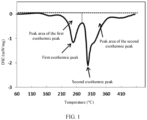
- FIG. 1 is a curve graph of a positive electrode active material obtained through a differential scanning calorimetry (DSC) test in Embodiment 30 of this application.
- the terms “about”, “roughly”, “substantially”, and “about” used herein are intended to describe and represent small variations.
- the term may refer to an Embodiment in which the exact event or circumstance occurs or an Embodiment in which an extremely similar event or circumstance occurs.
- the term when used in combination with a value, the term may refer to a variation range of less than or equal to ⁇ 10% of the value, for example, less than or equal to ⁇ 5%, less than or equal to ⁇ 4%, less than or equal to ⁇ 3%, less than or equal to ⁇ 2%, less than or equal to ⁇ 1%, less than or equal to ⁇ 0.5%, less than or equal to ⁇ 0.1%, or less than or equal to ⁇ 0.05%.
- a difference between two values is less than or equal to ⁇ 10% of an average value of the values (for example, less than or equal to ⁇ 5%, less than or equal to ⁇ 4%, less than or equal to ⁇ 3%, less than or equal to ⁇ 2%, less than or equal to ⁇ 1%, less than or equal to ⁇ 0.5%, less than or equal to ⁇ 0.1%, or less than or equal to ⁇ 0.05%), the two values may be considered "roughly" the same.
- an item list connected by the terms “at least one of”, “at least one piece of”, “at least one kind of” or other similar terms may mean any combination of the listed items.
- the phrase “at least one of A or B” means only A; only B; or A and B.
- the phrase "at least one of A, B, or C” means only A; only B; only C; A and B (exclusive of C); A and C (exclusive of B); B and C (exclusive of A); or all of A, B, and C.
- the item A may contain one constituent or a plurality of constituents.
- the item B may contain one constituent or a plurality of constituents.
- the item C may contain one constituent or a plurality of constituents.
- alkyl group is intended to be a straight-chain saturated hydrocarbon structure having 1 to 20 carbon atoms.
- alkyl group is also intended to be a branched or cyclic hydrocarbon structure having 3 to 20 carbon atoms.
- the alkyl group may be an alkyl group having 1 to 20 carbon atoms, an alkyl group having 1 to 10 carbon atoms, an alkyl group having 1 to 5 carbon atoms, an alkyl group having 5 to 20 carbon atoms, an alkyl group having 5 to 15 carbon atoms, or an alkyl group having 5 to 10 carbon atoms.
- References to an alkyl group with a specific carbon number are intended to cover all geometric isomers with the specific carbon number.
- butyl is meant to comprises n-butyl, sec-butyl, isobutyl, tert-butyl, and cyclobutyl; and "propyl” comprises n-propyl, isopropyl, and cyclopropyl.
- Embodiments of the alkyl group comprises, but are not limited to, a methyl group, an ethyl group, an n-propyl group, an isopropyl group, an cyclopropyl group, an n-butyl group, an isobutyl group, a sec-butyl group, a tert-butyl group, a cyclobutyl group, an n-pentyl group, an isopentyl group, a neopentyl group, a cyclopentyl group, a methylcyclopentyl group, an ethylcyclopentyl group, an n-hexyl group, an isohexyl group, a cyclohexyl group, an n-heptyl group, an octyl group, a cyclopropyl group, a cyclobutyl group, a norbornyl group, and the like.
- alkylidene group means a straight-chain or branched divalent saturated hydrocarbon group.
- the alkylidene group may be an alkylidene group having 1 to 20 carbon atoms, an alkylidene group having 1 to 15 carbon atoms, an alkylidene group having 1 to 10 carbon atoms, an alkylidene group having 1 to 5 carbon atoms, an alkylidene group having 5 to 20 carbon atoms, an alkylidene group having 5 to 15 carbon atoms, or an alkylidene group having 5 to 10 carbon atoms.
- Representative alkylidene groups comprises, for example, methylene, ethane-1,2-diyl ("ethylene”), propane-1,2-diyl, propane-1,3-diyl, butane-1,4-diyl, and pentane-1,5-diyl.
- the alkylidene group may be arbitrarily substituted.
- cycloalkyl group covers cyclic alkyl groups.
- the cycloalkyl group may be a cycloalkyl group having 3 to 20 carbon atoms, a cycloalkyl group having 6 to 20 carbon atoms, a cycloalkyl group having 3 to 10 carbon atoms, or a cycloalkyl group having 3 to 6 carbon atoms.
- the cycloalkyl group may be cyclopropyl, cyclobutyl, cyclopentyl, cyclohexyl, or the like.
- the cycloalkyl group may be arbitrarily substituted.
- cycloalkylidene group alone or as a part of another substituent group means a divalent free radical derived from a cycloalkyl group.
- alkenyl group is a straight-chain or branched monovalent unsaturated hydrocarbon group having at least one and usually 1, 2, or 3 carbon-carbon double bonds. Unless otherwise defined, the alkenyl group generally contains 2 to 20 carbon atoms.
- the alkenyl group may be an alkenyl group having 2 to 20 carbon atoms, an alkenyl group having 6 to 20 carbon atoms, an alkenyl group having 2 to 10 carbon atoms, or an alkenyl group having 2 to 6 carbon atoms.
- alkenyl groups comprises, for example, vinyl, n-propenyl, isopropenyl, n-but-2-enyl, but-3-enyl, and n-hex-3-enyl.
- the alkenyl group may be arbitrarily substituted.
- alkenylene group covers straight-chain and branched chain alkenylene groups. References to an alkenylene group with a specific carbon number are intended to cover all geometric isomers with the specific carbon number.
- the alkenylene group may be an alkenylene group having 2 to 20 carbon atoms, an alkenylene group having 2 to 15 carbon atoms, an alkenylene group having 2 to 10 carbon atoms, an alkenylene group having 2 to 5 carbon atoms, an alkenylene group having 5 to 20 carbon atoms, an alkenylene group having 5 to 15 carbon atoms, or an alkenylene group having 5 to 10 carbon atoms.
- Representative alkylidene groups comprises, for example, vinylene, propenylene, and butenylene.
- the alkenylene group may be arbitrarily substituted.
- alkynyl group refers to a straight-chain or branched monovalent unsaturated hydrocarbon group having at least one and usually 1, 2, or 3 carbon-carbon triple bonds. Unless otherwise defined, the alkynyl group generally contains 2 to 20 carbon atoms.
- the alkynyl group may be an alkynyl group having 2 to 20 carbon atoms, an alkynyl group having 6 to 20 carbon atoms, an alkynyl group having 2 to 10 carbon atoms, or an alkynyl group having 2 to 6 carbon atoms.
- Representative alkynyl groups comprises, for example, ethynyl, prop-2-ynyl(n-propynyl), n-but-2-ynyl, and n-hex-3-ynyl.
- the alkynyl group may be arbitrarily substituted.
- alkoxy group is an L-O-group, where L is an alkyl group.
- the alkoxy group herein may be an alkoxy group having 1 to 12 carbon atoms, an alkoxy group having 1 to 10 carbon atoms, an alkoxy group having 1 to 5 carbon atoms, an alkoxy group having 5 to 12 carbon atoms, or an alkoxy group having 5 to 10 carbon atoms.
- alkyleneoxy group alone or as a part of another substituent group means a divalent free radical derived from an alkoxy group.
- aryl group covers both monocyclic and polycyclic systems.
- a polycyclic ring may have two or more rings in which two carbons are shared by two adjacent rings (the rings are "fused"), where at least one of the rings is aromatic, and other rings, for example, may be a cycloalkyl group, a cycloalkenyl group, an aryl group, a heterocyclic and/or heteroaryl group.
- the aryl group may be C 6 to C 50 aryl groups, C 6 to C 40 aryl groups, C 6 to C 30 aryl groups, C 6 to C 20 aryl groups, or C 6 to C 10 aryl groups.
- aryl groups comprises, for example, phenyl, methylphenyl, propylphenyl, isopropylphenyl, benzyl, naphth-1-yl, and naphth-2-yl.
- the aryl group may be arbitrarily substituted.
- arylene group alone or as a part of another substituent group means a divalent free radical derived from an aryl group.
- heteroaryl group covers monocyclic heteromatic groups, each of which may contain one to three hetero atoms, for example, pyrrole, furan, thiophene, imidazole, oxazole, thiazole, triazole, pyrazole, pyridine, pyrazine, and pyrimidine.
- heteroaryl group further comprises a polycyclic aromatic system having two or more cycles with two of atoms shared by two adjacent cycles (which are "condensed"), where at least one of the cycles is a heteroaryl group, and other cycles may be a cycloalkyl group, a cycloalkenyl group, an aryl group, a heterocycle group, and/or a heteroaryl group.
- the heteroaryl group may be C 6 to C 50 heteroaryl groups, C 6 to C 40 heteroaryl groups, C 6 to C 30 heteroaryl groups, C 6 to C 20 heteroaryl groups, or C 6 to C 10 heteroaryl groups.
- the heteroaryl group may be arbitrarily substituted.
- heterocyclic group covers aromatic and non-aromatic cyclic groups.
- a heteroaromatic cyclic group also means a heteroaryl group.
- the heteroaromatic cyclic group and the hetero-non-aromatic cyclic group are C 1 to C 50 heterocyclic groups, C 1 to C 40 heterocyclic groups, C 1 to C 30 heterocyclic groups, C 1 to C 20 heterocyclic groups, C 1 to C 10 heterocyclic groups, and C 1 to C 6 heterocyclic groups that each comprises at least one heteroatom.
- they are a morpholinyl group, a piperidinyl group, a pyrrolidinyl group, and the like, and cyclic ether such as tetrahydrofuran and tetrahydropyran.
- the heterocyclic group may be arbitrarily substituted.
- heterocyclylene group alone or as a part of another substituent group means a divalent free radical derived from a heterocyclic group.
- hetero atom covers O, S, P, N, B, or isosteres thereof.
- halogen may be F, Cl, Br, or I.
- the electrochemical device comprises a positive electrode, a negative electrode, a separator, and an electrolyte, where the electrolyte of the electrochemical device contains a nitrile compound and transition metal ions, and satisfies 5 ⁇ A/B ⁇ 30000, where based on a total molar mass of the electrolyte, a molar percentage of a cyano group in the electrolyte is A%, and based on a total weight of the electrolyte, a total weight percentage of the transition metal ions in the electrolyte is B%.
- the transition metal ions comprises at least one of iron ions, cobalt ions, nickel ions, manganese ions, or copper ions.
- the transition metal ions comprises at least one of cobalt ions or copper ions.
- the nitrile compound comprises at least one of a compound of formula I, a compound of formula II, or a compound of formula III: or
- R 1 is selected from substituted or unsubstituted C 1 to C 10 alkylidene groups, substituted or unsubstituted C 1 to C 10 alkyleneoxy groups, substituted or unsubstituted C 2 to C 10 alkenylene groups, substituted or unsubstituted C 6 to C 12 arylene groups, and substituted or unsubstituted C 6 to C 10 cycloalkylidene groups, where when substitution is performed, a substituent group is selected from at least one of halogen, a cyano group, or a carboxyl group.
- R 21 , R 22 , and R 23 are each independently selected from a single bond, substituted or unsubstituted C 1 to C 5 alkylidene groups, and substituted or unsubstituted C 1 to C 10 alkyleneoxy groups, where when substitution is performed, a substituent group is selected from at least one of halogen, a cyano group, or a carboxyl group.
- R 31 is selected from substituted or unsubstituted C 1 to C 5 alkylidene groups, substituted or unsubstituted C 1 to C 5 alkyleneoxy groups, substituted or unsubstituted C 2 to C 10 alkenylene groups, substituted or unsubstituted C 3 to C 6 cycloalkylidene groups, substituted or unsubstituted C 6 to C 10 arylene groups, and substituted or unsubstituted C 1 to C 6 heterocyclylene groups, where when substitution is performed, a substituent group is selected from at least one of halogen, a cyano group, or a carboxyl group, and a heteroatom of the heterocyclylene group is selected from at least one of O, N, P, or S.
- the nitrile compound of the structural formula I may comprises, but is not limited to, at least one of malononitrile, succinonitrile, glutaronitrile, adiponitrile, heptanedinitrile, octanedinitrile, azelanitrile, sebaconitrile, 2-methyl-malononitrile, ethylmalononitrile, isopropylmalononitrile, tert-butylmalononitrile, 2-methyl-succinonitrile, 2,2-dimethylsuccinonitrile, 2,3-dimethylsuccinonitrile, 2,3,3-trimethyl succinonitrile, 2,2,3,3-tetramethyl succinonitrile, 2,3-diethyl-2,3-dimethyl succinonitrile, 2,2-diethyl-3,3-dimethyl succinonitrile, dicyclohexyl-1,1-dicarbonitrile, dicyclohexyl
- the nitrile compound of formula II may comprises at least one of or
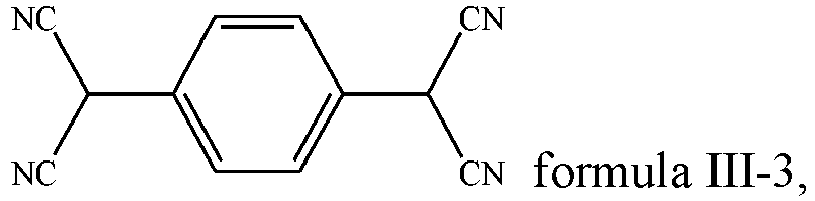
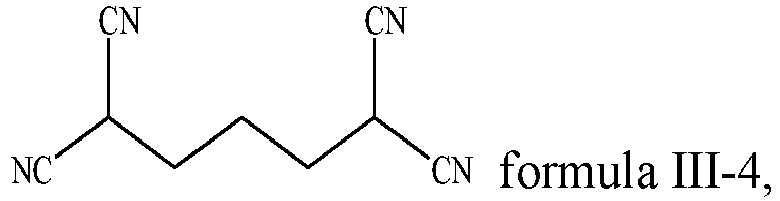
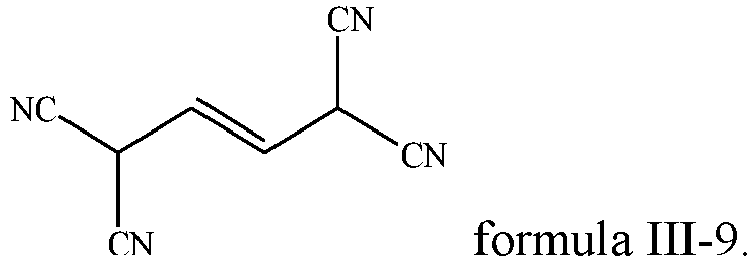
- the nitrile compound of formula III may comprises at least one of or
- the transition metal ions comprises at least one of cobalt (Co) ions or copper (Cu) ions, where based on the weight of the electrolyte, a weight percentage of the cobalt ions is less than or equal to about 0.1%, and a weight percentage of the copper ions is less than or equal to about 0.1%. In some embodiments, based on the weight of the electrolyte, the weight percentage of the cobalt ions is less than or equal to about 0.08%, less than or equal to about 0.05%, less than or equal to about 0.03%, less than or equal to about 0.02%, or less than or equal to about 0.001%.
- the weight percentage of the copper ions is less than or equal to about 0.08%, less than or equal to about 0.05%, less than or equal to about 0.03%, less than or equal to about 0.02%, or less than or equal to about 0.001%.
- the electrochemical device can maintain relatively good cycle performance and floating charge performance.
- the weight percentage of the cobalt ions in the electrolyte exceeds 0.1%, a structure of a positive electrode active material is destroyed, resulting in that the transition metal ions in the positive electrode active material is leached, and then deposited on the negative electrode through the electrolyte and catalyzes decomposition of a negative electrode protective film, deteriorating performance of the electrochemical device.
- a negative electrode current collector is copper foil.
- the copper foil is not covered and protected before chemical conversion, and is prone to corrosion by the electrolyte because it is exposed to the electrolyte.
- the copper foil is oxidized to form copper ions and then dissolve in the electrolyte.
- the copper ions are reduced to copper and deposited on the negative electrode, catalyzing decomposition of a solid electrolyte interface (SEI) film of the negative electrode and deteriorating the performance of the electrochemical device.
- SEI solid electrolyte interface
- an upper limit charging voltage of an electrochemical device When an upper limit charging voltage of an electrochemical device is increased to 4.4 V, an amount of leached transition metal cobalt ions increases, structural stability of a positive electrode active material becomes worse, and cycle performance and floating charge performance of the electrochemical device become worse.
- the electrochemical device according to this application can still maintain good high-temperature cycle performance and floating charge performance when the upper limit charging voltage is increased to 4.4 V
- the nitrile compound in this application can effectively separate an easily oxidizable component in the electrolyte from the positive electrode active material, thereby stabilizing the structure of the positive electrode active material, reducing leaching of the transition metal ions from the positive electrode active material, and improving the high-temperature cycle performance and the floating charge performance of the electrochemical device.
- the nitrile compound can form a stable polymer at the negative electrode (for example, a surface of the exposed copper foil), thereby protecting the negative electrode interface, alleviating corrosion of the copper foil, and then improving the high-temperature storage performance and the floating charge performance.
- the molar percentage A% of the cyano group in the electrolyte and the total weight percentage B% of the first metal ions in the electrolyte satisfy the following proportional relationship: 5 ⁇ A/B ⁇ 30000. When A/B is in this range, the electrochemical device has good high-temperature cycle performance and floating charge performance.
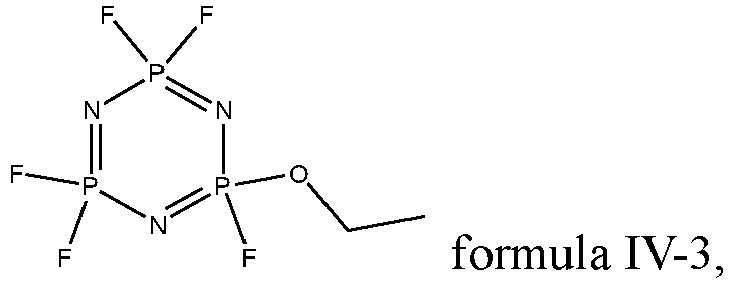
- the electrolyte may further comprises a compound of formula IV:
- R 41 is selected from substituted or unsubstituted C 1 to C 12 alkyl groups, substituted or unsubstituted C 3 to C 12 cycloalkyl groups, substituted or unsubstituted C 2 to C 12 alkenyl groups, substituted or unsubstituted C 2 to C 12 alkynyl groups, substituted or unsubstituted C 6 to C 22 aryl groups, and substituted or unsubstituted C 5 to C 22 heteroaryl groups, where when substitution is performed, a substituent group is selected from at least one of halogen, a cyano group, or a carboxyl group; and based on the total weight of the electrolyte solution, a percentage of the compound of formula IV is 0.001% to 5%.
- the compound of formula IV comprises: at least one of or
- the electrolyte further comprises a first additive
- the first additive comprises at least one of vinyl ethylene carbonate (VEC), fluorobenzene, lithium difluorophosphate (LiPO 2 F 2 ), lithium tetrafluoroborate, 1,3,2-dioxathiolane,2,2-dioxide (DTD), fluoroethylene carbonate (FEC), vinylene carbonate (VC), or 1,3-propane sultone (PS).
- VEC vinyl ethylene carbonate
- fluorobenzene LiPO 2 F 2
- LiPO 2 F 2 lithium tetrafluoroborate
- FEC fluoroethylene carbonate
- VC vinylene carbonate
- PS 1,3-propane sultone
- a weight percentage of the first additive is about 0.01% to about 13%.
- a weight percentage of the first additive is about 0.01%, about 0.05%, about 0.1%, about 0.5%, about 1%, about 2%, about 3%, about 5%, about 8%, about 10%, about 11%, about 12%, or the like.
- a weight percentage of the lithium difluorophosphate is less than 1%. In some embodiments, based on the total weight of the electrolyte, a weight percentage of the lithium difluorophosphate is less than 0.5%.
- the positive electrode of the electrochemical device contains a positive electrode active material, and the positive electrode active material contains the aluminum element, where based on a weight of the positive electrode active material, a weight percentage of the aluminum element is 0.001% to 1%. In some embodiments, based on a weight of the positive electrode active material, a weight percentage of the aluminum element is about 0.005%, about 0.01%, about 0.05%, about 0.08%, about 0.1%, about 0.5%, about 0.8%, 0.001% to 0.05%, 0.001% to 0.1%, 0.001% to 0.5%, 0.01% to 0.05%, 0.01% to 0.1%, 0.01% to 0.5%, 0.001% to 0.05%, or the like. In some embodiments, the positive electrode active material comprises lithium cobaltate doped with the aluminum element.
- the internal structure can be stabilized, thereby improving the electrochemical performance.
- the weight percentage of the aluminum element is less than 0.001%, an improvement effect of the positive electrode active material is not obvious.
- the weight percentage of the aluminum element is greater than 1%, a discharge capacity of the positive electrode active material is deteriorated due to the excessively high doping amount, which is not conducive to the cycle performance and the floating charge performance of electrochemical device.
- the molar percentage A% of the cyano group in the electrolyte and a weight percentage C% of aluminum ions in the electrolyte satisfy: 0.01 ⁇ A/C ⁇ 170, so as to effectively improve the cycle performance and the floating charge performance of the electrochemical device.
- A/C is less than 0.01, the effect of stabilizing the structure of the positive electrode active material and increasing corrosion resistance of the copper foil is not obvious, and therefore the cycle performance and the floating charge performance cannot be significantly improved.
- A/C is greater than 170, the discharge capacity of the positive electrode active material is too low and polarization of the electrochemical device is too large, and therefore the cycle performance and the floating charge performance cannot be improved.
- the positive electrode active material may be selected from lithium cobalt oxide, lithium nickel cobalt manganate, lithium nickel cobalt aluminate, or any combinations thereof.
- a curve of the positive electrode active material obtained through a differential scanning calorimetry test comprises a first exothermic peak and a second exothermic peak, where a temperature corresponding to the first exothermic peak is X, 240°C ⁇ X ⁇ 280°C, a temperature corresponding to the second exothermic peak is Y, and 280°C ⁇ Y ⁇ 340°C.
- a peak area of the first exothermic peak is ⁇ 50 J/g
- a peak area of the second exothermic peak is ⁇ 800 J/g.
- the positive electrode active material has more excellent thermal stability, so that the cycle performance and the floating charge performance of the electrochemical device can be improved.
- positive electrode active materials in Embodiments subjected to the DSC test are all fully discharged (in a delithiated state) positive electrode active materials.
- FIG. 1 shows a curve of a positive electrode active material obtained through a DSC test in Embodiment 30.
- the electrolyte further comprises a second additive.
- the second additive comprises a phosphorus-containing compound.
- the phosphorus-containing compound comprises at least one of trimethyl phosphate, triethyl phosphate, dimethyl ethyl phosphate, methyl diethyl phosphate, ethylene methyl phosphate, ethylene ethyl phosphate, triphenyl phosphate, trimethyl phosphite, triethyl phosphite, triphenyl phosphite, tris(2,2,2-trifluoroethyl) phosphate, or tris(2,2,3,3,3-pentafluoropropyl) phosphate.
- a weight percentage of the second additive is 1% to 15%.
- the electrolyte further comprises a third additive.
- the third additive comprises a fluorine-containing aromatic compound.
- the fluorine-containing aromatic compound comprises at least one of fluorobenzene, difluorobenzene, trifluorobenzene, tetrafluorobenzene, pentafluorobenzene, hexafluorobenzene, or benzotrifluoride.
- a weight percentage of the third additive is 1% to 15%.
- the negative electrode used in the electrochemical device comprises a negative electrode active material.
- the negative electrode active material is not limited to a specific type, and may be selected based on needs.
- the negative electrode active material may be selected from at least one of lithium metal, structured lithium metal, natural graphite, artificial graphite, mesocarbon microbeads (MCMB), hard carbon, soft carbon, silicon, a silicon-carbon composite, a Li-Sn alloy, a Li-Sn-O alloy, Sn, SnO, SnO 2 , spinel-structure lithiated TiO 2 -Li 4 Ti 5 O 12 , and a Li-Al alloy.
- MCMB mesocarbon microbeads
- the electrochemical device is a lithium-ion secondary battery.
- a capacity of the negative electrode active material capable of intercalating and delithiating lithium ions is preferably greater than a capacity of the positive electrode active material. Therefore, amounts of the positive electrode active material and the negative electrode active material need to be adjusted accordingly to obtain high energy density.
- a ratio of the negative electrode capacity to the positive electrode capacity may be 1.01 to 1.2.
- the electrochemical device according to this application has a separator provided between the positive electrode and the negative electrode to prevent short circuits.
- the separator used in the electrochemical device according to this application is not particularly limited to any material or shape, and may be based on any technology disclosed in the prior art.
- the separator comprises a polymer or an inorganic material formed by a material stable to the electrolyte of this application.
- the separator may comprises a porous substrate and a surface treatment layer.
- the porous substrate is a non-woven fabric, a film, or a composite film with a porous structure
- a material of the porous substrate is selected from at least one of polyethylene, polypropylene, polyethylene terephthalate, or polyimide.
- a polypropylene porous membrane, a polyethylene porous membrane, a polypropylene non-woven fabric, a polyethylene non-woven fabric or a polypropylene-polyethylene-polypropylene porous composite membrane can be selected.
- a surface treatment layer is disposed on at least one surface of the porous substrate, and the surface treatment layer may be a polymer layer or an inorganic material layer, or may be a layer formed by a mixture of a polymer and an inorganic material.
- the inorganic material layer comprises inorganic particles and a bonding agent.
- the inorganic particles are selected from a combination of one or more of aluminum oxide, silicon oxide, magnesium oxide, titanium oxide, hafnium oxide, tin oxide, ceria oxide, nickel oxide, zinc oxide, calcium oxide, zirconium oxide, yttrium oxide, silicon carbide, boehmite, aluminum hydroxide, magnesium hydroxide, calcium hydroxide, and barium sulfate.
- the binder is selected from a combination of one or more of polyvinylidene fluoride, a vinylidene fluoride-hexafluoropropylene copolymer, polyamide, polyacrylonitrile, polyacrylate, polyacrylic acid, polyacrylate, polyvinylpyrrolidone, polyvinyl ether, polymethyl methacrylate, polytetrafluoroethylene, and polyhexafluoropropylene.
- the polymer layer contains a polymer, and a material of the polymer comprises at least one of polyamide, polyacrylonitrile, acrylate polymer, polyacrylic acid, polyacrylate, polyvinylpyrrolidone, polyvinyl ether, polyvinylidene fluoride, or poly(vinylidene fluoride-hexafluoropropylene).
- the electrochemical device according to this application is a lithium-ion battery.
- a positive electrode of the lithium-ion battery comprises a positive electrode current collector and a positive electrode active material layer applied on the positive electrode current collector, and a negative electrode comprises a negative electrode current collector and a negative electrode active material layer applied on the negative electrode current collector.
- the electrochemical device according to this application is applicable to electronic device in various fields.
- the electrochemical device according to this application is not particularly limited to any purpose, and may be used for any known purposes in the prior art.
- the electrochemical device of this application may be used for, but is not limited to, a notebook computer, a pen-input computer, a mobile computer, an electronic book player, a portable telephone, a portable fax machine, a portable copier, a portable printer, a stereo headset, a video recorder, a liquid crystal television, a portable cleaner, a portable CD player, a mini-disc, a transceiver, an electronic notebook, a calculator, a memory card, a portable recorder, a radio, a standby power source, a motor, an automobile, a motorcycle, a motor bicycle, a bicycle, a lighting appliance, a toy, a game console, a clock, an electric tool, a flash lamp, a camera, a large household battery, a lithium-ion capacitor, or the like.
- Lithium cobaltate, acetylene black, and polyvinylidene fluoride were fully stirred and mixed in an appropriate amount of N-methylpyrrolidone solvent at a weight ratio of 96:2:2 to form a uniform positive electrode slurry; and the slurry was applied on a positive electrode current collector aluminum foil, followed by drying and cold pressing, to obtain a positive electrode active material layer, and tabs were welded to obtain a positive electrode.
- Lithium cobaltate doped with the aluminum element (a weight percentage of the aluminum element in a specific Embodiment is shown in Table 2 and Table 3), acetylene black, and polyvinylidene fluoride were fully stirred and mixed in an appropriate amount of N-methylpyrrolidone solvent at a weight ratio of 96:2:2 to form a uniform positive electrode slurry; and the slurry was applied on a positive electrode current collector aluminum foil, followed by drying and cold pressing, to obtain a positive electrode.
- Preparation of a lithium-ion battery The positive electrode, the separator, and the negative electrode were laminated in order, so that the separator was located between the positive electrode and the negative electrode for separation, followed by winding to obtain an electrode assembly; the electrode assembly was placed into a packaging case, and the prepared electrolyte was injected into the dried packaging case, followed by processes such as vacuum packaging, standing, chemical conversion, and shaping, to complete preparation of a lithium-ion battery.
- Lithium-ion batteries in Embodiments 1 to 55 and Comparative Embodiment 1 were prepared according to the foregoing preparation methods, and the lithium-ion batteries was subjected to a high-temperature cycle test, a floating charge test, and a DSC test.
- a lithium-ion battery was placed in a 45°C thermostat, charged to 4.4 V at a constant current of 1.5 C, and an initial thickness (D0) at this time was recorded.
- a lithium-ion battery was discharged and then disassembled.
- a disassembled positive electrode plate was washed with dimethyl carbonate (DMC) three times, followed by drying for 24 hours and a DSC test, to obtain a DSC curve of a positive electrode active material, a position of an exothermic peak, and an area of the exothermic peak.
- DSC test procedure 3 mg of the dried sample was taken and heated from a room temperature to 450°C at a rate of 10°C/min in a nitrogen atmosphere.
- An electrolyte was centrifugated after a lithium-ion battery was discharged.
- a gas chromatography-mass spectrometry (GC-MS) test was performed on a liquid obtained through centrifugation, a mass (M) of each nitrile compound was detected, and a mole number of each nitrile compound was calculated based on a relative atomic mass (M0) of each nitrile compound, that is, M/M0 (mol).
- M0 relative atomic mass
- a cyano group content in a nitrile compound in the electrolyte was calculated as follows: (mole number of the nitrile compound/total mole numbers of materials in the electrolyte) ⁇ quantity of cyano groups in one nitrile compound molecule ⁇ 100%.
- the cyano group content in the electrolyte was a sum of cyano group contents in various nitrile compounds in the electrolyte.
- ICP inductively coupled plasma emission spectroscopy
- Table 1 shows test results of lithium-ion batteries in Embodiments 1 to 22 and Comparative Embodiment 1.
- Table 1 Nitrile compound Nitrile compound content (%) Cyano group molar percentage (%) A/B Cu ion weight percentage (%) Co ion weight percentage (%) Capacity retention rate Thickness growth rate Embodiment 1
- Formula II-1 2 5.6 140 0.02 0.02 66.20% 19.80% Embodiment 4
- 2-methyl glutaronitrile 3 8.4 210 0.02 0.02 66.80% 17.50% Embodiment 5 Formula II-3 3 8.4 210 0.02 0.02 67.60% 17.10% Embodiment 6
- Succinonitrile 3 7.2 180 0.02 0.02 62.00% 19.50% Embodiment 7 Formula III-1 3 6.8 170 0.02 0.02 6
- the electrolyte in Comparative Embodiment 1 in Table 1 had no nitrile compound added, and its lithium-ion battery had a low cycle capacity retention rate at a high temperature and a large thickness growth rate in floating charge.
- Embodiments 1 to 7 and Comparative Embodiment 1 it can be learned from comparison between Embodiments 1 to 7 and Comparative Embodiment 1 that adding a nitrile compound to the electrolyte could effectively improve high-temperature cycle performance and floating charge performance of the lithium-ion battery. This is because the cyano group in the nitrile compound could complex with the transition metal on a surface of the positive electrode active material to reduce leaching of the transition metal, thereby improving the high-temperature cycle performance and the floating charge performance of the lithium-ion battery. It can be learned from Embodiments 8 to 11 that adding a nitrile compound to the electrolyte could improve the high-temperature cycle performance and the floating charge performance, but when the weight percentage of the nitrile compound was increased to 10%, the improvement effect was weakened. This is mainly because an increase in the nitrile compound content resulted in increased polarization of the lithium-ion battery, and therefore the effect of improving high-temperature storage and floating charge was weakened.
- Embodiments 12 to 15 Comparative Embodiment 1 that when the copper ion content in the electrolyte was increased to 0.1%, the copper ions in the electrolyte destroyed stability of the negative electrode structure, and even if the cyano group content in the electrolyte was increased, corrosion of the copper foil could not be alleviated. Therefore, the effect of improving the high-temperature cycle performance and the floating charge performance was weakened.
- Table 2 shows test results of lithium-ion batteries in Embodiments 23 to 29 and Embodiment 16. The difference between Embodiment 23 to Embodiment 29 and Embodiment 16 lies in the data shown in the table.
- Table 2 C (wt%) A (mol%) A/C Capacity retention rate Thickness growth rate Embodiment 16 0 7.00 / 70.80% 16.30% Embodiment 23 0.05 7.00 140 72.30% 15.20% Embodiment 24 0.10 7.00 70 73.80% 14.80% Embodiment 25 0.30 7.00 23 74.50% 14.10% Embodiment 26 0.50 7.00 14 74.60% 13.90% Embodiment 27 1 7.00 7 71.80% 16.10% Embodiment 28 1 1.40 1.4 71.20% 15.70% Embodiment 29 0.05 8.50 170 70.90% 15.90%
- Embodiments 23 to 28 and Embodiment 16 it can be learned from comparison between Embodiments 23 to 28 and Embodiment 16 that using a positive electrode active material doped with the aluminum element to prepare a positive electrode could effectively improve the high-temperature cycle performance and floating charge performance of the lithium-ion battery. This is because the Al-O bond is stronger than the Co-O bond. After the positive electrode active material was doped with the aluminum element, the aluminum element could stabilize the structure of the delithiated positive electrode active material and alleviate structural collapse, thereby improving the high-temperature cycle performance and the floating charge performance of the lithium-ion battery.
- Embodiments 27 to 29 Through comparison between Embodiments 27 to 29 and Embodiment 16, when the cyano group content in the electrolyte and the aluminum element content in the positive electrode active material met the relationship of 0.01 ⁇ A/C ⁇ 170, the high-temperature cycle performance and the floating charge performance of the lithium-ion battery could be effectively improved. When the ratio was less than 0.01, the cyano group content was too low, and therefore the effect of stabilizing the structure of the positive electrode active material and increasing corrosion resistance of the copper foil was not obvious, and the cycle performance and the floating charge performance could not be significantly improved.
- the ratio was greater than 170, the aluminum element content in the positive electrode active material was too low, and the cyano group content in the electrolyte was too high, resulting in that the discharge capacity of the positive electrode active material was too low and polarization of the lithium-ion battery was too large, and then weakening the effect of improving the high-temperature cycle performance and the floating charge performance of the lithium-ion battery.
- Table 3 shows test results of lithium-ion batteries in Embodiments 16, 25, and 30 to 38 and Comparative Embodiment 1.
- the difference between Embodiment 30 to Embodiment 37 and Embodiment 25 lies in the data shown in the table.
- Table 3 C (wt%) A (mol%) First exothermic peak Second exothermic peak Area of the first exothermic peak Area of the second exothermic peak Capacity retention rate Thickness growth rate Embodiment 25 0.30 7 244 283 50 800 74.50% 14.10% Embodiment 30 0.30 7.5 256 295 49 789 76.30% 12.20% Embodiment 31 0.30 8 267 306 48 789 76.70% 12.00% Embodiment 32 0.30 8.5 279 318 49 786 75.90% 13.80% Embodiment 33 0.5 7 266 305 46 721 75.50% 13.50% Embodiment 34 0.40 7 267 307 43 603 76.20% 12.70% Embodiment 35 0.35 7 268 308 39 512 76.4
- the DSC test curve of each positive electrode active material in Embodiment 25 and Embodiments 30 to 36 comprisesd at least two exothermic peaks.
- the temperature X corresponding to the first exothermic peak was 240°C ⁇ X ⁇ 280°C
- the peak area of the first exothermic peak was less than or equal to 50 J/g
- the temperature Y corresponding to the second exothermic peak was 280°C ⁇ Y ⁇ 340°C
- the peak area of the second exothermic peak was less than or equal to 800 J/g.
- the exothermic peaks of each positive electrode active material in Embodiment 25 and Embodiments 30 to 36 were delayed and the exothermic areas were reduced. Therefore, thermal stability of the positive electrode active material was better, thereby effectively improving the high-temperature cycle performance and the floating charge performance of the lithium-ion battery.
- Table 4 shows test results of lithium-ion batteries in Embodiments 38 to 57 and Embodiment 25.
- the compound of formula IV and/or the first additive was further added to the electrolyte.
- references to “some embodiments”, “some of the embodiments”, “an embodiment”, “another Embodiment”, “Embodiments”, “specific Embodiments”, or “some Embodiments” in the specification mean the inclusion of specific features, structures, materials, or characteristics described in at least one embodiment or Embodiment of this application in the embodiment or Embodiment. Therefore, descriptions in various places throughout the specification, such as “in some embodiments”, “in the embodiments”, “in an embodiment”, “in another Embodiment”, “in an Embodiment”, “in a specific Embodiment”, or “Embodiments”, do not necessarily refer to the same embodiment or Embodiment in this application.
- a specific feature, structure, material, or characteristic herein may be combined in any appropriate manner in one or more embodiments or Embodiments.
Landscapes
- Chemical & Material Sciences (AREA)
- Engineering & Computer Science (AREA)
- Chemical Kinetics & Catalysis (AREA)
- Electrochemistry (AREA)
- General Chemical & Material Sciences (AREA)
- Manufacturing & Machinery (AREA)
- Inorganic Chemistry (AREA)
- Physics & Mathematics (AREA)
- Condensed Matter Physics & Semiconductors (AREA)
- General Physics & Mathematics (AREA)
- Materials Engineering (AREA)
- Secondary Cells (AREA)
Abstract
Description
- This application relates to the field of energy storage technologies, and in particular, to an electrochemical device and an electronic device comprising the same.
- Electrochemical device (for example, lithium-ion batteries) are widely used in wearable devices, smart phones, drones, notebook computers, and other fields because of their merits such as high working voltages, high energy density, environmental friendliness, stable cycling, and safety. With development of modern information technologies and expanded application of the lithium-ion batteries, higher requirements, namely, high energy density, long cycle life, and excellent storage properties, are put forward for the lithium-ion batteries. Interaction between an electrolyte and positive and negative electrodes affects these properties, especially when a working voltage is increased to 4.4 V to improve energy density of a lithium-ion battery, instability of an interface between the electrolyte and a positive electrode active material is increased, and the lithium-ion battery swells severely at a high temperature, and cycle performance and charge-discharge performance are reduced, severely limiting performance of the lithium-ion battery. To improve the properties of the lithium-ion batteries, existing lithium-ion battery technologies usually optimize only an electrolyte or improve only a positive electrode active material, instead of conducting in-depth exploration of an entire lithium-ion battery system, and therefore overall performance of the lithium-ion batteries cannot be improved.
- This application provides an electrochemical device in an attempt to resolve at least one problem in the related field to at least some extent.
- This application optimizes an entire electrochemical device system by adding a nitrile compound in an electrolyte and adjusting a relationship between a cyano group content and a transition metal ion content in the electrolyte, so as to improve high-temperature cycle performance and floating charge performance of an electrochemical device. In addition, this application also studies impact of a relationship between a doping element content in a positive electrode active material and the cyano group content in the electrolyte on the high-temperature cycle performance and the floating charge performance of the electrochemical device.
- According to an embodiment of this application, this application provides an electrochemical device, including a positive electrode, a negative electrode, a separator, and an electrolyte, where the electrolyte contains a nitrile compound and transition metal ions, and satisfies 5 ≤ A/B ≤ 30000, where based on a total molar mass of the electrolyte, a molar percentage of a cyano group in the electrolyte is A%, and based on a total weight of the electrolyte, a total weight percentage of the transition metal ions in the electrolyte is B%.
- According to an embodiment of this application, in the electrochemical device according to this application, the transition metal ions comprises at least one of iron ions, cobalt ions, nickel ions, manganese ions, or copper ions.
- According to an embodiment of this application, in the electrochemical device according to this application, the transition metal ions comprises at least one of cobalt ions or copper ions.
- According to an embodiment of this application, in the electrochemical device according to this application, the nitrile compound comprises at least one of a compound of formula I, a compound of formula II, or a compound of formula III:


- According to an embodiment of this application, based on the total weight of the electrolyte, a weight percentage of the cobalt ions in the electrolyte is less than or equal to 0.1%, and a weight percentage of the copper ions in the electrolyte is less than or equal to 0.1%.
- According to an embodiment of this application, the positive electrode contains a positive electrode active material, and the positive electrode active material contains the aluminum element, where based on a total weight of the positive electrode active material, a weight percentage of the aluminum element is C%, and a numerical range of C is 0.001 < C < 1.
- According to an embodiment of this application, A and C satisfy the following relationship: 0.01 ≤ A/C ≤ 170.
- According to an embodiment of this application, a curve of the positive electrode active material obtained through a differential scanning calorimetry test comprises a first exothermic peak and a second exothermic peak, where a temperature corresponding to the first exothermic peak is X, 240°C ≤ X ≤ 280°C, a temperature corresponding to the second exothermic peak is Y, and 280°C < Y ≤ 340°C.
- According to an embodiment of this application, a peak area of the first exothermic peak is ≤ 50 J/g, and a peak area of the second exothermic peak is ≤ 800 J/g.
- According to an embodiment of this application, the electrolyte further comprises a compound of formula IV:

- According to an embodiment of this application, the electrolyte further comprises a first additive, the first additive comprises at least one of vinyl ethylene carbonate, fluorobenzene, lithium difluorophosphate, lithium tetrafluoroborate, 1,3,2-dioxathiolane,2,2-dioxide, fluoroethylene carbonate, vinylene carbonate, or 1,3-propane sultone, and based on the total weight of the electrolyte, a weight percentage of the first additive is 0.001% to 13%.
- The electrochemical device according to this application ensures that the cyano group and the transition metal ions in the electrolyte satisfy a specified relationship, to reduce leaching of the transition metal ions from a positive electrode active material and stabilize structural distortion of the positive electrode active material in a charge and discharge process, thereby improving high-temperature cycle performance and floating charge performance of the electrochemical device.
- According to an embodiment of this application, this application further provides an electronic device, where the electronic device comprises any one of the foregoing electrochemical device.
- Additional aspects and advantages of the embodiments of this application are partially described and presented in subsequent descriptions, or explained by implementation of the embodiments of this application.
- To describe embodiments of this application, the following briefly describes the accompanying drawings required for describing the embodiments of this application or the prior art. Apparently, the accompanying drawings described below are merely some embodiments of this application. A person skilled in the art may still derive drawings for other embodiments from structures shown in these accompanying drawings without creative efforts.
FIG. 1 is a curve graph of a positive electrode active material obtained through a differential scanning calorimetry (DSC) test in Embodiment 30 of this application. - Embodiments of this application are described in detail below. In the full text of the specification of this application, the same or similar components and components with the same or similar functions are indicated by similar reference signs. The embodiments in related accompanying drawings described herein are descriptive and illustrative, and are used to provide a basic understanding of this application. The embodiments of this application shall not be construed as a limitation on this application.
- The terms "about", "roughly", "substantially", and "about" used herein are intended to describe and represent small variations. When used in combination with an event or a circumstance, the term may refer to an Embodiment in which the exact event or circumstance occurs or an Embodiment in which an extremely similar event or circumstance occurs. For example, when used in combination with a value, the term may refer to a variation range of less than or equal to ±10% of the value, for example, less than or equal to ±5%, less than or equal to ±4%, less than or equal to ±3%, less than or equal to ±2%, less than or equal to ±1%, less than or equal to ±0.5%, less than or equal to ±0.1%, or less than or equal to ±0.05%. For example, if a difference between two values is less than or equal to ±10% of an average value of the values (for example, less than or equal to ±5%, less than or equal to ±4%, less than or equal to ±3%, less than or equal to ±2%, less than or equal to ±1%, less than or equal to ±0.5%, less than or equal to ±0.1%, or less than or equal to ±0.05%), the two values may be considered "roughly" the same.
- In addition, quantities, ratios, and other values are sometimes presented in the format of ranges in this specification. It should be understood that such range formats are used for convenience and simplicity and should be flexibly understood as including not only values clearly designated as falling within the range but also all individual values or sub-ranges covered by the range as if each value and sub-range are clearly designated.
- In the specific embodiments and claims, an item list connected by the terms "at least one of", "at least one piece of", "at least one kind of" or other similar terms may mean any combination of the listed items. For example, if items A and B are listed, the phrase "at least one of A or B" means only A; only B; or A and B. In another Embodiment, if items A, B, and C are listed, the phrase "at least one of A, B, or C" means only A; only B; only C; A and B (exclusive of C); A and C (exclusive of B); B and C (exclusive of A); or all of A, B, and C. The item A may contain one constituent or a plurality of constituents. The item B may contain one constituent or a plurality of constituents. The item C may contain one constituent or a plurality of constituents.
- The term "alkyl group" is intended to be a straight-chain saturated hydrocarbon structure having 1 to 20 carbon atoms. The term "alkyl group" is also intended to be a branched or cyclic hydrocarbon structure having 3 to 20 carbon atoms. For example, the alkyl group may be an alkyl group having 1 to 20 carbon atoms, an alkyl group having 1 to 10 carbon atoms, an alkyl group having 1 to 5 carbon atoms, an alkyl group having 5 to 20 carbon atoms, an alkyl group having 5 to 15 carbon atoms, or an alkyl group having 5 to 10 carbon atoms. References to an alkyl group with a specific carbon number are intended to cover all geometric isomers with the specific carbon number. Therefore, for example, "butyl" is meant to comprises n-butyl, sec-butyl, isobutyl, tert-butyl, and cyclobutyl; and "propyl" comprises n-propyl, isopropyl, and cyclopropyl. Embodiments of the alkyl group comprises, but are not limited to, a methyl group, an ethyl group, an n-propyl group, an isopropyl group, an cyclopropyl group, an n-butyl group, an isobutyl group, a sec-butyl group, a tert-butyl group, a cyclobutyl group, an n-pentyl group, an isopentyl group, a neopentyl group, a cyclopentyl group, a methylcyclopentyl group, an ethylcyclopentyl group, an n-hexyl group, an isohexyl group, a cyclohexyl group, an n-heptyl group, an octyl group, a cyclopropyl group, a cyclobutyl group, a norbornyl group, and the like. In addition, the alkyl group may be arbitrarily substituted.
- As used herein, the term "alkylidene group" means a straight-chain or branched divalent saturated hydrocarbon group. For example, the alkylidene group may be an alkylidene group having 1 to 20 carbon atoms, an alkylidene group having 1 to 15 carbon atoms, an alkylidene group having 1 to 10 carbon atoms, an alkylidene group having 1 to 5 carbon atoms, an alkylidene group having 5 to 20 carbon atoms, an alkylidene group having 5 to 15 carbon atoms, or an alkylidene group having 5 to 10 carbon atoms. Representative alkylidene groups comprises, for example, methylene, ethane-1,2-diyl ("ethylene"), propane-1,2-diyl, propane-1,3-diyl, butane-1,4-diyl, and pentane-1,5-diyl. In addition, the alkylidene group may be arbitrarily substituted.
- The term "cycloalkyl group" covers cyclic alkyl groups. The cycloalkyl group may be a cycloalkyl group having 3 to 20 carbon atoms, a cycloalkyl group having 6 to 20 carbon atoms, a cycloalkyl group having 3 to 10 carbon atoms, or a cycloalkyl group having 3 to 6 carbon atoms. For example, the cycloalkyl group may be cyclopropyl, cyclobutyl, cyclopentyl, cyclohexyl, or the like. In addition, the cycloalkyl group may be arbitrarily substituted.
- The term "cycloalkylidene group" alone or as a part of another substituent group means a divalent free radical derived from a cycloalkyl group.
- The term "alkenyl group" is a straight-chain or branched monovalent unsaturated hydrocarbon group having at least one and usually 1, 2, or 3 carbon-carbon double bonds. Unless otherwise defined, the alkenyl group generally contains 2 to 20 carbon atoms. For example, the alkenyl group may be an alkenyl group having 2 to 20 carbon atoms, an alkenyl group having 6 to 20 carbon atoms, an alkenyl group having 2 to 10 carbon atoms, or an alkenyl group having 2 to 6 carbon atoms. Representative alkenyl groups comprises, for example, vinyl, n-propenyl, isopropenyl, n-but-2-enyl, but-3-enyl, and n-hex-3-enyl. In addition, the alkenyl group may be arbitrarily substituted.
- The term "alkenylene group" covers straight-chain and branched chain alkenylene groups. References to an alkenylene group with a specific carbon number are intended to cover all geometric isomers with the specific carbon number. For example, the alkenylene group may be an alkenylene group having 2 to 20 carbon atoms, an alkenylene group having 2 to 15 carbon atoms, an alkenylene group having 2 to 10 carbon atoms, an alkenylene group having 2 to 5 carbon atoms, an alkenylene group having 5 to 20 carbon atoms, an alkenylene group having 5 to 15 carbon atoms, or an alkenylene group having 5 to 10 carbon atoms. Representative alkylidene groups comprises, for example, vinylene, propenylene, and butenylene. In addition, the alkenylene group may be arbitrarily substituted.
- The term "alkynyl group" refers to a straight-chain or branched monovalent unsaturated hydrocarbon group having at least one and usually 1, 2, or 3 carbon-carbon triple bonds. Unless otherwise defined, the alkynyl group generally contains 2 to 20 carbon atoms. For example, the alkynyl group may be an alkynyl group having 2 to 20 carbon atoms, an alkynyl group having 6 to 20 carbon atoms, an alkynyl group having 2 to 10 carbon atoms, or an alkynyl group having 2 to 6 carbon atoms. Representative alkynyl groups comprises, for example, ethynyl, prop-2-ynyl(n-propynyl), n-but-2-ynyl, and n-hex-3-ynyl. In addition, the alkynyl group may be arbitrarily substituted.
- The term "alkoxy group" is an L-O-group, where L is an alkyl group. The alkoxy group herein may be an alkoxy group having 1 to 12 carbon atoms, an alkoxy group having 1 to 10 carbon atoms, an alkoxy group having 1 to 5 carbon atoms, an alkoxy group having 5 to 12 carbon atoms, or an alkoxy group having 5 to 10 carbon atoms.
- The term "alkyleneoxy group" alone or as a part of another substituent group means a divalent free radical derived from an alkoxy group.
- The term "aryl group" covers both monocyclic and polycyclic systems. A polycyclic ring may have two or more rings in which two carbons are shared by two adjacent rings (the rings are "fused"), where at least one of the rings is aromatic, and other rings, for example, may be a cycloalkyl group, a cycloalkenyl group, an aryl group, a heterocyclic and/or heteroaryl group. For example, the aryl group may be C6 to C50 aryl groups, C6 to C40 aryl groups, C6 to C30 aryl groups, C6 to C20 aryl groups, or C6 to C10 aryl groups. Representative aryl groups comprises, for example, phenyl, methylphenyl, propylphenyl, isopropylphenyl, benzyl, naphth-1-yl, and naphth-2-yl. In addition, the aryl group may be arbitrarily substituted.
- The term "arylene group" alone or as a part of another substituent group means a divalent free radical derived from an aryl group.
- The term "heteroaryl group" covers monocyclic heteromatic groups, each of which may contain one to three hetero atoms, for example, pyrrole, furan, thiophene, imidazole, oxazole, thiazole, triazole, pyrazole, pyridine, pyrazine, and pyrimidine. The term "heteroaryl group" further comprises a polycyclic aromatic system having two or more cycles with two of atoms shared by two adjacent cycles (which are "condensed"), where at least one of the cycles is a heteroaryl group, and other cycles may be a cycloalkyl group, a cycloalkenyl group, an aryl group, a heterocycle group, and/or a heteroaryl group. For example, the heteroaryl group may be C6 to C50 heteroaryl groups, C6 to C40 heteroaryl groups, C6 to C30 heteroaryl groups, C6 to C20 heteroaryl groups, or C6 to C10 heteroaryl groups. In addition, the heteroaryl group may be arbitrarily substituted.
- The term "heterocyclic group" covers aromatic and non-aromatic cyclic groups. A heteroaromatic cyclic group also means a heteroaryl group. In some embodiments, the heteroaromatic cyclic group and the hetero-non-aromatic cyclic group are C1 to C50 heterocyclic groups, C1 to C40 heterocyclic groups, C1 to C30 heterocyclic groups, C1 to C20 heterocyclic groups, C1 to C10 heterocyclic groups, and C1 to C6 heterocyclic groups that each comprises at least one heteroatom. For example, they are a morpholinyl group, a piperidinyl group, a pyrrolidinyl group, and the like, and cyclic ether such as tetrahydrofuran and tetrahydropyran. In addition, the heterocyclic group may be arbitrarily substituted.
- The term "heterocyclylene group" alone or as a part of another substituent group means a divalent free radical derived from a heterocyclic group.
- As used herein, the term "hetero atom" covers O, S, P, N, B, or isosteres thereof.
- As used herein, the term "halogen" may be F, Cl, Br, or I.
- This application provides an electrochemical device. The electrochemical device comprises a positive electrode, a negative electrode, a separator, and an electrolyte, where the electrolyte of the electrochemical device contains a nitrile compound and transition metal ions, and satisfies 5 ≤ A/B ≤ 30000, where based on a total molar mass of the electrolyte, a molar percentage of a cyano group in the electrolyte is A%, and based on a total weight of the electrolyte, a total weight percentage of the transition metal ions in the electrolyte is B%.
- In some embodiments, the transition metal ions comprises at least one of iron ions, cobalt ions, nickel ions, manganese ions, or copper ions.
- In some embodiments, the transition metal ions comprises at least one of cobalt ions or copper ions.
- In some embodiments, the nitrile compound comprises at least one of a compound of formula I, a compound of formula II, or a compound of formula III:


- In formula I, R1 is selected from substituted or unsubstituted C1 to C10 alkylidene groups, substituted or unsubstituted C1 to C10 alkyleneoxy groups, substituted or unsubstituted C2 to C10 alkenylene groups, substituted or unsubstituted C6 to C12 arylene groups, and substituted or unsubstituted C6 to C10 cycloalkylidene groups, where when substitution is performed, a substituent group is selected from at least one of halogen, a cyano group, or a carboxyl group.
- In formula II, R21, R22, and R23 are each independently selected from a single bond, substituted or unsubstituted C1 to C5 alkylidene groups, and substituted or unsubstituted C1 to C10 alkyleneoxy groups, where when substitution is performed, a substituent group is selected from at least one of halogen, a cyano group, or a carboxyl group.
- In formula III, R31 is selected from substituted or unsubstituted C1 to C5 alkylidene groups, substituted or unsubstituted C1 to C5 alkyleneoxy groups, substituted or unsubstituted C2 to C10 alkenylene groups, substituted or unsubstituted C3 to C6 cycloalkylidene groups, substituted or unsubstituted C6 to C10 arylene groups, and substituted or unsubstituted C1 to C6 heterocyclylene groups, where when substitution is performed, a substituent group is selected from at least one of halogen, a cyano group, or a carboxyl group, and a heteroatom of the heterocyclylene group is selected from at least one of O, N, P, or S.
- In some embodiments, the nitrile compound of the structural formula I may comprises, but is not limited to, at least one of malononitrile, succinonitrile, glutaronitrile, adiponitrile, heptanedinitrile, octanedinitrile, azelanitrile, sebaconitrile, 2-methyl-malononitrile, ethylmalononitrile, isopropylmalononitrile, tert-butylmalononitrile, 2-methyl-succinonitrile, 2,2-dimethylsuccinonitrile, 2,3-dimethylsuccinonitrile, 2,3,3-trimethyl succinonitrile, 2,2,3,3-tetramethyl succinonitrile, 2,3-diethyl-2,3-dimethyl succinonitrile, 2,2-diethyl-3,3-dimethyl succinonitrile, dicyclohexyl-1,1-dicarbonitrile, dicyclohexyl-2,2-dicarbonitrile, dicyclohexyl-3,3-dicarbonitrile, 2,5-dimethyl-2,5-hexane dicarbonitrile, 2,3-diisobutyl-2,3-dimethylsuccinonitrile, 2,2-diisobutyl-3,3-dimethylsuccinonitrile, 2-methyl glutaronitrile, 2,3-dimethyl glutaronitrile, 2,4-dimethyl glutaronitrile, 2,2,3,3-tetramethyl glutaronitrile, 2,2,4,4-tetramethyl glutaronitrile, 2,2,3,4-tetramethyl glutaronitrile, 2,3,3,4-tetramethyl glutaronitrile, malonitrile, fumaronitrile, 1,4-dicyanopentane, 2,6-dicyanoheptane, 2,7-dicyanooctane, 2,8-dicyanononane, 1,6-dicyanodecane, 1,2-dicyanobenzene, 1,3-dicyanobenzene, and 1,4-dicyanobenzene.
- In some embodiments, the nitrile compound of formula II may comprises at least one of


- In some embodiments, the nitrile compound of formula III may comprises at least one of




- In some embodiments, the transition metal ions comprises at least one of cobalt (Co) ions or copper (Cu) ions, where based on the weight of the electrolyte, a weight percentage of the cobalt ions is less than or equal to about 0.1%, and a weight percentage of the copper ions is less than or equal to about 0.1%. In some embodiments, based on the weight of the electrolyte, the weight percentage of the cobalt ions is less than or equal to about 0.08%, less than or equal to about 0.05%, less than or equal to about 0.03%, less than or equal to about 0.02%, or less than or equal to about 0.001%. In some embodiments, based on the weight of the electrolyte, the weight percentage of the copper ions is less than or equal to about 0.08%, less than or equal to about 0.05%, less than or equal to about 0.03%, less than or equal to about 0.02%, or less than or equal to about 0.001%.
- When the weight percentage of the cobalt ions in the electrolyte is less than or equal to 0.1%, the electrochemical device can maintain relatively good cycle performance and floating charge performance. When the weight percentage of the cobalt ions in the electrolyte exceeds 0.1%, a structure of a positive electrode active material is destroyed, resulting in that the transition metal ions in the positive electrode active material is leached, and then deposited on the negative electrode through the electrolyte and catalyzes decomposition of a negative electrode protective film, deteriorating performance of the electrochemical device.
- In the electrochemical device, a negative electrode current collector is copper foil. The copper foil is not covered and protected before chemical conversion, and is prone to corrosion by the electrolyte because it is exposed to the electrolyte. The copper foil is oxidized to form copper ions and then dissolve in the electrolyte. In chemical conversion and charge processes, the copper ions are reduced to copper and deposited on the negative electrode, catalyzing decomposition of a solid electrolyte interface (SEI) film of the negative electrode and deteriorating the performance of the electrochemical device. When the weight percentage of the copper ions is less than or equal to 0.1%, there is no significant difference in impact on the performance of the electrochemical device. When the weight percentage of the copper ions exceeds 0.1%, the electrochemical performance of the electrochemical device is deteriorated.
- When an upper limit charging voltage of an electrochemical device is increased to 4.4 V, an amount of leached transition metal cobalt ions increases, structural stability of a positive electrode active material becomes worse, and cycle performance and floating charge performance of the electrochemical device become worse. However, the electrochemical device according to this application can still maintain good high-temperature cycle performance and floating charge performance when the upper limit charging voltage is increased to 4.4 V The nitrile compound in this application can effectively separate an easily oxidizable component in the electrolyte from the positive electrode active material, thereby stabilizing the structure of the positive electrode active material, reducing leaching of the transition metal ions from the positive electrode active material, and improving the high-temperature cycle performance and the floating charge performance of the electrochemical device.
- In addition, the nitrile compound can form a stable polymer at the negative electrode (for example, a surface of the exposed copper foil), thereby protecting the negative electrode interface, alleviating corrosion of the copper foil, and then improving the high-temperature storage performance and the floating charge performance. The molar percentage A% of the cyano group in the electrolyte and the total weight percentage B% of the first metal ions in the electrolyte satisfy the following proportional relationship: 5 ≤ A/B ≤ 30000. When A/B is in this range, the electrochemical device has good high-temperature cycle performance and floating charge performance.
- In some embodiments, to further improve the performance of the electrochemical device, the electrolyte may further comprises a compound of formula IV:

- In formula IV, R41 is selected from substituted or unsubstituted C1 to C12 alkyl groups, substituted or unsubstituted C3 to C12 cycloalkyl groups, substituted or unsubstituted C2 to C12 alkenyl groups, substituted or unsubstituted C2 to C12 alkynyl groups, substituted or unsubstituted C6 to C22 aryl groups, and substituted or unsubstituted C5 to C22 heteroaryl groups, where when substitution is performed, a substituent group is selected from at least one of halogen, a cyano group, or a carboxyl group; and based on the total weight of the electrolyte solution, a percentage of the compound of formula IV is 0.001% to 5%.
- In some embodiments, the compound of formula IV comprises: at least one of




- In some embodiments, the electrolyte further comprises a first additive, the first additive comprises at least one of vinyl ethylene carbonate (VEC), fluorobenzene, lithium difluorophosphate (LiPO2F2), lithium tetrafluoroborate, 1,3,2-dioxathiolane,2,2-dioxide (DTD), fluoroethylene carbonate (FEC), vinylene carbonate (VC), or 1,3-propane sultone (PS). In some embodiments, based on the weight of the electrolyte, a weight percentage of the first additive is about 0.01% to about 13%. In some embodiments, based on the total weight of the electrolyte, a weight percentage of the first additive is about 0.01%, about 0.05%, about 0.1%, about 0.5%, about 1%, about 2%, about 3%, about 5%, about 8%, about 10%, about 11%, about 12%, or the like.
- In some embodiments, based on the total weight of the electrolyte, a weight percentage of the lithium difluorophosphate is less than 1%. In some embodiments, based on the total weight of the electrolyte, a weight percentage of the lithium difluorophosphate is less than 0.5%.
- In some embodiments, the positive electrode of the electrochemical device contains a positive electrode active material, and the positive electrode active material contains the aluminum element, where based on a weight of the positive electrode active material, a weight percentage of the aluminum element is 0.001% to 1%. In some embodiments, based on a weight of the positive electrode active material, a weight percentage of the aluminum element is about 0.005%, about 0.01%, about 0.05%, about 0.08%, about 0.1%, about 0.5%, about 0.8%, 0.001% to 0.05%, 0.001% to 0.1%, 0.001% to 0.5%, 0.01% to 0.05%, 0.01% to 0.1%, 0.01% to 0.5%, 0.001% to 0.05%, or the like. In some embodiments, the positive electrode active material comprises lithium cobaltate doped with the aluminum element.
- After the positive electrode active material is doped with the aluminum element, the internal structure can be stabilized, thereby improving the electrochemical performance. When the weight percentage of the aluminum element is less than 0.001%, an improvement effect of the positive electrode active material is not obvious. When the weight percentage of the aluminum element is greater than 1%, a discharge capacity of the positive electrode active material is deteriorated due to the excessively high doping amount, which is not conducive to the cycle performance and the floating charge performance of electrochemical device.
- In some embodiments, the molar percentage A% of the cyano group in the electrolyte and a weight percentage C% of aluminum ions in the electrolyte satisfy: 0.01 ≤ A/C ≤ 170, so as to effectively improve the cycle performance and the floating charge performance of the electrochemical device. When A/C is less than 0.01, the effect of stabilizing the structure of the positive electrode active material and increasing corrosion resistance of the copper foil is not obvious, and therefore the cycle performance and the floating charge performance cannot be significantly improved. When A/C is greater than 170, the discharge capacity of the positive electrode active material is too low and polarization of the electrochemical device is too large, and therefore the cycle performance and the floating charge performance cannot be improved.
- In some embodiments, the positive electrode active material may be selected from lithium cobalt oxide, lithium nickel cobalt manganate, lithium nickel cobalt aluminate, or any combinations thereof. In some embodiments, to further improve the performance of the electrochemical device, a curve of the positive electrode active material obtained through a differential scanning calorimetry test comprises a first exothermic peak and a second exothermic peak, where a temperature corresponding to the first exothermic peak is X, 240°C ≤ X ≤ 280°C, a temperature corresponding to the second exothermic peak is Y, and 280°C < Y ≤ 340°C. In some embodiments, a peak area of the first exothermic peak is ≤ 50 J/g, and a peak area of the second exothermic peak is ≤ 800 J/g. When the foregoing conditions are met, the positive electrode active material has more excellent thermal stability, so that the cycle performance and the floating charge performance of the electrochemical device can be improved. In Embodiments of this application, positive electrode active materials in Embodiments subjected to the DSC test are all fully discharged (in a delithiated state) positive electrode active materials.
FIG. 1 shows a curve of a positive electrode active material obtained through a DSC test in Embodiment 30. In some embodiments, the electrolyte further comprises a second additive. The second additive comprises a phosphorus-containing compound. The phosphorus-containing compound comprises at least one of trimethyl phosphate, triethyl phosphate, dimethyl ethyl phosphate, methyl diethyl phosphate, ethylene methyl phosphate, ethylene ethyl phosphate, triphenyl phosphate, trimethyl phosphite, triethyl phosphite, triphenyl phosphite, tris(2,2,2-trifluoroethyl) phosphate, or tris(2,2,3,3,3-pentafluoropropyl) phosphate. - In some embodiments, based on the total weight of the electrolyte, a weight percentage of the second additive is 1% to 15%.
- In some embodiments, the electrolyte further comprises a third additive. The third additive comprises a fluorine-containing aromatic compound. The fluorine-containing aromatic compound comprises at least one of fluorobenzene, difluorobenzene, trifluorobenzene, tetrafluorobenzene, pentafluorobenzene, hexafluorobenzene, or benzotrifluoride.
- In some embodiments, based on the total weight of the electrolyte, a weight percentage of the third additive is 1% to 15%.
- In some embodiments, the negative electrode used in the electrochemical device comprises a negative electrode active material. The negative electrode active material is not limited to a specific type, and may be selected based on needs. Specifically, the negative electrode active material may be selected from at least one of lithium metal, structured lithium metal, natural graphite, artificial graphite, mesocarbon microbeads (MCMB), hard carbon, soft carbon, silicon, a silicon-carbon composite, a Li-Sn alloy, a Li-Sn-O alloy, Sn, SnO, SnO2, spinel-structure lithiated TiO2-Li4Ti5O12, and a Li-Al alloy.
- In some embodiments, the electrochemical device is a lithium-ion secondary battery. To prevent the lithium metal from being unintentionally precipitated on the negative electrode during charging, a capacity of the negative electrode active material capable of intercalating and delithiating lithium ions is preferably greater than a capacity of the positive electrode active material. Therefore, amounts of the positive electrode active material and the negative electrode active material need to be adjusted accordingly to obtain high energy density. In some embodiments, a ratio of the negative electrode capacity to the positive electrode capacity may be 1.01 to 1.2.
- In some embodiments, the electrochemical device according to this application has a separator provided between the positive electrode and the negative electrode to prevent short circuits. The separator used in the electrochemical device according to this application is not particularly limited to any material or shape, and may be based on any technology disclosed in the prior art. In some embodiments, the separator comprises a polymer or an inorganic material formed by a material stable to the electrolyte of this application.
- For example, the separator may comprises a porous substrate and a surface treatment layer. The porous substrate is a non-woven fabric, a film, or a composite film with a porous structure, and a material of the porous substrate is selected from at least one of polyethylene, polypropylene, polyethylene terephthalate, or polyimide. Specifically, a polypropylene porous membrane, a polyethylene porous membrane, a polypropylene non-woven fabric, a polyethylene non-woven fabric or a polypropylene-polyethylene-polypropylene porous composite membrane can be selected.
- A surface treatment layer is disposed on at least one surface of the porous substrate, and the surface treatment layer may be a polymer layer or an inorganic material layer, or may be a layer formed by a mixture of a polymer and an inorganic material.
- The inorganic material layer comprises inorganic particles and a bonding agent. The inorganic particles are selected from a combination of one or more of aluminum oxide, silicon oxide, magnesium oxide, titanium oxide, hafnium oxide, tin oxide, ceria oxide, nickel oxide, zinc oxide, calcium oxide, zirconium oxide, yttrium oxide, silicon carbide, boehmite, aluminum hydroxide, magnesium hydroxide, calcium hydroxide, and barium sulfate. The binder is selected from a combination of one or more of polyvinylidene fluoride, a vinylidene fluoride-hexafluoropropylene copolymer, polyamide, polyacrylonitrile, polyacrylate, polyacrylic acid, polyacrylate, polyvinylpyrrolidone, polyvinyl ether, polymethyl methacrylate, polytetrafluoroethylene, and polyhexafluoropropylene. The polymer layer contains a polymer, and a material of the polymer comprises at least one of polyamide, polyacrylonitrile, acrylate polymer, polyacrylic acid, polyacrylate, polyvinylpyrrolidone, polyvinyl ether, polyvinylidene fluoride, or poly(vinylidene fluoride-hexafluoropropylene).
- In some embodiments, the electrochemical device according to this application is a lithium-ion battery. A positive electrode of the lithium-ion battery comprises a positive electrode current collector and a positive electrode active material layer applied on the positive electrode current collector, and a negative electrode comprises a negative electrode current collector and a negative electrode active material layer applied on the negative electrode current collector.
- The electrochemical device according to this application is applicable to electronic device in various fields.
- The electrochemical device according to this application is not particularly limited to any purpose, and may be used for any known purposes in the prior art. In one embodiment, the electrochemical device of this application may be used for, but is not limited to, a notebook computer, a pen-input computer, a mobile computer, an electronic book player, a portable telephone, a portable fax machine, a portable copier, a portable printer, a stereo headset, a video recorder, a liquid crystal television, a portable cleaner, a portable CD player, a mini-disc, a transceiver, an electronic notebook, a calculator, a memory card, a portable recorder, a radio, a standby power source, a motor, an automobile, a motorcycle, a motor bicycle, a bicycle, a lighting appliance, a toy, a game console, a clock, an electric tool, a flash lamp, a camera, a large household battery, a lithium-ion capacitor, or the like.
- The following describes performance evaluation performed based on Embodiments of a lithium-ion battery in this application and comparative Embodiments.
-
- (1) Preparation of a negative electrode: Artificial graphite, styrene-butadiene rubber, and sodium carboxymethyl cellulose were fully stirred and mixed in an appropriate amount of deionized water solvent at a weight ratio of 97.4: 1.2: 1.4, to form a uniform negative electrode slurry; and the slurry was applied onto a negative electrode current collector copper foil, followed by drying and cold pressing, to obtain a negative electrode active material layer, and tabs were welded to obtain a negative electrode.
- (2) Preparation of an electrolyte: In an argon atmosphere glove box with a water content less than 10 ppm, ethylene carbonate, propylene carbonate, and diethyl carbonate were well mixed at a mass ratio of 3:3:4, and then fully dried lithium hexafluorophosphate was dissolved in the foregoing non-aqueous solvent to form a basic electrolyte in which a concentration of the lithium hexafluorophosphate is 1 mol/L. Materials with different percentages, as shown in the tables below, were added into the basic electrolyte solution, to obtain electrolyte solutions in different Embodiments and comparative Embodiments.
- (3) Preparation of a positive electrode
- Lithium cobaltate, acetylene black, and polyvinylidene fluoride were fully stirred and mixed in an appropriate amount of N-methylpyrrolidone solvent at a weight ratio of 96:2:2 to form a uniform positive electrode slurry; and the slurry was applied on a positive electrode current collector aluminum foil, followed by drying and cold pressing, to obtain a positive electrode active material layer, and tabs were welded to obtain a positive electrode.
- Lithium cobaltate doped with the aluminum element (a weight percentage of the aluminum element in a specific Embodiment is shown in Table 2 and Table 3), acetylene black, and polyvinylidene fluoride were fully stirred and mixed in an appropriate amount of N-methylpyrrolidone solvent at a weight ratio of 96:2:2 to form a uniform positive electrode slurry; and the slurry was applied on a positive electrode current collector aluminum foil, followed by drying and cold pressing, to obtain a positive electrode.
- (4) Separator: A porous polyethylene film was used as a separator.
- (5) Preparation of a lithium-ion battery: The positive electrode, the separator, and the negative electrode were laminated in order, so that the separator was located between the positive electrode and the negative electrode for separation, followed by winding to obtain an electrode assembly; the electrode assembly was placed into a packaging case, and the prepared electrolyte was injected into the dried packaging case, followed by processes such as vacuum packaging, standing, chemical conversion, and shaping, to complete preparation of a lithium-ion battery.
- Lithium-ion batteries in Embodiments 1 to 55 and Comparative Embodiment 1 were prepared according to the foregoing preparation methods, and the lithium-ion batteries was subjected to a high-temperature cycle test, a floating charge test, and a DSC test.
- A lithium-ion battery was placed in a 45°C thermostat, charged to 4.4 V at a constant current of 1.5 C, charged to 0.05 C at a constant voltage of 4.4 V, and discharged to 3.0 V at a constant current of 1.0 C. This was the first charge and discharge cycle. 500 charge and discharge cycles were performed in the foregoing manner, a capacity retention rate was monitored, where capacity retention rate = (remaining discharge capacity/initial discharge capacity) × 100%.
- A lithium-ion battery was placed in a 45°C thermostat, charged to 4.4 V at a constant current of 1.5 C, and an initial thickness (D0) at this time was recorded. The lithium-ion battery was charged to 0.05 C at a constant voltage of 4.4 V, and then constant-current charged at a small current of 0.05 C for 1500 h, a thickness (D1) after floating charge was recorded, and a thickness growth rate in the floating charge process was monitored, where thickness growth rate = (D1 - D0)/D0 × 100%.
- A lithium-ion battery was discharged and then disassembled. A disassembled positive electrode plate was washed with dimethyl carbonate (DMC) three times, followed by drying for 24 hours and a DSC test, to obtain a DSC curve of a positive electrode active material, a position of an exothermic peak, and an area of the exothermic peak. DSC test procedure: 3 mg of the dried sample was taken and heated from a room temperature to 450°C at a rate of 10°C/min in a nitrogen atmosphere.
- An electrolyte was centrifugated after a lithium-ion battery was discharged. A gas chromatography-mass spectrometry (GC-MS) test was performed on a liquid obtained through centrifugation, a mass (M) of each nitrile compound was detected, and a mole number of each nitrile compound was calculated based on a relative atomic mass (M0) of each nitrile compound, that is, M/M0 (mol). A mole number of another component in the electrolyte could be obtained by using the same method. A cyano group content in a nitrile compound in the electrolyte was calculated as follows: (mole number of the nitrile compound/total mole numbers of materials in the electrolyte) × quantity of cyano groups in one nitrile compound molecule × 100%. The cyano group content in the electrolyte was a sum of cyano group contents in various nitrile compounds in the electrolyte.
- After a lithium-ion battery was discharged, centrifugation was performed. An inductively coupled plasma emission spectroscopy (ICP) test was performed on a liquid obtained through centrifugation, to obtain a weight percentage of transition metal ions (for example, cobalt ions and copper ions) in an electrolyte.
- Table 1 shows test results of lithium-ion batteries in Embodiments 1 to 22 and Comparative Embodiment 1.
Table 1 Nitrile compound Nitrile compound content (%) Cyano group molar percentage (%) A/B Cu ion weight percentage (%) Co ion weight percentage (%) Capacity retention rate Thickness growth rate Embodiment 1 Glutaronitrile 2 6 150 0.02 0.02 66.40% 18.50% Embodiment 2 Adiponitrile 2.5 6.8 170 0.02 0.02 66.70% 18.30% Embodiment 3 Formula II-1 2 5.6 140 0.02 0.02 66.20% 19.80% Embodiment 4 2-methyl glutaronitrile 3 8.4 210 0.02 0.02 66.80% 17.50% Embodiment 5 Formula II-3 3 8.4 210 0.02 0.02 67.60% 17.10% Embodiment 6 Succinonitrile 3 7.2 180 0.02 0.02 62.00% 19.50% Embodiment 7 Formula III-1 3 6.8 170 0.02 0.02 63.70% 18.00% Embodiment 8 2-methyl glutaronitrile 0.5 1.2 30 0.02 0.02 54.30% 23.70% Embodiment 9 2-methyl glutaronitrile 1.5 4 100 0.02 0.02 58.50% 20.40% Embodiment 10 2-methyl glutaronitrile + adiponitrile 3+3 17 425 0.02 0.02 68.40% 16.50% Embodiment 11 2-methyl glutaronitrile + adiponitrile + succinonitrile 4+3+3 28.4 710 0.02 0.02 56.30% 19.60% Embodiment 12 Formula II-1 2.5 7.35 210 0.005 0.03 68.80% 17.40% Embodiment 13 Formula II-1 + adiponitrile 1+3 12.6 210 0.03 0.03 69.80% 17.00% Embodiment 14 Succinonitrile + adiponitrile + glutaronitrile 2+3+3 23.1 210 0.08 0.03 69.70% 16.90% Embodiment 15 2-methyl glutaronitrile + formula II-1 + formula II-3 3.5+3+3 27.3 210 0.1 0.03 58.80% 19.80% Embodiment 16 Formula II-3 0.5 7.0 200 0.03 0.005 70.80% 16.30% Embodiment 17 2-methyl glutaronitrile + adiponitrile + glutaronitrile 2+3+3 23.1 210 0.03 0.08 68.70% 16.50% Embodiment 18 2-methyl glutaronitrile + adiponitrile + glutaronitrile 3.5+3+3 27.3 210 0.03 0.1 54.30% 19.20% Embodiment 19 Glutaronitrile 0.5 1 5 0.1 0.1 54.20% 20.40% Embodiment 20 Succinonitrile 6 20 5000 0.002 0.002 72.30% 16.10% Embodiment 21 Glutaronitrile 5 45 15000 0.001 0.002 72.80% 15.80% Embodiment 22 Malononitrile + adiponitrile 6+4 60 30000 0.001 0.001 57.60% 19.70% Comparative Embodiment 1 / / / / 0.12 0.11 45.20% 26.10% - The electrolyte in Comparative Embodiment 1 in Table 1 had no nitrile compound added, and its lithium-ion battery had a low cycle capacity retention rate at a high temperature and a large thickness growth rate in floating charge.
- It can be learned from comparison between Embodiments 1 to 7 and Comparative Embodiment 1 that adding a nitrile compound to the electrolyte could effectively improve high-temperature cycle performance and floating charge performance of the lithium-ion battery. This is because the cyano group in the nitrile compound could complex with the transition metal on a surface of the positive electrode active material to reduce leaching of the transition metal, thereby improving the high-temperature cycle performance and the floating charge performance of the lithium-ion battery. It can be learned from Embodiments 8 to 11 that adding a nitrile compound to the electrolyte could improve the high-temperature cycle performance and the floating charge performance, but when the weight percentage of the nitrile compound was increased to 10%, the improvement effect was weakened. This is mainly because an increase in the nitrile compound content resulted in increased polarization of the lithium-ion battery, and therefore the effect of improving high-temperature storage and floating charge was weakened.
- It can be learned from comparison between Embodiments 12 to 15 and Comparative Embodiment 1 that when the copper ion content in the electrolyte was increased to 0.1%, the copper ions in the electrolyte destroyed stability of the negative electrode structure, and even if the cyano group content in the electrolyte was increased, corrosion of the copper foil could not be alleviated. Therefore, the effect of improving the high-temperature cycle performance and the floating charge performance was weakened.
- It can be learned from comparison between Embodiments 16 to 18 and Comparative Embodiment 1 that when the cobalt ion content in the electrolyte was increased to 0.1%, the positive electrode active material was significantly destroyed, and even if the cyano group content in the electrolyte was increased, the positive electrode active material could not be effectively protected. Therefore, the effect of improving the high-temperature cycle performance and the floating charge performance was weakened.
- It can be learned from comparison between Embodiments 19 to 22 and Comparative Embodiment 1 that when the value range of A/B in the electrolyte was 5 ≤ A/B ≤ 30000, the lithium-ion battery had better high-temperature cycle performance and floating charge performance.
- Table 2 shows test results of lithium-ion batteries in Embodiments 23 to 29 and Embodiment 16. The difference between Embodiment 23 to Embodiment 29 and Embodiment 16 lies in the data shown in the table.
Table 2 C (wt%) A (mol%) A/C Capacity retention rate Thickness growth rate Embodiment 16 0 7.00 / 70.80% 16.30% Embodiment 23 0.05 7.00 140 72.30% 15.20% Embodiment 24 0.10 7.00 70 73.80% 14.80% Embodiment 25 0.30 7.00 23 74.50% 14.10% Embodiment 26 0.50 7.00 14 74.60% 13.90% Embodiment 27 1 7.00 7 71.80% 16.10% Embodiment 28 1 1.40 1.4 71.20% 15.70% Embodiment 29 0.05 8.50 170 70.90% 15.90% - It can be learned from comparison between Embodiments 23 to 28 and Embodiment 16 that using a positive electrode active material doped with the aluminum element to prepare a positive electrode could effectively improve the high-temperature cycle performance and floating charge performance of the lithium-ion battery. This is because the Al-O bond is stronger than the Co-O bond. After the positive electrode active material was doped with the aluminum element, the aluminum element could stabilize the structure of the delithiated positive electrode active material and alleviate structural collapse, thereby improving the high-temperature cycle performance and the floating charge performance of the lithium-ion battery. However, when the weight percentage of the aluminum element was increased to 1%, because the doping amount of the aluminum element was too high, the discharge capacity of the positive electrode was deteriorated, weakening the effect of improving the high-temperature cycle performance and the floating charge performance of the lithium-ion battery.
- Through comparison between Embodiments 27 to 29 and Embodiment 16, when the cyano group content in the electrolyte and the aluminum element content in the positive electrode active material met the relationship of 0.01 ≤ A/C ≤ 170, the high-temperature cycle performance and the floating charge performance of the lithium-ion battery could be effectively improved. When the ratio was less than 0.01, the cyano group content was too low, and therefore the effect of stabilizing the structure of the positive electrode active material and increasing corrosion resistance of the copper foil was not obvious, and the cycle performance and the floating charge performance could not be significantly improved. When the ratio was greater than 170, the aluminum element content in the positive electrode active material was too low, and the cyano group content in the electrolyte was too high, resulting in that the discharge capacity of the positive electrode active material was too low and polarization of the lithium-ion battery was too large, and then weakening the effect of improving the high-temperature cycle performance and the floating charge performance of the lithium-ion battery.
- Table 3 shows test results of lithium-ion batteries in Embodiments 16, 25, and 30 to 38 and Comparative Embodiment 1. The difference between Embodiment 30 to Embodiment 37 and Embodiment 25 lies in the data shown in the table.
Table 3 C (wt%) A (mol%) First exothermic peak Second exothermic peak Area of the first exothermic peak Area of the second exothermic peak Capacity retention rate Thickness growth rate Embodiment 25 0.30 7 244 283 50 800 74.50% 14.10% Embodiment 30 0.30 7.5 256 295 49 789 76.30% 12.20% Embodiment 31 0.30 8 267 306 48 789 76.70% 12.00% Embodiment 32 0.30 8.5 279 318 49 786 75.90% 13.80% Embodiment 33 0.5 7 266 305 46 721 75.50% 13.50% Embodiment 34 0.40 7 267 307 43 603 76.20% 12.70% Embodiment 35 0.35 7 268 308 39 512 76.40% 12.30% Embodiment 36 0.50 8.5 269 303 32 391 75.40% 13.10% Embodiment 37 0.30 0 229 268 59 860 53.20% 20.30% Embodiment 16 0.00 7 231 272 57 840 55.20% 18.40% Comparative Embodiment 1 0 0 227 266 56 868 45.20% 26.10% - It can be learned from Table 3 that the DSC test curve of each positive electrode active material in Embodiment 25 and Embodiments 30 to 36 comprisesd at least two exothermic peaks. The temperature X corresponding to the first exothermic peak was 240°C ≤ X ≤ 280°C, the peak area of the first exothermic peak was less than or equal to 50 J/g, the temperature Y corresponding to the second exothermic peak was 280°C < Y ≤ 340°C, and the peak area of the second exothermic peak was less than or equal to 800 J/g. Compared with Comparative Embodiment 1, the exothermic peaks of each positive electrode active material in Embodiment 25 and Embodiments 30 to 36 were delayed and the exothermic areas were reduced. Therefore, thermal stability of the positive electrode active material was better, thereby effectively improving the high-temperature cycle performance and the floating charge performance of the lithium-ion battery.
- Table 4 shows test results of lithium-ion batteries in Embodiments 38 to 57 and Embodiment 25. In Embodiments 38 to 57, on the basis of Embodiment 25, the compound of formula IV and/or the first additive was further added to the electrolyte.
Table 4 Compound of formula IV First additive Capacity retention rate Thickness growth rate Structural formula Weight percentage (%) FEC (%) LiPO2F2 (%) Embodime nt 25 / / / / 74.50% 14.10% Embodime nt 38 Formula IV-3 0.05 / / 74.70% 13.80% Embodime nt 39 Formula IV-3 0.1 / / 75.1% 13.1% Embodime nt 40 Formula IV-3 3.00 / / 76.10% 11.30% Embodime nt 41 Formula IV-3 5.00 / / 75.10% 12.90% Embodime nt 42 Formula IV- 1 3.00 / / 75.60% 12.30% Embodime nt 43 Formula IV-2 3.00 / / 75.90% 12.10% Embodime nt 44 / / 0.50 / 75.10% 13.50% Embodime nt 45 / / 3.00 / 75.90% 12.50% Embodime nt 46 / / 6.00 / 75.70% 12.80% Embodime nt 47 / / 10.00 / 74.90% 13.80% Embodime nt 48 / / / 0.05 75.20% 13.70% Embodime nt 49 / / / 0.30 76.70% 12.10% Embodime nt 50 / / / 0.49 77.20% 12.00% Embodime nt 51 / / / 0.80 76.10% 12.50% Embodime nt 52 / / / 1.50 75.10% 13.50% Embodime nt 53 Formula IV- 1 2.00 3.00 / 76.90% 10.80% Embodime nt 54 Formula IV- 1 2.00 / 0.30 76.50% 11.20% Embodime nt 55 / / 3.00 0.30 77.10% 11.40% Embodime nt 56 Formula IV- 1 2.00 3.00 0.30 77.80% 10.10% Embodime nt 57 / / 4.00 0.49 77.60% 10.50% - It can be learned from Table 4 that adding the compound of formula IV and/or the first additive to the electrolyte could further improve the high-temperature cycle performance and the floating charge performance of the lithium-ion battery.
- References to "some embodiments", "some of the embodiments", "an embodiment", "another Embodiment", "Embodiments", "specific Embodiments", or "some Embodiments" in the specification mean the inclusion of specific features, structures, materials, or characteristics described in at least one embodiment or Embodiment of this application in the embodiment or Embodiment. Therefore, descriptions in various places throughout the specification, such as "in some embodiments", "in the embodiments", "in an embodiment", "in another Embodiment", "in an Embodiment", "in a specific Embodiment", or "Embodiments", do not necessarily refer to the same embodiment or Embodiment in this application. In addition, a specific feature, structure, material, or characteristic herein may be combined in any appropriate manner in one or more embodiments or Embodiments.
- Although illustrative embodiments have been demonstrated and described, a person skilled in the art should understand that the foregoing embodiments are not to be construed as limiting this application, and that the embodiments may be changed, replaced, and modified without departing from the spirit, principle, and scope of this application.
Claims (11)
- An electrochemical device, comprising a positive electrode, a negative electrode, a separator, and an electrolyte,wherein the electrolyte contains a nitrile compound and transition metal ions, and satisfies 5 ≤ A/B ≤ 30000,wherein based on a total molar mass of the electrolyte, a molar percentage of a cyano group in the electrolyte is A%, and based on a total weight of the electrolyte, a weight percentage of the transition metal ions in the electrolyte is B%.
- The electrochemical device according to claim 1, wherein the transition metal ions comprise at least one of iron ions, cobalt ions, nickel ions, manganese ions, or copper ions.
- The electrochemical device according to claim 1, wherein the nitrile compound comprises at least one of a compound of formula I, a compound of formula II, or a compound of formula III:


 R21, R22, and R23 are each independently selected from a single bond, substituted or unsubstituted C1 to C5 alkylidene groups, and substituted or unsubstituted C1 to C10 alkyleneoxy groups, wherein when substitution is performed, a substituent group is selected from at least one of halogen, a cyano group, or a carboxyl group; andR31 is selected from substituted or unsubstituted C1 to C5 alkylidene groups, substituted or unsubstituted C1 to C5 alkyleneoxy groups, substituted or unsubstituted C2 to C10 alkenylene groups, substituted or unsubstituted C3 to C6 cycloalkylidene groups, substituted or unsubstituted C6 to C10 arylene groups, and substituted or unsubstituted C1 to C6 heterocyclylene groups, wherein when substitution is performed, a substituent group is selected from at least one of halogen, a cyano group, or a carboxyl group, and a heteroatom of the heterocyclylene group is selected from at least one of O, N, P, or S.
 - The electrochemical device according to claim 2, wherein based on the total weight of the electrolyte, a weight percentage of the cobalt ions in the electrolyte is less than or equal to 0.1%, and a weight percentage of the copper ions in the electrolyte is less than or equal to 0.1%.
- The electrochemical device according to claim 1, wherein the positive electrode contains a positive electrode active material, and the positive electrode active material contains the aluminum element, wherein based on a total weight of the positive electrode active material, a weight percentage of the aluminum element is C%, and a numerical range of C is 0.001 < C < 1.
- The electrochemical device according to claim 5, wherein A and C satisfy the following relationship: 0.01 ≤ A/C ≤ 170.
- The electrochemical device according to claim 5, wherein a curve of the positive electrode active material obtained through a differential scanning calorimetry test comprises a first exothermic peak and a second exothermic peak, wherein a temperature corresponding to the first exothermic peak is X, 240°C ≤ X ≤ 280°C, a temperature corresponding to the second exothermic peak is Y, and 280°C < Y ≤ 340°C.
- The electrochemical device according to claim 7, wherein a peak area of the first exothermic peak is ≤ 50 J/g, and a peak area of the second exothermic peak is ≤ 800 J/g.
- The electrochemical device according to claim 1, wherein the electrolyte further comprises a compound of formula IV:

based on the total weight of the electrolyte solution, a weight percentage of the compound of formula IV is 0.001% to 5%. - The electrochemical device according to claim 1, wherein the electrolyte further comprises a first additive, the first additive comprises at least one of vinyl ethylene carbonate, fluorobenzene, lithium difluorophosphate, lithium tetrafluoroborate, 1,3,2-dioxathiolane,2,2-dioxide, fluoroethylene carbonate, vinylene carbonate, or 1,3-propane sultone, and based on the total weight of the electrolyte, a weight percentage of the additive is 0.001% to 13%.
- An electronic device, comprising the electrochemical device according to any one of claims 1 to 10.
Applications Claiming Priority (2)
| Application Number | Priority Date | Filing Date | Title |
|---|---|---|---|
| CN202010230895.3A CN111416152B (en) | 2020-03-27 | 2020-03-27 | Electrochemical device and electronic device including the same |
| PCT/CN2021/081455 WO2021190388A1 (en) | 2020-03-27 | 2021-03-18 | Electrochemical device and electronic device comprising same |
Publications (2)
| Publication Number | Publication Date |
|---|---|
| EP4131546A1 true EP4131546A1 (en) | 2023-02-08 |
| EP4131546A4 EP4131546A4 (en) | 2023-11-01 |
Family
ID=71494785
Family Applications (1)
| Application Number | Title | Priority Date | Filing Date |
|---|---|---|---|
| EP21774244.4A Pending EP4131546A4 (en) | 2020-03-27 | 2021-03-18 | Electrochemical device and electronic device comprising same |
Country Status (4)
| Country | Link |
|---|---|
| US (1) | US20220006122A1 (en) |
| EP (1) | EP4131546A4 (en) |
| CN (3) | CN114628786B (en) |
| WO (1) | WO2021190388A1 (en) |
Families Citing this family (12)
| Publication number | Priority date | Publication date | Assignee | Title |
|---|---|---|---|---|
| CN114628786B (en) * | 2020-03-27 | 2024-02-20 | 宁德新能源科技有限公司 | Electrochemical device and electronic device including the same |
| CN116114097A (en) * | 2020-09-16 | 2023-05-12 | 宁德新能源科技有限公司 | Electrolyte and electrochemical device comprising electrolyte |
| JP7431846B2 (en) * | 2020-10-15 | 2024-02-15 | 寧徳新能源科技有限公司 | Electrochemical and electronic devices |
| CN112731174B (en) * | 2020-12-25 | 2023-04-07 | 惠州市豪鹏科技有限公司 | Method for evaluating full-charge and shallow-discharge performance of lithium battery positive electrode material |
| CN112838285B (en) * | 2021-01-27 | 2025-09-16 | 国联汽车动力电池研究院有限责任公司 | Device and method for researching dissolution condition of transition metal in lithium ion battery |
| CN113299973B (en) * | 2021-05-21 | 2023-01-31 | 珠海冠宇电池股份有限公司 | A kind of lithium ion battery and its application |
| CN115176370B (en) * | 2021-09-28 | 2025-04-08 | 宁德新能源科技有限公司 | Electrochemical device and electric equipment comprising same |
| CN114388804B (en) * | 2021-12-29 | 2024-08-20 | 东莞新能源科技有限公司 | Electrochemical device and electronic device |
| CN114335734B (en) * | 2022-03-16 | 2022-06-28 | 宁德新能源科技有限公司 | Electrolyte, and electrochemical device and electronic device including the same |
| CN119998963A (en) * | 2022-12-29 | 2025-05-13 | 东莞新能源科技有限公司 | Electrochemical devices and electronic devices |
| CN115863766B (en) * | 2023-01-18 | 2023-05-16 | 如鲲(江苏)新材料科技有限公司 | Non-aqueous electrolyte and lithium-ion battery |
| CN116759648B (en) * | 2023-08-16 | 2024-02-23 | 宁德新能源科技有限公司 | An electrochemical device and an electronic device including the same |
Family Cites Families (27)
| Publication number | Priority date | Publication date | Assignee | Title |
|---|---|---|---|---|
| JP3635713B2 (en) * | 1995-01-26 | 2005-04-06 | ソニー株式会社 | Gel electrolyte and battery |
| KR100644074B1 (en) * | 2004-12-02 | 2006-11-10 | 주식회사 엘지화학 | COPPER COLLECTOR FOR SECONDARY BATTERY COMPRISING Cu-NITRILE COMPOUND COMPLEX FORMED ON SURFACE THEREOF |
| JP4739781B2 (en) * | 2005-03-11 | 2011-08-03 | 三洋電機株式会社 | Lithium secondary battery |
| KR100709833B1 (en) * | 2005-09-22 | 2007-04-23 | 삼성에스디아이 주식회사 | Lithium secondary battery which can prevent elution of copper current collector |
| US9257698B2 (en) * | 2007-01-25 | 2016-02-09 | General Electric Company | Composition, energy storage device, and related process |
| US9048508B2 (en) * | 2007-04-20 | 2015-06-02 | Mitsubishi Chemical Corporation | Nonaqueous electrolytes and nonaqueous-electrolyte secondary batteries employing the same |
| KR101288907B1 (en) * | 2010-11-30 | 2013-07-23 | 주식회사 엘지화학 | Lithium secondary battery |
| CN108878769A (en) * | 2011-03-24 | 2018-11-23 | 日本电气株式会社 | Secondary cell |
| CN102983358B (en) * | 2011-09-05 | 2015-04-15 | 轻工业化学电源研究所 | Nonaqueous electrolyte solution for lithium iron phosphate lithium-ion battery |
| US20180191033A1 (en) * | 2012-11-02 | 2018-07-05 | Natron Energy, Inc. | Electrolyte additives for electrochemical devices |
| WO2014203409A1 (en) * | 2013-06-21 | 2014-12-24 | 住友電気工業株式会社 | Redox flow battery electrolyte and redox flow battery |
| CN103579667B (en) * | 2013-11-11 | 2017-05-24 | 东莞新能源科技有限公司 | Lithium ion battery |
| KR101730958B1 (en) * | 2013-12-16 | 2017-04-27 | 삼성에스디아이 주식회사 | Electrolyte for lithium secondary battery and lithium secondary battery employing the same |
| WO2017030416A1 (en) * | 2015-08-19 | 2017-02-23 | 주식회사 엘지화학 | Electrolyte for lithium secondary battery and lithium secondary battery comprising same |
| KR102640842B1 (en) * | 2016-06-09 | 2024-02-27 | 삼성에스디아이 주식회사 | Lithium battery |
| CN106058315B (en) * | 2016-08-04 | 2018-10-26 | 宁德时代新能源科技股份有限公司 | Lithium ion battery additive, battery containing additive and preparation method |
| CN109888383B (en) * | 2017-12-06 | 2021-11-02 | 宁德新能源科技有限公司 | Electrolyte and Lithium Ion Batteries |
| CN108539269B (en) * | 2018-04-12 | 2020-02-18 | 南通新宙邦电子材料有限公司 | Lithium ion battery electrolyte |
| CN108987805B (en) * | 2018-07-19 | 2020-12-25 | 中南大学 | Treatment method for preventing lithium ion battery electrode material from being corroded |
| CN112002942B (en) * | 2018-09-21 | 2022-08-02 | 宁德新能源科技有限公司 | Electrolyte and electrochemical device containing same |
| CN111916706B (en) * | 2018-11-28 | 2021-10-01 | 宁德时代新能源科技股份有限公司 | Lithium-ion secondary battery, method for manufacturing the same, and electric vehicle, consumer electronics, and mechanical equipment including the same |
| CN109860703B (en) * | 2019-01-25 | 2021-04-06 | 宁德新能源科技有限公司 | Electrolyte and electrochemical device |
| CN110336075B (en) * | 2019-06-25 | 2022-01-11 | 宁德新能源科技有限公司 | Electrolyte solution, electrochemical device and electronic device comprising same |
| CN110380120B (en) * | 2019-07-05 | 2021-04-13 | 宁德新能源科技有限公司 | Electrolyte solution, electrochemical device and electronic device comprising the same |
| CN110808413A (en) * | 2019-10-29 | 2020-02-18 | 珠海冠宇电池有限公司 | Non-aqueous electrolyte of lithium ion battery and lithium ion battery using same |
| CN110797575A (en) * | 2019-10-29 | 2020-02-14 | 珠海冠宇电池有限公司 | Non-aqueous electrolyte of lithium ion battery and lithium ion battery using same |
| CN114628786B (en) * | 2020-03-27 | 2024-02-20 | 宁德新能源科技有限公司 | Electrochemical device and electronic device including the same |
-
2020
- 2020-03-27 CN CN202210267262.9A patent/CN114628786B/en active Active
- 2020-03-27 CN CN202210265432.XA patent/CN114583277B/en active Active
- 2020-03-27 CN CN202010230895.3A patent/CN111416152B/en active Active
-
2021
- 2021-03-18 WO PCT/CN2021/081455 patent/WO2021190388A1/en not_active Ceased
- 2021-03-18 EP EP21774244.4A patent/EP4131546A4/en active Pending
- 2021-09-15 US US17/475,704 patent/US20220006122A1/en active Pending
Also Published As
| Publication number | Publication date |
|---|---|
| CN114583277A (en) | 2022-06-03 |
| CN111416152B (en) | 2022-04-15 |
| US20220006122A1 (en) | 2022-01-06 |
| WO2021190388A1 (en) | 2021-09-30 |
| CN114628786A (en) | 2022-06-14 |
| CN114628786B (en) | 2024-02-20 |
| EP4131546A4 (en) | 2023-11-01 |
| CN111416152A (en) | 2020-07-14 |
| CN114583277B (en) | 2024-06-21 |
Similar Documents
| Publication | Publication Date | Title |
|---|---|---|
| US20220006122A1 (en) | Electrochemical device and electronic device comprising the same | |
| CN111801834B (en) | Electrolyte and electrochemical devices and electronic devices using the same | |
| US20230395859A1 (en) | Electrochemical device and electronic device containing same | |
| US12113169B2 (en) | Electrochemical device and electronic device containing same | |
| US20230178807A1 (en) | Electrolyte, and electrochemical apparatus and electronic apparatus including electrolyte | |
| US11742518B2 (en) | Electrolyte, and electrochemical device and electronic device using the same | |
| CN111740165B (en) | Electrolyte solution, electrochemical device containing electrolyte solution, and electronic device | |
| CN113169377B (en) | Non-aqueous electrolyte for battery and lithium secondary battery | |
| EP4092799B1 (en) | Electrolyte and electrochemical device using same | |
| CN111244541A (en) | Electrolyte and electrochemical device using the same | |
| US20260005288A1 (en) | Electrochemical device and electronic device | |
| CN114335734B (en) | Electrolyte, and electrochemical device and electronic device including the same | |
| EP4601065A1 (en) | Lithium-ion battery, electrochemical apparatus, and electronic device | |
| JP7200465B2 (en) | Non-aqueous electrolyte for batteries and lithium secondary batteries | |
| US12176491B2 (en) | Electrolyte and electrochemical apparatus using same | |
| EP4283705A1 (en) | Electrolyte, electrochemical device thereof, and electronic device thereof |
Legal Events
| Date | Code | Title | Description |
|---|---|---|---|
| STAA | Information on the status of an ep patent application or granted ep patent |
Free format text: STATUS: THE INTERNATIONAL PUBLICATION HAS BEEN MADE |
|
| PUAI | Public reference made under article 153(3) epc to a published international application that has entered the european phase |
Free format text: ORIGINAL CODE: 0009012 |
|
| STAA | Information on the status of an ep patent application or granted ep patent |
Free format text: STATUS: REQUEST FOR EXAMINATION WAS MADE |
|
| 17P | Request for examination filed |
Effective date: 20221027 |
|
| AK | Designated contracting states |
Kind code of ref document: A1 Designated state(s): AL AT BE BG CH CY CZ DE DK EE ES FI FR GB GR HR HU IE IS IT LI LT LU LV MC MK MT NL NO PL PT RO RS SE SI SK SM TR |
|
| DAV | Request for validation of the european patent (deleted) | ||
| DAX | Request for extension of the european patent (deleted) | ||
| A4 | Supplementary search report drawn up and despatched |
Effective date: 20231005 |
|
| RIC1 | Information provided on ipc code assigned before grant |
Ipc: H01M 4/46 20060101ALI20230928BHEP Ipc: H01M 4/525 20100101ALI20230928BHEP Ipc: H01M 10/0567 20100101AFI20230928BHEP |
|
| STAA | Information on the status of an ep patent application or granted ep patent |
Free format text: STATUS: EXAMINATION IS IN PROGRESS |
|
| 17Q | First examination report despatched |
Effective date: 20251222 |
|
| GRAP | Despatch of communication of intention to grant a patent |
Free format text: ORIGINAL CODE: EPIDOSNIGR1 |
|
| STAA | Information on the status of an ep patent application or granted ep patent |
Free format text: STATUS: GRANT OF PATENT IS INTENDED |
|
| INTG | Intention to grant announced |
Effective date: 20260218 |